EP2553035B2 - Formgedächtnis-Material auf Basis eines Strukturklebstoffs - Google Patents
Formgedächtnis-Material auf Basis eines Strukturklebstoffs Download PDFInfo
- Publication number
- EP2553035B2 EP2553035B2 EP11709970.5A EP11709970A EP2553035B2 EP 2553035 B2 EP2553035 B2 EP 2553035B2 EP 11709970 A EP11709970 A EP 11709970A EP 2553035 B2 EP2553035 B2 EP 2553035B2
- Authority
- EP
- European Patent Office
- Prior art keywords
- hardener
- epoxy resin
- composition
- structural adhesive
- elastomer
- Prior art date
- Legal status (The legal status is an assumption and is not a legal conclusion. Google has not performed a legal analysis and makes no representation as to the accuracy of the status listed.)
- Active
Links
Images


Classifications
-
- C—CHEMISTRY; METALLURGY
- C09—DYES; PAINTS; POLISHES; NATURAL RESINS; ADHESIVES; COMPOSITIONS NOT OTHERWISE PROVIDED FOR; APPLICATIONS OF MATERIALS NOT OTHERWISE PROVIDED FOR
- C09J—ADHESIVES; NON-MECHANICAL ASPECTS OF ADHESIVE PROCESSES IN GENERAL; ADHESIVE PROCESSES NOT PROVIDED FOR ELSEWHERE; USE OF MATERIALS AS ADHESIVES
- C09J163/00—Adhesives based on epoxy resins; Adhesives based on derivatives of epoxy resins
-
- C—CHEMISTRY; METALLURGY
- C08—ORGANIC MACROMOLECULAR COMPOUNDS; THEIR PREPARATION OR CHEMICAL WORKING-UP; COMPOSITIONS BASED THEREON
- C08G—MACROMOLECULAR COMPOUNDS OBTAINED OTHERWISE THAN BY REACTIONS ONLY INVOLVING UNSATURATED CARBON-TO-CARBON BONDS
- C08G59/00—Polycondensates containing more than one epoxy group per molecule; Macromolecules obtained by polymerising compounds containing more than one epoxy group per molecule using curing agents or catalysts which react with the epoxy groups
- C08G59/18—Macromolecules obtained by polymerising compounds containing more than one epoxy group per molecule using curing agents or catalysts which react with the epoxy groups ; e.g. general methods of curing
- C08G59/40—Macromolecules obtained by polymerising compounds containing more than one epoxy group per molecule using curing agents or catalysts which react with the epoxy groups ; e.g. general methods of curing characterised by the curing agents used
- C08G59/42—Polycarboxylic acids; Anhydrides, halides or low molecular weight esters thereof
- C08G59/4246—Polycarboxylic acids; Anhydrides, halides or low molecular weight esters thereof polymers with carboxylic terminal groups
-
- C—CHEMISTRY; METALLURGY
- C09—DYES; PAINTS; POLISHES; NATURAL RESINS; ADHESIVES; COMPOSITIONS NOT OTHERWISE PROVIDED FOR; APPLICATIONS OF MATERIALS NOT OTHERWISE PROVIDED FOR
- C09J—ADHESIVES; NON-MECHANICAL ASPECTS OF ADHESIVE PROCESSES IN GENERAL; ADHESIVE PROCESSES NOT PROVIDED FOR ELSEWHERE; USE OF MATERIALS AS ADHESIVES
- C09J175/00—Adhesives based on polyureas or polyurethanes; Adhesives based on derivatives of such polymers
-
- Y—GENERAL TAGGING OF NEW TECHNOLOGICAL DEVELOPMENTS; GENERAL TAGGING OF CROSS-SECTIONAL TECHNOLOGIES SPANNING OVER SEVERAL SECTIONS OF THE IPC; TECHNICAL SUBJECTS COVERED BY FORMER USPC CROSS-REFERENCE ART COLLECTIONS [XRACs] AND DIGESTS
- Y10—TECHNICAL SUBJECTS COVERED BY FORMER USPC
- Y10T—TECHNICAL SUBJECTS COVERED BY FORMER US CLASSIFICATION
- Y10T428/00—Stock material or miscellaneous articles
- Y10T428/31504—Composite [nonstructural laminate]
- Y10T428/31511—Of epoxy ether
-
- Y—GENERAL TAGGING OF NEW TECHNOLOGICAL DEVELOPMENTS; GENERAL TAGGING OF CROSS-SECTIONAL TECHNOLOGIES SPANNING OVER SEVERAL SECTIONS OF THE IPC; TECHNICAL SUBJECTS COVERED BY FORMER USPC CROSS-REFERENCE ART COLLECTIONS [XRACs] AND DIGESTS
- Y10—TECHNICAL SUBJECTS COVERED BY FORMER USPC
- Y10T—TECHNICAL SUBJECTS COVERED BY FORMER US CLASSIFICATION
- Y10T428/00—Stock material or miscellaneous articles
- Y10T428/31504—Composite [nonstructural laminate]
- Y10T428/31511—Of epoxy ether
- Y10T428/31529—Next to metal
Definitions
- the invention lies in the field of compositions comprising curable structural adhesives that are designed as so-called shape memory materials. Furthermore, the invention relates to a reinforcing element for reinforcing cavities in structural components, such as those used in automobile bodies and the like.
- Hollow structural components are often used in all types of construction. This design allows for the weight of the structure and the use of materials to be kept low, but this construction method often results in a loss of stability and strength. Furthermore, due to the larger surface area of the hollow component, the cavities offer a larger surface area for corrosion if moisture or dirt penetrates them. Noise caused by wind or vibrations, for example, can also be transmitted in or along the cavities. Due to the shape and/or narrow dimensions of such cavities, it is often difficult to effectively reinforce, seal, or contain noise transmission.
- Such reinforcement elements are typically made of metals or plastics, or combinations of these materials.
- Structural foams are also frequently used in hard-to-reach areas that, for example, need to be reinforced or sealed after the component has been assembled. This is the case, for example, in the manufacture of vehicle structures or car bodies.
- the advantage of structural foams is that they can be installed in a cavity in an unexpanded state and later foamed, primarily by increasing the temperature. For example, the inner wall of the cavity can be completely coated using cathodic dip painting (CDP) even after the reinforcement element has been installed and only then reinforced by foaming the structural adhesive. Foaming typically occurs while the CDP layer is curing in the oven.
- CDP cathodic dip painting
- the object of the present invention is therefore to provide a reinforcing element which overcomes the disadvantages of the prior art and allows a gap between the cavity and the reinforcing element to be closed without impairing the mechanical properties of the structural adhesive.
- shape memory materials can be realized with compositions according to the invention, which change their shape in particular due to the influence of temperature and thus expand in a desired direction without an increase in volume, for example through a foaming process.
- the term "pervasive polymer network” is used in this document in accordance with the definition of a " Semi-interpenetrating polymer network (SIPN) according to the IUPAC Compendium of Chemical Terminology, 2nd Edition (1997 ). Accordingly, the SIPN comprises at least one network and at least one linear or branched polymer, wherein this polymer at least partially penetrates the network. In the composition, the elastomer forms the network, the polymer is a component of the curable structural adhesive.
- a "chemically cross-linked elastomer” is defined as an elastomer that is cross-linked via covalent chemical bonds.
- the cross-linking of a thermoplastic elastomer is based on physical interactions.
- a chemically cross-linked elastomer differs from a thermoplastic elastomer in that it swells in a suitable solvent but does not dissolve.
- a thermoplastic elastomer dissolves completely in a suitable solvent.
- the presence of a chemically cross-linked elastomer can be determined, for example, based on ASTM D 2765.
- the glass transition temperature Tg of a composition is understood to be the glass transition temperature of the curable structural adhesive, i.e. in particular of the epoxy resin A, or the glass transition temperature of the chemically crosslinked elastomer, whichever is higher.
- the glass transition temperature Tg of the composition generally refers to the glass transition temperature Tg of the solid epoxy resin.
- the glass transition temperature Tg of the composition generally refers to the glass transition temperature Tg of the chemically crosslinked elastomer.
- the glass transition temperature T g and melting points are typically measured using DSC (differential scanning calorimetry). Measurements are performed on 5 mg samples using a Mettler Toledo 822e instrument at a heating rate of 10°C/min up to 180°C. The measured values are determined from the measured DSC curve using DSC software.
- the composition which constitutes a "shape memory material,” can be formed into a specific shape ("original shape") during its manufacture or processing and, after this shaping, exhibits a solid consistency. This means that the composition exists at a temperature below its glass transition temperature Tg .
- the chemically crosslinked elastomer which is present as a permeating polymer network in the structural adhesive, is essentially relaxed. If necessary, the composition is then heated to a temperature above its glass transition temperature Tg and formed into any desired shape (“temporary shape”). In this temporary form, the chemically crosslinked elastomer is in a stressed state.
- the composition is held in this temporary shape, and the temperature of the composition is lowered again below its glass transition temperature Tg , whereby the composition solidifies in the temporary form.
- the composition is storage-stable and can be subjected to processing, for example, punching or cutting. If the composition is heated again at a later time to a temperature above its glass transition temperature T g , the elastomer returns to its relaxed shape and thus deforms the entire composition into its original shape.
- the composition is a shape memory material which is solid at room temperature (23°C), allowing optimal handling of the material in its original and temporary form.
- the composition For the composition to be solid at room temperature, it should have a glass transition temperature T g , which is above room temperature. Otherwise, the composition could, after it has been brought into its temporary shape, the elastomer strained in this temporary shape does not hold in this shape at room temperature.
- the composition preferably has a glass transition temperature T g in the range from 23°C to 95°C, in particular from 30°C to 80°C, preferably from 35°C to 75°C.
- the surface of the composition is non-sticky at room temperature, which facilitates its handling.
- the curable structural adhesive is in particular a heat-curing structural adhesive which preferably has a curing temperature in the range of 120°C to 220°C, in particular 160°C to 200°C.
- the curable structural adhesive is a heat-curing structural adhesive, care must be taken during processing of the composition, in which it is brought into its temporary form, to ensure that the composition is not heated to such an extent that the curing process begins.
- the curable structural adhesive is an epoxy resin composition comprising at least one epoxy resin A and at least one epoxy resin hardener B , which is activated by elevated temperature.
- it is a one-component epoxy resin composition.
- Epoxy resin A has, on average, more than one epoxy group per molecule and is, in particular, a solid epoxy resin or a mixture of a solid epoxy resin with a liquid epoxy resin.
- solid epoxy resin is well known to epoxy experts and is used in contrast to "liquid epoxy resin.”
- the glass transition temperature T g of solid resins is above room temperature.
- Preferred solid epoxy resins have the formula (I).
- the substituents R' and R" independently of one another represent either H or CH 3 .
- the index s represents a value of ⁇ 1, in particular ⁇ 1.5, preferably from 2 to 12.
- Preferred solid epoxy resins have a glass transition temperature T g in the range from 23°C to 95°C, in particular from 30°C to 80°C, preferably from 35°C to 75°C.
- Such solid epoxy resins are commercially available, for example, from Dow Chemical Company, USA, from Huntsman International LLC, USA, or from Hexion Specialty Chemicals Inc, USA.
- Preferred liquid epoxy resins which are used in particular together with a solid epoxy resin can be used have the formula (II).
- the substituents R'" and R"" independently of one another represent either H or CH 3 .
- the index r represents a value from 0 to 1.
- r represents a value of ⁇ 0.2.
- DGEBA diglycidyl ethers of bisphenol A
- A/F refers to a mixture of acetone with formaldehyde, which is used as a starting material in its production.
- liquid resins are commercially available, for example, under the trade names Araldite ® GY 250, Araldite ® PY 304, Araldite ® GY 282 from Huntsman International LLC, USA, or DER ® 331 or DER ® 330 from Dow Chemical Company, USA, or under the trade names Epikote ® 828 or Epikote ® 862 from Hexion Specialty Chemicals Inc, USA.
- the epoxy resin used as one of the starting compounds in the curable structural adhesive can also be a liquid epoxy resin.
- the curable structural adhesive comprises at least one chemically crosslinked elastomer to form a shape memory material.
- the chemical crosslinking of the polymeric constituents used to produce this elastomer, i.e., the elastomer-building components, leads to an increase in the glass transition temperature T g of the composition, so that it lies within a range suitable for handling the material. This is the case, for example, when the chemically crosslinked elastomer is constructed at least partially from the liquid epoxy resin used.
- novolaks are so-called novolaks. These have, in particular, the following formula (III).
- the radical X represents a hydrogen atom or a methyl group.
- the radical Y represents -CH 2 - or a radical of formula (IV).
- index z stands for a value from 0 to 7, in particular for a value of ⁇ 3.
- phenol or cresol novolaks (Y stands for -CH 2 -).
- Such epoxy resins are commercially available under the trade names EPN or ECN and Tactix ® 556 from Huntsman International, LLC, USA, or under the product line DEN TM from Dow Chemical Company, USA.
- the epoxy resin A is a solid epoxy resin of the formula (I).
- the heat-curing epoxy resin composition contains both at least one solid epoxy resin of the formula (I) and at least one liquid epoxy resin of the formula (II).
- the proportion of epoxy resin A is preferably 2 to 90 wt.%, in particular 5 to 70 wt.%, preferably 10 to 60 wt.%, based on the total weight of the curable structural adhesive.
- Hardener B for epoxy resins is activated by elevated temperature.
- Hardener B is preferably a hardener selected from the group consisting of dicyandiamide, guanamines, guanidines, aminoguanidines, and their derivatives; substituted ureas, in particular 3-(3-chloro-4-methylphenyl)-1,1-dimethylurea (chlorotoluron), or phenyldimethylureas, in particular p-chlorophenyl-N,N-dimethylurea (monuron), 3-phenyl-1,1-dimethylurea (fenuron), 3,4-dichlorophenyl-N,N-dimethylurea (diuron), as well as imidazoles and amine complexes.
- Dicyandiamide is particularly preferred as hardener B , especially in combination with a substituted urea.
- the advantage of combining dicyandiamide with a substituted urea is the resulting accelerated curing of the composition.
- the proportion of hardener B is preferably 0.05 to 8 wt.%, in particular 0.1 to 6 wt.%, preferably 0.2 to 5 wt.%, based on the total weight of the curable structural adhesive.
- hardener also includes catalysts and catalytically active compounds.
- catalysts also includes catalysts and catalytically active compounds.
- the proportion of hardener B in the total curable structural adhesive is in the lower range of the specified values.
- the epoxy resin composition may comprise at least one impact modifier.
- an "impact modifier” is understood to mean an addition of an organic polymer to an epoxy resin matrix which, even in small amounts, i.e., typically between 0.1 and 20 wt.%, causes a significant increase in toughness and is thus able to absorb higher impact or shock loads before the matrix tears or breaks.
- Particularly suitable impact modifiers are reactive liquid rubbers based on nitrile rubber or derivatives of polyether polyol polyurethanes, core-shell polymers and similar systems known to the person skilled in the art.
- Suitable impact modifiers are described as impact modifiers D in the European patent application with the application number EP08168009.2 , the contents of which are hereby incorporated by reference.
- the curable structural adhesive may contain other components commonly used in curable structural adhesives.
- the curable structural adhesive additionally contains at least one filler.
- these are preferably mica, talc, kaolin, wollastonite, feldspar, syenite, chlorite, bentonite, montmorillonite, calcium carbonate (precipitated or ground), dolomite, quartz, silica (pyrogenic or precipitated), cristobalite, calcium oxide, aluminum hydroxide, magnesium oxide, hollow ceramic spheres, hollow glass spheres, organic hollow spheres, glass spheres, and color pigments.
- Fillers include both the organically coated and uncoated forms that are commercially available and known to those skilled in the art. Another example is functionalized alumoxanes, as used, for example, in
- the proportion of filler is 1 to 60 wt.%, preferably 5 to 50 wt.%, in particular 10 to 35 wt.%, based on the weight of the total curable structural adhesive.
- the curable structural adhesive also comprises, in particular, thixotropic agents such as aerosils or nanoclays, toughness modifiers, reactive diluents and other components known to the person skilled in the art.
- the composition does not contain any chemical blowing agent or any other agent that causes the composition to foam.
- the curable structural adhesive is a one-component, heat-curing epoxy resin composition.
- the composition comprises at least one chemically cross-linked elastomer which is present as a penetrating polymer network in the structural adhesive.
- the chemically cross-linked elastomer is introduced into the composition by mixing elastomer-building components with the curable structural adhesive and then cross-linking them in the mixture to create a permeating polymer network in the structural adhesive.
- Any components that can be crosslinked in a controlled manner to form an elastomer when mixed with the curable structural adhesive can be used as elastomer building components without impairing the function of the curable structural adhesive.
- synthetic rubbers are typically suitable Rubbers such as styrene-butadiene rubber, polybutadiene rubber, acrylonitrile-butadiene rubber, in particular with an acrylonitrile content of ⁇ 25 mol-%, chloroprene rubber and ethylene-propylene-diene rubber.
- crosslinking can be carried out with sulfur, radically or in another manner known to the person skilled in the art.
- the elastomer-building components can be polyisocyanates and polyols, as are well known to those skilled in the art.
- the polyisocyanates are commercially available diisocyanates such as diphenylmethane diisocyanate (MDI), tolylene diisocyanate (TDI), 1,6-hexamethylene diisocyanate (HDI), or 1-isocyanato-3,3,5-trimethyl-5-isocyanatomethylcyclohexane (IPDI).
- MDI diphenylmethane diisocyanate
- TDI tolylene diisocyanate
- HDI 1,6-hexamethylene diisocyanate
- IPDI 1-isocyanato-3,3,5-trimethyl-5-isocyanatomethylcyclohexane
- the polyols are, in particular, polymeric polyols, especially di- or trifunctional polyols.
- Suitable polymeric polyols are typically polyether polyols, polyester polyols, polycarbonate polyols, and mixtures of these polyols.
- the polymeric polyols have a molecular weight in the range of 500 to 5000 g/mol.
- the curable structural adhesive is mixed with elastomer components until a homogeneous mixture is obtained. If the curable structural adhesive comprises a solid epoxy resin as epoxy resin A , mixing takes place at a temperature above the glass transition temperature T g of the solid epoxy resin. If the curable structural adhesive is a heat-curing epoxy resin composition, it can be mixed with the elastomer components before adding hardener B. This allows the mixing temperature to be adjusted to or even above the curing temperature of the heat-curing epoxy resin composition without curing the structural adhesive. More efficient mixing is generally achieved at higher temperatures.
- the elastomer-building components are crosslinked to form an elastomer, which is present as a penetrating polymer network in the structural adhesive.
- the proportion of chemically crosslinked elastomer is preferably 1 to 40 wt.%, in particular 10 to 20 wt.%, based on the total weight of the composition.
- the chemically crosslinked elastomer is constructed from components of the curable structural adhesive.
- the composition comprises a chemically crosslinked elastomer which is present as a penetrating polymer network in the structural adhesive, which is composed of epoxy resin A and at least one additional hardener H for epoxy resins.
- the hardener H is a molecule or a polymer that contains functional groups reactive with epoxy groups, particularly with an average functionality of > 2 to 5 and an average equivalent weight of 40 to 2000 g/eq. Functionality is understood to mean functionality toward epoxy groups.
- the activation temperature of hardener H is below the activation temperature of hardener B, which was described above.
- the activation temperature of hardener H is at least 10°C, in particular at least 20°C, preferably at least 30°C, below the activation temperature of hardener B.
- the stoichiometric ratio of the sum of the reactive groups of hardener H and hardener B to the epoxy groups of epoxy resin A is in the range of ⁇ 0.9:1.
- Hardener H is a molecule or a polymer that contains functional groups reactive with epoxy groups. Typically, it is a polymer, and this polymer is selected in particular from the group consisting of polyolefin, polyether, polyester, fatty acid, fatty acid amide, and acrylonitrile-butadiene rubber with an acrylonitrile content of ⁇ 25 mol%.
- the hardener H has a backbone that does not separate from the remaining composition, in particular from the epoxy resin A , as is the case with known elastomers that are usually added to epoxy resin compositions as impact modifiers. This would be the case, for example, with acrylonitrile-butadiene rubber with a low acrylonitrile content, in particular below 25 mol%.
- Such hardeners H are flexibilizing.
- the functional groups of hardener H that are reactive with epoxy groups are, in particular, amino, carboxyl, carboxylamide, hydroxyl, or anhydride groups. These are preferably amino or carboxyl groups or phenolic hydroxyl groups, more preferably amino or carboxyl groups.
- Carboxyl groups are particularly preferred because the composition then exhibits better storage stability after crosslinking with hardener H, but before crosslinking with hardener B. The reason for this is that reacted amines, which are thus present in the composition as tertiary amines, can catalyze the homopolymerization of the epoxy groups.
- the average functionality of the polymer is in the range from > 2 to 5, in particular from 2.5 to 5, preferably from 3 to 5.
- the average equivalent weight of the polymer is in the range from 40 to 1000 g/Eq, in particular from 40 to 1000, preferably from 50 to 800.
- the equivalent weight is the ratio of the molecular weight of the entire polymer, ie of the hardener H, to its functionality, ie to the number of functional groups reactive with epoxy groups.
- the hardener H comprises diamines such as 4,9-dioxadodecane-1,12-diamine or polyetherpolyamines, as are commercially available, for example, under the trade name Jeffamine® , in particular as Jeffamine® D-230 or T-403, from Huntsman International LLC, USA, or dimer or trimer fatty acids, as are commercially available, for example, under the trade name Pripol TM , in particular Pripol TM 1040, from Croda International PLC, England.
- diamines such as 4,9-dioxadodecane-1,12-diamine or polyetherpolyamines
- Jeffamine® in particular as Jeffamine® D-230 or T-403
- dimer or trimer fatty acids as are commercially available, for example, under the trade name Pripol TM , in particular Pripol TM 1040, from Croda International PLC, England.
- the hardener B which is also used in this preferred embodiment of the composition according to the invention, has already been described above.
- the stoichiometric ratio of the reactive groups of hardener H to the reactive groups of hardener B is in the range of ⁇ 1:1.
- composition according to the invention is designed as a shape memory material, which has the highest possible dimensional stability in the temporary shape and the most complete recovery capacity.
- Sufficient recovery is typically achieved when a test specimen made from a composition according to the invention with a height in the range of 5 to 10 mm is deformed by 50% in height and can be returned to 80 to 100% of its original height if necessary.
- the composition comprises a chemically crosslinked elastomer composed of epoxy resin A and at least one hardener H for epoxy resins, this means that the crosslinking of the epoxy resin A with the hardener H must bring about these properties.
- the proportion of hardener H in the composition is just sufficient to produce a shape memory material with the aforementioned properties, so that as many epoxy groups of epoxy resin A as possible are available for curing with hardener B, i.e., for building the adhesion.
- hardener H is a hardener which reacts with the epoxy resin at room temperature or at a significantly lower temperature than hardener B, whereby no or only little energy in the form of heat needs to be supplied to produce the composition according to the invention, i.e. a shape memory material.
- Figure 1 shows schematically the production of a shaped body from a composition based on an epoxy resin composition as previously described.
- the solid composition 1 is in its initial state Z1 in the original form in which it was produced, for example.
- the composition is then heated by a temperature ⁇ T 1 to a temperature which is above its glass transition temperature T g , but, in the case of a heat-curing epoxy resin composition, below its curing temperature.
- T g glass transition temperature
- a heat-curing epoxy resin composition below its curing temperature.
- the composition is brought into its temporary, still deformable form 2 under the action of a force F.
- this temporary, still deformable form as shown in state Z3, the chemically cross-linked elastomer is in a tensioned form.
- the composition is held in this temporary form, and the temperature of the composition is lowered again by the temperature ⁇ T 1 to a temperature which is below its glass transition temperature T g .
- the composition solidifies and is now solid in its temporary form 3, as shown in state Z4.
- state Z4 the composition is storage-stable and can be further processed.
- the molded body can be punched or cut and/or, in particular, attached to a support or placed in a cavity of a structural component to be reinforced.
- the deformation of the composition which involves bringing it into its temporary shape, is typically carried out by pressing, rolling, drawing, etc. It is important during deformation that the composition can be cooled in the deformed state to a temperature below its glass transition temperature T g so that it remains in its temporary shape.
- the present invention relates to a reinforcing element for reinforcing cavities in structural components comprising a carrier to which a shaped body according to the above description is attached.
- This carrier can be made of any material.
- the carrier consists of a plastic, a metal, or a combination of plastic and metal.
- Preferred plastics are polyurethanes, polyamides, polyesters, and polyolefins and polyolefin copolymers, especially high-temperature-resistant polymers such as poly(phenylene ether), polysulfones, or polyethersulfones.
- Most preferred plastics are polyamides (PA) such as PA6 or PA66, polyethylene and polypropylene, as well as polystyrene and copolymers such as acrylonitrile butadiene styrene (ABS).
- Preferred metals are aluminum, steel, nickel, and alloys of these metals. The metal can be untreated or pretreated with suitable agents, for example, to prevent corrosion or improve adhesion.
- the carrier can also have any desired structure and design. For example, it can be solid, hollow, foamed, or have a grid-like structure.
- the surface of the carrier can typically be smooth, rough, or textured.
- the carrier can contribute to structural reinforcement or sealing of the component or even to sound insulation.
- the carrier may further comprise at least one fastening means, in particular a clip, for fastening and positioning the reinforcing element in a cavity.
- Fastening the reinforcing element with a clip is particularly suitable for applications in which the entire surface of the component, including the cavity's inner wall, for example, must be accessible for dip painting. In such cases, fastening by adhesive, for example, is not suitable because the paint cannot reach the bonding point.
- the carrier consists of a plastic coated with a metal.
- the previously described materials are preferred as the plastic and the metal.
- the metal with which the plastic is coated can be attached to the plastic in any desired manner.
- the attachment is achieved by mechanical fasteners such as nails, screws, rivets, mechanical clips, clamps, crimps, and the like, or by gluing the metal to the plastic.
- the metal can also be applied to the plastic by means of plastic electroplating.
- the thickness of the metal layer on the plastic carrier is usually between 0.03 and 1.5 mm.
- a metal-coated plastic substrate has the advantage over a pure metal substrate that it is lighter and, thanks to the properties of the plastic, such as the choice of material and its processing, its mechanical properties and design can be varied very widely.
- the advantage of a metal coating over a pure plastic substrate is that metals generally bond better.
- a further advantage of a metal coating is that, with heat-curing structural adhesives, the metal layer can be heated very locally and efficiently by induction.
- Figure 2 shows a carrier 5 made of a plastic, which is coated with a metal 8. The metal is attached to the carrier with nails 9. On the metal layer is a molded body 3 consisting of a composition in its temporary state.
- Figure 3 shows schematically a reinforcing element consisting of a carrier 5, to which a molded body 3 made of a composition with a heat-curing epoxy resin composition as a structural adhesive and a chemically crosslinked elastomer in its temporary form is attached, in its initial state Z4.
- the molded body 3 is then heated by a temperature ⁇ T 1 to a temperature which is above the glass transition temperature T g of the composition, whereby the elastomer relaxes and leads to a deformation of the molded body or the composition 1 into its original shape. This corresponds to state Z5 in Figure 3 .
- the temperature is then further increased by ⁇ T 2 to a temperature at which the composition cures.
- the cured composition 4 is shown in state Z6.
- the temperature increase that leads to the deformation of the molded body and the temperature increase that cures the structural adhesive do not necessarily have to occur in two stages. It is certainly possible to perform the two steps sequentially by continuously increasing the temperature.
- the invention further encompasses the use of a reinforcing element as described above for reinforcing cavities in structural components.
- Such structural components are preferably used in bodies and/or frames of means of transport and locomotion, in particular waterborne or land-based vehicles or aircraft.
- the invention preferably encompasses the use of a reinforcing element in bodies or frames of automobiles, trucks, railway carriages, boats, ships, helicopters, and aircraft, most preferably in automobiles.
- steps b') and c') are effected by induction, that is to say by an alternating electromagnetic field of an induction coil.
- Figure 4 shows analogous to Figure 3 schematically the reinforcement in a cavity of a structural component 6, wherein a reinforcing element consisting of a carrier 5 and several molded bodies 3 made of a composition with heat-curing structural adhesive and chemically cross-linked elastomer in their temporary form is attached inside the structural component.
- the carrier of the reinforcing element is fastened to the structural component with a clip 7.
- the molded body or the composition is in its temporary form (state Z4) and is then heated by a temperature ⁇ T 1 to a temperature which is above the glass transition temperature T g of the composition.
- Figure 5 shows a reinforcing element as it is inserted into a cavity 10 of a structural component 6 before the deformation of the shaped body or the composition in its temporary form 3, which is located on a carrier 5.
- Figure 6 shows the reinforcement element from Figure 5 as it is inserted into a cavity of a structural component 6, wherein the molded part or the composition in this case has already returned to its original shape and adheres to the inner walls of the structural component 6. Furthermore, Figure 6 the cured composition 4.
- the shape and structure of the reinforcing elements can be freely selected according to their place of use.
- the present invention relates to a cured composition as obtainable by a curing process, in particular by heat curing, from a previously described composition.
- the dimensional stability of the material in the temporary form was determined over 7 days under standard climate (23°C / 50% humidity) ( “relaxation” ), and the resilience to the original shape was determined after 7 days of storage under standard climate.
- the dimensions of the original form of the test specimens measure 10x10x6 mm (LxWxH).
- the height in the original form ( H 0 ) was therefore 6 mm.
- Examples 1 and 2 represent a structural adhesive based on an epoxy resin composition and a chemically crosslinked elastomer, which is composed of components of the epoxy resin.
- Formulations 1 and 2 were prepared by mixing the components according to Table 1 in the corresponding weight percentages using a speed mixer at 40°C.
- Formulations 3 to 6 and the reference foam Ref were prepared by mixing the components according to Table 2 in the corresponding weight percentages on a twin-screw extruder at a temperature above the glass transition temperature T g of the solid resin or below the decomposition temperature of the chemical blowing agent ( Ref ).
- Example 5 the polyols were reacted with the diisocyanate and, if appropriate, with the catalyst before being mixed into the respective formulation, in a process known to the person skilled in the art, to form a polyurethane polymer containing isocyanate groups.
Landscapes
- Chemical & Material Sciences (AREA)
- Organic Chemistry (AREA)
- Health & Medical Sciences (AREA)
- Chemical Kinetics & Catalysis (AREA)
- Medicinal Chemistry (AREA)
- Polymers & Plastics (AREA)
- Adhesives Or Adhesive Processes (AREA)
- Adhesive Tapes (AREA)
- Body Structure For Vehicles (AREA)
- Compositions Of Macromolecular Compounds (AREA)
Description
- Die Erfindung liegt auf dem Gebiet der Zusammensetzungen umfassend härtbare Strukturklebstoffe, welche als so genannte Formgedächtnis-Materialien ausgebildet sind. Weiterhin betrifft die Erfindung ein Verstärkungselement zur Verstärkung in Hohlräumen von strukturellen Bauteilen, wie sie beispielsweise bei Automobilkarosserien und dergleichen eingesetzt werden.
- Oftmals werden bei Konstruktionen jeglicher Art hohlräumige strukturelle Bauteile eingesetzt. Diese Bauweise erlaubt es, das Gewicht der Konstruktion und den Materialaufwand niedrig zu halten, jedoch gehen bei dieser Bauweise häufig auch Stabilität und Festigkeit verloren. Die Hohlräume bieten zudem, aufgrund der grösseren Oberfläche des hohlen Bauteils, eine grössere Angriffsfläche für Korrosion, falls Feuchtigkeit oder Schmutz in sie eindringt. Ebenfalls können Geräusche, die beispielsweise durch Wind oder Vibrationen verursacht werden, in oder entlang der Hohlräume übertragen werden. Aufgrund der Form und/oder des engen Ausmasses solcher Hohlräume ist es vielfach schwierig diese effizient zu verstärken, abzudichten oder die Geräuschübertragung einzudämmen.
- Insbesondere um die mechanischen Eigenschaften hohlräumiger struktureller Bauteile zu verbessern, ist es weitgehend üblich, lokale Verstärkungselemente in die Bauteile einzusetzen oder einzubauen. Derartige Verstärkungselemente bestehen typischerweise aus Metallen oder Kunststoffen oder aus Kombinationen dieser Werkstoffe. An schwer zugänglichen Stellen, welche beispielsweise erst nach der Montage des Bauteils verstärkt oder abgedichtet werden sollen, werden häufig auch Strukturschäume eingesetzt. Dies ist etwa bei der Herstellung von Fahrzeugstrukturen bzw. Karosserien, der Fall. Der Vorteil der Strukturschäume ist, dass sie im nicht expandierten Zustand in einem Hohlraum montiert werden können und später, vor allem durch Temperaturerhöhung geschäumt werden können. So kann beispielsweise die Innenwand des Hohlraums auch nach der Montage des Verstärkungselements mittels kathodischer Tauchlackierung (KTL) vollständig beschichtet und erst danach durch Schäumung des Strukturklebstoffs verstärkt werden. Die Schäumung erfolgt dabei typischerweise während der Härtung der KTL-Schicht im Ofen.
- Der Nachteil derartiger Verstärkungselemente ist, dass die mechanischen Eigenschaften des Strukturklebstoffs mit dem Schäumungsvorgang beeinträchtigt werden.
- Die Aufgabe der vorliegenden Erfindung ist es daher, ein Verstärkungselement zur Verfügung zu stellen, welcher die Nachteile des Standes der Technik überwindet und es erlaubt, einen Spalt zwischen Hohlraum und Verstärkungselement zu schliessen, ohne dass dabei die mechanischen Eigenschaften des Strukturklebstoffs beeinträchtigt werden.
- Überraschenderweise wurde gefunden, dass mit Zusammensetzungen gemäss Anspruch 1 diese Aufgabe gelöst werden kann.
- Es wurde gefunden, dass sich mit erfindungsgemässen Zusammensetzungen Formgedächtnis-Materialien realisieren lassen, welche insbesondere durch Temperatureinfluss ihre Form ändern und somit in eine gewünschte Richtung expandieren, ohne dass dabei eine Volumenzunahme, beispielsweise durch einen Schäumungsvorgang, einhergeht.
- Weitere Aspekte der Erfindung sind Gegenstand weiterer unabhängiger Ansprüche. Besonders bevorzugte Ausführungsformen der Erfindung sind Gegenstand der abhängigen Ansprüche.
- Anhand der Zeichnungen werden Ausführungsbeispiele der Erfindung näher erläutert. Gleiche Elemente sind in den verschiedenen Figuren mit den gleichen Bezugszeichen versehen. Selbstverständlich ist die Erfindung nicht auf gezeigte und beschriebene Ausführungsbeispiele beschränkt.
- Es zeigen:
-
Figur 1
eine schematische Darstellung der Herstellung eines Formkörpers bzw. einer Zusammensetzung in ihrer temporären Form; -
Figur 2
eine schematische Darstellung Verstärkungselements; -
Figur 3
eine schematische Darstellung der Formänderung und Aushärtung der Zusammensetzung; -
Figur 4
eine schematische Darstellung der Verstärkung eines Hohlraums eines strukturellen Bauteils; -
Figur 5
eine schematische Darstellung eines Verstärkungselements in einem Hohlraum eines strukturellen Bauteils; -
Figur 6
eine schematische Darstellung eines verstärkten strukturellen Bauteils. - In den Figuren sind nur die für das unmittelbare Verständnis der Erfindung wesentlichen Elemente gezeigt.
- Die vorliegende Erfindung betrifft in einem ersten Aspekt eine Verwendung einer Zusammensetzung umfassend
- i) mindestens einen härtbaren Strukturklebstoff; sowie
- ii) mindestens ein chemisch vernetztes Elastomer;
- Der Term "durchdringendes Polymernetzwerk" wird im vorliegenden Dokument in Anlehnung an die Definition eines "Semi-interpenetrierenden Polymernetzwerks" (semi-interpenetrating polymer network (SIPN)) gemäss IUPAC Compendium of Chemical Terminology, 2nd Edition (1997) verwendet. Demnach umfasst das SIPN mindestens ein Netzwerk sowie mindestens ein lineares oder verzweigtes Polymer, wobei dieses Polymer das Netzwerk zumindest teilweise durchdringt. In der Zusammensetzung bildet das Elastomer das Netzwerk, das Polymer ist Bestandteil des härtbaren Strukturklebstoffs.
- Als "chemisch vernetztes Elastomer" wird im vorliegenden Dokument ein Elastomer verstanden, welches über kovalente chemische Bindungen vernetzt ist. Im Gegensatz dazu basiert die Vernetzung eines thermoplastischen Elastomers auf physikalischen Wechselwirkungen. Ein chemisch vernetztes Elastomer unterscheidet sich dadurch von einem thermoplastischen Elastomer, dass es in einem geeigneten Lösungsmittel zwar quillt, jedoch nicht gelöst wird. Ein thermoplastisches Elastomer löst sich hingegen vollständig in einem geeigneten Lösungsmittel.
Das Vorliegen eines chemisch vernetzten Elastomers lässt sich beispielsweise in Anlehnung an ASTM D 2765 bestimmen. - Als Glasübergangstemperatur Tg einer Zusammensetzung wird im vorliegendem Dokument die Glasübergangstemperatur des härtbaren Strukturklebstoffs, also insbesondere des Epoxidharzes A, oder die Glasübergangstemperatur des chemisch vernetzten Elastomers verstanden, je nachdem welche der beiden höher liegt. Bei Ausführungsformen mit einem härtbaren Strukturklebstoff auf Basis eines Epoxid-Festharzes bezieht sich die Glasübergangstemperatur Tg der Zusammensetzung in der Regel auf die Glasübergangstemperatur Tg des Epoxid-Festharzes. Bei Ausführungsformen mit einem härtbaren Strukturklebstoff auf Basis eines Epoxid-Flüssigharzes bezieht sich die Glasübergangstemperatur Tg der Zusammensetzung in der Regel auf die Glasübergangstemperatur Tg des chemisch vernetzten Elastomers.
Die Glasübergangstemperatur Tg sowie Schmelzpunkte werden typischerweise mittels DSC (Differential Scanning Calorimetry) gemessen, wobei die Messungen mit einem Gerät Mettler Toledo 822e bei einer Heizrate von 10°C/min bis 180°C an 5 mg Proben erfolgen. Die Messwerte werden mit Hilfe der DSC-Software aus der gemessenen DSC-Kurve bestimmt. - Die Zusammensetzung, welche ein "Formgedächtnis-Material" ("shape memory material") darstellt, kann bei ihrer Herstellung oder Verarbeitung in eine bestimmte Form ("ursprüngliche Form") gebracht werden und weist nach dieser Formgebung eine feste Konsistenz auf, das heisst, dass die Zusammensetzung bei einer Temperatur unterhalb ihrer Glasübergangstemperatur Tg vorliegt. In dieser Form liegt das chemisch vernetzte Elastomer, welches als durchdringendes Polymernetzwerk im Strukturklebstoff vorliegt, im Wesentlichen entspannt vor. Bei Bedarf wird die Zusammensetzung dann auf eine Temperatur über ihre Glasübergangstemperatur Tg erwärmt und in eine beliebige Form ("temporäre Form") gebracht. In dieser temporären Form liegt das chemisch vernetzte Elastomer in einer gespannten Form vor. Die Zusammensetzung wird in dieser temporären Form gehalten und die Temperatur der Zusammensetzung wird wieder unter ihre Glasübergangstemperatur Tg gesenkt, wodurch sich die Zusammensetzung in der temporären Form verfestigt. In dieser temporären Form ist die Zusammensetzung lagerstabil und kann einer Verarbeitung, beispielsweise Stanzen oder Schneiden, unterzogen werden. Wird die Zusammensetzung zu einem späteren Zeitpunkt wieder auf eine Temperatur erwärmt, welche über ihrer Glasübergangstemperatur Tg liegt, bringt sich das Elastomer wieder in seine entspannte Form und verformt somit die gesamte Zusammensetzung in ihre ursprüngliche Form.
- Insbesondere handelt es sich bei der Zusammensetzung um ein Formgedächtnis-Material, welches bei Raumtemperatur (23°C) fest ist, was eine optimale Handhabung des Materials in seiner ursprünglichen und in seiner temporären Form erlaubt.
- Damit die Zusammensetzung bei Raumtemperatur fest ist, sollte sie eine Glasübergangstemperatur Tg, aufweisen, welche über der Raumtemperatur liegt. Ansonsten könnte die Zusammensetzung, nachdem sie in ihre temporäre Form gebracht wurde, das in dieser temporären Form angespannte Elastomer, bei Raumtemperatur nicht in dieser Form halten.
- Vorzugsweise weist die Zusammensetzung eine Glasübergangstemperatur Tg im Bereich von 23°C bis 95°C, insbesondere von 30°C bis 80°C, bevorzugt von 35°C bis 75°C, auf.
- Weiterhin bevorzugt ist die Oberfläche der Zusammensetzung bei Raumtemperatur nicht klebrig, was ihre Handhabung erleichtert.
- Beim härtbaren Strukturklebstoff handelt es sich insbesondere um einen hitzehärtenden Strukturklebstoff, welcher vorzugsweise eine Aushärtungstemperatur im Bereich von 120°C bis 220°C, insbesondere 160°C bis 200°C, aufweist.
- Handelt es sich beim härtbaren Strukturklebstoff um einen hitzehärtenden Strukturklebstoff, muss bei der Verarbeitung der Zusammensetzung, bei welcher sie in ihre temporäre Form gebracht wird, darauf geachtet werden, dass die Zusammensetzung nicht soweit erwärmt wird, dass der Aushärtungsvorgang einsetzt.
- Meist bevorzugt ist der härtbare Strukturklebstoff eine Epoxidharzzusammensetzung umfassend mindestens ein Epoxidharz A und mindestens einen Härter B für Epoxidharze, welcher durch erhöhte Temperatur aktiviert wird. Insbesondere handelt es sich dabei um eine einkomponentige Epoxidharzzusammensetzung.
- Das Epoxidharz A, weist durchschnittlich mehr als eine Epoxidgruppe pro Molekül auf und ist insbesondere ein Epoxid-Festharz oder eine Mischung eines Epoxid-Festharzes mit einem Epoxid-Flüssigharz. Der Begriff "Epoxid-Festharz" ist dem Epoxid-Fachmann bestens bekannt und wird im Gegensatz zu "Epoxid-Flüssigharz" verwendet. Die Glasübergangstemperatur Tg von Festharzen liegt über Raumtemperatur.
- Bevorzugte Epoxid-Festharze weisen die Formel (I) auf.

- Hierbei stehen die Substituenten R' und R" unabhängig voneinander entweder für H oder CH3. Weiterhin steht der Index s für einen Wert von ≥ 1, insbesondere von ≥ 1.5, bevorzugt von 2 bis 12.
- Bevorzugte Epoxid-Festharze weisen eine Glasübergangstemperatur Tg im Bereich von 23°C bis 95°C, insbesondere von 30°C bis 80°C, bevorzugt von 35°C bis 75°C, auf.
- Derartige Epoxid-Festharze sind beispielsweise kommerziell erhältlich von Dow Chemical Company, USA, von Huntsman International LLC, USA, oder von Hexion Specialty Chemicals Inc, USA.
- Bevorzugte Epoxid-Flüssigharze, welche insbesondere zusammen mit einem Epoxid-Festharz verwendet werden können, weisen die Formel (II) auf.

- Hierbei stehen die Substituenten R'" und R"" unabhängig voneinander entweder für H oder CH3. Weiterhin steht der Index r für einen Wert von 0 bis 1. Bevorzugt steht r für einen Wert von ≥ 0.2.
- Es handelt sich somit vorzugsweise um Diglycidylether von Bisphenol-A (DGEBA), von Bisphenol-F sowie von Bisphenol-A/F. Die Bezeichnung "A/F" verweist hierbei auf eine Mischung von Aceton mit Formaldehyd, welche als Edukt bei dessen Herstellung verwendet wird. Solche Flüssigharze sind beispielsweise unter den Handelsnamen Araldite® GY 250, Araldite® PY 304, Araldite® GY 282 von Huntsman International LLC, USA, oder D.E.R.® 331 oder D.E.R.® 330 von Dow Chemical Company, USA, oder unter dem Handelsnamen Epikote® 828 oder Epikote® 862 von Hexion Specialty Chemicals Inc, USA, kommerziell erhältlich.
- Je nach Ausführungsform kann es sich beim Epoxidharz, welches als eine der Ausgangsverbindungen in härtbaren Strukturklebstoff eingesetzt wird, auch um ein Epoxid-Flüssigharz handeln. Dies ist typischerweise dann der Fall, wenn der härtbare Strukturklebstoff zur Ausbildung eines Formgedächtnis-Materials mindestens ein chemisch vernetztes Elastomer umfasst, wobei die chemische Vernetzung der polymeren Bestandteile zur Herstellung dieses Elastomers, also der elastomeraufbauenden Komponenten, zu einer Erhöhung der Glasübergangstemperatur Tg der Zusammensetzung führt, sodass diese im, für die Handhabung des Materials, geeigneten Bereich liegt. Dies ist beispielsweise der Fall, wenn das chemisch vernetzte Elastomer zumindest teilweise aus dem eingesetzten Epoxid-Flüssigharz aufgebaut wird.
- Weitere geeignete Epoxidharze sind sogenannte Novolake. Diese weisen insbesondere die folgende Formel (III) auf.
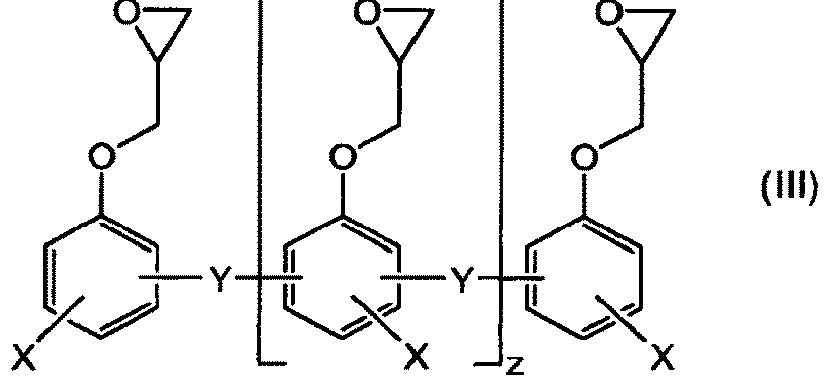
- Dabei steht der Rest X für ein Wasserstoffatom oder für eine Methylgruppe. Der Rest Y steht für -CH2- oder für einen Rest der Formel (IV).

- Weiterhin steht der Index z für einen Wert von 0 bis 7, insbesondere für einen Wert von ≥ 3.
- Insbesondere handelt es sich hierbei um Phenol- oder Kresol-Novolake (Y steht für -CH2-).
- Derartige Epoxidharze sind unter dem Handelsnamen EPN oder ECN sowie Tactix® 556 von Huntsman International, LLC, USA, oder unter der Produktreihe D.E.N.™ von Dow Chemical Company, USA, kommerziell erhältlich.
- Bevorzugt stellt das Epoxidharz A ein Epoxid-Festharz der Formel (I) dar. In einer ebenfalls bevorzugten Ausführungsform enthält die hitzehärtende Epoxidharzzusammensetzung sowohl mindestens ein Epoxid-Festharz der Formel (I) als auch mindestens ein Epoxid-Flüssigharz der Formel (II).
- Der Anteil von Epoxidharz A beträgt vorzugsweise 2 bis 90 Gew.-%, insbesondere 5 bis 70 Gew.-%, bevorzugt 10 bis 60 Gew.-%, bezogen auf das Gesamtgewicht des härtbaren Strukturklebstoffs.
- Der Härter B für Epoxidharze wird durch erhöhte Temperatur aktiviert. Bevorzugt handelt es sich beim Härter B um einen Härter, ausgewählt aus der Gruppe bestehend aus Dicyandiamid, Guanamine, Guanidine, Aminoguanidine und deren Derivate; substituierte Harnstoffe, insbesondere 3-(3-Chlor-4-methylphenyl)-1,1-dimethylharnstoff (Chlortoluron), oder Phenyl- Dimethylharnstoffe, insbesondere p-Chlorphenyl-N,N-dimethylharnstoff (Monuron), 3-Phenyl-1,1-dimethylharnstoff (Fenuron), 3,4-Dichlorphenyl-N,N-dimethylharnstoff (Diuron), sowie Imidazole und Amin-Komplexe.
- Besonders bevorzugt als Härter B ist Dicyandiamid, insbesondere in Kombination mit einem substituierten Harnstoff. Der Vorteil der Kombination von Dicyandiamid mit einem substituierten Harnstoff liegt in der dadurch erzielten beschleunigten Aushärtung der Zusammensetzung.
- Der Anteil des Härters B beträgt vorzugsweise 0.05 bis 8 Gew.-%, insbesondere 0.1 bis 6 Gew.-%, bevorzugt 0.2 bis 5 Gew.-%, bezogen auf das Gesamtgewicht des härtbaren Strukturklebstoffs.
- Der Begriff "Härter" schliesst im vorliegenden Dokument auch Katalysatoren und katalytisch wirkende Verbindungen mit ein. Dem Fachmann ist in diesem Fall klar, dass beim Einsatz eines Katalysators oder einer katalytisch wirkenden Verbindung als Härter B, der Anteil der Härters B am gesamten härtbaren Strukturklebstoff im unteren Bereich des angegebenen Wertebereichs liegt.
- Zusätzlich kann die Epoxidharzzusammensetzung mindestens ein Schlagzähigkeitsmodifikator umfassen.
- Unter einem "Schlagzähigkeitsmodifikator" wird in diesem Dokument ein Zusatz eines organischen Polymers zu einer Epoxidharzmatrix verstanden, der bereits in geringen Mengen, d.h. von typischerweise zwischen 0.1 und 20 Gew.-%, eine deutliche Zunahme der Zähigkeit bewirkt und somit in der Lage ist, höhere Schlag- oder Stossbeanspruchung aufzunehmen, bevor die Matrix einreisst oder bricht.
- Als Schlagzähigkeitsmodifikatoren eignen sich insbesondere reaktive Flüssigkautschuke auf Basis von Nitrilkautschuk oder Derivate von Polyetherpolyol-Polyurethanen, Core-Shell Polymere und ähnliche dem Fachmann bekannte Systeme.
- Geeignete Schlagzähigkeitsmodifikatoren sind als Schlagzähigkeitsmodifikatoren D beschrieben in der europäischen Patentanmeldung mit der Anmeldenummer
EP08168009.2 - Der härtbare Strukturklebstoff kann weitere Bestandteile enthalten, wie sie üblicherweise in härtbaren Strukturklebstoffen eingesetzt werden.
- Insbesondere enthält der härtbare Strukturklebstoff zusätzlich mindestens einen Füllstoff. Bevorzugt handelt es sich hierbei um Glimmer, Talk, Kaolin, Wollastonit, Feldspat, Syenith, Chlorit, Bentonit, Montmorillonit, Calciumcarbonat (gefällt oder gemahlen), Dolomit, Quarz, Kieselsäuren (pyrogen oder gefällt), Cristobalit, Calciumoxid, Aluminiumhydroxid, Magnesiumoxid, Keramikhohlkugeln, Glashohlkugeln, organische Hohlkugeln, Glaskugeln, Farbpigmente. Als Füllstoff sind sowohl die organisch beschichteten als auch die unbeschichteten kommerziell erhältlichen und dem Fachmann bekannten Formen gemeint. Ein weiteres Beispiel sind funktionalisierte Alumoxane, wie sie z. B. in
-
US 6,322,890 beschrieben sind und deren Inhalt hiermit durch Bezugnahme eingeschlossen wird. - Vorteilhaft beträgt der Anteil des Füllstoffs 1 bis 60 Gew.-%, vorzugsweise 5 bis 50 Gew.-%, insbesondere 10 bis 35 Gew.-%, bezogen auf das Gewicht des gesamten härtbaren Strukturklebstoffs.
- Als weitere Bestandteile umfasst der härtbare Strukturklebstoff insbesondere auch Thixothropierungsmittel wie beispielsweise Aerosile oder Nanoclays, Zähigkeitsmodifikatoren, Reaktivverdünner sowie weitere dem Fachmann bekannte Bestandteile.
- Typischerweise enthält die Zusammensetzung kein chemisches Treibmittel oder sonst ein Mittel, welches zu einer Schäumung der Zusammensetzung führt.
- Meist bevorzugt handelt es sich beim härtbaren Strukturklebstoff um eine einkomponentige, hitzehärtende Epoxidharzzusammensetzung.
- Die Zusammensetzung weist mindestens ein chemisch vernetztes Elastomer auf, welches als durchdringendes Polymernetzwerk im Strukturklebstoff vorliegt.
- Das chemisch vernetzte Elastomer wird dadurch in die Zusammensetzung eingebracht, dass elastomeraufbauende Komponenten mit dem härtbaren Strukturklebstoff vermischt und dann in der Mischung vernetzt werden, sodass ein durchdringendes Polymernetzwerk im Strukturklebstoff entsteht.
- Als elastomeraufbauende Komponenten können dabei beliebige Komponenten eingesetzt werden, die in der Mischung mit dem härtbaren Strukturklebstoff kontrolliert zu einem Elastomer vernetzt werden können, ohne dass dabei der härtbare Strukturklebstoff in seiner Funktion beeinträchtigt wird.
- Insbesondere sind die elastomeraufbauenden Komponenten ausgewählt aus der Gruppe bestehend aus
- mindestens einem natürlichen oder synthetischen Kautschuk sowie mindestens einem Vernetzer für Kautschuk; und
- mindestens einem Polyisocyanat sowie mindestens einem Polyol.
- Neben natürlichem Kautschuk, also Polyisopren, eignen sich typischerweise synthetische Kautschuke wie Styrol-Butadien-Kautschuk, Polybutadien-Kautschuk, Acrylnitril-Butadien-Kautschuk, insbesondere mit einem Acrylnitrilanteil von ≥ 25 mol-%, Chloropren-Kautschuk und Ethylen-Propylen-DienKautschuk.
- Die Vernetzung kann dabei mit Schwefel, radikalisch oder auf eine andere, dem Fachmann bekannte Art und Weise, erfolgen.
- Weiterhin können die elastomeraufbauenden Komponenten Polyisocyanate und Polyole sein, wie sie dem Fachmann bestens bekannt sind. Insbesondere handelt es sich bei den Polyisocyanaten um handelsübliche Diisocyanate wie beispielsweise Diphenylmethandiisocyanat (MDI), Toluylendiisocyanat (TDI), 1,6-Hexamethylendiisocyanat (HDI) oder 1-Isocyanato-3,3,5-trimethyl-5-isocyanatomethyl-cyclohexan (IPDI).
- Bei den Polyolen handelt es sich insbesondere um polymere Polyole, insbesondere di- oder trifunktionelle Polyole. Als polymere Polyole eignen sich typischerweise Polyetherpolyole, Polyesterpolyole, Polycarbonatpolyole sowie Mischungen dieser Polyole. Insbesondere weisen die polymeren Polyole ein Molekulargewicht im Bereicht von 500 bis 5000 g/mol auf.
- Bei der Herstellung der Zusammensetzung, wird der härtbare Strukturklebstoff mit elastomeraufbauenden Komponenten vermischt bis eine homogene Mischung erhalten wird. Umfasst der härtbare Strukturklebstoff als Epoxidharz A ein Epoxid-Festharz, erfolgt das Vermischen bei einer Temperatur über der Glasübergangstemperatur Tg des Epoxid-Festharzes. Handelt es sich beim härtbaren Strukturklebstoff um eine hitzehärtende Epoxidharzzusammensetzung, kann diese vor der Zugabe des Härters B mit den elastomeraufbauenen Komponenten vermischt werden. Dadurch kann die Temperatur beim Vermischen bis oder sogar über die Aushärtungstemperatur der hitzehärtenden Epoxidharzzusammensetzung eingestellt werden, ohne dass es zu einer Aushärtung des Strukturklebstoffs kommt. Bei höheren Temperaturen wird in der Regel eine effizientere Vermischung erreicht.
- Nachdem eine homogene Mischung erhalten wurde, erfolgt die Vernetzung der elastomeraufbauenden Komponenten, sodass sie ein Elastomer bilden, welches als durchdringendes Polymernetzwerk im Strukturklebstoff vorliegt.
- Der Anteil an chemisch vernetztem Elastomer beträgt vorzugsweise 1 bis 40 Gew.-%, insbesondere 10 bis 20 Gew.-%, bezogen auf das Gesamtgewicht der Zusammensetzung.
- In einer bevorzugten Ausführungsform der vorliegenden Erfindung, wird das chemisch vernetzte Elastomer aus Bestandteilen des härtbaren Strukturklebstoffs aufgebaut.
- In dieser Ausführungsform weist die Zusammensetzung ein chemisch vernetztes Elastomer auf, welches als durchdringendes Polymernetzwerk im Strukturklebstoff vorliegt, wobei dieses aufgebaut ist aus Epoxidharz A und mindestens einem zusätzlichen Härter H für Epoxidharze.
- Der Härter H ist ein Molekül oder ein Polymer, welches mit Epoxidgruppen reaktive funktionelle Gruppen aufweist, wobei er insbesondere eine mittlere Funktionalität von > 2 bis 5 und ein mittleres Äquivalenzgewicht von 40 bis 2000 g/Eq aufweist. Als Funktionalität wird hierbei die Funktionalität gegenüber Epoxidgruppen verstanden.
- Weiterhin liegt die Aktivierungstemperatur des Härters H unterhalb der Aktivierungstemperatur des Härters B, welcher vorhergehend beschrieben ist. Vorzugsweise liegt die Aktivierungstemperatur des Härters H mindestens 10°C, insbesondere mindestens 20°C, bevorzugt mindestens 30°C, unterhalb der Aktivierungstemperatur des Härters B.
- Ferner liegt das stöchiometrische Verhältnis der Summe der reaktiven Gruppen von Härter H und Härter B zu den Epoxidgruppen des Epoxidharzes A im Bereich von ≥ 0.9:1.
- Beim Härter H handelt es sich um ein Molekül oder um ein Polymer, welches mit Epoxidgruppen reaktive funktionelle Gruppen aufweist. Typischerweise handelt es sich um ein Polymer, wobei dieses Polymer insbesondere ausgewählt ist aus der Gruppe der bestehend aus Polyolefin, Polyether, Polyester, Fettsäure, Fettsäureamid und Acrylnitril-Butadien-Kautschuk mit einem Acrylnitrilanteil von ≥ 25 mol-%.
- Für die vorliegende Erfindung ist es wichtig, dass der Härter H ein Grundgerüst aufweist, welches sich nicht von der übrigen Zusammensetzung, insbesondere also vom Epoxidharz A entmischt, so wie dies bekannte Elastomere, welche üblicherweise als Schlagzähigkeitsmodifikatoren zu Epoxidharzzusammensetzungen zugegeben werden, tun. Dies wäre beispielsweise der Fall bei Acrylnitril-Butadien-Kautschuk mit einem geringen Acrylnitrilanteil von insbesondere unter 25 mol-%.
- Typischerweise sind derartige Härter H flexibilisierend.
- Bei den mit Epoxidgruppen reaktiven funktionellen Gruppen des Härters H handelt es sich insbesondere um Amino-, Carboxyl-, Carboxylamid-, Hydroxyl- oder Anhydridgruppen. Vorzugsweise handelt es sich um Amino- oder Carboxylgruppen oder um phenolische Hydroxylgruppen, bevorzugt um Amino- oder Carboxylgruppen. Carboxylgruppen sind besonders bevorzugt, da die Zusammensetzung dann nach der Vernetzung mit dem Härter H, jedoch vor der Vernetzung mit dem Härter B, eine bessere Lagerstabilität aufweist. Der Grund dafür liegt darin, dass umgesetzte Amine, welche somit als tertiäre Amine in der Zusammensetzung vorliegen, die Homopolymerisation der Epoxidgruppen katalysieren können.
- Die mittlere Funktionalität des Polymers liegt im Bereich von > 2 bis 5, insbesondere von 2.5 bis 5, bevorzugt von 3 bis 5. Das mittlere Äquivalenzgewicht des Polymers liegt im Bereich von 40 bis 1000 g/Eq insbesondere von 40 bis 1000, bevorzugt von 50 bis 800. Als Äquivalenzgewicht wird hierbei das Verhältnis des Molekulargewichts des gesamten Polymers, d.h. des Härters H, zur seiner Funktionalität, d.h. zur Anzahl der mit Epoxidgruppen reaktiven funktionellen Gruppen, bezeichnet
- Meist bevorzugt handelt es sich beim Härter H um Diamine wie 4,9-Dioxadodecan-1,12-diamin oder Polyetherpolyamine, wie sie beispielsweise unter dem Handelsnamen Jeffamine®, insbesondere als Jeffamine® D-230 oder T-403, kommerziell erhältlich sind von Huntsman International LLC, USA, oder um Dimer- oder Trimerfettsäuren, wie sie beispielsweise unter dem Handelsnamen Pripol™, insbesondere Pripol™ 1040, kommerziell erhältlich sind von Croda International PLC, England, erhältlich sind.
- Der Härter B, welcher auch in dieser bevorzugten Ausführungsform der erfindungsgemässen Zusammensetzung eingesetzt wird, ist bereits vorhergehend beschriebenen worden.
- Insbesondere liegt das stöchiometrische Verhältnis der reaktiven Gruppen von Härter H zu den reaktiven Gruppen von Härter B im Bereich von ≥ 1:1.
- Wesentlich ist für die erfindungsgemässe Zusammensetzung, dass sie als Formgedächtnis-Material ausgebildet ist, welches eine möglichst hohe Formstabilität in der temporären Form und ein möglichst vollständiges Rückstellvermögen aufweist. Konkret bedeutet dies, dass sich die erfindungsgemässe Zusammensetzung für eine möglichst lange Zeitdauer, typischerweise für länger als 6 Monate, in der temporären Form zu halten vermag und dass sich die Zusammensetzung bei Bedarf, durch Erwärmen über die Glasübergangstemperatur Tg der Zusammensetzung, vollständig ihre ursprüngliche Form wieder annimmt. Ein genügendes Rückstellvermögen ist typischerweise gegeben, wenn ein Probekörper aus einer erfindungsgemässen Zusammensetzung mit einer Höhe im Bereich von 5 bis 10 mm in seiner Höhe um 50% verformt wird und bei Bedarf wieder auf 80 bis 100% der ursprünglichen Höhe zurückgestellt werden kann.
- Bei der bevorzugten Ausführungsform der vorliegenden Erfindung, wo die Zusammensetzung ein chemisch vernetztes Elastomer aufweist, welches aufgebaut ist aus Epoxidharz A und mindestens einen Härter H für Epoxidharze, bedeutet dies, dass die Vernetzung des Epoxidharzes A mit dem Härter H diese Eigenschaften herbeiführen muss.
- Hingegen ist darauf zu achten, dass die Vernetzung der restlichen Epoxidgruppen des Epoxidharzes A mit dem Härter B eine genügende Adhäsion des Strukturklebstoffs herbeiführt. Idealerweise beträgt in dieser Ausführungsform der Anteil der Härters H an der Zusammensetzung nur gerade soviel, dass ein Formgedächtnis-Material mit den besagten Eigenschaften erhalten wird, damit so viele Epoxidgruppen des Epoxidharzes A wie möglich, für die Aushärtung mit dem Härter B, also für den Aufbau der Adhäsion, zur Verfügung stehen.
- Die Zusammensetzung, welche die bevorzugte Ausführungsform darstellt, wird hergestellt in einem Verfahren umfassend die Schritte:
- Mischen des Epoxidharzes A mit mindestens einem Härter B;
- Zugabe und Einmischen eines Härters H;
- Umsetzen des Epoxidharzes A mit dem Härter H;
oder - Mischen des Epoxidharzes A mit mindestens einem Härter H und einem Härter B;
- Umsetzen des Epoxidharzes A mit dem Härter H bei einer Temperatur unterhalb der Aktivierungstemperatur des Härters B.
- Insbesondere handelt es sich beim Härter H um einen Härter, welcher bei Raumtemperatur oder bei einer deutlich tieferen Temperatur als Härter B mit dem Epoxidharz reagiert, wodurch zur Herstellung der erfindungsgemässen Zusammensetzung, also eines Formgedächtnis-Materials keine oder nur wenig Energie in Form von Wärme zugeführt werden muss.
- Ein weiterer Aspekt betrifft einen Formkörper, welcher einer reversiblen Formgebung unterzogen wurde, wobei die Formgebung die Schritte umfasst:
- 1. a) Erwärmen einer Zusammensetzung, wie sie vorhergehend beschrieben worden ist, auf eine Temperatur oberhalb ihrer Glasübergangstemperatur Tg;
- 2. b) Verformen der Zusammensetzung, unter Spannung des chemisch vernetzten Elastomers;
- 3. c) Abkühlen der verformten Zusammensetzung unter ihre Glasübergangstemperatur Tg.
-
Figur 1 zeigt schematisch die Herstellung eines Formkörpers aus einer Zusammensetzung auf der Basis einer Epoxidharzzusammensetzung, wie sie vorhergehend beschrieben wurde. - Dabei liegt die feste Zusammensetzung 1 in ihrem Ausgangszustand Z1 in der ursprünglichen Form vor, in welcher sie beispielsweise bei ihrer Herstellung gebracht wurde. In einem ersten Schritt wird die Zusammensetzung dann um eine Temperatur ΔT1 auf eine Temperatur erwärmt, welche über ihrer Glasübergangstemperatur Tg liegt, jedoch, im Fall einer hitzehärtenden Epoxidharzzusammensetzung, unterhalb ihrer Aushärtungstemperatur. Befindet sich die Zusammensetzung in diesem Zustand Z2, wird sie unter Einwirkung einer Kraft F in ihre temporäre, noch verformbare Form 2 gebracht. In dieser temporären, noch verformbaren Form, wie sie in Zustand Z3 dargestellt ist, liegt das chemisch vernetzte Elastomer in gespannter Form vor. Die Zusammensetzung wird in dieser temporären Form gehalten und die Temperatur der Zusammensetzung wird wieder um die Temperatur ΔT1 auf eine Temperatur erniedrigt, welche unterhalb ihrer Glasübergangstemperatur Tg liegt. Dabei verfestigt sich die Zusammensetzung und liegt nun fest in ihrer temporären Form 3 vor, so wie es in Zustand Z4 gezeigt ist. In diesem Zustand als Formkörper ist die Zusammensetzung lagerstabil und kann weiter verarbeitet werden. So kann der Formkörper gestanzt oder geschnitten werden und/oder insbesondere an einem Träger angebracht oder in einem zu verstärkenden Hohlraum eines strukturellen Bauteils angeordnet werden.
- Das Verformen der Zusammensetzung, bei welcher sie in ihre temporäre Form gebracht wird, erfolgt typischerweise durch Pressen, Walzen, Ziehen und dergleichen. Wichtig ist beim Verformen, dass die Zusammensetzung im verformten Zustand auf eine Temperatur unterhalb ihrer Glasübergangstemperatur Tg abgekühlt werden kann, damit sie in ihrer temporären Form verbleibt.
- In einem weiteren Aspekt betrifft die vorliegende Erfindung ein Verstärkungselement zur Verstärkung in Hohlräumen von strukturellen Bauteilen umfassend einen Träger, an welchem ein Formkörper gemäss vorhergehender Beschreibung angebracht ist.
- Dieser Träger kann aus beliebigen Materialien bestehen. Insbesondere besteht der Träger aus einem aus einem Kunststoff, aus einem Metall oder aus einer Kombination von Kunststoff und Metall.
- Bevorzugte Kunststoffe sind Polyurethane, Polyamide, Polyester und Polyolefine und Polyolefin-Copolymere, insbesondere hochtemperaturbeständige Polymere wie Poly(phenylenether), Polysulfone oder Polyethersulfone. Meist bevorzugte Kunststoffe sind Polyamide (PA) wie PA6 oder PA66, Polyethlyen und Polypropylen sowie Polystyrol und Copolymere wie Acrylnitril-Butadien-Styrol (ABS). Bevorzugte Metalle sind Aluminium, Stahl, Nickel und Legierungen dieser Metalle. Das Metall kann weiterhin unbehandelt vorliegen oder es kann mit geeigneten Mitteln, beispielsweise zur Verhinderung von Korrosion oder zur Verbesserung der Haftung vorbehandelt sein.
- Der Träger kann weiterhin einen beliebigen Aufbau und eine beliebige Struktur aufweisen. Es kann beispielsweise massiv, hohl oder geschäumt sein oder eine gitterartige Struktur aufweisen. Die Oberfläche des Trägers kann typischerweise glatt, rau oder strukturiert sein.
- Der Träger kann, zusätzlich zur seiner Funktion als Träger für die Zusammensetzung bzw. dem aus ihr hergestellten Formteil, zur strukturellen Verstärkung oder zur Abdichtung des Bauteils oder auch zur Geräuschdämmung beitragen.
- Der Träger kann weiterhin mindestens ein Befestigungsmittel, insbesondere einen Clip, zur Befestigung und Platzierung des Verstärkungselements in einem Hohlraum aufweisen. Die Befestigung des Verstärkungselements mit einem Clip eignet sich insbesondere für Anwendungen, bei welchen die gesamte Oberfläche des Bauteils, also auch die Hohlrauminnenwand, beispielsweise für eine Tauchlackierung erreichbar sein muss. In solchen Fällen ist eine Befestigung beispielsweise durch Verkleben nicht geeignet, da der Lack die Stelle der Verklebung nicht erreichen kann.
- Meist bevorzugt besteht der Träger aus einem Kunststoff, welcher mit einem Metall beschichtet ist. Als Kunststoff und als Metall sind dabei die vorhergehend beschriebenen Materialien bevorzugt.
- Das Metall, mit welchem der Kunststoff beschichtet ist, kann dabei auf beliebige Art und Weise am Kunststoff befestigt sein. Beispielsweise erfolgt die Befestigung durch mechanische Befestigungsmittel wie Nägel, Schrauben, Nieten, mechanischen Clips, Klemmen, Bördeln und dergleichen, oder durch Verkleben des Metalls mit dem Kunststoff. Weiterhin kann das Metall auch mittels Kunststoffgalvanisierung auf den Kunststoff aufgetragen worden sein. Meist bevorzugt beträgt die Schichtdicke der Metallschicht auf dem Kunststoffträger 0.03 bis 1.5 mm.
- Der Träger aus Kunststoff, welcher mit einem Metall beschichtet ist, weist gegenüber einem reinen Metallträger den Vorteil auf, dass er einerseits leichter ist und dass er andererseits, durch die Eigenschaften des Kunststoffs wie die Wahl des Materials und dessen Verarbeitung, in seinen mechanischen Eigenschaften und in seiner Ausgestaltung sehr breit variiert werden kann. Der Vorteil der Metallbeschichtung gegenüber einem reinen Kunststoffträger ist, dass die Metalle in der Regel haftfreundlicher sind. Ein weiterer Vorteil der Metallbeschichtung ist, dass bei hitzehärtenden Strukturklebstoffen die Metallschicht sehr lokal und effizient durch Induktion erwärmt werden kann.
-
Figur 2 zeigt einen Träger 5 aus einem Kunststoff, welcher mit einem Metall 8 beschichtet ist. Das Metall ist dabei mit Nägeln 9 am Träger befestigt. Auf der Metallschicht befindet sich ein Formkörper 3, bestehend aus einer Zusammensetzung in ihrem temporären Zustand. -
Figur 3 zeigt schematisch ein Verstärkungselement, bestehend aus einem Träger 5, an welchem ein Formkörper 3 aus einer Zusammensetzung mit hitzehärtender Epoxidharzzusammensetzung als Strukturklebstoff und chemisch vernetztem Elastomer in ihrer temporären Form, angebracht ist, in seinem Ausgangszustand Z4. In einem ersten Schritt wird der Formkörper 3 dann um eine Temperatur ΔT1 auf eine Temperatur erwärmt, welche über der Glasübergangstemperatur Tg der Zusammensetzung liegt, wobei sich das Elastomer entspannt und zu einer Verformung des Formkörpers bzw. der Zusammensetzung 1 in ihre ursprüngliche Form führt. Dies entspricht Zustand Z5 inFigur 3 . Danach wird die Temperatur weiter um ΔT2 auf eine Temperatur erhöht, bei welcher die Zusammensetzung aushärtet. Die ausgehärtete Zusammensetzung 4 ist in Zustand Z6 gezeigt. - Die Temperaturerhöhung, welche zur Verformung des Formkörpers führt, und die Temperaturerhöhung zur Aushärtung des Strukturklebstoffs, müssen nicht zwingend zweistufig verlaufen. Es ist durchaus möglich, die beiden Schritte durch einen stetigen Temperaturanstieg nacheinander ablaufen zu lassen.
- Weiterhin umfasst die Erfindung die Verwendung eines Verstärkungselements, wie es vorhergehend beschrieben wurde, zur Verstärkung in Hohlräumen von strukturellen Bauteilen. Vorzugsweise werden derartige strukturelle Bauteile in Karosserien und/oder Rahmen von Transport- und Fortbewegungsmitteln, insbesondere von Fahrzeugen zu Wasser oder zu Land oder von Luftfahrzeugen, eingesetzt. Bevorzugt umfasst die Erfindung die Verwendung eines Verstärkungselements in Karosserien oder Rahmen von Automobilen, Lastkraftwagen, Eisenbahnwagen, Booten, Schiffen, Hubschraubern und Flugzeugen, meist bevorzugt in Automobilen.
- Ein weiterer Aspekt betrifft ein Verfahren zur Verstärkung in Hohlräumen von strukturellen Bauteilen umfassend die Schritte:
- a') Platzieren eines Verstärkungselements gemäss vorhergehender Beschreibung in den Hohlraum eines strukturellen Bauteils;
- b') Erwärmen des Formkörpers 3 auf dem Verstärkungselement auf eine Temperatur oberhalb der Glasübergangstemperatur Tg der Zusammensetzung, wodurch der Formkörper in seine Form vor der Formgebung, also in die ursprüngliche Form, zurückgeht;
- c') Aushärten des härtbaren Strukturklebstoffs.
- In einer Ausführungsform des beschriebenen Verfahrens zur Verstärkung in Hohlräumen von strukturellen Bauteilen, bei welchem die Massgabe gilt, dass der Träger des Verstärkungselements aus einem durch Induktion erwärmbaren Metall oder aus einem Material besteht, welcher mit einem durch Induktion erwärmbaren Metall beschichtet ist, und mit der Massgabe, dass der härtbare Strukturklebstoff eine hitzehärtender Strukturklebstoff ist, werden die Schritte b') und c') durch Induktion, das heisst durch ein elektromagnetisches Wechselfeld einer Induktionsspule, bewirkt.
-
Figur 4 zeigt analog zuFigur 3 schematisch die Verstärkung in einem Hohlraum eines strukturellen Bauteils 6, wobei im Inneren des strukturellen Bauteils ein Verstärkungselement, bestehend aus einem Träger 5 und mehreren Formkörpern 3 aus einer Zusammensetzung mit hitzehärtendem Strukturklebstoff und chemisch vernetztem Elastomer in ihrer temporären Form, angebracht ist. Der Träger des Verstärkungselements ist dabei mit einem Clip 7 am strukturellen Bauteil befestigt. Der Formkörper bzw. die Zusammensetzung liegt dabei in seiner temporären Form vor (Zustand Z4) und wird anschliessend um eine Temperatur ΔT1 auf eine Temperatur erwärmt, welche über der Glasübergangstemperatur Tg der Zusammensetzung liegt. Dabei entspannt sich das Elastomer und führt zu einer Verformung des Formkörpers bzw. der Zusammensetzung 1 in ihre ursprüngliche Form, wodurch der offen gelassene Spalt 10 zwischen Verstärkungselement und Hohlraum geschlossen wird und sich die Zusammensetzung an die Hohlrauminnenwand haftet (Zustand Z5). Nach einer weiteren Temperaturerhöhung um eine Temperatur ΔT2 härtet der hitzehärtende Strukturklebstoff aus.Figur 4 , Zustand Z6, zeigt das verstärkte strukturelle Bauteil mit der ausgehärteten Zusammensetzung 4. -
Figur 5 zeigt ein Verstärkungselement, wie es in einem Hohlraum 10 eines strukturellen Bauteils 6 eingesetzt wird vor der Verformung des Formkörpers bzw. der Zusammensetzung in ihrer temporären Form 3, welche sich auf einem Träger 5 befindet. -
Figur 6 zeigt das Verstärkungselement ausFigur 5 wie es in einem Hohlraum eines strukturellen Bauteils 6 eingesetzt ist, wobei das Formteil bzw. die Zusammensetzung in diesem Fall bereits in seine ursprüngliche Form zurückgegangen ist und an die Innenwände des strukturellen Bauteils 6 haftet. Weiterhin zeigtFigur 6 die ausgehärtete Zusammensetzung 4. Die Form und Struktur der Verstärkungselemente kann gemäss ihrem Einsatzort beliebig gewählt werden. - Weiterhin betrifft die vorliegende Erfindung eine gehärtete Zusammensetzung, wie sie durch einen Härtungsvorgang, insbesondere durch Hitzehärtung, aus einer vorhergehend beschriebenen Zusammensetzung erhältlich ist.
- Im Folgenden sind Ausführungsbeispiele aufgeführt, welche die beschriebene Erfindung näher erläutern sollen. Selbstverständlich ist die Erfindung nicht auf diese beschriebenen Ausführungsbeispiele beschränkt.
- Die Formstabilität des Materials in der temporären Form wurde während 7 Tagen bei Normklima (23°C / 50% Luftfeuchtigkeit) (" Relaxation"), das Rückstellvermögen zur ursprünglichen Form nach 7 Tagen Lagerung bei Normklima bestimmt. Die Dimensionen der ursprünglichen Form der Probekörper misst 10x10x6 mm (LxBxH). Die Höhe in ursprünglicher Form (H0 ) betrug also 6 mm. Durch Pressen bei erhöhter Temperatur und anschliessendem Abkühlen wurden die Probekörper in die temporäre Form mit einer Höhe von 3 mm gebracht (HTemp ), was einer Kompression von 50 % entspricht und somit beim Rückstellvorgang einen Höhengewinn von 100 % erlaubt.
- Die Relaxation ist hier definiert als:

- Das Rückstellvermögen ist bestimmt als:

- Die Beispiele 1 und 2 repräsentiert einen Strukturklebstoff auf Basis einer Epoxidharzzusammensetzung und einem chemisch vernetzen Elastomer, welches aufgebaut ist aus Bestandteilen des Epoxidharzes.
- Die Formulierungen 1 und 2 wurden hergestellt durch Vermischen der Bestandteile gemäss Tabelle 1 in den entsprechenden Gewichtsprozenten mittels Speedmixer bei 40°C.
- Die Formulierungen 3 bis 6 sowie der Referenzschaum Ref wurden hergestellt durch Vermischen der Bestandteile gemäss Tabelle 2 in den entsprechenden Gewichtsprozenten auf einem Doppelschneckenextruder bei einer Temperatur oberhalb der Glasübergangstemperatur Tg des Festharzes bzw. unterhalb der Zersetzungstemperatur des chemischen Treibmittels ( Ref ).
- Bei den Beispielen 5 und 6 wurden die Polyole mit dem Diisocyanat und gegebenenfalls mit dem Katalysator vor dem Einmischen in die jeweilige Formulierung, in einem dem Fachmann bekannten Verfahren, zu einem Isocyanatgruppen aufweisenden Polyurethanpolymer umgesetzt.
- Die hergestellten Formulierungen wurden zu Probekörpern in ihrer ursprünglichen Form mit der Abmessung 10x10x6 mm verarbeitet. Anschliessend wurde das jeweilige Elastomer während einer Stunde bei 90°C chemisch vernetzt.
Tabelle 1 Formulierungen 1 bis 3 und Referenzschaum Ref in Gew.-% sowie Resultate; Ref 1 2 Araldite® GT 7004 a) 85.4 Araldite® GY 250 a) 77.2 60 Dicyandiamid b) 1.6 1.5 1.1 Jeffamine® D-230 a) 13.5 Armeen® CD c) 7.8 Pripol™ 1040 d) 14.2 Bisphenol A e) 21.9 PPh3 e) 2.8 Luvopor® OB f) 3 Aerosil® g) 10 Relaxation [%] - 5 0 Rückstellvermögen [%] - 100 100 a) erhältlich von Huntsman Advanced Materials (Schweiz); b) erhältlich von AlzChem GmbH, Deutschland; c) erhältlich von Akzo Nobel GmbH, Schweden; d) erhältlich von Croda Inc., UK; e) erhältlich von Fluka, Schweiz; f) erhältlich von Lehmann&Voss&Co, Deutschland; g) erhältlich von Wacker Chemie AG, Deutschland. Tabelle 2 Formulierung 3 bis 6 in Gew.-% sowie Resultate; 3 4 5 6 Araldite® GT 7004 73 63 64 64 Dicyandiamid 1.5 1.2 1.2 1.2 Nipol® 1072 (Kautschuk) a) 20 30 Dibenzoylperoxid b) 0.6 0.6 Desmophen® 3060 BS (Polyol) c) 14 Acclaim® 4200 (Polyol) c) 14 24.37 Takenate® 500 (Polyisocyanat) d) 4 Desmodur® 3400 (Polyisocyanat) c) 7.7 Dibutylzinndilaurat 0.03 Purmol® 13 e) 1.6 1.6 Aerosil® 5 5 1 1 Relaxation [%] 0 0 0 0 Rückstellvermögen [%] 80 95 75 50 a) erhältlich von Zeon Chemicals, USA; b) erhältlich von Arkema, Frankreich; c) erhältlich von Bayer MaterialScience, Deutschland; d) erhältlich von Mitsui Chemicals, Japan; e) erhältlich von Zeochem AG, Schweiz. -
- 1
- Zusammensetzung in der ursprünglichen Form
- 2
- Zusammensetzung (verformbar)
- 3
- Formkörper (temporäre Form)
- 4
- Ausgehärtete Zusammensetzung
- 5
- Träger
- 6
- strukturelles Bauteil
- 7
- Clip
- 8
- Metallschicht
- 9
- Nagel
- 10
- Spalt
- Z1
- Zustand der Zusammensetzung in ursprünglicher Form
- Z2
- Zustand der verformbaren Zusammensetzung
- Z3
- Zustand der Zusammensetzung im temporären Zustand (Formkörper)
- Z4
- Zustand der ausgehärteten Zusammensetzung
- ΔT1
- Temperaturunterschied zwischen Temperatur unterhalb von Tg der Zusammensetzung und Temperatur oberhalb des Tg der Zusammensetzung
- ΔT2
- Temperaturunterschied zwischen Temperatur oberhalb von Tg der Zusammensetzung und der Aushärtungstemperatur der Zusammensetzung
Claims (13)
- Verwendung einer Zusammensetzung umfassendi) mindestens einen härtbaren Strukturklebstoff; sowieii) mindestens ein chemisch vernetztes Elastomer;dadurch gekennzeichnet, dass das chemisch vernetzte Elastomer als durchdringendes Polymernetzwerk im Strukturklebstoff vorliegt, als Formgedächtnis-Material.
- Verwendung der Zusammensetzung gemäss Anspruch 1, dadurch gekennzeichnet, dass der härtbare Strukturklebstoff eine hitzehärtende Epoxidharzzusammensetzung, umfassend mindestens ein Epoxidharz A und mindestens einen Härter B für Epoxidharze, welcher durch erhöhte Temperatur aktiviert wird, ist.
- Verwendung der Zusammensetzung gemäss einem der vorhergehenden Ansprüche, erhältlich durch- Mischen von mindestens einem härtbaren Strukturklebstoff mit elastomeraufbauenden Komponenten;- Vernetzen der elastomeraufbauenden Komponenten in der Mischung zu einem Elastomer, sodass ein durchdringendes Polymernetzwerk im Strukturklebstoff entsteht.
- Verwendung der Zusammensetzung gemäss Anspruch 3, dadurch gekennzeichnet, dass die elastomeraufbauenden Komponenten ausgewählt sind aus der Gruppe bestehend aus- mindestens einem natürlichen oder synthetischen Kautschuk sowie mindestens einem Vernetzer für Kautschuk; und- mindestens einem Polyisocyanat sowie mindestens einem Polyol.
- Verwendung der Zusammensetzung gemäss Anspruch 2, dadurch gekennzeichnet, dass das chemisch vernetzte Elastomer, welches als durchdringendes Polymernetzwerk im Strukturklebstoff vorliegt, aufgebaut ist aus Epoxidharz A und mindestens einem zusätzlichen Härter H für Epoxidharze,- wobei der Härter H ein Molekül oder ein Polymer ist, welches mit Epoxidgruppen reaktive funktionelle Gruppen aufweist, wobei es eine mittlere Funktionalität von > 2 bis 5 und ein mittleres Äquivalenzgewicht von 40 bis 2000 g/Eq aufweist;- wobei die Aktivierungstemperatur des Härters H unterhalb der Aktivierungstemperatur des Härters B liegt; und- wobei das stöchiometrische Verhältnis der Summe der reaktiven Gruppen von Härter H und Härter B zu den Epoxidgruppen des Epoxidharzes A im Bereich von ≥ 0.9:1 liegt.
- Verwendung der Zusammensetzung gemäss Anspruch 5, dadurch gekennzeichnet, dass das stöchiometrische Verhältnis der reaktiven Gruppen von Härter H zu den reaktiven Gruppen von Härter B im Bereich von ≥ 1:1 liegt.
- Verwendung der Zusammensetzung gemäss Anspruch 5, dadurch gekennzeichnet, dass der Härter H ein Amino- oder Carboxylgruppen aufweisendes Polymer ist, wobei das Polymer ausgewählt ist aus der Gruppe der bestehend aus Polyolefin, Polyether, Polyester, Fettsäure, Fettsäureamid und Acrylnitril-Butadien-Kautschuk mit einem Acrylnitrilanteil von ≥ 25 mol-%.
- Verwendung der Zusammensetzung gemäss Anspruch 7, dadurch gekennzeichnet, dass der Härter H ein Polyetherpolyamin ist.
- Verwendung gemäss Anspruch 5 dadurch gekennzeichnet, dass die Zusammensetzung erhältlich ist durch ein Verfahren umfassend die Schritte:- Mischen des Epoxidharzes A mit mindestens einem Härter B;- Zugabe und Einmischen eines Härters H;- Umsetzen des Epoxidharzes A mit dem Härter H;
oder- Mischen des Epoxidharzes A mit mindestens einem Härter H und einem Härter B;- Umsetzen des Epoxidharzes A mit dem Härter H bei einer Temperatur unterhalb der Aktivierungstemperatur des Härters B. - Zusammensetzung umfassendi) mindestens einen härtbaren Strukturklebstoff; sowieii) mindestens ein chemisch vernetztes Elastomer;wobei dass das chemisch vernetzte Elastomer als durchdringendes Polymernetzwerk im Strukturklebstoff vorliegt dadurch gekennzeichnet, dass der härtbare Strukturklebstoff eine hitzehärtende Epoxidharzzusammensetzung, umfassend mindestens ein Epoxidharz A und mindestens einen Härter B für Epoxidharze, welcher durch erhöhte Temperatur aktiviert wird, ist, unddass das chemisch vernetzte Elastomer, welches als durchdringendes Polymernetzwerk im Strukturklebstoff vorliegt, aufgebaut ist aus Epoxidharz A und mindestens einem zusätzlichen Härter H für Epoxidharze,- wobei der Härter H ein Molekül oder ein Polymer ist, welches mit Epoxidgruppen reaktive funktionelle Gruppen aufweist, wobei es eine mittlere Funktionalität von > 2 bis 5 und ein mittleres Äquivalenzgewicht von 40 bis 2000 g/Eq aufweist;- wobei die Aktivierungstemperatur des Härters H unterhalb der Aktivierungstemperatur des Härters B liegt; und- wobei das stöchiometrische Verhältnis der Summe der reaktiven Gruppen von Härter H und Härter B zu den Epoxidgruppen des Epoxidharzes A im Bereich von ≥ 0.9:1 liegt .
- Zusammensetzung gemäss Anspruch 10, dadurch gekennzeichnet, dass das stöchiometrische Verhältnis der reaktiven Gruppen von Härter H zu den reaktiven Gruppen von Härter B im Bereich von ≥ 1:1 liegt.
- Zusammensetzung gemäss Anspruch 10, dadurch gekennzeichnet, dass der Härter H ein Amino- oder Carboxylgruppen aufweisendes Polymer ist, wobei das Polymer ausgewählt ist aus der Gruppe der bestehend aus Polyolefin, Polyether, Polyester, Fettsäure, Fettsäureamid und Acrylnitril-Butadien-Kautschuk mit einem Acrylnitrilanteil von ≥ 25 mol-%.
- Zusammensetzung gemäss Anspruch 12, dadurch gekennzeichnet, dass der Härter H ein Polyetherpolyamin ist.
Priority Applications (1)
| Application Number | Priority Date | Filing Date | Title |
|---|---|---|---|
| EP11709970.5A EP2553035B2 (de) | 2010-03-26 | 2011-03-25 | Formgedächtnis-Material auf Basis eines Strukturklebstoffs |
Applications Claiming Priority (3)
| Application Number | Priority Date | Filing Date | Title |
|---|---|---|---|
| EP20100158077 EP2368956A1 (de) | 2010-03-26 | 2010-03-26 | Formgedächtnis-Material auf Basis eines Strukturklebstoffs |
| PCT/EP2011/054647 WO2011117402A1 (de) | 2010-03-26 | 2011-03-25 | Formgedächtnis-material auf basis eines strukturklebstoffs |
| EP11709970.5A EP2553035B2 (de) | 2010-03-26 | 2011-03-25 | Formgedächtnis-Material auf Basis eines Strukturklebstoffs |
Publications (3)
| Publication Number | Publication Date |
|---|---|
| EP2553035A1 EP2553035A1 (de) | 2013-02-06 |
| EP2553035B1 EP2553035B1 (de) | 2014-07-09 |
| EP2553035B2 true EP2553035B2 (de) | 2025-06-18 |
Family
ID=42562525
Family Applications (2)
| Application Number | Title | Priority Date | Filing Date |
|---|---|---|---|
| EP20100158077 Withdrawn EP2368956A1 (de) | 2010-03-26 | 2010-03-26 | Formgedächtnis-Material auf Basis eines Strukturklebstoffs |
| EP11709970.5A Active EP2553035B2 (de) | 2010-03-26 | 2011-03-25 | Formgedächtnis-Material auf Basis eines Strukturklebstoffs |
Family Applications Before (1)
| Application Number | Title | Priority Date | Filing Date |
|---|---|---|---|
| EP20100158077 Withdrawn EP2368956A1 (de) | 2010-03-26 | 2010-03-26 | Formgedächtnis-Material auf Basis eines Strukturklebstoffs |
Country Status (7)
| Country | Link |
|---|---|
| US (1) | US8952097B2 (de) |
| EP (2) | EP2368956A1 (de) |
| JP (2) | JP5898173B2 (de) |
| KR (1) | KR20130044229A (de) |
| CN (1) | CN102869742B (de) |
| BR (1) | BR112012024398A2 (de) |
| WO (1) | WO2011117402A1 (de) |
Families Citing this family (15)
| Publication number | Priority date | Publication date | Assignee | Title |
|---|---|---|---|---|
| EP2368955A1 (de) | 2010-03-26 | 2011-09-28 | Sika Technology AG | Formgedächtnis-Material auf Basis eines Strukturklebstoffs |
| GB201012595D0 (en) | 2010-07-27 | 2010-09-08 | Zephyros Inc | Oriented structural adhesives |
| EP2759514A1 (de) | 2013-01-29 | 2014-07-30 | tesa SE | Haftklebemasse enthaltend ein verbundenes Nanopartikelnetzwerk, Verfahren zu ihrer Herstellung sowie die Verwendung derselben |
| EP3024871B1 (de) | 2013-07-26 | 2022-12-07 | Zephyros Inc. | Wärmehärtende haftfolien mit einem faserigen träger |
| US9708441B2 (en) * | 2014-10-06 | 2017-07-18 | Plactis Industry Development Center | Low temperature shape memory thermosetting epoxy, film material and producing method thereof |
| BR112017009818B1 (pt) | 2014-11-14 | 2021-10-26 | Zephyros, Inc | Estrutura defletora multicamada e método para produzir a estrutura defletora multicamada |
| US10683442B2 (en) | 2015-12-17 | 2020-06-16 | Sika Technology Ag | Self-supporting adhesive body for structural bonds |
| EP3421331B1 (de) | 2017-06-29 | 2021-06-16 | Sika Technology Ag | System eines verstärkten strukturelementes eines kraftfahrzeugs |
| EP3466800B1 (de) | 2017-10-06 | 2024-03-13 | Sika Technology Ag | Verstärkungsvorrichtung zur verstärkung eines strukturelementes in einem kraftfahrzeug |
| EP3486146B1 (de) * | 2017-11-15 | 2021-04-14 | Sika Technology Ag | Vorrichtung zur verstärkung und abdichtung eines strukturelementes |
| US11591503B2 (en) | 2018-01-25 | 2023-02-28 | Sika Technology Ag | Shape memory material with improved mechanical properties |
| KR102197833B1 (ko) * | 2019-08-30 | 2021-01-05 | 울산과학기술원 | 열을 이용한 형상기억 접착 구조물 |
| DE102020206619A1 (de) | 2020-05-27 | 2021-12-02 | Tesa Se | Vorvernetzte epoxid-haftklebmassen und klebebänder, welche diese enthalten |
| CN112452369B (zh) * | 2020-11-24 | 2022-03-01 | 东南大学 | 一种磁控的热可塑形状记忆聚合物包裹式加热平台及方法 |
| CN114426674B (zh) * | 2021-12-10 | 2023-02-24 | 哈尔滨理工大学 | 一种基于热固性树脂的增韧高导热填料的制备方法和应用 |
Citations (2)
| Publication number | Priority date | Publication date | Assignee | Title |
|---|---|---|---|---|
| US6388043B1 (en) † | 1998-02-23 | 2002-05-14 | Mnemoscience Gmbh | Shape memory polymers |
| WO2010011705A1 (en) † | 2008-07-23 | 2010-01-28 | 3M Innovative Properties Company | Two-part epoxy-based structural adhesives |
Family Cites Families (33)
| Publication number | Priority date | Publication date | Assignee | Title |
|---|---|---|---|---|
| US3227668A (en) | 1961-09-11 | 1966-01-04 | Atlantic Refining Co | Wax-extended epoxide-ethylene vinyl acetate composition |
| DE3517333A1 (de) | 1985-05-14 | 1986-11-20 | Basf Ag, 6700 Ludwigshafen | Verfahren zur herstellung stabiler dispersionen feinteiliger polyisocyanate und deren verwendung |
| US4766183A (en) | 1986-01-27 | 1988-08-23 | Essex Specialty Products, Inc. | Thermosetting composition for an interpenetrating polymer network system |
| ZA87201B (en) * | 1986-01-27 | 1987-09-30 | Essex Specialty Prod | Thermosetting composition for an interpenetrating polymer network system |
| JPH0662739B2 (ja) * | 1986-04-11 | 1994-08-17 | 東芝ケミカル株式会社 | 封止用樹脂組成物 |
| US5001194A (en) | 1987-12-21 | 1991-03-19 | The Dow Chemical Company | Method of making functionalized polymeric compositions |
| JP2818254B2 (ja) * | 1990-04-13 | 1998-10-30 | セメダイン株式会社 | 樹脂組成物 |
| US5331062A (en) * | 1991-08-28 | 1994-07-19 | The United States Of America As Represented By The Secretary Of The Navy | Polyurethane-epoxy interpenetrating polymer network acoustic damping material |
| JPH09316169A (ja) * | 1996-05-28 | 1997-12-09 | Nissan Motor Co Ltd | 車体補強用エポキシ樹脂系組成物およびその組成物を用いた車体の補強方法 |
| JPH10176159A (ja) | 1996-12-20 | 1998-06-30 | Dainippon Ink & Chem Inc | 形状記憶性接着剤組成物、並びにそれを用いた積層体及び積層体の製造方法 |
| AU6138698A (en) * | 1997-02-04 | 1998-08-25 | Ashland Inc. | Unsaturated polymer polyurethane structural adhesive |
| US6054007A (en) * | 1997-04-09 | 2000-04-25 | 3M Innovative Properties Company | Method of forming shaped adhesives |
| US5965256A (en) * | 1997-10-14 | 1999-10-12 | Minnesota Mining And Manufacturing Company | Protective films and coatings |
| ATE203035T1 (de) | 1997-12-11 | 2001-07-15 | Thomas Abend | Verfahren zur herstellung und verwendung von lagerstabilen latentreaktiven schichten oder pulvern aus oberflächendesaktivierten festen polyisocyanaten und dispersionspolymeren mit funktionellen gruppen |
| US6322890B1 (en) | 1998-03-30 | 2001-11-27 | Wm. Marsh Rice University | Supra-molecular alkylalumoxanes |
| US6077601A (en) | 1998-05-01 | 2000-06-20 | 3M Innovative Properties Company | Coated abrasive article |
| US7005394B1 (en) * | 1998-07-10 | 2006-02-28 | 3M Innovative Properties Company | Tackified thermoplastic-epoxy pressure sensitive adhesives |
| US6387470B1 (en) | 1998-11-05 | 2002-05-14 | Sika Corporation | Sound deadening and structural reinforcement compositions and methods of using the same |
| JP3573033B2 (ja) * | 1999-11-09 | 2004-10-06 | Jfeスチール株式会社 | 樹脂ライニング鋼管 |
| US7429220B2 (en) * | 2001-04-13 | 2008-09-30 | Acushnet Company | Golf balls containing interpenetrating polymer networks |
| WO2002085975A1 (en) * | 2001-04-19 | 2002-10-31 | Diversified Chemical Technologies, Inc. | Composition of acrylated urethane oligomer, epoxy resin and amine hardener |
| DE10150737A1 (de) * | 2001-10-15 | 2003-04-30 | Hilti Ag | Mehrkomponenten-Ortschaumsystem und dessen Verwendung |
| JP2003294329A (ja) | 2002-03-29 | 2003-10-15 | Sanyo Electric Co Ltd | スターリング冷凍機 |
| AU2004212942A1 (en) * | 2003-02-14 | 2004-09-02 | Depuy Spine, Inc. | In-situ formed intervertebral fusion device |
| WO2007070877A2 (en) * | 2005-12-15 | 2007-06-21 | Cornerstone Research Group, Inc. | Shape memory epoxy copolymers |
| EP1964865A4 (de) | 2005-12-09 | 2009-08-26 | Mitsui Chemicals Inc | Olefinpolymer, zusammensetzung davon und klebharz aus einer derartigen zusammensetzung |
| JP5083696B2 (ja) * | 2006-05-02 | 2012-11-28 | 国立大学法人大阪大学 | 形状記憶樹脂 |
| FR2905068B1 (fr) | 2006-08-25 | 2008-10-31 | Oreal | Procede de maquillage des cils et ensemble de conditionnement. |
| DE502006004082D1 (de) | 2006-11-17 | 2009-08-06 | Sika Technology Ag | Polyaldimin enthaltende feuchtigkeitshärtende Heissschmelzklebstoff-Zusammensetzung |
| EP2019027A1 (de) * | 2007-07-27 | 2009-01-28 | Sika Technology AG | Verstärkungselement zur Verstärkung von Hohlräumen von strukturellen Bauteilen |
| EP2182025B1 (de) | 2008-10-31 | 2010-10-06 | Sika Technology AG | Hitzehärtende Epoxidharzzusammensetzungen einsetzbar als Rohbauklebstoff oder Strukturschaum |
| EP2368957A1 (de) | 2010-03-26 | 2011-09-28 | Sika Technology AG | Verstärkungselement zur Verstärkung in Hohlräumen von strukturellen Bauteilen |
| EP2368955A1 (de) * | 2010-03-26 | 2011-09-28 | Sika Technology AG | Formgedächtnis-Material auf Basis eines Strukturklebstoffs |
-
2010
- 2010-03-26 EP EP20100158077 patent/EP2368956A1/de not_active Withdrawn
-
2011
- 2011-03-25 KR KR1020127027266A patent/KR20130044229A/ko not_active Ceased
- 2011-03-25 BR BR112012024398A patent/BR112012024398A2/pt not_active IP Right Cessation
- 2011-03-25 JP JP2013501772A patent/JP5898173B2/ja not_active Expired - Fee Related
- 2011-03-25 WO PCT/EP2011/054647 patent/WO2011117402A1/de not_active Ceased
- 2011-03-25 EP EP11709970.5A patent/EP2553035B2/de active Active
- 2011-03-25 CN CN201180021943.7A patent/CN102869742B/zh active Active
-
2012
- 2012-09-26 US US13/627,502 patent/US8952097B2/en active Active
-
2015
- 2015-12-25 JP JP2015253367A patent/JP6174673B2/ja not_active Expired - Fee Related
Patent Citations (2)
| Publication number | Priority date | Publication date | Assignee | Title |
|---|---|---|---|---|
| US6388043B1 (en) † | 1998-02-23 | 2002-05-14 | Mnemoscience Gmbh | Shape memory polymers |
| WO2010011705A1 (en) † | 2008-07-23 | 2010-01-28 | 3M Innovative Properties Company | Two-part epoxy-based structural adhesives |
Also Published As
| Publication number | Publication date |
|---|---|
| KR20130044229A (ko) | 2013-05-02 |
| JP2013523926A (ja) | 2013-06-17 |
| JP2016056377A (ja) | 2016-04-21 |
| BR112012024398A2 (pt) | 2016-05-24 |
| CN102869742B (zh) | 2015-03-25 |
| WO2011117402A1 (de) | 2011-09-29 |
| CN102869742A (zh) | 2013-01-09 |
| EP2553035A1 (de) | 2013-02-06 |
| US20130186562A1 (en) | 2013-07-25 |
| JP6174673B2 (ja) | 2017-08-02 |
| EP2553035B1 (de) | 2014-07-09 |
| US8952097B2 (en) | 2015-02-10 |
| JP5898173B2 (ja) | 2016-04-06 |
| EP2368956A1 (de) | 2011-09-28 |
Similar Documents
| Publication | Publication Date | Title |
|---|---|---|
| EP2553035B1 (de) | Formgedächtnis-Material auf Basis eines Strukturklebstoffs | |
| EP2553034B2 (de) | Formgedächtnis-Material auf Basis eines Strukturklebstoffs | |
| EP2553036A1 (de) | Verstärkungselement zur verstärkung in hohlräumen von strukturellen bauteilen | |
| EP2183150B2 (de) | Verfahren zur verstärkung in hohlräumen von strukturellen bauteilen | |
| DE602004004501T3 (de) | Epoxidharz Klebstoffzusammensetzung | |
| EP2182025B1 (de) | Hitzehärtende Epoxidharzzusammensetzungen einsetzbar als Rohbauklebstoff oder Strukturschaum | |
| EP2426160B1 (de) | Hitzehärtende Epoxidharzzusammensetzung mit Wasser als Treibmittel | |
| EP3677611B1 (de) | Hitzehärtende epoxidharzzusammensetzung mit tiefer aushärtungstemperatur und guter lagerstabilität | |
| EP1720952A1 (de) | Zweikomponentiger klebstoff zur herstellung von halbzeugen und sandwich-verbundwerkstoffen | |
| EP2337728A1 (de) | Verstärkte struktur eines fahrzeugs | |
| EP3460019B1 (de) | Einkomponentiger hitzehärtender epoxidklebstoff mit verbesserter haftung | |
| EP2756031B1 (de) | Formgedächtnis-material auf basis eines strukturklebstoffs | |
| WO2019081581A1 (de) | Hitzehärtende epoxidharzzusammensetzung mit hoher lagerstabilität | |
| WO2009016109A1 (de) | Verfahren zur herstellung eines sandwichelements | |
| EP3662001B1 (de) | Thermisch expandierbare einkomponentige hitzehärtende epoxidharzzusammensetzung mit hoher standfestigkeit und guter granulierbarkeit | |
| EP2336262A1 (de) | Bördelfalzverklebung | |
| WO2019215119A1 (de) | Epoxidharz basierte kathodische tauchlackierung (ktl) von metallbauteilen als haftvermittler zu pu systemen | |
| EP2261104A1 (de) | Element zur Abdichtung oder Verstärkung eines Hohlraumes und Verfahren zur Einbringung eines solchen Elements in den Hohlraum eines Bauelementes |
Legal Events
| Date | Code | Title | Description |
|---|---|---|---|
| PUAI | Public reference made under article 153(3) epc to a published international application that has entered the european phase |
Free format text: ORIGINAL CODE: 0009012 |
|
| 17P | Request for examination filed |
Effective date: 20121026 |
|
| AK | Designated contracting states |
Kind code of ref document: A1 Designated state(s): AL AT BE BG CH CY CZ DE DK EE ES FI FR GB GR HR HU IE IS IT LI LT LU LV MC MK MT NL NO PL PT RO RS SE SI SK SM TR |
|
| DAX | Request for extension of the european patent (deleted) | ||
| GRAP | Despatch of communication of intention to grant a patent |
Free format text: ORIGINAL CODE: EPIDOSNIGR1 |
|
| INTG | Intention to grant announced |
Effective date: 20131113 |
|
| GRAP | Despatch of communication of intention to grant a patent |
Free format text: ORIGINAL CODE: EPIDOSNIGR1 |
|
| INTG | Intention to grant announced |
Effective date: 20140326 |
|
| GRAS | Grant fee paid |
Free format text: ORIGINAL CODE: EPIDOSNIGR3 |
|
| GRAA | (expected) grant |
Free format text: ORIGINAL CODE: 0009210 |
|
| STAA | Information on the status of an ep patent application or granted ep patent |
Free format text: STATUS: THE PATENT HAS BEEN GRANTED |
|
| RIN1 | Information on inventor provided before grant (corrected) |
Inventor name: GOESSI, MATTHIAS Inventor name: FINTER, JUERGEN |
|
| AK | Designated contracting states |
Kind code of ref document: B1 Designated state(s): AL AT BE BG CH CY CZ DE DK EE ES FI FR GB GR HR HU IE IS IT LI LT LU LV MC MK MT NL NO PL PT RO RS SE SI SK SM TR |
|
| REG | Reference to a national code |
Ref country code: GB Ref legal event code: FG4D Free format text: NOT ENGLISH |
|
| REG | Reference to a national code |
Ref country code: CH Ref legal event code: EP Ref country code: AT Ref legal event code: REF Ref document number: 676600 Country of ref document: AT Kind code of ref document: T Effective date: 20140715 |
|
| REG | Reference to a national code |
Ref country code: IE Ref legal event code: FG4D Free format text: LANGUAGE OF EP DOCUMENT: GERMAN |
|
| REG | Reference to a national code |
Ref country code: DE Ref legal event code: R096 Ref document number: 502011003679 Country of ref document: DE Effective date: 20140821 |
|
| REG | Reference to a national code |
Ref country code: NL Ref legal event code: VDEP Effective date: 20140709 |
|
| REG | Reference to a national code |
Ref country code: LT Ref legal event code: MG4D |
|
| PG25 | Lapsed in a contracting state [announced via postgrant information from national office to epo] |
Ref country code: PT Free format text: LAPSE BECAUSE OF FAILURE TO SUBMIT A TRANSLATION OF THE DESCRIPTION OR TO PAY THE FEE WITHIN THE PRESCRIBED TIME-LIMIT Effective date: 20141110 Ref country code: FI Free format text: LAPSE BECAUSE OF FAILURE TO SUBMIT A TRANSLATION OF THE DESCRIPTION OR TO PAY THE FEE WITHIN THE PRESCRIBED TIME-LIMIT Effective date: 20140709 Ref country code: BG Free format text: LAPSE BECAUSE OF FAILURE TO SUBMIT A TRANSLATION OF THE DESCRIPTION OR TO PAY THE FEE WITHIN THE PRESCRIBED TIME-LIMIT Effective date: 20141009 Ref country code: GR Free format text: LAPSE BECAUSE OF FAILURE TO SUBMIT A TRANSLATION OF THE DESCRIPTION OR TO PAY THE FEE WITHIN THE PRESCRIBED TIME-LIMIT Effective date: 20141010 Ref country code: SE Free format text: LAPSE BECAUSE OF FAILURE TO SUBMIT A TRANSLATION OF THE DESCRIPTION OR TO PAY THE FEE WITHIN THE PRESCRIBED TIME-LIMIT Effective date: 20140709 Ref country code: NO Free format text: LAPSE BECAUSE OF FAILURE TO SUBMIT A TRANSLATION OF THE DESCRIPTION OR TO PAY THE FEE WITHIN THE PRESCRIBED TIME-LIMIT Effective date: 20141009 Ref country code: LT Free format text: LAPSE BECAUSE OF FAILURE TO SUBMIT A TRANSLATION OF THE DESCRIPTION OR TO PAY THE FEE WITHIN THE PRESCRIBED TIME-LIMIT Effective date: 20140709 Ref country code: ES Free format text: LAPSE BECAUSE OF FAILURE TO SUBMIT A TRANSLATION OF THE DESCRIPTION OR TO PAY THE FEE WITHIN THE PRESCRIBED TIME-LIMIT Effective date: 20140709 |
|
| PG25 | Lapsed in a contracting state [announced via postgrant information from national office to epo] |
Ref country code: HR Free format text: LAPSE BECAUSE OF FAILURE TO SUBMIT A TRANSLATION OF THE DESCRIPTION OR TO PAY THE FEE WITHIN THE PRESCRIBED TIME-LIMIT Effective date: 20140709 Ref country code: LV Free format text: LAPSE BECAUSE OF FAILURE TO SUBMIT A TRANSLATION OF THE DESCRIPTION OR TO PAY THE FEE WITHIN THE PRESCRIBED TIME-LIMIT Effective date: 20140709 Ref country code: CY Free format text: LAPSE BECAUSE OF FAILURE TO SUBMIT A TRANSLATION OF THE DESCRIPTION OR TO PAY THE FEE WITHIN THE PRESCRIBED TIME-LIMIT Effective date: 20140709 Ref country code: RS Free format text: LAPSE BECAUSE OF FAILURE TO SUBMIT A TRANSLATION OF THE DESCRIPTION OR TO PAY THE FEE WITHIN THE PRESCRIBED TIME-LIMIT Effective date: 20140709 Ref country code: PL Free format text: LAPSE BECAUSE OF FAILURE TO SUBMIT A TRANSLATION OF THE DESCRIPTION OR TO PAY THE FEE WITHIN THE PRESCRIBED TIME-LIMIT Effective date: 20140709 Ref country code: NL Free format text: LAPSE BECAUSE OF FAILURE TO SUBMIT A TRANSLATION OF THE DESCRIPTION OR TO PAY THE FEE WITHIN THE PRESCRIBED TIME-LIMIT Effective date: 20140709 Ref country code: IS Free format text: LAPSE BECAUSE OF FAILURE TO SUBMIT A TRANSLATION OF THE DESCRIPTION OR TO PAY THE FEE WITHIN THE PRESCRIBED TIME-LIMIT Effective date: 20141109 |
|
| REG | Reference to a national code |
Ref country code: DE Ref legal event code: R026 Ref document number: 502011003679 Country of ref document: DE |
|
| PLBI | Opposition filed |
Free format text: ORIGINAL CODE: 0009260 |
|
| PLBI | Opposition filed |
Free format text: ORIGINAL CODE: 0009260 |
|
| PG25 | Lapsed in a contracting state [announced via postgrant information from national office to epo] |
Ref country code: IT Free format text: LAPSE BECAUSE OF FAILURE TO SUBMIT A TRANSLATION OF THE DESCRIPTION OR TO PAY THE FEE WITHIN THE PRESCRIBED TIME-LIMIT Effective date: 20140709 Ref country code: CZ Free format text: LAPSE BECAUSE OF FAILURE TO SUBMIT A TRANSLATION OF THE DESCRIPTION OR TO PAY THE FEE WITHIN THE PRESCRIBED TIME-LIMIT Effective date: 20140709 Ref country code: RO Free format text: LAPSE BECAUSE OF FAILURE TO SUBMIT A TRANSLATION OF THE DESCRIPTION OR TO PAY THE FEE WITHIN THE PRESCRIBED TIME-LIMIT Effective date: 20140709 Ref country code: DK Free format text: LAPSE BECAUSE OF FAILURE TO SUBMIT A TRANSLATION OF THE DESCRIPTION OR TO PAY THE FEE WITHIN THE PRESCRIBED TIME-LIMIT Effective date: 20140709 Ref country code: SK Free format text: LAPSE BECAUSE OF FAILURE TO SUBMIT A TRANSLATION OF THE DESCRIPTION OR TO PAY THE FEE WITHIN THE PRESCRIBED TIME-LIMIT Effective date: 20140709 Ref country code: EE Free format text: LAPSE BECAUSE OF FAILURE TO SUBMIT A TRANSLATION OF THE DESCRIPTION OR TO PAY THE FEE WITHIN THE PRESCRIBED TIME-LIMIT Effective date: 20140709 |
|
| 26 | Opposition filed |
Opponent name: L & L PRODUCTS EUROPE S.A.S. Effective date: 20150331 |
|
| PLAX | Notice of opposition and request to file observation + time limit sent |
Free format text: ORIGINAL CODE: EPIDOSNOBS2 |
|
| 26 | Opposition filed |
Opponent name: TESA SE Effective date: 20150409 |
|
| REG | Reference to a national code |
Ref country code: DE Ref legal event code: R026 Ref document number: 502011003679 Country of ref document: DE Effective date: 20150331 |
|
| PLAF | Information modified related to communication of a notice of opposition and request to file observations + time limit |
Free format text: ORIGINAL CODE: EPIDOSCOBS2 |
|
| PG25 | Lapsed in a contracting state [announced via postgrant information from national office to epo] |
Ref country code: LU Free format text: LAPSE BECAUSE OF FAILURE TO SUBMIT A TRANSLATION OF THE DESCRIPTION OR TO PAY THE FEE WITHIN THE PRESCRIBED TIME-LIMIT Effective date: 20150325 Ref country code: MC Free format text: LAPSE BECAUSE OF FAILURE TO SUBMIT A TRANSLATION OF THE DESCRIPTION OR TO PAY THE FEE WITHIN THE PRESCRIBED TIME-LIMIT Effective date: 20140709 |
|
| REG | Reference to a national code |
Ref country code: CH Ref legal event code: PL |
|
| GBPC | Gb: european patent ceased through non-payment of renewal fee |
Effective date: 20150325 |
|
| PG25 | Lapsed in a contracting state [announced via postgrant information from national office to epo] |
Ref country code: SI Free format text: LAPSE BECAUSE OF FAILURE TO SUBMIT A TRANSLATION OF THE DESCRIPTION OR TO PAY THE FEE WITHIN THE PRESCRIBED TIME-LIMIT Effective date: 20140709 |
|
| PLBB | Reply of patent proprietor to notice(s) of opposition received |
Free format text: ORIGINAL CODE: EPIDOSNOBS3 |
|
| REG | Reference to a national code |
Ref country code: CH Ref legal event code: AECN Free format text: DAS PATENT IST AUFGRUND DES WEITERBEHANDLUNGSANTRAGS VOM 01. DEZEMBER 2015 REAKTIVIERT WORDEN. |
|
| REG | Reference to a national code |
Ref country code: IE Ref legal event code: MM4A |
|
| PG25 | Lapsed in a contracting state [announced via postgrant information from national office to epo] |
Ref country code: GB Free format text: LAPSE BECAUSE OF NON-PAYMENT OF DUE FEES Effective date: 20150325 Ref country code: IE Free format text: LAPSE BECAUSE OF NON-PAYMENT OF DUE FEES Effective date: 20150325 |
|
| REG | Reference to a national code |
Ref country code: FR Ref legal event code: PLFP Year of fee payment: 6 |
|
| PLAB | Opposition data, opponent's data or that of the opponent's representative modified |
Free format text: ORIGINAL CODE: 0009299OPPO |
|
| R26 | Opposition filed (corrected) |
Opponent name: TESA SE Effective date: 20150409 |
|
| PG25 | Lapsed in a contracting state [announced via postgrant information from national office to epo] |
Ref country code: MT Free format text: LAPSE BECAUSE OF FAILURE TO SUBMIT A TRANSLATION OF THE DESCRIPTION OR TO PAY THE FEE WITHIN THE PRESCRIBED TIME-LIMIT Effective date: 20140709 |
|
| REG | Reference to a national code |
Ref country code: FR Ref legal event code: PLFP Year of fee payment: 7 |
|
| REG | Reference to a national code |
Ref country code: AT Ref legal event code: MM01 Ref document number: 676600 Country of ref document: AT Kind code of ref document: T Effective date: 20160325 |
|
| PG25 | Lapsed in a contracting state [announced via postgrant information from national office to epo] |
Ref country code: HU Free format text: LAPSE BECAUSE OF FAILURE TO SUBMIT A TRANSLATION OF THE DESCRIPTION OR TO PAY THE FEE WITHIN THE PRESCRIBED TIME-LIMIT; INVALID AB INITIO Effective date: 20110325 Ref country code: SM Free format text: LAPSE BECAUSE OF FAILURE TO SUBMIT A TRANSLATION OF THE DESCRIPTION OR TO PAY THE FEE WITHIN THE PRESCRIBED TIME-LIMIT Effective date: 20140709 |
|
| RIC2 | Information provided on ipc code assigned after grant |
Ipc: C09J 163/00 20060101AFI20170516BHEP Ipc: C09J 175/00 20060101ALI20170516BHEP Ipc: C08G 59/42 20060101ALI20170516BHEP |
|
| PG25 | Lapsed in a contracting state [announced via postgrant information from national office to epo] |
Ref country code: BE Free format text: LAPSE BECAUSE OF NON-PAYMENT OF DUE FEES Effective date: 20150331 |
|
| PG25 | Lapsed in a contracting state [announced via postgrant information from national office to epo] |
Ref country code: AT Free format text: LAPSE BECAUSE OF NON-PAYMENT OF DUE FEES Effective date: 20160325 Ref country code: TR Free format text: LAPSE BECAUSE OF FAILURE TO SUBMIT A TRANSLATION OF THE DESCRIPTION OR TO PAY THE FEE WITHIN THE PRESCRIBED TIME-LIMIT Effective date: 20140709 |
|
| APAH | Appeal reference modified |
Free format text: ORIGINAL CODE: EPIDOSCREFNO |
|
| APBM | Appeal reference recorded |
Free format text: ORIGINAL CODE: EPIDOSNREFNO |
|
| APBP | Date of receipt of notice of appeal recorded |
Free format text: ORIGINAL CODE: EPIDOSNNOA2O |
|
| APAW | Appeal reference deleted |
Free format text: ORIGINAL CODE: EPIDOSDREFNO |
|
| APBM | Appeal reference recorded |
Free format text: ORIGINAL CODE: EPIDOSNREFNO |
|
| APBP | Date of receipt of notice of appeal recorded |
Free format text: ORIGINAL CODE: EPIDOSNNOA2O |
|
| APBQ | Date of receipt of statement of grounds of appeal recorded |
Free format text: ORIGINAL CODE: EPIDOSNNOA3O |
|
| APBQ | Date of receipt of statement of grounds of appeal recorded |
Free format text: ORIGINAL CODE: EPIDOSNNOA3O |
|
| REG | Reference to a national code |
Ref country code: FR Ref legal event code: PLFP Year of fee payment: 8 |
|
| PG25 | Lapsed in a contracting state [announced via postgrant information from national office to epo] |
Ref country code: MK Free format text: LAPSE BECAUSE OF FAILURE TO SUBMIT A TRANSLATION OF THE DESCRIPTION OR TO PAY THE FEE WITHIN THE PRESCRIBED TIME-LIMIT Effective date: 20140709 |
|
| PG25 | Lapsed in a contracting state [announced via postgrant information from national office to epo] |
Ref country code: AL Free format text: LAPSE BECAUSE OF FAILURE TO SUBMIT A TRANSLATION OF THE DESCRIPTION OR TO PAY THE FEE WITHIN THE PRESCRIBED TIME-LIMIT Effective date: 20140709 |
|
| APAH | Appeal reference modified |
Free format text: ORIGINAL CODE: EPIDOSCREFNO |
|
| REG | Reference to a national code |
Ref country code: CH Ref legal event code: PL |
|
| APBU | Appeal procedure closed |
Free format text: ORIGINAL CODE: EPIDOSNNOA9O |
|
| PLAY | Examination report in opposition despatched + time limit |
Free format text: ORIGINAL CODE: EPIDOSNORE2 |
|
| PLBC | Reply to examination report in opposition received |
Free format text: ORIGINAL CODE: EPIDOSNORE3 |
|
| PLAY | Examination report in opposition despatched + time limit |
Free format text: ORIGINAL CODE: EPIDOSNORE2 |
|
| PLBC | Reply to examination report in opposition received |
Free format text: ORIGINAL CODE: EPIDOSNORE3 |
|
| PGFP | Annual fee paid to national office [announced via postgrant information from national office to epo] |
Ref country code: DE Payment date: 20250218 Year of fee payment: 15 |
|
| PGFP | Annual fee paid to national office [announced via postgrant information from national office to epo] |
Ref country code: FR Payment date: 20250218 Year of fee payment: 15 |
|
| PUAH | Patent maintained in amended form |
Free format text: ORIGINAL CODE: 0009272 |
|
| STAA | Information on the status of an ep patent application or granted ep patent |
Free format text: STATUS: PATENT MAINTAINED AS AMENDED |
|
| 27A | Patent maintained in amended form |
Effective date: 20250618 |
|
| AK | Designated contracting states |
Kind code of ref document: B2 Designated state(s): AL AT BE BG CH CY CZ DE DK EE ES FI FR GB GR HR HU IE IS IT LI LT LU LV MC MK MT NL NO PL PT RO RS SE SI SK SM TR |
|
| REG | Reference to a national code |
Ref country code: DE Ref legal event code: R102 Ref document number: 502011003679 Country of ref document: DE |
|
| PGFP | Annual fee paid to national office [announced via postgrant information from national office to epo] |
Ref country code: CH Payment date: 20250401 Year of fee payment: 15 |