EP2552020A2 - Elektronische Vorrichtung, Oszillator und Verfahren zur Herstellung der elektronischen Vorrichtung - Google Patents
Elektronische Vorrichtung, Oszillator und Verfahren zur Herstellung der elektronischen Vorrichtung Download PDFInfo
- Publication number
- EP2552020A2 EP2552020A2 EP12168387A EP12168387A EP2552020A2 EP 2552020 A2 EP2552020 A2 EP 2552020A2 EP 12168387 A EP12168387 A EP 12168387A EP 12168387 A EP12168387 A EP 12168387A EP 2552020 A2 EP2552020 A2 EP 2552020A2
- Authority
- EP
- European Patent Office
- Prior art keywords
- base substrate
- substrate
- electronic device
- lid substrate
- lid
- Prior art date
- Legal status (The legal status is an assumption and is not a legal conclusion. Google has not performed a legal analysis and makes no representation as to the accuracy of the status listed.)
- Withdrawn
Links
Images


Classifications
-
- H—ELECTRICITY
- H03—ELECTRONIC CIRCUITRY
- H03B—GENERATION OF OSCILLATIONS, DIRECTLY OR BY FREQUENCY-CHANGING, BY CIRCUITS EMPLOYING ACTIVE ELEMENTS WHICH OPERATE IN A NON-SWITCHING MANNER; GENERATION OF NOISE BY SUCH CIRCUITS
- H03B5/00—Generation of oscillations using amplifier with regenerative feedback from output to input
- H03B5/30—Generation of oscillations using amplifier with regenerative feedback from output to input with frequency-determining element being electromechanical resonator
- H03B5/32—Generation of oscillations using amplifier with regenerative feedback from output to input with frequency-determining element being electromechanical resonator being a piezoelectric resonator
-
- H—ELECTRICITY
- H10—SEMICONDUCTOR DEVICES; ELECTRIC SOLID-STATE DEVICES NOT OTHERWISE PROVIDED FOR
- H10W—GENERIC PACKAGES, INTERCONNECTIONS, CONNECTORS OR OTHER CONSTRUCTIONAL DETAILS OF DEVICES COVERED BY CLASS H10
- H10W76/00—Containers; Fillings or auxiliary members therefor; Seals
- H10W76/10—Containers or parts thereof
- H10W76/12—Containers or parts thereof characterised by their shape
-
- H—ELECTRICITY
- H03—ELECTRONIC CIRCUITRY
- H03H—IMPEDANCE NETWORKS, e.g. RESONANT CIRCUITS; RESONATORS
- H03H9/00—Networks comprising electromechanical or electro-acoustic elements; Electromechanical resonators
- H03H9/02—Details
- H03H9/05—Holders or supports
- H03H9/10—Mounting in enclosures
- H03H9/1007—Mounting in enclosures for bulk acoustic wave [BAW] devices
- H03H9/1014—Mounting in enclosures for bulk acoustic wave [BAW] devices the enclosure being defined by a frame built on a substrate and a cap, the frame having no mechanical contact with the BAW device
- H03H9/1021—Mounting in enclosures for bulk acoustic wave [BAW] devices the enclosure being defined by a frame built on a substrate and a cap, the frame having no mechanical contact with the BAW device the BAW device being of the cantilever type
-
- H—ELECTRICITY
- H10—SEMICONDUCTOR DEVICES; ELECTRIC SOLID-STATE DEVICES NOT OTHERWISE PROVIDED FOR
- H10W—GENERIC PACKAGES, INTERCONNECTIONS, CONNECTORS OR OTHER CONSTRUCTIONAL DETAILS OF DEVICES COVERED BY CLASS H10
- H10W70/00—Package substrates; Interposers; Redistribution layers [RDL]
- H10W70/60—Insulating or insulated package substrates; Interposers; Redistribution layers
-
- Y—GENERAL TAGGING OF NEW TECHNOLOGICAL DEVELOPMENTS; GENERAL TAGGING OF CROSS-SECTIONAL TECHNOLOGIES SPANNING OVER SEVERAL SECTIONS OF THE IPC; TECHNICAL SUBJECTS COVERED BY FORMER USPC CROSS-REFERENCE ART COLLECTIONS [XRACs] AND DIGESTS
- Y10—TECHNICAL SUBJECTS COVERED BY FORMER USPC
- Y10T—TECHNICAL SUBJECTS COVERED BY FORMER US CLASSIFICATION
- Y10T29/00—Metal working
- Y10T29/49—Method of mechanical manufacture
- Y10T29/49002—Electrical device making
Definitions
- the present invention relates to an electronic device including an electronic element mounted in a cavity formed between two substrates, an oscillator, and a method of manufacturing the electronic device.
- Portable information terminals such as cellular phones widely available in recent years often employ electronic devices with small packages of a surface mount type.
- a vibrator, a MEMS, a gyrosensor, an acceleration sensor or the like has a structure in which an electronic element is housed in a package of a hollow cavity structure.
- a known example of the package of the hollow cavity type is provided by anodic-bonding a base substrate to a lid substrate with a metal film interposed between them.
- a method of the anodic bonding is described, for example in JP-A-9-2845 .
- Fig. 10 shows a method of simultaneously forming a number of electronic devices 50 of this type.
- a base substrate 51 and a lid substrate 52 are prepared.
- a plurality of through holes are formed in the base substrate 51, and a conductive material is embedded in each of the through holes to provide a through electrode 56.
- An electrode terminal 58 is formed on a back face of the base substrate 51 for electrical connection to the through electrode 56.
- a number of electronic elements 55 are mounted on a front face of the base substrate 51. In mounting of the electronic element 55, the electronic element 55 is electrically connected to the through electrode 56.
- a number of recess portions 59 are formed in the lid substrate 52. Then, the base substrate 51 is overlaid on the lid substrate 52 and they are bonded together. The bonding is performed with an adhesive or anodic bonding.
- the recess portion 59 in the lid substrate 52 provides a cavity 54, and the electronic element 55 is housed in the cavity 54. Then, the substrates are split into individual electronic devices.
- the base substrate 51 and the lid substrate 52 are deformed when the through electrodes 56 and the recess portions 59 are formed. This reduces the accuracy of the alignment of the lid substrate 52 and the base substrate 51. Warping also occurs as shown in Fig. 10 after the bonding of the base substrate 51 to the lid substrate 52.
- the substrates are significantly warped, especially when the outer diameters of the base substrate 51 and the lid substrate 52 are increased to obtain a larger number of devices, which makes it difficult to align the base substrate 51 with the lid substrate 52.
- a change in ambient temperature changes the stress applied to the mounted electronic element 55, and the stress change disadvantageously varies the characteristics of the electronic element 55.
- the invention has been made in view of the problems described above, and it is an object thereof to provide an electronic device with reduced deformation of a substrate, and a method of manufacturing the same.
- An electronic device includes a lid substrate, a base substrate bonded to the lid substrate and forming a cavity hermetically sealed from the outside air between the base substrate and the lid substrate, an electronic element housed in the cavity, and a mold member placed on an outer face of the lid substrate or the base substrate.
- the lid substrate has a recess portion and the recess portion forms the cavity.
- the base substrate has a through electrode passing from an inner face on the side of the cavity to an outer face on the side opposite to the cavity, and the electronic element is electrically connected to the through electrode.
- the lid substrate and the base substrate are bonded together with a bonding material including a metal material interposed between them.
- the electronic element is a crystal vibrator mounted in the form of a cantilever on the inner face of the base substrate.
- the mold member is formed of an epoxy resin.
- An oscillator includes the electronic device described in any of the above, and a driving circuit supplying a driving signal to the electronic device.
- a method of manufacturing an electronic device includes a recess portion forming step of forming a recess portion in a lid substrate, a mounting step of mounting an electronic element on a base substrate, a mold member placing step of placing a mold member on an outer face of the lid substrate or the base substrate, and a bonding step of bonding the lid substrate to the base substrate with the electronic element housed in the recess portion.
- the mold member placing step is performed before the bonding step.
- the mold member placing step is performed after the bonding step.
- a through electrode forming step of forming a through electrode in the base substrate is further included, and the mold member placing step is a step of placing the mold member such that the through electrode is exposed on an outer face of the base substrate on the side opposite to the side where the electronic element is mounted.
- the recess portion forming step is a step of mounting a plurality of recess portions in the lid substrate
- the mounting step is a step of mounting a plurality of the electronic elements on the base substrate.
- a splitting step of cutting and splitting a stack formed of the lid substrate and the base substrate bonded together is included.
- the electronic device includes the lid substrate, the base substrate bonded to the lid substrate and forming the cavity between the base substrate and the lid substrate, the electronic element housed in the cavity, and the mold member placed on the outer face of the lid substrate or the base substrate.
- the mold member placed on the outer face of the lid substrate or the base substrate can reduce warping of the substrate to facilitate alignment of the lid substrate and the base substrate, thereby reducing the rate of occurrence of defects.
- variations in stress applied to the electronic element from the lid substrate or the base substrate can be reduced to stabilize the characteristics of the electronic element.
- An electronic device includes a lid substrate, a base substrate bonded to the lid substrate and forming a cavity between the base substrate and the lid substrate, an electronic element housed in the cavity, and a mold member placed on an outer face of the lid substrate or the base substrate.
- the configuration of the invention can reduce warping of the lid substrate or the base substrate to facilitate the alignment of the lid substrate and the base substrate, thereby reducing the rate of occurrence of defects.
- the reduced warping of the substrate allows the use of a large glass substrate from which a number of devices can be obtained, so that the cost of the electronic device can be cut.
- the reduced warping of the substrate relieves variations in stress applied to the electronic element resulting from a change in ambient temperature, which stabilizes the characteristics of the electronic element.
- the lid substrate and the base substrate can be provided by using glass, ceramics, synthetic resin, or other materials. When a glass material is used, working thereof is easily performed and impregnation with water or other impurities can be prevented, and therefore, a package can be formed at low cost and with high reliability.
- the cavity may be formed of a recess portion formed in the lid substrate or a recess portion formed in the base substrate.
- the electronic element may be mounted on an inner face of the lid substrate or may be mounted on an inner face of the base substrate.
- the mold member may be formed on the outer face of the lid substrate, may be formed on the outer face of the base substrate, or may be formed on each of the outer faces of both of the lid substrate and the base substrate.
- the mold member can be provided by using a resin material, for example an epoxy resin and a filler added thereto.
- the filler can be provided by using silica, alumina, alumina powder or the like. The coefficient of linear expansion of the mold member can be adjusted on the basis of the type and the amount of the filler. Since the mold member serves as the outer peripheral face of the electronic device, an identification number or the like can be marked on the mold member to ensure the specification of each product.
- the lid substrate and the base substrate are bonded together by using an adhesive or can be anodic-bonded with a metal material interposed between them.
- the anodic bonding can provide a highly hermetic cavity.
- An electrical connection from the electronic element enclosed in the cavity to the outside can be made through an electrode formed on a bonding face of the lid substrate and/or the base substrate or can be made through a through electrode passing through the base substrate and/or the lid substrate.
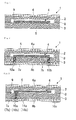
- Fig. 1 is a schematic diagram in vertical section showing an electronic device 1 according to a first embodiment of the invention.
- the electronic device 1 includes a lid substrate 2 made of soda-lime glass, a base substrate 3 made of soda-lime glass, bonded to the lid substrate 2, and forming a cavity 4 hermetically sealed from the outside air between the base substrate 3 and the lid substrate 2, an electronic element 5 housed in the cavity 4 and surface-mounted on the base substrate 3, and a mold member 6 placed on an outer face of the lid substrate 2 on the side opposite to the cavity 4.
- the lid substrate 2 and the base substrate 3 are bonded together with a metal material 8 interposed between them.
- the cavity 4 is formed of a recess portion 9 formed in the lid substrate 2.
- the lid substrate 2 is easily warped such that the side of the recess portion 9 protrudes.
- the mold member 6 is placed on the surface of the lid substrate 2 on the side opposite to the recess portion 9.
- the soda-lime glass has a coefficient of linear expansion of 9 to 11 (ppm/°C), and the mold member 6 is set to have a coefficient of linear expansion smaller than that of the soda-lime glass.
- a mold material is applied to the surface of the lid substrate 2 and thermally cured at a temperature of 100°C or higher to form the mold member 6.
- the lid substrate 2 When the mold member 6 is cooled to room temperature, the lid substrate 2 has the coefficient of linear expansion larger than the coefficient of linear expansion of the mold member 6 and thus the outer face of the lid substrate 2 is subjected to a compressive stress. Since this corrects the warping of the lid substrate 2 in which the side of the recess portion 9 protrudes, the lid substrate 2 is flattened.
- the coefficient of linear expansion of the mold member 6 can be adjusted by the type and the amount of the filler contained in the mold member 6. When epoxy resin filled with silica is used as the mold material, the filling amount of the silica can be increased to reduce the coefficient of linear expansion of the mold member 6.
- the warping of the lid substrate 2 is reduced to facilitate the alignment of the lid substrate 2 and the base substrate 3. This allows the use of a large substrate from which a number of devices can be obtained, so that the cost of the electronic device can be reduced.
- the reduced warping of the electronic device 1 relieves variations in stress applied to the electronic element resulting from a change in ambient temperature, which stabilizes the characteristics of the electronic element.
- Fig. 2 is a schematic diagram in vertical section showing an electronic device 1 according to a second embodiment of the invention.
- the electronic device 1 includes a lid substrate 2 made of soda-lime glass, a base substrate 3 made of soda-lime glass, bonded to the lid substrate 2, and forming a cavity 4 hermetically sealed from the outside air between the base substrate 3 and the lid substrate 2, an electronic element 5 housed in the cavity 4 and surface-mounted on the base substrate 3, and mold members 6a and 6b placed on outer faces of the lid substrate 2 and the base substrate 3, respectively.
- the electronic device 1 further includes through electrodes 7a and 7b passing through the base substrate 3, and electrode terminals 10a and 10b formed on an outer face of the mold member 6b and passing through the mold member 6b to electrically connect to the through electrodes 7a and 7b, respectively.
- the electronic element 5 is electrically connected to the through electrodes 7a and 7b through an electrode, not shown, and is mounted on the base substrate 3. Thus, the electronic element 5 can be supplied with power from the outside and can perform transmission to the outside through the electrode terminals 10a and 10b.
- the coefficient of linear expansion of the mold member 6b may be adjusted on the basis of the warping of the base substrate 3 or warping of the lid substrate 2 and the base substrate 3 bonded together. For example when the base substrate 3 alone or the lid substrate 2 and the base substrate 3 bonded together are easily warped such that the side of the electronic element 5 protrudes, the coefficient of linear expansion of the mold member 6b may be set to be smaller than the coefficient of linear expansion of the soda-lime glass.
- the mold member 6b serves as a shock-absorbing member when the electronic device 1 is mounted on a substrate or the like.
- the through electrodes 7a and 7b are directly bonded to a mounting electrode on the substrate or the like in mounting the electronic device 1 on the substrate or the like.
- a large stress is applied to the through electrodes 7a and 7b in mounting the electronic device 1 or due to other environmental changes to cause a defect such as chipping or cracking in the base substrate 3 near the through electrodes 7a and 7b, for example the glass substrate.
- the mold member 6b and the electrode terminals 10a and 10b are present between the electrode on the mounting substrate and the through electrodes 7a and 7b in the present embodiment, so that the stress applied to the base substrate 3 near the through electrodes 7a and 7b can be relieved to prevent occurrence of cracking or chipping in the base substrate 3.
- the mold members 6a and 6b are placed on the outer faces of the lid substrate 2 and the base substrate 3 in this manner, the warping of each of the lid substrate 2 and the base substrate 3 is reduced to relieve the stress applied to the electronic element 5 to stabilize the characteristics.
- variations in stress applied to the electronic element resulting from a change in ambient temperature can be reduced to stabilize the characteristics of the electronic element.
- the mold members 6a and 6b can serve as the stress relieving layers to prevent the occurrence of cracking or chipping in the base substrate 3 due to environmental changes.
- the mold members 6a and 6b may, but need not, have different coefficients of linear expansion.
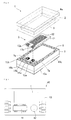
- Fig. 3 and Fig. 4 are a schematic diagram in vertical section and an exploded perspective view showing an electronic device 1 according to a third embodiment of the invention, respectively.
- the third embodiment differs from the second embodiment in that an electronic element 5 is mounted in the form of a cantilever on a base substrate 3, and the other configurations are substantially similar to those of the second embodiment.
- description is mainly made of the different points.
- the same portions or the portions having the same functions are designated with the same reference numerals.
- a lid substrate 2 and the base substrate 3 are anodic-bonded on the outer peripheral portions of the substrates by using a metal material 8 as a bonding material.
- the electronic element 5 is formed of a piezoelectric vibrating strip 11 made of monocrystalline crystal, an exciting electrode 12 formed on each face of the piezoelectric vibrating strip 11, and connecting electrodes 13a and 13b electrically connected to the exciting electrode 12.
- the electronic element 5 is mounted such that one end portion thereof is cantilevered on two mounting portions 14a and 14b.
- the two connecting electrodes 13a and 13b are connected to electrode terminals 10a and 10b (or 10c) through the mounting portions 14a and 14b, routing electrodes 15a and 15b, and through electrodes 7a and 7b, respectively, such that the electrodes 13a and 13b are electrically isolated from each other.
- the coefficient of linear expansion of a mold member 6b can be set to be smaller than the coefficient of linear expansion of the lid substrate 2 or the base substrate 3, for example the coefficient of linear expansion of the soda-lime glass.
- the coefficient of linear expansion of the mold member 6b can be set to be larger than the coefficient of linear expansion of the soda-lime glass.
- an AT-cut crystal vibrating strip is used as the piezoelectric vibrating strip 11.
- Each of the lid substrate 2 and the base substrate 3 has an outer diameter of approximately 2 mm x approximately 1 mm.
- Each of the lid substrate 2 and the base substrate 3 has a thickness of approximately 0.2 mm.
- Each of the mold members 6a and 6b has a thickness of approximately 50 ⁇ m.
- a recess portion 9 formed in the lid substrate 2 has a depth of approximately 0.1 mm. Vacuum is maintained in a cavity 4, and the vibrations of the piezoelectric vibrating strip 11 do not undergo air resistance.
- the mold members 6a and 6b are placed on the outer faces of the lid substrate 2 and the base substrate 3 in this manner, the warping of each of the lid substrate 2 and the base substrate 3 is reduced to facilitate the alignment in bonding the lid substrate 2 to the base substrate 3, and the stress applied to the piezoelectric vibrating strip 11 is reduced to relieve variations in the vibration rate of the piezoelectric vibrating strip 11. In addition, the frequency characteristics are stabilized when the ambient temperature is changed. Furthermore, the mold member 6b can serve as a buffer member to prevent the occurrence of cracking or chipping in the base substrate 3 in mounting the electronic device 1 or due to other environmental changes. Since the mold members 6a and 6b serve as the outer peripheral face of the electronic device 1, an identification number or the like can be marked on the mold member 6a or 6b to ensure the specification of each product.
- Fig. 5 is a schematic diagram of a top face showing an oscillator 40 according to a fourth embodiment of the invention.
- the oscillator 40 has the electronic device 1 incorporated therein which employs the piezoelectric vibrating strip 11 made of monocrystalline crystal shown in the third embodiment.
- the oscillator 40 includes a substrate 43, the electronic device 1 placed on the substrate, an integrated circuit 41, and an electronic part 42.
- the electronic device 1 produces a signal at a certain frequency based on a driving signal supplied to the electrode terminals 10a and 10b.
- the integrated circuit 41 and the electronic part 42 process the signal at the certain frequency supplied from the electronic device 1 to produce a reference signal such as a clock signal. Since the electronic device 1 according to the invention can be formed with high reliability and small size, the overall oscillator 40 can be made compact.
- a method of manufacturing the electronic device includes a recess portion forming step of forming the recess portion in the lid substrate, a mounting step of mounting the electronic element on the base substrate, a mold member placing step of placing the mold member on the outer face of one or both of the lid substrate and the base substrate, and a bonding step of bonding the lid substrate to the base substrate with the electronic element housed in the recess portion.
- the mold member placed on the outer face of one or both of the lid substrate and the base substrate can reduce warping of the lid substrate or the base substrate to facilitate the alignment of the lid substrate and the base substrate.
- the mounting of the electronic part can be facilitated at the mounting step to reduce the occurrence of defects.
- the reduced warping of the substrate allows the use of a large substrate from which a number of devices can be obtained, thereby cutting the cost of the electronic device.
- variations in characteristics of the electronic element can be reduced when environmental changes occur, so that the quality of the electronic device can be improved.
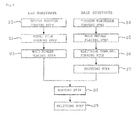
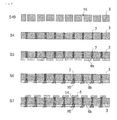
- Fig. 6 to Fig. 9 are diagrams for explaining the method of manufacturing the electronic device according to a fifth embodiment of the invention.
- Fig. 6 is a process diagram showing the method of manufacturing the electronic device.
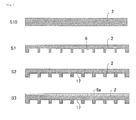
- Fig. 7 , Fig. 8 , and Fig. 9 are explanatory diagrams for the respective steps.
- soda-lime glass is used as the lid substrate 2 and the base substrate 3, and the electronic element 5 is formed of a crystal oscillator.
- a method of manufacturing the lid substrate 2 is described with reference to Fig. 6 and Fig. 7 .
- the lid substrate 2 in plate shape is prepared at a lid substrate preparing step S10.
- the lid substrate 2 is placed in a mold with a molding method and is pressed while heating, thereby forming a plurality of recess portions 9 simultaneously.
- a number of recess portions 9 having a depth of approximately 0.1 mm are simultaneously formed in a soda-lime glass plate having an outer diameter of 4 inches and a thickness of approximately 0.2 mm.
- a number of recess portions 9 may be formed simultaneously in this recess forming step S1 with a sandblast method or an etching method by placing a mask on the surface of the lid substrate 2, instead of the formation with the molding.
- a metal film 17 made of aluminum containing amorphous silicon is deposited on the surface of the lid substrate 2 on the side of the recess portion 9 with a sputtering method.
- the metal film 17 is used as a bonding material between the lid substrate 2 and the base substrate 3 at a later step.
- the metal film 17 may be deposited with an evaporation method or a plating method. Another metal material can be used as required.
- the mold member 6a is placed on the outer face of the lid substrate 2 on the side opposite to the recess portion 9.
- An epoxy resin material filled with silica is used as the mold material, is applied to the outer face of the lid substrate 2, and is cured through heating to a temperature of approximately 150C° to form the mold member 6a.
- the mold member 6a is formed with a thickness of 20 ⁇ m to 100 ⁇ m, preferably with a thickness of 50 ⁇ m.
- a method of manufacturing the base substrate 3 is described with reference to Fig. 6 and Fig. 8 .
- the base substrate 3 in plate shape is prepared, and a plurality of through holes 16 are formed in the base substrate 3 at a through hole forming step S40.
- the plurality of through holes 16 can be formed simultaneously with the molding method similarly to the formation of the recess portions 9. Instead of the molding method, the plurality of through holes 16 can be formed simultaneously with the sandblasting method or the etching method by placing a mask on the surface.
- the through holes 16 having a diameter of 50 ⁇ m to 0.3 mm are formed with a pitch of approximately 0.5 mm to 2 mm in a vertical direction and a horizontal direction in a soda-lime glass plate having an outer diameter of 4 inches and a thickness of approximately 0.2 mm.
- the through hole 16 is filled with a metal material to provide the through electrode 7 at a through electrode forming step S4.
- a metal rod can be inserted into the through hole 16, and the glass and the metal rod can be hermetically bonded together through heat welding or an adhesive.
- the surface of the base substrate 3 is planarized by grinding or polishing.
- the mold member 6b is placed such that an end face of the through electrode 7 is exposed on a lower face of the base substrate 3 at the mold member placing step S5.
- An epoxy resin material filled with silica is used as the mold material, is applied to the outer face of the base substrate 3, and is cured through heating to a temperature of approximately 150°C to form the mold member 6b.
- the mold member 6b is formed to have a thickness of 20 ⁇ m to 100 ⁇ m, preferably a thickness of 50 ⁇ m.
- the coefficient of linear expansion of the mold member 6b is set by adjusting the type or the amount of the filler in consideration of the state of warping of the base substrate 3 or the state of warping of the base substrate 3 after the bonding to the lid substrate 2.
- the coefficient of linear expansion of the mold member 6b is set to be smaller than the coefficient of linear expansion of the soda-lime glass.
- the coefficient of linear expansion of the mold member 6b is set to be larger than the coefficient of linear expansion of the soda-lime glass.
- the electrode terminal 10 is formed on the face of the mold member 6b and the exposed face of the through electrode 7 on the side of the mole member 6b at an electrode terminal forming step S6.
- the electrode terminal 10 can be formed by depositing a metal film on the outer face of the mold member 6b with the evaporation method, the sputtering method, or the plating method and patterning the film with the photolithography and etching method.
- the electrode terminal 10 can be provided by printing and thermally treating a pattern formed of a conductive material.
- the electronic element 5 is mounted in the form of a cantilever over an upper face of the base substrate 3 with the mounting portion 14 interposed. This causes the connecting electrode, not shown, formed on the face of the electronic element 5 to be electrically connected to the electrode terminal 10 through the mounting portion 14 and the through electrode 7.
- the electronic element 5 is a crystal vibrator with one end fixed to the mounting portion 14 and the other end separated from the base substrate 3 for vibration.
- the bonding step S8 and a splitting step S9 for the lid substrate 2 and the base substrate 3 are described with reference to Fig. 6 and Fig. 9 .
- the lid substrate 2 and the base substrate 3 are placed one on another with the metal film 17 interposed between them such that the electronic element 5 mounted on the base substrate 3 is housed in the recess portion 9 of the lid substrate 2.
- the bonding step S8 is performed under vacuum. Since the mold members 6a and 6b are placed on the outer faces of the lid substrate 2 and the base substrate 3, respectively, each of the substrates is warped only slightly to allow easy alignment thereof.
- the lid substrate 2 and the base substrate 3 are heated, and a high voltage is applied between the lid substrate 2 and the base substrate 3 to anodic-bond the abutting portions of the substrates.
- a high voltage is applied between the lid substrate 2 and the base substrate 3 to anodic-bond the abutting portions of the substrates.
- heating is performed to a temperature of 200°C to 250°C, and a voltage of 500V is applied to the lid substrate 2 and the base substrate 3 to perform the anodic bonding.
- the substrates are split into individual electronic devices 1 by a dicer at the splitting step S9.
- the warping amount of each of the substrates is reduced to facilitate the alignment in this manner, a larger substrate can be used to form a number of electronic devices 1 simultaneously to cut the cost.
- variations in stress applied to the electronic element due to a change in ambient temperature can be reduced to stabilize the characteristics of the electronic element to improve the quality of the electronic device.
- the metal film 17 is formed on the lid substrate 2 in the present embodiment, the metal film 17 may be formed on the base substrate 3. While the metal film 17 is formed on the side face and the bottom face of the recess portion 9 of the lid substrate 2 in the present embodiment, the metal film 17 on the bottom face and the side face of the recess portion 9 may be removed since it is only required that the metal film 17 should serve as the bonding material.
- the anodic bonding is not essential in the invention, and for example, the lid substrate 2 and the base substrate 3 may be bonded together by using an adhesive.
- the mold members 6a and 6b are formed on the outer faces of the substrates before the bonding of the lid substrate 2 and the base substrate 3 in the embodiments described above, the invention is not limited thereto, and the mold members 6a and 6b may be placed on the outer face of the lid substrate 2 or the base substrate 3 after the bonding of the lid substrate 2 and the base substrate 3. This is limited to the case where the lid substrate 2 and the base substrate 3 can be aligned.
- the mold material is applied to the substrate face to form the mold member 6 in the embodiments described above, the invention is not limited thereto.
- the mold member 6 may be formed with transfer molding by placing the lid substrate 2 and the base substrate 3 in a mold and pouring a mold material into the mold.
Landscapes
- Physics & Mathematics (AREA)
- Acoustics & Sound (AREA)
- Piezo-Electric Or Mechanical Vibrators, Or Delay Or Filter Circuits (AREA)
- Oscillators With Electromechanical Resonators (AREA)
Applications Claiming Priority (1)
| Application Number | Priority Date | Filing Date | Title |
|---|---|---|---|
| JP2011165291A JP5779030B2 (ja) | 2011-07-28 | 2011-07-28 | 電子デバイス、発振器及び電子デバイスの製造方法 |
Publications (2)
| Publication Number | Publication Date |
|---|---|
| EP2552020A2 true EP2552020A2 (de) | 2013-01-30 |
| EP2552020A3 EP2552020A3 (de) | 2014-01-08 |
Family
ID=46320763
Family Applications (1)
| Application Number | Title | Priority Date | Filing Date |
|---|---|---|---|
| EP12168387.4A Withdrawn EP2552020A3 (de) | 2011-07-28 | 2012-05-16 | Elektronische Vorrichtung, Oszillator und Verfahren zur Herstellung der elektronischen Vorrichtung |
Country Status (6)
| Country | Link |
|---|---|
| US (1) | US20130027145A1 (de) |
| EP (1) | EP2552020A3 (de) |
| JP (1) | JP5779030B2 (de) |
| KR (1) | KR20130014384A (de) |
| CN (1) | CN102904539A (de) |
| TW (1) | TW201306475A (de) |
Families Citing this family (6)
| Publication number | Priority date | Publication date | Assignee | Title |
|---|---|---|---|---|
| JP6342643B2 (ja) * | 2013-10-25 | 2018-06-13 | セイコーインスツル株式会社 | 電子デバイス |
| JP6516399B2 (ja) * | 2013-10-25 | 2019-05-22 | セイコーインスツル株式会社 | 電子デバイス |
| KR101675453B1 (ko) | 2015-05-15 | 2016-11-11 | 주식회사 바디프랜드 | 성장 발육 및 정서적 안정을 촉진하는 마사지 기능을 포함하는 안마의자 |
| JP2022002249A (ja) * | 2020-06-19 | 2022-01-06 | キオクシア株式会社 | 半導体装置およびその製造方法 |
| KR102759225B1 (ko) * | 2022-12-23 | 2025-01-22 | 성균관대학교산학협력단 | 전자 패키지 및 전자 패키지 제조방법 |
| CN119341509B (zh) * | 2024-11-12 | 2025-07-25 | 上海摩仑工业技术有限公司 | 一种集成振荡器及制备方法 |
Citations (1)
| Publication number | Priority date | Publication date | Assignee | Title |
|---|---|---|---|---|
| JPH092845A (ja) | 1995-06-19 | 1997-01-07 | Canon Inc | 導電体薄膜と非晶質絶縁体との接合体及びその形成方法 |
Family Cites Families (11)
| Publication number | Priority date | Publication date | Assignee | Title |
|---|---|---|---|---|
| JP2000174151A (ja) * | 1998-12-10 | 2000-06-23 | Sharp Corp | 半導体搭載基板の気密封止構造とその製造方法 |
| JP2002231843A (ja) * | 2001-02-01 | 2002-08-16 | Tdk Corp | 電子部品保護用キャップおよびその製造方法ならびに電子装置およびその製造方法 |
| KR100856610B1 (ko) * | 2001-03-27 | 2008-09-03 | 가부시키가이샤 네오맥스 마테리아르 | 전자부품용 팩키지 및 그 제조방법 |
| JP3879923B2 (ja) * | 2002-09-25 | 2007-02-14 | セイコーエプソン株式会社 | 電子部品用蓋体の製造方法 |
| JP4889974B2 (ja) * | 2005-08-01 | 2012-03-07 | 新光電気工業株式会社 | 電子部品実装構造体及びその製造方法 |
| US7649235B2 (en) * | 2006-02-07 | 2010-01-19 | Panasonic Corporation | Electronic component package |
| JP2009194091A (ja) * | 2008-02-13 | 2009-08-27 | Seiko Instruments Inc | 電子部品、電子機器、及びベース部材製造方法 |
| JP5121493B2 (ja) * | 2008-02-21 | 2013-01-16 | セイコーインスツル株式会社 | 圧電振動子の製造方法 |
| JP2009283553A (ja) * | 2008-05-20 | 2009-12-03 | Nec Electronics Corp | 電子装置およびその製造方法 |
| JP2010187326A (ja) * | 2009-02-13 | 2010-08-26 | Seiko Instruments Inc | 圧電振動子の製造方法、圧電振動子および発振器 |
| JP2011049992A (ja) * | 2009-08-28 | 2011-03-10 | Seiko Instruments Inc | 圧電デバイス及び圧電デバイスの製造方法 |
-
2011
- 2011-07-28 JP JP2011165291A patent/JP5779030B2/ja not_active Expired - Fee Related
-
2012
- 2012-04-24 TW TW101114535A patent/TW201306475A/zh unknown
- 2012-05-16 EP EP12168387.4A patent/EP2552020A3/de not_active Withdrawn
- 2012-06-07 US US13/490,910 patent/US20130027145A1/en not_active Abandoned
- 2012-07-26 KR KR1020120081526A patent/KR20130014384A/ko not_active Withdrawn
- 2012-07-27 CN CN2012102623934A patent/CN102904539A/zh active Pending
Patent Citations (1)
| Publication number | Priority date | Publication date | Assignee | Title |
|---|---|---|---|---|
| JPH092845A (ja) | 1995-06-19 | 1997-01-07 | Canon Inc | 導電体薄膜と非晶質絶縁体との接合体及びその形成方法 |
Also Published As
| Publication number | Publication date |
|---|---|
| TW201306475A (zh) | 2013-02-01 |
| JP5779030B2 (ja) | 2015-09-16 |
| EP2552020A3 (de) | 2014-01-08 |
| JP2013030957A (ja) | 2013-02-07 |
| CN102904539A (zh) | 2013-01-30 |
| US20130027145A1 (en) | 2013-01-31 |
| KR20130014384A (ko) | 2013-02-07 |
Similar Documents
| Publication | Publication Date | Title |
|---|---|---|
| US8702891B2 (en) | Method for manufacturing glass-sealed package, apparatus for manufacturing glass-sealed package, and oscillator | |
| JP2012019108A (ja) | ガラス基板の製造方法及び電子部品の製造方法 | |
| JP4864152B2 (ja) | 表面実装用の水晶振動子 | |
| US20130027145A1 (en) | Electronic device, oscillator, and method of manufacturing electronic device | |
| US20100207696A1 (en) | Piezoelectric vibrator, method for manufacturing piezoelectric vibrator, and oscillator | |
| JP5550373B2 (ja) | パッケージの製造方法 | |
| JP2004214787A (ja) | 圧電発振器およびその製造方法 | |
| KR20140095002A (ko) | 전자 디바이스 및 전자 디바이스의 제조 방법 | |
| US20130207735A1 (en) | Vibrating device and oscillator | |
| JP2013122375A (ja) | 物理量検出デバイス、物理量検出器、および電子機器 | |
| US8499443B2 (en) | Method of manufacturing a piezoelectric vibrator | |
| JP2008104151A (ja) | 圧電デバイス及び圧電デバイスの製造方法 | |
| JP2005278069A (ja) | 圧電振動片およびこれを用いた圧電デバイス | |
| KR20060114821A (ko) | 수정발진기 | |
| CN101997503A (zh) | 封装件的制造方法、压电振动器的制造方法、振荡器、电子设备及电波钟 | |
| US8823247B2 (en) | Piezoelectric vibrating devices including respective packages in which castellations include respective connecting electrodes | |
| JP2012220461A (ja) | 加速度検出器、加速度検出デバイス及び電子機器 | |
| JP2008219348A (ja) | 圧電デバイスの製造方法および圧電デバイス | |
| KR20170109805A (ko) | 압전 소자용 써미스터 및 이를 포함하는 압전 소자 패키지 | |
| JPS6144408B2 (de) | ||
| JP4078606B2 (ja) | 圧電振動子の構造と製造方法 | |
| JP2010268439A (ja) | 表面実装用の水晶振動子 | |
| JP2013168893A (ja) | 圧電振動デバイス | |
| JP2004119625A (ja) | 電子部品用蓋体とその製造方法、ならびに圧電デバイスと圧電デバイスを利用した携帯電話装置および圧電デバイスを利用した電子機器 | |
| JP4020031B2 (ja) | 圧電振動片と圧電振動片を利用した圧電デバイス、ならびに圧電デバイスを利用した携帯電話装置および圧電デバイスを利用した電子機器 |
Legal Events
| Date | Code | Title | Description |
|---|---|---|---|
| PUAI | Public reference made under article 153(3) epc to a published international application that has entered the european phase |
Free format text: ORIGINAL CODE: 0009012 |
|
| AK | Designated contracting states |
Kind code of ref document: A2 Designated state(s): AL AT BE BG CH CY CZ DE DK EE ES FI FR GB GR HR HU IE IS IT LI LT LU LV MC MK MT NL NO PL PT RO RS SE SI SK SM TR |
|
| AX | Request for extension of the european patent |
Extension state: BA ME |
|
| PUAL | Search report despatched |
Free format text: ORIGINAL CODE: 0009013 |
|
| RAP1 | Party data changed (applicant data changed or rights of an application transferred) |
Owner name: SIL CRYSTAL TECHNOLOGY INC. |
|
| AK | Designated contracting states |
Kind code of ref document: A3 Designated state(s): AL AT BE BG CH CY CZ DE DK EE ES FI FR GB GR HR HU IE IS IT LI LT LU LV MC MK MT NL NO PL PT RO RS SE SI SK SM TR |
|
| AX | Request for extension of the european patent |
Extension state: BA ME |
|
| RIC1 | Information provided on ipc code assigned before grant |
Ipc: H01L 23/04 20060101ALI20131202BHEP Ipc: H03H 9/05 20060101ALI20131202BHEP Ipc: H03H 9/10 20060101AFI20131202BHEP |
|
| STAA | Information on the status of an ep patent application or granted ep patent |
Free format text: STATUS: THE APPLICATION IS DEEMED TO BE WITHDRAWN |
|
| 18D | Application deemed to be withdrawn |
Effective date: 20140709 |