EP2521790B1 - Biological and chemical process utilizing chemoautotrophic microorganisms for the chemosynthetic fixation of carbon dioxide and/or other inorganic carbon sources into organic compounds, and the generation of additional useful products - Google Patents
Biological and chemical process utilizing chemoautotrophic microorganisms for the chemosynthetic fixation of carbon dioxide and/or other inorganic carbon sources into organic compounds, and the generation of additional useful products Download PDFInfo
- Publication number
- EP2521790B1 EP2521790B1 EP10828637.8A EP10828637A EP2521790B1 EP 2521790 B1 EP2521790 B1 EP 2521790B1 EP 10828637 A EP10828637 A EP 10828637A EP 2521790 B1 EP2521790 B1 EP 2521790B1
- Authority
- EP
- European Patent Office
- Prior art keywords
- carbon dioxide
- carbon
- biomass
- chemosynthetic
- certain embodiments
- Prior art date
- Legal status (The legal status is an assumption and is not a legal conclusion. Google has not performed a legal analysis and makes no representation as to the accuracy of the status listed.)
- Active
Links
Images





Classifications
-
- C—CHEMISTRY; METALLURGY
- C12—BIOCHEMISTRY; BEER; SPIRITS; WINE; VINEGAR; MICROBIOLOGY; ENZYMOLOGY; MUTATION OR GENETIC ENGINEERING
- C12P—FERMENTATION OR ENZYME-USING PROCESSES TO SYNTHESISE A DESIRED CHEMICAL COMPOUND OR COMPOSITION OR TO SEPARATE OPTICAL ISOMERS FROM A RACEMIC MIXTURE
- C12P1/00—Preparation of compounds or compositions, not provided for in groups C12P3/00 - C12P39/00, by using microorganisms or enzymes
- C12P1/04—Preparation of compounds or compositions, not provided for in groups C12P3/00 - C12P39/00, by using microorganisms or enzymes by using bacteria
-
- C—CHEMISTRY; METALLURGY
- C12—BIOCHEMISTRY; BEER; SPIRITS; WINE; VINEGAR; MICROBIOLOGY; ENZYMOLOGY; MUTATION OR GENETIC ENGINEERING
- C12M—APPARATUS FOR ENZYMOLOGY OR MICROBIOLOGY; APPARATUS FOR CULTURING MICROORGANISMS FOR PRODUCING BIOMASS, FOR GROWING CELLS OR FOR OBTAINING FERMENTATION OR METABOLIC PRODUCTS, i.e. BIOREACTORS OR FERMENTERS
- C12M43/00—Combinations of bioreactors or fermenters with other apparatus
- C12M43/04—Bioreactors or fermenters combined with combustion devices or plants, e.g. for carbon dioxide removal
-
- C—CHEMISTRY; METALLURGY
- C12—BIOCHEMISTRY; BEER; SPIRITS; WINE; VINEGAR; MICROBIOLOGY; ENZYMOLOGY; MUTATION OR GENETIC ENGINEERING
- C12N—MICROORGANISMS OR ENZYMES; COMPOSITIONS THEREOF; PROPAGATING, PRESERVING, OR MAINTAINING MICROORGANISMS; MUTATION OR GENETIC ENGINEERING; CULTURE MEDIA
- C12N1/00—Microorganisms; Compositions thereof; Processes of propagating, maintaining or preserving microorganisms or compositions thereof; Processes of preparing or isolating a composition containing a microorganism; Culture media therefor
- C12N1/20—Bacteria; Culture media therefor
-
- C—CHEMISTRY; METALLURGY
- C12—BIOCHEMISTRY; BEER; SPIRITS; WINE; VINEGAR; MICROBIOLOGY; ENZYMOLOGY; MUTATION OR GENETIC ENGINEERING
- C12P—FERMENTATION OR ENZYME-USING PROCESSES TO SYNTHESISE A DESIRED CHEMICAL COMPOUND OR COMPOSITION OR TO SEPARATE OPTICAL ISOMERS FROM A RACEMIC MIXTURE
- C12P3/00—Preparation of elements or inorganic compounds except carbon dioxide
-
- C—CHEMISTRY; METALLURGY
- C12—BIOCHEMISTRY; BEER; SPIRITS; WINE; VINEGAR; MICROBIOLOGY; ENZYMOLOGY; MUTATION OR GENETIC ENGINEERING
- C12P—FERMENTATION OR ENZYME-USING PROCESSES TO SYNTHESISE A DESIRED CHEMICAL COMPOUND OR COMPOSITION OR TO SEPARATE OPTICAL ISOMERS FROM A RACEMIC MIXTURE
- C12P5/00—Preparation of hydrocarbons or halogenated hydrocarbons
- C12P5/02—Preparation of hydrocarbons or halogenated hydrocarbons acyclic
- C12P5/023—Methane
-
- C—CHEMISTRY; METALLURGY
- C12—BIOCHEMISTRY; BEER; SPIRITS; WINE; VINEGAR; MICROBIOLOGY; ENZYMOLOGY; MUTATION OR GENETIC ENGINEERING
- C12P—FERMENTATION OR ENZYME-USING PROCESSES TO SYNTHESISE A DESIRED CHEMICAL COMPOUND OR COMPOSITION OR TO SEPARATE OPTICAL ISOMERS FROM A RACEMIC MIXTURE
- C12P7/00—Preparation of oxygen-containing organic compounds
- C12P7/02—Preparation of oxygen-containing organic compounds containing a hydroxy group
- C12P7/04—Preparation of oxygen-containing organic compounds containing a hydroxy group acyclic
- C12P7/06—Ethanol, i.e. non-beverage
- C12P7/065—Ethanol, i.e. non-beverage with microorganisms other than yeasts
-
- C—CHEMISTRY; METALLURGY
- C12—BIOCHEMISTRY; BEER; SPIRITS; WINE; VINEGAR; MICROBIOLOGY; ENZYMOLOGY; MUTATION OR GENETIC ENGINEERING
- C12P—FERMENTATION OR ENZYME-USING PROCESSES TO SYNTHESISE A DESIRED CHEMICAL COMPOUND OR COMPOSITION OR TO SEPARATE OPTICAL ISOMERS FROM A RACEMIC MIXTURE
- C12P7/00—Preparation of oxygen-containing organic compounds
- C12P7/40—Preparation of oxygen-containing organic compounds containing a carboxyl group including Peroxycarboxylic acids
- C12P7/54—Acetic acid
-
- Y—GENERAL TAGGING OF NEW TECHNOLOGICAL DEVELOPMENTS; GENERAL TAGGING OF CROSS-SECTIONAL TECHNOLOGIES SPANNING OVER SEVERAL SECTIONS OF THE IPC; TECHNICAL SUBJECTS COVERED BY FORMER USPC CROSS-REFERENCE ART COLLECTIONS [XRACs] AND DIGESTS
- Y02—TECHNOLOGIES OR APPLICATIONS FOR MITIGATION OR ADAPTATION AGAINST CLIMATE CHANGE
- Y02E—REDUCTION OF GREENHOUSE GAS [GHG] EMISSIONS, RELATED TO ENERGY GENERATION, TRANSMISSION OR DISTRIBUTION
- Y02E50/00—Technologies for the production of fuel of non-fossil origin
- Y02E50/10—Biofuels, e.g. bio-diesel
-
- Y—GENERAL TAGGING OF NEW TECHNOLOGICAL DEVELOPMENTS; GENERAL TAGGING OF CROSS-SECTIONAL TECHNOLOGIES SPANNING OVER SEVERAL SECTIONS OF THE IPC; TECHNICAL SUBJECTS COVERED BY FORMER USPC CROSS-REFERENCE ART COLLECTIONS [XRACs] AND DIGESTS
- Y02—TECHNOLOGIES OR APPLICATIONS FOR MITIGATION OR ADAPTATION AGAINST CLIMATE CHANGE
- Y02E—REDUCTION OF GREENHOUSE GAS [GHG] EMISSIONS, RELATED TO ENERGY GENERATION, TRANSMISSION OR DISTRIBUTION
- Y02E50/00—Technologies for the production of fuel of non-fossil origin
- Y02E50/30—Fuel from waste, e.g. synthetic alcohol or diesel
-
- Y—GENERAL TAGGING OF NEW TECHNOLOGICAL DEVELOPMENTS; GENERAL TAGGING OF CROSS-SECTIONAL TECHNOLOGIES SPANNING OVER SEVERAL SECTIONS OF THE IPC; TECHNICAL SUBJECTS COVERED BY FORMER USPC CROSS-REFERENCE ART COLLECTIONS [XRACs] AND DIGESTS
- Y02—TECHNOLOGIES OR APPLICATIONS FOR MITIGATION OR ADAPTATION AGAINST CLIMATE CHANGE
- Y02W—CLIMATE CHANGE MITIGATION TECHNOLOGIES RELATED TO WASTEWATER TREATMENT OR WASTE MANAGEMENT
- Y02W30/00—Technologies for solid waste management
- Y02W30/40—Bio-organic fraction processing; Production of fertilisers from the organic fraction of waste or refuse
Definitions
- the present invention falls within the technical areas of biofuels, bioremediation, carbon capture, carbon dioxide-to-fuels, carbon recycling, carbon sequestration, energy storage, and renewable/alternative and/or low carbon dioxide emission sources of energy.
- the present invention involves in certain aspects a unique use of biocatalysts within a biological and chemical process to fix carbon dioxide and/or other forms of inorganic carbon into organic chemical products through chemosynthesis.
- certain embodiments of the present invention involve the production of chemical co-products that are co-generated through chemosynthetic reaction steps and/or non-biological reaction steps as part of an overall carbon capture and conversion process.
- the present invention can enable the effective capture of carbon dioxide from the atmosphere or from a point source of carbon dioxide emissions for the production of liquid transportation fuel and/or other organic chemical products, which can help address greenhouse gas induced climate change and contribute to the domestic production of renewable liquid transportation fuels without any dependence upon agriculture.
- Hydrogen which can be generated through a number of different inorganic renewable energy technologies including solar, wind, and geothermal has been proposed as a replacement for hydrocarbon fuels. But hydrogen has its own set of problems including most notably problems with storage. Ironically the best chemical storage medium for hydrogen both in terms of volumetric and gravimetric energy densities is quite possibly hydrocarbons such as gasoline, suggesting that the quest for hydrogen fuel may simply lead full circle back to hydrocarbons.
- Biofuels are a promising type of renewable hydrocarbon generally made through the capture and conversion of CO 2 into organic matter by photosynthetic organisms. Since the current transportation fleet and infrastructure is designed for fossil fuels with similar properties to biofuels, it can be more readily be adapted to biofuels, than to inorganic energy storage products such as hydrogen or batteries. A further advantage of biofuels, and hydrocarbons in general, is that they have some of the highest volumetric and gravimetric energy densities found for any form of chemical energy storage - substantially higher than that achieved with current lithium battery and hydrogen storage technologies. However, biofuels produced through photosynthesis have their own set of problems.
- Chemoautotrophic microorganisms are known that catalyzing the carbon fixation reaction without photosynthesis.
- the chemosynthetic reactions performed by chemoautotrophs for the fixation of CO 2 , and other forms of inorganic carbon, to organic compounds, is powered by potential energy stored in inorganic chemicals, rather than by the radiant energy of light [Shively et al, 1998; Smith et al, 1967; Hugler et al, 2005; Hugker et al., 2005; Scott and Cavanaugh, 2007].
- Carbon fixing biochemical pathways that occur in chemoautotrophs include the reductive tricarboxylic acid cycle, the Calvin-Benson-Bassham cycle [ Jessup Shively, Geertje van Kaulen, Wim Meijer,, Annu. Rev. Microbiol., 1998, 191-230 ], and the Wood-Ljungdahl pathway [Ljungdahl, 1986; Gottschalk, 1989; Lee, 2008; Fischer, 2008].
- Chemoautotrophic microorganisms have also been used to biologically convert syngas into C 2 and longer organic compounds including acetic acid and acetate, and biofuels such as ethanol and butanol [Gaddy, 2007; Lewis, 2007; Heiskanen, 2007; Worden, 1991; Klasson, 1992; Ahmed, 2006; Cotter, 2008; Piccolo, 2008, Wei, 2008]; however, in such approaches the feedstock is strictly limited to fixed carbon (either biomass or fossil fuel), which is gasified and then biologically converted to another form of fixed carbon ⁇ biofuel, and the carbon source and energy source utilized in the process come from the same process input, either biomass or fossil fuel, and are completely intermixed within the syngas in the form of H 2 , CO, and CO 2 .
- biofuels such as ethanol and butanol
- the present inventors have recognized in the context of the present invention that a need exists for processes that do not require any fixed carbon feedstock, only CO 2 and/or other forms of inorganic carbon and/or utilize a carbon source and energy source that are derived from separate process inputs.
- the carbon source may be separated from the energy source in certain embodiments of the present invention which enables it to function as a far more general energy conversion technology than syngas to liquid fuel conversions. This is because the electron donors used in the present invention can be generated from a wide array of different CO 2 -free energy sources, both conventional and alternative, while for syngas conversions to biofuel, all the energy stored in the biofuel is ultimately derived from photosynthesis (with additional geochemical energy in the case of fossil fuel feedstock).
- chemoautotrophic microorganisms perform chemosynthesis to fix inorganic carbon into organic compounds using the chemical energy stored in hydrogen as an electron donor pumped or otherwise provided to the nutrient media.
- the electron donor is oxidized by electron acceptors in the chemosynthetic reaction.
- Electron acceptors that may be used at the chemosynthetic reaction step include carbon dioxide and/or oxygen.
- the chemosynthetic reaction step or steps of certain inventive processes wherein carbon dioxide and/or inorganic carbon is fixed into organic carbon in the form of organic compounds and biomass can be performed in aerobic, microaerobic, anoxic, anaerobic, or facultative conditions.
- a facultative environment is considered to be one where the water column is stratified into aerobic layers and anaerobic layers.
- the oxygen level maintained spatially and temporally in the system will depend upon the chemoautotrophic species used, and the desired chemosynthesis reactions to be performed.
- An additional feature of certain embodiments of the present invention regards the source, production, or recycling of the electron donor used by the chemoautotrophic microorganisms to fix carbon dioxide into organic compounds.
- the electron donor used for carbon dioxide capture and carbon fixation can be produced or recycled in the present invention electrochemically or thermochemically using power from a number of different renewable and/or low carbon emission energy technologies including but not limited to: photovoltaics, solar thermal, wind power, hydroelectric, nuclear, geothermal, enhanced geothermal, ocean thermal, ocean wave power, tidal power.
- biochemicals and/or biomass products can have applications including but not limited to one or more of the following: as a carbon source for large scale fermentations; as a nutrient source for the growth of other microbes or organisms; as feed for animals including but not limited to cattle, sheep, chickens, pigs, or fish; as sources of pharmaceutical, medicinal or nutritional substances; soil additives and soil stabilizers.
- the present invention provides, in certain embodiments, compositions and methods for the capture and fixation of carbon dioxide from carbon dioxide-containing gas streams and/or atmospheric carbon dioxide or carbon dioxide in liquefied or chemically-bound form through a chemical and biological process.
- the present invention in certain embodiments, provides a method for the recovery, processing, and use of the chemical products of chemosynthetic reaction step or steps performed by Ralstonia sp. to fix inorganic carbon into organic compounds.
- the genus of chemoautotrophic microorganisms that can be used in one or more process steps of the present invention comprises Ralstonia sp..
- FIG 1 illustrates the general process flow diagram for certain embodiments of the present invention that have a process step for the generation of electron donors suitable for supporting chemosynthesis from an energy input and raw inorganic chemical input; followed by recovery of chemical products from the electron donor generation step; delivery of generated electron donors along with electron acceptors, water, nutrients, and CO 2 from a point industrial flue gas source, into chemosynthetic reaction step or steps that make use of chemoautotrophic microorganisms to capture and fix carbon dioxide, creating chemical and biomass co-products through chemosynthetic reactions; followed by process steps for the recovery of both chemical and biomass products from the process stream; and recycling of unused nutrients and process water, as well as cell mass needed to maintain the chemoautotrophic culture back into the chemosynthetic reaction steps.
- the CO 2 containing flue gas is captured from a point source or emitter. Electron donors needed for chemosynthesis may be generated from input inorganic chemicals and energy.
- the flue gas is pumped through bioreactors containing Ralstonia sp. along with electron donors and acceptors to drive chemosynthesis and a medium suitable to support a chemoautotrophic culture and carbon fixation through chemosynthesis.
- the cell culture may be continuously flowed into and out of the bioreactors. After the cell culture leaves the bioreactors the cell mass is separated from the liquid medium. Cell mass needed to replenish the cell culture population at a functional or an optimal level is recycled back into the bioreactor. Surplus cell mass may be dried to form a dry biomass product.
- Certain embodiments of the present invention use carbon dioxide emission-free or low-carbon emission and/or renewable sources of power in the production of electron donors including but not limited to one or more of the following: photovoltaics, solar thermal, wind power, hydroelectric, nuclear, geothermal, enhanced geothermal, ocean thermal, ocean wave power, tidal power.
- chemoautotrophs function as biocatalysts for the conversion of renewable energy into liquid hydrocarbon fuel, or high energy density organic compounds generally, with CO 2 captured from flue gases, or from the atmosphere, or ocean serving as a carbon source.
- inventions of the present invention can provide renewable energy technologies with the capability of producing a transportation fuel having significantly higher energy density than if the renewable energy sources are used to produce hydrogen gas - which must be stored in relatively heavy storage systems (e.g. tanks or storage materials) - or if it is used to charge batteries which have relatively low energy density. Additionally the liquid hydrocarbon fuel product of certain embodiments of the present invention may be more compatible with the current transportation infrastructure compared to these other energy storage options.
- chemoautotrophs to use inorganic sources of chemical energy also enables the conversion of inorganic carbon into liquid hydrocarbon fuels using non-hydrocarbon mineralogical sources of chemical energy, i.e.
- certain embodiments of the present invention use mineralogical sources of chemical energy which are pre-processed ahead of the chemosynthetic reaction steps into a form of electron donor and method of electron donor delivery that is suitable or optimal for supporting chemoautotrophic carbon fixation.
- Electron donors produced in the present invention using electrochemical and/or thermochemical processes known in the art of chemical engineering and/or generated from natural sources include hydrogen.
- Hydrogen electron donor may be generated by methods known in to art of chemical and process engineering including but not limited to more or more of the following: through electrolysis of water including but not limited to approaches using Proton Exchange Membranes (PEM), liquid electrolytes such as KOH, high-pressure electrolysis, high temperature electrolysis of steam (HTES).
- PEM Proton Exchange Membranes
- KOH KOH
- HTES high temperature electrolysis of steam
- Certain embodiments of the present invention that use electrical power for the generation of electron donors, receive the electrical power from carbon dioxide emission-free or low-carbon emission and/or renewable sources of power in the production of electron donors including but not limited to one or more of the following: photovoltaics, solar thermal, wind power, hydroelectric, nuclear, geothermal, enhanced geothermal, ocean thermal, ocean wave power, tidal power.
- the generated electron donors are oxidized in the chemosynthetic reaction step or steps by electron acceptors that include carbon dioxide and/or oxygen.
- FIG. 1 The position of the chemosynthetic reaction step or steps in the general process flow of the present invention is illustrated in FIG. 1 by the box 3. labeled "Chemoautotroph bioreactor”.
- one or more types of electron donor and one or more types of electron acceptor may be pumped or otherwise added to the reaction vessel as either a bolus addition, or periodically, or continuously to the nutrient medium containing chemoautotrophic organisms.
- the chemosynthetic reaction driven by the transfer of electrons from electron donor to electron acceptor fixes inorganic carbon dioxide into organic compounds and biomass.
- electron mediators may be included in the nutrient medium to facilitate the delivery of reducing equivalents from electron donors to chemoautotrophic organisms in the presence of electron acceptors and inorganic carbon in order to kinetically enhance the chemosynthetic reaction step.
- This aspect of the present invention is particularly applicable to embodiments of the present invention using poorly soluble electron donors such as H 2 gas.
- the delivery of reducing equivalents from electron donors to the chemoautotrophic organisms for the chemosynthetic reaction or reactions can be kinetically and/or thermodynamically enhanced in the present invention through means including but not limited to: the introduction of hydrogen storage materials into the chemoautotrophic culture environment that can double as a solid support media for microbial growth - bringing absorbed or adsorbed hydrogen electron donors into close proximity with the hydrogen-oxidizing chemoautotrophs; the introduction of electron mediators known in the art such as but not limited to cytochromes, formate, methyl-viologen, NAD+/NADH, neutral red (NR), and quinones into the chemoautotrophic culture media.
- the culture broth used in the chemosynthetic steps of certain embodiments of the present invention may be an aqueous solution containing suitable minerals, salts, vitamins, cofactors, buffers, and other components needed for microbial growth, known to those skilled in the art [ Bailey and Ollis, Biochemical Engineering Fundamentals, 2nd ed; pp 383-384 and 620-622; McGraw-Hill: New York (1986 )]. These nutrients can be chosen to facilitate or maximize Ralstonia sp. growth and promote the chemosynthetic enzymatic pathways. Alternative growth environments such as used in the arts of solid state or non-aqueous fermentation may be used in certain embodiments. In certain embodiments that utilize an aqueous culture broth, salt water, sea water, or other non-potable sources of water are used when tolerated by the Ralstonia sp. organisms.
- the chemosynthetic pathways may be controlled and optimized in certain embodiments of the present invention for the production of chemical products and/or biomass by maintaining specific growth conditions (e.g. levels of nitrogen, oxygen, phosphorous, sulfur, trace micronutrients such as inorganic ions, and if present any regulatory molecules that might not generally be considered a nutrient or energy source).
- the broth may be maintained in aerobic, microaerobic, anoxic, anaerobic, or facultative conditions depending upon the requirements of the Ralstonia sp. organisms and the desired products to be created by the chemosynthetic process.
- a facultative environment is considered to be one having aerobic upper layers and anaerobic lower layers caused by stratification of the water column.
- the source of inorganic carbon used in the chemosynthetic reaction process steps of certain embodiments of the present invention includes but is not limited to one or more of the following: a carbon dioxide-containing gas stream that may be pure or a mixture; liquefied CO 2 ; dry ice; dissolved carbon dioxide, carbonate ion, or bicarbonate ion in solutions including aqueous solutions such as sea water.
- a carbon dioxide-containing gas stream that may be pure or a mixture
- liquefied CO 2 dry ice
- dissolved carbon dioxide, carbonate ion, or bicarbonate ion in solutions including aqueous solutions such as sea water aqueous solutions
- Carbon dioxide and/or other forms of inorganic carbon may be introduced to the nutrient medium contained in reaction vessels either as a bolus addition or periodically or continuously at the steps in the process where chemosynthesis occurs.
- carbon dioxide containing flue gases are captured from the smoke stack at temperature, pressure, and gas composition characteristic of the untreated exhaust, and directed with minimal modification into the reaction vessel(s) where chemosynthesis occurs.
- modification of the flue gas upon entering the reaction vessels may be substantially limited to compression needed to pump the gas through the reactor system and heat exchange needed to lower the gas temperature to one suitable for the microorganisms.
- Gases in addition to carbon dioxide that are dissolved into the culture broth of certain embodiments of the present invention may include gaseous electron donors in certain embodiments such as but not limited to hydrogen, carbon monoxide, hydrogen sulfide or other sour gases; and for certain aerobic embodiments of the present invention, oxygen electron acceptor, generally from air (e.g. 20.9% oxygen).
- gaseous electron donors in certain embodiments such as but not limited to hydrogen, carbon monoxide, hydrogen sulfide or other sour gases
- oxygen electron acceptor generally from air (e.g. 20.9% oxygen).
- the dissolution of these and other gases into solution may be achieved using a system of compressors, flowmeters, and flow valves known to one of skilled in the art of bioreactor scale microbial culturing, that feed into one of more of the following widely used systems for pumping gas into solution: sparging equipment; diffusers including but not limited to dome, tubular, disc, or doughnut geometries; coarse or fine bubble aerators; venturi equipment.
- surface aeration may also be performed using paddle aerators and the like.
- gas dissolution is enhanced by mechanical mixing with an impeller or turbine, as well as hydraulic shear devices to reduce bubble size. Following passage through the reactor system holding Ralstonia sp. microorganisms which capture the carbon dioxide, the scrubbed flue gas, which is generally comprised primarily of inert gases such as nitrogen, may be released into the atmosphere.
- hydrogen gas is fed to the chemoautotrophic bioreactor either by bubbling it through the culture medium, or by diffusing it through a membrane that bounds the culture medium.
- the latter method may be safer in certain cases, since hydrogen accumulating in the gas phase can potentially create explosive conditions (the range of explosive hydrogen concentrations in air is 4 to 74.5% and may be avoided in certain embodiments of the present invention).
- oxygen bubbles are injected into the broth at an appropriate or optimal diameter for mixing and oxygen transfer.
- the average diameter of the oxygen bubbles is selected to be about 2 mm, which has been found to be optimal in certain cases [ Environment Research Journal May/June 1999 pgs. 307-315 ].
- a process of shearing the oxygen bubbles is used to achieve this bubble diameter as described in U.S. Pat. No. 7,332,077 .
- bubble size is controlled to yield values a no larger than 7.5 mm average diameter without substantial slugging.
- Additional chemicals to facilitate Ralstonia sp. maintenance and growth as known in the art may be added to the culture broth of certain embodiments of the present invention.
- concentrations of nutrient chemicals, and particularly the electron donors and acceptors may be maintained as close as possible to their respective optimal levels for maximum chemoautotrophic growth and/or carbon uptake and fixation and/or production of organic compounds, which varies depending upon the chemoautotrophic species utilized but is known or determinable without undue experimentation to one of skilled in the art of culturing chemoautotrophs.
- the waste product levels, pH, temperature, salinity, dissolved oxygen and carbon dioxide, gas and liquid flow rates, agitation rate, and pressure in the chemoautotrophic culture environment may be controlled in certain embodiments of the present invention as well.
- the operating parameters affecting chemoautotrophic growth may be monitored with sensors (e.g. dissolved oxygen probe or oxidation-reduction probe to gauge electron donor/acceptor concentrations), and controlled either manually or automatically based upon feedback from sensors through the use of equipment including but not limited to actuating valves, pumps, and agitators.
- the temperature of the incoming broth as well as incoming gases may be regulated by unit operations such as but not limited to heat exchangers.
- Agitation of the culture broth in certain embodiments of the present invention may be provided for mixing and may be accomplished by equipment including but not limited to: recirculation of broth from the bottom of the container to the top via a recirculation conduit; sparging with carbon dioxide plus in certain embodiments electron donor gas (i.e. H 2 ), and for certain aerobic embodiments of the present invention oxygen or air as well; a mechanical mixer such as but not limited to an impeller (100-1000 rpm) or turbine.
- equipment including but not limited to: recirculation of broth from the bottom of the container to the top via a recirculation conduit; sparging with carbon dioxide plus in certain embodiments electron donor gas (i.e. H 2 ), and for certain aerobic embodiments of the present invention oxygen or air as well; a mechanical mixer such as but not limited to an impeller (100-1000 rpm) or turbine.
- the Ralstonia sp. microorganism containing nutrient medium is removed from the chemosynthetic reactors partially or completely, periodically or continuously, and is replaced with fresh cell-free medium to maintain the cell culture in exponential growth phase and/or replenish the depleted nutrients in the growth medium and/or remove inhibitory waste products.
- the production of useful chemical products through the chemosynthetic reaction step or steps reacting electron donors and acceptors to fix carbon dioxide is a feature of certain embodiments of the present invention.
- Optimizing the production of a desired chemical product of chemosynthesis may be achieved in certain embodiments of the present invention through control of the parameters in the chemoautotrophic culture environment including but not limited to: nutrient levels, waste levels, pH, temperature, salinity, dissolved oxygen and carbon dioxide, gas and liquid flow rates, agitation rate, and pressure
- the high growth rate of Ralstonia sp. species enables them to equal or even surpass the highest rates of carbon fixation, and biomass production per standing unit biomass attainable by photosynthetic microbes. Consequently the production of surplus biomass is a feature of certain embodiments of the present invention.
- Surplus growth of cell mass may be removed from the system to produce a biomass product, and in order to maintain an optimal microbial population and cell density in the chemoautotrophic culture for continued high carbon capture and fixation rates.
- Another feature of certain embodiments of the present invention is the vessels used to contain the chemosynthetic reaction environment in the carbon capture and fixation process.
- the types of culture vessels that can be used in the present invention to culture and grow the chemoautotrophic bacteria for carbon dioxide capture and fixation are generally known in the art of large scale microbial culturing.
- These culture vessels include but are not limited to: airlift reactors; biological scrubber columns; bioreactors; bubble columns; caverns; caves; cisterns; continuous stirred tank reactors; counter-current, upflow, expanded-bed reactors; digesters and in particular digester systems such as known in the prior arts of sewage and waste water treatment or bioremediation; filters including but not limited to trickling filters, rotating biological contactor filters, rotating discs, soil filters; fluidized bed reactors; gas lift fermenters; immobilized cell reactors; lagoons; membrane biofilm reactors; mine shafts; pachuca tanks; packed-bed reactors; plug-flow reactors; ponds; pools; quarries; reservoirs; static mixers; tanks; towers; trickle bed reactors; vats; wells ⁇ with the vessel base, siding, walls, lining, or top constructed out of one or more materials including but not limited to bitumen, cement, ceramics, clay, concrete, epoxy, fiberglass, glass, macadam
- Ralstonia sp. microorganisms either require a corrosive growth environment and/or produce corrosive chemicals through the chemosynthetic metabolism corrosion resistant materials may be used to line the interior of the container contacting the growth medium.
- Certain embodiments of the present invention will minimize material costs by using chemosynthetic vessel geometries having a low surface area to volume ratio, such as but not limited to substantially cubic, cylindrical shapes with medium aspect ratio, substantially ellipsoidal or "egg-shaped", substantially hemispherical, or substantially spherical shapes, unless material costs are superseded by other design considerations (e.g. land footprint size).
- the ability to use compact reactor geometries is enabled by the absence of a light requirement for chemosynthetic reactions, in contrast to photosynthetic technologies where the surface area to volume ratio must be large to provide sufficient light exposure.
- Ralstonia sp. lack of dependence on light also can allow plant designs with a much smaller footprint than photosynthetic approaches allow.
- certain embodiments of the present invention may use a long vertical shaft bioreactor system for chemoautotrophic growth and carbon capture.
- a bioreactor of the long vertical shaft type is described in U.S. Pat. Nos. 4,279,754 , 5,645,726 , 5,650,070 , and 7,332,077 .
- certain embodiments of the present invention may advantageously minimize vessel surfaces across which high losses of water, nutrients, and/or heat may occur, or which potentially permit the introduction of invasive predators into the reactor.
- the ability to minimize such surfaces is enabled by the lack of light requirements for chemosynthesis.
- the Ralstonia sp. microorganisms are immobilized within their growth environment. This may be accomplished using any suitable media known in the art of microbial culturing to support colonization by Ralstonia sp. microorganisms including but not limited to growing the Ralstonia sp. on a matrix, mesh, or membrane made from any of a wide range of natural and synthetic materials and polymers including but not limited to one or more of the following: glass wool, clay, concrete, wood fiber, inorganic oxides such as ZrO 2 , Sb 2 O 3 , or Al 2 O 3 , the organic polymer polysulfone, or open-pore polyurethane foam having high specific surface area.
- microorganisms in the present invention may also be grown on the surfaces of unattached objects distributed throughout the growth container as are known in the art of microbial culturing that include but are not limited to one or more of the following: beads; sand; silicates; sepiolite; glass; ceramics; small diameter plastic discs, spheres, tubes, particles, or other shapes known in the art; shredded coconut hulls; ground corn cobs; activated charcoal; granulated coal; crushed coral; sponge balls; suspended media; bits of small diameter rubber (elastomeric) polyethylene tubing; hanging strings of porous fabric, Berl saddles, Raschig rings.
- Inoculation of the Ralstonia sp. culture into the culture vessel may be performed by methods including but not limited to transfer of culture from an existing Ralstonia sp. culture inhabiting another carbon capture and fixation system of the present invention, or incubation from a seed stock raised in an incubator.
- the seed stock of Ralstonia sp. strains in certain embodiments, may be transported and stored in forms including but not limited to a powder, liquid, frozen, or freeze-dried form as well as any other suitable form, which may be readily recognized by one skilled in the art.
- Separation of cell mass from liquid suspension in certain embodiments of the present invention can be performed by methods known in the art of microbial culturing [Examples of cell mass harvesting techniques are given in International Patent Application No. WO08/00558, published Jan. 8, 1998 ; U.S. Pat. No. 5,807,722 ; U.S. Pat. No. 5,593,886 and U.S. Pat. No. 5,821,111 . ] including but not limited to one or more of the following: centrifugation; flocculation; flotation; filtration using a membranous, hollow fiber, spiral wound, or ceramic filter system; vacuum filtration; tangential flow filtration; clarification; settling; hydrocyclone.
- the cell mass is immobilized on a matrix it may be harvested by methods including but not limited to gravity sedimentation or filtration, and separated from the growth substrate by liquid shear forces.
- the cell mass recovered by the harvesting system may be recycled back into the culture vessel using, for example, an airlift or geyser pump.
- the cell mass recycled back into the culture vessel has not been exposed to flocculating agents, unless those agents are non-toxic to the Ralstonia sp..
- the chemoautotrophic system is maintained, using continuous influx and removal of nutrient medium and/or biomass, in substantially steady state where the cell population and environmental parameters (e.g. cell density, chemical concentrations) are targeted at a substantially constant suitable or optimal level over time.
- Cell densities may be monitored in certain embodiments of the present invention either by direct sampling, by a correlation of optical density to cell density, or with a particle size analyzer.
- the hydraulic and biomass retention times can be decoupled so as to allow independent control of both the broth chemistry and the cell density in certain embodiments. Dilution rates may be kept high enough so that the hydraulic retention time is relatively low compared to the biomass retention time, resulting in a highly replenished broth for cell growth. Dilution rates may be set at an appropriate or optimal trade-off between culture broth replenishment, and increased process costs from pumping, increased inputs, and other demands that rise with dilution rates.
- the surplus microbial cells in certain embodiments of the invention are broken open following the cell separation step using methods including but not limited to ball milling, cavitation pressure, sonication, or mechanical shearing.
- the harvested biomass in certain embodiments of the present invention is dried in the process step or steps of box 7. Labeled "Dryer" in the general process flow illustrated in FIG. 1 .
- Surplus biomass drying may be performed in certain embodiments of the present invention using technologies including but not limited to centrifugation, drum drying, evaporation, freeze drying, heating, spray drying, vacuum drying, vacuum filtration.
- Heat waste from the industrial source of flue gas may be used in drying the biomass in certain embodiments.
- the chemosynthetic oxidation of electron donors is exothermic and generally produces waste heat.
- waste heat can be used in drying the biomass.
- the biomass is further processed following drying to aid the production of biofuels or other useful chemicals through the separation of the lipid content or other targeted biochemicals from the chemoautotrophic biomass.
- the separation of the lipids may be performed by using nonpolar solvents to extract the lipids such as, but not limited to, hexane, cyclohexane, ethyl ether, alcohol (isopropanol, ethanol, etc.), tributyl phosphate, supercritical carbon dioxide, trioctylphosphine oxide, secondary and tertiary amines, or propane.
- Other useful biochemicals may be extracted in certain embodiments using solvents including but not limited to: chloroform, acetone, ethyl acetate, and tetrachloroethylene.
- the broth left over following the removal of cell mass may be pumped to a system for removal of the products of chemosynthesis and/or spent nutrients which may be recycled or recovered to the extent possible, or else disposed of.
- the position of the process step or steps for the recovery of chemical products from the process stream in the general process flow of the embodiment of present invention illustrated in FIG. 1 is indicated by the box 6. labeled "Separation of chemical products”.
- Recovery and/or recycling of chemosynthetic chemical products and/or spent nutrients from the aqueous broth solution may be accomplished in certain embodiments of the present invention using equipment and techniques known in the art of process engineering, and targeted towards the chemical products of particular embodiments of the present invention, including but not limited to: solvent extraction; water extraction; distillation; fractional distillation; cementation; chemical precipitation; alkaline solution absorption; absorption or adsorption on activated carbon, ion-exchange resin or molecular sieve; modification of the solution pH and/or oxidation-reduction potential, evaporators, fractional crystallizers, solid/liquid separators, nanofiltration, and all combinations thereof.
- the removal of the waste products may be performed as indicated by the box 8. labeled “Waste removal” in FIG. 1 .
- the remaining broth may be returned to the culture vessel along with replacement water and nutrients, if desired [see the process arrow labeled "Recycled H 2 O + nutrients” in FIG. 1 ].
- the base may be produced from a carbon dioxide emission-free source such as naturally occurring basic minerals including but not limited to calcium oxide, magnesium oxide, iron oxide, iron ore, olivine containing a metal oxide, serpentine containing a metal oxide, ultramafic deposits containing metal oxides, and underground basic saline aquifers.
- Ralstonia sp. microorganisms capable of withstanding a high pH solution where carbon dioxide is thermodynamically favored to precipitate as carbonate may be advantageous in certain cases.
- Any carbonate or biomineral precipitate produced may be removed periodically or continuously from the system using, for example, solid/liquid separation techniques known in the art of process engineering.
- An additional feature of certain embodiments of the present invention relates to the uses of chemical products generated through the chemosynthetic carbon capture and fixation process of certain embodiments of the invention.
- the chemical products of certain embodiments of the present invention can be applied to uses including but not limited to the following: in the production of fertilizers;.
- An additional feature of certain embodiments of the present invention relates to the uses of biochemicals or biomass produced through the chemosynthetic process step or steps of certain embodiments of the present invention.
- Uses of the biomass product include: as a carbon source for large scale fermentations to produce produce various chemicals including but not limited to commercial enzymes, antibiotics, amino acids, vitamins, bioplastics, glycerol, or 1,3-propanediol; as a nutrient source for the growth of other microbes or organisms; as feed for animals including but not limited to cattle, sheep, chickens, pigs, or fish; as fertilizer; as sources of pharmaceutical, medicinal or nutritional substances; soil additives and soil stabilizers.
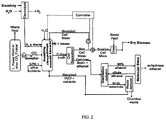
- FIG. 2 is process flow diagram for an exemplary embodiment of the present invention for the capture of CO 2 by hydrogen oxidizing chemoautotrophs and production of ethanol.
- a carbon dioxide rich flue gas is captured from an emission source such as a power plant, refinery, or cement producer.
- the flue gas is then compressed and pumped into cylindrical anaerobic digesters containing one or more hydrogen oxidizing acetogenic chemoautotrophs such as but not limited to the following comparative chemoautotrophs: Acetoanaerobium noterae, Acetobacterium woodii, Acetogenium kivui, Butyribacterium methylotrophicum, Butyribacterium rettgeri, Clostridium aceticum, Clostridium acetobutylicum, Clostridium acidi-urici, Clostridium autoethanogenum, Clostridium carboxidivorans, Clostridium formicoaceticum, Clostridium kluyveri, Clostridium ljungdahlii, Clostridium thermoaceticum, Clostridium thermoautotrophicum, Clostridium thermohydrosulfuricum, Clostridium thermosaccharolyticum, Clostridium thermocellum, Eubacterium limosum
- Hydrogen electron donor is added continuously to the growth broth along with other nutrients required for chemoautotrophic growth and maintenance that are pumped into the digester.
- the hydrogen source is a carbon dioxide emission-free process. This could be electrolytic or thermochemical processes powered by energy technologies including but not limited to photovoltaics, solar thermal, wind power, hydroelectric, nuclear, geothermal, enhanced geothermal, ocean thermal, ocean wave power, tidal power. Carbon dioxide serves as an electron acceptor in the chemosynthetic reaction.
- the culture broth is continuously removed from the digesters and flowed through membrane filters to separate the cell mass from the broth. The cell mass is then either recycled back into the digesters or pumped to driers depending upon the cell density in the digesters which is monitored by a controller.
- Cell mass directed to the dryers is then centrifuged and dried with evaporation.
- the dry biomass product is collected from the dryers.
- Cell-free broth which has passed through the cell mass removing filters is directed to vessels where the ethanol product is distilled and put through a molecular sieve to produce anhydrous ethanol using standard techniques known in the art of distillation.
- the broth left over after distillation is then subjected to any desired additional waste removal treatments which depends on the source of flue gas.
- the remaining water and nutrients are then pumped back into the digesters.
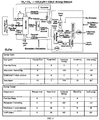
- FIG. 3 , 4 and 5 A process model is given in FIG. 3 , 4 and 5 for the embodiment of FIG. 2 .
- the mass balance, enthalpy flow, energy balance, and plant economics have been calculated for this [ R.K. Sinnott, Chemical Engineering Design volume 6, 4th ed. (Elsevier Butterworth-Heinemann, Oxford, 2005 )] preferred embodiment for the present invention.
- the model was developed using established results in the scientific literature for the H 2 oxidizing acetogens and for the process steps known from the art of chemical engineering.
- the inputs for the model regarding microorganism performance taken from the scientific literature [Gaddy, James L., et al. "Methods for increasing the production of ethanol from microbial fermentation”. US Patent 7285402. Oct.
- the mass balance indicates that 1 ton of ethanol will be produced for every 2 tons of CO 2 pumped into the system. This amounts to over 150 gallons of ethanol produced per ton of CO 2 intake.
- the energy balance indicates that for every 1 GJ of H 2 chemical energy input there is 0.8 GJ of ethanol chemical energy out, i.e. the chemical conversion is expected to be around 80% efficient.
- Overall efficiency of ethanol production from H 2 and CO 2 including electric power and process heat is predicted with the model to be about 50%.
- FIG. 6 is process flow diagram for a comparative process involving the capture of CO 2 by sulfur oxidizing chemoautotrophs and production of biomass and gypsum.
- a carbon dioxide rich flue gas is captured from an emission source such as a power plant, refinery, or cement producer.
- the flue gas is then compressed and pumped into cylindrical aerobic digesters containing one or more sulfur oxidizing chemoautotrophs such as but not limited to Thiomicrospira crunogena, Thiomicrospira strain MA-3, Thiomicrospira thermophila, Thiobacillus hydrothermalis, Thiomicrospira sp. strain CVO, Thiobacillus neapolitanus, Arcobacter sp. strain FWKO B.
- One or more electron donors such as but not limited to thiosulfate, hydrogen sulfide, or sulfur are added continuously to the growth broth along with other nutrients required for chemoautotrophic growth and air is pumped into the digester to provide oxygen as an electron acceptor.
- the culture broth is continuously removed from the digesters and flowed through membrane filters to separate the cell mass from the broth.
- the cell mass is then either recycled back into the digesters or pumped to driers depending upon the cell density in the digesters which is monitored by a controller.
- Cell mass directed to the dryers is then centrifuged and dried with evaporation. The dry biomass product is collected from the dryers.
- Cell-free broth which has passed through the cell mass removing filters is directed to vessels where the sulfuric acid produced by the chemosynthetic metabolism is neutralized with lime, precipitating out gypsum (CaSO 4 ).
- the lime may be produced in certain embodiments by a carbon dioxide emission-free process rather than through the heating of limestone.
- Such carbon dioxide emission-free processes include the recovery of natural sources of basic minerals including but not limited to minerals containing a metal oxide, serpentine containing a metal oxide, ultramafic deposits containing metal oxides, and underground basic saline aquifers.
- Alternative bases may be used for neutralization in this process including but not limited to magnesium oxide, iron oxide, or some other metal oxide.
- the gypsum is removed by solid-liquid separation techniques and pumped to dryers. The final product is dried gypsum.
- the broth left over after the sulfate is precipitated out is then subjected to any desired additional waste removal treatments which depends on the source of flue gas. The remaining water and nutrients
- FIG. 7 is process flow diagram for a comparative process involving the capture of CO 2 by sulfur oxidizing chemoautotrophs and production of biomass and sulfuric acid and calcium carbonate via the Muller-Kuhne reaction.
- a carbon dioxide rich flue gas is captured from an emission source such as a power plant, refinery, or cement producer.
- the flue gas is then compressed and pumped into cylindrical aerobic digesters containing one or more sulfur oxidizing chemoautotrophs such as but not limited to Thiomicrospira crunogena, Thiomicrospira strain MA-3, Thiomicrospira thermophila, Thiobacillus hydrothermalis, Thiomicrospira sp. strain CVO, Thiobacillus neapolitanus, Arcobacter sp.
- strain FWKO B One or more electron donors such as but not limited to thiosulfate, hydrogen sulfide, or sulfur are added continuously to the growth broth along with other nutrients required for chemoautotrophic growth and air is pumped into the digester to provide oxygen as an electron acceptor.
- the culture broth is continuously removed from the digesters and flowed through membrane filters to separate the cell mass from the broth.
- the cell mass is then either recycled back into the digesters or pumped to driers depending upon the cell density in the digesters which is monitored by a controller.
- Cell mass directed to the dryers is then centrifuged and dried with evaporation. The dry biomass product is collected from the dryers.
- Cell-free broth which has passed through the cell mass removing filters is directed to vessels where the sulfuric acid produced by the chemosynthetic metabolism is neutralized with lime (CaO), precipitating out gypsum (CaSO 4 ).
- the lime may be produced in certain embodiments by a carbon dioxide emission-free process rather than through the heating of limestone.
- Such carbon dioxide emission-free processes include the recovery of natural sources of basic minerals including but not limited to minerals containing a metal oxide, iron ore, serpentine containing a metal oxide, ultramafic deposits containing metal oxides, and underground basic saline aquifers.
- Alternative bases may be used for neutralization in this process including but not limited to magnesium oxide, iron oxide, or some other metal oxide.
- the gypsum is removed by solid-liquid separation techniques and pumped to kilns where the Muller-Kuhne process is carried out with the addition of coal.
- the net reaction for the Muller-Kuhne process is as follows 2C + 4CaSO 4 ⁇ 2CaO + 2CaCO 3 + 4SO 2 .
- the produced CaCO 3 is collected and the CaO is recycled for further neutralization.
- the SO 2 gas produced is directed to a reactor for the contact process where sulfuric acid is produced.
- the broth left over after the sulfate is precipitated out is then subjected to any desired additional waste removal treatments which depends on the source of flue gas.
- the remaining water and nutrients are then pumped back into the digesters.
- FIG. 8 is a process flow diagram for a comparative process involving the capture of CO 2 by sulfur oxidizing chemoautotrophs and production of biomass and calcium carbonate and recycling of thiosulfate electron donor via the Muller-Kuhne reaction.
- a carbon dioxide rich flue gas is captured from an emission source such as a power plant, refinery, or cement producer.
- the flue gas is then compressed and pumped into cylindrical aerobic digesters containing one or more sulfur oxidizing chemoautotrophs such as but not limited to Thiomicrospira crunogena, Thiomicrospira strain MA-3, Thiomicrospira thermophila, Thiobacillus hydrothermalis, Thiomicrospira sp.
- Cell-free broth which has passed through the cell mass removing filters is directed to vessels where the sulfuric acid produced by the chemosynthetic metabolism is neutralized with lime (CaO), precipitating out gypsum (CaSO 4 ).
- the lime may be produced in certain embodiments by a carbon dioxide emission-free process rather than through the heating of limestone.
- Such carbon dioxide emission-free processes include the recovery of natural sources of basic minerals including but not limited to minerals containing a metal oxide, serpentine containing a metal oxide, ultramafic deposits containing metal oxides, and underground basic saline aquifers.
- Alternative bases may be used for neutralization in this process including but not limited to magnesium oxide, iron oxide, or some other metal oxide.
- the gypsum is removed by solid-liquid separation techniques and pumped to kilns where the Muller-Kuhne process is carried out with the addition of coal.
- the net reaction for the Muller-Kuhne process is as follows 2C + 4CaSO 4 ⁇ 2CaO + 2CaCO 3 + 4SO 2 .
- the produced CaCO 3 is collected and the CaO is recycled for further reaction.
- the SO 2 gas produced is directed to a reactor where it is reacted with CaO or some other metal oxide such as iron oxide, and sulfur to recycle the thiosulfate (calcium thiosulfate if CaO is used).
- the broth left over after the sulfate is precipitated out is then subjected to any desired additional waste removal treatments which depends on the source of flue gas.
- the remaining water and nutrients are then pumped back into the digesters.
- FIG. 9 is process flow diagram for a comparative process involving the capture of CO 2 by sulfur and iron oxidizing chemoautotrophs and production of biomass and sulfuric acid using an insoluble source of electron donors.
- a carbon dioxide rich flue gas is captured from an emission source such as a power plant, refinery, or cement producer.
- the flue gas is then compressed and pumped into one set of cylindrical aerobic digesters containing one or more sulfur oxidizing chemoautotrophs such as but not limited to Thiomicrospira crunogena, Thiomicrospira strain MA-3, Thiomicrospira thermophila, Thiobacillus hydrothermalis, Thiomicrospira sp. strain CVO, Thiobacillus neapolitanus, Arcobacter sp.
- strain FWKO B and another set of cylindrical aerobic digesters containing one or more iron oxidizing chemoautotrophs such as but not limited to Leptospirillum ferrooxidans or Thiobacillus ferrooxidans.
- iron oxidizing chemoautotrophs such as but not limited to Leptospirillum ferrooxidans or Thiobacillus ferrooxidans.
- One or more insoluble sources of electron donors such as but not limited to elemental sulfur, pyrite, or other metal sulfides are sent to a anaerobic reactor for reaction with a ferric iron solution.
- chemoautotrophs such as but not limited to Thiobacillus ferrooxidans and Sulfolobus sp. can be present in this reactor to help biocatalyze the attack of the insoluble electron donor source with ferric iron.
- the ferrous iron is separated out of the process stream by precipitation.
- the thiosulfate solution is then flowed into the S-oxidizer digesters and the ferrous iron is pumped into the Fe-oxidizer digesters as the electron donor for each type of chemoautotroph respectively.
- Air and other nutrients required for chemoautotrophic growth are also pumped into the digesters.
- the culture broth is continuously removed from the digesters and flowed through membrane filters to separate the cell mass from the broth. The cell mass is then either recycled back into the digesters or pumped to driers depending upon the cell density in the digesters which is monitored by a controller.
- Cell mass directed to the dryers is then centrifuged and dried with evaporation.
- the dry biomass product is collected from the dryers.
- the cell-free broth which has passed through the cell mass removing filters is directed to sulfuric acid recovery systems such employed in the refinery or distillery industries where the sulfuric acid product of chemosynthetic metabolism is concentrated. This sulfuric acid concentrate is then concentrated further using the contact process to give a concentrated sulfuric acid product.
- the broth left over after the sulfate and sulfuric acid have been removed is then subjected to any desired additional waste removal treatments which depends on the source of flue gas.
- the Fe-oxidizer process stream the cell-free broth which has passed through the cell mass removing filters is then stripped of ferric iron by precipitation. This ferric iron is then sent back for further reaction with the insoluble source of electron donors (e.g. S, FeS 2 ). The remaining water and nutrients in both process streams are then pumped back into their respective digesters.
- the insoluble source of electron donors e.g. S, Fe
- FIG. 10 is a process flow diagram for a comparative process involving the capture of CO 2 by sulfur and hydrogen oxidizing chemoautotrophs and production of biomass, sulfuric acid, and ethanol using an insoluble source of electron donors.
- a carbon dioxide rich flue gas is captured from an emission source such as a power plant, refinery, or cement producer.
- the flue gas is then compressed and pumped into one set of cylindrical aerobic digesters containing one or more sulfur oxidizing chemoautotrophs such as but not limited to Thiomicrospira crunogena, Thiomicrospira strain MA-3, Thiomicrospira thermophila, Thiobacillus hydrothermalis, Thiomicrospira sp.
- strain CVO Thiobacillus neapolitanus, Arcobacter sp. strain FWKO B, and another set of cylindrical anaerobic digesters containing one or more hydrogen oxidizing acetogenic chemoautotrophs such as but not limited to Acetoanaerobium noterae, Acetobacterium woodii, Acetogenium kivui, Butyribacterium methylotrophicum, Butyribacterium rettgeri, Clostridium aceticum, Clostridium acetobutylicum, Clostridium acidi-urici, Clostridium autoethanogenum, Clostridium carboxidivorans, Clostridium formicoaceticum, Clostridium kluyveri, Clostridium ljungdahlii, Clostridium thermoaceticum, Clostridium thermoautotrophicum, Clostridium thermohydrosulfuricum, Clostridium thermosaccharolyticum, Clostridium
- One or more insoluble sources of electron donors such as but not limited to elemental sulfur, pyrite, or other metal sulfides are sent to an anaerobic reactor for reaction with a ferric iron solution.
- chemoautotrophs such as but not limited to Thiobacillus ferrooxidans and Sulfolobus sp. can be present in this reactor to help biocatalyze the attack of the insoluble electron donor source with ferric iron.
- a leachate of ferrous iron and thiosulfate flow out of the reactor. The ferrous iron is separated out of the process stream by precipitation.
- the thiosulfate solution is then flowed into the S-oxidizer digesters as an electron donor and the ferrous iron is pumped into an anaerobic electrolysis reactor.
- hydrogen gas is formed by the electrochemical reaction 2H + + Fe 2+ ⁇ H 2 + Fe 3+ .
- the open cell voltage for this reaction is 0.77 V which is substantially lower than the open cell voltage for the electrolysis of water (1.23 V).
- the kinetics of the oxidation of ferrous iron to ferric iron is much simpler than that for the reduction of oxygen in water to oxygen gas, hence the overvoltage for the iron reaction is lower.
- the hydrogen produced is fed into the H-oxidizer digesters as the electron donor.
- the other nutrients required for chemoautotrophic growth are also pumped into the digesters.
- the culture broth is continuously removed from the digesters and flowed through membrane filters to separate the cell mass from the broth.
- the cell mass is then either recycled back into the digesters or pumped to driers depending upon the cell density in the digesters which is monitored by a controller.
- Cell mass directed to the dryers is then centrifuged and dried with evaporation. The dry biomass product is collected from the dryers.
- the cell-free broth which has passed through the cell mass removing filters is directed to sulfuric acid recovery systems such as employed in the refinery and distillation industries where the sulfuric acid product of chemosynthetic metabolism is concentrated. This sulfuric acid concentrate is then concentrated further using the contact process to give a concentrated sulfuric acid product.
- the broth left over after the sulfate and sulfuric acid have been removed is then subjected to any desired additional waste removal treatments which depends on the source of flue gas.
- the cell-free broth which has passed through the cell mass removing filters is directed to vessels where the acetic acid produced is reacted with ethanol to produce ethyl acetate which is removed from solution by reactive distillation.
- the ethyl acetate is converted to ethanol by hydrogenation. Part, e.g. half, of the ethanol is recycled for further reaction in the reactive distillation process. The other part is put through a molecular sieve which separates anhydrous ethanol by adsorbtion from dilute ethanol. The anhydrous ethanol is then collected and the dilute ethanol is returned for further reaction in the reactive distillation step.
- the broth left over after the acetic acid is reactively distilled out is then subjected to any desired additional waste removal treatments which depends on the source of flue gas. The remaining water and nutrients in both process streams are then pumped back into their respective digesters.
- FIG. 11 is process flow diagram for a comparative process involving the capture of CO 2 by iron and hydrogen oxidizing chemoautotrophs and production of biomass, ferric sulfate, calcium carbonate and ethanol using coal or another hydrocarbon as the energy input for the production of electron donors without the release of gaseous CO 2 .
- a carbon dioxide rich flue gas is captured from an emission source such as a power plant, refinery, or cement producer.
- the flue gas is then compressed and pumped into one set of cylindrical aerobic digesters containing one or more iron oxidizing chemoautotrophs such as but not limited to Leptospirillum ferrooxidans or Thiobacillus ferrooxidans, and another set of cylindrical anaerobic digesters containing one or more hydrogen oxidizing acetogenic chemoautotrophs such as but not limited to Acetoanaerobium noterae, Acetobacterium woodii, Acetogenium kivui, Butyribacterium methylotrophicum, Butyribacterium rettgeri, Clostridium aceticum, Clostridium acetobutylicum, Clostridium acidi-urici, Clostridium autoethanogenum, Clostridium carboxidivorans, Clostridium formicoaceticum, Clostridium kluyveri, Clostridium ljungdahlii, Clostridium thermoaceticum, Clostridium thermoautotroph
- Hydrogen gas produced by the water shift reaction is fed into the H-oxidizer digesters as the electron donor.
- Ferrous sulfate synthesized through the reaction of ferrous oxide (FeO), sulfur dioxide and oxygen is pumped into the Fe-oxidizer digesters as the electron donor.
- the other nutrients required for chemoautotrophic growth are also pumped into the digesters for each respective type of chemoautotroph.
- the culture broth is continuously removed from the digesters and flowed through membrane filters to separate the cell mass from the broth. The cell mass is then either recycled back into the digesters or pumped to driers depending upon the cell density in the digesters which is monitored by a controller. Cell mass directed to the dryers is then centrifuged and dried with evaporation. The dry biomass product is collected from the dryers.
- the cell-free broth which has passed through the cell mass removing filters is directed to ferric sulfate recovery systems such as employed in the steel industry where the ferric sulfate product of chemosynthetic metabolism is concentrated into a salable product.
- the broth left over after the sulfate has been removed is then subjected to any desired additional waste removal treatments which depends on the source of flue gas.
- the cell-free broth which has passed through the cell mass removing filters is directed to vessels where the acetic acid produced is reacted with ethanol to produce ethyl acetate which is removed from solution by reactive distillation. The ethyl acetate is converted to ethanol by hydrogenation. Part, e.g.
- the oxidation drives two reactions that occur in parallel, one is the reduction of iron ore (Fe 2 O3) to ferrous oxide (FeO) accompanied by the release of carbon monoxide which is water shifted to produce hydrogen gas and carbon dioxide, the other is the reduction of gypsum (CaSO 4 ) to sulfur dioxide and quicklime accompanied by the release of carbon dioxide.
- the carbon dioxide from both process streams is reacted with the quicklime to produce calcium carbonate.
- In parallel with the production of calcium carbonate is the production of ferrous sulfate through the reaction of ferrous oxide with sulfur dioxide and oxygen.
- the sulfuric acid may alternatively be neutralized, in certain embodiments with a base that is not a carbonate (so as to not release carbon dioxide in the acid base reaction) and this carbonate may be produced by a carbon dioxide emission-free process.
- bases include but are not limited to natural basic minerals containing a metal oxide, serpentine containing a metal oxide, ultramafic deposits containing metal oxides, underground basic saline aquifers, and naturally occurring calcium oxide, magnesium oxide, iron oxide, or some other metal oxide.
- the metal sulfate which results from the acid-base reaction may be recovered from the process stream and preferably refined into a salable product, while the water produced by the acid-base reaction may be recycled back into the chemosynthesis reactors.
- a specific comparative example is provided to demonstrate the carbon capture and fixation capabilities of chemoautotrophic microorganisms that play a central part in the overall carbon capture and fixation process of the present invention.
- Tests were performed on the sulfur-oxidizing chemoautotroph Thiomicrospira crunogena ATCC #35932 acquired as a freeze dried culture from American Type Culture Collection (ATCC). The organisms were grown on the recommended ATCC medium - the #1422 broth.
- This broth consisted of the following chemicals dissolved in 1 Liter of distilled water: NaCl, 25.1g; (NH 4 ) 2 SO 4 , 1.0g; MgSO 4 .7 H 2 O, 1.5g; KH 2 PO 4 , 0.42g; NaHCO 3 , 0.20g; CaCl 2 .2 H 2 O, 0.29g; Tris-hydrochloride buffer, 3.07g; Na 2 S 2 O 3 .5H 2 O, 2.48g; Visniac and Santer Trace Element Solution, 0.2 ml; 0.5% Phenol Red, 1.0 ml;
- the #1422 broth was adjusted to pH 7.5 and filter-sterilized prior to innoculation.
- the freeze dried culture of Thiomicrospira crunogena was rehydrated according to the procedure recommended by ATCC and transferred first to a test tube with 5 ml broth #1422 and placed on a shaker. This culture was used to innoculate additional test tubes. NaOH was added as needed to maintain the pH near 7.5. Eventually the cultures were transferred from the test tube to 1 liter flasks filled with 250 ml of #1422 broth and placed in a New Brunswick Scientific Co. shake flask incubator set to 25 Celsius.
- a reference to "A and/or B,” when used in conjunction with open-ended language such as “comprising” can refer, in one embodiment, to A without B (optionally including elements other than B); in another embodiment, to B without A (optionally including elements other than A); in yet another embodiment, to both A and B (optionally including other elements); etc.
Landscapes
- Chemical & Material Sciences (AREA)
- Organic Chemistry (AREA)
- Engineering & Computer Science (AREA)
- Life Sciences & Earth Sciences (AREA)
- Wood Science & Technology (AREA)
- Zoology (AREA)
- Health & Medical Sciences (AREA)
- Bioinformatics & Cheminformatics (AREA)
- Genetics & Genomics (AREA)
- Biotechnology (AREA)
- General Health & Medical Sciences (AREA)
- Biochemistry (AREA)
- General Engineering & Computer Science (AREA)
- Microbiology (AREA)
- Chemical Kinetics & Catalysis (AREA)
- General Chemical & Material Sciences (AREA)
- Biomedical Technology (AREA)
- Medicinal Chemistry (AREA)
- Combustion & Propulsion (AREA)
- Sustainable Development (AREA)
- Tropical Medicine & Parasitology (AREA)
- Virology (AREA)
- Mycology (AREA)
- Preparation Of Compounds By Using Micro-Organisms (AREA)
- Micro-Organisms Or Cultivation Processes Thereof (AREA)
- Liquid Carbonaceous Fuels (AREA)
- Soil Conditioners And Soil-Stabilizing Materials (AREA)
- Fertilizers (AREA)
- Apparatus Associated With Microorganisms And Enzymes (AREA)
- Processing Of Solid Wastes (AREA)
Applications Claiming Priority (2)
| Application Number | Priority Date | Filing Date | Title |
|---|---|---|---|
| US12/613,550 US20100120104A1 (en) | 2008-11-06 | 2009-11-06 | Biological and chemical process utilizing chemoautotrophic microorganisms for the chemosythetic fixation of carbon dioxide and/or other inorganic carbon sources into organic compounds, and the generation of additional useful products |
| PCT/US2010/001402 WO2011056183A1 (en) | 2009-11-06 | 2010-05-12 | Biological and chemical process utilizing chemoautotrophic microorganisms for the chemosynthetic fixation of carbon dioxide and/or other inorganic carbon sources into organic compounds, and the generation of additional useful products |
Publications (3)
| Publication Number | Publication Date |
|---|---|
| EP2521790A1 EP2521790A1 (en) | 2012-11-14 |
| EP2521790A4 EP2521790A4 (en) | 2013-11-27 |
| EP2521790B1 true EP2521790B1 (en) | 2021-09-22 |
Family
ID=42165543
Family Applications (1)
| Application Number | Title | Priority Date | Filing Date |
|---|---|---|---|
| EP10828637.8A Active EP2521790B1 (en) | 2009-11-06 | 2010-05-12 | Biological and chemical process utilizing chemoautotrophic microorganisms for the chemosynthetic fixation of carbon dioxide and/or other inorganic carbon sources into organic compounds, and the generation of additional useful products |
Country Status (6)
| Country | Link |
|---|---|
| EP (1) | EP2521790B1 (https=) |
| JP (1) | JP5956927B2 (https=) |
| ES (1) | ES2899980T3 (https=) |
| MY (1) | MY162723A (https=) |
| SG (1) | SG10201908921WA (https=) |
| WO (1) | WO2011056183A1 (https=) |
Families Citing this family (40)
| Publication number | Priority date | Publication date | Assignee | Title |
|---|---|---|---|---|
| US20130149755A1 (en) | 2008-11-06 | 2013-06-13 | Kiverdi ,Inc. | Use of oxyhydrogen microorganisms for non-photosynthetic carbon capture and conversion of inorganic and/or c1 carbon sources into useful organic compounds |
| US9879290B2 (en) | 2008-11-06 | 2018-01-30 | Kiverdi, Inc. | Industrial fatty acid engineering general system for modifying fatty acids |
| US9957534B2 (en) | 2008-11-06 | 2018-05-01 | Kiverdi, Inc. | Engineered CO2-fixing chemotrophic microorganisms producing carbon-based products and methods of using the same |
| EP2459725B1 (en) * | 2009-07-27 | 2019-01-16 | The University Of Wyoming Research Corporation | Biological clean fuel processing systems and methods |
| BR112012027661B1 (pt) * | 2010-04-27 | 2020-12-08 | Kiverdi, Inc. | método biológico e químico para a captura e a conversão de um composto de carbono inorgânico e/ou um composto orgânico contendo apenas um átomo de carbono em um produto químico orgânico |
| CL2011001252A1 (es) * | 2011-05-27 | 2011-08-05 | Biosigma Sa | Sistema de biodaptacion de azufre en forma de dispersion estable para alimentar biorreactores industriales que comprende un estanque con medio liquido de sobrenadantes o cultivo de bacterias sulfooxidantes, bomba de recirculacion y un eductor con via de alimentacion de azufre en polvo fino; y su metodo. |
| WO2013090769A2 (en) | 2011-12-14 | 2013-06-20 | Kiverdi, Inc. | Method and apparatus for growing microbial cultures that require gaseous electron donors, electron acceptors, carbon sources, or other nutrients |
| RU2620063C2 (ru) * | 2012-07-27 | 2017-05-22 | Эф-Эф-Джи-Эф Лимитед | Устройство и способ получения метана |
| JP5985331B2 (ja) * | 2012-09-21 | 2016-09-06 | 一般財団法人電力中央研究所 | 水素細菌の代謝制御方法 |
| JP2016513977A (ja) | 2013-03-14 | 2016-05-19 | ザ ユニバーシティ オブ ワイオミング リサーチ コーポレーション | 化学合成独立栄養細菌を利用した二酸化炭素の変換システムおよび方法 |
| AU2014236594B2 (en) | 2013-03-14 | 2018-06-14 | The University Of Wyoming Research Corporation | Methods and systems for biological coal-to-biofuels and bioproducts |
| EP2971023B1 (en) | 2013-03-15 | 2024-12-11 | Kiverdi, Inc. | Methods of using natural and engineered organisms to produce small molecules for industrial application |
| JP6104005B2 (ja) * | 2013-03-21 | 2017-03-29 | 一般財団法人電力中央研究所 | 水素細菌の代謝制御方法 |
| AU2014202663B2 (en) * | 2013-05-17 | 2018-06-21 | Newsouth Innovations Pty Limited | Enhanced biogas production |
| WO2015027209A2 (en) | 2013-08-22 | 2015-02-26 | Kiverdi, Inc. | Microorganisms for biosynthesis of limonene on gaseous substrates |
| CN107075531B (zh) * | 2013-10-17 | 2021-07-27 | 朗泽科技新西兰有限公司 | 改进的发酵中碳捕捉 |
| KR101640297B1 (ko) * | 2014-01-15 | 2016-07-15 | 연세대학교 원주산학협력단 | 산성광산배수를 이용한 바이오매스 회수방법 |
| JP6399536B2 (ja) * | 2014-03-03 | 2018-10-03 | 一般財団法人電力中央研究所 | 微生物の遺伝子発現制御方法 |
| JP5740553B1 (ja) * | 2014-03-06 | 2015-06-24 | 辰己 秋峯 | クリーン複合発電とメタンガス製法と肥料製法と漁業法 |
| CN106574209B (zh) | 2014-06-09 | 2020-02-14 | 斯泰潘公司 | 用于冷水清洗的洗涤剂 |
| JP6403465B2 (ja) * | 2014-07-09 | 2018-10-10 | 株式会社安藤・間 | 細菌の固定化方法、細菌固定化担体、及び細菌の保存方法 |
| US10856560B2 (en) * | 2015-05-21 | 2020-12-08 | Lanzatech New Zealand Limited | Gas fermentation for the production of protein or feed |
| CN105352985A (zh) * | 2015-08-13 | 2016-02-24 | 安徽世华化工有限公司 | 一种脱除煤中不同有机硫化物的方法 |
| FR3045666B1 (fr) | 2015-12-18 | 2018-02-16 | Suez Environnement | Procede de synthese de molecules organiques |
| PT3411489T (pt) * | 2016-02-01 | 2023-08-07 | Lanzatech Nz Inc | Processo de fermentação e eletrólise integrado |
| IL317232A (en) * | 2016-03-19 | 2025-01-01 | Kiverdi Inc | Microorganisms and artificial ecosystems for the production of protein, food and useful co-products from C1 substrates |
| JP6241906B2 (ja) * | 2017-01-26 | 2017-12-06 | 一般財団法人電力中央研究所 | 水素細菌の代謝制御方法 |
| EA201891926A1 (ru) * | 2017-02-03 | 2019-04-30 | Киверди, Инк. | Микроорганизмы и искусственные экосистемы для производства белка, продуктов питания и полезных побочных продуктов из субстратов c1 |
| CA3098176A1 (en) | 2018-04-25 | 2019-10-31 | The University Of British Columbia | Systems and methods for electrochemical generation of syngas and other useful chemicals |
| KR20220123019A (ko) | 2019-12-31 | 2022-09-05 | 에어 프로틴 인코포레이티드 | 고단백질 식품 조성물 |
| EP4157493B1 (en) * | 2020-05-27 | 2025-11-05 | Sammy, Johann, Q. | Photolytic bioreactor system and method |
| KR20220110968A (ko) | 2021-02-01 | 2022-08-09 | 에스케이이노베이션 주식회사 | 이산화탄소 및 대기오염물질 저감방법 |
| IT202100011393A1 (it) * | 2021-05-05 | 2022-11-05 | Bioevo S R L | Sistema e metodo per il miglioramento oggettivo delle prestazioni ecologiche di un’impresa |
| CN113337429B (zh) * | 2021-06-03 | 2023-11-14 | 四川发展中恒能环境科技有限公司 | 一种用于处理餐厨垃圾类有机废弃物的微生物菌剂及其应用 |
| CN114921326B (zh) * | 2021-12-31 | 2025-06-27 | 西南大学 | 一种碳减排生物藻板 |
| GB2620645A (en) | 2022-07-13 | 2024-01-17 | Cemvita Factory Inc | Process |
| US20240245190A1 (en) | 2023-01-19 | 2024-07-25 | Sharkninja Operating Llc | Identification of hair care appliance attachments |
| KR20250154586A (ko) | 2023-01-19 | 2025-10-28 | 샤크닌자 오퍼레이팅 엘엘씨 | 전력 공급 부착물을 갖는 헤어 케어 기기 |
| GB202306850D0 (en) | 2023-05-09 | 2023-06-21 | Farmless Holding B V | Fermentation process |
| KR102675317B1 (ko) * | 2023-11-23 | 2024-06-13 | 이동우 | 기능성 사료 조성물 및 이의 제조방법 |
Family Cites Families (19)
| Publication number | Priority date | Publication date | Assignee | Title |
|---|---|---|---|---|
| CA1114963A (en) | 1979-10-26 | 1981-12-22 | Canadian Industries Limited | Means for separation of gas and solids from waste mixed liquor |
| US4596778A (en) | 1983-07-06 | 1986-06-24 | Phillips Petroleum Company | Single cell protein from sulfur energy sources |
| US4859588A (en) * | 1986-04-09 | 1989-08-22 | Combustion Engineering, Inc. | Production of a single cell protein |
| JP2912684B2 (ja) * | 1990-07-16 | 1999-06-28 | 電源開発株式会社 | バイオテクノロジーによる炭酸ガス固定組合わせ方法 |
| US5173429A (en) * | 1990-11-09 | 1992-12-22 | The Board Of Trustees Of The University Of Arkansas | Clostridiumm ljungdahlii, an anaerobic ethanol and acetate producing microorganism |
| US5821111A (en) | 1994-03-31 | 1998-10-13 | Bioengineering Resources, Inc. | Bioconversion of waste biomass to useful products |
| US5593886A (en) * | 1992-10-30 | 1997-01-14 | Gaddy; James L. | Clostridium stain which produces acetic acid from waste gases |
| US5807722A (en) * | 1992-10-30 | 1998-09-15 | Bioengineering Resources, Inc. | Biological production of acetic acid from waste gases with Clostridium ljungdahlii |
| JP2516154B2 (ja) * | 1992-12-07 | 1996-07-10 | 株式会社荏原製作所 | 微生物学的エネルギ―及び有用物質の生産方法及び装置 |
| US5989513A (en) | 1995-07-28 | 1999-11-23 | Gas Research Institute | Biologically assisted process for treating sour gas at high pH |
| US5650070A (en) | 1996-03-14 | 1997-07-22 | Deep Shaft Technology Inc. | Aerobic long vertical shaft bioreactors |
| US5645726A (en) | 1996-03-14 | 1997-07-08 | Deep Shaft Technology Inc. | Treatment of waste liquor in a vertical shaft bioreactor |
| KR100387301B1 (ko) * | 1996-07-01 | 2003-06-12 | 바이오 엔지니어링 리소스 인코포레이티드 | 폐가스로부터의 생성물의 생물학적 제조방법 |
| JP4557344B2 (ja) * | 2000-02-01 | 2010-10-06 | 独立行政法人科学技術振興機構 | 水素資化メタン菌からのビタミンb12の生産方法 |
| US6667171B2 (en) | 2000-07-18 | 2003-12-23 | Ohio University | Enhanced practical photosynthetic CO2 mitigation |
| WO2002008438A2 (en) | 2000-07-25 | 2002-01-31 | Bioengineering Resources, Inc. | Methods for increasing the production of ethanol from microbial fermentation |
| EP1363857A2 (en) | 2001-02-23 | 2003-11-26 | V.A.I. Ltd. | Methods and apparatus for biological treatment of waste waters |
| US20070275447A1 (en) | 2006-05-25 | 2007-11-29 | Lewis Randy S | Indirect or direct fermentation of biomass to fuel alcohol |
| DE102006030001A1 (de) | 2006-06-29 | 2008-01-03 | Robert Bosch Gmbh | Regel- und Steuersystem in einem Fahrzeugverbund |
-
2010
- 2010-05-12 MY MYPI2012002003A patent/MY162723A/en unknown
- 2010-05-12 ES ES10828637T patent/ES2899980T3/es active Active
- 2010-05-12 EP EP10828637.8A patent/EP2521790B1/en active Active
- 2010-05-12 JP JP2012537850A patent/JP5956927B2/ja active Active
- 2010-05-12 SG SG10201908921W patent/SG10201908921WA/en unknown
- 2010-05-12 WO PCT/US2010/001402 patent/WO2011056183A1/en not_active Ceased
Also Published As
| Publication number | Publication date |
|---|---|
| JP5956927B2 (ja) | 2016-07-27 |
| EP2521790A1 (en) | 2012-11-14 |
| ES2899980T3 (es) | 2022-03-15 |
| MY162723A (en) | 2017-07-14 |
| JP2013509876A (ja) | 2013-03-21 |
| EP2521790A4 (en) | 2013-11-27 |
| WO2011056183A1 (en) | 2011-05-12 |
| SG10201908921WA (en) | 2019-11-28 |
Similar Documents
| Publication | Publication Date | Title |
|---|---|---|
| EP2521790B1 (en) | Biological and chemical process utilizing chemoautotrophic microorganisms for the chemosynthetic fixation of carbon dioxide and/or other inorganic carbon sources into organic compounds, and the generation of additional useful products | |
| US20250257374A1 (en) | Biological and Chemical Process Utilizing Chemoautotrophic Microorganisms for the Chemosynthetic Fixation of Carbon Dioxide and/or Other Inorganic Carbon Sources into Organic Compounds and the Generation of Additional Useful Products | |
| US20190382808A1 (en) | Biological and Chemical Process Utilizing Chemoautotrophic Microorganisms for the Chemosynthetic Fixation of Carbon Dioxide and/or Other Inorganic Carbon Sources into Organic Compounds and the Generation of Additional Useful Products | |
| JP7582679B2 (ja) | 無機炭素源および/またはc1炭素源から有用有機化合物への非光合成炭素の回収および変換のための酸水素微生物の使用 | |
| US20130078690A1 (en) | Biological and chemical process utilizing chemoautotrophic microorganisms for the chemosythetic fixation of carbon dioxide and/or other inorganic carbon sources into organic compounds, and the generation of additional useful products | |
| US9085785B2 (en) | Use of oxyhydrogen microorganisms for non-photosynthetic carbon capture and conversion of inorganic and/or C1 carbon sources into useful organic compounds | |
| US9157058B2 (en) | Method and apparatus for growing microbial cultures that require gaseous electron donors, electron acceptors, carbon sources, or other nutrients | |
| ES2788510T3 (es) | Proceso de fermentación | |
| ES2878261T3 (es) | Métodos de mantener la viabilidad de cultivos | |
| JP2013509876A5 (https=) | ||
| Akash et al. | Biotechnology to convert carbon dioxide into biogas, bioethanol, bioplastic and succinic acid using algae, bacteria and yeast: a review | |
| Rachbauer et al. | Gas fermentation | |
| US20250250594A1 (en) | USE OF OXYHYDROGEN MICROORGANISMS FOR NONPHOTOSYNTHETIC CARBON CAPTURE AND CONVERSION OF INORGANIC AND/OR Cl CARBON SOURCES INTO USEFUL ORGANIC COMPOUNDS | |
| Semwal et al. | Technobiological Pathways for High‐CO₂ Capture Using Micro‐/Macroalgae: Genetic Engineering, Process Automation, and Value‐Added Bioproducts | |
| WO2025235319A1 (en) | Methods and compositions for production of carbohydrates from co2 by a chemolithoautotroph | |
| Singh et al. | Microalgal Biomass as a Promising | |
| Yang | Biological Production of Hydrogen from Renewable Resources | |
| BR122020011452B1 (pt) | Métodos biológico e químico para a captura e a conversão de um composto de carbono inorgânico e/ou um composto orgânico contendo apenas um átomo de carbono em um produto químico orgânico tendo um comprimento de cadeia c5 ou mais longo |
Legal Events
| Date | Code | Title | Description |
|---|---|---|---|
| PUAI | Public reference made under article 153(3) epc to a published international application that has entered the european phase |
Free format text: ORIGINAL CODE: 0009012 |
|
| 17P | Request for examination filed |
Effective date: 20120914 |
|
| AK | Designated contracting states |
Kind code of ref document: A1 Designated state(s): AL AT BE BG CH CY CZ DE DK EE ES FI FR GB GR HR HU IE IS IT LI LT LU LV MC MK MT NL NO PL PT RO SE SI SK SM TR |
|
| DAX | Request for extension of the european patent (deleted) | ||
| A4 | Supplementary search report drawn up and despatched |
Effective date: 20131029 |
|
| RIC1 | Information provided on ipc code assigned before grant |
Ipc: C12P 5/00 20060101ALI20131023BHEP Ipc: C12P 9/00 20060101ALI20131023BHEP Ipc: C12P 11/00 20060101ALI20131023BHEP Ipc: C12P 1/04 20060101AFI20131023BHEP Ipc: C12P 7/00 20060101ALI20131023BHEP |
|
| STAA | Information on the status of an ep patent application or granted ep patent |
Free format text: STATUS: EXAMINATION IS IN PROGRESS |
|
| 17Q | First examination report despatched |
Effective date: 20181212 |
|
| GRAP | Despatch of communication of intention to grant a patent |
Free format text: ORIGINAL CODE: EPIDOSNIGR1 |
|
| STAA | Information on the status of an ep patent application or granted ep patent |
Free format text: STATUS: GRANT OF PATENT IS INTENDED |
|
| INTG | Intention to grant announced |
Effective date: 20210414 |
|
| GRAS | Grant fee paid |
Free format text: ORIGINAL CODE: EPIDOSNIGR3 |
|
| GRAA | (expected) grant |
Free format text: ORIGINAL CODE: 0009210 |
|
| STAA | Information on the status of an ep patent application or granted ep patent |
Free format text: STATUS: THE PATENT HAS BEEN GRANTED |
|
| AK | Designated contracting states |
Kind code of ref document: B1 Designated state(s): AL AT BE BG CH CY CZ DE DK EE ES FI FR GB GR HR HU IE IS IT LI LT LU LV MC MK MT NL NO PL PT RO SE SI SK SM TR |
|
| REG | Reference to a national code |
Ref country code: GB Ref legal event code: FG4D |
|
| REG | Reference to a national code |
Ref country code: IE Ref legal event code: FG4D |
|
| REG | Reference to a national code |
Ref country code: DE Ref legal event code: R096 Ref document number: 602010067618 Country of ref document: DE |
|
| REG | Reference to a national code |
Ref country code: CH Ref legal event code: EP Ref country code: AT Ref legal event code: REF Ref document number: 1432369 Country of ref document: AT Kind code of ref document: T Effective date: 20211015 |
|
| REG | Reference to a national code |
Ref country code: LT Ref legal event code: MG9D |
|
| REG | Reference to a national code |
Ref country code: NL Ref legal event code: FP |
|
| PG25 | Lapsed in a contracting state [announced via postgrant information from national office to epo] |
Ref country code: SE Free format text: LAPSE BECAUSE OF FAILURE TO SUBMIT A TRANSLATION OF THE DESCRIPTION OR TO PAY THE FEE WITHIN THE PRESCRIBED TIME-LIMIT Effective date: 20210922 Ref country code: HR Free format text: LAPSE BECAUSE OF FAILURE TO SUBMIT A TRANSLATION OF THE DESCRIPTION OR TO PAY THE FEE WITHIN THE PRESCRIBED TIME-LIMIT Effective date: 20210922 Ref country code: BG Free format text: LAPSE BECAUSE OF FAILURE TO SUBMIT A TRANSLATION OF THE DESCRIPTION OR TO PAY THE FEE WITHIN THE PRESCRIBED TIME-LIMIT Effective date: 20211222 Ref country code: LT Free format text: LAPSE BECAUSE OF FAILURE TO SUBMIT A TRANSLATION OF THE DESCRIPTION OR TO PAY THE FEE WITHIN THE PRESCRIBED TIME-LIMIT Effective date: 20210922 Ref country code: NO Free format text: LAPSE BECAUSE OF FAILURE TO SUBMIT A TRANSLATION OF THE DESCRIPTION OR TO PAY THE FEE WITHIN THE PRESCRIBED TIME-LIMIT Effective date: 20211222 Ref country code: FI Free format text: LAPSE BECAUSE OF FAILURE TO SUBMIT A TRANSLATION OF THE DESCRIPTION OR TO PAY THE FEE WITHIN THE PRESCRIBED TIME-LIMIT Effective date: 20210922 |
|
| REG | Reference to a national code |
Ref country code: GR Ref legal event code: EP Ref document number: 20210403216 Country of ref document: GR Effective date: 20220113 |
|
| REG | Reference to a national code |
Ref country code: AT Ref legal event code: MK05 Ref document number: 1432369 Country of ref document: AT Kind code of ref document: T Effective date: 20210922 |
|
| PG25 | Lapsed in a contracting state [announced via postgrant information from national office to epo] |
Ref country code: LV Free format text: LAPSE BECAUSE OF FAILURE TO SUBMIT A TRANSLATION OF THE DESCRIPTION OR TO PAY THE FEE WITHIN THE PRESCRIBED TIME-LIMIT Effective date: 20210922 |
|
| REG | Reference to a national code |
Ref country code: ES Ref legal event code: FG2A Ref document number: 2899980 Country of ref document: ES Kind code of ref document: T3 Effective date: 20220315 |
|
| PG25 | Lapsed in a contracting state [announced via postgrant information from national office to epo] |
Ref country code: AT Free format text: LAPSE BECAUSE OF FAILURE TO SUBMIT A TRANSLATION OF THE DESCRIPTION OR TO PAY THE FEE WITHIN THE PRESCRIBED TIME-LIMIT Effective date: 20210922 |
|
| PG25 | Lapsed in a contracting state [announced via postgrant information from national office to epo] |
Ref country code: IS Free format text: LAPSE BECAUSE OF FAILURE TO SUBMIT A TRANSLATION OF THE DESCRIPTION OR TO PAY THE FEE WITHIN THE PRESCRIBED TIME-LIMIT Effective date: 20220122 Ref country code: SK Free format text: LAPSE BECAUSE OF FAILURE TO SUBMIT A TRANSLATION OF THE DESCRIPTION OR TO PAY THE FEE WITHIN THE PRESCRIBED TIME-LIMIT Effective date: 20210922 Ref country code: RO Free format text: LAPSE BECAUSE OF FAILURE TO SUBMIT A TRANSLATION OF THE DESCRIPTION OR TO PAY THE FEE WITHIN THE PRESCRIBED TIME-LIMIT Effective date: 20210922 Ref country code: PT Free format text: LAPSE BECAUSE OF FAILURE TO SUBMIT A TRANSLATION OF THE DESCRIPTION OR TO PAY THE FEE WITHIN THE PRESCRIBED TIME-LIMIT Effective date: 20220124 Ref country code: PL Free format text: LAPSE BECAUSE OF FAILURE TO SUBMIT A TRANSLATION OF THE DESCRIPTION OR TO PAY THE FEE WITHIN THE PRESCRIBED TIME-LIMIT Effective date: 20210922 Ref country code: EE Free format text: LAPSE BECAUSE OF FAILURE TO SUBMIT A TRANSLATION OF THE DESCRIPTION OR TO PAY THE FEE WITHIN THE PRESCRIBED TIME-LIMIT Effective date: 20210922 Ref country code: CZ Free format text: LAPSE BECAUSE OF FAILURE TO SUBMIT A TRANSLATION OF THE DESCRIPTION OR TO PAY THE FEE WITHIN THE PRESCRIBED TIME-LIMIT Effective date: 20210922 Ref country code: AL Free format text: LAPSE BECAUSE OF FAILURE TO SUBMIT A TRANSLATION OF THE DESCRIPTION OR TO PAY THE FEE WITHIN THE PRESCRIBED TIME-LIMIT Effective date: 20210922 |
|
| REG | Reference to a national code |
Ref country code: DE Ref legal event code: R097 Ref document number: 602010067618 Country of ref document: DE |
|
| PG25 | Lapsed in a contracting state [announced via postgrant information from national office to epo] |
Ref country code: DK Free format text: LAPSE BECAUSE OF FAILURE TO SUBMIT A TRANSLATION OF THE DESCRIPTION OR TO PAY THE FEE WITHIN THE PRESCRIBED TIME-LIMIT Effective date: 20210922 |
|
| PLBE | No opposition filed within time limit |
Free format text: ORIGINAL CODE: 0009261 |
|
| STAA | Information on the status of an ep patent application or granted ep patent |
Free format text: STATUS: NO OPPOSITION FILED WITHIN TIME LIMIT |
|
| 26N | No opposition filed |
Effective date: 20220623 |
|
| PG25 | Lapsed in a contracting state [announced via postgrant information from national office to epo] |
Ref country code: SI Free format text: LAPSE BECAUSE OF FAILURE TO SUBMIT A TRANSLATION OF THE DESCRIPTION OR TO PAY THE FEE WITHIN THE PRESCRIBED TIME-LIMIT Effective date: 20210922 |
|
| REG | Reference to a national code |
Ref country code: CH Ref legal event code: PL |
|
| REG | Reference to a national code |
Ref country code: BE Ref legal event code: MM Effective date: 20220531 |
|
| PG25 | Lapsed in a contracting state [announced via postgrant information from national office to epo] |
Ref country code: MC Free format text: LAPSE BECAUSE OF FAILURE TO SUBMIT A TRANSLATION OF THE DESCRIPTION OR TO PAY THE FEE WITHIN THE PRESCRIBED TIME-LIMIT Effective date: 20210922 Ref country code: LU Free format text: LAPSE BECAUSE OF NON-PAYMENT OF DUE FEES Effective date: 20220512 Ref country code: LI Free format text: LAPSE BECAUSE OF NON-PAYMENT OF DUE FEES Effective date: 20220531 Ref country code: CH Free format text: LAPSE BECAUSE OF NON-PAYMENT OF DUE FEES Effective date: 20220531 |
|
| PG25 | Lapsed in a contracting state [announced via postgrant information from national office to epo] |
Ref country code: IE Free format text: LAPSE BECAUSE OF NON-PAYMENT OF DUE FEES Effective date: 20220512 |
|
| PG25 | Lapsed in a contracting state [announced via postgrant information from national office to epo] |
Ref country code: BE Free format text: LAPSE BECAUSE OF NON-PAYMENT OF DUE FEES Effective date: 20220531 |
|
| P01 | Opt-out of the competence of the unified patent court (upc) registered |
Effective date: 20230519 |
|
| PG25 | Lapsed in a contracting state [announced via postgrant information from national office to epo] |
Ref country code: HU Free format text: LAPSE BECAUSE OF FAILURE TO SUBMIT A TRANSLATION OF THE DESCRIPTION OR TO PAY THE FEE WITHIN THE PRESCRIBED TIME-LIMIT; INVALID AB INITIO Effective date: 20100512 |
|
| PG25 | Lapsed in a contracting state [announced via postgrant information from national office to epo] |
Ref country code: SM Free format text: LAPSE BECAUSE OF FAILURE TO SUBMIT A TRANSLATION OF THE DESCRIPTION OR TO PAY THE FEE WITHIN THE PRESCRIBED TIME-LIMIT Effective date: 20210922 Ref country code: MK Free format text: LAPSE BECAUSE OF FAILURE TO SUBMIT A TRANSLATION OF THE DESCRIPTION OR TO PAY THE FEE WITHIN THE PRESCRIBED TIME-LIMIT Effective date: 20210922 Ref country code: CY Free format text: LAPSE BECAUSE OF FAILURE TO SUBMIT A TRANSLATION OF THE DESCRIPTION OR TO PAY THE FEE WITHIN THE PRESCRIBED TIME-LIMIT Effective date: 20210922 |
|
| PG25 | Lapsed in a contracting state [announced via postgrant information from national office to epo] |
Ref country code: TR Free format text: LAPSE BECAUSE OF FAILURE TO SUBMIT A TRANSLATION OF THE DESCRIPTION OR TO PAY THE FEE WITHIN THE PRESCRIBED TIME-LIMIT Effective date: 20210922 |
|
| PG25 | Lapsed in a contracting state [announced via postgrant information from national office to epo] |
Ref country code: MT Free format text: LAPSE BECAUSE OF FAILURE TO SUBMIT A TRANSLATION OF THE DESCRIPTION OR TO PAY THE FEE WITHIN THE PRESCRIBED TIME-LIMIT Effective date: 20210922 |
|
| PGFP | Annual fee paid to national office [announced via postgrant information from national office to epo] |
Ref country code: NL Payment date: 20250314 Year of fee payment: 16 |
|
| PGFP | Annual fee paid to national office [announced via postgrant information from national office to epo] |
Ref country code: FR Payment date: 20250310 Year of fee payment: 16 |
|
| PGFP | Annual fee paid to national office [announced via postgrant information from national office to epo] |
Ref country code: GB Payment date: 20250320 Year of fee payment: 16 |
|
| PGFP | Annual fee paid to national office [announced via postgrant information from national office to epo] |
Ref country code: DE Payment date: 20250319 Year of fee payment: 16 |
|
| PGFP | Annual fee paid to national office [announced via postgrant information from national office to epo] |
Ref country code: ES Payment date: 20250603 Year of fee payment: 16 |
|
| PGFP | Annual fee paid to national office [announced via postgrant information from national office to epo] |
Ref country code: IT Payment date: 20250422 Year of fee payment: 16 |
|
| PGFP | Annual fee paid to national office [announced via postgrant information from national office to epo] |
Ref country code: GR Payment date: 20250416 Year of fee payment: 16 |