EP2513063B1 - Verfahren zur herstellung von 1-alkyl-/1-aryl-5-pyrazolcarbonsäurederivaten - Google Patents
Verfahren zur herstellung von 1-alkyl-/1-aryl-5-pyrazolcarbonsäurederivaten Download PDFInfo
- Publication number
- EP2513063B1 EP2513063B1 EP10787791.2A EP10787791A EP2513063B1 EP 2513063 B1 EP2513063 B1 EP 2513063B1 EP 10787791 A EP10787791 A EP 10787791A EP 2513063 B1 EP2513063 B1 EP 2513063B1
- Authority
- EP
- European Patent Office
- Prior art keywords
- formula
- alkyl
- compounds
- halogen
- preparation
- Prior art date
- Legal status (The legal status is an assumption and is not a legal conclusion. Google has not performed a legal analysis and makes no representation as to the accuracy of the status listed.)
- Active
Links
- 0 *Cc1n[n](*)c(C(*)=O)c1 Chemical compound *Cc1n[n](*)c(C(*)=O)c1 0.000 description 4
Classifications
-
- C—CHEMISTRY; METALLURGY
- C07—ORGANIC CHEMISTRY
- C07D—HETEROCYCLIC COMPOUNDS
- C07D231/00—Heterocyclic compounds containing 1,2-diazole or hydrogenated 1,2-diazole rings
- C07D231/02—Heterocyclic compounds containing 1,2-diazole or hydrogenated 1,2-diazole rings not condensed with other rings
- C07D231/10—Heterocyclic compounds containing 1,2-diazole or hydrogenated 1,2-diazole rings not condensed with other rings having two or three double bonds between ring members or between ring members and non-ring members
- C07D231/14—Heterocyclic compounds containing 1,2-diazole or hydrogenated 1,2-diazole rings not condensed with other rings having two or three double bonds between ring members or between ring members and non-ring members with hetero atoms or with carbon atoms having three bonds to hetero atoms with at the most one bond to halogen, e.g. ester or nitrile radicals, directly attached to ring carbon atoms
-
- A—HUMAN NECESSITIES
- A01—AGRICULTURE; FORESTRY; ANIMAL HUSBANDRY; HUNTING; TRAPPING; FISHING
- A01N—PRESERVATION OF BODIES OF HUMANS OR ANIMALS OR PLANTS OR PARTS THEREOF; BIOCIDES, e.g. AS DISINFECTANTS, AS PESTICIDES OR AS HERBICIDES; PEST REPELLANTS OR ATTRACTANTS; PLANT GROWTH REGULATORS
- A01N43/00—Biocides, pest repellants or attractants, or plant growth regulators containing heterocyclic compounds
- A01N43/48—Biocides, pest repellants or attractants, or plant growth regulators containing heterocyclic compounds having rings with two nitrogen atoms as the only ring hetero atoms
-
- C—CHEMISTRY; METALLURGY
- C07—ORGANIC CHEMISTRY
- C07D—HETEROCYCLIC COMPOUNDS
- C07D231/00—Heterocyclic compounds containing 1,2-diazole or hydrogenated 1,2-diazole rings
- C07D231/02—Heterocyclic compounds containing 1,2-diazole or hydrogenated 1,2-diazole rings not condensed with other rings
- C07D231/10—Heterocyclic compounds containing 1,2-diazole or hydrogenated 1,2-diazole rings not condensed with other rings having two or three double bonds between ring members or between ring members and non-ring members
- C07D231/14—Heterocyclic compounds containing 1,2-diazole or hydrogenated 1,2-diazole rings not condensed with other rings having two or three double bonds between ring members or between ring members and non-ring members with hetero atoms or with carbon atoms having three bonds to hetero atoms with at the most one bond to halogen, e.g. ester or nitrile radicals, directly attached to ring carbon atoms
- C07D231/18—One oxygen or sulfur atom
- C07D231/20—One oxygen atom attached in position 3 or 5
- C07D231/22—One oxygen atom attached in position 3 or 5 with aryl radicals attached to ring nitrogen atoms
-
- C—CHEMISTRY; METALLURGY
- C07—ORGANIC CHEMISTRY
- C07D—HETEROCYCLIC COMPOUNDS
- C07D317/00—Heterocyclic compounds containing five-membered rings having two oxygen atoms as the only ring hetero atoms
- C07D317/08—Heterocyclic compounds containing five-membered rings having two oxygen atoms as the only ring hetero atoms having the hetero atoms in positions 1 and 3
- C07D317/10—Heterocyclic compounds containing five-membered rings having two oxygen atoms as the only ring hetero atoms having the hetero atoms in positions 1 and 3 not condensed with other rings
- C07D317/14—Heterocyclic compounds containing five-membered rings having two oxygen atoms as the only ring hetero atoms having the hetero atoms in positions 1 and 3 not condensed with other rings with substituted hydrocarbon radicals attached to ring carbon atoms
- C07D317/30—Radicals substituted by carbon atoms having three bonds to hetero atoms with at the most one bond to halogen, e.g. ester or nitrile radicals
-
- C—CHEMISTRY; METALLURGY
- C07—ORGANIC CHEMISTRY
- C07D—HETEROCYCLIC COMPOUNDS
- C07D401/00—Heterocyclic compounds containing two or more hetero rings, having nitrogen atoms as the only ring hetero atoms, at least one ring being a six-membered ring with only one nitrogen atom
- C07D401/02—Heterocyclic compounds containing two or more hetero rings, having nitrogen atoms as the only ring hetero atoms, at least one ring being a six-membered ring with only one nitrogen atom containing two hetero rings
- C07D401/04—Heterocyclic compounds containing two or more hetero rings, having nitrogen atoms as the only ring hetero atoms, at least one ring being a six-membered ring with only one nitrogen atom containing two hetero rings directly linked by a ring-member-to-ring-member bond
Definitions
- the present invention relates to a process for the preparation of 1-alkyl- or 1-aryl-substituted 5-pyrazolecarboxylic acid derivatives comprising the reaction of substituted 1,3-dioxolanes and 1,4-dioxanes with alkyl- or arylhydrazines to give 1-alkyl- or 1-one -Aryl-substituted dihydro-1H-pyrazoles, their further reaction with elimination of water to 1-alkyl- or 1-aryl-substituted pyrazoles and their further processing to 5-pyrazolecarboxylic acid derivatives.
- 1-Alkyl- / 1-aryl-substituted pyrazoles and 1-H-pyrazoles are valuable intermediates for the preparation of anthranilic acid amides which can be used as insecticides.
- the object of the present invention is therefore to provide novel, economical processes for the preparation of 1-alkyl- / 1-aryl-substituted 5-pyrazolecarboxylic acid derivatives which carry a further substituent (CH 2 -R 2 ) in the pyrazole ring in the 3-position.
- the method should not have the disadvantages described above and should be distinguished by a particularly good and easy to carry out process control on an industrial scale.
- the method according to the invention is characterized by a very short synthesis route, high regioselectivity in the formation of the pyrazole ring, favorable raw materials, such as 2,2-dimethyl-4-methylene-1,3-dioxolanes, 4-methylene-1,3-dioxolanes , Acid chlorides and alkyl or arylhydrazines, as well as by a particularly good and easy to carry out process control on an industrial scale.
- R 1 , R 2 , R 4 , R 5 , R 6 , A, n have the meanings given above.
- halogens includes those elements selected from the group consisting of fluorine, chlorine, bromine and iodine, with fluorine, chlorine and bromine being preferred and fluorine and chlorine being particularly preferred preferably used.
- Substituted groups may be monosubstituted or polysubstituted, with multiple substituents the substituents may be the same or different.
- Alkyl groups (haloalkyl groups) substituted with one or more halogen atoms (-X) are for example selected from trifluoromethyl (CF 3 ), difluoromethyl (CHF 2 ), CCl 3 , CFCl 2 , CF 3 CH 2 , ClCH 2 , CF 3 CCl. 2
- Alkyl groups are in the context of the present invention, unless otherwise defined, linear or branched hydrocarbon groups.
- alkyl and C 1 -C 12 -alkyl includes, for example, the meanings methyl, ethyl, n-, iso-propyl, n-, iso-, sec- and t-butyl, n-pentyl, n-hexyl, 1,3 Dimethylbutyl, 3,3-dimethylbutyl, n-heptyl, n-nonyl, n-decyl, n-undecyl, n-dodecyl.
- Cycloalkyl groups are in the context of the present invention, unless otherwise defined, annular saturated hydrocarbon groups.
- Aryl radicals in the context of the present invention are aromatic hydrocarbon radicals which may have one, two or more heteroatoms selected from O, N, P and S and may optionally be substituted by further groups ,
- Arylalkyl groups and arylalkoxy groups are in the context of the present invention, unless otherwise defined, substituted by aryl groups alkyl or alkoxy groups which may have an alkylene chain.
- arylalkyl includes, for example, the meanings benzyl and phenylethyl; the definition of arylalkoxy is for example the meaning of benzyloxy.
- Alkylaryl groups (alkaryl groups) and alkylaryloxy groups are in the context of the present invention, unless otherwise defined, substituted by alkyl groups aryl groups, or aryloxy groups which may have a C 1-8 alkylene chain and in the aryl or aryloxy skeleton one or more heteroatoms selected from O, N, P and S.
- the compounds according to the invention can be present as mixtures of various possible isomeric forms, in particular of stereoisomers, such as, for example, E and Z, threo and erythro, as well as optical isomers, but optionally also of tautomers. Both the E and the Z isomers, as well as the threo and erythro, as well as the optical isomers, any mixtures of these isomers, as well as the possible tautomeric forms disclosed and claimed.
- stereoisomers such as, for example, E and Z, threo and erythro, as well as optical isomers
- Suitable hydrazines according to the invention are methylhydrazine, ethylhydrazine, 3-chloro-2-hydrazinopyridine, phenylhydrazine, o- and p-chlorophenylhydrazine, o- and p-methylphenylhydrazine, nitrophenylhydrazines. These compounds are commercially available.
- the implementation of the process step (1) according to the invention is preferably carried out within a temperature range from -20 ° C to + 100 ° C, more preferably at temperatures from -10 ° C to +80 ° C., particularly preferably 20 to 60 ° C.
- the process step (1) according to the invention is generally carried out under normal pressure. Alternatively, however, it is also possible to work in vacuo to remove ketone formed in the process from the reaction mixture.
- the reaction time is not critical and can be chosen in a range between a few and several hours depending on the substrate, the batch size and the temperature.
- 1 mol of the substituted 1,3-dioxolanes or 1,4-dioxanes of the formula (II) is used with 0.8 mol to 2 mol, preferably 0.9 mol to 1.7 mol, particularly preferably with 1.0-1.2 mol.
- alkyl or Arylhydrazins of the formula (III) is used with 0.8 mol to 2 mol, preferably 0.9 mol to 1.7 mol, particularly preferably with 1.0-1.2 mol.
- Suitable solvents are, for example, aliphatic, alicyclic or aromatic hydrocarbons, such as petroleum ether, n-hexane, n-heptane, cyclohexane, methylcyclohexane, benzene, toluene, xylene or decalin, and halogenated hydrocarbons, such as chlorobenzene, dichlorobenzene, dichloromethane, chloroform, carbon tetrachloride , Dichloroethane or trichloroethane, ethers, such as Diethyl ether, diisopropyl ether, methyl tert-butyl ether, methyl tert-amyl ether, dioxane, tetrahydrofuran, 1,2-dimethoxyethane, 1,2-diethoxyethane or anisole; Nitriles, such as acetonitrile, propionitrile, n- or iso-butyroni
- the compounds of the general formula (VII) show the same reactivity when carrying out this embodiment of the process according to the invention. Depending on the polarity and acidity of the solvent and the temperature, different forms of the compounds of the general formula (VII) are present.
- the process step (1a) according to the invention is preferably carried out within a temperature range from -20.degree. C. to + 100.degree. C., more preferably at temperatures from -10.degree. C. to +80.degree. C., particularly preferably at + 20.degree. C. to 60.degree ,
- dioxolanes of the general formula (II-1) react with ammonia even at 0 ° C within a few minutes to the alkyl 4-amino-5-hydroxy-2-oxopent-3-enoate.Für for the reaction of dioxolanes of the formula (II- 1) with water is required for several hours at room temperature.
- the process step (1a) according to the invention is generally carried out under normal pressure. It is particularly advantageous to work in vacuo, whereby the formed ketone of the general formula (VIII) is removed from the mixture.
- reaction time is not critical and can be chosen in a range of a few minutes to several hours, depending on substrate, batch size and temperature.
- the isolation of the compounds of the formula VII a is carried out by filtration, for example, for solids such
- Suitable solvents are for example aliphatic, alicyclic or aromatic hydrocarbons, such as petroleum ether, n-hexane, n-heptane, cyclohexane, methylcyclohexane, benzene, toluene, xylene or decalin, and halogenated hydrocarbons, such as chlorobenzene, dichlorobenzene, dichloromethane, chloroform, carbon tetrachloride , Dichloroethane or trichloroethane, ethers, such as diethyl ether, diisopropyl ether, methyl tert-butyl ether, methyl tert-amyl ether, dioxane, tetrahydrofuran, 1,2-dimethoxyethane, 1,2-diethoxyethane or anisole; Nitriles, such as acetonitrile, propionitrile, n- or iso-butyronitrile
- the compounds of the formula (VII) formed in step 1a are reacted with alkyl or arylhydrazines of the formula (III). in which R 4 , R 5 , R 6 , A and L have the meanings given above.
- the process step (1b) according to the invention is preferably carried out within a temperature range from -20 ° C to + 100 ° C, preferably at temperatures of -10 ° C to +80 ° C, more preferably at temperatures of + 20 ° C to +60 ° C.
- the process step (1b) according to the invention is generally carried out under atmospheric pressure. Alternatively, however, it is also possible to work in a vacuum,
- reaction time is not critical and can be chosen in a range between a few and several hours, depending on the batch size and temperature.
- the reaction can be accelerated by the addition of acids.
- Suitable acids are HCl, H 2 SO 4 , CF 3 COOH, trifluoromethanesulfonic acid, p-toluenesulfonic acid, methanesulfonic acid.
- the acid is used in amounts of 0.2 to 2 mol, preferably 0.5 to 1.1 mol, based on the compound of the formula (VII).
- Suitable solvents are, for example, aliphatic, alicyclic or aromatic hydrocarbons, e.g. Petroleum ether, n-hexane, n-heptane, cyclohexane, methylcyclohexane, benzene, toluene, xylene or decalin, and halogenated hydrocarbons, e.g.
- the formed 1-alkyl- / 1-aryl-substituted dihydro-1H-pyrazoles of the formula (IV) can be used without prior work-up in the subsequent step (2 or 2a) in which dehydration takes place.
- the compounds of formula (IV) can be isolated by suitable workup steps and optionally further purification. Only at a later time then water can be split off.
- the compounds of the formula (IV) formed in step 1 are converted to 1-alkyl- or 1-aryl-substituted pyrazoles of the formula (V) with elimination of water (cf., step 2 in scheme (I)) , in which A, R 2 , R 6 have the meanings given above.
- reagents are suitable for the dehydration: HCl, H 2 SO 4 , CF 3 COOH, trifluoromethanesulfonic acid, pivaloyl chloride, PCl 5 , POCl 3 , P 4 O 10 , polyphosphoric acid, SOCl 2 , (CH 3 CO) 2 O, (CF 3 CO) 2 O, oxalyl chloride, methanesulfonic acid, p-toluenesulfonic acid, phosgene and diphosgene, methanesulfonyl chloride (MesCl), SiO 2 .
- HCl (CF 3 CO) 2 O
- MesCl thionyl chloride
- acetic anhydride oxalyl chloride
- phosgene P 4 O 10 .
- the implementation of the process step (2) according to the invention is preferably carried out within a temperature range from -20 ° C to + 180 ° C, more preferably at temperatures from -10 ° C to +150 ° C.
- the process step (2) according to the invention is generally carried out under normal pressure. Alternatively, however, it is also possible to work in vacuo or under overpressure (e.g., reaction with phosgene).
- reaction time is not critical and can be chosen in a range of a few minutes to several hours, depending on the batch size and temperature.
- 1 mol of the compound of the formula (IV) is reacted with 1 mol to 3 mol, preferably 1.5 mol to 2.5 mol, particularly preferably 1.8 to 2.5 mol, of the dehydrating agent.
- Suitable solvents are for example aliphatic, alicyclic or aromatic hydrocarbons, such as petroleum ether, n-hexane, n-heptane, cyclohexane, methylcyclohexane, benzene, toluene, xylene or decalin, and halogenated hydrocarbons, such as chlorobenzene, dichlorobenzene, dichloromethane, chloroform, carbon tetrachloride , Dichloroethane or trichloroethane, ethers, such as diethyl ether, diisopropyl ether, methyl tert-butyl ether, methyl tert-amyl ether, dioxane, tetrahydrofuran, 1,2-dimethoxyethane, 1,2-diethoxyethane or anisole; Nitriles, such as acetonitrile, propionitrile, n- or iso-butyronitrile
- Alcohols such as methanol, ethanol, isopropanol Particularly preferably used methanol, methyl tert-butyl ether, toluene, xylene, dichloroethane, dichloromethane, chlorobenzene, cyclohexane or methylcyclohexane, most preferably methanol, toluene, xylene, THF, CH 2 Cl 2 , dichloroethane , Methyl tert-butyl ether, acetonitrile. It is also possible to carry out the reaction without solvent, for example in bulk.
- the aromatization can be carried out under basic conditions (see step (2a) in scheme (I)) to obtain the compound of formula (I) in which R 1 and R 2 are OH in one step only.
- Suitable bases are such as LiOH, NaOH, KOH or CsOH.
- the 1-alkyl- / 1-aryl-substituted-pyrazoles of the formula (V) are converted directly to the compound of the formula (I) (compare step 3 in scheme (I)).
- R 1 , R 2 , A, R 6 have the meanings given above.
- the transformations in the R 6 and / or in the R 2 group are carried out.
- the reaction is usually carried out under acidic or basic conditions. Preference is given to mineral acids, for example H 2 SO 4 , HCl, HSO 3 Cl, HF, HBr, HI, H 3 PO 4 or organic acids, for example CF 3 COOH, p-toluenesulfonic acid, methanesulfonic acid, trifluoromethanesulfonic acid.
- the reaction can be accelerated by the addition of catalysts such as FeCl 3 , AlCl 3 , BF 3 , SbCl 3 , NaH 2 PO 4 .
- the reaction can also be carried out only in water without addition of acid.
- Basic hydrolysis takes place in the presence of organic bases such as trialkylamines, alkylpyridines, phosphazenes and 1,8-diazabicyclo [5.4.0] undecene (DBU), inorganic bases such as, alkali metal hydroxides such as lithium, sodium or potassium hydroxide, alkali metal carbonates such as Na 2 CO 3 , K 2 CO 3 and acetates such as NaOAc, KOAc, LiOAc, and - alcoholates such as NaOMe, NaOEt, NaOt-Bu, KOt-Bu.
- organic bases such as trialkylamines, alkylpyridines, phosphazenes and 1,8-diazabicyclo [5.4.0] undecene (DBU)
- inorganic bases such as, alkali metal hydroxides such as lithium, sodium or potassium hydroxide, alkali metal carbonates such as Na 2 CO 3 , K 2 CO 3 and acetates such as NaOAc, KOAc, LiOA
- the implementation of the process step (3) according to the invention is preferably carried out within a temperature range of 20 ° C to + 150 ° C, more preferably at temperatures of 30 ° C to +110 ° C.
- the process step (3) according to the invention is generally carried out under normal pressure. Alternatively, however, it is also possible to work in vacuo or under excess pressure (eg reaction in an autoclave with aqueous HCl, or with methanol).
- the reaction time can be chosen in a range between 1 hour and several hours, depending on the batch size and temperature.
- the alcohol is used as a reagent and as a solvent at the same time.
- the reaction step 3 can be carried out in bulk or in a solvent.
- the reaction is carried out in a solvent.
- Suitable solvents are for example selected from the group consisting of water, aliphatic and aromatic hydrocarbons, such as n-hexane, benzene or toluene, which may be substituted by fluorine and chlorine atoms, such as methylene chloride, dichloroethane, fluorobenzene, chlorobenzene or dichlorobenzene; Ethers, such as diethyl ether, diphenyl ether, methyl tert-butyl ether, isopropyl ethyl ether, dioxane, diglyme, dimethyl glycol, dimethoxyethane (DME) or THF; Nitriles such as methylnitrile, butylnitrile or phenylnitrile; Amides are suitable dimethylformamide (DMF) or N-methylpyrollidone (NMP) or mixture
- Examples 1, 2, 10, 11 illustrate the preparation of pyrazole compounds of Formula IV (Step 1).
- Examples 7, 12, 13 illustrate step 2.
- Examples 3,5,6 illustrate step 2a.
- Example 9 illustrates step 3.
- Methyl 1- (3-chloropyridin-2-yl) -5-hydroxy-3- (hydroxymethyl) -4,5-dihydro-1H-pyrazole-5-carboxylate (28.5 g, 0.1 mol) was dissolved in 100 ml CH 3 CN dissolved and the solution heated to 70 ° C. (26 g, 0.22 mol) of SOCl 2 was slowly added dropwise at this temperature. The mixture was stirred for 1 hr. At 70 ° C and concentrated in vacuo. 27.6% (92%) of the product was obtained as a viscous brown oil of 95% purity.
- preparation examples, 14, 15, 16 and 17 illustrate the preparation of intermediates of the formula (VII), (step 1a) of the further embodiment of the method according to the invention, examples 18, 19, 20 and 21 the preparation of pyrazole compounds of the formula (IV ) (Step 1b).
- Methyl 1- (3-chloropyridin-2-yl) -5-hydroxy-3- (hydroxymethyl) -4,5-dihydro-1H-pyrazole-5-carboxylate.
Landscapes
- Chemical & Material Sciences (AREA)
- Organic Chemistry (AREA)
- Life Sciences & Earth Sciences (AREA)
- Dentistry (AREA)
- Wood Science & Technology (AREA)
- Plant Pathology (AREA)
- Health & Medical Sciences (AREA)
- Engineering & Computer Science (AREA)
- Agronomy & Crop Science (AREA)
- General Health & Medical Sciences (AREA)
- Pest Control & Pesticides (AREA)
- Zoology (AREA)
- Environmental Sciences (AREA)
- Plural Heterocyclic Compounds (AREA)
- Pharmaceuticals Containing Other Organic And Inorganic Compounds (AREA)
- Organic Low-Molecular-Weight Compounds And Preparation Thereof (AREA)
- Low-Molecular Organic Synthesis Reactions Using Catalysts (AREA)
Description
- Die vorliegende Erfindung betrifft ein Verfahren zur Herstellung von 1-Alkyl- oder 1-Aryl-substituierten 5-Pyrazolcarbonsäurederivaten umfassend die Umsetzung von substituierten 1,3-Dioxolanen und 1,4-Dioxanen mit Alkyl- oder Arylhydrazinen zu 1-Alkyl- oder 1-Aryl-substituierten dihydro-1H-Pyrazolen, deren Weiterreaktion unter Wasserabspaltung zu 1-Alkyl- oder 1-Aryl-substituierten Pyrazolen und deren Weiterverarbeitung zu 5-Pyrazolcarbonsäurederivaten.
- 1-Alkyl-/1-Aryl-substituierte Pyrazole und 1-H-Pyrazole sind wertvolle Zwischenprodukte zur Herstellung von Anthranilsäureamiden, die als Insektizide Verwendung finden können.
- In der Literatur ist bereits beschrieben, dass Pyrazole durch Reaktion von 1,3 Dicarbonylen oder entsprechenden 1,3 bis-elektrophilen Reagenzien mit Monoalkyl- oder Monoarylhydrazinen gebildet werden können (Synthesis 2004, N1. pp 43-52). Jedoch wird berichtet, dass im Fall von Monoalkyl- oder Monoarylhydrazinen eine Mischung aus regioisomeren Pyrazolen resultiert (Tetrahedron 59 (2003), 2197-2205; Martins et al., T. L. 45 (2004) 4935). Versuche, exklusiv ein Regioisomer zu erhalten, schlugen fehl (JOC 2007, 72, 8243-8250). In der Literatur ebenfalls beschrieben ist ein Verfahren zur Herstellung von Trifluormethyl-Pyrazolen (
WO 2003/016282 ). Ebenfalls ist Herstellverfahren von (Het)Aryl-substituierten Pyrazolen beschrieben (WO 2007/144100 ), wobei durch Reduktion von Diestern mit DIBAL oder LiALH4 die entsprechenden Pyrazole erhalten werden. Allerdings sind dabei sehr tiefe Temperaturen erforderlich, und die Verwendung von DIBAL ist unwirtschaftlich.WO 2010/112178 beschreibt die Herstellung von 5-Pyrazolcarbonsäurederivaten durch Zyklisierung von Acetylenketonen, wobei für die Synthese von Acetylenketonen BuLi und sehr tiefe Temperaturen erforderlich (-70°C bis -80°C) sind. - Die Aufgabe der vorliegenden Erfindung ist daher die Bereitstellung neuer, wirtschaftlicher Verfahren zur Herstellung von 1-Alkyl-/1-Aryl-substituierten 5-Pyrazolcarbonsäurederivaten, die im Pyrazolring in der 3-Position einen weiteren Substituenten (CH2-R2) tragen. Das Verfahren soll die zuvor beschriebenen Nachteile nicht aufweisen und soll sich durch eine auch im großtechnischen Maßstab besonders gut und einfach durchzuführende Prozeßführung auszeichnen.
- Die Aufgabe wurde gemäß der vorliegenden Erfindung gelöst durch ein Verfahren zur Herstellung von 1-Alkyl- /1-Aryl- substituierten 5-Pyrazolcarbonsäurederivaten der allgemeinen Formel (I)

- R1
- für Hydroxy, Halogen, Alkoxy, Aryloxy steht,
- R1
- bevorzugt für Hydroxy, Halogen, (C1-C6)Alkoxy steht,
- R1
- besonders bevorzugt für Hydroxy, Halogen, (C1-C4)Alkoxy steht,
- R2
- für Hydroxy, Alkoxy, Arylalkoxy, Halogen, O-(C=O)Alkyl, O-(C=O)O-Alkyl, O(C=O)Halogenalkyl, OSO2Alkyl, OSO2 Halogenalkyl, OSO2-Aryl steht,
- R2
- bevorzugt für Hydroxy, Halogen, O-(C=O) (C1-C6)Alkyl, OSO2(C1-C6)Alkyl, OSO2Halogen(C1-C6)Alkyl steht,
- R2
- besonders bevorzugt für Hydroxy, Halogen, O-(C=O)CH3 steht,
- A
- für Alkyl oder
für die Gruppe
- A
- bevorzugt für (C1-C4)Alkyl oder
für die Gruppe
- A
- besonders bevorzugt für die Gruppe

- R3
- für Halogen, CN, NO2, Alkyl, Cycloalkyl, Halogenalkyl, Halogencycloalkyl, Alkoxy, Halogenalkoxy, Alkylamino, Dialkylamino, Cycloalkylamino steht,
- R3
- bevorzugt für Halogen, CN, NO2, (C1-C6)-Alkyl, Halogen(C1-C6)-alkyl, (C1-C6)Alkoxy, Halogen(C1-C6)alkoxy, steht,
- R3
- besonders bevorzugt für F, Chlor, Brom, Jod, CN, (C1-C4)-Alkyl, Halogen(C1-C4)-alkyl, oder Halogen(C1-C4)alkoxy steht,
- R3
- ganz besonders bevorzugt für Fluor, Chlor, Brom oder Jod steht,
- R3
- insbesondere bevorzugt für Chlor steht,
- Z
- für CH, N steht,
- Z
- bevorzugt und besonders bevorzugt für N steht.
- R4, R5
- unabhängig von einander für Wasserstoff, Alkyl, Aryl, Arylalkyl, Alkoxy stehen,
- R4, R5
- weiterhin einen 4, 5, 6 oder 7-gliedrigen, gesättigten, gegebenenfalls substituierten Ring ausbilden können, welcher 1-2 Heteroatome aus der Reihe N,S,O enthalten kann,
- R6
- für Trihalogenmethyl, (C=O)OAlkyl, (C=O)OHalogenalkyl steht,
- n
- für 0 oder 1 steht,
- n
- bevorzugt und besonders bevorzugt für 0 steht,
mit Alkyl- oder Arylhydrazinen der Formel (III)
ANHNH2 (III),
- R3
- für Halogen, CN, NO2, Alkyl, Cycloalkyl, Halogenalkyl, Halogencycloalkyl, Alkoxy, Halogenalkoxy, Alkylamino, Dialkylamino, Cycloalkylamino steht,
- Z
- für CH, N steht,
- Insbesondere zeichnet sich das erfindungsgemäße Verfahren durch einen sehr kurzen Syntheseweg, hohe Regioselektivität bei der Bildung des Pyrazolrings, günstige Rohstoffe, wie beispielsweise 2,2-Dimethyl-4-methylene-1,3-dioxolane, 4-Methylene-1,3-dioxolane, Säurechloride und Alkyl- oder Arylhydrazine, sowie durch eine auch im großtechnischen Maßstab besonders gut und einfach durchzuführende Prozeßführung aus.
- Das erfindungsgemäße Verfahren kann anhand des folgenden Schemas (I) erläutert werden :


- Wobei R1, R2, R4, R5, R6, A, n die oben angegebenen Bedeutungen haben.
- Die Verbindungen der Formel (IV), in welcher R6 für (C=O)OAlkyl steht, können weiterhin im Schritt (2a) direkt zu Verbindungen der Formel (I) umgesetzt werden, in welcher R1 für OAlkyl und R2 für Hydroxy, Halogen, O-(C=O)(C1-C6)Alkyl, OSO2(C1-C6)Alkyl, OSO2Halogen(C1-C6)Alkyl steht.
- In einer weiteren Ausführungsform des Verfahrens werden Verbindungen der Formel (II)

zuerst mit Nukleophilen der Formel (VI)
H2L (VI),
in welcher - L
- für O, NH oder NR7 steht,
- R7
- für Alkyl steht
- zu Aminohydroxyoxopentenoaten oder Hydroxy-2,4-dioxopentanoaten der Formel (VII) umgesetzt, welche in Form zweier tautomerer Formen (VIIa) und (VIIb) vorliegen können und einen Ring der Formel (VIIc), (VIId) ausbilden können,

A-NHNH2 (III),
in welcher A die oben angegebenen Bedeutungen hat,
umsetzt zu 1-Alkyl-/1-Aryl-substituierten dihydro-1H-Pyrazolen der Formel (IV),
- Diese Ausführungsform des erfmdungsgemäßen Verfahrens kann anhand des folgenden Schemas (IA) erläutert werden

die Verbindungen der Formel (II-1) substituierte 1,3 Dioxolane der allgemeinen Formel (II) sind, in welcher n für 0 steht und
R4, R5, R6, A und L die oben angegebenen allgemeinen Bedeutungen haben - Im Zusammenhang mit der vorliegenden Erfindung umfasst der Begriff Halogene (X), soweit nicht anders definiert, solche Elemente, die ausgewählt sind aus der Gruppe bestehend aus Fluor, Chlor, Brom und Jod, wobei Fluor, Chlor und Brom bevorzugt und Fluor und Chlor besonders bevorzugt verwendet werden. Substituierte Gruppen können einfach oder mehrfach substituiert sein, wobei bei Mehrfachsubstitutionen die Substituenten gleich oder verschieden sein können.
- Mit einem oder mehreren Halogenatomen (-X) substituierte Alkyl-Gruppen = (Halogenalkyl-Gruppen) sind beispielsweise ausgewählt aus Trifluormethyl (CF3), Difluormethyl (CHF2), CCl3, CFCl2, CF3CH2, ClCH2, CF3CCl2.
- Alkyl-Gruppen sind im Zusammenhang mit der vorliegenden Erfindung, soweit nicht abweichend definiert, lineare oder verzweigte Kohlenwasserstoff-Gruppen.
- Die Definition Alkyl und C1-C12-Alkyl umfasst beispielsweise die Bedeutungen Methyl, Ethyl, n-, iso-Propyl, n-, iso-, sec- und t-Butyl, n-Pentyl, n-Hexyl, 1,3-Dimethylbutyl, 3,3-Dimethylbutyl, n-Heptyl, n-Nonyl, n-Decyl, n-Undecyl, n-Dodecyl.
- Cycloalkyl-Gruppen sind im Zusammenhang mit der vorliegenden Erfindung, soweit nicht abweichend definiert, ringförmige gesättigte Kohlenwasserstoff-Gruppen.
- Aryl-Reste sind im Zusammenhang mit der vorliegenden Erfindung, soweit nicht abweichend definiert, aromatische Kohlenwasserstoff-Reste, die ein, zwei oder mehrere Heteroatome, die ausgewählt sind aus O, N, P und S aufweisen können und optional durch weitere Gruppen substituiert sein können.
- Arylalkyl-Gruppen und Arylalkoxy-Gruppen sind im Zusammenhang mit der vorliegenden Erfindung, soweit nicht abweichend definiert, durch Aryl-Gruppen substituierte Alkyl- bzw. AlkoxyGruppen, die eine Alkylenkette aufweisen können. Im Einzelnen umfasst die Definition Arylalkyl beispielsweise die Bedeutungen Benzyl- und Phenylethyl-; die Definition Arylalkoxy bespielsweise die Bedeutung Benzyloxy.
- Alkylaryl-Gruppen (Alkaryl-Gruppen) und Alkylaryloxy-Gruppen sind im Zusammenhang mit der vorliegenden Erfindung, soweit nicht abweichend definiert, durch Alkyl-Gruppen substituierte Aryl-Gruppen, bzw Aryloxy-Gruppen, die eine C1-8-Alkylenkette aufweisen können und im Arylgerüst oder Aryloxygerüst ein oder mehrere Heteroatome, die ausgewählt sind aus O, N, P und S, aufweisen können.
- Die erfindungsgemäßen Verbindungen können gegebenenfalls als Mischungen verschiedener möglicher isomerer Formen, insbesondere von Stereoisomeren, wie z.B. E- und Z-, threo- und erythro-, sowie optischen Isomeren, gegebenenfalls aber auch von Tautomeren vorliegen. Es werden sowohl die E- als auch die Z-Isomeren, wie auch die threo- und erythro-, sowie die optischen Isomeren, beliebige Mischungen dieser Isomeren, sowie die möglichen tautomeren Formen offenbart und beansprucht.
- Die bei der Durchführung des erfindungsgemäßen Verfahrens als Ausgangsstoffe verwendeten substituierten 1,3 Dioxolane und 1,4 -Dioxane sind durch die Formel (II) allgemein definiert.

- R4 und R5
- unabhängig voneinander für Wasserstoff, Alkyl, Arylalkyl, Aryl oder Alkoxy stehen,
- R4, R5
- weiterhin einen 4, 5 oder 6 gliedrigen, gesättigten, gegebenenfalls substituierten Ring ausbilden können, welcher 1-2 Heteroatome aus der Reihe N,S,O enthalten kann,
- R4 und R5
- unabhängig voneinander bevorzugt für Wasserstoff oder (C1-C12)Alkyl stehen,
- R4 und R5
- unabhängig voneinander besonders bevorzugt für Wasserstoff oder Methyl stehen;
- n
- für 0 oder 1 steht,
- n
- bevorzugt und besonders bevorzugt für 0 steht.
- R6
- für Trihalogenmetlryl, (C=O)OAlkyl, (C=O)OHalogenalkyl steht,
- R6
- bevorzugt für Trichlormethyl, (C=O)O(C1-C6)Alkyl steht,
- R6
- besonders bevorzugt für Trichlormethyl, (C=O)OMethyl und (C=O)OEthyl steht.
- 1,1,1-Trichlor-3-(2,2-dimethyl-1,3-dioxolan-4-yliden)aceton, 1,1,1-Trifluor-3-(2,2-dimethyl-1,3-dioxolan-4-yliden)aceton, Methyl-3-(2,2-dimethyl-1,3-dioxolan-4-yliden)-2-oxopropanoat, Methyl-3-(1,3-dioxolan-4-yliden)-2-oxopropanoat, Ethyl -3-(2,2-dimethyl-1,3-dioxolan-4-yliden)-2-oxopropanoat oder Ethyl 3-(5,5-dimethyl-1,4-dioxan-2-yliden)-2-oxopropanoat.
- Die Verbindungen der Formel (II) sind neu und können hergestellt werden, indem man Verbindungen der allgemeinen Formel (II-a),


in Gegenwart einer Base umsetzt (vgl. Schema (II)).
R4, R5 und R6 die oben angegebenen Bedeutungen haben und R für Halogen oder -O(C=O)R6 steht. - Die gemäß der vorliegenden Erfindung verwendeten Alkyl- oder Arylhydrazine sind Verbindungen der allgemeinen Formel (III)
ANHNH2 (III),
in welcher - A
- für Alkyl oder
für die Gruppe
- A
- bevorzugt für (C1-C4)Alkyl oder
für die Gruppe
- A
- besonders bevorzugt für die Gruppe

- R3
- für Halogen, CN, NO2, Alkyl, Cycloalkyl, Halogenalkyl, Halogencycloalkyl, Alkoxy, Halogenalkoxy, Alkylamino, Dialkylamino, Cycloalkylamino, steht,
- R3
- bevorzugt für Halogen, CN, NO2, (C1-C6)-Alkyl, Halogen(C1-C6)-alkyl, (C1-C6)Alkoxy, Halogen(C1-C6)alkoxy steht,
- R3
- besonders bevorzugt für F, Chlor, Brom, Jod, CN, (C1-C4)-Alkyl, Halogen(C1-C4)-alkyl oder Halogen(C1-C4)alkoxy steht,
- R3
- ganz besonders bevorzugt für Fluor, Chlor, Brom oder Jod steht,
- R3
- insbesondere bevorzugt für Chlor steht,
- Z
- für CH, N steht,
- Z
- bevorzugt und besonders bevorzugt für N steht.
- Beispiele für ein erfindungsgemäß geeignete Hydrazine sind Methylhydrazin, Ethylhydrazin, 3-Chloro-2-hydrazinopyridin, Phenylhydrazin, o- und p-Chlorphenylhydrazin, o- und p-Methylphenylhydrazin, Nitrophenylhydrazine. Diese Verbindungen sind kommerziell erhältlich.
- In einer ersten Ausführungsform des vorliegenden Verfahrens, werden zunächst substituierte 1,3-Dioxolane oder 1,4-Dioxane der Formel (II) mit Alkyl- oder Arylhydrazinen der Formel (III) umgesetzt.

- Überraschenderweise wurde gefunden, dass die Umsetzung von substituierten 1,3-Dioxolanen oder 1,4-Dioxanen der Formel (II) mit Alkyl- oder Arylhydrazinen der Formel (III) selektiv erfolgt zu 1-Alkyl-/1-Aryl-substituierten dihydro-1H-Pyrazolen der Formel (IV). Das zweite mögliche Regioisomer wurde nicht beobachtet. Auch ist es als überraschend anzusehen, dass am Ende der Reaktion mit Dioxolanen der Formel (II-1) ein geringer Teil (ca unter 3 %) des Hydrazins der allgemeinen Formel (III) durch Reaktion mit in der Reaktion abgespaltenem Keton der allgemeinen Formel (VIII) in Hydrazon der allgemeinen Formel (IX) umgewandelt wurde. Überraschenderweise reagiert das Hydrazon der allgemeinen Formel (IX) mit Dioxolanen der Formel (II-1) zur Verbindung der Formel (IV).


- Die Durchführung des erfindungsgemäßen Verfahrensschritts (1) erfolgt vorzugsweise innerhalb eines Temperaturbereichs von -20°C bis +100°C, besonders bevorzugt bei Temperaturen von -10°C bis +80 °C., besonders bevorzugt 20 bis 60°C.
- Der erfindungsgemäße Verfahrensschritt (1) wird im Allgemeinen unter Normaldruck durchgeführt. Alternativ ist es jedoch auch möglich, im Vakuum zu arbeiten, um im Verfahren gebildetes Keton aus dem Reaktionsgemisch zu entfernen.
- Die Reaktionszeit ist nicht kritisch und kann, in Abhängigkeit vom Substrat, von der Ansatzgröße und Temperatur, in einem Bereich zwischen wenigen und mehreren Stunden gewählt werden.
- Bei der Durchführung des erfindungsgemäßen Verfahrensschritts setzt man 1 Mol des substituierten 1,3-Dioxolanes oder 1,4-Dioxanes der Formel (II) mit 0,8 Mol bis 2 Mol, vorzugsweise 0,9 Mol bis 1,7 Mol, besonders bevorzugt mit 1,0-1,2 Mol. des Alkyl- oder Arylhydrazins der Formel (III) um.
- Geeignete Lösungsmittel sind beispielsweise aliphatische, alicyclische oder aromatische Kohlenwasserstoffe, wie z.B. Petrolether, n-Hexan, n-Heptan, Cyclohexan, Methylcyclohexan, Benzol, Toluol, Xylol oder Decalin, und halogenierte Kohlenwasserstoffe, wie z.B. Chlorbenzol, Dichlorbenzol, Dichlormethan, Chloroform, Tetrachlormethan, Dichlorethan oder Trichlorethan, Ether, wie Diethylether, Diisopropylether, Methyl-tert-butylether, Methyl-tert-amylether, Dioxan, Tetrahydrofuran, 1,2-Dimethoxyethan, 1,2-Diethoxyethan oder Anisol; Nitrile, wie Acetonitril, Propionitril, n- oder iso-Butyronitril oder Benzonitril; Amide, wie N,N-Dimethylformamid, N,N-Dimethylacetamid, N-Methylformanilid, N-Methylpyrrolidon oder Hexamethylphosphorsäuretriamid; Sulfoxide, wie Dimethylsulfoxid oder Sulfone, wie Sulfolan, Alkohole wie Methanol, Ethanol, Isopropanol. Besonders bevorzugt verwendet man Toluol, Ethanol, Methyltert.Butylether, THF, Isopropanol, Acetonitril.
- In einer weiteren Ausführungsform des vorliegenden Verfahrens, werden zunächst substituierte 1,3-Dioxolane der Formel (II-1) mit Nukleophilen der Formel (VI) umgesetzt (vgl. Schema (IA)). Dadurch wird Keton der allgemeinen Formel (VIII) freigesetzt und vor der Durchführung des Schritts 1b entfernt.

- Die Verbindungen der allgemeinen Formel (VII) sind neu.
- Sie können in verschiedenen tautomeren Formen vorliegen, z.B als Hydroxyacetonderivate oder einen Ring ausbilden, z.B. als zyklisches 2-Hydroxy-4-oxotetrahydrofuran. Die Verbindungen der allgemeinen Formel (VII) zeigen bei der Durchführung dieser Ausführungsform des erfindungsgemäßen Verfahrens die gleiche Reaktivität. In Abhängigkeit von der Polarität und Acidität des Lösungsmittels und der Temperatur liegen unterschiedliche Formen der Verbindungen der allgemeinen Formel (VII) vor.
- Die Durchführung des erfindungsgemäßen Verfahrensschritts (1a) erfolgt vorzugsweise innerhalb eines Temperaturbereichs von -20°C bis +100°C, besonders bevorzugt bei Temperaturen von -10°C bis +80 °C, besonders bevorzugt bei +20°C bis 60°C. So reagieren Dioxolane der allgemeinen Formel (II-1) mit Ammoniak schon bei 0°C binnen weiniger Minuten zum Alkyl- 4-amino-5-hydroxy-2-oxopent-3-enoate.Für die Reaktion von Dioxolane der Formel (II-1) mit Wasser benötigt man dagegen mehrere Stunden bei Raumtemperatur.
- Der erfindungsgemäße Verfahrensschritt (1a) wird im Allgemeinen unter Normaldruck durchgeführt. Besonders vorteilhaft ist es, im Vakuum zu arbeiten, wobei das gebildete Keton der allgemeinen Formel (VIII) aus dem Gemisch entfernt wird.
- Die Reaktionszeit ist nicht kritisch und kann, in Abhängigkeit von Substrat, Ansatzgröße und Temperatur, in einem Bereich zwischen wenigen Minuten und mehreren Stunden gewählt werden.
- Bei der Durchführung des erfindungsgemäßen Verfahrensschritts (1 a) setzt man 1 Mol des substituierten 1,3-Dioxolanes der Formel (II) mit 0,8 Mol bis 2 Mol, vorzugsweise 0,9 Mol bis 1,7 Mol, besonders bevorzugt mit 1-1,3 Mol. der Nukleophile der Formel VI um. Es ist möglich die Reaktion in Wasser durchzuführen wobei das Wasser als Reagenz und Lösemittel dient.
- Die Isolierung der Verbindungen der Formel VII a erfolgt durch Filtration z.B für Feststoffe wie
- Methyl- 4-amino-5-hydroxy-2-oxopent-3-enoate oder durch Extraktion im Falle von flüssigen Intermediaten.
- Es ist auch möglich, die Verbindungen ohne Isolierung weiter umzusetzen.
- Geeignete Lösungsmittel sind beispielsweise aliphatische, alicyclische oder aromatische Kohlenwasserstoffe, wie z.B. Petrolether, n-Hexan, n-Heptan, Cyclohexan, Methylcyclohexan, Benzol, Toluol, Xylol oder Decalin, und halogenierte Kohlenwasserstoffe, wie z.B. Chlorbenzol, Dichlorbenzol, Dichlormethan, Chloroform, Tetrachlormethan, Dichlorethan oder Trichlorethan, Ether, wie Diethylether, Diisopropylether, Methyl-tert-butylether, Methyl-tert-amylether, Dioxan, Tetrahydrofuran, 1,2-Dimethoxyethan, 1,2-Diethoxyethan oder Anisol; Nitrile, wie Acetonitril, Propionitril, n- oder iso-Butyronitril oder Benzonitril; Amide, wie N,N-Dimethylformamid, N,N-Dimethylacetamid, N-Methylformanilid, N-Methylpyrrolidon oder Hexamethylphosphorsäuretriamid; Sulfoxide, wie Dimethylsulfoxid oder Sulfone, wie Sulfolan, Alkohole wie Methanol, Ethanol, Isopropanol, Wasser. Besonders bevorzugt verwendet man Acetonitrile, Isopropanol, Wasser
- In dieser Ausführungsform des erfindungsgemäßen Verfahrens werden die im Schritt 1a gebildeten Verbindungen der Formel (VII) mit Alkyl- oder Arylhydrazinen der Formel (III) umgesetzt.

- Überraschenderweise wurde gefunden, dass die Umsetzung von Aminoalkoholen oder Alkyl 5-hydroxy-2,4-dioxopentanoate der allgemeinen Formel (VII) mit Alkyl- oder Arylhydrazinen der Formel (III) selektiv erfolgt zu 1-Alkyl-/1-Aryl-substituierten dihydro-1H-Pyrazolen der Formel (IV).
- Die Durchführung des erfindungsgemäßen Verfahrensschritts (1b) erfolgt vorzugsweise innerhalb eines Temperaturbereichs von -20°C bis +100°C, bevorzugt bei Temperaturen von -10°C bis +80 °C, besonders bevorzugt bei Temperaturen von +20°C bis +60°C.
- Der erfindungsgemäße Verfahrensschritt (1b) wird im Allgemeinen unter Normaldruck durchgeführt. Alternativ ist es jedoch auch möglich, im Vakuum zu arbeiten,
- Die Reaktionszeit ist nicht kritisch und kann, in Abhängigkeit von der Ansatzgröße und Temperatur, in einem Bereich zwischen wenigen und mehreren Stunden gewählt werden.
- Bei der Durchführung des erfindungsgemäßen Verfahrensschritts (1b) setzt man 1 Mol der Verbindung der Formel (VII) mit 0,8 Mol bis 2 Mol, vorzugsweise 0,9 Mol bis 1,7 Mol, besonders bevorzugt mit 1 bis 1,3 Mol. des Alkyl- oder Arylhydrazins der Formel (III) um.
- Die Reaktion kann durch Zusatz von Säuren beschleunigt werden. Geeignete Säuren sind HCl, H2SO4, CF3COOH, Trifluormethansulfonsäure, p-Toluolsulfonsäure, Methansulfonsäure.
- Man setzt die Säure in Mengen von 0,2 bis 2 Mol, bevorzugt 0,5 bis 1,1 Mol bezogen auf die Verbindung der Formel (VII) ein.
- Geeignete Lösungsmittel sind beispielsweise aliphatische, alicyclische oder aromatische Kohlenwasserstoffe, wie z.B. Petrolether, n-Hexan, n-Heptan, Cyclohexan, Methylcyclohexan, Benzol, Toluol, Xylol oder Decalin, und halogenierte Kohlenwasserstoffe, wie z.B. Chlorbenzol, Dichlorbenzol, Dichlormethan, Chloroform, Tetrachlormethan, Dichlorethan oder Trichlorethan, Ether, wie Diethylether, Diisopropylether, Methyl-tert-butylether, Methyl-tert-amylether, Dioxan, Tetrahydrofuran, 1,2-Dimethoxyethan, 1,2-Diethoxyethan oder Anisol; Nitrile, wie Acetonitril, Propionitril, n- oder iso-Butyronitril oder Benzonitril; Amide, wie N,N-Dimethylformamid, N,N-Dimethylacetamid, N-Methylformanilid, N-Methylpyrrolidon oder Hexamethylphosphorsäuretriamid; Sulfoxide, wie Dimethylsulfoxid oder Sulfone, wie Sulfolan, Alkohole wie Methanol, Ethanol, Isopropanol. Besonders bevorzugt verwendet man Toluol, Ethanol, Methyltert.Butylether, THF, Isopropanol, Acetonitril.
- Die gebildeten 1-Alkyl-/1-Aryl-substituierten dihydro-1H-Pyrazole der Formel (IV) können ohne vorherige Aufarbeitung im darauffolgenden Schritt (2 oder 2a), in welchem Wasserabspaltung stattfindet, eingesetzt werden.
- Alternativ können die Verbindungen der Formel (IV) durch geeignete Aufarbeitungsschritte und ggf. weitere Aufreinigung isoliert werden. Erst zu einem späteren Zeitpunkt kann dann Wasser abgespalten werden.
- In einer bevorzugten Ausführungsform des erfindungsgemäßen Verfahrens werden die im Schritt 1 gebildeten Verbindungen der Formel (IV) zu 1-Alkyl- oder 1-Aryl-substituierten Pyrazolen der Formel (V) unter Wasserabspaltung umgesetzt (vgl. Schritt 2 im Schema (I)).

- Für die Wasserabspaltung kommen folgende Reagenzien in Frage: HCl, H2SO4, CF3COOH, Trifluormethansulfonsäure, Pivaloylchlorid, PCl5, POCl3, P4O10, Polyphosphorsäure, SOCl2, (CH3CO)2O, (CF3CO)2O, Oxalylchlorid, Methansulfonsäure, p-Toluolsulfonsäure, Phosgen und Diphosgen, Methansulfonsäurechlorid (MesCl), SiO2.
- Bevorzugt sind HCl, (CF3CO)2O, MesCl, Thionylchlorid, Acetanhydrid, Oxalylchlorid, Phosgen und P4O10.
- Während der Wasserabspaltung mit Anhydriden und Halogenanhydriden (z.B SOCl2, POCl3, Oxalylchlorid, Phosgen, MesCl), findet auch die Derivatisierung der CH2OH-Gruppe statt, sodass man in nur einem Schritt die Verbindungen der Formel (V), in welcher R2 für Chlor, Brom, Fluor, Jod, O-(C=O)Alkyl, O-(C=O)O-Alkyl, O(C=O)Halogenalkyl, OSO2Alkyl, OSO2-Halogenalkyl oder OSO2-Aryl steht, erhält.
- Die Umsetzung mit Säuren wie HCl, H2SO4, H3PO4, Polyphosphorsäure liefert die Verbindungen der Formel (V), in welchen R2 für OH steht. Falls R6 für (C=O)OAlkyl steht, ist es vorteilhaft, mit HCl in Methanol zu arbeiten, um das Produkt der Formel (V), wobei R6 für (C=O)OAlkyl und R2 für OH steht , in hoher Ausbeute zu erhalten.
- Es ist auch möglich, Wasser durch thermische Belastung (Erhitzen) abzuspalten.
- Die Durchführung des erfindungsgemäßen Verfahrensschritts (2) erfolgt vorzugsweise innerhalb eines Temperaturbereichs von -20°C bis +180°C, besonders bevorzugt bei Temperaturen von -10°C bis +150 °C.
- Der erfindungsgemäße Verfahrensschritt (2) wird im Allgemeinen unter Normaldruck durchgeführt. Alternativ ist es jedoch auch möglich, im Vakuum oder unter Überdrück (z.B. Umsetzung mit Phosgen) zu arbeiten.
- Die Reaktionszeit ist nicht kritisch und kann, in Abhängigkeit von der Ansatzgröße und Temperatur, in einem Bereich zwischen wenigen Minuten und mehreren Stunden gewählt werden.
- Bei der Durchführung des erfindungsgemäßen Verfahrensschritts setzt man 1 Mol der Verbindung der Formel (III) mit 0,1 Mol bis 2,5 Mol, vorzugsweise 1 Mol bis 1,8 Mol, besonders bevorzugt mit der äquimolaren Menge des Entwässerungsmittels um.
- Falls zusätzlich noch Derivatisierung stattfindet, setzt man 1 Mol der Verbindung der Formel (IV) mit 1 Mol bis 3 Mol, vorzugsweise 1,5 Mol bis 2,5 Mol, besonders bevorzugt mit 1,8 bis 2,5 Mol des Entwässerungsmittels um.
- Es ist auch möglich, das Wasser katalytisch abzuspalten (HCl, SiO2, H2SO4).
- Geeignete Lösungsmittel sind beispielsweise aliphatische, alicyclische oder aromatische Kohlenwasserstoffe, wie z.B. Petrolether, n-Hexan, n-Heptan, Cyclohexan, Methylcyclohexan, Benzol, Toluol, Xylol oder Decalin, und halogenierte Kohlenwasserstoffe, wie z.B. Chlorbenzol, Dichlorbenzol, Dichlormethan, Chloroform, Tetrachlormethan, Dichlorethan oder Trichlorethan, Ether, wie Diethylether, Diisopropylether, Methyl-tert-butylether, Methyl-tert-amylether, Dioxan, Tetrahydrofuran, 1,2-Dimethoxyethan, 1,2-Diethoxyethan oder Anisol; Nitrile, wie Acetonitril, Propionitril, n- oder iso-Butyronitril oder Benzonitril; Ketone, wie Aceton, Methylethylketon, Methylisobutylketon oder Cyclohexanon; Amide, wie N,N-Dimethylformamid, N,N-Dimethylacelamid, N-Methylformanilid, N-Methylpyrrolidon oder Hexamethylphosphorsäuretriamid; Sulfoxide, wie Dimethylsulfoxid oder Sulfone, wie Sulfolan. Alkohole wie Methanol, Ethanol, Isopropanol Besonders bevorzugt verwendet man Methanol, Methyl-tert-butylether, Toluol, Xylol, Dichlorethan, Dichlormethan, Chlorbenzol, Cyclohexan oder Methylcyclohexan, ganz besonders bevorzugt Methanol, Toluol, Xylol, THF, CH2Cl2, Dichlorethan, Methyl-tert-butylether, Acetonitril. Es ist auch möglich, die Reaktion ohne Lösungsmittel durchzuführen, z.B in Substanz.
- Weiterhin kann die Aromatisierung unter basischen Bedingungen durchgeführt werden (vgl. Schritt (2a) in Schema (I)), um die Verbindung der Formel (I), in welcher R1 und R2 für OH stehen, in nur einem Schritt zu erhalten. Dafür geeignet sind Basen wie beispielsweise LiOH, NaOH, KOH oder CsOH. Geeignete Lösungsmittel sind Alkohole oder Wasser.

- In einer weiteren bevorzugten Ausführungsform des erfindungsgemäßen Verfahrens werden die 1-Alkyl-/1-Aryl-substituierte-Pyrazole der Formel (V) direkt zur Verbindung der Formel (I) umgewandelt (vgl. Schritt 3 in Schema (I)).

- Für die Transformation R6= Trihalogenmethyl zu R1=OH wird die Reaktion in der Regel unter sauren oder basischen Bedingungen durchgeführt. Bevorzugt sind mineralische Säuren, beispielsweise H2SO4, HCl, HSO3Cl, HF, HBr, HI, H3PO4 oder organische Säuren, beispielsweise CF3COOH, p-Toluolsulfonsäure, Methansulfonsäure, Trifluormethansulfonsäure. Die Reaktion kann durch der Zusatz von Katalysatoren wie beispielsweise FeCl3, AlCl3, BF3, SbCl3, NaH2PO4 beschleunigt werden. Die Reaktion kann ebenfalls ohne Zusatz von Säure nur in Wasser durchgeführt werden.
- Basische Hydrolyse erfolgt in Gegenwart von organischen Basen wie Trialkylamine, Alkylpyridine, Phosphazene und 1,8-Diazabicyclo[5.4.0]undecen (DBU), anorganischen Basen wie, Alkalimetallhydroxide wie z.B. Lithium-, Natrium- oder Kaliumhydroxid, Alkalimetallcarbonate wie beispielsweise Na2CO3, K2CO3 und -Acetate wie beispielsweise NaOAc, KOAc, LiOAc, sowie - Alkoholate, wie z.B. NaOMe, NaOEt, NaOt-Bu, KOt-Bu.
- Die Durchführung des erfindungsgemäßen Verfahrensschritts (3) erfolgt vorzugsweise innerhalb eines Temperaturbereichs von 20°C bis +150°C, besonders bevorzugt bei Temperaturen von 30°C bis +110 °C.
- Der erfindungsgemäße Verfahrensschritt (3) wird im Allgemeinen unter Normaldruck durchgeführt. Alternativ ist es jedoch auch möglich, im Vakuum oder unter Überdruck (z.B. Umsetzung im Autoklav mit wässriger HCl, oder mit Methanol) zu arbeiten.
- Die Reaktionszeit kann, in Abhängigkeit von der Ansatzgröße und Temperatur, in einem Bereich zwischen 1 Stunde und mehreren Stunden gewählt werden.
- Für die Transformation R6= Trihalogenmethyl zu R1=Alkoxy benutzt man z.B. Alkohole beispielsweise Methanol, Ethanol, Propanol oder die Kombinationen Alkohol/HCl, Alkohol/FeCl3, Alkohol/H2SO4 oder Alkohol/Alkoholat.. Dabei dient der Alkohol als Reagenz und als Lösemittel gleichzeitig. Für die Umsetzung beispielsweise mit Methanol oder Ethanol ist es vorteilhaft, die Reaktion unter Druck durchzuführen, um die Reaktionstemperatur von 90° oder von 90°-100°C zu erreichen, und damit die Reaktionszeit zu verkürzen.
- Der Reaktionsschritt 3 kann in Substanz oder in einem Lösungsmittel durchgeführt werden. Vorzugsweise wird die Reaktion in einem Lösungsmittel durchgeführt. Geeignete Lösungsmittel sind beispielsweise ausgewählt aus der Gruppe bestehend aus Wasser, aliphatischen und aromatischen Kohlenwasserstoffen, wie z.B. n-Hexan, Benzol oder Toluol, die durch Fluor- und Chloratome substituiert sein können, wie Methylenchlorid, Dichlorethan, Fluorbenzol, Chlorbenzol oder Dichlorbenzol; Ethern, wie z.B. Diethylether, Diphenylether Methyl-tert-butylether, Isopropylethylether, Dioxan, Diglym, Dimethylglycol, Dimethoxyethane (DME) oder THF; Nitrilen wie Methylnitril, Butylnitril oder Phenylnitril; Amide wir Dimethylformamid (DMF) oder N-methlypyrollidon (NMP) oder Mischungen solcher Lösungsmittel geeignet, wobei Wasser, Acetonitril, Dichlormethan und Alkohole besonders gut geeignet sind.
- Die folgenden Herstellbeispiele illustrieren die Erfindung, ohne sie zu beschränken.
- Insbesondere illustrieren die Beispiele 1, 2, 10, 11 die Herstellung von Pyrazolverbindungen der Formel IV (Schritt 1). Die Beispiele 7, 12, 13 illustrieren Schritt 2. Beispiele 3,5,6 illustrieren Schritt 2a. und Beispiel 9 illustriert Schritt 3.
-

- Das Gemisch von Methyl 3-(2,2-dimethyl-1,3-dioxolan-4-yliden)-2-oxopropanoat (20 g., 0.1 mol) und 2-Hydrazino-3-chlorpyridin (14,3 g, 0.1 mol) in 40 Isopropanol wurde 18 Std. bei 35°C gerührt. Der Niederschlag wurde abfiltriert und mit 15 ml Isopropanol gewaschen. Man erhielt 24,2 g (85 %) des Produktes als hell-gelben Feststoff mit einem Schmelzpunkt von 113°C.
- 1H NMR (DMSO d6) δ: 7.99 (1H, d); 7,65 (1H, d); 6.85 (1H, dd); 6.4 (1H, b.s); 4,51 (2H, b.s); 3,25 (1 H, d); 3,05 (1H,d), 2,55 (s, 1H) ppm.
- Ethyl 1-(3-chloropyridin-2-yl)-5-hydroxy-3-(hydroxymethyl)-4,5-dihydro-1H-pyrazol-5-carboxylat

- Das Gemisch von Ethyl (3E)-3-(2,2-dimethyl-1,3-dioxolan-4-yliden)-2-oxopropanoat (21.4 g, 0.1 mol) und 2-Hydrazino-3-chlorpyridin (14,3 g , 0.1 mol) in 50 ml Ethanol wurde 18 Std. bei 35°C gerührt. Ethanol wurde im Vakuum entfernt und der Rückstand in 100 ml Methyl(tert)butylether aufgenommen. Die organische Phase wurde 1 mal mit 50 ml 1%iger HCl gewaschen und eingeengt. Man erhielt 26,2 g (86 % Ausbeute) des Produktes als zähflüssiges Öl mit der Reinheit (HPLC) von 97%.
- 1H NMR (DMSO d6) δ: 7.99 (1H, d); 7,65 (1H, d); 6.85 (1H, dd); 6.0 (OH, b.s); 4,51 (2H, b.s); 4.25 (2H, q); 3,25 (1H, d); 3,05 (1H,d); 1,28 (t, 3H) ppm.
-

- Zu der Suspension von (28,5 g, 0,1 mol) Methyl 1-(3-chloropyridin-2-yl)-5-hydroxy-3-(hydroxymethyl)-4,5-dihydro-1H-pyrazole-5-carboxylate in 100 ml Methanol die Lösung von HCl (9,1 g , 4 % Lösung in Methanol) wurden zugegeben. Nach ca. 30-60 Min bei 25-30°C die klare gelbe Lösung entstanden. Methanol wurde im Vakuum entfernt und der Niederschlag mit Wasser gewaschen. Ausbeute 26,7 g., 100 %. Schmp. 104°C.
- 1H NMR (DMSO d6) δ: 8,52 (1H,d); 8,06 (1H,d); 7,55 (1H, dd); 7,10 (1H, s); 5,4 (1H, b.s) 4,5 (2H,s); 3,75 (3H,s) ppm.
-

- (32,6 g, 0,1 Mol) [1-(3-chlorpyridin-2-yl)-5-(trichlormethyl)-1H-pyrazol-3-yl]methanol
und 300 ml Methanol wurden 3 Std. bei 90°C im Autoklaven erhitzt. Methanol wurde im Vakuum entfernt und der Niederschlag mit Wasser gewaschen. Ausbeute 25 g. 88 %. - Schmp.104°C.
-

- Methyl 1-(3-chlorpyridin-2-yl)-5-hydroxy-3-(hydroxymethyl)-4,5-dihydro-1H-pyrazol-5-carboxylat (28.5 g, 0.1 mol) und 15 g Triethylamin wurden in 150 ml THF vorgelegt und die Lösung auf 5°C gekühlt. (11,4 g, 0,1 Mol) Mesylchlorid wurde bei 0-5°C binnen 20 min zugegeben und das Gemisch bei 0°C 2 Std. nachgerührt. Das Reaktionsgemisch wurde mit Wasser verdünnt und das Produkt mit Ethylacetat extrahiert. Die Ethylacetat-Lösung wurde gewaschen, getrocknet und eingeengt. Der zähölige Rückstand (Auswage 31 g) enthielt nach LC/MS 98 % des Produktes.
- 1H NMR (DMSO d6) δ: 8,58 (1H,d); 8,27 (1H,d); 7,73 (1H,dd); 7,29 (1H,s); 5,35 (2H,s); 3,75 (3H, q); 3,25 (3H,s) ppm. M/Z 345.
-

- Methy 1-(3-chlorpyridin-2-yl)-5-hydroxy-3-(hydroxymethyl)-4,5-dihydro-1H-pyrazol-5-carboxylat (28.5 g, 0.1 mol) wurde in 100 ml CH3CN gelöst und die Lösung auf 70°C erhitzt. (26 g , 0.22 mol) SOCl2 wurde langsam bei dieser Temperatur zugetropft. Das Gemisch wurde 1 Std. bei 70°C nachgerührt und im Vakuum eingeengt. Man erhielt 27,6 (92 %) des Produktes als zähflüssiges braunes Öl mit der Reinheit von 95 %.
- 1H NMR (CD3CN) δ: 8,52 (1H, d); 8,06 (1H,d); 7,55 (1H, dd); 7,10 (1H, s); 4,75 (2H, s); 3,75 (3H,s) ppm.
-

- 1-(3-Chlorpyridin-2-yl)-3-(hydroxymethyl)-5-(trichlormethyl)-4,5-dihydro-1H-pyrazol-5-ol (34.3 g, 0,1 Mol) und (12,2 g.,0,12 Mol) Acetanhydrid wurden 1 Std. bei 80°C erhitzt und das Reaktionsgemisch im Vakuum 1 mbar komplett eingeengt. Man erhielt 35 g des Produktes als zähes Öl, welches nach ca. 8 Std. bei Raumtemperatur kristallisiert. Schmp. 40°C.
- 1H NMR (DMSO d6) δ: 8.5 (1H, dd); 8.1 (1H, dd); 7.6 (1H, dd); 7.0 (1H,s) ; 5.1 (2H, dd), 2.0 (3H,s) ppm.
-
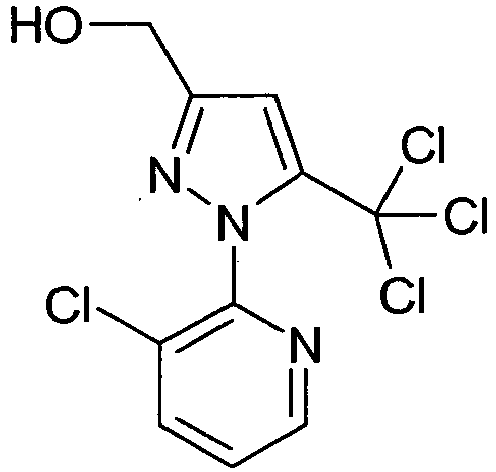
- 1-(3-Chlorpyridin-2-yl)-5-(trichlormethyl)-1H-pyrazol-3-yl]methyl acetat (36.9 g. 0,1 Mol) wurden in 100 ml Ethanol gelöst und 10 g NaOH (als 40 % Lösung in Wasser) wurden zugegeben. Nach 1 Std. wurde das Gemisch mit 300 ml Wasser verdünnt, das Produkt wurde abfiltriert, mit Wasser gewaschen und getrocknet. Man erhielt 31 g (95 %) des Produktes als weißer Feststoff.
- Schmp. 109-111°C.
- 1H NMR (DMSO d6) δ : 8.5 (1H, dd); 8.05 (1H, dd); 7.55 (1H,dd); 6.95 (1H,s); 5,35 (1H,bs), 4.55 (2H,s) ppm.
-

- 38.7 g (0.1 mol) [1-(3-Chlorpyridin-2-yl)-5-(trichlormethyl)-1H-pyrazol-3-yl]methanol und 10 g H2SO4 (als 10 % Lösung in Wasser) wurden 3 Stunden bei 80°C gerührt. Das Gemisch wurde abgekühlt auf 0°C , mit Lösung von NaHCO3 neutral gestellt und der Niederschlag wurde abfiltriert, mit Acetonitril gewaschen und getrocknet. Ausbeute 90 %. Schmp. 178-180 °C.
- 1H NMR (DMSO d6) δ: 12,8 (1H, b.s); 8.45 (1H, dd); 8.1 (1H,dd); 7.55 (1H, dd); 6.95 (1H,s);
- 5.2 (1H, b.s); 4.50 (2H,s) ppm.
-

- Man arbeitet wie in Beispiel 1 beschrieben, verwendet jedoch Phenylhydrazin und 1,1,1-Trifluor-3-(2,2-dimethyl-1,3-dioxolan-4-yliden)aceton.
- Ausbeute (62 %), Schmp. 72-74 °C.
- 1H NMR (DMSO-d6) δ: 7.98 (1H, b.s); 7.32 (2H, m), 7.24 (2H, m), 6.94 (1H, m), 5.50-5.00 (1H, b.s), 4.20 (2H, s), 3.43 and 3.21 (2H, AB system, J HH=19.1Hz, CH 2) ppm.
-

- Man arbeitet wie in Beispiel 2 beschrieben, verwendet jedoch Phenylhydrazin und 1,1,1-Trichlor-3-(2,2-dimethyl-1,3-dioxolan-4-yliden)aceton.
- 1H NMR ( DMSO-d6) δ: 8.17 (1H, b.s), 7.49 (2H, m), 7.21 (2H, m), 6.96 (1H, m), 4.70-4.30 (1H, b.s), 4.18 (2H,s), 3.64 and 3.34 (2H, AB system, J HH=19.3Hz, CH 2) ppm.
-

- wurde erhitzt bei 100-120°C für 30 min. Das Produkt wurde isoliert und gereinigt mittels Säulenchromatographie (Eluent: Ethylacetat:Hexane 1/1-Mischung), Ausbeute 1,5 g (32%).
- 1H NMR (CDCl3) δ: 7.46 (5H, m), 6.80 (1H, s), 4.73 (2H, s), 2.50 (1H, br. s);
- 19F NMR (CDCl3) δ: -58.16 (s, CF 3) ppm.
-

- Man arbeitet wie in Beispiel 12 beschrieben, verwendet jedoch 3-(Hydroxymethyl)-1-phenyl-5-(trichlonnethyl)-4,5-dihydro-1H-pyrazol-5-ol.
- Ausbeute 21%.
- 1H NMR (CDCl3) δ: 7.6-7.5 (5H, m), 7.00 (1H, br. s), 4.74 (2H, s), 2.47 (1H, b. s) ppm.
- Desweiteren illustrieren insbesondere die Herstellbeispiele, 14, 15, 16 und 17 die Herstellung von Intermediaten der Formel (VII), (Schritt 1a) der weiteren Ausführungsform des erfindungsgemäßen Verfahrens, Beispiele 18, 19, 20 und 21 die Herstellung von Pyrazolverbindungen der Formel (IV) (Schritt 1b).
-

- Zu der Lösung von (6 g, 28 mmol) von (E)-Ethyl 3-(1,3-dioxolan-4-ylidene)-2-oxopropanoate in 25 ml acetonitrile, 2,7 mL (28 mmol) Ammoniak (als 19 % Lösung in Wasser) wurde zugegeben.
- Das Reaktiongemisch wurde 3 h bei 25 °C nachgerührt und im Vakuum eingeengt. Der Rückstand wurde mit Hexan gewaschen. 3.8 g (78.4%) wurden erhalten.
- 1H NMR (DMSO-d6) δ: cis-isomer (~90%): 9.89 (1H,b.s, NH), 8.28 (1H, b.s, 1H, NH), 5.66 (1H, s, CH), 5.61 (1H, b.s, OH), 4.15 (2H, q, OCH 2), 4.14 (2H, s, CH 2), 1.22 (3H, t, CH 3); trans-isomer (~10%): 8.37 (1H, b. s, NH), 7.11 (1H, b. s, NH), 5.75 (1H, s, CH), 4.57 (2H,s, CH 2).
-

- Zu der Lösung von (9 g, 45 mmol) von Methyl (3E)-3-(2,2,-dimethyl-1,3-dioxolan-4-ylidene)-2-oxopropanote in 50 ml acetonitrile Ammoniak Lösung (2,32 g , 45 mmol, 33 % Lösung in Wasser) wurde zugegeben. Nach ca. 2 Std. der weißer Feststoff wurde abgesaugt und mit kaltem Acetonitril gewaschen. Man erhält 5,36 g (75 %) des Produktes mit Schmp.130-132 °C.
- 1H NMR (DMSO-d6) δ: cis-isomer (95 %): 9.91 (1H, b.s, NH), 8.35 (1H, b.s, NH), 5.68 (1H, s ), 5.67 (1H, b.s, 1H, OH), 4.15 (2H, s), 3,7 (3H, s), trans-isomer (~5%): 8.36 (1H, b.s, NH), 7.12 (1H, b.s, NH), 5.76 (1H,s, CH), 4,15 (2H, s), 3,68 (3H, s) ppm.
-

- Ein Gemisch aus 3-(2,2-dimethyl-1,3-dioxolan-4-ylidene)-1,1,1-trifluoroacetone (5.21 g, 24.8 mmol) und 20 ml Wasser wurden 24 Std bei 20 °C gerührt. Die flüchtige Komponenten wurden in Vakuum 20 mbar entfernt. Das Produkt wurde mit Dichlormethane extragiert und organische Phase über MgSO4 getrocknet und eingeengt. Der Niederschlag wurde durch Kristallization aus Toluol gereinigt.
- Ausbeute. 3.0 g (71.1%), Schmp 45-47 °C.
- 1H NMR (DMSO-d6) δ: 8.08 (1H,s), 4.28 (2H, m), 3.05 and 2.65 (AB-System, CH 2, J HH = 18.2 Hz) ppm.
- 19F NMR (DMSO-d6) -85.24 (s) ppm.
-

- Man arbeitet wie in Beispiel 16 beschrieben, nimmt jedoch Ethyl 3-(2,2,-dimethyl-1,3-dioxolan-4-ylidene)-2-oxopropanote.
- Ausbeute 77 %.
- 1H NMR (CDCl3) δ: 4.62 (1H, b.s), 4.28 (2H, q), 4.22 und 4.12 (AB-system, J HH = 16.6 Hz); 3.05 and 2.59 (AB-System, J HH = 18.3 Hz), 1.30 (3H, t) ppm.
-

- 2 g (10 mmol) Methyl-3-(2,2,-dimethyl-1,3-dioxolan-4-ylidene)-2-oxopropanote und 20 ml Waser wurden 18 Std. bei RT gerührt. Der Niederschlag geht in die Lösung. Die Lösung wurde 1 Std in Vakuum 100 mbar gerührt, dabei ca. 10 ml der Flüssigkeit wurden entfernt. 10 ml Isopropanol und (1,43 g. 10 mmol) 3-Chlorpyridin-2-ylhydrazine wurden zugegeben und das Gemisch wurde 24 Std. bei RT nachgerührt. Der Niederschlag wurde abfiltriert und mit Isopropanol gewaschen. Man erhielt 2,1 g (74 %), des Produktes mit Schmp. 111-113°C.
-

- Das Gemisch aus Ethyl 4-amino-5-hydroxy-2-oxopent-3-enoate (2.5 g, 14 mmol), 3-Chlorpyridin-2-ylhydrazine (2.07 g, 14 mmol) und p-Toluosulfonsäure Monohydrat (2.5 g, 13 mmol) wurde in 25 ml Acetonitril 5 Std. bei 25 °C gerührt. Der Niederschlag wurde abfiltriert und der Filtrat wurde in Vakuum eingeengt. Das Produkt wurde durch Säulen-Chromatographie auf SiO2 gereinigt (Eluent Hexan/Etylacetat). Öl. Ausbeute 4.2 g (90%).
- 1H NMR (DMSO-d6) δ: 8.02 (1H, m), 7.78 (1H, m), 6.88 (1H, m), 5.60 (1H, b. s), 5.29 (1H, b. s), 4.24 (2H, s), 4.13 (2H, q), 3.18 und 2.94 (2H, AB system, J HH=17.9Hz,), 1.08 (3H, t) ppm..
- Methyl 1-(3-chloropyridin-2-yl)-5-hydroxy-3-(hydroxymethyl)-4,5-dihydro-1H-pyrazol-5-carboxylat.

- Das Gemisch aus Methyl 4-amino-5-hydroxy-2-oxopent-3-enoate (1,59 g, 10 mmol), 3-Clorpyridin-2-ylhydrazine (1,43 g, 10 mmol) und HCl (1g, 10 mmol, 37 % Lösung in Wasser) in 15 ml Acetonitril wurde 20 Std. bei 25 °C gerührt. Die Lösung wurde in Vakuum eingeengt und der Rückstand mit Wasser und Isopropanol gewaschen. Man erhielt 2,13 g (75 %) des Produktes mit Schmelzpunkt von 111-113°C.
- 1H NMR (DMSO d6 ) δ: 7.99 (1H, d); 7,65 (1H, d); 6.85 (1R, dd); 6.4 (1H, b.s); 4,51 (2H, b.s); 3,25 (1H, d); 3,05 (1H,d), 2,55 (s, 1H) ppm.
-

- Man arbeitet wie in Beispiel 3 beschrieben, verwendet jedoch Ethyl 1-(3-chloropyridin-2-yl)-5-hydroxy-3-(hydroxymethyl)-4,5-dihydro-1H-pyrazol-5-carboxylat.
- Ausbeute 98 %. Zähflüssiges Öl.
- 1H NMR (DMSO-d6) δ: 8.56 (1H, m), 8.24 (1H, m), 7.68 (1H, m), 7.07 (1H, s), 5.39 (1H, b. s), 4.54 (2H, s), 4.14 (2H, q), 1.09 (3H, t) ppm.


diese gegebenenfalls ohne vorherige Isolierung unter Wasserabspaltung weiter umsetzt zu 1-Alkyl-/1-Aryl-substituierten -Pyrazolen der Formel (V)

diese Verbindungen der allgemeinen Formel (V)
zu Pyrazolcarbonsäurederivaten der Formel (I) umsetzt,

Claims (15)
- Verfahren zur Herstellung von 1-Alkyl- /1-Aryl- substituierten 5-Pyrazolcarbonsäurederivaten der allgemeinen Formel (I)
 R1 für Hydroxy, Halogen, Alkoxy, Aryloxy steht,R2 für Hydroxy, Alkoxy, Arylalkoxy, Halogen, O-(C=O)Alkyl, O-(C=O)O-Alkyl, O(C=O)Halogenalkyl, OSO2Alkyl, OSO2 Halogenalkyl, OSO2-Aryl steht,A für Alkyl oderfür die Gruppe
 R3 für Halogen, CN, NO2, Alkyl, Cycloalkyl, Halogenalkyl, Halogencycloalkyl, Alkoxy, Halogenalkoxy, Alkylamino, Dialkylamino, Cycloalkylamino steht,Z für CH, N steht,dadurch gekennzeichnet, dass man substituierte 1,3-Dioxolane und 1,4-Dioxane der Formel (II)in welcher
 R4, R5 unabhängig von einander für Wasserstoff, Alkyl, Aryl, Arylalkyl, Alkoxy stehen,R4, R5 weiterhin einen 4, 5 oder 6 gliedrigen, gesättigten, gegebenenfalls substituierten Ring ausbilden können, welcher 1-2 Heteroatome aus der Reihe N,S,O enthalten kann,R6 für Trihalogenmethyl, (C=O)OAlkyl, (C=O)OHalogenalkyl steht,n für 0 oder 1 steht,mit Alkyl- oder Arylhydrazinen der Formel (III)
ANHNH2 (III),
in welcher A für Alkyl oder für die Gruppe R3 für Halogen, CN, NO2, Alkyl, Cycloalkyl, Halogenalkyl, Halogencycloalkyl, Alkoxy, Halogenalkoxy, Alkylamino, Dialkylamino, Cycloalkylamino steht,Z für CH, N steht,umsetzt zu 1-Alkyl-/1-Aryl-substituierten dihydro-1H-Pyrazolen der Formel (IV),
diese gegebenenfalls ohne vorherige Isolierung unter Wasserabspaltung weiter umsetzt zu 1-Alkyl-/1-Aryl-substituierten -Pyrazolen der Formel (V)
zu Pyrazolcarbonsäurederivaten der Formel (I) umsetzt,
- Verfahren zur Herstellung von Verbindungen der Formel (I) gemäß Anspruch 1, wobeiR1 für Hydroxy, Halogen, (C1-C6)Alkoxy steht,R2 für Hydroxy, Halogen, O-(C=O) (C1-C6)Alkyl, OSO2(C1-C6)Alkyl, OSO2-Halogen(C1-C6)Alkyl steht,A für (C1-C4)Alkyl oderfür die Gruppe
 R3 für Halogen, CN, NO2, (C1-C6)-Alkyl, Halogen(C1-C6)-alkyl, (C1-C6)Alkoxy, Halogen(C1-C6)alkoxy, steht,Z für N steht.
 - Verfahren zur Herstellung von Verbindungen der Formel (I) gemäß einem der Ansprüche 1 oder 2, wobeiR1 für Hydroxy, Halogen, (C1-C4)Alkoxy steht,R2 für Hydroxy, Halogen, O-(C=O)CH3 steht,A für die Gruppe
 R3 für Chlor steht,Z für N steht.
 - Verfahren zur Herstellung von Verbindungen der Formel (I) gemäß einem der Ansprüche 1 bis 3, dadurch gekennzeichnet, dass n für 0 steht.
- Verfahren zur Herstellung von Verbindungen der Formel (I) gemäß einem der Ansprüche 1 bis 4, dadurch gekennzeichnet, dass man Verbindungen der Formel (II)

zuerst mit Nukleophilen der Formel (VI)
H2L (VI), in welcher L für O, NH oder NR7 steht,
R7 für Alkyl steht,
zu Aminohydroxyoxopentenoaten oder Hydroxy-2,4-dioxopentanoaten der Formel (VII) umsetzt, welche in Form zweier tautomerer Formen (VIIa) und (VIIb) vorliegen können und einen Ring der Formel (VIIc), (VIId) ausbilden können,
in welcher A die oben angegebenen Bedeutungen hat,
umsetzt zu 1-Alkyl-/1-Aryl-substituierten dihydrö-1H-Pyrazolen der Formel (IV),
- Verfahren zur Herstellung von Verbindungen der Formel (I) gemäß einem der Ansprüche 1 bis 6, dadurch gekennzeichnet, dass die Durchführung des Verfahrensschritts (1) innerhalb eines Temperaturbereichs von -20°C bis +100°C erfolgt.
- Verfahren zur Herstellung von Verbindungen der Formel (I) gemäß einem der Ansprüche 1 bis 4, dadurch gekennzeichnet, dass 1 Mol einer Verbindung der Formel (II) mit 0,8 Mol bis 2 Mol eines
Alkyl- oder Arylhydrazins der Formel (III) umgesetzt wird. - Verfahren zur Herstellung von Verbindungen der Formel (I) gemäß einem der Ansprüche 1 bis 7, dadurch gekennzeichnet, dass
die Verbindungen der Formel (IV) unter Zugabe einer Base direkt in die Verbindungen der Formel (I) umgesetzt werden, wobei
R1 und R2 für Hydroxy stehen, R6 für (C=O)OAlkyl steht, und
R3,R4,R5,A und Z die Bedeutung gemäß Anspruch 1 haben. - Verfahren zur Herstellung von Verbindungen der Formel (I) gemäß Anspruch 8, dadurch gekennzeichnet, dass die Base ausgewählt ist aus der Gruppe bestehend aus LiOH, NaOH, KOH und CsOH und als Lösungsmittel Alkohole oder Wasser verwendet werden.
- Verfahren zur Herstellung von Verbindungen der Formel (I) gemäß einem der Ansprüche 1 bis 7, dadurch gekennzeichnet, dass die Durchführung des Verfahrensschritts (3) innerhalb eines Temperaturbereichs von 20°C bis +150°C erfolgt.
- Verfahren zur Herstellung von Verbindungen der Formel (I) gemäß einem der Ansprüche 1 bis 7 oder 10, dadurch gekennzeichnet, dass die Durchführung des Verfahrensschritts (3) unter sauren Bedingungen mit mineralischen oder organischen Säuren oder unter basischen Bedingungen mit organischen oder anorganischen Basen erfolgt.
- Verfahren zur Herstellung von Verbindungen der Formel (I) gemäß einem der Ansprüche 1 bis 7 oder 10, dadurch gekennzeichnet, dass die Durchführung des Verfahrensschritts (3) mit Alkohol oder Kombinationen von Alkohol/HCl, Alkohol/FeCl3, Alkohol/H2SO4 oder Alkohol/Alkoholat erfolgt.
- Verfahren zur Herstellung von Verbindungen der Formel (I) gemäß einem der Ansprüche 1 bis 7, dadurch gekennzeichnet, dass
die Verbindungen der Formel (IV) unter Zugabe einer Säure (HCl) direkt in die Verbindungen der Formel (I) umgesetzt werden, wobei
R1 für (C=O)OAlkyl, R2 für Hydroxy und R6 für (C=O)OAlkyl stehen, und
R3,R4,R5,A und Z die Bedeutung gemäß Anspruch 1 haben. - Verbindungen der Formel (IV)

- Verbindungen der allgemeinen Formel (VII), welche in Form zweier tautomerer Formen (VIIa) und (VIIb) vorliegen können und einen Ring der Formel (VIIc), (VIId) ausbilden können,


Priority Applications (1)
| Application Number | Priority Date | Filing Date | Title |
|---|---|---|---|
| EP10787791.2A EP2513063B1 (de) | 2009-12-15 | 2010-12-10 | Verfahren zur herstellung von 1-alkyl-/1-aryl-5-pyrazolcarbonsäurederivaten |
Applications Claiming Priority (3)
| Application Number | Priority Date | Filing Date | Title |
|---|---|---|---|
| EP09179299 | 2009-12-15 | ||
| PCT/EP2010/069385 WO2011073101A1 (de) | 2009-12-15 | 2010-12-10 | Verfahren zur herstellung von 1-alkyl-/1-aryl-5-pyrazolcarbonsäurederivaten |
| EP10787791.2A EP2513063B1 (de) | 2009-12-15 | 2010-12-10 | Verfahren zur herstellung von 1-alkyl-/1-aryl-5-pyrazolcarbonsäurederivaten |
Publications (2)
| Publication Number | Publication Date |
|---|---|
| EP2513063A1 EP2513063A1 (de) | 2012-10-24 |
| EP2513063B1 true EP2513063B1 (de) | 2013-11-06 |
Family
ID=41569911
Family Applications (1)
| Application Number | Title | Priority Date | Filing Date |
|---|---|---|---|
| EP10787791.2A Active EP2513063B1 (de) | 2009-12-15 | 2010-12-10 | Verfahren zur herstellung von 1-alkyl-/1-aryl-5-pyrazolcarbonsäurederivaten |
Country Status (12)
| Country | Link |
|---|---|
| US (1) | US8586753B2 (de) |
| EP (1) | EP2513063B1 (de) |
| JP (1) | JP5753856B2 (de) |
| KR (1) | KR101758201B1 (de) |
| CN (1) | CN102753531B (de) |
| BR (1) | BR112012014683B1 (de) |
| DK (1) | DK2513063T3 (de) |
| ES (1) | ES2437923T3 (de) |
| IL (1) | IL220211A (de) |
| MX (1) | MX2012006723A (de) |
| TW (1) | TWI504590B (de) |
| WO (1) | WO2011073101A1 (de) |
Families Citing this family (13)
| Publication number | Priority date | Publication date | Assignee | Title |
|---|---|---|---|---|
| KR101736522B1 (ko) * | 2009-12-15 | 2017-05-16 | 바이엘 크롭사이언스 악티엔게젤샤프트 | 신규 디옥솔란 및 디옥산 유도체, 및 그의 제조 방법 |
| JP5970065B2 (ja) | 2011-07-08 | 2016-08-17 | バイエル・インテレクチュアル・プロパティ・ゲゼルシャフト・ミット・ベシュレンクテル・ハフツングBayer Intellectual Property GmbH | ピラゾール酸をアントラニル酸エステルと反応させる工程によってテトラゾール置換アントラニル酸ジアミド誘導体を製造する方法 |
| ES2555463T3 (es) | 2011-08-26 | 2016-01-04 | Bayer Intellectual Property Gmbh | Procedimiento de preparación de derivados de diamida de ácido antranílico sustituida con tetrazol mediante reacción de benzoxazinonas con aminas |
| CN109689629B (zh) * | 2016-09-21 | 2022-11-29 | 拜耳作物科学股份公司 | 制备3-氟烷基-5-吡唑羧酸酯和3-氟烷基-5-吡唑羧酸的方法 |
| MX2020011671A (es) | 2018-05-21 | 2020-12-10 | Pi Industries Ltd | Nuevo proceso para la preparacion de diamidas antranilicas. |
| KR102790425B1 (ko) | 2018-07-20 | 2025-04-04 | 피아이 인더스트리스 엘티디. | 안트라닐산 디아미드의 새로운 제조 방법 |
| MX2023000970A (es) * | 2020-07-23 | 2023-03-01 | Bayer Ag | Metodo de preparacion de aminofuranos. |
| CN116209656A (zh) * | 2020-10-06 | 2023-06-02 | 拜耳公司 | 制备羰基氨基呋喃的方法 |
| WO2023006634A1 (en) | 2021-07-27 | 2023-02-02 | Syngenta Crop Protection Ag | Method for controlling diamide resistant pests & compounds therefor |
| EP4380363A1 (de) | 2021-08-05 | 2024-06-12 | Syngenta Crop Protection AG | Verfahren zur bekämpfung von diamidresistenten schädlingen und verbindungen dafür |
| WO2023110710A1 (en) | 2021-12-13 | 2023-06-22 | Syngenta Crop Protection Ag | Method for controlling diamide resistant pests & compounds therefor |
| EP4197333A1 (de) | 2021-12-15 | 2023-06-21 | Syngenta Crop Protection AG | Verfahren zur bekämpfung von diamidresistenten schädlingen und verbindungen dafür |
| WO2024133426A1 (en) | 2022-12-21 | 2024-06-27 | Syngenta Crop Protection Ag | Method for controlling diamide resistant pests and compounds therefor |
Family Cites Families (9)
| Publication number | Priority date | Publication date | Assignee | Title |
|---|---|---|---|---|
| TW438796B (en) * | 1996-05-15 | 2001-06-07 | Hoffmann La Roche | 2,4-diaminopyrimidine derivatives, the manufacture process thereof, and the antibiotically-active pharmaceutical composition containing the same |
| SK174699A3 (en) * | 1997-06-19 | 2000-08-14 | Du Pont Pharm Co | Inhibitors of factor xa with a neutral p1 specificity group |
| US7038057B2 (en) | 2001-08-13 | 2006-05-02 | E.I. Du Pont De Nemours And Company | Substituted 1H-dihydropyrazoles, their preparation and use |
| TWI356822B (en) * | 2001-08-13 | 2012-01-21 | Du Pont | Novel substituted dihydro 3-halo-1h-pyrazole-5-car |
| ES2424840T3 (es) * | 2003-01-28 | 2013-10-09 | E.I. Du Pont De Nemours And Company | Insecticidas tipo ciano antranilamida |
| TW200526588A (en) * | 2003-11-17 | 2005-08-16 | Smithkline Beecham Corp | Chemical compounds |
| DE102006032168A1 (de) * | 2006-06-13 | 2007-12-20 | Bayer Cropscience Ag | Anthranilsäurediamid-Derivate mit heteroaromatischen Substituenten |
| EP2243777A1 (de) | 2009-04-03 | 2010-10-27 | Bayer CropScience AG | Verfahren zum Herstellen von Pyridyl-substituierten Pyrazolen |
| KR101736522B1 (ko) * | 2009-12-15 | 2017-05-16 | 바이엘 크롭사이언스 악티엔게젤샤프트 | 신규 디옥솔란 및 디옥산 유도체, 및 그의 제조 방법 |
-
2010
- 2010-12-10 BR BR112012014683-1A patent/BR112012014683B1/pt active IP Right Grant
- 2010-12-10 ES ES10787791.2T patent/ES2437923T3/es active Active
- 2010-12-10 EP EP10787791.2A patent/EP2513063B1/de active Active
- 2010-12-10 KR KR1020127018392A patent/KR101758201B1/ko active Active
- 2010-12-10 JP JP2012543631A patent/JP5753856B2/ja active Active
- 2010-12-10 MX MX2012006723A patent/MX2012006723A/es active IP Right Grant
- 2010-12-10 CN CN201080063459.6A patent/CN102753531B/zh active Active
- 2010-12-10 WO PCT/EP2010/069385 patent/WO2011073101A1/de not_active Ceased
- 2010-12-10 DK DK10787791.2T patent/DK2513063T3/da active
- 2010-12-14 TW TW099143604A patent/TWI504590B/zh active
- 2010-12-15 US US12/969,145 patent/US8586753B2/en active Active
-
2012
- 2012-06-06 IL IL220211A patent/IL220211A/en active IP Right Grant
Also Published As
| Publication number | Publication date |
|---|---|
| BR112012014683A2 (pt) | 2015-09-15 |
| DK2513063T3 (da) | 2014-01-06 |
| US20110152532A1 (en) | 2011-06-23 |
| CN102753531B (zh) | 2015-07-01 |
| JP5753856B2 (ja) | 2015-07-22 |
| KR20120096078A (ko) | 2012-08-29 |
| ES2437923T3 (es) | 2014-01-15 |
| JP2013513635A (ja) | 2013-04-22 |
| KR101758201B1 (ko) | 2017-07-14 |
| TWI504590B (zh) | 2015-10-21 |
| CN102753531A (zh) | 2012-10-24 |
| TW201144288A (en) | 2011-12-16 |
| WO2011073101A1 (de) | 2011-06-23 |
| US8586753B2 (en) | 2013-11-19 |
| EP2513063A1 (de) | 2012-10-24 |
| MX2012006723A (es) | 2012-06-28 |
| IL220211A (en) | 2016-02-29 |
| IL220211A0 (en) | 2012-07-31 |
| BR112012014683B1 (pt) | 2017-11-07 |
Similar Documents
| Publication | Publication Date | Title |
|---|---|---|
| EP2513063B1 (de) | Verfahren zur herstellung von 1-alkyl-/1-aryl-5-pyrazolcarbonsäurederivaten | |
| EP0595130B1 (de) | N-Phenylacetaminonitrile und ihre Verwendung als Zwischenprodukte zur Synthese von Insektiziden und Herbiziden 3-Aryl-pyrrolidin-2,4-dionen | |
| DE102006039909A1 (de) | Verfahren zum Herstellen von 3-Dihalomethyl-pyrazol-4-carbonsäurederivaten | |
| EP2456760B1 (de) | Verfahren zum herstellen von aryl-substituierten pyrazolen | |
| EP2414345B1 (de) | Verfahren zum herstellen von pyridyl-substituierten pyrazolen | |
| EP2623496A1 (de) | Verfahren zur Herstellung von 3,5-bis (fluoralkyl)-pyrazol-4-carbonsäure-Derivaten und 3,5-bis(fluoralkyl)-pyrazolen | |
| EP0776889A1 (de) | Verfahren zur Herstellung von 1,3-Dimethyl-5-fluor-pyrazol-4-carboxaniliden | |
| EP2456747B1 (de) | Verfahren zur Herstellung von Alkoxyenonen und Enaminoketonen | |
| EP2513082B1 (de) | Neue dioxolan- und dioxanderivate und ein verfahren zur deren herstellung | |
| EP0726258A1 (de) | Verfahren und neue Zwischenprodukte zur Herstellung von Triazolinonen | |
| EP0709367B1 (de) | Verfahren zur Herstellung von N-Alkenylcarbonsäureamiden | |
| WO2014187774A1 (de) | Verfahren zur herstellung von 3,5-bis(fluoralkyl)-pyrazol-derivaten | |
| EP0371361B1 (de) | Verfahren zur Herstellung von 4-Chlorpyrazolen | |
| WO2024038036A1 (de) | Eliminierungsreaktion zur herstellung von substituierten alkenen | |
| EP0703225B1 (de) | Verfahren zur Herstellung von Alkoxytriazolinonen | |
| EP0703226B1 (de) | Verfahren zur Herstellung von Alkoxytriazolinonen | |
| DE4001600C1 (en) | Pyrazole carboxylic acid derivs. prepn. - by reacting azo-carboxylic acid cpd. with an enol-ether and aromatising | |
| DE19744705A1 (de) | Verfahren zur Herstellung gegebenenfalls substituierter Benzofuranone | |
| DE3004695A1 (de) | Verfahren zur herstellung von trifluormethylphenyl-oxyphenyl-ethern | |
| DE3742822A1 (de) | Verfahren zur herstellung von 5-amino-l-phenyl-4-nitro-pyrazolen | |
| WO1996012707A1 (de) | 2-chlor-n-[1-(2,6-dichlor-4-difluormethyl-phenyl)-1h-pyrazol-5-yl]-propanamid und ein verfahren zu seiner herstellung | |
| DE3742612A1 (de) | Verfahren zur herstellung von 4-substituierten 3-methyl-1-aryl-5-amino-pyrazolen | |
| EP1358164A1 (de) | Verfahren zur herstellung von 1-alkyl-3-aryl-5-difluormethoxy-1h-pyrazolen |
Legal Events
| Date | Code | Title | Description |
|---|---|---|---|
| PUAI | Public reference made under article 153(3) epc to a published international application that has entered the european phase |
Free format text: ORIGINAL CODE: 0009012 |
|
| 17P | Request for examination filed |
Effective date: 20120716 |
|
| AK | Designated contracting states |
Kind code of ref document: A1 Designated state(s): AL AT BE BG CH CY CZ DE DK EE ES FI FR GB GR HR HU IE IS IT LI LT LU LV MC MK MT NL NO PL PT RO RS SE SI SK SM TR |
|
| DAX | Request for extension of the european patent (deleted) | ||
| GRAP | Despatch of communication of intention to grant a patent |
Free format text: ORIGINAL CODE: EPIDOSNIGR1 |
|
| INTG | Intention to grant announced |
Effective date: 20130531 |
|
| GRAS | Grant fee paid |
Free format text: ORIGINAL CODE: EPIDOSNIGR3 |
|
| GRAA | (expected) grant |
Free format text: ORIGINAL CODE: 0009210 |
|
| AK | Designated contracting states |
Kind code of ref document: B1 Designated state(s): AL AT BE BG CH CY CZ DE DK EE ES FI FR GB GR HR HU IE IS IT LI LT LU LV MC MK MT NL NO PL PT RO RS SE SI SK SM TR |
|
| REG | Reference to a national code |
Ref country code: GB Ref legal event code: FG4D Free format text: NOT ENGLISH |
|
| REG | Reference to a national code |
Ref country code: CH Ref legal event code: EP |
|
| REG | Reference to a national code |
Ref country code: AT Ref legal event code: REF Ref document number: 639389 Country of ref document: AT Kind code of ref document: T Effective date: 20131215 |
|
| REG | Reference to a national code |
Ref country code: IE Ref legal event code: FG4D Free format text: LANGUAGE OF EP DOCUMENT: GERMAN |
|
| REG | Reference to a national code |
Ref country code: NL Ref legal event code: T3 |
|
| REG | Reference to a national code |
Ref country code: DE Ref legal event code: R096 Ref document number: 502010005338 Country of ref document: DE Effective date: 20140102 |
|
| REG | Reference to a national code |
Ref country code: DK Ref legal event code: T3 Effective date: 20131217 |
|
| REG | Reference to a national code |
Ref country code: ES Ref legal event code: FG2A Ref document number: 2437923 Country of ref document: ES Kind code of ref document: T3 Effective date: 20140115 |
|
| REG | Reference to a national code |
Ref country code: LT Ref legal event code: MG4D |
|
| PG25 | Lapsed in a contracting state [announced via postgrant information from national office to epo] |
Ref country code: HR Free format text: LAPSE BECAUSE OF FAILURE TO SUBMIT A TRANSLATION OF THE DESCRIPTION OR TO PAY THE FEE WITHIN THE PRESCRIBED TIME-LIMIT Effective date: 20131106 Ref country code: SE Free format text: LAPSE BECAUSE OF FAILURE TO SUBMIT A TRANSLATION OF THE DESCRIPTION OR TO PAY THE FEE WITHIN THE PRESCRIBED TIME-LIMIT Effective date: 20131106 Ref country code: LT Free format text: LAPSE BECAUSE OF FAILURE TO SUBMIT A TRANSLATION OF THE DESCRIPTION OR TO PAY THE FEE WITHIN THE PRESCRIBED TIME-LIMIT Effective date: 20131106 Ref country code: NO Free format text: LAPSE BECAUSE OF FAILURE TO SUBMIT A TRANSLATION OF THE DESCRIPTION OR TO PAY THE FEE WITHIN THE PRESCRIBED TIME-LIMIT Effective date: 20140206 Ref country code: IS Free format text: LAPSE BECAUSE OF FAILURE TO SUBMIT A TRANSLATION OF THE DESCRIPTION OR TO PAY THE FEE WITHIN THE PRESCRIBED TIME-LIMIT Effective date: 20140306 |
|
| PG25 | Lapsed in a contracting state [announced via postgrant information from national office to epo] |
Ref country code: LV Free format text: LAPSE BECAUSE OF FAILURE TO SUBMIT A TRANSLATION OF THE DESCRIPTION OR TO PAY THE FEE WITHIN THE PRESCRIBED TIME-LIMIT Effective date: 20131106 Ref country code: RS Free format text: LAPSE BECAUSE OF FAILURE TO SUBMIT A TRANSLATION OF THE DESCRIPTION OR TO PAY THE FEE WITHIN THE PRESCRIBED TIME-LIMIT Effective date: 20131106 |
|
| PG25 | Lapsed in a contracting state [announced via postgrant information from national office to epo] |
Ref country code: PT Free format text: LAPSE BECAUSE OF FAILURE TO SUBMIT A TRANSLATION OF THE DESCRIPTION OR TO PAY THE FEE WITHIN THE PRESCRIBED TIME-LIMIT Effective date: 20140306 |
|
| PG25 | Lapsed in a contracting state [announced via postgrant information from national office to epo] |
Ref country code: EE Free format text: LAPSE BECAUSE OF FAILURE TO SUBMIT A TRANSLATION OF THE DESCRIPTION OR TO PAY THE FEE WITHIN THE PRESCRIBED TIME-LIMIT Effective date: 20131106 |
|
| REG | Reference to a national code |
Ref country code: DE Ref legal event code: R097 Ref document number: 502010005338 Country of ref document: DE |
|
| PG25 | Lapsed in a contracting state [announced via postgrant information from national office to epo] |
Ref country code: PL Free format text: LAPSE BECAUSE OF FAILURE TO SUBMIT A TRANSLATION OF THE DESCRIPTION OR TO PAY THE FEE WITHIN THE PRESCRIBED TIME-LIMIT Effective date: 20131106 Ref country code: CZ Free format text: LAPSE BECAUSE OF FAILURE TO SUBMIT A TRANSLATION OF THE DESCRIPTION OR TO PAY THE FEE WITHIN THE PRESCRIBED TIME-LIMIT Effective date: 20131106 Ref country code: RO Free format text: LAPSE BECAUSE OF FAILURE TO SUBMIT A TRANSLATION OF THE DESCRIPTION OR TO PAY THE FEE WITHIN THE PRESCRIBED TIME-LIMIT Effective date: 20131106 Ref country code: SK Free format text: LAPSE BECAUSE OF FAILURE TO SUBMIT A TRANSLATION OF THE DESCRIPTION OR TO PAY THE FEE WITHIN THE PRESCRIBED TIME-LIMIT Effective date: 20131106 |
|
| PLBE | No opposition filed within time limit |
Free format text: ORIGINAL CODE: 0009261 |
|
| STAA | Information on the status of an ep patent application or granted ep patent |
Free format text: STATUS: NO OPPOSITION FILED WITHIN TIME LIMIT |
|
| REG | Reference to a national code |
Ref country code: IE Ref legal event code: MM4A |
|
| 26N | No opposition filed |
Effective date: 20140807 |
|
| PG25 | Lapsed in a contracting state [announced via postgrant information from national office to epo] |
Ref country code: IE Free format text: LAPSE BECAUSE OF NON-PAYMENT OF DUE FEES Effective date: 20131210 |
|
| REG | Reference to a national code |
Ref country code: DE Ref legal event code: R097 Ref document number: 502010005338 Country of ref document: DE Effective date: 20140807 |
|
| PG25 | Lapsed in a contracting state [announced via postgrant information from national office to epo] |
Ref country code: SI Free format text: LAPSE BECAUSE OF FAILURE TO SUBMIT A TRANSLATION OF THE DESCRIPTION OR TO PAY THE FEE WITHIN THE PRESCRIBED TIME-LIMIT Effective date: 20131106 |
|
| PG25 | Lapsed in a contracting state [announced via postgrant information from national office to epo] |
Ref country code: MC Free format text: LAPSE BECAUSE OF FAILURE TO SUBMIT A TRANSLATION OF THE DESCRIPTION OR TO PAY THE FEE WITHIN THE PRESCRIBED TIME-LIMIT Effective date: 20131106 |
|
| PG25 | Lapsed in a contracting state [announced via postgrant information from national office to epo] |
Ref country code: SM Free format text: LAPSE BECAUSE OF FAILURE TO SUBMIT A TRANSLATION OF THE DESCRIPTION OR TO PAY THE FEE WITHIN THE PRESCRIBED TIME-LIMIT Effective date: 20131106 |
|
| PG25 | Lapsed in a contracting state [announced via postgrant information from national office to epo] |
Ref country code: CY Free format text: LAPSE BECAUSE OF FAILURE TO SUBMIT A TRANSLATION OF THE DESCRIPTION OR TO PAY THE FEE WITHIN THE PRESCRIBED TIME-LIMIT Effective date: 20131106 |
|
| PG25 | Lapsed in a contracting state [announced via postgrant information from national office to epo] |
Ref country code: MK Free format text: LAPSE BECAUSE OF FAILURE TO SUBMIT A TRANSLATION OF THE DESCRIPTION OR TO PAY THE FEE WITHIN THE PRESCRIBED TIME-LIMIT Effective date: 20131106 Ref country code: LU Free format text: LAPSE BECAUSE OF NON-PAYMENT OF DUE FEES Effective date: 20131210 Ref country code: HU Free format text: LAPSE BECAUSE OF FAILURE TO SUBMIT A TRANSLATION OF THE DESCRIPTION OR TO PAY THE FEE WITHIN THE PRESCRIBED TIME-LIMIT; INVALID AB INITIO Effective date: 20101210 Ref country code: BG Free format text: LAPSE BECAUSE OF FAILURE TO SUBMIT A TRANSLATION OF THE DESCRIPTION OR TO PAY THE FEE WITHIN THE PRESCRIBED TIME-LIMIT Effective date: 20131106 |
|
| PG25 | Lapsed in a contracting state [announced via postgrant information from national office to epo] |
Ref country code: MT Free format text: LAPSE BECAUSE OF FAILURE TO SUBMIT A TRANSLATION OF THE DESCRIPTION OR TO PAY THE FEE WITHIN THE PRESCRIBED TIME-LIMIT Effective date: 20131106 Ref country code: GR Free format text: LAPSE BECAUSE OF NON-PAYMENT OF DUE FEES Effective date: 20131106 |
|
| REG | Reference to a national code |
Ref country code: FR Ref legal event code: PLFP Year of fee payment: 6 |
|
| PG25 | Lapsed in a contracting state [announced via postgrant information from national office to epo] |
Ref country code: GR Free format text: LAPSE BECAUSE OF FAILURE TO SUBMIT A TRANSLATION OF THE DESCRIPTION OR TO PAY THE FEE WITHIN THE PRESCRIBED TIME-LIMIT Effective date: 20140207 |
|
| PG25 | Lapsed in a contracting state [announced via postgrant information from national office to epo] |
Ref country code: TR Free format text: LAPSE BECAUSE OF FAILURE TO SUBMIT A TRANSLATION OF THE DESCRIPTION OR TO PAY THE FEE WITHIN THE PRESCRIBED TIME-LIMIT Effective date: 20131106 |
|
| REG | Reference to a national code |
Ref country code: FR Ref legal event code: PLFP Year of fee payment: 7 |
|
| REG | Reference to a national code |
Ref country code: FR Ref legal event code: PLFP Year of fee payment: 8 |
|
| PG25 | Lapsed in a contracting state [announced via postgrant information from national office to epo] |
Ref country code: AL Free format text: LAPSE BECAUSE OF FAILURE TO SUBMIT A TRANSLATION OF THE DESCRIPTION OR TO PAY THE FEE WITHIN THE PRESCRIBED TIME-LIMIT Effective date: 20131106 |
|
| PGFP | Annual fee paid to national office [announced via postgrant information from national office to epo] |
Ref country code: AT Payment date: 20221125 Year of fee payment: 13 |
|
| P01 | Opt-out of the competence of the unified patent court (upc) registered |
Effective date: 20230507 |
|
| REG | Reference to a national code |
Ref country code: AT Ref legal event code: MM01 Ref document number: 639389 Country of ref document: AT Kind code of ref document: T Effective date: 20231210 |
|
| PG25 | Lapsed in a contracting state [announced via postgrant information from national office to epo] |
Ref country code: AT Free format text: LAPSE BECAUSE OF NON-PAYMENT OF DUE FEES Effective date: 20231210 |
|
| PG25 | Lapsed in a contracting state [announced via postgrant information from national office to epo] |
Ref country code: AT Free format text: LAPSE BECAUSE OF NON-PAYMENT OF DUE FEES Effective date: 20231210 |
|
| PGFP | Annual fee paid to national office [announced via postgrant information from national office to epo] |
Ref country code: NL Payment date: 20251126 Year of fee payment: 16 |
|
| REG | Reference to a national code |
Ref country code: CH Ref legal event code: U11 Free format text: ST27 STATUS EVENT CODE: U-0-0-U10-U11 (AS PROVIDED BY THE NATIONAL OFFICE) Effective date: 20260101 |
|
| PGFP | Annual fee paid to national office [announced via postgrant information from national office to epo] |
Ref country code: DE Payment date: 20251119 Year of fee payment: 16 |
|
| PGFP | Annual fee paid to national office [announced via postgrant information from national office to epo] |
Ref country code: GB Payment date: 20251120 Year of fee payment: 16 |
|
| PGFP | Annual fee paid to national office [announced via postgrant information from national office to epo] |
Ref country code: FI Payment date: 20251211 Year of fee payment: 16 Ref country code: DK Payment date: 20251212 Year of fee payment: 16 Ref country code: IT Payment date: 20251126 Year of fee payment: 16 |
|
| PGFP | Annual fee paid to national office [announced via postgrant information from national office to epo] |
Ref country code: FR Payment date: 20251124 Year of fee payment: 16 |
|
| PGFP | Annual fee paid to national office [announced via postgrant information from national office to epo] |
Ref country code: BE Payment date: 20251127 Year of fee payment: 16 |
|
| PGFP | Annual fee paid to national office [announced via postgrant information from national office to epo] |
Ref country code: ES Payment date: 20260114 Year of fee payment: 16 |
|
| PGFP | Annual fee paid to national office [announced via postgrant information from national office to epo] |
Ref country code: CH Payment date: 20260101 Year of fee payment: 16 |