EP2506565B1 - Anzeigesteuerung, Anzeigeverfahren und Computerprogramm - Google Patents
Anzeigesteuerung, Anzeigeverfahren und Computerprogramm Download PDFInfo
- Publication number
- EP2506565B1 EP2506565B1 EP12160848.3A EP12160848A EP2506565B1 EP 2506565 B1 EP2506565 B1 EP 2506565B1 EP 12160848 A EP12160848 A EP 12160848A EP 2506565 B1 EP2506565 B1 EP 2506565B1
- Authority
- EP
- European Patent Office
- Prior art keywords
- character information
- display
- displayed
- image
- section
- Prior art date
- Legal status (The legal status is an assumption and is not a legal conclusion. Google has not performed a legal analysis and makes no representation as to the accuracy of the status listed.)
- Not-in-force
Links
Images







Classifications
-
- H—ELECTRICITY
- H04—ELECTRIC COMMUNICATION TECHNIQUE
- H04N—PICTORIAL COMMUNICATION, e.g. TELEVISION
- H04N21/00—Selective content distribution, e.g. interactive television or video on demand [VOD]
- H04N21/40—Client devices specifically adapted for the reception of or interaction with content, e.g. set-top-box [STB]; Operations thereof
- H04N21/43—Processing of content or additional data, e.g. demultiplexing additional data from a digital video stream; Elementary client operations, e.g. monitoring of home network or synchronising decoder's clock; Client middleware
- H04N21/431—Generation of visual interfaces for content selection or interaction; Content or additional data rendering
- H04N21/4312—Generation of visual interfaces for content selection or interaction; Content or additional data rendering involving specific graphical features, e.g. screen layout, special fonts or colors, blinking icons, highlights or animations
-
- H—ELECTRICITY
- H04—ELECTRIC COMMUNICATION TECHNIQUE
- H04N—PICTORIAL COMMUNICATION, e.g. TELEVISION
- H04N13/00—Stereoscopic video systems; Multi-view video systems; Details thereof
- H04N13/10—Processing, recording or transmission of stereoscopic or multi-view image signals
- H04N13/106—Processing image signals
- H04N13/128—Adjusting depth or disparity
-
- H—ELECTRICITY
- H04—ELECTRIC COMMUNICATION TECHNIQUE
- H04N—PICTORIAL COMMUNICATION, e.g. TELEVISION
- H04N13/00—Stereoscopic video systems; Multi-view video systems; Details thereof
- H04N13/10—Processing, recording or transmission of stereoscopic or multi-view image signals
- H04N13/106—Processing image signals
- H04N13/172—Processing image signals image signals comprising non-image signal components, e.g. headers or format information
- H04N13/183—On-screen display [OSD] information, e.g. subtitles or menus
-
- H—ELECTRICITY
- H04—ELECTRIC COMMUNICATION TECHNIQUE
- H04N—PICTORIAL COMMUNICATION, e.g. TELEVISION
- H04N21/00—Selective content distribution, e.g. interactive television or video on demand [VOD]
- H04N21/40—Client devices specifically adapted for the reception of or interaction with content, e.g. set-top-box [STB]; Operations thereof
- H04N21/47—End-user applications
- H04N21/485—End-user interface for client configuration
-
- H—ELECTRICITY
- H04—ELECTRIC COMMUNICATION TECHNIQUE
- H04N—PICTORIAL COMMUNICATION, e.g. TELEVISION
- H04N21/00—Selective content distribution, e.g. interactive television or video on demand [VOD]
- H04N21/40—Client devices specifically adapted for the reception of or interaction with content, e.g. set-top-box [STB]; Operations thereof
- H04N21/47—End-user applications
- H04N21/488—Data services, e.g. news ticker
-
- H—ELECTRICITY
- H04—ELECTRIC COMMUNICATION TECHNIQUE
- H04N—PICTORIAL COMMUNICATION, e.g. TELEVISION
- H04N21/00—Selective content distribution, e.g. interactive television or video on demand [VOD]
- H04N21/80—Generation or processing of content or additional data by content creator independently of the distribution process; Content per se
- H04N21/81—Monomedia components thereof
- H04N21/8126—Monomedia components thereof involving additional data, e.g. news, sports, stocks, weather forecasts
-
- H—ELECTRICITY
- H04—ELECTRIC COMMUNICATION TECHNIQUE
- H04N—PICTORIAL COMMUNICATION, e.g. TELEVISION
- H04N21/00—Selective content distribution, e.g. interactive television or video on demand [VOD]
- H04N21/80—Generation or processing of content or additional data by content creator independently of the distribution process; Content per se
- H04N21/81—Monomedia components thereof
- H04N21/8146—Monomedia components thereof involving graphical data, e.g. 3D object, 2D graphics
Definitions
- the present invention relates to an information processing device.
- the present invention relates to an information processing device and an information processing method which displays an image, and a program which causes a computer to execute the method.
- information processing devices such as a television reception device, which receives broadcasting waves from each broadcasting station and displays an image based on broadcasting waves, are in wide spread use.
- an information processing device which, along with the image which is a display target, displays character information which relates to the image (for example, subtitles or captions).
- a content processing device which displays subtitles where Chinese characters used in Japanese are accompanied with Japanese syllabary and subtitles where Chinese characters used in Japanese are not accompanied with Japanese syllabary so as to overlap with an image (see, for example, Japanese Unexamined Patent Application Publication No. 2010-199711 ).
- a time when the character information is displayed is a time which is determined by at the broadcasting station which outputs the broadcasting waves.
- WO 2009/157893 describes a method and system for playing a video image including video frames and on-screen displays, and displaying an on-screen display associated with a video frame already played without interrupting the playing of the video frames.
- WO 2010/099495 describes systems, apparatus and methods for the real-time positional manipulation of stereoscopic (3D) subtitles in a stereoscopic viewing environment.
- a stereoscopic subtitling workstation is provided for creating stereoscopic subtitling content for use with stereoscopic video content in which stereoscopic subtitling content can be manipulated and adjusted in real-time in a stereoscopic viewing environment to set the desired viewing position and appearance parameters for the stereoscopic subtitling content.
- EP 2309463 is a document that was published after the priority date of the present application. It relates to the insertion of graphic items as subtitles in a 3D video. During the displaying, if an object of the 3D video is deeper than the graphic item, i.e. positioned behind this graphic item, the human perception will be fine. However, if the subtitle is inserted in a zone that should be partially masked by a 3D object of the image, this object being placed in front of the subtitle, the viewer's cue is very bad. In this case, video processing is applied to the graphic item.
- Embodiments of the invention allow a user to easily view desired character information.
- a superior effect where the user is able to easily view desired character information is able to be realized.
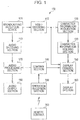
- Fig. 1 is a block diagram illustrating a functional configuration example of an information processing device 100 according to a first embodiment of the present disclosure.
- the information processing device 100 is provided with a broadcasting reception device 111, a video decoding section 112, an audio decoding section 113, a character information acquisition section 120, and a character information holding section 130.
- the information processing device 100 is provided with a control section 140, a display control section 150, a display section 160, an audio processing section 170, an audio output section 180, and an operation reception section 190.
- the information processing device 100 is, for example, realized using a television reception device which receives broadcasting waves from each broadcasting station and displays an image (a stereoscopic image and a planar image).
- the broadcasting reception device 111 receives broadcasting waves from each broadcasting station via an antenna (not shown) and demodulates the video signal and the audio signal.
- the broadcasting reception device 111 receives broadcasting waves such as terrestrial digital television broadcasting, CS (Communications Satellite) digital broadcasting, and BS (Broadcasting Satellite) digital broadcasting. Then, the broadcasting reception device 111 outputs the demodulated video signal to the video decoding section 112 and the demodulated audio signal to the audio signal decoding section 113.
- the video decoding section 112 reconstructs the video data by a process for decoding the video signal output from the broadcasting reception device 111 (the video signal which is compressed and coded for transmission) and outputs the reconstructed video data to the character information acquisition section 120 and the display control section 150.
- the audio decoding section 113 reconstructs the audio data by a process for decoding the audio signal output from the broadcasting reception device 111 (the audio signal which is compressed and coded for transmission) and outputs the reconstructed audio data to the audio processing section 170.
- the character information acquisition section 120 acquires character information related to the video data which is output from the video decoding section 112 and holds the acquired character information in the character information holding section 130.
- the video and audio content are a data format based on a MPEG (Moving Picture Experts Group) standard.
- the character information acquisition section 120 it is possible for the character information acquisition section 120 to acquire subtitle information by extracting a subtitle PES (Packetized Elementary Stream) (subtitle mode (413) shown in Fig. 5 ).
- a character which is included in the display target image may be captured (so-called character caption capture) and the character information is acquired as character information (capture mode (412) shown in Fig. 5 ).
- the character information acquisition section 120 extracts a string of characters, where a predetermined number or more are continuous, from a display target image using character recognition techniques (for example, a template matching process) and acquires the extracted string of characters as the character information by capturing.
- character recognition techniques for example, a template matching process
- the character information holding section 130 holds the character information which is acquired by the character information acquisition section 120 and supplies the held character information to the display control section 150.
- the character information content held in the character information holding section 130 will be described in detail with reference to Figs. 3A and 3B .
- the control section 140 performs various controls based on a control program which is stored in a memory (not shown).
- the control section 140 is configured by, for example, a microprocessor.
- the control section 140 performs control so as to change the character information which is the earliest character information (for example, the foremost character information) from a plurality of items of character information based on a user operation.
- the display control section 150 performs an output process for outputting video (images) corresponding to broadcasting waves which are received by the broadcasting reception section 111 based on the control of the control section 140.
- the display control section 150 acquires the character information which is held by the character information holding section 130 and displays the acquired character information along with the moving images in the display section 160 based on the control of the control section 140.
- the display control section 150 lines up the plurality of items of character information related to the moving images, which correspond to broadcasting waves received by the broadcasting reception section 111, in a predetermined direction along the time axis and displays the plurality of items of character information along with the moving images in the display section 160 (for example, the display example shown in Figs. 7A and 7B ).
- one out of the plurality of items of character information related to the moving images is set as the earliest character information (for example, the foremost character information) and sets the earliest character information and one item of or a plurality of items of character information which is continuous with the earliest character information on the time axis as the display target character information.
- the display control section 150 displays so that the display target character information is lined up in the predetermined direction from the earliest character information along the time axis and overlaps with the moving images.
- the predetermined direction it is possible for the predetermined direction to be set as, for example, a direction (depth direction) which goes substantially straight through a display surface of the display section 160.
- the display control section 150 displays so as to line up the display target character information in the predetermined direction by overwriting and combining the display target character information along the time axis so that the earliest character information is in front.
- the display control section 150 sets the transparency (for example, an ⁇ value) in a display region of the display target character information so as to be reduced in accordance with heading in the predetermined direction from the earliest character information. In this case, it is preferable to set the transparency only in a background region of the characters out of the display region of the display target character information.
- the display section 160 is a display section where various types of images are displayed based on the control of the display control section 150. It is possible for the display section 160 to be realised, for example, using a display element such as an LCD (Liquid Crystal Display).
- LCD Liquid Crystal Display
- the audio processing section 170 performs an output process for outputting the audio corresponding to broadcasting waves which are received by the broadcasting reception section 111 based on the control of the control section 140.
- the audio output section 180 outputs various types of audio information based on the control of the audio processing section 170. It is possible for the audio output section 180 to be realised, for example, using a speaker or the like.
- the operation reception section 190 is an operation reception section which receives operational input by a user and supplies the operation signal according to the received operation input to the control section 140. In addition, when an operation signal is received from a remote control 200, the operation reception section 190 supplies the operation signal according to the received operation input to the control section 140.
- the remote control 200 is a remote control for remotely controlling from a location which is separated from the information processing device 100 and outputs an operation signal (output signal) according to the operation input by a user to the operation reception section 190.
- an operation signal output signal
- the external configuration of the remote control 200 will be described in detail with reference to Fig. 2 .
- Fig. 2 is a diagram illustrating an external configuration example of the remote control 200 according to the first embodiment of the present disclosure.
- a power source button 201 In the remote control 200, a power source button 201, a channel specifying button grouping 202, an arrow determination button grouping 203, a video 2D/3D switching button 207, a character information 2D/3D switching button 208, and a mode switching button 209.
- the power source button 201 is a button used when turning the power of the information processing device 100 on or off.
- the channel specifying button grouping 202 is a group of buttons used when specifying a broadcasting channel in a case of viewing a broadcasting program based on broadcasting waves using the information processing device 100.
- the arrow determination button grouping 203 is configured using up, down, left and right arrow buttons (including an up button 204 and a down button 205) and a confirm button 206 which are used when a menu screen or the like is displayed in the display screen 160.
- the up, down, left and right arrow buttons are buttons used when performing a selection operation in the up, down, left and right directions in a display screen which is displayed in the display section 160, and for example, are used in a case of moving a selection state up, down, left and right when performing a selection operation on a menu screen.
- the confirm button 206 is a button used when performing various confirming operations in a display screen which is displayed on the display section 160, and for example, is used in a case of confirming a selection state in the menu screen.
- the video 2D/3D switching button 207 is a button used when switching a broadcasting channel between either a planar image (2D image) or a stereoscopic image (3D image) in a case of viewing a broadcasting program based on broadcasting waves.
- the character information 2D/3D switching button 208 is a button used when switching the character information which is linked to a broadcasting channel between either a planar image (2D image) or a stereoscopic image (3D image) in a case of viewing a broadcasting program based on broadcasting waves.
- a display method in a case where the character information is switched to a stereoscopic image (3D image) is shown in the second embodiment of the present disclosure.
- the mode switching button 209 is a button used when switching between either a normal mode or a UC (user control) mode in a case where a character information display mode where the character information is displayed is set.
- the normal mode is a character information display mode where the foremost character information is sequentially updated based on a display timing which is set in advance.
- the foremost character information is updated, the past character information moves to the rear in the depth direction.
- a portion of the past character information is displayed to the extent that it is able to be seen.
- the display timing set in advance is, for example, a display timing of a character caption which is overlapped with the moving images.
- the display timing is controlled by information which is, for example, inserted in the subtitle PES included in the broadcasting waves.
- the subtitle mode subtitle mode (413) shown in Fig. 5
- the foremost character information is updated using a display position on the screen and a display timing which is specified at the broadcasting station.
- the capture mode capture mode (412) shown in Fig. 5
- the foremost character information is displayed continuously until the next character is captured.
- the UC mode is a character information display mode where the foremost character information is updated based on a user operation. That is, when the UC mode is set, different to the normal mode, the foremost character information is not updated in real time even in a case where new character information is provided from the broadcasting station. For example, in a case where the UC mode is set based on the user information, the display state is maintained during the setting operation. Then, every time an operation of updating the foremost character information is performed (for example, an operation of pressing the up button 204 and the down button 205 on the remote control 200), the foremost character information is updated.
- a display example of the UC mode will be described in detail with reference to Fig. 9 .
- Figs. 3A and 3B are diagrams schematically illustrating content held in the character information holding section 130 according to the first embodiment of the present disclosure.
- a state where the character information is held by the character information holding section 130 is shown so as to be lined up in an up and down direction in a time line.
- Fig. 3B the character information is held by the character information holding section 130 is shown so as to be lined up in a diagonal direction in a time line.
- a predetermined number of items of character information are held.
- the number of character information which is the holding target (character information holding section possible holding number 305) is ten.
- an identification number (#00 to #09) is attached in a rectangle which represents the character information lined up in a time line. That is, on the time axis, character information #00 is the newest character information and character information #09 is the oldest character information.
- the character information which is the display target out of the character information which is held in the character information holding section 130 is shown so as to be surrounded by a rectangle with a dotted line as a display target character information 300.
- a foremost pointer 301 is attached to the character information which is disposed in front out of the display target character information 300.
- Fig. 4 is a diagram illustrating character information, which is a holding target of the character information holding section 130 according to the first embodiment of the present disclosure, in a time line in a simplified manner. That is, in Fig. 4 , ten items of character information 431 to 440 which is the holding target of the character information holding section 130 are shown to be lined up in a time line. In addition, in Fig. 4 , an item of character information 441 which is newly acquired (indicated by an arrow 302) is shown to be lined up in the time line.
- characters which correspond to the character information 431 to 440 (for ease of description, a simplified string of characters) are shown as attached in the rectangles which respectively correspond to the character information 431 to 440 shown in Fig. 4 .
- the strings of characters which correspond to the character information are determined at the broadcasting station in a case where, for example, the character information (subtitle information) is acquired by being extracted from the subtitle PES.
- the character information 431 to 440 corresponds to the character information #00 to #09 shown in Figs. 3A and 3B .
- Fig. 5 is a diagram illustrating a menu screen example displayed in the display section 160 according to the first embodiment of the present disclosure.
- a menu screen 410 is displayed to overlap on the image 400 is described as an example.
- an example is shown where either a capture mode, where characters which are included in a display target image are captured and the characters are displayed as the character information, and a subtitle mode, where the subtitle information which is linked to the display target information is displayed as the character information, is selected as the character information display mode.
- the menu screen 410 is displayed according to, for example, the pressing of a predetermined button in the arrow determination button grouping 203 on the remote control 200.
- an "end" selection region 411, a “capture” selection region 412, and a “subtitles” selection region 413 are provided in the menu screen 410.
- each of the regions for example, it is possible to select a predetermined region using an operation of pressing the up button 204 or the down button 205 of the arrow determination button grouping 203 on the remote control 200.
- the "end" selection region 411 is a region selected in a case where the setting of the character information display mode is removed.
- the "capture" selection region 412 is a region selected in a case where the capture mode is selected.
- the "subtitles" selection region 413 is a region selected in a case where the subtitle mode is selected.
- the subtitle mode is mainly set as the character information display mode.
- Figs. 6A and 6B are diagrams illustrating a relationship between the display section 160 and a virtual display position of the character information which is displayed in the display section 160 according to the first embodiment of the present disclosure.
- Fig. 6A schematically illustrates a perspective diagram in a case where the positions of the character information 431 to 436 (a character information grouping 430) which are able to be viewed virtually in a stereoscopic manner by a viewer (user) 420 are arranged in the depth direction when the character information 431 to 436 is displayed on the display section 160.
- Fig. 6B schematically illustrates an upper-plane diagram in a case where the positions of the character information 431 to 436 are virtually arranged in the depth direction in a state shown in Fig. 6A .
- the character information 431 to 436 corresponds to the character information 431 to 436 shown in Fig. 4 (the character information #00 to #05 shown in Figs. 3A and 3B ).
- the depth direction shown by the arrow is a direction which, for example, is parallel to a line which connects the view (user) 420 and the display surface of the display section 160 and is a direction which goes straight through (or substantially straight through) the display surface of the display section 160.
- a display example in the case of viewing from the front side is shown in Figs. 7A and 7B .
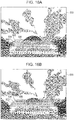
- Figs. 7A and 7B are diagrams illustrating a display example of the character information displayed in the display section 160 according to the first embodiment of the present disclosure.
- Fig. 7A illustrates a display example of the character information 431 to 436 (the character information grouping 430) in a case where an image 451 is displayed on the display section 160.
- the image 451 is, for example, an image where the expanses of Hokkaido in winter are imaged.
- "winter visits Hokkaido" is displayed at the front as the character information 431 which is related to the image 451. That is, Fig. 7A illustrates a display example in a case where the holding state of the character information holding section 130 is a state shown in Fig. 4 .
- the user grasps that there is the character information which is positioned previously on the time axis (old character information) by changing the ⁇ value of each item of the character information which configures the character information grouping 430.
- the characters which are included in the character information may become difficult to see in a case where the ⁇ value of the entire region of the character information. Therefore, in the first embodiment of the present disclosure, only the ⁇ value of a region other than a character region of the character information (that is, the background image) is changed and the ⁇ value of the character region is not changed.
- the ⁇ value is a numerical value which expresses the transparency and is changed within a range where the transparency of RGB (Red, Green, and Blue) is zero to one.
- the target image is not transparent in a case where ⁇ is set to equal zero and the transparency of the target image increases in accordance with the numerical value increasing. Then, the target image is completely transparent in a case where ⁇ is set to equal one. That is, it is possible to change to a predetermined degree of transparency by changing the ⁇ value in a case of changing the transparency of the image.
- the ⁇ value of the background region of the character information 431 which is in the front is set to be the highest and the ⁇ value of the background region of the character information 436 which is in the rear is set to be the lowest.
- the display control section 150 changes the sizes of the rectangles which correspond to the character information 431 to 436 according to the time axis. Specifically, with the size of the rectangle which corresponds to the character information 431 which is in the front as a standard, the sizes of the rectangles which correspond to the prior character information 432 to 436 are reduced by a predetermined proportion on the time axis.
- the display control section 150 overwrites and combines the character information 431 to 436 where the ⁇ value of the background region has been changed from the character information 436 which is in the rear to the character information 431 which is in the front.
- the display control section 150 By changing the ⁇ value of the background region of each item of the character information and combining in this manner, as shown in Fig. 7A , the user is easily able to grasp that there is the prior character information 432, 433, and the like on the time axis in the background region of the character information 431 which is in the front.
- the ⁇ values are changed for the background regions, other than that for the character information 436 which is in the rear, out of the display target character information.
- a display example of the character information 441 and 431 to 435 (character information grouping 460) is shown of a case where an image 452 is displayed in the display section 160.
- the image 452 is, for example, an image where a ski field in Hokkaido is imaged.
- "ski field crowded with skiers" is displayed at the front as the character information 441 which is related to the image 452.
- a display example is shown of a case where, from the state shown in Fig. 7A , new character information "ski field crowded with skiers" is acquired and held in the character information holding section 130. That is, in Fig. 7B , a display example is shown of a case where the state is changed from a holding state of the character information holding section 130 shown in Fig. 4 so that the new character information 441 "ski field crowded with skiers" is added and the oldest character information 440 "meat fair opens in Sapporo" is deleted. In this case, as shown in Fig. 7B , each item of the character information 431 to 435 shown in Fig. 7A is moved to the rear in the depth direction and the oldest character information 436 shown in Fig. 7A is deleted.
- the images 451 and 452 are displayed in the display section 160 in this manner, it is easy for the user to grasp the content of the images 451 and 452 which are displayed through the displaying of the character information 431 and 441 which are linked to the images 451 and 452.
- the past character information so as to be arranged to line up from the newest character information in the depth direction, it is possible for the user to easily grasp that it is possible to see the past character information.
- Fig. 8 is a diagram illustrating a transition example of the character information displayed in the display section 160 according to the first embodiment of the present disclosure.
- Fig. 8 illustrates a transition example of the character information when the normal mode is set.
- a display example (character information grouping 471) is shown of a case in the character information holding section 130 where the character information 434 "ice floe in Sea of Okhotsk" is held in the character information holding section 130 as the newest character information.
- a display example (character information grouping 472) is shown of a case where the new character information 433 "mountains before snow (one month beforehand)" is added in the character information holding section 130 from a state shown in (a) of Fig. 8 .
- a display example (character information grouping 473) is shown of a case where the new character information 432 "snow-capped mountains (today)" is added in the character information holding section 130 from a state shown in (b) of Fig. 8 .
- a display example (the character information grouping 430) is shown of a case where the new character information 431 "winter visits Hokkaido" is added in the character information holding section 130 from a state shown in (c) of Fig. 8 .
- (d) of Fig. 8 is the same as the display example (the character information grouping 430) shown in Fig. 7A .
- the character information which is displayed in the display section 160 is sequentially updated each time new character information is acquired by the character information acquisition section 120 and added to the character information holding section 130.
- the newest character information is arranged as the foremost character information and the past character information is arranged in a time line in the rear of the newest character information in the depth direction.
- the character information which is older than the newest character information is moved to the rear in the depth direction.
- Fig. 9 is a diagram illustrating a transition example of the character information displayed in the display section 160 according to the first embodiment of the present disclosure.
- a transition example of the character information is shown when the UC mode is set. That is, in (a) to (d) in Fig. 9 , a display transition example is shown when the up button 204 or the down button 205 on the remote control 200 are pressed in a case where each item of character information shown in Fig. 4 is displayed.
- each item of character information shown in (a) to (d) in Fig. 9 corresponds to each item of character information shown in (a) to (d) in Fig. 8 .
- the UC mode it is possible to display the character information based on a user operation without any relationship with the image which is displayed in the display section 160 (the image based on the broadcasting waves).
- the same character information for a time which is desired by a user.
- the operation reception section 190 receives a first operation (the operation of pressing the down button 205) or a second operation (the operation of pressing the up button 204) via the remote control 200.
- the first operation is an operation for setting one out of two items of character information (the new one of the two items of character information) which are adjacent to the earliest character information (the foremost character information) on the time axis as the new earliest character information.
- the second operation is an operation for setting the other out of the two items of character information (the old one of the two items of character information) as the new earliest character information.
- the control section 140 performs a change of either of the two items of character information to the new earliest character information based on the user operation (the first operation or the second operation) which is received by the operation reception section 190.
- control section 140 performs a control where the new earliest character information is displayed on the display section 160 adjacent to the earliest character information when the first operation was received in a case where the first operation was received. In addition, the control section 140 performs a control where the new earliest character information is displayed on the display section 160 by deleting the earliest character information when the second operation was received in a case where the second operation was received.
- the region for holding the character information in the character information holding section 130 is limited. As a result, it is possible to display the past character information by going back just the number which is able to be held in the character information holding section 130.
- the character information is not updated as described above.
- an updating process for example, the operation of pressing the up button 204 or the down button 205 on the remote control 200
- the character information is not updated as described above.
- the character information is frequently acquired from the broadcasting station without the updating process by the user having been performed for a long time.
- the holding region in the character information holding section 130 is exhausted and holding more than this is not possible.
- the oldest character information of the character information which is held is deleted irrespective of the user operation.
- this deletion operation is repeatedly performed, the character information which is displayed as the foremost character information is the final deletion target when the UC mode is set.
- the character information is deleted, there is a display such that the foremost character information is updated and plotting is performed with the oldest character information out of the character information which is held as the foremost character information.
- the deletion action the user may be notified by that the deletion action has been performed (for example, that it is not possible to go back to the past character information further than this) being displayed.
- all of the character information which is held in the character information holding section 130 may be deleted irrespective of the user operation.
- the case where the certain conditions are satisfied is, for example, cases where selection of another channel by the user operation, switching input to an external input, or the like is performed. In this case, it is possible to delete all of the character information which is held in the character information holding section 130 since it is not possible to view the content (event) which the user was viewing.
- the case where certain conditions are satisfied is, for example, a case where the content (event) has ended.
- the end of the content is able to be determined by referencing program information of the broadcasting. For example, in a case where a program which has a sequenced time slot (from 20:00 to 20:54) is defined by the broadcasting station, it is possible to delete all of the character information related to the program when it is the end timing (20:54) (or after a certain period of time has passed since the end).
- the setting of the UC mode may be mandatorily removed and the normal mode may be set.
- Fig. 10 is a flowchart illustrating one example of a process sequence of a character information display process using the information process device 100 according to the first embodiment of the present disclosure.
- step S901 it is determined whether or not the character information display mode is set (step S901) and in a case where it is determined that the character information display mode is not set, the operation of the character information display process ends.
- the character information acquisition section 120 acquires the character information which is included in the broadcasting waves (step S902).
- step S903 it is determined whether or not the number of items of character information which are held in the character information holding section 130 is equal to or more than a threshold (step S903). Then, in a case where the number of items of character information which are held in the character information holding section 130 is equal to or more than the threshold (step S903), the character information acquisition section 120 deletes the oldest character information out of the character information which are held in the character information holding section 130 (step S904). Next, "T(True)" is set as holding related information (step S905).
- step S903 In a case where the number of items of character information which are held in the character information holding section 130 is less than the threshold (step S903), "F(False)" is set as holding related information (step S906).
- step S905 or S906 the character information which is acquired by the character information acquisition section 120 is held in the character information holding section 130 as the newest character information (step S907).
- step S910 is an example of a display sequence according to the scope of the disclosure.
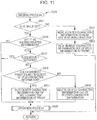
- Fig. 11 is a flowchart illustrating one example of a plotting process sequence (a process sequence of step S910 shown in Fig. 10 ) out of the process sequence of the character information display process using the information process device 100 according to the first embodiment of the present disclosure.
- step S911 it is determined whether or not the UC mode is set (step S911). In a case where the UC mode is not set (that is, in a case where the user mode is set) (step S911), the display control section 150 moves the plotted character information one to the rear in the depth direction (step S912). Next, the display control section 150 plots in front the newest character information (that is, the character information which was acquired immediately beforehand) out of the character information which is held in the character information holding section 130 (step S913) and the operation of the plotting process ends.
- the display control section 150 moves the plotted character information one to the rear in the depth direction (step S912).
- step S913 the display control section 150 plots in front the newest character information (that is, the character information which was acquired immediately beforehand) out of the character information which is held in the character information holding section 130 (step S913) and the operation of the plotting process ends.
- step S914 it is determined whether or not "T" is set as the holding related information. In a case where "T” is not set as the holding related information (that is, in a case where "F” is set as the holding related information) (step S914), the operation proceeds to step S930. On the other hand, in a case where "T” is set as the holding related information (step S914), it is determined whether or not the following equation 1 is satisfied (step S915), and in a case where equation 1 is satisfied, the operation proceeds to step S930.
- CM1 is a value indicating a number of items of character information which are able to be held in the character information holding section 130.
- FP1 is a value indicating the position of the foremost pointer 301 (a value indicating a number of items of character information from the newest character information to the foremost pointer 301).
- IO1 is a value indicating the number of items of display target character information.
- step S930 the display control section 150 plots in front the oldest character information out of the character information which is held in the character information holding section 130 (step S917). In this case, only the oldest character information is displayed as the display target character information. In addition, the foremost pointer 301 is attached to the oldest character information which is the display target.
- step S930 is an example of a control sequence according to the scope of the disclosure.
- the display control section 150 deletes the oldest character information out of the display target information (step S918). Due to this, the plotting position of the character information in the rear is set one forward.
- the deletion of the character information is performed using an effect of effects.
- Fig. 12 is a flowchart illustrating one example of an operation process sequence (a process sequence of step S930 shown in Fig. 11 ) out of the process sequence of the character information display process using the information process device 100 according to the first embodiment of the present disclosure.
- step S931 it is determined whether or not an operation input in the remote control 200 (or an operation input in the operation reception section 190 in the information processing device 100) is performed (step S931) and in a case where the input operation is not performed, the operation of the operation process ends.
- step S931 it is determined whether or not the operation is the operation of pressing the up button 204 or the down button 205 on the remote control 200 (step S932). In a case where the operation is not the operation of pressing the up button 204 or the down button 205 (step S932), a process is performed according to the operation (step S933) and the operation of the operation process ends.
- step S934 it is determined whether or not the pressing operation is the operation of pressing the up button 204 (step S934).
- the pressing operation is the operation of pressing the up button 204 (step S934)
- an upward direction event process is performed (step S940). The upward direction event process will be described in detail with reference to Fig. 13 .
- a downward direction event process is performed (step S950). The upward direction event process will be described in detail with reference to Fig. 14 .
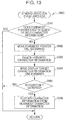
- Fig. 13 is a flowchart illustrating one example of an upward direction event process sequence (a process sequence of step S940 shown in Fig. 12 ) out of the process sequence of the character information display process using the information process device 100 according to the first embodiment of the present disclosure.
- step S941 it is determined whether or not the foremost pointer 301 exists at the oldest character information which is held in the character information holding section 130 (step S941), and in a case where the foremost pointer 301 exists at the oldest character information, the operation of the upward direction event process ends. In this case, since the foremost character information is the oldest character information, that the process according to the operation of the up button 204 is not possible may be displayed.
- step S941 the display control section 150 moves the foremost pointer 301 one backward (forward on the time axis) (step S942).
- step S943 the display control section 150 deletes the character information which is plotted in front (step S943).
- step S944 the display control section 150 moves each item of the display target character information one forward (step S944).
- step S945 it is determined whether or not equation 1 is satisfied (step S945), and in a case where equation 1 is not satisfied, the operation of the upward direction event process ends.
- step S945 the display control section 150 plots the Nth (IO1-1th) character information from the plotting position of the character information in the rear (step S946), that is, plots the character information in the front.
- IO1 is the same as equation 1.
- Fig. 14 is a flowchart illustrating one example of an downward direction event process sequence (a process sequence of step S950 shown in Fig. 12 ) out of the process sequence of the character information display process using the information process device 100 according to the first embodiment of the present disclosure.
- step S951 it is determined whether or not the character information in the front is the newest character information which is held in the character information holding section 130 (step S951), and in a case where the character information in the front is the newest character information, the operation of the downward direction event process ends. In this case, since the foremost character information is the newest character information, that the process according to the operation of the down button 205 is not possible may be displayed.
- step S951 the display control section 150 moves the foremost pointer 301 one forward (backward on the time axis) (step S952) and moves each item of the display target character information one backward (step S953).
- the oldest character information out of the plotted character information is deleted.
- step S954 the display control section 150 plots in front the character information where the foremost pointer 301 exists.
- the display position of the character information is fixed (for example, the display position of the foremost character information) in a case where the character information display mode (the normal mode or the UC mode) is set.
- the display state of the character information may be changed according to the mode which is set so that it is possible to the user to visually grasp the mode which has been set.
- the color of a background region of the character information when the normal mode is set and the color of a background region of the character information when the UC mode is set are different.
- the color of the frame of the rectangle which corresponds to the character information when the normal mode is set and the color of the frame of the rectangle which corresponds to the character information when the UC mode is set are different.
- the shape (or the size) of the region which corresponds to the character information when the normal mode is set and the shape (or the size) of the region which corresponds to the character information when the UC mode is set are different.
- the display position of the character information when the normal mode is set and the display position of the character information when the UC mode is set are different. This example will be shown in Figs. 15A to 16B .
- Figs. 15A to 16B are diagrams illustrating an example of a change in a display state of the character information in a case where the character information display mode is set in the information process device 100 according to the first embodiment of the present disclosure. That is, Figs. 15A and 15B schematically illustrate an upper-plane diagram in a case where the positions of the character information 501 to 506 are virtually arranged in the depth direction, and Figs. 16A and 16B illustrate an example of the character information displayed in the display section 160. In addition, in Figs. 15A and 16A , an example of a display state of the character information is shown when the normal mode is set and, in Figs. 15B and 16B , an example of a display state of the character information is shown when the UC mode is set.
- the display state of the character information shown in Figs. 15A and 16A is the same display state.
- the UC mode is set in a case where an operation of pressing the mode switching button 209 on the remote control 200 is performed in a state shown in Figs. 15A and 16A (in a state where the normal mode is set). That is, switching from the normal mode to the UC mode is performed.
- the display position of the character information changes. For example, as shown by a dotted line 509, the character information 501 to 506 moves to the rear in the depth direction.
- the normal mode is set in a case where the operation of pressing the mode switching button 209 on the remote control 200 is performed in a state shown in Figs. 15B and 16B (a state where the UC mode is set). That is, switching from the UC mode to the normal mode is performed.
- the display position of the character information changes. With regard to this case, the opposite change is performed to the transition when switching from the normal mode to the UC mode.
- the operation reception section 190 receives the operation of switching the UC mode (the first mode) and the normal mode (the second mode) with regard to the character information which is the earliest character information (the foremost character information) via the remote control 200.
- the UC mode (the first mode) is a character information display mode where it is possible to perform a change based on the user operation with regard to the character information which is the earliest character information.
- the normal mode (the second mode) is a character information display mode where it is possible to perform a change according to the display of the moving images without changing based on the user operation with regard to the character information which is the earliest character information.
- control section 140 performs a control where the display state of the display target character information is changed when each of the modes is set (the first mode or the second mode) in a case where the operation for switching received by the operation reception section 190 is received.
- control section 140 changes the display state by changing the position of the earliest character information in the predetermined direction (the depth direction) when the first mode is set and the position of the earliest character information in the predetermined direction when the second mode is set.
- the foremost character information may be moved in the depth direction according to the operation of pressing the up button 204 or the down button 205 on the remote control 200.
- the foremost character information and the other display target character information which is continuous with the foremost character information are moved to the rear in the depth direction.
- the foremost character information and the other display target character information which is continuous with the foremost character information are moved to the front in the depth direction. Due to this, the user is easily able to visually grasp that the operation of changing the character information has been performed.
- a planar image for example, an image based on broadcasting waves
- character information a planar image
- the character information is displayed as a stereoscopic image.
- the configuration of the information processing device of the second embodiment of the present disclosure has substantially the same configuration as the example shown in Fig. 1 .
- the portions which are common with the first embodiment of the present disclosure have the same reference numeral attached and a portion of the description thereof is omitted.
- the second embodiment of the present disclosure it is possible to use a parallax barrier method or a specialized glasses method as an example of a display method for displaying the stereoscopic image in the display section 160.
- the specialized glasses method is a method of providing the stereoscopic image to a user by the user wearing specialized glasses for viewing stereoscopic images (for example, active shutter method glasses or polarized plate type glasses).
- active shutter method glasses or polarized plate type glasses for example, active shutter method glasses or polarized plate type glasses.
- Figs. 17A to 17D are diagrams illustrating a stereoscopic image for displaying the character information in a stereoscopic manner in the display section 160 according to the second embodiment of the present disclosure.
- Figs. 18A and 18B are diagrams illustrating a relationship between the display section 160 and a virtual display position of the character information which is displayed in the display section 160 according to the second embodiment of the present disclosure.
- the relationship of the virtual display position of the character information shown in Figs. 18A and 18B is the same as the example shown in Figs. 6A and 6B .
- a stereoscopic image (left eye image (first layer) 601 and right eye image (first layer) 603) is shown for displaying the foremost character information.
- a rectangular region 602 which corresponds to the character information is included in the left eye image (first layer) 601 and a rectangular region 604 which corresponds to the character information is included in right eye image (first layer) 603.
- d1 a staggering amount of the rectangular regions 602 and 604 between the left eye image (first layer) 601 and the right eye image (first layer) 603 is shown as d1.
- the left eye image (first layer) 601 and the right eye image (first layer) 603 are displayed in the display section 160
- a case is assumed where the left eye of the user sees the left eye image (first layer) 601 and the right eye of the user sees the right eye image (first layer) 603.
- the rectangular regions 602 and 604 which are included in the left eye image (first layer) 601 and the right eye image (first layer) 603 are seen in a position in front of the display surface (a position of the character information 651) as shown in Figs. 18A and 18B .
- Figs. 17A to 17D for ease of description, the staggering amount of the rectangular regions included in the left eye image and the right eye image are shown to be comparatively large.
- a stereoscopic image (left eye image (second layer) 605 and right eye image (second layer) 607) is shown for displaying the character information next to the front.
- the relationship of rectangular regions 606 and 608, a staggering amount d2, and the ⁇ value of the left eye image (second layer) 605 and the right eye image (second layer) 607 is the same as Fig. 17A .
- the rectangular regions 606 and 608 are seen in a position in front of the display surface (a position of the character information 652) as shown in Figs. 18A and 18B .
- a stereoscopic image (left eye image (fourth layer) 611 and right eye image (fourth layer) 613) is shown for displaying the character information next to the front.
- the relationship of rectangular regions 612 and 614 and the ⁇ value of the left eye image (fourth layer) 611 and the right eye image (fourth layer) 613 is the same as Fig. 17A .
- the rectangular regions 612 and 614 are equivalent to the position of the display surface (a position of the character information 654) as shown in Figs. 18A and 18B .
- the rectangular regions 612 and 614 of the left eye image (fourth layer) 611 and the right eye image (fourth layer) 613 overlap.
- a stereoscopic image (left eye image (sixth layer) 615 and right eye image (sixth layer) 617) is shown for displaying the character information in the rear.
- the relationship of rectangular regions 616 and 618, a staggering amount d3, and the ⁇ value of the left eye image (sixth layer) 615 and right eye image (sixth layer) 617 is the same as Fig. 17A .
- the rectangular regions 616 and 618 are seen in a position to the rear of the display surface (a position of the character information 656) as shown in Figs. 18A and 18B .
- FIGs. 17A to 17D the diagrammatical representation and the description of third layer and the fifth layer which correspond to positions of the character information 653 and 655 shown in Figs. 18A and 18B is omitted.
- the character information which configures the stereoscopic effect (the rectangular regions 602, 604, and the like) are deviated in a horizontal direction in the stereoscopic image.
- the position of the staggering is the opposite for the character information (the rectangular regions 602, 604, and the like) which is projected outward and the character information (the rectangular regions 616, 618, and the like) which is drawn inward.
- the staggering amount of the character information corresponds to a projected-out amount or a drawn-in amount of the stereoscopic object (3D object). Therefore, in the second embodiment of the present disclosure, the staggering amount (the projected-out amount or the drawn-in amount of the stereoscopic object) of the character information, which is related to the left eye image and the right eye image which configure the stereoscopic image, is held in the display control section 150 as a parameter.
- the display section 150 overwrites and combines the respective left eye images and overwrites and combines the respective right eye images.
- the images with small layer numbers are combined so as to be on an upper side. That is, in a case of overwriting and combining the left eye images, the left eye image (first layer) 601 is combined so as to be on top and the left eye image (sixth layer) 615 is combined so as to be on bottom.
- the character information to the rear in the depth direction is difficult due to the combining. Therefore, for example, the rectangular regions which correspond to each item of the character information may be arranged so as to be deviated in the up and down direction.
- the rectangular regions which corresponds to each item of the character information are set so as to be deviated upward by a predetermined amount in the up and down direction. Due to this, it is possible for at least the rectangular regions which correspond to each item of the character information on the upper side to be recognized by the user as the stereoscopic images.
- the display control section 150 displays the display target character information as a stereoscopic image.
- the display control section 150 displays the display target character information so that the direction which goes substantially straight through the display surface of the display section 160 as the predetermined direction and the display target character information is lined up in the predetermined direction by being arranging in a three-dimensional space.
- the first embodiment of the present disclosure with regard to points other than the character information being a stereoscopic image. That is, it is possible to apply the display state shown in the first embodiment of the present disclosure also to the second embodiment of the present disclosure.
- the character information is displayed in predetermined units (for example, each sentence or each paragraph) in a lower portion of the display region in the display section 160.
- predetermined units for example, each sentence or each paragraph
- the moving images and the character information are displayed at the same time in the one display section 160, but for example, the moving images and the character information may be displayed in a plurality of display sections.
- the moving images may be displayed in one display section and the character information may be displayed in another display section. In this case, for example, it is possible to display the character information in the center portion of the display region of the other display section.
- the foremost character information may be changed using another operation method.
- the foremost character information may be changed by the character information which is to be the foremost character information being operated by touch using a touch panel.
- the foremost character information may be changed using an operation such as where there is pulling out of any of the display target character information using a touch panel.
- a concept of time in the depth direction is introduced and the character information is arranged in the depth direction along the time line which is provided from the broadcasting station. That is, the past character information is arranged in the depth direction along the time line.
- the character information which is arranged in this manner it is possible to easily view any character information by going back more into the past than the current timing. For example, it is possible to view the character information of which the reading was missed by the character information of which the reading was missed by the user being displayed in front using an operation of the remote control 200.
- the embodiments described above shown examples for the realization of the present disclosure and the items in the embodiments and the specific items of the present disclosure in the scope of the disclosure each have a corresponding relationship.
- the specific items of the present disclosure in the scope of the disclosure and the items in the embodiments of the present disclosure which are given the same name each have a corresponding relationship.
- the present disclosure is not limited to the embodiments and it is possible for the present disclosure to be realized by various modifications being carried out on the embodiments within the range that does not depart from the concept of the present disclosure.
- the process sequence which is described in the embodiments described above may be taken as a method which is the series of sequences and may be taken as a program for executing the series of sequences on a computer and a recording medium which records the program.
- a CD Compact Disc
- MD MiniDisc
- DVD Digital Versatile Disk
- a memory card a Blu-ray Disc (registered trademark), or the like as the recording medium.
Landscapes
- Engineering & Computer Science (AREA)
- Multimedia (AREA)
- Signal Processing (AREA)
- Human Computer Interaction (AREA)
- Computer Graphics (AREA)
- Controls And Circuits For Display Device (AREA)
- User Interface Of Digital Computer (AREA)
- Testing, Inspecting, Measuring Of Stereoscopic Televisions And Televisions (AREA)
Claims (10)
- Anzeigesteuerung (100), umfassend:einen Steuerteil (140) zum Steuern einer Anzeige (160), um eine Sequenz von Bildern, erste Zeicheninformationen (431), die einem ersten angezeigten Bild (451) der Sequenz von Bildern entsprechen, und andere Zeicheninformationen (441), die einem anderen Bild (452) in der Sequenz von Bildern, das in der Sequenz von Bildern vor dem ersten angezeigten Bild kommt, anzuzeigen,wobei der Steuerteil die Anzeige der ersten Zeicheninformationen und der anderen Zeicheninformationen als Reaktion auf eine Benutzeroperation steuert; undwobei, wenn (i) die ersten Zeicheninformationen zuvorderst relativ zu den anderen Zeicheninformationen angezeigt werden und (ii) die Benutzeroperation eine Änderung der zuvordersten Zeicheninformationen spezifiziert, die Steuerung die Anzeige steuert, um gleichzeitig die ersten Zeicheninformationen und die anderen Zeicheninformationen mit den anderen Zeicheninformationen zuvorderst relativ zu den ersten Zeicheninformationen anzuzeigen; undwobei die ersten Zeicheninformationen und die anderen Zeicheninformationen stereoskopisch in einem Linksaugenbild und einem Rechtsaugenbild angezeigt werden, dergestalt, dass die ersten Zeicheninformationen und die anderen Zeicheninformationen sich in einer Breitenrichtung und einer Höhenrichtung mindestens teilweise überlappen und in einer Tiefenrichtung durch die ersten Zeicheninformationen und die anderen Zeicheninformationen getrennt werden, die zwischen dem Linksaugenbild und dem Rechtsaugenbild verschieden gestaffelt werden.
- Anzeigesteuerung nach Anspruch 1, wobei die ersten Zeicheninformationen und die anderen Zeicheninformationen auf einer Zeitachse der Anzeige dergestalt erscheinen, dass die ersten Zeicheninformationen an einer einem ersten Zeitpunkt entsprechenden Position erscheinen und die anderen Zeicheninformationen an einer einem zweiten Zeitpunkt entsprechenden Position erscheinen, wobei der erste Zeitpunkt später als der zweite Zeitpunkt ist.
- Anzeigesteuerung nach Anspruch 1, wobei die ersten Zeicheninformationen und die anderen Zeicheninformationen auf einer Zeitachse erscheinen, die in einer zu einem Bildschirm der Anzeige senkrechten Richtung verläuft, dergestalt, dass die Zeit auf der Achse in der Richtung zum Benutzer vorrückt und dergestalt, dass die ersten Zeicheninformationen dem Benutzer vor den anderen Zeicheninformationen erscheinen.
- Anzeigesteuerung nach Anspruch 1, wobei die ersten Zeicheninformationen und die anderen Zeicheninformationen so angezeigt werden, dass eines der ersten Zeicheninformationen und der anderen Zeicheninformationen mindestens einen Teil des anderen zu überlagern scheint.
- Anzeigesteuerung nach Anspruch 4, wobei mindestens ein Teil des einen der ersten Zeicheninformationen und der anderen Zeicheninformationen auf transparente Weise angezeigt wird.
- Anzeigesteuerung nach Anspruch 5, wobei das eine der ersten Zeicheninformationen und der anderen Zeicheninformationen ein oder mehrere Textzeichen umfasst und der Nicht-Zeichenteil des anderen der ersten Zeicheninformationen und der anderen Zeicheninformationen auf transparente Weise angezeigt wird.
- Anzeigesteuerung nach Anspruch 1, wobei die Sequenz von Bildern ein bewegtes Bild bildet.
- Anzeigeverfahren, umfassend:Steuern einer Anzeige (160), um eine Sequenz von Bildern, erste Zeicheninformationen (431), die einem ersten angezeigten Bild (451) der Sequenz von Bildern entsprechen, und andere Zeicheninformationen (441), die einem anderen Bild (452) in der Sequenz von Bildern, das in der Sequenz von Bildern vor dem ersten angezeigten Bild kommt, anzuzeigen,wobei das Steuern der Anzeige der ersten Zeicheninformationen und der anderen Zeicheninformationen als Reaktion auf eine Benutzeroperation durchgeführt wird; undwobei, wenn (i) die ersten Zeicheninformationen zuvorderst relativ zu den anderen Zeicheninformationen angezeigt werden und (ii) die Benutzeroperation eine Änderung der zuvordersten Zeicheninformationen spezifiziert, Steuern der Anzeige der ersten Zeicheninformationen und der anderen Zeicheninformationen Steuern der Anzeige umfasst, um gleichzeitig die ersten Zeicheninformationen und die anderen Zeicheninformationen mit den anderen Zeicheninformationen relativ zu den ersten Zeicheninformationen zuvorderst anzuzeigen; undwobei die ersten Zeicheninformationen und die anderen Zeicheninformationen stereoskopisch in einem Linksaugenbild und einem Rechtsaugenbild angezeigt werden, dergestalt, dass die ersten Zeicheninformationen und die anderen Zeicheninformationen sich in einer Breitenrichtung und einer Höhenrichtung mindestens teilweise überlappen und in einer Tiefenrichtung durch die ersten Zeicheninformationen und die anderen Zeicheninformationen getrennt werden, die zwischen dem Linksaugenbild und dem Rechtsaugenbild verschieden gestaffelt werden.
- Anzeigeverfahren nach Anspruch 8, wobei die ersten Zeicheninformationen und die anderen Zeicheninformationen auf einer Zeitachse der Anzeige dergestalt erscheinen, dass die ersten Zeicheninformationen an einer einem ersten Zeitpunkt entsprechenden Position erscheinen und die anderen Zeicheninformationen an einer einem zweiten Zeitpunkt entsprechenden Position erscheinen, wobei der erste Zeitpunkt später als der zweite Zeitpunkt ist.
- Nichttransitorisches computerlesbares Speichermedium, auf dem ein computerlesbares Programm zur Implementierung des Anzeigeverfahrens nach Anspruch 8 gespeichert ist.
Applications Claiming Priority (1)
| Application Number | Priority Date | Filing Date | Title |
|---|---|---|---|
| JP2011074082A JP5716492B2 (ja) | 2011-03-30 | 2011-03-30 | 情報処理装置、情報処理方法およびプログラム |
Publications (3)
| Publication Number | Publication Date |
|---|---|
| EP2506565A2 EP2506565A2 (de) | 2012-10-03 |
| EP2506565A3 EP2506565A3 (de) | 2013-01-02 |
| EP2506565B1 true EP2506565B1 (de) | 2017-07-26 |
Family
ID=45977200
Family Applications (1)
| Application Number | Title | Priority Date | Filing Date |
|---|---|---|---|
| EP12160848.3A Not-in-force EP2506565B1 (de) | 2011-03-30 | 2012-03-22 | Anzeigesteuerung, Anzeigeverfahren und Computerprogramm |
Country Status (4)
| Country | Link |
|---|---|
| US (1) | US8866851B2 (de) |
| EP (1) | EP2506565B1 (de) |
| JP (1) | JP5716492B2 (de) |
| CN (1) | CN102740024A (de) |
Families Citing this family (5)
| Publication number | Priority date | Publication date | Assignee | Title |
|---|---|---|---|---|
| EP2867757A4 (de) * | 2012-06-30 | 2015-12-23 | Intel Corp | Grafische 3d-benutzeroberfläche |
| WO2017020806A1 (en) * | 2015-07-31 | 2017-02-09 | Versitech Limited | A multi-overlay variable support and order kernel-based representation for image deformation and view synthesis |
| JP2018005109A (ja) * | 2016-07-07 | 2018-01-11 | オリンパス株式会社 | 表示装置、表示方法、及びプログラム |
| CN109144393B (zh) * | 2018-08-28 | 2020-08-07 | 维沃移动通信有限公司 | 一种图像显示方法及移动终端 |
| JP7148172B2 (ja) * | 2021-03-03 | 2022-10-05 | VoiceApp株式会社 | 字幕表示処理プログラム、字幕表示処理装置、サーバ。 |
Citations (4)
| Publication number | Priority date | Publication date | Assignee | Title |
|---|---|---|---|---|
| EP1153508A1 (de) * | 1999-02-08 | 2001-11-14 | United Video Properties, Inc. | Elektronischer programmführer mit unterstützung umfassender programminhalte |
| EP1703744A2 (de) * | 2005-03-16 | 2006-09-20 | Sony Corporation | Vorrichtung und Verfahren zur stereoskopischen Bildaufnahme, -wiedergabe und -anzeige |
| US20100245666A1 (en) * | 2009-03-31 | 2010-09-30 | Daniel Rosen | Subtitling Stereographic Imagery |
| CN101902582A (zh) * | 2010-07-09 | 2010-12-01 | 清华大学 | 一种立体视频字幕添加方法及装置 |
Family Cites Families (17)
| Publication number | Priority date | Publication date | Assignee | Title |
|---|---|---|---|---|
| JP5302239B2 (ja) | 1998-02-24 | 2013-10-02 | 株式会社マンダム | 防腐殺菌剤及び人体施用組成物 |
| JP2001186446A (ja) * | 1999-12-24 | 2001-07-06 | Toshiba Corp | 情報再生装置及び情報再生方法 |
| JP2001285812A (ja) * | 2000-03-29 | 2001-10-12 | Sanyo Electric Co Ltd | 放送受信装置 |
| JP2002232798A (ja) * | 2001-01-30 | 2002-08-16 | Toshiba Corp | 放送受信装置とその制御方法 |
| US7050109B2 (en) * | 2001-03-02 | 2006-05-23 | General Instrument Corporation | Methods and apparatus for the provision of user selected advanced close captions |
| US20050210416A1 (en) * | 2004-03-16 | 2005-09-22 | Maclaurin Matthew B | Interactive preview of group contents via axial controller |
| JP2006287676A (ja) * | 2005-04-01 | 2006-10-19 | Dainippon Printing Co Ltd | データ放送の画面に字幕を表示させる方法、データ放送番組、データ放送番組プログラム、字幕配信システム。 |
| JP2007158959A (ja) * | 2005-12-07 | 2007-06-21 | Sharp Corp | 光ディスク再生装置 |
| CN101222592B (zh) * | 2007-01-11 | 2010-09-15 | 深圳Tcl新技术有限公司 | 封闭式字幕显示装置与方法 |
| JP2009159126A (ja) * | 2007-12-25 | 2009-07-16 | Casio Hitachi Mobile Communications Co Ltd | 字幕付き映像再生装置、字幕付き映像再生装置の画面制御方法及びプログラム |
| JP5140687B2 (ja) * | 2008-02-14 | 2013-02-06 | パナソニック株式会社 | 再生装置、集積回路、再生方法、プログラム、コンピュータ読取可能な記録媒体 |
| JP4618384B2 (ja) * | 2008-06-09 | 2011-01-26 | ソニー株式会社 | 情報提示装置および情報提示方法 |
| US8970782B2 (en) | 2008-06-24 | 2015-03-03 | Thomson Licensing | Method and system for redisplaying text |
| JP2010199711A (ja) | 2009-02-23 | 2010-09-09 | Sony Corp | コンテンツ処理装置および方法 |
| CA2752691C (en) | 2009-02-27 | 2017-09-05 | Laurence James Claydon | Systems, apparatus and methods for subtitling for stereoscopic content |
| CN101887439B (zh) * | 2009-05-13 | 2014-04-02 | 富士通株式会社 | 生成视频摘要的方法、装置、包含该装置的图像处理系统 |
| EP2309463A3 (de) | 2009-10-07 | 2011-07-27 | Thomson Licensing | Verfahren zur Anzeige eines 3D-Videos mit Einfügung eines Grafikelements und Endgerät zur Umsetzung des Verfahrens |
-
2011
- 2011-03-30 JP JP2011074082A patent/JP5716492B2/ja not_active Expired - Fee Related
-
2012
- 2012-03-19 US US13/423,643 patent/US8866851B2/en not_active Expired - Fee Related
- 2012-03-22 EP EP12160848.3A patent/EP2506565B1/de not_active Not-in-force
- 2012-03-23 CN CN2012100797132A patent/CN102740024A/zh active Pending
Patent Citations (4)
| Publication number | Priority date | Publication date | Assignee | Title |
|---|---|---|---|---|
| EP1153508A1 (de) * | 1999-02-08 | 2001-11-14 | United Video Properties, Inc. | Elektronischer programmführer mit unterstützung umfassender programminhalte |
| EP1703744A2 (de) * | 2005-03-16 | 2006-09-20 | Sony Corporation | Vorrichtung und Verfahren zur stereoskopischen Bildaufnahme, -wiedergabe und -anzeige |
| US20100245666A1 (en) * | 2009-03-31 | 2010-09-30 | Daniel Rosen | Subtitling Stereographic Imagery |
| CN101902582A (zh) * | 2010-07-09 | 2010-12-01 | 清华大学 | 一种立体视频字幕添加方法及装置 |
Also Published As
| Publication number | Publication date |
|---|---|
| EP2506565A2 (de) | 2012-10-03 |
| CN102740024A (zh) | 2012-10-17 |
| JP5716492B2 (ja) | 2015-05-13 |
| US8866851B2 (en) | 2014-10-21 |
| EP2506565A3 (de) | 2013-01-02 |
| JP2012209776A (ja) | 2012-10-25 |
| US20120249572A1 (en) | 2012-10-04 |
Similar Documents
| Publication | Publication Date | Title |
|---|---|---|
| EP2506565B1 (de) | Anzeigesteuerung, Anzeigeverfahren und Computerprogramm | |
| JP4926416B2 (ja) | 画像表示方法、プログラム、記録媒体及び画像表示装置 | |
| EP1520401A1 (de) | Anordnung zur verarbeitung von videosignalen | |
| KR101247033B1 (ko) | 입체 디스플레이에서 1차 콘텐츠와 2차 콘텐츠 간의 방해 방지 | |
| EP2448276A2 (de) | GUI-Bereitstellungsverfahren, Anzeigevorrichtung und 3D-Bildbereitstellungssystem damit | |
| US20160261929A1 (en) | Broadcast receiving apparatus and method and controller for providing summary content service | |
| KR101901909B1 (ko) | 표시 제어 장치, 프로그램 및 표시 제어 방법 | |
| CN108777775A (zh) | 用于根据定制格式显示视频流的方法 | |
| US8749617B2 (en) | Display apparatus, method for providing 3D image applied to the same, and system for providing 3D image | |
| KR20140040151A (ko) | 3D (3-dimensional) 방송 서비스를 위한 방송 신호 처리 방법 및 장치 | |
| CN102256095A (zh) | 电子装置、视频处理方法和程序 | |
| KR20120039767A (ko) | 3차원 비디오 위에 그래픽 객체를 오버레이하기 위한 추천 깊이 값 | |
| US8836757B2 (en) | 3D image providing device, display device, and method thereof | |
| US20120092457A1 (en) | Stereoscopic image display apparatus | |
| KR20140044663A (ko) | 방송 수신 장치 및 디스플레이 장치와 이를 이용한 검색 방법 | |
| JP2012173683A (ja) | 表示制御装置、情報表示装置、及び表示制御方法 | |
| KR20120023268A (ko) | 디스플레이 장치 및 그 영상 생성 방법 | |
| US20110304769A1 (en) | Digital broadcast receiver apparatus and image display method | |
| JP2010161493A (ja) | 画像表示装置及び画像表示方法 | |
| JP2009071704A (ja) | デジタル放送受信機 | |
| US20120098944A1 (en) | 3-dimensional image display apparatus and image display method thereof | |
| JP2006295806A (ja) | 電子番組表表示装置 | |
| WO2010143351A1 (ja) | デジタル放送受信装置及びデジタル放送受信方法 | |
| KR101881292B1 (ko) | Uhd동영상의 스티칭 및 컷-아웃용 텔레스트레이터 | |
| JP2016092769A (ja) | 受信機 |
Legal Events
| Date | Code | Title | Description |
|---|---|---|---|
| PUAI | Public reference made under article 153(3) epc to a published international application that has entered the european phase |
Free format text: ORIGINAL CODE: 0009012 |
|
| 17P | Request for examination filed |
Effective date: 20120330 |
|
| AK | Designated contracting states |
Kind code of ref document: A2 Designated state(s): AL AT BE BG CH CY CZ DE DK EE ES FI FR GB GR HR HU IE IS IT LI LT LU LV MC MK MT NL NO PL PT RO RS SE SI SK SM TR |
|
| AX | Request for extension of the european patent |
Extension state: BA ME |
|
| PUAL | Search report despatched |
Free format text: ORIGINAL CODE: 0009013 |
|
| AK | Designated contracting states |
Kind code of ref document: A3 Designated state(s): AL AT BE BG CH CY CZ DE DK EE ES FI FR GB GR HR HU IE IS IT LI LT LU LV MC MK MT NL NO PL PT RO RS SE SI SK SM TR |
|
| AX | Request for extension of the european patent |
Extension state: BA ME |
|
| 17Q | First examination report despatched |
Effective date: 20150904 |
|
| STAA | Information on the status of an ep patent application or granted ep patent |
Free format text: STATUS: EXAMINATION IS IN PROGRESS |
|
| R17C | First examination report despatched (corrected) |
Effective date: 20150904 |
|
| GRAP | Despatch of communication of intention to grant a patent |
Free format text: ORIGINAL CODE: EPIDOSNIGR1 |
|
| STAA | Information on the status of an ep patent application or granted ep patent |
Free format text: STATUS: GRANT OF PATENT IS INTENDED |
|
| RIC1 | Information provided on ipc code assigned before grant |
Ipc: H04N 13/00 20060101ALI20161205BHEP Ipc: H04N 21/81 20110101ALI20161205BHEP Ipc: H04N 21/431 20110101ALI20161205BHEP Ipc: H04N 21/485 20110101ALI20161205BHEP Ipc: H04N 5/445 20110101AFI20161205BHEP Ipc: H04N 21/488 20110101ALI20161205BHEP |
|
| INTG | Intention to grant announced |
Effective date: 20170105 |
|
| GRAS | Grant fee paid |
Free format text: ORIGINAL CODE: EPIDOSNIGR3 |
|
| GRAJ | Information related to disapproval of communication of intention to grant by the applicant or resumption of examination proceedings by the epo deleted |
Free format text: ORIGINAL CODE: EPIDOSDIGR1 |
|
| GRAL | Information related to payment of fee for publishing/printing deleted |
Free format text: ORIGINAL CODE: EPIDOSDIGR3 |
|
| STAA | Information on the status of an ep patent application or granted ep patent |
Free format text: STATUS: EXAMINATION IS IN PROGRESS |
|
| GRAR | Information related to intention to grant a patent recorded |
Free format text: ORIGINAL CODE: EPIDOSNIGR71 |
|
| INTC | Intention to grant announced (deleted) | ||
| STAA | Information on the status of an ep patent application or granted ep patent |
Free format text: STATUS: GRANT OF PATENT IS INTENDED |
|
| GRAA | (expected) grant |
Free format text: ORIGINAL CODE: 0009210 |
|
| STAA | Information on the status of an ep patent application or granted ep patent |
Free format text: STATUS: THE PATENT HAS BEEN GRANTED |
|
| AK | Designated contracting states |
Kind code of ref document: B1 Designated state(s): AL AT BE BG CH CY CZ DE DK EE ES FI FR GB GR HR HU IE IS IT LI LT LU LV MC MK MT NL NO PL PT RO RS SE SI SK SM TR |
|
| INTG | Intention to grant announced |
Effective date: 20170620 |
|
| REG | Reference to a national code |
Ref country code: GB Ref legal event code: FG4D |
|
| REG | Reference to a national code |
Ref country code: CH Ref legal event code: EP |
|
| REG | Reference to a national code |
Ref country code: AT Ref legal event code: REF Ref document number: 913279 Country of ref document: AT Kind code of ref document: T Effective date: 20170815 |
|
| REG | Reference to a national code |
Ref country code: IE Ref legal event code: FG4D |
|
| REG | Reference to a national code |
Ref country code: DE Ref legal event code: R096 Ref document number: 602012034929 Country of ref document: DE |
|
| REG | Reference to a national code |
Ref country code: NL Ref legal event code: MP Effective date: 20170726 |
|
| REG | Reference to a national code |
Ref country code: LT Ref legal event code: MG4D |
|
| REG | Reference to a national code |
Ref country code: AT Ref legal event code: MK05 Ref document number: 913279 Country of ref document: AT Kind code of ref document: T Effective date: 20170726 |
|
| PG25 | Lapsed in a contracting state [announced via postgrant information from national office to epo] |
Ref country code: AT Free format text: LAPSE BECAUSE OF FAILURE TO SUBMIT A TRANSLATION OF THE DESCRIPTION OR TO PAY THE FEE WITHIN THE PRESCRIBED TIME-LIMIT Effective date: 20170726 Ref country code: LT Free format text: LAPSE BECAUSE OF FAILURE TO SUBMIT A TRANSLATION OF THE DESCRIPTION OR TO PAY THE FEE WITHIN THE PRESCRIBED TIME-LIMIT Effective date: 20170726 Ref country code: NL Free format text: LAPSE BECAUSE OF FAILURE TO SUBMIT A TRANSLATION OF THE DESCRIPTION OR TO PAY THE FEE WITHIN THE PRESCRIBED TIME-LIMIT Effective date: 20170726 Ref country code: SE Free format text: LAPSE BECAUSE OF FAILURE TO SUBMIT A TRANSLATION OF THE DESCRIPTION OR TO PAY THE FEE WITHIN THE PRESCRIBED TIME-LIMIT Effective date: 20170726 Ref country code: HR Free format text: LAPSE BECAUSE OF FAILURE TO SUBMIT A TRANSLATION OF THE DESCRIPTION OR TO PAY THE FEE WITHIN THE PRESCRIBED TIME-LIMIT Effective date: 20170726 Ref country code: FI Free format text: LAPSE BECAUSE OF FAILURE TO SUBMIT A TRANSLATION OF THE DESCRIPTION OR TO PAY THE FEE WITHIN THE PRESCRIBED TIME-LIMIT Effective date: 20170726 Ref country code: NO Free format text: LAPSE BECAUSE OF FAILURE TO SUBMIT A TRANSLATION OF THE DESCRIPTION OR TO PAY THE FEE WITHIN THE PRESCRIBED TIME-LIMIT Effective date: 20171026 |
|
| PG25 | Lapsed in a contracting state [announced via postgrant information from national office to epo] |
Ref country code: BG Free format text: LAPSE BECAUSE OF FAILURE TO SUBMIT A TRANSLATION OF THE DESCRIPTION OR TO PAY THE FEE WITHIN THE PRESCRIBED TIME-LIMIT Effective date: 20171026 Ref country code: GR Free format text: LAPSE BECAUSE OF FAILURE TO SUBMIT A TRANSLATION OF THE DESCRIPTION OR TO PAY THE FEE WITHIN THE PRESCRIBED TIME-LIMIT Effective date: 20171027 Ref country code: RS Free format text: LAPSE BECAUSE OF FAILURE TO SUBMIT A TRANSLATION OF THE DESCRIPTION OR TO PAY THE FEE WITHIN THE PRESCRIBED TIME-LIMIT Effective date: 20170726 Ref country code: IS Free format text: LAPSE BECAUSE OF FAILURE TO SUBMIT A TRANSLATION OF THE DESCRIPTION OR TO PAY THE FEE WITHIN THE PRESCRIBED TIME-LIMIT Effective date: 20171126 Ref country code: PL Free format text: LAPSE BECAUSE OF FAILURE TO SUBMIT A TRANSLATION OF THE DESCRIPTION OR TO PAY THE FEE WITHIN THE PRESCRIBED TIME-LIMIT Effective date: 20170726 Ref country code: LV Free format text: LAPSE BECAUSE OF FAILURE TO SUBMIT A TRANSLATION OF THE DESCRIPTION OR TO PAY THE FEE WITHIN THE PRESCRIBED TIME-LIMIT Effective date: 20170726 Ref country code: ES Free format text: LAPSE BECAUSE OF FAILURE TO SUBMIT A TRANSLATION OF THE DESCRIPTION OR TO PAY THE FEE WITHIN THE PRESCRIBED TIME-LIMIT Effective date: 20170726 |
|
| REG | Reference to a national code |
Ref country code: FR Ref legal event code: PLFP Year of fee payment: 7 |
|
| PG25 | Lapsed in a contracting state [announced via postgrant information from national office to epo] |
Ref country code: CZ Free format text: LAPSE BECAUSE OF FAILURE TO SUBMIT A TRANSLATION OF THE DESCRIPTION OR TO PAY THE FEE WITHIN THE PRESCRIBED TIME-LIMIT Effective date: 20170726 Ref country code: RO Free format text: LAPSE BECAUSE OF FAILURE TO SUBMIT A TRANSLATION OF THE DESCRIPTION OR TO PAY THE FEE WITHIN THE PRESCRIBED TIME-LIMIT Effective date: 20170726 Ref country code: DK Free format text: LAPSE BECAUSE OF FAILURE TO SUBMIT A TRANSLATION OF THE DESCRIPTION OR TO PAY THE FEE WITHIN THE PRESCRIBED TIME-LIMIT Effective date: 20170726 |
|
| REG | Reference to a national code |
Ref country code: DE Ref legal event code: R097 Ref document number: 602012034929 Country of ref document: DE |
|
| PG25 | Lapsed in a contracting state [announced via postgrant information from national office to epo] |
Ref country code: SM Free format text: LAPSE BECAUSE OF FAILURE TO SUBMIT A TRANSLATION OF THE DESCRIPTION OR TO PAY THE FEE WITHIN THE PRESCRIBED TIME-LIMIT Effective date: 20170726 Ref country code: IT Free format text: LAPSE BECAUSE OF FAILURE TO SUBMIT A TRANSLATION OF THE DESCRIPTION OR TO PAY THE FEE WITHIN THE PRESCRIBED TIME-LIMIT Effective date: 20170726 Ref country code: EE Free format text: LAPSE BECAUSE OF FAILURE TO SUBMIT A TRANSLATION OF THE DESCRIPTION OR TO PAY THE FEE WITHIN THE PRESCRIBED TIME-LIMIT Effective date: 20170726 Ref country code: SK Free format text: LAPSE BECAUSE OF FAILURE TO SUBMIT A TRANSLATION OF THE DESCRIPTION OR TO PAY THE FEE WITHIN THE PRESCRIBED TIME-LIMIT Effective date: 20170726 |
|
| PLBE | No opposition filed within time limit |
Free format text: ORIGINAL CODE: 0009261 |
|
| STAA | Information on the status of an ep patent application or granted ep patent |
Free format text: STATUS: NO OPPOSITION FILED WITHIN TIME LIMIT |
|
| 26N | No opposition filed |
Effective date: 20180430 |
|
| PG25 | Lapsed in a contracting state [announced via postgrant information from national office to epo] |
Ref country code: SI Free format text: LAPSE BECAUSE OF FAILURE TO SUBMIT A TRANSLATION OF THE DESCRIPTION OR TO PAY THE FEE WITHIN THE PRESCRIBED TIME-LIMIT Effective date: 20170726 |
|
| REG | Reference to a national code |
Ref country code: CH Ref legal event code: PL |
|
| PG25 | Lapsed in a contracting state [announced via postgrant information from national office to epo] |
Ref country code: MC Free format text: LAPSE BECAUSE OF FAILURE TO SUBMIT A TRANSLATION OF THE DESCRIPTION OR TO PAY THE FEE WITHIN THE PRESCRIBED TIME-LIMIT Effective date: 20170726 |
|
| REG | Reference to a national code |
Ref country code: BE Ref legal event code: MM Effective date: 20180331 |
|
| REG | Reference to a national code |
Ref country code: IE Ref legal event code: MM4A |
|
| PG25 | Lapsed in a contracting state [announced via postgrant information from national office to epo] |
Ref country code: LU Free format text: LAPSE BECAUSE OF NON-PAYMENT OF DUE FEES Effective date: 20180322 |
|
| PG25 | Lapsed in a contracting state [announced via postgrant information from national office to epo] |
Ref country code: IE Free format text: LAPSE BECAUSE OF NON-PAYMENT OF DUE FEES Effective date: 20180322 |
|
| PG25 | Lapsed in a contracting state [announced via postgrant information from national office to epo] |
Ref country code: BE Free format text: LAPSE BECAUSE OF NON-PAYMENT OF DUE FEES Effective date: 20180331 Ref country code: LI Free format text: LAPSE BECAUSE OF NON-PAYMENT OF DUE FEES Effective date: 20180331 Ref country code: CH Free format text: LAPSE BECAUSE OF NON-PAYMENT OF DUE FEES Effective date: 20180331 |
|
| PG25 | Lapsed in a contracting state [announced via postgrant information from national office to epo] |
Ref country code: MT Free format text: LAPSE BECAUSE OF NON-PAYMENT OF DUE FEES Effective date: 20180322 |
|
| PG25 | Lapsed in a contracting state [announced via postgrant information from national office to epo] |
Ref country code: TR Free format text: LAPSE BECAUSE OF FAILURE TO SUBMIT A TRANSLATION OF THE DESCRIPTION OR TO PAY THE FEE WITHIN THE PRESCRIBED TIME-LIMIT Effective date: 20170726 |
|
| PG25 | Lapsed in a contracting state [announced via postgrant information from national office to epo] |
Ref country code: HU Free format text: LAPSE BECAUSE OF FAILURE TO SUBMIT A TRANSLATION OF THE DESCRIPTION OR TO PAY THE FEE WITHIN THE PRESCRIBED TIME-LIMIT; INVALID AB INITIO Effective date: 20120322 Ref country code: PT Free format text: LAPSE BECAUSE OF FAILURE TO SUBMIT A TRANSLATION OF THE DESCRIPTION OR TO PAY THE FEE WITHIN THE PRESCRIBED TIME-LIMIT Effective date: 20170726 |
|
| PG25 | Lapsed in a contracting state [announced via postgrant information from national office to epo] |
Ref country code: CY Free format text: LAPSE BECAUSE OF FAILURE TO SUBMIT A TRANSLATION OF THE DESCRIPTION OR TO PAY THE FEE WITHIN THE PRESCRIBED TIME-LIMIT Effective date: 20170726 Ref country code: MK Free format text: LAPSE BECAUSE OF NON-PAYMENT OF DUE FEES Effective date: 20170726 |
|
| PG25 | Lapsed in a contracting state [announced via postgrant information from national office to epo] |
Ref country code: AL Free format text: LAPSE BECAUSE OF FAILURE TO SUBMIT A TRANSLATION OF THE DESCRIPTION OR TO PAY THE FEE WITHIN THE PRESCRIBED TIME-LIMIT Effective date: 20170726 |
|
| PGFP | Annual fee paid to national office [announced via postgrant information from national office to epo] |
Ref country code: FR Payment date: 20210218 Year of fee payment: 10 |
|
| PGFP | Annual fee paid to national office [announced via postgrant information from national office to epo] |
Ref country code: DE Payment date: 20210217 Year of fee payment: 10 Ref country code: GB Payment date: 20210219 Year of fee payment: 10 |
|
| REG | Reference to a national code |
Ref country code: DE Ref legal event code: R119 Ref document number: 602012034929 Country of ref document: DE |
|
| GBPC | Gb: european patent ceased through non-payment of renewal fee |
Effective date: 20220322 |
|
| PG25 | Lapsed in a contracting state [announced via postgrant information from national office to epo] |
Ref country code: GB Free format text: LAPSE BECAUSE OF NON-PAYMENT OF DUE FEES Effective date: 20220322 Ref country code: FR Free format text: LAPSE BECAUSE OF NON-PAYMENT OF DUE FEES Effective date: 20220331 Ref country code: DE Free format text: LAPSE BECAUSE OF NON-PAYMENT OF DUE FEES Effective date: 20221001 |