EP2501707B1 - 3-coordinate copper (i) - carbene complexes - Google Patents
3-coordinate copper (i) - carbene complexes Download PDFInfo
- Publication number
- EP2501707B1 EP2501707B1 EP10832153.0A EP10832153A EP2501707B1 EP 2501707 B1 EP2501707 B1 EP 2501707B1 EP 10832153 A EP10832153 A EP 10832153A EP 2501707 B1 EP2501707 B1 EP 2501707B1
- Authority
- EP
- European Patent Office
- Prior art keywords
- group
- complex
- aryl
- alkyl
- heteroaryl
- Prior art date
- Legal status (The legal status is an assumption and is not a legal conclusion. Google has not performed a legal analysis and makes no representation as to the accuracy of the status listed.)
- Active
Links
- 0 C*1=CC=C*1c1c(C)cccc1 Chemical compound C*1=CC=C*1c1c(C)cccc1 0.000 description 31
- KFHBTJVWYPWFKJ-UHFFFAOYSA-N CN1c2nccnc2N(C)C1 Chemical compound CN1c2nccnc2N(C)C1 KFHBTJVWYPWFKJ-UHFFFAOYSA-N 0.000 description 2
- SADPUIFJAHYKLH-UHFFFAOYSA-N CC(C1N(c2c3cccc2)c2ccccc2)C(C)c(cccc2)c2[N]13I Chemical compound CC(C1N(c2c3cccc2)c2ccccc2)C(C)c(cccc2)c2[N]13I SADPUIFJAHYKLH-UHFFFAOYSA-N 0.000 description 1
- YOKXPWGKCNWANR-UHFFFAOYSA-N CN1c2ncncc2CCC1 Chemical compound CN1c2ncncc2CCC1 YOKXPWGKCNWANR-UHFFFAOYSA-N 0.000 description 1
- DISZOYLMLQLMFJ-UHFFFAOYSA-N c(cc1)cc(c(c2c3)cc4c3c(cccc3)c3[n]4-c3cccc4ccccc34)c1[n]2-c1cccc2c1cccc2 Chemical compound c(cc1)cc(c(c2c3)cc4c3c(cccc3)c3[n]4-c3cccc4ccccc34)c1[n]2-c1cccc2c1cccc2 DISZOYLMLQLMFJ-UHFFFAOYSA-N 0.000 description 1
- FLCOBMXLSOVHGE-UHFFFAOYSA-N c(cc1)ccc1-[n]1c(c2c(cc3)c4ccccc4[n]2-c2ccccc2)c3c2ccccc12 Chemical compound c(cc1)ccc1-[n]1c(c2c(cc3)c4ccccc4[n]2-c2ccccc2)c3c2ccccc12 FLCOBMXLSOVHGE-UHFFFAOYSA-N 0.000 description 1
- RPHSQWOMKHJGSI-UHFFFAOYSA-N c(cc1)ccc1-[n]1c(ccc(-c2cc(-c(cc3c4c5ccc(-c(cc6)cc7c6c6cnccc6[o]7)c4)ccc3[n]5-c3ccccc3)ccc2)c2)c2c2cc(-c3ccc(c(cncc4)c4[o]4)c4c3)ccc12 Chemical compound c(cc1)ccc1-[n]1c(ccc(-c2cc(-c(cc3c4c5ccc(-c(cc6)cc7c6c6cnccc6[o]7)c4)ccc3[n]5-c3ccccc3)ccc2)c2)c2c2cc(-c3ccc(c(cncc4)c4[o]4)c4c3)ccc12 RPHSQWOMKHJGSI-UHFFFAOYSA-N 0.000 description 1
- PHBJYIUTTPNUBD-UHFFFAOYSA-N c(cc1)ccc1-c1nc(cccc2)c2[n]1-c(cc1)ccc1-c1c(cccc2)c2c(-c2cc(cccc3)c3cc2)c2ccccc12 Chemical compound c(cc1)ccc1-c1nc(cccc2)c2[n]1-c(cc1)ccc1-c1c(cccc2)c2c(-c2cc(cccc3)c3cc2)c2ccccc12 PHBJYIUTTPNUBD-UHFFFAOYSA-N 0.000 description 1
- NSXJEEMTGWMJPY-UHFFFAOYSA-N c(cc1c2ccccc22)ccc1[n]2-c1cccc(-c2cc(-[n]3c(cccc4)c4c4c3cccc4)ccc2)c1 Chemical compound c(cc1c2ccccc22)ccc1[n]2-c1cccc(-c2cc(-[n]3c(cccc4)c4c4c3cccc4)ccc2)c1 NSXJEEMTGWMJPY-UHFFFAOYSA-N 0.000 description 1
Images











Classifications
-
- C—CHEMISTRY; METALLURGY
- C07—ORGANIC CHEMISTRY
- C07F—ACYCLIC, CARBOCYCLIC OR HETEROCYCLIC COMPOUNDS CONTAINING ELEMENTS OTHER THAN CARBON, HYDROGEN, HALOGEN, OXYGEN, NITROGEN, SULFUR, SELENIUM OR TELLURIUM
- C07F1/00—Compounds containing elements of Groups 1 or 11 of the Periodic Table
- C07F1/08—Copper compounds
-
- C—CHEMISTRY; METALLURGY
- C09—DYES; PAINTS; POLISHES; NATURAL RESINS; ADHESIVES; COMPOSITIONS NOT OTHERWISE PROVIDED FOR; APPLICATIONS OF MATERIALS NOT OTHERWISE PROVIDED FOR
- C09K—MATERIALS FOR MISCELLANEOUS APPLICATIONS, NOT PROVIDED FOR ELSEWHERE
- C09K11/00—Luminescent, e.g. electroluminescent, chemiluminescent materials
- C09K11/06—Luminescent, e.g. electroluminescent, chemiluminescent materials containing organic luminescent materials
-
- H—ELECTRICITY
- H05—ELECTRIC TECHNIQUES NOT OTHERWISE PROVIDED FOR
- H05B—ELECTRIC HEATING; ELECTRIC LIGHT SOURCES NOT OTHERWISE PROVIDED FOR; CIRCUIT ARRANGEMENTS FOR ELECTRIC LIGHT SOURCES, IN GENERAL
- H05B33/00—Electroluminescent light sources
- H05B33/12—Light sources with substantially two-dimensional radiating surfaces
- H05B33/14—Light sources with substantially two-dimensional radiating surfaces characterised by the chemical or physical composition or the arrangement of the electroluminescent material, or by the simultaneous addition of the electroluminescent material in or onto the light source
-
- H—ELECTRICITY
- H10—SEMICONDUCTOR DEVICES; ELECTRIC SOLID-STATE DEVICES NOT OTHERWISE PROVIDED FOR
- H10K—ORGANIC ELECTRIC SOLID-STATE DEVICES
- H10K85/00—Organic materials used in the body or electrodes of devices covered by this subclass
- H10K85/30—Coordination compounds
- H10K85/371—Metal complexes comprising a group IB metal element, e.g. comprising copper, gold or silver
-
- C—CHEMISTRY; METALLURGY
- C09—DYES; PAINTS; POLISHES; NATURAL RESINS; ADHESIVES; COMPOSITIONS NOT OTHERWISE PROVIDED FOR; APPLICATIONS OF MATERIALS NOT OTHERWISE PROVIDED FOR
- C09K—MATERIALS FOR MISCELLANEOUS APPLICATIONS, NOT PROVIDED FOR ELSEWHERE
- C09K2211/00—Chemical nature of organic luminescent or tenebrescent compounds
- C09K2211/18—Metal complexes
- C09K2211/188—Metal complexes of other metals not provided for in one of the previous groups
-
- H—ELECTRICITY
- H10—SEMICONDUCTOR DEVICES; ELECTRIC SOLID-STATE DEVICES NOT OTHERWISE PROVIDED FOR
- H10K—ORGANIC ELECTRIC SOLID-STATE DEVICES
- H10K2101/00—Properties of the organic materials covered by group H10K85/00
- H10K2101/10—Triplet emission
-
- H—ELECTRICITY
- H10—SEMICONDUCTOR DEVICES; ELECTRIC SOLID-STATE DEVICES NOT OTHERWISE PROVIDED FOR
- H10K—ORGANIC ELECTRIC SOLID-STATE DEVICES
- H10K50/00—Organic light-emitting devices
- H10K50/10—OLEDs or polymer light-emitting diodes [PLED]
- H10K50/11—OLEDs or polymer light-emitting diodes [PLED] characterised by the electroluminescent [EL] layers
Definitions
- the present invention relates to phosphorescent copper complexes, and their use in organic light emitting devices (OLEDs). More particularly, the invention relates to phosphorescent complexes comprising a carbene ligand coordinated to a three coordinate copper atom, and devices containing such complexes.
- Opto-electronic devices that make use of organic materials are becoming increasingly desirable for a number of reasons. Many of the materials used to make such devices are relatively inexpensive, so organic opto-electronic devices have the potential for cost advantages over inorganic devices. In addition, the inherent properties of organic materials, such as their flexibility, may make them well suited for particular applications such as fabrication on a flexible substrate. Examples of organic opto-electronic devices include organic light emitting devices (OLEDs), organic phototransistors, organic photovoltaic cells, and organic photodetectors. For OLEDs, the organic materials may have performance advantages over conventional materials. For example, the wavelength at which an organic emissive layer emits light may generally be readily tuned with appropriate dopants.
- OLEDs organic light emitting devices
- the wavelength at which an organic emissive layer emits light may generally be readily tuned with appropriate dopants.
- OLEDs make use of thin organic films that emit light when voltage is applied across the device. OLEDs are becoming an increasingly interesting technology for use in applications such as flat panel displays, illumination, and backlighting. Several OLED materials and configurations are described in U.S. Pat. Nos. 5,844,363 , 6,303,238 , and 5,707,745 .
- phosphorescent emissive molecules is a full color display.
- Industry standards for such a display call for pixels adapted to emit particular colors, referred to as "saturated" colors.
- these standards call for saturated red, green, and blue pixels. Color may be measured using CIE coordinates, which are well known to the art.
- a green emissive molecule is tris(2-phenylpyridine) iridium, denoted Ir(ppy) 3 , which has the structure:
- organic includes polymeric materials as well as small molecule organic materials that may be used to fabricate organic opto-electronic devices.
- Small molecule refers to any organic material that is not a polymer, and "small molecules” may actually be quite large. Small molecules may include repeat units in some circumstances. For example, using a long chain alkyl group as a substituent does not remove a molecule from the "small molecule” class. Small molecules may also be incorporated into polymers, for example as a pendent group on a polymer backbone or as a part of the backbone. Small molecules may also serve as the core moiety of a dendrimer, which consists of a series of chemical shells built on the core moiety.
- the core moiety of a dendrimer may be a fluorescent or phosphorescent small molecule emitter.
- a dendrimer may be a "small molecule,” and it is believed that all dendrimers currently used in the field of OLEDs are small molecules.
- top means furthest away from the substrate, while “bottom” means closest to the substrate.
- first layer is described as “disposed over” a second layer, the first layer is disposed further away from substrate. There may be other layers between the first and second layer, unless it is specified that the first layer is "in contact with” the second layer.
- a cathode may be described as “disposed over” an anode, even though there are various organic layers in between.
- solution processible means capable of being dissolved, dispersed, or transported in and/or deposited from a liquid medium, either in solution or suspension form.
- a ligand may be referred to as "photoactive” when it is believed that the ligand directly contributes to the photoactive properties of an emissive material.
- a ligand may be referred to as "ancillary” when it is believed that the ligand does not contribute to the photoactive properties of an emissive material, although an ancillary ligand may alter the properties of a photoactive ligand.
- a first "Highest Occupied Molecular Orbital” (HOMO) or “Lowest Unoccupied Molecular Orbital” (LUMO) energy level is “greater than” or "higher than” a second HOMO or LUMO energy level if the first energy level is closer to the vacuum energy level.
- IP ionization potentials
- a higher HOMO energy level corresponds to an IP having a smaller absolute value (an IP that is less negative).
- a higher LUMO energy level corresponds to an electron affinity (EA) having a smaller absolute value (an EA that is less negative).
- the LUMO energy level of a material is higher than the HOMO energy level of the same material.
- a "higher” HOMO or LUMO energy level appears closer to the top of such a diagram than a "lower” HOMO or LUMO energy level.
- a first work function is "greater than” or “higher than” a second work function if the first work function has a higher absolute value. Because work functions are generally measured as negative numbers relative to vacuum level, this means that a "higher” work function is more negative. On a conventional energy level diagram, with the vacuum level at the top, a “higher” work function is illustrated as further away from the vacuum level in the downward direction. Thus, the definitions of HOMO and LUMO energy levels follow a different convention than work functions.
- Hu Xile et. al., J. Am. Chem. Soc., 2003, 125, 12237-12245 describes copper complexes of nitrogen-anchored tripoldal N-heterocyclic carbene ligands.
- WO 2005/019373 A2 describes transition metal complexes with carbene ligands as emitter materials for organic light emitting devices.
- JP 2007/297347 A describes substituted phenylethinyl copper-nitrogen-containing heterocyclic carbene complexes and electroluminescent devices using the same.
- the invention is directed to phosphorescent complexes and a device as defined in the independent claims. Preferred embodiments of the invention are disclosed in the dependent claims.
- Novel phosphorescent complexes comprising a carbene ligand coordinated to a three coordinate copper atom.
- the carbene ligand has the formula: *C is a divalent carbon atom coordinated to a monovalent copper atom Cu.
- X 1 and X 2 are substituents independently selected from alkyl, amine, phosphine, heteroalkyl, aryl and heteroaryl. X 1 and X 2 may be further substituted, and X 1 and X 2 are optionally linked to form a cycle.
- the carbene ligand is monodentate.
- each of Xi and X 2 independently forms a bond with *C.
- a first bond is formed between *C and an atom X' 1 in substituent X1
- a second bond is formed between *C and an atom X' 2 in substituent X 2 .
- X' 1 and X' 2 are independently selected from the group consisting of C, N, O, S and P.
- the carbene ligand is monodentate.
- X 1 and X 2 are not joined to form a cycle. In another aspect, X 1 and X 2 are joined to form a cycle.
- the copper complex is neutral. In another aspect, the copper complex is charged.
- the complex has the formula: Yi is independently selected from the group consisting of alkyl, alkoxy, amino, alkenyl, alkynyl, arylalkyl, heteroalkyl, aryl and heteroaryl. Yi is a monodentate ligand or a bidentate ligand. n is 1 or 2. Preferably, n is 2.
- the complex has the formula: Y 1 and Y 2 are substituents that are independently selected from the group consisting of alkyl, heteroalkyl, aryl and heteroaryl. Y 1 and Y 2 may be further substituted. Y 1 and Y 2 are joined. Each of Y 1 and Y 2 form a bond with Cu. A first bond is formed between Cu and an atom Y' 1 in substituent Y 1 and a second bond is formed between Cu and an atom Y' 2 in substituent Y 2 .
- Y' 1 is selected from the group consisting of N, P, *C, O, and S.
- Y' 2 is selected from the group consisting of N, P, *C, tetravalent carbon, O, and S.
- Y' 1 is N.
- the ring comprising Cu, Y' 1 and Y' 2 is a 5-membered or 6-membered ring.
- Y 1 is selected from the group consisting of pyridyl, pyrazole, alkyl amine, imidazole, benzimidazole, triazole, tetrazole, pyridazine, pyrimidine, pyrazine, triazine, tetrazine, oxazole, thiazole, benzoxazole and benzothiazole.
- Y 1 - Y 2 is selected from the group consisting of:
- X is selected from the group consisting of NR, O, S, Se, CR 2 , and CO.
- Each R is independently selected from the group consisting of hydrogen, alkyl, alkoxy, amino, alkenyl, alkynyl, arylalkyl, heteroalkyl, aryl and heteroaryl.
- Each ring is further substituted by a substituent selected from the group consisting of hydrogen, alkyl, alkoxy, amino, alkenyl, alkynyl, arylalkyl, heteroalkyl, aryl and heteroaryl.
- each R includes a substituent independently selected from the group consisting of carbazole, dibenzofuran, dibenzothiophene, azacarbazole, azadibenzofuran, and azadibenzothiophene.
- Y 1 - Y 2 is selected from the group consisting of:
- X is selected from the group consisting of NR, O, S, Se, CR 2 , and CO.
- Each R is independently selected from the group consisting of hydrogen, alkyl, alkoxy, amino, alkenyl, alkynyl, arylalkyl, heteroalkyl, aryl and heteroaryl.
- Each ring is further substituted by a substituent selected from the group consisting of hydrogen, alkyl, alkoxy, amino, alkenyl, alkynyl, arylalkyl, heteroalkyl, aryl and heteroaryl.
- each R includes a substituent independently selected from the group consisting of carbazole, dibenzofuran, dibenzothiophene, azacarbazole, azadibenzofuran, and azadibenzothiophene.
- Y i is an unconjugated, monoanionic ligand containing BY 4 - , SO 3 Y - , CY 4 - , SiO 4 - , OY 2 - , or SY 2 - .
- Each Y is independently selected from the group consisting of hydrogen, alkyl, aryl, alkoxy, amino, alkenyl, alkynyl, arylalkyl, heteroalkyl and heteroaryl.
- Y i is BY 4 - .
- the ligand Yi comprises two monodentate ligands, at least one of which is BY 4 - .
- the ligand Y i has the formula:
- the ligand Y ⁇ that comprises two monodentate ligands, at least one of which is BY 4 - , is selected from the group consisting of:
- Y 1 and Y 2 are independently selected from the group consisting of pyridyl, pyrimidyl, pyrazinyl, pyridazinyl, triazinyl, tetrazinyl, triazolyl, tetrazolyl, pyrazolyl, imidazolyl, benzimidazolyl, oxazolyl, thiazolyl, benzoxazolyl, benzothiazolyl and phosphine.
- Y 1 and Y 2 may be extended by fusion, e.g., benzanulation. Additionally, Y 1 and Y 2 may be further substituted with alkyl, aryl, donor or acceptor groups.
- Y 3 and Y 4 are independently selected from the group consisting of hydrogen, alkyl, aryl, alkoxy, amino, alkenyl, alkynyl, arylalkyl, heteralkyl and heteroaryl. In one aspect, Y 3 and Y 4 are joined to form a cycle, may be extended by fusion, e.g., benzanulation.
- Y i is a bidentate ligand having the formula BY 4 - .
- the ligand Y i is selected from the group consisting of:
- Y 1 is a bidentate chelating ligand having the formula:
- Y' 1 -Y" 1 represents a neutral, i.e., uncharged, chealting ligand.
- Y' 1 -Y" 1 are capable of coordinating to a metal center.
- Y' 1 -Y" 1 ligand examples include, but are not limited to, ligands having the structure:
- Each R is independently selected from the group consisting of hydrogen, alkyl, alkoxy, amino, alkenyl, alkynyl, arylalkyl, heteroalkyl, aryl and heteroaryl.
- Y 1 and Y 2 are independently selected from the group consisting of pyridyl, pyrimidyl, pyrazinyl, pyridazinyl, triazinyl, tetrazinyl, triazolyl, tetrazolyl, pyrazolyl, imidazolyl, benzimidazolyl, oxazolyl, thiazolyl, benzoxazolyl, benzothiazolyl and phosphine.
- Y 1 and Y 2 may be extended by fusion, e.g., benzanulation. Additionally, Y 1 and Y 2 may be further substituted with alkyl, aryl, donor or acceptor groups.
- Y 3 and Y 4 are independently selected from the group consisting of hydrogen, alkyl, aryl, alkoxy, amino, alkenyl, alkynyl, arylalkyl, heteralkyl and heteroaryl. In one aspect, Y 3 and Y 4 are joined to form a cycle, which may be extended by fusion, e.g., benzanulation.
- Y 1 and Y 2 are the same.
- Specific examples of ligands where Y 1 and Y 2 are the same include, but are not limited to, ligands selected from the group consisting of:
- Each R is independently selected from the group consisting of hydrogen, alkyl, alkoxy, amino, alkenyl, alkynyl, arylalkyl, heteroalkyl, aryl and heteroaryl.
- C* is a divalent carbon atom.
- n is 0, 1, or 2.
- m is 0, 1, or 2.
- Y 1 and Y 2 are different.
- Specific examples of ligands where Y 1 and Y 2 are different include, but are not limited to, ligands selected from the group consisting of:
- Each R is independently selected from the group consisting of hydrogen, alkyl, alkoxy, amino, alkenyl, alkynyl, arylalkyl, heteroalkyl, aryl and heteroaryl.
- Y 3 and Y 4 are selected from the group consisting of:
- Y i is SO 3 Y - .
- Specific examples of ligands Y i having the formula SO 3 Y - include, but are not limited to, ligands having the structure:
- Each R is independently selected from the group consisting of hydrogen, alkyl, alkoxy, amino, alkenyl, alkynyl, arylalkyl, heteroalkyl, aryl and heteroaryl.
- Y i is CY 4 - .
- CY 4 - has the formula:
- ligands Y i having the formula CY 4 - include, but are not limited to, ligands having the structure:
- Each R is independently selected from the group consisting of hydrogen, alkyl, alkoxy, amino, alkenyl, alkynyl, arylalkyl, heteroalkyl, aryl and heteroaryl.
- Y 3 and Y 4 are selected from the group consisting of:
- Y i is SiY 4 - .
- Specific examples of ligands Y i having the formula SiY 4 - include, but are not limited to, ligands having the structure:
- Each R is independently selected from the group consisting of hydrogen, alkyl, alkoxy, amino, alkenyl, alkynyl, arylalkyl, heteroalkyl, aryl and heteroaryl.
- Y 3 and Y 4 are selected from the group consisting of:
- Y i is OY 2 - .
- OY 2 - has the formula:
- ligands Y i having the formula OY 2 - include, but are not limited to, ligands having the structure:
- Each R is independently selected from the group consisting of hydrogen, alkyl, alkoxy, amino, alkenyl, alkynyl, arylalkyl, heteroalkyl, aryl and heteroaryl.
- Y 3 and Y 4 are selected from the group consisting of:
- Y i is SY 2 - .
- SY 2 - has the formula:
- ligands Y i having the formula SY 2 - include, but are not limited to, ligands having the structure:
- Each R is independently selected from the group consisting of hydrogen, alkyl, alkoxy, amino, alkenyl, alkynyl, arylalkyl, heteroalkyl, aryl and heteroaryl.
- the complex comprises two copper (I) centers.
- complexes comprising two copper (I) centers include complexes selected from the group consisting of:
- Each R is independently selected from the group consisting of hydrogen, alkyl, alkoxy, amino, alkenyl, alkynyl, arylalkyl, heteroalkyl, aryl and heteroaryl.
- the carbene ligand is selected from the group consisting of:
- Each R is independently selected from the group consisting of hydrogen, alkyl, alkoxy, amino, alkenyl, alkynyl, arylalkyl, heteroalkyl, aryl and heteroaryl.
- z is 1, 2, 3, or 4.
- each R includes a substituent independently selected from the group consisting of carbazole, dibenzofuran, dibenzothiophene, azacarbazole, azadibenzofuran, and azadibenzothiophene.
- the carbene is More preferably, the carbene is R' 1 and R' 2 may represent mono, di, tri, or tetra substitutions.
- R' 1 and R' 2 are independently selected from the group consisting of hydrogen, alkyl, alkoxy, amino, alkenyl, alkynyl, arylalkyl, heteroalkyl, aryl and heteroaryl.
- at least one of R' 1 and R' 2 is an alkyl having three or more carbon atoms.
- the complex is selected from the group consisting of:
- the complex is selected from the group consisting of:
- the complex is:
- the complex has the formula: Y 1 and Y 2 are substituents that are independently selected from the group consisting of alkyl, heteroalkyl, aryl and heteroaryl. Y 1 and Y 2 may be further substituted. Y 1 and Y 2 are not joined. Each of Y 1 and Y 2 form a bond with Cu.
- the complex is selected from the group consisting of:
- Each R is independently selected from the group consisting of hydrogen, alkyl, alkoxy, amino, alkenyl, alkynyl, arylalkyl, heteroalkyl, aryl and heteroaryl.
- the carbene ligand is bidentate.
- the complex is selected from the group consisting of:
- Each R is independently selected from the group consisting of hydrogen, alkyl, alkoxy, amino, alkenyl, alkynyl, arylalkyl, heteroalkyl, aryl and heteroaryl.
- Z is a monodentate ligand.
- the complex is included in a polymer. In another aspect, the complex is included in the repeat unit of the polymer. In yet another aspect, the complex is pendant on the polymer.
- the polymer is selected from the group consisting of: Each R is independently selected from the group consisting of hydrogen, alkyl, alkoxy, amino, alkenyl, alkynyl, arylalkyl, heteroalkyl, aryl and heteroaryl. m is greater than 2. n is 0-20.
- the complex is included in a dendritic complex.
- the dendritic complex is or
- the core is a molecule or a polyvalent element selected from the group consisting of C, Si, Ge, Sn, Pb, N, P, and As.
- Each R is independently selected from the group consisting of hydrogen, alkyl, alkoxy, amino, alkenyl, alkynyl, arylalkyl, heteroalkyl, aryl and heteroaryl.
- m is greater than 1.
- n is 0-20.
- the complex is included in a small molecule.
- a first device comprising an organic light emitting device further comprising an anode, a cathode; and an organic layer, disposed between the anode and the cathode.
- the organic layer further comprising a phosphorescent complex itself comprising a three coordinate copper atom and a carbene ligand.
- the first device is a consumer product.
- the device may comprise a complex having Formula I, Formula II, Formula III, or Formula IV, as described above.
- Selections for the substituents, ligands, and complexes described as preferred for the complexes having Formula I, Formula II, Formula III, or Formula IV are also preferred for use in a device that comprises a complex including a complex having Formula I, Formula II, Formula III, or Formula IV. These selections include those described for X 1 , X 2 , X' 1 , X' 2 , Y 1 , Y 2 , Y' 1 , Y' 2 , Yi, R, X, and Z.
- Selections for the substituents, ligands, and complexes described as preferred for the complexes having Formula I, Formula II, Formula III, or Formula IV are also preferred for use in a device that comprises a complex including a complex having Formula I, Formula II, Formula III, or Formula IV. These selections include those described for X 1 , X 2 , X' 1 , X' 2 , Y 1 , Y 2 , Y 3 , Y 4 , Y 5 , Y' 1 , Y" 1 , Y' 2 , Y i , R, X, and Z.
- an OLED comprises at least one organic layer disposed between and electrically connected to an anode and a cathode.
- the anode injects holes and the cathode injects electrons into the organic layer(s).
- the injected holes and electrons each migrate toward the oppositely charged electrode.
- an "exciton” which is a localized electron-hole pair having an excited energy state, is formed.
- Light is emitted when the exciton relaxes via a photoemissive mechanism.
- the exciton may be localized on an excimer or an exciplex. Non-radiative mechanisms, such as thermal relaxation, may also occur, but are generally considered undesirable.
- the initial OLEDs used emissive molecules that emitted light from their singlet states ("fluorescence") as disclosed, for example, in U.S. Pat. No. 4,769,292 . Fluorescent emission generally occurs in a time frame of less than 10 nanoseconds.
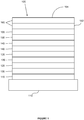
- FIG. 1 shows an organic light emitting device 100.
- Device 100 may include a substrate 110, an anode 115, a hole injection layer 120, a hole transport layer 125, an electron blocking layer 130, an emissive layer 135, a hole blocking layer 140, an electron transport layer 145, an electron injection layer 150, a protective layer 155, and a cathode 160.
- Cathode 160 is a complex cathode having a first conductive layer 162 and a second conductive layer 164.
- Device 100 may be fabricated by depositing the layers described, in order. The properties and functions of these various layers, as well as example materials, are described in more detail in US 7,279,704 at cols. 6-10.
- a flexible and transparent substrate-anode combination is disclosed in U.S. Pat. No. 5,844,363 .
- An example of a p-doped hole transport layer is m-MTDATA doped with F.sub.4-TCNQ at a molar ratio of 50:1, as disclosed in U.S. Patent Application Publication No. 2003/0230980 .
- Examples of emissive and host materials are disclosed in U.S. Pat. No. 6,303,238 to Thompson et al. .
- An example of an n-doped electron transport layer is BPhen doped with Li at a molar ratio of 1:1, as disclosed in U.S. Patent Application Publication No. 2003/0230980 .
- U.S. Pat. Nos. 5,703,436 and 5,707,745 disclose examples of cathodes including complex cathodes having a thin layer of metal such as Mg:Ag with an overlying transparent, electrically-conductive, sputter-deposited ITO layer.
- the theory and use of blocking layers is described in more detail in U.S. Pat. No. 6,097,147 and U.S. Patent Application Publication No. 2003/0230980 .
- Examples of injection layers are provided in U.S. Patent Application Publication No. 2004/0174116 .
- a description of protective layers may be found in U.S. Patent Application Publication No. 2004/0174116 .
- FIG. 2 shows an inverted OLED 200.
- the device includes a substrate 210, a cathode 215, an emissive layer 220, a hole transport layer 225, and an anode 230.
- Device 200 may be fabricated by depositing the layers described, in order. Because the most common OLED configuration has a cathode disposed over the anode, and device 200 has cathode 215 disposed under anode 230, device 200 may be referred to as an "inverted" OLED. Materials similar to those described with respect to device 100 may be used in the corresponding layers of device 200.
- FIG. 2 provides one example of how some layers may be omitted from the structure of device 100.
- FIGS. 1 and 2 The simple layered structure illustrated in FIGS. 1 and 2 is provided by way of non-limiting example, and it is understood that embodiments of the invention may be used in connection with a wide variety of other structures.
- the specific materials and structures described are exemplary in nature, and other materials and structures may be used.
- Functional OLEDs may be achieved by combining the various layers described in different ways, or layers may be omitted entirely, based on design, performance, and cost factors. Other layers not specifically described may also be included. Materials other than those specifically described may be used. Although many of the examples provided herein describe various layers as comprising a single material, it is understood that combinations of materials, such as a mixture of host and dopant, or more generally a mixture, may be used. Also, the layers may have various sublayers.
- hole transport layer 225 transports holes and injects holes into emissive layer 220, and may be described as a hole transport layer or a hole injection layer.
- an OLED may be described as having an "organic layer" disposed between a cathode and an anode. This organic layer may comprise a single layer, or may further comprise multiple layers of different organic materials as described, for example, with respect to FIGS. 1 and 2 .
- OLEDs comprised of polymeric materials (PLEDs) such as disclosed in U.S. Pat. No. 5,247,190 to Friend et al. .
- PLEDs polymeric materials
- OLEDs having a single organic layer may be used.
- OLEDs may be stacked, for example as described in U.S. Pat. No. 5,707,745 to Forrest et al.
- the OLED structure may deviate from the simple layered structure illustrated in FIGS. 1 and 2 .
- the substrate may include an angled reflective surface to improve out-coupling, such as a mesa structure as described in U.S. Pat. No. 6,091,195 to Forrest et al. , and/or a pit structure as described in U.S. Pat. No. 5,834,893 to Bulovic et al. .
- any of the layers of the various embodiments may be deposited by any suitable method.
- preferred methods include thermal evaporation, ink-jet, such as described in U.S. Pat. Nos. 6,013,982 and 6,087,196 , organic vapor phase deposition (OVPD), such as described in U.S. Pat. No. 6,337,102 to Forrest et al., and deposition by organic vapor jet printing (OVJP), such as described in U.S. patent application Ser. No. 10/233,470 .
- OVPD organic vapor phase deposition
- OJP organic vapor jet printing
- Other suitable deposition methods include spin coating and other solution based processes. Solution based processes are preferably carried out in nitrogen or an inert atmosphere.
- preferred methods include thermal evaporation.
- Preferred patterning methods include deposition through a mask, cold welding such as described in U.S. Pat. Nos. 6,294,398 and 6,468,819 and patterning associated with some of the deposition methods such as ink-jet and OVJD. Other methods may also be used.
- the materials to be deposited may be modified to make them compatible with a particular deposition method.
- substituents such as alkyl and aryl groups, branched or unbranched, and preferably containing at least 3 carbons, may be used in small molecules to enhance their ability to undergo solution processing. Substituents having 20 carbons or more may be used, and 3-20 carbons is a preferred range. Materials with asymmetric structures may have better solution processibility than those having symmetric structures, because asymmetric materials may have a lower tendency to recrystallize. Dendrimer substituents may be used to enhance the ability of small molecules to undergo solution processing.
- Devices fabricated in accordance with embodiments of the invention may be incorporated into a wide variety of consumer products, including flat panel displays, computer monitors, televisions, billboards, lights for interior or exterior illumination and/or signaling, heads up displays, fully transparent displays, flexible displays, laser printers, telephones, cell phones, personal digital assistants (PDAs), laptop computers, digital cameras, camcorders, viewfinders, micro-displays, vehicles, a large area wall, theater or stadium screen, or a sign.
- PDAs personal digital assistants
- Various control mechanisms may be used to control devices fabricated in accordance with the present invention, including passive matrix and active matrix. Many of the devices are intended for use in a temperature range comfortable to humans, such as 18 degrees C. to 30 degrees C., and more preferably at room temperature (20-25 degrees C.).
- the materials and structures described herein may have applications in devices other than OLEDs.
- other optoelectronic devices such as organic solar cells and organic photodetectors may employ the materials and structures.
- organic devices such as organic transistors, may employ the materials and structures.
- halo, halogen, alkyl, cycloalkyl, alkenyl, alkynyl, arylkyl, heterocyclic group, aryl, aromatic group, and heteroaryl are known to the art, and are defined in U.S. 7,279,704 at cols. 31-32.
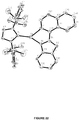
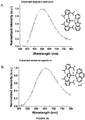
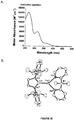
- Novel trigonal planar copper complexes with a carbene ligand are provided (illustrated in FIG. 3 ).
- the complexes include a monodentate or a bidentate carbene ligand coordinated to a three coordinate copper atom.
- the complex can be either charged or neutral.
- OLEDs organic light emitting diodes
- a dipyridyl borate complex in this class of compounds has an emission maximum of 475 nm and a photoluminescence efficiency of 0.95 in the solid state.
- Suitable substitution of the pyridyl groups can red or blue shift this emission substantially.
- the ability to tune emission energies may make these copper complexes excellent emitters and host materials for OLEDs. It is thought that the emission energy may be shifted high enough to make these compounds suitable host materials for deep blue to violet emissive dopants.
- Phosphorescent OLEDs have relied largely on heavy metal complexes as emitters. In particular, devices often utilize emitters containing Ir or Pt to induce spin orbit coupling. Tetrahedral copper complexes have been reported, and are known to phosphoresce at room temperature. However, tetrahedral copper complexes may have certain limitations. In particular, flattening distortions may increase the non-radiative rate, which leads to a decrease in luminescence efficiency. Trigonal planar copper carbene complexes have now been found to give efficient phosphorescence at room temperature. We believe that this is the first observation of phosphorescence from trigonal planar copper complexes.
- Trigonal planar copper complexes may also have several advantages for use in OLEDs.
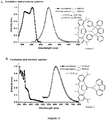
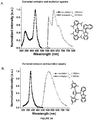
- the trigonal planar copper complexes have comparatively short lifetimes, in the tens of microsecond range (see Table 1).
- Table 1 shows the lifetimes of several different trigonal planar copper carbene complexes.
- the lifetime of the trigonal copper complex is longer than an Ir complex (i.e., 1-10 ⁇ s) but shorter than that of a platinum porphyrin complex. TABLE 1.
- the copper complexes provide efficient phosphorescence at room temperature and have comparatively short lifetimes, i.e., in the 10's of microsecond range.
- Table 2 shows the lifetimes of several different trigonal planar copper carbene complexes.
- Trigonal planar copper complexes may also be particularly useful in OLEDs used for certain applications.
- copper complexes provide a broader line spectrum which is especially useful for lighting applications.
- a device comprising a trigonal planar copper complex in combination with only one other complex may cover red, green, and blue colors.
- a device comprising a trigonal planar copper complex and a blue emitter may cover all colors required for lighting.
- Novel phosphorescent complexes comprising a carbene ligand coordinated to a three coordinate copper atom.
- the carbene ligand has the formula: *C is a divalent carbon atom coordinated to a monovalent copper atom Cu.
- X 1 and X 2 are substituents independently selected from alkyl, amine, phosphine, heteroalkyl, aryl and heteroaryl. X 1 and X 2 may be further substituted, and X 1 and X 2 are optionally linked to form a cycle.
- the carbene ligand is monodentate. Preferably, each of X 1 and X 2 independently forms a bond with *C.
- a first bond is formed between *C and an atom X' 1 in substituent X 1
- a second bond is formed between *C and an atom X' 2 in substituent X 2 .
- X' 1 and X' 2 are independently selected from the group consisting of C, N, O, S and P.
- the carbene ligand is monodentate.
- X 1 and X 2 are not joined to form a cycle. In another aspect, X 1 and X 2 are joined to form a cycle.
- the copper complex is neutral.
- Neutral complexes may be particularly beneficial for use in OLEDs.
- a neutral complex can be deposited via vapor deposition.
- the copper complex is charged.
- the complex has the formula: Yi is independently selected from the group consisting of alkyl, alkoxy, amino, alkenyl, alkynyl, arylalkyl, heteroalkyl, aryl and heteroaryl. Yi is a monodentate ligand or a bidentate ligand. n is 1 or 2. Preferably, n is 2.
- the complex has the formula: Y 1 and Y 2 are substituents that are independently selected from the group consisting of alkyl, heteroalkyl, aryl and heteroaryl. Y 1 and Y 2 may be further substituted. Y 1 and Y 2 are joined. Each of Y 1 and Y 2 form a bond with Cu. A first bond is formed between Cu and an atom Y' 1 in substituent Y 1 and a second bond is formed between Cu and an atom Y' 2 in substituent Y 2 .
- Y' 1 is selected from the group consisting of N, P, *C, O, and S.
- Y' 2 is selected from the group consisting of N, P, *C, tetravalent carbon, O, and S.
- Y' 1 is N.
- the Cu atom, the Y' 1 atom and the Y' 2 atom in the complex are included in a ring that can be, for example, a 4-membered, 5-membered, 6-membered, 7-membered, or 8-membered ring.
- the ring comprising Cu, Y' 1 and Y' 2 is a 5-membered or 6-membered ring.
- Y 1 is selected from the group consisting of pyridyl, pyrazole, alkyl amine, imidazole, benzimidazole, triazole, tetrazole, pyridazine, pyrimidine, pyrazine, triazine, tetrazine, oxazole, thiazole, benzoxazole and benzothiazole.
- Y 1 - Y 2 is selected from the group consisting of:
- X is selected from the group consisting of NR, O, S, Se, CR 2 , and CO.
- Each R is independently selected from the group consisting of hydrogen, alkyl, alkoxy, amino, alkenyl, alkynyl, arylalkyl, heteroalkyl, aryl and heteroaryl.
- Each ring is further substituted by a substituent selected from the group consisting of hydrogen, alkyl, alkoxy, amino, alkenyl, alkynyl, arylalkyl, heteroalkyl, aryl and heteroaryl.
- each R includes a substituent independently selected from the group consisting of carbazole, dibenzofuran, dibenzothiophene, azacarbazole, azadibenzofuran, and azadibenzothiophene.
- Y 1 - Y 2 is selected from the group consisting of:
- X is selected from the group consisting of NR, O, S, Se, CR 2 , and CO.
- Each R is independently selected from the group consisting of hydrogen, alkyl, alkoxy, amino, alkenyl, alkynyl, arylalkyl, heteroalkyl, aryl and heteroaryl.
- Each ring is further substituted by a substituent selected from the group consisting of hydrogen, alkyl, alkoxy, amino, alkenyl, alkynyl, arylalkyl, heteroalkyl, aryl and heteroaryl.
- each R includes a substituent independently selected from the group consisting of carbazole, dibenzofuran, dibenzothiophene, azacarbazole, azadibenzofuran, and azadibenzothiophene.
- Y i is an unconjugated, monoanionic ligand containing BY 4 - , SO 3 Y - , CY 4 - , SiO 4 - , OY 2 - , or SY 2 - .
- Each Y is independently selected from the group consisting of hydrogen, alkyl, aryl, alkoxy, amino, alkenyl, alkynyl, arylalkyl, heteralkyl and heteroaryl.
- Y i is BY 4 - .
- the ligand Yi comprises two monodentate ligands, at least one of which is BY 4 - .
- the ligand Y i has the formula:
- the ligand Y i that comprises two monodentate ligands, at least one of which is BY 4 - , is selected from the group consisting of:
- Y 1 and Y 2 are independently selected from the group consisting of pyridyl, pyrimidyl, pyrazinyl, pyridazinyl, triazinyl, tetrazinyl, triazolyl, tetrazolyl, pyrazolyl, imidazolyl, benzimidazolyl, oxazolyl, thiszolyl, benzoxazolyl, benzothiazolyl and phosphine.
- Y 1 and Y 2 may be extended by fusion, e.g., benzanulation. Additionally, Y 1 and Y 2 may be further substituted with alkyl, aryl, donor or acceptor groups.
- Y 3 and Y 4 are independently selected from the group consisting of hydrogen, alkyl, aryl, alkoxy, amino, alkenyl, alkynyl, arylalkyl, heteralkyl and heteroaryl. In one aspect, Y 3 and Y 4 are joined to form a cycle, may be extended by fusion, e.g., benzanulation.
- Y i is a bidentate ligand having the formula BY 4 - .
- the ligand Y i is selected from the group consisting of:
- Y 1 is a bidentate chelating ligand having the formula:
- Y' 1 -Y" 1 represents a neutral, i.e., uncharged, chelating ligand.
- Y' 1 -Y" 1 are capable of coordinating to a metal center.
- Y' 1 -Y" 1 ligand examples include, but are not limited to, ligands having the structure:
- Each R is independently selected from the group consisting of hydrogen, alkyl, alkoxy, amino, alkenyl, alkynyl, arylalkyl, heteroalkyl, aryl and heteroaryl.
- Y 1 and Y 2 are independently selected from the group consisting of pyridyl, pyrimidyl, pyrazinyl, pyridazinyl, triazinyl, tetrazinyl, triazolyl, tetrazolyl, pyrazolyl, imidazolyl, benzimidazolyl, oxazolyl, thiszolyl, benzoxazolyl, benzothiazolyl and phosphine.
- Y 1 and Y 2 may be extended by fusion, e.g., benzanulation. Additionally, Y 1 and Y 2 may be further substituted with alkyl, aryl, donor or acceptor groups.
- Y 3 and Y 4 are independently selected from the group consisting of hydrogen, alkyl, aryl, alkoxy, amino, alkenyl, alkynyl, arylalkyl, heteralkyl and heteroaryl. In one aspect, Y 3 and Y 4 are joined to form a cycle, which may be extended by fusion, e.g., benzanulation.
- Y 1 and Y 2 are the same.
- Specific examples of ligands where Y 1 and Y 2 are the same include, but are not limited to, ligands selected from the group consisting of:
- Each R is independently selected from the group consisting of hydrogen, alkyl, alkoxy, amino, alkenyl, alkynyl, arylalkyl, heteroalkyl, aryl and heteroaryl.
- C* is a divalent carbon atom.
- n is 0, 1, or 2.
- m is 0, 1, or 2.
- Y 1 and Y 2 are different.
- Specific examples of ligands where Y 1 and Y 2 are different include, but are not limited to, ligands selected from the group consisting of:
- Each R is independently selected from the group consisting of hydrogen, alkyl, alkoxy, amino, alkenyl, alkynyl, arylalkyl, heteroalkyl, aryl and heteroaryl.
- Y 3 and Y 4 are selected from the group consisting of:
- Y i is SO 3 Y - .
- Specific examples of ligands Y i having the formula SO 3 Y - include, but are not limited to, ligands having the structure:
- Each R is independently selected from the group consisting of hydrogen, alkyl, alkoxy, amino, alkenyl, alkynyl, arylalkyl, heteroalkyl, aryl and heteroaryl.
- Y i is CY 4 - .
- CY 4 - has the formula:
- ligands Y i having the formula CY 4 - include, but are not limited to, ligands having the structure:
- Each R is independently selected from the group consisting of hydrogen, alkyl, alkoxy, amino, alkenyl, alkynyl, arylalkyl, heteroalkyl, aryl and heteroaryl.
- Y 3 and Y 4 are selected from the group consisting of:
- Y i is SiY 4 - .
- Specific examples of ligands Y i having the formula SiY 4 - include, but are not limited to, ligands having the structure:
- Each R is independently selected from the group consisting of hydrogen, alkyl, alkoxy, amino, alkenyl, alkynyl, arylalkyl, heteroalkyl, aryl and heteroaryl.
- Y 3 and Y 4 are selected from the group consisting of:
- Y i is OY 2 - .
- OY 2 - has the formula:
- ligands Y i having the formula OY 2 - include, but are not limited to, ligands having the structure:
- Each R is independently selected from the group consisting of hydrogen, alkyl, alkoxy, amino, alkenyl, alkynyl, arylalkyl, heteroalkyl, aryl and heteroaryl.
- Y 3 and Y 4 are selected from the group consisting of:
- Y i is SY 2 - .
- SY 2 - has the formula:
- ligands Y i having the formula SY 2 - include, but are not limited to, ligands having the structure:
- Each R is independently selected from the group consisting of hydrogen, alkyl, alkoxy, amino, alkenyl, alkynyl, arylalkyl, heteroalkyl, aryl and heteroaryl.
- the complex comprises two copper (I) centers.
- complexes comprising two copper (I) centers include complexes selected from the group consisting of:
- Each R is independently selected from the group consisting of hydrogen, alkyl, alkoxy, amino, alkenyl, alkynyl, arylalkyl, heteroalkyl, aryl and heteroaryl.
- the carbene ligand is selected from the group consisting of:
- Each R is independently selected from the group consisting of hydrogen, alkyl, alkoxy, amino, alkenyl, alkynyl, arylalkyl, heteroalkyl, aryl and heteroaryl.
- z is 1, 2, 3, or 4.
- the carbene is More preferably, the carbene is R' 1 and R' 2 may represent mono, di, tri, or tetra substitutions.
- R' 1 and R' 2 are independently selected from the group consisting of hydrogen, alkyl, alkoxy, amino, alkenyl, alkynyl, arylalkyl, heteroalkyl, aryl and heteroaryl.
- at least one of R' 1 and R' 2 is an alkyl having three or more carbon atoms.
- the complex is selected from the group consisting of:
- the complex is selected from the group consisting of:
- the complex is:
- the complex has the formula: Y 1 and Y 2 are substituents that are independently selected from the group consisting of alkyl, heteroalkyl, aryl and heteroaryl. Y 1 and Y 2 may be further substituted. Y 1 and Y 2 are not joined. Each of Y 1 and Y 2 form a bond with Cu.
- the complex is selected from the group consisting of:
- Each R is independently selected from the group consisting of hydrogen, alkyl, alkoxy, amino, alkenyl, alkynyl, arylalkyl, heteroalkyl, aryl and heteroaryl.
- the carbene ligand is bidentate.
- the complex is selected from the group consisting of:
- Each R is independently selected from the group consisting of hydrogen, alkyl, alkoxy, amino, alkenyl, alkynyl, arylalkyl, heteroalkyl, aryl and heteroaryl.
- Z is a monodentate ligand.
- the complex is included in a polymer. In another aspect, the complex is included in the repeat unit of the polymer. In yet another aspect, the complex is pendant on the polymer.
- the polymer is selected from the group consisting of: Each R is independently selected from the group consisting of hydrogen, alkyl, alkoxy, amino, alkenyl, alkynyl, arylalkyl, heteroalkyl, aryl and heteroaryl. m is greater than 2. n is 0-20.
- the complex is included in a dendritic complex.
- the dendritic complex is or
- the core is a molecule or a polyvalent element selected from the group consisting of C, Si, Ge, Sn, Pb, N, P, and As.
- Each R is independently selected from the group consisting of hydrogen, alkyl, alkoxy, amino, alkenyl, alkynyl, arylalkyl, heteroalkyl, aryl and heteroaryl.
- m is greater than 1.
- n is 0-20.
- the complex is included in a small molecule.
- a first device comprising an organic light emitting device further comprising an anode, a cathode; and an organic layer, disposed between the anode and the cathode.
- the organic layer further comprising a phosphorescent complex itself comprising a three coordinate copper atom and a carbene ligand.
- the first device is a consumer product.
- the device may comprise a complex having Formula I, Formula II, Formula III, or Formula IV, as described above.
- Selections for the substituents, ligands, and complexes described as preferred for the complexes having Formula I, Formula II, Formula III, or Formula IV are also preferred for use in a device that comprises a complex including a complex having Formula I, Formula II, Formula III, or Formula IV. These selections include those described for X 1 , X 2 , X' 1 , X' 2 , Y 1 , Y 2 , Y' 1 , Y' 2 , Yi, R, X, and Z.
- Selections for the substituents, ligands, and complexes described as preferred for the complexes having Formula I, Formula II, Formula III, or Formula IV are also preferred for use in a device that comprises a complex including a complex having Formula I, Formula II, Formula III, or Formula IV. These selections include those described for X 1 , X 2 , X' 1 , X' 2 , Y 1 , Y 2 , Y 3 , Y 4 , Y 5 , Y' 1 , Y" 1 , Y' 2 , Y i , R, X, and Z.
- Such devices may contain the trigonal copper complex as a neat thin film.
- an OLED comprising a pure film of the complex may have a higher luminescent efficiency than an OLED that comprises the complex doped with another material.
- the trigonal copper complexes provided herein may not demonstrate the self-quenching problems seen in other complexes.
- the materials described herein as useful for a particular layer in an organic light emitting device may be used in combination with a wide variety of other materials present in the device.
- emissive dopants disclosed herein may be used in conjunction with a wide variety of hosts, transport layers, blocking layers, injection layers, electrodes and other layers that may be present.
- the materials described or referred to below are non-limiting examples of materials that may be useful in combination with the complexes disclosed herein, and one of skill in the art can readily consult the literature to identify other materials that may be useful in combination.
- hole injection materials In addition to and / or in combination with the materials disclosed herein, many hole injection materials, hole transporting materials, host materials, dopant materials, exiton/hole blocking layer materials, electron transporting and electron injecting materials may be used in an OLED.
- Non-limiting examples of the materials that may be used in an OLED in combination with materials disclosed herein are listed in Table 3 below. Table 3 lists non-limiting classes of materials, non-limiting examples of complexes for each class, and references that disclose the materials. TABLE 3.
- MATERIAL EXAMPLES OF MATERIAL PUBLICATIONS Hole injection materials Phthalocyanine and porphryin complexes Appl. Phys. Lett. 69, 2160 (1996 ) Starburst triarylamines J. Lumin.
- Chloro[1,3-bis(2,6-di-i-propylphenyl)imidazol-2-ylidene]copper(I) (121.9 mg, 0.25 mmol) and silver triflate (64.2 mg, 0.25 mmol) were mixed under nitrogen in 25 mL flask and 10 mL of dry THF were added. Reaction mixture was stirred at RT for 30 minutes. Solution of 1,10-phenanthroline (45.05 mg, 0.25 mmol) in dry THF (5 mL) was added. Reaction mixture turned yellow and was stirred at RT overnight. Resulting mixture was filtered through Celite® and solvent was evaporated on rotovap.
Landscapes
- Chemical & Material Sciences (AREA)
- Organic Chemistry (AREA)
- Engineering & Computer Science (AREA)
- Materials Engineering (AREA)
- Inorganic Chemistry (AREA)
- Electroluminescent Light Sources (AREA)
- Plural Heterocyclic Compounds (AREA)
- Pyridine Compounds (AREA)
- Nitrogen Condensed Heterocyclic Rings (AREA)
Applications Claiming Priority (6)
| Application Number | Priority Date | Filing Date | Title |
|---|---|---|---|
| US26280409P | 2009-11-19 | 2009-11-19 | |
| US30136210P | 2010-02-04 | 2010-02-04 | |
| US39880810P | 2010-07-01 | 2010-07-01 | |
| US40298910P | 2010-09-09 | 2010-09-09 | |
| US12/948,396 US8580394B2 (en) | 2009-11-19 | 2010-11-17 | 3-coordinate copper(I)-carbene complexes |
| PCT/US2010/057169 WO2011063083A1 (en) | 2009-11-19 | 2010-11-18 | 3-coordinate copper (i) - carbene complexes |
Publications (3)
| Publication Number | Publication Date |
|---|---|
| EP2501707A1 EP2501707A1 (en) | 2012-09-26 |
| EP2501707A4 EP2501707A4 (en) | 2014-03-26 |
| EP2501707B1 true EP2501707B1 (en) | 2017-08-02 |
Family
ID=44059980
Family Applications (1)
| Application Number | Title | Priority Date | Filing Date |
|---|---|---|---|
| EP10832153.0A Active EP2501707B1 (en) | 2009-11-19 | 2010-11-18 | 3-coordinate copper (i) - carbene complexes |
Country Status (8)
| Country | Link |
|---|---|
| US (2) | US8580394B2 (OSRAM) |
| EP (1) | EP2501707B1 (OSRAM) |
| JP (2) | JP2013511532A (OSRAM) |
| KR (1) | KR101822668B1 (OSRAM) |
| CN (3) | CN102695711B (OSRAM) |
| IN (1) | IN2012DN05146A (OSRAM) |
| TW (1) | TWI513796B (OSRAM) |
| WO (1) | WO2011063083A1 (OSRAM) |
Families Citing this family (22)
| Publication number | Priority date | Publication date | Assignee | Title |
|---|---|---|---|---|
| US8580394B2 (en) * | 2009-11-19 | 2013-11-12 | Universal Display Corporation | 3-coordinate copper(I)-carbene complexes |
| DE102011003192B4 (de) | 2011-01-26 | 2015-12-24 | Siemens Aktiengesellschaft | Halbleiterbauelement und Verfahren zu seiner Herstellung |
| JP6174024B2 (ja) | 2011-07-25 | 2017-08-02 | メルク パテント ゲーエムベーハー | 機能性側鎖を有するコポリマー |
| JP2014527550A (ja) | 2011-07-25 | 2014-10-16 | メルク パテント ゲーエムベーハー | 機能性側鎖基を有するポリマーおよびオリゴマー |
| DE102011079857B4 (de) | 2011-07-26 | 2013-03-21 | Eberhard-Karls-Universität Tübingen | Komplexverbindungen mit vierzähnigen Liganden und ihre Verwendung im opto-elektronischen Bereich |
| DE102011079847A1 (de) | 2011-07-26 | 2013-01-31 | Eberhard-Karls-Universität Tübingen | Komplexverbindungen mit anionischen Liganden mit zwei P-Donoren und ihre Verwendung im opto-elektronischen Bereich |
| DE102011079856A1 (de) | 2011-07-26 | 2013-01-31 | Eberhard-Karls-Universität Tübingen | Komplexverbindungen mit einem Liganden mit einem N- und einem P-Donor und ihre Verwendung im opto-elektronischen Bereich |
| DE102011080240A1 (de) | 2011-08-02 | 2013-02-07 | Cynora Gmbh | Singulett-Harvesting mit zweikernigen Kupfer(I)-Komplexen für opto-elektronische Vorrichtungen |
| DE102011084639A1 (de) | 2011-10-17 | 2013-04-18 | Osram Opto Semiconductors Gmbh | Organisches elektronisches bauelement mit dotierstoff, verwendung eines dotierstoffs und verfahren zur herstellung des dotierstoffs |
| JP5978843B2 (ja) | 2012-02-02 | 2016-08-24 | コニカミノルタ株式会社 | イリジウム錯体化合物、有機エレクトロルミネッセンス素子材料、有機エレクトロルミネッセンス素子、照明装置及び表示装置 |
| US8786179B2 (en) | 2012-09-17 | 2014-07-22 | Universal Display Corporation | Light emitting device comprising phosphorescent materials for white light generation |
| US9853229B2 (en) * | 2013-10-23 | 2017-12-26 | University Of Southern California | Organic electroluminescent materials and devices |
| KR102556025B1 (ko) * | 2014-09-17 | 2023-07-19 | 삼성디스플레이 주식회사 | 유기금속 착체 및 이를 포함하는 유기 발광 소자 |
| GB2540132A (en) * | 2015-06-30 | 2017-01-11 | Cambridge Display Tech Ltd | Compound, composition and organic light-emitting device |
| AU2016322694B2 (en) * | 2015-09-14 | 2021-06-24 | Cambridge Enterprise Limited | Metal complexes |
| US10862054B2 (en) * | 2016-06-20 | 2020-12-08 | Universal Display Corporation | Organic electroluminescent materials and devices |
| US12180230B2 (en) * | 2017-11-28 | 2024-12-31 | University Of Southern California | Carbene compounds and organic electroluminescent devices |
| US11111432B2 (en) * | 2018-01-02 | 2021-09-07 | Beijing Normal University | Triangular carbon quantum dots and compositions and uses thereof |
| US11920070B2 (en) | 2019-07-12 | 2024-03-05 | The University Of Southern California | Luminescent janus-type, two-coordinated metal complexes |
| US12365800B2 (en) | 2020-06-16 | 2025-07-22 | Okinawa Institute Of Science And Technology School Corporation | Polymer, mechanical stress sensor, method for detecting mechanical stress, method for preparing polymer, copper complex and method for preparing same |
| CN112500582B (zh) * | 2020-12-15 | 2022-03-29 | 北京工业大学 | 基于四头吡唑配体的多核钴簇金属有机框架材料、制备和应用 |
| US20230165135A1 (en) * | 2021-11-23 | 2023-05-25 | Versitech Limited | d10 METAL CARBENE COMPLEXES FOR OLED APPLICATIONS |
Family Cites Families (131)
| Publication number | Priority date | Publication date | Assignee | Title |
|---|---|---|---|---|
| US4769292A (en) | 1987-03-02 | 1988-09-06 | Eastman Kodak Company | Electroluminescent device with modified thin film luminescent zone |
| GB8909011D0 (en) | 1989-04-20 | 1989-06-07 | Friend Richard H | Electroluminescent devices |
| US5061569A (en) | 1990-07-26 | 1991-10-29 | Eastman Kodak Company | Electroluminescent device with organic electroluminescent medium |
| EP0650955B1 (en) | 1993-11-01 | 1998-08-19 | Hodogaya Chemical Co., Ltd. | Amine compound and electro-luminescence device comprising same |
| US5703436A (en) | 1994-12-13 | 1997-12-30 | The Trustees Of Princeton University | Transparent contacts for organic devices |
| US5707745A (en) | 1994-12-13 | 1998-01-13 | The Trustees Of Princeton University | Multicolor organic light emitting devices |
| AU681934B2 (en) | 1995-03-14 | 1997-09-11 | Kalford Pty Ltd | A hinge |
| US5627164A (en) | 1995-06-13 | 1997-05-06 | Exxon Research And Engineering Company | Pyrazolyl borates complexes-(LAW294) |
| US6939625B2 (en) | 1996-06-25 | 2005-09-06 | Nôrthwestern University | Organic light-emitting diodes and methods for assembly and enhanced charge injection |
| US5844363A (en) | 1997-01-23 | 1998-12-01 | The Trustees Of Princeton Univ. | Vacuum deposited, non-polymeric flexible organic light emitting devices |
| US6091195A (en) | 1997-02-03 | 2000-07-18 | The Trustees Of Princeton University | Displays having mesa pixel configuration |
| US6013982A (en) | 1996-12-23 | 2000-01-11 | The Trustees Of Princeton University | Multicolor display devices |
| US5834893A (en) | 1996-12-23 | 1998-11-10 | The Trustees Of Princeton University | High efficiency organic light emitting devices with light directing structures |
| US6303238B1 (en) | 1997-12-01 | 2001-10-16 | The Trustees Of Princeton University | OLEDs doped with phosphorescent compounds |
| US6337102B1 (en) | 1997-11-17 | 2002-01-08 | The Trustees Of Princeton University | Low pressure vapor phase deposition of organic thin films |
| US6087196A (en) | 1998-01-30 | 2000-07-11 | The Trustees Of Princeton University | Fabrication of organic semiconductor devices using ink jet printing |
| US6528187B1 (en) | 1998-09-08 | 2003-03-04 | Fuji Photo Film Co., Ltd. | Material for luminescence element and luminescence element using the same |
| US6097147A (en) | 1998-09-14 | 2000-08-01 | The Trustees Of Princeton University | Structure for high efficiency electroluminescent device |
| US6830828B2 (en) | 1998-09-14 | 2004-12-14 | The Trustees Of Princeton University | Organometallic complexes as phosphorescent emitters in organic LEDs |
| US6294398B1 (en) | 1999-11-23 | 2001-09-25 | The Trustees Of Princeton University | Method for patterning devices |
| US6458475B1 (en) | 1999-11-24 | 2002-10-01 | The Trustee Of Princeton University | Organic light emitting diode having a blue phosphorescent molecule as an emitter |
| KR100377321B1 (ko) | 1999-12-31 | 2003-03-26 | 주식회사 엘지화학 | 피-형 반도체 성질을 갖는 유기 화합물을 포함하는 전기소자 |
| US20020121638A1 (en) | 2000-06-30 | 2002-09-05 | Vladimir Grushin | Electroluminescent iridium compounds with fluorinated phenylpyridines, phenylpyrimidines, and phenylquinolines and devices made with such compounds |
| JP5241053B2 (ja) | 2000-08-11 | 2013-07-17 | ザ、トラスティーズ オブ プリンストン ユニバーシティ | 有機金属化合物及び放射移行有機電気燐光体 |
| US6579630B2 (en) | 2000-12-07 | 2003-06-17 | Canon Kabushiki Kaisha | Deuterated semiconducting organic compounds used for opto-electronic devices |
| JP3812730B2 (ja) | 2001-02-01 | 2006-08-23 | 富士写真フイルム株式会社 | 遷移金属錯体及び発光素子 |
| JP4307000B2 (ja) | 2001-03-08 | 2009-08-05 | キヤノン株式会社 | 金属配位化合物、電界発光素子及び表示装置 |
| JP4310077B2 (ja) | 2001-06-19 | 2009-08-05 | キヤノン株式会社 | 金属配位化合物及び有機発光素子 |
| US7396598B2 (en) | 2001-06-20 | 2008-07-08 | Showa Denko K.K. | Light emitting material and organic light-emitting device |
| US7071615B2 (en) | 2001-08-20 | 2006-07-04 | Universal Display Corporation | Transparent electrodes |
| US7250226B2 (en) | 2001-08-31 | 2007-07-31 | Nippon Hoso Kyokai | Phosphorescent compound, a phosphorescent composition and an organic light-emitting device |
| US7431968B1 (en) | 2001-09-04 | 2008-10-07 | The Trustees Of Princeton University | Process and apparatus for organic vapor jet deposition |
| US6835469B2 (en) | 2001-10-17 | 2004-12-28 | The University Of Southern California | Phosphorescent compounds and devices comprising the same |
| US7166368B2 (en) | 2001-11-07 | 2007-01-23 | E. I. Du Pont De Nemours And Company | Electroluminescent platinum compounds and devices made with such compounds |
| US6863997B2 (en) | 2001-12-28 | 2005-03-08 | The Trustees Of Princeton University | White light emitting OLEDs from combined monomer and aggregate emission |
| KR100691543B1 (ko) | 2002-01-18 | 2007-03-09 | 주식회사 엘지화학 | 새로운 전자 수송용 물질 및 이를 이용한 유기 발광 소자 |
| US20030230980A1 (en) | 2002-06-18 | 2003-12-18 | Forrest Stephen R | Very low voltage, high efficiency phosphorescent oled in a p-i-n structure |
| US7189989B2 (en) | 2002-08-22 | 2007-03-13 | Fuji Photo Film Co., Ltd. | Light emitting element |
| AU2003261758A1 (en) | 2002-08-27 | 2004-03-19 | Fujitsu Limited | Organometallic complexes, organic el devices, and organic el displays |
| US6687266B1 (en) | 2002-11-08 | 2004-02-03 | Universal Display Corporation | Organic light emitting materials and devices |
| JP4365199B2 (ja) | 2002-12-27 | 2009-11-18 | 富士フイルム株式会社 | 有機電界発光素子 |
| JP4365196B2 (ja) | 2002-12-27 | 2009-11-18 | 富士フイルム株式会社 | 有機電界発光素子 |
| DE10300098A1 (de) | 2003-01-07 | 2004-07-15 | Bayer Ag | Kupfer-Carben-Komplexe und ihre Verwendung |
| US7338722B2 (en) | 2003-03-24 | 2008-03-04 | The University Of Southern California | Phenyl and fluorenyl substituted phenyl-pyrazole complexes of Ir |
| US7090928B2 (en) | 2003-04-01 | 2006-08-15 | The University Of Southern California | Binuclear compounds |
| KR101162933B1 (ko) | 2003-04-15 | 2012-07-05 | 메르크 파텐트 게엠베하 | 매트릭스 재료 및 방출 가능 유기 반도체의 혼합물, 그의 용도 및 상기 혼합물을 함유하는 전자 부품 |
| US7029765B2 (en) | 2003-04-22 | 2006-04-18 | Universal Display Corporation | Organic light emitting devices having reduced pixel shrinkage |
| WO2004107822A1 (ja) | 2003-05-29 | 2004-12-09 | Nippon Steel Chemical Co., Ltd. | 有機電界発光素子 |
| JP2005011610A (ja) | 2003-06-18 | 2005-01-13 | Nippon Steel Chem Co Ltd | 有機電界発光素子 |
| WO2005007659A2 (en) * | 2003-07-11 | 2005-01-27 | Georgetown University | Diketiminato cu(i) and co(i) carbene catalysts, and cyclopropanation methods using them |
| US20050025993A1 (en) | 2003-07-25 | 2005-02-03 | Thompson Mark E. | Materials and structures for enhancing the performance of organic light emitting devices |
| TWI390006B (zh) | 2003-08-07 | 2013-03-21 | Nippon Steel Chemical Co | Organic EL materials with aluminum clamps |
| DE10338550A1 (de) * | 2003-08-19 | 2005-03-31 | Basf Ag | Übergangsmetallkomplexe mit Carbenliganden als Emitter für organische Licht-emittierende Dioden (OLEDs) |
| US20060269780A1 (en) | 2003-09-25 | 2006-11-30 | Takayuki Fukumatsu | Organic electroluminescent device |
| JP4822687B2 (ja) | 2003-11-21 | 2011-11-24 | 富士フイルム株式会社 | 有機電界発光素子 |
| US7332232B2 (en) | 2004-02-03 | 2008-02-19 | Universal Display Corporation | OLEDs utilizing multidentate ligand systems |
| KR100963457B1 (ko) | 2004-03-11 | 2010-06-17 | 미쓰비시 가가꾸 가부시키가이샤 | 전하 수송막용 조성물 및 이온 화합물, 이를 이용한 전하수송막 및 유기 전계 발광 장치, 및 유기 전계 발광 장치의제조 방법 및 전하 수송막의 제조 방법 |
| TW200531592A (en) | 2004-03-15 | 2005-09-16 | Nippon Steel Chemical Co | Organic electroluminescent device |
| JP4869565B2 (ja) | 2004-04-23 | 2012-02-08 | 富士フイルム株式会社 | 有機電界発光素子 |
| US7393599B2 (en) | 2004-05-18 | 2008-07-01 | The University Of Southern California | Luminescent compounds with carbene ligands |
| US7154114B2 (en) | 2004-05-18 | 2006-12-26 | Universal Display Corporation | Cyclometallated iridium carbene complexes for use as hosts |
| US7445855B2 (en) | 2004-05-18 | 2008-11-04 | The University Of Southern California | Cationic metal-carbene complexes |
| US7279704B2 (en) | 2004-05-18 | 2007-10-09 | The University Of Southern California | Complexes with tridentate ligands |
| US7598388B2 (en) | 2004-05-18 | 2009-10-06 | The University Of Southern California | Carbene containing metal complexes as OLEDs |
| US7491823B2 (en) | 2004-05-18 | 2009-02-17 | The University Of Southern California | Luminescent compounds with carbene ligands |
| US7534505B2 (en) | 2004-05-18 | 2009-05-19 | The University Of Southern California | Organometallic compounds for use in electroluminescent devices |
| WO2005123873A1 (ja) | 2004-06-17 | 2005-12-29 | Konica Minolta Holdings, Inc. | 有機エレクトロルミネッセンス素子材料、有機エレクトロルミネッセンス素子、表示装置及び照明装置 |
| CN101006161A (zh) | 2004-06-28 | 2007-07-25 | 西巴特殊化学品控股有限公司 | 含有三唑和苯并三唑的电致发光金属络合物 |
| US20060008670A1 (en) | 2004-07-06 | 2006-01-12 | Chun Lin | Organic light emitting materials and devices |
| EP2178348B1 (en) | 2004-07-23 | 2012-11-21 | Konica Minolta Holdings, Inc. | Organic electroluminescent element, display and illuminator |
| DE102004057072A1 (de) | 2004-11-25 | 2006-06-01 | Basf Ag | Verwendung von Übergangsmetall-Carbenkomplexen in organischen Licht-emittierenden Dioden (OLEDs) |
| US8362463B2 (en) | 2004-12-30 | 2013-01-29 | E. I. Du Pont De Nemours And Company | Organometallic complexes |
| GB2437453B (en) | 2005-02-04 | 2011-05-04 | Konica Minolta Holdings Inc | Material for organic electroluminescence element, organic electroluminescence element, display device and lighting device |
| KR100803125B1 (ko) | 2005-03-08 | 2008-02-14 | 엘지전자 주식회사 | 적색 인광 화합물 및 이를 사용한 유기전계발광소자 |
| JP5125502B2 (ja) | 2005-03-16 | 2013-01-23 | コニカミノルタホールディングス株式会社 | 有機エレクトロルミネッセンス素子材料、有機エレクトロルミネッセンス素子 |
| DE102005014284A1 (de) | 2005-03-24 | 2006-09-28 | Basf Ag | Verwendung von Verbindungen, welche aromatische oder heteroaromatische über Carbonyl-Gruppen enthaltende Gruppen verbundene Ringe enthalten, als Matrixmaterialien in organischen Leuchtdioden |
| JPWO2006103874A1 (ja) | 2005-03-29 | 2008-09-04 | コニカミノルタホールディングス株式会社 | 有機エレクトロルミネッセンス素子材料、有機エレクトロルミネッセンス素子、表示装置及び照明装置 |
| US8231983B2 (en) | 2005-04-18 | 2012-07-31 | Konica Minolta Holdings Inc. | Organic electroluminescent device, display and illuminating device |
| US7807275B2 (en) | 2005-04-21 | 2010-10-05 | Universal Display Corporation | Non-blocked phosphorescent OLEDs |
| US9051344B2 (en) | 2005-05-06 | 2015-06-09 | Universal Display Corporation | Stability OLED materials and devices |
| JP4533796B2 (ja) | 2005-05-06 | 2010-09-01 | 富士フイルム株式会社 | 有機電界発光素子 |
| EP1888708B1 (en) | 2005-05-31 | 2012-11-21 | Universal Display Corporation | Triphenylene hosts in phosphorescent light emitting diodes |
| WO2006132173A1 (ja) | 2005-06-07 | 2006-12-14 | Nippon Steel Chemical Co., Ltd. | 有機金属錯体及びこれを用いた有機電界発光素子 |
| KR101294905B1 (ko) | 2005-06-27 | 2013-08-09 | 이 아이 듀폰 디 네모아 앤드 캄파니 | 전기 전도성 중합체 조성물 |
| JP5076891B2 (ja) | 2005-07-01 | 2012-11-21 | コニカミノルタホールディングス株式会社 | 有機エレクトロルミネッセンス素子材料、有機エレクトロルミネッセンス素子、表示装置及び照明装置 |
| WO2007028417A1 (en) | 2005-09-07 | 2007-03-15 | Technische Universität Braunschweig | Triplett emitter having condensed five-membered rings |
| JP4887731B2 (ja) | 2005-10-26 | 2012-02-29 | コニカミノルタホールディングス株式会社 | 有機エレクトロルミネッセンス素子、表示装置及び照明装置 |
| CN101321755B (zh) | 2005-12-01 | 2012-04-18 | 新日铁化学株式会社 | 有机电致发光元件用化合物及有机电致发光元件 |
| JPWO2007063796A1 (ja) | 2005-12-01 | 2009-05-07 | 新日鐵化学株式会社 | 有機電界発光素子 |
| EP1981898B2 (en) | 2006-02-10 | 2019-04-10 | Universal Display Corporation | Metal complexes of imidazo[1,2-f]phenanthridine ligands for use in OLED devices |
| US8142909B2 (en) | 2006-02-10 | 2012-03-27 | Universal Display Corporation | Blue phosphorescent imidazophenanthridine materials |
| JP4823730B2 (ja) | 2006-03-20 | 2011-11-24 | 新日鐵化学株式会社 | 発光層化合物及び有機電界発光素子 |
| KR101551591B1 (ko) | 2006-04-26 | 2015-09-08 | 이데미쓰 고산 가부시키가이샤 | 방향족 아민 유도체 및 그들을 이용한 유기 전기 발광 소자 |
| JP4918810B2 (ja) | 2006-05-02 | 2012-04-18 | 宇部興産株式会社 | 置換フェニルエチニル銅−含窒素へテロ環カルベン錯体及びそれを用いた有機エレクトロルミネッセンス素子 |
| JP5432523B2 (ja) | 2006-05-11 | 2014-03-05 | 出光興産株式会社 | 有機エレクトロルミネッセンス素子 |
| KR20090016684A (ko) | 2006-06-02 | 2009-02-17 | 이데미쓰 고산 가부시키가이샤 | 유기 전기발광 소자용 재료 및 그것을 이용한 유기 전기발광 소자 |
| KR20090040895A (ko) | 2006-08-23 | 2009-04-27 | 이데미쓰 고산 가부시키가이샤 | 방향족 아민 유도체 및 이들을 이용한 유기 전기발광 소자 |
| JP5589251B2 (ja) | 2006-09-21 | 2014-09-17 | コニカミノルタ株式会社 | 有機エレクトロルミネッセンス素子材料 |
| KR100955993B1 (ko) | 2006-11-09 | 2010-05-04 | 신닛테츠가가쿠 가부시키가이샤 | 유기 전계 발광 소자용 화합물 및 유기 전계 발광 소자 |
| KR101370183B1 (ko) | 2006-11-24 | 2014-03-05 | 이데미쓰 고산 가부시키가이샤 | 방향족 아민 유도체 및 그것을 이용한 유기 전기발광 소자 |
| US8778508B2 (en) | 2006-12-08 | 2014-07-15 | Universal Display Corporation | Light-emitting organometallic complexes |
| US8119255B2 (en) | 2006-12-08 | 2012-02-21 | Universal Display Corporation | Cross-linkable iridium complexes and organic light-emitting devices using the same |
| KR101532798B1 (ko) | 2007-02-23 | 2015-06-30 | 바스프 에스이 | 벤조트리아졸과의 전계발광 금속 착물 |
| KR101502187B1 (ko) | 2007-04-26 | 2015-03-16 | 바스프 에스이 | 페노티아진-s-옥시드 또는 페노티아진-s,s-디옥시드 기를 함유하는 실란 및 이의 oled에서의 용도 |
| JP2008303152A (ja) | 2007-06-05 | 2008-12-18 | Idemitsu Kosan Co Ltd | 新規銅錯体およびそれを用いた有機エレクトロルミネッセンス素子 |
| EP2170911B1 (en) | 2007-06-22 | 2018-11-28 | UDC Ireland Limited | Light emitting cu(i) complexes |
| US20090004385A1 (en) * | 2007-06-29 | 2009-01-01 | Blackwell James M | Copper precursors for deposition processes |
| JP5675349B2 (ja) | 2007-07-05 | 2015-02-25 | ビーエーエスエフ ソシエタス・ヨーロピアBasf Se | カルベン遷移金属錯体発光体、ならびにジシリルカルバゾール、ジシリルジベンゾフラン、ジシリルジベンゾチオフェン、ジシリルジベンゾホスホール、ジシリルジベンゾチオフェンs−オキシドおよびジシリルジベンゾチオフェンs,s−ジオキシドから選択される少なくとも1つの化合物を含む有機発光ダイオード |
| JP5473600B2 (ja) | 2007-07-07 | 2014-04-16 | 出光興産株式会社 | クリセン誘導体及びそれを用いた有機エレクトロルミネッセンス素子 |
| WO2009008205A1 (ja) | 2007-07-07 | 2009-01-15 | Idemitsu Kosan Co., Ltd. | 有機エレクトロルミネッセンス素子および有機エレクトロルミネッセンス素子用材料 |
| WO2009008198A1 (ja) | 2007-07-07 | 2009-01-15 | Idemitsu Kosan Co., Ltd. | ナフタレン誘導体、有機el素子用材料及びそれを用いた有機el素子 |
| US8779655B2 (en) | 2007-07-07 | 2014-07-15 | Idemitsu Kosan Co., Ltd. | Organic electroluminescence device and material for organic electroluminescence device |
| US20090045731A1 (en) | 2007-07-07 | 2009-02-19 | Idemitsu Kosan Co., Ltd. | Organic electroluminescence device and material for organic electroluminescence device |
| US8080658B2 (en) | 2007-07-10 | 2011-12-20 | Idemitsu Kosan Co., Ltd. | Material for organic electroluminescent element and organic electroluminescent element employing the same |
| EP2166583A4 (en) | 2007-07-10 | 2011-10-19 | Idemitsu Kosan Co | MATERIAL FOR AN ORGANIC ELECTROLUMINESCENT ELEMENT AND ORGANIC ELECTROLUMINESCENE ELEMENT PRODUCED BY USE OF THE MATERIAL |
| KR20100065302A (ko) | 2007-07-27 | 2010-06-16 | 이 아이 듀폰 디 네모아 앤드 캄파니 | 무기 나노입자를 포함하는 전기 전도성 중합체의 수성 분산물 |
| EP2185532B1 (en) | 2007-08-08 | 2016-11-09 | Universal Display Corporation | Benzo-fused thiophene compounds comprising a triphenylene group |
| JP2009040728A (ja) | 2007-08-09 | 2009-02-26 | Canon Inc | 有機金属錯体及びこれを用いた有機発光素子 |
| KR101741778B1 (ko) | 2007-10-17 | 2017-05-31 | 유디씨 아일랜드 리미티드 | 가교된 카르벤 리간드를 포함하는 전이 금속 착물 및 이의 용도 |
| US20090101870A1 (en) | 2007-10-22 | 2009-04-23 | E. I. Du Pont De Nemours And Company | Electron transport bi-layers and devices made with such bi-layers |
| US7914908B2 (en) | 2007-11-02 | 2011-03-29 | Global Oled Technology Llc | Organic electroluminescent device having an azatriphenylene derivative |
| DE102007053771A1 (de) | 2007-11-12 | 2009-05-14 | Merck Patent Gmbh | Organische Elektrolumineszenzvorrichtungen |
| KR101353635B1 (ko) | 2007-11-15 | 2014-01-20 | 이데미쓰 고산 가부시키가이샤 | 벤조크리센 유도체 및 이것을 사용한 유기 전계 발광 소자 |
| EP2221896A4 (en) | 2007-11-22 | 2012-04-18 | Idemitsu Kosan Co | ORGANIC EL ELEMENT |
| WO2009066778A1 (ja) | 2007-11-22 | 2009-05-28 | Idemitsu Kosan Co., Ltd. | 有機el素子および有機el材料含有溶液 |
| WO2009085344A2 (en) | 2007-12-28 | 2009-07-09 | Universal Display Corporation | Dibenzothiophene-containing materials in phosphorescent light emitting diodes |
| US8221905B2 (en) | 2007-12-28 | 2012-07-17 | Universal Display Corporation | Carbazole-containing materials in phosphorescent light emitting diodes |
| KR101691613B1 (ko) | 2008-02-12 | 2017-01-02 | 유디씨 아일랜드 리미티드 | 디벤조[f,h]퀴녹살린과의 전계발광 금속 착물 |
| DE102008048336A1 (de) | 2008-09-22 | 2010-03-25 | Merck Patent Gmbh | Einkernige neutrale Kupfer(I)-Komplexe und deren Verwendung zur Herstellung von optoelektronischen Bauelementen |
| CN101402644B (zh) * | 2008-10-31 | 2010-12-01 | 浙江大学 | 金属氮杂环卡宾配合物的制备方法 |
| US8580394B2 (en) * | 2009-11-19 | 2013-11-12 | Universal Display Corporation | 3-coordinate copper(I)-carbene complexes |
-
2010
- 2010-11-17 US US12/948,396 patent/US8580394B2/en active Active
- 2010-11-18 CN CN201080059525.2A patent/CN102695711B/zh active Active
- 2010-11-18 WO PCT/US2010/057169 patent/WO2011063083A1/en not_active Ceased
- 2010-11-18 TW TW099139776A patent/TWI513796B/zh active
- 2010-11-18 EP EP10832153.0A patent/EP2501707B1/en active Active
- 2010-11-18 CN CN201710567865.XA patent/CN107793437B/zh active Active
- 2010-11-18 IN IN5146DEN2012 patent/IN2012DN05146A/en unknown
- 2010-11-18 JP JP2012540041A patent/JP2013511532A/ja active Pending
- 2010-11-18 KR KR1020127015896A patent/KR101822668B1/ko active Active
- 2010-11-18 CN CN202410614438.2A patent/CN118561876A/zh active Pending
-
2013
- 2013-10-22 US US14/060,006 patent/US9773986B2/en active Active
-
2015
- 2015-09-18 JP JP2015185143A patent/JP6656858B2/ja active Active
Non-Patent Citations (1)
| Title |
|---|
| None * |
Also Published As
| Publication number | Publication date |
|---|---|
| CN102695711B (zh) | 2018-03-23 |
| WO2011063083A1 (en) | 2011-05-26 |
| CN107793437A (zh) | 2018-03-13 |
| US9773986B2 (en) | 2017-09-26 |
| US20120056529A1 (en) | 2012-03-08 |
| JP2016040270A (ja) | 2016-03-24 |
| EP2501707A1 (en) | 2012-09-26 |
| TWI513796B (zh) | 2015-12-21 |
| JP2013511532A (ja) | 2013-04-04 |
| CN118561876A (zh) | 2024-08-30 |
| JP6656858B2 (ja) | 2020-03-04 |
| CN102695711A (zh) | 2012-09-26 |
| KR101822668B1 (ko) | 2018-01-26 |
| KR20120085917A (ko) | 2012-08-01 |
| IN2012DN05146A (OSRAM) | 2015-10-23 |
| EP2501707A4 (en) | 2014-03-26 |
| CN107793437B (zh) | 2024-05-24 |
| US20140125221A1 (en) | 2014-05-08 |
| TW201134918A (en) | 2011-10-16 |
| US8580394B2 (en) | 2013-11-12 |
Similar Documents
| Publication | Publication Date | Title |
|---|---|---|
| EP2501707B1 (en) | 3-coordinate copper (i) - carbene complexes | |
| EP3424935B1 (en) | Imidazopyrazinyl carbene phosphorescent emitters | |
| EP3578564B1 (en) | Novel heteroleptic iridium complexes | |
| EP2565249B1 (en) | Cyclometallated tetradentate Pt (II) complexes | |
| EP2554548B1 (en) | Materials for organic light emitting diode | |
| JP6279632B2 (ja) | 遅延蛍光oled |
Legal Events
| Date | Code | Title | Description |
|---|---|---|---|
| PUAI | Public reference made under article 153(3) epc to a published international application that has entered the european phase |
Free format text: ORIGINAL CODE: 0009012 |
|
| 17P | Request for examination filed |
Effective date: 20120619 |
|
| AK | Designated contracting states |
Kind code of ref document: A1 Designated state(s): AL AT BE BG CH CY CZ DE DK EE ES FI FR GB GR HR HU IE IS IT LI LT LU LV MC MK MT NL NO PL PT RO RS SE SI SK SM TR |
|
| DAX | Request for extension of the european patent (deleted) | ||
| A4 | Supplementary search report drawn up and despatched |
Effective date: 20140226 |
|
| RIC1 | Information provided on ipc code assigned before grant |
Ipc: H01L 51/50 20060101ALI20140220BHEP Ipc: C07F 1/08 20060101AFI20140220BHEP Ipc: C09K 11/06 20060101ALI20140220BHEP Ipc: H01L 51/00 20060101ALI20140220BHEP |
|
| 17Q | First examination report despatched |
Effective date: 20160527 |
|
| STAA | Information on the status of an ep patent application or granted ep patent |
Free format text: STATUS: EXAMINATION IS IN PROGRESS |
|
| REG | Reference to a national code |
Ref country code: DE Ref legal event code: R079 Ref document number: 602010044156 Country of ref document: DE Free format text: PREVIOUS MAIN CLASS: C07F0001080000 Ipc: H01L0051540000 |
|
| RIC1 | Information provided on ipc code assigned before grant |
Ipc: C09K 11/06 20060101ALI20161216BHEP Ipc: H01L 51/54 20060101AFI20161216BHEP Ipc: C07F 1/08 20060101ALI20161216BHEP |
|
| GRAP | Despatch of communication of intention to grant a patent |
Free format text: ORIGINAL CODE: EPIDOSNIGR1 |
|
| STAA | Information on the status of an ep patent application or granted ep patent |
Free format text: STATUS: GRANT OF PATENT IS INTENDED |
|
| INTG | Intention to grant announced |
Effective date: 20170214 |
|
| GRAS | Grant fee paid |
Free format text: ORIGINAL CODE: EPIDOSNIGR3 |
|
| GRAA | (expected) grant |
Free format text: ORIGINAL CODE: 0009210 |
|
| STAA | Information on the status of an ep patent application or granted ep patent |
Free format text: STATUS: THE PATENT HAS BEEN GRANTED |
|
| AK | Designated contracting states |
Kind code of ref document: B1 Designated state(s): AL AT BE BG CH CY CZ DE DK EE ES FI FR GB GR HR HU IE IS IT LI LT LU LV MC MK MT NL NO PL PT RO RS SE SI SK SM TR |
|
| REG | Reference to a national code |
Ref country code: GB Ref legal event code: FG4D |
|
| REG | Reference to a national code |
Ref country code: CH Ref legal event code: EP Ref country code: AT Ref legal event code: REF Ref document number: 915365 Country of ref document: AT Kind code of ref document: T Effective date: 20170815 |
|
| REG | Reference to a national code |
Ref country code: IE Ref legal event code: FG4D |
|
| REG | Reference to a national code |
Ref country code: DE Ref legal event code: R096 Ref document number: 602010044156 Country of ref document: DE |
|
| REG | Reference to a national code |
Ref country code: NL Ref legal event code: MP Effective date: 20170802 |
|
| REG | Reference to a national code |
Ref country code: AT Ref legal event code: MK05 Ref document number: 915365 Country of ref document: AT Kind code of ref document: T Effective date: 20170802 |
|
| REG | Reference to a national code |
Ref country code: LT Ref legal event code: MG4D |
|
| PG25 | Lapsed in a contracting state [announced via postgrant information from national office to epo] |
Ref country code: LT Free format text: LAPSE BECAUSE OF FAILURE TO SUBMIT A TRANSLATION OF THE DESCRIPTION OR TO PAY THE FEE WITHIN THE PRESCRIBED TIME-LIMIT Effective date: 20170802 Ref country code: FI Free format text: LAPSE BECAUSE OF FAILURE TO SUBMIT A TRANSLATION OF THE DESCRIPTION OR TO PAY THE FEE WITHIN THE PRESCRIBED TIME-LIMIT Effective date: 20170802 Ref country code: AT Free format text: LAPSE BECAUSE OF FAILURE TO SUBMIT A TRANSLATION OF THE DESCRIPTION OR TO PAY THE FEE WITHIN THE PRESCRIBED TIME-LIMIT Effective date: 20170802 Ref country code: SE Free format text: LAPSE BECAUSE OF FAILURE TO SUBMIT A TRANSLATION OF THE DESCRIPTION OR TO PAY THE FEE WITHIN THE PRESCRIBED TIME-LIMIT Effective date: 20170802 Ref country code: HR Free format text: LAPSE BECAUSE OF FAILURE TO SUBMIT A TRANSLATION OF THE DESCRIPTION OR TO PAY THE FEE WITHIN THE PRESCRIBED TIME-LIMIT Effective date: 20170802 Ref country code: NO Free format text: LAPSE BECAUSE OF FAILURE TO SUBMIT A TRANSLATION OF THE DESCRIPTION OR TO PAY THE FEE WITHIN THE PRESCRIBED TIME-LIMIT Effective date: 20171102 Ref country code: NL Free format text: LAPSE BECAUSE OF FAILURE TO SUBMIT A TRANSLATION OF THE DESCRIPTION OR TO PAY THE FEE WITHIN THE PRESCRIBED TIME-LIMIT Effective date: 20170802 |
|
| PG25 | Lapsed in a contracting state [announced via postgrant information from national office to epo] |
Ref country code: BG Free format text: LAPSE BECAUSE OF FAILURE TO SUBMIT A TRANSLATION OF THE DESCRIPTION OR TO PAY THE FEE WITHIN THE PRESCRIBED TIME-LIMIT Effective date: 20171102 Ref country code: ES Free format text: LAPSE BECAUSE OF FAILURE TO SUBMIT A TRANSLATION OF THE DESCRIPTION OR TO PAY THE FEE WITHIN THE PRESCRIBED TIME-LIMIT Effective date: 20170802 Ref country code: GR Free format text: LAPSE BECAUSE OF FAILURE TO SUBMIT A TRANSLATION OF THE DESCRIPTION OR TO PAY THE FEE WITHIN THE PRESCRIBED TIME-LIMIT Effective date: 20171103 Ref country code: PL Free format text: LAPSE BECAUSE OF FAILURE TO SUBMIT A TRANSLATION OF THE DESCRIPTION OR TO PAY THE FEE WITHIN THE PRESCRIBED TIME-LIMIT Effective date: 20170802 Ref country code: IS Free format text: LAPSE BECAUSE OF FAILURE TO SUBMIT A TRANSLATION OF THE DESCRIPTION OR TO PAY THE FEE WITHIN THE PRESCRIBED TIME-LIMIT Effective date: 20171202 Ref country code: RS Free format text: LAPSE BECAUSE OF FAILURE TO SUBMIT A TRANSLATION OF THE DESCRIPTION OR TO PAY THE FEE WITHIN THE PRESCRIBED TIME-LIMIT Effective date: 20170802 Ref country code: LV Free format text: LAPSE BECAUSE OF FAILURE TO SUBMIT A TRANSLATION OF THE DESCRIPTION OR TO PAY THE FEE WITHIN THE PRESCRIBED TIME-LIMIT Effective date: 20170802 |
|
| PG25 | Lapsed in a contracting state [announced via postgrant information from national office to epo] |
Ref country code: DK Free format text: LAPSE BECAUSE OF FAILURE TO SUBMIT A TRANSLATION OF THE DESCRIPTION OR TO PAY THE FEE WITHIN THE PRESCRIBED TIME-LIMIT Effective date: 20170802 Ref country code: RO Free format text: LAPSE BECAUSE OF FAILURE TO SUBMIT A TRANSLATION OF THE DESCRIPTION OR TO PAY THE FEE WITHIN THE PRESCRIBED TIME-LIMIT Effective date: 20170802 Ref country code: CZ Free format text: LAPSE BECAUSE OF FAILURE TO SUBMIT A TRANSLATION OF THE DESCRIPTION OR TO PAY THE FEE WITHIN THE PRESCRIBED TIME-LIMIT Effective date: 20170802 |
|
| REG | Reference to a national code |
Ref country code: DE Ref legal event code: R097 Ref document number: 602010044156 Country of ref document: DE |
|
| PG25 | Lapsed in a contracting state [announced via postgrant information from national office to epo] |
Ref country code: SK Free format text: LAPSE BECAUSE OF FAILURE TO SUBMIT A TRANSLATION OF THE DESCRIPTION OR TO PAY THE FEE WITHIN THE PRESCRIBED TIME-LIMIT Effective date: 20170802 Ref country code: EE Free format text: LAPSE BECAUSE OF FAILURE TO SUBMIT A TRANSLATION OF THE DESCRIPTION OR TO PAY THE FEE WITHIN THE PRESCRIBED TIME-LIMIT Effective date: 20170802 Ref country code: IT Free format text: LAPSE BECAUSE OF FAILURE TO SUBMIT A TRANSLATION OF THE DESCRIPTION OR TO PAY THE FEE WITHIN THE PRESCRIBED TIME-LIMIT Effective date: 20170802 Ref country code: SM Free format text: LAPSE BECAUSE OF FAILURE TO SUBMIT A TRANSLATION OF THE DESCRIPTION OR TO PAY THE FEE WITHIN THE PRESCRIBED TIME-LIMIT Effective date: 20170802 |
|
| PLBE | No opposition filed within time limit |
Free format text: ORIGINAL CODE: 0009261 |
|
| STAA | Information on the status of an ep patent application or granted ep patent |
Free format text: STATUS: NO OPPOSITION FILED WITHIN TIME LIMIT |
|
| PG25 | Lapsed in a contracting state [announced via postgrant information from national office to epo] |
Ref country code: MC Free format text: LAPSE BECAUSE OF FAILURE TO SUBMIT A TRANSLATION OF THE DESCRIPTION OR TO PAY THE FEE WITHIN THE PRESCRIBED TIME-LIMIT Effective date: 20170802 |
|
| 26N | No opposition filed |
Effective date: 20180503 |
|
| GBPC | Gb: european patent ceased through non-payment of renewal fee |
Effective date: 20171118 |
|
| PG25 | Lapsed in a contracting state [announced via postgrant information from national office to epo] |
Ref country code: LI Free format text: LAPSE BECAUSE OF NON-PAYMENT OF DUE FEES Effective date: 20171130 Ref country code: CH Free format text: LAPSE BECAUSE OF NON-PAYMENT OF DUE FEES Effective date: 20171130 |
|
| PG25 | Lapsed in a contracting state [announced via postgrant information from national office to epo] |
Ref country code: LU Free format text: LAPSE BECAUSE OF NON-PAYMENT OF DUE FEES Effective date: 20171118 Ref country code: SI Free format text: LAPSE BECAUSE OF FAILURE TO SUBMIT A TRANSLATION OF THE DESCRIPTION OR TO PAY THE FEE WITHIN THE PRESCRIBED TIME-LIMIT Effective date: 20170802 |
|
| REG | Reference to a national code |
Ref country code: FR Ref legal event code: ST Effective date: 20180731 Ref country code: BE Ref legal event code: MM Effective date: 20171130 |
|
| PG25 | Lapsed in a contracting state [announced via postgrant information from national office to epo] |
Ref country code: MT Free format text: LAPSE BECAUSE OF NON-PAYMENT OF DUE FEES Effective date: 20171118 |
|
| PG25 | Lapsed in a contracting state [announced via postgrant information from national office to epo] |
Ref country code: IE Free format text: LAPSE BECAUSE OF NON-PAYMENT OF DUE FEES Effective date: 20171118 Ref country code: FR Free format text: LAPSE BECAUSE OF NON-PAYMENT OF DUE FEES Effective date: 20171130 |
|
| PG25 | Lapsed in a contracting state [announced via postgrant information from national office to epo] |
Ref country code: BE Free format text: LAPSE BECAUSE OF NON-PAYMENT OF DUE FEES Effective date: 20171130 Ref country code: GB Free format text: LAPSE BECAUSE OF NON-PAYMENT OF DUE FEES Effective date: 20171118 |
|
| PG25 | Lapsed in a contracting state [announced via postgrant information from national office to epo] |
Ref country code: HU Free format text: LAPSE BECAUSE OF FAILURE TO SUBMIT A TRANSLATION OF THE DESCRIPTION OR TO PAY THE FEE WITHIN THE PRESCRIBED TIME-LIMIT; INVALID AB INITIO Effective date: 20101118 |
|
| PG25 | Lapsed in a contracting state [announced via postgrant information from national office to epo] |
Ref country code: CY Free format text: LAPSE BECAUSE OF NON-PAYMENT OF DUE FEES Effective date: 20170802 |
|
| PG25 | Lapsed in a contracting state [announced via postgrant information from national office to epo] |
Ref country code: MK Free format text: LAPSE BECAUSE OF FAILURE TO SUBMIT A TRANSLATION OF THE DESCRIPTION OR TO PAY THE FEE WITHIN THE PRESCRIBED TIME-LIMIT Effective date: 20170802 |
|
| PG25 | Lapsed in a contracting state [announced via postgrant information from national office to epo] |
Ref country code: TR Free format text: LAPSE BECAUSE OF FAILURE TO SUBMIT A TRANSLATION OF THE DESCRIPTION OR TO PAY THE FEE WITHIN THE PRESCRIBED TIME-LIMIT Effective date: 20170802 |
|
| PG25 | Lapsed in a contracting state [announced via postgrant information from national office to epo] |
Ref country code: PT Free format text: LAPSE BECAUSE OF FAILURE TO SUBMIT A TRANSLATION OF THE DESCRIPTION OR TO PAY THE FEE WITHIN THE PRESCRIBED TIME-LIMIT Effective date: 20170802 |
|
| PG25 | Lapsed in a contracting state [announced via postgrant information from national office to epo] |
Ref country code: AL Free format text: LAPSE BECAUSE OF FAILURE TO SUBMIT A TRANSLATION OF THE DESCRIPTION OR TO PAY THE FEE WITHIN THE PRESCRIBED TIME-LIMIT Effective date: 20170802 |
|
| REG | Reference to a national code |
Ref country code: DE Ref legal event code: R079 Ref document number: 602010044156 Country of ref document: DE Free format text: PREVIOUS MAIN CLASS: H01L0051540000 Ipc: H10K0085000000 |
|
| P01 | Opt-out of the competence of the unified patent court (upc) registered |
Effective date: 20230503 |
|
| PGFP | Annual fee paid to national office [announced via postgrant information from national office to epo] |
Ref country code: DE Payment date: 20241127 Year of fee payment: 15 |