EP2499096B1 - Stable sub-micron titania sols - Google Patents
Stable sub-micron titania sols Download PDFInfo
- Publication number
- EP2499096B1 EP2499096B1 EP10830386.8A EP10830386A EP2499096B1 EP 2499096 B1 EP2499096 B1 EP 2499096B1 EP 10830386 A EP10830386 A EP 10830386A EP 2499096 B1 EP2499096 B1 EP 2499096B1
- Authority
- EP
- European Patent Office
- Prior art keywords
- titania
- sol
- aqueous
- titania sol
- particles
- Prior art date
- Legal status (The legal status is an assumption and is not a legal conclusion. Google has not performed a legal analysis and makes no representation as to the accuracy of the status listed.)
- Active
Links
Images


Classifications
-
- B—PERFORMING OPERATIONS; TRANSPORTING
- B01—PHYSICAL OR CHEMICAL PROCESSES OR APPARATUS IN GENERAL
- B01J—CHEMICAL OR PHYSICAL PROCESSES, e.g. CATALYSIS OR COLLOID CHEMISTRY; THEIR RELEVANT APPARATUS
- B01J21/00—Catalysts comprising the elements, oxides, or hydroxides of magnesium, boron, aluminium, carbon, silicon, titanium, zirconium, or hafnium
- B01J21/06—Silicon, titanium, zirconium or hafnium; Oxides or hydroxides thereof
- B01J21/063—Titanium; Oxides or hydroxides thereof
-
- B—PERFORMING OPERATIONS; TRANSPORTING
- B01—PHYSICAL OR CHEMICAL PROCESSES OR APPARATUS IN GENERAL
- B01D—SEPARATION
- B01D53/00—Separation of gases or vapours; Recovering vapours of volatile solvents from gases; Chemical or biological purification of waste gases, e.g. engine exhaust gases, smoke, fumes, flue gases, aerosols
- B01D53/34—Chemical or biological purification of waste gases
- B01D53/74—General processes for purification of waste gases; Apparatus or devices specially adapted therefor
- B01D53/86—Catalytic processes
- B01D53/88—Handling or mounting catalysts
- B01D53/885—Devices in general for catalytic purification of waste gases
-
- B—PERFORMING OPERATIONS; TRANSPORTING
- B01—PHYSICAL OR CHEMICAL PROCESSES OR APPARATUS IN GENERAL
- B01D—SEPARATION
- B01D53/00—Separation of gases or vapours; Recovering vapours of volatile solvents from gases; Chemical or biological purification of waste gases, e.g. engine exhaust gases, smoke, fumes, flue gases, aerosols
- B01D53/34—Chemical or biological purification of waste gases
- B01D53/92—Chemical or biological purification of waste gases of engine exhaust gases
- B01D53/94—Chemical or biological purification of waste gases of engine exhaust gases by catalytic processes
- B01D53/9404—Removing only nitrogen compounds
- B01D53/9409—Nitrogen oxides
- B01D53/9413—Processes characterised by a specific catalyst
- B01D53/9418—Processes characterised by a specific catalyst for removing nitrogen oxides by selective catalytic reduction [SCR] using a reducing agent in a lean exhaust gas
-
- B—PERFORMING OPERATIONS; TRANSPORTING
- B01—PHYSICAL OR CHEMICAL PROCESSES OR APPARATUS IN GENERAL
- B01J—CHEMICAL OR PHYSICAL PROCESSES, e.g. CATALYSIS OR COLLOID CHEMISTRY; THEIR RELEVANT APPARATUS
- B01J2/00—Processes or devices for granulating materials, e.g. fertilisers in general; Rendering particulate materials free flowing in general, e.g. making them hydrophobic
- B01J2/02—Processes or devices for granulating materials, e.g. fertilisers in general; Rendering particulate materials free flowing in general, e.g. making them hydrophobic by dividing the liquid material into drops, e.g. by spraying, and solidifying the drops
- B01J2/06—Processes or devices for granulating materials, e.g. fertilisers in general; Rendering particulate materials free flowing in general, e.g. making them hydrophobic by dividing the liquid material into drops, e.g. by spraying, and solidifying the drops in a liquid medium
- B01J2/08—Gelation of a colloidal solution
-
- B—PERFORMING OPERATIONS; TRANSPORTING
- B01—PHYSICAL OR CHEMICAL PROCESSES OR APPARATUS IN GENERAL
- B01J—CHEMICAL OR PHYSICAL PROCESSES, e.g. CATALYSIS OR COLLOID CHEMISTRY; THEIR RELEVANT APPARATUS
- B01J21/00—Catalysts comprising the elements, oxides, or hydroxides of magnesium, boron, aluminium, carbon, silicon, titanium, zirconium, or hafnium
- B01J21/06—Silicon, titanium, zirconium or hafnium; Oxides or hydroxides thereof
-
- B—PERFORMING OPERATIONS; TRANSPORTING
- B01—PHYSICAL OR CHEMICAL PROCESSES OR APPARATUS IN GENERAL
- B01J—CHEMICAL OR PHYSICAL PROCESSES, e.g. CATALYSIS OR COLLOID CHEMISTRY; THEIR RELEVANT APPARATUS
- B01J23/00—Catalysts comprising metals or metal oxides or hydroxides, not provided for in group B01J21/00
- B01J23/16—Catalysts comprising metals or metal oxides or hydroxides, not provided for in group B01J21/00 of arsenic, antimony, bismuth, vanadium, niobium, tantalum, polonium, chromium, molybdenum, tungsten, manganese, technetium or rhenium
- B01J23/20—Vanadium, niobium or tantalum
- B01J23/22—Vanadium
-
- B—PERFORMING OPERATIONS; TRANSPORTING
- B01—PHYSICAL OR CHEMICAL PROCESSES OR APPARATUS IN GENERAL
- B01J—CHEMICAL OR PHYSICAL PROCESSES, e.g. CATALYSIS OR COLLOID CHEMISTRY; THEIR RELEVANT APPARATUS
- B01J35/00—Catalysts, in general, characterised by their form or physical properties
- B01J35/30—Catalysts, in general, characterised by their form or physical properties characterised by their physical properties
-
- B—PERFORMING OPERATIONS; TRANSPORTING
- B01—PHYSICAL OR CHEMICAL PROCESSES OR APPARATUS IN GENERAL
- B01J—CHEMICAL OR PHYSICAL PROCESSES, e.g. CATALYSIS OR COLLOID CHEMISTRY; THEIR RELEVANT APPARATUS
- B01J35/00—Catalysts, in general, characterised by their form or physical properties
- B01J35/40—Catalysts, in general, characterised by their form or physical properties characterised by dimensions, e.g. grain size
-
- B—PERFORMING OPERATIONS; TRANSPORTING
- B01—PHYSICAL OR CHEMICAL PROCESSES OR APPARATUS IN GENERAL
- B01J—CHEMICAL OR PHYSICAL PROCESSES, e.g. CATALYSIS OR COLLOID CHEMISTRY; THEIR RELEVANT APPARATUS
- B01J35/00—Catalysts, in general, characterised by their form or physical properties
- B01J35/40—Catalysts, in general, characterised by their form or physical properties characterised by dimensions, e.g. grain size
- B01J35/45—Nanoparticles
-
- B—PERFORMING OPERATIONS; TRANSPORTING
- B01—PHYSICAL OR CHEMICAL PROCESSES OR APPARATUS IN GENERAL
- B01J—CHEMICAL OR PHYSICAL PROCESSES, e.g. CATALYSIS OR COLLOID CHEMISTRY; THEIR RELEVANT APPARATUS
- B01J35/00—Catalysts, in general, characterised by their form or physical properties
- B01J35/70—Catalysts, in general, characterised by their form or physical properties characterised by their crystalline properties, e.g. semi-crystalline
-
- B—PERFORMING OPERATIONS; TRANSPORTING
- B01—PHYSICAL OR CHEMICAL PROCESSES OR APPARATUS IN GENERAL
- B01J—CHEMICAL OR PHYSICAL PROCESSES, e.g. CATALYSIS OR COLLOID CHEMISTRY; THEIR RELEVANT APPARATUS
- B01J35/00—Catalysts, in general, characterised by their form or physical properties
- B01J35/70—Catalysts, in general, characterised by their form or physical properties characterised by their crystalline properties, e.g. semi-crystalline
- B01J35/77—Compounds characterised by their crystallite size
-
- C—CHEMISTRY; METALLURGY
- C01—INORGANIC CHEMISTRY
- C01G—COMPOUNDS CONTAINING METALS NOT COVERED BY SUBCLASSES C01D OR C01F
- C01G23/00—Compounds of titanium
- C01G23/04—Oxides; Hydroxides
- C01G23/047—Titanium dioxide
-
- C—CHEMISTRY; METALLURGY
- C01—INORGANIC CHEMISTRY
- C01G—COMPOUNDS CONTAINING METALS NOT COVERED BY SUBCLASSES C01D OR C01F
- C01G23/00—Compounds of titanium
- C01G23/04—Oxides; Hydroxides
- C01G23/047—Titanium dioxide
- C01G23/053—Producing by wet processes, e.g. hydrolysing titanium salts
- C01G23/0532—Producing by wet processes, e.g. hydrolysing titanium salts by hydrolysing sulfate-containing salts
-
- C—CHEMISTRY; METALLURGY
- C09—DYES; PAINTS; POLISHES; NATURAL RESINS; ADHESIVES; COMPOSITIONS NOT OTHERWISE PROVIDED FOR; APPLICATIONS OF MATERIALS NOT OTHERWISE PROVIDED FOR
- C09C—TREATMENT OF INORGANIC MATERIALS, OTHER THAN FIBROUS FILLERS, TO ENHANCE THEIR PIGMENTING OR FILLING PROPERTIES ; PREPARATION OF CARBON BLACK ; PREPARATION OF INORGANIC MATERIALS WHICH ARE NO SINGLE CHEMICAL COMPOUNDS AND WHICH ARE MAINLY USED AS PIGMENTS OR FILLERS
- C09C1/00—Treatment of specific inorganic materials other than fibrous fillers; Preparation of carbon black
- C09C1/36—Compounds of titanium
- C09C1/3607—Titanium dioxide
- C09C1/3669—Treatment with low-molecular organic compounds
-
- B—PERFORMING OPERATIONS; TRANSPORTING
- B01—PHYSICAL OR CHEMICAL PROCESSES OR APPARATUS IN GENERAL
- B01D—SEPARATION
- B01D2255/00—Catalysts
- B01D2255/20—Metals or compounds thereof
- B01D2255/207—Transition metals
- B01D2255/20707—Titanium
-
- B—PERFORMING OPERATIONS; TRANSPORTING
- B01—PHYSICAL OR CHEMICAL PROCESSES OR APPARATUS IN GENERAL
- B01D—SEPARATION
- B01D2259/00—Type of treatment
- B01D2259/80—Employing electric, magnetic, electromagnetic or wave energy, or particle radiation
- B01D2259/804—UV light
-
- B—PERFORMING OPERATIONS; TRANSPORTING
- B01—PHYSICAL OR CHEMICAL PROCESSES OR APPARATUS IN GENERAL
- B01J—CHEMICAL OR PHYSICAL PROCESSES, e.g. CATALYSIS OR COLLOID CHEMISTRY; THEIR RELEVANT APPARATUS
- B01J2235/00—Indexing scheme associated with group B01J35/00, related to the analysis techniques used to determine the catalysts form or properties
- B01J2235/30—Scanning electron microscopy; Transmission electron microscopy
-
- B—PERFORMING OPERATIONS; TRANSPORTING
- B01—PHYSICAL OR CHEMICAL PROCESSES OR APPARATUS IN GENERAL
- B01J—CHEMICAL OR PHYSICAL PROCESSES, e.g. CATALYSIS OR COLLOID CHEMISTRY; THEIR RELEVANT APPARATUS
- B01J23/00—Catalysts comprising metals or metal oxides or hydroxides, not provided for in group B01J21/00
- B01J23/16—Catalysts comprising metals or metal oxides or hydroxides, not provided for in group B01J21/00 of arsenic, antimony, bismuth, vanadium, niobium, tantalum, polonium, chromium, molybdenum, tungsten, manganese, technetium or rhenium
- B01J23/24—Chromium, molybdenum or tungsten
- B01J23/30—Tungsten
-
- B—PERFORMING OPERATIONS; TRANSPORTING
- B01—PHYSICAL OR CHEMICAL PROCESSES OR APPARATUS IN GENERAL
- B01J—CHEMICAL OR PHYSICAL PROCESSES, e.g. CATALYSIS OR COLLOID CHEMISTRY; THEIR RELEVANT APPARATUS
- B01J35/00—Catalysts, in general, characterised by their form or physical properties
- B01J35/30—Catalysts, in general, characterised by their form or physical properties characterised by their physical properties
- B01J35/39—Photocatalytic properties
-
- C—CHEMISTRY; METALLURGY
- C01—INORGANIC CHEMISTRY
- C01P—INDEXING SCHEME RELATING TO STRUCTURAL AND PHYSICAL ASPECTS OF SOLID INORGANIC COMPOUNDS
- C01P2004/00—Particle morphology
- C01P2004/01—Particle morphology depicted by an image
- C01P2004/04—Particle morphology depicted by an image obtained by TEM, STEM, STM or AFM
-
- C—CHEMISTRY; METALLURGY
- C01—INORGANIC CHEMISTRY
- C01P—INDEXING SCHEME RELATING TO STRUCTURAL AND PHYSICAL ASPECTS OF SOLID INORGANIC COMPOUNDS
- C01P2004/00—Particle morphology
- C01P2004/51—Particles with a specific particle size distribution
-
- C—CHEMISTRY; METALLURGY
- C01—INORGANIC CHEMISTRY
- C01P—INDEXING SCHEME RELATING TO STRUCTURAL AND PHYSICAL ASPECTS OF SOLID INORGANIC COMPOUNDS
- C01P2004/00—Particle morphology
- C01P2004/60—Particles characterised by their size
- C01P2004/62—Submicrometer sized, i.e. from 0.1-1 micrometer
-
- C—CHEMISTRY; METALLURGY
- C01—INORGANIC CHEMISTRY
- C01P—INDEXING SCHEME RELATING TO STRUCTURAL AND PHYSICAL ASPECTS OF SOLID INORGANIC COMPOUNDS
- C01P2006/00—Physical properties of inorganic compounds
- C01P2006/12—Surface area
-
- C—CHEMISTRY; METALLURGY
- C01—INORGANIC CHEMISTRY
- C01P—INDEXING SCHEME RELATING TO STRUCTURAL AND PHYSICAL ASPECTS OF SOLID INORGANIC COMPOUNDS
- C01P2006/00—Physical properties of inorganic compounds
- C01P2006/14—Pore volume
-
- C—CHEMISTRY; METALLURGY
- C01—INORGANIC CHEMISTRY
- C01P—INDEXING SCHEME RELATING TO STRUCTURAL AND PHYSICAL ASPECTS OF SOLID INORGANIC COMPOUNDS
- C01P2006/00—Physical properties of inorganic compounds
- C01P2006/22—Rheological behaviour as dispersion, e.g. viscosity, sedimentation stability
-
- C—CHEMISTRY; METALLURGY
- C01—INORGANIC CHEMISTRY
- C01P—INDEXING SCHEME RELATING TO STRUCTURAL AND PHYSICAL ASPECTS OF SOLID INORGANIC COMPOUNDS
- C01P2006/00—Physical properties of inorganic compounds
- C01P2006/90—Other properties not specified above
Definitions
- This invention relates to high-surface area anatase titania alkaline sol compositions according to claim 1 useful as catalyst supports and binders, and methods of their manufacture according to claim 7.
- High surface area, or ultrafine, anatase titania (TiO 2 ) is commonly used as a catalyst support material for reacting with atmospheric pollutants such as oxides of nitrogen, particularly from diesel engine exhaust, via reduction with ammonia or urea, in a process termed selective catalytic reduction (SCR).
- SCR selective catalytic reduction
- the titania is typically used as the support material for the active catalytic metal or oxide, which is typically vanadia or other active materials such as iron, cerium, copper, and/or manganese oxides.
- Anatase titania is also active by itself in the light-catalyzed (photocatalysis, PC) destruction of such atmospheric pollutants such as the oxides of nitrogen, sulfur, ozone, toxic and unpleasant odors such as VOCs, and particulate materials such as dust and dirt.
- the titania can be used alone, or can be mixed with other materials, and disposed as a coating on a surface.
- the titania coating when illuminated by UV light, absorbs the UV light thereby driving the photocatalytic process which degrades, reduces, or oxidizes the pollutants.
- the titania may be provided as a stable, aqueous colloidal dispersion (a sol), that is, a mixture in which the titania particles are small enough to resist sedimentation over time.
- ultrafine anatase titania sols examples include S5-300A® and S5-300B®, which are peptized with acid and base, respectively, and are available from Millennium Chemical Co.
- Sol S5-300B® for example comprises titania in a weight % of 17.5 ⁇ 2.5, at a pH of 11.5 ⁇ 1, and has a surface area of > 250 m 2 /g of dried product as measured by BET.
- small particles of anatase titania provided in the stable sol can be used as a binder material in order to improve the adhesion of other titania particles onto a monolith support.
- the ability to provide titania catalytic materials and support materials in small particle form is particularly advantageous for adding SCR activity to a diesel particulate filter (DPF) by coating the pores in the walls of a wall-flow particulate filter.
- DPF diesel particulate filter
- SCR-F combined particulate filter/SCR catalyst
- S5-300B® titania sol has shown great usefulness as a titania source for use in production of catalytic materials, it has several short comings.
- S5-300B® has, as noted above, a titania content of about 17.5 wt%. It is desirable to increase the solids content of the sol for several reasons. First, a sol provided at higher solids will have lower freight and duty costs. Second, when used in a production process such as wash-coating a monolith, a higher solids sol will enable more of the titania solids to be deposited in one wash-coating step, which can lead either to improved functionality, lower processing costs, or both.
- S5-300B® is stabilized at a pH of about 11.5 by the organic dispersant diethylamine (DEA), which is both strongly alkaline and miscible in water, and as such is a good alkaline peptizing agent
- DEA organic dispersant diethylamine
- this conventionally-available S5-300B® sol has a relatively high flammability (flashpoint 35°C) due to the high vapor pressure and low boiling point of diethylamine which constitutes about 2.6 wt% of the sol.
- S5-300B® has the undesirable properties of being provided at relatively low solids content with a high vapor pressure dispersant, it does have the desirable properties of low viscosity and low surface tension. These desirable properties are useful in that they facilitate the ingress of the sol into the channels and/or pores of a monolith support, so that the washcoating process is improved.
- such a precipitated material is comprised of small anatase primary crystallites, typically on the order of a few nm in size. These crystallites are further bonded together to form what are often referred to as primary aggregates which typically range in diameter from 50 - 100 nm. These primary aggregates are also further bonded together to form agglomerates that are roughly one or two microns (1 ⁇ m - 2 ⁇ m) in diameter. The final agglomerated particle thus has an internal porous network. It is believed that in the peptization process, severe conditions of time, temperature and pH are used to create chemical forces that disrupt the forces that bond the primary aggregates together to form the micron-sized agglomerate.
- One object of the present invention is to provide an alternative means of breaking the agglomerates down into smaller particles that can be done under less severe conditions of pH, time and temperature, while enabling sols with higher solids content to be obtained.
- the titania sols for use of the titania sols as active catalyst materials, catalyst supports or catalyst binders, it is disadvantageous to use the hydroxides of Group IA or IIA elements as dispersants or peptizing agents because such alkali (such as NaOH and KOH) are strong catalyst poisons for SCR reactions, for example. Therefore, the alkaline dispersants of the present invention are restricted to organic bases (and hence can be burned off during the production process of the final catalytic article for applications such as SCR). Examples of weak organic bases such as NH 3 and the alkanolamines, which have lower flammability and cost than DEA, are not as strongly alkaline as DEA, and hence do not effectively to peptize the titania to prepare a stable sol.
- weak organic bases such as NH 3 and the alkanolamines, which have lower flammability and cost than DEA, are not as strongly alkaline as DEA, and hence do not effectively to peptize the titania to prepare a stable sol.
- TMAOH tetramethylammonium hydroxide
- a titania sol which optimizes the optimal features of high solids content and stability and minimizes the features of flammability, viscosity and surface tension would be highly desirable.
- compositions of the present invention are directed to compositions and processes for the production of stable, alkaline, high solids, low viscosity, low surface tension, low flammability, sub-micron titania sols that have minimal offensive odor and methods of their use.
- Compositions of the present invention include, for example, mixtures of strong and weak organic bases used as dispersants to stabilize the titania sols. The dispersant mixtures have been found to result in relatively high titania solids content, low surface tension, low viscosity suspensions that are low in flammability.
- compositions of the present invention include, for example, mixtures of strong and weak organic bases used as dispersants to stabilize the titania sols.
- the dispersant mixtures have been found to result in relatively high titania solids content, low surface tension, low viscosity suspensions that are low in flammability.
- the process involves media milling of titania precursor materials using small, high density milling media to efficiently produce the ultrafine titania particles under relatively mild conditions of time, temperature and pH.
- the process is also very flexible in that additional inorganic additives are included which serve to further modify and enhance the titania surface for improved functionality.
- additional inorganic additives are included which serve to further modify and enhance the titania surface for improved functionality.
- a form of silica such as a tetra(alkyl)ammonium silicate (e.g., tetramethylammonium silicate)
- the surfaces of the titania particles are stabilized against sintering, which serves to efficiently maintain the anatase phase of the titania and prevents crystal growth under severe thermal and hydrothermal conditions, even in the presence of vanadia added to the titania for use of the product as a catalyst.
- This latter improvement is particularly relevant for applications of the titania sols in SCR-F applications where the temperatures can become very high as a result of soot combustion during regeneration of the filter.
- compositions of the present invention are higher in titania solids (e.g., 30 wt% versus the 17.5 ⁇ 2 wt% of S5-300B®), are lower in flammability than conventionally-available S5-300B®, and are provided at low viscosity and low surface tension.
- a further benefit is that the mixtures have relatively inoffensive odor.
- the media milling process is a very efficient means of generating very small particle size titania sols.
- the surface area of the titania recovered from thermally or hydrothermally aged sols can be improved, as noted above, via treatment with a soluble form of silica, and the anatase phase stability can be improved as well, which is desirable for catalyst applications.
- the catalytic functionality of the titania sols is further improved by the incorporation of additional inorganic additives such as tungsten trioxide during the wet-milling process.
- the invention provides for alternative dispersant compositions that enable these high wt% solids, low viscosity, low surface tension, small particle size sols to be easily prepared.
- Preferred dispersant mixtures comprise a weak organic base (e.g., an alkanolamine) and a strong organic base (e.g., a quaternary alkylammonium hydroxide).
- the silica stabilized sols maintain higher surface area and demonstrate better phase stability than sols without the silica stabilization or with alternative forms of silica stabilization.
- sols with added silica and tungsta are good catalyst supports for vanadia-based SCR catalysts.
- Sols produced according to the present invention can be used, for example, in catalytic applications such as catalyst supports for diesel emission control, or in pollutant photocatalyst applications in which it is desirable to have the titania in sol form.
- a particular object of the present invention is to produce a high solids (high wt% titania), stable, low flammability, low viscosity, low surface tension, alkaline suspension (sol) of very small particle size, high surface area titania in anatase crystal form.
- stable refers to the absence of sedimentation over time as well as to the maintainence of low viscosity over time. That is, unstable sols tend to form unacceptable amounts of sediment over the course of months, or the sols can increase substantially in viscosity, ultimately forming a "gel". Sedimentation is avoided by producing particles of small size
- sols include, but are not limited to, uses as photocatalytics, and diesel emission control catalyst applications, for example.
- the sols are produced using a process involving media milling that can be carried out in simple fashion at the industrial scale.
- An additional surface modification step involves treatment of the titania sol with another inorganic material such as tungsta and/or silica in an active form.
- the titania surface is modified with a source of tungsta, ceria, manganese, copper, vanadia or other active catalyst, catalyst promoter or catalyst stabilizer.
- the product(s) of this invention have unique properties as described herein.
- a precipitated , hydrous TiO 2 from the sulfate process is typically used as the starting source material for high surface area anatase.
- a titania material with the anatase crystal structure was obtained from the MIC plant in Thann, France, which contained a volatile content (weight loss on ignition) of about 16 wt%, contained a residual sulfate content (reported as SO 3 ) 3 of less than about 0.8 wt%, had high surface area (greater than about 250 m 2 /g), a high pore volume (greater than about 0.25 cm 3 /g), and a particle size (D50- measured by light scattering) of about 1.5 microns.
- particulate titania could be used, in particular those having even higher surface area (up to 400 m 2 /g) and pore volume (up to 0.4 cm 3 /g),
- the above material has been neutralized with aqueous ammonia and washed with water to provide a relatively low sulfate product.
- a particulate titania could be captured from upstream process steps that, for example, have higher volatile content and higher sulfate content.
- the sol production process would have to include additional steps to lower the sulfate level, as high sulfate levels are known to destabilize colloidal sols.
- very low sulfate titania is used.
- a unique feature of the present invention is the ability to readily prepare high solids (more specifically, high volume fraction), low viscosity titania sols, particularly using titania sources that have high porosity.
- high solids more specifically, high volume fraction
- low viscosity titania sols particularly using titania sources that have high porosity.
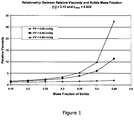
- the Dougherty-Krieger model describes the relative viscosity of an ideal suspension of spherical particles in terms of the fractional occupied volume that the particles exhibit ( ⁇ and two constant terms, the limiting occupied volume ( ⁇ max ) and the intrinsic viscosity [n].
- ⁇ / ⁇ o 1 ⁇ ⁇ / ⁇ max ⁇ ⁇ * ⁇ max
- n is the viscosity of the suspension of particles
- ⁇ ⁇ is the viscosity of the pure solvent.
- a goal of the present invention is to provide a stable aqueous alkaline sol that has higher solids, and lower flammability than the conventional product S5-300B®, but which maintains or has better properties than that product.
- the titania source material is formed into a slurry by addition of water, with an alkaline dispersant present.
- the dispersant is an organic compound which does not leave a residue, after burning off during subsequent calcination, for applications (like SCR) where residual Na or K ions are strong catalyst poisons . Such residues may also act to suppress the photocatalytic activity of titania when used in PC applications.
- the dispersant be miscible with water, so as to prevent separation of the final sol into an aqueous phase and an organic phase.
- a list of some possible dispersants which can be used in the present invention is given in Table 1, wherein it can be seen that there are a variety of organic compounds that are alkaline, have lower vapor pressures (higher boiling and flash points) than DEA, and that are miscible with water.
- one general class of materials that is particularly suitable is the alkanolamines, (including, but not limited to, monoethanolamine, diethanolamine, monoisopropanolamine, and aminomethylpropanol).
- Substituted alkanolamines such as alkyl substituted alkanolamines may be used alternatively, examples of which include, but are not limited to, N,N-dimethylethanolamine, N-methyldiethanolamine, N-methylethanolamine and N,N-diethylethanolamine.
- These are readily available reagents that are used, e.g., in exhaust gas scrubbing applications, and also have found utility as dispersants for titania.
- TMAOH tetramethylammonium hydroxide
- Table I Another material noted in Table I is tetramethylammonium hydroxide (TMAOH).
- TMAOH tetramethylammonium hydroxide
- Other quaternary alkylammonium hydroxides that have similar properties include, but are not limited to, tetraethylammonium hydroxide, tetrapropylammonium hydroxide, etc.
- a sample of commercially available prior art titania dispersion S5-300B was obtained from the MIC production facility in Thann, France.
- This sol (referred to elsewhere herein as E1) was prepared via the peptization method using the strong organic base diethylamine (DEA).
- DEA organic base diethylamine
- the sol was characterized by a variety of means to determine physical properties. Surface tension of the TiO 2 slurries was measured with a Kruss K-100 Tensiometer using the Du Nouy ring method, Viscosities were measured using a Brookfield viscometer. Flammability was measured using the Pensky-Martens method.
- the sample was also analyzed by Transmission Electron Microscopy (TEM).
- the sample was prepared for TEM analysis by diluting the provided slurry 1,000:1 using a 50:50 mixture of isopropanol and water. The dilute suspension was briefly hand shaken and a carbon coated Cu TEM grid dipped directly into the suspension. The grids were allowed to air dry and then viewed in the TEM at magnifications ranging from 50 to 400,000X. Analysis was performed using a JEOL 2000FX II TEM operated at 200kV. During the imaging process particular attention was given to characterizing phase size and distribution. Images were collected with a Gatan MultiScan CCD camera and are in jpeg format.
- a sample of the prior art titania dispersion SB-X1 was obtained from the MIC production facility in Thann, France. This sol was prepared via the peptization method using the strong organic base tetramethylammonium hydroxide (TMAOH). The sol was characterized as above. Table 2. Properties of Prior Art Sols Sol Example TiO 2 , wt% Dispersant Dispersant wt% pH Viscosity (cP) Surface Tension (mN/m) Flashpoint, C S5-300B 1 17.5 DEA 2.60 11.5 2.5 47 38 SB-X1 2 17.5 TMAOH 1.20 12.1 2.4 71 >100
- the sols S5-300B and SB-X1 of Examples 1 and 2 both of which are made using a single strong organic base by the peptization method, have relatively low titania solids content of only 17.5 wt%. These sols also have low viscosities. They differ, however, in flash point and surface tension. The low flashpoint for S5-300B is undesirable, as is the high surface tension of SB-X1.
- Figure 2 reveals that the titania particles in the S5-300B sol consist of primary aggregates that are roughly 50-60 nm in size, and these aggregates consist of the primary anatase crystallites that are roughly a few nanometers in size.
- the titania particles in this case also consist of primary aggregates that are roughly 50-60 nm in size, and these aggregates consist of the primary anatase crystallites that are roughly a few nanometers in size.
- aqueous dispersions were made up with 30% TiO 2 content, and with a constant proportion of total dispersant mass relative to TiO 2 of 20 wt% so that the total solids content (titania + dispersant) is about 37.5 wt%, wherein the total amount of dispersant is about 7.5 wt%.
- the starting titania was obtained from the MIC production facility in Thann, France, and this material was in the anatase crystal form, exhibited a 17% weight loss on ignition at 1000°C, and contained ⁇ 0.8 wt% SO 3 .
- the mean particle size (D50) was 1.2 microns.
- each sol contains only a single dispersant.
- the viscosities of the prepared sols are very high, and in one case (E7, ammonium hydroxide) the sol has hardened into a gel that resists flow altogether.
- TMAOH the viscosity is relatively low, but the pH is exceptionally high, and as mentioned above, the surface tension of the SB-X1 sol prepared with only TMAOH is very high. Also, TMAOH is a very expensive and malodorous raw material militating against its general use.
- Sols of Examples 8 and 9 were prepared using mixtures of two dispersants (DEAOH/MEAOH in Example 8, and DEAOH and NH4OH in Example 9). For these mixtures, the total amount of dispersant was kept constant and equal to 20% by weight of the titania, the ratio of the dispersants was varied as shown in parentheses in Table 3. Thus, the sol of Example 8 was formed by mixing diethanolamine and monoethanolamine in the proportions 15 wt% to 5 wt% and a TiO 2 basis. It can be seen in Table 3 that even for these mixed dispersants, the viscosities of the prepared sols are very high.
- the present invention also involves the very efficient deagglomeration and deaggregation of the initial titania agglomerate and aggregate particles via milling using very small media in the presence of the novel dispersant combinations.
- This method of preparation is essential for the present invention because it has been found that the chemical peptization route that is normally used to prepare such sols is not effective with the disperant mixtures described above.
- the reactants involving a titania source and the dispersant mixtures
- a media mill such as the Netzsch Labstar or LMZ-10 mill.
- the titania aggregates and agglomerates in the starting material After a short residence time in the milling chamber, the titania aggregates and agglomerates in the starting material have become substantially de-aggregated and de-agglomerated, to generate an ultrafine titania stable sol primarily comprising particles having sizes of about 5 nm with trace amounts of primary aggregates with sizes of 30-60 nm and larger agglomerates with sizes of over 100 nm.
- the mechanical energy imparted by the milling media supplements the chemical energy of the alkaline peptization process, and this enables the high solids sols to be made under relatively mild conditions of time, temperature and pH.
- titania surface modifiers including but not limited to, silica, tungsta and alumina.
- such additives typically interfere with the chemical peptization process, and to the extent to which the additives further stabilize the titania surface, it is advantageous to incorporate them during the comminution step.
- the unique dispersant chemistry is needed to stabilize the small titania particles towards re-aggregation, and to provide for low viscosity, low surface tension sols made under the mild milling conditions.
- Example 23 High Solids Sol Preparation via Media-Milling of Titania with mixed DEAOH/TMAOH dispersant.
- a slurry composition was prepared by first mixing 6.66 kg of diethanolamine (85% DEAOH) and 2.52 kg tetramethylammonium hydroxide (25% TMAOH) to 44.51 kg water. To this solution was added 30.3 kg of anatase titania (17% loss on ignition, ⁇ 0.8 wt% SO 3 ) 3 with good mixing. This mixture contained 30 wt% TiO 2 , 6.75 wt% DEAOH and 0.75 wt% TMAOH. This was milled using the Netzsch LMZ-10 mill with 0.2 to 0.3 mm media.
- Example 23 The slurry was re-circulated through the milling chamber for a total elapsed time of 173 min. This material is designated herein as E23.
- E23 Some properties of the sol of Example 23 are shown in Table 4. It can be seen that the sol has a pH of 10.8 (lower than that for S5-300B and S5-300B2), relatively low viscosity, low surface tension (much lower than that for S5-300B2) and high flashpoint. Also, the sol was essentially odor-less. Table 4.
- both TEM and x-ray disc centrifuge were used.
- the sols were each diluted to 3-4 wt% TiO 2 , and run at 9000 RPM on a Brookhaven Instrument Corporation BI-XDC instrument for a time of 45 min.
- the results of the x-ray disc centrifuge analysis (calculated on a particle number basis) can be seen in Table 5 below, and exemplary results of the TEM analysis are shown in Figure 3 .
- the XDC measurements show that the inventive composition prepared by the milling process has lower median particle size (D50), although the particle size distribution is somewhat broader than that for S5-300B.
- the TEM image ( Figure 3 ) indicates that the milled sample is also composed of crystallites with sizes of about 5 nm, however the degree of agglomeration is highly reduced compared to S5-300B ( Fig. 2 ), so that there are many smaller particles in the milled sample ( Fig. 3 ).
- Levels of agglomeration or aggregation in E23 Fig.
- the media-milled mixed dispersant sol of the present invention comprises significantly smaller particles than a prior art titania sol product (e.g., S5-300B®) produced via the chemical peptization route.
- a prior art titania sol product e.g., S5-300B®
- use of the milling process described herein surprisingly results in titania sols having higher titania content, low viscosities, low surface tension and low flammability.
- titania-based catalysts for SCR applications contain added vanadia (the catalytically active oxide) as well as tungsta and optionally silica.
- vanadia the catalytically active oxide
- tungsta is a modifier/promoter in that it moderates the activity of vanadia (e.g., it suppresses the tendency of vanadia to oxidize SO 2 ).
- Silica is optionally present on the surface to improve the thermal stability of the catalyst..
- Alkaline, low viscosity silica-surface treated sols of the invention were prepared by media milling in the presence of a soluble form of silica, comprising tetramethylammonium silicate and/or tungsta as shown in Table 4.
- Example 26 a sol (E26) with the composition (inorganic oxide basis) of 90% TiO 2 , 4% SiO 2 and 6% WO 3 was prepared in the following way.
- a slurry composition was prepared by first mixing 49 g of monoethanolamine (85% MEAOH) and 233 g tetramethylammonium silicate (9% SiO 2 ), 36 g of ammonium paratungstate (APT, 88% WO 3 ) and 864 g water. To this solution was added 569 g of anatase titania (17% loss on ignition, ⁇ 0.8 wt% SO 3 ) 3 with good mixing. This mixture contained 30 wt% total inorganic oxides.
- sols in Examples 25 and 28 were prepared in an similar fashion, but have different final compositions. It can be seen from the data in Table 4 that the sols produced with the above compositions and via the media milling process have small particle size, low viscosity, and low surface tension. Such sols are useful in the ways contemplated herein such as in catalytic applications such as SCR.
- Example 29 is directed towards demonstrating the catalytic benefit achieved by incorporating the silica and tungsta modifiers during the production of the sol.
- To 100 g of the sol of Example 10 was added 2.27 g APT (88% WO 3 ) and 4.4 g Ludox AS-30 (30% SiO 2 ) with stirring. This material is designated E29.
- the sols E1, E26 and E29 were evaluated as catalyst supports for vanadia-based catalysts in the following way.
- 0.31 g vanadia was added to an appropriate amount of sol (e.g, 50 g of 30 wt% sol) to give a constant loading of 2 wt% V 2 O 5 , and the mixture was then dried under vacuum at 75°C using a roto-evaporator.
- the vanadia-loaded materials were then aged at high temperature in hydrothermal environment (750°C for 16 hr in 10% H 2 O) in order to simulate accelerated aging in real use, for, e.g., as SCR catalysts for mobile diesel emission engine application.
- the aged catalysts were then evaluated for their ability to convert NO into N 2 (DeNOx) by using a 0.1 g sample of each vanadia-loaded catalyst sample.
- the catalyst was pelletized and meshed to -20/+40 mesh, and was loaded into a reactor to determine the conversion of NO in the presence of NH 3 .
- a flowing stream that contained 5% O 2 , 500 ppm NH 3 , 500 ppm NO, and 5% H 2 O was passed over the catalyst at a space velocity of 650 l/g.cat-hr.
- the results for the NO conversion, reported at three different reaction temperatures, are given in Table 6, below. Table 6.
- more than one type of dispersant can be mixed in the appropriate proportions to achieve the novel lower flammability alkaline sols of the present invention.
- a small amount of the expensive and malodorous TMAOH can be used in mixture with a larger amount of an alkanolamine, such as diethanolamine, to achieve a stable, high pH sol.
- the choice of dispersants used in the mixture can be guided by the amine pK a , from which the basicity of the amine can be established, and the sol pH.
- an amine that is a relatively weak base pK a ⁇ 10.5
- an amine that is a relatively strong base pK a > 10.5
- pK a > 10.5 can be used as a secondary dispersant component.
Landscapes
- Chemical & Material Sciences (AREA)
- Organic Chemistry (AREA)
- Engineering & Computer Science (AREA)
- Chemical Kinetics & Catalysis (AREA)
- Materials Engineering (AREA)
- Environmental & Geological Engineering (AREA)
- Inorganic Chemistry (AREA)
- Life Sciences & Earth Sciences (AREA)
- Geology (AREA)
- General Life Sciences & Earth Sciences (AREA)
- General Chemical & Material Sciences (AREA)
- Oil, Petroleum & Natural Gas (AREA)
- Health & Medical Sciences (AREA)
- Biomedical Technology (AREA)
- Analytical Chemistry (AREA)
- Combustion & Propulsion (AREA)
- Dispersion Chemistry (AREA)
- Catalysts (AREA)
- Inorganic Compounds Of Heavy Metals (AREA)
- Exhaust Gas Treatment By Means Of Catalyst (AREA)
- Colloid Chemistry (AREA)
- Paper (AREA)
- Agricultural Chemicals And Associated Chemicals (AREA)
Applications Claiming Priority (2)
| Application Number | Priority Date | Filing Date | Title |
|---|---|---|---|
| US12/618,484 US8247343B2 (en) | 2009-11-13 | 2009-11-13 | Stable sub-micron titania sols |
| PCT/US2010/051810 WO2011059606A2 (en) | 2009-11-13 | 2010-10-07 | Stable sub-micron titania sols |
Publications (3)
| Publication Number | Publication Date |
|---|---|
| EP2499096A2 EP2499096A2 (en) | 2012-09-19 |
| EP2499096A4 EP2499096A4 (en) | 2015-03-04 |
| EP2499096B1 true EP2499096B1 (en) | 2017-11-29 |
Family
ID=43992293
Family Applications (1)
| Application Number | Title | Priority Date | Filing Date |
|---|---|---|---|
| EP10830386.8A Active EP2499096B1 (en) | 2009-11-13 | 2010-10-07 | Stable sub-micron titania sols |
Country Status (14)
| Country | Link |
|---|---|
| US (2) | US8247343B2 (enExample) |
| EP (1) | EP2499096B1 (enExample) |
| JP (1) | JP5519022B2 (enExample) |
| KR (1) | KR101767698B1 (enExample) |
| CN (1) | CN102596813B (enExample) |
| AU (1) | AU2010318634B2 (enExample) |
| BR (1) | BR112012011278B1 (enExample) |
| CA (1) | CA2778778C (enExample) |
| MX (1) | MX2012005244A (enExample) |
| MY (1) | MY182360A (enExample) |
| SA (2) | SA110310823B1 (enExample) |
| TW (1) | TWI433815B (enExample) |
| UA (1) | UA107946C2 (enExample) |
| WO (1) | WO2011059606A2 (enExample) |
Families Citing this family (13)
| Publication number | Priority date | Publication date | Assignee | Title |
|---|---|---|---|---|
| US8944072B2 (en) * | 2009-06-02 | 2015-02-03 | R.J. Reynolds Tobacco Company | Thermal treatment process for tobacco materials |
| US8247343B2 (en) | 2009-11-13 | 2012-08-21 | Chapman David M | Stable sub-micron titania sols |
| US8617502B2 (en) * | 2011-02-07 | 2013-12-31 | Cristal Usa Inc. | Ce containing, V-free mobile denox catalyst |
| JP5897995B2 (ja) * | 2012-06-07 | 2016-04-06 | テイカ株式会社 | アルカリ性のアナタース形チタニアゾル及びその製造方法 |
| WO2014118372A1 (en) * | 2013-02-02 | 2014-08-07 | Joma International A/S | An aqueous dispersion comprising tio2 particles |
| WO2014118371A1 (en) | 2013-02-03 | 2014-08-07 | Joma International A/S | A catalytic substrate surface containing particles |
| TWI651269B (zh) * | 2013-09-23 | 2019-02-21 | Tioxide Europe Limited | 二氧化鈦粒子及其製備方法 |
| BR112018010044A2 (pt) * | 2015-11-20 | 2018-11-21 | Cristal Usa Inc | composições de dióxido de titânio e sua utilização como agentes despoluidores |
| FR3060554B1 (fr) * | 2016-12-20 | 2022-04-01 | Saint Gobain Ct Recherches | Produits ceramiques de sous oxydes de titane |
| CN108889297B (zh) * | 2018-07-31 | 2020-12-29 | 包头稀土研究院 | Scr催化剂及其制备方法和应用 |
| TWI717113B (zh) * | 2019-11-20 | 2021-01-21 | 郭浩正 | 用於減少氮氧化物及硫氧化物的複合燃料及其製造方法 |
| EP4316649A4 (en) * | 2021-03-31 | 2025-03-19 | Zeon Corporation | CATALYST AND PROCESS FOR THE PRODUCTION OF CYCLOPENTENE |
| TWI820799B (zh) * | 2022-07-15 | 2023-11-01 | 研能科技股份有限公司 | 臭氧清淨裝置 |
Family Cites Families (11)
| Publication number | Priority date | Publication date | Assignee | Title |
|---|---|---|---|---|
| US4904411A (en) | 1986-04-25 | 1990-02-27 | Ceramics Process Systems Corp. | Highly loaded, pourable suspensions of particulate materials |
| EP0261560B1 (en) | 1986-09-22 | 1992-04-01 | Ishihara Sangyo Kaisha, Ltd. | Titania sol and process for producing same |
| US4752340A (en) | 1987-01-27 | 1988-06-21 | Kerr-Mcgee Chemical Corporation | Titanium dioxide pigments |
| US5886069A (en) | 1995-11-13 | 1999-03-23 | E. I. Du Pont De Nemours And Company | Titanium dioxide particles having substantially discrete inorganic particles dispersed on their surfaces |
| US6740312B2 (en) | 1996-02-15 | 2004-05-25 | Rhodia Chimie | Titanium dioxide particles |
| GB2361653A (en) | 2000-04-28 | 2001-10-31 | Johnson Matthey Plc | Improvements in catalytic reduction of NOx |
| US7431903B2 (en) | 2001-10-30 | 2008-10-07 | Catalysts & Chemicals Industries Co., Ltd. | Tubular titanium oxide particles and process for preparing same |
| DE102004037118A1 (de) | 2004-07-30 | 2006-03-23 | Degussa Ag | Titandioxid enthaltende Dispersion |
| US7763565B2 (en) | 2007-08-31 | 2010-07-27 | Millennium Inorganic Chemicals, Inc. | Transparent, stable titanium dioxide sols |
| US8357426B2 (en) | 2008-01-11 | 2013-01-22 | Nanomateriales S.A. De C.V. | Single step milling and surface coating process for preparing stable nanodispersions |
| US8247343B2 (en) | 2009-11-13 | 2012-08-21 | Chapman David M | Stable sub-micron titania sols |
-
2009
- 2009-11-13 US US12/618,484 patent/US8247343B2/en active Active
-
2010
- 2010-07-10 UA UAA201207235A patent/UA107946C2/ru unknown
- 2010-10-07 CA CA2778778A patent/CA2778778C/en not_active Expired - Fee Related
- 2010-10-07 EP EP10830386.8A patent/EP2499096B1/en active Active
- 2010-10-07 CN CN201080051031.XA patent/CN102596813B/zh active Active
- 2010-10-07 BR BR112012011278-3A patent/BR112012011278B1/pt not_active IP Right Cessation
- 2010-10-07 MX MX2012005244A patent/MX2012005244A/es active IP Right Grant
- 2010-10-07 MY MYPI2012002029A patent/MY182360A/en unknown
- 2010-10-07 WO PCT/US2010/051810 patent/WO2011059606A2/en not_active Ceased
- 2010-10-07 JP JP2012538822A patent/JP5519022B2/ja not_active Expired - Fee Related
- 2010-10-07 AU AU2010318634A patent/AU2010318634B2/en not_active Ceased
- 2010-10-07 KR KR1020127012243A patent/KR101767698B1/ko not_active Expired - Fee Related
- 2010-11-03 SA SA110310823A patent/SA110310823B1/ar unknown
- 2010-11-03 SA SA114350277A patent/SA114350277B1/ar unknown
- 2010-11-11 TW TW099138875A patent/TWI433815B/zh not_active IP Right Cessation
-
2012
- 2012-07-17 US US13/550,954 patent/US8507405B2/en active Active
Non-Patent Citations (1)
| Title |
|---|
| None * |
Also Published As
| Publication number | Publication date |
|---|---|
| US8507405B2 (en) | 2013-08-13 |
| KR20120101386A (ko) | 2012-09-13 |
| JP5519022B2 (ja) | 2014-06-11 |
| MX2012005244A (es) | 2012-06-19 |
| EP2499096A2 (en) | 2012-09-19 |
| KR101767698B1 (ko) | 2017-08-11 |
| CA2778778A1 (en) | 2011-05-19 |
| TWI433815B (zh) | 2014-04-11 |
| SA114350277B1 (ar) | 2015-07-07 |
| CN102596813B (zh) | 2014-09-24 |
| CN102596813A (zh) | 2012-07-18 |
| BR112012011278A8 (pt) | 2017-12-12 |
| JP2013510707A (ja) | 2013-03-28 |
| UA107946C2 (en) | 2015-03-10 |
| US20110118109A1 (en) | 2011-05-19 |
| WO2011059606A3 (en) | 2011-09-15 |
| BR112012011278B1 (pt) | 2020-02-11 |
| SA110310823B1 (ar) | 2014-05-08 |
| TW201132592A (en) | 2011-10-01 |
| BR112012011278A2 (pt) | 2016-04-12 |
| AU2010318634B2 (en) | 2013-09-19 |
| US20120283092A1 (en) | 2012-11-08 |
| AU2010318634A1 (en) | 2012-05-17 |
| WO2011059606A2 (en) | 2011-05-19 |
| US8247343B2 (en) | 2012-08-21 |
| EP2499096A4 (en) | 2015-03-04 |
| CA2778778C (en) | 2014-03-25 |
| MY182360A (en) | 2021-01-20 |
Similar Documents
| Publication | Publication Date | Title |
|---|---|---|
| US8247343B2 (en) | Stable sub-micron titania sols | |
| JP5564109B2 (ja) | 特有の多孔度を有する酸化セリウムおよび酸化ジルコニウムを含む組成物、この調製方法および触媒作用におけるこの使用 | |
| TWI432258B (zh) | 觸媒承載材料及製造方法 | |
| KR101127384B1 (ko) | 높은 열안정성을 가지는 나노-구조 입자 | |
| US10183246B2 (en) | Method for preparing a catalyzed fabric filter and a catalyzed fabric filter | |
| EP2069439A1 (en) | Nanocomposite particle and process of preparing the same | |
| KR20160062086A (ko) | 티타니아 입자 및 이의 제조방법 | |
| JP6188185B2 (ja) | TiO2複合化多孔質シリカ光触媒粒子の製造方法及びTiO2複合化多孔質シリカ光触媒粒子 | |
| KR20130120487A (ko) | 내황성 알루미나 촉매 지지체 | |
| CN101195498A (zh) | 含二氧化钛的分散体 | |
| US20170320043A1 (en) | Low-Alkali Catalyst Material and Process for Preparation Thereof | |
| AU2012100633A4 (en) | Stable sub-micron titania sols | |
| Kinoshita et al. | Photocatalytic activity of mixed-phase titanium oxide synthesized by supercritical sol-gel reaction | |
| JP7626759B2 (ja) | 混合酸化物のナノ粒子の懸濁液 | |
| US8563462B2 (en) | Catalyst compositions based on nanoparticles of a zirconium oxide, a titanium oxide or a mixed zirconium/titanium oxide deposited onto a silica support therefor |
Legal Events
| Date | Code | Title | Description |
|---|---|---|---|
| PUAI | Public reference made under article 153(3) epc to a published international application that has entered the european phase |
Free format text: ORIGINAL CODE: 0009012 |
|
| 17P | Request for examination filed |
Effective date: 20120503 |
|
| AK | Designated contracting states |
Kind code of ref document: A2 Designated state(s): AL AT BE BG CH CY CZ DE DK EE ES FI FR GB GR HR HU IE IS IT LI LT LU LV MC MK MT NL NO PL PT RO RS SE SI SK SM TR |
|
| DAX | Request for extension of the european patent (deleted) | ||
| RAP1 | Party data changed (applicant data changed or rights of an application transferred) |
Owner name: CRISTAL USA INC. |
|
| A4 | Supplementary search report drawn up and despatched |
Effective date: 20150202 |
|
| RIC1 | Information provided on ipc code assigned before grant |
Ipc: C01G 23/00 20060101ALI20150127BHEP Ipc: C01G 23/047 20060101AFI20150127BHEP Ipc: B01J 21/06 20060101ALI20150127BHEP |
|
| GRAP | Despatch of communication of intention to grant a patent |
Free format text: ORIGINAL CODE: EPIDOSNIGR1 |
|
| INTG | Intention to grant announced |
Effective date: 20170613 |
|
| GRAS | Grant fee paid |
Free format text: ORIGINAL CODE: EPIDOSNIGR3 |
|
| GRAA | (expected) grant |
Free format text: ORIGINAL CODE: 0009210 |
|
| AK | Designated contracting states |
Kind code of ref document: B1 Designated state(s): AL AT BE BG CH CY CZ DE DK EE ES FI FR GB GR HR HU IE IS IT LI LT LU LV MC MK MT NL NO PL PT RO RS SE SI SK SM TR |
|
| RAP1 | Party data changed (applicant data changed or rights of an application transferred) |
Owner name: CRISTAL USA INC. |
|
| REG | Reference to a national code |
Ref country code: CH Ref legal event code: EP |
|
| REG | Reference to a national code |
Ref country code: AT Ref legal event code: REF Ref document number: 950205 Country of ref document: AT Kind code of ref document: T Effective date: 20171215 |
|
| REG | Reference to a national code |
Ref country code: IE Ref legal event code: FG4D |
|
| REG | Reference to a national code |
Ref country code: DE Ref legal event code: R096 Ref document number: 602010047086 Country of ref document: DE |
|
| REG | Reference to a national code |
Ref country code: NL Ref legal event code: FP |
|
| REG | Reference to a national code |
Ref country code: LT Ref legal event code: MG4D |
|
| REG | Reference to a national code |
Ref country code: AT Ref legal event code: MK05 Ref document number: 950205 Country of ref document: AT Kind code of ref document: T Effective date: 20171129 |
|
| PG25 | Lapsed in a contracting state [announced via postgrant information from national office to epo] |
Ref country code: ES Free format text: LAPSE BECAUSE OF FAILURE TO SUBMIT A TRANSLATION OF THE DESCRIPTION OR TO PAY THE FEE WITHIN THE PRESCRIBED TIME-LIMIT Effective date: 20171129 Ref country code: LT Free format text: LAPSE BECAUSE OF FAILURE TO SUBMIT A TRANSLATION OF THE DESCRIPTION OR TO PAY THE FEE WITHIN THE PRESCRIBED TIME-LIMIT Effective date: 20171129 Ref country code: FI Free format text: LAPSE BECAUSE OF FAILURE TO SUBMIT A TRANSLATION OF THE DESCRIPTION OR TO PAY THE FEE WITHIN THE PRESCRIBED TIME-LIMIT Effective date: 20171129 Ref country code: SE Free format text: LAPSE BECAUSE OF FAILURE TO SUBMIT A TRANSLATION OF THE DESCRIPTION OR TO PAY THE FEE WITHIN THE PRESCRIBED TIME-LIMIT Effective date: 20171129 Ref country code: NO Free format text: LAPSE BECAUSE OF FAILURE TO SUBMIT A TRANSLATION OF THE DESCRIPTION OR TO PAY THE FEE WITHIN THE PRESCRIBED TIME-LIMIT Effective date: 20180228 |
|
| PG25 | Lapsed in a contracting state [announced via postgrant information from national office to epo] |
Ref country code: HR Free format text: LAPSE BECAUSE OF FAILURE TO SUBMIT A TRANSLATION OF THE DESCRIPTION OR TO PAY THE FEE WITHIN THE PRESCRIBED TIME-LIMIT Effective date: 20171129 Ref country code: BG Free format text: LAPSE BECAUSE OF FAILURE TO SUBMIT A TRANSLATION OF THE DESCRIPTION OR TO PAY THE FEE WITHIN THE PRESCRIBED TIME-LIMIT Effective date: 20180228 Ref country code: AT Free format text: LAPSE BECAUSE OF FAILURE TO SUBMIT A TRANSLATION OF THE DESCRIPTION OR TO PAY THE FEE WITHIN THE PRESCRIBED TIME-LIMIT Effective date: 20171129 Ref country code: RS Free format text: LAPSE BECAUSE OF FAILURE TO SUBMIT A TRANSLATION OF THE DESCRIPTION OR TO PAY THE FEE WITHIN THE PRESCRIBED TIME-LIMIT Effective date: 20171129 Ref country code: LV Free format text: LAPSE BECAUSE OF FAILURE TO SUBMIT A TRANSLATION OF THE DESCRIPTION OR TO PAY THE FEE WITHIN THE PRESCRIBED TIME-LIMIT Effective date: 20171129 Ref country code: GR Free format text: LAPSE BECAUSE OF FAILURE TO SUBMIT A TRANSLATION OF THE DESCRIPTION OR TO PAY THE FEE WITHIN THE PRESCRIBED TIME-LIMIT Effective date: 20180301 |
|
| PG25 | Lapsed in a contracting state [announced via postgrant information from national office to epo] |
Ref country code: SK Free format text: LAPSE BECAUSE OF FAILURE TO SUBMIT A TRANSLATION OF THE DESCRIPTION OR TO PAY THE FEE WITHIN THE PRESCRIBED TIME-LIMIT Effective date: 20171129 Ref country code: CZ Free format text: LAPSE BECAUSE OF FAILURE TO SUBMIT A TRANSLATION OF THE DESCRIPTION OR TO PAY THE FEE WITHIN THE PRESCRIBED TIME-LIMIT Effective date: 20171129 Ref country code: CY Free format text: LAPSE BECAUSE OF FAILURE TO SUBMIT A TRANSLATION OF THE DESCRIPTION OR TO PAY THE FEE WITHIN THE PRESCRIBED TIME-LIMIT Effective date: 20171129 Ref country code: EE Free format text: LAPSE BECAUSE OF FAILURE TO SUBMIT A TRANSLATION OF THE DESCRIPTION OR TO PAY THE FEE WITHIN THE PRESCRIBED TIME-LIMIT Effective date: 20171129 Ref country code: DK Free format text: LAPSE BECAUSE OF FAILURE TO SUBMIT A TRANSLATION OF THE DESCRIPTION OR TO PAY THE FEE WITHIN THE PRESCRIBED TIME-LIMIT Effective date: 20171129 |
|
| REG | Reference to a national code |
Ref country code: DE Ref legal event code: R097 Ref document number: 602010047086 Country of ref document: DE |
|
| PG25 | Lapsed in a contracting state [announced via postgrant information from national office to epo] |
Ref country code: PL Free format text: LAPSE BECAUSE OF FAILURE TO SUBMIT A TRANSLATION OF THE DESCRIPTION OR TO PAY THE FEE WITHIN THE PRESCRIBED TIME-LIMIT Effective date: 20171129 Ref country code: RO Free format text: LAPSE BECAUSE OF FAILURE TO SUBMIT A TRANSLATION OF THE DESCRIPTION OR TO PAY THE FEE WITHIN THE PRESCRIBED TIME-LIMIT Effective date: 20171129 Ref country code: SM Free format text: LAPSE BECAUSE OF FAILURE TO SUBMIT A TRANSLATION OF THE DESCRIPTION OR TO PAY THE FEE WITHIN THE PRESCRIBED TIME-LIMIT Effective date: 20171129 Ref country code: IT Free format text: LAPSE BECAUSE OF FAILURE TO SUBMIT A TRANSLATION OF THE DESCRIPTION OR TO PAY THE FEE WITHIN THE PRESCRIBED TIME-LIMIT Effective date: 20171129 |
|
| REG | Reference to a national code |
Ref country code: FR Ref legal event code: PLFP Year of fee payment: 9 |
|
| PLBE | No opposition filed within time limit |
Free format text: ORIGINAL CODE: 0009261 |
|
| STAA | Information on the status of an ep patent application or granted ep patent |
Free format text: STATUS: NO OPPOSITION FILED WITHIN TIME LIMIT |
|
| 26N | No opposition filed |
Effective date: 20180830 |
|
| PG25 | Lapsed in a contracting state [announced via postgrant information from national office to epo] |
Ref country code: SI Free format text: LAPSE BECAUSE OF FAILURE TO SUBMIT A TRANSLATION OF THE DESCRIPTION OR TO PAY THE FEE WITHIN THE PRESCRIBED TIME-LIMIT Effective date: 20171129 |
|
| REG | Reference to a national code |
Ref country code: CH Ref legal event code: PL |
|
| REG | Reference to a national code |
Ref country code: BE Ref legal event code: MM Effective date: 20181031 |
|
| PG25 | Lapsed in a contracting state [announced via postgrant information from national office to epo] |
Ref country code: MC Free format text: LAPSE BECAUSE OF FAILURE TO SUBMIT A TRANSLATION OF THE DESCRIPTION OR TO PAY THE FEE WITHIN THE PRESCRIBED TIME-LIMIT Effective date: 20171129 Ref country code: LU Free format text: LAPSE BECAUSE OF NON-PAYMENT OF DUE FEES Effective date: 20181007 |
|
| REG | Reference to a national code |
Ref country code: IE Ref legal event code: MM4A |
|
| PG25 | Lapsed in a contracting state [announced via postgrant information from national office to epo] |
Ref country code: LI Free format text: LAPSE BECAUSE OF NON-PAYMENT OF DUE FEES Effective date: 20181031 Ref country code: CH Free format text: LAPSE BECAUSE OF NON-PAYMENT OF DUE FEES Effective date: 20181031 Ref country code: BE Free format text: LAPSE BECAUSE OF NON-PAYMENT OF DUE FEES Effective date: 20181031 |
|
| PG25 | Lapsed in a contracting state [announced via postgrant information from national office to epo] |
Ref country code: IE Free format text: LAPSE BECAUSE OF NON-PAYMENT OF DUE FEES Effective date: 20181007 |
|
| PGFP | Annual fee paid to national office [announced via postgrant information from national office to epo] |
Ref country code: NL Payment date: 20190925 Year of fee payment: 10 |
|
| PG25 | Lapsed in a contracting state [announced via postgrant information from national office to epo] |
Ref country code: MT Free format text: LAPSE BECAUSE OF NON-PAYMENT OF DUE FEES Effective date: 20181007 |
|
| REG | Reference to a national code |
Ref country code: DE Ref legal event code: R082 Ref document number: 602010047086 Country of ref document: DE Representative=s name: KRAUS & LEDERER PARTGMBB, DE Ref country code: DE Ref legal event code: R082 Ref document number: 602010047086 Country of ref document: DE Representative=s name: KRAUS & WEISERT PATENTANWAELTE PARTGMBB, DE Ref country code: DE Ref legal event code: R081 Ref document number: 602010047086 Country of ref document: DE Owner name: TRONOX LLC (N.D.GES.D. STAATES DELAWARE), OKLA, US Free format text: FORMER OWNER: CRISTAL USA INC., GLEN BURNIE, MD., US |
|
| PG25 | Lapsed in a contracting state [announced via postgrant information from national office to epo] |
Ref country code: TR Free format text: LAPSE BECAUSE OF FAILURE TO SUBMIT A TRANSLATION OF THE DESCRIPTION OR TO PAY THE FEE WITHIN THE PRESCRIBED TIME-LIMIT Effective date: 20171129 |
|
| REG | Reference to a national code |
Ref country code: GB Ref legal event code: 732E Free format text: REGISTERED BETWEEN 20200319 AND 20200325 |
|
| PG25 | Lapsed in a contracting state [announced via postgrant information from national office to epo] |
Ref country code: PT Free format text: LAPSE BECAUSE OF FAILURE TO SUBMIT A TRANSLATION OF THE DESCRIPTION OR TO PAY THE FEE WITHIN THE PRESCRIBED TIME-LIMIT Effective date: 20171129 |
|
| PG25 | Lapsed in a contracting state [announced via postgrant information from national office to epo] |
Ref country code: HU Free format text: LAPSE BECAUSE OF FAILURE TO SUBMIT A TRANSLATION OF THE DESCRIPTION OR TO PAY THE FEE WITHIN THE PRESCRIBED TIME-LIMIT; INVALID AB INITIO Effective date: 20101007 Ref country code: MK Free format text: LAPSE BECAUSE OF NON-PAYMENT OF DUE FEES Effective date: 20171129 |
|
| PG25 | Lapsed in a contracting state [announced via postgrant information from national office to epo] |
Ref country code: AL Free format text: LAPSE BECAUSE OF FAILURE TO SUBMIT A TRANSLATION OF THE DESCRIPTION OR TO PAY THE FEE WITHIN THE PRESCRIBED TIME-LIMIT Effective date: 20171129 Ref country code: IS Free format text: LAPSE BECAUSE OF FAILURE TO SUBMIT A TRANSLATION OF THE DESCRIPTION OR TO PAY THE FEE WITHIN THE PRESCRIBED TIME-LIMIT Effective date: 20180329 |
|
| PGFP | Annual fee paid to national office [announced via postgrant information from national office to epo] |
Ref country code: GB Payment date: 20201022 Year of fee payment: 11 |
|
| REG | Reference to a national code |
Ref country code: NL Ref legal event code: MM Effective date: 20201101 |
|
| PG25 | Lapsed in a contracting state [announced via postgrant information from national office to epo] |
Ref country code: NL Free format text: LAPSE BECAUSE OF NON-PAYMENT OF DUE FEES Effective date: 20201101 |
|
| GBPC | Gb: european patent ceased through non-payment of renewal fee |
Effective date: 20211007 |
|
| PG25 | Lapsed in a contracting state [announced via postgrant information from national office to epo] |
Ref country code: GB Free format text: LAPSE BECAUSE OF NON-PAYMENT OF DUE FEES Effective date: 20211007 |
|
| P01 | Opt-out of the competence of the unified patent court (upc) registered |
Effective date: 20230609 |
|
| P02 | Opt-out of the competence of the unified patent court (upc) changed |
Effective date: 20230621 |
|
| PGFP | Annual fee paid to national office [announced via postgrant information from national office to epo] |
Ref country code: FR Payment date: 20250924 Year of fee payment: 16 |
|
| PGFP | Annual fee paid to national office [announced via postgrant information from national office to epo] |
Ref country code: DE Payment date: 20250923 Year of fee payment: 16 |