EP2497451B2 - Produit hygiènique, procédé de fabrication d'un produit d'hygiène et dispositif de fabrication d'un produit d'hygiène - Google Patents
Produit hygiènique, procédé de fabrication d'un produit d'hygiène et dispositif de fabrication d'un produit d'hygiène Download PDFInfo
- Publication number
- EP2497451B2 EP2497451B2 EP12001502.9A EP12001502A EP2497451B2 EP 2497451 B2 EP2497451 B2 EP 2497451B2 EP 12001502 A EP12001502 A EP 12001502A EP 2497451 B2 EP2497451 B2 EP 2497451B2
- Authority
- EP
- European Patent Office
- Prior art keywords
- core
- material web
- superabsorbent
- liquid
- transportation belt
- Prior art date
- Legal status (The legal status is an assumption and is not a legal conclusion. Google has not performed a legal analysis and makes no representation as to the accuracy of the status listed.)
- Active
Links
Images


Classifications
-
- A—HUMAN NECESSITIES
- A61—MEDICAL OR VETERINARY SCIENCE; HYGIENE
- A61F—FILTERS IMPLANTABLE INTO BLOOD VESSELS; PROSTHESES; DEVICES PROVIDING PATENCY TO, OR PREVENTING COLLAPSING OF, TUBULAR STRUCTURES OF THE BODY, e.g. STENTS; ORTHOPAEDIC, NURSING OR CONTRACEPTIVE DEVICES; FOMENTATION; TREATMENT OR PROTECTION OF EYES OR EARS; BANDAGES, DRESSINGS OR ABSORBENT PADS; FIRST-AID KITS
- A61F13/00—Bandages or dressings; Absorbent pads
- A61F13/15—Absorbent pads, e.g. sanitary towels, swabs or tampons for external or internal application to the body; Supporting or fastening means therefor; Tampon applicators
- A61F13/15577—Apparatus or processes for manufacturing
- A61F13/15617—Making absorbent pads from fibres or pulverulent material with or without treatment of the fibres
- A61F13/15658—Forming continuous, e.g. composite, fibrous webs, e.g. involving the application of pulverulent material on parts thereof
-
- A—HUMAN NECESSITIES
- A61—MEDICAL OR VETERINARY SCIENCE; HYGIENE
- A61F—FILTERS IMPLANTABLE INTO BLOOD VESSELS; PROSTHESES; DEVICES PROVIDING PATENCY TO, OR PREVENTING COLLAPSING OF, TUBULAR STRUCTURES OF THE BODY, e.g. STENTS; ORTHOPAEDIC, NURSING OR CONTRACEPTIVE DEVICES; FOMENTATION; TREATMENT OR PROTECTION OF EYES OR EARS; BANDAGES, DRESSINGS OR ABSORBENT PADS; FIRST-AID KITS
- A61F13/00—Bandages or dressings; Absorbent pads
- A61F13/15—Absorbent pads, e.g. sanitary towels, swabs or tampons for external or internal application to the body; Supporting or fastening means therefor; Tampon applicators
- A61F13/45—Absorbent pads, e.g. sanitary towels, swabs or tampons for external or internal application to the body; Supporting or fastening means therefor; Tampon applicators characterised by the shape
- A61F13/47—Sanitary towels, incontinence pads or napkins
- A61F13/472—Sanitary towels, incontinence pads or napkins specially adapted for female use
-
- A—HUMAN NECESSITIES
- A61—MEDICAL OR VETERINARY SCIENCE; HYGIENE
- A61F—FILTERS IMPLANTABLE INTO BLOOD VESSELS; PROSTHESES; DEVICES PROVIDING PATENCY TO, OR PREVENTING COLLAPSING OF, TUBULAR STRUCTURES OF THE BODY, e.g. STENTS; ORTHOPAEDIC, NURSING OR CONTRACEPTIVE DEVICES; FOMENTATION; TREATMENT OR PROTECTION OF EYES OR EARS; BANDAGES, DRESSINGS OR ABSORBENT PADS; FIRST-AID KITS
- A61F13/00—Bandages or dressings; Absorbent pads
- A61F13/15—Absorbent pads, e.g. sanitary towels, swabs or tampons for external or internal application to the body; Supporting or fastening means therefor; Tampon applicators
- A61F13/53—Absorbent pads, e.g. sanitary towels, swabs or tampons for external or internal application to the body; Supporting or fastening means therefor; Tampon applicators characterised by the absorbing medium
- A61F13/531—Absorbent pads, e.g. sanitary towels, swabs or tampons for external or internal application to the body; Supporting or fastening means therefor; Tampon applicators characterised by the absorbing medium having a homogeneous composition through the thickness of the pad
- A61F13/532—Absorbent pads, e.g. sanitary towels, swabs or tampons for external or internal application to the body; Supporting or fastening means therefor; Tampon applicators characterised by the absorbing medium having a homogeneous composition through the thickness of the pad inhomogeneous in the plane of the pad
-
- A—HUMAN NECESSITIES
- A61—MEDICAL OR VETERINARY SCIENCE; HYGIENE
- A61F—FILTERS IMPLANTABLE INTO BLOOD VESSELS; PROSTHESES; DEVICES PROVIDING PATENCY TO, OR PREVENTING COLLAPSING OF, TUBULAR STRUCTURES OF THE BODY, e.g. STENTS; ORTHOPAEDIC, NURSING OR CONTRACEPTIVE DEVICES; FOMENTATION; TREATMENT OR PROTECTION OF EYES OR EARS; BANDAGES, DRESSINGS OR ABSORBENT PADS; FIRST-AID KITS
- A61F13/00—Bandages or dressings; Absorbent pads
- A61F13/15—Absorbent pads, e.g. sanitary towels, swabs or tampons for external or internal application to the body; Supporting or fastening means therefor; Tampon applicators
- A61F13/53—Absorbent pads, e.g. sanitary towels, swabs or tampons for external or internal application to the body; Supporting or fastening means therefor; Tampon applicators characterised by the absorbing medium
- A61F13/531—Absorbent pads, e.g. sanitary towels, swabs or tampons for external or internal application to the body; Supporting or fastening means therefor; Tampon applicators characterised by the absorbing medium having a homogeneous composition through the thickness of the pad
- A61F13/532—Absorbent pads, e.g. sanitary towels, swabs or tampons for external or internal application to the body; Supporting or fastening means therefor; Tampon applicators characterised by the absorbing medium having a homogeneous composition through the thickness of the pad inhomogeneous in the plane of the pad
- A61F13/5323—Absorbent pads, e.g. sanitary towels, swabs or tampons for external or internal application to the body; Supporting or fastening means therefor; Tampon applicators characterised by the absorbing medium having a homogeneous composition through the thickness of the pad inhomogeneous in the plane of the pad having absorbent material located in discrete regions, e.g. pockets
-
- A—HUMAN NECESSITIES
- A61—MEDICAL OR VETERINARY SCIENCE; HYGIENE
- A61F—FILTERS IMPLANTABLE INTO BLOOD VESSELS; PROSTHESES; DEVICES PROVIDING PATENCY TO, OR PREVENTING COLLAPSING OF, TUBULAR STRUCTURES OF THE BODY, e.g. STENTS; ORTHOPAEDIC, NURSING OR CONTRACEPTIVE DEVICES; FOMENTATION; TREATMENT OR PROTECTION OF EYES OR EARS; BANDAGES, DRESSINGS OR ABSORBENT PADS; FIRST-AID KITS
- A61F13/00—Bandages or dressings; Absorbent pads
- A61F13/15—Absorbent pads, e.g. sanitary towels, swabs or tampons for external or internal application to the body; Supporting or fastening means therefor; Tampon applicators
- A61F13/53—Absorbent pads, e.g. sanitary towels, swabs or tampons for external or internal application to the body; Supporting or fastening means therefor; Tampon applicators characterised by the absorbing medium
- A61F2013/530481—Absorbent pads, e.g. sanitary towels, swabs or tampons for external or internal application to the body; Supporting or fastening means therefor; Tampon applicators characterised by the absorbing medium having superabsorbent materials, i.e. highly absorbent polymer gel materials
- A61F2013/53051—Absorbent pads, e.g. sanitary towels, swabs or tampons for external or internal application to the body; Supporting or fastening means therefor; Tampon applicators characterised by the absorbing medium having superabsorbent materials, i.e. highly absorbent polymer gel materials being only in particular parts or specially arranged
- A61F2013/530518—Absorbent pads, e.g. sanitary towels, swabs or tampons for external or internal application to the body; Supporting or fastening means therefor; Tampon applicators characterised by the absorbing medium having superabsorbent materials, i.e. highly absorbent polymer gel materials being only in particular parts or specially arranged the maximum being at the crotch
Definitions
- the invention relates to a device for producing a hygiene product.
- Sanitary pads and hygiene products are designed to absorb fluids such as menstrual fluid, secretions, or urine. These include, in particular, panty liners, sanitary napkins, menstrual pads, and incontinence pads, which are referred to in this application as "sanitary pad product” or “sanitary pads.” Sanitary products can include sanitary napkins, baby diapers, and other fluid-absorbing products for personal hygiene.
- Superabsorbents are used in such hygiene products. These are special materials characterized by their enormous water absorption capacity. Chemically, a superabsorbent can be a copolymer of acrylic acid and sodium acrylate. SAPs are usually used as a coarse-grained powder. They are integrated into a carrier, which serves as the core of a hygiene product and stores the liquid absorbed by the hygiene product.
- Hygiene products with a core made of cellulose and superabsorbent, produced using a flaking machine, are already known.
- the core is usually multi-layered, making it possible to incorporate the superabsorbent in higher concentrations in certain layers of the core.
- These products typically include incontinence products and baby diapers.
- US 2008/044616 A1 describes absorbent articles such as paper diapers and sanitary pads.
- the examples concern absorbent articles in which the superabsorbent has a higher concentration in the central region of the core than in the side regions of the core.
- the superabsorbent is evenly distributed in the central region and in the side regions.
- US 2003/118780 A1 Describes the production of fabric webs with different fiber densities by applying a vacuum to a wire screen onto which the fibers are deposited. More fibers are deposited where the vacuum is higher. A perforated plate is placed between the wire screen and the vacuum source to control the negative pressure. The distribution of the superabsorbent in the machine direction into two high-density zones and one low-density zone is achieved by controlling a superabsorbent feeder under which the fabric web is passed.
- US 4,994,053A describes a method for producing a composite product from a liquid-impermeable fabric web and superabsorbent deposited thereon in discrete areas, wherein a roller with cavities is used to deposit the discrete areas on the fabric web.
- US 2010/022978 A1 The distribution of superabsorbents on a material web in locally varying concentrations.
- the superabsorbent is applied intermittently, or the amount to be applied is progressively changed, e.g., increased or decreased, as the material web passes under the application agents.
- the invention is based on the object of providing a device for producing a sanitary pad product and other hygiene products with sufficient absorption capacity for liquid with reduced material expenditure.
- the invention consists in distributing the SAP over the core such that the SAP has a higher concentration in the central region of the core than in at least one side region of the core.
- the SAP has a higher concentration in the central region of the core than in both side regions of the core, which are located on either side of the central region.
- the sanitary pad products are placed by the user on the body in such a way that the liquid can be absorbed centrally by the core. From this central point of application, the liquid in the core is distributed more or less radially outwards. Due to the fiber structure of the core, the liquid can be distributed somewhat faster and further in a preferred direction than across it, which can result in a slightly oval distribution of the liquid in the core.
- the fibers are usually aligned lengthwise of the core because the lengthwise direction of the core corresponds to the machine direction of the machines on which the web material from which the core is made is produced. As a result, the liquid can spread somewhat faster and further along the long axis of the core than across the core.
- the product's capacity with regard to overall liquid absorption is limited by the fact that the liquid leaks out along the long sides of the core and/or over the surface of the core and soils the user's laundry.
- This capacity limit is reached, considerable capacity reserves outside the liquid distribution area remain unused in conventional hygiene products. This applies particularly to the side areas of the core located longitudinally on either side of the liquid distribution area.
- only about 50% of the SAP of a conventional hygiene product with SAP evenly distributed across the core is used for liquid absorption.
- the SAP used has a higher concentration in the central region of the core than in both side regions arranged longitudinally outside the central region. With this design, roughly estimated, about 90% of the SAP can be utilized for liquid absorption.
- the sanitary pad product saves significant amounts of SAP while maintaining the same performance as a conventional sanitary pad product, in which the SAP is evenly distributed throughout the core.
- the amount of SAP used is essentially used for fluid absorption and is sufficient to absorb the desired amounts of fluid.
- a sanitary pad product with significantly increased performance compared to conventional sanitary pad products can be provided if the same amount of SAP is used as in a conventional sanitary pad product.
- the properties of the sanitary pad product are confirmed by standard tests for hygiene products.
- certain parameters such as penetration time (also called “absorption time”) or rewet (also called “rewetting”), are determined exclusively in the center of the hygiene product.
- penetration time also called “absorption time”
- rewet also called “rewetting”
- a particularly advantageous feature of the sanitary pad product is that the core is made of airlaid or a similarly soft and supple, fluid-absorbing material. This makes it possible to produce pads that conform particularly well to the wearer's body. Hard spots caused by material accumulation on the core, as well as wrinkles, can be avoided.
- the layer thickness of the superabsorbent applied to the core preferably does not exceed 2 mm.
- the superabsorbent is applied to a multitude of small, spaced-apart surfaces. These are preferably a multitude of circular, elliptical, or polygonal surfaces. Furthermore, this has the advantage of having its own absorption capacity, which is in addition to the absorption capacity of the SAP.
- the hygiene product is preferably a panty liner, thin sanitary pad, or ultra-pad.
- the superabsorbent has a higher concentration in a central region of the core than in at least one other side region of the core that is arranged outside the central region in the transverse direction of the core.
- the concentration of the superabsorbent is preferably higher in the central region of the core than in both other side regions on either side of the central region. This takes into account the fact that the liquid is not distributed uniformly across the core even in the transverse direction.
- the core's liquid absorption capacity is limited by the fact that the liquid reaches the long sides of the core in the transverse direction. This is initially the case approximately in the transverse center plane of the core. Then, at a distance from the transverse center plane, the liquid has not yet reached the long sides of the core. The distance of the liquid front from the long sides increases with the distance from the transverse center plane of the core. This makes it possible to concentrate the superabsorbent on a central region even in the transverse direction of the core.
- the superabsorbent is arranged in an oval central region of the core. This corresponds to the distribution of the liquid that is applied centrally to the core.
- the oval central region is preferably aligned with its major axis in the longitudinal direction of the core and with its minor axis in the transverse direction of the core, corresponding to the preferred orientation of the fibers in the core.
- the particulate superabsorbent is scattered onto the core.
- topsheet surface material
- buffer temporaryly store
- a liquid-permeable topsheet with a textile character is arranged on top of the core.
- the topsheet serves to create pleasant body contact. This can be an additional layer or a layer integrated into the outer surface of the core.
- the topsheet can, in particular, be an additional layer of nonwoven fabric or a perforated film. It can also serve as the liquid absorption and/or liquid distribution layer.
- the superabsorbent is concentrated in spaced-apart areas of the material web by applying a vacuum to specific areas of the material web. These areas form the central regions of the core.
- concentration and distribution of the superabsorbent depend primarily on the formation of the areas to which the vacuum is applied and on the level of the applied vacuum. Between the areas where the superabsorbent is concentrated, the material web is divided into liquid-absorbing cores.
- an adhesive is applied to the upper side of the material web to fix the superabsorbent to the material web.
- the adhesive is preferably applied before the superabsorbent is applied to the material web. However, it can also be applied after the superabsorbent has been applied and, if necessary, after the vacuum has been applied.
- At least one lateral web region of the material web is folded over the top of the central web region of the material web after the superabsorbent has been applied and concentrated to the central regions. This secures the superabsorbent in the core.
- the material web is guided on a conveyor belt with a hole pattern below the areas of the material web where the superabsorbent is to be concentrated, over a device for applying a vacuum across the entire material web.
- the superabsorbent is concentrated by applying a vacuum to the underside of the conveyor belt in the areas of the material web above the hole pattern.
- the conveyor belt with the hole pattern forms a mask through which the vacuum is directed specifically to the areas of the material web where the SAP is to be concentrated.
- the material web or core is provided with a liquid-impermeable layer on the underside and/or at least one liquid-receiving and/or liquid-distributing layer on the top side and/or with a liquid-permeable textile cover layer on the outside of the top side.
- a liquid-impermeable layer on the underside and/or at least one liquid-receiving and/or liquid-distributing layer on the top side and/or with a liquid-permeable textile cover layer on the outside of the top side.
- These additional layers can be applied wholly or partially to the material web before cutting or after cutting the material web onto the core. They are preferably applied to the core after cutting.
- the vacuum is applied specifically to areas of the material web via the conveyor belt with spaced-apart hole patterns.
- the material web is applied to the upper side of the upper conveyor belt section in the running direction of the conveyor belt.
- the superabsorbent is applied to the upper side of the material belt arranged on the conveyor belt using the application means.
- the vacuum is applied to the underside of the upper conveyor belt section using a vacuum table.
- the vacuum table enables a uniform negative pressure to be applied to a specific area. Vacuum tables are known to those skilled in the art and are commercially available. A negative pressure can be applied to the vacuum table using a vacuum pump.
- the material web is drawn from a roll or a block and fed to the feeding means.
- the material web can be laid in a zigzag fold.
- the means for discharging a superabsorbent comprise a chute for particles of the superabsorbent.
- the chute is a dosing device for dosing the material flow of the superabsorbent particles.
- means for applying an adhesive to the upper side of the material web are provided.
- the means for applying an adhesive are arranged upstream of the means for applying a superabsorbent in the direction of travel of the material web.
- the means for applying an adhesive can also be arranged downstream of the means for applying a superabsorbent or downstream of the vacuum table in the direction of travel.
- the means for applying an adhesive comprise a spray head for an adhesive.
- a spray head for a hot-melt adhesive is preferably a spray head for a hot-melt adhesive.
- guide plates are provided for deflecting the lateral sections of the material web onto the upper side of a central section of the material web. These deflection devices fold the lateral sections over the central section, thereby securing the SAP of the material web.
- means for cutting the material web into strip-shaped pieces are provided behind the conveyor belt in the running direction.
- the device comprises means for synchronizing the cutting means with the movement of the conveyor belt.
- the synchronizing means ensure that the material web is cut between the regions where the superabsorbent is concentrated.
- sanitary pad 1 is shown. This is an "ultra pad,” meaning it is a particularly thin sanitary pad that offers a particularly high level of comfort.
- the bandage 1 has a strip-shaped core 2 made of airlaid.
- the core 2 has a central strip region 2.1 and two wing regions folded from the longitudinal sides of the central strip region 2.1. Lateral wing regions 2.2, 2.3 are folded over these wing regions and slightly overlap each other along the longitudinal center axis of the core 2.
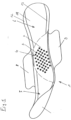
- a superabsorbent 3 is arranged between the central stripe area 2.1 and the lateral wing areas 2.2, 2.3. This is a coarse-grained powder. As best described in Fig. 1 As can be seen, the superabsorbent 3 is concentrated in a central region 4 of the core. There, it occupies an approximately prism-shaped area. Within this central region 4, the superabsorbent 3 is collected in several small, circular clusters. These are based on the fact that the distribution of the superabsorbent 3 over the core is controlled by means of a perforated mask with a hole pattern corresponding to the arrangement of the clusters, to which a negative pressure is applied.
- the superabsorbent 3 is fixed in the core 2 using hot glue.
- the core On the underside 2, the core is covered by a central section 8.1 of a liquid-impermeable layer ("laundry protection layer") 8.
- the liquid-impermeable layer 8 is extended on both sides adjacent to the central region 4 of the core 2 to form two outwardly projecting wing sections 8.2, 8.3, which are lower layers of wings 9, 10.
- the upper side of the core 2 is covered by a liquid-permeable cover layer 11 made of nonwoven fabric.
- the cover layer 11 can also form a liquid-receiving layer.
- the two longitudinal edges of the cover layer 11 are each covered by a lateral cover layer 12, 13.
- the lateral cover layers 12, 13 form the upper sides of the wings 8, 9.
- These can be layers with a textile character (e.g., nonwoven) that prevent the body from coming into contact with the plastic film that can form the liquid-impermeable layer 8 and the lower layers of the wings 8, 9.
- the various layers of bandage 1 can be bonded together at suitable locations using adhesive.
- Hot melt adhesive can be used, in particular.
- the central section 8.1 of the liquid-impermeable Layer 8 is bonded to the underside of core 2.
- the liquid-permeable cover layer 11 is preferably bonded to the top side of core 2 at specific points so as not to impede the passage of liquid.
- the additional cover layers 12, 13 are bonded to the wing sections 8.2, 8.3 of the liquid-impermeable layer 8 and the edge regions of the cover layer 4.
- adhesive strips 14.1, 14.2, 14.3 are provided for fixing to the waistband of a panty.
- the adhesive strip 14.1 is covered by a centrally positioned cover material 15.1.
- the adhesive strip 14.3 is covered by a further, strip-shaped cover material 15.2, which is arranged in Fig. 2a protrudes laterally.
- the cover materials 15.1, 15.2 are made, for example, of siliconized paper or siliconized film. The siliconization facilitates the removal of the cover materials 15.1, 15.2.
- the wings 9, 10 are folded over the liquid-permeable cover layer 11, and the cover material 15.2 covers the adhesive strips 14.2 and 14.3.
- the cover material 15.1 also serves as the individual packaging film or outer packaging sleeve for the bandage 1.
- the sanitary pad 1 is secured to the waistband of a pair of panties by means of the wings 8, 9, so that released body fluid is released centrally over the central region 4 of the core 2. From there, it is distributed radially outward through the cover layer 11 and the core 2, so that upon reaching the longitudinal edges of the core 2, it occupies almost the entire central region 4 and is bound by the superabsorbent 3 arranged there. This optimally utilizes the capacity of the sanitary pad 1 with the lowest possible use of SAP 3.
- a device 16 for producing the core 2 has a vacuum table 17.
- a conveyor belt 20 is guided around the vacuum table 17 via deflection rollers 18, 19.
- the upper conveyor belt section 20.1 of the conveyor belt 20 runs directly over the vacuum table 17.
- the conveyor belt has hole patterns 21, each with a plurality of holes 22 arranged on a prism-shaped surface, which Fig. 5 Outside the hole pattern, the conveyor belt is closed.
- One of the deflection rollers 19 of the conveyor belt 20 is driven by a motor.
- a material web 25 made of airlaid is fed to the upper side of the upper conveyor belt section 20.1 of the conveyor belt 20 via further rollers 23, 24.
- a spray head 26 for a hot-melt adhesive is arranged in front of the conveyor belt 20, above the material web 25, a spray head 26 for a hot-melt adhesive is arranged.
- a chute 27 for powdered SAP is arranged above the upper conveyor belt section 20.1 of the conveyor belt 20.
- the chute 27 is fed by a dosing device 28 with a dosing screw.
- the dosing screw is fed from a storage container 29 for SAP with a feed hopper 30.
- Guide rails 31, 32 for folding lateral web regions of the material web 25 over a central web region of the material web 25 are arranged on both sides of the upper conveyor belt section 20.1 of the conveyor belt 20.
- the airlaid material web 25 is supplied as a roll or in a block, laid in a zigzag or festooned pattern, and placed on the device 16.
- the material web 25 is placed such that it is guided over the rollers 23, 24 on the upper conveyor belt section 20.1 of the conveyor belt 20.
- the vacuum table 17 below the upper conveyor belt section 20.1 draws air through the hole patterns 21, thereby securing the material web 25 lying on the upper conveyor belt section 20.1.
- the lateral guides 31, 32 initially position the material web 25 in a U-shape in the area of the upper conveyor belt section 20.1.
- a uniform amount of SAP in grams per unit of time is fed to the chute 27 via the dosing device 28.
- the fed amount can vary depending on the belt speed of the conveyor belt 20.
- the metered SAP is applied via the chute 27 to the top of the U-shaped material web 25.
- Hot melt adhesive is sprayed onto the material web 25 via the spray head 26 before it runs onto the conveyor belt 20.
- the SAP granules pass from the chute 27 onto the material web 25, are accelerated accordingly, and are distributed across the material web 25. Due to the hole patterns 21 in the conveyor belt 20, to which a negative pressure is applied via the vacuum table 17, the SAP preferentially deposits itself over the hole patterns 21.
- the vacuum generates an air flow that is directed from above through the airlaid to the vacuum table 17 and transports the SAP granules to the locations above the hole patterns 21.
- the SAP preferably deposits itself on the material web 25 according to the hole geometry of the conveyor belt 20 and is fixed to the material web 25 by the hot-melt adhesive when it no longer moves relative to the material web 25. Additionally, the SAP is fixed by the lateral web areas of the material web 25, which are folded by the guides 31, 32 in the running direction behind the vacuum table 17 over the central web area.
- the layout of the hole patterns 21 and the vacuum can be controlled so that a certain proportion of the SAP remains on the material web 25 and is evenly distributed over the length of the material web 25.
- the material web 25 is finally cut into cores 2 in such a synchronous manner that the area with the highest Concentration of SAP 3 is located centrally in the core.
- the device 16 according to the invention can be implemented with only minor modifications to existing devices for producing cores 2 with SAP dosing.
- SAP 3.1 is located in the center of a central area of core 2.
- Fig. 6a and 6b Page areas 3.2, 3.3 from SAP and Fig. 6c a strip area 3.4 made of SAP that surrounds the central area 3.1.
- the side areas 3.2, 3.3, and 3.4 serve as side leakage protection.
Landscapes
- Health & Medical Sciences (AREA)
- Epidemiology (AREA)
- Engineering & Computer Science (AREA)
- Biomedical Technology (AREA)
- Heart & Thoracic Surgery (AREA)
- Vascular Medicine (AREA)
- Life Sciences & Earth Sciences (AREA)
- Animal Behavior & Ethology (AREA)
- General Health & Medical Sciences (AREA)
- Public Health (AREA)
- Veterinary Medicine (AREA)
- Manufacturing & Machinery (AREA)
- Absorbent Articles And Supports Therefor (AREA)
- Orthopedics, Nursing, And Contraception (AREA)
Claims (4)
- Dispositif de fabrication d'un produit hygiénique comprenant- une table aspirante (17),- un tapis roulant (20) guidé par le biais de déflecteurs (18, 19) avec plusieurs motifs à trou (21) espacés les uns des autres, lequel est guidé avec une partie supérieure de tapis roulant (20.1) au-dessus de la face supérieure de la table aspirante (17),- des moyens (23, 24) destinés à conduire une nappe de matériau (25) constituée d'un airlaid, d'un non-tissé ou d'un autre matériau flexible en fibres naturelles et/ou synthétiques sur la face supérieure de la partie supérieure de tapis roulant (20.1) dans la direction de marche du tapis roulant (20),- des moyens destinés à appliquer un super-absorbant (27) sur la face supérieure de la nappe de matériau (25) sur la partie supérieure de tapis roulant (20.1) du tapis roulant (20)- des moyens destinés à appliquer un vide à la table aspirante (17) et- dans lequel il est prévu des tôles de guidage (31, 32) de part et d'autre du tapis roulant pour la déviation de zones de nappe latérales de la nappe de matériau (25) vers la face supérieure d'une zone de nappe centrale de la nappe de matériau (25).
- Dispositif selon la revendication 1, dans lequel les moyens destinés à appliquer un super-absorbant comportent une glissière (17) pour le super-absorbant (3) et un dispositif de dosage (28) destiné au dosage du flux de matériau du super-absorbant (3) est placé en amont de la glissière (17).
- Dispositif selon la revendication 1 ou 2, dans lequel les moyens destinés à appliquer un adhésif (26) sont arrangés en amont des moyens destinés à appliquer un super-absorbant (27) dans la direction de marche de la nappe de matériau (25).
- Dispositif selon l'une des revendications 1 à 3, dans lequel il est prévu des moyens destinés à découper la nappe de matériau (25) en noyaux en forme de bande (2) en aval du tapis roulant (20) dans la direction de marche et lequel possède des moyens destinés à synchroniser les moyens destinés à découper avec le déplacement du tapis roulant (20).
Applications Claiming Priority (1)
| Application Number | Priority Date | Filing Date | Title |
|---|---|---|---|
| DE102011013707A DE102011013707A1 (de) | 2011-03-11 | 2011-03-11 | Bindenprodukt, Verfahren zum Herstellen eines Hygieneproduktes und Vorrichtung zum Herstellen eines Hygieneproduktes |
Publications (3)
| Publication Number | Publication Date |
|---|---|
| EP2497451A1 EP2497451A1 (fr) | 2012-09-12 |
| EP2497451B1 EP2497451B1 (fr) | 2014-06-18 |
| EP2497451B2 true EP2497451B2 (fr) | 2025-05-07 |
Family
ID=45876555
Family Applications (1)
| Application Number | Title | Priority Date | Filing Date |
|---|---|---|---|
| EP12001502.9A Active EP2497451B2 (fr) | 2011-03-11 | 2012-03-06 | Produit hygiènique, procédé de fabrication d'un produit d'hygiène et dispositif de fabrication d'un produit d'hygiène |
Country Status (2)
| Country | Link |
|---|---|
| EP (1) | EP2497451B2 (fr) |
| DE (1) | DE102011013707A1 (fr) |
Families Citing this family (2)
| Publication number | Priority date | Publication date | Assignee | Title |
|---|---|---|---|---|
| WO2019204972A1 (fr) | 2018-04-24 | 2019-10-31 | The Procter & Gamble Company | Culotte absorbante ayant un noyau absorbant avec canal continu |
| CN111971008A (zh) * | 2018-04-24 | 2020-11-20 | 宝洁公司 | 具有带有通道的吸收芯的吸收裤 |
Citations (5)
| Publication number | Priority date | Publication date | Assignee | Title |
|---|---|---|---|---|
| US4960477A (en) † | 1983-12-01 | 1990-10-02 | Mcneil-Ppc, Inc. | Disposable diaper with folded absorbent batt |
| US5494622A (en) † | 1994-07-12 | 1996-02-27 | Kimberly-Clark Corporation | Apparatus and method for the zoned placement of superabsorbent material |
| US5593399A (en) † | 1993-10-29 | 1997-01-14 | Kimberly-Clark Corporation | Absorbent article which includes superabsorbent material located in discrete, elongate pockets placed in selected patterns |
| US5925439A (en) † | 1995-03-29 | 1999-07-20 | The Procter & Gamble Company | Liquid-absorbent sanitary cellulose product |
| EP1621165A1 (fr) † | 2004-07-28 | 2006-02-01 | The Procter & Gamble Company | impression indirecte de agm |
Family Cites Families (5)
| Publication number | Priority date | Publication date | Assignee | Title |
|---|---|---|---|---|
| US4994053A (en) * | 1985-06-26 | 1991-02-19 | Kimberly-Clark Corporation | Composite article having discrete particulate areas formed therein |
| DE19806575A1 (de) * | 1997-03-27 | 1998-10-01 | Kimberly Clark Gmbh | Absorbierender Artikel |
| US6890622B2 (en) * | 2001-12-20 | 2005-05-10 | Kimberly-Clark Worldwide, Inc. | Composite fluid distribution and fluid retention layer having selective material deposition zones for personal care products |
| US7884259B2 (en) * | 2004-06-28 | 2011-02-08 | Daio Paper Corporation | Absorbent article |
| KR101400703B1 (ko) * | 2006-03-23 | 2014-05-29 | 가오 가부시키가이샤 | 흡수체 및 그 제조방법 |
-
2011
- 2011-03-11 DE DE102011013707A patent/DE102011013707A1/de active Pending
-
2012
- 2012-03-06 EP EP12001502.9A patent/EP2497451B2/fr active Active
Patent Citations (5)
| Publication number | Priority date | Publication date | Assignee | Title |
|---|---|---|---|---|
| US4960477A (en) † | 1983-12-01 | 1990-10-02 | Mcneil-Ppc, Inc. | Disposable diaper with folded absorbent batt |
| US5593399A (en) † | 1993-10-29 | 1997-01-14 | Kimberly-Clark Corporation | Absorbent article which includes superabsorbent material located in discrete, elongate pockets placed in selected patterns |
| US5494622A (en) † | 1994-07-12 | 1996-02-27 | Kimberly-Clark Corporation | Apparatus and method for the zoned placement of superabsorbent material |
| US5925439A (en) † | 1995-03-29 | 1999-07-20 | The Procter & Gamble Company | Liquid-absorbent sanitary cellulose product |
| EP1621165A1 (fr) † | 2004-07-28 | 2006-02-01 | The Procter & Gamble Company | impression indirecte de agm |
Also Published As
| Publication number | Publication date |
|---|---|
| EP2497451B1 (fr) | 2014-06-18 |
| EP2497451A1 (fr) | 2012-09-12 |
| DE102011013707A1 (de) | 2012-09-13 |
Similar Documents
| Publication | Publication Date | Title |
|---|---|---|
| EP0767732B1 (fr) | Dispositif et procede de production d'une bande striee et produit absorbant contenant une bande striee | |
| DE602005004363T2 (de) | Trommel zum Formen von flüssigkeitsabsorbierendem Material | |
| DE60213855T3 (de) | Saugfähiger artikel | |
| DE69327251T2 (de) | Absorbierender artikel mit kontrollierter flüssigkeitsverteilung | |
| DE69838092T2 (de) | Verfahren zum Produzieren einer faserigen Schicht für einen absorbierenden Artikel | |
| DE60214625T2 (de) | Damenbinde | |
| DE69211708T3 (de) | Absorbierender artikel mit schellverteilungsstreifen | |
| DE69413597T2 (de) | Vliesstoff-Damenbinde und Verfahren und Vorrichtung zur deren Herstellung | |
| DE112016004589T5 (de) | Bahnartiger Artikel und Verfahren zur Herstellung eines bahnartigen Artikels | |
| DE202013012607U1 (de) | Absorptionsartikel mit Kanälen und Signalen | |
| DE202018002381U1 (de) | Absorptionsartikel mit Kanälen | |
| DE202018006929U1 (de) | Absorbierender Artikel mit Kanälen | |
| WO1996000625A9 (fr) | Dispositif et procede de production d'une bande striee et produit absorbant contenant une bande striee | |
| DE19938437B4 (de) | Verwendung Absorbierender Artikel und dessen Verwendung | |
| WO2012146748A1 (fr) | Article hygiénique absorbant élastique pour l'absorption de fluides corporels | |
| DE69910763T2 (de) | Absorbierender wegwerfartikel mit verbesserter oberlage | |
| DE602004010179T2 (de) | Vorrichtung und verfahren zur herstellung einer verbundbahnstruktur und absorbierende struktur mit der verbundbahn | |
| DE29923333U1 (de) | Absorbierendes Produkt wie beispielsweise eine Damenbinde, ein Inkontinenzschutz, eine Slipeinlage o.ä. | |
| WO2023110703A1 (fr) | Article contre l'incontinence comprenant un canal | |
| DE202017007118U1 (de) | Absorptionsartikel mit Kanälen | |
| EP4267067A1 (fr) | Article pour incontinence avec régulateur de ph et de canal | |
| EP2497451B2 (fr) | Produit hygiènique, procédé de fabrication d'un produit d'hygiène et dispositif de fabrication d'un produit d'hygiène | |
| EP4267066B1 (fr) | Article pour incontinence avec régulateur de ph | |
| EP0030342A2 (fr) | Procédé de fabrication d'un article hygiénique | |
| DE112017007509T5 (de) | Verfahren zur Herstellung eines Absorbers und Verfahren zur Herstellung eines Absorptionsartikels |
Legal Events
| Date | Code | Title | Description |
|---|---|---|---|
| PUAI | Public reference made under article 153(3) epc to a published international application that has entered the european phase |
Free format text: ORIGINAL CODE: 0009012 |
|
| AK | Designated contracting states |
Kind code of ref document: A1 Designated state(s): AL AT BE BG CH CY CZ DE DK EE ES FI FR GB GR HR HU IE IS IT LI LT LU LV MC MK MT NL NO PL PT RO RS SE SI SK SM TR |
|
| AX | Request for extension of the european patent |
Extension state: BA ME |
|
| 17P | Request for examination filed |
Effective date: 20130311 |
|
| 17Q | First examination report despatched |
Effective date: 20130523 |
|
| GRAP | Despatch of communication of intention to grant a patent |
Free format text: ORIGINAL CODE: EPIDOSNIGR1 |
|
| GRAS | Grant fee paid |
Free format text: ORIGINAL CODE: EPIDOSNIGR3 |
|
| INTG | Intention to grant announced |
Effective date: 20140310 |
|
| GRAA | (expected) grant |
Free format text: ORIGINAL CODE: 0009210 |
|
| STAA | Information on the status of an ep patent application or granted ep patent |
Free format text: STATUS: THE PATENT HAS BEEN GRANTED |
|
| AK | Designated contracting states |
Kind code of ref document: B1 Designated state(s): AL AT BE BG CH CY CZ DE DK EE ES FI FR GB GR HR HU IE IS IT LI LT LU LV MC MK MT NL NO PL PT RO RS SE SI SK SM TR |
|
| REG | Reference to a national code |
Ref country code: GB Ref legal event code: FG4D Free format text: NOT ENGLISH |
|
| REG | Reference to a national code |
Ref country code: CH Ref legal event code: EP |
|
| REG | Reference to a national code |
Ref country code: AT Ref legal event code: REF Ref document number: 672910 Country of ref document: AT Kind code of ref document: T Effective date: 20140715 |
|
| REG | Reference to a national code |
Ref country code: IE Ref legal event code: FG4D Free format text: LANGUAGE OF EP DOCUMENT: GERMAN |
|
| REG | Reference to a national code |
Ref country code: DE Ref legal event code: R096 Ref document number: 502012000863 Country of ref document: DE Effective date: 20140807 |
|
| PG25 | Lapsed in a contracting state [announced via postgrant information from national office to epo] |
Ref country code: FI Free format text: LAPSE BECAUSE OF FAILURE TO SUBMIT A TRANSLATION OF THE DESCRIPTION OR TO PAY THE FEE WITHIN THE PRESCRIBED TIME-LIMIT Effective date: 20140618 Ref country code: LT Free format text: LAPSE BECAUSE OF FAILURE TO SUBMIT A TRANSLATION OF THE DESCRIPTION OR TO PAY THE FEE WITHIN THE PRESCRIBED TIME-LIMIT Effective date: 20140618 Ref country code: NO Free format text: LAPSE BECAUSE OF FAILURE TO SUBMIT A TRANSLATION OF THE DESCRIPTION OR TO PAY THE FEE WITHIN THE PRESCRIBED TIME-LIMIT Effective date: 20140918 Ref country code: GR Free format text: LAPSE BECAUSE OF FAILURE TO SUBMIT A TRANSLATION OF THE DESCRIPTION OR TO PAY THE FEE WITHIN THE PRESCRIBED TIME-LIMIT Effective date: 20140919 Ref country code: CY Free format text: LAPSE BECAUSE OF FAILURE TO SUBMIT A TRANSLATION OF THE DESCRIPTION OR TO PAY THE FEE WITHIN THE PRESCRIBED TIME-LIMIT Effective date: 20140618 |
|
| REG | Reference to a national code |
Ref country code: NL Ref legal event code: VDEP Effective date: 20140618 |
|
| REG | Reference to a national code |
Ref country code: LT Ref legal event code: MG4D |
|
| PG25 | Lapsed in a contracting state [announced via postgrant information from national office to epo] |
Ref country code: LV Free format text: LAPSE BECAUSE OF FAILURE TO SUBMIT A TRANSLATION OF THE DESCRIPTION OR TO PAY THE FEE WITHIN THE PRESCRIBED TIME-LIMIT Effective date: 20140618 Ref country code: SE Free format text: LAPSE BECAUSE OF FAILURE TO SUBMIT A TRANSLATION OF THE DESCRIPTION OR TO PAY THE FEE WITHIN THE PRESCRIBED TIME-LIMIT Effective date: 20140618 Ref country code: RS Free format text: LAPSE BECAUSE OF FAILURE TO SUBMIT A TRANSLATION OF THE DESCRIPTION OR TO PAY THE FEE WITHIN THE PRESCRIBED TIME-LIMIT Effective date: 20140618 Ref country code: HR Free format text: LAPSE BECAUSE OF FAILURE TO SUBMIT A TRANSLATION OF THE DESCRIPTION OR TO PAY THE FEE WITHIN THE PRESCRIBED TIME-LIMIT Effective date: 20140618 |
|
| PG25 | Lapsed in a contracting state [announced via postgrant information from national office to epo] |
Ref country code: SK Free format text: LAPSE BECAUSE OF FAILURE TO SUBMIT A TRANSLATION OF THE DESCRIPTION OR TO PAY THE FEE WITHIN THE PRESCRIBED TIME-LIMIT Effective date: 20140618 Ref country code: EE Free format text: LAPSE BECAUSE OF FAILURE TO SUBMIT A TRANSLATION OF THE DESCRIPTION OR TO PAY THE FEE WITHIN THE PRESCRIBED TIME-LIMIT Effective date: 20140618 Ref country code: CZ Free format text: LAPSE BECAUSE OF FAILURE TO SUBMIT A TRANSLATION OF THE DESCRIPTION OR TO PAY THE FEE WITHIN THE PRESCRIBED TIME-LIMIT Effective date: 20140618 Ref country code: ES Free format text: LAPSE BECAUSE OF FAILURE TO SUBMIT A TRANSLATION OF THE DESCRIPTION OR TO PAY THE FEE WITHIN THE PRESCRIBED TIME-LIMIT Effective date: 20140618 Ref country code: RO Free format text: LAPSE BECAUSE OF FAILURE TO SUBMIT A TRANSLATION OF THE DESCRIPTION OR TO PAY THE FEE WITHIN THE PRESCRIBED TIME-LIMIT Effective date: 20140618 Ref country code: PT Free format text: LAPSE BECAUSE OF FAILURE TO SUBMIT A TRANSLATION OF THE DESCRIPTION OR TO PAY THE FEE WITHIN THE PRESCRIBED TIME-LIMIT Effective date: 20141020 |
|
| PG25 | Lapsed in a contracting state [announced via postgrant information from national office to epo] |
Ref country code: IS Free format text: LAPSE BECAUSE OF FAILURE TO SUBMIT A TRANSLATION OF THE DESCRIPTION OR TO PAY THE FEE WITHIN THE PRESCRIBED TIME-LIMIT Effective date: 20141018 Ref country code: NL Free format text: LAPSE BECAUSE OF FAILURE TO SUBMIT A TRANSLATION OF THE DESCRIPTION OR TO PAY THE FEE WITHIN THE PRESCRIBED TIME-LIMIT Effective date: 20140618 Ref country code: PL Free format text: LAPSE BECAUSE OF FAILURE TO SUBMIT A TRANSLATION OF THE DESCRIPTION OR TO PAY THE FEE WITHIN THE PRESCRIBED TIME-LIMIT Effective date: 20140618 |
|
| REG | Reference to a national code |
Ref country code: DE Ref legal event code: R026 Ref document number: 502012000863 Country of ref document: DE |
|
| PLBI | Opposition filed |
Free format text: ORIGINAL CODE: 0009260 |
|
| 26 | Opposition filed |
Opponent name: THE PROCTER & GAMBLE COMPANY Effective date: 20150317 |
|
| PLAX | Notice of opposition and request to file observation + time limit sent |
Free format text: ORIGINAL CODE: EPIDOSNOBS2 |
|
| PG25 | Lapsed in a contracting state [announced via postgrant information from national office to epo] |
Ref country code: IT Free format text: LAPSE BECAUSE OF FAILURE TO SUBMIT A TRANSLATION OF THE DESCRIPTION OR TO PAY THE FEE WITHIN THE PRESCRIBED TIME-LIMIT Effective date: 20140618 Ref country code: DK Free format text: LAPSE BECAUSE OF FAILURE TO SUBMIT A TRANSLATION OF THE DESCRIPTION OR TO PAY THE FEE WITHIN THE PRESCRIBED TIME-LIMIT Effective date: 20140618 |
|
| REG | Reference to a national code |
Ref country code: DE Ref legal event code: R026 Ref document number: 502012000863 Country of ref document: DE Effective date: 20150317 |
|
| PG25 | Lapsed in a contracting state [announced via postgrant information from national office to epo] |
Ref country code: SI Free format text: LAPSE BECAUSE OF FAILURE TO SUBMIT A TRANSLATION OF THE DESCRIPTION OR TO PAY THE FEE WITHIN THE PRESCRIBED TIME-LIMIT Effective date: 20140618 |
|
| PLAF | Information modified related to communication of a notice of opposition and request to file observations + time limit |
Free format text: ORIGINAL CODE: EPIDOSCOBS2 |
|
| PLBB | Reply of patent proprietor to notice(s) of opposition received |
Free format text: ORIGINAL CODE: EPIDOSNOBS3 |
|
| REG | Reference to a national code |
Ref country code: FR Ref legal event code: PLFP Year of fee payment: 5 |
|
| APAH | Appeal reference modified |
Free format text: ORIGINAL CODE: EPIDOSCREFNO |
|
| APBM | Appeal reference recorded |
Free format text: ORIGINAL CODE: EPIDOSNREFNO |
|
| APBP | Date of receipt of notice of appeal recorded |
Free format text: ORIGINAL CODE: EPIDOSNNOA2O |
|
| APAW | Appeal reference deleted |
Free format text: ORIGINAL CODE: EPIDOSDREFNO |
|
| APBQ | Date of receipt of statement of grounds of appeal recorded |
Free format text: ORIGINAL CODE: EPIDOSNNOA3O |
|
| PG25 | Lapsed in a contracting state [announced via postgrant information from national office to epo] |
Ref country code: MT Free format text: LAPSE BECAUSE OF FAILURE TO SUBMIT A TRANSLATION OF THE DESCRIPTION OR TO PAY THE FEE WITHIN THE PRESCRIBED TIME-LIMIT Effective date: 20140618 |
|
| REG | Reference to a national code |
Ref country code: FR Ref legal event code: PLFP Year of fee payment: 6 |
|
| PG25 | Lapsed in a contracting state [announced via postgrant information from national office to epo] |
Ref country code: HU Free format text: LAPSE BECAUSE OF FAILURE TO SUBMIT A TRANSLATION OF THE DESCRIPTION OR TO PAY THE FEE WITHIN THE PRESCRIBED TIME-LIMIT; INVALID AB INITIO Effective date: 20120306 Ref country code: BG Free format text: LAPSE BECAUSE OF FAILURE TO SUBMIT A TRANSLATION OF THE DESCRIPTION OR TO PAY THE FEE WITHIN THE PRESCRIBED TIME-LIMIT Effective date: 20140618 Ref country code: SM Free format text: LAPSE BECAUSE OF FAILURE TO SUBMIT A TRANSLATION OF THE DESCRIPTION OR TO PAY THE FEE WITHIN THE PRESCRIBED TIME-LIMIT Effective date: 20140618 |
|
| PG25 | Lapsed in a contracting state [announced via postgrant information from national office to epo] |
Ref country code: BE Free format text: LAPSE BECAUSE OF NON-PAYMENT OF DUE FEES Effective date: 20150331 |
|
| PG25 | Lapsed in a contracting state [announced via postgrant information from national office to epo] |
Ref country code: TR Free format text: LAPSE BECAUSE OF FAILURE TO SUBMIT A TRANSLATION OF THE DESCRIPTION OR TO PAY THE FEE WITHIN THE PRESCRIBED TIME-LIMIT Effective date: 20140618 |
|
| REG | Reference to a national code |
Ref country code: FR Ref legal event code: PLFP Year of fee payment: 7 |
|
| PG25 | Lapsed in a contracting state [announced via postgrant information from national office to epo] |
Ref country code: MK Free format text: LAPSE BECAUSE OF FAILURE TO SUBMIT A TRANSLATION OF THE DESCRIPTION OR TO PAY THE FEE WITHIN THE PRESCRIBED TIME-LIMIT Effective date: 20140618 |
|
| PG25 | Lapsed in a contracting state [announced via postgrant information from national office to epo] |
Ref country code: AL Free format text: LAPSE BECAUSE OF FAILURE TO SUBMIT A TRANSLATION OF THE DESCRIPTION OR TO PAY THE FEE WITHIN THE PRESCRIBED TIME-LIMIT Effective date: 20140618 |
|
| PLAB | Opposition data, opponent's data or that of the opponent's representative modified |
Free format text: ORIGINAL CODE: 0009299OPPO |
|
| R26 | Opposition filed (corrected) |
Opponent name: THE PROCTER & GAMBLE COMPANY Effective date: 20150317 |
|
| PGFP | Annual fee paid to national office [announced via postgrant information from national office to epo] |
Ref country code: IT Payment date: 20190124 Year of fee payment: 8 Ref country code: MC Payment date: 20190320 Year of fee payment: 8 Ref country code: LU Payment date: 20190321 Year of fee payment: 8 Ref country code: IE Payment date: 20190326 Year of fee payment: 8 |
|
| PGFP | Annual fee paid to national office [announced via postgrant information from national office to epo] |
Ref country code: AT Payment date: 20190319 Year of fee payment: 8 |
|
| APBY | Invitation to file observations in appeal sent |
Free format text: ORIGINAL CODE: EPIDOSNOBA2O |
|
| APCA | Receipt of observations in appeal recorded |
Free format text: ORIGINAL CODE: EPIDOSNOBA4O |
|
| PG25 | Lapsed in a contracting state [announced via postgrant information from national office to epo] |
Ref country code: MC Free format text: LAPSE BECAUSE OF NON-PAYMENT OF DUE FEES Effective date: 20200331 |
|
| REG | Reference to a national code |
Ref country code: CH Ref legal event code: PL |
|
| REG | Reference to a national code |
Ref country code: AT Ref legal event code: MM01 Ref document number: 672910 Country of ref document: AT Kind code of ref document: T Effective date: 20200306 |
|
| PG25 | Lapsed in a contracting state [announced via postgrant information from national office to epo] |
Ref country code: LU Free format text: LAPSE BECAUSE OF NON-PAYMENT OF DUE FEES Effective date: 20200306 |
|
| PG25 | Lapsed in a contracting state [announced via postgrant information from national office to epo] |
Ref country code: AT Free format text: LAPSE BECAUSE OF NON-PAYMENT OF DUE FEES Effective date: 20200306 Ref country code: CH Free format text: LAPSE BECAUSE OF NON-PAYMENT OF DUE FEES Effective date: 20200331 Ref country code: LI Free format text: LAPSE BECAUSE OF NON-PAYMENT OF DUE FEES Effective date: 20200331 Ref country code: IE Free format text: LAPSE BECAUSE OF NON-PAYMENT OF DUE FEES Effective date: 20200306 |
|
| APBU | Appeal procedure closed |
Free format text: ORIGINAL CODE: EPIDOSNNOA9O |
|
| APAN | Information on closure of appeal procedure modified |
Free format text: ORIGINAL CODE: EPIDOSCNOA9O |
|
| PLAY | Examination report in opposition despatched + time limit |
Free format text: ORIGINAL CODE: EPIDOSNORE2 |
|
| PLBC | Reply to examination report in opposition received |
Free format text: ORIGINAL CODE: EPIDOSNORE3 |
|
| PLAY | Examination report in opposition despatched + time limit |
Free format text: ORIGINAL CODE: EPIDOSNORE2 |
|
| PLBC | Reply to examination report in opposition received |
Free format text: ORIGINAL CODE: EPIDOSNORE3 |
|
| PLAY | Examination report in opposition despatched + time limit |
Free format text: ORIGINAL CODE: EPIDOSNORE2 |
|
| PLBC | Reply to examination report in opposition received |
Free format text: ORIGINAL CODE: EPIDOSNORE3 |
|
| P01 | Opt-out of the competence of the unified patent court (upc) registered |
Effective date: 20230531 |
|
| PUAH | Patent maintained in amended form |
Free format text: ORIGINAL CODE: 0009272 |
|
| STAA | Information on the status of an ep patent application or granted ep patent |
Free format text: STATUS: PATENT MAINTAINED AS AMENDED |
|
| PGFP | Annual fee paid to national office [announced via postgrant information from national office to epo] |
Ref country code: FR Payment date: 20250324 Year of fee payment: 14 |
|
| PGFP | Annual fee paid to national office [announced via postgrant information from national office to epo] |
Ref country code: GB Payment date: 20250324 Year of fee payment: 14 |
|
| 27A | Patent maintained in amended form |
Effective date: 20250507 |
|
| AK | Designated contracting states |
Kind code of ref document: B2 Designated state(s): AL AT BE BG CH CY CZ DE DK EE ES FI FR GB GR HR HU IE IS IT LI LT LU LV MC MK MT NL NO PL PT RO RS SE SI SK SM TR |
|
| REG | Reference to a national code |
Ref country code: DE Ref legal event code: R102 Ref document number: 502012000863 Country of ref document: DE |
|
| PGFP | Annual fee paid to national office [announced via postgrant information from national office to epo] |
Ref country code: DE Payment date: 20250514 Year of fee payment: 14 |