EP2492259A1 - Thiolate als nicht-migrierende PVC-Weichmacher - Google Patents
Thiolate als nicht-migrierende PVC-Weichmacher Download PDFInfo
- Publication number
- EP2492259A1 EP2492259A1 EP20110156107 EP11156107A EP2492259A1 EP 2492259 A1 EP2492259 A1 EP 2492259A1 EP 20110156107 EP20110156107 EP 20110156107 EP 11156107 A EP11156107 A EP 11156107A EP 2492259 A1 EP2492259 A1 EP 2492259A1
- Authority
- EP
- European Patent Office
- Prior art keywords
- formula
- thiolate
- disulfide
- compound
- iii
- Prior art date
- Legal status (The legal status is an assumption and is not a legal conclusion. Google has not performed a legal analysis and makes no representation as to the accuracy of the status listed.)
- Withdrawn
Links
- 150000007944 thiolates Chemical class 0.000 title claims description 9
- -1 Thiolate compound Chemical class 0.000 claims abstract description 62
- 150000001768 cations Chemical class 0.000 claims abstract description 10
- 238000002360 preparation method Methods 0.000 claims abstract description 10
- 229920000233 poly(alkylene oxides) Polymers 0.000 claims abstract description 8
- 125000000217 alkyl group Chemical group 0.000 claims abstract 3
- BWGNESOTFCXPMA-UHFFFAOYSA-N Dihydrogen disulfide Chemical compound SS BWGNESOTFCXPMA-UHFFFAOYSA-N 0.000 claims description 33
- 238000006243 chemical reaction Methods 0.000 claims description 29
- 150000001875 compounds Chemical class 0.000 claims description 28
- UMGDCJDMYOKAJW-UHFFFAOYSA-N thiourea Chemical compound NC(N)=S UMGDCJDMYOKAJW-UHFFFAOYSA-N 0.000 claims description 16
- 238000000034 method Methods 0.000 claims description 13
- YBBRCQOCSYXUOC-UHFFFAOYSA-N sulfuryl dichloride Chemical compound ClS(Cl)(=O)=O YBBRCQOCSYXUOC-UHFFFAOYSA-N 0.000 claims description 13
- 229910052739 hydrogen Inorganic materials 0.000 claims description 12
- UFHFLCQGNIYNRP-UHFFFAOYSA-N Hydrogen Chemical compound [H][H] UFHFLCQGNIYNRP-UHFFFAOYSA-N 0.000 claims description 10
- 230000008569 process Effects 0.000 claims description 10
- 229910052736 halogen Inorganic materials 0.000 claims description 9
- 150000002367 halogens Chemical class 0.000 claims description 9
- 125000002947 alkylene group Chemical group 0.000 claims description 8
- 239000001257 hydrogen Substances 0.000 claims description 8
- 125000004423 acyloxy group Chemical group 0.000 claims description 7
- 238000004519 manufacturing process Methods 0.000 claims description 7
- 125000004178 (C1-C4) alkyl group Chemical group 0.000 claims description 5
- JIHQDMXYYFUGFV-UHFFFAOYSA-N 1,3,5-triazine Chemical compound C1=NC=NC=N1 JIHQDMXYYFUGFV-UHFFFAOYSA-N 0.000 claims description 5
- XSQUKJJJFZCRTK-UHFFFAOYSA-N Urea Natural products NC(N)=O XSQUKJJJFZCRTK-UHFFFAOYSA-N 0.000 claims description 5
- 125000004432 carbon atom Chemical group C* 0.000 claims description 4
- 239000012530 fluid Substances 0.000 claims description 4
- 150000003839 salts Chemical class 0.000 claims description 2
- 229920000915 polyvinyl chloride Polymers 0.000 abstract description 47
- 239000000460 chlorine Substances 0.000 abstract description 3
- 150000001805 chlorine compounds Chemical class 0.000 abstract 1
- 239000004800 polyvinyl chloride Substances 0.000 abstract 1
- 150000003464 sulfur compounds Chemical class 0.000 abstract 1
- 239000002585 base Substances 0.000 description 19
- OKKJLVBELUTLKV-UHFFFAOYSA-N Methanol Chemical compound OC OKKJLVBELUTLKV-UHFFFAOYSA-N 0.000 description 18
- HEDRZPFGACZZDS-UHFFFAOYSA-N Chloroform Chemical compound ClC(Cl)Cl HEDRZPFGACZZDS-UHFFFAOYSA-N 0.000 description 16
- ZMANZCXQSJIPKH-UHFFFAOYSA-N Triethylamine Chemical compound CCN(CC)CC ZMANZCXQSJIPKH-UHFFFAOYSA-N 0.000 description 15
- 239000004014 plasticizer Substances 0.000 description 15
- CSNNHWWHGAXBCP-UHFFFAOYSA-L Magnesium sulfate Chemical compound [Mg+2].[O-][S+2]([O-])([O-])[O-] CSNNHWWHGAXBCP-UHFFFAOYSA-L 0.000 description 14
- 238000003756 stirring Methods 0.000 description 13
- VLKZOEOYAKHREP-UHFFFAOYSA-N n-Hexane Chemical compound CCCCCC VLKZOEOYAKHREP-UHFFFAOYSA-N 0.000 description 12
- 239000011734 sodium Substances 0.000 description 11
- 239000002904 solvent Substances 0.000 description 11
- 239000000203 mixture Substances 0.000 description 10
- XLYOFNOQVPJJNP-UHFFFAOYSA-N water Substances O XLYOFNOQVPJJNP-UHFFFAOYSA-N 0.000 description 10
- LFQSCWFLJHTTHZ-UHFFFAOYSA-N Ethanol Chemical compound CCO LFQSCWFLJHTTHZ-UHFFFAOYSA-N 0.000 description 9
- ZMXDDKWLCZADIW-UHFFFAOYSA-N N,N-Dimethylformamide Chemical compound CN(C)C=O ZMXDDKWLCZADIW-UHFFFAOYSA-N 0.000 description 9
- HEMHJVSKTPXQMS-UHFFFAOYSA-M Sodium hydroxide Chemical compound [OH-].[Na+] HEMHJVSKTPXQMS-UHFFFAOYSA-M 0.000 description 9
- KFZMGEQAYNKOFK-UHFFFAOYSA-N Isopropanol Chemical compound CC(C)O KFZMGEQAYNKOFK-UHFFFAOYSA-N 0.000 description 7
- 229910052943 magnesium sulfate Inorganic materials 0.000 description 7
- 235000019341 magnesium sulphate Nutrition 0.000 description 7
- 239000012074 organic phase Substances 0.000 description 7
- ZWEHNKRNPOVVGH-UHFFFAOYSA-N 2-Butanone Chemical compound CCC(C)=O ZWEHNKRNPOVVGH-UHFFFAOYSA-N 0.000 description 6
- UIIMBOGNXHQVGW-UHFFFAOYSA-M Sodium bicarbonate Chemical compound [Na+].OC([O-])=O UIIMBOGNXHQVGW-UHFFFAOYSA-M 0.000 description 6
- WYURNTSHIVDZCO-UHFFFAOYSA-N Tetrahydrofuran Chemical compound C1CCOC1 WYURNTSHIVDZCO-UHFFFAOYSA-N 0.000 description 6
- 229910052783 alkali metal Inorganic materials 0.000 description 6
- 239000003795 chemical substances by application Substances 0.000 description 6
- 238000004821 distillation Methods 0.000 description 6
- 239000012153 distilled water Substances 0.000 description 6
- 238000000605 extraction Methods 0.000 description 6
- BWHMMNNQKKPAPP-UHFFFAOYSA-L potassium carbonate Chemical compound [K+].[K+].[O-]C([O-])=O BWHMMNNQKKPAPP-UHFFFAOYSA-L 0.000 description 6
- 150000003254 radicals Chemical class 0.000 description 6
- VEXZGXHMUGYJMC-UHFFFAOYSA-N Hydrochloric acid Chemical compound Cl VEXZGXHMUGYJMC-UHFFFAOYSA-N 0.000 description 5
- 125000001309 chloro group Chemical group Cl* 0.000 description 5
- 230000000694 effects Effects 0.000 description 5
- 230000009477 glass transition Effects 0.000 description 5
- 238000006894 reductive elimination reaction Methods 0.000 description 5
- 150000003573 thiols Chemical class 0.000 description 5
- FYSNRJHAOHDILO-UHFFFAOYSA-N thionyl chloride Chemical compound ClS(Cl)=O FYSNRJHAOHDILO-UHFFFAOYSA-N 0.000 description 5
- QGZKDVFQNNGYKY-UHFFFAOYSA-N Ammonia Chemical compound N QGZKDVFQNNGYKY-UHFFFAOYSA-N 0.000 description 4
- IJGRMHOSHXDMSA-UHFFFAOYSA-N Atomic nitrogen Chemical compound N#N IJGRMHOSHXDMSA-UHFFFAOYSA-N 0.000 description 4
- KXDAEFPNCMNJSK-UHFFFAOYSA-N Benzamide Chemical compound NC(=O)C1=CC=CC=C1 KXDAEFPNCMNJSK-UHFFFAOYSA-N 0.000 description 4
- MQIUGAXCHLFZKX-UHFFFAOYSA-N Di-n-octyl phthalate Natural products CCCCCCCCOC(=O)C1=CC=CC=C1C(=O)OCCCCCCCC MQIUGAXCHLFZKX-UHFFFAOYSA-N 0.000 description 4
- 239000000654 additive Substances 0.000 description 4
- BJQHLKABXJIVAM-UHFFFAOYSA-N bis(2-ethylhexyl) phthalate Chemical compound CCCCC(CC)COC(=O)C1=CC=CC=C1C(=O)OCC(CC)CCCC BJQHLKABXJIVAM-UHFFFAOYSA-N 0.000 description 4
- GUUVPOWQJOLRAS-UHFFFAOYSA-N diphenyl disulphide Natural products C=1C=CC=CC=1SSC1=CC=CC=C1 GUUVPOWQJOLRAS-UHFFFAOYSA-N 0.000 description 4
- 238000001035 drying Methods 0.000 description 4
- 229910052740 iodine Inorganic materials 0.000 description 4
- 238000006025 oxidative dimerization reaction Methods 0.000 description 4
- 229920000642 polymer Polymers 0.000 description 4
- 238000000746 purification Methods 0.000 description 4
- KEQGZUUPPQEDPF-UHFFFAOYSA-N 1,3-dichloro-5,5-dimethylimidazolidine-2,4-dione Chemical compound CC1(C)N(Cl)C(=O)N(Cl)C1=O KEQGZUUPPQEDPF-UHFFFAOYSA-N 0.000 description 3
- LLSUTQJPSOQMBA-UHFFFAOYSA-N 2-chloro-4,6-bis(2-ethylhexoxy)-1,3,5-triazine Chemical compound CCCCC(CC)COC1=NC(Cl)=NC(OCC(CC)CCCC)=N1 LLSUTQJPSOQMBA-UHFFFAOYSA-N 0.000 description 3
- QTBSBXVTEAMEQO-UHFFFAOYSA-N Acetic acid Chemical compound CC(O)=O QTBSBXVTEAMEQO-UHFFFAOYSA-N 0.000 description 3
- WFDIJRYMOXRFFG-UHFFFAOYSA-N Acetic anhydride Chemical compound CC(=O)OC(C)=O WFDIJRYMOXRFFG-UHFFFAOYSA-N 0.000 description 3
- YGYAWVDWMABLBF-UHFFFAOYSA-N Phosgene Chemical compound ClC(Cl)=O YGYAWVDWMABLBF-UHFFFAOYSA-N 0.000 description 3
- 150000001340 alkali metals Chemical class 0.000 description 3
- 239000003638 chemical reducing agent Substances 0.000 description 3
- XTHPWXDJESJLNJ-UHFFFAOYSA-N chlorosulfonic acid Substances OS(Cl)(=O)=O XTHPWXDJESJLNJ-UHFFFAOYSA-N 0.000 description 3
- 229920001577 copolymer Polymers 0.000 description 3
- 150000002019 disulfides Chemical class 0.000 description 3
- 230000005012 migration Effects 0.000 description 3
- 238000013508 migration Methods 0.000 description 3
- 230000004048 modification Effects 0.000 description 3
- 238000012986 modification Methods 0.000 description 3
- 125000000896 monocarboxylic acid group Chemical group 0.000 description 3
- 230000003472 neutralizing effect Effects 0.000 description 3
- 229910052757 nitrogen Inorganic materials 0.000 description 3
- 239000003960 organic solvent Substances 0.000 description 3
- 229910000027 potassium carbonate Inorganic materials 0.000 description 3
- 239000002244 precipitate Substances 0.000 description 3
- 239000000047 product Substances 0.000 description 3
- BDERNNFJNOPAEC-UHFFFAOYSA-N propan-1-ol Chemical compound CCCO BDERNNFJNOPAEC-UHFFFAOYSA-N 0.000 description 3
- 229920006395 saturated elastomer Polymers 0.000 description 3
- 229910000030 sodium bicarbonate Inorganic materials 0.000 description 3
- 235000017557 sodium bicarbonate Nutrition 0.000 description 3
- 239000000126 substance Substances 0.000 description 3
- RMVRSNDYEFQCLF-UHFFFAOYSA-N thiophenol Chemical compound SC1=CC=CC=C1 RMVRSNDYEFQCLF-UHFFFAOYSA-N 0.000 description 3
- NMRPBPVERJPACX-UHFFFAOYSA-N (3S)-octan-3-ol Natural products CCCCCC(O)CC NMRPBPVERJPACX-UHFFFAOYSA-N 0.000 description 2
- WOFPPJOZXUTRAU-UHFFFAOYSA-N 2-Ethyl-1-hexanol Natural products CCCCC(O)CCC WOFPPJOZXUTRAU-UHFFFAOYSA-N 0.000 description 2
- YIWUKEYIRIRTPP-UHFFFAOYSA-N 2-ethylhexan-1-ol Chemical compound CCCCC(CC)CO YIWUKEYIRIRTPP-UHFFFAOYSA-N 0.000 description 2
- VMKYTRPNOVFCGZ-UHFFFAOYSA-N 2-sulfanylphenol Chemical class OC1=CC=CC=C1S VMKYTRPNOVFCGZ-UHFFFAOYSA-N 0.000 description 2
- LZQMZNSHRMJRKK-UHFFFAOYSA-N 4-[(4-carbonochloridoylphenyl)disulfanyl]benzoyl chloride Chemical compound C1=CC(C(=O)Cl)=CC=C1SSC1=CC=C(C(Cl)=O)C=C1 LZQMZNSHRMJRKK-UHFFFAOYSA-N 0.000 description 2
- GAMSSMZJKUMFEY-UHFFFAOYSA-N 4-[(4-carboxyphenyl)disulfanyl]benzoic acid Chemical compound C1=CC(C(=O)O)=CC=C1SSC1=CC=C(C(O)=O)C=C1 GAMSSMZJKUMFEY-UHFFFAOYSA-N 0.000 description 2
- VHUUQVKOLVNVRT-UHFFFAOYSA-N Ammonium hydroxide Chemical compound [NH4+].[OH-] VHUUQVKOLVNVRT-UHFFFAOYSA-N 0.000 description 2
- KHBQMWCZKVMBLN-UHFFFAOYSA-N Benzenesulfonamide Chemical compound NS(=O)(=O)C1=CC=CC=C1 KHBQMWCZKVMBLN-UHFFFAOYSA-N 0.000 description 2
- ZAMOUSCENKQFHK-UHFFFAOYSA-N Chlorine atom Chemical compound [Cl] ZAMOUSCENKQFHK-UHFFFAOYSA-N 0.000 description 2
- IAYPIBMASNFSPL-UHFFFAOYSA-N Ethylene oxide Chemical compound C1CO1 IAYPIBMASNFSPL-UHFFFAOYSA-N 0.000 description 2
- 239000008037 PVC plasticizer Substances 0.000 description 2
- NBIIXXVUZAFLBC-UHFFFAOYSA-N Phosphoric acid Chemical compound OP(O)(O)=O NBIIXXVUZAFLBC-UHFFFAOYSA-N 0.000 description 2
- 229920012485 Plasticized Polyvinyl chloride Polymers 0.000 description 2
- GOOHAUXETOMSMM-UHFFFAOYSA-N Propylene oxide Chemical compound CC1CO1 GOOHAUXETOMSMM-UHFFFAOYSA-N 0.000 description 2
- CDBYLPFSWZWCQE-UHFFFAOYSA-L Sodium Carbonate Chemical group [Na+].[Na+].[O-]C([O-])=O CDBYLPFSWZWCQE-UHFFFAOYSA-L 0.000 description 2
- QAOWNCQODCNURD-UHFFFAOYSA-N Sulfuric acid Chemical compound OS(O)(=O)=O QAOWNCQODCNURD-UHFFFAOYSA-N 0.000 description 2
- 239000002253 acid Substances 0.000 description 2
- 230000002378 acidificating effect Effects 0.000 description 2
- 239000003513 alkali Substances 0.000 description 2
- AZDRQVAHHNSJOQ-UHFFFAOYSA-N alumane Chemical class [AlH3] AZDRQVAHHNSJOQ-UHFFFAOYSA-N 0.000 description 2
- 229910021529 ammonia Inorganic materials 0.000 description 2
- 235000011114 ammonium hydroxide Nutrition 0.000 description 2
- 239000008280 blood Substances 0.000 description 2
- 210000004369 blood Anatomy 0.000 description 2
- 229910052801 chlorine Inorganic materials 0.000 description 2
- MGNCLNQXLYJVJD-UHFFFAOYSA-N cyanuric chloride Chemical compound ClC1=NC(Cl)=NC(Cl)=N1 MGNCLNQXLYJVJD-UHFFFAOYSA-N 0.000 description 2
- 125000004122 cyclic group Chemical group 0.000 description 2
- JHIVVAPYMSGYDF-UHFFFAOYSA-N cyclohexanone Chemical compound O=C1CCCCC1 JHIVVAPYMSGYDF-UHFFFAOYSA-N 0.000 description 2
- 239000000839 emulsion Substances 0.000 description 2
- 150000002148 esters Chemical class 0.000 description 2
- 239000007789 gas Substances 0.000 description 2
- 238000010348 incorporation Methods 0.000 description 2
- BDAGIHXWWSANSR-UHFFFAOYSA-N methanoic acid Natural products OC=O BDAGIHXWWSANSR-UHFFFAOYSA-N 0.000 description 2
- 230000003287 optical effect Effects 0.000 description 2
- CTSLXHKWHWQRSH-UHFFFAOYSA-N oxalyl chloride Chemical compound ClC(=O)C(Cl)=O CTSLXHKWHWQRSH-UHFFFAOYSA-N 0.000 description 2
- 125000005498 phthalate group Chemical class 0.000 description 2
- 239000000843 powder Substances 0.000 description 2
- 230000001681 protective effect Effects 0.000 description 2
- 230000002829 reductive effect Effects 0.000 description 2
- 238000001226 reprecipitation Methods 0.000 description 2
- 229910052708 sodium Inorganic materials 0.000 description 2
- 238000006467 substitution reaction Methods 0.000 description 2
- AKEJUJNQAAGONA-UHFFFAOYSA-N sulfur trioxide Chemical compound O=S(=O)=O AKEJUJNQAAGONA-UHFFFAOYSA-N 0.000 description 2
- 239000000725 suspension Substances 0.000 description 2
- 238000012360 testing method Methods 0.000 description 2
- 125000006686 (C1-C24) alkyl group Chemical group 0.000 description 1
- JEYGVZXIYQXSIB-UHFFFAOYSA-N (phenyldisulfanyl)benzene;sulfuryl dichloride Chemical compound ClS(Cl)(=O)=O.C=1C=CC=CC=1SSC1=CC=CC=C1 JEYGVZXIYQXSIB-UHFFFAOYSA-N 0.000 description 1
- RBACIKXCRWGCBB-UHFFFAOYSA-N 1,2-Epoxybutane Chemical compound CCC1CO1 RBACIKXCRWGCBB-UHFFFAOYSA-N 0.000 description 1
- LBLYYCQCTBFVLH-UHFFFAOYSA-N 2-Methylbenzenesulfonic acid Chemical compound CC1=CC=CC=C1S(O)(=O)=O LBLYYCQCTBFVLH-UHFFFAOYSA-N 0.000 description 1
- OSWFIVFLDKOXQC-UHFFFAOYSA-N 4-(3-methoxyphenyl)aniline Chemical compound COC1=CC=CC(C=2C=CC(N)=CC=2)=C1 OSWFIVFLDKOXQC-UHFFFAOYSA-N 0.000 description 1
- VUKZJNCBRXLCAA-UHFFFAOYSA-N 4-[(4-chlorosulfonylphenyl)disulfanyl]benzenesulfonyl chloride Chemical compound C1=CC(S(=O)(=O)Cl)=CC=C1SSC1=CC=C(S(Cl)(=O)=O)C=C1 VUKZJNCBRXLCAA-UHFFFAOYSA-N 0.000 description 1
- LMJXSOYPAOSIPZ-UHFFFAOYSA-N 4-sulfanylbenzoic acid Chemical compound OC(=O)C1=CC=C(S)C=C1 LMJXSOYPAOSIPZ-UHFFFAOYSA-N 0.000 description 1
- ZCYVEMRRCGMTRW-UHFFFAOYSA-N 7553-56-2 Chemical compound [I] ZCYVEMRRCGMTRW-UHFFFAOYSA-N 0.000 description 1
- QGZKDVFQNNGYKY-UHFFFAOYSA-O Ammonium Chemical compound [NH4+] QGZKDVFQNNGYKY-UHFFFAOYSA-O 0.000 description 1
- WKBOTKDWSSQWDR-UHFFFAOYSA-N Bromine atom Chemical compound [Br] WKBOTKDWSSQWDR-UHFFFAOYSA-N 0.000 description 1
- LOONVUBMERYJEW-UHFFFAOYSA-N CC(C)(CC(C(C)(C)N)Cl)N Chemical compound CC(C)(CC(C(C)(C)N)Cl)N LOONVUBMERYJEW-UHFFFAOYSA-N 0.000 description 1
- VVOWTCVPIYAQCH-UHFFFAOYSA-N CC1(C=CC(NN)=CC=C1)O Chemical compound CC1(C=CC(NN)=CC=C1)O VVOWTCVPIYAQCH-UHFFFAOYSA-N 0.000 description 1
- 229910003896 H2xO Inorganic materials 0.000 description 1
- 241000282412 Homo Species 0.000 description 1
- 206010062767 Hypophysitis Diseases 0.000 description 1
- BJSKBZUMYQBSOQ-UHFFFAOYSA-N Jeffamine M-600 Chemical compound COCCOCC(C)OCC(C)OCC(C)OCC(C)OCC(C)OCC(C)OCC(C)OCC(C)OCC(C)N BJSKBZUMYQBSOQ-UHFFFAOYSA-N 0.000 description 1
- AFVFQIVMOAPDHO-UHFFFAOYSA-M Methanesulfonate Chemical compound CS([O-])(=O)=O AFVFQIVMOAPDHO-UHFFFAOYSA-M 0.000 description 1
- 229920000583 O-(2-Aminopropyl)-O′-(2-methoxyethyl)polypropylene glycol Polymers 0.000 description 1
- 229920001944 Plastisol Polymers 0.000 description 1
- 229920003171 Poly (ethylene oxide) Polymers 0.000 description 1
- ZLMJMSJWJFRBEC-UHFFFAOYSA-N Potassium Chemical compound [K] ZLMJMSJWJFRBEC-UHFFFAOYSA-N 0.000 description 1
- KEAYESYHFKHZAL-UHFFFAOYSA-N Sodium Chemical group [Na] KEAYESYHFKHZAL-UHFFFAOYSA-N 0.000 description 1
- 150000007513 acids Chemical class 0.000 description 1
- 230000000996 additive effect Effects 0.000 description 1
- 125000003158 alcohol group Chemical group 0.000 description 1
- 150000001298 alcohols Chemical class 0.000 description 1
- 125000001931 aliphatic group Chemical group 0.000 description 1
- 229910052784 alkaline earth metal Inorganic materials 0.000 description 1
- 229910000147 aluminium phosphate Inorganic materials 0.000 description 1
- 150000001412 amines Chemical class 0.000 description 1
- 150000008064 anhydrides Chemical class 0.000 description 1
- 239000007900 aqueous suspension Substances 0.000 description 1
- PASDCCFISLVPSO-UHFFFAOYSA-N benzoyl chloride Chemical compound ClC(=O)C1=CC=CC=C1 PASDCCFISLVPSO-UHFFFAOYSA-N 0.000 description 1
- GDTBXPJZTBHREO-UHFFFAOYSA-N bromine Substances BrBr GDTBXPJZTBHREO-UHFFFAOYSA-N 0.000 description 1
- 229910052794 bromium Inorganic materials 0.000 description 1
- 238000012662 bulk polymerization Methods 0.000 description 1
- 231100000357 carcinogen Toxicity 0.000 description 1
- 239000003183 carcinogenic agent Substances 0.000 description 1
- 239000012320 chlorinating reagent Substances 0.000 description 1
- 238000004440 column chromatography Methods 0.000 description 1
- 238000001816 cooling Methods 0.000 description 1
- 239000012043 crude product Substances 0.000 description 1
- 230000005595 deprotonation Effects 0.000 description 1
- 238000010537 deprotonation reaction Methods 0.000 description 1
- 230000006866 deterioration Effects 0.000 description 1
- 238000006471 dimerization reaction Methods 0.000 description 1
- 238000007720 emulsion polymerization reaction Methods 0.000 description 1
- 238000005516 engineering process Methods 0.000 description 1
- 125000004185 ester group Chemical group 0.000 description 1
- 230000032050 esterification Effects 0.000 description 1
- 238000005886 esterification reaction Methods 0.000 description 1
- IDGUHHHQCWSQLU-UHFFFAOYSA-N ethanol;hydrate Chemical compound O.CCO IDGUHHHQCWSQLU-UHFFFAOYSA-N 0.000 description 1
- 238000002474 experimental method Methods 0.000 description 1
- 230000002349 favourable effect Effects 0.000 description 1
- 235000019253 formic acid Nutrition 0.000 description 1
- 238000009472 formulation Methods 0.000 description 1
- 230000002140 halogenating effect Effects 0.000 description 1
- 230000026030 halogenation Effects 0.000 description 1
- 238000005658 halogenation reaction Methods 0.000 description 1
- 230000036541 health Effects 0.000 description 1
- 239000011630 iodine Substances 0.000 description 1
- IQPQWNKOIGAROB-UHFFFAOYSA-N isocyanate group Chemical group [N-]=C=O IQPQWNKOIGAROB-UHFFFAOYSA-N 0.000 description 1
- 210000004185 liver Anatomy 0.000 description 1
- 239000000463 material Substances 0.000 description 1
- 229940127554 medical product Drugs 0.000 description 1
- 239000000155 melt Substances 0.000 description 1
- 239000002207 metabolite Substances 0.000 description 1
- 125000002496 methyl group Chemical group [H]C([H])([H])* 0.000 description 1
- JZMJDSHXVKJFKW-UHFFFAOYSA-M methyl sulfate(1-) Chemical compound COS([O-])(=O)=O JZMJDSHXVKJFKW-UHFFFAOYSA-M 0.000 description 1
- 150000007522 mineralic acids Chemical class 0.000 description 1
- 238000002156 mixing Methods 0.000 description 1
- 238000000465 moulding Methods 0.000 description 1
- GDJYIXGPYCKDOV-UHFFFAOYSA-N n-phenylthiohydroxylamine Chemical compound SNC1=CC=CC=C1 GDJYIXGPYCKDOV-UHFFFAOYSA-N 0.000 description 1
- 238000006386 neutralization reaction Methods 0.000 description 1
- 239000012038 nucleophile Substances 0.000 description 1
- 230000000269 nucleophilic effect Effects 0.000 description 1
- 238000010534 nucleophilic substitution reaction Methods 0.000 description 1
- 239000007800 oxidant agent Substances 0.000 description 1
- 230000003647 oxidation Effects 0.000 description 1
- 238000007254 oxidation reaction Methods 0.000 description 1
- 230000001590 oxidative effect Effects 0.000 description 1
- 239000005022 packaging material Substances 0.000 description 1
- 150000004965 peroxy acids Chemical class 0.000 description 1
- UHZYTMXLRWXGPK-UHFFFAOYSA-N phosphorus pentachloride Chemical compound ClP(Cl)(Cl)(Cl)Cl UHZYTMXLRWXGPK-UHFFFAOYSA-N 0.000 description 1
- FAIAAWCVCHQXDN-UHFFFAOYSA-N phosphorus trichloride Chemical compound ClP(Cl)Cl FAIAAWCVCHQXDN-UHFFFAOYSA-N 0.000 description 1
- 210000003635 pituitary gland Anatomy 0.000 description 1
- 210000002381 plasma Anatomy 0.000 description 1
- 239000004999 plastisol Substances 0.000 description 1
- 229920001451 polypropylene glycol Polymers 0.000 description 1
- 239000011591 potassium Substances 0.000 description 1
- 229910052700 potassium Inorganic materials 0.000 description 1
- 230000003389 potentiating effect Effects 0.000 description 1
- 230000000750 progressive effect Effects 0.000 description 1
- 230000005588 protonation Effects 0.000 description 1
- 230000009467 reduction Effects 0.000 description 1
- 210000003296 saliva Anatomy 0.000 description 1
- 229910000033 sodium borohydride Inorganic materials 0.000 description 1
- 239000012279 sodium borohydride Substances 0.000 description 1
- 229910000029 sodium carbonate Inorganic materials 0.000 description 1
- 239000012312 sodium hydride Substances 0.000 description 1
- 229910000104 sodium hydride Inorganic materials 0.000 description 1
- 159000000000 sodium salts Chemical class 0.000 description 1
- 239000007858 starting material Substances 0.000 description 1
- 230000003335 steric effect Effects 0.000 description 1
- 125000001424 substituent group Chemical group 0.000 description 1
- 125000000472 sulfonyl group Chemical group *S(*)(=O)=O 0.000 description 1
- 238000010557 suspension polymerization reaction Methods 0.000 description 1
- 210000001550 testis Anatomy 0.000 description 1
- YLQBMQCUIZJEEH-UHFFFAOYSA-N tetrahydrofuran Natural products C=1C=COC=1 YLQBMQCUIZJEEH-UHFFFAOYSA-N 0.000 description 1
- NBOMNTLFRHMDEZ-UHFFFAOYSA-N thiosalicylic acid Chemical compound OC(=O)C1=CC=CC=C1S NBOMNTLFRHMDEZ-UHFFFAOYSA-N 0.000 description 1
- JOXIMZWYDAKGHI-UHFFFAOYSA-N toluene-4-sulfonic acid Chemical compound CC1=CC=C(S(O)(=O)=O)C=C1 JOXIMZWYDAKGHI-UHFFFAOYSA-N 0.000 description 1
- 230000001988 toxicity Effects 0.000 description 1
- 231100000419 toxicity Toxicity 0.000 description 1
- ITMCEJHCFYSIIV-UHFFFAOYSA-M triflate Chemical compound [O-]S(=O)(=O)C(F)(F)F ITMCEJHCFYSIIV-UHFFFAOYSA-M 0.000 description 1
- 210000002700 urine Anatomy 0.000 description 1
- 238000004383 yellowing Methods 0.000 description 1
Images

Classifications
-
- C—CHEMISTRY; METALLURGY
- C07—ORGANIC CHEMISTRY
- C07D—HETEROCYCLIC COMPOUNDS
- C07D251/00—Heterocyclic compounds containing 1,3,5-triazine rings
- C07D251/02—Heterocyclic compounds containing 1,3,5-triazine rings not condensed with other rings
- C07D251/12—Heterocyclic compounds containing 1,3,5-triazine rings not condensed with other rings having three double bonds between ring members or between ring members and non-ring members
- C07D251/26—Heterocyclic compounds containing 1,3,5-triazine rings not condensed with other rings having three double bonds between ring members or between ring members and non-ring members with only hetero atoms directly attached to ring carbon atoms
- C07D251/38—Sulfur atoms
-
- C—CHEMISTRY; METALLURGY
- C07—ORGANIC CHEMISTRY
- C07C—ACYCLIC OR CARBOCYCLIC COMPOUNDS
- C07C323/00—Thiols, sulfides, hydropolysulfides or polysulfides substituted by halogen, oxygen or nitrogen atoms, or by sulfur atoms not being part of thio groups
- C07C323/50—Thiols, sulfides, hydropolysulfides or polysulfides substituted by halogen, oxygen or nitrogen atoms, or by sulfur atoms not being part of thio groups containing thio groups and carboxyl groups bound to the same carbon skeleton
- C07C323/62—Thiols, sulfides, hydropolysulfides or polysulfides substituted by halogen, oxygen or nitrogen atoms, or by sulfur atoms not being part of thio groups containing thio groups and carboxyl groups bound to the same carbon skeleton having the sulfur atom of at least one of the thio groups bound to a carbon atom of a six-membered aromatic ring of the carbon skeleton
-
- C—CHEMISTRY; METALLURGY
- C07—ORGANIC CHEMISTRY
- C07C—ACYCLIC OR CARBOCYCLIC COMPOUNDS
- C07C323/00—Thiols, sulfides, hydropolysulfides or polysulfides substituted by halogen, oxygen or nitrogen atoms, or by sulfur atoms not being part of thio groups
- C07C323/64—Thiols, sulfides, hydropolysulfides or polysulfides substituted by halogen, oxygen or nitrogen atoms, or by sulfur atoms not being part of thio groups containing thio groups and sulfur atoms, not being part of thio groups, bound to the same carbon skeleton
- C07C323/67—Thiols, sulfides, hydropolysulfides or polysulfides substituted by halogen, oxygen or nitrogen atoms, or by sulfur atoms not being part of thio groups containing thio groups and sulfur atoms, not being part of thio groups, bound to the same carbon skeleton containing sulfur atoms of sulfonamide groups, bound to the carbon skeleton
-
- C—CHEMISTRY; METALLURGY
- C08—ORGANIC MACROMOLECULAR COMPOUNDS; THEIR PREPARATION OR CHEMICAL WORKING-UP; COMPOSITIONS BASED THEREON
- C08F—MACROMOLECULAR COMPOUNDS OBTAINED BY REACTIONS ONLY INVOLVING CARBON-TO-CARBON UNSATURATED BONDS
- C08F8/00—Chemical modification by after-treatment
- C08F8/34—Introducing sulfur atoms or sulfur-containing groups
-
- C—CHEMISTRY; METALLURGY
- C08—ORGANIC MACROMOLECULAR COMPOUNDS; THEIR PREPARATION OR CHEMICAL WORKING-UP; COMPOSITIONS BASED THEREON
- C08K—Use of inorganic or non-macromolecular organic substances as compounding ingredients
- C08K5/00—Use of organic ingredients
- C08K5/36—Sulfur-, selenium-, or tellurium-containing compounds
- C08K5/37—Thiols
- C08K5/378—Thiols containing heterocyclic rings
Definitions
- the invention relates to non-migrating PVC plasticizers based on thiolate compounds, processes for their preparation and polyvinyl chlorides (PVC), which have been covalently modified with these plasticizers.
- PVC formulations are used in the production of many medical products, such as transfusion tubing and blood and urine bags. They are also used as packaging materials in toys, bathroom curtains and floor coverings.
- plasticizers such as dioctyl phthalate (DOP) are among the most commonly used additives for this purpose.
- DOP dioctyl phthalate
- these plasticizers tend to migrate to the surface of the article in question. On the one hand, this leads to a progressive loss of the original properties of the material and, on the other hand, can cause considerable damage to health when it comes to articles for biomedical applications or children's toys in which the surface-migrated additives enter the human organism and physiological fluids such Contaminate blood, saliva or plasma.
- PVC can be chemically modified by substitution of the chlorine atoms with suitable nucleophiles.
- the object of the present invention is to provide non-migrating PVC plasticizers which exhibit a sufficient softening effect even at a low PVC degree of substitution. Glass transition temperatures and mechanical properties of the modified PVC are said to be comparable to those of a PVC treated with conventional migrating plasticizers.
- the modification of the PVC with the non-migrating plasticizer should proceed so completely that a purification of the PVC is superfluous.
- plasticizers based on aromatic thiolate compounds which carry polyalkylene oxide radicals.
- a further subject of the invention is modified PVC which contains repeating units of the formulas II.a and II.b, wherein n, R, X and Y have the meanings mentioned above.
- the molar ratio of the repeating units of the formula II.b to the repeating units of the formula II.a is preferably from 1: 200 to 1: 9, in particular from 1: 100 to 1:30.
- the invention also relates to the use of the modified PVC in biomedical applications, in children's toys and in applications in which the modified PVC comes into contact with the human organism or physiological fluids.
- cation equivalent in the present application stands for a simply positively charged cation or the fictitious, simply positively charged fraction of a multiply positively charged cation.
- M + is H or a cation equivalent, preferably a cation equivalent, in particular an ammonium ion, alkali metal cation or a cation equivalent of an alkaline earth metal cation.
- M + is an alkali metal cation such as Na + or K + .
- variable "n” stands for 1 or 2.
- variable "X" stands independently for N or CH.
- X is exclusively N or exclusively CH.
- X is exclusively CH and n is 1.
- X is exclusively N and n is 2.
- R is a polyalkylene oxide radical.
- a polyalkylene oxide radical is meant a radical comprising alkylene oxide repeating units.
- the alkylene oxide repeating units are preferably derived from (C 2 -C 6 ) -alkylene oxides.
- the polyalkylene oxide residue is etherified at the distal end.
- Preferred polyalkylene oxides are poly ((C 2 -C 6 ) alkylene oxides) such as poly (ethylene oxide) or poly (propylene oxide) or copolymers of various (C 2 -C 6 ) alkylene oxides, such as copolymers of ethylene oxide and propylene oxide.
- R can also be (C 6 -C 22 ) -alkyl, preferably (C 8 -C 18 ) -alkyl.
- the alkyl radical can be straight-chain or branched and is preferably branched.
- R ' is hydrogen or (C 1 -C 4 ) -alkyl or has the meaning mentioned for R.
- R ' is hydrogen or (C 1 -C 4 ) -alkyl, in particular hydrogen or methyl.
- Y is bonded to a ring C atom and independently of one another is * -CO-O-, * -O-CO-, * -CO-NR'-, * -NR'-CO-, * -SO 2 -NR'-, * -NH-CO-O-, * -NH-CO-NR'-, * -O-, * -S- or * -NR'-.
- Y is * -CO-O-, * -CO-NR'-, * -SO 2 -NR'-, * -NH-CO-O- or * -O-.
- Y is * -CO-NR'-, * -SO 2 -NR'-, * -NH-CO-O- or * -O-.
- the thiolate compound of general formula I has a molecular weight of at least 400 g / mol, preferably 600 to 10,000 g / mol, in particular 800 to 2000 g / mol.
- the inventively modified PVC has excellent mechanical and optical properties. It is transparent, flexible, permanently elastic and shows a high tear resistance. Furthermore, the glass transition temperature of the modified PVC is lowered compared to unmodified PVC. Even a small proportion of repeat units of the formula IIb in the modified PVC leads to the described improved mechanical properties.
- the covalently bound plasticizer of the invention does not migrate. Due to the associated reduced toxicity, the modified PVC according to the invention can also be used in applications in which humans come into direct contact with the modified PVC. Thus, another aspect of the present invention is the use of the modified PVC in biomedical applications, in children's toys, and in applications where the modified PVC comes in contact with the human organism or physiological fluids.
- the PVC may be made by emulsion, suspension or bulk polymerization.
- PVC is reacted with the thiolate compound according to formula I, in which M + is a cation equivalent, or in the presence of a base with the thiolate compound according to formula I, in which M + is H.
- a suitable base is sodium carbonate.
- the modification can be solvent-free or suspended in water or dissolved in organic solvents.
- the PVC is suspended in water or reacted solvent-free.
- an organic solvent known to the expert solvents for PVC such as tetrahydrofuran or dimethylformamide used.
- suspension PVC can be reacted in the form of an aqueous paste with the plasticizer according to the invention at temperatures between 40 ° and 90 ° C. Under the conditions of incorporation there is a nucleophilic substitution of chlorine atoms of the PVC by the thiolate group of the plasticizer according to the invention.
- the thiolate compound of the invention corresponds to the general formula Ia wherein M + , Y and R are as defined above.
- Y is preferably * -O-, * -S- or * -NR'-.
- R preferably represents (C 6 -C 22 ) -alkyl, in particular (C 8 -C 18 ) -alkyl.
- the thiolate compound according to the invention corresponds to the general formula Ib wherein M + , Y and R are as defined above.
- Y preferably represents * -CO-O-, * -O-CO-, * -CO-NR'-, * -SO 2 -NR'-, * -NH-CO-O-, * - NH-CO-NR'- or * -O-.
- a further aspect of the present invention are processes for the preparation of thiolate compounds according to the general formula I. These compounds can be prepared in particular by the following methods.
- thiol compounds IV.a are commercially available or can be prepared by methods known to those skilled in the art.
- Dimerization of the thiol compound in step 1 to a disulfide is by oxidation.
- Corresponding oxidizing agents for the preparation of a disulfide are known to the person skilled in the art. Preference is given to using H 2 O 2 and peracids having 1 to 10 carbon atoms, in particular H 2 O 2 .
- Z 4 is, for example, COOH or NH 2 .
- the group COOH may be converted to CO-Z 3 , where Z 3 is halogen, by conventional halogenating agents such as thionyl chloride (SOCl 2 ), phosgene (COCl 2 ), phosphorus (III) chloride or phosphorus (V) chloride.
- the group COOH may be converted to CO-Z 3 by conventional acylating agents such as acetic anhydride or the mixed anhydride of formic acid and acetic acid, wherein Z 3 is acyloxy.
- the group NH 2 may, for. B. be converted by reaction with phosgene in an isocyanate group (NCO).
- polyoxyalkylene amines which are obtainable under the name Jeffamine® from Huntsman can be used as compounds of the formula RZ 2 H.
- compounds of the formula RZ 2 H it is also possible to use polyoxyalkylene alcohols.
- the reaction of the disulfide III.a, wherein Z 1 is CO-Z 3 is preferably carried out in the presence of a base, such as potassium carbonate or triethylamine.
- the conversion of the disulfide of the formula III.b into a thiolate compound of the formula I.b in step 2) is preferably carried out by reductive cleavage of the disulfide bridge.
- Reducing agents for the reductive cleavage of disulide bridges are known to the person skilled in the art. Preference is given to using aluminum hydrides or borohydrides, in particular alkali aluminum hydrides or alkali borohydrides, especially sodium borohydride or potassium borohydride. These lead directly to the alkali metal salt of the thiolate of formula I.b. If other reducing agents are used, subsequent neutralization with a suitable neutralizing agent may be necessary.
- An exchange of the counterion of the thiolate is achieved, if desired, by protonation of the thiolate with an acid and subsequent deprotonation of the resulting thiol with a base.
- acids which are mono- to tri-protic inorganic acid, such as hydrochloric acid, sulfuric acid or phosphoric acid.
- the bases used are preferably alkali metal and alkaline earth bases such as Na 2 CO 3 , K 2 CO 3 , NaOH, KOH or CaCO 3 or nitrogen bases such as ammonia.
- the disulfides used in step 1) can easily be obtained by oxidative dimerization of thiol compounds of the formula IV.b, produce.
- the thiol IV.b are commercially available, such as. As mercaptophenols or mercaptoaniline.
- mercaptophenols or mercaptoaniline for the conditions of the oxidative dimerization, reference is made to the above statements.
- Suitable leaving groups Z 5 are z.
- RZ 5 wherein Z 5 is a leaving group are obtainable, for example, by converting the alcohol function in a polyoxyalkylene to a leaving group, e.g. B. by halogenation or esterification with toluenesulfonic acid or the like.
- reaction of the disulfide of the formula III.c with the compound of the formula RZ 5 is preferably carried out in the presence of a base, such as potassium carbonate or triethylamine.
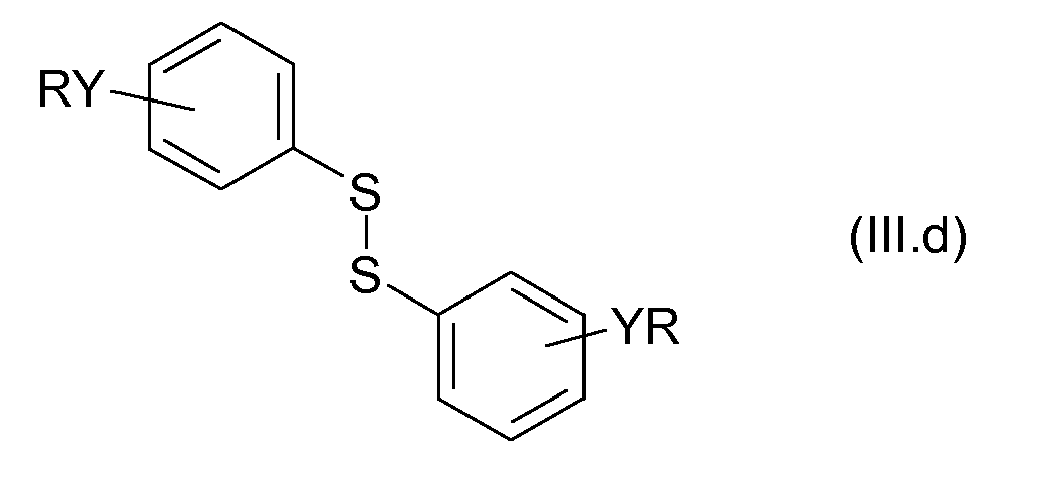
- the conversion of the disulfide of the formula III.d into a thiolate compound of the formula I.b in step 2) is preferably carried out by reductive cleavage of the disulfide bridge.
- the chlorosulfonation in step 1) is carried out in the usual manner, for. B. by means of chlorosulfonic acid.
- Suitable compounds of the formula RZ 2 H are those mentioned above.
- reaction of the sulfonyl chloride with the compound of the formula RZ 2 H is preferably carried out in the presence of a base, such as potassium carbonate or triethylamine.
- the conversion of the disulfide of the formula I.e into a thiolate compound of the formula I in step 3) is preferably carried out by reductive cleavage of the disulfide bridge.
- the disulfides used in step 1) can easily be obtained by oxidative dimerization of mercaptophenol.
- Preferred alkylene oxides are ethylene oxide, propylene oxide or 1,2-butylene oxide.
- a suitable base is sodium hydride.
- the conversion of the disulfide of the formula III.i into a thiolate compound of the formula I in step 3) is preferably carried out by reductive cleavage of the disulfide bridge.
- the compound of the formula IV.c used in step 1 as starting material can be prepared by processes which are known to a person skilled in the art. So you can z. B. benzoic acid chloride in the presence of a base with a compound of formula RZ 2 H implement, wherein Z 2 is O or NR '.
- the chlorosulfonation in step 1 is preferably carried out by reacting the compound of formula IV.c with chlorosulfonic acid or sulfonating with known sulfonating agents such as oleum or sulfur trioxide and then chlorinating the introduced sulfonyl group with known chlorinating reagents such as PCl 3 , PCl 5 , phosgene and oxalyl chloride.
- known sulfonating agents such as oleum or sulfur trioxide
- chlorinating reagents such as PCl 3 , PCl 5 , phosgene and oxalyl chloride.
- step 2 the sulfonyl chloride of formula IV.d is converted by reduction into a thiolate compound of formula Ib.
- the sulfonyl chloride is reduced with reducing agents known to the skilled worker for sulfonyl chlorides such as, for example, SnCl 2 / HCl, and the resulting thiol compound is then converted by reaction with neutralizing agent into a thiolate compound of the formula Ib.
- the neutralizing agents used are preferably alkali metal and alkaline earth bases such as Na 2 CO 3 , K 2 CO 3 , NaOH, KOH or CaCO 3 or nitrogen bases such as ammonia.
- Suitable leaving groups Z 6 are z.
- halogen in particular chlorine.
- the [1,3,5] -triazine of the formula V.a used in step 1 is commercially available.
- a preferred [1,3,5] triazine of formula I.h is 2,4,6-trichloro [1,3,5] triazine.
- Suitable compounds of the formula RZ 2 H are those mentioned above.
- the reaction of the compound of the formula Vb with thiourea to the thiuronium salt of the formula Vc in step 2 is preferably carried out in a suitable solvent at temperatures in a range from -50 to 70 ° C, preferably -20 to 40 ° C, especially -10 to 20 ° C.
- Alkanols are preferred as the organic solvent, in particular C 1 -C 6 -alkanols, such as methanol, ethanol, 1-propanol or 2-propanol.
- Thiourea and the compound Vb are used regularly in a molar ratio in a range from 1:10 to 10: 1, preferably from 2: 1 to 1: 4, in particular from 1: 1 to 3: 1.
- step 3 the thiuronium salt of the formula Vc is preferably reacted with an alkali metal base such as Na 2 CO 3 , K 2 CO 3 , NaOH or KOH. Preference is given to using the base in excess.
- an alkali metal base such as Na 2 CO 3 , K 2 CO 3 , NaOH or KOH. Preference is given to using the base in excess.
- Fig. 1 shows the results of extraction tests carried out on conventionally plasticized PVC (upper curve) and on PVC with plasticized (lower curve) according to the invention
- cyanuric chloride (1,3,5-trichloro-2,4,6-triazine) are dissolved in 300 ml of methyl ethyl ketone (MEK). Then, at 0 ° C., 0.1 mol of 2-ethyl-1-hexanol and 0.1 mol of Na 2 CO 3 are added. The reaction solution is warmed to room temperature and stirred at this temperature for 30 minutes. Then, 0.1 mol of 2-ethyl-1-hexanol and 0.1 mol of Na 2 CO 3 are added. The reaction solution is stirred for 1 hour at 45 ° C and then cooled to room temperature. Thereafter, the mixture is washed with distilled water, the organic phase dried with magnesium sulfate and the solvent removed on a rotary evaporator. The resulting crude product is distilled in vacuo. Yield: about 75%.
- the migration properties of the modified PVC are tested by extraction experiments with hexane as extractant.
- a sample of the modified PVC is weighed and covered with hexane with stirring. After different time intervals, the sample is removed, dried and weighed again. From the difference of the detected and original mass, the amount of migrated plasticizer can be determined.
- a typical extraction curve of a PVC sample made in this invention is in FIG Fig. 1 shown (lower curve).
- For comparison is also an extraction curve of a dioctyl phthalate plasticized PVC (upper curve).
Landscapes
- Chemical & Material Sciences (AREA)
- Organic Chemistry (AREA)
- Health & Medical Sciences (AREA)
- Chemical Kinetics & Catalysis (AREA)
- Medicinal Chemistry (AREA)
- Polymers & Plastics (AREA)
- General Chemical & Material Sciences (AREA)
- Organic Low-Molecular-Weight Compounds And Preparation Thereof (AREA)
Abstract
Thiolatverbindungen der allgemeinen Formel I werden als Weichmacher für PVC verwendet,
worin
M +
für H oder ein Kationäquivalent steht,
n
für 1 oder 2 steht,
X
unabhängig voneinander für eine Gruppe CH oder N stehen,
Y
an ein Ring-C-Atom gebunden ist und unabhängig voneinander für *-CO-O-, *-O-CO-, *-CO-NR'-, *-NR'-CO-, *-SO 2 -NR'-, *-NH-CO-O-, *-NH-CO-NR'-, *-O-, *-S- oder *-NR'- steht, wobei * den Anknüpfungspunkt an das Ringsystem beschreibt,
R
für einen Polyalkylenoxid-Rest steht, oder, wenn wenigstens ein X für N steht, R auch für (C 6 -C 22 )-Alkyl stehen kann,
R'
für Wasserstoff, (C 1 -C 4 )-Alkyl oder R steht.
Description
- Die Erfindung betrifft nicht-migrierende PVC-Weichmacher auf Basis von Thiolatverbindungen, Verfahren zu deren Herstellung sowie Polyvinylchloride (PVC), die mit diesen Weichmachern kovalent modifiziert wurden.
- PVC-Formulierungen finden Einsatz in der Produktion von vielerlei Artikeln im medizinischen Bereich, zum Beispiel in Transfusionsschläuchen und Blut- und Urinbeuteln. Sie werden außerdem als Verpackungsmaterialien eingesetzt, in Spielzeug, Badezimmervorhängen und Fußbodenbelägen. Damit das PVC die erforderliche Flexibilität erhält, werden ihm große Mengen von Weichmachern zugesetzt. Phthalate wie Dioctylphthalat (DOP) gehören zu den am häufigsten verwendeten Additiven für diesen Zweck. Aus thermodynamischen Gründen haben diese Weichmacher die Tendenz, an die Oberfläche des betreffenden Artikels zu migrieren. Dies führt zum Einem zu einem fortschreitenden Verlust der ursprünglichen Eigenschaften des Materials und kann zum Anderen erhebliche Gesundheitsschäden verursachen, wenn es sich um Artikel für biomedizinische Anwendungen oder Kinderspielzeug handelt, bei denen die an die Oberfläche migrierten Additive in den menschlichen Organismus gelangen und physiologische Flüssigkeiten wie Blut, Speichel oder Plasma kontaminieren. So ist gezeigt worden, dass Phthalate menschliches Gewebe schädigen können, wobei besonders die Hirnanhangdrüse (Hypophyse), die Leber und die Hoden betroffen sind. Metabolite von DOP wurden zudem als stark krebsfördernde Substanzen identifiziert. Aus all diesen Gründen wird seit langem daran gearbeitet, die Migration von Weichmachern in die Umwelt zu reduzieren.
- Eine vielversprechende Strategie, um das Migrationsproblem zu lösen, ist die kovalente chemische Anbindung des Additivs an die Polymerkette, was zu copolymerartigen Strukturen führt. PVC kann durch Substitution der Chloratome durch geeignete Nukleophile chemisch modifiziert werden.
- Die Möglichkeit, substituierte Thiole zu verwenden, um niedermolekulare Weichmacher irreversible an die PVC-Ketten zu binden, ist in der
FR 2557115A1 - In der
WO 2010/070176A1 wird die Anbindung von Thiol-modifiziertem Dioctylphtalat an PVC beschrieben. Auch hier sind die erzielten Umsätze auf 25 mol% beschränkt. Aufgrund der sterisch günstigeren Anordnung der aliphatischen Estergruppen konnten hier Glasübergangstemperaturen um 0°C für die am höchsten modifizierten Polymere erzielt werden. Um einen ausreichenden Weichmachereffekt zu erzielen, muss jedoch ein hoher Anteil der Chloratome - bis zu einem Viertel aller Chloratome im PVC - substituiert werden. Hierdurch kann es zu einer Verschlechterung der optischen Eigenschaften, z. B. durch Vergilbung, und der mechanischen Eigenschaften kommen. Ein weiterer Nachteil, der den Gebrauch der in dieser Anmeldung beschriebenen Technologie für einen industriellen Nutzen erheblich einschränkt, ist auch hier die Notwendigkeit, das erhaltene Produkt von nicht umgesetztem Weichmacher zu befreien. - Die Aufgabe der vorliegenden Erfindung liegt in der Bereitstellung von nicht-migrierenden PVC-Weichmachern, die bereits bei einem geringen PVC-Substitutionsgrad einen ausreichenden Weichmachereffekt zeigen. Glastemperaturen und mechanische Eigenschaften des modifizierten PVCs sollen mit denen eines PVCs vergleichbar sein, das mit konventionellen, migrierenden Weichmachern behandelt wurde. Die Modifizierung des PVCs mit dem nicht-migrierenden Weichmacher soll dabei so vollständig ablaufen, dass eine Aufreinigung des PVCs überflüssig ist.
- Diese und weitere Aufgaben werden überraschender Weise gelöst durch Weichmacher auf Basis aromatischer Thiolatverbindungen, die Polyalkylenoxidreste tragen.
- Ein erster Gegenstand der Erfindung ist daher eine Thiolatverbindung der allgemeinen Formel I

- M+
- für H oder ein Kationäquivalent steht,
- n
- für 1 oder 2 steht,
- X
- unabhängig voneinander für eine Gruppe CH oder N stehen,
- Y
- an ein Ring-C-Atom gebunden ist und unabhängig voneinander für *-CO-O-, *-O-CO-, *-CO-NR'-, *-NR'-CO-, *-SO2-NR'-, *-NH-CO-O-, *-NH-CO-NR'-, *-O-, *-S-oder *-NR'- steht, wobei * den Anknüpfungspunkt an das Ringsystem beschreibt,
- R
- für einen Polyalkylenoxid-Rest steht, oder, wenn wenigstens ein X für N steht, R auch für (C6-C22)-Alkyl stehen kann,
- R'
- für Wasserstoff, (C1-C4)-Alkyl oder R steht.
- Ein weiterer Gegenstand der Erfindung ist modifiziertes PVC, das Wiederholungseinheiten der Formeln II.a und II.b enthält,

- Das molare Verhältnis der Wiederholungseinheiten der Formel II.b zu den Wiederholungseinheiten der Formel II.a beträgt vorzugsweise 1:200 bis 1:9, insbesondere 1:100 bis 1:30.
- Die Erfindung betrifft außerdem die Verwendung des modifizierten PVCs in biomedizinischen Anwendungen, in Kinderspielzeug und in Anwendungen, in denen das modifizierte PVC in Kontakt mit dem menschlichen Organismus oder physiologischen Flüssigkeiten tritt.
- Der Ausdruck "Kationäquivalent" steht in der vorliegenden Anmeldung für ein einfach positiv geladenes Kation oder den fiktiven, einfach positiv geladenen Bruchteil eines mehrfach positiv geladenen Kations.
- In der Formel I steht M+ für H oder ein Kationäquivalent, vorzugsweise ein Kationäquivalent, insbesondere ein Ammoniumion, Alkalimetall-Kation oder ein Kationäquivalent eines Erdalkalimetall-Kations. Vorzugsweise steht M+ für ein Alkalimetall-Kation wie Na+ oder K+.
- Die Variable "n" steht für 1 oder 2.
- Die Variable "X" steht unabhängig für N oder CH. Vorzugsweise steht X ausschließlich für N oder ausschließlich für CH. In einer bevorzugten Ausführungsform steht X ausschließlich für CH und n für 1. In einer weiteren bevorzugten Ausführungsform steht X ausschließlich für N und n für 2.
- In der allgemeinen Formel I steht R für einen Polyalkylenoxid-Rest. Unter einem Polyalkylenoxid-Rest wird ein Rest verstanden, der Alkylenoxid-Wiederholungseinheiten umfasst. Die Alkylenoxid-Wiederholungseinheiten leiten sich vorzugsweise von (C2-C6)-Alkylenoxiden ab. In bestimmten Ausführungsformen ist der Polyalkylenoxid-Rest am distalen Ende verethert.
- Bevorzugte Reste R weisen die allgemeine Formel auf:
-Qk-(CxH2x-O)m-R"
worin - k
- für 0 oder 1 steht,
- x
- für eine ganze Zahl von 2 bis 6 steht,
- m
- für 3 bis 1000 steht,
- Q
- für C2-C20-Alkylen, vorzugsweise C2-C8-Alkylen, steht und
- R"
- für Wasserstoff C1-C24-Alkyl, vorzugsweise Wasserstoff oder C1-C24-Alkyl, steht.
- Bevorzugte Polyalkylenoxide sind Poly((C2-C6)-alkylenoxide) wie Poly(ethylenoxid) oder Poly(propylenoxid) oder Copolymere verschiedener (C2-C6)-Alkylenoxide, wie Copolymere aus Ethylenoxid und Propylenoxid.
- Wenn wenigstens ein X für N steht, kann R auch für (C6-C22)-Alkyl, vorzugsweise (C8-C18)-Alkyl stehen. Der Alkylrest kann geradkettig oder verzweigt sein und ist vorzugsweise verzweigt.
- Der Substituent R' steht für Wasserstoff oder (C1-C4)-Alkyl oder hat die für R genannten Bedeutung. Bevorzugt steht R' für Wasserstoff oder (C1-C4)-Alkyl, insbesondere für Wasserstoff oder Methyl.
- In der allgemeinen Formel I ist Y an ein Ring-C-Atom gebunden und steht unabhängig voneinander für *-CO-O-, *-O-CO-, *-CO-NR'-, *-NR'-CO-, *-SO2-NR'-, *-NH-CO-O-, *-NH-CO-NR'-, *-O-, *-S- oder *-NR'-. Bevorzugt steht Y für *-CO-O-, *-CO-NR'-, *-SO2-NR'-, *-NH-CO-O- oder *-O-. Insbesondere steht Y für *-CO-NR'-, *-SO2-NR'-, *-NH-CO-O- oder *-O-.
- Die Thiolatverbindung der allgemeinen Formel I weist ein Molekulargewicht von mindestens 400 g/mol, vorzugsweise 600 bis 10000 g/mol, insbesondere 800 bis 2000 g/mol auf.
- Das erfindungsgemäß modifizierte PVC weist hervorragende mechanische und optische Eigenschaften auf. Es ist transparent, flexibel, dauerelastisch und zeigt eine hohe Reißfestigkeit. Weiterhin ist die Glasübergangstemperatur des modifizierten PVCs im Vergleich zu nicht modifiziertem PVC erniedrigt. Schon ein geringer Anteil an Wiederholungseinheiten der Formel llb im modifizierten PVC führt zu den beschriebenen verbesserten mechanischen Eigenschaften.
- Der kovalent gebundene erfindungsgemäße Weichmacher migriert nicht. Aufgrund der damit verbundenen verringerten Toxizität kann das erfindungsgemäß modifizierte PVC auch in Anwendungen eingesetzt werden, in denen Menschen in direkten Kontakt mit dem modifizierten PVC kommen. Folglich ist ein weiterer Aspekt der vorliegenden Erfindung die Verwendung des modifizierten PVCs in biomedizinischen Anwendungen, in Kinderspielzeug und in Anwendungen, in denen das modifizierte PVC in Kontakt mit dem menschlichen Organismus oder physiologischen Flüssigkeiten tritt.
- Das PVC kann durch Emulsions-, Suspensions- oder Masse-Polymerisation hergestellt sein.
- Zur Modifizierung wird PVC mit der Thiolatverbindung gemäß Formel I umgesetzt, in der M+ für ein Kationäquivalent steht, oder in Gegenwart einer Base mit der Thiolatverbindung gemäß Formel I umgesetzt, worin M+ für H steht. Eine geeignete Base ist Natriumcarbonat. Die Modifizierung kann lösungsmittelfrei oder in Wasser suspendiert oder in organischen Lösungsmitteln gelöst erfolgen. Bevorzugt wird das PVC in Wasser suspendiert oder lösungsmittelfrei umgesetzt. Als organisches Lösungsmittel werden dem Fachmann bekannte Lösungsmittel für PVC wie Tetrahydrofuran oder Dimethylformamid verwendet. Die lösungsmittelfreie Einarbeitung des erfindungsgemäßen Weichmachers in das PVC erfolgt z. B. auf einem Mischwalzwerk, z.B. einem Zweiwalzenstuhl bei Temperaturen zwischen 150° und 200°C. Alternativ kann Suspensions-PVC in Form einer wässrigen Paste mit dem erfindungsgemäßen Weichmacher bei Temperaturen zwischen 40° und 90°C umgesetzt werden. Unter den Bedingungen der Einarbeitung erfolgt eine nukleophile Substitution von Chloratomen des PVC durch die Thiolatgruppe des erfindungsgemäßen Weichmachers.
- In einer bevorzugten Ausführungsform entspricht die erfindungsgemäße Thiolatverbindung der allgemeinen Formel I.a

- In der Formel I.a steht Y vorzugsweise für *-O-, *-S- oder *-NR'-. In der Formel I.a steht R vorzugsweise für für (C6-C22)-Alkyl, insbesondere für (C8-C18)-Alkyl.
- In einer weiteren bevorzugten Ausführungsform entspricht die erfindungsgemäße Thiolatverbindung der allgemeinen Formel I.b

- In der Formel I.a steht Y vorzugsweise für *-CO-O-, *-O-CO-, *-CO-NR'-, *-SO2-NR'-, *-NH-CO-O-, *-NH-CO-NR'- oder *-O-.
- Ein weiterer Aspekt der vorliegenden Erfindung sind Verfahren zur Herstellung von Thiolatverbindungen gemäß der allgemeinen Formel I. Diese Verbindungen können insbesondere durch die folgenden Verfahren hergestellt werden.
- In einem bevorzugten Verfahren wird eine Thiolatverbindung der allgemeinen Formel I.b hergestellt, worin Y für *-CO-O-, *-CO-NR'-, *-NH-CO-O-, *-NH-CO-NR'- steht, indem man
- 1) ein Disulfid der Formel III.a

mit einer Verbindung der Formel R-Z2H, worin Z2 für O oder NR' steht, zum Disulfid der Formel III.b umsetzt,
und
- 2) das Disulfid der Formel III.b in eine Thiolatverbindung der Formel I.b umwandelt. Die im Schritt 1) eingesetzten Disulfide lassen sich leicht durch oxidative Dimerisierung von Thiolverbindungen der Formel IV.a,

- Die Thiolverbindungen IV.a sind handelsüblich oder lassen sich durch dem Fachmann bekannte Verfahren herstellen.
- Die Dimerisierung der Thiolverbindung in Schritt 1 zu einem Disulfid erfolgt durch Oxidation. Entsprechende Oxidationsmittel zur Herstellung eines Disulfides sind dem Fachmann bekannt. Bevorzugt werden H2O2 und Persäuren mit 1 bis 10 Kohlenstoffatomen, insbesondere H2O2 eingesetzt.
- Z4 steht beispielsweise für COOH oder NH2. Die Gruppe COOH kann durch übliche Halogenierungsmittel, wie Thionylchlorid (SOCl2), Phosgen (COCl2), Phosphor(III)-chlorid oder Phosphor(V)-chlorid, in CO-Z3 umgewandelt werden, worin Z3 für Halogen steht. Die Gruppe COOH kann durch übliche Acylierungsmittel, wie Essigsäureanhydrid oder dem gemischten Anhydrid von Ameisensäure und Essigsäure, in CO-Z3 umgewandelt werden, worin Z3 für Acyloxy steht.
- Die Gruppe NH2 kann z. B. durch Umsetzung mit Phosgen in eine Isocyanatgruppe (NCO) umgewandelt werden.
- Als Verbindungen der Formel R-Z2H sind handelsübliche Polyoxyalkylenamine verwendbar, die unter der Bezeichnung Jeffamine® von Huntsman erhältlich sind. Als Verbindungen der Formel R-Z2H sind weiterhin Polyoxyalkylenalkohole verwendbar.
- Die Umsetzung des Disulfids III.a, worin Z1 für CO-Z3 steht, erfolgt vorzugsweise in Gegenwart einer Base, wie Kaliumcarbonat oder Triethylamin.
- Die Umwandlung des Disulfides der Formel III.b in eine Thiolatverbindung der Formel I.b in Schritt 2) erfolgt bevorzugt durch reduktive Spaltung der Disulfidbrücke. Reduktionsmittel zur reduktiven Spaltung von Disulidbrücken sind dem Fachmann bekannt. Bevorzugt werden Aluminiumhydride oder Borhydride, insbesondere Alkali-Aluminiumhydride oder Alkali-Borhydride, speziell Natriumborhydrid oder Kaliumborhydrid eingesetzt. Diese führen unmittelbar zum Alkalisalz des Thiolats der Formel I.b. Bei Verwendung anderer Reduktionsmittel ist gegebenenfalls eine anschließende Neutralisation mit einem geeigneten Neutralisationsmittel erforderlich.
- Ein Austausch des Gegenions des Thiolates wird gewünschtenfalls durch Protonierung des Thiolates mit einer Säure und anschließender Deprotonierung des gebildeten Thiols mit einer Base erreicht. Bevorzugt werden als Säuren ein- bis drei-protonige anorganische Säure wie Salzsäure, Schwefelsäure oder Phosphorsäure eingesetzt. Als Base werden bevorzugt Alkali- und Erdalkalibasen wie Na2CO3, K2CO3, NaOH, KOH bzw. CaCO3 oder Stickstoffbasen wie Ammoniak eingesetzt.
- In einem bevorzugten Verfahren wird eine Thiolatverbindung der allgemeinen Formel I.b hergestellt, worin Y für *-O-CO-, *-NR'-CO-, *-O- oder *-NR'- steht, indem man
- 1) ein Disulfid der Formel III.c


- 2) das Disulfid der Formel III.d in eine Thiolatverbindung der Formel I.b umwandelt.
- Die im Schritt 1) eingesetzten Disulfide lassen sich leicht durch oxidative Dimerisierung von Thiolverbindungen der Formel IV.b,

- Geeignete Abgangsgruppen Z5 sind z. B. Halogen, wie Chlor, Brom, lod; Methylsulfat, Tosylat, Methylsulfonat, Trifluormethansulfonat.
- Verbindungen der Formel R-Z5, worin Z5 für CO-Z3 steht, sind erhältlich durch dem Fachmann bekannte Verfahren.
- Verbindungen der Formel R-Z5, worin Z5 für eine Abgangsgruppe steht, sind beispielsweise erhältlich, indem man die Alkoholfunktion in einem Polyoxyalkylenalkohole in eine Abgangsgruppe umwandelt, z. B. durch Halogenierung oder Veresterung mit Toluolsulfonsäure oder dergleichen.
- Die Umsetzung des Disulfids der Formel III.c mit der Verbindung der Formel R-Z5 erfolgt vorzugsweise in Gegenwart einer Base, wie Kaliumcarbonat oder Triethylamin.
- Die Umwandlung des Disulfides der Formel III.d in eine Thiolatverbindung der Formel I.b in Schritt 2) erfolgt bevorzugt durch reduktive Spaltung der Disulfidbrücke. Hierzu wird auf die vorstehenden Ausführungen verwiesen.
- In einem bevorzugten Verfahren wird eine Thiolatverbindung der allgemeinen Formel I.b hergestellt, worin Y für *-SO2-NR'- steht, indem man
- 1) ein Disulfid der Formel III.e


- 2) das Sulfonylchlorid der Formel III.f mit einer Verbindung der Formel R-Z2H, worin Z2 für O oder NR' steht, zum Disulfid der Formel III.g umsetzt,

- 3) das Disulfid der Formel I.e in eine Thiolatverbindung der Formel I.b umwandelt.
- Die Chlorsulfonierung in Schritt 1) erfolgt in üblicher Weise z. B. mittels Chlorsulfonsäure.
- Geeignete Verbindungen der Formel R-Z2H sind die weiter oben genannten.
- Die Umsetzung des Sulfonylchlorids mit der Verbindung der Formel R-Z2H erfolgt vorzugsweise in Gegenwart einer Base, wie Kaliumcarbonat oder Triethylamin.
- Die Umwandlung des Disulfides der Formel I.e in eine Thiolatverbindung der Formel I in Schritt 3) erfolgt bevorzugt durch reduktive Spaltung der Disulfidbrücke. Hierzu wird auf die vorstehenden Ausführungen verwiesen.
- In einem bevorzugten Verfahren wird eine Thiolatverbindung der allgemeinen Formel I.b hergestellt, worin Y für *-O- steht, indem man
- 1) ein Disulfid der Formel III.h


- 2) das Disulfid der Formel III.i in eine Thiolatverbindung der Formel I.b umwandelt.
- Die im Schritt 1) eingesetzten Disulfide lassen sich leicht durch oxidative Dimerisierung von Mercaptophenol erhalten.
- Bevorzugte Alkylenoxide sind Ethylenoxid, Propylenoxid oder 1,2-Butylenoxid.
- Eine geeignete Base ist Natriumhydrid.
- Die Umwandlung des Disulfides der Formel III.i in eine Thiolatverbindung der Formel I in Schritt 3) erfolgt bevorzugt durch reduktive Spaltung der Disulfidbrücke. Hierzu wird auf die vorstehenden Ausführungen verwiesen.
- Ebenfalls bevorzugt ist ein Verfahren zur Herstellung der Thiolatverbindung der Formel I.b, bei dem man
- 1) eine Verbindung der Formel IV.c,

- 2) das erhaltene Sulfonylchlorid der Formel IV.d

- Die in Schritt 1 als Edukt eingesetzte Verbindung der Formel IV.c lässt sich nach Verfahren herstellen, die einem Fachmann bekannt sind. So kann man z. B. Benzoesäurechlorid in Gegenwart einer Base mit einer Verbindung der Formel R-Z2H umsetzen, worin Z2 für O oder NR' steht.
- Die Chlorsulfonierung in Schritt 1 wird bevorzugt durchgeführt, indem die Verbindung gemäß Formel IV.c mit Chlorsulfonsäure umgesetzt oder mit bekannten Sulfonierungsmitteln wie Oleum oder Schwefeltrioxid sulfoniert und anschließend die eingeführte Sulfonylgruppe mit bekannten Chlorierungsreagenzien wie PCl3, PCl5, Phosgen und Oxalylchlorid chloriert wird.
- In Schritt 2 wird das Sulfonylchlorid der Formel IV.d durch Reduktion in eine Thiolatverbindung der Formel I.b überführt. Dabei wird das Sulfonylchlorid mit dem Fachmann bekannten Reduktionsmitteln für Sulfonylchloriden wie beispielsweise SnCl2/HCl reduziert und anschließend die entstehende Thiolverbindung durch Umsetzung mit Neutralisationsmittel in eine Thiolatverbindung der Formel I.b überführt. Als Neutralisationsmittel werden bevorzugt Alkali- und Erdalkalibasen wie Na2CO3, K2CO3, NaOH, KOH bzw. CaCO3 oder Stickstoffbasen wie Ammoniak eingesetzt.
- Weiterhin ist ein Verfahren zur Herstellung einer Thiolatverbindung der Formel I.a bevorzugt, worin Y für *-O-, *-S- oder *-NR'- steht,
wobei man - 1) ein [1,3,5]-Triazin der Formel V.a

mit wenigstens einer Verbindung der Formel R-Z2H, worin Z2 für O oder NR' steht, zu einer Verbindung der Formel V.b umsetzt,
- 2) die Verbindung der Formel V.b mit Thioharnstoff zu einem Thiuroniumsalz der Formel V.c umsetzt

- 3) das erhaltene Thiouroniumsalz durch Umsetzung mit einer Base in die Thiolatverbindung der Formel I.a umwandelt.
- Geeignete Abgangsgruppen Z6 sind z. B. Halogen, wie insbesondere Chlor.
- Das in Schritt 1 eingesetzte [1,3,5]-Triazin der Formel V.a ist handelsüblich. Ein bevorzugtes [1,3,5]-Triazin der Formel I.h ist 2,4,6-Trichlor-[1,3,5]-triazin.
- Geeignete Verbindungen der Formel R-Z2H sind die weiter oben genannten.
- Die Umsetzung der Verbindung der Formel V.b mit Thioharnstoff zu dem ThiuroniumSalz der Formel V.c in Schritt 2 erfolgt vorzugsweise in einem geeigneten Lösungsmittel bei Temperaturen in einem Bereich von -50 bis 70 °C, vorzugsweise -20 bis 40 °C, insbesondere -10 bis 20 °C. Als organisches Lösungsmittel werden Alkanole bevorzugt, insbesondere C1-C6-Alkanole wie Methanol, Ethanol, 1-Propanol oder 2-Propanol. Thioharnstoff und die Verbindung V.b werden regelmäßig in einem molaren Verhältnis in einem Bereich von 1:10 bis 10:1, bevorzugt von 2:1 bis 1:4, insbesondere von 1:1 bis 3:1, eingesetzt.
- In Schritt 3 wird das Thiuroniumsalz der Formel V.c bevorzugt mit einer Alkali-Base wie Na2CO3, K2CO3, NaOH oder KOH umgesetzt. Bevorzugt wird dabei die Base im Überschuss eingesetzt.
- Die beigefügte Figur und die nachfolgenden Beispiele sollen die Erfindung weiter erläutern und sind nicht einschränkend zu verstehen.
-
Fig. 1 zeigt die Ergebnisse von Extraktionsversuchen, durchgeführt an konventionell weichgemachtem PVC (obere Kurve) und an PVC mit erfindungsgemäß weichgemachten (untere Kurve) - 10 g (0,065 mol) 4-Mercaptobenzoesäure werden in einer Mischung aus einem Teil destilliertem Wasser und einem Teil Methanol (v/v) gelöst und unter Rühren werden 2 ml H2O2 (30%) und 0,5 ml Ammoniakwasser zugegeben. Nach weiteren 30 Minuten Rühren bei Raumtemperatur wird der gebildete Niederschlag abfiltriert. Nach dem Trocknen erhält man ein weißes Pulver, dessen Reinheit ausreichend ist für die nachfolgende Umsetzung. Ausbeute: 90%
- 10 g (0,032 mol) 4,4'-Disulfandiyldibenzoesäure werden in 50 ml Thionylchlorid suspendiert. Anschließend werden 0,5 ml Dimethylformamid (DMF) zugegeben und die Mischung 2 Stunden unter Rückfluss erhitzt. Danach wird das überschüssige Thionylchlorid destillativ abgetrennt und der Rückstand in Hexan ausgefällt. Der Niederschlag wird mehrmals mit Hexan gewaschen und getrocknet. Ausbeute: 90%
- 5 g (0,015 mol) 4,4'-Disulfandiyldibenzoylchlorid werden in 100 ml Chloroform gelöst und bei 0 °C werden stöchiometrischen Mengen an O-(2-Aminopropyl)-O'-(2-methoxyethyl)polypropylenglycol (Jeffamine -2005, Huntsman) und Triethylamin zugegeben. Nach 2 Stunden Rühren bei Raumtemperatur wird die Reaktionslösung dreimal mit destilliertem Wasser gewaschen, die organische Phase mit Magnesiumsulfat getrocknet und das Lösungsmittel am Rotationsverdampfer entfernt. Der erhaltene Rückstand kann ohne weitere Reinigung für den nächsten Reaktionsschritt verwendet werden. Ausbeute: 99%.
- 10 g (2,3 mmol) 4,4'-Disulfandiyl-bis (N-polypropylenoxy)benzamid werden in 100 ml Isopropanol gelöst und 4 Moläquivalente NaBH4 werden anschließend hinzugegeben. Nach 12 Stunden Rühren bei Raumtemperatur wird konzentrierte HCl zu der Mischung, bis diese sauer reagiert. Nach zweimaliger Extraktion mit jeweils 150 ml Chloroform, wird die organische Phase dreimal mit einer gesättigten, wässrigen Natriumhydrogencarbonat-Lösung gewaschen, mit Magnesiumsulfat getrocknet und das Lösungsmittel destillativ entfernt. Das erhaltene Öl kann direkt für die Umsetzung mit PVC weiterverwendet werden. Ausbeute: 99%
- 10 g (0,09 mol) Thiophenol werden in einer Mischung aus einem Teil destilliertem Wasser und einem Teil Methanol (v/v) gelöst und anschließend werden unter Rühren 2 ml H2O2 (30%) und 0,5 ml Ammoniakwasser zugegeben. Nach 30 Minuten Rühren bei Raumtemperatur wird der gebildete Niederschlag abfiltriert. Nach dem Trocknen erhält man ein weißes Pulver, dessen Reinheit ausreichend ist für die nachfolgende Umsetzung. Ausbeute: 93%
- Zu einer Lösung von 0,3 mol Chlorsulfonsäure in Chloroform wird langsam eine Lösung von 0,1 mol Diphenyldisulfan in 100 ml Chloroform zugegeben, ohne dass die Reaktionstemperatur 10°C übersteigt. Nach erfolgter Zugabe wird die Reaktionslösung noch eine Stunde bei 40°C gerührt. Die Mischung wird auf Eis gegossen und das Produkt mit Chloroform extrahiert. Nachdem die organische Phase dreimal einer gesättigten, wässrigen Natriumhydrogencarbonat-Lösung gewaschen und dreimal mit destilliertem Wasser gewaschen wurde, wird die organische Phase mit Magnesiumsulfat getrocknet und das Lösungsmittel destillativ entfernt. Man erhält das Produkt in Form von hellgelben Nadeln. Ausbeute: 70%.
- 5 g (0,012 mol) 4,4'-Disulfandiyldibenzenesulfonylchlorid werden in 80 ml Chloroform gelöst und anschließend wird bei 0°C stöchiometrische Mengen an O-(2-Aminopropyl)-O'-(2-methoxyethyl)polypropylenglycol (Jeffamine M-2005, Huntsman) und Triethylamin zugegeben. Nach 2 Stunden Rühren bei Raumtemperatur wird die Reaktionslösung dreimal mit destilliertem Wasser gewaschen, mit Magnesiumsulfat getrocknet und das Lösungsmittel am Rotationsverdampfer entfernt. Der erhaltene Rückstand kann ohne weitere Reinigung für den nächsten Reaktionsschritt verwendet werden. Ausbeute: 98%.
- 10 g (2,25 mmol) 4,4'-Disulfandiyl-bis-(N-polypropylenoxy)benzolsulfonamid werden in 100 ml Isopropanol gelöst und anschließend werden 4 Moläquivalente NaBH4 zugegeben. Nach 12 h Rühren bei Raumtemperatur wird konzentrierte HCl zu der Mischung, bis diese sauer reagiert. Nach zweimaliger Extraktion mit jeweils 150 ml Chloroform, wird die organische Phase dreimal mit einer gesättigten, wässrigen Natriumhydrogencarbonat-Lösung gewaschen, mit Magnesiumsulfat getrocknet und das Lösungsmittel destillativ entfernt. Das erhaltene Öl kann direkt für die Umsetzung mit PVC weiterverwendet werden. Ausbeute: 99%
- 0,3 mol Cyanurchlorid (1,3,5-Trichlor-2,4,6-triazin) werden in 300 ml Methyl-ethylketon (MEK) gelöst. Anschließend werden bei 0°C 0,1 mol 2-Ethyl-1-hexanol und 0,1 mol Na2CO3 zugegeben. Die Reaktionslösung wird auf Raumtemperatur erwärmt und rührt bei dieser Temperatur 30 Minuten gerührt. Dann werden 0,1 mol 2-Ethyl-1-hexanol und 0,1 mol Na2CO3 zugegeben. Die Reaktionslösung wird 1 Stunde bei 45°C gerührt und anschließend auf Raumtemperatur abgekühlt. Danach wird die Mischung mit destilliertem Wasser gewaschen, die organische Phase mit Magnesiumsulfat getrocknet und das Lösungsmittel am Rotationsverdampfer entfernt. Das erhaltene Rohprodukt wird im Vakuum destilliert. Ausbeute: ca. 75%.
- 0,1 mol 1,3-Di(2-ethyl-hexyl)oxy-5-chlor-2,4,6-triazin werden in 50 ml Ethanol gelöst und bei 0°C werden 0,11 mol Thioharnstoff zugegeben. Nach zwei Stunden Rühren bei Raumtemperatur wird der Ethanol destillativ entfernt und der Rückstand durch Säulenchromatographie gereinigt. Ausbeute: 70%
- 0,1 mol des unter 1.3.2 beschriebenen Thiuroniumsalzes werden in einer Mischung aus Ethanol-Wasser 2:1 (v:v) gelöst und anschießend werden 0,11 mol Na2CO3 zugegeben. Nach 2 Stunden Rühren bei 40°C wird die Reaktionslösung dreimal mit Chloroform extrahiert, die organische Phase mit Magnesiumsulfat getrocknet und das Lösungsmittel destillativ entfernt. Das erhaltene Öl kann ohne weitere Aufreinigung für die Umsetzungsreaktion mit PVC weiterverwendet werden. Ausbeute: 95%
- 1 g (0.016 mol) PVC werden in 100 ml Cyclohexanon gelöst. Dann gibt man 1g (0.0005 mol) Polypropylenoxy-4-mercaptobenzamid dazu und 1g (0.0094 mol) Na2CO3 und erwaermt 16 Stunden unter N2-Schutzgas und Rühren auf 60°C. Man fällt dann die Mischung in H2O/MeOH 1:3 aus, saugt das Polymer ab und reinigt es durch dreimaliges Umfällen aus THF(Lösungsmittel)/MeOH (Fällungsmittel). Nach dem Trocknen erhäelt man das modifizierte PVC in einer Ausbeute von 99%.
- 1 g (0.016 mol) PVC werden in 100 ml H2O suspendiert. Dann gibt man 1g (0.0005 mol) Polypropylenoxy-4-mercaptobenzamid dazu und 1g (0.0094 mol) Na2CO3 und erwaermt 16 Stunden unter N2-Schutzgas und Rühren auf 60°C. Dabei bildet sich eine polymerartige Masse, die auf dem Wasser schwimmt und leicht abgetrennt werden kann. Man reinigt sie durch dreimaliges Umfällen aus THF(Lösungsmittel)/MeOH (Fällungsmittel). Nach dem Trocknen erhält man das modifizierte PVC in einer Ausbeute von 95%.
- Man mischt in der Kälte 1 g (0.016 mol) Emulsions-PVC mit 1 g (0.0005 mol) Polypropylenoxy-4-mercaptobenzoesäureester Natriumsalz wobei man eine weisse zähe Paste erhält. Diese wird ohne Zusatz von weiteren Additiven in eine auf 160°C geheizte Formpresse gegeben und 3 Minuten unter Druck belassen. Nach dem Abkühlen kann das fertige Plastisol aus der Form entnommen werden (Ausbeute 100%).
- Die Migrationseigenschaften des modifizierten PVC werden durch Extraktionsexperimente mit Hexan als Extraktionsmittel getestet. Man wiegt eine Probe des modifizierten PVC ein und bedeckt sie unter Rühren mit Hexan. Nach unterschiedlichen Zeitabständen wird die Probe entnommen, getrocknet und erneut gewogen. Aus der Differenz der festgestellten und ursprünglichen Masse kann die Menge an migriertem Weichmacher ermittelt werden. Eine typische Extraktionskurve von einer in dieser Erfindung hergestellten PVC-Probe ist in
Fig. 1 dargestellt (untere Kurve). Zum Vergleich ist außerdem eine Extraktionskurve eines mit Dioctylphthalat weichgemachten PVC (obere Kurve) dargestellt.
Claims (15)
- Thiolatverbindung der allgemeinen Formel I
 M+ für H oder ein Kationäquivalent steht,n für 1 oder 2 steht,X unabhängig voneinander für eine Gruppe CH oder N stehen,Y an ein Ring-C-Atom gebunden ist und unabhängig voneinander für *-CO-O-, *-O-CO-, *-CO-NR'-, *-NR'-CO-, *-SO2-NR'-, *-NH-CO-O-, *-NH-CO-NR'-, *-O-, *-S- oder *-NR'- steht, wobei * den Anknüpfungspunkt an das Ringsystem beschreibt,R für einen Polyalkylenoxid-Rest steht, oder, wenn wenigstens ein X für N steht, R auch für (C6-C22)-Alkyl stehen kann,R' für Wasserstoff, (C1-C4)-Alkyl oder R steht.
 - Thiolatverbindung nach Anspruch 1, der allgemeinen Formel I.a

- Thiolatverbindung nach Anspruch 1, der allgemeinen Formel I.b

- Thiolatverbindung nach einem der vorhergehenden Ansprüche, worin R die allgemeine Formel aufweist:
-Qk-(CxH2x-O)m-R"
worink für 0 oder 1 steht,x für eine ganze Zahl von 2 bis 6 steht,m für 3 bis 100 steht,Q für C2-C20-Alkylen steht undR" für Wasserstoff oder C1-C24-Alkyl steht. - Thiolatverbindung nach einem der vorhergehenden Ansprüche, aufweisend ein Molekulargewicht von mindestens 600 g/mol.
- Verwendung einer Thiolatverbindung der Formel I nach einem der vorhergehenden Ansprüche zur Weichmachung von PVC.
- Modifiziertes PVC, enthaltend Wiederholungseinheiten der Formeln II.a und II.b

- Modifiziertes PVC nach Anspruch 7, worin das molare Verhältnis der Wiederholungseinheiten der Formel II.b zu den Wiederholungseinheiten der Formel II.a 1:200 bis 1:9 beträgt.
- Verwendung des modifizierten PVC nach Anspruch 7 oder 8 in biomedizinischen Anwendungen, in Kinderspielzeug und in Anwendungen, in denen das modifizierte PVC in Kontakt mit dem menschlichen Organismus oder physiologischen Flüssigkeiten tritt.
- Verfahren zur Herstellung einer Thiolatverbindung nach Anspruch 3 der allgemeinen Formel I.b, worin Y für *-CO-O-, *-CO-NR'-, *-NH-CO-O- oder *-NH-CO-NR'- steht, indem man1) ein Disulfid der Formel III.a

mit einer Verbindung der Formel R-Z2H, worin Z2 für O oder NR' steht, zum Disulfid der Formel III.b umsetzt, 2) das Disulfid der Formel III.b in eine Thiolatverbindung der Formel I.b umwandelt.
 - Verfahren zur Herstellung einer Thiolatverbindung nach Anspruch 3 der allgemeinen Formel I.b, worin Y für *-O-CO-, *-NR'-CO-, *-O- oder *-NR'- steht, indem man1) ein Disulfid der Formel III.c

 2) das Disulfid der Formel III.d in eine Thiolatverbindung der Formel I.b umwandelt.
 - Verfahren zur Herstellung einer Thiolatverbindung nach Anspruch 3 der allgemeinen Formel I.b, worin Y für *-SO2-NR'- steht, indem man1) ein Disulfid der Formel III.e

 2) das Sulfonylchlorid der Formel III.f mit einer Verbindung der Formel R-Z2H, worin Z2 für O oder NR' steht, zum Disulfid der Formel III.g umsetzt,
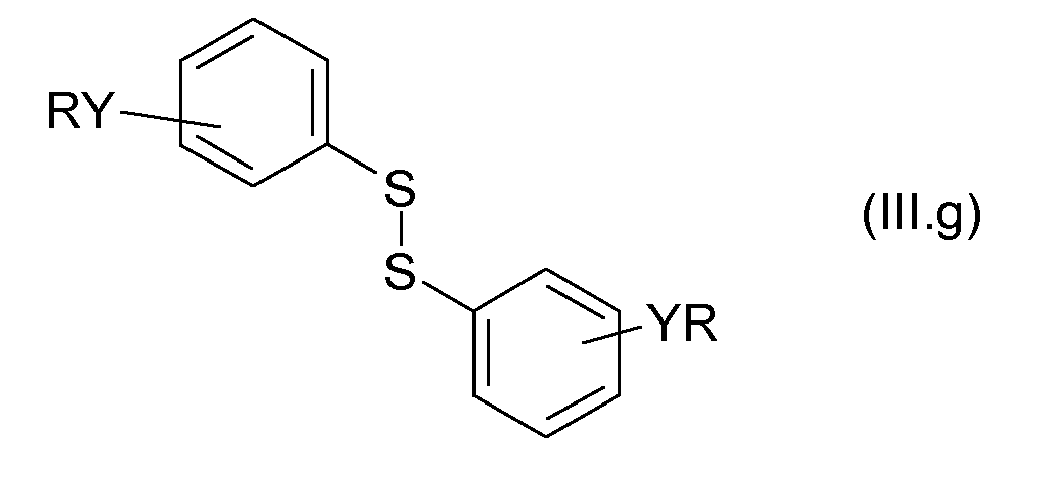 3) das Disulfid der Formel I.e in eine Thiolatverbindung der Formel I.b umwandelt.
 - Verfahren zur Herstelung einer Thiolatverbindung nach Anspruch 3 der allgemeinen Formel I.b, worin Y für *-O- steht, indem man1) ein Disulfid der Formel III.h

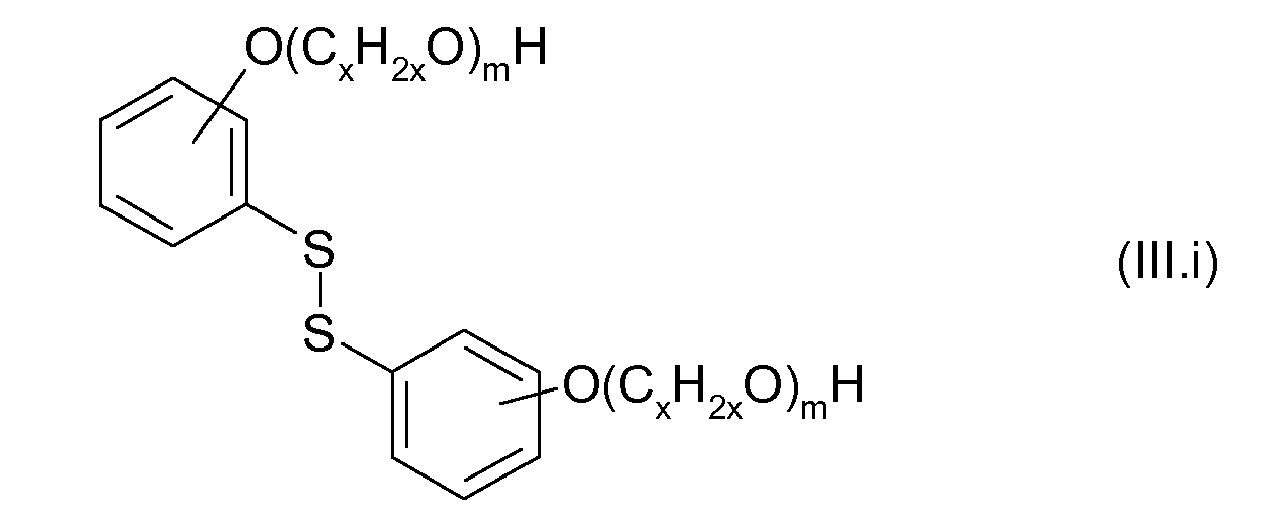 2) das Disulfid der Formel III.i in eine Thiolatverbindung der Formel I.b umwandelt.
 - Verfahren zur Herstellung einer Thiolatverbindung nach Anspruch 3 der Formel I.b, indem man1) eine Verbindung der Formel IV.c,

das erhaltene Sulfonylchlorid der Formel IV.d
- Verfahren zur Herstellung einer Thiolatverbindung nach Anspruch 2 der Formel I.a, worin Y für *-O-, *-S- oder *-NR'- steht, indem man1) ein [1,3,5]-Triazin der Formel V.a

mit wenigstens einer Verbindung der Formel R-Z2H, worin Z2 für O oder NR' steht, zu einer Verbindung der Formel V.b umsetzt, 2) die Verbindung der Formel V.b mit Thioharnstoff zu einem Thiuroniumsalz
der Formel V.c umsetzt, und 3) das erhaltene Thiouroniumsalz durch Umsetzung mit einer Base in die Thiolatverbindung der Formel I.a umwandelt.
Priority Applications (1)
| Application Number | Priority Date | Filing Date | Title |
|---|---|---|---|
| EP20110156107 EP2492259A1 (de) | 2011-02-25 | 2011-02-25 | Thiolate als nicht-migrierende PVC-Weichmacher |
Applications Claiming Priority (1)
| Application Number | Priority Date | Filing Date | Title |
|---|---|---|---|
| EP20110156107 EP2492259A1 (de) | 2011-02-25 | 2011-02-25 | Thiolate als nicht-migrierende PVC-Weichmacher |
Publications (1)
| Publication Number | Publication Date |
|---|---|
| EP2492259A1 true EP2492259A1 (de) | 2012-08-29 |
Family
ID=44117264
Family Applications (1)
| Application Number | Title | Priority Date | Filing Date |
|---|---|---|---|
| EP20110156107 Withdrawn EP2492259A1 (de) | 2011-02-25 | 2011-02-25 | Thiolate als nicht-migrierende PVC-Weichmacher |
Country Status (1)
| Country | Link |
|---|---|
| EP (1) | EP2492259A1 (de) |
Citations (6)
| Publication number | Priority date | Publication date | Assignee | Title |
|---|---|---|---|---|
| FR2557115A1 (fr) | 1983-12-23 | 1985-06-28 | Centre Nat Rech Scient | Procede d'obtention de polychlorure de vinyle plastifie contenant des fonctions plastifiantes greffees |
| EP0365483A1 (de) * | 1988-10-20 | 1990-04-25 | Ciba-Geigy Ag | Mercaptobenzoesäureester als Stabilisatoren für chlorhaltige Polymerisate |
| EP1394153A1 (de) * | 2001-06-04 | 2004-03-03 | Unimatec Co., Ltd. | Derivate von thiolverbindungen, härtende zusammensetzungen, die diese derivate enthalten, und daraus geformte artikel |
| US20070054814A1 (en) * | 2005-09-01 | 2007-03-08 | Fuji Photo Film Co., Ltd. | Lubricant composition, bearing apparatus, sliding member and triazine-ring compound |
| JP2007238558A (ja) * | 2006-03-10 | 2007-09-20 | Hokkaido Univ | ナノ粒子化合物、この化合物を用いる金属イオンの検出方法及び除去方法 |
| WO2010070176A1 (es) | 2008-12-18 | 2010-06-24 | Consejo Superior De Investigaciones Científicas (Csic) | Nuevos aditivos basados en ftalatos para la plastificación interna de polimeros clorados |
-
2011
- 2011-02-25 EP EP20110156107 patent/EP2492259A1/de not_active Withdrawn
Patent Citations (6)
| Publication number | Priority date | Publication date | Assignee | Title |
|---|---|---|---|---|
| FR2557115A1 (fr) | 1983-12-23 | 1985-06-28 | Centre Nat Rech Scient | Procede d'obtention de polychlorure de vinyle plastifie contenant des fonctions plastifiantes greffees |
| EP0365483A1 (de) * | 1988-10-20 | 1990-04-25 | Ciba-Geigy Ag | Mercaptobenzoesäureester als Stabilisatoren für chlorhaltige Polymerisate |
| EP1394153A1 (de) * | 2001-06-04 | 2004-03-03 | Unimatec Co., Ltd. | Derivate von thiolverbindungen, härtende zusammensetzungen, die diese derivate enthalten, und daraus geformte artikel |
| US20070054814A1 (en) * | 2005-09-01 | 2007-03-08 | Fuji Photo Film Co., Ltd. | Lubricant composition, bearing apparatus, sliding member and triazine-ring compound |
| JP2007238558A (ja) * | 2006-03-10 | 2007-09-20 | Hokkaido Univ | ナノ粒子化合物、この化合物を用いる金属イオンの検出方法及び除去方法 |
| WO2010070176A1 (es) | 2008-12-18 | 2010-06-24 | Consejo Superior De Investigaciones Científicas (Csic) | Nuevos aditivos basados en ftalatos para la plastificación interna de polimeros clorados |
Non-Patent Citations (4)
| Title |
|---|
| KATSUAKI KONISHI ET AL: "Surface-Functionalized CdS Clusters with Recognition Sites near the Interface: Selective Luminescence Response to Lipophilic Phenols +", LANGMUIR, vol. 27, no. 4, 15 February 2011 (2011-02-15), pages 1332 - 1335, XP055001719, ISSN: 0743-7463, DOI: 10.1021/la103956m * |
| KATSUAKI KONISHI ET AL: "Turn-On and Selective Luminescence Sensing of Copper Ions by a Water-Soluble Cd10S16 Molecular Cluster", ANGEWANDTE CHEMIE INTERNATIONAL EDITION, vol. 45, no. 31, 4 August 2006 (2006-08-04), pages 5191 - 5194, XP055001616, ISSN: 1433-7851, DOI: 10.1002/anie.200601491 * |
| KYUNG W J ET AL: "Development of New Linkers for the Formation of Aliphatic C-H Bonds on Polymeric Supports", TETRAHEDRON, ELSEVIER SCIENCE PUBLISHERS, AMSTERDAM, NL, vol. 53, no. 19, 12 May 1997 (1997-05-12), pages 6645 - 6652, XP004105656, ISSN: 0040-4020, DOI: 10.1016/S0040-4020(97)00222-6 * |
| ZHAO X ET AL: "Soluble Polymer Synthesis: An Improved Traceless Linker Methodology for Aliphatic C-H Bond Formation", TETRAHEDRON LETTERS, ELSEVIER, AMSTERDAM, NL, vol. 38, no. 6, 10 February 1997 (1997-02-10), pages 977 - 980, XP004033910, ISSN: 0040-4039, DOI: 10.1016/S0040-4039(96)02503-8 * |
Similar Documents
| Publication | Publication Date | Title |
|---|---|---|
| CH653989A5 (de) | Cyclobutendion-verbindungen. | |
| DE2648241A1 (de) | Verfahren zur herstellung von alkylpolysulfiden | |
| DE19708782C1 (de) | Verfahren zur Herstellung von 2-Aminoethansulfonylazid-säureadditionssalzen, 2-Aminoethansulfonylazid-hydrochlorid sowie dessen Verwendung | |
| DE2744423B2 (de) | Verfahren zur Herstellung von Benzothiazolylsulfenamiden | |
| EP1031566B1 (de) | Verfahren zur Herstellung von 2-Chlor-5-chlormethylthiazol | |
| DE19930495C1 (de) | Verfahren zur Herstellung von polysulfidischen Silanverbindungen | |
| DE69833951T2 (de) | Verfahren zur herstellung von substituierten alkylaminen oder salzen davon | |
| DE2321075A1 (de) | Verfahren zur herstellung von aminoverbindungen | |
| DE102005004472A1 (de) | Verfahren zur Herstellung von Bis-DMTD | |
| DE2512498C2 (de) | Verfahren zur herstellung von sulfonsaeurefluoriden | |
| EP0180650B1 (de) | Verfahren zur Herstellung von Thiurampolysulfiden | |
| EP0293912B1 (de) | Verfahren zur Herstellung von gegebenenfalls substituierten Ethansulfobetainverbindungen | |
| DE2922785A1 (de) | Verfahren zum herstellen von cysteaminen und/oder cystaminen | |
| EP0481366A1 (de) | Verfahren zur Herstellung von 2-Aminodithiothiazolen und 2-Aminotrithiothiazolen | |
| EP0293913A1 (de) | Verfahren zur Herstellung von gegebenenfalls substituierten Ethansulfonverbindungen | |
| DE2657709A1 (de) | Verfahren zur herstellung von n hoch 1 -(2-tetrahydrofuryl)-5- fluoruracil | |
| DE69734479T2 (de) | Herstellung von Thiazolen | |
| EP0195744A2 (de) | Verfahren zur Herstellung von Trifluordichlorethyl substituierten Säuren und Zinkverbindungen | |
| DE2534811A1 (de) | Verfahren zur herstellung von cephalosporinen | |
| DE69012835T2 (de) | Verfahren zur herstellung von sterisch gehinderten arylphosphiten. | |
| EP0000042B1 (de) | Verfahren zur Herstellung von 2,4,5-Trichlorpyrimidin | |
| DE1695402C3 (de) | Verfahren zur Herstellung von Bis- eckige Klammer auf 3-hydroxy-4hydroxymethyl-2-methyl-pyridyl-(5)methyl eckige Klammer zu -disulfid | |
| CH657124A5 (en) | 3-Chloroisocinchomeronoyl chloride and a process for its preparation | |
| DE932676C (de) | Verfahren zur Herstellung von Sultamen | |
| DE2306001C3 (de) | Pyrimidinderivate, Verfahren zu deren Herstellung und diese enthaltende Geflügelfutterzusammensetzungen |
Legal Events
| Date | Code | Title | Description |
|---|---|---|---|
| PUAI | Public reference made under article 153(3) epc to a published international application that has entered the european phase |
Free format text: ORIGINAL CODE: 0009012 |
|
| AK | Designated contracting states |
Kind code of ref document: A1 Designated state(s): AL AT BE BG CH CY CZ DE DK EE ES FI FR GB GR HR HU IE IS IT LI LT LU LV MC MK MT NL NO PL PT RO RS SE SI SK SM TR |
|
| AX | Request for extension of the european patent |
Extension state: BA ME |
|
| 17P | Request for examination filed |
Effective date: 20130225 |
|
| 17Q | First examination report despatched |
Effective date: 20130812 |
|
| STAA | Information on the status of an ep patent application or granted ep patent |
Free format text: STATUS: THE APPLICATION IS DEEMED TO BE WITHDRAWN |
|
| 18D | Application deemed to be withdrawn |
Effective date: 20151117 |