EP2490969B1 - Vorrichtung zur ausgabe von streifenmaterial - Google Patents
Vorrichtung zur ausgabe von streifenmaterial Download PDFInfo
- Publication number
- EP2490969B1 EP2490969B1 EP10773458.4A EP10773458A EP2490969B1 EP 2490969 B1 EP2490969 B1 EP 2490969B1 EP 10773458 A EP10773458 A EP 10773458A EP 2490969 B1 EP2490969 B1 EP 2490969B1
- Authority
- EP
- European Patent Office
- Prior art keywords
- guide arm
- substrate
- frame
- crank shaft
- friction
- Prior art date
- Legal status (The legal status is an assumption and is not a legal conclusion. Google has not performed a legal analysis and makes no representation as to the accuracy of the status listed.)
- Active
Links
Images








Classifications
-
- B—PERFORMING OPERATIONS; TRANSPORTING
- B65—CONVEYING; PACKING; STORING; HANDLING THIN OR FILAMENTARY MATERIAL
- B65H—HANDLING THIN OR FILAMENTARY MATERIAL, e.g. SHEETS, WEBS, CABLES
- B65H39/00—Associating, collating, or gathering articles or webs
- B65H39/16—Associating two or more webs
-
- B—PERFORMING OPERATIONS; TRANSPORTING
- B65—CONVEYING; PACKING; STORING; HANDLING THIN OR FILAMENTARY MATERIAL
- B65H—HANDLING THIN OR FILAMENTARY MATERIAL, e.g. SHEETS, WEBS, CABLES
- B65H57/00—Guides for filamentary materials; Supports therefor
- B65H57/006—Traversing guides
-
- B—PERFORMING OPERATIONS; TRANSPORTING
- B65—CONVEYING; PACKING; STORING; HANDLING THIN OR FILAMENTARY MATERIAL
- B65H—HANDLING THIN OR FILAMENTARY MATERIAL, e.g. SHEETS, WEBS, CABLES
- B65H2220/00—Function indicators
- B65H2220/02—Function indicators indicating an entity which is controlled, adjusted or changed by a control process, i.e. output
-
- B—PERFORMING OPERATIONS; TRANSPORTING
- B65—CONVEYING; PACKING; STORING; HANDLING THIN OR FILAMENTARY MATERIAL
- B65H—HANDLING THIN OR FILAMENTARY MATERIAL, e.g. SHEETS, WEBS, CABLES
- B65H2220/00—Function indicators
- B65H2220/04—Function indicators for distinguishing adjusting from controlling, i.e. manual adjustments
-
- B—PERFORMING OPERATIONS; TRANSPORTING
- B65—CONVEYING; PACKING; STORING; HANDLING THIN OR FILAMENTARY MATERIAL
- B65H—HANDLING THIN OR FILAMENTARY MATERIAL, e.g. SHEETS, WEBS, CABLES
- B65H2220/00—Function indicators
- B65H2220/09—Function indicators indicating that several of an entity are present
-
- B—PERFORMING OPERATIONS; TRANSPORTING
- B65—CONVEYING; PACKING; STORING; HANDLING THIN OR FILAMENTARY MATERIAL
- B65H—HANDLING THIN OR FILAMENTARY MATERIAL, e.g. SHEETS, WEBS, CABLES
- B65H2220/00—Function indicators
- B65H2220/11—Function indicators indicating that the input or output entities exclusively relate to machine elements
-
- B—PERFORMING OPERATIONS; TRANSPORTING
- B65—CONVEYING; PACKING; STORING; HANDLING THIN OR FILAMENTARY MATERIAL
- B65H—HANDLING THIN OR FILAMENTARY MATERIAL, e.g. SHEETS, WEBS, CABLES
- B65H2301/00—Handling processes for sheets or webs
- B65H2301/40—Type of handling process
- B65H2301/43—Gathering; Associating; Assembling
- B65H2301/431—Features with regard to the collection, nature, sequence and/or the making thereof
- B65H2301/4315—Webs
- B65H2301/43151—Webs and ribbons, tapes or strips
-
- B—PERFORMING OPERATIONS; TRANSPORTING
- B65—CONVEYING; PACKING; STORING; HANDLING THIN OR FILAMENTARY MATERIAL
- B65H—HANDLING THIN OR FILAMENTARY MATERIAL, e.g. SHEETS, WEBS, CABLES
- B65H2403/00—Power transmission; Driving means
- B65H2403/90—Machine drive
- B65H2403/94—Other features of machine drive
- B65H2403/941—Manually powered handling device
-
- B—PERFORMING OPERATIONS; TRANSPORTING
- B65—CONVEYING; PACKING; STORING; HANDLING THIN OR FILAMENTARY MATERIAL
- B65H—HANDLING THIN OR FILAMENTARY MATERIAL, e.g. SHEETS, WEBS, CABLES
- B65H2511/00—Dimensions; Position; Numbers; Identification; Occurrences
- B65H2511/20—Location in space
-
- B—PERFORMING OPERATIONS; TRANSPORTING
- B65—CONVEYING; PACKING; STORING; HANDLING THIN OR FILAMENTARY MATERIAL
- B65H—HANDLING THIN OR FILAMENTARY MATERIAL, e.g. SHEETS, WEBS, CABLES
- B65H2701/00—Handled material; Storage means
- B65H2701/10—Handled articles or webs
- B65H2701/17—Nature of material
- B65H2701/176—Cardboard
- B65H2701/1762—Corrugated
Definitions
- This disclosure relates to an apparatus for dispensing strip materials onto a moving substrate, such as paper-like material in a laminating or corrugating machine.
- the apparatus includes a frame extending transversally of the substrate path, the frame supporting at least one guide arm and a guide arm positioning system.
- Each guide arm includes means for dispensing strip materials and can be independently moved along the frame by the guide arm positioning system.
- the guide arm positioning system includes at least one crank shaft coupled to a first end of the frame, such that each crank shaft can rotate about an independent axis per crank shaft.
- the guide arm positioning system also includes at least one friction drive means coupled to each crank shaft and to a corresponding guide arm, wherein each friction drive means depends on frictional contact between two surfaces to transfer rotational movement of a crank shaft to linear motion of a guide arm.
- Each guide arm is independently movable along the frame by rotation of a corresponding crank shaft.
- Each friction drive means can include one or more drive pulley and tail pulley pairs, and cables that extend around each pair of drive and tail pulleys and that are fixed to a guide arm therebetween.
- a friction braking means can also be included to hold the guide arms in position, which can include various members that can be pressed against components of the drive system to frictionally prevent their motion.
- the apparatus can also include a guide arm position feedback system that can include a magnet attached to each guide arm and a transducer attached to the frame which interact with a remote control panel to measure and display the location of the guide arms.
- a guide arm position feedback system can include a magnet attached to each guide arm and a transducer attached to the frame which interact with a remote control panel to measure and display the location of the guide arms.
- the apparatus can further include a substrate tracking and adjustment system that includes a controller, an actuator, and a sensor that can track the position of the substrate as it moves side to side from the normal substrate path and automatically adjust the position of the frame to match.
- a linear actuator can adjust the transversal location of the frame relative to the substrate in response to a signal from the substrate sensor means, thereby adjusting all of the mounted guide arms in unison.
- the sensor can sense the substrate position and transmit the position information to a controller that can send a command signal to the actuator to move the frame to be aligned with the substrate position. As the frame moves, so do the guide arms supported by the frame. This sensing, comparing, and adjusting loop can be done repeatedly to maintain the frame and guide arms in the desired position in relation to the substrate.
- Step one includes rotating at least one crank shaft coupled to a first end of a frame such that each crank shaft can rotate about an independent axis per crank shaft, the frame extending transversally of the substrate path, each rotating crank shaft thereby actuating a friction drive means, one friction drive means being coupled to each crank shaft and a corresponding guide arm, each friction drive means depending on frictional contact between two surfaces to transfer rotational movement of the crank shaft to linear motion of a guide ann, each friction drive means thereby moving the corresponding guide arm to a desired position along the frame, each guide arm having a supporting means to movably couple the guide ann to the frame and a dispensing means for dispensing strip materials onto the substrate.
- Step two includes using a guide arm position feedback means to automatically determine the transversal position of each guide arm in relation to a predetermined position and display the positions on a display device.
- Step three includes repeating steps one and two until the display device displays the desired positions
- the apparatus includes at least one strip material dispensing guide arm that may be independently adjustable transversely of the direction of movement of the substrate.
- the strip materials may be a ribbon material, such as tape, string and yarn, various web materials and various widths of material, particularly tapes that include an adhesive such as a hot melt adhesive, a hot melt pressure sensitive adhesive, a hot melt remoistenable adhesive, a water dispersible hot melt adhesive, a biodegradable hot melt adhesive or a repulpable hot melt adhesive, or heat activatable adhesives.
- an adhesive such as a hot melt adhesive, a hot melt pressure sensitive adhesive, a hot melt remoistenable adhesive, a water dispersible hot melt adhesive, a biodegradable hot melt adhesive or a repulpable hot melt adhesive, or heat activatable adhesives.
- the substrate may be a film, non-woven web, paper product, paper board, carton blank, box board, corrugated board or other sheet material or web material, all of various widths.
- the substrate processing machine may be a wet end, a dry end, or both a wet end and a dry end of a corrugation machine, a lamination machine, a carton press, a fiber reinforcement application machine, or other similar machines that processes a moving substrate.
- the substrate processing machine can process more than one substrate at the same time, for example, one above the other, and can combine more than one substrate into a single substrate during the processing.
- changing the position of any one or more of the dispensing guide arms is accomplished by turning a series of crankshafts located at a head end of the apparatus.
- a control box precisely displays the position of each of the guide arms. This combination of moving the guide arms from the head end of the apparatus and the precise guide arm position readout enables apparatus setup and fine calibration without removing the apparatus from the substrate processing machine.
- Change in the position of the strip materials is dictated by the desired position of the strip material on the substrate and the later manufacturing of the substrate. Depending on the strength of the strip material, the same will be a suitable transverse reinforcement of the substrate or serve as a tear strip affording ease in opening the container to be formed from the substrate.
- the apparatus is adapted to be positioned in various locations within a substrate processing machine 4.
- FIG. 1 shows one possible location.
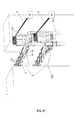
- An apparatus 200 corresponding to the apparatus 2, can additionally be positioned in the substrate processing machine 4, for example above or below the apparatus 2, as shown in FIGS 2 and 17 .
- the apparatus 200 can be positioned on the opposite side of the substrate 6 to simultaneously apply strip materials 8 to the other side of the substrate 6. In other embodiments, the apparatus 200 can be positioned to apply strip materials to a second substrate.
- the apparatus 200 can be used, for example, when strip materials are to be applied between different layers of a laminated substrate, such as in the manufacturing of "double wall” or “triple wall” corrugated board, and/or when strip materials are to be applied both between layers of a substrate and on an outer surface of the same substrate. Since the apparatus 2 is similar to the apparatus 200, only the apparatus 2 is described further.
- two or more upright support towers 10 can hold the apparatus 2 in a generally horizontal position at a desired height above the ground. Each of these upright support towers 10 can be mounted on wheels 12 for increased mobility.
- the apparatus 2 and towers 10 can be wheeled in and out of the substrate processing machine 4.
- a portion of the apparatus 2 e.g. a guide track 110, can be fixed to and supported by the substrate processing machine 4, and one or more of the upright support towers can then be removed.
- the upright support towers 10 can hold the apparatus 2 within the substrate processing machine 4 during operation and the apparatus 2 is not attached to the machine 4.
- An extension member 14 can also be included to connect the apparatus 2 to an upright support tower 10 such that the tower can be located farther away from the laminating machine.
- the length of the extension member 14 can be adjustable, and in one embodiment, the extension member 14 has a hollow cross section.
- the apparatus 2 includes an elongated frame 16.
- the frame 16 can be rectangular in cross section and can be constructed of aluminum.
- the frame 16 has a cross-sectional width of about 5.0 to 7.0 inches, and a cross-section height of about 4.25 inches.
- the frame 16 supports and encloses many components of the apparatus 2, shielding them from starch and other contaminants.
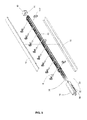
- the frame 16 supports one or more guide arms 18 that can be mounted in a series along the length of the frame 16.
- the frame 16 can also include a guide rail 20 fixed to the frame 16.
- Each guide arm 18 can include a component for coupling the guide ann 18 to the guide rail 20, for example a low friction sliding or rolling device, and in particular a linear bearing 22, which mates to the guide rail 20.
- Each guide arm 18 can have full range of the guide rail 20.
- the frame 16 and guide rail 20 can extend transversally beyond the edges of the substrate 6 such that the guide arms 16 can be positioned beyond the edges of the substrate 6.
- the guide arms 18 include pulleys 24 for receiving strip materials 8 that can be fed to the guide arms 18 transversely of the substrate from a remote supply 26 and then dispensed onto the substrate 6 for attachment and lamination thereto.
- the frame 16 with mounted guide arms 18 and pulleys 24 can have a total cross-sectional width of about 12.1 inches and a total cross-sectional height of about 6.6 inches.
- a guide arm moving and holding assembly 30 can be located at an end of the frame 16 generally separate from the portion of the frame where the guide arms 18 are mounted.
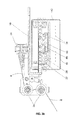
- the guide arm moving and holding assembly 30 can include at least one, and preferably a series of series of crank shaft(s) 32, head pulley(s) 34, cable(s) 36, and brake system(s) 38.
- crank shafts 32 arc rotably supported by the sides 42 of the frame 16 along parallel, horizontal axes. Pairs of shafts can be supported by the frame 16, side by side along the same axis.
- a center member 40 of the frame 16 is vertically disposed between the two crank shafts 32 and supports the inner ends of both crank shafts 32 such that they can rotate independently.
- the outer ends of the crank shafts 32 pass through opposite side walls 42 of the frame 16 and are connected to drive mechanisms 44.
- the drive mechanisms 44 can be manual cranks or automated devices, such as electric motors or actuators.
- a head pulley 34 is fixed to each crank shaft 32 within the frame 16 such that the head pulley 34 rotates with the crank shaft 32.
- Each cable 36 is secured to a corresponding guide arm 18 and makes a closed loop wrapping around a head pulley 32 and a tail pulley 46.
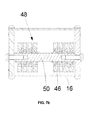
- the tail pulley assembly 48 shown in FIGS. 7a and 7b , is supported by the frame side walls 42 at the opposite end as the head pulleys 34.
- the tail pulley assembly 48 includes a series of independently rotable idler pulleys 46 that can be mounted on a common shaft 50 that is parallel to the crank shafts 32.
- the cable-pulley system is a friction-drive system that relies on the tension of the cable 36 strained around the head pulley 34 to move and hold the guide arms 18 in their desired positions.
- Tension can be necessary to prevent the cable 36 from slipping on the pulley 34 when the guide arms 18 exert a force on the cable 36, such as from a residual tension of the strip material 8 or an occasional jerk resulting from the splicing of two ends of running strip material 8.
- Tension can also be necessary to prevent the cable 36 from slipping on the pulley 34 when the crank shaft 32 is turned to move a guide arm 18 to a desired position.
- the frictional resistance generated can be the product of the tension force multiplied by the coefficient of static friction between the cable and pulley materials.
- the functional resistance of the cable 36 on the pulley 34 and the angle subtending the arc of contact between the pulley 34 and tension element are the primary factors that affect the design and performance of the cable-pulley friction-drive systems.
- An alternative to the cable-pulley friction-drive system which relies on the tension of a cable strained around a pulley to move and hold guide arms in their desired positions, is a chain-sprocket direct-drive system, which relies on intimately interlocking contact between chain links and sprocket teeth to move and hold guide arms to desired positions.
- tension is not required to prevent the chain from slipping on the sprocket when moving a guide arm to the desired position or when guide arms exert a force on the chain.
- Other direct-drive systems include gear and threaded rod drives that also rely on the intimate interlocking contact between drive elements to provide the desired motive force.
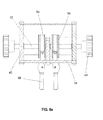
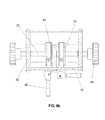
- each brake system 38 includes a horseshoe-shaped member 64, shown in FIG. 8a - 8c , that wraps around a portion of a corresponding head pulley 34. This member moves into contact with and frictionally retards the rotation of the head pulley 34 when an attached brake lever 66 is actuated.
- One end of the horseshoe-shaped member 64 can be fixed to the frame 16 while the other end protrudes through the frame 16 and couples to the brake lever 66.
- the brake lever 66 can include a cam portion and can be coupled to the frame 16 such that the brake lever 66 can be actuated, as shown in FIG.
- the brake system 38 can be arranged to hold the head pulley 34 in place when the lever 66 is actuated and keep the head pulley 34 stationary without maintained pressure on the lever 66.
- the brake systems 38 can include a similar horseshoe-shaped friction member 64 that is biased, such as by a spring 68, to be continually pressed against a head pulley 34.
- the constant static friction force generated by the biased friction member 64 and the head pulley 34 can be sufficient to keep the guide arm 18 stationary against vibrations and forces applied to the guide arm 18 during operation.
- the constant friction force can be weak enough, however, to be overcome by manual or mechanized turning of the crank shaft 32. In this embodiment, the brake systems 38 do not need to be applied and disengaged or otherwise adjusted during operation.
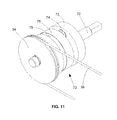
- the brake systems 38 can include a clutch brake system 70 mounted on each crank shaft 32.
- the clutch brake system 70 can include a disk-shaped back plate 72 mounted rotably on the crank shaft 32.
- One or more springs 74 can be fixed at one end to the back plate 72, and fixed at the other end to a clutch disk 76.
- the clutch disk 76 is also mounted rotably on the crank shaft 32, between the back plate 72 and the head pulley 34.
- the surface of the clutch disk 76 facing the head pulley 34 is lined with a friction pad 78 that can be pressed against the side of the head pulley 34 by the springs 74, as shown in FIG. 10 .
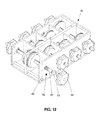
- the brake systems 38 can include a shaft brake 80.
- Each crank shaft 32 can be threaded at a location 82 near a side wall 42 of the frame 16.
- a nut 84 can be threaded onto the crank shaft 32.
- the nut 84 can be rotated such that the nut 84 moves along the crank shaft 32 and presses against a surface of the frame 16, such as the side wall 42.
- a drive mechanism 44 (not shown in FIG. 12 ) can be coupled to the end portion of the crank shaft 32 shown in FIG. 12 as having a square cross-section.
- Each of these brake system embodiments can create a friction-brake system that relies exclusively or primarily on the friction force between a surface of a friction member, such as the horseshoe-shaped member 64, the brake pad 78, or the brake nut 84, and a surface of a moving component of the drive system, such as a head pulley 34 or a crank shaft 32, to keep the guide arms 18 8 in their desired positions.
- the friction force generated to restrict the motion of arm guide arm is a product of a normal force exerted upon the friction member multiplied by the coefficient of friction between the friction member and the drive system component.
- the normal force can be supplied by manual pressure transferred to the friction member through a suitable device, such as a lever or spring system.
- the apparatus 2 can include a system for determining the position of the guide arms 18 transversely of the substrate direction of movement or the machine direction of the substrate 6.
- the linear bearing 22 of each guide arm 18 can have a magnet 88 mounted to it that cooperates with a transducer 90, as shown in FIG. 3 .
- the frame 16 supports the transducer 90 to afford a reading as to the position of the guide arms 18 with respect to the frame 16.
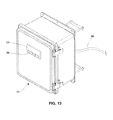
- the transducer 90 can be connected to a control panel 92, shown in FIG. 13 , having a display 94 providing a numeric digital readout giving the location along the frame 16 of the guide arms 18.
- the control panel 92 can have buttons 96 for user input, such as to select which arm 18 to monitor.
- the control panel 92 can be remotely located, and is mounted on an upright support tower 10 in one embodiment.
- a cable 98 connecting the transducer 90 to the control panel 92 can be routed through the frame 16 and through the hollow extension member 14, thereby keeping the cable 98 safe from harm.
- the magnets 88 cooperate with the transducer 90 to afford a signal in response to a current pulse sent from the control panel 92 along the transducer 90.
- the signal from each arm 18 can be discerned by the electronics in the control panel 92 to calculate the distance any particular guide arm 18 is from the predetermined "0" and the numeric value can then be displayed on the display 94.
- the transducer 90 and control panel 92 operation allows an operator to view the precise location of any guide arm 18.
- the control circuitry can trigger the transducer 90 to send a current pulse down a wire held inside the transducer 90.
- the current in the wire can then create an electric field about the wire.
- the electrical field of the wire interacts with the magnetic field of the magnet 88 on the guide arm 18. This interaction creates a torque in the wire producing a signal by the arm 18.
- the electronics of the transducer 90 calculate how long in time it was from when the current pulse was sent down the wire to when the reaction signal in the wire is sensed.
- the position of the guide arm 18 is discerned and the distance is calculated from the present "0" and a numeric value is displayed on the display of the control panel 92.
- the electronics can be designed to discern which magnet 88 from which to read the electric field-magnet field location signal. The operator then has a precise position reading and can adjust the arms 18 as necessary by rotating appropriate crank shafts 32.
- a substrate tracking and adjustment system 100 including a substrate sensor 102, control panel 92, and actuator 106 can be used to track the position of the substrate 6 as it moves side to side from the normal substrate path or position.
- the substrate tracking and adjustment system 100 is used to maintain the position of a frame 16 in relation to the substrate 6.
- the substrate tracking sensor 102 can be placed somewhere on the substrate processing machine 4, such as upstream from the apparatus 2 as shown in FIG. 1 , or the tracking sensor 102 can be affixed to the apparatus 2, preferably at a stationary location.
- the substrate sensor or sensors 102 can include laser, camera, proximity, pneumatic, ultrasonic, photo, optical, or other suitable sensing means.
- a movable end 120 of a linear actuator 106 can be secured to the frame 16 via an actuator-frame bracket 118 and a fixed end 122 of the actuator 106 can be secured to a guide track 110 via an actuator-track bracket 116.
- the actuator 106 can be driven hydraulically, pneumatically, magnetically, by a motor, or by other suitable driving means.
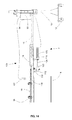
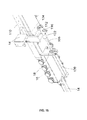
- the frame 16 can be mounted to the guide track 110 on two or more pairs of guide rollers 112, shown in detail in FIG. 16 , so as to allow the frame 16 to freely move along the length of the guide track I 10 if the frame 16 were not secured to the linear actuator 106.
- the pairs of guide rollers 112 2 can be fixed to the frame side wall 42 via guide roller brackets 124.
- the frame side wall 42 can be provided with multiple mounting locations along its length such that the guide roller brackets 124 can be attached at varying distance apart from each other.
- the actuator 106 can move the frame 16 on the guide track 110 by extending or contracting.
- the guide track 110 can be attached to a stationary object, such as a frame of the substrate processing machine 4, via a track bracket 114.
- the apparatus 2 including between one to eight guide arms 18, friction drive systems, horseshoe-type friction brake systems 38, linear bearings 22 and magnets 88, plus the transducer 90, guide rollers 112 and track brackets 114, and other necessary components, but not including the extension member 14, upright support towers 10, or guide track 110, can weigh 130 lbs to 165 lbs, depending on the number of guide arms and related systems installed.
- the installation of the apparatus 2 with the substrate tracking and adjustment system 100 into the operational position within a substrate processing machine 4 can be accomplished by first installing the guide track 110 and the actuator-track bracket 116 onto a stationary structural component of the substrate processing machine 4 via one or more tack brackets 114.
- the apparatus 2 can be wheeled on two upright support towers 10, as shown in FIG. 2 , into a position where the a first pair of guide rollers 112 are adjacent to an end of the guide track 110.
- the first pair of guide rollers 112 are installed onto the guide track 110 by allowing end of the guide track 110 to move between the first pair of guide rollers 112.
- one of the upright support towers 10 are removed and the guide track 110 supports the mounted end of the apparatus 2.
- the apparatus 2 is further rolled into the machine 4 until the second set of guide track rollers 112 mount onto the end of the guide track 110.
- the fixed end 122 of the linear actuator 106 is attached to the actuator track bracket 116.
- the substrate sensor 102 can detect the transversal position of the substrate 6. The substrate sensor 102 can then transmit the substrate position information to a controller 104. The control panel 92 can then compare the substrate position to the frame's preset position. If the substrate position is not aligned to the preset frame position, the control panel 92 can send a command signal to the actuator 106 to move the frame 16 to be aligned with the substrate position. As the frame 16 is moved along the guide track 110, each of the guide arms 18 mounted on the frame 16 are simultaneously moved the same distance. This sensing, comparing, and adjusting loop can be done continuously to maintain the frame 16 and guide arms 18 in the desired position in relation to the substrate 6.
- the strip materials 8 are taken from a bulk source and threaded through or around various strip guides 130 attached to the upright support tower 10, as shown in FIG. 17 .
- the strip materials are threaded around guide arm pulleys 24 and attached to the substrate 6.
- the guide arms need not be in desired transversal positions along the frame prior to attaching the strip materials to the substrate or prior to the substrate commencing movement through the machine. The guide arms can be adjusted while the substrate is moving and the strip materials are being dispensed.
- the corresponding brake systems 38 are first loosened, if needed, and then the user turns the corresponding drive mechanisms 44, which can be hand cranks, which in turn rotate crank shafts 32 and attached drive pulleys 34.
- the rotating drive pulleys 34 in coordination with the tail pulleys 46, moves cables 36 about a loop. When the cables 36 move, they pull the connected guide arms 18, which slide along the frame via the guide rail 20 on bearings 22.
- each guide arm interacts with the transducer 90 and send a signal to the control panel 92 signifying the location of each guide arm 18 in relation to a predetermined "0" location along the frame.
- the user can then interface with the buttons 96 and display 94 to select and read the location of each guide arm. If the guide arms are not in the desired positions, the user can then repeat these steps to adjust the guide arm positions to be more precise.
- the brake systems 38 can optionally be applied to hold them in place.
- the user can also manually hold the drive mechanisms 44 to hold the guide arms 16 in place.
- the brake systems 38 can be applied by various methods as described above, such as actuating levers or turning nuts.
- the brake lever 66 can be rotated towards the frame side wall 42, thereby employing a cam at the base of the lever 66 to pull the attached horseshoe member 64 downward and into frictional contact with the head pulley 34.
- the strip material application process can commence.
- the substrate tracking and adjustment system can optionally be used to automatically make transversal adjustments to all the guide arms in unison in reaction to side-to-side changes in the position of the moving substrate.
- these steps can repeated to re-adjust the guide arms, for example when there is an order change to manufacture a different product. All these steps can be done without removing the apparatus from the substrate processing machine or stopping the movement of the substrate.
Landscapes
- Coating Apparatus (AREA)
- Transmission Devices (AREA)
- Making Paper Articles (AREA)
- Engineering & Computer Science (AREA)
- Mechanical Engineering (AREA)
- Registering, Tensioning, Guiding Webs, And Rollers Therefor (AREA)
- Bending Of Plates, Rods, And Pipes (AREA)
- Advancing Webs (AREA)
Claims (24)
- Vorrichtung zur Abgabe von Streifenmaterialien (8) auf wenigstens ein sich bewegendes Substrat (6), umfassend:einen Rahmen (16), der sich quer zum Substratweg erstreckt;wenigstens zwei Führungsarme (18), die jeweils ein Haltemittel zur beweglichen Anbringung des Führungsarms am Rahmen und ein Abgabemittel zur Abgabe von Streifenmaterialien aufweisen; undein Führungsarmpositionierungssystem, dadurch gekennzeichnet, dass das Führungsarmpositionierungssystem umfasst:i) wenigstens zwei Kurbelwellen (32), die derart mit einem ersten Ende des Rahmens (16) verbunden sind, dass sich jede Kurbelwelle um eine unabhängige Achse pro Kurbelwelle drehen kann; undii) wenigstens zwei Reibantriebsmittel, wobei ein Reibantriebsmittel jeweils mit einer Kurbelwelle (32) und einem entsprechenden Führungsarm (18) verbunden ist, wobei jedes Reibantriebsmittel von Reibkontakt zwischen zwei Oberflächen abhängig ist, um Drehbewegung einer Kurbelwelle in lineare Bewegung eines Führungsarms umzusetzen;wobei jeder Führungsarm (18) durch Drehung der entsprechenden Kurbelwelle (32) unabhängig entlang des Rahmens (16) beweglich ist.
- Vorrichtung nach Anspruch 1, wobei jedes Reibantriebsmittel umfasst:eine Antriebsscheibe (34), wobei die Antriebsscheibe an einer Kurbelwelle (32) befestigt ist,eine Umlenkscheibe (48), die drehbar mit einem zweiten, entgegengesetzten Ende des Rahmens (16) verbunden ist, ein Riemen (36), wobei der Riemen Kabel um die Antriebsscheibe und die Umlenkscheibe verläuft und zwischen beiden am Führungsarm (18) angebracht ist, wobei der Führungsarm der Kurbelwelle (32) entspricht.
- Vorrichtung nach Anspruch 1, wobei das Führungsarmpositionierungssystem weiterhin wenigstens zwei Reibungsbremsmittel (38) umfasst, wobei ein Reibungsbremsmittel jeweils mit einem Reibantriebsmittel verbunden ist und durch den Rahmen (16) gehalten wird und so ausgestaltet ist, dass es die Bewegung des entsprechenden Führungsarms (18) beschränkt.
- Vorrichtung nach Anspruch 3, wobei jedes Reibungsbremsmittel (38) eine Reibungsfläche umfasst, wobei die Reibungsfläche so ausgestaltet ist, dass sie gegen ein Bauteil des entsprechenden Reibantriebsmittels drückt und die Bewegung des entsprechenden Führungsarms (18) beschränkt.
- Vorrichtung nach Anspruch 4, wobei ein hufeisenförmiges Element (64) die Reibungsfläche umfasst.
- Vorrichtung nach Anspruch 4, wobei ein klauenartiges, scheibenförmiges Element (76) die Reibungsfläche umfasst.
- Vorrichtung nach Anspruch 4, wobei ein mutternartiges, mit Innengewinde versehenes Element (84) die Reibungsfläche umfasst.
- Vorrichtung nach Anspruch 1, wobei jedes Reibantriebsmittel im Wesentlichen eingehaust ist.
- Vorrichtung nach Anspruch 1, wobei ein erster Führungsarm (18) über einem ersten sich bewegenden Substrat (6) angeordnet ist und ein zweiter Führungsarm unter dem ersten sich bewegenden Substrat angeordnet ist.
- Vorrichtung nach Anspruch 9, wobei ein Führungsarm (18) Streifenmaterialien auf das erste sich bewegende Substrat (6) abgeben kann und ein anderer Führungsarm Streifenmaterialien auf ein zweites sich bewegendes Substrat abgeben kann, das sich über oder unter dem ersten sich bewegenden Substrat befindet.
- Vorrichtung nach Anspruch 1, das weiterhin ein Führungsarmpositionsrückmeldesystem zur automatischen Bestimmung der Querposition jedes Führungsarms (18) bezogen auf eine vorgegebene Position und zur Anzeige der Querpositionen auf einer Anzeigevorrichtung umfasst.
- Vorrichtung nach Anspruch 11, wobei das Führungsarmpositionsrückmeldemittel wenigstens einen Magneten (88) und wenigstens einen Wandler (90) umfasst.
- Vorrichtung nach Anspruch 1, das weiterhin einen Substratpositionssensor (102) zur Bestimmung der Querposition des Substrats (6) umfasst.
- Vorrichtung nach Anspruch 13, das weiterhin einen Aktuator (106) umfasst, der als Reaktion auf ein Signal des Substratsensormittels die Querposition des Rahmens (16) bezogen auf das Substrat (6) einstellen kann und dadurch alle installierten Führungsarme (18) gleichzeitig einstellt.
- Vorrichtung nach Anspruch 14, wobei die Bestimmung der Position des Substrats (6) und die Einstellung der Position des Rahmens (6) bezogen auf das Substrat wiederholt erfolgen können, um den Rahmen (16) an einer Sollposition bezogen auf das Substrat zu halten.
- Vorrichtung nach Anspruch 1, wobei sich jede der wenigstens zwei Kurbelwellen (32) um eine Achse drehen kann, die im Wesentlichen senkrecht zur Bewegungsrichtung des entsprechenden Führungsarms (18) ist.
- Vorrichtung nach Anspruch 1, wobei die wenigstens zwei Kurbelwellen (32) um getrennte und im Wesentlichen parallele Achsen drehbar sind.
- Vorrichtung nach Anspruch 17, wobei sich zwei der Kurbelwellen (32) unabhängig um die gleiche Achse drehen können.
- Vorrichtung nach Anspruch 18, wobei zwei oder mehr Sätze von zwei Kurbelwellen (32), die sich unabhängig um die gleiche Achse drehen können, vorgesehen sind, wobei sich jeder Satz um getrennte und im Wesentlichen parallele Achsen dreht.
- Vorrichtung nach Anspruch 17, wobei sich die an den Kurbelwellen (32) befestigten Antriebsscheiben (34) in getrennten und im Wesentlichen parallelen Ebenen drehen können, wobei die Ebenen senkrecht zu den Drehachsen der Kurbelwellen sind.
- Vorrichtung nach Anspruch 1, wobei jede der Kurbelwellen (32) durch eine motorgetriebene Vorrichtung gedreht werden kann, die außerhalb des Rahmens mit der Kurbelwelle verbunden ist.
- Verfahren zur Vorbereitung der Abgabe von Streifenmaterialien (8) auf ein sich bewegendes Substrat, umfassend:i) Drehen von wenigstens zwei, mit einem ersten Ende eines Rahmens (16) verbundenen Kurbelwellen (32) derart, dass sich jede Kurbelwelle um eine unabhängige Achse pro Kurbelwelle drehen kann, wobei sich der Rahmen quer zum Substratweg erstreckt, wodurch jede sich drehende Kurbelwelle ein Reibantriebsmittel betätigt, wobei das Reibantriebsmittel mit der Kurbelwelle und einem entsprechenden Führungsarm (18) verbunden ist, wobei das Reibantriebsmittel von Reibkontakt zwischen zwei Oberflächen abhängig ist, um Drehbewegung der Kurbelwelle in lineare Bewegung des entsprechenden Führungsarms umzusetzen, wodurch das Reibantriebsmittel den entsprechenden Führungsarm zu einer Sollposition entlang des Rahmens bewegt, wobei der entsprechende Führungsarm ein Haltemittel zur beweglichen Verbindung des Führungsarms mit dem Rahmen und ein Abgabemittel zur Abgabe von Streifenmaterialien auf das Substrat umfasst.
- Verfahren nach Anspruch 22, weiterhin umfassend:ii) Verwenden eines Führungsarmpositionsrückmeldemittels zur automatischen Bestimmung der Querposition jedes Führungsarms (18) bezogen auf eine vorgegebene Position und zur Anzeige der Positionen auf einer Anzeigevorrichtung.
- Verfahren nach Anspruch 23, weiterhin umfassend:iii) Wiederholen von i und ii, bis die Anzeigevorrichtung die Sollpositionen der Führungsarme anzeigt.
Priority Applications (1)
| Application Number | Priority Date | Filing Date | Title |
|---|---|---|---|
| PL10773458T PL2490969T3 (pl) | 2009-10-19 | 2010-10-18 | Urządzenie do dozowania materiału taśmowego |
Applications Claiming Priority (2)
| Application Number | Priority Date | Filing Date | Title |
|---|---|---|---|
| US12/581,611 US8640982B2 (en) | 2009-10-19 | 2009-10-19 | Strip material dispensing device |
| PCT/US2010/053069 WO2011049877A1 (en) | 2009-10-19 | 2010-10-18 | Strip material dispensing device |
Publications (2)
| Publication Number | Publication Date |
|---|---|
| EP2490969A1 EP2490969A1 (de) | 2012-08-29 |
| EP2490969B1 true EP2490969B1 (de) | 2014-08-13 |
Family
ID=43413725
Family Applications (1)
| Application Number | Title | Priority Date | Filing Date |
|---|---|---|---|
| EP10773458.4A Active EP2490969B1 (de) | 2009-10-19 | 2010-10-18 | Vorrichtung zur ausgabe von streifenmaterial |
Country Status (10)
| Country | Link |
|---|---|
| US (2) | US8640982B2 (de) |
| EP (1) | EP2490969B1 (de) |
| CN (1) | CN102686496B (de) |
| AR (1) | AR078699A1 (de) |
| BR (1) | BR112012009199A2 (de) |
| CA (1) | CA2786135C (de) |
| ES (1) | ES2523600T3 (de) |
| MX (1) | MX2012003623A (de) |
| PL (1) | PL2490969T3 (de) |
| WO (1) | WO2011049877A1 (de) |
Families Citing this family (6)
| Publication number | Priority date | Publication date | Assignee | Title |
|---|---|---|---|---|
| US8640982B2 (en) * | 2009-10-19 | 2014-02-04 | Adalis Corp. | Strip material dispensing device |
| US9669588B2 (en) | 2014-09-04 | 2017-06-06 | H.B. Fuller Company | Devices and methods for starting strip material in a substrate processing machine |
| US9764512B2 (en) | 2014-09-04 | 2017-09-19 | H.B. Fuller Company | Devices and methods for starting strip material in a substrate processing machine |
| CN107187906B (zh) * | 2016-03-15 | 2019-05-28 | 柯尼卡美能达株式会社 | 纸张输送装置以及图像形成装置 |
| CN105696187B (zh) * | 2016-03-15 | 2017-12-12 | 重庆天春科技有限公司 | 一种尼龙骨架的高分子纤维牵引装置 |
| CN108313790A (zh) * | 2018-02-05 | 2018-07-24 | 陈建辉 | 卷纸的生产系统 |
Family Cites Families (27)
| Publication number | Priority date | Publication date | Assignee | Title |
|---|---|---|---|---|
| US74817A (en) * | 1868-02-25 | Kingston goddarp | ||
| US56894A (en) * | 1866-08-07 | Improvement in bag-fasteners | ||
| US199333A (en) * | 1878-01-15 | Improvement in cuspadores | ||
| US139470A (en) * | 1873-06-03 | Improvement in apparatus for cooling rooms | ||
| US2911835A (en) * | 1956-07-05 | 1959-11-10 | Deering Milliken Res Corp | Traversing arrangement |
| US3093344A (en) * | 1960-01-21 | 1963-06-11 | Monsanto Chemicals | Traversing device |
| US3177751A (en) * | 1962-08-06 | 1965-04-13 | Corrugating Technicians Inc | Edge aligning apparatus |
| US3245594A (en) * | 1964-03-26 | 1966-04-12 | Honeywell Inc | Mechanical apparatus |
| US4120740A (en) * | 1974-09-13 | 1978-10-17 | Ronald Wade Morgan | Tape applicator for drapery tabler |
| US4452837A (en) * | 1979-06-11 | 1984-06-05 | H. B. Fuller Company | Web reinforced with string-type adhesive and method of manufacturing same |
| US4481054A (en) | 1981-11-19 | 1984-11-06 | H. B. Fuller Company | Method of forming reinforcing network |
| SE455698B (sv) * | 1986-12-01 | 1988-08-01 | Foerenade Well Ab | Instellbar remsappliceringsanordning med forskjutbar graderad instellningsbalk |
| DE4424197C2 (de) | 1994-07-08 | 1996-07-11 | Gueldenring Maschinenbau Gmbh | Längsschneideinrichtung |
| US5507432A (en) * | 1994-10-25 | 1996-04-16 | Industrial Adhesives, Inc. | System for separating corrugated fiberboard |
| IT1282743B1 (it) * | 1996-05-24 | 1998-03-31 | Menegatto Srl | Macchina bobinatrice perfezionata |
| GB2318084B (en) * | 1996-10-14 | 1998-09-09 | Tecksom International Limited | Laminating apparatus |
| US5775629A (en) * | 1996-10-31 | 1998-07-07 | Industrial Adhesives, Inc. | Non-twisting transfer tail system |
| US5759339A (en) * | 1996-12-12 | 1998-06-02 | Linear Products Inc | Ribbon dispensing guide arm and positioning device |
| US7368159B2 (en) * | 2000-09-07 | 2008-05-06 | International Paper Company | Reinforcing strips for corrugated paperboard and related method and apparatus for its manufacture |
| CA2342495C (en) | 2001-04-03 | 2005-02-01 | Martin Robitaille | Automatic guide arms apparatus |
| WO2002083530A2 (en) * | 2001-04-12 | 2002-10-24 | H.B. Fuller Licensing & Financing, Inc. | Method and system for positioning guide arms in a strip fabrication assembly |
| US20030056894A1 (en) | 2001-09-25 | 2003-03-27 | John Getz | Applicator for adhesively-impregnated tape |
| US20050199333A1 (en) | 2001-09-25 | 2005-09-15 | Industrial Adhesives, Inc. | Tail for attaching the trailing edge of one roll of tape to the leading edge of another roll of tape and method of using same |
| US6596111B2 (en) * | 2001-09-25 | 2003-07-22 | Industrial Adhesives, Inc. | Tail for attaching the trailing edge of one roll of tape to the leading edge of another roll of tape and method of using same |
| US6981537B2 (en) * | 2001-09-25 | 2006-01-03 | Industrial Adhesives, Inc. | Tail for attaching the trailing edge of one roll of tape to the leading edge of another roll of tape and method of using same |
| US7681829B2 (en) | 2005-10-03 | 2010-03-23 | Gilles Cyr | Non-twist tail for joining tape ends |
| US8640982B2 (en) * | 2009-10-19 | 2014-02-04 | Adalis Corp. | Strip material dispensing device |
-
2009
- 2009-10-19 US US12/581,611 patent/US8640982B2/en active Active
-
2010
- 2010-10-18 AR ARP100103795A patent/AR078699A1/es active IP Right Grant
- 2010-10-18 CN CN201080047264.2A patent/CN102686496B/zh not_active Expired - Fee Related
- 2010-10-18 WO PCT/US2010/053069 patent/WO2011049877A1/en not_active Ceased
- 2010-10-18 PL PL10773458T patent/PL2490969T3/pl unknown
- 2010-10-18 BR BR112012009199A patent/BR112012009199A2/pt not_active Application Discontinuation
- 2010-10-18 EP EP10773458.4A patent/EP2490969B1/de active Active
- 2010-10-18 ES ES10773458.4T patent/ES2523600T3/es active Active
- 2010-10-18 CA CA2786135A patent/CA2786135C/en active Active
- 2010-10-18 MX MX2012003623A patent/MX2012003623A/es active IP Right Grant
-
2014
- 2014-01-03 US US14/146,889 patent/US20140116849A1/en not_active Abandoned
Also Published As
| Publication number | Publication date |
|---|---|
| PL2490969T3 (pl) | 2015-02-27 |
| WO2011049877A1 (en) | 2011-04-28 |
| US20110089214A1 (en) | 2011-04-21 |
| US20140116849A1 (en) | 2014-05-01 |
| CN102686496B (zh) | 2015-06-24 |
| EP2490969A1 (de) | 2012-08-29 |
| BR112012009199A2 (pt) | 2016-08-16 |
| CA2786135A1 (en) | 2011-04-28 |
| ES2523600T3 (es) | 2014-11-27 |
| MX2012003623A (es) | 2012-04-20 |
| CN102686496A (zh) | 2012-09-19 |
| CA2786135C (en) | 2015-08-11 |
| US8640982B2 (en) | 2014-02-04 |
| AR078699A1 (es) | 2011-11-30 |
Similar Documents
| Publication | Publication Date | Title |
|---|---|---|
| EP2490969B1 (de) | Vorrichtung zur ausgabe von streifenmaterial | |
| US4517436A (en) | Laser marker for articles of manufacture | |
| SK180198A3 (en) | Wrapping apparatus | |
| SK73399A3 (en) | Device and method for feeding film | |
| US11993411B2 (en) | Film dispenser for a wrapping apparatus and related methods | |
| EP0057523B1 (de) | Längsschneidumroller | |
| US5395209A (en) | Palletizer | |
| US8720333B2 (en) | Buffering and tension control system and method | |
| US5759339A (en) | Ribbon dispensing guide arm and positioning device | |
| CN105883459B (zh) | 收料装置、收料组件及收取薄膜的方法 | |
| US7222653B2 (en) | Automatic guide arms apparatus | |
| US4363692A (en) | Sheet binding apparatus | |
| JPS61277559A (ja) | シート材積重ね機械 | |
| JP2001334574A (ja) | ロール成形装置システム | |
| US11707928B2 (en) | Thermal transmission tubular marking | |
| JP2882750B2 (ja) | 紙葉類大束結束機 | |
| CN114229548A (zh) | 一种自动卷膜收紧装置 | |
| JPH0380707B2 (de) | ||
| CN1440006A (zh) | 张力控制实验装置 | |
| JP3579611B2 (ja) | ラベル貼着装置 | |
| JP2897702B2 (ja) | Pvcシートへの両面テープ貼着方法および貼着装置 | |
| JPH0223019B2 (de) | ||
| JPH11105364A (ja) | 印字機 | |
| WO2002083358A2 (en) | Positioning device for multiple transversely spaced operating units | |
| JPH07274332A (ja) | ケーブルの延線装置 |
Legal Events
| Date | Code | Title | Description |
|---|---|---|---|
| PUAI | Public reference made under article 153(3) epc to a published international application that has entered the european phase |
Free format text: ORIGINAL CODE: 0009012 |
|
| 17P | Request for examination filed |
Effective date: 20120504 |
|
| AK | Designated contracting states |
Kind code of ref document: A1 Designated state(s): AL AT BE BG CH CY CZ DE DK EE ES FI FR GB GR HR HU IE IS IT LI LT LU LV MC MK MT NL NO PL PT RO RS SE SI SK SM TR |
|
| DAX | Request for extension of the european patent (deleted) | ||
| GRAP | Despatch of communication of intention to grant a patent |
Free format text: ORIGINAL CODE: EPIDOSNIGR1 |
|
| INTG | Intention to grant announced |
Effective date: 20140305 |
|
| GRAS | Grant fee paid |
Free format text: ORIGINAL CODE: EPIDOSNIGR3 |
|
| GRAA | (expected) grant |
Free format text: ORIGINAL CODE: 0009210 |
|
| AK | Designated contracting states |
Kind code of ref document: B1 Designated state(s): AL AT BE BG CH CY CZ DE DK EE ES FI FR GB GR HR HU IE IS IT LI LT LU LV MC MK MT NL NO PL PT RO RS SE SI SK SM TR |
|
| REG | Reference to a national code |
Ref country code: GB Ref legal event code: FG4D |
|
| REG | Reference to a national code |
Ref country code: AT Ref legal event code: REF Ref document number: 682078 Country of ref document: AT Kind code of ref document: T Effective date: 20140815 Ref country code: CH Ref legal event code: EP |
|
| REG | Reference to a national code |
Ref country code: IE Ref legal event code: FG4D |
|
| REG | Reference to a national code |
Ref country code: DE Ref legal event code: R096 Ref document number: 602010018267 Country of ref document: DE Effective date: 20140925 |
|
| REG | Reference to a national code |
Ref country code: CH Ref legal event code: NV Representative=s name: MAIWALD PATENTANWALTSGESELLSCHAFT (SCHWEIZ) MB, CH |
|
| REG | Reference to a national code |
Ref country code: ES Ref legal event code: FG2A Ref document number: 2523600 Country of ref document: ES Kind code of ref document: T3 Effective date: 20141127 |
|
| REG | Reference to a national code |
Ref country code: NL Ref legal event code: T3 |
|
| REG | Reference to a national code |
Ref country code: AT Ref legal event code: MK05 Ref document number: 682078 Country of ref document: AT Kind code of ref document: T Effective date: 20140813 |
|
| REG | Reference to a national code |
Ref country code: LT Ref legal event code: MG4D |
|
| PG25 | Lapsed in a contracting state [announced via postgrant information from national office to epo] |
Ref country code: NO Free format text: LAPSE BECAUSE OF FAILURE TO SUBMIT A TRANSLATION OF THE DESCRIPTION OR TO PAY THE FEE WITHIN THE PRESCRIBED TIME-LIMIT Effective date: 20141113 Ref country code: BG Free format text: LAPSE BECAUSE OF FAILURE TO SUBMIT A TRANSLATION OF THE DESCRIPTION OR TO PAY THE FEE WITHIN THE PRESCRIBED TIME-LIMIT Effective date: 20141113 Ref country code: SE Free format text: LAPSE BECAUSE OF FAILURE TO SUBMIT A TRANSLATION OF THE DESCRIPTION OR TO PAY THE FEE WITHIN THE PRESCRIBED TIME-LIMIT Effective date: 20140813 Ref country code: GR Free format text: LAPSE BECAUSE OF FAILURE TO SUBMIT A TRANSLATION OF THE DESCRIPTION OR TO PAY THE FEE WITHIN THE PRESCRIBED TIME-LIMIT Effective date: 20141114 Ref country code: LT Free format text: LAPSE BECAUSE OF FAILURE TO SUBMIT A TRANSLATION OF THE DESCRIPTION OR TO PAY THE FEE WITHIN THE PRESCRIBED TIME-LIMIT Effective date: 20140813 Ref country code: PT Free format text: LAPSE BECAUSE OF FAILURE TO SUBMIT A TRANSLATION OF THE DESCRIPTION OR TO PAY THE FEE WITHIN THE PRESCRIBED TIME-LIMIT Effective date: 20141215 |
|
| REG | Reference to a national code |
Ref country code: SK Ref legal event code: T3 Ref document number: E 17438 Country of ref document: SK |
|
| PG25 | Lapsed in a contracting state [announced via postgrant information from national office to epo] |
Ref country code: RS Free format text: LAPSE BECAUSE OF FAILURE TO SUBMIT A TRANSLATION OF THE DESCRIPTION OR TO PAY THE FEE WITHIN THE PRESCRIBED TIME-LIMIT Effective date: 20140813 Ref country code: AT Free format text: LAPSE BECAUSE OF FAILURE TO SUBMIT A TRANSLATION OF THE DESCRIPTION OR TO PAY THE FEE WITHIN THE PRESCRIBED TIME-LIMIT Effective date: 20140813 Ref country code: CY Free format text: LAPSE BECAUSE OF FAILURE TO SUBMIT A TRANSLATION OF THE DESCRIPTION OR TO PAY THE FEE WITHIN THE PRESCRIBED TIME-LIMIT Effective date: 20140813 Ref country code: LV Free format text: LAPSE BECAUSE OF FAILURE TO SUBMIT A TRANSLATION OF THE DESCRIPTION OR TO PAY THE FEE WITHIN THE PRESCRIBED TIME-LIMIT Effective date: 20140813 Ref country code: HR Free format text: LAPSE BECAUSE OF FAILURE TO SUBMIT A TRANSLATION OF THE DESCRIPTION OR TO PAY THE FEE WITHIN THE PRESCRIBED TIME-LIMIT Effective date: 20140813 Ref country code: IS Free format text: LAPSE BECAUSE OF FAILURE TO SUBMIT A TRANSLATION OF THE DESCRIPTION OR TO PAY THE FEE WITHIN THE PRESCRIBED TIME-LIMIT Effective date: 20141213 |
|
| REG | Reference to a national code |
Ref country code: PL Ref legal event code: T3 |
|
| PG25 | Lapsed in a contracting state [announced via postgrant information from national office to epo] |
Ref country code: DK Free format text: LAPSE BECAUSE OF FAILURE TO SUBMIT A TRANSLATION OF THE DESCRIPTION OR TO PAY THE FEE WITHIN THE PRESCRIBED TIME-LIMIT Effective date: 20140813 Ref country code: IT Free format text: LAPSE BECAUSE OF FAILURE TO SUBMIT A TRANSLATION OF THE DESCRIPTION OR TO PAY THE FEE WITHIN THE PRESCRIBED TIME-LIMIT Effective date: 20140813 Ref country code: RO Free format text: LAPSE BECAUSE OF FAILURE TO SUBMIT A TRANSLATION OF THE DESCRIPTION OR TO PAY THE FEE WITHIN THE PRESCRIBED TIME-LIMIT Effective date: 20140813 Ref country code: EE Free format text: LAPSE BECAUSE OF FAILURE TO SUBMIT A TRANSLATION OF THE DESCRIPTION OR TO PAY THE FEE WITHIN THE PRESCRIBED TIME-LIMIT Effective date: 20140813 |
|
| REG | Reference to a national code |
Ref country code: DE Ref legal event code: R097 Ref document number: 602010018267 Country of ref document: DE |
|
| PG25 | Lapsed in a contracting state [announced via postgrant information from national office to epo] |
Ref country code: LU Free format text: LAPSE BECAUSE OF FAILURE TO SUBMIT A TRANSLATION OF THE DESCRIPTION OR TO PAY THE FEE WITHIN THE PRESCRIBED TIME-LIMIT Effective date: 20141018 Ref country code: MC Free format text: LAPSE BECAUSE OF FAILURE TO SUBMIT A TRANSLATION OF THE DESCRIPTION OR TO PAY THE FEE WITHIN THE PRESCRIBED TIME-LIMIT Effective date: 20140813 |
|
| PLBE | No opposition filed within time limit |
Free format text: ORIGINAL CODE: 0009261 |
|
| STAA | Information on the status of an ep patent application or granted ep patent |
Free format text: STATUS: NO OPPOSITION FILED WITHIN TIME LIMIT |
|
| PG25 | Lapsed in a contracting state [announced via postgrant information from national office to epo] |
Ref country code: BE Free format text: LAPSE BECAUSE OF NON-PAYMENT OF DUE FEES Effective date: 20141031 |
|
| 26N | No opposition filed |
Effective date: 20150515 |
|
| REG | Reference to a national code |
Ref country code: IE Ref legal event code: MM4A |
|
| REG | Reference to a national code |
Ref country code: FR Ref legal event code: PLFP Year of fee payment: 6 |
|
| PG25 | Lapsed in a contracting state [announced via postgrant information from national office to epo] |
Ref country code: IE Free format text: LAPSE BECAUSE OF NON-PAYMENT OF DUE FEES Effective date: 20141018 |
|
| PG25 | Lapsed in a contracting state [announced via postgrant information from national office to epo] |
Ref country code: SI Free format text: LAPSE BECAUSE OF FAILURE TO SUBMIT A TRANSLATION OF THE DESCRIPTION OR TO PAY THE FEE WITHIN THE PRESCRIBED TIME-LIMIT Effective date: 20140813 |
|
| PG25 | Lapsed in a contracting state [announced via postgrant information from national office to epo] |
Ref country code: SM Free format text: LAPSE BECAUSE OF FAILURE TO SUBMIT A TRANSLATION OF THE DESCRIPTION OR TO PAY THE FEE WITHIN THE PRESCRIBED TIME-LIMIT Effective date: 20140813 |
|
| PG25 | Lapsed in a contracting state [announced via postgrant information from national office to epo] |
Ref country code: HU Free format text: LAPSE BECAUSE OF FAILURE TO SUBMIT A TRANSLATION OF THE DESCRIPTION OR TO PAY THE FEE WITHIN THE PRESCRIBED TIME-LIMIT; INVALID AB INITIO Effective date: 20101018 Ref country code: BE Free format text: LAPSE BECAUSE OF FAILURE TO SUBMIT A TRANSLATION OF THE DESCRIPTION OR TO PAY THE FEE WITHIN THE PRESCRIBED TIME-LIMIT Effective date: 20140813 Ref country code: MT Free format text: LAPSE BECAUSE OF FAILURE TO SUBMIT A TRANSLATION OF THE DESCRIPTION OR TO PAY THE FEE WITHIN THE PRESCRIBED TIME-LIMIT Effective date: 20140813 |
|
| REG | Reference to a national code |
Ref country code: CH Ref legal event code: PFA Owner name: ADALIS CORPORATION, US Free format text: FORMER OWNER: ADALIS CORPORATION, US |
|
| REG | Reference to a national code |
Ref country code: FR Ref legal event code: PLFP Year of fee payment: 7 |
|
| REG | Reference to a national code |
Ref country code: FR Ref legal event code: PLFP Year of fee payment: 8 |
|
| PG25 | Lapsed in a contracting state [announced via postgrant information from national office to epo] |
Ref country code: MK Free format text: LAPSE BECAUSE OF FAILURE TO SUBMIT A TRANSLATION OF THE DESCRIPTION OR TO PAY THE FEE WITHIN THE PRESCRIBED TIME-LIMIT Effective date: 20140813 |
|
| REG | Reference to a national code |
Ref country code: FR Ref legal event code: PLFP Year of fee payment: 9 |
|
| PG25 | Lapsed in a contracting state [announced via postgrant information from national office to epo] |
Ref country code: AL Free format text: LAPSE BECAUSE OF FAILURE TO SUBMIT A TRANSLATION OF THE DESCRIPTION OR TO PAY THE FEE WITHIN THE PRESCRIBED TIME-LIMIT Effective date: 20140813 |
|
| P01 | Opt-out of the competence of the unified patent court (upc) registered |
Effective date: 20230421 |
|
| PGFP | Annual fee paid to national office [announced via postgrant information from national office to epo] |
Ref country code: NL Payment date: 20241021 Year of fee payment: 15 |
|
| PGFP | Annual fee paid to national office [announced via postgrant information from national office to epo] |
Ref country code: CZ Payment date: 20241014 Year of fee payment: 15 |
|
| PGFP | Annual fee paid to national office [announced via postgrant information from national office to epo] |
Ref country code: SK Payment date: 20241016 Year of fee payment: 15 |
|
| PGFP | Annual fee paid to national office [announced via postgrant information from national office to epo] |
Ref country code: CH Payment date: 20241101 Year of fee payment: 15 |
|
| PGFP | Annual fee paid to national office [announced via postgrant information from national office to epo] |
Ref country code: TR Payment date: 20241011 Year of fee payment: 15 |
|
| PGFP | Annual fee paid to national office [announced via postgrant information from national office to epo] |
Ref country code: DE Payment date: 20251021 Year of fee payment: 16 |
|
| PGFP | Annual fee paid to national office [announced via postgrant information from national office to epo] |
Ref country code: GB Payment date: 20251022 Year of fee payment: 16 |
|
| PGFP | Annual fee paid to national office [announced via postgrant information from national office to epo] |
Ref country code: FI Payment date: 20251028 Year of fee payment: 16 |
|
| PGFP | Annual fee paid to national office [announced via postgrant information from national office to epo] |
Ref country code: FR Payment date: 20251030 Year of fee payment: 16 |
|
| PGFP | Annual fee paid to national office [announced via postgrant information from national office to epo] |
Ref country code: PL Payment date: 20251009 Year of fee payment: 16 |
|
| PGFP | Annual fee paid to national office [announced via postgrant information from national office to epo] |
Ref country code: ES Payment date: 20251210 Year of fee payment: 16 |