EP2475813B1 - Surtapis antidérapant, et procédé de fabrication de ce surtapis - Google Patents
Surtapis antidérapant, et procédé de fabrication de ce surtapis Download PDFInfo
- Publication number
- EP2475813B1 EP2475813B1 EP10751598.3A EP10751598A EP2475813B1 EP 2475813 B1 EP2475813 B1 EP 2475813B1 EP 10751598 A EP10751598 A EP 10751598A EP 2475813 B1 EP2475813 B1 EP 2475813B1
- Authority
- EP
- European Patent Office
- Prior art keywords
- multifilament
- layer
- insert mat
- recited
- regions
- Prior art date
- Legal status (The legal status is an assumption and is not a legal conclusion. Google has not performed a legal analysis and makes no representation as to the accuracy of the status listed.)
- Not-in-force
Links
- 238000004519 manufacturing process Methods 0.000 title claims description 7
- 239000000835 fiber Substances 0.000 claims description 47
- 238000003825 pressing Methods 0.000 claims description 18
- 238000000034 method Methods 0.000 claims description 13
- 230000006835 compression Effects 0.000 claims description 12
- 238000007906 compression Methods 0.000 claims description 12
- 238000005056 compaction Methods 0.000 claims description 9
- 238000009732 tufting Methods 0.000 claims description 8
- 230000008719 thickening Effects 0.000 claims description 6
- 238000002844 melting Methods 0.000 claims description 5
- 230000008018 melting Effects 0.000 claims description 5
- 239000004753 textile Substances 0.000 claims description 4
- 238000002604 ultrasonography Methods 0.000 claims description 4
- 238000004804 winding Methods 0.000 claims 3
- 238000002360 preparation method Methods 0.000 claims 1
- 239000010410 layer Substances 0.000 description 94
- 102100040428 Chitobiosyldiphosphodolichol beta-mannosyltransferase Human genes 0.000 description 17
- 230000001070 adhesive effect Effects 0.000 description 12
- 239000000853 adhesive Substances 0.000 description 11
- 239000002131 composite material Substances 0.000 description 5
- 238000004140 cleaning Methods 0.000 description 4
- 238000005520 cutting process Methods 0.000 description 4
- 230000000694 effects Effects 0.000 description 3
- 230000003068 static effect Effects 0.000 description 3
- 230000015572 biosynthetic process Effects 0.000 description 2
- 238000011109 contamination Methods 0.000 description 2
- 239000000428 dust Substances 0.000 description 2
- 238000004049 embossing Methods 0.000 description 2
- 238000003780 insertion Methods 0.000 description 2
- 230000037431 insertion Effects 0.000 description 2
- 239000000203 mixture Substances 0.000 description 2
- 239000004745 nonwoven fabric Substances 0.000 description 2
- 239000002356 single layer Substances 0.000 description 2
- 101100491335 Caenorhabditis elegans mat-2 gene Proteins 0.000 description 1
- 235000006679 Mentha X verticillata Nutrition 0.000 description 1
- 235000002899 Mentha suaveolens Nutrition 0.000 description 1
- 235000001636 Mentha x rotundifolia Nutrition 0.000 description 1
- 239000012790 adhesive layer Substances 0.000 description 1
- 230000001427 coherent effect Effects 0.000 description 1
- 230000001419 dependent effect Effects 0.000 description 1
- 238000007598 dipping method Methods 0.000 description 1
- 230000003670 easy-to-clean Effects 0.000 description 1
- 238000007786 electrostatic charging Methods 0.000 description 1
- 238000002474 experimental method Methods 0.000 description 1
- 239000004744 fabric Substances 0.000 description 1
- 244000144992 flock Species 0.000 description 1
- 238000010438 heat treatment Methods 0.000 description 1
- 230000003993 interaction Effects 0.000 description 1
- 239000000463 material Substances 0.000 description 1
- 230000035515 penetration Effects 0.000 description 1
- 238000007788 roughening Methods 0.000 description 1
- 238000003860 storage Methods 0.000 description 1
- 239000000758 substrate Substances 0.000 description 1
- 239000006228 supernatant Substances 0.000 description 1
Images


Classifications
-
- D—TEXTILES; PAPER
- D04—BRAIDING; LACE-MAKING; KNITTING; TRIMMINGS; NON-WOVEN FABRICS
- D04H—MAKING TEXTILE FABRICS, e.g. FROM FIBRES OR FILAMENTARY MATERIAL; FABRICS MADE BY SUCH PROCESSES OR APPARATUS, e.g. FELTS, NON-WOVEN FABRICS; COTTON-WOOL; WADDING ; NON-WOVEN FABRICS FROM STAPLE FIBRES, FILAMENTS OR YARNS, BONDED WITH AT LEAST ONE WEB-LIKE MATERIAL DURING THEIR CONSOLIDATION
- D04H13/00—Other non-woven fabrics
-
- B—PERFORMING OPERATIONS; TRANSPORTING
- B32—LAYERED PRODUCTS
- B32B—LAYERED PRODUCTS, i.e. PRODUCTS BUILT-UP OF STRATA OF FLAT OR NON-FLAT, e.g. CELLULAR OR HONEYCOMB, FORM
- B32B5/00—Layered products characterised by the non- homogeneity or physical structure, i.e. comprising a fibrous, filamentary, particulate or foam layer; Layered products characterised by having a layer differing constitutionally or physically in different parts
- B32B5/22—Layered products characterised by the non- homogeneity or physical structure, i.e. comprising a fibrous, filamentary, particulate or foam layer; Layered products characterised by having a layer differing constitutionally or physically in different parts characterised by the presence of two or more layers which are next to each other and are fibrous, filamentary, formed of particles or foamed
- B32B5/24—Layered products characterised by the non- homogeneity or physical structure, i.e. comprising a fibrous, filamentary, particulate or foam layer; Layered products characterised by having a layer differing constitutionally or physically in different parts characterised by the presence of two or more layers which are next to each other and are fibrous, filamentary, formed of particles or foamed one layer being a fibrous or filamentary layer
- B32B5/26—Layered products characterised by the non- homogeneity or physical structure, i.e. comprising a fibrous, filamentary, particulate or foam layer; Layered products characterised by having a layer differing constitutionally or physically in different parts characterised by the presence of two or more layers which are next to each other and are fibrous, filamentary, formed of particles or foamed one layer being a fibrous or filamentary layer another layer next to it also being fibrous or filamentary
-
- B—PERFORMING OPERATIONS; TRANSPORTING
- B60—VEHICLES IN GENERAL
- B60N—SEATS SPECIALLY ADAPTED FOR VEHICLES; VEHICLE PASSENGER ACCOMMODATION NOT OTHERWISE PROVIDED FOR
- B60N3/00—Arrangements or adaptations of other passenger fittings, not otherwise provided for
- B60N3/04—Arrangements or adaptations of other passenger fittings, not otherwise provided for of floor mats or carpets
- B60N3/048—Arrangements or adaptations of other passenger fittings, not otherwise provided for of floor mats or carpets characterised by their structure
-
- D—TEXTILES; PAPER
- D02—YARNS; MECHANICAL FINISHING OF YARNS OR ROPES; WARPING OR BEAMING
- D02G—CRIMPING OR CURLING FIBRES, FILAMENTS, THREADS, OR YARNS; YARNS OR THREADS
- D02G3/00—Yarns or threads, e.g. fancy yarns; Processes or apparatus for the production thereof, not otherwise provided for
- D02G3/22—Yarns or threads characterised by constructional features, e.g. blending, filament/fibre
- D02G3/38—Threads in which fibres, filaments, or yarns are wound with other yarns or filaments, e.g. wrap yarns, i.e. strands of filaments or staple fibres are wrapped by a helically wound binder yarn
-
- D—TEXTILES; PAPER
- D02—YARNS; MECHANICAL FINISHING OF YARNS OR ROPES; WARPING OR BEAMING
- D02G—CRIMPING OR CURLING FIBRES, FILAMENTS, THREADS, OR YARNS; YARNS OR THREADS
- D02G3/00—Yarns or threads, e.g. fancy yarns; Processes or apparatus for the production thereof, not otherwise provided for
- D02G3/44—Yarns or threads characterised by the purpose for which they are designed
- D02G3/445—Yarns or threads for use in floor fabrics
-
- D—TEXTILES; PAPER
- D06—TREATMENT OF TEXTILES OR THE LIKE; LAUNDERING; FLEXIBLE MATERIALS NOT OTHERWISE PROVIDED FOR
- D06N—WALL, FLOOR, OR LIKE COVERING MATERIALS, e.g. LINOLEUM, OILCLOTH, ARTIFICIAL LEATHER, ROOFING FELT, CONSISTING OF A FIBROUS WEB COATED WITH A LAYER OF MACROMOLECULAR MATERIAL; FLEXIBLE SHEET MATERIAL NOT OTHERWISE PROVIDED FOR
- D06N7/00—Flexible sheet materials not otherwise provided for, e.g. textile threads, filaments, yarns or tow, glued on macromolecular material
- D06N7/0063—Floor covering on textile basis comprising a fibrous top layer being coated at the back with at least one polymer layer, e.g. carpets, rugs, synthetic turf
- D06N7/0071—Floor covering on textile basis comprising a fibrous top layer being coated at the back with at least one polymer layer, e.g. carpets, rugs, synthetic turf characterised by their backing, e.g. pre-coat, back coating, secondary backing, cushion backing
- D06N7/0081—Floor covering on textile basis comprising a fibrous top layer being coated at the back with at least one polymer layer, e.g. carpets, rugs, synthetic turf characterised by their backing, e.g. pre-coat, back coating, secondary backing, cushion backing with at least one extra fibrous layer at the backing, e.g. stabilizing fibrous layer, fibrous secondary backing
-
- B—PERFORMING OPERATIONS; TRANSPORTING
- B32—LAYERED PRODUCTS
- B32B—LAYERED PRODUCTS, i.e. PRODUCTS BUILT-UP OF STRATA OF FLAT OR NON-FLAT, e.g. CELLULAR OR HONEYCOMB, FORM
- B32B2307/00—Properties of the layers or laminate
- B32B2307/70—Other properties
- B32B2307/744—Non-slip, anti-slip
-
- B—PERFORMING OPERATIONS; TRANSPORTING
- B32—LAYERED PRODUCTS
- B32B—LAYERED PRODUCTS, i.e. PRODUCTS BUILT-UP OF STRATA OF FLAT OR NON-FLAT, e.g. CELLULAR OR HONEYCOMB, FORM
- B32B2471/00—Floor coverings
- B32B2471/04—Mats
-
- B—PERFORMING OPERATIONS; TRANSPORTING
- B32—LAYERED PRODUCTS
- B32B—LAYERED PRODUCTS, i.e. PRODUCTS BUILT-UP OF STRATA OF FLAT OR NON-FLAT, e.g. CELLULAR OR HONEYCOMB, FORM
- B32B2605/00—Vehicles
- B32B2605/08—Cars
-
- D—TEXTILES; PAPER
- D06—TREATMENT OF TEXTILES OR THE LIKE; LAUNDERING; FLEXIBLE MATERIALS NOT OTHERWISE PROVIDED FOR
- D06N—WALL, FLOOR, OR LIKE COVERING MATERIALS, e.g. LINOLEUM, OILCLOTH, ARTIFICIAL LEATHER, ROOFING FELT, CONSISTING OF A FIBROUS WEB COATED WITH A LAYER OF MACROMOLECULAR MATERIAL; FLEXIBLE SHEET MATERIAL NOT OTHERWISE PROVIDED FOR
- D06N2209/00—Properties of the materials
- D06N2209/10—Properties of the materials having mechanical properties
- D06N2209/106—Roughness, anti-slip, abrasiveness
-
- D—TEXTILES; PAPER
- D06—TREATMENT OF TEXTILES OR THE LIKE; LAUNDERING; FLEXIBLE MATERIALS NOT OTHERWISE PROVIDED FOR
- D06N—WALL, FLOOR, OR LIKE COVERING MATERIALS, e.g. LINOLEUM, OILCLOTH, ARTIFICIAL LEATHER, ROOFING FELT, CONSISTING OF A FIBROUS WEB COATED WITH A LAYER OF MACROMOLECULAR MATERIAL; FLEXIBLE SHEET MATERIAL NOT OTHERWISE PROVIDED FOR
- D06N2211/00—Specially adapted uses
- D06N2211/12—Decorative or sun protection articles
- D06N2211/26—Vehicles, transportation
- D06N2211/263—Cars
Definitions
- the invention relates to a non-slip insert mat according to the preamble of claim 1 and a method for producing the insert mat.
- Known mats for insertion into foot wells of motor vehicles, in particular cars, in which a carpet tray is installed have substantially the following structure.
- a useful / decorative layer is tufted and in the vast majority of cases as Thomasflorober Design, ie formed with cut tuft loops.
- a fleece is arranged and connected in a planar manner with the carrier layer.
- the flocking of portions of the free top of the web is extremely expensive and expensive. For example, after applying the nonwoven layer, the flocking fibers must first be fixed on the felt in a locally defined manner.
- a single-layer interior trim part for motor vehicles which has a carrier layer and a decorative layer, wherein the decorative layer is tufted into the carrier layer. Opposite the decorative layer there is a lower layer, which is tufted into the same carrier layer.
- the backsheet is formed from cut yarn loops with the free ends of the pile yarn hooked to the backsheet of the single layer trim panel.
- the WO 2004/050347 A1 discloses a structured composite comprising at least one outer layer of fibers and an adhesive layer. These layers are processed to create higher and lower areas.
- a planar support layer may be provided on its side facing the floor. Also disclosed in this document composite material does not meet the requirements of a high static friction or adhesive force.
- the object of the invention is therefore to provide a non-slip insert mat, which on the one hand increased demands on the adhesion to a car floor carpet, especially a cut velor carpet, d. H. a carpet, which has no loops on the upper side, fulfilled.
- an insert mat and a manufacturing method for the insert mat are to be specified, which are cost-effective, simpler and less complicated to carry out in comparison to known insert mats or methods.
- an insert mat is to be specified, which can be easily cleaned by unavoidable contamination in use and after cleaning the original adhesive force, as it was in new condition, should reach again.
- a generic insert mat having an initial stretch as a carrier layer for a decorative layer and a textile interlocking layer formed from fibers is developed in such a way that the interlocking layer has raised areas and compacted areas of lesser height, wherein the raised areas are formed by free ends of the fibers and the areas of the interlocking layer of lesser height, ie the compacted areas by permanent Pressing the free ends of the fibers are formed.
- Such a mat according to the invention is particularly inexpensive to manufacture, since free ends of the fabric layer forming the hooking layer are used for entanglement with a carpet of a motor vehicle.
- the partial pressing of the textile layer forming the hooking layer produces raised areas and compressed areas of lesser height, ie in these areas the textile layer which forms the hooking layer has a smaller thickness. This makes it possible to bring the protruding fibers of the raised areas more intensively with the carpet lining of the motor vehicle in contact. This results in an increased Verhakungsgrad, so that even at lower pressure loads of the mat a sufficient Verhakungsgrad and thus a good adhesion to the car carpet layer is achieved.
- the hooking layer consists of a tuft with a carrier layer and a pile yarn tufted into the carrier layer.
- the raised areas are formed by free ends of the pile yarn which is cut during or after tufting.
- the portions of the interlocking layer of lesser height are formed by permanently pressing the free ends of the pile yarn.
- the pile yarn used is preferably a multifilament, which is looped around by at least one monofilament, wherein the monofilament is made thicker in comparison with the filament forming the multifilament.
- the thicker monofilament is wound helically or helically around the multifilament and is processed with the multifilament together as a yarn during tufting. Since the pile loops formed during tufting are cut open, so that arise free pile ends, may replace the thicker monofilament at least a piece of the multifilament and / or unwind in the region of the free ends of the pile yarn.
- the unwound / detached end of the monofilament is slightly longer than the free ends of the multifilament due to the formerly present looping of the multifilament.
- the free ends of the monofilament are somewhat stiffer and more kink resistant than the free ends of the fibers of the multifilament. This ensures that the longer, more prominent ends of the monofilament can penetrate deep into the carpet structure of the car floor carpet and thus form a particularly secure entanglement and a particularly resistant adhesion of the mat against slipping.
- the Verhakungs Mrs is formed from a velourinstrumenten needle felt.
- This layer of a velorized needle punched nonwoven fabric is particularly inexpensive to apply, since the nonwoven layer can be connected flat, for example, with the carrier layer of the decorative layer.
- PET or PP or PA6 or PA6.6 fibers are particularly suitable for the fibers of the velorized needle-punched nonwoven.
- a weight per unit area of the velorized needle felt of 200 g / m 2 to 800 g / m 2 has proven particularly useful.
- the fibers from which the velorized needle-punched fleece is formed preferably have a fineness of 20 dtex to 100 dtex and have a cutting length of 30 mm to 80 mm.
- the velorized needle felt can preferably be used as a shorn needle punched nonwoven. Furthermore, a fiber blend of different fineness or different cut length can be used to form the velorized needle felt.
- fibers of different materials for example a mixture of PP and PA fibers.
- the raised areas form a coherent, in particular over the surface of the insert mat related, line pattern.
- dimensions of 0.5 mm to 3 mm, preferably 1 mm to 2 mm have proved successful.
- the free ends of the fibers forming the raised regions still have enough inherent rigidity to reliably ensure penetration into the top of the underlying car carpet.
- the permanently pressed areas are preferably formed by thermal compression, whereby the filaments of the multifilament and the looping monofilament are at least partially fused together and / or the filaments and the monofilaments are at least partially fused with the carrier layer of the decorative layer or with the carrier layer of Verhakungs Mrs.
- the monofilament about two to ten times, preferably five to 20 times as thick. For the multifilament and the monofilament in particular fibers from PA6, PA12, PP or PET come into question.
- the raised areas in areas of the mat more closely with one another during use of greater tread or pressure load than in areas with less tread or pressure load. In areas of higher pressure load, so z. As in the areas where the passengers are more likely to park their feet on the mat, in use, a larger surface load is available, causing a hooking of the free fiber ends with the car carpet. In these areas, the area ratio of the raised areas relative to the area proportions of the compressed areas can be made larger. In the area of greater tread or pressure load and the degree of compression, the recessed areas compared to the raised areas can be chosen slightly lower. This results in more free fiber ends, which are not or not fully integrated into the press assembly compared to a stronger compression and thus possibly contribute to the additional entanglement of the mat in the car carpet in the compressed areas.
- the areal size of the raised areas per unit area of the insert mat to be greater in the region of the greater pedaling or compressive load than in the area of lower pressure loading.
- the raised areas are preferably circular, circular, oval or triangular or polygonal or irregularly shaped island contours into consideration.
- closed Line patterns have proven to be a honeycomb line pattern particularly.
- the slip resistance of the insert mat is optimal if the areal proportion of the raised areas is smaller or at most equal to the areal proportion of the pressed areas of the insert mat.
- a method according to the invention is characterized in particular by first applying to a carrier layer of a decorative layer an interlocking layer which is at least locally locally permanently compressed so that raised areas with free fibers and compressed areas of low height are formed.
- a diloured needle-punched non-woven layer is used as the interlocking layer and the compression takes place using heat or ultrasound.
- the interlocking layer is at least one side of the carrier layer is produced by tufting a pile yarn into a carrier layer of the hooking layer, wherein a yarn of a multifilament is used as pile yarn and wherein the tufted pile yarn is cut so that free pile ends are formed.
- the free pole ends are partially compressed and / or permanently compressed, so that raised areas formed of pole ends of the interlocking layer arise.
- a pressing by means of a heated pressing template which excludes the raised areas of the pressing, has proven.
- the fibers forming the hooking layer are at least partially fused together in the pressed areas and thus permanently compressed.
- ultrasound is also suitable for pressing and / or permanent compacting which, in interaction with a pressing template, effects a permanent connection of the fibers in the compressed areas.
- a yarn of a multifilament and at least one monofilament wrapping around the multifilament is used as the pile yarn.
- the monofilament is made thicker than the multifilament forming fibers / filaments.
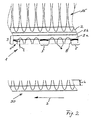
- a first exemplary embodiment of the insert mat 1 (FIG. Fig. 1 ) has an outreach as a carrier layer 2 for a decorative layer 15.
- a Verhakungs slaughter 3 is arranged on an underside of the carrier layer 2 on an underside of the carrier layer 2 is connected by means of a bonding layer (not shown in FIG FIG. 1 ) a Verhakungs slaughter 3 is arranged.
- the hooking layer 3 consists of fibers 3a.
- the hooking layer has raised areas 4 and compacted areas 5. In the area of the raised areas 4, there are irregularly free ends 6 of the fibers 3a forming the hooking layer 3.
- the Verhakungstik is a velouranalysise needle felt with a basis weight of about 200 g / m 2 up to 800 g / m 2 .
- the fibers 3a from which the velorized needle punched fleece is formed, have a fineness of 20 dtex to 100 dtex and a cut length of 30 mm to 80 mm.
- the velorized needle punched fleece is preferably shaved, but may also be unshackled with reduced adhesive force requirements.
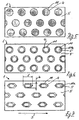
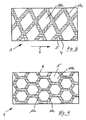
- the raised areas 4 may, for example, be islands 11 or a closed line pattern 11a, which will be described hereinafter with reference to FIGS Fig. 5 to 9 is explained in more detail.
- the islands 11 can either be distributed regularly or irregularly over the surface of the insert mat 1 in a circular shape.
- the islands 11 are circular in shape, with a center region 11b likewise forming a compacted region 5.
- the spatial shape of the islands 11 is shown as a hexagon, which have a center region 11b.
- the longitudinal extent 1 of the islands 11 in this embodiment is greater than the transverse extent b of the islands 11. If island shapes are selected which have a greater longitudinal extent 1 than the transverse extent b, then it is recommended that the longitudinal extent 1 be parallel to a line direction S of a substrate 30 to which the insert mat 1 is intended to be laid. This results in a better entanglement of the mats 1 with the pad 30th
- the raised areas 4 are arranged distributed as a closed line pattern on the underside of the insert mat 1.
- a closed line pattern in the sense of the invention means a line pattern in which all raised areas 4 of the insert mat 1 are connected to one another. This distinguishes the closed line pattern from the above-described arrangement of islands 11 on the underside of the insert mat 1.
- the under the Fig. 5 to 9 Drawings shown island and line patterns are only examples. Of course, other geometrical spatial forms, such. B.
- ovals or ovals with a center region 11a or closed line pattern 11a are performed with non-straight connecting lines or irregularly distributed over the bottom of the insert mat 1 connecting lines.
- a closed line pattern 11a as exemplified in Fig. 8 is indicated, it is recommended that at least portions of lines 11c, which form the closed line pattern, to oblique to a stroke direction S a pad on which the insert mat is to be placed, ie not necessarily at an angle of 90 ° or parallel to the direction S. This results in an increased adhesion of the mat.
- the line direction S of the car carpet (not shown) is oriented by default in the direction of travel to the rear parallel to the vehicle longitudinal axis.
- FIG. 9 shows a particularly preferred embodiment of the insert mat according to the invention, in which the raised areas 4 are formed as a closed line pattern in the form of a honeycomb structure, in particular a hexagonal honeycomb structure. It could be determined in the course of experiments that the adhesion force of such a line pattern for the raised areas 4 has the highest static friction values on a base 30 in comparison with other types of line patterns.
- acc. Fig. 10 are different geometric configurations of the islands 11 realized in different surface density distributed over the bottom of the insert mat 1.
- the insert mat 1 according to the invention has a carrier layer 2 as the first step for a decorative layer 15 from a tuft.
- the hooking layer 3 is arranged on an underside of the carrier layer 2.
- the pole loops are cut open, so that free ends 6 of the pile yarn 8 arise.
- Subareas of the interlocking layer 3 are permanently compressed and / or compressed areas 5, so that raised areas 4 remain.
- the decorative layer 15 is formed for example as Thomasflor, wherein the Thomasflor forming cut loops are tufted into the carrier layer 2.
- the free ends 6 of the pile yarn 8 of the hooking layer 3 protrude from the carrier layer 2a and thus form entanglement devices with a base 30, which can be, for example, a car carpet, which in most cases is also a tuft.
- the pad 30 usually has a line direction S, which is often directed in the vehicle longitudinal direction of a car in the direction of travel to the rear.
- the compacted regions 5 are achieved by permanent compression of free ends 6 of the pile yarn 8 and, seen in their vertical extent from the carrier layer 2, are lower than the raised regions 4, which have a greater vertical extent away from the carrier layer 2.
- the degree of compaction can be varied or the length of the free ends 6 can be set correspondingly for a given degree of compaction for the compacted regions 5. This depends essentially on the nature of the pad 30. So it is recommended, for example, the free ends 6 in a particularly low-pile car carpet (pad 30) also tend to keep their length rather small.
- the length of the free ends 6 or the protrusion t of the raised Areas 4 relative to the densified areas 5 are usefully chosen not to be larger than the pile height h of the base 30.
- the degree of compaction for producing the compacted areas must be adjusted accordingly.
- the degree of compaction can be chosen slightly lower and a corresponding projection t of the raised areas 4 with respect to the compacted areas 5 can be achieved by a greater length of the free ends 6.
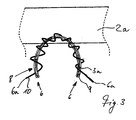
- the Verhakungs slaughter 3 is formed of a special pile yarn 8, which is based on the Fig. 3 will now be explained in more detail.
- the pile yarn 8 has a central multifilament 9 formed of a plurality of fine filaments / fibers 3a.
- a monofilament 10 is looped around the multifilament 9, wherein the composite of the multifilament 9 and the monofilament 10 is formed even before the tuft of the hooking layer 3 is produced, and the composite is tufted into the carrier layer 2a.
- tufting the pile loops formed from pile yarn 8 are cut, so that the hooking layer 3 is formed in the manner of a cut velor layer. This results in the free ends 6 of the pile yarn 8.
- the monofilament 10 is substantially thicker than the fibers 3a of the multifilament 9, there is a tendency for the monofilament 10 to unwind a bit from the multifilament 9. This results in longer free ends 6a of the monofilament 10, which have a greater stiffness than the filaments / fibers 3a of the multifilament 9. These longer and stiffer ends 6a of the monofilament, when placed on the base 30, can get caught in the base 30 well, because they can penetrate further into the pile of the base 3 due to the higher buckling resistance. This entanglement effect can be further enhanced by roughening the monofilament 10 slightly before making the composite of multifilament 9 and monofilament 10 into pile yarn 8.
- a single monofilament 10 is wrapped around a multifilament formed of fibers / filaments 3a.
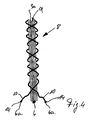
- a schematically greatly enlarged section of a pile yarn 8 is shown, in which two monofilaments 10 are looped around the multifilament 9 in the manner of a double-threaded screw.
- a multiple wrapping of the multifilament 9 with two or more monofilaments 10 accordingly, when cutting the tuft loops (pile loops), a plurality of free ends 6a of the monofilaments 10 are formed.
- two or more monofilaments 10 may be formed around the multifilament 9 into a wrapping multiple filament comprising two or more monofilaments 10 prior to wrapping, wherein the wrapping multiple filament is wrapped around the multifilament 9 as described above.
- the filaments / fibers 3a of the multifilament 9 expediently have a fineness of from 20 dtex to 80 dtex.
- the monofilament 10 or the monofilaments 10 preferably have a fineness of 40 dtex to 800 dtex.
- the process according to the invention is briefly explained below. It is distinguished, in particular, by the fact that first of all an outreach is provided as the carrier layer 2 of the insert mat 1.
- a decorative layer 15 is tufted or applied flat.
- a hooking layer 3 either a velourized needle felt (dilours) or a tuft layer with a carrier layer 2a is used.
- a velourized needle felt in the specification already explained above.
- the pile yarn 8 consists of a multifilament 9 comprising fibers / filaments 3a.
- at least one monofilament 10 is wrapped around the multifilament 9.
- the tufted pile yarn 8 of the hooking layer 3 is cut so that free pile ends 6 are formed. Subsequently, the interlocking layer is pressed in some areas and / or partially permanently compacted, so that raised, formed from pole ends 6 areas 4 of the interlocking layer 3 arise.
- the pressing and / or permanent compacting is expediently carried out after the tufting and cutting of the interlocking layer by means of a heated embossing template (not shown), which is placed on the interlocking layer 3 and provides by means of sufficient pressing pressure for the formation of the compacted and / or compressed areas 5. Pressing by means of a heated press jig is suitable both for the embodiment with a velorized needle felt and for the embodiment with a tufted hooking layer of a multifilament and optionally a monofilament as pile yarn.
- the pressing may also take place in such a way that, for example, the areas 5 to be thickened and pressed on the hooking layer 3 are pressed down and then, by means of ultrasound, a connection of the pressed fibers to each other or optionally to the carrier layer 2a is achieved.
- the monofilaments 10 are roughened around the multifilament 9 before looping, so that after cutting the pole loops after tufting free ends 6a of the monofilament 10 are formed, which have a roughened and thus tends to be verhakungsLERere surface.
- the insert mat 1 according to the invention and the method according to the invention are characterized in particular by the fact that the insert mat 1 has a particularly good adhesion to conventional carpeting trays of passenger cars and is moreover particularly cost-effective to produce since the flocking step can be saved. Furthermore, this insert mat is particularly easy to clean, since it can be easily removed again from the raised areas in use staking dirt and thus the original mint adhesive property of the mat can be restored at least approximately with conventional cleaning methods.
- the inventive method is characterized in particular by the cost feasibility. Furthermore, the embossing step provided according to the invention for compacting the hooking layer is very reliable and easy to carry out, so that low losses and a low scrap content can be expected.
Landscapes
- Engineering & Computer Science (AREA)
- Textile Engineering (AREA)
- Mechanical Engineering (AREA)
- Transportation (AREA)
- Carpets (AREA)
- Passenger Equipment (AREA)
Claims (17)
- Surtapis antidérapant, comportant une couche de support (2, 2a) et une couche d'accrochage (3) textile formée de filaments/fibres (3a) qui, lors d'un usage conforme, est tournée vers un support (30), en particulier vers un tapis de voiture particulière, et est réalisée de manière à pouvoir s'accrocher avec celui-ci, caractérisé en ce que la couche d'accrochage (3) possède des zones surélevées (4) et des zones compactées (5) de plus faible hauteur, les zones surélevées (4) étant formées par des extrémités libres (6, 6a) des fibres (3a) et les zones compactées (5) de la couche d'accrochage (3) étant formées par undurable des extrémités libres (6, 6a) des fibres (3a).
- Surtapis selon la revendication 1, caractérisé en ce que la couche d'accrochage (3) est un produit de touffetage comportant une couche de support (2a) qui est touffetée dans le fil de poil (8), les zones surélevées (4) étant formées par des extrémités libres (6, 6a) du fil de poil (8), les zones compactées (5) de la couche d'accrochage (3) étant formées par une compression durable des extrémités libres (6, 6a) du fil de poil (8), et le fil de poid (8) étant constitué par un multifilament (9).
- Surtapis selon la revendication 2, caractérisé en ce que le multifilament (9) est enlacé par au moins un monofilament (10), le monofilament (10) étant réalisé plus épais par comparaison aux fibres/filaments (3a) formant le multifilament (9).
- Surtapis selon la revendication 1, caractérisé en ce que la couche d'accrochage (3) est constituée par une nappe aiguilletée (7) veloutée, les fibres de la couche d'accrochage (3) étant constituées en PET et/ou PP et/ou PA6 et/ou PA6.6, la nappe aiguilletée (7) veloutée possédant un poids surfacique de 200 g/m2 à 800 g/m2.
- Surtapis selon l'une des revendications précédentes, caractérisé en ce que les zones surélevées (4) forment des îlots (11).
- Surtapis selon l'une des revendications précédentes, caractérisé en ce que les zones surélevées (4) forment un motif de lignes fermées (11a), en particulier à la manière d'un motif hexagonal en nids d'abeilles.
- Surtapis selon l'une des revendications 2 à 6, caractérisé en ce que les zones (5) comprimées durablement sont formées par compression thermique et en ce que les filaments (3a) du multifilament (9) et/ou le monofilament enlaçant (10) sont au moins localement fondus les uns avec les autres et/ou les filaments (3a) et/ou les monofilaments (10) sont fondus entre eux et au moins partiellement avec la couche de support (2a).
- Surtapis selon l'une des revendications 3 à 7, caractérisé en ce que l'épaisseur du monofilament (10) est au moins deux à dix fois, de préférence au moins cinq à vingt fois celle des filaments (3a) du multifilament (9).
- Surtapis selon l'une des revendications précédentes, caractérisé en ce que dans des zones du surtapis (1) présentant une charge de passage et de pression plus élevée en usage, les zones surélevées (4) sont agencées plus étroitement les unes à côté des autres que dans des zones présentant une charge de passage et de pression plus faible.
- Surtapis selon l'une des revendications précédentes, caractérisé en ce que dans des zones présentant une charge de passage ou de pression plus élevée en usage, le taux de compression est inférieur à celui dans des zones présentant une charge de passage et de pression plus faible.
- Surtapis selon l'une des revendications précédentes, caractérisé en ce que dans la zone présentant la charge de passage ou de pression plus élevée, la taille surfacique des zones surélevées (4) par unité de surface est supérieure à celle dans la zone présentant la charge de passage ou de pression plus faible.
- Surtapis selon l'une des revendications 3 à 11, caractérisé en ce qu'au moins deux monofilaments (10) enlacent le multifilament (9) à la manière d'une vis à deux ou à plusieurs pas.
- Surtapis selon l'une des revendications 3 à 12, caractérisé en ce qu'au moins deux minomfilaments (10) constituent un polyfilamant d'enlacement qui enlace le multifilament (9), et en particulier plusieurs polyfilaments d'enlacement enlacent le multifilament (9).
- Procédé pour réaliser un surtapis antidérapant (1), comprenant les étapes suivantes :- on fournit une couche de support (2, 2a) d'une couche d'accrochage (3) du surtapis (1),- on réalise une couche d'accrochage (3) sur au moins un côté de la couche de support (2, 2a) par touffetage d'un fil de poil (9) ou par application surfacique d'une surface en nappe aiguilletée (7) veloutée,- on utilise un fil de poil (8) qui est formé par un multifilament (9), le fil de poil (8) touffeté étant coupé de manière à former des extrémités de poil libres (6, 6a), ou- on utilise une couche aiguilletée (7) veloutée pour réaliser une couche d'accrochage (3),- on comprime et/ou compacte durablement des zones partielles (5) de la couche d'accrochage (3), de manière à former des zones surélevées (4) de la couche d'accrochage (3), qui sont formées par des extrémités de poil (6, 6a) du fil de poil (8) ou par des fibres libres (3a) de la nappe aiguilletée (7) veloutée.
- Procédé selon la revendication 14, caractérisé en ce que comme fil de poil (8), on utilise un multifilament (9) qui est enlacé par au moins un monofilament (10), le monofilament (10) étant réalisé plus épais par rapport à une fibre/un filament (3a) du multifilament.
- Procédé selon l'une des revendications 14 ou 15, caractérisé en ce que la compression locale et/ou le compactage durable est réalisé(e) sous l'action de la température au moyen d'un gabarit de compression chauffé, et la compression et/ou le compactage durable est réalisé(e) sous l'action d'ultrasons et par compression au moyen d'un gabarit de compression.
- Procédé selon l'une des revendications 15 à 16, caractérisé en ce que des extrémités libres (6, 6a) des monofilaments (10) et du multifilament (9) sont brièvement fondues dans les zones surélevées, de sorte qu'il en résulte des épaississements (14) du côté extrémité, la fusion brève s'effectuant par air chaud ou la fusion brève étant réalisée par une plaque chauffée que l'on pose sur les extrémités de poil libres (6, 6a) ou sur les extrémités des fibres de la nappe aiguilletée veloutée, qui les touche mais qui ne les déforme pas ou seulement de façon négligeable.
Applications Claiming Priority (2)
| Application Number | Priority Date | Filing Date | Title |
|---|---|---|---|
| DE102009040761A DE102009040761A1 (de) | 2009-09-09 | 2009-09-09 | Rutschfeste Einlegematte und Verfahren zur Herstellung der Einlegematte |
| PCT/EP2010/062581 WO2011029736A1 (fr) | 2009-09-09 | 2010-08-27 | Surtapis antidérapant, et procédé de fabrication de ce surtapis |
Publications (2)
| Publication Number | Publication Date |
|---|---|
| EP2475813A1 EP2475813A1 (fr) | 2012-07-18 |
| EP2475813B1 true EP2475813B1 (fr) | 2013-10-16 |
Family
ID=42799717
Family Applications (1)
| Application Number | Title | Priority Date | Filing Date |
|---|---|---|---|
| EP10751598.3A Not-in-force EP2475813B1 (fr) | 2009-09-09 | 2010-08-27 | Surtapis antidérapant, et procédé de fabrication de ce surtapis |
Country Status (6)
| Country | Link |
|---|---|
| US (1) | US20120235438A1 (fr) |
| EP (1) | EP2475813B1 (fr) |
| DE (1) | DE102009040761A1 (fr) |
| ES (1) | ES2439546T3 (fr) |
| MX (1) | MX2012002598A (fr) |
| WO (1) | WO2011029736A1 (fr) |
Cited By (1)
| Publication number | Priority date | Publication date | Assignee | Title |
|---|---|---|---|---|
| US20120321877A1 (en) * | 2011-06-16 | 2012-12-20 | International Automotive Components Group North America, Inc. | Textile Structure With Improved Backing |
Families Citing this family (8)
| Publication number | Priority date | Publication date | Assignee | Title |
|---|---|---|---|---|
| US20120207959A1 (en) * | 2011-02-14 | 2012-08-16 | Protocollo Gina M | Pet paw magic mat |
| DE102012104656A1 (de) * | 2012-05-30 | 2013-12-19 | Ideal Automotive Oelsnitz Gmbh | Einlegematte für Kraftfahrzeuge zum Auflegen auf eine Bodenteppichstruktur des Kraftfahrzeuges |
| DE102013012070B4 (de) * | 2013-07-19 | 2017-12-07 | Aunde Kulmbach Gmbh | Unterkonstruktion für eine Fußmatte |
| US10774612B2 (en) | 2015-04-28 | 2020-09-15 | Thru Tubing Solutions, Inc. | Flow control in subterranean wells |
| CN105078173A (zh) * | 2015-08-06 | 2015-11-25 | 上海卡比特家饰地毯有限公司 | 一种二合一地毯 |
| KR101789023B1 (ko) * | 2017-05-02 | 2017-10-23 | 한국특수섬유기술 (주) | 밀림 방지 기능을 갖는 차량용 발판 매트 |
| CN111634083B (zh) * | 2020-05-17 | 2022-01-25 | 杭州一胜布艺有限公司 | 一种寄生复合于四面弹面料的纬平绒的制作方法 |
| FR3128722B1 (fr) * | 2021-10-29 | 2023-09-22 | Faurecia Automotive Ind | Procédé de fabrication de revêtements intérieurs à partir d’une structure sandwiche |
Family Cites Families (12)
| Publication number | Priority date | Publication date | Assignee | Title |
|---|---|---|---|---|
| US4902465A (en) * | 1988-07-11 | 1990-02-20 | Milliken Research Corporation | Process for forming dust control mat with non-cleated borders |
| US5616200A (en) * | 1992-10-23 | 1997-04-01 | Interface, Inc. | I-bond method for making fusion-bonded carpet |
| DE9309926U1 (de) * | 1993-07-03 | 1993-09-02 | Schaeffler Teppichboden GmbH, 96052 Bamberg | Fußmatte |
| US6468622B1 (en) * | 1994-04-29 | 2002-10-22 | Kleen-Tex Industries Inc. | Track control mat and method of making the same |
| US6106921A (en) * | 1998-03-03 | 2000-08-22 | Quill-Tuft, Inc. | Floor matting and yarn for its manufacture |
| DE20120605U1 (de) * | 2001-12-20 | 2002-04-18 | IDEAL Automotive GmbH, 96052 Bamberg | Innenverkleidungsteil, insbesondere für Kraftfahrzeuge |
| AU2003291160A1 (en) * | 2002-11-29 | 2004-06-23 | Swz, Llc | Textured composite material |
| WO2005049913A1 (fr) * | 2003-11-14 | 2005-06-02 | Johann Borgers Gmbh & Co. Kg | Revetement de sol ou de paroi pour une surface textile, notamment dans des vehicules |
| ATE387877T1 (de) * | 2004-07-15 | 2008-03-15 | Domo Nv | Rutschfeste verkleidung |
| DE102005025681A1 (de) | 2005-06-03 | 2006-12-07 | Ideal Automotive Gmbh | Einlagiges Innenverkleidungsteil |
| DE102005037572A1 (de) * | 2005-08-09 | 2007-02-15 | Ideal Automotive Gmbh | Verkleidungsteil, insbesondere Innenverkleidungs- oder Auskleidungsteil für Kraftfahrzeuge |
| US20070207286A1 (en) * | 2006-03-06 | 2007-09-06 | Craig Stephen M | Floor covering having thermally modified patterned textile layer |
-
2009
- 2009-09-09 DE DE102009040761A patent/DE102009040761A1/de not_active Withdrawn
-
2010
- 2010-08-27 US US13/395,163 patent/US20120235438A1/en not_active Abandoned
- 2010-08-27 WO PCT/EP2010/062581 patent/WO2011029736A1/fr not_active Ceased
- 2010-08-27 EP EP10751598.3A patent/EP2475813B1/fr not_active Not-in-force
- 2010-08-27 MX MX2012002598A patent/MX2012002598A/es active IP Right Grant
- 2010-08-27 ES ES10751598.3T patent/ES2439546T3/es active Active
Cited By (2)
| Publication number | Priority date | Publication date | Assignee | Title |
|---|---|---|---|---|
| US20120321877A1 (en) * | 2011-06-16 | 2012-12-20 | International Automotive Components Group North America, Inc. | Textile Structure With Improved Backing |
| US9227543B2 (en) * | 2011-06-16 | 2016-01-05 | International Automotive Components Group North America, Inc. | Textile structure with improved backing |
Also Published As
| Publication number | Publication date |
|---|---|
| WO2011029736A1 (fr) | 2011-03-17 |
| US20120235438A1 (en) | 2012-09-20 |
| MX2012002598A (es) | 2012-06-25 |
| DE102009040761A1 (de) | 2011-03-10 |
| EP2475813A1 (fr) | 2012-07-18 |
| ES2439546T3 (es) | 2014-01-23 |
| WO2011029736A9 (fr) | 2011-04-28 |
Similar Documents
| Publication | Publication Date | Title |
|---|---|---|
| EP2475813B1 (fr) | Surtapis antidérapant, et procédé de fabrication de ce surtapis | |
| DE10225072C1 (de) | Kraftfahrzeug-Bodenbelag mit getufteter Velours-Teppichschicht und Verfahren zu deren Herstellung | |
| EP1794361B1 (fr) | Partie se presentant sous la forme d'un tapis laminee par moussage pour vehicules a moteur et procede de production associe | |
| EP0763418A2 (fr) | Procédé de fabrication d'une bande multicouche pour matériaux de capitonnage pour véhicules | |
| EP2855143B1 (fr) | Tapis d'appoint marqueté pour véhicules automobiles à appliquer sur une structure de tapis de plancher du véhicule automobile | |
| EP3058120B1 (fr) | Support de garniture | |
| DE2050273A1 (de) | Frotte mit offenen Schlingen, sowie Verfahren und Vorrichtung zur Herstellung desselben | |
| EP1587978A1 (fr) | Structure de surface textile, procede de fabrication et utilisation | |
| EP0959731B1 (fr) | Piece moulee en mousse avec element d'ancrage integre dans la mousse | |
| WO2020148147A1 (fr) | Revêtement sous caisse de véhicule à moteur, revêtement de coffre à bagages ou revêtement de plancher de chargement avec une surface tapis de structure aiguilletée | |
| DE2050595A1 (en) | Car mat - from needled synthetic fibre felt | |
| DE10132103C1 (de) | Verfahren zur Herstellung eines gemusterten textilen Flächengebildes | |
| DE602005005210T2 (de) | Rutschfeste verkleidung | |
| EP3911792B1 (fr) | Revêtement sous caisse, revêtement de coffre à bagages ou revêtement de plancher de chargement, de véhicule à moteur, avec une surface tapis de structure aiguilletée | |
| DE2544033C3 (de) | Teppichunterlage | |
| WO2020148145A1 (fr) | Revêtement sous caisse, revêtement de coffre à bagages ou revêtement de plancher de chargement de véhicule à moteur, avec une surface tapis de structure aiguilletée | |
| DE10164087B4 (de) | Verwendung eines Vliesstoffes mit Faserpolschicht als Dekorvliesstoff für Fahrzeugdachhimmel | |
| DE10259554B3 (de) | Scheuerkörper und Verfahren zu seiner Herstellung | |
| DE102007050874A1 (de) | Textiles Laminat aus einer elastischen Trägerschicht und zumindest einer Vliesstoffschicht, Bandmaterial aus dem Laminat, Windelverschluss, sowie Verfahren zum Herstellen des Bandmaterials | |
| DE102020122215A1 (de) | Vlies mit Riefenstruktur, Zwischenprodukt und Verfahren zur Herstellung eines Vlieses mit Riefenstruktur | |
| DE29603229U1 (de) | Fußabstreiferware mit Sammelschicht | |
| DE202005009135U1 (de) | Rutschfeste Bodenmatte, insbesondere eine rutschfeste Fahrzeugbodenmatte zum Verhindern von Rutschen auf einer teppichbelegten Oberfläche in einem Automobil oder anderem Fahrzeug | |
| CH711781B1 (de) | Garnitur. | |
| DE20321620U1 (de) | Textilerzeugnis mit auf mindestens einer Flächenseite herausragender Faserstruktur |
Legal Events
| Date | Code | Title | Description |
|---|---|---|---|
| PUAI | Public reference made under article 153(3) epc to a published international application that has entered the european phase |
Free format text: ORIGINAL CODE: 0009012 |
|
| 17P | Request for examination filed |
Effective date: 20120314 |
|
| AK | Designated contracting states |
Kind code of ref document: A1 Designated state(s): AL AT BE BG CH CY CZ DE DK EE ES FI FR GB GR HR HU IE IS IT LI LT LU LV MC MK MT NL NO PL PT RO SE SI SK SM TR |
|
| DAX | Request for extension of the european patent (deleted) | ||
| GRAP | Despatch of communication of intention to grant a patent |
Free format text: ORIGINAL CODE: EPIDOSNIGR1 |
|
| INTG | Intention to grant announced |
Effective date: 20130516 |
|
| GRAS | Grant fee paid |
Free format text: ORIGINAL CODE: EPIDOSNIGR3 |
|
| GRAA | (expected) grant |
Free format text: ORIGINAL CODE: 0009210 |
|
| AK | Designated contracting states |
Kind code of ref document: B1 Designated state(s): AL AT BE BG CH CY CZ DE DK EE ES FI FR GB GR HR HU IE IS IT LI LT LU LV MC MK MT NL NO PL PT RO SE SI SK SM TR |
|
| REG | Reference to a national code |
Ref country code: GB Ref legal event code: FG4D Free format text: NOT ENGLISH |
|
| REG | Reference to a national code |
Ref country code: CH Ref legal event code: EP |
|
| REG | Reference to a national code |
Ref country code: IE Ref legal event code: FG4D Free format text: LANGUAGE OF EP DOCUMENT: GERMAN |
|
| REG | Reference to a national code |
Ref country code: AT Ref legal event code: REF Ref document number: 636579 Country of ref document: AT Kind code of ref document: T Effective date: 20131115 |
|
| REG | Reference to a national code |
Ref country code: DE Ref legal event code: R096 Ref document number: 502010005105 Country of ref document: DE Effective date: 20131212 |
|
| REG | Reference to a national code |
Ref country code: ES Ref legal event code: FG2A Ref document number: 2439546 Country of ref document: ES Kind code of ref document: T3 Effective date: 20140123 |
|
| REG | Reference to a national code |
Ref country code: NL Ref legal event code: T3 |
|
| REG | Reference to a national code |
Ref country code: NL Ref legal event code: T3 |
|
| REG | Reference to a national code |
Ref country code: LT Ref legal event code: MG4D |
|
| PG25 | Lapsed in a contracting state [announced via postgrant information from national office to epo] |
Ref country code: IS Free format text: LAPSE BECAUSE OF FAILURE TO SUBMIT A TRANSLATION OF THE DESCRIPTION OR TO PAY THE FEE WITHIN THE PRESCRIBED TIME-LIMIT Effective date: 20140216 Ref country code: SE Free format text: LAPSE BECAUSE OF FAILURE TO SUBMIT A TRANSLATION OF THE DESCRIPTION OR TO PAY THE FEE WITHIN THE PRESCRIBED TIME-LIMIT Effective date: 20131016 Ref country code: HR Free format text: LAPSE BECAUSE OF FAILURE TO SUBMIT A TRANSLATION OF THE DESCRIPTION OR TO PAY THE FEE WITHIN THE PRESCRIBED TIME-LIMIT Effective date: 20131016 Ref country code: NO Free format text: LAPSE BECAUSE OF FAILURE TO SUBMIT A TRANSLATION OF THE DESCRIPTION OR TO PAY THE FEE WITHIN THE PRESCRIBED TIME-LIMIT Effective date: 20140116 Ref country code: FI Free format text: LAPSE BECAUSE OF FAILURE TO SUBMIT A TRANSLATION OF THE DESCRIPTION OR TO PAY THE FEE WITHIN THE PRESCRIBED TIME-LIMIT Effective date: 20131016 Ref country code: LT Free format text: LAPSE BECAUSE OF FAILURE TO SUBMIT A TRANSLATION OF THE DESCRIPTION OR TO PAY THE FEE WITHIN THE PRESCRIBED TIME-LIMIT Effective date: 20131016 |
|
| PG25 | Lapsed in a contracting state [announced via postgrant information from national office to epo] |
Ref country code: CY Free format text: LAPSE BECAUSE OF FAILURE TO SUBMIT A TRANSLATION OF THE DESCRIPTION OR TO PAY THE FEE WITHIN THE PRESCRIBED TIME-LIMIT Effective date: 20131016 Ref country code: LV Free format text: LAPSE BECAUSE OF FAILURE TO SUBMIT A TRANSLATION OF THE DESCRIPTION OR TO PAY THE FEE WITHIN THE PRESCRIBED TIME-LIMIT Effective date: 20131016 |
|
| PG25 | Lapsed in a contracting state [announced via postgrant information from national office to epo] |
Ref country code: PT Free format text: LAPSE BECAUSE OF FAILURE TO SUBMIT A TRANSLATION OF THE DESCRIPTION OR TO PAY THE FEE WITHIN THE PRESCRIBED TIME-LIMIT Effective date: 20140217 |
|
| REG | Reference to a national code |
Ref country code: DE Ref legal event code: R097 Ref document number: 502010005105 Country of ref document: DE |
|
| PG25 | Lapsed in a contracting state [announced via postgrant information from national office to epo] |
Ref country code: EE Free format text: LAPSE BECAUSE OF FAILURE TO SUBMIT A TRANSLATION OF THE DESCRIPTION OR TO PAY THE FEE WITHIN THE PRESCRIBED TIME-LIMIT Effective date: 20131016 |
|
| PLBE | No opposition filed within time limit |
Free format text: ORIGINAL CODE: 0009261 |
|
| STAA | Information on the status of an ep patent application or granted ep patent |
Free format text: STATUS: NO OPPOSITION FILED WITHIN TIME LIMIT |
|
| PG25 | Lapsed in a contracting state [announced via postgrant information from national office to epo] |
Ref country code: CZ Free format text: LAPSE BECAUSE OF FAILURE TO SUBMIT A TRANSLATION OF THE DESCRIPTION OR TO PAY THE FEE WITHIN THE PRESCRIBED TIME-LIMIT Effective date: 20131016 Ref country code: RO Free format text: LAPSE BECAUSE OF FAILURE TO SUBMIT A TRANSLATION OF THE DESCRIPTION OR TO PAY THE FEE WITHIN THE PRESCRIBED TIME-LIMIT Effective date: 20131016 Ref country code: SK Free format text: LAPSE BECAUSE OF FAILURE TO SUBMIT A TRANSLATION OF THE DESCRIPTION OR TO PAY THE FEE WITHIN THE PRESCRIBED TIME-LIMIT Effective date: 20131016 Ref country code: PL Free format text: LAPSE BECAUSE OF FAILURE TO SUBMIT A TRANSLATION OF THE DESCRIPTION OR TO PAY THE FEE WITHIN THE PRESCRIBED TIME-LIMIT Effective date: 20131016 |
|
| 26N | No opposition filed |
Effective date: 20140717 |
|
| PG25 | Lapsed in a contracting state [announced via postgrant information from national office to epo] |
Ref country code: DK Free format text: LAPSE BECAUSE OF FAILURE TO SUBMIT A TRANSLATION OF THE DESCRIPTION OR TO PAY THE FEE WITHIN THE PRESCRIBED TIME-LIMIT Effective date: 20131016 |
|
| REG | Reference to a national code |
Ref country code: DE Ref legal event code: R097 Ref document number: 502010005105 Country of ref document: DE Effective date: 20140717 |
|
| PG25 | Lapsed in a contracting state [announced via postgrant information from national office to epo] |
Ref country code: SI Free format text: LAPSE BECAUSE OF FAILURE TO SUBMIT A TRANSLATION OF THE DESCRIPTION OR TO PAY THE FEE WITHIN THE PRESCRIBED TIME-LIMIT Effective date: 20131016 |
|
| PG25 | Lapsed in a contracting state [announced via postgrant information from national office to epo] |
Ref country code: MC Free format text: LAPSE BECAUSE OF FAILURE TO SUBMIT A TRANSLATION OF THE DESCRIPTION OR TO PAY THE FEE WITHIN THE PRESCRIBED TIME-LIMIT Effective date: 20131016 Ref country code: LU Free format text: LAPSE BECAUSE OF FAILURE TO SUBMIT A TRANSLATION OF THE DESCRIPTION OR TO PAY THE FEE WITHIN THE PRESCRIBED TIME-LIMIT Effective date: 20140827 |
|
| REG | Reference to a national code |
Ref country code: CH Ref legal event code: PL |
|
| PG25 | Lapsed in a contracting state [announced via postgrant information from national office to epo] |
Ref country code: LI Free format text: LAPSE BECAUSE OF NON-PAYMENT OF DUE FEES Effective date: 20140831 Ref country code: CH Free format text: LAPSE BECAUSE OF NON-PAYMENT OF DUE FEES Effective date: 20140831 |
|
| REG | Reference to a national code |
Ref country code: IE Ref legal event code: MM4A |
|
| PG25 | Lapsed in a contracting state [announced via postgrant information from national office to epo] |
Ref country code: IE Free format text: LAPSE BECAUSE OF NON-PAYMENT OF DUE FEES Effective date: 20140827 |
|
| REG | Reference to a national code |
Ref country code: DE Ref legal event code: R082 Ref document number: 502010005105 Country of ref document: DE Representative=s name: DR. GASSNER & PARTNER MBB PATENTANWAELTE, DE |
|
| PG25 | Lapsed in a contracting state [announced via postgrant information from national office to epo] |
Ref country code: SM Free format text: LAPSE BECAUSE OF FAILURE TO SUBMIT A TRANSLATION OF THE DESCRIPTION OR TO PAY THE FEE WITHIN THE PRESCRIBED TIME-LIMIT Effective date: 20131016 |
|
| PG25 | Lapsed in a contracting state [announced via postgrant information from national office to epo] |
Ref country code: MT Free format text: LAPSE BECAUSE OF FAILURE TO SUBMIT A TRANSLATION OF THE DESCRIPTION OR TO PAY THE FEE WITHIN THE PRESCRIBED TIME-LIMIT Effective date: 20131016 Ref country code: GR Free format text: LAPSE BECAUSE OF FAILURE TO SUBMIT A TRANSLATION OF THE DESCRIPTION OR TO PAY THE FEE WITHIN THE PRESCRIBED TIME-LIMIT Effective date: 20131016 Ref country code: BG Free format text: LAPSE BECAUSE OF FAILURE TO SUBMIT A TRANSLATION OF THE DESCRIPTION OR TO PAY THE FEE WITHIN THE PRESCRIBED TIME-LIMIT Effective date: 20131016 |
|
| PG25 | Lapsed in a contracting state [announced via postgrant information from national office to epo] |
Ref country code: TR Free format text: LAPSE BECAUSE OF FAILURE TO SUBMIT A TRANSLATION OF THE DESCRIPTION OR TO PAY THE FEE WITHIN THE PRESCRIBED TIME-LIMIT Effective date: 20131016 Ref country code: HU Free format text: LAPSE BECAUSE OF FAILURE TO SUBMIT A TRANSLATION OF THE DESCRIPTION OR TO PAY THE FEE WITHIN THE PRESCRIBED TIME-LIMIT; INVALID AB INITIO Effective date: 20100827 |
|
| REG | Reference to a national code |
Ref country code: FR Ref legal event code: PLFP Year of fee payment: 7 |
|
| REG | Reference to a national code |
Ref country code: FR Ref legal event code: PLFP Year of fee payment: 8 |
|
| PG25 | Lapsed in a contracting state [announced via postgrant information from national office to epo] |
Ref country code: MK Free format text: LAPSE BECAUSE OF FAILURE TO SUBMIT A TRANSLATION OF THE DESCRIPTION OR TO PAY THE FEE WITHIN THE PRESCRIBED TIME-LIMIT Effective date: 20131016 |
|
| REG | Reference to a national code |
Ref country code: FR Ref legal event code: PLFP Year of fee payment: 9 |
|
| PG25 | Lapsed in a contracting state [announced via postgrant information from national office to epo] |
Ref country code: AL Free format text: LAPSE BECAUSE OF FAILURE TO SUBMIT A TRANSLATION OF THE DESCRIPTION OR TO PAY THE FEE WITHIN THE PRESCRIBED TIME-LIMIT Effective date: 20131016 |
|
| PGFP | Annual fee paid to national office [announced via postgrant information from national office to epo] |
Ref country code: NL Payment date: 20220822 Year of fee payment: 13 |
|
| PGFP | Annual fee paid to national office [announced via postgrant information from national office to epo] |
Ref country code: IT Payment date: 20220831 Year of fee payment: 13 Ref country code: GB Payment date: 20220824 Year of fee payment: 13 Ref country code: ES Payment date: 20220919 Year of fee payment: 13 Ref country code: DE Payment date: 20220727 Year of fee payment: 13 Ref country code: AT Payment date: 20220818 Year of fee payment: 13 |
|
| PGFP | Annual fee paid to national office [announced via postgrant information from national office to epo] |
Ref country code: FR Payment date: 20220822 Year of fee payment: 13 Ref country code: BE Payment date: 20220822 Year of fee payment: 13 |
|
| REG | Reference to a national code |
Ref country code: DE Ref legal event code: R119 Ref document number: 502010005105 Country of ref document: DE |
|
| REG | Reference to a national code |
Ref country code: NL Ref legal event code: MM Effective date: 20230901 |
|
| REG | Reference to a national code |
Ref country code: AT Ref legal event code: MM01 Ref document number: 636579 Country of ref document: AT Kind code of ref document: T Effective date: 20230827 |
|
| PG25 | Lapsed in a contracting state [announced via postgrant information from national office to epo] |
Ref country code: AT Free format text: LAPSE BECAUSE OF NON-PAYMENT OF DUE FEES Effective date: 20230827 |
|
| GBPC | Gb: european patent ceased through non-payment of renewal fee |
Effective date: 20230827 |
|
| PG25 | Lapsed in a contracting state [announced via postgrant information from national office to epo] |
Ref country code: AT Free format text: LAPSE BECAUSE OF NON-PAYMENT OF DUE FEES Effective date: 20230827 |
|
| REG | Reference to a national code |
Ref country code: BE Ref legal event code: MM Effective date: 20230831 |
|
| PG25 | Lapsed in a contracting state [announced via postgrant information from national office to epo] |
Ref country code: NL Free format text: LAPSE BECAUSE OF NON-PAYMENT OF DUE FEES Effective date: 20230901 |
|
| PG25 | Lapsed in a contracting state [announced via postgrant information from national office to epo] |
Ref country code: NL Free format text: LAPSE BECAUSE OF NON-PAYMENT OF DUE FEES Effective date: 20230901 |
|
| PG25 | Lapsed in a contracting state [announced via postgrant information from national office to epo] |
Ref country code: GB Free format text: LAPSE BECAUSE OF NON-PAYMENT OF DUE FEES Effective date: 20230827 |
|
| PG25 | Lapsed in a contracting state [announced via postgrant information from national office to epo] |
Ref country code: IT Free format text: LAPSE BECAUSE OF NON-PAYMENT OF DUE FEES Effective date: 20230827 Ref country code: GB Free format text: LAPSE BECAUSE OF NON-PAYMENT OF DUE FEES Effective date: 20230827 Ref country code: FR Free format text: LAPSE BECAUSE OF NON-PAYMENT OF DUE FEES Effective date: 20230831 Ref country code: DE Free format text: LAPSE BECAUSE OF NON-PAYMENT OF DUE FEES Effective date: 20240301 |
|
| PG25 | Lapsed in a contracting state [announced via postgrant information from national office to epo] |
Ref country code: BE Free format text: LAPSE BECAUSE OF NON-PAYMENT OF DUE FEES Effective date: 20230831 |
|
| REG | Reference to a national code |
Ref country code: ES Ref legal event code: FD2A Effective date: 20241004 |
|
| PG25 | Lapsed in a contracting state [announced via postgrant information from national office to epo] |
Ref country code: ES Free format text: LAPSE BECAUSE OF NON-PAYMENT OF DUE FEES Effective date: 20230828 |
|
| PG25 | Lapsed in a contracting state [announced via postgrant information from national office to epo] |
Ref country code: ES Free format text: LAPSE BECAUSE OF NON-PAYMENT OF DUE FEES Effective date: 20230828 |