EP2466030A1 - Verwendung nicht-reaktiven Heissschmelzklebstoff-beschichteter Polyolefin- Abdichtungsfolien zum Abdichten - Google Patents
Verwendung nicht-reaktiven Heissschmelzklebstoff-beschichteter Polyolefin- Abdichtungsfolien zum Abdichten Download PDFInfo
- Publication number
- EP2466030A1 EP2466030A1 EP10195793A EP10195793A EP2466030A1 EP 2466030 A1 EP2466030 A1 EP 2466030A1 EP 10195793 A EP10195793 A EP 10195793A EP 10195793 A EP10195793 A EP 10195793A EP 2466030 A1 EP2466030 A1 EP 2466030A1
- Authority
- EP
- European Patent Office
- Prior art keywords
- adhesive composition
- melt adhesive
- hot
- building
- sealing film
- Prior art date
- Legal status (The legal status is an assumption and is not a legal conclusion. Google has not performed a legal analysis and makes no representation as to the accuracy of the status listed.)
- Withdrawn
Links
- 239000004831 Hot glue Substances 0.000 title claims abstract description 147
- 229920000098 polyolefin Polymers 0.000 title claims abstract description 121
- 238000007789 sealing Methods 0.000 title claims abstract description 95
- 239000012528 membrane Substances 0.000 title description 3
- 239000000203 mixture Substances 0.000 claims abstract description 102
- 238000009435 building construction Methods 0.000 claims abstract description 31
- 239000000853 adhesive Substances 0.000 claims abstract description 29
- 230000001070 adhesive effect Effects 0.000 claims abstract description 29
- 238000002844 melting Methods 0.000 claims abstract description 21
- 230000008018 melting Effects 0.000 claims abstract description 21
- 238000001816 cooling Methods 0.000 claims abstract description 19
- 239000002131 composite material Substances 0.000 claims abstract description 14
- 239000011248 coating agent Substances 0.000 claims abstract description 6
- 238000000576 coating method Methods 0.000 claims abstract description 6
- 239000011888 foil Substances 0.000 claims abstract description 4
- 239000003822 epoxy resin Substances 0.000 claims abstract description 3
- 229920000647 polyepoxide Polymers 0.000 claims abstract description 3
- 238000000034 method Methods 0.000 claims description 31
- 229920013640 amorphous poly alpha olefin Polymers 0.000 claims description 9
- 239000007787 solid Substances 0.000 claims description 9
- 229910052799 carbon Inorganic materials 0.000 claims description 8
- 229920001577 copolymer Polymers 0.000 claims description 8
- VGGSQFUCUMXWEO-UHFFFAOYSA-N Ethene Chemical compound C=C VGGSQFUCUMXWEO-UHFFFAOYSA-N 0.000 claims description 5
- 239000005977 Ethylene Substances 0.000 claims description 5
- 239000004744 fabric Substances 0.000 claims description 4
- 229920013639 polyalphaolefin Polymers 0.000 claims description 4
- XPVIQPQOGTVMSU-UHFFFAOYSA-N (4-acetamidophenyl)arsenic Chemical compound CC(=O)NC1=CC=C([As])C=C1 XPVIQPQOGTVMSU-UHFFFAOYSA-N 0.000 claims description 3
- 239000000178 monomer Substances 0.000 claims description 2
- 238000010526 radical polymerization reaction Methods 0.000 claims description 2
- 229920001169 thermoplastic Polymers 0.000 claims description 2
- 239000004416 thermosoftening plastic Substances 0.000 claims description 2
- 239000000835 fiber Substances 0.000 description 20
- 239000000565 sealant Substances 0.000 description 18
- 239000000758 substrate Substances 0.000 description 11
- 229920005989 resin Polymers 0.000 description 9
- 239000011347 resin Substances 0.000 description 9
- 238000010276 construction Methods 0.000 description 6
- 239000000155 melt Substances 0.000 description 6
- 238000005096 rolling process Methods 0.000 description 6
- VTYYLEPIZMXCLO-UHFFFAOYSA-L Calcium carbonate Chemical compound [Ca+2].[O-]C([O-])=O VTYYLEPIZMXCLO-UHFFFAOYSA-L 0.000 description 5
- -1 ethylene, propylene, 1-butene Chemical class 0.000 description 5
- 238000010438 heat treatment Methods 0.000 description 5
- 239000000463 material Substances 0.000 description 5
- 229920000728 polyester Polymers 0.000 description 5
- 239000004711 α-olefin Substances 0.000 description 5
- 239000013032 Hydrocarbon resin Substances 0.000 description 4
- 230000001680 brushing effect Effects 0.000 description 4
- 239000004567 concrete Substances 0.000 description 4
- 239000011521 glass Substances 0.000 description 4
- 229920001112 grafted polyolefin Polymers 0.000 description 4
- 229920006270 hydrocarbon resin Polymers 0.000 description 4
- 238000004519 manufacturing process Methods 0.000 description 4
- 229910052751 metal Inorganic materials 0.000 description 4
- 239000002184 metal Substances 0.000 description 4
- 239000012963 UV stabilizer Substances 0.000 description 3
- 239000003795 chemical substances by application Substances 0.000 description 3
- 239000000470 constituent Substances 0.000 description 3
- 238000006073 displacement reaction Methods 0.000 description 3
- 239000000945 filler Substances 0.000 description 3
- 239000012760 heat stabilizer Substances 0.000 description 3
- 150000002739 metals Chemical class 0.000 description 3
- 239000004014 plasticizer Substances 0.000 description 3
- 229920000642 polymer Polymers 0.000 description 3
- QQONPFPTGQHPMA-UHFFFAOYSA-N propylene Natural products CC=C QQONPFPTGQHPMA-UHFFFAOYSA-N 0.000 description 3
- 125000004805 propylene group Chemical group [H]C([H])([H])C([H])([*:1])C([H])([H])[*:2] 0.000 description 3
- 230000002787 reinforcement Effects 0.000 description 3
- 238000003860 storage Methods 0.000 description 3
- ZGEGCLOFRBLKSE-UHFFFAOYSA-N 1-Heptene Chemical compound CCCCCC=C ZGEGCLOFRBLKSE-UHFFFAOYSA-N 0.000 description 2
- LIKMAJRDDDTEIG-UHFFFAOYSA-N 1-hexene Chemical compound CCCCC=C LIKMAJRDDDTEIG-UHFFFAOYSA-N 0.000 description 2
- KWKAKUADMBZCLK-UHFFFAOYSA-N 1-octene Chemical compound CCCCCCC=C KWKAKUADMBZCLK-UHFFFAOYSA-N 0.000 description 2
- KAKZBPTYRLMSJV-UHFFFAOYSA-N Butadiene Chemical compound C=CC=C KAKZBPTYRLMSJV-UHFFFAOYSA-N 0.000 description 2
- OKTJSMMVPCPJKN-UHFFFAOYSA-N Carbon Chemical compound [C] OKTJSMMVPCPJKN-UHFFFAOYSA-N 0.000 description 2
- PPBRXRYQALVLMV-UHFFFAOYSA-N Styrene Chemical compound C=CC1=CC=CC=C1 PPBRXRYQALVLMV-UHFFFAOYSA-N 0.000 description 2
- GWEVSGVZZGPLCZ-UHFFFAOYSA-N Titan oxide Chemical compound O=[Ti]=O GWEVSGVZZGPLCZ-UHFFFAOYSA-N 0.000 description 2
- XTXRWKRVRITETP-UHFFFAOYSA-N Vinyl acetate Chemical compound CC(=O)OC=C XTXRWKRVRITETP-UHFFFAOYSA-N 0.000 description 2
- 239000000654 additive Substances 0.000 description 2
- 239000002318 adhesion promoter Substances 0.000 description 2
- 150000001336 alkenes Chemical class 0.000 description 2
- 239000000956 alloy Substances 0.000 description 2
- 229910045601 alloy Inorganic materials 0.000 description 2
- 238000005452 bending Methods 0.000 description 2
- 230000000903 blocking effect Effects 0.000 description 2
- IAQRGUVFOMOMEM-UHFFFAOYSA-N but-2-ene Chemical compound CC=CC IAQRGUVFOMOMEM-UHFFFAOYSA-N 0.000 description 2
- 239000000975 dye Substances 0.000 description 2
- 230000002349 favourable effect Effects 0.000 description 2
- 239000012530 fluid Substances 0.000 description 2
- 229920001519 homopolymer Polymers 0.000 description 2
- 239000007788 liquid Substances 0.000 description 2
- 238000005259 measurement Methods 0.000 description 2
- YWAKXRMUMFPDSH-UHFFFAOYSA-N pentene Chemical compound CCCC=C YWAKXRMUMFPDSH-UHFFFAOYSA-N 0.000 description 2
- 239000000049 pigment Substances 0.000 description 2
- 239000011495 polyisocyanurate Substances 0.000 description 2
- 229920000582 polyisocyanurate Polymers 0.000 description 2
- 230000003068 static effect Effects 0.000 description 2
- 239000004575 stone Substances 0.000 description 2
- XLYOFNOQVPJJNP-UHFFFAOYSA-N water Substances O XLYOFNOQVPJJNP-UHFFFAOYSA-N 0.000 description 2
- 241000531908 Aramides Species 0.000 description 1
- 229920000742 Cotton Polymers 0.000 description 1
- 239000004593 Epoxy Substances 0.000 description 1
- 239000004743 Polypropylene Substances 0.000 description 1
- 229920000297 Rayon Polymers 0.000 description 1
- 229910000831 Steel Inorganic materials 0.000 description 1
- HCHKCACWOHOZIP-UHFFFAOYSA-N Zinc Chemical compound [Zn] HCHKCACWOHOZIP-UHFFFAOYSA-N 0.000 description 1
- 239000006096 absorbing agent Substances 0.000 description 1
- NIXOWILDQLNWCW-UHFFFAOYSA-M acrylate group Chemical group C(C=C)(=O)[O-] NIXOWILDQLNWCW-UHFFFAOYSA-M 0.000 description 1
- 230000002411 adverse Effects 0.000 description 1
- 229910052782 aluminium Inorganic materials 0.000 description 1
- XAGFODPZIPBFFR-UHFFFAOYSA-N aluminium Chemical compound [Al] XAGFODPZIPBFFR-UHFFFAOYSA-N 0.000 description 1
- 229920003180 amino resin Polymers 0.000 description 1
- 239000003963 antioxidant agent Substances 0.000 description 1
- 239000004760 aramid Substances 0.000 description 1
- 229920003235 aromatic polyamide Polymers 0.000 description 1
- 239000003139 biocide Substances 0.000 description 1
- 230000015572 biosynthetic process Effects 0.000 description 1
- 238000007664 blowing Methods 0.000 description 1
- 239000011449 brick Substances 0.000 description 1
- 239000004566 building material Substances 0.000 description 1
- 238000003490 calendering Methods 0.000 description 1
- 150000001721 carbon Chemical group 0.000 description 1
- 125000004432 carbon atom Chemical group C* 0.000 description 1
- 239000006229 carbon black Substances 0.000 description 1
- 238000005266 casting Methods 0.000 description 1
- 229920002678 cellulose Polymers 0.000 description 1
- 239000001913 cellulose Substances 0.000 description 1
- 239000004568 cement Substances 0.000 description 1
- 238000004140 cleaning Methods 0.000 description 1
- 239000002826 coolant Substances 0.000 description 1
- 230000006378 damage Effects 0.000 description 1
- 230000001419 dependent effect Effects 0.000 description 1
- 239000002274 desiccant Substances 0.000 description 1
- XNMQEEKYCVKGBD-UHFFFAOYSA-N dimethylacetylene Natural products CC#CC XNMQEEKYCVKGBD-UHFFFAOYSA-N 0.000 description 1
- 238000007598 dipping method Methods 0.000 description 1
- 239000000428 dust Substances 0.000 description 1
- 238000001125 extrusion Methods 0.000 description 1
- 239000002657 fibrous material Substances 0.000 description 1
- 239000003063 flame retardant Substances 0.000 description 1
- 230000009969 flowable effect Effects 0.000 description 1
- 238000005755 formation reaction Methods 0.000 description 1
- 239000000417 fungicide Substances 0.000 description 1
- 239000003365 glass fiber Substances 0.000 description 1
- 239000003292 glue Substances 0.000 description 1
- 239000010438 granite Substances 0.000 description 1
- 238000000227 grinding Methods 0.000 description 1
- 239000010440 gypsum Substances 0.000 description 1
- 229910052602 gypsum Inorganic materials 0.000 description 1
- LNEPOXFFQSENCJ-UHFFFAOYSA-N haloperidol Chemical compound C1CC(O)(C=2C=CC(Cl)=CC=2)CCN1CCCC(=O)C1=CC=C(F)C=C1 LNEPOXFFQSENCJ-UHFFFAOYSA-N 0.000 description 1
- 230000006698 induction Effects 0.000 description 1
- 239000012948 isocyanate Substances 0.000 description 1
- 150000002513 isocyanates Chemical class 0.000 description 1
- 238000003475 lamination Methods 0.000 description 1
- 150000002605 large molecules Chemical class 0.000 description 1
- 230000007774 longterm Effects 0.000 description 1
- 239000000314 lubricant Substances 0.000 description 1
- 239000004579 marble Substances 0.000 description 1
- 239000004570 mortar (masonry) Substances 0.000 description 1
- TVMXDCGIABBOFY-UHFFFAOYSA-N n-Octanol Natural products CCCCCCCC TVMXDCGIABBOFY-UHFFFAOYSA-N 0.000 description 1
- 239000000025 natural resin Substances 0.000 description 1
- 239000004745 nonwoven fabric Substances 0.000 description 1
- 230000003287 optical effect Effects 0.000 description 1
- 230000010355 oscillation Effects 0.000 description 1
- 239000003973 paint Substances 0.000 description 1
- 239000012188 paraffin wax Substances 0.000 description 1
- 239000002245 particle Substances 0.000 description 1
- 239000004033 plastic Substances 0.000 description 1
- 229920003023 plastic Polymers 0.000 description 1
- 239000002985 plastic film Substances 0.000 description 1
- 229920006255 plastic film Polymers 0.000 description 1
- 229920000058 polyacrylate Polymers 0.000 description 1
- 229920000570 polyether Polymers 0.000 description 1
- 229920001155 polypropylene Polymers 0.000 description 1
- 238000002360 preparation method Methods 0.000 description 1
- 238000002203 pretreatment Methods 0.000 description 1
- 238000005488 sandblasting Methods 0.000 description 1
- 239000002904 solvent Substances 0.000 description 1
- 241000894007 species Species 0.000 description 1
- 238000005507 spraying Methods 0.000 description 1
- 239000010959 steel Substances 0.000 description 1
- 239000000126 substance Substances 0.000 description 1
- 230000009182 swimming Effects 0.000 description 1
- 239000012209 synthetic fiber Substances 0.000 description 1
- 229920002994 synthetic fiber Polymers 0.000 description 1
- 229920003002 synthetic resin Polymers 0.000 description 1
- 239000000057 synthetic resin Substances 0.000 description 1
- 229920001897 terpolymer Polymers 0.000 description 1
- 238000002076 thermal analysis method Methods 0.000 description 1
- 239000002937 thermal insulation foam Substances 0.000 description 1
- 239000004408 titanium dioxide Substances 0.000 description 1
- 239000002966 varnish Substances 0.000 description 1
- 238000004078 waterproofing Methods 0.000 description 1
- 239000002023 wood Substances 0.000 description 1
- 229910052725 zinc Inorganic materials 0.000 description 1
- 239000011701 zinc Substances 0.000 description 1
Images
Classifications
-
- E—FIXED CONSTRUCTIONS
- E04—BUILDING
- E04D—ROOF COVERINGS; SKY-LIGHTS; GUTTERS; ROOF-WORKING TOOLS
- E04D5/00—Roof covering by making use of flexible material, e.g. supplied in roll form
- E04D5/06—Roof covering by making use of flexible material, e.g. supplied in roll form by making use of plastics
-
- B—PERFORMING OPERATIONS; TRANSPORTING
- B32—LAYERED PRODUCTS
- B32B—LAYERED PRODUCTS, i.e. PRODUCTS BUILT-UP OF STRATA OF FLAT OR NON-FLAT, e.g. CELLULAR OR HONEYCOMB, FORM
- B32B27/00—Layered products comprising a layer of synthetic resin
- B32B27/06—Layered products comprising a layer of synthetic resin as the main or only constituent of a layer, which is next to another layer of the same or of a different material
- B32B27/08—Layered products comprising a layer of synthetic resin as the main or only constituent of a layer, which is next to another layer of the same or of a different material of synthetic resin
-
- B—PERFORMING OPERATIONS; TRANSPORTING
- B32—LAYERED PRODUCTS
- B32B—LAYERED PRODUCTS, i.e. PRODUCTS BUILT-UP OF STRATA OF FLAT OR NON-FLAT, e.g. CELLULAR OR HONEYCOMB, FORM
- B32B27/00—Layered products comprising a layer of synthetic resin
- B32B27/32—Layered products comprising a layer of synthetic resin comprising polyolefins
-
- B—PERFORMING OPERATIONS; TRANSPORTING
- B32—LAYERED PRODUCTS
- B32B—LAYERED PRODUCTS, i.e. PRODUCTS BUILT-UP OF STRATA OF FLAT OR NON-FLAT, e.g. CELLULAR OR HONEYCOMB, FORM
- B32B7/00—Layered products characterised by the relation between layers; Layered products characterised by the relative orientation of features between layers, or by the relative values of a measurable parameter between layers, i.e. products comprising layers having different physical, chemical or physicochemical properties; Layered products characterised by the interconnection of layers
- B32B7/04—Interconnection of layers
- B32B7/12—Interconnection of layers using interposed adhesives or interposed materials with bonding properties
-
- E—FIXED CONSTRUCTIONS
- E04—BUILDING
- E04B—GENERAL BUILDING CONSTRUCTIONS; WALLS, e.g. PARTITIONS; ROOFS; FLOORS; CEILINGS; INSULATION OR OTHER PROTECTION OF BUILDINGS
- E04B1/00—Constructions in general; Structures which are not restricted either to walls, e.g. partitions, or floors or ceilings or roofs
- E04B1/62—Insulation or other protection; Elements or use of specified material therefor
- E04B1/66—Sealings
-
- E—FIXED CONSTRUCTIONS
- E04—BUILDING
- E04B—GENERAL BUILDING CONSTRUCTIONS; WALLS, e.g. PARTITIONS; ROOFS; FLOORS; CEILINGS; INSULATION OR OTHER PROTECTION OF BUILDINGS
- E04B1/00—Constructions in general; Structures which are not restricted either to walls, e.g. partitions, or floors or ceilings or roofs
- E04B1/62—Insulation or other protection; Elements or use of specified material therefor
- E04B1/66—Sealings
- E04B1/665—Sheets or foils impervious to water and water vapor
-
- E—FIXED CONSTRUCTIONS
- E04—BUILDING
- E04D—ROOF COVERINGS; SKY-LIGHTS; GUTTERS; ROOF-WORKING TOOLS
- E04D5/00—Roof covering by making use of flexible material, e.g. supplied in roll form
- E04D5/14—Fastening means therefor
- E04D5/148—Fastening means therefor fastening by gluing
-
- E—FIXED CONSTRUCTIONS
- E04—BUILDING
- E04D—ROOF COVERINGS; SKY-LIGHTS; GUTTERS; ROOF-WORKING TOOLS
- E04D5/00—Roof covering by making use of flexible material, e.g. supplied in roll form
- E04D5/14—Fastening means therefor
- E04D5/149—Fastening means therefor fastening by welding
-
- Y—GENERAL TAGGING OF NEW TECHNOLOGICAL DEVELOPMENTS; GENERAL TAGGING OF CROSS-SECTIONAL TECHNOLOGIES SPANNING OVER SEVERAL SECTIONS OF THE IPC; TECHNICAL SUBJECTS COVERED BY FORMER USPC CROSS-REFERENCE ART COLLECTIONS [XRACs] AND DIGESTS
- Y10—TECHNICAL SUBJECTS COVERED BY FORMER USPC
- Y10T—TECHNICAL SUBJECTS COVERED BY FORMER US CLASSIFICATION
- Y10T156/00—Adhesive bonding and miscellaneous chemical manufacture
- Y10T156/10—Methods of surface bonding and/or assembly therefor
Definitions
- the invention relates to the field of seals of civil engineering or building construction as well as the field of hot melt adhesives.
- Polyolefin sealing films have been known for some time. They have also been used for a long time for sealing roofs and roof structures. Traditionally, such films are laid as waterproofing membranes on the roof and welded together. For attaching such tracks are so far primarily mechanical anchors, z. As nails, used. Of course, the guarantee of tightness is a big problem.
- the object of the present invention is to provide a method which makes it possible to reliably and cost-effectively seal a building of civil engineering or building construction.
- a method according to claim 1 is able to achieve this object.
- this method makes it possible in a very simple way to realize a previously long-held desire, namely a full-surface and long-term bonding of a flexible polyolefin web to a substrate, in particular a roof or a roof structure, and thus to achieve an optimal seal.
- non-reactive hotmelt adhesive compositions are best suited for solving this problem. It has been found to be particularly advantageous that flexible polyolefin films coated with such non-reactive hot-melt adhesive compositions are tack-free and can therefore be stored for a relatively long time, in particular in the form of rolls.
- the sealing foils disclosed in this document are easy to produce, can be stored and transported for extended periods of time, and can be laid and bonded in an extremely simple manner.
- no mechanical fastening means, such as nails or the like, are required for laying and fixing. This reduces the susceptibility of slides to injuries. As a result, sources of leakage are massively reduced.
- sealing film in this document means flexible, ie flexible, sheet-like plastics, in particular in a thickness of 0.05 millimeters to 5 millimeters, which can be rolled up.
- sealing sheets in addition to films in the strict sense of thicknesses below 1 mm, also, preferably, sealing sheets, as typically for sealing tunnels, roofs or swimming pools in a thickness of typically 1 to 3 mm, in special cases even in a thickness to maximum 5 mm, used, understood.
- Such films are usually made by brushing, casting, calendering or extrusion and are typically commercially available in rolls or made on site. They can be single-layered or multi-layered.
- films may also contain other additives and processing agents, such as fillers, UV and heat stabilizers, plasticizers, lubricants, biocides, flame retardants, antioxidants, pigments such as titanium dioxide or carbon black, and dyes. That is, it will be in this document also such Films referred to as polyolefin films, which are not 100% polyolefin.
- a polyolefin sealing film common in the field of building sealing is suitable.
- Such polyolefin films contain in particular plasticizers.
- the flexible polyolefin sealing films are based on flexible polyolefins, also known to those skilled in the art as "FPO".
- Flexible polyolefins are homopolymers or copolymers of olefins, in particular of ethylene and propylene.
- FPO flexible polyolefins
- rigid polyolefins would result in bending or bending of the film, as in the application of the film but also in use, for example due to temperature fluctuations, mechanical stresses such. when walking or driving on the film, take place, break or at least tear, whereby the sealing function could not be guaranteed.
- the sealing film is reinforced by fibers. It is particularly advantageous if the polyolefin sealing film is reinforced by fibers.
- the reinforcement by fibers may be in the form of loose fibers or, preferably, by flat fiber formations.
- the reinforcement by fibers is such that the PVC sealing film is reinforced with a fiber mat, a fiber fabric, a nonwoven fabric, a Fasergittergelege or a fiber fabric.
- the flexible polyolefin sealing film is reinforced with a fabric.
- the fibers are in particular glass, carbon, cellulose, cotton or synthetic synthetic fibers, preferably fibers of polyester or of a homo- or copolymers of ethylene and / or propylene or of viscose.
- the fibers can be used as short fibers or long fibers, or in the form of spun, woven or non-woven fiber materials.
- the use of fibers is particularly advantageous for improving the mechanical reinforcement, in particular if at least some of the fibers consist of tensile or high-tensile fibers, in particular of glass or aramides.
- the most preferred fibers are glass fibers or polyester fibers.
- flexible polyolefin sealing films which are reinforced with a glass fleece and / or glass or polyester Gittergelege.
- Particularly suitable flexible polyolefin sealing film are the product lines offered by Sika Sarnafil AG, Switzerland, Sarnafil® TG and Sarnafil® TS, in particular Sarnafil® TS 77-15, TS 77-18 and TS-20, as well as the product lines Sikaplan® WT.
- Buildings, houses, retaining walls, roofs, tunnels or bridges are considered to be civil engineering or structural engineering. Particularly preferred as a civil engineering or building construction are roofs, in particular flat roofs.
- non-reactive hotmelt adhesive composition As a "non-reactive" hotmelt adhesive composition, this document is directed to a hotmelt adhesive composition that does not have polymers that would chemically react with each other at either room temperature or at the melting temperature and result in higher molecular species.
- Such non-reactive hot-melt adhesive compositions in particular have no polymers containing isocyanate or alkoxysilane or epoxy or (meth) acrylate groups.
- the non-reactive hot-melt adhesive composition thus contains no epoxy resins, in particular no Epoxidfestharze.
- hot-melt adhesive composition a composition which is solid at 25 ° C when heated to Melting temperature melts and thus becomes fluid.
- a hotmelt adhesive composition is capable of being applied to a substrate at an application temperature which is above the melting point of the hotmelt adhesive composition and re-solidifying on cooling, thereby establishing an adhesive force with the substrate. Due to the fact that the hot melt adhesive composition of the present invention is a non-reactive hot melt adhesive composition, the hot melt adhesive composition re-melts upon heating to the melt temperature, thereby allowing the adhesive bond to dissolve again.
- room temperature is understood in the present document, a temperature of 25 ° C.
- melting point is used to measure the softening point according to the Ring & Ball method according to DIN EN 1238.
- Melting typically occurs at a temperature that is substantially, i. at least 20 ° C, in particular at least 30 ° C, preferably at least 40 ° C, below the softening point.
- step a) of the process a flexible polyolefin sealant film is coated with a non-reactive hotmelt adhesive composition.
- non-reactive hot-melt adhesive composition is heated above the melting temperature, so that the hot-melt adhesive composition is liquefied and applied to the flexible polyolefin sealing film at the application temperature.
- the melting temperature of the hot-melt adhesive composition should be as high as possible so that it is at least above the temperatures occurring in the use of the sealing film.
- the melting temperature of the non-reactive hotmelt adhesive composition is between 80 and 200 ° C, in particular between 130 and 180 ° C.
- the application temperature is typically chosen so that the viscosity of the molten hot melt adhesive composition is a good application with application devices commonly used in hot melt adhesives.
- the application temperature is chosen so that the viscosity is preferably between 1'500 - 40'000 mPa • s, measured according to Brookfield Thermosel. If too high an application temperature is used, the adhesive or the flexible polyolefin sealing film is thermally damaged to an unacceptable extent.
- the application temperature is preferably below 200 ° C, preferably below 190 ° C.
- the application of the molten non-reactive hotmelt adhesive composition to the flexible polyolefin sealing film preferably takes place at the application temperature described above Raking, spraying, brushing, stamping, rolling, pouring, brushing, rolling, dipping or extruding.
- the application of the melted non-reactive hotmelt adhesive composition to the flexible polyolefin sealant film does not necessarily have to be done on a pre-fabricated flexible polyolefin sealant film, but can also be done directly in making the polyolefin flexible sealant film, for example, by coextruding flexible polyolefin and not reactive hotmelt adhesive composition.
- coextrusion of flexible polyolefin and non-reactive hotmelt adhesive composition is also understood as "coating of a flexible polyolefin sealant film" within the meaning of the present invention.
- the application of the non-reactive hotmelt adhesive composition can be made over the entire surface, with a raster or with a special pattern.
- non-reactive hot melt adhesive composition forms a hot melt adhesive coated polyolefin sealant film which is tack free at 25 ° C.
- the applied non-reactive hotmelt adhesive composition can be cooled with a cooling agent, such as by blowing cold air or by cooling the film by placing the film on a pre-cooled or actively cooled heat sink.
- a cooling agent such as by blowing cold air or by cooling the film by placing the film on a pre-cooled or actively cooled heat sink.
- the hot-melt adhesive-coated polyolefin sealing film produced in this way can now be cut to length, cut off, rolled up or processed further directly as required.
- the rollers with the coated plastic films can now be stored or transported as needed.
- the steps a) is preferably carried out in an industrial process in a film factory and the hot-melt adhesive-coated polyolefin sealing film preferably passes on the construction site in the form of Hot-melt adhesive-coated polyolefin sealing film from a roll to use.
- This is advantageous in that the application of the non-reactive hot-melt adhesive composition does not have to be carried out on the construction site, which is very advantageous in terms of labor and safety due to the high application temperatures and the associated risk of fire and burns.
- the coated film can be easily rolled up and stored as a roll to save space and transport and rewind as needed.
- individual layers do not stick to one another on the roll, ie preferably no blockage of the roll occurs in the case of, above all, long storage.
- Non-reactive hot melt adhesive compositions are solid at room temperature and melt when heated above the melting point and become liquid. Actually, one can not talk about a "melting point" with a polymer. Therefore, in this document, the term “melting point” is understood to mean the softening point measured by the Ring & Ball method according to DIN EN 1238.
- the molten hotmelt adhesive compositions are typically applied at a temperature which is higher, typically at least 20 ° C higher, than the softening point. This temperature, referred to as “application temperature”, is typically between 140 and 200 ° C, between 150 and 180 ° C. At the application temperature, the adhesive has a viscosity which allows a simple application.
- the viscosity determined according to Brookfield Thermosel, is preferably in this temperature range 1,500 - 50,000 mPa ⁇ s. If it is much higher, the application is very difficult. If it is much deeper, the glue is like that low viscosity, so that it runs away during application of the material surface to be bonded before it solidifies due to cooling. Particularly preferably, the viscosity, determined according to Brookfield Thermosel, in the temperature range from 150 to 180 ° C 2'500 - 20'000 mPa • s.
- non-reactive hotmelt adhesive compositions are those which are tacky at 25 ° C. Whether a hot-melt adhesive composition is tacky or not can be easily determined with a finger tap on the surface, on the one hand. In cases of doubt, chalk powder can be sprinkled onto the surface of a non-reactive hot melt adhesive at 25 ° C., after which the surface is tilted so that the chalk powder falls off. If residual chalk powder remains visibly sticking to the surface, the adhesive is considered sticky.
- suitable as a hot-melt adhesive composition are those which are a thermoplastic poly- ⁇ -olefin which is solid at 25 ° C., preferably an atactic poly- ⁇ -olefin (APAO), in particular in an amount of more than 50% by weight. , preferably greater than 60% by weight, based on the amount of the non-reactive hot-melt adhesive composition.
- APAO atactic poly- ⁇ -olefin
- ⁇ -olefin is meant in this document in the usual definition an alkene of the empirical formula C x H 2x (x corresponds to the number of carbon atoms), which has a CC double bond on the first carbon atom ( ⁇ -carbon).
- ⁇ -olefins are ethylene, propylene, 1-butene, 1-pentene, 1-hexene, 1-heptene and 1-octene.
- 1,3-butadiene nor 2-butene or styrene represent ⁇ -olefins within the meaning of this document.
- poly- ⁇ -olefins is meant in this document in the usual definition homopolymers of ⁇ -olefins and copolymers of several different ⁇ -olefins.
- Atactic poly- ⁇ -olefins APAO Sie have an amorphous structure compared to other polyolefins.
- These atactic poly- ⁇ -olefins preferably have a softening point of more than 90 ° C., in particular between 90 ° C. and 130 ° C.
- the molecular weight M n is in particular between 7,000 and 25,000 g / mol.
- Particularly preferred atactic poly- ⁇ -olefins are available under the trade name Vestoplast® from Degussa.
- propylene-rich atactic poly- ⁇ -olefins and partially crystalline propylene-ethylene-butylene terpolymers.
- ethylene / vinyl acetate copolymers have proven, in particular those having a vinyl acetate content of less than 50%, in particular with a vinyl acetate content of between 10 and 40%, preferably 15 to 30%.
- the non-reactive hotmelt adhesive composition furthermore advantageously contains polyolefins, hydrocarbon resins solid at 23 ° C., soft resins and maleic acid-grafted polyolefins, and also UV and / or heat stabilizers.
- a solid at 23 ° C hydrocarbon resin preferably has a softening point of 100 to 140 ° C, in particular between 110 and 130 ° C, on. It has proved to be particularly favorable if the proportion of all hydrocarbon resins solid at 23 ° C. not more than 20 wt .-%, in particular maximum 16 wt .-%, preferably between 10 and 16 wt .-%, based on the hot-melt adhesive composition.
- a soft resin has a softening point between -10 ° C and 40 ° C. Due to the fact that the soft resin ( WH ) at room temperature (23 ° C) is very close to the melting or softening point, it is either already liquid or very soft at room temperature.
- a soft resin may be a natural resin or synthetic resin. In particular, such soft resins are medium to high molecular weight compounds from the classes of paraffin, hydrocarbon resins, polyolefins, polyesters, polyethers, polyacrylates or amino resins.
- the soft resin preferably has a melting point or softening point between 0 ° C and 25 ° C, especially 10 ° C and 25 ° C on. The soft resins are used only in small quantities. The proportion of all soft resins is preferably not more than 20% by weight, based on the hot-melt adhesive composition.
- Maleic acid-grafted polyolefins are particularly preferred because they are advantageous in terms of adhesion. It has been found to be particularly advantageous that such maleic acid-grafted polyolefins are maleic acid-grafted polypropylenes, in particular having a molecular weight of between 7,000 and 14,000 g / mol. It has proved to be particularly favorable if the proportion of all maleic acid-grafted polyolefins is not more than 20% by weight, in particular not more than 15% by weight, preferably less than 10% by weight, based on the hot-melt adhesive composition.
- non-reactive hotmelt adhesive composition may have further constituents.
- Particularly suitable as further constituents are constituents which are selected from the group comprising plasticizers, adhesion promoters, UV absorbers, UV and heat stabilizers, optical brighteners, fungicides, pigments, dyes, fillers and drying agents.
- the non-reactive hot-melt adhesive composition preferably has a melting point of 80 to 200 ° C, in particular from 130 to 180 ° C, measured as a softening point according to the Ring & Ball method according to DIN EN 1238.
- the amount of non-reactive hotmelt adhesive composition applied in step a) is typically between 50 and 300 g / m 2 , in particular between 100 and 200 g / m 2 , preferably between 100 and 150 g / m 2 .
- the layer thickness of the non-reactive hot-melt adhesive composition is preferably between 50 and 500 micrometers, in particular between 50 and 100 micrometers.
- the hot melt adhesive-coated polyolefin sealing film is placed on the surface of a building of civil engineering or building construction in a step b) downstream of step a).
- the coating of the coated film is carried out in such a way that the non-reactive hot-melt adhesive composition is arranged between the flexible polyolefin sealing film and the surface of the building.
- the film is displaceable on the surface due to the freedom from tack of the hot-melt adhesive-coated polyolefin sealing film.
- a certain minimum force is required for this displacement. This is advantageous because it can prevent unintentional shifting.
- the minimum force required for a displacement can be adjusted on the one hand with the choice of additives (eg fillers) or the film thickness or on the other hand, the surface structure of the hot melt adhesive-coated polyolefin sealing film, the static friction can be significantly influenced.
- the static friction can be increased by a rough Adhesive surface, which is for example the result of a non-uniform adhesive application or a raster insomniassig adhesive application.
- the surface of the structure can be made of different materials.
- such surface materials are building materials such as concrete, gypsum, stone, brick, mortar, fiber cement and natural stones such as granite or marble; Metals or alloys such as aluminum, steel, non-ferrous metals, galvanized metals; Wood, insulation foams, polyisocyanurate resins (PIR); coated substrates such as coated metals or alloys; as well as paints and varnishes.
- building materials such as concrete, gypsum, stone, brick, mortar, fiber cement and natural stones such as granite or marble
- Metals or alloys such as aluminum, steel, non-ferrous metals, galvanized metals
- Wood insulation foams, polyisocyanurate resins (PIR)
- coated substrates such as coated metals or alloys
- paints and varnishes are Especially preferred.
- materials such as those used as a roof substrate.
- the substrates can be pretreated before applying the adhesive or sealant.
- pretreatments include, in particular, physical and / or chemical cleaning methods, for example grinding, sandblasting, brushing or the like, or treatment with cleaners or solvents or the application of an adhesion promoter, a primer solution or a primer.
- step a ' takes place before step b).
- step c) of the process heat is supplied so that the non-reactive hot-melt adhesive composition melts.
- the supply of heat in step c) is preferably such that the temperature of the hotmelt adhesive composition does not exceed a temperature which is at least 30 ° C, preferably at least 40 ° C, below the melting point, i. below the softening point of the hotmelt adhesive composition.
- the feeding of the heat may preferably in step c) during the application of the hot-melt adhesive-coated polyolefin sealing film 3 in step b), in particular in the gap formed during the laying between hot melt adhesive-coated polyolefin sealing film 3 and the surface 4 of a building 5th , respectively.
- the heat in step c) is applied to the side of the polyolefin sealant film 1 opposite the hotmelt adhesive composition 2 and transferred to the hotmelt adhesive composition 2 via the polyolefin sealant film 1.
- the supply of heat can be done by hot air, flame, induction or dielectric heating.
- the heat is preferably supplied in such a way that the heat does not thermally stress or even destroy the film, the adhesive or the material of the surface of the building too negatively.
- the hotmelt adhesive composition becomes at least partially flowable, thereby ensuring intimate contact with the surface of the structure.
- the heating of the adhesive is carried out in particular to an adhesive temperature of 70 to 130 ° C.
- step d) downstream of step c) the hot melt adhesive composition 2 is formed to form an adhesive bond between flexible polyolefin sealing film 1 and the surface of the Bauwerkes 5 cooled.
- This cooling is typically done without further aids. In certain cases, however, it may be appropriate and advantageous if, for example, the film is already loaded or committed after a short time to accelerate the cooling. This can be done, for example, by cooling by a cooling means, for example by a blower, in particular an air blower, the film or building.
- This seal is in particular a seal against water, in particular against rainwater or construction water.
- this method it is possible to reliably seal structures over longer periods of time, typically several years, in particular more than 10 or 20 years.
- a layer composite 8 is another aspect of the present invention.
- the building 5 of the civil engineering or building construction is a roof.
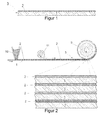
- FIG. 2 shows that the hot-melt adhesive-coated polyolefin sealing film 3, or sealing sheet 3, can be rolled up into a roll 9.
- the hot-melt adhesive composition 2 is melted and applied to the flexible polyolefin sealing film 1 by means of an applicator 10, for example a slot die.
- the polyolefin sealing film is moved under the applicator 10.
- the polyolefin sealant sheet is unwound from a roll (not shown).
- cooling means 11 for example an air blower.
- FIG. 2 further shows that hot-melt adhesive-coated polyolefin sealing film 3 thus prepared is rolled up. Furthermore, in FIG. 2 in the lower part of an enlarged schematic section of a roll 9 with rolled hot melt adhesive-coated polyolefin sealing film 3 shown. As a result of the rolling up of the coated sealing film, the individual layers of the rolled hot-melt adhesive-coated polyolefin sealing film 3 are in direct contact with one another and in particular have no intermediate layers of a release paper. If necessary, the hot-melt adhesive-coated polyolefin sealing film 3 can be unwound from the roll 9 without blocking, even after a longer storage or transport time. The role 9 can be stored and transported over longer periods of space to save space, unrolled if necessary in the film factory or on the site and, if necessary, be cut to the desired track length.
- the rolling takes place without the use of a siliconized release papers, which during rolling up
- the adhesive would be applied and then would prevent the sticking of individual layers in the role.
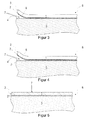
- FIGS. 3 and 4 show steps b) and c) of the method.
- step b the hot-melt adhesive-coated polyolefin sealing film 3 is placed on the surface 4 of a building 5 of civil engineering or building construction. Due to the tackiness of the film this can be moved on the surface 4, whereby, for example, a final positioning of the film is made possible. Due to the weight of the film, however, a certain inertia of the film is present and in particular largely prevents the unwanted displacement, for example by slipping or wind influence. Further shows FIG. 3 a variant of step c).
- step c) takes place during the application of the hot-melt adhesive-coated polyolefin sealing film 3 in step b) in the gap formed between hot-melt adhesive-coated polyolefin sealing film 3 and the surface 4 of a building 5 during laying
- the hotmelt adhesive composition 2 melts.
- the hotmelt adhesive composition becomes soft or slightly tacky, and the surface 4 of the building can contact it.
- the hotmelt adhesive composition 2 is cooled again, whereby an adhesive bond between flexible polyolefin sealing film 1 and the surface of the structure 5 is carried out and forms a composite layer 8 as a result.
- This layer composite body 8 has a layer of a polyolefin sealing film 1, a layer of a hot melt adhesive composition 2 and a building of civil engineering or building construction 5, on.
- the layer of the hot-melt adhesive composition 2 is in this case arranged between the layer of the polyolefin sealing film 1 and the structure of the civil engineering or building construction 5.
- FIG. 4 represents a second embodiment. This corresponds essentially to the FIG. 3 except that the surface 4 of the building is a hot melt adhesive composition 2 coated surface 4 '. Such a surface 4 'is before laying on the additional step a ').
- a non-reactive hotmelt adhesive composition 2 was applied to surface 4 of a building 5 of civil engineering or building construction and then step b) was carried out.
- FIG. 5 illustrates a third embodiment.
- the heat is supplied by means of a heat source 7 in step c) on the side opposite the hotmelt adhesive composition 2 to the polyolefin sealing film 1 and is transferred to the hotmelt adhesive composition 2 via the polyolefin sealing film 1. Due to the heat, the hotmelt adhesive composition 2 melts. As a result, the hotmelt adhesive composition becomes at least partially fluid and can contact the surface 4 of the building.
- the hotmelt adhesive composition 2 is cooled again, whereby an adhesive bond between flexible polyolefin sealing film 1 and the surface of the structure 5 takes place and as a result, as in FIG. 4 described, forms a layer composite body 8.
- the adhesive-coated polyolefin flexible film thus prepared was tack-free at 23 ° C as judged by scattering of chalk powder. When setting up the film, all of the chalk powder fell off the surface of the adhesive so that visually no more chalk could be detected on the surface.
- the adhesive-coated flexible polyolefin film strips thus produced were placed on a concrete garden path plate, or on a zinc sheet, so that the adhesive-coated side came into contact with the substrate to be bonded.
- the strip was lifted and hot air blown into the gap by means of a hot air blower so that the temperature measured in the adhesive was between 115 ° C and 135 ° C and compressed with a 5 kg roller.
- the peel strength was measured with a tensile tester (angle 90 °, feed rate 100 mm / min) and given in Table 1.
- SikaMelt®-9171 has a softening point, measured according to the Ring & Ball method according to DIN EN 1238, of 160 ° C and a crossover temperature, determined by DTMA, of 109 ° C according to the method as described above , hot air dryer flame concrete Zn-sheet concrete Zn-sheet Peel strength [N / 5cm] 90 366 > 100 413
Landscapes
- Engineering & Computer Science (AREA)
- Architecture (AREA)
- Civil Engineering (AREA)
- Structural Engineering (AREA)
- Physics & Mathematics (AREA)
- Electromagnetism (AREA)
- Adhesives Or Adhesive Processes (AREA)
- Laminated Bodies (AREA)
- Adhesive Tapes (AREA)
- Sealing Material Composition (AREA)
- Lining Or Joining Of Plastics Or The Like (AREA)
Priority Applications (9)
| Application Number | Priority Date | Filing Date | Title |
|---|---|---|---|
| EP10195793A EP2466030A1 (de) | 2010-12-17 | 2010-12-17 | Verwendung nicht-reaktiven Heissschmelzklebstoff-beschichteter Polyolefin- Abdichtungsfolien zum Abdichten |
| JP2013543769A JP5976007B2 (ja) | 2010-12-17 | 2011-12-14 | 封止用非反応性ホットメルト接着剤で被覆されたポリオレフィン封止膜の使用 |
| RU2013117938/03A RU2593845C2 (ru) | 2010-12-17 | 2011-12-14 | Применение полиолефиновых герметизирующих пленок с покрытием из нереактивного термоплавкого клея для герметизации |
| EP11799670.2A EP2652224B1 (de) | 2010-12-17 | 2011-12-14 | Verwendung nicht-reaktiven heissschmelzklebstoff-beschichteter polyolefin-abdichtungsfolien zum abdichten |
| US13/882,650 US8858743B2 (en) | 2010-12-17 | 2011-12-14 | Use of polyolefin sealing films coated with non-reactive hot-melt adhesive for sealing |
| BR112013011062A BR112013011062A2 (pt) | 2010-12-17 | 2011-12-14 | uso de películas de vedação de poliolefina revestida com adesivo termofundível não reagente para vedação |
| PCT/EP2011/072793 WO2012080353A1 (de) | 2010-12-17 | 2011-12-14 | Verwendung nicht-reaktiven heissschmelzklebstoff-beschichteter polyolefin-abdichtungsfolien zum abdichten |
| CN201180058492.4A CN103249900B (zh) | 2010-12-17 | 2011-12-14 | 涂覆有非反应性的热熔粘合剂的聚烯烃密封膜片用于密封的用途 |
| US13/973,366 US9157238B2 (en) | 2010-12-17 | 2013-08-22 | Use of polyolefin membranes being coated by non-reactive hotmelt adhesives for sealing |
Applications Claiming Priority (1)
| Application Number | Priority Date | Filing Date | Title |
|---|---|---|---|
| EP10195793A EP2466030A1 (de) | 2010-12-17 | 2010-12-17 | Verwendung nicht-reaktiven Heissschmelzklebstoff-beschichteter Polyolefin- Abdichtungsfolien zum Abdichten |
Publications (1)
| Publication Number | Publication Date |
|---|---|
| EP2466030A1 true EP2466030A1 (de) | 2012-06-20 |
Family
ID=43983760
Family Applications (2)
| Application Number | Title | Priority Date | Filing Date |
|---|---|---|---|
| EP10195793A Withdrawn EP2466030A1 (de) | 2010-12-17 | 2010-12-17 | Verwendung nicht-reaktiven Heissschmelzklebstoff-beschichteter Polyolefin- Abdichtungsfolien zum Abdichten |
| EP11799670.2A Not-in-force EP2652224B1 (de) | 2010-12-17 | 2011-12-14 | Verwendung nicht-reaktiven heissschmelzklebstoff-beschichteter polyolefin-abdichtungsfolien zum abdichten |
Family Applications After (1)
| Application Number | Title | Priority Date | Filing Date |
|---|---|---|---|
| EP11799670.2A Not-in-force EP2652224B1 (de) | 2010-12-17 | 2011-12-14 | Verwendung nicht-reaktiven heissschmelzklebstoff-beschichteter polyolefin-abdichtungsfolien zum abdichten |
Country Status (7)
| Country | Link |
|---|---|
| US (2) | US8858743B2 (enExample) |
| EP (2) | EP2466030A1 (enExample) |
| JP (1) | JP5976007B2 (enExample) |
| CN (1) | CN103249900B (enExample) |
| BR (1) | BR112013011062A2 (enExample) |
| RU (1) | RU2593845C2 (enExample) |
| WO (1) | WO2012080353A1 (enExample) |
Cited By (2)
| Publication number | Priority date | Publication date | Assignee | Title |
|---|---|---|---|---|
| AT14052U1 (de) * | 2012-08-02 | 2015-03-15 | Fatra As | Flächiger Verbundwerkstoff mit kaschierter Kunststofffolie |
| EP3756866A1 (de) * | 2019-06-26 | 2020-12-30 | Optiplan GmbH | Faserverstärkter, thermoplastischer verbundwerkstoff, verfahren zur herstellung eines verbundwerkstoffs und entsprechende verwendungen |
Families Citing this family (6)
| Publication number | Priority date | Publication date | Assignee | Title |
|---|---|---|---|---|
| EP2662213A1 (de) * | 2012-05-07 | 2013-11-13 | Sika Technology AG | Abdichtungsvorrichtung mit verbesserter Haftung |
| JP2016510094A (ja) * | 2013-03-12 | 2016-04-04 | シーカ・テクノロジー・アーゲー | 熱可塑性密封層を備えるタビングを作製する方法 |
| US20200331254A1 (en) * | 2017-11-22 | 2020-10-22 | Dsm Ip Assets B.V. | Method for producing and recycling an object consisting of a panel durably provided with a surface covering |
| PL3715105T3 (pl) * | 2019-03-27 | 2023-07-31 | Albéa Services | Laminowany materiał do formowania elastycznego pojemnika i elastycznej osłony tuby zawierającej wspomniany laminowany materiał |
| CN122058618A (zh) | 2021-03-10 | 2026-05-19 | 欧文斯科宁知识产权资产有限公司 | 用于发泡玻璃隔热材料的结合部粘合剂 |
| US11913233B2 (en) * | 2022-01-19 | 2024-02-27 | Johns Manville | Adhering single ply membrane to a roof deck with a hot melt or pressure sensitive adhesive applied to a release liner or transfer film |
Citations (4)
| Publication number | Priority date | Publication date | Assignee | Title |
|---|---|---|---|---|
| EP1728807A1 (de) * | 2005-05-31 | 2006-12-06 | Sika Technology AG | Wasserenthaltender zweikomponentiger Heissschmelzklebstoff |
| EP2075297A1 (de) * | 2007-12-04 | 2009-07-01 | Sika Technology AG | Heissschmelzklebstoff mit guter Haftung auf Polyolefinen |
| WO2009133093A1 (de) | 2008-04-28 | 2009-11-05 | Sika Technology Ag | Heissschmelzklebstoffe mit verlängerter offenzeit |
| EP2145907A1 (de) * | 2008-07-14 | 2010-01-20 | Sika Technology AG | Amorphes Polyurethanpolymer und dessen Verwendung in Heissschmelzklebstoffen |
Family Cites Families (20)
| Publication number | Priority date | Publication date | Assignee | Title |
|---|---|---|---|---|
| US2036123A (en) | 1935-06-22 | 1936-03-31 | William J Tompkins | Dampproof structure and method of constructing same |
| JPS5063083A (enExample) * | 1973-10-05 | 1975-05-29 | ||
| JPS5063082A (enExample) * | 1973-10-06 | 1975-05-29 | ||
| CH679761A5 (enExample) * | 1989-10-02 | 1992-04-15 | Sarna Patent & Lizenz Ag | |
| JP2960836B2 (ja) * | 1993-07-07 | 1999-10-12 | 大倉工業株式会社 | 断熱材の表面被覆用フィルム |
| US5479753A (en) | 1994-08-31 | 1996-01-02 | Williams; Charles T. | Process for sealing a sloped metal roof |
| JPH0972198A (ja) * | 1995-09-01 | 1997-03-18 | Fujita Corp | トンネル構築方法 |
| JP2950779B2 (ja) * | 1996-08-05 | 1999-09-20 | 倉敷紡績株式会社 | コンクリート型枠用パネル |
| CN1075103C (zh) * | 1998-09-21 | 2001-11-21 | 深圳市奥博胶粘剂化工有限公司 | 一种聚氨酯粘接剂/密封胶组合物及其制备方法 |
| JP2001026915A (ja) * | 1999-05-07 | 2001-01-30 | Sekisui Chem Co Ltd | 道路面表示材及び道路面表示材の道路面への貼付方法 |
| ATE247223T1 (de) * | 1999-07-06 | 2003-08-15 | Tecton Holding Ag | Vorrichtung zum verlegen von dichtungsfolien mittels klebstoff an wandungen von bauwerken |
| US20040115318A1 (en) * | 2001-11-07 | 2004-06-17 | Annegret Janssen | Food packaging laminates |
| US6679018B2 (en) * | 2002-02-01 | 2004-01-20 | Chem Link, Inc. | Roofing system and method |
| CN100588663C (zh) * | 2002-10-15 | 2010-02-10 | 埃克森美孚化学专利公司 | 用于烯烃聚合的多催化剂体系和由其生产的聚合物 |
| CA2413550C (en) | 2002-12-03 | 2009-01-20 | Bakor Inc. | Self-adhering vapor permeable air and moisture barrier membrane |
| JP2007176996A (ja) * | 2005-12-27 | 2007-07-12 | Sekisui Chem Co Ltd | 止水シール材 |
| CA2623972C (en) | 2007-03-05 | 2015-02-03 | Alpha Systems, Inc. | Recreational vehicle roofing system |
| US20080250741A1 (en) | 2007-04-13 | 2008-10-16 | University Of Maine System Board Of Trustees | Fire resistant fibrous composite articles |
| DE102007060533A1 (de) * | 2007-12-13 | 2009-06-18 | Henkel Ag & Co. Kgaa | Coextrudierbarer Schmelzklebstoff |
| US20100307087A1 (en) | 2009-06-08 | 2010-12-09 | Oliver Zoellner | Self adhering roofing membrane with an attached roofing underlayment |
-
2010
- 2010-12-17 EP EP10195793A patent/EP2466030A1/de not_active Withdrawn
-
2011
- 2011-12-14 RU RU2013117938/03A patent/RU2593845C2/ru not_active IP Right Cessation
- 2011-12-14 WO PCT/EP2011/072793 patent/WO2012080353A1/de not_active Ceased
- 2011-12-14 EP EP11799670.2A patent/EP2652224B1/de not_active Not-in-force
- 2011-12-14 US US13/882,650 patent/US8858743B2/en not_active Expired - Fee Related
- 2011-12-14 BR BR112013011062A patent/BR112013011062A2/pt not_active IP Right Cessation
- 2011-12-14 JP JP2013543769A patent/JP5976007B2/ja not_active Expired - Fee Related
- 2011-12-14 CN CN201180058492.4A patent/CN103249900B/zh not_active Expired - Fee Related
-
2013
- 2013-08-22 US US13/973,366 patent/US9157238B2/en not_active Expired - Fee Related
Patent Citations (4)
| Publication number | Priority date | Publication date | Assignee | Title |
|---|---|---|---|---|
| EP1728807A1 (de) * | 2005-05-31 | 2006-12-06 | Sika Technology AG | Wasserenthaltender zweikomponentiger Heissschmelzklebstoff |
| EP2075297A1 (de) * | 2007-12-04 | 2009-07-01 | Sika Technology AG | Heissschmelzklebstoff mit guter Haftung auf Polyolefinen |
| WO2009133093A1 (de) | 2008-04-28 | 2009-11-05 | Sika Technology Ag | Heissschmelzklebstoffe mit verlängerter offenzeit |
| EP2145907A1 (de) * | 2008-07-14 | 2010-01-20 | Sika Technology AG | Amorphes Polyurethanpolymer und dessen Verwendung in Heissschmelzklebstoffen |
Cited By (2)
| Publication number | Priority date | Publication date | Assignee | Title |
|---|---|---|---|---|
| AT14052U1 (de) * | 2012-08-02 | 2015-03-15 | Fatra As | Flächiger Verbundwerkstoff mit kaschierter Kunststofffolie |
| EP3756866A1 (de) * | 2019-06-26 | 2020-12-30 | Optiplan GmbH | Faserverstärkter, thermoplastischer verbundwerkstoff, verfahren zur herstellung eines verbundwerkstoffs und entsprechende verwendungen |
Also Published As
| Publication number | Publication date |
|---|---|
| EP2652224B1 (de) | 2017-10-11 |
| WO2012080353A1 (de) | 2012-06-21 |
| RU2593845C2 (ru) | 2016-08-10 |
| JP5976007B2 (ja) | 2016-08-23 |
| CN103249900B (zh) | 2016-06-29 |
| JP2014504320A (ja) | 2014-02-20 |
| US9157238B2 (en) | 2015-10-13 |
| CN103249900A (zh) | 2013-08-14 |
| US20130212967A1 (en) | 2013-08-22 |
| RU2013117938A (ru) | 2015-01-27 |
| BR112013011062A2 (pt) | 2016-08-23 |
| EP2652224A1 (de) | 2013-10-23 |
| US8858743B2 (en) | 2014-10-14 |
| US20130340368A1 (en) | 2013-12-26 |
Similar Documents
| Publication | Publication Date | Title |
|---|---|---|
| EP2652224B1 (de) | Verwendung nicht-reaktiven heissschmelzklebstoff-beschichteter polyolefin-abdichtungsfolien zum abdichten | |
| EP2652223B1 (de) | Verwendung von dispersionsklebstoff-beschichteten polyvinylchlorid-abdichtungsfolien zum abdichten | |
| EP3235637B1 (de) | Abdecklaminat oder -schichtsystem | |
| EP2662214A1 (de) | Abdichtungsvorrichtung mit verbesserter Haftung | |
| EP3228676B1 (de) | Schmelzklebstoff mit verbesserter uv- und temperaturstabilität und verwendung zur herstellung einer mehrschichtigen kunststoffbahn | |
| CH646638A5 (de) | Waermeisolierende und wasserdichte schichtstoffplatte und verfahren zur herstellung einer wasserdichten abdeckung unter verwendung dieser schichtstoffplatten. | |
| EP2290029A1 (de) | Heissschmelzklebstoffe mit verbesserter Haftung auf niederenergetischen Oberflächen | |
| EP2325273A1 (de) | Montageklebeband für den Innenausbau | |
| EP3265531A1 (de) | Schmelzklebstoff mit verbesserter uv-stabilität und verwendung zur herstellung einer mehrschichtigen kunststoffbahn | |
| WO2012098115A1 (de) | Dichtungsmasse und dichtungselement zur bauwerksabdichtung | |
| EP2995665B1 (de) | Folienbahn, Fensterrahmen mit einer solchen Bahn und Verwendung dieser Bahn | |
| DE202011000107U1 (de) | Dichtungsmasse und Dichtungselement zur Bauwerksabdichtung | |
| EP1664447A1 (de) | Sperrbahn, ihre anordnung und verwendung | |
| EP2907832B1 (de) | Verfahren zur druckwasserfesten abdichtung von bauwerken | |
| WO2018073406A1 (de) | Doppelseitig selbstklebende dampfbremse | |
| DE202016101644U1 (de) | Überputzbares Klebeband | |
| EP2945785A1 (de) | Verfahren zur herstellung eines tübbing mit thermoplastischer schottschicht | |
| DE102008054031A1 (de) | Herstellung eines Klebebandes | |
| EP2971505A2 (de) | Verfahren zur herstellung eines tübbing mit thermoplastischer schottschicht | |
| EP3312250A1 (de) | Einseitig selbstklebende dampfbremse zum absperren von restfeuchten böden | |
| DE102009046739B4 (de) | Zweikomponentiges Kleb- und Dichtstoffsystem | |
| EP1769907A1 (de) | Mehrschichtiger Verbundwerkstoff | |
| DE102008025980A1 (de) | Klebeband für Bauanwendungen | |
| EP3347423B1 (de) | Eine mehrschichtige trägerfolie aus kunststoff | |
| DE202007009110U1 (de) | Festes, formbeständiges Baumaterial |
Legal Events
| Date | Code | Title | Description |
|---|---|---|---|
| PUAI | Public reference made under article 153(3) epc to a published international application that has entered the european phase |
Free format text: ORIGINAL CODE: 0009012 |
|
| AK | Designated contracting states |
Kind code of ref document: A1 Designated state(s): AL AT BE BG CH CY CZ DE DK EE ES FI FR GB GR HR HU IE IS IT LI LT LU LV MC MK MT NL NO PL PT RO RS SE SI SK SM TR |
|
| AX | Request for extension of the european patent |
Extension state: BA ME |
|
| STAA | Information on the status of an ep patent application or granted ep patent |
Free format text: STATUS: THE APPLICATION IS DEEMED TO BE WITHDRAWN |
|
| 18D | Application deemed to be withdrawn |
Effective date: 20121221 |