EP2425987B1 - Hydraulisches transferverfahren und aktivierungsmittel für das hydraulische transferverfahren - Google Patents
Hydraulisches transferverfahren und aktivierungsmittel für das hydraulische transferverfahren Download PDFInfo
- Publication number
- EP2425987B1 EP2425987B1 EP10769823.5A EP10769823A EP2425987B1 EP 2425987 B1 EP2425987 B1 EP 2425987B1 EP 10769823 A EP10769823 A EP 10769823A EP 2425987 B1 EP2425987 B1 EP 2425987B1
- Authority
- EP
- European Patent Office
- Prior art keywords
- activating agent
- photo
- ink
- article
- print pattern
- Prior art date
- Legal status (The legal status is an assumption and is not a legal conclusion. Google has not performed a legal analysis and makes no representation as to the accuracy of the status listed.)
- Not-in-force
Links
Images









Classifications
-
- B—PERFORMING OPERATIONS; TRANSPORTING
- B44—DECORATIVE ARTS
- B44C—PRODUCING DECORATIVE EFFECTS; MOSAICS; TARSIA WORK; PAPERHANGING
- B44C1/00—Processes, not specifically provided for elsewhere, for producing decorative surface effects
- B44C1/16—Processes, not specifically provided for elsewhere, for producing decorative surface effects for applying transfer pictures or the like
- B44C1/165—Processes, not specifically provided for elsewhere, for producing decorative surface effects for applying transfer pictures or the like for decalcomanias; sheet material therefor
- B44C1/175—Transfer using solvent
- B44C1/1752—Decalcomanias provided with a particular decorative layer, e.g. being specially adapted to allow the formation of a metallic or dyestuff layer on a substrate unsuitable for direct deposition
-
- B—PERFORMING OPERATIONS; TRANSPORTING
- B44—DECORATIVE ARTS
- B44F—SPECIAL DESIGNS OR PICTURES
- B44F7/00—Designs imitating three-dimensional [3D] effects
-
- C—CHEMISTRY; METALLURGY
- C09—DYES; PAINTS; POLISHES; NATURAL RESINS; ADHESIVES; COMPOSITIONS NOT OTHERWISE PROVIDED FOR; APPLICATIONS OF MATERIALS NOT OTHERWISE PROVIDED FOR
- C09D—COATING COMPOSITIONS, e.g. PAINTS, VARNISHES OR LACQUERS; FILLING PASTES; CHEMICAL PAINT OR INK REMOVERS; INKS; CORRECTING FLUIDS; WOODSTAINS; PASTES OR SOLIDS FOR COLOURING OR PRINTING; USE OF MATERIALS THEREFOR
- C09D11/00—Inks
- C09D11/02—Printing inks
- C09D11/10—Printing inks based on artificial resins
- C09D11/101—Inks specially adapted for printing processes involving curing by wave energy or particle radiation, e.g. with UV-curing following the printing
-
- C—CHEMISTRY; METALLURGY
- C09—DYES; PAINTS; POLISHES; NATURAL RESINS; ADHESIVES; COMPOSITIONS NOT OTHERWISE PROVIDED FOR; APPLICATIONS OF MATERIALS NOT OTHERWISE PROVIDED FOR
- C09D—COATING COMPOSITIONS, e.g. PAINTS, VARNISHES OR LACQUERS; FILLING PASTES; CHEMICAL PAINT OR INK REMOVERS; INKS; CORRECTING FLUIDS; WOODSTAINS; PASTES OR SOLIDS FOR COLOURING OR PRINTING; USE OF MATERIALS THEREFOR
- C09D133/00—Coating compositions based on homopolymers or copolymers of compounds having one or more unsaturated aliphatic radicals, each having only one carbon-to-carbon double bond, and at least one being terminated by only one carboxyl radical, or of salts, anhydrides, esters, amides, imides, or nitriles thereof; Coating compositions based on derivatives of such polymers
Definitions
- This invention relates to a water pressure transfer method and a coating (activating) agent to be used for said method, and more particularly, a water pressure transfer method using a transfer film for obtaining a tactile feeling of fine unevenness on a surface of an article.
- the water pressure transfer method is a method for floating on a water surface in a transfer tub a transfer film formed by applying a predetermined print pattern of non-water solubility on a water-soluble film of polyvinyl alcohol, making wet the water-soluble film of the transfer film with water, immersing an article (an object to be pattern-transferred) into the water in the transfer tub while contacting the transfer film, and transferring the print pattern of the transfer film on a surface of the article using the water pressure generated when the article is immersed into water to form a print layer.
- this transfer film is obtained by printing the print pattern on the water-soluble film by gravure printing method etc.
- this transfer film is generally supplied to the water pressure transfer operation site by being shipped in a roll state after the ink of the print pattern is dried.
- the transfer film has a whole outer surface pattern fixture layer in order to make stable the ink pattern on the polyvinyl alcohol of the water soluble film when the water soluble film is made wet or dissolved.
- the whole outer surface pattern fixture layer will be described later in details, the whole outer surface pattern fixture layer of transparent or translucent ink is applied on the whole surface of the transfer film so that the whole area has a uniform thickness in spite of the no ink area and the ink area of color ink layer of the print pattern partially having the visible surface (substrate surface) of the article, that is the print pattern partially having no color ink resulting in having the print pattern partially removed.
- the whole outer surface pattern fixture layer serves to prevent the print pattern from being unable to be fixed as the polyvinyl alcohol of the water soluble film swells or is dissolved if there is no whole outer surface pattern fixture layer.
- This whole outer surface pattern fixture layer also serves to prevent the water soluble film from unstably swelling or being dissolved due to the difference between the thicknesses of the area of ink layer and the area of no ink.
- this whole outer surface pattern fixture layer is indispensable for the transfer layer for obtaining the desired design.
- Patent Document 1 For the conventional unevenness imparting arts, there has been a first conventional prior art in which the unevenness is imparted by printing a pattern on a fine uneven surface of a decorative sheet having the fine uneven surface formed beforehand (see Patent Document 1), a second prior art in which wood flour is mixed into an ink layer etc. of a print pattern of a transfer film to give a fine unevenness to the surface of the water pressure transfer article (see Patent Document 2) or a third prior art in which a fine unevenness is formed on the surface of the article with a base coat layer having an surface unevenness applied to the article before the transfer of the print pattern or a topcoat having variant unevenness formed by a press-molding machine etc. after the transfer, but before hardening the print pattern (see Patent Documents 3).
- EP 2221189 is prior art in the sense of Article 54(3) EPC and describes a transfer film which has print pattern comprising a first area having an ink layer and a second area having no ink layer.
- An activating agent is applied onto the surface of the transfer film to collect a surplus portion of the activating agent in a convex form in the second area by a repelling operation of the ink in the first area and a collecting power of the activating agent.
- the convex collection portions of the activating agent in the second area have a concave-convex reversal made on the surface of the article when the water pressure transfer method is performed.
- the convex collection portions of the activating agent are shrunk and then protruded when the print layer is hardened whereby a three-dimensional unevenness is imparted onto the surface of the article.
- WO 2006/098575 discloses an ink which is viscosity and volumetric shrinkage controlled to 20-80 CPN and 10-30% respectively by controlling an amount of each of a first monomer and a second monomer.
- the methods according to these prior arts have the disadvantages that the separate steps such as an emboss process for the decorative sheet (the first prior art) and mechanically imparting the unevenness to the base coat or topcoat (the third prior art) are required and there are the difficulties of obtaining the unevenness other than dot-like one (the second prior art) and the stripe-like unevenness pattern such as wooden skin. Furthermore, none of the prior arts forms the three-dimensional fine unevenness on the print pattern itself and therefore the real tactile feeling of unevenness cannot be obtained.
- the applicant has proposed a water pressure transfer method adapted to form the three-dimensional fine unevenness on the print pattern itself without any particular step and to thereby obtain the real tactile feeling of unevenness (Japanese Patent Application No. 2007-277501 of the Patent Document No. 5)
- the water pressure transfer method is a method in which there is prepared a transfer film having a print pattern including a first area of an ink layer and a second area of no ink layer or an ink layer thinner than that of the first area and having no whole outer surface pattern fixture layer, there is formed activating agent convex collection portions by protruding on a surface of an article a surplus portion of the activating agent which is applied onto the surface of the transfer film to activate the ink of the first area while the surplus portion of the activating agent is collected in the second area by being pushed by the surface of the article on the water pressure transfer and there is shrunk the activating agent convex collection portion when the print pattern on the article is hardened whereby an ink print portion corresponding to the second area projects over an ink print portion corresponding to the first area to thereby impart a three-dimensional unevenness shape to the surface of the article surface.
- the activating agent convex collection portions in order to form the activating agent convex collection portions in the second area, may be formed by collecting in a convex manner in the second area by a repelling function of the ink layer of the first area and a collection power of the activating agent the surplus portion of the activating agent within the first area.
- the collection of the surplus portion of the activating agent may be carried out by setting an interfacial tension of the ink relative to the activating agent in the first and second areas so that the activating agent collection power in the second area acts more greatly than a power for the ink layer of the first area to draw the activating agent and setting the interfacial tension may be carried out so that the interfacial tension relative to the activating agent in the first area gets lower than the interfacial tension relative to the activating agent in the second area.
- the repelling function in this specification is the phenomena where the surplus portion of the activating agent remaining on the ink after the activating agent permeates the ink composite until the activating agent is wholly united with the ink composite is pulled from the surface of the portions having the ink layer near the surface of the portions having no ink layer due to the difference of the polarities of the surface of the portions having the ink layer and the surface of the portion having no ink layer.
- the repelling function never prevents the activating agent from permeating the ink layer.
- the activating agent to be used for this new water pressure transfer method is not an organic solvent, but may preferably be one formed of ultraviolet ray hardening resin composite.
- the activating agent of ultraviolet ray hardening resin has the ultraviolet ray hardening resin component permeated into the ink of the print pattern to activate the dried ink and also hardened by ultraviolet ray in the ink to impart a mechanical and chemical surface protection function to the surface decorative layer formed of the print pattern transferred onto the surface of the article.
- the applicant has also proposed an activating agent of ultraviolet ray hardening resin composite suitable for being used in the water pressure transfer (see Patent Document 4).
- This activating agent includes no organic solvent and includes at least photo-polymerization pre-polymer (photo-polymerization oligomer), photo-polymerization monomer and photo-polymerization initiator.
- the photo-polymerization pre-polymer may be of 9 to 40 mass%
- the photo-polymerization monomer may be of 50 to 90 mass%
- the photo-polymerization initiator may be of 0.5 to 5 mass%
- the balance may be of 0.5 to 5 mass %. This may have the viscosity of 10 to 100 CPS (25°C) and the ink solubility of 10 or more at the SP value.
- the photo-polymerization monomer of the ultraviolet ray hardening resin component has a solvent power to an ink of the print pattern as well as that to the photo-polymerization pre-polymer, a higher hardenability, a good adhesion to ABS resins, PC materials, etc., which are base materials onto which the print pattern is to be transferred under water pressure, a lower shrinkage when hardened and a good smoothness and also has a good transparency maintained.
- the adhesion of the dried and cured print pattern of the water pressure transfer film can be positively recovered by the proper viscosity and ink solubility of the ultraviolet ray hardening resin composite and since the ultraviolet ray hardening resin composite permeates and penetrates the whole thickness of the print pattern from the surface on the side of application of the ultraviolet ray hardening resin composite to the surface on the opposite side so that the print pattern and the ultraviolet ray hardening resin composite are integrally combined with each other over the whole of the print pattern (the whole areas and the whole thickness thereof), the decorative layer obtained by the print pattern transferred on the article is hardened by the ultraviolet ray all over the decorative layer including the outer surface and therefore the print pattern can be solidly attached on the surface of the article and in addition thereto the surface protection function according to the ultraviolet ray hardening can be imparted to the decorative layer itself.
- the decorative layer obtained by transferring the print pattern is hardened all over the whole including the outer surface thereof whereby the print pattern can be positively adhered to the surface of the article and in addition thereto, the surface protection function by ultraviolet ray hardening is imparted to the decorative layer itself.
- the particular viscosity of 10 to 100 CPS (25°C) and the particular ink solubility of 10 or more at the SP value of the ultraviolet ray hardening resin composite are the values necessary for making the solubility of the ultraviolet ray hardening resin composite closer to that of the ink component of the print pattern and the particular viscosity of the ultraviolet ray hardening resin composite is the value necessary for maintaining the smoother coating to the ink component of the print pattern and the permeability of the ultraviolet ray hardening resin composite into the ink component.
- the particular viscosity of 3 to 30 CPS (25°C) and the particular ink solubility of 9 or more at the SP value reduces the viscosity of the photo-polymerization pre-polymer having a tendency of high viscosity and also makes the solubility of the ultraviolet ray hardening resin composite closer to that of the ink component of the print pattern. Therefore, there can be obtained the ultraviolet ray hardening resin composite maintaining the property of smoothly applying the ultraviolet ray hardening resin composite on the ink component of the print pattern (smooth applicability) and the property in which the ultraviolet ray hardening resin composite can permeate the ink component in a good manner (permeability).
- the ultraviolet ray hardening resin composite has a good adhesion to the ABS resins, the PC materials etc. of the base materials and maintains the smoothness and the transparency when hardened.
- the blend ratio of the photo-polymerization monomer having the high volume shrinkage ratio is required to be 70% or more, for example.
- a high volume shrinkage ratio reduces the blend ratio of the photo-polymerization pre-polymer, the component to be a main frame of the activating agent, which influences a membrane performance (abrasion resistance and chemical resistance) after hardened with the result that the membrane performance is disadvantageously reduced.
- the activating agent of the ultraviolet ray hardening resin composite previously proposed by the applicant is used for the new water pressure transfer method, the product having the large height difference of the unevenness can be obtained, but sufficient membrane performance cannot be obtained and therefore both of the good tactile feeling of unevenness and the good membrane performance cannot be obtained.
- the blend ratio of the photo-polymerization pre-polymer of the activating agent is so set to be slightly higher in order to heighten the membrane performance of the decorative layer, then the product having the large height difference of unevenness cannot be obtained due to the volume shrinkage ratio of the photo-polymerization pre-polymer less than that of the photo-polymerization polymer and therefore this is undesirable.
- the article with the unevenness to be imparted thereto is a transfer article requiring the tactile feeling of unevenness
- the chemical resistance against oleic acid used for evaluating the prevention of dirt on the surface of the product due to tactile by a human body More particularly, as one of the evaluation of the performance of the chemical resistance required for such a transfer article, it is very important that there is evaluated the prevention of dirt due to sweat or remains of a fingerprint of a human body by oleic acid included in the sweat or skin fat of the human body. Thus the resistance to oleic acid is an important performance for the article having the unevenness imparted thereto.
- the performance of the product is insufficient (or poor).
- the membrane performance will be considerably reduced as the smoothness is reduced for obtaining the unevenness.
- the unevenness cannot be imparted in a totally balanced manner in addition to the coating performance, permeability and so on.
- Another important problem of the invention is to be able to stably maintain the pattern of the print pattern layer on water even though the transfer film has no whole outer surface pattern fixture layer.
- the activating agent of prior art according to the Patent Document 4 is applied onto the transfer film having no whole outer surface pattern fixture layer, the stability of the pattern of the print pattern layer is not sufficient.
- a first problem to be solved by this invention is to provide a water pressure transfer method adapted to further improve a tactile feeling of three-dimensional unevenness by enlarging a height difference of unevenness without any reduction of a membrane performance (abrasion resistance, chemical resistance to oleic acid and so on) of a surface decorative layer and also to stably maintain on water a pattern of a print pattern layer of a transfer film required to have no whole outer surface pattern fixture layer for imparting the unevenness to the decorative layer whereby a high design characteristric can be maintained.
- a second problem to be solved by the invention is to provide an activating agent for a water pressure transfer adapted to further improve a tactile feeling of three-dimensional unevenness by enlarging a height difference of unevenness without any reduction of a membrane performance (abrasion resistance, chemical resistance to oleic acid and so on) of a surface decorative layer and also to stably maintain on water a pattern of a print pattern layer of a transfer film required to have no whole outer surface pattern fixture layer for imparting the unevenness to the decorative layer whereby a high design characteristic can be maintained.
- Means to solve a first problem of the invention is to provide a water pressure transfer method according to claim 1 for activating a print pattern of a transfer film formed by applying the print pattern on a water-soluble film with an activating agent and thereafter carrying out a water pressure transfer of said print pattern on a surface of an article.
- the first photo-polymerization monomer has the volume shrinkage ratio of 5 to 35% while said second photo-polymerization monomer has the volume shrinkage ratio of 10 to 22%, said first photo-polymerization monomer has molecular weight of 1500 or more while said second photo-polymerization monomer has molecular weight of 100 to 1000 and said first photo-polymerization monomer has a viscosity of 50 to 6000 CPS while said second photo-polymerization monomer has a viscosity of 3 to 30 CPS.
- the resin component of the activating agent in order to obtain the predetermined viscosity and ink solubility of the activating agent, preferably has the blend ratio of the first photo-polymerization monomer of three or more functional groups to the second photo-polymerization monomer of two functional groups of 70 to 30 weight% or 50 to 50 weight % or 20 to 50 weight 5 or 5 to 50 weight%.
- Means to solve a second problem of the invention is to provide an activating agent to be used for the water pressure transfer method according to the means to solve the first problem, said activating agent characterized by having at least resin main component including first photo-polymerization monomer of three or more functional groups and second photo-polymerization monomer of two functional groups and photo-polymerization initiator, said first and second-polymerization monomers being blended so as to provide a whole volume shrinkage ratio of 10 to 20 % and a viscosity of 100 to 500 CPS.
- the first photo-polymerization monomer has the volume shrinkage ratio of 5 to 35% while said second photo-polymerization monomer has the volume shrinkage ratio of 10 to 22%, said first photo-polymerization monomer has molecular weight of 1500 or more while said second photo-polymerization monomer has molecular weight of 100 to 1000 and said first photo-polymerization monomer has a viscosity of 50 to 6000 CPS while said second photo-polymerization monomer has a viscosity of 3 to 30 CPS.
- the resin component of the activating agent preferably has the blend ratio of the first photo-polymerization monomer of three or more functional groups to the second photo-polymerization monomer of two functional groups of 70 to 30 weight% or 50 to 50 weight% or 20 to 50 weight% or 5 to 50 weight%.
- the activating agent to activate the print pattern of the transfer film can obtain the high volume shrinkage ratio of 10 to 20 %, which cannot be obtained for the ultraviolet ray hardening resin composite of conventional art, without using the photo-polymerization oligomer of low volume shrinkage ratio used in the ultraviolet ray hardening resin type activating agent of conventional art, there can be provided the extremely larger height difference of unevenness of the surface decorative layer and therefore the realer tactile feeling of unevenness can be obtained and the three-dimensional decoration can be more improved whereby the higher design can be maintained without any whole outer surface pattern fixture layer on the transfer film.
- the first photo-polymerization monomer of three or more functional groups imparts the mechanical and chemical surface protection function to the surface decorative layer in place of the photo-polymerization oligomer of the activating agent of conventional art, the membrane performance of the surface decoration layer can be maintained.
- the ultraviolet ray hardening resin type activating agent has the relatively lower viscosity of 100 to 500 CPS and in addition thereto preferably the high ink solubility of 7 and more at SP value, the easiness of coating the activating agent on the print pattern and the high permeability of the activating agent in the print pattern can be maintained to thereby ease the operation of activation and also to positively adhere the print pattern onto the article.
- the viscosity of the ultraviolet ray hardening resin type activating agent is higher than 10 to 100 CPS of the viscosity of the ultraviolet ray hardening resin type activating agent of the prior art disclosed in the Patent Document 4.
- the activating agent easily permeates the ink and also the easy movement of the activating agent caused by the repelling function promotes the formation of the convex collection portions of the activating agent with the result that the function of the appearance of the unevenness design can be expected.
- the viscosity of the activating agent is made higher as long as the permeability of the activating agent into ink is maintained in order to enlarge the height difference of unevenness, the thicker coating can be easily accomplished in view of the relation of balance between interfacial tension and gravity.
- the invention defines the viscosity of the activating agent to the range of 100 to 500 CPS, which maintains the permeability of the activating agent into ink and improves the thicker coating thereof.
- the viscosity of the activating agent In case where such a range of the viscosity of the activating agent is set, it can be controlled in consideration of the blend ratio of the first photo-polymerization monomer of three or more functional groups having the high viscosity and the second photo-polymerization monomer having the lower viscosity and the addition of other additives.
- Fig. 1 briefly illustrates a water pressure transfer method to which this invention is applied.
- This water pressure transfer method is a method in which an activating agent 320 of ultraviolet ray hardening resin described in details later is applied to a print pattern 340 of a transfer film 316 (see Fig. 3(A) ) comprising a water soluble film 314 having the print pattern 340 applied thereon to thereby activate the ink of the print pattern, thereafter the transfer film 316 is floated on a water 318 within a transfer tub not shown with the print pattern 340 directed upside and an article 10 to be transferred under water pressure is forced underwater through the transfer film 316 (see Fig. 1 and Fig.
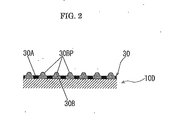
- a decorated article 10D having a print layer (or a decorative layer) 30 (see Fig. 2 and Fig. 3(C) ) of a pattern corresponding to the print pattern 340 on the surface of the article 10.
- An ingredient of the ink of the print pattern 340 and materials of components such as the water-soluble film 314 and so on (excluding the activating agent) are not limited to what are described with respect to the mode of embodiment and Examples which are described later and the article 10 may have a suitable ground process applied thereto before the water pressure transfer is carried out.
- the water soluble film 314 is formed of water soluble material having a main ingredient of polyvinyl alcohol, for example, which gets wet and is softened by absorbing water. This water soluble film 314 is softened when it contacts the water within the transfer tub to facilitate the water pressure transfer.
- the print pattern 312 may be applied on the water soluble film 314 by gravure printing and so on and the transfer film 316 may be stored in the state where the ink is dried and activated by using the activating agent when the water pressure transfer is carried out.
- the decorated article 10D having the print layer 30 formed thereon passes through a curing step (see Fig. 3 (D) ) where the activating agent is hardened, a shower washing step (see Fig. 3 (E) ) where the water-soluble film 314 is removed and a drying step (see Fig. 3 (F) ) where the surface of the article is dried and then a finished product can be produced.
- the article 10 is forced underwater, while it is being conveyed by a suitable conveyor or being supported by a robot arm.
- the step of applying the activating agent 320 on the print pattern 340 and the step of floating the transfer film 316 on the water may be performed in a reverse order where the activating agent 320 may be sprayed on the print pattern 340 of the transfer film 316 which is floated on the water.
- the method of the invention lies in an application of the specific activating agent for the method disclosed in Japanese Patent Application No. 2007-277501 and PCT/JP2008/069304 , both of which were previously filed by the applicant.
- the transfer film 316 having the print pattern 340 comprising a first area 312A having an ink layer 312I and a second area 312B having no ink layer or an ink layer thinner than the ink layer of the first area 312A, having a space required for collecting a surplus portion of the activating agent provided in the second area 312 and having no whole outer surface pattern fixture layer provided thereon.
- An interfacial tension of the first area 312A relative to the activating agent is preferably lower than an interfacial tension of the second area 312B relative to the activating agent, and the reason for it will be described later.
- this activating agent 320 of ultraviolet ray hardening resin activates the ink layer 312I in the first area 312A of the print pattern 312 while it permeates this ink layer 312I to restore the adhesion having the same state as the one when the ink layer is printed, which enables the water pressure transfer of the print pattern 312 to be performed.
- a surplus portion 320R of the activating agent 320 of ultraviolet ray hardening type resin used for activating the print pattern 312 is transferred to a space (a middle space) between the adjacent ink printed portions 30A of the print layer (the surface decoration layer) 30 (see Fig.
- the first form is the one in which the surplus portion 320R of the activating agent applied on the transfer film 316 is transferred onto the surface of the article while it is collected between the ink printed portions 312A of the print pattern 340 on water pressure transfer so that the surplus portion 320R of the activating agent flows into the adjacent ink printed portions 312A to thereby form the convex portions 30BP.
- the surplus portion 320R of the activating agent applied on the transfer film 316 is transferred onto the surface of the article while it is collected between the ink printed portions 312A of the print pattern 340 on water pressure transfer so that the surplus portion 320R of the activating agent flows into the adjacent ink printed portions 312A to thereby form the convex portions 30BP.
- the second form is the one in which the surplus portion 320R of the activating agent is collected in the second area 312B by means of the repelling operation of the ink layer 312I in the first area 312A of the print pattern 340 and the collecting power of the activating agent 320 and thereafter, the concavo-convex reversal of the activating agent convex collection portions 320C in the second area 312B is carried out on the surface of the article on water pressure transfer to thereby form the convex portions 30BP.
- repelling function is the phenomena in which the surplus portions of the activating agent remaining on the ink is pulled from the surface of the location where there is the ink layer toward the location where there is no ink layer due to the difference of the polarity of the ink layer location and the no ink layer location as previously described.
- the "repelling function” may be also referred to as “pulling phenomena” due to the polarity difference between the two locations as viewed from the location where there is no ink layer. It should be noted that the activating agent is never prevented from permeating the ink layer for activating the ink due to the "repelling function" or the "pulling phenomena".
- the process according to the first form and the process according to the second form are independently or simultaneously performed and each of the processes will be concretely described later.
- the activating agent is necessary to be applied at the amount of the surplus portion required to form the convex portions 32BP exceeding the amount for permeating the ink printed portions 312 to activate the ink.
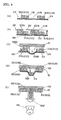
- Figs. 4 and 5 The process according to the first form is shown in Figs. 4 and 5 .
- Fig. 4 (B) as the activating agent 320 of ultraviolet ray hardening type resin is applied on the transfer film 316 shown in Fig. 4 (A) , the activating agent 320 permeates the ink layer 312I in the dried first area 312A of the print pattern 312 to restore the adhesion of the ink layer 312I.
- the print pattern 312 is transferred under water pressure so as to become the print layer (the surface decoration layer) 30 on the surface of the article 10 and at that time, the surplus portion 320RA of the activating agent 320 above the first area 312A and the surplus portion 320RB of the activating agent 320 in the second area 312B are collected while they are pushed down by the surface of the article 10 and flow into the second area 312B by their fluidity (see Fig. 4 (C) ).
- these surplus portions of the activating agent 320 are transferred in the convex form into the space 30B (the portion corresponding to the second area 312B) between the adjacent ink printed portions 30A (the portions having the ink of the print layer 30) corresponding to the ink printed portions 312I of the first area 312A to form the convex portion 30BP by the collection of the activating agent in the space 30B (see Fig. 4 (C) ).
- This convex portion 30BP may have a more remarkable vertical height difference by providing a shrinkage difference at the time of ultraviolet ray hardening to form a crevice lower than the ink printed portions 30A surrounding the convex portion 30BP as described in detail with reference to Fig. 6 (F) relating to the second form.
- Fig. 5 The state where the article 10 is pushed underwater via the transfer film 316 is shown in Fig. 5 in detail.
- a speed at which the transfer film 316 is attached around the article 10 is so set to be higher than a speed at which the surrounding surface of the article 10 is attached to the water, the height of the convex portion 30BP desirably becomes much more remarkable.
- the reason is the same as the reason for the second form later described with reference to Fig. 7 .
- the article 10 is shown to be conveniently flat, but in Fig. 5 , the article 10 is shown in the form having the height and roundness in order to more easily explain the state where the transfer film 316 is attached around the article.
- the activating agent 320 is formed of an ultraviolet ray hardening resin composite containing a photo-polymerization monomer which can give activation to the ink and in particular, preferably of a non-solvent type ultraviolet ray hardening resin composite.
- the activating agent 320 may be applied onto the transfer film 316 by either of a photogravure roll, a wire bar coating, or a spraying, for example.
- To the activating agent may be added a leveling agent, a sensitizer, filler, an inactivating organic polymer, a thixotropy imparting agent, a thermal polymerization prohibition agent, a delustering ingredient, etc.
- the convex portion 30BP formed in the space 30 is of the resinous component of the activating agent hardened by the ultraviolet ray.
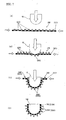
- the process of the second form is shown in Figs. 6 and 7 .
- the activating agent 320 As the activating agent 320 is applied to the transfer film 316 of Fig. 6(A) as shown in Fig. 6 (B) , the activating agent 320 permeates the dried ink layer 312I of the first area 312A of the print pattern 312 to recover the adhesion of the ink layer 312I, and meantime, as shown in Fig.
- the surplus portion 320R of the activating agent is transferred to the second area 312B while it is repelled by the low interfacial tension of the ink layer 312I and the activating agent collects in the convex form in the second area 312B by the action of the collecting power of the activating agent itself in the second area 312B.
- the surplus portion of the activating agent 320 collects from the first area 312A having the ink layer 312I to the second area 312 having no ink layer (or having the thinner ink layer) so that it rises slightly.
- the rising portion will be referred to as an activating agent convex collection portion 320C later.
- the height of this activating agent convex collection portion 320C is several micrometers.
- Adjustment of the interfacial tension of the ink layer 312I to the activating agent 320 may be performed by adjusting the leveling agent in the activating agent 320. As the leveling agent in the activating agent 320 increases, the interfacial tension of the ink layer 312I of the first area 312A to the activating agent 320 can be lowered and the collecting power of the activating agent 320 to the second area 312B can be heightened. In case where the second area 312B has the ink layer thinner than the ink layer 312I of the first area 312A, the thickness of the ink layer of this second area 312B should be set up to such an extent that the coneavo-convex reversal as described later is not prevented.
- this thinner ink layer may be preferably provided in the form of very fine dot independent from each other and completely dissolved by the activating agent while it colors the activating agent, for example.
- the material (the thinner ink layer or the activating agent) with which the second area 312B is filled up is colored, the skin color of the surface of the article recognized visually when not colored can be concealed, and an appearance of the print layer or decoration layer 30 of the surface of the article can be made better.
- the leveling agent blended in the activating agent may be suitably adjusted according to an affinity with the composition of the ink of the print pattern 340. If the amount of the leveling agent is too small (there is no leveling property), then the permeability of the activating agent into the ink layer 312I of the first area 312A is considerably reduced and therefore, sufficient permeation (activation) of the activating agent into the ink layer 312I cannot be maintained. Furthermore, since the activating agent cannot be never wholly united or combined with ink component, there occurs a problem that the good adhesion of the ink cannot be recovered and also there cannot be expected the mechanically and chemically good property, which is obtained by the whole unity or combination of the activating agent with the ink component.
- the leveling agent should be adjusted in the range where such a disadvantage never occurs.
- the desirable leveling agent may be a silicon system leveling agent such as an organic denaturation polysiloxane, an acrylic leveling agent such as polyacrylate or a UV coating leveling agent having a frame of dimethylpolysiloxane commercially available under the name of BYK-UV3500 (BYK is the registered trademark of BYK Chemie, Japan).
- These leveling agents may be preferably contained in the activating agent at the rate of 0.01 to 3 weight % relative to the total amount (weight) of the first photo-polymerization monomer and the second photo-polymerization monomer, and more preferably at the rate of 0.01 to 0.5 weight %.
- the height of the activating agent convex collection portion 320C of the second area 312B has the tendency to become higher than the height of the first area, but this height differs on the characteristic of respective areas, i.e., the ingredients such as the solid content of the ink or the pigments, an interval of the areas, the amount of application of the activating agent, etc.
- the collecting power of the activating agent may be preferably set to be high so that the second area 312B may become higher than the first area 312A by about 2-10 micrometers.
- the activating agent 320 used for the second form may preferably comprise the non-solvent type ultraviolet ray hardening resin composite having photo-polymerization monomer blended with a predetermined amount of the leveling agent.
- This activating agent may be also applied onto the transfer film 316 by either of the methods of the photogravure roll, the wire bar coating and the spraying.
- To this activating agent may be also added a leveling agent, a sensitizer, a filler, an inactivating organic polymer, a thixotropy imparting agent, a thermal polymerization prohibition agent, a delustering ingredient, etc. unless the repelling function (the pulling function) of the activating agent is reduced.
- a surface treatment such as a surface improvement or the like by UV irradiation, for example, may be performed to the water-soluble film 314 before the print pattern is applied. With such a treatment performed, the collecting power of the activating agent 320 of the second area 312B can be further heightened.
- the print pattern 340 is transferred under water pressure onto the article 10 using the transfer film 316 having the activating agent convex collection portion 320C formed in the second area 312B by applying the print pattern activating agent 320, as shown in Fig. 6 (D) and at that time, the print pattern 340 of the transfer film 316 is transferred onto the surface of the article 10 while the concavo-convex reversal is carried out so that the activating agent convex collection portion 320C of the second area 312B may be pushed up toward the water-soluble film 314 of the transfer film 316 as shown in Fig. 6 (E) .
- the activating agent convex collection portion 320C having the convex formed toward the opposite side to the water-soluble film 314 of the transfer film 316 is reversed by the water pressure transfer so that the portion having the convex until now is pushed as a reaction by the surface of the article 10 until the convex is formed toward the water soluble film 314 to thereby form the portion 30BP having the convex formed toward the decoration layer 30 (the layer formed by attachment of the print pattern 340).
- This concavo-convex reversal of the activating agent convex collection portion 320C can be accomplished by having the portion of no ink layer or of the thinner ink layer on the print pattern 30 and also by having no whole outer surface pattern fixture layer surrounding the whole outer surface of the print pattern 340.
- the concavo-convex reversal of the activating agent convex collection portion 320C may be preferably performed by attaching the transfer film 316 around the surface of the article 10 so as to shrink the transfer film 316 in at least one of longitudinal and latitudinal directions.
- This attachment of the transfer film 316 around the surface of the article 10 due to its shrinkage can be performed so that the speed at which the transfer film is attached around the article is set to get higher than the speed at which the surrounding surface of the article is attached onto the water. In this manner, the protrusion of the portion 320C (the convex portion 30BP) can be made more remarkable.
- the print pattern 340 is transferred so as to move the print pattern 340 toward the article 10 along the longitudinal direction as shown in Figs. 7(B) and 7(C) when the article 10 should be pushed against the print pattern 340 as shown in Fig. 7(A)
- the print pattern is transferred so as to be moved along the article 10 while a gap between the second area 312B and the first area 312A is being narrowed.
- the width of the second area 312B is narrowed before the width of the first area 312A is narrowed.
- the surplus portion of the activating agent is collected so that the activating agent projects still more highly within the narrowed second area 312B (see Fig. 7(B) ).
- the activating agent surplus portion in the state of projecting much more highly contacts the surface of the article 10 from above, when the concavo-convex reversal is carried out by being pushed by the surface of the article 10, the activating agent surplus portion has the more remarkable convex toward the water-soluble film 314 (see Fig. 7 (D) ).
- the print pattern 340 In order to shrink the print pattern 340 so as to be brought near the article 10, in case of a batch type transfer tub, the article is immersed underwater while the water soluble film 314 made fully wet on the water within the transfer tub is brought near the point where the water soluble film lands on the water from both sides of the water soluble film or in case of a water pressure transfer using a running water type transfer tub where the water runs from upstream to downstream, the print pattern 340 can be narrowed so that the print pattern 340 on the water soluble film 314 is brought further near the article 10 while the relative speed of the article 10 and the water stream is so set that the article moves more slowly (so that the speed of the water stream gets higher).
- the print layer or decoration layer 30 (the original print pattern 340) is hardened by UV ray irradiation using a UV ray irradiation hardening apparatus (see Fig. 3 (D) and Fig. 6(F) ), thereafter as explained with reference to Fig.3(E) , the water soluble film 314 remaining on the surface of the article is removed by the shower washing machine 324 and finally the surface of the article 10 is dried by the drier 326 (an air blower, for example) to complete the decorated article 10D having the fine concavo-convex surface.
- a UV ray irradiation hardening apparatus see Fig. 3 (D) and Fig. 6(F)
- the water soluble film 314 remaining on the surface of the article is removed by the shower washing machine 324 and finally the surface of the article 10 is dried by the drier 326 (an air blower, for example) to complete the decorated article 10D having the fine concavo-convex surface.
- the step of hardening the decoration layer 30 (see Fig. 3(D) ) and the step of removing the water-soluble film 314(see Fig. 3(E) ) may be made reverse. Otherwise, the dryness of the surface of the article 10D may be naturally made.
- Hardening of the decoration layer 30 should be preferably made so as to make it hardened from the surface of the decoration layer 30.
- the decoration layer 30 begins to shrink while the surface of the convex portion 30BP of the decoration layer 30 is hardened from the top of the convex portion 30BP to the side thereof and the interior of the convex portion 30BP begins to gradually shrink so as to follow the surface hardening.
- a modification of the interior having the softness occurs and the convex shape may be tapered off upwardly by making the interior thinner, which improves a finger contact feeling of the article.
- the shrinkage of the convex portion 30BP becomes still larger and that the height (tapering off) increases and therefore the concavo-convex difference can be suitably set up also by adjusting the hardening speed (see Figs. 5(D) and 7(D) ).
- the first area 312A having the ink layer 312I can control its shrinkage by using the ink of more solid content or the pigments of higher concentration.
- a bigger shrinkage difference can be provided between the first area 312A and the second area 312B by controlling the shrinkage of the ink whereby the convex shape of the convex portion 30BP may be further tapered off.
- the UV ray irradiation-hardening apparatus 322 for hardening the surface decoration layer 30 may be in the arbitrary forms containing a low-pressure or high-pressure mercury lamp or a light source lamp such as a metal halide lamp and an irradiation device (a lamp house).
- the UV irradiation hardening apparatus 322 may be preferably adapted to harden the surface of the activating agent convex collection portion 320C (the convex portion 30BP) at a dash by the UV ray irradiation. In this manner, when the surface coat is formed at a dash, the shrinkage modification of the ink printed portion (the first surface portion) 30A corresponding to the first area 312A and the portion (the second surface portion) 30B corresponding to the second area 312B can be remarkably made.
- the convex collecting portions of the activating agent of ultraviolet ray hardening resin composite (which may be either of solvent including type and solvent excluding type) is also hardened by ultraviolet ray when the major portion permeating the print pattern is hardened by ultraviolet ray, but since the ultraviolet ray hardening can be carried out in the state where the convex portion 30BP is covered with the water-soluble film 314 without contacting an air by washing and removing the surface water-soluble film after the surface hardening with the result that the surface hardening can speed up further to thereby make the concavo-convex difference much more remarkable.
- a surface protection layer (a top coat layer) may be preferably made because such a surface protection layer damages the cubic effect caused by the unevenness of the decoration layer 30, but if the surface protection layer having an imitated unevenness of the decoration layer 30, it will not necessarily deny providing the surface protection layer.
- the activating agent of ultraviolet ray hardening resin for being suitably used for the invention has at least resin main component including a first photo-polymerization monomer A of three or more functional groups and a second photo-polymerization monomer B of two functional groups and a photo-polymerization initiator and the first and second photo-polymerization monomers A and B are blended so as to be a whole volume shrinkage ratio of 10 to 20 % including additives and a viscosity of 100 to 500 CPS. If the whole volume shrinkage ratio does not reach 10%, then the desirable unevenness cannot be formed, and reversely, if the whole volume shrinkage ratio exceeds 20%, the desirable unevenness can be formed, but the membrane performance of the print pattern itself is reduced due to the too high volume shrinkage.
- the optimal whole volume shrinkage ratio is 10 to 20 %.
- the first and second photo-polymerization monomers A and B may be preferably blended so as to get the ink solubility of 7 or more at SP value.
- the activating agent of ultraviolet ray hardening resin to be used for the invention avoids the use of a photo-polymerization oligomer (pre-polymer) of low volume shrinkage ratio so as to be able to heighten the volume shrinkage ratio of the activating agent and has the blend ratio of the first and second photo-polymerization monomers set to an appropriate value whereby the predetermined viscosity and ink solubility are obtained for maintaining the permeability of the activating agent into the ink, the transfer and the adhesion to the surface of the article 10 while maintaining the membrane performance, which is taken charge of by the photo-polymerization oligomer (pre-polymer) of the prior art activating agent.
- the first photo-polymerization monomer A of three or more functional groups has a main role of adjusting the volume shrinkage ratio of the whole activating agent and improving the membrane performance while the second photo-polymerization monomer B of two or more functional group has a role of adjusting (lowering) the viscosity of the activating agent within a range desirable for the coating operation efficiency while obtaining the height difference of concave-convex unevenness by means of the volume shrinkage ratio and further a role of maintaining the ink solubility and the desirable adhesion and coating operation efficiency.
- the resin component of the activating agent can be obtained by the blend ratio of 20 to 60 weight % of the first photo-polymerization monomer of three or more functional groups and 40 to 80 weight % of the second photo-polymerization monomer of two functional groups in order to obtain the aforementioned predetermined viscosity and ink solubility.
- the coating operation efficiency will be improved because the shrinkage when the activating agent is hardened and also the smoothness (leveling property) is strengthened, but due to the smoothness too strong superfluously, it is difficult to obtain the desirable height of concave-convex unevenness, and also there occur a poor shrinkage before hardened and a lower membrane performance.
- the coating operation efficiency there is required to be balanced the coating operation efficiency, the height of concave-convex unevenness, the shrinkage before hardened and the membrane performance.
- the blend ratio of the first and second photo-polymerization monomers A and B is not necessarily limited to the above-mentioned range.
- the activating agent is required to have the viscosity of 100 - 500CPS and is more preferably set to have the ink solubility of 7 or more at SP value.
- non-reactive resin may be added to the activating agent.
- the non-reactive resin may be acrylic polymer, for example.
- the desirable addition amount of the non-reactive resin is 2 to 30 weight % (as solid content) relative to the ultraviolet ray hardening resin composite (total weight of the first and second photo-polymerization monomers and the photo-polymerization initiator). If the addition amount of the non-reactive resin exceeds 30 weight %, there undesirably occurs gelling of the ultraviolet ray hardening resin.
- the molecular weight of the non-reactive resin can be suitably chosen within the range in which various characteristics of the ultraviolet ray hardening resin composite of the present invention are not damaged, but it is desirably 50000-100000 and more preferably 60000-80000.
- the first photo-polymerization monomer A (photo-polymerization monomer of three or more functional groups) may be preferably the component having the volume shrinkage ratio of 5 to 35%, the molecular weight of 1500 or more and the viscosity of 50 - 6000CPS and more preferably the component having the ink solubility of SP value of 7 or more in addition thereto.
- the reason why the molecular weight of the first photo-polymerization monomer A is 1500 or more is that if it is less than 1500, then the membrane performance of the print layer (the surface decorative layer) cannot be fully maintained.
- the volume shrinkage ratio of the first photo-polymerization monomer A is 5 to 35%. If the volume shrinkage ratio is less than 5%, then the height difference of the concavo-convex unevenness of the activating agent convex-collecting portions 320C and the portions around them cannot be enlarged and in addition thereto it is difficult to adjust the height difference of the concave-convex unevenness, while if the volume shrinkage ratio exceeds 35%, then the volume shrinkage ratio is too high and therefore the adhesion of the membrane of the print layer or the surface decorative layer 30 obtained through the hardening step after transferred to the article tends to be reduced and the surface protection function will be possibly reduced.
- the volume shrinkage ratio of the first photo-polymerization monomer A is preferably 5 to 35%.
- the reason why the viscosity of the first photo-polymerization monomer A is 50 to 6000 CPS and the ink solubility thereof is of SP value of 7 or more is that the viscosity and the ink solubility within such a range cause the coating operation and the permeation of the activating agent to be easily accomplished.
- a concrete example of the first photo-polymerization monomer of such component may be listed as follows. One or a combination of two or more of the components may be used.
- Such monomer has the volume shrinkage ratio of 15.1 to 28 and the viscosity (mPa-s) / 25 °C of 60 to 1100 and is listed for example, as follows. Pentaerythritol triacrylate, Trimethylol propane triacrylate, Trymethylol propane ethoxyacrylate, Polyether triacrylate, Glycerin proxytriacrylate and Tris (2-hydroxyethyl) iso cyanurate triacrylate
- Such monomer has the volume shrinkage ratio of 7 to 33 and the viscosity (mPa-s) / 25 °C of 160 to 5250 and is listed for example, as follows. Dipentaerythritol hexaacrylate, Pentaerythritol Tetraacrylate, Pentaerythritol ethoxytetraacrylate, Ditrimethyrol propane tetraacrylate and Dipentaerythritol pentaacrylate.
- the second photo-polymerization monomer B (photo-polymerization monomer of two functional groups) may be desirably a component having the volume shrinkage ratio of 10 to 22%, the molecular weight of 100 to 1000 and the viscosity of 3 to 30 CPS and it may more desirably have the ink solubility of 7 or more at SP values.
- volume shrinkage ratio of the second photo-polymerization monomer is 10 to 22% is that if the volume shrinkage ratio of this monomer is less than 10%, then the viscosity of the activating agent gets too high whereby the concavo-convex reversal of the activating agent of the activating agent convex collecting portions 320C possibly becomes difficult and also the transfer operation efficiency becomes remarkably worsened and if the volume shrinkage ratio of the monomer exceeds 22%, the smoothness of the print layer or the surface decorative layer gets so strong that it is difficult to obtain the large height difference of the unevenness and also the print layer and the surface decorative layer 30 is excessively hardened and shrunk whereby the remaining stress reduces the membrane performance.
- the volume shrinkage ratio of the second photo-polymerization monomer B of 10 to 22% can avoid such disadvantages and also adjust the high viscosity of the first photo-polymerization monomer A whereby the viscosity of the whole activating agent can be adjusted to the predetermined value and the height difference of the concavo-convex unevenness can be set at the predetermined value.
- the molecular weight of the second photo-polymerization monomer B is defined to be 100 to 1000 is that this molecular weight improves the solvent power of the second photo-polymerization monomer B into the first photo-polymerization monomer A and the solvent power of the activating agent into the ink of the print pattern 320 to maintain the preparation of the activating agent and also the permeability of the activating agent into the print pattern, improves the ultraviolet ray hardening and the adhesion of the print pattern to the base material of the article 10 to be pattern transferred under water pressure, especially to ABS resin or PC resin as the base material of the article to thereby improve the adhesion intensity of the print layer or the surface decorative layer.
- the reason why the viscosity of the second photo-polymerization monomer B is defined to be 3 to 30 CPS and the ink solubility thereof is defined to be 7 or more at SP value is that the activating agent can be adjusted so that there can be obtained the predetermined viscosity of 100 to 500 CPS and the predetermined ink solubility of 7 or more at SP value by blending the thus defined second photo-polymerization monomer B with the first photo-polymerization monomer A.
- the second photo-polymerization monomer B of such component may have the volume shrinkage ratio of 7.1 to 22 and the viscosity (mPa-s) / 25 °C of 65 to 1400 and a concrete example is listed for example as follows. One or a combination of two or more of the components may be used.
- a part of the first photo-polymerization monomer may be selectively replaced by photo-polymerization oligomers such as urethane (meta) acrylate, Bisphenol A epoxy acrylate and Amine denaturation polyether acrylate.
- photo-polymerization oligomers such as urethane (meta) acrylate, Bisphenol A epoxy acrylate and Amine denaturation polyether acrylate.
- the photo-polymerization initiator serves to start the photo-polymerization reaction of the first and second photo-polymerization monomers and may preferably include both of the surface hardening type photo-polymerization initiator and the interior hardening type photo-polymerization initiator.
- a hydroxyl-ketone system for example, may be used for the surface-hardening type photo-polymerization initiator and an acyl-phosphine oxide system, for example, may be used for the interior-hardening type photo-polymerization initiator.
- the ultraviolet ray hardening resin activating agent is applied or coated on the print pattern 30 beyond the quantity of the activating agent necessary for permeating the print pattern 340 of the transfer film 316 so as to activate the ink whereby the surplus thereof can be transferred onto the second area.
- the proper quantity of application is set to get 3 to 30 micrometers in the thickness, but more desirably it is set to get 10 to 25 micrometers in the thickness.
- non-solvent type in the non-solvent type ultraviolet ray hardening resin composite used by this invention does not mean that there is absolutely zero of a "solvent ingredient”, but is never exclusive of one having solvent ingredient added as auxiliary ingredient within the range where the action of the invention is never damaged, intentionally added in order to escape from the invention or having solvent ingredient added to the ultraviolet ray hardening resin used for dispersing additive components of hard dispersion or used for producing the photo-polymerization monomer, but remained.
- non-solvent type does not mean that there is absolutely zero of "volatility" of the photo-polymerization monomer, but means that it is not as high as the solvent and therefore it may have the volatility in such a degree as can be disregarded practically.
- solvent should be used having the characteristics (solution intensity) and the amount of addition never damaging the activation of the print pattern by the photo-polymerization monomer of the ultraviolet ray hardening resin composite which is the main ingredient of the activating agent.
- a fundamental difference between the solvent type activating agent and the non-solvent type activating ingredient of the ultraviolet ray hardening resin is that in the former activating agent, the plasticity state of the ink by the recovery of the adhesion of the ink varies as time passes because the solvent ingredient of the solvent type activating agent volatilizes after the activating agent is coated, but in the latter activating agent (the activating agent ingredient of the invention), the plasticity state of the ink never varies because the adhesion of the ink is recovered by the photo-polymerization monomer ingredient (mainly the second photo-polymerization monomer) of little volatility.
- the activating agent of the invention never damages the plasticity state of the ink even though the solvent is included together in the range meeting the afore-mentioned condition so long as the blend ratio of the photo-polymerization monomers is within the specific range.
- the amount of addition of the solvent for dispersing the non-reactive resins is preferably 5 to 50 weight % relative to the ultraviolet ray hardening resin composite (total amount of the first and second photo-polymerization monomers and the photo-polymerization initiator), more preferably 5 to 30 weight % and further preferably 5 to 20 weight %.
- SP value is the abbreviation of Solubility Parameter as described in Patent Documents 4. It is based on the turbidimetric titration method announced by Soe (KW.SUE) and Clark (D. H.CLARKE) and the turbidimetric titration method has been described in " Journal of Polymer Science PARTA-1 and Vol.5-1671-1681 (1967 ).
- Example 1 does not fall within the scope of the claimed invention.
- Examples 2 through 8 used the activating agent of ultraviolet ray hardening type resin having the first and second photo-polymerization monomers blended at the predetermined ratio and having the volume shrinkage ratio of 11 to 18 % and the viscosity of 100 to 500 CPS Example 1, falling outside of the scope of the claimed invention, provides a volume shrinkage ratio of 20% and a viscosity of 50 CPS.
- Comparisons 1 and 2 were identical to Example 6 except that Comparison 1 used the activating agent not including the first photo-polymerization monomer (multi-functional monomer) and Comparison 2 used the activating agent having the hardening shrinkage ratio lower than that of predetermined value by replacing a part of polymer ingredient of EXAMPLE 6 by the delustering agent.
- Comparisons 3 and 4 used the activating agent having the blend ratio of the first and second photo-polymerization monomers (multifunctional monomer and two functional monomer) departed from the predetermined ratio and Comparison 3 had the blend ratio of the first photo-polymerization monomer excessively larger than that of the second photo-polymerization monomer and Comparison 4 had the blend ratio of the second photo-polymerization monomer excessively larger than that of the first photo-polymerization monomer.
- a symbol “ ⁇ ” shows the better coating operation while a symbol “X” shows the difficult coating operation when each activating agent was coated by the wire coating method on the print pattern of the transfer film to the thickness of about 20 micrometers just before introducing the transfer film into the transfer tub.
- a symbol “ ⁇ ” shows no occurrence of poor design on the peripheral edge of the decorative article caused by excessive hardening shrinkage, a symbol “ ⁇ ” shows no occurrence of trouble even though such poor design occurs and a symbol “X” shows poorness of the decorative article because of occurrence of such poor design.
- Test liquid having solvent of petroleum benzene
- oleic acid of 0.2 ml
- the larger height difference of the concave-convex unevenness to thereby further improve the tactile feeling of the cubic concave-convex unevenness without lowering the membrane performances (abrasion resistance and medical resistance such as oleic acid resistance, etc.) of the surface decoration layer.
Landscapes
- Chemical & Material Sciences (AREA)
- Life Sciences & Earth Sciences (AREA)
- Engineering & Computer Science (AREA)
- Materials Engineering (AREA)
- Wood Science & Technology (AREA)
- Organic Chemistry (AREA)
- Decoration By Transfer Pictures (AREA)
- Application Of Or Painting With Fluid Materials (AREA)
Claims (8)
- Verfahren zum Aktivieren eines Druckmusters einer Transferfolie, das durch Aufbringen des Druckmusters auf einer wasserlöslichen Folie mit einem Aktivierungsmittel und anschließend Ausführen eines Wasserdrucktransfers des Druckmusters auf eine Oberfläche eines Gegenstands gebildet ist, wobei das Verfahren die Schritte des Herstellens der Transferfolie (316), die das Druckmuster (312) aufweist, das einen ersten Bereich mit einer Tintenschicht und einen zweiten Bereich ohne Tintenschicht oder mit einer Tintenschicht, die dünner als jene des ersten Bereichs ist umfasst, und die gesamte Außenoberfläche des Druckmusters exponiert ist; des Bildens von konvexen Aktivierungsmittel-Sammelabschnitten durch Aufbringen einer Überschussmenge des Aktivierungsmittels (320), das auf der Oberfläche der Transferfolie (316) aufgebracht ist, auf die Oberfläche des Gegenstands mit dem darauf exponierten Druckmuster, um Tinte des ersten Bereichs zu aktivieren, während die Überschussmenge des Aktivierungsmittels in dem zweiten Bereich gesammelt wird, indem sie von der Oberfläche des Gegenstands bei dem Wasserdrucktransfer gedrückt wird; und des Schrumpfens des konvexen Aktivierungsmittel-Sammelabschnitts, wenn das Druckmuster und das Aktivierungsmittel auf dem Gegenstand durch Anwendung von Ultraviolettstrahlen gehärtet werden, wodurch ein Abschnitt, der dem zweiten Bereich entspricht, über einen Tintendruck-Abschnitt vorragt, der dem ersten Bereich entspricht, um so der Oberfläche des Gegenstands eine dreidimensionale nicht-ebene Form zu verleihen, wobei das Aktivierungsmittel von Ultraviolettstrahlungs-härtendem Harzkomposit, der auf die Oberfläche der Transferfolie aufgebracht werden soll, wenigstens eine Harz-Hauptkomponente aufweist, die ein erstes Photopolymerisationsmonomer A mit drei oder mehr funktionellen Gruppen und ein zweites Photopolymerisationsmonomer B mit zwei funktionellen Gruppen und einen Photopolymerisationsinitiator umfasst, wobei das erste und das zweite Photopolymerisationsmonomer gemischt sind, um ein Gesamt-Volumenschrumpfungsverhältnis von 10 bis 20 % und eine Viskosität von 100 bis 500 CPS bereitzustellen.
- Wasserdrucktransferverfahren gemäß Anspruch 1, wobei das erste Photopolymerisationsmonomer ein Volumenschrumpfungsverhältnis von 5 bis 35 %, ein Molekulargewicht von 1500 oder mehr und eine Viskosität von 50 bis 6000 CPS aufweist.
- Wasserdrucktransferverfahren gemäß Anspruch 1 oder 2, wobei das zweite Photopolymerisationsmonomer ein Volumenschrumpfungsverhältnis von 10 bis 22 %, ein Molekulargewicht von 1500 oder mehr und eine Viskosität von 3 bis 30 CPS aufweist.
- Wasserdrucktransferverfahren gemäß einem der Ansprüche 1 bis 3, wobei die Harzkomponente des Aktivierungsmittels ein Mischungsverhältnis des ersten Photopolymerisationsmonomers mit drei oder mehr funktionellen Gruppen zu dem zweiten Photopolymerisationsmonomer mit zwei funktionellen Gruppen 70 zu 30 Gew.-% oder 50 zu 50 Gew.-% oder 20 zu 50 Gew.-% oder 5 zu 50 Gew.-% beträgt.
- Aktivierungsmittel für die Verwendung bei dem Wasserdrucktransferverfahren gemäß einem der Ansprüche 1 bis 4, wobei das Aktivierungsmittel dadurch gekennzeichnet ist, dass es wenigstens eine Harz-Hauptkomponente aufweist, die ein erstes Photopolymerisationsmonomer mit drei oder mehr funktionellen Gruppen, ein zweites Photopolymerisationsmonomer mit zwei funktionellen Gruppen und einen Photopolymerisationsinitiator umfasst, wobei das erste und das zweite Photopolymerisationsmonomer gemischt sind, um ein Gesamt-Volumenschrumpfungsverhältnis von 10 bis 20 % und eine Viskosität von 100 bis 500 CPS bereitzustellen.
- Aktivierungsmittel gemäß Anspruch 5, wobei das erste Photopolymerisationsmonomer ein Volumenschrumpfungsverhältnis von 5 bis 35 %, ein Molekulargewicht von 1500 oder mehr und eine Viskosität von 50 bis 6000 CPS aufweist.
- Aktivierungsmittel gemäß Anspruch 6, wobei das zweite Photopolymerisationsmonomer ein Volumenschrumpfungsverhältnis von 10 bis 22 %, ein Molekulargewicht von 1500 oder mehr und eine Viskosität von 3 bis 30 CPS aufweist.
- Aktivierungsmittel gemäß einem der Ansprüche 5 bis 7, wobei die Harzkomponente des Aktivierungsmittels ein Mischungsverhältnis des ersten Photopolymerisationsmonomers mit drei oder mehr funktionellen Gruppen zu dem zweiten Photopolymerisationsmonomer mit zwei funktionellen Gruppen 70 zu 30 Gew.-% oder 50 zu 50 Gew.-% oder 20 zu 50 Gew.-% oder 5 zu 50 Gew.-% beträgt.
Priority Applications (1)
| Application Number | Priority Date | Filing Date | Title |
|---|---|---|---|
| PL10769823T PL2425987T3 (pl) | 2009-04-30 | 2010-04-30 | Sposób transferu hydraulicznego i czynnik aktywujący do transferu hydraulicznego |
Applications Claiming Priority (2)
| Application Number | Priority Date | Filing Date | Title |
|---|---|---|---|
| JP2009111536 | 2009-04-30 | ||
| PCT/JP2010/057660 WO2010126125A1 (ja) | 2009-04-30 | 2010-04-30 | 水圧転写方法、水圧転写品及び水圧転写フィルム用塗布剤 |
Publications (3)
| Publication Number | Publication Date |
|---|---|
| EP2425987A1 EP2425987A1 (de) | 2012-03-07 |
| EP2425987A4 EP2425987A4 (de) | 2012-11-14 |
| EP2425987B1 true EP2425987B1 (de) | 2014-12-10 |
Family
ID=43032268
Family Applications (1)
| Application Number | Title | Priority Date | Filing Date |
|---|---|---|---|
| EP10769823.5A Not-in-force EP2425987B1 (de) | 2009-04-30 | 2010-04-30 | Hydraulisches transferverfahren und aktivierungsmittel für das hydraulische transferverfahren |
Country Status (10)
| Country | Link |
|---|---|
| US (1) | US8850973B2 (de) |
| EP (1) | EP2425987B1 (de) |
| JP (1) | JP5616332B2 (de) |
| KR (1) | KR20120024657A (de) |
| CN (1) | CN102438840B (de) |
| AU (1) | AU2010242326B2 (de) |
| CA (1) | CA2759168A1 (de) |
| MY (1) | MY154646A (de) |
| PL (1) | PL2425987T3 (de) |
| WO (1) | WO2010126125A1 (de) |
Families Citing this family (9)
| Publication number | Priority date | Publication date | Assignee | Title |
|---|---|---|---|---|
| WO2007023525A1 (ja) | 2005-08-23 | 2007-03-01 | Taica Corporation | 水圧転写フィルム用塗布剤、水圧転写方法及び水圧転写品 |
| JP5242990B2 (ja) * | 2007-10-25 | 2013-07-24 | 株式会社タイカ | 水圧転写方法、水圧転写用転写フィルム及び水圧転写品 |
| CN103862900B (zh) * | 2012-12-11 | 2017-02-15 | 黄北江 | 一种制造表面呈凹凸结构的薄膜的方法 |
| CN104375723B (zh) * | 2014-09-17 | 2018-02-09 | 福建省飞阳光电股份有限公司 | 一种电容式触摸屏基板的着色方法 |
| WO2016123740A1 (zh) * | 2015-02-02 | 2016-08-11 | 浙江大学 | 一种可计算的三维彩色印刷方法 |
| KR102429958B1 (ko) * | 2017-06-21 | 2022-08-09 | 현대자동차주식회사 | 차량의 전파투과 커버용 자외선 경화형 프라이머 |
| TWI705906B (zh) * | 2019-05-17 | 2020-10-01 | 大勤化成股份有限公司 | 用於產生凸紋的水壓轉印方法 |
| CN113705758A (zh) * | 2021-09-05 | 2021-11-26 | 上扬无线射频科技扬州有限公司 | 一种rfid标签制备工艺 |
| CN116122053A (zh) * | 2023-01-05 | 2023-05-16 | 浙江兆奕科技有限公司 | 一种轻量化、仿陶瓷高光纯色材料的制备方法 |
Family Cites Families (26)
| Publication number | Priority date | Publication date | Assignee | Title |
|---|---|---|---|---|
| US3811915A (en) * | 1971-04-27 | 1974-05-21 | Inmont Corp | Printing method for forming three dimensional simulated wood grain,and product formed thereby |
| US4229239A (en) * | 1977-07-27 | 1980-10-21 | Dai Nippon Insatsu Kabushiki Kaisha | Transfer printing method |
| US4490413A (en) * | 1984-02-15 | 1984-12-25 | Stimson Frank P | Method for producing a painting |
| DE3932460A1 (de) | 1988-09-30 | 1990-04-05 | Desoto Inc | Durch ultraviolettlicht haertbare ueberzugsmasse |
| JPH0516598A (ja) | 1991-07-11 | 1993-01-26 | Dainippon Printing Co Ltd | 鏡面光沢を有する成形体及びその製造方法 |
| JPH05270199A (ja) | 1992-03-26 | 1993-10-19 | Toppan Printing Co Ltd | 化粧板の製造方法 |
| JPH0640198A (ja) | 1992-07-27 | 1994-02-15 | Kiyuubitsuku:Kk | 液圧転写品の表面改質方法 |
| JP3249211B2 (ja) | 1992-11-30 | 2002-01-21 | 株式会社キュービック | 液圧転写印刷品の製造方法 |
| JP3482506B2 (ja) | 1994-04-11 | 2003-12-22 | 株式会社キュービック | 異形凹凸表面を有する加飾施工品並びにその製造方法 |
| EP0839673B1 (de) * | 1996-10-31 | 2001-07-11 | Bush Industries, Inc. | Verfahren und Vorrichtung zum Aufbringen eines Dekors auf einen Gegenstand |
| JP3890454B2 (ja) * | 1997-06-03 | 2007-03-07 | 株式会社キュービック | 液圧転写印刷が施されたステアリングホイールの製造方法 |
| US6554940B2 (en) * | 1997-06-03 | 2003-04-29 | Cubic Co., Ltd. | Method of transferring a print pattern composed of a fluoropolymer resin and an inorganic pigment onto an objective body using liquid pressure |
| JP2001092118A (ja) | 1999-09-20 | 2001-04-06 | Murata Mfg Co Ltd | 感光性ペーストおよび電子部品 |
| US6935230B1 (en) * | 2000-05-12 | 2005-08-30 | Immersion Graphics Corporation | Liquid coating applicator and printing system with ink activator sprayer |
| US20020016226A1 (en) | 2000-06-08 | 2002-02-07 | Lord Corporation | UV curable coating for golf balls |
| JP2003313489A (ja) | 2002-04-18 | 2003-11-06 | Jujo Chemical Kk | アルミニウム材にコーティングする放射線硬化型樹脂組成物 |
| JP4020113B2 (ja) | 2003-09-30 | 2007-12-12 | 大日本インキ化学工業株式会社 | 水圧転写用フィルム及び水圧転写体 |
| CN1918009B (zh) * | 2004-02-18 | 2014-03-12 | 泰卡株式会社 | 水压转印物品 |
| JP3826362B2 (ja) * | 2004-06-28 | 2006-09-27 | 株式会社キュービック | 表面保護層の水圧転写方法及び水圧転写品 |
| KR100736531B1 (ko) * | 2005-03-16 | 2007-07-06 | 주식회사 엘지화학 | 단차 조절이 가능한 잉크 |
| JP4198163B2 (ja) | 2005-05-19 | 2008-12-17 | 日東電工株式会社 | 包装材用積層テープ |
| WO2007023525A1 (ja) * | 2005-08-23 | 2007-03-01 | Taica Corporation | 水圧転写フィルム用塗布剤、水圧転写方法及び水圧転写品 |
| JP5077645B2 (ja) * | 2007-03-28 | 2012-11-21 | Dic株式会社 | 活性化剤、及び水圧転写体の製造方法 |
| CN101293440A (zh) * | 2007-04-28 | 2008-10-29 | 台湾加饰科技股份有限公司 | 水压转印膜及水压转印方法 |
| JP5242990B2 (ja) | 2007-10-25 | 2013-07-24 | 株式会社タイカ | 水圧転写方法、水圧転写用転写フィルム及び水圧転写品 |
| TW201129480A (en) * | 2010-02-26 | 2011-09-01 | Hirotech Transfer Technology Company Ltd | Method of creating three-dimensional patterns on the object surface |
-
2010
- 2010-04-30 WO PCT/JP2010/057660 patent/WO2010126125A1/ja not_active Ceased
- 2010-04-30 KR KR1020117028234A patent/KR20120024657A/ko not_active Abandoned
- 2010-04-30 CN CN201080018898.5A patent/CN102438840B/zh not_active Expired - Fee Related
- 2010-04-30 US US13/266,807 patent/US8850973B2/en not_active Expired - Fee Related
- 2010-04-30 PL PL10769823T patent/PL2425987T3/pl unknown
- 2010-04-30 AU AU2010242326A patent/AU2010242326B2/en not_active Ceased
- 2010-04-30 MY MYPI2011004982A patent/MY154646A/en unknown
- 2010-04-30 CA CA2759168A patent/CA2759168A1/en not_active Abandoned
- 2010-04-30 JP JP2011511464A patent/JP5616332B2/ja not_active Expired - Fee Related
- 2010-04-30 EP EP10769823.5A patent/EP2425987B1/de not_active Not-in-force
Also Published As
| Publication number | Publication date |
|---|---|
| KR20120024657A (ko) | 2012-03-14 |
| JPWO2010126125A1 (ja) | 2012-11-01 |
| US20120048136A1 (en) | 2012-03-01 |
| EP2425987A1 (de) | 2012-03-07 |
| AU2010242326B2 (en) | 2015-06-18 |
| AU2010242326A1 (en) | 2011-12-15 |
| CA2759168A1 (en) | 2010-11-04 |
| CN102438840B (zh) | 2015-08-19 |
| WO2010126125A1 (ja) | 2010-11-04 |
| MY154646A (en) | 2015-07-15 |
| US8850973B2 (en) | 2014-10-07 |
| EP2425987A4 (de) | 2012-11-14 |
| PL2425987T3 (pl) | 2015-04-30 |
| JP5616332B2 (ja) | 2014-10-29 |
| CN102438840A (zh) | 2012-05-02 |
Similar Documents
| Publication | Publication Date | Title |
|---|---|---|
| US8850973B2 (en) | Water pressure transfer method, a water pressure transfer article and a coating agent for water pressure transfer film | |
| EP2221189B1 (de) | Verfahren zum hydraulischen transfer | |
| DE69329655T2 (de) | Geprägte mehrschichtfolie | |
| US8178187B2 (en) | Water pressure transfer article | |
| US8795789B2 (en) | Coating agent for a water pressure transfer film, a water pressure transfer method and a water pressure transfer article | |
| EP2703183A1 (de) | Wasserdruckübertragungsverfahren, beschichtungsmittel für eine wasserdruckfolie und wasserdruckübertragungsartikel | |
| EP2492110B1 (de) | Aktivierungsmittel für einen hydrauliktransferfilm und hydrauliktransferverfahren | |
| TWI331099B (en) | Water pressure transfering method and water pressure transfer article | |
| HK1147725B (en) | Method of hydraulic transfer, transfer film for hydraulic transfer, and hydraulic-transfer article | |
| HK1102575B (en) | Hydraulic transfer product | |
| HK1102575A (en) | Hydraulic transfer product |
Legal Events
| Date | Code | Title | Description |
|---|---|---|---|
| PUAI | Public reference made under article 153(3) epc to a published international application that has entered the european phase |
Free format text: ORIGINAL CODE: 0009012 |
|
| 17P | Request for examination filed |
Effective date: 20111107 |
|
| AK | Designated contracting states |
Kind code of ref document: A1 Designated state(s): AT BE BG CH CY CZ DE DK EE ES FI FR GB GR HR HU IE IS IT LI LT LU LV MC MK MT NL NO PL PT RO SE SI SK SM TR |
|
| DAX | Request for extension of the european patent (deleted) | ||
| A4 | Supplementary search report drawn up and despatched |
Effective date: 20121011 |
|
| RIC1 | Information provided on ipc code assigned before grant |
Ipc: B44F 7/00 20060101ALI20121005BHEP Ipc: B44C 1/175 20060101AFI20121005BHEP |
|
| 17Q | First examination report despatched |
Effective date: 20130614 |
|
| GRAP | Despatch of communication of intention to grant a patent |
Free format text: ORIGINAL CODE: EPIDOSNIGR1 |
|
| INTG | Intention to grant announced |
Effective date: 20140819 |
|
| GRAS | Grant fee paid |
Free format text: ORIGINAL CODE: EPIDOSNIGR3 |
|
| GRAA | (expected) grant |
Free format text: ORIGINAL CODE: 0009210 |
|
| AK | Designated contracting states |
Kind code of ref document: B1 Designated state(s): AT BE BG CH CY CZ DE DK EE ES FI FR GB GR HR HU IE IS IT LI LT LU LV MC MK MT NL NO PL PT RO SE SI SK SM TR |
|
| REG | Reference to a national code |
Ref country code: GB Ref legal event code: FG4D |
|
| REG | Reference to a national code |
Ref country code: CH Ref legal event code: EP |
|
| REG | Reference to a national code |
Ref country code: IE Ref legal event code: FG4D |
|
| REG | Reference to a national code |
Ref country code: AT Ref legal event code: REF Ref document number: 700452 Country of ref document: AT Kind code of ref document: T Effective date: 20150115 |
|
| REG | Reference to a national code |
Ref country code: DE Ref legal event code: R096 Ref document number: 602010020916 Country of ref document: DE Effective date: 20150122 |
|
| REG | Reference to a national code |
Ref country code: AT Ref legal event code: MK05 Ref document number: 700452 Country of ref document: AT Kind code of ref document: T Effective date: 20141210 Ref country code: NL Ref legal event code: VDEP Effective date: 20141210 |
|
| REG | Reference to a national code |
Ref country code: NL Ref legal event code: VDEP Effective date: 20141210 |
|
| PG25 | Lapsed in a contracting state [announced via postgrant information from national office to epo] |
Ref country code: LT Free format text: LAPSE BECAUSE OF FAILURE TO SUBMIT A TRANSLATION OF THE DESCRIPTION OR TO PAY THE FEE WITHIN THE PRESCRIBED TIME-LIMIT Effective date: 20141210 Ref country code: FI Free format text: LAPSE BECAUSE OF FAILURE TO SUBMIT A TRANSLATION OF THE DESCRIPTION OR TO PAY THE FEE WITHIN THE PRESCRIBED TIME-LIMIT Effective date: 20141210 Ref country code: ES Free format text: LAPSE BECAUSE OF FAILURE TO SUBMIT A TRANSLATION OF THE DESCRIPTION OR TO PAY THE FEE WITHIN THE PRESCRIBED TIME-LIMIT Effective date: 20141210 Ref country code: NO Free format text: LAPSE BECAUSE OF FAILURE TO SUBMIT A TRANSLATION OF THE DESCRIPTION OR TO PAY THE FEE WITHIN THE PRESCRIBED TIME-LIMIT Effective date: 20150310 |
|
| REG | Reference to a national code |
Ref country code: PL Ref legal event code: T3 |
|
| REG | Reference to a national code |
Ref country code: LT Ref legal event code: MG4D |
|
| PG25 | Lapsed in a contracting state [announced via postgrant information from national office to epo] |
Ref country code: AT Free format text: LAPSE BECAUSE OF FAILURE TO SUBMIT A TRANSLATION OF THE DESCRIPTION OR TO PAY THE FEE WITHIN THE PRESCRIBED TIME-LIMIT Effective date: 20141210 Ref country code: HR Free format text: LAPSE BECAUSE OF FAILURE TO SUBMIT A TRANSLATION OF THE DESCRIPTION OR TO PAY THE FEE WITHIN THE PRESCRIBED TIME-LIMIT Effective date: 20141210 Ref country code: GR Free format text: LAPSE BECAUSE OF FAILURE TO SUBMIT A TRANSLATION OF THE DESCRIPTION OR TO PAY THE FEE WITHIN THE PRESCRIBED TIME-LIMIT Effective date: 20150311 Ref country code: LV Free format text: LAPSE BECAUSE OF FAILURE TO SUBMIT A TRANSLATION OF THE DESCRIPTION OR TO PAY THE FEE WITHIN THE PRESCRIBED TIME-LIMIT Effective date: 20141210 Ref country code: SE Free format text: LAPSE BECAUSE OF FAILURE TO SUBMIT A TRANSLATION OF THE DESCRIPTION OR TO PAY THE FEE WITHIN THE PRESCRIBED TIME-LIMIT Effective date: 20141210 |
|
| PG25 | Lapsed in a contracting state [announced via postgrant information from national office to epo] |
Ref country code: NL Free format text: LAPSE BECAUSE OF FAILURE TO SUBMIT A TRANSLATION OF THE DESCRIPTION OR TO PAY THE FEE WITHIN THE PRESCRIBED TIME-LIMIT Effective date: 20141210 |
|
| PG25 | Lapsed in a contracting state [announced via postgrant information from national office to epo] |
Ref country code: SK Free format text: LAPSE BECAUSE OF FAILURE TO SUBMIT A TRANSLATION OF THE DESCRIPTION OR TO PAY THE FEE WITHIN THE PRESCRIBED TIME-LIMIT Effective date: 20141210 Ref country code: RO Free format text: LAPSE BECAUSE OF FAILURE TO SUBMIT A TRANSLATION OF THE DESCRIPTION OR TO PAY THE FEE WITHIN THE PRESCRIBED TIME-LIMIT Effective date: 20141210 Ref country code: PT Free format text: LAPSE BECAUSE OF FAILURE TO SUBMIT A TRANSLATION OF THE DESCRIPTION OR TO PAY THE FEE WITHIN THE PRESCRIBED TIME-LIMIT Effective date: 20150410 Ref country code: EE Free format text: LAPSE BECAUSE OF FAILURE TO SUBMIT A TRANSLATION OF THE DESCRIPTION OR TO PAY THE FEE WITHIN THE PRESCRIBED TIME-LIMIT Effective date: 20141210 |
|
| PG25 | Lapsed in a contracting state [announced via postgrant information from national office to epo] |
Ref country code: IS Free format text: LAPSE BECAUSE OF FAILURE TO SUBMIT A TRANSLATION OF THE DESCRIPTION OR TO PAY THE FEE WITHIN THE PRESCRIBED TIME-LIMIT Effective date: 20150410 |
|
| REG | Reference to a national code |
Ref country code: DE Ref legal event code: R097 Ref document number: 602010020916 Country of ref document: DE |
|
| PLBE | No opposition filed within time limit |
Free format text: ORIGINAL CODE: 0009261 |
|
| STAA | Information on the status of an ep patent application or granted ep patent |
Free format text: STATUS: NO OPPOSITION FILED WITHIN TIME LIMIT |
|
| PG25 | Lapsed in a contracting state [announced via postgrant information from national office to epo] |
Ref country code: DK Free format text: LAPSE BECAUSE OF FAILURE TO SUBMIT A TRANSLATION OF THE DESCRIPTION OR TO PAY THE FEE WITHIN THE PRESCRIBED TIME-LIMIT Effective date: 20141210 |
|
| 26N | No opposition filed |
Effective date: 20150911 |
|
| PG25 | Lapsed in a contracting state [announced via postgrant information from national office to epo] |
Ref country code: LU Free format text: LAPSE BECAUSE OF FAILURE TO SUBMIT A TRANSLATION OF THE DESCRIPTION OR TO PAY THE FEE WITHIN THE PRESCRIBED TIME-LIMIT Effective date: 20150430 Ref country code: MC Free format text: LAPSE BECAUSE OF FAILURE TO SUBMIT A TRANSLATION OF THE DESCRIPTION OR TO PAY THE FEE WITHIN THE PRESCRIBED TIME-LIMIT Effective date: 20141210 |
|
| REG | Reference to a national code |
Ref country code: CH Ref legal event code: PL |
|
| REG | Reference to a national code |
Ref country code: IE Ref legal event code: MM4A |
|
| PG25 | Lapsed in a contracting state [announced via postgrant information from national office to epo] |
Ref country code: CH Free format text: LAPSE BECAUSE OF NON-PAYMENT OF DUE FEES Effective date: 20150430 Ref country code: LI Free format text: LAPSE BECAUSE OF NON-PAYMENT OF DUE FEES Effective date: 20150430 |
|
| PG25 | Lapsed in a contracting state [announced via postgrant information from national office to epo] |
Ref country code: SI Free format text: LAPSE BECAUSE OF FAILURE TO SUBMIT A TRANSLATION OF THE DESCRIPTION OR TO PAY THE FEE WITHIN THE PRESCRIBED TIME-LIMIT Effective date: 20141210 |
|
| REG | Reference to a national code |
Ref country code: FR Ref legal event code: PLFP Year of fee payment: 7 |
|
| PG25 | Lapsed in a contracting state [announced via postgrant information from national office to epo] |
Ref country code: IE Free format text: LAPSE BECAUSE OF NON-PAYMENT OF DUE FEES Effective date: 20150430 |
|
| PGFP | Annual fee paid to national office [announced via postgrant information from national office to epo] |
Ref country code: CZ Payment date: 20160323 Year of fee payment: 7 |
|
| PG25 | Lapsed in a contracting state [announced via postgrant information from national office to epo] |
Ref country code: BE Free format text: LAPSE BECAUSE OF FAILURE TO SUBMIT A TRANSLATION OF THE DESCRIPTION OR TO PAY THE FEE WITHIN THE PRESCRIBED TIME-LIMIT Effective date: 20141210 |
|
| PGFP | Annual fee paid to national office [announced via postgrant information from national office to epo] |
Ref country code: GB Payment date: 20160317 Year of fee payment: 7 |
|
| PGFP | Annual fee paid to national office [announced via postgrant information from national office to epo] |
Ref country code: DE Payment date: 20160421 Year of fee payment: 7 |
|
| PGFP | Annual fee paid to national office [announced via postgrant information from national office to epo] |
Ref country code: FR Payment date: 20160421 Year of fee payment: 7 Ref country code: IT Payment date: 20160426 Year of fee payment: 7 Ref country code: PL Payment date: 20160421 Year of fee payment: 7 |
|
| PG25 | Lapsed in a contracting state [announced via postgrant information from national office to epo] |
Ref country code: MT Free format text: LAPSE BECAUSE OF FAILURE TO SUBMIT A TRANSLATION OF THE DESCRIPTION OR TO PAY THE FEE WITHIN THE PRESCRIBED TIME-LIMIT Effective date: 20141210 |
|
| PG25 | Lapsed in a contracting state [announced via postgrant information from national office to epo] |
Ref country code: SM Free format text: LAPSE BECAUSE OF FAILURE TO SUBMIT A TRANSLATION OF THE DESCRIPTION OR TO PAY THE FEE WITHIN THE PRESCRIBED TIME-LIMIT Effective date: 20141210 Ref country code: HU Free format text: LAPSE BECAUSE OF FAILURE TO SUBMIT A TRANSLATION OF THE DESCRIPTION OR TO PAY THE FEE WITHIN THE PRESCRIBED TIME-LIMIT; INVALID AB INITIO Effective date: 20100430 Ref country code: BG Free format text: LAPSE BECAUSE OF FAILURE TO SUBMIT A TRANSLATION OF THE DESCRIPTION OR TO PAY THE FEE WITHIN THE PRESCRIBED TIME-LIMIT Effective date: 20141210 |
|
| PG25 | Lapsed in a contracting state [announced via postgrant information from national office to epo] |
Ref country code: CY Free format text: LAPSE BECAUSE OF FAILURE TO SUBMIT A TRANSLATION OF THE DESCRIPTION OR TO PAY THE FEE WITHIN THE PRESCRIBED TIME-LIMIT Effective date: 20141210 |
|
| PG25 | Lapsed in a contracting state [announced via postgrant information from national office to epo] |
Ref country code: TR Free format text: LAPSE BECAUSE OF FAILURE TO SUBMIT A TRANSLATION OF THE DESCRIPTION OR TO PAY THE FEE WITHIN THE PRESCRIBED TIME-LIMIT Effective date: 20141210 |
|
| REG | Reference to a national code |
Ref country code: DE Ref legal event code: R119 Ref document number: 602010020916 Country of ref document: DE |
|
| GBPC | Gb: european patent ceased through non-payment of renewal fee |
Effective date: 20170430 |
|
| REG | Reference to a national code |
Ref country code: FR Ref legal event code: ST Effective date: 20171229 |
|
| PG25 | Lapsed in a contracting state [announced via postgrant information from national office to epo] |
Ref country code: DE Free format text: LAPSE BECAUSE OF NON-PAYMENT OF DUE FEES Effective date: 20171103 Ref country code: CZ Free format text: LAPSE BECAUSE OF NON-PAYMENT OF DUE FEES Effective date: 20170430 Ref country code: FR Free format text: LAPSE BECAUSE OF NON-PAYMENT OF DUE FEES Effective date: 20170502 |
|
| PG25 | Lapsed in a contracting state [announced via postgrant information from national office to epo] |
Ref country code: GB Free format text: LAPSE BECAUSE OF NON-PAYMENT OF DUE FEES Effective date: 20170430 |
|
| PG25 | Lapsed in a contracting state [announced via postgrant information from national office to epo] |
Ref country code: IT Free format text: LAPSE BECAUSE OF NON-PAYMENT OF DUE FEES Effective date: 20170430 |
|
| PG25 | Lapsed in a contracting state [announced via postgrant information from national office to epo] |
Ref country code: MK Free format text: LAPSE BECAUSE OF FAILURE TO SUBMIT A TRANSLATION OF THE DESCRIPTION OR TO PAY THE FEE WITHIN THE PRESCRIBED TIME-LIMIT Effective date: 20141210 |
|
| PG25 | Lapsed in a contracting state [announced via postgrant information from national office to epo] |
Ref country code: PL Free format text: LAPSE BECAUSE OF NON-PAYMENT OF DUE FEES Effective date: 20170430 |