EP2420311A2 - Mehrschichtige mikroporöse folie auf polyolefinbasis mit hervorragenden physikalischen eigenschaften und hoher temperaturstabilität - Google Patents
Mehrschichtige mikroporöse folie auf polyolefinbasis mit hervorragenden physikalischen eigenschaften und hoher temperaturstabilität Download PDFInfo
- Publication number
- EP2420311A2 EP2420311A2 EP10761827A EP10761827A EP2420311A2 EP 2420311 A2 EP2420311 A2 EP 2420311A2 EP 10761827 A EP10761827 A EP 10761827A EP 10761827 A EP10761827 A EP 10761827A EP 2420311 A2 EP2420311 A2 EP 2420311A2
- Authority
- EP
- European Patent Office
- Prior art keywords
- temperature
- polyethylene
- layer
- heat resistant
- film
- Prior art date
- Legal status (The legal status is an assumption and is not a legal conclusion. Google has not performed a legal analysis and makes no representation as to the accuracy of the status listed.)
- Withdrawn
Links
Images
Classifications
-
- B—PERFORMING OPERATIONS; TRANSPORTING
- B01—PHYSICAL OR CHEMICAL PROCESSES OR APPARATUS IN GENERAL
- B01D—SEPARATION
- B01D71/00—Semi-permeable membranes for separation processes or apparatus characterised by the material; Manufacturing processes specially adapted therefor
- B01D71/06—Organic material
- B01D71/76—Macromolecular material not specifically provided for in a single one of groups B01D71/08 - B01D71/74
-
- B—PERFORMING OPERATIONS; TRANSPORTING
- B01—PHYSICAL OR CHEMICAL PROCESSES OR APPARATUS IN GENERAL
- B01D—SEPARATION
- B01D69/00—Semi-permeable membranes for separation processes or apparatus characterised by their form, structure or properties; Manufacturing processes specially adapted therefor
- B01D69/02—Semi-permeable membranes for separation processes or apparatus characterised by their form, structure or properties; Manufacturing processes specially adapted therefor characterised by their properties
-
- B—PERFORMING OPERATIONS; TRANSPORTING
- B01—PHYSICAL OR CHEMICAL PROCESSES OR APPARATUS IN GENERAL
- B01D—SEPARATION
- B01D69/00—Semi-permeable membranes for separation processes or apparatus characterised by their form, structure or properties; Manufacturing processes specially adapted therefor
- B01D69/12—Composite membranes; Ultra-thin membranes
- B01D69/1216—Three or more layers
-
- B—PERFORMING OPERATIONS; TRANSPORTING
- B01—PHYSICAL OR CHEMICAL PROCESSES OR APPARATUS IN GENERAL
- B01D—SEPARATION
- B01D69/00—Semi-permeable membranes for separation processes or apparatus characterised by their form, structure or properties; Manufacturing processes specially adapted therefor
- B01D69/14—Dynamic membranes
- B01D69/141—Heterogeneous membranes, e.g. containing dispersed material; Mixed matrix membranes
- B01D69/148—Organic/inorganic mixed matrix membranes
-
- B—PERFORMING OPERATIONS; TRANSPORTING
- B01—PHYSICAL OR CHEMICAL PROCESSES OR APPARATUS IN GENERAL
- B01D—SEPARATION
- B01D71/00—Semi-permeable membranes for separation processes or apparatus characterised by the material; Manufacturing processes specially adapted therefor
-
- B—PERFORMING OPERATIONS; TRANSPORTING
- B01—PHYSICAL OR CHEMICAL PROCESSES OR APPARATUS IN GENERAL
- B01D—SEPARATION
- B01D71/00—Semi-permeable membranes for separation processes or apparatus characterised by the material; Manufacturing processes specially adapted therefor
- B01D71/06—Organic material
- B01D71/26—Polyalkenes
- B01D71/261—Polyethylene
-
- H—ELECTRICITY
- H01—ELECTRIC ELEMENTS
- H01M—PROCESSES OR MEANS, e.g. BATTERIES, FOR THE DIRECT CONVERSION OF CHEMICAL ENERGY INTO ELECTRICAL ENERGY
- H01M50/00—Constructional details or processes of manufacture of the non-active parts of electrochemical cells other than fuel cells, e.g. hybrid cells
- H01M50/40—Separators; Membranes; Diaphragms; Spacing elements inside cells
- H01M50/409—Separators, membranes or diaphragms characterised by the material
- H01M50/411—Organic material
- H01M50/414—Synthetic resins, e.g. thermoplastics or thermosetting resins
-
- H—ELECTRICITY
- H01—ELECTRIC ELEMENTS
- H01M—PROCESSES OR MEANS, e.g. BATTERIES, FOR THE DIRECT CONVERSION OF CHEMICAL ENERGY INTO ELECTRICAL ENERGY
- H01M50/00—Constructional details or processes of manufacture of the non-active parts of electrochemical cells other than fuel cells, e.g. hybrid cells
- H01M50/40—Separators; Membranes; Diaphragms; Spacing elements inside cells
- H01M50/409—Separators, membranes or diaphragms characterised by the material
- H01M50/411—Organic material
- H01M50/414—Synthetic resins, e.g. thermoplastics or thermosetting resins
- H01M50/417—Polyolefins
-
- H—ELECTRICITY
- H01—ELECTRIC ELEMENTS
- H01M—PROCESSES OR MEANS, e.g. BATTERIES, FOR THE DIRECT CONVERSION OF CHEMICAL ENERGY INTO ELECTRICAL ENERGY
- H01M50/00—Constructional details or processes of manufacture of the non-active parts of electrochemical cells other than fuel cells, e.g. hybrid cells
- H01M50/40—Separators; Membranes; Diaphragms; Spacing elements inside cells
- H01M50/409—Separators, membranes or diaphragms characterised by the material
- H01M50/411—Organic material
- H01M50/414—Synthetic resins, e.g. thermoplastics or thermosetting resins
- H01M50/42—Acrylic resins
-
- H—ELECTRICITY
- H01—ELECTRIC ELEMENTS
- H01M—PROCESSES OR MEANS, e.g. BATTERIES, FOR THE DIRECT CONVERSION OF CHEMICAL ENERGY INTO ELECTRICAL ENERGY
- H01M50/00—Constructional details or processes of manufacture of the non-active parts of electrochemical cells other than fuel cells, e.g. hybrid cells
- H01M50/40—Separators; Membranes; Diaphragms; Spacing elements inside cells
- H01M50/409—Separators, membranes or diaphragms characterised by the material
- H01M50/411—Organic material
- H01M50/414—Synthetic resins, e.g. thermoplastics or thermosetting resins
- H01M50/426—Fluorocarbon polymers
-
- H—ELECTRICITY
- H01—ELECTRIC ELEMENTS
- H01M—PROCESSES OR MEANS, e.g. BATTERIES, FOR THE DIRECT CONVERSION OF CHEMICAL ENERGY INTO ELECTRICAL ENERGY
- H01M50/00—Constructional details or processes of manufacture of the non-active parts of electrochemical cells other than fuel cells, e.g. hybrid cells
- H01M50/40—Separators; Membranes; Diaphragms; Spacing elements inside cells
- H01M50/409—Separators, membranes or diaphragms characterised by the material
- H01M50/449—Separators, membranes or diaphragms characterised by the material having a layered structure
-
- H—ELECTRICITY
- H01—ELECTRIC ELEMENTS
- H01M—PROCESSES OR MEANS, e.g. BATTERIES, FOR THE DIRECT CONVERSION OF CHEMICAL ENERGY INTO ELECTRICAL ENERGY
- H01M50/00—Constructional details or processes of manufacture of the non-active parts of electrochemical cells other than fuel cells, e.g. hybrid cells
- H01M50/40—Separators; Membranes; Diaphragms; Spacing elements inside cells
- H01M50/409—Separators, membranes or diaphragms characterised by the material
- H01M50/449—Separators, membranes or diaphragms characterised by the material having a layered structure
- H01M50/451—Separators, membranes or diaphragms characterised by the material having a layered structure comprising layers of only organic material and layers containing inorganic material
-
- H—ELECTRICITY
- H01—ELECTRIC ELEMENTS
- H01M—PROCESSES OR MEANS, e.g. BATTERIES, FOR THE DIRECT CONVERSION OF CHEMICAL ENERGY INTO ELECTRICAL ENERGY
- H01M50/00—Constructional details or processes of manufacture of the non-active parts of electrochemical cells other than fuel cells, e.g. hybrid cells
- H01M50/40—Separators; Membranes; Diaphragms; Spacing elements inside cells
- H01M50/409—Separators, membranes or diaphragms characterised by the material
- H01M50/449—Separators, membranes or diaphragms characterised by the material having a layered structure
- H01M50/457—Separators, membranes or diaphragms characterised by the material having a layered structure comprising three or more layers
-
- H—ELECTRICITY
- H01—ELECTRIC ELEMENTS
- H01M—PROCESSES OR MEANS, e.g. BATTERIES, FOR THE DIRECT CONVERSION OF CHEMICAL ENERGY INTO ELECTRICAL ENERGY
- H01M50/00—Constructional details or processes of manufacture of the non-active parts of electrochemical cells other than fuel cells, e.g. hybrid cells
- H01M50/40—Separators; Membranes; Diaphragms; Spacing elements inside cells
- H01M50/489—Separators, membranes, diaphragms or spacing elements inside the cells, characterised by their physical properties, e.g. swelling degree, hydrophilicity or shut down properties
-
- B—PERFORMING OPERATIONS; TRANSPORTING
- B01—PHYSICAL OR CHEMICAL PROCESSES OR APPARATUS IN GENERAL
- B01D—SEPARATION
- B01D2325/00—Details relating to properties of membranes
- B01D2325/22—Thermal or heat-resistance properties
-
- B—PERFORMING OPERATIONS; TRANSPORTING
- B01—PHYSICAL OR CHEMICAL PROCESSES OR APPARATUS IN GENERAL
- B01D—SEPARATION
- B01D2325/00—Details relating to properties of membranes
- B01D2325/32—Melting point or glass-transition temperatures
-
- H—ELECTRICITY
- H01—ELECTRIC ELEMENTS
- H01M—PROCESSES OR MEANS, e.g. BATTERIES, FOR THE DIRECT CONVERSION OF CHEMICAL ENERGY INTO ELECTRICAL ENERGY
- H01M50/00—Constructional details or processes of manufacture of the non-active parts of electrochemical cells other than fuel cells, e.g. hybrid cells
- H01M50/40—Separators; Membranes; Diaphragms; Spacing elements inside cells
- H01M50/403—Manufacturing processes of separators, membranes or diaphragms
- H01M50/406—Moulding; Embossing; Cutting
-
- Y—GENERAL TAGGING OF NEW TECHNOLOGICAL DEVELOPMENTS; GENERAL TAGGING OF CROSS-SECTIONAL TECHNOLOGIES SPANNING OVER SEVERAL SECTIONS OF THE IPC; TECHNICAL SUBJECTS COVERED BY FORMER USPC CROSS-REFERENCE ART COLLECTIONS [XRACs] AND DIGESTS
- Y02—TECHNOLOGIES OR APPLICATIONS FOR MITIGATION OR ADAPTATION AGAINST CLIMATE CHANGE
- Y02E—REDUCTION OF GREENHOUSE GAS [GHG] EMISSIONS, RELATED TO ENERGY GENERATION, TRANSMISSION OR DISTRIBUTION
- Y02E60/00—Enabling technologies; Technologies with a potential or indirect contribution to GHG emissions mitigation
- Y02E60/10—Energy storage using batteries
-
- Y—GENERAL TAGGING OF NEW TECHNOLOGICAL DEVELOPMENTS; GENERAL TAGGING OF CROSS-SECTIONAL TECHNOLOGIES SPANNING OVER SEVERAL SECTIONS OF THE IPC; TECHNICAL SUBJECTS COVERED BY FORMER USPC CROSS-REFERENCE ART COLLECTIONS [XRACs] AND DIGESTS
- Y10—TECHNICAL SUBJECTS COVERED BY FORMER USPC
- Y10T—TECHNICAL SUBJECTS COVERED BY FORMER US CLASSIFICATION
- Y10T428/00—Stock material or miscellaneous articles
- Y10T428/249921—Web or sheet containing structurally defined element or component
- Y10T428/249953—Composite having voids in a component [e.g., porous, cellular, etc.]
- Y10T428/249978—Voids specified as micro
-
- Y—GENERAL TAGGING OF NEW TECHNOLOGICAL DEVELOPMENTS; GENERAL TAGGING OF CROSS-SECTIONAL TECHNOLOGIES SPANNING OVER SEVERAL SECTIONS OF THE IPC; TECHNICAL SUBJECTS COVERED BY FORMER USPC CROSS-REFERENCE ART COLLECTIONS [XRACs] AND DIGESTS
- Y10—TECHNICAL SUBJECTS COVERED BY FORMER USPC
- Y10T—TECHNICAL SUBJECTS COVERED BY FORMER US CLASSIFICATION
- Y10T428/00—Stock material or miscellaneous articles
- Y10T428/249921—Web or sheet containing structurally defined element or component
- Y10T428/249953—Composite having voids in a component [e.g., porous, cellular, etc.]
- Y10T428/249978—Voids specified as micro
- Y10T428/249979—Specified thickness of void-containing component [absolute or relative] or numerical cell dimension
Definitions
- the present invention relates to a microporous polyolefin multilayer film possessing good mechanical properties and thermal stability. More particularly, the present invention relates to a microporous polyolefin multilayer film, which not only possesses a low shutdown temperature due to polyethylene and a high melt fracture temperature due to a heat resistant resin and low shrinkage at the same time but also possesses uniform micropores and high strength/stability that are characteristics of a separator prepared through a wet process and high permeability/high strength according to large pores prepared by a dry process at the same time, thereby capable of showing excellent effect when used in a high capacity/high power secondary battery.
- a microporous polyolefin film is widely used as a battery separator, a filter for separation and a membrane for microfiltration, due to its chemical stability and good mechanical properties.
- a wet process which is composed of mixing polyolefin with diluent at a high temperature to form a single phase, phase-separating the polyolefin and the diluent in a cooling process and then extracting the diluent to form pores in the polyolefin is widely used in manufacturing separators for a high capacity/high power lithium ion secondary battery, etc. since a thin film with good strength, good permeability, uniform pores and good quality stability can be prepared by this method.
- the lithium ion secondary battery has danger of explosion due to a short although it is an excellent battery having a very high energy density, and a separator is therefore greatly required to have quality stability together with a high quality level.
- a separator is therefore greatly required to have quality stability together with a high quality level.
- the lithium ion secondary battery such as a battery for a hybrid vehicle
- the thermal stability of the battery is influenced by a shutdown temperature, a meltdown temperature of the separator, a shrinkage at a high temperature, a melt shrinkage in a transverse direction (a direction vertical to a winding direction of electrode/separator), and a strength of the separator at a high temperature.
- the shutdown temperature is a temperature at which micropores of the separator is closed to prevent electric current from flowing no longer when an internal temperature of the battery is abnormally increased due to abnormality of the battery.
- the meltdown temperature is a temperature at which the separator is melt fractured to allow the current to flow again when the temperature of the battery is continuously increased over the shutdown temperature. For the stability of the battery, it is preferred that the shutdown temperature is lower and the meltdown temperature is higher.
- the shrinkage at a high temperature is a degree that the separator is shrunken by before the separator is melted when the temperature of the battery is raised by internal/external factors and the transverse directional melt shrinkage is a degree of shrinkage generated during the separator is melted. If the two shrinkages are large, an edge portion of the electrode of battery may be exposed to cause a short between electrodes in the shrinkage process when the temperature of battery increases, thereby to take place of heating/ignition/explosion, etc. If the shrinkage at a high temperature and the transverse directional melt shrinkage are large even if the melt fracture temperature of the separator is high, the edge portion of the electrode of battery may be exposed to cause a short between electrodes in the process that the separator is melted.
- the high strength of the separator at a high temperature is required to prevent damage of the separator which may be caused at a high temperature by a dendrite produced on an electrode during the charging/discharging process of the battery and thus to prevent the short between the electrodes. Also, a weak strength of the separator at a high temperature may cause a short due to fracture of the separator. This may generate heating/ignition/explosion, etc. due to the short between electrodes.
- Efforts to improve the thermal stability of the separator have been mainly developed in three directions : raising heat resistance of the separator by adding inorganic substances or heat resistant resin into polyethylene, coating heat resistant material on a surface of the separator, and forming a multilayer film having a layer with a heat resistance.
- US Pat. No 6,949,315 discloses the film with improved thermal stability of the separator by adding 5-15 wt% of inorganic substance such as titanium oxide to ultrahigh molecular polyethylene.
- this method may result, despite its effect of enhancement in the thermal stability due to adding of the inorganic substance, in problems of deterioration in mixing performance due to the addition of the inorganic substance and generation of pin holes upon stretching and non-uniform quality due to the deterioration of kneadability, and may also result in deterioration in mechanical properties such as a impact strength, etc. due to a lack of compatibility in the interface between the inorganic substance and polymer resin. These disadvantages are inevitable in the separator when using inorganic substances.
- a separator prepared by adding a resin having a good heat resistance instead of the inorganic substance is disclosed in US Pat. No. 5,641,565 .
- 20-75 wt% of organic liquid and 10-50 wt% of inorganic substance are mixed with a resin mixture where polyethylene is mixed with 5-45 wt% of polypropylene and then the organic liquid and the inorganic substance are extracted, thereby preparing a separator.
- this technique still has the aforementioned problem upon the mixing of the inorganic substance and further shows, as mentioned in the patent itself, deterioration in mechanical properties due to addition of polypropylene that cannot be mixed homogeneously with polyethylene.
- this method has a disadvantage that the process becomes complicated as the processes for extracting and removing the inorganic substance are added, and requires relatively a large amount of polypropylene to obtain sufficient heat resistant effect, which deteriorates the mechanical properties of the separator more.
- a method of coating a heat resistant material on a surface of microporous film is disclosed in US Pat. Publication No. 2006/0055075Al .
- the coating method may have high risks of deterioration in permeability of the entire film due to its limitation in raising permeability of a coating layer and non-uniform quality due to low wetting capability between the coating layer and the microporous film.
- a method of forming a multilayer film for increasing the thermal stability of the separator is to use lamination.
- US Pat. No. 5,691,077 discloses a method of preparing a trilayer separator by laminating polypropylene layer having a high meltdown temperature (having a high melting temperature) on polyethylene having good shutdown property (having a low melting temperature).
- this separator is good for thermal property, it has problems of not only reduction in productivity due to addition of a separately conducted lamination process but also delamination caused by poor lamination, along with disadvantages of non-uniformity of stretching, generation of pin holes and non-uniformity of thickness in the process of preparing a fabric film by a low temperature dry process.
- This method has, despite its good heat resistance, problems of low strength, low permeability, quality uniformity and productivity, which are indispensable for a separator for a secondary battery.
- Japanese Patent Application Publication No. 2002-321323 and PCT Publication No. W02004/089627 disclose multilayer separators that have a microporous polyethylene layer prepared by a wet process as a main layer and a layer of a mixture of polyethylene and polypropylene also prepared by a wet process as a surface layer.
- these separators are good for quality stability since they are prepared by a wet process, they have limitation that their heat resistances cannot be higher than that of the polyethylene resin and they cannot be applied to high capacity/high power battery since it is impossible to realize a high permeability when the content of the polypropylene is increased so as to improve the heat resistance.
- PCT Publication No. W02006/038532 discloses multilayer separator through wet process including inorganic particles, and this separator is manufactured through the complicated mixing process as all layers of the separator are prepared by a wet process as described above, and also shows a low improvement in mechanical properties as production is conducted in the state that even the heat resistant layer includes 50 % or more of diluent which should be extracted in the film production process (reduced stretching effect is shown since the heat resistant layer is stretched with being softened by inclusion of the diluent).
- PCT Publication No. W02006/038532 discloses multilayer separator through wet process including inorganic particles, and this separator is manufactured through the complicated mixing process as all layers of the separator are prepared by a wet process as described above, and also shows a low improvement in mechanical properties as production is conducted in the state that even the heat resistant layer includes 50 % or more of diluent which should be extracted in the film production process (reduced stretching effect is shown since the heat resistant layer is stretched with being
- W02007/046473 discloses a multilayer separator having a surface layer formed of polypropylene alone. This is a method of obtaining a high permeability by stretching a layer formed of the polypropylene having a high crystallinity at a low temperature to cause internal crack, and can easily realize the high permeability but shows low improvement in the heat resistance as the network in the polypropylene layer is formed weak.
- the present inventors found that by mixing a semicrystalline polymer having a degree of crystallinity of 10-45% or a heat of fusion of 20 ⁇ 90 J/g and having a melting temperature of 145 ⁇ 250°C and a glass transition temperature of -100 ⁇ 90°C or an amorphous polymer having a glass transition temperature of 90 ⁇ 120°C with an inorganic filler or an organic filler that remains in a solid phase at 130°C(an organic substance having a melting temperature or a glass transition temperature of 130 ⁇ 250°C) and then stretching the mixture, an interface between the resin and filler is broaden to form a pore and a porous film having good heat resistance and permeability can thus be prepared, and by using this porous film as a separate layer together with a porous film prepared by a wet process, a multilayer separator that includes a polyethylene porous layer having good mechanical properties and quality stability and a porous layer having good heat resistance and thus has high strength and
- Characteristics of a polyolefin multilayer film having good quality stability, strength, permeability and thermal stability are as follows:
- a microporous polyolefin film has two or more stacked layers, and among those layers there are at least one layer which contains 90 wt% or more of polyethylene having a melting temperature of 130 ⁇ 140°C and there are at least one layer which contains 20 wt% or more of a heat resistant resin and 80 wt% or less of a filler selected from the group consisting of an organic filler, an inorganic filler and a mixture thereof which remain in solid phase at 130 ⁇ .
- the heat resistant resin is preferably a semi crystalline polymer or an amorphous polymer.
- the semi crystalline polymer preferably has a degree of crystallinity of 10-45% or a heat of fusion of 20 ⁇ 90 J/g and has a crystalline melting temperature of 145 ⁇ 250°C and a glass transition temperature of -100 ⁇ 90°C.
- the amorphous polymer preferably has no crystal and has a glass transition temperature of 90 ⁇ 120°C.
- the present invention provides a microporous polyolefin multilayer film as described above.
- a microporous polyolefin multilayer film in which a mean pore size of a porous layer formed of polyethylene is 0.1 ⁇ m or less and a representative diameter of a pore of a porous layer formed of not the polyethylene but the semi crystalline polymer or amorphous polymer is 5 ⁇ 100 ⁇ m.
- microporous polyolefin film which has three or more stacked layers and has a layer containing 90 ⁇ 100 wt% of polyethylene having a melting temperature of 130 ⁇ 140°C as both surface layers.
- a microporous polyolefin multilayer film in which a thickness of the film is 9 ⁇ 30 ⁇ m, a puncture strength is 0.15 N/ ⁇ m or more, a permeability is 1.5X10 -5 Darcy or more, a puncture strength at 120°C is 0.05 N/ ⁇ m or more and a melt fracture temperature is 170°C or higher.
- a microporous polyolefin multilayer film in which a thickness of the film is 9 ⁇ 30 ⁇ m, a puncture strength is 0.20 N/ ⁇ m or more, a permeability is 2.0X10 -5 ⁇ 10.0X10 -5 Darcy, a puncture strength at 120°C is 0.06 N/ ⁇ m or more and a melt fracture temperature is 180°C or more.
- a microporous polyolefin multilayer film in which shrinkages at 120°C for 1 hour in longitudinal and transverse directions are 0 ⁇ 12%, and a TMA maximum shrinkage in the transverse direction under an external stress of 2.0 mN/ ⁇ m normalized with the film thickness is 0% or less.
- a microporous polyolefin multilayer film in which shrinkages at 120°C for 1 hour in longitudinal and transverse directions are 0 ⁇ 10%, and a TMA maximum shrinkage in the transverse direction under an external stress of 1.5mN/ ⁇ m standardized with a thickness of a partition film is 0% or less.
- the present invention provides a microporous polyolefin multilayer film having two or more stacked layers, wherein at least one layer is a microporous polyolefin layer containing 90 ⁇ 100 wt% of polyethylene having a melting temperature of 130 ⁇ 140°C and at least one the other layer is a heat resistant resin layer containing a heat resistant resin selected from the group consisting of a semi crystalline polymer having a degree of crystallinity of 10-45% or a heat of fusion of 20 ⁇ 90 J/g and having a crystalline melting temperature of 145 ⁇ 250°C and a glass transition temperature of -100 ⁇ 90°C, an amorphous polymer having a glass transition temperature of 90 ⁇ 120°C, and a mixture thereof.
- the heat resistant resin layer may include 20 ⁇ 75wt% of above mentioned heat resistant resin and 25 ⁇ 80 wt% of a filler selected from the group consisting of an organic filler, an inorganic filler and a mixture thereof which remain in solid phase at 130°C.
- a filler selected from the group consisting of an organic filler, an inorganic filler and a mixture thereof which remain in solid phase at 130°C.
- the present invention is a microporous polyolefin multilayer film having two or more stacked layers and at least one layer contains 90 ⁇ 100 wt% of polyethylene having a melting temperature of 130 ⁇ 140°C.
- General polyethylene has a limitation in raising the heat resistance as the melting temperature thereof is 135°C or lower but is effective to ensure battery safety since its shutdown temperature is low.
- the melting temperature of the polyethylene is preferably 130 ⁇ 140°C since the shutdown temperature is lower than being needed and the meltdown temperature of an entire multilayer separator may be hardly increased when the melting temperature of the polyethylene is lower than 130°C.
- a polyethylene content of the polyethylene layer is preferably 90 ⁇ 100 wt% since the battery safety may be deteriorated as mechanical properties of the polyethylene layer and the resulting mechanical properties of the entire multilayer film are deteriorated when the polyethylene content of the polyethylene layer is lower than 90 wt%.
- One layer of the microporous polyolefin multilayer film having two or more stacked layers may contain 20 wt% or more of a heat resistant resin and may contain 80wt% or less of organic or inorganic filler which remains in a solid phase at 130°C.
- the heat resistant resin is preferably a semi crystalline polymer or an amorphous polymer.
- the semi crystalline polymer should have a degree of crystallinity of 10 ⁇ 45% or a heat of fusion of 20 ⁇ 90 J/g and have a crystalline melting temperature of 145 ⁇ 250°C and a glass transition temperature of 90°C or less, preferably -100 ⁇ 900 ⁇ .
- the amorphous polymer preferably should have no crystal and have a glass transition temperature of 90 ⁇ 120°C.
- the multilayer sheet which consists of polyethylene sheet and heat resistant resin sheet is stretched at a temperature where some of crystals within the polyethylene sheet prepared by the wet process is melt (about 100 ⁇ 130°C). It is effective to improve productivity since the process can be simplified by stretching the polyethylene layer and the heat resistant layer at the same time.
- the heat resistant resin is not stretched during the stretching process and is fractured, which may lead to problems of insignificant improvement in heat resistance and deterioration in mechanical properties.
- the heat resistant resin is preferably the semi crystalline polymer having a degree of crystallinity of 10-45% or a heat of fusion of 20 ⁇ 90 J/g and having a crystalline melting temperature of 145 ⁇ 250°C and a glass transition temperature of 90°C or lower, preferably - 100 ⁇ 90°C or an amorphous polymer having a glass transition temperature of 90 ⁇ 120°C so that a predetermined level of flowability can be ensured at the stretching temperature range (about 100 ⁇ 130°C).
- the degree of crystallinity is estimated by using a differential scanning calorimeter (DSC).
- DSC differential scanning calorimeter
- the calculation is to divide heat content of heat absorption peak measured by the DSC by the heat of fusion of 100% crystal as described in documents, but it may be sufficient for the heat of fusion to be 20 ⁇ 90 J/g when it is sometimes not easy to determine the heat of fusion of 100% crystal.
- the heat of fusion of 90 J/g or less, particularly 20 ⁇ 90 J/g means low degree of crystallinity or ease of transforming crystalline and does not cause the fracture of the heat resistant layer in the stretching process.
- the semi-crystalline resin as the heat resistant resin preferably has a melting temperature of 250°C or lower, more preferably 145 ⁇ 250°C since it is required not to melt and flow at a temperature of 130°C or higher which is the melting temperature of polyethylene in order to expect improvement in the heat resistance of the multilayer separator.
- a melting temperature 250°C or lower, more preferably 145 ⁇ 250°C since it is required not to melt and flow at a temperature of 130°C or higher which is the melting temperature of polyethylene in order to expect improvement in the heat resistance of the multilayer separator.
- the melting temperature is over 250°C, an extruding temperature for kneading is excessively raised to generate thermal oxidation of the resin greatly, thereby resulting in quality deterioration.
- the glass transition temperature is 90°C or less, the resin has sufficient flowability at the stretching temperature, which results in a good stretching property, but it is difficult to ensure the heat resistance higher than that of polyethylene.
- the heat resistant resin When the glass transition temperature is 120°C or more, the heat resistant resin has a low flowability at the stretching temperature and thus fractured in the stretching process, thereby resulting in low improvement in the heat resistance and deterioration in the mechanical properties.
- An amorphous polymer having a glass transition temperature of 90 ⁇ 120°C has a low flowability even at a temperature of 150°C or higher and thus shows a large improvement in the heat resistance of the multilayer separator.
- the polyethylene layer has micropores formed through the stretching and extracting processes after the phase separation of polyethylene and the diluent and having a mean diameter of 0.02 ⁇ 0.1 ⁇ m
- the heat resistant resin layer has macropores formed through broadening of the interface between the matrix resin and the organic or inorganic filler and having a representative diameter of 0.5-100 ⁇ m.
- the pores of the layer formed of polyethylene are micropores formed through the stretching and extracting processes after the phase separation of polyethylene and the diluent, have a mean diameter of 0.1 ⁇ m or less, preferably 0.02 ⁇ 0.1 ⁇ m, and are distributed uniformly in the entire film, which gives the film good mechanical properties, quality uniformity and stability, etc.
- the pores of the layer formed of the heat resistant resin are macropores formed through broadening of the interface between the matrix resin and the organic or inorganic filler, are formed in a disc shape in planar direction of the porous film, have a representative diameter of 0.5-100 ⁇ m, and have good strength and permeability. The permeability is not good when the representative diameter of the macropores is lower than 5 ⁇ m and there is low improvement in the mechanical properties and heat resistance as the pores are excessively large when the representative diameter of the macropores is over 100 ⁇ m.
- the inorganic filler acts not only as a nucleus for the formation of the pores in the pore formation process but also to remain in the final product to aid improvement in the heat resistance and to improve wetting property to electrolyte.
- the content of the inorganic filler is preferably 50 ⁇ 80 wt% and the content of the heat resistant resin is preferably 20 ⁇ 50 wt%.
- the content of the inorganic filler is lower than 50 wt%, a sufficient amount of the pores is not formed and thus the permeability is not high.
- the content of the inorganic filler is over 80 wt%, the content of the heat resistant resin is low and thus the network of the heat resistant resin is destroyed in the stretching process.
- the separator shows a high permeability but is low improvement in the heat resistance and low mechanical properties.
- the organic filler is phase separated from the heat resistant resin in the state of the sheet prior to the stretching and is present in a form of a micro-particle, and the pores are formed as pore is generated in the interface between the organic filler and the heat resistant resin in the stretching process.
- the content of the organic filler contained in the heat resistant resin layer is preferably 25 ⁇ 45 wt% and the content of the heat resistant resin is preferably 55 ⁇ 75 wt%. Since the organic filler has a low density compared to the inorganic filler, it is possible to form sufficient pores only using 25 ⁇ 45 wt% of the organic filler.
- the organic filler may be removed together in a process of removing the diluent in the polyethylene layer after the stretching.
- an organic filler which is soluble in a solvent for extracting the diluent in the polyethylene layer it is possible to improve the permeability of the heat resistant resin layer as the organic filler is removed together in the extracting process and it is easy to handle the product as detachment of the filler is not generated in a process of handling the final product.
- the content of the heat resistant resin in the final product of the heat resistant resin layer prepared using such organic filler is 100%.
- the organic filler when using an organic filler which is not soluble in a solvent for extracting the diluent, the organic filler remains in the heat resistant resin layer and helps to improve the heat resistance and wetting properties to the electrolyte of the heat resistant resin layer.
- the content of the heat resistant resin in the final product of the heat resistant resin layer prepared using such organic filler is 55 ⁇ 75 wt%.
- the aforementioned inorganic filler and organic filler may be used alone, respectively, but may be used as a mixture thereof.
- the present invention preferably has, although it is a film having two or more stacked layers, three or more stacked layers and has a layer having 90 ⁇ 100 wt% of polyethylene having a melting temperature of 130 ⁇ 140°C as both surface layers in view of characteristics and productivity of a separator.
- a layer prepared using polyethylene through a wet process forms the surface layers, quality uniformity of both surface layers of the multilayer separator is good and thus quality uniformity of the multilayer separator can be improved.
- the middle layer has large pores having a representative diameter of 5 ⁇ 100 ⁇ m and thus has a good permeability
- the surface layers has a small and uniform pores having a mean size of 0.02 ⁇ 0.1 ⁇ m and thus has good overcharge properties of a battery and good retention capability of the electrolyte.
- the heat resistant resin layer is placed in the middle layer, there is low detachment of the filler and it is easy to ensure production stability.
- the thickness of the film in accordance with the present invention is preferably 9 ⁇ 30 ⁇ m in consideration of a film strength, a light weight of a battery and safety of a battery.
- the film thickness is thinner than 9 ⁇ m, it is not possible to ensure safety as resistances against external stresses upon preparing battery and needle shapes such as dendrite generated upon charging/discharging of a battery, and it is not possible to ensure sufficient heat resistance because the thickness of the heat resistant resin layer is thin.
- the film thickness is thicker than 30 ⁇ m, there are problems that the permeability is deteriorated and the battery is thickened more than being needed.
- a thickness of the heat resistant resin layer is preferably 3 ⁇ m or more and more preferably 5 ⁇ 10 ⁇ m. The improvement in the heat resistance is not large when the thickness of the heat resistant resin layer is lower than 3 ⁇ m, and the mechanical properties and quality uniformity of the entire layer is deteriorated when the thickness of the heat resistant resin layer is over 10 ⁇ m.
- the puncture strength at a room temperature is 0.15 N/ ⁇ m or more and preferably 0.20 ⁇ 0.50 N/ ⁇ m.
- the puncture strength is lower than 0.15 N/ ⁇ m, it is not possible to ensure the battery safety as a resistance against external damage which may be generated in the battery preparation process is low.
- a puncture strength at 120°C is 0.05 N/ ⁇ m or more and preferably 0.10-0.30 N/ ⁇ m.
- the puncture strength at 120°C is lower than 0.05 N/ ⁇ m, it is not possible to ensure the safety as a separator is damaged at a high temperature by dendrite, which is generated upon charging/discharging process, and the like.
- the multilayer separator of the present invention has a good thermal stability at a high temperature and high temperature puncture strength as it uses the semicrystalline polymer having a melting temperature of 145-250°C or the amorphous polymer having a glass transition temperature of 90 ⁇ 120°C.
- the melt fracture temperature of the microporous film in accordance with the present invention depends on kind and content of the used heat resistant resin and filler, and is preferably 170°C or higher and more preferably 180 ⁇ 250°C.
- the melt fracture temperature is lower than 170°C, improvement in the heat resistance of a battery is insignificant when considering that a melt fracture temperature of a separator using polyethylene alone is 150°C.
- Shrinkage without stress at 120°C is 0 ⁇ 12% in longitudinal and transverse directions, respectively. More preferably, they are 0 ⁇ 10%, respectively. When the shrinkage is over 12%, it is not possible to ensure the battery safety as short between electrodes is generated by shrinkage.
- a TMA maximum shrinkage in a transverse direction to an external force normalized with a thickness is 0% or less.
- the TMA is a device which measures a degree of shrinkage of the specimen in the melting process with raising temperature in a state that a predetermined force is applied, in which the degree of shrinkage is measured differently according to the applied force. Also, since the shrinkage is varied with the thickness of the specimen even when the same force is applied, the force applied from the outside should be normalized with a thickness.
- a TMA maximum shrinkage in a transverse direction is 0% or less when the force applied from the outside and normalized with a thickness is 2.0 0 mN/ ⁇ m (applied force/thickness of specimen) and preferably a TMA maximum shrinkage in a transverse direction is 0% or less when the force is 1.5 mN/ ⁇ m.
- the separator in accordance with the present invention has a small shrinkage because the heat resistant resin does not melt at the melting/shrinking temperature of polyethylene. Therefore, its shrinkage is small as compared to conventional separators when the same force is applied from the outside.
- a process for preparing the microporous polyolefin multilayer film includes following processes.
- the processes includes: (a) melting and mixing a composition formed of a heat resistant resin (a semicrystalline polymer having a melting temperature of 145 ⁇ 250°C or an amorphous polymer having a glass transition temperature of 90 ⁇ 120 ⁇ ) and a filler; (b) melting and mixing a composition formed of polyethylene having a melting temperature of 130°C or higher and diluent; (c) forming a multilayer sheet by stacking the melts melted and mixed in the steps (a) and (b); (d) forming a film by stretching the multilayer sheet at a temperature range where 30 ⁇ 80% of polyethylene crystals of the polyethylene layer of the multilayer sheet is melted; (e) extracting the diluent and some organic filler from the film; and (f) heat-setting the film.
- a heat resistant resin a semicrystalline polymer having a melting temperature of 145 ⁇ 250°C or an amorphous polymer
- the step of (a) melting and mixing a composition formed of a heat resistant resin (a semicrystalline polymer having a melting temperature of 145 ⁇ 250°C or an amorphous polymer having a glass transition temperature of 90 ⁇ 120°C) and a filler is conducted.
- a composition formed of 20 ⁇ 75 wt% of a semicrystalline polymer having a degree of crystallinity of 10-45%, a melting temperature of 145 ⁇ 250°C and a glass transition temperature of -100 ⁇ 90°C or an amorphous polymer having a glass transition temperature of 90 ⁇ 120°C, and 25 ⁇ 80 wt% of filler is melted and mixed using a twin screw compounder, a kneader or a Banbury mixer designed for the mixing of the resin and filler.
- the melting and mixing is preferably conducted at a temperature 40 ⁇ 70°C higher than the melting temperature of the resin (in a case of the semicrystalline polymer) or the glass transition temperature (in a case of the amorphous polymer) for the inorganic filler, and at a temperature 40 ⁇ 70°C higher than the highest temperature of the melting temperature of the resin (in a case of the semicrystalline polymer), the glass transition temperature (in a case of the amorphous polymer), the melting temperature of the organic filler (in a case of the semicrystalline polymer or crystalline organic filler) and the glass transition temperature of the organic filler (in a case of the amorphous polymer filler) for the organic filler.
- the heat resistant resin and the filler may be introduced into the compounder with being previously blended or may be introduced from separated feeders, respectively. Further, they may be introduced in a form of a composition preliminarily compounded in previous in another kneader.
- semicrystalline polymers such as polypropylene, polyamide resin (nylon based resin), polybutylene terephthalate (PBT), polyethylene terephthalate (PET), polychlorotrifluoroethylene (PCTFE), polyoxymethylene (POM), polyvinyl fluoride (PVF), polyvinylidene fluoride (PVdF), and amorphous polymers such as polyacrylic acid, polymethacrylate, polys
- polypropylene homopolymer cannot be used due to its high degree of crystallinity and it is preferred to use one of a copolymer of propylene and another olefin or a mixture thereof.
- a copolymer both random copolymer and block copolymer can be used.
- the copolymerized olefin besides the propylene preferably includes ethylene, butene-1, pentene-1, hexane-1, 4-methylpentene-1, octene-1.
- the weight averaged molecular weight of 1.0x10 4 ⁇ 5.0 ⁇ 10 6 is more preferred.
- An example of the inorganic filler may include silicon dioxide (Si0 2 ), aluminum oxide (Al 2 O 3 ), calcium carbonate (CaCO 3 ), barium titanium oxide (BaTi0 3 ), titanium oxide (Ti0 2 ), naturally or organically modified clays, or a mixture thereof, which have a mean particle size of 0.1-3 ⁇ m.
- the organic filler is a resin of a kind different from the matrix resin that forms the network of the heat resistant resin and preferably includes a semicrystalline polymer having a melting temperature of 130 ⁇ 250°C, an amorphous polymer having a glass transition temperature of 130 ⁇ 250°C and an organic substance having a melting temperature of 130 ⁇ 200°C and a boiling temperature of 300°C or higher.
- the organic filler may include, other than the heat resistance resin, polycarbonate, polyarylate, polysulfone, and polyetherimide.
- composition may be, if necessary, further added with additives, such as oxidation stabilizer, UV stabilizer, antistatic agent, etc., for improvement of a certain function.
- additives such as oxidation stabilizer, UV stabilizer, antistatic agent, etc.
- the step of (b) melting and mixing a composition formed of polyethylene having a melting temperature of 130°C or higher and diluent is conducted.
- content of the polyethylene is preferably 20 ⁇ 50 wt%.
- content of the polyethylene is lower than 20 wt%, it is difficult to ensure a strength and kneadability for the microporous film, and on the contrary, when the content of the polyethylene is over 50 wt%, extruding and mixing performance is lowered and a permeability of a separator is greatly decreased.
- the polyethylene used in this step is homopolyethylene, polyethylene copolymer or a mixture thereof.
- the polyethylene of the present invention is homopolyethylene formed of ethylene alone, copolymerized polyethylene formed by copolymerization of ethylene and C3-8 ⁇ -olefin or a mixture thereof, and has a melting temperature of 130°C or higher.
- An example of the C3-8 ⁇ -olefin comonomer may include propylene, 1-butene, 1-hexene and 4methylpentene-1.
- the polyethylene has a weight averaged molecular weight of 2x10 5 ⁇ 3 ⁇ 10 6 .
- weight -averaged molecular weight of the polyethylene is lower than 2 ⁇ 10 5 , the mechanical properties of the final porous film is weakened.
- weight averaged molecular weight of the polyethylene is higher than 3 ⁇ 10 6 , extruding and mixing performance is deteriorated to cause lowering in productivity.
- more preferred weight averaged molecular weight is 2 ⁇ l0 5 ⁇ 1.5xl0 6 .
- the diluent all organic liquids that form a single phase with resin at an extruding temperature can be used.
- An example of the diluent includes aliphatic such as nonane, decane, decalin and paraffin oil, or phthalic acid ester such as cyclic hydrocarbon, dibutyl phthalate and dioctyl phthalate.
- paraffin oil that is harmless to human body and has a high boiling point and less volatile components is suitable. More preferably, paraffin oil having a kinetic viscosity of 20-200 cSt at a temperature of 40°C is suitable.
- the kinetic viscosity of the paraffin oil When the kinetic viscosity of the paraffin oil is over 200 cSt, it leads to a high kinetic viscosity in the extrusion process to generate problems of increase in load, surface defects of a film and a sheet, and it also leads to difficulties in extraction in the extraction process to cause problems of deterioration in productivity and decrease in the permeability due to remaining oil.
- the kinetic viscosity of the paraffin oil is lower than 20 cSt, it leads to difficulties in mixing in the extrusion process due to viscosity difference with melted polyethylene in the extruder.
- the composition is melted and mixed using a twin screw compounder, a kneader or a Banbury mixer designed for the mixing of the diluent and polyethylene.
- the melting and mixing temperature is suitably 180 ⁇ 250°C.
- the polyethylene and the diluent may be introduced into the compounder with being previously blended or may be introduced from separated feeders, respectively.
- composition may be, if necessary, further added with additives, such as oxidation stabilizer, UV stabilizer, antistatic agent, etc., for improvement of a certain function.
- additives such as oxidation stabilizer, UV stabilizer, antistatic agent, etc.
- the step of (c) forming a multilayer sheet by stacking the melts melted and mixed in the steps (a) and (b) is conducted.
- a suitable temperature of the casting or calendaring roll is 30 to 80°C.
- the temperature of the cooling roll of below 30°C may cause generation of wrinkles of the sheet due to rapid cooling of the sheet, and the temperature of the cooling roll of over 80°C may cause a problem of surface defects due to insufficient cooling.
- the co-extrusion is a process of preparing a multilayer sheet by co-extruding melts extruded from respective extruders through a multilayer T die when molding the sheet
- the thermal bonding is a process of overlapping sheets obtained from respective extruders and thermally bonding them with pressure.
- a process of (d) forming a film by stretching the multilayer sheet at a temperature range where 30 ⁇ 80% of polyethylene crystals of the polyethylene layer of the multilayer sheet is melted is conducted.
- the stretching may be conducted by any stretching process such as a tenter type simultaneous stretching and a successive stretching in which a primary stretching in a longitudinal direction is conducted by using a roll and then a secondary stretching in a transverse direction is conducted using a tenter.
- Stretching ratios are four times or more in the longitudinal and transverse directions, respectively, and gross stretching ratio is preferably 25-60 times.
- gross stretching ratio is preferably 25-60 times.
- the stretching ratio in one direction is less than 4
- orientation in the one direction is not sufficient and at the same time, balance of mechanical properties between the longitudinal and transverse directions is broken to result in deterioration in puncture strength.
- the gross stretching ratio is below 25 times, stretching is not sufficient, and when the gross stretching ratio is over 60 times, there is a high risk of generation of fracture during the stretching and the shrinkage of the final film is increased.
- the stretching temperature varies depending on a melting point of polyethylene and concentration and kind of the diluent.
- the optimal stretching temperature is preferably selected from a temperature range where 30-80% of polyethylene crystals of the polyethylene layer of the multilayer sheet are melted.
- the amount of the melted crystal according to the temperature can be obtained from DSC analysis for the sheet.
- the stretching temperature is selected from a temperature range higher than the temperature where 80% of polyethylene crystals of the polyethylene layer is melted, the uniformity of thickness is deteriorated due to partial overstretching and the mechanical properties is deteriorated due to less orientation of the resin, despite to stretching easily and less generation of unstretching.
- the aforementioned temperature range for stretching is not the range where the heat resistant resin is melted, but is the range where it is possible to ensure softness so that the heat resistant resin can be stretched.
- the heat resistant resin is not fractured but stretched, and at the same time the interface between the heat resistant resin and the filler is broaden to form the pore.
- the heat resistant resin stretched as such has, since it is stretched without the diluent, high stretching effect and gives improvement in the mechanical properties of the entire separator.
- the step of (e) extracting the diluent and some organic filler from the film is conducted.
- the sheet i.e. the film, which has reduced thickness through the stretching process, is subject to extraction of the diluent in the polyethylene layer and extractable organic filler in the heat resistant resin layer by using an organic solvent and then being dried.
- the organic solvent usable in the present invention is not particularly limited and may be any solvent that can extract the diluent and organic filler used in the extrusion of the resin, but is preferably methyl ethyl ketone, methylene chloride and hexane that have high extraction efficiency and are dried quickly.
- the extraction may be conducted by all conventional solvent extraction processes such as immersion, solvent spraying and ultrasonic processes in alone or in combination with another.
- the content of the residual diluent should be 1 wt% or less. When the content of the residual diluent is over 1 wt%, the mechanical properties are deteriorated and the permeability of the film is reduced.
- the extraction time is, though it depends on the thickness of the film, preferably 2 ⁇ 4 minutes when preparing the microporous film having a thickness of 9 ⁇ 30 ⁇ m.
- the film dried after the extraction is subject to the heat-setting step to finally remove the residual stress and thus reduce the shrinkage of the final film.
- the heat-setting process is to remove the residual stress by holding compulsorily the film to be shrunken, and the shrinkage and high temperature puncture strength are influenced by the temperature and setting ratio of heat setting process.
- the heat-setting temperature is high, the stress in the resin is reduced and thus the shrinkage is decreased and the puncture strength at high temperature is raised.
- the puncture strength is decreased together with reduction in the stress in the resin as the measurement temperature is raised.
- the heat-setting temperature increases, the puncture strength at high temperature is higher since the stress is sufficiently reduced during the heat-setting process and thus the reduction in the puncture strength is not large.
- the suitable heat-setting temperature is preferably selected from the temperature range where 10 ⁇ 40 wt% of crystals of the polyethylene layer is melted.
- the heat-setting temperature is selected at the temperature range lower than the temperature where 10 wt% of crystals of the polyethylene layer is melted, there is no removal of the residual stress of the film as the reorientation of the molecules within the film is not sufficient, and when the heat-setting temperature is selected from the temperature range higher than the temperature where 40 wt% of crystals of the polyethylene layer is melted, the micropores are closed due to partial melt to result in deteriorating in the permeability.
- a tenter type machine is used to conduct step-by-step heat-setting, to improve the mechanical properties such as a tensile strength and a puncture strength and to reduce the shrinkage.
- the film is stretched by 20 ⁇ 50% in a transverse direction to increase the permeability and improve the tensile strength and a puncture strength.
- a TMA shrinkage in a transverse direction is increased as the shrinkage is increased and the orientation in a transverse direction is increased and the size of the pore is excessively increased.
- the width of the firstly enlarged film is shrunken by 15 ⁇ 40%.
- the stress is reduced and the orientation of the resin is reduced through the shrinkage in a transverse direction to decrease the shrinkage and the TMA shrinkage in a transverse direction.
- the permeability and the puncture strength are excessively reduced when the width of the product is shrunken by 40% or more, and it is not possible to ensure the safety of a battery as the stress and the resin orientation are not reduced and thus the shrinkage and the TMA shrinkage in a transverse direction are increased and the size of the pore remains large when the width of the product is shrunken 15% or less.
- the heat-setting time may become relatively shorter when the heat-setting temperature become higher, and relatively longer when the heat-setting temperature become lower.
- the heat-setting time is 15 second to one minute.
- the stretching, extraction and heat-setting steps are preferably conducted in a continuous process.
- the microporous multilayer film in accordance with the present invention not only possesses a low shutdown temperature due to polyethylene and a high meltdown temperature and low shrinkage property due to the heat resistant resin and the filler at the same time but also possesses uniform micropores and high strength/stability properties that are characteristics of a separator prepared by a wet process and high permeability/high strength properties according to large pores prepared by a dry process at the same time, thereby capable of showing excellent effect when used in a high capacity/high power secondary battery.
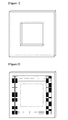
- Fig. 1 illustrates a frame for measuring a melt fracture temperature of a microporous film in accordance with an embodiment of the present invention.
- Fig. 2 illustrates that a microporous film in accordance with an embodiment of the present invention is fixed to the frame for measuring the melt fracture temperature of the microporous film using a tape.
- Degree of crystallinity % measured heat of fusion / heat of fusion of 100 % crystal ⁇ X ⁇ 100
- a gas permeability was measured by a porometer (CFP-1500-AEL of PMI).
- the gas permeability is expressed by Gurley number, but according to the Gurley number, it is difficult to compare relative permeability according to porous structure of a separator itself since influence by a thickness of the separator is not corrected.
- Darcy's permeability constant was used in the present invention.
- the Darcy's permeability constant is obtained by the following mathematical equation, and nitrogen was used in the present invention.
- C 8 F T V / ⁇ ⁇ D 2 P 2 - 1 where,
- a mean pore diameter of a polyethylene layer was measured by a half-dry method using a porometer (CFP-1500-AEL of PMI) according to ASTM F316-03 after peeling the polyethylene layer off from the multilayer separator film.
- Galwick liquid surface tension: 15.9 dyne/cm available from PMI was used to measure the pore diameter.
- Puncture strength was defined as a strength of a separator when the pin which having a diameter of 1mm and radius of curvature of 0.5mm and mounted in the Universal Testing Machine(UTM) is piercing the separator film with a crosshead moving speed of 120mm/min.
- the puncture strength at 120°C was defined as the puncture strength at high temperature.
- the measuring method is like abovementioned method to define puncture strength but is conducted at 120°C.
- the pin and specimen holder were placed in the oven which was maintained at 120°C for 3 minutes and more preferably for 5 minutes in consideration of both the temperature stabilization and efficiency.
- TMA Thermo-Mechanical Analysis
- TMA shrinkage % 100 X initial length - length of specimen at respective temperature / initial length
- (-)% shrinkage (0% or less) means that the specimen is not shrunken and is lengthened by the external stress, which means that a force of shrinkage is lower than the external stress and thus the thermal stability of the separator is ensured.
- a separator was cut by 15 cm X 15 cm and marked with a spacing of 10 cm in a longitudinal direction and a transverse direction, respectively. Then, the marked separator was placed in the oven which maintained at 120°C for 60 minutes and followed by measurement of spacing variation and calculation of the shrinkage.
- a film (5 cm X 5 cm) was fixed to a frame (outer: 7.5 cm X 7.5 cm, inner: 2.5 cm X 2.5 cm) as shown in Fig. 1 by using a polyimide tape as shown in Fig.2 and was then placed in a convection oven maintained at a preset temperature for 5 minutes, followed by observation of fracture of the film.
- an iron partitioning plate was provided at a hot wind discharge port. The highest temperature where the film was not fractured even after 5 minutes was defined as a melt fracture temperature.
- polyethylene having a weight average molecular weight of 3.0X10 5 and a melting temperature of 135°C and paraffin oil having a kinetic viscosity of 95 cSt at 40°C were used, and the contents of the two components were 30 wt% and 70 wt%, respectively.
- the polyethylene was fed into a main hopper and the paraffin oil, i.e. diluent, was fed into an extruder using a side feeder.
- polypropylene with ethylene as a comonomer having a weight average molecular weight of 2.5 ⁇ 10 5 , a melting temperature of 153°C and a degree of crystallinity of 42%, and CaCO 3 as a filler having a average particle size of 1.5 ⁇ m were used, and the contents of the two components were 30 wt% and 70 wt%, respectively.
- a thickness of a sheet formed of the polyethylene was 680 ⁇ m and a thickness of a sheet formed of the heat resistant resin was 140 ⁇ m.
- the 2-layer sheet was sequentially stretched 6 times in a longitudinal direction at 114°C and 6 times in a transverse direction at 125°C.
- the stretched film was subject to extraction of diluent in the polyethylene layer therefrom using methylene chloride of 25 ⁇ 30°C.
- Heat-setting was performed at 127°C, wherein the film was lengthened 130% in a transverse direction as compared to the initial width in the stretching step and was shrunken 15.4% as compared to the final width of the stretching step in the shrinking step.
- Table 1 The obtained mechanical properties of the separator are shown in Table 1 below.
- polyethylene having a weight average molecular weight of 3.0X10 5 and a melting temperature of 135°C and paraffin oil having a kinetic viscosity of 95 cSt at 40°C were used, and the contents of the two components were 30 wt% and 70 wt%, respectively.
- the polyethylene was fed into a main hopper and the paraffin oil, i.e. diluent, was fed into an extruder using a side feeder.
- polypropylene added with ethylene-polypropylene rubber and having a weight average molecular weight of 3.5X10 5 , a melting temperature of 164°C and a degree of crystallinity of 41%, and polyarylate as a filler having a glass transition temperature of 200°C were used, and the contents of the two components were 60 wt% and 40 wt%, respectively.
- a thickness of a sheet formed of the polyethylene was 420 ⁇ m and a thickness of a sheet formed of the heat resistant resin was 150 ⁇ m, respectively.
- the 3-layer sheet was sequentially stretched 6.5 times in a longitudinal direction at 110°C and 6 times in a transverse direction at 124°C.
- the stretched film was subject to extraction of diluent in the polyethylene layer therefrom using methylene chloride of 25 ⁇ 30°C.
- Heat-setting was performed at 130°C, wherein the film was lengthened 140% in a transverse direction as compared to the initial width in the stretching step and was shrunken 21.4% as compared to the final width of the stretching step in the shrinking step.
- Table 1 The obtained mechanical properties of the separator are shown in Table 1 below.
- polyethylene having a weight average molecular weight of 3.0X10 5 and a melting temperature of 135°C and paraffin oil having a kinetic viscosity of 95 cSt at 40°C were used, and the contents of the two components were 30 wt% and 70 wt%, respectively.
- the polyethylene was fed into a main hopper and the paraffin oil, i.e. diluent, was fed into an extruder using a side feeder.
- poly4-methyl-lpentene having a weight average molecular weight of 6.0X10 5 , a melting temperature of 231°C and a melting heat of 40 J/g, and CaCo 3 as a filler having a average particle size of 2.5 ⁇ m were used, and the contents of the two components were 35 wt% and 65 wt%, respectively.
- a thickness of a sheet formed of the polyethylene was 500 ⁇ m and a thickness of a sheet formed of the heat resistant resin was 100 ⁇ m, respectively.
- the 3-layer sheet was sequentially stretched 7 times in a longitudinal direction at 116°C and 6 times in a transverse direction at 128°C.
- the stretched film was subject to extraction of diluent in the polyethylene layer therefrom using methylene chloride of 25 ⁇ 30 ⁇ .
- Heat-setting was performed at 130°C, wherein the film was lengthened 150% in a transverse direction as compared to the initial width in the stretching step and was shrunken 20% as compared to the final width of the stretching step in the shrinking step.
- the obtained mechanical properties of the separator are shown in Table 1 below.
- polyethylene having a weight average molecular weight of 3.0X10 5 and a melting temperature of 135°C and paraffin oil having a kinetic viscosity of 95 cSt at 40°C were used, and the contents of the two components were 30 wt% and 70 wt%, respectively.
- the polyethylene was fed into a main hopper and the paraffin oil, i.e. diluent, was fed into an extruder using a side feeder.
- PVdF polyvinylidene fluoride
- CTFE chlorotrifluoroethylene
- BaTiO 3 barium titanium oxide
- a thickness of a sheet formed of the polyethylene was 800 ⁇ m and a thickness of a sheet formed of the heat resistant resin was 60 ⁇ m.
- the 2-layer sheet was simultaneously stretched 7 times in a longitudinal direction and 5.5 times in a transverse direction at 117°C.
- the stretched film was subject to extraction of diluent in the polyethylene layer therefrom using methylene chloride of 25 ⁇ 30°C.
- Heat-setting was performed at 129°C, wherein the film was lengthened 150% in a transverse direction as compared to the initial width in the stretching step and was shrunken 26.7% as compared to the final width of the stretching step in the shrinking step.
- Table 1 The obtained mechanical properties of the separator are shown in Table 1 below.
- polyethylene having a weight average molecular weight of 3.0X10 5 and a melting temperature of 135°C and paraffin oil having a kinetic viscosity of 95 cSt at 40°C were used, and the contents of the two components were 30 wt% and 70 wt%, respectively.
- the polyethylene was fed into a main hopper and the paraffin oil, i.e. diluent, was fed into an extruder using a side feeder.
- ABS resin having a weight average molecular weight of 5.0X10 5 and a glass transition temperature of 98°C, and homopolypropylene as a filler having a weight average molecular weight of 2.5X10 5 and a melting temperature of 163°C were used, and the contents of the two components were 65 wt% and 35 wt%, respectively.
- a thickness of a sheet formed of the polyethylene was 400 ⁇ m and a thickness of a sheet formed of the heat resistant resin was 200 ⁇ m, respectively.
- the 3-layer sheet was simultaneously stretched 5.5 times in a longitudinal direction and 5.5 times in a transverse direction at 118°C.
- the stretched film was subject to extraction of diluent in the polyethylene layer therefrom using normal hexane of 25 ⁇ 30°C.
- Heat-setting was performed at 125°C, wherein the film was lengthened 130% in a transverse direction as compared to the initial width in the stretching step and was shrunken 15.4% as compared to the final width of the stretching step in the shrinking step.
- the obtained mechanical properties of the separator are shown in Table 1 below.
- polyethylene having a weight average molecular weight of 3.0X10 5 and a melting temperature of 135°C and paraffin oil having a kinetic viscosity of 95 cSt at 40°C were used, and the contents of the two components were 30 wt% and 70 wt%, respectively.
- the polyethylene was fed into a main hopper and the paraffin oil, i.e. diluent, was fed into an extruder using a side feeder.
- polybutylene terephthalate having a weight average molecular weight of 4.0X10 5 , a melting temperature of 225°C and a degree of crystallinity of 35%, and CaCo 3 as a filler having a average particle size of 0.8 ⁇ m were used, and the contents of the two components were 40 wt% and 60 wt%, respectively.
- a thickness of a sheet formed of the polyethylene was 700 ⁇ m and a thickness of a sheet formed of the heat resistant resin was 100 ⁇ m.
- the 2-layer sheet was simultaneously stretched 7.0 times in a longitudinal direction and 6.0 times in a transverse direction at 115°C.
- the stretched film was subject to extraction of diluent in the polyethylene layer therefrom using methylene chloride of 25 ⁇ 30°C.
- Heat-setting was performed at 129°C, wherein the film was lengthened 140% in a transverse direction as compared to the initial width in the stretching step and was shrunken 17.9% as compared to the final width of the stretching step in the shrinking step.
- Table 1 The obtained mechanical properties of the separator are shown in Table 1 below.
- polyethylene having a weight average molecular weight of 3.0X10 5 and a melting temperature of 135°C and paraffin oil having a kinetic viscosity of 95 cSt at 40°C were used, and the contents of the two components were 30 wt% and 70 wt%, respectively.
- the polyethylene was fed into a main hopper and the paraffin oil, i.e.
- diluent was fed into an extruder using a side feeder, and they were extruded through a T die and molded by a casting roll at 30°C into a single layer (polyethylene layer) sheet.
- a thickness of the polyethylene sheet was 1,100 ⁇ m.
- the polyethylene sheet was sequentially stretched 7.0 times in a longitudinal direction at 116°C and 5.0 times in a transverse direction at 124°C.
- the stretched film was subject to extraction of diluent in the polyethylene layer therefrom using methylene chloride of 25 ⁇ 30°C.
- Heat-setting was performed at 128 ⁇ , wherein the film was lengthened 140% in a transverse direction as compared to the initial width in the stretching step and was shrunken 21.4% as compared to the final width of the stretching step in the shrinking step.
- the obtained mechanical properties of the separator are shown in Table 1 below.
- polyethylene having a weight average molecular weight of 3.0X10 5 and a melting temperature of 135°C and paraffin oil having a kinetic viscosity of 95 cSt at 40°C were used, and the contents of the two components were 30 wt% and 70 wt%, respectively.
- the polyethylene was fed into a main hopper and the paraffin oil, i.e. diluent, was fed into an extruder using a side feeder.
- homopolypropylene having a weight average molecular weight of 5.7X10 5 , a melting temperature of 163°C and a degree of crystallinity of 51%, and CaC03 as a filler having a average particle size of 1.5 ⁇ m were used, and the contents of the two components were 30 wt% and 70 wt%, respectively.
- a thickness of a sheet formed of the polyethylene was 400 ⁇ m and a thickness of a sheet formed of the heat resistant resin was 150 ⁇ m, respectively.
- the 3-layer sheet was sequentially stretched 7 times in a longitudinal direction at 112°C and 6 times in a transverse direction at 122°C.
- the stretched film was subject to extraction of diluent in the polyethylene layer therefrom using methylene chloride of 25 ⁇ 30°C.
- Heat-setting was performed at 130°C, wherein the film was lengthened 150% in a transverse direction as compared to the initial width in the stretching step and was shrunken 26.7% as compared to the final width of the stretching step in the shrinking step.
- the obtained mechanical properties of the separator are shown in Table 1 below.
- polyethylene having a weight average molecular weight of 3.0X10 5 and a melting temperature of 135°C and paraffin oil having a kinetic viscosity of 95 cSt at 40°C were used, and the contents of the two components were 30 wt% and 70 wt%, respectively.
- the polyethylene was fed into a main hopper and the paraffin oil, i.e. diluent, was fed into an extruder using a side feeder.
- high density polyethylene having a weight average molecular weight of 1.5X10 5 , a melting temperature of 134°C and a degree of crystallinity of 72%, and CaCO 3 as a filler having a average particle size of 2.5 ⁇ m were used, and the contents of the two components were 30 wt% and 70 wt%, respectively.
- a thickness of a sheet formed of the polyethylene was 600 ⁇ m and a thickness of a sheet formed of the resin-filler was 200 ⁇ m.
- the 2-layer sheet was sequentially stretched 6 times in a longitudinal direction at 110°C and 5.5 times in a transverse direction at 127°C.
- the stretched film was subject to extraction of diluent in the polyethylene layer therefrom using methylene chloride of 25 ⁇ 30°C.
- Heat-setting was performed at 126°C, wherein the film was lengthened 130% in a transverse direction as compared to the initial width in the stretching step and was shrunken 15.4% as compared to the final width of the stretching step in the shrinking step.
- Table 1 The obtained mechanical properties of the separator are shown in Table 1 below.
- polyethylene having a weight average molecular weight of 3.0X10 5 and a melting temperature of 135°C and paraffin oil having a kinetic viscosity of 95 cSt at 40°C were used, and the contents of the two components were 30 wt% and 70 wt%, respectively.
- the polyethylene was fed into a main hopper and the paraffin oil, i.e. diluent, was fed into an extruder using a side feeder.
- polypropylene with ethylene as a comonomer having a weight average molecular weight of 2.5X10 5 , a melting temperature of 153°C and a degree of crystallinity of 42%, and CaCO 3 as a filler having a average particle size of 1.5 ⁇ m were used, and the contents of the two components were 65 wt% and 35 wt%, respectively.
- a thickness of a sheet formed of the polyethylene was 370 ⁇ m and a thickness of a sheet formed of the heat resistant resin was 100 ⁇ m, respectively.
- the 3-layer sheet was simultaneously stretched 6 times in a longitudinal direction and 6 times in a transverse direction at 119°C.
- the stretched film was subject to extraction of diluent in the polyethylene layer therefrom using methylene chloride of 25 ⁇ 30°C.
- Heat-setting was performed at 120°C, wherein the film was lengthened 135% in a transverse direction as compared to the initial width in the stretching step and was shrunken 18.5% as compared to the final width of the stretching step in the shrinking step.
- the obtained mechanical properties of the separator are shown in Table 1 below.
- polyethylene having a weight average molecular weight of 3.0X10 5 and a melting temperature of 135°C and paraffin oil having a kinetic viscosity of 95 cSt at 40°C were used, and the contents of the two components were 30 wt% and 70 wt%, respectively.
- the polyethylene was fed into a main hopper and the paraffin oil, i.e. diluent, was fed into an extruder using a side feeder.
- polycarbonate having a weight average molecular weight of 2.0X10 5 and a glass transition temperature of 150°C, and CaCO 3 as a filler having a average particle size of 2.5 ⁇ m were used, and the contents of the two components were 30 wt% and 70 wt%, respectively.
- a thickness of a sheet formed of the polyethylene was 600 ⁇ m and a thickness of a sheet formed of the heat resistant resin was 150 ⁇ m.
- the 2-layer sheet was simultaneously stretched 5.5 times in a longitudinal direction and 5.5 times in a transverse direction at 120°C.
- the heat resistant resin layer was not stretched in the stretching process and therefore the next processes such as extraction were not conducted.
- the microporous multilayer film in accordance with the present invention not only possesses a low shutdown temperature due to polyethylene and a high meltdown temperature and low shrinkage property due to the heat resistant resin and the filler at the same time but also possesses uniform micropores and high strength/stability properties that are characteristics of a separator prepared by a wet process and high permeability/high strength properties according to large pores prepared by a dry process at the same time, thereby capable of showing excellent effect when used in a high capacity/high power secondary battery.
Landscapes
- Chemical & Material Sciences (AREA)
- Chemical Kinetics & Catalysis (AREA)
- Electrochemistry (AREA)
- General Chemical & Material Sciences (AREA)
- Inorganic Chemistry (AREA)
- Dispersion Chemistry (AREA)
- Cell Separators (AREA)
- Laminated Bodies (AREA)
- Separation Using Semi-Permeable Membranes (AREA)
- Manufacture Of Porous Articles, And Recovery And Treatment Of Waste Products (AREA)
Applications Claiming Priority (2)
| Application Number | Priority Date | Filing Date | Title |
|---|---|---|---|
| KR1020090029439A KR101394622B1 (ko) | 2009-04-06 | 2009-04-06 | 물성과 고온 안정성이 우수한 폴리올레핀계 다층 미세다공막 |
| PCT/KR2010/002057 WO2010117166A2 (ko) | 2009-04-06 | 2010-04-05 | 물성과 고온 안정성이 우수한 폴리올레핀계 다층 미세다공막 |
Publications (2)
| Publication Number | Publication Date |
|---|---|
| EP2420311A2 true EP2420311A2 (de) | 2012-02-22 |
| EP2420311A4 EP2420311A4 (de) | 2013-10-23 |
Family
ID=42936689
Family Applications (1)
| Application Number | Title | Priority Date | Filing Date |
|---|---|---|---|
| EP10761827.4A Withdrawn EP2420311A4 (de) | 2009-04-06 | 2010-04-05 | Mehrschichtige mikroporöse folie auf polyolefinbasis mit hervorragenden physikalischen eigenschaften und hoher temperaturstabilität |
Country Status (7)
| Country | Link |
|---|---|
| US (1) | US20120070644A1 (de) |
| EP (1) | EP2420311A4 (de) |
| JP (1) | JP2012522669A (de) |
| KR (1) | KR101394622B1 (de) |
| CN (1) | CN102405095A (de) |
| TW (1) | TW201105505A (de) |
| WO (1) | WO2010117166A2 (de) |
Families Citing this family (25)
| Publication number | Priority date | Publication date | Assignee | Title |
|---|---|---|---|---|
| KR101269207B1 (ko) * | 2010-01-25 | 2013-05-31 | 에스케이이노베이션 주식회사 | 내열성이 우수한 다층 다공막 |
| TWI497791B (zh) * | 2011-04-08 | 2015-08-21 | Teijin Ltd | Non-aqueous secondary battery separator and non-aqueous secondary battery |
| CN103155220B (zh) * | 2011-04-08 | 2016-01-20 | 帝人株式会社 | 非水系二次电池用隔膜及非水系二次电池 |
| CA2887356A1 (en) * | 2012-10-08 | 2014-04-17 | Treofan Germany Gmbh & Co. Kg | Microporous separator film having homogeneous porosity and greater resistance to puncturing |
| KR101611229B1 (ko) | 2013-01-31 | 2016-04-11 | 제일모직 주식회사 | 분리막의 제조 방법과 그 분리막, 및 이를 이용한 전지 |
| JP6414545B2 (ja) * | 2013-02-28 | 2018-10-31 | 三洋電機株式会社 | 非水電解質二次電池 |
| CN105830251B (zh) * | 2013-12-26 | 2018-05-29 | 帝人株式会社 | 非水系二次电池用隔膜及非水系二次电池 |
| WO2015156127A1 (ja) * | 2014-04-11 | 2015-10-15 | 東レバッテリーセパレータフィルム株式会社 | 電池用セパレータ |
| JP2017522399A (ja) * | 2014-06-06 | 2017-08-10 | キンバリー クラーク ワールドワイド インコーポレイテッド | 多孔質高分子シートから形成される熱成形物品 |
| WO2015198948A1 (ja) * | 2014-06-25 | 2015-12-30 | 帝人株式会社 | 液体フィルター用基材及びその製造方法 |
| KR102604599B1 (ko) * | 2015-04-02 | 2023-11-22 | 에스케이이노베이션 주식회사 | 리튬 이차전지용 복합 분리막 및 이의 제조방법 |
| KR20170044499A (ko) * | 2015-10-15 | 2017-04-25 | 삼성에스디아이 주식회사 | 다공성 필름, 다공성 필름의 제조 방법, 및 이를 포함하는 전기화학 전지 |
| JP6543164B2 (ja) * | 2015-10-27 | 2019-07-10 | 旭化成株式会社 | 多層微多孔膜及び蓄電デバイス用セパレータ |
| JP6014743B1 (ja) | 2015-11-30 | 2016-10-25 | 住友化学株式会社 | 非水電解液二次電池用セパレータおよびその利用 |
| CN108699250B (zh) | 2016-01-05 | 2020-12-25 | Sabic环球技术有限责任公司 | 用于制备包含聚乙烯的接枝共聚物的方法 |
| CN109153752B (zh) * | 2016-01-05 | 2021-02-09 | Sabic环球技术有限责任公司 | 用于制备包含聚乙烯的接枝共聚物的方法 |
| WO2018034735A1 (en) * | 2016-08-19 | 2018-02-22 | Jindal Films Americas Llc | Coextruded, polyethylene skins on polypropylene core |
| HUE055821T2 (hu) | 2017-03-27 | 2021-12-28 | Asahi Chemical Ind | Poliolefin mikroporózus membrán és annak elõállítási eljárása |
| TWI638718B (zh) * | 2017-08-31 | 2018-10-21 | 財團法人工業技術研究院 | 複合膜及其製造方法與包括複合膜的電池 |
| KR102409258B1 (ko) | 2018-10-11 | 2022-06-15 | 아사히 가세이 가부시키가이샤 | 리튬 이온 전지용 세퍼레이터 |
| KR102834252B1 (ko) * | 2018-10-11 | 2025-07-18 | 아사히 가세이 배터리 세퍼레이터 가부시키가이샤 | 가교 세퍼레이터를 사용한 리튬 이온 전지 |
| KR102309228B1 (ko) * | 2019-12-27 | 2021-10-05 | 닛토덴코 가부시키가이샤 | 복합 반투막 |
| CN119855706A (zh) * | 2022-09-19 | 2025-04-18 | 阿姆泰克研究国际公司 | 由双层充油片材制成的双轴取向膜 |
| CN116247369A (zh) * | 2023-01-06 | 2023-06-09 | 隆电科技(广东)有限公司 | 一种半固态锂电池复合隔膜 |
| CN119325666A (zh) * | 2023-02-13 | 2025-01-17 | 宁德时代新能源科技股份有限公司 | 隔离膜、其制备方法及其相关的二次电池和用电装置 |
Family Cites Families (21)
| Publication number | Priority date | Publication date | Assignee | Title |
|---|---|---|---|---|
| US4247498A (en) | 1976-08-30 | 1981-01-27 | Akzona Incorporated | Methods for making microporous products |
| JPS59196706A (ja) * | 1983-04-22 | 1984-11-08 | Dainippon Ink & Chem Inc | 不均質膜およびその製造方法 |
| US4980101A (en) * | 1989-07-14 | 1990-12-25 | The Dow Chemical Company | Anisotropic microporous syndiotactic polystyrene membranes and a process for preparing the same |
| US4927535A (en) * | 1989-07-14 | 1990-05-22 | The Dow Chemical Company | Microporous membranes from isotactic polystyrene and syndiotactic polystyrene |
| US5641565A (en) | 1991-07-05 | 1997-06-24 | Asahi Kasei Kogyo Kabushiki Kaisha | Separator for a battery using an organic electrolytic solution and method for preparing the same |
| TW297171B (de) | 1994-12-20 | 1997-02-01 | Hoechst Celanese Corp | |
| KR100648026B1 (ko) * | 1998-10-15 | 2006-11-23 | 가부시키가이샤 유포 코포레숀 | 인몰드성형용 라벨 |
| TWI315591B (en) | 2000-06-14 | 2009-10-01 | Sumitomo Chemical Co | Porous film and separator for battery using the same |
| JP4931163B2 (ja) | 2001-04-24 | 2012-05-16 | 旭化成イーマテリアルズ株式会社 | ポリオレフィン製微多孔膜 |
| CN100522602C (zh) | 2003-04-04 | 2009-08-05 | 旭化成电子材料株式会社 | 聚烯烃微多孔膜 |
| US6949315B1 (en) | 2004-05-12 | 2005-09-27 | Garrin Samii | Shutdown separators with improved properties |
| CN101031421B (zh) | 2004-10-01 | 2011-07-27 | 旭化成电子材料株式会社 | 聚烯烃微孔膜 |
| JP4791044B2 (ja) * | 2005-01-11 | 2011-10-12 | 日東電工株式会社 | 電池用セパレータのための反応性ポリマー担持多孔質フィルムとそれを用いた電池の製造方法 |
| EP1900514B1 (de) * | 2005-06-24 | 2013-08-14 | Toray Battery Separator Film Co., Ltd. | Mehrlagige, mikroporöse polyethylenmembran, diese verwendender batterieseparator und batterie |
| JP5148093B2 (ja) * | 2005-09-28 | 2013-02-20 | 東レバッテリーセパレータフィルム株式会社 | ポリエチレン多層微多孔膜及びその製造方法、並びに電池用セパレータ |
| CN1331578C (zh) * | 2005-10-13 | 2007-08-15 | 中材科技股份有限公司 | 耐高温聚四氟乙烯覆膜过滤材料 |
| CN101291794B (zh) * | 2005-10-19 | 2013-08-28 | 东丽电池隔膜株式会社 | 聚烯烃多层微孔膜的制造方法 |
| RU2431521C2 (ru) * | 2005-10-24 | 2011-10-20 | Торей Тонен Спешиалти Сепарейтор Годо Кайса | Многослойная, микропористая полиолефиновая мембрана, способ ее получения и сепаратор аккумулятора |
| JP4936960B2 (ja) * | 2007-04-04 | 2012-05-23 | 旭化成イーマテリアルズ株式会社 | 複合微多孔膜、電池用セパレータ、及び複合微多孔膜の製造方法 |
| JP5164413B2 (ja) * | 2007-04-04 | 2013-03-21 | 旭化成イーマテリアルズ株式会社 | 複合微多孔膜、電池用セパレータ、及び複合微多孔膜の製造方法 |
| EP2075126B1 (de) * | 2007-12-26 | 2014-04-09 | SK Innovation Co. Ltd. | Mehrschichtiger und mikroporöser Polyolefinfilm und Verfahren zu dessen Herstellung |
-
2009
- 2009-04-06 KR KR1020090029439A patent/KR101394622B1/ko active Active
-
2010
- 2010-04-01 TW TW99110121A patent/TW201105505A/zh unknown
- 2010-04-05 CN CN2010800159380A patent/CN102405095A/zh active Pending
- 2010-04-05 JP JP2012504570A patent/JP2012522669A/ja active Pending
- 2010-04-05 WO PCT/KR2010/002057 patent/WO2010117166A2/ko not_active Ceased
- 2010-04-05 EP EP10761827.4A patent/EP2420311A4/de not_active Withdrawn
- 2010-04-05 US US13/263,161 patent/US20120070644A1/en not_active Abandoned
Also Published As
| Publication number | Publication date |
|---|---|
| KR20100111065A (ko) | 2010-10-14 |
| WO2010117166A3 (ko) | 2011-01-20 |
| US20120070644A1 (en) | 2012-03-22 |
| CN102405095A (zh) | 2012-04-04 |
| TW201105505A (en) | 2011-02-16 |
| KR101394622B1 (ko) | 2014-05-20 |
| EP2420311A4 (de) | 2013-10-23 |
| WO2010117166A2 (ko) | 2010-10-14 |
| JP2012522669A (ja) | 2012-09-27 |
Similar Documents
| Publication | Publication Date | Title |
|---|---|---|
| EP2420311A2 (de) | Mehrschichtige mikroporöse folie auf polyolefinbasis mit hervorragenden physikalischen eigenschaften und hoher temperaturstabilität | |
| EP2274787B1 (de) | Mikroporöser polyolefinfilm mit einer bei hohen temperaturen wärmestabilen porösen schicht | |
| KR101406051B1 (ko) | 폴리올레핀 다층 미세 다공막, 그 제조 방법, 전지용 세페레이터 및 전지 | |
| US9147868B2 (en) | Microporous films, methods for their production, and applications thereof | |
| TWI426641B (zh) | 具有改良之熱特性的多孔狀多層薄膜 | |
| EP3438177A1 (de) | Mikroporöse polyolefinmembran, herstellungsverfahren für mikroporöse polyolefinmembran, batterieseparator und batterie | |
| CN102740956B (zh) | 微孔性膜和用于制备和使用这样的膜的方法 | |
| EP1930157B1 (de) | Mehrlagige poröse polyethylenmembran, verfahren zu deren herstellung und trennvorrichtungen für zellen | |
| EP2310182B1 (de) | Mikroporöse mehrlagige polyolefinfolie und herstellungsverfahren dafür | |
| EP2075126B1 (de) | Mehrschichtiger und mikroporöser Polyolefinfilm und Verfahren zu dessen Herstellung | |
| CN101795866B (zh) | 多层微孔聚烯烃膜,其制备方法,电池隔板和电池 | |
| KR101701185B1 (ko) | 미다공막, 이러한 막의 제조 방법 및 전지 세퍼레이터막으로서 이러한 막의 사용 | |
| KR102137377B1 (ko) | 전지용 세퍼레이터 및 이의 제조 방법 | |
| EP2360014A1 (de) | Poröse verbundfolie, separator für eine lithiumzelle und zelle | |
| KR20140105750A (ko) | 폴리올레핀 미다공막 및 그 제조 방법 | |
| JP2010502472A (ja) | 微多孔膜、電池用セパレータ及び電池 | |
| KR101452945B1 (ko) | 다층 폴리올레핀계 미세다공막 및 그 제조방법 | |
| EP3239223A1 (de) | Mikroporöse polyolefinmembran, herstellungsverfahren dafür und batterieseparator | |
| KR20160016806A (ko) | 폴리올레핀 다층 미다공막 및 이의 제조 방법 | |
| KR101690101B1 (ko) | 미세다공막, 이러한 막의 제조 방법 및 사용 방법 | |
| JP6304149B2 (ja) | 微多孔膜 |
Legal Events
| Date | Code | Title | Description |
|---|---|---|---|
| PUAI | Public reference made under article 153(3) epc to a published international application that has entered the european phase |
Free format text: ORIGINAL CODE: 0009012 |
|
| 17P | Request for examination filed |
Effective date: 20111025 |
|
| AK | Designated contracting states |
Kind code of ref document: A2 Designated state(s): AT BE BG CH CY CZ DE DK EE ES FI FR GB GR HR HU IE IS IT LI LT LU LV MC MK MT NL NO PL PT RO SE SI SK SM TR |
|
| DAX | Request for extension of the european patent (deleted) | ||
| A4 | Supplementary search report drawn up and despatched |
Effective date: 20130919 |
|
| RIC1 | Information provided on ipc code assigned before grant |
Ipc: B01D 71/76 20060101ALI20130913BHEP Ipc: B01D 71/00 20060101AFI20130913BHEP |
|
| STAA | Information on the status of an ep patent application or granted ep patent |
Free format text: STATUS: THE APPLICATION IS DEEMED TO BE WITHDRAWN |
|
| 18D | Application deemed to be withdrawn |
Effective date: 20140423 |