EP2415902A2 - Verfahren zur Herstellung einer nanokristallinen CuSCN-chnicht auf einem Substrat - Google Patents
Verfahren zur Herstellung einer nanokristallinen CuSCN-chnicht auf einem Substrat Download PDFInfo
- Publication number
- EP2415902A2 EP2415902A2 EP11075187A EP11075187A EP2415902A2 EP 2415902 A2 EP2415902 A2 EP 2415902A2 EP 11075187 A EP11075187 A EP 11075187A EP 11075187 A EP11075187 A EP 11075187A EP 2415902 A2 EP2415902 A2 EP 2415902A2
- Authority
- EP
- European Patent Office
- Prior art keywords
- substrate
- cuscn
- bath
- temperature
- layer
- Prior art date
- Legal status (The legal status is an assumption and is not a legal conclusion. Google has not performed a legal analysis and makes no representation as to the accuracy of the status listed.)
- Withdrawn
Links
- 239000000758 substrate Substances 0.000 title claims abstract description 53
- PDZKZMQQDCHTNF-UHFFFAOYSA-M copper(1+);thiocyanate Chemical compound [Cu+].[S-]C#N PDZKZMQQDCHTNF-UHFFFAOYSA-M 0.000 title claims abstract description 44
- 238000004519 manufacturing process Methods 0.000 title claims abstract description 5
- 239000000243 solution Substances 0.000 claims abstract description 28
- 239000007864 aqueous solution Substances 0.000 claims abstract description 12
- 238000000224 chemical solution deposition Methods 0.000 claims abstract description 7
- -1 SCN ions Chemical class 0.000 claims abstract description 5
- 238000000034 method Methods 0.000 claims description 30
- 230000004048 modification Effects 0.000 claims description 7
- 238000012986 modification Methods 0.000 claims description 7
- 239000002202 Polyethylene glycol Substances 0.000 claims description 5
- 239000000203 mixture Substances 0.000 claims description 5
- 229920001223 polyethylene glycol Polymers 0.000 claims description 5
- 229920001721 polyimide Polymers 0.000 claims description 5
- 239000000654 additive Substances 0.000 claims description 4
- 239000013078 crystal Substances 0.000 claims description 4
- 239000011521 glass Substances 0.000 claims description 3
- 238000002156 mixing Methods 0.000 claims description 2
- 238000001020 plasma etching Methods 0.000 claims description 2
- 239000010703 silicon Substances 0.000 claims description 2
- 229910052710 silicon Inorganic materials 0.000 claims description 2
- 239000004094 surface-active agent Substances 0.000 claims description 2
- 230000004913 activation Effects 0.000 claims 2
- 238000000151 deposition Methods 0.000 description 19
- 230000008021 deposition Effects 0.000 description 19
- 239000010949 copper Substances 0.000 description 14
- ZMZDMBWJUHKJPS-UHFFFAOYSA-M Thiocyanate anion Chemical compound [S-]C#N ZMZDMBWJUHKJPS-UHFFFAOYSA-M 0.000 description 11
- ZNNZYHKDIALBAK-UHFFFAOYSA-M potassium thiocyanate Chemical compound [K+].[S-]C#N ZNNZYHKDIALBAK-UHFFFAOYSA-M 0.000 description 11
- 238000010438 heat treatment Methods 0.000 description 10
- 238000001878 scanning electron micrograph Methods 0.000 description 7
- 229920000604 Polyethylene Glycol 200 Polymers 0.000 description 6
- 229910052782 aluminium Inorganic materials 0.000 description 5
- XAGFODPZIPBFFR-UHFFFAOYSA-N aluminium Chemical compound [Al] XAGFODPZIPBFFR-UHFFFAOYSA-N 0.000 description 5
- XLYOFNOQVPJJNP-UHFFFAOYSA-N water Substances O XLYOFNOQVPJJNP-UHFFFAOYSA-N 0.000 description 5
- IJGRMHOSHXDMSA-UHFFFAOYSA-N Atomic nitrogen Chemical compound N#N IJGRMHOSHXDMSA-UHFFFAOYSA-N 0.000 description 4
- KFZMGEQAYNKOFK-UHFFFAOYSA-N Isopropanol Chemical compound CC(C)O KFZMGEQAYNKOFK-UHFFFAOYSA-N 0.000 description 4
- 239000000463 material Substances 0.000 description 4
- QTBSBXVTEAMEQO-UHFFFAOYSA-N Acetic acid Chemical compound CC(O)=O QTBSBXVTEAMEQO-UHFFFAOYSA-N 0.000 description 3
- WEVYAHXRMPXWCK-UHFFFAOYSA-N Acetonitrile Chemical compound CC#N WEVYAHXRMPXWCK-UHFFFAOYSA-N 0.000 description 3
- 240000006829 Ficus sundaica Species 0.000 description 3
- DBMJMQXJHONAFJ-UHFFFAOYSA-M Sodium laurylsulphate Chemical compound [Na+].CCCCCCCCCCCCOS([O-])(=O)=O DBMJMQXJHONAFJ-UHFFFAOYSA-M 0.000 description 3
- 229910010413 TiO 2 Inorganic materials 0.000 description 3
- 239000008367 deionised water Substances 0.000 description 3
- 229910021641 deionized water Inorganic materials 0.000 description 3
- 238000005470 impregnation Methods 0.000 description 3
- 239000005361 soda-lime glass Substances 0.000 description 3
- 235000019333 sodium laurylsulphate Nutrition 0.000 description 3
- 239000002904 solvent Substances 0.000 description 3
- 238000001228 spectrum Methods 0.000 description 3
- 239000000126 substance Substances 0.000 description 3
- ZERULLAPCVRMCO-UHFFFAOYSA-N Dipropyl sulfide Chemical compound CCCSCCC ZERULLAPCVRMCO-UHFFFAOYSA-N 0.000 description 2
- 238000002441 X-ray diffraction Methods 0.000 description 2
- 238000006243 chemical reaction Methods 0.000 description 2
- 239000011248 coating agent Substances 0.000 description 2
- 238000000576 coating method Methods 0.000 description 2
- ORTQZVOHEJQUHG-UHFFFAOYSA-L copper(II) chloride Chemical compound Cl[Cu]Cl ORTQZVOHEJQUHG-UHFFFAOYSA-L 0.000 description 2
- OPQARKPSCNTWTJ-UHFFFAOYSA-L copper(ii) acetate Chemical compound [Cu+2].CC([O-])=O.CC([O-])=O OPQARKPSCNTWTJ-UHFFFAOYSA-L 0.000 description 2
- 238000004070 electrodeposition Methods 0.000 description 2
- 229910052757 nitrogen Inorganic materials 0.000 description 2
- 229920001643 poly(ether ketone) Polymers 0.000 description 2
- 239000011148 porous material Substances 0.000 description 2
- 239000002244 precipitate Substances 0.000 description 2
- 238000001556 precipitation Methods 0.000 description 2
- 231100000331 toxic Toxicity 0.000 description 2
- 230000002588 toxic effect Effects 0.000 description 2
- RYGMFSIKBFXOCR-UHFFFAOYSA-N Copper Chemical compound [Cu] RYGMFSIKBFXOCR-UHFFFAOYSA-N 0.000 description 1
- ZLMJMSJWJFRBEC-UHFFFAOYSA-N Potassium Chemical compound [K] ZLMJMSJWJFRBEC-UHFFFAOYSA-N 0.000 description 1
- BUGBHKTXTAQXES-UHFFFAOYSA-N Selenium Chemical compound [Se] BUGBHKTXTAQXES-UHFFFAOYSA-N 0.000 description 1
- VYPSYNLAJGMNEJ-UHFFFAOYSA-N Silicium dioxide Chemical compound O=[Si]=O VYPSYNLAJGMNEJ-UHFFFAOYSA-N 0.000 description 1
- 229910006404 SnO 2 Inorganic materials 0.000 description 1
- QAOWNCQODCNURD-UHFFFAOYSA-L Sulfate Chemical compound [O-]S([O-])(=O)=O QAOWNCQODCNURD-UHFFFAOYSA-L 0.000 description 1
- 239000012670 alkaline solution Substances 0.000 description 1
- SOIFLUNRINLCBN-UHFFFAOYSA-N ammonium thiocyanate Chemical compound [NH4+].[S-]C#N SOIFLUNRINLCBN-UHFFFAOYSA-N 0.000 description 1
- UHYPYGJEEGLRJD-UHFFFAOYSA-N cadmium(2+);selenium(2-) Chemical compound [Se-2].[Cd+2] UHYPYGJEEGLRJD-UHFFFAOYSA-N 0.000 description 1
- 239000000919 ceramic Substances 0.000 description 1
- 239000002131 composite material Substances 0.000 description 1
- 239000000470 constituent Substances 0.000 description 1
- 238000001816 cooling Methods 0.000 description 1
- 229910052802 copper Inorganic materials 0.000 description 1
- ARUVKPQLZAKDPS-UHFFFAOYSA-L copper(II) sulfate Chemical compound [Cu+2].[O-][S+2]([O-])([O-])[O-] ARUVKPQLZAKDPS-UHFFFAOYSA-L 0.000 description 1
- 229910000366 copper(II) sulfate Inorganic materials 0.000 description 1
- BQVVSSAWECGTRN-UHFFFAOYSA-L copper;dithiocyanate Chemical compound [Cu+2].[S-]C#N.[S-]C#N BQVVSSAWECGTRN-UHFFFAOYSA-L 0.000 description 1
- 229960003280 cupric chloride Drugs 0.000 description 1
- 238000005137 deposition process Methods 0.000 description 1
- 239000002274 desiccant Substances 0.000 description 1
- 238000001035 drying Methods 0.000 description 1
- 238000005485 electric heating Methods 0.000 description 1
- 239000007789 gas Substances 0.000 description 1
- 229910052736 halogen Inorganic materials 0.000 description 1
- 150000002367 halogens Chemical class 0.000 description 1
- 238000007654 immersion Methods 0.000 description 1
- 150000002500 ions Chemical class 0.000 description 1
- 229910052751 metal Inorganic materials 0.000 description 1
- 239000002184 metal Substances 0.000 description 1
- 239000002086 nanomaterial Substances 0.000 description 1
- 239000002073 nanorod Substances 0.000 description 1
- 230000002572 peristaltic effect Effects 0.000 description 1
- 239000002985 plastic film Substances 0.000 description 1
- 229920006255 plastic film Polymers 0.000 description 1
- 229910052700 potassium Inorganic materials 0.000 description 1
- 239000011591 potassium Substances 0.000 description 1
- 229940116357 potassium thiocyanate Drugs 0.000 description 1
- 238000002360 preparation method Methods 0.000 description 1
- 230000035484 reaction time Effects 0.000 description 1
- 239000012047 saturated solution Substances 0.000 description 1
- 229910052711 selenium Inorganic materials 0.000 description 1
- 239000011669 selenium Substances 0.000 description 1
- 239000004065 semiconductor Substances 0.000 description 1
- 239000000741 silica gel Substances 0.000 description 1
- 229910002027 silica gel Inorganic materials 0.000 description 1
- 239000011734 sodium Substances 0.000 description 1
- VGTPCRGMBIAPIM-UHFFFAOYSA-M sodium thiocyanate Chemical compound [Na+].[S-]C#N VGTPCRGMBIAPIM-UHFFFAOYSA-M 0.000 description 1
- 239000007787 solid Substances 0.000 description 1
- 238000005507 spraying Methods 0.000 description 1
- 238000003756 stirring Methods 0.000 description 1
- 238000003860 storage Methods 0.000 description 1
- 239000008399 tap water Substances 0.000 description 1
- 235000020679 tap water Nutrition 0.000 description 1
- 238000007740 vapor deposition Methods 0.000 description 1
Images



Classifications
-
- C—CHEMISTRY; METALLURGY
- C23—COATING METALLIC MATERIAL; COATING MATERIAL WITH METALLIC MATERIAL; CHEMICAL SURFACE TREATMENT; DIFFUSION TREATMENT OF METALLIC MATERIAL; COATING BY VACUUM EVAPORATION, BY SPUTTERING, BY ION IMPLANTATION OR BY CHEMICAL VAPOUR DEPOSITION, IN GENERAL; INHIBITING CORROSION OF METALLIC MATERIAL OR INCRUSTATION IN GENERAL
- C23C—COATING METALLIC MATERIAL; COATING MATERIAL WITH METALLIC MATERIAL; SURFACE TREATMENT OF METALLIC MATERIAL BY DIFFUSION INTO THE SURFACE, BY CHEMICAL CONVERSION OR SUBSTITUTION; COATING BY VACUUM EVAPORATION, BY SPUTTERING, BY ION IMPLANTATION OR BY CHEMICAL VAPOUR DEPOSITION, IN GENERAL
- C23C18/00—Chemical coating by decomposition of either liquid compounds or solutions of the coating forming compounds, without leaving reaction products of surface material in the coating; Contact plating
- C23C18/02—Chemical coating by decomposition of either liquid compounds or solutions of the coating forming compounds, without leaving reaction products of surface material in the coating; Contact plating by thermal decomposition
- C23C18/12—Chemical coating by decomposition of either liquid compounds or solutions of the coating forming compounds, without leaving reaction products of surface material in the coating; Contact plating by thermal decomposition characterised by the deposition of inorganic material other than metallic material
- C23C18/1204—Chemical coating by decomposition of either liquid compounds or solutions of the coating forming compounds, without leaving reaction products of surface material in the coating; Contact plating by thermal decomposition characterised by the deposition of inorganic material other than metallic material inorganic material, e.g. non-oxide and non-metallic such as sulfides, nitrides based compounds
-
- C—CHEMISTRY; METALLURGY
- C23—COATING METALLIC MATERIAL; COATING MATERIAL WITH METALLIC MATERIAL; CHEMICAL SURFACE TREATMENT; DIFFUSION TREATMENT OF METALLIC MATERIAL; COATING BY VACUUM EVAPORATION, BY SPUTTERING, BY ION IMPLANTATION OR BY CHEMICAL VAPOUR DEPOSITION, IN GENERAL; INHIBITING CORROSION OF METALLIC MATERIAL OR INCRUSTATION IN GENERAL
- C23C—COATING METALLIC MATERIAL; COATING MATERIAL WITH METALLIC MATERIAL; SURFACE TREATMENT OF METALLIC MATERIAL BY DIFFUSION INTO THE SURFACE, BY CHEMICAL CONVERSION OR SUBSTITUTION; COATING BY VACUUM EVAPORATION, BY SPUTTERING, BY ION IMPLANTATION OR BY CHEMICAL VAPOUR DEPOSITION, IN GENERAL
- C23C18/00—Chemical coating by decomposition of either liquid compounds or solutions of the coating forming compounds, without leaving reaction products of surface material in the coating; Contact plating
- C23C18/02—Chemical coating by decomposition of either liquid compounds or solutions of the coating forming compounds, without leaving reaction products of surface material in the coating; Contact plating by thermal decomposition
- C23C18/04—Pretreatment of the material to be coated
-
- C—CHEMISTRY; METALLURGY
- C23—COATING METALLIC MATERIAL; COATING MATERIAL WITH METALLIC MATERIAL; CHEMICAL SURFACE TREATMENT; DIFFUSION TREATMENT OF METALLIC MATERIAL; COATING BY VACUUM EVAPORATION, BY SPUTTERING, BY ION IMPLANTATION OR BY CHEMICAL VAPOUR DEPOSITION, IN GENERAL; INHIBITING CORROSION OF METALLIC MATERIAL OR INCRUSTATION IN GENERAL
- C23C—COATING METALLIC MATERIAL; COATING MATERIAL WITH METALLIC MATERIAL; SURFACE TREATMENT OF METALLIC MATERIAL BY DIFFUSION INTO THE SURFACE, BY CHEMICAL CONVERSION OR SUBSTITUTION; COATING BY VACUUM EVAPORATION, BY SPUTTERING, BY ION IMPLANTATION OR BY CHEMICAL VAPOUR DEPOSITION, IN GENERAL
- C23C18/00—Chemical coating by decomposition of either liquid compounds or solutions of the coating forming compounds, without leaving reaction products of surface material in the coating; Contact plating
- C23C18/02—Chemical coating by decomposition of either liquid compounds or solutions of the coating forming compounds, without leaving reaction products of surface material in the coating; Contact plating by thermal decomposition
- C23C18/12—Chemical coating by decomposition of either liquid compounds or solutions of the coating forming compounds, without leaving reaction products of surface material in the coating; Contact plating by thermal decomposition characterised by the deposition of inorganic material other than metallic material
- C23C18/1229—Composition of the substrate
- C23C18/1245—Inorganic substrates other than metallic
-
- C—CHEMISTRY; METALLURGY
- C23—COATING METALLIC MATERIAL; COATING MATERIAL WITH METALLIC MATERIAL; CHEMICAL SURFACE TREATMENT; DIFFUSION TREATMENT OF METALLIC MATERIAL; COATING BY VACUUM EVAPORATION, BY SPUTTERING, BY ION IMPLANTATION OR BY CHEMICAL VAPOUR DEPOSITION, IN GENERAL; INHIBITING CORROSION OF METALLIC MATERIAL OR INCRUSTATION IN GENERAL
- C23C—COATING METALLIC MATERIAL; COATING MATERIAL WITH METALLIC MATERIAL; SURFACE TREATMENT OF METALLIC MATERIAL BY DIFFUSION INTO THE SURFACE, BY CHEMICAL CONVERSION OR SUBSTITUTION; COATING BY VACUUM EVAPORATION, BY SPUTTERING, BY ION IMPLANTATION OR BY CHEMICAL VAPOUR DEPOSITION, IN GENERAL
- C23C18/00—Chemical coating by decomposition of either liquid compounds or solutions of the coating forming compounds, without leaving reaction products of surface material in the coating; Contact plating
- C23C18/02—Chemical coating by decomposition of either liquid compounds or solutions of the coating forming compounds, without leaving reaction products of surface material in the coating; Contact plating by thermal decomposition
- C23C18/12—Chemical coating by decomposition of either liquid compounds or solutions of the coating forming compounds, without leaving reaction products of surface material in the coating; Contact plating by thermal decomposition characterised by the deposition of inorganic material other than metallic material
- C23C18/125—Process of deposition of the inorganic material
- C23C18/1291—Process of deposition of the inorganic material by heating of the substrate
Definitions
- the invention relates to a method for producing a thin nanocrystalline CuSCN layer on a substrate.
- copper thiocyanate layers a p-type semiconductor material, are produced by various methods.
- CuSCN layers are deposited in an aqueous basic (pH ⁇ 9) solution, which results in Journal of the American Ceramic Society, vol. 90, 2007, pp. 2966-2973 is described. Also by means of electrodeposition, a CuSCN layer is deposited on a porous TiO 2 - layer and fills the pores of this layer completely, as in WO 00/52764 A1 described.
- H54-H57 describes the preparation of a transparent CuSCN layer by means of thermal vapor deposition first of a Cu layer, then a KSCN layer and subsequent reaction of both layers in a drying vessel with silica gel as drying agent for up to 24 hours. Depending on the reaction time, the transparency of the resulting CuSCN layer is improved.
- a CuSCN layer in a saturated solution of CuSCN and dipropyl sulfide is deposited on a preheated to 80 ° C sample of the structure glass / SnO 2 : F / ZnO sp / ZnO ed / CdSe.
- the CuSCN layer fills the nanostructured ZnO layer.
- DE 101 42 913 A1 describes a transistor arrangement in which the microholes of a composite film, consisting of two plastic films with intermediate metal layer, vertically filled with p-type CuSCN by means of chemical bath deposition. Further details on the parameters of the deposition are not mentioned here.
- the object of the invention is therefore to provide a further method by means of chemical bath deposition thin transparent nanocrystalline CuCSN layers, which is inexpensive, works well on non-conductive substrates and without seed layer and no toxic solvent needed.
- the object is achieved in that in the chemical bath deposition according to the invention first the surface of the substrate is activated and then the substrate and the aqueous solution are adjusted to different temperatures, the temperature of the substrate is set higher than the temperature of the solution, and an aqueous Solution with 0.1 to 200 mM Cu (II) - and SCN ions is used, and the substrate is bathed by this bath solution.
- the substrate / the substrate surface is heated to a temperature between 5 and 200 ° C and the aqueous solution is maintained at a temperature between 0 ° C and 100 ° C.
- concentration of the Cu II and SCN ions is adjusted so that the aqueous solution is metastable and little or no CuSCN precipitates.
- ion sources the state of the art is known for CuS0 4 and KSCN.
- the Cu (II) and SCN-ion solution can also be prepared at temperatures of 0 to 25 ° C from prediluted solutions with thorough mixing to the stability of the bath solution increase and avoid early precipitation of CuSCN.
- other water-soluble copper and thiocyanate ion sources can be used, such as copper (II) acetate, cupric chloride, ammonium thiocyanate or sodium thiocyanate.
- Both the morphology of the Cu (I) SCN layers and the nature of the crystal phase ( ⁇ - or ⁇ -CuSCN) is determined by the Cu (II) and SCN initial concentration, the temperature gradient between substrate and solution, the surface-active additives and Badkonvetation affected.
- a non- or bad conductive substrate can be used, for example, silicon or glass or a polyimide film.
- silicon or glass or a polyimide film On substrates with high thermal conductivity and heat resistance higher deposition rates can be achieved.
- the process according to the invention does not use expensive organic, partly toxic solvents (eg acetonitrile or dipropylsulfide) as in the "impregnation" method and, compared to the sequential SILAR technique, higher deposition rates can be achieved.
- expensive organic, partly toxic solvents eg acetonitrile or dipropylsulfide
- PEG polyethylene glycol
- SLS sodium lauryl sulfate
- the application of such a CuSCN seed layer to the substrate can influence the morphology of the CuSCN layer to be subsequently deposited.
- the substrate A to be coated is in the in FIG. 1 installed schematically illustrated cell.
- the flow cell B consists of polyether ketone (PEEK) and a Viton O-ring C.
- the bath D flows through the chamber has dimensions of about 14 mm wide, 17 mm long and 1.5 mm high.
- the heater E consists of an aluminum block (60 mm width, 70 mm length and 10 mm height), which is held by four electric heating elements (each 60 W power) by means of a PID controller at a constant temperature (T heating ).
- the bath supply vessel with a volume (V total ) is mixed by means of a magnetic stirrer, via a temperature sensor, the bath temperature (T bath ) is monitored and optionally controlled by a thermostat.
- the inlets and outlets F of the cell are connected to a storage vessel via a peristaltic pump , which regulates the volume flow (v pump ) of the bath. Furthermore, the process is characterized by the deposition time ( t deposition ).
- the substrates are each degreased for 5 minutes in 3% Mucasol solution in an ultrasonic bath, then rinsed with tap water, deionized water and isopropanol and dried in a stream of nitrogen.
- reaction solutions are prepared from prediluted solutions of CuSO 4 and KSCN with vigorous stirring at the lowest possible temperature to minimize precipitation of Cu (I) SCN.
- the substrate heating is switched on and only when the target temperature is reached, the solution is pumped through the flow cell and the deposition begins. At the end of this, the substrate heater is turned off, the heater block is actively cooled with water, and the cell is rinsed with 20 ml of deionized water. Subsequently, the substrate is removed from the cell and rinsed again with deionized water and isopropanol and dried in a stream of nitrogen.
- the parameters are varied during the coating of a Si substrate in four variants.
- a 0.4 mm thick Si substrate is introduced into the cell.
- the heating is set to 150 ° C, thus increasing the bath temperature from 20 ° C to 98 ° C in the described arrangement.
- the duration of the deposition is set to 10 min.
- the sample is covered with a fine-crystalline CuSCN film about 1.5 ⁇ m thick, as in Fig. 2 recognizable.
- the Si substrate is now placed in a bath solution containing 10 g / l PEG200 in high concentration, the bath temperature is thereby increased from 18 ° C to 38 ° C and carried out the deposition over 180 min.
- the result is a very inhomogeneous deposition of large crystallites predominantly in the ⁇ -Cu (I) SCN modification.
- aqueous bath solution SLS is added in a low concentration of 0.2 g / l and only a deposition time of 10 min is carried out (Variant IV ) , only a very thin layer ( ⁇ 200 nm) of hexagonal crystals grows on the Si substrate, but not yet formed closed.
- the heating temperature T heating is 95 ° C, the temperature of the chemical bath rises from 18 ° C to 38 ° C with active cooling.
- the chemical bath solution was rinsed over the Si substrate for 180 minutes. As a result, a very homogeneous deposition of very large crystallites was observed predominantly in the ⁇ -Cu (I) SCN modification, as in Fig. 5 recognizable.
- a CuSCN layer is applied to a 1.0 mm thick soda-lime glass.
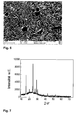
- the bath was then pumped through the cell at 5.4 l / h and heated from 20 ° C to 88 ° C over a period of 120 min by means of additional heating. After completion of the deposition process, the surface of the soda-lime glass is covered with an about 4 .mu.m thick Cu (l) SCN film, as in Fig. 6 shown. According to XRD analysis - s. FIG. 7 All peaks can be assigned to the ⁇ - or ⁇ -CuSCN modification.
- a conductive substrate is used and a CuSCN layer is applied to a 1.0 mm thick aluminum substrate.
- the deposition takes place at a heating temperature of 150 ° C.
- the bath temperature rises from 20 ° C to 100 ° C.
- the hot Al substrate is rinsed with the bath solution for 5 min.
- On the sample grows a microstructure, which consists of large platelet-shaped crystallites (s. Fig. 8 ).
- the XRD analysis of the grown-up layer yields maxima which are attributed to the ⁇ - and - the predominant - ⁇ -CuSCN modification as well as the aluminum of the substrate.
- the bath temperature rises from 20 ° C to 70 ° C at a heating temperature of 160 ° C.
- the sample is lapped for 10 minutes by the bath solution, this process is repeated again.
- the polyimide film is overgrown at the edges with a CuSCN layer of the ⁇ - and ⁇ -CuSCN modifications, but only sporadic crystal growth is observed in the center of the film.
- Fig. 9 shows an SEM image of only the edge region of the sample with a dense growth of a CuSCN layer.
- the exemplary embodiments prove that the method according to the invention, using chemical bath deposition, makes it possible to deposit thin transparent CuSCN layers on different substrates.
Landscapes
- Chemical & Material Sciences (AREA)
- Engineering & Computer Science (AREA)
- Physics & Mathematics (AREA)
- Thermal Sciences (AREA)
- General Chemical & Material Sciences (AREA)
- Chemical Kinetics & Catalysis (AREA)
- Materials Engineering (AREA)
- Mechanical Engineering (AREA)
- Metallurgy (AREA)
- Organic Chemistry (AREA)
- Inorganic Chemistry (AREA)
- Photovoltaic Devices (AREA)
- Chemically Coating (AREA)
Abstract
Description
- Die Erfindung betrifft ein Verfahren zur Herstellung einer dünnen nanokristallinen CuSCN-Schicht auf einem Substrat.
- Dem Stand der Technik nach werden Kupferthiocyanat-Schichten, ein p-leitendes Halbleitermaterial, mittels verschiedener Verfahren hergestellt.
- Bereits 1936 wird in Berichte der deutschen chemischen Gesellschaft (A and B Series), vol. 69, 1936, S. 1601-1610 beschrieben, dass CuSCN aus wässrigen Lösungen als Niederschlag ausgefällt werden kann, wenn diese Lösungen Kupfer(II)sulfat (CuSO4)und Kaliumthiocyanat (KSCN) enthalten. Die Herstellung einer CuSCN-Schicht wurde hierbei nicht realisiert.
- Mittels Elektrodeposition werden CuSCN-Schichten in einer wässrigen basischen (pH ∼ 9) Lösung abgeschieden, was in Journal of the American Ceramic Society, vol. 90, 2007, S. 2966-2973 beschrieben ist. Ebenfalls mittels Elektrodeposition wird eine CuSCN-Schicht auf eine poröse TiO2- Schicht abgeschieden und füllt die Poren dieser Schicht vollständig aus, wie in
WO 00/52764 A1 - In Chemistry of Materials, vol. 14, Dez. 2002, S. 5023-5029 ist das Abscheiden von CuSCN in die Poren einer nanopartikelartigen TiO2-Schicht mittels Imprägnierung angegeben. In eine Schicht von ZnO-Nanostäbchen, die mit einer ln2S3-Schicht bedeckt sind, wird eine CuSCN-Schicht ebenfalls mittels Imprägnierung aufgebracht, wie in Appl. Phys. Lett. 93, 053113 (2008) beschrieben.
- Mittels Spraybeschichtung wird eine CuSCN-Schicht auf eine Selen aufweisende nanoporöse n-TiO2-Schicht aufgebracht, wie in Journal of Physics D: Applied Physics, vol. 31, 1998, S. 2326-2330 berichtet wird.
- Für die Abscheidung von CuSCN-Schichten ist in Thin Solid Films, vol. 451-452, März. 2004, S. 128-132 das SILAR (successive ionic layer absorption and reaction)-Verfahren beschrieben.
- In Electrochem. and Solid-State Letters, 12 (3) H54-H57 (2009) wird das Herstellen einer transparenten CuSCN-Schicht mittels thermischen Aufdampfens zunächst einer Cu-Schicht, anschließend einer KSCN-Schicht und nachfolgender Reaktion beider Schichten in einem Trockengefäß mit Silica-Gel als Trocknungsmittel für bis zu 24 Stunden beschrieben. In Abhängigkeit der Reaktionszeit wird die Transparenz der entstehenden CuSCN-Schicht verbessert.
- Bei dem in Solar Energy Materials & Solar Cells 58 (1999) 337-347 beschriebenen Verfahren wird auf gut gesäuberte Cu-Platten in einer Lösung aus 0,5 M KSCN; 0,5 M Na2SO3 und 10-4 M Essigsäure durch Eintauchen dieser Platten für einige Minuten in diese Lösung eine p-leitende CuSCN-Schicht aufgebracht.
- In Adv. Mat. 2005, 17, 1512-1515 wird beschrieben, dass eine CuSCN-Schicht in einer gesättigten Lösung von CuSCN und Dipropylsulfid auf eine auf 80 °C vorgeheizte Probe der Struktur Glas/SnO2:F/ZnOsp/ZnOed/CdSe abgeschieden wird. Die CuSCN-Schicht füllt die nanostrukturierte ZnO-Schicht aus.
- In Solar Energy Materials & Cells 86 (2005) 443-450 wird berichtet, dass die Leitfähigkeit der CuSCN-Schichten - hergestellt mittels Eintauchens in eine Lösung aus in Alkylsulfiden gelöstem CuSCN - dadurch verbessert wird, dass sie einem Halogengas oder einer Lösung von (SCN)2 in CCL4 ausgesetzt wird.
- In
DE 101 42 913 A1 wird eine Transistoranordnung beschrieben, bei der die Mikrolöcher eines Folienverbundes, bestehend aus zwei Kunststofffolien mit zwischenliegender Metallschicht, vertikal mit p-leitendem CuSCN mittels chemischer Badabscheidung aufgefüllt sind. Weitere Angaben zu den Parametern der Abscheidung werden hier nicht genannt. - Aufgabe der Erfindung ist es deshalb, ein weiteres Verfahren mittels chemischer Badabscheidung dünner transparenter nanokristalliner CuCSN-Schichten anzugeben, das kostengünstig ist, auch auf nicht leitenden Substraten und ohne Saatschicht funktioniert und keine toxischen Lösungsmittel benötigt.
- Die Aufgabe wird dadurch gelöst, dass bei der chemischen Badabscheidung erfindungsgemäß zunächst die Oberfläche des Substrats aktiviert wird und anschließend das Substrat und die wässrige Lösung auf unterschiedliche Temperaturen eingestellt werden, wobei die Temperatur des Substrats höher eingestellt wird als die Temperatur der Lösung, und eine wässrige Lösung mit 0,1 bis 200 mM Cu(II)- und SCN-lonen verwendet wird, und das Substrat von dieser Badlösung umspült wird.
- In einer Ausführungsform der Erfindung ist vorgesehen, dass das Substrat/die Substratoberfläche auf eine Temperatur zwischen 5 und 200 °C erhitzt und die wässrige Lösung bei einer Temperatur zwischen 0 °C und 100 °C gehalten wird. Die Konzentration der Cu-II- und SCN-lonen wird dabei so eingestellt, dass die wässrige Lösung metastabil ist und kaum bzw. wenig CuSCN ausfällt. Als lonenlieferanten sind dem Stand der Technik nach CuS04 und KSCN bekannt. Die Cu(II)- und SCN-lonen-Lösung kann auch bei Temperaturen von 0 bis 25 °C aus vorverdünnten Lösungen unter starker Durchmischung angesetzt werden, um die Stabilität der Badlösung zu erhöhen und ein frühzeitiges Ausfällen von CuSCN zu vermeiden. Es können alternativ auch andere wasserlösliche Kupfer- und Thiocyanationenlieferanten eingesetzt werden, wie z.B. Kupfer(II)-acetat, Kupfer(II)-chlorid, Ammoniumthiocyanat oder Natriumthiocyanat.
- Cu(I)SCN-Nanokristallite, die sich aufgrund der erhöhten Temperatur vermehrt an oder nahe der Substratoberfläche bilden, adsorbieren teilweise an dieser und dienen im Anschluss als "intrinsische" Saatschicht für weiteres Wachstum.
- Bei niedrigen Substrattemperaturen wachsen eher sehr große vereinzelte Kristallite. Bei höheren Temperaturen nimmt die Kristallitdichte zu. Ein besonders dichtes Wachstum wird erzielt, wenn das Lösungsmittel (Wasser) an der Substratoberfläche verdampft. Hierbei werden zwar auch die anderen Bestandteile (Gegenionen) des Bades abgeschieden. Diese lösen sich jedoch im Falle von Kalium- und Sulfat-lonen im weiteren Verlauf der Abscheidung wieder auf. Somit besteht die zurückbleibende Schicht ausschließlich aus Cu(I)SCN.
- Sowohl die Morphologie der Cu(I)SCN-Schichten sowie die Art der Kristallphase (α- oder β -CuSCN) wird von der Cu(II)- und SCN-Ausgangskonzentration, dem Temperaturgradienten zwischen Substrat und Lösung, den oberflächenaktiven Additiven sowie der Badkonvektion beeinflusst.
- Die Methode der chemischen Badabscheidung bietet den Vorteil gegenüber der elektrochemischen Badabscheidung, dass z. B. neben Aluminium auch ein nicht- oder schlechtleitendes Substrat verwendet werden kann, beispielsweise Silizium oder Glas oder eine Polyimidfolie. Auf Substraten mit einer hohen Wärmeleitfähigkeit und Hitzebeständigkeit können höhere Abscheideraten erzielt werden.
- Das erfindungsgemäße Verfahren verwendet keine teuren organischen, teils toxischen Lösungsmittel (z. B. Acetonitril oder Dipropylsulfid) wie bei der Methode des "lmprägnierens" und im Vergleich zur sequentiellen SILAR-Technik können höhere Abscheideraten erzielt werden.
- Zur Erzeugung eines homogenen Filmwachstums ist es notwendig, die Substratoberfläche vor der Beschichtung in der Badlösung zu reinigen bzw. zu aktivieren. Dies kann mittels Plasmaätzens oder mittels Tensiden im Ultraschallbad oder mittels alkalischer Lösungen erfolgen.
- Durch Zugabe von Polyethylenglykol (PEG), insbesondere PEG 200 bis PEG 10000, oder von Sodiumlaurylsulfat (SLS) kann die Badstabilität der wässrigen Lösung gesteigert werden. In geringen Konzentrationen zugegeben, kann außerdem die Abscheidungshomogenität verbessert werden. Bei höheren Konzentrationen können so Nanostrukturen mit großer Oberfläche abgeschieden werden.
- Auch wenn das erfindungsgemäße Verfahren keine Saatschicht erfordert, kann durch das Aufbringen einer solchen CuSCN-Saatschicht auf das Substrat die Morphologie der anschließend abzuscheidenden CuSCN-Schicht beeinflusst werden.
- Das erfindungsgemäße Verfahren wird in Ausführungsbeispielen anhand von Zeichnungen erläutert.
- Dabei zeigen
- Fig. 1:
- schematisch eine Anordnung zur Durchführung des Verfahrens;
- Fig. 2:
- REM-Aufnahme einer mit dem erfindungsgemäßen Verfahren aufgebrachten CuSCN-Schicht auf ein Si-Substrat;
- Fig. 3:
- REM-Aufnahme einer weiteren mit dem erfindungsgemäßen Verfahren aufgebrachten CuSCN-Schicht auf ein Si-Substrat;
- Fig. 4:
- XRD-Spektrum der in
Fig. 3 gezeigten CuSCN-Schicht; - Fig. 5:
- REM-Aufnahme einer weiteren mit dem erfindungsgemäßen Verfahren aufgebrachten CuSCN-Schicht auf ein Si-Substrat;
- Fig. 6:
- REM-Aufnahme einer mit dem erfindungsgemäßen Verfahren aufgebrachten CuSCN-Schicht auf ein Kalk-Natron-Glas-Substrat;
- Fig. 7:
- XRD-Spektrum der in
Fig. 6 gezeigten CuSCN-Schicht; - Fig. 8:
- REM-Aufnahme einer mit dem erfindungsgemäßen Verfahren aufgebrachten CuSCN-Schicht auf ein Aluminium-Substrat;
- Fig. 9:
- REM-Aufnahme einer mit dem erfindungsgemäßen Verfahren aufgebrachten CuSCN-Schicht Polyimidfolie.
- Das zu beschichtende Substrat A wird in die in
Figur 1 schematisch dargestellte Zelle eingebaut. Die Durchflusszelle B besteht aus Polyetherketon (PEEK) sowie einem Viton O-Ring C. Die vom Bad durchströmte Kammer D hat Abmessungen von etwa 14 mm Breite, 17 mm Länge und 1,5 mm Höhe. Die Heizung E besteht aus einem Aluminiumblock (60 mm Breite, 70 mm Länge und 10 mm Höhe), welcher über vier elektrische Heizstäbe (je 60 W Leistung) mittels eines PID-Reglers auf einer konstanten Temperatur gehalten wird (THeiz). Das Badvorratsgefäß mit einem Volumen (VGesamt) wird mittels eines Magnetrührers durchmischt, über einen Temperaturfühler wird die Badtemperatur (TBad) überwacht und gegebenenfalls mittels eines Thermostaten kontrolliert. Die Zu- und Abläufe F der Zelle sind über eine Schlauchpumpe, welche den Volumenstrom (vPumpe) des Bades reguliert, mit einem Vorratsgefäß verbunden. Des Weiteren wird der Prozess durch die Abscheidungsdauer (tAbscheidung ) charakterisiert. - Zunächst werden die Substrate jeweils für 5 Minuten in 3%-iger Mucasol-Lösung im Ultraschallbad entfettet, anschließend mit Leitungswasser, deionisierten Wasser und Isopropanol gespült und im Stickstoffstrom getrocknet.
- Die Reaktionslösungen werden aus vorverdünnten Lösungen von CuSO4 und KSCN unter starkem Rühren bei möglichst niedriger Temperatur angesetzt, um ein Ausfallen von Cu(I)SCN zu minimieren.
- Die Substratheizung wird eingeschaltet und erst bei Erreichen der Zieltemperatur wird die Lösung durch die Durchflusszelle gepumpt und die Abscheidung beginnt. Am Ende dieser wird die Substratheizung ausgeschaltet, der Heizblock aktiv mit Wasser gekühlt, und die Zelle wird mit 20 ml deionisiertem Wasser gespült. Anschließend wird das Substrat aus der Zelle entnommen und nochmals mit deionisierten Wasser sowie Isopropanol gespült und im Stickstoffstrom getrocknet.
- In einem ersten Ausführungsbeispiel werden die Parameter während der Beschichtung eines Si-Substrats in vier Varianten variiert.
- Ein 0,4 mm dickes Si-Substrat wird in die Zelle eingeführt. Die Badzusammensetzung beträgt bei VGesamt = 30 ml, c(CuSO4) = 4,6 mM; c(KSCN) = 13 mM.
- In den beiden ersten Varianten wird die Heizung auf 150 °C eingestellt, woduch sich in der beschriebenen Anordnung die Badtemperatur von 20 °C auf 98 °C erhöht. Die Dauer der Abscheidung wird auf 10 min eingestellt.
- Ohne Zugabe von PEG (Variante I) ist die Probe mit einem feinkristallinen etwa 1,5 µm dicken CuSCN-Film bewachsen, wie in
Fig. 2 erkennbar. - Wird nun der Badlösung PEG200 in einer Konzentration von 1,12 g/l zugegeben und ansonsten die Parameter beigehalten (Variante II), ist der aufgewachsene CuSCN-Film (s.
Fig. 3 ) 3 µm dick und weist größere Kristallite im Vergleich zum vorhergehenden Beipiel (Variante I) auf. Außerdem ist diese Probe - optisch betrachtet - gleichmäßiger bewachsen. Die Maxima des XRD-Spektrums, dargestellt inFig. 4 , können alle der α- und β-Cu(l)SCN-Modifikation zugeordnet werden. - Bei Variante III wird das Si-Substrat nun in eine Badlösung gegeben, die in hoher Konzentration 10 g/l PEG200 enthält, die Badtemperatur wird dabei von 18 °C auf 38 °C erhöht und die Abscheidung über 180 min durchgeführt. Das Resultat ist hierbei eine sehr inhomogene Abscheidung großer Kristallite überwiegend in der β-Cu(l)SCN-Modifikation.
- Wird der wässrigen Badlösung SLS in einer geringen Konzentration von 0,2 g/l zugegeben und nur eine Abscheidezeit von 10 min durchgeführt (Variante IV), wächst auf das Si-Substrat nur eine sehr dünne Schicht (< 200 nm) hexagonaler Kristalle auf, die aber noch nicht geschlossen ausgebildet ist.
- Ein weiteres Ausführungsbeispiel betrifft zwar auch die Abscheidung einer CuSCN-Schicht auf einem 0,4 mm dicken Si-Substrat, das Bad setzt sich hier jedoch wie folgt zusammen: VGesamt = 100 ml, c(CuSO4) = 10 mM; c(KSCN) = 25 mM und PEG 200 = 10 g/l. Die Heiztemperatur THeiz beträgt 95 °C, die Temperatur des chemischen Bades steigt von 18 °C auf 38 °C bei aktiver Kühlung. Die chemische Badlösung wurde 180 min über das Si-Substrat gespült. Im Ergebnis wurde eine sehr homogene Abscheidung sehr großer Kristallite überwiegend in der β-Cu(I)SCN-Modifikation beobachtet, wie in
Fig. 5 erkennbar. - In einem nächsten Ausführungsbeispiel wird auf ein 1,0 mm dickes Kalk-Natron-Glas eine CuSCN-Schicht aufgebracht. Die Badzusammensetzung beträgt hierbei VGesamt = 500 ml ; c(CuS04)= 4,6 mM ; c(KSCN)= 13 mM; wiederum wird PEG 200 in einer Konzentration von 1,12 g/l zugegeben, die Heiztemperatur THeiz beträgt 160 °C. In diesem Ausführungsbeispiel wird das heiße Substrat mit der Badlösung einer Temperatur von TBad = 20°C für 10 Sekunden überspült. Anschließend wurde das Bad wieder abgepumpt und 290 Sekunden gewartet, damit die Substratoberfläche wieder 160°C erreicht. Dieser Schritt wurde fünfmal wiederholt, um zunächst eine "intrinsisch"gebildete CuSCN-Saatschicht zu erzeugen. Im Anschluss wurde das Bad mit 5,4 l/h durch die Zelle gepumpt und über einen Zeitraum von 120 min von 20°C auf 88°C mittels zusätzlichen Heizens erwärmt. Nach Beendigung des Abscheidevorgangs ist die Oberfläche des Kalk-Natron-Glases mit einem etwa 4µm dicken Cu(l)SCN-Film bewachsen, wie in
Fig. 6 gezeigt. Laut XRD-Analyse - s.Figur 7 - können alle Peaks der α- oder β - CuSCN-Modifikation zugeordnet werden. - In einem weiteren Ausführungsbeispiel wird ein leitendes Substrat verwendet und auf ein 1,0 mm dickes Aluminium-Substrat eine CuSCN-Schicht aufgebracht. Hierbei beträgt die Badzusammensetzung VGesamt = 30 ml, c(CuSO4) = 4,6 mM; c(KSCN) = 13 mM und PEG 200 = 1,12 g/l. Die Abscheidung erfolgt bei einer Heiztemperatur von 150 °C. Die Badtemperatur steigt dabei von 20 °C auf 100 °C. Das heiße Al-Substrat wird hierbei mit der Badlösung für 5 min überspült. Auf der Probe wächst eine Mikrostruktur, die aus großen blättchenförmigen Kristalliten besteht (s.
Fig. 8 ). Die durchgeführte XRD-Analyse der aufgewachsenen Schicht liefert Maxima, die der α- und - der überwiegenden - β-CuSCN-Modifikation sowie dem Aluminum des Substrats zugeordnet werden. - Im letzten Ausführungsbeispiel wird nun eine 0,08 mm dicke Polyimidfolie in einem Bad der Zusammensetzung VGesamt = 30 ml, c(CuSO4) = 4,6 mM; c(KSCN) = 13 mM mit einer CuSCN-Schicht versehen. Die Badtemperatur steigt bei einer Heiztemperatur von 160 °C von 20 °C auf 70 °C. Die Probe wird für 10 min von der Badlösung umspült, dieser Vorgang wird nochmals wiederholt. Im Ergebnis dieser Abscheidung ist die Polyimidfolie an den Rändern mit einer CuSCN-Schicht der α- und β-CuSCN-Modifikationen bewachsen, in der Mitte der Folie ist jedoch nur vereinzelt Kristallwachstum zu beobachten.
Fig. 9 zeigt eine REM-Aufnahme nur des Randbereichs der Probe mit einem dichten Wachstum einer CuSCN-Schicht. - Die Ausführungsbeispiele belegen, dass das erfindungsgemäße Verfahren unter Nutzung der chemischen Badabscheidung gestattet, dünne transparente CuSCN-Schichten auf unterschiedlichen Substraten abzuscheiden.
Claims (11)
dadurch gekennzeichnet, dass
zunächst die Oberfläche des Substrats aktiviert wird,
anschließend das Substrat und die wässrige Lösung auf unterschiedliche Temperaturen eingestellt werden, wobei die Temperatur des Substrats höher eingestellt wird als die Temperatur der Lösung, und
eine wässrige Lösung mit 0,1 bis 200 mM Cu(II)- und SCN-lonen verwendet wird.
dadurch gekennzeichnet, dass
das Substrat auf eine Temperatur zwischen 5 und 200 °C erhitzt und die wässrige Lösung bei einer Temperatur zwischen 0 °C und 100 °C gehalten wird.
dadurch gekennzeichnet, dass
ein nicht- oder schlechtleitendes Substrat verwendet wird.
dadurch gekennzeichnet, dass
als Substrat Silizium oder Glas oder Polyimidfolie verwendet wird.
dadurch gekennzeichnet, dass
der wässrigen Lösung oberflächenaktive Additive zugegeben werden.
dadurch gekennzeichnet, dass
als oberflächenaktive Additive Polyethylenglykol zugegeben wird.
dadurch gekennzeichnet, dass
als oberflächenaktive Additive Sodiumlaurylsulfat zugegeben wird.
dadurch gekennzeichnet, dass
die Aktivierung der Substratoberfläche mittels Plasmaätzens erfolgt.
dadurch gekennzeichnet, dass
die Aktivierung der Substratoberfläche mittels Tensiden im Ultraschallbad erfolgt.
dadurch gekennzeichnet, dass
die Cu(II)- und SCN-lonen-Lösung bei Temperaturen von 0 bis 25 °C aus vorverdünnten Lösungen unter starker Durchmischung angesetzt wird.
dadurch gekennzeichnet, dass
über die Änderung der Badzusammensetzung und der Badkonvektion bevorzugt das Verhältnis der abgeschiedenen α- und β-Kristallmodifikation von CuSCN eingestellt wird.
Applications Claiming Priority (1)
| Application Number | Priority Date | Filing Date | Title |
|---|---|---|---|
| DE201010033198 DE102010033198B4 (de) | 2010-08-03 | 2010-08-03 | Verfahren zur Herstellung einer nanokristallinen CuSCN-Schicht auf einem Substrat |
Publications (3)
| Publication Number | Publication Date |
|---|---|
| EP2415902A2 true EP2415902A2 (de) | 2012-02-08 |
| EP2415902A3 EP2415902A3 (de) | 2012-03-14 |
| EP2415902A8 EP2415902A8 (de) | 2012-04-04 |
Family
ID=44582029
Family Applications (1)
| Application Number | Title | Priority Date | Filing Date |
|---|---|---|---|
| EP11075187A Withdrawn EP2415902A3 (de) | 2010-08-03 | 2011-08-02 | Verfahren zur Herstellung einer nanokristallinen CuSCN-Schicht auf einem Substrat |
Country Status (2)
| Country | Link |
|---|---|
| EP (1) | EP2415902A3 (de) |
| DE (1) | DE102010033198B4 (de) |
Cited By (1)
| Publication number | Priority date | Publication date | Assignee | Title |
|---|---|---|---|---|
| CN108793197A (zh) * | 2018-03-01 | 2018-11-13 | 复旦大学 | 银掺杂硫氰酸亚铜薄膜及其制备方法和应用 |
Citations (2)
| Publication number | Priority date | Publication date | Assignee | Title |
|---|---|---|---|---|
| WO2000052764A1 (de) | 1999-02-26 | 2000-09-08 | Hahn-Meitner-Institut Berlin Gmbh | Elektrochemische abscheidung von cuscn in porösen tio2-filmen |
| DE10142913A1 (de) | 2001-08-27 | 2003-03-27 | Hahn Meitner Inst Berlin Gmbh | Transistoranordnung und Verfahren zu deren Herstellung |
Family Cites Families (1)
| Publication number | Priority date | Publication date | Assignee | Title |
|---|---|---|---|---|
| CN100552095C (zh) * | 2007-07-27 | 2009-10-21 | 中国科学院上海硅酸盐研究所 | 一种液相条件下制备硫氰酸亚铜薄膜的方法 |
-
2010
- 2010-08-03 DE DE201010033198 patent/DE102010033198B4/de not_active Expired - Fee Related
-
2011
- 2011-08-02 EP EP11075187A patent/EP2415902A3/de not_active Withdrawn
Patent Citations (2)
| Publication number | Priority date | Publication date | Assignee | Title |
|---|---|---|---|---|
| WO2000052764A1 (de) | 1999-02-26 | 2000-09-08 | Hahn-Meitner-Institut Berlin Gmbh | Elektrochemische abscheidung von cuscn in porösen tio2-filmen |
| DE10142913A1 (de) | 2001-08-27 | 2003-03-27 | Hahn Meitner Inst Berlin Gmbh | Transistoranordnung und Verfahren zu deren Herstellung |
Non-Patent Citations (10)
| Title |
|---|
| ADV. MAT, vol. 17, 2005, pages 1512 - 1515 |
| APPL. PHYS. LETT., vol. 93, 2008, pages 053113 |
| BERICHTE DER DEUTSCHEN CHEMISCHEN GESELLSCHAFT (A AND B SERIES, vol. 69, 1936, pages 1601 - 1610 |
| CHEMISTRY OF MATERIALS, vol. 14, pages 5023 - 5029 |
| ELECTROCHEM. AND SOLID-STATE LETTERS, vol. 12, no. 3, 2009, pages H54 - H57 |
| JOURNAL OF PHYSICS D: APPLIED PHYSICS, vol. 31, 1998, pages 2326 - 2330 |
| JOURNAL OF THE AMERICAN CERAMIC SOCIETY, vol. 90, 2007, pages 2966 - 2973 |
| SOLAR ENERGY MATERIALS & CELLS, vol. 86, 2005, pages 443 - 450 |
| SOLAR ENERGY MATERIALS & SOLAR CELLS, vol. 58, 1999, pages 337 - 347 |
| THIN SOLID FILMS, vol. 451-452, March 2004 (2004-03-01), pages 128 - 132 |
Cited By (2)
| Publication number | Priority date | Publication date | Assignee | Title |
|---|---|---|---|---|
| CN108793197A (zh) * | 2018-03-01 | 2018-11-13 | 复旦大学 | 银掺杂硫氰酸亚铜薄膜及其制备方法和应用 |
| CN108793197B (zh) * | 2018-03-01 | 2021-08-20 | 复旦大学 | 银掺杂硫氰酸亚铜薄膜及其制备方法和应用 |
Also Published As
| Publication number | Publication date |
|---|---|
| DE102010033198B4 (de) | 2013-04-04 |
| EP2415902A8 (de) | 2012-04-04 |
| DE102010033198A1 (de) | 2012-02-09 |
| EP2415902A3 (de) | 2012-03-14 |
Similar Documents
| Publication | Publication Date | Title |
|---|---|---|
| EP2051936B1 (de) | Verfahren zur erzeugung von oxidishen nanopartikeln aus einem oxidpartikel bildenden material durch filmsieden | |
| DE102013109394B4 (de) | Anodische Oxidschicht und Verfahren zur Herstellung derselben | |
| DE69025495T2 (de) | Abscheidung von Silberschichten auf nichtleitenden Substraten | |
| EP2398934B1 (de) | Verfahren zur herstellung halbleitender indiumoxid-schichten, nach dem verfahren hergestellte indiumoxid-schichten und deren verwendung | |
| DE102007010872A1 (de) | Verfahren zur Präzisionsbearbeitung von Substraten und dessen Verwendung | |
| DE69231779T2 (de) | Herstellungsverfahren von ohmschen Kontakten und photovoltaische Zelle mit ohmschem Kontakt | |
| EP1792348B1 (de) | Verfahren zum aufbringen einer zinksulfid-pufferschicht auf ein halbleitersubstrat mittels chemischer badabscheidung, insbesondere auf die absorberschicht einer chalkopyrit-dünnschicht-solarzelle | |
| EP3053186A1 (de) | Vorrichtung und verfahren zur kontinuierlichen herstellung poröser siliciumschichten | |
| WO2009006988A1 (de) | Kontakt-struktur für euin halbleiter-bauelement sowie verfahren zur herstellung desselben | |
| EP2252728A2 (de) | Elektrodepositionsverfahren zur herstellung von nanostrukturiertem zno | |
| WO2011092236A2 (de) | Badabscheidungslösung zur nasschemischen abscheidung einer metallsulfidschicht und zugehörige herstellungsverfahren | |
| WO2001086029A1 (de) | Elektrochemisch erzeugte schichten zum korrosionsschutz oder als haftgrund | |
| WO2004023529A2 (de) | Vorrichtung und verfahren zum thermischen behandeln von halbleiterwafern | |
| DE102010033198B4 (de) | Verfahren zur Herstellung einer nanokristallinen CuSCN-Schicht auf einem Substrat | |
| DE102018203256A1 (de) | Verfahren zum Einbringen eines photovoltaisch aktiven Materials in ein eine Vielzahl von Zellen aufweisendes photovoltaisches Modul und entsprechendes photovoltaisches Modul | |
| EP2411558B1 (de) | VERFAHREN ZUM AUFBRINGEN EINER Zn(S, O)-PUFFERSCHICHT AUF EIN HALBLEITERSUBSTRAT MITTELS CHEMISCHER BADABSCHEIDUNG | |
| DE102010030884A1 (de) | Verfahren zur Abscheidung einer Pufferschicht auf einer CIS-Dünnschicht-Solarzelle und nach dem Verfahren hergestellte CIS-Dünnschicht-Solarzelle | |
| DE102020113518B4 (de) | Verfahren zur Herstellung einer Schicht aus Bismutvanadat | |
| DE10330192A1 (de) | Elektrisch leitender Körper mit einer Haftvermittlungsschicht sowie Verfahren zum Abscheiden einer Haftvermittlungsschicht | |
| DE102012023349B4 (de) | Verfahren und Vorrichtung zur strukturierten Beschichtung der Innenseite eines Schlauchs oder Rohrs | |
| DE102008037177B4 (de) | Verfahren zur Herstellung nanostrukturierter Metalloxide oder -chalkogenide mittels chemischer Badabscheidung | |
| DE102007006455B4 (de) | Wärmereservoir und Verfahren zur Bearbeitung eines mit einem Wärmereservoir thermisch gekoppelten Substrates sowie Verwendung eines Wärmetransportmediums | |
| WO2022253385A1 (de) | Verfahren zur herstellung hochgenau lokalisierter breitbandabsorber für 2d- und 3d-oberflächen | |
| EP1448808B1 (de) | Verfahren zur herstellung dünner, schwer löslicher beschichtungen | |
| AT515522B1 (de) | Verfahren zur elektrochemischen abscheidung halbleitender materialien und elektrolyten hierzu |
Legal Events
| Date | Code | Title | Description |
|---|---|---|---|
| AK | Designated contracting states |
Kind code of ref document: A2 Designated state(s): AL AT BE BG CH CY CZ DE DK EE ES FI FR GB GR HR HU IE IS IT LI LT LU LV MC MK MT NL NO PL PT RO RS SE SI SK SM TR |
|
| AX | Request for extension of the european patent |
Extension state: BA ME |
|
| PUAI | Public reference made under article 153(3) epc to a published international application that has entered the european phase |
Free format text: ORIGINAL CODE: 0009012 |
|
| PUAL | Search report despatched |
Free format text: ORIGINAL CODE: 0009013 |
|
| AK | Designated contracting states |
Kind code of ref document: A3 Designated state(s): AL AT BE BG CH CY CZ DE DK EE ES FI FR GB GR HR HU IE IS IT LI LT LU LV MC MK MT NL NO PL PT RO RS SE SI SK SM TR |
|
| AX | Request for extension of the european patent |
Extension state: BA ME |
|
| RIC1 | Information provided on ipc code assigned before grant |
Ipc: C23C 18/12 20060101AFI20120209BHEP |
|
| 17P | Request for examination filed |
Effective date: 20120914 |
|
| RIC1 | Information provided on ipc code assigned before grant |
Ipc: C23C 18/04 20060101ALI20130129BHEP Ipc: C23C 18/12 20060101AFI20130129BHEP |
|
| GRAP | Despatch of communication of intention to grant a patent |
Free format text: ORIGINAL CODE: EPIDOSNIGR1 |
|
| INTG | Intention to grant announced |
Effective date: 20130627 |
|
| STAA | Information on the status of an ep patent application or granted ep patent |
Free format text: STATUS: THE APPLICATION IS DEEMED TO BE WITHDRAWN |
|
| 18D | Application deemed to be withdrawn |
Effective date: 20131108 |