EP2408846B1 - Hybridpolymere aus cyanaten und silazanen, verfahren zu ihrer herstellung sowie deren verwendung - Google Patents
Hybridpolymere aus cyanaten und silazanen, verfahren zu ihrer herstellung sowie deren verwendung Download PDFInfo
- Publication number
- EP2408846B1 EP2408846B1 EP10709209A EP10709209A EP2408846B1 EP 2408846 B1 EP2408846 B1 EP 2408846B1 EP 10709209 A EP10709209 A EP 10709209A EP 10709209 A EP10709209 A EP 10709209A EP 2408846 B1 EP2408846 B1 EP 2408846B1
- Authority
- EP
- European Patent Office
- Prior art keywords
- several
- polymer according
- cyanate
- silazane
- substituted
- Prior art date
- Legal status (The legal status is an assumption and is not a legal conclusion. Google has not performed a legal analysis and makes no representation as to the accuracy of the status listed.)
- Not-in-force
Links
- 0 C*(C)N[S+](C)(*(C)C)C=C Chemical compound C*(C)N[S+](C)(*(C)C)C=C 0.000 description 3
Images
Classifications
-
- C—CHEMISTRY; METALLURGY
- C08—ORGANIC MACROMOLECULAR COMPOUNDS; THEIR PREPARATION OR CHEMICAL WORKING-UP; COMPOSITIONS BASED THEREON
- C08G—MACROMOLECULAR COMPOUNDS OBTAINED OTHERWISE THAN BY REACTIONS ONLY INVOLVING UNSATURATED CARBON-TO-CARBON BONDS
- C08G77/00—Macromolecular compounds obtained by reactions forming a linkage containing silicon with or without sulfur, nitrogen, oxygen or carbon in the main chain of the macromolecule
- C08G77/48—Macromolecular compounds obtained by reactions forming a linkage containing silicon with or without sulfur, nitrogen, oxygen or carbon in the main chain of the macromolecule in which at least two but not all the silicon atoms are connected by linkages other than oxygen atoms
- C08G77/54—Nitrogen-containing linkages
-
- B—PERFORMING OPERATIONS; TRANSPORTING
- B32—LAYERED PRODUCTS
- B32B—LAYERED PRODUCTS, i.e. PRODUCTS BUILT-UP OF STRATA OF FLAT OR NON-FLAT, e.g. CELLULAR OR HONEYCOMB, FORM
- B32B17/00—Layered products essentially comprising sheet glass, or glass, slag, or like fibres
- B32B17/02—Layered products essentially comprising sheet glass, or glass, slag, or like fibres in the form of fibres or filaments
-
- C—CHEMISTRY; METALLURGY
- C08—ORGANIC MACROMOLECULAR COMPOUNDS; THEIR PREPARATION OR CHEMICAL WORKING-UP; COMPOSITIONS BASED THEREON
- C08G—MACROMOLECULAR COMPOUNDS OBTAINED OTHERWISE THAN BY REACTIONS ONLY INVOLVING UNSATURATED CARBON-TO-CARBON BONDS
- C08G18/00—Polymeric products of isocyanates or isothiocyanates
- C08G18/06—Polymeric products of isocyanates or isothiocyanates with compounds having active hydrogen
- C08G18/28—Polymeric products of isocyanates or isothiocyanates with compounds having active hydrogen characterised by the compounds used containing active hydrogen
- C08G18/40—High-molecular-weight compounds
- C08G18/61—Polysiloxanes
-
- C—CHEMISTRY; METALLURGY
- C08—ORGANIC MACROMOLECULAR COMPOUNDS; THEIR PREPARATION OR CHEMICAL WORKING-UP; COMPOSITIONS BASED THEREON
- C08G—MACROMOLECULAR COMPOUNDS OBTAINED OTHERWISE THAN BY REACTIONS ONLY INVOLVING UNSATURATED CARBON-TO-CARBON BONDS
- C08G77/00—Macromolecular compounds obtained by reactions forming a linkage containing silicon with or without sulfur, nitrogen, oxygen or carbon in the main chain of the macromolecule
- C08G77/60—Macromolecular compounds obtained by reactions forming a linkage containing silicon with or without sulfur, nitrogen, oxygen or carbon in the main chain of the macromolecule in which all the silicon atoms are connected by linkages other than oxygen atoms
- C08G77/62—Nitrogen atoms
-
- C—CHEMISTRY; METALLURGY
- C08—ORGANIC MACROMOLECULAR COMPOUNDS; THEIR PREPARATION OR CHEMICAL WORKING-UP; COMPOSITIONS BASED THEREON
- C08J—WORKING-UP; GENERAL PROCESSES OF COMPOUNDING; AFTER-TREATMENT NOT COVERED BY SUBCLASSES C08B, C08C, C08F, C08G or C08H
- C08J5/00—Manufacture of articles or shaped materials containing macromolecular substances
- C08J5/24—Impregnating materials with prepolymers which can be polymerised in situ, e.g. manufacture of prepregs
-
- C—CHEMISTRY; METALLURGY
- C08—ORGANIC MACROMOLECULAR COMPOUNDS; THEIR PREPARATION OR CHEMICAL WORKING-UP; COMPOSITIONS BASED THEREON
- C08L—COMPOSITIONS OF MACROMOLECULAR COMPOUNDS
- C08L83/00—Compositions of macromolecular compounds obtained by reactions forming in the main chain of the macromolecule a linkage containing silicon with or without sulfur, nitrogen, oxygen or carbon only; Compositions of derivatives of such polymers
- C08L83/14—Compositions of macromolecular compounds obtained by reactions forming in the main chain of the macromolecule a linkage containing silicon with or without sulfur, nitrogen, oxygen or carbon only; Compositions of derivatives of such polymers in which at least two but not all the silicon atoms are connected by linkages other than oxygen atoms
-
- C—CHEMISTRY; METALLURGY
- C08—ORGANIC MACROMOLECULAR COMPOUNDS; THEIR PREPARATION OR CHEMICAL WORKING-UP; COMPOSITIONS BASED THEREON
- C08L—COMPOSITIONS OF MACROMOLECULAR COMPOUNDS
- C08L83/00—Compositions of macromolecular compounds obtained by reactions forming in the main chain of the macromolecule a linkage containing silicon with or without sulfur, nitrogen, oxygen or carbon only; Compositions of derivatives of such polymers
- C08L83/16—Compositions of macromolecular compounds obtained by reactions forming in the main chain of the macromolecule a linkage containing silicon with or without sulfur, nitrogen, oxygen or carbon only; Compositions of derivatives of such polymers in which all the silicon atoms are connected by linkages other than oxygen atoms
-
- Y—GENERAL TAGGING OF NEW TECHNOLOGICAL DEVELOPMENTS; GENERAL TAGGING OF CROSS-SECTIONAL TECHNOLOGIES SPANNING OVER SEVERAL SECTIONS OF THE IPC; TECHNICAL SUBJECTS COVERED BY FORMER USPC CROSS-REFERENCE ART COLLECTIONS [XRACs] AND DIGESTS
- Y10—TECHNICAL SUBJECTS COVERED BY FORMER USPC
- Y10T—TECHNICAL SUBJECTS COVERED BY FORMER US CLASSIFICATION
- Y10T428/00—Stock material or miscellaneous articles
- Y10T428/249921—Web or sheet containing structurally defined element or component
Definitions
- the present invention relates to hybrid prepolymers and polymers prepared by reacting difunctional, oligofunctional and / or polyfunctional cyanates and / or their prepolymers with monomeric, oligomeric and / or polymeric silazanes.
- the polymers are high glass transition temperature thermosets and have very high fracture toughness compared to thermosets from the respective cyanate starting materials. They can be dissolved in prepolymerized state in solvents and are therefore suitable, for example, as impregnating resins for prepregs. In addition, they can be processed into moldings. Particularly outstanding are their fire characteristics.
- molded parts e.g. from casting resins, coated fabrics, adhesives, adhesion promoters and other increasingly required lightweight plastic materials that are fire retardant or act and which should be mechanically very stable at the same time.
- the requirements for the fire behavior often include a low heat release rate, a low smoke density, a low toxicity of the formed combustion gases, but also a high fire residue.
- liquid or viscous resins which can be postcrosslinked by means of heat and / or pressure.
- the preferred resins for such purposes are phenolic resins.
- phenolic resins can not provide the required mechanical properties; for applications where e.g. Impact loads occur, especially their high brittleness can be problematic.
- cyanate resins already have an intrinsic flame retardancy due to their high nitrogen content and their network structure. They combine a low heat release rate with a low smoke density and a low level of toxic gases in case of fire. They usually have high glass transition temperatures and low fracture toughness.
- silazanes generally refers to compounds which contain the group R 1 R 2 R 3 Si-N (R 4 ) SiR 5 R 6 R 7 .
- a very simple member of this group is the disilazane, H 3 Si-NH-SiH 3 .
- Cyclic and linear silazanes include or consist of -Si (R 1 R 2 ) -N (R 3 ) - structural units.
- substituents on the silicon can be alkyl or aryl, for example, in addition to hydrogen, alkyl, alkenyl or aryl and their substituents on the nitrogen in addition to hydrogen.
- the inventors of the present invention have set themselves the task of providing polymers which have a comparison with polycyanates even better fire behavior, a high glass transition temperature and a comparatively very high fracture toughness.
- the polymers should be able to be produced via moldable / meltable prepolymers which are obtainable under relatively mild conditions in bulk or in solution and are suitable, for example, for the preparation of prepregs or moldings from which they are cured by postcuring (under pressure and / or elevated temperature ) To form thermosets.
- the polymers should also be preparable in one stage, for example by the hardening of casting resins obtained by mixing the starting components.
- RTM resins which can be converted at moderate temperatures into a state which is still liquid and therefore suitable for infusion processes, i. for processes in which a pre-form (which may contain, for example, a stabilizing fabric) is impregnated with the relatively low-viscosity resin.
- a pre-form which may contain, for example, a stabilizing fabric
- RTM resins especially epoxy and bismaleimide resins are used as RTM resins, but all of which have unsatisfactory flame resistance. It would also be desirable to further reduce the post-crosslinking temperatures (currently about 200 ° C.).
- Isocyanates are inserted as mentioned above to form urea groups in the Si-N bond of silazanes.
- a network therefore forms in the hybrid prepolymers according to the invention via these groups.
- the polymerizable resins are formed especially when an excess of cyanate relative to silazane is used, as explained in more detail below.
- the hybrid prepolymers of the invention can be cured to give thermosets with improved properties. Compared to pure cyanates in particular an improved fracture toughness could be determined. Also, the cure temperatures in duromer manufacture are superior to pure cyanates, as well as other cyanate polymers, e.g. Lower epoxide cyanates; the exotherm of the reaction is lower, which facilitates the reaction. Finally, a significantly improved fire resistance could be documented. This is also superior to the fire resistance of isocyanate-silazane copolymers, even if the duromers contain only relatively little silazane, which is intrinsically more fire-resistant due to its high nitrogen content.
- the hybrid polymers are obtainable by reacting one or more difunctional, oligofunctional or polyfunctional cyanates or mixtures thereof and / or their prepolymers with one or more monomeric, oligomeric or polymeric silazanes or mixtures thereof and optionally additionally one or more further components.
- Either mixtures of the starting components can be used, or the reaction is carried out in a solvent in which both components can be dissolved. In a first stage, this produces prepolymers which are soluble and / or remeltable and can be cured under the action of higher temperatures, resulting in thermosets.
- the starting materials are mixed, made into the desired shape and cured in one step.
- oligofunctional cyanates are to be understood as meaning cyanates having 3 to 10 cyanate groups. Polyfunctional cyanates are therefore those with at least 11 cyanate groups.
- oligomeric silazanes are understood to mean silazanes having 2 to 10 silicon atoms. Polymeric silazanes are therefore those with at least 11 silicon atoms.
- units in the context of the definition of the silazanes of the formulas (I) to (III) refers to the in each case set in an angular bracket and with an amount of these units in the molecule indicating index (m, n %) provided parts of the molecule.
- the substituents (R 2 and R 3 or R 2 ' and R 3' ) bonded to one silicon atom each are selected as follows: an alkyl radical in combination with a hydrogen atom , a further alkyl radical, an alkenyl radical, preferably a vinyl radical, or a phenyl radical.
- the alkyl or alkenyl radicals in the formulas (I) to (III) have 1 to 6 carbon atoms. Methyl, ethyl and vinyl radicals are particularly preferred.
- the aryl, arylalkyl, alkylaryl, alkenylaryl or arylalkenyl radicals have from 5 to 12 carbon atoms. Phenyl and styryl radicals are particularly preferred. This embodiment is particularly preferred in combination with the first embodiment.
- R 4 and / or R 4 ' are selected from hydrogen and methyl.
- R 2 , R 3 , R 2 ' and R 3' are preferably selected from alkyl, especially from 1 to 8 carbon atoms.
- the substituents R 2 , R 3 , R 2 ' and R 3' carry fluorine atoms. This embodiment is particularly preferred in combination with the fourth embodiment.
- the index o is 0.
- the index m is in each case 0.
- R 1 and R 5 together form a single bond.
- This embodiment is particularly preferred for compounds of formula (I) wherein the index o is zero and, optionally, the index m is also zero.
- o is 0 and m and n are greater than 1 and are preferably between 2 and 25,000, in particular between 2 and 200.
- m and n may be the same or different. Additionally or alternatively, the m and n units may be randomized or evenly distributed. They may be arranged in blocks or not in blocks.
- n and o in the formula (I) have the meaning zero and R 5 has the meaning Si (R 1 ) (R 2 ' ) (R 3' ).
- the individual bond stains in these examples may in particular be alkyl, very particularly preferably methyl, but may also be hydride or partly alkyl and partly hydride.
- m in the formula (I) has the meaning 1, 2, 3, 4, 5 or an integer between 6 and 50, while n and o are zero, or it is a mixture of various of these silazanes.
- the substituents R 1 and R 5 may be the same or different and have the same meaning as R 2 or R 3 , wherein R 5 may also mean Si (R 1 ) (R 2 ' ) (R 3' ). If appropriate, this or these silazanes can also be present, in particular, in a mixture with silazanes in which R 1 and R 5 together form a single bond.
- Examples include the following oligomers / polymers
- o in the formula (I) is zero, while m and n are the same or different and mean between 2 and 200-25,000.
- the substituents R 1 and R 5 may be the same or different and have the same meaning as R 2 or R 3 , wherein R 5 in addition also Si (R 1 ) (R 2 ' ) (R 3' ) may mean. If appropriate, this or these silazanes can also be present, in particular, in a mixture with silazanes in which R 1 and R 5 together form a single bond.
- oligomers / polymers wherein the units in square brackets are randomized in the molecules, optionally instead blockwise and in other cases uniformly arranged in the ratio given to each other and the molecules contain terminal hydrogen atoms or alkyl or aryl groups.
- n and o are 0, m is 2, 3, 4, 5, 6, 7, 8, 9, 10 or an overlying number, and R 1 and R 5 Together, these compounds can be exemplified by formulas such as represent, wherein the standing in square brackets units are n-fold.
- m and n are respectively 2, 3, 4, 5, 6, 7, 8, 9, 10 or an overlying number, and R 1 and R 5 are together a single bond.
- These compounds can be (again for o or p equal to 0) again by way of example by formulas such as represent, in turn, the units in square brackets in the molecules randomized or blockwise, evenly distributed in some cases, m- or n-fold, or in the case of the last-shown formula together (m + n) -fold in the specified Relationship to each other, but the molecules are present in closed chain form.
- This variant can be present in particular in a mixture with corresponding open-chain silazanes and be used for the present invention.
- the index n is 0 and the indices m and o or p are greater than 1 and are preferably between 2 and 200-25,000.
- An example of formula (I) is the following specific silazane:
- the m and o units be evenly distributed in equal numbers, i. that a unit o always follows a unit m.
- the m and p units can preferably be arranged randomly or in blocks.
- the substituent R 4 in the p-fold moiety has the meaning of a phenyl group.
- R 1 and R 5 are a single bond
- m and n are each 2 or more than 2
- all R 3 radicals with the R 3 ' radicals form an alkylene group.
- silazane is the following silazane:
- This embodiment is applicable to all the above silazanes as far as they contain the mentioned groups.
- the said crosslinking reactions are preferably carried out prior to the addition of the cyanate component.
- vinyl silazanes are used according to the invention, it is possible to subject them to an addition polymerization prior to reaction with the cyanate (s). Alternatively, the polymerization of the double bonds can also be carried out after the formation of the hybrid polymer.
- Silazanes of the formula (I) with o equal to 0 are commercially available and according to standard methods, in particular the ammonolysis of monohalosilanes, for example as in US 4,395,460 and the literature cited therein, produced. Silazanes of the formula (I) in which the indices n and o are zero, the subscript m is 1 and R 5 is Si, (R 1 ) (R 2 ' ) (R 3 ' ). The organic radicals are not split off during the reaction.
- halosilanes having at least one Si-H bond alone and / or in combination with di- or trihalosilanes are reacted in an excess of liquid, anhydrous ammonia and left in this medium for a longer time, they form in the ammonium halide salt formed by the resulting ammonium halide salt the corresponding acid become more acidic environment over time by reaction of Si-H bonds polymerization products in which the indices m, n and o have a higher value and / or a different ratio than before, possibly catalyzed by the presence of dissolved and ionized ammonium halide.
- N-alkyl-substituted silazanes can be readily prepared by those skilled in the art by reacting the corresponding halosilanes with alkylamines, such as in US 4,935,481 and US 4,595,775 described.
- any at least bifunctional cyanate body can be used, including, in particular, aromatic cyanates and among these, in particular, di- or polyfunctional cyanates of the structures IV-VII listed below: in which R 1 to R 4, independently of one another, are hydrogen, C 1 -C 10 -alkyl, C 3 -C 8 -cycloalkyl, C 1 -C 10 -alkoxy, halogen (F, Cl, Br or I), phenyl or phenoxy, where the alkyl or Aryl groups may be fluorinated or partially fluorinated.
- cyanates mentioned can be used as monomers or as prepolymers (still more crosslinkable) of said compounds, alone or mixed with each other or in admixture with other, e.g. monofunctional cyanates are used.
- di- or oligocyanates are the following: the dicyanate of bisphenol A (4,4'-dimethylmethylene diphenyl dicyanate; B10), 4,4'-methylmethylene diphenyl dicyanate (L10), 4,4'-methylidene diphenyl dicyanate (M10) , Compounds of the formula VI, wherein n is 1, 2, 3, 4, 5 or 6, R 9 is hydrogen and the methylene group is in each ortho position to the cyanate group (PT15 / PT30).
- epoxides e.g., bisepoxides
- epoxides e.g., bisepoxides
- the amount ratio of silazane used to di- or oligocyanate used is not critical in principle. However, it is advisable to control the molar ratio of the cyanate groups in the di- or polycyanates to the Si-N groups in the silazanes such that the molar amount of the cyanate groups is used in excess, preferably even at least twice, relative to the molar Amount of Si-N groups in the silazane (s).
- silazanes and cyanates which react as undiluted substances extremely fast and possibly uncontrolled with each other.
- the amount by weight of silazane should favorably not exceed that of cyanate; For some combinations, even a weight ratio of cyanate to silazane of at least 3: 2, preferably 4: 1 or even 7: 1 to 10: 1, in particular 8: 1 to 10: 1 is even recommended.
- a weight ratio of cyanate groups to Si-N groups of at least about 70:30 (ie, at least 2: 1 or above) is recommended. The skilled person can easily determine by combining small amounts of the respective components, which proportions should be avoided if necessary.
- Alternatives for effecting a controlled reaction are the reaction in high dilution by addition of a solvent or the use of starting materials having a lower number of active groups per unit weight (ie of oligomeric or relatively low polymer cyanates and / or silazanes). If the above problem does not exist, it is recommended for a number of applications to mix the starting materials used for the prepolymerization process in the absence of solvent (most silazanes and some di- and oligocyanates are liquid at room temperature or can be melted at mild temperatures) ; instead, however, the reaction can also be carried out in a suitable solvent, for example methyl ethyl ketone.
- a suitable solvent for example methyl ethyl ketone.
- an initial reaction is spontaneous; If necessary, it should be remedied by mild heating, for example to about 60-100 ° C. If desired, the reaction can be carried out under exclusion of oxygen; However, this measure is usually not mandatory. Venting or degassing of the lugs is often beneficial in order to extract potentially generated gases (ammonia). This results within usually a few minutes to a few hours, a prepolymer, which can be postcrosslinked at temperatures of about 100 ° C to 250 ° C to form a thermoset.
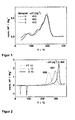
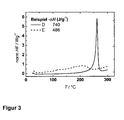
- This post-hardening is accompanied by less exothermic than the post-curing of pure cyan (ur) resins, which facilitates the reaction (see Figures 1 and 2 with Examples 3a, 3b, 35 and 53 and the Comparative Example); depending on the temperature actually applied, it generally lasts from a few minutes to several hours; As a rule of thumb, it can be said that faster precrosslinking starting materials can also be postcrosslinked faster and / or at lower temperatures.
- a relatively low proportion of silazane in the mixture to be polymerized is generally also favorable in order to obtain polymers having a relatively high glass transition temperature with a comparatively high fracture toughness.
- changes in the mixing ratio of eg 7: 3 to 8: 2 can already lead to a serious increase of T g lead.
- Another way to get to relatively high glass transition temperatures can be taken by the use of aromatically substituted silazanes.
- the starting components for the polymers of the present invention may be subjected to polymerization as known for the preparation of other cyanate polymers.
- fillers for example, those serving in EP 1854827 A1 are called.
- the polymers of the invention are useful e.g. for the production of prepregs.
- corresponding prepolymers dissolved in solvents can be used as precrosslinked impregnating resins, which can be postcrosslinked to thermosets under pressure / higher temperatures.
- the impregnating resins in turn can be prepared by dissolving mass-produced prepolymers or by reacting the starting materials in a solvent which is preferably already the solvent of the impregnating resin.
- the polymers according to the invention can also be prepared in the form of shaped bodies, which is possible in particular with solution-free mixtures of the starting materials.
- the fracture toughness was determined using OCT (Optical Crack Tracing) at a peel rate of 1 mm / min and a spot rate of 10 Hz.
- Sample geometry: CT body W 35mm, thickness 6mm.
- DMA Dynamic Mechanical Analysis
- Example 1 Preparation of a polymer of 4,4'-methylmethylene diphenyl dicyanate (L10) and hexamethylcyclotrisilazane (HMCTS).
- the mixture was poured into a plate-shaped mold and heated to 70 ° C. After about 2 hours, the temperature was increased to 200 ° C and after another 2h again to 250 ° C and left for 1 hour at this temperature to postcure the resulting prepolymer. After a total of 6.5 hours, the temperature was lowered slowly to room temperature. Slightly yellowish-brownish, translucent plates with dry surfaces were obtained.
- Example 2 Preparation of a polymer of 4,4'-methylmethylene diphenyl dicyanate (L10) and trimethyltrivinyl cyclotrisilazane (TMTVCTS).
- the dicyanate was mixed with the silazane at room temperature (at which it is liquid) without solvent in ratios of between about 7: 3 and about 9: 1 equivalents.
- the mixtures (equivalence ratios of 7: 3 to 9: 1) were also poured into plate-shaped molds and heated to 70 ° C. After about 2 hours, the temperature was increased to 200 ° C and after another 2h again to 250 ° C and left for 1 hour at this temperature to postcure the resulting prepolymer. After a total of 6.5 hours, the temperature was lowered slowly to room temperature. Slightly yellowish-brownish, translucent plates with dry surfaces were obtained.
- the glass transition temperature of the resulting polymers increases with increasing cyanate content.
- the moisture uptake of two rods of L10 and TMTVCTS in the ratio of 8: 2 and 7: 3 was tested by storage in water.
- the average moisture uptake after 7 days was about 0.85% for the rod from the starting materials in the ratio of 8: 2, and less than 0.7% for that of the materials in the ratio 7: 3. After 28 days, in both cases it was barely above 1, so it barely rose.
- Fig. 1 the exothermicity of the reactions according to Example 3a (curve A) and 3b (curve 3b) is shown.
- the integrals for - ⁇ H (J / g -1 ) have a value of 450 and 480, respectively.
- Example 3 was repeated except that VML50 was replaced by a polyphenylmethylsilazane (PML100). Comparable results were obtained.
- the glass transition temperature T g for the finished cured polymer was determined to be 204 ° C.
- Example 4 was repeated except that the equivalent ratio cyanate to silazane was 7: 3.
- Example 3 was repeated except that VML50 was replaced by a cyclic silazane of 50 mole% vinylmethylsilylamino groups and 50 mole% phenylmethylsilylamino groups (PVL50) has been replaced.
- the glass transition temperature T g for the finished cured polymer was determined to be 190 ° C.
- a flammability test analogous to UL94 was carried out for Examples 3 to 6. Burning dripping could not be observed in any of the samples. Complete burning of the sample was also not observed in any of the cases; the specimens did not rot.
- Table 3 The results of the fire test analogously to UI94 of Examples 3 to 6 are shown in Table 3: Table 3 example Afterburning after 1st flame of 10s Afterburning after 2nd flame of 10s Classification according to UL94 3 ⁇ 1s ⁇ 1s V0 4 ⁇ 1s 7s V0 5 ⁇ 1s ⁇ 1s V0 6 1s 4s V0
- Example 3 was repeated except that 4,4'-methylmethylene diphenyl dicyanate (L10) was replaced by 4,4'-dimethylmethylene diphenyl dicyanate (B10).
- the glass transition temperature was determined to be 215 ° C.
- Example 7 was repeated but VML50 was replaced by a cyclic silazane of 85 mole% dimethylsilylamino groups
- the glass transition temperature was determined to be 217 ° C.
- Example 7 was repeated but VML50 was replaced by a cyclic silazane of 100 mol% dimethylsilylamino groups (ML100).
- the glass transition temperature was determined to be 215 ° C.
- Example 9 was repeated except that 4,4'-dimethylmethylene diphenyl dicyanate (B10) was replaced by 4,4'-methylidene diphenyl dicyanate (M10).
- the glass transition temperature was determined to be 239 ° C.
- Example 4 was repeated but 4,4'-methylmethylene diphenyl dicyanate (L10) was replaced by 4,4'-methylidene diphenyl dicyanate (M10).
- the glass transition temperature was determined to be 224 ° C.
- Example 6 was repeated but 4,4'-methylmethylene diphenyl dicyanate (L10) was replaced by 4,4'-methylidene diphenyl dicyanate (M10).
- Example 3 was repeated, but 4,4'-methylmethylene diphenyl dicyanate (L10) was replaced by 4,4'-methylidene diphenyl dicyanate (M10).
- the glass transition temperature was determined to be 238 ° C.
- Example 5 was repeated except that 4,4'-methylmethylene diphenyl dicyanate (L10) was replaced by 4,4'-methylidene diphenyl dicyanate (M10).
- the glass transition temperature was determined to be 235 ° C.
- 4,4'-methylmethylene diphenyl dicyanate (L10) was reacted at room temperature (at which it is liquid) without solvent in the equivalent ratio of 8: 2 with a cyclic silazane prepared from 85 mole% dichlorodimethylsilane and 15 mole% dichloromethylsilane (ML85). , mixed. The mixtures were then poured into plate-shaped molds, heated to 70 ° C and then cured at 200 ° C. Slightly yellowish-brownish, translucent plates were obtained.
- Example 15 was repeated except that ML85 was replaced by a cyclic silazane prepared from 100 mol% dichlorodimethylsilane (ML100).
- Example 15 was repeated except that ML85 was employed by a cyclic silazane prepared from 50 mole percent dichlorovinylmethylsilane and 50 mole percent dichlorodimethylsilane (VML50). Comparable results were obtained.
- Example 15 was repeated except that ML85 was replaced by a cyclic silazane prepared from 50 mol% dichloromethylvinylsilane and 50 mol% dichloromethylphenylsilane (PVL50).
- Example 15 was repeated except that ML85 was replaced by a cyclic silazane of 100 mol% phenylmethylsilylamino groups (PML100).
- Example 15 was repeated except that 4,4'-methylmethylene diphenyl dicyanate (L10) was replaced by 4'-methylidene diphenyl dicyanate (M10).
- Example 16 was repeated except that 4,4'-methylmethylene diphenyl dicyanate (L10) was replaced by 4,4'-methylidene diphenyl dicyanate (M10).
- Example 17 was repeated except that 4,4'-methylmethylene diphenyl dicyanate (L10) was replaced by 4,4'-methylidene diphenyl dicyanate (M10).
- Example 18 was repeated except that 4,4'-methylmethylene diphenyl dicyanate (L10) was replaced by 4,4'-methylidene diphenyl dicyanate (M10).
- Example 19 was repeated except that 4,4'-methylmethylene diphenyl dicyanate (L10) was replaced by 4,4'-methylidene diphenyl dicyanate (M10).
- Example 21 was repeated several times, but the equivalence ratio cyanate to silazane (ML100) was 8: 2, 8.5: 1.5 and 9: 1.
- Example 25 The K 1c and glass transition temperatures for Example 25 are listed in Table 10. Table 10 Examples K 1c T g [MN / m 3/2 ] [° C] 8: 2 0.64 231 8.5: 1.5 0.50 254 9: 1 0.41 240
- a methylated silazane of phenylmethylsilylmethylamino groups (PML100N) was mixed in an equivalent ratio of 8: 2 at room temperature with L10, at about 75 ° C. with B10 and above 100 ° C. with M10.
- a methylated silazane from dimethylsilylmethylamino groups (ML100N) was mixed with B10 in an equivalence ratio of 8: 2 at approx. 75 ° C.
- a test piece was prepared from 4,4'-dimethylmethylene diphenyl dicyanate (B10) and ML100N. Cyanate and silazane were mixed in an equivalence ratio of 8: 2 at 75 ° C and the mixture was placed in an open mold. Curing took place at a maximum curing temperature of 200 ° C.
- Example 28 was repeated except that 4,4'-methylmethylene diphenyl dicyanate (B10) was replaced by 4,4'-methylidene diphenyl dicyanate (M10) and ML100N by PL100N. The mixing took place at over 100 ° C
- 4,4'-Dimethylmethylene-diphenyldicyanate prepolymer (B10 prepolymer, 35% conversion) was in the equivalent ratio of 8: 2 at about 50 ° C with a cyclic silazane of 50 mol% Vinylmethylsilylamino- and 50 mol% Dimethylsilylamino phenomenon (VML50 ) mixed.
- Example 30 was repeated except that VML50 was replaced by a cyclic silazane of 50 mole percent vinylmethylsilylamino and 50 mole percent phenylsilylamino groups (PVL50).
- VML50 was replaced by a cyclic silazane of 50 mole percent vinylmethylsilylamino and 50 mole percent phenylsilylamino groups (PVL50).
- Example 30 was repeated except that VML50 was replaced by a cyclic silazane of 100 mol% phenylmethylsilylamino groups (PML100).
- a test piece was made from 4,4'-dimethylmethylene diphenyl dicyanate (B10) prepolymer (35% conversion) and VML50. The mixture was mixed in an equivalence ratio 8: 2 at about 50 ° C and placed in an open mold. The curing was carried out in two stages with two hours at about 130 ° C and about 1.5 hours at 200 ° C. The glass transition temperature was determined to be 224 ° C.
- Example 33 was repeated except that VML50 was replaced by PML100.
- the glass transition temperature was determined to be 233 ° C.
- a test piece was made of the cyanate mixture L10 / PT15 (weight ratio 1: 4) and VML50.
- the cyanate-silazane mixture in the equivalent ratio 8: 2 was mixed at about 50 ° C and placed in an open mold. Curing took place at a maximum curing temperature of 200 ° C. The glass transition temperature was determined to be 223 ° C.
- a test piece was made of the cyanate mixture L10 / PT15 (weight ratio 1: 1) and PML100.
- the cyanate-silazane mixture in an equivalence ratio 8: 2 was mixed at about 60 ° C and placed in a mold. Curing took place at a maximum curing temperature of 200 ° C. The glass transition temperature was determined to be 212 ° C.
- a two-layered glass laminate was produced.
- glass fabric was impregnated with the mixture of B10 prepolymer and ABSE (equivalence ratio 7: 3) in toluene.
- Two of the prepreg layers thus formed which had been stored for 5 days at room temperature, were pressed at 200 ° C for 15 minutes.
- the resin flow was determined to be 9%.
- Example 39 was repeated except that prepregs were pre-dried for 2 minutes at 50 ° C and stored for 1 hour at room temperature. Toluene was replaced here by methyl ethyl ketone (MEK).
- MEK methyl ethyl ketone
- the resin flow was determined to be 17%.
- a six-layered glass laminate was prepared. Glass cloth was impregnated with a mixture of L10 and VML50 (equivalence ratio 8: 2) in methyl ethyl ketone (MEK). The prepregs were pre-dried for 15 minutes at 150 ° C and pressed for 2 hours at 200 ° C (preheated press)
- Example 41 was repeated except that prepregs were first pressed at 70 ° C for 1 hour, 130 ° C for 1 hour, and finally at 200 ° C for 1 hour.
- Example 42 was repeated except that prepregs were pre-dried for 20 minutes at 150 ° C.
- a six-layered glass laminate was prepared. Glass cloth was impregnated with a mixture of L10 and VML50 (equivalent ratio 8: 2) in MEK. The Prepregs were pre-dried at 150 ° C for 20 minutes and pressed at 200 ° C for 2 hours. The resin content of the prepreg solution was 30-35% by weight.
- a hand laminate with alternating construction (glass fabric-glass mat-glass fabric) was made. Seven glass material layers were impregnated with the mixture of L10 and PML100 (equivalence ratio 8: 2). The layers were joined together using different vent rollers. The laminate was then stored for several hours while maintaining several different temperature levels (maximum temperature at 150 ° C). The glass transition temperature was determined to be 166 ° C. The results of the fire test are listed in Table 12. Table 12 example TTI [s] HRR peak [kW / m 2 ] MARHE [kW / m 2 ] THR [MJ / m 2 ] TSR [m 2 / m 2 ] ⁇ m [%] 45 65 198 102 34 1300 29
- a hand laminate with alternating construction (glass fabric-glass mat-glass fabric) was made. Seven glass material layers were impregnated with the mixture of L10 and VML50 (equivalence ratio 8: 2). The layers were joined together using different vent rollers. Curing took place at a maximum curing temperature of 200 ° C.
- Example 46 The fire values for Example 46 are listed in Table 13. Table 13 example TTI [s] HRR peak [kW / m 2 ] MARHE [kW / m 2 ] THR [MJ / m 2 ] TSR [m 2 / m 2 ] ⁇ m [%] 46 65 135 68 43 1466 25
- Example 46 was repeated but making a six-layered hand laminate.
- the glass material used was glass cloth.
- the fire values for Example 47 are listed in Table 14.
- Table 14 example TTI [s] HRR peak [kW / m 2 ] MARHE [kW / m 2 ] THR [MJ / m 2 ] TSR [m 2 / m 2 ] ⁇ m [%] 47 69 168 83 21 863 18
- a six-layered RTM (Resin Transfer Molding) component was produced. L10 and VML50 in the equivalent ratio 8: 2 were mixed at room temperature. A six-layer glass fabric construction was impregnated by means of pressure RTM and the resulting component was cured at 200 ° C. The glass transition temperature is determined at about 214 ° C.
- Table 15 example TTI [s] HRR peak [kW / m 2 ] MARHE [kW / m 2 ] THR [MJ / m 2 ] TSR [m 2 / m 2 ] ⁇ m [%] 48 32 99 31 6 117 25
- Example 48 was repeated using a four layer glass fabric construction and vacuum RTM instead of a six layer glass fabric construction.
- the results of the fire test are listed in Table 16.
- Table 16 example TTI [s] HRR peak [kW / m 2 ] MARHE (kW / m 2 ] THR [MJ / m 2 ] TSR [m 2 / m 2 ] ⁇ m [%] 49 29 215 66 5 190 19
- Example 48 is repeated using a nine layer glass fabric construction and vacuum RTM instead of a six layer glass fabric construction.
- the glass transition temperature is determined to be approx. 215 ° C.
- the results of the fire test are listed in Table 17.
- Table 17 example TTI [s] HRR peak [kW / m 2 ] MARHE [kW / m 2 ] THR [MJ / m 2 ] TSR [m 2 / m 2 ] ⁇ m [%] 50 75 211 77 25 667 20
- a bending test (3-point bending test) was performed on both materials. The average was determined to be 350 Mpa for L10 glass fiber and 393 Mpa for L10 / VML50 glass fiber.
- Example 50 was repeated but using a carbon fiber fabric construction.
- the glass transition temperature is determined at about 205 ° C.
- the results of the fire test are listed in Table 18.
- Table 18 example TTI [s] HRR peak [kW / m 2 ] MARHE [kW / m 2 ] THR [MJ / m 2 ] TSR [m 2 / m 2 ] ⁇ m [%] 51 80 168 72 20.8 716 21
- a bending test (3-point bending test) was performed on the material.
- the mean value was determined to be 803 MPa for L10 / VML50 carbon fiber.
- Triglycidyl para-aminophenol (TGPAP) and PT15 in the equivalence ratio of 1: 1 were mixed with 10 wt% of a precrosslinked silazane of 33 mol% dimethylsilylamino and 67 mol% methylsilylamino groups (ML33 S).
- the curing reaction takes place only at significantly higher temperatures than those of the preceding examples.
Landscapes
- Chemical & Material Sciences (AREA)
- Health & Medical Sciences (AREA)
- Chemical Kinetics & Catalysis (AREA)
- Medicinal Chemistry (AREA)
- Polymers & Plastics (AREA)
- Organic Chemistry (AREA)
- Engineering & Computer Science (AREA)
- Materials Engineering (AREA)
- Manufacturing & Machinery (AREA)
- Macromolecular Compounds Obtained By Forming Nitrogen-Containing Linkages In General (AREA)
- Polyurethanes Or Polyureas (AREA)
- Silicon Polymers (AREA)
- Reinforced Plastic Materials (AREA)
Applications Claiming Priority (2)
| Application Number | Priority Date | Filing Date | Title |
|---|---|---|---|
| DE200910013410 DE102009013410A1 (de) | 2009-03-16 | 2009-03-16 | Hybridpolymere aus Cyanaten und Silazanen, Verfahren zur ihrer Herstellung sowie deren Verwendung |
| PCT/EP2010/053405 WO2010106074A1 (de) | 2009-03-16 | 2010-03-16 | Hybridpolymere aus cyanaten und silazanen, verfahren zu ihrer herstellung sowie deren verwendung |
Publications (2)
| Publication Number | Publication Date |
|---|---|
| EP2408846A1 EP2408846A1 (de) | 2012-01-25 |
| EP2408846B1 true EP2408846B1 (de) | 2013-01-16 |
Family
ID=42139057
Family Applications (1)
| Application Number | Title | Priority Date | Filing Date |
|---|---|---|---|
| EP10709209A Not-in-force EP2408846B1 (de) | 2009-03-16 | 2010-03-16 | Hybridpolymere aus cyanaten und silazanen, verfahren zu ihrer herstellung sowie deren verwendung |
Country Status (7)
| Country | Link |
|---|---|
| US (1) | US20120135217A1 (enExample) |
| EP (1) | EP2408846B1 (enExample) |
| JP (1) | JP5591907B2 (enExample) |
| KR (1) | KR101738579B1 (enExample) |
| CN (1) | CN102449035B (enExample) |
| DE (1) | DE102009013410A1 (enExample) |
| WO (1) | WO2010106074A1 (enExample) |
Families Citing this family (15)
| Publication number | Priority date | Publication date | Assignee | Title |
|---|---|---|---|---|
| DE202009010871U1 (de) * | 2009-08-11 | 2010-12-23 | Frenzelit-Werke Gmbh & Co. Kg | Thermisches Isolationsformteil |
| DE102010046914A1 (de) * | 2010-09-29 | 2012-03-29 | Clariant International Ltd. | Harze aus ungesättigten Polyestern und Polysilazanen sowie damit hergestellte duroplastische Reaktionsharz-Formstoffe |
| DE102011050675A1 (de) * | 2011-05-27 | 2012-11-29 | Fraunhofer-Gesellschaft zur Förderung der angewandten Forschung e.V. | Cyanatbasierte Harze mit verbesserter Schlagfestigkeit |
| CN102911401B (zh) * | 2012-11-08 | 2014-04-23 | 广州市回天精细化工有限公司 | 一种羟基清除剂、其制备方法及含有它的硫化硅橡胶 |
| CN106432688B (zh) * | 2016-09-28 | 2019-04-26 | 合肥科天水性科技有限责任公司 | 一种硅氮烷改性的水性聚氨酯分散体及其制备方法和用途 |
| CN107400496B (zh) * | 2017-07-27 | 2020-02-18 | 中国科学院化学研究所 | 一种硅氮烷杂化氰酸酯胶粘剂 |
| CN107502277B (zh) * | 2017-07-27 | 2020-02-21 | 中国科学院化学研究所 | 一种高韧性氰酸酯胶粘剂 |
| CN107384297B (zh) * | 2017-07-27 | 2020-02-21 | 中国科学院化学研究所 | 一种高韧性氰酸酯胶粘剂的制备方法 |
| CN107474534B (zh) * | 2017-07-27 | 2020-02-21 | 中国科学院化学研究所 | 氰酸酯泡沫塑料的制备方法 |
| CN107474533B (zh) * | 2017-07-27 | 2020-09-04 | 中国科学院化学研究所 | 氰酸酯泡沫塑料 |
| CN107400495B (zh) * | 2017-07-27 | 2020-02-21 | 中国科学院化学研究所 | 一种硅氮烷杂化氰酸酯胶粘剂的制备方法 |
| KR102766734B1 (ko) * | 2020-06-26 | 2025-03-04 | 코오롱인더스트리 주식회사 | 실라잔계 화합물, 이를 포함하는 코팅용 조성물, 코팅층을 갖는 광투과성 필름 및 광투과성 필름을 포함하는 표시장치 |
| CN113754904B (zh) * | 2021-10-19 | 2024-03-01 | 中国电子科技集团公司第二十研究所 | 一种石英纤维/改性氰酸酯复合材料及其制备方法和用途 |
| CN113817171B (zh) * | 2021-10-19 | 2023-03-10 | 中国电子科技集团公司第二十研究所 | 一种改性氰酸酯树脂及其制备方法和用途 |
| CN117417595B (zh) * | 2023-09-13 | 2024-06-18 | 义博通信设备集团股份有限公司 | 一种耐温电缆及改性聚丙烯电缆保护套材料 |
Family Cites Families (21)
| Publication number | Priority date | Publication date | Assignee | Title |
|---|---|---|---|---|
| US3239489A (en) | 1961-10-17 | 1966-03-08 | Monsanto Co | Poly-urea-silazanes and process of preparation |
| US4788309A (en) | 1985-04-26 | 1988-11-29 | Sri International | Method of forming compounds having Si-N groups and resulting products |
| US4395460A (en) | 1981-09-21 | 1983-07-26 | Dow Corning Corporation | Preparation of polysilazane polymers and the polymers therefrom |
| US4621383A (en) | 1984-02-09 | 1986-11-11 | Christopher Gendala | Method and apparatus for inflating an article |
| US4595775A (en) | 1984-04-06 | 1986-06-17 | Petrarch Systems, Inc. | N-methylhydridosilazanes, polymers thereof, methods of making same and silicon nitrides produced therefrom |
| JPS6163647A (ja) * | 1984-09-05 | 1986-04-01 | Mitsubishi Petrochem Co Ltd | ビスシアナミドおよびその製造方法 |
| DE3737921A1 (de) | 1987-11-07 | 1989-05-18 | Hoechst Ag | Polysilazane, verfahren zu ihrer herstellung, aus ihnen herstellbare siliziumnitrid enthaltende keramische materialien, sowie deren herstellung |
| US4929704A (en) * | 1988-12-20 | 1990-05-29 | Hercules Incorporated | Isocyanate- and isothiocyanate-modified polysilazane ceramic precursors |
| US5032649A (en) * | 1989-11-27 | 1991-07-16 | Hercules Incorporated | Organic amide-modified polysilazane ceramic precursors |
| JP3283276B2 (ja) * | 1991-12-04 | 2002-05-20 | 東燃ゼネラル石油株式会社 | 改質ポリシラザン及びその製造方法 |
| US5229468A (en) * | 1992-02-13 | 1993-07-20 | Hercules Incorporated | Polymer precursor for silicon carbide/aluminum nitride ceramics |
| US5616650A (en) * | 1993-11-05 | 1997-04-01 | Lanxide Technology Company, Lp | Metal-nitrogen polymer compositions comprising organic electrophiles |
| US5558908A (en) | 1994-11-07 | 1996-09-24 | Lanxide Technology Company, Lp | Protective compositions and methods of making same |
| US6329487B1 (en) | 1999-11-12 | 2001-12-11 | Kion Corporation | Silazane and/or polysilazane compounds and methods of making |
| US6534184B2 (en) | 2001-02-26 | 2003-03-18 | Kion Corporation | Polysilazane/polysiloxane block copolymers |
| US6652978B2 (en) * | 2001-05-07 | 2003-11-25 | Kion Corporation | Thermally stable, moisture curable polysilazanes and polysiloxazanes |
| JP2003043682A (ja) * | 2001-08-01 | 2003-02-13 | Jsr Corp | 感放射線性誘電率変化性組成物、誘電率変化法 |
| US7211638B2 (en) * | 2003-06-25 | 2007-05-01 | Intel Corporation | Silicone-based cyanate-ester cross-linkable die attach adhesive |
| DE102004063762A1 (de) | 2004-12-29 | 2006-07-13 | Wacker Chemie Ag | Reaktive Kieselsäuresuspensionen |
| EP1854827B1 (de) | 2006-05-11 | 2015-04-29 | Fraunhofer-Gesellschaft zur Förderung der angewandten Forschung e.V. | Flammfeste, niedrigtemperaturhärtende, cyanatbasierte Harze mit verbesserten Eigenschaften |
| DE102006022372A1 (de) * | 2006-05-12 | 2007-11-15 | Airbus Deutschland Gmbh | Flammfeste, niedrigtemperaturhärtende, cyanatbasierte Prepregharze für Honeycomb-Sandwichbauteile mit exzellenten Oberflächen |
-
2009
- 2009-03-16 DE DE200910013410 patent/DE102009013410A1/de not_active Withdrawn
-
2010
- 2010-03-16 KR KR1020117024093A patent/KR101738579B1/ko not_active Expired - Fee Related
- 2010-03-16 US US13/257,085 patent/US20120135217A1/en not_active Abandoned
- 2010-03-16 JP JP2012500222A patent/JP5591907B2/ja not_active Expired - Fee Related
- 2010-03-16 CN CN201080012429.2A patent/CN102449035B/zh not_active Expired - Fee Related
- 2010-03-16 WO PCT/EP2010/053405 patent/WO2010106074A1/de not_active Ceased
- 2010-03-16 EP EP10709209A patent/EP2408846B1/de not_active Not-in-force
Also Published As
| Publication number | Publication date |
|---|---|
| JP5591907B2 (ja) | 2014-09-17 |
| KR101738579B1 (ko) | 2017-05-22 |
| CN102449035B (zh) | 2014-06-04 |
| CN102449035A (zh) | 2012-05-09 |
| WO2010106074A1 (de) | 2010-09-23 |
| EP2408846A1 (de) | 2012-01-25 |
| US20120135217A1 (en) | 2012-05-31 |
| JP2012520388A (ja) | 2012-09-06 |
| KR20110131284A (ko) | 2011-12-06 |
| DE102009013410A1 (de) | 2010-09-23 |
Similar Documents
| Publication | Publication Date | Title |
|---|---|---|
| EP2408846A1 (de) | Hybridpolymere aus cyanaten und silazanen, verfahren zu ihrer herstellung sowie deren verwendung | |
| DE69827835T2 (de) | Faserverstärkter, mit aromatischem aminvernetzer vernetzter phthalonitrilverbundwerkstoff mit niedriger reaktivität | |
| DE69027296T2 (de) | Isocyanat- und isothiocyanatmodifiziertes Polysilazan als keramischer Vorläufer | |
| EP1710264B1 (de) | Phosphororganische Verbindungen enthaltende Prepolymere und Verwendungen dafür | |
| DE102008032176A1 (de) | Polymerisierbare Zusammensetzung | |
| EP1854827B1 (de) | Flammfeste, niedrigtemperaturhärtende, cyanatbasierte Harze mit verbesserten Eigenschaften | |
| DE69313143T2 (de) | Ein faser-verstärkter glasverbundwerkstoff zum schutz von polymeren substraten | |
| EP1854828B1 (de) | Flammfeste, niedrigtemperaturhärtende, cyanatbasierte Prepregharze für Honeycomb-Sandwichbauteile | |
| DE3805796A1 (de) | Verfahren zur herstellung von organischen silazanpolymeren und keramikmaterialien daraus | |
| EP4347702B1 (de) | Vernetzbare organosiloxan-modifizierte reaktionsharze | |
| EP4153658B1 (de) | Vernetzbare organosiloxan-modifizierte reaktionsharze | |
| EP2718399B1 (de) | Herstellung von gehärteten epoxidharzen mit flammhemmenden phosphonaten | |
| DE2604739A1 (de) | Polymerisierbare harzmasse | |
| EP2714774B1 (de) | Cyanatbasierte harze mit verringerter viskosität sowie daraus hergestellte duromere mit verbesserter schlagfestigkeit | |
| EP2622044B1 (de) | Harze aus ungesättigten polyestern und polysilazanen sowie damit hergestellte duroplastische reaktionsharz-formstoffe | |
| EP3102628B1 (de) | Chemisch abbaubares epoxidharzsystem | |
| WO2012041933A1 (de) | Reaktivharze und damit hergestellte formkörper und flächige oder textile materialien mit teilchenförmigen polysilazanen als neuen flammfestmachern | |
| EP2510024B1 (de) | Acrylnitril-silazan-copolymere, insbesondere in faserform, verfahren zu deren herstellung und ihre verwendung | |
| DE102006041037A1 (de) | Flammfeste, niedrigtemperaturhärtende, cyanatbasierte Harze mit verbesserten Eigenschaften | |
| EP0558929A1 (de) | Harnstoff- und/oder Urethangruppen enthaltende prepolymere Imidazolverbindungen und deren Verwendung als Härtungsmittel für Epoxidharze | |
| DE2261335C3 (de) | Wärmevernetzbare Formpulver sowie deren Verwendung | |
| DE3920725A1 (de) | Verfahren zur herstellung von faserverstaerkten traegermaterialien fuer den elektrosektor | |
| DE2413443A1 (de) | Waermehaertbare poly-(hexasubstituierte melamine) und verfahren zu ihrer herstellung | |
| JPS6131131B2 (enExample) | ||
| JPS62201960A (ja) | 樹脂組成物 |
Legal Events
| Date | Code | Title | Description |
|---|---|---|---|
| PUAI | Public reference made under article 153(3) epc to a published international application that has entered the european phase |
Free format text: ORIGINAL CODE: 0009012 |
|
| 17P | Request for examination filed |
Effective date: 20110921 |
|
| AK | Designated contracting states |
Kind code of ref document: A1 Designated state(s): AT BE BG CH CY CZ DE DK EE ES FI FR GB GR HR HU IE IS IT LI LT LU LV MC MK MT NL NO PL PT RO SE SI SK SM TR |
|
| DAX | Request for extension of the european patent (deleted) | ||
| GRAP | Despatch of communication of intention to grant a patent |
Free format text: ORIGINAL CODE: EPIDOSNIGR1 |
|
| RAP1 | Party data changed (applicant data changed or rights of an application transferred) |
Owner name: CLARIANT FINANCE (BVI) LIMITED Owner name: FRAUNHOFER-GESELLSCHAFT ZUR FOERDERUNG DER ANGEWAN |
|
| GRAS | Grant fee paid |
Free format text: ORIGINAL CODE: EPIDOSNIGR3 |
|
| GRAA | (expected) grant |
Free format text: ORIGINAL CODE: 0009210 |
|
| AK | Designated contracting states |
Kind code of ref document: B1 Designated state(s): AT BE BG CH CY CZ DE DK EE ES FI FR GB GR HR HU IE IS IT LI LT LU LV MC MK MT NL NO PL PT RO SE SI SK SM TR |
|
| REG | Reference to a national code |
Ref country code: GB Ref legal event code: FG4D Free format text: NOT ENGLISH |
|
| REG | Reference to a national code |
Ref country code: CH Ref legal event code: EP |
|
| REG | Reference to a national code |
Ref country code: IE Ref legal event code: FG4D Free format text: LANGUAGE OF EP DOCUMENT: GERMAN |
|
| REG | Reference to a national code |
Ref country code: AT Ref legal event code: REF Ref document number: 593893 Country of ref document: AT Kind code of ref document: T Effective date: 20130215 Ref country code: CH Ref legal event code: EP |
|
| REG | Reference to a national code |
Ref country code: DE Ref legal event code: R096 Ref document number: 502010002134 Country of ref document: DE Effective date: 20130321 |
|
| REG | Reference to a national code |
Ref country code: NL Ref legal event code: VDEP Effective date: 20130116 |
|
| REG | Reference to a national code |
Ref country code: LT Ref legal event code: MG4D |
|
| PG25 | Lapsed in a contracting state [announced via postgrant information from national office to epo] |
Ref country code: BG Free format text: LAPSE BECAUSE OF FAILURE TO SUBMIT A TRANSLATION OF THE DESCRIPTION OR TO PAY THE FEE WITHIN THE PRESCRIBED TIME-LIMIT Effective date: 20130416 Ref country code: LT Free format text: LAPSE BECAUSE OF FAILURE TO SUBMIT A TRANSLATION OF THE DESCRIPTION OR TO PAY THE FEE WITHIN THE PRESCRIBED TIME-LIMIT Effective date: 20130116 Ref country code: ES Free format text: LAPSE BECAUSE OF FAILURE TO SUBMIT A TRANSLATION OF THE DESCRIPTION OR TO PAY THE FEE WITHIN THE PRESCRIBED TIME-LIMIT Effective date: 20130427 Ref country code: NO Free format text: LAPSE BECAUSE OF FAILURE TO SUBMIT A TRANSLATION OF THE DESCRIPTION OR TO PAY THE FEE WITHIN THE PRESCRIBED TIME-LIMIT Effective date: 20130416 Ref country code: IS Free format text: LAPSE BECAUSE OF FAILURE TO SUBMIT A TRANSLATION OF THE DESCRIPTION OR TO PAY THE FEE WITHIN THE PRESCRIBED TIME-LIMIT Effective date: 20130516 Ref country code: SE Free format text: LAPSE BECAUSE OF FAILURE TO SUBMIT A TRANSLATION OF THE DESCRIPTION OR TO PAY THE FEE WITHIN THE PRESCRIBED TIME-LIMIT Effective date: 20130116 |
|
| PG25 | Lapsed in a contracting state [announced via postgrant information from national office to epo] |
Ref country code: FI Free format text: LAPSE BECAUSE OF FAILURE TO SUBMIT A TRANSLATION OF THE DESCRIPTION OR TO PAY THE FEE WITHIN THE PRESCRIBED TIME-LIMIT Effective date: 20130116 Ref country code: PL Free format text: LAPSE BECAUSE OF FAILURE TO SUBMIT A TRANSLATION OF THE DESCRIPTION OR TO PAY THE FEE WITHIN THE PRESCRIBED TIME-LIMIT Effective date: 20130116 Ref country code: LV Free format text: LAPSE BECAUSE OF FAILURE TO SUBMIT A TRANSLATION OF THE DESCRIPTION OR TO PAY THE FEE WITHIN THE PRESCRIBED TIME-LIMIT Effective date: 20130116 Ref country code: SI Free format text: LAPSE BECAUSE OF FAILURE TO SUBMIT A TRANSLATION OF THE DESCRIPTION OR TO PAY THE FEE WITHIN THE PRESCRIBED TIME-LIMIT Effective date: 20130116 Ref country code: NL Free format text: LAPSE BECAUSE OF FAILURE TO SUBMIT A TRANSLATION OF THE DESCRIPTION OR TO PAY THE FEE WITHIN THE PRESCRIBED TIME-LIMIT Effective date: 20130116 Ref country code: GR Free format text: LAPSE BECAUSE OF FAILURE TO SUBMIT A TRANSLATION OF THE DESCRIPTION OR TO PAY THE FEE WITHIN THE PRESCRIBED TIME-LIMIT Effective date: 20130417 Ref country code: PT Free format text: LAPSE BECAUSE OF FAILURE TO SUBMIT A TRANSLATION OF THE DESCRIPTION OR TO PAY THE FEE WITHIN THE PRESCRIBED TIME-LIMIT Effective date: 20130516 |
|
| BERE | Be: lapsed |
Owner name: CLARIANT FINANCE (BVI) LIMITED Effective date: 20130331 Owner name: FRAUNHOFER-GESELLSCHAFT ZUR FORDERUNG DER ANGEWAN Effective date: 20130331 |
|
| PG25 | Lapsed in a contracting state [announced via postgrant information from national office to epo] |
Ref country code: HR Free format text: LAPSE BECAUSE OF FAILURE TO SUBMIT A TRANSLATION OF THE DESCRIPTION OR TO PAY THE FEE WITHIN THE PRESCRIBED TIME-LIMIT Effective date: 20130116 |
|
| PG25 | Lapsed in a contracting state [announced via postgrant information from national office to epo] |
Ref country code: RO Free format text: LAPSE BECAUSE OF FAILURE TO SUBMIT A TRANSLATION OF THE DESCRIPTION OR TO PAY THE FEE WITHIN THE PRESCRIBED TIME-LIMIT Effective date: 20130116 Ref country code: MC Free format text: LAPSE BECAUSE OF NON-PAYMENT OF DUE FEES Effective date: 20130331 Ref country code: SK Free format text: LAPSE BECAUSE OF FAILURE TO SUBMIT A TRANSLATION OF THE DESCRIPTION OR TO PAY THE FEE WITHIN THE PRESCRIBED TIME-LIMIT Effective date: 20130116 Ref country code: EE Free format text: LAPSE BECAUSE OF FAILURE TO SUBMIT A TRANSLATION OF THE DESCRIPTION OR TO PAY THE FEE WITHIN THE PRESCRIBED TIME-LIMIT Effective date: 20130116 Ref country code: DK Free format text: LAPSE BECAUSE OF FAILURE TO SUBMIT A TRANSLATION OF THE DESCRIPTION OR TO PAY THE FEE WITHIN THE PRESCRIBED TIME-LIMIT Effective date: 20130116 Ref country code: CZ Free format text: LAPSE BECAUSE OF FAILURE TO SUBMIT A TRANSLATION OF THE DESCRIPTION OR TO PAY THE FEE WITHIN THE PRESCRIBED TIME-LIMIT Effective date: 20130116 |
|
| PLBE | No opposition filed within time limit |
Free format text: ORIGINAL CODE: 0009261 |
|
| STAA | Information on the status of an ep patent application or granted ep patent |
Free format text: STATUS: NO OPPOSITION FILED WITHIN TIME LIMIT |
|
| PG25 | Lapsed in a contracting state [announced via postgrant information from national office to epo] |
Ref country code: CY Free format text: LAPSE BECAUSE OF FAILURE TO SUBMIT A TRANSLATION OF THE DESCRIPTION OR TO PAY THE FEE WITHIN THE PRESCRIBED TIME-LIMIT Effective date: 20130116 |
|
| 26N | No opposition filed |
Effective date: 20131017 |
|
| PG25 | Lapsed in a contracting state [announced via postgrant information from national office to epo] |
Ref country code: BE Free format text: LAPSE BECAUSE OF NON-PAYMENT OF DUE FEES Effective date: 20130331 |
|
| REG | Reference to a national code |
Ref country code: DE Ref legal event code: R097 Ref document number: 502010002134 Country of ref document: DE Effective date: 20131017 |
|
| PG25 | Lapsed in a contracting state [announced via postgrant information from national office to epo] |
Ref country code: MT Free format text: LAPSE BECAUSE OF FAILURE TO SUBMIT A TRANSLATION OF THE DESCRIPTION OR TO PAY THE FEE WITHIN THE PRESCRIBED TIME-LIMIT Effective date: 20130116 |
|
| REG | Reference to a national code |
Ref country code: CH Ref legal event code: PCAR Free format text: NEW ADDRESS: EIGERSTRASSE 2 POSTFACH, 3000 BERN 14 (CH) |
|
| PG25 | Lapsed in a contracting state [announced via postgrant information from national office to epo] |
Ref country code: SM Free format text: LAPSE BECAUSE OF FAILURE TO SUBMIT A TRANSLATION OF THE DESCRIPTION OR TO PAY THE FEE WITHIN THE PRESCRIBED TIME-LIMIT Effective date: 20130116 |
|
| PG25 | Lapsed in a contracting state [announced via postgrant information from national office to epo] |
Ref country code: TR Free format text: LAPSE BECAUSE OF FAILURE TO SUBMIT A TRANSLATION OF THE DESCRIPTION OR TO PAY THE FEE WITHIN THE PRESCRIBED TIME-LIMIT Effective date: 20130116 |
|
| PG25 | Lapsed in a contracting state [announced via postgrant information from national office to epo] |
Ref country code: MK Free format text: LAPSE BECAUSE OF FAILURE TO SUBMIT A TRANSLATION OF THE DESCRIPTION OR TO PAY THE FEE WITHIN THE PRESCRIBED TIME-LIMIT Effective date: 20130116 Ref country code: LU Free format text: LAPSE BECAUSE OF NON-PAYMENT OF DUE FEES Effective date: 20130316 Ref country code: HU Free format text: LAPSE BECAUSE OF FAILURE TO SUBMIT A TRANSLATION OF THE DESCRIPTION OR TO PAY THE FEE WITHIN THE PRESCRIBED TIME-LIMIT; INVALID AB INITIO Effective date: 20100316 |
|
| REG | Reference to a national code |
Ref country code: DE Ref legal event code: R082 Ref document number: 502010002134 Country of ref document: DE Representative=s name: OLGEMOELLER, LUITGARD, DIPL.-CHEM. DR.RER.NAT., DE Ref country code: DE Ref legal event code: R081 Ref document number: 502010002134 Country of ref document: DE Owner name: CLARIANT INTERNATIONAL LTD., CH Free format text: FORMER OWNERS: CLARIANT FINANCE (BVI) LTD., TORTOLA, VG; FRAUNHOFER-GESELLSCHAFT ZUR FOERDERUNG DER ANGEWANDTEN FORSCHUNG E.V., 80686 MUENCHEN, DE Ref country code: DE Ref legal event code: R081 Ref document number: 502010002134 Country of ref document: DE Owner name: FRAUNHOFER-GESELLSCHAFT ZUR FOERDERUNG DER ANG, DE Free format text: FORMER OWNERS: CLARIANT FINANCE (BVI) LTD., TORTOLA, VG; FRAUNHOFER-GESELLSCHAFT ZUR FOERDERUNG DER ANGEWANDTEN FORSCHUNG E.V., 80686 MUENCHEN, DE Ref country code: DE Ref legal event code: R082 Ref document number: 502010002134 Country of ref document: DE Representative=s name: OLGEMOELLER, LUITGARD, DR.RER.NAT., DE |
|
| REG | Reference to a national code |
Ref country code: FR Ref legal event code: PLFP Year of fee payment: 7 |
|
| REG | Reference to a national code |
Ref country code: AT Ref legal event code: MM01 Ref document number: 593893 Country of ref document: AT Kind code of ref document: T Effective date: 20150316 |
|
| REG | Reference to a national code |
Ref country code: CH Ref legal event code: PUEA Owner name: FRAUNHOFER-GESELLSCHAFT ZUR FOERDERUNG DER ANG, CH Free format text: FORMER OWNER: FRAUNHOFER-GESELLSCHAFT ZUR FOERDERUNG DER ANGEWANDTEN FORSCHUNG E.V., VG |
|
| REG | Reference to a national code |
Ref country code: GB Ref legal event code: 732E Free format text: REGISTERED BETWEEN 20160623 AND 20160629 |
|
| PG25 | Lapsed in a contracting state [announced via postgrant information from national office to epo] |
Ref country code: AT Free format text: LAPSE BECAUSE OF NON-PAYMENT OF DUE FEES Effective date: 20150316 |
|
| REG | Reference to a national code |
Ref country code: FR Ref legal event code: TQ Owner name: CLARIANT INTERNATIONAL LTD, CH Effective date: 20160804 Ref country code: FR Ref legal event code: TQ Owner name: FRAUNHOFER-GESELLSCHAFT ZUR FORDERUNG DERANGEW, DE Effective date: 20160804 |
|
| REG | Reference to a national code |
Ref country code: FR Ref legal event code: PLFP Year of fee payment: 8 |
|
| REG | Reference to a national code |
Ref country code: FR Ref legal event code: PLFP Year of fee payment: 9 |
|
| PGFP | Annual fee paid to national office [announced via postgrant information from national office to epo] |
Ref country code: GB Payment date: 20190315 Year of fee payment: 10 Ref country code: IE Payment date: 20190322 Year of fee payment: 10 |
|
| PGFP | Annual fee paid to national office [announced via postgrant information from national office to epo] |
Ref country code: IT Payment date: 20190329 Year of fee payment: 10 |
|
| REG | Reference to a national code |
Ref country code: DE Ref legal event code: R082 Ref document number: 502010002134 Country of ref document: DE Representative=s name: STREHL SCHUEBEL-HOPF & PARTNER MBB PATENTANWAE, DE |
|
| REG | Reference to a national code |
Ref country code: CH Ref legal event code: PUE Owner name: FRAUNHOFER-GESELLSCHAFT ZUR FOERDERUNG DER ANG, DE Free format text: FORMER OWNER: FRAUNHOFER-GESELLSCHAFT ZUR FOERDERUNG DER ANGEWANDTEN FORSCHUNG E.V., CH |
|
| PGFP | Annual fee paid to national office [announced via postgrant information from national office to epo] |
Ref country code: CH Payment date: 20200324 Year of fee payment: 11 |
|
| PGFP | Annual fee paid to national office [announced via postgrant information from national office to epo] |
Ref country code: FR Payment date: 20200326 Year of fee payment: 11 |
|
| PGFP | Annual fee paid to national office [announced via postgrant information from national office to epo] |
Ref country code: DE Payment date: 20200522 Year of fee payment: 11 |
|
| REG | Reference to a national code |
Ref country code: CH Ref legal event code: PFA Owner name: FRAUNHOFER-GESELLSCHAFT ZUR FOERDERUNG DER ANG, DE Free format text: FORMER OWNER: FRAUNHOFER-GESELLSCHAFT ZUR FOERDERUNG DER ANGEWANDTEN FORSCHUNG E.V., DE |
|
| PG25 | Lapsed in a contracting state [announced via postgrant information from national office to epo] |
Ref country code: IE Free format text: LAPSE BECAUSE OF NON-PAYMENT OF DUE FEES Effective date: 20200316 |
|
| GBPC | Gb: european patent ceased through non-payment of renewal fee |
Effective date: 20200316 |
|
| PG25 | Lapsed in a contracting state [announced via postgrant information from national office to epo] |
Ref country code: GB Free format text: LAPSE BECAUSE OF NON-PAYMENT OF DUE FEES Effective date: 20200316 |
|
| REG | Reference to a national code |
Ref country code: DE Ref legal event code: R119 Ref document number: 502010002134 Country of ref document: DE |
|
| PG25 | Lapsed in a contracting state [announced via postgrant information from national office to epo] |
Ref country code: IT Free format text: LAPSE BECAUSE OF NON-PAYMENT OF DUE FEES Effective date: 20200316 |
|
| REG | Reference to a national code |
Ref country code: CH Ref legal event code: PL |
|
| PG25 | Lapsed in a contracting state [announced via postgrant information from national office to epo] |
Ref country code: CH Free format text: LAPSE BECAUSE OF NON-PAYMENT OF DUE FEES Effective date: 20210331 Ref country code: LI Free format text: LAPSE BECAUSE OF NON-PAYMENT OF DUE FEES Effective date: 20210331 Ref country code: DE Free format text: LAPSE BECAUSE OF NON-PAYMENT OF DUE FEES Effective date: 20211001 Ref country code: FR Free format text: LAPSE BECAUSE OF NON-PAYMENT OF DUE FEES Effective date: 20210331 |