EP2403024A2 - Klebeschicht zwischen einer Elektrode und einem Isolator in einem Halbleiterbauelement und entsprechendes Herstellungsverfahren - Google Patents
Klebeschicht zwischen einer Elektrode und einem Isolator in einem Halbleiterbauelement und entsprechendes Herstellungsverfahren Download PDFInfo
- Publication number
- EP2403024A2 EP2403024A2 EP11171908A EP11171908A EP2403024A2 EP 2403024 A2 EP2403024 A2 EP 2403024A2 EP 11171908 A EP11171908 A EP 11171908A EP 11171908 A EP11171908 A EP 11171908A EP 2403024 A2 EP2403024 A2 EP 2403024A2
- Authority
- EP
- European Patent Office
- Prior art keywords
- electrode
- layer
- semiconductor layer
- semiconductor element
- insulating layer
- Prior art date
- Legal status (The legal status is an assumption and is not a legal conclusion. Google has not performed a legal analysis and makes no representation as to the accuracy of the status listed.)
- Granted
Links
Images




Classifications
-
- H—ELECTRICITY
- H10—SEMICONDUCTOR DEVICES; ELECTRIC SOLID-STATE DEVICES NOT OTHERWISE PROVIDED FOR
- H10H—INORGANIC LIGHT-EMITTING SEMICONDUCTOR DEVICES HAVING POTENTIAL BARRIERS
- H10H20/00—Individual inorganic light-emitting semiconductor devices having potential barriers, e.g. light-emitting diodes [LED]
- H10H20/80—Constructional details
- H10H20/84—Coatings, e.g. passivation layers or antireflective coatings
-
- H10W74/141—
-
- H10W74/147—
-
- H—ELECTRICITY
- H10—SEMICONDUCTOR DEVICES; ELECTRIC SOLID-STATE DEVICES NOT OTHERWISE PROVIDED FOR
- H10H—INORGANIC LIGHT-EMITTING SEMICONDUCTOR DEVICES HAVING POTENTIAL BARRIERS
- H10H20/00—Individual inorganic light-emitting semiconductor devices having potential barriers, e.g. light-emitting diodes [LED]
- H10H20/01—Manufacture or treatment
- H10H20/032—Manufacture or treatment of electrodes
-
- H—ELECTRICITY
- H10—SEMICONDUCTOR DEVICES; ELECTRIC SOLID-STATE DEVICES NOT OTHERWISE PROVIDED FOR
- H10H—INORGANIC LIGHT-EMITTING SEMICONDUCTOR DEVICES HAVING POTENTIAL BARRIERS
- H10H20/00—Individual inorganic light-emitting semiconductor devices having potential barriers, e.g. light-emitting diodes [LED]
- H10H20/80—Constructional details
- H10H20/83—Electrodes
- H10H20/831—Electrodes characterised by their shape
-
- H—ELECTRICITY
- H10—SEMICONDUCTOR DEVICES; ELECTRIC SOLID-STATE DEVICES NOT OTHERWISE PROVIDED FOR
- H10H—INORGANIC LIGHT-EMITTING SEMICONDUCTOR DEVICES HAVING POTENTIAL BARRIERS
- H10H20/00—Individual inorganic light-emitting semiconductor devices having potential barriers, e.g. light-emitting diodes [LED]
- H10H20/80—Constructional details
- H10H20/83—Electrodes
- H10H20/832—Electrodes characterised by their material
-
- H10W72/29—
-
- H10W72/9415—
-
- H10W72/944—
-
- H10W72/952—
Definitions
- the present invention relates to a semiconductor element, and particularly to an electrode structure of the semiconductor element.
- a semiconductor element may be covered with an insulating layer made of a transparent material such as SiO 2 , to protect its semiconductor layer from external environment. More specifically, as shown in FIG. 6 , a metal layer 140 for improving adhesion with an insulating layer 160 is disposed on the periphery of the upper surface of an electrode 130 disposed on a semiconductor layer 120 formed over a substrate 110, and from the upper surface of the metal layer 140 to the semiconductor layer 120 is continuously covered with an insulating layer 160 (see JP H11-150301 ).
- a bonding member made of a metal material such as Au is heated in a state being in contact with the metal layer, so that particularly in the case where high temperature eutectic bonding is used, the bonding member is easily diffused into the metal layer, which results in reduction in adhesion of the metal layer.
- the insulating layer is detached from the electrode which may allow entering of the bonding member from the detached portion, and in the worst case, resulting in disabling light emission of the semiconductor element.
- the present invention is devised to solve the problems as described above, and is aimed to provide a semiconductor element capable of reducing diffusion of a bonding member used for mounting of the semiconductor element into a metal layer.
- a semiconductor element includes a semiconductor layer, an electrode, an adhesion layer, and an insulating layer.
- the electrode is disposed over the semiconductor layer and has a first upper surface and a second upper surface disposed further away from the semiconductor layer than the first upper surface.
- the adhesion layer is disposed on the first upper surface of the electrode so that the second upper surface of the electrode is disposed further away from the semiconductor layer than an upper surface of the adhesion layer.
- the insulating layer covers from the upper surface of the adhesion layer to the semiconductor layer.
- the insulating layer preferably covers the electrode such that at least a part of the second upper surface of the electrode is not covered by the insulating layer.
- the second upper surface of the electrode can be used as a main contact surface with the bonding member. Accordingly, the bonding member can be suppressed from diffusing into the electrode from the first upper surface, and further diffusing into the adjacent adhesion layer.
- a portion of the electrode forming the second upper surface is preferably continuously made of the same member as a portion of the electrode forming the first upper surface.
- the two portions are integrally formed as a one-piece, unitary member.
- the first upper surface of the electrode preferably surrounds the second upper surface of the electrode.
- the insulating layer can be prevented from detaching from the electrode.
- a method of manufacturing a semiconductor element including a semiconductor layer, an electrode disposed on the semiconductor layer, an adhesion layer disposed on the electrode, and an insulating layer covering the adhesion layer and the semiconductor layer, includes: forming the electrode on the semiconductor layer so that the electrode has a first upper surface and a second upper surface disposed further away from the semiconductor layer than the first upper surface; and forming the adhesion layer and the insulating layer stacked in this order on the first upper surface of the electrode.
- the forming of the electrode on the semiconductor layer may include stacking a first portion of the electrode and stacking a second portion of the electrode on the first portion of the electrode, with the first upper surface being part of the first portion and the second upper surface being part of the second portion
- the forming of the adhesion layer and the insulating layer may include stacking the adhesion layer and the insulating layer in this order on an upper surface of the first portion of the electrode before the stacking of the second portion of the electrode on the first portion of the electrode, and partially removing the adhesion layer and the insulating layer to expose a part of the upper surface other than the first upper surface of the first portion of the electrode to define an opening above the part of the upper surface of the first portion of the electrode so that the second portion of the electrode is stacked on the part of the upper surface of the first portion of the electrode in the opening.
- a step of partially removing the adhesion layer and the insulating layer and a step of further stacking the electrode can be performed sequentially, so that formation of the second upper surface protruding further than the first upper surface can be facilitated.
- the first portion of the electrode and the second portion of the electrode are preferably made of the same material. This arrangement facilitates forming of the electrode having the first upper surface and the second upper surface protruding further than the first upper surface with the same continuous material.
- the forming of the electrode on the semiconductor layer may include stacking the electrode on the semiconductor layer and removing a peripheral portion of the electrode so that the electrode has the first upper surface and the second upper surface; and the forming of the adhesion layer and the insulating layer may include, after the removing of the peripheral portion of the electrode, forming the adhesion layer to cover the first upper surface of the electrode and forming the insulating layer to cover the adhesion layer and the semiconductor layer.
- the semiconductor element and method of manufacturing the semiconductor element according to above aspects provide a semiconductor element capable of reducing diffusion of a bonding member used for mounting of the semiconductor element into an adhesion layer.
- FIG. 1 is a plan view schematically showing a semiconductor element according to the first embodiment of the present invention.
- FIG. 2 is a cross sectional view schematically showing a cross sectional view of a semiconductor element according to the first embodiment of the present invention taken along line A-A' of FIG. 1 .
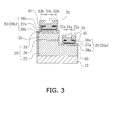
- FIG. 3 is a cross sectional view schematically showing a semiconductor element according to the second embodiment of the present invention.
- FIGS. 4A through 4F are cross sectional views schematically showing a method of manufacturing a semiconductor element according to the first embodiment of the present invention.
- FIGS. 5A through 5D are cross sectional views schematically showing another method of manufacturing a semiconductor element according to the first embodiment of the present invention.
- FIG. 6 is a cross sectional view schematically showing a conventional semiconductor element.
- FIG. 1 is a plan view schematically showing a semiconductor element according to the first embodiment.
- FIG. 2 is a cross sectional view schematically showing a cross sectional view of a semiconductor element according to the first embodiment taken along line A-A' of FIG. 1 .
- FIGS. 4A through 4F are cross sectional views schematically showing a method of manufacturing a semiconductor element according to the first embodiment.
- FIGS. 5A through 5D are cross sectional views schematically showing another method of manufacturing a semiconductor element according to the first embodiment.
- the semiconductor element according to the first embodiment includes at least a substrate 10, a semiconductor layer 20 disposed on the substrate 10, an electrode 30 (30a, 30b) disposed on the semiconductor layer 20 and having a first upper surface 32a, 32b and a second upper surface 34a, 34b protruding further than the first upper surface 32a, 32b (i.e., the second upper surface 34a, 34b is dipsosed further away from the semiconductor layer 20 than the first uper surface 32a, 32b), and an adhesion layer 40 disposed on the first upper surface 32a, 32b of the electrode 30 and having an upper surface located in the semiconductor layer side 20 than the second upper surface 34a, 34b of the electrode 30 (i.e., the second upper surface 34a, 34b is disposed further away from the semiconducor layer 20 than the upper surface of the adheshion layer 40), and an insulating layer 60 covering from the upper surface of the adhesion layer 40 to the semiconductor layer 20.
- the semiconductor element of the present embodiment is a light emitting element, in which on the substrate 10, an n-type semiconductor layer 22, an active layer 26, and a p-type semiconductor layer 24 are stacked in this order as the semiconductor layer 20. Further, a pair of electrodes 30a, 30b are disposed at the upper surface side of the semiconductor element, where an n-side electrode 30a is electrically connected to the n-type semiconductor layer 22 and a p-side electrode 30b is electrically connected to the p-type semiconductor layer 24. In this case, the n-side electrode 30a is disposed on the surface of the n-type semiconductor layer 22 which is exposed by removing a part of the p-type semiconductor layer 24 and the active layer 26.
- the p-side electrode 30b is disposed on and in contact with a transparent electrode 50 which is formed on the approximately entire surface of the p-type semiconductor layer 24.
- Both of the n-side electrode 30a and the p-side electrode 30b respectively have the first upper surface 32a, 32b and the second upper surface 34a, 34b protruding further than the first upper surface 32a, 32b, where in the top plan view, the first upper surface 32a, 32b is disposed to surround the periphery of the second upper surface 34a, 34b.
- first upper surface 32b in the p-side electrode 30b is connected to an extending portion 31b of the p-side electrode 30b, which extends toward the n-side electrode 30a and is capable of uniformly supplying electric current to the transparent electrode 50.
- the adhesion layer 40 is disposed on the first upper surface 32a, 32b of each electrode and the second upper surface 34a, 34b protrudes further then the upper surface of the adhesion layer 40.
- the adhesion layer 40 is disposed on the first upper surface 32a, 32b and is spaced apart from the second upper surface 34a, 34b.
- the insulating layer 60 is disposed on the upper surface of the adhesion layer 40, and is continuously disposed from the upper surface of the adhesion layer 40 to the semiconductor layer 20.
- the surrounding of the second upper surface 34a, 34b is covered with the insulating layer 60 so that the second upper surface 34a, 34b is exposed, and the bonding member (not shown) used at the time of mounting the semiconductor element is not directly in contact with the first upper surface 32a, 32b.
- the second upper surface 34a, 34b are arranged lower than the upper surface of the insulating layer 60 disposed on the adhesion layer 40. That is, the second upper surface 34a, 34b forms the bottom surface of the opening 70 formed in the insulating layer 60, which enables to supply sufficient amount of the bonding member in the opening 70, and thus the bonding strength can be enhanced.
- Each electrode 30a, 30b is formed by the same member, continuously at least from the second upper surface 34a, 34b to the first upper surface 32a, 32b.
- the adhesion layer 40 is, as shown in FIGS. 1 and 2 , preferably disposed on the entire surface of the first upper surface 32a, 32b of each electrode, but may be disposed on a part of the first upper surface 32a, 32b of each electrode as long as the adhesion layer 40 is in contact with a portion of each electrode which is protruding further than the first upper surface 32a, 32b towards the second upper surface 34a, 34b.
- the semiconductor element according to the first embodiment having a structure described above is capable of reducing diffusion of the bonding member used at the time of mounting into the adhesion layer 40.
- a member capable of epitaxially growing a nitride semiconductor is sufficient and the size and/or the thickness of the member is not specifically limited.
- the material for the substrate include an insulating substrate such as sapphire (A1 2 O 3 ) and spinel (MgA1 2 O 4 ), silicone carbide (SiC), ZnS, ZnO, Si, GaAs, diamond, and an oxide substrate such as lithium niobate and neodymium gallate which are capable of forming a lattice junction with the nitride semiconductor.
- the semiconductor layer includes at least an n-type semiconductor layer, an active layer, and a p-type semiconductor layer, and the kind and a material are not specifically limited, but for example, a gallium nitride-based semiconductor material such as In x AlyGa i - x - Y N (0 ⁇ X, 0 ⁇ Y, X+Y ⁇ 1) is preferably used.
- a gallium nitride-based semiconductor material such as In x AlyGa i - x - Y N (0 ⁇ X, 0 ⁇ Y, X+Y ⁇ 1) is preferably used.
- the electrode is a member to which a bonding member such as a solder, which is used at the time of mounting the semiconductor element, is connected to supply electric current to the semiconductor layer from outside.
- a bonding member such as a solder
- An n-side electrode is electrically connected to the n-type semiconductor layer and a p-side electrode is electrically connected to the p-type semiconductor layer, respectively.
- the material of the electrode include a metal material such as Ag, Al, Pt, Au, Ni, Ti, Cr, W, Rh, Ru, Ir, Hf, Mo, or Ta, and particularly, the material preferably contains at least one selected from the group consisting of Pt, Rh, Ir, and Ru, which is capable of reducing the diffusion of the bonding member whose main component is Au.
- the electrode may be formed with a stacked layer of such metal materials, and the metal material such as Pt, Rh, Ir, or Ru is preferably mainly used as a layer at the upper surface side which is in contact with the bonding member.
- the metal material such as Ti, Ni, Cr, W, Mo, or Ta having excellent adhesion with the semiconductor layer and the transparent electrode, or the metal material such as Ag, A1, Pt, or Rh capable of efficiently reflecting the light from the semiconductor layer is preferably used as a layer at the side contacting the transparent electrode which to be described later.
- the metal materials are stacked in sequence from the semiconductor layer side, such as Ti/Pt or Ti/Rh/Pt, Cr/Rh/Pt, or Ag/Ti/Pt, and the outer most layer of Pt layer may be formed with a protruded shape having the first upper surface and the second upper surface.
- the Pt layer which is capable of reducing the diffusion of the bonding member into the electrode and the adhesion layer and the other layers (Ti layer, Cr layer, Rh layer, and/or Ag layer) can serve different purposes, so that the most suitable metal material can be selected according to the needs.
- a bonding layer made of a material contained in the bonding member may be further stacked on the second upper surface of the electrode.
- Au is preferably used as the material of the bonding layer.
- the transparent electrode is a member disposed on approximately the entire surface of the upper surface of the p-type semiconductor layer, and is used to uniformly apply the electric current supplied from the p-side electrode to the entire surface of the p-type semiconductor layer.
- the transparent electrode is disposed at the light extracting side of the semiconductor element, so that an electrically conductive oxide is preferably employed as the material.
- a thin metal film may be used as the transparent electrode, but an electrically conductive oxide has higher light transmissive property with respect to that of the thin metal film, so that the light emitting efficiency of the semiconductor element can be improved by employing the electrically conductive oxide.
- Examples of the electrically conductive oxide include an oxide containing at least one selected from the group consisting of Zn, In, Sn, and Mg, and more specifically, ZnO, In 2 O 3 , SnO 2 , ITO, and the like can be exemplified.
- ITO is a material which exhibits high light transmissive property in visible light (visible region) and has relatively high electric conductivity, so that it is preferably used.
- the adhesion layer is a member for improving the adhesion between the insulating layer and the electrode so that the insulating layer is prevented from detaching from the electrode.
- the material for such adhesion layer is sufficient to have excellent adhesion with the insulating layer and the electrode.
- the adhesion layer is a metal layer made of a material containing at least one selected from Ti, Ni, Cr, W, Mo, and Ta. An oxide of Ti, Ni, Cr, W, Mo, Ta, or the like may be used also for the adhesion layer. With this, excellent adhesion between the insulating layer and the electrode can be obtained and diffusion of the bonding member in the adhesion layer can be reduced.
- the insulating layer is a member for mainly protecting the semiconductor layer from the external environment, and covers the entire upper surface of the semiconductor element except for the second upper surface to where the bonding member is going to be contacted.
- Examples of the material of the insulating layer include an oxide of Si, Ti, Ta, Zr, or the like, having light transmissive property, for example, SiO 2 and ZrO 2 .
- FIGS. 4A through 4F are cross sectional views schematically showing a method of manufacturing a semiconductor element according to the first embodiment.
- the structure of the semiconductor element according to the first embodiment has been described above and the explanation thereof will be omitted.
- a method of manufacturing a semiconductor element includes at least a first step (see FIG. 4A ) of stacking the semiconductor layer 20 on the substrate 10, a second step (see FIG. 4B ) of stacking the electrode 30 (30a, 30b) on the semiconductor layer 20, a third step (see FIG. 4C ) of stacking the adhesion layer 40 on the upper surface of the electrode 30, a fourth step (see FIG. 4A ) of stacking the semiconductor layer 20 on the substrate 10, a second step (see FIG. 4B ) of stacking the electrode 30 (30a, 30b) on the semiconductor layer 20, a third step (see FIG. 4C ) of stacking the adhesion layer 40 on the upper surface of the electrode 30, a fourth step (see FIG.
- the electrode to be exposed and the electrode to be stacked in the opening are preferably made of the same material, and the formation of the electrode 30 of the semiconductor element having the first upper surface 32a, 32b and the second upper surface 34a, 34b protruding further than the first upper surface 32a, 32b can be facilitated by using the same, continuous material.
- the semiconductor layer 20 made of an n-type semiconductor layer 22, a light emitting layer 26, and a p-type semiconductor layer 24 is stacked on the substrate 10. More specifically, on a foreign substrate made of washed sapphire or the like, with supplying a gas containing predetermined semiconductor materials, a dopant, or the like, and using an vapor deposition apparatus of such as MOVPE (Metal Organic Vapor Phase Epitaxy), HVPE (Hydride Vapor Phase Epitaxy), MBE (Molecular Beam Epitaxy), or MOMBE (Metal Organic Molecular Beam Epitaxy), an n-type semiconductor layer 22, a light emitting layer 26, and a p-type semiconductor layer 24 are stacked in this sequence by way of vapor deposition.
- MOVPE Metal Organic Vapor Phase Epitaxy
- HVPE Hydride Vapor Phase Epitaxy
- MBE Molecular Beam Epitaxy
- MOMBE Metal Organic Molecular Beam Epitaxy
- the n-side electrode 30a is stacked on the n-type semiconductor layer 22, the p-side electrode 30b is stacked over the p-type semiconductor layer 24, respectively.
- a resist mask (not shown) having a predetermined shape is disposed on the p-type semiconductor layer 24 which is a component of the semiconductor layer 20.
- RIE reactive Ion Etching
- etching is performed over the mask until the surface of the n-type semiconductor layer 22 is exposed, and then the resist is removed.
- ITO is deposited on the semiconductor layer 20.
- a resist mask (not shown) is formed so that the ITO film will remain on the substantially entire surface of the p-type semiconductor layer 24 and etching is carried out, then the resist is removed. Next, annealing is carried out to improve the ohmic contact property of the ITO film to obtain the transparent electrode 50.
- a resist mask (not shown) is formed except on the predetermined regions of the exposed n-type semiconductor layer 22 and the transparent electrode 50, respectively.
- a metal material such as Ti, Pt which forms the electrode 30 is deposited over the mask by using a sputtering machine. At this time, disposing a plurality of metal materials in a continuous manner facilitates formation of the electrode made of a plurality of layers (for example Ti/Pt etc.).
- an adhesion layer 40 for improving the adhesion with the insulating layer 60 which to be described later is stacked on the upper surface of the stacked electrode 30.
- a metal material such as Ni which forms the adhesion layer 40 is deposited over the mask which is used at the time of stacking the electrode in the second step. Then, together with the metal material (Ti, Pt, Ni, etc.) deposited on the resist, the resist is removed. With this, a state is obtained in which the n-side electrode 30a and the p-side electrode 30b are stacked in the predetermined regions and the adhesion layer 40 is stacked on each electrode 30 with the same shape in plan view.
- an insulating layer 60 is stacked to cover entire surface of the semiconductor element.
- a SiO 2 film is deposited as the insulating layer 60 over the semiconductor element.
- the electrode 30 having the second upper surface 34a, 34b is stacked so as to protrude from the first upper surface 32a, 32b.
- the resist mask (not shown) is formed except on the predetermined region of the adhesion layer 40, and etching is carried out on the insulating layer 60 and the adhesion layer 40 to expose the upper surface of the electrode 30.
- the same metal material as the exposed electrode 30 is deposited in the opening 70 formed by the etching by using the sputtering machine, and then the resist is removed. With this, removing of the insulating layer 60 and the adhesion layer 40 through further stacking the electrode can be performed in a continuous step, thus the manufacturing steps can be simplified.
- the method of manufacturing the semiconductor element according to the present invention for the sake of simplicity, a single semiconductor element is shown and described, but the method can be applied in the same manner to a wafer state (before dividing into individual semiconductor elements).
- etching is carried out on the semiconductor layer 20 at each part corresponding to a single semiconductor element along each planned dicing line for dividing into individual semiconductor elements to expose the substrate 10, then stack the insulating layer 60.
- the insulating layer 60 can be applied to cover to the side surfaces of the semiconductor layer 20.
- the wafer may be divided into individual semiconductor elements after stacking the insulating layer 60 (for example, after the fifth step).
- the side surfaces of the semiconductor layer are exposed from the insulating layer 60, but the bonding member will not reach to the side surfaces of the semiconductor layer, so that the cost of the material can be reduced and thus preferable.
- FIGS. 5A through 5D are cross sectional views schematically showing another method of manufacturing a semiconductor element according to the first embodiment.
- a resist mask 80 is formed except on the regions corresponding to the peripheral regions of the upper surface of the electrode 30, and using an RIE machine, an etching is carried out over the mask 80 to remove the peripheral regions of the upper surface of the electrode 30.
- a metal material such as Ni which formed the adhesion layer 40 is deposited, and then the resist 80 is removed (see FIG. 5B ).
- the electrode 30 having the first upper surface 32a, 32b and the second upper surface 34a, 34b protruding further than the first upper surface 32a, 32b can be formed, and further, a state in which the adhesion layer 40 is stacked on the first upper surface 32a, 32b of the electrode 30 can be obtained.
- depositing a SiO 2 film as the insulating layer 60 over the semiconductor element thus the insulating layer 60 is stacked to cover the entire surface over the semiconductor element (see FIG. 5C ).
- a resist mask 80 is formed except on the regions corresponding with the second upper surface 34a, 34b of the electrode 30, and using an RIE machine, an etching is carried out over the resist mask 80 to remove the insulating layer 60 so as to expose the second upper surface 34a, 34b of the electrode 30 (see FIG. 5D ). Thereafter, the resist 80 is removed.
- FIG. 3 is a cross sectional view schematically showing a semiconductor element according to the second embodiment of the present invention.
- the semiconductor element according to the second embodiment has a structure substantially the same as that according to the first embodiment, except that the electrode 30 has a multilayer structure including a diffusion-reducing layer 37a, 37b. The description on the same structure as above may be omitted.
- the semiconductor element according to the present embodiment has at least a substrate 10, a semiconductor layer 20, an electrode 30, an adhesion layer 40, and an insulating layer 60.
- the electrode 30 is disposed on the upper surface of the semiconductor layer 20 disposed on the substrate 10.
- the electrode 30 has a first upper surface 32a, 32b and a second upper surface 34a, 34b protruding further than the first upper surface 32a, 32b.
- the adhesion layer 40 is stacked on the first upper surface 32a, 32b of the electrode, and the insulating layer 60 is further stacked on the upper surface of the adhesion layer 40.
- the insulating layer 60 is disposed to surround the periphery of the electrode so that the second upper surface 34a, 34b of the electrode is exposed, and to cover continuously from the upper surface of the adhesion layer 40 to the semiconductor layer 20.
- the electrode 30 is formed of a plurality of layers, more specifically, a diffusion reducing layer 37a, 37b and a layer 36a, 36b having a protrusion and having a first upper surface and a second upper surface are stacked in this order from the semiconductor layer 20 side.
- a diffusion reducing layer 37a, 37b and a layer 36a, 36b having a protrusion and having a first upper surface and a second upper surface are stacked in this order from the semiconductor layer 20 side.
- the electrode 30 according to the present embodiment may have a light reflecting layer 38a, 38b further stacked between the diffusion reducing layer 37a, 37b and the semiconductor layer 20 or the transparent electrode 50.
- a metal material such as Ag, Al, Pt, Rh capable of efficiently reflecting light from the semiconductor layer 20 can be used.
- a bonding layer (not shown) made of a material contained in the bonding member may be further stacked on the second upper surface 34a, 34b of the electrode 30.
- Au is preferably used as the material of the bonding layer.
- the diffusion reducing layer is one of the layers constructing the electrode and is the member for reducing the diffusion of the bonding member, which is used at the time of mounting the semiconductor element, inside the electrode.
- the diffusion reducing layer according to the present embodiment is stacked closer to the semiconductor layer than the protruding layer having the first upper surface and the second upper surface, but it is not limited thereto, for example, the diffusion reducing layer may be stacked closer to the upper surface than the protruding layer.
- the material for such a diffusion reducing layer include at least one metal material selected from Ti, Ni, Cr, W, Mo, Ta, and the like.
- the semiconductor element according to the illustrated embodiment can be used for general lighting and for various light sources such as backlight of car navigation monitors, head lamp for automobiles, signals, and large screen displays.
- the adhesion layer 40 is disposed on both the first upper surface 32a of the n-side electrode 30a and the first upper surface 32b of the p-side electrode 30b, but the arrangement is not limited to this.
- the adhesion layer 40 may be disposed on one of the first upper surface 32a and the first upper surface 32b.
- the second upper surface 34a, 34b is located in the semiconductor layer 20 side than the upper surface of the insulating layer 60 (i.e., the upper surface of the insulating layer 60 is disposed further away from the semiconductor layer 20 than the second upper surface 34a, 34b), but the arrangement is not limited to this.
- the upper surface of the insulating layer 60 may be located in the semiconductor layer 20 side than the second upper surface 34a, 34b (i.e., the second upper surface 34a, 34b may be disposed further away from the semiconductor layer 20 than the upper surface of the insulating layer 60).
- the upper surface of the insulating layer 60 may be arranged to be flush with the second upper surface 34a, 34b.
Landscapes
- Led Devices (AREA)
- Electrodes Of Semiconductors (AREA)
- Formation Of Insulating Films (AREA)
Applications Claiming Priority (1)
| Application Number | Priority Date | Filing Date | Title |
|---|---|---|---|
| JP2010147133 | 2010-06-29 |
Publications (3)
| Publication Number | Publication Date |
|---|---|
| EP2403024A2 true EP2403024A2 (de) | 2012-01-04 |
| EP2403024A3 EP2403024A3 (de) | 2014-06-11 |
| EP2403024B1 EP2403024B1 (de) | 2017-05-31 |
Family
ID=44751245
Family Applications (1)
| Application Number | Title | Priority Date | Filing Date |
|---|---|---|---|
| EP11171908.4A Active EP2403024B1 (de) | 2010-06-29 | 2011-06-29 | Klebeschicht zwischen einer Elektrode und einem Isolator in einem Halbleiterbauelement und entsprechendes Herstellungsverfahren |
Country Status (5)
| Country | Link |
|---|---|
| US (1) | US8592954B2 (de) |
| EP (1) | EP2403024B1 (de) |
| JP (1) | JP5659966B2 (de) |
| CN (1) | CN102315351B (de) |
| TW (1) | TWI527268B (de) |
Families Citing this family (21)
| Publication number | Priority date | Publication date | Assignee | Title |
|---|---|---|---|---|
| JP5974808B2 (ja) * | 2012-10-17 | 2016-08-23 | 日亜化学工業株式会社 | 半導体発光素子 |
| KR20140086624A (ko) * | 2012-12-28 | 2014-07-08 | 삼성전자주식회사 | 질화물 반도체 발광 소자 |
| JP6176032B2 (ja) * | 2013-01-30 | 2017-08-09 | 日亜化学工業株式会社 | 半導体発光素子 |
| CN103367590A (zh) * | 2013-07-08 | 2013-10-23 | 安徽三安光电有限公司 | 一种氮化镓基发光二极管及其制作方法 |
| WO2015074353A1 (zh) * | 2013-11-25 | 2015-05-28 | 扬州中科半导体照明有限公司 | 一种半导体发光二极管芯片 |
| TWD172675S (zh) * | 2014-12-19 | 2015-12-21 | 晶元光電股份有限公司 | 發光二極體陣列之部分 |
| WO2016181625A1 (ja) * | 2015-05-12 | 2016-11-17 | パナソニックIpマネジメント株式会社 | 半導体発光素子及びその製造方法 |
| JP6582738B2 (ja) * | 2015-08-26 | 2019-10-02 | 日亜化学工業株式会社 | 発光素子及び発光装置 |
| TWD182762S (zh) * | 2016-02-24 | 2017-05-01 | 晶元光電股份有限公司 | 發光二極體陣列之部分 |
| TWD181129S (zh) * | 2016-05-11 | 2017-02-01 | 晶元光電股份有限公司 | 發光二極體陣列之部分 |
| WO2017222279A1 (ko) | 2016-06-20 | 2017-12-28 | 엘지이노텍 주식회사 | 반도체 소자 |
| CN106252470B (zh) * | 2016-08-30 | 2018-08-14 | 厦门市三安光电科技有限公司 | 一种氮化镓基发光二极管及其制作方法 |
| US10340415B2 (en) | 2016-09-01 | 2019-07-02 | Lg Innotek Co., Ltd. | Semiconductor device and semiconductor device package including the same |
| EP4283690A3 (de) | 2016-09-10 | 2024-01-24 | Suzhou Lekin Semiconductor Co., Ltd. | Halbleiteranordnung |
| CN109791960B (zh) | 2016-09-13 | 2022-10-21 | 苏州立琻半导体有限公司 | 半导体器件和包括该半导体器件的半导体器件封装 |
| US10903395B2 (en) | 2016-11-24 | 2021-01-26 | Lg Innotek Co., Ltd. | Semiconductor device having varying concentrations of aluminum |
| KR102390828B1 (ko) * | 2017-08-14 | 2022-04-26 | 쑤저우 레킨 세미컨덕터 컴퍼니 리미티드 | 반도체 소자 |
| JP7068579B2 (ja) * | 2017-09-27 | 2022-05-17 | 日亜化学工業株式会社 | 発光素子の製造方法 |
| US20190189850A1 (en) * | 2017-12-19 | 2019-06-20 | Epistar Corporation | Light-emitting device |
| CN113437188A (zh) * | 2021-06-24 | 2021-09-24 | 厦门乾照光电股份有限公司 | 一种led芯片及其制备方法 |
| JP7339994B2 (ja) * | 2021-11-12 | 2023-09-06 | 日機装株式会社 | 半導体発光素子および半導体発光素子の製造方法 |
Citations (1)
| Publication number | Priority date | Publication date | Assignee | Title |
|---|---|---|---|---|
| JPH11150301A (ja) | 1997-11-14 | 1999-06-02 | Nichia Chem Ind Ltd | 窒化物半導体素子 |
Family Cites Families (17)
| Publication number | Priority date | Publication date | Assignee | Title |
|---|---|---|---|---|
| JP3171740B2 (ja) * | 1993-12-22 | 2001-06-04 | 株式会社リコー | 半導体発光装置 |
| EP1959506A2 (de) * | 1997-01-31 | 2008-08-20 | Matsushita Electric Industrial Co., Ltd. | Herstellungsverfahren für eine lichtemittierende Halbleitervorrichtung |
| JP3761461B2 (ja) * | 2001-12-13 | 2006-03-29 | Necエレクトロニクス株式会社 | 半導体装置の製造方法 |
| JP2004006498A (ja) * | 2002-05-31 | 2004-01-08 | Toyoda Gosei Co Ltd | Iii族窒化物系化合物半導体発光素子 |
| EP1450414A3 (de) * | 2003-02-19 | 2008-12-24 | Nichia Corporation | Halbleitervorrichtung aus einer Nitridverbindung |
| JP4580633B2 (ja) * | 2003-11-14 | 2010-11-17 | スタンレー電気株式会社 | 半導体装置及びその製造方法 |
| JP4330476B2 (ja) * | 2004-03-29 | 2009-09-16 | スタンレー電気株式会社 | 半導体発光素子 |
| US7259110B2 (en) * | 2004-04-28 | 2007-08-21 | Semiconductor Energy Laboratory Co., Ltd. | Manufacturing method of display device and semiconductor device |
| KR100615237B1 (ko) * | 2004-08-07 | 2006-08-25 | 삼성에스디아이 주식회사 | 박막 트랜지스터 및 그의 제조방법 |
| JP4956928B2 (ja) * | 2004-09-28 | 2012-06-20 | 日亜化学工業株式会社 | 半導体装置 |
| JP2006128227A (ja) * | 2004-10-26 | 2006-05-18 | Mitsubishi Cable Ind Ltd | 窒化物半導体発光素子 |
| JP4601391B2 (ja) * | 2004-10-28 | 2010-12-22 | シャープ株式会社 | 窒化物半導体素子およびその製造方法 |
| WO2006082687A1 (ja) * | 2005-02-07 | 2006-08-10 | Mitsubishi Cable Industries, Ltd. | GaN系発光ダイオードおよび発光装置 |
| JP4850453B2 (ja) * | 2005-08-11 | 2012-01-11 | ローム株式会社 | 半導体発光装置の製造方法及び半導体発光装置 |
| JP2007049045A (ja) * | 2005-08-11 | 2007-02-22 | Rohm Co Ltd | 半導体発光素子およびこれを備えた半導体装置 |
| WO2009128372A1 (ja) * | 2008-04-15 | 2009-10-22 | 株式会社アルバック | 薄膜トランジスタ、薄膜トランジスタの製造方法 |
| JP5282086B2 (ja) * | 2008-04-25 | 2013-09-04 | 株式会社アルバック | 薄膜トランジスタの製造方法、薄膜トランジスタ |
-
2011
- 2011-06-23 JP JP2011139646A patent/JP5659966B2/ja active Active
- 2011-06-27 CN CN201110174875.XA patent/CN102315351B/zh active Active
- 2011-06-28 US US13/171,303 patent/US8592954B2/en active Active
- 2011-06-29 TW TW100122933A patent/TWI527268B/zh active
- 2011-06-29 EP EP11171908.4A patent/EP2403024B1/de active Active
Patent Citations (1)
| Publication number | Priority date | Publication date | Assignee | Title |
|---|---|---|---|---|
| JPH11150301A (ja) | 1997-11-14 | 1999-06-02 | Nichia Chem Ind Ltd | 窒化物半導体素子 |
Also Published As
| Publication number | Publication date |
|---|---|
| US8592954B2 (en) | 2013-11-26 |
| EP2403024B1 (de) | 2017-05-31 |
| CN102315351A (zh) | 2012-01-11 |
| US20110316126A1 (en) | 2011-12-29 |
| EP2403024A3 (de) | 2014-06-11 |
| JP2012033898A (ja) | 2012-02-16 |
| CN102315351B (zh) | 2016-09-07 |
| TWI527268B (zh) | 2016-03-21 |
| JP5659966B2 (ja) | 2015-01-28 |
| TW201212290A (en) | 2012-03-16 |
Similar Documents
| Publication | Publication Date | Title |
|---|---|---|
| US8592954B2 (en) | Semiconductor element and method of manufacturing the semiconductor element | |
| US7982234B2 (en) | Light emitting device and method for fabricating the same | |
| US10153398B2 (en) | Light-emitting device and manufacturing method thereof | |
| US9837579B2 (en) | Semiconductor light emitting element and method for producing the same | |
| KR101017394B1 (ko) | 발광 소자 및 그것을 제조하는 방법 | |
| JP5776535B2 (ja) | Iii族窒化物半導体発光素子 | |
| EP2722889B1 (de) | Leuchtdiode mit verbesserter Effizienz durch Stromaufweitung | |
| US20110303938A1 (en) | Group III nitride semiconductor light-emitting element | |
| JP2013125929A5 (de) | ||
| KR20190104693A (ko) | 반도체 발광소자 | |
| JP4929924B2 (ja) | 半導体発光素子、その製造方法、及び複合半導体装置 | |
| JP5729328B2 (ja) | Iii族窒化物半導体発光素子およびその製造方法 | |
| US9553238B2 (en) | Method of manufacturing light emitting element | |
| US8659051B2 (en) | Semiconductor light emitting device and method for manufacturing thereof | |
| WO2015141166A1 (ja) | 半導体発光装置とその製造方法 | |
| CN111261760B (zh) | 发光元件 | |
| US20250143028A1 (en) | Light-emitting diode device and wafer structure | |
| CN116210093A (zh) | 谐振腔发光二极管及其制备方法 | |
| KR101945791B1 (ko) | 반도체 발광소자의 제조방법 | |
| KR101165252B1 (ko) | 발광 소자 및 그 제조방법 | |
| KR102563266B1 (ko) | 발광소자 및 이를 구비한 광원 모듈 | |
| US12284845B2 (en) | Semiconductor light emitting device having reflective electrode on multilayer insulating structure | |
| JP5682427B2 (ja) | 発光素子 |
Legal Events
| Date | Code | Title | Description |
|---|---|---|---|
| AK | Designated contracting states |
Kind code of ref document: A2 Designated state(s): AL AT BE BG CH CY CZ DE DK EE ES FI FR GB GR HR HU IE IS IT LI LT LU LV MC MK MT NL NO PL PT RO RS SE SI SK SM TR |
|
| AX | Request for extension of the european patent |
Extension state: BA ME |
|
| PUAI | Public reference made under article 153(3) epc to a published international application that has entered the european phase |
Free format text: ORIGINAL CODE: 0009012 |
|
| PUAL | Search report despatched |
Free format text: ORIGINAL CODE: 0009013 |
|
| AK | Designated contracting states |
Kind code of ref document: A3 Designated state(s): AL AT BE BG CH CY CZ DE DK EE ES FI FR GB GR HR HU IE IS IT LI LT LU LV MC MK MT NL NO PL PT RO RS SE SI SK SM TR |
|
| AX | Request for extension of the european patent |
Extension state: BA ME |
|
| RIC1 | Information provided on ipc code assigned before grant |
Ipc: H01L 33/38 20100101ALN20140506BHEP Ipc: H01L 33/44 20100101ALN20140506BHEP Ipc: H01L 33/40 20100101AFI20140506BHEP |
|
| 17P | Request for examination filed |
Effective date: 20141211 |
|
| RBV | Designated contracting states (corrected) |
Designated state(s): AL AT BE BG CH CY CZ DE DK EE ES FI FR GB GR HR HU IE IS IT LI LT LU LV MC MK MT NL NO PL PT RO RS SE SI SK SM TR |
|
| 17Q | First examination report despatched |
Effective date: 20160406 |
|
| GRAP | Despatch of communication of intention to grant a patent |
Free format text: ORIGINAL CODE: EPIDOSNIGR1 |
|
| RIC1 | Information provided on ipc code assigned before grant |
Ipc: H01L 23/31 20060101ALI20161118BHEP Ipc: H01L 33/44 20100101ALN20161118BHEP Ipc: H01L 23/00 20060101ALI20161118BHEP Ipc: H01L 33/38 20100101ALN20161118BHEP Ipc: H01L 33/40 20100101AFI20161118BHEP |
|
| INTG | Intention to grant announced |
Effective date: 20161209 |
|
| RIC1 | Information provided on ipc code assigned before grant |
Ipc: H01L 33/38 20100101ALN20161130BHEP Ipc: H01L 23/31 20060101ALI20161130BHEP Ipc: H01L 23/00 20060101ALI20161130BHEP Ipc: H01L 33/40 20100101AFI20161130BHEP Ipc: H01L 33/44 20100101ALN20161130BHEP |
|
| GRAS | Grant fee paid |
Free format text: ORIGINAL CODE: EPIDOSNIGR3 |
|
| GRAA | (expected) grant |
Free format text: ORIGINAL CODE: 0009210 |
|
| AK | Designated contracting states |
Kind code of ref document: B1 Designated state(s): AL AT BE BG CH CY CZ DE DK EE ES FI FR GB GR HR HU IE IS IT LI LT LU LV MC MK MT NL NO PL PT RO RS SE SI SK SM TR |
|
| REG | Reference to a national code |
Ref country code: CH Ref legal event code: EP Ref country code: GB Ref legal event code: FG4D |
|
| REG | Reference to a national code |
Ref country code: AT Ref legal event code: REF Ref document number: 898169 Country of ref document: AT Kind code of ref document: T Effective date: 20170615 |
|
| REG | Reference to a national code |
Ref country code: FR Ref legal event code: PLFP Year of fee payment: 7 Ref country code: IE Ref legal event code: FG4D |
|
| REG | Reference to a national code |
Ref country code: DE Ref legal event code: R096 Ref document number: 602011038279 Country of ref document: DE |
|
| REG | Reference to a national code |
Ref country code: NL Ref legal event code: MP Effective date: 20170531 |
|
| REG | Reference to a national code |
Ref country code: LT Ref legal event code: MG4D |
|
| REG | Reference to a national code |
Ref country code: AT Ref legal event code: MK05 Ref document number: 898169 Country of ref document: AT Kind code of ref document: T Effective date: 20170531 |
|
| PG25 | Lapsed in a contracting state [announced via postgrant information from national office to epo] |
Ref country code: ES Free format text: LAPSE BECAUSE OF FAILURE TO SUBMIT A TRANSLATION OF THE DESCRIPTION OR TO PAY THE FEE WITHIN THE PRESCRIBED TIME-LIMIT Effective date: 20170531 Ref country code: LT Free format text: LAPSE BECAUSE OF FAILURE TO SUBMIT A TRANSLATION OF THE DESCRIPTION OR TO PAY THE FEE WITHIN THE PRESCRIBED TIME-LIMIT Effective date: 20170531 Ref country code: HR Free format text: LAPSE BECAUSE OF FAILURE TO SUBMIT A TRANSLATION OF THE DESCRIPTION OR TO PAY THE FEE WITHIN THE PRESCRIBED TIME-LIMIT Effective date: 20170531 Ref country code: AT Free format text: LAPSE BECAUSE OF FAILURE TO SUBMIT A TRANSLATION OF THE DESCRIPTION OR TO PAY THE FEE WITHIN THE PRESCRIBED TIME-LIMIT Effective date: 20170531 Ref country code: FI Free format text: LAPSE BECAUSE OF FAILURE TO SUBMIT A TRANSLATION OF THE DESCRIPTION OR TO PAY THE FEE WITHIN THE PRESCRIBED TIME-LIMIT Effective date: 20170531 Ref country code: NO Free format text: LAPSE BECAUSE OF FAILURE TO SUBMIT A TRANSLATION OF THE DESCRIPTION OR TO PAY THE FEE WITHIN THE PRESCRIBED TIME-LIMIT Effective date: 20170831 Ref country code: GR Free format text: LAPSE BECAUSE OF FAILURE TO SUBMIT A TRANSLATION OF THE DESCRIPTION OR TO PAY THE FEE WITHIN THE PRESCRIBED TIME-LIMIT Effective date: 20170901 |
|
| PG25 | Lapsed in a contracting state [announced via postgrant information from national office to epo] |
Ref country code: SE Free format text: LAPSE BECAUSE OF FAILURE TO SUBMIT A TRANSLATION OF THE DESCRIPTION OR TO PAY THE FEE WITHIN THE PRESCRIBED TIME-LIMIT Effective date: 20170531 Ref country code: RS Free format text: LAPSE BECAUSE OF FAILURE TO SUBMIT A TRANSLATION OF THE DESCRIPTION OR TO PAY THE FEE WITHIN THE PRESCRIBED TIME-LIMIT Effective date: 20170531 Ref country code: IS Free format text: LAPSE BECAUSE OF FAILURE TO SUBMIT A TRANSLATION OF THE DESCRIPTION OR TO PAY THE FEE WITHIN THE PRESCRIBED TIME-LIMIT Effective date: 20170930 Ref country code: NL Free format text: LAPSE BECAUSE OF FAILURE TO SUBMIT A TRANSLATION OF THE DESCRIPTION OR TO PAY THE FEE WITHIN THE PRESCRIBED TIME-LIMIT Effective date: 20170531 Ref country code: LV Free format text: LAPSE BECAUSE OF FAILURE TO SUBMIT A TRANSLATION OF THE DESCRIPTION OR TO PAY THE FEE WITHIN THE PRESCRIBED TIME-LIMIT Effective date: 20170531 Ref country code: BG Free format text: LAPSE BECAUSE OF FAILURE TO SUBMIT A TRANSLATION OF THE DESCRIPTION OR TO PAY THE FEE WITHIN THE PRESCRIBED TIME-LIMIT Effective date: 20170831 |
|
| PG25 | Lapsed in a contracting state [announced via postgrant information from national office to epo] |
Ref country code: EE Free format text: LAPSE BECAUSE OF FAILURE TO SUBMIT A TRANSLATION OF THE DESCRIPTION OR TO PAY THE FEE WITHIN THE PRESCRIBED TIME-LIMIT Effective date: 20170531 Ref country code: RO Free format text: LAPSE BECAUSE OF FAILURE TO SUBMIT A TRANSLATION OF THE DESCRIPTION OR TO PAY THE FEE WITHIN THE PRESCRIBED TIME-LIMIT Effective date: 20170531 Ref country code: DK Free format text: LAPSE BECAUSE OF FAILURE TO SUBMIT A TRANSLATION OF THE DESCRIPTION OR TO PAY THE FEE WITHIN THE PRESCRIBED TIME-LIMIT Effective date: 20170531 Ref country code: CZ Free format text: LAPSE BECAUSE OF FAILURE TO SUBMIT A TRANSLATION OF THE DESCRIPTION OR TO PAY THE FEE WITHIN THE PRESCRIBED TIME-LIMIT Effective date: 20170531 Ref country code: SK Free format text: LAPSE BECAUSE OF FAILURE TO SUBMIT A TRANSLATION OF THE DESCRIPTION OR TO PAY THE FEE WITHIN THE PRESCRIBED TIME-LIMIT Effective date: 20170531 |
|
| REG | Reference to a national code |
Ref country code: CH Ref legal event code: PL |
|
| PG25 | Lapsed in a contracting state [announced via postgrant information from national office to epo] |
Ref country code: IT Free format text: LAPSE BECAUSE OF FAILURE TO SUBMIT A TRANSLATION OF THE DESCRIPTION OR TO PAY THE FEE WITHIN THE PRESCRIBED TIME-LIMIT Effective date: 20170531 Ref country code: PL Free format text: LAPSE BECAUSE OF FAILURE TO SUBMIT A TRANSLATION OF THE DESCRIPTION OR TO PAY THE FEE WITHIN THE PRESCRIBED TIME-LIMIT Effective date: 20170531 Ref country code: SM Free format text: LAPSE BECAUSE OF FAILURE TO SUBMIT A TRANSLATION OF THE DESCRIPTION OR TO PAY THE FEE WITHIN THE PRESCRIBED TIME-LIMIT Effective date: 20170531 |
|
| REG | Reference to a national code |
Ref country code: DE Ref legal event code: R097 Ref document number: 602011038279 Country of ref document: DE |
|
| REG | Reference to a national code |
Ref country code: IE Ref legal event code: MM4A |
|
| PLBE | No opposition filed within time limit |
Free format text: ORIGINAL CODE: 0009261 |
|
| STAA | Information on the status of an ep patent application or granted ep patent |
Free format text: STATUS: NO OPPOSITION FILED WITHIN TIME LIMIT |
|
| PG25 | Lapsed in a contracting state [announced via postgrant information from national office to epo] |
Ref country code: LU Free format text: LAPSE BECAUSE OF NON-PAYMENT OF DUE FEES Effective date: 20170629 Ref country code: CH Free format text: LAPSE BECAUSE OF NON-PAYMENT OF DUE FEES Effective date: 20170630 Ref country code: LI Free format text: LAPSE BECAUSE OF NON-PAYMENT OF DUE FEES Effective date: 20170630 Ref country code: IE Free format text: LAPSE BECAUSE OF NON-PAYMENT OF DUE FEES Effective date: 20170629 |
|
| 26N | No opposition filed |
Effective date: 20180301 |
|
| REG | Reference to a national code |
Ref country code: FR Ref legal event code: PLFP Year of fee payment: 8 |
|
| PG25 | Lapsed in a contracting state [announced via postgrant information from national office to epo] |
Ref country code: SI Free format text: LAPSE BECAUSE OF FAILURE TO SUBMIT A TRANSLATION OF THE DESCRIPTION OR TO PAY THE FEE WITHIN THE PRESCRIBED TIME-LIMIT Effective date: 20170531 |
|
| REG | Reference to a national code |
Ref country code: BE Ref legal event code: MM Effective date: 20170630 |
|
| PG25 | Lapsed in a contracting state [announced via postgrant information from national office to epo] |
Ref country code: BE Free format text: LAPSE BECAUSE OF NON-PAYMENT OF DUE FEES Effective date: 20170630 |
|
| PG25 | Lapsed in a contracting state [announced via postgrant information from national office to epo] |
Ref country code: MT Free format text: LAPSE BECAUSE OF NON-PAYMENT OF DUE FEES Effective date: 20170629 |
|
| PG25 | Lapsed in a contracting state [announced via postgrant information from national office to epo] |
Ref country code: HU Free format text: LAPSE BECAUSE OF FAILURE TO SUBMIT A TRANSLATION OF THE DESCRIPTION OR TO PAY THE FEE WITHIN THE PRESCRIBED TIME-LIMIT; INVALID AB INITIO Effective date: 20110629 Ref country code: MC Free format text: LAPSE BECAUSE OF FAILURE TO SUBMIT A TRANSLATION OF THE DESCRIPTION OR TO PAY THE FEE WITHIN THE PRESCRIBED TIME-LIMIT Effective date: 20170531 |
|
| PG25 | Lapsed in a contracting state [announced via postgrant information from national office to epo] |
Ref country code: CY Free format text: LAPSE BECAUSE OF NON-PAYMENT OF DUE FEES Effective date: 20170531 |
|
| PG25 | Lapsed in a contracting state [announced via postgrant information from national office to epo] |
Ref country code: MK Free format text: LAPSE BECAUSE OF FAILURE TO SUBMIT A TRANSLATION OF THE DESCRIPTION OR TO PAY THE FEE WITHIN THE PRESCRIBED TIME-LIMIT Effective date: 20170531 |
|
| PG25 | Lapsed in a contracting state [announced via postgrant information from national office to epo] |
Ref country code: TR Free format text: LAPSE BECAUSE OF FAILURE TO SUBMIT A TRANSLATION OF THE DESCRIPTION OR TO PAY THE FEE WITHIN THE PRESCRIBED TIME-LIMIT Effective date: 20170531 |
|
| PG25 | Lapsed in a contracting state [announced via postgrant information from national office to epo] |
Ref country code: PT Free format text: LAPSE BECAUSE OF FAILURE TO SUBMIT A TRANSLATION OF THE DESCRIPTION OR TO PAY THE FEE WITHIN THE PRESCRIBED TIME-LIMIT Effective date: 20170531 |
|
| PG25 | Lapsed in a contracting state [announced via postgrant information from national office to epo] |
Ref country code: AL Free format text: LAPSE BECAUSE OF FAILURE TO SUBMIT A TRANSLATION OF THE DESCRIPTION OR TO PAY THE FEE WITHIN THE PRESCRIBED TIME-LIMIT Effective date: 20170531 |
|
| P01 | Opt-out of the competence of the unified patent court (upc) registered |
Effective date: 20230522 |
|
| REG | Reference to a national code |
Ref country code: DE Ref legal event code: R079 Ref document number: 602011038279 Country of ref document: DE Free format text: PREVIOUS MAIN CLASS: H01L0033400000 Ipc: H10H0020832000 |
|
| PGFP | Annual fee paid to national office [announced via postgrant information from national office to epo] |
Ref country code: DE Payment date: 20250507 Year of fee payment: 15 |
|
| PGFP | Annual fee paid to national office [announced via postgrant information from national office to epo] |
Ref country code: GB Payment date: 20250508 Year of fee payment: 15 |
|
| PGFP | Annual fee paid to national office [announced via postgrant information from national office to epo] |
Ref country code: FR Payment date: 20250508 Year of fee payment: 15 |