EP2398818B1 - Mittel zur aufreinigung eines proteins aus blutplasma und verfahren zu dessen einsatz - Google Patents
Mittel zur aufreinigung eines proteins aus blutplasma und verfahren zu dessen einsatz Download PDFInfo
- Publication number
- EP2398818B1 EP2398818B1 EP10709893.1A EP10709893A EP2398818B1 EP 2398818 B1 EP2398818 B1 EP 2398818B1 EP 10709893 A EP10709893 A EP 10709893A EP 2398818 B1 EP2398818 B1 EP 2398818B1
- Authority
- EP
- European Patent Office
- Prior art keywords
- protein
- aptamer
- factor
- human
- plasma protein
- Prior art date
- Legal status (The legal status is an assumption and is not a legal conclusion. Google has not performed a legal analysis and makes no representation as to the accuracy of the status listed.)
- Not-in-force
Links
Images



Classifications
-
- C—CHEMISTRY; METALLURGY
- C07—ORGANIC CHEMISTRY
- C07K—PEPTIDES
- C07K1/00—General methods for the preparation of peptides, i.e. processes for the organic chemical preparation of peptides or proteins of any length
- C07K1/14—Extraction; Separation; Purification
- C07K1/16—Extraction; Separation; Purification by chromatography
- C07K1/22—Affinity chromatography or related techniques based upon selective absorption processes
-
- A—HUMAN NECESSITIES
- A61—MEDICAL OR VETERINARY SCIENCE; HYGIENE
- A61P—SPECIFIC THERAPEUTIC ACTIVITY OF CHEMICAL COMPOUNDS OR MEDICINAL PREPARATIONS
- A61P7/00—Drugs for disorders of the blood or the extracellular fluid
-
- C—CHEMISTRY; METALLURGY
- C07—ORGANIC CHEMISTRY
- C07K—PEPTIDES
- C07K1/00—General methods for the preparation of peptides, i.e. processes for the organic chemical preparation of peptides or proteins of any length
- C07K1/14—Extraction; Separation; Purification
- C07K1/16—Extraction; Separation; Purification by chromatography
- C07K1/18—Ion-exchange chromatography
-
- C—CHEMISTRY; METALLURGY
- C07—ORGANIC CHEMISTRY
- C07K—PEPTIDES
- C07K14/00—Peptides having more than 20 amino acids; Gastrins; Somatostatins; Melanotropins; Derivatives thereof
- C07K14/435—Peptides having more than 20 amino acids; Gastrins; Somatostatins; Melanotropins; Derivatives thereof from animals; from humans
- C07K14/745—Blood coagulation or fibrinolysis factors
-
- C—CHEMISTRY; METALLURGY
- C07—ORGANIC CHEMISTRY
- C07K—PEPTIDES
- C07K14/00—Peptides having more than 20 amino acids; Gastrins; Somatostatins; Melanotropins; Derivatives thereof
- C07K14/435—Peptides having more than 20 amino acids; Gastrins; Somatostatins; Melanotropins; Derivatives thereof from animals; from humans
- C07K14/745—Blood coagulation or fibrinolysis factors
- C07K14/755—Factors VIII, e.g. factor VIII C (AHF), factor VIII Ag (VWF)
-
- C—CHEMISTRY; METALLURGY
- C07—ORGANIC CHEMISTRY
- C07K—PEPTIDES
- C07K14/00—Peptides having more than 20 amino acids; Gastrins; Somatostatins; Melanotropins; Derivatives thereof
- C07K14/435—Peptides having more than 20 amino acids; Gastrins; Somatostatins; Melanotropins; Derivatives thereof from animals; from humans
- C07K14/76—Albumins
- C07K14/765—Serum albumin, e.g. HSA
-
- C—CHEMISTRY; METALLURGY
- C12—BIOCHEMISTRY; BEER; SPIRITS; WINE; VINEGAR; MICROBIOLOGY; ENZYMOLOGY; MUTATION OR GENETIC ENGINEERING
- C12N—MICROORGANISMS OR ENZYMES; COMPOSITIONS THEREOF; PROPAGATING, PRESERVING, OR MAINTAINING MICROORGANISMS; MUTATION OR GENETIC ENGINEERING; CULTURE MEDIA
- C12N15/00—Mutation or genetic engineering; DNA or RNA concerning genetic engineering, vectors, e.g. plasmids, or their isolation, preparation or purification; Use of hosts therefor
- C12N15/09—Recombinant DNA-technology
- C12N15/11—DNA or RNA fragments; Modified forms thereof; Non-coding nucleic acids having a biological activity
- C12N15/115—Aptamers, i.e. nucleic acids binding a target molecule specifically and with high affinity without hybridising therewith ; Nucleic acids binding to non-nucleic acids, e.g. aptamers
-
- C—CHEMISTRY; METALLURGY
- C12—BIOCHEMISTRY; BEER; SPIRITS; WINE; VINEGAR; MICROBIOLOGY; ENZYMOLOGY; MUTATION OR GENETIC ENGINEERING
- C12N—MICROORGANISMS OR ENZYMES; COMPOSITIONS THEREOF; PROPAGATING, PRESERVING, OR MAINTAINING MICROORGANISMS; MUTATION OR GENETIC ENGINEERING; CULTURE MEDIA
- C12N9/00—Enzymes; Proenzymes; Compositions thereof; Processes for preparing, activating, inhibiting, separating or purifying enzymes
- C12N9/14—Hydrolases (3)
- C12N9/48—Hydrolases (3) acting on peptide bonds (3.4)
- C12N9/50—Proteinases, e.g. Endopeptidases (3.4.21-3.4.25)
- C12N9/64—Proteinases, e.g. Endopeptidases (3.4.21-3.4.25) derived from animal tissue
- C12N9/6421—Proteinases, e.g. Endopeptidases (3.4.21-3.4.25) derived from animal tissue from mammals
- C12N9/6424—Serine endopeptidases (3.4.21)
- C12N9/647—Blood coagulation factors not provided for in a preceding group or according to more than one of the proceeding groups
-
- C—CHEMISTRY; METALLURGY
- C12—BIOCHEMISTRY; BEER; SPIRITS; WINE; VINEGAR; MICROBIOLOGY; ENZYMOLOGY; MUTATION OR GENETIC ENGINEERING
- C12N—MICROORGANISMS OR ENZYMES; COMPOSITIONS THEREOF; PROPAGATING, PRESERVING, OR MAINTAINING MICROORGANISMS; MUTATION OR GENETIC ENGINEERING; CULTURE MEDIA
- C12N2310/00—Structure or type of the nucleic acid
- C12N2310/10—Type of nucleic acid
- C12N2310/16—Aptamers
-
- C—CHEMISTRY; METALLURGY
- C12—BIOCHEMISTRY; BEER; SPIRITS; WINE; VINEGAR; MICROBIOLOGY; ENZYMOLOGY; MUTATION OR GENETIC ENGINEERING
- C12N—MICROORGANISMS OR ENZYMES; COMPOSITIONS THEREOF; PROPAGATING, PRESERVING, OR MAINTAINING MICROORGANISMS; MUTATION OR GENETIC ENGINEERING; CULTURE MEDIA
- C12N2320/00—Applications; Uses
Definitions
- the present invention relates to the field of purification of blood plasma proteins, which can be used as active ingredients of medicaments
- Blood plasma proteins have long been active ingredients in drugs.
- proteins of the blood plasma used as drug active principles there may be mentioned in particular factor VII, factor VIII, thrombin or von Willebrand factor.
- plasma proteins were exclusively obtained by purification from human blood plasma.
- certain plasma proteins have been obtained in the form of recombinant proteins produced in body fluids of transgenic mammals, for example in the milk of transgenic mammals.
- the starting material containing the plasma protein to be purified consists of a complex constitution material, in which the protein of interest is present in combination with a very large number of substances, including proteins, lipids and carbohydrates. , amino acids, mineral salts, cellular debris and metabolic waste such as urea, uric acid or bilirubin.
- the plasma protein used as the active ingredient must be present in a highly purified form and not be associated with undesirable substances which may be deleterious to the body, including d other plasma proteins, or degradation products of the aforementioned proteins.
- All of the known methods comprise a succession of selective separation steps based on steps of protein precipitation, passage on chromatographic media followed by sequential elution steps, filtration steps in depth, ultrafiltration or concentration steps.
- Romig et al. J. Chromatogr 1999, 731, 275-284 discloses the purification of a recombinant L-selectin-Ig fusion protein from the clarified supernatant of a CHO culture medium by affinity-media chromatography comprising aptamers.
- Zhao et al. (Anal Chem, 2008, 80, 3915-3920 ) describes a method for detecting cytochrome C and thrombin by capillary chromatography on an aptamer affinity support.
- the applicant has developed a method for purifying blood plasma proteins, comprising a chromatography step during which a specific binding of the protein of interest takes place on a ligand previously immobilized on the support of chromatography, then release of the protein of interest retained on said support and recovery of the purified protein in the volume of the eluate.
- a method for the purification of blood plasma proteins comprising a step of specific binding of the plasma protein of interest on a support on which are immobilized deoxyribonucleic aptamers specifically binding to said protein of d interest, followed by a step of recovering said purified protein of interest.
- affinity chromatography supports have been shown to immobilize deoxyribonucleic aptamers specific for the plasma protein of interest, that is to say also in the form of immobilized compounds comprising such aptamers.
- deoxyribonucleic acid can be used successfully in processes for obtaining plasma proteins that can be used as active ingredients of a medicament.
- an affinity support as defined in the present description can be manufactured using deoxyribonucleic acid (DNA) aptamers, nevertheless considered in the state of the art as nucleic acids.
- DNA deoxyribonucleic acid
- ligands whose implementation is difficult, and whose specificity for the target protein is less than the specificity of the corresponding sequence RNA molecule.
- the DNA ligands have less flexibility than the corresponding RNA and therefore are less able than the RNA ligands to undergo conformational changes. It is recalled that when a nucleic aptamer binds to the target protein, a conformational change occurs.
- the affinity support has also been shown to purify very distinct primary sequence coagulation proteins, such as human Factor VII and Factor IX.
- the affinity support makes it possible to purify coagulation proteins from starting materials of complex composition, such as a plasma composition enriched in human factor IX and a transgenic animal milk for human factor IX. with high specificity of binding to said coagulation protein of interest.
- the affinity support makes it possible to selectively purify a human coagulation protein from a starting medium also comprising a non-human orthologous protein, for example from a transgenic animal milk for human Factor IX, said milk also comprising Factor IX naturally produced by said transgenic animal, said Factor IX naturally produced by said transgenic animal (or endogenous FIX) which may for example be a porcine FIX.
- a non-human orthologous protein for example from a transgenic animal milk for human Factor IX, said milk also comprising Factor IX naturally produced by said transgenic animal, said Factor IX naturally produced by said transgenic animal (or endogenous FIX) which may for example be a porcine FIX.
- the affinity support makes it possible to selectively purify a human coagulation protein from a starting medium also comprising a non-human orthologous protein, for example from a transgenic animal milk for human factor VII, said milk also comprising Factor VII naturally produced by said transgenic animal, said Factor VII naturally produced by said transgenic animal (or endogenous FVII) which may be for example a rabbit FVII
- An affinity support for the selective binding of a blood plasma protein comprising a solid support material on which deoxyribonucleic aptamers specifically binding to said plasma protein are immobilized, including as compounds comprising such deoxyribonucleotide aptamers.
- Deoxyribonucleic aptamer molecules specifically binding to the plasma protein of interest, as well as compounds comprising such deoxyribonucleic aptamers, constitute specific binding sites of said target protein carried by said solid support material.
- deoxyribonucleic aptamers are meant single-stranded deoxyribonucleic acids having a length of from 5 to 120 nucleotides in length and which specifically bind to a protein of the blood plasma.
- compounds comprising a deoxyribonucleic aptamer, there are also encompassed compounds which comprise in their structure said deoxyribonucleic acids defined previously.
- compounds comprising a deoxyribonucleic acid specifically binding to a plasma protein, human or mammal include compounds wherein said deoxyribonucleic acid is included in a structure comprising a biotin molecule.
- An affinity support as defined above has been shown to allow efficient immobilization of the plasma protein of interest, which may also be referred to as the "target protein" in the present description.
- An affinity support as defined above has a high adsorption capacity of the target protein, since contacting the solid support with a liquid solution containing the plasma protein to be purified makes it possible to saturate at least 50 percent of the target sites carried by the solid support.
- the plasma protein molecules that are specifically attached to the deoxyribonucleic aptamer molecules can then be eluted from the affinity support in good yield of at least 75 percent.
- the affinity support has a high specificity for the plasma protein of interest, since said plasma protein can be found with a purity level of up to 99.95 percent by weight, relative to to the total weight of the proteins contained in the eluate.
- an increase of two orders of magnitude in the purity of the coagulation protein of interest can still be obtained with an affinity support as described herein, using as starting material a composition comprising the target protein coagulation at a high degree of purity, for example more than 98% by weight, relative to the total weight of the proteins contained in said starting material. It is specified that such an increase in purity is obtained even when the impurities present in the starting product have structural or physicochemical characteristics very close to those of the target protein of the coagulation that is to be purified.
- the affinity support can be "regenerated” by eliminating the proteins that remain attached to the support after elution, many times without any significant alteration of (i) its ability to absorb the target plasma protein. (ii) its specificity with respect to said target protein, or (iii) its absence of release of the deoxyribonucleic aptamers immobilized on the solid support material.
- the regeneration of the affinity support can be carried out according to known techniques and with known regenerating agents, such as urea.
- deoxyribonucleic acids used as ligands of the plasma protein of interest have many advantages. Due to their oligonucleotide nature aptamers possess low immunogenicity and high resistance to stringent physicochemical conditions (presence of urea, DMSO, very acidic or very basic pH, use of organic solvents or high temperature) allowing for a variety of safety control strategies, in particular safety against viruses or unconventional pathogens, in the context of use as an affinity ligand. In addition, their selectivity is important. Finally, as already mentioned, the production of deoxyribonucleic aptamers involves relatively limited costs.
- the affinity support is able to selectively reversibly bind the target plasma protein, with a good yield and a good specificity, in purification processes from constitutive media. complex, especially from media conventionally used on an industrial scale, such as human plasma or culture media or biological fluids containing said protein of interest.
- the affinity support is capable of treating large volumes of solution containing the plasma protein of interest.
- the affinity support is therefore a tool for purifying a blood plasma protein that is perfectly well suited for use on an industrial scale.
- affinity support will be specified later in the present description, either in connection with the description of the affinity support itself, or in relation with the methods of purification of a plasma protein in which said Affinity can be used.
- an affinity support comprising immobilized deoxyribonucleic aptamers for the purification of a blood plasma protein under conditions of use on an industrial scale.
- nucleic aptamers specific to thrombin, Factor VII and Factor IX are known (see application PCT No. WO 02/26932 ).
- deoxyribonucleic aptamers for the manufacture of affinity supports that can be used on an industrial scale in plasma protein purification processes has never been described in the state of the art. .
- selective binding is meant for the purposes of the present description the non-covalently specific binding of the plasma protein of interest to the immobilized deoxyribonucleic acids constituting the affinity support, and which is reversible by contacting the support of the affinity on which non-covalent complexes have formed between said deoxyribonucleic acids and said protein of interest with a suitable constitution solution, which may also be called an elution solution.
- plasma protein any protein, especially any protein of industrial or therapeutic interest, contained in the blood plasma.
- Blood plasma proteins include albumin, alpha / macroglobulin, antichymotrypsin, antithrombin, antitrypsin, Apo A, Apo B, Apo C, Apo D, Apo E, Apo F, Apo G, beta XIIa, C 1-inhibitor, protein C-reactive, C7, C1r, C1s, C2C3, C4, C4bP, C5, C6, C1q, C8, C9, carboxypeptidase N, ceruloplasmin, Factor B, Factor D, Factor H, Factor I, Factor IX, Factor V, Factor VII, Factor VIIa, Factor VIII, Factor X, Factor XI, Factor XII, Factor XIII, Fibrinogen, Fibronectin, Haptoglobin, Hemopexin, Heparin Cofactor II, Histidine Rich
- plasma proteins include coagulation proteins, that is, plasma proteins involved in the chain of cascade reactions resulting in the formation of a blood clot.
- Coagulation proteins include Factor I (fibrinogen), Factor II (prothrombin), Factor V (proaccelerin), Factor VII (proconvertin), Factor VIII (antihemophilic factor A), Factor IX (factor Antihemophilic B), Factor X (Stuart Factor), Factor XI (Rosenthal Factor or PTA), Factor XII (Hageman Factor), Factor XIII (Fibrin Stabilizing Factor or FSF), PK (Prekalicrin) KHPM (high molecular weight kininogen), tissue thromboplastin, heparin cofactor II (HCII), protein C (PC), thrombomodulin (TM), protein S (PS), von Willebrand factor (Wf) ) and the tissue factor pathway inhibitor (TFPI), or tissue factors.
- Factor I fibrinogen
- the plasma protein is an enzymatically active coagulation protein.
- Enzymatic coagulation proteins include Factor II (prothrombin), Factor VII (proconvertin), Factor IX (antihemophilic factor B), Factor X (Stuart Factor), Factor XI (Rosenthal Factor or PTA ), Factor XII (Hageman Factor), Factor XIII (Fibrin Stabilizing Factor or FSF) and PK (Prekalicrin).
- the plasma protein consists of a recombinant human plasma protein.
- the plasma protein is recombinant human factor VII.
- the solid supports on which the aptamers can be immobilized include any type of support having the structure and composition found commonly for filter supports, membranes, etc.
- Solid supports include, but are not limited to, resins, affinity chromatography resins, polymer beads, magnetic beads, paramagnetic beads, filter membrane support materials, and the like.
- Solid supports also include glass or metal-based materials such as steel, gold, silver, aluminum, copper, silicon, glass and ceramics.
- Solid supports also include, in particular, polymeric materials, such as polyethylene, polypropylene, polyamide, polyvinylidene fluoride, and combinations thereof.
- the solid support may be coated with a material facilitating attachment, attachment, complex formation, immobilization or interaction with aptamers, or with compounds comprising said aptamers.
- the solid support is a glass slide whose surface is coated with a gold layer, a carboxymethylation-treated layer, a layer of dextran, collagen, avidin, streptavidin, etc.
- the aptamers, or compounds comprising said aptamers can be immobilized on the solid support via an attachment coating, as for example described above, or by chemical reaction with creation of covalent bonds or by association with non-covalent bonds such as hydrogen bonds, electrostatic forces, Van der Waals forces, etc.
- the examples describe embodiments of an affinity support in which the deoxyribonucleic aptamers are immobilized, via the compounds in the structure of which they are included, by non-covalent bonds to the solid support material.
- affinity supports comprising a solid support material on the surface of which grafted streptavidin molecules are grafted, the deoxyribonucleic aptamers being included in the structure of compounds comprising coupled aptamers at one of their ends. to a biotin molecule, and said aptamers being immobilized on said solid support material by non-covalent immobilization between the streptavidin molecules of the support material and the biotin molecules of the compounds comprising said deoxyribonucleic aptamers.
- an affinity support comprising a support material on which streptavidin molecules are grafted.
- Such solid support materials are readily available commercially.
- deoxyribonucleic acids specifically binding to a plasma protein or “aptamers” or “nucleic aptamers” is meant DNA molecules (deoxyribonucleic acid) having the ability to bind to a given plasma protein of higher interest. the ability to bind to any other protein.
- the nucleic aptamers constituting the affinity support have the ability to bind to a given human plasma protein, greater than the ability to bind to any other human protein.
- the nucleic aptamers include the ability to bind to a given human plasma protein, greater than the ability to bind to any other homologous plasma protein encoded by the genome of a non-human mammal.
- a nucleic aptamer specific for human factor VII usable in an affinity support, has an ability to bind to human factor VII greater than the ability to bind to Factor VII from a non-human mammal, including rabbit Factor VII.
- a first nucleic acid deoxyribonucleic aptamer has the capacity to bind to human factor VII / VIIa, which is greater than that of a second deoxyribonucleic aptamer of equivalent mass, when, using any of the detection techniques Binding above and under the same test conditions, a statistically significant upper binding signal value is obtained with the first deoxyribonucleic aptamer, compared with that obtained with the second deoxyribonucleic aptamer.
- a first deoxyribonucleic aptamer has the capacity to bind to human Factor VII / VIIa, which is greater than that of a second deoxyribonucleic aptamer of equivalent mass, when the The resonance signal value for the first deoxyribonucleic aptamer, regardless of the expressed resonance unit of measure, is statistically greater than the measured resonance signal value for the second deoxyribonucleic aptamer.
- Two distinct "statistically" measured values encompass two values that are greater than the measurement error of the link detection technique used.
- a deoxyribonucleic aptamer of the affinity support has a high affinity for the target plasma protein.
- said deoxyribonucleic aptamer has a Kd value, vis-à-vis said target plasma protein, of less than 500 nM.
- the value of Kd can be measured according to the Biacore® technique.
- nucleic aptamer comprising the sequence SEQ ID No. 86 has an ability to bind to human factor VII / VIIa which is significantly greater than its binding capacity to any factor VII / VIIa. from a non-human mammal.
- an aptamer comprising the nucleic acid of sequence SEQ ID No. 86 has a strong capacity to bind to any type of human factor VII / VIIa, including a natural factor VII / VIIa or a factor VII / Recombinant VIIa, it has little or no capacity to bind to a Factor VII / VIIa encoded by the genome of a non-human mammal, including a rabbit Factor VII / VIIa.
- the aptamer comprising the nucleic acid of sequence SEQ ID No. 86
- the value of binding capacity to human factor VII / VIIa, expressed as the dissociation constant Kd is about 100 nM.
- said nucleic aptamer has a binding capacity identical to both human plasma Factor VII / VIIa and a recombinant human Factor VII / VIIa, for example produced in a transgenic rabbit.
- the complexes between an aptamer comprising the nucleic acid of sequence SEQ ID No. 86 and a human factor VII / VIIa are stoichiometric, that is to say that the ratio of the number of nucleic acid molecules of sequence SEQ ID No. 86 to the number of complexed human Factor VII / VIIa molecules is about 1: 1, and can be in particular 1: 1.
- the affinity support can be used in a step of a method for purifying a recombinant human plasma protein produced by a transgenic non-human mammal.
- the starting complex medium comprises the human recombinant protein in admixture with many proteins naturally produced by said transgenic mammal, including, as appropriate, the protein plasma homologous to the recombinant human protein. It is understood that, in such embodiments, it is advantageous for the nucleic aptamers constituting the affinity support to bind selectively to the human protein of interest and not to bind to the protein under the same operating conditions. homologous produced naturally by the non-human mammal.
- the capacity of said aptamers to bind "specifically" to the human plasma protein of interest can also be expressed as the ratio of dissociation constants Kd, respectively for the human protein. and for the nonhuman mammalian homologous protein.
- a nucleic aptamer binding specifically to said recombinant human protein can also be defined by a human Kd / Kd ratio. human less than 0.005.
- the nucleic aptamers constituting the affinity support can be prepared according to the technique called SELEX.
- SELEX Systematic Evolution of Ligands by Exponential Enrichment
- Aptamers generally comprise between 5 and 120 nucleotides and can be selected in vitro by a process known as SELEX (Systematic Evolution of Ligands by Exponential Enrichment), which was initially described in particular in the application PCT No. WO 1991/019813 ).
- the SELEX process for the selection of aptamers consists, as far as relates to obtaining DNA aptamers used as described herein, to bring a protein into contact with a combinatorial library of deoxyribonucleic acids (generally 1015 molecules), the deoxyribonucleic acids that do not bind to the target are eliminated, the deoxyribonucleic acids binding to the target are isolated and amplified.
- a deoxyribonucleic acid specifically binding to a plasma protein of interest is preferentially included in a chemical structure, also called a "compound” in the present description, also comprising a means spacer and, if appropriate, a means of immobilization on a solid support.
- the "spacer chain” designated [SPAC] in the compound of formula (I) may be of any known type. Said spacer chain has the function of physically removing the deoxyribonucleic acid from the surface of the solid support on which said compound may be immobilized and to allow a relative mobility of the nucleic acid with respect to the surface of the solid support on which it can to be immobilized.
- the spacer chain limits or avoids that steric hindrances, due to an excessive proximity of the solid support and the nucleic acid, interfere with the binding events between said nucleic acid and plasma protein molecules that may be contacted with this one.
- the spacer chain is preferably bonded to the 5 'end or the 3' end of aptamer deoxyribonucleic acid.
- the spacer chain is bonded to both an end of the aptamer and the solid support.
- This spacer construction has the advantage of not immobilizing directly the aptamer on the solid support.
- the spacer chain is a nonspecific oligonucleotide or polyethylene glycol (PEG).
- PEG polyethylene glycol
- the spacer chain consists of a nonspecific oligonucleotide, said oligonucleotide advantageously comprises at least 5 nucleotides in length, preferably between 5 and 15 nucleotides in length.
- said spacer chain includes a polyethylene glycol of the PEG (C18) type, marketed for example by Sigma Aldrich.
- the deoxyribonucleic acid may be chemically modified with different chemical groups such as groups that make it possible to immobilize said nucleic acid in a covalent manner, such as thiols, amines or any other group capable of react with chemical groups present on the solid support.
- the compound [FIX] consists of a compound selected from (i) a compound capable of forming one or more covalent bonds (s) with the solid support material and (ii) a compound capable of specifically bind to the solid support via weak non-covalent bonds, including hydrogen bonds, electrostatic forces or Van der Waals forces.
- the first type of compound [FIX] includes the bifunctional coupling agents, such as glutaraldehyde, SIAB or SMCC.
- the compound SIAB comprises two reactive groups, an iodoacetate group and a sulpho-NHS ester group respectively, these groups reacting respectively on amino and sulphhydryl groups.
- the SMCC compound which is described by Samoszuk MK et al. (1989, Antibody, Immunoconjugates Radiopharm., 2 (1): 37-46 ), is the compound of formula (II) below:
- the SMCC compound comprises two reactive groups, respectively a sulfo-NHS ester group and a maleimide group, which react respectively with an amino group and a sulfhydryl group.
- the second type of compound [FIX] includes biotin, which is capable of specifically non-covalently binding to avidin or streptavidin molecules present on the mobile support.
- Nucleic aptamers capable of binding to various proteins involved in the blood coagulation pathway including aptamers binding the von Willebrand factor (Request PCT No. WO 2008/150495 alpha-thrombin-binding aptamers (European patent application no. EP 1 972 693 ) or thrombin ( Zhao et al., 2008, Anal Chem, Vol. 80 (19): 7586-7593 ), aptamers binding Factor IX / IXa ( Subash et al., 2006, Thromb Haemost, Vol. 95: 767-771 ; Howard et al., 2007, Atherioscl Thromb Vasc Biol, Vol. 27: 722-727 ; Request PCT No.
- Nucleic aptamers binding to human factor VII / VIIa have also been described in the state of the art ( Rusconi et al., 2000, Thromb Haemost, Vol. 84 (5): 841-848 ; Layzer et al., 2007, Spring, Vol. 17: 1-11 ).
- a specific advantage of deoxyribonucleic aptamers relates to their ease of manufacture, compared to the difficulties of synthesis of aptamers RNA, as well as their cost price which is significantly lower than the cost price of an aptamer RNA.
- the present description also describes an affinity chromatography device for the purification of a plasma protein, comprising a container in which is disposed a suitable amount of an affinity support as defined in the present description.
- containers for chromatographic media are known in the state of the art and are encompassed by the meaning of the term "container" above. Important features of such a container include the presence of feed means of the starting sample affinity chromatography device and liquid outlet means after contacting with the affinity support.
- Also disclosed is a method for immobilizing a plasma protein on a carrier comprising a step of contacting a sample containing said plasma protein of interest with an affinity support as defined above.
- sample containing a plasma protein is generally meant any type of liquid solution in which said plasma protein is in suspension or is solubilized. Specific embodiments of such a sample, particularly in connection with the purification process described hereinafter, will be defined later in this specification.
- said sample consists of a liquid biological solution from an animal such as blood, a blood derivative (blood derivative), mammalian milk, or a milk derivative. mammal.
- Said sample may consist of plasma, plasma cryoprecipitate, clarified milk or their derivatives.
- said sample comes from a transgenic animal for the protein of human interest.
- the solution is mammalian milk or a transgenic mammalian milk derivative for said protein of human interest.
- the transgenic animals include (i) non-human mammals such as cows, goats, rabbits, pigs, monkeys, rats or mice, (ii) birds or (iii) ) insects such as mosquitoes, flies or silkworms.
- the transgenic animal for the human protein of interest is a non-human transgenic mammal, most preferably a transgenic rabbit for said protein of human interest.
- the transgenic mammal produces said recombinant human protein of interest in its mammary glands, because of the insertion in its genome an expression cassette comprising nucleic acid encoding said protein of interest which is placed under the control of a specific promoter allowing the expression of the transgene protein in the milk of said transgenic mammal.
- a method of producing said human plasma protein in the milk of a transgenic animal may comprise the following steps: a DNA molecule comprising a gene encoding the protein of interest, said gene being under the control of a promoter of a a naturally secreted protein in the milk (such as the casein, beta-casein, lactalbumin, beta-lactoglobulin promoter or the WAP promoter) is integrated into an embryo of a non-human mammal. The embryo is then placed in a female mammal of the same species. Once the mammal from the embryo has grown sufficiently, the lactation of the mammal is induced, then the milk collected. The milk then contains the recombinant human protein of interest.
- a promoter of a a naturally secreted protein in the milk such as the casein, beta-casein, lactalbumin, beta-lactoglobulin promoter or the WAP promoter
- a plasmid containing the WAP (Whey Acidic Protein) promoter is manufactured by introducing a sequence comprising the promoter of the WAP gene, this plasmid being made in such a way as to be able to receive a foreign gene placed under the control of the WAP promoter.
- the plasmid containing the promoter and the gene coding for the protein of the invention are used to obtain transgenic rabbits by microinjection into the male pronucleus of rabbit embryos. The embryos are then transferred into the oviduct of hormonally prepared females. The presence of the transgenes is revealed by the Southern technique from the DNA extracted from the transgenic rabbits obtained. Concentrations in animal milk are evaluated using specific radioimmunoassays.
- the purification method is also perfectly suited to obtaining a purified plasma protein from a sample of human blood plasma, or a fraction of human blood plasma, for example the cryoprecipitate fraction of human blood plasma.
- the target blood plasma protein is human.
- the sample comprises at least one non-human blood plasma protein.
- said human blood plasma protein is homologous to said non-human plasma protein.
- said human blood plasma protein is the homologue of said non-human plasma protein.
- the starting sample may consist of the raw material, either the human blood plasma sample, or a fraction thereof.
- the starting sample may consist of a body fluid of a non-human mammal transgenic for the protein of interest, and which contains said protein of interest to be purified.
- the body fluids of a transgenic non-human mammal include milk or a milk fraction, for example a delipidated milk fraction or a fraction depleted of casein micelles.
- the above embodiment is not the preferred embodiment of the purification process of the invention, in particular because of the risk of clogging of the affinity support by the numerous proteins present in the raw sample of the invention. departure.
- said starting sample consists of a liquid solution containing the plasma protein of interest suspended in said solution, said liquid solution consisting of an intermediate product generated during a multi-step purification process. a plasma protein.
- the starting sample may consist of a chromatographic eluate. ion exchange performed from a milk filtrate of said non-human transgenic mammal.
- This particular embodiment of a purification process according to the invention is illustrated in the examples. It is disclosed that for a method of purifying a plasma protein of interest from human plasma, the starting sample may consist of a filtrate of a depth filtration step practiced on the cryoprecipitated fraction of a sample of human plasma.
- the conditions of use of the affinity support for carrying out the purification process of the invention are very similar to the conventional conditions of use of a conventional chromatographic support, for example of the immunocyte carrier type. affinity on which ligand antibodies are immobilized.
- affinity on which ligand antibodies are immobilized The skilled person can for example refer to the Bailon et al. ( Pascal Bailon, George K. Ehrlich, Wen-Jian Fung and Wolfgang Berthold, An Overview of Affinity Chromatography, Humana Press, 2000 ).
- step c) of elution of the process of the invention are very advantageous for the purification of a plasma protein.
- step a an appropriate volume of the sample to be purified is contacted with the affinity support.
- Complexes are formed between (i) immobilized nucleic aptamers on said affinity support and (ii) the plasma protein of interest contained in the sample to be purified.
- step a) it has been shown in the examples that the capture conditions of Factor VII are improved when step a) is used a reduced concentration buffer MgCl 2 or even a buffer free of MgCl 2.
- buffer reduced concentration of MgCl 2 is meant according to the invention a buffer whose final concentration of MgCl 2 is less than 1 mM.
- a buffer whose concentration of MgCl 2 is less than 1 mM includes buffers whose concentration of MgCl 2 is less than 0.5 mM, 0.1 mM, 0.05 mM and 0.01 mM, advantageously equal to 0 mM.
- the method comprises a step a ') washing the affinity support with a wash buffer.
- the process comprises a step a ') washing the affinity support by increasing the ionic strength, that is to say with a washing buffer whose ionic strength is increased relative to the ionic strength of step a) .
- the ionic strength of the washing buffer is increased by 2 to 500 times with respect to the ionic strength of step a).
- the ionic strength of the washing buffer is increased from 100 to 500 times, preferably from 200 to 500 times, relative to the ionic strength of step a).
- step a ') of a washing buffer having a high ionic strength, in particular a high concentration of NaCl makes it possible to effectively remove the non-specifically bound substances. to the affinity support without simultaneously sensibly affecting the binding of Factor VII to the affinity support.
- a washing buffer having a final NaCl concentration of at least 1M is preferably used.
- a wash buffer having a final NaCl concentration of at least 1 M includes wash buffers having a final NaCl concentration of at least 1.5 M, 2 M, 2.5 M or minus 3 M.
- a washing buffer used in step a ') of the process has a final NaCl concentration of at most 3.5 M.
- a washing buffer used in step a') of the process has a concentration of final NaCl between 1.5 and 3.5, preferably between 2 and 3.5, preferably between 2.5 and 3.5, preferably between 3 and 3.5.
- step a ') of a washing buffer having a high hydrophobicity, in particular a high concentration of propylene glycol makes it possible to effectively remove the non-ionically bound substances. specific to the affinity support without simultaneously sensibly affecting the binding of Factor VII to the affinity support.
- step a ' a wash buffer with a final propylene glycol content of at least 20% is preferably used.
- a wash buffer having a final propylene glycol content of at least 20% includes wash buffers having a final propylene glycol content of at least 25% M, 30%, 35%, 40% , 45%, 50%, 55%, or at least 60% by volume, based on the total volume of the wash buffer.
- a wash buffer used in step a ') of the process has a final propylene glycol content of at most 50%.
- a washing buffer used in step a ') of the process has a final propylene glycol content of between 20% and 50%, preferably between 30% and 50%.
- the washing buffer used in step a ') contains both NaCl and propylene glycol as described above.
- Step b) consists of a step of eluting the molecules of the plasma protein of interest having formed complexes with the nucleic aptamers during step a).
- a specific advantage of the purification process above is the possibility of carrying out the elution step by bringing into contact the complexes formed between (i) the immobilized nucleic aptamers on said affinity support and (ii) said plasma protein with a divalent ion chelating agent, such as EDTA.
- This technical advantage which is made possible, thanks to the characteristics of the affinity support of the invention, allows the elution of the plasma protein without requiring any use of the use of stringent elution conditions, which may denature, at least partially, the plasma protein of interest.
- Said drastic conditions that are avoided include the use of an acidic pH for the elution step, which is commonly practiced for protein purification methods on known affinity carriers, and particularly on affinity comprising immobilized antibodies.
- step b) is carried out by contacting the affinity support with an elution buffer containing a divalent ion chelating agent, preferably EDTA. .
- the elution buffer may contain a final concentration of EDTA of at least 1 mM and at most 30 mM.
- At least 1 mM includes at least 2, 3, 4, 5, 6, 7, 8, 9 or 10 mM.
- not more than 30 mM includes not more than 29, 28, 27, 26, 25, 24, 23, 22, 21, 20, 19, 18, 17, 16, 15, 14, 13, 12 or 11 mM .
- step c) the plasmid protein of interest is recovered and purified by collecting the eluate liquid obtained at the end of step b).
- a purified liquid composition of the plasma protein of interest is obtained.
- Said purified liquid composition can then be treated appropriate, according to any known technique of packaging and preservation of proteins, including by direct flotation or after dilution with a suitable solution, or by lyophilization, preferably under sterile and pyrogen-free conditions, and then storage under appropriate conditions, at room temperature , at -4 ° C or at low temperature, depending on the type of packaging chosen.
- the affinity support of the invention can, with the successive cycles of use for the purification of a plasma protein of interest, undergo a reduction of its capacity to absorption, for example because the elution step c) does not systematically release all the plasma protein molecules, which reduces the number of free aptamer sites for subsequent cycles of purification.
- the purification method of the invention comprises an additional step d) of regenerating the affinity support, by contacting said affinity support with a regeneration solution.
- step d) of regeneration of the affinity support can be carried out by placing said support in contact with a 50 mM Tris buffer solution, 50% Ethylene Glycol, as illustrated in the examples.
- the above purification method makes it possible to obtain a plasma protein with a very high degree of purity, possibly with a degree of purity greater than 99.95% by weight, relative to total weight of the proteins contained in the purified final product.
- the starting sample consists of a sample comprising the human plasma protein of interest in recombinant form mixed with proteins produced naturally by the mammal non-human transgenic
- the final composition comprising the recombinant human protein of high purity is substantially free of proteins from said transgenic mammal, and in particular substantially free of proteins of said mammal homologous to said recombinant human protein.
- recombinant human factor VII produced in the milk of a transgenic rabbit comprises less than 1.5% by weight of the proteins. of said transgenic mammal, relative to the weight of said proteins initially contained in the starting sample.
- 85% by weight of the recombinant human factor VII present in the starting sample was contained in the final product with a high degree of purity in recombinant human factor VII, greater than 99, 95% of the weight of the proteins present.
- composition of a recombinant human plasma protein comprising at least 99.9% by weight of said recombinant human protein and which is substantially free of non-human proteins.
- a purified composition of a recombinant human plasma protein comprising at least 99.9% by weight of said recombinant human protein and at most 0.01% by weight of non-human proteins, the percentages by weight being expressed relative to total weight of proteins of adite purified composition.
- At least 99.9% includes at least 99.91%, 99.92%, 99.93%, 99.94%, 99.95%, 99.96%, 99.9%, 99.9%, 99.9%, 99.9%, 99.9%. , 97%, 99.98% and 99.99%.
- composition comprising a purified composition of a recombinant human plasma protein as defined above, in combination with one or more pharmaceutically acceptable excipients.
- the present description also describes a purified composition as defined above for the treatment of coagulation disorders.
- aptamers specifically binding to a coagulation protein which may be advantageously used in the purification method according to the invention, are described below.
- the Applicant has constructed a family of nucleic aptamers specifically binding to the proteins of the blood plasma, and in particular to the human factor VII / VIIa which it has been able to show the existence of relationships between (i) the common structural features and (ii) the common functional characteristic (s).
- the acid of sequence SEQ ID No. X has a length of 15, 16, 17, 18, 19, 20, 21, 22, 23, 24, 25, 26, 27, 28, 29, 30, 31, 32, 33, 34, 35, 36, 37, 38, 39, 40, 41, 42, 43, 44, 45, 46, 47, 48, 49, or 50 nucleotides.
- nucleic acid of sequence SEQ ID No. X has a length of 43, 44, 45, 46, 47, 48 or 49 nucleotides in length.
- nucleic acid of sequence SEQ ID NO: X is 43, 44 or 45 nucleotides in length.
- the nucleic acid of formula (I) is at least 15 nucleotides in length.
- the nucleic acid of formula (I) has at least 15, 16, 17, 18, 19, 20, 21, 22, 23, 24, 25, 26, 27, 28, 29, 30, 31, 32, 33, 34, 35, 36, 37, 38, 39, 40, 41, 42, 43, 44, 45, 46, 47, 48, 49, 50, 51, 52, 53, 54, 55, 56, 57, 58, 59, 60, 61, 62, 63, 64, 65, 66, 67, 68, 69, 70, 71, 72, 73, 74, 75, 76, 77, 78, 79, 80 or 81 nucleotides of length, which includes nucleic acids having exactly each of the specified lengths.
- the successive cycles of selection carried out to construct the family of nucleic acids of interest that bind specifically to the proteins of the blood plasma have resulted in isolating and characterizing, at each successive step of selecting, sets and subsets of nucleic aptamers comprising, at their ends, 5 'and 3', respectively the sequences SEQ ID No. 1 and SEQ ID No. 2, structurally framing a variable sequence SEQ ID N X °.
- the set of variable sequences SEQ ID No. X have between them a sequence identity in nucleotides of at least 40%. This means that, for the sequence SEQ ID No. X, the structure constraints, to maintain the protein binding property of the blood plasma, are much less than the structural constraints for the sequences located respectively at the 5 'and 3' ends. of these nucleic aptamers.
- the nucleic aptamers of formula (I) include nucleic acids comprising at least 15 consecutive nucleotides of a polynucleotide having at least 40% nucleotide identity with the nucleic acid of the following formula (I-1) 5 '- [SEQ ID NO: X] - [SEQ ID NO: 2] -3' (I-1),
- the nucleic aptamers of formula (I) include nucleic acids comprising at least 15 consecutive nucleotides of a polynucleotide having at least 40 % nucleotide identity with the nucleic acid of the following formula (I-2) 5 '- [SEQ ID NO: 1] - [SEQ ID NO: X] -3' (I-2)
- nucleic aptamers of formula (I) include nucleic acids comprising at least 15 consecutive nucleotides of a polynucleotide having at least 40 % nucleotide identity with the following nucleic acid of formula (I-3): 5 '- [SEQ ID NO: X] -3' (I-3)
- nucleic aptamers thus include nucleic acids comprising at least 15 consecutive nucleotides of a polynucleotide having at least 40% nucleotide identity with a nucleic acid selected from the group consisting of nucleic acids of SEQ ID NO: 3 sequences. to SEQ ID NO: 85 and SEQ ID NO: 87 to SEQ ID NO: 100.
- a first polynucleotide having at least 40% nucleotide identity with a second polynucleotide or nucleic acid has at least 41%, 42%, 43%, 44%, 45%, 46%, 47%, 48% 49% 50% 51% 52% 53% 54% 55% 56% 57% 58% 59% 60% 61% 62% 63% 64% 65 % 66% 67% 68% 69% 70% 71% 72% 73% 74% 75% 76% 77% 78% 79% 80% 81% 82%, 83%, 84%, 85%, 86%, 87%, 88%, 89%, 90%, 91%, 92%, 93%, 94%, 95%, 96%, 97%, 98% or 100% nucleotide identity with said second polynucleotide or nucleic acid.
- nucleic acid comprising the sequence SEQ ID No. X
- said sequence SEQ ID No. X is chosen from the group consisting of nucleic acids having at least 15 consecutive nucleotides of a sequence possessing at least 40% of nucleic acid. nucleotide identity with at least one of SEQ ID NO: 3 to SEQ ID NO: 85 and SEQ ID NO: 87 to SEQ ID NO: 100.
- nucleic acid comprising the sequence SEQ ID No. X
- said sequence SEQ ID No. X is chosen from the group consisting of nucleic acids having at least 41%, 42%, 43%, 44%, 45% , 46, 47, 48, 49, 50, 51, 52, 53, 54, 55, 56, 57, 58, 59, 60, 61, 62 %, 63%, 64%, 65%, 66%, 67%, 68%, 69%, 70%, 71%, 72%, 73%, 74%, 75%, 76%, 77%, 78%, 79%, 80%, 81%, 82%, 83%, 84%, 85%, 86%, 87%, 88%, 89%, 90%, 91%, 92%, 93%, 94%, 95% , 96%, 97%, 98% or 100% identity in nucleotides with at least one of SEQ ID NO: 3 to SEQ ID NO: 85 and SEQ ID NO: 87 to SEQ ID NO: 100.
- the "percent identity" between two nucleic acid sequences in the sense of the present invention is determined by comparing the two optimally aligned sequences through a comparison window.
- the part of the nucleotide sequence in the comparison window may thus comprise additions or deletions (for example "gaps") with respect to the reference sequence (which does not include these additions or deletions) so as to obtain a optimal alignment between the two sequences.
- the percent identity is calculated by determining the number of positions at which an identical nucleotide base is observed for the two compared sequences, and then dividing the number of positions at which there is identity between the two nucleobases by the total number of positions in the comparison window, then multiplying the result by one hundred in order to obtain the percentage of nucleotide identity of the two sequences between them.
- the affinity support was made from a solid support material consisting of a matrix onto which streptavidin (streptavidin-agarose-Novagen®) was grafted.
- a volume of 1 ml of gel was introduced into a container consisting of a column (ID 11mm). The gel was washed with purified water to remove the storage solvent
- biotinylated anti-human FVII nucleic aptamers of sequence SEQ ID No. 86 are solubilized in purified water at the final concentration of 0.5 mg / 0.187 ml, ie a final molar concentration of 0.1 mM.
- the nucleic aptamer solution was activated at 95 ° C according to the standard cycle, for the immobilization of aptamers on the solid support material.
- the nucleic aptamer solution was previously diluted with 4.8 ml of purified water and then 1.5 ml of Me ++ buffer (5 ⁇ concentrated).
- the absorbance detector is adjusted to 1 AUFS (Absorbance Unit Full Scale) and the OD is recorded at 254 nm of this solution at 0.575 AU 254 .
- the aptamer affinity carriers were tested from a purified preparation of FVII / FVIIa prepared according to the technique described in the application PCT No. WO2008 / 099077 .
- the starting biological material is transgenic rabbit milk containing recombinant human FVII.
- the expression cassette comprises the human FVII transgene placed under the control of the ⁇ -casein gene promoter.
- the average amidolytic FVII titre (biologically activable FVII) in the milk collected is 928 IU / ml.
- the milks are kept at a temperature of -80 ° C.
- the rabbit milk is thawed in a water bath at a temperature of 37 ° C, then diluted with a solution of Sodium citrate for a final protein concentration of 62 g / l at a pH of 7, 5.
- the lipid-rich protein solution of the milk is then clarified on a sequence of filters, respectively (i) filter depth of 15 to 0.5 ⁇ m porosity threshold and (i) 0.2 ⁇ m membrane filter.
- a volume of 360 ml of filtered solution with a FVII titre of 198 IU / ml, ie 36 mg of transgenic FVII, is pre-purified on a chromatography gel MEP-HyperCel® (Pall BioSepra) with a volume of 16 ml. .. This capture gel removes 95% of the milk protein, including most of the casein, while retaining 60% of the initial amount of FVII.
- a quantity of 17.5 mg of low purity FVII ( ⁇ 5%) obtained at the end of the above step is purified by ion exchange chromatography, using a Q-sepharose® XL gel ( GE Healthcare) with a volume of 20 ml.
- the human FVII is eluted with a volume of 78 ml of buffer comprising 5 mM calcium chloride.
- the residual proteins from rabbit milk are difficult to separate from FVII at this stage, either because there are homologies of structures such as GLA domain or EGF domain proteins, or physico-chemical homologies (ionic charge and / or near molecular size).
- Conventional techniques allow up to 99.95% purity improvement by orthogonal techniques (combination of hydroxyapatite gel separation and size exclusion chromatography).
- orthogonal techniques combination of hydroxyapatite gel separation and size exclusion chromatography
- the exogenous protein loading allowed for the genetic recombination proteins must not exceed 50 ppm, ie purity> 99.995%. Such purity only seems attainable after purification on an affinity matrix.
- a volume of 6 ml of the purified human FVII solution (1.1 mg of FVII) obtained at the end of the previous step is used for the purification step at a high level of purity of the recombinant human FVII with the support affinity of the invention.
- the FVII solution obtained in the preceding step is injected onto the Aptamer-agarose gel (affinity support) with a peristaltic pump at a flow rate of 0.1 ml / minute is a contact time with the affinity support of 10 minutes (I / O).
- the gel is washed in 50mM tris buffer + 50mM NaCl + 4mM MgCl 2 + 10mM CaCl 2 at pH 7.5.
- a volume of 10 ml of non-adsorbed solution is collected.
- FVII is eluted with 50mM tris buffer + 10mM EDTA pH 7.5.
- the collection of the elution peak is carried out according to the DO profile.
- the amount of immobilized nucleic aptamers in the affinity support is 17 nanomoles, which corresponds, for a mole to mole interaction with the FVII molecules, to an absolute capacity of the affinity support of 0. , 9 mg of FVII.
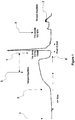
- the figure 1 illustrates a chromatographic profile of recombinant human FVII produced in rabbit milk, with continuous monitoring of absorbance (OD) values at 254 nanometers.
- the inflection (2) of the absorption curve after the moment of the injection (1) illustrates the beginning of the saturation of the affinity support with the recombinant human FVII.
- time (3) the injection of recombinant human FVII is stopped.
- duration between the injection start time (1) and the end of injection time (2) is 10 minutes.
- the affinity support continues to saturate with the coagulation protein of interest: complexes between (i) the anti-FVII nucleic aptamers of the affinity support and (ii) the recombinant human FVII molecules initially contained in the composition to be purified have been formed.
- a washing step (6) of the column is carried out with the washing buffer specified above. Then the elution step is carried out by injection at the time (4) of the buffer solution comprising a final concentration of 10 mM EDTA.
- the absorption peak illustrates the release of recombinant human FVII from recombinant nucleic Aptamer / FVII complexes. It is noted that the recombinant human FVII molecules are released rapidly and therefore in a small volume. As a result, thanks to the affinity support, a high concentration elution solution of recombinant human FVII protein is obtained.
- a step of regeneration of the affinity support was carried out with a 50 mM Tris buffer.
- the visible absorbance peak in (7) corresponds to the substances released from the affinity support because of the regeneration step.
- Table 1 presents the results of the test, which show a dynamic adsorption capacity of 0.45 to 0.49 mg / ml of the affinity matrices, ie 50 to 55% of bio-available ligands.
- the affinity supports were evaluated for specificity by a specific ELISA assay for rabbit milk proteins.
- Example 2 illustrate the excellent characteristics of the Aptamer-Agarose (Apta-2) gel affinity carriers with a dynamic adsorption capacity of at least 1 mg of FVII per mg of ligand with a yield of elution of at least 75%. Specificity is also well established with a clear improvement in purity ( ⁇ 99.95%), elimination of 2 log 10 of residual rabbit milk protein RMPs. The final rate is about 500 ppm on these 2 non-optimized trials.
- the aptamer is directly attached to the chromatographic support material by a chemical coupling reaction.
- the aptamer used is the sequence aptamer SEQ ID No. 101
- the starting material consists of a composition enriched in Factor IX derived from human plasma, which is marketed by LFB under the name Betafact®.
- Raw material injected Betafact MPVP (plasma FIX at 60% purity), 200 IU load (ie 800 ⁇ g) of factor IX per ml of gel, contact time 10 minutes.
- Protein peaks are detected by measuring the absorbance value at the wavelength of 280 nanometers.
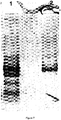
- NOVEX gels (Invitrogen) 10 wells, 4-12%, Bis-Tris; MES migration buffer, migration to 200V for 50min. CBB (G250) or AgNO3 (GE kit) staining
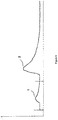
- the Figure 2 represents the curve of the measured values of the absorbance at 280 nm as a function of time.
- peak No. 1 corresponds to the fraction of the starting product which has not been retained on the column.
- Peak No. 2 corresponds to the elution fraction.
- Peak No. 3 corresponds to the desorbed fraction of the support by the implementation of the regeneration step.
- Table 3 summarizes the percentages of purity of FIX obtained by integration of the electrophoretic profile in the different fractions.
- The% FIX is calculated according to a procedure well known to those skilled in the art, by quantitative integration of the densities of the electrophoretic bands of the CBB-stained gel (numerical data corresponding to the figure 3 ).
- the quantitative integration of the densities of the electrophoretic bands can be obtained by scanning the gel with a suitable scanner.
- Example 4 Purification method of the recombinant factor IX contained in a transgenic sow milk extract
- the aptamer is directly attached to the chromatographic support material by a chemical coupling reaction.
- the aptamer used is the aptamer Mapt 1 of sequence SEQ ID No. 101
- the starting material consists of a clarified transgenic sow milk pre-purified on MEP HyperCel: 1.8% purity Sample dialysed against the adsorption buffer / equilibration of the resin to remove sodium citrate. Charge of 302 IU (ie 1200 ⁇ g) of factor IX per ml.
- the sample is injected at a flow rate of 0.1 ml / min for 10 min, the gel is then washed for 5 min at 0.5 ml / min. Elution and regeneration are carried out by injection of 2 ml of each of the buffers with a flow rate of 0.5 ml / min.
- Protein peaks are detected by measuring the absorbance value at the wavelength of 280 nanometers.
- the FIX enzymatic activity was measured by a chromogenic test with the Biophen FIX kit ref. 221802 (Hyphen BioMed) according to the supplier's recommendations.
- the specific activity is calculated by the following ratio: Enzymatic activity of FIX / Quantity of FIX
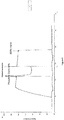
- the Figure 4 represents the curve of the measured values of the absorbance at 280 nm as a function of time.
- peak No. 1 corresponds to the fraction of the starting product which has not been retained on the column.
- Peak No. 2 corresponds to the elution fraction.
- Peak No. 3 corresponds to the desorbed fraction of the support by the implementation of the regeneration step.
- results of the example illustrate the important degree of enrichment in human factor IX which is obtained after passing the starting material of complex composition on the affinity chromatography support on which the Mapt 2 aptamer is immobilized.
- the eluate has a good electrophoretic purity with a high purity gain relative to the starting material (> 26 times).
- the second band identified in the eluate certainly corresponds to another form of FIX.
- the aptamer used is the Mapt-2 Core aptamer of sequence SEQ ID No. 20
- the starting material consists of a 98% purified human plasma factor VII composition.
- Protein peaks are detected by measuring the absorbance value at the wavelength of 280 nanometers.
- the Figure 6 represents the curve of the measured values of the absorbance at 280 nm as a function of time.
- peak No. 1 corresponds to the fraction of the starting product which has not been retained on the column.
- Peak No. 2 corresponds to the elution fraction.
- lane no. 1 corresponds to the fraction of the starting product and lane no. 2 to the elution fraction. Despite the high purity of the starting material, it is found that the eluted fraction no longer contains contaminant or degraded forms.
- the aptamer used is aptamer of sequence SEQ ID No. 86
- Protein peaks are detected by measuring the absorbance value at the wavelength of 280 nanometers.
- the fractions are analyzed for their amidolytic activity in chromogenic assay using a Stago kit according to the supplier's recommendations (Kit Factor VIIa StatClot).
- the amidolytic activity is then converted into ⁇ g of FVII contained in said fraction.
- a solid support was made on which molecules of the nucleic aptamer of sequence SEQ ID No. 86, also referred to herein as "Mapt2", were immobilized. Prior to its attachment to the solid support, the 5 'end of the aptamer Mapt2 was chemically coupled to a spacer chain consisting of 4 molecules of PEG (C18). Then, the free end of the spacer chain, opposite to the aptamer coupled end, was coupled to a biotin molecule.
- the solid support above was brought into contact with the above aptamer compounds in order to immobilize the nucleic acids of sequence SEQ ID No. 86, by non-covalent association between the streptavidin molecules of the support and the biotin aptamer compounds.
- the aptamer Mapt2 is thus immobilized with a immobilization rate of 3772 RU (1 RU corresponds to approximately 1 ⁇ g of immobilized product per mm 2 ).
- transgenic human FVII obtained from transgenic rabbit milk (FVII HPTG, purity: 98%) was diluted in running buffer (50 mM Tris, 50 mM NaCl, 10 mM CaCl 2 , 4 mM MgCl 2 , pH 7.4) in order to obtain a sample of concentration of 200mM in FVII.
- the sample was injected onto the chip (solid support) containing the aptaptin Mapt2 immobilized by a biotin-streptavidin interaction.
- buffers of increasing concentration of NaCl were injected onto the solid support (3 injection series ranging from 1 M NaCl to 3 M NaCl). All injections were performed with a flow rate of 30 ⁇ l / min for 60 sec after the injection.
- elution buffer (EDTA, 10 mM) was then injected for 75 sec with a flow rate of 30 ⁇ l / min to unhook the FVII HPTG from the aptamer.
- the binding curves of the immobilized aptamer Mapt2 to transgenic human FVII were calculated with the dedicated module of the software Biacore® control Software, version 1.2.
- Mapt2 aptamer binding results to human FVII determined that binding of Mapt2 aptamer to human FVII was not impaired by injection of NaCl-containing buffers.
- a solid support was made on which molecules of the nucleic aptamer of sequence SEQ ID No. 86, also referred to herein as "Mapt2", were immobilized. Prior to its attachment to the solid support, the 5 'end of the aptamer Mapt2 was chemically coupled to a spacer chain consisting of 4 molecules of PEG (C18). Then, the free end of the spacer chain, opposite to the aptamer coupled end, was coupled to a biotin molecule.
- the solid support above was brought into contact with the above aptamer compounds in order to immobilize the nucleic acids of sequence SEQ ID No. 86, by non-covalent association between the streptavidin molecules of the support and the biotin aptamer compounds.
- the aptamer Mapt2 is thus immobilized with a immobilization rate of 5319 RU (1 RU corresponds to approximately 1 ⁇ g of immobilized product per mm 2 ).
- transgenic human FVII obtained from transgenic rabbit milk (FVII HPTG, purity: 98%) was diluted in running buffer (50 mM Tris, 10 mM CaCl 2 , 4 mM MgCl 2 , pH 7.4) to obtain a sample of concentration 200mM FVII.
- the sample was injected onto the chip (solid support) containing the aptaptin Mapt2 immobilized by a biotin-streptavidin interaction. Then, a buffer containing 50% propylene glycol was injected onto the solid support. All injections were performed with a flow rate of 30 ⁇ l / min for 60 sec after the injection. After injection with the buffer containing 50% propylene glycol, elution buffer (EDTA, 10 mM) was then injected for 75 sec with a flow rate of 30 ⁇ l / min to unhook the FVII HPTG from the aptamer.
- EDTA elution buffer
- the binding curves of the immobilized aptamer Mapt2 to transgenic human FVII were calculated with the dedicated module of the software Biacore® control Software, version 1.2.
- Mapt2 aptamer binding results to human FVII determined that binding of Mapt2 aptamer to human FVII was not impaired by injection of the propylene glycol-containing buffer.
Landscapes
- Health & Medical Sciences (AREA)
- Chemical & Material Sciences (AREA)
- Life Sciences & Earth Sciences (AREA)
- Organic Chemistry (AREA)
- Genetics & Genomics (AREA)
- Engineering & Computer Science (AREA)
- Molecular Biology (AREA)
- Zoology (AREA)
- General Health & Medical Sciences (AREA)
- Biomedical Technology (AREA)
- Biochemistry (AREA)
- Bioinformatics & Cheminformatics (AREA)
- Medicinal Chemistry (AREA)
- Biophysics (AREA)
- Wood Science & Technology (AREA)
- Biotechnology (AREA)
- General Engineering & Computer Science (AREA)
- Proteomics, Peptides & Aminoacids (AREA)
- Hematology (AREA)
- Microbiology (AREA)
- Analytical Chemistry (AREA)
- Toxicology (AREA)
- Gastroenterology & Hepatology (AREA)
- Physics & Mathematics (AREA)
- Plant Pathology (AREA)
- Diabetes (AREA)
- Chemical Kinetics & Catalysis (AREA)
- General Chemical & Material Sciences (AREA)
- Nuclear Medicine, Radiotherapy & Molecular Imaging (AREA)
- Pharmacology & Pharmacy (AREA)
- Animal Behavior & Ethology (AREA)
- Public Health (AREA)
- Veterinary Medicine (AREA)
- Peptides Or Proteins (AREA)
- Medicines That Contain Protein Lipid Enzymes And Other Medicines (AREA)
- Medicines Containing Material From Animals Or Micro-Organisms (AREA)
- Solid-Sorbent Or Filter-Aiding Compositions (AREA)
Claims (16)
- Verfahren zur Reinigung eines rekombinanten humanen Plasmaproteins aus einem Ausgangsmedium, das eine biologische Lösung ist, die von einem für besagtes humanes Plasmaprotein transgenen nicht-humanen Tier stammt, umfassend die folgenden Schritte:a) Inkontaktbringen einer das humane Plasmaprotein enthaltenden Probe mit einem Affinitätsträger, umfassend einen festen Träger, auf dem Desoxyribonukleinsäure-Aptamere immobilisiert sind, die spezifisch besagtes humanes Plasmaprotein binden, um Komplexe zwischen (i) den Nukleinsäure-Aptameren, die auf besagtem Affinitätsträger immobilisiert sind, und (ii) besagtem humanen Plasmaprotein zu bilden, undb) Freisetzen des Proteins aus den in Schritt a) gebildeten Komplexen, undc) Wiedergewinnen besagten humanen Plasmaproteins in einer gereinigten Form.
- Verfahren gemäß Anspruch 1, dadurch gekennzeichnet, dass es einen Schritt a') umfasst, in dem besagter Affinitätsträger mit einem Waschpuffer gewaschen wird.
- Verfahren gemäß Anspruch 2, wobei der Waschpuffer ausgewählt ist aus:- einer Pufferlösung, umfassend eine NaCl-Endkonzentration von wenigstens 1 M, und- einer Pufferlösung mit einem Endpropylengehalt von wenigstens 20% (v/v).
- Verfahren gemäß einem der Ansprüche 1 bis 3, dadurch gekennzeichnet, dass die biologische Lösung ein nicht-humanes Blutplasmaprotein umfasst, das zu besagtem humanen Blutplasmaprotein homolog ist.
- Verfahren gemäß Anspruch 4, dadurch gekennzeichnet, dass besagtes humanes Blutplasmaprotein zu besagtem nicht-humanen Plasmaprotein homolog ist.
- Verfahren gemäß einem der Ansprüche 1 bis 5, dadurch gekennzeichnet, dass der Schritt b) durch Inkontaktbringen des Affinitätsträgers mit einem Elutionspuffer durchgeführt wird, der einen Chelatbildner für zweiwertige Ionen enthält.
- Verfahren gemäß Anspruch 6, dadurch gekennzeichnet, dass der Chelatbildner für zweiwertige Ionen EDTA ist.
- Verfahren gemäß Anspruch 7, wobei der Elutionspuffer eine EDTA-Konzentration von wenigstens 1 mM und höchstens 30 mM besitzt.
- Verfahren gemäß einem der Ansprüche 1 bis 8, wobei das Ausgangsmedium eine Körperflüssigkeit eines für besagtes humanes Plasmaprotein transgenen nicht-humanen Säugetiers ist.
- Verfahren gemäß Anspruch 9, wobei besagte Körperflüssigkeit eine Milch oder eine Milchfraktion besagten transgenen nicht-humanen Säugetiers ist.
- Verfahren gemäß einem der Ansprüche 1 bis 10, wobei das humane Plasmaprotein ein Koagulationsprotein ist, ausgewählt aus der Gruppe, bestehend aus Albumin, alpha-Makroglobulin, Antichymotrypsin, Antithrombin, Antitrypsin, Apo A, Apo B, Apo C, Apo D, Apo E, Apo F, Apo G, beta-XIIa, C1-Hemmer, C-reaktivem Protein, C7, C1r, C1s, C2, C3, C4, C4bP, C5, C6, C1q, C8, C9, Carboxypeptidase N, Caeruloplasmin, Faktor B, Faktor D, Faktor H, Faktor I, Faktor IX, Faktor V, Faktor VII, Faktor Vlla, Faktor VIII, Faktor X, Faktor XI, Faktor XII, Faktor XIII, Fibrinogen, Fibronectin, Haptoglobin, Hämopexin, Heparin-Cofaktor II, Histidinreichem GP, IgA, IgD, IgE, IgG, ITI, IgM, Kinase II, hochmolekularem Kininogen, Lysozym, PAI 2, PAI 1, PCI, Plasmin, Plasmin-Hemmer, Plasminogen, Präalbumin, Präkallikrein, Properdin, Protease-Nexin PNI, Protein C, Protein S, Protein Z, Prothrombin, TFPI, Thiol-Protease, Thrombomodulin, Gewebe-Faktor (TF), TPA, Transcobalamin II, Transcortin, Transferrin, Vitronectin und von-Willebrand-Faktor.
- Verfahren gemäß einem der Ansprüche 1 bis 11, wobei das humane Plasmaprotein ein Koagulationsprotein mit enzymatischer Aktivität ist.
- Verfahren gemäß einem der Ansprüche 1 bis 12, wobei der feste Träger des Affinitätsträgers ein Harz für eine Affinitätschromatographie-Säule ist.
- Verfahren gemäß einem der Ansprüche 1 bis 13, wobei besagte Desoxyribonukleinsäure-Aptamere in der Struktur einer Verbindung folgender Formel (I) enthalten sind
[FIX]x-[SPAC]y-[APT] (I),
in der:- [FIX] eine Verbindung zur Immobilisierung auf einem Träger bedeutet,- [SPAC] eine Spacer-Kette bedeutet,- [APT] eine Desoxyribonukleinsäure bedeutet, die spezifisch ein Plasmaprotein bindet und auch als Desoxyribonukleinsäure-Aptamer bezeichnet wird,- x eine ganze Zahl gleich 0 oder 1 ist, und- y eine ganze Zahl gleich 0 oder 1 ist. - Verfahren gemäß einem der Ansprüche 4 bis 14, wobei das Desoxyribonukleinsäure-Aptamer dadurch gekennzeichnet ist, dass:
Kd human/Kd nicht-human < 0,01, wo- "Kd human" die Dissoziationskonstante besagten Aptamers für besagtes humanes Plasmaprotein, ausgedrückt in molaren Einheiten, ist, und- "Kd nicht-human" die Dissoziationskonstante besagten Aptamers für besagtes nicht-humanes homologes Protein, ausgedrückt in denselben molaren Einheiten, ist. - Verfahren gemäß einem der Ansprüche 1 bis 15, wobei das in Schritt c) in gereinigter Form erhaltene humane Plasmaprotein in Flaschen direkt abgefüllt wird, gegebenenfalls nach Verdünnung mit einer geeigneten Lösung oder Lyophilisation.
Priority Applications (1)
| Application Number | Priority Date | Filing Date | Title |
|---|---|---|---|
| PL10709893T PL2398818T3 (pl) | 2009-02-19 | 2010-02-19 | Środki do oczyszczania białka z osocza krwi i sposoby ich realizacji |
Applications Claiming Priority (2)
| Application Number | Priority Date | Filing Date | Title |
|---|---|---|---|
| FR0951083A FR2942233B1 (fr) | 2009-02-19 | 2009-02-19 | Moyens pour la purification d'une proteine du plasma sanguin, et procedes pour sa mise en oeuvre |
| PCT/FR2010/050294 WO2010094901A1 (fr) | 2009-02-19 | 2010-02-19 | Moyens pour la purification d'une proteine du plasma sanguin, et procedes pour sa mise en œuvre |
Publications (2)
| Publication Number | Publication Date |
|---|---|
| EP2398818A1 EP2398818A1 (de) | 2011-12-28 |
| EP2398818B1 true EP2398818B1 (de) | 2018-08-29 |
Family
ID=41319742
Family Applications (1)
| Application Number | Title | Priority Date | Filing Date |
|---|---|---|---|
| EP10709893.1A Not-in-force EP2398818B1 (de) | 2009-02-19 | 2010-02-19 | Mittel zur aufreinigung eines proteins aus blutplasma und verfahren zu dessen einsatz |
Country Status (14)
| Country | Link |
|---|---|
| US (1) | US9534012B2 (de) |
| EP (1) | EP2398818B1 (de) |
| JP (2) | JP6129473B2 (de) |
| KR (1) | KR101713761B1 (de) |
| CN (1) | CN102405228B (de) |
| AU (1) | AU2010215304B2 (de) |
| BR (1) | BRPI1008044A8 (de) |
| CA (1) | CA2753172A1 (de) |
| DK (1) | DK2398818T3 (de) |
| ES (1) | ES2700225T3 (de) |
| FR (1) | FR2942233B1 (de) |
| IL (1) | IL214567A (de) |
| PL (1) | PL2398818T3 (de) |
| WO (1) | WO2010094901A1 (de) |
Families Citing this family (26)
| Publication number | Priority date | Publication date | Assignee | Title |
|---|---|---|---|---|
| FR2948665B1 (fr) * | 2009-07-31 | 2011-09-23 | Lfb Biotechnologies | Procede pour la purification de proteines de la coagulation a domaine gla actives |
| FR2948664B1 (fr) * | 2009-07-31 | 2013-11-01 | Lfb Biotechnologies | Procede pour la purification de proteines de la coagulation a domaine gla |
| FR2983212A1 (fr) * | 2011-11-28 | 2013-05-31 | Lfb Biotechnologies | Aptameres anti-fh, procede pour leur obtention et utilisations |
| EP2687595B1 (de) * | 2012-07-19 | 2018-05-30 | Laboratoire Français du Fractionnement et des Biotechnologies | Verfahren zur Reinigung eines transgenen Faktor VII |
| US9534029B2 (en) | 2012-10-03 | 2017-01-03 | Csl Behring Ag | Method of purifying proteins |
| EP2904005A1 (de) * | 2012-10-03 | 2015-08-12 | CSL Behring LLC | Verfahren zur reinigung von proteinen |
| WO2014113712A1 (en) | 2013-01-20 | 2014-07-24 | Dyax Corp. | Evaluation and treatment of bradykinin-mediated disorders |
| CN105263960B (zh) | 2013-04-18 | 2020-05-22 | 国家医疗保健研究所 | 具有降低的免疫原性的组合物 |
| EP2821076A1 (de) | 2013-07-02 | 2015-01-07 | Stallergenes Sa | C1q als Therapeutikum von Allergien und/oder Asthma |
| PL3060908T3 (pl) | 2013-10-21 | 2021-10-25 | Takeda Pharmaceutical Company Limited | Diagnoza i leczenie chorób autoimmunologicznych |
| KR20250066486A (ko) | 2013-10-21 | 2025-05-13 | 다케다 파머수티컬 컴패니 리미티드 | 혈장 칼리크레인 시스템 바이오마커를 결정하기 위한 검정법 |
| WO2015066080A2 (en) * | 2013-10-28 | 2015-05-07 | The Regents Of The University Of California | Lipid co-factor essential for cell density signaling |
| FR3018450B1 (fr) * | 2014-03-11 | 2016-04-15 | Lab Francais Du Fractionnement | Procede de preparation de proteines plasmatiques humaines |
| EP2974741A1 (de) | 2014-07-16 | 2016-01-20 | Stallergenes | Zusammensetzung von Allergenextrakten mit verminderter Toxizität und Verfahren zur Herstellung davon |
| EA201790558A1 (ru) | 2014-10-15 | 2017-08-31 | Ксенотера | Композиция с пониженной иммуногенностью |
| GB201506113D0 (en) | 2015-04-10 | 2015-05-27 | Ge Healthcare Bio Sciences Ab | Method for chromatography |
| GB201506117D0 (en) | 2015-04-10 | 2015-05-27 | Ge Healthcare Bio Sciences Ab | Method for chromatography |
| CA3002747A1 (en) * | 2015-10-19 | 2017-04-27 | Dyax Corp. | Immunoassay to detect cleaved high molecular weight kininogen |
| EP4293116A3 (de) | 2016-07-06 | 2024-01-24 | Laboratoire Français du Fractionnement et des Biotechnologies | Stabiles flüssiges fibrinogen |
| CA3031390A1 (en) * | 2016-07-28 | 2018-02-01 | Laboratoire Francais Du Fractionnement Et Des Biotechnologies | Anti- immunoglobulin g aptamers and uses thereof |
| CN106148465B (zh) * | 2016-08-09 | 2020-02-14 | 广东海洋大学 | 一种具有抗氧化活性的鲎血浆蛋白水解肽及其制备方法和应用 |
| EP3506915B1 (de) | 2016-09-01 | 2024-03-06 | Plas-Free Ltd | Aus menschlichem blut gewonnene produkte mit verringerter fibrinolytischer aktivität und verwendungen davon in hämostatischen störungen |
| EP3867262A1 (de) * | 2018-10-17 | 2021-08-25 | CSL Behring GmbH | Verfahren zur reinigung von c1-inh |
| WO2020221723A1 (en) | 2019-04-30 | 2020-11-05 | Xenothera | Association of polyclonal antibodies and anti-pd1 or anti-pdl1 antibodies for the treatment of cancer |
| GB201906595D0 (en) * | 2019-05-10 | 2019-06-26 | Ge Healthcare Bioprocess R&D Ab | Method for purification of plasma proteins |
| CN111000974B (zh) * | 2020-02-24 | 2021-07-27 | 重庆大学 | 一种兔奶活性小肽溶液及其提取方法和应用 |
Family Cites Families (11)
| Publication number | Priority date | Publication date | Assignee | Title |
|---|---|---|---|---|
| US5440018A (en) | 1992-05-20 | 1995-08-08 | The Green Cross Corporation | Recombinant human serum albumin, process for producing the same and pharmaceutical preparation containing the same |
| JP3508149B2 (ja) * | 1993-02-25 | 2004-03-22 | 三菱ウェルファーマ株式会社 | ヒト血清アルブミンおよびその製造方法 |
| JP2869417B2 (ja) * | 1992-09-22 | 1999-03-10 | 吉富製薬株式会社 | 遺伝子操作により得られるヒト血清アルブミン |
| US5521287A (en) | 1992-05-20 | 1996-05-28 | The Green Cross Corporation | Recombinant human serum albumin, process for producing the same and pharmaceutical preparation containing the same |
| CA2116385A1 (en) | 1993-02-25 | 1994-08-26 | Akinori Sumi | Human serum albumin and process for producing the same |
| US6117996A (en) * | 1995-09-20 | 2000-09-12 | Novo Nordisk A/S | Triazine based ligands and use thereof |
| EP2351855A1 (de) * | 2000-09-26 | 2011-08-03 | Duke University | RNA-Aptamere und Verfahren zu ihrer Identifizierung |
| AU2005277190B2 (en) * | 2004-08-20 | 2011-03-03 | American National Red Cross | Sequential protein isolation and purification schemes by affinity chromatography |
| US8367627B2 (en) * | 2005-09-15 | 2013-02-05 | Duke University | Focused libraries, functional profiling, laser SELEX, and DESELEX |
| WO2007058592A1 (en) * | 2005-11-21 | 2007-05-24 | Ge Healthcare Bio-Sciences Ab | A method of chromatography using semi-synthetic heparin ligands |
| FR2910786B1 (fr) * | 2006-12-29 | 2017-08-11 | Laboratoire Francais Du Fractionnement Et Des Biotechnologies (Lfb) | "procede d'extraction d'une proteine presente dans du lait" |
-
2009
- 2009-02-19 FR FR0951083A patent/FR2942233B1/fr not_active Expired - Fee Related
-
2010
- 2010-02-19 JP JP2011550637A patent/JP6129473B2/ja active Active
- 2010-02-19 WO PCT/FR2010/050294 patent/WO2010094901A1/fr not_active Ceased
- 2010-02-19 BR BRPI1008044A patent/BRPI1008044A8/pt not_active IP Right Cessation
- 2010-02-19 DK DK10709893.1T patent/DK2398818T3/da active
- 2010-02-19 AU AU2010215304A patent/AU2010215304B2/en not_active Ceased
- 2010-02-19 EP EP10709893.1A patent/EP2398818B1/de not_active Not-in-force
- 2010-02-19 KR KR1020117019398A patent/KR101713761B1/ko not_active Expired - Fee Related
- 2010-02-19 ES ES10709893T patent/ES2700225T3/es active Active
- 2010-02-19 PL PL10709893T patent/PL2398818T3/pl unknown
- 2010-02-19 CA CA2753172A patent/CA2753172A1/fr not_active Abandoned
- 2010-02-19 US US13/201,690 patent/US9534012B2/en not_active Expired - Fee Related
- 2010-02-19 CN CN201080017044.5A patent/CN102405228B/zh not_active Expired - Fee Related
-
2011
- 2011-08-09 IL IL214567A patent/IL214567A/en not_active IP Right Cessation
-
2015
- 2015-08-05 JP JP2015154743A patent/JP2016028027A/ja active Pending
Non-Patent Citations (4)
| Title |
|---|
| MICHAUD M ET AL: "A DNA aptamer as a new target-specific chiral selector for HPLC", JOURNAL OF THE AMERICAN CHEMICAL SOCIETY, AMERICAN CHEMICAL SOCIETY, US, vol. 125, no. 28, 16 July 2003 (2003-07-16), pages 8672 - 8679, XP002364016, ISSN: 0002-7863, DOI: 10.1021/JA034483T * |
| MIYAKAWA SHIN ET AL: "Structural and molecular basis for hyperspecificity of RNA aptamer to human immunoglobulin G", RNA, COLD SPRING HARBOR LABORATORY PRESS, US, vol. 14, no. 6, 1 June 2008 (2008-06-01), pages 1154 - 1163, XP002532239, ISSN: 1355-8382, DOI: 10.1261/RNA.1005808 * |
| ROMIG T S ET AL: "Aptamer affinity chromatography: - combinatorial chemistry applied to protein purification", JOURNAL OF CHROMATOGRAPHY B: BIOMEDICAL SCIENCES AND APPLICATIONS, ELSEVIER SCIENCE PUBLISHERS, NL, vol. 731, no. 2, 27 August 1999 (1999-08-27), pages 275 - 284, XP004179577, ISSN: 0378-4347, DOI: 10.1016/S0378-4347(99)00243-1 * |
| ZHAO Q ET AL: "Aptamer-Modified Monolithic Capillary Chromatography for Protein Separation and Detection", ANALYTICAL CHEMISTRY, AMERICAN CHEMICAL SOCIETY, US, vol. 80, no. 10, 15 May 2008 (2008-05-15), pages 3915 - 3920, XP002574911, ISSN: 0003-2700, [retrieved on 20080326], DOI: 10.1021/AC702567X * |
Also Published As
| Publication number | Publication date |
|---|---|
| EP2398818A1 (de) | 2011-12-28 |
| CA2753172A1 (fr) | 2010-08-26 |
| AU2010215304A1 (en) | 2011-09-08 |
| CN102405228B (zh) | 2016-08-24 |
| JP2016028027A (ja) | 2016-02-25 |
| PL2398818T3 (pl) | 2019-02-28 |
| DK2398818T3 (da) | 2019-01-02 |
| AU2010215304B2 (en) | 2015-08-13 |
| JP6129473B2 (ja) | 2017-05-17 |
| IL214567A (en) | 2016-12-29 |
| KR101713761B1 (ko) | 2017-03-08 |
| BRPI1008044A2 (pt) | 2016-05-03 |
| CN102405228A (zh) | 2012-04-04 |
| JP2012518033A (ja) | 2012-08-09 |
| US9534012B2 (en) | 2017-01-03 |
| FR2942233A1 (fr) | 2010-08-20 |
| FR2942233B1 (fr) | 2015-03-13 |
| WO2010094901A1 (fr) | 2010-08-26 |
| BRPI1008044A8 (pt) | 2018-04-03 |
| IL214567A0 (en) | 2011-09-27 |
| US20120122179A1 (en) | 2012-05-17 |
| KR20110139199A (ko) | 2011-12-28 |
| ES2700225T3 (es) | 2019-02-14 |
Similar Documents
| Publication | Publication Date | Title |
|---|---|---|
| EP2398818A1 (de) | Mittel zur aufreinigung eines proteins aus blutplasma und verfahren zu dessen einsatz | |
| EP2398904A1 (de) | Mittel zur reinigung eines gerinnungsproteins und verfahren zu seiner anwendung | |
| EP2178901B1 (de) | Verfahren zur reinigung oder zum nachweis eines zielproteins | |
| JP2012518033A5 (de) | ||
| CA2771850C (fr) | Procede pour la purification de proteines de la coagulation a domaine gla actives | |
| EP2459718B1 (de) | Verfahren zur reinigung von gla-domäne-koagulationsproteinen | |
| EP2785841B1 (de) | Anti-fh aptamere, herstellungsverfahren dafür und verwendungen davon | |
| EP2398816A1 (de) | Spezifisch an den humanen faktor vii/viia bindende nukleinsäuren und anwendungen davon | |
| WO2015044923A9 (fr) | Acides nucleiques se liant specifiquement au facteur ix/ixa humain, et leurs utilisations |
Legal Events
| Date | Code | Title | Description |
|---|---|---|---|
| PUAI | Public reference made under article 153(3) epc to a published international application that has entered the european phase |
Free format text: ORIGINAL CODE: 0009012 |
|
| 17P | Request for examination filed |
Effective date: 20110818 |
|
| AK | Designated contracting states |
Kind code of ref document: A1 Designated state(s): AT BE BG CH CY CZ DE DK EE ES FI FR GB GR HR HU IE IS IT LI LT LU LV MC MK MT NL NO PL PT RO SE SI SK SM TR |
|
| DAX | Request for extension of the european patent (deleted) | ||
| RAP1 | Party data changed (applicant data changed or rights of an application transferred) |
Owner name: LABORATOIRE FRANCAIS DU FRACTIONNEMENT ET DES BIOT |
|
| TPAC | Observations filed by third parties |
Free format text: ORIGINAL CODE: EPIDOSNTIPA |
|
| 17Q | First examination report despatched |
Effective date: 20150724 |
|
| TPAC | Observations filed by third parties |
Free format text: ORIGINAL CODE: EPIDOSNTIPA |
|
| STAA | Information on the status of an ep patent application or granted ep patent |
Free format text: STATUS: EXAMINATION IS IN PROGRESS |
|
| GRAP | Despatch of communication of intention to grant a patent |
Free format text: ORIGINAL CODE: EPIDOSNIGR1 |
|
| STAA | Information on the status of an ep patent application or granted ep patent |
Free format text: STATUS: GRANT OF PATENT IS INTENDED |
|
| RIC1 | Information provided on ipc code assigned before grant |
Ipc: C07K 1/22 20060101AFI20180227BHEP Ipc: C07K 16/00 20060101ALI20180227BHEP Ipc: C07K 14/765 20060101ALI20180227BHEP Ipc: C07K 14/745 20060101ALI20180227BHEP Ipc: C07K 14/78 20060101ALI20180227BHEP Ipc: C12N 15/115 20100101ALI20180227BHEP Ipc: C07K 14/81 20060101ALI20180227BHEP Ipc: C07K 14/755 20060101ALI20180227BHEP Ipc: C12N 9/64 20060101ALI20180227BHEP |
|
| INTG | Intention to grant announced |
Effective date: 20180403 |
|
| GRAS | Grant fee paid |
Free format text: ORIGINAL CODE: EPIDOSNIGR3 |
|
| GRAA | (expected) grant |
Free format text: ORIGINAL CODE: 0009210 |
|
| STAA | Information on the status of an ep patent application or granted ep patent |
Free format text: STATUS: THE PATENT HAS BEEN GRANTED |
|
| AK | Designated contracting states |
Kind code of ref document: B1 Designated state(s): AT BE BG CH CY CZ DE DK EE ES FI FR GB GR HR HU IE IS IT LI LT LU LV MC MK MT NL NO PL PT RO SE SI SK SM TR |
|
| REG | Reference to a national code |
Ref country code: GB Ref legal event code: FG4D Free format text: NOT ENGLISH |
|
| REG | Reference to a national code |
Ref country code: CH Ref legal event code: EP |
|
| REG | Reference to a national code |
Ref country code: AT Ref legal event code: REF Ref document number: 1034998 Country of ref document: AT Kind code of ref document: T Effective date: 20180915 |
|
| REG | Reference to a national code |
Ref country code: IE Ref legal event code: FG4D Free format text: LANGUAGE OF EP DOCUMENT: FRENCH |
|
| REG | Reference to a national code |
Ref country code: DE Ref legal event code: R096 Ref document number: 602010053105 Country of ref document: DE |
|
| REG | Reference to a national code |
Ref country code: NL Ref legal event code: FP |
|
| REG | Reference to a national code |
Ref country code: SE Ref legal event code: TRGR |
|
| REG | Reference to a national code |
Ref country code: DK Ref legal event code: T3 Effective date: 20181217 |
|
| REG | Reference to a national code |
Ref country code: LT Ref legal event code: MG4D |
|
| PG25 | Lapsed in a contracting state [announced via postgrant information from national office to epo] |
Ref country code: BG Free format text: LAPSE BECAUSE OF FAILURE TO SUBMIT A TRANSLATION OF THE DESCRIPTION OR TO PAY THE FEE WITHIN THE PRESCRIBED TIME-LIMIT Effective date: 20181129 Ref country code: LT Free format text: LAPSE BECAUSE OF FAILURE TO SUBMIT A TRANSLATION OF THE DESCRIPTION OR TO PAY THE FEE WITHIN THE PRESCRIBED TIME-LIMIT Effective date: 20180829 Ref country code: GR Free format text: LAPSE BECAUSE OF FAILURE TO SUBMIT A TRANSLATION OF THE DESCRIPTION OR TO PAY THE FEE WITHIN THE PRESCRIBED TIME-LIMIT Effective date: 20181130 Ref country code: NO Free format text: LAPSE BECAUSE OF FAILURE TO SUBMIT A TRANSLATION OF THE DESCRIPTION OR TO PAY THE FEE WITHIN THE PRESCRIBED TIME-LIMIT Effective date: 20181129 Ref country code: IS Free format text: LAPSE BECAUSE OF FAILURE TO SUBMIT A TRANSLATION OF THE DESCRIPTION OR TO PAY THE FEE WITHIN THE PRESCRIBED TIME-LIMIT Effective date: 20181229 Ref country code: FI Free format text: LAPSE BECAUSE OF FAILURE TO SUBMIT A TRANSLATION OF THE DESCRIPTION OR TO PAY THE FEE WITHIN THE PRESCRIBED TIME-LIMIT Effective date: 20180829 |
|
| REG | Reference to a national code |
Ref country code: ES Ref legal event code: FG2A Ref document number: 2700225 Country of ref document: ES Kind code of ref document: T3 Effective date: 20190214 |
|
| PG25 | Lapsed in a contracting state [announced via postgrant information from national office to epo] |
Ref country code: HR Free format text: LAPSE BECAUSE OF FAILURE TO SUBMIT A TRANSLATION OF THE DESCRIPTION OR TO PAY THE FEE WITHIN THE PRESCRIBED TIME-LIMIT Effective date: 20180829 Ref country code: LV Free format text: LAPSE BECAUSE OF FAILURE TO SUBMIT A TRANSLATION OF THE DESCRIPTION OR TO PAY THE FEE WITHIN THE PRESCRIBED TIME-LIMIT Effective date: 20180829 |
|
| PG25 | Lapsed in a contracting state [announced via postgrant information from national office to epo] |
Ref country code: EE Free format text: LAPSE BECAUSE OF FAILURE TO SUBMIT A TRANSLATION OF THE DESCRIPTION OR TO PAY THE FEE WITHIN THE PRESCRIBED TIME-LIMIT Effective date: 20180829 Ref country code: RO Free format text: LAPSE BECAUSE OF FAILURE TO SUBMIT A TRANSLATION OF THE DESCRIPTION OR TO PAY THE FEE WITHIN THE PRESCRIBED TIME-LIMIT Effective date: 20180829 Ref country code: CZ Free format text: LAPSE BECAUSE OF FAILURE TO SUBMIT A TRANSLATION OF THE DESCRIPTION OR TO PAY THE FEE WITHIN THE PRESCRIBED TIME-LIMIT Effective date: 20180829 |
|
| PGFP | Annual fee paid to national office [announced via postgrant information from national office to epo] |
Ref country code: NL Payment date: 20190131 Year of fee payment: 10 |
|
| PG25 | Lapsed in a contracting state [announced via postgrant information from national office to epo] |
Ref country code: SK Free format text: LAPSE BECAUSE OF FAILURE TO SUBMIT A TRANSLATION OF THE DESCRIPTION OR TO PAY THE FEE WITHIN THE PRESCRIBED TIME-LIMIT Effective date: 20180829 Ref country code: SM Free format text: LAPSE BECAUSE OF FAILURE TO SUBMIT A TRANSLATION OF THE DESCRIPTION OR TO PAY THE FEE WITHIN THE PRESCRIBED TIME-LIMIT Effective date: 20180829 |
|
| PGFP | Annual fee paid to national office [announced via postgrant information from national office to epo] |
Ref country code: AT Payment date: 20190221 Year of fee payment: 10 Ref country code: DK Payment date: 20190227 Year of fee payment: 10 |
|
| REG | Reference to a national code |
Ref country code: DE Ref legal event code: R097 Ref document number: 602010053105 Country of ref document: DE |
|
| PLBE | No opposition filed within time limit |
Free format text: ORIGINAL CODE: 0009261 |
|
| STAA | Information on the status of an ep patent application or granted ep patent |
Free format text: STATUS: NO OPPOSITION FILED WITHIN TIME LIMIT |
|
| 26N | No opposition filed |
Effective date: 20190531 |
|
| PG25 | Lapsed in a contracting state [announced via postgrant information from national office to epo] |
Ref country code: SI Free format text: LAPSE BECAUSE OF FAILURE TO SUBMIT A TRANSLATION OF THE DESCRIPTION OR TO PAY THE FEE WITHIN THE PRESCRIBED TIME-LIMIT Effective date: 20180829 |
|
| PG25 | Lapsed in a contracting state [announced via postgrant information from national office to epo] |
Ref country code: LU Free format text: LAPSE BECAUSE OF NON-PAYMENT OF DUE FEES Effective date: 20190219 Ref country code: MC Free format text: LAPSE BECAUSE OF FAILURE TO SUBMIT A TRANSLATION OF THE DESCRIPTION OR TO PAY THE FEE WITHIN THE PRESCRIBED TIME-LIMIT Effective date: 20180829 |
|
| REG | Reference to a national code |
Ref country code: IE Ref legal event code: MM4A |
|
| REG | Reference to a national code |
Ref country code: AT Ref legal event code: UEP Ref document number: 1034998 Country of ref document: AT Kind code of ref document: T Effective date: 20180829 |
|
| PG25 | Lapsed in a contracting state [announced via postgrant information from national office to epo] |
Ref country code: IE Free format text: LAPSE BECAUSE OF NON-PAYMENT OF DUE FEES Effective date: 20190219 |
|
| PG25 | Lapsed in a contracting state [announced via postgrant information from national office to epo] |
Ref country code: MT Free format text: LAPSE BECAUSE OF FAILURE TO SUBMIT A TRANSLATION OF THE DESCRIPTION OR TO PAY THE FEE WITHIN THE PRESCRIBED TIME-LIMIT Effective date: 20180829 Ref country code: PT Free format text: LAPSE BECAUSE OF FAILURE TO SUBMIT A TRANSLATION OF THE DESCRIPTION OR TO PAY THE FEE WITHIN THE PRESCRIBED TIME-LIMIT Effective date: 20181229 |
|
| REG | Reference to a national code |
Ref country code: DK Ref legal event code: EBP Effective date: 20200229 |
|
| REG | Reference to a national code |
Ref country code: SE Ref legal event code: EUG |
|
| REG | Reference to a national code |
Ref country code: CH Ref legal event code: PL |
|
| REG | Reference to a national code |
Ref country code: NL Ref legal event code: MM Effective date: 20200301 |
|
| REG | Reference to a national code |
Ref country code: AT Ref legal event code: MM01 Ref document number: 1034998 Country of ref document: AT Kind code of ref document: T Effective date: 20200219 |
|
| PG25 | Lapsed in a contracting state [announced via postgrant information from national office to epo] |
Ref country code: SE Free format text: LAPSE BECAUSE OF NON-PAYMENT OF DUE FEES Effective date: 20200220 |
|
| PG25 | Lapsed in a contracting state [announced via postgrant information from national office to epo] |
Ref country code: AT Free format text: LAPSE BECAUSE OF NON-PAYMENT OF DUE FEES Effective date: 20200219 Ref country code: CH Free format text: LAPSE BECAUSE OF NON-PAYMENT OF DUE FEES Effective date: 20200229 Ref country code: LI Free format text: LAPSE BECAUSE OF NON-PAYMENT OF DUE FEES Effective date: 20200229 |
|
| PG25 | Lapsed in a contracting state [announced via postgrant information from national office to epo] |
Ref country code: NL Free format text: LAPSE BECAUSE OF NON-PAYMENT OF DUE FEES Effective date: 20200301 |
|
| PG25 | Lapsed in a contracting state [announced via postgrant information from national office to epo] |
Ref country code: DK Free format text: LAPSE BECAUSE OF NON-PAYMENT OF DUE FEES Effective date: 20200229 |
|
| PGFP | Annual fee paid to national office [announced via postgrant information from national office to epo] |
Ref country code: FR Payment date: 20210120 Year of fee payment: 12 Ref country code: IT Payment date: 20210120 Year of fee payment: 12 |
|
| PG25 | Lapsed in a contracting state [announced via postgrant information from national office to epo] |
Ref country code: CY Free format text: LAPSE BECAUSE OF FAILURE TO SUBMIT A TRANSLATION OF THE DESCRIPTION OR TO PAY THE FEE WITHIN THE PRESCRIBED TIME-LIMIT Effective date: 20180829 |
|
| PGFP | Annual fee paid to national office [announced via postgrant information from national office to epo] |
Ref country code: ES Payment date: 20210301 Year of fee payment: 12 Ref country code: GB Payment date: 20210120 Year of fee payment: 12 Ref country code: DE Payment date: 20210120 Year of fee payment: 12 Ref country code: BE Payment date: 20210125 Year of fee payment: 12 Ref country code: TR Payment date: 20210128 Year of fee payment: 12 |
|
| PG25 | Lapsed in a contracting state [announced via postgrant information from national office to epo] |
Ref country code: HU Free format text: LAPSE BECAUSE OF FAILURE TO SUBMIT A TRANSLATION OF THE DESCRIPTION OR TO PAY THE FEE WITHIN THE PRESCRIBED TIME-LIMIT; INVALID AB INITIO Effective date: 20100219 |
|
| PG25 | Lapsed in a contracting state [announced via postgrant information from national office to epo] |
Ref country code: PL Free format text: LAPSE BECAUSE OF NON-PAYMENT OF DUE FEES Effective date: 20200219 |
|
| PG25 | Lapsed in a contracting state [announced via postgrant information from national office to epo] |
Ref country code: MK Free format text: LAPSE BECAUSE OF FAILURE TO SUBMIT A TRANSLATION OF THE DESCRIPTION OR TO PAY THE FEE WITHIN THE PRESCRIBED TIME-LIMIT Effective date: 20180829 |
|
| REG | Reference to a national code |
Ref country code: DE Ref legal event code: R119 Ref document number: 602010053105 Country of ref document: DE |
|
| REG | Reference to a national code |
Ref country code: BE Ref legal event code: MM Effective date: 20220228 |
|
| GBPC | Gb: european patent ceased through non-payment of renewal fee |
Effective date: 20220219 |
|
| PG25 | Lapsed in a contracting state [announced via postgrant information from national office to epo] |
Ref country code: FR Free format text: LAPSE BECAUSE OF NON-PAYMENT OF DUE FEES Effective date: 20220228 |
|
| PG25 | Lapsed in a contracting state [announced via postgrant information from national office to epo] |
Ref country code: GB Free format text: LAPSE BECAUSE OF NON-PAYMENT OF DUE FEES Effective date: 20220219 Ref country code: DE Free format text: LAPSE BECAUSE OF NON-PAYMENT OF DUE FEES Effective date: 20220901 |
|
| PG25 | Lapsed in a contracting state [announced via postgrant information from national office to epo] |
Ref country code: BE Free format text: LAPSE BECAUSE OF NON-PAYMENT OF DUE FEES Effective date: 20220228 |
|
| REG | Reference to a national code |
Ref country code: ES Ref legal event code: FD2A Effective date: 20230504 |
|
| PG25 | Lapsed in a contracting state [announced via postgrant information from national office to epo] |
Ref country code: IT Free format text: LAPSE BECAUSE OF NON-PAYMENT OF DUE FEES Effective date: 20220219 |
|
| PG25 | Lapsed in a contracting state [announced via postgrant information from national office to epo] |
Ref country code: ES Free format text: LAPSE BECAUSE OF NON-PAYMENT OF DUE FEES Effective date: 20220220 |
|
| PG25 | Lapsed in a contracting state [announced via postgrant information from national office to epo] |
Ref country code: TR Free format text: LAPSE BECAUSE OF NON-PAYMENT OF DUE FEES Effective date: 20220219 |