EP2393647B1 - Verfahren zur herstellung von formteilen aus einem polyoxymethylenpolymerisat - Google Patents
Verfahren zur herstellung von formteilen aus einem polyoxymethylenpolymerisat Download PDFInfo
- Publication number
- EP2393647B1 EP2393647B1 EP10702870.6A EP10702870A EP2393647B1 EP 2393647 B1 EP2393647 B1 EP 2393647B1 EP 10702870 A EP10702870 A EP 10702870A EP 2393647 B1 EP2393647 B1 EP 2393647B1
- Authority
- EP
- European Patent Office
- Prior art keywords
- process according
- temperature
- polyoxymethylene
- extruder
- polyoxymethylene polymer
- Prior art date
- Legal status (The legal status is an assumption and is not a legal conclusion. Google has not performed a legal analysis and makes no representation as to the accuracy of the status listed.)
- Not-in-force
Links
- 229920006324 polyoxymethylene Polymers 0.000 title claims description 39
- 238000004519 manufacturing process Methods 0.000 title claims description 13
- 238000000034 method Methods 0.000 claims description 38
- -1 polyoxymethylene Polymers 0.000 claims description 20
- 238000000465 moulding Methods 0.000 claims description 19
- 229930040373 Paraformaldehyde Natural products 0.000 claims description 17
- 238000000071 blow moulding Methods 0.000 claims description 17
- 239000007789 gas Substances 0.000 claims description 10
- 150000001875 compounds Chemical class 0.000 claims description 8
- 229920001577 copolymer Polymers 0.000 claims description 7
- 230000001588 bifunctional effect Effects 0.000 claims description 6
- 239000003431 cross linking reagent Substances 0.000 claims description 6
- 239000001257 hydrogen Substances 0.000 claims description 6
- 229910052739 hydrogen Inorganic materials 0.000 claims description 6
- 239000000155 melt Substances 0.000 claims description 6
- 239000001301 oxygen Substances 0.000 claims description 6
- 229910052760 oxygen Inorganic materials 0.000 claims description 6
- 238000003860 storage Methods 0.000 claims description 6
- UFHFLCQGNIYNRP-UHFFFAOYSA-N Hydrogen Chemical compound [H][H] UFHFLCQGNIYNRP-UHFFFAOYSA-N 0.000 claims description 5
- QVGXLLKOCUKJST-UHFFFAOYSA-N atomic oxygen Chemical compound [O] QVGXLLKOCUKJST-UHFFFAOYSA-N 0.000 claims description 5
- 239000000126 substance Substances 0.000 claims description 5
- 239000007787 solid Substances 0.000 claims description 4
- 125000004178 (C1-C4) alkyl group Chemical group 0.000 claims description 3
- 239000007788 liquid Substances 0.000 claims description 3
- 125000004406 C3-C8 cycloalkylene group Chemical group 0.000 claims description 2
- 125000004435 hydrogen atom Chemical group [H]* 0.000 claims description 2
- 239000008188 pellet Substances 0.000 claims 2
- 238000001125 extrusion Methods 0.000 claims 1
- 239000006072 paste Substances 0.000 claims 1
- WSFSSNUMVMOOMR-UHFFFAOYSA-N Formaldehyde Chemical compound O=C WSFSSNUMVMOOMR-UHFFFAOYSA-N 0.000 description 26
- 229920000642 polymer Polymers 0.000 description 14
- 239000008187 granular material Substances 0.000 description 13
- 238000002844 melting Methods 0.000 description 13
- 230000008018 melting Effects 0.000 description 13
- 239000000654 additive Substances 0.000 description 11
- 238000010438 heat treatment Methods 0.000 description 11
- 238000002156 mixing Methods 0.000 description 11
- 229920012196 Polyoxymethylene Copolymer Polymers 0.000 description 9
- 239000000203 mixture Substances 0.000 description 8
- BGJSXRVXTHVRSN-UHFFFAOYSA-N 1,3,5-trioxane Chemical compound C1OCOCO1 BGJSXRVXTHVRSN-UHFFFAOYSA-N 0.000 description 7
- LYCAIKOWRPUZTN-UHFFFAOYSA-N Ethylene glycol Chemical compound OCCO LYCAIKOWRPUZTN-UHFFFAOYSA-N 0.000 description 6
- PEDCQBHIVMGVHV-UHFFFAOYSA-N Glycerine Chemical compound OCC(O)CO PEDCQBHIVMGVHV-UHFFFAOYSA-N 0.000 description 6
- 150000004292 cyclic ethers Chemical class 0.000 description 5
- 238000007872 degassing Methods 0.000 description 5
- GPLRAVKSCUXZTP-UHFFFAOYSA-N diglycerol Chemical compound OCC(O)COCC(O)CO GPLRAVKSCUXZTP-UHFFFAOYSA-N 0.000 description 5
- 239000011265 semifinished product Substances 0.000 description 5
- 238000005496 tempering Methods 0.000 description 5
- 229920001169 thermoplastic Polymers 0.000 description 5
- 239000004416 thermosoftening plastic Substances 0.000 description 5
- 239000004971 Cross linker Substances 0.000 description 4
- 230000007423 decrease Effects 0.000 description 4
- 239000000463 material Substances 0.000 description 4
- 238000000926 separation method Methods 0.000 description 4
- XLYOFNOQVPJJNP-UHFFFAOYSA-N water Substances O XLYOFNOQVPJJNP-UHFFFAOYSA-N 0.000 description 4
- PUPZLCDOIYMWBV-UHFFFAOYSA-N (+/-)-1,3-Butanediol Chemical compound CC(O)CCO PUPZLCDOIYMWBV-UHFFFAOYSA-N 0.000 description 3
- IAYPIBMASNFSPL-UHFFFAOYSA-N Ethylene oxide Chemical compound C1CO1 IAYPIBMASNFSPL-UHFFFAOYSA-N 0.000 description 3
- 239000004952 Polyamide Substances 0.000 description 3
- 229920009382 Polyoxymethylene Homopolymer Polymers 0.000 description 3
- 150000001412 amines Chemical class 0.000 description 3
- 230000009172 bursting Effects 0.000 description 3
- 125000004432 carbon atom Chemical group C* 0.000 description 3
- 239000003054 catalyst Substances 0.000 description 3
- 125000004122 cyclic group Chemical group 0.000 description 3
- MTHSVFCYNBDYFN-UHFFFAOYSA-N diethylene glycol Chemical compound OCCOCCO MTHSVFCYNBDYFN-UHFFFAOYSA-N 0.000 description 3
- 229920001519 homopolymer Polymers 0.000 description 3
- DNIAPMSPPWPWGF-UHFFFAOYSA-N monopropylene glycol Natural products CC(O)CO DNIAPMSPPWPWGF-UHFFFAOYSA-N 0.000 description 3
- 229920002647 polyamide Polymers 0.000 description 3
- 230000005855 radiation Effects 0.000 description 3
- 150000005846 sugar alcohols Polymers 0.000 description 3
- FQERLIOIVXPZKH-UHFFFAOYSA-N 1,2,4-trioxane Chemical compound C1COOCO1 FQERLIOIVXPZKH-UHFFFAOYSA-N 0.000 description 2
- IJGRMHOSHXDMSA-UHFFFAOYSA-N Atomic nitrogen Chemical compound N#N IJGRMHOSHXDMSA-UHFFFAOYSA-N 0.000 description 2
- RTZKZFJDLAIYFH-UHFFFAOYSA-N Diethyl ether Chemical compound CCOCC RTZKZFJDLAIYFH-UHFFFAOYSA-N 0.000 description 2
- 229920009204 Methacrylate-butadiene-styrene Polymers 0.000 description 2
- 229920002873 Polyethylenimine Polymers 0.000 description 2
- PCSMJKASWLYICJ-UHFFFAOYSA-N Succinic aldehyde Chemical compound O=CCCC=O PCSMJKASWLYICJ-UHFFFAOYSA-N 0.000 description 2
- 230000000996 additive effect Effects 0.000 description 2
- 150000001408 amides Chemical class 0.000 description 2
- 239000003963 antioxidant agent Substances 0.000 description 2
- 230000004888 barrier function Effects 0.000 description 2
- WWNGFHNQODFIEX-UHFFFAOYSA-N buta-1,3-diene;methyl 2-methylprop-2-enoate;styrene Chemical compound C=CC=C.COC(=O)C(C)=C.C=CC1=CC=CC=C1 WWNGFHNQODFIEX-UHFFFAOYSA-N 0.000 description 2
- WERYXYBDKMZEQL-UHFFFAOYSA-N butane-1,4-diol Chemical compound OCCCCO WERYXYBDKMZEQL-UHFFFAOYSA-N 0.000 description 2
- 238000006243 chemical reaction Methods 0.000 description 2
- 239000000470 constituent Substances 0.000 description 2
- 238000001816 cooling Methods 0.000 description 2
- 230000003247 decreasing effect Effects 0.000 description 2
- GYZLOYUZLJXAJU-UHFFFAOYSA-N diglycidyl ether Chemical compound C1OC1COCC1CO1 GYZLOYUZLJXAJU-UHFFFAOYSA-N 0.000 description 2
- 230000000694 effects Effects 0.000 description 2
- 229920001971 elastomer Polymers 0.000 description 2
- 150000002148 esters Chemical class 0.000 description 2
- 235000013305 food Nutrition 0.000 description 2
- 239000000446 fuel Substances 0.000 description 2
- LEQAOMBKQFMDFZ-UHFFFAOYSA-N glyoxal Chemical compound O=CC=O LEQAOMBKQFMDFZ-UHFFFAOYSA-N 0.000 description 2
- 239000004611 light stabiliser Substances 0.000 description 2
- 125000001570 methylene group Chemical group [H]C([H])([*:1])[*:2] 0.000 description 2
- 239000000178 monomer Substances 0.000 description 2
- 239000002071 nanotube Substances 0.000 description 2
- 239000003921 oil Substances 0.000 description 2
- 125000005704 oxymethylene group Chemical group [H]C([H])([*:2])O[*:1] 0.000 description 2
- 238000006116 polymerization reaction Methods 0.000 description 2
- 229920002635 polyurethane Polymers 0.000 description 2
- 239000004814 polyurethane Substances 0.000 description 2
- 238000002360 preparation method Methods 0.000 description 2
- 238000012545 processing Methods 0.000 description 2
- 239000000047 product Substances 0.000 description 2
- YPFDHNVEDLHUCE-UHFFFAOYSA-N propane-1,3-diol Chemical compound OCCCO YPFDHNVEDLHUCE-UHFFFAOYSA-N 0.000 description 2
- 239000005060 rubber Substances 0.000 description 2
- NGCMLEQSKQCTAK-UHFFFAOYSA-N tetraoxane Chemical compound C1COOOO1 NGCMLEQSKQCTAK-UHFFFAOYSA-N 0.000 description 2
- 238000012546 transfer Methods 0.000 description 2
- DNIAPMSPPWPWGF-GSVOUGTGSA-N (R)-(-)-Propylene glycol Chemical compound C[C@@H](O)CO DNIAPMSPPWPWGF-GSVOUGTGSA-N 0.000 description 1
- RBACIKXCRWGCBB-UHFFFAOYSA-N 1,2-Epoxybutane Chemical compound CCC1CO1 RBACIKXCRWGCBB-UHFFFAOYSA-N 0.000 description 1
- VDFVNEFVBPFDSB-UHFFFAOYSA-N 1,3-dioxane Chemical compound C1COCOC1 VDFVNEFVBPFDSB-UHFFFAOYSA-N 0.000 description 1
- CZLMRJZAHXYRIX-UHFFFAOYSA-N 1,3-dioxepane Chemical compound C1CCOCOC1 CZLMRJZAHXYRIX-UHFFFAOYSA-N 0.000 description 1
- WNXJIVFYUVYPPR-UHFFFAOYSA-N 1,3-dioxolane Chemical compound C1COCO1 WNXJIVFYUVYPPR-UHFFFAOYSA-N 0.000 description 1
- RYHBNJHYFVUHQT-UHFFFAOYSA-N 1,4-Dioxane Chemical compound C1COCCO1 RYHBNJHYFVUHQT-UHFFFAOYSA-N 0.000 description 1
- BGCSUUSPRCDKBQ-UHFFFAOYSA-N 2,4,8,10-tetraoxaspiro[5.5]undecane Chemical compound C1OCOCC21COCOC2 BGCSUUSPRCDKBQ-UHFFFAOYSA-N 0.000 description 1
- WVRSKDLYHADNMN-UHFFFAOYSA-N 2-(1,3-dioxolan-2-ylmethoxymethyl)-1,3-dioxolane Chemical compound O1CCOC1COCC1OCCO1 WVRSKDLYHADNMN-UHFFFAOYSA-N 0.000 description 1
- FZIIBDOXPQOKBP-UHFFFAOYSA-N 2-methyloxetane Chemical compound CC1CCO1 FZIIBDOXPQOKBP-UHFFFAOYSA-N 0.000 description 1
- OOXMQACSWCZQLX-UHFFFAOYSA-N 3,9-bis(ethenyl)-2,4,8,10-tetraoxaspiro[5.5]undecane Chemical compound C1OC(C=C)OCC21COC(C=C)OC2 OOXMQACSWCZQLX-UHFFFAOYSA-N 0.000 description 1
- NIXOWILDQLNWCW-UHFFFAOYSA-M Acrylate Chemical compound [O-]C(=O)C=C NIXOWILDQLNWCW-UHFFFAOYSA-M 0.000 description 1
- 241000234671 Ananas Species 0.000 description 1
- 235000007119 Ananas comosus Nutrition 0.000 description 1
- ZETHHMPKDUSZQQ-UHFFFAOYSA-N Betulafolienepentol Natural products C1C=C(C)CCC(C(C)CCC=C(C)C)C2C(OC)OC(OC)C2=C1 ZETHHMPKDUSZQQ-UHFFFAOYSA-N 0.000 description 1
- FBPFZTCFMRRESA-FSIIMWSLSA-N D-Glucitol Natural products OC[C@H](O)[C@H](O)[C@@H](O)[C@H](O)CO FBPFZTCFMRRESA-FSIIMWSLSA-N 0.000 description 1
- FBPFZTCFMRRESA-JGWLITMVSA-N D-glucitol Chemical compound OC[C@H](O)[C@@H](O)[C@H](O)[C@H](O)CO FBPFZTCFMRRESA-JGWLITMVSA-N 0.000 description 1
- ZNZYKNKBJPZETN-WELNAUFTSA-N Dialdehyde 11678 Chemical compound N1C2=CC=CC=C2C2=C1[C@H](C[C@H](/C(=C/O)C(=O)OC)[C@@H](C=C)C=O)NCC2 ZNZYKNKBJPZETN-WELNAUFTSA-N 0.000 description 1
- MYMOFIZGZYHOMD-UHFFFAOYSA-N Dioxygen Chemical compound O=O MYMOFIZGZYHOMD-UHFFFAOYSA-N 0.000 description 1
- 229920002943 EPDM rubber Polymers 0.000 description 1
- 241000251729 Elasmobranchii Species 0.000 description 1
- VGGSQFUCUMXWEO-UHFFFAOYSA-N Ethene Chemical compound C=C VGGSQFUCUMXWEO-UHFFFAOYSA-N 0.000 description 1
- 239000005977 Ethylene Substances 0.000 description 1
- SXRSQZLOMIGNAQ-UHFFFAOYSA-N Glutaraldehyde Chemical compound O=CCCCC=O SXRSQZLOMIGNAQ-UHFFFAOYSA-N 0.000 description 1
- WSMYVTOQOOLQHP-UHFFFAOYSA-N Malondialdehyde Chemical compound O=CCC=O WSMYVTOQOOLQHP-UHFFFAOYSA-N 0.000 description 1
- 239000004594 Masterbatch (MB) Substances 0.000 description 1
- 229920000877 Melamine resin Polymers 0.000 description 1
- GOOHAUXETOMSMM-UHFFFAOYSA-N Propylene oxide Chemical compound CC1CO1 GOOHAUXETOMSMM-UHFFFAOYSA-N 0.000 description 1
- 239000004433 Thermoplastic polyurethane Substances 0.000 description 1
- ZJCCRDAZUWHFQH-UHFFFAOYSA-N Trimethylolpropane Chemical compound CCC(CO)(CO)CO ZJCCRDAZUWHFQH-UHFFFAOYSA-N 0.000 description 1
- 230000002378 acidificating effect Effects 0.000 description 1
- 150000001252 acrylic acid derivatives Chemical class 0.000 description 1
- 239000002318 adhesion promoter Substances 0.000 description 1
- 150000001298 alcohols Chemical class 0.000 description 1
- 150000007933 aliphatic carboxylic acids Chemical class 0.000 description 1
- 125000002947 alkylene group Chemical group 0.000 description 1
- 230000003078 antioxidant effect Effects 0.000 description 1
- 239000007864 aqueous solution Substances 0.000 description 1
- WPYMKLBDIGXBTP-UHFFFAOYSA-N benzoic acid Chemical compound OC(=O)C1=CC=CC=C1 WPYMKLBDIGXBTP-UHFFFAOYSA-N 0.000 description 1
- 150000001558 benzoic acid derivatives Chemical class 0.000 description 1
- 150000008366 benzophenones Chemical class 0.000 description 1
- 125000003354 benzotriazolyl group Chemical class N1N=NC2=C1C=CC=C2* 0.000 description 1
- 235000013361 beverage Nutrition 0.000 description 1
- 238000007664 blowing Methods 0.000 description 1
- KGBXLFKZBHKPEV-UHFFFAOYSA-N boric acid Chemical compound OB(O)O KGBXLFKZBHKPEV-UHFFFAOYSA-N 0.000 description 1
- 239000004327 boric acid Substances 0.000 description 1
- CDQSJQSWAWPGKG-UHFFFAOYSA-N butane-1,1-diol Chemical compound CCCC(O)O CDQSJQSWAWPGKG-UHFFFAOYSA-N 0.000 description 1
- BMRWNKZVCUKKSR-UHFFFAOYSA-N butane-1,2-diol Chemical compound CCC(O)CO BMRWNKZVCUKKSR-UHFFFAOYSA-N 0.000 description 1
- 229910052799 carbon Inorganic materials 0.000 description 1
- 230000015556 catabolic process Effects 0.000 description 1
- 239000004020 conductor Substances 0.000 description 1
- 239000000498 cooling water Substances 0.000 description 1
- STENYDAIMALDKF-UHFFFAOYSA-N cyclobutane-1,3-diol Chemical compound OC1CC(O)C1 STENYDAIMALDKF-UHFFFAOYSA-N 0.000 description 1
- VKONPUDBRVKQLM-UHFFFAOYSA-N cyclohexane-1,4-diol Chemical compound OC1CCC(O)CC1 VKONPUDBRVKQLM-UHFFFAOYSA-N 0.000 description 1
- 238000006731 degradation reaction Methods 0.000 description 1
- HEOKFDGOFROELJ-UHFFFAOYSA-N diacetal Natural products COc1ccc(C=C/c2cc(O)cc(OC3OC(COC(=O)c4cc(O)c(O)c(O)c4)C(O)C(O)C3O)c2)cc1O HEOKFDGOFROELJ-UHFFFAOYSA-N 0.000 description 1
- VYFOOXBIRRKSIH-DKXJUACHSA-N diethyl (2s,3s,4s,5r)-2,3,4,5-tetrahydroxyhexanedioate Chemical compound CCOC(=O)[C@@H](O)[C@@H](O)[C@H](O)[C@@H](O)C(=O)OCC VYFOOXBIRRKSIH-DKXJUACHSA-N 0.000 description 1
- 238000007599 discharging Methods 0.000 description 1
- 238000001035 drying Methods 0.000 description 1
- 239000000975 dye Substances 0.000 description 1
- 230000032050 esterification Effects 0.000 description 1
- 238000005886 esterification reaction Methods 0.000 description 1
- HQQADJVZYDDRJT-UHFFFAOYSA-N ethene;prop-1-ene Chemical group C=C.CC=C HQQADJVZYDDRJT-UHFFFAOYSA-N 0.000 description 1
- 238000006266 etherification reaction Methods 0.000 description 1
- 150000002170 ethers Chemical class 0.000 description 1
- 239000003925 fat Substances 0.000 description 1
- 239000000945 filler Substances 0.000 description 1
- 239000003063 flame retardant Substances 0.000 description 1
- 239000012530 fluid Substances 0.000 description 1
- 239000011888 foil Substances 0.000 description 1
- IVJISJACKSSFGE-UHFFFAOYSA-N formaldehyde;1,3,5-triazine-2,4,6-triamine Chemical compound O=C.NC1=NC(N)=NC(N)=N1 IVJISJACKSSFGE-UHFFFAOYSA-N 0.000 description 1
- 239000003365 glass fiber Substances 0.000 description 1
- 150000002315 glycerophosphates Chemical class 0.000 description 1
- 230000017525 heat dissipation Effects 0.000 description 1
- 238000000265 homogenisation Methods 0.000 description 1
- 239000010720 hydraulic oil Substances 0.000 description 1
- 150000002431 hydrogen Chemical class 0.000 description 1
- 125000002887 hydroxy group Chemical group [H]O* 0.000 description 1
- 239000011261 inert gas Substances 0.000 description 1
- 239000003999 initiator Substances 0.000 description 1
- 238000011089 mechanical engineering Methods 0.000 description 1
- WSFSSNUMVMOOMR-NJFSPNSNSA-N methanone Chemical compound O=[14CH2] WSFSSNUMVMOOMR-NJFSPNSNSA-N 0.000 description 1
- 239000012778 molding material Substances 0.000 description 1
- SYSQUGFVNFXIIT-UHFFFAOYSA-N n-[4-(1,3-benzoxazol-2-yl)phenyl]-4-nitrobenzenesulfonamide Chemical class C1=CC([N+](=O)[O-])=CC=C1S(=O)(=O)NC1=CC=C(C=2OC3=CC=CC=C3N=2)C=C1 SYSQUGFVNFXIIT-UHFFFAOYSA-N 0.000 description 1
- 229910052757 nitrogen Inorganic materials 0.000 description 1
- 229920002866 paraformaldehyde Polymers 0.000 description 1
- 235000011837 pasties Nutrition 0.000 description 1
- WXZMFSXDPGVJKK-UHFFFAOYSA-N pentaerythritol Chemical compound OCC(CO)(CO)CO WXZMFSXDPGVJKK-UHFFFAOYSA-N 0.000 description 1
- ISWSIDIOOBJBQZ-UHFFFAOYSA-N phenol group Chemical group C1(=CC=CC=C1)O ISWSIDIOOBJBQZ-UHFFFAOYSA-N 0.000 description 1
- 239000000049 pigment Substances 0.000 description 1
- 239000004033 plastic Substances 0.000 description 1
- 229920003023 plastic Polymers 0.000 description 1
- 239000004014 plasticizer Substances 0.000 description 1
- 229920003229 poly(methyl methacrylate) Polymers 0.000 description 1
- 239000004926 polymethyl methacrylate Substances 0.000 description 1
- 238000003825 pressing Methods 0.000 description 1
- 238000003672 processing method Methods 0.000 description 1
- QQONPFPTGQHPMA-UHFFFAOYSA-N propylene Natural products CC=C QQONPFPTGQHPMA-UHFFFAOYSA-N 0.000 description 1
- 235000013772 propylene glycol Nutrition 0.000 description 1
- 125000004805 propylene group Chemical group [H]C([H])([H])C([H])([*:1])C([H])([H])[*:2] 0.000 description 1
- 229920005989 resin Polymers 0.000 description 1
- 239000011347 resin Substances 0.000 description 1
- 238000007142 ring opening reaction Methods 0.000 description 1
- 229920006395 saturated elastomer Polymers 0.000 description 1
- 238000010008 shearing Methods 0.000 description 1
- 150000004760 silicates Chemical class 0.000 description 1
- 239000000243 solution Substances 0.000 description 1
- 239000000600 sorbitol Substances 0.000 description 1
- 238000003756 stirring Methods 0.000 description 1
- 239000000725 suspension Substances 0.000 description 1
- 239000000454 talc Substances 0.000 description 1
- 229910052623 talc Inorganic materials 0.000 description 1
- 238000012360 testing method Methods 0.000 description 1
- 229920002803 thermoplastic polyurethane Polymers 0.000 description 1
- 238000013022 venting Methods 0.000 description 1
- 229920002554 vinyl polymer Polymers 0.000 description 1
- 239000001993 wax Substances 0.000 description 1
- 239000010456 wollastonite Substances 0.000 description 1
- 229910052882 wollastonite Inorganic materials 0.000 description 1
- 239000010457 zeolite Substances 0.000 description 1
Classifications
-
- B—PERFORMING OPERATIONS; TRANSPORTING
- B29—WORKING OF PLASTICS; WORKING OF SUBSTANCES IN A PLASTIC STATE IN GENERAL
- B29C—SHAPING OR JOINING OF PLASTICS; SHAPING OF MATERIAL IN A PLASTIC STATE, NOT OTHERWISE PROVIDED FOR; AFTER-TREATMENT OF THE SHAPED PRODUCTS, e.g. REPAIRING
- B29C49/00—Blow-moulding, i.e. blowing a preform or parison to a desired shape within a mould; Apparatus therefor
- B29C49/0005—Blow-moulding, i.e. blowing a preform or parison to a desired shape within a mould; Apparatus therefor characterised by the material
-
- B—PERFORMING OPERATIONS; TRANSPORTING
- B29—WORKING OF PLASTICS; WORKING OF SUBSTANCES IN A PLASTIC STATE IN GENERAL
- B29C—SHAPING OR JOINING OF PLASTICS; SHAPING OF MATERIAL IN A PLASTIC STATE, NOT OTHERWISE PROVIDED FOR; AFTER-TREATMENT OF THE SHAPED PRODUCTS, e.g. REPAIRING
- B29C48/00—Extrusion moulding, i.e. expressing the moulding material through a die or nozzle which imparts the desired form; Apparatus therefor
- B29C48/03—Extrusion moulding, i.e. expressing the moulding material through a die or nozzle which imparts the desired form; Apparatus therefor characterised by the shape of the extruded material at extrusion
- B29C48/09—Articles with cross-sections having partially or fully enclosed cavities, e.g. pipes or channels
-
- B—PERFORMING OPERATIONS; TRANSPORTING
- B29—WORKING OF PLASTICS; WORKING OF SUBSTANCES IN A PLASTIC STATE IN GENERAL
- B29C—SHAPING OR JOINING OF PLASTICS; SHAPING OF MATERIAL IN A PLASTIC STATE, NOT OTHERWISE PROVIDED FOR; AFTER-TREATMENT OF THE SHAPED PRODUCTS, e.g. REPAIRING
- B29C48/00—Extrusion moulding, i.e. expressing the moulding material through a die or nozzle which imparts the desired form; Apparatus therefor
- B29C48/25—Component parts, details or accessories; Auxiliary operations
- B29C48/78—Thermal treatment of the extrusion moulding material or of preformed parts or layers, e.g. by heating or cooling
- B29C48/793—Thermal treatment of the extrusion moulding material or of preformed parts or layers, e.g. by heating or cooling upstream of the plasticising zone, e.g. heating in the hopper
-
- B—PERFORMING OPERATIONS; TRANSPORTING
- B29—WORKING OF PLASTICS; WORKING OF SUBSTANCES IN A PLASTIC STATE IN GENERAL
- B29C—SHAPING OR JOINING OF PLASTICS; SHAPING OF MATERIAL IN A PLASTIC STATE, NOT OTHERWISE PROVIDED FOR; AFTER-TREATMENT OF THE SHAPED PRODUCTS, e.g. REPAIRING
- B29C48/00—Extrusion moulding, i.e. expressing the moulding material through a die or nozzle which imparts the desired form; Apparatus therefor
- B29C48/25—Component parts, details or accessories; Auxiliary operations
- B29C48/78—Thermal treatment of the extrusion moulding material or of preformed parts or layers, e.g. by heating or cooling
- B29C48/875—Thermal treatment of the extrusion moulding material or of preformed parts or layers, e.g. by heating or cooling for achieving a non-uniform temperature distribution, e.g. using barrels having both cooling and heating zones
-
- B—PERFORMING OPERATIONS; TRANSPORTING
- B29—WORKING OF PLASTICS; WORKING OF SUBSTANCES IN A PLASTIC STATE IN GENERAL
- B29C—SHAPING OR JOINING OF PLASTICS; SHAPING OF MATERIAL IN A PLASTIC STATE, NOT OTHERWISE PROVIDED FOR; AFTER-TREATMENT OF THE SHAPED PRODUCTS, e.g. REPAIRING
- B29C49/00—Blow-moulding, i.e. blowing a preform or parison to a desired shape within a mould; Apparatus therefor
- B29C49/02—Combined blow-moulding and manufacture of the preform or the parison
- B29C49/04—Extrusion blow-moulding
-
- B—PERFORMING OPERATIONS; TRANSPORTING
- B29—WORKING OF PLASTICS; WORKING OF SUBSTANCES IN A PLASTIC STATE IN GENERAL
- B29C—SHAPING OR JOINING OF PLASTICS; SHAPING OF MATERIAL IN A PLASTIC STATE, NOT OTHERWISE PROVIDED FOR; AFTER-TREATMENT OF THE SHAPED PRODUCTS, e.g. REPAIRING
- B29C49/00—Blow-moulding, i.e. blowing a preform or parison to a desired shape within a mould; Apparatus therefor
- B29C49/42—Component parts, details or accessories; Auxiliary operations
- B29C49/78—Measuring, controlling or regulating
- B29C49/786—Temperature
- B29C2049/7861—Temperature of the preform
- B29C2049/7862—Temperature of the preform characterised by temperature values or ranges
-
- B—PERFORMING OPERATIONS; TRANSPORTING
- B29—WORKING OF PLASTICS; WORKING OF SUBSTANCES IN A PLASTIC STATE IN GENERAL
- B29C—SHAPING OR JOINING OF PLASTICS; SHAPING OF MATERIAL IN A PLASTIC STATE, NOT OTHERWISE PROVIDED FOR; AFTER-TREATMENT OF THE SHAPED PRODUCTS, e.g. REPAIRING
- B29C49/00—Blow-moulding, i.e. blowing a preform or parison to a desired shape within a mould; Apparatus therefor
- B29C49/42—Component parts, details or accessories; Auxiliary operations
- B29C49/78—Measuring, controlling or regulating
- B29C49/786—Temperature
- B29C2049/7864—Temperature of the mould
- B29C2049/78645—Temperature of the mould characterised by temperature values or ranges
-
- B—PERFORMING OPERATIONS; TRANSPORTING
- B29—WORKING OF PLASTICS; WORKING OF SUBSTANCES IN A PLASTIC STATE IN GENERAL
- B29C—SHAPING OR JOINING OF PLASTICS; SHAPING OF MATERIAL IN A PLASTIC STATE, NOT OTHERWISE PROVIDED FOR; AFTER-TREATMENT OF THE SHAPED PRODUCTS, e.g. REPAIRING
- B29C48/00—Extrusion moulding, i.e. expressing the moulding material through a die or nozzle which imparts the desired form; Apparatus therefor
- B29C48/25—Component parts, details or accessories; Auxiliary operations
- B29C48/36—Means for plasticising or homogenising the moulding material or forcing it through the nozzle or die
- B29C48/50—Details of extruders
- B29C48/501—Extruder feed section
-
- B—PERFORMING OPERATIONS; TRANSPORTING
- B29—WORKING OF PLASTICS; WORKING OF SUBSTANCES IN A PLASTIC STATE IN GENERAL
- B29C—SHAPING OR JOINING OF PLASTICS; SHAPING OF MATERIAL IN A PLASTIC STATE, NOT OTHERWISE PROVIDED FOR; AFTER-TREATMENT OF THE SHAPED PRODUCTS, e.g. REPAIRING
- B29C48/00—Extrusion moulding, i.e. expressing the moulding material through a die or nozzle which imparts the desired form; Apparatus therefor
- B29C48/25—Component parts, details or accessories; Auxiliary operations
- B29C48/78—Thermal treatment of the extrusion moulding material or of preformed parts or layers, e.g. by heating or cooling
- B29C48/80—Thermal treatment of the extrusion moulding material or of preformed parts or layers, e.g. by heating or cooling at the plasticising zone, e.g. by heating cylinders
- B29C48/83—Heating or cooling the cylinders
-
- B—PERFORMING OPERATIONS; TRANSPORTING
- B29—WORKING OF PLASTICS; WORKING OF SUBSTANCES IN A PLASTIC STATE IN GENERAL
- B29K—INDEXING SCHEME ASSOCIATED WITH SUBCLASSES B29B, B29C OR B29D, RELATING TO MOULDING MATERIALS OR TO MATERIALS FOR MOULDS, REINFORCEMENTS, FILLERS OR PREFORMED PARTS, e.g. INSERTS
- B29K2059/00—Use of polyacetals, e.g. POM, i.e. polyoxymethylene or derivatives thereof, as moulding material
Definitions
- the invention relates to a process for the production of molded parts from a polyoxymethylene polymer by blow molding.
- Blow molding processes are used in particular to produce hollow bodies. These may be, for example, storage containers or transport containers, for example for gaseous, liquid or solid media. Such storage or containers are for example bottles, tanks or the like.
- a semifinished polymer product generally a granulate
- a tube is then formed in a blow mold into a hollow body by inserting a mandrel into the tube and injecting a pressurized gas into the tube through the mandrel, thereby pressing the tube against the walls of the blow mold.
- the blow molding tool in this case has temperatures below the melting temperature of the polymer, so that this solidifies in the tool.
- a blow molding process for the production of moldings from polyoxymethylene / polyurethane blends is for example EP-A 0 121 407 known.
- the polyurethane is added to improve the properties of the polyoxymethylene.
- EP-A 0 568 308 a method for producing moldings by blow molding polyoxymethylene resins is also known EP-A 0 568 308 known.
- the polyoxymethylene copolymer used has a substantially linear molecular structure.
- extruders with grooved feed zones For melting, extruders with grooved feed zones have been established. Such extruders with grooved feed zones are, for example, in D. Boes et al., 30 years groove extruder, in Kunststoffe 80, 1990, No. 6, pages 659-664 described. In such extruders with grooved feed zone, the polymer feed through the feed zone is determined. In the feed zone of extruders with grooved feed zone, the polymer granules are compressed and conveyed, whereby a high pressure is generated. Melting of the granules in the feed zone is prevented by cooling.
- the object of the present invention is therefore to provide a process for the production of molded parts from polyoxymethylene polymers by blow molding, with which molded parts can be produced which have an improved mechanical property profile.
- the feed zone is heated according to the method of the invention.
- the mechanical properties of the blow-molded article are improved.
- the mass fractions of the polyoxymethylene homo- or copolymer and of the crosslinker are in each case based on the trioxane or formaldehyde used for the preparation of the polyoxymethylene homo- or copolymer.
- the polyoxymethyl polymer which is composed of at least one Polyoxymethylenhomo- or copolymer and 0.01 to 1 wt .-% of a crosslinking agent, is that this has a greater softening range than known semi-crystalline Thermoplastics. This allows improved use even in hot forming.
- semi-crystalline thermoplastics can only be formed around or above the crystallite melting point. The suitable temperature range is very narrow. Too high a temperature causes semifinished products to deliquesce, with only a minimal decrease in temperature, the semi-finished products are already too stiff to reshape.
- thermoplastics are currently usually formed only under constant control by hot forming process, automation is due to the properties of semi-crystalline thermoplastics with considerable restrictions and only with great effort possible.
- the polyoxymethylene molding composition containing the crosslinker exhibits a greater softening range than known semicrystalline thermoplastics. This allows a larger processing window. This also allows automation of the molding process.
- the area of softening is defined as the area in which the semifinished product deforms under applied deformation pressure without deliquescing.
- polystyrene resin In general, these polymers have at least 50 mole percent of recurring units -CH 2 O- in the polymer backbone.
- Polyoxymethylene homopolymers are generally straight-chain linear polymers, which generally contain at least 80%, preferably at least 90%, oxymethylene units.
- the homopolymers are generally prepared by polymerization of formaldehyde or its cyclic oligomers, such as trioxane or tetroxane, preferably in the presence of suitable catalysts.
- Homopolymers of formaldehyde or trioxane are those polymers whose hydroxyl end groups are chemically stabilized in a known manner against degradation, for example by esterification or etherification.
- Copolymers are polymers of formaldehyde or its cyclic oligomers, in particular trioxane, and cyclic ethers, cyclic acetals and / or linear polyacetals.
- ethylene oxide, 1,2-propylene oxide, 1,2-butylene oxide, 1,3-butylene oxide, 1,3-dioxane, 1,3-dioxolane and 1,3-dioxepane are mentioned as cyclic ethers and linear oligo- or polyformals such as polydioxolane or polydioxepan, called comonomers.
- Crosslinker B used for the process according to the invention is, for example, a bifunctional compound which contains two higher cyclic ethers of the general formula (II) which are linked to one another via the Z unit.
- the linkage Z is preferably selected to be stable to the cationically active catalysts and initiators known for the polymerization of formaldehyde and its cyclic oligomers, such as trioxane and tetroxane, ie, that linkage Z does not significantly contribute to termination, transfer, and termination may cause other reactions.
- the radicals R 9 to R 12 in the bifunctional compound of the formula (IV) are each independently of one another hydrogen or a C 1 -C 4 -alkyl group.
- the radicals R 9 to R 12 are hydrogen, a bifunctional compound of the formula (IV) is especially preferred as the crosslinking agent B are used, 9 to R 12 are hydrogen at the Z is oxygen and the radicals R.
- Preferred monomers of this type are ethylene diglycide, diglycidyl ether and diether from glycidylene and formaldehyde, dioxane or trioxane in the molar ratio 2: 1 and diether from 2 mol glycidyl compound and 1 mol of an aliphatic diol having 2 to 8 carbon atoms, such as diglycidyl ether of ethylene glycol, 1 , 4-butanediol, 1,3-butanediol, cyclobutane-1,3-diol, 1,2-propanediol and cyclohexane-1,4-diol, to name just a few examples.
- diglycerol which consists predominantly of the linear compound but also contains branched isomers
- the reaction with formaldehyde leads to a mixture of isomers, such as glycerol, whose main constituent is the abovementioned compound.
- This mixture is just like the pure substance.
- the diglycerol formal is usually in amounts of 0.01 to 1 wt .-%, preferably in the range of 0.05 to 0.3 wt .-% and in particular in the range of 0.1 to 0.2 wt .-%, based on the weight of the trioxane used.
- the preferred polyoxymethylene copolymers have melting points of at least 150 ° C (DSC, ISO 3146) and weight average molecular weights M w in the range of 5,000 to 300,000, preferably 7,000 to 250,000 (GPC, standard PMMA).
- End-group stabilized polyoxymethylene polymers having C-C bonds at the chain ends are particularly preferred.
- melt index (MVR value 190 / 2.16) of the polyoxymethylene polymers employed is generally in the range of 0.5 to 50 cm 3/10 min (ISO 1133).
- crosslinkers B are also suitable Erythritoldiformal 2,2- (trimethylene) bis-1,3-dioxolane 2,2- (phenylene) -bis-1,3-dioxolane Pentaerythritoldiformal Pentaerythritoldiacetal Pentaerythritoldibenzal Pentaerythritoldichloral Pentaerythritoldipropionaldehydacetal Diformal of diethylsaccharate Sorbitoltriformal Pentaerythritoldiisovaleraldehydacetal polyvinyl where x is preferably 9 or 10 times as large as y and z, Pentaerythritoldiacroleinacetal Pentaerythritoldiglyoxaldehydacetal Pentaerythritol di-p-nitrobenzaldehydacetal Diisopropylidenaldehyd-D-arabinose Di
- dioxacyclorine-containing materials include diacetals of a dialdehyde and a polyhydric alcohol having the structure: wherein R 1 is derived from a polyhydric alcohol R 1 (OH) 2 having 1 to 8 carbon atoms.
- dialdehydes which may be used are, for example, oxaldehyde, succinaldehyde, glutaraldehyde and others.
- additives depends on the additive used and the effect desired. The person skilled in the usual amounts are known. If used, the additives are added in the customary manner, for example individually or together, as such, as a solution or suspension or preferably as a masterbatch.
- the finished polyoxymethylene molding material for the production of the semifinished product can be prepared in a single step by, for example, mixing the polyoxymethylene and the additives in an extruder, kneader, mixer or other suitable mixing device with melting of the polyoxymethylene, discharging the mixture and then granulating normally becomes.
- the extruder or the mixing device can be provided with a degassing device, for example, to remove residual monomers or other volatile constituents in a simple manner.
- the homogenized mixture is discharged as usual, preferably granulated.
- the additive addition can be made particularly gentle by minimizing the residence time between the discharge from the degassing device and the entry into the mixing device in which the additives are added.
- the degassing can be mounted directly on the feeder of the extruder, which is used for mixing with the additives.
- the polyoxymethylene polymer thus prepared is then processed by the process according to the invention into moldings by blow molding.
- the polyoxymethylene polymer is preferably added to the extruder for the production of the tube as granules. It is very particularly preferred if the granules are preheated to a temperature in the range from 60 to 150.degree. C., more preferably in the range from 80 to 140.degree. C. and in particular in the range from 100 to 130.degree. Preheating also improves the mechanical properties of the molded part.
- suitable storage containers with heating elements can be used.
- the walls may for example be designed as a double jacket, which is flowed through by a heating medium.
- a heating medium for example, it is also possible, for example, to provide an electrical heating.
- so-called circulating air or dry air dryers are suitable, which blow hot air into a container. In dry air dryers, the air is previously deprived of water. Likewise, drying in a vacuum dryer is conceivable.
- the granules are stirred in the receiving container. This makes it possible to achieve an improved heat transfer.
- the granules can be heat by radiation.
- the granules can be produced by the use of infrared radiation or microwave radiation, optionally also with stirring, energy and thus heat, until the corresponding temperature is reached.
- the blow molding tool used to produce the molding preferably has a temperature in the range of 50 to 130 ° C, more preferably in the range of 60 to 115 ° C and in particular in the range of 80 to 100 ° C. Due to the temperature of the tool, a good impression of the mold cavity is supported. If the mold temperature is too low, an effect similar to a poor venting of the tool is observed. For example, mold release lines are clearly visible on the component and the mold cavity is poorly imaged. Also, for the anticipation of a subsequent Nachschwindung the molding an increased tool temperature is required. This makes it possible, if necessary, to avoid a subsequent tempering process, since the molded part produced has already largely reached the final dimensions and only slightly fades.
- the tool In order to produce the molded part by blow molding, the tool generally consists of two halves, which form the tube produced in the extruder to form Quetschnähten to the molding. For this purpose, the two halves are joined together around the hose and a mandrel inserted into the hose. Through the mandrel, a suitable gas is injected into the hose.
- the pressure with which the gas is injected is preferably in the range of 2 to 20 bar. The pressure presses the hose against the tool so that the hose shows the negative mold of the tool.
- air As gas blown into the hose, air is usually used.
- the gas that is blown into the tube can also be tempered or enriched with water vapor for the purpose of high heat dissipation. In addition to air, other gases, for example inert gases relative to the polyoxymethylene polymer used, can also be used.
- Another suitable gas is for example nitrogen.
- the extruder In order to obtain a homogeneous melt, the extruder preferably has a length in the range of 15 to 30 ⁇ D. D is the screw diameter.
- An extruder suitable for melting and extruding the tube usually has, in addition to the grooved feed zone, at least two further zones. Usually, a melting zone adjoins the feed zone and an ejection zone or metering zone adjoins it. In the area of the zones following the feed zone, the extruder is heated.
- the worm may have a constant flight depth and pitch, but alternatively it is also possible to use a worm, in which the pitch changes, the pitch changes or even has, for example, mixing parts or shaving parts in addition to a conventional helical gear used.
- mixing parts are for example those in which openings are formed in the screw land, alternatively, for example, pins can be provided in the screw channel, furthermore, it is also possible to form in the mixing part of a conventional thread direction of the channel opposing channel with openings, it is also it is possible to form toothed disks on the worm or to provide cams in the cylinder and on the worm. Also, so-called Pineapple or Rapra mixing parts can be used.
- shearing parts are, for example, shear torpedoes, Troester shaving or Maddock shaving or a ring on the screw, through which a storage space is generated.
- degassing zone in which the melt is degassed.
- Conventional degassing zones have a mandrel above the screw in the cylinder, through which the gas is discharged.
- barrier screws In order to improve the melting behavior of the polyoxymethylene polymer, it is also possible, for example, to use barrier screws. In this, the still to be melted solid is separated from the melt by a barrier bar.
- the grooved feed zone preferably has a length in the range of 3 to 6 ⁇ D, where also here D is the screw diameter.
- D is the screw diameter.
- the length of the feed zone is thereby sufficiently large to build up such a large pressure build-up of the polyoxymethylene polymer granules which is added to the feed zone, so as to ensure a uniform delivery of the polymer through the extruder.
- a feed zone suitable for the process according to the invention usually has 4 to 8 grooves extending in the axial direction.
- spiral grooves it is also possible to use, for example, spiral grooves. If spiral grooves are used, they can be designed both in the direction of rotation of the worm and counter to the direction of rotation of the worm. However, axially extending grooves are preferred. In the course of the intake zone, the groove depth decreases, so that the grooves run out towards the end of the intake zone.
- suitable grooves have, for example, a rectangular, circular segment-shaped or triangular cross-section.
- grooves are used with a rectangular cross-section.
- the feed zone is heated to a temperature in the range of 100 to 230 ° C.
- a temperature control medium for example water, preferably under pressure, or tempering oils can be used.
- tempering oils are used to heat the intake zone.
- heat separation between the feed zone and the subsequent zones in the cylinder of the extruder.
- Such heat separation can be realized, for example, by using a disk made of a poorly heat-conductive material, which is stable with respect to the temperatures occurring in the extruder cylinder.
- Suitable thermal separations are known to the person skilled in the art and are also used in today's single-screw extruders with a grooved feed zone. Since, according to the invention, the feed zone is heated, however, the heat separation is not absolutely necessary here.
- the zones adjoining the feed zone are heated to a temperature in the range from 180 to 230 ° C.
- the temperature is preferably more than 30 K above the melting temperature of the polyoxymethylene polymer.
- the corresponding temperature initially leads to melting and then melting of the polymer.
- a suitable screw geometry By a suitable screw geometry, a homogenization of the melt is achieved.
- the heating of the zones following the feed zone also takes place by formed in the cylinder heating channels, which are flowed through by a temperature control medium.
- a temperature control medium As tempering the same temperature control can be used, as it is also used to heat the feed zone.
- the cylinder is divided into individual zones, which are each heated by a separate temperature control circuit. This also makes it possible to heat the individual zones to different temperatures.
- the temperature to which the zones adjoining the feed zone are heated decreases from the feed zone to the tool.
- the temperature difference between maximum and minimum temperature is preferably in the range of 10 to 50 K, in particular in the range of 20 to 40 K, for example at 30 K. Die
- decreasing temperature can be realized, for example, by heating the individual zones to different temperatures with decreasing temperature.
- heating of the extruder by electrical heating elements is also possible.
- cooling devices for example in the form of blowers, may be provided.
- the temperature of the extruder is preferably such that the melt melt temperature at the nozzle outlet is in the range between 180 and 230 ° C.
- the thus molten and homogenized Polyoxymethylenpolymerisat is then extruded through a suitable extruder tool at the end of the extruder to a tube.
- the hose is fed to the blow molding tool and formed in the blow mold to the molding.
- Molded articles which can be produced by the process according to the invention are, for example, containers, tanks or reservoirs for solid, pasty, liquid or gaseous media, pots, buckets, canisters, bottles and hollow bodies in the general sense.
- Containers or reservoirs which can be produced by the process according to the invention are, for example, vessels and pressure accumulators for hydraulic oils and other fluids of the mechanical engineering, for example fats, cooling water, fuels or other operating materials, containers or pressure accumulators for gases and gaseous fuels, in particular as inliners for Tank systems, containers for chemicals that should diffuse as little as possible through the Be conceptionniswandung, or containers for food, beverages, feed, for example, must be protected against permeation in general, and in particular against oxygen. Pots or buckets produced by the method according to the invention can be used, for example, for the storage of goods. These can be closed, for example, by covers or welded foils.
- Containers for food or drinks which are produced by the method according to the invention are, for example, cups or bottles in particular.
- the molded parts produced by the method according to the invention can be further processed by any further processing method.
- the parts can be inked or printed.
- hoses are produced in the coextrusion process, which are then formed in the blow mold to the actual molded part.
- a hollow body is produced by a blow-molding process ,
- the polyoxymethylene copolymer is melted in an extruder with grooved feed zone, wherein the feed zone is heated to a temperature of 220 ° C.
- the supplied granules of the polyoxymethylene copolymer has a temperature of 110 ° C.
- a temperature profile is set, which decreases from 220 ° to 190 ° C towards the tool.
- a tube is extruded, which is supplied to a blow mold.
- the tool is tempered to a temperature of 120 ° C. By. Blowing in air at a pressure of 8 bar, the hollow body is formed.
- the tension rods produced from the hollow bodies with heated material, heated draw-in zone and heated tool according to the method of the invention have an elongation at break in the range of 15 to 23%.
- the bursting pressure of these hollow bodies is determined to be 30 bar.
- the elongation at break of the tensile bars cut from the hollow body made by the cooled draw zone method is in the range of 6 to 11%.
- the determined bursting pressure is 25 bar.
Landscapes
- Engineering & Computer Science (AREA)
- Mechanical Engineering (AREA)
- Physics & Mathematics (AREA)
- Thermal Sciences (AREA)
- Manufacturing & Machinery (AREA)
- Compositions Of Macromolecular Compounds (AREA)
- Blow-Moulding Or Thermoforming Of Plastics Or The Like (AREA)
- Extrusion Moulding Of Plastics Or The Like (AREA)
- Manufacture Of Macromolecular Shaped Articles (AREA)
- Polyoxymethylene Polymers And Polymers With Carbon-To-Carbon Bonds (AREA)
Description
- Die Erfindung betrifft ein Verfahren zur Herstellung von Formteilen aus einem Polyoxymethylenpolymerisat durch Blasformen.
- Blasformverfahren werden insbesondere eingesetzt, um Hohlkörper herzustellen. Hierbei kann es sich zum Beispiel um Speicherbehälter oder Transportbehälter, beispielsweise für gasförmige, flüssige oder feste Medien handeln. Solche Speicher oder Behälter sind zum Beispiel Flaschen, Tanks oder ähnliches.
- Bei Blasformverfahren wird üblicherweise ein Polymerhalbzeug, im Allgemeinen ein Granulat, in einem Extruder aufgeschmolzen und zu einem Schlauch extrudiert. Der Schlauch wird dann in einem Blasformwerkzeug zum Hohlkörper geformt, indem in den Schlauch ein Dorn eingeführt wird und durch den Dorn ein unter Druck stehendes Gas in den Schlauch eingeblasen wird, wodurch der Schlauch gegen die Wandungen des Blasformwerkzeuges gepresst wird. Das Blasformwerkzeug weist dabei Temperaturen unterhalb der Schmelztemperatur des Polymers auf, so dass dieses im Werkzeug erstarrt.
- Ein Blasformverfahren zur Herstellung von Formteilen aus Polyoxymethylen/Polyurethan-Mischungen ist zum Beispiel aus
EP-A 0 121 407 bekannt. Das Polyurethan wird zur Verbesserung der Eigenschaften des Polyoxymethylens zugegeben. - Ein Verfahren zur Herstellung von Formteilen durch Blasformen aus Polyoxymethylenharzen ist zum Beispiel auch aus
EP-A 0 568 308 bekannt. Das eingesetzte Polyoxymethylencopolymer weist eine im Wesentlichen lineare molekulare Struktur auf. - Ein weiteres Verfahren zur Herstellung von blasgeformten Polyoxymethylen-Formteilen ist in
EP 0 568 308 A2 offenbart. - Zum Aufschmelzen haben sich Extruder mit genuteten Einzugszonen etabliert. Solche Extruder mit genuteten Einzugszonen sind zum Beispiel in D. Boes et al., 30 Jahre Nutenextruder, in Kunststoffe 80, 1990, Nr. 6, Seiten 659-664 beschrieben. In derartigen Extrudern mit genuteter Einzugszone wird die Polymerfördermenge durch die Einzugszone bestimmt. In der Einzugszone von Extrudern mit genuteter Einzugszone wird das Polymergranulat komprimiert und gefördert, wodurch ein hoher Druck erzeugt wird. Ein Aufschmelzen des Granulates in der Einzugszone wird durch Kühlung verhindert. Die übliche Fahrweise des Einschneckenextruders mit genuteter Einzugszone hat jedoch bei der Verarbeitung von Polyoxymethylenpolymerisaten zu Blasformteilen den Nachteil, dass die durch das Blasformverfahren hergestellten Formteile schlechte mechanische Eigenschaften, zum Beispiel eine niedrige Bruchdehnung und einen reduzierten Berstdruck, aufweisen. Zudem können ungleichmäßige Wanddicken und Bindenähte im Blasformteil auftreten.
- Aufgabe der vorliegenden Erfindung ist es daher, ein Verfahren zur Herstellung von Formteilen aus Polyoxymethylenpolymerisaten durch Blasformen bereitzustellen, mit dem Formteile hergestellt werden können, die ein verbessertes mechanisches Eigenschaftsprofil aufweisen.
- Gelöst wird die Aufgabe durch ein Verfahren zur Herstellung von Formteilen aus einem Polyoxymethylenpolymerisat durch Blasformen, das folgende Schritte umfasst:
- (a) Extrudieren des Polyoxymethylenpolymerisats zu einem Schlauch mit einem Extruder mit genuteter Einzugszone, wobei die Einzugszone auf eine Temperatur im Bereich von 100 bis 230°C geheizt wird,
- (b) Einbringen des extrudierten Schlauches aus dem Polyoxymethylenpolymerisat in ein Blasformwerkzeug,
- (c) Erzeugen des Formteils aus dem extrudierten Schlauch im Blasformwerkzeug.
- Entgegen den derzeit eingesetzten üblichen Verfahren wird die Einzugszone gemäß dem erfindungsgemäßen Verfahren geheizt. Durch das Heizen der Einzugszone hat sich gezeigt, dass die mechanischen Eigenschaften des durch Blasformen hergestellten Formteils verbessert sind.
- Das für das erfindungsgemäße Verfahren eingesetzte Polyoxymethylenpolymerisat ist vorzugsweise aufgebaut aus:
- A) 99 bis 99,99 Gew.-% mindestens eines Polyoxymethylenhomo- oder -copolymerisats,
- B) 0,01 bis 1 Gew.-% eines Vernetzers.
- Die Massenanteile des Polyoxymethylenhomo- oder -copolymerisats und des Vernetzers sind dabei jeweils bezogen auf das zur Herstellung des Polyoxymethylenhomo- oder -copolymerisats eingesetzte Trioxan oder Formaldehyd.
- Vorteil des Polyoxymethylpolymerisats, das aufgebaut ist aus mindestens einem Polyoxymethylenhomo- oder -copolymerisat und 0,01 bis 1 Gew.-% eines Vernetzers, ist, dass dieses einen größeren Erweichungsbereich aufweist als bekannte teilkristalline Thermoplaste. Dies ermöglicht einen verbesserten Einsatz auch bei Warmumformverfahren. Üblicherweise lassen sich teilkristalline Thermoplaste nur um oder oberhalb des Kristallitschmelzpunktes umformen. Der geeignete Temperaturbereich ist dabei sehr eng. Eine zu hohe Temperatur führt dazu, dass Halbzeuge zerfließen, bei einer nur minimalen Temperaturabsenkung sind die Halbzeuge zum Umformen bereits zu steif. Aus diesem Grund werden teilkristalline Thermoplaste derzeit üblicherweise nur unter ständiger Kontrolle durch Warmumformverfahren umgeformt, eine Automatisierung ist aufgrund der Eigenschaften der teilkristallinen Thermoplaste mit erheblichen Einschränkungen und nur mit großem Aufwand möglich. Diese Nachteile werden durch die Polyoxymethylen-Formmasse, die den Vernetzer enthält, vermieden. Insbesondere zeigt die Polyoxymethylen-Formmasse einen größeren Erweichungsbereich als bekannte teilkristalline Thermoplaste. Hierdurch wird ein größeres Verarbeitungsfenster ermöglicht. Dieses lässt auch eine Automatisierung des Formprozesses zu.
- Als Erweichungsbereich wird der Bereich bezeichnet, in dem das Halbzeug sich unter angelegtem Verformungsdruck verformt, ohne zu zerfließen.
- Polyoxymethylenhomo- oder copolymerisate sind dem Fachmann an sich bekannt und in der Literatur beschrieben.
- Ganz allgemein weisen diese Polymere mindestens 50 mol-% an wiederkehrenden Einheiten -CH2O- in der Polymerhauptkette auf. Bei Polyoxymethylenhomopolymeren handelt es sich im Allgemeinen um unverzweigte lineare Polymere, die in der Regel mindestens 80 %, vorzugsweise mindestens 90 %, Oxymethylen-Einheiten enthalten. Die Homopolymeren werden im Allgemeinen durch Polymerisation von Formaldehyd oder seiner zyklischen Oligomeren, wie Trioxan oder Tetroxan, hergestellt, vorzugsweise in der Gegenwart von geeigneten Katalysatoren.
- Homopolymere des Formaldehyds oder Trioxans sind solche Polymere, deren Hydroxylendgruppen in bekannter Weise chemisch gegen Abbau stabilisiert sind, zum Beispiel durch Veresterung oder Veretherung. Copolymere sind Polymere aus Formaldehyd oder seinen cyclischen Oligomeren, insbesondere Trioxan, und cyclischen Ethern, cyclischen Acetalen und/oder linearen Polyacetalen.
- Im Rahmen der Erfindung werden Polyoxymethylencopolymere als Komponente A bevorzugt, insbesondere solche, die neben den wiederkehrenden Einheiten -CH2O-noch bis zu 50, vorzugsweise 0,1 bis 20, insbesondere 0,3 bis 10 mol-%, und ganz besonders bevorzugt 0,02 bis 2,5 mol-% an wiederkehrenden Einheiten

- R1 bis R4
- unabhängig voneinander ein Wasserstoffatom, eine C1-C4-Alkylgruppe oder eine halogensubstituierte Alkylgruppe mit 1 bis 4 C-Atomen und
- R5
- eine -CH2-, CH2O-, eine C1-C4-alkyl- oder C1-C4-haloalkylsubstituierte Methylengruppe oder eine entsprechende Oxymethylengruppe darstellen und
- n
- einen Wert im Bereich von 0 bis 3 hat.
- Vorteilhafterweise können diese Gruppen durch Ringöffnung von cyclischen Ethern in die Copolymere eingeführt werden. Bevorzugte cyclische Ether sind solche der Formel
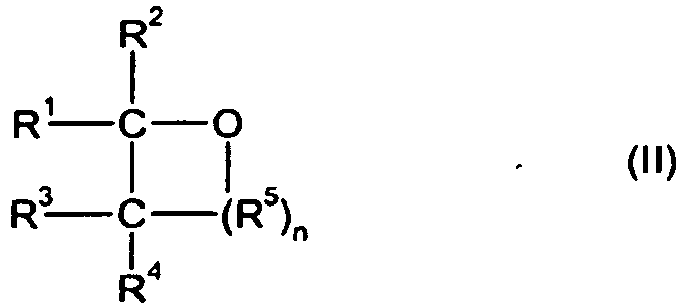
- R1 bis R5 und n
- die oben genannte Bedeutung haben.
- Nur beispielsweise seien Ethylenoxid, 1,2-Propylenoxid, 1,2-Butylenoxid, 1,3-Butylenoxid, 1,3-Dioxan, 1,3-Dioxolan und 1,3-Dioxepan als cyclische Ether genannt sowie lineare Oligo- oder Polyformale, wie Polydioxolan oder Polydioxepan, als Comonomere genannt.
- Als Vernetzer B wird für das erfindungsgemäße Verfahren beispielsweise eine bifunktionelle Verbindung eingesetzt, die zwei höhere cyclische Ether der allgemeinen Formel (II) enthält, die über die Einheit Z miteinander verbunden sind.
- Vorzugsweise enthält das für das erfindungsgemäße Verfahren eingesetzte Polyoxymethylenpolymerisat als Komponente B eine bifunktionelle Verbindung der Formel


- Z
- eine chemische Bindung, -O-, -OR6O-, -R7-, -R7OR8-, -(O-CH2-CH2)n-O- oder -(O-CH2)n-O- ist. Darin bedeuten
R6 C1-C8-Alkylen oder C3-C8-Cycloalkylen,
R7 und R8 jeweils unabhängig voneinander eine C1-C12-Alkylengruppe und
n eine Zahl zwischen 1 und 4. - Bevorzugt ist Z eine chemische Bindung, -O- oder -OR6O-, wobei
- R6
- die vorstehend genannte Bedeutung hat.
- Die Verknüpfung Z wird vorzugsweise so ausgewählt, dass sie gegen die für die Polymerisation von Formaldehyd und seiner cyclischen Oligomeren, wie Trioxan und Tetroxan bekannten kationisch wirksamen Katalysatoren und Initiatoren stabil ist, d.h., dass die Verknüpfung Z nicht signifikant zu Abbruch-, Übertragungs- und sonstigen Reaktionen führen darf.
- Die Reste R9 bis R12 in der bifunktionellen Verbindung der Formel (IV) sind jeweils unabhängig voneinander Wasserstoff oder eine C1-C4-Alkylgruppe. Bevorzugt sind die Reste R9 bis R12 Wasserstoff, ganz besonders bevorzugt wird als Vernetzer B eine bifunktionelle Verbindung der Formel (IV) eingesetzt, bei der Z Sauerstoff und die Reste R9 bis R12 Wasserstoff sind.
- Bevorzugte Monomere dieser Art sind Ethylendiglycid, Diglycidylether und Diether aus Glycidylen und Formaldehyd, Dioxan oder Trioxan im Molverhältnis 2:1 sowie Diether aus 2 mol Glycidylverbindung und 1 mol eines aliphatischen Diols mit 2 bis 8 C-Atomen, wie beispielsweise Diglycidylether von Ethylenglykol, 1,4-Butandiol, 1,3-Butandiol, Cyclobutan-1,3-diol, 1,2-Propandiol und Cyclohexan-1,4-diol, um nur einige Beispiele zu nennen.
- Besonders bevorzugt als Komponente B wird Diglycerindiformal eingesetzt. Dieses lässt sich relativ einfach und mit guter Ausbeute aus linearem Diglycerin und Formaldehyd (als wässrige Lösung Paraformaldehyd oder Trioxan) in Gegenwart eines sauren Katalysators herstellen. Als Hauptprodukt erhält man 4,4'-bis-(1,3-Dioxolanylmethyl)oxid. Dieses ist entsprechend der allgemeinen Struktur (IV) aufgebaut, wobei
- Z
- Sauerstoff und
- die Reste R9 bis R12
- Wasserstoff sind.
- Bei Verwendung von Diglycerin, das vorwiegend aus der linearen Verbindung besteht, daneben aber noch verzweigte Isomere enthält, führt die Umsetzung mit Formaldehyd zu einem Gemisch von Isomeren, wie Glycerindiformalen, deren Hauptbestandteil die oben genannte Verbindung darstellt. Dieses Gemisch eignet sich ebenso wie die reine Substanz. Das Diglycerindiformal wird üblicherweise in Mengen von 0,01 bis 1 Gew.-%, bevorzugt im Bereich von 0,05 bis 0,3 Gew.-% und insbesondere im Bereich von 0,1 bis 0,2 Gew.-%, bezogen auf das Gewicht des eingesetzten Trioxans, verwendet.
- Verfahren zur Herstellung der vorstehend beschriebenen Homo- und Copolymerisate sind dem Fachmann bekannt und in der Literatur beschrieben.
- Die bevorzugten Polyoxymethylencopolymere haben Schmelzpunkte von mindestens 150 °C (DSC, ISO 3146) und Molekulargewichte (Gewichtsmittelwert) Mw im Bereich von 5000 bis 300 000, vorzugsweise von 7000 bis 250 000 (GPC, Standard PMMA).
- Endgruppenstabilisierte Polyoxymethylenpolymerisate, die an den Kettenenden C-C-Bindungen aufweisen, werden besonders bevorzugt.
- Der Schmelzindex (MVR-Wert 190/2,16) der eingesetzten Polyoxymethylenpolymere liegt im Allgemeinen im Bereich von 0,5 bis 50 cm3/10 min (ISO 1133).
- Weiterhin eignen sich als Vernetzer B auch
Erythritoldiformal


Pentaerythritoldiacroleinacetal


- Weitere geeignete, Dioxacycloringe enthaltende Materialien umfassen Diacetale eines Dialdehyds und eines mehrwertigen Alkohols mit folgender Struktur:

- Von diesen bevorzugt ist das Diacetal des Malonaldehyds und Ethylenglykols mit folgender Struktur:
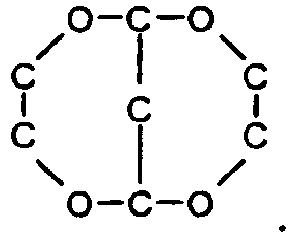
- Weitere Dialdehyde, die verwendet werden können, sind zum Beispiel Oxaldehyd, Succinaldehyd, Glutaraldehyd und weitere.
- Als mehrwertige Alkohole eignen sich zum Beispiel Glycerol, 1,2-Propylenglykol, 1,2-Butylenglykol, 1,3-Propylenglykol, Trimethylol-Propan, Sorbitol und Diethylenglykol. Das Halbzeug zur Herstellung von Formkörpern kann weiterhin bis zu 70 Gew.-%, vorzugsweise bis zu 50 Gew.-%, bezogen auf 100 Gew.-% der Komponenten A und B, sonstige Additive enthalten. Geeignete Additive sind beispielsweise
- Talkum,
- Polyamide, insbesondere Mischpolyamide,
- Erdalkalisilikate und Erdalkaliglycerophosphate,
- Ester oder Amide gesättigter aliphatischer Carbonsäuren,
- Ether, die sich von Alkoholen und Ethylenoxid ableiten,
- unpolare Propylenwachse,
- Füllstoffe, wie Glasfasern, Nanotubes, Wollastonit, Kreide, vorzugsweise mit Borsäure oder deren Derivaten als Synergisten,
- schlagzäh modifizierte Polymere, insbesondere solche auf Basis von Ethylen-Propylen (EPM)-Kautschuken, Methyl-Methacrylat-Butadien-Styrol (MBS)-Kautschuken oder Ethylen-Propylen-Dien (EPDM)-Kautschuken oder thermoplastischen Polyurethanen,
- Flammschutzmittel,
- Weichmacher,
- Haftvermittler,
- Farbstoffe und Pigmente,
- Formaldehyd-Fänger, Zeolithe oder Polyethylenimine, oder MelaminFormaldehyd-Kondensate,
- Antioxidantien, insbesondere solche mit phenolischer Struktur, Benzophenonderivate, Benzotriazolderivate, Acrylate, Benzoate, Oxaniline und sterisch gehinderte Amine (HALS = hindered amine light stabilizers).
- Diese Zusatzstoffe sind bekannt und beispielsweise in Gächter/Müller, Plastics Additives Handbook, Hanser Verlag München, 4. Auflage 1993, Reprint 1996 beschrieben.
- Die Menge der Additive hängt vom verwendeten Additiv und der gewünschten Wirkung ab. Dem Fachmann sind die üblichen Mengen bekannt. Die Additive werden, falls mitverwendet, in üblicher Weise zugefügt, beispielsweise einzeln oder gemeinsam, als solche, als Lösung bzw. Suspension oder bevorzugt als Masterbatch.
- Die fertige Polyoxymethylen-Formmasse zur Herstellung des Halbzeugs kann in einem einzigen Schritt hergestellt werden, indem zum Beispiel das Polyoxymethylen und die Additive in einem Extruder, Kneter, Mischer oder einer anderen geeigneten Mischvorrichtung unter Aufschmelzen des Polyoxymethylens vermischt, die Mischung ausgetragen und anschließend üblicherweise granuliert wird. Es hat sich jedoch als vorteilhaft erwiesen, einige oder alle der Komponenten zunächst in einem Trockenmischer oder in einem anderen Mischapparat vorzumischen und die erhaltene Mischung in einem zweiten Schritt unter Aufschmelzen des Polyoxymethylens, gegebenenfalls unter Zugabe weiterer Komponenten, in einem Extruder oder sonstigen Mischvorrichtung zu homogenisieren. Insbesondere kann es vorteilhaft sein, zumindest das Polyoxymethylen und das Antioxidans (falls mitverwendet) vorzumischen.
- Der Extruder beziehungsweise die Mischvorrichtung kann mit einer Entgasungsvorrichtung versehen sein, beispielsweise um Restmonomere oder sonstige flüchtige Bestandteile auf einfache Weise zu entfernen. Die homogenisierte Mischung wird wie üblich ausgetragen, vorzugsweise granuliert.
- Die Additivzugabe kann besonders schonend ausgestaltet werden, indem die Verweilzeit zwischen dem Austrag aus der Entgasungsvorrichtung und dem Eintrag in die Mischvorrichtung, in der die Additive zugefügt werden, minimiert wird. Dazu kann beispielsweise der Entgasungstopf unmittelbar auf den Einzug des Extruders montiert werden, der zur Abmischung mit den Additiven verwendet wird.
- Das so hergestellte Polyoxymethylenpolymerisat wird dann durch das erfindungsgemäße Verfahren zu Formteilen durch Blasformen verarbeitet. Hierzu wird das Polyoxymethylenpolymerisat dem Extruder zur Herstellung des Schlauches vorzugsweise als Granulat zugegeben. Ganz besonders bevorzugt ist es, wenn das Granulat auf eine Temperatur im Bereich von 60 bis 150°C, mehr bevorzugt im Bereich von 80 bis 140 °C und insbesondere im Bereich von 100 bis 130°C vorgewärmt wird. Durch das Vorwärmen lassen sich die mechanischen Eigenschaften des Formteils ebenfalls verbessern.
- Zum Vorheizen des Granulats können zum Beispiel geeignete Vorlagebehälter mit Heizelementen eingesetzt werden. Hierzu können die Wandungen beispielsweise als Doppelmantel ausgeführt sein, der von einem Heizmedium durchströmt wird. Alternativ ist es jedoch zum Beispiel auch möglich, eine elektrische Beheizung vorzusehen. Dazu eignen sich beispielsweise so genannte Umluft- oder Trockenlufttrockner, die heiße Luft in einen Behälter blasen. Bei Trockenlufttrocknern wird der Luft vorab Wasser entzogen. Ebenso ist eine Trocknung im Vakuumtrockner denkbar. Um eine gleichmäßige Vorerwärmung des Granulats zu erhalten, ist es weiterhin bevorzugt, wenn das Granulat im Vorlagebehälter gerührt wird. Hierdurch lässt sich ein verbesserter Wärmeübergang erzielen.
- Alternativ ist es zum Beispiel auch möglich, das Granulat durch Strahlung zu heizen. So lässt sich dem Granulat beispielsweise durch die Verwendung von Infrarotstrahlung oder Mikrowellenstrahlung, gegebenenfalls auch unter Rühren, Energie und somit Wärme zuführen, bis die entsprechende Temperatur erreicht ist.
- Das zur Herstellung des Formteils eingesetzte Blasformwerkzeug weist vorzugsweise eine Temperatur im Bereich von 50 bis 130°C, mehr bevorzugt im Bereich von 60 bis 115°C und insbesondere im Bereich von 80 bis 100°C auf. Durch die Temperierung des Werkzeugs wird eine gute Abformung der Werkzeugkavität unterstützt. Bei einer zu niedrigen Werkzeugtemperatur wird ein Effekt beobachtet, der einer mangelhaften Entlüftung des Werkzeugs ähnelt. So zeichnen sich zum Beispiel Formtrennlinien deutlich auf dem Bauteil ab und die Werkzeugkavität wird mangelhaft abgebildet. Auch für die Vorwegnahme einer späteren Nachschwindung des Formteils ist eine erhöhte Werkzeugtemperatur erforderlich. Damit lässt sich ein nachgeschalteter Temperprozess gegebenenfalls vermeiden, da das hergestellte Formteil die Endmaße bereits größtenteils erreicht hat und nur wenig nachschwindet.
- Um das Formteil durch Blasformen zu erzeugen, besteht das Werkzeug im Allgemeinen aus zwei Hälften, die den im Extruder hergestellten Schlauch unter Ausbildung von Quetschnähten zum Formteil ausformen. Hierzu werden die zwei Hälften um den Schlauch zusammengefügt und ein Dorn in den Schlauch eingebracht. Durch den Dorn wird ein geeignetes Gas in den Schlauch eingeblasen. Der Druck, mit dem das Gas eingeblasen wird, liegt vorzugsweise im Bereich von 2 bis 20 bar. Durch den Druck wird der Schlauch gegen das Werkzeug gepresst, so dass der Schlauch die Negativform des Werkzeugs abbildet. Als Gas, das in den Schlauch eingeblasen wird, wird üblicherweise Luft verwendet. Das Gas, das in den Schlauch eingeblasen wird, kann auch temperiert oder zum Zweck hoher Wärmeabfuhr mit Wasserdampf angereichert werden. Außer Luft können auch andere Gase, zum Beispiel gegenüber dem eingesetzten Polyoxymethylenpolymerisat inerte Gase, verwendet werden. Ein weiteres geeignetes Gas ist zum Beispiel Stickstoff.
- Um eine homogene Schmelze zu erhalten, weist der Extruder vorzugsweise eine Länge im Bereich von 15 bis 30·D auf. D ist dabei der Schneckendurchmesser. Ein zum Aufschmelzen und Extrudieren des Schlauches geeigneter Extruder weist üblicherweise neben der genuteten Einzugszone mindestens zwei weitere Zonen auf. Üblicherweise schließt sich an die Einzugszone eine Aufschmelzzone und daran eine Ausstoßzone oder Meteringzone an. Im Bereich der der Einzugszone nachfolgenden Zonen wird der Extruder geheizt. Die Schnecke kann eine konstante Gangtiefe und Gangsteigung aufweisen, alternativ ist es jedoch auch möglich, eine Schnecke einzusetzen, bei der sich die Gangsteigung ändert, die Gangtiefe ändert oder die neben einem üblichen eingesetzten Wendelgang auch zum Beispiel Mischteile oder Scherteile aufweist.
- Üblicherweise eingesetzte Mischteile sind zum Beispiel solche, bei denen im Schneckensteg Durchbrüche ausgebildet sind, alternativ können im Schneckenkanal zum Beispiel auch Stifte vorgesehen sein, weiterhin ist es auch möglich, im Mischteil einen der üblichen Gewinderichtung des Kanals entgegengerichteten Kanal mit Durchbrüchen auszubilden, ferner ist es möglich, auf der Schnecke Zahnscheiben auszubilden oder Nocken im Zylinder und auf der Schnecke vorzusehen. Auch können so genannte Pineapple- oder Rapra-Mischteile eingesetzt werden.
- Als Scherteile eignen sich zum Beispiel Schertorpedos, Troester-Scherteile oder Maddock-Scherteile oder auch ein Ring auf der Schnecke, durch den ein Stauraum erzeugt wird.
- Neben den vorstehend genannten Zonen ist es weiterhin möglich, zum Beispiel auch mindestens eine Entgasungszone vorzusehen, in der die Schmelze entgast wird. Übliche Entgasungszonen weisen einen Dorn oberhalb der Schnecke im Zylinder auf, durch die das Gas abgeführt wird.
- Geeignete und üblicherweise in Extrudern eingesetzte Schneckenbauarten sind dem Fachmann bekannt.
- Um das Aufschmelzverhalten des Polyoxymethylenpolymerisats zu verbessern, ist es beispielsweise auch möglich, Barriereschnecken einzusetzen. In diesen wird der noch aufzuschmelzende Feststoff von der Schmelze durch einen Barrieresteg getrennt.
- Die genutete Einzugszone weist vorzugsweise eine Länge im Bereich von 3 bis 6·D auf, wobei auch hier D der Schneckendurchmesser ist. Als Schneckendurchmesser im Sinne der vorliegenden Erfindung wird dabei der Außendurchmesser der Schnecke verstanden. Die Länge der Einzugszone ist hierdurch ausreichend groß, um einen so großen Druckaufbau des Polyoxymethylenpolymerisat-Granulats, das der Einzugszone zugegeben wird, aufzubauen, damit eine gleichmäßige Förderung des Polymerisats durch den Extruder gewährleistet wird. Eine für das erfindungsgemäße Verfahren geeignete Einzugszone weist üblicherweise 4 bis 8 Nuten auf, die in axialer Richtung verlaufen. Alternativ ist es jedoch auch möglich, zum Beispiel Wendelnuten einzusetzen. Wenn Wendelnuten eingesetzt werden, so können diese sowohl in Drehrichtung der Schnecke als auch entgegen der Drehrichtung der Schnecke ausgeführt sein. Bevorzugt sind jedoch axial verlaufende Nuten. Im Verlauf der Einzugszone nimmt die Nuttiefe ab, so dass die Nuten zum Ende der Einzugszone hin auslaufen.
- Für das erfindungsgemäße Verfahren geeignete Nuten weisen zum Beispiel einen rechteckförmigen, kreissegmentförmigen oder dreieckförmigen Querschnitt auf. Bevorzugt werden Nuten mit einem rechteckförmigen Querschnitt eingesetzt.
- Erfindungsgemäß wird die Einzugszone auf eine Temperatur im Bereich von 100 bis 230°C geheizt. Hierzu sind in der Einzugszone im Zylinder üblicherweise Kanäle vorgesehen, die von einem Temperiermedium durchströmt werden können. Als Temperiermedium können zum Beispiel Wasser, vorzugsweise unter Druck, oder Temperieröle eingesetzt werden. Bevorzugt werden zum Heizen der Einzugszone Temperieröle verwendet. Weiterhin ist es auch möglich, die Einzugszone sowie den gesamten Extruder über elektrische Heizbänder mit Thermoelementen zu temperieren.
- Um zu vermeiden, dass Wärme von den der Einzugszone nachfolgenden Zonen an den Zylindermantel der Einzugszone übertragen wird, ist es üblich, zwischen der Einzugszone und den nachfolgenden Zonen im Zylinder des Extruders eine Wärmetrennung vorzusehen. Eine solche Wärmetrennung kann zum Beispiel durch Einsatz einer Scheibe aus einem schlecht wärmeleitenden Material, das gegenüber den im Extruderzylinder auftretenden Temperaturen stabil ist, realisiert werden. Geeignete Wärmetrennungen sind dem Fachmann bekannt und werden auch bei heute üblichen Einschneckenextrudem mit genuteter Einzugszone eingesetzt. Da erfindungsgemäß die Einzugszone geheizt wird, ist die Wärmetrennung hier jedoch nicht unbedingt erforderlich.
- Um das Polyoxymethylenpolymerisat aufzuschmelzen, werden die sich an die Einzugszone anschließenden Zonen auf eine Temperatur im Bereich von 180 bis 230°C aufgeheizt. Die Temperatur liegt dabei vorzugsweise mehr als 30 K über der Schmelztemperatur des Polyoxymethylenpolymerisats. Durch die entsprechende Temperatur erfolgt zunächst ein Anschmelzen und dann ein Aufschmelzen des Polymerisats. Durch eine geeignete Schneckengeometrie wird eine Homogenisierung der Schmelze erzielt. Die Beheizung der der Einzugszone nachfolgenden Zonen erfolgt zum Beispiel ebenfalls durch im Zylinder ausgebildete Heizkanäle, die von einem Temperiermedium durchströmt werden. Als Temperiermedium kann das gleiche Temperiermedium eingesetzt werden, wie es auch zur Beheizung der Einzugszone verwendet wird. Üblicherweise wird der Zylinder in einzelne Zonen eingeteilt, die jeweils von einem separaten Temperierkreislauf beheizt werden. Hierdurch ist es auch möglich, die einzelnen Zonen auf unterschiedliche Temperaturen zu erwärmen. Insbesondere ist es bevorzugt, wenn die Temperatur, auf die die sich an die Einzugszone anschließenden Zonen aufgeheizt werden, von der Einzugszone zum Werkzeug hin abnimmt. Die Temperaturdifferenz zwischen maximaler und minimaler Temperatur liegt dabei vorzugsweise im Bereich von 10 bis 50 K, insbesondere im Bereich von 20 bis 40 K, beispielsweise bei 30 K. Die abnehmende Temperatur kann dabei zum Beispiel dadurch realisiert werden, dass die einzelnen Zonen jeweils auf unterschiedliche Temperaturen mit abnehmender Temperatur erwärmt werden.
- Neben einer Beheizung mit einem Temperiermedium ist auch eine Beheizung des Extruders durch elektrische Heizelemente möglich. Zusätzlich können zur Temperaturregelung, zum Beispiel um kurzfristige Temperaturspitzen abzumildern, Kühlvorrichtungen, beispielsweise in Form von Gebläsen vorgesehen sein. Die Temperierung des Extruders erfolgt vorzugsweise derart, dass die Massetemperatur der Schmelze am Düsenaustritt im Bereich zwischen 180 und 230°C liegt.
- Das so aufgeschmolzene und homogenisierte Polyoxymethylenpolymerisat wird dann durch ein geeignetes Extruderwerkzeug am Ende des Extruders zu einem Schlauch extrudiert. Der Schlauch wird dem Blasformwerkzeug zugeführt und im Blasformwerkzeug zum Formteil geformt.
- Formteile, die durch das erfindungsgemäße Verfahren hergestellt werden können, sind zum Beispiel Behälter, Tanks oder Speicher für feste, pastöse, flüssige oder gasförmige Medien, Töpfe, Eimer, Kanister, Flaschen und Hohlkörper im allgemeinen Sinn.
- Behälter oder Speicher, die durch das erfindungsgemäße Verfahren hergestellt werden können, sind zum Beispiel Behälter und Druckspeicher für Hydrauliköle und andere Fluide der Maschinentechnik, beispielsweise Fette, Kühlwasser, Treibstoffe oder andere Betriebsmittel, Behälter oder Druckspeicher für Gase und gasförmige Treibstoffe, insbesondere als Inliner für Tanksysteme, Behältnisse für Chemikalien, die möglichst wenig durch die Behältniswandung diffundieren sollen, oder auch Behältnisse für Lebensmittel, Getränke, Futtermittel, die zum Beispiel vor Permeation im Allgemeinen und insbesondere vor Sauerstoff geschützt werden müssen. Durch das erfindungsgemäße Verfahren hergestellte Töpfe oder Eimer können zum Beispiel zur Aufbewahrung von Gütern genutzt werden. Diese lassen sich zum Beispiel durch Deckel oder aufgeschweißte Folien verschließen.
- Behältnisse für Lebensmittel oder Getränke, die durch das erfindungsgemäße Verfahren hergestellt werden, sind zum Beispiel Becher oder insbesondere Flaschen.
- Die durch das erfindungsgemäße Verfahren hergestellten Formteile können durch jedes beliebige weitere Verarbeitungsverfahren weiterverarbeitet werden. So lassen sich die Teile zum Beispiel einfärben oder bedrucken.
- Neben der Herstellung von Formteilen aus nur einem Polymer ist es auch möglich, beispielsweise mehrlagige Formteile herzustellen. Hierzu werden zum Beispiel Schläuche im Coextrusionsverfahren hergestellt, die dann im Blasformwerkzeug zum eigentlichen Formteil umgeformt werden.
- Aus einem Polyoxymethylencopolymerisat, das aufgebaut ist aus 96,9 bis 96,7 Gew.-% Trioxan, ca. 3 Gew.-% Butandiolformal und 0,1 bis 0,3 Gew.-% Diglycerindiformal, wird ein Hohlkörper durch ein Blasformverfahren hergestellt. Das Polyoxymethylen-Copolymerisat wird in einem Extruder mit genuteter Einzugszone aufgeschmolzen, wobei die Einzugszone auf eine Temperatur von 220°C erwärmt wird. Das zugeführte Granulat des Polyoxymethylen-Copolymerisats weist eine Temperatur von 110°C auf. Im Extruder wird ein Temperaturverlauf eingestellt, der von 220° auf 190°C zum Werkzeug hin abnimmt. Aus dem Polyoxymethylen-Copolymerisat wird ein Schlauch extrudiert, der einem Blasformwerkzeug zugeführt wird. Das Werkzeug wird auf eine Temperatur von 120°C temperiert. Durch. Einblasen von Luft bei einem Druck von 8 bar wird der Hohlkörper geformt.
- Es wird ein zweiter Hohlkörper aus dem gleichen Material gefertigt, wobei die Einzugszone gemäß gängigen Verfahren auf 15°C gekühlt wird, das Granulat nicht vorgewärmt wird und das Werkzeug auf 20°C gekühlt wird. Es wird jeweils ein Hohlkörper gebildet, aus dem Zugstäbe geschnitten werden. Darüber hinaus werden an weiteren Hohlkörpern Berstdruckprüfungen unter Wasserinnendruck durchgeführt.
- Die aus den Hohlkörpern mit geheiztem Material, geheizter Einzugszone und geheiztem Werkzeug nach dem erfindungsgemäßen Verfahren hergestellten Zugstäbe weisen eine Bruchdehnung im Bereich von 15 bis 23 % auf. Der Berstdruck dieser Hohlkörper wird zu 30 bar bestimmt. Die Bruchdehnung der Zugstäbe, die aus dem Hohlkörper geschnitten wurden, der durch das Verfahren mit gekühlter Einzugszone hergestellt wurde, liegt im Bereich zwischen 6 und 11 %. Der ermittelte Berstdruck liegt bei 25 bar. Das erfindungsgemäße Verfahren erlaubt somit die Herstellung von Polyoxymethylen-Hohlkörpem mit signifikant verbesserten mechanischen Eigenschaften.
Claims (12)
- Verfahren zur Herstellung von Formteilen aus einem Polyoxymethylenpolymerisat durch Blasformen, folgende Schritte umfassend:(a) Extrudieren des Polyoxymethylenpolymerisats zu einem Schlauch mit einem Extruder mit genuteter Einzugszone, wobei die Einzugszone auf eine Temperatur im Bereich von 100 bis 230°C geheizt wird,(b) Einbringen des extrudierten Schlauches aus dem Polyoxymethylenpolymerisat in ein Blasformwerkzeug,(c) Erzeugen des Formteils aus dem extrudierten Schlauch im Blasformwerkzeug.
- Verfahren gemäß Anspruch 1, dadurch gekennzeichnet, dass das Polyoxymethylenpolymerisat dem Extruder als Granulat zugegeben wird, wobei das Granulat auf eine Temperatur im Bereich von 60 bis 150°C vorgeheizt wird.
- Verfahren gemäß Anspruch 1 oder 2, dadurch gekennzeichnet, dass das Blasformwerkzeug eine Temperatur im Bereich von 50 bis 130°C aufweist.
- Verfahren gemäß einem der Ansprüche 1 bis 3, dadurch gekennzeichnet, dass der Extruder eine Länge im Bereich von 15 bis 30·D aufweist, wobei D der Schneckendurchmesser ist.
- Verfahren gemäß einem der Ansprüche 1 bis 4, dadurch gekennzeichnet, dass die genutete Einzugszone eine Länge im Bereich von 3 bis 6·D aufweist, wobei D der Schneckendurchmesser ist.
- Verfahren gemäß einem der Ansprüche 1 bis 5, dadurch gekennzeichnet, dass die sich an die Einzugszone anschließenden Zonen auf eine Temperatur im Bereich von 180 bis 230°C aufgeheizt werden.
- Verfahren gemäß einem der Ansprüche 1 bis 6, dadurch gekennzeichnet, dass die Massetemperatur der Schmelze am Düsenaustritt 180 bis 210°C beträgt.
- Verfahren gemäß einem der Ansprüche 1 bis 7, dadurch gekennzeichnet, dass das Polyoxymethylenpolymerisat aufgebaut ist aus:A) 99 bis 99,99 Gew.-% mindestens eines Polyoxymethylenhomo- oder -copolymerisats,B) 0,01 bis 1 Gew.-% eines Vernetzers.
- Verfahren gemäß Anspruch 8, dadurch gekennzeichnet, dass der Vernetzer B) eine bifunktionelle Verbindung der allgemeinen Formel

 Z eine chemische Bindung, -O-, -OR6O-, -R7-, -R7OR8-, -(O-CH2-CH2)n-O- oder -(O-CH2)n-O- ist,R6 C1-C8-Alkylen oder C3-C8-Cycloalkylen,R7 und R8 jeweils unabhängig voneinander eine C1-C12-AlkylengruppeR9 bis R12 jeweils unabhängig voneinander Wasserstoff oder eine C1-C4-Alkylgruppe bedeuten undn eine Zahl zwischen 1 und 4 ist.
 - Verfahren gemäß Anspruch 9, dadurch gekennzeichnet, dass Z Sauerstoff ist.
- Verfahren gemäß Anspruch 9, dadurch gekennzeichnet, dass der Vernetzer eine bifunktionelle Verbindung der allgemeinen Formel IV ist, wobei Z Sauerstoff und R9 bis R12 jeweils Wasserstoff sind.
- Verfahren gemäß einem der Ansprüche 1 bis 11, dadurch gekennzeichnet, dass die Formteile Behälter, Tanks oder Speicher für feste, flüssige, pastöse oder gasförmige Medien, Töpfe, Eimer, Kanister, Flaschen und Hohlkörper im allgemeinen Sinn sind.
Priority Applications (2)
| Application Number | Priority Date | Filing Date | Title |
|---|---|---|---|
| EP10702870.6A EP2393647B1 (de) | 2009-02-09 | 2010-02-05 | Verfahren zur herstellung von formteilen aus einem polyoxymethylenpolymerisat |
| PL10702870T PL2393647T3 (pl) | 2009-02-09 | 2010-02-05 | Sposób wytwarzania elementów kształtowych z polimeru polioksymetylenowego |
Applications Claiming Priority (3)
| Application Number | Priority Date | Filing Date | Title |
|---|---|---|---|
| EP09152399 | 2009-02-09 | ||
| PCT/EP2010/051419 WO2010089369A1 (de) | 2009-02-09 | 2010-02-05 | Verfahren zur herstellung von formteilen aus einem polyoxymethylenpolymerisat |
| EP10702870.6A EP2393647B1 (de) | 2009-02-09 | 2010-02-05 | Verfahren zur herstellung von formteilen aus einem polyoxymethylenpolymerisat |
Publications (2)
| Publication Number | Publication Date |
|---|---|
| EP2393647A1 EP2393647A1 (de) | 2011-12-14 |
| EP2393647B1 true EP2393647B1 (de) | 2013-04-17 |
Family
ID=42083583
Family Applications (1)
| Application Number | Title | Priority Date | Filing Date |
|---|---|---|---|
| EP10702870.6A Not-in-force EP2393647B1 (de) | 2009-02-09 | 2010-02-05 | Verfahren zur herstellung von formteilen aus einem polyoxymethylenpolymerisat |
Country Status (9)
| Country | Link |
|---|---|
| US (1) | US9149968B2 (de) |
| EP (1) | EP2393647B1 (de) |
| JP (1) | JP5832299B2 (de) |
| KR (1) | KR101662861B1 (de) |
| CN (1) | CN102307718B (de) |
| BR (1) | BRPI1008816A2 (de) |
| ES (1) | ES2409272T3 (de) |
| PL (1) | PL2393647T3 (de) |
| WO (1) | WO2010089369A1 (de) |
Families Citing this family (3)
| Publication number | Priority date | Publication date | Assignee | Title |
|---|---|---|---|---|
| CN107249534A (zh) | 2014-11-06 | 2017-10-13 | 宝洁公司 | 预应变层合体及其制备方法 |
| KR101646977B1 (ko) * | 2014-11-11 | 2016-08-09 | 한국엔지니어링플라스틱 주식회사 | 열안정성이 우수한 폴리옥시메틸렌 수지 조성물 |
| EP4335420B1 (de) | 2017-02-16 | 2026-04-01 | The Procter & Gamble Company | Saugfähige artikel mit substraten mit sich wiederholenden mustern von öffnungen mit mehreren wiederholungseinheiten |
Family Cites Families (18)
| Publication number | Priority date | Publication date | Assignee | Title |
|---|---|---|---|---|
| US4100245A (en) * | 1967-09-11 | 1978-07-11 | Oiles Kogyo Kabushiki Kaisha | Method for manufacturing bearings or other anti-friction elements formed of lubricant contained polyacetal |
| NL181204C (nl) * | 1974-11-07 | 1987-07-01 | Hoechst Ag | Werkwijze voor het bereiden van korrelvormige oxymethyleenpolymeren. |
| US3954366A (en) * | 1975-01-06 | 1976-05-04 | Fields Reuben T | Two-stage single screw extrusion apparatus |
| EP0121407A2 (de) | 1983-03-29 | 1984-10-10 | E.I. Du Pont De Nemours And Company | Blasformverfahren für Polyoxymethylen/Polyurethan-Mischungen |
| US4500481A (en) * | 1983-04-25 | 1985-02-19 | At&T Technologies, Inc. | Methods for controlling vinyl plastic extrudate |
| DE3843576A1 (de) * | 1988-12-23 | 1990-07-12 | Jv Kunststoffwerk | Verfahren und vorrichtung zur herstellung von kunststoffformteilen |
| DE3927424A1 (de) * | 1989-08-19 | 1991-02-21 | Basf Ag | Polyoxymethylen-polyurethan-formmassen mit verbesserter lichtbestaendigkeit, verfahren zu ihrer herstellung und ihre verwendung |
| JP2965660B2 (ja) * | 1990-10-25 | 1999-10-18 | 旭化成工業株式会社 | ポリアセタール樹脂製ガソリンタンク |
| US5286808A (en) * | 1991-07-25 | 1994-02-15 | Hoechst Celanese Corporation | Elastomeric crosslinked poly(1,3-dioxlane) |
| JP3304391B2 (ja) | 1992-04-27 | 2002-07-22 | ポリプラスチックス株式会社 | ポリオキシメチレン樹脂製押出成形品並びにその製造法 |
| JP3169548B2 (ja) * | 1996-04-12 | 2001-05-28 | ポリプラスチックス株式会社 | ポリアセタール樹脂組成物並びにその成形品 |
| JPH09327855A (ja) * | 1996-06-11 | 1997-12-22 | Polyplastics Co | ポリアセタール樹脂製のフィラーネックパイプ |
| US5909958A (en) * | 1997-04-25 | 1999-06-08 | Rauwendaal Extrusion Engineering, Inc. | Screw extruder with independently adjustable groove depth |
| US6712495B2 (en) * | 2001-11-20 | 2004-03-30 | E. I. Du Pont De Nemours And Company | Mixing apparatus |
| WO2005007384A1 (en) | 2003-07-03 | 2005-01-27 | Ticona, Llc | Method of making coextruded polyacetal articles with a shaped profile and a melt-bonded thermoplastic elastomer layer, and such an article |
| JP2005262824A (ja) * | 2004-03-22 | 2005-09-29 | Idemitsu Kosan Co Ltd | 樹脂押出用スクリュウおよび模様着色品の成形方法 |
| DE102005034490A1 (de) * | 2005-07-20 | 2007-01-25 | Basf Ag | Zusatzstoff-freies Verfahren zur Herstellung von Polyoxymethylenen |
| EP2212382B1 (de) | 2007-11-20 | 2011-05-04 | Basf Se | Verwendung von thermoplastischen formmassen für gid/wit |
-
2010
- 2010-02-05 JP JP2011548691A patent/JP5832299B2/ja not_active Expired - Fee Related
- 2010-02-05 KR KR1020117018450A patent/KR101662861B1/ko not_active Expired - Fee Related
- 2010-02-05 CN CN201080006862.5A patent/CN102307718B/zh not_active Expired - Fee Related
- 2010-02-05 BR BRPI1008816A patent/BRPI1008816A2/pt not_active IP Right Cessation
- 2010-02-05 PL PL10702870T patent/PL2393647T3/pl unknown
- 2010-02-05 EP EP10702870.6A patent/EP2393647B1/de not_active Not-in-force
- 2010-02-05 US US13/148,338 patent/US9149968B2/en not_active Expired - Fee Related
- 2010-02-05 ES ES10702870T patent/ES2409272T3/es active Active
- 2010-02-05 WO PCT/EP2010/051419 patent/WO2010089369A1/de not_active Ceased
Also Published As
| Publication number | Publication date |
|---|---|
| KR20110117676A (ko) | 2011-10-27 |
| JP2012517356A (ja) | 2012-08-02 |
| ES2409272T3 (es) | 2013-06-26 |
| JP5832299B2 (ja) | 2015-12-16 |
| US9149968B2 (en) | 2015-10-06 |
| CN102307718B (zh) | 2014-05-07 |
| PL2393647T3 (pl) | 2013-09-30 |
| KR101662861B1 (ko) | 2016-10-05 |
| WO2010089369A1 (de) | 2010-08-12 |
| BRPI1008816A2 (pt) | 2016-03-15 |
| US20110309558A1 (en) | 2011-12-22 |
| CN102307718A (zh) | 2012-01-04 |
| EP2393647A1 (de) | 2011-12-14 |
Similar Documents
| Publication | Publication Date | Title |
|---|---|---|
| EP0279289B1 (de) | Kontinuierliches Verfahren zur Entfernung instabiler Anteile aus rohem Oxymethylencopolymerisat | |
| DE10251332B4 (de) | Polyoxymethylen-Copolymere, deren Herstellung und Verwendung | |
| DE2450818A1 (de) | Strangpressverfahren | |
| EP0010751A1 (de) | Kraftstoffleitung aus Kunststoffverbundsystem sowie diese enthaltende Vorrichtungen | |
| DE2400097A1 (de) | Verfahren zur steigerung der schmelzelastizitaet von hochmolekularen linearen polyesterharzen | |
| WO2003005378A1 (de) | Elekrisch leitfähige zusammensetzungen und verfahren zu deren herstellung und deren verwendung | |
| EP2393647A1 (de) | Verfahren zur herstellung von formteilen aus einem polyoxymethylenpolymerisat | |
| EP1861443B1 (de) | Verfahren zur entfernung von restmonomeren aus polyoxymethylenen | |
| DE2840679C2 (de) | Verfahren zur Herstellung von Oxymethylencopolymerisat-Formmassen mit geringem Anteil an Restformaldehyd | |
| EP0480314A2 (de) | Polyoxymethylen-Formmassen mit verbesserter thermischer Stabilität und verminderter Formaldehydemission | |
| DE10160866A1 (de) | Verfahren und Mittel zur Verringerung der Formaldehydemission bei der Verarbeitung von Thermoplasten mit Beimengungen von Polyacetal | |
| CH718330A1 (de) | Verfahren zur Herstellung eines rPET-Kunststoffmaterials zur Verwendung in einem Dünnwand-Spritzgussverfahren und im Dünnwand-Spritzgussverfahren hergestellter Hohlkörper. | |
| DE2208168C3 (de) | Thermoplastische Formmasse auf Polyoxymethylen-Basis und Verfahren zu ihrer Herstellung | |
| EP0513500A1 (de) | Verfahren zur Herstellung offenporöser, fasriger Teile aus Polytetrafluorethylen durch Spritzguss oder Extrusion | |
| EP0517025B1 (de) | Verfahren zum thermoplastischen Verarbeiten nichtplastifizierbarer Polymerer | |
| JP2012517356A5 (de) | ||
| WO2009103812A1 (de) | Verfahren zur herstellung von formkörpern aus polyoxymethylen | |
| JP3115533B2 (ja) | ポリアセタール樹脂組成物並びに成形品 | |
| DE2166377C3 (de) | Verwendung von verzweigten oder vernetzten Trioxancopolymeren als Nukleierungsmittel | |
| WO2006136457A1 (de) | Melaminharz | |
| EP1869096B1 (de) | Verfahren zur herstellung von polyoxymethylen-homo- und -copolymeren und dafür geeignete vorrichtung | |
| WO2013020830A2 (de) | Verfahren zur aufarbeitung von partikelförmigem rohpolyoxymethylen | |
| DE1495267B2 (de) | Verfahren zur Herstellung von festen thermoplastischen Terpolymerisaten des Tn ox an s | |
| WO2013113879A1 (de) | Polyoxymethylencopolymere |
Legal Events
| Date | Code | Title | Description |
|---|---|---|---|
| PUAI | Public reference made under article 153(3) epc to a published international application that has entered the european phase |
Free format text: ORIGINAL CODE: 0009012 |
|
| 17P | Request for examination filed |
Effective date: 20110909 |
|
| AK | Designated contracting states |
Kind code of ref document: A1 Designated state(s): AT BE BG CH CY CZ DE DK EE ES FI FR GB GR HR HU IE IS IT LI LT LU LV MC MK MT NL NO PL PT RO SE SI SK SM TR |
|
| DAX | Request for extension of the european patent (deleted) | ||
| GRAP | Despatch of communication of intention to grant a patent |
Free format text: ORIGINAL CODE: EPIDOSNIGR1 |
|
| GRAC | Information related to communication of intention to grant a patent modified |
Free format text: ORIGINAL CODE: EPIDOSCIGR1 |
|
| GRAJ | Information related to disapproval of communication of intention to grant by the applicant or resumption of examination proceedings by the epo deleted |
Free format text: ORIGINAL CODE: EPIDOSDIGR1 |
|
| GRAP | Despatch of communication of intention to grant a patent |
Free format text: ORIGINAL CODE: EPIDOSNIGR1 |
|
| GRAJ | Information related to disapproval of communication of intention to grant by the applicant or resumption of examination proceedings by the epo deleted |
Free format text: ORIGINAL CODE: EPIDOSDIGR1 |
|
| GRAP | Despatch of communication of intention to grant a patent |
Free format text: ORIGINAL CODE: EPIDOSNIGR1 |
|
| GRAS | Grant fee paid |
Free format text: ORIGINAL CODE: EPIDOSNIGR3 |
|
| GRAA | (expected) grant |
Free format text: ORIGINAL CODE: 0009210 |
|
| AK | Designated contracting states |
Kind code of ref document: B1 Designated state(s): AT BE BG CH CY CZ DE DK EE ES FI FR GB GR HR HU IE IS IT LI LT LU LV MC MK MT NL NO PL PT RO SE SI SK SM TR |
|
| REG | Reference to a national code |
Ref country code: GB Ref legal event code: FG4D Free format text: NOT ENGLISH |
|
| REG | Reference to a national code |
Ref country code: CH Ref legal event code: EP |
|
| REG | Reference to a national code |
Ref country code: IE Ref legal event code: FG4D Free format text: LANGUAGE OF EP DOCUMENT: GERMAN |
|
| REG | Reference to a national code |
Ref country code: AT Ref legal event code: REF Ref document number: 606976 Country of ref document: AT Kind code of ref document: T Effective date: 20130515 |
|
| REG | Reference to a national code |
Ref country code: DE Ref legal event code: R096 Ref document number: 502010002975 Country of ref document: DE Effective date: 20130613 |
|
| REG | Reference to a national code |
Ref country code: ES Ref legal event code: FG2A Ref document number: 2409272 Country of ref document: ES Kind code of ref document: T3 Effective date: 20130626 |
|
| REG | Reference to a national code |
Ref country code: NL Ref legal event code: T3 |
|
| REG | Reference to a national code |
Ref country code: LT Ref legal event code: MG4D |
|
| REG | Reference to a national code |
Ref country code: PL Ref legal event code: T3 |
|
| PG25 | Lapsed in a contracting state [announced via postgrant information from national office to epo] |
Ref country code: IS Free format text: LAPSE BECAUSE OF FAILURE TO SUBMIT A TRANSLATION OF THE DESCRIPTION OR TO PAY THE FEE WITHIN THE PRESCRIBED TIME-LIMIT Effective date: 20130817 Ref country code: SE Free format text: LAPSE BECAUSE OF FAILURE TO SUBMIT A TRANSLATION OF THE DESCRIPTION OR TO PAY THE FEE WITHIN THE PRESCRIBED TIME-LIMIT Effective date: 20130417 Ref country code: PT Free format text: LAPSE BECAUSE OF FAILURE TO SUBMIT A TRANSLATION OF THE DESCRIPTION OR TO PAY THE FEE WITHIN THE PRESCRIBED TIME-LIMIT Effective date: 20130819 Ref country code: SI Free format text: LAPSE BECAUSE OF FAILURE TO SUBMIT A TRANSLATION OF THE DESCRIPTION OR TO PAY THE FEE WITHIN THE PRESCRIBED TIME-LIMIT Effective date: 20130417 Ref country code: LT Free format text: LAPSE BECAUSE OF FAILURE TO SUBMIT A TRANSLATION OF THE DESCRIPTION OR TO PAY THE FEE WITHIN THE PRESCRIBED TIME-LIMIT Effective date: 20130417 Ref country code: FI Free format text: LAPSE BECAUSE OF FAILURE TO SUBMIT A TRANSLATION OF THE DESCRIPTION OR TO PAY THE FEE WITHIN THE PRESCRIBED TIME-LIMIT Effective date: 20130417 Ref country code: NO Free format text: LAPSE BECAUSE OF FAILURE TO SUBMIT A TRANSLATION OF THE DESCRIPTION OR TO PAY THE FEE WITHIN THE PRESCRIBED TIME-LIMIT Effective date: 20130717 Ref country code: GR Free format text: LAPSE BECAUSE OF FAILURE TO SUBMIT A TRANSLATION OF THE DESCRIPTION OR TO PAY THE FEE WITHIN THE PRESCRIBED TIME-LIMIT Effective date: 20130718 |
|
| PG25 | Lapsed in a contracting state [announced via postgrant information from national office to epo] |
Ref country code: BG Free format text: LAPSE BECAUSE OF FAILURE TO SUBMIT A TRANSLATION OF THE DESCRIPTION OR TO PAY THE FEE WITHIN THE PRESCRIBED TIME-LIMIT Effective date: 20130717 Ref country code: LV Free format text: LAPSE BECAUSE OF FAILURE TO SUBMIT A TRANSLATION OF THE DESCRIPTION OR TO PAY THE FEE WITHIN THE PRESCRIBED TIME-LIMIT Effective date: 20130417 Ref country code: CY Free format text: LAPSE BECAUSE OF FAILURE TO SUBMIT A TRANSLATION OF THE DESCRIPTION OR TO PAY THE FEE WITHIN THE PRESCRIBED TIME-LIMIT Effective date: 20130417 Ref country code: HR Free format text: LAPSE BECAUSE OF FAILURE TO SUBMIT A TRANSLATION OF THE DESCRIPTION OR TO PAY THE FEE WITHIN THE PRESCRIBED TIME-LIMIT Effective date: 20130417 |
|
| PG25 | Lapsed in a contracting state [announced via postgrant information from national office to epo] |
Ref country code: SK Free format text: LAPSE BECAUSE OF FAILURE TO SUBMIT A TRANSLATION OF THE DESCRIPTION OR TO PAY THE FEE WITHIN THE PRESCRIBED TIME-LIMIT Effective date: 20130417 Ref country code: DK Free format text: LAPSE BECAUSE OF FAILURE TO SUBMIT A TRANSLATION OF THE DESCRIPTION OR TO PAY THE FEE WITHIN THE PRESCRIBED TIME-LIMIT Effective date: 20130417 Ref country code: EE Free format text: LAPSE BECAUSE OF FAILURE TO SUBMIT A TRANSLATION OF THE DESCRIPTION OR TO PAY THE FEE WITHIN THE PRESCRIBED TIME-LIMIT Effective date: 20130417 Ref country code: CZ Free format text: LAPSE BECAUSE OF FAILURE TO SUBMIT A TRANSLATION OF THE DESCRIPTION OR TO PAY THE FEE WITHIN THE PRESCRIBED TIME-LIMIT Effective date: 20130417 |
|
| PLBE | No opposition filed within time limit |
Free format text: ORIGINAL CODE: 0009261 |
|
| STAA | Information on the status of an ep patent application or granted ep patent |
Free format text: STATUS: NO OPPOSITION FILED WITHIN TIME LIMIT |
|
| PG25 | Lapsed in a contracting state [announced via postgrant information from national office to epo] |
Ref country code: RO Free format text: LAPSE BECAUSE OF FAILURE TO SUBMIT A TRANSLATION OF THE DESCRIPTION OR TO PAY THE FEE WITHIN THE PRESCRIBED TIME-LIMIT Effective date: 20130417 |
|
| 26N | No opposition filed |
Effective date: 20140120 |
|
| REG | Reference to a national code |
Ref country code: DE Ref legal event code: R097 Ref document number: 502010002975 Country of ref document: DE Effective date: 20140120 |
|
| PGFP | Annual fee paid to national office [announced via postgrant information from national office to epo] |
Ref country code: ES Payment date: 20140321 Year of fee payment: 5 |
|
| PGFP | Annual fee paid to national office [announced via postgrant information from national office to epo] |
Ref country code: GB Payment date: 20140228 Year of fee payment: 5 |
|
| BERE | Be: lapsed |
Owner name: BASF SE Effective date: 20140228 |
|
| PG25 | Lapsed in a contracting state [announced via postgrant information from national office to epo] |
Ref country code: LU Free format text: LAPSE BECAUSE OF FAILURE TO SUBMIT A TRANSLATION OF THE DESCRIPTION OR TO PAY THE FEE WITHIN THE PRESCRIBED TIME-LIMIT Effective date: 20140205 Ref country code: MC Free format text: LAPSE BECAUSE OF FAILURE TO SUBMIT A TRANSLATION OF THE DESCRIPTION OR TO PAY THE FEE WITHIN THE PRESCRIBED TIME-LIMIT Effective date: 20130417 |
|
| REG | Reference to a national code |
Ref country code: CH Ref legal event code: PL |
|
| PG25 | Lapsed in a contracting state [announced via postgrant information from national office to epo] |
Ref country code: LI Free format text: LAPSE BECAUSE OF NON-PAYMENT OF DUE FEES Effective date: 20140228 Ref country code: CH Free format text: LAPSE BECAUSE OF NON-PAYMENT OF DUE FEES Effective date: 20140228 |
|
| REG | Reference to a national code |
Ref country code: IE Ref legal event code: MM4A |
|
| PG25 | Lapsed in a contracting state [announced via postgrant information from national office to epo] |
Ref country code: BE Free format text: LAPSE BECAUSE OF NON-PAYMENT OF DUE FEES Effective date: 20140228 Ref country code: IE Free format text: LAPSE BECAUSE OF NON-PAYMENT OF DUE FEES Effective date: 20140205 |
|
| REG | Reference to a national code |
Ref country code: FR Ref legal event code: PLFP Year of fee payment: 6 |
|
| GBPC | Gb: european patent ceased through non-payment of renewal fee |
Effective date: 20150205 |
|
| PG25 | Lapsed in a contracting state [announced via postgrant information from national office to epo] |
Ref country code: GB Free format text: LAPSE BECAUSE OF NON-PAYMENT OF DUE FEES Effective date: 20150205 |
|
| PG25 | Lapsed in a contracting state [announced via postgrant information from national office to epo] |
Ref country code: MT Free format text: LAPSE BECAUSE OF FAILURE TO SUBMIT A TRANSLATION OF THE DESCRIPTION OR TO PAY THE FEE WITHIN THE PRESCRIBED TIME-LIMIT Effective date: 20130417 |
|
| REG | Reference to a national code |
Ref country code: FR Ref legal event code: PLFP Year of fee payment: 7 |
|
| REG | Reference to a national code |
Ref country code: ES Ref legal event code: FD2A Effective date: 20160329 |
|
| REG | Reference to a national code |
Ref country code: AT Ref legal event code: MM01 Ref document number: 606976 Country of ref document: AT Kind code of ref document: T Effective date: 20150205 |
|
| PG25 | Lapsed in a contracting state [announced via postgrant information from national office to epo] |
Ref country code: SM Free format text: LAPSE BECAUSE OF FAILURE TO SUBMIT A TRANSLATION OF THE DESCRIPTION OR TO PAY THE FEE WITHIN THE PRESCRIBED TIME-LIMIT Effective date: 20130417 Ref country code: ES Free format text: LAPSE BECAUSE OF NON-PAYMENT OF DUE FEES Effective date: 20150206 |
|
| PGFP | Annual fee paid to national office [announced via postgrant information from national office to epo] |
Ref country code: NL Payment date: 20160225 Year of fee payment: 7 |
|
| PG25 | Lapsed in a contracting state [announced via postgrant information from national office to epo] |
Ref country code: AT Free format text: LAPSE BECAUSE OF NON-PAYMENT OF DUE FEES Effective date: 20150205 |
|
| PGFP | Annual fee paid to national office [announced via postgrant information from national office to epo] |
Ref country code: PL Payment date: 20160201 Year of fee payment: 7 |
|
| PG25 | Lapsed in a contracting state [announced via postgrant information from national office to epo] |
Ref country code: TR Free format text: LAPSE BECAUSE OF FAILURE TO SUBMIT A TRANSLATION OF THE DESCRIPTION OR TO PAY THE FEE WITHIN THE PRESCRIBED TIME-LIMIT Effective date: 20130417 Ref country code: HU Free format text: LAPSE BECAUSE OF FAILURE TO SUBMIT A TRANSLATION OF THE DESCRIPTION OR TO PAY THE FEE WITHIN THE PRESCRIBED TIME-LIMIT; INVALID AB INITIO Effective date: 20100205 |
|
| REG | Reference to a national code |
Ref country code: FR Ref legal event code: PLFP Year of fee payment: 8 |
|
| REG | Reference to a national code |
Ref country code: NL Ref legal event code: MM Effective date: 20170301 |
|
| PG25 | Lapsed in a contracting state [announced via postgrant information from national office to epo] |
Ref country code: NL Free format text: LAPSE BECAUSE OF NON-PAYMENT OF DUE FEES Effective date: 20170301 |
|
| REG | Reference to a national code |
Ref country code: FR Ref legal event code: PLFP Year of fee payment: 9 |
|
| PG25 | Lapsed in a contracting state [announced via postgrant information from national office to epo] |
Ref country code: MK Free format text: LAPSE BECAUSE OF FAILURE TO SUBMIT A TRANSLATION OF THE DESCRIPTION OR TO PAY THE FEE WITHIN THE PRESCRIBED TIME-LIMIT Effective date: 20130417 |
|
| PG25 | Lapsed in a contracting state [announced via postgrant information from national office to epo] |
Ref country code: PL Free format text: LAPSE BECAUSE OF NON-PAYMENT OF DUE FEES Effective date: 20170205 |
|
| PGFP | Annual fee paid to national office [announced via postgrant information from national office to epo] |
Ref country code: DE Payment date: 20220225 Year of fee payment: 13 |
|
| PGFP | Annual fee paid to national office [announced via postgrant information from national office to epo] |
Ref country code: IT Payment date: 20220221 Year of fee payment: 13 Ref country code: FR Payment date: 20220224 Year of fee payment: 13 |
|
| REG | Reference to a national code |
Ref country code: DE Ref legal event code: R119 Ref document number: 502010002975 Country of ref document: DE |
|
| PG25 | Lapsed in a contracting state [announced via postgrant information from national office to epo] |
Ref country code: IT Free format text: LAPSE BECAUSE OF NON-PAYMENT OF DUE FEES Effective date: 20230205 Ref country code: FR Free format text: LAPSE BECAUSE OF NON-PAYMENT OF DUE FEES Effective date: 20230228 Ref country code: DE Free format text: LAPSE BECAUSE OF NON-PAYMENT OF DUE FEES Effective date: 20230901 |