EP2379693B2 - Utilisation d'une composition transparente pour photobioreacteurs - Google Patents
Utilisation d'une composition transparente pour photobioreacteurs Download PDFInfo
- Publication number
- EP2379693B2 EP2379693B2 EP10707570.7A EP10707570A EP2379693B2 EP 2379693 B2 EP2379693 B2 EP 2379693B2 EP 10707570 A EP10707570 A EP 10707570A EP 2379693 B2 EP2379693 B2 EP 2379693B2
- Authority
- EP
- European Patent Office
- Prior art keywords
- layer
- methacrylic polymer
- blocks
- antifouling
- polyamide
- Prior art date
- Legal status (The legal status is an assumption and is not a legal conclusion. Google has not performed a legal analysis and makes no representation as to the accuracy of the status listed.)
- Active
Links
Images
Classifications
-
- C—CHEMISTRY; METALLURGY
- C12—BIOCHEMISTRY; BEER; SPIRITS; WINE; VINEGAR; MICROBIOLOGY; ENZYMOLOGY; MUTATION OR GENETIC ENGINEERING
- C12M—APPARATUS FOR ENZYMOLOGY OR MICROBIOLOGY; APPARATUS FOR CULTURING MICROORGANISMS FOR PRODUCING BIOMASS, FOR GROWING CELLS OR FOR OBTAINING FERMENTATION OR METABOLIC PRODUCTS, i.e. BIOREACTORS OR FERMENTERS
- C12M21/00—Bioreactors or fermenters specially adapted for specific uses
- C12M21/02—Photobioreactors
-
- C—CHEMISTRY; METALLURGY
- C12—BIOCHEMISTRY; BEER; SPIRITS; WINE; VINEGAR; MICROBIOLOGY; ENZYMOLOGY; MUTATION OR GENETIC ENGINEERING
- C12M—APPARATUS FOR ENZYMOLOGY OR MICROBIOLOGY; APPARATUS FOR CULTURING MICROORGANISMS FOR PRODUCING BIOMASS, FOR GROWING CELLS OR FOR OBTAINING FERMENTATION OR METABOLIC PRODUCTS, i.e. BIOREACTORS OR FERMENTERS
- C12M23/00—Constructional details, e.g. recesses, hinges
- C12M23/20—Material Coatings
-
- C—CHEMISTRY; METALLURGY
- C12—BIOCHEMISTRY; BEER; SPIRITS; WINE; VINEGAR; MICROBIOLOGY; ENZYMOLOGY; MUTATION OR GENETIC ENGINEERING
- C12M—APPARATUS FOR ENZYMOLOGY OR MICROBIOLOGY; APPARATUS FOR CULTURING MICROORGANISMS FOR PRODUCING BIOMASS, FOR GROWING CELLS OR FOR OBTAINING FERMENTATION OR METABOLIC PRODUCTS, i.e. BIOREACTORS OR FERMENTERS
- C12M23/00—Constructional details, e.g. recesses, hinges
- C12M23/22—Transparent or translucent parts
-
- C—CHEMISTRY; METALLURGY
- C12—BIOCHEMISTRY; BEER; SPIRITS; WINE; VINEGAR; MICROBIOLOGY; ENZYMOLOGY; MUTATION OR GENETIC ENGINEERING
- C12M—APPARATUS FOR ENZYMOLOGY OR MICROBIOLOGY; APPARATUS FOR CULTURING MICROORGANISMS FOR PRODUCING BIOMASS, FOR GROWING CELLS OR FOR OBTAINING FERMENTATION OR METABOLIC PRODUCTS, i.e. BIOREACTORS OR FERMENTERS
- C12M39/00—Means for cleaning the apparatus or avoiding unwanted deposits of microorganisms
-
- Y—GENERAL TAGGING OF NEW TECHNOLOGICAL DEVELOPMENTS; GENERAL TAGGING OF CROSS-SECTIONAL TECHNOLOGIES SPANNING OVER SEVERAL SECTIONS OF THE IPC; TECHNICAL SUBJECTS COVERED BY FORMER USPC CROSS-REFERENCE ART COLLECTIONS [XRACs] AND DIGESTS
- Y10—TECHNICAL SUBJECTS COVERED BY FORMER USPC
- Y10T—TECHNICAL SUBJECTS COVERED BY FORMER US CLASSIFICATION
- Y10T428/00—Stock material or miscellaneous articles
- Y10T428/13—Hollow or container type article [e.g., tube, vase, etc.]
- Y10T428/1352—Polymer or resin containing [i.e., natural or synthetic]
- Y10T428/139—Open-ended, self-supporting conduit, cylinder, or tube-type article
- Y10T428/1393—Multilayer [continuous layer]
-
- Y—GENERAL TAGGING OF NEW TECHNOLOGICAL DEVELOPMENTS; GENERAL TAGGING OF CROSS-SECTIONAL TECHNOLOGIES SPANNING OVER SEVERAL SECTIONS OF THE IPC; TECHNICAL SUBJECTS COVERED BY FORMER USPC CROSS-REFERENCE ART COLLECTIONS [XRACs] AND DIGESTS
- Y10—TECHNICAL SUBJECTS COVERED BY FORMER USPC
- Y10T—TECHNICAL SUBJECTS COVERED BY FORMER US CLASSIFICATION
- Y10T428/00—Stock material or miscellaneous articles
- Y10T428/31504—Composite [nonstructural laminate]
- Y10T428/3154—Of fluorinated addition polymer from unsaturated monomers
-
- Y—GENERAL TAGGING OF NEW TECHNOLOGICAL DEVELOPMENTS; GENERAL TAGGING OF CROSS-SECTIONAL TECHNOLOGIES SPANNING OVER SEVERAL SECTIONS OF THE IPC; TECHNICAL SUBJECTS COVERED BY FORMER USPC CROSS-REFERENCE ART COLLECTIONS [XRACs] AND DIGESTS
- Y10—TECHNICAL SUBJECTS COVERED BY FORMER USPC
- Y10T—TECHNICAL SUBJECTS COVERED BY FORMER US CLASSIFICATION
- Y10T428/00—Stock material or miscellaneous articles
- Y10T428/31504—Composite [nonstructural laminate]
- Y10T428/31725—Of polyamide
- Y10T428/3175—Next to addition polymer from unsaturated monomer[s]
-
- Y—GENERAL TAGGING OF NEW TECHNOLOGICAL DEVELOPMENTS; GENERAL TAGGING OF CROSS-SECTIONAL TECHNOLOGIES SPANNING OVER SEVERAL SECTIONS OF THE IPC; TECHNICAL SUBJECTS COVERED BY FORMER USPC CROSS-REFERENCE ART COLLECTIONS [XRACs] AND DIGESTS
- Y10—TECHNICAL SUBJECTS COVERED BY FORMER USPC
- Y10T—TECHNICAL SUBJECTS COVERED BY FORMER US CLASSIFICATION
- Y10T428/00—Stock material or miscellaneous articles
- Y10T428/31504—Composite [nonstructural laminate]
- Y10T428/31855—Of addition polymer from unsaturated monomers
Definitions
- the present invention relates to photobioreactors and more particularly relates to a transparent multilayer structure comprising at least one layer of a methacrylic polymer for the culture of photosensitive organisms as defined by the claims.
- a photobioreactor is a system in which biological interactions take place in the presence of light energy, which we seek to control by controlling the culture conditions.
- a biochemical photosynthesis reaction takes place in order to produce plant biomass from photosynthetic microorganisms, light, carbon dioxide and a minimum of mineral elements.
- most of the organic components are produced (carbohydrates, lipids and proteins).
- Microalgae photosynthetic under solar radiation, allow in aquaculture the production of a biomass whose composition depends on the chosen species, and which can reach in energy value, according to estimates, twenty to one hundred times that of plants on the ground.
- Some species are rich in lipids, it is possible to extract the oils (triglycerides) more or less directly giving a biodiesel.
- the residues can also be valorized, for example by fermentation producing bioethanol.
- Lipid-rich microalgae thus become a technical solution to the energy problems linked to the depletion of oil deposits and the replacement of raw materials of fossil origin by renewable materials.
- the production of algae is accelerated by bubbling CO 2 from, for example, a polluting industry such as a thermal flame power plant, thus avoiding the immediate release of this greenhouse gas.
- Microalgae also constitute an alternative to obtaining biofuels from plant crops (for example rapeseed, beets, wheat) which require large cultivable areas.
- certain microalgae are capable of synthesizing 30 times more oil per hectare than the terrestrial plants used for the manufacture of biofuels. Furthermore, the use of this raw material as a source of biofuels avoids the seasonality and supply problems characteristic of the use of terrestrial plants.
- Microalgae can constitute potential sources of molecules that are difficult to access by chemical synthesis.
- Microalgae can be directly involved in the production of new and renewable energy, including the production of biofuels such as hydrogen. Certain species can produce hydrogen under the action of the enzymes present, such as hydrogenases.
- Microalgae cultivation offers an interesting alternative for wastewater treatment (urban, industrial or agricultural effluents). It allows tertiary biotreatment coupled with the production of potentially valuable biomass.
- microalgae play various roles such as the simultaneous elimination of nutrient salts (NH 4+ , NO 3- , PO 4 3- ), the purification of secondary effluents by the production of oxygen which is used by bacteria to degrade residual organic compounds, a bactericidal action reducing the survival of pathogenic germs contained in secondary effluents.
- This technology has the advantage of being based on the principles of natural ecosystems and is therefore safe for the environment.
- Microalgae growth can be achieved on the surface of open solar ponds or in greenhouses, which constitute photobioreactors with limited investment.
- this technology is limited to the use of robust species, which can withstand variations in temperature or sunlight or viruses.
- the production of biodiesel from the biomass thus obtained has not proven to be economically competitive compared to petroleum products.
- closed solar photobioreactors with transparent walls are used. These devices are generally of flat geometry (flat photobioreactors) or cylindrical geometry (tubular photobioreactors). Photobioreactors with a more specific geometry can also be used, such as hollow profile structures in the shape of an “H” or “I”, for example.
- a flat photobioreactor consists of two parallel transparent panels of varying surface areas, between which resides a thin layer of culture a few centimeters deep.
- the particularity of a photobioreactor lies, in addition to the usual needs common to all bioreactors, in the need to provide photonic energy to the microorganisms to be cultivated, in particular microalgae, this contribution being essential for the realization of photosynthesis. From a technological point of view, the enclosure of the system must therefore be transparent and be designed in such a way as to provide sufficient light intensity for the microalgae.
- photobioreactors are typically made from a material with high transparency in the visible range, such as glass or polycarbonate (PC).
- a material with high transparency in the visible range such as glass or polycarbonate (PC).
- Polycarbonate is a product that has little resistance to UV rays over time, and whose light transmission is lower than that of PMMA. Furthermore, for photobioreactors that require very thick walls, PC becomes very fragile. Finally, PC has low chemical resistance to cleaning products such as hydrochloric acid, bleach and ozone.
- the geometry of the reactor must, as far as possible, favour a high ratio of the illuminated surface to the culture volume, while limiting the size and remaining in line with the objectives of desired biomass concentration and the physiological needs of the cultivated microorganisms.
- a hydrodynamic/regulation compromise must also be sought to ensure sufficient mixing and control of parameters such as CO2 consumption, oxygen release, temperature.
- Access to light must be optimized in all cases, so that the light actually available is significant and homogeneous within the culture.
- Different variants are used, for example tilting flat reactors to improve the use of solar irradiance, placing the reactors on reflective surfaces to increase the incidence of radiation by reflection, arranging artificial light sources in tubes at the heart of the culture medium, etc.
- Photobioreactors give rise to numerous publications, for example the following documents describe different configurations for implementing photosynthesis reactions from microorganisms: EP 112 556 ; EP 239 272 ; WO 99/20736 ; WO 00/12673 ; WO 00/23562 ; FR 2 907 311 ; WO 07/025145 ; WO 08/040828 ; US 2005/064577 .
- the document WO 2008/115058 describes a plant for the cultivation of algae using in addition methacrylic polymers (PMMA), without details on the characteristics of said PMMA.
- plastic materials such as polyethylene (PE), polycarbonate (PC), polymethyl acrylate (PMA), methacrylic polymers such as polymethyl methacrylate (PMMA), cellulose acetate butyrate (CAB), polyvinyl chloride (PVC), polyethylene terephthalate (PET), polyethylene terephthalate glycol modified (PETG), or non-plastic materials such as glass.
- PE polyethylene
- PC polycarbonate
- PMA polymethyl acrylate
- PMA methacrylic polymers
- PMMA polymethyl methacrylate
- CAB cellulose acetate butyrate
- PVC polyvinyl chloride
- PET polyethylene terephthalate
- PETG polyethylene terephthalate glycol modified
- non-plastic materials such as glass.
- the object of the present invention is to provide a transparent material capable of replacing glass or polycarbonate for the cultivation of photosensitive organisms in photobioreactors, which makes it possible to avoid the aforementioned technical problems and drawbacks encountered with the current use of glass or polycarbonate, and makes it possible to improve its efficiency and its service life.
- the efficiency of the reactor will be all the higher if the material that constitutes it allows light to pass through and if this diffusion of light remains high over time. Furthermore, during cleaning operations, it is necessary to avoid scratching the surface of the reactor and to ensure that the reactor will not crack or break due to chemical attack of the material by the washing products.
- the object of the present invention is to provide a lightweight and easily transportable thermoplastic material, transparent in the visible range (between 400 and 800 nm), resistant over time, in particular under the effect of prolonged exposure to the sun or humidity, having high mechanical strength, good chemical resistance to washing products, transformable into different shapes, in particular flexible and connectable.
- a PMMA type methacrylic polymer allows to combine the best performances compared to PC, PE, PVC and PET plastic materials, and glass, on the above-mentioned aspects, in particular on the following different aspects: transparency, durability in outdoor exposure, scratch resistance, chemical resistance, weight and cost.
- the present invention aims to provide transparent plates, profiles or tubes intended for the construction of installations of various geometries and configurations for the culture of photosensitive organisms.
- the present invention relates to the use of a transparent composition based on at least one methacrylic polymer for the construction of installations intended for the culture of photosensitive organisms, such as microorganisms, microalgae, photosynthetic bacteria or plankton.
- the invention is characterized in that the methacrylic polymer is PMMA, a homopolymer of methyl methacrylate MAM - or a copolymer of methyl methacrylate (MAM), comprising by weight at least 50% of MAM.
- the copolymer is obtained from MAM and at least one comonomer copolymerizable with MAM.
- the copolymer comprises by weight from 70 to 99.9%, advantageously from 90 to 99.9%, preferably from 95 to 99.9% of MAM for respectively from 0.1 to 30%, advantageously from 0.1 to 10%, preferably from 0.1 to 5% of comonomer.
- the comonomer copolymerizable with the MAM is a (meth)acrylic monomer or a vinylaromatic monomer such as for example styrene or substituted styrenes.
- the comonomer may also be a crosslinking agent, i.e. a molecule or oligomer having at least two ethylenic unsaturations, polymerizable with MAM by a radical mechanism.
- the crosslinking agent may be difunctional. It may be, for example, ethylene glycol di(meth)acrylate, hexanediol, tripropylene glycol, butanediol, neopentyl glycol, diethylene glycol, triethylene glycol, dipropylene glycol, allyl or divinyl benzene.
- the crosslinking agent may also be trifunctional.
- the crosslinking agent may be, for example, tripropylene glycol tri(meth)acrylate, trimethylol propane, pentaerythritol.
- the crosslinking agent may also be tetrafunctional, such as pentaerythritol tetra(meth)acrylate or hexafunctional such as dipentaerythritol hexa(meth)acrylate.
- the comonomer is an alkyl (meth)acrylate, in particular methyl, ethyl, propyl, butyl acrylate, or butyl methacrylate.
- PMMA may advantageously be a copolymer of MAM and acrylic and/or methacrylic acid. This type of PMMA offers improved thermomechanical resistance and scratch resistance compared to PMMA not containing it.
- PMMA has superior light transmission characteristics compared to other transparent polymers and glass, as shown in the table below: Transmission, % ASTM D1003 standard PMMA Standard 92 PMMA impact 90-92 Glass 90 PC 84-88 SAN 84-89 ABS Transparent 80-89 PA 86 PS 89 Copolyesters and PET 82-91
- PMMA exhibits superior scratch resistance properties compared to other transparent polymers as shown in the table below: Pencil test* ASTM D3363 standard PMMA Standard 2H - 4H PMM Impact B - 2H PC 3B - HB SAN, Transparent ABS, PA, PS, PVC, PET, PA, ⁇ B * Hardness of available leads (from softest to hardest): 7B-6B-5B-4B-3B-2B-B-HB-FH-2H-3H-4H-5H-6H
- the methacrylic polymer according to the invention has a molecular weight (M w ) ranging from 90,000 g/mol to 170,000 g/mol, advantageously from 110,000 to 170,000 g/mol, preferably from 140,000 g/mol to 160,000 g/mol (PMMA equivalent standard calculated on the basis of the PS standard).
- M w molecular weight
- the molecular weight is determined according to the gel permeation chromatography (GPC) method, also called size exclusion chromatography (SEC). Operating conditions that can be used to implement this method are as follows: The samples are prepared at a concentration of 1 g/l, with a dissolution time of at least 4 hours.
- the measurement conditions are as follows: solvent: THF; temperature: 30°C, injected volume: 100 ⁇ l, detection: refractive index; calibration with Polystyrene (PS) standards using universal calibration.
- the masses are expressed in PMMA equivalents using the Mark-Houwink-Sakurada coefficients. For this determination, one can use, for example, an apparatus from WATERS (Milford USA).
- the composition based on at least one methacrylic polymer according to the invention can be impact-reinforced using at least one impact modifier.
- An extruder is advantageously used to produce the mixture.
- the impact modifier can be, for example, an acrylic elastomer.
- the acrylic elastomer can be a block copolymer having at least one elastomeric block.
- it can be a styrene-butadiene-methyl methacrylate or methyl methacrylate-butyl acrylate-methyl methacrylate copolymer.
- the impact modifier can also be in the form of fine multilayer particles, called core-shell, having at least one elastomeric (or soft) layer, i.e. a layer formed from a polymer having a T g lower than -5°C and at least one rigid (or hard) layer, i.e. formed from a polymer having a T g higher than 25°C.
- composition according to the invention may further comprise conventionally used additives chosen from heat stabilizers, for example terdocecyldisulfide (DtDDS) or Irganox ⁇ 1076; lubricants, for example stearic acid or stearyl alcohol; flame retardants, for example antimony trioxide or a brominated or chlorinated phosphate ester; organic or inorganic pigments; UV stabilizers, for example Tinuvin ⁇ P; antioxidants, such as hindered phenolic compounds; antistatics.
- heat stabilizers for example terdocecyldisulfide (DtDDS) or Irganox ⁇ 1076
- lubricants for example stearic acid or stearyl alcohol
- flame retardants for example antimony trioxide or a brominated or chlorinated phosphate ester
- organic or inorganic pigments organic or inorganic pigments
- UV stabilizers for example Tinuvin ⁇ P
- antioxidants such
- composition according to the invention comprises at least one antifouling additive as defined by the claims in order to avoid the phenomena of adhesion and soiling in the presence of the culture medium and/or in the presence of air.
- antifouling additives as defined by the claims in order to avoid the phenomena of adhesion and soiling in the presence of the culture medium and/or in the presence of air.
- the use of such additives to the methacrylic composition also makes it possible to use concentrated culture media without the problems of adhesion of photosensitive organisms to the walls in contact with the organic medium and/or in contact with air appearing.
- a copolymer with polyamide blocks and polyether blocks also called PEBA according to IUPAC
- PEBA polyamide blocks and polyether blocks
- Polyamide blocks with dicarboxylic chain ends arise, for example, from the condensation of polyamide precursors in the presence of a chain-limiting dicarboxylic acid.
- Polyamide blocks with diamine chain ends come, for example, from the condensation of polyamide precursors in the presence of a chain-limiting diamine.
- the number-average molar mass Mn of the polyamide blocks is in the range from 400 to 20,000 g/mol, preferably from 500 to 10,000 g/mol, and more preferably from 600 to 6,000 g/mol.
- Polyamide block and polyether block polymers can also include randomly distributed units.
- Polyamide blocks may include homopolyamides or copolyamides.
- Three types of polyamides can be included in the composition of these PA blocks.
- the polyamide blocks come from the condensation of at least one dicarboxylic acid (aliphatic, cycloaliphatic or aromatic) in particular those having from 4 to 36 carbon atoms, preferably those having from 6 to 18 carbon atoms and at least one diamine (aliphatic, cycloaliphatic or aromatic) chosen in particular from those having from 2 to 20 carbon atoms, preferably those having from 6 to 15 carbon atoms.
- dicarboxylic acid aliphatic, cycloaliphatic or aromatic
- diamine aliphatic, cycloaliphatic or aromatic
- aliphatic diacids examples include butanedioic, adipic, suberic, azelaic, sebacic, dodecanedicarboxylic, myristic, tetradecanedicarboxylic, hexadecanedicarboxylic, octadecanedicarboxylic acids and dimerized fatty acids,
- cycloaliphatic diacids examples include 1,4-cyclohexyldicarboxylic acid.
- aromatic diacids examples include terephthalic (T) and isophthalic (I) acids.
- aliphatic diamines examples include tetramethylenediamine, hexamethylenediamine, 1,10-decamethylenediamine, dodecamethylenediamine, trimethylhexamethylenediamine.
- cycloaliphatic diamines include isomers of bis-(4-aminocyclohexyl)methane (BACM or PACM), bis-(3-methyl-4-aminocyclohexyl)methane (BMACM or MACM), and 2-2-bis-(3-methyl-4-aminocyclohexyl)propane (BMACP), isophoronediamine (IPDA), 2,6-bis-(aminomethyl)norbornane (BAMN), and piperazine (Pip).
- BCM or PACM bis-(4-aminocyclohexyl)methane
- BMACM or MACM bis-(3-methyl-4-aminocyclohexyl)methane
- BMACP 2-2-bis-(3-methyl-4-aminocyclohexyl)propane
- IPDA isophoronediamine
- BAMN 2,6-bis-(aminomethyl)norbornane
- the copolymer comprises at least one PA block based on PA 4.4, PA 4.6, PA 4.9, PA 4.10, PA 4.12, PA 4.14, PA 4.16, PA 4.18, PA 4.36, PA 6.4, PA 6.6, PA 6.9, PA 6.10, PA 6.12, PA 6.13, PA 6.14, PA 6.16, PA 6.18, PA 6.36, PA 9.4, PA 9.6, PA 9.10, PA 9.12, PA 9.14, PA 9.18, PA 9.36, PA 10.4, PA 10.6, PA 10.9, PA 10.10, PA 10.12, PA 10.13, PA 10.14, PA 10.16, PA 10.18, PA 10.36, PA 10.T, PA BMACM.4, PA BMACM.6, PA BMACM.9, PA BMACM.10, PA BMACM.12, PA BMACM.14, PA BMACM.16 , PA BMACM.18, PA BMACM.36, PA PACM.4, PA PACM.6, PA PACM.9, PA PACM.10, PA PACM.12, PA PA PACM.12
- polyamide blocks result from the condensation of one or more alpha acids omega aminocarboxylic acids and/or one or more lactams having from 6 to 12 carbon atoms in the presence of a dicarboxylic acid having from 4 to 12 carbon atoms or a diamine.
- lactams examples include caprolactam, oenantholactam and lauryllactam.
- alpha omega amino carboxylic acids examples include aminocaproic, 7-aminoheptanoic, 11-aminoundecanoic and 12-aminododecanoic acids.
- the dicarboxylic acids or diamines can be chosen from those mentioned above.
- the polyamide blocks of the second type are made of polyamide 11, polyamide 12 or polyamide 6.
- the polyamide blocks result from the condensation of at least one monomer of the first type with at least one monomer of the second type.
- the polyamide blocks result from the condensation of at least one alpha omega aminocarboxylic acid (or a lactam), with at least one diamine and one dicarboxylic acid.
- the dicarboxylic acid having Y carbon atoms is used as chain limiter, which is introduced in excess relative to the stoichiometry of the diamine(s).
- the polyamide blocks result from the condensation of at least two different alpha omega aminocarboxylic acids or of at least two different lactams having from 6 to 12 carbon atoms or of a lactam and an aminocarboxylic acid not having the same number of carbon atoms in the possible presence of a chain limiter.
- Examples include PA 10.10/11, PA 6.10/11, PA10.12/11, PA 10.10/11/12, PA 6.10/10.10/11, PA 6.10/6.12/11, PA 6.10/6.12/10.10.
- the polyether blocks may represent 1 to 99%, and preferably 5 to 90% by weight of the polyamide and polyether block copolymer, even more preferably 10 to 50% by weight.
- the molar mass Mn of the polyether blocks is in the range from 100 to 6,000 g/mol and preferably from 200 to 3,000 g/mol, even more preferably from 250 to 2,000 g/mol.
- Polyether blocks mean polyalkylene ether polyols, in particular polyalkylene ether diols, such as poly(ethylene glycol) (PEG), poly(1,2-propylene glycol) (PPG), polytetramethylene ether glycol (PTMG), polyhexamethylene glycol, poly(1,3-propylene glycol) (PO3G), poly(3-alkyl tetrahydrofuran) in particular poly(3-methyltetrahydrofuran (poly(3MeTHF)), and mixtures thereof. It is also possible to envisage a PE block of the block or statistical "copolyether" type containing a chain of at least two types of PE mentioned above.
- the polyether blocks may also comprise blocks obtained by oxyethylation of bisphenols, such as for example bisphenol A. These latter products are described in the patent EP 613 919 .
- the polyether blocks may also comprise ethoxylated primary amines. These blocks are also advantageously used.
- ethoxylated primary amines the products of formula: in which m and n are between 1 and 20 and x between 8 and 18. These products are commercially available under the brand name NORAMOX ® from CECA and under the brand name GENAMIN ® from CLARIANT.
- the preparation of the copolymers with polyamide block(s) and polyether block(s) PEBA comprises any means for attaching the polyamide blocks (PA block) and the polyether blocks (PE block) according to the present invention.
- PA block polyamide blocks
- PE block polyether blocks
- two processes are essentially used, one called a 2-step process, the other a one-step process.
- the two-step or single-step methods described in the document are used WO 01/18111 .
- the copolymers having polyamide 12 blocks and polyether blocks essentially comprising ethylene oxide units are used as antifouling and/or antistatic additives.
- Pebax® MV 1074 having polyamide 12 blocks with a number-average molar mass of 1500 and PEG blocks with a number-average molar mass of 1500 may be used.
- the antifouling and/or antistatic additives described above are preferably used at a content ranging from 3 to 15% by weight relative to the total composition, i.e. allowing the material to have a slippery effect and not to attract dust.
- a methacrylic polymer having antifouling properties or a methacrylic polymer having antistatic properties may be obtained.
- a PMMA composition comprising from 5% to 10%, more particularly from 6% to 8% of a PEBA, results in a composition having good antistatic properties.
- the additive will be present at a content ranging from 3% to 7% by weight relative to the total composition.
- the antistatic and/or antifouling property of a polymer can be measured by its surface resistivity.
- a 500 ⁇ m film of PMMA alone with a molecular weight of 150,000 g/mol has a surface resistivity of 126 10 +15 Ohm.
- the addition of 7% by weight and 10% by weight of PEBAX ® MV1074 in the PMMA makes it possible to obtain surface resistivities measured on a 500 ⁇ m film of 136 10 +12 and 47 10 +12 Ohm, respectively, the surface resistivity measurements having been carried out using a Keithley cell connected to an electrometer, according to the ASTM D257 standard, with a measurement voltage of 500 Volts.
- the antifouling property can be quantified by friction coefficient measurements according to ASTM D1894-08 which determines the force required to slide a paving stone on the surface of the part to be evaluated. Tests carried out according to this standard give static and dynamic friction coefficients for a standard Altuglas type V046 of 0.154 and 0.107. This grade with 5% Pebax MV1074 has static and dynamic friction coefficient values of 0.074 and 0.053.
- a fluorinated polymer is used as an antifouling additive to provide antifouling properties, but also good resistance, in particular to UV rays and chemicals.
- the fluoropolymer is a PVDF homo- or copolymer.
- This fluoropolymer has good chemical resistance, particularly to UV and chemicals, and is completely miscible in a methacrylic polymer matrix.
- the PVDF contains, by weight, at least 50% VDF, more preferably at least 75% and better still at least 85%.
- the comonomer is advantageously HFP.
- the PVDFs marketed under the KYNAR ® brand in particular grades 710, 720 or 740, are perfectly suited for this formulation.
- the fluorinated polymer is preferably present at a content which can range from 5 to 60% by weight relative to the total composition, preferably from 20 to 40%.
- composition according to the invention can be prepared by the usual techniques for thermoplastics such as for example by extrusion or using twin-screw mixers or using a device of the Buss ® Ko-malaxeur type.
- composition according to the invention can be put in the form of plates, hollow profiles in the shape of an “H” or an “I” for example, or cylinders such as tubes according to conventional extrusion or injection processes.
- the invention relates to a transparent multilayer structure comprising at least one layer of a methacrylic polymer and one layer comprising at least one antifouling and/or antistatic additive, as well as to its use for the construction of installations intended for the culture of photosensitive organisms, such as microorganisms, microalgae, photosynthetic bacteria, planktons as defined by the claims.
- the layer in contact with the culture medium is made of a methacrylic polymer.
- antifouling defined in the present invention by a methacrylic polymer as defined above, with the addition of at least one antifouling additive chosen from PVDF homo- and copolymers, as defined by claims.
- the layer in contact with the air or the external environment consists of an antistatic methacrylic polymer, defined in the present invention by a methacrylic polymer to which 5 to 10% of an antistatic additive is added, chosen from copolymers with polyamide blocks and polyether blocks.
- the single or multilayer structure has a thickness of between 200 ⁇ m and 12 mm, preferably between 500 ⁇ m and 7 mm.
- the antistatic or antifouling layer has a thickness of between 50 ⁇ m and 2 mm, and preferably between 100 ⁇ m and 1 mm.
- the multilayer structures can be coextruded, hot-pressed, coextruded-laminated, and preferably are coextruded, resulting in multilayer tubes or plates.
- the invention also relates to a multilayer tube which can have a diameter of 2 to 100 cm, preferably 10 to 60 cm, and a length of 1 to 50 meters.
Landscapes
- Health & Medical Sciences (AREA)
- Life Sciences & Earth Sciences (AREA)
- Engineering & Computer Science (AREA)
- Organic Chemistry (AREA)
- Chemical & Material Sciences (AREA)
- Bioinformatics & Cheminformatics (AREA)
- Wood Science & Technology (AREA)
- Zoology (AREA)
- Biotechnology (AREA)
- Genetics & Genomics (AREA)
- General Engineering & Computer Science (AREA)
- Biochemistry (AREA)
- Biomedical Technology (AREA)
- General Health & Medical Sciences (AREA)
- Sustainable Development (AREA)
- Microbiology (AREA)
- Clinical Laboratory Science (AREA)
- Molecular Biology (AREA)
- Immunology (AREA)
- Laminated Bodies (AREA)
- Compositions Of Macromolecular Compounds (AREA)
Description
- La présente invention concerne les photobioréacteurs et a plus particulièrement pour objet une structure multicouche transparente comprenant au moins une couche d'un polymère méthacrylique pour la culture d'organismes photosensibles comme défini par des revendications.
- Un photobioréacteur est un système dans lequel se déroulent, en présence d'énergie lumineuse, des interactions biologiques que l'on cherche à contrôler en maîtrisant les conditions de culture. En son sein, une réaction biochimique de photosynthèse a lieu dans le but de produire de la biomasse végétale à partir de microorganismes photosynthétiques, de lumière, de gaz carbonique et d'un minimum d'éléments minéraux. Lors du mécanisme de photosynthèse, l'essentiel des composants organiques est fabriqué (glucides, lipides et protéines).
- Les microalgues, photosynthétiques sous le rayonnement solaire, permettent en aquaculture la production d'une biomasse dont la composition dépend de l'espèce choisie, et qui peut atteindre en valeur énergétique, selon les estimations, vingt à cent fois celle des plantes au sol. On compte quelques milliers de genres de microalgues répartis en espèces dont certaines représentent un large groupe potentiellement fournisseur de composés valorisables comme biocarburants ou dans les domaines de la cosmétique, la pharmacie, voire l'agro-alimentaire.
- Certaines espèces sont riches en lipides, il est possible d'en extraire les huiles (triglycérides) donnant plus ou moins directement un biodiesel. Les résidus peuvent aussi être valorisés, par exemple par une fermentation produisant du bioéthanol. Les microalgues riches en lipides deviennent ainsi une solution technique aux problèmes énergétiques liés à l'épuisement des gisements de pétrole et au remplacement des matières premières d'origine fossile par des matières renouvelables. De plus, la production d'algues est accélérée par barbotage de CO2 issu par exemple d'une industrie polluante comme une centrale électrique thermique à flamme, évitant ainsi le rejet immédiat de ce gaz à effet de serre. Les microalgues constituent également une alternative à l'obtention de biocarburants à partir de cultures végétales (par exemple colza, betteraves, blé) qui nécessitent d'importantes surfaces cultivables. Selon des scientifiques américains, certaines microalgues seraient capables de synthétiser 30 fois plus d'huile à l'hectare que les plantes terrestres utilisées pour la fabrication de biocarburants. Par ailleurs, l'utilisation de cette matière première comme source de biocarburants évite les problèmes de saisonnalité et d'approvisionnement caractéristiques de l'emploi des végétaux terrestres.
- Composées essentiellement de protéines, certaines espèces présentent un bon précédent alimentaire car elles sont riches en vitamines, en acides gras polyinsaturés et en oligo-éléments. Elles trouvent des applications dans l'agriculture et l'horticulture par l'utilisation d'extraits d'algues qui assurent un rôle non seulement de fertilisant mais aussi d'accélérateur et protecteur de cultures.
- D'autres espèces représentent un potentiel productif applicable dans les domaines de la santé, pour la synthèse de médicaments ou de biocosmétiques à partir des extraits de substances à activités biologique ou thérapeutique, dans l'industrie agro-alimentaire par l'extraction et fabrication de pigments, de colorants naturels ou de gélifiants. Les microalgues peuvent constituer des sources potentielles de molécules difficilement accessibles par synthèse chimique.
- Les microalgues peuvent être directement impliquées dans la production d'énergie nouvelle et renouvelable notamment la production de biocombustibles comme l'hydrogène, Certaines espèces peuvent produire de l'hydrogène sous l'action des enzymes présentes du type hydrogénases.
- La culture de microalgues offre une alternative intéressante pour le traitement des eaux usées (effluents urbains, industriels ou agricoles). Elle permet un biotraitement tertiaire couplé à la production de biomasse potentiellement valorisable. Comme agent épurateur, les microalgues jouent divers rôles tels que l'élimination simultanée des sels nutritifs (NH4+, NO3-, PO4 3-), l'épuration des effluents secondaires par production d'oxygène qui est utilisé par les bactéries pour dégrader des composés organiques résiduels, une action bactéricide réduisant la survie des germes pathogènes contenus dans les effluents secondaires. Cette technologie a l'avantage de reposer sur les principes des écosystèmes naturels et est donc sans danger pour l'environnement.
- La croissance des microalgues peut être réalisée à la surface de bassins solaires ouverts ou sous des serres, ce qui constitue des photobioréacteurs d'investissement limité. Cependant, cette technologie est limitée à l'utilisation d'espèces robustes, pouvant résister aux variations de température ou d'ensoleillement ou à des virus. La production de biodiesel à partir de la biomasse ainsi obtenue, ne s'est pas avérée économiquement compétitive par rapport aux produits pétroliers.
- Pour une production plus stable ou plus intensive, on utilise des photobioréacteurs solaires fermés, à parois transparentes. Ces appareils sont généralement de géométrie plane (photobioréacteurs plats) ou de géométrie cylindrique (photobioréacteurs tubulaires). On peut également utiliser des photobioréacteurs avec une géométrie plus particulière telle que des structures de type profilé creux en forme de « H » ou de « I » par exemple.
- Un photobioréacteur plat se compose de deux panneaux parallèles transparents, de surfaces variables et entre lesquels réside une mince couche de culture d'une profondeur de quelques centimètres.
- Un photobioréacteur tubulaire se compose d'un ou plusieurs tubes transparents, de diamètres et de longueurs variables, de configurations diverses et au sein desquels peut circuler la culture. Les variantes de configuration sont multiples :
- un tube large et vertical formant une colonne,
- deux tubes de diamètres différents agencés l'un dans l'autre formant une chambre annulaire,
- un tube placé au sol et de diamètre modéré mais de longueur importante, agencé sous forme de serpentin,
- un tube de petit diamètre et de longueur importante enroulé hélicoïdalement autour d'une tour,
- plusieurs tubes de petit diamètre agencés parallèlement et à la verticale.
- La particularité d'un photobioréacteur tient, en plus des besoins habituels communs à tous les bioréacteurs, à la nécessité de fournir une énergie photonique aux microorganismes à cultiver, en particulier les microalgues, cet apport étant incontournable pour la réalisation de la photosynthèse. D'un point de vue technologique, l'enceinte du système doit donc être transparente et être conçue de façon à fournir une intensité lumineuse suffisante pour les microalgues.
- Pour répondre à cette exigence, les photobioréacteurs sont généralement fabriqués à partir d'un matériau présentant une grande transparence dans le domaine du visible, tel que le verre ou le polycarbonate (PC).
- L'utilisation du verre qui en outre doit être de haute pureté, présente cependant de nombreux inconvénients : c'est un matériau lourd, cher, rigide qui se casse facilement et qui est difficile à usiner. Le verre présente de plus une diffusion de lumière moins bonne que les polymères méthacryliques tel que le PMMA. Sa mise en oeuvre limite le choix de la géométrie du réacteur : les agencements sous forme de boucles ou de serpentins sont difficilement réalisables, les tubes connectés les uns aux autres par des tubulures ou des raccords sont sources de fuite ; afin de maintenir un accès correct de la lumière, les réacteurs doivent être nettoyés très souvent en raison de la formation d'un biofilm sur leurs parois. L'optimisation entre une grande longueur de tube, une surface réduite au sol et l'accessibilité de la lumière au milieu de culture s'avère difficile.
- Le polycarbonate est un produit qui résiste peu aux UV dans le temps, et dont la transmission de la lumière est inférieure à celle du PMMA. Par ailleurs, pour les photobioréacteurs qui nécessitent des parois de forte épaisseur, le PC devient très fragile. Enfin, le PC présente une faible résistance chimique envers les produits de lavage tels que l'acide chlorhydrique, l'eau de Javel et l'ozone.
- La géométrie du réacteur doit autant que possible privilégier un rapport élevé de la surface éclairée sur le volume de culture, tout en limitant l'encombrement et en restant en adéquation avec les objectifs de concentration en biomasse souhaitée et des besoins physiologiques des microorganismes cultivés. Un compromis hydrodynamique/ régulation est à rechercher également pour assurer un mélange suffisant et un contrôle des paramètres tels que consommation de CO2, dégagement d'oxygène, température.
- L'accès à la lumière doit être optimisé dans tous les cas, de façon à ce que la lumière réellement disponible soit importante et homogène au sein de la culture. Différentes variantes sont utilisées, par exemple incliner les réacteurs plats pour améliorer l'utilisation de l'irradiance solaire, placer les réacteurs sur des surfaces réfléchissantes afin d'accroître par réflexion l'incidence du rayonnement, disposer des sources lumineuses artificielles dans des tubes au coeur du milieu de culture, etc.
- Les photobioréacteurs donnent lieu à de nombreuses publications, par exemple les documents suivants décrivent différentes configurations pour mettre en oeuvre des réactions de photosynthèse à partir de microorganismes :
EP 112 556 EP 239 272 WO 99/20736 WO 00/12673 WO 00/23562 FR 2 907 311 WO 07/025145 WO 08/040828 US 2005/064577 . - Le document
WO 2008/115058 décrit une installation pour la culture d'algues utilisant en outre des polymères méthacryliques (PMMA), sans des détails sur les caractéristiques de ledit PMMA. - Concernant la nature des matériaux transparents utilisés pour élaborer les zones de culture, tubes ou chambres de réaction pour la photosynthèse de microorganismes, l'état de la technique propose différents matériaux parmi les matériaux plastiques tels que le polyéthylène (PE), le polycarbonate (PC), le poly acrylate de méthyle (PMA), les polymères méthacryliques tel que le poly méthacrylate de méthyle (PMMA), l'acétate-butyrate de cellulose (CAB), le polychlorure de vinyle (PVC), le polyéthylène téréphtalate (PET), le polyéthylène téréphtalate modfié glycol (PETG), ou des matériaux non plastiques tel que le verre.
- La présente invention a pour objet de proposer un matériau transparent susceptible de remplacer le verre ou le polycarbonate pour la culture d'organismes photosensibles dans des photobioréacteurs, qui permet d'éviter les problèmes techniques et inconvénients précités rencontrés avec l'utilisation actuelle du verre ou du polycarbonate, et permet d'améliorer son efficacité et sa durée de vie.
- L'efficacité du réacteur sera d'autant plus élevée que le matériau qui le constitue laissera passer la lumière et que cette diffusion de lumière reste élevée dans le temps. Par ailleurs, lors des opérations de nettoyage, il faut éviter de rayer la surface du réacteur et s'assurer que le réacteur ne va se fissurer ou casser par attaque chimique du matériau par les produits de lavage.
- La présente invention a pour objet de fournir un matériau thermoplastique léger et facilement transportable, transparent dans le domaine du visible (entre 400 et 800 nm), résistant au cours du temps, notamment sous l'effet d'une exposition prolongée au soleil ou à l'humidité, présentant une tenue mécanique élevée, une bonne résistance chimique aux produits de lavage, transformable en différentes formes, notamment flexibles et raccordables.
- Il a été trouvé de façon surprenante qu'un polymère méthacrylique de type PMMA permet d'allier les meilleures performances par rapport aux matériaux plastiques PC, PE, PVC et PET, et le verre, sur les aspects précités, en particulier sur les différents aspects suivants : transparence, durabilité en exposition extérieure, résistance à la rayure, résistance chimique, poids et coût.
- La présente invention a pour but de fournir des plaques, profilés ou tubes transparents destinés à la construction d'installations de géométries et configurations diverses pour la culture d'organismes photosensibles.
- Plus précisément, la présente invention a pour objet l'utilisation d'une composition transparente à base d'au moins un polymère méthacrylique pour la construction d'installations destinées à la culture d'organismes photosensibles, tels que microorganismes, microalgues, bactéries photosynthétiques ou planctons.
- L'invention est caractérisée en ce que le polymère méthacrylique, est le PMMA, homopolymère du méthacrylate de méthyle MAM - ou un copolymère du méthacrylate de méthyle (MAM), comprenant en poids au moins 50% de MAM. Le copolymère est obtenu à partir de MAM et d'au moins un comonomère copolymérisable avec le MAM. De préférence, le copolymère comprend en poids de 70 à 99,9%, avantageusement de 90 à 99,9%, de préférence de 95 à 99,9% de MAM pour respectivement de 0,1 à 30%, avantageusement de 0,1 à 10%, de préférence de 0.1 à 5% de comonomère.
- De préférence, le comonomère copolymérisable avec le MAM est un monomère (méth)acrylique ou un monomère vinylaromatique tel que par exemple le styrène ou les styrènes substitués.
- Le comonomère peut être choisi par exemple dans la liste des :
- monomères acryliques de formule CH2=CH-C(=O)-O-R1 où R1 désigne un atome d'hydrogène, un groupement alkyle en C1-C40 linéaire, cyclique ou ramifié éventuellement substitué par un atome d'halogène, un groupement hydroxy, alcoxy, cyano, amino ou époxy tels que par exemple l'acide acrylique, l'acrylate de méthyle, d'éthyle, de propyle, de n-butyle, d'isobutyle, de tertiobutyle, de 2-éthylhexyle, de glycidyle, les acrylates d'hydroxyalkyle, l'acrylonitrile ;
- les monomères méthacryliques de formule CH2=C(CH3)-C(=O)-O-R2 où R2 désigne un atome d'hydrogène, un groupement alkyle en C2-C40 linéaire, cyclique ou ramifié éventuellement substitué par un atome d'halogène, un groupement hydroxy, alcoxy, cyano, amino ou époxy tels que par exemple l'acide méthacrylique, le méthacrylate de méthyle, d'éthyle, de propyle, de n-butyle, d'isobutyle, de tertiobutyle, de 2-éthylhexyle, de glycidyle, les méthacrylates d'hydroxyalkyle, le méthacrylonitrile ;
- les monomères vinylaromatiques tels que par exemple le styrène, les styrènes substitués, l'alpha-méthylstyrène, le monochlorostyrène, le tertbutyl styrène.
- Le comonomère peut être aussi un agent réticulant c'est-à-dire une molécule ou un oligomère présentant au moins deux insaturations éthyléniques, polymérisables avec le MAM par un mécanisme radicalaire. L'agent réticulant peut être difonctionnel. Il peut s'agir par exemple du di(méth)acrylate d'éthylène glycol, d'hexanediol, de tripropylène glycol, de butanediol, de néopéntyl glycol, de diéthylène glycol, de triéthylène glycol, de dipropylène glycol, d'allyle ou de divinyl benzène. L'agent réticulant peut être aussi trifonctionnel. Il peut s'agir par exemple du tri(méth)acrylate de tripropylène glycol, de triméthylol propane, de pentaérythritol. L'agent réticulant peut être aussi tétrafonctionnel, comme par exemple le tétra(méth)acrylate de pentaérythritol ou hexafonctionnel comme l'hexa(méth)acrylate de dipentaérythritol.
- De préférence, le comonomère est un (méth)acrylate d'alkyle, notamment l'acrylate de méthyle, d'éthyle, de propyle, de butyle, ou le méthacrylate de butyle.
- Le PMMA pourra être avantageusement un copolymère du MAM et de l'acide acrylique et/ou méthacrylique. Ce type de PMMA offre une résistance thermomécanique ainsi qu'une résistance à la rayure améliorée par rapport à un PMMA n'en contenant pas.
- Le PMMA présente des caractéristiques de transmission lumineuse supérieures à celles des autres polymères transparents et du verre, comme le montre le tableau ci-après :
Transmission, % Norme ASTM D1003 PMMA Standard 92 PMMA impact 90-92 Verre 90 PC 84-88 SAN 84-89 ABS Transparent 80-89 PA 86 PS 89 Copolyesters et PET 82-91 - Le PMMA présente des propriétés de résistance à la rayure supérieures à celles des autres polymères transparents, comme l'indique le tableau ci-après :
Test crayon* Norme ASTM D3363 PMMA Standard 2H - 4H PMMÀ impact B - 2H PC 3B - HB SAN, ABS Transparent, PA, PS, PVC, PET, PA, < B * Dureté des mines disponibles (du plus mou au plus dur): 7B-6B-5B-4B-3B-2B-B-HB-F-H-2H-3H-4H-5H-6H - De plus, les
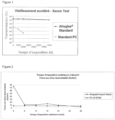
figures 1 et 2 illustrent les propriétés supérieures du PMMA (grade standard) par rapport à un polycarbonate PC standard en termes de durabilité en exposition extérieure et résistance aux UV. - La
figure 1 représente l'évolution de la transmission lumineuse des 2 matériaux testés en fonction de la durée de vieillissement accéléré dans une enceinte climatique, selon la méthode ISO 4892. - La
figure 2 illustre la perte des propriétés mécaniques du PC après 6 mois d'exposition extérieure, selon la méthode NF T51-165. - Le polymère méthacrylique selon l'invention a une masse moléculaire en poids (Mw) allant de 90000 g/mol à 170000 g/mol, avantageusement de 110000 à 170000 g/mol, de préférence de 140000 g/mol à 160000 g/mol (étalon équivalent PMMA calculé à base du standard PS). Selon l'invention, la masse moléculaire en poids est déterminée selon la méthode par chromatographie par perméation de gel (GPC, Gel Permeation Chromatography), ou appelée également chromatographie d'exclusion stérique (SEC, size exclusion chromatographie). Des conditions opératoires utilisables pour mettre en oeuvre cette méthode sont les suivantes : La préparation des échantillons est faite à une concentration de 1g/l, avec une durée de dissolution de 4heures minimum. Les conditions de mesure sont les suivantes : solvant : THF ; température : 30°C, volume injecté : 100µl, détection : indice de réfraction; étalonnage avec des standards Polystyrène (PS) en utilisant la calibration universelle. Les masses sont exprimées en équivalant PMMA grâce aux coefficients de Mark-Houwink-Sakurada. Pour cette détermination, on peut utiliser par exemple un appareillage de la société WATERS (Milford USA).
- Des essais de résistance chimique (selon la méthode EN 13559) ont en effet montré de façon surprenante que les PMMA de masse moléculaire inférieure à 90000 g/mol ne permettent pas de résister aux produits utilisés pour le nettoyage des photobioréacteurs. Par ailleurs, les PMMA de masse moléculaire inférieure à 90000 g/mol s'avèrent fragiles en enceinte humide et chaude (85% d'humidité et température 85°C), et ne sont donc pas adaptés à l'utilisation envisagée.
- Les polymères méthacryliques commercialisés sous la marque Altuglas®, en particulier le grade HCR-3, sont parfaitement adaptés pour l'invention,
- La composition à base d'au moins un polymère méthacrylique selon l'invention peut être renforcée à l'impact à l'aide d'au moins un modifiant choc. On utilise avantageusement une extrudeuse pour réaliser le mélange. Le modifiant choc peut être par exemple un élastomère acrylique. L'élastomère acrylique peut être un copolymère séquencé présentant au moins une séquence élastomérique. Par exemple, il peut s'agir d'un copolymère styrène-butadiène-méthacrylate de méthyle ou méthacrylate de méthyle-acrylate de butyle-méthacrylate de méthyle. Le modifiant choc peut se présenter aussi sous forme de fines particules multicouches, appelées core-shell (noyau-écorce), ayant au moins une couche élastomérique (ou molle), c'est-à-dire une couche formée d'un polymère ayant une Tg inférieure à -5°C et au moins une couche rigide (ou dure), c'est-à-dire formée d'un polymère ayant une Tg supérieure à 25°C.
- La composition selon l'invention peut comprendre en outre des additifs classiquement employés choisis parmi les stabilisants thermiques, par exemple le terdocécyldisulfure (DtDDS) ou l'Irganox© 1076 ; les lubrifiants, par exemple l'acide stéarique ou l'alcool stéarylique ; les ignifugeants, par exemple le trioxyde d'antimoine ou un phosphate ester bromé ou chloré ; les pigments organiques ou inorganiques ; les anti-UV, par exemple le Tinuvin© P ; les anti-oxydants, tels que des composés phénoliques encombrés ; les antistatiques.
- La composition selon l'invention comprend au moins un additif antifouling comme defini par les revendications afin d'éviter les phénomènes d'accrochage et de salissures en présence du milieu de culture et/ou en présence d'air. L'utilisation de tels additifs à la composition méthacrylique permet en outre de mettre en oeuvre des milieux de cultures concentrés sans voir apparaitre les problèmes d'accrochage des organismes photosensibles sur les parois en contact avec le milieu organique et/ou en contact avec l'air.
- Comme additive antifouling et/ou antistatique optionale, on peut utiliser notamment un copolymère à blocs polyamide et blocs polyéther (appelé aussi PEBA selon l'IUPAC),
- Les PEBA ou Polyether-Bloc-Amide, tels que ceux commercialisés par la Société Arkema sous le nom Pebax®, résultent de la polycondensation de blocs polyamides PA à extrémités réactives avec des blocs polyéthers PE à extrémités réactives, telles que, entre autres :
- 1) blocs polyamides à bouts de chaîne diamines avec des blocs polyoxyalkylènes à bouts de chaînes dicarboxyliques.
- 2) blocs polyamides à bouts de chaînes dicarboxyliques avec des blocs polyoxyalkylènes à bouts de chaînes diamines, obtenues par cyanoéthylation et hydrogénation de blocs polyoxyalkylène alpha-oméga dihydroxylées aliphatiques appelées polyétherdiols
- 3) blocs polyamides à bouts de chaînes dicarboxyliques avec des polyétherdiols, les produits obtenus étant, dans ce cas particulier, des polyétheresteramides.
- Les blocs polyamides à bouts de chaînes dicarboxyliques proviennent, par exemple, de la condensation de précurseurs de polyamides en présence d'un diacide carboxylique limiteur de chaîne.
- Les blocs polyamides à bouts de chaînes diamines proviennent par exemple de la condensation de précurseurs de polyamides en présence d'une diamine limiteur de chaîne.
- La masse molaire en nombre Mn des blocs polyamides est comprise dans la gamme allant de 400 à 20000 g/mol, de préférence de 500 à 10000 g/mol, et de préférence encore de 600 et 6000 g/mol.
- Les polymères à blocs polyamides et blocs polyéthers peuvent aussi comprendre des motifs répartis de façon aléatoire.
- Les blocs polyamides peuvent comporter des homopolyamides ou des copolyamides.
- Trois types de polyamides peuvent entrer dans la composition de ces blocs PA.
- Selon un premier type, les blocs polyamide proviennent de la condensation d'au moins un diacide carboxylique (aliphatique, cycloaliphatique ou aromatique) en particulier ceux ayant de 4 à 36 atomes de carbone, de préférence ceux ayant de 6 à 18 atomes de carbone et d'au moins une diamine (aliphatique, cycloaliphatique ou aromatique) choisie en particulier parmi celles ayant de 2 à 20 atomes de carbone, de préférence celles ayant de 6 à 15 atomes de carbone.
- A titre d'exemples de diacides aliphatiques, on peut citer les acides butanedioïque, adipique, subérique, azélaïque, sébacique, dodécanedicarboxylique, myristique, tétradécanedicarboxylique, hexadécanedicarboxylique, octadécanedicarboxylique et les acides gras dimérisés,
- A titre d'exemples de diacides cycloaliphatiques, on peut citer l'acide 1,4-cyclohexyldicarboxylique.
- A titre d'exemples de diacides aromatiques, on peut citer les acides téréphtalique (T) et isophtalique (I).
- A titre d'exemples de diamines aliphatiques, on peut citer la tétraméthylène diamine, l'hexaméthylènediamine, la 1,10-décaméthylènediamine, la dodécaméthylènediamine, la triméthylhexaméthylène diamine.
- A titre d'exemple de diamines cycloaliphatiques, on peut citer les isomères des bis-(4-aminocyclohexyl)-méthane (BACM ou PACM), bis-(3-méthyl-4-aminocyclohexyl)méthane (BMACM ou MACM), et 2-2-bis-(3-méthyl-4-aminocyclohexyl)-propane (BMACP), l'isophoronediamine (IPDA), la 2,6-bis-(aminométhyl)-norbornane (BAMN) et la pipérazine (Pip).
- Avantageusement, le copolymère comprend au moins un bloc PA à base de PA 4.4, PA 4.6, PA 4.9, PA 4.10, PA 4.12, PA 4.14, PA 4.16, PA 4.18, PA 4.36, PA 6.4, PA 6.6, PA 6.9, PA 6.10, PA 6.12, PA 6.13, PA 6.14, PA 6.16, PA 6.18, PA 6.36, PA 9.4, PA 9.6, PA 9.10, PA 9.12, PA 9.14, PA 9.18, PA 9.36, PA 10.4, PA 10.6, PA 10.9, PA 10.10, PA 10.12, PA 10.13, PA 10.14, PA 10.16, PA 10.18, PA 10.36, PA 10.T, PA BMACM.4, PA BMACM.6, PA BMACM.9, PA BMACM.10, PA BMACM.12, PA BMACM.14, PA BMACM.16, PA BMACM.18, PA BMACM.36, PA PACM.4, PA PACM.6, PA PACM.9, PA PACM.10, PA PACM.12, PA PACM.14, PA PACM.16, PA PACM.18, PA PACM.36, PA Pip.4, PA Pip.6, PA Pip.9, PA Pip.10, PA Pip.12, PA Pip.14, PA Pip.16, PA Pip.18 et/ou PA Pip.36, et leurs mélanges.
- Selon un deuxième type, les blocs polyamides résultent de la condensation d'un ou plusieurs acides alpha oméga aminocarboxyliques et/ou d'un ou plusieurs lactames ayant de 6 à 12 atomes de carbone en présence d'un diacide carboxylique ayant de 4 à 12 atomes de carbone ou d'une diamine.
- A titre d'exemples de lactames, on peut citer le caprolactame, l'oenantholactame et le lauryllactame.
- A titre d'exemples d'acide alpha omega amino carboxylique, on peut citer les acides aminocaproïque, amino-7-heptanoïque, amino-11-undécanoïque et amino-12-dodécanoïque.
- Les diacides carboxyliques ou les diamines peuvent être choisis parmi ceux cités plus haut.
- Avantageusement les blocs polyamides du deuxième type sont en polyamide 11, en polyamide 12 ou en polyamide 6.
- Selon un troisième type, les blocs polyamides résultent de la condensation d'au moins un monomère du premier type avec au moins un monomère du deuxième type. En d'autres termes, les blocs polyamides résultent de la condensation d'au moins un acide alpha oméga aminocarboxylique (ou un lactame), avec au moins une diamine et un diacide carboxylique.
- Dans ce cas, on prépare les blocs PA par polycondensation :
- de la ou des diamines aliphatiques, cycloaliphatiques ou aromatiques ayant X atomes de carbone ;
- du ou des diacides carboxyliques ayant Y atomes de carbone ; et
- du ou des comonomères {Z}, choisis parmi les lactames et les acides alpha-oméga aminocarboxyliques ayant Z atomes de carbone ;
- en présence d'un limiteur de chaîne choisi parmi les diacides carboxyliques ou diamines ou d'un excès de diacide ou de diamine utilisé comme unité structurale.
- Avantageusement, on utilise comme limiteur de chaîne le diacide carboxylique ayant Y atomes de carbone, que l'on introduit en excès par rapport à la stoechiométrie de la ou des diamines.
- Selon une autre variante (cas des copolymères, c'est-à-dire des copolyamides), les blocs polyamides résultent de la condensation d'au moins deux acides alpha oméga aminocarboxyliques différents ou d'au moins deux lactames différents ayant de 6 à 12 atomes de carbone ou d'un lactame et d'un acide aminocarboxylique n'ayant pas le même nombre d'atomes de carbone en présence éventuelle d'un limiteur de chaîne.
- A titre d'exemples de blocs polyamides du troisième type, on peut citer ceux formés par les polyamides (copolyamides) suivants :
- PA 6/6.6 dans lequel 6 désigne du caprolactame et 6.6 désigne un monomère résultant de la condensation de l'hexaméthylènediamine avec de l'acide adipique.
- PA 6.6/Pip.10/12 dans laquelle 6.6 désigne un monomère résultant de la condensation de l'hexaméthylènediamine avec de l'acide adipique. Pip.10 désigne un monomère résultant de la condensation de la pipérazine avec l'acide sébacique. 12 désigne du Sauryllactame.
- PA 6.6/6.10/11/12 dans laquelle 6.6 désigne monomère résultant de la condensation de l'hexaméthylènediamine avec de l'acide adipique. 6.10 désigne un monomère résultant de la condensation de l'hexaméthylènediamine avec l'acide sébacique. 11 désigne l'acide amino-11-undécanoïque. 12 désigne du lauryllactame.
- A titre d'exemples, on peut encore citer le PA 10.10/11, PA 6.10/11, PA10.12/11, PA 10.10/11/12, PA 6.10/10.10/11, PA 6.10/6.12/11, PA 6.10/6.12/10.10.
- Dans les PEBA, les blocs polyéthers peuvent représenter 1 à 99%, et de préférence 5 à 90 % en poids du copolymère à blocs polyamides et polyéthers, encore plus préférentiellement de 10 à 50% en poids. La masse molaire Mn des blocs polyéther est comprise dans la gamme allant de 100 à 6 000 g/mol et de préférence de 200 à 3 000 g/mol, encore plus préférentiellement de 250 à 2000 g/mol.
- Par blocs polyéther (abrégé ci-après PE) on entend les polyalkylènes éthers polyols, notamment des polyalkylènes éther diols, tels que le poly(éthylène glycol) (PEG), le poly{1,2-propylène glycol) (PPG), le polytétraméthylène éther glycol (PTMG), le polyhexaméthylène glycol, le poly(1,3-propylène glycol) (PO3G), les poly(3-alkyl tétrahydrofurane) en particulier le poly(3-méthyltétrahydrofurane (poly(3MeTHF)), et leurs mélanges. On peut également envisager un bloc PE de type «copolyéther» à blocs ou statistique contenant un enchaînement d'au moins deux types de PE cités ci-dessus. Les blocs polyéther peuvent également comprendre des blocs obtenus par oxyéthylation de bisphenols, tels que par exemple le bisphenol A. Ces derniers produits sont décrits dans le brevet
EP 613 919 - Les blocs polyéthers peuvent aussi comprendre des amines primaires éthoxylées. On utilise avantageusement aussi ces blocs. A titre d'exemple d'amines primaires éthoxylées on peut citer les produits de formule :

- Ainsi, les fins de chaînes des blocs PE peuvent être diOH, diNH2, diisocyanate ou diacide suivant leur procédé de synthèse.
- Les blocs PE à bouts de chaîne NH2, peuvent être obtenus par cyanoacétylation de séquences polyoxyalkylène alpha-oméga dihydroxylées aliphatiques appelées polétherdiols telles que les Jeffamines® D300, D400, D2000, ED-600, ED-900, ED2003, les Elastamines® RP-409, RP-2009, RT-1000, RE-600, RE-900, RE-2000, HT-1700, HE-180 de la société Huntsman. De tels blocs sont décrits dans les brevets
JP 2004346274 JP 2004352794 EP1482011 . - La préparation des copolymères à bloc(s) polyamide et bloc(s) polyéther PEBA comprend tout moyen permettant d'accrocher les blocs polyamide (bloc PA) et les blocs polyéther (bloc PE) selon la présente invention. En pratique, on utilise essentiellement deux procédés l'un dit en 2 étapes, l'autre en une étape.
- La méthode générale de préparation en deux étapes des copolymères PEBA ayant des liaisons ester entre les blocs PA et les blocs PE est connue et est décrite, par exemple, dans le brevet français
FR 2 846 332 EP 1 482 011 . - Avantageusement, on utilise les méthodes en deux étapes ou en une seule étape décrites dans le document
WO 01/18111 - Selon l'invention, on utilise en outre avantageusement comme additifs antifouling et/ou antistatiques optionnels:
- les copolymères à blocs polyamides et blocs polyéthers comprenant essentiellement des motifs oxyde d'éthylène et dans lequels les blocs polyamides sont des copolyamides résultant de la condensation d'au moins un acide alpha oméga aminocarboxylique (ou un lactame), au moins une diamine et au moins un acide dicarboxylique, comme décrits dans le document
EP 1 046 675 , - les poylétheresteramides ayant des blocs polyamide comprenant des sulfonates d'acides dicarboxyliques soit comme limiteurs de chaîne du bloc polyamide, soit associés à une diamine comme l'un des monomères constitutifs du bloc polyamide et ayant des blocs polyéthers consitutés essentiellement de motifs oxyde d'alkylène, comme décrits dans le document
WO 01/29113 - Un mélange d'un copolymère à blocs polyamides et blocs polyéthers et d'un polymère ou oligomère comprenant dans sa chaine au moins une fonction ionique et choisi parmi les polyamides, les copolymères à blocs polyamides et blocs polyéthers, les polyesters ou polyétheramides thermoplastiques, les copolymères à blocs polyesters et blocs polyéthers, les polyéthers et les polyuréthanes, comme décrits dans le document
EP 1 262 527 . - Selon un mode de réalisation préféré de l'invention, on utilise comme additifs antifouling et/ou antistatique les copolymères ayant des blocs polyamide 12 et des blocs polyéther comprenant essentiellement des motifs oxyde d'éthylène. En particulier, on peut utiliser le Pebax®MV 1074 ayant des blocs polyamide 12 de masse molaire moyenne en nombre 1500 et des blocs PEG de masse molaire moyenne en nombre 1500.
- Les additifs antifouling et/ou antistatique décrits précédemment sont utilisés de préférence à une teneur pouvant aller de 3 à 15 % en poids par rapport à la composition totale, c'est-à-dire permettant au matériau d'avoir un effet glissant et de ne pas attirer les poussières. Selon la teneur en additif, on pourra obtenir un polymère méthacrylique présentant des propriétés antifouling ou un polymère méthacrylique présentant des propriétés antistatiques. A titre d'exemple, une composition de PMMA comprenant de 5% à 10%, plus particulièrement de 6% à 8% d'un PEBA, conduit à une composition présentant de bonnes propriétés antistatiques. De préférence, pour obtenir un polymère méthacrylique présentant des propriétés antifouling, l'additif sera présent à une teneur allant de 3% à 7% en poids par rapport à la composition totale.
- La propriété antistatique et/ou antifouling d'un polymère peut être mesurée par sa résistivité surfacique. A titre d'exemple, un film de 500 µm de PMMA seul de masse moléculaire égale à 150000g/mol, présente une résistivité surfacique de 126 10+15 Ohm. L'ajout de 7% en poids et 10% en poids du PEBAX® MV1074 dans le PMMA permet respectivement d'obtenir des résistivités surfaciques mesurées sur film de 500µm de 136 10+12 et 47 10+12 Ohm, les mesures de résistivité surfacique ayant été réalisées à l'aide d'une cellule Keithley reliée à un électromètre, selon la norme ASTM D257, avec une tension de mesure de 500 Volts.
- La propriété antifouling (effet glissant) peut être quantifiée par des mesures de coefficient de friction selon la norme ASTM D1894-08 qui permet de déterminer la force nécessaire pour faire glisser un pavé sur la surface de la pièce à évaluer. Les essais réalisés suivant cette norme donnent des coefficients de friction statique et dynamique pour un Altuglas standard de type V046 de 0,154 et 0,107. Ce grade additivé avec 5% de Pebax MV1074 a des valeurs de coefficients de friction statique et dynamique de 0,074 et 0,053.
- Selon l'invention, on utilise comme additif antifouling un polymère fluoré permettant d'apporter des propriétés antifouling, mais aussi une bonne résistance, notamment aux UV et aux produits chimiques.
- Le polymère fluoré est choisi parmi :
- les homo- et copolymères du fluorure de vinylidène (VDF, CH2=CF2) contenant au moins 50% en poids de VDF. Le comonomère du VDF peut être choisi parmi le chlorotrifluoroéthylène (CTFE), l'hexafluoropropylène (HFP), le trifluoroéthylène (VF3) et le tétrafluoroéthylène (TFE) ;
- Le polymère fluoré est un PVDF homo- ou copolymère. Ce polymère fluoré présente en effet une bonne résistance chimique, notamment aux UV et aux produits chimiques, et il est complètement miscible dans une matrice de polymère méthacrylique. De préférence le PVDF contient, en poids, au moins 50% de VDF, plus préférentiellement au moins 75% et mieux encore au moins 85%. Le comonomère est avantageusement l'HFP.
- Ainsi, les PVDF commercialisés sous la marque KYNAR®, en particulier les grades 710, 720 ou 740 sont parfaitement adaptés pour cette formulation.
- Le polymère fluoré est présent de préférence à une teneur pouvant aller de 5 à 60 % en poids par rapport à la composition totale de préférence de 20 à 40 %.
- La composition selon l'invention peut se préparer par les techniques habituelles des thermoplastiques telles que par exemple par extrusion ou à l'aide de mélangeurs bivis ou encore à l'aide d'un appareil du type Ko-malaxeur Buss®.
- La composition selon l'invention peut être mise sous la forme de plaques, profilés creux en forme de « H » ou de « I » par exemple, ou de cylindres tels que des tubes selon les procédés classiques d'extrusion ou d'injection.
- Ainsi, l'invention est relative à une structure multicouche transparente comprenant au moins une couche d'un polymère méthacrylique et une couche comprenant au moins un additif antifouling et/ou antistatique, ainsi qu'à son utilisation pour la construction d'installations destinées à la culture d'organismes photosensibles, tels que microorganismes, microalgues, bactéries photosynthétiques, planctons tel que défini par les revendications.
- La structure multicouche comprend au moins :
- une couche d'au moins un polymère méthacrylique tel que défini précédemment
- une couche comprenant au moins un additif antifouling susceptible d'être en contact avec un milieu de culture, les couches étant disposées l'une sur l'autre.
- La couche en contact avec le milieu de culture est constituée, d'un polymère méthacrylique antifouling défini dans la présente invention par un polymère méthacrylique tel que défini précédemment, additivé d'au moins un additif antifouling choisi parmi des PVDF homo- et copolymères, tel que défini par des revendications.
- De manière préférée, la structure multicouche comprend dans l'ordre au moins :
- une couche comprenant au moins un additif antistatique susceptible d'être en contact avec l'air ou le milieu extérieur
- une couche d'au moins un polymère méthacrylique tel que défini précédemment
- une couche comprenant au moins un additif antifouling susceptible d'être en contact avec un milieu de culture.
- Avantageusement, la couche en contact avec l'air ou le milieu extérieur est constituée d'un polymère méthacrylique antistatique, défini dans la présente invention par un polymère méthacrylique additivé de 5 à 10% d'un additif antistatique choisi parmi les copolymères à blocs polyamides et blocs polyéthers.
- La structure mono ou multicouche présente un épaisseur comprise entre 200 µm et 12 mm, de manière préférée entre 500 µm et 7 mm.
- La couche antistatique ou antifouling présente une épaisseur comprise entre 50 µm et 2 mm, et de préférence entre 100 µm et 1 mm.
- Les structures multicouches peuvent être coextrudées, comprimées à chaud, coextrudées-laminées, et de préférence sont coextrudées, permettant d'obtenir des tubes ou des plaques multicouches.
- L'invention est relative aussi à un tube multicouche pouvant présenter un diamètre de 2 à 100 cm, de préférence de 10 à 60 cm, et une longueur de 1 à 50 mètres.
Claims (6)
- Structure multicouche pour la construction d'installations destinées à la culture d'organismes photosensibles, la structure comprenant au moins :- une couche d'au moins un polymère méthacrylique- une couche comprenant au moins un additif antifouling susceptible d'être en contact avec un milieu de culture, les couches étant disposées l'une sur l'autre,caractérisée en ce que la couche susceptible d'être en contact avec le milieu de culture est constituée d'un polymère méthacrylique antifouling défini par un polymère méthacrylique additivé d'au moins un additif antifouling choisi parmides PVDF homo - et copolymères , et caractérisé en ce que le polymère méthacrylique est un PMMA - homopolymère du méthacrylate de méthyle MAM ou un copolymère du méthacrylate de méthyle (MAM), comprenant en poids au moins 50% de MAM - de masse moléculaire en poids allant de 90000 g/mol à 170000 g/mol (étalon PMMA);caractérisée en ce que la structure multicouche est sous forme de tube, profilé ou de plaque.
- Structure multicouche selon la revendication 1 comprenant dans l'ordre au moins :- une couche comprenant au moins un additif antistatique susceptible d'être en contact avec l'air ou le milieu extérieur- une couche d'au moins un polymère méthacrylique- une couche comprenant au moins un additif antifouling susceptible d'être en contact avec un milieu de culture.
- Structure selon la revendication 2 caractérisée en ce que la couche en contact avec l'air ou le milieu extérieur est constituée d'un polymère méthacrylique antistatique, défini par un polymère méthacrylique additivé de 5 à 10% d'un additif antistatique choisi parmi les copolymères à blocs polyamides et blocs polyéthers.
- Tube multicouche selon la revendication 1, caractérisé en ce qu'il présente un diamètre allant de 2 à 100 cm et une longueur de 1 à 50 m.
- Plaque multicouche selon la revendication 1, caractérisée en ce qu'elle présente une épaisseur allant de 1 à 100 mm.
- Utilisation d'une tube multicouche selon l'une des revendications 1 à 4, ou d'une plaque selon la revendication 5 pour la construction d'installations destinées à la culture d'organismes photosensibles, tels que microorganismes, microalgues, bactéries photosynthétiques, planctons.
Applications Claiming Priority (3)
| Application Number | Priority Date | Filing Date | Title |
|---|---|---|---|
| FR0950374A FR2941238B1 (fr) | 2009-01-22 | 2009-01-22 | Utilisation d'une composition transparente pour photobioreacteurs. |
| FR0954969A FR2941237B1 (fr) | 2009-01-22 | 2009-07-17 | Utilisation d'une composition transparente pour photobioreacteurs |
| PCT/FR2010/050095 WO2010084289A1 (fr) | 2009-01-22 | 2010-01-22 | Utilisation d'une composition transparente pour photobioreacteurs |
Publications (3)
| Publication Number | Publication Date |
|---|---|
| EP2379693A1 EP2379693A1 (fr) | 2011-10-26 |
| EP2379693B1 EP2379693B1 (fr) | 2019-08-21 |
| EP2379693B2 true EP2379693B2 (fr) | 2024-10-16 |
Family
ID=41129221
Family Applications (1)
| Application Number | Title | Priority Date | Filing Date |
|---|---|---|---|
| EP10707570.7A Active EP2379693B2 (fr) | 2009-01-22 | 2010-01-22 | Utilisation d'une composition transparente pour photobioreacteurs |
Country Status (6)
| Country | Link |
|---|---|
| US (2) | US20110312084A1 (fr) |
| EP (1) | EP2379693B2 (fr) |
| CN (1) | CN102361967B (fr) |
| BR (1) | BRPI1007251B1 (fr) |
| FR (2) | FR2941238B1 (fr) |
| WO (1) | WO2010084289A1 (fr) |
Families Citing this family (8)
| Publication number | Priority date | Publication date | Assignee | Title |
|---|---|---|---|---|
| WO2014197766A1 (fr) * | 2013-06-07 | 2014-12-11 | Joule Unlimited Technologies, Inc. | Bioréacteurs flexibles, systèmes et procédés |
| JP2015073513A (ja) * | 2013-10-11 | 2015-04-20 | セイコーエプソン株式会社 | 核酸抽出用デバイス、核酸抽出用キット、及び核酸抽出用装置 |
| GB201521136D0 (en) | 2015-12-01 | 2016-01-13 | Arborea Ltd | Device |
| WO2017132587A1 (fr) | 2016-01-28 | 2017-08-03 | Saint-Gobain Performance Plastics Corporation | Article et procédé pour le fabriquer |
| CN110494487A (zh) * | 2017-04-14 | 2019-11-22 | 大金工业株式会社 | 树脂组合物和成型体 |
| EP3662050A1 (fr) | 2017-08-01 | 2020-06-10 | Basf Se | Dispositifs de culture de cellules enrobées d'un copolymère de méthacrylate de polyéthylèneglycol |
| US20210054326A1 (en) * | 2019-08-22 | 2021-02-25 | Alliance For Sustainable Energy, Llc | Reactor for cell growth |
| WO2023089165A1 (fr) * | 2021-11-22 | 2023-05-25 | Facellitate Gmbh | Photobioréacteur avec une couche adsorbée de copolymère peigne cationique antisalissure |
Citations (1)
| Publication number | Priority date | Publication date | Assignee | Title |
|---|---|---|---|---|
| WO2009000566A1 (fr) † | 2007-06-22 | 2008-12-31 | Evonik Röhm Gmbh | Feuille pmma/pvdf présentant une résistance aux intempéries particulièrement élevée et une action de protection élevée contre les uv |
Family Cites Families (31)
| Publication number | Priority date | Publication date | Assignee | Title |
|---|---|---|---|---|
| DE3376220D1 (en) | 1982-12-24 | 1988-05-11 | Kei Mori | Apparatus for photosynthesis |
| DE239272T1 (de) * | 1986-03-19 | 1988-02-25 | Biotechna Ltd., London | Produktion von biomasse. |
| JPH0764940B2 (ja) * | 1986-09-16 | 1995-07-12 | 三菱レイヨン株式会社 | 帯電防止性に優れた合成樹脂成形品の製造法 |
| JPH04351547A (ja) * | 1991-05-29 | 1992-12-07 | Sekisui Chem Co Ltd | 積層シ─ト |
| WO1993003911A1 (fr) * | 1991-08-19 | 1993-03-04 | Packard Instrument Company, Inc. | Flacons d'echantillons enrobes et depourvus de charge statiques, utilises pour la spectrometrie a scintillation |
| US5652326A (en) | 1993-03-03 | 1997-07-29 | Sanyo Chemical Industries, Ltd. | Polyetheresteramide and antistatic resin composition |
| GB2330589B (en) | 1997-10-22 | 2002-03-06 | Stephen Skill | Apparatus and method for culture of photosensitive organisms |
| ATE242276T1 (de) * | 1998-02-24 | 2003-06-15 | Mitsubishi Rayon Co | Optische plastikfaser, faseroptisches kabel, faseroptisches kabel mit stecker, verfahren zur herstellung von polymer auf der basis von methylmethacrylat und verfahren zur herstellung einer optischen plastikfaser |
| JPH11291415A (ja) * | 1998-04-09 | 1999-10-26 | Toray Ind Inc | 膜 材 |
| WO2000012673A1 (fr) * | 1998-08-28 | 2000-03-09 | Addavita Limited | Photoreacteur |
| JP3662424B2 (ja) * | 1998-09-29 | 2005-06-22 | 出光興産株式会社 | 難燃性ポリカーボネート樹脂組成物および射出成形品 |
| US6492149B1 (en) | 1998-10-19 | 2002-12-10 | Institut Francais De Recherche Pour L'exploitation De La Mer | Method for improving the performance of a photobioreactor |
| JP2000143408A (ja) * | 1998-11-05 | 2000-05-23 | Natl Inst Of Sericultural & Entomological Science | 水棲付着生物忌避剤及び防汚性繊維 |
| DE60026262T2 (de) | 1999-04-23 | 2007-02-15 | Arkema | Antistatische Polymerzusammensetzungen |
| JP2003508622A (ja) | 1999-09-09 | 2003-03-04 | アトフィナ | 帯電防止性のアクリルポリマー組成物 |
| USRE39994E1 (en) | 1999-10-18 | 2008-01-01 | Arkema France | Polyetheresteramides and compositions of antistatic polymers containing the same |
| FR2824329B1 (fr) | 2001-05-03 | 2003-06-13 | Atofina | Compositions de polymeres antistatique |
| US20050064577A1 (en) | 2002-05-13 | 2005-03-24 | Isaac Berzin | Hydrogen production with photosynthetic organisms and from biomass derived therefrom |
| FR2846332B1 (fr) | 2002-10-23 | 2004-12-03 | Atofina | Copolymeres transparents a blocs polyamides et blocs polyethers |
| DE10305113A1 (de) | 2003-02-07 | 2004-08-19 | Polysius Ag | Belüftungselement für einen Kühler |
| JP4193588B2 (ja) | 2003-05-26 | 2008-12-10 | 宇部興産株式会社 | ポリアミド系エラストマー |
| US7056975B2 (en) | 2003-05-27 | 2006-06-06 | Ube Industries, Ltd. | Thermoplastic resin composition having improved resistance to hydrolysis |
| JP4161802B2 (ja) | 2003-05-27 | 2008-10-08 | 宇部興産株式会社 | ポリアミド組成物 |
| US20070048848A1 (en) | 2005-08-25 | 2007-03-01 | Sunsource Industries | Method, apparatus and system for biodiesel production from algae |
| FR2896445B1 (fr) * | 2006-01-25 | 2010-08-20 | Arkema | Film flexible a base de polymere fluore |
| ES2326296B1 (es) | 2006-10-02 | 2010-07-15 | Bio Fuel Systems, S.L. | Fotobiorreactor vertical sumergible para la obtencion de biocombustibles. |
| FR2907311B3 (fr) | 2006-10-19 | 2009-01-16 | Didier Costes | Installation d'aquaculture pour micro-algues |
| US7682821B2 (en) | 2006-11-02 | 2010-03-23 | Algenol Biofuels Switzerland GmbH | Closed photobioreactor system for continued daily in situ production, separation, collection, and removal of ethanol from genetically enhanced photosynthetic organisms |
| US8569049B2 (en) | 2007-03-19 | 2013-10-29 | Feyecon Development & Implementation B.V. | Photo bioreactor with light distributor and method for the production of a photosynthetic culture |
| EP2252684A1 (fr) | 2008-03-19 | 2010-11-24 | Feyecon B.V. | Photobioréacteur à répartiteur de lumière et procédé de production de culture photosynthétique |
| CA2792904A1 (fr) * | 2010-03-12 | 2011-09-15 | Solix Biosystems, Inc. | Systemes et procedes de positionnement de photobioreacteurs flottants souples |
-
2009
- 2009-01-22 FR FR0950374A patent/FR2941238B1/fr not_active Expired - Fee Related
- 2009-07-17 FR FR0954969A patent/FR2941237B1/fr not_active Expired - Fee Related
-
2010
- 2010-01-22 BR BRPI1007251-9A patent/BRPI1007251B1/pt not_active IP Right Cessation
- 2010-01-22 US US13/145,442 patent/US20110312084A1/en not_active Abandoned
- 2010-01-22 WO PCT/FR2010/050095 patent/WO2010084289A1/fr not_active Ceased
- 2010-01-22 CN CN201080012742.6A patent/CN102361967B/zh not_active Expired - Fee Related
- 2010-01-22 EP EP10707570.7A patent/EP2379693B2/fr active Active
-
2015
- 2015-09-11 US US14/851,721 patent/US9816064B2/en not_active Expired - Fee Related
Patent Citations (1)
| Publication number | Priority date | Publication date | Assignee | Title |
|---|---|---|---|---|
| WO2009000566A1 (fr) † | 2007-06-22 | 2008-12-31 | Evonik Röhm Gmbh | Feuille pmma/pvdf présentant une résistance aux intempéries particulièrement élevée et une action de protection élevée contre les uv |
Also Published As
| Publication number | Publication date |
|---|---|
| FR2941238A1 (fr) | 2010-07-23 |
| US20110312084A1 (en) | 2011-12-22 |
| CN102361967B (zh) | 2014-08-13 |
| BRPI1007251A2 (pt) | 2015-08-25 |
| US9816064B2 (en) | 2017-11-14 |
| EP2379693A1 (fr) | 2011-10-26 |
| EP2379693B1 (fr) | 2019-08-21 |
| WO2010084289A1 (fr) | 2010-07-29 |
| US20160002581A1 (en) | 2016-01-07 |
| BRPI1007251B1 (pt) | 2019-09-10 |
| FR2941237A1 (fr) | 2010-07-23 |
| FR2941237B1 (fr) | 2013-12-27 |
| FR2941238B1 (fr) | 2012-06-08 |
| CN102361967A (zh) | 2012-02-22 |
Similar Documents
| Publication | Publication Date | Title |
|---|---|---|
| EP2379693B1 (fr) | Utilisation d'une composition transparente pour photobioreacteurs | |
| US8586344B2 (en) | Tubular photobioreactor | |
| AU2008257494B2 (en) | Photoreactor | |
| US10703080B2 (en) | Film for medicine packaging and method of preparing the same | |
| Suzuki et al. | A novel poly (3-hydroxybutyrate)-degrading actinobacterium that was isolated from plastisphere formed on marine plastic debris | |
| KR101324581B1 (ko) | 실리콘 물질로 구성된 생물반응기 | |
| CA2786958C (fr) | Appareil de traitement de flux de fluide et procede d'acheminement de ces derniers | |
| Lee et al. | Development of a limitless scale-up photobioreactor for highly efficient photosynthesis-based polyhydroxybutyrate (PHB)-producing cyanobacteria | |
| Huang et al. | Polymer type and aging drive the selective enrichment of antibiotic resistance genes and pathogens in microplastics biofilms | |
| AU2010280709B2 (en) | Bioreactor comprising a silicone coating | |
| KR101484732B1 (ko) | 고분자 박막으로 전처리한 폐수를 이용한 미세조류의 배양 방법 | |
| US20120220020A1 (en) | Multichamber photobioreactor | |
| Jiang | Polyhydroxyalkanoates production by bacterial enrichments | |
| KR102767353B1 (ko) | 발수성 및 염색성이 향상된 오수받이 수지조성물 및 이로부터 제조된 오수받이 | |
| JP2015057990A (ja) | 液面浮遊培養による多段培養法 | |
| FR2948036A1 (fr) | Utilisation d'une composition transparente pour photoreacteurs | |
| Kim et al. | Biological fixed film | |
| EP3976693A1 (fr) | Copolymère à blocs à résistance améliorée au sébum |
Legal Events
| Date | Code | Title | Description |
|---|---|---|---|
| PUAI | Public reference made under article 153(3) epc to a published international application that has entered the european phase |
Free format text: ORIGINAL CODE: 0009012 |
|
| 17P | Request for examination filed |
Effective date: 20110718 |
|
| AK | Designated contracting states |
Kind code of ref document: A1 Designated state(s): AT BE BG CH CY CZ DE DK EE ES FI FR GB GR HR HU IE IS IT LI LT LU LV MC MK MT NL NO PL PT RO SE SI SK SM TR |
|
| RIN1 | Information on inventor provided before grant (corrected) |
Inventor name: BERGE, JEROME Inventor name: DELPRAT, PATRICK Inventor name: BOUTILLIER, JEAN-MARC |
|
| DAX | Request for extension of the european patent (deleted) | ||
| STAA | Information on the status of an ep patent application or granted ep patent |
Free format text: STATUS: EXAMINATION IS IN PROGRESS |
|
| 17Q | First examination report despatched |
Effective date: 20180504 |
|
| GRAP | Despatch of communication of intention to grant a patent |
Free format text: ORIGINAL CODE: EPIDOSNIGR1 |
|
| STAA | Information on the status of an ep patent application or granted ep patent |
Free format text: STATUS: GRANT OF PATENT IS INTENDED |
|
| INTG | Intention to grant announced |
Effective date: 20190312 |
|
| GRAS | Grant fee paid |
Free format text: ORIGINAL CODE: EPIDOSNIGR3 |
|
| GRAA | (expected) grant |
Free format text: ORIGINAL CODE: 0009210 |
|
| STAA | Information on the status of an ep patent application or granted ep patent |
Free format text: STATUS: THE PATENT HAS BEEN GRANTED |
|
| AK | Designated contracting states |
Kind code of ref document: B1 Designated state(s): AT BE BG CH CY CZ DE DK EE ES FI FR GB GR HR HU IE IS IT LI LT LU LV MC MK MT NL NO PL PT RO SE SI SK SM TR |
|
| REG | Reference to a national code |
Ref country code: GB Ref legal event code: FG4D Free format text: NOT ENGLISH |
|
| REG | Reference to a national code |
Ref country code: CH Ref legal event code: EP |
|
| REG | Reference to a national code |
Ref country code: DE Ref legal event code: R096 Ref document number: 602010060643 Country of ref document: DE |
|
| REG | Reference to a national code |
Ref country code: AT Ref legal event code: REF Ref document number: 1169778 Country of ref document: AT Kind code of ref document: T Effective date: 20190915 |
|
| REG | Reference to a national code |
Ref country code: IE Ref legal event code: FG4D Free format text: LANGUAGE OF EP DOCUMENT: FRENCH |
|
| REG | Reference to a national code |
Ref country code: LT Ref legal event code: MG4D |
|
| REG | Reference to a national code |
Ref country code: NL Ref legal event code: MP Effective date: 20190821 |
|
| PG25 | Lapsed in a contracting state [announced via postgrant information from national office to epo] |
Ref country code: FI Free format text: LAPSE BECAUSE OF FAILURE TO SUBMIT A TRANSLATION OF THE DESCRIPTION OR TO PAY THE FEE WITHIN THE PRESCRIBED TIME-LIMIT Effective date: 20190821 Ref country code: BG Free format text: LAPSE BECAUSE OF FAILURE TO SUBMIT A TRANSLATION OF THE DESCRIPTION OR TO PAY THE FEE WITHIN THE PRESCRIBED TIME-LIMIT Effective date: 20191121 Ref country code: SE Free format text: LAPSE BECAUSE OF FAILURE TO SUBMIT A TRANSLATION OF THE DESCRIPTION OR TO PAY THE FEE WITHIN THE PRESCRIBED TIME-LIMIT Effective date: 20190821 Ref country code: NL Free format text: LAPSE BECAUSE OF FAILURE TO SUBMIT A TRANSLATION OF THE DESCRIPTION OR TO PAY THE FEE WITHIN THE PRESCRIBED TIME-LIMIT Effective date: 20190821 Ref country code: NO Free format text: LAPSE BECAUSE OF FAILURE TO SUBMIT A TRANSLATION OF THE DESCRIPTION OR TO PAY THE FEE WITHIN THE PRESCRIBED TIME-LIMIT Effective date: 20191121 Ref country code: HR Free format text: LAPSE BECAUSE OF FAILURE TO SUBMIT A TRANSLATION OF THE DESCRIPTION OR TO PAY THE FEE WITHIN THE PRESCRIBED TIME-LIMIT Effective date: 20190821 Ref country code: PT Free format text: LAPSE BECAUSE OF FAILURE TO SUBMIT A TRANSLATION OF THE DESCRIPTION OR TO PAY THE FEE WITHIN THE PRESCRIBED TIME-LIMIT Effective date: 20191223 Ref country code: LT Free format text: LAPSE BECAUSE OF FAILURE TO SUBMIT A TRANSLATION OF THE DESCRIPTION OR TO PAY THE FEE WITHIN THE PRESCRIBED TIME-LIMIT Effective date: 20190821 |
|
| PG25 | Lapsed in a contracting state [announced via postgrant information from national office to epo] |
Ref country code: LV Free format text: LAPSE BECAUSE OF FAILURE TO SUBMIT A TRANSLATION OF THE DESCRIPTION OR TO PAY THE FEE WITHIN THE PRESCRIBED TIME-LIMIT Effective date: 20190821 Ref country code: ES Free format text: LAPSE BECAUSE OF FAILURE TO SUBMIT A TRANSLATION OF THE DESCRIPTION OR TO PAY THE FEE WITHIN THE PRESCRIBED TIME-LIMIT Effective date: 20190821 Ref country code: GR Free format text: LAPSE BECAUSE OF FAILURE TO SUBMIT A TRANSLATION OF THE DESCRIPTION OR TO PAY THE FEE WITHIN THE PRESCRIBED TIME-LIMIT Effective date: 20191122 Ref country code: IS Free format text: LAPSE BECAUSE OF FAILURE TO SUBMIT A TRANSLATION OF THE DESCRIPTION OR TO PAY THE FEE WITHIN THE PRESCRIBED TIME-LIMIT Effective date: 20191221 |
|
| REG | Reference to a national code |
Ref country code: AT Ref legal event code: MK05 Ref document number: 1169778 Country of ref document: AT Kind code of ref document: T Effective date: 20190821 |
|
| PG25 | Lapsed in a contracting state [announced via postgrant information from national office to epo] |
Ref country code: TR Free format text: LAPSE BECAUSE OF FAILURE TO SUBMIT A TRANSLATION OF THE DESCRIPTION OR TO PAY THE FEE WITHIN THE PRESCRIBED TIME-LIMIT Effective date: 20190821 |
|
| PG25 | Lapsed in a contracting state [announced via postgrant information from national office to epo] |
Ref country code: RO Free format text: LAPSE BECAUSE OF FAILURE TO SUBMIT A TRANSLATION OF THE DESCRIPTION OR TO PAY THE FEE WITHIN THE PRESCRIBED TIME-LIMIT Effective date: 20190821 Ref country code: PL Free format text: LAPSE BECAUSE OF FAILURE TO SUBMIT A TRANSLATION OF THE DESCRIPTION OR TO PAY THE FEE WITHIN THE PRESCRIBED TIME-LIMIT Effective date: 20190821 Ref country code: DK Free format text: LAPSE BECAUSE OF FAILURE TO SUBMIT A TRANSLATION OF THE DESCRIPTION OR TO PAY THE FEE WITHIN THE PRESCRIBED TIME-LIMIT Effective date: 20190821 Ref country code: AT Free format text: LAPSE BECAUSE OF FAILURE TO SUBMIT A TRANSLATION OF THE DESCRIPTION OR TO PAY THE FEE WITHIN THE PRESCRIBED TIME-LIMIT Effective date: 20190821 Ref country code: EE Free format text: LAPSE BECAUSE OF FAILURE TO SUBMIT A TRANSLATION OF THE DESCRIPTION OR TO PAY THE FEE WITHIN THE PRESCRIBED TIME-LIMIT Effective date: 20190821 |
|
| REG | Reference to a national code |
Ref country code: DE Ref legal event code: R026 Ref document number: 602010060643 Country of ref document: DE |
|
| PLBI | Opposition filed |
Free format text: ORIGINAL CODE: 0009260 |
|
| PG25 | Lapsed in a contracting state [announced via postgrant information from national office to epo] |
Ref country code: CZ Free format text: LAPSE BECAUSE OF FAILURE TO SUBMIT A TRANSLATION OF THE DESCRIPTION OR TO PAY THE FEE WITHIN THE PRESCRIBED TIME-LIMIT Effective date: 20190821 Ref country code: SM Free format text: LAPSE BECAUSE OF FAILURE TO SUBMIT A TRANSLATION OF THE DESCRIPTION OR TO PAY THE FEE WITHIN THE PRESCRIBED TIME-LIMIT Effective date: 20190821 Ref country code: SK Free format text: LAPSE BECAUSE OF FAILURE TO SUBMIT A TRANSLATION OF THE DESCRIPTION OR TO PAY THE FEE WITHIN THE PRESCRIBED TIME-LIMIT Effective date: 20190821 Ref country code: IS Free format text: LAPSE BECAUSE OF FAILURE TO SUBMIT A TRANSLATION OF THE DESCRIPTION OR TO PAY THE FEE WITHIN THE PRESCRIBED TIME-LIMIT Effective date: 20200224 |
|
| PLAX | Notice of opposition and request to file observation + time limit sent |
Free format text: ORIGINAL CODE: EPIDOSNOBS2 |
|
| 26 | Opposition filed |
Opponent name: ROEHM GMBH Effective date: 20200511 |
|
| PG2D | Information on lapse in contracting state deleted |
Ref country code: IS |
|
| PLAB | Opposition data, opponent's data or that of the opponent's representative modified |
Free format text: ORIGINAL CODE: 0009299OPPO |
|
| PG25 | Lapsed in a contracting state [announced via postgrant information from national office to epo] |
Ref country code: MC Free format text: LAPSE BECAUSE OF FAILURE TO SUBMIT A TRANSLATION OF THE DESCRIPTION OR TO PAY THE FEE WITHIN THE PRESCRIBED TIME-LIMIT Effective date: 20190821 Ref country code: SI Free format text: LAPSE BECAUSE OF FAILURE TO SUBMIT A TRANSLATION OF THE DESCRIPTION OR TO PAY THE FEE WITHIN THE PRESCRIBED TIME-LIMIT Effective date: 20190821 |
|
| REG | Reference to a national code |
Ref country code: CH Ref legal event code: PL |
|
| R26 | Opposition filed (corrected) |
Opponent name: ROEHM GMBH Effective date: 20200511 |
|
| PLAB | Opposition data, opponent's data or that of the opponent's representative modified |
Free format text: ORIGINAL CODE: 0009299OPPO |
|
| REG | Reference to a national code |
Ref country code: BE Ref legal event code: MM Effective date: 20200131 |
|
| PLBB | Reply of patent proprietor to notice(s) of opposition received |
Free format text: ORIGINAL CODE: EPIDOSNOBS3 |
|
| PG25 | Lapsed in a contracting state [announced via postgrant information from national office to epo] |
Ref country code: LU Free format text: LAPSE BECAUSE OF NON-PAYMENT OF DUE FEES Effective date: 20200122 |
|
| R26 | Opposition filed (corrected) |
Opponent name: ROEHM GMBH Effective date: 20200511 |
|
| PG25 | Lapsed in a contracting state [announced via postgrant information from national office to epo] |
Ref country code: BE Free format text: LAPSE BECAUSE OF NON-PAYMENT OF DUE FEES Effective date: 20200131 Ref country code: CH Free format text: LAPSE BECAUSE OF NON-PAYMENT OF DUE FEES Effective date: 20200131 Ref country code: LI Free format text: LAPSE BECAUSE OF NON-PAYMENT OF DUE FEES Effective date: 20200131 |
|
| PG25 | Lapsed in a contracting state [announced via postgrant information from national office to epo] |
Ref country code: IE Free format text: LAPSE BECAUSE OF NON-PAYMENT OF DUE FEES Effective date: 20200122 |
|
| PLAB | Opposition data, opponent's data or that of the opponent's representative modified |
Free format text: ORIGINAL CODE: 0009299OPPO |
|
| R26 | Opposition filed (corrected) |
Opponent name: ROEHM GMBH Effective date: 20200511 |
|
| REG | Reference to a national code |
Ref country code: DE Ref legal event code: R081 Ref document number: 602010060643 Country of ref document: DE Owner name: TRINSEO EUROPE GMBH, CH Free format text: FORMER OWNER: ARKEMA FRANCE, COLOMBES, FR |
|
| REG | Reference to a national code |
Ref country code: GB Ref legal event code: 732E Free format text: REGISTERED BETWEEN 20210923 AND 20210929 |
|
| APAH | Appeal reference modified |
Free format text: ORIGINAL CODE: EPIDOSCREFNO |
|
| APBM | Appeal reference recorded |
Free format text: ORIGINAL CODE: EPIDOSNREFNO |
|
| APBP | Date of receipt of notice of appeal recorded |
Free format text: ORIGINAL CODE: EPIDOSNNOA2O |
|
| APBQ | Date of receipt of statement of grounds of appeal recorded |
Free format text: ORIGINAL CODE: EPIDOSNNOA3O |
|
| PG25 | Lapsed in a contracting state [announced via postgrant information from national office to epo] |
Ref country code: MT Free format text: LAPSE BECAUSE OF FAILURE TO SUBMIT A TRANSLATION OF THE DESCRIPTION OR TO PAY THE FEE WITHIN THE PRESCRIBED TIME-LIMIT Effective date: 20190821 Ref country code: CY Free format text: LAPSE BECAUSE OF FAILURE TO SUBMIT A TRANSLATION OF THE DESCRIPTION OR TO PAY THE FEE WITHIN THE PRESCRIBED TIME-LIMIT Effective date: 20190821 |
|
| PG25 | Lapsed in a contracting state [announced via postgrant information from national office to epo] |
Ref country code: MK Free format text: LAPSE BECAUSE OF FAILURE TO SUBMIT A TRANSLATION OF THE DESCRIPTION OR TO PAY THE FEE WITHIN THE PRESCRIBED TIME-LIMIT Effective date: 20190821 |
|
| P01 | Opt-out of the competence of the unified patent court (upc) registered |
Effective date: 20230531 |
|
| APBU | Appeal procedure closed |
Free format text: ORIGINAL CODE: EPIDOSNNOA9O |
|
| APAN | Information on closure of appeal procedure modified |
Free format text: ORIGINAL CODE: EPIDOSCNOA9O |
|
| PGFP | Annual fee paid to national office [announced via postgrant information from national office to epo] |
Ref country code: DE Payment date: 20240129 Year of fee payment: 15 Ref country code: GB Payment date: 20240129 Year of fee payment: 15 |
|
| PGFP | Annual fee paid to national office [announced via postgrant information from national office to epo] |
Ref country code: IT Payment date: 20240122 Year of fee payment: 15 Ref country code: FR Payment date: 20240125 Year of fee payment: 15 |
|
| PUAH | Patent maintained in amended form |
Free format text: ORIGINAL CODE: 0009272 |
|
| STAA | Information on the status of an ep patent application or granted ep patent |
Free format text: STATUS: PATENT MAINTAINED AS AMENDED |
|
| 27A | Patent maintained in amended form |
Effective date: 20241016 |
|
| AK | Designated contracting states |
Kind code of ref document: B2 Designated state(s): AT BE BG CH CY CZ DE DK EE ES FI FR GB GR HR HU IE IS IT LI LT LU LV MC MK MT NL NO PL PT RO SE SI SK SM TR |
|
| REG | Reference to a national code |
Ref country code: DE Ref legal event code: R102 Ref document number: 602010060643 Country of ref document: DE |
|
| REG | Reference to a national code |
Ref country code: DE Ref legal event code: R119 Ref document number: 602010060643 Country of ref document: DE |
|
| GBPC | Gb: european patent ceased through non-payment of renewal fee |
Effective date: 20250122 |
|
| PG25 | Lapsed in a contracting state [announced via postgrant information from national office to epo] |
Ref country code: DE Free format text: LAPSE BECAUSE OF NON-PAYMENT OF DUE FEES Effective date: 20250801 |
|
| PG25 | Lapsed in a contracting state [announced via postgrant information from national office to epo] |
Ref country code: GB Free format text: LAPSE BECAUSE OF NON-PAYMENT OF DUE FEES Effective date: 20250122 |
|
| PG25 | Lapsed in a contracting state [announced via postgrant information from national office to epo] |
Ref country code: FR Free format text: LAPSE BECAUSE OF NON-PAYMENT OF DUE FEES Effective date: 20250131 |
|
| PG25 | Lapsed in a contracting state [announced via postgrant information from national office to epo] |
Ref country code: IT Free format text: LAPSE BECAUSE OF NON-PAYMENT OF DUE FEES Effective date: 20250122 |