EP2379642B1 - Blends aus polyvyrylenethern und polyarylensulfiden enthaltend carbonsäureanhydride - Google Patents
Blends aus polyvyrylenethern und polyarylensulfiden enthaltend carbonsäureanhydride Download PDFInfo
- Publication number
- EP2379642B1 EP2379642B1 EP09764848.9A EP09764848A EP2379642B1 EP 2379642 B1 EP2379642 B1 EP 2379642B1 EP 09764848 A EP09764848 A EP 09764848A EP 2379642 B1 EP2379642 B1 EP 2379642B1
- Authority
- EP
- European Patent Office
- Prior art keywords
- weight
- component
- polyarylene
- composition according
- end groups
- Prior art date
- Legal status (The legal status is an assumption and is not a legal conclusion. Google has not performed a legal analysis and makes no representation as to the accuracy of the status listed.)
- Not-in-force
Links
- 229920000412 polyarylene Polymers 0.000 title claims description 83
- 239000000203 mixture Substances 0.000 title claims description 76
- 150000002170 ethers Chemical class 0.000 title claims description 33
- 150000003568 thioethers Chemical class 0.000 title claims description 13
- 150000001244 carboxylic acid anhydrides Chemical class 0.000 title description 2
- ISWSIDIOOBJBQZ-UHFFFAOYSA-N phenol group Chemical group C1(=CC=CC=C1)O ISWSIDIOOBJBQZ-UHFFFAOYSA-N 0.000 claims description 53
- 239000002904 solvent Substances 0.000 claims description 43
- RTZKZFJDLAIYFH-UHFFFAOYSA-N Diethyl ether Chemical compound CCOCC RTZKZFJDLAIYFH-UHFFFAOYSA-N 0.000 claims description 37
- 150000008064 anhydrides Chemical class 0.000 claims description 23
- 150000001732 carboxylic acid derivatives Chemical class 0.000 claims description 17
- -1 1,4-phenylene, 1,3-phenylene Chemical group 0.000 claims description 16
- 125000004432 carbon atom Chemical group C* 0.000 claims description 12
- 125000003178 carboxy group Chemical group [H]OC(*)=O 0.000 claims description 11
- 238000000034 method Methods 0.000 claims description 11
- 150000001735 carboxylic acids Chemical class 0.000 claims description 10
- 239000003365 glass fiber Substances 0.000 claims description 10
- 239000000470 constituent Substances 0.000 claims description 9
- 239000000945 filler Substances 0.000 claims description 9
- UCKMPCXJQFINFW-UHFFFAOYSA-N Sulphide Chemical compound [S-2] UCKMPCXJQFINFW-UHFFFAOYSA-N 0.000 claims description 8
- 239000000126 substance Substances 0.000 claims description 8
- 229910052799 carbon Inorganic materials 0.000 claims description 6
- 125000000524 functional group Chemical group 0.000 claims description 6
- FALRKNHUBBKYCC-UHFFFAOYSA-N 2-(chloromethyl)pyridine-3-carbonitrile Chemical compound ClCC1=NC=CC=C1C#N FALRKNHUBBKYCC-UHFFFAOYSA-N 0.000 claims description 5
- 239000004734 Polyphenylene sulfide Substances 0.000 claims description 5
- 125000000732 arylene group Chemical group 0.000 claims description 5
- 229920000069 polyphenylene sulfide Polymers 0.000 claims description 5
- 230000008569 process Effects 0.000 claims description 5
- 239000007787 solid Substances 0.000 claims description 5
- 229940014800 succinic anhydride Drugs 0.000 claims description 5
- 125000004642 (C1-C12) alkoxy group Chemical group 0.000 claims description 4
- 125000004400 (C1-C12) alkyl group Chemical group 0.000 claims description 3
- 239000004215 Carbon black (E152) Substances 0.000 claims description 3
- 229930195733 hydrocarbon Natural products 0.000 claims description 3
- 125000004435 hydrogen atom Chemical group [H]* 0.000 claims description 3
- 125000004957 naphthylene group Chemical group 0.000 claims description 3
- 229920000488 Poly(1,4-phenylene sulfide) Polymers 0.000 claims description 2
- 125000000896 monocarboxylic acid group Chemical group 0.000 claims 2
- HIXDQWDOVZUNNA-UHFFFAOYSA-N 2-(3,4-dimethoxyphenyl)-5-hydroxy-7-methoxychromen-4-one Chemical compound C=1C(OC)=CC(O)=C(C(C=2)=O)C=1OC=2C1=CC=C(OC)C(OC)=C1 HIXDQWDOVZUNNA-UHFFFAOYSA-N 0.000 description 20
- SECXISVLQFMRJM-UHFFFAOYSA-N N-Methylpyrrolidone Chemical compound CN1CCCC1=O SECXISVLQFMRJM-UHFFFAOYSA-N 0.000 description 20
- 238000000465 moulding Methods 0.000 description 18
- 150000001875 compounds Chemical class 0.000 description 16
- 125000005843 halogen group Chemical group 0.000 description 16
- 150000001491 aromatic compounds Chemical class 0.000 description 15
- 238000006243 chemical reaction Methods 0.000 description 15
- 229920000642 polymer Polymers 0.000 description 13
- BWHMMNNQKKPAPP-UHFFFAOYSA-L potassium carbonate Chemical compound [K+].[K+].[O-]C([O-])=O BWHMMNNQKKPAPP-UHFFFAOYSA-L 0.000 description 12
- 125000002887 hydroxy group Chemical group [H]O* 0.000 description 11
- 239000002245 particle Substances 0.000 description 11
- 239000000049 pigment Substances 0.000 description 11
- GHMLBKRAJCXXBS-UHFFFAOYSA-N resorcinol Chemical compound OC1=CC=CC(O)=C1 GHMLBKRAJCXXBS-UHFFFAOYSA-N 0.000 description 11
- 239000007858 starting material Substances 0.000 description 11
- 239000000243 solution Substances 0.000 description 10
- QIGBRXMKCJKVMJ-UHFFFAOYSA-N Hydroquinone Chemical compound OC1=CC=C(O)C=C1 QIGBRXMKCJKVMJ-UHFFFAOYSA-N 0.000 description 9
- 238000002156 mixing Methods 0.000 description 8
- 239000000178 monomer Substances 0.000 description 7
- QIQXTHQIDYTFRH-UHFFFAOYSA-N octadecanoic acid Chemical compound CCCCCCCCCCCCCCCCCC(O)=O QIQXTHQIDYTFRH-UHFFFAOYSA-N 0.000 description 7
- ZMXDDKWLCZADIW-UHFFFAOYSA-N N,N-Dimethylformamide Chemical compound CN(C)C=O ZMXDDKWLCZADIW-UHFFFAOYSA-N 0.000 description 6
- 235000021355 Stearic acid Nutrition 0.000 description 6
- GWEVSGVZZGPLCZ-UHFFFAOYSA-N Titan oxide Chemical compound O=[Ti]=O GWEVSGVZZGPLCZ-UHFFFAOYSA-N 0.000 description 6
- 239000000654 additive Substances 0.000 description 6
- 125000000217 alkyl group Chemical group 0.000 description 6
- 239000002585 base Substances 0.000 description 6
- KRKNYBCHXYNGOX-UHFFFAOYSA-N citric acid Chemical compound OC(=O)CC(O)(C(O)=O)CC(O)=O KRKNYBCHXYNGOX-UHFFFAOYSA-N 0.000 description 6
- 229910052736 halogen Inorganic materials 0.000 description 6
- NXPPAOGUKPJVDI-UHFFFAOYSA-N naphthalene-1,2-diol Chemical compound C1=CC=CC2=C(O)C(O)=CC=C21 NXPPAOGUKPJVDI-UHFFFAOYSA-N 0.000 description 6
- DFQICHCWIIJABH-UHFFFAOYSA-N naphthalene-2,7-diol Chemical compound C1=CC(O)=CC2=CC(O)=CC=C21 DFQICHCWIIJABH-UHFFFAOYSA-N 0.000 description 6
- OQCDKBAXFALNLD-UHFFFAOYSA-N octadecanoic acid Natural products CCCCCCCC(C)CCCCCCCCC(O)=O OQCDKBAXFALNLD-UHFFFAOYSA-N 0.000 description 6
- 238000006068 polycondensation reaction Methods 0.000 description 6
- 229910000027 potassium carbonate Inorganic materials 0.000 description 6
- 238000002360 preparation method Methods 0.000 description 6
- 229960001755 resorcinol Drugs 0.000 description 6
- 239000008117 stearic acid Substances 0.000 description 6
- 239000005995 Aluminium silicate Substances 0.000 description 5
- ZLMJMSJWJFRBEC-UHFFFAOYSA-N Potassium Chemical compound [K] ZLMJMSJWJFRBEC-UHFFFAOYSA-N 0.000 description 5
- 235000012211 aluminium silicate Nutrition 0.000 description 5
- 125000003118 aryl group Chemical group 0.000 description 5
- VCCBEIPGXKNHFW-UHFFFAOYSA-N biphenyl-4,4'-diol Chemical compound C1=CC(O)=CC=C1C1=CC=C(O)C=C1 VCCBEIPGXKNHFW-UHFFFAOYSA-N 0.000 description 5
- 150000002367 halogens Chemical class 0.000 description 5
- NLYAJNPCOHFWQQ-UHFFFAOYSA-N kaolin Chemical compound O.O.O=[Al]O[Si](=O)O[Si](=O)O[Al]=O NLYAJNPCOHFWQQ-UHFFFAOYSA-N 0.000 description 5
- 239000011591 potassium Substances 0.000 description 5
- 229910052700 potassium Inorganic materials 0.000 description 5
- 238000001556 precipitation Methods 0.000 description 5
- GBXQPDCOMJJCMJ-UHFFFAOYSA-M trimethyl-[6-(trimethylazaniumyl)hexyl]azanium;bromide Chemical compound [Br-].C[N+](C)(C)CCCCCC[N+](C)(C)C GBXQPDCOMJJCMJ-UHFFFAOYSA-M 0.000 description 5
- XLYOFNOQVPJJNP-UHFFFAOYSA-N water Substances O XLYOFNOQVPJJNP-UHFFFAOYSA-N 0.000 description 5
- VTYYLEPIZMXCLO-UHFFFAOYSA-L Calcium carbonate Chemical compound [Ca+2].[O-]C([O-])=O VTYYLEPIZMXCLO-UHFFFAOYSA-L 0.000 description 4
- OKTJSMMVPCPJKN-UHFFFAOYSA-N Carbon Chemical compound [C] OKTJSMMVPCPJKN-UHFFFAOYSA-N 0.000 description 4
- QAOWNCQODCNURD-UHFFFAOYSA-N Sulfuric acid Chemical compound OS(O)(=O)=O QAOWNCQODCNURD-UHFFFAOYSA-N 0.000 description 4
- 239000002253 acid Substances 0.000 description 4
- IMHDGJOMLMDPJN-UHFFFAOYSA-N biphenyl-2,2'-diol Chemical compound OC1=CC=CC=C1C1=CC=CC=C1O IMHDGJOMLMDPJN-UHFFFAOYSA-N 0.000 description 4
- 229920001577 copolymer Polymers 0.000 description 4
- 239000000446 fuel Substances 0.000 description 4
- 239000000155 melt Substances 0.000 description 4
- ISWSIDIOOBJBQZ-UHFFFAOYSA-M phenolate Chemical compound [O-]C1=CC=CC=C1 ISWSIDIOOBJBQZ-UHFFFAOYSA-M 0.000 description 4
- 229940031826 phenolate Drugs 0.000 description 4
- 239000002798 polar solvent Substances 0.000 description 4
- 238000003918 potentiometric titration Methods 0.000 description 4
- 239000000454 talc Substances 0.000 description 4
- 229910052623 talc Inorganic materials 0.000 description 4
- DGAQECJNVWCQMB-PUAWFVPOSA-M Ilexoside XXIX Chemical compound C[C@@H]1CC[C@@]2(CC[C@@]3(C(=CC[C@H]4[C@]3(CC[C@@H]5[C@@]4(CC[C@@H](C5(C)C)OS(=O)(=O)[O-])C)C)[C@@H]2[C@]1(C)O)C)C(=O)O[C@H]6[C@@H]([C@H]([C@@H]([C@H](O6)CO)O)O)O.[Na+] DGAQECJNVWCQMB-PUAWFVPOSA-M 0.000 description 3
- OFOBLEOULBTSOW-UHFFFAOYSA-N Malonic acid Chemical compound OC(=O)CC(O)=O OFOBLEOULBTSOW-UHFFFAOYSA-N 0.000 description 3
- OKKJLVBELUTLKV-UHFFFAOYSA-N Methanol Chemical compound OC OKKJLVBELUTLKV-UHFFFAOYSA-N 0.000 description 3
- KDYFGRWQOYBRFD-UHFFFAOYSA-N Succinic acid Natural products OC(=O)CCC(O)=O KDYFGRWQOYBRFD-UHFFFAOYSA-N 0.000 description 3
- YXFVVABEGXRONW-UHFFFAOYSA-N Toluene Chemical compound CC1=CC=CC=C1 YXFVVABEGXRONW-UHFFFAOYSA-N 0.000 description 3
- 238000000559 atomic spectroscopy Methods 0.000 description 3
- IISBACLAFKSPIT-UHFFFAOYSA-N bisphenol A Chemical compound C=1C=C(O)C=CC=1C(C)(C)C1=CC=C(O)C=C1 IISBACLAFKSPIT-UHFFFAOYSA-N 0.000 description 3
- PXKLMJQFEQBVLD-UHFFFAOYSA-N bisphenol F Chemical compound C1=CC(O)=CC=C1CC1=CC=C(O)C=C1 PXKLMJQFEQBVLD-UHFFFAOYSA-N 0.000 description 3
- 238000009835 boiling Methods 0.000 description 3
- 239000004917 carbon fiber Substances 0.000 description 3
- 150000002148 esters Chemical class 0.000 description 3
- 238000001125 extrusion Methods 0.000 description 3
- 150000002576 ketones Chemical class 0.000 description 3
- 239000011133 lead Substances 0.000 description 3
- 238000004519 manufacturing process Methods 0.000 description 3
- 229910052751 metal Inorganic materials 0.000 description 3
- 239000002184 metal Substances 0.000 description 3
- 238000011084 recovery Methods 0.000 description 3
- 150000003839 salts Chemical class 0.000 description 3
- VYPSYNLAJGMNEJ-UHFFFAOYSA-N silicon dioxide Inorganic materials O=[Si]=O VYPSYNLAJGMNEJ-UHFFFAOYSA-N 0.000 description 3
- 235000012239 silicon dioxide Nutrition 0.000 description 3
- 239000011734 sodium Substances 0.000 description 3
- 229910052708 sodium Inorganic materials 0.000 description 3
- 239000003381 stabilizer Substances 0.000 description 3
- XOOUIPVCVHRTMJ-UHFFFAOYSA-L zinc stearate Chemical class [Zn+2].CCCCCCCCCCCCCCCCCC([O-])=O.CCCCCCCCCCCCCCCCCC([O-])=O XOOUIPVCVHRTMJ-UHFFFAOYSA-L 0.000 description 3
- OCJBOOLMMGQPQU-UHFFFAOYSA-N 1,4-dichlorobenzene Chemical compound ClC1=CC=C(Cl)C=C1 OCJBOOLMMGQPQU-UHFFFAOYSA-N 0.000 description 2
- 125000001140 1,4-phenylene group Chemical group [H]C1=C([H])C([*:2])=C([H])C([H])=C1[*:1] 0.000 description 2
- BOKGTLAJQHTOKE-UHFFFAOYSA-N 1,5-dihydroxynaphthalene Chemical compound C1=CC=C2C(O)=CC=CC2=C1O BOKGTLAJQHTOKE-UHFFFAOYSA-N 0.000 description 2
- PLVUIVUKKJTSDM-UHFFFAOYSA-N 1-fluoro-4-(4-fluorophenyl)sulfonylbenzene Chemical compound C1=CC(F)=CC=C1S(=O)(=O)C1=CC=C(F)C=C1 PLVUIVUKKJTSDM-UHFFFAOYSA-N 0.000 description 2
- 238000001644 13C nuclear magnetic resonance spectroscopy Methods 0.000 description 2
- VXHYVVAUHMGCEX-UHFFFAOYSA-N 2-(2-hydroxyphenoxy)phenol Chemical compound OC1=CC=CC=C1OC1=CC=CC=C1O VXHYVVAUHMGCEX-UHFFFAOYSA-N 0.000 description 2
- YMTYZTXUZLQUSF-UHFFFAOYSA-N 3,3'-Dimethylbisphenol A Chemical compound C1=C(O)C(C)=CC(C(C)(C)C=2C=C(C)C(O)=CC=2)=C1 YMTYZTXUZLQUSF-UHFFFAOYSA-N 0.000 description 2
- RXNYJUSEXLAVNQ-UHFFFAOYSA-N 4,4'-Dihydroxybenzophenone Chemical compound C1=CC(O)=CC=C1C(=O)C1=CC=C(O)C=C1 RXNYJUSEXLAVNQ-UHFFFAOYSA-N 0.000 description 2
- GPAPPPVRLPGFEQ-UHFFFAOYSA-N 4,4'-dichlorodiphenyl sulfone Chemical compound C1=CC(Cl)=CC=C1S(=O)(=O)C1=CC=C(Cl)C=C1 GPAPPPVRLPGFEQ-UHFFFAOYSA-N 0.000 description 2
- VPWNQTHUCYMVMZ-UHFFFAOYSA-N 4,4'-sulfonyldiphenol Chemical compound C1=CC(O)=CC=C1S(=O)(=O)C1=CC=C(O)C=C1 VPWNQTHUCYMVMZ-UHFFFAOYSA-N 0.000 description 2
- VWGKEVWFBOUAND-UHFFFAOYSA-N 4,4'-thiodiphenol Chemical compound C1=CC(O)=CC=C1SC1=CC=C(O)C=C1 VWGKEVWFBOUAND-UHFFFAOYSA-N 0.000 description 2
- NZGQHKSLKRFZFL-UHFFFAOYSA-N 4-(4-hydroxyphenoxy)phenol Chemical compound C1=CC(O)=CC=C1OC1=CC=C(O)C=C1 NZGQHKSLKRFZFL-UHFFFAOYSA-N 0.000 description 2
- QIOCFZAEFQTCSO-UHFFFAOYSA-N 4-[1,1,1,3,3,3-hexafluoro-2-(4-hydroxy-3,5-dimethylphenyl)propan-2-yl]-2,6-dimethylphenol Chemical compound CC1=C(O)C(C)=CC(C(C=2C=C(C)C(O)=C(C)C=2)(C(F)(F)F)C(F)(F)F)=C1 QIOCFZAEFQTCSO-UHFFFAOYSA-N 0.000 description 2
- ODJUOZPKKHIEOZ-UHFFFAOYSA-N 4-[2-(4-hydroxy-3,5-dimethylphenyl)propan-2-yl]-2,6-dimethylphenol Chemical compound CC1=C(O)C(C)=CC(C(C)(C)C=2C=C(C)C(O)=C(C)C=2)=C1 ODJUOZPKKHIEOZ-UHFFFAOYSA-N 0.000 description 2
- YWFPGFJLYRKYJZ-UHFFFAOYSA-N 9,9-bis(4-hydroxyphenyl)fluorene Chemical compound C1=CC(O)=CC=C1C1(C=2C=CC(O)=CC=2)C2=CC=CC=C2C2=CC=CC=C21 YWFPGFJLYRKYJZ-UHFFFAOYSA-N 0.000 description 2
- CPELXLSAUQHCOX-UHFFFAOYSA-M Bromide Chemical compound [Br-] CPELXLSAUQHCOX-UHFFFAOYSA-M 0.000 description 2
- IAZDPXIOMUYVGZ-UHFFFAOYSA-N Dimethylsulphoxide Chemical compound CS(C)=O IAZDPXIOMUYVGZ-UHFFFAOYSA-N 0.000 description 2
- BRDWIEOJOWJCLU-LTGWCKQJSA-N GS-441524 Chemical compound C=1C=C2C(N)=NC=NN2C=1[C@]1(C#N)O[C@H](CO)[C@@H](O)[C@H]1O BRDWIEOJOWJCLU-LTGWCKQJSA-N 0.000 description 2
- VEXZGXHMUGYJMC-UHFFFAOYSA-N Hydrochloric acid Chemical compound Cl VEXZGXHMUGYJMC-UHFFFAOYSA-N 0.000 description 2
- UQSXHKLRYXJYBZ-UHFFFAOYSA-N Iron oxide Chemical compound [Fe]=O UQSXHKLRYXJYBZ-UHFFFAOYSA-N 0.000 description 2
- FXHOOIRPVKKKFG-UHFFFAOYSA-N N,N-Dimethylacetamide Chemical compound CN(C)C(C)=O FXHOOIRPVKKKFG-UHFFFAOYSA-N 0.000 description 2
- 239000004695 Polyether sulfone Substances 0.000 description 2
- XLOMVQKBTHCTTD-UHFFFAOYSA-N Zinc monoxide Chemical compound [Zn]=O XLOMVQKBTHCTTD-UHFFFAOYSA-N 0.000 description 2
- WNLRTRBMVRJNCN-UHFFFAOYSA-N adipic acid Chemical compound OC(=O)CCCCC(O)=O WNLRTRBMVRJNCN-UHFFFAOYSA-N 0.000 description 2
- 229910000288 alkali metal carbonate Inorganic materials 0.000 description 2
- 150000008041 alkali metal carbonates Chemical class 0.000 description 2
- 229910052782 aluminium Inorganic materials 0.000 description 2
- RDOXTESZEPMUJZ-UHFFFAOYSA-N anisole Chemical compound COC1=CC=CC=C1 RDOXTESZEPMUJZ-UHFFFAOYSA-N 0.000 description 2
- MWPLVEDNUUSJAV-UHFFFAOYSA-N anthracene Chemical compound C1=CC=CC2=CC3=CC=CC=C3C=C21 MWPLVEDNUUSJAV-UHFFFAOYSA-N 0.000 description 2
- 229910000019 calcium carbonate Inorganic materials 0.000 description 2
- 238000004364 calculation method Methods 0.000 description 2
- 230000008859 change Effects 0.000 description 2
- 238000005336 cracking Methods 0.000 description 2
- 238000001514 detection method Methods 0.000 description 2
- 150000001991 dicarboxylic acids Chemical class 0.000 description 2
- 229940117389 dichlorobenzene Drugs 0.000 description 2
- 238000009826 distribution Methods 0.000 description 2
- 239000000975 dye Substances 0.000 description 2
- 230000008030 elimination Effects 0.000 description 2
- 238000003379 elimination reaction Methods 0.000 description 2
- 239000000835 fiber Substances 0.000 description 2
- 238000005227 gel permeation chromatography Methods 0.000 description 2
- VANNPISTIUFMLH-UHFFFAOYSA-N glutaric anhydride Chemical compound O=C1CCCC(=O)O1 VANNPISTIUFMLH-UHFFFAOYSA-N 0.000 description 2
- IPCSVZSSVZVIGE-UHFFFAOYSA-N hexadecanoic acid Chemical compound CCCCCCCCCCCCCCCC(O)=O IPCSVZSSVZVIGE-UHFFFAOYSA-N 0.000 description 2
- IXCSERBJSXMMFS-UHFFFAOYSA-N hydrogen chloride Substances Cl.Cl IXCSERBJSXMMFS-UHFFFAOYSA-N 0.000 description 2
- 229910000041 hydrogen chloride Inorganic materials 0.000 description 2
- XMBWDFGMSWQBCA-UHFFFAOYSA-N hydrogen iodide Chemical compound I XMBWDFGMSWQBCA-UHFFFAOYSA-N 0.000 description 2
- XEEYBQQBJWHFJM-UHFFFAOYSA-N iron Substances [Fe] XEEYBQQBJWHFJM-UHFFFAOYSA-N 0.000 description 2
- 239000000314 lubricant Substances 0.000 description 2
- 229920002521 macromolecule Polymers 0.000 description 2
- NUJOXMJBOLGQSY-UHFFFAOYSA-N manganese dioxide Chemical compound O=[Mn]=O NUJOXMJBOLGQSY-UHFFFAOYSA-N 0.000 description 2
- 125000002496 methyl group Chemical group [H]C([H])([H])* 0.000 description 2
- 239000006082 mold release agent Substances 0.000 description 2
- 239000012778 molding material Substances 0.000 description 2
- FZZQNEVOYIYFPF-UHFFFAOYSA-N naphthalene-1,6-diol Chemical compound OC1=CC=CC2=CC(O)=CC=C21 FZZQNEVOYIYFPF-UHFFFAOYSA-N 0.000 description 2
- ZUVBIBLYOCVYJU-UHFFFAOYSA-N naphthalene-1,7-diol Chemical compound C1=CC=C(O)C2=CC(O)=CC=C21 ZUVBIBLYOCVYJU-UHFFFAOYSA-N 0.000 description 2
- GLDOVTGHNKAZLK-UHFFFAOYSA-N octadecan-1-ol Chemical compound CCCCCCCCCCCCCCCCCCO GLDOVTGHNKAZLK-UHFFFAOYSA-N 0.000 description 2
- YNPNZTXNASCQKK-UHFFFAOYSA-N phenanthrene Chemical compound C1=CC=C2C3=CC=CC=C3C=CC2=C1 YNPNZTXNASCQKK-UHFFFAOYSA-N 0.000 description 2
- 229920000090 poly(aryl ether) Polymers 0.000 description 2
- 229920003229 poly(methyl methacrylate) Polymers 0.000 description 2
- 229920006393 polyether sulfone Polymers 0.000 description 2
- 229920002959 polymer blend Polymers 0.000 description 2
- 239000004926 polymethyl methacrylate Substances 0.000 description 2
- 238000012545 processing Methods 0.000 description 2
- 239000000523 sample Substances 0.000 description 2
- 239000000725 suspension Substances 0.000 description 2
- 238000012360 testing method Methods 0.000 description 2
- VDZOOKBUILJEDG-UHFFFAOYSA-M tetrabutylammonium hydroxide Chemical compound [OH-].CCCC[N+](CCCC)(CCCC)CCCC VDZOOKBUILJEDG-UHFFFAOYSA-M 0.000 description 2
- 229920001169 thermoplastic Polymers 0.000 description 2
- 238000009757 thermoplastic moulding Methods 0.000 description 2
- 239000004416 thermosoftening plastic Substances 0.000 description 2
- 239000004408 titanium dioxide Substances 0.000 description 2
- 239000010456 wollastonite Substances 0.000 description 2
- 229910052882 wollastonite Inorganic materials 0.000 description 2
- JIAARYAFYJHUJI-UHFFFAOYSA-L zinc dichloride Chemical compound [Cl-].[Cl-].[Zn+2] JIAARYAFYJHUJI-UHFFFAOYSA-L 0.000 description 2
- BHHYHSUAOQUXJK-UHFFFAOYSA-L zinc fluoride Chemical compound F[Zn]F BHHYHSUAOQUXJK-UHFFFAOYSA-L 0.000 description 2
- MUTGBJKUEZFXGO-OLQVQODUSA-N (3as,7ar)-3a,4,5,6,7,7a-hexahydro-2-benzofuran-1,3-dione Chemical compound C1CCC[C@@H]2C(=O)OC(=O)[C@@H]21 MUTGBJKUEZFXGO-OLQVQODUSA-N 0.000 description 1
- KMOUUZVZFBCRAM-OLQVQODUSA-N (3as,7ar)-3a,4,7,7a-tetrahydro-2-benzofuran-1,3-dione Chemical compound C1C=CC[C@@H]2C(=O)OC(=O)[C@@H]21 KMOUUZVZFBCRAM-OLQVQODUSA-N 0.000 description 1
- 150000005207 1,3-dihydroxybenzenes Chemical class 0.000 description 1
- 150000005208 1,4-dihydroxybenzenes Chemical class 0.000 description 1
- FRASJONUBLZVQX-UHFFFAOYSA-N 1,4-dioxonaphthalene Natural products C1=CC=C2C(=O)C=CC(=O)C2=C1 FRASJONUBLZVQX-UHFFFAOYSA-N 0.000 description 1
- QBNABJXQGRVIRA-UHFFFAOYSA-N 1-bromo-4-(4-bromophenyl)sulfonylbenzene Chemical compound C1=CC(Br)=CC=C1S(=O)(=O)C1=CC=C(Br)C=C1 QBNABJXQGRVIRA-UHFFFAOYSA-N 0.000 description 1
- NYKRSGJRIJJRRK-UHFFFAOYSA-N 1-chloro-2-(2-chlorophenyl)sulfonylbenzene Chemical class ClC1=CC=CC=C1S(=O)(=O)C1=CC=CC=C1Cl NYKRSGJRIJJRRK-UHFFFAOYSA-N 0.000 description 1
- SLPUTJFVMJPMKV-UHFFFAOYSA-N 1-methylpyrrolidin-3-one Chemical compound CN1CCC(=O)C1 SLPUTJFVMJPMKV-UHFFFAOYSA-N 0.000 description 1
- RTBFRGCFXZNCOE-UHFFFAOYSA-N 1-methylsulfonylpiperidin-4-one Chemical compound CS(=O)(=O)N1CCC(=O)CC1 RTBFRGCFXZNCOE-UHFFFAOYSA-N 0.000 description 1
- JPSKCQCQZUGWNM-UHFFFAOYSA-N 2,7-Oxepanedione Chemical compound O=C1CCCCC(=O)O1 JPSKCQCQZUGWNM-UHFFFAOYSA-N 0.000 description 1
- 125000005916 2-methylpentyl group Chemical group 0.000 description 1
- MILSYCKGLDDVLM-UHFFFAOYSA-N 2-phenylpropan-2-ylbenzene Chemical class C=1C=CC=CC=1C(C)(C)C1=CC=CC=C1 MILSYCKGLDDVLM-UHFFFAOYSA-N 0.000 description 1
- DTBDAFLSBDGPEA-UHFFFAOYSA-N 3-Methylquinoline Natural products C1=CC=CC2=CC(C)=CN=C21 DTBDAFLSBDGPEA-UHFFFAOYSA-N 0.000 description 1
- 125000005917 3-methylpentyl group Chemical group 0.000 description 1
- BRPSWMCDEYMRPE-UHFFFAOYSA-N 4-[1,1-bis(4-hydroxyphenyl)ethyl]phenol Chemical compound C=1C=C(O)C=CC=1C(C=1C=CC(O)=CC=1)(C)C1=CC=C(O)C=C1 BRPSWMCDEYMRPE-UHFFFAOYSA-N 0.000 description 1
- KNDQHSIWLOJIGP-UHFFFAOYSA-N 826-62-0 Chemical compound C1C2C3C(=O)OC(=O)C3C1C=C2 KNDQHSIWLOJIGP-UHFFFAOYSA-N 0.000 description 1
- WSNMPAVSZJSIMT-UHFFFAOYSA-N COc1c(C)c2COC(=O)c2c(O)c1CC(O)C1(C)CCC(=O)O1 Chemical compound COc1c(C)c2COC(=O)c2c(O)c1CC(O)C1(C)CCC(=O)O1 WSNMPAVSZJSIMT-UHFFFAOYSA-N 0.000 description 1
- 229920000049 Carbon (fiber) Polymers 0.000 description 1
- 241000723347 Cinnamomum Species 0.000 description 1
- QXNVGIXVLWOKEQ-UHFFFAOYSA-N Disodium Chemical class [Na][Na] QXNVGIXVLWOKEQ-UHFFFAOYSA-N 0.000 description 1
- PWHULOQIROXLJO-UHFFFAOYSA-N Manganese Chemical compound [Mn] PWHULOQIROXLJO-UHFFFAOYSA-N 0.000 description 1
- 239000006057 Non-nutritive feed additive Substances 0.000 description 1
- 235000021314 Palmitic acid Nutrition 0.000 description 1
- OAICVXFJPJFONN-UHFFFAOYSA-N Phosphorus Chemical compound [P] OAICVXFJPJFONN-UHFFFAOYSA-N 0.000 description 1
- LGRFSURHDFAFJT-UHFFFAOYSA-N Phthalic anhydride Natural products C1=CC=C2C(=O)OC(=O)C2=C1 LGRFSURHDFAFJT-UHFFFAOYSA-N 0.000 description 1
- FKNQFGJONOIPTF-UHFFFAOYSA-N Sodium cation Chemical compound [Na+] FKNQFGJONOIPTF-UHFFFAOYSA-N 0.000 description 1
- NINIDFKCEFEMDL-UHFFFAOYSA-N Sulfur Chemical compound [S] NINIDFKCEFEMDL-UHFFFAOYSA-N 0.000 description 1
- WGLPBDUCMAPZCE-UHFFFAOYSA-N Trioxochromium Chemical compound O=[Cr](=O)=O WGLPBDUCMAPZCE-UHFFFAOYSA-N 0.000 description 1
- 239000012963 UV stabilizer Substances 0.000 description 1
- 229920003291 Ultrason® E Polymers 0.000 description 1
- 239000005083 Zinc sulfide Substances 0.000 description 1
- 150000007513 acids Chemical class 0.000 description 1
- 239000002318 adhesion promoter Substances 0.000 description 1
- 239000001361 adipic acid Substances 0.000 description 1
- 235000011037 adipic acid Nutrition 0.000 description 1
- 125000001931 aliphatic group Chemical group 0.000 description 1
- 229910052977 alkali metal sulfide Inorganic materials 0.000 description 1
- CEGOLXSVJUTHNZ-UHFFFAOYSA-K aluminium tristearate Chemical compound [Al+3].CCCCCCCCCCCCCCCCCC([O-])=O.CCCCCCCCCCCCCCCCCC([O-])=O.CCCCCCCCCCCCCCCCCC([O-])=O CEGOLXSVJUTHNZ-UHFFFAOYSA-K 0.000 description 1
- 150000001408 amides Chemical class 0.000 description 1
- 238000004458 analytical method Methods 0.000 description 1
- JFCQEDHGNNZCLN-UHFFFAOYSA-N anhydrous glutaric acid Natural products OC(=O)CCCC(O)=O JFCQEDHGNNZCLN-UHFFFAOYSA-N 0.000 description 1
- FAWGZAFXDJGWBB-UHFFFAOYSA-N antimony(3+) Chemical compound [Sb+3] FAWGZAFXDJGWBB-UHFFFAOYSA-N 0.000 description 1
- GHPGOEFPKIHBNM-UHFFFAOYSA-N antimony(3+);oxygen(2-) Chemical compound [O-2].[O-2].[O-2].[Sb+3].[Sb+3] GHPGOEFPKIHBNM-UHFFFAOYSA-N 0.000 description 1
- 239000003963 antioxidant agent Substances 0.000 description 1
- 239000004760 aramid Substances 0.000 description 1
- 229920006231 aramid fiber Polymers 0.000 description 1
- 150000001502 aryl halides Chemical class 0.000 description 1
- 238000005452 bending Methods 0.000 description 1
- 230000008901 benefit Effects 0.000 description 1
- 239000012965 benzophenone Chemical class 0.000 description 1
- 150000008366 benzophenones Chemical class 0.000 description 1
- 150000001565 benzotriazoles Chemical class 0.000 description 1
- KCXMKQUNVWSEMD-UHFFFAOYSA-N benzyl chloride Chemical compound ClCC1=CC=CC=C1 KCXMKQUNVWSEMD-UHFFFAOYSA-N 0.000 description 1
- 229940073608 benzyl chloride Drugs 0.000 description 1
- QUPKBVQQJFNYOA-UHFFFAOYSA-N bicyclo[2.2.1]heptane-4-carbonyl bicyclo[2.2.1]heptane-4-carboxylate Chemical compound C1CC(C2)CCC12C(=O)OC(=O)C1(C2)CCC2CC1 QUPKBVQQJFNYOA-UHFFFAOYSA-N 0.000 description 1
- 229910052626 biotite Inorganic materials 0.000 description 1
- 229920001400 block copolymer Polymers 0.000 description 1
- 150000001649 bromium compounds Chemical class 0.000 description 1
- KDYFGRWQOYBRFD-NUQCWPJISA-N butanedioic acid Chemical compound O[14C](=O)CC[14C](O)=O KDYFGRWQOYBRFD-NUQCWPJISA-N 0.000 description 1
- JHIWVOJDXOSYLW-UHFFFAOYSA-N butyl 2,2-difluorocyclopropane-1-carboxylate Chemical compound CCCCOC(=O)C1CC1(F)F JHIWVOJDXOSYLW-UHFFFAOYSA-N 0.000 description 1
- 235000012241 calcium silicate Nutrition 0.000 description 1
- 239000006229 carbon black Substances 0.000 description 1
- 150000004649 carbonic acid derivatives Chemical class 0.000 description 1
- YCIMNLLNPGFGHC-UHFFFAOYSA-N catechol Chemical compound OC1=CC=CC=C1O YCIMNLLNPGFGHC-UHFFFAOYSA-N 0.000 description 1
- 239000003795 chemical substances by application Substances 0.000 description 1
- 150000001805 chlorine compounds Chemical class 0.000 description 1
- 229910001919 chlorite Inorganic materials 0.000 description 1
- 229910052619 chlorite group Inorganic materials 0.000 description 1
- NEHMKBQYUWJMIP-NJFSPNSNSA-N chloro(114C)methane Chemical compound [14CH3]Cl NEHMKBQYUWJMIP-NJFSPNSNSA-N 0.000 description 1
- QBWCMBCROVPCKQ-UHFFFAOYSA-N chlorous acid Chemical compound OCl=O QBWCMBCROVPCKQ-UHFFFAOYSA-N 0.000 description 1
- 229910052804 chromium Inorganic materials 0.000 description 1
- 239000011651 chromium Substances 0.000 description 1
- 229910000423 chromium oxide Inorganic materials 0.000 description 1
- 235000017803 cinnamon Nutrition 0.000 description 1
- IVMYJDGYRUAWML-UHFFFAOYSA-N cobalt(ii) oxide Chemical compound [Co]=O IVMYJDGYRUAWML-UHFFFAOYSA-N 0.000 description 1
- 238000004040 coloring Methods 0.000 description 1
- 239000013078 crystal Substances 0.000 description 1
- 125000001995 cyclobutyl group Chemical group [H]C1([H])C([H])([H])C([H])(*)C1([H])[H] 0.000 description 1
- 125000004850 cyclobutylmethyl group Chemical group C1(CCC1)C* 0.000 description 1
- 125000000582 cycloheptyl group Chemical group [H]C1([H])C([H])([H])C([H])([H])C([H])([H])C([H])(*)C([H])([H])C1([H])[H] 0.000 description 1
- 125000000113 cyclohexyl group Chemical group [H]C1([H])C([H])([H])C([H])([H])C([H])(*)C([H])([H])C1([H])[H] 0.000 description 1
- 125000004210 cyclohexylmethyl group Chemical group [H]C([H])(*)C1([H])C([H])([H])C([H])([H])C([H])([H])C([H])([H])C1([H])[H] 0.000 description 1
- 125000000640 cyclooctyl group Chemical group [H]C1([H])C([H])([H])C([H])([H])C([H])([H])C([H])(*)C([H])([H])C([H])([H])C1([H])[H] 0.000 description 1
- 125000001511 cyclopentyl group Chemical group [H]C1([H])C([H])([H])C([H])([H])C([H])(*)C1([H])[H] 0.000 description 1
- 125000001559 cyclopropyl group Chemical group [H]C1([H])C([H])([H])C1([H])* 0.000 description 1
- 125000004186 cyclopropylmethyl group Chemical group [H]C([H])(*)C1([H])C([H])([H])C1([H])[H] 0.000 description 1
- 238000000354 decomposition reaction Methods 0.000 description 1
- 125000002704 decyl group Chemical group [H]C([H])([H])C([H])([H])C([H])([H])C([H])([H])C([H])([H])C([H])([H])C([H])([H])C([H])([H])C([H])([H])C([H])([H])* 0.000 description 1
- 235000014113 dietary fatty acids Nutrition 0.000 description 1
- 150000005205 dihydroxybenzenes Chemical class 0.000 description 1
- NJLLQSBAHIKGKF-UHFFFAOYSA-N dipotassium dioxido(oxo)titanium Chemical compound [K+].[K+].[O-][Ti]([O-])=O NJLLQSBAHIKGKF-UHFFFAOYSA-N 0.000 description 1
- YGANSGVIUGARFR-UHFFFAOYSA-N dipotassium dioxosilane oxo(oxoalumanyloxy)alumane oxygen(2-) Chemical compound [O--].[K+].[K+].O=[Si]=O.O=[Al]O[Al]=O YGANSGVIUGARFR-UHFFFAOYSA-N 0.000 description 1
- KCIDZIIHRGYJAE-YGFYJFDDSA-L dipotassium;[(2r,3r,4s,5r,6r)-3,4,5-trihydroxy-6-(hydroxymethyl)oxan-2-yl] phosphate Chemical compound [K+].[K+].OC[C@H]1O[C@H](OP([O-])([O-])=O)[C@H](O)[C@@H](O)[C@H]1O KCIDZIIHRGYJAE-YGFYJFDDSA-L 0.000 description 1
- 238000002845 discoloration Methods 0.000 description 1
- 125000003438 dodecyl group Chemical group [H]C([H])([H])C([H])([H])C([H])([H])C([H])([H])C([H])([H])C([H])([H])C([H])([H])C([H])([H])C([H])([H])C([H])([H])C([H])([H])C([H])([H])* 0.000 description 1
- 238000000635 electron micrograph Methods 0.000 description 1
- 125000001033 ether group Chemical group 0.000 description 1
- 125000001495 ethyl group Chemical group [H]C([H])([H])C([H])([H])* 0.000 description 1
- 238000011156 evaluation Methods 0.000 description 1
- 239000003925 fat Substances 0.000 description 1
- 239000000194 fatty acid Substances 0.000 description 1
- 229930195729 fatty acid Natural products 0.000 description 1
- 150000004665 fatty acids Chemical class 0.000 description 1
- 239000010433 feldspar Substances 0.000 description 1
- SZVJSHCCFOBDDC-UHFFFAOYSA-N ferrosoferric oxide Chemical compound O=[Fe]O[Fe]O[Fe]=O SZVJSHCCFOBDDC-UHFFFAOYSA-N 0.000 description 1
- 239000012765 fibrous filler Substances 0.000 description 1
- 238000001914 filtration Methods 0.000 description 1
- 239000003063 flame retardant Substances 0.000 description 1
- 239000011521 glass Substances 0.000 description 1
- 150000004820 halides Chemical class 0.000 description 1
- 150000008282 halocarbons Chemical class 0.000 description 1
- 239000012760 heat stabilizer Substances 0.000 description 1
- KCNOEZOXGYXXQU-UHFFFAOYSA-N heptatriacontan-19-one Chemical compound CCCCCCCCCCCCCCCCCCC(=O)CCCCCCCCCCCCCCCCCC KCNOEZOXGYXXQU-UHFFFAOYSA-N 0.000 description 1
- 125000003187 heptyl group Chemical group [H]C([*])([H])C([H])([H])C([H])([H])C([H])([H])C([H])([H])C([H])([H])C([H])([H])[H] 0.000 description 1
- MUTGBJKUEZFXGO-UHFFFAOYSA-N hexahydrophthalic anhydride Chemical compound C1CCCC2C(=O)OC(=O)C21 MUTGBJKUEZFXGO-UHFFFAOYSA-N 0.000 description 1
- 229920006258 high performance thermoplastic Polymers 0.000 description 1
- 230000007062 hydrolysis Effects 0.000 description 1
- 238000006460 hydrolysis reaction Methods 0.000 description 1
- 230000006872 improvement Effects 0.000 description 1
- 238000010348 incorporation Methods 0.000 description 1
- 238000002347 injection Methods 0.000 description 1
- 239000007924 injection Substances 0.000 description 1
- 238000001746 injection moulding Methods 0.000 description 1
- 150000004694 iodide salts Chemical class 0.000 description 1
- 229910052742 iron Inorganic materials 0.000 description 1
- 125000001449 isopropyl group Chemical group [H]C([H])([H])C([H])(*)C([H])([H])[H] 0.000 description 1
- 239000007788 liquid Substances 0.000 description 1
- 229910052744 lithium Inorganic materials 0.000 description 1
- 238000011068 loading method Methods 0.000 description 1
- 150000004668 long chain fatty acids Chemical class 0.000 description 1
- ZLNQQNXFFQJAID-UHFFFAOYSA-L magnesium carbonate Chemical compound [Mg+2].[O-]C([O-])=O ZLNQQNXFFQJAID-UHFFFAOYSA-L 0.000 description 1
- 239000001095 magnesium carbonate Substances 0.000 description 1
- 229910000021 magnesium carbonate Inorganic materials 0.000 description 1
- FPYJFEHAWHCUMM-UHFFFAOYSA-N maleic anhydride Chemical compound O=C1OC(=O)C=C1 FPYJFEHAWHCUMM-UHFFFAOYSA-N 0.000 description 1
- 229910052748 manganese Inorganic materials 0.000 description 1
- 239000011572 manganese Substances 0.000 description 1
- 239000011159 matrix material Substances 0.000 description 1
- 229910000000 metal hydroxide Inorganic materials 0.000 description 1
- 150000004692 metal hydroxides Chemical class 0.000 description 1
- 229910052976 metal sulfide Inorganic materials 0.000 description 1
- 150000002739 metals Chemical class 0.000 description 1
- UZKWTJUDCOPSNM-UHFFFAOYSA-N methoxybenzene Substances CCCCOC=C UZKWTJUDCOPSNM-UHFFFAOYSA-N 0.000 description 1
- 239000010445 mica Substances 0.000 description 1
- 229910052618 mica group Inorganic materials 0.000 description 1
- 238000012986 modification Methods 0.000 description 1
- 230000004048 modification Effects 0.000 description 1
- 229910052627 muscovite Inorganic materials 0.000 description 1
- WQEPLUUGTLDZJY-UHFFFAOYSA-N n-Pentadecanoic acid Natural products CCCCCCCCCCCCCCC(O)=O WQEPLUUGTLDZJY-UHFFFAOYSA-N 0.000 description 1
- 125000004108 n-butyl group Chemical group [H]C([H])([H])C([H])([H])C([H])([H])C([H])([H])* 0.000 description 1
- GOQYKNQRPGWPLP-UHFFFAOYSA-N n-heptadecyl alcohol Natural products CCCCCCCCCCCCCCCCCO GOQYKNQRPGWPLP-UHFFFAOYSA-N 0.000 description 1
- 125000004123 n-propyl group Chemical group [H]C([H])([H])C([H])([H])C([H])([H])* 0.000 description 1
- 231100000252 nontoxic Toxicity 0.000 description 1
- 230000003000 nontoxic effect Effects 0.000 description 1
- 125000001400 nonyl group Chemical group [H]C([*])([H])C([H])([H])C([H])([H])C([H])([H])C([H])([H])C([H])([H])C([H])([H])C([H])([H])C([H])([H])[H] 0.000 description 1
- 239000002667 nucleating agent Substances 0.000 description 1
- 238000007339 nucleophilic aromatic substitution reaction Methods 0.000 description 1
- 125000002347 octyl group Chemical group [H]C([*])([H])C([H])([H])C([H])([H])C([H])([H])C([H])([H])C([H])([H])C([H])([H])C([H])([H])[H] 0.000 description 1
- 230000003647 oxidation Effects 0.000 description 1
- 238000007254 oxidation reaction Methods 0.000 description 1
- 229910052760 oxygen Inorganic materials 0.000 description 1
- 125000004430 oxygen atom Chemical group O* 0.000 description 1
- 239000003973 paint Substances 0.000 description 1
- WXZMFSXDPGVJKK-UHFFFAOYSA-N pentaerythritol Chemical compound OCC(CO)(CO)CO WXZMFSXDPGVJKK-UHFFFAOYSA-N 0.000 description 1
- 230000000737 periodic effect Effects 0.000 description 1
- 150000002989 phenols Chemical class 0.000 description 1
- 125000000843 phenylene group Chemical group C1(=C(C=CC=C1)*)* 0.000 description 1
- 229910052698 phosphorus Inorganic materials 0.000 description 1
- 239000011574 phosphorus Substances 0.000 description 1
- 239000004014 plasticizer Substances 0.000 description 1
- 238000006116 polymerization reaction Methods 0.000 description 1
- 229920002635 polyurethane Polymers 0.000 description 1
- 239000004814 polyurethane Substances 0.000 description 1
- 239000002243 precursor Substances 0.000 description 1
- 238000000746 purification Methods 0.000 description 1
- 239000010453 quartz Substances 0.000 description 1
- 229920005604 random copolymer Polymers 0.000 description 1
- 239000011541 reaction mixture Substances 0.000 description 1
- 230000009257 reactivity Effects 0.000 description 1
- 239000012779 reinforcing material Substances 0.000 description 1
- 150000003873 salicylate salts Chemical class 0.000 description 1
- 239000012266 salt solution Substances 0.000 description 1
- 125000002914 sec-butyl group Chemical group [H]C([H])([H])C([H])([H])C([H])(*)C([H])([H])[H] 0.000 description 1
- 150000003336 secondary aromatic amines Chemical class 0.000 description 1
- 238000004062 sedimentation Methods 0.000 description 1
- 238000005029 sieve analysis Methods 0.000 description 1
- 150000004760 silicates Chemical class 0.000 description 1
- RMAQACBXLXPBSY-UHFFFAOYSA-N silicic acid Chemical compound O[Si](O)(O)O RMAQACBXLXPBSY-UHFFFAOYSA-N 0.000 description 1
- 239000000377 silicon dioxide Substances 0.000 description 1
- 229910001415 sodium ion Inorganic materials 0.000 description 1
- 159000000000 sodium salts Chemical class 0.000 description 1
- 229910052596 spinel Inorganic materials 0.000 description 1
- 239000011029 spinel Substances 0.000 description 1
- 125000001424 substituent group Chemical group 0.000 description 1
- 239000001384 succinic acid Substances 0.000 description 1
- HXJUTPCZVOIRIF-UHFFFAOYSA-N sulfolane Chemical compound O=S1(=O)CCCC1 HXJUTPCZVOIRIF-UHFFFAOYSA-N 0.000 description 1
- 150000003457 sulfones Chemical class 0.000 description 1
- 239000011593 sulfur Substances 0.000 description 1
- 229910052717 sulfur Inorganic materials 0.000 description 1
- 238000003786 synthesis reaction Methods 0.000 description 1
- 238000009864 tensile test Methods 0.000 description 1
- 238000005979 thermal decomposition reaction Methods 0.000 description 1
- 150000003573 thiols Chemical class 0.000 description 1
- 231100000419 toxicity Toxicity 0.000 description 1
- 230000001988 toxicity Effects 0.000 description 1
- 150000003628 tricarboxylic acids Chemical class 0.000 description 1
- 125000002948 undecyl group Chemical group [H]C([*])([H])C([H])([H])C([H])([H])C([H])([H])C([H])([H])C([H])([H])C([H])([H])C([H])([H])C([H])([H])C([H])([H])C([H])([H])[H] 0.000 description 1
- 239000003981 vehicle Substances 0.000 description 1
- 238000005406 washing Methods 0.000 description 1
- 230000002087 whitening effect Effects 0.000 description 1
- 239000002759 woven fabric Substances 0.000 description 1
- 239000011592 zinc chloride Substances 0.000 description 1
- 235000005074 zinc chloride Nutrition 0.000 description 1
- 239000011787 zinc oxide Substances 0.000 description 1
- 229910052984 zinc sulfide Inorganic materials 0.000 description 1
- DRDVZXDWVBGGMH-UHFFFAOYSA-N zinc;sulfide Chemical compound [S-2].[Zn+2] DRDVZXDWVBGGMH-UHFFFAOYSA-N 0.000 description 1
Classifications
-
- C—CHEMISTRY; METALLURGY
- C08—ORGANIC MACROMOLECULAR COMPOUNDS; THEIR PREPARATION OR CHEMICAL WORKING-UP; COMPOSITIONS BASED THEREON
- C08L—COMPOSITIONS OF MACROMOLECULAR COMPOUNDS
- C08L71/00—Compositions of polyethers obtained by reactions forming an ether link in the main chain; Compositions of derivatives of such polymers
- C08L71/08—Polyethers derived from hydroxy compounds or from their metallic derivatives
- C08L71/10—Polyethers derived from hydroxy compounds or from their metallic derivatives from phenols
- C08L71/12—Polyphenylene oxides
-
- C—CHEMISTRY; METALLURGY
- C08—ORGANIC MACROMOLECULAR COMPOUNDS; THEIR PREPARATION OR CHEMICAL WORKING-UP; COMPOSITIONS BASED THEREON
- C08K—Use of inorganic or non-macromolecular organic substances as compounding ingredients
- C08K5/00—Use of organic ingredients
- C08K5/04—Oxygen-containing compounds
- C08K5/09—Carboxylic acids; Metal salts thereof; Anhydrides thereof
-
- C—CHEMISTRY; METALLURGY
- C08—ORGANIC MACROMOLECULAR COMPOUNDS; THEIR PREPARATION OR CHEMICAL WORKING-UP; COMPOSITIONS BASED THEREON
- C08K—Use of inorganic or non-macromolecular organic substances as compounding ingredients
- C08K7/00—Use of ingredients characterised by shape
- C08K7/02—Fibres or whiskers
- C08K7/04—Fibres or whiskers inorganic
- C08K7/14—Glass
-
- C—CHEMISTRY; METALLURGY
- C08—ORGANIC MACROMOLECULAR COMPOUNDS; THEIR PREPARATION OR CHEMICAL WORKING-UP; COMPOSITIONS BASED THEREON
- C08L—COMPOSITIONS OF MACROMOLECULAR COMPOUNDS
- C08L81/00—Compositions of macromolecular compounds obtained by reactions forming in the main chain of the macromolecule a linkage containing sulfur with or without nitrogen, oxygen or carbon only; Compositions of polysulfones; Compositions of derivatives of such polymers
- C08L81/02—Polythioethers; Polythioether-ethers
-
- C—CHEMISTRY; METALLURGY
- C08—ORGANIC MACROMOLECULAR COMPOUNDS; THEIR PREPARATION OR CHEMICAL WORKING-UP; COMPOSITIONS BASED THEREON
- C08L—COMPOSITIONS OF MACROMOLECULAR COMPOUNDS
- C08L81/00—Compositions of macromolecular compounds obtained by reactions forming in the main chain of the macromolecule a linkage containing sulfur with or without nitrogen, oxygen or carbon only; Compositions of polysulfones; Compositions of derivatives of such polymers
- C08L81/06—Polysulfones; Polyethersulfones
Definitions
- the present invention relates to the use of said anhydrides of polyfunctional carboxylic acids in compositions comprising at least one polyarylene ether and at least one polyarylene sulfide, wherein the use according to claim 15 takes place.
- Polyarylene ethers belong to the group of high-performance thermoplastics and are used in highly stressed applications because of their high heat resistance and chemical resistance, see G. Blinne, M. Knoll, D. Muller, K. Schlichting, Kunststoffe 75, 219 (1985 ) EM Koch, H.-M. Walter, Kunststoffe 80, 1146 (1990 ) and D. Döring, Kunststoffe 80, 1149 (1990 ).
- Polyaryl ethers are amorphous and therefore often have insufficient resistance to aggressive media. Furthermore, polyaryl ethers also have a high melt viscosity, which particularly affects the processing into large moldings by means of injection molding. The high melt viscosity is also disadvantageous in the preparation of molding materials with high filler or fiber loading.
- Object of the present invention was to provide molding compositions that do not have the above-mentioned disadvantages and have a high tensile strength, a high modulus of elasticity and a high impact strength at the same time good processability.
- the molding compositions should also have good resistance to fuel.
- compositions according to the invention particularly preferably contain from 50 to 94.999% by weight of component (A), from 5 to 49.7% by weight of component (B) and from 0.001 to 0.3% by weight of component (C ) in each case based on the sum of components (A), (B) and (C), wherein the sum of the wt .-% of components (A), (B) and (C) 100 wt .-% results.
- compositions according to the invention particularly preferably contain from 55 to 89.995% by weight of component (A), from 10 to 44.9% by weight of component (B) and from 0.005 to 0.1% by weight of component (C ) in each case based on the sum of components (A), (B) and (C), wherein the sum of the wt .-% of components (A), (B) and (C) 100 wt .-% results.
- compositions of the present invention are preferably thermoplastic molding compositions.
- the individual components are explained in more detail below.
- component (A) has proven to be advantageous to control the end group of component (A).
- polyarylene ethers have phenol, halogen and / or ether end groups. It is of great advantage for the present invention if component (A) has partial phenolic end groups.
- component (A) preferably has a phenolic end group content of at least 0.04% by weight, more preferably at least 0.05, in particular at least 0.08% by weight, calculated as the amount by weight of OH based on the amount by weight of component ( A).
- a phenolic end group is understood as meaning a hydroxy group which is bonded to an aromatic nucleus.
- the determination of the proportion of phenolic end groups is preferably carried out by potentiometric titration.
- the polymer is dissolved in dimethylformamide and titrated with a solution of tetrabutylammonium hydroxide in toluene / methanol. Endpoint detection is potentiometric.
- the determination of the proportions of the respective end groups can be carried out by means of 13 C nuclear magnetic resonance spectroscopy.
- polyarylene ethers with simultaneous control of the end groups is known to the person skilled in the art and will be described in more detail below.
- the known polyarylene ethers usually have halogen, in particular -F or -Cl, or phenolic OH or phenolate end groups, the latter can be present as such or in reacted form, in particular in the form of -OCH 3 end groups.
- Q, T and Y in formula (I) are independently selected from -O- and -SO 2 -, provided that at least one selected from the group consisting of Q, T and Y is -SO 2 -.
- R a and R b are each independently a hydrogen atom or a C 1 -C 12 alkyl, C 1 -C 12 alkoxy or C 6 -C 18 -aryl group.
- C 1 -C 12 alkyl groups include linear and branched, saturated alkyl groups having from 1 to 12 carbon atoms.
- the following radicals may be mentioned: C 1 -C 6 -alkyl, such as methyl, ethyl, n-propyl, i-propyl, n-butyl, sec-butyl, 2- or 3-methyl-pentyl and longer-chain radicals, such as unbranched Heptyl, octyl, nonyl, decyl, undecyl, lauryl and the mono- or poly-branched analogs thereof.
- Suitable alkyl radicals in the abovementioned usable C 1 -C 12 -alkoxy groups are the alkyl groups having from 1 to 12 carbon atoms defined above.
- Preferred cycloalkyl radicals include, in particular, C 3 -C 12 -cycloalkyl radicals, such as, for example, cyclopropyl, cyclobutyl, cyclopentyl, cyclohexyl, cycloheptyl, cyclooctyl, cyclopropylmethyl, cyclopropylethyl, cyclopropylpropyl, cyclobutylmethyl, cyclobutylethyl, cyclpentylethyl, -propyl, -butyl, -pentyl, - hexyl, cyclohexylmethyl, -dimethyl, -trimethyl.
- Ar and Ar 1 independently of one another denote a C 6 -C 18 -arylene group.
- Ar is preferably derived from an electron-rich, easily electrophilically attackable aromatic substance, which is preferably selected from the group consisting of hydroquinone, resorcinol, dihydroxynaphthalene, in particular 2,7-dihydroxynaphthalene, and 4,4'-bisphenol ,
- Ar 1 is an unsubstituted C 6 or C 12 arylene group.
- Phenylene groups such as 1,2-, 1,3- and 1,4-phenylene, naphthylene groups, such as, for example, 1,6-, 1,7-, 2,6, are especially C 6 -C 18 -arylene groups Ar and Ar 1 and 2,7-naphthylene, as well as derived from anthracene, phenanthrene and naphthacene arylene groups into consideration.
- Ar and Ar 1 in the preferred embodiment according to formula (I) are independently selected from the group consisting of 1,4-phenylene, 1,3-phenylene, naphthylene, in particular 2,7-dihydroxynaphthalene, and 4,4'- biphenylene.
- component (A) preferably present building blocks are those which contain at least one of the following recurring structural units Ia to Io:
- building blocks la to Io are also preferred in which one or more 1,4-dihydroxyphenyl units are replaced by resorcinol or dihydroxynaphthalene units.
- the building blocks la, Ig and Ik are particularly preferred. It is also particularly preferred if the polyarylene ethers of component (A) are essentially composed of one kind of building blocks of general formula I, in particular of one building block selected from la, Ig and Ik.
- the preferred polyarylene ethers (A) have average molecular weights M n (number average) in the range of 5000 to 60,000 g / mol and relative viscosities of 0.20 to 0.95 dl / g.
- M n number average
- relative viscosities are measured either in 1% strength by weight N-methylpyrrolidone solution, in mixtures of phenol and dichlorobenzene or in 96% strength sulfuric acid at 20 ° C. and 25 ° C., respectively.
- the polyarylene ethers (A) of the present invention preferably have weight-average molecular weights M w of from 10,000 to 150,000 g / mol, especially from 15,000 to 120,000 g / mol, more preferably from 18,000 to 100,000 g / mol, as determined by gel permeation chromatography in the dimethylacetamide solvent against narrow-distribution Polymethylmethacrylate as standard.
- the polyarylene ethers of component (A) are preferably prepared by reacting at least one aromatic compound (r1) having two halogen substituents and at least one aromatic compound (r2) having two functional groups which are reactive with the aforementioned halogen substituents.
- Aromatic compounds (r1) and (r2) as monomers which are suitable for the preparation of polyarylene ethers are known to the person skilled in the art and are not subject to any fundamental restriction, provided that the abovementioned substituents are sufficiently reactive in the context of a nucleophilic aromatic substitution. Another requirement is sufficient solubility in the solvent.
- Suitable compounds (r1) are in particular dihalodiphenylsulfones such as 4,4'-dichlorodiphenylsulfone, 4,4'-difluorodiphenylsulfone, 4,4'-dibromodiphenylsulfone, bis (2-chlorophenyl) sulfones, 2,2'-dichlorodiphenylsulfone and 2,2'- difluorodiphenylsulphone.
- dihalodiphenylsulfones such as 4,4'-dichlorodiphenylsulfone, 4,4'-difluorodiphenylsulfone, 4,4'-dibromodiphenylsulfone, bis (2-chlorophenyl) sulfones, 2,2'-dichlorodiphenylsulfone and 2,2'- difluorodiphenylsulphone.
- the aromatic compounds having two halogen substituents (r1) are selected from 4,4'-dihalodiphenylsulfones, especially 4,4'-dichlorodiphenylsulfone or 4,4'-difluorodiphenylsulfone.
- the groups which are reactive with the abovementioned halogen substituents are, in particular, phenolic OH and O - groups, the latter functional group being derived from the dihydroxy compounds and can be prepared in a known manner from one or produced as an intermediate. Accordingly, preferred compounds (r2) are those having two phenolic hydroxyl groups.
- aromatic dihydroxy compounds (r2) it is preferable, starting from the abovementioned aromatic dihydroxy compounds (r2), to prepare their dipotassium or disodium salts and to react with the compound (r1).
- the aforementioned compounds may be used singly or as a combination of two or more of the aforementioned compounds.
- Hydroquinone, resorcinol, dihydroxynaphthalene, especially 2,7-dihydroxynaphthalene, and 4,4'-bisphenol are particularly preferred as the aromatic compound (r2) having two functional groups reactive with the halogeno substituents of the aromatic compound (r1).
- the proportions to be used arise from the stoichiometry of the ongoing polycondensation reaction with arithmetic elimination of hydrogen chloride and are set by the skilled person in a known manner.
- the adjustment of the ratio of halogen end groups to phenolic end groups can be achieved, for example, by specifically adjusting an excess of a dihydroxy compound in the preparation of the polyarylene ethers as described below.
- the molar ratio of monomers having hydroxy functionalities to monomers having halogen functionalities is 0.9 to 1.1 to 1.1 to 0.9, preferably 0.95 to 1.05 to 1.05 to 0.95, more preferably at 1 to 1. If there are different monomers with hydroxy functionalities or with halogen functionalities, the molar amounts are considered in each case.
- Particularly preferred is the reaction of the monomers in aprotic polar solvents in the presence of anhydrous alkali metal carbonate, in particular sodium, potassium, calcium carbonate or mixtures thereof, with potassium carbonate being very particularly preferred, in particular potassium carbonate having a volume-weighted average particle size of less than 100 micrometers with a particle size measuring device in suspension in N-methylpyrrolidone.
- anhydrous alkali metal carbonate in particular sodium, potassium, calcium carbonate or mixtures thereof
- potassium carbonate being very particularly preferred, in particular potassium carbonate having a volume-weighted average particle size of less than 100 micrometers with a particle size measuring device in suspension in N-methylpyrrolidone.
- a particularly preferred combination is N-methylpyrrolidone as solvent and potassium carbonate as base.
- the reaction of the suitable monomers is carried out at a temperature of 80 to 250 ° C, preferably 100 to 220 ° C. The reaction is carried out for 2 to 12 hours, preferably 3 to 8 hours.
- a monofunctional alkyl or aryl halide for example C 1 -C 6 -alkyl chloride, bromide or iodide, preferably methyl chloride, or benzyl chloride, bromide or iodide or mixtures thereof can be added to the reaction mixture.
- the reaction in the melt is also possible.
- the polycondensation in the melt is carried out at a temperature of 140 to 290 ° C, preferably 150 to 280 ° C.
- the purification of the polyarylene ether copolymers is carried out by methods known to those skilled in the art, for example washing with suitable solvents in which the polyarylene ether copolymers according to the invention are preferably largely insoluble.
- component (A) contains two different polyarylene ethers (A1) and (A2).
- the respective upper limit for the content of phenolic end groups in the components (A) or (A2) results from the number of end groups available per molecule (two in the case of linear polyarylene ethers) and the chain length. Corresponding calculations are known to the person skilled in the art.
- the proportion of the phenolic end groups of component (A1) is preferably less than 0.01% by weight of OH, based on the total amount of component (A1), in particular less than 0.001% by weight.
- the proportion of the phenolic end groups of component (A2) is preferably at least 0.15% by weight of OH, based on the total amount of component (A2), more preferably at least 0.2% by weight.
- the determination of the phenolic end groups is carried out as described above by means of potentiometric titration.
- the component (A) is particularly preferably from 80 to 98 wt .-%, in particular from 85 to 97 wt .-%, of said component (A1) and from 2 to 20 wt .-%, in particular of From 3 to 15% by weight of said constituent (A2).
- the polyarylene ethers (A1) and (A2) according to this preferred embodiment can - apart from the end groups - be the same or be composed of different building blocks and / or have a different molecular weight, if they are then still completely miscible with each other.
- constituents (A1) and (A2) structurally have a high degree of agreement, in particular are composed of the same building blocks and have a similar molecular weight.
- phenolate end groups are understood as meaning negatively charged oxygen atoms in the form of an end group which are bonded to an aromatic nucleus. These end groups are derived from the phenolic end groups by removal of a proton.
- the aromatic nuclei mentioned are preferably 1,4-phenylene groups.
- the polyarylene ethers (P) of the present invention may, on the one hand, have phenolate or phenolic OH end groups and, on the other hand, halogen end groups.
- predominantly phenolate end groups is to be understood as meaning that more than 50% of the end groups present are phenolate end groups. Accordingly, the term “predominantly phenolic end groups” is to be understood as meaning that more than 50% of the end groups present are of the phenolic type.
- the determination of the proportion of phenolate end groups is preferably carried out by determining the OH end groups by potentiometric titration and determination of the organically bound halogen end groups by means of atomic spectroscopy and subsequent calculation of the respective numerical proportions in%. Corresponding methods are known to the person skilled in the art. Alternatively, the determination of the proportions of the respective end groups can be carried out by means of 13 C nuclear magnetic resonance spectroscopy.
- the provision of the polyarylene ether (P) is preferably carried out in the form of a solution in the solvent (L).
- Polyarylene ethers with predominantly phenolic end groups are referred to below as reactive polyarylene ethers.
- the polyarylene ethers (P) have average molecular weights M n (number average) in the range from 2,000 to 60,000 g / mol, in particular 5,000 to 40,000 g / mol, determined by gel permeation chromatography in the solvent dimethylacetamide against narrow-distribution polymethyl methacrylate as standard.
- the polyarylene ethers (P) preferably have relative viscosities of from 0.20 to 0.95 dl / g, in particular from 0.30 to 0.80. Depending on the solubility of the polyarylene ether sulfones, the relative viscosities are measured either in 1% strength by weight N-methylpyrrolidone solution, in mixtures of phenol and dichlorobenzene or in 96% strength sulfuric acid at 20 ° C. and 25 ° C., respectively.
- polyarylene ethers (P) can in principle be carried out in various ways.
- a corresponding polyarylene ether (P) can be brought directly into contact with a suitable solvent and used directly, ie without further reaction, in the process according to the invention.
- prepolymers of polyarylene ethers can be used and brought to reaction in the presence of a solvent, wherein the described polyarylene (P) arise in the presence of the solvent.
- the polyarylene ether (P) preferably has at least 60%, particularly preferably at least 80%, in particular at least 90% of phenolate end groups, based on the total number of end groups.
- the ratio of (s1) and (s2) is chosen so that the number of phenolic or phenolate end groups exceeds the number of halogen end groups.
- Suitable starting compounds are known to the person skilled in the art or can be prepared by known methods.
- Preferred starting compounds (s1) or (s2) are identical to the starting compounds (r1) and (r2) mentioned above in the context of component (A).
- Hydroquinone, resorcinol, dihydroxynaphthalene, especially 2,7-dihydroxynaphthalene, and 4,4'-bisphenol are particularly preferred as the starting compound (s2).
- trifunctional compounds it is also possible to use trifunctional compounds. In this case, branched structures arise. If a trifunctional starting compound (s2) is used, 1,1,1-tris (4-hydroxyphenyl) ethane is preferred.
- proportions to be used arise in principle from the stoichiometry of the ongoing polycondensation reaction with arithmetic elimination of hydrogen chloride and are set by the skilled person in a known manner. However, to increase the number of phenolic OH end groups, an excess of (s2) is preferable.
- the molar ratio (s2) / (s1) in this embodiment is from 1.005 to 1.2, in particular from 1.01 to 1.15, very particularly preferably from 1.02 to 1.1.
- an excess of hydroxy groups is established by adding the starting compound (s2).
- that is Ratio of the phenolic end groups used to halogen preferably from 1.01 to 1.2, in particular from 1.03 to 1.15, very particularly preferably from 1.05 to 1.1.
- the conversion in the polycondensation is at least 0.9, whereby a sufficiently high molecular weight is ensured.
- the degree of polymerization refers to the number of actual monomers.
- Preferred solvents (L) are aprotic polar solvents. Suitable solvents also have a boiling point in the range of 80 to 320 ° C, in particular 100 to 280 ° C, preferably from 150 to 250 ° C. Suitable aprotic polar solvents are, for example, high-boiling ethers, esters, ketones, asymmetrically halogenated hydrocarbons, anisole, dimethylformamide, dimethyl sulfoxide, sulfolane and N-methyl-2-pyrrolidone.
- the reaction of the starting compounds (s1) and (s2) takes place in said aprotic polar solvents (L), in particular N-methyl-2-pyrollidone.
- reaction of the phenolic OH groups is preferably carried out in the presence of a base (B) in order to increase the reactivity with respect to the halogen substituents of the starting compound (s1).
- the bases (B) are anhydrous.
- Suitable bases are in particular anhydrous alkali metal carbonate, preferably sodium, potassium, calcium carbonate or mixtures thereof, with potassium carbonate being particularly preferred, in particular potassium carbonate having a volume-weighted mean particle size of less than 100 micrometers, determined with a particle size measuring device in a suspension in N-methyl -2-pyrrolidone.
- a particularly preferred combination is N-methyl-2-pyrrolidone as solvent (L) and potassium carbonate as base (B).
- the reaction of the appropriate starting compounds (s1) and (s2) is carried out at a temperature of 80 to 250 ° C, preferably 100 to 220 ° C, wherein the upper limit of the temperature is limited by the boiling point of the solvent.
- the reaction is preferably carried out in a time interval of 2 to 12 hours, in particular from 3 to 8 hours.
- step (a) It has proved advantageous to carry out a filtration of the polymer solution after step (a) and before the execution of step (b). As a result, the salt content formed in the polycondensation and any gel body formed is removed.
- step (a) the amount of the polyarylene ether (P) based on the total weight of the mixture of polyarylene ether (P) and solvent (L) from 10 to 70 wt .-%, preferably 15 to adjust to 50 wt .-%.
- step (b) at least one acid, preferably at least one polyfunctional carboxylic acid, is added to the polyarylene ether (P) from step (a), preferably to dissolve the polyarylene ether (P) in the solvent (L).
- at least one acid preferably at least one polyfunctional carboxylic acid
- multifunctional is meant a functionality of at least 2.
- the functionality is the (possibly average) number of COOH groups per molecule.
- multifunctional is meant a functionality of two or higher.
- Carboxylic acids which are preferred in the context of the present invention are di- and trifunctional carboxylic acids.
- polyfunctional carboxylic acid can be carried out in various ways, in particular in solid or liquid form or in the form of a solution, preferably in a solvent which is miscible with the solvent (L).
- the polyfunctional carboxylic acid has a number average molecular weight of at most 1500 g / mol, in particular at most 1200 g / mol.
- the polyfunctional carboxylic acid preferably has a number average molecular weight of at least 90 g / mol.
- Suitable polyfunctional carboxylic acids are in particular those according to general structure II: HOOC-R-COOH (II), wherein R represents a hydrocarbon radical having from 2 to 20 carbon atoms, which optionally contains further functional groups, preferably selected from OH and COOH.
- Preferred polyfunctional carboxylic acids are C 4 to C 10 dicarboxylic acids, in particular succinic acid, glutaric acid, adipic acid, and tricarboxylic acids, in particular citric acid.
- Particularly preferred polyfunctional carboxylic acids are succinic acid and citric acid.
- step (b) a polyfunctional carboxylic acid in an amount of 25 to 200 mol% carboxyl groups, preferably from 50 to 150 mol% carboxyl groups, particularly preferably from 75 to 125 mol% carboxyl groups, based on the amount of substance add to phenolate or phenolic end groups.
- step (c) the recovery of the polyarylene ether (A2) takes place as a solid.
- the preferred precipitation can be carried out in particular by mixing the solvent (L) with a poor solvent (L ').
- a poor solvent is a solvent in which the polymer composition does not dissolve.
- Such a poor solvent is preferably a mixture of a non-solvent and a solvent.
- a preferred non-solvent is water.
- a preferred mixture (L ') of a solvent with a non-solvent is preferably a mixture of the solvent (L), in particular N-methyl-4-pyrrolidone, and water.
- the addition of the polymer solution from step (a) takes place in finely divided form, in particular in drop form.
- a poor solvent (L ') a mixture of water and N-methyl-2-pyrrolidone (NMP) in combination with N-methyl-2-pyrrolidone as the solvent (L) is preferable.
- NMP N-methyl-2-pyrrolidone
- Particularly preferred as a poor solvent (L ') is a mixture NMP / water of 1: 3 to 1:50, in particular 1:30.
- the precipitation is particularly efficient if the content of the polymer composition in the solvent (L) is from 10 to 50% by weight, preferably from 15 to 35% by weight, based on the total weight of the mixture of polymer composition and solvent (L).
- Component (A2) preferably has a potassium content of at most 600 ppm.
- the potassium content is determined by means of atomic spectrometry.
- the molding compositions according to the invention comprise as component (B) at least one polyarylene sulfide.
- component (B) at least one polyarylene sulfide.
- all polyarylene sulfides come into consideration as component (B).
- the polyarylene sulfides of component (B) contain from 30 to 100% by weight of recurring units according to the general formula -Ar-S-, wherein --Ar- represents an arylene group having from 6 to 18 carbon atoms.
- polyarylene sulfides which contain at least 30% by weight, in particular at least 70% by weight, of repeating units (III): contain. Suitable further repeat units are, for example wherein RC is 1 to C 10 alkyl, preferably methyl.
- the polyarylene sulfides may be both random copolymers and block copolymers. Very particularly preferred polyarylene sulfides contain 100 mol% of the general formula (III).
- component (B) is particularly preferably a polyphenylene sulfide, in particular poly (1,4-phenylene sulfide).
- end groups are e.g. Halogen, thiol or hydroxy, preferably halogen.
- the polyarylene sulfides may be branched or unbranched.
- the preferred polyarylene sulfides have weight average molecular weights of 1,000 to 1,000,000 g / mol.
- Such polyarylene sulfides are known per se or obtainable by known methods. For example, they can, as in the US 2,513,188 be prepared by reacting haloaromatics with sulfur or metal sulfides. It is also possible to heat metal salts of halogen-substituted thiophenols (see GB-B 962,941 ).
- the preferred syntheses of polyarylene sulfides is the reaction of alkali metal sulfides with haloaromatics in solution, such as the US 3,354,129 can be seen.
- Other methods are in US 3,699,087 . US 4,645,826 and JP Critchley et al., Heat Resistant Polymers, pp. 151-160 (1983), Plenum Press, New York , described.
- compositions of the invention comprise at least one anhydride of a polyfunctional carboxylic acid having a number average molecular weight of at most 600 g / mol, preferably from 90 g / mol to 500 g / mol, in particular from 90 g / mol to 400 g / mol.
- compositions of the invention are obtainable by adding at least one anhydride of a polyfunctional carboxylic acid having a number average molecular weight of at most 600 g / mol, preferably from 90 g / mol 500 g / mol, in particular from 90 g / mol to 400 g / mol, of components (A) and (B) as described above.
- Preferred anhydrides (C) have low volatility and are low in toxicity, ideally non-toxic.
- anhydrides used are reactive towards the phenolic end groups in component (A) or (B) and therefore are not or not completely present as anhydride in the compositions according to the invention, but completely or partially in reacted form.
- anhydrides of component (C) are not incorporated in the compositions of the invention in a polymer chain or in graft or other form as a copolymer, but as additives which may be reacted with reactive end groups.
- the anhydrides used according to the invention are thus to be distinguished from polymers and / or copolymers containing co-polymerized anhydrides.
- the functionality is the (possibly average) number of COOH groups per molecule.
- multifunctional is meant a functionality of two or higher.
- Anhydrides preferred in the context of the present invention are those which are based on a carboxylic acid whose functionality is 2 or 3.
- component (C) consists of at least one anhydride of a polyfunctional carboxylic acid according to general structure IV: HOOC-R-COOH (IV), wherein R represents a linear or branched hydrocarbon radical having from 2 to 20 carbon atoms which optionally contains further functional groups, preferably selected from OH and COOH, with the proviso that the polyfunctional carboxylic acids can form an anhydride, preferably a cyclic anhydride, in particular at least two COOH groups are linked together via 2 or 3 carbon atoms.
- R represents a linear or branched hydrocarbon radical having from 2 to 20 carbon atoms which optionally contains further functional groups, preferably selected from OH and COOH, with the proviso that the polyfunctional carboxylic acids can form an anhydride, preferably a cyclic anhydride, in particular at least two COOH groups are linked together via 2 or 3 carbon atoms.
- Cycloaliphatic dicarboxylic acid anhydrides especially 1,2-cyclohexanedicarboxylic anhydride, are thus also preferred.
- anhydrides are C 4 -C 10 aliphatic dicarboxylic acid anhydrides.
- Preferred carboxylic acid anhydrides are: succinic anhydride, alkylsuccinic anhydrides, phthalic anhydride, trimellitic anhydrides, tetrahydrophthalic anhydride, hexahydrophthalic anhydride, 5-norbornene-2,3-dicarboxylic anhydride, norbornanecarboxylic anhydride and glutaric anhydride.
- Particularly preferred are succinic anhydride, glutaric anhydride and adipic anhydride.
- dicarboxylic acid anhydride-containing compounds which contain ethylenically unsaturated groups, for example maleic anhydride, are also suitable per se.
- anhydrides are used which have no reactive double bonds.
- Succinic anhydride is most preferred as component (C).
- compositions according to the invention contain as further component (D) at least one filler, preferably in an amount of from 5 to 250 parts by weight and more preferably from 20 to 100 parts by weight of component (D) relative to 100 parts by weight of the components ( A), (B) and (C).
- the molding compositions according to the invention may in particular contain particulate or fibrous additives.
- Preferred fibrous fillers or reinforcing materials are carbon fibers, potassium titanate whiskers, aramid fibers, and more preferably glass fibers.
- they may be equipped with a size, preferably a polymethane size and an adhesion promoter, with the matrix material.
- the carbon and glass fibers used have a diameter in the range of 6 to 20 microns.
- Component (D) is preferably made of glass fibers.
- the incorporation of the glass fibers can take place both in the form of short glass fibers and in the form of endless strands (rovings).
- the average length of the glass fibers is preferably in the range of 0.08 to 0.5 mm.
- Carbon or glass fibers can also be used in the form of woven fabrics, mats or glass silk rovings.
- Suitable particulate fillers are amorphous silicic acid, carbonates such as magnesium carbonate (chalk), powdered quartz, mica, various silicates such as clays, muscovite, biotite, suzoite, cinnamon, talc, chlorite, phlogophite, feldspar, calcium silicates such as wollastonite or aluminum silicates such as kaolin calcined kaolin.
- carbonates such as magnesium carbonate (chalk)
- chalk magnesium carbonate
- mica various silicates such as clays, muscovite, biotite, suzoite, cinnamon, talc, chlorite, phlogophite, feldspar
- calcium silicates such as wollastonite or aluminum silicates such as kaolin calcined kaolin.
- particulate fillers are used, of which at least 95% by weight, preferably at least 98% by weight of the particles have a diameter (largest dimension), determined on the finished product, of less than 45 ⁇ m, preferably less than 40 ⁇ m and whose so-called aspect ratio is in the range from 1 to 25, preferably in the range from 2 to 20, determined on the finished product.
- the particle diameter can be z. B. be determined by taking electron micrographs of thin sections of the polymer mixture and at least 25, preferably at least 50 filler particles are used for the evaluation. Likewise, the determination of the particle diameter can be made by sedimentation analysis, according to Transactions of ASAE, page 491 (1983). The weight fraction of the fillers, which is less than 40 ⁇ m, can also be measured by sieve analysis. The aspect ratio is the ratio of particle diameter to thickness (largest dimension to smallest dimension).
- Particularly preferred particulate fillers are talc, kaolin, such as calcined kaolin or wollastonite, or mixtures of two or all of these fillers.
- talc having a proportion of at least 95% by weight of particles having a diameter of less than 40 ⁇ m and an aspect ratio of from 1.5 to 25, in each case determined on the finished product, is particularly preferred.
- Kaolin prefers one Content of at least 95 wt .-% of particles with a diameter of less than 20 microns and an aspect ratio of 1.2 to 20, each determined on the finished product.
- compositions may also contain other components E.
- the molding compositions according to the invention may contain as further component (E) auxiliaries, in particular processing aids, pigments, stabilizers, flame retardants or mixtures of different additives.
- auxiliaries include, for example, antioxidants, thermal decomposition and ultraviolet light decomposition agents, lubricants and mold release agents, dyes and plasticizers.
- the proportion of component (E) in the molding composition according to the invention is in particular from 0 to 30, preferably from 0 to 20 wt .-%, in particular 0 to 15 wt .-%, based on the total weight of components A to E. If Component E contains stabilizers, the proportion of these stabilizers is usually up to 2 wt .-%, preferably 0.01 to 1 wt .-%, in particular 0.01 to 0.5 wt .-%, based on the sum of the wt .-% of components (A) to (E).
- Pigments and dyes are generally present in amounts from 0 to 6, preferably from 0.05 to 5 and in particular from 0.1 to 3 wt .-%, based on the sum of the wt .-% of components (A) to (E) , contain.
- the pigments for coloring thermoplastics are well known, see Example R. Gumbleter and H. Müller, Taschenbuch der Kunststoffadditive, Carl Hanser Verlag, 1983, pages 494 to 510 .
- the first preferred group of pigments are white pigments, such as zinc oxide, zinc sulfide, lead white [2 PbCO 3 .Pb (OH) 2 ], lithopone, antimony white and titanium dioxide.
- white pigments such as zinc oxide, zinc sulfide, lead white [2 PbCO 3 .Pb (OH) 2 ], lithopone, antimony white and titanium dioxide.
- rutile and anatase-type of titanium dioxide, in particular the rutile form is used for the whitening of the molding compositions according to the invention.
- Black color pigments which can be used according to the invention are iron oxide black (Fe 3 O 4 ), spinel black [Cu (Cr, Fe) 2 O 4 ], manganese black (mixture of manganese dioxide, silicon dioxide and iron oxide), cobalt black and antimony black, and particularly preferably carbon black, which is usually used in the form of furnace or gas black. See also G. Benzing, Pigments for paints, Expert-Verlag (1988), pages 78 ff ,
- inorganic colored pigments such as chromium oxide green or organic colored pigments, such as azo pigments or phthalocyanines
- chromium oxide green or organic colored pigments such as azo pigments or phthalocyanines
- Oxidation retardants and heat stabilizers which can be added to the thermoplastic compositions according to the invention are, for example, halides of Group I metals of the periodic table, for example sodium, potassium, lithium halides, for example chlorides, bromides or iodides.
- zinc fluoride and zinc chloride can be used.
- sterically hindered phenols, hydroquinones, substituted members of this group, secondary aromatic amines, optionally in conjunction with phosphorus-containing acids or their salts, and mixtures of these compounds, preferably in concentrations up to 1 wt .-%, based on the sum of the wt .-% of components (A) can be used to (E).
- UV stabilizers are various substituted resorcinols, salicylates, benzotriazoles and benzophenones, which are generally used in amounts of up to 2% by weight.
- Lubricants and mold release agents which are generally added in amounts of up to 1% by weight, based on the sum of the weight percent of components (A) to (E), are stearyl alcohol, alkyl stearates and amides, and esters of pentaerythritol with long-chain fatty acids. It is also possible to use dialkyl ketones, for example distearyl ketone.
- the novel molding materials comprise from 0.1 to 2, preferably from 0.1 to 1.75, particularly preferably from 0.1 to 1.5,% by weight and in particular from 0.1 to 0.9% by weight.
- stearic acid and / or stearates are stearic acid derivatives.
- other stearic acid derivatives such as esters of stearic acid can be used.
- Stearic acid is preferably produced by hydrolysis of fats.
- the products thus obtained are usually mixtures of stearic acid and palmitic acid. Therefore, such products have a wide softening range, for example from 50 to 70 ° C, depending on the composition of the product. Preference is given to using products having a stearic acid content of more than 20, particularly preferably more than 25,% by weight. Pure stearic acid (> 98%) can also be used.
- component (E) may also include stearates.
- Stearates can be prepared either by reaction of corresponding sodium salts with metal salt solutions (for example CaCl 2 , MgCl 2 , aluminum salts) or by direct reaction of the fatty acid with metal hydroxide (see Example Baerlocher Additives, 2005 ).
- metal salt solutions for example CaCl 2 , MgCl 2 , aluminum salts
- aluminum tristearate is used.
- nucleating agents such as talc
- the molding compositions according to the invention can be prepared by processes known per se, for example extrusion.
- the molding compositions of the invention may e.g. can be prepared by mixing the starting components in conventional mixing devices such as screw extruders preferably twin-screw extruders, Brabender mixers or Banbury mixers and kneaders and then extruded. After extrusion, the extrudate is cooled and comminuted.
- the order of mixing the components can be varied so that two or possibly three components can be premixed, but it is also possible to mix all the components together.
- the molding compositions according to the invention are distinguished by good mechanical properties, improved flowability and improved resistance to stress cracking compared with the prior art.
- the molding compositions of the invention are characterized by good flowability with simultaneously improved toughness, especially elongation at break and notched impact strength.
- the molding compositions according to the invention are therefore suitable for the production of moldings for household articles, electrical or electronic components and moldings for the vehicle sector.
- thermoplastic molding compositions of the invention can be advantageously used for the production of moldings.
- Another object of the present invention is the use according to claim 15 of anhydrides of polyfunctional carboxylic acids as described in the context of component (C) in compositions containing at least one polyarylene ether and at least one polyarylene sulfide, preferably to increase the stiffness or to increase the elongation at break or for improvement the impact resistance.
- the moduli of elasticity and the elongation at break of the samples were determined in the tensile test according to ISO 527 on shoulder bars.
- the impact resistance of the products was determined on ISO bars according to ISO 179 1 eU.
- melt viscosity was determined by means of a capillary rheometer.
- the apparent viscosity at 350 ° C was determined as a function of the shear rate. Indicated are the values determined at 1000 Hz.
- the stress cracking resistance was determined according to DIN EN ISO 22088-3 on specimens of thickness of 2 mm. At a bending strain of 1.32%, the test medium was allowed to act for different periods of time and the condition of the test specimen was then assessed visually.
- the fuel FAM B was allowed to act for 7 days at 80 ° C.
- the altered sites were examined for cracks in a light microscope.
- component A-1 a polyethersulfone having a viscosity number of 49.0 ml / g (Ultrason® E 1010 from BASF SE) was used.
- the product used had 0.16 wt.% CI end groups and 0.21 wt.% OCH 3 end groups.
- the OH end groups were below the detection limit.
- component A-2 a polyethersulfone having a viscosity number of 55.6 ml / g was used which had 0.20 wt.% OH end groups and 0.02 wt.% CI end groups.
- component B-1 a polyphenylene sulfide having a melt viscosity of 145 Pa * s at 330 ° C and a shear rate of 1000 Hz was used.
- Succinic anhydride was used as component C-1.
- compositions are given in parts by weight.
- the molding compositions according to the invention are characterized by a combination of high rigidity, good toughness, low viscosity and good resistance to fuel.
Landscapes
- Chemical & Material Sciences (AREA)
- Health & Medical Sciences (AREA)
- Chemical Kinetics & Catalysis (AREA)
- Medicinal Chemistry (AREA)
- Polymers & Plastics (AREA)
- Organic Chemistry (AREA)
- Compositions Of Macromolecular Compounds (AREA)
Description
- Die vorliegende Erfindung betrifft Zusammensetzungen gemäß Anspruch 1 enthaltend folgende Komponenten:
- (A) mindestens ein Polyarylenether,
- (B) mindestens ein Polyarylensulfid, und
- (C) mindestens ein Anhydrid einer mehrfunktionellen Carbonsäure mit einem zahlenmittleren Molekulargewicht von höchstens 600 g/mol, wobei die Komponente (A) die weiter unten definierten Bestandteile (A1) und (A2) umfasst.
- Darüber hinaus betrifft die vorliegende Erfindung die Verwendung der genannten Anhydride mehrfunktioneller Carbonsäuren in Zusammensetzungen enthaltend mindestens ein Polyarylenether und mindestens ein Polyarylensulfid, wobei die Verwendung gemäß Anspruch 15 erfolgt.
- Polyarylenether gehören zur Gruppe der Hochleistungsthermoplaste und finden aufgrund ihrer hohen Wärmeform- und Chemikalienbeständigkeit Verwendung in hoch beanspruchten Anwendungen, siehe G. Blinne, M. Knoll, D. Müller, K. Schlichting, Kunststoffe 75, 219 (1985), E. M. Koch, H.-M. Walter, Kunststoffe 80, 1146 (1990) und D. Döring, Kunststoffe 80, 1149 (1990).
- Polyarylether sind amorph und weisen daher oft eine unzureichende Beständigkeit gegenüber aggressiven Medien auf. Weiterhin weisen Polyarylether auch eine hohe Schmelzeviskosität auf, was besonders die Verarbeitung zu großen Formteilen mittels Spritzguss beeinträchtigt. Die hohe Schmelzeviskosität ist auch nachteilig bei der Herstellung von Formmassen mit hoher Füllstoff- oder Faserbeladung.
- Aus der
EP-A 673 973 GB-A 2 113 235 JP1299872 - Aufgabe der vorliegenden Erfindung war Formmassen bereitzustellen, die oben genannte Nachteile nicht aufweisen und eine hohe Reißfestigkeit, ein hohes E-Modul und eine hohe Schlagzähigkeit bei gleichzeitig guter Verarbeitbarkeit aufweisen. Die Formmassen sollten außerdem eine gute Beständigkeit gegenüber Kraftstoff aufweisen.
- Die vorgenannten Aufgaben werden gelöst durch die erfindungsgemäßen Zusammensetzungen. Bevorzugte Ausführungsformen sind den Ansprüchen und der nachfolgenden Beschreibung zu entnehmen. Kombinationen bevorzugter Ausführungsformen verlassen den Rahmen der vorliegenden Erfindung nicht.
- Die erfindungsgemäßen Zusammensetzungen enthalten folgende Komponenten:
- (A) mindestens ein Polyarylenether,
- (B) mindestens ein Polyarylensulfid, und
- (C) mindestens ein Anhydrid einer mehrfunktionellen Carbonsäure mit einem zahlenmittleren Molekulargewicht von höchstens 600 g/mol, wobei die Komponente (A) die weiter unten definierten Bestandteile (A1) und (A2) umfasst.
- Besonders bevorzugt enthalten die erfindungsgemäßen Zusammensetzungen von 50 bis 94,999 Gew.-% der Komponente (A), von 5 bis 49,7 Gew.-% der Komponente (B) und von 0,001 bis 0,3 Gew.-% der Komponente (C) jeweils bezogen auf die Summe der Komponenten (A), (B) und (C), wobei die Summe der Gew.-% der Komponenten (A), (B) und (C) 100 Gew.-% ergibt.
- Besonders bevorzugt enthalten die erfindungsgemäßen Zusammensetzungen von 55 bis 89,995 Gew.-% der Komponente (A), von 10 bis 44,9 Gew.-% der Komponente (B) und von 0,005 bis 0,1 Ges.-% der Komponente (C) jeweils bezogen auf die Summe der Komponenten (A), (B) und (C), wobei die Summe der Gew.-% der Komponenten (A), (B) und (C) 100 Gew.-% ergibt.
- Bei den Zusammensetzungen der vorliegenden Erfindung handelt es sich vorzugsweise um thermoplastische Formmassen. Die einzelnen Komponenten werden im Folgenden näher erläutert.
- Es hat sich als vorteilhaft erwiesen, die Endgruppe der Komponente (A) zu steuern. Üblicherweise weisen Polyarylenether Phenol-, Halogen- und/oder Ether-Endgruppen auf. Es ist für die vorliegende Erfindung von großem Vorteil, wenn Komponente (A) teilweise phenolische Endgruppen aufweist.
- Komponente (A) weist demgemäß vorzugsweise einen Gehalt phenolischer Endgruppen von mindestens 0,04 Gew.-%, besonders bevorzugt mindestens 0,05, insbesondere mindestens 0,08 Gew.-% auf, berechnet als Gewichtsmenge OH bezogen auf die Gewichtsmenge der Komponente (A).
- Unter phenolischer Endgruppe wird im Rahmen der vorliegenden Erfindung eine Hydroxygruppe verstanden, die an einen aromatischen Kern gebunden ist.
- Die Bestimmung des Anteils der phenolischen Endgruppen erfolgt vorzugsweise durch potentiometrische Titration. Hierfür wird das Polymer in Dimethylformamid gelöst und mit einer Lösung von Tetrabutylammoniumhydroxid in Toluol/Methanol titriert. Die Endpunktserfassung erfolgt potentiometrisch. Alternativ kann die Bestimmung der Anteile der jeweiligen Endgruppen mittels 13C-Kernspinresonanzspektroskopie erfolgen.
- Die Herstellung von Polyarylenethern bei gleichzeitiger Steuerung der Endgruppen ist dem Fachmann bekannt und wird weiter unten näher beschrieben. Die bekannten Polyarylenether weisen üblicherweise Halogen-, insbesondere -F oder -Cl, oder phenolische OH- bzw. Phenolat-Endgruppen auf, wobei letztere als solche oder in umgesetzter Form, insbesondere in Form von -OCH3-Endgruppen, vorliegen können.
- Bevorzugte Polyarylenether der Komponente (A) sind aufgebaut aus Bausteinen der allgemeinen Formel (I):

- t, q:
- unabhängig voneinander 0, 1, 2 oder 3,
- Q, T, Y:
- unabhängig voneinander jeweils eine chemische Bindung oder Gruppe, ausgewählt aus -O-, -S-, -SO2-, S=O, C=O, -N=N- und -CRaRb-, wobei Ra und Rb unabhängig voneinander jeweils für ein Wasserstoffatom oder eine C1-C12-Alkyl-, C1-C12-Alkoxy- oder C6-C18-Arylgruppe stehen, wobei wenigstens eines aus Q, T und Y von -O- verschieden ist, und wenigstens eines aus Q, T und Y für -SO2- steht und
- Ar, Ar1:
- unabhängig voneinander eine Arylengruppe mit von 6 bis 18 Kohlenstoffatomen.
- Falls Q, T oder Y unter den oben genannten Voraussetzungen eine chemischen Bindung ist, dann ist darunter zu verstehen, dass die links benachbarte und die rechts benachbarte Gruppe direkt miteinander über eine chemische Bindung verknüpft vorliegen.
- Vorzugsweise werden Q, T und Y in Formel (I) allerdings unabhängig voneinander ausgewählt aus -O- und -SO2-, mit der Maßgabe, dass wenigstens eines aus der Gruppe bestehend aus Q, T und Y für -SO2- steht.
- Sofern Q, T oder Y -CRaRb- sind, stehen Ra und Rb unabhängig voneinander jeweils für ein Wasserstoffatom oder eine C1-C12-Alkyl-, C1-C12-Alkoxy- oder C6-C18-Arylgruppe.
- Bevorzugte C1-C12-Alkylgruppen umfassen lineare und verzweigte, gesättigte Alkylgruppen mit von 1 bis 12 Kohlenstoffatomen. Insbesondere sind folgende Reste zu nennen: C1-C6-Alkylrest, wie Methyl, Ethyl, n-Propyl, i-Propyl, n-Butyl, sec.-Butyl, 2- oder 3-Methyl-pentyl und längerkettige Reste wie unverzweigtes Heptyl, Octyl, Nonyl, Decyl, Undecyl, Lauryl und die ein- oder mehrfach verzweigten Analoga davon.
- Als Alkylreste in den vorgenannten einsetzbaren C1-C12-Alkoxygruppen kommen die weiter oben definierten Alkylgruppen mit von 1 bis 12 Kohlenstoffatomen in Betracht. Vorzugsweise verwendbare Cycloalkylreste umfassen insbesondere C3-C12-Cycloalkylreste, wie zum Beispiel Cyclopropyl, Cyclobutyl, Cyclopentyl, Cyclohexyl, Cycloheptyl, Cyclooctyl, Cyclopropylmethyl, Cyclopropylethyl, Cyclopropylpropyl, Cyclobutylmethyl, Cyclobutylethyl, Cyclpentylethyl, -propyl, -butyl, -pentyl, -hexyl, Cyclohexylmethyl, -dimethyl, -trimethyl.
- Ar und Ar1 bedeuten unabhängig voneinander eine C6-C18-Arylengruppe. Ausgehend von den weiter unten beschriebenen Ausgangsprodukten ist Ar vorzugsweise abgeleitet von einer elektronenreichen, leicht elektrophil angreifbaren aromatischen Substanz, die bevorzugt aus der Gruppe bestehend aus Hydrochinon, Resorcin, Dihydroxynaphthalin, insbesondere 2,7-Dihydroxynaphthalin, und 4,4'-Bisphenol ausgewählt wird. Vorzugsweise ist Ar1 eine unsubstituierte C6- oder C12-Arylengruppe.
- Als C6-C18-Arylengruppen Ar und Ar1 kommen insbesondere Phenylengruppen, wie 1,2-, 1,3- und 1,4-Phenylen, Naphthylengruppen, wie beispielsweise 1,6-, 1,7-, 2,6-und 2,7-Naphthylen, sowie die von Anthracen, Phenanthren und Naphthacen abgeleiteten Arylengruppen in Betracht.
- Vorzugsweise werden Ar und Ar1 in der bevorzugten Ausführungsform gemäß Formel (I) unabhängig voneinander ausgewählt aus der Gruppe bestehend aus 1,4-Phenylen, 1,3-Phenylen, Naphthylen, insbesondere 2,7-Dihydroxynaphthalin, und 4,4'-Bisphenylen.
- Im Rahmen der Komponente (A) vorzugsweise vorliegende Bausteine sind solche, die mindestens eine der folgenden wiederkehrenden Struktureinheiten la bis Io enthalten:






- Zusätzlich zu den bevorzugt vorliegenden Bausteinen la bis Io sind auch solche Bausteine bevorzugt, in denen eine oder mehrere 1,4-Dihydroxyphenyl-Einheiten durch Resorcin- oder Dihydroxynaphthalin-Einheiten ersetzt sind.
- Als Bausteine der allgemeinen Formel I besonders bevorzugt sind die Bausteine la, Ig und Ik. Es ist außerdem besonders bevorzugt, wenn die Polyarylenether der Komponente (A) im Wesentlichen aus einer Sorte Bausteine der allgemeinen Formel I, insbesondere aus einem Baustein ausgewählt aus la, Ig und Ik aufgebaut sind.
- Im Allgemeinen weisen die bevorzugten Polyarylenether (A) mittlere Molekulargewichte Mn (Zahlenmittel) im Bereich von 5000 bis 60000 g/mol und relative Viskositäten von 0,20 bis 0,95 dl/g auf. Die relativen Viskositäten werden je nach Löslichkeit der Polyarylenethersulfone entweder in 1 gew.-%iger N-Methylpyrrolidon-Lösung, in Mischungen aus Phenol und Dichlorbenzol oder in 96-%iger Schwefelsäure bei jeweils 20°C bzw. 25 °C gemessen.
- Die Polyarylenether (A) der vorliegenden Erfindung weisen vorzugsweise gewichtsmittlere Molekulargewichte Mw von 10.000 bis 150.000 g/mol, insbesondere von 15.000 bis 120.000 g/mol, besonders bevorzugt von 18.000 bis 100.000 g/mol auf, bestimmt mittels Gelpermeationschromatographie im Lösungsmittel Dimethylacetamid gegen engverteiltes Polymethylmethacrylat als Standard.
- Herstellungsverfahren, die zu den vorgenannten Polyarylenethern führen, sind dem Fachmann bekannt.
- Die Polyarylenether der Komponente (A) werden vorzugsweise durch Umsetzung mindestens einer aromatischen Verbindung (r1) mit zwei Halogensubstituenten und mindestens einer aromatischen Verbindung (r2) mit zwei funktionellen Gruppen, die gegenüber vorgenannten Halogensubstituenten reaktiv sind, hergestellt.
- Für die Herstellung von Polyarylenethern geeignete aromatische Verbindungen (r1) und (r2) als Monomere sind dem Fachmann bekannt und unterliegen keiner prinzipiellen Einschränkung, sofern die genannten Substituenten im Rahmen einer nucleophilen aromatischen Substitution ausreichend reaktiv sind. Eine weitere Voraussetzung ist eine ausreichende Löslichkeit im Lösungsmittel.
- Geeignete Verbindungen (r1) sind insbesondere Dihalogendiphenylsulfone wie 4,4'-Dichlordiphenylsulfon, 4,4'-Difluordiphenylsulfon, 4,4'-Dibromdiphenylsulfon, bis(2-chlorophenyl)sulfone, 2,2'-Dichlordiphenylsulfon und 2,2'-Difluordiphenylsulfon.
- Vorzugsweise sind die aromatischen Verbindungen mit zwei Halogensubstituenten (r1) ausgewählt aus 4,4'-Dihalogendiphenylsulfonen, insbesondere 4,4'-Dichlordiphenylsulfon oder 4,4'-Difluordiphenylsulfon.
- Die gegenüber den vorgenannten Halogensubstituenten reaktiven Gruppen sind insbesondere phenolische OH und O--Gruppen, wobei letztere funktionelle Gruppe sich von den Dihydroxyverbindungen ableitet und in bekannter Weise aus einer solchen hergestellt werden kann oder intermediär entsteht. Bevorzugte Verbindungen (r2) sind demzufolge solche mit zwei phenolischen Hydroxygruppen.
- Bevorzugte Verbindungen (r2) mit zwei phenolischen Hydroxygruppen werden aus folgenden Verbindungen ausgewählt:
- Dihydroxybenzole, insbesondere Hydrochinon und Resorcin;
- Dihydroxynaphthaline, insbesondere 1,5-Dihydroxynaphthalin, 1,6- Dihydroxynaphthalin, 1,7- Dihydroxynaphthalin, und 2,7- Dihydroxynaphthalin;
- Dihydroxybiphenyle, insbesondere 4,4'-Biphenol und 2,2'-Biphenol;
- Bisphenylether, insbesondere Bis(4-hydroxyphenyl)ether und Bis(2-hydroxyphenyl)ether;
- Bisphenylpropane, insbesondere 2,2-Bis(4-hydroxyphenyl)propan, 2,2-Bis(3-methyl-4-hydroxyphenyl)propan, und 2,2-Bis(3,5-dimethyl-4-hydroxyphenyl)propan;
- Bisphenylmethane, insbesondere Bis(4-hydroxyphenyl)methan;
- Bisphenylsulfone, insbesondere Bis(4-hydroxyphenyl)sulfon;
- Bisphenylsulfide, insbesondere Bis(4-hydroxyphenyl)sulfid;
- Bisphenylketone, insbesondere Bis(4-hydroxyphenyl)keton;
- Bisphenylhexafluoropropane, insbesondere 2,2-Bis(3,5-dimethyl-4-hydroxyphenyl)hexafluoropropan; und
- Bisphenylfluorene, insbesondere 9,9-Bis(4-hydroxyphenyl)fluoren.
- Es ist bevorzugt ausgehend von den vorgenannten aromatischen Dihydroxyverbindungen (r2) ihre Dikalium- oder Dinatriumsalze herzustellen und mit der Verbindung (r1) zur Reaktion zu bringen. Die vorgenannten Verbindungen können einzeln oder als Kombination zwei oder mehrerer der vorgenannten Verbindungen eingesetzt werden.
- Hydrochinon, Resorcin, Dihydroxynaphthalin, insbesondere 2,7- Dihydroxynaphthalin, und 4,4'-Bisphenol sind als aromatische Verbindung (r2) mit zwei funktionellen Gruppen, die gegenüber den Halogensubstituenten der aromatischen Verbindung (r1) reaktiv sind, besonders bevorzugt.
- Die einzusetzenden Mengenverhältnisse ergeben sich aus der Stöchiometrie der ablaufenden Polykondensationsreaktion unter rechnerischer Abspaltung von Chlorwasserstoff und werden vom Fachmann in bekannter Weise eingestellt.
- Für die Steuerung der Zahl der phenolischen Endgruppen stehen dem Fachmann unterschiedliche Verfahren zur Verfügung.
- Die Einstellung des Verhältnisses von Halogen-Endgruppen zu phenolischen Endgruppen kann beispielsweise durch gezielte Einstellung eines Überschusses einer Dihydroxyverbindung bei der Herstellung der Polyarylenether wie weiter unten beschrieben erzielt werden.
- Das molare Verhältnis von Monomeren mit Hydroxyfunktionalitäten zu Monomeren mit Halogenfunktionalitäten liegt bei 0,9 zu 1,1 bis 1,1 zu 0,9, bevorzugt bei 0,95 zu 1,05 bis 1,05 zu 0,95, besonders bevorzugt bei 1 zu 1. Liegen verschiedene Monomere mit Hydroxyfunktionalitäten oder mit Halogenfunktionalitäten vor, so werden jeweils die molaren Mengen in Summe betrachtet.
- Besonders bevorzugt ist die Umsetzung der Monomere in aprotischen polaren Lösungsmitteln in Gegenwart von wasserfreiem Alkalicarbonat, insbesondere Natrium-, Kalium-, Calciumcarbonat oder Mischungen davon, wobei Kaliumcarbonat ganz besonders bevorzugt ist, insbesondere Kaliumcarbonat mit einer volumengewichteten mittleren Teilchengröße von weniger als 100 Mikrometer, bestimmt mit einem Partikelgrößenmessgerät in einer Suspension in N-Methylpyrrolidon. Eine besonders bevorzugte Kombination ist N-Methylpyrrolidon als Lösungsmittel und Kaliumcarbonat als Base.
- Die Umsetzung der geeigneten Monomere wird bei einer Temperatur von 80 bis 250°C, bevorzugt 100 bis 220°C durchgeführt. Die Umsetzung wird für 2 bis 12 h, bevorzugt 3 bis 8 h durchgeführt. Nach Beendigung der Polykondensationsreaktion kann dem Reaktionsgemisch ein monofunktionelles Alkyl- oder Arylhalogenid, beispielsweise C1-C6-Alkylchlorid, -bromid oder -iodid, bevorzugt Methylchlorid, oder Benzylchlorid, -bromid oder -iodid oder Mischungen davon, zugesetzt werden. Diese Verbindungen reagieren mit den Hydroxygruppen an den Enden der Makromoleküle und bilden somit die Anfangs- bzw. Endstücke der Makromoleküle.
- Die Umsetzung in der Schmelze ist ebenfalls möglich. Die Polykondensation in der Schmelze wird bei einer Temperatur von 140 bis 290°C, bevorzugt 150 bis 280°C durchgeführt.
- Die Reinigung der Polyarylenether-Copolymere erfolgt nach dem Fachmann bekannten Methoden, beispielsweise Waschen mit geeigneten Lösungsmitteln, in denen die erfindungsgemäßen Polyarylenether-Copolymere bevorzugt größtenteils unlöslich sind.
- Gemäß der vorliegenden Erfindung enthält die Komponente (A) zwei verschiedene Polyarylenether (A1) und (A2).
- Die erfindungsgemäßen Zusammensetzungen enthalten als Komponente (A) demgemäß folgende Bestandteile:
- (A1) mindestens ein Polyarylenether mit höchstens 0,01 Gew.-% phenolischer Endgruppen berechnet als Gewichtsmenge OH bezogen auf die Gewichtsmenge der Komponente (A1), und
- (A2) mindestens ein Polyarylenether mit mindestens 0,1 Gew.-% phenolischer Endgruppen berechnet als Gewichtsmenge OH bezogen auf die Gewichtsmenge der Komponente (A2).
- Die jeweilige Obergrenze für den Gehalt phenolischer Endgruppen in den Komponenten (A) bzw. (A2) ergeben sich aus der Zahl der zur Verfügung stehenden Endgruppen pro Molekül (zwei im Fall linearer Polyarylenether) und der Kettenlänge. Entsprechende Berechnungen sind dem Fachmann bekannt.
- Vorzugsweise beträgt der Anteil der phenolischen Endgruppen der Komponente (A1) weniger als 0,01 Gew.-% OH bezogen auf die Gesamtmenge der Komponente (A1), insbesondere weniger als 0,001 Gew.-%.
- Vorzugsweise beträgt der Anteil der phenolischen Endgruppen der Komponente (A2) mindestens 0,15 Gew.-% OH bezogen auf die Gesamtmenge der Komponente (A2), besonders bevorzugt mindestens 0,2 Gew.-%.
- Die Bestimmung der phenolischen Endgruppen erfolgt wie oben beschrieben mittels potentiometrischer Titration.
- In einer besonders bevorzugten Ausführungsform ist Komponente (A) eine Mischung aus folgenden Bestandteilen:
- (A1) von 75 bis 99 Gew.-% mindestens eines Polyarylenethers mit weniger als 0,01 Gew.-% phenolischer Endgruppen berechnet als Gewichtsteile OH bezogen auf die Gewichtsmenge der Komponente (A1) und
- (A2) von 1 bis 25 Gew.-% mindestens eines Polyarylenethers mit mindestens 0,1 Gew.-% phenolischer Endgruppen berechnet als Gewichtsteile OH bezogen auf die Gewichtsmenge der Komponente (A2).
- In dieser bevorzugten Ausführungsform besteht die Komponente (A) besonders bevorzugt aus von 80 bis 98 Gew.-%, insbesondere von 85 bis 97 Gew.-%, des genannten Bestandteiles (A1) und von 2 bis 20 Gew.-%, insbesondere von 3 bis 15 Gew.-%, des genannten Bestandteils (A2).
- Die Polyarylenether (A1) und (A2) gemäß dieser bevorzugten Ausführungsform können - abgesehen von den Endgruppen - gleich sein oder aus unterschiedlichen Bausteinen aufgebaut sein und/oder ein unterschiedliches Molekulargewicht aufweisen, sofern sie dann noch miteinander vollständig mischbar sind.
- Es ist jedoch bevorzugt, wenn die Bestandteile (A1) und (A2) strukturell eine weitgehende Übereinstimmung aufweisen, insbesondere aus denselben Bausteinen aufgebaut sind und ein ähnliches Molekulargewicht aufweisen.
- Ein bevorzugtes Verfahren zur Herstellung von Polyarylenethern der Komponente (A2) wird nachfolgend beschrieben und umfasst folgende Schritte in der Reihenfolge a-b-c:
- (a) Bereitstellung mindestens eines Polyarylenethers (P) in Gegenwart eines Lösungsmittels (L), der überwiegend Phenolat-Endgruppen aufweist und vorzugsweise aufgebaut ist aus Bausteinen der allgemeinen Formel I wie oben definiert,
- (b) Zugabe mindestens einer Säure, vorzugsweise mindestens einer mehrfunktionellen Carbonsäure, und
- (c) Gewinnung der Polyarylenether der Komponente (A2) als Feststoff.
- Unter Phenolat-Endgruppen werden im Rahmen der vorliegenden Erfindung negativ geladene Sauerstoffatome in Form einer Endgruppe verstanden, die an einen aromatischen Kern gebunden sind. Diese Endgruppen leiten sich von den phenolischen Endgruppen durch Entfernung eines Protons ab. Bei den genannten aromatischen Kernen handelt es sich vorzugsweise um 1,4-Phenylengruppen. Die Polyarylenether (P) der vorliegenden Erfindung können einerseits Phenolat- bzw. phenolische OH-Endgruppen und andererseits Halogenendgruppen aufweisen.
- Unter dem Begriff "überwiegend Phenolat-Endgruppen" ist zu verstehen, dass mehr als 50 % der vorhandenen Endgruppen Phenolat-Endgruppen sind. Entsprechend ist unter dem Begriff "überwiegend phenolische Endgruppen" zu verstehen, dass mehr als 50 % der vorhandenen Endgruppen phenolischer Art sind.
- Die Bestimmung des Anteils der Phenolat-Endgruppen erfolgt vorzugsweise durch Bestimmung der OH-Endgruppen mittels potentiometrischer Titration und Bestimmung der organisch gebundenen Halogen-Endgruppen mittels Atomspektroskopie und anschließender Berechnung der jeweiligen Zahlenanteile in %. Entsprechende Methoden sind dem Fachmann bekannt. Alternativ kann die Bestimmung der Anteile der jeweiligen Endgruppen mittels 13C-Kernspinresonanzspektroskopie erfolgen.
- Die Bereitstellung des Polyarylenethers (P) erfolgt dabei bevorzugt in Form einer Lösung im Lösungsmittel (L).
- Polyarylenether mit überwiegend phenolischen Endgruppen werden im Folgenden als reaktive Polyarylenether bezeichnet.
- Vorzugsweise weisen die Polyarylenether (P) mittlere Molekulargewichte Mn (Zahlenmittel) im Bereich von 2.000 bis 60.000 g/mol, insbesondere 5.000 bis 40.000 g/mol, bestimmt mittels Gelpermeationschromatographie im Lösungsmittel Dimethylacetamid gegen engverteiltes Polymethylmethacrylat als Standard auf.
- Vorzugsweise weisen die Polyarylenether (P) relative Viskositäten von 0,20 bis 0,95 dl/g, insbesondere von 0,30 bis 0,80 auf. Die relativen Viskositäten werden je nach Löslichkeit der Polyarylenethersulfone entweder in 1 gew.-%iger N-Methylpyrrolidon-Lösung, in Mischungen aus Phenol und Dichlorbenzol oder in 96-%iger Schwefelsäure bei jeweils 20°C bzw. 25°C gemessen.
- Die Bereitstellung der beschriebenen Polyarylenether (P) kann im Prinzip auf verschiedene Weise erfolgen. Beispielsweise kann ein entsprechender Polyarylenether (P) direkt mit einem geeigneten Lösungsmittel in Kontakt gebracht und direkt, d. h. ohne weitere Umsetzung, im erfindungsgemäßen Verfahren eingesetzt werden. Alternativ können Präpolymere von Polyarylenethern eingesetzt und zur Umsetzung in Gegenwart eines Lösungsmittels gebracht werden, wobei die beschriebenen Polyarylenether (P) in Gegenwart des Lösungsmittels entstehen.
- Die Bereitstellung des Polyarylenethers oder der Polyarylenether (P) mit überwiegend Phenolat- Endgruppen in Schritt (a) erfolgt jedoch vorzugsweise durch Umsetzung mindestens einer Ausgangsverbindung der Struktur X-Ar-Y (s1) mit mindestens einer Ausgangsverbindung der Struktur HO-Ar1-OH (s2) in Gegenwart eines Lösungsmittels (L) und einer Base (B), wobei
- Y ein Halogenatom ist,
- X ausgewählt wird aus Halogenatomen und OH und
- Ar und Ar1 unabhängig voneinander eine Arylengruppe mit 6 bis 18 Kohlenstoffatomen darstellen.
- Der Polyarylenether (P) weist vorzugsweise mindestens 60 %, besonders bevorzugt mindestens 80 %, insbesondere mindestens 90 % Phenolat-Endgruppen bezogen auf die Gesamtzahl der Endgruppen auf.
- Das Verhältnis von (s1) und (s2) wird dabei so gewählt, dass die Zahl der phenolischen bzw. Phenolat-Endgruppen die Zahl der Halogen-Endgruppen übersteigt.
- Geeignete Ausgangsverbindungen sind dem Fachmann bekannt oder können nach bekannten Methoden hergestellt werden. Bevorzugte Ausgangsverbindungen (s1) bzw. (s2) sind identisch zu den im Rahmen von Komponente (A) oben genannten Ausgangsverbindungen (r1) bzw. (r2).
- Hydrochinon, Resorcin, Dihydroxynaphthalin, insbesondere 2,7- Dihydroxynaphthalin, und 4,4'-Bisphenol sind als Ausgangsverbindung (s2) besonders bevorzugt.
- Es ist jedoch auch möglich, trifunktionelle Verbindungen zu verwenden. In diesem Fall entstehen verzweigte Strukturen. Sofern eine trifunktionelle Ausgangsverbindung (s2) zum Einsatz kommt, ist 1,1,1-Tris(4-hydroxyphenyl)ethan bevorzugt.
- Die einzusetzenden Mengenverhältnisse ergeben sich im Prinzip aus der Stöchiometrie der ablaufenden Polykondensationsreaktion unter rechnerischer Abspaltung von Chlorwasserstoff und werden vom Fachmann in bekannter Weise eingestellt. Um jedoch die Zahl der phenolischen OH-Endgruppen zu erhöhen, ist ein Überschuss an (s2) zu bevorzugen.
- Besonders bevorzugt beträgt das Molverhältnis (s2)/(s1) in dieser Ausführungsform von 1,005 bis 1,2, insbesondere 1,01 bis 1,15, ganz besonders bevorzugt 1,02 bis 1,1.
- Alternativ kann auch eine Ausgangsverbindung (s1) mit X = Halogen und Y = OH eingesetzt werden. In diesem Fall erfolgt die Einstellung eines Überschusses von Hydroxygruppen durch Zugabe der Ausgangsverbindung (s2). In diesem Fall beträgt das Verhältnis der eingesetzten phenolischen Endgruppen zu Halogen vorzugsweise von 1,01 bis 1,2, insbesondere 1,03 bis 1,15, ganz besonders bevorzugt 1,05 bis 1,1.
- Vorzugsweise beträgt der Umsatz bei der Polykondensation mindestens 0,9, wodurch ein ausreichend hohes Molekulargewicht gewährleistet wird. Sofern als Vorstufe des Polyarylenethers ein Präpolymer verwendet wird, bezieht sich der Polymerisationsgrad auf die Zahl der eigentlichen Monomere.
- Bevorzugte Lösungsmittel (L) sind aprotische polare Lösungsmittel. Geeignete Lösungsmittel weisen außerdem einen Siedepunkt im Bereich von 80 bis 320°C, insbesondere 100 bis 280°C, bevorzugt von 150 bis 250°C auf. Geeignete aprotische polare Lösungsmittel sind beispielsweise hochsiedende Ether, Ester, Ketone, asymmetrisch halogenierte Kohlenwasserstoffe, Anisol, Dimethylformamid, Dimethylsulfoxid, Sulfolan und N-Methyl-2-pyrrolidon.
- Vorzugsweise erfolgt die Umsetzung der Ausgangsverbindungen (s1) und (s2) in den genannten aprotischen polaren Lösungsmitteln (L), insbesondere N-Methyl-2-pyrollidon.
- Dem Fachmann ist an sich bekannt, dass die Umsetzung der phenolischen OH-Gruppen vorzugsweise in Gegenwart einer Base (B) erfolgt, um die Reaktivität gegenüber den Halogensubstituenten der Ausgangsverbindung (s1) zu erhöhen.
- Vorzugsweise sind die Basen (B) wasserfrei. Geeignete Basen sind insbesondere wasserfreies Alkalicarbonat, vorzugsweise Natrium-, Kalium-, Calciumcarbonat oder Mischungen davon, wobei Kaliumcarbonat ganz besonders bevorzugt ist, insbesondere Kaliumcarbonat mit einer volumengewichteten mittleren Teilchengröße von weniger als 100 Mikrometer, bestimmt mit einem Partikelgrößenmessgerät in einer Suspension in N-Methyl-2-pyrrolidon.
- Eine besonders bevorzugte Kombination ist N-Methyl-2-pyrrolidon als Lösungsmittel (L) und Kaliumcarbonat als Base (B).
- Die Umsetzung der geeigneten Ausgangsverbindungen (s1) und (s2) wird bei einer Temperatur von 80 bis 250°C, bevorzugt 100 bis 220°C durchgeführt, wobei die Obergrenze der Temperatur durch den Siedepunkt des Lösungsmittels begrenzt wird.
- Die Umsetzung erfolgt vorzugsweise in einem Zeitintervall von 2 bis 12 h, insbesondere von 3 bis 8 h.
- Es hat sich als vorteilhaft erwiesen, in Anschluss an Schritt (a) und vor Ausführung des Schrittes (b) eine Filtration der Polymerlösung durchzuführen. Hierdurch wird der bei der Polykondensation gebildete Salzanteil sowie eventuell gebildete Gelkörper entfernt.
- Es hat sich zudem als vorteilhaft herausgestellt, im Rahmen von Schritt (a) die Menge des Polyarylenethers (P) bezogen auf das Gesamtgewicht der Mischung aus Polyarylenether (P) und Lösungsmittel (L) von 10 bis 70 Gew.-%, vorzugsweise von 15 bis 50 Gew.-% einzustellen.
- Im Rahmen von Schritt (b) erfolgt die Zugabe mindestens einer Säure, vorzugsweise mindestens einer mehrfunktionellen Carbonsäure zum Polyarylenether (P) aus Schritt (a), vorzugsweise zur Lösung des Polyarylenethers (P) im Lösungsmittel (L).
- Unter "mehrfunktionell" ist eine Funktionalität von mindestens 2 zu verstehen. Die Funktionalität ist die (gegebenenfalls mittlere) Zahl an COOH-Gruppen pro Molekül. Unter mehrfunktionell wird eine Funktionalität von zwei oder höher verstanden. Im Rahmen der vorliegenden Erfindung bevorzugte Carbonsäuren sind di- und trifunktionelle Carbonsäuren.
- Die Zugabe der mehrfunktionellen Carbonsäure kann auf verschiedene Weise erfolgen, insbesondere in fester oder flüssiger Form oder in Form einer Lösung, vorzugsweise in einem Lösungsmittel, welches mit dem Lösungsmittel (L) mischbar ist.
- Vorzugsweise weist die mehrfunktionelle Carbonsäure ein zahlenmittleres Molekulargewicht von höchstens 1500 g/mol, insbesondere höchstens 1200 g/mol auf. Gleichzeitig weist die mehrfunktionelle Carbonsäure vorzugsweise ein zahlenmittleres Molekulargewicht von mindestens 90 g/mol auf.
- Geeignete mehrfunktionelle Carbonsäuren sind insbesondere solche gemäß der allgemeinen Struktur II:
HOOC-R-COOH (II),
wobei R ein Kohlenwasserstoffrest mit von 2 bis 20 Kohlenstoffatomen repräsentiert, der optional weitere funktionelle Gruppen, vorzugsweise ausgewählt aus OH und COOH, enthält. - Bevorzugte mehrfunktionelle Carbonsäuren sind C4 bis C10-Dicarbonsäuren, insbesondere Bernsteinsäure, Glutarsäure, Adipinsäure, und Tricarbonsäuren, insbesondere Zitronensäure.
- Besonders bevorzugte mehrfunktionelle Carbonsäuren sind Bernsteinsäure und Zitronensäure.
- Um eine ausreichende Umwandlung der Phenolat-Endgruppen in phenolische Endgruppen zu gewährleisten hat es sich als vorteilhaft erwiesen, die Menge der eingesetzten mehrfunktionellen Carbonsäure oder mehrfunktionellen Carbonsäuren in Bezug auf die Menge der Phenolat-Endgruppen einzustellen.
- Es ist bevorzugt im Rahmen von Schritt (b) eine mehrfunktionelle Carbonsäure in einer Menge von 25 bis 200 mol-% Carboxylgruppen, vorzugsweise von 50 bis 150 mol-% Carboxylgruppen, besonders bevorzugt von 75 bis 125 mol-% Carboxylgruppen, bezogen auf die Stoffmenge an Phenolat- bzw. phenolische Endgruppen zuzugeben.
- Wird zu wenig Säure dosiert, ist das Fällverhalten der Polymerlösung ungenügend, während bei einer deutlichen Überdosierung eine Verfärbung des Produktes bei der weiteren Verarbeitung auftreten kann.
- Die Bestimmung der Stoffmenge an Phenolat- bzw. phenolischen Endgruppen erfolgt mittels potentiometrischer Titration der phenolischen OH-Gruppen einerseits und Bestimmung der organisch gebundenen Halogen-Endgruppen mittels Atomspektroskopie andererseits, woraus der Fachmann das zahlenmittlere Molekulargewicht und die vorliegende Stoffmenge Phenolat-Endgruppen bzw. phenolische Endgruppen bestimmt.
- Im Rahmen von Schritt (c) erfolgt die Gewinnung des Polyarylenethers (A2) als Feststoff.
- Grundsätzlich kommen verschiedene Verfahren zur Gewinnung als Feststoff in Betracht. Bevorzugt ist jedoch eine Gewinnung der Polymerzusammensetzung durch Ausfällung.
- Die bevorzugte Ausfällung kann insbesondere durch Mischung des Lösungsmittels (L) mit einem schlechten Lösungsmittel (L') erfolgen. Ein schlechtes Lösungsmittel ist ein Lösungsmittel, in dem sich die Polymerzusammensetzung nicht löst. Ein solches schlechtes Lösungsmittel ist vorzugsweise ein Gemisch aus einem Nicht-Lösungsmittel und einem Lösungsmittel. Ein bevorzugtes Nicht-Lösungsmittel ist Wasser. Ein bevorzugtes Gemisch (L') aus einem Lösungsmittel mit einem Nicht-Lösungsmittel ist vorzugsweise ein Gemisch aus dem Lösungsmittel (L), insbesondere N-Methyl-4-pyrrolidon, und Wasser. Es ist bevorzugt, die Polymerlösung aus Schritt (b) zu dem schlechten Lösungsmittel (L') hinzuzugeben, was zur Ausfällung der Polymerzusammensetzung führt. Dabei wird vorzugsweise ein Überschuss des schlechten Lösungsmittels eingesetzt. Besonders bevorzugt erfolgt die Zugabe der Polymerlösung aus Schritt (a) in fein verteilter Form, insbesondere in Tropfenform.
- Sofern als schlechtes Lösungsmittel (L') eine Mischung aus dem Lösungsmittel (L), insbesondere N-Methyl-2-pyrollidon, und einem Nicht-Lösungsmittel, insbesondere Wasser, verwendet wird, dann ist ein Mischungsverhältnis Lösungsmittel:Nicht-lösungsmittel von 1:2 bis 1:100, insbesondere 1:3 bis 1:50 zu bevorzugen.
- Als schlechtes Lösungsmittel (L') ist eine Mischung aus Wasser und N-Methyl-2-pyrrolidon (NMP) in Kombination mit N-Methyl-2-pyrrolidon als Lösungsmittel (L) bevorzugt. Besonders bevorzugt ist als schlechtes Lösungsmittel (L') ein Gemisch NMP/Wasser von 1:3 bis 1:50, insbesondere 1:30.
- Die Ausfällung erfolgt besonders effizient, wenn der Gehalt der Polymerzusammensetzung im Lösungsmittel (L) bezogen auf das Gesamtgewicht der Mischung aus Polymerzusammensetzung und Lösungsmittel (L) von 10 bis 50 Gew.-%, vorzugsweise von 15 bis 35 Gew.-% beträgt.
- Komponente (A2) weist vorzugsweise einen Kaliumgehalt von höchstens 600 ppm auf. Der Kaliumgehalt wird mittels Atomspektrometrie bestimmt.
- Die erfindungsgemäßen Formmassen enthalten als Komponente (B) mindestens ein Polyarylensulfid. Als Komponente (B) kommen prinzipiell alle Polyarylensulfide in Betracht.
- Vorzugsweise enthalten die Polyarylensulfide der Komponente (B) von 30 bis 100 Gew.-% aus Wiederholungseinheiten gemäß der allgemeinen Formel -Ar-S-, wobei - Ar- eine Arylengruppe mit 6 bis 18 Kohlenstoffatomen darstellt.
- Bevorzugt werden Polyarylensulfide, die mindestens 30 Gew.-%, insbesondere mindestens 70 Gew.-% Wiederholungseinheiten (III):
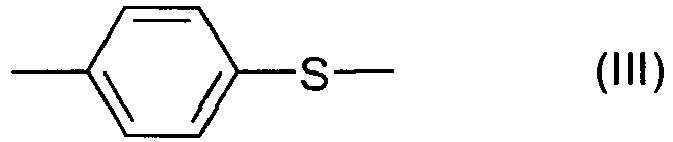


- Als Endgruppen kommen z.B. Halogen, Thiol oder Hydroxy, bevorzugt Halogen in Betracht.
- Die Polyarylensulfide können verzweigt oder unverzweigt sein. Die bevorzugten Polyarylensulfide weisen gewichtsmittlere Molgewichte von 1.000 bis 1.000.000 g/mol auf.
- Derartige Polyarylensulfide sind an sich bekannt oder nach bekannten Methoden erhältlich. Beispielsweise können sie, wie in der
US 2,513,188 beschrieben, durch Umsetzen von Halogenaromaten mit Schwefel oder Metallsulfiden hergestellt werden. Ebenso ist es möglich, Metallsalze von mit Halogen substituierten Thiophenolen zu erhitzen (sieheGB-B 962 941 US 3,354,129 zu entnehmen ist. Weitere Verfahren sind inUS 3,699,087 ,US 4,645,826 und J.P. Critchley et al., "Heat Resistant Polymers", Seiten 151 bis 160 (1983), Plenum Press, New York, beschrieben. - Die erfindungsgemäßen Zusammensetzungen enthalten mindestens ein Anhydrid einer mehrfunktionellen Carbonsäure mit einem zahlenmittleren Molekulargewicht von höchstens 600 g/mol, vorzugsweise von 90 g/mol bis 500 g/mol, insbesondere von 90 g/mol bis 400 g/mol.
- Die erfindungsgemäßen Zusammensetzungen sind erhältlich durch Zugabe von mindestens einem Anhydrid einer mehrfunktionellen Carbonsäure mit einem zahlenmittleren Molekulargewicht von höchstens 600 g/mol, vorzugsweise von 90 g/mol bis 500 g/mol, insbesondere von 90 g/mol bis 400 g/mol zu den Komponenten (A) und (B) wie oben beschrieben.
- Bevorzugte Anhydride (C) weisen eine geringe Flüchtigkeit auf und sind wenig toxisch, idealer weise nicht toxisch.
- Es ist für den Fachmann offensichtlich, dass die eingesetzten Anhydride gegenüber den phenolischen Endgruppen in Komponente (A) bzw. (B) reaktiv sind und deshalb in den erfindungsgemäßen Zusammensetzungen nicht oder nicht vollständig als Anhydrid vorliegen, sondern ganz oder teilweise in umgesetzter Form.
- Die Anhydride der Komponente (C) liegen jedoch in den erfindungsgemäßen Zusammensetzungen nicht eingebaut in eine Polymerkette oder in gepfropfter oder anderer Form als Copolymer vor, sondern als Additive, die mit reaktiven Endgruppen umgesetzt vorliegen können. Die erfindungsgemäß eingesetzten Anhydride sind somit von Polymeren und /oder Copolymeren enthaltend co-polymerisierte Anhydride zu unterscheiden.
- Die Funktionalität ist die (gegebenenfalls mittlere) Zahl an COOH-Gruppen pro Molekül. Unter mehrfunktionell wird eine Funktionalität von zwei oder höher verstanden. Im Rahmen der vorliegenden Erfindung bevorzugte Anhydride sind solche, die auf Basis einer Carbonsäure aufgebaut sind, deren Funktionalität 2 oder 3 ist.
- Vorzugsweise besteht Komponente (C) aus mindestens einem Anhydrid einer mehrfunktionellen Carbonsäure gemäß der allgemeinen Struktur IV:
HOOC-R-COOH (IV),
wobei R einen linearen oder verzweigten Kohlenwasserstoffrest mit von 2 bis 20 Kohlenstoffatomen repräsentiert, der optional weitere funktionelle Gruppen, vorzugsweise ausgewählt aus OH und COOH, enthält, mit der Maßgabe, dass die mehrfunktionellen Carbonsäuren ein Anhydrid bilden können, vorzugsweise ein zyklisches Anhydrid, insbesondere indem mindestens zwei COOH-Gruppen über 2 oder 3 Kohlenstoffatome miteinander verknüpft sind. - Cycloaliphatische Dicarbonsäureanhydride, insbesondere 1,2-Cyclohexandicarbonsäureanhydrid, sind somit ebenfalls bevorzugt. Bevorzugte Anhydride auf Basis cycloaliphatischer Dicarbonsäuren weisen folgende Struktur (V) auf:

- Bevorzugte Anhydride sind insbesondere C4 - C10 aliphatische Dicarbonsäureanhydride. Als Carbonsäureanhydride sind bevorzugt: Bernsteinsäureanhydrid, Alkylbernsteinsäureanhydride, Phthalsäureanhydrid, Trimellitinsäureanhydride, Tetrahydrophthalsäureanhydrid, Hexahydrophthalsäureanhydrid, 5-Norbornen-2,3-dicarbonsäureanhydrid, Norbornancarbonsäureanhydrid und Glutarsäureanhydrid. Besonders bevorzugt sind Bernsteinsäureanhydrid, Glutarsäureanhydrid und Adipinsäureanhydrid.
- Darüber hinaus kommen an sich auch Dicarbonsäureanhydride enthaltende Verbindungen in Betracht, die ethylenisch ungesättigte Gruppen enthalten, beispielsweise Maleinsäureanhydrid. Vorzugsweise werden jedoch Anhydride verwendet, die keine reaktive Doppelbindungen aufweisen.
- Bernsteinsäureanhydrid ist als Komponente (C) ganz besonders bevorzugt.
- In einer bevorzugten Ausführungsform der vorliegenden Erfindung enthalten die erfindungsgemäßen Zusammensetzungen als weitere Komponente (D) mindestens einen Füllstoff, vorzugsweise in einer Menge von 5 bis 250 Gewichtsteilen und besonders bevorzugt von 20 bis 100 Gewichtsteilen der Komponente (D) bezogen auf 100 Gewichtsteile der Komponenten (A), (B) und (C).
- Die erfindungsgemäßen Formmassen können insbesondere teilchenförmige oder faserförmige Zusatzstoffe enthalten.
- Bevorzugte faserförmige Füll- oder Verstärkungsstoffe sind Kohlenstofffasern, Kaliumtitanatwhisker, Aramidfasern und besonders bevorzugt Glasfasern. Bei der Verwendung von Glasfasern können diese zur besseren Verträglichkeit mit dem Matrixmaterial mit einer Schlichte, bevorzugt einer Polymethanschlichte und einem Haftvermittler ausgerüstet sein. Im Allgemeinen haben die verwendeten Kohlenstoff- und Glasfasern einen Durchmesser im Bereich von 6 bis 20 µm.
- Die Einarbeitung der Glasfasern kann sowohl in Form von Kurzglasfasern als auch in Form von Endlossträngen (Rovings) erfolgen. Im fertigen Spritzgussteil liegt die mittlere Länge der Glasfasern vorzugsweise im Bereich von 0,08 bis 0,5 mm.
- Kohlenstoff- oder Glasfasern können auch in Form von Geweben, Matten oder Glasseidenrovings eingesetzt werden.
- Als teilchenförmige Füllstoffe eignen sich amorphe Kieselsäure, Carbonate wie Magnesiumcarbonat (Kreide), gepulverter Quarz, Glimmer, unterschiedlichste Silikate wie Tone, Muskovit, Biotit, Suzoit, Zinnmaletit, Talkum, Chlorit, Phlogophit, Feldspat, Calciumsilikate wie Wollastonit oder Aluminiumsilikate wie Kaolin, besonders kalzinierter Kaolin.
- Nach einer besonders bevorzugten Ausführungsform werden teilchenförmige Füllstoffe verwendet, von denen mindestens 95 Gew.-%, bevorzugt mindestens 98 Gew.-% der Teilchen einen Durchmesser (größte Ausdehnung), bestimmt am fertigen Produkt, von weniger als 45 µm, bevorzugt weniger als 40 µm aufweisen und deren so genanntes Aspektverhältnis im Bereich von 1 bis 25, bevorzugt im Bereich von 2 bis 20 liegt, bestimmt am fertigen Produkt.
- Die Teilchendurchmesser können dabei z. B. dadurch bestimmt werden, dass elektronenmikroskopische Aufnahmen von Dünnschnitten der Polymermischung aufgenommen und mindestens 25, bevorzugt mindestens 50 Füllstoffteilchen für die Auswertung herangezogen werden. Ebenso kann die Bestimmung der Teilchendurchmesser über Sedimentationsanalyse erfolgen, gemäß Transactions of ASAE, Seite 491 (1983). Der Gewichtsanteil der Füllstoffe, die weniger als 40 µm beträgt kann auch mittels Siebanalyse gemessen werden. Das Aspektverhältnis ist das Verhältnis von Teilchendurchmesser zu Dicke (größter Ausdehnung zu kleinster Ausdehnung).
- Besonders bevorzugt werden als teilchenförmige Füllstoffe Talkum, Kaolin, wie kalzinierter Kaolin oder Wollastonit oder Mischungen aus zwei oder allen dieser Füllstoffe. Darunter wird Talkum mit einem Anteil von mindestens 95 Gew.-% an Teilchen mit einem Durchmesser von kleiner als 40 µm und einem Aspektverhältnis von 1,5 bis 25, jeweils bestimmt am fertigen Produkt, besonders bevorzugt. Kaolin hat bevorzugt einen Anteil von mindestens 95 Gew.-% an Teilchen mit einem Durchmesser von kleiner als 20 µm und ein Aspektverhältnis von 1,2 bis 20, jeweils bestimmt am fertigen Produkt.
- Die Zusammensetzungen können außerdem weitere Komponenten E enthalten.
- Die erfindungsgemäßen Formmassen können als weitere Komponente (E) Hilfsstoffe, insbesondere Verarbeitungshilfsmittel, Pigmente, Stabilisatoren, Flammschutzmittel oder Mischungen unterschiedlicher Additive enthalten. Übliche Zusatzstoffe sind beispielsweise auch Oxidationsverzögerer, Mittel gegen Wärmezersetzung und Zersetzung durch ultraviolettes Licht, Gleit- und Entformungsmittel, Farbstoffe und Weichmacher.
- Der Anteil der Komponente (E) in der erfindungsgemäßen Formmasse beträgt insbesondere von 0 bis zu 30, vorzugsweise von 0 bis zu 20 Gew.-%, insbesondere 0 bis 15 Gew.-%, bezogen auf das Gesamtgewicht der Komponenten A bis E. Falls die Komponente E Stabilisatoren beinhaltet, beträgt der Anteil dieser Stabilisatoren üblicherweise bis zu 2 Gew.-%, vorzugsweise 0,01 bis 1 Gew.-%, insbesondere 0,01 bis 0,5 Gew.-%, bezogen auf die Summe der Gew.-% der Komponenten (A) bis (E).
- Pigmente und Farbstoffe sind allgemein in Mengen von 0 bis 6, bevorzugt von 0,05 bis 5 und insbesondere von 0,1 bis 3 Gew.-%, bezogen auf die Summe der Gew.-% der Komponenten (A) bis (E), enthalten.
- Die Pigmente zur Einfärbung von Thermoplasten sind allgemein bekannt, siehe zum Beispiel R. Gächter und H. Müller, Taschenbuch der Kunststoffadditive, Carl Hanser Verlag, 1983, Seiten 494 bis 510. Als erste bevorzugte Gruppe von Pigmenten sind Weißpigmente zu nennen, wie Zinkoxid, Zinksulfid, Bleiweiß [2 PbCO3·Pb(OH)2], Lithopone, Antimonweiß und Titandioxid. Von den beiden gebräuchlichsten Kristallmodifikationen (Rutil- und Anatas-Typ) des Titandioxids wird insbesondere die Rutilform zur Weißfärbung der erfindungsgemäßen Formmassen verwendet. Schwarze Farbpigmente, die erfindungsgemäß eingesetzt werden können, sind Eisenoxidschwarz (Fe3O4), Spinellschwarz [Cu(Cr, Fe)2O4], Manganschwarz (Mischung aus Mangandioxid, Siliciumdioxid und Eisenoxid), Kobaltschwarz und Antimonschwarz sowie besonders bevorzugt Ruß, der meist in Form von Furnace- oder Gasruß eingesetzt wird. Siehe hierzu G. Benzing, Pigmente für Anstrichmittel, Expert-Verlag (1988), Seiten 78 ff.
- Zur Einstellung bestimmter Farbtöne können anorganische Buntpigmente, wie Chromoxidgrün oder organische Buntpigmente, wie Azopigmente oder Phthalocyanine erfindungsgemäß eingesetzt werden. Derartige Pigmente sind allgemein im Handel üblich. Oxidationsverzögerer und Wärmestabilisatoren, die den thermoplastischen Massen gemäß der Erfindung zugesetzt werden können, sind zum Beispiel Halogenide von Metallen der Gruppe I des Periodensystems, zum Beispiel Natrium-, Kalium-, Lithium-Halogenide, zum Beispiel Chloride, Bromide oder Iodide. Weiterhin können Zinkfluorid und Zinkchlorid verwendet werden. Ferner sind sterisch gehinderte Phenole, Hydrochinone, substituierte Vertreter dieser Gruppe, sekundäre aromatische Amine, gegebenenfalls in Verbindung mit phosphorhaltigen Säuren bzw. deren Salze, und Mischungen dieser Verbindungen, vorzugsweise in Konzentrationen bis zu 1 Gew.-%, bezogen auf die Summe der Gew.-% der Komponenten (A) bis (E) einsetzbar.
- Beispiele für UV-Stabilisatoren sind verschiedene substituierte Resorcine, Salicylate, Benzotriazole und Benzophenone, die im Allgemeinen in Mengen bis zu 2 Gew.-% eingesetzt werden.
- Gleit- und Entformungsmittel, die in der Regel in Mengen bis zu 1 Gew.-% bezogen auf die Summe der Gew.-% der Komponenten (A) bis (E) zugesetzt werden, sind Stearylalkohol, Stearinsäurealkylester und -amide sowie Ester des Pentaerythrits mit langkettigen Fettsäuren. Es können auch Dialkylketone, zum Beispiel Distearylketon, eingesetzt werden.
- Als bevorzugten Bestandteil enthalten die erfindungsgemäßen Formmassen von 0,1 bis 2, bevorzugt 0,1 bis 1,75, besonders bevorzugt 0,1 bis 1,5 Gew.-% und insbesondere von 0,1 bis 0,9 Gew.-% (bezogen auf die Summe der Gew.-% der Komponenten (A) bis (E)) an Stearinsäure und/oder Stearaten. Im Prinzip können auch andere Stearinsäurederivate wie Ester der Stearinsäure eingesetzt werden.
- Stearinsäure wird bevorzugt durch Hydrolyse von Fetten hergestellt. Die dabei erhaltenen Produkte stellen üblicherweise Mischungen aus Stearinsäure und Palmitinsäure dar. Daher haben solche Produkte einen breiten Erweichungsbereich, zum Beispiel von 50 bis 70 °C, je nach Zusammensetzung des Produkts. Bevorzugt werden Produkte mit einem Anteil an Stearinsäure von mehr als 20, besonders bevorzugt mehr als 25 Gew.-% verwendet. Es kann auch reine Stearinsäure (> 98 %) verwendet werden.
- Des Weiteren kann Komponente (E) auch Stearate beinhalten. Stearate können entweder durch Umsetzung entsprechender Natriumsalze mit Metallsalzlösungen (zum Beispiel CaCl2, MgCl2, Aluminiumsalze) oder durch direkte Umsetzung der Fettsäure mit Metallhydroxid hergestellt werden (siehe zum Beispiel Baerlocher Additives, 2005). Bevorzugt wird Aluminiumtristearat verwendet.
- Als weitere Zusatzstoffe kommen auch so genannte Nukleierungsmittel, wie beispielsweise Talkum, in Betracht.
- Die Reihenfolge, in der die Komponenten (A) bis (E) gemischt werden ist beliebig.
- Die erfindungsgemäßen Formmassen können nach an sich bekannten Verfahren, beispielsweise Extrusion, hergestellt werden. Die erfindungsgemäßen Formmassen können z.B. hergestellt werden, indem man die Ausgangskomponenten in üblichen Mischvorrichtungen wie Schneckenextrudern vorzugsweise Zweischneckenextrudern, Brabender-Mischer oder Banbury-Mischer sowie Knetern mischt und anschließend extrudiert. Nach der Extrusion wird das Extrudat abgekühlt und zerkleinert. Die Reihenfolge der Mischung der Komponenten kann variiert werden, so können zwei oder ggf. drei Komponenten vorgemischt werden, es können aber auch alle Komponenten gemeinsam gemischt werden.
- Um eine möglichst homogene Durchmischung zu erhalten, ist eine intensive Durchmischung vorteilhaft. Dazu sind im Allgemeinen mittlere Mischzeiten von 0,2 bis 30 Minuten bei Temperaturen von 280 bis 380°C, bevorzugt 290 bis 370°C, erforderlich. Nach der Extrusion wird das Extrudat in der Regel abgekühlt und zerkleinert.
- Die erfindungsgemäßen Formmassen zeichnen sich durch gute mechanische Eigenschaften, gegenüber dem Stand der Technik verbesserte Fließfähigkeit und verbesserte Spannungsrissbeständigkeit aus.
- Die erfindungsgemäßen Formmassen zeichnen sich durch gute Fließfähigkeit bei gleichzeitig verbesserter Zähigkeit, vor allem Reißdehnung und Kerbschlagzähigkeit aus. Die erfindungsgemäßen Formmassen eignen sich daher zur Herstellung von Formteilen für Haushaltsartikel, elektrische oder elektronische Bauteile sowie für Formteile für den Fahrzeugsektor.
- Die erfindungsgemäßen thermoplastischen Formmassen können vorteilhaft zur Herstellung von Formteilen verwendet werden.
- Ein weiterer Gegenstand der vorliegenden Erfindung ist die Verwendung gemäß Anspruch 15 von Anhydriden von mehrfunktionellen Carbonsäuren wie im Rahmen von Komponente (C) beschrieben in Zusammensetzungen enthaltend mindestens ein Polyarylenether und mindestens ein Polyarylensulfid, vorzugsweise zur Erhöhung der Steifigkeit oder zur Erhöhung der Reißdehnung oder zur Verbesserung der Schlagzähigkeit.
- Die folgenden Beispiele erläutern die Erfindung näher, ohne sie einzuschränken.
- Die E-Moduli und die Reißdehnung der Proben wurden im Zugversuch nach ISO 527 an Schulterstäben ermittelt.
- Die Schlagzähigkeit der Produkte wurde an ISO-Stäben nach ISO 179 1 eU bestimmt.
- Die Fließfähigkeit wurde anhand der Schmelzeviskosität beurteilt. Die Schmelzestabilität wurde mittels eines Kapillarrheometers bestimmt. Dabei wurde die scheinbare Viskosität bei 350°C als Funktion der Scherrate bestimmt. Angegeben sind die bei 1000 Hz bestimmten Werte.
- Die Spannungsrissbeständigkeit wurde nach DIN EN ISO 22088-3 an Probekörpern der Dicke von 2 mm bestimmt. Bei einer Biegedehnung von 1,32 % wurde das Prüfmedium verschieden lange einwirken lassen und der Zustand des Probekörpers anschließend visuell begutachtet.
- Zur Bestimmung der Beständigkeit gegenüber Kraftstoff wurde der Kraftstoff FAM B 7 Tage bei 80°C einwirken lassen.
- Der Zustand der Proben wurde anschließend visuell begutachtet:
- +: unverändert +/-: leichte Oberflächenveränderung, keine erkennbaren Risse
- -: starke Oberflächenveränderung, deutlich erkennbare Risse
- --: Bruch der Probe
- Die veränderten Stellen wurden im Lichtmikroskop auf Risse untersucht.
- Als Komponente A-1 wurde ein Polyethersulfon mit einer Viskositätszahl von 49,0 ml/g (Ultrason® E 1010 der BASF SE) verwendet. Das verwendete Produkt wies 0,16 Gew.-% CI-Endgruppen und 0,21 Gew.-% OCH3-Endgruppen auf. Die OH-Endgruppen lagen unterhalb der Nachweisgrenze.
- Als Komponente A-2 wurde ein Polyethersulfon mit einer Viskositätszahl von 55,6 ml/g verwendet, welches 0,20 Gew.-% OH-Endgruppen und 0,02 Gew.-% CI-Endgruppen aufwies.
- Als Komponente B-1 wurde ein Polyphenylensulfid mit einer Schmelzeviskosität von 145 Pa*s bei 330°C und einer Scherrate von 1000 Hz verwendet.
- Als Komponente C-1 wurde Bernsteinsäureanhydrid verwendet.
- Als Komponente D-1 wurden Schnittglasfasern mit einer Stapellänge von 4,5 mm und einem Faserdurchmesser von 10 µm eingesetzt, die mit einer Polyurethanschlichte versehen waren.
Tabelle 1: Versuch V1 V2 V3 4 5 6 7 8 Komp. A-1 70 41 36 36 36 30 33 36 Komp. B-1 14 14 13,99 13,995 19,99 11,99 13,85 Komp. A-2 5 5 5 5 5 5 Komp. C-1 0,01 0,005 0,01 0,01 0,15 Komp. D-1 30 45 45 45 45 45 50 45 E-Modul [GPa] 9,40 16,5 16,4 16,5 16,5 17,2 18,9 16,4 Reißdehnung [%] 2,4 1,4 1,6 1,8 1,8 1,7 1,6 1,3 ISO 179 1eU [kJ/m2] 48 41 43 47 46 44 42 37 Viskosität bei 103 Hz [350°C] 690 551 563 560 565 491 625 564 Beständigkeit Gegen FAM B bei 25°C +/- + + + + + + + - Die Zusammensetzungen sind in Gewichtsteilen angegeben.
- Die erfindungsgemäßen Formmassen zeichnen sich durch eine Kombination aus hoher Steifigkeit, guter Zähigkeit, niedriger Viskosität und guter Beständigkeit gegenüber Kraftstoff aus.
Claims (15)
- Zusammensetzung enthaltend folgende Komponenten:(A) mindestens ein Polyarylenether,(B) mindestens ein Polyarylensulfid, und(C) mindestens ein Anhydrid einer mehrfunktionellen Carbonsäure mit einem zahlenmittleren Molekulargewicht von höchstens 600 g/mol, wobei Komponente (A) folgende Bestandteile umfasst:(A1) mindestens ein Polyarylenether mit höchstens 0,01 Gew.-% phenolischer Endgruppen berechnet als Gewichtsmenge OH bezogen auf die Gewichtsmenge der Komponente (A1), und(A2) mindestens ein Polyarylenether mit mindestens 0,1 Gew.-% phenolischer Endgruppen berechnet als Gewichtsmenge OH bezogen auf die Gewichtsmenge der Komponente (A2).
- Zusammensetzung nach Anspruch 1, wobei Komponente (A) einen Gehalt phenolischer Endgruppen von mindestens 0,04 Gew.-% aufweist, berechnet als Gewichtsmenge OH bezogen auf die Gewichtsmenge der Komponente (A).
- Zusammensetzung nach Anspruch 1 oder 2, wobei die Polyarylenether der Komponente (A2) durch ein Verfahren erhältlich sind, welches folgende Schritte in der Reihenfolge a-b-c umfasst:(a) Bereitstellung mindestens eines Polyarylenethers (P), der überwiegend Phenolat-Endgruppen aufweist, in Gegenwart eines Lösungsmittels (L),(b) Zugabe mindestens einer mehrfunktionellen Carbonsäure und(c) Gewinnung der Polyarylenether der Komponente (A2) als Feststoff.
- Zusammensetzung nach Anspruch 1 bis 3, wobei die Polyarylenether der Komponente (A) aufgebaut sind aus Bausteinen der allgemeinen Formel I:
 t, q: unabhängig voneinander 0, 1, 2 oder 3,Q, T, Y: unabhängig voneinander jeweils eine chemische Bindung oder Gruppe, ausgewählt aus -O-, -S-, -SO2-, S=O, C=O, -N=N- und -CRaRb-, wobei Ra und Rb unabhängig voneinander jeweils für ein Wasserstoffatom oder eine C1-C12-Alkyl-, C1-C12-Alkoxy- oder C6-C16-Arylgruppe stehen, wobei wenigstens eines aus Q, T und Y von -O- verschieden ist, und wenigstens eines aus Q, T und Y für -SO2- steht undAr, Ar1: unabhängig voneinander C6-C18-Arylengruppe.
 - Zusammensetzung nach Anspruch 4, wobei Q, T und Y in Formel (I) unabhängig voneinander ausgewählt sind aus -O- und -SO2- und wenigstens eines aus Q, T und Y für -SO2- steht.
- Zusammensetzung nach den Ansprüchen 4 oder 5, wobei Ar und Ar1 in Formel (I) unabhängig voneinander ausgewählt sind aus der Gruppe bestehend aus 1,4-Phenylen, 1,3-Phenylen, Naphthylen und 4,4'-Bisphenylen.
- Zusammensetzung nach den Ansprüchen 1 bis 6 enthaltend von 60 bis 94,999 Gew.-% der Komponente (A), von 5 bis 49,7 Gew.-% der Komponente (B) und von 0,001 bis 0,3 Ges.-% der Komponente (C), wobei die Summe der Ges.-% der Komponenten (A), (B) und (C) 100 Gew.-% ergibt.
- Zusammensetzung nach den Ansprüchen 1 bis 7, wobei die Polyarylensulfide der Komponente (B) von 30 bis 100 Gew.-% aus Wiederholungseinheiten gemäß der allgemeinen Formel -Ar-S- aufgebaut sind, wobei -Ar- eine Arylengruppe mit 6 bis 18 Kohlenstoffatomen darstellt.
- Zusammensetzung nach den Ansprüchen 1 bis 8, wobei Komponente (B) Polyphenylensulfid, vorzugsweise Poly(1,4-pl-enylensulfid) ist.
- Zusammensetzung nach den Ansprüchen 1 bis 9, wobei Komponente (C) aus mindestens einem Anhydrid einer mehrfunktionellen Carbonsäure gemäß der allgemeinen Struktur IV besteht:
HOOC-R-COOH (IV),
wobei R einen linearen oder verzweigten Kohlenwasserstoffrest mit 2 bis 20 Kohlenstoffatomen repräsentiert, der optional weitere funktionelle Gruppen, vorzugsweise ausgewählt aus OH und COOH, enthält, mit der Maßgabe, dass mindestens zwei COOH-Gruppen jeder mehrfunktionellen Carbonsäure über zwei oder drei Kohlenstoffatome miteinander verbunden sind. - Zusammensetzung nach den Ansprüchen 1 bis 10, wobei Komponente (C) Bernsteinsäureanhydrid ist.
- Zusammensetzung nach den Ansprüchen 1 bis 11 enthaltend als weitere Komponente (D) mindestens einen Füllstoff.
- Zusammensetzung nach Anspruch 12 enthaltend von 5 bis 250 Gewichtsteile der Komponente (D) bezogen auf 100 Gewichtsteile der Mischung aus den Komponenten (A), (B) und (C).
- Zusammensetzung nach Anspruch 12 oder 13, wobei Komponente (D) aus Glasfasern besteht.
- Verwendung von Anhydriden mehrfunktioneller Carbonsäuren (C) wie in den Ansprüchen 1 bis 14 definiert in Zusammensetzungen enthaltend mindestens ein Polyarylenether (A) und mindestens ein Polyarylensulfid (B) zur Erhöhung der Steifigkeit, zur Erhöhung der Reißdehnung oder zur Verbesserung der Schlagzähigkeit,
wobei Komponente (A) folgende Bestandteile umfasst:(A1) mindestens ein Polyarylenether mit höchstens 0,01 Gew.-% phenolischer Endgruppen berechnet als Gewichtsmenge OH bezogen auf die Gewichtsmenge der Komponente (A1), und(A2) mindestens ein Polyarylenether mit mindestens 0,1 Gew.-% phenolischer Endgruppen berechnet als Gewichtsmenge OH bezogen auf die Ge-wichtsmenge der Komponente (A2).
Priority Applications (1)
| Application Number | Priority Date | Filing Date | Title |
|---|---|---|---|
| EP09764848.9A EP2379642B1 (de) | 2008-12-17 | 2009-12-08 | Blends aus polyvyrylenethern und polyarylensulfiden enthaltend carbonsäureanhydride |
Applications Claiming Priority (3)
| Application Number | Priority Date | Filing Date | Title |
|---|---|---|---|
| EP08171958 | 2008-12-17 | ||
| PCT/EP2009/066584 WO2010069813A1 (de) | 2008-12-17 | 2009-12-08 | Blends aus polyvyrylenethern und polyarylensulfiden enthaltend carbonsäureanhydride |
| EP09764848.9A EP2379642B1 (de) | 2008-12-17 | 2009-12-08 | Blends aus polyvyrylenethern und polyarylensulfiden enthaltend carbonsäureanhydride |
Publications (2)
| Publication Number | Publication Date |
|---|---|
| EP2379642A1 EP2379642A1 (de) | 2011-10-26 |
| EP2379642B1 true EP2379642B1 (de) | 2014-03-26 |
Family
ID=41572428
Family Applications (1)
| Application Number | Title | Priority Date | Filing Date |
|---|---|---|---|
| EP09764848.9A Not-in-force EP2379642B1 (de) | 2008-12-17 | 2009-12-08 | Blends aus polyvyrylenethern und polyarylensulfiden enthaltend carbonsäureanhydride |
Country Status (9)
| Country | Link |
|---|---|
| US (1) | US20110251337A1 (de) |
| EP (1) | EP2379642B1 (de) |
| JP (2) | JP2012512297A (de) |
| KR (1) | KR20110111289A (de) |
| CN (1) | CN102341457B (de) |
| BR (1) | BRPI0922573A2 (de) |
| ES (1) | ES2461800T3 (de) |
| MY (1) | MY153981A (de) |
| WO (1) | WO2010069813A1 (de) |
Families Citing this family (17)
| Publication number | Priority date | Publication date | Assignee | Title |
|---|---|---|---|---|
| MY146822A (en) * | 2007-06-22 | 2012-09-28 | Basf Se | Molding materials comprising polyaryl ethers with improved surface quality |
| ATE495218T1 (de) * | 2007-06-28 | 2011-01-15 | Basf Se | Thermoplastische formmassen enthaltend organische schwarzpigmente |
| CN101784605A (zh) * | 2007-08-15 | 2010-07-21 | 巴斯夫欧洲公司 | 具有改进的流动性和良好的机械性能的聚酯混合物 |
| KR20110089284A (ko) * | 2008-10-23 | 2011-08-05 | 바스프 에스이 | 분지형 폴리아릴렌 에테르 및 상기 에테르를 포함하는 열가소성 성형 화합물 |
| JP2012512297A (ja) * | 2008-12-17 | 2012-05-31 | ビーエーエスエフ ソシエタス・ヨーロピア | カルボン酸無水物を含有する、ポリアリーレンエーテルとポリアリーレンスルフィドとからなる配合物 |
| EP2379301B1 (de) | 2008-12-19 | 2013-02-20 | Basf Se | Verfahren zur herstellung eines verbundbauteils durch mehrkomponentenspritzguss, solcher verbundbauteil und verwendung einer mischung zur herstellung des verbundbauteils |
| JP2012522856A (ja) | 2009-04-03 | 2012-09-27 | ビーエーエスエフ ソシエタス・ヨーロピア | 塩素の少ないポリビフェニルスルホン−ポリマーの製造方法 |
| EP2440599B2 (de) | 2009-06-08 | 2017-02-22 | Basf Se | Verfahren zur herstellung von polyarylenether-blockcopolymeren |
| CN102459409B (zh) | 2009-06-08 | 2014-05-28 | 巴斯夫欧洲公司 | 链段状聚亚芳基醚嵌段共聚物 |
| DE102009025537A1 (de) | 2009-06-19 | 2010-12-30 | Basf Se | Copolyamide |
| US9962889B2 (en) | 2009-07-08 | 2018-05-08 | Basf Se | Method for producing fiber-reinforced composite materials from polyamide 6 and copolyamides made of polyamide 6 and polyamide 12 |
| EP2467415B1 (de) | 2009-08-20 | 2019-10-09 | Basf Se | Verfahren zur herstellung von halogenarmen polybiphenylsulfon-polymeren |
| EP2501749B1 (de) | 2009-11-20 | 2013-09-18 | Basf Se | Mikrohohlkugeln enthaltende harzschaumstoffe |
| EP2336220A1 (de) | 2009-12-17 | 2011-06-22 | Basf Se | Verbesserte Blends aus Polyarylenethern und Polyarylensulfiden |
| WO2011107389A1 (de) * | 2010-03-05 | 2011-09-09 | Basf Se | Verbesserte blends aus polyarylenethern und polyarylensulfiden |
| US20110218294A1 (en) * | 2010-03-05 | 2011-09-08 | Basf Se | blends of polyarylene ethers and polyarylene sulfides |
| WO2014095973A1 (en) | 2012-12-18 | 2014-06-26 | Solvay Specialty Polymers Usa, Llc | Mobile electronic devices made of low-chlorine aromatic polysulfones |
Family Cites Families (15)
| Publication number | Priority date | Publication date | Assignee | Title |
|---|---|---|---|---|
| JPH0710831B2 (ja) * | 1986-09-24 | 1995-02-08 | 三菱瓦斯化学株式会社 | オリゴマ−の精製分離法 |
| JPH0249023A (ja) * | 1988-05-25 | 1990-02-19 | Mitsubishi Gas Chem Co Inc | 樹脂組成物 |
| JP2676017B2 (ja) * | 1989-02-28 | 1997-11-12 | 日本ジーイープラスチックス 株式会社 | ポリフェニレンサルファイド樹脂組成物及びその製造法 |
| JPH078948B2 (ja) * | 1989-07-24 | 1995-02-01 | 日本ジーイープラスチックス株式会社 | ポリフェニレンサルファイド系樹脂組成物 |
| JP2799415B2 (ja) * | 1989-02-23 | 1998-09-17 | 日本ジーイープラスチックス 株式会社 | ポリフェニレンサルファイド樹脂組成物 |
| JP2707714B2 (ja) * | 1989-04-25 | 1998-02-04 | 東レ株式会社 | ポリフェニレンスルフィド樹脂組成物 |
| US5214083A (en) * | 1991-08-15 | 1993-05-25 | General Electric Company | Poly(phenylene sulfide) resin compositions |
| JPH06336549A (ja) * | 1993-05-28 | 1994-12-06 | Mitsubishi Petrochem Co Ltd | 熱可塑性樹脂組成物 |
| DE4420643A1 (de) * | 1994-06-14 | 1995-12-21 | Basf Ag | Mischungen auf der Basis von Polyarylenethern und Polyarylensulfiden |
| EP0673973A1 (de) * | 1994-03-26 | 1995-09-27 | Basf Aktiengesellschaft | Mischungen auf der Basis von Polyarylenethern und Polyarylensulfiden |
| JPH09143362A (ja) * | 1995-11-24 | 1997-06-03 | Mitsui Toatsu Chem Inc | 樹脂組成物 |
| US6627704B2 (en) * | 1999-12-01 | 2003-09-30 | General Electric Company | Poly(arylene ether)-containing thermoset composition, method for the preparation thereof, and articles derived therefrom |
| JP2012512297A (ja) * | 2008-12-17 | 2012-05-31 | ビーエーエスエフ ソシエタス・ヨーロピア | カルボン酸無水物を含有する、ポリアリーレンエーテルとポリアリーレンスルフィドとからなる配合物 |
| JP2012522856A (ja) * | 2009-04-03 | 2012-09-27 | ビーエーエスエフ ソシエタス・ヨーロピア | 塩素の少ないポリビフェニルスルホン−ポリマーの製造方法 |
| ATE517149T1 (de) * | 2009-05-11 | 2011-08-15 | Basf Se | Verstärkte styrolcopolymere |
-
2009
- 2009-12-08 JP JP2011541320A patent/JP2012512297A/ja active Pending
- 2009-12-08 WO PCT/EP2009/066584 patent/WO2010069813A1/de not_active Ceased
- 2009-12-08 US US13/140,245 patent/US20110251337A1/en not_active Abandoned
- 2009-12-08 KR KR1020117016504A patent/KR20110111289A/ko not_active Ceased
- 2009-12-08 BR BRPI0922573A patent/BRPI0922573A2/pt not_active IP Right Cessation
- 2009-12-08 CN CN200980156968.0A patent/CN102341457B/zh not_active Expired - Fee Related
- 2009-12-08 MY MYPI2011002562A patent/MY153981A/en unknown
- 2009-12-08 EP EP09764848.9A patent/EP2379642B1/de not_active Not-in-force
- 2009-12-08 ES ES09764848.9T patent/ES2461800T3/es active Active
-
2015
- 2015-02-04 JP JP2015020252A patent/JP2015083706A/ja not_active Ceased
Also Published As
| Publication number | Publication date |
|---|---|
| BRPI0922573A2 (pt) | 2015-12-15 |
| KR20110111289A (ko) | 2011-10-10 |
| EP2379642A1 (de) | 2011-10-26 |
| CN102341457B (zh) | 2014-03-26 |
| CN102341457A (zh) | 2012-02-01 |
| US20110251337A1 (en) | 2011-10-13 |
| ES2461800T3 (es) | 2014-05-21 |
| MY153981A (en) | 2015-04-30 |
| JP2015083706A (ja) | 2015-04-30 |
| JP2012512297A (ja) | 2012-05-31 |
| WO2010069813A1 (de) | 2010-06-24 |
Similar Documents
| Publication | Publication Date | Title |
|---|---|---|
| EP2379642A1 (de) | Blends aus polyvyrylenethern und polyarylensulfiden enthaltend carbonsäureanhydride | |
| EP2513193B1 (de) | Verbesserte blends aus polyarylenethern und polyarylensulfiden | |
| EP2513191B1 (de) | Verbesserte blends aus polyarylenethern und polyarylensulfiden | |
| EP2576676B1 (de) | Verstärkte thermoplastische formmassen auf basis von polyarylenethern | |
| EP2160440B1 (de) | Formmassen enthaltend polyarylether mit verbesserter oberflächenqualität | |
| EP2358787B1 (de) | Verfahren zur herstellung eines reaktiven polyarylenethers | |
| EP2414430B1 (de) | Verfahren zur herstellung von chlorarmen polybiphenylsulfon-polymeren | |
| EP2467415B1 (de) | Verfahren zur herstellung von halogenarmen polybiphenylsulfon-polymeren | |
| EP2340273A1 (de) | Verzweigte polyarylenether und diese enthaltende thermoplastische formmassen | |
| EP2550335B1 (de) | Verbesserte blends aus polyarylenethern und polyarylensulfiden | |
| EP2440597B1 (de) | Segmentierte polyarylenether-blockcopolymere | |
| EP2550331B1 (de) | Polyarylenether mit verbesserter fliessfähigkeit | |
| EP2542623B1 (de) | Verbesserte blends aus polyarylenethern und polyarylensulfiden | |
| EP2760916B1 (de) | Hochfeste blends auf basis von polyarylenethern | |
| EP2694577B1 (de) | Thermoplastische formmasse aus polyarylenethern und polyphenylensulfid mit verbesserter verarbeitungsstabilität | |
| DE2009323C (de) | Verfahren zur Herstellung von hitze bestandigen linearen aromatischen Copolythioathern | |
| DE4410661A1 (de) | Mischungen auf der Basis von Polyarylenethern und Polyarylensulfiden |
Legal Events
| Date | Code | Title | Description |
|---|---|---|---|
| PUAI | Public reference made under article 153(3) epc to a published international application that has entered the european phase |
Free format text: ORIGINAL CODE: 0009012 |
|
| 17P | Request for examination filed |
Effective date: 20110718 |
|
| AK | Designated contracting states |
Kind code of ref document: A1 Designated state(s): AT BE BG CH CY CZ DE DK EE ES FI FR GB GR HR HU IE IS IT LI LT LU LV MC MK MT NL NO PL PT RO SE SI SK SM TR |
|
| DAX | Request for extension of the european patent (deleted) | ||
| GRAP | Despatch of communication of intention to grant a patent |
Free format text: ORIGINAL CODE: EPIDOSNIGR1 |
|
| INTG | Intention to grant announced |
Effective date: 20131113 |
|
| GRAS | Grant fee paid |
Free format text: ORIGINAL CODE: EPIDOSNIGR3 |
|
| GRAA | (expected) grant |
Free format text: ORIGINAL CODE: 0009210 |
|
| AK | Designated contracting states |
Kind code of ref document: B1 Designated state(s): AT BE BG CH CY CZ DE DK EE ES FI FR GB GR HR HU IE IS IT LI LT LU LV MC MK MT NL NO PL PT RO SE SI SK SM TR |
|
| REG | Reference to a national code |
Ref country code: GB Ref legal event code: FG4D Free format text: NOT ENGLISH |
|
| REG | Reference to a national code |
Ref country code: CH Ref legal event code: EP |
|
| REG | Reference to a national code |
Ref country code: AT Ref legal event code: REF Ref document number: 659004 Country of ref document: AT Kind code of ref document: T Effective date: 20140415 |
|
| REG | Reference to a national code |
Ref country code: IE Ref legal event code: FG4D Free format text: LANGUAGE OF EP DOCUMENT: GERMAN |
|
| REG | Reference to a national code |
Ref country code: DE Ref legal event code: R096 Ref document number: 502009009068 Country of ref document: DE Effective date: 20140508 |
|
| REG | Reference to a national code |
Ref country code: ES Ref legal event code: FG2A Ref document number: 2461800 Country of ref document: ES Kind code of ref document: T3 Effective date: 20140521 |
|
| PG25 | Lapsed in a contracting state [announced via postgrant information from national office to epo] |
Ref country code: LT Free format text: LAPSE BECAUSE OF FAILURE TO SUBMIT A TRANSLATION OF THE DESCRIPTION OR TO PAY THE FEE WITHIN THE PRESCRIBED TIME-LIMIT Effective date: 20140326 Ref country code: NO Free format text: LAPSE BECAUSE OF FAILURE TO SUBMIT A TRANSLATION OF THE DESCRIPTION OR TO PAY THE FEE WITHIN THE PRESCRIBED TIME-LIMIT Effective date: 20140626 |
|
| REG | Reference to a national code |
Ref country code: NL Ref legal event code: VDEP Effective date: 20140326 |
|
| REG | Reference to a national code |
Ref country code: LT Ref legal event code: MG4D |
|
| PG25 | Lapsed in a contracting state [announced via postgrant information from national office to epo] |
Ref country code: SE Free format text: LAPSE BECAUSE OF FAILURE TO SUBMIT A TRANSLATION OF THE DESCRIPTION OR TO PAY THE FEE WITHIN THE PRESCRIBED TIME-LIMIT Effective date: 20140326 Ref country code: FI Free format text: LAPSE BECAUSE OF FAILURE TO SUBMIT A TRANSLATION OF THE DESCRIPTION OR TO PAY THE FEE WITHIN THE PRESCRIBED TIME-LIMIT Effective date: 20140326 |
|
| PG25 | Lapsed in a contracting state [announced via postgrant information from national office to epo] |
Ref country code: HR Free format text: LAPSE BECAUSE OF FAILURE TO SUBMIT A TRANSLATION OF THE DESCRIPTION OR TO PAY THE FEE WITHIN THE PRESCRIBED TIME-LIMIT Effective date: 20140326 Ref country code: LV Free format text: LAPSE BECAUSE OF FAILURE TO SUBMIT A TRANSLATION OF THE DESCRIPTION OR TO PAY THE FEE WITHIN THE PRESCRIBED TIME-LIMIT Effective date: 20140326 |
|
| PG25 | Lapsed in a contracting state [announced via postgrant information from national office to epo] |
Ref country code: NL Free format text: LAPSE BECAUSE OF FAILURE TO SUBMIT A TRANSLATION OF THE DESCRIPTION OR TO PAY THE FEE WITHIN THE PRESCRIBED TIME-LIMIT Effective date: 20140326 Ref country code: IS Free format text: LAPSE BECAUSE OF FAILURE TO SUBMIT A TRANSLATION OF THE DESCRIPTION OR TO PAY THE FEE WITHIN THE PRESCRIBED TIME-LIMIT Effective date: 20140726 Ref country code: EE Free format text: LAPSE BECAUSE OF FAILURE TO SUBMIT A TRANSLATION OF THE DESCRIPTION OR TO PAY THE FEE WITHIN THE PRESCRIBED TIME-LIMIT Effective date: 20140326 Ref country code: BG Free format text: LAPSE BECAUSE OF FAILURE TO SUBMIT A TRANSLATION OF THE DESCRIPTION OR TO PAY THE FEE WITHIN THE PRESCRIBED TIME-LIMIT Effective date: 20140626 Ref country code: RO Free format text: LAPSE BECAUSE OF FAILURE TO SUBMIT A TRANSLATION OF THE DESCRIPTION OR TO PAY THE FEE WITHIN THE PRESCRIBED TIME-LIMIT Effective date: 20140326 Ref country code: CY Free format text: LAPSE BECAUSE OF FAILURE TO SUBMIT A TRANSLATION OF THE DESCRIPTION OR TO PAY THE FEE WITHIN THE PRESCRIBED TIME-LIMIT Effective date: 20140326 Ref country code: CZ Free format text: LAPSE BECAUSE OF FAILURE TO SUBMIT A TRANSLATION OF THE DESCRIPTION OR TO PAY THE FEE WITHIN THE PRESCRIBED TIME-LIMIT Effective date: 20140326 |
|
| PG25 | Lapsed in a contracting state [announced via postgrant information from national office to epo] |
Ref country code: SK Free format text: LAPSE BECAUSE OF FAILURE TO SUBMIT A TRANSLATION OF THE DESCRIPTION OR TO PAY THE FEE WITHIN THE PRESCRIBED TIME-LIMIT Effective date: 20140326 Ref country code: PL Free format text: LAPSE BECAUSE OF FAILURE TO SUBMIT A TRANSLATION OF THE DESCRIPTION OR TO PAY THE FEE WITHIN THE PRESCRIBED TIME-LIMIT Effective date: 20140326 |
|
| PG25 | Lapsed in a contracting state [announced via postgrant information from national office to epo] |
Ref country code: PT Free format text: LAPSE BECAUSE OF FAILURE TO SUBMIT A TRANSLATION OF THE DESCRIPTION OR TO PAY THE FEE WITHIN THE PRESCRIBED TIME-LIMIT Effective date: 20140728 |
|
| REG | Reference to a national code |
Ref country code: DE Ref legal event code: R097 Ref document number: 502009009068 Country of ref document: DE |
|
| PG25 | Lapsed in a contracting state [announced via postgrant information from national office to epo] |
Ref country code: DK Free format text: LAPSE BECAUSE OF FAILURE TO SUBMIT A TRANSLATION OF THE DESCRIPTION OR TO PAY THE FEE WITHIN THE PRESCRIBED TIME-LIMIT Effective date: 20140326 |
|
| PLBE | No opposition filed within time limit |
Free format text: ORIGINAL CODE: 0009261 |
|
| STAA | Information on the status of an ep patent application or granted ep patent |
Free format text: STATUS: NO OPPOSITION FILED WITHIN TIME LIMIT |
|
| 26N | No opposition filed |
Effective date: 20150106 |
|
| REG | Reference to a national code |
Ref country code: DE Ref legal event code: R097 Ref document number: 502009009068 Country of ref document: DE Effective date: 20150106 |
|
| PG25 | Lapsed in a contracting state [announced via postgrant information from national office to epo] |
Ref country code: BE Free format text: LAPSE BECAUSE OF NON-PAYMENT OF DUE FEES Effective date: 20141231 |
|
| PG25 | Lapsed in a contracting state [announced via postgrant information from national office to epo] |
Ref country code: LU Free format text: LAPSE BECAUSE OF FAILURE TO SUBMIT A TRANSLATION OF THE DESCRIPTION OR TO PAY THE FEE WITHIN THE PRESCRIBED TIME-LIMIT Effective date: 20141208 Ref country code: SI Free format text: LAPSE BECAUSE OF FAILURE TO SUBMIT A TRANSLATION OF THE DESCRIPTION OR TO PAY THE FEE WITHIN THE PRESCRIBED TIME-LIMIT Effective date: 20140326 |
|
| REG | Reference to a national code |
Ref country code: CH Ref legal event code: PL |
|
| REG | Reference to a national code |
Ref country code: IE Ref legal event code: MM4A |
|
| PG25 | Lapsed in a contracting state [announced via postgrant information from national office to epo] |
Ref country code: IE Free format text: LAPSE BECAUSE OF NON-PAYMENT OF DUE FEES Effective date: 20141208 Ref country code: CH Free format text: LAPSE BECAUSE OF NON-PAYMENT OF DUE FEES Effective date: 20141231 Ref country code: LI Free format text: LAPSE BECAUSE OF NON-PAYMENT OF DUE FEES Effective date: 20141231 |
|
| REG | Reference to a national code |
Ref country code: FR Ref legal event code: PLFP Year of fee payment: 7 |
|
| PGFP | Annual fee paid to national office [announced via postgrant information from national office to epo] |
Ref country code: GB Payment date: 20151230 Year of fee payment: 7 |
|
| REG | Reference to a national code |
Ref country code: AT Ref legal event code: MM01 Ref document number: 659004 Country of ref document: AT Kind code of ref document: T Effective date: 20141208 |
|
| PGFP | Annual fee paid to national office [announced via postgrant information from national office to epo] |
Ref country code: FR Payment date: 20151228 Year of fee payment: 7 |
|
| PG25 | Lapsed in a contracting state [announced via postgrant information from national office to epo] |
Ref country code: SM Free format text: LAPSE BECAUSE OF FAILURE TO SUBMIT A TRANSLATION OF THE DESCRIPTION OR TO PAY THE FEE WITHIN THE PRESCRIBED TIME-LIMIT Effective date: 20140326 |
|
| PGFP | Annual fee paid to national office [announced via postgrant information from national office to epo] |
Ref country code: DE Payment date: 20160302 Year of fee payment: 7 Ref country code: ES Payment date: 20160121 Year of fee payment: 7 Ref country code: IT Payment date: 20151221 Year of fee payment: 7 |
|
| PG25 | Lapsed in a contracting state [announced via postgrant information from national office to epo] |
Ref country code: MC Free format text: LAPSE BECAUSE OF FAILURE TO SUBMIT A TRANSLATION OF THE DESCRIPTION OR TO PAY THE FEE WITHIN THE PRESCRIBED TIME-LIMIT Effective date: 20140326 Ref country code: AT Free format text: LAPSE BECAUSE OF NON-PAYMENT OF DUE FEES Effective date: 20141208 |
|
| PG25 | Lapsed in a contracting state [announced via postgrant information from national office to epo] |
Ref country code: GR Free format text: LAPSE BECAUSE OF FAILURE TO SUBMIT A TRANSLATION OF THE DESCRIPTION OR TO PAY THE FEE WITHIN THE PRESCRIBED TIME-LIMIT Effective date: 20140627 |
|
| PG25 | Lapsed in a contracting state [announced via postgrant information from national office to epo] |
Ref country code: TR Free format text: LAPSE BECAUSE OF FAILURE TO SUBMIT A TRANSLATION OF THE DESCRIPTION OR TO PAY THE FEE WITHIN THE PRESCRIBED TIME-LIMIT Effective date: 20140326 Ref country code: MT Free format text: LAPSE BECAUSE OF FAILURE TO SUBMIT A TRANSLATION OF THE DESCRIPTION OR TO PAY THE FEE WITHIN THE PRESCRIBED TIME-LIMIT Effective date: 20140326 Ref country code: HU Free format text: LAPSE BECAUSE OF FAILURE TO SUBMIT A TRANSLATION OF THE DESCRIPTION OR TO PAY THE FEE WITHIN THE PRESCRIBED TIME-LIMIT; INVALID AB INITIO Effective date: 20091208 |
|
| REG | Reference to a national code |
Ref country code: DE Ref legal event code: R119 Ref document number: 502009009068 Country of ref document: DE |
|
| GBPC | Gb: european patent ceased through non-payment of renewal fee |
Effective date: 20161208 |
|
| REG | Reference to a national code |
Ref country code: FR Ref legal event code: ST Effective date: 20170831 |
|
| PG25 | Lapsed in a contracting state [announced via postgrant information from national office to epo] |
Ref country code: IT Free format text: LAPSE BECAUSE OF NON-PAYMENT OF DUE FEES Effective date: 20161208 Ref country code: FR Free format text: LAPSE BECAUSE OF NON-PAYMENT OF DUE FEES Effective date: 20170102 |
|
| PG25 | Lapsed in a contracting state [announced via postgrant information from national office to epo] |
Ref country code: DE Free format text: LAPSE BECAUSE OF NON-PAYMENT OF DUE FEES Effective date: 20170701 Ref country code: GB Free format text: LAPSE BECAUSE OF NON-PAYMENT OF DUE FEES Effective date: 20161208 |
|
| PG25 | Lapsed in a contracting state [announced via postgrant information from national office to epo] |
Ref country code: ES Free format text: LAPSE BECAUSE OF NON-PAYMENT OF DUE FEES Effective date: 20161209 |
|
| PG25 | Lapsed in a contracting state [announced via postgrant information from national office to epo] |
Ref country code: MK Free format text: LAPSE BECAUSE OF FAILURE TO SUBMIT A TRANSLATION OF THE DESCRIPTION OR TO PAY THE FEE WITHIN THE PRESCRIBED TIME-LIMIT Effective date: 20140326 |
|
| REG | Reference to a national code |
Ref country code: ES Ref legal event code: FD2A Effective date: 20181114 |