EP2371522A1 - Method for the production of composite materials using magnetic nano-particles to orient reinforcing particles and reinforced materials obtained using the method - Google Patents
Method for the production of composite materials using magnetic nano-particles to orient reinforcing particles and reinforced materials obtained using the method Download PDFInfo
- Publication number
- EP2371522A1 EP2371522A1 EP10003358A EP10003358A EP2371522A1 EP 2371522 A1 EP2371522 A1 EP 2371522A1 EP 10003358 A EP10003358 A EP 10003358A EP 10003358 A EP10003358 A EP 10003358A EP 2371522 A1 EP2371522 A1 EP 2371522A1
- Authority
- EP
- European Patent Office
- Prior art keywords
- particles
- matrix
- reinforcing particles
- magnetic
- spherical
- Prior art date
- Legal status (The legal status is an assumption and is not a legal conclusion. Google has not performed a legal analysis and makes no representation as to the accuracy of the status listed.)
- Withdrawn
Links
Images


Classifications
-
- B—PERFORMING OPERATIONS; TRANSPORTING
- B29—WORKING OF PLASTICS; WORKING OF SUBSTANCES IN A PLASTIC STATE IN GENERAL
- B29C—SHAPING OR JOINING OF PLASTICS; SHAPING OF MATERIAL IN A PLASTIC STATE, NOT OTHERWISE PROVIDED FOR; AFTER-TREATMENT OF THE SHAPED PRODUCTS, e.g. REPAIRING
- B29C70/00—Shaping composites, i.e. plastics material comprising reinforcements, fillers or preformed parts, e.g. inserts
- B29C70/02—Shaping composites, i.e. plastics material comprising reinforcements, fillers or preformed parts, e.g. inserts comprising combinations of reinforcements, e.g. non-specified reinforcements, fibrous reinforcing inserts and fillers, e.g. particulate fillers, incorporated in matrix material, forming one or more layers and with or without non-reinforced or non-filled layers
- B29C70/021—Combinations of fibrous reinforcement and non-fibrous material
- B29C70/025—Combinations of fibrous reinforcement and non-fibrous material with particular filler
-
- B—PERFORMING OPERATIONS; TRANSPORTING
- B29—WORKING OF PLASTICS; WORKING OF SUBSTANCES IN A PLASTIC STATE IN GENERAL
- B29C—SHAPING OR JOINING OF PLASTICS; SHAPING OF MATERIAL IN A PLASTIC STATE, NOT OTHERWISE PROVIDED FOR; AFTER-TREATMENT OF THE SHAPED PRODUCTS, e.g. REPAIRING
- B29C67/00—Shaping techniques not covered by groups B29C39/00 - B29C65/00, B29C70/00 or B29C73/00
- B29C67/24—Shaping techniques not covered by groups B29C39/00 - B29C65/00, B29C70/00 or B29C73/00 characterised by the choice of material
-
- B—PERFORMING OPERATIONS; TRANSPORTING
- B29—WORKING OF PLASTICS; WORKING OF SUBSTANCES IN A PLASTIC STATE IN GENERAL
- B29C—SHAPING OR JOINING OF PLASTICS; SHAPING OF MATERIAL IN A PLASTIC STATE, NOT OTHERWISE PROVIDED FOR; AFTER-TREATMENT OF THE SHAPED PRODUCTS, e.g. REPAIRING
- B29C70/00—Shaping composites, i.e. plastics material comprising reinforcements, fillers or preformed parts, e.g. inserts
- B29C70/58—Shaping composites, i.e. plastics material comprising reinforcements, fillers or preformed parts, e.g. inserts comprising fillers only, e.g. particles, powder, beads, flakes, spheres
- B29C70/62—Shaping composites, i.e. plastics material comprising reinforcements, fillers or preformed parts, e.g. inserts comprising fillers only, e.g. particles, powder, beads, flakes, spheres the filler being oriented during moulding
-
- B—PERFORMING OPERATIONS; TRANSPORTING
- B82—NANOTECHNOLOGY
- B82Y—SPECIFIC USES OR APPLICATIONS OF NANOSTRUCTURES; MEASUREMENT OR ANALYSIS OF NANOSTRUCTURES; MANUFACTURE OR TREATMENT OF NANOSTRUCTURES
- B82Y30/00—Nanotechnology for materials or surface science, e.g. nanocomposites
-
- C—CHEMISTRY; METALLURGY
- C08—ORGANIC MACROMOLECULAR COMPOUNDS; THEIR PREPARATION OR CHEMICAL WORKING-UP; COMPOSITIONS BASED THEREON
- C08J—WORKING-UP; GENERAL PROCESSES OF COMPOUNDING; AFTER-TREATMENT NOT COVERED BY SUBCLASSES C08B, C08C, C08F, C08G or C08H
- C08J5/00—Manufacture of articles or shaped materials containing macromolecular substances
- C08J5/04—Reinforcing macromolecular compounds with loose or coherent fibrous material
- C08J5/06—Reinforcing macromolecular compounds with loose or coherent fibrous material using pretreated fibrous materials
-
- C—CHEMISTRY; METALLURGY
- C08—ORGANIC MACROMOLECULAR COMPOUNDS; THEIR PREPARATION OR CHEMICAL WORKING-UP; COMPOSITIONS BASED THEREON
- C08J—WORKING-UP; GENERAL PROCESSES OF COMPOUNDING; AFTER-TREATMENT NOT COVERED BY SUBCLASSES C08B, C08C, C08F, C08G or C08H
- C08J5/00—Manufacture of articles or shaped materials containing macromolecular substances
- C08J5/04—Reinforcing macromolecular compounds with loose or coherent fibrous material
- C08J5/10—Reinforcing macromolecular compounds with loose or coherent fibrous material characterised by the additives used in the polymer mixture
-
- B—PERFORMING OPERATIONS; TRANSPORTING
- B29—WORKING OF PLASTICS; WORKING OF SUBSTANCES IN A PLASTIC STATE IN GENERAL
- B29K—INDEXING SCHEME ASSOCIATED WITH SUBCLASSES B29B, B29C OR B29D, RELATING TO MOULDING MATERIALS OR TO MATERIALS FOR MOULDS, REINFORCEMENTS, FILLERS OR PREFORMED PARTS, e.g. INSERTS
- B29K2105/00—Condition, form or state of moulded material or of the material to be shaped
- B29K2105/06—Condition, form or state of moulded material or of the material to be shaped containing reinforcements, fillers or inserts
- B29K2105/16—Fillers
- B29K2105/162—Nanoparticles
-
- B—PERFORMING OPERATIONS; TRANSPORTING
- B29—WORKING OF PLASTICS; WORKING OF SUBSTANCES IN A PLASTIC STATE IN GENERAL
- B29K—INDEXING SCHEME ASSOCIATED WITH SUBCLASSES B29B, B29C OR B29D, RELATING TO MOULDING MATERIALS OR TO MATERIALS FOR MOULDS, REINFORCEMENTS, FILLERS OR PREFORMED PARTS, e.g. INSERTS
- B29K2105/00—Condition, form or state of moulded material or of the material to be shaped
- B29K2105/06—Condition, form or state of moulded material or of the material to be shaped containing reinforcements, fillers or inserts
- B29K2105/16—Fillers
- B29K2105/165—Hollow fillers, e.g. microballoons or expanded particles
- B29K2105/167—Nanotubes
-
- B—PERFORMING OPERATIONS; TRANSPORTING
- B29—WORKING OF PLASTICS; WORKING OF SUBSTANCES IN A PLASTIC STATE IN GENERAL
- B29K—INDEXING SCHEME ASSOCIATED WITH SUBCLASSES B29B, B29C OR B29D, RELATING TO MOULDING MATERIALS OR TO MATERIALS FOR MOULDS, REINFORCEMENTS, FILLERS OR PREFORMED PARTS, e.g. INSERTS
- B29K2995/00—Properties of moulding materials, reinforcements, fillers, preformed parts or moulds
- B29K2995/0003—Properties of moulding materials, reinforcements, fillers, preformed parts or moulds having particular electrical or magnetic properties, e.g. piezoelectric
- B29K2995/0008—Magnetic or paramagnetic
Definitions
- the present invention relates to methods for making composite materials with non-spherical reinforcing particles embedded in a matrix as well as to composite materials obtained using the method and applications of such composite materials in particular for the reinforcement of fiber-reinforced laminates, adhesion between laminates, medical and dental applications, and structural materials in general for the automobile, aerospace, energy-related and construction industries. In general, it relates to composites with magnetically controlled orientational and spatial distribution of reinforcing particles.
- Composite materials with non-spherical reinforcing particles embedded in a matrix material are of high importance for many different applications, such as lightweight construction, etc.
- the non-spherical reinforcing particles are continuous or discontinuous fibres, rovings, platelets, whiskers, rods, tubes etc.
- One-dimensional particles like fibres, whiskers, rods and tubes have been extensively used to enhance the mechanical strength and stiffness of composites, in particular using polymeric matrices, but the reinforcement provided by each single particle is limited to one specific direction. This limitation has been partly overcome by stacking individual layers of different orientations of one-dimensional reinforcing particles into laminates or by using two-dimensional platelets that enable truly two-dimensional planar reinforcement.
- US 2005/0239948 discloses the alignment of carbon nanotubes using magnetic particles in order to make a composite material.
- Carbon nanotubes are provided with magnetic nanoparticles on their surface by means of attaching the magnetic nanoparticles via van der Waals forces between the carbon nanotubes and the nanoparticles.
- the attachment in this particular system is sufficient and can be effected by bringing the two materials into intimate contact with one another, for example in a fluid medium such as water.
- This reinforcing material is mixed with a polymer precursor material and subsequently the matrix is cross-linked.
- the process according to the invention involves the following steps: (1) possible surface modification of the reinforcing particles (e.g., platelets, rods, fibers, whiskers, ribbons, tubes) to enable a good adhesion between reinforcing particles and polymer matrix in the final composite, (2) adsorption of magnetic and/or superparamagnetic nanoparticles to the surface of reinforcing particles through van der Waals, electrostatic interactions and/or covalent bonds, (3) magnetic alignment of the reinforcing particles within a solution and/or polymer matrix, (4) setting of the matrix while the magnetic field is applied in order to fix the aligned structure, (5) possible further conditioning of the composite material (annealing, e.g. heat treatment) to provide a good adhesion between reinforcing particle and polymer matrix, (6) possible removal of magnetic nanoparticles by dissolution in acidic solutions.
- the reinforcing particles e.g., platelets, rods, fibers, whiskers, ribbons, tubes
- non-spherical reinforcing particles are preferably essentially non-magnetic.
- matrix material is preferentially essentially non-magnetic.
- the magnetic and/or super paramagnetic nanoparticles can distributed over the surface of the nonspherical reinforcing particles, they can on the other hand also essentially cover the surface of the nonspherical reinforcing particles as a single layer, and they may also essentially cover the surface of the nonspherical reinforcing particles in multilayer structures.
- a magnetic field is applied so as to align or locally concentrate the reinforcing particles in the matrix and this alignment is fixed in the matrix after the third step due to the solidification/polymerization/cross-linking of the matrix.
- This process is carried out with a weight ratio of the magnetic and/or superparamagnetic nano-particles to the non-spherical reinforcing particles lower than 0.25.
- the weight ratio here is defined as (mass of magnetic and/or superparamagnetic nano-particles)/(mass of non-spherical reinforcing particles).
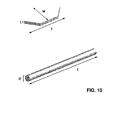
- Figure 10 schematically illustrates a two-dimensional reinforcing particle (upper part) and a one-dimensional reinforcing particle (lower part) and the corresponding designation of the dimensions as used in this description.
- the magnetic and/or superparamagnetic nano-particles are generally to be understood as being spherical or nonspherical particles with average diameters in the range of 1-200 nm
- it is possible to work with comparably low magnetic and/or superparamagnetic nano-particle loading i.e. with a low weight ratio of the magnetic and/or superparamagnetic nano-particles to the non-spherical reinforcing particles of below 0.25.
- Magnetic orientation allows for essentially unlimited tailoring of the spatial distribution of the reinforcing particles in the matrix and correspondingly allows for essentially unlimited tailoring of the reinforcing properties.
- it is possible to orient the reinforcing particles in the matrix e.g.
- a magnetic field of less than 5000 Gauss, preferably less than 500 Gauss can be applied as opposed to a minimum field necessary in the range of 5000 Gauss in state-of-the-art.
- a magnetic field of less than 5000 Gauss preferably less than 500 Gauss can be applied as opposed to a minimum field necessary in the range of 5000 Gauss in state-of-the-art.
- the non-spherical reinforcing particles have an average length (1) in one dimension of at least 0.5 ⁇ m.
- a minimum average length of the longest axis of the reinforcing particle can also be below this value, so for example above 10 nm.
- the non-spherical reinforcing particles are selected from the group of one-dimensional reinforcing particles, so preferably from the group of fibres, rods, tubes or whiskers or combinations thereof with an average diameter (d) in the range of 1 nm-1 mm, preferably in the range of 1 ⁇ m-100 ⁇ m, with the proviso that the length (1) is at least twice, preferably at least five times as large as the diameter (d).
- the shape of the cross-section of these one-dimensional reinforcing particles can be circular, but also different cross-sectional shapes are possible such as rectangular, square, cocoon, oval shapes etc. It is also possible for some applications to go for aggregate of such particles.
- the non-spherical reinforcing particles are two-dimensional reinforcing particles, preferably selected from the group of platelets, ribbons or combinations thereof with a thickness (t) in the range of I nm-10 ⁇ m, preferably in the range of 50 nm-1000 nm and preferably with a width (w) in the range of 10 nm - 100 ⁇ m, with the proviso that the length (1) is at least twice, preferably at least five times larger than the thickness (t) and with the proviso that the width (w) is larger than the thickness (t), preferably at least twice as large as the thickness (t).
- the cross-sectional area in a direction to the length can be rectangular but it can also be oval or ellipsoid, the above values for the thickness and the width corresponding to the main axes of such shapes.
- the numerical values given correspond to average values.
- a combination of one-dimensional and two-dimensional reinforcing particles is used.
- different types of one-dimensional reinforcing particles can be used in one composite material as well as different types of two-dimensional reinforcing particles in order to tailor the reinforcing particles, but also combinations of one-dimensional and two-dimensional reinforcing particles.
- the weight ratio of the magnetic and/or superparamagnetic nano-particles to the non-spherical reinforcing particles is in the range of 0.00001-0.10, preferably in the range of 0.0001-0.05. In particular with these low magnetic and/or superparamagnetic nano-particle loadings still very high orientational order can be generated.
- a magnetic field in the range of 1-5000 Gauss preferably in the range of 5-2000 Gauss, more preferably in a range below 1000 Gauss, most preferably in the range of 5-500 Gauss is applied, wherein the necessary strength of the magnetic fields for proper alignment depends on factors such as viscosity of the matrix, setting time of the matrix, magnetic properties and size of the nano-particles, size of the reinforcing particles etc.
- Such a magnetic field has to be applied for a timespan sufficient to align the reinforcing particles in the matrix.
- the magnetic and/or superparamagnetic nano-particles are attached to the non-spherical reinforcing particles by van der Waals, electrostatic and/or covalent attachment, preferably the attachment is electrostatic and/or covalent, as this allows a much more firm attachment and a much more efficient alignment with high magnetic fields and/or under more difficult matrix conditions.
- the non-spherical reinforcing particles are bonded and/or attached to the surrounding matrix material, preferably by a subsequent fourth annealing step with heat treatment and/or irradiation treatment and/or pressure treatment.
- These treatments can be made possible and effective by the above-mentioned treatment of the reinforcing particles prior to the embedding in the matrix in order to provide for this adhesion.
- the reinforcing particles are provided with a coating or a surface treatment prior to, during or after step 1 of the above process, this coating or surface modification for example having corresponding functional chemical groups, can be covalently linked to the matrix or linked to the matrix via hydrogen bonds or the like.
- heat treatment temperatures well below the melting temperature are chosen, typically at least 10°C, preferably at least 25°C below the melting temperature.
- the non-spherical reinforcing particles can be platelets, fibres, whiskers, rods, tubes, ribbons, wherein preferably such structures are made of or based on metallic, ceramic, polymeric or composite materials, preferably selected from alumina platelets, gibbsite platelets, clay platelets, talc platelets, mica platelets, glass platelets, silicon carbide platelets, aluminum boride platelets, graphite platelets, aluminum platelets, copper platelets, glass fibres, polymer fibres, carbon fibers, silicon carbide whiskers and silicon nitride whiskers.
- metallic, ceramic, polymeric or composite materials preferably selected from alumina platelets, gibbsite platelets, clay platelets, talc platelets, mica platelets, glass platelets, silicon carbide platelets, aluminum boride platelets, graphite platelets, aluminum platelets, copper platelets, glass fibres, polymer fibres, carbon fibers, silicon carbide whiskers and silicon nitride whiskers.
- the magnetic and/or superparamagnetic nano-particles can be attached to the non-spherical reinforcing particles by electrostatic attachment.
- This is possible according to a preferred embodiment by immersing the magnetic and/or superparamagnetic nano-particles and the non-spherical reinforcing particles in a fluid, preferably in water, under conditions such that the non-spherical reinforcing particles and the magnetic and/or superparamagnetic nano-particles have opposite charge, wherein the charges are strong enough such that the energy of electrostatic attraction is larger than thermal energy when the particles are close to each other, typically tens of nanometers apart.
- the opposite charge is generated by adapting the pH of the solution to a value above the isoelectric point of one element and below the isoelectric point of the other element (an element being the magnetic and/or superparamagnetic particle or the reinforcing particle, respectively).
- the non-spherical reinforcing particles are coated with a material allowing for the generation of charged non-spherical reinforcing particles if immersed in water.
- magnetic and/or superparamagnetic nanoparticles can be coated with a material allowing for the generation of charged magnetic and/or superparamagnetic nanoparticles if immersed in water.
- the non-spherical reinforcing particles can be coated with a material allowing for bonding and/or attachment of the non-spherical reinforcing particles during the third step and/or during a subsequent annealing step.
- the liquid matrix material and/or the liquid matrix-precursor material is a cross-linkable and/or non-cross-linkable polymeric material, a polymer precursor material or a ceramic (precursor) material.
- polyurethanes Preferably it is selected from the group of polyurethanes, polyethylenes, polypropylenes, polyamides, polyesters, epoxies, polyimides, poly(ether ether ketone), poly(tetra fluorethylene), poly(ethylene terephthalate), poly(vinyl alcohol), as well as natural compounds such us chitosan, agarose, gellan gum, gelatine, collagen, natural rubber, starch and alginate.
- matrix materials are metals and ceramics. The addition and alignment of reinforcing particles in steels, metal alloys or ceramics (e.g. tungsten carbide) leads to harder cutting tools for example.
- the magnetic and/or superparamagnetic nano-particles can, as mentioned above, selectively be removed from the matrix. Indeed removal of the magnetic and/or superparamagnetic nano-particles can be desirable for reasons such as colour induced by the magnetic and/or superparamagnetic nano-particles, but also for chemical and/or physical reasons. Unexpectedly removal of the magnetic and/or superparamagnetic nano-particles out of the solidified matrix with the oriented reinforcing particles embedded therein is possible without imparting or even destroying the orientation of the reinforcing particles.
- Removal of the magnetic and/or superparamagnetic nano-particles can for example be effected by treating the composite material with an acidic fluid, wherein preferably the acidic fluid has a pH-value below 3, preferably below 1, and wherein the treatment takes place at a temperature preferably 10-30°C below the melting point of the matrix, more preferably below 30°C.
- the treatment takes place for a timespan of less than 48 hours, preferably of less than 10 minutes.
- the acidic fluid removal of the magnetic and/or superparamagnetic nanoparticles is an aqueous solution of nitric acid, sulphuric acid or phosphoric acid, preferably with a pH in the range of 0-3.
- the proposed method allows tailoring of the actual reinforcing properties by means of tailoring the distribution of the reinforcing particles in the matrix.
- This can be effected in that prior to and/or during the third step a magnetic field is applied so as to lead to an inhomogeneous distribution of the reinforcing particles.
- This inhomogeneous distribution can be a variable concentration of the reinforcing particles as a function of the location in the matrix. It can also be a variable orientational distribution of the reinforcing particles as a function of the location in the matrix. It can also be a combination of the two, namely a combination of variable concentration and variable orientational distribution in the material.
- the present invention relates to a composite material with non-spherical reinforcing particles embedded in a matrix, obtainable and/or obtained using a method as outlined above.
- the non-spherical reinforcing particles are magnetically aligned in the matrix material of the composite material, wherein preferably there is an inhomogeneous distribution (in the sense of concentration or in the sense of orientation as a function of location in the matrix) of the non-spherical reinforcing materials in the matrix.
- the composite material takes the shape of a coating or a film, and the non-spherical reinforcing particles are on average arranged in the matrix with the long axis essentially perpendicular to the plane of the coating and/or film (or at least at an angle larger than 45° with respect to the plane).
- the composite material is essentially free from magnetic and/or superparamagnetic nano-paticles. This is possible by the above-mentioned additional step of subsequent removal of the magnetic and/or superparamagnetic nano-particles from the matrix.
- the present invention relates to the use of a composite material according to the description given above as construction material and/or an adhesive layer and/or a surface coating or surface films and/or as an intermediate layer in a laminate and/or a scratch-resistant lamina and/or a dental restoration and/or an artificial scaffold for tissue regeneration, preferably with an orientational distribution of the non-spherical reinforcing particles e.g. in a plane perpendicular to the plane of the layer, preferably for applications such as automobile construction, aerospatial construction, biomedical implants, dental restorations, strengthened glues and adhesives, cutting tools.
- Typical materials to be used in accordance with the invention are as follows:
- non-spherical reinforcing particles including, but not limited to, the following: alumina platelets, glass fibers, clay particles, carbon fibers, Kevlar fibers, polyethylene fibers, cellulose fibers.
- the main requirement is that the particles exhibit anisotropy in shape in at least one axis.
- they can be rods, platelets, fibers, whiskers, tubes, ribbons, ellipsoids, etc.
- the method applies generally to magnetic and/or superparamagnetic nanoparticles including, but not limited to, the following: iron oxide (such as Fe 3 O 4 , Fe 2 O 3 ), cobalt, nickel, and derived alloys. These magnetic and/or superparamagnetic nanoparticles must be responsive to an applied magnetic field. Also, the magnetic and/or superparamagnetic nanoparticles are generally in the size range of 1-200 nm in diameter.
- the method applies generally to a variety of matrices including, but not limited to, the following: thermoplastic and thermoset polymers, ceramics and metals.
- iron oxide nanoparticles are adsorbed onto aluminum oxide platelets. Subsequently, these platelets are added to a thermoplastic polymer, such as polyurethane.
- a thermoplastic polymer such as polyurethane.
- glass fibers can be pretreated with cobalt nanoparticles and then added to a thermoset polymer, such as a commercial epoxy.
- Electrostatic adsorption it is important that the electrostatic surface charge of the fibers and the nanoparticles are opposite, (one is negatively charged and one is positively charged). Opposite charges can be achieved by either selecting reinforcing particles and nanoparticles with an opposite natural surface charge at a given pH or by altering, through chemical treatment or coatings, the surface charge of one or both of these elements. Both cationic and anionic magnetic and/or superparamagnetic nanoparticles are commercially available, such as the respective EMG-605 and EMG-705 ferrofluids from the company Ferrotec.
- One example is to suspend 50 nm commercial iron oxide nanoparticles, such as from Nanostructured and Amorphous Materials Inc., in water with a pH of 4 to give them a naturally positive charge.
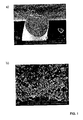
- the fibers Upon adding glass fibers to this solution, such as those commercially available from Fibre Glast Development Corporation, the fibers will exhibit a natural negative surface charge. Through electrostatics, the magnetic and/or superparamagnetic nanoparticles will then adsorb to the fibers under these conditions, as shown in Figure 1 .
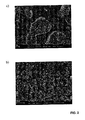
- Another example is to use treated iron oxide nanoparticles coated with surfactants that provide an anionic surface charge, such as that available to purchase from commercial sources, such as the EMG-705 solution from Ferrotec. These nanoparticles will electrostatically adsorb at neutral pH to aluminum oxide platelets, such as those commercially available from Antaria (grade Al-Pearl), which are naturally cationic at pH of 7. See Figure 2 .
- ionic surfactants and/or polymeric molecules can be adsorbed in a layer-by-layer fashion in order to provide strong adsorption of the magnetic and/or superparamagnetic nanoparticles on the surface of the reinforcing particles.
- Reinforcing carbon nanotubes for instance can be first coated with the anionic polymer poly(sodium 4-styrene sulfonate), followed by the electrostatic adsorption of the cationic polymer poly(dimethyldiallylammonium chloride) and finally the adsorption of negatively charged magnetic and/or superparamagnetic nanoparticles as those commercially available from Ferrotec.
- the magnetic and/or superparamagnetic nanoparticles can also be attached to the surface of the reinforcing particles through covalent bonds.
- reinforcing particles and magnetic and/or superparamagnetic nanoparticles must be surface modified with appropriate organic functional groups.
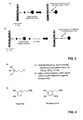
- Covalent bonds can be formed either by direct reaction between those functional groups or by using a cross linking agent, as schematically exemplified in Figure 3 .
- metal oxide reinforcing particles e.g. glass fibers and alumina platelets
- silane coupling agents Figure 4a
- Cathecol- and pyrogallol-based molecules can also be used to provide organic functional groups on metal oxide surfaces.
- dopamine and nitrodopamine supplied by Aldrich and Surface Solutions Gmbh respectively, can attach strongly to alumina surfaces providing free amine groups ( Figure 4b ), which can be further used for coupling magnetic and/or superparamagnetic nanoparticles through covalent bonds.
- One example is to use an amine silane to modify both the glass fiber and the magnetic and/or superparamagnetic nanoparticle surface.
- a diisocyanate can be used as a crosslinker, coupling the magnetic and/or superparamagnetic nanoparticle to the glass fiber surface ( Figure 5a ).
- Another example is to use an amine and an epoxy silane to modify the glass fiber and the magnetic and/or superparamagnetic nanoparticles respectively.
- a covalent bond can be formed linking the magnetic and/or superparamagnetic nanoparticle onto the glass fiber surface ( Figure 5b ).
- a cathecol-based molecule can also be used to provide amine groups.
- carbodiimide chemistry can be used to covalently bind amine groups from one surface to carboxylic acids groups from the other surface.
- Magnetic and/or superparamagnetic nanoparticles can also be adsorbed on the surface of reinforcing particles through van der Waals interactions.
- negatively charged magnetic nanoparticles Ferotec
- negatively charged alumina platelets Antaria
- a salt e.g. NaCI
- concentrations higher than the critical coagulation concentration e.g. 0.3 M
- the field needs to provide a torque on the particle that overcomes competing forces, such as gravity, thermal motion or steric hinderance.
- competing forces such as gravity, thermal motion or steric hinderance.
- moderate magnetic fields in the range of 1-5000 Gauss are strong enough to orient fibers and platelets.
- Such magnetic fields can either be applied with solenoids or with permanent magnets. Stronger magnetic fields, such as those produced with NMR/MRl machines, are not required but can also be employed.
- thermoplastic polymer such as polyurethane
- This field can be applied with commercially available permanent magnets, such as those from the company Supermagnete.
- Setting of the matrix can occur through (1) simple evaporation of the solvent from a polymer solution at high temperatures and/or low pressures, (2) crosslinking and/or polymerization reactions within the polymer matrix triggered by temperature or light, (3) solidification of a polymer melt upon cooling.
- an additional conditioning step is sometimes advantageous.
- a strong adhesion between reinforcing alumina platelets and a thermoplastic polyurethane matrix is achieved by heat-treating the final composite at 120-130°C for 3 hours.
- the formation of strong interfaces in polyurethane films containing about 20%vol of vertically aligned alumina platelets is clearly indicated by a 3-fold and 9-fold increase of the out-of-plane stiffness of the film, as compared to the out-of plane stiffness of films reinforced with horizontal platelets and films without platelets, respectively.
- light and/or heat can also be used to promote strong interfacial adhesion.
- Common chemicals are known to dissolve magnetic and/or superparamagnetic nanoparticles into solution. These chemicals can be used as a post treatment on the composite matrix to remove the magnetic and/or superparamagnetic particles after the matrix is set. It is required that the chemical dissolves the magnetic and/or superparamagnetic nanoparticles at an increased rate as compared with degrading the matrix or reinforcing particles.
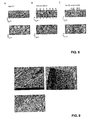
- 15 M phosphoric acid can be used to dissolve iron oxide from polyurethane films reinforced with alumina platelets as shown in Figure 9 .
- Treatment in phosphoric acid for 1 hour dissolves all magnetic and/or superparamagnetic particles without degrading the material or compromising the alignment of the platelets.
- thermoplastic polymer films produced with alumina platelets, iron oxide nanoparticles and polyurethane as reinforcing particles, magnetic particles and thermoplastic matrix polymer, respectively.
- thermoset polymer film produced with alumina platelets, iron oxide nanoparticles and epoxy resin as reinforcing particles, magnetic particles and thermoset matrix polymer, respectively.
- thermoset polymer film produced with glass fibers, iron oxide nanoparticles and epoxy resin as reinforcing particles, magnetic particles and thermoset matrix polymer, respectively.
Landscapes
- Chemical & Material Sciences (AREA)
- Engineering & Computer Science (AREA)
- Materials Engineering (AREA)
- Mechanical Engineering (AREA)
- Composite Materials (AREA)
- Nanotechnology (AREA)
- Health & Medical Sciences (AREA)
- Chemical Kinetics & Catalysis (AREA)
- Medicinal Chemistry (AREA)
- Polymers & Plastics (AREA)
- Organic Chemistry (AREA)
- Manufacturing & Machinery (AREA)
- General Physics & Mathematics (AREA)
- Crystallography & Structural Chemistry (AREA)
- Condensed Matter Physics & Semiconductors (AREA)
- Physics & Mathematics (AREA)
- Compositions Of Macromolecular Compounds (AREA)
- Materials For Medical Uses (AREA)
- Moulding By Coating Moulds (AREA)
- Epoxy Resins (AREA)
- Reinforced Plastic Materials (AREA)
- Treatments Of Macromolecular Shaped Articles (AREA)
- Polymerisation Methods In General (AREA)
Priority Applications (5)
| Application Number | Priority Date | Filing Date | Title |
|---|---|---|---|
| EP10003358A EP2371522A1 (en) | 2010-03-29 | 2010-03-29 | Method for the production of composite materials using magnetic nano-particles to orient reinforcing particles and reinforced materials obtained using the method |
| JP2013501665A JP5964810B2 (ja) | 2010-03-29 | 2011-03-21 | 強化材料の製造方法およびその方法を用いて得られた強化材料 |
| PCT/EP2011/001381 WO2011120643A2 (en) | 2010-03-29 | 2011-03-21 | Method for the production of reinforced materials and reinforced materials obtained using this method |
| US13/638,496 US8889761B2 (en) | 2010-03-29 | 2011-03-21 | Method for the production of reinforced materials and reinforced materials obtained using this method |
| EP11715167.0A EP2552681B1 (en) | 2010-03-29 | 2011-03-21 | Method for the production of composite materials using magnetic nano-particles to orient reinforcing particles |
Applications Claiming Priority (1)
| Application Number | Priority Date | Filing Date | Title |
|---|---|---|---|
| EP10003358A EP2371522A1 (en) | 2010-03-29 | 2010-03-29 | Method for the production of composite materials using magnetic nano-particles to orient reinforcing particles and reinforced materials obtained using the method |
Publications (1)
| Publication Number | Publication Date |
|---|---|
| EP2371522A1 true EP2371522A1 (en) | 2011-10-05 |
Family
ID=42989268
Family Applications (2)
| Application Number | Title | Priority Date | Filing Date |
|---|---|---|---|
| EP10003358A Withdrawn EP2371522A1 (en) | 2010-03-29 | 2010-03-29 | Method for the production of composite materials using magnetic nano-particles to orient reinforcing particles and reinforced materials obtained using the method |
| EP11715167.0A Active EP2552681B1 (en) | 2010-03-29 | 2011-03-21 | Method for the production of composite materials using magnetic nano-particles to orient reinforcing particles |
Family Applications After (1)
| Application Number | Title | Priority Date | Filing Date |
|---|---|---|---|
| EP11715167.0A Active EP2552681B1 (en) | 2010-03-29 | 2011-03-21 | Method for the production of composite materials using magnetic nano-particles to orient reinforcing particles |
Country Status (4)
| Country | Link |
|---|---|
| US (1) | US8889761B2 (enExample) |
| EP (2) | EP2371522A1 (enExample) |
| JP (1) | JP5964810B2 (enExample) |
| WO (1) | WO2011120643A2 (enExample) |
Cited By (8)
| Publication number | Priority date | Publication date | Assignee | Title |
|---|---|---|---|---|
| US20130150480A1 (en) * | 2011-12-13 | 2013-06-13 | Cheil Industries Inc. | Thermoplastic Resin Composition |
| WO2016050357A1 (en) * | 2014-10-02 | 2016-04-07 | Max-Planck-Gesellschaft zur Förderung der Wissenschaften e. V. | Methods for preparing and orientating biopolymer nanofibres and a composite material comprising the same |
| CN105818398A (zh) * | 2016-03-13 | 2016-08-03 | 北京化工大学 | 一种短切纤维分散体及其制备方法 |
| EP3070071A1 (en) * | 2015-03-16 | 2016-09-21 | Construction Research & Technology GmbH | A process for forming roughened micron size anisotropic platelets |
| CN107828344A (zh) * | 2017-11-21 | 2018-03-23 | 桂林电子科技大学 | 一种沿z向排列的一维微纳米粒子/环氧树脂复合胶膜及其制备方法 |
| WO2019123189A1 (en) | 2017-12-22 | 2019-06-27 | Espinosa Duran David Jose | Recyclable or compostable film replacements of plastic aluminum laminate packaging |
| CN114614021A (zh) * | 2022-03-30 | 2022-06-10 | 珠海中科先进技术研究院有限公司 | 一种具有聚合物涂层的集流体及其制备方法和应用 |
| CN114633493A (zh) * | 2022-01-21 | 2022-06-17 | 南京航空航天大学 | 一种新型磁引导层间颗粒增强复合材料及其制备方法 |
Families Citing this family (35)
| Publication number | Priority date | Publication date | Assignee | Title |
|---|---|---|---|---|
| EP2793300A1 (en) * | 2013-04-16 | 2014-10-22 | ETH Zurich | Method for the production of electrodes and electrodes made using such a method |
| US9768038B2 (en) | 2013-12-23 | 2017-09-19 | STATS ChipPAC, Pte. Ltd. | Semiconductor device and method of making embedded wafer level chip scale packages |
| US20160346997A1 (en) * | 2014-02-10 | 2016-12-01 | President And Fellows Of Harvard College | Three-dimensional (3d) printed composite structure and 3d printable composite ink formulation |
| US11299569B2 (en) * | 2014-04-30 | 2022-04-12 | Institute Of Chemistry, Chinese Academy Of Sciences | Material for 3D printing, process for preparing the same and article thereof |
| EP3152772B1 (en) * | 2014-06-06 | 2021-08-04 | Northeastern University | Additive manufacturing of discontinuous fiber composites using magnetic fields |
| WO2016007889A1 (en) * | 2014-07-10 | 2016-01-14 | Georgia Tech Research Corporation | Carbon nanotube compositions |
| US20170210632A1 (en) * | 2014-07-14 | 2017-07-27 | Empire Technology Development Llc | Methods and systems for producing ammonia |
| US10059589B2 (en) | 2014-07-14 | 2018-08-28 | Empire Technology Development Llc | Methods and systems for isolating nitrogen from a gaseous mixture |
| DE102014118086A1 (de) * | 2014-12-08 | 2016-06-09 | Valeo Schalter Und Sensoren Gmbh | Verfahren zur Vorbehandlung von Fasern, Verfahren zur Herstellung eines faserverstärkten Kunststoffteils, faserverstärktes Kunststoffteil sowie Schlichte zum Vorbehandeln von Fasern für einen faserverstärkten Kunststoff |
| DE102015200527A1 (de) * | 2015-01-15 | 2016-07-21 | Bayerische Motoren Werke Aktiengesellschaft | Verfahren zur Herstellung eines wiedergewonnene Kunststofffasern aufweisenden Halbzeugs |
| US9732445B2 (en) * | 2015-03-06 | 2017-08-15 | Ut-Battelle, Llc | Low temperature stabilization process for production of carbon fiber having structural order |
| US10918767B2 (en) | 2015-05-12 | 2021-02-16 | University Of Florida Research Foundation, Inc. | Magnetically templated tissue engineering scaffolds and methods of making and using the magnetically templated tissue engineering scaffolds |
| US10987941B2 (en) | 2015-12-07 | 2021-04-27 | Northeastern University | Direct write three-dimensional printing of aligned composite materials |
| GB201522393D0 (en) | 2015-12-18 | 2016-02-03 | Rolls Royce Plc | Composite component forming method |
| CH712877A2 (de) | 2016-09-06 | 2018-03-15 | Battrion Ag | Verfahren und Einrichtung zur kontinuierlichen Applizierung magnetischer Felder auf einen Gegenstand. |
| US11578183B2 (en) | 2016-11-28 | 2023-02-14 | Somar Corporation | Resin composition, method for producing resin composition, resin composition molded body, and method for producing resin composition molded body |
| US10834854B2 (en) | 2017-02-28 | 2020-11-10 | Northeastern University | Methods for the manufacture of thermal interfaces, thermal interfaces, and articles comprising the same |
| WO2018226709A1 (en) * | 2017-06-05 | 2018-12-13 | 3D Fortify | Systems and methods for aligning anisotropic particles for additive manufacturing |
| KR102010771B1 (ko) | 2017-09-07 | 2019-08-14 | 성균관대학교산학협력단 | 생체 내에서 3차원 스캐폴드를 제작하는 방법 및 이에 의해 제작된 3차원 스캐폴드 |
| DE102017216878A1 (de) * | 2017-09-25 | 2019-03-28 | Robert Bosch Gmbh | Verfahren zum Herstellen eines Klebstoffs und einer Klebung, insbesondere in Form einer Kleberschicht innerhalb einer Batteriezelle |
| US10732521B2 (en) * | 2018-08-07 | 2020-08-04 | 3DFortify, Inc. | Systems and methods for alignment of anisotropic inclusions in additive manufacturing processes |
| US11376692B2 (en) * | 2018-10-04 | 2022-07-05 | Abb Schweiz Ag | Articles of manufacture and methods for additive manufacturing of articles having desired magnetic anisotropy |
| WO2020080833A1 (ko) * | 2018-10-17 | 2020-04-23 | 주식회사 이지다이아텍 | 생체물질 검출용 미세 입자 및 이를 이용한 생체물질 검출방법 |
| CN113194776B (zh) * | 2018-12-10 | 2024-05-28 | 波士顿材料公司 | 用于碳纤维对齐及纤维增强的复合材料的系统和方法 |
| US11820880B2 (en) | 2019-07-10 | 2023-11-21 | Boston Materials, Inc. | Compositions and methods for carbon fiber-metal and other composites |
| CN111760070B (zh) * | 2020-08-04 | 2022-08-05 | 北京劲松口腔医院有限公司 | 一种口腔美容用牙种植体材料及其制备方法 |
| CN112226068A (zh) * | 2020-10-29 | 2021-01-15 | 南通纳科达聚氨酯科技有限公司 | 一种超疏水耐磨tpu薄膜及其制备方法 |
| WO2022132895A2 (en) | 2020-12-16 | 2022-06-23 | Carbice Corporation | Solder-carbon nanostructure composites and methods of making and using thereof |
| EP4060007A1 (en) | 2021-03-17 | 2022-09-21 | ETH Zurich | Composites with strain-induced architectured color |
| CN115260677B (zh) * | 2022-08-25 | 2024-04-16 | 山东东岳高分子材料有限公司 | 一种纤维定向填充聚四氟乙烯制品及其制备方法 |
| EP4781466A1 (en) | 2023-09-18 | 2026-07-29 | Theion GmbH | Advanced synergistic magneto-electrically active current collector for electrochemical energy storage devices and a method of fabricating the same |
| WO2025212695A1 (en) * | 2024-04-03 | 2025-10-09 | The Board Of Trustees Of The Leland Stanford Junior University | Mycobacteriophage functionalized magnetic nanocrystal clusters for highly sensitive detection of tuberculosis and non-tuberculosis mycobacterium (ntm) related infection |
| US20260062598A1 (en) | 2024-09-03 | 2026-03-05 | Boston Materials, Inc. | Liquid metal compositions and methods |
| CN119857176B (zh) * | 2025-01-14 | 2025-11-04 | 北京大学第三医院(北京大学第三临床医学院) | 一种复合水凝胶支架的制备方法、复合水凝胶支架及其应用 |
| CN121271194A (zh) * | 2025-12-11 | 2026-01-06 | 湖北博兴复合材料股份有限公司 | 一种玻璃纤维增强复合材料及其制备方法 |
Citations (5)
| Publication number | Priority date | Publication date | Assignee | Title |
|---|---|---|---|---|
| US20050239948A1 (en) | 2004-04-23 | 2005-10-27 | Yousef Haik | Alignment of carbon nanotubes using magnetic particles |
| US6987302B1 (en) * | 2003-07-01 | 2006-01-17 | Yingjian Chen | Nanotube with at least a magnetic nanoparticle attached to the nanotube's exterior sidewall and electronic devices made thereof |
| DE102007009124A1 (de) * | 2007-02-24 | 2008-08-28 | Evonik Degussa Gmbh | Induktionsgestützte Fertigungsverfahren |
| US20080286546A1 (en) * | 2005-05-03 | 2008-11-20 | Nanocomp Technologies, Inc. | Continuous glassy carbon composite materials reinforced with carbon nanotubes and methods of manufacturing same |
| US20090117269A1 (en) * | 2002-04-17 | 2009-05-07 | Metal Matrix Composites Company | Electrically conductive composite material |
Family Cites Families (16)
| Publication number | Priority date | Publication date | Assignee | Title |
|---|---|---|---|---|
| JPS62257814A (ja) * | 1986-05-02 | 1987-11-10 | Ube Ind Ltd | 改質プリプレグ及びその製造法 |
| JPS63111039A (ja) * | 1986-10-29 | 1988-05-16 | Agency Of Ind Science & Technol | 三次元強化複合材料及びその製造方法 |
| US6683783B1 (en) * | 1997-03-07 | 2004-01-27 | William Marsh Rice University | Carbon fibers formed from single-wall carbon nanotubes |
| US6741019B1 (en) * | 1999-10-18 | 2004-05-25 | Agere Systems, Inc. | Article comprising aligned nanowires |
| JP4360007B2 (ja) * | 2000-05-26 | 2009-11-11 | Jsr株式会社 | 熱伝導性シート用硬化性組成物、熱伝導性シートおよびその製造方法 |
| JP2001214075A (ja) * | 2000-02-04 | 2001-08-07 | Jsr Corp | 高熱伝導性シート用組成物、高熱伝導性シート、高熱伝導性シートの製造方法および高熱伝導性シートを用いた放熱構造 |
| JP2001294676A (ja) * | 2000-04-13 | 2001-10-23 | Jsr Corp | 熱伝導性シート、熱伝導性シートの製造方法および熱伝導性シートを用いた放熱構造 |
| JP2002146672A (ja) * | 2000-11-06 | 2002-05-22 | Polymatech Co Ltd | 熱伝導性充填剤及び熱伝導性接着剤並びに半導体装置 |
| JP2003026827A (ja) * | 2001-07-13 | 2003-01-29 | Jsr Corp | 高熱伝導性シート、高熱伝導性シートの製造方法および高熱伝導性シートを用いた放熱構造 |
| ITTO20020256A1 (it) * | 2002-03-22 | 2003-09-22 | Fiat Ricerche | Procedimento per la realizzazione di una sorgente luminosa ad incandescenza e sorgente luminosa ottenuta con tale procedimento. |
| JP4454353B2 (ja) * | 2003-05-09 | 2010-04-21 | 昭和電工株式会社 | 直線性微細炭素繊維及びそれを用いた樹脂複合体 |
| CA2604886A1 (en) * | 2005-04-06 | 2006-10-26 | Drexel University | Functional nanoparticle filled carbon nanotubes and methods of their production |
| WO2007106771A2 (en) * | 2006-03-10 | 2007-09-20 | The Arizona Board Of Regents On Behalf Of The University Of Arizona | Multifunctional polymer coated magnetic nanocomposite materials |
| US8507032B2 (en) * | 2006-04-06 | 2013-08-13 | Sigma Pro Ltd. Llc | Orientation of nanotubes containing magnetic nanoparticles in a magnetic storage medium |
| WO2008118191A2 (en) * | 2006-09-29 | 2008-10-02 | University Of South Carolina | Reprogrammable parallel nanomanufacturing |
| US20080166563A1 (en) * | 2007-01-04 | 2008-07-10 | Goodrich Corporation | Electrothermal heater made from thermally conducting electrically insulating polymer material |
-
2010
- 2010-03-29 EP EP10003358A patent/EP2371522A1/en not_active Withdrawn
-
2011
- 2011-03-21 EP EP11715167.0A patent/EP2552681B1/en active Active
- 2011-03-21 WO PCT/EP2011/001381 patent/WO2011120643A2/en not_active Ceased
- 2011-03-21 JP JP2013501665A patent/JP5964810B2/ja active Active
- 2011-03-21 US US13/638,496 patent/US8889761B2/en active Active
Patent Citations (5)
| Publication number | Priority date | Publication date | Assignee | Title |
|---|---|---|---|---|
| US20090117269A1 (en) * | 2002-04-17 | 2009-05-07 | Metal Matrix Composites Company | Electrically conductive composite material |
| US6987302B1 (en) * | 2003-07-01 | 2006-01-17 | Yingjian Chen | Nanotube with at least a magnetic nanoparticle attached to the nanotube's exterior sidewall and electronic devices made thereof |
| US20050239948A1 (en) | 2004-04-23 | 2005-10-27 | Yousef Haik | Alignment of carbon nanotubes using magnetic particles |
| US20080286546A1 (en) * | 2005-05-03 | 2008-11-20 | Nanocomp Technologies, Inc. | Continuous glassy carbon composite materials reinforced with carbon nanotubes and methods of manufacturing same |
| DE102007009124A1 (de) * | 2007-02-24 | 2008-08-28 | Evonik Degussa Gmbh | Induktionsgestützte Fertigungsverfahren |
Cited By (11)
| Publication number | Priority date | Publication date | Assignee | Title |
|---|---|---|---|---|
| US20130150480A1 (en) * | 2011-12-13 | 2013-06-13 | Cheil Industries Inc. | Thermoplastic Resin Composition |
| US8962733B2 (en) * | 2011-12-13 | 2015-02-24 | Cheil Industries Inc. | Thermoplastic resin composition |
| WO2016050357A1 (en) * | 2014-10-02 | 2016-04-07 | Max-Planck-Gesellschaft zur Förderung der Wissenschaften e. V. | Methods for preparing and orientating biopolymer nanofibres and a composite material comprising the same |
| EP3070071A1 (en) * | 2015-03-16 | 2016-09-21 | Construction Research & Technology GmbH | A process for forming roughened micron size anisotropic platelets |
| CN105818398A (zh) * | 2016-03-13 | 2016-08-03 | 北京化工大学 | 一种短切纤维分散体及其制备方法 |
| CN105818398B (zh) * | 2016-03-13 | 2018-02-23 | 北京化工大学 | 一种短切纤维分散体及其制备方法 |
| CN107828344A (zh) * | 2017-11-21 | 2018-03-23 | 桂林电子科技大学 | 一种沿z向排列的一维微纳米粒子/环氧树脂复合胶膜及其制备方法 |
| CN107828344B (zh) * | 2017-11-21 | 2020-11-03 | 桂林电子科技大学 | 一种沿z向排列的一维微纳米粒子/环氧树脂复合胶膜及其制备方法 |
| WO2019123189A1 (en) | 2017-12-22 | 2019-06-27 | Espinosa Duran David Jose | Recyclable or compostable film replacements of plastic aluminum laminate packaging |
| CN114633493A (zh) * | 2022-01-21 | 2022-06-17 | 南京航空航天大学 | 一种新型磁引导层间颗粒增强复合材料及其制备方法 |
| CN114614021A (zh) * | 2022-03-30 | 2022-06-10 | 珠海中科先进技术研究院有限公司 | 一种具有聚合物涂层的集流体及其制备方法和应用 |
Also Published As
| Publication number | Publication date |
|---|---|
| EP2552681B1 (en) | 2014-05-14 |
| JP2013525137A (ja) | 2013-06-20 |
| US8889761B2 (en) | 2014-11-18 |
| JP5964810B2 (ja) | 2016-08-03 |
| US20130053471A1 (en) | 2013-02-28 |
| EP2552681A2 (en) | 2013-02-06 |
| WO2011120643A2 (en) | 2011-10-06 |
| WO2011120643A3 (en) | 2012-12-20 |
Similar Documents
| Publication | Publication Date | Title |
|---|---|---|
| EP2552681B1 (en) | Method for the production of composite materials using magnetic nano-particles to orient reinforcing particles | |
| US20230002591A1 (en) | Systems and methods for forming short-fiber films, composites comprising thermosets, and other composites | |
| Fu et al. | Nanofiber composite coating with self-healing and active anticorrosive performances | |
| Stanier et al. | Fabrication and characterisation of short fibre reinforced elastomer composites for bending and twisting magnetic actuation | |
| Yang et al. | Codepositing mussel-inspired nanohybrids onto one-dimensional fibers under “green” conditions for significantly enhanced surface/interfacial properties | |
| KR20160043981A (ko) | 층상 나노입자 및 분산제를 함유하는 나노복합재, 복합재, 물품, 및 이의 제조 방법 | |
| EP3152772A1 (en) | Additive manufacturing of discontinuous fiber composites using magnetic fields | |
| EP3543287B1 (en) | Composition for 3 dimensional printing | |
| EP3626763B1 (en) | Soluble nanoparticles for composite performance enhancement | |
| WO2009085362A2 (en) | Ultrastrong and stiff layered polymer nanocomposites and hierarchical laminate materials thereof | |
| JP2013525137A5 (enExample) | ||
| EP3070071A1 (en) | A process for forming roughened micron size anisotropic platelets | |
| Xiang et al. | Tannic acid and aminopropyltriethoxysilane modified basalt fiber/epoxy resin composites with enhanced interfacial and mechanical properties | |
| Sapasakulvanit et al. | Fabrication and testing of bioinspired microstructured alumina composites with sacrificial interpenetrating polymer bonds | |
| Rajabi et al. | Thermal stability and dynamic mechanical properties of nano and micron-TiO2 particles reinforced epoxy composites: effect of mixing method | |
| Karak | Modification of epoxies | |
| Rafique et al. | Fiber-reinforced magneto-polymer matrix composites (FR–MPMCs)—A review | |
| JP5173173B2 (ja) | 導電性材料の配向方法、及びこの配向方法を用いた異方性材料または異方性材料を有する電子装置の製造方法 | |
| KR101174849B1 (ko) | 기계화학적 결합 장치를 이용한 탄소나노튜브-에폭시 수지 복합체의 제조방법 및 이에 의한 복합체 | |
| Ma et al. | Graphene oxide-modified microcapsule self-healing system for 4D printing | |
| CN1200015C (zh) | 纳米复合双马来酰亚胺树脂及其制备方法 | |
| Cai et al. | Effects of fluorinated silane compound on the repeated self-healing properties of nanocapsules | |
| Caldwell et al. | Nanoparticles as Interphase Modifiers in Fiber Reinforced Polymeric Composites: A Critical | |
| McCrary-Dennis et al. | Development of the displaced foam dispersion technique for the manufacture of multiscale composites | |
| Fatima et al. | Composites: Types, Method of Preparation and Application as An Emerging Tool for Environmental Remediation |
Legal Events
| Date | Code | Title | Description |
|---|---|---|---|
| PUAI | Public reference made under article 153(3) epc to a published international application that has entered the european phase |
Free format text: ORIGINAL CODE: 0009012 |
|
| AK | Designated contracting states |
Kind code of ref document: A1 Designated state(s): AT BE BG CH CY CZ DE DK EE ES FI FR GB GR HR HU IE IS IT LI LT LU LV MC MK MT NL NO PL PT RO SE SI SK SM TR |
|
| AX | Request for extension of the european patent |
Extension state: AL BA ME RS |
|
| STAA | Information on the status of an ep patent application or granted ep patent |
Free format text: STATUS: THE APPLICATION IS DEEMED TO BE WITHDRAWN |
|
| 18D | Application deemed to be withdrawn |
Effective date: 20120406 |