EP2365954B1 - Procede de preparation d'acroleine a partir de glycerol ou de glycerine - Google Patents
Procede de preparation d'acroleine a partir de glycerol ou de glycerine Download PDFInfo
- Publication number
- EP2365954B1 EP2365954B1 EP09802191.8A EP09802191A EP2365954B1 EP 2365954 B1 EP2365954 B1 EP 2365954B1 EP 09802191 A EP09802191 A EP 09802191A EP 2365954 B1 EP2365954 B1 EP 2365954B1
- Authority
- EP
- European Patent Office
- Prior art keywords
- catalyst
- glycerol
- acrolein
- yield
- conversion
- Prior art date
- Legal status (The legal status is an assumption and is not a legal conclusion. Google has not performed a legal analysis and makes no representation as to the accuracy of the status listed.)
- Not-in-force
Links
Images


Classifications
-
- C—CHEMISTRY; METALLURGY
- C07—ORGANIC CHEMISTRY
- C07C—ACYCLIC OR CARBOCYCLIC COMPOUNDS
- C07C45/00—Preparation of compounds having >C = O groups bound only to carbon or hydrogen atoms; Preparation of chelates of such compounds
- C07C45/51—Preparation of compounds having >C = O groups bound only to carbon or hydrogen atoms; Preparation of chelates of such compounds by pyrolysis, rearrangement or decomposition
- C07C45/52—Preparation of compounds having >C = O groups bound only to carbon or hydrogen atoms; Preparation of chelates of such compounds by pyrolysis, rearrangement or decomposition by dehydration and rearrangement involving two hydroxy groups in the same molecule
-
- B—PERFORMING OPERATIONS; TRANSPORTING
- B01—PHYSICAL OR CHEMICAL PROCESSES OR APPARATUS IN GENERAL
- B01J—CHEMICAL OR PHYSICAL PROCESSES, e.g. CATALYSIS OR COLLOID CHEMISTRY; THEIR RELEVANT APPARATUS
- B01J23/00—Catalysts comprising metals or metal oxides or hydroxides, not provided for in group B01J21/00
- B01J23/16—Catalysts comprising metals or metal oxides or hydroxides, not provided for in group B01J21/00 of arsenic, antimony, bismuth, vanadium, niobium, tantalum, polonium, chromium, molybdenum, tungsten, manganese, technetium or rhenium
- B01J23/20—Vanadium, niobium or tantalum
-
- B—PERFORMING OPERATIONS; TRANSPORTING
- B01—PHYSICAL OR CHEMICAL PROCESSES OR APPARATUS IN GENERAL
- B01J—CHEMICAL OR PHYSICAL PROCESSES, e.g. CATALYSIS OR COLLOID CHEMISTRY; THEIR RELEVANT APPARATUS
- B01J23/00—Catalysts comprising metals or metal oxides or hydroxides, not provided for in group B01J21/00
- B01J23/90—Regeneration or reactivation
- B01J23/92—Regeneration or reactivation of catalysts comprising metals, oxides or hydroxides provided for in groups B01J23/02 - B01J23/36
-
- B—PERFORMING OPERATIONS; TRANSPORTING
- B01—PHYSICAL OR CHEMICAL PROCESSES OR APPARATUS IN GENERAL
- B01J—CHEMICAL OR PHYSICAL PROCESSES, e.g. CATALYSIS OR COLLOID CHEMISTRY; THEIR RELEVANT APPARATUS
- B01J38/00—Regeneration or reactivation of catalysts, in general
- B01J38/04—Gas or vapour treating; Treating by using liquids vaporisable upon contacting spent catalyst
- B01J38/12—Treating with free oxygen-containing gas
-
- C—CHEMISTRY; METALLURGY
- C07—ORGANIC CHEMISTRY
- C07C—ACYCLIC OR CARBOCYCLIC COMPOUNDS
- C07C319/00—Preparation of thiols, sulfides, hydropolysulfides or polysulfides
- C07C319/14—Preparation of thiols, sulfides, hydropolysulfides or polysulfides of sulfides
- C07C319/18—Preparation of thiols, sulfides, hydropolysulfides or polysulfides of sulfides by addition of thiols to unsaturated compounds
-
- C—CHEMISTRY; METALLURGY
- C07—ORGANIC CHEMISTRY
- C07C—ACYCLIC OR CARBOCYCLIC COMPOUNDS
- C07C45/00—Preparation of compounds having >C = O groups bound only to carbon or hydrogen atoms; Preparation of chelates of such compounds
- C07C45/61—Preparation of compounds having >C = O groups bound only to carbon or hydrogen atoms; Preparation of chelates of such compounds by reactions not involving the formation of >C = O groups
- C07C45/65—Preparation of compounds having >C = O groups bound only to carbon or hydrogen atoms; Preparation of chelates of such compounds by reactions not involving the formation of >C = O groups by splitting-off hydrogen atoms or functional groups; by hydrogenolysis of functional groups
- C07C45/66—Preparation of compounds having >C = O groups bound only to carbon or hydrogen atoms; Preparation of chelates of such compounds by reactions not involving the formation of >C = O groups by splitting-off hydrogen atoms or functional groups; by hydrogenolysis of functional groups by dehydration
-
- Y—GENERAL TAGGING OF NEW TECHNOLOGICAL DEVELOPMENTS; GENERAL TAGGING OF CROSS-SECTIONAL TECHNOLOGIES SPANNING OVER SEVERAL SECTIONS OF THE IPC; TECHNICAL SUBJECTS COVERED BY FORMER USPC CROSS-REFERENCE ART COLLECTIONS [XRACs] AND DIGESTS
- Y02—TECHNOLOGIES OR APPLICATIONS FOR MITIGATION OR ADAPTATION AGAINST CLIMATE CHANGE
- Y02P—CLIMATE CHANGE MITIGATION TECHNOLOGIES IN THE PRODUCTION OR PROCESSING OF GOODS
- Y02P20/00—Technologies relating to chemical industry
- Y02P20/50—Improvements relating to the production of bulk chemicals
- Y02P20/584—Recycling of catalysts
Definitions
- the present invention relates to a catalytic process for the manufacture of acrolein by dehydration of glycerol or glycerine and the applications of such a process.
- Glycerol is understood to mean a purified or non-purified glycerol, preferably derived from biomass, and in particular a highly purified or partially purified glycerol.
- a purified glycerol has a purity greater than or equal to 98%, obtained by distillation of glycerine.
- An unpurified or only partially purified glycerol may be in solution in methanol when it comes for example from a transesterification of triglycerides, as described below.
- Glycerin is understood to mean, in particular, a glycerine of natural origin, resulting from the hydrolysis of vegetable oils and / or animal fats, or a glycerin of synthetic origin, derived from petroleum, more or less purified or refined, or well gross.
- a crude glycerin has a titer of between 80 and 85%.
- biodiesel is a fuel produced from vegetable or animal oil.
- Diester® (or EMVH, Vegetable Oils Methyl Esters) is a biodiesel produced by transesterification of triglycerides present in oleaginous liquids, especially vegetable oils of palm, rapeseed and sunflower, by methanol. This transesterification co-produces approximately, and according to the envisaged methods, 100 kg of glycerol per ton of diester®.
- the non-lipidic part of the raw material used, the cakes, is mainly used in animal feed.
- This biodiesel is used as a mixture in diesel fuel.
- Acrolein and acrylic acid are traditionally produced by gas phase oxidation of propylene by oxygen in the presence of catalysts based on molybdenum and / or bismuth oxides.
- the acrolein thus obtained can either be directly integrated into a two-step process for producing acrylic acid or be used as a synthesis intermediate.
- the production of these two monomers is closely related to propylene which is, in essence, manufactured by steam cracking or catalytic cracking of petroleum fractions.
- acrolein highly reactive compound by its structure, has many applications, including as a synthesis intermediate. It is especially used as a key intermediate in the synthesis of D, L-methionine and its hydroxy-analogue derivative, 2-hydroxy-4-methylthiobutanoic acid (HMTBA).
- HMTBA 2-hydroxy-4-methylthiobutanoic acid
- These food additives are widely used because they are part of the composition of food supplements essential for the growth of animals (poultry, pigs, ruminants, fish, ). In a certain number of cases, it may be profitable to be able to increase or even ensure the production capacities of existing industrial units by diversifying the raw material involved. It therefore seems particularly interesting to be able to increase acrolein productivity, while reducing the dependence on this resource derived from propylene oil.
- the invention further relates to an application of this reaction to the synthesis of aldehyde-3- (methylthio) propionic acid (MMP), 2-hydroxy-4-methylthiobutyronitrile (HMTBN), methionine and its derivatives.
- MMP aldehyde-3- (methylthio) propionic acid
- HMTBN 2-hydroxy-4-methylthiobutyronitrile
- methionine and its derivatives analogs such as 2-hydroxy-4-methylthiobutanoic acid (HMTBA), esters of HMTBA such as isopropyl ester, 2-oxo-4-methylthiobutanoic acid, from acrolein.
- Methionine, HMTBA and esters thereof and the like are used in animal nutrition and in their synthetic industrial processes acrolein is generally obtained by oxidation of propylene and / or propane.
- the oxidation of propylene to acrolein by air in the presence of water is partial, and the resulting crude product, based on acrolein, also contains unreacted propylene and propane, water and water. by-products of the oxidation reaction, including acids, aldehydes and alcohols.
- Glycerol also known as glycerine
- glycerine has long been known as a source of acrolein (thermal transformation), it is a product that is widely found in nature, in the form of esters (triglycerides), especially in all the animal or vegetable oils and fats, which makes it a starting reagent available in quantity and in this industrially usable. It is known that glycerol decomposes to give acrolein when heated to temperatures above 280 ° C. This weakly selective reaction is accompanied by the formation of numerous by-products, including acetaldehyde and hydroxyacetone, in addition to the total oxidation products CO, CO 2 .
- the documents WO-2006087083 and WO-2006087084 disclose a process for the catalytic dehydration of glycerol to acrolein in the gas phase, in the presence of molecular oxygen and a strongly acidic catalyst selected from zeolites, Nafion®, oxides of metals selected from aluminum, zirconium, titanium, niobium, tantalum, silicon, impregnated with acid functions in the form of sulphate, borate, tungstate, silicate and phosphate groups.
- zeolites, Nafion® oxides of metals selected from aluminum, zirconium, titanium, niobium, tantalum, silicon
- WO-2007132926 discloses a method of converting the glycerol to acrolein in the presence of a catalyst selected from crystalline acidic metallosilicates such as zeolites of structural type MFI or BEA, comprising silicon and a member preferably selected from Al, Fe and Ga.
- a catalyst selected from crystalline acidic metallosilicates such as zeolites of structural type MFI or BEA, comprising silicon and a member preferably selected from Al, Fe and Ga.
- WO2008 / 066079A discloses a process for producing acrylic acid from glycerol in a single step using a catalyst comprising primarily molybdenum.
- US2008 / 183013A1 relates to the conversion of glycerol to acrylic acid, acrolein being a non-isolated intermediate.
- US2008 / 0214384A1 relates to a process for regenerating a catalyst for converting glycerol to acrolein, this catalyst being acidic and based on tungsten, having served in the dehydration reaction of glycerol to acrolein where it has lost activity and / or selectivity.
- JP2007 / 268363A and JP2008 / 266165A describe the use of oxide mixtures to catalyze the conversion reaction of glycerol to acrolein.
- a process for the preparation of acrolein from glycerol or glycerine, by catalytic dehydration of glycerol in the presence of a catalyst which, while allowing to convert all the Starting glycerol, both can be very easily regenerated and has a long shelf life.
- This catalyst was based on zirconium oxide and consisted of at least one mixed zirconium oxide and at least one metal M, the said metal being niobium.
- the invention relates to a process for obtaining acrolein from glycerol or glycerin, in the presence of a catalyst as defined above, and the use of this catalyst, for converting glycerol or glycerin to acrolein.
- a catalyst of the invention allows a controlled conversion of glycerol or glycerine to acrolein, that is to say not promoting the conversion to acrylic acid.
- a preferred catalyst of the invention does not comprise, or does not comprise in majority proportion by weight relative to each of the other oxides constituent thereof, molybdenum oxide and / or copper oxide.
- the invention also relates to the use of at least one catalyst, as defined above to convert glycerol or glycerine to acrolein.
- the catalyst can be prepared in various ways (coprecipitation, hydrothermal synthesis, etc.). An effective procedure has been described by Kantcheva. et al., Catalysis Communications (2008), 9 (5), p874-879 , in patents FR 2907444 and FR 2907445 .
- the catalyst of the invention has the advantage of being easily regenerated, and this without the dehydration yield or acrolein selectivity are affected.
- the reaction according to the invention can be carried out in the gas phase or in the liquid phase, preferably in the gas phase.
- various process technologies can be used, namely fixed bed process, fluidized bed process or circulating fluidized bed process.
- the regeneration of the catalyst can be separated from the catalytic reaction. It can for example be done ex situ by conventional regeneration methods, such as combustion under air or with a gaseous mixture containing molecular oxygen. According to the method of the invention, the regeneration can be done in situ because the temperatures and pressures at which the regeneration is done are similar to the reaction conditions of the process.
- the reaction can be carried out in a conventional reactor for liquid phase reaction on a solid catalyst, but also in a catalytic distillation type reactor with regard to the significant difference in glycerol boiling points. (290 ° C) and acrolein (53 ° C). It is also reasonably possible to envisage a liquid phase process at a relatively low temperature which allows a continuous distillation of the produced acrolein, thus limiting the consequent degradation reactions of acrolein.
- the experimental conditions of the gas phase reaction are preferably a temperature of between 250 and 400 ° C. at a pressure of between 1 and 10 ° C. bars. In the liquid phase, the reaction is carried out between 150 and 350 ° C. and at a pressure ranging from 3 to 70 bars.
- glycerol or glycerine starting which may be in pure form or partially purified or in solution, in particular aqueous.
- an aqueous solution of glycerol is used.
- the glycerol concentration is preferably at least 1%, at most it varies from 10 to 50% by weight and preferably between 15 and 30% by weight in the reactor.
- the glycerol concentration should not be too high in order to avoid the spurious reactions that constrain the yield of acrolein, such as the formation of glycerol ethers or acetalization reactions between acrolein produced and unconverted glycerol.
- the glycerol solution must not be too diluted, because of a prohibitive energy cost induced by the evaporation of glycerol.
- Another object of the invention is a process for the manufacture of aldehyde-3- (methylthio) propionic acid (MMP), 2-hydroxy-4-methylthiobutyronitrile (HMTBN), methionine, 2-hydroxy acid 4-methylthiobutanoic acid (HMTBA), esters of the latter, in particular the isopropyl ester, and 2-oxo-4-methylthiobutanoic acid (KMB) from acrolein, according to which acrolein is obtained by a process described above.
- MMP 2-hydroxy-4-methylthiobutyronitrile
- HMTBA 2-hydroxy acid 4-methylthiobutanoic acid
- KMB 2-oxo-4-methylthiobutanoic acid
- acrolein produced by the aforementioned process may contain impurities different from the conventional process, both in terms of quantity and nature.
- synthesis of acrylic acid or methionine or its hydroxyanalogue it may be envisaged to purify acrolein according to techniques known to those
- the Figure 1 shows the evolution of the conversion to glycerol and the corresponding acrolein selectivity over time, on each of catalysts A, B, C and D described in Examples 1, 7, 8 and 9 respectively;
- catalyst A is a catalyst of the invention, catalyst B is outside the invention, catalysts C and D are catalysts of the prior art.
- the time indicated for each point is that of the end of a sample corresponding to trapping for one hour.
- the reaction conditions and the calculation methods used by the acrolein conversion and selectivity are described below.
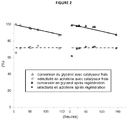
- the Figure 2 illustrates the conversion to glycerol and the acrolein selectivity obtained on the catalyst A according to the invention before and after regeneration under air flow.
- the Figure 3 represents a comparison of the conversion to glycerol and the acrolein selectivity of this conversion over time, with each of the catalysts A ', C and D described in Examples 2, 8 and 9 respectively; catalyst A 'is a catalyst of the invention, catalysts C and D, catalysts of the prior art.
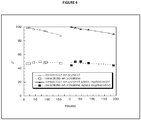
- the Figure 4 illustrates the conversion to glycerol and acrolein selectivity obtained with the catalyst A 'according to the invention before and after regeneration under air flow.
- the dehydration reaction of glycerol is carried out on the catalysts indicated, at atmospheric pressure, in a fixed bed reactor with a fixed diameter of 18 mm.
- the reactor is placed in an oven which keeps the catalyst at the reaction temperature of 300 ° C.
- the volume of catalyst charged to the reactor is 4.5 mL, giving a bed height of about 1.8 cm.
- the reactor is fed with a flow rate of 3.77 g / h of aqueous solution containing 20% by weight of glycerol.
- the aqueous glycerol solution is vaporized using a Bronkhorst® Controlled Evaporator (EMC) evaporator in the presence of a nitrogen flow rate of 75 ml / min.
- EMC Bronkhorst® Controlled Evaporator
- the relative molar ratio of glycerol / water / nitrogen is 2.3 / 46.3 / 51.4.
- the calculated contact time is of the order of 1.9 s, ie a GHSV of 1930 h -1 .
- Examples 10, 11, 12, 16, 17 and 18 were obtained with a system of three traps connected in series.
- the first trap contains a known mass of water and is chilled by crushed ice.
- the other two traps contain ethanol and are cooled by a cryostat to -25 ° C.
- Examples 13, 14 and 15 were obtained with a simple trap containing a known mass of water and chilled by crushed ice.
- the trapping time is one hour and the feed rate is not interrupted during the trapping changes.
- a catalyst according to the invention of the type of zirconium oxide and niobium prepared from hydrated zirconium oxide and ammonium oxalato-niobiate, (NH 4 ) (C 2 O 4 ) 2 NbO.xH 2 O (Aldrich , 99.99%).
- the ammonium oxalato-niobiate is dissolved in acidified water with HNO 3 concentrated at pH ⁇ 0.5 and heated to 45 ° C. After returning to ambient temperature, the hydrated zirconium hydroxide is added in a molar ratio of ZrO 2 / Nb 2 O 5 of 3: 1, the degree of hydration of the zirconium oxide hydrate is determined beforehand by thermogravimetric analysis (ATG ). After stirring for 24 hours, the mixture is filtered and the solid calcined under an air stream at 600.degree. The specific surface area of this catalyst is 40 m 2 / g. The specific surfaces of the solids were measured by the BET method (Brunauer Emmet and Teller) at -196 ° C.
- the solids are desorbed beforehand at 300 ° C. for 3 hours under a vacuum of 5 ⁇ 10 -5 mbar. .
- the niobium and zirconia contents of the various solids prepared were determined by ICP-OES (Plasma Optical Emission Spectrometry).
- the molar ratio Zr / Nb of catalyst A calculated from these analyzes is 9.3.
- a catalyst according to the invention of zirconium oxide and niobium type is prepared according to the procedure described by Kantcheva. et al., Catalysis Communications (2008), 9 (5), p874-879 by impregnation with hydrated zirconium oxide.
- the hydrated zirconium oxide was prepared by co-precipitation of zirconium oxonitrate solution ZrO (NO 3 ) 2 ⁇ xH 2 O (Aldrich, 99%) and 28% ammonia solution.
- the precursor of Nb (V), (NH 4 ) (C 2 O 4 ) 2 NbO ⁇ xH 2 O (Aldrich, 99.99%) is added with stirring to a solution of hydrogen peroxide 35% (Sigma Aldrich) acidified at pH ⁇ 0.5 with concentrated HNO 3 and heated to 50 ° C.
- the molar ratio H 2 O 2 / oxalate is 13/1.
- the solution is heated for 1 hour at 50 ° C. before being cooled to room temperature.
- TGA thermogravimetric analysis
- the specific surface area of this catalyst is 51 m 2 / g.
- the specific surfaces of the solids were measured by the BET method (Brunauer Emmet and Teller) at -196 ° C. on a Micromeritics ASAP 2020 device. The solids are desorbed beforehand at 300 ° C. for 3 hours under a vacuum of 5 ⁇ 10 -5 mbar. . The niobium and zirconium contents of the solid obtained were determined by ICP-OES. The Zr / Nb molar ratio of this solid is 3.3.
- a catalyst according to the invention of zirconium oxide and niobium type is prepared according to the procedure described by Kantcheva. et al., (Catalysis Communications 9 (5) (2008) p874-879 ) by impregnation of hydrated zirconium oxide with a solution containing a mixed oxalate of ammonium and niobium.
- Nb (V), (NH 4 ) (C 2 O 4 ) 2 NbO ⁇ xH 2 O (Aldrich, 99.99%) is added with stirring to a solution of hydrogen peroxide 35% (Sigma Aldrich) acidified at pH ⁇ 0.5 with concentrated HNO 3 and heated to 50 ° C.
- the molar ratio H 2 O 2 / oxalate is 13/1.
- the solution is heated for 1 hour at 50 ° C. before being cooled to room temperature.
- the mixture is stirred at room temperature for 24 hours and then the liquid phase is evaporated under vacuum at T ⁇ 70 ° C.
- the solid obtained is calcined under a stream of air at 600 ° C.
- the specific surface area of this catalyst determined in a manner similar to that of catalyst A is 39 m 2 / g.
- the niobium and zirconium contents of the solid obtained were determined by ICP-OES.
- the Zr / Nb molar ratio of this solid is 3.7.
- a catalyst according to the invention of zirconium oxide, niobium and vanadium type was prepared from NH 4 VO 3 (Sigma, ACS Reagent 99.7%) according to the following method: The ammonium metavanadate is dissolved in a 9% hydrogen peroxide solution containing oxalic acid (Aldrich, 99%). The molar ratio of oxalic acid / NH 4 VO 3 introduced is 1.3. After stirring for 1 hour at room temperature, the solution is evaporated under vacuum; a blue solid is obtained. The vanadium oxide content of this compound is determined by thermogravimetric analysis.
- the vanadium precursor, the mixed oxalate of niobium and ammonium (NH 4 ) (C 2 O 4 ) 2 NbO ⁇ xH 2 O (Aldrich, 99.99%), and the hydrated zirconium oxide prepared as described in the example 1 are introduced into an acidified aqueous solution with concentrated HNO 3 (pH ⁇ 0.5) with a Zr / Nb / V molar ratio of 72/22 / 3.2. After stirring for 24 hours, the reaction mixture is filtered and the solid calcined under an air stream at 600 ° C.
- the specific surface area of this catalyst determined similarly to that of catalyst A is 48 m 2 / g.
- the contents of niobium, vanadium and zirconium of the solid obtained were determined by ICP-OES.
- the Zr / Nb / V molar composition of this catalyst is 90.4 / 8.4 / 1.2.
- a tungstic zirconia catalyst doped with silica The preparation of this solid has three stages.
- the second step is to stabilize the hydrated zirconium hydroxide with silicic species according to the procedure described by Nahas et al. (Journal of Catalysis 247 (2007), p51-60 ).
- the hydrated zirconium hydroxide is placed in a glass flask containing an ammoniacal solution whose pH is adjusted to 11.
- the mixture is heated at reflux for 72 hours and then filtered and washed with deionized water.
- the last step is the exchange between H 2 WO 4 tungstic acid (Aldrich, 99%) dissolved in hydrogen peroxide and zirconium hydroxide.
- Tungstic acid is dissolved in a 35% hydrogen peroxide solution at 60 ° C.
- the concentration of the tungstic acid solution is 0.04M.
- the tungstic acid solution is then cooled to room temperature, and the silica-doped zirconium hydroxide is added slowly.
- the solid obtained is filtered and then calcined in air at 650 ° C. Its specific surface is 40m 2 / g.
- the niobium, silicon and zirconium contents of the solid were determined by ICP-OES.
- the molar W / Si / Zr composition of this catalyst is 4.7 / 1.4 / 93.9.
- Catalyst H is prepared according to the synthesis method described in Example 1.
- the pH of the nitric acid solution is slightly more acidic (pH ⁇ 0.1) in the case of catalyst H.
- the solid obtained has a surface specificity of 57m 2 / g and a molar ratio Zr / Nb of 11.8.
- the ZrTiSiW catalyst according to the invention was prepared by Rhodia according to the method described in the patent FR2907445A .
- the specific surface area of this catalyst, determined in a manner similar to that of catalyst A, is 105 m 2 / g.
- the composition by weight of oxides of this catalyst is 54% of ZrO 2 , 35% of TiO 2 , 7.5% of SiO 2 and 3.5% of WO 3 .
- Catalyst C is a tungsten zirconia (89.5% ZrO 2 -10.5% WO 3 ) synthesized by Daiichi Kigenso (reference supplier: Z-1104).
- the specific surface area of this catalyst determined similarly to catalyst A is 77 m 2 / g.
- Catalyst D is zeolite H-ZSM-5 supplied by Zeochem (ZEOcat PZ-2 / 5OH).
- the specific surface area of this catalyst determined similarly to catalyst A is 406 m 2 / g.
- Table 1 gives the performances obtained with the catalysts A, B, C and D at 6 hours of reaction.
- Table 1 ⁇ / u> A (invention) B (except invention) C (comparative) D (comparative) Glycerol conversion 100 100 94 57 Selectivity in acrolein 66 69 64 65 Yield of acrolein 66 69 60 37 Acetaldehyde yield 6.3 6.5 3.9 0.6 Yield of propionaldehyde 3.1 5.4 2.8 1.6 Acetone yield 1.7 2.7 1.6 0.0 Yield of allylic alcohol 0.1 0.5 0.5 0.2 Hydroxypropanone yield 5.8 3.1 6.1 3.0 Phenol yield 2.6 0.8 0.3 -
- the catalysts A and B are therefore more active and more selective than the catalysts of the prior art.
- Catalysts A and B maintain a constant acrolein selectivity and a high glycerol conversion over several days unlike prior art C and D catalysts which deactivate strongly in less than 24 hours.
- Catalysts A and B are therefore more active, more selective in acrolein but also more stable in time than the best catalysts claimed in the prior art.
- the catalyst A according to the invention is regenerated under a stream of air at 450 ° C. for 2 hours (air flow: 51 ml / min). After regeneration, the catalyst is tested under the same operating conditions as before the regeneration.
- Catalyst A according to the invention is therefore regenerable over a short time and without loss of activity and selectivity. Not only is Catalyst A active and selective, but it is also fully and easily regenerable.
- Table 2 gives the performances obtained at 300 ° C. with the catalysts A ', B and C at 5 hours of reaction.
- Catalyst A '(invention) maintains an almost constant selectivity in acrolein and a high glycerol conversion over a week under a reaction stream, unlike the catalysts D and C of the prior art which deactivate strongly in less than 24 hours.
- the catalyst A 'of the invention is therefore more active, more selective in acrolein and more stable in time than the best catalysts claimed in the prior art.
- the catalyst A 'according to the invention is regenerated under a stream of air at 450 ° C. for 1 h (air flow: 51 ml / min). After regeneration, the catalyst is tested under the same operating conditions as before the regeneration.
- the catalyst A 'according to the invention is therefore regenerable over a short time and without loss of activity and selectivity. Not only is the catalyst A 'active and selective, but it is also fully and easily regenerable.
- Table 3 gives the performances of catalysts E and F obtained. ⁇ u> Table 3: ⁇ / u> E F end of sampling time 5 20 48 72 95 6 24 Glycerol conversion 100 98 97 94 90 100 94 Selectivity in acrolein 60 72 73 72 71 50 51 Yield of acrolein 60 71 71 68 63 50 48 Acetaldehyde yield 4.9 3.1 2.6 2.6 2.5 8 5.5 Yield of propionaldehyde 6.8 4.8 3.9 3.9 3.8 5.8 4 Acetone yield 1.9 1.7 1 1.1 0.9 4.1 3.2 Yield of allylic alcohol 0.6 0.7 0.7 0.7 3.2 4.4 Hydroxypropanone yield 5.1 12.2 13.5 13.1 12.4 3.1 7.7 Phenol yield 1.9 0.9 0.5 0.3 1.3 0.7
- Table 4 gives the performance of the catalyst. ⁇ u> Table 4: ⁇ / u> end of sampling hours 4 23 42 Glycerol conversion 98 96 87 Selectivity in acrolein 68 80 83 Yield of acrolein 67 77 72 Acetaldehyde yield 4.2 3.5 2.4 Yield of propionaldehyde 3.1 2.4 1.6 Acetone yield 1.2 1.3 0.9 Yield of allylic alcohol 0.7 0.9 0.6 Hydroxypropanone yield 5.2 10.9 9.7 Phenol yield 0.8 0.2 -
- Example 18 Obtaining acrolein from non-pure glycerol with catalyst H
- the performance of the catalyst H was evaluated with a solution of crude industrial glycerin, titrating 82% by weight.
- This glycerine is characterized in that it contains more than 15% by weight of methanol.
- the volume of catalyst in the reactor is 4.5 ml
- the nitrogen flow rate is 74.5 ml / min
- the reaction temperature is 300 ° C.
- the flow rate of the aqueous solution at 20% by weight of glycerine is 3.77 g / h.
- the relative molar ratio of glycerol / water / nitrogen is 1.9 / 46.5 / 51.6.
- Table 5 The results obtained are given in Table 5.
Landscapes
- Chemical & Material Sciences (AREA)
- Organic Chemistry (AREA)
- Chemical Kinetics & Catalysis (AREA)
- Engineering & Computer Science (AREA)
- Materials Engineering (AREA)
- Organic Low-Molecular-Weight Compounds And Preparation Thereof (AREA)
- Catalysts (AREA)
- Low-Molecular Organic Synthesis Reactions Using Catalysts (AREA)
Applications Claiming Priority (2)
| Application Number | Priority Date | Filing Date | Title |
|---|---|---|---|
| FR0858624A FR2939791B1 (fr) | 2008-12-16 | 2008-12-16 | Procede de preparation d'acroleine a partir de glycerol ou de glycerine brute |
| PCT/FR2009/052577 WO2010076510A2 (fr) | 2008-12-16 | 2009-12-16 | Procede de preparation d'acroleine a partir de glycerol ou de glycerine |
Publications (2)
| Publication Number | Publication Date |
|---|---|
| EP2365954A2 EP2365954A2 (fr) | 2011-09-21 |
| EP2365954B1 true EP2365954B1 (fr) | 2018-11-07 |
Family
ID=40791517
Family Applications (1)
| Application Number | Title | Priority Date | Filing Date |
|---|---|---|---|
| EP09802191.8A Not-in-force EP2365954B1 (fr) | 2008-12-16 | 2009-12-16 | Procede de preparation d'acroleine a partir de glycerol ou de glycerine |
Country Status (10)
| Country | Link |
|---|---|
| US (2) | US20110288323A1 (https=) |
| EP (1) | EP2365954B1 (https=) |
| JP (1) | JP6116799B2 (https=) |
| KR (1) | KR101778103B1 (https=) |
| CN (2) | CN105837420B (https=) |
| ES (1) | ES2709479T3 (https=) |
| FR (1) | FR2939791B1 (https=) |
| RU (1) | RU2531277C2 (https=) |
| SG (1) | SG171721A1 (https=) |
| WO (1) | WO2010076510A2 (https=) |
Families Citing this family (12)
| Publication number | Priority date | Publication date | Assignee | Title |
|---|---|---|---|---|
| FR2939791B1 (fr) | 2008-12-16 | 2011-01-14 | Adisseo France Sas | Procede de preparation d'acroleine a partir de glycerol ou de glycerine brute |
| FR2961507B1 (fr) * | 2010-06-17 | 2016-03-04 | Adisseo France Sas | Procede de preparation d'acroleine a partir de glycerol ou de glycerine |
| FR2966456B1 (fr) * | 2010-10-26 | 2013-03-15 | Adisseo France Sas | Procede d'obtention d'acroleine par deshydratation catalytique de glycerol ou de glycerine |
| FR2997398B1 (fr) * | 2012-10-30 | 2014-11-21 | Adisseo France Sas | Procede de preparation de l’acroleine a partir de glycerol |
| FR3001728B1 (fr) * | 2013-02-04 | 2015-11-13 | Adisseo France Sas | Procede de preparation d’une olefine par conversion catalytique d’au moins un alcool |
| KR101616528B1 (ko) | 2013-07-16 | 2016-04-28 | 주식회사 엘지화학 | 글리세린 탈수반응용 촉매, 이의 제조 방법 및 아크롤레인의 제조 방법 |
| WO2015168683A1 (en) | 2014-05-02 | 2015-11-05 | University Of Tennessee Research Foundation | Novel glycerol dehydration methods and products thereof |
| CN104892382B (zh) * | 2015-05-28 | 2017-08-11 | 珠海凯美科技有限公司 | 甘油液相氧化制备丙烯醛的方法 |
| KR102052708B1 (ko) | 2015-12-22 | 2019-12-09 | 주식회사 엘지화학 | 글리세린 탈수 반응용 촉매, 이의 제조 방법 및 상기 촉매를 이용한 아크롤레인의 제조 방법 |
| KR102210508B1 (ko) * | 2015-12-23 | 2021-02-01 | 주식회사 엘지화학 | 글리세린 탈수 반응용 촉매의 제조 방법 및 아크롤레인의 제조 방법 |
| KR102044428B1 (ko) * | 2015-12-23 | 2019-12-02 | 주식회사 엘지화학 | 글리세린으로부터 아크릴산의 제조방법 |
| CN109305899B (zh) * | 2017-07-28 | 2021-09-03 | 中国石油化工股份有限公司 | 甘油脱水生产丙烯醛的方法 |
Family Cites Families (23)
| Publication number | Priority date | Publication date | Assignee | Title |
|---|---|---|---|---|
| SU52208A1 (ru) * | 1936-04-22 | 1936-11-30 | Ю.Н. Вольнов | Способ получени акролеина из глицерина |
| US4524077A (en) * | 1983-11-14 | 1985-06-18 | Monsanto Company | Liquid 2-hydroxy-4-methylthiobutyric acid and process for the preparation thereof |
| DE102005003990A1 (de) * | 2005-01-28 | 2006-08-03 | Degussa Ag | Herstellung von 3-(Alkylthio)propanal |
| FR2882053B1 (fr) * | 2005-02-15 | 2007-03-23 | Arkema Sa | Procede de deshydratation du glycerol en acrolene |
| FR2882052B1 (fr) * | 2005-02-15 | 2007-03-23 | Arkema Sa | Procede de deshydratation du glycerol en acroleine |
| FR2884818B1 (fr) * | 2005-04-25 | 2007-07-13 | Arkema Sa | Procede de preparation d'acide acrylique a partir de glycerol |
| WO2007058221A1 (ja) * | 2005-11-15 | 2007-05-24 | Nippon Shokubai Co., Ltd. | 多価アルコールの脱水方法 |
| JP4041512B2 (ja) * | 2006-03-30 | 2008-01-30 | 株式会社日本触媒 | グリセリン脱水用触媒、グリセリン脱水用触媒の製造方法、アクロレインの製造方法、およびアクロレイン誘導体の製造方法 |
| WO2007132926A1 (en) | 2006-05-12 | 2007-11-22 | Nippon Shokubai Co., Ltd. | Production method of acrolein |
| TW200811086A (en) | 2006-07-11 | 2008-03-01 | Adisseo Ireland Ltd | Process for preparing 2-hydroxy-4-(methylthio)butyronitrile and methionine |
| FR2907445B1 (fr) | 2006-10-20 | 2010-09-03 | Rhodia Recherches & Tech | Composition a acidite elevee a base d'oxyde de zirconium, d'oxyde de titane et d'oxyde de tungstene,procede de preparation et utilisation dans le traitement des gaz d'echappement |
| FR2907444B1 (fr) | 2006-10-20 | 2008-12-19 | Rhodia Recherches & Tech | Composition a acidite elevee a base d'oxydes de zirconium,de silicium et d'au moins un autre element choisi parmi le titane,l'aluminium,le tungstene,le molybdene,le cerium,le fer et le manganese |
| WO2008066079A1 (en) * | 2006-12-01 | 2008-06-05 | Nippon Shokubai Co., Ltd. | Method for producing acrylic acid |
| DE102007004351A1 (de) | 2007-01-29 | 2008-07-31 | Evonik Degussa Gmbh | Neue Katalysatoren und Verfahren zur Dehydratisierung von Glycerin |
| DE102007004350A1 (de) * | 2007-01-29 | 2008-07-31 | Evonik Degussa Gmbh | Verfahren zur Regenerierung eines Katalysators |
| JP2008266165A (ja) * | 2007-04-17 | 2008-11-06 | Nippon Shokubai Co Ltd | アクロレインの製造方法 |
| FR2920767B1 (fr) | 2007-09-06 | 2009-12-18 | Arkema France | Procede de vaporisation reactive de glycerol |
| WO2009127889A1 (en) | 2008-04-16 | 2009-10-22 | Arkema France | Process for manufacturing acrolein from glycerol |
| BRPI0910458A2 (pt) | 2008-04-16 | 2018-03-27 | Arkema France | catalisador para preparar acroleína ou ácido acrílico por reação de desidratação de glicerina e método para produzir o mesmo |
| FR2938535B1 (fr) | 2008-11-20 | 2012-08-17 | Arkema France | Procede de fabrication de methylmercaptopropionaldehyde et de methionine a partir de matieres renouvelables |
| FR2939791B1 (fr) | 2008-12-16 | 2011-01-14 | Adisseo France Sas | Procede de preparation d'acroleine a partir de glycerol ou de glycerine brute |
| FR2954312B1 (fr) | 2009-12-21 | 2012-02-10 | Adisseo France Sas | Procede de preparation d'acroleine par deshydratation catalytique de glycerol ou glycerine |
| FR2961507B1 (fr) | 2010-06-17 | 2016-03-04 | Adisseo France Sas | Procede de preparation d'acroleine a partir de glycerol ou de glycerine |
-
2008
- 2008-12-16 FR FR0858624A patent/FR2939791B1/fr not_active Expired - Fee Related
-
2009
- 2009-12-16 CN CN201610190995.1A patent/CN105837420B/zh not_active Expired - Fee Related
- 2009-12-16 WO PCT/FR2009/052577 patent/WO2010076510A2/fr not_active Ceased
- 2009-12-16 RU RU2011123484/04A patent/RU2531277C2/ru active
- 2009-12-16 KR KR1020117014891A patent/KR101778103B1/ko not_active Expired - Fee Related
- 2009-12-16 EP EP09802191.8A patent/EP2365954B1/fr not_active Not-in-force
- 2009-12-16 CN CN2009801498045A patent/CN102245552A/zh active Pending
- 2009-12-16 ES ES09802191T patent/ES2709479T3/es active Active
- 2009-12-16 JP JP2011541561A patent/JP6116799B2/ja not_active Expired - Fee Related
- 2009-12-16 US US13/140,109 patent/US20110288323A1/en not_active Abandoned
- 2009-12-16 SG SG2011032778A patent/SG171721A1/en unknown
-
2013
- 2013-08-27 US US14/010,724 patent/US9447009B2/en not_active Expired - Fee Related
Non-Patent Citations (2)
| Title |
|---|
| ROSS-MEDGAARDEN E I ET AL: "New insights into the nature of the acidic catalytic active sites present in ZrO"2-supported tungsten oxide catalysts", JOURNAL OF CATALYSIS, ACADEMIC PRESS, DULUTH, MN, US, vol. 256, no. 1, 15 May 2008 (2008-05-15), pages 108 - 125, XP022655702, ISSN: 0021-9517, [retrieved on 20080410], DOI: 10.1016/J.JCAT.2008.03.003 * |
| S. VIVES ET AL: "Sol-gel/co-precipiation method for the preparation and characterization of zirconia-tungsten composite powders", JOURNAL OF MATERIALS SCIENCE, vol. 34, no. 13, 1 January 1999 (1999-01-01), Dordrecht, pages 3127 - 3135, XP055342242, ISSN: 0022-2461, DOI: 10.1023/A:1004661202300 * |
Also Published As
| Publication number | Publication date |
|---|---|
| JP6116799B2 (ja) | 2017-04-19 |
| FR2939791A1 (fr) | 2010-06-18 |
| RU2011123484A (ru) | 2013-01-27 |
| JP2012512236A (ja) | 2012-05-31 |
| CN102245552A (zh) | 2011-11-16 |
| CN105837420B (zh) | 2019-09-13 |
| RU2531277C2 (ru) | 2014-10-20 |
| SG171721A1 (en) | 2011-07-28 |
| KR20110094198A (ko) | 2011-08-22 |
| CN105837420A (zh) | 2016-08-10 |
| ES2709479T3 (es) | 2019-04-16 |
| US20140171676A1 (en) | 2014-06-19 |
| US9447009B2 (en) | 2016-09-20 |
| FR2939791B1 (fr) | 2011-01-14 |
| EP2365954A2 (fr) | 2011-09-21 |
| KR101778103B1 (ko) | 2017-09-13 |
| US20110288323A1 (en) | 2011-11-24 |
| WO2010076510A3 (fr) | 2010-10-14 |
| WO2010076510A2 (fr) | 2010-07-08 |
Similar Documents
| Publication | Publication Date | Title |
|---|---|---|
| EP2365954B1 (fr) | Procede de preparation d'acroleine a partir de glycerol ou de glycerine | |
| EP2582652B1 (fr) | Procede de preparation d'acroleine a partir de glycerol ou de glycerine | |
| EP2912005B1 (fr) | Procede de synthese directe d'aldehydes insatures a partir de melanges d'alcools | |
| EP1874720B1 (fr) | Procede de preparation d'acide acrylique a partir de glycerol | |
| FR2882052A1 (fr) | Procede de deshydratation du glycerol en acroleine | |
| FR2882053A1 (fr) | Procede de deshydratation du glycerol en acrolene | |
| FR2931820A1 (fr) | Procede de fabrication d'acroleine par deshydratation du glycerol | |
| WO2011083254A1 (fr) | Procede de preparation d'acroleine a partir de glycerol ou de glycerine | |
| FR2884817A1 (fr) | Procede de preparation d'acide acrylique a partir de glycerol | |
| WO2011108509A1 (ja) | 低品位グリセリンからのアリルアルコールとプロピレンの製造方法、及びそのための触媒 | |
| EP2914569B1 (fr) | Procédé de préparation de l'acroléine à partir de glycérol | |
| EP3126318B1 (fr) | Procédé de synthèse directe de (méth)acroléine a partir d'éthers et/ou acétals |
Legal Events
| Date | Code | Title | Description |
|---|---|---|---|
| PUAI | Public reference made under article 153(3) epc to a published international application that has entered the european phase |
Free format text: ORIGINAL CODE: 0009012 |
|
| 17P | Request for examination filed |
Effective date: 20110531 |
|
| AK | Designated contracting states |
Kind code of ref document: A2 Designated state(s): AT BE BG CH CY CZ DE DK EE ES FI FR GB GR HR HU IE IS IT LI LT LU LV MC MK MT NL NO PL PT RO SE SI SK SM TR |
|
| DAX | Request for extension of the european patent (deleted) | ||
| 17Q | First examination report despatched |
Effective date: 20130902 |
|
| GRAP | Despatch of communication of intention to grant a patent |
Free format text: ORIGINAL CODE: EPIDOSNIGR1 |
|
| RIC1 | Information provided on ipc code assigned before grant |
Ipc: B01J 23/20 20060101ALI20180503BHEP Ipc: C07C 323/58 20060101ALI20180503BHEP Ipc: C07C 45/52 20060101AFI20180503BHEP Ipc: B01J 38/12 20060101ALI20180503BHEP Ipc: B01J 23/92 20060101ALI20180503BHEP Ipc: C07C 319/18 20060101ALI20180503BHEP Ipc: C07C 47/22 20060101ALI20180503BHEP Ipc: C07C 323/22 20060101ALI20180503BHEP Ipc: C07C 323/52 20060101ALI20180503BHEP |
|
| INTG | Intention to grant announced |
Effective date: 20180606 |
|
| GRAS | Grant fee paid |
Free format text: ORIGINAL CODE: EPIDOSNIGR3 |
|
| GRAA | (expected) grant |
Free format text: ORIGINAL CODE: 0009210 |
|
| AK | Designated contracting states |
Kind code of ref document: B1 Designated state(s): AT BE BG CH CY CZ DE DK EE ES FI FR GB GR HR HU IE IS IT LI LT LU LV MC MK MT NL NO PL PT RO SE SI SK SM TR |
|
| REG | Reference to a national code |
Ref country code: GB Ref legal event code: FG4D Free format text: NOT ENGLISH |
|
| REG | Reference to a national code |
Ref country code: CH Ref legal event code: EP Ref country code: AT Ref legal event code: REF Ref document number: 1061875 Country of ref document: AT Kind code of ref document: T Effective date: 20181115 |
|
| REG | Reference to a national code |
Ref country code: DE Ref legal event code: R096 Ref document number: 602009055524 Country of ref document: DE |
|
| REG | Reference to a national code |
Ref country code: IE Ref legal event code: FG4D Free format text: LANGUAGE OF EP DOCUMENT: FRENCH |
|
| REG | Reference to a national code |
Ref country code: NL Ref legal event code: FP |
|
| REG | Reference to a national code |
Ref country code: LT Ref legal event code: MG4D |
|
| REG | Reference to a national code |
Ref country code: ES Ref legal event code: FG2A Ref document number: 2709479 Country of ref document: ES Kind code of ref document: T3 Effective date: 20190416 |
|
| PG25 | Lapsed in a contracting state [announced via postgrant information from national office to epo] |
Ref country code: BG Free format text: LAPSE BECAUSE OF FAILURE TO SUBMIT A TRANSLATION OF THE DESCRIPTION OR TO PAY THE FEE WITHIN THE PRESCRIBED TIME-LIMIT Effective date: 20190207 Ref country code: HR Free format text: LAPSE BECAUSE OF FAILURE TO SUBMIT A TRANSLATION OF THE DESCRIPTION OR TO PAY THE FEE WITHIN THE PRESCRIBED TIME-LIMIT Effective date: 20181107 Ref country code: LT Free format text: LAPSE BECAUSE OF FAILURE TO SUBMIT A TRANSLATION OF THE DESCRIPTION OR TO PAY THE FEE WITHIN THE PRESCRIBED TIME-LIMIT Effective date: 20181107 Ref country code: LV Free format text: LAPSE BECAUSE OF FAILURE TO SUBMIT A TRANSLATION OF THE DESCRIPTION OR TO PAY THE FEE WITHIN THE PRESCRIBED TIME-LIMIT Effective date: 20181107 Ref country code: NO Free format text: LAPSE BECAUSE OF FAILURE TO SUBMIT A TRANSLATION OF THE DESCRIPTION OR TO PAY THE FEE WITHIN THE PRESCRIBED TIME-LIMIT Effective date: 20190207 Ref country code: IS Free format text: LAPSE BECAUSE OF FAILURE TO SUBMIT A TRANSLATION OF THE DESCRIPTION OR TO PAY THE FEE WITHIN THE PRESCRIBED TIME-LIMIT Effective date: 20190307 Ref country code: FI Free format text: LAPSE BECAUSE OF FAILURE TO SUBMIT A TRANSLATION OF THE DESCRIPTION OR TO PAY THE FEE WITHIN THE PRESCRIBED TIME-LIMIT Effective date: 20181107 |
|
| PG25 | Lapsed in a contracting state [announced via postgrant information from national office to epo] |
Ref country code: SE Free format text: LAPSE BECAUSE OF FAILURE TO SUBMIT A TRANSLATION OF THE DESCRIPTION OR TO PAY THE FEE WITHIN THE PRESCRIBED TIME-LIMIT Effective date: 20181107 Ref country code: PT Free format text: LAPSE BECAUSE OF FAILURE TO SUBMIT A TRANSLATION OF THE DESCRIPTION OR TO PAY THE FEE WITHIN THE PRESCRIBED TIME-LIMIT Effective date: 20190307 Ref country code: GR Free format text: LAPSE BECAUSE OF FAILURE TO SUBMIT A TRANSLATION OF THE DESCRIPTION OR TO PAY THE FEE WITHIN THE PRESCRIBED TIME-LIMIT Effective date: 20190208 |
|
| PG25 | Lapsed in a contracting state [announced via postgrant information from national office to epo] |
Ref country code: CZ Free format text: LAPSE BECAUSE OF FAILURE TO SUBMIT A TRANSLATION OF THE DESCRIPTION OR TO PAY THE FEE WITHIN THE PRESCRIBED TIME-LIMIT Effective date: 20181107 Ref country code: DK Free format text: LAPSE BECAUSE OF FAILURE TO SUBMIT A TRANSLATION OF THE DESCRIPTION OR TO PAY THE FEE WITHIN THE PRESCRIBED TIME-LIMIT Effective date: 20181107 Ref country code: IT Free format text: LAPSE BECAUSE OF FAILURE TO SUBMIT A TRANSLATION OF THE DESCRIPTION OR TO PAY THE FEE WITHIN THE PRESCRIBED TIME-LIMIT Effective date: 20181107 Ref country code: PL Free format text: LAPSE BECAUSE OF FAILURE TO SUBMIT A TRANSLATION OF THE DESCRIPTION OR TO PAY THE FEE WITHIN THE PRESCRIBED TIME-LIMIT Effective date: 20181107 |
|
| REG | Reference to a national code |
Ref country code: CH Ref legal event code: PL |
|
| REG | Reference to a national code |
Ref country code: DE Ref legal event code: R097 Ref document number: 602009055524 Country of ref document: DE |
|
| PG25 | Lapsed in a contracting state [announced via postgrant information from national office to epo] |
Ref country code: LU Free format text: LAPSE BECAUSE OF NON-PAYMENT OF DUE FEES Effective date: 20181216 Ref country code: SK Free format text: LAPSE BECAUSE OF FAILURE TO SUBMIT A TRANSLATION OF THE DESCRIPTION OR TO PAY THE FEE WITHIN THE PRESCRIBED TIME-LIMIT Effective date: 20181107 Ref country code: MC Free format text: LAPSE BECAUSE OF FAILURE TO SUBMIT A TRANSLATION OF THE DESCRIPTION OR TO PAY THE FEE WITHIN THE PRESCRIBED TIME-LIMIT Effective date: 20181107 Ref country code: RO Free format text: LAPSE BECAUSE OF FAILURE TO SUBMIT A TRANSLATION OF THE DESCRIPTION OR TO PAY THE FEE WITHIN THE PRESCRIBED TIME-LIMIT Effective date: 20181107 Ref country code: EE Free format text: LAPSE BECAUSE OF FAILURE TO SUBMIT A TRANSLATION OF THE DESCRIPTION OR TO PAY THE FEE WITHIN THE PRESCRIBED TIME-LIMIT Effective date: 20181107 Ref country code: SM Free format text: LAPSE BECAUSE OF FAILURE TO SUBMIT A TRANSLATION OF THE DESCRIPTION OR TO PAY THE FEE WITHIN THE PRESCRIBED TIME-LIMIT Effective date: 20181107 |
|
| PLBE | No opposition filed within time limit |
Free format text: ORIGINAL CODE: 0009261 |
|
| STAA | Information on the status of an ep patent application or granted ep patent |
Free format text: STATUS: NO OPPOSITION FILED WITHIN TIME LIMIT |
|
| REG | Reference to a national code |
Ref country code: IE Ref legal event code: MM4A |
|
| 26N | No opposition filed |
Effective date: 20190808 |
|
| GBPC | Gb: european patent ceased through non-payment of renewal fee |
Effective date: 20190207 |
|
| PG25 | Lapsed in a contracting state [announced via postgrant information from national office to epo] |
Ref country code: IE Free format text: LAPSE BECAUSE OF NON-PAYMENT OF DUE FEES Effective date: 20181216 Ref country code: SI Free format text: LAPSE BECAUSE OF FAILURE TO SUBMIT A TRANSLATION OF THE DESCRIPTION OR TO PAY THE FEE WITHIN THE PRESCRIBED TIME-LIMIT Effective date: 20181107 |
|
| PG25 | Lapsed in a contracting state [announced via postgrant information from national office to epo] |
Ref country code: LI Free format text: LAPSE BECAUSE OF NON-PAYMENT OF DUE FEES Effective date: 20181231 Ref country code: CH Free format text: LAPSE BECAUSE OF NON-PAYMENT OF DUE FEES Effective date: 20181231 |
|
| PG25 | Lapsed in a contracting state [announced via postgrant information from national office to epo] |
Ref country code: MT Free format text: LAPSE BECAUSE OF FAILURE TO SUBMIT A TRANSLATION OF THE DESCRIPTION OR TO PAY THE FEE WITHIN THE PRESCRIBED TIME-LIMIT Effective date: 20181107 Ref country code: GB Free format text: LAPSE BECAUSE OF NON-PAYMENT OF DUE FEES Effective date: 20190207 |
|
| PG25 | Lapsed in a contracting state [announced via postgrant information from national office to epo] |
Ref country code: TR Free format text: LAPSE BECAUSE OF FAILURE TO SUBMIT A TRANSLATION OF THE DESCRIPTION OR TO PAY THE FEE WITHIN THE PRESCRIBED TIME-LIMIT Effective date: 20181107 |
|
| PG25 | Lapsed in a contracting state [announced via postgrant information from national office to epo] |
Ref country code: HU Free format text: LAPSE BECAUSE OF FAILURE TO SUBMIT A TRANSLATION OF THE DESCRIPTION OR TO PAY THE FEE WITHIN THE PRESCRIBED TIME-LIMIT; INVALID AB INITIO Effective date: 20091216 Ref country code: CY Free format text: LAPSE BECAUSE OF FAILURE TO SUBMIT A TRANSLATION OF THE DESCRIPTION OR TO PAY THE FEE WITHIN THE PRESCRIBED TIME-LIMIT Effective date: 20181107 Ref country code: MK Free format text: LAPSE BECAUSE OF NON-PAYMENT OF DUE FEES Effective date: 20181107 |
|
| REG | Reference to a national code |
Ref country code: AT Ref legal event code: UEP Ref document number: 1061875 Country of ref document: AT Kind code of ref document: T Effective date: 20181107 |
|
| PGFP | Annual fee paid to national office [announced via postgrant information from national office to epo] |
Ref country code: NL Payment date: 20211027 Year of fee payment: 13 |
|
| PGFP | Annual fee paid to national office [announced via postgrant information from national office to epo] |
Ref country code: DE Payment date: 20211027 Year of fee payment: 13 Ref country code: AT Payment date: 20211123 Year of fee payment: 13 |
|
| PGFP | Annual fee paid to national office [announced via postgrant information from national office to epo] |
Ref country code: FR Payment date: 20211029 Year of fee payment: 13 Ref country code: BE Payment date: 20211221 Year of fee payment: 13 |
|
| PGFP | Annual fee paid to national office [announced via postgrant information from national office to epo] |
Ref country code: ES Payment date: 20220104 Year of fee payment: 13 |
|
| REG | Reference to a national code |
Ref country code: DE Ref legal event code: R119 Ref document number: 602009055524 Country of ref document: DE |
|
| REG | Reference to a national code |
Ref country code: NL Ref legal event code: MM Effective date: 20230101 |
|
| REG | Reference to a national code |
Ref country code: AT Ref legal event code: MM01 Ref document number: 1061875 Country of ref document: AT Kind code of ref document: T Effective date: 20221216 |
|
| REG | Reference to a national code |
Ref country code: BE Ref legal event code: MM Effective date: 20221231 |
|
| PG25 | Lapsed in a contracting state [announced via postgrant information from national office to epo] |
Ref country code: NL Free format text: LAPSE BECAUSE OF NON-PAYMENT OF DUE FEES Effective date: 20230101 |
|
| PG25 | Lapsed in a contracting state [announced via postgrant information from national office to epo] |
Ref country code: DE Free format text: LAPSE BECAUSE OF NON-PAYMENT OF DUE FEES Effective date: 20230701 Ref country code: AT Free format text: LAPSE BECAUSE OF NON-PAYMENT OF DUE FEES Effective date: 20221216 |
|
| PG25 | Lapsed in a contracting state [announced via postgrant information from national office to epo] |
Ref country code: FR Free format text: LAPSE BECAUSE OF NON-PAYMENT OF DUE FEES Effective date: 20221231 Ref country code: BE Free format text: LAPSE BECAUSE OF NON-PAYMENT OF DUE FEES Effective date: 20221231 |
|
| REG | Reference to a national code |
Ref country code: ES Ref legal event code: FD2A Effective date: 20240131 |
|
| PG25 | Lapsed in a contracting state [announced via postgrant information from national office to epo] |
Ref country code: ES Free format text: LAPSE BECAUSE OF NON-PAYMENT OF DUE FEES Effective date: 20221217 |
|
| PG25 | Lapsed in a contracting state [announced via postgrant information from national office to epo] |
Ref country code: ES Free format text: LAPSE BECAUSE OF NON-PAYMENT OF DUE FEES Effective date: 20221217 |