EP2363782A1 - Dual processor architecture for multi mode device - Google Patents
Dual processor architecture for multi mode device Download PDFInfo
- Publication number
- EP2363782A1 EP2363782A1 EP11166665A EP11166665A EP2363782A1 EP 2363782 A1 EP2363782 A1 EP 2363782A1 EP 11166665 A EP11166665 A EP 11166665A EP 11166665 A EP11166665 A EP 11166665A EP 2363782 A1 EP2363782 A1 EP 2363782A1
- Authority
- EP
- European Patent Office
- Prior art keywords
- processor
- communication
- mode
- plb
- application
- Prior art date
- Legal status (The legal status is an assumption and is not a legal conclusion. Google has not performed a legal analysis and makes no representation as to the accuracy of the status listed.)
- Ceased
Links
Images

Classifications
-
- G—PHYSICS
- G06—COMPUTING OR CALCULATING; COUNTING
- G06F—ELECTRIC DIGITAL DATA PROCESSING
- G06F1/00—Details not covered by groups G06F3/00 - G06F13/00 and G06F21/00
- G06F1/26—Power supply means, e.g. regulation thereof
- G06F1/32—Means for saving power
- G06F1/3203—Power management, i.e. event-based initiation of a power-saving mode
-
- H—ELECTRICITY
- H04—ELECTRIC COMMUNICATION TECHNIQUE
- H04B—TRANSMISSION
- H04B1/00—Details of transmission systems, not covered by a single one of groups H04B3/00 - H04B13/00; Details of transmission systems not characterised by the medium used for transmission
- H04B1/38—Transceivers, i.e. devices in which transmitter and receiver form a structural unit and in which at least one part is used for functions of transmitting and receiving
- H04B1/40—Circuits
-
- G—PHYSICS
- G06—COMPUTING OR CALCULATING; COUNTING
- G06F—ELECTRIC DIGITAL DATA PROCESSING
- G06F1/00—Details not covered by groups G06F3/00 - G06F13/00 and G06F21/00
- G06F1/26—Power supply means, e.g. regulation thereof
- G06F1/32—Means for saving power
- G06F1/3203—Power management, i.e. event-based initiation of a power-saving mode
- G06F1/3234—Power saving characterised by the action undertaken
- G06F1/3293—Power saving characterised by the action undertaken by switching to a less power-consuming processor, e.g. sub-CPU
-
- H—ELECTRICITY
- H04—ELECTRIC COMMUNICATION TECHNIQUE
- H04B—TRANSMISSION
- H04B1/00—Details of transmission systems, not covered by a single one of groups H04B3/00 - H04B13/00; Details of transmission systems not characterised by the medium used for transmission
- H04B1/38—Transceivers, i.e. devices in which transmitter and receiver form a structural unit and in which at least one part is used for functions of transmitting and receiving
-
- H—ELECTRICITY
- H04—ELECTRIC COMMUNICATION TECHNIQUE
- H04M—TELEPHONIC COMMUNICATION
- H04M1/00—Substation equipment, e.g. for use by subscribers
-
- H—ELECTRICITY
- H04—ELECTRIC COMMUNICATION TECHNIQUE
- H04W—WIRELESS COMMUNICATION NETWORKS
- H04W52/00—Power management, e.g. Transmission Power Control [TPC] or power classes
- H04W52/02—Power saving arrangements
- H04W52/0209—Power saving arrangements in terminal devices
- H04W52/0261—Power saving arrangements in terminal devices managing power supply demand, e.g. depending on battery level
- H04W52/0274—Power saving arrangements in terminal devices managing power supply demand, e.g. depending on battery level by switching on or off the equipment or parts thereof
- H04W52/028—Power saving arrangements in terminal devices managing power supply demand, e.g. depending on battery level by switching on or off the equipment or parts thereof switching on or off only a part of the equipment circuit blocks
-
- H—ELECTRICITY
- H04—ELECTRIC COMMUNICATION TECHNIQUE
- H04W—WIRELESS COMMUNICATION NETWORKS
- H04W52/00—Power management, e.g. Transmission Power Control [TPC] or power classes
- H04W52/02—Power saving arrangements
- H04W52/0209—Power saving arrangements in terminal devices
- H04W52/0261—Power saving arrangements in terminal devices managing power supply demand, e.g. depending on battery level
- H04W52/0287—Power saving arrangements in terminal devices managing power supply demand, e.g. depending on battery level changing the clock frequency of a controller in the equipment
-
- Y—GENERAL TAGGING OF NEW TECHNOLOGICAL DEVELOPMENTS; GENERAL TAGGING OF CROSS-SECTIONAL TECHNOLOGIES SPANNING OVER SEVERAL SECTIONS OF THE IPC; TECHNICAL SUBJECTS COVERED BY FORMER USPC CROSS-REFERENCE ART COLLECTIONS [XRACs] AND DIGESTS
- Y02—TECHNOLOGIES OR APPLICATIONS FOR MITIGATION OR ADAPTATION AGAINST CLIMATE CHANGE
- Y02D—CLIMATE CHANGE MITIGATION TECHNOLOGIES IN INFORMATION AND COMMUNICATION TECHNOLOGIES [ICT], I.E. INFORMATION AND COMMUNICATION TECHNOLOGIES AIMING AT THE REDUCTION OF THEIR OWN ENERGY USE
- Y02D10/00—Energy efficient computing, e.g. low power processors, power management or thermal management
-
- Y—GENERAL TAGGING OF NEW TECHNOLOGICAL DEVELOPMENTS; GENERAL TAGGING OF CROSS-SECTIONAL TECHNOLOGIES SPANNING OVER SEVERAL SECTIONS OF THE IPC; TECHNICAL SUBJECTS COVERED BY FORMER USPC CROSS-REFERENCE ART COLLECTIONS [XRACs] AND DIGESTS
- Y02—TECHNOLOGIES OR APPLICATIONS FOR MITIGATION OR ADAPTATION AGAINST CLIMATE CHANGE
- Y02D—CLIMATE CHANGE MITIGATION TECHNOLOGIES IN INFORMATION AND COMMUNICATION TECHNOLOGIES [ICT], I.E. INFORMATION AND COMMUNICATION TECHNOLOGIES AIMING AT THE REDUCTION OF THEIR OWN ENERGY USE
- Y02D30/00—Reducing energy consumption in communication networks
- Y02D30/70—Reducing energy consumption in communication networks in wireless communication networks
Definitions
- the present invention relates generally to multi mode devices such as wireless telephones that can also undertake ancillary computer functions.
- Multi mode mobile computing devices have been proposed which have multiple capabilities. For example, mobile telephones might be expected to undertake personal computing tasks now undertaken by notebook computers, in addition to their communication functions.
- US2002/0103949A1 and WO 02/054212A2 show examples for such devices.
- a main processor typically functions as a master device that controls peripheral devices and that treats the other device processors (e.g., a telephone modem processor) as peripherals.
- the main processor be active in all modes, including, e.g., the main processor needs to be active in the telephone mode, in which the modem processor is active, simply to provide the modem processor access to device hardware (e.g. , a data display, non volatile storage, audio input/output) that is controlled by the main processor.
- device hardware e.g. , a data display, non volatile storage, audio input/output
- a multi mode mobile device includes a housing holding a battery and a communication processor that may be embodied in a module configured to facilitate wireless communication using the device.
- the communication processor module is supported on the housing and is powered by the battery.
- An application processor that may be embodied in a module is configured to execute applications is also supported on the housing and powered by the battery.
- a module in this description means a collection of hardware, assembled of discrete components or within an integrated circuit package, that performs a function through coordinated use of its hardware components.
- a communication processor module consists of a communications processor core in addition to other hardware resources that function as peripherals of the communications processor (for example Qualcomm's MSM 3300, 5100, 5500 which an ARM processor core are in the current view communications processor modules).
- an application processor module consists of an application processor core together with- assisting hardware (for example Qualcomm's MSP1000 or IBM's 405GP which have ARM and PowerPC processor cores are examples of application processor modules).
- the device has a communication mode and a computing mode, and when the device is in the communication mode, a core of the application processor is not energized. The application processor core is energized, however, when the device is in the computing mode.
- the communication processor module is associated with a memory bus that communicates with one or more memory devices and the application processor module is associated with a processor local bus (PLB).
- PLB processor local bus
- the preferred memory bus communicates with the PLB through hardware interfaces between the communication processor module and the application processor module. More specifically, the preferred memory bus communicates with a PLB bridge processor to facilitate the communication processor functioning as a master of the PLB. The communication processor can thereby access peripheral hardware associated with the PLB.
- a multi mode mobile device in another aspect, includes a housing holding a battery and a communication processor configured to facilitate wireless communication using the device.
- the communication processor is supported on the housing and is powered by the battery.
- An application processor is configured to execute applications, and the application processor is supported on the housing and powered by the battery.
- the device has at least a communication mode and a computing mode, and when the device is in the communication mode, the communication processor functions as a master processor.
- a method for effecting mobile computing includes supporting an application processor and a communication processor in a housing. The method also includes selectively establishing one of the processors as a master processor based on a mode of operation.
- Figure 1 is schematic diagram of a preferred non-limiting multi mode mobile computing device
- Figure 2 is a block diagram of a preferred non-limiting implementation of the present multi mode mobile device architecture.
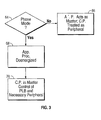
- Figure 3 is a flow chart illustrating the logic of the invention.
- a mobile multi mode computing device is shown, generally designated 10.
- the device 10 can be used to undertake wireless voice and/or data communication as well as personal computing application-based functions, such as but not limited to word processing.
- the device 10 includes a preferably lightweight portable housing 12 that holds the components discussed herein.
- a battery 14 can be engaged with the housing 12 to provide a source of power to the components disclosed below.
- the battery 14 preferably is rechargeable in accordance with portable computing principles known in the art, but when the device 10 is not connected to an electrical outlet, the battery 14 is the sole source of power to the components of the device 10.
- a mode selector 16 can be provided on the housing 12.
- the mode selector 16 can be a user-manipulable input device to select the operational mode of the device 10, e. g., communication or computing.
- the mode selector 16 can be implemented in any number of ways, e.g., it can be a switch, or a portion of a touchscreen display that is used in conjunction with appropriate software to select the mode, or other equivalent input structure.
- the mode selector 16 can be automatically implemented by software responsive to the user's activities, e.g., if the user starts to dial a number the mode selector can be software that automatically configures the device 10 in the communication mode.
- the device 10 includes a communication processor 18, preferably a type of processor referred to as a mobile system modem (MSM) that can access synchronous dynamic random access memory (SDRAM) 20 over, e.g., a 16/32 bit bus 22 and that can be implemented in a communication processor module.
- MSM mobile system modem
- SDRAM synchronous dynamic random access memory
- the communication processor 18 can access, using, for instance, a 16 bit memory interface bus 24, MSM flash memory 26 and MSM static random access memory (SRAM) 28.
- Communication-related applications such as the present assignee's"BREW"applications, can be stored in one or more of the memories 20, 26, 28 for execution thereof by the communication processor 18.
- the communication processor 18 accesses wireless communication circuitry 30 to effect wireless communication in accordance with means known in the art.
- the communication processor 18, associated memories 20,26, and 28, and circuitry 30 establish a wireless voice and/or data communication portion, generally designated 32.
- the communication portion 32 also referred to as a"mobile station (“MS")
- MS mobile telephone-type device made by Kyocera, Samsung, or other manufacturer that uses Code Division Multiple Access (CDMA) principles and CDMA over-the-air (OTA) communication air interface protocols such as defined in but not limited to IS-95A, IS-95B, WCDMA, IS-2000, and others to communicate with wireless infrastructure, although the present invention applies to any wireless communication device.
- CDMA Code Division Multiple Access
- OTA over-the-air
- the wireless communication systems to which the present invention can apply include GSM, Personal Communications Service (PCS) and cellular systems, such as Analog Advanced Mobile Phone System (AMPS) and the following digital systems: CDMA, Time Division Multiple Access (TDMA), and hybrid systems that use both TDMA and CDMA technologies.
- GSM Global System for Mobile Communications
- PCS Personal Communications Service
- AMPS Analog Advanced Mobile Phone System
- CDMA Time Division Multiple Access
- TDMA Time Division Multiple Access
- hybrid systems that use both TDMA and CDMA technologies.
- a CDMA cellular system is described in the Telecommunications Industry Association/Electronic Industries Association (TIA/EIA) Standard IS-95.
- TIA/EIA Telecommunications Industry Association/Electronic Industries Association
- Combined AMPS and CDMA systems are described in TIA/EIA Standard IS-98.
- WCDMA wideband CDMA
- cdma2000 such as cdma2000 1x or 3x standards, for example
- TD-SCDMA TD-SCDMA
- a main processor 34 that can be embodied in a module holds an application processor core 36, which in one non-limiting illustrative embodiment can be an IBM 405 LP processor or equivalent. While Figure 2 shows that the processors 18, 36 can be on separate chips from each other, it is to be appreciated that they can also be disposed on the same chip.
- the application processor core 36 accesses one or more software applications that can be stored in various memories to execute the applications.
- the application processor core 36 can access an SRAM/Flash memory 38 over, e.g., a 16-bit memory bus 40, and it can also access an SDRAM memory 42 (where software applications typically will be preferentially stored) over a preferably 32-bit bus 44.
- FIG. 2 also shows that the application processor core 36 accesses a processor local bus (PLB) 46.
- the PLB bus 46 can be a 64-bit bus.
- Various supporting devices and peripherals are accessed by the application processor core 36 using the PLB 46 in accordance with principles known in the art.
- the PLB 46 (and, hence, application processor core 36) can be connected to a SDRAM controller 48 for controlling the SDRAM memory 42.
- the PLB 46 can communicate with a personal computer memory card interface architecture (PCMCIA) interface or other storage interface 50.
- PCMCIA personal computer memory card interface architecture
- the PLB 46 and, hence, application processor core 36
- LCD liquid crystal display
- the application processor 34 which bears the application processor core 36 can also hold an on-chip peripheral bus (OPB) 54 which in one non-limiting embodiment can be a 32 bit bus.
- OPB on-chip peripheral bus
- the OPB 54 is connected to the PLB 46 through a PLB/OPB bridge device 56.
- the bridge device 56 can translate 32 bit data to 64 bit data and vice versa.
- Various peripheral devices can communicate with the OPB 54.
- a touch panel interface 58 can be connected to the OPB 54.
- other storage interfaces 60 can be connected to the OPB 54.
- peripheral devices that can be connected to the OPB 54 include a USB, a UART, an interrupt (UC), and an AC97 device.
- the communication processor 18 can also communicate with the PLB 46 over its memory interface 24.
- the memory interface 24 of the communication processor 18 is connected to the PLB 46 by a PLB bridge processor 62.
- the PLB bridge processor 62 is implemented in hardware by a logic device, such as, e.g., a processor. In this way, the communication processor 18 can access the devices connected to the PLB 46.
- the functions of the PLB bridge processor 62 can be implemented by, e.g., a dedicated portion of the communication processor 18.
- Figure 3 shows the logic that is executed by the PLB bridge processor 62 to negotiate which processor 18, 36 controls the peripherals shown in Figure 2 .
- decision diamond 64 it is determined whether the device 10 is in the communication mode as indicated by, e.g., the mode selector 16 or other user activity discussed above. If not, meaning that the device 10 is in the computing mode, the logic flows to block 66, wherein the PLB bridge processor 62 designates the application processor core 36 to be the master processor in control of the PLB 46 and OPB 54. In this mode, the communication processor 18 can be treated by the application processor core 36 as a peripheral device.
- the logic moves from decision diamond 64 to block 68, wherein at least the application processor core 36 of the application processor 34 is deenergized. That is, in the communication mode, according to present principles the application processor core 36 is deenergized. Consequently, the communication processor 18 is assigned (by, e.g., the PLB bridge processor 62) the role of master processor at block 70, controlling the peripheral devices connected to the PLB 46 and OPB 54.
- a multi mode mobile device comprising: a housing holding a battery; at least one communication processor configured to facilitate wireless communication using the device, the communication processor being supported on the housing and being powered at least in part by the battery; and at least one application processor configured to execute at least one application, the application processor being supported on the housing and being powered at least in part by the battery, wherein the device has at least a communication mode and a computing mode, and when the device is in the communication mode, a core of the application processor is not energized.
- the communication processor may be associated with a memory bus communicating with one or more memory devices and the application processor may be associated with a processor local bus (PLB), and the memory bus communicates with the PLB.
- PLB processor local bus
- the memory bus may communicate with a PLB bridge processor to facilitate the communication processor functioning as a master of the PLB.
- the communication processor may access peripheral hardware associated with the PLB.
- the device may further comprising a PLB bridge processor interposed between the memory bus and PLB.
- the application processor may be energized when the device is in the computing mode.
- the device may further comprising at least one peripheral hardware component connected to the PLB.
- the peripheral hardware component may be at least one of: a touch panel controller, and a storage interface.
- a multi mode mobile device comprising: a housing holding a battery; at least one communication processor configured to facilitate wireless communication using the device, the communication processor being supported on the housing and being powered at least in part by the battery; and at least one application processor configured to execute at least one application, the application processor being supported on the housing and being powered at least in part by the battery, wherein the device has at least a communication mode and a computing mode, and when the device is in the communication mode, the communication processor functions as a master processor.
- the communication processor when the communication processor functions as a master processor, it may at least control at least one peripheral hardware component on the device.
- the application processor may be not energized.
- the communication processor may be associated with a memory bus communicating with one or more memory devices and the application processor may be associated with a processor local bus (PLB), and the memory bus may communicate with the PLB.
- the memory bus may communicate with the PLB using a PLB bridge processor to facilitate the communication processor functioning as a master of the PLB.
- the communication processor may access peripheral hardware associated with the PLB.
- the device may further comprising a PLB bridge processor interposed between the memory bus and PLB.
- the application processor may be energized when the device is in the computing mode.
- the peripheral hardware component may communicate with the PLB.
- a method for effecting mobile computing comprising: supporting an application processor and a communication processor in a housing; and selectively establishing one of the processors as a master processor based on a mode of operation.
- a processor may be a master processor at least in part based on its control of at least one peripheral hardware component supported on the housing.
- the method may further comprising undertaking wireless communication using the communication processor in a communication mode with the application processor being deenergized and the communication processor being a master processor.
- the method may further comprising executing at least one application using the application processor in an application mode, wherein the application processor is a master processor and the communication processor is a peripheral processor.
- the method may further comprising energizing at least one processor using at least one battery.
- the method may further comprising establishing communication between the communication processor and a bus of the application processor using a memory interface of the communication processor.
- the method may further comprising disposing a PLB bridge processor on the housing to undertake the act of selectively establishing.
- a system for effecting mobile computing comprising: a housing; application processing means for executing logic, the application processing means being mounted on the housing; communication processing means for executing logic, the communication processing means being mounted on the housing; and means for selectively establishing one of the processoring means as a master processor based on a mode of operation.
- a processing means may be a master processor at least in part based on its control of at least one peripheral hardware component supported on the housing.
- the system may further comprising means for undertaking wireless communication using the communication processing means in a communication mode with the application processing means being deenergized and the communication processing means being a master processor.
- the system may further comprising means for executing at least one application using the application processing means in an application mode, wherein the application processing means is a master processor and the communication processing means is a peripheral processor.
- the system may further comprising means for energizing at least one processor using at least one battery.
- the system may further comprising means for establishing communication between the communication processing means and a bus of the application processing means using a memory interface of the communication processing means.
Landscapes
- Engineering & Computer Science (AREA)
- Theoretical Computer Science (AREA)
- Signal Processing (AREA)
- Computer Networks & Wireless Communication (AREA)
- Physics & Mathematics (AREA)
- General Engineering & Computer Science (AREA)
- General Physics & Mathematics (AREA)
- Telephone Function (AREA)
- Mobile Radio Communication Systems (AREA)
- Power Sources (AREA)
- Transceivers (AREA)
- Multi Processors (AREA)
Applications Claiming Priority (2)
| Application Number | Priority Date | Filing Date | Title |
|---|---|---|---|
| US10/229,507 US7450963B2 (en) | 2002-08-27 | 2002-08-27 | Low power dual processor architecture for multi mode devices |
| EP03791963A EP1540923B1 (en) | 2002-08-27 | 2003-08-27 | Low power dual processor architecture for multi mode devices |
Related Parent Applications (1)
| Application Number | Title | Priority Date | Filing Date |
|---|---|---|---|
| EP03791963.6 Division | 2003-08-27 |
Publications (1)
| Publication Number | Publication Date |
|---|---|
| EP2363782A1 true EP2363782A1 (en) | 2011-09-07 |
Family
ID=31976241
Family Applications (2)
| Application Number | Title | Priority Date | Filing Date |
|---|---|---|---|
| EP11166665A Ceased EP2363782A1 (en) | 2002-08-27 | 2003-08-27 | Dual processor architecture for multi mode device |
| EP03791963A Expired - Lifetime EP1540923B1 (en) | 2002-08-27 | 2003-08-27 | Low power dual processor architecture for multi mode devices |
Family Applications After (1)
| Application Number | Title | Priority Date | Filing Date |
|---|---|---|---|
| EP03791963A Expired - Lifetime EP1540923B1 (en) | 2002-08-27 | 2003-08-27 | Low power dual processor architecture for multi mode devices |
Country Status (8)
| Country | Link |
|---|---|
| US (4) | US7450963B2 (enExample) |
| EP (2) | EP2363782A1 (enExample) |
| JP (2) | JP4860921B2 (enExample) |
| KR (1) | KR101050283B1 (enExample) |
| CN (3) | CN101887302B (enExample) |
| AT (1) | ATE521188T1 (enExample) |
| AU (1) | AU2003262997A1 (enExample) |
| WO (1) | WO2004021684A1 (enExample) |
Families Citing this family (71)
| Publication number | Priority date | Publication date | Assignee | Title |
|---|---|---|---|---|
| US7450963B2 (en) * | 2002-08-27 | 2008-11-11 | Qualcomm Incorporated | Low power dual processor architecture for multi mode devices |
| US7398068B2 (en) | 2003-05-05 | 2008-07-08 | Marvell International Ltd. | Dual antenna system having one phase lock loop |
| CA2547204C (en) * | 2003-12-02 | 2010-05-04 | Research In Motion Limited | Inter-processor parameter management in a multiple-processor wireless mobile communication device operating on a processor specific communication network |
| US8478921B2 (en) * | 2004-03-31 | 2013-07-02 | Silicon Laboratories, Inc. | Communication apparatus implementing time domain isolation with restricted bus access |
| US7305569B2 (en) * | 2004-06-29 | 2007-12-04 | Intel Corporation | Apparatus, system and method for adjusting a set of actual power states according to a function depending on a set of desired power states |
| EP1762938B1 (en) * | 2004-06-30 | 2013-01-23 | Vodafone Group PLC | Linked operation method and mobile communication terminal device |
| US7761056B2 (en) * | 2004-07-23 | 2010-07-20 | St-Ericsson Sa | Method of controlling a processor for radio isolation using a timer |
| US8472990B2 (en) | 2004-07-23 | 2013-06-25 | St Ericsson Sa | Apparatus using interrupts for controlling a processor for radio isolation and associated method |
| CN100399318C (zh) * | 2004-12-31 | 2008-07-02 | 联想(北京)有限公司 | 一种具有多处理器的计算机及其操作方法 |
| US7970345B2 (en) * | 2005-06-22 | 2011-06-28 | Atc Technologies, Llc | Systems and methods of waveform and/or information splitting for wireless transmission of information to one or more radioterminals over a plurality of transmission paths and/or system elements |
| US7711391B2 (en) * | 2005-07-29 | 2010-05-04 | Varia Holdings Llc | Multiple processor communication circuit cards and communication devices that employ such cards |
| US20070073854A1 (en) * | 2005-09-19 | 2007-03-29 | Tobias Lindquist | Communication terminals having multiple processors and methods of operating the same |
| US7841967B1 (en) | 2006-04-26 | 2010-11-30 | Dp Technologies, Inc. | Method and apparatus for providing fitness coaching using a mobile device |
| US8902154B1 (en) | 2006-07-11 | 2014-12-02 | Dp Technologies, Inc. | Method and apparatus for utilizing motion user interface |
| US7962775B1 (en) * | 2007-01-10 | 2011-06-14 | Marvell International Ltd. | Methods and apparatus for power mode control for PDA with separate communications and applications processors |
| US8620353B1 (en) | 2007-01-26 | 2013-12-31 | Dp Technologies, Inc. | Automatic sharing and publication of multimedia from a mobile device |
| US8949070B1 (en) | 2007-02-08 | 2015-02-03 | Dp Technologies, Inc. | Human activity monitoring device with activity identification |
| CN101035343B (zh) * | 2007-04-24 | 2012-04-11 | 中兴通讯股份有限公司 | 一种多模手机 |
| US8385840B2 (en) * | 2007-05-16 | 2013-02-26 | Broadcom Corporation | Phone service processor |
| US8555282B1 (en) | 2007-07-27 | 2013-10-08 | Dp Technologies, Inc. | Optimizing preemptive operating system with motion sensing |
| KR101425544B1 (ko) * | 2007-08-01 | 2014-08-01 | 삼성전자주식회사 | 듀얼 프로세서형 이동통신 단말기 및 그의 usb 접속처리 방법 |
| EP2034388A1 (en) * | 2007-09-05 | 2009-03-11 | High Tech Computer Corp. | System and electronic device having multiple operating systems and operating method thereof |
| TWI362612B (en) | 2007-09-05 | 2012-04-21 | Htc Corp | System and electronic device using multiple operating systems and operating method thereof |
| US20090099812A1 (en) * | 2007-10-11 | 2009-04-16 | Philippe Kahn | Method and Apparatus for Position-Context Based Actions |
| US8948822B2 (en) * | 2008-04-23 | 2015-02-03 | Qualcomm Incorporated | Coordinating power management functions in a multi-media device |
| US8285344B2 (en) * | 2008-05-21 | 2012-10-09 | DP Technlogies, Inc. | Method and apparatus for adjusting audio for a user environment |
| US8683247B2 (en) * | 2008-06-12 | 2014-03-25 | Advanced Micro Devices, Inc. | Method and apparatus for controlling power supply to primary processor and portion of peripheral devices by controlling switches in a power/reset module embedded in secondary processor |
| US8996332B2 (en) * | 2008-06-24 | 2015-03-31 | Dp Technologies, Inc. | Program setting adjustments based on activity identification |
| US8908763B2 (en) * | 2008-06-25 | 2014-12-09 | Qualcomm Incorporated | Fragmented reference in temporal compression for video coding |
| US8964828B2 (en) | 2008-08-19 | 2015-02-24 | Qualcomm Incorporated | Power and computational load management techniques in video processing |
| US8948270B2 (en) | 2008-08-19 | 2015-02-03 | Qualcomm Incorporated | Power and computational load management techniques in video processing |
| CN101668350B (zh) * | 2008-09-01 | 2012-07-25 | 联想(北京)有限公司 | 移动终端的状态切换方法及移动终端 |
| US8872646B2 (en) * | 2008-10-08 | 2014-10-28 | Dp Technologies, Inc. | Method and system for waking up a device due to motion |
| CN101754458B (zh) * | 2008-12-01 | 2016-10-05 | 联想(北京)有限公司 | 通信系统的工作模式切换方法及移动终端 |
| CN101753700B (zh) * | 2008-12-22 | 2012-12-19 | 联想(北京)有限公司 | 移动终端的电池信息检测方法及移动终端 |
| JP2010178209A (ja) * | 2009-01-30 | 2010-08-12 | Toshiba Corp | 移動無線端末装置 |
| US9529437B2 (en) * | 2009-05-26 | 2016-12-27 | Dp Technologies, Inc. | Method and apparatus for a motion state aware device |
| CN101888435B (zh) * | 2009-06-16 | 2012-05-09 | 联想(北京)有限公司 | 便携终端的状态控制方法及便携终端 |
| CN101997956A (zh) * | 2009-08-17 | 2011-03-30 | 联想(北京)有限公司 | 一种移动终端切换工作模式的方法及移动终端 |
| US8364857B2 (en) * | 2009-08-31 | 2013-01-29 | Qualcomm Incorporated | Wireless modem with CPU and auxiliary processor that shifts control between processors when in low power state while maintaining communication link to wireless network |
| IL206455A (en) | 2010-01-28 | 2016-11-30 | Elta Systems Ltd | Cellular communication system with moving base stations and methods and useful devices in collaboration with the above |
| US8244609B2 (en) * | 2010-04-02 | 2012-08-14 | Intel Corporation | Payment management on mobile devices |
| KR101649157B1 (ko) * | 2010-05-18 | 2016-08-18 | 엘지전자 주식회사 | 휴대 단말기 및 그 동작 제어방법 |
| US20110296078A1 (en) * | 2010-06-01 | 2011-12-01 | Qualcomm Incorporated | Memory pool interface methods and apparatuses |
| KR101675342B1 (ko) * | 2010-06-01 | 2016-11-11 | 삼성전자주식회사 | 휴대용 단말기의 전력 증폭 장치 및 방법 |
| IL207180A (en) | 2010-07-25 | 2016-03-31 | Elta Systems Ltd | A system for switching application processors in cellular systems |
| CN101931700B (zh) * | 2010-08-20 | 2012-12-19 | 北京天碁科技有限公司 | 一种实现智能手机芯片间通信的方法及智能手机 |
| WO2012070049A1 (en) | 2010-11-24 | 2012-05-31 | Elta Systems Ltd. | Various routing architectures for dynamic multi-hop backhauling cellular network and various methods useful in conjunction therewith |
| SG190870A1 (en) * | 2010-11-24 | 2013-07-31 | Elta Systems Ltd | Wireless device system-architecture |
| EP3528534B1 (en) | 2010-11-24 | 2020-09-09 | Elta Systems Ltd. | Architecture and methods for traffic management by tunneling in moving hierarchical cellular networks |
| TW201224754A (en) * | 2010-12-08 | 2012-06-16 | Quanta Comp Inc | Portable electronic apparatus and control method thereof |
| JP2012175174A (ja) * | 2011-02-17 | 2012-09-10 | Seiko Epson Corp | ネットワーク通信装置、周辺装置、及びネットワーク通信方法 |
| US8824346B2 (en) | 2011-02-23 | 2014-09-02 | Lg Electronics Inc. | Remote wakeup of application processor of mobile device |
| US8830889B2 (en) | 2011-02-23 | 2014-09-09 | Lg Electronics Inc. | Systems for remotely waking up application processor of mobile device |
| US9059597B2 (en) | 2011-02-23 | 2015-06-16 | Lg Electronics Inc. | Reduction of leakage current in mobile device with embedded battery |
| US8918148B2 (en) | 2011-02-23 | 2014-12-23 | Lg Electronics Inc. | Systems and methods for controlling sensor devices in mobile devices |
| US9019984B2 (en) * | 2011-06-03 | 2015-04-28 | Apple Inc. | Selecting wireless access points for geofence monitoring |
| CA2843320A1 (en) | 2011-07-25 | 2013-01-31 | Servergy, Inc. | Method and system for building a low power computer system |
| CN103294160A (zh) * | 2012-03-05 | 2013-09-11 | 联想(北京)有限公司 | 通信设备和工作状态控制方法 |
| WO2013173985A1 (en) * | 2012-05-23 | 2013-11-28 | Honeywell International Inc. | Portable electronic devices having a separate location trigger unit for use in controlling an application unit |
| WO2013183963A1 (en) | 2012-06-07 | 2013-12-12 | Samsung Electronics Co., Ltd. | Apparatus and method for reducing power consumption in electronic device |
| KR102024745B1 (ko) * | 2012-06-07 | 2019-09-25 | 삼성전자주식회사 | 전자 장치에서 전력 소모를 줄이기 위한 장치 및 방법 |
| US9972275B2 (en) * | 2013-05-14 | 2018-05-15 | Ati Technologies Ulc | Content presentation system and method |
| WO2015026197A1 (ko) * | 2013-08-22 | 2015-02-26 | 삼성전자 주식회사 | 전자 장치에서 절전 모드를 수행하는 방법 및 이를 위한 전자 장치 |
| JP2016530819A (ja) * | 2013-08-22 | 2016-09-29 | サムスン エレクトロニクス カンパニー リミテッド | 電子装置における節電モードを実行する方法及びそのための電子装置 |
| USRE49652E1 (en) | 2013-12-16 | 2023-09-12 | Qualcomm Incorporated | Power saving techniques in computing devices |
| KR20160054850A (ko) * | 2014-11-07 | 2016-05-17 | 삼성전자주식회사 | 다수의 프로세서들을 운용하는 장치 및 방법 |
| KR101777660B1 (ko) * | 2016-10-25 | 2017-09-12 | 주식회사 티에스피글로벌 | 플래시 스토리지 디바이스 및 그 동작 제어 방법 |
| US11334291B2 (en) | 2020-03-31 | 2022-05-17 | Nxp B.V. | Method and apparatus for isolating a memory |
| US11520598B2 (en) | 2020-07-01 | 2022-12-06 | Anthony Donte Ebron | Multi-processor mobile computing device |
| EP4318254B1 (en) * | 2022-08-05 | 2025-09-24 | Fraunhofer-Gesellschaft zur Förderung der angewandten Forschung e.V. | Semiconductor device system |
Citations (2)
| Publication number | Priority date | Publication date | Assignee | Title |
|---|---|---|---|---|
| WO2002054212A2 (en) | 2000-12-29 | 2002-07-11 | Intel Corporation | Computer peripheral device that remains operable when central processor operations are suspended |
| US20020103949A1 (en) | 2001-01-26 | 2002-08-01 | Watts La Vaughn F. | Combination personal data assistant and personal computing device with master slave input output |
Family Cites Families (23)
| Publication number | Priority date | Publication date | Assignee | Title |
|---|---|---|---|---|
| JP2663783B2 (ja) | 1992-03-09 | 1997-10-15 | 富士通株式会社 | 携帯通信機の電源制御回路 |
| US5487181A (en) * | 1992-10-28 | 1996-01-23 | Ericsson Ge Mobile Communications Inc. | Low power architecture for portable and mobile two-way radios |
| US5526398A (en) * | 1993-05-04 | 1996-06-11 | Motorola, Inc. | Method of operating a combination radiotelephone and paging device |
| FR2725103B1 (fr) * | 1994-09-23 | 1996-12-27 | Alcatel Mobile Comm France | Economie d'energie dans un systeme incluant un radiotelephone portatif connecte a un dispositif peripherique |
| US5797089A (en) * | 1995-09-07 | 1998-08-18 | Telefonaktiebolaget Lm Ericsson (Publ) | Personal communications terminal having switches which independently energize a mobile telephone and a personal digital assistant |
| US5925092A (en) * | 1996-12-02 | 1999-07-20 | Motorola, Inc. | Satellite cluster with synchronized payload processors and method for use in space-based systems |
| JPH11215043A (ja) * | 1998-01-21 | 1999-08-06 | Toshiba Corp | 通信端末装置 |
| JP3753537B2 (ja) | 1998-05-22 | 2006-03-08 | 三菱電機株式会社 | 携帯無線機 |
| JP3282721B2 (ja) * | 1999-02-02 | 2002-05-20 | 日本電気株式会社 | 携帯無線通信装置 |
| JP2001256205A (ja) | 2000-03-08 | 2001-09-21 | Sharp Corp | マルチプロセッサ装置 |
| JP2002033851A (ja) | 2000-07-13 | 2002-01-31 | Kyocera Corp | 携帯電話機 |
| JP2002032158A (ja) * | 2000-07-17 | 2002-01-31 | Casio Comput Co Ltd | データ送受信システム、データ処理端末及び記憶媒体 |
| CN1142630C (zh) * | 2000-07-28 | 2004-03-17 | 倚天资讯股份有限公司 | 具有单向/双向通讯功能的个人数字助理系统 |
| KR20020069008A (ko) * | 2000-09-06 | 2002-08-28 | 코닌클리즈케 필립스 일렉트로닉스 엔.브이. | 두 개의 프로세서를 포함하는 시스템 및 컴퓨팅 장치 |
| JP3560149B2 (ja) * | 2000-09-12 | 2004-09-02 | 日本電気株式会社 | 携帯電話、GPS、Bluetooth一体型複合端末及びその制御方法 |
| US7069456B2 (en) * | 2000-12-28 | 2006-06-27 | Intel Corporation | Method and apparatus facilitating direct access to a serial ATA device by an autonomous subsystem |
| JP2002215597A (ja) | 2001-01-15 | 2002-08-02 | Mitsubishi Electric Corp | マルチプロセッサ装置 |
| KR101046876B1 (ko) | 2001-01-31 | 2011-07-05 | 가부시키가이샤 히타치세이사쿠쇼 | 데이터 처리 시스템 및 데이터 프로세서 |
| US20020173344A1 (en) * | 2001-03-16 | 2002-11-21 | Cupps Bryan T. | Novel personal electronics device |
| US20030017854A1 (en) * | 2001-03-21 | 2003-01-23 | Asher Avitan | Wireless mobile computing telephone dialer for use with landline telephone systems |
| US7062303B2 (en) * | 2001-07-05 | 2006-06-13 | Intel Corporation | Synchronizing power conservation modes |
| US6941538B2 (en) * | 2002-02-22 | 2005-09-06 | Xilinx, Inc. | Method and system for integrating cores in FPGA-based system-on-chip (SoC) |
| US7450963B2 (en) | 2002-08-27 | 2008-11-11 | Qualcomm Incorporated | Low power dual processor architecture for multi mode devices |
-
2002
- 2002-08-27 US US10/229,507 patent/US7450963B2/en not_active Expired - Lifetime
-
2003
- 2003-08-27 CN CN201010163996.XA patent/CN101887302B/zh not_active Expired - Lifetime
- 2003-08-27 EP EP11166665A patent/EP2363782A1/en not_active Ceased
- 2003-08-27 CN CN038200740A patent/CN1698339B/zh not_active Expired - Lifetime
- 2003-08-27 JP JP2004531966A patent/JP4860921B2/ja not_active Expired - Lifetime
- 2003-08-27 AT AT03791963T patent/ATE521188T1/de not_active IP Right Cessation
- 2003-08-27 KR KR1020057003005A patent/KR101050283B1/ko not_active Expired - Lifetime
- 2003-08-27 AU AU2003262997A patent/AU2003262997A1/en not_active Abandoned
- 2003-08-27 WO PCT/US2003/027182 patent/WO2004021684A1/en not_active Ceased
- 2003-08-27 EP EP03791963A patent/EP1540923B1/en not_active Expired - Lifetime
- 2003-08-27 CN CN201010164012XA patent/CN101893930B/zh not_active Expired - Lifetime
-
2007
- 2007-11-29 US US11/946,901 patent/US8208972B2/en not_active Expired - Fee Related
-
2008
- 2008-08-19 US US12/194,032 patent/US20080305831A1/en not_active Abandoned
-
2010
- 2010-01-15 JP JP2010007077A patent/JP4938868B2/ja not_active Expired - Lifetime
-
2012
- 2012-01-20 US US13/354,377 patent/US8351985B2/en not_active Expired - Fee Related
Patent Citations (2)
| Publication number | Priority date | Publication date | Assignee | Title |
|---|---|---|---|---|
| WO2002054212A2 (en) | 2000-12-29 | 2002-07-11 | Intel Corporation | Computer peripheral device that remains operable when central processor operations are suspended |
| US20020103949A1 (en) | 2001-01-26 | 2002-08-01 | Watts La Vaughn F. | Combination personal data assistant and personal computing device with master slave input output |
Also Published As
| Publication number | Publication date |
|---|---|
| KR101050283B1 (ko) | 2011-07-19 |
| CN101893930B (zh) | 2012-07-04 |
| US20120115456A1 (en) | 2012-05-10 |
| EP1540923B1 (en) | 2011-08-17 |
| CN101893930A (zh) | 2010-11-24 |
| KR20050058445A (ko) | 2005-06-16 |
| ATE521188T1 (de) | 2011-09-15 |
| US20080305831A1 (en) | 2008-12-11 |
| US7450963B2 (en) | 2008-11-11 |
| EP1540923A1 (en) | 2005-06-15 |
| CN1698339A (zh) | 2005-11-16 |
| CN1698339B (zh) | 2010-06-09 |
| US8208972B2 (en) | 2012-06-26 |
| EP1540923A4 (en) | 2009-05-13 |
| WO2004021684A1 (en) | 2004-03-11 |
| AU2003262997A1 (en) | 2004-03-19 |
| CN101887302B (zh) | 2015-04-08 |
| US20040204050A1 (en) | 2004-10-14 |
| JP2005537546A (ja) | 2005-12-08 |
| CN101887302A (zh) | 2010-11-17 |
| US20080072014A1 (en) | 2008-03-20 |
| JP2010157247A (ja) | 2010-07-15 |
| US8351985B2 (en) | 2013-01-08 |
| JP4860921B2 (ja) | 2012-01-25 |
| JP4938868B2 (ja) | 2012-05-23 |
Similar Documents
| Publication | Publication Date | Title |
|---|---|---|
| EP1540923B1 (en) | Low power dual processor architecture for multi mode devices | |
| EP1996993B1 (en) | Dual mode power-saving computing system | |
| US7231531B2 (en) | Personal electronics device with a dual core processor | |
| US10194397B2 (en) | Power supply control method and wireless terminal | |
| US5905900A (en) | Mobile client computer and power management architecture | |
| CN1503934A (zh) | 新型个人电子设备 | |
| JP2001344038A (ja) | クロックダウン機能を有するコンピュータシステム及びコンピュータシステムの動作周波数を調整する方法 | |
| US8205196B2 (en) | Systems and methods for using operating system (OS) virtualisation for minimizing power consumption in mobile phones | |
| KR20160091065A (ko) | SoC(System-on Chip), 그의 전력 관리 방법 및 전자 장치 | |
| CN101150811B (zh) | 一种移动终端中控制待机的装置和方法 | |
| CN101478840A (zh) | 单芯片双模移动终端的sim卡控制电路及其控制方法 | |
| US20090106573A1 (en) | Power saving method | |
| KR20050065394A (ko) | 모바일 장치에서의 메모리 전류 누설을 줄이기 위한 방법및 장치 | |
| JPWO2004111811A1 (ja) | 携帯情報処理装置の省電力化方法及び携帯情報処理システム | |
| CN1610417A (zh) | 信息处理装置 | |
| KR20030003611A (ko) | 대용량 메모리를 가지는 휴대형 단말 장치 및 그 동작 방법 | |
| HK1082352A (en) | Low power dual processor architecture for multi mode devices | |
| KR20050086262A (ko) | 유에스비 디바이스의 통신 제어방법 | |
| KR20050086171A (ko) | 유에스비 디바이스와의 접속 모드 제어방법 | |
| KR20070119286A (ko) | 멀티미디어 칩의 바이패스 모드 구현 방법 |
Legal Events
| Date | Code | Title | Description |
|---|---|---|---|
| PUAI | Public reference made under article 153(3) epc to a published international application that has entered the european phase |
Free format text: ORIGINAL CODE: 0009012 |
|
| 17P | Request for examination filed |
Effective date: 20110519 |
|
| AC | Divisional application: reference to earlier application |
Ref document number: 1540923 Country of ref document: EP Kind code of ref document: P |
|
| AK | Designated contracting states |
Kind code of ref document: A1 Designated state(s): AT BE BG CH CY CZ DE DK EE ES FI FR GB GR HU IE IT LI LU MC NL PT RO SE SI SK TR |
|
| 17Q | First examination report despatched |
Effective date: 20120529 |
|
| APBK | Appeal reference recorded |
Free format text: ORIGINAL CODE: EPIDOSNREFNE |
|
| APBN | Date of receipt of notice of appeal recorded |
Free format text: ORIGINAL CODE: EPIDOSNNOA2E |
|
| APAF | Appeal reference modified |
Free format text: ORIGINAL CODE: EPIDOSCREFNE |
|
| APBR | Date of receipt of statement of grounds of appeal recorded |
Free format text: ORIGINAL CODE: EPIDOSNNOA3E |
|
| APBT | Appeal procedure closed |
Free format text: ORIGINAL CODE: EPIDOSNNOA9E |
|
| STAA | Information on the status of an ep patent application or granted ep patent |
Free format text: STATUS: THE APPLICATION HAS BEEN REFUSED |
|
| 18R | Application refused |
Effective date: 20201030 |