EP2350190B1 - Stabilisierung von polycarbonat auf isosorbid-basis - Google Patents
Stabilisierung von polycarbonat auf isosorbid-basis Download PDFInfo
- Publication number
- EP2350190B1 EP2350190B1 EP09771780.5A EP09771780A EP2350190B1 EP 2350190 B1 EP2350190 B1 EP 2350190B1 EP 09771780 A EP09771780 A EP 09771780A EP 2350190 B1 EP2350190 B1 EP 2350190B1
- Authority
- EP
- European Patent Office
- Prior art keywords
- polycarbonate composition
- solvent
- polycarbonate
- acid
- stabilizer
- Prior art date
- Legal status (The legal status is an assumption and is not a legal conclusion. Google has not performed a legal analysis and makes no representation as to the accuracy of the status listed.)
- Not-in-force
Links
Images


Classifications
-
- C—CHEMISTRY; METALLURGY
- C08—ORGANIC MACROMOLECULAR COMPOUNDS; THEIR PREPARATION OR CHEMICAL WORKING-UP; COMPOSITIONS BASED THEREON
- C08J—WORKING-UP; GENERAL PROCESSES OF COMPOUNDING; AFTER-TREATMENT NOT COVERED BY SUBCLASSES C08B, C08C, C08F, C08G or C08H
- C08J3/00—Processes of treating or compounding macromolecular substances
- C08J3/02—Making solutions, dispersions, lattices or gels by other methods than by solution, emulsion or suspension polymerisation techniques
-
- C—CHEMISTRY; METALLURGY
- C08—ORGANIC MACROMOLECULAR COMPOUNDS; THEIR PREPARATION OR CHEMICAL WORKING-UP; COMPOSITIONS BASED THEREON
- C08G—MACROMOLECULAR COMPOUNDS OBTAINED OTHERWISE THAN BY REACTIONS ONLY INVOLVING UNSATURATED CARBON-TO-CARBON BONDS
- C08G64/00—Macromolecular compounds obtained by reactions forming a carbonic ester link in the main chain of the macromolecule
- C08G64/02—Aliphatic polycarbonates
- C08G64/0208—Aliphatic polycarbonates saturated
-
- C—CHEMISTRY; METALLURGY
- C08—ORGANIC MACROMOLECULAR COMPOUNDS; THEIR PREPARATION OR CHEMICAL WORKING-UP; COMPOSITIONS BASED THEREON
- C08J—WORKING-UP; GENERAL PROCESSES OF COMPOUNDING; AFTER-TREATMENT NOT COVERED BY SUBCLASSES C08B, C08C, C08F, C08G or C08H
- C08J2369/00—Characterised by the use of polycarbonates; Derivatives of polycarbonates
Definitions
- isosorbide The diol 1,4:3,6-dianhydro-D-sorbitol, hereinafter referred to as isosorbide, is readily made from renewable resources, such as from sugars and starches. According to the following reaction scheme, isosorbide can be made from biomass derived starch through hydrolysis, hydrogenation, and dehydration reactions.
- Isosorbide has been used as a monomer in the subsequent formation of copolycarbonate polymers as described in US Patent No. 7,138,479 .
- This patent notes that copolycarbonates of isosorbide with BPA and homopolycarbonate of isosorbide made by the melt route using BMSC or DPC as the carbonate source may discolor when exposed to high temperatures greater than 250° C. Residual catalyst in the polycarbonate is indicated as a potential contributor to the discoloration.
- Isosorbide is also listed as a possible aliphatic diacid comonomer for inclusion in polycarbonates in US Patents Nos. 7,132,498 and 7,041,775 .
- polycarbonate molding compositions containing polycarbonate-property-modifying agents e.g. additives such as impact modifiers, colorants, and stabilizers
- polycarbonate-property-modifying agents e.g. additives such as impact modifiers, colorants, and stabilizers
- polycarbonate-property-modifying agents e.g. additives such as impact modifiers, colorants, and stabilizers
- polycarbonate-property-modifying agents e.g. additives such as impact modifiers, colorants, and stabilizers
- polycarbonate-property-modifying agents e.g. additives such as impact modifiers, colorants, and stabilizers
- polycarbonate-property-modifying agents mixed with polycarbonate containing no isosorbide e.g. traditional bisphenol-A-type polycarbonate
- isosorbide-containing polycarbonate is unexpectedly susceptible to polymer degradation reactions that are catalyzed by either acidic or basic environments at elevated temperatures (e.g. such as those used during molding the composition).
- the present invention provides methods of forming isosorbide-containing polycarbonate compositions with steps including adjusting the pH of the polycarbonate composition.
- the present invention also provides pH-stabilized isosorbide-containing polycarbonate compositions.
- a method of forming an isosorbide-containing polycarbonate composition comprises the steps of: (I) combining a polycarbonate comprising repeat units derived from isosorbide with a polycarbonate-property-modifying additive to form a polycarbonate composition, (II) dissolving a sample from the polycarbonate composition in a non-aqueous solvent to form a polycarbonate composition solution, (III) determining the non-aqueous pH of the polycarbonate composition solution and determining the non-aqueous pH of the solvent, (IV) comparing the pH of the solvent with the pH of the polycarbonate composition solution, and if the pH of the polycarbonate composition solution is more than 0.8 below or more than 0.5 above the pH of the solvent then taking an action selected from the group consisting of (
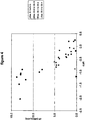
- Figs. 1-4 are graphical representations of results obtained in the example section.
- the present invention may be understood more readily by reference to the following detailed description of preferred embodiments of the invention and the examples included herein.
- the present invention relates to isosorbide-containing polycarbonate compositions and to methods of forming the compositions. It has been found quite unexpectedly that polycarbonate compositions having polycarbonate-property-modifying agents (e.g. additives such as impact modifiers, colorants, and stabilizers) that are acidic or basic mixed with polycarbonate containing repeat units derived from isosorbide have many undesirable properties, including color instability that can be induced by variations in molding conditions, light, heat, and humidity.
- polycarbonate-property-modifying agents e.g. additives such as impact modifiers, colorants, and stabilizers
- polycarbonate compositions having polycarbonate-property-modifying agents mixed with polycarbonate containing no isosorbide do not show similar reduction in color properties.
- polycarbonate containing no isosorbide e.g. traditional bisphenol-A-type polycarbonate
- the present Inventors believe that isosorbide-containing polycarbonate is unexpectedly susceptible polymer degradation reactions that are catalyzed by either acidic or basic environments.
- an aromatic dihydroxy compound refers to either a single species of compound or a mixture of such species unless the context indicates otherwise.
- polycarbonate refers to an oligomer or polymer comprising residues of at least one monomer compound (e.g. a dihydroxy compound) joined by carbonate linkages.
- the polycarbonate comprises residues of an aromatic dihydroxy compound and has a number average molecular weight, Mn, measured relative to polystyrene (PS) standards of between 10,000 g/mol and 160,000 g/mol.
- Mn measured relative to PS is between 13,000 g/mol and 160,000 g/mol, for example between 15,000 g/mol and 160,000 g/mol.
- the Mn (PS) is between 15,000 g/mol and 102,000 g/mol.
- polycarbonate encompasses poly(carbonate-coester) oligomers and polymers. None in the description and claims of this application should be taken as limiting the polycarbonate to only one monomer residue unless the context is expressly limiting. Thus, the application encompasses copolycarbonates with residues of 2, 3, 4, or more types of monomer compounds.
- dissolving as it relates to dissolving a sample in a solvent to prepare a solution for the determination of the non-aqueous pH of the solution in herein understood to mean that the acidic and basic components of the composition(s) are made available for detection in the non-aqueous pH measurement of the prepared solution.
- the entire sample is dissolved or dissolvable in the selected solvent.
- some compositions of the present invention may comprises components that are not completely dissolvable in the selected solvent.
- the solvent is preferably selected such that the acidic and/or basic components of the composition are made available (e.g. made swollen and mobile) for detection and quantification.
- the phrases "more than 0.8 below or more than 0.5 above the pH of the solvent”, “more than 0.5 below or more than 0.3 above the pH of the solvent”, and related phrases found throughout the specification refer to the comparison of the non-aqueous pH of the polycarbonate composition sample solution as compared to the non-aqueous pH of the pure solvent (e.g. the solvent without the polycarbonate composition present) that is used in the polycarbonate composition sample solution.
- the pH of the polycarbonate composition sample solution will have a pH of more than 0.8 below or more than 0.5 above the pH of the solvent when pH sample - pH solvent is ⁇ -0.8 or > +0.5.
- the pH of the polycarbonate composition sample solution will have a pH in a range of equal to or between 0.8 below and 0.5 above the pH of the solvent when pH sample - pH solvent is ⁇ -0.8 and ⁇ +0.5, and so on.
- the present invention provides a method of forming an isosorbide-containing polycarbonate composition comprising a step of comparing the non-aqueous pH of the polycarbonate composition dissolved in a non-aqueous solvent to the pH of the solvent. If necessary the pH of the polycarbonate composition is adjusted toward that of the solvent.
- the present invention provides a pH-stabilized isosorbide-containing polycarbonate.
- a method of forming an isosorbide-containing polycarbonate composition comprises the steps of: (I) combining a polycarbonate comprising repeat units derived from isosorbide with a polycarbonate-property-modifying additive to form a polycarbonate composition, (II) dissolving a sample from the polycarbonate composition in a non-aqueous solvent to form a polycarbonate composition solution, (III) determining the non-aqueous pH of the polycarbonate composition solution and determining the non-aqueous pH of the solvent, (IV) comparing the pH of the solvent with the pH of the polycarbonate composition solution, and if the pH of the polycarbonate composition solution is more than 0.8 below or more than 0.5 above the pH of the solvent then taking an action selected from the group consisting of: (a) if the polycarbonate composition solution has a pH that is more than 0.5 above the pH of the solvent, adding an acid stabilizer to the polycarbonate composition to form an acid stabilized polycarbonate composition, wherein the acid
- the polycarbonate compositions and methods of forming the polycarbonate composition require an isosorbide-containing polycarbonate.
- the phrases "isosorbide-containing polycarbonate”, “polycarbonate containing isosorbide”, “polycarbonate comprising repeat units derived from isosorbide”, and related phrases are used interchangeably herein.
- the isosorbide monomer has the following structure:
- the method used to make the isosorbide-containing polymer is not particularly limited.
- known polymerization methods suitable for preparing the isosorbide-containing polycarbonate include solid state polymerization, interfacial polymerization, and melt polymerization.
- a melt polymerization reaction scheme is used to produce the polycarbonate where a diaryl carbonate is reacted with the isosorbide, and optionally additional monomers, to link the free hydroxyl ends of the isosorbide monomer to produce the polycarbonate.
- the diaryl carbonate is an ester-substituted diaryl carbonate such as bismethylsalicylcarbonate (BMSC).
- the isosorbide-containing polycarbonate may be a homopolymer, copolymer, terpolymer, or a polymer containing several different residues derived from other monomer compounds in addition to isosorbide.
- another monomer compound e.g. a second monomer compound
- the polycarbonate will preferably comprises at least 20 mol%, more preferably at least 40 mol%, and most preferably greater than 60 mol% (for example 80 mol% or more) repeat units derived from isosorbide monomers.
- the additional monomer compounds are not limited to dihydroxy compounds or to aromatic dihydroxy compounds.
- preferred additional monomer compounds include compounds having one or more functional groups capable of reacting with a dihydroxy compound or a diaryl carbonate to give a chemical bond.
- Some non-limiting examples of such reactive functional groups are carboxylic acid, ester, amine functional groups and their combinations.
- Typical monomer compounds will have two functional groups capable of reacting with a dihydroxy compound or a diaryl carbonate, however monofunctional compounds may be used as chainstoppers or endcappers, and trifunctional or higher functional compounds may be used as branching agents.
- dihydroxy and aromatic dihydroxy compounds are frequently preferred for use in these types of applications. Suitable dihydroxy compounds and dihydroxy aromatic compounds are those as described in US Patent Application Serial No. 11/863,659 which is incorporated herein by reference for all purposes.
- the additional monomer component comprises a compound selected from the group consisting of: ethylene glycol, 1,3-Propanediol, 1,2-Propanediol, 1,4-Butanediol, 1,3-Butanediol, 1,5-Pentanediol, 1,6-Hexanediol, 1,7-Heptanediol, 1,10-Decanediol, 1,2-Cyclohexanediol, trans- 1,2-Cyclohexanediol, cis- 1,2-Cyclohexanediol, 1,4-Cyclohexanedimethanol, 1,2,6-Hexanetriol, resorcinol, PLURONIC ® PE 3500 compound, PLURONIC ® PE 6100 compound, UNITHOX ® 480 ETHOXYLATE compound, and an aliphatic compound such as a C 14-44 aliphatic diacid (e
- the additional monomer component(s) comprises a compound selected from the group consisting of: bisphenol-A (BPA), dodecanedioic acid, sebacic acid, and an aliphatic compound such as a C 14-44 aliphatic diacid (e.g. C 36 diacid), C 1444 aliphatic diol (e.g. C 36 branched fatty diol), or combination of these such as PRIPOL ® 1009 compound.
- BPA bisphenol-A
- dodecanedioic acid e.g. C 36 diacid
- C 1444 aliphatic diol e.g. C 36 branched fatty diol
- PRIPOL ® 1009 compound e.g. C 14-44 aliphatic diacid
- the additional monomer component comprises BPA and C 36 diacid.
- the polycarbonate compositions and methods of forming the polycarbonate composition include a polycarbonate-property-modifying agent/additive.
- the method used to combine the additive with the polycarbonate is not particularly limited.
- the additive is blended with the polycarbonate to disperse the additive throughout the polycarbonate.
- the method of blending is not limited and can occur via any known method of mixing polymer and additives.
- the present inventors have found that the isosorbide-containing polycarbonate composition that has an acidic or basic property modifying agent should be treated to adjust its pH (e.g. by adding a corresponding basic or acidic stabilizer) according to the methods provided herein prior to molding or treating the composition at elevated temperatures.
- the methods provided herein are counterintuitive.
- a base such as sodium stearate
- the addition of a base to polycarbonate is not typically desirable because the addition of base to traditional polycarbonates typically results in polymer degradation reactions including reduction in polymer qualities including color and molecular weight degradation.
- pH stabilizer to isosorbide-containing polycarbonate compositions containing polycarbonate-property-modifying additives has been found to be very desirable.
- the polycarbonate-property-modifying additive is not particularly limited other than it is preferably added to the polycarbonate to affect the resulting properties of the polycarbonate.
- Such additives include, among many others, impact modifiers, colorants, mold release agents, fire retardants, and UV stabilizers.
- the polycarbonate-property-modifying additive is considered to be either a basic or acidic additive.
- polycarbonate-property-modifying additives are considered to be generally acidic in nature: acidic pigments such as pigment yellow (e.g. PALIOTOLTM Yellow K 0961 HD), acidic dyes, acidic impact modifiers (e.g. methyl methacrylate butadiene styrene (MBS) produced by acid coagulation), acidic UV stabilizers, acidic release agents, acidic antioxidants, acidic thermal stabilizers (e.g. tris(di-t-butylphenyl)phosphite).
- acidic pigments such as pigment yellow (e.g. PALIOTOLTM Yellow K 0961 HD)
- acidic impact modifiers e.g. methyl methacrylate butadiene styrene (MBS) produced by acid coagulation
- acidic UV stabilizers e.g. methyl methacrylate butadiene styrene (MBS) produced by acid coagulation
- acidic UV stabilizers e.g.
- polycarbonate-property-modifying additives are considered to be generally basic in nature: basic pigments such as pigment blue (PK5095 from Ferro) or Pigment Red (Lithol Scarlet K4165 from BASF), basic dyes, basic impact modifiers, basic UV stabilizers (such as various hindered amine light stabilizers, e.g. TINUVIN ® 770 from CIBA ® ), basic release agents, basic antioxidants, and basic thermal stabilizers.
- basic pigments such as pigment blue (PK5095 from Ferro) or Pigment Red (Lithol Scarlet K4165 from BASF)
- basic dyes such as pigment blue (PK5095 from Ferro) or Pigment Red (Lithol Scarlet K4165 from BASF)
- basic UV stabilizers such as various hindered amine light stabilizers, e.g. TINUVIN ® 770 from CIBA ®
- basic release agents such as various hindered amine light stabilizers, e.g. TINUVIN ®
- Polycarbonate-property-modifying additives are added to polycarbonate or polycarbonate compositions in an amount sufficient to modify a property of the polycarbonate.
- the additive is added in an amount corresponding to less than 0.1 wt% to 20.0 wt% or more of the total composition (e.g. from 0.1 wt% to 20.0 wt% of the total composition).
- the additive is added in an amount corresponding to 5.0 wt% to 15.0 wt% of the total composition.
- the base stabilizer is not particularly limited.
- the base stabilizer remains active (e.g. it is stable, does not degrade, does not evaporate, does not react other than through acid/base reactions) under compounding and molding conditions (e.g. at temperatures up to 300°C or higher). Both weak and strong Br ⁇ nsted bases can be used.
- the base stabilizer can be selected from alkali metal hydroxides, alkaline earth metal hydroxides, amines, carboxylic acid salts, and phosphates.
- the base stabilizer will comprise a compound selected from the group consisting of: sodium hydroxide (NaOH), lithium hydroxide (LiOH), potassium hydroxide (KOH), sodium phosphate (Na 3 PO 4 , tribasic), sodium acetate (NaAc), and sodium stearate. Of these compounds sodium hydroxide and sodium stearate are most preferred.
- the acid stabilizer is not particularly limited. Both weak and strong Br ⁇ nsted acids can be used.
- the acid stabilizer will comprise a compound selected from the group consisting of: phosphorous acid, phosphoric acid, and carboxylic acids (e.g. benzoic acid, stearic acid, acetic acid, oxalic acid, citric acid, and ascorbic acid).
- carboxylic acids e.g. benzoic acid, stearic acid, acetic acid, oxalic acid, citric acid, and ascorbic acid.
- the acid stabilizer is a phosphorus-containing acid (e.g. H 3 PO 4 ).
- the solvent and the method of determining the non-aqueous pH of the prepared solutions is not particularly limited.
- the solvent is preferably a polar non-aqueous solvent that is in a neutral pH range (e.g. it has a non-aqueous pH in a range of between 5 and 9, more preferably between 5.5 and 8.5).
- the solvent is of pure or purified form meaning that the solvent contains minimal acidic or basic impurities that can lead to interaction with acidic or basic components in the polycarbonate composition that would shift the pH measurement of the polycarbonate composition away from a true or actual value.
- the solvent be greater than 99.99 wt% pure (e.g. less than 0.01 wt% acidic or basic impurities).
- the solvent is not particularly limited.
- the solvent is preferably selected such that the polycarbonate composition is capable of being dissolved in the solvent such that acidic and basic species within the polycarbonate composition are available for detection and quantification.
- the solvent is selected, or a cosolvent is added, such that the non-dissolvable acidic or basic components are at least partially solubilized (e.g. swollen) and made available for detection and quantification.
- Solvents include toluene, tetrahydrofuran, 2-butanone, acetone, ethyl acetate, and dimethyl sulfoxide (DMSO), among many others.
- the solvent system preferably comprises a chlorinated hydrocarbon (e.g. a chlorinated alkane and/or a chlorinated benzene) composition that is capable of dissolving or solubilizing (e.g. swelling) the components of the polycarbonate composition such that the acidic or basic species can be detected and quantified.
- a chlorinated hydrocarbon e.g. a chlorinated alkane and/or a chlorinated benzene
- the solvent is a non-aqueous solvent and is selected from the group consisting of dichloromethane (DCM), chloroform, chlorobenzene, and dichlorobenzene.
- DCM dichloromethane
- high performance liquid chromatography grade DCM is used as the non-aqueous solvent.
- the method of determining the non-aqueous pH can be determined using the following method can be performed at or near room temperature (e.g. at or about 20 °C).
- a secondary calibration of the electrode is done using a basic solution of 100 ppm (volumetric) cyclohexylamine (CHA) in dichloromethane and a 1.0 ppm (volumetric) solution of trifluoroacetic acid (TFA) in dichloromethane.
- the pH of the CHA solution was set at 8.5 and the pH of the TFA solution was set at 1.0.
- the pH values for these calibration solutions are determined after a first calibration of the electrode using a set of aqueous buffers of pH 4.0 and 7.0 as commonly used in aqueous pH measurement. During further use, contact of the electrode with aqueous samples and buffer solutions is avoided since the electrode requires extensive cleaning and regeneration afterwards before reliable and reproducible readings in non-aqueous samples are possible again. The correct functioning of the electrode and the validity of the calibration was verified on a regular basis after every 5 to 10 sample measurements by determining pH of the TFA and CHA solutions. The electrode is recalibrated using the CHA and TFA solutions when the difference with the target pH values was larger than 0.2.
- the electrode In between sample measurements, the electrode is cleaned extensively through rinsing and wiping until the pH value of dichloromethane solvent reaches a value of 5.5 - 5.8.
- the pH values for pure solvent, as well as for the secondary calibration solutions of TFA and CHA depends on its grade and age. For consistency, high performance liquid chromatography (HPLC) grade dichloromethane supplied by Acros is used and any remaining solvent is discarded one week after opening.
- HPLC high performance liquid chromatography
- the polycarbonate composition sample solution prepared in DCM has a pH in a range of equal to 0.8 below to 0.5 above the pH of DCM, which is about 5.7 at room temperature of about 20 °C (e.g. a pH of equal to or between 4.9 to 6.2, more preferably equal to or between 5.2 to 6.0).
- Color stability measurement was performed using a Color-Eye ® 7000A spectrophotometer manufactured by GretagMacbeth, at an illuminant observer of C12".
- the CIE Commission Internationale de l'Eclairage
- L*, a*, and b* values were determined on 2.5 mm color chips under reflectance mode according to ASTM 6290, and calibrated using a high gloss polycarbonate standard at a white pigment (TiO 2 ) loading of 5 wt%.
- the color capability was determined from the absorbance spectral data according to the CIELAB color measurement method detailed by CIE (Commission Internationale de l'Eclairage).
- the values of L*, a*, and b* are reported for the Example tested.
- Color difference AE is calculated as the distance between two points (1 and 2) in color space using the following formula:
- ⁇ ⁇ E L ⁇ 1 - L ⁇ 2 ⁇ 2 + a ⁇ 1 - a ⁇ 2 ⁇ 2 + b ⁇ 1 - b ⁇ 2 ⁇ 2 0.5.
- Base polycarbonate compositions including various impact modifying additives are given in Table 1 below. A description of the compounds of these formulations can be found in Table 2. Results are depicted in Tables 3 and 4 and graphically in Figures 1 to 4 .
- Formulations A and B are white and are reference materials based on bisphenol-A (BPA) polycarbonate.
- Formulations C and D are isosorbide-containing polycarbonate blends in white (C) and light grey (D).
- Table 1 formulation name A B C D resins PC-1 % 68.12 95.47 & PC-2 % 4.47 Impact IS-PC % 89.67 89.78 modifiers SAN % 11.55 ABS % 11.55 MBS % 5.77 5.78 colorants COL-1 % 3.8484 3.8263 3.8458 3.6123 COL-2 % 0.0308 0.0306 0.0308 0.0443 COL-3 % 0.0002 0.0002 0.0002 COL-4 % 0.0077 0.0077 0.0077 COL-5 0.0077 COL-6 0.0067 other AO % 0.14 0.38 0.38 0.39 additives R % 0.29 0.29 0.29 0.29 Table 2: Compound Descriptions material description source PC-1 BPA polycarbonate resin made by a melt process having MVR of 23.5 to 28.5 g/10min.
- SABIC Innovative Plastics PC-2 BPA polycarbonate resin made by a melt process having MVR of 5.1 to 6.9 (300°C, 1.2kg) SABIC Innovative Plastics IS-PC Poly(ester-co-carbonate) containing 50%w isosorbide, 18%w fatty acid dimer (Pripol 1009) and 32%w BPA SABIC Innovative Plastics SAN Styrene acrylonitrile comprising about 25 wt.% acrylonitrile and 75 wt.% styrene SABIC Innovative Plastics ABS High rubber graft emulsion polymerized ABS comprising about 11.1 wt.% acrylonitrile and about 38.5 wt.% styrene grafted to about 51 wt.% polybutadiene with a crosslink density of 43-55% SABIC Innovative Plastics MBS MBS is nominal 75 - 82 wt.% butadiene core with a balance styrene-methyl meth
- Table 3 lists a number of compositions based on formulation C.
- the term 'stabilizer type' means the type of base/acid stabilizer which is used for the pH stabilization of the compositions.
- the term 'stabilizer level' is the amount of the stabilizer which is used, expressed as ppm (a mass fraction of the total formulation).
- AE is measured and calculated according to the description provided above.
- Columns labeled 'STD' refer to color data of standard molded color plaques. Standard conditions for molding are those conditions at which the material has sufficient flow to fill the mold. For formulations A and B, standard conditions were molding at 270 °C; for formulations C and D, standard molding was performed at 250 °C. Residence time was 3 minutes for all formulations.
- Abusive conditions are 20 degrees higher in temperature than standard conditions (290 °C for A&B, 270 °C for C&D) and comprise 12 minutes of residence time in the molding machine.
- Columns labeled 'ABU' refer to color data of abusively molded plaques.
- Light exposure (L) is combined exposure to daylight/artificial light in a windowsill for a period of time between 8 and 10 hours of daylight + an additional 24 hours of regular office lighting by tubelights.
- Heat-Humidity treatment (HH) is exposure to 80 °C and 80% relative humidity for 24 hours in the dark.
- 'L+HH' refers to the combined effect of both light and heat-humidity to which the material is exposed to sequentially starting with the light exposure.
- ⁇ pH pH sample - pH solvent
- Table 4 lists a number of comparative examples.
- CE-1 to CE-4 do not contain isosorbide-containing polycarbonate as they are based on formulations A and B.
- CE-5 to CE-13 do not contain a pH stabilizer in an appropriate level. Column headings are similar to those described with reference to Table 3.
- the present invention provides methods for preparing isosorbide-containing polycarbonate compositions as well as the compositions themselves that are superior to those that are not pH stabilized. This is a surprising result because compositions containing polycarbonate having no isosorbide do not have the same susceptibility to variation in pH. See the comparative examples.
Landscapes
- Chemical & Material Sciences (AREA)
- Health & Medical Sciences (AREA)
- Chemical Kinetics & Catalysis (AREA)
- Medicinal Chemistry (AREA)
- Polymers & Plastics (AREA)
- Organic Chemistry (AREA)
- Dispersion Chemistry (AREA)
- Compositions Of Macromolecular Compounds (AREA)
- Polyesters Or Polycarbonates (AREA)
Claims (7)
- Ein Verfahren zum Formen einer Isosorbid enthaltenden Polycarbonatzusammensetzung, wobei das Verfahren folgende Schritte umfasst:(I) Kombinieren eines Polycarbonats, das von Isosorbid abgeleitete Wiederholungseinheiten umfasst, mit einem Polycarbonat-Eigenschaften modifizierenden Zusatzstoff, um eine Polycarbonatzusammensetzung zu formen,(II) Auflösen einer Probe der Polycarbonatzusammensetzung in einem nicht wässerigen Lösungsmittel, um eine Polycarbonatzusammensetzungs-Lösung zu bilden,(III) Bestimmung des nicht wässerigen pHs der Polycarbonatzusammensetzungs-Lösung und Bestimmung des nicht wässerigen pHs des Lösungsmittels,(IV) Vergleich des pHs des Lösungsmittels mit dem pH-Wert der Polycarbonatzusammensetzungs-Lösung, und wenn der pH-Wert der Polycarbonatzusammensetzungs-Lösung mehr als 0,8 niedriger oder mehr als 0,5 höher als der pH-Wert des Lösungsmittels ist, Ergreifen einer Maßnahme, die gewählt ist aus der Gruppe bestehend aus:(a) wenn die Polycarbonatzusammensetzungs-Lösung einen pH-Wert hat, der mehr als 0,5 höher ist als der pH-Wert des Lösungsmittels, Hinzugabe eines Säurestabilisators zur Polycarbonatzusammensetzung, um eine säurestabilisierte Polycarbonatzusammensetzung zu bilden, worin der Säurestabilisator zur Polycarbonatzusammensetzung in einer Menge hinzugefügt ist, die derart ist, dass eine Probe der säurestabilisierten Polycarbonatzusammensetzung, die in dem Lösungsmittel aufgelöst ist, einen nicht wässerigen pH-Wert hat, der in einem Bereich von gleich oder zwischen 0, 8 niedriger als und 0,5 höher als der pH-Wert des Lösungsmittels liegt, und(b) wenn die Polycarbonatzusammensetzungs-Lösung einen pH-Wert hat, der mehr als 0,8 niedriger ist als der pH-Wert des Lösungsmittels, Hinzufügen eines Basenstabilisators zur Polycarbonatzusammensetzung, um eine basenstabilisierte Polycarbonatzusammensetzung zu bilden, worin der Basenstabilisator zur Polycarbonatzusammensetzung in einer Menge hinzugefügt wird, die derart ist, dass eine Probe der basenstabilisierten Polycarbonatzusammensetzung, die in dem Lösungsmittel aufgelöst ist, einen nicht wässerigen pH-Wert hat, der in einem Bereich von gleich oder zwischen 0,8 niedriger als und 0,5 höher als der pH-Wert des Lösungsmittels liegt, wodurch eine Isosorbid enthaltende Polycarbonatzusammensetzung gebildet wird.
- Das Verfahren gemäß Anspruch 1, worin Schritt (IV) weiter Folgendes einschließt:Vergleichen des pH-Werts des Lösungsmittels mit dem pH-Wert der Polycarbonatzusammensetzungs-Lösung, und wenn der pH-Wert der Polycarbonatzusammensetzungs-Lösung mehr als 0,5 niedriger oder mehr als 0,3 höher ist als der pH-Wert des Lösungsmittels, Ergreifen einer Maßnahme, die gewählt ist aus der Gruppe bestehend aus:(a) wenn die Polycarbonatzusammensetzungs-Lösung einen pH-Wert hat, der mehr als 0,3 höher ist als der pH-Wert des Lösungsmittels, Hinzugabe eines Säurestabilisators zur Polycarbonatzusammensetzung, um eine säurestabilisierte Polycarbonatzusammensetzung zu bilden,
worin der Säurestabilisator zur Polycarbonatzusammensetzung in einer Menge hinzugefügt wird, die derart ist, dass eine Probe der säurestabilisierten Polycarbonatzusammensetzung, die in dem Lösungsmittel aufgelöst ist, einen nicht wässerigen pH-Wert hat, der in einem Bereich von gleich oder zwischen 0,5 niedriger als und 0,3 höher als der pH-Wert des Lösungsmittels liegt, und(b) wenn die Polycarbonatzusammensetzungs-Lösung einen pH-Wert hat, der mehr als 0,5 niedriger ist als der pH-Wert des Lösungsmittels, Hinzufügen eines Basenstabilisators zur Polycarbonatzusammensetzung, um eine basenstabilisierte Polycarbonatzusammensetzung zu bilden,
worin der Basenstabilisator zur Polycarbonatzusammensetzung in einer Menge hinzugefügt wird, die derart ist, dass eine Probe der basenstabilisierten Polycarbonatzusammensetzung, die in dem Lösungsmittel aufgelöst ist, einen nicht wässerigen pH-Wert hat, der in einem Bereich von gleich oder zwischen 0,5 niedriger als und 0,3 höher als der pH-Wert des Lösungsmittels liegt. - Das Verfahren gemäß Anspruch 1 oder 2, worin ein Basenstabilisator zur Polycarbonatzusammensetzung hinzugefügt wird, um eine basenstabilisierte Polycarbonatzusammensetzung zu bilden,
worin der Basenstabilisator gewählt ist aus der Gruppe bestehend aus: Natriumhydroxid, Lithiumhydroxid, Kaliumhydroxid, Natriumphosphat, Natriumacetat und Natriumstearat. - Das Verfahren gemäß Anspruch 1 oder 2, worin ein Säurestabilisator zur Polycarbonatzusammensetzung hinzugefügt wird, um eine säurestabilisierte Polycarbonatzusammensetzung zu bilden,
worin der Säurestabilisator gewählt ist aus der Gruppe bestehend aus Carbonsäuren, Phosphonsäure und Phosphorsäure. - Das Verfahren gemäß Anspruch 1 oder 2, worin der Polycarbonat-Eigenschaften modifizierende Zusatzstoff ein saurer Zusatzstoff ist, der in einer Menge hinzugegeben wird, die derart ist, dass sie von 0,1 bis einschließlich 20,0 Gewichtsprozent der Gesamtzusammensetzung ausmacht, und worin der saure Zusatzstoff gewählt ist aus der Gruppe bestehend aus:sauren Pigmenten, sauren Farbstoffen, sauren Elastifikatoren, sauren UV-Stabilisatoren, sauren Trennmitteln, sauren Antioxidantien und sauren Wärmestabilisatoren.
- Das Verfahren gemäß Anspruch 1 oder 2, worin der Polycarbonat-Eigenschaften modifizierende Zusatzstoff ein basischer Zusatzstoff ist, der in einer Menge hinzugegeben wird, die derart ist, dass sie von 0,1 bis einschließlich 20,0 Gewichtsprozent der Gesamtzusammensetzung ausmacht, und
worin der basische Zusatzstoff gewählt ist aus der Gruppe bestehend aus basischen Pigmenten, basischen Farbstoffen, basischen Elastifikatoren, basischen UV-Stabilisatoren, basischen Trennmitteln, basischen Antioxidantien und basischen Wärmestabilisatoren. - Das Verfahren gemäß einem beliebigen der obigen Ansprüche, worin die in den Schritten (II) und (IV) hergestellten Lösungen hergestellt werden durch Auflösen der entsprechenden Probe in einem nicht wässerigen Lösungsmittel, gewählt aus der Gruppe bestehend aus:Dichlormethan (DCM), Chloroform, Chlorbenzen und Dichlorbenzen,worin die Lösungen von 5 bis einschließlich 20 Gewichtsprozent der entsprechenden Probe umfassen.
Priority Applications (1)
| Application Number | Priority Date | Filing Date | Title |
|---|---|---|---|
| EP12191074.9A EP2559733B1 (de) | 2008-11-18 | 2009-11-17 | Stabilisierung von isosorbidbasiertem Polycarbonat |
Applications Claiming Priority (2)
| Application Number | Priority Date | Filing Date | Title |
|---|---|---|---|
| US12/273,132 US7659359B1 (en) | 2008-11-18 | 2008-11-18 | Stabilization of isosorbide-based polycarbonate |
| PCT/IB2009/055124 WO2010058343A1 (en) | 2008-11-18 | 2009-11-17 | Stabilization of isosorbide-based polycarbonate |
Related Child Applications (2)
| Application Number | Title | Priority Date | Filing Date |
|---|---|---|---|
| EP12191074.9A Division EP2559733B1 (de) | 2008-11-18 | 2009-11-17 | Stabilisierung von isosorbidbasiertem Polycarbonat |
| EP12191074.9 Division-Into | 2012-11-02 |
Publications (2)
| Publication Number | Publication Date |
|---|---|
| EP2350190A1 EP2350190A1 (de) | 2011-08-03 |
| EP2350190B1 true EP2350190B1 (de) | 2014-01-01 |
Family
ID=41581941
Family Applications (2)
| Application Number | Title | Priority Date | Filing Date |
|---|---|---|---|
| EP12191074.9A Not-in-force EP2559733B1 (de) | 2008-11-18 | 2009-11-17 | Stabilisierung von isosorbidbasiertem Polycarbonat |
| EP09771780.5A Not-in-force EP2350190B1 (de) | 2008-11-18 | 2009-11-17 | Stabilisierung von polycarbonat auf isosorbid-basis |
Family Applications Before (1)
| Application Number | Title | Priority Date | Filing Date |
|---|---|---|---|
| EP12191074.9A Not-in-force EP2559733B1 (de) | 2008-11-18 | 2009-11-17 | Stabilisierung von isosorbidbasiertem Polycarbonat |
Country Status (5)
| Country | Link |
|---|---|
| US (1) | US7659359B1 (de) |
| EP (2) | EP2559733B1 (de) |
| JP (1) | JP5220199B2 (de) |
| CN (1) | CN102216388B (de) |
| WO (1) | WO2010058343A1 (de) |
Families Citing this family (9)
| Publication number | Priority date | Publication date | Assignee | Title |
|---|---|---|---|---|
| CN104262926B (zh) * | 2010-07-14 | 2017-04-12 | 三菱化学株式会社 | 聚碳酸酯树脂组合物、以及使用该组合物得到的成型品、膜、板、注塑成型品 |
| US8633265B2 (en) * | 2011-01-19 | 2014-01-21 | Sabic Innovative Plastics Ip B.V. | UV stabilization of isosorbide polycarbonates |
| US8669314B2 (en) | 2012-02-03 | 2014-03-11 | Sabic Innovative Plastics Ip B.V. | Hydrolytic stability in polycarbonate compositions |
| JP6260092B2 (ja) * | 2012-03-29 | 2018-01-17 | 三菱ケミカル株式会社 | 眼鏡レンズ |
| JP6015070B2 (ja) * | 2012-03-30 | 2016-10-26 | 三菱化学株式会社 | 自動車内外装部品 |
| US9193864B2 (en) | 2012-06-22 | 2015-11-24 | Sabic Global Technologies B.V. | Polycarbonate compositions with improved impact resistance |
| WO2017002886A1 (ja) * | 2015-06-30 | 2017-01-05 | 三菱化学株式会社 | ポリカーボネート樹脂組成物、その製造方法、成形体 |
| JP6693231B2 (ja) * | 2016-03-31 | 2020-05-13 | 三菱ケミカル株式会社 | ポリカーボネート樹脂組成物及び成形体 |
| JP2017014527A (ja) * | 2016-09-26 | 2017-01-19 | 三菱化学株式会社 | 自動車内外装部品 |
Family Cites Families (17)
| Publication number | Priority date | Publication date | Assignee | Title |
|---|---|---|---|---|
| US4323668A (en) | 1980-12-03 | 1982-04-06 | General Electric Company | (Ortho-alkoxycarbonyaryl)-carbonate transesterification |
| JP3315360B2 (ja) * | 1998-01-23 | 2002-08-19 | 株式会社東芝 | 消去可能な画像形成材料の消去方法 |
| US6984354B2 (en) * | 2001-05-10 | 2006-01-10 | Eastman Chemical Company | Process for making labeled containers using a stretch blow molding process |
| US6548623B2 (en) | 2001-07-24 | 2003-04-15 | General Electric Company | Method of polycarbonate preparation |
| US6506871B1 (en) | 2001-07-24 | 2003-01-14 | General Electric Company | Extrusion method for making polycarbonate |
| US6870025B2 (en) | 2001-07-24 | 2005-03-22 | General Electric Company | Method of polycarbonate preparation |
| US6518391B1 (en) | 2001-07-24 | 2003-02-11 | General Electric Company | Method of polycarbonate preparation by solid state polymerization |
| US6420512B1 (en) | 2001-07-24 | 2002-07-16 | General Electric Company | Extrusion method for making polycarbonate |
| US20030139529A1 (en) | 2001-11-02 | 2003-07-24 | General Electric Company | Method of making block copolymers by solid state polymerization |
| US6790929B2 (en) | 2002-06-12 | 2004-09-14 | General Electric Company | Method for making an aromatic polycarbonate |
| US7138479B2 (en) | 2003-12-31 | 2006-11-21 | General Electric Company | Aliphatic diol polycarbonates and their preparation |
| US7041775B2 (en) | 2004-04-20 | 2006-05-09 | General Electric Company | Method for preparing a polycarbonate oligomer mixture at low temperature for manufacturing polycarbonate |
| US7132498B2 (en) | 2004-09-27 | 2006-11-07 | General Electric Company | Process to make polycarbonate from bismethylsalicylcarbonate (BMSC) |
| JP2007146019A (ja) * | 2005-11-29 | 2007-06-14 | Mitsui Chemicals Inc | ポリカーボネート重合体、その製造方法およびその用途 |
| US7645851B2 (en) | 2006-06-30 | 2010-01-12 | Sabic Innovative Plastics Ip B.V. | Polycarbonate with reduced color |
| JP2008241919A (ja) * | 2007-03-26 | 2008-10-09 | Yamaha Corp | 楽曲データ提供システム及びサイト |
| US7601794B2 (en) | 2007-09-28 | 2009-10-13 | Sabic Innovative Plastics Ip B.V. | Monomer solution for producing polycarbonate |
-
2008
- 2008-11-18 US US12/273,132 patent/US7659359B1/en not_active Expired - Fee Related
-
2009
- 2009-11-17 CN CN2009801454117A patent/CN102216388B/zh not_active Expired - Fee Related
- 2009-11-17 EP EP12191074.9A patent/EP2559733B1/de not_active Not-in-force
- 2009-11-17 WO PCT/IB2009/055124 patent/WO2010058343A1/en not_active Ceased
- 2009-11-17 EP EP09771780.5A patent/EP2350190B1/de not_active Not-in-force
- 2009-11-17 JP JP2011536981A patent/JP5220199B2/ja not_active Expired - Fee Related
Also Published As
| Publication number | Publication date |
|---|---|
| US7659359B1 (en) | 2010-02-09 |
| EP2559733A1 (de) | 2013-02-20 |
| CN102216388B (zh) | 2012-11-28 |
| CN102216388A (zh) | 2011-10-12 |
| JP2012509382A (ja) | 2012-04-19 |
| JP5220199B2 (ja) | 2013-06-26 |
| EP2559733B1 (de) | 2015-02-25 |
| WO2010058343A1 (en) | 2010-05-27 |
| EP2350190A1 (de) | 2011-08-03 |
Similar Documents
| Publication | Publication Date | Title |
|---|---|---|
| EP2559733B1 (de) | Stabilisierung von isosorbidbasiertem Polycarbonat | |
| EP3476897B1 (de) | Polycarbonatharzzusammensetzung und formgegenstand | |
| EP2554598B1 (de) | Polycarbonatharzzusammensetzung und formartikel | |
| EP2677002B1 (de) | Polycarbonatharzzusammensetzung und formartikel | |
| EP3653669B1 (de) | Verfahren zur herstellung einer thermoplastischen harzzusammensetzung | |
| US20120245265A1 (en) | Polycarbonate resin composition and molded article | |
| EP3196252B1 (de) | Polycarbonatharzzusammensetzung und formgegenstand daraus | |
| KR20120117756A (ko) | 폴리카보네이트 수지 조성물 그리고 이것을 성형하여 얻어지는 성형체, 필름, 플레이트 및 사출 성형품 | |
| EP2108671A1 (de) | Polykarbonatharz und verfahren zu seiner herstellung | |
| US20120238679A1 (en) | Polycarbonate resin composition and molded article | |
| EP3318603B1 (de) | Polycarbonatharzzusammensetzung, verfahren zur herstellung davon und formgegenstand | |
| CN1352661A (zh) | 聚碳酸酯的猝灭方法及通过其制备的组合物 | |
| EP2692797A1 (de) | Polycarbonatharzzusammensetzung und formartikel daraus | |
| JP2011132316A (ja) | 透明樹脂組成物及び透明樹脂成形品 | |
| JP6898192B2 (ja) | 自動車用内外装部材 | |
| EP3305852A1 (de) | Polycarbonatzusammensetzung und herstellungsverfahren dafür | |
| CN109280353B (zh) | 汽车内外部件 | |
| JP3420890B2 (ja) | 芳香族ポリカーボネート及びその組成物 | |
| JP3437033B2 (ja) | 芳香族ポリカーボネート組成物及びその製造法 | |
| JP2019123441A (ja) | 自動車用内外装部材 | |
| EP4563656A1 (de) | Polycarbonatharzzusammensetzung | |
| US20180094133A1 (en) | Interior/exterior automotive trim component | |
| CN120380081A (zh) | 聚膦酸酯均聚物在具有改进的冲击性能的聚合物共混物中的应用及其相关方法 | |
| JP2023148429A (ja) | 熱可塑性樹脂組成物よび成形体 |
Legal Events
| Date | Code | Title | Description |
|---|---|---|---|
| PUAI | Public reference made under article 153(3) epc to a published international application that has entered the european phase |
Free format text: ORIGINAL CODE: 0009012 |
|
| 17P | Request for examination filed |
Effective date: 20110527 |
|
| AK | Designated contracting states |
Kind code of ref document: A1 Designated state(s): AT BE BG CH CY CZ DE DK EE ES FI FR GB GR HR HU IE IS IT LI LT LU LV MC MK MT NL NO PL PT RO SE SI SK SM TR |
|
| DAX | Request for extension of the european patent (deleted) | ||
| 17Q | First examination report despatched |
Effective date: 20120620 |
|
| GRAP | Despatch of communication of intention to grant a patent |
Free format text: ORIGINAL CODE: EPIDOSNIGR1 |
|
| INTG | Intention to grant announced |
Effective date: 20130709 |
|
| GRAS | Grant fee paid |
Free format text: ORIGINAL CODE: EPIDOSNIGR3 |
|
| GRAA | (expected) grant |
Free format text: ORIGINAL CODE: 0009210 |
|
| AK | Designated contracting states |
Kind code of ref document: B1 Designated state(s): AT BE BG CH CY CZ DE DK EE ES FI FR GB GR HR HU IE IS IT LI LT LU LV MC MK MT NL NO PL PT RO SE SI SK SM TR |
|
| REG | Reference to a national code |
Ref country code: GB Ref legal event code: FG4D |
|
| REG | Reference to a national code |
Ref country code: CH Ref legal event code: EP |
|
| REG | Reference to a national code |
Ref country code: IE Ref legal event code: FG4D |
|
| REG | Reference to a national code |
Ref country code: DE Ref legal event code: R096 Ref document number: 602009021177 Country of ref document: DE Effective date: 20140213 |
|
| REG | Reference to a national code |
Ref country code: AT Ref legal event code: REF Ref document number: 647607 Country of ref document: AT Kind code of ref document: T Effective date: 20140215 |
|
| REG | Reference to a national code |
Ref country code: NL Ref legal event code: VDEP Effective date: 20140101 |
|
| REG | Reference to a national code |
Ref country code: AT Ref legal event code: MK05 Ref document number: 647607 Country of ref document: AT Kind code of ref document: T Effective date: 20140101 |
|
| REG | Reference to a national code |
Ref country code: LT Ref legal event code: MG4D |
|
| PG25 | Lapsed in a contracting state [announced via postgrant information from national office to epo] |
Ref country code: IS Free format text: LAPSE BECAUSE OF FAILURE TO SUBMIT A TRANSLATION OF THE DESCRIPTION OR TO PAY THE FEE WITHIN THE PRESCRIBED TIME-LIMIT Effective date: 20140501 Ref country code: LT Free format text: LAPSE BECAUSE OF FAILURE TO SUBMIT A TRANSLATION OF THE DESCRIPTION OR TO PAY THE FEE WITHIN THE PRESCRIBED TIME-LIMIT Effective date: 20140101 |
|
| PG25 | Lapsed in a contracting state [announced via postgrant information from national office to epo] |
Ref country code: ES Free format text: LAPSE BECAUSE OF FAILURE TO SUBMIT A TRANSLATION OF THE DESCRIPTION OR TO PAY THE FEE WITHIN THE PRESCRIBED TIME-LIMIT Effective date: 20140101 Ref country code: CY Free format text: LAPSE BECAUSE OF FAILURE TO SUBMIT A TRANSLATION OF THE DESCRIPTION OR TO PAY THE FEE WITHIN THE PRESCRIBED TIME-LIMIT Effective date: 20140101 Ref country code: AT Free format text: LAPSE BECAUSE OF FAILURE TO SUBMIT A TRANSLATION OF THE DESCRIPTION OR TO PAY THE FEE WITHIN THE PRESCRIBED TIME-LIMIT Effective date: 20140101 Ref country code: SE Free format text: LAPSE BECAUSE OF FAILURE TO SUBMIT A TRANSLATION OF THE DESCRIPTION OR TO PAY THE FEE WITHIN THE PRESCRIBED TIME-LIMIT Effective date: 20140101 Ref country code: PT Free format text: LAPSE BECAUSE OF FAILURE TO SUBMIT A TRANSLATION OF THE DESCRIPTION OR TO PAY THE FEE WITHIN THE PRESCRIBED TIME-LIMIT Effective date: 20140502 Ref country code: NL Free format text: LAPSE BECAUSE OF FAILURE TO SUBMIT A TRANSLATION OF THE DESCRIPTION OR TO PAY THE FEE WITHIN THE PRESCRIBED TIME-LIMIT Effective date: 20140101 Ref country code: FI Free format text: LAPSE BECAUSE OF FAILURE TO SUBMIT A TRANSLATION OF THE DESCRIPTION OR TO PAY THE FEE WITHIN THE PRESCRIBED TIME-LIMIT Effective date: 20140101 |
|
| PG25 | Lapsed in a contracting state [announced via postgrant information from national office to epo] |
Ref country code: LV Free format text: LAPSE BECAUSE OF FAILURE TO SUBMIT A TRANSLATION OF THE DESCRIPTION OR TO PAY THE FEE WITHIN THE PRESCRIBED TIME-LIMIT Effective date: 20140101 Ref country code: BE Free format text: LAPSE BECAUSE OF FAILURE TO SUBMIT A TRANSLATION OF THE DESCRIPTION OR TO PAY THE FEE WITHIN THE PRESCRIBED TIME-LIMIT Effective date: 20140101 Ref country code: HR Free format text: LAPSE BECAUSE OF FAILURE TO SUBMIT A TRANSLATION OF THE DESCRIPTION OR TO PAY THE FEE WITHIN THE PRESCRIBED TIME-LIMIT Effective date: 20140101 |
|
| REG | Reference to a national code |
Ref country code: DE Ref legal event code: R097 Ref document number: 602009021177 Country of ref document: DE |
|
| PG25 | Lapsed in a contracting state [announced via postgrant information from national office to epo] |
Ref country code: RO Free format text: LAPSE BECAUSE OF FAILURE TO SUBMIT A TRANSLATION OF THE DESCRIPTION OR TO PAY THE FEE WITHIN THE PRESCRIBED TIME-LIMIT Effective date: 20140101 Ref country code: DK Free format text: LAPSE BECAUSE OF FAILURE TO SUBMIT A TRANSLATION OF THE DESCRIPTION OR TO PAY THE FEE WITHIN THE PRESCRIBED TIME-LIMIT Effective date: 20140101 Ref country code: CZ Free format text: LAPSE BECAUSE OF FAILURE TO SUBMIT A TRANSLATION OF THE DESCRIPTION OR TO PAY THE FEE WITHIN THE PRESCRIBED TIME-LIMIT Effective date: 20140101 Ref country code: EE Free format text: LAPSE BECAUSE OF FAILURE TO SUBMIT A TRANSLATION OF THE DESCRIPTION OR TO PAY THE FEE WITHIN THE PRESCRIBED TIME-LIMIT Effective date: 20140101 |
|
| PLBE | No opposition filed within time limit |
Free format text: ORIGINAL CODE: 0009261 |
|
| STAA | Information on the status of an ep patent application or granted ep patent |
Free format text: STATUS: NO OPPOSITION FILED WITHIN TIME LIMIT |
|
| PG25 | Lapsed in a contracting state [announced via postgrant information from national office to epo] |
Ref country code: SK Free format text: LAPSE BECAUSE OF FAILURE TO SUBMIT A TRANSLATION OF THE DESCRIPTION OR TO PAY THE FEE WITHIN THE PRESCRIBED TIME-LIMIT Effective date: 20140101 Ref country code: PL Free format text: LAPSE BECAUSE OF FAILURE TO SUBMIT A TRANSLATION OF THE DESCRIPTION OR TO PAY THE FEE WITHIN THE PRESCRIBED TIME-LIMIT Effective date: 20140101 |
|
| 26N | No opposition filed |
Effective date: 20141002 |
|
| REG | Reference to a national code |
Ref country code: DE Ref legal event code: R097 Ref document number: 602009021177 Country of ref document: DE Effective date: 20141002 |
|
| PG25 | Lapsed in a contracting state [announced via postgrant information from national office to epo] |
Ref country code: SI Free format text: LAPSE BECAUSE OF FAILURE TO SUBMIT A TRANSLATION OF THE DESCRIPTION OR TO PAY THE FEE WITHIN THE PRESCRIBED TIME-LIMIT Effective date: 20140101 |
|
| PG25 | Lapsed in a contracting state [announced via postgrant information from national office to epo] |
Ref country code: MC Free format text: LAPSE BECAUSE OF FAILURE TO SUBMIT A TRANSLATION OF THE DESCRIPTION OR TO PAY THE FEE WITHIN THE PRESCRIBED TIME-LIMIT Effective date: 20140101 Ref country code: LU Free format text: LAPSE BECAUSE OF FAILURE TO SUBMIT A TRANSLATION OF THE DESCRIPTION OR TO PAY THE FEE WITHIN THE PRESCRIBED TIME-LIMIT Effective date: 20141117 |
|
| REG | Reference to a national code |
Ref country code: CH Ref legal event code: PL |
|
| PG25 | Lapsed in a contracting state [announced via postgrant information from national office to epo] |
Ref country code: LI Free format text: LAPSE BECAUSE OF NON-PAYMENT OF DUE FEES Effective date: 20141130 Ref country code: CH Free format text: LAPSE BECAUSE OF NON-PAYMENT OF DUE FEES Effective date: 20141130 |
|
| REG | Reference to a national code |
Ref country code: IE Ref legal event code: MM4A |
|
| REG | Reference to a national code |
Ref country code: FR Ref legal event code: PLFP Year of fee payment: 7 |
|
| PG25 | Lapsed in a contracting state [announced via postgrant information from national office to epo] |
Ref country code: IE Free format text: LAPSE BECAUSE OF NON-PAYMENT OF DUE FEES Effective date: 20141117 |
|
| PGFP | Annual fee paid to national office [announced via postgrant information from national office to epo] |
Ref country code: DE Payment date: 20151110 Year of fee payment: 7 Ref country code: GB Payment date: 20151111 Year of fee payment: 7 |
|
| REG | Reference to a national code |
Ref country code: DE Ref legal event code: R081 Ref document number: 602009021177 Country of ref document: DE Owner name: SABIC GLOBAL TECHNOLOGIES B.V., NL Free format text: FORMER OWNER: SABIC INNOVATIVE PLASTICS IP B.V., BERGEN OP ZOOM, NL |
|
| PG25 | Lapsed in a contracting state [announced via postgrant information from national office to epo] |
Ref country code: SM Free format text: LAPSE BECAUSE OF FAILURE TO SUBMIT A TRANSLATION OF THE DESCRIPTION OR TO PAY THE FEE WITHIN THE PRESCRIBED TIME-LIMIT Effective date: 20140101 Ref country code: NO Free format text: LAPSE BECAUSE OF FAILURE TO SUBMIT A TRANSLATION OF THE DESCRIPTION OR TO PAY THE FEE WITHIN THE PRESCRIBED TIME-LIMIT Effective date: 20140401 |
|
| REG | Reference to a national code |
Ref country code: FR Ref legal event code: CD Owner name: SABIC INNOVATIVE PLASTICS IP B.V., NL Effective date: 20160517 |
|
| PG25 | Lapsed in a contracting state [announced via postgrant information from national office to epo] |
Ref country code: IT Free format text: LAPSE BECAUSE OF FAILURE TO SUBMIT A TRANSLATION OF THE DESCRIPTION OR TO PAY THE FEE WITHIN THE PRESCRIBED TIME-LIMIT Effective date: 20140101 Ref country code: GR Free format text: LAPSE BECAUSE OF FAILURE TO SUBMIT A TRANSLATION OF THE DESCRIPTION OR TO PAY THE FEE WITHIN THE PRESCRIBED TIME-LIMIT Effective date: 20140402 Ref country code: BG Free format text: LAPSE BECAUSE OF FAILURE TO SUBMIT A TRANSLATION OF THE DESCRIPTION OR TO PAY THE FEE WITHIN THE PRESCRIBED TIME-LIMIT Effective date: 20140101 |
|
| PG25 | Lapsed in a contracting state [announced via postgrant information from national office to epo] |
Ref country code: TR Free format text: LAPSE BECAUSE OF FAILURE TO SUBMIT A TRANSLATION OF THE DESCRIPTION OR TO PAY THE FEE WITHIN THE PRESCRIBED TIME-LIMIT Effective date: 20140101 Ref country code: MT Free format text: LAPSE BECAUSE OF FAILURE TO SUBMIT A TRANSLATION OF THE DESCRIPTION OR TO PAY THE FEE WITHIN THE PRESCRIBED TIME-LIMIT Effective date: 20140101 Ref country code: HU Free format text: LAPSE BECAUSE OF FAILURE TO SUBMIT A TRANSLATION OF THE DESCRIPTION OR TO PAY THE FEE WITHIN THE PRESCRIBED TIME-LIMIT; INVALID AB INITIO Effective date: 20091117 |
|
| REG | Reference to a national code |
Ref country code: FR Ref legal event code: PLFP Year of fee payment: 8 |
|
| PGFP | Annual fee paid to national office [announced via postgrant information from national office to epo] |
Ref country code: FR Payment date: 20161014 Year of fee payment: 8 |
|
| REG | Reference to a national code |
Ref country code: DE Ref legal event code: R119 Ref document number: 602009021177 Country of ref document: DE |
|
| GBPC | Gb: european patent ceased through non-payment of renewal fee |
Effective date: 20161117 |
|
| PG25 | Lapsed in a contracting state [announced via postgrant information from national office to epo] |
Ref country code: GB Free format text: LAPSE BECAUSE OF NON-PAYMENT OF DUE FEES Effective date: 20161117 Ref country code: DE Free format text: LAPSE BECAUSE OF NON-PAYMENT OF DUE FEES Effective date: 20170601 |
|
| PG25 | Lapsed in a contracting state [announced via postgrant information from national office to epo] |
Ref country code: MK Free format text: LAPSE BECAUSE OF FAILURE TO SUBMIT A TRANSLATION OF THE DESCRIPTION OR TO PAY THE FEE WITHIN THE PRESCRIBED TIME-LIMIT Effective date: 20140101 |
|
| REG | Reference to a national code |
Ref country code: FR Ref legal event code: ST Effective date: 20180731 |
|
| PG25 | Lapsed in a contracting state [announced via postgrant information from national office to epo] |
Ref country code: FR Free format text: LAPSE BECAUSE OF NON-PAYMENT OF DUE FEES Effective date: 20171130 |