EP2345708B1 - Druckempfindliches Klebeband - Google Patents
Druckempfindliches Klebeband Download PDFInfo
- Publication number
- EP2345708B1 EP2345708B1 EP10192861A EP10192861A EP2345708B1 EP 2345708 B1 EP2345708 B1 EP 2345708B1 EP 10192861 A EP10192861 A EP 10192861A EP 10192861 A EP10192861 A EP 10192861A EP 2345708 B1 EP2345708 B1 EP 2345708B1
- Authority
- EP
- European Patent Office
- Prior art keywords
- pressure
- sensitive adhesive
- adhesive layer
- meth
- fine particles
- Prior art date
- Legal status (The legal status is an assumption and is not a legal conclusion. Google has not performed a legal analysis and makes no representation as to the accuracy of the status listed.)
- Not-in-force
Links
Images
Classifications
-
- C—CHEMISTRY; METALLURGY
- C09—DYES; PAINTS; POLISHES; NATURAL RESINS; ADHESIVES; COMPOSITIONS NOT OTHERWISE PROVIDED FOR; APPLICATIONS OF MATERIALS NOT OTHERWISE PROVIDED FOR
- C09J—ADHESIVES; NON-MECHANICAL ASPECTS OF ADHESIVE PROCESSES IN GENERAL; ADHESIVE PROCESSES NOT PROVIDED FOR ELSEWHERE; USE OF MATERIALS AS ADHESIVES
- C09J11/00—Features of adhesives not provided for in group C09J9/00, e.g. additives
- C09J11/02—Non-macromolecular additives
- C09J11/04—Non-macromolecular additives inorganic
-
- C—CHEMISTRY; METALLURGY
- C09—DYES; PAINTS; POLISHES; NATURAL RESINS; ADHESIVES; COMPOSITIONS NOT OTHERWISE PROVIDED FOR; APPLICATIONS OF MATERIALS NOT OTHERWISE PROVIDED FOR
- C09J—ADHESIVES; NON-MECHANICAL ASPECTS OF ADHESIVE PROCESSES IN GENERAL; ADHESIVE PROCESSES NOT PROVIDED FOR ELSEWHERE; USE OF MATERIALS AS ADHESIVES
- C09J7/00—Adhesives in the form of films or foils
- C09J7/30—Adhesives in the form of films or foils characterised by the adhesive composition
- C09J7/38—Pressure-sensitive adhesives [PSA]
- C09J7/381—Pressure-sensitive adhesives [PSA] based on macromolecular compounds obtained by reactions involving only carbon-to-carbon unsaturated bonds
- C09J7/385—Acrylic polymers
-
- C—CHEMISTRY; METALLURGY
- C09—DYES; PAINTS; POLISHES; NATURAL RESINS; ADHESIVES; COMPOSITIONS NOT OTHERWISE PROVIDED FOR; APPLICATIONS OF MATERIALS NOT OTHERWISE PROVIDED FOR
- C09J—ADHESIVES; NON-MECHANICAL ASPECTS OF ADHESIVE PROCESSES IN GENERAL; ADHESIVE PROCESSES NOT PROVIDED FOR ELSEWHERE; USE OF MATERIALS AS ADHESIVES
- C09J2301/00—Additional features of adhesives in the form of films or foils
- C09J2301/40—Additional features of adhesives in the form of films or foils characterized by the presence of essential components
- C09J2301/408—Additional features of adhesives in the form of films or foils characterized by the presence of essential components additives as essential feature of the adhesive layer
-
- C—CHEMISTRY; METALLURGY
- C09—DYES; PAINTS; POLISHES; NATURAL RESINS; ADHESIVES; COMPOSITIONS NOT OTHERWISE PROVIDED FOR; APPLICATIONS OF MATERIALS NOT OTHERWISE PROVIDED FOR
- C09J—ADHESIVES; NON-MECHANICAL ASPECTS OF ADHESIVE PROCESSES IN GENERAL; ADHESIVE PROCESSES NOT PROVIDED FOR ELSEWHERE; USE OF MATERIALS AS ADHESIVES
- C09J2301/00—Additional features of adhesives in the form of films or foils
- C09J2301/40—Additional features of adhesives in the form of films or foils characterized by the presence of essential components
- C09J2301/412—Additional features of adhesives in the form of films or foils characterized by the presence of essential components presence of microspheres
-
- C—CHEMISTRY; METALLURGY
- C09—DYES; PAINTS; POLISHES; NATURAL RESINS; ADHESIVES; COMPOSITIONS NOT OTHERWISE PROVIDED FOR; APPLICATIONS OF MATERIALS NOT OTHERWISE PROVIDED FOR
- C09J—ADHESIVES; NON-MECHANICAL ASPECTS OF ADHESIVE PROCESSES IN GENERAL; ADHESIVE PROCESSES NOT PROVIDED FOR ELSEWHERE; USE OF MATERIALS AS ADHESIVES
- C09J2433/00—Presence of (meth)acrylic polymer
-
- Y—GENERAL TAGGING OF NEW TECHNOLOGICAL DEVELOPMENTS; GENERAL TAGGING OF CROSS-SECTIONAL TECHNOLOGIES SPANNING OVER SEVERAL SECTIONS OF THE IPC; TECHNICAL SUBJECTS COVERED BY FORMER USPC CROSS-REFERENCE ART COLLECTIONS [XRACs] AND DIGESTS
- Y10—TECHNICAL SUBJECTS COVERED BY FORMER USPC
- Y10T—TECHNICAL SUBJECTS COVERED BY FORMER US CLASSIFICATION
- Y10T428/00—Stock material or miscellaneous articles
- Y10T428/25—Web or sheet containing structurally defined element or component and including a second component containing structurally defined particles
-
- Y—GENERAL TAGGING OF NEW TECHNOLOGICAL DEVELOPMENTS; GENERAL TAGGING OF CROSS-SECTIONAL TECHNOLOGIES SPANNING OVER SEVERAL SECTIONS OF THE IPC; TECHNICAL SUBJECTS COVERED BY FORMER USPC CROSS-REFERENCE ART COLLECTIONS [XRACs] AND DIGESTS
- Y10—TECHNICAL SUBJECTS COVERED BY FORMER USPC
- Y10T—TECHNICAL SUBJECTS COVERED BY FORMER US CLASSIFICATION
- Y10T428/00—Stock material or miscellaneous articles
- Y10T428/25—Web or sheet containing structurally defined element or component and including a second component containing structurally defined particles
- Y10T428/252—Glass or ceramic [i.e., fired or glazed clay, cement, etc.] [porcelain, quartz, etc.]
Definitions
- the present invention relates to a pressure-sensitive adhesive tape.
- a pressure-sensitive adhesive tape or sheet (hereinafter, referred to as a "pressure-sensitive adhesive member") has been used for joining members together.
- a pressure-sensitive adhesive member is produced by, for example, curing a pressure-sensitive adhesive composition containing, as its monomer main component, (meth)acrylic acid alkyl ester with ultraviolet rays.
- the aforementioned pressure-sensitive adhesive member is sometimes required to have high shear strength in addition to adhesive force to peel-off.
- the present invention has been made in view of these situations, and an object of the invention is to provide a pressure-sensitive adhesive tape with high adhesion reliability.
- a pressure-sensitive adhesive tape having a pressure-sensitive adhesive layer containing hollow inorganic fine particles and bubbles, and the pressure-sensitive adhesive tape has a modulus at 100% of 13.0 N/cm 2 or more and shear adhesive force of 80 N/cm 2 or more and wherein the total surface area of the hollow inorganic fine particles per gram of the pressure-sensitive adhesive layer is within the range of 3.5 x 10 2 to 6.0 x 10 2 [cm 2 ].
- the pressure ⁇ sensitive adhesive tape of the present invention can be used in, for example, adhesion applications in which high shear adhesive force is required, such as automobiles and buildings, etc., and processability and workability can be improved because of a high initial elastic modulus thereof. As a result, high adhesion reliability can be obtained by using such a pressure-sensitive adhesive tape. Also, even when processed into a product form having a relatively large thickness, in particular, in an adhesion application for structural materials, the pressure-sensitive adhesive tape of the present invention contributes to reduction in weight because the hollow inorganic fine particles are adopted therein.
- a pressure ⁇ sensitive adhesive member In a pressure ⁇ sensitive adhesive member according to the present embodiment, materials that are flexible and excellent in durability are used as the main compositions of an adhesive and support member. Accordingly, the pressure-sensitive adhesive member can follow a distortion and deformation of an adherend, occurring with a change in temperature, and exhibit strong adhesive force, high durability, and high heat resistance.
- the pressure ⁇ sensitive adhesive member according to the embodiment is not particularly limited in shape, but may have a sheet shape other than a long and thin shape like a tape. In the following descriptions, a tape-shaped pressure-sensitive adhesive tape, one side of which is only a pressure-sensitive adhesive surface, will be described.
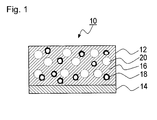
- the pressure-sensitive adhesive tape according to the present embodiment may have a form in which both sides of the pressure-sensitive adhesive tape are pressure-sensitive adhesive surfaces, other than the form illustrated in Fig. 1 , in which one side of the pressure-sensitive adhesive tape is only a pressure-sensitive adhesive surface.
- the pressure-sensitive adhesive layers of which the pressure-sensitive adhesive surfaces are composed may or may not be the same type on both sides.
- Such a pressure-sensitive adhesive tape may be a single separator type in which the pressure ⁇ sensitive adhesive surface is protected by a separator (release liner) or a double separator type in which the pressure-sensitive adhesive surfaces on both sides are protected by two separators.
- the pressure-sensitive adhesive tape may comprise only the pressure-sensitive adhesive layer without the substrate. In this case, it is better that the pressure-sensitive adhesive surfaces are protected by two separators on both sides.
- the substrate 14 may consist of the same composition as the pressure-sensitive adhesive composition 16 contained in the pressure-sensitive adhesive layer 12, which may appropriately contain the hollow inorganic fine particles 18 and the bubbles 20.
- the pressure-sensitive adhesive tape 10 may be formed in a form of being wound in a roll shape, or in a form of sheets being laminated. When the pressure-sensitive adhesive tape 10 is formed in a form of being wound in a roll shape, the formation thereof can be made by, for example, winding the pressure-sensitive adhesive layer 12 in a roll shape in the state where the pressure-sensitive adhesive layer 12 is protected by the separator or the release treatment layer formed on the back side of the substrate.
- the pressure-sensitive adhesive tape 10 has a modulus at 100% of 13.0 N/cm 2 or more. It is better that the upper limit of the modulus at 100% is 30 N/cm 2 or less, and more preferably 25 N/cm 2 or less. In addition, the pressure-sensitive adhesive tape 10 has shear adhesive force of 80 N/cm 2 or more. The values of the modulus at 100% and shear adhesive force used in the present embodiment are obtained when only the pressure-sensitive adhesive layer 12 is measured. The method of measuring each value will be described in the later-described examples.
- the pressure-sensitive adhesive composition 16 contained in the pressure-sensitive adhesive layer 12 includes a base polymer.
- the base polymers can be used alone or in combination of two or more thereof.
- those used in a publicly-known acrylic pressure-sensitive adhesives can be preferably used.
- An acrylic pressure-sensitive adhesive usually contains, as the base polymer, an acrylic polymer [in particular, an acrylic polymer whose monomer main component is (meth) acrylic acid ester]. In the acrylic polymer, only one type of (meth) acrylic acid ester may be used, or two or more types thereof may be used.
- (meth) acrylic acid ester (meth) acrylic acid alkyl ester can be used preferably.
- Examples of (meth)acrylic acid alkyl ester in the acrylic polymer include for example:
- (meth)acrylic acid esters other than (meth)acrylic acid alkyl esters include, for example:
- Examples of the aforementioned polar group-containing monomers include, for example: carboxyl group-containing monomers, such as (meth)acrylic acid, itaconic acid, maleic acid, fumaric acid, crotonic acid, and isocrotonic acid, or anhydrides thereof (maleic anhydride, etc.); hydroxyl group ⁇ containing monomers, such as (meth)acrylic acid hydroxyalkyls including (meth)acrylic acid hydroxyethyl, (meth)acrylic acid hydroxypropyl, and (meth)acrylic acid hydroxybutyl, etc.; amide group-containing monomers, such as acrylamide, methacrylamide, N,N-dimethyl(meth)acrylamide, N-methylol(meth)acrylamide, N-methoxymethyl(meth)acrylamide, and N-butoxymethyl(meth)acrylamide, etc.; amino group-containing monomers, such as (meth) acrylic acid aminoethyl, (meth)acrylic acid dimethyl
- polyfunctional monomers examples include, for example: hexanediol di(meth)acrylate, (poly)ethylene glycol di(meth)acrylate, (poly)propylene glycol di(meth)acrylate, neopentyl glycol di(meth)acrylate, pentaerythritol di(meth)acrylate, pentaerythritol tri(meth)acrylate, dipentaerythritol hexa(meth)acrylate, trimethylolpropane tri(meth)acrylate, tetramethylol methane tri(meth)acrylate, allyl(meth)acrylate, vinyl(meth)acrylate, divinylbenzene, epoxy acrylate, polyester acrylate, urethane acrylate, butyl di(meth)acrylate, hexyl di(meth)acrylate, etc.
- copolymeric monomers other than the polar group-containing monomers or polyfunctional monomers include: for example: vinyl esters, such as vinyl acetate and vinyl propionate, etc.; aromatic vinyl compounds, such as styrene and vinyl toluene, etc.; olefins or dienes, such as ethylene, butadiene, isoprene and isobutylene, etc.
- vinyl ethers such as vinyl alkyl ether, etc.; vinyl chloride; (meth)acrylic acid alkoxy alkyl monomers, such as (meth)acrylic acid methoxyethyl, (meth)acrylic acid ethoxyethyl, etc.; sulfonate group-containing monomers, such as vinyl sulfonate sodium, etc.; phosphate group-containing monomers, such as 2-hydroxyethyl acryloyl phosphate, etc.; imide group-containing monomers, such as cyclohexyl maleimide and isopropyl maleimide, etc.; isocyanate group-containing monomers, such as 2-methacryloyloxyethyl isocyanate, etc.; fluorine atom-containing (meth)acrylate; and silicon atom-containing (meth)acrylate, etc.
- the pressure ⁇ sensitive adhesive composition 16 When containing a polymerization initiator (thermal polymerization initiator or photopolymerization initiator, etc.), as stated above, the pressure ⁇ sensitive adhesive composition 16 can be cured by heat or an activated energy ray. Accordingly, because the adhesive component 16 is cured in the state where the hollow inorganic fine particles 18 are mixed, the pressure ⁇ sensitive adhesive layer 12 can be easily formed in which the hollow inorganic fine particles 18 are stably contained.
- a polymerization initiator thermal polymerization initiator or photopolymerization initiator, etc.
- ⁇ -ketol photopolymerization initiator examples include, for example: 2-methyl-2-hydroxy propiophenone and 1- [ 4 - (2-hydroxyethyl) -phenyl] -2-hydroxy-2-methylpropane-1-one, etc.
- aromatic sulfonyl chloride photopolymerization initiator examples include, for example, 2-naphthalene sulfonyl chloride, etc.
- photoactive oxime photopolymerization initiator include, for example, 1-phenyl-1,1-propanedione-2- (o-ethoxycarbonyl) -oxime, etc.
- thioxanthone photopolymerization initiator examples include, for example, thioxanthone, 2-chlorothioxanthone, 2-methyl thioxanthone, 2,4-dimethyl thioxanthone, isopropyl thioxanthone, 2,4 ⁇ dichloro thioxanthone, 2,4-diethyl thioxanthone, 2,4-diisopropyl thioxanthone, and dodecyl thioxanthone, etc.
- thermal polymerization initiator examples include, for example: azo polymerization initiators [for example,
- the pressure-sensitive adhesive layer 12 is stably cured, by various polymerizations, in the state where the hollow inorganic fine particles 18 are scattered, thereby allowing the cohesive force and heat resistance to be improved.
- the total of the surface areas of the hollow inorganic fine particles 18 contained in the pressure-sensitive adhesive layer 12 according to the present embodiment is better when within a range of 3.5x10 2 to 6.0x10 2 [cm 2 ] per gram of the pressure-sensitive adhesive layer (adhesive) .
- the pressure-sensitive adhesive tape 10 provided with such a pressure-sensitive adhesive layer 12 and the pressure-sensitive adhesive layer 12 without a substrate have high shear strength without impairing the normal adhesive force.
- a method of containing the hollow inorganic fine particles 18 into the pressure-sensitive adhesive composition 16 is not particularly limited, but a method can be cited in which, for example, after the pressure-sensitive adhesive composition 16 of which the pressure-sensitive adhesive layer 12 consist has been formed, the hollow inorganic fine particles 18 are combined and mixed into the pressure-sensitive adhesive composition 16.
- a method can be cited in which the hollow inorganic fine particles 18 are combined and mixed into a mixture of acrylic monomers of which the acrylic polymer is formed or into a partial polymer in which part of the acrylic monomers has been polymerized. Of these methods, the latter method is preferred in terms of the workability.
- Examples of the fine particles contained in the pressure-sensitive adhesive layer 12 according to the present embodiment include, for example: carbide particles, such as silicon carbide, boron carbide, and carbon nitride, etc. ; nitride particles, such as aluminum nitride, silicon nitride, and boron nitride, etc.; ceramic particles represented by oxides, such as alumina and zirconium; and inorganic fine particles, such as calcium carbide, aluminum hydroxide, glass, silica, and hydrophobic silica, etc.
- examples of the hollow inorganic fine particles 18 include: hollow balloons made of glass, such as hollow glass balloons, etc.; hollow balloons made of compounds, such as hollow aluminum balloons; and hollow ceramic balloons, etc.
- hollow inorganic fine particles in terms of the efficiency in the polymerization when an ultraviolet reaction is used, and the weight of the fine particles. It is more preferable to use the hollow glass balloons, because the adhesive force at high temperature can be improved without impairing the strength and properties necessary for the pressure-sensitive adhesive layers 12, such as the shear strength and holding force, etc. Also, when compared to the fine particles made of an inorganic salt, the influence on the adhesion properties, occurring due to alkaline elution, etc., can be reduced. Also, deterioration of the processability in each manufacturing process can be reduced because the inorganic fine particles are hollow glass balloons.
- the average particle size of the hollow inorganic fine particles 18 is not particularly limited, but may be selected in accordance with a desired property required for the pressure-sensitive adhesive layer 12.
- the average particle size of the hollow inorganic fine particles 18 may be within a range of 1 to 500 ⁇ m, preferably within a range of 5 to 200 ⁇ m, more preferably 20 to 80 ⁇ m, and still more preferably 30 to 50 ⁇ m.
- the surface area of the hollow inorganic fine particles 18 per unit mass of the pressure-sensitive adhesive layer 12 can be made large without impairing the properties of the pressure-sensitive adhesive layer 12, such as the shear strength and holding force.
- the average particle size of the hollow inorganic fine particles 18 is measured in the following way: a particle size distribution is first measured with a Coulter particle size measuring apparatus (laser diffractometry); and an average particle size is then calculated from the measured volume frequency distribution.
- a particle size distribution is first measured with a Coulter particle size measuring apparatus (laser diffractometry); and an average particle size is then calculated from the measured volume frequency distribution.
- the specific gravity of the hollow inorganic fine particles 18 is not particularly limited, but may be selected in accordance with a desired property required for the pressure-sensitive adhesive layer 12.
- the specific gravity thereof may be within a range of 0.1 to 0.8 g/cm 3 , and preferably within a range of 0.15 to 0.50 g/cm 3 .
- the surface area of the hollow inorganic fine particles 18 per unit mass of the pressure-sensitive adhesive layer 12 can be made large without impairing the properties of the pressure-sensitive adhesive layer 12, such as the shear strength and the holding force.
- the specific gravity thereof is larger than 0.1 g/cm3, and more preferably larger than 0.15 g/cm 3 , floating of the hollow inorganic fine particles 18 can be reduced when the hollow inorganic fine particles 18 is combined and mixed into a mixture of the acrylic monomers or into a partial polymer in which part of the acrylic monomer has been polymerized. Accordingly, the hollow inorganic fine particles 18 can be uniformly scattered in the pressure-sensitive adhesive layer 12. Further, because the specific gravity thereof is greater than or equal to the aforementioned lower limit, the glass strength is secured to some extent, thereby reducing cracking of the hollow inorganic fine particles 18 themselves.
- the specific gravity of the hollow inorganic fine particles 18 is smaller than 0.8 g/cm3, and more preferably smaller than 0.50 g/cm 3 , the transmission rate of an ultraviolet ray is secured to some extent, and hence a decrease in the efficiency of an ultraviolet reaction can be reduced. Further, because a cheaper material can be used, the production cost can be reduced to a lower level. Still further, an increase in the weight of the pressure-sensitive adhesive layer 12 in which the hollow inorganic fine particles 18 are scattered is reduced, the workability can be improved while the pressure-sensitive adhesive layer 12 is being manufactured or used, thereby also contributing to a reduction in weight of the apparatus using the pressure-sensitive adhesive tape.
- the surface of the hollow inorganic fine particles 18 may be subjected to various surface treatments (for example, low surface tension treatment by silicone compound or fluorine compound, etc.).
- the use amount of the hollow inorganic fine particles 18 is one part by mass or more based on 100 parts by mass of the whole monomer components for forming an acrylic polymer that is the base polymer of the pressure-sensitive adhesive composition 16, and preferably five parts by mass or more.
- the use amount of the hollow inorganic fine particles 18 is fifteen parts by mass or less based on 100 parts by mass of the whole monomer components for forming the acrylic polymer, preferably thirteen parts by mass or less, and still preferably ten parts by mass or less.
- hollow glass balloons used as the hollow inorganic fine particles 18 include “Fuji Balloon H-35” and “Fuji Balloon H-40” (both are made by FUJI SILYSIA CHEMICAL LTD.), etc.
- the total of the surface areas of the hollow glass balloons is made to be within a range of 3.5 x 10 2 to 6.0 x 10 2 [CM 2 ] per gram of the pressure-sensitive adhesive layer 12 by mixing the aforementioned hollow glass balloons alone or in combination of two or more thereof.
- the shear adhesive force can be improved without impairing other properties such as the adhesive force and holding force, etc.
- the pressure-sensitive adhesive layer 12 appropriately contains the bubbles 20.
- the amount of the bubbles 20 able to be mixed into the pressure-sensitive adhesive layer 12 is not particularly limited, but is appropriately selected in accordance with a use application. It is better that the bubbles 20 according to the embodiment is contained in an amount within a range of 5 to 40% by volume based on the whole volume of the pressure-sensitive adhesive layer 12, and preferably within a range of 8 to 30% by volume. When the bubbles 20 are contained in an amount greater than or equal to 5% by volume, the pressure-sensitive adhesive layer 12 can exhibit the aforementioned properties more surely.
- the amount of the contained bubbles 20 smaller than or equal to 40% by volume based on the whole volume of the pressure-sensitive adhesive layer 12, the presence of the bubbles penetrating through the pressure-sensitive adhesive layer 12 from the front surface to the back surface thereof is reduced, and thereby reducing the deterioration of the adhesive performance and appearance of the pressure-sensitive adhesive layer 12.
- the bubbles 20 mixed in the pressure-sensitive adhesive layer 12 are basically closed-cell type bubbles, but closed-cell type bubbles and interconnected-cell type bubbles may coexist.
- the bubbles 20 usually have a spherical shape (in particular, a true spherical shape) , but may have a distorted spherical shape.
- the average bubble size of the bubbles 20 is not particularly limited, but is selected from a range of, for example, 1 to 1000 ⁇ m (preferably 10 to 500 ⁇ m, and more preferably 30 to 300 ⁇ m).
- the average bubble size (diameter) of the bubbles can be measured from an image of the cross section of a tape sample, the image being obtained with an electron microscope, etc.
- a surfactant examples include, for example: an ionic surfactant, hydrocarbon surfactant, silicon surfactant, and fluorochemical surfactant, etc.
- a fluorochemical surfactant is preferred, and in particular, the fluorochemical surfactant having an oxy C 2 - 3 alkylene group and a fluorinated hydrocarbon group in its molecule is preferred.
- the fluorochemical surfactant may be used alone or in combination of two or more thereof.
- a fluorochemical surfactant for example, a surfactant with a product name of "Surflon S-393" (made by AGC SEIMI CHEMICAL CO., LTD) is preferred.
- a use amount (solid content) of a fluorochemical surfactant is not particularly limited, but can be selected from, for example, a range of 0.01 to 2 parts by mass (preferably 0.03 to 1.5 parts by mass, and more preferably 0.05 to 1 parts by mass) based on 100 parts by mass of the whole monomer components for forming the base polymer in the pressure-sensitive adhesive composition 16 [in particular, the whole monomer components for forming an acrylic polymer whose monomer main component is (meth) acrylic acid ester] .
- the use amount of a fluorochemical surfactant is below 0.01 parts by mass based on 100 parts by mass of the base polymer in the pressure-sensitive adhesive composition 16 containing the bubbles 20, the mixability of the bubbles 20 is decreased and it becomes difficult to mix a sufficient amount of the bubbles 20 into the pressure-sensitive adhesive composition 16.
- the use amount of a fluorochemical surfactant exceeds 2 parts by mass based on 100 parts by mass of the base polymer containing the bubbles 20, the adhesive performance is deteriorated.
- the bubbles 20 are combined and mixed into the pressure-sensitive adhesive composition 16 as the final component to be combined, in order for the bubbles 20 to be stably mixed into and present in the pressure-sensitive adhesive layer 12.
- the viscosity of the pressure-sensitive adhesive composition 16 prior to the mixture of the bubbles 20 is not particularly limited, as far as the mixed bubbles 20 are stably held, but a viscosity of 5 to 50 Pa•s (preferably 10 to 40 Pa•s) is preferred, the viscosity being measured by using a BH viscometer as a viscometer and at the conditions where a rotor is a No. 5 rotor, the number of rotations is 10 rpm, and measuring temperature is 30°C.
- the viscosity (BH viscometer, No. 5 rotor, 10 rpm, 30°C) of the pressure-sensitive adhesive composition 16 into which the bubbles 20 are mixed is below 5 Pa•s, the mixed bubbles are instantly integrated together and sometimes released outside the system, because the viscosity is too low. On the other hand, if the viscosity exceeds 50 Pa•s, it becomes difficult to form the pressure-sensitive adhesive layer 12 containing the bubbles 20.
- the viscosity of the acrylic monomer mixture prior to mixing the bubbles can be adjusted by, for example: a method of combining various polymer components, such as acrylic rubber, and thickening additive, etc.; and a method of partially polymerizing a monomer component for forming the base polymer [for example, a monomer component for forming an acrylic polymer, such as (meth)acrylic acid ester, etc.], etc.
- a monomer mixture is prepared by mixing, for example, a monomer component for forming the base polymer [for example, a monomer component for forming an acrylic polymer, such as (meth) acrylic acid ester, etc.] and a polymerization initiator (for example, a photopolymerization initiator, etc.). And then, the monomer mixture is subjected to a polymerization reaction in accordance with the type of the polymerization initiator, so that a composition (syrup) is prepared in which part of the monomer component is only polymerized. Thereafter, a fluorochemical surfactant and the hollow inorganic fine particles 18, and various additives if necessary, are combined into the syrup.
- a monomer component for forming the base polymer for example, a monomer component for forming an acrylic polymer, such as (meth) acrylic acid ester, etc.
- a polymerization initiator for example, a photopolymerization initiator, etc.
- a precursor of the pressure-sensitive adhesive composition 16 having a proper viscosity with which bubbles can be stably contained can be prepared.
- the pressure-sensitive adhesive layer 12 can be obtained in which the bubbles 20 are uniformly scattered.
- a method of mixing bubbles is not particularly limited, but a publicly-known bubble mixing method can be used.
- an example of such an apparatus is provided with: a stator having many fine teeth placed on a disk with a through-hole at its center; and a rotor having teeth as fine as those of the stator, which is placed on the disk to face the stator.
- the pressure-sensitive adhesive composition 16 containing bubbles is introduced between the teeth on the stator and that on the rotor in the apparatus, and while rotating the rotor at high speed, a gas component for forming bubbles (bubble-forming gas) is introduced into the precursor of the pressure-sensitive adhesive composition 16 through the through-hole.
- a gas component for forming gas bubble-forming gas
- the pressure-sensitive adhesive composition 16 containing the aforementioned bubbles it is difficult to cause the integration of the bubbles and a sufficient amount of the bubbles are stably held therein, and hence the pressure-sensitive adhesive composition 16 can be preferably used as a material for forming the pressure-sensitive adhesive layer 12 in the pressure-sensitive adhesive tape 10 by appropriately selecting a base polymer and an additive of which the pressure-sensitive adhesive composition 16 consists. Also, the pressure-sensitive adhesive composition 16 containing the aforementioned bubbles can be preferably used as a material for forming the substrate 14 (in particular, the substrate containing bubbles to be used in a pressure-sensitive adhesive member) by appropriately selecting a base polymer and an additive of which the pressure-sensitive adhesive composition 16 consists.
- the pressure-sensitive adhesive layer 12 may contain an appropriate additive other than a base polymer, polymerization initiator, hollow inorganic fine particles, and surfactant, in accordance with an application of the pressure-sensitive adhesive layer 12.
- appropriate additives such as cross-linking agent (for example, polyisocyanate cross-linking agent, silicone cross-linking agent, epoxy cross-linking agent, and alkyl-etherified melamine cross-linking agent, etc.), tackifier (solid, semisolid, and liquid tackifier at normal temperature consisting of, for example, rosin derivative resin, polyterpene resin, petroleum resin, and oil soluble phenol resin, etc.), plasticizer, filler other than the aforementioned hollow inorganic fine particle, anti-aging agent, antioxidant, and colorant (pigment and dye, etc.), etc., may be contained in the pressure-sensitive adhesive layer 12.
- cross-linking agent for example, polyisocyanate cross-linking agent, silicone cross-linking agent, epoxy cross-linking agent, and alkyl
- the use amount of carbon black is preferably smaller than or equal to, for example, 0.15 parts by mass (for example, 0.001 to 0.15 parts by mass) based on 100 parts by mass of the whole monomer components for forming the base polymer in the pressure-sensitive adhesive composition 16 [in particular, the whole monomers for forming an acrylic polymer whose monomer main component is (meth) acrylic acid ester], and is more preferably selected from a range of 0.01 to 0.1 parts by mass, in terms of a coloring degree and not hampering a photopolymerization reaction.
- the aforementioned pressure-sensitive adhesive layer 12 may have either form of a single layer and laminated layers.
- the thickness of the pressure-sensitive adhesive layer 12 is not particularly limited, but can be selected from a range of, for example, 200 to 5000 ⁇ m (preferably 300 to 4000 ⁇ m, and more preferably 400 to 3000 ⁇ m). If the thickness thereof is smaller than 200 ⁇ m, the cushion performance is deteriorated, thereby deteriorating the adhesiveness to a curved surface and a concave-convex surface. On the other hand, if the thickness thereof is larger than 5000 ⁇ m, it becomes difficult to obtain a layer with a uniform thickness.
- the substrate 14 to be used in the pressure-sensitive adhesive tape 10 according to the present embodiment is not particularly limited, but can be composed of an appropriate thin-walled body.
- a thin-walled body include, for example: paper substrates, such as paper, etc.; fiber substrates (the materials of which are not particularly limited, but can be appropriately selected from the group of, for example, Manila hemp, rayon, polyester, and pulp fiber, etc.), such as cloth, nonwoven fabric, and net, etc.; metal substrates, such as metallic foil and metal plate, etc.; plastic substrates, such as plastic film and sheet, etc.; rubber substrates, such as rubber sheet, etc.; foams, such as foam sheet, etc.; and laminated bodies thereof (in particular, laminated bodies formed of plastic substrates and other substrates and those formed of both plastic films (or sheets)), etc.
- plastic films and sheets examples include, for example: olefin resins whose monomer component is an ⁇ -olefin, such as polyethylene (PE), polypropylene (PP), ethylene-propylene copolymer, and ethylene-vinyl acetate copolymer (EVA), etc; polyester resins, such as polyethylene terephthalate (PET), polyethylene naphthalate (PEN), polybutylene terephthalate (PBT), etc.; polyvinyl chloride (PVC); vinyl acetate resin; polyphenylene sulfide (PPS); polyamide (nylon); amide resins, such wholly aromatic polyamide (aramid), etc.; polyimide resin; and polyether ether ketone (PEEK), etc. These materials can be used alone or in combination of two or more thereof.
- olefin resins whose monomer component is an ⁇ -olefin, such as polyethylene (PE), polypropylene (PP), ethylene-propylene copo
- the deformation performance thereof such as an elongation percentage, may be controlled by a stretching treatment, etc.
- the pressure-sensitive adhesive layer 12 is formed by being cured with an activated energy ray, it is preferable to use the substrate by which the transmission of the activated energy ray is not hampered.
- the surface of a substrate may be subjected to a commonly-used surface treatment, such as a chemical or physical oxidation treatment, etc., for example, corona treatment, chromic acid treatment, ozone exposure, flame exposure, high-voltage electrical-shock exposure, and ionizing radiation treatment, etc., or to a coating treatment with the use of an undercoat or parting agent.
- a commonly-used surface treatment such as a chemical or physical oxidation treatment, etc., for example, corona treatment, chromic acid treatment, ozone exposure, flame exposure, high-voltage electrical-shock exposure, and ionizing radiation treatment, etc.
- the thickness of the substrate may be appropriately selected in accordance with the strength, flexibility, and a purpose of use.
- the thickness thereof is usually smaller than or equal to 1000 ⁇ m (for example, 1 to 1000 ⁇ m), preferably 1 to 500 ⁇ m, and more preferably approximately 3 to 300 ⁇ m, but is not limited thereto.
- the substrate may have either form of a single layer and laminated layers.
- the release treatment agent of which the release treatment layer consists is not particularly limited, but, for example, a silicone release treatment agent, fluorine release treatment agent, and long-chain alkyl release treatment agent, etc., can be used.
- the release treatment agents can be used alone or in combination of two or more thereof.
- the thickness of the separator and a formation method thereof, etc. are not particularly limited.
- a coating film that is an adherend is not particularly limited, and examples thereof include various coating films including, for example, polyester melamine coating film, alkyd melamine coating film, acrylic melamine coating film, acrylic urethane coating film, and acrylic-polyacid curing agent, etc.
- Samples were produced by cutting the pressure-sensitive adhesive layers in Examples and Comparative Example into the shape of 25 mm in width and 100 mm in length.
- the sample was attached to the surface of a SUS plate by press bonding while moving a roller having a weight of 5 kg weight in one direction, the surface of the SUS plate having been sanded with a 280-grit sandpaper and then wiped with toluene.
- the force necessary for peeling off the sample was measured under the atmosphere of 23°c and 65% R. H.
- Samples were produced by cutting the pressure-sensitive adhesive layers in each Example and Comparative example into the shape of 25 mm in width and 100 mm in length.
Landscapes
- Chemical & Material Sciences (AREA)
- Organic Chemistry (AREA)
- Chemical Kinetics & Catalysis (AREA)
- Inorganic Chemistry (AREA)
- Adhesive Tapes (AREA)
- Adhesives Or Adhesive Processes (AREA)
- Laminated Bodies (AREA)
Claims (6)
- Haftklebeband mit einer Haftkleberschicht, die hohle anorganische feine Teilchen und Blasen enthält, wobei das Haftklebeband einen Modul bei 100 % von 13,0 N/cm2 oder mehr und eine Scherklebekraft von 80 N/cm2 oder mehr aufweist und die Gesamtoberfläche der hohlen anorganischen feinen Teilchen pro Gramm der Haftkleberschicht in einem Bereich von 3,5 x 10² bis 6,0 x 10² [cm2] liegt.
- Haftklebeband nach Anspruch 1, wobei die hohlen anorganischen feinen Teilchen hohle Glasballons sind.
- Haftklebeband nach einem der Ansprüche 1-2, wobei die mittlere Teilchengröße der hohlen anorganischen feinen Teilchen in einem Bereich von 20 bis 80 µm liegt.
- Haftklebeband nach einem der Ansprüche 1-3, wobei die Haftkleberschicht ein Acrylpolymer enthält, dessen Monomerhauptkomponente (Meth)acrylsäurealkylester ist.
- Haftklebeband nach Anspruch 4, wobei das Acrylpolymer durch die Wirkung eines aktiven Energiestrahls polymerisiert wird.
- Haftklebeband nach einem der Ansprüche 1-5, wobei die Blasen insgesamt in einer Menge von 5 bis 40 Vol.-%, bezogen auf das Gesamtvolumen der Haftkleberschicht, enthalten sind.
Priority Applications (1)
| Application Number | Priority Date | Filing Date | Title |
|---|---|---|---|
| EP12004277A EP2497808A1 (de) | 2009-11-30 | 2010-11-29 | Druckempfindliches Klebeband |
Applications Claiming Priority (1)
| Application Number | Priority Date | Filing Date | Title |
|---|---|---|---|
| JP2009272068A JP5568290B2 (ja) | 2009-11-30 | 2009-11-30 | 粘着テープ |
Related Child Applications (2)
| Application Number | Title | Priority Date | Filing Date |
|---|---|---|---|
| EP12004277A Division EP2497808A1 (de) | 2009-11-30 | 2010-11-29 | Druckempfindliches Klebeband |
| EP12004277A Division-Into EP2497808A1 (de) | 2009-11-30 | 2010-11-29 | Druckempfindliches Klebeband |
Publications (2)
| Publication Number | Publication Date |
|---|---|
| EP2345708A1 EP2345708A1 (de) | 2011-07-20 |
| EP2345708B1 true EP2345708B1 (de) | 2012-08-22 |
Family
ID=44012498
Family Applications (2)
| Application Number | Title | Priority Date | Filing Date |
|---|---|---|---|
| EP10192861A Not-in-force EP2345708B1 (de) | 2009-11-30 | 2010-11-29 | Druckempfindliches Klebeband |
| EP12004277A Withdrawn EP2497808A1 (de) | 2009-11-30 | 2010-11-29 | Druckempfindliches Klebeband |
Family Applications After (1)
| Application Number | Title | Priority Date | Filing Date |
|---|---|---|---|
| EP12004277A Withdrawn EP2497808A1 (de) | 2009-11-30 | 2010-11-29 | Druckempfindliches Klebeband |
Country Status (4)
| Country | Link |
|---|---|
| US (1) | US20110129661A1 (de) |
| EP (2) | EP2345708B1 (de) |
| JP (1) | JP5568290B2 (de) |
| CN (1) | CN102079954A (de) |
Families Citing this family (23)
| Publication number | Priority date | Publication date | Assignee | Title |
|---|---|---|---|---|
| JP2011190290A (ja) * | 2010-03-11 | 2011-09-29 | Nitto Denko Corp | 粘着テープ |
| CN102329578A (zh) * | 2011-08-09 | 2012-01-25 | 常熟市长江胶带有限公司 | Pi双面胶带 |
| JP5986452B2 (ja) * | 2011-08-10 | 2016-09-06 | バンドー化学株式会社 | 車両用床シート、車両の床構造体、車両の床構造体の施工方法 |
| JP5856463B2 (ja) * | 2011-12-09 | 2016-02-09 | 日東電工株式会社 | 携帯電子機器部材固定用両面粘着シート |
| JP5950669B2 (ja) * | 2012-04-16 | 2016-07-13 | 日東電工株式会社 | 粘着シート及び粘着剤組成物 |
| CN102703001B (zh) * | 2012-06-12 | 2014-03-12 | 安徽省郎溪县阿拉法胶粘制品有限公司 | 一种丙烯酸异辛酯胶黏剂及其制备方法 |
| CN102702991B (zh) * | 2012-06-12 | 2014-04-16 | 安徽省郎溪县阿拉法胶粘制品有限公司 | 一种亚克力双面胶带及其制备方法 |
| KR101534898B1 (ko) * | 2012-06-19 | 2015-07-07 | (주)엘지하우시스 | 기포 안정성이 향상된 점착제 조성물 및 그의 제조방법 |
| KR101523817B1 (ko) * | 2012-07-10 | 2015-05-28 | (주)엘지하우시스 | 기포 안정성이 향상된 난연용 점착제 조성물 및 그의 제조방법 |
| CN104869952B (zh) * | 2013-01-02 | 2020-03-13 | 凯希特许有限公司 | 具有超薄型布单膜和厚粘合剂涂层的医用布单 |
| JP6207868B2 (ja) * | 2013-04-11 | 2017-10-04 | 日本カーバイド工業株式会社 | 積層シート |
| EP2803711B1 (de) | 2013-05-17 | 2018-06-27 | 3M Innovative Properties Company | Druckempfindliche Haftklebstoffanordnung mit einem Füllmaterial |
| CN104231956B (zh) * | 2013-06-20 | 2018-09-28 | 中山市云创知识产权服务有限公司 | 胶带 |
| JP6495820B2 (ja) | 2013-07-09 | 2019-04-03 | 日東電工株式会社 | 粘着剤組成物 |
| WO2015005388A1 (ja) | 2013-07-09 | 2015-01-15 | 日東電工株式会社 | 粘着シートおよびその利用 |
| JP6202958B2 (ja) * | 2013-09-13 | 2017-09-27 | 日東電工株式会社 | 粘着シート |
| JP2019505638A (ja) * | 2016-01-18 | 2019-02-28 | スリーエム イノベイティブ プロパティズ カンパニー | 充填剤を含む感圧接着剤 |
| WO2018101478A1 (ja) * | 2016-12-02 | 2018-06-07 | 積水化学工業株式会社 | 建築用面構造 |
| EP3388457B1 (de) * | 2017-04-13 | 2020-01-15 | 3M Innovative Properties Company | Druckempfindliche haftmittelzusammensetzungen |
| JP7131947B2 (ja) * | 2018-04-19 | 2022-09-06 | 積水化学工業株式会社 | 建築用面構造、その製造方法、及びパネル構造体 |
| WO2021145259A1 (ja) * | 2020-01-17 | 2021-07-22 | Dic株式会社 | 粘着テープ |
| JP7846444B2 (ja) * | 2021-07-08 | 2026-04-15 | Dic株式会社 | 粘着テープ及び電子機器 |
| EP4630467A1 (de) | 2022-12-06 | 2025-10-15 | 3M Innovative Properties Company | Zusammensetzung mit partikeln und zwei flüssigphasen und zugehöriges verfahren |
Family Cites Families (13)
| Publication number | Priority date | Publication date | Assignee | Title |
|---|---|---|---|---|
| US3314838A (en) * | 1964-08-26 | 1967-04-18 | Minnesota Mining & Mfg | Pressure sensitive adhesives containing hollow spheroidal particles |
| CA1124428A (en) * | 1977-05-16 | 1982-05-25 | Minnesota Mining And Manufacturing Company | Foam-like pressure-sensitive adhesive tape |
| JP2748024B2 (ja) * | 1989-07-05 | 1998-05-06 | 株式会社サクラクレパス | 再剥離型固型糊 |
| JPH0748549A (ja) * | 1993-08-05 | 1995-02-21 | Dainippon Ink & Chem Inc | 感圧接着テープ、シート又はラベル並びにそれに使用する活性エネルギー線硬化性組成物 |
| JP4462937B2 (ja) * | 2004-01-16 | 2010-05-12 | 東日本旅客鉄道株式会社 | 土木構造物及び建築構造物に於けるコンクリート構造物の保護用シート及び該保護用シートを使用した保護方法 |
| JP4756834B2 (ja) * | 2004-07-07 | 2011-08-24 | 日東電工株式会社 | 気泡含有粘弾性組成物、及び感圧性接着テープ又はシート |
| JP5089894B2 (ja) * | 2006-03-10 | 2012-12-05 | 日東電工株式会社 | 微粒子含有粘弾性層、及び感圧性接着テープ又はシート |
| JP5408640B2 (ja) * | 2006-09-04 | 2014-02-05 | 日東電工株式会社 | 紫外線硬化型粘着剤組成物、紫外線硬化型粘着シート及びその製造方法 |
| JP5123638B2 (ja) * | 2006-12-05 | 2013-01-23 | 日東電工株式会社 | 感圧性接着シート |
| JP2009267020A (ja) * | 2008-04-24 | 2009-11-12 | Nitto Denko Corp | 太陽電池パネル用粘着シート、該粘着シートを用いてなる太陽電池パネルおよび該粘着シートを用いた太陽電池パネルの製造方法 |
| JP2010132745A (ja) * | 2008-12-03 | 2010-06-17 | Nitto Denko Corp | 化粧パネル固定用両面粘着テープ |
| EP2371916A1 (de) * | 2008-12-04 | 2011-10-05 | Nitto Denko Corporation | Zweiseitiges haftklebeband für ein solarzellenmodul |
| JP2010202843A (ja) * | 2009-03-06 | 2010-09-16 | Nitto Denko Corp | 両面粘着テープおよびその貼付方法、剥離ライナー |
-
2009
- 2009-11-30 JP JP2009272068A patent/JP5568290B2/ja not_active Expired - Fee Related
-
2010
- 2010-11-29 US US12/955,501 patent/US20110129661A1/en not_active Abandoned
- 2010-11-29 EP EP10192861A patent/EP2345708B1/de not_active Not-in-force
- 2010-11-29 EP EP12004277A patent/EP2497808A1/de not_active Withdrawn
- 2010-11-30 CN CN2010105724497A patent/CN102079954A/zh active Pending
Also Published As
| Publication number | Publication date |
|---|---|
| US20110129661A1 (en) | 2011-06-02 |
| EP2497808A1 (de) | 2012-09-12 |
| JP5568290B2 (ja) | 2014-08-06 |
| CN102079954A (zh) | 2011-06-01 |
| JP2011111594A (ja) | 2011-06-09 |
| EP2345708A1 (de) | 2011-07-20 |
Similar Documents
| Publication | Publication Date | Title |
|---|---|---|
| EP2345708A1 (de) | Druckempfindliches Klebeband | |
| EP2862901B1 (de) | Mikropartikelhaltige viskoelastische Schicht und druckempfindliches Klebeband bzw. Folie | |
| EP2385088B1 (de) | Druckempfindliches Klebeband | |
| JP4756834B2 (ja) | 気泡含有粘弾性組成物、及び感圧性接着テープ又はシート | |
| EP2194106A1 (de) | Doppelseitiges druckempfindliches Klebeband | |
| EP2653516B1 (de) | Druckempfindliche haftfolie und druckempfindliche haftzusammensetzung | |
| JP5570706B2 (ja) | アクリル系感圧接着テープ又はシート | |
| US20110151249A1 (en) | Pressure-sensitive adhesive tape and method of manufacturing the pressure-sensitive adhesive tape | |
| CN101024757A (zh) | 双面压敏粘着带或片 | |
| WO2008047636A1 (fr) | Ruban ou feuille d'adhésif acrylique et leur procédé de fabrication | |
| WO2009144891A1 (ja) | アクリル系感圧接着テープ又はシート | |
| JP2013067809A (ja) | 粘着テープ | |
| EP2374854B1 (de) | Druckempfindliches Klebeband | |
| EP2743319B1 (de) | Druckempfindliche Haftzusammensetzung und druckempfindliche Klebefolie | |
| JP6317938B2 (ja) | 粘着シート | |
| JP5138066B2 (ja) | 気泡含有粘弾性組成物、及び感圧性接着テープ又はシート | |
| EP2703463A1 (de) | Druckempfindliche Haftzusammensetzung und druckempfindliche Klebefolie |
Legal Events
| Date | Code | Title | Description |
|---|---|---|---|
| PUAI | Public reference made under article 153(3) epc to a published international application that has entered the european phase |
Free format text: ORIGINAL CODE: 0009012 |
|
| AK | Designated contracting states |
Kind code of ref document: A1 Designated state(s): AL AT BE BG CH CY CZ DE DK EE ES FI FR GB GR HR HU IE IS IT LI LT LU LV MC MK MT NL NO PL PT RO RS SE SI SK SM TR |
|
| AX | Request for extension of the european patent |
Extension state: BA ME |
|
| 17P | Request for examination filed |
Effective date: 20111207 |
|
| GRAP | Despatch of communication of intention to grant a patent |
Free format text: ORIGINAL CODE: EPIDOSNIGR1 |
|
| GRAS | Grant fee paid |
Free format text: ORIGINAL CODE: EPIDOSNIGR3 |
|
| GRAA | (expected) grant |
Free format text: ORIGINAL CODE: 0009210 |
|
| AK | Designated contracting states |
Kind code of ref document: B1 Designated state(s): AL AT BE BG CH CY CZ DE DK EE ES FI FR GB GR HR HU IE IS IT LI LT LU LV MC MK MT NL NO PL PT RO RS SE SI SK SM TR |
|
| REG | Reference to a national code |
Ref country code: GB Ref legal event code: FG4D |
|
| REG | Reference to a national code |
Ref country code: CH Ref legal event code: EP |
|
| REG | Reference to a national code |
Ref country code: IE Ref legal event code: FG4D |
|
| REG | Reference to a national code |
Ref country code: AT Ref legal event code: REF Ref document number: 572008 Country of ref document: AT Kind code of ref document: T Effective date: 20120915 |
|
| REG | Reference to a national code |
Ref country code: DE Ref legal event code: R096 Ref document number: 602010002469 Country of ref document: DE Effective date: 20121018 |
|
| REG | Reference to a national code |
Ref country code: NL Ref legal event code: VDEP Effective date: 20120822 |
|
| REG | Reference to a national code |
Ref country code: AT Ref legal event code: MK05 Ref document number: 572008 Country of ref document: AT Kind code of ref document: T Effective date: 20120822 |
|
| REG | Reference to a national code |
Ref country code: LT Ref legal event code: MG4D Effective date: 20120822 |
|
| PG25 | Lapsed in a contracting state [announced via postgrant information from national office to epo] |
Ref country code: NO Free format text: LAPSE BECAUSE OF FAILURE TO SUBMIT A TRANSLATION OF THE DESCRIPTION OR TO PAY THE FEE WITHIN THE PRESCRIBED TIME-LIMIT Effective date: 20121122 Ref country code: IS Free format text: LAPSE BECAUSE OF FAILURE TO SUBMIT A TRANSLATION OF THE DESCRIPTION OR TO PAY THE FEE WITHIN THE PRESCRIBED TIME-LIMIT Effective date: 20121222 Ref country code: FI Free format text: LAPSE BECAUSE OF FAILURE TO SUBMIT A TRANSLATION OF THE DESCRIPTION OR TO PAY THE FEE WITHIN THE PRESCRIBED TIME-LIMIT Effective date: 20120822 Ref country code: LT Free format text: LAPSE BECAUSE OF FAILURE TO SUBMIT A TRANSLATION OF THE DESCRIPTION OR TO PAY THE FEE WITHIN THE PRESCRIBED TIME-LIMIT Effective date: 20120822 Ref country code: AT Free format text: LAPSE BECAUSE OF FAILURE TO SUBMIT A TRANSLATION OF THE DESCRIPTION OR TO PAY THE FEE WITHIN THE PRESCRIBED TIME-LIMIT Effective date: 20120822 Ref country code: HR Free format text: LAPSE BECAUSE OF FAILURE TO SUBMIT A TRANSLATION OF THE DESCRIPTION OR TO PAY THE FEE WITHIN THE PRESCRIBED TIME-LIMIT Effective date: 20120822 |
|
| PG25 | Lapsed in a contracting state [announced via postgrant information from national office to epo] |
Ref country code: LV Free format text: LAPSE BECAUSE OF FAILURE TO SUBMIT A TRANSLATION OF THE DESCRIPTION OR TO PAY THE FEE WITHIN THE PRESCRIBED TIME-LIMIT Effective date: 20120822 Ref country code: BE Free format text: LAPSE BECAUSE OF FAILURE TO SUBMIT A TRANSLATION OF THE DESCRIPTION OR TO PAY THE FEE WITHIN THE PRESCRIBED TIME-LIMIT Effective date: 20120822 Ref country code: SE Free format text: LAPSE BECAUSE OF FAILURE TO SUBMIT A TRANSLATION OF THE DESCRIPTION OR TO PAY THE FEE WITHIN THE PRESCRIBED TIME-LIMIT Effective date: 20120822 Ref country code: PT Free format text: LAPSE BECAUSE OF FAILURE TO SUBMIT A TRANSLATION OF THE DESCRIPTION OR TO PAY THE FEE WITHIN THE PRESCRIBED TIME-LIMIT Effective date: 20121224 Ref country code: GR Free format text: LAPSE BECAUSE OF FAILURE TO SUBMIT A TRANSLATION OF THE DESCRIPTION OR TO PAY THE FEE WITHIN THE PRESCRIBED TIME-LIMIT Effective date: 20121123 Ref country code: SI Free format text: LAPSE BECAUSE OF FAILURE TO SUBMIT A TRANSLATION OF THE DESCRIPTION OR TO PAY THE FEE WITHIN THE PRESCRIBED TIME-LIMIT Effective date: 20120822 |
|
| PG25 | Lapsed in a contracting state [announced via postgrant information from national office to epo] |
Ref country code: NL Free format text: LAPSE BECAUSE OF FAILURE TO SUBMIT A TRANSLATION OF THE DESCRIPTION OR TO PAY THE FEE WITHIN THE PRESCRIBED TIME-LIMIT Effective date: 20120822 |
|
| PG25 | Lapsed in a contracting state [announced via postgrant information from national office to epo] |
Ref country code: RO Free format text: LAPSE BECAUSE OF FAILURE TO SUBMIT A TRANSLATION OF THE DESCRIPTION OR TO PAY THE FEE WITHIN THE PRESCRIBED TIME-LIMIT Effective date: 20120822 Ref country code: CZ Free format text: LAPSE BECAUSE OF FAILURE TO SUBMIT A TRANSLATION OF THE DESCRIPTION OR TO PAY THE FEE WITHIN THE PRESCRIBED TIME-LIMIT Effective date: 20120822 Ref country code: EE Free format text: LAPSE BECAUSE OF FAILURE TO SUBMIT A TRANSLATION OF THE DESCRIPTION OR TO PAY THE FEE WITHIN THE PRESCRIBED TIME-LIMIT Effective date: 20120822 Ref country code: DK Free format text: LAPSE BECAUSE OF FAILURE TO SUBMIT A TRANSLATION OF THE DESCRIPTION OR TO PAY THE FEE WITHIN THE PRESCRIBED TIME-LIMIT Effective date: 20120822 |
|
| PG25 | Lapsed in a contracting state [announced via postgrant information from national office to epo] |
Ref country code: IT Free format text: LAPSE BECAUSE OF FAILURE TO SUBMIT A TRANSLATION OF THE DESCRIPTION OR TO PAY THE FEE WITHIN THE PRESCRIBED TIME-LIMIT Effective date: 20120822 Ref country code: PL Free format text: LAPSE BECAUSE OF FAILURE TO SUBMIT A TRANSLATION OF THE DESCRIPTION OR TO PAY THE FEE WITHIN THE PRESCRIBED TIME-LIMIT Effective date: 20120822 Ref country code: SK Free format text: LAPSE BECAUSE OF FAILURE TO SUBMIT A TRANSLATION OF THE DESCRIPTION OR TO PAY THE FEE WITHIN THE PRESCRIBED TIME-LIMIT Effective date: 20120822 |
|
| PLBE | No opposition filed within time limit |
Free format text: ORIGINAL CODE: 0009261 |
|
| STAA | Information on the status of an ep patent application or granted ep patent |
Free format text: STATUS: NO OPPOSITION FILED WITHIN TIME LIMIT |
|
| 26N | No opposition filed |
Effective date: 20130523 |
|
| PG25 | Lapsed in a contracting state [announced via postgrant information from national office to epo] |
Ref country code: RS Free format text: LAPSE BECAUSE OF FAILURE TO SUBMIT A TRANSLATION OF THE DESCRIPTION OR TO PAY THE FEE WITHIN THE PRESCRIBED TIME-LIMIT Effective date: 20120822 Ref country code: BG Free format text: LAPSE BECAUSE OF FAILURE TO SUBMIT A TRANSLATION OF THE DESCRIPTION OR TO PAY THE FEE WITHIN THE PRESCRIBED TIME-LIMIT Effective date: 20121122 |
|
| REG | Reference to a national code |
Ref country code: IE Ref legal event code: MM4A |
|
| REG | Reference to a national code |
Ref country code: DE Ref legal event code: R097 Ref document number: 602010002469 Country of ref document: DE Effective date: 20130523 |
|
| PG25 | Lapsed in a contracting state [announced via postgrant information from national office to epo] |
Ref country code: ES Free format text: LAPSE BECAUSE OF FAILURE TO SUBMIT A TRANSLATION OF THE DESCRIPTION OR TO PAY THE FEE WITHIN THE PRESCRIBED TIME-LIMIT Effective date: 20121203 Ref country code: IE Free format text: LAPSE BECAUSE OF NON-PAYMENT OF DUE FEES Effective date: 20121129 |
|
| PG25 | Lapsed in a contracting state [announced via postgrant information from national office to epo] |
Ref country code: CY Free format text: LAPSE BECAUSE OF FAILURE TO SUBMIT A TRANSLATION OF THE DESCRIPTION OR TO PAY THE FEE WITHIN THE PRESCRIBED TIME-LIMIT Effective date: 20120822 Ref country code: AL Free format text: LAPSE BECAUSE OF FAILURE TO SUBMIT A TRANSLATION OF THE DESCRIPTION OR TO PAY THE FEE WITHIN THE PRESCRIBED TIME-LIMIT Effective date: 20120822 Ref country code: MT Free format text: LAPSE BECAUSE OF FAILURE TO SUBMIT A TRANSLATION OF THE DESCRIPTION OR TO PAY THE FEE WITHIN THE PRESCRIBED TIME-LIMIT Effective date: 20120822 |
|
| PGFP | Annual fee paid to national office [announced via postgrant information from national office to epo] |
Ref country code: FR Payment date: 20131108 Year of fee payment: 4 |
|
| PG25 | Lapsed in a contracting state [announced via postgrant information from national office to epo] |
Ref country code: MC Free format text: LAPSE BECAUSE OF NON-PAYMENT OF DUE FEES Effective date: 20121130 Ref country code: TR Free format text: LAPSE BECAUSE OF FAILURE TO SUBMIT A TRANSLATION OF THE DESCRIPTION OR TO PAY THE FEE WITHIN THE PRESCRIBED TIME-LIMIT Effective date: 20120822 |
|
| PG25 | Lapsed in a contracting state [announced via postgrant information from national office to epo] |
Ref country code: SM Free format text: LAPSE BECAUSE OF FAILURE TO SUBMIT A TRANSLATION OF THE DESCRIPTION OR TO PAY THE FEE WITHIN THE PRESCRIBED TIME-LIMIT Effective date: 20120822 Ref country code: LU Free format text: LAPSE BECAUSE OF NON-PAYMENT OF DUE FEES Effective date: 20121129 |
|
| PG25 | Lapsed in a contracting state [announced via postgrant information from national office to epo] |
Ref country code: HU Free format text: LAPSE BECAUSE OF FAILURE TO SUBMIT A TRANSLATION OF THE DESCRIPTION OR TO PAY THE FEE WITHIN THE PRESCRIBED TIME-LIMIT Effective date: 20101129 |
|
| REG | Reference to a national code |
Ref country code: CH Ref legal event code: PL |
|
| GBPC | Gb: european patent ceased through non-payment of renewal fee |
Effective date: 20141129 |
|
| PG25 | Lapsed in a contracting state [announced via postgrant information from national office to epo] |
Ref country code: LI Free format text: LAPSE BECAUSE OF NON-PAYMENT OF DUE FEES Effective date: 20141130 Ref country code: CH Free format text: LAPSE BECAUSE OF NON-PAYMENT OF DUE FEES Effective date: 20141130 Ref country code: MK Free format text: LAPSE BECAUSE OF FAILURE TO SUBMIT A TRANSLATION OF THE DESCRIPTION OR TO PAY THE FEE WITHIN THE PRESCRIBED TIME-LIMIT Effective date: 20120822 |
|
| REG | Reference to a national code |
Ref country code: FR Ref legal event code: ST Effective date: 20150731 |
|
| PG25 | Lapsed in a contracting state [announced via postgrant information from national office to epo] |
Ref country code: GB Free format text: LAPSE BECAUSE OF NON-PAYMENT OF DUE FEES Effective date: 20141129 |
|
| PG25 | Lapsed in a contracting state [announced via postgrant information from national office to epo] |
Ref country code: FR Free format text: LAPSE BECAUSE OF NON-PAYMENT OF DUE FEES Effective date: 20141201 |
|
| PGFP | Annual fee paid to national office [announced via postgrant information from national office to epo] |
Ref country code: DE Payment date: 20161123 Year of fee payment: 7 |
|
| REG | Reference to a national code |
Ref country code: DE Ref legal event code: R119 Ref document number: 602010002469 Country of ref document: DE |
|
| PG25 | Lapsed in a contracting state [announced via postgrant information from national office to epo] |
Ref country code: DE Free format text: LAPSE BECAUSE OF NON-PAYMENT OF DUE FEES Effective date: 20180602 |