EP2298930B2 - Herstellung von Vorlagen zur Nukleinsäuresequenzierung - Google Patents
Herstellung von Vorlagen zur Nukleinsäuresequenzierung Download PDFInfo
- Publication number
- EP2298930B2 EP2298930B2 EP10011728.2A EP10011728A EP2298930B2 EP 2298930 B2 EP2298930 B2 EP 2298930B2 EP 10011728 A EP10011728 A EP 10011728A EP 2298930 B2 EP2298930 B2 EP 2298930B2
- Authority
- EP
- European Patent Office
- Prior art keywords
- nucleic acid
- double
- strand
- cleavage
- template
- Prior art date
- Legal status (The legal status is an assumption and is not a legal conclusion. Google has not performed a legal analysis and makes no representation as to the accuracy of the status listed.)
- Expired - Lifetime
Links
Images




Classifications
-
- B—PERFORMING OPERATIONS; TRANSPORTING
- B01—PHYSICAL OR CHEMICAL PROCESSES OR APPARATUS IN GENERAL
- B01J—CHEMICAL OR PHYSICAL PROCESSES, e.g. CATALYSIS OR COLLOID CHEMISTRY; THEIR RELEVANT APPARATUS
- B01J19/00—Chemical, physical or physico-chemical processes in general; Their relevant apparatus
- B01J19/0046—Sequential or parallel reactions, e.g. for the synthesis of polypeptides or polynucleotides; Apparatus and devices for combinatorial chemistry or for making molecular arrays
-
- C—CHEMISTRY; METALLURGY
- C12—BIOCHEMISTRY; BEER; SPIRITS; WINE; VINEGAR; MICROBIOLOGY; ENZYMOLOGY; MUTATION OR GENETIC ENGINEERING
- C12Q—MEASURING OR TESTING PROCESSES INVOLVING ENZYMES, NUCLEIC ACIDS OR MICROORGANISMS; COMPOSITIONS OR TEST PAPERS THEREFOR; PROCESSES OF PREPARING SUCH COMPOSITIONS; CONDITION-RESPONSIVE CONTROL IN MICROBIOLOGICAL OR ENZYMOLOGICAL PROCESSES
- C12Q1/00—Measuring or testing processes involving enzymes, nucleic acids or microorganisms; Compositions therefor; Processes of preparing such compositions
- C12Q1/68—Measuring or testing processes involving enzymes, nucleic acids or microorganisms; Compositions therefor; Processes of preparing such compositions involving nucleic acids
- C12Q1/6806—Preparing nucleic acids for analysis, e.g. for polymerase chain reaction [PCR] assay
-
- C—CHEMISTRY; METALLURGY
- C12—BIOCHEMISTRY; BEER; SPIRITS; WINE; VINEGAR; MICROBIOLOGY; ENZYMOLOGY; MUTATION OR GENETIC ENGINEERING
- C12Q—MEASURING OR TESTING PROCESSES INVOLVING ENZYMES, NUCLEIC ACIDS OR MICROORGANISMS; COMPOSITIONS OR TEST PAPERS THEREFOR; PROCESSES OF PREPARING SUCH COMPOSITIONS; CONDITION-RESPONSIVE CONTROL IN MICROBIOLOGICAL OR ENZYMOLOGICAL PROCESSES
- C12Q1/00—Measuring or testing processes involving enzymes, nucleic acids or microorganisms; Compositions therefor; Processes of preparing such compositions
- C12Q1/68—Measuring or testing processes involving enzymes, nucleic acids or microorganisms; Compositions therefor; Processes of preparing such compositions involving nucleic acids
- C12Q1/6813—Hybridisation assays
- C12Q1/6834—Enzymatic or biochemical coupling of nucleic acids to a solid phase
-
- C—CHEMISTRY; METALLURGY
- C12—BIOCHEMISTRY; BEER; SPIRITS; WINE; VINEGAR; MICROBIOLOGY; ENZYMOLOGY; MUTATION OR GENETIC ENGINEERING
- C12Q—MEASURING OR TESTING PROCESSES INVOLVING ENZYMES, NUCLEIC ACIDS OR MICROORGANISMS; COMPOSITIONS OR TEST PAPERS THEREFOR; PROCESSES OF PREPARING SUCH COMPOSITIONS; CONDITION-RESPONSIVE CONTROL IN MICROBIOLOGICAL OR ENZYMOLOGICAL PROCESSES
- C12Q1/00—Measuring or testing processes involving enzymes, nucleic acids or microorganisms; Compositions therefor; Processes of preparing such compositions
- C12Q1/68—Measuring or testing processes involving enzymes, nucleic acids or microorganisms; Compositions therefor; Processes of preparing such compositions involving nucleic acids
- C12Q1/6869—Methods for sequencing
- C12Q1/6874—Methods for sequencing involving nucleic acid arrays, e.g. sequencing by hybridisation
-
- B—PERFORMING OPERATIONS; TRANSPORTING
- B01—PHYSICAL OR CHEMICAL PROCESSES OR APPARATUS IN GENERAL
- B01J—CHEMICAL OR PHYSICAL PROCESSES, e.g. CATALYSIS OR COLLOID CHEMISTRY; THEIR RELEVANT APPARATUS
- B01J2219/00—Chemical, physical or physico-chemical processes in general; Their relevant apparatus
- B01J2219/00274—Sequential or parallel reactions; Apparatus and devices for combinatorial chemistry or for making arrays; Chemical library technology
- B01J2219/00583—Features relative to the processes being carried out
- B01J2219/00596—Solid-phase processes
-
- B—PERFORMING OPERATIONS; TRANSPORTING
- B01—PHYSICAL OR CHEMICAL PROCESSES OR APPARATUS IN GENERAL
- B01J—CHEMICAL OR PHYSICAL PROCESSES, e.g. CATALYSIS OR COLLOID CHEMISTRY; THEIR RELEVANT APPARATUS
- B01J2219/00—Chemical, physical or physico-chemical processes in general; Their relevant apparatus
- B01J2219/00274—Sequential or parallel reactions; Apparatus and devices for combinatorial chemistry or for making arrays; Chemical library technology
- B01J2219/00583—Features relative to the processes being carried out
- B01J2219/00603—Making arrays on substantially continuous surfaces
- B01J2219/00605—Making arrays on substantially continuous surfaces the compounds being directly bound or immobilised to solid supports
- B01J2219/00608—DNA chips
-
- B—PERFORMING OPERATIONS; TRANSPORTING
- B01—PHYSICAL OR CHEMICAL PROCESSES OR APPARATUS IN GENERAL
- B01J—CHEMICAL OR PHYSICAL PROCESSES, e.g. CATALYSIS OR COLLOID CHEMISTRY; THEIR RELEVANT APPARATUS
- B01J2219/00—Chemical, physical or physico-chemical processes in general; Their relevant apparatus
- B01J2219/00274—Sequential or parallel reactions; Apparatus and devices for combinatorial chemistry or for making arrays; Chemical library technology
- B01J2219/00583—Features relative to the processes being carried out
- B01J2219/00603—Making arrays on substantially continuous surfaces
- B01J2219/00675—In-situ synthesis on the substrate
-
- B—PERFORMING OPERATIONS; TRANSPORTING
- B01—PHYSICAL OR CHEMICAL PROCESSES OR APPARATUS IN GENERAL
- B01J—CHEMICAL OR PHYSICAL PROCESSES, e.g. CATALYSIS OR COLLOID CHEMISTRY; THEIR RELEVANT APPARATUS
- B01J2219/00—Chemical, physical or physico-chemical processes in general; Their relevant apparatus
- B01J2219/00274—Sequential or parallel reactions; Apparatus and devices for combinatorial chemistry or for making arrays; Chemical library technology
- B01J2219/00718—Type of compounds synthesised
- B01J2219/0072—Organic compounds
- B01J2219/00722—Nucleotides
Definitions
- the invention relates to the preparation of templates for nucleic acid sequencing reactions and to methods of sequencing such templates.
- the invention relates to the preparation of template nucleic acid molecules ready for sequencing by cleavage of one or both strands of a double-stranded nucleic acid immobilised on a solid support.
- Nucleic acid sequencing methods have been known in the art for many years.
- One of the best-known methods is the Sanger "dideoxy” method which relies upon the use of dideoxyribonucleoside triphosphates as chain terminators.
- the Sanger method has been adapted for use in automated sequencing with the use of chain terminators incorporating fluorescent labels.
- nucleic acid sequencing is based on successive cycles of incorporation of fluorescently labelled nucleic acid analogues.
- identity of the added base is determined after each nucleotide addition by detecting the fluorescent label.
- US 5,302,509 describes a method for sequencing a polynucleotide template which involves performing multiple extension reactions using a DNA polymerase or DNA ligase to successively incorporate labelled polynucleotides complementary to a template strand.
- a new polynucleotide strand based-paired to the template strand is built up in the 5' to 3' direction by successive incorporation of individual nucleotides complementary to the template strand.
- the substrate nucleoside triphosphates used in the sequencing reaction are labelled at the 3' position with different 3' labels, permitting determination of the identity of the incorporated nucleotide as successive nucleotides are added.
- nucleic acid array technology typically consist of a high-density matrix of polynucleotides immobilised onto a solid support material.
- WO 98/44151 and WO 00/18957 both describe methods of nucleic acid amplification which allow amplification products to be immobilised on a solid support in order to form arrays comprised of clusters or "colonies" formed from a plurality of identical immobilised polynucleotide strands and a plurality of identical immobilised complementary strands.
- Arrays of this type are referred to herein as "clustered arrays".
- the nucleic acid molecules present in DNA colonies on the clustered arrays prepared according to these methods can provide templates for sequencing reactions, for example as described in WO 98/44152 .
- bridged structures formed by annealing of pairs of immobilised polynucleotide strands and immobilised complementary strands, both strands being attached to the solid support at the 5' end.
- Arrays comprised of such bridged structures provide inefficient templates for nucleic acid sequencing, since hybridisation of a conventional sequencing primer to one of the immobilised strands is not favoured compared to annealing of this strand to its immobilised complementary strand under standard hybridisation conditions.
- bridged template structures may be linearised by cleavage of one or both strands with a restriction endonuclease.
- restriction enzymes for linearisation is that it requires the presence of a specific recognition sequence for the enzyme at a suitable location in the bridged template structure. There is a risk that the same recognition sequence may appear elsewhere in the bridged structure, meaning that the enzyme may cut at one or more further sites, in addition to the intended cleavage site for linearisation. This may be a particular problem where the bridged structures to be linearised are derived by solid-phase amplification of templates of partially unknown sequence, since it cannot be predicted in advance whether a particular enzyme will cut within the region of unknown sequence.
- the invention provides methods of template linearisation which do not require cleavage with restriction endonucleases, or with nicking endonucleases.
- WO/0053617 discloses a method of assembling long DNA sequences from short synthetic oligonucleotides.
- the short oligonucleotides are synthesized in situ on a solid support and subsequently cleaved from the solid support prior or during the assembly into full-length DNA sequences.
- a cleavable moiety can be attached to the solid support and to the oligonucleotides. This cleavable moiety may contain an abasic site, which may then be cleaved by Endonuclease IV.
- the invention in another general aspect relates to methods of template linearisation which are compatible with a particular type of solid supported microarray. More specifically, the invention provides linearisation methods which are compatible with arrays formed on solid supported polyacrylamide hydrogels.
- hydrogel-based solid-supported molecular arrays In preparing hydrogel-based solid-supported molecular arrays, a hydrogel is formed and molecules displayed from it. These two features - formation of the hydrogel and construction of the array - may be effected sequentially or simultaneously. Where the hydrogel is formed prior to formation of the array, it is typically produced by allowing a mixture of co-monomers to polymerise. Generally, the mixture of co-monomers contain acrylamide and one or more co-monomers, the latter of which permit, in part, subsequent immobilisation of molecules of interest so as to form the molecular array.
- the co-monomers used to create the hydrogel typically contain a functionality that serves to participate in crosslinking of the hydrogel and/or immobilise the hydrogel to the solid support and facilitate association with the target molecules of interest.
- clustered arrays may be formed on such solid-supported hydrogels by solid phase nucleic acid amplification using forward and reverse amplification primers attached to the hydrogel at their 5 ends, leading to the production of clustered arrays of amplification products having a "bridged" structure.
- forward and reverse amplification primers attached to the hydrogel at their 5 ends
- the invention provides method of generating a template for a nucleic acid sequencing reaction comprising,
- the double-stranded stranded nucleic acid molecule may be cleaved at a pre-determined cleavage site.
- pre-determined cleavage site is meant a site whose location is determined in advance of the cleavage reaction, as opposed to cleavage at a random site the location of which is not known in advance.
- cleavage may occur at a cleavage site in one strand of the double-stranded nucleic acid molecule which comprises one or more or any combination of non-natural nucleotides, ribonucleotides or a non-nucleotide chemical modifications.
- the position of this cleavage site is preferably pre-determined.
- One strand of the double-stranded nucleic acid molecule may be treated to generate an abasic site and then cleaved at the abasic site.
- the abasic site may be generated by treatment with uracil DNA glycosylase and then cleaved with endonuclease, heat treatment or alkali treatment.
- one strand of the double-stranded nucleic acid may comprise one or more ribonucleotides and step (ii) may comprise cleaving this strand adjacent to a ribonucleotide using an RNAse or a non-enzymatic chemical cleavage agent.
- Suitable non-enzymatic chemical cleavage agents include metal ions, and in particular rare earth metal ions, e.g. La 3+ or Lu 3+ .
- one strand of the double-stranded nucleic acid molecule may have a peptide covalently linked at the 5' end and step (ii) may comprise cleaving the peptide.
- the invention also provides methods of sequencing nucleic acid templates generated according to the method of claim 1.
- the invention generally relates to methods of forming templates for nucleic acid sequencing starting from double-stranded nucleic acid molecules immobilised on a solid support, and to methods of sequencing such templates.
- the double-stranded nucleic acid molecules which provide the starting point for sequencing template formation according to the first and second aspects of the invention are characterised in that they are formed from annealed complementary nucleic acid strands that are attached to the solid support at their 5' ends, preferably via covalent attachment.
- the complementary strands of the double-stranded nucleic acid molecule are annealed, such as will generally be the case when the molecules are maintained under non-denaturing conditions, such molecules may be referred to herein as "bridged" structures.
- the methods of template formation provided by the invention involve cleavage of one strand of the double-stranded molecule. Following the cleavage step the cleaved products may be subjected to denaturing conditions so as to remove the portion(s) of the cleaved strand which are not attached to the solid support, i.e. the portion located downstream of the site of cleavage when a given strand is viewed 5' to 3'.
- the resulting template molecule will be at least partially single-stranded and may be substantially single-stranded.
- the length of the single-stranded portion will depend on the position of the cleavage site relative to the 5' ends of the complementary strands It will be appreciated that the location of the cleavage site determines how much of each strand remains attached to the solid support after cleavage and denaturation.
- the double-stranded nucleic acid molecule from which the sequencing template is to be derived comprises two annealed (complementary) polynucleotide strands which are both attached to a solid support at or near the 5' end. Linkage to the solid support will preferably be via covalent attachment. It will be appreciated that the annealed strands need not necessarily be fully complementary along their entire length.
- the terms "immobilised” and “attached” are used interchangeably herein and both terms are intended to encompass direct or indirect, covalent or non-covalent attachment, unless indicated otherwise, either explicitly or by context.
- covalent attachment may be preferred, but generally all that is required is that the molecules (e.g. nucleic acids) remain immobilised or attached to the support under the conditions in which it is intended to use the support, for example in applications requiring nucleic acid amplification and/or sequencing.
- Certain embodiments of the invention make use of solid supports comprised of an inert substrate or matrix (e.g. glass slides, polymer beads etc) which is been "functionalised", for example by application of a layer or coating of an intermediate material comprising reactive groups which permit covalent attachment to biomolecules, such as polynucleotides.
- Such supports include, but are not limited to, polyacrylamide hydrogels supported on an inert substrate such as glass.
- the biomolecules e.g. polynucleotides
- the intermediate material e.g. the hydrogel
- the intermediate material may itself be non-covalently attached to the substrate or matrix (e.g. the glass substrate).
- covalent attachment to a solid support is to be interpreted accordingly as encompassing this type of arrangement.
- covalent attachment can be achieved through a sulphur-containing nucleophile, such as phosphorothioate, present at the 5' end of a polynucleotide strand.
- a sulphur-containing nucleophile such as phosphorothioate
- this nucleophile will bind to a "C" group present in the hydrogel.
- the "double-stranded" nucleic acid to be cleaved may in fact be partially single-stranded at the 5' end(s) of one or both strands.
- the double-stranded nucleic acid will typically be formed from two complementary polynucleotide strands comprised of deoxyribonucleotides joined by phosphodiester bonds, but may additionally include one or more ribonucleotides and/or non-nucleotide chemical moieties and/or non-naturally occurring nucleotides and/or non-naturally occurring backbone linkages.
- the double-stranded nucleic acid may include non-nucleotide chemical moieties, e.g. linkers or spacers, at the 5' end of one or both strands.
- the double-stranded nucleic acid may include methylated nucleotides, uracil bases, phosphorothioate groups, also peptide conjugates etc.
- Such non-DNA or non-natural modifications may be included in order to permit cleavage, or to confer some other desirable property, for example to enable covalent attachment to a solid support, or to act as spacers to position the site of cleavage an optimal distance from the solid support.
- the site for cleavage of a strand of the double-stranded nucleic acid may, depending on the nature of the cleavage reaction, be positioned in a region of the molecule that is single-stranded when the complementary strands are annealed.
- the double-stranded nucleic acid may in fact be partially single-stranded at one or both 5' ends, e.g. proximal to the site of linkage to the solid support. It is within the scope of the invention for a cleavage site to be positioned within such a single-stranded region.
- the cleavage site may be present in a non-nucleotide chemical moiety covalently attached to the 5' end of one strand of the double-stranded nucleic acid, for example a linker moiety.
- the double-stranded nucleic acid will comprise a "target" region that it is desired to fully or partially sequence.
- the nature of the target region is not limiting to the invention. It may be of previously known or unknown sequence and may be derived, for example, from a genomic DNA fragment, a cDNA, etc.
- the double-stranded nucleic acid molecule also includes non-target sequences, for example at the 5' and 3'ends of both strands, flanking the target region. If the double-stranded nucleic acid is formed by solid-phase nucleic acid amplification, these non-target sequences may be derived from the primers used for the amplification reaction. Sites for cleavage of one strand of the double-stranded nucleic acid are positioned in the non-target sequences.
- the double-stranded nucleic acid may form part of a cluster or colony comprised of many such double-stranded nucleic acid molecules, and the cluster or colony may itself form part of an array of such clusters or colonies, referred to herein as a "clustered array".
- a cluster or colony comprised of many such double-stranded nucleic acid molecules
- the cluster or colony may itself form part of an array of such clusters or colonies, referred to herein as a "clustered array”.
- each double-stranded nucleic acid molecule within each colony will comprise the same target region, whereas different colonies may be formed of double-stranded nucleic acid molecules comprising different target regions.
- At least 90%, more preferably at least 95% of the colonies on a given clustered array will be formed from double-stranded nucleic acid molecules comprising different target regions, although within each individual colony on the array all double-stranded nucleic acid molecules will comprise the same target region.
- all double-stranded nucleic acid molecules within all of the colonies on the array comprise the same type of cleavage site. This is preferred even when different colonies on the array are formed of double-stranded nucleic acid molecules comprising different target regions, since it enables all the double-stranded molecules on the array to be cleaved simultaneously under identical cleavage reaction conditions.
- cleavage methods may be used in accordance in accordance with the first and second aspects of the invention to cleave one strand of the double-stranded nucleic acid molecule.
- cleavage methods are discussed in further detail below.
- chemical cleavage encompasses any method which utilises a non-nucleic acid and non-enzymatic chemical reagent in order to promote/achieve cleavage of one or both strands of the double-stranded nucleic acid molecule.
- one or both strands of the double-stranded nucleic acid molecule may include one or more non-nucleotide chemical moieties and/or non-natural nucleotides and/or non-natural backbone linkages in order to permit a chemical cleavage reaction at a pre-determined cleavage site.
- one strand of the double-stranded nucleic acid molecule may include a diol linkage which permits cleavage by treatment with periodate (e.g. sodium periodate).
- the diol linkage may be positioned at a pre-determined cleavage site, the precise location of which may be selected by the user. It will be appreciated that more than one diol could be included at the cleavage site.
- Diol linker units based on phosphoamidite chemistry suitable for incorporation into polynucleotide chains are commercially available from Fidelity systems Inc. (Gaithersburg, MD, USA). One or more diol units may be incorporated into a polynucleotide using standard methods for automated chemical DNA synthesis.
- one or more spacer molecules may be included between the diol linker and the site of attachment to the solid support.
- the spacer molecule may be a non-nucleotide chemical moiety. Suitable spacer units based on phosphoamidite chemistry for use in conjunction with diol linkers are also supplied by Fidelity Systems Inc.
- One suitable spacer for use with diol linkers is the spacer denoted arm 26, identified in the accompanying examples. arm 26 may be modified to include a phosphorothioate group at the 5' end in order to facilitate attachment of the 5' end of the polynucleotide strand to a solid support. The phosphorothioate group can easily be attached during chemical synthesis of a "polynucleotide" chain including the spacer and diol units.
- spacer molecules could be used as an alternative to arm 26.
- a stretch of non-target "spacer" nucleotides may be included. Typically from 1 to 20, more preferably from 1 to 15 or from 1 to 10, and more particularly 2, 3, 4, 5, 6, 7, 8, 9 or 10 spacer nucleotides may be included. Most preferably 10 spacer nucleotides will be positioned between the point of attachment of the polynucleotide strand to a solid support (typically the extreme 5' end) and the diol linker. It is preferred to use polyT spacers, although other nucleotides and combinations thereof can be used. In one preferred embodiment the strand to be cleaved may include 10T spacer nucleotides upstream of the diol linker.
- the diol linker is cleaved by treatment with a "cleaving agent", which can be any substance which promotes cleavage of the diol.
- the preferred cleaving agent is periodate, preferably aqueous sodium periodate (NaIO 4 ).
- the cleaved product may be treated with a "capping agent” in order to neutralise reactive species generated in the cleavage reaction.
- Suitable capping agents for this purpose include amines, such as ethanolamine.
- the capping agent e.g. ethanolamine
- the capping agent may be included in a mixture with the cleaving agent (e.g. periodate) so that reactive species are capped as soon as they are formed.
- a diol linkage and cleaving agent e.g. periodate
- cleaving agent e.g. periodate
- the invention is not intended to be limited to the use of diol linkages/periodate as a method of linearisation on polyacrylamide hydrogel surfaces but also extends to use of this cleavage method for linearisation of nucleic acids immobilised on other surfaces, including supports coated with functionalised silanes (etc).
- abasic site is defined as a nucleoside position in a polynucleotide chain from which the base component has been removed.
- Abasic sites can occur naturally in DNA under physiological conditions by hydrolysis of nucleoside residues, but may also be formed chemically under artificial conditions or by the action of enzymes. Once formed, abasic sites may be cleaved (e.g. by treatment with an endonuclease or other single-stranded cleaving enzyme, exposure to heat or alkali), providing a means for site-specific cleavage of a polynucleotide strand.
- an abasic site may be created at a pre-determined position on one strand of a double-stranded polynucleotide and then cleaved by first incorporating deoxyuridine (U) at a pre-determined cleavage site in the double-stranded nucleic acid molecule.
- U deoxyuridine
- UGG uracil DNA glycosylase
- the polynucleotide strand including the abasic site may then be cleaved at the abasic site by treatment with endonuclease (e.g EndoIV endonuclease, AP lyase, FPG glycosylase/AP lyase, EndoVIII glycosylase/AP lyase), heat or alkali.
- endonuclease e.g EndoIV endonuclease, AP lyase, FPG glycosylase/AP lyase, EndoVIII glycosylase/AP lyase
- Abasic sites may also be generated at non-natural/modified deoxyribonucleotides other than deoxyuridine and cleaved in an analogous manner by treatment with endonuclease, heat or alkali.
- endonuclease heat or alkali.
- 8-oxo-guanine can be converted to an abasic site by exposure to FPG glycosylase.
- Deoxyinosine can be converted to an abasic site by exposure to AlkA glycosylase.
- the abasic sites thus generated may then be cleaved, typically by treatment with a suitable endonuclease (e.g. EndoIV, AP lyase).
- the double-stranded nucleic acid molecule is formed by solid-phase PCR amplification using an amplification primer which comprises the relevant non-natural/modified nucleotide, then it is essential in this embodiment that the non-natural/modified nucleotide is capable of being copied by the polymerase used for the amplification reaction.
- the double-stranded nucleic acid molecules to be cleaved may be exposed to a mixture containing the appropriate glycosylase (to generate the abasic site) and one or more suitable endonucleases (to subsequently cleave).
- the glycosylase and the endonuclease will typically be present in an activity ratio of at least about 2: 1.
- Cleavage of double stranded nucleic acids at pre-determined abasic sites has particular advantages in relation to the creation of templates for nucleic acid sequencing.
- cleavage at an abasic site generated by treatment with a glycosylase such as UDG generates a free 3' hydroxyl group on the cleaved strand which can provide an initiation point for sequencing a region of the complementary strand.
- a glycosylase such as UDG
- deoxyuridine which does not occur naturally in DNA, but is otherwise independent of sequence context, if only one non-natural base is included there is no possibility of glycosylase-mediated cleavage occurring elsewhere at unwanted positions in the duplex.
- the enzyme may create nicks at other sites in the duplex (in addition to the desired cleavage site) if these possess the correct recognition sequence.
- incorporation of one or more ribonucleotides into a polynucleotide strand which is otherwise comprised of deoxyribonucleotides can provide a pre-determined site for cleavage using a chemical agent capable of selectively cleaving the phosphodiester bond between a deoxyribonucleotide and a ribonucleotide or using a ribonuclease (RNAse).
- RNAse ribonuclease
- the invention also encompasses production of sequencing templates by cleavage of one strand (of a double-stranded nucleic acid molecule) at a site containing one or more consecutive ribonucleotides using such a chemical cleavage agent or an RNase.
- the strand to be cleaved contains a single ribonucleotide to provide a pre-determined site for chemical cleavage.
- Suitable chemical cleavage agents capable of selectively cleaving the phosphodiester bond between a deoxyribonucleotide and a ribonucleotide include metal ions, for example rare-earth metal ions (especially La 3+ , particularly Tm 3+ , Yb 3+ or Lu 3+ ( Chen et al. Biotechniques. 2002, 32: 518-520 ; Komiyama et al. Chem. Commun. 1999, 1443-1451 )), Fe(3) or Cu(3), or exposure to elevated pH, e.g. treatment with a base such as sodium hydroxide.
- a base such as sodium hydroxide
- the base composition of the ribonucleotide(s) is generally not material, but can be selected in order to optimise chemical (or enzymatic) cleavage.
- rUMP or rCMP are generally preferred if cleavage is to be carried out by exposure to metal ions, especially rare earth metal ions.
- the ribonucleotide(s) will typically be incorporated into one strand of the double-stranded nucleic acid molecule, and may be situated in a region thereof which is single-stranded when the two complementary strands of the double-stranded molecule are annealed (i.e. in a 5' overhanging portion).
- the double-stranded nucleic acid molecule is prepared by solid-phase PCR amplification using forward and reverse amplification primers, one of which contains at least one ribonucleotide, the standard DNA polymerase enzymes used for PCR amplification are not capable of copying ribonucleotide templates.
- the products of the solid-phase PCR reaction will contain an overhanging 5' region comprising the ribonucleotide(s) and any remainder of the amplification primer upstream of the ribonucleotide(s).
- the phosphodiester bond between a ribonucleotide and a deoxyribonucleotide, or between two ribonucleotides can also be cleaved by an RNase. Any endocytic ribonuclease of appropriate substrate specificity can be used for this purpose. If the ribonucleotide(s) are present in a region which is single-stranded when the two complementary strands of the double-stranded molecule are annealed (i.e. in a 5' overhanging portion), then the RNase will be an endonuclease which has specificity for single strands containing ribonucleotides.
- ribonuclease For cleavage with ribonuclease it is preferred to include two or more consecutive ribonucleotides, and preferably from 2 to 10 or from 5 to 10 consecutive ribonucleotides.
- the precise sequence of the ribonucleotides is generally not material, except that certain RNases have specificity for cleavage after certain residues. Suitable RNases include, for example, RNaseA, which cleaves after C and U residues. Hence, when cleaving with RNaseA the cleavage site must include at least one ribonucleotide which is C or U.
- Polynucleotides incorporating one or more ribonucleotides can be readily synthesised using standard techniques for oligonucleotide chemical synthesis with appropriate ribonucleotide precursors. If the double-stranded nucleic acid molecule is prepared by solid-phase nucleic acid amplification, then it is convenient to incorporate one or more ribonucleotides into one of the primers to be used for the amplification reaction.
- photochemical cleavage encompasses any method which utilises light energy in order to achieve cleavage of one or both strands of the double-stranded nucleic acid molecule.
- a pre-determined site for photochemical cleavage can be provided by a non-nucleotide chemical spacer unit in one of the strands of the double-stranded molecule.
- Suitable photochemical cleavable spacers include the PC spacer phosphoamidite (4-(4,4'-Dimethoxytrityloxy)butyramidomethyl)-1-(2-nitrophenyl)-ethyl]-2-cyanoethyl-(N,N-diisopropyl)-phosphoramidite) supplied by Glen Research, Sterling, Virginia, USA (cat number 10-4913-XX) which has the structure:
- the spacer unit can be cleaved by exposure to a UV light source.
- This spacer unit can be attached to the 5' end of a polynucleotide, together with a thiophosphate group which permits attachment to a solid surface, using standard techniques for chemical synthesis of oligonucleotides. Conveniently, this spacer unit can be incorporated into a forward or reverse amplification primer to be used for synthesis of a photocleavable double-stranded nucleic acid molecule by solid-phase amplification.
- Site-specific cleavage of one strand of a double-stranded nucleic acid molecule may also be achieved by incorporating one or more methylated nucleotides into this strand and then cleaving with an endonuclease enzyme specific for a recognition sequence including the methylated nucleotide (s) .
- the methylated nucleotide(s) will typically be incorporated in a region of one strand of the double-stranded nucleic acid molecule having a complementary stretch of non-methylated deoxyribonucleotides on the complementary strand, such that annealing of the two strands produces a hemimethylated duplex structure.
- the hemimethylated duplex may then be cleaved by the action of a suitable endonuclease.
- enzymes which cleave such hemimethylated target sequences are not to be considered as "restriction endonucleases" excluded from the scope of the second aspect of the invention, but rather are intended to form part of the subject-matter of the invention.
- Polynucleotides incorporating one or methylated nucleotides may be prepared using standard techniques for automated DNA synthesis, using appropriately methylated nucleotide precursors. If the double-stranded nucleic acid molecule is prepared by solid-phase nucleic acid amplification, then it is convenient to incorporate one or more methylated nucleotides into one of the primers to be used for the amplification reaction.
- the double-stranded nucleic acid may be prepared by solid-phase amplification using forward and reverse primers, one of which contains a "PCR stopper".
- a "PCR stopper” is any moiety (nucleotide or non-nucleotide) which prevents read-through of the polymerase used for amplification, such that it cannot copy beyond that point. The result is that amplified strands derived by extension of the primer containing the PCR stopper will contain a 5' overhanging portion. This 5' overhang (other than the PCR stopper itself) may be comprised of naturally occurring deoxyribonucleotides, with predominantly natural backbone linkages, i.e. it may simply be a stretch of single-stranded DNA.
- the molecule may then be cleaved in the 5' overhanging region with the use of a cleavage reagent (e.g. an enzyme) which is selective for cleavage of single-stranded DNA but not double stranded DNA, for example mung bean nuclease.
- a cleavage reagent e.g. an enzyme which is selective for cleavage of single-stranded DNA but not double stranded DNA, for example mung bean nuclease.
- the PCR stopper may be essentially any moiety which prevents read-through of the polymerase to be used for the amplification reaction.
- Suitable PCR stoppers include, but are not limited to, hexaethylene glycol (HEG), abasic sites, and any non-natural or modified nucleotide which prevents read-through of the polymerase, including DNA analogues such as peptide nucleic acid (PNA).
- HOG hexaethylene glycol
- PNA peptide nucleic acid
- Stable abasic sites can be introduced during chemical oligonucleotide synthesis using appropriate spacer units containing the stable abasic site.
- abasic furan (5'-O-Dimethoxytrityl-1',2'-Dideoxyribose-3'-[(2-cyanoethyl)-(N,N-diisopropyl)]-phosphoramidite) spacers commercially available from Glen Research, Sterling, Virginia, USA, can be incorporated during chemical oligonucleotide synthesis in order to introduce an abasic site.
- Such a site can thus readily be introduced into an oligonucleotide primer to be used in solid-phase amplification.
- an abasic site is incorporated into either forward or reverse amplification primer the resulting amplification product will have a 5' overhang on one strand which will include the abasic site (in single-stranded form).
- the single-stranded abasic site may then be cleaved by the action of a suitable chemical agent (e.g. exposure to alkali) or an enzyme (e.g. AP-endonuclease VI, Shida el al. Nucleic Acids Research, 1996, Vol.24, 4572-4576 ).
- a cleavage site can also be introduced into one strand of the double-stranded nucleic molecule by preparing a conjugate structure in which a peptide molecule is linked to one strand of the nucleic acid molecule.
- the peptide molecule can subsequently be cleaved by a peptidase enzyme of the appropriate specificity, or any other suitable means of non-enzymatic chemical or photochemical cleavage.
- the conjugate between peptide and nucleic acid will be formed by covalently linking a peptide to one strand only of the double-stranded nucleic acid molecule, with the peptide portion being conjugated to the 5' end of this strand, adjacent to the point of attachment to the solid surface.
- the peptide conjugate may be incorporated at the 5' end of one of the amplification primers. Obviously the peptide component of this primer will not be copied during PCR amplification, hence the "bridged" amplification product will include a cleavable 5' peptide "overhang" on one strand.
- Conjugates between peptides and nucleic acids wherein the peptide is conjugated to the 5' end of the nucleic acid can be prepared using techniques generally known in the art.
- the peptide and nucleic acid components of the desired amino acid and nucleotide sequence can be synthesised separately, e.g. by standard automated chemical synthesis techniques, and then conjugated in aqueous/organic solution.
- the OPeC TM system commercially available from Glen Research is based on the "native ligation" of an N-terminal thioester-functionalized peptide to a 5'-cysteinyl oligonucleotide.
- Pentafluorophenyl S-benzylthiosuccinate is used in the final coupling step in standard Fmoc-based solid-phase peptide assembly. Deprotection with trifluoroacetic acid generates, in solution, peptides substituted with an N-terminal S-benzylthiosuccinyl group.
- O-2-cyanoethyl-N,N-diisopropylphosphoramidite is used in the final coupling step in standard phosphoramidite solid-phase oligonucleotide assembly.
- the conjugate strand containing peptide and nucleic acid can be covalently attached to a solid support using any suitable covalent linkage technique known in the art which is compatible with the chosen surface.
- covalent attachment to a solid supported polyacrylamide hydrogel surface can be achieved by inclusion of a thiophosphate group on the "free" end of the peptide component (i.e. the end not conjugated to the nucleic acid).
- a thiophosphate group on the "free" end of the peptide component (i.e. the end not conjugated to the nucleic acid).
- the peptide component can be designed to be cleavable by any chosen peptidase enzyme, of which many are known in the art.
- the nature of the peptidase is not particularly limited, it is necessary only for the peptidase to cleave somewhere in the peptide component.
- the length and amino acid sequence of the peptide component is not particularly limited except by the need to be "cleavable" by the chosen peptidase.
- the length and precise sequence of the nucleic acid component is also not particularly limited, it may be of any desired sequence. If the nucleic acid component is to function as a primer in solid-phase PCR, then its length and nucleotide sequence will be selected to enable annealing to the template to be amplified.
- the product of the cleavage reaction may be subjected to denaturing conditions in order to remove the portion(s) of the cleaved strand that are not attached to the solid support.
- denaturing conditions will be apparent to the skilled reader with reference to standard molecular biology protocols ( Sambrook et al., 2001, Molecular Cloning, A Laboratory Manual, 3rd Ed, Cold Spring Harbor Laboratory Press, Cold Spring Harbor Laboratory Press, NY ; Current Protocols, eds Ausubel et al .).
- Denaturation results in the production of a sequencing template which is partially or substantially single-stranded.
- a sequencing reaction may then be initiated by hybridisation of a sequencing primer to the single-stranded portion of the template.
- sequencing can be initiated directly after the cleavage step with no need for denaturation to remove a portion of the cleaved strand(s). If the cleavage step generates a free 3' hydroxyl group on one cleaved strand still hybridised to a complementary strand then sequencing can proceed from this point using a strand-displacement polymerase enzyme without the need for an initial denaturation step.
- strand displacement sequencing may be used in conjunction with template generation by cleavage with nicking endonucleases, or by hydrolysis of an abasic site with endonuclease, heat or alkali treatment.
- solid support refers to the material to which the polynucleotides molecules are attached. Suitable solid supports are available commercially, and will be apparent to the skilled person.
- the supports can be manufactured from materials such as glass, ceramics, silica and silicon. Supports with a gold surface may also be used.
- the supports usually comprise a flat (planar) surface, or at least a structure in which the polynucleotides to be interrogated are in approximately the same plane.
- the solid support can be non-planar, e.g., a microbead. Any suitable size may be used.
- the supports might be on the order of 1-10 cm in each direction.
- the first aspect of the invention relates to generation of sequencing templates on a particular type of surface, namely solid supported polyacrylamide hydrogels.
- hydrogel-based solid-supported molecular arrays a hydrogel is formed and molecules displayed from it.
- the hydrogel is formed prior to formation of the array, it is typically produced by allowing a mixture of comonomers to polymerise.
- the mixture of comonomers contain acrylamide and one or more comonomers, the latter of which permit, in part, subsequent immobilisation of molecules of interest so as to form the molecular array.
- the comonomers used to create the hydrogel typically contain a functionality that serves to participate in crosslinking of the hydrogel and/or immobilise the hydrogel to the solid support and facilitate association with the target molecules of interest.
- polyacrylamide hydrogels are produced as thin sheets upon polymerisation of aqueous solutions of acrylamide solution.
- a multiply unsaturated (polyunsaturated) crosslinking agent such as bis acrylamide
- the ratio of acrylamide to bis acrylamide is generally about 19:1.
- Some form of covalent surface modification of the solid support may be practised in order to achieve satisfactory immobilisation of either hydrogel-based molecular arrays or hydrogels to which it is desired to array molecules.
- the inventors have observed that such functional modification of the support is not necessary in order to achieve satisfactory immobilisation of arrays of polynucleotides.
- a mixture of comonomers comprising at least one hydrophilic monomer and a functionalised comonomer (functionalised to the extent that the monomer once incorporated into the polymer is capable of binding the molecule of interest to the surface of the hydrogel) may be polymerised so as to form a hydrogel capable of being immobilised on a solid supported, preferably a silica-based, substrate.
- the hydrogel may be substantially free of any binder silane components.
- Suitable supports include silica-based substrates, such as glass, fused silica and other silica-containing materials; they may also be silicone hydrides or plastic materials such as polyethylene, polystyrene, poly(vinyl chloride), polypropylene, nylons, polyesters, polycarbonates and poly(methyl methacrylate). Preferred plastics material are poly(methyl methacrylate), polystyrene and cyclic olefin polymer substrates. Alternatively, other solid supports may be used such as gold, titanium dioxide, or silicon supports. The foregoing lists are intended to be illustrative of, but not limited to, the invention.
- the support is a silica-based material or plastics material such as discussed herein.
- the methods by which the mixture of comonomers are polymerised in the invention are not characteristic of this invention and will be known to the skilled person (e.g. by recourse to Sambrook et al . ( supra ). Generally, however, the polymerisation will be conducted in an aqueous medium, and polymerisation initiated by any suitable initiator. Potassium or ammonium persulfate as an initiator is typically employed. Tetramethylethylenediamine (TMEDA or TEMED) may be and generally is used to accelerate the polymerisation.
- TEDA or TEMED Tetramethylethylenediamine
- a.polyunsaturated crosslinking agent such as bis acrylamide or pentaerythritol tetraacrylate is present in the mixture which is polymerised; nor is it necessary to form PRP-type intermediates and crosslink them.
- hydrogels in producing hydrogels according to this invention, only one compound of formulae (I) or (II) will be used.
- Use of a compound of the formulae (I) or (II) permits formation of a hydrogel capable of being immobilised to solid supports, preferably silica-based solid supports.
- the compounds of these formulae comprise portions A, B and C as defined herein.
- Biradical A may be oxygen or N(R) wherein R is hydrogen or a C 1-5 alkyl group.
- R is hydrogen or methyl, particularly hydrogen.
- R is a C 1-5 alkyl group, this may contain one or more, e.g. one to three substituents.
- the alkyl group is unsubstituted.
- Biradical B is a predominantly hydrophobic linking moiety, connecting A to C and may be an alkylene biradical of formula - (CH 2 ) n -, wherein n is from 1 to 50.
- n is 2 or more, e.g. 3 or more.
- n is 2 to 25, particularly 2 to 15, more particularly 4 to 12, for example 5 to 10.
- one or more biradicals -CH 2 CH 2 - (-ethylene-) may be replaced with ethenylene or ethynylene biradicals.
- the biradical B does not contain such unsaturation.
- one or more methylene radicals -CH 2 - in B may be replaced with a mono- or polycyclic biradical which preferably comprises 5 to 10 carbon atoms e.g. 5 or 6 carbon atoms.
- cyclic biradicals may be, for example, 1,4-, 1,3- or 1,2-cyclohexyl biradicals.
- Bicylic radicals such as napthyl or decahydronaphthyl may also be employed.
- Corresponding heteroatom-substituted cyclic biradicals to those homocyclic biradicals may also be employed, for example pyridyl, piperidinyl, quinolinyl and decahydroquinolinyl.
- -B- is thus not particularly restricted.
- -B is a simple, unsubstituted, unsaturated alkylene biradical such as a C 3 -C 10 alkylene group, optimally C 5 -C 8 , such as n-pentylene: - (CH 2 ) 5 -.
- substituents may be selected from the group comprising hydroxyl, halo (i.e. bromo, chloro, fluoro or iodo), carboxyl, aldehydo, amine and the like.
- the biradical -B- is preferably unsubstituted or substituted by fewer than 10, preferably fewer than 5, e.g. by 1, 2 or 3 such substituents.
- Group C serves to permit attachment of molecules of interest after formation of the hydrogel.
- the nature of Group C is thus essentially unlimited provided that it contains a functionality allowing reaction between the hydrogel and the molecules to be immobilised.
- a functionality will not require modification prior to reaction with the molecule of interest and thus the C group is ready for direct reaction upon formation of the hydrogel.
- a functionality is a hydroxyl, thiol, amine, acid (e.g. carboxylic acid), ester and haloacetamido, haloacetamido and in particular bromoacetamido being particularly preferred.
- Other appropriate C groups will be evident to those skilled in the art and include groups comprising a single carbon-carbon double bond which is either terminal (i.e.
- a C group has an extremity terminating in a carbon-carbon double bond) or where the carbon-carbon double bond is not at a terminal extremity.
- the C moiety may thus comprise, for example, a dimethylmaleimide moiety as disclosed in US 6,372,813 , WO01/01143 , WO02/12566 and WO03/014394 .
- the (meth)acrylamide or (meth)acrylate of formula (I) or (II) which is copolymerised with acrylamide, methacrylamide, hydroxyethyl methacrylate or N-vinyl pyrrolidinone is preferably an acrylamide or acrylate, i.e. of formula (I). More preferably it is an acrylamide and still more preferably it is an acrylamide in which A is NH.
- Control of the proportion of monomer of formula (I) or (II) to that of the first comonomer allows adjustment of the physical properties of the hydrogel obtained on polymerisation. It is preferred that the comonomer of formula (I) or (II) is present in an amount of ⁇ 1 mol%, preferably ⁇ 2 mol% (relative to the total molar quantity of comonomers) in order for the hydrogel to have optimum thermal and chemical stability under conditions typically encountered during the preparation, and subsequent manipulation, of the molecular arrays produced from the hydrogels.
- the first comonomer e.g. acrylamide and/or methacrylamide, preferably acrylamide
- the amount of comonomer of formula (I) or (II) is less than or equal to about 5 mol%, more preferably less than or equal to about 4 mol%.
- Typical amounts of comonomer of formula (I) or (II) used are 1.5-3.5 mol%, exemplified herein by about 2% and about 3%.
- the amounts of acrylamide or methacrylamide from which the hydrogels are primarily constructed are those typically used to form hydrogels, e.g. about 1 to about 10% w/v, preferably less than 5 or 6% w/v, e.g. about 1 to about 2% w/v. Again, of course, the precise nature of the hydrogel may be adjusted by, in part, control of the amount of acrylamide or methacrylamide used.
- acrylamide or methacrylamide may be dissolved in water and mixed with a solution of a comonomer of formula (I) or (II).
- a comonomer of formula (I) or (II) may be conveniently dissolved in a water-miscible solvent, such as dimethylformamide (DMF), or water itself.
- DMF dimethylformamide
- the most appropriate solvent may be selected by the skilled person and shall depend upon the structure of the comonomer of formula (I) or (II).
- the general methods by which the polymerisation is carried out are known to those skilled in the art.
- acrylamide or methacrylamide is dissolved in purified water (e.g. Milli Q) and potassium or ammonium persulfate dissolved separately in purified water.
- the comonomer of formula (I) or (II) may be conveniently dissolved in a water-miscible organic solvent, e.g. glycerol, ethanol, methanol, dimethylformamide (DMF) etc.
- TEMED may be added as appropriate.
- the polymerisation process may be conducted by any convenient means.
- the second aspect of the invention is not limited with respect to the nature of the solid support and can be used in conjunction with essentially any type of support known in the art for production of polynucleotide arrays, and more specifically with any type of support which is compatible with solid-phase nucleic acid amplification.
- Suitable supports include those coated with functionalised silanes.
- the method of the second aspect of the invention can be used in conjunction with the silane-coated solid supports described in WO 98/44151 and WO 00/18957 .
- the methods according to the first and second aspects of the invention may be used to prepare templates for sequencing starting from double-stranded nucleic acid molecules present in clustered arrays of nucleic acid colonies generated by solid-phase nucleic acid amplification.
- solid-phase amplification refers to an amplification reaction which is analogous to standard PCR, except that the forward and reverse amplification primers are immobilised (e.g. covalently attached) to a solid support at or near the 5' end.
- the products of the PCR reaction are thus extended strands derived by extension of the amplification primers that are immobilised on the solid support at or near the 5' end.
- Solid-phase amplification may itself be carried out, for example, using procedures analogous to those described in WO 98/44151 and WO 00/18957 ,
- a mixture of forward and reverse amplification primers may be immobilised or "grafted" onto the surface of a suitable solid support.
- the grafting step will generally involve covalent attachment of the primers to the support at or near the 5' end, leaving the 3' end free for primer extension.
- the amplification primers are typically oligonucleotide molecules have the following structures:
- A represents a moiety which allows attachment to a solid support
- L represents an optional linker moiety
- S1 and S2 are polynucleotide sequences which permit amplification of a substrate nucleic acid molecule comprising a target region that it is desired to (fully or partially) sequence.
- the mixture of primers grafted onto the solid support will generally comprise substantially equal amounts of the forward and reverse primers.
- Group A can be any moiety (including a non-nucleotide chemical modification) which enables attachment (preferably covalent) to a solid support.
- group A may comprise a sulphur-containing nucleophile, such as phosphorothioate, present at the 5' end of a polynucleotide strand.
- the most preferred means of grafting primers to a solid support is via 5' phosphorothioate attachment to a hydrogel comprised of polymerised acrylamide and N -(5-bromoacetamidylpentyl) acrylamide (BRAPA).
- L represents a linker or spacer which may be included but is not strictly necessary.
- the linker may be included in order to ensure that a cleavage site present in the immobilised polynucleotide molecules generated as a result of the amplification reaction is positioned at an optimum distance from the solid support, or the linker may itself contain a cleavage site.
- the linker may be a carbon-containing chain such as those of formula (CH 2 ) n wherein "n" is from 1 to about 1500, for example less than about 1000, preferably less than 100, e.g. from 2-50, particularly 5-25.
- n is from 1 to about 1500, for example less than about 1000, preferably less than 100, e.g. from 2-50, particularly 5-25.
- linkers may be employed with the only restriction placed on their structures being that the linkers are stable under conditions under which the polynucleotides are intended to be used subsequently, e.g. conditions used in DNA amplification, cleavage and sequencing.
- Linkers which do not consist of only carbon atoms may also be used. Such linkers include polyethylene glycol (PEG) having a general formula of (CH 2 -CH 2 -O) m , wherein m is from about 1 to 600, preferably less than about 500.
- PEG polyethylene glycol
- Linkers formed primarily from chains of carbon atoms and from PEG may be modified so as to contain functional groups which interrupt the chains. Examples of such groups include ketones, esters, amines, amides, ethers, thioethers, sulfoxides, sulfones. Separately or in combination with the presence of such functional groups may be employed alkene, alkyne, aromatic or heteroaromatic moieties, or cyclic aliphatic moieties (e.g. cyclohexyl). Cyclohexyl or phenyl rings may, for example, be connected to a PEG or (CH 2 ) n chain through their 1- and 4-positions.
- linkers described above which are primarily based on linear chains of saturated carbon atoms, optionally interrupted with unsaturated carbon atoms or heteroatoms
- other linkers may be envisaged which are based on nucleic acids or monosaccharide units (e.g. dextrose). It is also within the scope of this invention to utilise peptides as linkers.
- the linker may comprise one or more nucleotides.
- nucleotides may also be referred to herein as "spacer" nucleotides.
- spacer nucleotides
- the primer will include 10 spacer nucleotides. It is preferred to use polyT spacers, although other nucleotides and combinations thereof can be used.
- the primer may include 10T spacer nucleotides.
- a mixture of the amplification primers is applied to a solid support under conditions which permit reaction between moiety A and the support.
- the solid support may be suitably functionalised to permit covalent attachment via moiety A.
- the result of the grafting reaction is a substantially even distribution of the primers over the solid support.
- the template to be amplified may be grafted onto the solid support together with the amplification primers in a single grafting reaction. This can be achieved by adding template molecules including moiety A at the 5' end to the mixture of primers to form a primer-template mixture. This mixture is then grafted onto the solid support in a single step. Amplification may then proceed using the immobilised template and primers in a reaction analogous to that described in WO 00/18957 . The first step in such a reaction will be hybridisation between surface-bound templates and surface-bound amplification primers.
- the template to be amplified may be added in free solution.
- the amplification reaction may then proceed substantially as described in WO 98/44151 .
- the solid support is contacted with the template to be amplified under conditions which permit hybridisation between the template and the immobilised primers.
- the template is usually added in free solution under suitable hybridisation conditions, which will be apparent to the skilled reader. Typically hybridisation conditions are, for example, 5xSSC at 40°C, following an initial denaturation step.
- Solid-phase amplification can then proceed, the first step of the amplification being a primer extension step in which nucleotides are added to the 3' end of the immobilised primer hybridised to the template to produce a fully extended complementary strand.
- This complementary strand will thus include at its 3' end a sequence which is capable of binding to the second primer molecule immobilised on the solid support. Further rounds of amplification (analogous to a standard PCR reaction) lead to the formation of clusters or colonies of template molecules bound to the solid support.
- Sequences S1 and S2 in the amplification primers may be specific for a particular target nucleic acid that it is desired to amplify, but in other embodiments sequences S1 and S2 may be "universal" primer sequences which enable amplification of any target nucleic acid of known or unknown sequence which has been modified to enable amplification with the universal primers.
- Suitable substrates to be amplified with universal primers may be prepared by modifying polynucleotides comprising the target region to be amplified (and sequenced) by addition of known adaptor sequences to the 5' and 3' ends of the target polynucleotides to be amplified.
- the target molecules themselves may be any double-stranded polynucleotide molecules it is desired to sequence (e.g. random fragments of human genomic DNA).
- the adaptor sequences enable amplification of these molecules on a solid support to form clusters using forward and reverse primers having the general structure described above, wherein sequences S1 and S2 are universal primer sequences.
- the adaptors are typically short oligonucleotides that may be synthesised by conventional means.
- the adaptors may be attached to the 5' and 3' ends of target nucleic acid fragments by a variety of means (e.g. subcloning, ligation. etc). More specifically, two different adaptor sequences are attached to a target nucleic acid molecule to be amplified such that one adaptor is attached at one end of the target nucleic acid molecule and another adaptor is attached at the other end of the target nucleic acid molecule.
- the resultant construct comprising a target nucleic acid sequence flanked by adaptors may be referred to herein as a "substrate nucleic acid construct".
- the target polynucleotides may advantageously be size-fractionated prior to modification with the adaptor sequences.
- the adaptors contain sequences which permit nucleic acid amplification using the amplification primer molecules immobilised on the solid support. These sequences in the adaptors may be referred to herein as "primer binding sequences".
- primer binding sequences In order to act as a template for nucleic acid amplification, a single strand of the template construct must contain a sequence which is complementary to sequence S1 in the forward amplification primers (such that the forward primer molecule can bind and prime synthesis of a complementary strand) and a sequence which corresponds to sequence S2 in the reverse amplification primer molecules (such that the reverse primer molecule can bind to the complementary strand).
- the sequences in the adaptors which permit hybridisation to primer molecules will typically be around 20-40 nucleotides in length, although the invention is not limited to sequences of this length.
- sequences S1 and S2 in the amplification primers are generally not material to the invention, as long as the primer molecules are able to interact with the amplification sequences in order to direct PCR amplification.
- the criteria for design of PCR primers are generally well known to those of ordinary skill in the art.
- Solid-phase amplification by either the method analogous to that of WO 98/44151 or that of WO 00/18957 will result in production of a clustered array comprised of colonies of "bridged" amplification products. Both strands of the amplification products will be immobilised on the solid support at or near the 5' end, this attachment being derived from the original attachment of the amplification primers. Typically the amplification products within each colony will be derived from amplification of a single template (target) molecule.
- Modifications required to enable subsequent cleavage of the bridged amplification products may be advantageously included in one or both amplification primers. Such modifications may be placed anywhere in the amplification primer, provided this does not affect the efficiency of the amplification reaction to a material extent. Thus, the modifications which enable cleavage may form part of the linker region L or one or both of sequences S1 or S2.
- the amplification primers may be modified to include inter alia diol linkages, uracil nucleotides, ribonucleotides, methylated nucleotides, peptide linkers, PCR stoppers or recognition sequences for a restriction endonuclease. Because all nucleic acid molecules prepared by solid-phase amplification will ultimately contain sequences derived from the amplification primers, any modifications in the primers will be carried over into the amplified products.
- the invention provides a method of solid-phase nucleic acid amplification wherein forward and reverse amplification primers covalently attached to a solid support at the 5' end are used to amplify one or more polynucleotide templates, the method being characterised in that one or both of the amplification primers includes a site for cleavage by a method other than digestion with the restriction endonuclease or a nicking endonuclease.
- Preferred features of the amplification primers are as described above and preferred cleavage methods are as described above in connection with the first and second aspects of the invention.
- Other preferred features described in relation to the first and second aspects of the invention apply mutatis mutandis to this aspect of the invention.
- the utility of the "template formation" method of the first and second aspects of the invention is not limited to formation of templates from double-stranded nucleic acids produced by an amplification reaction, although this is preferred.
- the method may be applied to linearisation of immobilised double-stranded polynucleotides produced on a support by any other means.
- the invention also encompasses method of sequencing nucleic acid templates generated using the methods of the invention.
- the invention provides a method of nucleic acid sequencing comprising forming a template for nucleic acid sequencing using a method according to the first or second aspect of the invention and performing a nucleic acid sequencing reaction to determine the sequence one at least one region of the template.
- Sequencing can be carried out using any suitable "sequencing-by-synthesis" technique, wherein nucleotides are added successively to a free 3' hydroxyl group, resulting in synthesis of a polynucleotide chain in the 5' to 3' direction.
- the nature of the nucleotide added is preferably determined after each addition.
- an initiation point for a sequencing reaction may be provided by annealing of a sequencing primer to a single-stranded region of the template.
- the invention encompasses methods wherein the nucleic acid sequencing reaction comprises hybridising a sequencing primer to a single-stranded region of the template generated in step (iii) of the "template generation" method of the first or second aspect of the invention, sequentially incorporating one or more nucleotides into a polynucleotide strand complementary to the region of the template to be sequenced, identifying the base present in one or more of the incorporated nucleotide(s) and thereby determining the sequence of a region of the template.
- the initiation point for the sequencing reaction may be a free 3' hydroxyl group generated by cleavage of one strand of the template itself (e.g. by cleavage of an abasic nucleotide with endonuclease, heat or alkali).
- the invention also provides methods of sequencing which involve forming a template for nucleic acid sequencing using a method comprising steps (i) and (ii) only of the "template formation” methods of the first or second aspects of the invention, carrying out a strand displacement sequencing reaction by sequentially adding one or more nucleotides to a free 3' hydroxyl group generated on the strand cleaved in step (ii), identifying the base present in one or more of the incorporated nucleotide(s) and thereby determining the sequence of a region of the template.
- a preferred sequencing method which can be used in all aspects of the invention relies on the use of modified nucleotides containing 3' blocking groups that can act as chain terminators. Once the modified nucleotide has been incorporated into the growing polynucleotide chain complementary to the region of the template being sequenced there is no free 3'-OH group available to direct further sequence extension and therefore the polymerase can not add further nucleotides. Once the nature of the base incorporated into the growing chain has been determined, the 3' block may be removed to allow addition of the next successive nucleotide. By ordering the products derived using these modified nucleotides it is possible to deduce the DNA sequence of the DNA template.
- Such reactions can be done in a single experiment if each of the modified nucleotides has attached a different label, known to correspond to the particular base, to facilitate discrimination between the bases added at each incorporation step.
- a separate reaction may be carried out containing each of the modified nucleotides separately.
- the modified nucleotides may carry a label to facilitate their detection.
- this is a fluorescent label.
- Each nucleotide type may carry a different fluorescent label.
- the detectable label need not be a fluorescent label. Any label can be used which allows the detection of an incorporated nucleotide.
- One method for detecting fluorescently labelled nucleotides comprises using laser light of a wavelength specific for the labelled nucleotides, or the use of other suitable sources of illumination.
- the fluorescence from the label on the nucleotide may be detected by a CCD camera or other suitable detection means.
- the methods of the invention are not limited to use of the sequencing method outlined above, but can be used in conjunction with essentially any sequencing methodology which relies on successive incorporation of nucleotides into a polynucleotide chain.
- Suitable techniques include, for example, Pyrosequencing TM , FISSEQ (fluorescent in situ sequencing), MPSS (massively parallel signature sequencing) and sequencing by ligation-based methods.
- the target polynucleotide to be sequenced using the method of the invention may be any polynucleotide that it is desired to sequence.
- the target polynucleotide may be of known, unknown or partially known sequence, for example in re-sequencing applications.
- Using the template preparation method described in detail herein it is possible to prepare templates starting from essentially any double-stranded target polynucleotide of known, unknown or partially known sequence. With the use of arrays it is possible to sequence multiple targets of the same or different sequence in parallel.
- a particularly preferred application of the method is in the sequencing of fragments of genomic DNA.
- the solid supports used in this experiment were 8-channel glass chips such as those provided by Micronit (Twente, Nederland) or IMT (Neucaul, Switzerland). However, the experimental conditions and procedures are readily applicable to other solid supports.
- Chips were washed as follows: neat Decon for 30 min, milliQ H 2 O for 30 min, NaOH 1N for 15 min, milliQ H 2 O for 30 min, HCl 0.1N for 15 min, milliQ H 2 O for 30 min.
- the 10 ml solution of acrylamide was first degassed with argon for 15 min.
- the solutions of BRAPA, TEMED and potassium persulfate were successively added to the acrylamide solution.
- the mixture was then quickly vortexed and immediately used.
- Polymerization was then carried out for 1h 30 at RT. Afterwards the channels were washed with milliQ H 2 O for 30 min.
- the slide was then dried by flushing argon through the inlets and stored under low pressure in a dessicator.
- N -Boc-1,5-diaminopentane toluene sulfonic acid was obtained from Novabiochem.
- the bromoacetyl chloride and acryloyl chloride were obtained from Fluka. All other reagents were Aldrich products.
- the primers were 5'-phosphorothioate oligonucleotides. Their sequences and suppliers varied according to the experiment they were used for (see specific examples).
- Grafting was carried out using 80 ⁇ l per channel in 10 mM phosphate buffer pH7 for 1h at RT.
- a PCR template may be hybridised to the grafted primers immediately prior to the PCR reaction.
- the PCR reaction thus begins with an initial primer extension step rather than template denaturation.
- the hybridization procedure begins with a heating step in a stringent buffer (95°C for 5 minutes in TE) to ensure complete denaturation prior to hybridisation of the PCR template. Hybridization was then carried out in 5x SSC, using template diluted to the desired final concentration. After the hybridization, the chip was washed for 5 minutes with milliQ water to remove salts.
- thermocycled PCR was carried out by thermocycled PCR in an MJ Research thermocycler.
- a typical PCR program is as follows:
- the first step in the amplification reaction was extension of the primers bound to template in the initial hybridisation step the first denaturation and annealing steps of this program are omitted (i.e. the chip is placed on the heating block only when the PCR mix is pumped through the flow cell and the temperature is at 73°C).
- the annealing temperature (X°C , step 2) depends on the primer pair that is used. Experiments have determined an optimal annealing temperature of 57°C for P5/P7 primers. For other primer-pairs the optimum annealing temperature can be determined by experiment. The number of PCR cycles may be varied if required.
- the procedure begins with a heating step in a stringent buffer (TE) to ensure complete denaturation of the colonies prior to hybridisation of the primer.
- TE stringent buffer
- Hybridization was carried out in 5x SSC, using an oligonucleotide diluted to a final concentration of 500 nM. This solution should be prepared just before use, especially when fluorophore-labelled oligonucleotides are used.
- Typical temperature cycling profile was as follows:
- Grafting was performed according to the procedure described under general methods. Channels 1 and 2 of an 8 channel chip were grafted using the non-cleavable primer, channels 5, 6 and 7 using the cleavable diol linker and channel 8 using the grafting control.
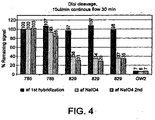
- a first hybridization using the complementary P5 oligonucleotide (SEQ ID NO:1) was performed to measure the percentage of P5 oligonucleotides attached to the surface. Standard hybridisation conditions are described in the general methods above. Channels to be cleaved were treated with a solution of 0.1M sodium periodate in water for 30 min at room temperature, channel 1 being kept as a control to evaluate the potential damage of the DNA or the surface by sodium periodate. The channels were then washed for 5 minutes with milliQ water then 5 min 5XSSC buffer at room temperature.
- a second hybridization was carried out using the complementary P5 oligonucleotide (SEQ ID NO:1) to evaluate the percentage of non-cleaved oligonucleotide.
- a second treatment with 0.1M sodium periodate was then performed for 15 min followed by the same washing conditions and a last hybridization using the complementary P5 oligonucleotide.
- the chip was scanned using the following settings: focal plane +3mm, 600V, 610BP/Red (633nm). The intensities were then normalized.
- the linker unit is incorporated with the diol in a protected OAc form during oligonucleotide synthesis.
- the free diol is released by ammonia treatment during oligonucleotide cleavage/deprotection. Therefore, the primers used in the grafting reaction contain the free diol.
- the template used for amplification was a library of PCR fragments derived from PhiX 174.
- the fragments contain common "end" sequences enabling amplification with the P5 and P7 primers flanking 400-700bp fragments of PhiX 174 of unknown sequence.
- Hybridization of the template was carried out substantially as described in the general methods above using a 100pM solution of template for channels 2, 3, 4, 5, 6 and 7, channels 1 and 8 being kept as primer only controls.
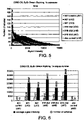
- PCR was performed as described in the general methods. Amplification products were then stained with SyBr Green-I in TE buffer (1/10 000), using 100 ⁇ l per channel and visualised using objective 0.4, Filter Xf 22 and 1 second acquisition time (gain 1).
- Figures 5 and 6 illustrate that successful colony formation was obtained using the cleavable diol primer.
- Olionucleotide used A594 sequencing primer (supplied by Eurogentec):
- Channels to be cleaved were treated with a solution of 0.1M of sodium periodate and 0.1M ethanolamine in water for 1 hour at room temperature. All the other channels were washed with milliQ water. All channels were then washed for 30 minutes with milliQ water at room temperature.
- Hybridization was carried out using the sequencing primer (SEQ ID NO:6) labelled with A594 to evaluate the percentage of non-cleaved oligonucleotide.
- the sequencing primer was hybridised to the linearised clusters prepared as described above at 500nM, using standard conditions for hybridisation as described under the general methods.
- the chip was then imaged using an orange filter with an exposure time of 1s.
- the channels grafted with the non-cleavable primers did not give any hybridization signal with the sequencing primer. As the colonies in these channels are still double-stranded no hybridization of the sequencing primer can occur.
- Hybridization of the sequencing primer was detected in the two diol channels treated with sodium periodate.
- the solid supports used were typically 8-channel glass flowcells such as those provided by Silex Microsystems (Sweden). However, the experimental conditions and procedures are readily applicable to other solid supports.
- FIG. 7 A schematic representation of one such flowcell is shown in Figure 7 .
- the flowcell is formed in three layers.
- the bottom layer 1 is formed of borosilicate glass at a depth of 1000 ⁇ m.
- An etched silicon channel layer (100 ⁇ m depth) is placed on top to defined 8 separate reaction channels.
- Top layer 3 (300 ⁇ m depth) includes two separate series of 8 holes 4 and 4' in register with the channels of the etched silicon channel layer in order to provide fluid communication with the contents of the channels when the flowcell is assembled in use.
- Flowcells were washed as follows: neat Decon for 30 min, milliQ H 2 O for 30 min, NaOH 1N for 15 min, milliQ H 2 O for 30 min, HCl 0.1N for 15 min, milliQ H 2 O for 30 min.
- the 10 ml solution of acrylamide was first degassed with argon for 15 min.
- the solutions of BRAPA, TEMED and potassium persulfate were successively added to the acrylamide solution.
- the mixture was then quickly vortexed and immediately pumped into the flowcell. Polymerization was then carried out for 1h 30 at RT. Afterwards the channels were washed with milliQ H 2 O for 30 min and filled with 0.1 M potassium phosphate buffer for storage until required.
- An acrylamide (SFA) coated flowcell was placed onto a modified MJ-Research thermocycler and attached to a peristaltic pump. Grafting mix consisting of 0.5 ⁇ M of a forward primer and 0.5 ⁇ M of a reverse primer in 10 mM phosphate buffer (pH 7.0) was pumped into the channels of the flowcell at a flow rate of 60 ⁇ l/min for 75 s at 20 °C. The thermocycler was then heated up to 51.6 °C, and the flowcell incubated at this temperature for 1 hour.
- SFA acrylamide
- the grafting mix underwent 18 cycles of pumping: grafting mix was pumped in at 15 ⁇ l/min for 20 s, then the solution was pumped back and forth (5 s forward at 15 ⁇ l/min, then 5 s backward at 15 ⁇ l/min) for 180 s. After 18 cycles of pumping, the flowcell was washed by pumping in 5xSSC/5mM EDTA at 15 ⁇ l/min for 300 s at 51.6 °C. The thermocycler was then cooled to 20 °C.
- the primers were typically 5'-phosphorothioate oligonucleotides incorporating any specific sequences or modifications required for cleavage. Their sequences and suppliers varied according to the experiment they were to be used for, and in this case were complementary to the 5'-ends of the template duplex.
- the amplified clusters contained a diol linkage in one of the grafted primers. Diol linkages can be introduced by including a suitable linkage into one of the primers used for solid-phase amplification.
- the grafted primers contained a sequence of T bases at the 5'-end to act as a spacer group to aid linearisation and hybridization. Synthesis of the diol phosphoramidite is detailed below. Oligonucleotides were prepared using the diol phosphoramidite using standard coupling conditions on a commercial DNA synthesiser. The final cleavage/deprotection step in ammonia cleaves the acetate groups from the protected diol moiety, so that the oligonucleotide in solution contains the diol modification.
- the sequences of the two primers grafted to the flowcell are:
- 1,6-Hexanediol (Sigma Aldrich 99 %) (14.6 g, 124 mmol), N,N -diisopropylethylamine (Hünig's base; Sigma Aldrich; redistilled) (21.6 mL, 124 mmol) was dissolved in anhydrous DCM/ DMF (250/ 50 mL) under N 2 . The solution was cooled to 0 °C and the first portion of 4, 4'-dimethoxytrityl chloride (DMTr-Cl; Sigma-Aldrich 95 %) (10.5 g, 31 mmol) added. The reaction mixture was then warmed to room temperature.
- DMTr-Cl 4, 4'-dimethoxytrityl chloride
- the reaction mixture was pre-absorbed on silica gel and subjected to flash chromatography using solvents containing 1 % Et 3 N petroleum ether to petroleum ether/ EtOAc (7:3) as eluent.
- the yield of pale yellow oil was 16.58 g, 64 %, with a further 7.8g (17%) of the bis-tritylated by-product.
- TPAP tetrapropylammonium perruthenate
- Diol-2 (10.34 g, 22.7 mmol) was weighed into a roundbottomed flask and dissolved with DCM (20 mL). The solution was then evaporated under reduced pressure until it gave a white foam. The flask was then subjected to high vacuum for 24 h. To this flask, anhydrous THF (180 mL) was added under N 2 . The resulting suspension was cooled to -78 °C with an acetone-dry ice bath. With vigorous stirring, KOBu t (3.3 g, 29.5 mmol) was added under N 2 . Slowly the colour of the suspension turned orange, and white solids were gradually precipitated out.
- the DNA sequence used in the amplification process was a single monotemplate sequence of 364 bases, with ends complimentary to the grafted primers.
- the full sequence of the template duplex is shown in Figure 8 (SEQ. ID NO:8).
- the duplex DNA (1 nM) was denatured using 0.1 M sodium hydroxide treatment followed by snap dilution to the desired 0.2-2 pM 'working concentration' in 'hybridization buffer' (5 x SSC /0.1% tween).
- thermocycling using an MJ Research thermocycler, coupled with an 8-way peristaltic pump Ismatec IPC ISM931 equipped with Ismatec tubing (orange/yellow, 0.51 mm ID).
- the single stranded template was hybridised to the grafted primers immediately prior to the amplification reaction, which thus begins with an initial primer extension step rather than template denaturation.
- the hybridization procedure begins with a heating step in a stringent buffer to ensure complete denaturation prior to hybridisation. After the hybridization, which occurs during a 20 min slow cooling step, the flowcell was washed for 5 minutes with a wash buffer (0.3 x SSC / 0.1% tween).
- Hybridisation mix 0.1 M hydroxide DNA sample, diluted in hybridisation pre mix
- Wash buffer 0.3 ⁇ SSC / 0.1 % tween
- Amplification pre mix 2 M betaine, 20 mM Tris, 10 mM Ammonium Sulfate, 2 mM Magnesium sulfate, 0.1% Triton, 1.3% DMSO, pH 8.8
- Amplification mix 2 M betaine, 20 mM Tris, 10 mM Ammonium Sulfate, 2 mM Magnesium sulfate, 0.1% Triton, 1.3% DMSO, pH 8.8 plus 200 ⁇ M dNTP mix and 25 units/mL of Taq polymerase (NEB Product ref M0273L)
- the linearisation buffer consisted of 1429 ⁇ L of water, 64 mg of sodium periodate, 1500 ⁇ L of formamide, 60 ⁇ L of 1 M Tris pH 8, and 11.4 ⁇ L of 3-aminopropanol, mixed for a final volume of 3 mL.
- the periodate was first mixed with the water while the Tris was mixed with the formamide.
- the two solutions were then mixed together and the 3-aminopropanol added to that mixture.
- Step 3 Blocking extendable 3'-OH groups
- Step Description T (°C) Time (sec) Flow rate ( ⁇ l/min) Pumped V ( ⁇ l) 1 Pump Blocking pre-mix 20 -200 15 50 2 Pump Blocking mix 37.7 300 15 75 3 Stop flow and hold T 37.7 20 static 0 4 Cyclic pump Blocking mix and wait 37.7 8 x (20+180) 15 / static 45 5 Pump wash buffer 20 300 15 75
- Step 4 Denaturation and hybridization of sequencing primer
- Step Description T (°C) Time (sec) Flow rate ( ⁇ l/min) Pumped V ( ⁇ l) 1 Pump NaOH 20 300 15 75 2 Pump TE 20 300 15 75 3 Pump Primer mix 20 300 15 75 4 Hold at 60C 60 900 0 0 5 Pump wash buffer 40.2 300 15 75
- the flowcell was ready for sequencing.
- a mutant 9°N polymerase enzyme (an exo- variant including the triple mutation L408Y/Y409A/P410V and C223S) was used for the nucleotide incorporation steps.
- Incorporation mix Incorporation buffer (50 mM Tris-HCl pH 8.0, 6 mM MgSO4, 1 mM EDTA, 0.05% (v/v) Tween -20, 50 mM NaCl) plus 110 nM YAV exo- C223S, and 1 ⁇ M each of the four labelled modified nucleotides, was applied to the clustered templates, and heated to 45 °C.
- Templates were maintained at 45 °C for 30 min, cooled to 20 °C and washed with Incorporation buffer, then with 5 x SSC/0.05 % Tween 20. Templates were then exposed to Imaging buffer (100 mM Tris pH 7.0, 30 mM NaCl, 0.05 % Tween 20, 50 mM sodium ascorbate, freshly dissolved).
- Templates were scanned in 4 colours at room temp.
- nucleotides were detected using a total internal reflection based fluorescent CCD imaging apparatus. Images were recorded and analysed to measure the intensites and numbers of the fluorescent objects on the surface. Images of two tiles from the first cycle of nucleotide incorporation for a linearised and a non-linearised (no periodate) channel are shown in Figure 9 . The histogram plots of these tiles are shown in Figure 10 . In the case of the sequence selected for amplification, only a single base (T) was incorporated in each cluster. This figure clearly shows the presence of clusters in both the linearised and non linearised channels, but the linearised clusters show a far higher average signal intensity. In the absence of the linearisation step, the clusters remain double stranded, and can not undergo effective hybridisation with a sequencing primer, and therefore show greatly reduced signal upon treatment with nucleotides and polymerase.
Landscapes
- Chemical & Material Sciences (AREA)
- Organic Chemistry (AREA)
- Life Sciences & Earth Sciences (AREA)
- Proteomics, Peptides & Aminoacids (AREA)
- Health & Medical Sciences (AREA)
- Zoology (AREA)
- Engineering & Computer Science (AREA)
- Wood Science & Technology (AREA)
- Analytical Chemistry (AREA)
- Molecular Biology (AREA)
- Biochemistry (AREA)
- Microbiology (AREA)
- Immunology (AREA)
- Biotechnology (AREA)
- Bioinformatics & Cheminformatics (AREA)
- General Engineering & Computer Science (AREA)
- General Health & Medical Sciences (AREA)
- Genetics & Genomics (AREA)
- Biophysics (AREA)
- Physics & Mathematics (AREA)
- Chemical Kinetics & Catalysis (AREA)
- Measuring Or Testing Involving Enzymes Or Micro-Organisms (AREA)
- General Chemical & Material Sciences (AREA)
Claims (15)
- Verfahren zur Erzeugung einer Matrize für eine Nukleinsäuresequenzierungsreaktion, welches umfasst, dass(i) mindestens ein doppelsträngiges Nukleinsäuremolekül zur Verfügung gestellt wird, wobei beide Stränge des doppelsträngigen Nukleinsäuremoleküls am 5'-Ende an einem Trägermaterial befestigt sind, wobei das doppelsträngige Nukleinsäuremolekül einen Zielbereich, welcher zu sequenzieren ist, und Nichtzielsequenzen, welche den Zielbereich flankieren, aufweist,(ii) ein Strang des doppelsträngigen Nukleinsäuremoleküls an einer abasischen Stelle gespalten wird, wobei die Spaltungsstellen in der Nichtzielsequenz gelegen sind, und(iii) der gespaltene Strang denaturierenden Bedingungen unterworfen wird, um den Teil des gespalteten Strangs, welcher nicht an dem Trägermaterial befestigt ist, zu entfernen, wodurch eine einzelsträngige Matrize für eine Nukleinsäuresequenzierungsreaktion erzeugt wird.
- Verfahren nach Anspruch 1, wobei Schritt (ii) durch Behandlung mit einer Endonuklease, Hitze oder Alkali durchgeführt wird.
- Verfahren nach Anspruch 1, wobei ein Strang des doppelsträngigen Nukleinsäuremoleküls eine Uracil-Base einschließt und die abasische Stelle durch Behandlung mit Uracilglycosylase erzeugt wird; oder wobei das doppelsträngige Nukleinsäuremolekül ein 8-Oxo-Guanin einschließt und die abasische Stelle durch Behandlung mit FPG-Glycosylase erzeugt wird; oder wobei das doppelsträngige Nukleinsäuremolekül ein Desoxyinosin einschließt und die abasische Stelle durch Behandlung mit AlkA-Glycosylase erzeugt wird.
- Verfahren nach Anspruch 1, wobei das doppelsträngige Nukleinsäuremolekül ein Uracil, an 8-Oxo-Guanin oder ein Desoxyinosin aufweist, und die abasische Stelle an der Stelle des Uracils, 8-Oxo-Guanins oder des Desoxyinosins gebildet wird.
- Verfahren nach Anspruch 1, wobei die abasische Stelle durch eine Glycosylase erzeugt und die abasische Stelle durch eine Endonuklease gespalten wird.
- Verfahren nach Anspruch 5, wobei das Spalten durch Aussetzen einer Mischung aus der Glycosylase und der Endonuklease durchgeführt wird.
- Verfahren nach einem der Ansprüche 1-6, wobei das doppelsträngige Nukleinsäuremolekül Teil eines Bündelarrays aus Nukleinsäuremolekülen bildet.
- Verfahren nach Anspruch 7, wobei der Bündelarray durch Festphasennukleinsäureamplifizierung hergestellt wird, indem Forward- und Reverse-Amplifikationsprimer verwendet werden, welche am 5'-Ende an dem Trägermaterial befestigt sind, und ein 8-Oxo-Guanin, Desoxyinosin oder Uracil in entweder dem Forward- oder dem Reverse-Amplifikationsprimer anwesend ist.
- Verfahren nach Anspruch 8, wobei das 8-Oxo-Guanin, Desoxyinosin oder Uracil in entweder dem Forward- oder dem Reverse-Amplifikationsprimer als 3'-Endbase anwesend ist
- Verfahren zur Nukleinsäuresequenzierung, welches umfasst, dass eine Matrize für Nukleinsäuresequenzierung gebildet wird, indem das Verfahren eines der Ansprüche 1 bis 9 verwendet wird, und dass eine Nukleinsäuresequenzierungsreaktion durchgeführt wird, um die Sequenz von mindestens einem Bereich der Matrize zu bestimmen.
- Verfahren nach Anspruch 10, wobei die Nukleinsäuresequenzierungsreaktion umfasst, dass ein Sequenzierungsprimer an einen einzelsträngigen Bereich der Matrize, welche in Schritt (iii) erzeugt wurde, hybridisiert wird; dass ein oder mehr Nukleotide sequenziell in einen Polynukleotidstrang eingefügt werden, welcher komplementär zu dem Bereich der zu sequenzierenden Matrize ist; dass die Base, welche in einem, oder mehr der eingefügten Nukleotide anwesend ist, identifiziert wird; und dass dadurch die Sequenz des Bereichs der Matrize bestimmt wird.
- Verfahren nach einem der Ansprüche 1-11, wobei das Trägermaterial mit funktionalisierten Silanen beschichtet ist.
- Verfahren nach einem der Ansprüche 1-11, wobei das Trägermaterial ein Polyacrylamidhydrogel auf einem Trägermaterial ist.
- Verfahren nach Anspruch 13, wobei das Hydrogel auf einem Trägermaterial durch ein Verfahren hergestellt wird, welches umfasst, dass auf einem Trägermaterial eine Mischung polymerisiert wird ausi. einem ersten Comonomer, welches Acrylamid, Methacrylamid, Hydroxyethylmethacrylat oder N-Vinylpyrrolidinon ist; undii. einem zweiten Comonomer, welches ein funktionalisiertes Acrylamid oder Acrylat der Formel (I)
H2C==C(H)-C(=O)-A-B-C (I)
. oder ein Methacrylat oder Methacrylamid der Formel (II)
H2C=C(CH3)-C(=O)-A-B-C (II)
ist; (wobei:A NR oder O ist, wobei R Wasserstoff oder eine gegebenenfalls substituierte gesättigte Kohlenwasserstoffgruppe ist, welche 1 bis 5 Kohlenstoffatome aufweist;-B- ein gegebenenfalls substituierter Alkylenbirest der Formel -(CH2)n- ist, wobei n eine ganze Zahl von 1 bis 50 ist; und wobei n=2 oder mehr ist, ein oder mehr gegebenenfalls substituierte Ethylenbireste -CH2CH2- des Alkylenbirests unabhängig voneinander durch Ethenylen- und Ethinylenteile ersetzt werden können; und wobei n=1 oder mehr ist, ein oder mehr Methylenbireste -CH2- unabhängig voneinander durch einen gegebenenfalls substitutierten mono- oder polycyclischen Kohlenwasserstoffbirest, welcher 4 bis 50 Kohlenstoffatome aufweist, oder durch einen entsprechenden heteromonocyclischen oder heteropolycyclischen Birest ersetzt werden können, wobei mindestens 1 CH2 oder CH2 durch ein Sauerstoff-, Schwefel- oder Stickstoffatom oder eine NH-Gruppe substituiert ist; undC eine Gruppe zur Reaktion mit einer Verbindung ist, um die Verbindung kovalent an das Hydrogel zu binden), um ein polymerisiertes Produkt zu bilden,dadurch gekennzeichnet, dass die Polymerisation auf dem Trägermaterial durchgeführt wird, und das polymerisierte Produkt an dem Trägermaterial, welches nicht kovalent oberflächenbehandelt ist, immobilisiert wird. - Verfahren nach einem der Ansprüche 1-14, wobei das Trägermaterial planar ist.
Applications Claiming Priority (3)
| Application Number | Priority Date | Filing Date | Title |
|---|---|---|---|
| GBGB0514936.4A GB0514936D0 (en) | 2005-07-20 | 2005-07-20 | Preparation of templates for nucleic acid sequencing |
| PCT/GB2006/002687 WO2007010251A2 (en) | 2005-07-20 | 2006-07-20 | Preparation of templates for nucleic acid sequencing |
| EP06755781A EP1910559B1 (de) | 2005-07-20 | 2006-07-20 | Herstellung von matrizen für die nukleinsäuresequenzierung |
Related Parent Applications (2)
| Application Number | Title | Priority Date | Filing Date |
|---|---|---|---|
| EP06755781.9 Division | 2006-07-20 | ||
| EP06755781A Division EP1910559B1 (de) | 2005-07-20 | 2006-07-20 | Herstellung von matrizen für die nukleinsäuresequenzierung |
Publications (3)
| Publication Number | Publication Date |
|---|---|
| EP2298930A1 EP2298930A1 (de) | 2011-03-23 |
| EP2298930B1 EP2298930B1 (de) | 2012-11-14 |
| EP2298930B2 true EP2298930B2 (de) | 2022-06-29 |
Family
ID=34897551
Family Applications (2)
| Application Number | Title | Priority Date | Filing Date |
|---|---|---|---|
| EP06755781A Expired - Lifetime EP1910559B1 (de) | 2005-07-20 | 2006-07-20 | Herstellung von matrizen für die nukleinsäuresequenzierung |
| EP10011728.2A Expired - Lifetime EP2298930B2 (de) | 2005-07-20 | 2006-07-20 | Herstellung von Vorlagen zur Nukleinsäuresequenzierung |
Family Applications Before (1)
| Application Number | Title | Priority Date | Filing Date |
|---|---|---|---|
| EP06755781A Expired - Lifetime EP1910559B1 (de) | 2005-07-20 | 2006-07-20 | Herstellung von matrizen für die nukleinsäuresequenzierung |
Country Status (5)
| Country | Link |
|---|---|
| US (6) | US20090118128A1 (de) |
| EP (2) | EP1910559B1 (de) |
| ES (1) | ES2398808T5 (de) |
| GB (1) | GB0514936D0 (de) |
| WO (1) | WO2007010251A2 (de) |
Families Citing this family (459)
| Publication number | Priority date | Publication date | Assignee | Title |
|---|---|---|---|---|
| US20060078893A1 (en) | 2004-10-12 | 2006-04-13 | Medical Research Council | Compartmentalised combinatorial chemistry by microfluidic control |
| GB0307403D0 (en) | 2003-03-31 | 2003-05-07 | Medical Res Council | Selection by compartmentalised screening |
| GB0307428D0 (en) | 2003-03-31 | 2003-05-07 | Medical Res Council | Compartmentalised combinatorial chemistry |
| US20050221339A1 (en) | 2004-03-31 | 2005-10-06 | Medical Research Council Harvard University | Compartmentalised screening by microfluidic control |
| US7968287B2 (en) | 2004-10-08 | 2011-06-28 | Medical Research Council Harvard University | In vitro evolution in microfluidic systems |
| GB0514936D0 (en) | 2005-07-20 | 2005-08-24 | Solexa Ltd | Preparation of templates for nucleic acid sequencing |
| GB0514910D0 (en) | 2005-07-20 | 2005-08-24 | Solexa Ltd | Method for sequencing a polynucleotide template |
| GB0514935D0 (en) | 2005-07-20 | 2005-08-24 | Solexa Ltd | Methods for sequencing a polynucleotide template |
| GB0524069D0 (en) * | 2005-11-25 | 2006-01-04 | Solexa Ltd | Preparation of templates for solid phase amplification |
| WO2007081385A2 (en) | 2006-01-11 | 2007-07-19 | Raindance Technologies, Inc. | Microfluidic devices and methods of use in the formation and control of nanoreactors |
| EP1987159B2 (de) | 2006-02-08 | 2020-08-12 | Illumina Cambridge Limited | Verfahren zur sequenzierung einer polynukleotidmatrize |
| SG170802A1 (en) | 2006-03-31 | 2011-05-30 | Solexa Inc | Systems and devices for sequence by synthesis analysis |
| US9562837B2 (en) | 2006-05-11 | 2017-02-07 | Raindance Technologies, Inc. | Systems for handling microfludic droplets |
| WO2007133710A2 (en) | 2006-05-11 | 2007-11-22 | Raindance Technologies, Inc. | Microfluidic devices and methods of use thereof |
| EP2032686B1 (de) | 2006-06-23 | 2022-01-12 | Illumina, Inc. | Vorrichtung und verfahren zur erzeugung von dna-cluster-anordnungen |
| US9012390B2 (en) | 2006-08-07 | 2015-04-21 | Raindance Technologies, Inc. | Fluorocarbon emulsion stabilizing surfactants |
| US7754429B2 (en) | 2006-10-06 | 2010-07-13 | Illumina Cambridge Limited | Method for pair-wise sequencing a plurity of target polynucleotides |
| US11940413B2 (en) | 2007-02-05 | 2024-03-26 | IsoPlexis Corporation | Methods and devices for sequencing nucleic acids in smaller batches |
| WO2008097559A2 (en) | 2007-02-06 | 2008-08-14 | Brandeis University | Manipulation of fluids and reactions in microfluidic systems |
| WO2008130623A1 (en) | 2007-04-19 | 2008-10-30 | Brandeis University | Manipulation of fluids, fluid components and reactions in microfluidic systems |
| US20090093378A1 (en) * | 2007-08-29 | 2009-04-09 | Helen Bignell | Method for sequencing a polynucleotide template |
| US8202691B2 (en) | 2008-01-25 | 2012-06-19 | Illumina, Inc. | Uniform fragmentation of DNA using binding proteins |
| WO2009097368A2 (en) | 2008-01-28 | 2009-08-06 | Complete Genomics, Inc. | Methods and compositions for efficient base calling in sequencing reactions |
| US9624489B2 (en) | 2008-03-10 | 2017-04-18 | Illumina, Inc. | Methods for selecting and amplifying polynucleotides |
| US8999642B2 (en) | 2008-03-10 | 2015-04-07 | Illumina, Inc. | Methods for selecting and amplifying polynucleotides |
| US9017973B2 (en) | 2008-03-19 | 2015-04-28 | Intelligent Biosystems, Inc. | Methods and compositions for incorporating nucleotides |
| CN102124018A (zh) | 2008-04-29 | 2011-07-13 | 生命科技公司 | 可维持从核苷酸模板酶促合成双链核苷酸的非天然聚合酶底物及其使用的方法 |
| US8039817B2 (en) | 2008-05-05 | 2011-10-18 | Illumina, Inc. | Compensator for multiple surface imaging |
| US8198028B2 (en) | 2008-07-02 | 2012-06-12 | Illumina Cambridge Limited | Using populations of beads for the fabrication of arrays on surfaces |
| US12038438B2 (en) | 2008-07-18 | 2024-07-16 | Bio-Rad Laboratories, Inc. | Enzyme quantification |
| EP4047367A1 (de) | 2008-07-18 | 2022-08-24 | Bio-Rad Laboratories, Inc. | Verfahren zum nachweis von zielanalyten unter verwendung von tropfenbibliotheken |
| US8728764B2 (en) | 2008-10-02 | 2014-05-20 | Illumina Cambridge Limited | Nucleic acid sample enrichment for sequencing applications |
| AU2009319907B2 (en) | 2008-11-03 | 2015-10-01 | The Regents Of The University Of California | Methods for detecting modification resistant nucleic acids |
| EP2607496B1 (de) | 2008-12-23 | 2014-07-16 | Illumina, Inc. | Für Nukleinsäuresequenzierungsprotokolle geeignete Verfahren |
| WO2010111231A1 (en) | 2009-03-23 | 2010-09-30 | Raindance Technologies, Inc. | Manipulation of microfluidic droplets |
| US12129514B2 (en) | 2009-04-30 | 2024-10-29 | Molecular Loop Biosolutions, Llc | Methods and compositions for evaluating genetic markers |
| EP2425240A4 (de) | 2009-04-30 | 2012-12-12 | Good Start Genetics Inc | Verfahren und zusammensetzung zur bewertung genetischer marker |
| US20120156728A1 (en) * | 2010-12-17 | 2012-06-21 | Life Technologies Corporation | Clonal amplification of nucleic acid on solid surface with template walking |
| DK2456892T3 (en) | 2009-07-24 | 2014-12-08 | Illumina Inc | Procedure for sequencing of a polynukleotidskabelon |
| CN102597256B (zh) | 2009-08-25 | 2014-12-03 | 伊鲁米那股份有限公司 | 选择和扩增多核苷酸的方法 |
| US10520500B2 (en) | 2009-10-09 | 2019-12-31 | Abdeslam El Harrak | Labelled silica-based nanomaterial with enhanced properties and uses thereof |
| WO2011071923A2 (en) | 2009-12-07 | 2011-06-16 | Illumina, Inc. | Multi-sample indexing for multiplex genotyping |
| EP2517025B1 (de) | 2009-12-23 | 2019-11-27 | Bio-Rad Laboratories, Inc. | Verfahren zur reduzierung des austauschs von molekülen zwischen tröpfchen |
| US9399797B2 (en) | 2010-02-12 | 2016-07-26 | Raindance Technologies, Inc. | Digital analyte analysis |
| US10351905B2 (en) | 2010-02-12 | 2019-07-16 | Bio-Rad Laboratories, Inc. | Digital analyte analysis |
| US9366632B2 (en) | 2010-02-12 | 2016-06-14 | Raindance Technologies, Inc. | Digital analyte analysis |
| EP4435111A1 (de) | 2010-02-12 | 2024-09-25 | Bio-Rad Laboratories, Inc. | Digitale analytanalyse |
| WO2011106368A2 (en) | 2010-02-23 | 2011-09-01 | Illumina, Inc. | Amplification methods to minimise sequence specific bias |
| US10787701B2 (en) | 2010-04-05 | 2020-09-29 | Prognosys Biosciences, Inc. | Spatially encoded biological assays |
| US20190300945A1 (en) | 2010-04-05 | 2019-10-03 | Prognosys Biosciences, Inc. | Spatially Encoded Biological Assays |
| KR101866401B1 (ko) | 2010-04-05 | 2018-06-11 | 프로그노시스 바이오사이언스, 인코포레이티드 | 공간적으로 엔코딩된 생물학적 검정 |
| US9029103B2 (en) | 2010-08-27 | 2015-05-12 | Illumina Cambridge Limited | Methods for sequencing polynucleotides |
| US8483969B2 (en) | 2010-09-17 | 2013-07-09 | Illuminia, Inc. | Variation analysis for multiple templates on a solid support |
| WO2012050920A1 (en) | 2010-09-29 | 2012-04-19 | Illumina, Inc. | Compositions and methods for sequencing nucleic acids |
| WO2012045012A2 (en) | 2010-09-30 | 2012-04-05 | Raindance Technologies, Inc. | Sandwich assays in droplets |
| US8753816B2 (en) | 2010-10-26 | 2014-06-17 | Illumina, Inc. | Sequencing methods |
| US9096899B2 (en) | 2010-10-27 | 2015-08-04 | Illumina, Inc. | Microdevices and biosensor cartridges for biological or chemical analysis and systems and methods for the same |
| US8575071B2 (en) | 2010-11-03 | 2013-11-05 | Illumina, Inc. | Reducing adapter dimer formation |
| CA2821299C (en) | 2010-11-05 | 2019-02-12 | Frank J. Steemers | Linking sequence reads using paired code tags |
| WO2012074855A2 (en) | 2010-11-22 | 2012-06-07 | The Regents Of The University Of California | Methods of identifying a cellular nascent rna transcript |
| US9163281B2 (en) | 2010-12-23 | 2015-10-20 | Good Start Genetics, Inc. | Methods for maintaining the integrity and identification of a nucleic acid template in a multiplex sequencing reaction |
| EP3859011A1 (de) | 2011-02-11 | 2021-08-04 | Bio-Rad Laboratories, Inc. | Verfahren zur bildung gemischter tröpfchen |
| WO2012112804A1 (en) | 2011-02-18 | 2012-08-23 | Raindance Technoligies, Inc. | Compositions and methods for molecular labeling |
| GB201106254D0 (en) | 2011-04-13 | 2011-05-25 | Frisen Jonas | Method and product |
| US8841071B2 (en) | 2011-06-02 | 2014-09-23 | Raindance Technologies, Inc. | Sample multiplexing |
| EP2714970B1 (de) | 2011-06-02 | 2017-04-19 | Raindance Technologies, Inc. | Enzymquantifizierung |
| US8658430B2 (en) | 2011-07-20 | 2014-02-25 | Raindance Technologies, Inc. | Manipulating droplet size |
| US10152569B2 (en) | 2011-09-26 | 2018-12-11 | Gen-Probe Incorporated | Algorithms for sequence determinations |
| US10378051B2 (en) | 2011-09-29 | 2019-08-13 | Illumina Cambridge Limited | Continuous extension and deblocking in reactions for nucleic acids synthesis and sequencing |
| EP2768983A4 (de) | 2011-10-17 | 2015-06-03 | Good Start Genetics Inc | Analyseverfahren |
| AU2012336040B2 (en) | 2011-11-07 | 2015-12-10 | Illumina, Inc. | Integrated sequencing apparatuses and methods of use |
| US9200274B2 (en) | 2011-12-09 | 2015-12-01 | Illumina, Inc. | Expanded radix for polymeric tags |
| WO2013117595A2 (en) | 2012-02-07 | 2013-08-15 | Illumina Cambridge Limited | Targeted enrichment and amplification of nucleic acids on a support |
| US9176031B2 (en) | 2012-02-24 | 2015-11-03 | Raindance Technologies, Inc. | Labeling and sample preparation for sequencing |
| NO2694769T3 (de) | 2012-03-06 | 2018-03-03 | ||
| US8209130B1 (en) | 2012-04-04 | 2012-06-26 | Good Start Genetics, Inc. | Sequence assembly |
| US8812422B2 (en) | 2012-04-09 | 2014-08-19 | Good Start Genetics, Inc. | Variant database |
| US9444880B2 (en) | 2012-04-11 | 2016-09-13 | Illumina, Inc. | Cloud computing environment for biological data |
| US10227635B2 (en) | 2012-04-16 | 2019-03-12 | Molecular Loop Biosolutions, Llc | Capture reactions |
| WO2013177220A1 (en) | 2012-05-21 | 2013-11-28 | The Scripps Research Institute | Methods of sample preparation |
| US20150167084A1 (en) | 2012-07-03 | 2015-06-18 | Sloan Kettering Institute For Cancer Research | Quantitative Assessment of Human T-Cell Repertoire Recovery After Allogeneic Hematopoietic Stem Cell Transplantation |
| AU2013292610B2 (en) | 2012-07-17 | 2018-05-17 | Myriad Women's Health, Inc. | System and methods for detecting genetic variation |
| US9092401B2 (en) | 2012-10-31 | 2015-07-28 | Counsyl, Inc. | System and methods for detecting genetic variation |
| NL2017959B1 (en) | 2016-12-08 | 2018-06-19 | Illumina Inc | Cartridge assembly |
| EP3901280B1 (de) | 2012-10-17 | 2025-03-12 | 10x Genomics Sweden AB | Verfahren und produkt zur optimierung einer lokalisierten oder räumlichen detektion einer genexpression in einer gewebeprobe |
| US9116139B2 (en) | 2012-11-05 | 2015-08-25 | Illumina, Inc. | Sequence scheduling and sample distribution techniques |
| US9805407B2 (en) | 2013-01-25 | 2017-10-31 | Illumina, Inc. | Methods and systems for using a cloud computing environment to configure and sell a biological sample preparation cartridge and share related data |
| EP2970951B1 (de) | 2013-03-13 | 2019-02-20 | Illumina, Inc. | Verfahren zur nukleinsäuresequenzierung |
| EP2971159B1 (de) | 2013-03-14 | 2019-05-08 | Molecular Loop Biosolutions, LLC | Verfahren zur analyse von nukleinsäuren |
| US9255265B2 (en) | 2013-03-15 | 2016-02-09 | Illumina, Inc. | Methods for producing stranded cDNA libraries |
| WO2014197377A2 (en) | 2013-06-03 | 2014-12-11 | Good Start Genetics, Inc. | Methods and systems for storing sequence read data |
| CN111500680B (zh) | 2013-06-25 | 2024-04-16 | 普罗格诺西斯生物科学公司 | 检测样品中生物靶标的空间分布的方法和系统 |
| DK3431614T3 (da) | 2013-07-01 | 2021-12-06 | Illumina Inc | Katalysator fri overfladefunktionalisering og polymerpodning |
| GB2558169B (en) | 2013-07-31 | 2019-10-23 | Hitachi High Tech Corp | Flow cell for nucleic acid analysis and nucleic acid analyzer |
| US9352315B2 (en) | 2013-09-27 | 2016-05-31 | Taiwan Semiconductor Manufacturing Company, Ltd. | Method to produce chemical pattern in micro-fluidic structure |
| US11901041B2 (en) | 2013-10-04 | 2024-02-13 | Bio-Rad Laboratories, Inc. | Digital analysis of nucleic acid modification |
| US11041203B2 (en) | 2013-10-18 | 2021-06-22 | Molecular Loop Biosolutions, Inc. | Methods for assessing a genomic region of a subject |
| US10851414B2 (en) | 2013-10-18 | 2020-12-01 | Good Start Genetics, Inc. | Methods for determining carrier status |
| US10540783B2 (en) | 2013-11-01 | 2020-01-21 | Illumina, Inc. | Image analysis useful for patterned objects |
| PT3077943T (pt) | 2013-12-03 | 2020-08-21 | Illumina Inc | Métodos e sistemas para analisar dados de imagem |
| EP4220137A1 (de) | 2013-12-10 | 2023-08-02 | Illumina, Inc. | Biosensoren zur biologischen oder chemischen analyse und verfahren zur herstellung davon |
| US9944977B2 (en) | 2013-12-12 | 2018-04-17 | Raindance Technologies, Inc. | Distinguishing rare variations in a nucleic acid sequence from a sample |
| US10537889B2 (en) | 2013-12-31 | 2020-01-21 | Illumina, Inc. | Addressable flow cell using patterned electrodes |
| WO2015103367A1 (en) | 2013-12-31 | 2015-07-09 | Raindance Technologies, Inc. | System and method for detection of rna species |
| JP6484636B2 (ja) | 2014-01-16 | 2019-03-13 | イラミーナ インコーポレーテッド | 固相担体におけるアンプリコン調製および配列決定 |
| CN110955371B (zh) | 2014-02-13 | 2023-09-12 | Illumina公司 | 综合式消费者基因组服务 |
| SI3108009T1 (sl) | 2014-02-18 | 2021-09-30 | Illumina, Inc. | Postopki in sestavki za profiliranje DNK |
| EP3116651B1 (de) | 2014-03-11 | 2020-04-22 | Illumina, Inc. | Wegwerfbare, integrierte mikrofluidische kartusche und verfahren zur herstellung davon |
| WO2015175530A1 (en) | 2014-05-12 | 2015-11-19 | Gore Athurva | Methods for detecting aneuploidy |
| AU2015259024B2 (en) | 2014-05-16 | 2021-07-01 | Illumina, Inc. | Nucleic acid synthesis techniques |
| JP6960223B2 (ja) | 2014-05-27 | 2021-11-05 | イラミーナ インコーポレーテッド | 基礎器具と取外可能カートリッジとを含む生化学的解析のためのシステム及び方法 |
| RU2688746C2 (ru) | 2014-06-05 | 2019-05-22 | Иллумина, Инк. | Системы и способы с использованием поворотного клапана для по меньшей мере одного из приготовления образца или анализа образца |
| US20150353989A1 (en) | 2014-06-09 | 2015-12-10 | Illumina Cambridge Limited | Sample preparation for nucleic acid amplification |
| WO2016025818A1 (en) | 2014-08-15 | 2016-02-18 | Good Start Genetics, Inc. | Systems and methods for genetic analysis |
| US10450562B2 (en) * | 2014-09-09 | 2019-10-22 | Igenomx International Genomics Corporation | Methods and compositions for rapid nucleic acid library preparation |
| US11408024B2 (en) | 2014-09-10 | 2022-08-09 | Molecular Loop Biosciences, Inc. | Methods for selectively suppressing non-target sequences |
| WO2016040602A1 (en) | 2014-09-11 | 2016-03-17 | Epicentre Technologies Corporation | Reduced representation bisulfite sequencing using uracil n-glycosylase (ung) and endonuclease iv |
| US10429399B2 (en) | 2014-09-24 | 2019-10-01 | Good Start Genetics, Inc. | Process control for increased robustness of genetic assays |
| MX391361B (es) | 2014-10-09 | 2025-03-21 | Illumina Inc | Metodo y dispositivo para la separacion de liquidos inmiscibles para aislar de modo efectivo al menos uno de los liquidos. |
| US9897791B2 (en) | 2014-10-16 | 2018-02-20 | Illumina, Inc. | Optical scanning systems for in situ genetic analysis |
| US10000799B2 (en) | 2014-11-04 | 2018-06-19 | Boreal Genomics, Inc. | Methods of sequencing with linked fragments |
| GB201419731D0 (en) | 2014-11-05 | 2014-12-17 | Illumina Cambridge Ltd | Sequencing from multiple primers to increase data rate and density |
| DK3215616T3 (da) | 2014-11-05 | 2020-03-02 | Illumina Cambridge Ltd | Reducering af DNA-skade under prøvepræparering og sekventering ved anvendelse af siderophor-chelatorer |
| PL3218511T3 (pl) | 2014-11-11 | 2020-10-19 | Illumina Cambridge Limited | Sposoby i macierze do wytwarzania i sekwencjonowania monoklonalnych klastrów kwasu nukleinowego |
| PT3234187T (pt) | 2014-12-15 | 2021-05-26 | Illumina Inc | Método para colocação de moleculas de alvo unico num substrato |
| US9857328B2 (en) | 2014-12-18 | 2018-01-02 | Agilome, Inc. | Chemically-sensitive field effect transistors, systems and methods for manufacturing and using the same |
| US10006910B2 (en) | 2014-12-18 | 2018-06-26 | Agilome, Inc. | Chemically-sensitive field effect transistors, systems, and methods for manufacturing and using the same |
| US10020300B2 (en) | 2014-12-18 | 2018-07-10 | Agilome, Inc. | Graphene FET devices, systems, and methods of using the same for sequencing nucleic acids |
| US10429342B2 (en) | 2014-12-18 | 2019-10-01 | Edico Genome Corporation | Chemically-sensitive field effect transistor |
| US9618474B2 (en) | 2014-12-18 | 2017-04-11 | Edico Genome, Inc. | Graphene FET devices, systems, and methods of using the same for sequencing nucleic acids |
| US9859394B2 (en) | 2014-12-18 | 2018-01-02 | Agilome, Inc. | Graphene FET devices, systems, and methods of using the same for sequencing nucleic acids |
| EP3271480B8 (de) | 2015-01-06 | 2022-09-28 | Molecular Loop Biosciences, Inc. | Abtastung auf strukturelle varianten |
| JP6929778B2 (ja) | 2015-01-15 | 2021-09-01 | グッド スタート ジェネティクス, インコーポレイテッド | 着床前遺伝子スクリーニングにおける一塩基多型を用いた品質管理方法 |
| ES3062422T3 (en) | 2015-02-10 | 2026-04-10 | Illumina Inc | Compositions for analyzing cellular components |
| US10576471B2 (en) | 2015-03-20 | 2020-03-03 | Illumina, Inc. | Fluidics cartridge for use in the vertical or substantially vertical position |
| ES2984193T3 (es) | 2015-03-31 | 2024-10-29 | Illumina Cambridge Ltd | Concatemerización de moldes en la superficie |
| EP4321627A3 (de) | 2015-04-10 | 2024-04-17 | 10x Genomics Sweden AB | Räumlich getrennte multiplex-nukleinsäureanalyse von biologischen proben |
| US10844428B2 (en) | 2015-04-28 | 2020-11-24 | Illumina, Inc. | Error suppression in sequenced DNA fragments using redundant reads with unique molecular indices (UMIS) |
| WO2016196358A1 (en) | 2015-05-29 | 2016-12-08 | Epicentre Technologies Corporation | Methods of analyzing nucleic acids |
| EP3303614B1 (de) * | 2015-05-29 | 2020-03-11 | Illumina Cambridge Limited | Verbesserte verwendung von oberflächenprimern bei clustern |
| CN115261468A (zh) | 2015-07-06 | 2022-11-01 | 伊卢米纳剑桥有限公司 | 用于核酸扩增的样品制备 |
| US10913975B2 (en) | 2015-07-27 | 2021-02-09 | Illumina, Inc. | Spatial mapping of nucleic acid sequence information |
| CN106435744B (zh) | 2015-08-13 | 2022-02-01 | 生捷科技控股公司 | 使用y-接头和消失限制位点的文库构建 |
| CN108138229B (zh) | 2015-08-14 | 2022-07-26 | 亿明达股份有限公司 | 使用磁响应式传感器确定遗传特征的系统和方法 |
| CN116338219A (zh) | 2015-08-24 | 2023-06-27 | 亿明达股份有限公司 | 用于生物和化学测定的线路内蓄压器和流量控制系统 |
| US10647981B1 (en) | 2015-09-08 | 2020-05-12 | Bio-Rad Laboratories, Inc. | Nucleic acid library generation methods and compositions |
| US10450598B2 (en) | 2015-09-11 | 2019-10-22 | Illumina, Inc. | Systems and methods for obtaining a droplet having a designated concentration of a substance-of-interest |
| US10577643B2 (en) | 2015-10-07 | 2020-03-03 | Illumina, Inc. | Off-target capture reduction in sequencing techniques |
| WO2017087724A1 (en) | 2015-11-17 | 2017-05-26 | Omniome, Inc. | Methods for determining sequence profiles |
| US10961573B2 (en) | 2016-03-28 | 2021-03-30 | Boreal Genomics, Inc. | Linked duplex target capture |
| WO2017168331A1 (en) | 2016-03-28 | 2017-10-05 | Boreal Genomics, Inc. | Linked duplex fragment sequencing |
| WO2017201081A1 (en) | 2016-05-16 | 2017-11-23 | Agilome, Inc. | Graphene fet devices, systems, and methods of using the same for sequencing nucleic acids |
| WO2018018008A1 (en) | 2016-07-22 | 2018-01-25 | Oregon Health & Science University | Single cell whole genome libraries and combinatorial indexing methods of making thereof |
| EP3510176A4 (de) | 2016-09-12 | 2020-05-27 | Dana-Farber Cancer Institute, Inc. | Acrylamidcopolymerisation zur sequestrierung und herstellung von einzelsträngiger nukleinsäure |
| KR102711907B1 (ko) | 2016-09-22 | 2024-09-27 | 일루미나, 인코포레이티드 | 체세포 복제수 변이 검출 |
| CN111781139B (zh) | 2016-10-14 | 2023-09-12 | 亿明达股份有限公司 | 夹盒组件 |
| PL3529380T3 (pl) | 2016-10-19 | 2022-10-24 | Illumina, Inc. | Sposoby chemicznej ligacji kwasów nukleinowych |
| JP7048609B2 (ja) | 2016-12-09 | 2022-04-05 | ボリアル ジェノミクス, インコーポレイテッド | 連結型ライゲーション |
| RU2765075C2 (ru) * | 2016-12-22 | 2022-01-25 | Иллюмина, Инк. | Биочип, включающий праймер секвенирования и несеквенирующую единицу |
| CN116612818A (zh) | 2017-01-06 | 2023-08-18 | 伊鲁米那股份有限公司 | 移相校正 |
| AU2018210316A1 (en) | 2017-01-17 | 2019-06-27 | Illumina, Inc. | Oncogenic splice variant determination |
| CN116497103A (zh) | 2017-01-18 | 2023-07-28 | 伊鲁米那股份有限公司 | 制备测序衔接子的方法和对核酸分子进行测序的方法 |
| CA3050241C (en) | 2017-01-20 | 2022-11-29 | Omniome, Inc. | Allele-specific capture of nucleic acids |
| CN110177884B (zh) | 2017-01-20 | 2021-08-06 | 欧姆尼欧美公司 | 通过聚合酶结合进行的基因分型 |
| CN110382710B (zh) | 2017-01-24 | 2024-10-01 | 瓦斯特根公司 | 构建核酸分子拷贝的方法 |
| US20200377935A1 (en) | 2017-03-24 | 2020-12-03 | Life Technologies Corporation | Polynucleotide adapters and methods of use thereof |
| WO2018197950A1 (en) | 2017-04-23 | 2018-11-01 | Illumina Cambridge Limited | Compositions and methods for improving sample identification in indexed nucleic acid libraries |
| EP3842545B1 (de) | 2017-04-23 | 2022-11-30 | Illumina, Inc. | Zusammensetzungen und verfahren zur verbesserung der probenidentifikation in indizierten nukleinsäurebibliotheken |
| WO2018197945A1 (en) | 2017-04-23 | 2018-11-01 | Illumina Cambridge Limited | Compositions and methods for improving sample identification in indexed nucleic acid libraries |
| CN111094584B (zh) | 2017-04-23 | 2024-11-26 | 伊鲁米那股份有限公司 | 用于改进编索引的核酸文库中的样品鉴定的组合物和方法 |
| CN119824552A (zh) | 2017-05-01 | 2025-04-15 | 伊鲁米那股份有限公司 | 用于多重大规模平行测序的最佳索引序列 |
| SG11201910070PA (en) | 2017-05-08 | 2019-11-28 | Illumina Inc | Universal short adapters for indexing of polynucleotide samples |
| WO2018213803A1 (en) | 2017-05-19 | 2018-11-22 | Neon Therapeutics, Inc. | Immunogenic neoantigen identification |
| ES3014783T3 (en) | 2017-06-07 | 2025-04-24 | Univ Oregon Health & Science | Single cell whole genome libraries for methylation sequencing |
| WO2018236631A1 (en) | 2017-06-20 | 2018-12-27 | Illumina, Inc. | METHODS AND COMPOSITIONS FOR RESOLVING INEFFICIENCY IN AMPLIFICATION REACTIONS |
| WO2019027767A1 (en) | 2017-07-31 | 2019-02-07 | Illumina Inc. | SEQUENCING SYSTEM COMPRISING AGGREGATION OF MULTIPLEXED BIOLOGICAL SAMPLES |
| JP6998404B2 (ja) | 2017-08-01 | 2022-02-04 | 深▲セン▼恒特基因有限公司 | 標的ヌクレオチド配列の富化及び決定方法 |
| CN119842876A (zh) | 2017-08-01 | 2025-04-18 | 伊鲁米纳公司 | 使用的水凝胶珠和流动池的遗传物质的空间索引和文库制备 |
| US11447818B2 (en) | 2017-09-15 | 2022-09-20 | Illumina, Inc. | Universal short adapters with variable length non-random unique molecular identifiers |
| FI3707723T3 (fi) | 2017-11-06 | 2023-12-13 | Illumina Inc | Nukleiinihappojen indeksointitekniikoita |
| KR102667912B1 (ko) | 2017-11-16 | 2024-05-21 | 일루미나, 인코포레이티드 | 미세부수체 불안정성을 결정하기 위한 시스템 및 방법 |
| EP3718113B1 (de) | 2017-11-30 | 2025-07-02 | Illumina, Inc. | Validierungsverfahren und systeme für sequenz-variant-calls |
| US11378544B2 (en) | 2018-01-08 | 2022-07-05 | Illumina, Inc. | High-throughput sequencing with semiconductor-based detection |
| KR102370055B1 (ko) | 2018-01-08 | 2022-03-03 | 일루미나, 인코포레이티드 | 반도체-기반 검출을 사용하는 고-처리율 서열분석용 시스템 및 디바이스 |
| CN110832086A (zh) | 2018-04-02 | 2020-02-21 | 伊鲁米那股份有限公司 | 用于制造用于基于序列的遗传检验的对照的组合物和方法 |
| WO2019200026A1 (en) * | 2018-04-12 | 2019-10-17 | Dana-Farber Cancer Institute, Inc. | Dna-tagged methanol responsive polymer for single-stranded nucleic acid production |
| IL316537A (en) * | 2018-05-15 | 2024-12-01 | Illumina Inc | Compositions and methods for chemical removal and deprotection of surface-bound oligonucleotides |
| RU2744175C1 (ru) | 2018-05-17 | 2021-03-03 | Иллумина, Инк. | Высокопроизводительное секвенирование одиночной клетки со сниженной ошибкой амплификации |
| CA3253118A1 (en) | 2018-06-04 | 2026-03-02 | Illumina, Inc. | High-throughput single-cell transcriptome libraries and methods of making and of using |
| NL2021377B1 (en) | 2018-07-03 | 2020-01-08 | Illumina Inc | Interposer with first and second adhesive layers |
| JP7431802B2 (ja) | 2018-08-15 | 2024-02-15 | イルミナ インコーポレイテッド | ライブラリー富化を改善するための組成物および方法 |
| US12098419B2 (en) | 2018-08-23 | 2024-09-24 | Ncan Genomics, Inc. | Linked target capture and ligation |
| WO2020047005A1 (en) | 2018-08-28 | 2020-03-05 | 10X Genomics, Inc. | Resolving spatial arrays |
| US11519033B2 (en) | 2018-08-28 | 2022-12-06 | 10X Genomics, Inc. | Method for transposase-mediated spatial tagging and analyzing genomic DNA in a biological sample |
| CN113767175B (zh) | 2018-08-28 | 2025-07-25 | 10X基因组学股份有限公司 | 增加空间阵列分辨率 |
| NL2022043B1 (en) | 2018-11-21 | 2020-06-03 | Akershus Univ Hf | Tagmentation-Associated Multiplex PCR Enrichment Sequencing |
| AU2019391274B2 (en) | 2018-12-05 | 2025-10-30 | Illumina Cambridge Limited | Methods and compositions for cluster generation by bridge amplification |
| US12529094B2 (en) | 2018-12-10 | 2026-01-20 | 10X Genomics, Inc. | Imaging system hardware |
| EP3894585A2 (de) | 2018-12-10 | 2021-10-20 | 10X Genomics, Inc. | Erzeugung von erfassungssonden zur räumlichen analyse |
| EP3894598B1 (de) | 2018-12-14 | 2024-01-03 | Illumina Cambridge Limited | Verminderung der phasenlage mit unmarkierten nukleotiden während der sequenzierung |
| EP3899036A1 (de) | 2018-12-17 | 2021-10-27 | Illumina Cambridge Limited | Primeroligonukleotid zur sequenzierung |
| WO2020126593A1 (en) | 2018-12-17 | 2020-06-25 | Illumina Cambridge Limited | Compositions for use in polyunucleotide sequencing |
| CN112739830A (zh) | 2018-12-18 | 2021-04-30 | 伊卢米纳剑桥有限公司 | 使用单一表面引物进行配对末端测序的方法和组合物 |
| BR112020026667A2 (pt) | 2018-12-19 | 2021-07-27 | Illumina, Inc. | métodos para melhorar a prioridade de clonalidade do agrupamento de polinucleotídeo |
| US11293061B2 (en) | 2018-12-26 | 2022-04-05 | Illumina Cambridge Limited | Sequencing methods using nucleotides with 3′ AOM blocking group |
| EP4538389A3 (de) | 2019-01-03 | 2025-07-30 | Ncan Genomics, Inc. | Verknüpfte zielerfassung |
| US11649485B2 (en) | 2019-01-06 | 2023-05-16 | 10X Genomics, Inc. | Generating capture probes for spatial analysis |
| US11926867B2 (en) | 2019-01-06 | 2024-03-12 | 10X Genomics, Inc. | Generating capture probes for spatial analysis |
| EP3931354A1 (de) | 2019-02-28 | 2022-01-05 | 10X Genomics, Inc. | Profilierung von biologischen analyten mit räumlich barcodierten oligonukleotid-arrays |
| WO2020180778A1 (en) | 2019-03-01 | 2020-09-10 | Illumina, Inc. | High-throughput single-nuclei and single-cell libraries and methods of making and of using |
| EP3938538A1 (de) | 2019-03-15 | 2022-01-19 | 10X Genomics, Inc. | Verfahren zur verwendung von räumlichen anordnungen für einzelzellsequenzierung |
| NL2023310B1 (en) | 2019-03-21 | 2020-09-28 | Illumina Inc | Training data generation for artificial intelligence-based sequencing |
| US11210554B2 (en) | 2019-03-21 | 2021-12-28 | Illumina, Inc. | Artificial intelligence-based generation of sequencing metadata |
| US11347965B2 (en) | 2019-03-21 | 2022-05-31 | Illumina, Inc. | Training data generation for artificial intelligence-based sequencing |
| WO2020205296A1 (en) | 2019-03-21 | 2020-10-08 | Illumina, Inc. | Artificial intelligence-based generation of sequencing metadata |
| NL2023312B1 (en) | 2019-03-21 | 2020-09-28 | Illumina Inc | Artificial intelligence-based base calling |
| NL2023316B1 (en) | 2019-03-21 | 2020-09-28 | Illumina Inc | Artificial intelligence-based sequencing |
| NL2023311B9 (en) | 2019-03-21 | 2021-03-12 | Illumina Inc | Artificial intelligence-based generation of sequencing metadata |
| EP3887542A1 (de) | 2019-03-22 | 2021-10-06 | 10X Genomics, Inc. | Dreidimensionale räumliche analyse |
| CA3104851A1 (en) | 2019-05-16 | 2020-11-19 | Illumina, Inc. | Base calling using convolutions |
| US11423306B2 (en) | 2019-05-16 | 2022-08-23 | Illumina, Inc. | Systems and devices for characterization and performance analysis of pixel-based sequencing |
| US11593649B2 (en) | 2019-05-16 | 2023-02-28 | Illumina, Inc. | Base calling using convolutions |
| EP3976820A1 (de) | 2019-05-30 | 2022-04-06 | 10X Genomics, Inc. | Verfahren zum nachweis der räumlichen heterogenität einer biologischen probe |
| EP3828283A1 (de) | 2019-11-28 | 2021-06-02 | Diagenode S.A. | Verbessertes sequenzierungsverfahren und -kit |
| US11788137B2 (en) | 2019-09-30 | 2023-10-17 | Diagenode S.A. | Diagnostic and/or sequencing method and kit |
| US11514575B2 (en) | 2019-10-01 | 2022-11-29 | 10X Genomics, Inc. | Systems and methods for identifying morphological patterns in tissue samples |
| WO2021091611A1 (en) | 2019-11-08 | 2021-05-14 | 10X Genomics, Inc. | Spatially-tagged analyte capture agents for analyte multiplexing |
| US12154266B2 (en) | 2019-11-18 | 2024-11-26 | 10X Genomics, Inc. | Systems and methods for binary tissue classification |
| EP4062373B1 (de) | 2019-11-21 | 2025-01-22 | 10X Genomics, Inc. | Räumliche analyse von analyten |
| WO2021127436A2 (en) | 2019-12-19 | 2021-06-24 | Illumina, Inc. | High-throughput single-cell libraries and methods of making and of using |
| US12110541B2 (en) | 2020-02-03 | 2024-10-08 | 10X Genomics, Inc. | Methods for preparing high-resolution spatial arrays |
| US12112833B2 (en) | 2020-02-04 | 2024-10-08 | 10X Genomics, Inc. | Systems and methods for index hopping filtering |
| EP4104179B1 (de) | 2020-02-13 | 2026-01-28 | 10X Genomics, Inc. | Systeme und methoden zur gemeinsamen interaktiven visualisierung der genexpression und der zugänglichkeit von dna-chromatin |
| WO2021167986A1 (en) | 2020-02-17 | 2021-08-26 | 10X Genomics, Inc. | In situ analysis of chromatin interaction |
| US12592298B2 (en) | 2020-02-20 | 2026-03-31 | Illumina, Inc. | Hardware execution and acceleration of artificial intelligence-based base caller |
| US12591780B2 (en) | 2020-02-20 | 2026-03-31 | Illumina, Inc. | Data compression for artificial intelligence-based base calling |
| US12354008B2 (en) | 2020-02-20 | 2025-07-08 | Illumina, Inc. | Knowledge distillation and gradient pruning-based compression of artificial intelligence-based base caller |
| JP7747643B2 (ja) | 2020-02-20 | 2025-10-01 | イルミナ インコーポレイテッド | 人工知能ベースの多対多ベースコール |
| EP4107285B1 (de) | 2020-02-21 | 2024-10-09 | 10X Genomics, Inc. | Verfahren und zusammensetzungen für integrierten räumlichen in-situ-test |
| EP4114966B1 (de) | 2020-03-03 | 2025-02-26 | Pacific Biosciences Of California, Inc. | Verfahren und zusammensetzungen zur sequenzierung von doppelsträngigen nukleinsäuren |
| US12188085B2 (en) | 2020-03-05 | 2025-01-07 | 10X Genomics, Inc. | Three-dimensional spatial transcriptomics with sequencing readout |
| WO2021178893A2 (en) | 2020-03-06 | 2021-09-10 | Singular Genomics Systems, Inc. | Linked paired strand sequencing |
| WO2021180724A1 (en) | 2020-03-09 | 2021-09-16 | Illumina, Inc. | Improvements in nucleic acid sequencing |
| US20220316003A1 (en) | 2020-03-09 | 2022-10-06 | Illumina, Inc. | Methods for sequencing polynucleotides |
| US11188778B1 (en) | 2020-05-05 | 2021-11-30 | Illumina, Inc. | Equalization-based image processing and spatial crosstalk attenuator |
| WO2021226522A1 (en) | 2020-05-08 | 2021-11-11 | Illumina, Inc. | Genome sequencing and detection techniques |
| WO2021231263A2 (en) | 2020-05-12 | 2021-11-18 | Singular Genomics Systems, Inc. | Nucleic acid amplification methods |
| US12209266B2 (en) | 2020-05-12 | 2025-01-28 | Illumina, Inc. | Generating nucleic acids with modified bases using recombinant terminal deoxynucleotidyl transferase |
| WO2021252375A1 (en) | 2020-06-08 | 2021-12-16 | The Broad Institute, Inc. | Single cell combinatorial indexing from amplified nucleic acids |
| KR20230020977A (ko) | 2020-06-09 | 2023-02-13 | 일루미나, 인코포레이티드 | 시퀀싱 라이브러리의 생성을 증가시키는 방법 |
| IL297992B2 (en) | 2020-06-22 | 2025-03-01 | Illumina Cambridge Ltd | Nucleosides and nucleotides with 3' acetal blocking group |
| JP2023532231A (ja) | 2020-06-30 | 2023-07-27 | イルミナ インコーポレイテッド | 傷なしdnaを生成するための触媒的に制御された合成による配列決定 |
| US12168801B1 (en) | 2020-07-02 | 2024-12-17 | 10X Genomics, Inc. | Hybrid/capture probe designs for full-length cDNA |
| MX2023000345A (es) | 2020-07-08 | 2023-02-13 | Illumina Inc | Globulos como portadores de transposomas. |
| EP4153606A4 (de) | 2020-07-13 | 2024-10-02 | Singular Genomics Systems, Inc. | Verfahren zur sequenzierung komplementärer polynukleotide |
| US12359193B2 (en) | 2022-03-04 | 2025-07-15 | Element Biosciences, Inc. | Single-stranded splint strands and methods of use |
| US12371743B2 (en) | 2022-03-04 | 2025-07-29 | Element Biosciences, Inc. | Double-stranded splint adaptors and methods of use |
| US12580044B1 (en) | 2020-09-02 | 2026-03-17 | 10X Genomics, Inc. | Systems and methods for identifying cells that are antigen-specific for an immunogenic feature |
| US12071667B2 (en) | 2020-11-04 | 2024-08-27 | 10X Genomics, Inc. | Sequence analysis using meta-stable nucleic acid molecules |
| CA3179883A1 (en) | 2020-12-02 | 2022-06-09 | Illumina Software, Inc. | System and method for detection of genetic alterations |
| EP4012046A1 (de) | 2020-12-11 | 2022-06-15 | 10X Genomics, Inc. | Verfahren und zusammensetzungen zur multimodalen in-situ-analyse |
| US12060603B2 (en) | 2021-01-19 | 2024-08-13 | 10X Genomics, Inc. | Methods for internally controlled in situ assays using padlock probes |
| EP4284945B1 (de) | 2021-01-26 | 2024-10-23 | 10X Genomics, Inc. | Nukleinsäureanalogsonden zur in-situ-analyse |
| EP4284944A1 (de) | 2021-01-29 | 2023-12-06 | Illumina, Inc. | Verfahren, zusammensetzungen und kits zur verbesserung der saateffizienz von durchflusszellen mit polynukleotiden |
| WO2022170212A1 (en) | 2021-02-08 | 2022-08-11 | Singular Genomics Systems, Inc. | Methods and compositions for sequencing complementary polynucleotides |
| WO2022187366A1 (en) | 2021-03-03 | 2022-09-09 | 10X Genomics, Inc. | Analyte detection in situ using nucleic acid origami |
| US20220301657A1 (en) | 2021-03-16 | 2022-09-22 | Illumina, Inc. | Tile location and/or cycle based weight set selection for base calling |
| WO2022197752A1 (en) | 2021-03-16 | 2022-09-22 | Illumina, Inc. | Tile location and/or cycle based weight set selection for base calling |
| US20220333178A1 (en) | 2021-03-22 | 2022-10-20 | Illumina Cambridge Limited | Methods for improving nucleic acid cluster clonality |
| BR112023019154A2 (pt) | 2021-03-31 | 2023-10-17 | Illumina Cambridge Ltd | Técnicas de sequenciamento de bibliotecas de ácidos nucleicos com detecção de dímero de adaptador |
| IL307378A (en) | 2021-04-02 | 2023-11-01 | Illumina Inc | A machine learning model for bubble detection within a nucleotide sample slide for sequencing |
| CA3212595A1 (en) | 2021-04-13 | 2022-10-20 | Sebastien RICOULT | Compositions, systems, and methods of making and using encapsulated lyophilised microspheres |
| US12217829B2 (en) | 2021-04-15 | 2025-02-04 | Illumina, Inc. | Artificial intelligence-based analysis of protein three-dimensional (3D) structures |
| US12444482B2 (en) | 2021-04-15 | 2025-10-14 | Illumina, Inc. | Multi-channel protein voxelization to predict variant pathogenicity using deep convolutional neural networks |
| EP4330430A2 (de) | 2021-04-29 | 2024-03-06 | Illumina, Inc. | Amplifikationsverfahren zur charakterisierung von nukleinsäuren |
| AU2022277632A1 (en) | 2021-05-20 | 2023-11-09 | Illumina Cambridge Limited | Compositions and methods for sequencing by synthesis |
| CA3220708A1 (en) | 2021-05-28 | 2022-12-01 | Niall Anthony Gormley | Oligo-modified nucleotide analogues for nucleic acid preparation |
| CN117396613A (zh) | 2021-06-01 | 2024-01-12 | 10X基因组学有限公司 | 用于分析物检测和探针解析的方法和组合物 |
| US20230084407A1 (en) | 2021-06-02 | 2023-03-16 | 10X Genomics, Inc. | Sample analysis using asymmetric circularizable probes |
| US20220403450A1 (en) | 2021-06-03 | 2022-12-22 | Illumina Software, Inc. | Systems and methods for sequencing nucleotides using two optical channels |
| WO2022266125A1 (en) * | 2021-06-15 | 2022-12-22 | Ultima Genomics, Inc. | Methods for preparing capture substrates |
| WO2022272260A1 (en) | 2021-06-23 | 2022-12-29 | Illumina, Inc. | Compositions, methods, kits, cartridges, and systems for sequencing reagents |
| BR112023026984A2 (pt) | 2021-06-24 | 2024-03-12 | Illumina Inc | Métodos e composições para indexação combinatória de ácidos nucleicos baseados em microesferas |
| WO2023278184A1 (en) | 2021-06-29 | 2023-01-05 | Illumina, Inc. | Methods and systems to correct crosstalk in illumination emitted from reaction sites |
| CN117546249B (zh) | 2021-06-29 | 2026-08-04 | 因美纳有限公司 | 使用寡核苷酸序列训练的自学碱基检出器 |
| MX2023015504A (es) | 2021-06-29 | 2024-01-22 | Illumina Inc | Metrica de la relacion se?al a ruido para determinar llamadas de bases de nucleotidos y la calidad de las llamadas de base. |
| CA3224393A1 (en) | 2021-06-29 | 2023-01-05 | Mitchell A BEKRITSKY | Machine-learning model for generating confidence classifications for genomic coordinates |
| US12530882B2 (en) | 2021-07-01 | 2026-01-20 | Illumina, Inc. | Efficient artificial intelligence-based base calling of index sequences |
| EP4779305A2 (de) | 2021-07-13 | 2026-07-22 | 10X Genomics, Inc. | Verfahren zur herstellung einer polymerisierten matrix mit steuerbarer dicke |
| US12423815B2 (en) | 2021-07-13 | 2025-09-23 | Illumina, Inc. | Methods and systems for real time extraction of crosstalk in illumination emitted from reaction sites |
| US11455487B1 (en) | 2021-10-26 | 2022-09-27 | Illumina Software, Inc. | Intensity extraction and crosstalk attenuation using interpolation and adaptation for base calling |
| EP4679300A3 (de) | 2021-07-19 | 2026-04-22 | Illumina, Inc. | Intensitätsextraktion mit interpolation und anpassung für basisanrufe |
| US12651646B2 (en) | 2021-07-23 | 2026-06-09 | Illumina, Inc. | Machine-learning model for recalibrating nucleotide-base calls |
| KR20240037882A (ko) | 2021-07-28 | 2024-03-22 | 일루미나, 인코포레이티드 | 염기 호출 시스템의 품질 점수 보정 |
| US12139751B2 (en) | 2021-07-30 | 2024-11-12 | 10X Genomics, Inc. | Circularizable probes for in situ analysis |
| EP4326900B1 (de) | 2021-07-30 | 2024-09-04 | 10X Genomics, Inc. | Verfahren und zusammensetzungen zur in-situ-synchronisierung von reaktionen |
| US12529096B2 (en) | 2021-08-03 | 2026-01-20 | 10X Genomics, Inc. | Stabilization and/or compaction of nucleic acid structures |
| US12391984B2 (en) | 2021-08-03 | 2025-08-19 | 10X Genomics, Inc. | Compositions and methods for rolling circle amplification |
| WO2023014741A1 (en) | 2021-08-03 | 2023-02-09 | Illumina Software, Inc. | Base calling using multiple base caller models |
| EP4381095A1 (de) | 2021-08-03 | 2024-06-12 | 10X Genomics, Inc. | Nukleinsäurekoncatamere und verfahren zur stabilisierung und/oder verdichtung davon |
| US12460251B2 (en) | 2021-08-03 | 2025-11-04 | 10X Genomics, Inc. | Stabilization and/or compaction of nucleic acid molecules |
| US12435364B2 (en) | 2021-08-16 | 2025-10-07 | 10X Genomics, Inc. | Probes comprising a split barcode region and methods of use |
| CN117580961A (zh) | 2021-09-01 | 2024-02-20 | Illumina公司 | 用于加速碱基判读的幅度调制 |
| WO2023044229A1 (en) | 2021-09-17 | 2023-03-23 | Illumina, Inc. | Automatically identifying failure sources in nucleotide sequencing from base-call-error patterns |
| WO2023049558A1 (en) | 2021-09-21 | 2023-03-30 | Illumina, Inc. | A graph reference genome and base-calling approach using imputed haplotypes |
| US12480157B2 (en) | 2021-09-30 | 2025-11-25 | Illumina, Inc. | Polynucleotide sequencing |
| EP4305195A2 (de) | 2021-12-01 | 2024-01-17 | 10X Genomics, Inc. | Verfahren, zusammensetzungen und systeme für verbesserten in-situ-nachweis von analyten und raumanalyse |
| CN117581303A (zh) | 2021-12-02 | 2024-02-20 | 因美纳有限公司 | 产生用于确定核苷酸碱基检出的簇特异性信号校正 |
| US20230183799A1 (en) | 2021-12-10 | 2023-06-15 | Illumina, Inc. | Parallel sample and index sequencing |
| EP4448793A4 (de) * | 2021-12-14 | 2025-12-17 | Univ Arizona State | Verfahren zur kombination von in-situ-einzelzellen-dna- und rna-sequenzierung |
| CA3223595A1 (en) | 2021-12-16 | 2023-06-22 | Xiaoyu Ma | Hybrid clustering |
| AU2022413575A1 (en) | 2021-12-16 | 2024-01-18 | Illumina, Inc. | Methods for metal directed cleavage of surface-bound polynucleotides |
| EP4453256A1 (de) | 2021-12-20 | 2024-10-30 | Illumina, Inc. | Periodatzusammensetzungen und verfahren zur chemischen spaltung von oberflächengebundenen polynukleotiden |
| AU2022419500A1 (en) | 2021-12-20 | 2024-01-18 | Illumina, Inc. | Periodate compositions and methods for chemical cleavage of surface-bound polynucleotides |
| US20230215515A1 (en) | 2021-12-23 | 2023-07-06 | Illumina Software, Inc. | Facilitating secure execution of external workflows for genomic sequencing diagnostics |
| WO2023122363A1 (en) | 2021-12-23 | 2023-06-29 | Illumina Software, Inc. | Dynamic graphical status summaries for nucelotide sequencing |
| US20230242974A1 (en) | 2021-12-27 | 2023-08-03 | 10X Genomics, Inc. | Methods and compositions for rolling circle amplification |
| US20230207050A1 (en) | 2021-12-28 | 2023-06-29 | Illumina Software, Inc. | Machine learning model for recalibrating nucleotide base calls corresponding to target variants |
| AU2022424380A1 (en) | 2021-12-29 | 2024-01-18 | Illumina, Inc. | Methods of nucleic acid sequencing using surface-bound primers |
| AU2022425440A1 (en) | 2021-12-29 | 2024-07-11 | Illumina, Inc. | Automatically switching variant analysis model versions for genomic analysis applications |
| US12674196B2 (en) | 2022-01-18 | 2026-07-07 | 10X Genomics, Inc. | Methods and compositions for improved probe specificity |
| EP4733410A3 (de) | 2022-01-21 | 2026-05-27 | 10X Genomics, Inc. | Mehrere auslesesignale zur analyse einer probe |
| CN114457146B (zh) * | 2022-01-28 | 2024-11-19 | 赛纳生物科技(北京)有限公司 | 一种固相介质表面双端扩增测序的方法 |
| CN114438185B (zh) * | 2022-01-28 | 2024-05-31 | 赛纳生物科技(北京)有限公司 | 一种芯片表面双端扩增测序的方法 |
| US20240254537A1 (en) | 2022-02-23 | 2024-08-01 | Insitro, Inc. | Pooled optical screening and transcriptional measurements of cells comprising barcoded genetic perturbations |
| AU2023225949A1 (en) | 2022-02-25 | 2024-01-18 | Illumina, Inc. | Machine-learning models for detecting and adjusting values for nucleotide methylation levels |
| EP4483372B1 (de) | 2022-02-25 | 2026-04-01 | Illumina, Inc. | Kalibrierungssequenzen für nucelotidsequenzierung |
| JP2025509651A (ja) | 2022-03-15 | 2025-04-11 | イルミナ インコーポレイテッド | 並行サンプル及びインデックス配列決定 |
| WO2023175040A2 (en) | 2022-03-15 | 2023-09-21 | Illumina, Inc. | Concurrent sequencing of forward and reverse complement strands on concatenated polynucleotides for methylation detection |
| US12703879B2 (en) | 2022-03-29 | 2026-08-11 | 10X Genomics, Inc. | RNase H assisted in situ rolling circle amplification |
| CA3223037A1 (en) | 2022-03-30 | 2023-10-05 | Oliver MILLER | Methods for chemical cleavage of surface-bound polynucleotides |
| AU2023244497A1 (en) | 2022-03-31 | 2024-01-18 | Illumina, Inc. | Paired-end re-synthesis using blocked p5 primers |
| CN119032271A (zh) | 2022-04-01 | 2024-11-26 | 10X基因组学有限公司 | 用于靶向掩蔽自发荧光的组合物和方法 |
| WO2023196526A1 (en) | 2022-04-06 | 2023-10-12 | 10X Genomics, Inc. | Methods for multiplex cell analysis |
| AU2023248405A1 (en) | 2022-04-07 | 2024-01-04 | Illumina, Inc. | Altered cytidine deaminases and methods of use |
| JP2025512974A (ja) | 2022-04-08 | 2025-04-22 | イルミナ インコーポレイテッド | アプタマーダイナミックレンジ圧縮及び検出技法 |
| EP4515547A1 (de) | 2022-04-26 | 2025-03-05 | Illumina, Inc. | Maschinenlernmodelle zur auswahl von oligonukleotidsonden für arraytechnologien |
| WO2023209606A1 (en) | 2022-04-29 | 2023-11-02 | Illumina Cambridge Limited | Methods and systems for encapsulating lyophilised microspheres |
| US20240002902A1 (en) | 2022-05-06 | 2024-01-04 | 10X Genomics, Inc. | Analysis of antigen and antigen receptor interactions |
| EP4523215A1 (de) | 2022-05-10 | 2025-03-19 | Illumina Inc. | Adaptives neuronales netzwerk zur nucelotidsequenzierung |
| EP4526443A1 (de) | 2022-05-18 | 2025-03-26 | Illumina, Inc. | Herstellung von grössenkontrollierten nukleinsäurefragmenten |
| US20240035071A1 (en) | 2022-06-17 | 2024-02-01 | 10X Genomics, Inc. | Catalytic de-crosslinking of samples for in situ analysis |
| EP4544558A1 (de) | 2022-06-24 | 2025-04-30 | Illumina, Inc. | Verbesserung der ausrichtung von geteiltem licht durch intelligente identifizierung und bewertung von kandidatenteilungsgruppen |
| US20260011405A1 (en) | 2022-06-27 | 2026-01-08 | Illumina, Inc. | Human leukocyte antigen (hla) genotyping |
| EP4544552A1 (de) | 2022-06-27 | 2025-04-30 | Illumina Inc. | Beschleuniger für ein genotyp-einschreibungsmodell |
| WO2024006769A1 (en) | 2022-06-27 | 2024-01-04 | Illumina Software, Inc. | Generating and implementing a structural variation graph genome |
| EP4551718B1 (de) | 2022-07-05 | 2026-06-24 | Element Biosciences, Inc. | Herstellung einer pcr-freien bibliothek mittels doppelsträngiger schienenadapter und verwendungsverfahren |
| WO2024026356A1 (en) | 2022-07-26 | 2024-02-01 | Illumina, Inc. | Rapid single-cell multiomics processing using an executable file |
| US12692484B2 (en) | 2022-08-12 | 2026-07-28 | 10X Genomics, Inc. | PUMA1 polymerases and uses thereof |
| US12116626B2 (en) | 2022-08-16 | 2024-10-15 | 10X Genomics, Inc. | AP50 polymerases and uses thereof |
| US20250361558A1 (en) | 2022-08-19 | 2025-11-27 | Illumina, Inc. | Third dna base pair site-specific dna detection |
| EP4587566A1 (de) | 2022-09-12 | 2025-07-23 | Element Biosciences, Inc. | Doppelsträngige schienenadapter mit universellen langen schienensträngen und verfahren zur verwendung |
| CN119054022A (zh) | 2022-09-16 | 2024-11-29 | 因美纳有限公司 | 簇分割和条件式碱基检出 |
| US20240102067A1 (en) | 2022-09-26 | 2024-03-28 | Illumina, Inc. | Resynthesis Kits and Methods |
| US20240112753A1 (en) | 2022-09-29 | 2024-04-04 | Illumina, Inc. | Target-variant-reference panel for imputing target variants |
| US20240110234A1 (en) | 2022-09-30 | 2024-04-04 | Illumina, Inc. | Amplification Compositions and Methods |
| EP4594481A1 (de) | 2022-09-30 | 2025-08-06 | Illumina, Inc. | Helicase-cytidindeaminase-komplexe und verfahren zur verwendung |
| US20240110221A1 (en) | 2022-09-30 | 2024-04-04 | Illumina, Inc. | Methods of modulating clustering kinetics |
| US20240124914A1 (en) | 2022-09-30 | 2024-04-18 | Illumina, Inc. | Thermophilic compositions for nucleic acid amplification |
| WO2024073519A1 (en) | 2022-09-30 | 2024-04-04 | Illumina, Inc. | Machine-learning model for refining structural variant calls |
| US20250388894A1 (en) | 2022-09-30 | 2025-12-25 | Illumina, Inc. | Methods of using cpg binding proteins in mapping modified cytosine nucleotides |
| WO2024073047A1 (en) | 2022-09-30 | 2024-04-04 | Illumina, Inc. | Cytidine deaminases and methods of use in mapping modified cytosine nucleotides |
| US20240124929A1 (en) | 2022-09-30 | 2024-04-18 | Illumina, Inc. | Mesophilic compositions for nucleic acid amplification |
| EP4599449A1 (de) | 2022-10-05 | 2025-08-13 | Illumina, Inc. | Integration von variant-aufrufen aus mehreren sequenzierungspipelines unter verwendung einer maschinenlernarchitektur |
| US20240127906A1 (en) | 2022-10-11 | 2024-04-18 | Illumina, Inc. | Detecting and correcting methylation values from methylation sequencing assays |
| US20240191297A1 (en) | 2022-10-14 | 2024-06-13 | 10X Genomics, Inc. | Methods, compositions, and systems for assessing biological sample quality |
| WO2024102736A1 (en) | 2022-11-08 | 2024-05-16 | 10X Genomics, Inc. | Immobilization methods and compositions for in situ detection |
| US20240158852A1 (en) | 2022-11-16 | 2024-05-16 | 10X Genomics, Inc. | Methods and compositions for assessing performance of in situ assays |
| WO2024107727A1 (en) | 2022-11-18 | 2024-05-23 | 10X Genomics, Inc. | Systems and methods for actively mitigating vibrations |
| EP4622746A1 (de) | 2022-11-22 | 2025-10-01 | 10X Genomics, Inc. | Systeme und verfahren zur schnittstellenbildung mit einer flasche |
| US12644837B2 (en) | 2022-11-22 | 2026-06-02 | 10X Genomics, Inc. | Systems and methods for imaging samples |
| US12581050B2 (en) | 2022-11-23 | 2026-03-17 | 10X Genomics, Inc. | Optical assemblies for machine vision calibration |
| WO2024118791A1 (en) | 2022-11-30 | 2024-06-06 | Illumina, Inc. | Accurately predicting variants from methylation sequencing data |
| WO2024118903A1 (en) | 2022-11-30 | 2024-06-06 | Illumina, Inc. | Chemoenzymatic correction of false positive uracil transformations |
| US20240218437A1 (en) | 2022-12-16 | 2024-07-04 | 10X Genomics, Inc. | Methods and compositions for assessing performance |
| EP4638789A1 (de) | 2022-12-21 | 2025-10-29 | 10X Genomics, Inc. | Verfahren zur bindung von ribonukleinsäuren in biologischen proben |
| EP4639552A1 (de) | 2022-12-21 | 2025-10-29 | Illumina, Inc. | Kontextabhängiges base-calling |
| AU2023409219A1 (en) | 2022-12-22 | 2024-10-03 | Illumina, Inc. | Palladium catalyst compositions and methods for sequencing by synthesis |
| WO2024137765A1 (en) | 2022-12-22 | 2024-06-27 | Illumina, Inc. | Transition-metal catalyst compositions and methods for sequencing by synthesis |
| US20240271206A1 (en) | 2022-12-27 | 2024-08-15 | Illumina, Inc. | Methods of sequencing using 3' allyl blocked nucleotides |
| WO2024148300A1 (en) | 2023-01-06 | 2024-07-11 | 10X Genomics, Inc. | Methods and compositions for in situ analysis of variant sequences |
| AU2023421715A1 (en) | 2023-01-06 | 2024-09-26 | Illumina, Inc. | Reducing uracils by polymerase |
| EP4662663A1 (de) | 2023-02-06 | 2025-12-17 | Illumina, Inc. | Bestimmung und entfernung von lichtinterferenzen zwischen clustern |
| WO2024191806A1 (en) | 2023-03-10 | 2024-09-19 | Illumina, Inc. | Aptamer detection techniques |
| US20250384952A1 (en) | 2023-03-30 | 2025-12-18 | Illumina, Inc. | Tandem repeat genotyping |
| WO2024229260A1 (en) | 2023-05-03 | 2024-11-07 | 10X Genomics, Inc. | Methods and compositions for spatial assay |
| JP2026517529A (ja) | 2023-05-03 | 2026-06-02 | イルミナ インコーポレイテッド | 既存の配列決定データファイルから遺伝子型コールを再較正するための機械学習モデル |
| WO2024249200A1 (en) | 2023-05-26 | 2024-12-05 | Illumina, Inc. | Methods for preserving methylation status during clustering |
| US20240401129A1 (en) | 2023-05-31 | 2024-12-05 | Illumina, Inc. | Methods for double-stranded sequencing by synthesis |
| WO2024249061A1 (en) | 2023-05-31 | 2024-12-05 | Illumina, Inc. | Detecting a methylated nucleotide using a quencher |
| WO2024249466A1 (en) | 2023-05-31 | 2024-12-05 | Illumina, Inc. | False positive reduction by translesion polymerase repair |
| US20240404624A1 (en) | 2023-05-31 | 2024-12-05 | Illumina, Inc. | Structural variant alignment and variant calling by utilizing a structural-variant reference genome |
| WO2024249973A2 (en) | 2023-06-02 | 2024-12-05 | Illumina, Inc. | Linking human genes to clinical phenotypes using graph neural networks |
| US20250001542A1 (en) | 2023-06-09 | 2025-01-02 | Illumina, Inc. | Method for polishing a substrate |
| EP4736169A1 (de) | 2023-06-27 | 2026-05-06 | Illumina, Inc. | Variantenaufruf mit methylierungsebenenschätzung |
| EP4736170A1 (de) | 2023-06-30 | 2026-05-06 | Illumina, Inc. | Maschinenlernmodell zur rekalibrierung von genotypaufrufen entsprechend keimbahnvarianten und somatischen mosaikvarianten |
| EP4735634A1 (de) | 2023-06-30 | 2026-05-06 | Illumina, Inc. | Systeme und verfahren zur sequenzierung von polynukleotiden mit modifizierten basen |
| EP4735635A1 (de) | 2023-06-30 | 2026-05-06 | Illumina, Inc. | Systeme und verfahren zur sequenzierung von polynukleotiden mit alternativen scatterplots |
| WO2025006466A1 (en) | 2023-06-30 | 2025-01-02 | Illumina, Inc. | Systems and methods of sequencing polynucleotides with four labeled nucleotides |
| WO2025029831A1 (en) | 2023-07-31 | 2025-02-06 | 10X Genomics, Inc. | Methods and systems for targeted rna cleavage and target rna-primed rolling circle amplification |
| CN121969766A (zh) | 2023-08-31 | 2026-05-01 | 因美纳有限公司 | 适体检测技术 |
| EP4771170A2 (de) | 2023-08-31 | 2026-07-08 | Illumina, Inc. | Verfahren zur komprimierung und erkennung des dynamischen bereichs eines aptamers |
| WO2025054389A1 (en) | 2023-09-07 | 2025-03-13 | Illumina, Inc. | Identification of methylated cytosine using landmarks |
| AU2023464289A1 (en) | 2023-09-08 | 2026-03-12 | The Regents Of The University Of Michigan | MICRORNA-DERIVED RNAs AND POLYPEPTIDES AND USES THEREOF |
| EP4780981A1 (de) * | 2023-09-20 | 2026-07-29 | Illumina, Inc. | Gleichzeitige sequenzierung mit nick-übersetzung |
| EP4784740A1 (de) | 2023-09-28 | 2026-08-05 | Illumina, Inc. | Veränderte cytidindeaminasen und verfahren zur verwendung |
| US20250111898A1 (en) | 2023-09-29 | 2025-04-03 | Illumina, Inc. | Tracking and modifying cluster location on nucleotide-sample slides in real time |
| US20250111899A1 (en) | 2023-09-29 | 2025-04-03 | Illumina, Inc. | Predicting insert lengths using primary analysis metrics |
| WO2025081064A2 (en) | 2023-10-11 | 2025-04-17 | Illumina, Inc. | Thermophilic deaminase and methods for identifying modified cytosine |
| WO2025090883A1 (en) | 2023-10-27 | 2025-05-01 | Illumina, Inc. | Detecting variants in nucleotide sequences based on haplotype diversity |
| US20250163502A1 (en) | 2023-11-22 | 2025-05-22 | 10X Genomics, Inc. | Methods for processing ribonucleic acids in biological samples |
| WO2025117738A1 (en) | 2023-11-28 | 2025-06-05 | Illumina, Inc. | Methods of improving unique molecular index ligation efficiency |
| WO2025123005A2 (en) | 2023-12-07 | 2025-06-12 | Illumina, Inc. | Preparation and compositions of cot-1 nucleic acid |
| WO2025129133A1 (en) | 2023-12-15 | 2025-06-19 | Illumina, Inc. | Minimal residual disease (mrd) models for determining likelihoods or probabilities of a subject comprising cancer |
| US20250201346A1 (en) | 2023-12-18 | 2025-06-19 | Illumina, Inc. | Using machine learning models for detecting minimum residual disease (mrd) in a subject |
| WO2025137222A1 (en) | 2023-12-19 | 2025-06-26 | Illumina, Inc. | Methylation detection assay |
| EP4578960A1 (de) | 2023-12-20 | 2025-07-02 | 10x Genomics, Inc. | In-situ-detektion von kopienzahlvariationen in biologischen proben |
| WO2025137341A1 (en) | 2023-12-20 | 2025-06-26 | Illumina, Inc. | Directly determining signal-to-noise-ratio metrics for accelerated convergence in determining nucleotide-base calls and base-call quality |
| US20250210141A1 (en) | 2023-12-21 | 2025-06-26 | Illumina, Inc. | Enhanced mapping and alignment of nucleotide reads utilizing an improved haplotype data structure with allele-variant differences |
| WO2025144626A1 (en) | 2023-12-28 | 2025-07-03 | Illumina, Inc. | Sequencing with single-stranded binding proteins |
| WO2025160089A1 (en) | 2024-01-26 | 2025-07-31 | Illumina, Inc. | Custom multigenome reference construction for improved sequencing analysis of genomic samples |
| WO2025174774A1 (en) | 2024-02-12 | 2025-08-21 | Illumina, Inc. | Determining offline corrections for sequence specific errors caused by low complexity nucleotide sequences |
| WO2025174708A1 (en) | 2024-02-13 | 2025-08-21 | Illumina, Inc. | Design and method for cross-sequencing platform compatibility of flow cells |
| WO2025178951A1 (en) | 2024-02-22 | 2025-08-28 | Illumina, Inc. | Techniques for dynamic range compression grouping in analyte assays |
| WO2025184234A1 (en) | 2024-02-28 | 2025-09-04 | Illumina, Inc. | A personalized haplotype database for improved mapping and alignment of nucleotide reads and improved genotype calling |
| WO2025193747A1 (en) | 2024-03-12 | 2025-09-18 | Illumina, Inc. | Machine-learning models for ordering and expediting sequencing tasks or corresponding nucleotide-sample slides |
| US20250288988A1 (en) | 2024-03-15 | 2025-09-18 | 10X Genomics, Inc. | Systems and methods for covering and sealing an open well |
| WO2025207535A1 (en) | 2024-03-26 | 2025-10-02 | Illumina, Inc. | Photo-switchable surfaces |
| WO2025217057A1 (en) | 2024-04-08 | 2025-10-16 | Illumina, Inc. | Variant detection using improved sequence data alignments |
| CN121359208A (zh) | 2024-05-13 | 2026-01-16 | 因美纳有限公司 | 在测序运行期间修改测序循环以满足针对目标基因组区域的定制化覆盖度估计 |
| WO2025240924A1 (en) | 2024-05-17 | 2025-11-20 | Illumina, Inc. | Blind equalization systems for base calling applications |
| WO2025240918A1 (en) | 2024-05-17 | 2025-11-20 | 10X Genomics, Inc. | Systems and methods for generating codebooks |
| WO2025250794A1 (en) | 2024-05-31 | 2025-12-04 | Illumina, Inc. | Two-copy allele detection |
| WO2025250996A2 (en) | 2024-05-31 | 2025-12-04 | Illumina, Inc. | Call generation and recalibration models for implementing personalized diploid reference haplotypes in genotype calling |
| WO2025255457A1 (en) | 2024-06-07 | 2025-12-11 | 10X Genomics, Inc. | Compositions and methods for improved on-target spatial profiling |
| WO2025264702A1 (en) | 2024-06-18 | 2025-12-26 | 10X Genomics, Inc. | 3d hydrogels for nucleic acid sequencing |
| WO2025264836A1 (en) | 2024-06-18 | 2025-12-26 | Illumina, Inc. | Methods for increasing sequencing quality of gc-rich regions |
| WO2025264831A1 (en) | 2024-06-18 | 2025-12-26 | Illumina, Inc. | Methods for increasing sequencing quality of gc-rich regions |
| WO2026006774A1 (en) | 2024-06-28 | 2026-01-02 | Illumina, Inc. | Altered cytidine deaminases and methods of use |
| WO2026006771A1 (en) | 2024-06-28 | 2026-01-02 | Illumina, Inc. | Cluster-filtering scores |
| WO2026006746A2 (en) | 2024-06-28 | 2026-01-02 | Illumina, Inc. | Nucleic acid preparation and analysis techniques |
| WO2026006314A1 (en) | 2024-06-28 | 2026-01-02 | Illumina, Inc. | Tagging target regions prior to nucleotide sequencing |
| WO2026030370A1 (en) | 2024-07-30 | 2026-02-05 | Illumina, Inc. | Generating adaptive intensity value decision boundaries for nucleotide sequencing |
| WO2026030369A1 (en) | 2024-07-31 | 2026-02-05 | 10X Genomics, Inc. | Methods and compositions for in situ analyte detection |
| WO2026035914A1 (en) | 2024-08-09 | 2026-02-12 | Illumina, Inc. | Nucleotides having 3'-hydroxy blocking groups |
| WO2026043885A1 (en) | 2024-08-20 | 2026-02-26 | 10X Genomics, Inc. | Methods and systems for preparing a nucleic acid library |
| WO2026072725A1 (en) | 2024-09-25 | 2026-04-02 | Illumina, Inc. | Adjusting oligonucleotide-cluster location in images in real time using band-edge spectral regions |
| WO2026072436A1 (en) | 2024-09-27 | 2026-04-02 | Illumina, Inc. | Systems and methods for quantifying sequence read connectivity |
| WO2026072986A1 (en) | 2024-09-27 | 2026-04-02 | Illumina, Inc. | Determining offline corrections for sequence specific errors caused by low complexity sequences using a machine learning model |
| WO2026072464A1 (en) | 2024-09-27 | 2026-04-02 | Illumina, Inc. | Read mapping enhanced by spatial information |
| WO2026073207A1 (en) | 2024-09-30 | 2026-04-02 | Illumina, Inc. | Affinity-binder-based assay compositions and methods |
| WO2026099278A1 (en) | 2024-11-08 | 2026-05-15 | F. Hoffmann-La Roche Ag | Normalizing and pooling of pcr-free sequencing libraries |
| WO2026117717A1 (en) | 2024-11-27 | 2026-06-04 | Illumina, Inc. | Genotype calling from sequencing data representing spontaneous deamination and/or methylation |
| WO2026122702A1 (en) | 2024-12-04 | 2026-06-11 | Illumina, Inc. | Linking variants to phenotypes using a machine-learning model |
| WO2026128365A1 (en) | 2024-12-09 | 2026-06-18 | Illumina, Inc. | Methods for increasing sequencing quality |
| WO2026136945A1 (en) | 2024-12-20 | 2026-06-25 | 10X Genomics, Inc. | Methods and compositions for selective control of signal generation efficiency |
| WO2026143014A1 (en) | 2024-12-23 | 2026-07-02 | Illumina, Inc. | Affinity-binder-based assay compositions and methods for spatial proteomics |
| WO2026151663A1 (en) | 2025-01-07 | 2026-07-16 | Kapa Biosystems, Inc. | Selective rna tagging methods of total nucleic samples for sequencing applications |
| WO2026151579A1 (en) | 2025-01-08 | 2026-07-16 | Illumina, Inc. | Methods and systems for mapping sequence reads from duplicated regions using flow cell proximity information |
Citations (10)
| Publication number | Priority date | Publication date | Assignee | Title |
|---|---|---|---|---|
| WO1997012062A1 (en) † | 1995-09-29 | 1997-04-03 | Lynx Therapeutics, Inc. | Polynucleotide detection by isothermal amplification |
| WO1998044151A1 (en) † | 1997-04-01 | 1998-10-08 | Glaxo Group Limited | Method of nucleic acid amplification |
| WO2000018957A1 (en) † | 1998-09-30 | 2000-04-06 | Applied Research Systems Ars Holding N.V. | Methods of nucleic acid amplification and sequencing |
| WO2000031148A2 (en) † | 1998-11-25 | 2000-06-02 | Motorola, Inc. | Polyacrylamide hydrogels and hydrogel arrays made from polyacrylamide reactive prepolymers |
| WO2000053617A1 (en) † | 1999-03-08 | 2000-09-14 | Protogene Laboratories, Inc. | Methods and compositions for economically synthesizing and assembling long dna sequences |
| WO2000058329A1 (en) † | 1999-03-29 | 2000-10-05 | Goldsborough, Andrew | Cleavage of nucleic acid from solid supports |
| WO2000075374A1 (en) † | 1999-06-04 | 2000-12-14 | Mosaic Technologies | Solid phase methods for amplifying multiple nucleic acids |
| WO2001062982A2 (en) † | 2000-02-25 | 2001-08-30 | Mosaic Technologies, Inc. | Methods for multi-stage solid phase amplification of nucleic acids |
| WO2004011665A2 (en) † | 2002-05-17 | 2004-02-05 | Nugen Technologies, Inc. | Methods for fragmentation, labeling and immobilization of nucleic acids |
| EP1910559A2 (de) † | 2005-07-20 | 2008-04-16 | Solexa Ltd. | Herstellung von matrizen für die nukleinsäuresequenzierung |
Family Cites Families (17)
| Publication number | Priority date | Publication date | Assignee | Title |
|---|---|---|---|---|
| US5112962A (en) * | 1989-04-19 | 1992-05-12 | Northwestern University | Labile anchors for solid phase polynucleotide synthesis |
| US5302509A (en) | 1989-08-14 | 1994-04-12 | Beckman Instruments, Inc. | Method for sequencing polynucleotides |
| US5830655A (en) * | 1995-05-22 | 1998-11-03 | Sri International | Oligonucleotide sizing using cleavable primers |
| GB9620209D0 (en) * | 1996-09-27 | 1996-11-13 | Cemu Bioteknik Ab | Method of sequencing DNA |
| GB9626815D0 (en) | 1996-12-23 | 1997-02-12 | Cemu Bioteknik Ab | Method of sequencing DNA |
| JP2001517948A (ja) | 1997-04-01 | 2001-10-09 | グラクソ、グループ、リミテッド | 核酸配列決定法 |
| US6372813B1 (en) * | 1999-06-25 | 2002-04-16 | Motorola | Methods and compositions for attachment of biomolecules to solid supports, hydrogels, and hydrogel arrays |
| US6664061B2 (en) | 1999-06-25 | 2003-12-16 | Amersham Biosciences Ab | Use and evaluation of a [2+2] photoaddition in immobilization of oligonucleotides on a three-dimensional hydrogel matrix |
| AU2001279244A1 (en) | 2000-08-09 | 2002-02-18 | Motorola, Inc. | The use and evaluation of a (2+2) photocycloaddition in immobilization of oligonucleotides on a three-dimensional hydrogel matrix |
| EP1332208A2 (de) * | 2000-10-30 | 2003-08-06 | Gene Logic, Inc. | Teilweise doppelsträngige nukleinsäuren, verfahren zu ihrer herstellung und ihre verwendung |
| US20040241690A1 (en) | 2001-08-03 | 2004-12-02 | Takayuki Souka | Method of evaluating biocompatibility |
| WO2004016767A2 (en) * | 2002-08-19 | 2004-02-26 | The President And Fellows Of Harvard College | Evolving new molecular function |
| EP3147292B1 (de) | 2002-08-23 | 2018-09-26 | Illumina Cambridge Limited | Markierte nukleotide |
| GB0324456D0 (en) | 2003-10-20 | 2003-11-19 | Isis Innovation | Parallel DNA sequencing methods |
| EP2789383B1 (de) * | 2004-01-07 | 2023-05-03 | Illumina Cambridge Limited | Molekül-Arrays |
| GB0427236D0 (en) * | 2004-12-13 | 2005-01-12 | Solexa Ltd | Improved method of nucleotide detection |
| WO2006064199A1 (en) * | 2004-12-13 | 2006-06-22 | Solexa Limited | Improved method of nucleotide detection |
-
2005
- 2005-07-20 GB GBGB0514936.4A patent/GB0514936D0/en not_active Ceased
-
2006
- 2006-07-20 ES ES10011728T patent/ES2398808T5/es not_active Expired - Lifetime
- 2006-07-20 US US11/989,169 patent/US20090118128A1/en not_active Abandoned
- 2006-07-20 WO PCT/GB2006/002687 patent/WO2007010251A2/en not_active Ceased
- 2006-07-20 EP EP06755781A patent/EP1910559B1/de not_active Expired - Lifetime
- 2006-07-20 EP EP10011728.2A patent/EP2298930B2/de not_active Expired - Lifetime
-
2012
- 2012-04-19 US US13/450,920 patent/US8715966B2/en not_active Expired - Fee Related
-
2014
- 2014-01-28 US US14/166,670 patent/US9085802B2/en not_active Expired - Lifetime
-
2015
- 2015-06-12 US US14/738,591 patent/US9498763B2/en not_active Expired - Fee Related
-
2016
- 2016-10-06 US US15/287,077 patent/US9999866B2/en not_active Expired - Fee Related
-
2018
- 2018-06-18 US US16/010,902 patent/US10710046B2/en not_active Expired - Fee Related
Patent Citations (10)
| Publication number | Priority date | Publication date | Assignee | Title |
|---|---|---|---|---|
| WO1997012062A1 (en) † | 1995-09-29 | 1997-04-03 | Lynx Therapeutics, Inc. | Polynucleotide detection by isothermal amplification |
| WO1998044151A1 (en) † | 1997-04-01 | 1998-10-08 | Glaxo Group Limited | Method of nucleic acid amplification |
| WO2000018957A1 (en) † | 1998-09-30 | 2000-04-06 | Applied Research Systems Ars Holding N.V. | Methods of nucleic acid amplification and sequencing |
| WO2000031148A2 (en) † | 1998-11-25 | 2000-06-02 | Motorola, Inc. | Polyacrylamide hydrogels and hydrogel arrays made from polyacrylamide reactive prepolymers |
| WO2000053617A1 (en) † | 1999-03-08 | 2000-09-14 | Protogene Laboratories, Inc. | Methods and compositions for economically synthesizing and assembling long dna sequences |
| WO2000058329A1 (en) † | 1999-03-29 | 2000-10-05 | Goldsborough, Andrew | Cleavage of nucleic acid from solid supports |
| WO2000075374A1 (en) † | 1999-06-04 | 2000-12-14 | Mosaic Technologies | Solid phase methods for amplifying multiple nucleic acids |
| WO2001062982A2 (en) † | 2000-02-25 | 2001-08-30 | Mosaic Technologies, Inc. | Methods for multi-stage solid phase amplification of nucleic acids |
| WO2004011665A2 (en) † | 2002-05-17 | 2004-02-05 | Nugen Technologies, Inc. | Methods for fragmentation, labeling and immobilization of nucleic acids |
| EP1910559A2 (de) † | 2005-07-20 | 2008-04-16 | Solexa Ltd. | Herstellung von matrizen für die nukleinsäuresequenzierung |
Non-Patent Citations (4)
| Title |
|---|
| Copy of illustrations † |
| MITRA ET AL, ANALITICAL BIOCHEMISTRY, vol. 320, 2003, pages 55 - 65 † |
| Opposition case: EP 06 011 728 † |
| REHMAN ET AL, NUCLEIC ACIDS RESEARCH, vol. 27, no. 2, 1999, pages 649 - 655 † |
Also Published As
| Publication number | Publication date |
|---|---|
| US20120208194A1 (en) | 2012-08-16 |
| US10710046B2 (en) | 2020-07-14 |
| US9999866B2 (en) | 2018-06-19 |
| GB0514936D0 (en) | 2005-08-24 |
| WO2007010251A2 (en) | 2007-01-25 |
| ES2398808T3 (es) | 2013-03-21 |
| ES2398808T5 (es) | 2022-11-04 |
| EP1910559B1 (de) | 2012-06-13 |
| US9498763B2 (en) | 2016-11-22 |
| WO2007010251A3 (en) | 2007-08-30 |
| US20150343410A1 (en) | 2015-12-03 |
| US8715966B2 (en) | 2014-05-06 |
| US20170021325A1 (en) | 2017-01-26 |
| EP1910559A2 (de) | 2008-04-16 |
| US20140349891A1 (en) | 2014-11-27 |
| US9085802B2 (en) | 2015-07-21 |
| US20090118128A1 (en) | 2009-05-07 |
| HK1154636A1 (en) | 2012-04-27 |
| EP2298930A1 (de) | 2011-03-23 |
| EP2298930B1 (de) | 2012-11-14 |
| US20180353926A1 (en) | 2018-12-13 |
Similar Documents
| Publication | Publication Date | Title |
|---|---|---|
| US10710046B2 (en) | Preparation of templates for nucleic acid sequencing | |
| EP2084295B1 (de) | Verfahren zur sequenzierung einer polynukleotidmatrize | |
| EP1987159B2 (de) | Verfahren zur sequenzierung einer polynukleotidmatrize | |
| US20090117621A1 (en) | Methods of nucleic acid amplification and sequencing | |
| US20140378323A1 (en) | Method of nucleotide detection | |
| HK1154636B (en) | Preparation of templates for nucleic acid sequencing | |
| HK40031248A (en) | Method for sequencing a polynucleotide template |
Legal Events
| Date | Code | Title | Description |
|---|---|---|---|
| PUAI | Public reference made under article 153(3) epc to a published international application that has entered the european phase |
Free format text: ORIGINAL CODE: 0009012 |
|
| AC | Divisional application: reference to earlier application |
Ref document number: 1910559 Country of ref document: EP Kind code of ref document: P |
|
| AK | Designated contracting states |
Kind code of ref document: A1 Designated state(s): AT BE BG CH CY CZ DE DK EE ES FI FR GB GR HU IE IS IT LI LT LU LV MC NL PL PT RO SE SI SK TR |
|
| RIN1 | Information on inventor provided before grant (corrected) |
Inventor name: OST, TOBIAS WILLIAM BARR Inventor name: TURCATTI, GERARDO Inventor name: RASOLONJATOVO, ISABELLE MARIE J. Inventor name: BARNES, COLIN Inventor name: SMITH, GEOFFREY PAUL Inventor name: WU, XIAOLIN Inventor name: RIGATTI, ROBERTO Inventor name: EARNSHAW, DAVID JAMES Inventor name: WORSLEY, GRAHAM JOHN Inventor name: MILTON, JOHN Inventor name: LIU, XIAOHAI Inventor name: ROMIEU, ANTHONY |
|
| RIN1 | Information on inventor provided before grant (corrected) |
Inventor name: TURCATTI, GERARDO Inventor name: WORSLEY, GRAHAM JOHN Inventor name: ROMIEU, ANTHONY Inventor name: OST, TOBIAS WILLIAM BARR Inventor name: SMITH, GEOFFREY PAUL Inventor name: WU, XIAOLIN Inventor name: LIU, XIAOHAI Inventor name: RIGATTI, ROBERTO Inventor name: RASOLONJATOVO, ISABELLE MARIE J. Inventor name: EARNSHAW, DAVID JAMES Inventor name: BARNES, COLIN Inventor name: MILTON, JOHN |
|
| 17P | Request for examination filed |
Effective date: 20110913 |
|
| 17Q | First examination report despatched |
Effective date: 20111102 |
|
| REG | Reference to a national code |
Ref country code: HK Ref legal event code: DE Ref document number: 1154636 Country of ref document: HK |
|
| GRAP | Despatch of communication of intention to grant a patent |
Free format text: ORIGINAL CODE: EPIDOSNIGR1 |
|
| GRAJ | Information related to disapproval of communication of intention to grant by the applicant or resumption of examination proceedings by the epo deleted |
Free format text: ORIGINAL CODE: EPIDOSDIGR1 |
|
| GRAP | Despatch of communication of intention to grant a patent |
Free format text: ORIGINAL CODE: EPIDOSNIGR1 |
|
| GRAS | Grant fee paid |
Free format text: ORIGINAL CODE: EPIDOSNIGR3 |
|
| GRAA | (expected) grant |
Free format text: ORIGINAL CODE: 0009210 |
|
| AC | Divisional application: reference to earlier application |
Ref document number: 1910559 Country of ref document: EP Kind code of ref document: P |
|
| AK | Designated contracting states |
Kind code of ref document: B1 Designated state(s): AT BE BG CH CY CZ DE DK EE ES FI FR GB GR HU IE IS IT LI LT LU LV MC NL PL PT RO SE SI SK TR |
|
| REG | Reference to a national code |
Ref country code: GB Ref legal event code: FG4D |
|
| REG | Reference to a national code |
Ref country code: AT Ref legal event code: REF Ref document number: 584058 Country of ref document: AT Kind code of ref document: T Effective date: 20121115 Ref country code: CH Ref legal event code: EP |
|
| REG | Reference to a national code |
Ref country code: CH Ref legal event code: NV Representative=s name: BRAUNPAT BRAUN EDER AG, CH |
|
| REG | Reference to a national code |
Ref country code: IE Ref legal event code: FG4D |
|
| REG | Reference to a national code |
Ref country code: DE Ref legal event code: R096 Ref document number: 602006033145 Country of ref document: DE Effective date: 20130110 |
|
| REG | Reference to a national code |
Ref country code: NL Ref legal event code: T3 |
|
| REG | Reference to a national code |
Ref country code: ES Ref legal event code: FG2A Ref document number: 2398808 Country of ref document: ES Kind code of ref document: T3 Effective date: 20130321 |
|
| REG | Reference to a national code |
Ref country code: AT Ref legal event code: MK05 Ref document number: 584058 Country of ref document: AT Kind code of ref document: T Effective date: 20121114 |
|
| REG | Reference to a national code |
Ref country code: LT Ref legal event code: MG4D |
|
| PG25 | Lapsed in a contracting state [announced via postgrant information from national office to epo] |
Ref country code: FI Free format text: LAPSE BECAUSE OF FAILURE TO SUBMIT A TRANSLATION OF THE DESCRIPTION OR TO PAY THE FEE WITHIN THE PRESCRIBED TIME-LIMIT Effective date: 20121114 Ref country code: LT Free format text: LAPSE BECAUSE OF FAILURE TO SUBMIT A TRANSLATION OF THE DESCRIPTION OR TO PAY THE FEE WITHIN THE PRESCRIBED TIME-LIMIT Effective date: 20121114 Ref country code: SE Free format text: LAPSE BECAUSE OF FAILURE TO SUBMIT A TRANSLATION OF THE DESCRIPTION OR TO PAY THE FEE WITHIN THE PRESCRIBED TIME-LIMIT Effective date: 20121114 |
|
| PG25 | Lapsed in a contracting state [announced via postgrant information from national office to epo] |
Ref country code: LV Free format text: LAPSE BECAUSE OF FAILURE TO SUBMIT A TRANSLATION OF THE DESCRIPTION OR TO PAY THE FEE WITHIN THE PRESCRIBED TIME-LIMIT Effective date: 20121114 Ref country code: PL Free format text: LAPSE BECAUSE OF FAILURE TO SUBMIT A TRANSLATION OF THE DESCRIPTION OR TO PAY THE FEE WITHIN THE PRESCRIBED TIME-LIMIT Effective date: 20121114 Ref country code: GR Free format text: LAPSE BECAUSE OF FAILURE TO SUBMIT A TRANSLATION OF THE DESCRIPTION OR TO PAY THE FEE WITHIN THE PRESCRIBED TIME-LIMIT Effective date: 20130215 Ref country code: BE Free format text: LAPSE BECAUSE OF FAILURE TO SUBMIT A TRANSLATION OF THE DESCRIPTION OR TO PAY THE FEE WITHIN THE PRESCRIBED TIME-LIMIT Effective date: 20121114 Ref country code: PT Free format text: LAPSE BECAUSE OF FAILURE TO SUBMIT A TRANSLATION OF THE DESCRIPTION OR TO PAY THE FEE WITHIN THE PRESCRIBED TIME-LIMIT Effective date: 20130314 Ref country code: SI Free format text: LAPSE BECAUSE OF FAILURE TO SUBMIT A TRANSLATION OF THE DESCRIPTION OR TO PAY THE FEE WITHIN THE PRESCRIBED TIME-LIMIT Effective date: 20121114 |
|
| PG25 | Lapsed in a contracting state [announced via postgrant information from national office to epo] |
Ref country code: AT Free format text: LAPSE BECAUSE OF FAILURE TO SUBMIT A TRANSLATION OF THE DESCRIPTION OR TO PAY THE FEE WITHIN THE PRESCRIBED TIME-LIMIT Effective date: 20121114 |
|
| PG25 | Lapsed in a contracting state [announced via postgrant information from national office to epo] |
Ref country code: SK Free format text: LAPSE BECAUSE OF FAILURE TO SUBMIT A TRANSLATION OF THE DESCRIPTION OR TO PAY THE FEE WITHIN THE PRESCRIBED TIME-LIMIT Effective date: 20121114 Ref country code: DK Free format text: LAPSE BECAUSE OF FAILURE TO SUBMIT A TRANSLATION OF THE DESCRIPTION OR TO PAY THE FEE WITHIN THE PRESCRIBED TIME-LIMIT Effective date: 20121114 Ref country code: BG Free format text: LAPSE BECAUSE OF FAILURE TO SUBMIT A TRANSLATION OF THE DESCRIPTION OR TO PAY THE FEE WITHIN THE PRESCRIBED TIME-LIMIT Effective date: 20130214 Ref country code: CZ Free format text: LAPSE BECAUSE OF FAILURE TO SUBMIT A TRANSLATION OF THE DESCRIPTION OR TO PAY THE FEE WITHIN THE PRESCRIBED TIME-LIMIT Effective date: 20121114 Ref country code: EE Free format text: LAPSE BECAUSE OF FAILURE TO SUBMIT A TRANSLATION OF THE DESCRIPTION OR TO PAY THE FEE WITHIN THE PRESCRIBED TIME-LIMIT Effective date: 20121114 |
|
| PLBI | Opposition filed |
Free format text: ORIGINAL CODE: 0009260 |
|
| PG25 | Lapsed in a contracting state [announced via postgrant information from national office to epo] |
Ref country code: RO Free format text: LAPSE BECAUSE OF FAILURE TO SUBMIT A TRANSLATION OF THE DESCRIPTION OR TO PAY THE FEE WITHIN THE PRESCRIBED TIME-LIMIT Effective date: 20121114 |
|
| PLAX | Notice of opposition and request to file observation + time limit sent |
Free format text: ORIGINAL CODE: EPIDOSNOBS2 |
|
| 26 | Opposition filed |
Opponent name: KILGER, CHRISTIAN Effective date: 20130808 |
|
| REG | Reference to a national code |
Ref country code: DE Ref legal event code: R026 Ref document number: 602006033145 Country of ref document: DE Effective date: 20130808 |
|
| PG25 | Lapsed in a contracting state [announced via postgrant information from national office to epo] |
Ref country code: CY Free format text: LAPSE BECAUSE OF FAILURE TO SUBMIT A TRANSLATION OF THE DESCRIPTION OR TO PAY THE FEE WITHIN THE PRESCRIBED TIME-LIMIT Effective date: 20121114 |
|
| PLAF | Information modified related to communication of a notice of opposition and request to file observations + time limit |
Free format text: ORIGINAL CODE: EPIDOSCOBS2 |
|
| PG25 | Lapsed in a contracting state [announced via postgrant information from national office to epo] |
Ref country code: MC Free format text: LAPSE BECAUSE OF FAILURE TO SUBMIT A TRANSLATION OF THE DESCRIPTION OR TO PAY THE FEE WITHIN THE PRESCRIBED TIME-LIMIT Effective date: 20121114 |
|
| PLBB | Reply of patent proprietor to notice(s) of opposition received |
Free format text: ORIGINAL CODE: EPIDOSNOBS3 |
|
| REG | Reference to a national code |
Ref country code: IE Ref legal event code: MM4A |
|
| PG25 | Lapsed in a contracting state [announced via postgrant information from national office to epo] |
Ref country code: IE Free format text: LAPSE BECAUSE OF NON-PAYMENT OF DUE FEES Effective date: 20130720 |
|
| PLAB | Opposition data, opponent's data or that of the opponent's representative modified |
Free format text: ORIGINAL CODE: 0009299OPPO |
|
| R26 | Opposition filed (corrected) |
Opponent name: KILGER, CHRISTIAN Effective date: 20130808 |
|
| APBM | Appeal reference recorded |
Free format text: ORIGINAL CODE: EPIDOSNREFNO |
|
| APBP | Date of receipt of notice of appeal recorded |
Free format text: ORIGINAL CODE: EPIDOSNNOA2O |
|
| APAH | Appeal reference modified |
Free format text: ORIGINAL CODE: EPIDOSCREFNO |
|
| APBM | Appeal reference recorded |
Free format text: ORIGINAL CODE: EPIDOSNREFNO |
|
| APBP | Date of receipt of notice of appeal recorded |
Free format text: ORIGINAL CODE: EPIDOSNNOA2O |
|
| PG25 | Lapsed in a contracting state [announced via postgrant information from national office to epo] |
Ref country code: TR Free format text: LAPSE BECAUSE OF FAILURE TO SUBMIT A TRANSLATION OF THE DESCRIPTION OR TO PAY THE FEE WITHIN THE PRESCRIBED TIME-LIMIT Effective date: 20121114 |
|
| PG25 | Lapsed in a contracting state [announced via postgrant information from national office to epo] |
Ref country code: LU Free format text: LAPSE BECAUSE OF NON-PAYMENT OF DUE FEES Effective date: 20130720 Ref country code: HU Free format text: LAPSE BECAUSE OF FAILURE TO SUBMIT A TRANSLATION OF THE DESCRIPTION OR TO PAY THE FEE WITHIN THE PRESCRIBED TIME-LIMIT; INVALID AB INITIO Effective date: 20060720 |
|
| APAH | Appeal reference modified |
Free format text: ORIGINAL CODE: EPIDOSCREFNO |
|
| APBQ | Date of receipt of statement of grounds of appeal recorded |
Free format text: ORIGINAL CODE: EPIDOSNNOA3O |
|
| APAH | Appeal reference modified |
Free format text: ORIGINAL CODE: EPIDOSCREFNO |
|
| APBQ | Date of receipt of statement of grounds of appeal recorded |
Free format text: ORIGINAL CODE: EPIDOSNNOA3O |
|
| REG | Reference to a national code |
Ref country code: FR Ref legal event code: PLFP Year of fee payment: 11 |
|
| PG25 | Lapsed in a contracting state [announced via postgrant information from national office to epo] |
Ref country code: IS Free format text: LAPSE BECAUSE OF FAILURE TO SUBMIT A TRANSLATION OF THE DESCRIPTION OR TO PAY THE FEE WITHIN THE PRESCRIBED TIME-LIMIT Effective date: 20121114 |
|
| REG | Reference to a national code |
Ref country code: FR Ref legal event code: PLFP Year of fee payment: 12 |
|
| REG | Reference to a national code |
Ref country code: CH Ref legal event code: PCAR Free format text: NEW ADDRESS: HOLEESTRASSE 87, 4054 BASEL (CH) |
|
| REG | Reference to a national code |
Ref country code: FR Ref legal event code: PLFP Year of fee payment: 13 |
|
| RAP2 | Party data changed (patent owner data changed or rights of a patent transferred) |
Owner name: ILLUMINA CAMBRIDGE LIMITED |
|
| REG | Reference to a national code |
Ref country code: CH Ref legal event code: PCOW Free format text: NEW ADDRESS: ILLUMINA CENTRE 19 GRANTA PARK, GREAT ABINGTON, CAMBRIDGE, CAMBRIDGESHIRE CB21 6DF (GB) |
|
| APBU | Appeal procedure closed |
Free format text: ORIGINAL CODE: EPIDOSNNOA9O |
|
| PLAY | Examination report in opposition despatched + time limit |
Free format text: ORIGINAL CODE: EPIDOSNORE2 |
|
| PUAH | Patent maintained in amended form |
Free format text: ORIGINAL CODE: 0009272 |
|
| STAA | Information on the status of an ep patent application or granted ep patent |
Free format text: STATUS: PATENT MAINTAINED AS AMENDED |
|
| 27A | Patent maintained in amended form |
Effective date: 20220629 |
|
| AK | Designated contracting states |
Kind code of ref document: B2 Designated state(s): AT BE BG CH CY CZ DE DK EE ES FI FR GB GR HU IE IS IT LI LT LU LV MC NL PL PT RO SE SI SK TR |
|
| REG | Reference to a national code |
Ref country code: DE Ref legal event code: R102 Ref document number: 602006033145 Country of ref document: DE |
|
| REG | Reference to a national code |
Ref country code: NL Ref legal event code: FP |
|
| REG | Reference to a national code |
Ref country code: ES Ref legal event code: DC2A Ref document number: 2398808 Country of ref document: ES Kind code of ref document: T5 Effective date: 20221104 |
|
| P01 | Opt-out of the competence of the unified patent court (upc) registered |
Effective date: 20230505 |
|
| PGFP | Annual fee paid to national office [announced via postgrant information from national office to epo] |
Ref country code: NL Payment date: 20230614 Year of fee payment: 18 Ref country code: IT Payment date: 20230612 Year of fee payment: 18 Ref country code: FR Payment date: 20230620 Year of fee payment: 18 |
|
| PGFP | Annual fee paid to national office [announced via postgrant information from national office to epo] |
Ref country code: GB Payment date: 20230601 Year of fee payment: 18 Ref country code: ES Payment date: 20230811 Year of fee payment: 18 Ref country code: CH Payment date: 20230801 Year of fee payment: 18 |
|
| PGFP | Annual fee paid to national office [announced via postgrant information from national office to epo] |
Ref country code: DE Payment date: 20230531 Year of fee payment: 18 |
|
| REG | Reference to a national code |
Ref country code: DE Ref legal event code: R119 Ref document number: 602006033145 Country of ref document: DE |
|
| REG | Reference to a national code |
Ref country code: CH Ref legal event code: PL |
|
| REG | Reference to a national code |
Ref country code: NL Ref legal event code: MM Effective date: 20240801 |
|
| GBPC | Gb: european patent ceased through non-payment of renewal fee |
Effective date: 20240720 |
|
| PG25 | Lapsed in a contracting state [announced via postgrant information from national office to epo] |
Ref country code: DE Free format text: LAPSE BECAUSE OF NON-PAYMENT OF DUE FEES Effective date: 20250201 |
|
| PG25 | Lapsed in a contracting state [announced via postgrant information from national office to epo] |
Ref country code: NL Free format text: LAPSE BECAUSE OF NON-PAYMENT OF DUE FEES Effective date: 20240801 |
|
| PG25 | Lapsed in a contracting state [announced via postgrant information from national office to epo] |
Ref country code: CH Free format text: LAPSE BECAUSE OF NON-PAYMENT OF DUE FEES Effective date: 20240731 |
|
| PG25 | Lapsed in a contracting state [announced via postgrant information from national office to epo] |
Ref country code: FR Free format text: LAPSE BECAUSE OF NON-PAYMENT OF DUE FEES Effective date: 20240731 |
|
| PG25 | Lapsed in a contracting state [announced via postgrant information from national office to epo] |
Ref country code: GB Free format text: LAPSE BECAUSE OF NON-PAYMENT OF DUE FEES Effective date: 20240720 |
|
| PG25 | Lapsed in a contracting state [announced via postgrant information from national office to epo] |
Ref country code: IT Free format text: LAPSE BECAUSE OF NON-PAYMENT OF DUE FEES Effective date: 20240720 |
|
| REG | Reference to a national code |
Ref country code: ES Ref legal event code: FD2A Effective date: 20250829 |
|
| PG25 | Lapsed in a contracting state [announced via postgrant information from national office to epo] |
Ref country code: ES Free format text: LAPSE BECAUSE OF NON-PAYMENT OF DUE FEES Effective date: 20240721 |