EP2295201A2 - Vorrichtung und Zusammensetzung zum Schärfen einer Papierschneidklinge sowie Herstellungsverfahren dafür - Google Patents
Vorrichtung und Zusammensetzung zum Schärfen einer Papierschneidklinge sowie Herstellungsverfahren dafür Download PDFInfo
- Publication number
- EP2295201A2 EP2295201A2 EP10172274A EP10172274A EP2295201A2 EP 2295201 A2 EP2295201 A2 EP 2295201A2 EP 10172274 A EP10172274 A EP 10172274A EP 10172274 A EP10172274 A EP 10172274A EP 2295201 A2 EP2295201 A2 EP 2295201A2
- Authority
- EP
- European Patent Office
- Prior art keywords
- grinding
- powder
- composition
- concentration
- additive
- Prior art date
- Legal status (The legal status is an assumption and is not a legal conclusion. Google has not performed a legal analysis and makes no representation as to the accuracy of the status listed.)
- Granted
Links
Images


Classifications
-
- B—PERFORMING OPERATIONS; TRANSPORTING
- B24—GRINDING; POLISHING
- B24D—TOOLS FOR GRINDING, BUFFING OR SHARPENING
- B24D3/00—Physical features of abrasive bodies, or sheets, e.g. abrasive surfaces of special nature; Abrasive bodies or sheets characterised by their constituents
- B24D3/34—Physical features of abrasive bodies, or sheets, e.g. abrasive surfaces of special nature; Abrasive bodies or sheets characterised by their constituents characterised by additives enhancing special physical properties, e.g. wear resistance, electric conductivity, self-cleaning properties
-
- B—PERFORMING OPERATIONS; TRANSPORTING
- B24—GRINDING; POLISHING
- B24D—TOOLS FOR GRINDING, BUFFING OR SHARPENING
- B24D11/00—Constructional features of flexible abrasive materials; Special features in the manufacture of such materials
- B24D11/001—Manufacture of flexible abrasive materials
-
- B—PERFORMING OPERATIONS; TRANSPORTING
- B24—GRINDING; POLISHING
- B24D—TOOLS FOR GRINDING, BUFFING OR SHARPENING
- B24D3/00—Physical features of abrasive bodies, or sheets, e.g. abrasive surfaces of special nature; Abrasive bodies or sheets characterised by their constituents
- B24D3/02—Physical features of abrasive bodies, or sheets, e.g. abrasive surfaces of special nature; Abrasive bodies or sheets characterised by their constituents the constituent being used as bonding agent
- B24D3/20—Physical features of abrasive bodies, or sheets, e.g. abrasive surfaces of special nature; Abrasive bodies or sheets characterised by their constituents the constituent being used as bonding agent and being essentially organic
-
- B—PERFORMING OPERATIONS; TRANSPORTING
- B24—GRINDING; POLISHING
- B24D—TOOLS FOR GRINDING, BUFFING OR SHARPENING
- B24D99/00—Subject matter not provided for in other groups of this subclass
-
- C—CHEMISTRY; METALLURGY
- C09—DYES; PAINTS; POLISHES; NATURAL RESINS; ADHESIVES; COMPOSITIONS NOT OTHERWISE PROVIDED FOR; APPLICATIONS OF MATERIALS NOT OTHERWISE PROVIDED FOR
- C09K—MATERIALS FOR MISCELLANEOUS APPLICATIONS, NOT PROVIDED FOR ELSEWHERE
- C09K3/00—Materials not provided for elsewhere
- C09K3/14—Anti-slip materials; Abrasives
- C09K3/1454—Abrasive powders, suspensions and pastes for polishing
- C09K3/1481—Pastes, optionally in the form of blocks or sticks
Definitions
- the present invention relates to the technical field of paper shredders, and in particular, the paper shredder maintenance.
- the main element of a current paper shredder is a paper shredder core wherein two sets of paper shredder blades are mounted. The two sets are rotated in opposite directions when shredding papers. Under cooperation of the two sets of paper shredder blades, paper to be shredded is destroyed when sent into the paper shredder. However, the paper shredder blades will lose sharpness over time, which reduces the shredding effect and may lead to paper shredder malfunctions, such as paper jams. In extreme cases, the shredder blades will be damaged, degrading the normal shredder operation, and even causing paper shredder breakdown.
- a conventional method to solve the above problem is to disassemble the paper shredder, to take down the blades of the paper shredder blade sets, to grind the blade sets for resharpening, and then to reassemble the paper shredder.
- this method interrupts shredder use and may take significant time and effort.
- Another method is to directly change the sets of paper shredder blades, which takes less time than the preceding method, but increases the maintenance cost.
- This alternative method is still troublesome, because the paper shredder is typically disassembled during maintenance. Many end users will not, or do not wish to, disassemble a shredder for repair; as a result, many such users come to accept declining shredder performance over time.
- grinding compositions for sharpening a blade of a paper shredder can include the grinding composition, methods for preparing embodiments of the grinding composition, and methods for preparing embodiments of the grinding apparatus.
- a grinding composition for sharpening a blade of a paper shredder there can be included a selected grinding powder in a concentration of between about 51% w/w to about 65% w/w, a selected thickening agent in a concentration of between about 5 % w/w to about 35% w/w, and a selected additive in a concentration of between about 3% w/w to about 30% w/w.
- the selected grinding power can have a particle size of between about 0.1 microns to about 40 microns.
- the selected thickening agent can be one or more of a white oil, an animal oil, an vegetable oil, or a stearine wax.
- the additive can be selected from one or more of an antirust powder, an antiwear powder, an antistatic powder, or an antioxidation powder.
- An antirust powder additive can be a stearate powder, such as aluminum distearate.
- An antiwear powder additive can be a microcrystalline wax, or a complex sodium-calcium based soap grease powder.
- An antistatic powder additive can be a glycerol monostearate powder
- An antioxidation powder additive can be a dibutyl-hydroxytoluene (butylated hydroxytoluene) powder.
- First example embodiments of the grinding composition may have a selected grinding powder concentration of about 55% w/w, the selected thickening agent concentration of about 35% w/w, a selected antirust powder additive concentration of about 5% w/w, a selected antiwear powder additive concentration of about 2% w/w, a selected antistatic powder additive concentration of about 2% w/w, and a selected antioxidation powder additive concentration of about 1 % w/w.
- First example embodiments can have one of a white oil or a vegetable oil as a thickening agent.
- second example embodiments of the grinding composition can have a selected grinding powder concentration of about 57% w/w, a selected thickening agent can have a concentration is about 35% w/w, a selected antirust powder additive can have a concentration of about 5% w/w, a selected antistatic powder additive can have a concentration of about 2% w/w, and a selected antioxidation powder additive can have a concentration of about 1% w/w.
- Second example embodiments may employ a stearine wax as a Thickening agent.
- second example embodiments can use a natural mineral grinding powder as a selected grinding powder, aluminum distearate powder as a selected antirust powder additive, glycerol monostearate powder as a selected antistatic powder additive, dibutyl-hydroxytoluene powder as a selected antioxidation powder additive, and one of a microcrystalline wax or a complex sodium-calcium based soap grease powder as a selected antiwear powder additive.
- the stearine wax can be prepared by combining stearic acid with one or more of a white wax, a microcrystalline wax, and a polyethylene wax.
- the stearic acid can be prepared from an animal fat and a vegetable fat.
- the selected grinding powder can be one of a grinding powder of natural diamond, or a grinding and polishing powder of natural micron quartz.
- the apparatus can include a selected grinding powder constituent in a concentration of between about 51 % w/w to about 65% w/w, a selected thickening agent constituent in a concentration of between about 5 % w/w to about 35% w/w, and a selected additive constituent in a concentration of between about 3% w/w to about 30% w/w.
- First example embodiments can be formed into a grinding sheet, so that the grinding sheet is shredded by the blade of the paper shredder, so that the shredder blade can be sharpened by shredding the grinding sheet.
- a process includes selecting a selected grinding powder constituent in a concentration of between about 51 % w/w to about 65% w/w, selecting a selected thickening agent constituent in a concentration of between about 5% w/w to about 35% w/w, and selecting a selected additive constituent in a concentration of between about 3% w/w to about 30% w/w.
- the selected grinding powder may be between about 0.1 micron to about 40 microns.
- the selected thickening agent can be a stearine wax.
- the process can continue by stirring the constituents, melting the constituents, and intermixing the constituents until homogenized into a grinding composition. After the grinding composition is formed, the process can continue by cooling the grinding composition; and packaging the grinding composition into a preselected form.
- the preselected form can be one of a grinding sheet or a grinding packet.
- the process embodiment also can continue by compressing the grinding composition into a grinding sheet, and, in some grinding sheet embodiments, also can include cutting the compressed grinding composition into sheets having one or more of a preselected width, a preselected length, and a preselected thickness.
- the process embodiment can continue by depositing the grinding composition into a plastic bag, and sealing the plastic bag.
- the process can include pre-measuring a volumetric bolus of the grinding, and enwrapping the volumetric bolus in a portion of a wrapper.
- the wrapper may be a plastic bag or a portion of a plastic sheet.
- sealing the plastic around the volumetric bolus can form a sealed grinding packet.
- the plastic bag or the portion of a plastic sheet can be made of polypropylene.
- the process for making a grinding apparatus can include imposing an image on one of the roll of plastic film or the plastic bag.
- the image can be one of a character, a picture, or a symbol.
- imposing the image can be implemented by imposing the image by single color printing or imposing the image by chromatography.
- FIG. 1 is a perspective plan view of a grinding apparatus for sharpening a paper shredder blade, in accordance with the teachings of the present invention
- FIG. 2 is an exploded cross-section view of a grinding apparatus for sharpening a paper shredder blade, in accordance with the teachings of the present invention
- FIG. 3A is a flow chart illustrating a method for preparing a grinding apparatus for sharpening a paper shredder blade, in accordance with the teachings of the present invention.
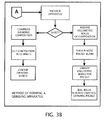
- FIG. 3B is a flow chart supplementing the flow chart in FIG. 3A illustrating a method for packaging a grinding apparatus for sharpening a paper shredder blade, in accordance with the teachings of the present invention.
- the embodiments herein provide examples of apparatus, compositions, and processes for preparing the compositions, that can be used to sharpen the blades of a paper shredder and that can be prepared in a straightforward manner using widely available raw materials, in light of the teachings herein.
- the apparatus may be, without limitation, in the form a grinding sheet or a grinding packet: (1) which can contain an embodiment of a grinding composition described herein; (2) which can grind and sharpen the paper shredder blades safely and effectively; or (3) which are easy to manage and use, without shredder disassembly by the shredder user.
- a preferred embodiment of the apparatus may exhibit all three characteristics.
- a grinding apparatus or grinding composition, or both, to a paper shredder in accordance with the present disclosure can be useful in maintaining good shredder performance and an extending service life, thus reducing costs. Because the shredder apparatus embodiments herein can be safe and easy to use, the embodiments can be suitable for widespread use, for example, in homes and in business offices.
- Grinding composition embodiments of the present invention provide grinding compositions for sharpening a paper shredder blade, each of which compositions can include preselected concentration of a selected grinding power; a preselected concentration of a selected thickener; and a preselected concentration of a selected additive. More than one additive may be used.
- a suitable selected additive can be one or more of the group consisting of a selected antirust powder, a selected antiwear powder, a selected antistatic powder, or a selected antioxidation powder.
- the grinding composition may be applied to grind and to keep sharp the paper shredder blade, and to remove shredder blade surface soiling including, without limitation, removing rust spots, minimizing blade stains, removing paper debris, and generally restoring the surface of the blades of the paper shredder.
- the grinding apparatus can be in the form of a grinding sheet, or a grinding packet. In accordance with a benefit of the present embodiments, it becomes unnecessary to open the paper shredder or to disassemble the shredder blade mechanism, to grind sharp the paper shredder blades. Both the grinding sheet and the grinding packet can be introduced directly to the paper shredder blades through the paper shredder feed opening.
- the shredder blade when the shredder blade shreds a grinding packet having therein a grinding composition for sharpening a paper shredder blade, as in the usual paper shredding process, the sealed bag of the grinding packet is cut open, and the grinding composition therein contacts, grinds, and sharpens the blade.
- Functional additives to the grinding composition can impart other desirable characteristics onto the shredder blade.
- the shredder blade when the shredder blade shreds a grinding sheet for sharpening a paper shredder blade, as in the usual paper shredding process, the grinding sheet is shredded and the grinding sheet grinding composition constituents therein contact, grind, and sharpen the shredder blade.
- Functional additives to the grinding composition can impart other desirable characteristics onto the shredder blade.
- a grinding material is an abrasive mineral material (equally, an abrasive material, or an "abrasive”), which can have a mineral hardness of between about 7 to about 10 on the Mohs scale.
- very hard materials for example, scoring between about 9 to about 10 on the Moh's scale, can include without limitation, corundum (Al 2 O 3 ), or silicon carbide (SiC), but can be costlier than natural quartz, natural micron diamond, or a commercial combination of natural quartz and natural micron diamond.
- a grinding powder can be constituted of one or more grinding materials.
- a grinding powder is a grinding material having a particle size of between about 0.1 micron to about 40 microns, although larger particle sizes, for example, up to about 70 microns, also may be used.
- a suitable grinding powder can have a hardness of between about 7 to about 10 on the Mohs Hardness scale ("Mohs" or "Mohs scale”).
- quartz grinding powder has a hardness of about 7 Mohs.
- Abrasive materials used in accordance with the teachings of the present invention are hard, non-metallic materials, which can be generally categorized as a natural abrasive or as a man-made (synthetic) abrasive.
- natural abrasives can include natural steel grit, natural corundum, natural diamond (diamond), natural quartz, garnet, flint, pumice, bacillariophyceae, or diatomaceous, earth, talc, gypsum, feldspar, chert, chalk, river sand, sea sand, atmosilicarenite, apatite, fluorite, calcite, or coal cinder. Because natural resources are growing limited, natural abrasives have been relegated to an alternative status relative to artificial, or synthetic, abrasives.
- Non-limiting examples of artificial or synthetic abrasives can include corundum, silicon carbide (i.e., carborundum), boron carbide, synthetic diamond (diamond), cubic boron nitride, alumina, fused mullite, dense corundum, spinel, ⁇ -alumina, glass sand, ceramic vermilion, or glass beads.
- Non-limiting examples of corundum can include brown fused alumina, white fused alumina, black fused alumina, alumina corundum, zirconium corundum, chromium corundum, crystal corundum, or corundum ceramics.
- Non-limiting examples of an alumina can include white alumina, brown alumina, or pink alumina.
- Non-limiting examples of a silicon carbide can include black silicon carbide or green silicon carbide.
- Artificial abrasives can be further divided into two segments: a super-hard abrasive or a general abrasive.
- Non-limiting examples of super-hard abrasives can include synthetic diamond (diamond), cubic boron nitride, or boron carbide.
- non-limiting examples of general abrasives can include a corundum, an alumina, a silicon carbide, fused mullite, dense corundum, spinel, ⁇ -alumina, glass beads, glass sand, ceramic cinnabar, or zirconia beads.
- grinding apparatus is intended to denote a grinding packet or a grinding sheet, made from a grinding composition, in accordance with the principles described herein.
- a thickening agent can be used (1) to prepare a complex sodium-calcium based soap grease powder; and (2) to thicken the grease powder to promote cohesion and prevent untimely separation of the grinding powder, from one or more of the antirust powder additive, the antistatic powder additive or the antioxidation powder additive.
- a suitable selected thickening agent can be one or more of the group consisting of a white oil, an animal oil, a vegetable oil, a white wax, a microcrystalline wax, a polyethylene (PE) wax, or a stearine wax.
- the stearine wax can be prepared by combining stearic acid with one or more of a white wax, a microcrystalline wax, or a polyethylene wax (PE wax).
- the stearic acid can be made from one or both of an animal or a vegetable fat.
- Additional suitable thickening agents also may be, without limitation, a cosmetic white wax oil, a light mineral oil, such as "baby oil.” It is desirable that thickening agents generally be fit for human contact, and may be capable of natural degradation.
- Antistatic powder additive may be applied to remove static, to prevent paper debris, retained powder, or other unwanted matter, from adhering to the paper shredder blades, which may impair the shredding function of the blades. Antistatic powder additive also may be applied to reduce generation of static charges or to effectively dissipate existing static charges.
- the antistatic powder additive can be coated on the surface of a product or added therein. Antistatic powder additive can reduce the risk of a paper powder dust explosion, which may result from electrical sparks generated by the shredder motor, or from a static charge spark, which may accumulate on the paper shredder enclosure.
- a suitable antistatic powder additive can be, without limitation, a glycerol monostearate powder.
- Antioxidation powder additive can be applied to inhibit the progress of oxidation and rusting of the paper shredder blade metal, and can avoid oxidative rancidity of stearine wax if used in the thickening agent. Desirably, the antioxidation powder additive is added prior to the onset of oxidative rancidity, because the oxidation cannot be substantially reduced once the oxidation reaction has occurred.
- a suitable antioxidation powder additive can be, without limitation, a dibutyl-hydroxytoluene (butylated hydroxytoluene) powder.
- Antiwear powder additive can be applied to prevent abrasion and bruising of the metal surface of the paper shredder blades and to reduce vibration noise.
- a suitable antiwear powder additive can be, without limitation, a microcrystalline wax, or a complex sodium-calcium based soap grease powder.
- a wear-resistant molding agent including without limitation, microcrystalline wax or complex sodium-calcium based soap grease may be applied to adhere to the shredder blade metal surface with good adsorbability and to combine with micron quartz powder to form a rigid protection film on the shredder blades to prolong blade life.
- the size of micron quartz powder is normally more than about 120 mesh, and can be used for polishing.
- Micron quartz powder is a grinding powder that can be combined thoroughly with other grinding powders in grinding composition including a wear-resistant molding agent.
- the grinding composition is to use between about 51% w/w to about 60% w/w of grinding powder
- the total % w/w concentration of all selected grinding powders including micron quartz powder used is preferred to be about 60% w/w. More the micron quartz powder can be used, although the concentration of other selected grinding powders in such embodiments would be decreased by similar measure.
- An antirust powder additive can be added to minimize the development of rust on the paper shredder blade.
- An antirust protection film can be coated on the paper shredder blade to prevent it from rusting, such that a stationary adhesion film is formed on the metal surface to prevent oxygen and water, especially water, from contacting the metal surface to prevent the metal from rusting.
- common mineral oil or vegetable oil alone tends to exhibit a weak adsorbability to the shredder blade metal surface.
- free radical energy on the metal surface can be in a range of between about 0.1 Newton/meter (N/m)) to about 1 N/m.
- Water has a surface tension of 8 ⁇ 10 -4 N/cm and the surface tension of a hydrocarbon, such as common mineral oil or vegetable oil, tends to range from about 2 ⁇ 10 -4 N/cm to about 3 ⁇ 10 -4 N/cm.
- common mineral oil or vegetable oil may form an unsuitable non-stationary oil film, because of the tendency of these oils to absorb and dissolve part of water and oxygen to which they may be exposed, allowing the oil film to be easily permeated.
- a suitable selected antirust powder additive can be, without limitation, a stearate powder, such as aluminum distearate.
- FIG. 1 is a perspective plan view of grinding sheet 100 (also called a grinding page), which may be formed of a selected grinding composition.
- a grinding composition may be viewed as grinding powder 2 intermixed in functional matrix 3.
- Functional matrix 3 can include at least one thickening agent, and at least one selected additive.
- Functional matrix 3 can be disposed in a wax-like form, which may facilitate economic manufacturing.
- FIG. 2 is an exploded cross-section view of grinding sheet 200, which may be similar to grinding sheet 100.
- Grinding sheet 100 can be formed such that plastic sheet 1 may enwraps functional matrix 3, for example, as shown in FIG. 2 .
- Plastic sheet 1 may be provided from a continuous roll of plastic sheet, from a continuous roll of a plastic sleeve, or from individual plastic sheeting containers. Furthermore, plastic sheet 1 may be fabricated from two or more layers, which may be sealed or laminated together.
- grinding packet 200 may be formed by laminating a plastic sheet 1 on opposing surfaces of formed grinding composition 2, 3.
- the size of the grinding sheet or grinding page may be formed as having a single page width as measured across a longitudinal aspect of a feed opening of a paper shredder.
- Grinding sheet length may be, for example, that of a standard Letter or A4 paper sheet, or may be formed to be longer or shorter, as found to be efficacious for a type of paper shredder.
- a width of a grinding sheet relative to a longitudinal aspect of a feed opening may be formed to be wider or narrower than the respective shredder feed opening.
- one constituent grinding composition material can be a thickening agent including stearine wax.
- Some embodiments of a grinding composition according to the teachings above may be constituted of between about 51% w/w to about 65% w/w of a selected grinding powder; between about 5% w/w to about 35% w/w of a selected thickening agent; and between about 3% w/w to about 30% w/w of a selected additive.
- a grinding powder in the concentration of about 55% w/w, an antirust powder additive in the concentration of about 5% w/w, an antiwear powder additive in the concentration of about 2% w/w, a thickening agent in the concentration of about 35% w/w, an antistatic powder additive in the concentration of about 2% w/w, and an antioxidation powder additive in the concentration of about 1% w/w.
- the thickening agent may be constituted of a white oil or a vegetable oil, or both.
- the concentration of a grinding powder may be about 57% w/w
- the concentration of a antirust powder may be about 5% w/w
- the concentration of a thickening agent may be about 35% w/w
- the concentration of the antistatic powder may be about 2% w/w
- the concentration of the antioxidation powder may be about 1 % w/w.
- the thickening agent can be stearine wax.
- a present method 300 for forming grinding sheet 100, 200 is illustrated in FIGS. 3A-3B , and can include: selecting (310) the constituent materials for a grinding composition of a grinding sheet for sharpening a paper shredder blade; stirring (320) the constituent grinding composition materials 2, 3; heating (330) the constituent grinding composition materials to effect melting; mixing (340) the constituent grinding composition materials, while melted to achieve a preselected intermixing thereof; cooling (350) the intermixed grinding composition materials; and enwrapping (360) the cooled intermixed grinding composition constituents to form one of a grinding sheet or a grinding packed,
- the method also may include one or both of compressing (370) the cooled intermixed grinding composition constituents, for example to form a flat grinding composition sheet, or cutting to size (380) the grinding composition sheets to the selected length and selected width.
- compressing 370
- the cooled intermixed grinding composition constituents for example to form a flat grinding composition sheet, or cutting to size (380) the grinding composition sheets to the
- enwrapping (360) for grinding apparatus for sharpening a paper shredder blade can include pre-measuring (365) a volumetric bolus of grinding composition into the shape of a packet.
- volumetric bolus describes a mass of material having a known volume.
- Process 300 may continue by forming (375) a grinding packet blank capable of receiving the volumetric bolus from at least one sheet of plastic film. Formation of the grinding packet can continue by enwrapping (385) the volumetric bolus of grinding composition within the plastic bag or plastic film, and by sealing (395) the volumetric bolus of grinding composition following enwrapping.
- a grinding packet can be a plastic sealed bag.
- a grinding packet can be a polypropylene sealed bag.
- the plastic film can be a polypropylene plastic film.
- Sealing (395) may be effected, for example, by sealing at least a portion of the respective periphery of two opposite sidewalls of plastic sheeting containing therein the volumetric bolus of grinding composition.
- some embodiments of a grinding packet may be formed from a sealable plastic bag.
- a grinding sheet may be disposed in a sealed plastic bag, a sealable plastic bag, or a non-sealed plastic bag.
- a present method for forming a grinding packet for sharpening a paper shredder blade can be performed by an automatic filling machine for making bags, such as, without limitation, an automatic forming, filling, and sealing (FFS) machine.
- the FFS machine may have a feed channel for pre-measuring (365) a volumetric bolus of a grinding composition to be deposited on a sheet portion intended to become a grinding packet.
- method 300 for forming a grinding packet can include: shift positioning (362) a roll of a plastic film on the FFS machine; feeding (364) into a feed channel of the FFS machine a selected grinding composition for sharpening a paper shredder blade; forming (375) a grinding packet blank having the predetermined width and predetermined length; depositing (384) a volumetric bolus of the selected grinding composition into the grinding packet blank; enwrapping (385) the volumetric bolus with the grinding packet blank; sealing (395) at least a portion of a periphery of grinding packet blank containing the volumetric bolus of the selected grinding composition held therein; and finishing (398) the filled packet blank to form a sealed grinding packet.
- the polypropylene plastic film, or bag can be made from oriented polypropylene (OPP), cast polypropylene (CPP), or, desirably, from a combination of OPP and CPP films (e.g., OPP.CPP film).
- OPP.CPP film whose main element is polypropylene plastic, is recyclable, can be completely combusted, does not generate a toxic gas during incineration, and does not degrade the use life of an incinerator, reducing both secondary pollution and higher recycling costs.
- At least one character, a picture, or a symbol characters and/or pictures can be imposed on the plastic film in advance of forming the grinding packet using, without limitation, a single-color printing technique or a chromatography technique.
- preparation of at least a portion of the grinding composition can be performed proximate to the FFS machine approximately simultaneously with the feeding into the feed channel, or the grinding composition may be pre-mixed and, in some cases, may be pre-measured as a volumetric bolus prior to feeding.
- the required filling concentration of the grinding composition for sharpening a paper shredder blade may be adjusted during a grinding packet forming process, as may the width and length of the finished plastic package.
- Example Process I Two Example Processes, namely Example Process I and Example Process II, are provided below to further illustrate the principles of producing a grinding composition, in accordance with present teachings.
- the example first process for preparing a grinding packet for sharpening a paper shredder blade can be performed in a working environment having a room temperature between about 20°C and about 30°C, and having a relative humidity of between about 60% and about 70%.
- Example Process I can include making a complex sodium-calcium based soap grease using an oil mixture, having about 20% grease in the total oil amount, and an alkaline substance, to form a solution in a reaction container.
- the grease can be composed of animal grease, vegetable grease, or a combination of animal grease and vegetable grease.
- the alkaline substance can be, without limitation, one or more of sodium hydroxide, calcium hydroxide, or calcium acetate. Mixing the oil mixture with the alkaline substance can cause hydrolysis of the fats in the grease and oils to occur, producing glycerol and a soap. This hydrolysis process commonly known as a saponification reaction. A saponification reaction is a slow, exothermic chemical reaction.
- a relatively high temperature such as between about 75°C to about 85°C may be maintained in the reaction container during the chemical reaction process, and the solution can be stirred substantially continuously, for example, at between about 1,000 revolutions/min to about 1200 r/min, to increase the number of molecular collisions between constituents of the solution in the reaction container.
- a chemical formula for triglyceride is:
- a triglyceride can be composed of three molecules of a fatty acid (R-COOH) and one molecule of glycerol (C 3 H 5 (OH)). Therefore, an equation of the saponification reaction can be:
- R-COONa is a soap base of sodium aliphatate
- R- can be one of:
- grease is a monounsaturated fatty acid, and can be obtained, for example, by hydrolyzing oil. Palmitic acid and stearic acid are both saturated fatty acids, and each may be obtained by hydrolyzing fat.
- Complex sodium-calcium based soap grease like a sponge, can absorb a large amount of grinding powder 2 and remain in a semi-solid state.
- Sodium-calcium based soap grease exhibits desirable water and temperature tolerance, and good antiwear properties.
- the dropping point of a grease is the temperature at which the grease begins to liquefy and becomes fluid enough to drip.
- the dropping point of the complex sodium-calcium based soap grease is at about 1 50°C; however, it may be used in a temperature range of between about 100°C to about 30°C.
- the complex sodium-calcium based soap grease displays strong adsorbability to metal, and can be combined with a micron quartz powder to form an antiwear film on the shredder blade metal.
- the concentration of the soap grease in the grinding composition there can be a positive correlation between the concentration of the soap grease in the grinding composition and its thickness.
- the grinding composition tends to exhibit increasing thickness.
- the grinding composition tends to exhibit decreasing thickness.
- one technique to adjust the thickness of a particular grinding composition is to adjust the concentration of complex sodium-calcium based soap grease included in the grinding composition.
- Use of the aforementioned optimized parameters may shorten saponification time to 45 minutes, after which substantially continuous stirring may be performed until the soap cools, for example, to room temperature.
- a suitable cooling system may be used to accelerate cooling.
- One or more thickening additive constituents may be added to the complex sodium-calcium based soap grease. Suitable thickening additive constituents may include one or more of a white oil, an animal oil, or a vegetable oil. Grinding powder 2 may be intermixed until substantially evenly diffused in the complex sodium-calcium based soap grease mixture, to obtain a gel in a semi-solid state.
- Mixing may be performed using a two-channel mixer, having an A-channel and a B-channel. Grinding powder 2 can be sieved to reduce the likelihood of the powder deliquescing from contact with ambient moisture, which may lead to undesirable grinding powder agglomeration.
- complex sodium-calcium based soap grease may be placed in A-channel and be substantially continuously stirred by a stirring machine at a rate of between about 100 r/min. to about 1200 r/min.
- a substantial portion of one or more thickening agents, for example 80%, may be held in B-channel, while a selected additive 3 is be diffused in B channel.
- the grease mixture in B-channel may be fast-stirred by the stirring machine at a rate of between about 3000 r/min and about 4000 r/min to promote substantially complete dissolution of the selected additive into the B-channel mixture.
- the grease mixture in B-channel may be added slowly into A-channel and may be substantially continuously stirred until the grease mixture is completely dissolved into a paste.
- a non-limiting example of the slow adding of B-channel constituent into A-channel constituent can be adding B-channel constituent at a speed of about 10% of the total oil amount per minute into A-channel constituent.
- grinding powder 2 may be dispersedly added, for example, using substantially continuous stirring, to produce a semi-solid gel.
- the semi-solid gel in A-channel may be spirally propelled into a feed channel of an FFS machine for making bags, such that finished grinding packets are prepared in accordance with the teachings herein.
- a grinding sheet for sharpening a paper shredder blade can be prepared by a second example process, in which non-limiting example of a suitable working environment can be characterized, at least in part, by having an ambient temperature between about 20°C to about 30°C. Also, relative humidity in the working environment can be between about 60% to about 70%.
- Stearic acid may be made from an animal fat, or by a vegetable fat, or by a suitable combination of animal fat and vegetable fat.
- the stearic acid may be placed in a single-channel stirring bucket capable bi-directional gear shifted stirring bucket.
- the stirring bucket may be maintained at a temperature of about 200 °C, using, for example, an adjustable temperature cycling kerosene heater.
- One or more of a white wax, a microcrystalline wax, or a PE wax may be mixed into the channel. After wax is substantially completely dissolved in the channel, the bucket temperature may be lowered to about 150°C and may be stirred at a speed of between about 1000 r/min. to about1200 r/min.
- a selected additive may be added to the stirring bucket mixture and stirred until dissolved.
- Previously-sieved grinding powder 2 may be added to the stirring machine bucket, with the stirrer being adjusted to stir the mixture at a speed of between about 2000 r/min. to about 2500) r/min.
- the stirring pot mixture may be maintained at a temperature of about 20°C, with the stirring machine being adjusted to stir the mixture at a speed of between about 1000 r/min. to about 1200 r/min.
- the mixture may be sent thereafter to a cooling system, for example, via a heat-insulated, compressed air transmission line.
- the cooling system if used, may employ cooling water cycling, in which the grinding composition mixture may be deposited on a grooved metal transfer sheet having a surface covered with PTFE. After the mixture is cooled, it may be compressed to a preselected thickness, and may be cut into sheets having a selected width and a selected length.
- a cutter employing a gear shift motor transmission set may be used to cut the grinding composition into wax-like sheets.
- the solid wax-like grinding composition sheets may be sent to a automatic planing machine to finish the form of the grinding sheet, for example, to a preselected thickness.
- One or more formed grinding composition sheets may be packaged into a non-sealed bag, or an unsealed bag which may be sealable. Grinding composition sheets may be "stacked" in that the more than one layer of grinding composition sheet may be laminated together to achieve, for example, a preselected thickness.
- grinding apparatus 100, 200 may be made (400) by: shift positioning (410) a roll of laminated plastic film on an automatic filling and bagging machine; feeding (420) a grinding composition for sharpening a paper shredder blade into a feed channel of the automatic filling and bagging machine; reserving (430) from the feed channel a preselected bolus volume of grinding composition; preparing (440) a receiver from the roll of laminated plastic for the bolus volume having a preselected width and a preselected length; dispensing (450) the bolus volume of the grinding composition into the receiver, and enwrapping (460) the bolus volume by sealing the bolus volume in the receiver such that one of a grinding packet or a grinding sheet is formed.
- a grinding sheet can be packaged in a manner similar to the aforementioned process to produce a sealed package.
- a grinding sheet may be packed in a non-sealed package, or an unsealed but sealable package.
- the grinding sheets can be separated from each other with the environment friendly materials such as common paper, release paper, plastic film paper, powders, etc.
- Example Formulations 1-5 of grinding composition may be used to make grinding apparatus 200, although each of the Example Formulations is meant to be illustrative and non-limiting.
- Example Formulation 1 may be formed by combining the constituents described in TABLE 2, using Example Process II , above.
- Example Formulation 2 may be formed by combining the constituents described in TABLE 3, using Examole Process I , above.
- Example Formulation 3 may be formed by combining the constituents described in TABLE 4, using Example Process II , above.
- Example Formulation 4 may be formed by combining the constituents described in TABLE 5, using Example Process II , above.
- Example Formulation 5 may be formed by combining the constituents described in TABLE 6, using Example Process I , above.
- a grinding packet for sharpening a paper shredder blade is formed to be easy to use, and can be directly inserted into the paper feed opening of a paper shredder. Similar to the shredding process for paper, when the rotating blade of the paper shredder cuts the grinding packet, the sealed bag is cut open. When opened, the grinding packet contents are released, at least in part, onto the paper shredder blades. According to the pressure principle, the grinding powder released from the sealed bag grinds at both sides of a rotating shredder blade, thereby sharpening it. Further, an antirust protection coating film is formed by a functional antirust additive which may be included in the grinding composition.
- an antioxidation additive or antistatic additive, or both, which may be included in the grinding composition can enhance the respective antioxidation and antistatic properties of the paper shredder blade.
- the shredded grinding packet can be disposed in the shredder waste bin.
- functional additives included within the grinding packet also can provide the function of paper shredder maintenance apart from grinding and sharpening the paper shredder blade.
- a grinding sheet for sharpening a paper shredder blade may be employed simply by inserting at least one grinding sheet into a paper shredder feed opening, as one would feed a sheet of ordinary paper to the shredder.
- the grinding constituent can grind and sharpen a paper shredder blade, while functional additives perform maintenance functions on the shredder blade mechanism.
Landscapes
- Engineering & Computer Science (AREA)
- Mechanical Engineering (AREA)
- Chemical & Material Sciences (AREA)
- Manufacturing & Machinery (AREA)
- Materials Engineering (AREA)
- Organic Chemistry (AREA)
- Crushing And Pulverization Processes (AREA)
- Paper (AREA)
- Compositions Of Macromolecular Compounds (AREA)
- Crushing And Grinding (AREA)
Applications Claiming Priority (2)
| Application Number | Priority Date | Filing Date | Title |
|---|---|---|---|
| CN200910056439A CN101624511B (zh) | 2009-08-14 | 2009-08-14 | 碎纸机刀片锋利研磨组合物、由其制造的研磨片、研磨包和相关制造工艺 |
| US12/837,377 US8684797B2 (en) | 2009-08-14 | 2010-07-15 | Apparatus and composition for sharpening a paper shredder blade |
Publications (3)
| Publication Number | Publication Date |
|---|---|
| EP2295201A2 true EP2295201A2 (de) | 2011-03-16 |
| EP2295201A3 EP2295201A3 (de) | 2012-12-26 |
| EP2295201B1 EP2295201B1 (de) | 2018-02-28 |
Family
ID=41520508
Family Applications (1)
| Application Number | Title | Priority Date | Filing Date |
|---|---|---|---|
| EP10172274.2A Active EP2295201B1 (de) | 2009-08-14 | 2010-08-09 | Vorrichtung und zusammensetzung zum schärfen einer papierschneidklinge sowie herstellungsverfahren dafür |
Country Status (3)
| Country | Link |
|---|---|
| US (4) | US8684797B2 (de) |
| EP (1) | EP2295201B1 (de) |
| CN (1) | CN101624511B (de) |
Families Citing this family (7)
| Publication number | Priority date | Publication date | Assignee | Title |
|---|---|---|---|---|
| CN102990536B (zh) * | 2012-12-26 | 2015-06-24 | 冉许润 | 磨刀皮 |
| USD774889S1 (en) * | 2015-04-13 | 2016-12-27 | FA Inc. | Package |
| CN105778862A (zh) * | 2016-04-08 | 2016-07-20 | 云南民族大学 | 一种易清洗的金刚石研磨膏及其制备方法 |
| CN106181793A (zh) * | 2016-07-12 | 2016-12-07 | 苏州普茨迈精密设备有限公司 | 磨粒流体弹性磨料配方及制作加工工艺 |
| CN107663422B (zh) * | 2016-07-29 | 2020-08-11 | 蓝思科技股份有限公司 | 一种陶瓷抛光研磨液 |
| US10961045B1 (en) | 2017-05-04 | 2021-03-30 | Xpresspax, Inc. | Document console |
| CN112517186B (zh) * | 2020-11-25 | 2025-10-21 | 上海震旦办公设备有限公司 | 一种碎纸机用自清洁研磨润滑包 |
Family Cites Families (27)
| Publication number | Priority date | Publication date | Assignee | Title |
|---|---|---|---|---|
| US2828261A (en) * | 1954-02-08 | 1958-03-25 | Standard Oil Co | Inorganic gel-thickened lubricant having good temperature susceptibility and dynamicwater stability characteristics |
| EP0104679B1 (de) * | 1982-09-01 | 1989-08-09 | Unilever N.V. | Abrasive Agglomerate zur Verwendung in scheuernden Reinigungsmitteln |
| DE8702207U1 (de) * | 1987-02-13 | 1987-06-19 | Alois Zettler Elektrotechnische Fabrik GmbH, 8000 München | Schmiermittelträger zum Schmieren von Schneidwerken insbesondere in Schriftgutvernichtern |
| US4891265A (en) | 1988-11-15 | 1990-01-02 | Xlnow Trading Corporation | Packaged sheet for cleaning facsimile machines |
| US5279755A (en) * | 1991-09-16 | 1994-01-18 | The Clorox Company | Thickening aqueous abrasive cleaner with improved colloidal stability |
| JPH11513620A (ja) * | 1995-10-20 | 1999-11-24 | ミネソタ・マイニング・アンド・マニュファクチャリング・カンパニー | 無機金属オルトリン酸塩を含有する研磨物品 |
| US6048677A (en) * | 1998-12-28 | 2000-04-11 | Eastman Kodak Company | Abrasive lubricant layer for photographic element |
| US6419174B1 (en) * | 2000-08-18 | 2002-07-16 | J. M. Huber Corporation | Abrasive compositions and methods for making same |
| JP4969761B2 (ja) * | 2000-08-31 | 2012-07-04 | オバン・エナジー・リミテッド | 所望粒度を持つ固体基材の小粒子および第一材料の小粒状物を含む相乗作用性混合物を製造する方法 |
| CN1100104C (zh) * | 2000-12-01 | 2003-01-29 | 清华大学 | 纳米级抛光液及其制备方法 |
| JP3921056B2 (ja) * | 2001-03-13 | 2007-05-30 | 善二郎 小柳津 | 弾性発泡砥石材及びその製造方法 |
| US8109455B2 (en) * | 2003-10-23 | 2012-02-07 | Buttercup Legacy, Llc | Delivery of agents to the cutting mechanism of paper shredders |
| US7902129B2 (en) * | 2003-10-23 | 2011-03-08 | Buttercup Legacy, Llc | Delivery of agents to the cutting mechanism of paper shredders |
| US7166561B2 (en) | 2003-10-23 | 2007-01-23 | Buttercup Legacy, Llc | Lubricant-carrying substrate for maintenance of paper shredders |
| US20060169619A1 (en) | 2005-01-19 | 2006-08-03 | Michilin Prosperity Co., Ltd. | Lubricating pack specifically designed for paper shredders |
| US20060243631A1 (en) | 2005-04-20 | 2006-11-02 | Duke Derek A | Method and apparatus for lubricating a shredding device |
| US7387270B2 (en) * | 2005-07-14 | 2008-06-17 | Michilin Prosperity Co., Ltd. | Lubricating pack having venting holes and specifically designed for paper shredders |
| US20070080252A1 (en) | 2005-08-19 | 2007-04-12 | Seanet Development, Inc. | Shredder maintenance material delivery system |
| CN2917792Y (zh) * | 2006-05-15 | 2007-07-04 | 柯约瑟 | 小型便携式碎纸机 |
| TWI402335B (zh) * | 2006-09-08 | 2013-07-21 | Kao Corp | 研磨液組合物 |
| US20090032006A1 (en) * | 2007-07-31 | 2009-02-05 | Chul Woo Nam | Wire saw process |
| US8404009B2 (en) * | 2007-10-29 | 2013-03-26 | Kao Corporation | Polishing composition for hard disk substrate |
| US8986407B2 (en) * | 2008-04-18 | 2015-03-24 | Saint-Gobain Abrasives, Inc. | High porosity abrasive articles and methods of manufacturing same |
| USD601434S1 (en) | 2008-05-16 | 2009-10-06 | Yulian Zhu | Lubricant bag for paper shredder |
| US20110171890A1 (en) * | 2008-08-08 | 2011-07-14 | Kuraray Co., Ltd. | Polishing pad and method for manufacturing the polishing pad |
| CN101392149B (zh) * | 2008-10-07 | 2011-08-17 | 江门市瑞期精细化学工程有限公司 | 水溶性固体抛光蜡 |
| US8084409B2 (en) * | 2009-04-21 | 2011-12-27 | Bella Bella, Inc. | Microdermabrasion soap bar compositions and methods of preparing same |
-
2009
- 2009-08-14 CN CN200910056439A patent/CN101624511B/zh active Active
-
2010
- 2010-07-15 US US12/837,377 patent/US8684797B2/en active Active
- 2010-08-09 EP EP10172274.2A patent/EP2295201B1/de active Active
- 2010-08-13 US US12/856,571 patent/US20110039478A1/en not_active Abandoned
-
2013
- 2013-04-12 US US13/862,106 patent/US8568498B2/en active Active
- 2013-04-12 US US13/862,255 patent/US20130227894A1/en not_active Abandoned
Non-Patent Citations (1)
| Title |
|---|
| None |
Also Published As
| Publication number | Publication date |
|---|---|
| US20130227894A1 (en) | 2013-09-05 |
| CN101624511B (zh) | 2012-08-29 |
| CN101624511A (zh) | 2010-01-13 |
| US8568498B2 (en) | 2013-10-29 |
| US20110039478A1 (en) | 2011-02-17 |
| US20110039483A1 (en) | 2011-02-17 |
| US20130227893A1 (en) | 2013-09-05 |
| US8684797B2 (en) | 2014-04-01 |
| EP2295201A3 (de) | 2012-12-26 |
| EP2295201B1 (de) | 2018-02-28 |
Similar Documents
| Publication | Publication Date | Title |
|---|---|---|
| US8568498B2 (en) | Method for preparing a grinding composition | |
| KR101318133B1 (ko) | 개선된 형상을 지닌 용융 지르코니아 알루미나 지립을 포함하는 연마 제품 | |
| AU734039B2 (en) | Bonded abrasive articles filled with oil/wax mixture | |
| CA1184041A (en) | Metal bonded grinding wheel containing diamond or cbn abrasive | |
| CN211412234U (zh) | 一种新型微磨粉装置 | |
| Niu et al. | Lapping performance of mixed-size agglomerated diamond abrasives in fixed abrasives pads | |
| US5061295A (en) | Grinding wheel abrasive composition | |
| TWI471196B (zh) | 用於高速磨削操作之磨料物品 | |
| JP5905604B2 (ja) | 研磨物品の形成方法 | |
| US7452814B2 (en) | Method of polishing GaN substrate | |
| CN108913036A (zh) | 一种人造石研磨光亮剂及其制备方法和应用方法 | |
| TWI470069B (zh) | 用於高速磨削操作之磨料物品 | |
| TWI299059B (en) | A texturing composition | |
| JPS62297062A (ja) | ラツプ剤組成物およびその製造方法 | |
| WO2004061040A1 (ja) | 立方晶窒化ホウ素砥粒及びその製造方法並びにそれを用いた砥石及び研磨布紙 | |
| CN206230368U (zh) | 蓝宝石基板研磨装置 | |
| US3158971A (en) | Surfacing plate glass | |
| JPS61261386A (ja) | 砥粒分散型スラリ−状ラツピング・ポリツシング潤滑剤 | |
| JP5476666B2 (ja) | 切削研削用組成物、切削研削油剤、切削研削用ホイール及び表面改質材 | |
| JP2002012856A (ja) | ダイヤモンド含有研磨用加工液組成物 | |
| US2347597A (en) | Diamond abrasive stick | |
| UA18929U (en) | Composition for polishing products of plastics | |
| JPS6059176B2 (ja) | 皮膚の厚皮等の擦過具の製造方法 | |
| JP2931567B2 (ja) | 流動性研磨材 | |
| UA102940C2 (uk) | Полірувальна суспензія та спосіб фінішної прецизійної обробки деталей з сапфіру |
Legal Events
| Date | Code | Title | Description |
|---|---|---|---|
| PUAI | Public reference made under article 153(3) epc to a published international application that has entered the european phase |
Free format text: ORIGINAL CODE: 0009012 |
|
| AK | Designated contracting states |
Kind code of ref document: A2 Designated state(s): AL AT BE BG CH CY CZ DE DK EE ES FI FR GB GR HR HU IE IS IT LI LT LU LV MC MK MT NL NO PL PT RO SE SI SK SM TR |
|
| AX | Request for extension of the european patent |
Extension state: BA ME RS |
|
| PUAL | Search report despatched |
Free format text: ORIGINAL CODE: 0009013 |
|
| AK | Designated contracting states |
Kind code of ref document: A3 Designated state(s): AL AT BE BG CH CY CZ DE DK EE ES FI FR GB GR HR HU IE IS IT LI LT LU LV MC MK MT NL NO PL PT RO SE SI SK SM TR |
|
| AX | Request for extension of the european patent |
Extension state: BA ME RS |
|
| RIC1 | Information provided on ipc code assigned before grant |
Ipc: B24D 99/00 20100101ALI20121122BHEP Ipc: B24D 11/00 20060101ALI20121122BHEP Ipc: B24D 3/34 20060101AFI20121122BHEP |
|
| 17P | Request for examination filed |
Effective date: 20130626 |
|
| RBV | Designated contracting states (corrected) |
Designated state(s): AL AT BE BG CH CY CZ DE DK EE ES FI FR GB GR HR HU IE IS IT LI LT LU LV MC MK MT NL NO PL PT RO SE SI SK SM TR |
|
| 17Q | First examination report despatched |
Effective date: 20151109 |
|
| GRAP | Despatch of communication of intention to grant a patent |
Free format text: ORIGINAL CODE: EPIDOSNIGR1 |
|
| INTG | Intention to grant announced |
Effective date: 20170425 |
|
| RIN1 | Information on inventor provided before grant (corrected) |
Inventor name: CHEN, HSIN-HSIUNG |
|
| GRAS | Grant fee paid |
Free format text: ORIGINAL CODE: EPIDOSNIGR3 |
|
| GRAA | (expected) grant |
Free format text: ORIGINAL CODE: 0009210 |
|
| AK | Designated contracting states |
Kind code of ref document: B1 Designated state(s): AL AT BE BG CH CY CZ DE DK EE ES FI FR GB GR HR HU IE IS IT LI LT LU LV MC MK MT NL NO PL PT RO SE SI SK SM TR |
|
| REG | Reference to a national code |
Ref country code: GB Ref legal event code: FG4D Ref country code: CH Ref legal event code: EP |
|
| REG | Reference to a national code |
Ref country code: AT Ref legal event code: REF Ref document number: 973603 Country of ref document: AT Kind code of ref document: T Effective date: 20180315 |
|
| REG | Reference to a national code |
Ref country code: IE Ref legal event code: FG4D |
|
| REG | Reference to a national code |
Ref country code: DE Ref legal event code: R096 Ref document number: 602010048777 Country of ref document: DE |
|
| REG | Reference to a national code |
Ref country code: NL Ref legal event code: MP Effective date: 20180228 |
|
| REG | Reference to a national code |
Ref country code: LT Ref legal event code: MG4D |
|
| REG | Reference to a national code |
Ref country code: AT Ref legal event code: MK05 Ref document number: 973603 Country of ref document: AT Kind code of ref document: T Effective date: 20180228 |
|
| PG25 | Lapsed in a contracting state [announced via postgrant information from national office to epo] |
Ref country code: CY Free format text: LAPSE BECAUSE OF FAILURE TO SUBMIT A TRANSLATION OF THE DESCRIPTION OR TO PAY THE FEE WITHIN THE PRESCRIBED TIME-LIMIT Effective date: 20180228 Ref country code: ES Free format text: LAPSE BECAUSE OF FAILURE TO SUBMIT A TRANSLATION OF THE DESCRIPTION OR TO PAY THE FEE WITHIN THE PRESCRIBED TIME-LIMIT Effective date: 20180228 Ref country code: LT Free format text: LAPSE BECAUSE OF FAILURE TO SUBMIT A TRANSLATION OF THE DESCRIPTION OR TO PAY THE FEE WITHIN THE PRESCRIBED TIME-LIMIT Effective date: 20180228 Ref country code: NL Free format text: LAPSE BECAUSE OF FAILURE TO SUBMIT A TRANSLATION OF THE DESCRIPTION OR TO PAY THE FEE WITHIN THE PRESCRIBED TIME-LIMIT Effective date: 20180228 Ref country code: HR Free format text: LAPSE BECAUSE OF FAILURE TO SUBMIT A TRANSLATION OF THE DESCRIPTION OR TO PAY THE FEE WITHIN THE PRESCRIBED TIME-LIMIT Effective date: 20180228 Ref country code: NO Free format text: LAPSE BECAUSE OF FAILURE TO SUBMIT A TRANSLATION OF THE DESCRIPTION OR TO PAY THE FEE WITHIN THE PRESCRIBED TIME-LIMIT Effective date: 20180528 Ref country code: FI Free format text: LAPSE BECAUSE OF FAILURE TO SUBMIT A TRANSLATION OF THE DESCRIPTION OR TO PAY THE FEE WITHIN THE PRESCRIBED TIME-LIMIT Effective date: 20180228 |
|
| REG | Reference to a national code |
Ref country code: FR Ref legal event code: PLFP Year of fee payment: 9 |
|
| PG25 | Lapsed in a contracting state [announced via postgrant information from national office to epo] |
Ref country code: BG Free format text: LAPSE BECAUSE OF FAILURE TO SUBMIT A TRANSLATION OF THE DESCRIPTION OR TO PAY THE FEE WITHIN THE PRESCRIBED TIME-LIMIT Effective date: 20180528 Ref country code: GR Free format text: LAPSE BECAUSE OF FAILURE TO SUBMIT A TRANSLATION OF THE DESCRIPTION OR TO PAY THE FEE WITHIN THE PRESCRIBED TIME-LIMIT Effective date: 20180529 Ref country code: LV Free format text: LAPSE BECAUSE OF FAILURE TO SUBMIT A TRANSLATION OF THE DESCRIPTION OR TO PAY THE FEE WITHIN THE PRESCRIBED TIME-LIMIT Effective date: 20180228 Ref country code: AT Free format text: LAPSE BECAUSE OF FAILURE TO SUBMIT A TRANSLATION OF THE DESCRIPTION OR TO PAY THE FEE WITHIN THE PRESCRIBED TIME-LIMIT Effective date: 20180228 Ref country code: SE Free format text: LAPSE BECAUSE OF FAILURE TO SUBMIT A TRANSLATION OF THE DESCRIPTION OR TO PAY THE FEE WITHIN THE PRESCRIBED TIME-LIMIT Effective date: 20180228 |
|
| PG25 | Lapsed in a contracting state [announced via postgrant information from national office to epo] |
Ref country code: PL Free format text: LAPSE BECAUSE OF FAILURE TO SUBMIT A TRANSLATION OF THE DESCRIPTION OR TO PAY THE FEE WITHIN THE PRESCRIBED TIME-LIMIT Effective date: 20180228 Ref country code: AL Free format text: LAPSE BECAUSE OF FAILURE TO SUBMIT A TRANSLATION OF THE DESCRIPTION OR TO PAY THE FEE WITHIN THE PRESCRIBED TIME-LIMIT Effective date: 20180228 Ref country code: RO Free format text: LAPSE BECAUSE OF FAILURE TO SUBMIT A TRANSLATION OF THE DESCRIPTION OR TO PAY THE FEE WITHIN THE PRESCRIBED TIME-LIMIT Effective date: 20180228 Ref country code: IT Free format text: LAPSE BECAUSE OF FAILURE TO SUBMIT A TRANSLATION OF THE DESCRIPTION OR TO PAY THE FEE WITHIN THE PRESCRIBED TIME-LIMIT Effective date: 20180228 Ref country code: EE Free format text: LAPSE BECAUSE OF FAILURE TO SUBMIT A TRANSLATION OF THE DESCRIPTION OR TO PAY THE FEE WITHIN THE PRESCRIBED TIME-LIMIT Effective date: 20180228 |
|
| REG | Reference to a national code |
Ref country code: DE Ref legal event code: R097 Ref document number: 602010048777 Country of ref document: DE |
|
| PG25 | Lapsed in a contracting state [announced via postgrant information from national office to epo] |
Ref country code: CZ Free format text: LAPSE BECAUSE OF FAILURE TO SUBMIT A TRANSLATION OF THE DESCRIPTION OR TO PAY THE FEE WITHIN THE PRESCRIBED TIME-LIMIT Effective date: 20180228 Ref country code: DK Free format text: LAPSE BECAUSE OF FAILURE TO SUBMIT A TRANSLATION OF THE DESCRIPTION OR TO PAY THE FEE WITHIN THE PRESCRIBED TIME-LIMIT Effective date: 20180228 Ref country code: SM Free format text: LAPSE BECAUSE OF FAILURE TO SUBMIT A TRANSLATION OF THE DESCRIPTION OR TO PAY THE FEE WITHIN THE PRESCRIBED TIME-LIMIT Effective date: 20180228 Ref country code: SK Free format text: LAPSE BECAUSE OF FAILURE TO SUBMIT A TRANSLATION OF THE DESCRIPTION OR TO PAY THE FEE WITHIN THE PRESCRIBED TIME-LIMIT Effective date: 20180228 |
|
| PLBE | No opposition filed within time limit |
Free format text: ORIGINAL CODE: 0009261 |
|
| STAA | Information on the status of an ep patent application or granted ep patent |
Free format text: STATUS: NO OPPOSITION FILED WITHIN TIME LIMIT |
|
| 26N | No opposition filed |
Effective date: 20181129 |
|
| PG25 | Lapsed in a contracting state [announced via postgrant information from national office to epo] |
Ref country code: SI Free format text: LAPSE BECAUSE OF FAILURE TO SUBMIT A TRANSLATION OF THE DESCRIPTION OR TO PAY THE FEE WITHIN THE PRESCRIBED TIME-LIMIT Effective date: 20180228 |
|
| PG25 | Lapsed in a contracting state [announced via postgrant information from national office to epo] |
Ref country code: MC Free format text: LAPSE BECAUSE OF FAILURE TO SUBMIT A TRANSLATION OF THE DESCRIPTION OR TO PAY THE FEE WITHIN THE PRESCRIBED TIME-LIMIT Effective date: 20180228 |
|
| REG | Reference to a national code |
Ref country code: CH Ref legal event code: PL |
|
| PG25 | Lapsed in a contracting state [announced via postgrant information from national office to epo] |
Ref country code: LU Free format text: LAPSE BECAUSE OF NON-PAYMENT OF DUE FEES Effective date: 20180809 Ref country code: LI Free format text: LAPSE BECAUSE OF NON-PAYMENT OF DUE FEES Effective date: 20180831 Ref country code: CH Free format text: LAPSE BECAUSE OF NON-PAYMENT OF DUE FEES Effective date: 20180831 |
|
| REG | Reference to a national code |
Ref country code: BE Ref legal event code: MM Effective date: 20180831 |
|
| REG | Reference to a national code |
Ref country code: IE Ref legal event code: MM4A |
|
| PG25 | Lapsed in a contracting state [announced via postgrant information from national office to epo] |
Ref country code: IE Free format text: LAPSE BECAUSE OF NON-PAYMENT OF DUE FEES Effective date: 20180809 |
|
| PG25 | Lapsed in a contracting state [announced via postgrant information from national office to epo] |
Ref country code: BE Free format text: LAPSE BECAUSE OF NON-PAYMENT OF DUE FEES Effective date: 20180831 |
|
| PG25 | Lapsed in a contracting state [announced via postgrant information from national office to epo] |
Ref country code: MT Free format text: LAPSE BECAUSE OF NON-PAYMENT OF DUE FEES Effective date: 20180809 |
|
| PG25 | Lapsed in a contracting state [announced via postgrant information from national office to epo] |
Ref country code: TR Free format text: LAPSE BECAUSE OF FAILURE TO SUBMIT A TRANSLATION OF THE DESCRIPTION OR TO PAY THE FEE WITHIN THE PRESCRIBED TIME-LIMIT Effective date: 20180228 |
|
| PG25 | Lapsed in a contracting state [announced via postgrant information from national office to epo] |
Ref country code: HU Free format text: LAPSE BECAUSE OF FAILURE TO SUBMIT A TRANSLATION OF THE DESCRIPTION OR TO PAY THE FEE WITHIN THE PRESCRIBED TIME-LIMIT; INVALID AB INITIO Effective date: 20100809 Ref country code: PT Free format text: LAPSE BECAUSE OF FAILURE TO SUBMIT A TRANSLATION OF THE DESCRIPTION OR TO PAY THE FEE WITHIN THE PRESCRIBED TIME-LIMIT Effective date: 20180228 |
|
| PG25 | Lapsed in a contracting state [announced via postgrant information from national office to epo] |
Ref country code: MK Free format text: LAPSE BECAUSE OF NON-PAYMENT OF DUE FEES Effective date: 20180228 |
|
| PG25 | Lapsed in a contracting state [announced via postgrant information from national office to epo] |
Ref country code: IS Free format text: LAPSE BECAUSE OF FAILURE TO SUBMIT A TRANSLATION OF THE DESCRIPTION OR TO PAY THE FEE WITHIN THE PRESCRIBED TIME-LIMIT Effective date: 20180628 |
|
| PGFP | Annual fee paid to national office [announced via postgrant information from national office to epo] |
Ref country code: DE Payment date: 20240902 Year of fee payment: 15 |
|
| PGFP | Annual fee paid to national office [announced via postgrant information from national office to epo] |
Ref country code: GB Payment date: 20240827 Year of fee payment: 15 |
|
| PGFP | Annual fee paid to national office [announced via postgrant information from national office to epo] |
Ref country code: FR Payment date: 20240827 Year of fee payment: 15 |
|
| REG | Reference to a national code |
Ref country code: DE Ref legal event code: R119 Ref document number: 602010048777 Country of ref document: DE |
|
| GBPC | Gb: european patent ceased through non-payment of renewal fee |
Effective date: 20250809 |