EP2289326A1 - Fungizide Mischungen - Google Patents
Fungizide Mischungen Download PDFInfo
- Publication number
- EP2289326A1 EP2289326A1 EP10180602A EP10180602A EP2289326A1 EP 2289326 A1 EP2289326 A1 EP 2289326A1 EP 10180602 A EP10180602 A EP 10180602A EP 10180602 A EP10180602 A EP 10180602A EP 2289326 A1 EP2289326 A1 EP 2289326A1
- Authority
- EP
- European Patent Office
- Prior art keywords
- formula
- compound
- prothioconazole
- compounds
- ppm
- Prior art date
- Legal status (The legal status is an assumption and is not a legal conclusion. Google has not performed a legal analysis and makes no representation as to the accuracy of the status listed.)
- Withdrawn
Links
- FMVOKFYHDMNVNY-UHFFFAOYSA-N CCC(C)CO/N=C(/c(c(OC(F)F)ccc1F)c1F)\NC(Cc1ccccc1)=O Chemical compound CCC(C)CO/N=C(/c(c(OC(F)F)ccc1F)c1F)\NC(Cc1ccccc1)=O FMVOKFYHDMNVNY-UHFFFAOYSA-N 0.000 description 1
- NNCAWEWCFVZOGF-UHFFFAOYSA-N C[N+]1(C)CCCCC1 Chemical compound C[N+]1(C)CCCCC1 NNCAWEWCFVZOGF-UHFFFAOYSA-N 0.000 description 1
- GQJOCBJHJKOJAX-UHFFFAOYSA-N Cc(cc1)ccc1-c([n](c(C#N)n1)[S](C)(N)(=O)=O)c1Cl Chemical compound Cc(cc1)ccc1-c([n](c(C#N)n1)[S](C)(N)(=O)=O)c1Cl GQJOCBJHJKOJAX-UHFFFAOYSA-N 0.000 description 1
- MUJOIMFVNIBMKC-UHFFFAOYSA-N N#Cc1c[nH]cc1-c1cccc(O2)c1OC2(F)F Chemical compound N#Cc1c[nH]cc1-c1cccc(O2)c1OC2(F)F MUJOIMFVNIBMKC-UHFFFAOYSA-N 0.000 description 1
- WJCNZQLZVWNLKY-UHFFFAOYSA-N c1c(-c2nc3ccccc3[nH]2)nc[s]1 Chemical compound c1c(-c2nc3ccccc3[nH]2)nc[s]1 WJCNZQLZVWNLKY-UHFFFAOYSA-N 0.000 description 1
Classifications
-
- A—HUMAN NECESSITIES
- A01—AGRICULTURE; FORESTRY; ANIMAL HUSBANDRY; HUNTING; TRAPPING; FISHING
- A01N—PRESERVATION OF BODIES OF HUMANS OR ANIMALS OR PLANTS OR PARTS THEREOF; BIOCIDES, e.g. AS DISINFECTANTS, AS PESTICIDES OR AS HERBICIDES; PEST REPELLANTS OR ATTRACTANTS; PLANT GROWTH REGULATORS
- A01N43/00—Biocides, pest repellants or attractants, or plant growth regulators containing heterocyclic compounds
- A01N43/64—Biocides, pest repellants or attractants, or plant growth regulators containing heterocyclic compounds having rings with three nitrogen atoms as the only ring hetero atoms
- A01N43/647—Triazoles; Hydrogenated triazoles
- A01N43/653—1,2,4-Triazoles; Hydrogenated 1,2,4-triazoles
-
- A—HUMAN NECESSITIES
- A01—AGRICULTURE; FORESTRY; ANIMAL HUSBANDRY; HUNTING; TRAPPING; FISHING
- A01N—PRESERVATION OF BODIES OF HUMANS OR ANIMALS OR PLANTS OR PARTS THEREOF; BIOCIDES, e.g. AS DISINFECTANTS, AS PESTICIDES OR AS HERBICIDES; PEST REPELLANTS OR ATTRACTANTS; PLANT GROWTH REGULATORS
- A01N43/00—Biocides, pest repellants or attractants, or plant growth regulators containing heterocyclic compounds
- A01N43/02—Biocides, pest repellants or attractants, or plant growth regulators containing heterocyclic compounds having rings with one or more oxygen or sulfur atoms as the only ring hetero atoms
- A01N43/24—Biocides, pest repellants or attractants, or plant growth regulators containing heterocyclic compounds having rings with one or more oxygen or sulfur atoms as the only ring hetero atoms with two or more hetero atoms
- A01N43/32—Biocides, pest repellants or attractants, or plant growth regulators containing heterocyclic compounds having rings with one or more oxygen or sulfur atoms as the only ring hetero atoms with two or more hetero atoms six-membered rings
-
- A—HUMAN NECESSITIES
- A01—AGRICULTURE; FORESTRY; ANIMAL HUSBANDRY; HUNTING; TRAPPING; FISHING
- A01N—PRESERVATION OF BODIES OF HUMANS OR ANIMALS OR PLANTS OR PARTS THEREOF; BIOCIDES, e.g. AS DISINFECTANTS, AS PESTICIDES OR AS HERBICIDES; PEST REPELLANTS OR ATTRACTANTS; PLANT GROWTH REGULATORS
- A01N43/00—Biocides, pest repellants or attractants, or plant growth regulators containing heterocyclic compounds
- A01N43/34—Biocides, pest repellants or attractants, or plant growth regulators containing heterocyclic compounds having rings with one nitrogen atom as the only ring hetero atom
- A01N43/40—Biocides, pest repellants or attractants, or plant growth regulators containing heterocyclic compounds having rings with one nitrogen atom as the only ring hetero atom six-membered rings
Definitions
- the invention relates to a method for controlling harmful fungi with mixtures of the compounds I with at least one of the compounds IV to XXI and the use of the compounds I with at least one of the compounds IV to XXI for the preparation of such mixtures and compositions containing these mixtures.
- prothioconazole of formula I which is 2- [2- (1-chlorocyclopropyl) -3- (2-chlorophenyl) -2-hydroxypropyl] -2,4-dihydro- [1,2,4] triazole-3-thione is already out of the WO 96/16048 known.
- Metrafenone of formula IV is known and in the EP-A-727 141 .
- EP-A 897 904 EP-A 899 255 and EP-A-967 196 described.
- the compound of formula V is in WO 96/19442 described.
- the compound of the formula VI is in EP-A-1017670 .
- the quinoxyfen of the formula VII is known from EP-A-0 326 330 known.
- the dithianone of formula VIII is in the GB 857,383 described.
- the thiram of formula IX is in the DE-A-06 42 532 described.
- the mepiquat chloride of the formula X is from the DE-A-22 07 575 known.
- the cyazofamide of the formula XI is in the PCT / EP / 02/00237 described.
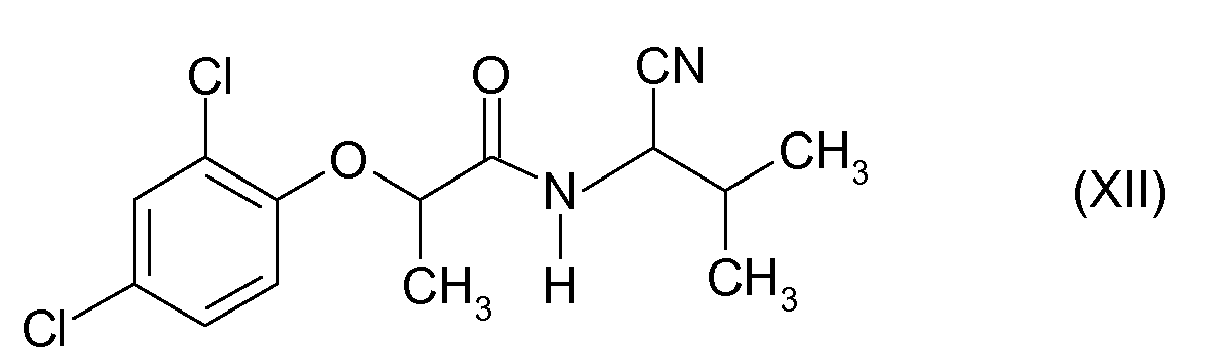
- the fenoxanil of formula XII is in the PCT / EP / 01/14785 described.
- the compound of formula XIII is in the WO 99/56551 described.
- the thiophanate-methyl of the formula XIV is known from DE-A-1930540 known.
- the metalaxyl of the formula XVI is in the US 4,151,299 described.
- the fludioxonil of the formula XVII is from the EP-A-206 999 known.
- the thiabendazole of the formula XVIII is from the US 3,017,415 known.
- mixtures of the present invention were the object of the invention, which was applied at a reduced total amount Active ingredients have an improved action against harmful fungi (synergistic mixtures).
- the initially defined mixture of prothioconazole with at least one other fungicide was found. It has also been found that it is possible to combat harmful fungi one after the other, at the same time, in common or separate application of the compounds I and at least one of the compounds IV to XXI or when using the compounds I and at least one of the compounds IV to XXI Individual connections alone.
- the 2- [2- (1-chlorocyclopropyl) -3- (2-chlorophenyl) -2-hydroxypropyl] -2,4-dihydro- [1,2,4] triazole-3-thione of the formula I is known from the WO 96-16048 known.
- the compound may be in the "thiono” form of the formula or in the tautomeric "mercapto" form of the formula available. For the sake of simplicity, only the "thiono" shape will be listed.
- the Metrafenone of Formula IV is from the EP-A-727 141 .
- the compound of formula V is from the WO 96/19442 known.
- the compound of formula VI is in the EP-A-1017670 .
- the quinoxyfen of the formula VII is from the EP-A-0 326 330 known.
- the dithianone of formula VIII is in the GB 857,383 described.
- the thiram formula IX is from the DE-A-06 42 532 known.
- the mepiquat chloride of the formula X. is in the DE-A-22 07 575 described.
- the cyazofamide of the formula XI is in the PCT / EP / 02/00237 described.
- the fenoxanil of the formula XII is in the PCT / EP / 01/14785 described.
- a compound of formula XIII is in the WO 99/56 551 described.
- Thiophanate-methyl of the formula XIV is in the DE-A-1 930 540 described.
- the metalaxyl of the formula XVI is in the US 4,151,299 described.
- Fludioxonil of formula XVII is in the EP-A-206 999 described.
- the thiabendazole of the formula XVIII is in the US 3,017,415 described.
- the compound I is able to form salts or adducts with inorganic or organic acids or with metal ions because of the basic character of the nitrogen atoms contained in it.
- inorganic acids examples include hydrohalic acids such as hydrogen fluoride, hydrogen chloride, hydrogen bromide and hydrogen iodide, sulfuric acid, phosphoric acid and nitric acid.
- suitable organic acids are formic acid, carbonic acid and alkanoic acids, such as acetic acid, trifluoroacetic acid, trichloroacetic acid and propionic acid, and also glycolic acid, thiocyanic acid, lactic acid, succinic acid, citric acid, benzoic acid, cinnamic acid, oxalic acid, alkylsulfonic acids (sulfonic acids having straight-chain or branched alkyl radicals having 1 to 20 carbon atoms), Arylsulfonic acids or disulfonic acids (aromatic radicals such as phenyl and naphthyl bearing one or two sulfonic acid groups), alkylphosphonic acids (phosphonic acids with straight-chain or branched alkyl radicals having 1 to 20 carbon atoms), arylphosphonic acids or diphosphonic acids (aromatic radicals such as phenyl and naphthyl which carry one or two phosphoric acid radicals) where the alkyl or ary
- the metal ions are, in particular, the ions of the elements of the second main group, in particular calcium and magnesium, the third and fourth main groups, in particular aluminum, tin and lead, and the first to eighth transition groups, in particular chromium, manganese, iron, cobalt, nickel, copper, Zinc and others into consideration. Particularly preferred are the metal ions of the elements of the subgroups of the fourth period.
- the metals can be present in the various valences that belong to them.
- the pure active ingredients I to XXI which can be added other active against harmful fungi or other pests such as insects, spider animals or nematodes or herbicidal or growth-regulating agents or fertilizers.
- the mixtures of the compound I with at least one of the compounds IV to XXI or the compound I with at least one of the compounds IV to XXI applied simultaneously, together or separately, are distinguished by an excellent action against a broad spectrum of phytopathogenic fungi, in particular the class of Ascomycetes, Basidiomycetes, Phycomycetes and Deuteromycetes. You are currently systemically effective and can therefore also be used as foliar and soil fungicides.
- fungi are suitable for controlling the following phytopathogenic fungi: Blumeria graminis (powdery mildew) on cereals, Erysiphe cichoracearum and Sphaerotheca fuliginea on cucurbits, Podosphaera leucotricha on apples, Uncinula necator on vines, Puccinia species on cereals, Rhizoctonia species on cotton, Rice and turf, Ustilago species on cereals and sugarcane, Venturia inaequalis on apples, Helminthosporium on cereals, Septoria nodorum on wheat, Botrytis cinera on gray strawberries, vegetables, ornamental plants and vines, Cercospora arachidicola on peanuts, Pseudocercosporella herpotrichoides on wheat and barley, Pyricularia oryzae on rice, Phytophthora infestans on potatoes and tomatoes, Plasmopara viticola on vines, Pseudoperon
- the compound I and at least one of the compounds IV to XIII can be applied simultaneously, either together or separately, or in succession, wherein the sequence with separate application generally has no effect on the control success.
- the compounds I and IV are usually used in a weight ratio of 20: 1 to 1:20, in particular 10: 1 to 1:10, preferably 5: 1 to 1: 5 applied.
- the compounds I and V are usually used in a weight ratio of 20: 1 to 1:20, in particular 10: 1 to 1:10, preferably 5: 1 to 1: 5 applied.
- the compounds I and VI are usually used in a weight ratio of 20: 1 to 1:20, in particular 10: 1 to 1:10, preferably 5: 1 to 1: 5 applied.
- the compounds I and VII are usually used in a weight ratio of 20: 1 to 1:20, in particular 10: 1 to 1:10, preferably 5: 1 to 1: 5 applied.
- the compounds I and VIII are usually used in a weight ratio of 20: 1 to 1:20, in particular 10: 1 to 1:10, preferably 5: 1 to 1: 5 applied.
- the compounds I and IX are usually used in a weight ratio of 20: 1 to 1:20, in particular 10: 1 to 1:10, preferably 5: 1 to 1: 5 applied.
- the compounds I and X are usually used in a weight ratio of 20: 1 to 1:20, in particular 10: 1 to 1:10, preferably 5: 1 to 1: 5 applied.
- the compounds I and XI are usually used in a weight ratio of 20: 1 to 1:20, in particular 10: 1 to 1:10, preferably 5: 1 to 1: 5 applied.
- the compounds I and XII are usually used in a weight ratio of 20: 1 to 1:20, in particular 10: 1 to 1:10, preferably 5: 1 to 1: 5 applied.
- the compounds I and XIII are usually used in a weight ratio of 20: 1 to 1:20, in particular 10: 1 to 1:10, preferably 5: 1 to 1: 5 applied.
- the compounds I and XIV are usually used in a weight ratio of 20: 1 to 1:20, in particular 10: 1 to 1:10, preferably 5: 1 to 1: 5 applied.
- the compounds I and XV are usually used in a weight ratio of 20: 1 to 1:20, in particular 10: 1 to 1:10, preferably 5: 1 to 1: 5 applied.
- the compounds I and XVI are usually used in a weight ratio of 20: 1 to 1:20, in particular 10: 1 to 1:10, preferably 5: 1 to 1: 5 applied.
- the compounds I and XVII are usually used in a weight ratio of 20: 1 to 1:20, in particular 10: 1 to 1:10, preferably 5: 1 to 1: 5 applied.
- the compounds I and XVIII are usually used in a weight ratio of 20: 1 to 1:20, in particular 10: 1 to 1:10, preferably 5: 1 to 1: 5 applied.
- the compounds I and XIX are usually used in a weight ratio of 20: 1 to 1:20, in particular 10: 1 to 1:10, preferably 5: 1 to 1: 5 applied.
- the compounds I and XX are usually used in a weight ratio of 20: 1 to 1:20, in particular 10: 1 to 1:10, preferably 5: 1 to 1: 5 applied.
- the compounds I and XXI are usually used in a weight ratio of 20: 1 to 1:20, in particular 10: 1 to 1:10, preferably 5: 1 to 1: 5 applied.
- the application rates of the mixtures according to the invention, especially in agricultural crops, depending on the nature of the desired effect at 0.01 to 8 kg / ha, preferably 0.1 to 5 kg / ha, in particular 0.1 to 3.0 kg / ha ,
- the application rates for the compounds I are 0.01 to 1 kg / ha, preferably 0.05 to 0.5 kg / ha, in particular 0.05 to 0.3 kg / ha.
- the application rates for the compounds IV are correspondingly 0.01 to 1 kg / ha, preferably 0.02 to 0.5 kg / ha, in particular 0.05 to 0.3 kg / ha.
- the application rates for the compounds V are correspondingly 0.01 to 1 kg / ha, preferably 0.02 to 0.5 kg / ha, in particular 0.05 to 0.3 kg / ha.
- the application rates for the compounds VI are correspondingly 0.01 to 1 kg / ha, preferably 0.02 to 0.5 kg / ha, in particular 0.05 to 0.3 kg / ha.
- the application rates for the compounds V are correspondingly 0.01 to 1 kg / ha, preferably 0.02 to 0.5 kg / ha, in particular 0.05 to 0.3 kg / ha.
- the application rates for the compounds VII are correspondingly 0.01 to 1 kg / ha, preferably 0.02 to 0.5 kg / ha, in particular 0.05 to 0.3 kg / ha.
- the application rates for the compounds VIII are correspondingly 0.01 to 1 kg / ha, preferably 0.02 to 0.5 kg / ha, in particular 0.05 to 0.3 kg / ha.
- the application rates for the compounds IX are correspondingly 0.01 to 1 kg / ha, preferably 0.02 to 0.5 kg / ha, in particular 0.05 to 0.3 kg / ha.
- the application rates for the compounds X are correspondingly 0.01 to 1 kg / ha, preferably 0.02 to 0.5 kg / ha, in particular 0.05 to 0.3 kg / ha.
- the application rates for the compounds XI are correspondingly 0.01 to 1 kg / ha, preferably 0.02 to 0.5 kg / ha, in particular 0.05 to 0.3 kg / ha.
- the application rates for the compounds XII are correspondingly 0.01 to 1 kg / ha, preferably 0.02 to 0.5 kg / ha, in particular 0.05 to 0.3 kg / ha.
- the application rates for the compounds XIII are correspondingly 0.01 to 1 kg / ha, preferably 0.02 to 0.5 kg / ha, in particular 0.05 to 0.3 kg / ha.
- the application rates for the compounds XIV are correspondingly 0.01 to 1 kg / ha, preferably 0.02 to 0.5 kg / ha, in particular 0.05 to 0.3 kg / ha.
- the application rates for compounds XV are correspondingly 0.01 to 1 kg / ha, preferably 0.02 to 0.5 kg / ha, in particular 0.05 to 0.3 kg / ha.
- the application rates for the compounds XVI are correspondingly 0.01 to 1 kg / ha, preferably 0.02 to 0.5 kg / ha, in particular 0.05 to 0.3 kg / ha.
- the application rates for the compounds XVII are correspondingly 0.01 to 1 kg / ha, preferably 0.02 to 0.5 kg / ha, in particular 0.05 to 0.3 kg / ha.
- the application rates for the compounds XVIII are correspondingly 0.01 to 1 kg / ha, preferably 0.02 to 0.5 kg / ha, in particular 0.05 to 0.3 kg / ha.
- the application rates for the compounds XIX are correspondingly 0.01 to 1 kg / ha, preferably 0.02 to 0.5 kg / ha, in particular 0.05 to 0.3 kg / ha.
- the application rates for compounds XX are correspondingly 0.01 to 1 kg / ha, preferably 0.02 to 0.5 kg / ha, in particular 0.05 to 0.3 kg / ha.
- the application rates for compounds XXI are correspondingly 0.01 to 1 kg / ha, preferably 0.02 to 0.5 kg / ha, in particular 0.05 to 0.3 kg / ha.
- seed treatment are generally applied to mixtures of from 0.001 to 250 g / kg of seed, preferably 0.01 to 100 g / kg, in particular 0.01 to 50 g / kg used.
- the separate or combined application of the compound I and at least one of the compounds IV to XXI or the mixtures of the compound I with at least one of the compounds IV to XXI by spraying or dusting the seeds, the plants or the soils before or after sowing the plants or before or after emergence of the plants.
- the fungicidal synergistic mixtures according to the invention or the compound I and at least one of the compounds IV to XXI can be used, for example, in the form of directly sprayable solutions, powders and suspensions or in the form of high-percentage aqueous, oily or other suspensions, dispersions, emulsions, oil dispersions, pastes, Dust, grit or granules prepared and applied by spraying, atomizing, dusting, scattering or pouring.
- the application form depends on the intended use; It should in any case ensure the finest possible and uniform distribution of the mixture according to the invention.
- the formulations are prepared in a manner known per se, e.g. by adding solvents and / or carriers.
- the formulations are usually admixed with inert additives such as emulsifiers or dispersants.
- the alkali, alkaline earth, ammonium salts of aromatic sulfonic acids e.g. Lignin, phenol, naphthalene and dibutylnaphthalenesulfonic acid, as well as fatty acids, alkyl and alkylarylsulfonates, alkyl, lauryl ether and fatty alcohol sulfates, and salts of sulfated hexa-, hepta- and octadecanols or fatty alcohol glycol ethers, condensation products of sulfonated naphthalene and its derivatives with formaldehyde , Condensation products of naphthalene or naphthalene sulfonic acids with phenol and formaldehyde, polyoxyethylene octyl phenol ethers, ethoxylated isooctyl, octyl or nonyl phenol, alkylphenol or tribu
- Powders and dusting agents can be prepared by mixing or co-grinding the compound I and at least one of the compounds IV to XXI or the mixture of the compound I with at least one of the compounds IV to XXI with a solid carrier.
- Granules e.g., coated, impregnated or homogeneous granules
- a solid carrier usually prepared by binding the active ingredient or agents to a solid carrier.
- fillers or solid carriers are, for example, mineral earths such as silica gel, silicas, silica gels, silicates, talc, kaolin, limestone, lime, chalk, bolus, loess, clay, dolomite, diatomaceous earth, calcium and magnesium sulfate, magnesium oxide, ground plastics, and fertilizers such as ammonium sulfate, ammonium phosphate, ammonium nitrate, ureas and vegetable products such as cornmeal, tree bark, wood and nutshell meal, cellulose powder or other solid carriers.
- mineral earths such as silica gel, silicas, silica gels, silicates, talc, kaolin, limestone, lime, chalk, bolus, loess, clay, dolomite, diatomaceous earth, calcium and magnesium sulfate, magnesium oxide, ground plastics, and fertilizers such as ammonium sulfate, ammonium phosphate, ammonium nitrate,
- the formulations generally comprise from 0.1 to 95% by weight, preferably from 0.5 to 90% by weight, of the compound I and at least one of the compounds IV to XXI or the mixture of the compound I with at least one of the compounds IV to XXI.
- the active compounds are used in a purity of 90% to 100%, preferably 95% to 100% (by NMR or HPLC spectrum).
- the use of the compound I with at least one of the compounds IV to XXI of the mixtures or the corresponding formulations is such that the harmful fungi, their habitat or the plants, seeds, soils, areas, materials or spaces to be kept free of them with a fungicidally effective amount the mixture, or the compound I with at least one of the compounds IV to XXI with separate application treated.
- the application can be made before or after the attack by the harmful fungi.
- the active compounds were prepared separately or together as a 10% emulsion in a mixture of 85 wt .-% cyclohexanone and 5 wt .-% emulsifier and diluted according to the desired concentration with water.
- the infestation of the treated plants corresponds to that of the untreated control plants; at an efficiency of 100, the treated plants had no infestation.
- aqueous active ingredient preparation which was prepared from a stock solution consisting of 10% active ingredient, 85% cyclohexanone and 5% emulsifier and 24 hours after the spray coating with spores of wheat powdery mildew (Erysiphe [syn. Blumeria] graminis forma specialis. tritici).
- the test plants were then placed in the greenhouse at temperatures between 20 and 24_ C and 60 to 90% relative humidity. After 7 days, the extent of mildew development was determined visually in% infestation of the entire leaf area.
- aqueous active ingredient preparation prepared from a stock solution consisting of 10% active ingredient, 85% cyclohexanone and 5% emulsifier. 20 hours after the spray coating had dried on, the plants were inoculated with an aqueous spore suspension of cucumber mildew (Sphaerotheca fuliginea). Subsequently, the plants were cultivated in the greenhouse at temperatures between 20 and 24_ C and 60 to 80% relative humidity for 7 days. Then, the extent of mildew development was determined visually in% of the cotyledon area.
Landscapes
- Life Sciences & Earth Sciences (AREA)
- Agronomy & Crop Science (AREA)
- Pest Control & Pesticides (AREA)
- Plant Pathology (AREA)
- Health & Medical Sciences (AREA)
- Engineering & Computer Science (AREA)
- Dentistry (AREA)
- General Health & Medical Sciences (AREA)
- Wood Science & Technology (AREA)
- Zoology (AREA)
- Environmental Sciences (AREA)
- Agricultural Chemicals And Associated Chemicals (AREA)
Abstract
Description
- Die vorliegende Erfindung betrifft fungizide Mischungen, enthaltend
- (1) 2-[2-(1-Chlorcyclopropyl)-3-(2-chlorphenyl)-2-hydroxypropyl]-2,4-dihydro-[1,2,4]-triazol-3-thion (Prothioconazole) der Formel I oder dessen Salze oder Addukte

- (4) Metrafenone der Formel IV

- (5) eine Verbindung der Formel V

- (6) eine Verbindung der Formel VI

- (7) Quinoxyfen der Formel VII

- (8) Dithianon der Formel VIII

- (9) Thiram Formel IX

- (10) Mepiquatchloride der Formel X

- (11) Cyazofamid der Formel XI

- (12) Fenoxanil der Formel XII
- (13) eine Verbindung der Formel XIII

- (14) Thiophanate-methyl der Formel XIV

- (15) Carbendazim der Formel XV

- (16) Metalaxyl der Formel XVI

- (17) Fludioxonil der Formel XVII

- (18) Thiabendazole der Formel XVIII

- (19) Quintozen der Formel XIX

- (20) Prochloraz der Formel XX

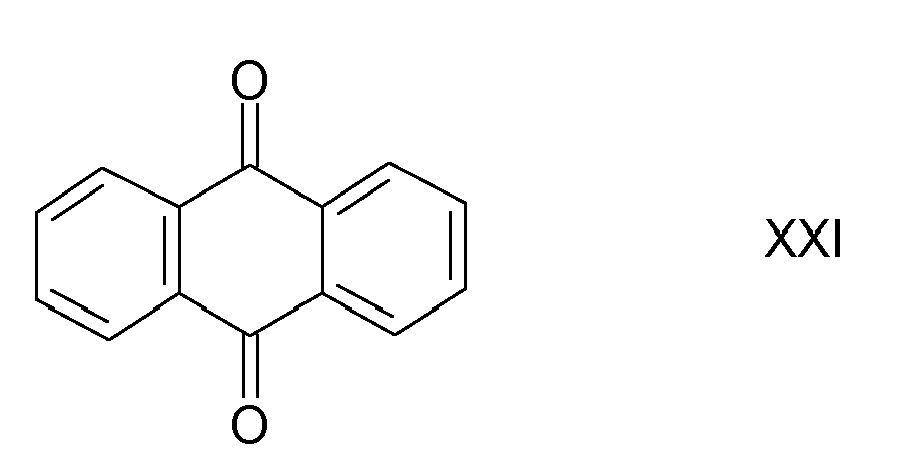
- (21) Anthraquinone der Formel XXI
- Außerdem betrifft die Erfindung ein Verfahren zur Bekämpfung von Schadpilzen mit Mischungen der Verbindungen I mit mindestens einer der Verbindungen IV bis XXI und die Verwendung der Verbindungen I mit mindestens einer der Verbindungen IV bis XXI zur Herstellung derartiger Mischungen sowie Mittel, die diese Mischungen enthalten.
- Das Prothioconazole der Formel I, das 2-[2-(1-Chlorcyclopropyl)-3-(2-chlorphenyl)-2-hydroxypropyl]-2,4-dihydro-[1,2,4]-triazol-3-thion ist bereits aus der
WO 96/16048 - Aus der
WO 98/47367 - Metrafenone der Formel IV ist bekannt und in der
EP-A-727 141 EP-A 897 904 EP-A 899 255 EP-A-967 196 - Die Verbindung der Formel V ist in
WO 96/19442 -
- Das Quinoxyfen der Formel VII ist aus der
EP-A-0 326 330 bekannt. - Das Dithianon der Formel VIII ist in der
GB 857 383 - Das Thiram der Formel IX ist in der
DE-A-06 42 532 beschrieben. - Das Mepiquatchloride der Formel X ist aus der
DE-A-22 07 575 bekannt. - Das Cyazofamid der Formel XI ist in der
PCT/EP/02/00237 beschrieben. - Das Fenoxanil der Formel XII ist in der
PCT/EP/01/14785 beschrieben. - Die Verbindung der Formel XIII ist in der
WO 99/56551 - Das Thiophanate-methyl der Formel XIV ist aus der
DE-A-1930540 bekannt. - Das Carbendazim der Formel XV ist in der
US 3,657,443 beschrieben. - Das Metalaxyl der Formel XVI ist in der
US 4,151,299 beschrieben. - Das Fludioxonil der Formel XVII ist aus der
EP-A-206 999 - Das Thiabendazole der Formel XVIII ist aus der
US 3,017,415 bekannt. - Das Quintozene der Formel XIX ist in der Formel
DE-A-682048 beschrieben. - Das Prochloraz der Formel XX ist in der
US 3,991,071 beschrieben. - Das Anthraquinone der Formel XXI ist in Pesticide Manual, 12th Ed. (2000), Seite 39 beschrieben.
- Im Hinblick auf eine Senkung der Aufwandmengen und eine Verbesserung des Wirkungsspektrums der bekannten Verbindungen I bis XXI lagen der vorliegenden Erfindung Mischungen als Aufgabe zugrunde, die bei verringerter Gesamtmenge an ausgebrachten Wirkstoffen eine verbesserte Wirkung gegen Schadpilze aufweisen (synergistische Mischungen).
- Demgemäß wurde die eingangs definierte Mischung von Prothioconazole mit mindestens einem weiteren Fungizid gefunden. Es wurde außerdem gefunden, daß sich bei gleichzeitiger, und zwar gemeinsamer oder getrennter Anwendung der Verbindungen I und mindestens einer der Verbindungen IV bis XXI oder bei Anwendung der Verbindungen I und mindestens eine der Verbindungen IV bis XXI nacheinander Schadpilze besser bekämpfen lassen, als mit den Einzelverbindungen allein.
- Das 2-[2-(1-Chlorcyclopropyl)-3-(2-chlorphenyl)-2-hydroxypropyl]-2,4-dihydro-[1,2,4]-triazol-3-thion der Formel I ist aus der
WO 96-16 048 

- Das Metrafenone der Formel IV

EP-A-727 141 EP-A-897 904 EP-A-899 255 EP-A-967 196 - Die Verbindung der Formel V

WO 96/19442 - Die Verbindung der Formel VI

EP-A-1017 670 ,EP-A-1017 671 undDE 197 535 19.4 beschrieben. - Das Quinoxyfen der Formel VII

EP-A-0 326 330 bekannt. - Das Dithianon der Formel VIII

GB 857 383 - Das Thiram Formel IX

DE-A-06 42 532 bekannt. - Das Mepiquatchloride der Formel X

DE-A-22 07 575 beschrieben. - Das Cyazofamid der Formel XI

PCT/EP/02/00237 beschrieben. - Das Fenoxanil der Formel XII

PCT/EP/01/14785 beschrieben. - Eine Verbindung der Formel XIII

WO 99/56 551 - Thiophanate-methyl der Formel XIV

DE-A-1 930 540 beschrieben. - Das Carbendazim der Formel XV

US 3,657,443 beschrieben. - Das Metalaxyl der Formel XVI

US 4,151,299 beschrieben. - Das Fludioxonil der Formel XVII

EP-A-206 999 - Das Thiabendazole der Formel XVIII

US 3,017,415 beschrieben. - Das Quintozene der Formel XIX

DE-A-682 048 beschrieben. - Das Prochloraz der Formel XX

US 3,991,071 beschrieben. - Das Anthraquinone der Formel XXI

- Bevorzugt sind auch Mischungen von Prothioconazole mit Metrafenone der Formel IV.
- Bevorzugt sind weiterhin Mischungen von Prothioconazole mit der Verbindung der Formel V.
- Bevorzugt sind weiterhin Mischungen von Prothioconazole mit der Verbindung der Formel VI.
- Bevorzugt sind weiterhin Mischungen von Prothioconazole mit Quinoxyfen der Formel VII.
- Bevorzugt sind weiterhin Mischungen von Prothioconazole mit Dithianon der Formel VIII.
- Bevorzugt sind weiterhin Mischungen von Prothioconazole mit Thiram der Formel IX.
- Bevorzugt sind weiterhin Mischungen von Prothioconazole mit Mepiquat chloride der Formel X.
- Bevorzugt sind weiterhin Mischungen von Prothioconazole mit Cyazofamid der Formel XI.
- Bevorzugt sind weiterhin Mischungen von Prothioconazole mit Fenoxanil der Formel XII.
- Bevorzugt sind weiterhin Mischungen von Prothioconazole mit der Verbindung der Formel XIII.
- Bevorzugt sind weiterhin Mischungen von Prothioconazole mit Thiophanate-methyl der Formel XVI.
- Bevorzugt sind weiterhin Mischungen von Prothioconazole mit Carbendazim der Formel XV.
- Bevorzugt sind weiterhin Mischungen von Prothioconazole mit Metalaxyl der Formel XVI.
- Bevorzugt sind weiterhin Mischungen von Prothioconazole mit Fludioxonil der Formel XVII.
- Bevorzugt sind weiterhin Mischungen von Prothioconazole mit Thiabendazole der Formel XVIII.
- Bevorzugt sind weiterhin Mischungen von Prothioconazole mit Quintozene der Formel XIX.
- Bevorzugt sind weiterhin Mischungen von Prothioconazole mit Prochloraz der Formel XX.
- Bevorzugt sind weiterhin Mischungen von Prothioconazole mit Anthraquinone der Formel XXI.
- Bevorzugt sind auch Mischungen von Prothioconazol mit zwei weiteren fungiziden Verbindungen der Formeln II bis XXI.
- Die Verbindung I ist wegen des basischen Charakters der in ihr enthaltenen Stickstoffatome in der Lage, mit anorganischen oder organischen Säuren oder mit Metallionen Salze oder Addukte zu bilden.
- Beispiele für anorganische Säuren sind Halogenwasserstoffsäuren wie Fluorwasserstoff, Chlorwasserstoff, Bromwasserstoff und Jodwasserstoff, Schwefelsäure, Phosphorsäure und Salpetersäure.
- Als organischen Säuren kommen beispielsweise Ameisensäure, Kohlensäure und Alkansäuren wie Essigsäure, Trifluoressigsäure, Trichloressigsäure und Propionsäure sowie Glycolsäure, Thiocyansäure, Milchsäure, Bernsteinsäure, Zitronensäure, Benzoesäure, Zimtsäure, Oxalsäure, Alkylsulfonsäuren (Sulfonsäuren mit geradkettigen oder verzweigten Alkylresten mit 1 bis 20 Kohlenstoffatomen), Arylsulfonsäuren oderdisulfonsäuren (aromatische Reste wie Phenyl und Naphthyl welche eine oder zwei Sulfonsäuregruppen tragen), Alkylphosphonsäuren (Phosphonsäuren mit geradkettigen oder verzweigten Alkylresten mit 1 bis 20 Kohlenstoffatomen), Arylphosphonsäuren oder -diphosphonsäuren (aromatische Reste wie Phenyl und Naphthyl welche eine oder zwei Phosphorsäurereste tragen), wobei die Alkyl- bzw. Arylreste weitere Substituenten tragen können, z.B. p-Toluolsulfonsäure, Salizylsäure, p-Aminosalizylsäure, 2-Phenoxybenzoesäure, 2-Acetoxybenzoesäure etc.
- Als Metallionen kommen insbesondere die Ionen der Elemente der zweiten Hauptgruppe, insbesondere Calzium und Magnesium, der dritten und vierten Hauptgruppe, insbesondere Aluminium, Zinn und Blei, sowie der ersten bis achten Nebengruppe, insbesondere Chrom, Mangan, Eisen, Kobalt, Nickel, Kupfer, Zink und andere in Betracht. Besonders bevorzugt sind die Metallionen der Elemente der Nebengruppen der vierten Periode. Die Metalle können dabei in den verschiedenen ihnen zukommenden Wertigkeiten vorliegen.
- Bevorzugt setzt man bei der Bereitstellung der Mischungen die reinen Wirkstoffe I bis XXI ein, denen man weitere Wirkstoffe gegen Schadpilze oder gegen andere Schädlinge wie Insekten, Spinntiere oder Nematoden oder auch herbizide oder wachstumsregulierende Wirkstoffe oder Düngemittel beimischen kann.
- Die Mischungen aus der Verbindung I mit mindestens einer der Verbindungen IV bis XXI bzw. die Verbindung I mit mindestens einer der Verbindungen IV bis XXI gleichzeitig, gemeinsam oder getrennt angewandt, zeichnen sich durch eine hervorragende Wirkung gegen ein breites Spektrum von pflanzenpathogenen Pilzen, insbesondere aus der Klasse der Ascomyceten, Basidiomyceten, Phycomyceten und Deuteromyceten aus. Sie sind z.T. systemisch wirksam und können daher auch als Blatt- und Bodenfungizide eingesetzt werden.
- Besondere Bedeutung haben sie für die Bekämpfung einer Vielzahl von Pilzen an verschiedenen Kulturpflanzen wie Baumwolle, Gemüsepflanzen (z.B. Gurken, Bohnen, Tomaten, Kartoffeln und Kürbisgewächse), Gerste, Gras, Hafer, Bananen, Kaffee, Mais, Obstpflanzen, Reis, Roggen, Soja, Wein, Weizen, Zierpflanzen, Zuckerrohr sowie an einer Vielzahl von Samen.
- Insbesondere eignen sie sich zur Bekämpfung der folgenden pflanzenpathogenen Pilze: Blumeria graminis (echter Mehltau) an Getreide, Erysiphe cichoracearum und Sphaerotheca fuliginea an Kürbisgewächsen, Podosphaera leucotricha an Äpfeln, Uncinula necator an Reben, Puccinia-Arten an Getreide, Rhizoctonia-Arten an Baumwolle, Reis und Rasen, Ustilago-Arten an Getreide und Zuckerrohr, Venturia inaequalis (Schorf) an Äpfeln, Helminthosporium-Arten an Getreide, Septoria nodorum an Weizen, Botrytis cinera (Grauschimmel) an Erdbeeren, Gemüse, Zierpflanzen und Reben, Cercospora arachidicola an Erdnüssen, Pseudocercosporella herpotrichoides an Weizen und Gerste, Pyricularia oryzae an Reis, Phytophthora infestans an Kartoffeln und Tomaten, Plasmopara viticola an Reben, Pseudoperonospora-Arten in Hopfen und Gurken, Alternaria-Arten an Gemüse und Obst, Mycosphaerella-Arten in Bananen sowie Fusarium- und Verticillium-Arten.
- Die Verbindung I und mindestens eine der Verbindungen IV bis XIII können gleichzeitig, und zwar gemeinsam oder getrennt, oder nacheinander aufgebracht werden, wobei die Reihenfolge bei getrennter Applikation im allgemeinen keine Auswirkung auf den Bekämpfungserfolg hat.
- Die Verbindungen I und IV werden üblicherweise in einem Gewichtsverhältnis von 20:1 bis 1:20, insbesondere 10:1 bis 1:10, vorzugsweise 5:1 bis 1:5 angewendet.
- Die Verbindungen I und V werden üblicherweise in einem Gewichtsverhältnis von 20:1 bis 1:20, insbesondere 10:1 bis 1:10, vorzugsweise 5:1 bis 1:5 angewendet.
- Die Verbindungen I und VI werden üblicherweise in einem Gewichtsverhältnis von 20:1 bis 1:20, insbesondere 10:1 bis 1:10, vorzugsweise 5:1 bis 1:5 angewendet.
- Die Verbindungen I und VII werden üblicherweise in einem Gewichtsverhältnis von 20:1 bis 1:20, insbesondere 10:1 bis 1:10, vorzugsweise 5:1 bis 1:5 angewendet.
- Die Verbindungen I und VIII werden üblicherweise in einem Gewichtsverhältnis von 20:1 bis 1:20, insbesondere 10:1 bis 1:10, vorzugsweise 5:1 bis 1:5 angewendet.
- Die Verbindungen I und IX werden üblicherweise in einem Gewichtsverhältnis von 20:1 bis 1:20, insbesondere 10:1 bis 1:10, vorzugsweise 5:1 bis 1:5 angewendet.
- Die Verbindungen I und X werden üblicherweise in einem Gewichtsverhältnis von 20:1 bis 1:20, insbesondere 10:1 bis 1:10, vorzugsweise 5:1 bis 1:5 angewendet.
- Die Verbindungen I und XI werden üblicherweise in einem Gewichtsverhältnis von 20:1 bis 1:20, insbesondere 10:1 bis 1:10, vorzugsweise 5:1 bis 1:5 angewendet.
- Die Verbindungen I und XII werden üblicherweise in einem Gewichtsverhältnis von 20:1 bis 1:20, insbesondere 10:1 bis 1:10, vorzugsweise 5:1 bis 1:5 angewendet.
- Die Verbindungen I und XIII werden üblicherweise in einem Gewichtsverhältnis von 20:1 bis 1:20, insbesondere 10:1 bis 1:10, vorzugsweise 5:1 bis 1:5 angewendet.
- Die Verbindungen I und XIV werden üblicherweise in einem Gewichtsverhältnis von 20:1 bis 1:20, insbesondere 10:1 bis 1:10, vorzugsweise 5:1 bis 1:5 angewendet.
- Die Verbindungen I und XV werden üblicherweise in einem Gewichtsverhältnis von 20:1 bis 1:20, insbesondere 10:1 bis 1:10, vorzugsweise 5:1 bis 1:5 angewendet.
- Die Verbindungen I und XVI werden üblicherweise in einem Gewichtsverhältnis von 20:1 bis 1:20, insbesondere 10:1 bis 1:10, vorzugsweise 5:1 bis 1:5 angewendet.
- Die Verbindungen I und XVII werden üblicherweise in einem Gewichtsverhältnis von 20:1 bis 1:20, insbesondere 10:1 bis 1:10, vorzugsweise 5:1 bis 1:5 angewendet.
- Die Verbindungen I und XVIII werden üblicherweise in einem Gewichtsverhältnis von 20:1 bis 1:20, insbesondere 10:1 bis 1:10, vorzugsweise 5:1 bis 1:5 angewendet.
- Die Verbindungen I und XIX werden üblicherweise in einem Gewichtsverhältnis von 20:1 bis 1:20, insbesondere 10:1 bis 1:10, vorzugsweise 5:1 bis 1:5 angewendet.
- Die Verbindungen I und XX werden üblicherweise in einem Gewichtsverhältnis von 20:1 bis 1:20, insbesondere 10:1 bis 1:10, vorzugsweise 5:1 bis 1:5 angewendet.
- Die Verbindungen I und XXI werden üblicherweise in einem Gewichtsverhältnis von 20:1 bis 1:20, insbesondere 10:1 bis 1:10, vorzugsweise 5:1 bis 1:5 angewendet.
- Die Aufwandmengen der erfindungsgemäßen Mischungen liegen, vor allem bei landwirtschaftlichen Kulturflächen, je nach Art des gewünschten Effekts bei 0,01 bis 8 kg/ha, vorzugsweise 0,1 bis 5 kg/ha, insbesondere 0,1 bis 3,0 kg/ha.
- Die Aufwandmengen liegen dabei für die Verbindungen I bei 0,01 bis 1 kg/ha, vorzugsweise 0,05 bis 0,5 kg/ha, insbesondere 0,05 bis 0,3 kg/ha.
- Die Aufwandmengen für die Verbindungen IV liegen entsprechend bei 0,01 bis 1 kg/ha, vorzugsweise 0,02 bis 0,5 kg/ha, insbesondere 0,05 bis 0,3 kg/ha.
- Die Aufwandmengen für die Verbindungen V liegen entsprechend bei 0,01 bis 1 kg/ha, vorzugsweise 0,02 bis 0,5 kg/ha, insbesondere 0,05 bis 0,3 kg/ha.
- Die Aufwandmengen für die Verbindungen VI liegen entsprechend bei 0,01 bis 1 kg/ha, vorzugsweise 0,02 bis 0,5 kg/ha, insbesondere 0,05 bis 0,3 kg/ha.
- Die Aufwandmengen für die Verbindungen V liegen entsprechend bei 0,01 bis 1 kg/ha, vorzugsweise 0,02 bis 0,5 kg/ha, insbesondere 0,05 bis 0,3 kg/ha.
- Die Aufwandmengen für die Verbindungen VII liegen entsprechend bei 0,01 bis 1 kg/ha, vorzugsweise 0,02 bis 0,5 kg/ha, insbesondere 0,05 bis 0,3 kg/ha.
- Die Aufwandmengen für die Verbindungen VIII liegen entsprechend bei 0,01 bis 1 kg/ha, vorzugsweise 0,02 bis 0,5 kg/ha, insbesondere 0,05 bis 0,3 kg/ha.
- Die Aufwandmengen für die Verbindungen IX liegen entsprechend bei 0,01 bis 1 kg/ha, vorzugsweise 0,02 bis 0,5 kg/ha, insbesondere 0,05 bis 0,3 kg/ha.
- Die Aufwandmengen für die Verbindungen X liegen entsprechend bei 0,01 bis 1 kg/ha, vorzugsweise 0,02 bis 0,5 kg/ha, insbesondere 0,05 bis 0,3 kg/ha.
- Die Aufwandmengen für die Verbindungen XI liegen entsprechend bei 0,01 bis 1 kg/ha, vorzugsweise 0,02 bis 0,5 kg/ha, insbesondere 0,05 bis 0,3 kg/ha.
- Die Aufwandmengen für die Verbindungen XII liegen entsprechend bei 0,01 bis 1 kg/ha, vorzugsweise 0,02 bis 0,5 kg/ha, insbesondere 0,05 bis 0,3 kg/ha.
- Die Aufwandmengen für die Verbindungen XIII liegen entsprechend bei 0,01 bis 1 kg/ha, vorzugsweise 0,02 bis 0,5 kg/ha, insbesondere 0,05 bis 0,3 kg/ha.
- Die Aufwandmengen für die Verbindungen XIV liegen entsprechend bei 0,01 bis 1 kg/ha, vorzugsweise 0,02 bis 0,5 kg/ha, insbesondere 0,05 bis 0,3 kg/ha.
- Die Aufwandmengen für die Verbindungen XV liegen entsprechend bei 0,01 bis 1 kg/ha, vorzugsweise 0,02 bis 0,5 kg/ha, insbesondere 0,05 bis 0,3 kg/ha.
- Die Aufwandmengen für die Verbindungen XVI liegen entsprechend bei 0,01 bis 1 kg/ha, vorzugsweise 0,02 bis 0,5 kg/ha, insbesondere 0,05 bis 0,3 kg/ha.
- Die Aufwandmengen für die Verbindungen XVII liegen entsprechend bei 0,01 bis 1 kg/ha, vorzugsweise 0,02 bis 0,5 kg/ha, insbesondere 0,05 bis 0,3 kg/ha.
- Die Aufwandmengen für die Verbindungen XVIII liegen entsprechend bei 0,01 bis 1 kg/ha, vorzugsweise 0,02 bis 0,5 kg/ha, insbesondere 0,05 bis 0,3 kg/ha.
- Die Aufwandmengen für die Verbindungen XIX liegen entsprechend bei 0,01 bis 1 kg/ha, vorzugsweise 0,02 bis 0,5 kg/ha, insbesondere 0,05 bis 0,3 kg/ha.
- Die Aufwandmengen für die Verbindungen XX liegen entsprechend bei 0,01 bis 1 kg/ha, vorzugsweise 0,02 bis 0,5 kg/ha, insbesondere 0,05 bis 0,3 kg/ha.
- Die Aufwandmengen für die Verbindungen XXI liegen entsprechend bei 0,01 bis 1 kg/ha, vorzugsweise 0,02 bis 0,5 kg/ha, insbesondere 0,05 bis 0,3 kg/ha.
- Bei der Saatgutbehandlung werden im allgemeinen Aufwandmengen an Mischung von 0,001 bis 250 g/kg Saatgut, vorzugsweise 0,01 bis 100 g/kg, insbesondere 0,01 bis 50 g/kg verwendet.
- Sofern für Pflanzen pathogene Schadpilze zu bekämpfen sind, erfolgt die getrennte oder gemeinsame Applikation der Verbindung I und mindestens einer der Verbindungen IV bis XXI oder der Mischungen aus der Verbindung I mit mindestens einer der Verbindungen IV bis XXI durch Besprühen oder Bestäuben der Samen, der Pflanzen oder der Böden vor oder nach der Aussaat der Pflanzen oder vor oder nach dem Auflaufen der Pflanzen.
- Die erfindungsgemäßen fungiziden synergistischen Mischungen bzw. die Verbindung I und mindestens einer der Verbindungen IV bis XXI können beispielsweise in Form von direkt versprühbaren Lösungen, Pulver und Suspensionen oder in Form von hochprozentigen wäßrigen, öligen oder sonstigen Suspensionen, Dispersionen, Emulsionen, Öldispersionen, Pasten, Stäubemitteln, Streumitteln oder Granulaten aufbereitet und durch Versprühen, Vernebeln, Verstäuben, Verstreuen oder Gießen angewendet werden. Die Anwendungsform ist abhängig vom Verwendungszweck; sie soll in jedem Fall eine möglichst feine und gleichmäßige Verteilung der erfindungsgemäßen Mischung gewährleisten.
- Die Formulierungen werden in an sich bekannter Weise hergestellt, z.B. durch Zugabe von Lösungsmitteln und/oder Trägerstoffen. Den Formulierungen werden üblicherweise inerte Zusatzstoffe wie Emulgiermittel oder Dispergiermittel beigemischt.
- Als oberflächenaktive Stoffe kommen die Alkali-, Erdalkali-, Ammoniumsalze von aromatischen Sulfonsäuren, z.B. Lignin-, Phenol-, Naphthalin- und Dibutylnaphthalinsulfonsäure, sowie von Fettsäuren, Alkyl- und Alkylarylsulfonaten, Alkyl-, Laurylether- und Fettalkoholsulfaten, sowie Salze sulfatierter Hexa-, Hepta- und Octadecanole oder Fettalkoholglycolethern, Kondensationsprodukte von sulfoniertem Naphthalin und seinen Derivaten mit Formaldehyd, Kondensationsprodukte des Naphthalins bzw. der Naphthalinsulfonsäuren mit Phenol und Formaldehyd, Polyoxyethylenoctylphenolether, ethoxyliertes Isooctyl-, Octyl- oder Nonylphenol, Alkylphenol- oder Tributylphenylpolyglycolether, Alkylarylpolyetheralkohole, Isotridecylalkohol, Fettalkoholethylenoxid-Kondensate, ethoxyliertes Rizinusöl, Polyoxyethylenalkylether oder Polyoxypropylen, Laurylalkoholpolyglycoletheracetat, Sorbitester, Lignin-Sulfitablaugen oder Methylcellulose in Betracht.
- Pulver Streu- und Stäubemittel können durch Mischen oder gemeinsames Vermahlen der Verbindung I und mindestens eine der Verbindungen IV bis XXI oder der Mischung aus der Verbindung I mit mindestens einer der Verbindungen IV bis XXI mit einem festen Trägerstoff hergestellt werden.
- Granulate (z.B. Umhüllungs-, Imprägnierungs- oder Homogengranulate) werden üblicherweise durch Bindung des Wirkstoffs oder der Wirkstoffe an einen festen Trägerstoff hergestellt.
- Als Füllstoffe bzw. feste Trägerstoffe dienen beispielsweise Mineralerden wie Silicagel, Kieselsäuren, Kieselgele, Silikate, Talkum, Kaolin, Kalkstein, Kalk, Kreide, Bolus, Löß, Ton, Dolomit, Diatomeenerde, Calcium- und Magnesiumsulfat, Magnesiumoxid, gemahlene Kunststoffe, sowie Düngemittel wie Ammoniumsulfat, Ammoniumphosphat, Ammoniumnitrat, Harnstoffe und pflanzliche Produkte wie Getreidemehl, Baumrinden-, Holz- und Nußschalenmehl, Cellulosepulver oder andere feste Trägerstoffe.
- Die Formulierungen enthalten im allgemeinen 0,1 bis 95 Gew.-%, vorzugsweise 0,5 bis 90 Gew.-% der Verbindung I und mindestens eine der Verbindungen IV bis XXI bzw. der Mischung aus der Verbindung I mit mindestens einer der Verbindungen IV bis XXI. Die Wirkstoffe werden dabei in einer Reinheit von 90% bis 100%, vorzugsweise 95% bis 100% (nach NMR- oder HPLC-Spektrum) eingesetzt.
- Die Anwendung der Verbindung I mit mindestens einer der Verbindungen IV bis XXI der Mischungen oder der entsprechenden Formulierungen erfolgt so, daß man die Schadpilze, deren Lebensraum oder die von ihnen freizuhaltenden Pflanzen, Samen, Böden, Flächen, Materialien oder Räume mit einer fungizid wirksamen Menge der Mischung, bzw. der Verbindung I mit mindestens einer der Verbindungen IV bis XXI bei getrennter Ausbringung, behandelt.
- Die Anwendung kann vor oder nach dem Befall durch die Schadpilze erfolgen.
- Die synergistische Wirkung der erfindungsgemäßen Mischungen ließ sich durch die folgenden Versuche zeigen:
- Die Wirkstoffe wurden getrennt oder gemeinsam als 10%ige Emulsion in einem Gemisch aus 85 Gew.-% Cyclohexanon und 5 Gew.-% Emulgator aufbereitet und entsprechend der gewünschten Konzentration mit Wasser verdünnt.
- Die Auswertung erfolgte durch Feststellung der befallenen Blattflächen in Prozent. Diese Prozent-Werte wurden in Wirkungsgrade umgerechnet. Der Wirkungsgrad (W) wurde nach der Formel von Abbot wie folgt bestimmt:

- α
- entspricht dem Pilzbefall der behandelten Pflanzen in % und
- β
- entspricht dem Pilzbefall der unbehandelten (Kontroll-) Pflanzen in %
- Bei einem Wirkungsgrad von 0 entspricht der Befall der behandelten Pflanzen demjenigen der unbehandelten Kontrollpflanzen; bei einem Wirkungsgrad von 100 wiesen die behandelten Pflanzen keinen Befall auf.
- Die zu erwartenden Wirkungsgrade der Wirkstoffmischungen wurden nach der Colby Formel [R.S. Colby, Weeds 15, 20-22 (1967)] ermittelt und mit den beobachteten Wirkungsgraden verglichen.

- E
- zu erwartender Wirkungsgrad, ausgedrückt in % der unbehandelten Kontrolle, beim Einsatz der Mischung aus den Wirkstoffen A und B in den Konzentrationen a und b
- x
- der Wirkungsgrad, ausgedrückt in % der unbehandelten Kontrolle, beim Einsatz des Wirkstoffs A in der Konzentration a
- y
- der Wirkungsgrad, ausgedrückt in % der unbehandelten Kontrolle, beim Einsatz des Wirkstoffs B in der Konzentration b
- Anwendungsbeispiel 1: Wirksamkeit gegen Weizenmehltau verursacht durch Erysiphe [syn. Blumeria] graminis forma specialis. tritici
- Blätter von in Töpfen gewachsenen Weizenkeimlingen der Sorte "Kanzler" wurden mit wässriger Wirkstoffaufbereitung, die aus einer Stammlösung bestehend aus 10 % Wirkstoff, 85 % Cyclohexanon und 5 % Emulgiermittel angesetzt wurde, bis zur Tropfnässe besprüht und 24 Stunden nach dem Antrocknen des Spritzbelages mit Sporen des Weizenmehltaus (Erysiphe [syn. Blumeria] graminis forma specialis. tritici) bestäubt. Die Versuchspflanzen wurden anschließend im Gewächshaus bei Temperaturen zwischen 20 und 24_ C und 60 bis 90 % relativer Luftfeuchtigkeit aufgestellt. Nach 7 Tagen wurde das Ausmaß der Mehltauentwicklung visuell in % Befall der gesamten Blattfläche ermittelt.
- Die visuell ermittelten Werte für den Prozentanteil befallener Blattflächen wurden in Wirkungsgrade als % der unbehandelten Kontrolle umgerechnet. Wirkungsgrad 0 ist gleicher Befall wie in der unbehandelten Kontrolle, Wirkungsgrad 100 ist 0 % Befall. Die zu erwartenden Wirkungsgrade für Wirkstoffkombinationen wurden nach der obengenannten Colby-Formel ermittelt und mit den beobachteten Wirkungsgraden verglichen.
Tabelle 1 Wirkstoff Wirkstoffkonzentration in der
Spritzbrühe in ppmWirkungsgrad in % der
unbehandelten KontrolleKontrolle
(unbehandelt)(90 % Befall) 0 Verbindung I = Prothioconazole 4 42 1 0 0,25 0 Verbindung IV = Metrafenone 0,06 53 0,015 30 Verbindung VI 0,25 53 0,06 0 Verbindung VII = Dithianon 4 0 1 0 0,25 Verbindung XI = Cyazofamid 1 22 0,25 22 0,06 0 Tabelle 2 Erfindungsgemäße Kombinationen Beobachteter Wirkungsgrad Berechneter Wirkungsgrad*) Verbindung I = Prothioconazole + Verbindung IV Metrafenone
0,25 + 0,06 ppm
Mischung 4 : 165 53 Verbindung I = Prothioconazole + Verbindung IV Metrafenone
1 + 0,06 ppm
Mischung 16 : 165 53 Verbindung I = Prothioconazole + Verbindung IV Metrafenone
0,25 + 0,015 ppm
Mischung 16 : 142 30 Verbindung I = Prothioconazole + Verbindung VI
1 + 0,25 ppm
Mischung 1 : 1665 53 Verbindung I = Prothioconazole + Verbindung VI
0,25 + 0,06 ppm
Mischung 4 : 118 0 Verbindung I = Prothioconazole + Verbindung VI
0,25 + 0,06 ppm
Mischung 4 : 118 0 Verbindung I = Prothioconazole + Verbindung VI
4 + 0,25 ppm
Mischung 16 : 188 77 Verbindung I = Prothioconazole + Verbindung VII = Dithianon
0,25 + 4 ppm
Mischung 1 : 1633 0 Verbindung I = Prothioconazole + Verbindung VII = Dithianon
1 + 4 ppm
Mischung 1 : 433 0 Verbindung I = Prothioconazole + Verbindung VII = Dithianon
0,25 + 0,25 ppm
Mischung 1 : 197 0 Verbindung I = Prothio-conazole + Verbindung VII = Dithianon
1 + 0,25 ppm
Mischung 4 : 122 0 Verbindung I = Prothioconazole + Verbindung XI = Cyazofamid
0,06 + 1 ppm
Mischung 16 : 156 22 Verbindung I = Prothioconazole + Verbindung XI = Cyazofamid
1 + 0,25 ppm
Mischung 4 : 156 22 Verbindung I = Prothioconazole + Verbindung XI = Cyazofamid
1 + 0,25 ppm
Mischung 4 : 133 22 Verbindung I = Prothioconazole + Verbindung XI = Cyazofamid
1 + 0,06 ppm
Mischung 16 : 122 0 *) berechneter Wirkungsgrad nach der Colby-Formel - Aus den Ergebnissen des Versuches geht hervor, daß der beobachtete Wirkungsgrad in allen Mischungsverhältnissen höher ist, als nach der Colby-Formel vorausberechnete Wirkungsgrad (aus Synerg 176. XLS).
- Anwendungsbeispiel 2 : Protektive Wirksamkeit gegen den durch Sphaerotheca fuliginea verursachten Gurkenmehltau
- Blätter von in Töpfen gewachsenen Gurkenkeimlingen der Sorte "Chinesische Schlange" wurden im Keimblattstadium mit wässriger Wirkstoffaufbereitung, die aus einer Stammlösung bestehend aus 10 % Wirkstoff, 85 % Cyclohexanon und 5 % Emulgiermittel angesetzt wurde, bis zur Tropfnässe besprüht. 20 Stunden nach dem Antrocknen des Spritzbelages wurden die Pflanzen mit einer wsrigen Sporensuspension des Gurkenmehltaus (Sphaerotheca fuliginea) inokuliert. Anschließend wurden die Pflanzen im Gewächshaus bei Temperaturen zwischen 20 und 24_ C und 60 bis 80 % relativer Luftfeuchtigkeit für 7 Tage kultiviert. Dann wurde das Ausmaß der Mehltauentwicklung visuell in %-Befall der Keimblattfläche ermittelt.
- Die visuell ermittelten Werte für den Prozentanteil befallener Blattflächen wurden in Wirkungsgrade als % der unbehandelten Kontrolle umgerechnet. Wirkungsgrad 0 ist gleicher Befall wie in der unbehandelten Kontrolle, Wirkungsgrad 100 ist 0 % Befall. Die zu erwartenden Wirkungsgrade für Wirkstoffkombinationen wurden nach der obengenannten Colby-Formel ermittelt und mit den beobachteten Wirkungsgraden verglichen.
Tabelle 3 Wirkstoff Wirkstoffkonzentration in der Spritzbrühe in ppm Wirkungsgrad in % der unbehandelten Kontrolle Kontrolle (unbehandelt) (90 % Befall) 0 Verbindung I 1 78 = Prothioconazole 0,25 56 Verbindung IV 0,06 0 = Metrafenone 0,015 0 Verbindung VI 0,06 33 0,015 0 Tabelle 4 Erfindungsgemäße Kombinationen Beobachteter Wirkungsgrad Berechneter Wirkungsgrad*) Verbindung I = Prothioconazole + Verbindung IV= Metrafenone
0,25 + 0,06 ppm
Mischung 4 : 178 56 Verbindung I = Prothioconazole + Verbindung IV= Metrafenone
1 + 0,06 ppm
Mischung 16 : 194 78 Verbindung I = Prothio-conazole + Verbindung IV=
Metrafenone 0,25 + 0,015 ppm
Mischung 16 : 178 56 Verbindung I = Prothioconazole + Verbindung VI
0,25 + 0,06 ppm
Mischung 4 : 189 70 Verbindung I = Prothioconazole + Verbindung VI
0,25 + 0,015 ppm
Mischung 16 : 172 56 *) berechneter Wirkungsgrad nach der Colby-Formel - Aus den Ergebnissen des Versuches geht hervor, daß der beobachtete Wirkungsgrad in allen Mischungsverhältnissen höher ist, als nach der Colby-Formel vorausberechnete Wirkungsgrad (aus Synerg 176. XLS).
Claims (6)
- Fungizide Mischung, enthaltend(1) 2-[2-(1 -Chlorcyclopropyl)-3-(2-chlorphenyl)-2-hydroxypropyl]-2,4-dihydro-[1,2,4]-triazol-3-thion (Prothioconazol) der Formel I oder dessen Salze oder Addukte
 (17) Fludioxonil der Formel XVII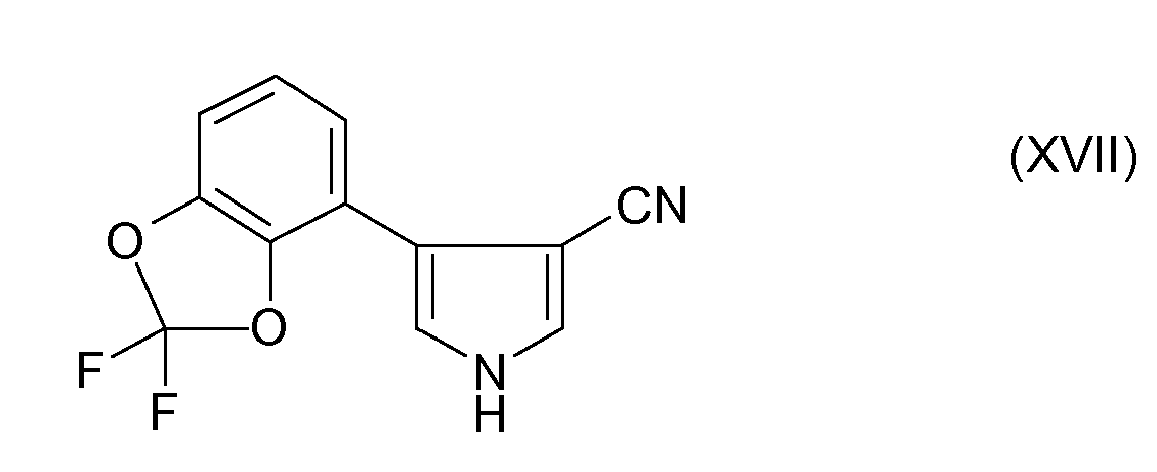
- Fungizide Mischung nach Anspruch 1, dadurch gekennzeichnet, dass das Gewichtsverhältnis von Prothioconazole der Formel I zu Fludioxonil der Formeln XVII 20 : 1 bis 1 : 20 beträgt.
- Verfahren zur Bekämpfung von Schadpilzen, dadurch gekennzeichnet, daß man die Schadpilze, deren Lebensraum oder die von ihnen freizuhaltenden Pflanzen, Samen, Böden, Flächen, Materialien oder Räume mit der fungiziden Mischung gemäß Anspruch 1 behandelt.
- Verfahren nach Anspruch 3, dadurch gekennzeichnet, daß man die Verbindung der Formel I gemäß Anspruch 1 und eine Verbindung der Formel XVII gemäß Anspruch 1 gleichzeitig, und zwar gemeinsam oder getrennt, oder nacheinander ausbringt.
- Verfahren nach Anspruch 3 oder 4, dadurch gekennzeichnet, daß man die fungizide Mischung oder die Verbindung der Formel I mit einer Verbindung der Formel XVII gemäß Anspruch 1 in einer Menge von 0,01 bis 8 kg/ha aufwendet.
- Fungizide Mittel, enthaltend die fungizide Mischung gemäß Anspruch 1 sowie einen festen oder flüssigen Träger.
Applications Claiming Priority (4)
| Application Number | Priority Date | Filing Date | Title |
|---|---|---|---|
| DE10212704 | 2002-03-21 | ||
| EP09157219A EP2080433B1 (de) | 2002-03-21 | 2003-03-19 | Fungizide Mischungen |
| EP03712051A EP1489906B1 (de) | 2002-03-21 | 2003-03-19 | Fungizide mischungen |
| EP07102911A EP1790226B1 (de) | 2002-03-21 | 2003-03-19 | Fungizide Mischungen |
Related Parent Applications (4)
| Application Number | Title | Priority Date | Filing Date |
|---|---|---|---|
| EP09157219 Previously-Filed-Application | 2003-03-19 | ||
| EP03712051.6 Division | 2003-03-19 | ||
| EP07102911.0 Division | 2007-02-22 | ||
| EP09157219.8 Division | 2009-04-02 |
Publications (1)
| Publication Number | Publication Date |
|---|---|
| EP2289326A1 true EP2289326A1 (de) | 2011-03-02 |
Family
ID=29264756
Family Applications (10)
| Application Number | Title | Priority Date | Filing Date |
|---|---|---|---|
| EP10180173A Expired - Lifetime EP2308300B1 (de) | 2002-03-21 | 2003-03-19 | Fungizide Mischungen |
| EP10181197A Withdrawn EP2308305A1 (de) | 2002-03-21 | 2003-03-19 | Fungizide Mischungen |
| EP07102911A Expired - Lifetime EP1790226B1 (de) | 2002-03-21 | 2003-03-19 | Fungizide Mischungen |
| EP10181170.1A Expired - Lifetime EP2308303B1 (de) | 2002-03-21 | 2003-03-19 | Fungizide Mischungen |
| EP10180582A Withdrawn EP2308302A1 (de) | 2002-03-21 | 2003-03-19 | Fungizide Mischungen |
| EP10181184A Expired - Lifetime EP2308304B1 (de) | 2002-03-21 | 2003-03-19 | Fungizide Mischungen |
| EP10180568A Withdrawn EP2308301A1 (de) | 2002-03-21 | 2003-03-19 | Fungizide Mischungen |
| EP10180602A Withdrawn EP2289326A1 (de) | 2002-03-21 | 2003-03-19 | Fungizide Mischungen |
| EP09157219A Expired - Lifetime EP2080433B1 (de) | 2002-03-21 | 2003-03-19 | Fungizide Mischungen |
| EP03712051A Expired - Lifetime EP1489906B1 (de) | 2002-03-21 | 2003-03-19 | Fungizide mischungen |
Family Applications Before (7)
| Application Number | Title | Priority Date | Filing Date |
|---|---|---|---|
| EP10180173A Expired - Lifetime EP2308300B1 (de) | 2002-03-21 | 2003-03-19 | Fungizide Mischungen |
| EP10181197A Withdrawn EP2308305A1 (de) | 2002-03-21 | 2003-03-19 | Fungizide Mischungen |
| EP07102911A Expired - Lifetime EP1790226B1 (de) | 2002-03-21 | 2003-03-19 | Fungizide Mischungen |
| EP10181170.1A Expired - Lifetime EP2308303B1 (de) | 2002-03-21 | 2003-03-19 | Fungizide Mischungen |
| EP10180582A Withdrawn EP2308302A1 (de) | 2002-03-21 | 2003-03-19 | Fungizide Mischungen |
| EP10181184A Expired - Lifetime EP2308304B1 (de) | 2002-03-21 | 2003-03-19 | Fungizide Mischungen |
| EP10180568A Withdrawn EP2308301A1 (de) | 2002-03-21 | 2003-03-19 | Fungizide Mischungen |
Family Applications After (2)
| Application Number | Title | Priority Date | Filing Date |
|---|---|---|---|
| EP09157219A Expired - Lifetime EP2080433B1 (de) | 2002-03-21 | 2003-03-19 | Fungizide Mischungen |
| EP03712051A Expired - Lifetime EP1489906B1 (de) | 2002-03-21 | 2003-03-19 | Fungizide mischungen |
Country Status (23)
| Country | Link |
|---|---|
| US (2) | US7683086B2 (de) |
| EP (10) | EP2308300B1 (de) |
| JP (1) | JP4722398B2 (de) |
| KR (3) | KR101006689B1 (de) |
| CN (5) | CN1922999A (de) |
| AR (1) | AR040401A1 (de) |
| AT (3) | ATE434380T1 (de) |
| AU (2) | AU2003218790B2 (de) |
| BR (1) | BR0308443B1 (de) |
| CA (5) | CA2708937C (de) |
| DE (2) | DE50311643D1 (de) |
| DK (5) | DK2080433T3 (de) |
| EA (1) | EA010093B1 (de) |
| ES (4) | ES2392496T3 (de) |
| IL (4) | IL163708A0 (de) |
| MX (1) | MXPA04008197A (de) |
| NZ (5) | NZ555495A (de) |
| PL (6) | PL218872B1 (de) |
| PT (4) | PT2080433E (de) |
| SI (3) | SI2080433T1 (de) |
| UA (1) | UA77507C2 (de) |
| WO (1) | WO2003090538A1 (de) |
| ZA (1) | ZA200408485B (de) |
Families Citing this family (57)
| Publication number | Priority date | Publication date | Assignee | Title |
|---|---|---|---|---|
| NZ555495A (en) * | 2002-03-21 | 2008-07-31 | Basf Ag | Fungicidal mixtures containing prothioconazole and metrafenone |
| EA200401291A1 (ru) * | 2002-04-05 | 2005-02-24 | Басф Акциенгезельшафт | Фунгицидная смесь на базе производных бензамидоксима и азолов |
| AU2003246635A1 (en) * | 2002-07-10 | 2004-02-02 | Basf Aktiengesellschaft | Fungicidal mixtures based on dithianon |
| DE10307751A1 (de) | 2003-02-14 | 2004-08-26 | Basf Ag | Neue kristalline Modifikation des Anhydrates von Boscalid |
| UA66740A (en) * | 2003-12-31 | 2004-05-17 | Prezens Ltd Liability Company | Pesticidal composition |
| WO2005077901A1 (en) * | 2004-02-12 | 2005-08-25 | Bayer Cropscience Sa | Fungicidal composition comprising a pyridylethylbenzamide derivative and a compound capable of inhibiting the transport of electrons of the respiratory chain in phytopathogenic fungal organisms |
| ES2367537T3 (es) * | 2005-02-22 | 2011-11-04 | Basf Se | Composición y método para mejorar la fitosanidad. |
| EP1917856A1 (de) * | 2006-11-01 | 2008-05-07 | Syngeta Participations AG | Pestizide Zusammensetzungen, die ein Azol-fungizid , ein Phenylamid-fungizid und Azoxystrobin enthalten |
| GB0508993D0 (en) * | 2005-05-03 | 2005-06-08 | Syngenta Participations Ag | Pesticidal compositions |
| US20080067766A1 (en) * | 2006-09-19 | 2008-03-20 | Mark Watson | Snow removal device |
| CL2007003256A1 (es) * | 2006-11-15 | 2008-07-25 | Du Pont | Mezcla fungicida que comprende al menos tres compuestos diferentes; composicion fungicida que comprende dicha mezcla; y metodo para controlar una enfermedad en plantas causada por el patogeno fungico vegetal que comprende aplicar una cantidad de la m |
| EP2000028A1 (de) * | 2007-06-06 | 2008-12-10 | Bayer CropScience Aktiengesellschaft | Fungizide Wirkstoffkombinationen |
| CN101491255B (zh) * | 2009-03-16 | 2013-06-05 | 陕西蒲城县美邦农药有限责任公司 | 一种含二氰蒽醌与甲基硫菌灵的杀菌组合物 |
| EP2408301B1 (de) | 2009-03-16 | 2013-05-15 | Basf Se | Fungizide zusammensetzungen enthaltend fluopyram und metrafenon |
| WO2010146029A2 (de) * | 2009-06-16 | 2010-12-23 | Basf Se | Fungizide mischungen |
| CN101755787B (zh) * | 2009-11-10 | 2012-09-05 | 深圳诺普信农化股份有限公司 | 一种含有稻瘟酰胺的杀菌组合物 |
| CN103749499A (zh) * | 2011-08-18 | 2014-04-30 | 陕西美邦农药有限公司 | 一种含丙硫菌唑的杀菌组合物 |
| CN102258043A (zh) * | 2011-08-18 | 2011-11-30 | 陕西美邦农药有限公司 | 一种含丙硫菌唑的杀菌组合物 |
| CN103749497A (zh) * | 2011-08-18 | 2014-04-30 | 陕西美邦农药有限公司 | 一种含丙硫菌唑的杀菌组合物 |
| CN102308808A (zh) * | 2011-10-10 | 2012-01-11 | 海利尔药业集团股份有限公司 | 一种含有环氟菌胺与三唑类杀菌剂的杀菌组合物 |
| CN103053531A (zh) * | 2011-10-21 | 2013-04-24 | 深圳诺普信农化股份有限公司 | 杀菌组合物 |
| CN102599172A (zh) * | 2012-01-20 | 2012-07-25 | 联保作物科技有限公司 | 一种杀菌组合物及其制剂 |
| CN102696648A (zh) * | 2012-04-23 | 2012-10-03 | 广东中迅农科股份有限公司 | 一种含有丙硫菌唑和福美双的农药组合物 |
| CN102657186B (zh) * | 2012-04-24 | 2014-04-30 | 杭州宇龙化工有限公司 | 一种含有噻呋酰胺与丙硫菌唑的杀菌组合物 |
| US9795137B2 (en) * | 2012-04-25 | 2017-10-24 | Bayer Cropscience Lp | Metalaxyl and prothioconazole cocrystals and methods of making and using |
| CN103444768A (zh) * | 2012-06-02 | 2013-12-18 | 陕西韦尔奇作物保护有限公司 | 一种含苯氧喹啉与三唑类的高效杀菌组合物 |
| CN103563913B (zh) * | 2012-08-04 | 2015-11-04 | 南京华洲药业有限公司 | 一种含噻呋酰胺和丙硫菌唑的杀菌组合物及其应用 |
| EP2925134B1 (de) * | 2012-11-30 | 2019-12-25 | Bayer CropScience AG | Ternäre fungizidmischungen |
| WO2014135468A1 (en) * | 2013-03-05 | 2014-09-12 | Bayer Cropscience Ag | Use of acylsulfonamides for improving plant yield |
| EP2826367A1 (de) * | 2013-07-18 | 2015-01-21 | Basf Se | Fungizide Mischungen enthaltend Boscalid und Zoxamid |
| US9408388B2 (en) * | 2013-08-30 | 2016-08-09 | Dow Global Technologies Llc | Synergistic combination of a lenacil compound and carbendazim for dry film protection |
| CN103461362B (zh) * | 2013-09-05 | 2014-12-24 | 江苏龙灯化学有限公司 | 一种杀菌活性成分组合物 |
| CN103563909A (zh) * | 2013-10-23 | 2014-02-12 | 江苏丰登农药有限公司 | 一种含丙硫菌唑和稻瘟酰胺的杀菌组合物及其应用 |
| CN104621168A (zh) * | 2013-11-15 | 2015-05-20 | 南京华洲药业有限公司 | 一种含丙硫菌唑和咪鲜胺锰盐的杀菌组合物及其应用 |
| CN104621128A (zh) * | 2013-11-15 | 2015-05-20 | 南京华洲药业有限公司 | 一种含丙硫菌唑和甲霜灵的杀菌组合物及其应用 |
| CN104642329A (zh) * | 2013-11-15 | 2015-05-27 | 南京华洲药业有限公司 | 一种含丙硫菌唑和氰霜唑的杀菌组合物及其应用 |
| CN104621129A (zh) * | 2013-11-15 | 2015-05-20 | 南京华洲药业有限公司 | 一种含丙硫菌唑和精甲霜灵的杀菌组合物及其应用 |
| CN104621127A (zh) * | 2013-11-15 | 2015-05-20 | 南京华洲药业有限公司 | 一种含丙硫菌唑和稻瘟酰胺的杀菌组合物及其应用 |
| CN104904723A (zh) * | 2014-03-11 | 2015-09-16 | 江苏龙灯化学有限公司 | 一种杀菌组合物 |
| CN103918693A (zh) * | 2014-03-31 | 2014-07-16 | 海利尔药业集团股份有限公司 | 一种含有丙硫菌唑与咪鲜胺的杀菌组合物 |
| CN103931624A (zh) * | 2014-04-30 | 2014-07-23 | 海利尔药业集团股份有限公司 | 一种含有丙硫菌唑与氰霜唑的杀菌组合物 |
| UA120628C2 (uk) | 2014-11-07 | 2020-01-10 | Басф Се | Пестицидні суміші |
| CN104542648B (zh) * | 2015-01-27 | 2016-06-08 | 四川利尔作物科学有限公司 | 杀菌组合物及其应用 |
| CN106135223A (zh) * | 2015-04-13 | 2016-11-23 | 南京华洲药业有限公司 | 一种含啶酰菌胺和丙硫菌唑的杀菌组合物及其应用 |
| CN105165836A (zh) * | 2015-07-19 | 2015-12-23 | 广东中迅农科股份有限公司 | 含有丙硫菌唑和环氟菌胺的杀菌组合物 |
| CN106417311A (zh) * | 2015-08-12 | 2017-02-22 | 四川利尔作物科学有限公司 | 种子处理剂组合物及其应用 |
| CN105123705A (zh) * | 2015-08-25 | 2015-12-09 | 天峨县平昌生态农业有限公司 | 一种含丙硫菌唑和氰菌胺的杀菌组合物 |
| CA3003065A1 (en) * | 2015-10-27 | 2017-05-04 | Bayer Cropscience Aktiengesellschaft | Composition comprising a safener, a fungicide and metalaxyl |
| CN105145589A (zh) * | 2015-10-27 | 2015-12-16 | 陕西上格之路生物科学有限公司 | 一种含苯菌酮和丙硫菌唑的杀菌组合物 |
| CN106008263A (zh) * | 2015-11-20 | 2016-10-12 | 江苏长青农化股份有限公司 | 稻瘟酰胺原药合成方法 |
| CN106172432A (zh) * | 2016-07-12 | 2016-12-07 | 安徽省农业科学院植物保护与农产品质量安全研究所 | 一种含丙硫菌唑和噻菌灵的杀菌组合物及其应用 |
| CN105918336A (zh) * | 2016-07-12 | 2016-09-07 | 安徽省农业科学院植物保护与农产品质量安全研究所 | 一种含丙硫菌唑和丙硫唑的杀菌组合物及其应用 |
| GB2552695B (en) * | 2016-08-04 | 2020-03-04 | Rotam Agrochem Int Co Ltd | A synergistic fungicidal composition |
| CN106417343A (zh) * | 2016-09-13 | 2017-02-22 | 江苏丘陵地区镇江农业科学研究所 | 一种含咪鲜胺的杀菌组合物的应用 |
| WO2020231751A1 (en) | 2019-05-10 | 2020-11-19 | Bayer Cropscience Lp | Active compound combinations |
| CN112586503A (zh) * | 2020-12-22 | 2021-04-02 | 江西禾益化工股份有限公司 | 一种含有氰霜唑的杀菌组合物及其应用 |
| CN118415179A (zh) * | 2024-04-28 | 2024-08-02 | 江苏丘陵地区镇江农业科学研究所 | 一种含丙硫菌唑、萎锈灵、杀螟丹的农药组合物及其应用 |
Citations (1)
| Publication number | Priority date | Publication date | Assignee | Title |
|---|---|---|---|---|
| WO1998047367A1 (de) * | 1997-04-18 | 1998-10-29 | Bayer Aktiengesellschaft | Fungizide wirkstoffkombinationen |
Family Cites Families (50)
| Publication number | Priority date | Publication date | Assignee | Title |
|---|---|---|---|---|
| DE682048C (de) | 1932-12-23 | 1939-10-06 | I G Farbenindustrie Akt Ges | Bodenbehandlungsmittel zur Bekaempfung von pilzlichen Pflanzenschaedlingen |
| DE642532C (de) | 1934-06-30 | 1937-03-08 | I G Farbenindustrie Akt Ges | Mittel zur Bekaempfung von Pilzschaedigungen im Obstbau |
| CH351791A (de) | 1957-10-26 | 1961-01-31 | Merck Ag E | Fungizides Mittel |
| BE599143A (de) * | 1960-01-18 | |||
| US3249499A (en) * | 1965-04-26 | 1966-05-03 | Us Rubber Co | Control of plant diseases |
| US4001297A (en) * | 1968-06-18 | 1977-01-04 | Nippon Soda Company Limited | Thioureidobenzene preparations and uses thereof |
| US3657443A (en) * | 1969-09-29 | 1972-04-18 | Du Pont | 2-benzimidazolecarbamic acid alkyl esters as foliar fungicides |
| BE795534A (fr) * | 1972-02-18 | 1973-08-16 | Basf Ag | Agents pour la regulation de la croissance des plantes, contenant comme principe actif un sel azote |
| GB1469772A (en) | 1973-06-21 | 1977-04-06 | Boots Co Ltd | Fungicidal imidazole derivatives |
| US4151299A (en) * | 1974-04-09 | 1979-04-24 | Ciba-Geigy Corporation | Certain aniline derivatives as microbicidal agents |
| EP0032630A1 (de) * | 1980-01-21 | 1981-07-29 | Imperial Chemical Industries Plc | Herstellung einer wässrigen Dispersion aromatischer Polyäthersulfone |
| IT1184535B (it) * | 1985-05-03 | 1987-10-28 | Gte Telecom Spa | Processo di ricavo di linee in film sottile |
| US4705800A (en) * | 1985-06-21 | 1987-11-10 | Ciba-Geigy Corporation | Difluorbenzodioxyl cyanopyrrole microbicidal compositions |
| EP0230209A3 (de) * | 1985-12-16 | 1987-08-12 | Ciba-Geigy Ag | Mikrobizide |
| EP0236689A3 (de) * | 1986-01-27 | 1988-04-27 | Shell Internationale Researchmaatschappij B.V. | Fungizide Mittel |
| IL89029A (en) | 1988-01-29 | 1993-01-31 | Lilly Co Eli | Fungicidal quinoline and cinnoline derivatives, compositions containing them, and fungicidal methods of using them |
| GB9122442D0 (en) * | 1991-10-23 | 1991-12-04 | Sandoz Ltd | Improvements in or relating to organic compounds |
| IL103614A (en) * | 1991-11-22 | 1998-09-24 | Basf Ag | Carboxamides for controlling botrytis and certain novel such compounds |
| DE4139637A1 (de) * | 1991-12-02 | 1993-06-03 | Bayer Ag | Fungizide wirkstoffkombinationen |
| JP3417995B2 (ja) * | 1994-04-12 | 2003-06-16 | 呉羽化学工業株式会社 | 殺菌剤組成物 |
| DE19528046A1 (de) | 1994-11-21 | 1996-05-23 | Bayer Ag | Triazolyl-Derivate |
| GB9424373D0 (en) * | 1994-12-02 | 1995-01-18 | Sandoz Ltd | Novel combinations |
| AU702432B2 (en) | 1994-12-19 | 1999-02-18 | Nippon Soda Co., Ltd. | Benzamidoxime derivatives, method for preparation thereof and fungicide for agricultural and horticultural use |
| CZ294096B6 (cs) * | 1995-01-20 | 2004-10-13 | Americanácyanamidácompany | Benzofenonové sloučeninyŹ způsob jejich výrobyŹ fungicidní prostředky s jejich obsahem a způsob ochrany rostlin |
| US5679866A (en) * | 1995-01-20 | 1997-10-21 | American Cyanamid Company | Fungicidal methods, compounds and compositions containing benzophenones |
| US5773663A (en) * | 1996-05-01 | 1998-06-30 | American Cyanamid Company | Fungicidal methods, compounds and compositions containing benzophenones |
| FR2732190B1 (fr) * | 1995-04-03 | 1997-04-30 | Rhone Poulenc Agrochimie | Composition fongicide a base de prochloraze et d'un compose triazole |
| SK283401B6 (sk) * | 1996-08-30 | 2003-07-01 | Basf Aktiengesellschaft | Fungicídne zmesi a spôsob ničenia škodlivých húb |
| US20020072535A1 (en) | 1997-04-18 | 2002-06-13 | Klaus Stenzel | Fungicide active substance combinations |
| DE19716256A1 (de) * | 1997-04-18 | 1998-10-22 | Bayer Ag | Fungizide Wirkstoffkombinationen |
| US5945567A (en) | 1997-08-20 | 1999-08-31 | American Cyanamid Company | Fungicidal 2-methoxybenzophenones |
| ATE213491T1 (de) | 1997-08-20 | 2002-03-15 | Fungizide 2-methoxybenzophenone | |
| US6001883A (en) * | 1998-06-24 | 1999-12-14 | American Cyanamid Company | Fungicidal 2-methoxybenzophenones |
| DE69812805T2 (de) | 1997-08-20 | 2003-11-13 | Basf Ag | Fungizide 2,6,6'-Trimethylbenzophenone |
| WO1999014188A1 (de) * | 1997-09-18 | 1999-03-25 | Basf Aktiengesellschaft | Neue benzamidoxim-derivate, zwischenprodukte und verfahren zu deren herstellung und deren verwendung als fungizide |
| PL193553B1 (pl) * | 1997-09-18 | 2007-02-28 | Basf Ag | Pochodne benzamidoksymu, benzamidoksymy, zastosowanie pochodnych benzamidoksymu i środek grzybobójczy |
| EP1077028B1 (de) * | 1998-04-30 | 2003-07-09 | Nippon Soda Co., Ltd. | Bakterizidzusammensetzung für acker- und gartenbau |
| CA2330607C (en) * | 1998-05-04 | 2008-02-19 | Basf Aktiengesellschaft | Fungicidal mixtures |
| DE69912193T2 (de) | 1998-06-24 | 2004-07-29 | Basf Ag | Substituierte 2-Hydroxybenzophenone, ihre Herstellung, ihre Verwendung als fungizide und ihre fungizide Zusammensetzungen |
| US6346535B1 (en) | 1999-01-29 | 2002-02-12 | American Cyanamid Company | Fungicidal mixtures |
| DE19917617A1 (de) * | 1999-04-19 | 2000-10-26 | Bayer Ag | -(-)Enantiomeres des 2-[2-(1-Chlor-cyclopropyl)-3-(2-chlorphenyl) 2-hydroxy-propyl]-2,4-dihydro-[1,2,4]-triazol-3-thions |
| DE19933938A1 (de) * | 1999-07-20 | 2001-01-25 | Bayer Ag | Fungizide Wirkstoffkombinationen |
| WO2001008064A1 (en) * | 1999-07-26 | 2001-02-01 | Taricani Joseph F Jr | Computer-based system for simplification of tax collections and remittances for internet and mail order commerce |
| CA2393988A1 (en) * | 1999-12-13 | 2001-06-21 | Bayer Aktiengesellschaft | Fungicidal combinations of active substances |
| DE10019758A1 (de) * | 2000-04-20 | 2001-10-25 | Bayer Ag | Fungizide Wirkstoffkombinationen |
| CN100345482C (zh) | 2000-12-18 | 2007-10-31 | 巴斯福股份公司 | 基于肟醚衍生物的杀真菌混合物 |
| WO2002054870A2 (de) | 2001-01-16 | 2002-07-18 | Basf Aktiengesellschaft | Fungizide mischungen auf der basis von imidazolderivaten |
| GB0108339D0 (en) * | 2001-04-03 | 2001-05-23 | Syngenta Participations Ag | Organics compounds |
| TWI283164B (en) * | 2001-09-21 | 2007-07-01 | Du Pont | Anthranilamide arthropodicide treatment |
| NZ555495A (en) * | 2002-03-21 | 2008-07-31 | Basf Ag | Fungicidal mixtures containing prothioconazole and metrafenone |
-
2003
- 2003-03-19 NZ NZ555495A patent/NZ555495A/en not_active IP Right Cessation
- 2003-03-19 PL PL402937A patent/PL218872B1/pl unknown
- 2003-03-19 AT AT07102911T patent/ATE434380T1/de not_active IP Right Cessation
- 2003-03-19 DK DK09157219.8T patent/DK2080433T3/da active
- 2003-03-19 UA UA20041008449A patent/UA77507C2/uk unknown
- 2003-03-19 ES ES10180173T patent/ES2392496T3/es not_active Expired - Lifetime
- 2003-03-19 ES ES03712051T patent/ES2287453T3/es not_active Expired - Lifetime
- 2003-03-19 NZ NZ577315A patent/NZ577315A/en not_active IP Right Cessation
- 2003-03-19 CA CA2708937A patent/CA2708937C/en not_active Expired - Fee Related
- 2003-03-19 EA EA200401158A patent/EA010093B1/ru not_active IP Right Cessation
- 2003-03-19 PT PT09157219T patent/PT2080433E/pt unknown
- 2003-03-19 MX MXPA04008197A patent/MXPA04008197A/es active IP Right Grant
- 2003-03-19 CN CNA2006101157301A patent/CN1922999A/zh active Pending
- 2003-03-19 SI SI200332075T patent/SI2080433T1/sl unknown
- 2003-03-19 EP EP10180173A patent/EP2308300B1/de not_active Expired - Lifetime
- 2003-03-19 EP EP10181197A patent/EP2308305A1/de not_active Withdrawn
- 2003-03-19 DE DE50311643T patent/DE50311643D1/de not_active Expired - Lifetime
- 2003-03-19 PL PL397316A patent/PL397316A1/pl unknown
- 2003-03-19 EP EP07102911A patent/EP1790226B1/de not_active Expired - Lifetime
- 2003-03-19 KR KR1020047014766A patent/KR101006689B1/ko not_active Expired - Fee Related
- 2003-03-19 NZ NZ535307A patent/NZ535307A/en not_active IP Right Cessation
- 2003-03-19 DK DK07102911T patent/DK1790226T3/da active
- 2003-03-19 JP JP2003587187A patent/JP4722398B2/ja not_active Expired - Lifetime
- 2003-03-19 SI SI200332205T patent/SI2308300T1/sl unknown
- 2003-03-19 CN CNB038066572A patent/CN1310585C/zh not_active Expired - Lifetime
- 2003-03-19 EP EP10181170.1A patent/EP2308303B1/de not_active Expired - Lifetime
- 2003-03-19 DK DK10180173.6T patent/DK2308300T3/da active
- 2003-03-19 CA CA2833053A patent/CA2833053A1/en not_active Abandoned
- 2003-03-19 DE DE50307517T patent/DE50307517D1/de not_active Expired - Lifetime
- 2003-03-19 ES ES07102911T patent/ES2327009T3/es not_active Expired - Lifetime
- 2003-03-19 PT PT07102911T patent/PT1790226E/pt unknown
- 2003-03-19 NZ NZ567862A patent/NZ567862A/en not_active IP Right Cessation
- 2003-03-19 DK DK03712051T patent/DK1489906T3/da active
- 2003-03-19 CA CA2858914A patent/CA2858914A1/en not_active Abandoned
- 2003-03-19 KR KR1020107023306A patent/KR20100116715A/ko not_active Ceased
- 2003-03-19 CA CA2479791A patent/CA2479791C/en not_active Expired - Lifetime
- 2003-03-19 ES ES09157219T patent/ES2369331T3/es not_active Expired - Lifetime
- 2003-03-19 EP EP10180582A patent/EP2308302A1/de not_active Withdrawn
- 2003-03-19 PT PT03712051T patent/PT1489906E/pt unknown
- 2003-03-19 KR KR1020127002217A patent/KR20120032017A/ko not_active Ceased
- 2003-03-19 CN CNB2006101157320A patent/CN100450356C/zh not_active Expired - Fee Related
- 2003-03-19 PL PL390655A patent/PL209203B1/pl unknown
- 2003-03-19 AT AT09157219T patent/ATE522138T1/de active
- 2003-03-19 CN CNB2006101157316A patent/CN100438761C/zh not_active Expired - Lifetime
- 2003-03-19 WO PCT/EP2003/002845 patent/WO2003090538A1/de not_active Ceased
- 2003-03-19 PT PT101801736T patent/PT2308300E/pt unknown
- 2003-03-19 EP EP10181184A patent/EP2308304B1/de not_active Expired - Lifetime
- 2003-03-19 PL PL371239A patent/PL207279B1/pl unknown
- 2003-03-19 BR BRPI0308443-4B1A patent/BR0308443B1/pt active IP Right Grant
- 2003-03-19 DK DK10181184.2T patent/DK2308304T3/da active
- 2003-03-19 IL IL16370803A patent/IL163708A0/xx unknown
- 2003-03-19 EP EP10180568A patent/EP2308301A1/de not_active Withdrawn
- 2003-03-19 PL PL393149A patent/PL214973B1/pl unknown
- 2003-03-19 AT AT03712051T patent/ATE364996T1/de active
- 2003-03-19 CA CA2778800A patent/CA2778800C/en not_active Expired - Fee Related
- 2003-03-19 SI SI200330890T patent/SI1489906T1/sl unknown
- 2003-03-19 NZ NZ586487A patent/NZ586487A/en not_active IP Right Cessation
- 2003-03-19 PL PL406864A patent/PL219699B1/pl unknown
- 2003-03-19 EP EP10180602A patent/EP2289326A1/de not_active Withdrawn
- 2003-03-19 EP EP09157219A patent/EP2080433B1/de not_active Expired - Lifetime
- 2003-03-19 US US10/508,208 patent/US7683086B2/en not_active Expired - Lifetime
- 2003-03-19 CN CNB2006101157335A patent/CN100438762C/zh not_active Expired - Fee Related
- 2003-03-19 AU AU2003218790A patent/AU2003218790B2/en not_active Ceased
- 2003-03-19 EP EP03712051A patent/EP1489906B1/de not_active Expired - Lifetime
- 2003-03-20 AR AR20030100990A patent/AR040401A1/es active IP Right Grant
-
2004
- 2004-08-24 IL IL163708A patent/IL163708A/en not_active IP Right Cessation
- 2004-10-20 ZA ZA2004/08485A patent/ZA200408485B/en unknown
-
2009
- 2009-12-17 US US12/640,423 patent/US8188001B2/en not_active Expired - Fee Related
-
2010
- 2010-06-22 AU AU2010202592A patent/AU2010202592B2/en not_active Expired
- 2010-08-04 IL IL207411A patent/IL207411A/en active IP Right Grant
- 2010-08-04 IL IL207406A patent/IL207406A0/en unknown
Patent Citations (1)
| Publication number | Priority date | Publication date | Assignee | Title |
|---|---|---|---|---|
| WO1998047367A1 (de) * | 1997-04-18 | 1998-10-29 | Bayer Aktiengesellschaft | Fungizide wirkstoffkombinationen |
Also Published As
Similar Documents
| Publication | Publication Date | Title |
|---|---|---|
| EP1489906B1 (de) | Fungizide mischungen | |
| EP2289325B1 (de) | Fungizide Mischungen auf der Basis von Triazolen | |
| EP1482798B1 (de) | Fungizide mischung auf der basis von prothioconazole und trifloxystrobin | |
| EP1484972B1 (de) | Fungizide mischungen auf der basis von prothioconazol mit einem insektizid | |
| EP1482797B1 (de) | Fungizide mischungen auf der basis von prothioconazol | |
| EP0984689A1 (de) | Fungizide mischung |
Legal Events
| Date | Code | Title | Description |
|---|---|---|---|
| PUAI | Public reference made under article 153(3) epc to a published international application that has entered the european phase |
Free format text: ORIGINAL CODE: 0009012 |
|
| AC | Divisional application: reference to earlier application |
Ref document number: 2080433 Country of ref document: EP Kind code of ref document: P Ref document number: 1790226 Country of ref document: EP Kind code of ref document: P Ref document number: 1489906 Country of ref document: EP Kind code of ref document: P |
|
| AK | Designated contracting states |
Kind code of ref document: A1 Designated state(s): AT BE BG CH CY CZ DE DK EE ES FI FR GB GR HU IE IT LI LU MC NL PT RO SE SI SK TR |
|
| 17P | Request for examination filed |
Effective date: 20110902 |
|
| STAA | Information on the status of an ep patent application or granted ep patent |
Free format text: STATUS: THE APPLICATION IS DEEMED TO BE WITHDRAWN |
|
| 18D | Application deemed to be withdrawn |
Effective date: 20110903 |