EP2281782A1 - Alumina powder, process for production of the same, and resin compositions containing the same - Google Patents
Alumina powder, process for production of the same, and resin compositions containing the same Download PDFInfo
- Publication number
- EP2281782A1 EP2281782A1 EP09738841A EP09738841A EP2281782A1 EP 2281782 A1 EP2281782 A1 EP 2281782A1 EP 09738841 A EP09738841 A EP 09738841A EP 09738841 A EP09738841 A EP 09738841A EP 2281782 A1 EP2281782 A1 EP 2281782A1
- Authority
- EP
- European Patent Office
- Prior art keywords
- alumina powder
- resin
- particle size
- resin composition
- phase
- Prior art date
- Legal status (The legal status is an assumption and is not a legal conclusion. Google has not performed a legal analysis and makes no representation as to the accuracy of the status listed.)
- Granted
Links
Images
Classifications
-
- C—CHEMISTRY; METALLURGY
- C01—INORGANIC CHEMISTRY
- C01F—COMPOUNDS OF THE METALS BERYLLIUM, MAGNESIUM, ALUMINIUM, CALCIUM, STRONTIUM, BARIUM, RADIUM, THORIUM, OR OF THE RARE-EARTH METALS
- C01F7/00—Compounds of aluminium
- C01F7/02—Aluminium oxide; Aluminium hydroxide; Aluminates
-
- C—CHEMISTRY; METALLURGY
- C01—INORGANIC CHEMISTRY
- C01F—COMPOUNDS OF THE METALS BERYLLIUM, MAGNESIUM, ALUMINIUM, CALCIUM, STRONTIUM, BARIUM, RADIUM, THORIUM, OR OF THE RARE-EARTH METALS
- C01F7/00—Compounds of aluminium
- C01F7/02—Aluminium oxide; Aluminium hydroxide; Aluminates
- C01F7/021—After-treatment of oxides or hydroxides
- C01F7/027—Treatment involving fusion or vaporisation
-
- C—CHEMISTRY; METALLURGY
- C08—ORGANIC MACROMOLECULAR COMPOUNDS; THEIR PREPARATION OR CHEMICAL WORKING-UP; COMPOSITIONS BASED THEREON
- C08G—MACROMOLECULAR COMPOUNDS OBTAINED OTHERWISE THAN BY REACTIONS ONLY INVOLVING UNSATURATED CARBON-TO-CARBON BONDS
- C08G59/00—Polycondensates containing more than one epoxy group per molecule; Macromolecules obtained by polymerising compounds containing more than one epoxy group per molecule using curing agents or catalysts which react with the epoxy groups
- C08G59/18—Macromolecules obtained by polymerising compounds containing more than one epoxy group per molecule using curing agents or catalysts which react with the epoxy groups ; e.g. general methods of curing
- C08G59/20—Macromolecules obtained by polymerising compounds containing more than one epoxy group per molecule using curing agents or catalysts which react with the epoxy groups ; e.g. general methods of curing characterised by the epoxy compounds used
- C08G59/32—Epoxy compounds containing three or more epoxy groups
- C08G59/3218—Carbocyclic compounds
-
- C—CHEMISTRY; METALLURGY
- C08—ORGANIC MACROMOLECULAR COMPOUNDS; THEIR PREPARATION OR CHEMICAL WORKING-UP; COMPOSITIONS BASED THEREON
- C08G—MACROMOLECULAR COMPOUNDS OBTAINED OTHERWISE THAN BY REACTIONS ONLY INVOLVING UNSATURATED CARBON-TO-CARBON BONDS
- C08G59/00—Polycondensates containing more than one epoxy group per molecule; Macromolecules obtained by polymerising compounds containing more than one epoxy group per molecule using curing agents or catalysts which react with the epoxy groups
- C08G59/18—Macromolecules obtained by polymerising compounds containing more than one epoxy group per molecule using curing agents or catalysts which react with the epoxy groups ; e.g. general methods of curing
- C08G59/40—Macromolecules obtained by polymerising compounds containing more than one epoxy group per molecule using curing agents or catalysts which react with the epoxy groups ; e.g. general methods of curing characterised by the curing agents used
- C08G59/62—Alcohols or phenols
- C08G59/621—Phenols
-
- C—CHEMISTRY; METALLURGY
- C08—ORGANIC MACROMOLECULAR COMPOUNDS; THEIR PREPARATION OR CHEMICAL WORKING-UP; COMPOSITIONS BASED THEREON
- C08G—MACROMOLECULAR COMPOUNDS OBTAINED OTHERWISE THAN BY REACTIONS ONLY INVOLVING UNSATURATED CARBON-TO-CARBON BONDS
- C08G59/00—Polycondensates containing more than one epoxy group per molecule; Macromolecules obtained by polymerising compounds containing more than one epoxy group per molecule using curing agents or catalysts which react with the epoxy groups
- C08G59/18—Macromolecules obtained by polymerising compounds containing more than one epoxy group per molecule using curing agents or catalysts which react with the epoxy groups ; e.g. general methods of curing
- C08G59/68—Macromolecules obtained by polymerising compounds containing more than one epoxy group per molecule using curing agents or catalysts which react with the epoxy groups ; e.g. general methods of curing characterised by the catalysts used
- C08G59/688—Macromolecules obtained by polymerising compounds containing more than one epoxy group per molecule using curing agents or catalysts which react with the epoxy groups ; e.g. general methods of curing characterised by the catalysts used containing phosphorus
-
- C—CHEMISTRY; METALLURGY
- C08—ORGANIC MACROMOLECULAR COMPOUNDS; THEIR PREPARATION OR CHEMICAL WORKING-UP; COMPOSITIONS BASED THEREON
- C08K—Use of inorganic or non-macromolecular organic substances as compounding ingredients
- C08K3/00—Use of inorganic substances as compounding ingredients
- C08K3/18—Oxygen-containing compounds, e.g. metal carbonyls
- C08K3/20—Oxides; Hydroxides
- C08K3/22—Oxides; Hydroxides of metals
-
- C—CHEMISTRY; METALLURGY
- C08—ORGANIC MACROMOLECULAR COMPOUNDS; THEIR PREPARATION OR CHEMICAL WORKING-UP; COMPOSITIONS BASED THEREON
- C08L—COMPOSITIONS OF MACROMOLECULAR COMPOUNDS
- C08L63/00—Compositions of epoxy resins; Compositions of derivatives of epoxy resins
-
- C—CHEMISTRY; METALLURGY
- C01—INORGANIC CHEMISTRY
- C01P—INDEXING SCHEME RELATING TO STRUCTURAL AND PHYSICAL ASPECTS OF SOLID INORGANIC COMPOUNDS
- C01P2004/00—Particle morphology
- C01P2004/30—Particle morphology extending in three dimensions
- C01P2004/32—Spheres
-
- C—CHEMISTRY; METALLURGY
- C01—INORGANIC CHEMISTRY
- C01P—INDEXING SCHEME RELATING TO STRUCTURAL AND PHYSICAL ASPECTS OF SOLID INORGANIC COMPOUNDS
- C01P2004/00—Particle morphology
- C01P2004/51—Particles with a specific particle size distribution
- C01P2004/52—Particles with a specific particle size distribution highly monodisperse size distribution
-
- C—CHEMISTRY; METALLURGY
- C01—INORGANIC CHEMISTRY
- C01P—INDEXING SCHEME RELATING TO STRUCTURAL AND PHYSICAL ASPECTS OF SOLID INORGANIC COMPOUNDS
- C01P2004/00—Particle morphology
- C01P2004/60—Particles characterised by their size
- C01P2004/61—Micrometer sized, i.e. from 1-100 micrometer
-
- Y—GENERAL TAGGING OF NEW TECHNOLOGICAL DEVELOPMENTS; GENERAL TAGGING OF CROSS-SECTIONAL TECHNOLOGIES SPANNING OVER SEVERAL SECTIONS OF THE IPC; TECHNICAL SUBJECTS COVERED BY FORMER USPC CROSS-REFERENCE ART COLLECTIONS [XRACs] AND DIGESTS
- Y10—TECHNICAL SUBJECTS COVERED BY FORMER USPC
- Y10T—TECHNICAL SUBJECTS COVERED BY FORMER US CLASSIFICATION
- Y10T428/00—Stock material or miscellaneous articles
- Y10T428/29—Coated or structually defined flake, particle, cell, strand, strand portion, rod, filament, macroscopic fiber or mass thereof
- Y10T428/2982—Particulate matter [e.g., sphere, flake, etc.]
Definitions
- the present invention relates to an alumina powder having a high average circularity and an improved flowability at the time of being highly filled, a process for its production and a resin composition employing it.
- an alumina powder having a high thermal conductivity may be incorporated to a rubber or resin.
- alumina powder it was not possible to sufficiently utilize the thermal conductivity of the alumina, because of a remarkable rising viscosity phenomenon at the time of being highly filled.
- Patent Document 1 a method has been proposed to spray an aluminum hydroxide powder or an aluminum hydroxide powder slurry into flames from a feed pipe having an intensive dispersing function to obtain spherical alumina powder particles.
- the spherical alumina particles obtained by this method had surface irregularities derived from aluminum hydroxide raw material, even with particles having an average sphericity of at least 0.90, and thus, they are still desired to be improved.
- the product has, on its surface, irregularities derived from the raw material and thus is still desired to be improved.
- the present invention provides the following to accomplish the above object.
- an alumina powder which has a high average circularity and which can maintain the flow property at a high level even at the time of being highly filled in a resin composition and thus is suitable as a filler, and a process for its production.
- the alumina powder of the present invention is useful as a sealing material for semiconductors, a heat dissipator, etc.
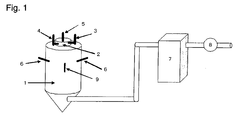
- Fig. 1 is a schematic view illustrating an embodiment of the process for producing the alumina powder of the present invention.
- a fused alumina pulverized product is used as a raw material, whereby it is possible to reduce the surface cracking of alumina powder particles thereby to increase the flowability.
- the ⁇ -phase content in the alumina powder should be at most 40%, an improvement can be made also with respect to the surface irregularities of the particles, whereby the flowability can further be increased.
- the ⁇ -phase content should better be close to 0, and it is more preferably at most 30%, particularly preferably from 20 to 0%.
- the ⁇ -phase content in the alumina powder can be controlled by changing the cooling condition after the heat treatment of a pulverized product of fused alumina.
- Such cooling can be carried out by spraying water into the furnace at a middle body portion of the furnace.
- the cooling condition in the furnace can be adjusted by the amount of water to be sprayed.
- the amount of water to be sprayed for cooling is preferably at least 100 L per one hour.
- the average particle size of the alumina powder of the present invention may be variously selected depending upon the particular purpose. According to the process of the present invention which will be described hereinafter, it is possible to easily produce an alumina powder having an average particle size of at most 100 ⁇ m, particularly from 10 to 95 ⁇ m. The average particle size can be increased or decreased by controlling the average particle size of the raw material.
- the average particle size of the alumina powder is adjusted to be at most 100 ⁇ m for such a reason that if the average particle size exceeds 100 ⁇ m, it becomes difficult to accomplish an average circularity of at least 0.95.
- the average circularity is preferably at least 0.95, and the average circularity is more preferably at least 0.97.
- the average particle size can be measured, for example, by using a laser diffraction type particle size distribution measuring apparatus, CILAS GRANULOMETER "Model 920" (manufactured by BECKMAN COULTER). With respect to particles having an average particle size of less than 25 ⁇ m, 1 g of a sample, with respect to particles having an average particle size of from 25 to less than 45 ⁇ m, 2 g of a sample, or with respect to particles having an average particle size of from 45 to less than 120 ⁇ m, 4 g of a sample, is weighed and introduced directly into a sample introduction section of the CILAS GRANULOMETER. The particle size distribution measurement by the CILAS GRANULOMETER was carried out at a pump rotational speed of 60 rpm using water as a solvent and employing the refractive index of alumina (1.768) for setting.
- the resin composition of the present invention is one having the alumina powder of the present invention incorporated and filled in a resin or rubber.
- a resin composition one having the alumina powder of the present invention incorporated and filled in a resin
- a rubber composition one having the alumina powder of the present invention incorporated and filled in a rubber
- the resin composition in the specification of the present invention may sometimes be used to cover the resin composition and the rubber composition.
- the average circularity of the alumina powder is preferably at least 0.95, particularly preferably at least 0.97.
- the average circularity of the alumina powder may be increased or decreased by changing the amount of a fuel gas (e.g. LPG) to be used for forming flames.
- a fuel gas e.g. LPG
- the average circularity can be measured, for example, by using a flow type particle image analyzer "FPIA-3000" manufactured by Sysmex. That is, 40 g of an alumina powder is weighed and put into a 200 ml beaker, and 100 ml of deionized water is introduced, followed by stirring and then by dispersion for 3 minutes by an ultrasonic cleaner (e.g. tradename "Ultrasonic Cleaner Powerful Type VS-150", manufactured by AS ONE Corporation).
- FPIA-3000 flow type particle image analyzer manufactured by Sysmex. That is, 40 g of an alumina powder is weighed and put into a 200 ml beaker, and 100 ml of deionized water is introduced, followed by stirring and then by dispersion for 3 minutes by an ultrasonic cleaner (e.g. tradename "Ultrasonic Cleaner Powerful Type VS-150", manufactured by AS ONE Corporation).
- the slurry in the beaker is introduced, and then 300 ml of deionized water is poured on the sieve, and then, depending upon the particle size, a measurement is carried out as follows.
- the average circularity the perimeter of a projected image of one particle and the perimeter of a circle corresponding to the area of the projected image of the particle are analyzed by the above-mentioned flow-type particle image analyzer "FPIA-3000", the circularity is obtained by the following formula, and an average value per 36,000 particles is automatically calculated.
- the slurry settled in the above tray is stirred by a stirring rod, and 0.5 ml thereof is sampled into a 5 ml container, and 5 ml of a 25 mass% propylene glycol aqueous solution is added, followed by dispersion for 10 seconds by an ultrasonic cleaner.
- the dispersion is introduced in its entire amount into a flow-type particle image analyzer "FPIA-3000" and measured in a HPF mode/quantitative count system (total number counted: 36,000 particles, number of repeated measurement: once), whereupon an analysis is carried out within a particle size range of from 1.5 to less than 45 ⁇ m (circle-equivalent diameter/based on the number of particles).
- the production of the alumina powder of the present invention is carried out preferably by using the installation shown in Fig. 1 by using a pulverized product of fused alumina as a raw material powder.
- the pulverized product of a fused alumina is sprayed and melted in flames, and from a middle body portion of the furnace, water is sprayed into the furnace for quenching, whereupon the obtained spheroidized particles are transported together with an exhaust gas by a blower to a bag filter and thereby collected.
- Formation of flames is carried out by spraying a fuel gas such as hydrogen, natural gas, acetylene gas, propane gas or butane and a supporting gas such as air or oxygen from a burner set in the furnace.
- the temperature of the flames is adjusted to be preferably at least 2,100°C, particularly preferably from 2,100 to 2,300°C.
- a twin-fluid nozzle For the cooling by spraying water into the furnace, a twin-fluid nozzle may be used. In the present invention, it is preferred to carry out the quenching treatment by spraying water by means of Atomax nozzle BN160 Model (manufactured by Atomax Co., Ltd.).
- the temperature in the furnace is preferably lowered by from 200 to 400°C as compared with a case where no water is sprayed.
- Such a range of lowering the temperature in the furnace can be attained preferably by the above-mentioned spray amount of water.
- the ⁇ -phase content of the alumina powder can be adjusted by the spray amount of water (corresponding to setting of the temperature condition in the furnace).
- the pulverized product of fused alumina as the raw material to be used in the process for producing an alumina powder of the present invention is preferably a pulverized product of a melt-solidified Bayer process alumina.
- a melt-solidified Bayer process alumina For the melting of Bayer process alumina, an arc furnace may be used.
- the average particle size of the pulverized product of fused alumina is preferably at most 100 ⁇ m, more preferably from 10 to 95 ⁇ m.
- the alumina powder in the present invention is to be used for a sealing material for semiconductors, it is necessary to reduce ionic impurities in the alumina powder.
- the flame-treated product of the pulverized product of fused alumina is preferred to subject the flame-treated product of the pulverized product of fused alumina to washing treatment with water.
- a method disclosed in JP-A-2005-281063 may, for example, be used. That is, the treatment is carried out by washing the alumina powder with water having a pH of from 3 to 7 which does not substantially contain Na + , K + , NH 4 + , Mg 2 + or Ca 2 + , in the presence of an ion exchange resin.
- an epoxy resin for the resin composition of the present invention, it is possible to use, for example, an epoxy resin, a phenol resin, a melamine resin, a urea resin, an unsaturated polyester, a fluororesin; a polyamide such as a polyimide, a polyamide imide or a polyether imide; a polyester such as a polybutylene terephthalate or a polyethylene terephthalate; a polyphenylene sulfide, an aromatic polyester, a polysulfone, a liquid crystal polymer, a polyether sulfone, a polycarbonate, a maleimide-modified resin, an ABS resin, an AAS (acrylonitrile/acrylic rubber/styrene) resin, an AES (acrylonitrile/ethylene/propylene/diene rubber/styrene) resin, an EVA (ethylene/vinyl acetate copolymer) resin or a silicone resin.
- an epoxy resin a phenol resin
- Particularly preferred is an epoxy resin or a silicone resin.
- the resin composition of the present invention is one having the alumina powder of the present invention incorporated and filled in the above-mentioned resin or rubber.
- the resin composition of the present invention can be produced by blending predetermined amounts of the respective materials by a blender or a Henschel mixer and then kneaded by e.g. heated rollers, a kneader or a single or twin screw extruder, followed by cooling and then by pulverization.
- the content of the alumina powder varies depending upon the particular applications, but the present invention is characterized in that the alumina powder can be highly filled in the resin or rubber, and its content is preferably made to be at least 40 vol%, more preferably from 65 to 90 vol%, based on 100 vol% of the resin composition.
- One containing the alumina powder of the present invention in an epoxy resin is suitable as a sealing material for semiconductors.
- the content of the alumina powder is adjusted to be preferably at least 70 vol%, more preferably from 75 to 90 vol%, based on 100 vol% of the resin composition.
- One containing the alumina powder of the present invention in a silicone resin or silicone rubber, is suitable as a heat dissipator.
- the content of the alumina powder is adjusted to be at least 65 vol%, more preferably from 70 to 80 vol%, based on 100 vol% of the resin composition.
- Bayer process calcined alumina powder "D” (A11 manufactured by Light Metal Co., Ltd.) was melted by an arc furnace, followed by cooling and pulverization to obtain pulverized products of fused alumina "A", “B” and “C”.
- the production of "A”, “B” and “C” was differentiated by adjusting the pulverization time.
- a ball mill (AXB-15, manufactured by Seiwa Giken Co., Ltd.) was used, and as pulverization media, alumina balls (balls with a diameter of 30 mm) were used.
- Table 1 shows the types and average particles sizes of the alumina powder raw materials "A”, “B”, “C” and “D” used in the present invention.
- the heat treatment was carried out by using the production apparatus shown in Fig. 1 .
- Flames of from 2,150 to 2,500°C were formed by adjusting the spray amounts of the fuel gas (LPG) and the supporting gas (O 2 gas) to be as shown in Table 2.
- the alumina powder raw material (supply amount: 30 kg/hr) was accompanied with oxygen gas (supply amount: 20 Nm 3 /hr) and sprayed from a nozzle into flames, and the obtained alumina powder was recovered from a bag filter.
- the temperature of the flames was confirmed by installing a burner outside the furnace and by using a radiation thermometer IS5/F Model manufactured by Impac.
- the temperature of the furnace wall was measured by inserting an R themocouple in a horizontal direction to the furnace wall surface in the same horizontal plane as the nozzles for water spraying, and the cooling effects were confirmed by using the furnace wall temperature as a reference.
- the measured furnace wall temperature is shown in Table 2.
- the obtained alumina powder was subjected to water washing treatment.
- the water content of the obtained cake was at most 20 mass% in all cases. This cake was dried at 150°C for 48 hours by a shelve-type drying machine to obtain water washing-treated alumina powder.
- the average circularity of the alumina powder was measured by the following method. The results are shown in Table 3.
- the average circularity was measured, for example, by using a flow type particle image analyzer "FPIA-3000" manufactured by Sysmex. That is, 40 g of an alumina powder was weighed and put into a 200 ml beaker, and 100 ml of deionized water was introduced, followed by stirring and then by dispersion for 3 minutes by an ultrasonic cleaner (e.g. tradename "Ultrasonic Cleaner Powerful Type VS-150", manufactured by AS ONE Corporation).
- FPIA-3000 flow type particle image analyzer
- an ultrasonic cleaner e.g. tradename "Ultrasonic Cleaner Powerful Type VS-150", manufactured by AS ONE Corporation.
- the slurry settled in the above tray was stirred by a stirring rod, and 0.5 ml thereof was sampled into a 5 ml container, and 5 ml of a 25 mass% propylene glycol aqueous solution was added, followed by dispersion for 10 seconds by a ultrasonic cleaner.
- the dispersion was introduced in its entire amount into a flow-type particle image analyzer "FPIA-3000" and measured in a HPF mode/quantitative count system (total number counted: 36,000 particles, number of repeated measurement: once) whereupon an analysis was carried out within a particle size range of from 1.5 to less than 45 ⁇ m (circle-equivalent diameter/based on the number of particles).
- the average particle size was measured, for example, by using a laser diffraction type particle size distribution measuring apparatus, CILAS GRANULOMETER "Model 920" (manufactured by BECKMAN COULTER). With respect to particles having an average particle size of at most 25 ⁇ m, 1 g of a sample, with respect to particles having an average particle size of from 25 to 45 ⁇ m, 2 g of a sample, or with respect to particles having an average particle size of from 45 to 120 ⁇ m, 4 g of a sample, was weighed and introduced directly into a sample introduction section of the CILAS GRANULOMETER. The particle size distribution measurement by the CILAS GRANULOMETER was carried out at a pump rotational speed of 60 rpm using water as a solvent and employing the refractive index of alumina (1.768) for setting.
- the ⁇ -phase content was measured by the following method. The results are shown in Table 3.
- the ⁇ -phase content can be obtained by a calibration line method of X-ray diffraction.
- JDX-3500 Model X-ray diffraction apparatus manufactured by JEOL Ltd. was used.
- Powders prepared by mixing ⁇ -phase alumina powder AA-05 (manufactured by Sumitomo Chemical Co., Ltd.) and ⁇ -phase alumina powder TAIMICRON TM-100D (manufactured by TAIMEI CHEMICALS Co., Ltd.) in mass ratios of 0:10, 5:5 and 10:0, respectively, were subjected to X-ray diffraction measurements, whereupon the integrated intensity of a peak of ⁇ -phase detected in the vicinity of 2 ⁇ 43° was calculated, and a calibration line of the integrated intensity plotted against the mixing ratio was made.
- Examples 11 to 18 and Comparative Examples 11 to 13 in Table 3 30 parts by volume of the resin blend shown in Table 5 and 70 parts by volume of the alumina powder obtained in one of the above Examples 1 to 8 and Comparative Examples 1 to 3, were mixed to prepare an epoxy resin composition.
- the flowability and the heat conductivity were evaluated as follows.
- Example 19 20 parts by volume of the resin blend shown in Table 5 and 80 parts by volume of the alumina powder of Example 9 were mixed to prepare an epoxy resin composition, and its flowability and heat conductivity were evaluated as follows.
- preparation of a heat dissipator used in the measurement of the heat conductivity was carried out as follows.
- a material for semiconductors, prepared by heating and kneading by a twin screw extrusion kneader was cast into a plate-forming mold of 25 mm ⁇ 25 mm ⁇ 3 mm by means of a transfer molding machine to prepare a sample for evaluation of the heat conductivity.
- a spiral flow value of the sealing material for semiconductors prepared by heating and kneading by the twin screw extrusion kneader, was measured by means of a transfer molding machine provided with a spiral flow measuring mold in accordance with EMMI-66 (Epoxy Molding Material Institute: Society of Plastic Industry).
- the transfer molding conditions were such that the mold temperature was 175°C, the molding pressure was 7.4 MPa (gauge pressure), and the pressure holding time was 90 seconds.
- Example 21 to 28 and Comparative Examples 21 to 23 in Table 4 40 parts by volume of the liquid silicone rubber and the 70 parts by volume of the alumina powder obtained in one of the above Examples 1 to 8 and Comparative Examples 1 to 3, were mixed to prepare a silicone rubber composition.
- the viscosity and the heat conductivity were evaluated as follows.
- Example 29 30 parts by volume of the liquid silicone rubber and 70 parts by volume of the alumina powder obtained in Example 9 were mixed to prepare a silicone rubber composition, and its viscosity and heat conductivity were evaluated as follows. Further, as the liquid silicone rubber, YE5822A (manufactured by Momentive Material) was used.
- the heat dissipator of the epoxy resin composition or the silicone rubber composition prepared as described above was molded into a size of 25 mm x 25 mm (length x width) and a thickness of 3 mm, and the molded member was sandwiched between a 15 mm x 15 mm copper heater case and a copper plate and set under a clamping torque of 5 kgf/cm. Then, a power of 15 W was applied to the copper heater case and maintained for 4 minutes, whereupon the temperature difference between the copper heater case and the copper plate was measured, and the thermal resistance was calculated by the following formula.
- the heat conductivity can be calculated by the following formula from the thermal resistance (°C/W), the heat transfer area [area of copper heater case] (m 2 ) and the thickness (m) of the molded product under a clamping torque of 5 kgf/cm.
- Heat conductivity W / m ⁇ k Thickness m of molded product / Thermal resistance °C / W ⁇ heat transfer area m 2
- Tables 3 and 4 show the results of measurement of the physical properties of the resin compositions and the rubber compositions in the respective Examples and Comparative Examples.
- filling rate in Tables 3 and 4 is meant for the filling rate (vol%) of the alumina powder obtained in each Example or Comparative Example.
- TABLE 1 Symbol for alumina powder raw material Type of raw material Average particle size ( ⁇ m) A Pulverized product of fused alumina 46.4 B Pulverized product of fused alumina 95.6 C Pulverized product of fused alumina 124.3 D Calcined alumina powder 48.9 TABLE 2 Symbol for alumina powder raw material Amount of LPG (Nm 3 /hr) Amount of supporting O 2 (Nm 3 /hr) Amount of water sprayed (L/(hr ⁇ nozzle)) Temperature of flames (°C) Temperature of furnace wall (°C) Ex.
- the resin compositions using the alumina powders of the present invention have low viscosities and high spiral flow values, and thus, the flowability is remarkably improved.
- the resin compositions using the alumina powders of the present invention are suitable for application to a sealing material for semiconductors or a heat dissipator.
- the alumina powder of the present invention is useful as a filler for a resin composition and further useful for a molding compound or a heat dissipating sheet for e.g. automobiles, portable electronic equipments, industrial equipments or household electric appliances.
- sealing material for semiconductors obtainable from the resin composition of the present invention is useful as a component of which the heat dissipation property is important, such as graphic chips.
Landscapes
- Chemical & Material Sciences (AREA)
- Organic Chemistry (AREA)
- Polymers & Plastics (AREA)
- Medicinal Chemistry (AREA)
- Chemical Kinetics & Catalysis (AREA)
- Health & Medical Sciences (AREA)
- Life Sciences & Earth Sciences (AREA)
- Inorganic Chemistry (AREA)
- Geology (AREA)
- Physics & Mathematics (AREA)
- Plasma & Fusion (AREA)
- Engineering & Computer Science (AREA)
- Compounds Of Alkaline-Earth Elements, Aluminum Or Rare-Earth Metals (AREA)
- Compositions Of Macromolecular Compounds (AREA)
Abstract
[method for measuring α-phase content]
Powders prepared by mixing α-phase alumina powder and θ-phase alumina powder in mass ratios of 0:10, 5:5 and 10:0, respectively, are subjected to X-ray diffraction measurements, whereupon the integrated intensity of a peak of α-phase detected in the vicinity of 2θ=43' is calculated, and a calibration line of the integrated intensity plotted against the mixing ratio is made; and then, a sample of the alumina powder is subjected to an X-ray diffraction measurement, whereupon the integrated intensity of a peak in the vicinity of 2θ=43° is calculated, and the α-phase content is obtained from the calibration line.
Description
- The present invention relates to an alumina powder having a high average circularity and an improved flowability at the time of being highly filled, a process for its production and a resin composition employing it.
- In recent years, along with the progress in high functionality and high speed of heat-generating electronic components such as IC, the amount of heat generation of electronic devices having such components has been increasing, and a high heat dissipating property is desired also for a sealing material for semiconductors. In order to increase the heat dissipating property of a sealing material for semiconductors, an alumina powder having a high thermal conductivity may be incorporated to a rubber or resin. However, by a common Bayer process alumina powder, it was not possible to sufficiently utilize the thermal conductivity of the alumina, because of a remarkable rising viscosity phenomenon at the time of being highly filled.
- In order to solve such a problem, a method has been proposed to spray an aluminum hydroxide powder or an aluminum hydroxide powder slurry into flames from a feed pipe having an intensive dispersing function to obtain spherical alumina powder particles (Patent Document 1). The spherical alumina particles obtained by this method had surface irregularities derived from aluminum hydroxide raw material, even with particles having an average sphericity of at least 0.90, and thus, they are still desired to be improved. Further, also in a case where Bayer process alumina powder is used as a raw material, the product has, on its surface, irregularities derived from the raw material and thus is still desired to be improved.
-
- Patent Document 1:
JP-A-2001-19425 - It is an object of the present invention to provide an alumina powder having a high average circularity and having an improved flow property at the time of being highly filled, a process for its production, and a resin composition employing it.
- The present invention provides the following to accomplish the above object.
- (1) An alumina powder which has an α-phase content of at most 40% as measured by the following method, an average circularity of at least 0.95 in each of the particle size range of from 45 to 200 µm and the particle size range of less than 45 µm, and an average particle size of at most 100 µm:
[method for measuring α-phase content]
Powders prepared by mixing α-phase alumina powder and θ-phase alumina powder in mass ratios of 0:10, 5:5 and 10:0, respectively, are subjected to X-ray diffraction measurements, whereupon the integrated intensity of a peak of α-phase detected in the vicinity of 2θ=43° is calculated, and a calibration line of the integrated intensity plotted against the mixing ratio is made; and then, a sample of the alumina powder is subjected to an X-ray diffraction measurement, whereupon the integrated intensity of a peak in the vicinity of 2θ=43° is calculated, and the α-phase content is obtained from the calibration line. - (2) A process for producing the alumina powder as defined in the above (1), which comprises heat-treating a pulverized product of fused alumina in flames.
- (3) The process for producing the alumina powder according to the above (2), which comprises quenching after the heat-treatment of a pulverized product of fused alumina.
- (4) A resin composition containing the alumina powder as defined in the above (1) in a resin or rubber.
- (5) The resin composition according to the above (4), wherein the resin is an epoxy resin.
- (6) The resin composition according to the above (4), wherein the resin is a silicone resin.
- (7) The resin composition according to the above (4), wherein the rubber is a silicone rubber.
- (8) A sealing material for semiconductors, employing the resin composition as defined in the above (4) or (5).
- (9) A heat dissipator employing the resin composition as defined in any one of the above (4) to (7).
- According to the present invention, it is possible to provide an alumina powder which has a high average circularity and which can maintain the flow property at a high level even at the time of being highly filled in a resin composition and thus is suitable as a filler, and a process for its production. The alumina powder of the present invention is useful as a sealing material for semiconductors, a heat dissipator, etc.
-
Fig. 1 is a schematic view illustrating an embodiment of the process for producing the alumina powder of the present invention. - Now, the present invention will be described in detail.
- For the alumina powder of the present invention, a fused alumina pulverized product is used as a raw material, whereby it is possible to reduce the surface cracking of alumina powder particles thereby to increase the flowability.
- Further, by controlling the α-phase content in the alumina powder to be at most 40%, an improvement can be made also with respect to the surface irregularities of the particles, whereby the flowability can further be increased. The α-phase content should better be close to 0, and it is more preferably at most 30%, particularly preferably from 20 to 0%.
- The α-phase content in the alumina powder can be controlled by changing the cooling condition after the heat treatment of a pulverized product of fused alumina. Such cooling can be carried out by spraying water into the furnace at a middle body portion of the furnace. The cooling condition in the furnace can be adjusted by the amount of water to be sprayed.
- In the present invention, the amount of water to be sprayed for cooling is preferably at least 100 L per one hour.
- The average particle size of the alumina powder of the present invention may be variously selected depending upon the particular purpose. According to the process of the present invention which will be described hereinafter, it is possible to easily produce an alumina powder having an average particle size of at most 100 µm, particularly from 10 to 95 µm. The average particle size can be increased or decreased by controlling the average particle size of the raw material.
- In the present invention, the average particle size of the alumina powder is adjusted to be at most 100 µm for such a reason that if the average particle size exceeds 100 µm, it becomes difficult to accomplish an average circularity of at least 0.95. In order to obtain a high flowability in a highly filled region, the average circularity is preferably at least 0.95, and the average circularity is more preferably at least 0.97.
- The average particle size can be measured, for example, by using a laser diffraction type particle size distribution measuring apparatus, CILAS GRANULOMETER "Model 920" (manufactured by BECKMAN COULTER). With respect to particles having an average particle size of less than 25 µm, 1 g of a sample, with respect to particles having an average particle size of from 25 to less than 45 µm, 2 g of a sample, or with respect to particles having an average particle size of from 45 to less than 120 µm, 4 g of a sample, is weighed and introduced directly into a sample introduction section of the CILAS GRANULOMETER. The particle size distribution measurement by the CILAS GRANULOMETER was carried out at a pump rotational speed of 60 rpm using water as a solvent and employing the refractive index of alumina (1.768) for setting.
- The resin composition of the present invention is one having the alumina powder of the present invention incorporated and filled in a resin or rubber. In the present invention, one having the alumina powder of the present invention incorporated and filled in a resin is referred to as "a resin composition", and one having the alumina powder of the present invention incorporated and filled in a rubber is referred to as "a rubber composition". Further, "the resin composition" in the specification of the present invention may sometimes be used to cover the resin composition and the rubber composition.
- In order to have the alumina powder highly filled in a resin or rubber, the average circularity of the alumina powder is preferably at least 0.95, particularly preferably at least 0.97. The average circularity of the alumina powder may be increased or decreased by changing the amount of a fuel gas (e.g. LPG) to be used for forming flames.
- The average circularity can be measured, for example, by using a flow type particle image analyzer "FPIA-3000" manufactured by Sysmex. That is, 40 g of an alumina powder is weighed and put into a 200 ml beaker, and 100 ml of deionized water is introduced, followed by stirring and then by dispersion for 3 minutes by an ultrasonic cleaner (e.g. tradename "Ultrasonic Cleaner Powerful Type VS-150", manufactured by AS ONE Corporation). Into a JIS 45 µm sieve provided with a tray, the slurry in the beaker is introduced, and then 300 ml of deionized water is poured on the sieve, and then, depending upon the particle size, a measurement is carried out as follows. Here, for the average circularity, the perimeter of a projected image of one particle and the perimeter of a circle corresponding to the area of the projected image of the particle are analyzed by the above-mentioned flow-type particle image analyzer "FPIA-3000", the circularity is obtained by the following formula, and an average value per 36,000 particles is automatically calculated.

- From 0.15 to 0.20 g of particles on the sieve are weighed and put into a 5 ml container, and 5 ml of a 25 mass% propylene glycol aqueous solution is added thereto, followed by dispersion for 10 seconds by an ultrasonic cleaner. The dispersion is put in its entire amount into a flow-type particle image analyzer "FPIA-3000" and measured in a HPF mode/quantitative count system (total number counted: 36,000 particles, number of repeated measurement: once), whereupon an analysis is carried out within a particle size range of from 45 to 200 µm (circle-equivalent diameter/based on the number of particles).
- The slurry settled in the above tray is stirred by a stirring rod, and 0.5 ml thereof is sampled into a 5 ml container, and 5 ml of a 25 mass% propylene glycol aqueous solution is added, followed by dispersion for 10 seconds by an ultrasonic cleaner. The dispersion is introduced in its entire amount into a flow-type particle image analyzer "FPIA-3000" and measured in a HPF mode/quantitative count system (total number counted: 36,000 particles, number of repeated measurement: once), whereupon an analysis is carried out within a particle size range of from 1.5 to less than 45 µm (circle-equivalent diameter/based on the number of particles).
- The production of the alumina powder of the present invention is carried out preferably by using the installation shown in
Fig. 1 by using a pulverized product of fused alumina as a raw material powder. - As outlined, from the top of a furnace, the pulverized product of a fused alumina is sprayed and melted in flames, and from a middle body portion of the furnace, water is sprayed into the furnace for quenching, whereupon the obtained spheroidized particles are transported together with an exhaust gas by a blower to a bag filter and thereby collected. Formation of flames is carried out by spraying a fuel gas such as hydrogen, natural gas, acetylene gas, propane gas or butane and a supporting gas such as air or oxygen from a burner set in the furnace. The temperature of the flames is adjusted to be preferably at least 2,100°C, particularly preferably from 2,100 to 2,300°C.
- For the cooling by spraying water into the furnace, a twin-fluid nozzle may be used. In the present invention, it is preferred to carry out the quenching treatment by spraying water by means of Atomax nozzle BN160 Model (manufactured by Atomax Co., Ltd.).
- In such quenching treatment by spraying water in the present invention, the temperature in the furnace is preferably lowered by from 200 to 400°C as compared with a case where no water is sprayed.
- Such a range of lowering the temperature in the furnace can be attained preferably by the above-mentioned spray amount of water.
- In the process for producing an alumina powder of the present invention, the α-phase content of the alumina powder can be adjusted by the spray amount of water (corresponding to setting of the temperature condition in the furnace).
- The pulverized product of fused alumina as the raw material to be used in the process for producing an alumina powder of the present invention, is preferably a pulverized product of a melt-solidified Bayer process alumina. For the melting of Bayer process alumina, an arc furnace may be used. The average particle size of the pulverized product of fused alumina is preferably at most 100 µm, more preferably from 10 to 95 µm.
- In a case where the alumina powder in the present invention is to be used for a sealing material for semiconductors, it is necessary to reduce ionic impurities in the alumina powder. For the reduction of ionic impurities in the alumina powder, it is preferred to subject the flame-treated product of the pulverized product of fused alumina to washing treatment with water. For such washing treatment with water, a method disclosed in
JP-A-2005-281063 - As the resin for the resin composition of the present invention, it is possible to use, for example, an epoxy resin, a phenol resin, a melamine resin, a urea resin, an unsaturated polyester, a fluororesin; a polyamide such as a polyimide, a polyamide imide or a polyether imide; a polyester such as a polybutylene terephthalate or a polyethylene terephthalate; a polyphenylene sulfide, an aromatic polyester, a polysulfone, a liquid crystal polymer, a polyether sulfone, a polycarbonate, a maleimide-modified resin, an ABS resin, an AAS (acrylonitrile/acrylic rubber/styrene) resin, an AES (acrylonitrile/ethylene/propylene/diene rubber/styrene) resin, an EVA (ethylene/vinyl acetate copolymer) resin or a silicone resin. Among them, an epoxy resin, a phenol resin, a fluororesin, a polyimide, a polyphenylene sulfide, a polycarbonate, an ABS resin or a silicone resin is, for example, preferred.
- Particularly preferred is an epoxy resin or a silicone resin.
- The resin composition of the present invention is one having the alumina powder of the present invention incorporated and filled in the above-mentioned resin or rubber. The resin composition of the present invention can be produced by blending predetermined amounts of the respective materials by a blender or a Henschel mixer and then kneaded by e.g. heated rollers, a kneader or a single or twin screw extruder, followed by cooling and then by pulverization. The content of the alumina powder varies depending upon the particular applications, but the present invention is characterized in that the alumina powder can be highly filled in the resin or rubber, and its content is preferably made to be at least 40 vol%, more preferably from 65 to 90 vol%, based on 100 vol% of the resin composition.
- One containing the alumina powder of the present invention in an epoxy resin is suitable as a sealing material for semiconductors. In order to obtain a high heat conductivity exceeding 3 W/m·k as a sealing material for semiconductors, the content of the alumina powder is adjusted to be preferably at least 70 vol%, more preferably from 75 to 90 vol%, based on 100 vol% of the resin composition.
- One containing the alumina powder of the present invention in a silicone resin or silicone rubber, is suitable as a heat dissipator. In order to obtain a high heat conductivity as a heat dissipator, the content of the alumina powder is adjusted to be at least 65 vol%, more preferably from 70 to 80 vol%, based on 100 vol% of the resin composition.
- Now, the present invention will be described in further detail with reference to Examples, but it should be understood that the present invention is by no means limited to such Examples.
- Bayer process calcined alumina powder "D" (A11 manufactured by Light Metal Co., Ltd.) was melted by an arc furnace, followed by cooling and pulverization to obtain pulverized products of fused alumina "A", "B" and "C". The production of "A", "B" and "C" was differentiated by adjusting the pulverization time.
- For the pulverization treatment at the time of preparing the raw material, a ball mill (AXB-15, manufactured by Seiwa Giken Co., Ltd.) was used, and as pulverization media, alumina balls (balls with a diameter of 30 mm) were used.
- Table 1 shows the types and average particles sizes of the alumina powder raw materials "A", "B", "C" and "D" used in the present invention.
- The heat treatment was carried out by using the production apparatus shown in
Fig. 1 . Flames of from 2,150 to 2,500°C were formed by adjusting the spray amounts of the fuel gas (LPG) and the supporting gas (O2 gas) to be as shown in Table 2. The alumina powder raw material (supply amount: 30 kg/hr) was accompanied with oxygen gas (supply amount: 20 Nm3/hr) and sprayed from a nozzle into flames, and the obtained alumina powder was recovered from a bag filter. The temperature of the flames was confirmed by installing a burner outside the furnace and by using a radiation thermometer IS5/F Model manufactured by Impac. - In order to reduce the α-phase content, cooling treatment by spraying water into the furnace was carried out. For such water spraying, Atomax nozzle BN160 Model (manufactured by Atomax Co., Ltd.) was used. Spraying of water was carried out from 16 holes equally separated around the circumference of the furnace. The temperature of the water to be sprayed was adjusted to 10°C. The amount of water sprayed is shown in Table 2.
- Further, with respect to the degree of quenching, the temperature of the furnace wall was measured by inserting an R themocouple in a horizontal direction to the furnace wall surface in the same horizontal plane as the nozzles for water spraying, and the cooling effects were confirmed by using the furnace wall temperature as a reference. The measured furnace wall temperature is shown in Table 2.
- The obtained alumina powder was subjected to water washing treatment. The water washing treatment was carried out in accordance with the following procedure. That is, for the water washing treatment, the alumina powder was mixed with deionized water of pH=7 wherein Li+, Na+ and K+ components were not detected by measurement by means of an atomic absorption spectrophotometer, to prepare an aqueous slurry having an alumina powder concentration of 40 mass%, which was stirred for 1 hour by means of a stirring and mixing apparatus (tradename "Stir Disperser RSV175" manufactured by Ashizawa Finetech Ltd.) and then subjected to dehydration treatment by a filter press. The water content of the obtained cake was at most 20 mass% in all cases. This cake was dried at 150°C for 48 hours by a shelve-type drying machine to obtain water washing-treated alumina powder.
- The average circularity of the alumina powder was measured by the following method. The results are shown in Table 3.
- The average circularity was measured, for example, by using a flow type particle image analyzer "FPIA-3000" manufactured by Sysmex. That is, 40 g of an alumina powder was weighed and put into a 200 ml beaker, and 100 ml of deionized water was introduced, followed by stirring and then by dispersion for 3 minutes by an ultrasonic cleaner (e.g. tradename "Ultrasonic Cleaner Powerful Type VS-150", manufactured by AS ONE Corporation). Then, into a JIS 45 µm sieve provided with a tray, the slurry in the beaker was introduced, and then 300 ml of deionized water was poured on the sieve, and then, depending upon the particle size, a measurement was carried out as follows. Here, for the average circularity, the perimeter of a projected image of one particle and the perimeter of a circle corresponding to the area of the projected image of the particle were analyzed by the above-mentioned flow-type particle image analyzer "FPIA-3000", the circularity was obtained by the following formula, and an average value per 36,000 particles was automatically calculated.

- From 0.15 to 0.20 g of particles on the sieve were weighed and put into a 5 ml container, and 5 ml of a 25 mass% propylene glycol aqueous solution was added thereto, followed by dispersion for 10 seconds by an ultrasonic cleaner. The dispersion was put in its entire amount into a flow-type particle image analyzer "FPIA-3000" and measured in a HPF mode/quantitative count system (total number counted: 36,000 particle, number of repeated measurement: once) whereupon an analysis was carried out within a particle size range of from 45 to 200 µm (circle-equivalent diameter/based on the number of particles).
- The slurry settled in the above tray was stirred by a stirring rod, and 0.5 ml thereof was sampled into a 5 ml container, and 5 ml of a 25 mass% propylene glycol aqueous solution was added, followed by dispersion for 10 seconds by a ultrasonic cleaner.
The dispersion was introduced in its entire amount into a flow-type particle image analyzer "FPIA-3000" and measured in a HPF mode/quantitative count system (total number counted: 36,000 particles, number of repeated measurement: once) whereupon an analysis was carried out within a particle size range of from 1.5 to less than 45 µm (circle-equivalent diameter/based on the number of particles). - The average particle size was measured, for example, by using a laser diffraction type particle size distribution measuring apparatus, CILAS GRANULOMETER "Model 920" (manufactured by BECKMAN COULTER). With respect to particles having an average particle size of at most 25 µm, 1 g of a sample, with respect to particles having an average particle size of from 25 to 45 µm, 2 g of a sample, or with respect to particles having an average particle size of from 45 to 120 µm, 4 g of a sample, was weighed and introduced directly into a sample introduction section of the CILAS GRANULOMETER. The particle size distribution measurement by the CILAS GRANULOMETER was carried out at a pump rotational speed of 60 rpm using water as a solvent and employing the refractive index of alumina (1.768) for setting.
- The α-phase content was measured by the following method. The results are shown in Table 3.
- The α-phase content can be obtained by a calibration line method of X-ray diffraction. For the measurement of the X-ray diffraction, JDX-3500 Model X-ray diffraction apparatus (manufactured by JEOL Ltd.) was used.
- Powders prepared by mixing α-phase alumina powder AA-05 (manufactured by Sumitomo Chemical Co., Ltd.) and θ-phase alumina powder TAIMICRON TM-100D (manufactured by TAIMEI CHEMICALS Co., Ltd.) in mass ratios of 0:10, 5:5 and 10:0, respectively, were subjected to X-ray diffraction measurements, whereupon the integrated intensity of a peak of α-phase detected in the vicinity of 2θ=43° was calculated, and a calibration line of the integrated intensity plotted against the mixing ratio was made.
- Then, a sample of the alumina powder was subjected to an X-ray diffraction measurement, whereupon the integrated intensity of a peak in the vicinity of 2θ=43° was calculated, and the α-phase content was obtained from the calibration line.
- In Examples 11 to 18 and Comparative Examples 11 to 13 in Table 3, 30 parts by volume of the resin blend shown in Table 5 and 70 parts by volume of the alumina powder obtained in one of the above Examples 1 to 8 and Comparative Examples 1 to 3, were mixed to prepare an epoxy resin composition. With respect to the respective resin compositions of such Examples and Comparative Examples, the flowability and the heat conductivity were evaluated as follows.
- Further, in Example 19, 20 parts by volume of the resin blend shown in Table 5 and 80 parts by volume of the alumina powder of Example 9 were mixed to prepare an epoxy resin composition, and its flowability and heat conductivity were evaluated as follows.
- Here, preparation of a heat dissipator used in the measurement of the heat conductivity was carried out as follows. A material for semiconductors, prepared by heating and kneading by a twin screw extrusion kneader was cast into a plate-forming mold of 25 mm × 25 mm × 3 mm by means of a transfer molding machine to prepare a sample for evaluation of the heat conductivity.
- Using a spiral flow mold, a spiral flow value of the sealing material for semiconductors, prepared by heating and kneading by the twin screw extrusion kneader, was measured by means of a transfer molding machine provided with a spiral flow measuring mold in accordance with EMMI-66 (Epoxy Molding Material Institute: Society of Plastic Industry). The transfer molding conditions were such that the mold temperature was 175°C, the molding pressure was 7.4 MPa (gauge pressure), and the pressure holding time was 90 seconds.
- In Examples 21 to 28 and Comparative Examples 21 to 23 in Table 4, 40 parts by volume of the liquid silicone rubber and the 70 parts by volume of the alumina powder obtained in one of the above Examples 1 to 8 and Comparative Examples 1 to 3, were mixed to prepare a silicone rubber composition. With respect to the respective silicone rubber compositions of such Examples and Comparative Examples, the viscosity and the heat conductivity were evaluated as follows.
- Further, in Example 29, 30 parts by volume of the liquid silicone rubber and 70 parts by volume of the alumina powder obtained in Example 9 were mixed to prepare a silicone rubber composition, and its viscosity and heat conductivity were evaluated as follows. Further, as the liquid silicone rubber, YE5822A (manufactured by Momentive Material) was used.
- The obtained results are shown together with the production conditions for the alumina powders (Examples 1 to 9 and Comparative Examples 1 to 3) in Table 4.
- For the viscosity measurement, heat-treated alumina powder was introduced into the liquid silicone rubber YE5822A manufactured by Momentive Material, followed by mixing by means of a stirring machine NZ-1100, manufactured by TOKYO RIKAKIKAI Co., Ltd.. The viscosity of the mixed silicone rubber composition was measured, after vacuum deaeration, by B Model viscosity TVB-1 0, manufactured by TOKI SANGYO CO., LTD. For the viscosity measurement, No. 7 spindle was used, and the measurement was carried out at a rotational speed of 20 rpm at a room temperature of 20°C.
- Further, preparation of the heat dissipator using the silicone rubber composition was carried out as follows.
- That is, to the silicone rubber composition comprising the liquid silicone rubber YE5822A and the alumina powder, prepared in the above viscosity measurement, liquid silicone rubber YE5822B was added in a ratio of 10:1 by mass, to YE5822A (i.e. YE5822A:YE5822B=10:1). After the addition of YE5822B, the mixture was molded and heat-treated in an atmosphere of 120°C to prepare a heat dissipator.
- The heat dissipator of the epoxy resin composition or the silicone rubber composition prepared as described above was molded into a size of 25 mm x 25 mm (length x width) and a thickness of 3 mm, and the molded member was sandwiched between a 15 mm x 15 mm copper heater case and a copper plate and set under a clamping torque of 5 kgf/cm. Then, a power of 15 W was applied to the copper heater case and maintained for 4 minutes, whereupon the temperature difference between the copper heater case and the copper plate was measured, and the thermal resistance was calculated by the following formula.

- The heat conductivity can be calculated by the following formula from the thermal resistance (°C/W), the heat transfer area [area of copper heater case] (m2) and the thickness (m) of the molded product under a clamping torque of 5 kgf/cm.

- Tables 3 and 4 show the results of measurement of the physical properties of the resin compositions and the rubber compositions in the respective Examples and Comparative Examples.
- Further, "filler filling rate" in Tables 3 and 4 is meant for the filling rate (vol%) of the alumina powder obtained in each Example or Comparative Example.
TABLE 1 Symbol for alumina powder raw material Type of raw material Average particle size (µm) A Pulverized product of fused alumina 46.4 B Pulverized product of fused alumina 95.6 C Pulverized product of fused alumina 124.3 D Calcined alumina powder 48.9 TABLE 2 Symbol for alumina powder raw material Amount of LPG (Nm3/hr) Amount of supporting O2 (Nm3/hr) Amount of water sprayed (L/(hr·nozzle)) Temperature of flames (°C) Temperature of furnace wall (°C) Ex. 1 A 25 125 0 2150 1046 Ex. 2 A 25 125 5 2150 983 Ex. 3 A 25 125 15 2150 921 Ex. 4 A 25 125 20 2150 853 Ex. 5 B 40 200 0 2300 1351 Ex. 6 B 40 200 5 2300 1236 Ex. 7 B 40 200 15 2300 1125 Ex. 8 B 40 200 20 2300 1038 Ex. 9 A 25 125 20 2150 853 Comp. Ex. 1 C 50 250 0 2400 1390 Comp. Ex. 2 C 60 300 0 2500 1455 Comp. Ex. 3 D 25 125 0 2150 1026 TABLE 3 Alumina powder used Average particle size (µm) Circularity α-phase content (%) Filler filling rate (vol%) Spiral flow (cm) Heat conductivity (W/m·K) Particles of 45-200 µm Particles of less than 45 µm Ex. 11 Ex. 1 49.2 0.99 0.99 30.5 70 104.8 4.2 Ex.12 Ex.2 48.4 0.98 0.99 25.6 70 110.3 4.1 Ex. 13 Ex. 3 47.9 0.98 0.99 21.4 70 116.8 4.1 Ex. 14 Ex. 4 48.8 0.98 0.99 17.5 70 123.1 4 Ex. 15 Ex. 5 98.7 0.97 0.99 38.2 70 113.8 4.4 Ex. 16 Ex. 6 97.1 0.97 0.98 34.6 70 119.6 4.3 Ex. 17 Ex. 7 97.3 0.96 0.97 31.4 70 117.1 4.2 Ex. 18 Ex. 8 96.6 0.96 0.97 28.9 70 118.8 4.2 Ex. 19 Ex. 9 48.8 0.98 0.99 17.5 80 85.6 5.3 Comp. Ex. 11 Comp. Ex. 1 127.9 0.89 0.99 51.6 70 51.8 4.1 Comp. Ex. 12 Comp. Ex. 2 129.6 0.93 0.99 42.8 70 83.7 4.1 Comp. Ex. 13 Comp. Ex. 3 52.1 0.97 0.98 45.9 70 84.3 4.1 TABLE 4 Alumina powder used Amount of LPG (Nm3/hr) Amount of supporting O2 (Nm3/hr) Amount of water sprayed (L/(hr·nozzle)) Filler filling rate (vol%) Viscosity (cP) Heat conductivity (W/m·K) Ex. 21 Ex.1 25 125 0 60 106590 3.4 Ex. 22 Ex. 2 25 125 5 60 97410 3.3 Ex. 23 Ex. 3 25 125 15 60 92820 3.3 Ex. 24 Ex. 4 25 125 20 60 88740 3.2 Ex. 25 Ex. 5 40 200 0 60 90984 3.5 Ex. 26 Ex. 6 40 200 5 60 84456 3.4 Ex. 27 Ex. 7 40 200 15 60 80376 3.4 Ex. 28 Ex. 8 40 200 20 60 75888 3.4 Ex. 29 Ex.9 25 125 20 70 144420 4.3 Comp. Ex. 21 Comp. Ex. 1 50 250 0 60 159630 3.3 Comp. Ex. 22 Comp. Ex. 2 60 300 0 60 136170 3.3 Comp. Ex. 23 Comp. Ex. 3 25 125 0 60 191250 3.3 TABLE 5 Type of material Variety Blend (mass%) Epoxy resin Orthocresol novolac type ("EOCN-1020" manufactured by Nippon Kayaku Co., Ltd.) 63.8 Curing agent Phenol novolac resin ("PMS-4261" manufactured by Gun Ei Chemical Industry Co., Ltd. 32.1 Curing accelerator Triphenylphosphine (manufactured by HOKKO CHEMICAL INDUSTRY CO., LTD. 0.6 Releasing agent Montanoic acid ester ("WaxEflakes" manufactured by Clariant Japan) 3.5 Silane coupling agent Organosilane ("KBM-403" manufactured by Shin-Etsu Chemical Co., Ltd. 0.5 Part by mass to 100 parts by mass of alumina powder - As is evident from Tables 3 and 4, the resin compositions using the alumina powders of the present invention have low viscosities and high spiral flow values, and thus, the flowability is remarkably improved.
- The resin compositions using the alumina powders of the present invention are suitable for application to a sealing material for semiconductors or a heat dissipator.
- The alumina powder of the present invention is useful as a filler for a resin composition and further useful for a molding compound or a heat dissipating sheet for e.g. automobiles, portable electronic equipments, industrial equipments or household electric appliances.
- Further, the sealing material for semiconductors obtainable from the resin composition of the present invention is useful as a component of which the heat dissipation property is important, such as graphic chips.
- The entire disclosure of Japanese Patent Application No.
2008-118246 filed on April 30, 2008 -
- 1 :
- Melting furnace
- 2:
- Burner
- 3:
- Fuel gas supply pipe
- 4:
- Supporting gas supply pipe
- 5:
- Raw material powder supply pipe
- 6:
- Water supply pipe
- 7:
- Bag filter
- 8:
- Blower
- 9:
- R thermocouple
Claims (9)
- An alumina powder which has an α-phase content of at most 40% as measured by the following method, an average circularity of at least 0.95 in each of the particle size range of from 45 to 200 µm and the particle size range of less than 45 µm, and an average particle size of at most 100 µm:[method for measuring α-phase content]Powders prepared by mixing α-phase alumina powder and θ-phase alumina powder in mass ratios of 0:10, 5:5 and 10:0, respectively, are subjected to X-ray diffraction measurements, whereupon the integrated intensity of a peak of α-phase detected in the vicinity of 2θ=43° is calculated, and a calibration line of the integrated intensity plotted against the mixing ratio is made; and then, a sample of the alumina powder is subjected to an X-ray diffraction measurement, whereupon the integrated intensity of a peak in the vicinity of 2θ=43° is calculated, and the α-phase content is obtained from the calibration line.
- A process for producing the alumina powder as defined in Claim 1, which comprises heat-treating a pulverized product of fused alumina in flames.
- The process for producing the alumina powder according to Claim 2, which comprises quenching after the heat-treatment of a pulverized product of fused alumina.
- A resin composition containing the alumina powder as defined in Claim 1 in a resin or rubber.
- The resin composition according to Claim 4, wherein the resin is an epoxy resin.
- The resin composition according to Claim 4, wherein the resin is a silicone resin.
- The resin composition according to Claim 4, wherein the rubber is a silicone rubber.
- A sealing material for semiconductors, employing the resin composition as defined in Claim 4 or 5.
- A heat dissipator employing the resin composition as defined in any one of Claims 4 to 7.
Applications Claiming Priority (2)
| Application Number | Priority Date | Filing Date | Title |
|---|---|---|---|
| JP2008118246 | 2008-04-30 | ||
| PCT/JP2009/058402 WO2009133904A1 (en) | 2008-04-30 | 2009-04-28 | Alumina powder, process for production of the same, and resin compositions containing the same |
Publications (3)
| Publication Number | Publication Date |
|---|---|
| EP2281782A1 true EP2281782A1 (en) | 2011-02-09 |
| EP2281782A4 EP2281782A4 (en) | 2015-03-04 |
| EP2281782B1 EP2281782B1 (en) | 2016-12-07 |
Family
ID=41255120
Family Applications (1)
| Application Number | Title | Priority Date | Filing Date |
|---|---|---|---|
| EP09738841.7A Active EP2281782B1 (en) | 2008-04-30 | 2009-04-28 | Alumina powder, process for production of the same, and resin compositions containing the same |
Country Status (9)
| Country | Link |
|---|---|
| US (1) | US20110046267A1 (en) |
| EP (1) | EP2281782B1 (en) |
| JP (2) | JP5775692B2 (en) |
| KR (1) | KR101505237B1 (en) |
| CN (1) | CN102007073B (en) |
| MY (1) | MY164740A (en) |
| SG (1) | SG190615A1 (en) |
| TW (1) | TWI457286B (en) |
| WO (1) | WO2009133904A1 (en) |
Cited By (1)
| Publication number | Priority date | Publication date | Assignee | Title |
|---|---|---|---|---|
| WO2015028296A1 (en) * | 2013-08-28 | 2015-03-05 | Wacker Chemie Ag | Cross-linkable compositions based on organosilicon compounds and thus produced moulded bodies |
Families Citing this family (30)
| Publication number | Priority date | Publication date | Assignee | Title |
|---|---|---|---|---|
| JP5775692B2 (en) * | 2008-04-30 | 2015-09-09 | 電気化学工業株式会社 | Method for producing alumina powder |
| JP5320263B2 (en) * | 2009-11-04 | 2013-10-23 | 電気化学工業株式会社 | Spherical alumina powder, production method and use thereof |
| JP5410245B2 (en) * | 2009-11-11 | 2014-02-05 | 電気化学工業株式会社 | Spherical alumina powder, its production method and use. |
| JP2013122029A (en) * | 2011-12-12 | 2013-06-20 | Sumitomo Bakelite Co Ltd | Filler, composition for forming insulating layer, film for forming insulating layer, and substrate |
| JP6323724B2 (en) * | 2015-10-13 | 2018-05-16 | 大陽日酸株式会社 | Method for producing alumina particles |
| EP3458509B1 (en) | 2016-05-16 | 2022-07-06 | Martinswerk GmbH | Alumina products and use thereof in polymer compositions with high thermal conductivity |
| JP6879690B2 (en) | 2016-08-05 | 2021-06-02 | スリーエム イノベイティブ プロパティズ カンパニー | Resin composition for heat dissipation, its cured product, and how to use them |
| JP7238791B2 (en) * | 2017-12-28 | 2023-03-14 | 株式会社レゾナック | Encapsulating composition and semiconductor device |
| JP7090459B2 (en) * | 2018-04-12 | 2022-06-24 | 株式会社アドマテックス | Particle material, its manufacturing method, and heat conductive material |
| JP6561220B1 (en) * | 2019-02-18 | 2019-08-14 | 株式会社アドマテックス | Particulate material and heat conductive material |
| CN111370623B (en) * | 2020-03-18 | 2022-03-15 | 江苏厚生新能源科技有限公司 | Alumina ceramic separator and preparation method, powder, ceramic slurry, lithium battery |
| KR20220160065A (en) * | 2020-03-31 | 2022-12-05 | 덴카 주식회사 | Carbon-containing alumina powder, resin composition, heat dissipation part, and manufacturing method of carbon-containing alumina powder |
| JP7546044B2 (en) * | 2020-03-31 | 2024-09-05 | デンカ株式会社 | Alumina powder, resin composition, and heat dissipation part |
| JP7543394B2 (en) * | 2020-03-31 | 2024-09-02 | デンカ株式会社 | Alumina powder, filler composition, resin composition, sealing material, and fingerprint authentication sensor |
| WO2022024727A1 (en) * | 2020-07-31 | 2022-02-03 | パナソニックIpマネジメント株式会社 | Epoxy resin composition and under-filling material |
| EP4206138A4 (en) | 2020-09-29 | 2024-06-19 | Denka Company Limited | SPHERICAL ALUMINUM OXIDE POWDER, RESIN COMPOSITION AND HEAT DISSIPATION MATERIAL |
| WO2022071131A1 (en) * | 2020-09-29 | 2022-04-07 | デンカ株式会社 | Spherical alumina powder, resin composition, and semiconductor sealing material |
| CN113149514B (en) * | 2021-04-13 | 2022-06-03 | 南京翌动新材料科技有限公司 | Method for improving mechanical property of ceramic polymer composite material |
| CN113060746B (en) * | 2021-04-14 | 2023-04-18 | 雅安百图高新材料股份有限公司 | Preparation method of large-particle-size alumina raw material and spherical alumina product thereof |
| JP7854340B2 (en) | 2021-06-04 | 2026-05-01 | 住友化学株式会社 | Alumina particles and resin compositions using the same |
| JP7844218B2 (en) * | 2022-03-29 | 2026-04-13 | 日鉄ケミカル&マテリアル株式会社 | Spherical alumina particles, a method for producing the same, a method for surface treatment of a raw material for spherical alumina particles, and a resin composite composition containing the spherical alumina particles, and a resin composite composition |
| JP2023164333A (en) | 2022-04-28 | 2023-11-10 | 住友化学株式会社 | Resin composition and alumina powder used therein |
| JP2023164332A (en) | 2022-04-28 | 2023-11-10 | 住友化学株式会社 | Resin composition and alumina powder used therein |
| JP2024080629A (en) | 2022-12-02 | 2024-06-13 | 住友化学株式会社 | Alumina particles and resin composition using the same |
| JP2024080633A (en) | 2022-12-02 | 2024-06-13 | 住友化学株式会社 | Alumina particles and resin composition using the same |
| JP2024080630A (en) | 2022-12-02 | 2024-06-13 | 住友化学株式会社 | Alumina particles and resin composition using the same |
| JP2024080631A (en) | 2022-12-02 | 2024-06-13 | 住友化学株式会社 | Alumina particles and resin composition using the same |
| CN120379936A (en) * | 2022-12-16 | 2025-07-25 | 电化株式会社 | Spherical alumina powder |
| KR20260053038A (en) * | 2023-09-29 | 2026-04-20 | 닛테츠 케미컬 앤드 머티리얼 가부시키가이샤 | Alumina particles, and a slurry composition and a resin composite composition containing the same. |
| JP7768276B2 (en) * | 2024-03-28 | 2025-11-12 | 株式会社レゾナック | Method for producing spherical inorganic oxide powder |
Family Cites Families (41)
| Publication number | Priority date | Publication date | Assignee | Title |
|---|---|---|---|---|
| US3870472A (en) * | 1969-11-26 | 1975-03-11 | Joseph A Adamski | Method and apparatus for growing crystals by annealing the crystal after formation |
| US3855172A (en) * | 1972-04-07 | 1974-12-17 | Du Pont | Uniform oxide microspheres and a process for their manufacture |
| US4010242A (en) * | 1972-04-07 | 1977-03-01 | E. I. Dupont De Nemours And Company | Uniform oxide microspheres and a process for their manufacture |
| US4606967A (en) * | 1983-10-19 | 1986-08-19 | Sermatech International Inc. | Spherical aluminum particles in coatings |
| IT1184114B (en) * | 1985-01-18 | 1987-10-22 | Montedison Spa | ALFA ALUMINATES IN THE FORM OF SPHERICAL PARTICLES, NOT AGGREGATED, WITH RESTRIBUTION GRANULOMETRIC RESTRICTED AND OF LESS THAN 2 MICRONS, AND PROCESS FOR ITS PREPARATION |
| AU577761B2 (en) * | 1985-05-24 | 1988-09-29 | Lilliwyte Societe Anonyme | Method of making beta"-alumina" |
| US5340781A (en) * | 1986-07-14 | 1994-08-23 | Showa Denko Kabushiki Kaisha | Spherical corundum particles, process for preparation thereof and rubber or plastic composition having high thermal conductivity and having spherical corundum paticles incorporated therein |
| JPH0674350B2 (en) * | 1987-09-10 | 1994-09-21 | 昭和電工株式会社 | High thermal conductivity rubber / plastic composition |
| GB8801554D0 (en) * | 1988-01-25 | 1988-02-24 | Lilliwyte Sa | Method of making beta-alumina |
| JPH01282195A (en) * | 1988-05-09 | 1989-11-14 | Nippon Kenmazai Kogyo Kk | Aluminous single crystal particle, production thereof and polisher |
| US4952389A (en) * | 1989-09-15 | 1990-08-28 | Norton Company | Alumina particles |
| AU699077B2 (en) * | 1995-02-21 | 1998-11-19 | Sumitomo Chemical Company, Limited | Alpha-alumina and method for producing the same |
| JP2972854B2 (en) * | 1996-11-20 | 1999-11-08 | 工業技術院長 | Production method of θ-alumina particles and application as catalyst support |
| JPH11147711A (en) * | 1997-11-11 | 1999-06-02 | Asahi Glass Co Ltd | Alumina microspheres and method for producing the same |
| JP4209041B2 (en) * | 1999-07-06 | 2009-01-14 | 電気化学工業株式会社 | Method for producing spherical alumina powder |
| JP3446951B2 (en) * | 1999-11-15 | 2003-09-16 | 電気化学工業株式会社 | Inorganic powder and resin composition filled therewith |
| US6936236B2 (en) * | 2000-04-27 | 2005-08-30 | Sumitomo Chemical Company, Limited | Method for producing an inorganic oxide powder |
| EP1288177B2 (en) * | 2000-05-31 | 2011-08-17 | AGC Ceramics Co., Ltd. | Porous high alumina cast refractory and method for its production |
| WO2002098796A1 (en) * | 2001-05-30 | 2002-12-12 | Showa Denko K.K. | Spherical alumina particles and production process thereof |
| JP4920141B2 (en) * | 2001-05-30 | 2012-04-18 | 昭和電工株式会社 | Alumina particles and method for producing the same |
| WO2002098795A1 (en) * | 2001-05-30 | 2002-12-12 | Showa Denko K.K. | Spherical alumina particles and production process thereof |
| US20050182172A1 (en) * | 2001-12-27 | 2005-08-18 | Katsuhiko Kamimura | Particulate alumina, method for producing particulate alumina and composition containing particulate alumina |
| JP3807995B2 (en) * | 2002-03-05 | 2006-08-09 | ポリマテック株式会社 | Thermally conductive sheet |
| US7425287B2 (en) * | 2003-01-24 | 2008-09-16 | Showa Denko K.K. | Surface modification method for inorganic oxide powder, powder produced by the method and use of the powder |
| JP4498727B2 (en) * | 2003-11-27 | 2010-07-07 | 日本碍子株式会社 | Alumina sintered body and manufacturing method thereof |
| JP2005306718A (en) * | 2004-01-08 | 2005-11-04 | Showa Denko Kk | Inorganic powder, resin composition filled with the powder, and use thereof |
| US20090188701A1 (en) * | 2004-01-08 | 2009-07-30 | Hiroshi Tsuzuki | Inorganic powder, resin composition filled with the powder and use thereof |
| EA009571B1 (en) * | 2004-03-12 | 2008-02-28 | Сэнт-Гобэн Керамикс & Пластикс, Инк. | ALUMINUM SPRAYED ALUMINUM OXIDE FOR CATALYST MEDIA |
| EP1727768A1 (en) * | 2004-03-15 | 2006-12-06 | Showa Denko K.K. | Roundish fused alumina particles, production process thereof, and resin composition containing the particles. |
| JP4214074B2 (en) | 2004-03-30 | 2009-01-28 | 電気化学工業株式会社 | Method for producing high purity spherical alumina powder |
| BRPI0513173A (en) * | 2004-07-09 | 2008-04-29 | Carbo Ceramics Inc | method for producing solid ceramic particles using a spray drying process |
| CN101023243A (en) * | 2004-09-14 | 2007-08-22 | 卡博陶粒有限公司 | Sintered spherical pellets |
| TWI297673B (en) * | 2004-11-11 | 2008-06-11 | Univ Nat Cheng Kung | High specific surface area composite alumina powder with thermal resistance and method for producing the same |
| TWI262172B (en) * | 2005-03-21 | 2006-09-21 | Univ Nat Cheng Kung | Method for producing nano-scale theta-phase alumina microparticles |
| JP4684835B2 (en) * | 2005-09-30 | 2011-05-18 | 信越化学工業株式会社 | Method for reducing surface tackiness of cured silicone rubber, liquid silicone rubber composition for semiconductor encapsulation, silicone rubber encapsulated semiconductor device, and method for producing the semiconductor device |
| JP2008031221A (en) * | 2006-07-26 | 2008-02-14 | Matsushita Electric Works Ltd | Epoxy resin composition for sealing semiconductor |
| US8354091B2 (en) * | 2006-10-31 | 2013-01-15 | Denki Kagaku Kogyo Kabushiki Kaisha | Alumina powder and method for preparing the same as well as use thereof |
| JP2008118246A (en) | 2006-11-01 | 2008-05-22 | Ricoh Co Ltd | Light irradiation apparatus, image reading apparatus, and image forming apparatus |
| JP2010515656A (en) * | 2007-01-15 | 2010-05-13 | サン−ゴバン セラミックス アンド プラスティクス,インコーポレイティド | Ceramic particulate material and method for forming the ceramic particulate material |
| JP5336374B2 (en) * | 2007-07-31 | 2013-11-06 | 電気化学工業株式会社 | Method for producing alumina powder |
| JP5775692B2 (en) * | 2008-04-30 | 2015-09-09 | 電気化学工業株式会社 | Method for producing alumina powder |
-
2009
- 2009-04-28 JP JP2010510148A patent/JP5775692B2/en active Active
- 2009-04-28 US US12/990,328 patent/US20110046267A1/en not_active Abandoned
- 2009-04-28 WO PCT/JP2009/058402 patent/WO2009133904A1/en not_active Ceased
- 2009-04-28 MY MYPI2010005082A patent/MY164740A/en unknown
- 2009-04-28 CN CN200980113653.8A patent/CN102007073B/en active Active
- 2009-04-28 KR KR1020107024334A patent/KR101505237B1/en active Active
- 2009-04-28 EP EP09738841.7A patent/EP2281782B1/en active Active
- 2009-04-28 SG SG2013033253A patent/SG190615A1/en unknown
- 2009-04-29 TW TW098114135A patent/TWI457286B/en active
-
2014
- 2014-08-14 JP JP2014165173A patent/JP5903136B2/en active Active
Non-Patent Citations (1)
| Title |
|---|
| See references of WO2009133904A1 * |
Cited By (3)
| Publication number | Priority date | Publication date | Assignee | Title |
|---|---|---|---|---|
| WO2015028296A1 (en) * | 2013-08-28 | 2015-03-05 | Wacker Chemie Ag | Cross-linkable compositions based on organosilicon compounds and thus produced moulded bodies |
| US9862642B2 (en) | 2013-08-28 | 2018-01-09 | Wacker Chemie Ag | Cross-linkable compositions based on organosilicon compounds and thus produced molded bodies |
| RU2660123C2 (en) * | 2013-08-28 | 2018-07-05 | Ваккер Хеми Аг | Cross-linkable compositions based on organosilicon compounds and molded bodies made thereof |
Also Published As
| Publication number | Publication date |
|---|---|
| EP2281782A4 (en) | 2015-03-04 |
| JP5903136B2 (en) | 2016-04-13 |
| KR101505237B1 (en) | 2015-03-23 |
| WO2009133904A1 (en) | 2009-11-05 |
| JP2014240351A (en) | 2014-12-25 |
| JP5775692B2 (en) | 2015-09-09 |
| TW200951073A (en) | 2009-12-16 |
| JPWO2009133904A1 (en) | 2011-09-01 |
| SG190615A1 (en) | 2013-06-28 |
| US20110046267A1 (en) | 2011-02-24 |
| CN102007073B (en) | 2014-10-08 |
| CN102007073A (en) | 2011-04-06 |
| TWI457286B (en) | 2014-10-21 |
| EP2281782B1 (en) | 2016-12-07 |
| KR20110008199A (en) | 2011-01-26 |
| MY164740A (en) | 2018-01-30 |
Similar Documents
| Publication | Publication Date | Title |
|---|---|---|
| EP2281782B1 (en) | Alumina powder, process for production of the same, and resin compositions containing the same | |
| JP5568399B2 (en) | Spherical alumina powder, production method and use thereof | |
| CN103140436B (en) | Aluminum nitride powder and process for manufacturing same | |
| JP5410245B2 (en) | Spherical alumina powder, its production method and use. | |
| KR101070505B1 (en) | Ceramic powder and applications thereof | |
| CN115348952B (en) | Alumina powder, resin composition and heat dissipation component | |
| CN106082309B (en) | Manufacturing method, heat-releasing filler, resin combination, heat-dissipating grease and the heat-dissipating coating composition of Zinc oxide particles | |
| EP3932858A1 (en) | Hexagonal boron nitride powder, resin composition, resin sheet, and method for producing hexagonal boron nitride powder | |
| EP4129912A1 (en) | Alumina powder, resin composition, and heat dissipation component | |
| CN102066254B (en) | Amorphous siliceous powder, process for production thereof, resin composition, and semiconductor encapsulation material | |
| TW202323193A (en) | Silica for electronic materials and method for producing same | |
| JP5336374B2 (en) | Method for producing alumina powder | |
| CN108250699B (en) | High-thermal-conductivity insulating polybutylene terephthalate alloy and preparation method thereof | |
| TWI402214B (en) | An amorphous silica powder, a method for manufacturing the same, and a semiconductor sealing material | |
| KR101442034B1 (en) | Siliceous powder, process for production of the same, and use thereof | |
| JP7090831B1 (en) | Aggregated boron nitride particles, boron nitride powder, heat conductive resin composition and heat dissipation sheet | |
| JP5748500B2 (en) | Inert spherical aluminum nitride powder and method for producing the same | |
| JP7438442B1 (en) | Boron nitride aggregated particles, sheet member, and method for producing boron nitride aggregated particles | |
| JP7438443B1 (en) | Boron nitride aggregated particles, sheet member, and method for producing boron nitride aggregated particles | |
| WO2025084382A1 (en) | Alumina powder, resin composition, and adhesive agent |
Legal Events
| Date | Code | Title | Description |
|---|---|---|---|
| PUAI | Public reference made under article 153(3) epc to a published international application that has entered the european phase |
Free format text: ORIGINAL CODE: 0009012 |
|
| 17P | Request for examination filed |
Effective date: 20101022 |
|
| AK | Designated contracting states |
Kind code of ref document: A1 Designated state(s): AT BE BG CH CY CZ DE DK EE ES FI FR GB GR HR HU IE IS IT LI LT LU LV MC MK MT NL NO PL PT RO SE SI SK TR |
|
| AX | Request for extension of the european patent |
Extension state: AL BA RS |
|
| DAX | Request for extension of the european patent (deleted) | ||
| A4 | Supplementary search report drawn up and despatched |
Effective date: 20150203 |
|
| RIC1 | Information provided on ipc code assigned before grant |
Ipc: C08L 83/00 20060101ALI20150127BHEP Ipc: C08L 101/00 20060101ALI20150127BHEP Ipc: C08L 83/04 20060101ALI20150127BHEP Ipc: C08G 59/32 20060101ALI20150127BHEP Ipc: C08G 59/62 20060101ALI20150127BHEP Ipc: C08K 7/16 20060101ALI20150127BHEP Ipc: C08L 63/00 20060101ALI20150127BHEP Ipc: C01F 7/02 20060101AFI20150127BHEP Ipc: C08G 59/68 20060101ALI20150127BHEP |
|
| 17Q | First examination report despatched |
Effective date: 20160202 |
|
| GRAP | Despatch of communication of intention to grant a patent |
Free format text: ORIGINAL CODE: EPIDOSNIGR1 |
|
| RAP1 | Party data changed (applicant data changed or rights of an application transferred) |
Owner name: DENKA COMPANY LIMITED |
|
| INTG | Intention to grant announced |
Effective date: 20160706 |
|
| GRAS | Grant fee paid |
Free format text: ORIGINAL CODE: EPIDOSNIGR3 |
|
| GRAA | (expected) grant |
Free format text: ORIGINAL CODE: 0009210 |
|
| AK | Designated contracting states |
Kind code of ref document: B1 Designated state(s): AT BE BG CH CY CZ DE DK EE ES FI FR GB GR HR HU IE IS IT LI LT LU LV MC MK MT NL NO PL PT RO SE SI SK TR |
|
| REG | Reference to a national code |
Ref country code: GB Ref legal event code: FG4D |
|
| REG | Reference to a national code |
Ref country code: CH Ref legal event code: EP Ref country code: AT Ref legal event code: REF Ref document number: 851521 Country of ref document: AT Kind code of ref document: T Effective date: 20161215 |
|
| REG | Reference to a national code |
Ref country code: IE Ref legal event code: FG4D |
|
| REG | Reference to a national code |
Ref country code: DE Ref legal event code: R096 Ref document number: 602009042914 Country of ref document: DE |
|
| PG25 | Lapsed in a contracting state [announced via postgrant information from national office to epo] |
Ref country code: LV Free format text: LAPSE BECAUSE OF FAILURE TO SUBMIT A TRANSLATION OF THE DESCRIPTION OR TO PAY THE FEE WITHIN THE PRESCRIBED TIME-LIMIT Effective date: 20161207 |
|
| REG | Reference to a national code |
Ref country code: LT Ref legal event code: MG4D |
|
| REG | Reference to a national code |
Ref country code: NL Ref legal event code: MP Effective date: 20161207 |
|
| PG25 | Lapsed in a contracting state [announced via postgrant information from national office to epo] |
Ref country code: NO Free format text: LAPSE BECAUSE OF FAILURE TO SUBMIT A TRANSLATION OF THE DESCRIPTION OR TO PAY THE FEE WITHIN THE PRESCRIBED TIME-LIMIT Effective date: 20170307 Ref country code: SE Free format text: LAPSE BECAUSE OF FAILURE TO SUBMIT A TRANSLATION OF THE DESCRIPTION OR TO PAY THE FEE WITHIN THE PRESCRIBED TIME-LIMIT Effective date: 20161207 Ref country code: GR Free format text: LAPSE BECAUSE OF FAILURE TO SUBMIT A TRANSLATION OF THE DESCRIPTION OR TO PAY THE FEE WITHIN THE PRESCRIBED TIME-LIMIT Effective date: 20170308 Ref country code: LT Free format text: LAPSE BECAUSE OF FAILURE TO SUBMIT A TRANSLATION OF THE DESCRIPTION OR TO PAY THE FEE WITHIN THE PRESCRIBED TIME-LIMIT Effective date: 20161207 |
|
| REG | Reference to a national code |
Ref country code: AT Ref legal event code: MK05 Ref document number: 851521 Country of ref document: AT Kind code of ref document: T Effective date: 20161207 |
|
| PG25 | Lapsed in a contracting state [announced via postgrant information from national office to epo] |
Ref country code: FI Free format text: LAPSE BECAUSE OF FAILURE TO SUBMIT A TRANSLATION OF THE DESCRIPTION OR TO PAY THE FEE WITHIN THE PRESCRIBED TIME-LIMIT Effective date: 20161207 Ref country code: HR Free format text: LAPSE BECAUSE OF FAILURE TO SUBMIT A TRANSLATION OF THE DESCRIPTION OR TO PAY THE FEE WITHIN THE PRESCRIBED TIME-LIMIT Effective date: 20161207 Ref country code: ES Free format text: LAPSE BECAUSE OF FAILURE TO SUBMIT A TRANSLATION OF THE DESCRIPTION OR TO PAY THE FEE WITHIN THE PRESCRIBED TIME-LIMIT Effective date: 20161207 |
|
| PG25 | Lapsed in a contracting state [announced via postgrant information from national office to epo] |
Ref country code: NL Free format text: LAPSE BECAUSE OF FAILURE TO SUBMIT A TRANSLATION OF THE DESCRIPTION OR TO PAY THE FEE WITHIN THE PRESCRIBED TIME-LIMIT Effective date: 20161207 |
|
| PG25 | Lapsed in a contracting state [announced via postgrant information from national office to epo] |
Ref country code: EE Free format text: LAPSE BECAUSE OF FAILURE TO SUBMIT A TRANSLATION OF THE DESCRIPTION OR TO PAY THE FEE WITHIN THE PRESCRIBED TIME-LIMIT Effective date: 20161207 Ref country code: CZ Free format text: LAPSE BECAUSE OF FAILURE TO SUBMIT A TRANSLATION OF THE DESCRIPTION OR TO PAY THE FEE WITHIN THE PRESCRIBED TIME-LIMIT Effective date: 20161207 Ref country code: RO Free format text: LAPSE BECAUSE OF FAILURE TO SUBMIT A TRANSLATION OF THE DESCRIPTION OR TO PAY THE FEE WITHIN THE PRESCRIBED TIME-LIMIT Effective date: 20161207 Ref country code: SK Free format text: LAPSE BECAUSE OF FAILURE TO SUBMIT A TRANSLATION OF THE DESCRIPTION OR TO PAY THE FEE WITHIN THE PRESCRIBED TIME-LIMIT Effective date: 20161207 Ref country code: IS Free format text: LAPSE BECAUSE OF FAILURE TO SUBMIT A TRANSLATION OF THE DESCRIPTION OR TO PAY THE FEE WITHIN THE PRESCRIBED TIME-LIMIT Effective date: 20170407 |
|
| PG25 | Lapsed in a contracting state [announced via postgrant information from national office to epo] |
Ref country code: BG Free format text: LAPSE BECAUSE OF FAILURE TO SUBMIT A TRANSLATION OF THE DESCRIPTION OR TO PAY THE FEE WITHIN THE PRESCRIBED TIME-LIMIT Effective date: 20170307 Ref country code: PL Free format text: LAPSE BECAUSE OF FAILURE TO SUBMIT A TRANSLATION OF THE DESCRIPTION OR TO PAY THE FEE WITHIN THE PRESCRIBED TIME-LIMIT Effective date: 20161207 Ref country code: BE Free format text: LAPSE BECAUSE OF FAILURE TO SUBMIT A TRANSLATION OF THE DESCRIPTION OR TO PAY THE FEE WITHIN THE PRESCRIBED TIME-LIMIT Effective date: 20161207 Ref country code: AT Free format text: LAPSE BECAUSE OF FAILURE TO SUBMIT A TRANSLATION OF THE DESCRIPTION OR TO PAY THE FEE WITHIN THE PRESCRIBED TIME-LIMIT Effective date: 20161207 Ref country code: IT Free format text: LAPSE BECAUSE OF FAILURE TO SUBMIT A TRANSLATION OF THE DESCRIPTION OR TO PAY THE FEE WITHIN THE PRESCRIBED TIME-LIMIT Effective date: 20161207 Ref country code: PT Free format text: LAPSE BECAUSE OF FAILURE TO SUBMIT A TRANSLATION OF THE DESCRIPTION OR TO PAY THE FEE WITHIN THE PRESCRIBED TIME-LIMIT Effective date: 20170407 |
|
| REG | Reference to a national code |
Ref country code: DE Ref legal event code: R097 Ref document number: 602009042914 Country of ref document: DE |
|
| PLBE | No opposition filed within time limit |
Free format text: ORIGINAL CODE: 0009261 |
|
| STAA | Information on the status of an ep patent application or granted ep patent |
Free format text: STATUS: NO OPPOSITION FILED WITHIN TIME LIMIT |
|
| 26N | No opposition filed |
Effective date: 20170908 |
|
| PG25 | Lapsed in a contracting state [announced via postgrant information from national office to epo] |
Ref country code: DK Free format text: LAPSE BECAUSE OF FAILURE TO SUBMIT A TRANSLATION OF THE DESCRIPTION OR TO PAY THE FEE WITHIN THE PRESCRIBED TIME-LIMIT Effective date: 20161207 Ref country code: SI Free format text: LAPSE BECAUSE OF FAILURE TO SUBMIT A TRANSLATION OF THE DESCRIPTION OR TO PAY THE FEE WITHIN THE PRESCRIBED TIME-LIMIT Effective date: 20161207 |
|
| REG | Reference to a national code |
Ref country code: CH Ref legal event code: PL |
|
| GBPC | Gb: european patent ceased through non-payment of renewal fee |
Effective date: 20170428 |
|
| REG | Reference to a national code |
Ref country code: IE Ref legal event code: MM4A |
|
| REG | Reference to a national code |
Ref country code: FR Ref legal event code: ST Effective date: 20171229 |
|
| PG25 | Lapsed in a contracting state [announced via postgrant information from national office to epo] |
Ref country code: FR Free format text: LAPSE BECAUSE OF NON-PAYMENT OF DUE FEES Effective date: 20170502 Ref country code: MC Free format text: LAPSE BECAUSE OF FAILURE TO SUBMIT A TRANSLATION OF THE DESCRIPTION OR TO PAY THE FEE WITHIN THE PRESCRIBED TIME-LIMIT Effective date: 20161207 |
|
| PG25 | Lapsed in a contracting state [announced via postgrant information from national office to epo] |
Ref country code: CH Free format text: LAPSE BECAUSE OF NON-PAYMENT OF DUE FEES Effective date: 20170430 Ref country code: LU Free format text: LAPSE BECAUSE OF NON-PAYMENT OF DUE FEES Effective date: 20170428 Ref country code: GB Free format text: LAPSE BECAUSE OF NON-PAYMENT OF DUE FEES Effective date: 20170428 Ref country code: LI Free format text: LAPSE BECAUSE OF NON-PAYMENT OF DUE FEES Effective date: 20170430 |
|
| PG25 | Lapsed in a contracting state [announced via postgrant information from national office to epo] |
Ref country code: IE Free format text: LAPSE BECAUSE OF NON-PAYMENT OF DUE FEES Effective date: 20170428 |
|
| PG25 | Lapsed in a contracting state [announced via postgrant information from national office to epo] |
Ref country code: MT Free format text: LAPSE BECAUSE OF NON-PAYMENT OF DUE FEES Effective date: 20170428 |
|
| PG25 | Lapsed in a contracting state [announced via postgrant information from national office to epo] |
Ref country code: HU Free format text: LAPSE BECAUSE OF FAILURE TO SUBMIT A TRANSLATION OF THE DESCRIPTION OR TO PAY THE FEE WITHIN THE PRESCRIBED TIME-LIMIT; INVALID AB INITIO Effective date: 20090428 |
|
| PG25 | Lapsed in a contracting state [announced via postgrant information from national office to epo] |
Ref country code: CY Free format text: LAPSE BECAUSE OF NON-PAYMENT OF DUE FEES Effective date: 20161207 |
|
| PG25 | Lapsed in a contracting state [announced via postgrant information from national office to epo] |
Ref country code: MK Free format text: LAPSE BECAUSE OF FAILURE TO SUBMIT A TRANSLATION OF THE DESCRIPTION OR TO PAY THE FEE WITHIN THE PRESCRIBED TIME-LIMIT Effective date: 20161207 |
|
| PG25 | Lapsed in a contracting state [announced via postgrant information from national office to epo] |
Ref country code: TR Free format text: LAPSE BECAUSE OF FAILURE TO SUBMIT A TRANSLATION OF THE DESCRIPTION OR TO PAY THE FEE WITHIN THE PRESCRIBED TIME-LIMIT Effective date: 20161207 |
|
| P01 | Opt-out of the competence of the unified patent court (upc) registered |
Effective date: 20230512 |
|
| PGFP | Annual fee paid to national office [announced via postgrant information from national office to epo] |
Ref country code: DE Payment date: 20250305 Year of fee payment: 17 |