EP2279286B1 - Aluminiumhaltiges substrat mit einer mikroporösen schicht eines aluminiumphosphat-zeoliths, ein verfahren zu dessen herstellung und dessen verwendung - Google Patents
Aluminiumhaltiges substrat mit einer mikroporösen schicht eines aluminiumphosphat-zeoliths, ein verfahren zu dessen herstellung und dessen verwendung Download PDFInfo
- Publication number
- EP2279286B1 EP2279286B1 EP09745557.0A EP09745557A EP2279286B1 EP 2279286 B1 EP2279286 B1 EP 2279286B1 EP 09745557 A EP09745557 A EP 09745557A EP 2279286 B1 EP2279286 B1 EP 2279286B1
- Authority
- EP
- European Patent Office
- Prior art keywords
- microporous
- aluminium
- secondary material
- containing substrate
- primary layer
- Prior art date
- Legal status (The legal status is an assumption and is not a legal conclusion. Google has not performed a legal analysis and makes no representation as to the accuracy of the status listed.)
- Active
Links
- 229910052782 aluminium Inorganic materials 0.000 title claims description 82
- 239000010457 zeolite Substances 0.000 title claims description 81
- XAGFODPZIPBFFR-UHFFFAOYSA-N aluminium Chemical compound [Al] XAGFODPZIPBFFR-UHFFFAOYSA-N 0.000 title claims description 78
- HNPSIPDUKPIQMN-UHFFFAOYSA-N dioxosilane;oxo(oxoalumanyloxy)alumane Chemical compound O=[Si]=O.O=[Al]O[Al]=O HNPSIPDUKPIQMN-UHFFFAOYSA-N 0.000 title claims description 74
- 239000000758 substrate Substances 0.000 title claims description 74
- 229910021536 Zeolite Inorganic materials 0.000 title claims description 70
- ILRRQNADMUWWFW-UHFFFAOYSA-K aluminium phosphate Chemical compound O1[Al]2OP1(=O)O2 ILRRQNADMUWWFW-UHFFFAOYSA-K 0.000 title claims description 25
- 238000000034 method Methods 0.000 title claims description 21
- 238000004519 manufacturing process Methods 0.000 title claims description 5
- 239000000463 material Substances 0.000 claims description 99
- 239000011148 porous material Substances 0.000 claims description 61
- 239000000126 substance Substances 0.000 claims description 24
- 238000002425 crystallisation Methods 0.000 claims description 22
- 239000007900 aqueous suspension Substances 0.000 claims description 19
- 150000004760 silicates Chemical class 0.000 claims description 10
- 229910000323 aluminium silicate Inorganic materials 0.000 claims description 8
- 229910000147 aluminium phosphate Inorganic materials 0.000 claims description 6
- 229910021645 metal ion Inorganic materials 0.000 claims description 6
- 239000000725 suspension Substances 0.000 claims description 6
- 241000269350 Anura Species 0.000 claims description 5
- 230000009466 transformation Effects 0.000 claims description 5
- XEEYBQQBJWHFJM-UHFFFAOYSA-N Iron Chemical compound [Fe] XEEYBQQBJWHFJM-UHFFFAOYSA-N 0.000 claims description 4
- KDLHZDBZIXYQEI-UHFFFAOYSA-N Palladium Chemical compound [Pd] KDLHZDBZIXYQEI-UHFFFAOYSA-N 0.000 claims description 4
- 230000003373 anti-fouling effect Effects 0.000 claims description 4
- 238000011065 in-situ storage Methods 0.000 claims description 4
- BASFCYQUMIYNBI-UHFFFAOYSA-N platinum Chemical compound [Pt] BASFCYQUMIYNBI-UHFFFAOYSA-N 0.000 claims description 4
- 229910052799 carbon Inorganic materials 0.000 claims description 3
- 239000000919 ceramic Substances 0.000 claims description 3
- 230000002950 deficient Effects 0.000 claims description 3
- RYGMFSIKBFXOCR-UHFFFAOYSA-N Copper Chemical compound [Cu] RYGMFSIKBFXOCR-UHFFFAOYSA-N 0.000 claims description 2
- VEQPNABPJHWNSG-UHFFFAOYSA-N Nickel(2+) Chemical compound [Ni+2] VEQPNABPJHWNSG-UHFFFAOYSA-N 0.000 claims description 2
- KJTLSVCANCCWHF-UHFFFAOYSA-N Ruthenium Chemical compound [Ru] KJTLSVCANCCWHF-UHFFFAOYSA-N 0.000 claims description 2
- 229910000831 Steel Inorganic materials 0.000 claims description 2
- HCHKCACWOHOZIP-UHFFFAOYSA-N Zinc Chemical compound [Zn] HCHKCACWOHOZIP-UHFFFAOYSA-N 0.000 claims description 2
- 239000000956 alloy Substances 0.000 claims description 2
- 229910045601 alloy Inorganic materials 0.000 claims description 2
- 230000003197 catalytic effect Effects 0.000 claims description 2
- 229910017052 cobalt Inorganic materials 0.000 claims description 2
- 239000010941 cobalt Substances 0.000 claims description 2
- GUTLYIVDDKVIGB-UHFFFAOYSA-N cobalt atom Chemical compound [Co] GUTLYIVDDKVIGB-UHFFFAOYSA-N 0.000 claims description 2
- 229910052802 copper Inorganic materials 0.000 claims description 2
- 239000010949 copper Substances 0.000 claims description 2
- 238000005516 engineering process Methods 0.000 claims description 2
- 229910052742 iron Inorganic materials 0.000 claims description 2
- 229910001453 nickel ion Inorganic materials 0.000 claims description 2
- 229910052763 palladium Inorganic materials 0.000 claims description 2
- 229910052697 platinum Inorganic materials 0.000 claims description 2
- 229910052707 ruthenium Inorganic materials 0.000 claims description 2
- 239000010959 steel Substances 0.000 claims description 2
- 229910052725 zinc Inorganic materials 0.000 claims description 2
- 239000011701 zinc Substances 0.000 claims description 2
- 239000004411 aluminium Substances 0.000 claims 27
- 229940001007 aluminium phosphate Drugs 0.000 claims 4
- 238000010276 construction Methods 0.000 claims 1
- 230000007812 deficiency Effects 0.000 claims 1
- BHEPBYXIRTUNPN-UHFFFAOYSA-N hydridophosphorus(.) (triplet) Chemical compound [PH] BHEPBYXIRTUNPN-UHFFFAOYSA-N 0.000 claims 1
- 230000015572 biosynthetic process Effects 0.000 description 29
- 230000008025 crystallization Effects 0.000 description 21
- 238000003786 synthesis reaction Methods 0.000 description 15
- 239000013078 crystal Substances 0.000 description 14
- YNAVUWVOSKDBBP-UHFFFAOYSA-N Morpholine Chemical compound C1COCCN1 YNAVUWVOSKDBBP-UHFFFAOYSA-N 0.000 description 12
- OAICVXFJPJFONN-UHFFFAOYSA-N Phosphorus Chemical group [P] OAICVXFJPJFONN-UHFFFAOYSA-N 0.000 description 12
- 239000000203 mixture Substances 0.000 description 12
- 229910052698 phosphorus Inorganic materials 0.000 description 11
- 239000011574 phosphorus Substances 0.000 description 11
- 229910052710 silicon Inorganic materials 0.000 description 11
- XUIMIQQOPSSXEZ-UHFFFAOYSA-N Silicon Chemical compound [Si] XUIMIQQOPSSXEZ-UHFFFAOYSA-N 0.000 description 10
- 239000010703 silicon Substances 0.000 description 10
- 229910019142 PO4 Inorganic materials 0.000 description 9
- 235000021317 phosphate Nutrition 0.000 description 9
- 230000008569 process Effects 0.000 description 9
- VYPSYNLAJGMNEJ-UHFFFAOYSA-N Silicium dioxide Chemical compound O=[Si]=O VYPSYNLAJGMNEJ-UHFFFAOYSA-N 0.000 description 8
- 238000000576 coating method Methods 0.000 description 7
- 229910004298 SiO 2 Inorganic materials 0.000 description 6
- 230000008901 benefit Effects 0.000 description 6
- 239000008367 deionised water Substances 0.000 description 6
- 229910021641 deionized water Inorganic materials 0.000 description 6
- NBIIXXVUZAFLBC-UHFFFAOYSA-K phosphate Chemical compound [O-]P([O-])([O-])=O NBIIXXVUZAFLBC-UHFFFAOYSA-K 0.000 description 6
- 239000010452 phosphate Substances 0.000 description 6
- XLYOFNOQVPJJNP-UHFFFAOYSA-N water Chemical compound O XLYOFNOQVPJJNP-UHFFFAOYSA-N 0.000 description 6
- ZMANZCXQSJIPKH-UHFFFAOYSA-N Triethylamine Chemical compound CCN(CC)CC ZMANZCXQSJIPKH-UHFFFAOYSA-N 0.000 description 5
- 239000011248 coating agent Substances 0.000 description 5
- 238000010335 hydrothermal treatment Methods 0.000 description 5
- -1 phosphates ammonium phosphates Chemical class 0.000 description 5
- 239000011541 reaction mixture Substances 0.000 description 5
- RMAQACBXLXPBSY-UHFFFAOYSA-N silicic acid Chemical compound O[Si](O)(O)O RMAQACBXLXPBSY-UHFFFAOYSA-N 0.000 description 5
- 238000012546 transfer Methods 0.000 description 5
- NBIIXXVUZAFLBC-UHFFFAOYSA-N Phosphoric acid Chemical compound OP(O)(O)=O NBIIXXVUZAFLBC-UHFFFAOYSA-N 0.000 description 4
- 230000006735 deficit Effects 0.000 description 4
- 230000000694 effects Effects 0.000 description 4
- 238000000635 electron micrograph Methods 0.000 description 4
- 238000005216 hydrothermal crystallization Methods 0.000 description 4
- 229910052751 metal Inorganic materials 0.000 description 4
- 239000002184 metal Substances 0.000 description 4
- 238000002360 preparation method Methods 0.000 description 4
- 238000001953 recrystallisation Methods 0.000 description 4
- 229910018072 Al 2 O 3 Inorganic materials 0.000 description 3
- 239000004642 Polyimide Substances 0.000 description 3
- YKTSYUJCYHOUJP-UHFFFAOYSA-N [O--].[Al+3].[Al+3].[O-][Si]([O-])([O-])[O-] Chemical compound [O--].[Al+3].[Al+3].[O-][Si]([O-])([O-])[O-] YKTSYUJCYHOUJP-UHFFFAOYSA-N 0.000 description 3
- 238000006243 chemical reaction Methods 0.000 description 3
- 239000002131 composite material Substances 0.000 description 3
- 239000011888 foil Substances 0.000 description 3
- 230000006870 function Effects 0.000 description 3
- 230000006872 improvement Effects 0.000 description 3
- 239000012229 microporous material Substances 0.000 description 3
- 238000010899 nucleation Methods 0.000 description 3
- 230000006911 nucleation Effects 0.000 description 3
- 230000035699 permeability Effects 0.000 description 3
- 229920001721 polyimide Polymers 0.000 description 3
- 239000000377 silicon dioxide Substances 0.000 description 3
- 238000001179 sorption measurement Methods 0.000 description 3
- 239000004254 Ammonium phosphate Substances 0.000 description 2
- OKTJSMMVPCPJKN-UHFFFAOYSA-N Carbon Chemical compound [C] OKTJSMMVPCPJKN-UHFFFAOYSA-N 0.000 description 2
- JGFZNNIVVJXRND-UHFFFAOYSA-N N,N-Diisopropylethylamine (DIPEA) Chemical compound CCN(C(C)C)C(C)C JGFZNNIVVJXRND-UHFFFAOYSA-N 0.000 description 2
- BPQQTUXANYXVAA-UHFFFAOYSA-N Orthosilicate Chemical compound [O-][Si]([O-])([O-])[O-] BPQQTUXANYXVAA-UHFFFAOYSA-N 0.000 description 2
- BOTDANWDWHJENH-UHFFFAOYSA-N Tetraethyl orthosilicate Chemical compound CCO[Si](OCC)(OCC)OCC BOTDANWDWHJENH-UHFFFAOYSA-N 0.000 description 2
- GWEVSGVZZGPLCZ-UHFFFAOYSA-N Titan oxide Chemical compound O=[Ti]=O GWEVSGVZZGPLCZ-UHFFFAOYSA-N 0.000 description 2
- VXAUWWUXCIMFIM-UHFFFAOYSA-M aluminum;oxygen(2-);hydroxide Chemical compound [OH-].[O-2].[Al+3] VXAUWWUXCIMFIM-UHFFFAOYSA-M 0.000 description 2
- 235000019289 ammonium phosphates Nutrition 0.000 description 2
- 238000004873 anchoring Methods 0.000 description 2
- 238000006555 catalytic reaction Methods 0.000 description 2
- 150000001875 compounds Chemical class 0.000 description 2
- 238000001816 cooling Methods 0.000 description 2
- 238000009792 diffusion process Methods 0.000 description 2
- 230000002349 favourable effect Effects 0.000 description 2
- 150000002500 ions Chemical class 0.000 description 2
- 150000002739 metals Chemical class 0.000 description 2
- 150000003013 phosphoric acid derivatives Chemical class 0.000 description 2
- 230000001737 promoting effect Effects 0.000 description 2
- 238000000926 separation method Methods 0.000 description 2
- BNGXYYYYKUGPPF-UHFFFAOYSA-M (3-methylphenyl)methyl-triphenylphosphanium;chloride Chemical compound [Cl-].CC1=CC=CC(C[P+](C=2C=CC=CC=2)(C=2C=CC=CC=2)C=2C=CC=CC=2)=C1 BNGXYYYYKUGPPF-UHFFFAOYSA-M 0.000 description 1
- 229910002012 Aerosil® Inorganic materials 0.000 description 1
- 229910052581 Si3N4 Inorganic materials 0.000 description 1
- 239000004115 Sodium Silicate Substances 0.000 description 1
- 239000013543 active substance Substances 0.000 description 1
- 125000000217 alkyl group Chemical group 0.000 description 1
- AZDRQVAHHNSJOQ-UHFFFAOYSA-N alumane Chemical group [AlH3] AZDRQVAHHNSJOQ-UHFFFAOYSA-N 0.000 description 1
- PNEYBMLMFCGWSK-UHFFFAOYSA-N aluminium oxide Inorganic materials [O-2].[O-2].[O-2].[Al+3].[Al+3] PNEYBMLMFCGWSK-UHFFFAOYSA-N 0.000 description 1
- ZRIUUUJAJJNDSS-UHFFFAOYSA-N ammonium phosphates Chemical class [NH4+].[NH4+].[NH4+].[O-]P([O-])([O-])=O ZRIUUUJAJJNDSS-UHFFFAOYSA-N 0.000 description 1
- 239000011230 binding agent Substances 0.000 description 1
- 239000004566 building material Substances 0.000 description 1
- 238000001354 calcination Methods 0.000 description 1
- 239000000969 carrier Substances 0.000 description 1
- 150000001768 cations Chemical class 0.000 description 1
- 229910010293 ceramic material Inorganic materials 0.000 description 1
- 239000003795 chemical substances by application Substances 0.000 description 1
- 238000004140 cleaning Methods 0.000 description 1
- 230000006378 damage Effects 0.000 description 1
- 230000008021 deposition Effects 0.000 description 1
- 238000011161 development Methods 0.000 description 1
- 238000004090 dissolution Methods 0.000 description 1
- 230000002708 enhancing effect Effects 0.000 description 1
- 239000004744 fabric Substances 0.000 description 1
- 229910021485 fumed silica Inorganic materials 0.000 description 1
- 229910002804 graphite Inorganic materials 0.000 description 1
- 239000010439 graphite Substances 0.000 description 1
- 238000007210 heterogeneous catalysis Methods 0.000 description 1
- 239000002149 hierarchical pore Substances 0.000 description 1
- 229930195733 hydrocarbon Natural products 0.000 description 1
- 150000002430 hydrocarbons Chemical class 0.000 description 1
- 238000001027 hydrothermal synthesis Methods 0.000 description 1
- 238000010348 incorporation Methods 0.000 description 1
- 229910052809 inorganic oxide Inorganic materials 0.000 description 1
- 238000005342 ion exchange Methods 0.000 description 1
- 150000001247 metal acetylides Chemical class 0.000 description 1
- OENLNEZGRPNQDR-UHFFFAOYSA-N n,n-di(propan-2-yl)hexan-1-amine Chemical compound CCCCCCN(C(C)C)C(C)C OENLNEZGRPNQDR-UHFFFAOYSA-N 0.000 description 1
- 239000002105 nanoparticle Substances 0.000 description 1
- TWNQGVIAIRXVLR-UHFFFAOYSA-N oxo(oxoalumanyloxy)alumane Chemical compound O=[Al]O[Al]=O TWNQGVIAIRXVLR-UHFFFAOYSA-N 0.000 description 1
- 229920000642 polymer Polymers 0.000 description 1
- 238000012987 post-synthetic modification Methods 0.000 description 1
- 239000000843 powder Substances 0.000 description 1
- 239000000047 product Substances 0.000 description 1
- 230000009993 protective function Effects 0.000 description 1
- 238000000746 purification Methods 0.000 description 1
- 239000000376 reactant Substances 0.000 description 1
- 150000003839 salts Chemical class 0.000 description 1
- HBMJWWWQQXIZIP-UHFFFAOYSA-N silicon carbide Chemical compound [Si+]#[C-] HBMJWWWQQXIZIP-UHFFFAOYSA-N 0.000 description 1
- 229910010271 silicon carbide Inorganic materials 0.000 description 1
- 235000012239 silicon dioxide Nutrition 0.000 description 1
- HQVNEWCFYHHQES-UHFFFAOYSA-N silicon nitride Chemical compound N12[Si]34N5[Si]62N3[Si]51N64 HQVNEWCFYHHQES-UHFFFAOYSA-N 0.000 description 1
- NTHWMYGWWRZVTN-UHFFFAOYSA-N sodium silicate Chemical compound [Na+].[Na+].[O-][Si]([O-])=O NTHWMYGWWRZVTN-UHFFFAOYSA-N 0.000 description 1
- 229910052911 sodium silicate Inorganic materials 0.000 description 1
- 239000007787 solid Substances 0.000 description 1
- 229910001220 stainless steel Inorganic materials 0.000 description 1
- 239000010935 stainless steel Substances 0.000 description 1
- 238000006467 substitution reaction Methods 0.000 description 1
- 239000013589 supplement Substances 0.000 description 1
- 239000004094 surface-active agent Substances 0.000 description 1
- BGQMOFGZRJUORO-UHFFFAOYSA-M tetrapropylammonium bromide Chemical compound [Br-].CCC[N+](CCC)(CCC)CCC BGQMOFGZRJUORO-UHFFFAOYSA-M 0.000 description 1
- LPSKDVINWQNWFE-UHFFFAOYSA-M tetrapropylazanium;hydroxide Chemical compound [OH-].CCC[N+](CCC)(CCC)CCC LPSKDVINWQNWFE-UHFFFAOYSA-M 0.000 description 1
- 238000012549 training Methods 0.000 description 1
- 238000011144 upstream manufacturing Methods 0.000 description 1
Images


Classifications
-
- C—CHEMISTRY; METALLURGY
- C23—COATING METALLIC MATERIAL; COATING MATERIAL WITH METALLIC MATERIAL; CHEMICAL SURFACE TREATMENT; DIFFUSION TREATMENT OF METALLIC MATERIAL; COATING BY VACUUM EVAPORATION, BY SPUTTERING, BY ION IMPLANTATION OR BY CHEMICAL VAPOUR DEPOSITION, IN GENERAL; INHIBITING CORROSION OF METALLIC MATERIAL OR INCRUSTATION IN GENERAL
- C23C—COATING METALLIC MATERIAL; COATING MATERIAL WITH METALLIC MATERIAL; SURFACE TREATMENT OF METALLIC MATERIAL BY DIFFUSION INTO THE SURFACE, BY CHEMICAL CONVERSION OR SUBSTITUTION; COATING BY VACUUM EVAPORATION, BY SPUTTERING, BY ION IMPLANTATION OR BY CHEMICAL VAPOUR DEPOSITION, IN GENERAL
- C23C18/00—Chemical coating by decomposition of either liquid compounds or solutions of the coating forming compounds, without leaving reaction products of surface material in the coating; Contact plating
- C23C18/02—Chemical coating by decomposition of either liquid compounds or solutions of the coating forming compounds, without leaving reaction products of surface material in the coating; Contact plating by thermal decomposition
- C23C18/12—Chemical coating by decomposition of either liquid compounds or solutions of the coating forming compounds, without leaving reaction products of surface material in the coating; Contact plating by thermal decomposition characterised by the deposition of inorganic material other than metallic material
- C23C18/1204—Chemical coating by decomposition of either liquid compounds or solutions of the coating forming compounds, without leaving reaction products of surface material in the coating; Contact plating by thermal decomposition characterised by the deposition of inorganic material other than metallic material inorganic material, e.g. non-oxide and non-metallic such as sulfides, nitrides based compounds
- C23C18/1208—Oxides, e.g. ceramics
- C23C18/1212—Zeolites, glasses
-
- B—PERFORMING OPERATIONS; TRANSPORTING
- B01—PHYSICAL OR CHEMICAL PROCESSES OR APPARATUS IN GENERAL
- B01J—CHEMICAL OR PHYSICAL PROCESSES, e.g. CATALYSIS OR COLLOID CHEMISTRY; THEIR RELEVANT APPARATUS
- B01J29/00—Catalysts comprising molecular sieves
- B01J29/82—Phosphates
- B01J29/83—Aluminophosphates [APO compounds]
-
- B—PERFORMING OPERATIONS; TRANSPORTING
- B01—PHYSICAL OR CHEMICAL PROCESSES OR APPARATUS IN GENERAL
- B01J—CHEMICAL OR PHYSICAL PROCESSES, e.g. CATALYSIS OR COLLOID CHEMISTRY; THEIR RELEVANT APPARATUS
- B01J29/00—Catalysts comprising molecular sieves
- B01J29/82—Phosphates
- B01J29/84—Aluminophosphates containing other elements, e.g. metals, boron
- B01J29/85—Silicoaluminophosphates [SAPO compounds]
-
- C—CHEMISTRY; METALLURGY
- C23—COATING METALLIC MATERIAL; COATING MATERIAL WITH METALLIC MATERIAL; CHEMICAL SURFACE TREATMENT; DIFFUSION TREATMENT OF METALLIC MATERIAL; COATING BY VACUUM EVAPORATION, BY SPUTTERING, BY ION IMPLANTATION OR BY CHEMICAL VAPOUR DEPOSITION, IN GENERAL; INHIBITING CORROSION OF METALLIC MATERIAL OR INCRUSTATION IN GENERAL
- C23C—COATING METALLIC MATERIAL; COATING MATERIAL WITH METALLIC MATERIAL; SURFACE TREATMENT OF METALLIC MATERIAL BY DIFFUSION INTO THE SURFACE, BY CHEMICAL CONVERSION OR SUBSTITUTION; COATING BY VACUUM EVAPORATION, BY SPUTTERING, BY ION IMPLANTATION OR BY CHEMICAL VAPOUR DEPOSITION, IN GENERAL
- C23C18/00—Chemical coating by decomposition of either liquid compounds or solutions of the coating forming compounds, without leaving reaction products of surface material in the coating; Contact plating
- C23C18/02—Chemical coating by decomposition of either liquid compounds or solutions of the coating forming compounds, without leaving reaction products of surface material in the coating; Contact plating by thermal decomposition
- C23C18/12—Chemical coating by decomposition of either liquid compounds or solutions of the coating forming compounds, without leaving reaction products of surface material in the coating; Contact plating by thermal decomposition characterised by the deposition of inorganic material other than metallic material
- C23C18/1225—Deposition of multilayers of inorganic material
-
- C—CHEMISTRY; METALLURGY
- C23—COATING METALLIC MATERIAL; COATING MATERIAL WITH METALLIC MATERIAL; CHEMICAL SURFACE TREATMENT; DIFFUSION TREATMENT OF METALLIC MATERIAL; COATING BY VACUUM EVAPORATION, BY SPUTTERING, BY ION IMPLANTATION OR BY CHEMICAL VAPOUR DEPOSITION, IN GENERAL; INHIBITING CORROSION OF METALLIC MATERIAL OR INCRUSTATION IN GENERAL
- C23C—COATING METALLIC MATERIAL; COATING MATERIAL WITH METALLIC MATERIAL; SURFACE TREATMENT OF METALLIC MATERIAL BY DIFFUSION INTO THE SURFACE, BY CHEMICAL CONVERSION OR SUBSTITUTION; COATING BY VACUUM EVAPORATION, BY SPUTTERING, BY ION IMPLANTATION OR BY CHEMICAL VAPOUR DEPOSITION, IN GENERAL
- C23C18/00—Chemical coating by decomposition of either liquid compounds or solutions of the coating forming compounds, without leaving reaction products of surface material in the coating; Contact plating
- C23C18/02—Chemical coating by decomposition of either liquid compounds or solutions of the coating forming compounds, without leaving reaction products of surface material in the coating; Contact plating by thermal decomposition
- C23C18/12—Chemical coating by decomposition of either liquid compounds or solutions of the coating forming compounds, without leaving reaction products of surface material in the coating; Contact plating by thermal decomposition characterised by the deposition of inorganic material other than metallic material
- C23C18/1229—Composition of the substrate
- C23C18/1241—Metallic substrates
-
- C—CHEMISTRY; METALLURGY
- C23—COATING METALLIC MATERIAL; COATING MATERIAL WITH METALLIC MATERIAL; CHEMICAL SURFACE TREATMENT; DIFFUSION TREATMENT OF METALLIC MATERIAL; COATING BY VACUUM EVAPORATION, BY SPUTTERING, BY ION IMPLANTATION OR BY CHEMICAL VAPOUR DEPOSITION, IN GENERAL; INHIBITING CORROSION OF METALLIC MATERIAL OR INCRUSTATION IN GENERAL
- C23C—COATING METALLIC MATERIAL; COATING MATERIAL WITH METALLIC MATERIAL; SURFACE TREATMENT OF METALLIC MATERIAL BY DIFFUSION INTO THE SURFACE, BY CHEMICAL CONVERSION OR SUBSTITUTION; COATING BY VACUUM EVAPORATION, BY SPUTTERING, BY ION IMPLANTATION OR BY CHEMICAL VAPOUR DEPOSITION, IN GENERAL
- C23C18/00—Chemical coating by decomposition of either liquid compounds or solutions of the coating forming compounds, without leaving reaction products of surface material in the coating; Contact plating
- C23C18/02—Chemical coating by decomposition of either liquid compounds or solutions of the coating forming compounds, without leaving reaction products of surface material in the coating; Contact plating by thermal decomposition
- C23C18/12—Chemical coating by decomposition of either liquid compounds or solutions of the coating forming compounds, without leaving reaction products of surface material in the coating; Contact plating by thermal decomposition characterised by the deposition of inorganic material other than metallic material
- C23C18/125—Process of deposition of the inorganic material
- C23C18/1254—Sol or sol-gel processing
-
- B—PERFORMING OPERATIONS; TRANSPORTING
- B01—PHYSICAL OR CHEMICAL PROCESSES OR APPARATUS IN GENERAL
- B01J—CHEMICAL OR PHYSICAL PROCESSES, e.g. CATALYSIS OR COLLOID CHEMISTRY; THEIR RELEVANT APPARATUS
- B01J2229/00—Aspects of molecular sieve catalysts not covered by B01J29/00
- B01J2229/60—Synthesis on support
- B01J2229/62—Synthesis on support in or on other molecular sieves
-
- B—PERFORMING OPERATIONS; TRANSPORTING
- B01—PHYSICAL OR CHEMICAL PROCESSES OR APPARATUS IN GENERAL
- B01J—CHEMICAL OR PHYSICAL PROCESSES, e.g. CATALYSIS OR COLLOID CHEMISTRY; THEIR RELEVANT APPARATUS
- B01J2229/00—Aspects of molecular sieve catalysts not covered by B01J29/00
- B01J2229/60—Synthesis on support
- B01J2229/66—Synthesis on support on metal supports
-
- B—PERFORMING OPERATIONS; TRANSPORTING
- B01—PHYSICAL OR CHEMICAL PROCESSES OR APPARATUS IN GENERAL
- B01J—CHEMICAL OR PHYSICAL PROCESSES, e.g. CATALYSIS OR COLLOID CHEMISTRY; THEIR RELEVANT APPARATUS
- B01J35/00—Catalysts, in general, characterised by their form or physical properties
- B01J35/60—Catalysts, in general, characterised by their form or physical properties characterised by their surface properties or porosity
-
- B—PERFORMING OPERATIONS; TRANSPORTING
- B01—PHYSICAL OR CHEMICAL PROCESSES OR APPARATUS IN GENERAL
- B01J—CHEMICAL OR PHYSICAL PROCESSES, e.g. CATALYSIS OR COLLOID CHEMISTRY; THEIR RELEVANT APPARATUS
- B01J35/00—Catalysts, in general, characterised by their form or physical properties
- B01J35/60—Catalysts, in general, characterised by their form or physical properties characterised by their surface properties or porosity
- B01J35/64—Pore diameter
- B01J35/643—Pore diameter less than 2 nm
-
- B—PERFORMING OPERATIONS; TRANSPORTING
- B01—PHYSICAL OR CHEMICAL PROCESSES OR APPARATUS IN GENERAL
- B01J—CHEMICAL OR PHYSICAL PROCESSES, e.g. CATALYSIS OR COLLOID CHEMISTRY; THEIR RELEVANT APPARATUS
- B01J35/00—Catalysts, in general, characterised by their form or physical properties
- B01J35/60—Catalysts, in general, characterised by their form or physical properties characterised by their surface properties or porosity
- B01J35/66—Pore distribution
- B01J35/69—Pore distribution bimodal
-
- B—PERFORMING OPERATIONS; TRANSPORTING
- B01—PHYSICAL OR CHEMICAL PROCESSES OR APPARATUS IN GENERAL
- B01J—CHEMICAL OR PHYSICAL PROCESSES, e.g. CATALYSIS OR COLLOID CHEMISTRY; THEIR RELEVANT APPARATUS
- B01J37/00—Processes, in general, for preparing catalysts; Processes, in general, for activation of catalysts
- B01J37/02—Impregnation, coating or precipitation
- B01J37/0215—Coating
-
- B—PERFORMING OPERATIONS; TRANSPORTING
- B01—PHYSICAL OR CHEMICAL PROCESSES OR APPARATUS IN GENERAL
- B01J—CHEMICAL OR PHYSICAL PROCESSES, e.g. CATALYSIS OR COLLOID CHEMISTRY; THEIR RELEVANT APPARATUS
- B01J37/00—Processes, in general, for preparing catalysts; Processes, in general, for activation of catalysts
- B01J37/02—Impregnation, coating or precipitation
- B01J37/024—Multiple impregnation or coating
- B01J37/0244—Coatings comprising several layers
-
- B—PERFORMING OPERATIONS; TRANSPORTING
- B01—PHYSICAL OR CHEMICAL PROCESSES OR APPARATUS IN GENERAL
- B01J—CHEMICAL OR PHYSICAL PROCESSES, e.g. CATALYSIS OR COLLOID CHEMISTRY; THEIR RELEVANT APPARATUS
- B01J37/00—Processes, in general, for preparing catalysts; Processes, in general, for activation of catalysts
- B01J37/02—Impregnation, coating or precipitation
- B01J37/024—Multiple impregnation or coating
- B01J37/0246—Coatings comprising a zeolite
Definitions
- the invention relates to an aluminum-containing substrate having at least one superficially applied microporous layer of an aluminum phosphate zeolite (ALPO) and further layers, to a process for producing this coated aluminum-containing substrate and to advantageous uses thereof.
- APO aluminum phosphate zeolite
- Aluminum substrates of the type described above are known for example from US Pat US 2003/0091872 A1 as well as the WO 2006/048211 A2 known.
- the US 2003/091872 A1 relates to a process for forming a layer of an aluminosilicate zeolite on a metal-containing substrate, which is accomplished by the use of aqueous synthesis suspensions for classical aluminosilicate zeolites. After incorporation of an aluminum-containing substrate into the suspension, aluminum atoms of the substrate are partially incorporated into the zeolite network, thereby improving the adhesion of the zeolite layer to the substrate.
- the Si and Al sources in the solution provide the building material for the zeolite layer to be formed, these sources being in stoichiometric relationship to each other.
- This known proposal is not satisfactory.
- layers of classic aluminum silicate zeolites are formed. Their anchoring to the substrate is unsatisfactory.
- the doctrine leads to the WO 2006/048211 A2 to an improvement.
- it is in particular a method for forming a zeolite layer on an aluminum-containing substrate.
- An aqueous suspension is prepared comprising at least one network-forming element for the zeolite, wherein the aluminum-containing substrate comprises at least one of the network-forming elements.
- the aluminum-containing substrate is introduced into an aqueous suspension, which forms on the substrate by in situ crystallization of a zeolite layer.
- Core of the invention according to the WO 2006/048211 A2 it is that at least one of the in the aqueous suspension present network forming elements for the zeolite formation process and the final structure of the zeolite in stoichiometric deficit exists.
- the molar ratio between the inferior network-forming element (s) in the aqueous suspension to the sum of all network-forming elements present in the aqueous suspension is less than 0.5.
- the aluminum-containing substrate is deprived of the deficient network-forming elements and incorporated into the zeolite layer.
- a network-forming element is phosphorus present in the aqueous suspension.
- an aluminum phosphate zeolite is formed on the substrate.
- the network-forming element for example, go back to phosphoric acid or various ammonium phosphates.
- the zeolite layer formed on the aluminum-containing substrate shows reliable anchoring and very good adhesion.
- the orientation of the crystals is substantially perpendicular to the surface of the aluminum-containing substrate. This particular orientation means a substantially uniform orientation of the crystals and ensures the uniform accessibility of reactants in the micropore system of the crystals produced the zeolite layer.
- This WO document first discloses a system with improved selective permeability of molecules. It is based on a substrate, a zeolite or zeolite-like layer, a selectivity enhancing coating in contact with the zeolite or zeolite-like layer, and, optionally, a permeable intermediate layer in contact with the substrate.
- the zeolite or zeolite-like layer is in contact with the substrate and / or the optional intermediate layer.
- the coating may be permeable or impermeable.
- Permeable materials can have a porous structure that transport the molecules so that they can pass through the zeolite.
- a preferred coating consists of a polyimide.
- Polyimide coatings or films have, according to the disclosure of this WO document, a very low permeability to molecules of lower hydrocarbons. Nevertheless, they should have sufficient permeability and improve selectivity.
- polyimides have the disadvantage that they would burn if calcination is considered.
- silica is another example of such a coating. Again, this may be permeable or non-permeable.
- the improved selectivity of the deposited layer on certain portions of the zeolite layer is due to a purely physical occlusion of unwanted openings in the zeolite layer. An intrinsic functionality of a chemical nature due to special material properties that goes beyond a simple, local transport blockage is not achieved.
- the material according to this prior art can be porous or non-porous. Preferably it is based on inorganic oxides or stainless steel. It should also be able to include ceramic materials, metals, carbides, polymers and mixtures thereof. Furthermore, refractive oxides, alumina, titania, silica, silicon carbide, carbon, graphite, silicon nitride, or mixtures thereof are contemplated. In particular, layers of any desired zeolites can then be formed on such a substrate. Concretely and preferably aluminum silicate MFI is specified, in particular in the examples.
- WO 96/01686 A1 does not disclose facts of particular relevance:
- a special structure is referred to, wherein on a substrate a zeolite or zeolite-like layer, a selectivity-promoting layer (on the zeolite layer) and optionally a permeable intermediate layer (in Contact with the substrate) are formed, wherein the zeolite layer is in contact with the substrate and in addition an optional intermediate layer is provided.
- this optional intermediate layer may be a microporous or mesoporous growth promoting layer containing zeolite.
- the microporous layer is an aluminum phosphate zeolite (ALPO) layer.
- APO aluminum phosphate zeolite
- the invention therefore an object of the invention at the outset aluminum-containing substrates with at least one superficially applied microporous layer of aluminum phosphate zeolite (ALPO) and other layers educate so that the mentioned disadvantages of Stofftransportlimittechnik (pressure loss) are resolved or at least significantly reduced.
- APO aluminum phosphate zeolite
- the formation of multiple layers to favor special targeted technical effects should be possible. It is also intended to propose a process suitable for the preparation of such a defined, coated aluminum-containing substrate. Also, further advantageous uses should be developed.
- the invention proposes an aluminum-containing substrate with at least one superficially applied microporous layer of an aluminum phosphate zeolite (ALPO) and further layers, which is characterized in that the microporous layer of the aluminum phosphate zeolite (ALPO) represents a primary layer on which is a microporous or mesoporous secondary material different from the material of the primary layer, the microporous primary layer and the microporous or mesoporous secondary material have a difference in chemical nature and in their pore system, wherein 1.) the microporous primary layer and the microporous secondary material a1) have a difference in a graded graded porosity, wherein the microporous primary layer has a mean pore diameter of 0.2 to 1 nm and the secondary microporous material has a mean pore diameter of 0.4 to 1.5 nm and b1) a U 2) the microporous primary layer and the mesoporous secondary material a2) have
- the invention deviates from the prior art described above in particular in that not only a zeolite layer is formed on the aluminum-containing substrate, but the designated primary layer is followed by the distinctive microporous or mesoporous secondary material, closed or interrupted.
- This makes it possible to crystallize zeolite types that were previously not or only very difficult to grow by direct crystallization processes on a support layer, now much better and without carrier resolution as layers.
- the teaching of the invention in the abstractness shown leads to significant improvements or advantages over the described prior art.
- the microporous layer of the aluminum phosphate zeolite in the form of the primary layer shows a particularly advantageous firm bond to the distinctive microporous or mesoporous secondary material, whether closed or interrupted.
- the invention allows extended zeolite selection in the preparation of binder-free zeolite layers.
- such materials are accessible as a layer that would dissolve the support material in direct crystallization or have very little tendency to crystallize on its surfaces.
- improved flexibility in the control of the properties of layers of microporous materials is achieved by the combination, on the one hand, of the microporous layer of the aluminum phosphate zeolite as primary layer and, on the other hand, of the designated secondary material.
- the crystallization of many zeolite types on the aluminum-containing substrate can be accelerated by the formation of the primary layer and perform in milder conditions.
- zeolites of different pore sizes can be produced hierarchically constructed pore systems that allow a particularly favorable mass transfer (see. Martin Hartmann, Angew Chem Int. Ed Engl. 2004 Nov 12; 43 (44): 5880-2 ), ie they are hierarchical pore systems with staggered pore size.
- the aluminum-containing substrate according to the invention has at least one superficially applied microporous layer of an aluminum phosphate zeolite (ALPO).
- ALPO aluminum phosphate zeolite
- These materials have the advantage in the context of the invention that in an in-situ crystallization their chemical composition can not be changed by aluminum from the aluminum-containing substrate and they also in the downstream formation process of the microporous or mesoporous secondary material this unintentionally by eg own counterions influence.
- the aluminum-containing substrate is preferably aluminum, an aluminum-containing alloy, in particular a steel alloyed with aluminum, or an aluminum-containing ceramic, such as in some cases aluminum oxide.
- the functional secondary material essential to the invention is microporous or mesoporous.
- the microporous secondary material is preferably present as ALPO, in particular as SAPO, MeAPO or MeSAPO, or generally in the form of zeolitic aluminosilicates or silicates, in particular as FAU, MFI, LTA, BEA, CHA. Closed, non-porous secondary materials with special functionality could also be applied, but then prevent the mass transfer. It is preferred that the mesoporous secondary material be in the form of silicates.
- the microporous primary layer has an average pore diameter of 0.2 to 1.0 nm, in particular 0.3 to 0.7 nm.
- the mean pore diameter of the microporous primary layer is preferably smaller than that of the porous secondary material. In individual cases, however, it may also be expedient if the smaller pores are present in the secondary layer and the larger pores in the primary layer. Furthermore, it is advantageous if the average pore diameter of the microporous secondary material is 0.4 to 1.5 nm, in particular 0.5 to 1.3 nm.
- the mean pore diameter of the Mesoporous secondary material is between 2 to 5 nm, in particular between 2.5 to 4 nm.
- the strength of the primary layer and the closed or discontinuous layer of the microporous or mesoporous secondary material is not critically limited. It has proven advantageous if the microporous primary layer has a thickness of at least about 1 ⁇ m and / or the microporous or mesoporous secondary material have a thickness of at least about 1 ⁇ m, in particular at least about 5 ⁇ m. Layer thicknesses below about 1 ⁇ m usually lead to interrupted primary layers. Accordingly, as stated, it is not mandatory that the surface of the primary layer is completely covered by the porous secondary material. In some cases it is quite sufficient if a more or less interrupted order was made. In general, it is sufficient if the surface coverage in the interrupted training more than about 60%, in particular more than about 90%.
- the microporous primary layer and the microporous or mesoporous secondary material have a difference in the chemical nature of the porous materials and their porosity, as illustrated above by the solution of the invention.
- graded graded porosity this is to be understood in particular as follows. It is a “hierarchical” porosity that promotes mass transfer.
- the graded porosity is characterized in that it comes through a matched pore width difference to a "funnel effect", which promotes the mass transfer from one to the other pore system.
- the mass transport can be better than in equally thick layers of the microporous layer of the aluminum phosphate zeolite and the microporous or mesoporous secondary material, in particular in the form of a zeolite.
- the lattice composition, contained counterions or inclusions, and hydrophilicity and acidity of the material are given.
- the different porosity can be adjusted advantageously within the framework of the porosity frame shown above.
- the combination of two-dimensional pore channel systems with three-dimensional pore networks or a pore system preferably oriented perpendicular to the carrier surface in FIG Secondary material on a primary layer with three-dimensional pore systems (3-D) allow advantageous diffusion properties.
- a particularly advantageous technical embodiment of the invention is found in the use of the aluminum-containing substrate according to claim 10, wherein the microporous primary layer, the microporous or mesoporous secondary material and the further material for promoting the mass transfer during use have a graded graded porosity.
- At least one further material is formed on the microporous or mesoporous secondary material, to which a functionality can be attributed, as defined above.
- this may be a functional porous material.
- the microporous primary layer, the microporous or mesoporous secondary material and further porous materials applied to promote the diffusion behavior during use have a graded graded porosity.
- the coated aluminum-containing substrate may contain functionally active substances and / or metal ions, in particular catalytically active metal ions.
- metal ions such as platinum, palladium, ruthenium, iron, copper, cobalt, zinc or nickel ions, are preferred.
- various functional coatings can provide different advantageous applications, e.g. for fouling protection, for heterogeneous catalysis, for a separation of substances, also in connection with catalysis, for adsorption, as well as for fabric cleaning and energy conversion.
- the coated aluminum substrate according to the invention shows particularly advantageous use when used as a heat exchanger, as a catalytic reactor or as a component in the heat transformation technique or as a component with an anti-fouling effect.
- microporous or mesoporous secondary material forming a microporous or mesoporous secondary material on the microporous primary layer by exposing the aluminum containing substrate comprising the microporous primary layer to further treatment in an aqueous suspension ion, which contains the necessary network-forming elements for the formation of the microporous or mesoporous secondary material, is performed in such a manner that the microporous primary layer and the microporous or mesoporous secondary material have a difference in chemical nature and in their pore system, wherein 1 .) the microporous primary layer and the secondary microporous material a1) have a difference in graded porosity, wherein the microporous primary layer has an average pore diameter of 0.2 to 1 nm and the microporous secondary material has an average pore diameter of 0.4 to 1.5 nm and b1) shows a difference in chemical nature, wherein the microporous secondary material is in the form of zeolitic silicates or
- underfunding technology essentially proceeds from the one already discussed at the outset WO2006 / 048211 , namely from the methodology emphasized therein as preferred. It is it can be seen that phosphorus is included as a network-forming element to form the microporous layer of the aluminum phosphate zeolite (ALPO) in the aqueous suspension used in which the aluminum-containing substrate is provided with a microporous primary layer.
- the phosphor can be contained, for example, as phosphoric acid or as phosphate, in particular in the form of water-soluble phosphates. In addition, in particular as water-soluble phosphates ammonium phosphates in question.
- the aqueous suspension also contains silicon as a network-forming element.
- the silicon is supplied to the reaction solution in the form of silica, silica sol, fumed silica such as Aerosil, or in the form of a silicic acid ester.
- a soluble silicate such as sodium silicate may also be added.
- template compounds may be advantageous to additionally use template compounds.
- SPA structure directing agents
- Alkyl or arylammonium salts here preferably phosphates, or surfactants.
- This method can be further developed particularly advantageous in that the molar ratio of the existing in deficit network-forming aluminum to the sum of all network-forming elements in the suspension is less than 0.2, in particular less than 0.1. Moreover, it is advantageous if the aqueous suspension, which is used to form the respective layers or the material to be applied, to a temperature of 50 to 250 ° C, in particular to 80 to 200 ° C, is set.
- the method according to the invention undergoes a particularly advantageous development in that a further functional porous material is applied to the microporous or mesoporous secondary material or the layer thereof, which has already been mentioned by way of example.
- This functional porous material can be: It is intended to continue an existing staggering of the pore widths, may preferably fulfill a protective function for the secondary material and prevent fouling and advantageously supplement the different chemical properties of primary layer and secondary material.
- the advantages of the invention are to be seen in particular in the fact that the combination of zeolites in layer form by the inventive method found for the first time on the basis of aluminum phosphates with their high aluminum content (phosphate primary zeolites) succeeds very well on metallic aluminum or on other Al restroomn carriers stick.
- the adhesion of the secondary material (for example second zeolite layer) on the primary layer is very strong due to a large microroughness of the primary layer and the chemical similarity (OH end groups, aluminum tetrahedron, possibly silicon tetrahedron).
- double and multiple layers of various zeolite types e.g., aluminosilicate and aluminum phosphate zeolite
- the product according to the invention shows a variety of possible uses, which are due in particular to the following improvements over the prior art: different zeolite structures: aluminum phosphates and aluminum silicates on aluminum phosphates, including systems derived therefrom with further lattice ions; different pore radii (large and small pore openings), different pore volumes, different orientation of the crystals or the pore systems, linear pore systems and 3D pore systems; different hydrophilicity, acidity, different postsynthetic modifications, ion exchange of different amounts and / or types of cations (metals); different morphologies (large crystals or passageways), closed layers of individual crystals with an open macrostructure or nanoparticles / crystallites and previously unrealizable zeolite layers as secondary layer.
- an ALPO, SAPO, MeAPO or MeSAPO primary layer can be formed on the aluminum-containing substrate.
- the invention preferably uses the consuming crystallization. This is a method for solid binderless adhesion of phosphate zeolites on the designated aluminum-containing substrates. This is then introduced into a further synthesis solution, which crystallizes the functional secondary porous material, thus in the form of a second zeolite (secondary zeolite) on the surface the phosphate primary layer leads.
- An advantageous suspension has a high tendency to heterogeneous nucleation, whereby the growth of the secondary material, in particular a secondary zeolite, takes place on the present primary layer with its large, zeolitic surface. It comes to a particularly favorable uniform nucleation. It is advantageous to set the reaction-technical and material parameters of the second synthesis solution so that it does not come to dissolve the primary layer, not to dissolve the aluminum-containing substrate and not to the formation of free zeolite zeolite powder and crystallization on the primary layer. The crystallization of the secondary zeolite is carried out, for example by hydrothermal synthesis at temperatures up to 250 ° C.
- the specific conditions in the production of the aluminum-containing substrate according to the invention vary depending on the pairing of phosphate primary zeolite / secondary zeolite and should therefore be adjusted in each case, which is to be carried out by the skilled artisan. It is expedient for significantly different primary and secondary zeolites also an upstream germ deposition of the secondary zeolite on the primary layer.
- FIG. 7 relates to a schematic representation of the composite of aluminum-containing substrate, the ALPO-based primary layer and the secondary material.
- FIG. 8 shows a schematic representation of inventively realizable composites by varying the properties of the primary layer and secondary material, with respect to the individual layers or their importance to the FIG. 7 referenced.
- microporous ALPO primary layer with porous 1) ALPO and 2) aluminum silicate or silicate secondary material;
- Primary layer consisting of smaller crystals and secondary material of larger crystals and vice versa: 4).
- the individual crystals can also be fused together.
- MFI ZSM-5
- AFI AFI
- AEI SAPO-18
- CHA SAPO-3
- the SAPO-34 (CHA) primary layer was prepared by partial transformation of an Al support by hydrothermal treatment.
- the Al support used was an Al foil (thickness 160 ⁇ m, dimensions 6 ⁇ 8 cm, ⁇ 9% Al). This was placed in an autoclave (40 ml) along with an aqueous synthesis solution containing the remaining network formers (phosphorus and silicon) and a structure-directing template (morpholine).
- the composition of the synthesis solution in oxide ratios was 1.0 P 2 O 5 : 0.4 SiO 2 : 3.0 morpholine: 70 H 2 O.
- the source of phosphorus was H 3 PO 4 (85%), as the source of silica sol (35%). ) used.
- the hydrothermal crystallization was carried out at 200 ° C for 48 h. After 48 hours crystallization time, the autoclave was cooled to room temperature. Subsequently, the coated support was removed, washed with deionized water and dried for 12 h at RT.
- the MFI secondary layer was crystallized in two steps. First, the coated support was rubbed over silicalite-1 crystals. As a result, the surface of the SAPO-34 primary layer was coated with MFI crystals, which can act as nucleation nuclei for secondary layer formation.
- the preparation of the silicalite-1 nuclei was carried out at 160 ° C and 48 h crystallization time starting from a reaction mixture having the following composition: 1.0 SiO 2 : 0.16 TPA 2 O: 29 H 2 O. Tetraethylorthosilicate as a silicon source and Tetrapropylammoniumhydroxid as a template used.
- the pretreated support was then placed in an autoclave (40 ml) along with a ZSM-5 (MFI) recrystallization reaction mixture.
- the molar composition of the reaction mixture was 1.0 SiO 2 0.0088 Al 2 O 3 : 0.036 K 2 O: 0.056 TPA 2 OH: 111 H 2 O.
- Tetraethyl orthosilicate was used as silicon source and aluminum nitrate as Al source and used as a template Tetrapropylammoniumbromid.
- the hydrothermal crystallization was carried out at 24 h and 175 ° C. After a crystallization time of 24 hours, the autoclave is cooled to room temperature, the coated support removed, washed with deionized water and dried for 12 h at RT.
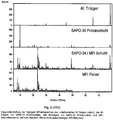
- Fig. 1 shows the X-ray diffractograms of the Al carrier before and after the coating steps.
- the diffractogram of the ZSM-5 seed crystals is shown.
- Fig. 2 shows an electron micrograph of the carrier after primary layer and secondary layer formation.
- Fig. 3 Then a recording after the secondary layer formation can be seen.
- the formation of the SAPO-34 primary layer and the ZSM-5 secondary layer can be clearly detected.
- the preparation of the SAPO-34 primary layer was carried out by a partial transformation of an Al support by a hydrothermal treatment.
- Al support an Al foil (thickness 160 ⁇ m, dimensions 6 ⁇ 8 cm, ⁇ 99% Al) was used. This was placed in an autoclave (40 ml) along with an aqueous synthesis solution containing the remaining network formers (phosphorus and silicon) and a structure-directing template (morpholine).
- the composition of the synthesis solution corresponded to 1.0 P 2 O 5 : 0.4 SiO 2 : 3.0 morpholine: 70 H 2 O.
- H 3 PO 4 (85%) was used as the Si source of silica sol (35%) .
- the hydrothermal crystallization was carried out at 200 ° C for 48 h. After a crystallization time of 48 hours, the autoclave was cooled to room temperature. Subsequently, the coated support was removed, washed with deionized water and dried for 12 h at RT.
- the crystallization of the ALPO-5 secondary layer was accomplished by a second hydrothermal treatment of the coated Al support.
- a reaction mixture was prepared with the following molar composition: 0.9 Al 2 O 3 : 1.0 P 2 O 5 : 1.0 TEA: 50 H 2 O.
- Al source was pseudoboehmite, as phosphorus source H 3 PO 4 and used as template triethylamine.
- the recrystallization of the secondary layer was carried out at 175 ° C for 24 h in a 40 ml autoclave. The crystallization was stopped by cooling the autoclave to room temperature.
- the coated carrier was subsequently removed from the autoclave, washed with deionized water and dried for 12 h at RT.
- Fig. 4 shows the X-ray diffractograms of the composite after primary and secondary layer formation
- Fig. 5 shows an electron micrograph of the ALPO-5 secondary layer. The diffraction patterns and the electron micrographs clearly show the formation of the SAPO-34 primary layer and the AIPO-5 secondary layer.
- the SAPO-18 primary layer was prepared by partial transformation of an Al support by hydrothermal treatment.
- Al support an Al foil (thickness 160 ⁇ m, dimensions 6 ⁇ 8 cm, ⁇ 99% Al) was used. This was placed in an autoclave (40 ml) along with an aqueous synthesis solution containing the remaining network formers (phosphorus and silicon) and a structure-directing template (diisopropylhexylamine).
- the composition of the synthesis solution corresponded to 1.0 P 2 O 5 : 0.4 SiO 2 : 3.0 diisopropylethylamine: 70 H 2 O.
- H 3 PO 4 (85%) was used as the Si source of silica sol (35%) .
- the hydrothermal crystallization was carried out at 175 ° C for 48 h. After a crystallization time of 48 hours, the autoclave was cooled to room temperature. Subsequently, the coated support was removed, washed with deionized water and dried for 12 h at RT.
- the crystallization of the SAPO-34 secondary layer was accomplished by a second hydrothermal treatment of the coated Al supports.
- a reaction mixture with the following molar composition was prepared: 0.8 Al 2 O 3 : 1.0 P 2 O 5 : 0.4 SiO 2 : 3.0 morpholine: 70 H 2 O.
- the Al source was pseudoboehmite, as Phosphorus source H 3 PO 4 used as silicon source silica sol and as a template morpholine.
- the recrystallization of the secondary layer was carried out at 200 ° C for 48 h in a 40 ml autoclave. After cooling the autoclave to room temperature, the coated support was removed from the autoclave, washed with deionized water and dried at RT for 12 h.
- Fig. 6 shows the X-ray diffractograms of the Al carrier after the primary and secondary layer formation.
- the diffraction patterns can be used to observe the formation of the SAPO-18 primary layer and the SAPO-34 secondary layer.
Landscapes
- Chemical & Material Sciences (AREA)
- Engineering & Computer Science (AREA)
- Materials Engineering (AREA)
- Organic Chemistry (AREA)
- Chemical Kinetics & Catalysis (AREA)
- Thermal Sciences (AREA)
- Inorganic Chemistry (AREA)
- Physics & Mathematics (AREA)
- General Chemical & Material Sciences (AREA)
- Mechanical Engineering (AREA)
- Metallurgy (AREA)
- Ceramic Engineering (AREA)
- Dispersion Chemistry (AREA)
- Silicates, Zeolites, And Molecular Sieves (AREA)
- Other Surface Treatments For Metallic Materials (AREA)
- Laminated Bodies (AREA)
- Chemically Coating (AREA)
- Catalysts (AREA)
Description
- Die Erfindung betrifft ein aluminiumhaltiges Substrat mit mindestens einer oberflächlich aufgebrachten mikroporösen Schicht eines Aluminiumphosphat-Zeoliths (ALPO) und weiteren Schichten, ein Verfahren zur Herstellung dieses beschichteten aluminiumhaltigen Substrats sowie vorteilhafte Verwendungen hiervon.
- Aluminiumsubstrate der vorstehend beschriebenen Art sind beispielsweise aus der
US 2003/0091872 A1 sowie derWO 2006/048211 A2 bekannt. DieUS 2003/091872 A1 betrifft ein Verfahren zur Ausbildung einer Schicht eines Aluminosilikat-Zeoliths auf einem metallhaltigen Substrat, was durch die Verwendung wässriger Synthese-Suspensionen für klassische Aluminosilikat-Zeolithe erfolgt. Nach dem Einbringen eines aluminiumhaltigen Substrats in die Suspension werden teilweise Aluminiumatome des Substrats in das Zeolith-Netzwerk eingebaut, wodurch die Haftung der Zeolith-Schicht auf dem Substrat verbessert wird. Die Si- und Al-Quellen in der Lösung liefern das Baumaterial für die zu bildende Zeolith-Schicht, wobei diese Quellen zueinander in stöchiometrischem Verhältnis stehen. Dieser bekannte Vorschlag stellt nicht zufrieden. Danach bilden sich zwar bei der Aufkristallisation auf aluminiumhaltige Substrate Schichten aus klassischen Aluminiumsilikat-Zeolithen. Deren Verankerung am Substrat ist unbefriedigend. Demgegenüber führt die Lehre nach derWO 2006/048211 A2 zu einer Verbesserung. Auch hier handelt es sich insbesondere um ein Verfahren zur Ausbildung einer Zeolith-Schicht auf einem aluminiumhaltigen Substrat. Es wird eine wässrige Suspension hergestellt, die wenigstens ein netzwerkbildendes Element für den Zeolithen umfasst, wobei das aluminiumhaltige Substrat wenigstens eines der netzwerkbildenden Elemente aufweist. Auch hier wird das aluminiumhaltige Substrat in eine wässrige Suspension eingebracht, wobei sich auf dem Substrat durch in-situ-Kristallisation eine Zeolith-Schicht ausbildet. Kern der Erfindung gemäß derWO 2006/048211 A2 ist es, dass wenigstens eines der in der wässrigen Suspension vorliegenden netzwerkbildenden Elemente für den Zeolith-Bildungsprozess und die Endstruktur des Zeoliths im stöchiometrischen Unterschuss vorliegt. Das Molverhältnis zwischen (dem) den im Unterschuss vorliegenden netzwerkbildenden Element(en) in der wässrigen Suspension zur Summe aller in der wässrigen Suspension vorliegenden netzwerkbildenden Elemente liegt unter 0,5. Dem aluminiumhaltigen Substrat werden die im Unterschuss vorliegenden netzwerkbildenden Elemente entzogen und in die Zeolith-Schicht eingebaut. Vorzugsweise ist ein netzwerkbildendes Element Phosphor, der in der wässrigen Suspension vorliegt. In einem derartigen Fall wird auf dem Substrat ein Aluminiumphosphat-Zeolith ausgebildet. Dabei kann das netzwerkbildende Element beispielsweise auf Phosphorsäure oder verschiedene Ammoniumphosphate zurückgehen. - Für den aus der
WO 2006/048211 A2 bekannten technischen Vorschlag ist es also wesentlich, dass mindestens eines der netzwerkbildenden Elemente in der beschriebenen wässrigen Suspension in stöchiometrischem Unterschuss vorliegt. Daraus resultieren vielfältige Vorteile: So zeigt die auf dem aluminiumhaltigen Substrat ausgebildete Zeolith-Schicht eine zuverlässige Verankerung und eine sehr gute Anhaftung. Die Orientierung der Kristalle verläuft im Wesentlichen senkrecht zur Oberfläche des aluminiumhaltigen Substrats. Diese besondere Orientierung bedeutet eine weitgehend gleichmäßige Ausrichtung der Kristalle und gewährleistet die gleichmäßige Zugänglichkeit von Reaktanten in das Mikroporensystem der hergestellten Kristalle der Zeolith-Schicht. - Somit ist der oben geschilderte Stand der Technik vor dem Hintergrund einer "Aufkristallisation" einer Zeolith-Schicht, insbesondere eines Aluminiumphosphat-Zeoliths (ALPO) zu sehen. Wenn hier von "Aluminiumphosphat" und "ALPO" gesprochen wird, dann sollen hier gleichzeitig die Substitutionsderivate "SAPOs", "MeAPOs" und "MeSAPOs" einbezogen sein.
- Bei dem vorstehend dargestellten Stand der Technik werden werden keine Bindemittel herangezogen. Dies ist vorteilhaft. Jedoch wachsen nicht alle Zeolithe auf diese Weise auf die Oberfläche des aluminiumhaltigen Substrats auf. In vielen Fällen, insbesondere bei den im stark alkalischen Medium kristallisierenden Aluminosilikaten, kann es zu einer unkontrollierbaren Auflösungsreaktion kommen, die zu einer Zerstörung des metallhaltigen Substrats führt. Andere Zeolithe wachsen nur schwer direkt auf metallischen oder keramischen Oberflächen auf, weil die Zusammensetzung, Struktur oder das Oberflächenpotential dieser Oberflächen einen abstoßenden Effekt auf die molekularen Bausteine (building units) der Zeolithe haben. Für die Adsorption von Molekülen in Katalyse, Reinigung und Adsorptionsprozessen sowie für die Stofftrennung ist der Stofftransport innerhalb der Zeolith-Schicht oft der geschwindigkeitsbegrenzende Faktor. Werden also dickere Schichten benötigt, dann ergibt sich von einer kritischen Schichtdicke an stets ein negativer Einfluss für den Stofftransport in die und aus der Zeolith-Schicht.
- Ein weiterer Stand der Technik im vorliegenden Bereich ergibt sich aus der
WO 96/01686 - Offensichtlich ist es für das Material nach diesem Stand der Technik nicht wichtig, welcher Art das angesprochene Substrat sein soll. Es kann porös oder nicht porös sein. Vorzugsweise beruht es auf anorganischen Oxiden oder nicht rostendem Stahl. Es sollte sich hier auch um keramische Materialien, Metalle, Carbide, Polymere und Mischungen hiervon handeln können. Des Weiteren sollen lichtbrechende Oxide, Aluminiumoxid, Titanoxid, Siliziumoxid, Siliziumcarbid, Kohlenstoff, Graphit, Siliziumnitrid oder Mischungen davon in Betracht kommen. Auf einem solchen Substrat können dann insbesondere Schichten aus beliebigen Zeolithen ausgebildet werden. Konkret und bevorzugt wird Aluminiumsilikat MFI angegeben, insbesondere in den Beispielen.
- Zum Stand der Technik ist noch auf folgende Literaturstellen hinzuweisen: Aus der
DE 10 2004 041836 sowie aus derDE 103 04 322 A1 geht es nach dem Anspruch 1 darum, eine erste Schicht durch zwei Schritte auszubilden, wobei beim ersten Schritt Zeolith-Seed-Kristalle auf den Träger kristallisiert werden und in einem zweiten Kristallisationsschritt eine "geschlossene Schicht weitergezüchtet" wird. Anspruch 7 führt zwar aus, dass weitere Kristallisationsschichten auf der nach Anspruch 1 hergestellten Schicht durch zusätzliche Kristallisationsschritte ausgebildet werden. Es geht daraus nicht hervor, dass sich das Material der Primärschicht von dem Material der mikro- oder mesoporösen Schicht, wie im folgenden Anspruch 1, der die vorliegende Erfindung bezeichnet, dargestellt wird, insbesondere mit den Merkmalen a) und b), unterscheidet. Es werden keinerlei Angaben zu den Porenstrukturen gemacht. - Auch die
WO 96/01686 A1 - Der Erfindung lag daher die Aufgabe zugrunde, die eingangs bezeichneten aluminiumhaltigen Substrate mit mindestens einer oberflächlich aufgebrachten mikroporösen Schicht eines Aluminiumphosphat-Zeoliths (ALPO) und weiteren Schichten so weiterzubilden, dass die angesprochenen Nachteile der Stofftransportlimitierung (Druckverlust) behoben bzw. zumindest deutlich verringert werden. Darüber hinaus soll die Ausbildung von Mehrfachschichten zur Begünstigung besonderer angestrebter technischer Effekte möglich werden. Es soll gleichfalls ein zur Herstellung eines solchen, definiert beschichteten aluminiumhaltigen Substrats geeignetes Verfahren vorgeschlagen werden. Auch sollten weitere vorteilhafte Verwendungsmöglichkeiten erschlossen werden.
- Als Lösung dieser Aufgabe schlägt die Erfindung ein aluminiumhaltiges Substrat mit mindestens einer oberflächlich aufgebrachten mikroporösen Schicht eines Aluminiumphosphat-Zeoliths (ALPO) und weiteren Schichten vor, das dadurch gekennzeichnet ist, dass die mikroporöse Schicht des Aluminiumphosphat-Zeoliths (ALPO) eine Primärschicht darstellt, auf der sich ein vom Material der Primärschicht unterscheidendes mikro- oder mesoporöses Sekundärmaterial befindet, die mikroporöse Primärschicht und das mikro- oder mesoporöse Sekundärmaterial eine Unterschiedlichkeit in der chemischen Art und in ihrem Porensystem aufweisen, wobei 1.) die mikroporöse Primärschicht und das mikroporöse Sekundärmaterial a1) eine Unterschiedlichkeit in einer graduell abgestuften Porosität aufweisen, wobei die mikroporöse Primärschicht einen mittleren Porendurchmesser von 0,2 bis 1 nm und das mikroporöse Sekundärmaterial einen mittleren Porendurchmesser von 0,4 bis 1,5 nm aufweist und b1) eine Unterschiedlichkeit in der chemischen Art zeigen, wobei das mikroporöse Sekundärmaterial in Form von zeolithischen Silikaten oder Alumosilikaten vorliegt, oder 2.) die mikroporöse Primärschicht und das mesoporöse Sekundärmaterial a2) eine Unterschiedlichkeit in einer graduell abgestuften Porosität aufweisen, wobei die mikroporöse Primärschicht einen mittleren Porendurchmesser von 0,2 bis 1 nm und das mesoporöse Sekundärmaterial einen mittleren Porendurchmesser von 2 bis 5 nm aufweist und b2) eine Unterschiedlichkeit in der chemischen Art zeigen, wobei das mesoporöse Sekundärmaterial in Form von Silikaten vorliegt.
- Somit wendet sich die Erfindung von dem vorstehend beschriebenen Stand der Technik insbesondere dadurch ab, dass auf dem aluminiumhaltigen Substrat nicht nur eine Zeolith-Schicht ausgebildet wird, sondern der bezeichneten Primärschicht das unterscheidende mikro- oder mesoporöse Sekundärmaterial, geschlossen oder unterbrochen, folgt. Damit ist es möglich, Zeolith-Typen, die bisher nicht oder nur sehr schwierig durch direkte Kristallisationsprozesse auf einer Trägerschicht aufwuchsen, nun deutlich besser und auch ohne Trägerauflösung als Schichten zu kristallisieren. Die erfindungsgemäße Lehre in der gezeigten Abstraktheit führt zu deutlichen Verbesserungen bzw. Vorteilen gegenüber dem geschilderten Stand der Technik. Die mikroporöse Schicht des Aluminiumphosphat-Zeoliths in Form der Primärschicht zeigt eine besonders vorteilhafte feste Bindung an das unterscheidende mikro- oder mesoporöse Sekundärmaterial, sei es geschlossen oder unterbrochen. Dies führt zu einer besseren Zugänglichkeit bei dickeren und deutlich stabiler verankerten Zeolith-Schichten auf dem jeweiligen aluminiumhaltigen Substrat. Schließlich ermöglicht die Erfindung eine erweiterte Zeolith-Auswahl bei der Herstellung von binderfreien Zeolith-Schichten. Somit werden auch solche Materialien als Schicht zugänglich, die bei direkter Kristallisation das Trägermaterial auflösen würden oder nur sehr geringe Neigung zur Kristallisation auf dessen Oberflächen haben. Es wird ferner eine verbesserte Flexibilität in der Steuerung der Eigenschaften von Schichten aus mikroporösen Materialien durch die Kombination einerseits der mikroporösen Schicht des Aluminiumphosphat-Zeoliths als Primärschicht sowie andererseits des bezeichneten Sekundärmaterials erreicht. Die Kristallisation vieler Zeolith-Typen auf dem aluminiumhaltigen Substrat lässt sich durch die Ausbildung der Primärschicht beschleunigen und bei milderen Bedingungen durchführen. Insbesondere durch die Kombination von Zeolithen unterschiedlicher Porenweiten lassen sich hierarchisch aufgebaute Porensysteme herstellen, die einen besonders begünstigten Stofftransport ermöglichen (sh. Martin Hartmann, Angew Chem Int. Ed Engl. 2004 Nov 12; 43(44):5880-2), d.h. es handelt sich hier um hierarchische Porensysteme mit gestaffelter Porenweite.
- Die vorstehenden Schilderungen zeigen, dass sowohl der mikroporösen Primärschicht als auch dem mikro- oder mesoporösen Sekundärmaterial, geschlossen, so beispielsweise in Form einer Schicht, oder unterbrochen, pe se bereits die Funktion zukommt, bei den Anwendungsfällen, bei denen ein Stoffstrom, insbesondere ein Gasstrom, verlangt wird, einen solchen zu ermöglichen. Bei den wesentlichen Anwendungen bestimmt die Art des Sekundärmaterials im Wesentlichen die gewünschte Funktion. Somit könnte man bei diesem von einem "funktionellen porösen Sekundärmaterial" bzw. einem "funktionellen mikro- oder mesoporösen Sekundärmaterial" sprechen. Daher wird nachfolgend im Einzelfall auch von einem "funktionellen Sekundärmaterial" gesprochen, ohne dass darin eine Einschränkung im technologischen Sinne gesehen werden soll.
- Besonders vorteilhafte Ausgestaltungen des erfindungsgemäßen aluminiumhaltigen Substrats werden nachfolgend im Einzelnen dargestellt:
Das erfindungsgemäße aluminiumhaltige Substrat weist mindestens eine oberflächlich aufgebrachte mikroporöse Schicht eines Aluminiumphosphat-Zeoliths (ALPO) auf. Diese Materialien haben im Sinne der Erfindung den Vorteil, dass bei einer in-situ-Kristallisation ihre chemische Zusammensetzung nicht durch Aluminium aus dem aluminiumhaltigen Substrat verändert werden kann und sie zudem im nachgeschalteten Bildungsprozess des mikro- oder mesoporösen Sekundärmaterials dieses nicht durch z.B. eigene Gegenionen ungewollt beeinflussen. Das aluminiumhaltige Substrat ist vorzugsweise Aluminium, eine aluminiumhaltige Legierung, insbesondere ein mit Aluminium legierter Stahl, oder eine aluminiumhaltige Keramik, wie in Einzelfällen Aluminiumoxid. - Das erfindungswesentliche funktionelle Sekundärmaterial ist mikro- oder mesoporös. Vorzugsweise liegt das mikroporöse Sekundärmaterial als ALPO, insbesondere als SAPO, MeAPO oder MeSAPO vor oder allgemein in Form von zeolithischen Alumosilikaten oder Silikaten, insbesondere als FAU, MFI, LTA, BEA, CHA. Geschlossene, nicht poröse Sekundärmaterialien mit spezieller Funktionalität könnten ebenso aufgebracht werden, verhindern dann aber den Stofftransport. Es gilt als bevorzugt, dass das mesoporöse Sekundärmaterial in Form von Silikaten vorliegt.
- Erfindungsgemäß weist die mikroporöse Primärschicht einen mittleren Porendurchmesser von 0,2 bis 1,0 nm, insbesondere 0,3 bis 0,7 nm, auf. Der mittlere Porendurchmesser der mikroporösen Primärschicht ist vorzugsweise kleiner als der des porösen Sekundärmaterials. In Einzelfällen kann es jedoch auch zweckmäßig sein, wenn in der Sekundärschicht die kleineren und in der Primärschicht die größeren Poren vorliegen. Des Weiteren ist es vorteilhaft, wenn der mittlere Porendurchmesser des mikroporösen Sekundärmaterials 0,4 bis 1,5 nm, insbesondere 0,5 bis 1,3 nm beträgt. Der mittlere Porendurchmesser des mesoporösen Sekundärmaterials liegt zwischen 2 bis 5 nm, insbesondere zwischen 2,5 bis 4 nm. Für die mit der Erfindung angestrebten vorteilhaften technischen Ergebnisse ist die Stärke der Primärschicht sowie der geschlossenen oder unterbrochenen Schicht des mikro- oder mesoporösen Sekundärmaterials nicht kritisch beschränkt. Es hat sich als vorteilhaft erwiesen, wenn die mikroporöse Primärschicht eine Stärke von mindestens etwa 1 µm und/oder das mikro- oder mesoporöse Sekundärmaterial eine Stärke von mindestens etwa 1 µm, insbesondere mindestens etwa 5 µm aufweisen. Schichtdicken unter etwa 1 µm führen meist zu unterbrochenen Primärschichten. Demzufolge ist es, wie gesagt, nicht zwingend, dass die Oberfläche der Primärschicht vollständig von dem porösen Sekundärmaterial bedeckt ist. Es ist in Einzelfällen völlig hinlänglich, wenn ein mehr oder weniger unterbrochener Auftrag erfolgte. In der Regel ist es hinlänglich, wenn die Oberflächenbedeckung bei der unterbrochenen Ausbildung mehr als etwa 60%, insbesondere mehr als etwa 90% beträgt.
- Bei der praktischen Verwirklichung der Erfindung hat es sich darüber hinaus als vorteilhaft erwiesen, wenn die mikroporöse Primärschicht und das mikro- oder mesoporöse Sekundärmaterial eine Unterschiedlichkeit in der chemischen Art der porösen Stoffe sowie ihrer Porosität aufweisen, wie oben durch die erfindungsgemäße Lösung dargestellt. Wenn von einer graduellen abgestuften Porosität gesprochen wird, dann ist dies insbesondere wie folgt zu verstehen. Es handelt sich um eine "hierarchische" Porosität, die den Stofftransport begünstigen soll. Des Weiteren ist die abgestufte Porosität dadurch gekennzeichnet, dass es durch eine angepasste Porenweitendifferenz zu einem "Trichtereffekt" kommt, der den Stoffübergang von einem zum anderen Porensystem fördert. Durch die abgestufte Porosität kann der Stofftransport besser als in gleich dicken Schichten der mikroporösen Schicht des Aluminiumphosphat-Zeoliths und des mikro- oder mesoporösen Sekundärmaterials, insbesondere in Form eines Zeolithen, erfolgen. Als Beispiele in der Unterschiedlichkeit der chemischen Art seien die Gitterzusammensetzung, enthaltene Gegenionen oder Einschlüsse sowie Hydrophilie und Acidität des Materials angegeben. Damit ist auch immer eine funktionelle Eigenschaft chemischer Natur oder eine Eigenschaft, die chemische Wirkung zeigt und die über rein physikalische, lokale Transportblockierungen hinausgeht, verbunden. Die unterschiedliche Porosität lässt sich vorteilhaft im Rahmen der oben dargestellten Porositätsrahmen einstellen. Zur Art und der Orientierung des Porensystems lässt sich ausführen, dass die Kombination von zweidimensionalen Porenkanalsystemen mit dreidimensionalen Porennetzwerken bzw. ein vorzugsweise senkrecht zur Trägeroberfläche orientiertes Porensystem im Sekundärmaterial auf einer Primärschicht mit dreidimensionalen Porensystemen (3-D) vorteilhafte Diffusionseigenschaften ermöglichen.
- Eine besonders vorteilhafte technische Ausbildung der Erfindung erweist sich in der Verwendung des aluminiumhaltigen Substrats nach Anspruch 10, wobei die mikroporöse Primärschicht, das mikroporöse oder mesoporöse Sekundärmaterial und das weitere Material zur Begünstigung des Stofftransports bei der Anwendung eine graduell abgestufte Porosität aufweisen.
- In Einzelfällen kann es vorteilhaft sein, wenn auf dem mikro- oder mesoporösen Sekundärmaterial mindestens ein weiteres Material ausgebildet ist, dem eine Funktionalität zugeschrieben werden kann, wie sie oben definiert wurde. Insbesondere kann es sich hierbei um ein funktionelles poröses Material handeln.
- Dabei ist es weitergehend bevorzugt, wenn die mikroporöse Primärschicht, das mikro- oder mesoporöse Sekundärmaterial und weitere aufgebrachte poröse Materialien zur Begünstigung des Diffusionsverhaltens bei der Anwendung eine graduell abgestufte Porosität aufweisen. Es gibt auch Anwendungsfälle, bei denen es zweckmäßig ist, wenn das beschichtete aluminiumhaltige Substrat eine äußere Schicht aufweist, die die Funktion einer Anti-Fouling-Schicht erfüllt. Die Flexibilität des erfindungsgemäßen aluminiumhaltigen Substrats erweist sich darin, dass vorteilhafterweise die mikroporöse Primärschicht und/oder das poröse Sekundärmaterial funktionell wirkende Substanzen und/oder Metallionen enthalten können, insbesondere katalytisch wirksame Metallionen. Hierbei sind insbesondere Metallionen, wie Platin-, Palladium-, Ruthenium-, Eisen-, Kupfer-, Kobalt-, Zink- oder Nickelionen, bevorzugt.
- Als Ergebnis können demzufolge verschiedene funktionelle Beschichtungen unterschiedliche vorteilhafte Anwendungsmöglichkeiten erschließen, so z.B. für den Foulingschutz, für eine heterogene Katalyse, für eine Stofftrennung, auch in Verbindung mit einer Katalyse, für die Adsorption sowie Stoffreinigung und Energieumwandlung.
- Das erfindungsgemäße beschichtete Aluminiumsubstrat, wie vorstehend dargestellt, zeigt besonders vorteilhaften Nutzen bei der Verwendung als Wärmetauscher, als katalytischer Reaktor oder als Bauelement in der Wärmetransformationstechnik oder als Bauelement mit Anti-Fouling-Wirkung.
- Die Vorteile, die das aluminiumhaltige Substrat gemäß der Erfindung zeigt, werden insbesondere dann erzielt, wenn das von der Erfindung vorgeschlagene Verfahren zu dessen Herstellung herangezogen wird.
- Hierbei handelt es sich um ein Verfahren zur Herstellung eines aluminiumhaltigen Substrats der vorstehend geschilderten Art, wobei 1. ein aluminiumhaltiges Substrat in einer mindestens Phosphor als netzwerkbildendes Element enthaltenden wässrigen Suspension hydrothermal behandelt und darauf durch eine in-situ-Kristallisation eine mikroporöse Primärschicht eines Aluminiumphosphat-Zeoliths ausgebildet wird, wobei das Mol-Verhältnis zwischen dem in der wässrigen Suspension im Unterschuss vorliegenden netzwerkbildenden Aluminium zur Summe aller in der wässrigen Suspension vorliegenden netzwerkbildende Elemente unter 0,5 liegt, so dass das erforderliche Aluminium zum Ausgleich des Unterschusses dem aluminiumhaltigen Substrat entnommen wird, und 2. auf der mikroporösen Primärschicht ein mikro- oder mesoporöses Sekundärmaterial dadurch ausgebildet wird, indem das die mikroporöse Primärschicht aufweisende aluminiumhaltige Substrat einer weiteren Behandlung in einer wässrigen Suspension, die die erforderlichen netzwerkbildenden Elemente für die Ausbildung des mikro- oder mesoporösen Sekundärmaterials enthält, in einer solchen Weise durchgeführt wird, dass die mikroporöse Primärschicht und das mikro- oder mesoporöse Sekundärmaterial eine Unterschiedlichkeit in der chemischen Art und in ihrem Porensystem aufweisen, wobei 1.) die mikroporöse Primärschicht und das mikroporöse Sekundärmaterial a1) eine Unterschiedlichkeit in einer graduell abgestuften Porosität aufweisen, wobei die mikroporöse Primärschicht einen mittleren Porendurchmesser von 0,2 bis 1 nm und das mikroporöse Sekundärmaterial einen mittleren Porendurchmesser von 0,4 bis 1,5 nm aufweist und b1) eine Unterschiedlichkeit in der chemischen Art zeigt, wobei das mikroporöse Sekundärmaterial in Form von zeolithischen Silikaten oder Alumosilikaten vorliegt, oder 2.) die mikroporöse Primärschicht und das mesoporöse Sekundärmaterial a2) eine Unterschiedlichkeit in einer graduell abgestuften Porosität aufweisen, wobei die mikroporöse Primärschicht einen mittleren Porendurchmesser von 0,2 bis 1 nm und das mesoporöse Sekundärmaterial einen mittleren Porendurchmesser von 2 bis 5 nm aufweist und b2) eine Unterschiedlichkeit in der chemischen Art zeigen, wobei das mesoporöse Sekundärmaterial in Form von Silikaten vorliegt.
- Das oben unter Maßnahme 1. dargestellte Verfahren der "Unterschuss-Technologie" geht im Wesentlichen aus der eingangs bereits erörterten
WO2006/048211 , nämlich aus der darin als bevorzugt herausgestellten Verfahrenslehre, hervor. Dabei ist ersichtlich, dass zur Ausbildung der mikroporösen Schicht des Aluminiumphosphat-Zeoliths (ALPO) in der eingesetzten wässrigen Suspension, in der das aluminiumhaltige Substrat mit einer mikroporösen Primärschicht versehen wird, als netzwerkbildendes Element Phosphor enthalten ist. Darin kann der Phosphor beispielsweise als Phosphorsäure oder als Phosphat, insbesondere in Form wasserlöslicher Phosphate, enthalten sein. Darüber hinaus kommen insbesondere als wasserlösliche Phosphate Ammoniumphosphate in Frage. - Für den Fall, dass es sich bei dem Aluminiumphosphat-Zeolith (ALPO) um einen Zeolith handelt, der, wie beispielsweise SAPO, Silizium enthält, enthält die wässrige Suspension als netzwerkbildendes Element auch Silizium. In diesem Fall wird das Silizium der Reaktionslösung in Form von Kieselsäure, Kieselsol, hochdispersem Siliziumoxid, wie z.B. Aerosil, oder in Form eines Kieselsäureesters zugeführt. Darüber hinaus kann auch ein lösliches Silikat, wie Natriumsilikat, zugefügt werden.
- In Einzelfällen kann es von Vorteil sein, zusätzlich Templatverbindungen einzusetzen. Hierbei handelt es sich um strukturdirigierende Agentien (SPA), wie z.B. Alkyl- oder Arylammoniumsalze, hier vorzugsweise Phosphate, oder auch oberflächenaktive Stoffe.
- Nach der gegebenen Lehre der Maßnahme 1) steht es dem Fachmann frei, diese so zu gestalten, dass das Aluminium entweder vollständig aus dem aluminiumhaltigen Substrat oder auch teilweise aus der Suspension als netzwerkbildendes Element hervorgeht. Das Merkmal "die erforderlichen netzwerkbildenden Elemente" zur Ausbildung des porösen Sekundärmaterials ist eine also hinlängliche Information für den Fachmann. Dies ergibt sich auch aus dem Zusammenhang der vorliegenden Erfindungsbeschreibung, wie insbesondere auch aus dem nachfolgenden Beispiel.
- Dieses Verfahren lässt sich dadurch besonders vorteilhaft weiterbilden, indem das Mol-Verhältnis des im Unterschuss vorliegenden netzwerkbildenden Aluminiums zur Summe aller in der Suspension enthaltenden netzwerkbildenden Elemente unter 0,2, insbesondere unter 0,1, liegt. Darüber hinaus ist es vorteilhaft, wenn die wässrige Suspension, die zur Ausbildung der jeweiligen Schichten bzw. des aufzutragenden Materials herangezogen wird, auf eine Temperatur von 50 bis 250°C, insbesondere auf 80 bis 200°C, eingestellt wird.
- Das erfindungsgemäße Verfahren erfährt eine besonders vorteilhafte Weiterbildung dadurch, indem auf dem mikro- oder mesoporösen Sekundärmaterial bzw. der Schicht desselben ein weiteres funktionelles poröses Material aufgebracht wird, auf das vorstehend bereits beispielhaft eingegangen wurde.
- Zu diesem funktionellen porösen Material lässt sich Folgendes ausführen:
Es soll eine vorliegende Staffelung der Porenweiten fortsetzen, kann vorzugsweise eine Schutzfunktion für das Sekundärmaterial erfüllen und Fouling verhindern und die unterschiedlichen chemischen Eigenschaften von Primärschicht und Sekundärmaterial vorteilhaft ergänzen. - Die Vorteile der Erfindung sind insbesondere darin zu sehen, dass die Kombination von Zeolithen in Schichtform durch das gefundene erfindungsgemäße Verfahren erstmals auf der Basis von Aluminiumphosphaten mit ihrem hohen Aluminiumgehalt (Phosphat-Primärzeolithe) gelingt, die sehr gut auf metallischem Aluminium oder auf anderen Alhaltigen Trägern haften. Die Haftung des Sekundärmaterials (beispielsweise zweite Zeolith-Schicht) auf der Primärschicht ist durch eine große Mikrorauhigkeit der Primärschicht und der chemischen Ähnlichkeit (OH-Endgruppen, Aluminiumtetraeder, eventuell Silikattetraeder) sehr stark. Erfindungsgemäß lassen sich vorteilhaft Doppel- und Mehrfachschichten aus verschiedenen Zeolith-Typen (z.B. Aluminiumsilikat- und Aluminiumphosphat-Zeolith) auf einer Aluminiumphosphat-Primärschicht erzeugen.
- Das erfindungsgemäße Erzeugnis zeigt vielfältige Einsatzmöglichkeiten, die insbesondere auf folgende Verbesserungen gegenüber dem Stand der Technik zurückgehen: unterschiedliche Zeolith-Strukturen: Aluminiumphosphate und Aluminiumsilikate auf Aluminiumphosphaten, einschließlich daraus abgeleitete Systeme mit weiteren Gitterionen; unterschiedliche Porenradien (große und kleine Porenöffnung), unterschiedliche Porenvolumina, unterschiedliche Orientierung der Kristalle oder der Porensysteme, lineare Porensysteme und 3D-Porensysteme; unterschiedliche Hydrophilie, Acidität, unterschiedliche postsynthetische Modifikationen, Ionenaustausch von verschiedenen Mengen und/oder Typen von Kationen (Metallen); unterschiedliche Morphologie (große Kristalle bzw. Durchgänge), geschlossene Schichten von einzelnen Kristallen mit offener Makrostruktur oder Nanopartikel/Kristallite und bisher nicht realisierbare Zeolith-Schichten als Sekundärschicht.
- Es erscheint sachdienlich, die Erfindung, auch unter Bezug auf obige Ausführungen, noch technologisch darzustellen: Zunächst kann eine ALPO-, SAPO-, MeAPO- oder MeSAPO-Primärschicht (Phosphat-Primärzeolith) auf dem aluminiumhaltigen Substrat ausgebildet werden. Hierbei bedient sich die Erfindung bevorzugt der konsumierenden Aufkristallisation. Es handelt sich hier um eine Methode zur festen binderlosen Verwachsung von Phosphat-Zeolithen auf den bezeichneten aluminiumhaltigen Substraten. Dieses wird dann in eine weitere Syntheselösung eingebracht, die zur Kristallisation des funktionellen porösen Sekundärmaterials, so in Form eines zweiten Zeolithen (Sekundärzeolith) auf der Oberfläche der Phosphat-Primärschicht führt. Eine vorteilhafte Suspension hat einen hohen Hang zur heterogenen Keimbildung, wodurch das Wachstum des Sekundärmaterials, insbesondere eines Sekundärzeoliths, auf der vorliegenden Primärschicht mit ihrer großen, zeolithischen Oberfläche stattfindet. Es kommt zu einer besonders günstigen gleichmäßigen Keimbildung. Es ist vorteilhaft, die reaktionstechnischen und stofflichen Parameter der zweiten Syntheselösung so einzustellen, dass es nicht zum Auflösen der Primärschicht, nicht zum Auflösen des aluminiumhaltigen Substrats sowie nicht zur Bildung von freiem Zeolithpulver des Zeoliths und zur Kristallisation auf der Primärschicht kommt. Die Kristallisation des Sekundärzeoliths wird z.B. durch hydrothermale Synthese bei Temperaturen bis zu 250°C durchgeführt. Die konkreten Bedingungen bei der Herstellung des erfindungsgemäßen aluminiumhaltigen Substrats variieren in Abhängigkeit von der Paarung Phosphat-Primärzeolith/Sekundärzeolith und sollten demzufolge jeweils angepasst werden, was vom Fachmann handwerklich vorzunehmen ist. Zweckmäßig bei deutlich unterschiedlichen Primär- und Sekundärzeolithen ist auch eine vorgeschaltete Keimablagerung des Sekundärzeoliths auf der Primärschicht.
- Die vorstehend detailliert beschriebene Erfindung lässt sich anhand der angeschlossenen
Figuren 7 und 8 weitergehend erläutern: DieFigur 7 betrifft eine schematische Darstellung des Komposits aus aluminiumhaltigem Substrat, der ALPO-basierten Primärschicht und dem Sekundärmaterial. DieFigur 8 zeigt eine schematische Darstellung erfindungsgemäß realisierbarer Komposite durch Variation der Eigenschaften von Primärschicht und Sekundärmaterial, wobei bezüglich der einzelnen Schichten bzw. ihrer Bedeutung auf dieFigur 7 verwiesen sei. Durch das Aufbringen eines zweiten Sekundärmaterials lassen sich die nachfolgenden Variationen entsprechend erweitern: mikroporöse ALPO-Primärschicht mit porösem 1) ALPO- und 2) Aluminiumsilikat oder Silikatsekundärmaterial; 3) Primärschicht bestehend aus kleineren Kristallen und Sekundärmaterial aus größeren Kristallen und umgekehrt: 4). Die einzelnen Kristalle können jeweils auch miteinander verwachsen sein. 5) und 6): unterschiedliche Orientierung der Kristalle oder der Porensysteme (z.B. lineare und dreidimensionale Porensysteme). Staffelung der Porendurchmesser: in 7) kleinere Porendurchmesser in der Primärschicht und größere im Sekundärmaterial. In 8) hat die Primärschicht die größeren Porendurchmesser. 9) und 10) versinnbildlichen unterschiedliche chemische Eigenschaften (z.B. Hydrophilie, Acidität, Gegenionen: Typ und Menge) in Primärschicht und Sekundärmaterial. - Die Erfindung soll nachfolgend anhand verschiedener Herstellungsbeispiele noch näher erläutert werden. Darin bezeichnen die Abkürzungen MFI (ZSM-5), AFI (ALPO-5), AEI (SAPO-18), und CHA (SAPO-34) zeolithische Verbindungen nach der Nomenklatur der International Zeolite Association IZA ("Atlas of Zeolite Frameworks", Ch. Baerlocher, L. B. McCusker, D. H. Olson, Elsevier, 2007).
- Synthese der Primärschicht: Die Herstellung der SAPO-34 (CHA) Primärschicht erfolgte über eine partielle Transformation eines Al-Trägers durch eine hydrothermale Behandlung. Als Al-Träger wurde eine Al-Folie (Dicke 160 µm, Abmessungen 6 x 8 cm, ∼9 % Al) verwendet. Diese wurde zusammen mit einer wässrigen Syntheselösung, welche die übrigen Netzwerkbildner (Phosphor und Silizium) und ein strukturdirigierendes Templat (Morpholin) enthielt, in einen Autoklav (40 ml) gegeben. Die Zusammensetzung der Syntheselösung in Oxidverhältnissen war 1,0 P2O5: 0,4 SiO2 : 3,0 Morpholin : 70 H2O. Als Phosphorquelle wurde H3PO4 (85 %), als Si Quelle Kieselsol (35 %) verwendet. Die hydrothermale Kristallisation erfolgte für 48 h bei 200 °C. Nach 48h Kristallisationszeit wurde der Autoklav auf Raumtemperatur gekühlt. Anschließend wurde der beschichtete Träger entnommen, mit deionisiertem Wasser gewaschen und für 12h bei RT getrocknet.
- Synthese der Sekundärschicht: Die Kristallisation der MFI Sekundärschicht erfolgte in zwei Schritten. Zunächst wurde der beschichtete Träger über Silikalit-1 Kristalle gerieben. Hierdurch wurde die Oberfläche der SAPO-34 Primärschicht mit MFI Kristallen belegt, welche als Kristallisationskeime für die Sekundärschichtbildung fungieren können. Die Herstellung der Silikalit-1 Keime erfolgte bei 160 °C und 48 h Kristallisationszeit ausgehend von einer Reaktionsmischung mit folgender Zusammensetzung: 1,0 SiO2 : 0,16 TPA2O : 29 H2O. Als Siliziumquelle wurde Tetraethylorthosilikat und als Templat Tetrapropylammoniumhydroxid verwendet.
- Der vorbehandelte Träger wurde anschließend zusammen mit einer Reaktionsmischung für die Aufkristallisation von ZSM-5 (MFI) in einen Autoklav (40 ml) gegeben. Die molare Zusammensetzung der Reaktionsmischung war 1,0 SiO2 0,0088 Al2O3 : 0,036 K2O : 0,056 TPA2OH : 111 H2O. Als Siliziumquelle wurde Tetraethylorthosilikat, als Al-Quelle Aluminiumnitrat und als Templat Tetrapropylammoniumbromid verwendet. Die hydrothermale Kristallisation wurde bei 24 h und 175 °C durchgeführt. Nach einer Kristallisationszeit von 24 h wird der Autoklav auf Raumtemperatur gekühlt, der beschichtete Träger entnommen, mit deionisiertem Wasser gewaschen und für 12 h bei RT getrocknet.
-
Fig. 1 zeigt die Röntgendiffraktogramme des Al-Trägers vor und nach den Beschichtungsschritten. Zusätzlich ist das Diffraktogramm der ZSM-5 Keimkristalle abgebildet.Fig. 2 zeigt eine Elektronenmikroskopieaufnahme des Trägers nach der Primärschicht- und Sekundärschichtbildung. InFig. 3 ist dann eine Aufnahme nach der Sekundärschichtbildung zu sehen. An Hand der Diffraktogramme und der Elektronenmikroskopie-Aufnahmen kann eindeutig die Bildung der SAPO-34 Primärschicht und der ZSM-5 Sekundärschicht nachgewiesen werden. - Synthese der Primärschicht: Die Herstellung der SAPO-34 Primärschicht erfolgte über eine partielle Transformation eines Al-Trägers durch eine hydrothermale Behandlung. Als Al-Träger wurde eine Al-Folie (Dicke 160 µm, Abmessungen 6 x 8 cm, ∼99 % Al) verwendet. Diese wurde zusammen mit einer wässrigen Syntheselösung, welche die übrigen Netzwerkbildner (Phosphor und Silizium) und ein strukturdirigierendes Templat (Morpholin) enthielt, in einen Autoklav (40 ml) gegeben. Die Zusammensetzung der Syntheselösung entsprach 1,0 P2O5 : 0,4 SiO2 : 3,0 Morpholin : 70 H2O. Als Phosphorquelle wurde H3PO4 (85 %), als Si Quelle Kieselsol (35 %) verwendet. Die hydrothermale Kristallisation erfolgte für 48 h bei 200 °C. Nach 48 h Kristallisationszeit wurde der Autoklav auf Raumtemperatur gekühlt. Anschließend wurde der beschichtete Träger entnommen, mit deionisiertem Wasser gewaschen und für 12 h bei RT getrocknet.
- Synthese der Sekundärschicht: Die Kristallisation der ALPO-5 Sekundärschicht erfolgte durch eine zweite hydrothermale Behandlung des beschichteten Al-Trägers. Hierzu wurde ein Reaktionsansatz mit folgender molarer Zusammensetzung präpariert: 0,9 Al2O3 : 1,0 P2O5: 1,0 TEA : 50 H2O. Als Al-Quelle wurde Pseudoböhmit, als Phosphorquelle H3PO4 und als Templat Triethylamin verwendet. Die Aufkristallisation der Sekundärschicht erfolgte bei 175 °C für 24 h in einem 40 ml Autoklav. Die Kristallisation wurde durch Kühlen des Autoklaven auf Raumtemperatur beendet. Der beschichtete Träger wurde anschließend aus dem Autoklaven entnommen, mit deionisiertem Wasser gewaschen und für 12 h bei RT getrocknet.
-
Fig. 4 zeigt die Röntgendiffraktogramme des Komposits nach Primär- und Sekundärschichtbildung undFig. 5 zeigt eine Elektronenmikroskopieaufnahme der ALPO-5 Sekundärschicht. An Hand der Diffraktogramme und der Elektronenmikroskopie-Aufnahmen kann eindeutig die Bildung der SAPO-34 Primärschicht und der AIPO-5 Sekundärschicht nachgewiesen werden. - Synthese der Primärschicht: Die Herstellung der SAPO-18 Primärschicht erfolgte über eine partielle Transformation eines Al-Trägers durch eine hydrothermale Behandlung. Als Al-Träger wurde eine Al-Folie (Dicke 160 µm, Abmessungen 6 x 8 cm, ∼99 % Al) verwendet. Diese wurde zusammen mit einer wässrigen Syntheselösung, welche die übrigen Netzwerkbildner (Phosphor und Silizium) und ein strukturdirigierendes Templat (Diisopropylehthylamin) enthielt, in einen Autoklav (40 ml) gegeben. Die Zusammensetzung der Syntheselösung entsprach 1,0 P2O5: 0,4 SiO2 : 3,0 Diisopropylethylamin : 70 H2O. Als Phosphorquelle wurde H3PO4 (85 %), als Si Quelle Kieselsol (35 %) verwendet. Die hydrothermale Kristallisation erfolgte für 48 h bei 175 °C. Nach 48 h Kristallisationszeit wurde der Autoklav auf Raumtemperatur gekühlt. Anschließend wurde der beschichtete Träger entnommen, mit deionisiertem Wasser gewaschen und für 12 h bei RT getrocknet.
- Synthese der Sekundärschicht: Die Kristallisation der SAPO-34 Sekundärschicht erfolgte durch eine zweite hydrothermale Behandlung der beschichteten Al-Träger. Hierzu wurde ein Reaktionsansatz mit folgender molarer Zusammensetzung präpariert: 0,8 Al2O3 : 1,0 P2O5: 0,4 SiO2 : 3,0 Morpholin : 70 H2O. Als Al-Quelle wurde Pseudoböhmit, als Phosphorquelle H3PO4 als Siliziumquelle Kieselsol und als Templat Morpholin verwendet. Die Aufkristallisation der Sekundärschicht erfolgte bei 200 °C für 48 h in einem 40 ml Autoklav. Nach dem Kühlen des Autoklaven auf Raumtemperatur wurde der beschichtete Träger aus dem Autoklaven entnommen, mit deionisiertem Wasser gewaschen und für 12 h bei RT getrocknet.
-
Fig. 6 zeigt die Röntgendiffraktogramme des Al-Trägers nach der Primär- und Sekundärschichtbildung. An Hand der Diffraktogramme kann die Bildung der SAPO-18 Primärschicht und der SAPO-34 Sekundärschicht beobachtet werden.
Claims (19)
- Aluminiumhaltiges Substrat mit mindestens einer oberflächlich aufgebrachten mikroporösen Schicht eines Aluminiumphosphat-Zeoliths (ALPO) und weiteren Schichten, dadurch gekennzeichnet, dass die mikroporöse Schicht des Aluminiumphosphat-Zeoliths (ALPO) eine Primärschicht darstellt, auf der sich ein vom Material der Primärschicht unterscheidendes mikro- oder mesoporöses Sekundärmaterial befindet, die mikroporöse Primärschicht und das mikro- oder mesoporöse Sekundärmaterial eine Unterschiedlichkeit in der chemischen Art und in ihrem Porensystem aufweisen, wobei1.) die mikroporöse Primärschicht und das mikroporöse Sekundärmateriala1) eine Unterschiedlichkeit in einer graduell abgestuften Porosität aufweisen, wobei die mikroporöse Primärschicht einen mittleren Porendurchmesser von 0,2 bis 1 nm und das mikroporöse Sekundärmaterial einen mittleren Porendurchmesser von 0,4 bis 1,5 nm aufweist undb1) eine Unterschiedlichkeit in der chemischen Art zeigen, wobei das mikroporöse Sekundärmaterial in Form von zeolithischen Silikaten oder Alumosilikaten vorliegt, oder2.) die mikroporöse Primärschicht und das mesoporöse Sekundärmateriala2) eine Unterschiedlichkeit in einer graduell abgestuften Porosität aufweisen, wobei die mikroporöse Primärschicht einen mittleren Porendurchmesser von 0,2 bis 1 nm und das mesoporöse Sekundärmaterial einen mittleren Porendurchmesser von 2 bis 5 nm aufweist undb2) eine Unterschiedlichkeit in der chemischen Art zeigen, wobei das mesoporöse Sekundärmaterial in Form von Silikaten vorliegt.
- Aluminiumhaltiges Substrat nach Anspruch 1, dadurch gekennzeichnet, dass das aluminiumhaltige Substrat auf Aluminium, einer aluminiumhaltigen Legierung, insbesondere einem mit Aluminium legierten Stahl, oder einer aluminiumhaltigen Keramik beruht.
- Aluminiumhaltiges Substrat nach Anspruch 1 oder 2, dadurch gekennzeichnet, dass der Aluminiumphosphat-Zeolith (ALPO) als SAPO, MeALPO oder MeSAPO vorliegt.
- Aluminiumhaltiges Substrat nach einem der Ansprüche 1 bis 3, dadurch gekennzeichnet, dass die mikroporöse Primärschicht einen mittleren Porendurchmesser von 0,3 bis 0,7 nm, aufweist.
- Aluminiumhaltiges Substrat nach mindestens einem der Ansprüche 1 bis 4, dadurch gekennzeichnet, dass der mittlere Porendurchmesser der mikroporösen Primärschicht kleiner als der des mikroporösen Sekundärmaterials ist.
- Aluminiumhaltiges Substrat nach mindestens einem der Ansprüche 1 bis 5, dadurch gekennzeichnet, dass der mittlere Porendurchmesser des mikroporösen Sekundärmaterials 0,5 bis 1,3 nm beträgt.
- Aluminiumhaltiges Substrat nach mindestens einem der Ansprüche 1 bis 5, dadurch gekennzeichnet, dass der mittlere Porendurchmesser des mesoporösen Sekundärmaterials 2,5 bis 4 nm beträgt.
- Aluminiumhaltiges Substrat nach mindestens einem der Ansprüche 1 bis 7, dadurch gekennzeichnet, dass die mikroporöse Primärschicht eine Stärke von mindestens 1 µm und/oder das mikro- oder mesoporöse Sekundärmaterial eine Stärke von mindestens 1 µm, insbesondere mindestens 5 µm, aufweisen.
- Aluminiumhaltiges Substrat nach mindestens einem der Ansprüche 1 bis 8, dadurch gekennzeichnet, dass das mikroporöse Sekundärmaterial in Form von zeolithischen Silikaten als FAU, MFI, LTA, BEA, CHA vorliegt.
- Aluminiumhaltiges Substrat nach mindestens einem der Ansprüche 1 bis 9, dadurch gekennzeichnet, dass auf dem mikro- oder mesoporösen Sekundärmaterial mindestens ein weiteres Material, geschlossen oder unterbrochen, ausgebildet ist, das insbesondere auf einem porösen Material beruht.
- Aluminiumhaltiges Substrat nach mindestens einem der Ansprüche 1 bis 10, dadurch gekennzeichnet, dass es eine äußere Schicht aufweist, die die Funktion einer Anti-Fouling-Schicht erfüllt.
- Aluminiumhaltiges Substrat nach mindestens einem der Ansprüche 1 bis 11, dadurch gekennzeichnet, dass die mikroporöse Primärschicht und/oder das mikro- oder mesoporöse Sekundärmaterial funktionell wirkende Substanzen und/oder Metallionen enthalten, insbesondere katalytisch wirksame Metallionen und Protonen.
- Aluminiumhaltiges Substrat nach Anspruch 12, dadurch gekennzeichnet, dass die Metallionen Platin-, Palladium-, Ruthenium-, Eisen-, Kupfer-, Kobalt-, Zink- oder Nickelionen darstellen.
- Verfahren zur Herstellung eines aluminiumhaltigen Substrats nach mindestens einem der vorhergehenden Ansprüche, dadurch gekennzeichnet, dass 1. ein aluminiumhaltiges Substrat in einer mindestens Phosphor als netzwerkbildendes Element enthaltenden wässrigen Suspension hydrothermal behandelt und darauf durch eine in-situ Kristallisation eine mikroporöse Primärschicht eines Aluminiumphosphat-Zeoliths (ALPO) ausgebildet wird, wobei das Mol-Verhältnis zwischen dem in der wässrigen Suspension im Unterschuss vorliegenden netzwerkbildenden Aluminium zur Summe aller in der wässrigen Suspension vorliegenden netzwerkbildende Elemente unter 0,5 liegt, so dass das erforderliche Aluminium zum Ausgleich des Unterschusses dem aluminiumhaltigen Substrat entnommen wird, und dass 2. auf der mikroporösen Primärschicht ein mikro- oder mesoporöses Sekundärmaterial dadurch ausgebildet wird, indem das die mikroporöse Primärschicht aufweisende aluminiumhaltige Substrat einer weiteren Behandlung in einer wässrigen Suspension, die die erforderlichen netzwerkbildenden Elemente für die Ausbildung des mikro- oder mesoporösen Sekundärmaterials enthält, in einer solchen Weise durchgeführt wird, dass die mikroporöse Primärschicht und das mikro- oder mesoporöse Sekundärmaterial eine Unterschiedlichkeit in der chemischen Art und in ihrem Porensystem aufweisen, wobei1.) die mikroporöse Primärschicht und das mikroporöse Sekundärmateriala1) eine Unterschiedlichkeit in einer graduell abgestuften Porosität aufweisen, wobei die mikroporöse Primärschicht einen mittleren Porendurchmesser von 0,2 bis 1 nm und das mikroporöse Sekundärmaterial einen mittleren Porendurchmesser von 0,4 bis 1,5 nm aufweist undb1) eine Unterschiedlichkeit in der chemischen Art zeigt, wobei das mikroporöse Sekundärmaterial in Form von zeolithischen Silikaten oder Alumosilikaten vorliegt, oder2.) die mikroporöse Primärschicht und das mesoporöse Sekundärmateriala2) eine Unterschiedlichkeit in einer graduell abgestuften Porosität aufweisen, wobei die mikroporöse Primärschicht einen mittleren Porendurchmesser von 0,2 bis 1 nm und das mesoporöse Sekundärmaterial einen mittleren Porendurchmesser von 2 bis 5 nm aufweist undb2) eine Unterschiedlichkeit in der chemischen Art zeigen, wobei das mesoporöse Sekundärmaterial in Form von Silikaten vorliegt.
- Verfahren nach Anspruch 14, dadurch gekennzeichnet, dass das Mol-Verhältnis des im Unterschuss vorliegenden netzwerkbildenden Aluminiums zur Summe aller in der Suspension enthaltenden netzwerkbildenden Elemente unter 0,2, insbesondere unter 0,1, liegt.
- Verfahren nach Anspruch 14 oder 15, dadurch gekennzeichnet, dass die wässrige Suspension, die zur der Ausbildung der jeweiligen Schichten bzw. des aufzutragenden Materials herangezogen wird, auf eine Temperatur von 50 bis 250 °C, insbesondere auf 80 bis 200 °C, eingestellt wird.
- Verfahren nach mindestens einem der Ansprüche 14 bis 16, dadurch gekennzeichnet, dass auf dem mikro- oder mesoporösen Sekundärmaterial ein weiteres poröses Material aufgebracht wird.
- Verwendung des aluminiumhaltigen Substrats nach mindestens einem der Ansprüche 1 bis 14 als Wärmetauscher, als katalytischer Reaktor oder als Bauelement in der Wärmetransformationstechnik mit Anti-Fouling-Wirkung.
- Verwendung des Aluminium-haltigen Substrats nach Anspruch 10, wobei die mikroporöse Primärschicht, das mikroporöse oder mesoporöse Sekundärmaterial und das weitere Material zur Begünstigung des Stofftransports bei der Anwendung eine graduell abgestufte Porosität aufweisen.
Applications Claiming Priority (2)
| Application Number | Priority Date | Filing Date | Title |
|---|---|---|---|
| DE102008023634A DE102008023634A1 (de) | 2008-05-15 | 2008-05-15 | Aluminiumhaltiges Substrat mit einer mikroporösen Schicht eines Aluminiumphosphat-Zeoliths, ein Verfahren zu dessen Herstellung und dessen Verwendung |
| PCT/EP2009/003408 WO2009138223A2 (de) | 2008-05-15 | 2009-05-13 | Aluminiumhaltiges substrat mit einer mikroporösen schicht eines aluminiumphosphat-zeoliths, ein verfahren zu dessen herstellung und dessen verwendung |
Publications (2)
| Publication Number | Publication Date |
|---|---|
| EP2279286A2 EP2279286A2 (de) | 2011-02-02 |
| EP2279286B1 true EP2279286B1 (de) | 2019-08-21 |
Family
ID=41165440
Family Applications (1)
| Application Number | Title | Priority Date | Filing Date |
|---|---|---|---|
| EP09745557.0A Active EP2279286B1 (de) | 2008-05-15 | 2009-05-13 | Aluminiumhaltiges substrat mit einer mikroporösen schicht eines aluminiumphosphat-zeoliths, ein verfahren zu dessen herstellung und dessen verwendung |
Country Status (9)
| Country | Link |
|---|---|
| US (1) | US9175396B2 (de) |
| EP (1) | EP2279286B1 (de) |
| JP (2) | JP2011523678A (de) |
| KR (1) | KR101612975B1 (de) |
| CN (1) | CN102066609B (de) |
| BR (1) | BRPI0912669B1 (de) |
| DE (1) | DE102008023634A1 (de) |
| ES (1) | ES2755851T3 (de) |
| WO (1) | WO2009138223A2 (de) |
Families Citing this family (5)
| Publication number | Priority date | Publication date | Assignee | Title |
|---|---|---|---|---|
| US10533779B2 (en) | 2011-06-30 | 2020-01-14 | International Business Machines Corporation | Adsorption heat exchanger devices |
| AP2016009337A0 (en) | 2014-01-10 | 2016-07-31 | Bry Air Asia Pvt Ltd | Hybrid heat exchangers and method of manufacture thereof |
| JP6915259B2 (ja) * | 2015-11-04 | 2021-08-04 | 三菱ケミカル株式会社 | プロピレン及び直鎖ブテンの製造方法 |
| DE102015122301B4 (de) * | 2015-12-18 | 2020-08-13 | Fahrenheit Gmbh | Verfahren zur Ausbildung einer Alumosilikat-Zeolith-Schicht auf einem aluminiumhaltigen metallischen Substrat sowie Verwendung des danach erhaltenen Substrats |
| WO2020123804A1 (en) * | 2018-12-12 | 2020-06-18 | Nelumbo Inc. | Ceramic surface modification materials and methods of use thereof |
Citations (1)
| Publication number | Priority date | Publication date | Assignee | Title |
|---|---|---|---|---|
| WO1996001686A1 (en) * | 1994-07-08 | 1996-01-25 | Exxon Research And Engineering Company | A zeolite containing composition with a selectivity enhancing coating |
Family Cites Families (33)
| Publication number | Priority date | Publication date | Assignee | Title |
|---|---|---|---|---|
| US1741586A (en) * | 1927-11-03 | 1929-12-31 | Robert C Russell | Index |
| US2052825A (en) * | 1934-09-08 | 1936-09-01 | Otto G Haussmann | Ophthalmic lens with elliptic segment |
| US3960442A (en) * | 1974-08-05 | 1976-06-01 | American Optical Corporation | Ophthalmic lens series |
| US4028743A (en) * | 1975-08-04 | 1977-06-14 | Christensen Cai V | Protective head-wear |
| US4271538A (en) * | 1980-03-24 | 1981-06-09 | Norton Company | Safety spectacles |
| US4536892A (en) * | 1984-04-23 | 1985-08-27 | Mine Safety Appliances Company | Riot faceshield assembly |
| US4867550A (en) * | 1985-01-11 | 1989-09-19 | Oakley, Inc. | Toroidal lens for sunglasses |
| US5208614A (en) * | 1990-11-30 | 1993-05-04 | Oakley, Inc. | Concavely indented lenses for eyeware |
| US5570143A (en) * | 1991-08-09 | 1996-10-29 | Capricornia Contact Lens Pty. Ltd. | Toric lens with axis mislocation latitude |
| NZ260250A (en) * | 1993-05-25 | 1997-11-24 | James Henry Jannard | Lens system for eyeglasses; peripheral zone of lens has its surface modified by grooving |
| GB2281635B (en) * | 1993-09-01 | 1997-04-09 | Gentex Optics Inc | Aspheric sunglass or eye protector of substantially uniform thickness |
| US5416315A (en) * | 1994-01-24 | 1995-05-16 | Night Vision General Partnership | Visor-mounted night vision visor |
| US5617588A (en) * | 1995-03-16 | 1997-04-08 | Uvex Safety, Inc. | Snap together protective goggle construction with toric lens |
| US5815848A (en) * | 1995-07-14 | 1998-10-06 | Oakley, Inc. | Impact resistant face shield for sporting helmets |
| US5648832A (en) * | 1995-12-05 | 1997-07-15 | Oakley, Inc. | Decentered noncorrective lens for eyewear |
| US5774201A (en) * | 1995-12-05 | 1998-06-30 | Oakley, Inc. | Elliptical lens for eyewear |
| CA2249584C (en) * | 1996-03-21 | 2007-03-27 | Sola International Holdings Ltd. | Improved single vision lenses |
| US5825455A (en) * | 1996-05-02 | 1998-10-20 | Cabot Safety Intermediate Corporation | Aspheric plano eyewear |
| US6254236B1 (en) * | 1996-05-02 | 2001-07-03 | Cabot Safety Intermediate Corporation | Parabolic and hyperbolic aspheric eyewear |
| US5901369A (en) * | 1997-08-15 | 1999-05-11 | Honeywell Inc. | Headgear having an articulated mounting mechanism for a visor |
| US6129435A (en) * | 1998-04-09 | 2000-10-10 | Nike, Inc. | Decentered protective eyewear |
| US6009564A (en) * | 1998-06-24 | 2000-01-04 | Oakley, Inc. | Optically corrected goggle |
| FR2792174B1 (fr) * | 1999-04-16 | 2001-09-21 | Sextant Avionique | Visiere pour casque |
| US6343860B1 (en) * | 1999-08-26 | 2002-02-05 | Greenhouse Grown Products, Inc. | Toric-shaped lenses and goggle assembly |
| US6500490B1 (en) | 2000-03-23 | 2002-12-31 | Honeywell International Inc. | Hydrophilic zeolite coating |
| WO2004013042A1 (en) | 2002-08-01 | 2004-02-12 | Chevron U.S.A. Inc. | Molecular sieve ssz-64 |
| DE10304322B4 (de) | 2003-02-04 | 2007-09-13 | Dechema Gesellschaft Für Chemische Technik Und Biotechnologie E.V. | Herstellung von gestützten Zeolithschichten |
| JP4759724B2 (ja) | 2004-03-31 | 2011-08-31 | 独立行政法人産業技術総合研究所 | ゼオライト膜及びその製造方法 |
| US7389543B2 (en) * | 2004-06-30 | 2008-06-24 | Nike, Inc. | Optically decentered face shield |
| DE102004041836A1 (de) | 2004-08-27 | 2006-03-02 | Wilhelm Prof. Dr. Schwieger | Erzeugung von Zeolithschichten auf SiSiC-Keramiken |
| EP1657587A1 (de) * | 2004-10-22 | 2006-05-17 | Christian Dalloz Sunoptics S.A.S | Nichtkorrigierendes Brillenglas mit verbesserter peripherer Sicht |
| DE102004052976A1 (de) | 2004-10-29 | 2006-05-04 | Sortech Ag | Verfahren zur Herstellung eines mit einer Zeolith-Schicht beschichteten Substrats |
| US7403346B2 (en) * | 2006-07-18 | 2008-07-22 | Nike, Inc. | Inclined-edged sports lens |
-
2008
- 2008-05-15 DE DE102008023634A patent/DE102008023634A1/de not_active Withdrawn
-
2009
- 2009-05-13 JP JP2011508836A patent/JP2011523678A/ja active Pending
- 2009-05-13 ES ES09745557T patent/ES2755851T3/es active Active
- 2009-05-13 KR KR1020107028144A patent/KR101612975B1/ko not_active Expired - Fee Related
- 2009-05-13 CN CN2009801234386A patent/CN102066609B/zh not_active Expired - Fee Related
- 2009-05-13 WO PCT/EP2009/003408 patent/WO2009138223A2/de not_active Ceased
- 2009-05-13 BR BRPI0912669-4A patent/BRPI0912669B1/pt not_active IP Right Cessation
- 2009-05-13 EP EP09745557.0A patent/EP2279286B1/de active Active
- 2009-05-13 US US12/736,807 patent/US9175396B2/en not_active Expired - Fee Related
-
2015
- 2015-04-01 JP JP2015075391A patent/JP6040273B2/ja not_active Expired - Fee Related
Patent Citations (1)
| Publication number | Priority date | Publication date | Assignee | Title |
|---|---|---|---|---|
| WO1996001686A1 (en) * | 1994-07-08 | 1996-01-25 | Exxon Research And Engineering Company | A zeolite containing composition with a selectivity enhancing coating |
Also Published As
| Publication number | Publication date |
|---|---|
| JP2011523678A (ja) | 2011-08-18 |
| ES2755851T3 (es) | 2020-04-23 |
| KR101612975B1 (ko) | 2016-04-15 |
| CN102066609A (zh) | 2011-05-18 |
| CN102066609B (zh) | 2013-07-10 |
| BRPI0912669A2 (pt) | 2016-01-26 |
| BRPI0912669B1 (pt) | 2020-02-11 |
| US20110183836A1 (en) | 2011-07-28 |
| WO2009138223A3 (de) | 2010-02-25 |
| EP2279286A2 (de) | 2011-02-02 |
| DE102008023634A1 (de) | 2009-11-19 |
| JP2015163739A (ja) | 2015-09-10 |
| US9175396B2 (en) | 2015-11-03 |
| WO2009138223A2 (de) | 2009-11-19 |
| KR20110018360A (ko) | 2011-02-23 |
| JP6040273B2 (ja) | 2016-12-07 |
Similar Documents
| Publication | Publication Date | Title |
|---|---|---|
| DE69304018T2 (de) | Verfahren zum Züchten von gemischten Zeolithen auf einem Substrat | |
| EP2043783B1 (de) | Verfahren zur herstellung metalldotierter zeolithe und ihre verwendung bei der katalytischen umwandlung von stickoxiden | |
| DE112015000474T5 (de) | Katalytisch extrudierter massiver Wabenkörper | |
| EP3433014B1 (de) | Herstellung von zeolith-basierten kompositmaterialien mit hierarchischer porosität | |
| EP2403977B1 (de) | Verfahren zur ausbildung einer alumosilikat-zeolith-schicht auf einem metallischen substrat, das beschichtete substrat sowie dessen verwendung | |
| EP2279286A2 (de) | Aluminiumhaltiges substrat mit einer mikroporösen schicht eines aluminiumphosphat-zeoliths, ein verfahren zu dessen herstellung und dessen verwendung | |
| WO2010037690A1 (de) | Templatfreie clathrasile und clathrasil-membranen | |
| EP2654928A1 (de) | Verfahren zur umsetzung stickstoffhaltiger verbindungen | |
| WO2006050820A1 (de) | Verfahren zur synthese von zeolith beta mit diethylentriamin | |
| DE29521398U1 (de) | Anorganischer poröser Verbundwerkstoff, insbesondere in Form einer Membran | |
| WO2006048211A2 (de) | Verfahren zur herstellung eines mit einer zeolith-schicht beschichteten substrats | |
| DE112018002916T5 (de) | Dehydratisierungsverfahren, dehydratisierungsvorrichtung und membranstruktur | |
| WO2008077590A2 (de) | Verfahren zur herstellung eines mit eisen, kupfer und/oder silber beladenen zeolithmaterials | |
| DE102006020993B4 (de) | Photokatalysator und seine Verwendung | |
| DE69225323T2 (de) | Verfahren zum auftragen von molekularsiebekristallen auf einen träger und der damit erhaltene beschichtete träger | |
| EP0464249A1 (de) | Verfahren zur Herstellung eines weitporigen kristallinen Molekularsiebes | |
| DE69308313T2 (de) | Katalytisches system mit struktur | |
| WO2011012288A1 (de) | Verfahren zur herstellung eines silico-alumo-phosphats | |
| EP3390689B1 (de) | Verfahren zur ausbildung einer alumosilikat-zeolith-schicht auf einem aluminiumhaltigen metallischen substrat sowie verwendung des danach erhaltenen substrats | |
| DE10304322B4 (de) | Herstellung von gestützten Zeolithschichten | |
| WO2010003680A1 (de) | Verfahren zur herstellung von kristallinen, zeolithänlichen galloaluminiumsilikaten | |
| DE10055611A1 (de) | Zeolithmembrane, Verfahren zu deren Herstellung und die Verwendung der Zeolithmembrane | |
| DE60119511T2 (de) | Verfahren zur Herstellung von Zeolith-Einkristallen mit geraden Mesoporen | |
| DE10055610A1 (de) | Feinstporiger Verbundwerkstoff, Verfahren zu dessen Herstellung und die Verwendung des Verbundwerkstoffes | |
| EP1965907A2 (de) | Schichtverbund und seine herstellung |
Legal Events
| Date | Code | Title | Description |
|---|---|---|---|
| PUAI | Public reference made under article 153(3) epc to a published international application that has entered the european phase |
Free format text: ORIGINAL CODE: 0009012 |
|
| 17P | Request for examination filed |
Effective date: 20101122 |
|
| AK | Designated contracting states |
Kind code of ref document: A2 Designated state(s): AT BE BG CH CY CZ DE DK EE ES FI FR GB GR HR HU IE IS IT LI LT LU LV MC MK MT NL NO PL PT RO SE SI SK TR |
|
| AX | Request for extension of the european patent |
Extension state: AL BA RS |
|
| RIN1 | Information on inventor provided before grant (corrected) |
Inventor name: SCHWIEGER, WILHELM Inventor name: BAUER, JUERGEN Inventor name: AVHALE, ABHIJEET Inventor name: HERRMANN, RALPH |
|
| DAX | Request for extension of the european patent (deleted) | ||
| 17Q | First examination report despatched |
Effective date: 20150313 |
|
| RAP1 | Party data changed (applicant data changed or rights of an application transferred) |
Owner name: FAHRENHEIT GMBH |
|
| STAA | Information on the status of an ep patent application or granted ep patent |
Free format text: STATUS: EXAMINATION IS IN PROGRESS |
|
| GRAP | Despatch of communication of intention to grant a patent |
Free format text: ORIGINAL CODE: EPIDOSNIGR1 |
|
| STAA | Information on the status of an ep patent application or granted ep patent |
Free format text: STATUS: GRANT OF PATENT IS INTENDED |
|
| INTG | Intention to grant announced |
Effective date: 20190305 |
|
| GRAS | Grant fee paid |
Free format text: ORIGINAL CODE: EPIDOSNIGR3 |
|
| GRAA | (expected) grant |
Free format text: ORIGINAL CODE: 0009210 |
|
| STAA | Information on the status of an ep patent application or granted ep patent |
Free format text: STATUS: THE PATENT HAS BEEN GRANTED |
|
| AK | Designated contracting states |
Kind code of ref document: B1 Designated state(s): AT BE BG CH CY CZ DE DK EE ES FI FR GB GR HR HU IE IS IT LI LT LU LV MC MK MT NL NO PL PT RO SE SI SK TR |
|
| REG | Reference to a national code |
Ref country code: GB Ref legal event code: FG4D Free format text: NOT ENGLISH |
|
| REG | Reference to a national code |
Ref country code: CH Ref legal event code: EP |
|
| REG | Reference to a national code |
Ref country code: DE Ref legal event code: R096 Ref document number: 502009015925 Country of ref document: DE |
|
| REG | Reference to a national code |
Ref country code: AT Ref legal event code: REF Ref document number: 1169852 Country of ref document: AT Kind code of ref document: T Effective date: 20190915 |
|
| REG | Reference to a national code |
Ref country code: IE Ref legal event code: FG4D Free format text: LANGUAGE OF EP DOCUMENT: GERMAN |
|
| REG | Reference to a national code |
Ref country code: LT Ref legal event code: MG4D |
|
| REG | Reference to a national code |
Ref country code: NL Ref legal event code: MP Effective date: 20190821 |
|
| PG25 | Lapsed in a contracting state [announced via postgrant information from national office to epo] |
Ref country code: NO Free format text: LAPSE BECAUSE OF FAILURE TO SUBMIT A TRANSLATION OF THE DESCRIPTION OR TO PAY THE FEE WITHIN THE PRESCRIBED TIME-LIMIT Effective date: 20191121 Ref country code: PT Free format text: LAPSE BECAUSE OF FAILURE TO SUBMIT A TRANSLATION OF THE DESCRIPTION OR TO PAY THE FEE WITHIN THE PRESCRIBED TIME-LIMIT Effective date: 20191223 Ref country code: LT Free format text: LAPSE BECAUSE OF FAILURE TO SUBMIT A TRANSLATION OF THE DESCRIPTION OR TO PAY THE FEE WITHIN THE PRESCRIBED TIME-LIMIT Effective date: 20190821 Ref country code: BG Free format text: LAPSE BECAUSE OF FAILURE TO SUBMIT A TRANSLATION OF THE DESCRIPTION OR TO PAY THE FEE WITHIN THE PRESCRIBED TIME-LIMIT Effective date: 20191121 Ref country code: NL Free format text: LAPSE BECAUSE OF FAILURE TO SUBMIT A TRANSLATION OF THE DESCRIPTION OR TO PAY THE FEE WITHIN THE PRESCRIBED TIME-LIMIT Effective date: 20190821 Ref country code: FI Free format text: LAPSE BECAUSE OF FAILURE TO SUBMIT A TRANSLATION OF THE DESCRIPTION OR TO PAY THE FEE WITHIN THE PRESCRIBED TIME-LIMIT Effective date: 20190821 Ref country code: HR Free format text: LAPSE BECAUSE OF FAILURE TO SUBMIT A TRANSLATION OF THE DESCRIPTION OR TO PAY THE FEE WITHIN THE PRESCRIBED TIME-LIMIT Effective date: 20190821 Ref country code: SE Free format text: LAPSE BECAUSE OF FAILURE TO SUBMIT A TRANSLATION OF THE DESCRIPTION OR TO PAY THE FEE WITHIN THE PRESCRIBED TIME-LIMIT Effective date: 20190821 |
|
| PG25 | Lapsed in a contracting state [announced via postgrant information from national office to epo] |
Ref country code: GR Free format text: LAPSE BECAUSE OF FAILURE TO SUBMIT A TRANSLATION OF THE DESCRIPTION OR TO PAY THE FEE WITHIN THE PRESCRIBED TIME-LIMIT Effective date: 20191122 Ref country code: IS Free format text: LAPSE BECAUSE OF FAILURE TO SUBMIT A TRANSLATION OF THE DESCRIPTION OR TO PAY THE FEE WITHIN THE PRESCRIBED TIME-LIMIT Effective date: 20191221 Ref country code: LV Free format text: LAPSE BECAUSE OF FAILURE TO SUBMIT A TRANSLATION OF THE DESCRIPTION OR TO PAY THE FEE WITHIN THE PRESCRIBED TIME-LIMIT Effective date: 20190821 |
|
| PG25 | Lapsed in a contracting state [announced via postgrant information from national office to epo] |
Ref country code: TR Free format text: LAPSE BECAUSE OF FAILURE TO SUBMIT A TRANSLATION OF THE DESCRIPTION OR TO PAY THE FEE WITHIN THE PRESCRIBED TIME-LIMIT Effective date: 20190821 |
|
| REG | Reference to a national code |
Ref country code: ES Ref legal event code: FG2A Ref document number: 2755851 Country of ref document: ES Kind code of ref document: T3 Effective date: 20200423 |
|
| PG25 | Lapsed in a contracting state [announced via postgrant information from national office to epo] |
Ref country code: DK Free format text: LAPSE BECAUSE OF FAILURE TO SUBMIT A TRANSLATION OF THE DESCRIPTION OR TO PAY THE FEE WITHIN THE PRESCRIBED TIME-LIMIT Effective date: 20190821 Ref country code: EE Free format text: LAPSE BECAUSE OF FAILURE TO SUBMIT A TRANSLATION OF THE DESCRIPTION OR TO PAY THE FEE WITHIN THE PRESCRIBED TIME-LIMIT Effective date: 20190821 Ref country code: RO Free format text: LAPSE BECAUSE OF FAILURE TO SUBMIT A TRANSLATION OF THE DESCRIPTION OR TO PAY THE FEE WITHIN THE PRESCRIBED TIME-LIMIT Effective date: 20190821 Ref country code: PL Free format text: LAPSE BECAUSE OF FAILURE TO SUBMIT A TRANSLATION OF THE DESCRIPTION OR TO PAY THE FEE WITHIN THE PRESCRIBED TIME-LIMIT Effective date: 20190821 |
|
| PG25 | Lapsed in a contracting state [announced via postgrant information from national office to epo] |
Ref country code: IS Free format text: LAPSE BECAUSE OF FAILURE TO SUBMIT A TRANSLATION OF THE DESCRIPTION OR TO PAY THE FEE WITHIN THE PRESCRIBED TIME-LIMIT Effective date: 20200224 Ref country code: SK Free format text: LAPSE BECAUSE OF FAILURE TO SUBMIT A TRANSLATION OF THE DESCRIPTION OR TO PAY THE FEE WITHIN THE PRESCRIBED TIME-LIMIT Effective date: 20190821 Ref country code: CZ Free format text: LAPSE BECAUSE OF FAILURE TO SUBMIT A TRANSLATION OF THE DESCRIPTION OR TO PAY THE FEE WITHIN THE PRESCRIBED TIME-LIMIT Effective date: 20190821 |
|
| REG | Reference to a national code |
Ref country code: DE Ref legal event code: R097 Ref document number: 502009015925 Country of ref document: DE |
|
| PLBE | No opposition filed within time limit |
Free format text: ORIGINAL CODE: 0009261 |
|
| STAA | Information on the status of an ep patent application or granted ep patent |
Free format text: STATUS: NO OPPOSITION FILED WITHIN TIME LIMIT |
|
| PG2D | Information on lapse in contracting state deleted |
Ref country code: IS |
|
| 26N | No opposition filed |
Effective date: 20200603 |
|
| PG25 | Lapsed in a contracting state [announced via postgrant information from national office to epo] |
Ref country code: SI Free format text: LAPSE BECAUSE OF FAILURE TO SUBMIT A TRANSLATION OF THE DESCRIPTION OR TO PAY THE FEE WITHIN THE PRESCRIBED TIME-LIMIT Effective date: 20190821 |
|
| PG25 | Lapsed in a contracting state [announced via postgrant information from national office to epo] |
Ref country code: CH Free format text: LAPSE BECAUSE OF NON-PAYMENT OF DUE FEES Effective date: 20200531 Ref country code: LI Free format text: LAPSE BECAUSE OF NON-PAYMENT OF DUE FEES Effective date: 20200531 Ref country code: MC Free format text: LAPSE BECAUSE OF FAILURE TO SUBMIT A TRANSLATION OF THE DESCRIPTION OR TO PAY THE FEE WITHIN THE PRESCRIBED TIME-LIMIT Effective date: 20190821 |
|
| REG | Reference to a national code |
Ref country code: BE Ref legal event code: MM Effective date: 20200531 |
|
| PG25 | Lapsed in a contracting state [announced via postgrant information from national office to epo] |
Ref country code: LU Free format text: LAPSE BECAUSE OF NON-PAYMENT OF DUE FEES Effective date: 20200513 |
|
| PG25 | Lapsed in a contracting state [announced via postgrant information from national office to epo] |
Ref country code: IE Free format text: LAPSE BECAUSE OF NON-PAYMENT OF DUE FEES Effective date: 20200513 |
|
| PG25 | Lapsed in a contracting state [announced via postgrant information from national office to epo] |
Ref country code: BE Free format text: LAPSE BECAUSE OF NON-PAYMENT OF DUE FEES Effective date: 20200531 |
|
| REG | Reference to a national code |
Ref country code: AT Ref legal event code: MM01 Ref document number: 1169852 Country of ref document: AT Kind code of ref document: T Effective date: 20200513 |
|
| PGFP | Annual fee paid to national office [announced via postgrant information from national office to epo] |
Ref country code: DE Payment date: 20210525 Year of fee payment: 13 Ref country code: IT Payment date: 20210531 Year of fee payment: 13 Ref country code: FR Payment date: 20210525 Year of fee payment: 13 |
|
| PG25 | Lapsed in a contracting state [announced via postgrant information from national office to epo] |
Ref country code: AT Free format text: LAPSE BECAUSE OF NON-PAYMENT OF DUE FEES Effective date: 20200513 |
|
| PGFP | Annual fee paid to national office [announced via postgrant information from national office to epo] |
Ref country code: GB Payment date: 20210525 Year of fee payment: 13 Ref country code: ES Payment date: 20210618 Year of fee payment: 13 |
|
| PG25 | Lapsed in a contracting state [announced via postgrant information from national office to epo] |
Ref country code: MT Free format text: LAPSE BECAUSE OF FAILURE TO SUBMIT A TRANSLATION OF THE DESCRIPTION OR TO PAY THE FEE WITHIN THE PRESCRIBED TIME-LIMIT Effective date: 20190821 Ref country code: CY Free format text: LAPSE BECAUSE OF FAILURE TO SUBMIT A TRANSLATION OF THE DESCRIPTION OR TO PAY THE FEE WITHIN THE PRESCRIBED TIME-LIMIT Effective date: 20190821 |
|
| PG25 | Lapsed in a contracting state [announced via postgrant information from national office to epo] |
Ref country code: MK Free format text: LAPSE BECAUSE OF FAILURE TO SUBMIT A TRANSLATION OF THE DESCRIPTION OR TO PAY THE FEE WITHIN THE PRESCRIBED TIME-LIMIT Effective date: 20190821 |
|
| REG | Reference to a national code |
Ref country code: DE Ref legal event code: R119 Ref document number: 502009015925 Country of ref document: DE |
|
| GBPC | Gb: european patent ceased through non-payment of renewal fee |
Effective date: 20220513 |
|
| PG25 | Lapsed in a contracting state [announced via postgrant information from national office to epo] |
Ref country code: FR Free format text: LAPSE BECAUSE OF NON-PAYMENT OF DUE FEES Effective date: 20220531 |
|
| PG25 | Lapsed in a contracting state [announced via postgrant information from national office to epo] |
Ref country code: GB Free format text: LAPSE BECAUSE OF NON-PAYMENT OF DUE FEES Effective date: 20220513 Ref country code: DE Free format text: LAPSE BECAUSE OF NON-PAYMENT OF DUE FEES Effective date: 20221201 |
|
| REG | Reference to a national code |
Ref country code: ES Ref legal event code: FD2A Effective date: 20230629 |
|
| PG25 | Lapsed in a contracting state [announced via postgrant information from national office to epo] |
Ref country code: IT Free format text: LAPSE BECAUSE OF NON-PAYMENT OF DUE FEES Effective date: 20220513 Ref country code: ES Free format text: LAPSE BECAUSE OF NON-PAYMENT OF DUE FEES Effective date: 20220514 |