EP2245087B1 - Latex binders, aqueous coatings and paints having freeze-thaw stability and methods for using same - Google Patents
Latex binders, aqueous coatings and paints having freeze-thaw stability and methods for using same Download PDFInfo
- Publication number
- EP2245087B1 EP2245087B1 EP09702572.0A EP09702572A EP2245087B1 EP 2245087 B1 EP2245087 B1 EP 2245087B1 EP 09702572 A EP09702572 A EP 09702572A EP 2245087 B1 EP2245087 B1 EP 2245087B1
- Authority
- EP
- European Patent Office
- Prior art keywords
- latex
- latex polymer
- polymer binder
- freeze
- monomer
- Prior art date
- Legal status (The legal status is an assumption and is not a legal conclusion. Google has not performed a legal analysis and makes no representation as to the accuracy of the status listed.)
- Active
Links
- 239000004816 latex Substances 0.000 title claims description 292
- 229920000126 latex Polymers 0.000 title claims description 292
- 239000011230 binding agent Substances 0.000 title claims description 48
- 238000000034 method Methods 0.000 title claims description 28
- 239000003973 paint Substances 0.000 title description 98
- 238000000576 coating method Methods 0.000 title description 21
- 239000000178 monomer Substances 0.000 claims description 166
- 229920005596 polymer binder Polymers 0.000 claims description 96
- 239000002491 polymer binding agent Substances 0.000 claims description 96
- 239000008199 coating composition Substances 0.000 claims description 88
- 229920000642 polymer Polymers 0.000 claims description 88
- 239000002245 particle Substances 0.000 claims description 80
- 239000000654 additive Substances 0.000 claims description 64
- 239000000203 mixture Substances 0.000 claims description 56
- -1 acrylamido, methacrylamido Chemical group 0.000 claims description 54
- XLYOFNOQVPJJNP-UHFFFAOYSA-N water Substances O XLYOFNOQVPJJNP-UHFFFAOYSA-N 0.000 claims description 50
- 230000000996 additive effect Effects 0.000 claims description 41
- NIXOWILDQLNWCW-UHFFFAOYSA-N acrylic acid group Chemical group C(C=C)(=O)O NIXOWILDQLNWCW-UHFFFAOYSA-N 0.000 claims description 26
- PPBRXRYQALVLMV-UHFFFAOYSA-N Styrene Chemical compound C=CC1=CC=CC=C1 PPBRXRYQALVLMV-UHFFFAOYSA-N 0.000 claims description 22
- CERQOIWHTDAKMF-UHFFFAOYSA-N Methacrylic acid Chemical compound CC(=C)C(O)=O CERQOIWHTDAKMF-UHFFFAOYSA-N 0.000 claims description 21
- VZCYOOQTPOCHFL-UHFFFAOYSA-N trans-butenedioic acid Natural products OC(=O)C=CC(O)=O VZCYOOQTPOCHFL-UHFFFAOYSA-N 0.000 claims description 20
- VZCYOOQTPOCHFL-OWOJBTEDSA-N Fumaric acid Chemical compound OC(=O)\C=C\C(O)=O VZCYOOQTPOCHFL-OWOJBTEDSA-N 0.000 claims description 14
- 230000009477 glass transition Effects 0.000 claims description 13
- 125000000391 vinyl group Chemical group [H]C([*])=C([H])[H] 0.000 claims description 13
- LVHBHZANLOWSRM-UHFFFAOYSA-N itaconic acid Chemical compound OC(=O)CC(=C)C(O)=O LVHBHZANLOWSRM-UHFFFAOYSA-N 0.000 claims description 11
- 125000004178 (C1-C4) alkyl group Chemical group 0.000 claims description 10
- 125000004169 (C1-C6) alkyl group Chemical group 0.000 claims description 10
- 229910019142 PO4 Inorganic materials 0.000 claims description 10
- VZCYOOQTPOCHFL-UPHRSURJSA-N maleic acid Chemical compound OC(=O)\C=C/C(O)=O VZCYOOQTPOCHFL-UPHRSURJSA-N 0.000 claims description 10
- 125000003011 styrenyl group Chemical group [H]\C(*)=C(/[H])C1=C([H])C([H])=C([H])C([H])=C1[H] 0.000 claims description 9
- SMZOUWXMTYCWNB-UHFFFAOYSA-N 2-(2-methoxy-5-methylphenyl)ethanamine Chemical compound COC1=CC=C(C)C=C1CCN SMZOUWXMTYCWNB-UHFFFAOYSA-N 0.000 claims description 8
- 125000004432 carbon atom Chemical group C* 0.000 claims description 8
- 125000003903 2-propenyl group Chemical group [H]C([*])([H])C([H])=C([H])[H] 0.000 claims description 7
- XTXRWKRVRITETP-UHFFFAOYSA-N Vinyl acetate Chemical compound CC(=O)OC=C XTXRWKRVRITETP-UHFFFAOYSA-N 0.000 claims description 7
- NIXOWILDQLNWCW-UHFFFAOYSA-M acrylate group Chemical group C(C=C)(=O)[O-] NIXOWILDQLNWCW-UHFFFAOYSA-M 0.000 claims description 7
- 125000002768 hydroxyalkyl group Chemical group 0.000 claims description 7
- 229920002554 vinyl polymer Polymers 0.000 claims description 7
- 239000004215 Carbon black (E152) Substances 0.000 claims description 6
- VGGSQFUCUMXWEO-UHFFFAOYSA-N Ethene Chemical group C=C VGGSQFUCUMXWEO-UHFFFAOYSA-N 0.000 claims description 6
- 239000005977 Ethylene Chemical group 0.000 claims description 6
- 229930195733 hydrocarbon Natural products 0.000 claims description 6
- 239000010452 phosphate Substances 0.000 claims description 6
- 125000001453 quaternary ammonium group Chemical group 0.000 claims description 6
- 229920001567 vinyl ester resin Polymers 0.000 claims description 6
- QFXBYZKQOKCTQA-UHFFFAOYSA-N (carbamoylamino) 2-methylprop-2-enoate Chemical compound CC(=C)C(=O)ONC(N)=O QFXBYZKQOKCTQA-UHFFFAOYSA-N 0.000 claims description 5
- JAHNSTQSQJOJLO-UHFFFAOYSA-N 2-(3-fluorophenyl)-1h-imidazole Chemical group FC1=CC=CC(C=2NC=CN=2)=C1 JAHNSTQSQJOJLO-UHFFFAOYSA-N 0.000 claims description 5
- ATVJXMYDOSMEPO-UHFFFAOYSA-N 3-prop-2-enoxyprop-1-ene Chemical compound C=CCOCC=C ATVJXMYDOSMEPO-UHFFFAOYSA-N 0.000 claims description 5
- NLHHRLWOUZZQLW-UHFFFAOYSA-N Acrylonitrile Chemical compound C=CC#N NLHHRLWOUZZQLW-UHFFFAOYSA-N 0.000 claims description 5
- QAOWNCQODCNURD-UHFFFAOYSA-L Sulfate Chemical compound [O-]S([O-])(=O)=O QAOWNCQODCNURD-UHFFFAOYSA-L 0.000 claims description 5
- QYKIQEUNHZKYBP-UHFFFAOYSA-N Vinyl ether Chemical compound C=COC=C QYKIQEUNHZKYBP-UHFFFAOYSA-N 0.000 claims description 5
- GYCMBHHDWRMZGG-UHFFFAOYSA-N Methylacrylonitrile Chemical compound CC(=C)C#N GYCMBHHDWRMZGG-UHFFFAOYSA-N 0.000 claims description 4
- OFOBLEOULBTSOW-UHFFFAOYSA-N Propanedioic acid Chemical group OC(=O)CC(O)=O OFOBLEOULBTSOW-UHFFFAOYSA-N 0.000 claims description 4
- BZHJMEDXRYGGRV-UHFFFAOYSA-N Vinyl chloride Chemical compound ClC=C BZHJMEDXRYGGRV-UHFFFAOYSA-N 0.000 claims description 4
- 125000005396 acrylic acid ester group Chemical group 0.000 claims description 4
- 150000007942 carboxylates Chemical class 0.000 claims description 4
- 150000001768 cations Chemical class 0.000 claims description 4
- LDHQCZJRKDOVOX-NSCUHMNNSA-N crotonic acid Chemical group C\C=C\C(O)=O LDHQCZJRKDOVOX-NSCUHMNNSA-N 0.000 claims description 4
- 150000001993 dienes Chemical class 0.000 claims description 4
- 239000001530 fumaric acid Chemical group 0.000 claims description 4
- 239000011976 maleic acid Chemical group 0.000 claims description 4
- 125000005397 methacrylic acid ester group Chemical group 0.000 claims description 4
- 125000000956 methoxy group Chemical group [H]C([H])([H])O* 0.000 claims description 4
- 125000000325 methylidene group Chemical group [H]C([H])=* 0.000 claims description 4
- 150000002763 monocarboxylic acids Chemical group 0.000 claims description 4
- NBIIXXVUZAFLBC-UHFFFAOYSA-K phosphate Chemical compound [O-]P([O-])([O-])=O NBIIXXVUZAFLBC-UHFFFAOYSA-K 0.000 claims description 4
- UEZVMMHDMIWARA-UHFFFAOYSA-M phosphonate Chemical compound [O-]P(=O)=O UEZVMMHDMIWARA-UHFFFAOYSA-M 0.000 claims description 4
- BDHFUVZGWQCTTF-UHFFFAOYSA-M sulfonate Chemical compound [O-]S(=O)=O BDHFUVZGWQCTTF-UHFFFAOYSA-M 0.000 claims description 4
- LDHQCZJRKDOVOX-UHFFFAOYSA-N trans-crotonic acid Chemical group CC=CC(O)=O LDHQCZJRKDOVOX-UHFFFAOYSA-N 0.000 claims description 4
- XYLMUPLGERFSHI-UHFFFAOYSA-N alpha-Methylstyrene Chemical compound CC(=C)C1=CC=CC=C1 XYLMUPLGERFSHI-UHFFFAOYSA-N 0.000 claims description 3
- 125000004209 (C1-C8) alkyl group Chemical group 0.000 claims description 2
- 239000004094 surface-active agent Substances 0.000 description 47
- 239000012855 volatile organic compound Substances 0.000 description 47
- 150000001875 compounds Chemical class 0.000 description 39
- 239000003999 initiator Substances 0.000 description 32
- 239000000839 emulsion Substances 0.000 description 31
- 238000009472 formulation Methods 0.000 description 29
- 239000003995 emulsifying agent Substances 0.000 description 26
- 239000006185 dispersion Substances 0.000 description 25
- 239000000049 pigment Substances 0.000 description 22
- 235000019333 sodium laurylsulphate Nutrition 0.000 description 22
- TVFWYUWNQVRQRG-UHFFFAOYSA-N 2,3,4-tris(2-phenylethenyl)phenol Chemical compound C=1C=CC=CC=1C=CC1=C(C=CC=2C=CC=CC=2)C(O)=CC=C1C=CC1=CC=CC=C1 TVFWYUWNQVRQRG-UHFFFAOYSA-N 0.000 description 21
- DBMJMQXJHONAFJ-UHFFFAOYSA-M Sodium laurylsulphate Chemical compound [Na+].CCCCCCCCCCCCOS([O-])(=O)=O DBMJMQXJHONAFJ-UHFFFAOYSA-M 0.000 description 20
- 238000007720 emulsion polymerization reaction Methods 0.000 description 20
- LYCAIKOWRPUZTN-UHFFFAOYSA-N Ethylene glycol Chemical compound OCCO LYCAIKOWRPUZTN-UHFFFAOYSA-N 0.000 description 19
- 239000008367 deionised water Substances 0.000 description 18
- 229910021641 deionized water Inorganic materials 0.000 description 18
- UIIMBOGNXHQVGW-UHFFFAOYSA-M Sodium bicarbonate Chemical compound [Na+].OC([O-])=O UIIMBOGNXHQVGW-UHFFFAOYSA-M 0.000 description 16
- 239000007798 antifreeze agent Substances 0.000 description 15
- QQGRFMIMXPWKPM-UHFFFAOYSA-N 2,3,4-tributylphenol Chemical compound CCCCC1=CC=C(O)C(CCCC)=C1CCCC QQGRFMIMXPWKPM-UHFFFAOYSA-N 0.000 description 14
- GWEVSGVZZGPLCZ-UHFFFAOYSA-N Titan oxide Chemical compound O=[Ti]=O GWEVSGVZZGPLCZ-UHFFFAOYSA-N 0.000 description 13
- CQEYYJKEWSMYFG-UHFFFAOYSA-N butyl acrylate Chemical compound CCCCOC(=O)C=C CQEYYJKEWSMYFG-UHFFFAOYSA-N 0.000 description 13
- 239000007787 solid Substances 0.000 description 13
- 239000004615 ingredient Substances 0.000 description 12
- IAYPIBMASNFSPL-UHFFFAOYSA-N Ethylene oxide Chemical group C1CO1 IAYPIBMASNFSPL-UHFFFAOYSA-N 0.000 description 10
- VVQNEPGJFQJSBK-UHFFFAOYSA-N Methyl methacrylate Chemical compound COC(=O)C(C)=C VVQNEPGJFQJSBK-UHFFFAOYSA-N 0.000 description 10
- 238000007792 addition Methods 0.000 description 10
- 230000000694 effects Effects 0.000 description 10
- 239000000126 substance Substances 0.000 description 9
- ROOXNKNUYICQNP-UHFFFAOYSA-N ammonium peroxydisulfate Substances [NH4+].[NH4+].[O-]S(=O)(=O)OOS([O-])(=O)=O ROOXNKNUYICQNP-UHFFFAOYSA-N 0.000 description 8
- VAZSKTXWXKYQJF-UHFFFAOYSA-N ammonium persulfate Chemical compound [NH4+].[NH4+].[O-]S(=O)OOS([O-])=O VAZSKTXWXKYQJF-UHFFFAOYSA-N 0.000 description 8
- 229910001870 ammonium persulfate Inorganic materials 0.000 description 8
- 238000006243 chemical reaction Methods 0.000 description 8
- 229920001577 copolymer Polymers 0.000 description 8
- 125000002496 methyl group Chemical group [H]C([H])([H])* 0.000 description 8
- 229910000030 sodium bicarbonate Inorganic materials 0.000 description 8
- 230000015572 biosynthetic process Effects 0.000 description 7
- 239000002736 nonionic surfactant Substances 0.000 description 7
- 235000017557 sodium bicarbonate Nutrition 0.000 description 7
- 229920001909 styrene-acrylic polymer Polymers 0.000 description 7
- DNIAPMSPPWPWGF-UHFFFAOYSA-N Propylene glycol Chemical compound CC(O)CO DNIAPMSPPWPWGF-UHFFFAOYSA-N 0.000 description 6
- PMZURENOXWZQFD-UHFFFAOYSA-L Sodium Sulfate Chemical compound [Na+].[Na+].[O-]S([O-])(=O)=O PMZURENOXWZQFD-UHFFFAOYSA-L 0.000 description 6
- HEMHJVSKTPXQMS-UHFFFAOYSA-M Sodium hydroxide Chemical compound [OH-].[Na+] HEMHJVSKTPXQMS-UHFFFAOYSA-M 0.000 description 6
- 239000011248 coating agent Substances 0.000 description 6
- MTHSVFCYNBDYFN-UHFFFAOYSA-N diethylene glycol Chemical compound OCCOCCO MTHSVFCYNBDYFN-UHFFFAOYSA-N 0.000 description 6
- 229910052938 sodium sulfate Inorganic materials 0.000 description 6
- 235000011152 sodium sulphate Nutrition 0.000 description 6
- VYPSYNLAJGMNEJ-UHFFFAOYSA-N Silicium dioxide Chemical compound O=[Si]=O VYPSYNLAJGMNEJ-UHFFFAOYSA-N 0.000 description 5
- 125000000129 anionic group Chemical group 0.000 description 5
- 125000003118 aryl group Chemical group 0.000 description 5
- 239000003139 biocide Substances 0.000 description 5
- 239000003795 chemical substances by application Substances 0.000 description 5
- 239000004815 dispersion polymer Substances 0.000 description 5
- 150000003254 radicals Chemical class 0.000 description 5
- KAKZBPTYRLMSJV-UHFFFAOYSA-N Butadiene Chemical compound C=CC=C KAKZBPTYRLMSJV-UHFFFAOYSA-N 0.000 description 4
- VTYYLEPIZMXCLO-UHFFFAOYSA-L Calcium carbonate Chemical compound [Ca+2].[O-]C([O-])=O VTYYLEPIZMXCLO-UHFFFAOYSA-L 0.000 description 4
- RRHGJUQNOFWUDK-UHFFFAOYSA-N Isoprene Chemical compound CC(=C)C=C RRHGJUQNOFWUDK-UHFFFAOYSA-N 0.000 description 4
- 125000000217 alkyl group Chemical group 0.000 description 4
- 150000008051 alkyl sulfates Chemical class 0.000 description 4
- CBTVGIZVANVGBH-UHFFFAOYSA-N aminomethyl propanol Chemical compound CC(C)(N)CO CBTVGIZVANVGBH-UHFFFAOYSA-N 0.000 description 4
- 239000003086 colorant Substances 0.000 description 4
- 238000007710 freezing Methods 0.000 description 4
- 230000008014 freezing Effects 0.000 description 4
- 238000011068 loading method Methods 0.000 description 4
- 229920006395 saturated elastomer Polymers 0.000 description 4
- 238000013341 scale-up Methods 0.000 description 4
- DAFHKNAQFPVRKR-UHFFFAOYSA-N (3-hydroxy-2,2,4-trimethylpentyl) 2-methylpropanoate Chemical compound CC(C)C(O)C(C)(C)COC(=O)C(C)C DAFHKNAQFPVRKR-UHFFFAOYSA-N 0.000 description 3
- QGZKDVFQNNGYKY-UHFFFAOYSA-N Ammonia Chemical compound N QGZKDVFQNNGYKY-UHFFFAOYSA-N 0.000 description 3
- OKKJLVBELUTLKV-UHFFFAOYSA-N Methanol Chemical compound OC OKKJLVBELUTLKV-UHFFFAOYSA-N 0.000 description 3
- 125000002947 alkylene group Chemical group 0.000 description 3
- 239000003945 anionic surfactant Substances 0.000 description 3
- TZCXTZWJZNENPQ-UHFFFAOYSA-L barium sulfate Chemical compound [Ba+2].[O-]S([O-])(=O)=O TZCXTZWJZNENPQ-UHFFFAOYSA-L 0.000 description 3
- 239000003153 chemical reaction reagent Substances 0.000 description 3
- 239000003638 chemical reducing agent Substances 0.000 description 3
- 239000013078 crystal Substances 0.000 description 3
- 239000002270 dispersing agent Substances 0.000 description 3
- 238000002296 dynamic light scattering Methods 0.000 description 3
- 230000001804 emulsifying effect Effects 0.000 description 3
- 239000006260 foam Substances 0.000 description 3
- 125000000524 functional group Chemical group 0.000 description 3
- 125000001165 hydrophobic group Chemical group 0.000 description 3
- 239000007800 oxidant agent Substances 0.000 description 3
- 230000001590 oxidative effect Effects 0.000 description 3
- 239000000123 paper Substances 0.000 description 3
- 238000006116 polymerization reaction Methods 0.000 description 3
- XAEFZNCEHLXOMS-UHFFFAOYSA-M potassium benzoate Chemical compound [K+].[O-]C(=O)C1=CC=CC=C1 XAEFZNCEHLXOMS-UHFFFAOYSA-M 0.000 description 3
- 230000008569 process Effects 0.000 description 3
- 238000010926 purge Methods 0.000 description 3
- 239000002994 raw material Substances 0.000 description 3
- 229930195734 saturated hydrocarbon Natural products 0.000 description 3
- 239000002904 solvent Substances 0.000 description 3
- 238000003860 storage Methods 0.000 description 3
- 239000000758 substrate Substances 0.000 description 3
- 239000004408 titanium dioxide Substances 0.000 description 3
- 0 *c1cc(*)c(*CCN)c(I)c1 Chemical compound *c1cc(*)c(*CCN)c(I)c1 0.000 description 2
- ARXJGSRGQADJSQ-UHFFFAOYSA-N 1-methoxypropan-2-ol Chemical compound COCC(C)O ARXJGSRGQADJSQ-UHFFFAOYSA-N 0.000 description 2
- GOXQRTZXKQZDDN-UHFFFAOYSA-N 2-Ethylhexyl acrylate Chemical compound CCCCC(CC)COC(=O)C=C GOXQRTZXKQZDDN-UHFFFAOYSA-N 0.000 description 2
- 241000219198 Brassica Species 0.000 description 2
- 235000003351 Brassica cretica Nutrition 0.000 description 2
- 235000003343 Brassica rupestris Nutrition 0.000 description 2
- LFQSCWFLJHTTHZ-UHFFFAOYSA-N Ethanol Chemical compound CCO LFQSCWFLJHTTHZ-UHFFFAOYSA-N 0.000 description 2
- CERQOIWHTDAKMF-UHFFFAOYSA-M Methacrylate Chemical compound CC(=C)C([O-])=O CERQOIWHTDAKMF-UHFFFAOYSA-M 0.000 description 2
- 239000004793 Polystyrene Substances 0.000 description 2
- XLOMVQKBTHCTTD-UHFFFAOYSA-N Zinc monoxide Chemical compound [Zn]=O XLOMVQKBTHCTTD-UHFFFAOYSA-N 0.000 description 2
- 229920006397 acrylic thermoplastic Polymers 0.000 description 2
- 238000004220 aggregation Methods 0.000 description 2
- 230000002776 aggregation Effects 0.000 description 2
- 125000003342 alkenyl group Chemical group 0.000 description 2
- 229910052782 aluminium Inorganic materials 0.000 description 2
- XAGFODPZIPBFFR-UHFFFAOYSA-N aluminium Chemical compound [Al] XAGFODPZIPBFFR-UHFFFAOYSA-N 0.000 description 2
- BFNBIHQBYMNNAN-UHFFFAOYSA-N ammonium sulfate Chemical compound N.N.OS(O)(=O)=O BFNBIHQBYMNNAN-UHFFFAOYSA-N 0.000 description 2
- 239000002280 amphoteric surfactant Substances 0.000 description 2
- 239000012736 aqueous medium Substances 0.000 description 2
- 150000004945 aromatic hydrocarbons Chemical class 0.000 description 2
- 230000008901 benefit Effects 0.000 description 2
- 230000003115 biocidal effect Effects 0.000 description 2
- QKSKPIVNLNLAAV-UHFFFAOYSA-N bis(2-chloroethyl) sulfide Chemical compound ClCCSCCCl QKSKPIVNLNLAAV-UHFFFAOYSA-N 0.000 description 2
- 229910000019 calcium carbonate Inorganic materials 0.000 description 2
- 235000010216 calcium carbonate Nutrition 0.000 description 2
- 239000011203 carbon fibre reinforced carbon Substances 0.000 description 2
- 238000012512 characterization method Methods 0.000 description 2
- YACLQRRMGMJLJV-UHFFFAOYSA-N chloroprene Chemical compound ClC(=C)C=C YACLQRRMGMJLJV-UHFFFAOYSA-N 0.000 description 2
- 239000004927 clay Substances 0.000 description 2
- 238000004581 coalescence Methods 0.000 description 2
- 230000000052 comparative effect Effects 0.000 description 2
- 239000012141 concentrate Substances 0.000 description 2
- 125000000753 cycloalkyl group Chemical group 0.000 description 2
- 125000000113 cyclohexyl group Chemical group [H]C1([H])C([H])([H])C([H])([H])C([H])(*)C([H])([H])C1([H])[H] 0.000 description 2
- 230000003247 decreasing effect Effects 0.000 description 2
- 230000001687 destabilization Effects 0.000 description 2
- 238000001035 drying Methods 0.000 description 2
- 230000007613 environmental effect Effects 0.000 description 2
- WGCNASOHLSPBMP-UHFFFAOYSA-N hydroxyacetaldehyde Natural products OCC=O WGCNASOHLSPBMP-UHFFFAOYSA-N 0.000 description 2
- 230000003993 interaction Effects 0.000 description 2
- 239000010410 layer Substances 0.000 description 2
- 239000003550 marker Substances 0.000 description 2
- 239000000463 material Substances 0.000 description 2
- 235000010460 mustard Nutrition 0.000 description 2
- SNQQPOLDUKLAAF-UHFFFAOYSA-N nonylphenol Chemical class CCCCCCCCCC1=CC=CC=C1O SNQQPOLDUKLAAF-UHFFFAOYSA-N 0.000 description 2
- TWNQGVIAIRXVLR-UHFFFAOYSA-N oxo(oxoalumanyloxy)alumane Chemical compound O=[Al]O[Al]=O TWNQGVIAIRXVLR-UHFFFAOYSA-N 0.000 description 2
- 150000002978 peroxides Chemical class 0.000 description 2
- 125000001997 phenyl group Chemical group [H]C1=C([H])C([H])=C(*)C([H])=C1[H] 0.000 description 2
- 239000004014 plasticizer Substances 0.000 description 2
- 229920003229 poly(methyl methacrylate) Polymers 0.000 description 2
- 229920002223 polystyrene Polymers 0.000 description 2
- 238000005381 potential energy Methods 0.000 description 2
- 239000000376 reactant Substances 0.000 description 2
- 239000011541 reaction mixture Substances 0.000 description 2
- 239000006254 rheological additive Substances 0.000 description 2
- 230000035945 sensitivity Effects 0.000 description 2
- 239000000377 silicon dioxide Substances 0.000 description 2
- 235000012239 silicon dioxide Nutrition 0.000 description 2
- YNJORDSKPXMABC-UHFFFAOYSA-M sodium;2-hydroxypropane-2-sulfonate Chemical compound [Na+].CC(C)(O)S([O-])(=O)=O YNJORDSKPXMABC-UHFFFAOYSA-M 0.000 description 2
- 239000007921 spray Substances 0.000 description 2
- 125000000999 tert-butyl group Chemical group [H]C([H])([H])C(*)(C([H])([H])[H])C([H])([H])[H] 0.000 description 2
- CIHOLLKRGTVIJN-UHFFFAOYSA-N tert‐butyl hydroperoxide Chemical compound CC(C)(C)OO CIHOLLKRGTVIJN-UHFFFAOYSA-N 0.000 description 2
- 238000012360 testing method Methods 0.000 description 2
- 238000010257 thawing Methods 0.000 description 2
- 239000002562 thickening agent Substances 0.000 description 2
- 239000001993 wax Substances 0.000 description 2
- 125000000008 (C1-C10) alkyl group Chemical group 0.000 description 1
- 125000003161 (C1-C6) alkylene group Chemical group 0.000 description 1
- OHVLMTFVQDZYHP-UHFFFAOYSA-N 1-(2,4,6,7-tetrahydrotriazolo[4,5-c]pyridin-5-yl)-2-[4-[2-[[3-(trifluoromethoxy)phenyl]methylamino]pyrimidin-5-yl]piperazin-1-yl]ethanone Chemical compound N1N=NC=2CN(CCC=21)C(CN1CCN(CC1)C=1C=NC(=NC=1)NCC1=CC(=CC=C1)OC(F)(F)F)=O OHVLMTFVQDZYHP-UHFFFAOYSA-N 0.000 description 1
- HMUNWXXNJPVALC-UHFFFAOYSA-N 1-[4-[2-(2,3-dihydro-1H-inden-2-ylamino)pyrimidin-5-yl]piperazin-1-yl]-2-(2,4,6,7-tetrahydrotriazolo[4,5-c]pyridin-5-yl)ethanone Chemical compound C1C(CC2=CC=CC=C12)NC1=NC=C(C=N1)N1CCN(CC1)C(CN1CC2=C(CC1)NN=N2)=O HMUNWXXNJPVALC-UHFFFAOYSA-N 0.000 description 1
- NFGXHKASABOEEW-UHFFFAOYSA-N 1-methylethyl 11-methoxy-3,7,11-trimethyl-2,4-dodecadienoate Chemical compound COC(C)(C)CCCC(C)CC=CC(C)=CC(=O)OC(C)C NFGXHKASABOEEW-UHFFFAOYSA-N 0.000 description 1
- 125000006017 1-propenyl group Chemical group 0.000 description 1
- OVSKIKFHRZPJSS-UHFFFAOYSA-N 2,4-D Chemical compound OC(=O)COC1=CC=C(Cl)C=C1Cl OVSKIKFHRZPJSS-UHFFFAOYSA-N 0.000 description 1
- VZSRBBMJRBPUNF-UHFFFAOYSA-N 2-(2,3-dihydro-1H-inden-2-ylamino)-N-[3-oxo-3-(2,4,6,7-tetrahydrotriazolo[4,5-c]pyridin-5-yl)propyl]pyrimidine-5-carboxamide Chemical compound C1C(CC2=CC=CC=C12)NC1=NC=C(C=N1)C(=O)NCCC(N1CC2=C(CC1)NN=N2)=O VZSRBBMJRBPUNF-UHFFFAOYSA-N 0.000 description 1
- LDXJRKWFNNFDSA-UHFFFAOYSA-N 2-(2,4,6,7-tetrahydrotriazolo[4,5-c]pyridin-5-yl)-1-[4-[2-[[3-(trifluoromethoxy)phenyl]methylamino]pyrimidin-5-yl]piperazin-1-yl]ethanone Chemical compound C1CN(CC2=NNN=C21)CC(=O)N3CCN(CC3)C4=CN=C(N=C4)NCC5=CC(=CC=C5)OC(F)(F)F LDXJRKWFNNFDSA-UHFFFAOYSA-N 0.000 description 1
- WZFUQSJFWNHZHM-UHFFFAOYSA-N 2-[4-[2-(2,3-dihydro-1H-inden-2-ylamino)pyrimidin-5-yl]piperazin-1-yl]-1-(2,4,6,7-tetrahydrotriazolo[4,5-c]pyridin-5-yl)ethanone Chemical compound C1C(CC2=CC=CC=C12)NC1=NC=C(C=N1)N1CCN(CC1)CC(=O)N1CC2=C(CC1)NN=N2 WZFUQSJFWNHZHM-UHFFFAOYSA-N 0.000 description 1
- IHCCLXNEEPMSIO-UHFFFAOYSA-N 2-[4-[2-(2,3-dihydro-1H-inden-2-ylamino)pyrimidin-5-yl]piperidin-1-yl]-1-(2,4,6,7-tetrahydrotriazolo[4,5-c]pyridin-5-yl)ethanone Chemical compound C1C(CC2=CC=CC=C12)NC1=NC=C(C=N1)C1CCN(CC1)CC(=O)N1CC2=C(CC1)NN=N2 IHCCLXNEEPMSIO-UHFFFAOYSA-N 0.000 description 1
- 229940058020 2-amino-2-methyl-1-propanol Drugs 0.000 description 1
- HRPVXLWXLXDGHG-UHFFFAOYSA-N Acrylamide Chemical compound NC(=O)C=C HRPVXLWXLXDGHG-UHFFFAOYSA-N 0.000 description 1
- QGZKDVFQNNGYKY-UHFFFAOYSA-O Ammonium Chemical compound [NH4+] QGZKDVFQNNGYKY-UHFFFAOYSA-O 0.000 description 1
- VHUUQVKOLVNVRT-UHFFFAOYSA-N Ammonium hydroxide Chemical compound [NH4+].[OH-] VHUUQVKOLVNVRT-UHFFFAOYSA-N 0.000 description 1
- GAWIXWVDTYZWAW-UHFFFAOYSA-N C[CH]O Chemical group C[CH]O GAWIXWVDTYZWAW-UHFFFAOYSA-N 0.000 description 1
- OKTJSMMVPCPJKN-UHFFFAOYSA-N Carbon Chemical group [C] OKTJSMMVPCPJKN-UHFFFAOYSA-N 0.000 description 1
- 239000004908 Emulsion polymer Substances 0.000 description 1
- 239000004606 Fillers/Extenders Substances 0.000 description 1
- 238000012424 Freeze-thaw process Methods 0.000 description 1
- 238000012425 Freezing-thawing process Methods 0.000 description 1
- DGAQECJNVWCQMB-PUAWFVPOSA-M Ilexoside XXIX Chemical compound C[C@@H]1CC[C@@]2(CC[C@@]3(C(=CC[C@H]4[C@]3(CC[C@@H]5[C@@]4(CC[C@@H](C5(C)C)OS(=O)(=O)[O-])C)C)[C@@H]2[C@]1(C)O)C)C(=O)O[C@H]6[C@@H]([C@H]([C@@H]([C@H](O6)CO)O)O)O.[Na+] DGAQECJNVWCQMB-PUAWFVPOSA-M 0.000 description 1
- 239000002202 Polyethylene glycol Substances 0.000 description 1
- ZLMJMSJWJFRBEC-UHFFFAOYSA-N Potassium Chemical compound [K] ZLMJMSJWJFRBEC-UHFFFAOYSA-N 0.000 description 1
- XUIMIQQOPSSXEZ-UHFFFAOYSA-N Silicon Chemical compound [Si] XUIMIQQOPSSXEZ-UHFFFAOYSA-N 0.000 description 1
- YKTSYUJCYHOUJP-UHFFFAOYSA-N [O--].[Al+3].[Al+3].[O-][Si]([O-])([O-])[O-] Chemical compound [O--].[Al+3].[Al+3].[O-][Si]([O-])([O-])[O-] YKTSYUJCYHOUJP-UHFFFAOYSA-N 0.000 description 1
- 125000002015 acyclic group Chemical group 0.000 description 1
- 229920000180 alkyd Polymers 0.000 description 1
- 239000000908 ammonium hydroxide Substances 0.000 description 1
- 230000002528 anti-freeze Effects 0.000 description 1
- 238000013459 approach Methods 0.000 description 1
- 125000003710 aryl alkyl group Chemical group 0.000 description 1
- 125000001797 benzyl group Chemical group [H]C1=C([H])C([H])=C(C([H])=C1[H])C([H])([H])* 0.000 description 1
- 230000000903 blocking effect Effects 0.000 description 1
- 238000009835 boiling Methods 0.000 description 1
- 125000000484 butyl group Chemical group [H]C([*])([H])C([H])([H])C([H])([H])C([H])([H])[H] 0.000 description 1
- 239000006227 byproduct Substances 0.000 description 1
- 125000002091 cationic group Chemical group 0.000 description 1
- 239000000919 ceramic Substances 0.000 description 1
- 125000000068 chlorophenyl group Chemical group 0.000 description 1
- 229910052570 clay Inorganic materials 0.000 description 1
- 238000005345 coagulation Methods 0.000 description 1
- 230000015271 coagulation Effects 0.000 description 1
- 239000000084 colloidal system Substances 0.000 description 1
- 239000004567 concrete Substances 0.000 description 1
- 125000004122 cyclic group Chemical group 0.000 description 1
- 125000000640 cyclooctyl group Chemical group [H]C1([H])C([H])([H])C([H])([H])C([H])([H])C([H])(*)C([H])([H])C([H])([H])C1([H])[H] 0.000 description 1
- 125000001511 cyclopentyl group Chemical group [H]C1([H])C([H])([H])C([H])([H])C([H])(*)C1([H])[H] 0.000 description 1
- 238000009792 diffusion process Methods 0.000 description 1
- 239000000975 dye Substances 0.000 description 1
- 238000004945 emulsification Methods 0.000 description 1
- 125000001495 ethyl group Chemical group [H]C([H])([H])C([H])([H])* 0.000 description 1
- 239000000945 filler Substances 0.000 description 1
- 239000012467 final product Substances 0.000 description 1
- 239000012530 fluid Substances 0.000 description 1
- 239000011521 glass Substances 0.000 description 1
- 125000003827 glycol group Chemical group 0.000 description 1
- 150000002334 glycols Chemical class 0.000 description 1
- 125000001188 haloalkyl group Chemical group 0.000 description 1
- 125000001475 halogen functional group Chemical group 0.000 description 1
- 125000004356 hydroxy functional group Chemical group O* 0.000 description 1
- 125000002887 hydroxy group Chemical group [H]O* 0.000 description 1
- 125000004029 hydroxymethyl group Chemical group [H]OC([H])([H])* 0.000 description 1
- 238000010348 incorporation Methods 0.000 description 1
- 229910052500 inorganic mineral Inorganic materials 0.000 description 1
- 238000009413 insulation Methods 0.000 description 1
- 125000001449 isopropyl group Chemical group [H]C([H])([H])C([H])(*)C([H])([H])[H] 0.000 description 1
- NLYAJNPCOHFWQQ-UHFFFAOYSA-N kaolin Chemical compound O.O.O=[Al]O[Si](=O)O[Si](=O)O[Al]=O NLYAJNPCOHFWQQ-UHFFFAOYSA-N 0.000 description 1
- 238000002386 leaching Methods 0.000 description 1
- 125000005647 linker group Chemical group 0.000 description 1
- HCWCAKKEBCNQJP-UHFFFAOYSA-N magnesium orthosilicate Chemical compound [Mg+2].[Mg+2].[O-][Si]([O-])([O-])[O-] HCWCAKKEBCNQJP-UHFFFAOYSA-N 0.000 description 1
- 239000000395 magnesium oxide Substances 0.000 description 1
- CPLXHLVBOLITMK-UHFFFAOYSA-N magnesium oxide Inorganic materials [Mg]=O CPLXHLVBOLITMK-UHFFFAOYSA-N 0.000 description 1
- 239000000391 magnesium silicate Substances 0.000 description 1
- 229910052919 magnesium silicate Inorganic materials 0.000 description 1
- 235000019792 magnesium silicate Nutrition 0.000 description 1
- AXZKOIWUVFPNLO-UHFFFAOYSA-N magnesium;oxygen(2-) Chemical compound [O-2].[Mg+2] AXZKOIWUVFPNLO-UHFFFAOYSA-N 0.000 description 1
- 238000004519 manufacturing process Methods 0.000 description 1
- 230000007246 mechanism Effects 0.000 description 1
- 229910052751 metal Inorganic materials 0.000 description 1
- 239000002184 metal Substances 0.000 description 1
- 229910044991 metal oxide Inorganic materials 0.000 description 1
- 150000004706 metal oxides Chemical class 0.000 description 1
- 239000011707 mineral Substances 0.000 description 1
- 235000010755 mineral Nutrition 0.000 description 1
- 238000002156 mixing Methods 0.000 description 1
- 238000012986 modification Methods 0.000 description 1
- 230000004048 modification Effects 0.000 description 1
- NJTGANWAUPEOAX-UHFFFAOYSA-N molport-023-220-454 Chemical compound OCC(O)CO.OCC(O)CO NJTGANWAUPEOAX-UHFFFAOYSA-N 0.000 description 1
- 125000004108 n-butyl group Chemical group [H]C([H])([H])C([H])([H])C([H])([H])C([H])([H])* 0.000 description 1
- 125000001280 n-hexyl group Chemical group C(CCCCC)* 0.000 description 1
- 125000004123 n-propyl group Chemical group [H]C([H])([H])C([H])([H])C([H])([H])* 0.000 description 1
- 238000006386 neutralization reaction Methods 0.000 description 1
- 229920000847 nonoxynol Polymers 0.000 description 1
- 125000000962 organic group Chemical group 0.000 description 1
- 125000001147 pentyl group Chemical group C(CCCC)* 0.000 description 1
- 239000002304 perfume Substances 0.000 description 1
- 125000000286 phenylethyl group Chemical group [H]C1=C([H])C([H])=C(C([H])=C1[H])C([H])([H])C([H])([H])* 0.000 description 1
- 239000011505 plaster Substances 0.000 description 1
- 229920003023 plastic Polymers 0.000 description 1
- 239000004033 plastic Substances 0.000 description 1
- 239000002798 polar solvent Substances 0.000 description 1
- 229920001200 poly(ethylene-vinyl acetate) Polymers 0.000 description 1
- 229920001223 polyethylene glycol Polymers 0.000 description 1
- 230000000379 polymerizing effect Effects 0.000 description 1
- 229920002635 polyurethane Polymers 0.000 description 1
- 239000004814 polyurethane Substances 0.000 description 1
- 239000011591 potassium Substances 0.000 description 1
- 229910052700 potassium Inorganic materials 0.000 description 1
- CHWRSCGUEQEHOH-UHFFFAOYSA-N potassium oxide Chemical compound [O-2].[K+].[K+] CHWRSCGUEQEHOH-UHFFFAOYSA-N 0.000 description 1
- 229910001950 potassium oxide Inorganic materials 0.000 description 1
- USHAGKDGDHPEEY-UHFFFAOYSA-L potassium persulfate Chemical compound [K+].[K+].[O-]S(=O)(=O)OOS([O-])(=O)=O USHAGKDGDHPEEY-UHFFFAOYSA-L 0.000 description 1
- 239000000843 powder Substances 0.000 description 1
- 238000002360 preparation method Methods 0.000 description 1
- 125000002924 primary amino group Chemical group [H]N([H])* 0.000 description 1
- 239000011241 protective layer Substances 0.000 description 1
- 239000012966 redox initiator Substances 0.000 description 1
- 230000009467 reduction Effects 0.000 description 1
- 238000012552 review Methods 0.000 description 1
- 238000009738 saturating Methods 0.000 description 1
- 125000002914 sec-butyl group Chemical group [H]C([H])([H])C([H])([H])C([H])(*)C([H])([H])[H] 0.000 description 1
- 238000000926 separation method Methods 0.000 description 1
- 229910052710 silicon Inorganic materials 0.000 description 1
- 239000010703 silicon Substances 0.000 description 1
- 239000002002 slurry Substances 0.000 description 1
- 239000011734 sodium Substances 0.000 description 1
- 229910052708 sodium Inorganic materials 0.000 description 1
- KKCBUQHMOMHUOY-UHFFFAOYSA-N sodium oxide Chemical compound [O-2].[Na+].[Na+] KKCBUQHMOMHUOY-UHFFFAOYSA-N 0.000 description 1
- 229910001948 sodium oxide Inorganic materials 0.000 description 1
- 239000003381 stabilizer Substances 0.000 description 1
- 238000007655 standard test method Methods 0.000 description 1
- 230000003335 steric effect Effects 0.000 description 1
- 238000003756 stirring Methods 0.000 description 1
- 125000005504 styryl group Chemical group 0.000 description 1
- 239000000454 talc Substances 0.000 description 1
- 229910052623 talc Inorganic materials 0.000 description 1
- ISXSCDLOGDJUNJ-UHFFFAOYSA-N tert-butyl prop-2-enoate Chemical compound CC(C)(C)OC(=O)C=C ISXSCDLOGDJUNJ-UHFFFAOYSA-N 0.000 description 1
- 125000003944 tolyl group Chemical group 0.000 description 1
- 125000002221 trityl group Chemical group [H]C1=C([H])C([H])=C([H])C([H])=C1C([*])(C1=C(C(=C(C(=C1[H])[H])[H])[H])[H])C1=C([H])C([H])=C([H])C([H])=C1[H] 0.000 description 1
- 229930195735 unsaturated hydrocarbon Natural products 0.000 description 1
- 239000000080 wetting agent Substances 0.000 description 1
- 239000002023 wood Substances 0.000 description 1
- 239000011787 zinc oxide Substances 0.000 description 1
- HSYFJDYGOJKZCL-UHFFFAOYSA-L zinc;sulfite Chemical compound [Zn+2].[O-]S([O-])=O HSYFJDYGOJKZCL-UHFFFAOYSA-L 0.000 description 1
Images
Classifications
-
- C—CHEMISTRY; METALLURGY
- C09—DYES; PAINTS; POLISHES; NATURAL RESINS; ADHESIVES; COMPOSITIONS NOT OTHERWISE PROVIDED FOR; APPLICATIONS OF MATERIALS NOT OTHERWISE PROVIDED FOR
- C09D—COATING COMPOSITIONS, e.g. PAINTS, VARNISHES OR LACQUERS; FILLING PASTES; CHEMICAL PAINT OR INK REMOVERS; INKS; CORRECTING FLUIDS; WOODSTAINS; PASTES OR SOLIDS FOR COLOURING OR PRINTING; USE OF MATERIALS THEREFOR
- C09D133/00—Coating compositions based on homopolymers or copolymers of compounds having one or more unsaturated aliphatic radicals, each having only one carbon-to-carbon double bond, and at least one being terminated by only one carboxyl radical, or of salts, anhydrides, esters, amides, imides, or nitriles thereof; Coating compositions based on derivatives of such polymers
- C09D133/02—Homopolymers or copolymers of acids; Metal or ammonium salts thereof
-
- C—CHEMISTRY; METALLURGY
- C08—ORGANIC MACROMOLECULAR COMPOUNDS; THEIR PREPARATION OR CHEMICAL WORKING-UP; COMPOSITIONS BASED THEREON
- C08F—MACROMOLECULAR COMPOUNDS OBTAINED BY REACTIONS ONLY INVOLVING CARBON-TO-CARBON UNSATURATED BONDS
- C08F2/00—Processes of polymerisation
- C08F2/12—Polymerisation in non-solvents
- C08F2/16—Aqueous medium
- C08F2/22—Emulsion polymerisation
- C08F2/24—Emulsion polymerisation with the aid of emulsifying agents
-
- C—CHEMISTRY; METALLURGY
- C09—DYES; PAINTS; POLISHES; NATURAL RESINS; ADHESIVES; COMPOSITIONS NOT OTHERWISE PROVIDED FOR; APPLICATIONS OF MATERIALS NOT OTHERWISE PROVIDED FOR
- C09D—COATING COMPOSITIONS, e.g. PAINTS, VARNISHES OR LACQUERS; FILLING PASTES; CHEMICAL PAINT OR INK REMOVERS; INKS; CORRECTING FLUIDS; WOODSTAINS; PASTES OR SOLIDS FOR COLOURING OR PRINTING; USE OF MATERIALS THEREFOR
- C09D133/00—Coating compositions based on homopolymers or copolymers of compounds having one or more unsaturated aliphatic radicals, each having only one carbon-to-carbon double bond, and at least one being terminated by only one carboxyl radical, or of salts, anhydrides, esters, amides, imides, or nitriles thereof; Coating compositions based on derivatives of such polymers
- C09D133/04—Homopolymers or copolymers of esters
- C09D133/06—Homopolymers or copolymers of esters of esters containing only carbon, hydrogen and oxygen, the oxygen atom being present only as part of the carboxyl radical
- C09D133/08—Homopolymers or copolymers of acrylic acid esters
-
- C—CHEMISTRY; METALLURGY
- C08—ORGANIC MACROMOLECULAR COMPOUNDS; THEIR PREPARATION OR CHEMICAL WORKING-UP; COMPOSITIONS BASED THEREON
- C08K—Use of inorganic or non-macromolecular organic substances as compounding ingredients
- C08K5/00—Use of organic ingredients
- C08K5/0008—Organic ingredients according to more than one of the "one dot" groups of C08K5/01 - C08K5/59
Definitions
- the present invention relates to the use of a particular family of alkoxylated compounds, e.g alkoxylated tristyrylphenol and alkoxylated tributylphenol, for improving freeze-thaw stability and open time of aqueous coating compositions such as paint and paper coating compositions.
- the present invention relates to the use of certain reactive alkoxylated compound based monomers, surface active alkoxylated compound surfactants, and surface active alkoxylated compound additives for freeze-thaw stability of aqueous latex dispersions, aqueous latex binders and aqueous latex paints.
- Latex paints are used for a variety of applications including interior and exterior, and flat, semi-gloss and gloss applications.
- paints and aqueous latex dispersions particularly low VOC paints and latex dispersions, suffer from a lack of freeze-thaw stability. This is particularly a problem during transportation and storage.
- Latex freeze-thaw (sometimes herein referred to as "F/T") stability including the freezing-thawing process, destabilization mechanism, and polymer structures, have been extensively studied since 1950.
- Blackley, D.C., Polymer Lattices-Science and Technology, 2nd Ed., Vol. 1, Chapman & Hall, 1997 gives a comprehensive review of colloidal destabilization of latexes by freezing.
- the freezing process starts with the decrease of temperature which leads to the formation of ice crystals.
- the ice crystal structures progressively increase the latex particle concentration in the unfrozen water.
- Eventually latex particles are forced into contact with each other at the pressure of growing ice crystal structures, resulting in particle aggregation or interparticle coalescence.
- latex paints include anti-freeze agents to allow the paints to be used even after they have been subjected to freezing conditions.
- anti-freeze agents include ethylene glycol, diethylene glycol and propylene glycol.
- Rajeev Farwaha et. al. discloses the copolymerizable amphoteric surfactants and discloses latex copolymers comprising the copolymerizable amphoteric surfactants impart freeze-thaw stability to the latex paints.
- Masayoshi Okubo et. al. (U.S. Patent: no. 6,410,655 B2 ) discloses freeze-thaw stability of latex polymers including ethylenic unsaturated monomers.
- VOC's volatile organic compounds
- VOC Volatile Organic Compounds
- the glass transition temperature is between above 10°C to about 40 °C.
- such architectural coatings often need and contain coalescent agents to soften such latex binders (i.e., soften the latex binders having relatively Tg in the range of above 10 °C to about 40 °C) or anti-freeze agents; both of which are typically high VOC solvents.
- these traditional architectural coatings with higher Tg latex binders cannot be formulated to be low VOC without solvents.
- the average Tg is close to or below 0 °C.
- the latex binder with low Tg causes grit when subjected to freeze/thaw cycles as well as exposure to mechanical shear.
- the resulting coating films are softer and tackier, even after fully dried, and are susceptible to blocking and dirt pick-up effects.
- such low Tg latex binders and resulting latex paints are not stable, and gel in a cold environmental storage or transportation process. Freeze-Thaw stability of low Tg latex binders and low VOC paints is critically important for transportation, storage, and practical applications.
- there is a need to develop latex paints and latex particle dispersions using emulsion polymer technology which meet zero or low VOC requirement and at the same provide excellent mechanical and film performance without sacrificing the freeze-thaw stability of those paints.
- WO 2005/019353 discloses copolymer surfactants and their use in coatings.
- WO'353 also discloses dispersing coloured pigments using the copolymer surfactant.
- the present invention relates to the use of a particular family of alkoxylated compounds with bulky hydrophobic groups, e.g., alkoxylated tristyrylphenols or alkoxylated tributylphenols, for improving freeze-thaw stability, as well as other properties such as open time, low temperature film formation, stain resistance, film gloss, dispersibility, hiding and scrub resistance, foam resistance, block resistance, adhesion and water sensitivity, among others, of latex binders, paints and coatings.
- alkoxylated tristyrylphenols or alkoxylated tributylphenols for improving freeze-thaw stability, as well as other properties such as open time, low temperature film formation, stain resistance, film gloss, dispersibility, hiding and scrub resistance, foam resistance, block resistance, adhesion and water sensitivity, among others, of latex binders, paints and coatings.
- the present invention in part stabilizes the latex particles using steric effects of larger hydrophobic groups to form a protective layer on the surfaces of soft latex particles.
- the large hydrophobic groups adsorbed or grafted onto the latex particles or co-polymerized into the latex particles prevent these latex particles from approaching the surfaces of other soft latex particles and increase the distance of separation between soft latex particles.
- the alkylene, e.g., ethylene oxide units from the surfactant of the alkoxylated compounds chains also form a layer which interacts with aqueous medium.
- aqueous coating compositions e.g. latex paints, latex dispersion
- an alkoxylated compound can be produced having excellent freeze-thaw stabilities with the addition of little or no other anti-freeze agents such as glycol, coalescents and high VOC components, more typically with no anti-freeze agents.
- Freeze-thaw stability or being freeze-thaw stable generally is understood to mean that the composition/formulation does not gel in 3 or more F/T cycles, typically 5 or more F/T cycles.
- the alkoxylated compounds can be employed in a number of ways for improving freeze-thaw stability of latex binders, paints and coatings.
- the present invention may employ polymerizable reactive alkoxylated monomers as a reactant during emulsion polymerization to form the latex polymer.
- the present invention may employ one or more surface active alkoxylated compounds described herein as a surfactant (emulsifier) during emulsion polymerization to form the latex polymer.
- the present invention may employ a surface active alkoxylated compound as an additive to a latex polymer-containing aqueous dispersion or concentrate.
- the present invention is a latex polymer binder derived from at least one first monomer and at least one polymerizable reactive alkoxylated second monomer having the structural formula IA: wherein R1, R2 and R3 are independently selected from: wherein X is a divalent hydrocarbon radical selected from linear or branched alkylene radicals having from 2 to 8 carbon atoms; wherein n is an integer of from 1 to 100, wherein R comprises an ethylenically unsaturated group; and wherein the latex binder has a glass transition temperature (Tg) of between -15°C and 12°C.
- Tg glass transition temperature
- R can be acrylate, C 1 -C 6 alkyl acrylate, allyl, vinyl, maleate, itaconate or fumarate.
- R can also be selected from acrylo, methacrylo, acrylamido, methacrylamido, diallylamino, allyl ether, vinyl ether, ⁇ -alkenyl, maleimido, styrenyl, and/or ⁇ -alkyl styrenyl groups.
- the present invention is a latex polymer binder derived from at least one first monomer and at least one second monomer having the structural formula IB: wherein n is an integer of from 1 to 100, and R 4 is selected from H and C 1 -C 6 alkyl. In one embodiment, n is an integer of from 3 to 80, typically, 10 to 60, and more typically from 20 to 50.
- the at least one first monomer can, in one embodiment, comprise at least one acrylic monomer selected from the group consisting of acrylic acid, acrylic acid esters, methacrylic acid, and methacrylic acid esters.
- the latex polymer can be derived from one or more monomers selected from styrene, alpha-methyl styrene, vinyl chloride, acrylonitrile, methacrylonitrile, ureido methacrylate, vinyl acetate, vinyl esters of branched tertiary monocarboxylic acids, itaconic acid, crotonic acid, maleic acid, fumaric acid, ethylene, or C 4 -C 8 conjugated dienes.
- composition of the present invention is freeze-thaw stable and the latex polymer binder has a glass transition temperature (Tg) of between -15°C and 12°C, more typically between -5°C and 5°C, and even more typically between -5°C and 0°C.
- Tg glass transition temperature
- the latex polymer binder of the present invention has a mean particle size (sometimes referred to as mean particle diameter, D 50 ) of less than 200 nm, more typically a mean particle size of less than 190 nm, and most typically a mean particle size of less than 175 nm.
- D 50 mean particle size
- the composition of the present invention is freeze-thaw stable, and the latex polymer binder has a Tg of between -15°C and 12°C and a mean particle size of less than 200 nm, or a Tg of between -5°C and 5°C and a mean particle size of less than 200 nm, or a Tg of between -5°C and 0°C and a mean particle size of less than 200 nm, or a Tg of between -15°C and 12°C and a mean particle size of less than 190 nm, or a Tg of between -5°C and 5°C and a mean particle size of less than 190 nm, or a Tg of between -5°C and 0°C and a mean particle size of less than 190 nm, or a Tg of between -15°C and 12°C and a mean particle size of less than 175 nm, or a Tg of between -5°C and 5°C and a
- the present invention is a latex coating composition
- a latex coating composition comprising: (a) a latex polymer binder as described above or as described anywhere herein; and (b) water. It is understood that the latex coating composition can contain other additive/ingredients including but not limited to biocides, surfactants, pigments, dispersants, etc.
- the latex coating composition can further comprise a freeze-thaw additive comprising an ethoxylated tristyrylphenol having the structural formula IIC or IIC-1: or wherein, n is an integer of from 1 to 100, wherein R 5 is -OH, -OCH 3 ,-OC 2 H 5 , -OC 3 H 7 , -OC 4 H 9 , -OC 5 H 11 , -OC 6 H 13 , -Cl, -Br, -CN, Phosphonate (-PO 3 - M + ), Phosphate (PO 4 - M + ), Sulfate (SO 4 - M + ), Sulfonate (SO 3 - M + ), carboxylate (COO-M + ), a nonionic group, or a quaternary ammonium ion, wherein M+ is a cation including but not limited to H + , Na + , NH 4 + , K + or Li + .
- n is
- the latex coating composition contains a freeze-thaw additive in an amount effective to impart freeze-thaw stability to the composition.
- the effective amount is greater than 1.3% by weight of the latex polymer binder, typically in an amount greater than 1.6% by weight of the latex polymer binder.
- the latex coating composition contains a freeze-thaw additive in an amount greater than 2% by weight of the latex polymer binder, typically in an amount greater than 4% by weight of the latex polymer binder.
- the latex coating composition contains a freeze-thaw additive in an amount greater than 7.5% by weight of the latex polymer binder, typically in an amount greater than 8% by weight of the latex polymer binder.
- the latex coating composition contains a freeze-thaw additive in an amount greater than 10% by weight of the latex polymer binder. In yet another embodiment, the latex coating composition contains a freeze-thaw additive in an amount greater than 20% by weight of the latex polymer binder. In another embodiment, the latex coating composition contains a freeze-thaw additive in an amount between 1.6% and 7.5% by weight of the latex polymer binder.
- the aforementioned latex coating composition is freeze-thaw stable and the latex polymer binder comprises a glass transition temperature (Tg) of between -15°C and 12°C, typically between -5°C and 5°C, more typically between -5°C and 0°C.
- Tg glass transition temperature
- a latex polymer binder in the aforementioned latex coating has a mean particle size of less than 200 nm, more typically less than 190 nm, most typically, less than 175 nm.
- the present invention is a method of preparing a latex polymer binder, comprising copolymerizing (1) at least one first monomer with (2) at least one second monomer, the second monomer a polymerizable reactive tristyrylphenol having the structural formula IA: wherein R1, R2 and R3 are independently selected from: wherein X is a divalent hydrocarbon radical selected from linear or branched alkylene radicals having from 2 to 8 carbon atoms; wherein n is in the range of 1-100, wherein R is an ethylenically unsaturated group including but not limited to acrylate, C 1 -C 6 alkyl acrylate, allyl, vinyl, maleate, itaconate or fumarate.
- R can also be selected from acrylo, methacrylo, acrylamido, methacrylamido, diallylamino, allyl ether, vinyl ether, ⁇ -alkenyl, maleimido, styrenyl, and/or ⁇ -alkyl styrenyl groups; and wherein the latex binder has a glass transition temperature (Tg) of between -15°C and 12°C.
- Tg glass transition temperature
- the present invention is a method of preparing latex polymer binder, comprising copolymerizing (1) at least one latex monomer with (2) at least one polymerizable reactive tristyrylphenol having the structural formula IB: wherein n is an integer of from 1 to 100, and R 4 is selected from H and C 1 -C 10 alkyl, typically C 1 -C 6 alkyl.
- an aqueous dispersion of the polymer is freeze-thaw stable, where the polymer comprises a glass transition temperature (Tg) of between -15°C and 12°C, more typically between-5°C and 0°C.
- Tg glass transition temperature
- the polymer utilized in one or more of the above-referenced methods comprises a mean particle size of less than 200 nm, more typically a mean particle size of less than 190 nm, and most typically a mean particle size of less than 175 nm.
- the present invention is a method of preparing freeze-thaw stable latex polymer binder, comprising copolymerizing (1) at least one first monomer with (2) at least one second monomer having the structural formula IB: wherein n is in the range of 1-100, R 4 is selected from the group consisting of H and C 1 -C 8 alkyl, and wherein the polymer has a glass transition temperature (Tg) of between -15°C and 12°C and a mean particle size of less than 200 nm, or a Tg of between -5°C and 5°C and a mean particle size of less than 200 nm, or a Tg of between -5°C and 0°C and a mean particle size of less than 200 nm, or a Tg of between -15°C and 12°C and a mean particle size of less than 190 nm, or a Tg of between -5°C and 5°C and a mean particle size of less than 190 nm, or a Tg of between -5
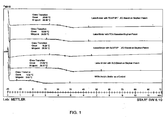
- FIG. 1 is a chart illustrating the Glass Transition temperature (Tg) of latex binders (prepared from the '514 application description) using different emulsifying surfactants during emulsion polymerization.
- the present invention relates to the use of a particular family of alkoxylated compounds, e.g., alkoxylated tristyrylphenols and alkoxylated tributylphenols, provided with an ethylene oxide chain for improving freeze-thaw stability of latex binders and paints.
- This family of alkoxylated compounds can improve other properties as well, for example, open time, stain resistance, film gloss, dispersibility, hiding and scrub resistance, low temperature film formation, foam resistance, block resistance, adhesion and water sensitivity, among others.
- alkyl means a saturated hydrocarbon radical, which may be straight, branched or cyclic, such as, for example, methyl, ethyl, n-propyl, iso-propyl, n-butyl, sec-butyl, t-butyl, pentyl, n-hexyl, cyclohexyl.
- cycloalkyl means a saturated hydrocarbon radical that includes one or more cyclic alkyl rings, such as, for example, cyclopentyl, cyclooctyl, and adamantanyl.
- hydroxyalkyl means an alkyl radical, more typically an alkyl radical, that is substituted with a hydroxyl groups, such as for example, hydroxymethyl, hydroxyethyl, hydroxypropyl, and hydroxydecyl.
- alkylene means a bivalent acyclic saturated hydrocarbon radical, including but not limited to methylene, polymethylene, and alkyl substituted polymethylene radicals, such as, for example, dimethylene, tetramethylene, and 2-methyltrimethylene.
- alkenyl means an unsaturated straight chain, branched chain, or cyclic hydrocarbon radical that contains one or more carbon-carbon double bonds, such as, for example, ethenyl, 1-propenyl, 2-propenyl.
- aryl means a monovalent unsaturated hydrocarbon radical containing one or more six-membered carbon rings in which the unsaturation may be represented by three conjugated double bonds, which may be substituted one or more of carbons of the ring with hydroxy, alkyl, alkenyl, halo, haloalkyl, or amino, such as, for example, phenoxy, phenyl, methylphenyl, dimethylphenyl, trimethylphenyl, chlorophenyl, trichloromethylphenyl, aminophenyl.
- aralkyl means an alkyl group substituted with one or more aryl groups, such as, for example, phenylmethyl, phenylethyl, triphenylmethyl.
- ethylenic unsaturation means a terminal (that is, e.g., ⁇ , ⁇ ) carbon-carbon double bond.
- the present invention includes latex polymer binders and latex dispersions having low-VOC content and excellent freeze-thaw stability and open time properties compared to conventional aqueous coating compositions, as well as methods of use.
- Such latex polymer binders can include at least one latex polymer copolymerized or blended with a particular family of alkoxylated compounds.
- the latex polymer binder has a Tg in the range of from -15°C to 12°C, more typically from -5°C to 5°C, more typically in the range from -5°C to 0°C.
- the latex polymer binder of the present invention has a weight average molecular weight of from 1,000 to 5,000,000, typically 5,000 to 2,000,000.
- the latex polymer of the present invention has a weight average molecular weight of from 10,000 to 250,000.
- the present invention provides aqueous compositions, for example, aqueous coating compositions, having low-VOC content and excellent freeze-thaw stability and open time properties comparable to conventional aqueous coating compositions.
- the aqueous compositions of the invention are aqueous polymer dispersions which include at least one latex polymer copolymerized or blended with a particular family of alkoxylated compounds, e.g., alkoxylated tristyrylphenol.
- the latex polymer binder is present in such aqueous compositions or paints from 15% to 40% by weight of the composition for semigloss and from 5% to up to 75%, typically 5% to 50% by weight of the composition for flat paint. Paints or other aqueous coatings of the present invention typically further include at least one pigment.
- the members of the particular family of alkoxylated compounds can be employed in a number of ways for improving freeze-thaw stability of latex binders and paints.
- the present invention may employ polymerizable reactive alkoxylated monomers to form a latex comonomer, surface active alkoxylated compounds as a surfactant (emulsifier) to be present during latex polymer formation, and/or surface active alkoxylated compounds as an additive to an aqueous dispersion of latex polymer or copolymer.
- polymerizable reactive alkoxylated (second) monomer of the following formula IA can be copolymerized (with a first monomer) into the backbone of the latex polymer binder.
- B is a single ring aromatic hydrocarbon having a 6 membered ring, i.e., a benzene ring
- R1, R2 and R3 are independently selected from: wherein, X is a divalent hydrocarbon radical selected from linear or branched alkylene radicals having from 2 to 8 carbon atoms; n is an integer of from 1 to 100, for example from 4 to 80 or 8 to 25; wherein R is an ethylenically unsaturated group; and wherein the latex binder has a glass transition temperature (Tg) of between -15°C and 12°C.
- Tg glass transition temperature
- n is an integer of from 4 to 80.
- n is an integer of from 4 to 60.
- n is an integer of from 10 to 50.
- Tg glass transition
- R includes acrylate, or C 1 -C 6 alkyl acrylate, e.g., methacrylate, allyl, vinyl, maleate, itaconate or fumarate, typically R is acrylate or methacrylate.
- Suitable polymerizable functional groups R include, for example, acrylo, methacrylo, acrylamido, methacrylamido, diallylamino, allyl ether, vinyl ether, ⁇ -alkenyl, maleimido, styrenyl, and ⁇ -alkyl styrenyl groups.
- the monomer has the formula IA: wherein, R, R 1 , R 2 , R 3 , X and n are as defined for the structure of formula IA and wherein the latex binder has a glass transition temperature (Tg) of between -15°C and 12°C.
- Tg glass transition temperature
- the aromatic ring shown in structural formula IA may be saturated.
- such a saturated monomer may be made by saturating a form of the monomer wherein H is in the R position and then replacing the H in the R position with one of the other above-listed R groups.
- At least one monomer can be copolymerized with a second monomer having structure IB-1: wherein R is R 1 , R 2 and R 3 are each independently: R 7 is a divalent linking group, O, (C 1 -C 6 ) alkylene, or absent, R 8 is H or methyl, R 9 is O or NR 10 , R 10 is H or (C 1 -C 4 ) alkyl; n is an integer of from 2 to 4, and m is an integer of from 1 to 100.
- R can be acrylate, C 1 -C 6 alkyl acrylate, allyl, vinyl, maleate, itaconate or fumarate. In one embodiment, R is at least one of acrylo, methacrylo, acrylamido, methacrylamido, diallylamino, allyl ether, vinyl ether, ⁇ -alkenyl, maleimido, styrenyl, and/or ⁇ -alkyl styrenyl groups.
- the monomer is an ethoxylated tristyrylphenol.
- the polymerizable reactive ethoxylated tristyrylphenols have the structural formula IB, as follows: wherein, n is an integer of from 1-100, for example, 4 to 60 or 8 to 25; R 4 is a member of the group H, C 1 -C 8 hydroxy alkyl, C 1 -C 6 alkyl, for example, CH 3 or C 2 H 5 .
- the reactive polymerizable ethoxylated tristyrylphenol monomer has a tristyrylphenol portion, an alkylene oxide portion and a reactive substituted or unsubstituted acrylic end group for polymerization.
- the ethylene oxide group shown in structural formula IB may be replaced with the above discussed - (OX)- group to form an alkoxylated tristyrylphenol, and the -C(O)-CHR 4 CH 2 end group may be replaced by allyl, vinyl, maleate, itaconate or fumarate.
- Tristyrylphenol ethoxylates for other uses, are disclosed by US patent number 6,146,570 , published PCT patent application number WO 98/012921 and WO 98/045212 .
- aromatic rings of the styryl groups in Formula IB may be saturated.
- the latex polymer binder is made from a mixture wherein the reactive tristyrylphenol monomer is 1 to 20 parts per 100 parts by weight of monomers used to form the copolymer, more typically 2 to 15, 2 to 8, or 2 to 6 parts per 100 parts by weight of monomers used to form the copolymer.
- these other monomers from which latex polymer binder used in the aqueous coating composition, e.g., paint, is typically derived are termed latex monomers.
- these other latex monomers comprise at least one acrylic monomer selected from the group consisting of acrylic acid, acrylic acid esters, methacrylic acid, and methacrylic acid esters.
- the other monomers for making the latex polymer can optionally be selected from one or more monomers selected from the group consisting of styrene, a-methyl styrene, vinyl chloride, acrylonitrile, methacrylonitrile, ureido methacrylate, vinyl acetate, vinyl esters of branched tertiary monocarboxylic acids (e.g. vinyl esters commercially available under the mark VEOVA from Shell Chemical Company or sold as EXXAR Neo Vinyl Esters by ExxonMobil Chemical Company), itaconic acid, crotonic acid, maleic acid, fumaric acid, and ethylene.
- monomers selected from the group consisting of styrene, a-methyl styrene, vinyl chloride, acrylonitrile, methacrylonitrile, ureido methacrylate, vinyl acetate, vinyl esters of branched tertiary monocarboxylic acids (e.g. vinyl esters commercially available
- the monomers include one or more monomers selected from the group consisting of n-butyl acrylate, methyl methacrylate, styrene and 2-ethylhexyl acrylate.
- the latex polymer is typically selected from the group consisting of pure acrylics (comprising acrylic acid, methacrylic acid, an acrylate ester, and/or a methacrylate ester as the main monomers); styrene acrylics (comprising styrene and acrylic acid, methacrylic acid, an acrylate ester, and/or a methacrylate ester as the main monomers); vinyl acrylics (comprising vinyl acetate and acrylic acid, methacrylic acid, an acrylate ester, and/or a methacrylate ester as the main monomers); and acrylated ethylene vinyl acetate copolymers (comprising ethylene, vinyl acetate and acrylic acid, methacrylic acid, an acrylate ester, and/or a methacrylate ester as the main monomers).
- the monomers can also include other main monomers such as acrylamide and acrylonitrile, and one or more functional monomers such as itaconic acid and ureido methacrylate, as would be readily understood by those skilled in the art.
- the latex polymer binder is a pure acrylic such as a butyl acrylate/methyl methacrylate copolymer derived from monomers including butyl acrylate and methyl methacrylate.
- the other monomer is an ethoxylated tristyrylphenol, which may have the structural formula IC, as follows: wherein, n is an integer of from 1-100, for example, 4 to 60 or 8 to 25 and R 4 is a member of the group H, C 1 -C 8 hydroxy alkyl, C 1 -C 6 alkyl, for example, CH 3 or C 2 H 5 .
- the reactive polymerizable alkoxylated monomer of formula IA, IA-1 and/or IB are utilized and copolymerized with one of the monomers listed under "other monomers" into the backbone of a latex polymer binder under reaction conditions.
- the reactive polymerizable alkoxylated monomer of formula IA, IA-1 and/or IB are utilized and copolymerized with two or more of the monomers listed under "other monomers" into the backbone of a latex polymer binder under reaction conditions.
- one or more reactive polymerizable alkoxylated monomers of formula IA, IA-1 and/or IB are utilized and copolymerized with one or more of the monomers listed under "other monomers" into the backbone of a latex polymer binder under reaction conditions.
- the latex polymer dispersion typically includes from 30 to 75% solids and a mean latex polymer binder particle size of from 70 to 650 nm.
- the polymer of the present invention has a mean particle size of less than 400nm, typically a mean particle size of less than 200 nm, more typically a mean particle size of less than 190 nm, and most typically a mean particle size of less than 175 nm.
- the latex polymer binder has a mean particle size of from 75 nm to 400 nm.
- the latex polymer binder is typically present in the aqueous coating composition in an amount from 5 to 60 percent by weight, and more typically from 8 to 40 percent by weight (i.e. the weight percentage of the dry latex polymer based on the total weight of the coating composition).
- aqueous coating composition containing the latex polymer binder of the present invention is freeze-thaw stable without having to add anti-freeze agents, or adding small amounts of anti-freeze agents, as described above. Therefore, aqueous coating compositions can be produced in accordance with the invention that possess lower VOC levels than conventional aqueous coating compositions and thus that are more environmentally desirable.
- the resulting latex polymer may be incorporated into an aqueous coating composition along with an emulsion surfactant as described below and/or a freeze-thaw additive as described below.
- the addition of the freeze-thaw additive has little or no effect on the VOC levels of the aqueous coating composition, and, thus, aqueous coating compositions can be produced in that possess lower VOC levels than conventional aqueous coating compositions.
- the latex coating composition contains a freeze-thaw additive as described herein in an amount greater than 1.3% by weight of the latex polymer binder.
- the latex coating composition contains a freeze-thaw additive as described herein in an amount greater than 1.6% by weight of the latex polymer binder.
- the latex coating composition contains a freeze-thaw additive as described herein in an amount greater than 2% by weight of the latex polymer binder. In another embodiment, the latex coating composition contains a freeze-thaw additive as described herein in an amount greater than 4% by weight of the latex polymer binder. In another embodiment, the latex coating composition contains a freeze-thaw additive as described herein in an amount greater than 7.5% by weight of the latex polymer binder. In another embodiment, the latex coating composition contains a freeze-thaw additive as described herein in an amount greater than 8% by weight of the latex polymer binder.
- the latex coating composition contains a freeze-thaw additive in an amount between 1.6% and 7.5% by weight of the latex polymer binder. In another embodiment, the latex coating composition contains a freeze-thaw additive in an amount between 1.6% and 45% by weight of the latex polymer binder, typically between 1.6% and 35% by weight of the latex polymer binder.
- the latex polymer binder of the present invention is freeze-thaw stable, and can have a Tg of between -15°C and 12°C and a mean particle size of less than 200 nm, or a Tg of between -5°C and 5°C and a mean particle size of less than 200 nm, or a Tg of between -5°C and 0°C and a mean particle size of less than 200 nm, or a Tg of between -15°C and 12°C and a mean particle size of less than 190 nm, or a Tg of between -5°C and 5°C and a mean particle size of less than 190 nm, or a Tg of between -5°C and 0°C and a mean particle size of less than 190 nm, or a Tg of between -15°C and 12°C and a mean particle size of less than 175 nm, or a Tg of between -5°C and 5°C and a mean particle size of less than
- the latex polymer including the reactive polymerizable alkoxylated monomer of formula IA, IA-1 and/or IB can be used in combination with other ionic or non-ionic type of surfactants that are either polymerizable or non-polymerizable, in the aqueous coating composition.
- the polymer latex binder can be prepared using emulsion polymerization by feeding the monomers used to form the latex binder to a reactor in the presence of at least one initiator and the at least one reactive polymerizable alkoxylated monomer of formula IA, IA-1 and/or IB and polymerizing the monomers to produce the latex binder.
- the monomers fed to a reactor to prepare the polymer latex binder typically include at least one acrylic monomer selected from the group consisting of acrylic acid, acrylic acid esters, methacrylic acid, and methacrylic acid esters.
- the monomers can include styrene, vinyl acetate, or ethylene.
- the monomers can also include one or more monomers selected from the group consisting of styrene, [alpha]-methyl styrene, vinyl chloride, acrylonitrile, methacrylonitrile, ureido methacrylate, vinyl acetate, vinyl esters of branched tertiary monocarboxylic acids, itaconic acid, crotonic acid, maleic acid, fumaric acid, and ethylene. It is also possible to include C4-C8 conjugated dienes such as 1,3-butadiene, isoprene or chloroprene.
- the monomers include one or more monomers selected from the group consisting of n-butyl acrylate, methyl methacrylate, styrene and 2-ethylhexyl acrylate.
- the initiator can be any initiator known in the art for use in emulsion polymerization such as ammonium or potassium persulfate, or a redox system that typically includes an oxidant and a reducing agent. Commonly used redox initiation systems are described e.g., by A. S. Sarac in Progress in Polymer Science 24(1999), 1149-1204 .
- the polymer latex binder can be produced by first preparing an initiator solution comprising the initiator and water.
- a monomer pre-emulsion is also prepared comprising at least a portion of the monomers to be used to form the latex polymer binder, one or more surfactants (emulsifiers), water, and additional additives such as NaOH.
- the one or more surfactants in the monomer pre-emulsion include any of the reactive polymerizable alkoxylated monomers of the present invention.
- the initiator solution and monomer pre-emulsion are then continuously added to the reactor over a predetermined period of time (e.g. 1.5-5 hours) to cause polymerization of the monomers and to thereby produce the latex polymer binder.
- the initiator solution is added to the reactor prior to adding the monomer pre-emulsion.
- a seed latex such as a polystyrene seed latex can be added to the reactor.
- water, one or more surfactants, and any monomers not provided in the monomer pre-emulsion can be added to the reactor prior to adding the initiator and adding the monomer pre-emulsion.
- the reactor is operated at an elevated temperature at least until all the monomers are fed to produce the polymer latex binder. Once the polymer latex binder is prepared, it is typically chemically stripped thereby decreasing its residual monomer content.
- a peroxide e.g. t-butylhydroperoxide
- a reducing agent e.g. sodium acetone bisulfite
- another redox pair such as those described by A. S. Sarac in Progress in Polymer Science 24(1999), 1149-1204
- the pH of the latex binder can then be adjusted and a biocide or other additives added after the chemical stripping step.
- the aqueous coating composition is a stable fluid that can be applied to a wide variety of materials such as, for example, paper, wood, concrete, metal, glass, ceramics, plastics, plaster, and roofing substrates such as asphaltic coatings, roofing felts, foamed polyurethane insulation; or to previously painted, primed, undercoated, worn, or weathered substrates.
- the aqueous coating composition of the invention can be applied to the materials by a variety of techniques well known in the art such as, for example, brush, rollers, mops, air-assisted or airless spray, electrostatic spray, and the like.
- Latex Polymer Binder Compositions Comprising Surface Active (emulsifier) Compound
- a surface active compound of structural formula IIA can be used as an emulsifier during the emulsion polymerization reaction used to make latex polymer binder.
- B is a 5 or 6 membered cycloalkyl ring, e.g., a cyclohexyl ring, or a single ring aromatic hydrocarbon having a 6 membered ring, e.g., a benzene ring;
- R 1 , R 2 and R 3 are independently selected from: -H, tertbutyl, butyl, with the proviso that one or none of R 1 , R 2 and R 3 is -H.
- X is at least one member of the group consisting of C 2 H 4 , C 3 H 6 , and C 4 H 8 , or wherein X is a divalent hydrocarbon radical selected from linear or branched alkylene radicals having from 2 to 8 carbon atoms; n is 1-100, for example, 3 to 80, 4 to 50, 4 to 40 or 8 to 25; wherein R is -OH, -OCH 3 , -OC 2 H 5 , -OC 3 H 7 , -OC 4 H 9 , -OC 5 H 11 ,-OC 6 H 13 , -Cl, -Br, -CN, Phosphonate (-PO 3 - M + ), Phosphate (PO 4 - M + ), Sulfate (SO 4 - M + ), Sulfonate (SO 3 - M + ), carboxylate (COO- M + ), a nonionic group, or a quaternary ammonium ion, wherein M+ is
- R 5 is selected from a quaternary ammonium ion:
- n is an integer of from 4 to 80. In one embodiment, n is an integer of from 4 to 60. In one embodiment, n is an integer of from 10 to 50. In one embodiment, n is an integer of from 10 to 25.
- the alkoxylated surface active compound has the formula IIB: wherein, R, R 1 , R 2 , R 3 , X and n are as defined for the structure of formula IIA. If desired, the aromatic ring shown in structural formula IIB may be saturated.
- a surface active alkoxylated tristyrylphenol e.g., ethoxylated tristyrylphenol
- a surface active alkoxylated tributylphenol e.g., ethoxylated tributylphenol
- emulsifier used as an emulsifier during the emulsion polymerization reaction used to make latex polymer.
- the surface active ethoxylated tristyrylphenols have the structural formula IIC and the surface active ethoxylated tributylphenols have the structural formula IIC-1, respectively, as follows: wherein, n is an integer of from 1 to 100 for example, 4 to 60 or 8 to 25, wherein R 5 is -OH, -OCH 3 , -OC 2 H 5 , -OC 3 H 7 , -OC 4 H 9 , -OC 5 H 11 , -OC 6 H 13 , -Cl,-Br, -CN, Phosphonate (-PO 3 - M + ), Phosphate (PO 4 - M + ), Sulfate (SO 4 - M + ), Sulfonate (SO 3 - M + ), carboxylate (COO- M + ), a nonionic group, or a quaternary ammonium ion, wherein M+ is a cation including but not limited to H + , Na + ,
- R 5 is selected from a quaternary ammonium ion:
- n is an integer of from 4 to 80. In one embodiment, n is an integer of from 4 to 60. In one embodiment, n is an integer of from 10 to 50. In one embodiment, n is an integer of from 10 to 25.
- the latex polymer binder is made from a mixture wherein the surface active emulsifier utilized is.
- the emulsifier is added in an amount greater than 1.3% by weight of the polymer or monomers used to form the latex polymer binder, in an amount greater than 1.6% by weight of the polymer or monomers used to form the latex polymer binder, typically in an amount greater than 2% by weight of the polymer or monomers used to form the latex polymer binder, more typically in an amount greater than 4% by weight of the polymer or monomers used to form the latex polymer binder, and most typically in an amount greater than 7.5% by weight of the polymer or monomers used to form the latex polymer binder.
- the latex coating composition contains an emulsifier in an amount greater than 8% by weight of the polymer or monomers used to form the latex polymer binder, or greater than 10% by weight of the polymer or monomers.
- the emulsifier is added is between 1.6% and 7.5% by weight of the polymer or monomers used to form the latex polymer binder.
- emulsifier added is between 1.6% and 45% by weight of the polymer or monomers used to form the latex polymer binder, typically between 1.6% and 35% by weight of the polymer or monomers used to form the latex polymer binder
- the ethylene oxide repeating units of the ethylene oxide chain of formula IIC or IIC-1 may be replace by the above-described -(OX)- group to form alkoxylated tristyrylphenol or alkoxylated tributylphenol.
- the polymer latex binder can be produced by first preparing an initiator solution comprising the initiator and water.
- a monomer pre-emulsion is also prepared comprising at least a portion of the monomers to be used to form the latex polymer binder, one or more surfactants (emulsifiers), water, and additional additives such as NaOH.
- the one or more surfactants in the monomer pre-emulsion include the surface active alkoxylated compound of the invention.
- the alkoxylated compound is employed as an emulsifier to form a blend rather than as a reactant which copolymerizes with the other monomers which form the polymer latex binder.
- the initiator solution and monomer pre-emulsion are then continuously added to the reactor over a predetermined period of time (e.g. 1.5-5 hours) to cause polymerization of the monomers and to thereby produce the latex polymer binder.
- a predetermined period of time e.g. 1.5-5 hours
- the initiator solution is added to the reactor prior to adding the monomer pre-emulsion.
- a seed latex such as a polystyrene seed latex can be added to the reactor.
- water, one or more surfactants, and any monomers not provided in the monomer pre-emulsion can be added to the reactor prior to adding the initiator and adding the monomer pre-emulsion.
- the reactor is operated at an elevated temperature at least until all the monomers are fed to produce the polymer latex binder.
- the polymer latex binder is typically chemically stripped thereby decreasing its residual monomer content.
- it is chemically stripped by continuously adding an oxidant such as a peroxide (e.g. t-butylhydroperoxide) and a reducing agent (e.g. sodium acetone bisulfite), or another redox pair such as those described by A. S. Sarac in Progress in Polymer Science 24(1999), 1149-1204 , to the latex binder at an elevated temperature and for a predetermined period of time (e.g. 0.5 hours).
- the pH of the latex binder can then be adjusted and a biocide or other additives added after the chemical stripping step.
- the incorporation of the surface active alkoxylated compound surfactant (emulsifier) in the emulsion polymerization reaction mixture enables the coating composition to have a lower VOC content while maintaining the freeze-thaw stability of the aqueous coating composition at desirable levels.
- the above-described surface active alkoxylated compound of structural formula IIA, IIB, IIC or IIC-1 can be used as an additive to an already formed aqueous dispersion of latex polymer binder. It is understood, that the freeze-thaw additive can be added any point in the production of the aqueous coating composition, including but not limited to during the emulsification step, during formulation, etc. It is also understood that the freeze-thaw additive can be post-added to the aqueous coating composition or a concentrate thereof.
- aqueous composition comprising the surface active alkoxylated compound and the latex polymer binder.
- the surface active alkoxylated compound is employed as an additive to an already formed aqueous latex dispersion
- the resulting composition has alkoxylated compound additive in an amount of 1 to 10, Typically 2 to 8 or 2 to 6, parts per 100 parts by weight of monomers used to form the latex polymer binder.
- the present invention further includes a method of preparing a latex binder composition, comprising adding the at least one surface active alkoxylated compound surfactant (emulsifier) of structural formula IIA, IIB, IIC and/or IIC-1 as described above to an aqueous dispersion of a latex polymer to produce the latex binder.
- the at least one pigment and other additives can then be mixed with the resulting latex binder to produce the aqueous coating composition in any appropriate order.
- the addition of the surface active alkoxylated compound of structural formula IIA, IIB, IIC or IIC-1 to the latex polymer binder forms a mixture having a lower VOC content while maintaining the freeze-thaw stability of the mixture at desirable levels.
- the above-described surface active compound of structural formula IIA, IIB, IIC or IIC-1 (sometimes referred to as the freeze-thaw additive) can be used as an additive to an during formulation of paint or aqueous coating composition.
- Formulation is the stage at which additives are added to a base aqueous latex polymer dispersion to make it into final product such as a paint or coating.
- the resulting composition has alkoxylated compound additive typically in an amount greater than 1.3% by weight of the polymer or monomers used to form the latex polymer binder, more typically in an amount greater than 1.6% by weight of the polymer or monomers used to form the latex polymer binder, yet more typically in an amount greater than 2% by weight of the polymer or monomers used to form the latex polymer binder, even more typically in an amount greater than 4% by weight of the polymer or monomers used to form the latex polymer binder, and most typically in an amount greater than 7.5% by weight of the polymer or monomers used to form the latex polymer binder.
- the latex coating composition contains surface active alkoxylated compound in an amount between 1.6% and 7.5% by weight of the polymer or monomers used to form the latex polymer binder. In another embodiment, the latex coating composition contains surface active alkoxylated compound in an amount between 1.6% and 45% by weight of the polymer or monomers used to form the latex polymer binder, typically between 1.6% and 35%. Pigment is a typical additive, for example, added during formulation of paint from raw aqueous latex polymer dispersion.
- the aqueous coating compositions of the present invention are freeze-thaw stable where the freeze-thaw additive is present in the aqueous coating composition in the amounts by weight of the latex polymer binder as described above, where the polymer has a Tg of between -15°C and 12°C and a mean particle size of less than 200 nm, or a Tg of between -5°C and 5°C and a mean particle size of less than 200 nm, or a Tg of between -5°C and 0°C and a mean particle size of less than 200 nm, or a Tg of between -15°C and 12°C and a mean particle size of less than 190 nm, or a Tg of between -5°C and 5°C and a mean particle size of less than 190 nm, or a Tg of between -5°C and 0°C and a mean particle size of less than 190 nm, or a Tg of between -15°C and 12°C and
- the mean particle size is typically between 75 nm to 400 nm.
- the aqueous coating composition can be characterized by an open time of greater than 2 minutes, an open time of greater than 4 minutes, an open time of greater than 6 minutes or an open time of greater than 12 minutes.
- the present invention further includes a method of preparing a paint or aqueous coating composition, comprising adding the at least one surface active alkoxylated compound of structural formula IIA, IIB, IIC and/or IIC-1 as described above during formulation of paint or aqueous coating composition comprising at least one pigment and other additives to produce the final paint or aqueous coating composition.
- the addition of the surface active alkoxylated compound surfactant (emulsifier) during formulation of paint or aqueous coating composition forms a coating composition having a lower VOC content while maintaining the freeze-thaw stability of the aqueous coating composition at desirable levels.
- the aqueous coating compositions of the invention include at least one latex polymer binder of the present invention.
- the aqueous coating compositions of the invention include less than 2 % by weight and typically less than 1.0% by weight of anti-freeze agents based on the total weight of the aqueous coating composition. More typically, the aqueous coating compositions are substantially free of anti-freeze agents.
- the aqueous coating composition typically includes at least one pigment.
- pigment as used herein includes non-film-forming solids such as pigments, extenders, and fillers.
- the at least one pigment is typically selected from the group consisting of TiO2 (in both anastase and rutile forms), clay (aluminum silicate), CaCO3 (in both ground and precipitated forms), aluminum oxide, silicon dioxide, magnesium oxide, talc (magnesium silicate), barytes (barium sulfate), zinc oxide, zinc sulfite, sodium oxide, potassium oxide and mixtures thereof.
- Suitable mixtures include blends of metal oxides such as those sold under the marks MINEX (oxides of silicon, aluminum, sodium and potassium commercially available from Unimin Specialty Minerals), CELITES (aluminum oxide and silicon dioxide commercially available from Celite Company), ATOMITES (commercially available from English China Clay International), and ATTAGELS (commercially available from Engelhard).
- the at least one pigment includes TiO2, CaCO3 or clay.
- the mean particle sizes of the pigments range from 0.01 to 50 microns.
- the TiO2 particles used in the aqueous coating composition typically have a mean particle size of from 0.15 to 0.40 microns.
- the pigment can be added to the aqueous coating composition as a powder or in slurry form.
- the pigment is typically present in the aqueous coating composition in an amount from 5 to 50 percent by weight, more typically from 10 to 40 percent by weight.
- the coating composition can optionally contain additives such as one or more film-forming aids or coalescing agents.
- Suitable firm-forming aids or coalescing agents include plasticizers and drying retarders such as high boiling point polar solvents.
- Other conventional coating additives such as, for example, dispersants, additional surfactants (i.e. wetting agents), rheology modifiers, defoamers, thickeners, biocides, mildewcides, colorants such as colored pigments and dyes, waxes, perfumes, co-solvents, and the like, can also be used in accordance with the invention.
- non-ionic and/or ionic (e.g. anionic or cationic) surfactants can be used to produce the polymer latex.
- These additives are typically present in the aqueous coating composition in an amount from 0 to 15% by weight, more typically from 1 to 10% by weight based on the total weight of the coating composition.
- the aqueous coating composition in some embodiments can include less than 2.0% of anti-freeze agents based on the total weight of the aqueous coating composition.
- anti-freeze agents include ethylene glycol, diethylene glycol, propylene glycol, glycerol (1,2,3-trihydroxypropane), ethanol, methanol, 1-methoxy-2-propanol, 2-amino-2-methyl-1-propanol, and FTS-365 (a freeze-thaw stabilizer from Inovachem Specialty Chemicals). More typically, the aqueous coating composition includes less than 1.0% or is substantially free (e.g. includes less than 0.1 %) of anti-freeze agents.
- the aqueous coating composition of the invention typically has a VOC level of less than 100 g/L and more typically less than or equal to 50 g/L.
- the aqueous coating compositions of the invention include little or no anti-freeze agents, the compositions possess freeze-thaw stabilities at levels desirable in the art.
- aqueous coating compositions of the invention can be subjected to freeze-thaw cycles using ASTM method D2243-82 or ASTM D2243-95 without coagulation.
- the balance of the aqueous coating composition of the invention is water. Although much of the water is present in the polymer latex dispersion and in other components of the aqueous coating composition, water is generally also added separately to the aqueous coating composition. Typically, the aqueous coating composition includes from 10% to 85% by weight and more typically from 35% to 80% by weight water. Stated differently, the total solids content of the aqueous coating composition is typically from 15% to 90%, more typically, from 20% to 65%.
- the coating compositions are typically formulated such that the dried coatings comprise at least 10% by volume of dry polymer solids, and additionally 5 to 90% by volume of non-polymeric solids in the form of pigments.
- the dried coatings can also include additives such as plasticizers, dispersants, surfactants, rheology modifiers, defoamers, thickeners, biocides, mildewcides, colorants, waxes, and the like, that do not evaporate upon drying of the coating composition.
- the aqueous coating composition is a latex paint composition comprising at least one latex polymer binder of the present invention; at least one pigment and water.
- the present invention further includes a method of preparing an aqueous coating composition by mixing together at least one latex polymer binder of the present invention as described above, and at least one pigment.
- the latex polymer binder is in the form of a latex polymer dispersion.
- the additives discussed above can be added in any suitable order to the latex polymer binder, the pigment, or combinations thereof, to provide these additives in the aqueous coating composition.
- the aqueous coating composition typically has a pH of from 7 to 10.
- the present invention may employ (I) surface active alkoxylated compounds as a surfactant (emulsifier) to be present during latex polymer formation, (II) polymerizable reactive alkoxylated monomers to form a latex comonomer, and/or (III) surface active alkoxylated compounds as an additive to an aqueous dispersion of latex polymer or copolymer.
- a surfactant emulsifier
- Example 1 The following Example 1 and its subsets describe surface active alkoxylated compounds utilized as a surfactant (emulsifier) to be present during latex polymer formation.
- TSP - EO is a surface active ethoxylated tristyrylphenol according to the above-listed structural formula IIC in which the R group is H.
- Sample 1 has 2% TSP - EO, 1% MAA (methacrylic acid); Sample 2 has 4% TSP - EO, 1 % MAA; and Sample 3 has 6% TSP - EO, 1 % MAA were made.
- TABLE 1 shows the ingredients of Sample 2 with 4% TSP - EO, 1% MAA.
- BOM is an abbreviation for "Based On Total Monomer.”
- the monomer emulsion contains typical monomers for making latex.
- TSP - EO contains a surface active tristyrylphenol with from about 10 to about 50 ethylene oxide groups in its alkoylate chain according to the above-listed structural formula IIC in which the R group is H.
- RHODACAL A-246/L and ABEX are emulsifiers available from Rhodia Inc., Cranbury, NJ
- TABLE 2 shows the ingredients employed in a control tested in this example.
- CONTROL INGREDIENTS Recipe: Ingredient weight (g) % BOTM Kettle Charge Deionized Water 320.00 Monomer Emulsion Deionized Water 282.00 Alkyl sulfate surfactant 30.00 1.50 Non-ionic surfactant 8.00 0.50 Methylmethacrylate (MMA) 320.00 40.00 butylacrylate (BA) 472.00 59.00 (methyl acrylic acid) MAA 8.00 1.00 Initiator Solution Deionized Water 156.80 Ammonium Persulfate 3.20 0.40 Total 1600.00 102.40 Total Theoretical %Solids Ingredient weight (g) % BOTM Kettle Charge Deionized Water 320.00 Monomer Emulsion Deionized Water 282.00 Alkyl sulfate surfactant 30.00 1.50 Non-ionic surfactant 8.00 0.50 Methylmethacrylate (MMA) 320.00 40.00 butylacrylate (BA) 472.00 5
- PROCEDURE The control and the Sample 1, 2 and 3 ingredients were respectively each employed in an emulsion polymerization reaction procedure as follows:
- Sample 1 contained 4% TSP - EO. The procedure was repeated for 2% TSP - EO and 6% TSP - EO samples that were the same as the 4% TSP - EO sample except for the amount of TSP - EO.
- TABLE 3 shows the results of the control, the 2% TSP - EO sample (Sample 1), the above-described 4% TSP - EO sample (Sample 2), and the 6% TSP - EO sample (Sample 3).
- the freeze-thaw stability of polymer dispersions and formulated paints was measured based on ASTM standard test Method D2243-95. The latexes or formulated paints are tested using a half pint of sample. The sample was kept in a freezer at 0°F (-18°C) over 17 hours and then taken out from the freezer and allowed to thaw for 7 hours at room temperature. The freeze-thaw cycles were continued until the latex or paint coagulated, or to a maximum of five (5) cycles.
- TABLE 3 shows the additive prevented gelling at conditions which gelled the control.
- Coagulum particles are formed as a byproduct of making latex.
- the Tg of the latex as measured using the DSC method as generally known in the art, was 3.63 °C.
- Additive loading level 1.0 Wt% of total paint weight.
- Water-borne commercial paint Weight per Gallon: 10.24 pounds per gallon; pH: 8.67; VOC: ⁇ 50 g/L; Gloss at 60 degrees: 52.
- Example 2 illustrates comparative examples of the present invention as against the disclosure of International Publication Number WO 2007/117512 (hereinafter sometimes referred to as the "'512 Application” or “Stepan”).
- the seed latex according to the '512 Application was prepared: Seed Latex Preparation using Sodium Lauryl Sulfate (SLS) Formulas: Water 50 Sulfate*: (29.5) 2.44 Monomers: Styrene 7.2 MMA 12.24 BA 15.84 AA 0.72 Total 100 Initiator Solution Ammonium Persulfate 0.26 Water 14
- SLS surfactant
- Tables 5 and 6 illustrate emulsion polymerization of a styrene-acrylic latex polymer using SLS (control) and using SLS in combination with a TSP having from about 10 to 40 ethylene oxide groups as surfactant emulsifiers, respectively.
- PROCEDURE (for Tables 5 and 6):
- Table 8 Freeze-Thaw Stability of latex binder using SLS (control) and TDA Sodium Sulfate (control), as compared to using SLS in combination with a TSP as surfactant emulsifiers and using TDA Sodium Sulfate in combination with a TSP as surfactant emulsifiers, respectively.
- Latex Binders Table 8 - Freeze-Thaw Stability of Latex Viscosity (cPs, Brookfield) (LV4, 60rpm) Initial Vis.
- the properties of the latex polymer dispersions prepared in Table 5 (Sodium Lauryl Sulfate used as the emulsifying surfactant) and Table 6 (Sodium Lauryl Sulfate and TSP used as emulsifying surfactants) both exhibit freeze thaw (F/T) stability.
- the measured Tg of the latex dispersion of Tables 5 and 6 ranged from about 24 °C - 27 °C.
- the Tg of various latex polymers prepared under the '512 application are illustrated: (1) emulsion polymerization of the latex polymer using SLS, which has a measured Tg of about 26.5 °C; (2) emulsion polymerization of the latex polymer using SLS in combination with a TSP - EO as surfactant emulsifiers, which has a measured Tg of about 25.3 °C; (3) emulsion polymerization of the latex polymer using TDA Sodium Sulfate, which has a measured Tg of about 24.5 °C; and (4) emulsion polymerization of the latex polymer using TDA Sodium Sulfate in combination with a TSP - EO as surfactant emulsifiers, which has a measured Tg of about 26.5 °C.
- Example 3 and its subsets describe the present invention as polymerizable reactive alkoxylated monomers (reactive monomers) used to form a latex comonomer or polymer binder.
- TSP tristyrylphenol
- TBP tributylphenol
- a control latex polymer was prepared from emulsion polymerization without the use of TSP/TBP ethoxylated monomers.
- a latex polymer was prepared from emulsion polymerization using TSP ethoxylated monomers of the present invention and TBP ethoxylated monomers. The procedure for preparing the latex polymer was as follows:
- Tables 11, 12 and 13 illustrate paint formulations utilizing a commercially low VOC available paint whose polymer latex is believed to have a Tg of about 2.4 °C and a D 50 of between 130-160, a similar formulation utilizing pure acrylic as the latex polymer, and a similar formulation utilizing the synthesized latexes of the present invention as the latex polymer, respectively.
- Table 11 - Paint Formulations Table 11 - Paint Formulation Control - Commercially available Low VOC paint (Comm.
- Table 13 - Paint Formulation with synthesized latex including TSP ethoxylate unit Table 13 - Paint Formulation with synthesized latex including TSP ethoxylate unit. Table 13 - Paint Formulation with synthesized latex including TSP ethoxylate unit
- Raw materials Pounds Gallons Weight Percent Pigment Grind Water 80 9.62 9.560 Ethylene Glycol 0 0 0.00 AMP-95 1 0.13 0.10 Rhodoline 286N 8 0.91 0.76 Antarox BL-225 4 0.48 0.38 Rhodoline 643 0.5 0.06 0.05 Attagel 50 5 0.253 0.48 Titanium dioxide Tiona 595 230 7 22.0 Water 89.6 10.77 6.64 Sub Total 418.1 29.22 Letdown Latex -2% - TSP/TBP reactive monomer 480 54.2 45.9 Texanol 0 0 0.0 Rhodoline 643 2.5 0.41 0.29 Aquaflow NHS310 28 3.23 2.68 Water 95 11.42 9.1 Acrysol
- Table 14 illustrates the resulting paint properties of the above referenced paint formulations using low Tg commercial latex, pure acrylic latex, and varying TSP/TBP ethoxylated monomers having ethoxylate groups from about 3 to 80. Table 14 Comm.
- Example 4 describe surface active alkoxylated compounds utilized as one or more additives to an aqueous dispersion of latex polymer or copolymer.
- Non-ionic TSP surfactants having ethylene oxide groups greater than about 3 to about 80 was added at 10 Ibs/ 100 gals in Pure acrylic - White base, and the formulation exhibited freeze-thaw stability.
- Table 20 shows anionic TSP surfactants (10 lbs/ 100 gals) as F/T additives (in Pure acrylic - White base).
- Table 21 shows the effects of the TSP ethoxylate on the binder particle size.
- the mean particle size was measured using a Zetasizer Nano ZS device utilizing the Dynamic Light Scattering (DLS) method.
- the DLS method essentially consists of observing the scattering of laser light from particles, determining the diffusion speed and deriving the size from this scattering of laser light, using the Stokes-Einstein relationship.
- TSP Low VOC Comm. Paint (3.0 wt%) Table 21 - Effects of TSP Ethoxylate on Particle sizes of Low Tg Binder Mean Particle Size (nm) Initial Vis.
- Table 22 shows the loading level of TSP Ethoxylate on F/T Stability of low VOC Paints.
- TSP-EO wt% based on dry polymer weight
- Table 22 Loading Level of TSP - EO on Freeze-Thaw Stability of Low VOC Semigloss Paints Viscosity (Krebs Units, KU) Initial Vis.
- TSP-EO wt% based on dry polymer weight
- TSP ethoxylates in varying amounts were added to low or zero VOC commercial paints and tested for freeze thaw stability.
- Table 24 shows the effects of TSP-EO on F/T Stability of various Low/Zero VOC Commercial Paints.
- the control contained no TSP ethoxylated surfactant (TSP-EO).
- Open time - Tables 25 and 26 show the effects of TSP Ethoxylate nonionic surfactants on "open time” of Low VOC Paints and the Effects of TSP Ethoxylate Anionic Surfactants on “open time” of Low VOC Paints, respectively.
- Open time is generally understood to be the interval, after the paint is applied, during which it can be blended with additional painted regions (at the "wet edge”).
- Open time refers to the amount of time a newly-applied layer of paint remains workable before brush strokes and other signs of manipulation become visible in dried films.
- the method for measuring Open Time is generally as follows: a 10 mils film is drawn down on a piece of black scrub test paper.
- the paint film is then cross-hatched in two-inch intervals with the eraser end of a pencil.
- the first cross hatch then brushed over in one direction 15 times; this is then repeated in two-minute intervals for each successive cross-hatch.
- the dry films are examined for the earliest times at which traces of cross-hatch at discernable. This is performed under constant humidity, room temp. It is desirable for paint formulations to have an open time of greater than 4 minutes, typically, greater than 6 minutes.
- the amount of reagent both nonionic surfactants and anionic surfactants varied from about 2.5 grams surfactant to about 4.25 grams surfactant per 256 grams of paint.
Landscapes
- Chemical & Material Sciences (AREA)
- Organic Chemistry (AREA)
- Life Sciences & Earth Sciences (AREA)
- Engineering & Computer Science (AREA)
- Materials Engineering (AREA)
- Wood Science & Technology (AREA)
- Health & Medical Sciences (AREA)
- Chemical Kinetics & Catalysis (AREA)
- Medicinal Chemistry (AREA)
- Polymers & Plastics (AREA)
- Paints Or Removers (AREA)
- Addition Polymer Or Copolymer, Post-Treatments, Or Chemical Modifications (AREA)
- Polymerisation Methods In General (AREA)
Priority Applications (3)
| Application Number | Priority Date | Filing Date | Title |
|---|---|---|---|
| EP18201355.7A EP3480241B1 (en) | 2008-01-18 | 2009-01-16 | Latex binders, aqueous coatings and paints having freeze-thaw stability and methods for using same |
| EP13188193.0A EP2703433B1 (en) | 2008-01-18 | 2009-01-16 | Latex binders, aqueous coatings and paints having freeze-thaw stability and methods for using same |
| EP13188195.5A EP2703434B1 (en) | 2008-01-18 | 2009-01-16 | Latex binders, aqueous coatings and paints having freeze-thaw stability and methods for using same |
Applications Claiming Priority (4)
| Application Number | Priority Date | Filing Date | Title |
|---|---|---|---|
| US2220608P | 2008-01-18 | 2008-01-18 | |
| US2244308P | 2008-01-21 | 2008-01-21 | |
| US19993608P | 2008-11-21 | 2008-11-21 | |
| PCT/US2009/000309 WO2009091592A1 (en) | 2008-01-18 | 2009-01-16 | Latex binders, aqueous coatings and paints having freeze-thaw stability and methods for using same |
Related Child Applications (5)
| Application Number | Title | Priority Date | Filing Date |
|---|---|---|---|
| EP13188195.5A Division EP2703434B1 (en) | 2008-01-18 | 2009-01-16 | Latex binders, aqueous coatings and paints having freeze-thaw stability and methods for using same |
| EP13188195.5A Division-Into EP2703434B1 (en) | 2008-01-18 | 2009-01-16 | Latex binders, aqueous coatings and paints having freeze-thaw stability and methods for using same |
| EP18201355.7A Division EP3480241B1 (en) | 2008-01-18 | 2009-01-16 | Latex binders, aqueous coatings and paints having freeze-thaw stability and methods for using same |
| EP13188193.0A Division EP2703433B1 (en) | 2008-01-18 | 2009-01-16 | Latex binders, aqueous coatings and paints having freeze-thaw stability and methods for using same |
| EP13188193.0A Division-Into EP2703433B1 (en) | 2008-01-18 | 2009-01-16 | Latex binders, aqueous coatings and paints having freeze-thaw stability and methods for using same |
Publications (3)
| Publication Number | Publication Date |
|---|---|
| EP2245087A1 EP2245087A1 (en) | 2010-11-03 |
| EP2245087A4 EP2245087A4 (en) | 2012-12-26 |
| EP2245087B1 true EP2245087B1 (en) | 2015-08-12 |
Family
ID=40876985
Family Applications (4)
| Application Number | Title | Priority Date | Filing Date |
|---|---|---|---|
| EP09702572.0A Active EP2245087B1 (en) | 2008-01-18 | 2009-01-16 | Latex binders, aqueous coatings and paints having freeze-thaw stability and methods for using same |
| EP18201355.7A Active EP3480241B1 (en) | 2008-01-18 | 2009-01-16 | Latex binders, aqueous coatings and paints having freeze-thaw stability and methods for using same |
| EP13188195.5A Active EP2703434B1 (en) | 2008-01-18 | 2009-01-16 | Latex binders, aqueous coatings and paints having freeze-thaw stability and methods for using same |
| EP13188193.0A Active EP2703433B1 (en) | 2008-01-18 | 2009-01-16 | Latex binders, aqueous coatings and paints having freeze-thaw stability and methods for using same |
Family Applications After (3)
| Application Number | Title | Priority Date | Filing Date |
|---|---|---|---|
| EP18201355.7A Active EP3480241B1 (en) | 2008-01-18 | 2009-01-16 | Latex binders, aqueous coatings and paints having freeze-thaw stability and methods for using same |
| EP13188195.5A Active EP2703434B1 (en) | 2008-01-18 | 2009-01-16 | Latex binders, aqueous coatings and paints having freeze-thaw stability and methods for using same |
| EP13188193.0A Active EP2703433B1 (en) | 2008-01-18 | 2009-01-16 | Latex binders, aqueous coatings and paints having freeze-thaw stability and methods for using same |
Country Status (17)
| Country | Link |
|---|---|
| US (3) | US7906577B2 (enExample) |
| EP (4) | EP2245087B1 (enExample) |
| JP (2) | JP5596557B2 (enExample) |
| KR (1) | KR20100117609A (enExample) |
| CN (2) | CN103205172B (enExample) |
| AU (1) | AU2009205657B2 (enExample) |
| BR (1) | BRPI0906737B1 (enExample) |
| CA (1) | CA2711915C (enExample) |
| EG (1) | EG26674A (enExample) |
| IL (2) | IL206940A0 (enExample) |
| MA (1) | MA32082B1 (enExample) |
| MX (1) | MX2010007790A (enExample) |
| NZ (1) | NZ586683A (enExample) |
| RU (1) | RU2499009C2 (enExample) |
| SG (1) | SG179449A1 (enExample) |
| WO (1) | WO2009091592A1 (enExample) |
| ZA (1) | ZA201004720B (enExample) |
Families Citing this family (50)
| Publication number | Priority date | Publication date | Assignee | Title |
|---|---|---|---|---|
| WO2007138108A1 (en) * | 2006-06-01 | 2007-12-06 | Cytec Surface Specialties, S.A. | Pressure sensitive adhesives |
| BRPI0906737B1 (pt) * | 2008-01-18 | 2019-08-27 | Rhodia Operations | aglutinante de polímero de látex, composição de revestimento de látex e método para preparar um aglutinante de látex |
| US9388323B2 (en) * | 2008-01-18 | 2016-07-12 | Rhodia Operations | Latex binders, aqueous coatings and paints having freeze-thaw ability and methods for using same |
| CN102414165B (zh) * | 2009-04-29 | 2014-05-28 | 陶氏环球技术有限责任公司 | 作为用于油漆、涂料和环氧树脂的多功能添加剂的多羟基-二胺 |
| MX2012006638A (es) * | 2009-12-11 | 2013-01-14 | Rhodia Operations | Metodos y sistemas para mejorar el tiempo disponible y el tiempo de secado de glutinantes de latex y recubrimientos acuosos. |
| CA2852728C (en) | 2011-10-21 | 2020-10-27 | Ethox Chemicals, Llc | New reactive surfactants for freeze-thaw stable emulsion polymers and coatings thereof |
| US10626284B2 (en) | 2011-12-15 | 2020-04-21 | The Sherwin-Williams Company | Rheological methods for high block, tack and scrub resistant coating composition |
| US10647871B2 (en) | 2011-12-15 | 2020-05-12 | Valspar Sourcing, Inc. | High block, tack and scrub resistant coating composition |
| BR112014013992B1 (pt) | 2011-12-15 | 2021-06-15 | Swimc Llc | Composição para revestimento |
| US10273378B2 (en) | 2011-12-15 | 2019-04-30 | The Sherwin-Williams Company | High block, tack and scrub resistant coating composition |
| ES2728360T3 (es) * | 2012-02-10 | 2019-10-23 | Arkema Inc | Aglutinantes de látex útiles en composiciones de recubrimiento con bajo contenido de VOC o contenido cero |
| EP2822997B1 (en) | 2012-03-10 | 2017-12-06 | Ethox Chemicals, LLC | Additives to improve open-time and freeze-thaw characteristics of water-based paints and coatings |
| US9644108B2 (en) | 2012-03-10 | 2017-05-09 | Ethox Chemicals, Llc | Additives to improve open-time and freeze-thaw characteristics of water-based paints and coatings |
| CN102618233B (zh) * | 2012-03-16 | 2013-09-18 | 中国海洋石油总公司 | 一种防冻剂及其用于油田固井水泥外加剂水剂的用途 |
| EP2653512B1 (en) | 2012-04-18 | 2016-06-29 | Dow Global Technologies LLC | Aqueous coating compositions including phenylphenol ethoxylate surfactants |
| EP2657271B1 (en) | 2012-04-23 | 2015-05-06 | Dow Global Technologies LLC | Surfactant and use for aqueous compositions |
| CA2823476A1 (en) | 2012-09-17 | 2014-03-17 | Dow Global Technologies Llc | Surfactant compositions and use for aqueous compositions |
| CN105705585B (zh) * | 2013-04-22 | 2018-11-09 | 埃瑟克斯化学有限责任公司 | 用于改进的冲击强度和柔性的树脂组合物的添加剂 |
| JP6632969B2 (ja) * | 2013-04-22 | 2020-01-22 | エトクス ケミカルズ リミテッド ライアビリティ カンパニー | 衝撃強さ及び柔軟性の改善のための樹脂組成物への添加剤 |
| US10190019B2 (en) * | 2013-12-13 | 2019-01-29 | Basf Se | Multistage polymers and compositions thereof |
| CN105980465B (zh) | 2014-02-12 | 2018-09-18 | 斯泰潘公司 | 三苯乙烯基苯酚烷氧基化磺基琥珀酸酯 |
| CA2943227C (en) * | 2014-03-18 | 2022-06-14 | Rhodia Operations | Tri-substituted aromatic-containing additives and surfactants and methods for use |
| US10273376B2 (en) | 2014-07-30 | 2019-04-30 | Hewlett-Packard Development Company, L.P. | Ink composition and pre-treatment fixing fluid |
| CN107709671B (zh) | 2015-06-18 | 2020-10-27 | 电化株式会社 | 冻结溶解稳定性优异的土壤侵蚀防止剂 |
| TWI714675B (zh) | 2015-11-30 | 2021-01-01 | 日商電化股份有限公司 | 凍結融解穩定性優異之土壤侵蝕防止劑 |
| CA2948956A1 (en) | 2015-12-15 | 2017-06-15 | Rohm And Haas Company | Phenyl glycidyl ether adduct of maltodextrin |
| CA2948965A1 (en) | 2015-12-17 | 2017-06-17 | Dow Global Technologies Llc | Di- or tristyrylphenol monogycidyl ether adduct of maltodextrin |
| AU2017229008A1 (en) | 2016-03-11 | 2018-10-04 | Dow Global Technologies Llc | Coating formulation with an open time additive |
| CN105575329B (zh) * | 2016-03-16 | 2017-12-01 | 京东方科技集团股份有限公司 | 移位寄存器及驱动方法、驱动电路、阵列基板及显示装置 |
| CA2960249A1 (en) | 2016-03-28 | 2017-09-28 | Dow Global Technologies Llc | Aqueous compositions having polyalkoxylates for improved open time |
| CA2960100C (en) * | 2016-03-28 | 2025-10-14 | Dow Global Technologies Llc | AQUEOUS COMPOSITIONS CONTAINING POLYALCOXYLATE SALTS INTENDED FOR IMPROVING OPEN TIME |
| EP3436532A1 (en) | 2016-03-28 | 2019-02-06 | Dow Global Technologies, LLC | Compositions, aqueous coating compositions, and methods for improving the freeze/thaw stability of aqueous coating compositions |
| EP3481880B1 (en) | 2016-07-05 | 2023-07-12 | Rohm and Haas Company | Compositions comprising polyether-urethane-urea additives for block resistance and open time |
| PL3519658T3 (pl) * | 2016-09-30 | 2024-01-29 | Ged Integrated Solutions, Inc. | Zespół ramy dystansera |
| EP3538574B1 (en) | 2016-11-11 | 2022-08-17 | Dow Global Technologies LLC | Aqueous coating composition |
| CN110997825B (zh) | 2017-07-31 | 2021-11-26 | 陶氏环球技术有限责任公司 | 水性涂料组合物 |
| EP3661985B1 (en) | 2017-07-31 | 2022-09-14 | Dow Global Technologies LLC | Aqueous polymer dispersion |
| AU2018217319B2 (en) * | 2017-09-05 | 2023-04-06 | Rohm And Haas Company | Process for preparing an aqueous dispersion of polymeric microspheres |
| WO2019056361A1 (en) | 2017-09-25 | 2019-03-28 | Dow Global Technologies Llc | AQUEOUS POLYMER COMPOSITION |
| WO2019120183A1 (en) * | 2017-12-22 | 2019-06-27 | Rhodia Operations | Method for improving scrub resistance of coatings |
| EP3746508A4 (en) | 2018-02-02 | 2021-10-27 | Benjamin Moore & Co. | MULTI-PHASE LATEX PARTICLES WITH PINS IN THE OUTER PHASE |
| WO2019174021A1 (en) | 2018-03-16 | 2019-09-19 | Dow Global Technologies Llc | Aqueous coating compositions and methods for improving freeze/thaw stability of aqueous coating compositions |
| US11248126B2 (en) | 2018-04-12 | 2022-02-15 | Dow Global Technologies | Aqueous coating composition |
| CN112292423B (zh) * | 2018-07-10 | 2022-11-04 | 陶氏环球技术有限责任公司 | 多阶段聚合物颗粒的水性分散体和其制备方法 |
| US11939486B2 (en) | 2018-10-16 | 2024-03-26 | Dow Global Technologies Llc | Aqueous dispersion of polymeric particles |
| KR102740512B1 (ko) | 2019-01-29 | 2024-12-10 | 다우 글로벌 테크놀로지스 엘엘씨 | 수성 코팅 조성물 |
| ES2985579T3 (es) * | 2019-04-16 | 2024-11-06 | Dow Global Technologies Llc | Composición aditiva de congelación-descongelación |
| KR102667697B1 (ko) | 2019-09-02 | 2024-05-22 | 삼성전자주식회사 | 디스플레이 장치 및 그 제어 방법 |
| WO2021120142A1 (en) * | 2019-12-20 | 2021-06-24 | Rhodia Operations | A method for extending the open time of paints and a paint composition |
| CN119775826A (zh) * | 2025-01-19 | 2025-04-08 | 新昌县槃古环保科技有限公司 | 一种内墙乳胶漆及其制备方法 |
Family Cites Families (80)
| Publication number | Priority date | Publication date | Assignee | Title |
|---|---|---|---|---|
| DE2228515B1 (de) * | 1972-06-12 | 1974-02-14 | Röhm GmbH, 6100 Darmstadt | Verfahren zur herstellung von polyacrylatdispersionen |
| JPS5245754B2 (enExample) | 1973-06-06 | 1977-11-18 | ||
| AT355693B (de) | 1978-06-20 | 1980-03-10 | Vianova Kunstharz Ag | Wasserverduennbares waermehaertendes ueberzugs- mittel |
| US4284709A (en) * | 1979-05-15 | 1981-08-18 | Ciba-Geigy Aktiengesellschaft | Process for incorporating photographic additives in hydrophilic colloid preparations |
| DE3346676A1 (de) * | 1983-02-17 | 1984-08-23 | Hoechst Ag, 6230 Frankfurt | Tributylphenol-ethersulfonate, deren verwendung und verfahren zur herstellung von ethersulfonaten |
| DE3311752A1 (de) * | 1983-03-31 | 1984-10-04 | Hoechst Ag, 6230 Frankfurt | Crotonesterhaltige copolymerisate, verfahren zu ihrer herstellung und ihre verwendung als verdicker in waessrigen systemen sowie als schlichtemittel |
| DE3407565A1 (de) * | 1984-03-01 | 1985-09-05 | Hoechst Ag, 6230 Frankfurt | Alkyl- und alkylaryl-alkoxy-methylenphosphonate, verfahren zu deren herstellung und deren verwendung als tenside fuer die tertiaere erdoelgewinnung |
| US4647610A (en) * | 1985-06-28 | 1987-03-03 | Rohm And Haas Company | Aqueous polymer compositions containing surface-active evaporation suppressants |
| IT1219699B (it) * | 1988-05-27 | 1990-05-24 | Geronazzo Spa | Agente tensio attivo a base di (fenil 1 etil) fenoli poliossialchilenati,suo procedimento di preparazione e suo impiego per ottenere soluzioni concentrate emulsionabili di sostanze attive |
| IT1217960B (it) * | 1988-06-29 | 1990-03-30 | Geronazzo Spa | Procedimento di polimerizzazione in emulsione di monomeri vinilici |
| US5030514A (en) * | 1989-04-27 | 1991-07-09 | Ppg Industries, Inc. | Paint composites |
| EP0441309A3 (en) * | 1990-02-07 | 1993-04-28 | Konica Corporation | Processing solution for light-sensitive silver halide color photographic material and processing method using the same |
| US5610215A (en) * | 1990-04-03 | 1997-03-11 | Gregory A. Konrad | Aqueous emulsion-based coating compositions |
| US5399617A (en) | 1990-06-13 | 1995-03-21 | National Starch And Chemical Investment Holding Corporation | Thermoplastic, aqueous latex paints having improved wet adhesion and freeze-thaw stability |
| WO1992000335A1 (en) * | 1990-06-29 | 1992-01-09 | Vinamul Limited | Emulsion polymerisation |
| JP2942963B2 (ja) * | 1990-07-03 | 1999-08-30 | コニカ株式会社 | ハロゲン化銀カラー写真感光材料の処理方法 |
| US5211747A (en) * | 1991-05-16 | 1993-05-18 | Xerox Corporation | Ink jet ink compositions containing desizing agents |
| US5221496A (en) * | 1992-06-02 | 1993-06-22 | Basf Corp. | Aqueous prewash stain remover compositions with efficacy on tenacious oily stains |
| US5340394A (en) * | 1992-07-23 | 1994-08-23 | The Glidden Company | Zero voc tinting concentrates for decorative paints |
| US6204358B1 (en) * | 1992-08-05 | 2001-03-20 | Kao Corporation | Process for producing deproteinized natural rubber using protease and anionic surfactant |
| US5270380A (en) | 1992-10-13 | 1993-12-14 | Rohm And Haas Company | Method for extending the open time of an aqueous coating composition |
| JP2784882B2 (ja) * | 1994-04-28 | 1998-08-06 | 第一工業製薬株式会社 | 粉末状高融点2,2−ビス[4′−(2″,3″−ジブロモプロポキシ)−3′,5′−ジブロモフェニル]プロパンの製造方法 |
| US5874495A (en) * | 1994-10-03 | 1999-02-23 | Rhodia Inc. | Polymers useful as PH responsive thickeners and monomers therefor |
| ATE181933T1 (de) * | 1994-12-21 | 1999-07-15 | Zeneca Ltd | Verfahren zum pfropfen |
| US5906962A (en) * | 1994-12-22 | 1999-05-25 | Rhodia Inc. | Non-aqueous suspension concentrates of highly water-soluble solids |
| FR2731001B1 (fr) * | 1995-02-24 | 1997-05-23 | Enichem Elastomeres France | Procede pour la preparation de (co)polychloroprene en emulsion aqueuse |
| US5610225A (en) | 1995-05-03 | 1997-03-11 | National Starch And Chemical Investment Holding Corporation | Latex paints which are free of volatile coalescents and freeze-thaw additives |
| JP2693741B2 (ja) * | 1995-05-22 | 1997-12-24 | 菊水化学工業株式会社 | 床面塗装用組成物 |
| US5719244A (en) * | 1995-06-05 | 1998-02-17 | National Starch And Chemical Investment Holding Corporation | Latex binders and coatings containing polymers derived from polymerizable saccharide monomers |
| US5874498A (en) * | 1996-03-11 | 1999-02-23 | Air Products And Chemicals, Inc. | Vinyl acetate emulsions for high scrub paints |
| DE19621574A1 (de) * | 1996-05-29 | 1997-12-04 | Basf Ag | Bindemittel für emissionsarme Beschichtungsmassen |
| WO1998012921A1 (en) | 1996-09-25 | 1998-04-02 | Rhodia Inc. | Spontaneously water dispersible carrier for pesticides |
| US5939514A (en) * | 1996-09-26 | 1999-08-17 | Rohm And Haas Company | Coating composition having extended storage stability and method for producing wear resistant coatings therefrom |
| US6242526B1 (en) * | 1997-01-28 | 2001-06-05 | Stepan Company | Antimicrobial polymer latexes derived from unsaturated quaternary ammonium compounds and antimicrobial coatings, sealants, adhesives and elastomers produced from such latexes |
| US5906862A (en) * | 1997-04-02 | 1999-05-25 | Minnesota Mining And Manufacturing Company | Apparatus and method for drying a coating on a substrate |
| AU6876098A (en) | 1997-04-04 | 1998-10-30 | Rhoda Inc | Cerium oxides, zirconium oxides, ce/zr mixed oxides and ce/zr solid solutions having improved thermal stability and oxygen storage capacity |
| US6111146A (en) * | 1997-09-03 | 2000-08-29 | Rayborn; Randy L. | Alkyl cyclohexanol alkoxylates and method for making same |
| ZA989155B (en) | 1997-10-10 | 1999-04-12 | Procter & Gamble | Mixed surfactant system |
| KR100384606B1 (ko) | 1998-02-18 | 2003-05-22 | 더 프록터 앤드 갬블 캄파니 | 비-수성 액체 조성물 구조화용 계면활성제 |
| US6146570A (en) | 1998-03-20 | 2000-11-14 | Rhodia Inc. | Process for producing extruded hydrocolloid granules |
| FR2777011B1 (fr) * | 1998-04-01 | 2000-05-19 | Atochem Elf Sa | Emulsions eau dans eau, stables et de faible taille de particules leur procede de synthese et application en tant qu'epaississants |
| GB2336370B (en) * | 1998-04-14 | 2002-09-04 | Reckitt & Colman Inc | Improvements in or relating to organic compositions |
| GB9807649D0 (en) * | 1998-04-14 | 1998-06-10 | Reckitt & Colman Inc | Improvements in or relating organic compositions |
| GB2336372B (en) * | 1998-04-14 | 2002-05-01 | Reckitt & Colman Inc | Aqueous disinfecting and cleaning compositions |
| GB2336369B (en) * | 1998-04-14 | 2002-06-19 | Reckitt & Colman Inc | Improvements in or relating to organic compositions |
| FR2781806B1 (fr) | 1998-07-30 | 2000-10-13 | Rhodia Chimie Sa | Poudres redispersables dans l'eau de polymeres filmogenes prepares a partir de monomeres a insaturation ethylenique |
| GB9907269D0 (en) * | 1999-03-30 | 1999-05-26 | Zeneca Ltd | Aqueous fungicide dispersion |
| US6218455B1 (en) * | 1999-05-19 | 2001-04-17 | Air Products Polymers, L.P. | Vinyl acetate/ethylene paint latices stabilized with urethane linked poly(ethylene glycols) and polyoxyethylene-polyoxyalkylene glycols |
| US6518354B1 (en) * | 1999-05-28 | 2003-02-11 | Jsr Corporation | Dispersing emulsion of thermoplastic elastomer and process for preparing the same |
| FR2796074A1 (fr) | 1999-07-07 | 2001-01-12 | Rhodia Chimie Sa | Poudres redispersables dans l'eau de polymeres filmogenes prepares a partir de monomeres a insaturation ethylenique et contenant des polyphenols |
| JP3320698B2 (ja) * | 1999-12-09 | 2002-09-03 | 大日本塗料株式会社 | 水性塗料組成物 |
| US6465605B2 (en) | 2000-02-16 | 2002-10-15 | Cognis Corporation | Branched polymeric surfactant reaction products, methods for their preparation, and uses therefor |
| FR2813313B1 (fr) * | 2000-08-25 | 2007-06-15 | Rhodia Chimie Sa | Composition a base de nanoparticules ou de nanolatex de polymeres pour le soin du linge |
| US7238645B1 (en) * | 2000-09-18 | 2007-07-03 | Syngenta Crop Protection, Inc. | Pesticide formulations containing phosphate ester surfactant and alkoxylated lignosulfonate |
| GB0025210D0 (en) * | 2000-10-14 | 2000-11-29 | Avecia Bv | Polymer compositions |
| US6645605B2 (en) * | 2001-01-15 | 2003-11-11 | James Rodney Hammersmith | Materials and method of making same for low ignition propensity products |
| CA2444234C (en) * | 2001-04-19 | 2011-08-02 | W.F. Taylor Co., Inc. | Low emissions one part adhesive |
| WO2002090392A1 (en) | 2001-05-04 | 2002-11-14 | Rhodia Chimie | Process for the preparation of latices using block copolymers as surfactants |
| FR2826014B1 (fr) * | 2001-06-19 | 2007-04-13 | Coatex Sas | Epaississants non ioniques pour compositions pigmentaires, notamment pour peintures, assurant la compatibilite pigmentaire, et leurs applications |
| FR2828887B1 (fr) * | 2001-08-22 | 2003-12-05 | Rhodia Chimie Sa | Additif preformule pour composition de traitement des articles en fibres textiles et utilisation dudit comme agent de soin |
| US20030078765A1 (en) * | 2001-10-24 | 2003-04-24 | Kurt Hoffmaster | Method and apparatus for simulating a multi-industry economy |
| US6933415B2 (en) * | 2002-06-06 | 2005-08-23 | Basf Ag | Low-VOC aqueous coating compositions with excellent freeze-thaw stability |
| KR100602966B1 (ko) | 2002-08-27 | 2006-07-20 | 아사히 가세이 케미칼즈 가부시키가이샤 | 신규 아실기 함유 조성물 |
| US6946509B2 (en) * | 2002-09-20 | 2005-09-20 | Resolution Specialty Materials Llc | Acrylate-functional alkyd resins having improved dry time |
| US20040102568A1 (en) * | 2002-11-22 | 2004-05-27 | Bridgewater Brian Michael | Aqueous coating composition |
| US7514487B2 (en) * | 2002-12-19 | 2009-04-07 | Denki Kagaku Kogyo Kabushiki Kaisha | Polychloroprene latex, process for the production thereof and aqueous adhesive compositions |
| US7619017B2 (en) * | 2003-05-19 | 2009-11-17 | Wacker Chemical Corporation | Polymer emulsions resistant to biodeterioration |
| US7402627B2 (en) * | 2003-08-18 | 2008-07-22 | Columbia Insurance Company | Precursor colorant composition for latex paint |
| CA2601856A1 (en) * | 2005-03-18 | 2006-09-28 | Valspar Sourcing, Inc. | Low voc universal paint colorant compositions |
| US20090143502A1 (en) * | 2005-07-11 | 2009-06-04 | Wood Coatings Research Group, Inc. | Aqueous dispersions utilizing carboxyalkyl cellulose esters and water reducible polymers |
| US7803864B2 (en) * | 2006-01-05 | 2010-09-28 | Rohm And Haas Company | Associative thickener compositions and methods of use |
| US7319416B2 (en) | 2006-01-30 | 2008-01-15 | Hewlett-Packard Development Company, L.P. | Tunneling-resistor-junction-based microscale/nanoscale demultiplexer arrays |
| WO2007089807A2 (en) | 2006-01-31 | 2007-08-09 | Valspar Sourcing, Inc. | Coating system for cement composite articles |
| DE102006013898A1 (de) * | 2006-03-25 | 2007-09-27 | Celanese Emulsions Gmbh | Polymerdispersionen, Verfahren zu deren Herstellung und deren Verwendung |
| RU2406737C2 (ru) | 2006-04-03 | 2010-12-20 | Степан Компани | Замещенные алкоксилированные фенолы и разветвленные сульфаты для применения в эмульсионных полимерных латексах |
| WO2008006058A2 (en) * | 2006-07-06 | 2008-01-10 | Stepan Company | Alkyl lactyllactate solvent compositions |
| US20080058473A1 (en) * | 2006-08-31 | 2008-03-06 | Yakov Freidzon | Latex for low VOC paint having improved block resistance, open time and water-softening resistance |
| US8119717B2 (en) * | 2006-11-21 | 2012-02-21 | Basf Corporation | Coating composition having a low volatile organic compound content |
| BRPI0906737B1 (pt) * | 2008-01-18 | 2019-08-27 | Rhodia Operations | aglutinante de polímero de látex, composição de revestimento de látex e método para preparar um aglutinante de látex |
| TWI524844B (zh) | 2008-05-12 | 2016-03-11 | 先正達合夥公司 | 除害組成物 |
-
2009
- 2009-01-16 BR BRPI0906737A patent/BRPI0906737B1/pt active IP Right Grant
- 2009-01-16 US US12/321,214 patent/US7906577B2/en active Active
- 2009-01-16 EP EP09702572.0A patent/EP2245087B1/en active Active
- 2009-01-16 KR KR1020107018352A patent/KR20100117609A/ko not_active Ceased
- 2009-01-16 EP EP18201355.7A patent/EP3480241B1/en active Active
- 2009-01-16 CN CN201310123211.XA patent/CN103205172B/zh active Active
- 2009-01-16 JP JP2010543144A patent/JP5596557B2/ja not_active Expired - Fee Related
- 2009-01-16 SG SG2012016150A patent/SG179449A1/en unknown
- 2009-01-16 MX MX2010007790A patent/MX2010007790A/es active IP Right Grant
- 2009-01-16 EP EP13188195.5A patent/EP2703434B1/en active Active
- 2009-01-16 NZ NZ586683A patent/NZ586683A/xx not_active IP Right Cessation
- 2009-01-16 CA CA2711915A patent/CA2711915C/en active Active
- 2009-01-16 CN CN200980109341.XA patent/CN101977974B/zh active Active
- 2009-01-16 WO PCT/US2009/000309 patent/WO2009091592A1/en not_active Ceased
- 2009-01-16 AU AU2009205657A patent/AU2009205657B2/en not_active Ceased
- 2009-01-16 EP EP13188193.0A patent/EP2703433B1/en active Active
- 2009-01-16 RU RU2010134423/05A patent/RU2499009C2/ru not_active IP Right Cessation
- 2009-09-23 US US12/586,486 patent/US8889774B2/en active Active
-
2010
- 2010-07-05 ZA ZA2010/04720A patent/ZA201004720B/en unknown
- 2010-07-11 IL IL206940A patent/IL206940A0/en unknown
- 2010-07-14 EG EG2010071187A patent/EG26674A/en active
- 2010-08-13 MA MA33090A patent/MA32082B1/fr unknown
- 2010-12-20 US US12/973,316 patent/US8580883B2/en active Active
-
2013
- 2013-10-10 IL IL228826A patent/IL228826A0/en unknown
-
2014
- 2014-02-24 JP JP2014033150A patent/JP2014098167A/ja not_active Ceased
Also Published As
Similar Documents
| Publication | Publication Date | Title |
|---|---|---|
| EP2245087B1 (en) | Latex binders, aqueous coatings and paints having freeze-thaw stability and methods for using same | |
| US9388323B2 (en) | Latex binders, aqueous coatings and paints having freeze-thaw ability and methods for using same | |
| US20150133604A1 (en) | Latex binders, aqueous coatings and paints having freeze-thaw stability and methods for using same | |
| EP2510064B1 (en) | Methods and systems for improving open time and drying time of latex binders and aqueous coatings | |
| US20030229171A1 (en) | Low-VOC aqueous coating compositions with excellent freeze-thaw stability | |
| US6638998B2 (en) | Use of surfactants for improving the compatibility of inorganic pigments in aqueous coating compositions | |
| AU2013200757B2 (en) | Latex binders, aqueous coatings and paints having freeze-thaw stability and methods for using same | |
| WO2016101094A1 (en) | Use of an alkoxylated compound for reducing combining of coating particles on a substrate and the method thereof | |
| WO2019120183A1 (en) | Method for improving scrub resistance of coatings | |
| WO2024243836A1 (en) | Latex polymer dispersion and the aqueous coating composition prepared from the same |
Legal Events
| Date | Code | Title | Description |
|---|---|---|---|
| PUAI | Public reference made under article 153(3) epc to a published international application that has entered the european phase |
Free format text: ORIGINAL CODE: 0009012 |
|
| 17P | Request for examination filed |
Effective date: 20100812 |
|
| AK | Designated contracting states |
Kind code of ref document: A1 Designated state(s): AT BE BG CH CY CZ DE DK EE ES FI FR GB GR HR HU IE IS IT LI LT LU LV MC MK MT NL NO PL PT RO SE SI SK TR |
|
| AX | Request for extension of the european patent |
Extension state: AL BA RS |
|
| DAX | Request for extension of the european patent (deleted) | ||
| A4 | Supplementary search report drawn up and despatched |
Effective date: 20121126 |
|
| RIC1 | Information provided on ipc code assigned before grant |
Ipc: C09K 8/584 20060101ALI20121120BHEP Ipc: C08J 9/00 20060101AFI20121120BHEP |
|
| 17Q | First examination report despatched |
Effective date: 20131126 |
|
| 17Q | First examination report despatched |
Effective date: 20140120 |
|
| GRAP | Despatch of communication of intention to grant a patent |
Free format text: ORIGINAL CODE: EPIDOSNIGR1 |
|
| INTG | Intention to grant announced |
Effective date: 20150227 |
|
| GRAS | Grant fee paid |
Free format text: ORIGINAL CODE: EPIDOSNIGR3 |
|
| GRAA | (expected) grant |
Free format text: ORIGINAL CODE: 0009210 |
|
| AK | Designated contracting states |
Kind code of ref document: B1 Designated state(s): AT BE BG CH CY CZ DE DK EE ES FI FR GB GR HR HU IE IS IT LI LT LU LV MC MK MT NL NO PL PT RO SE SI SK TR |
|
| REG | Reference to a national code |
Ref country code: GB Ref legal event code: FG4D |
|
| REG | Reference to a national code |
Ref country code: CH Ref legal event code: EP |
|
| REG | Reference to a national code |
Ref country code: AT Ref legal event code: REF Ref document number: 742113 Country of ref document: AT Kind code of ref document: T Effective date: 20150815 |
|
| REG | Reference to a national code |
Ref country code: IE Ref legal event code: FG4D |
|
| REG | Reference to a national code |
Ref country code: DE Ref legal event code: R096 Ref document number: 602009032791 Country of ref document: DE |
|
| REG | Reference to a national code |
Ref country code: FR Ref legal event code: PLFP Year of fee payment: 8 |
|
| REG | Reference to a national code |
Ref country code: LT Ref legal event code: MG4D |
|
| REG | Reference to a national code |
Ref country code: AT Ref legal event code: MK05 Ref document number: 742113 Country of ref document: AT Kind code of ref document: T Effective date: 20150812 |
|
| REG | Reference to a national code |
Ref country code: NL Ref legal event code: MP Effective date: 20150812 |
|
| PG25 | Lapsed in a contracting state [announced via postgrant information from national office to epo] |
Ref country code: LT Free format text: LAPSE BECAUSE OF FAILURE TO SUBMIT A TRANSLATION OF THE DESCRIPTION OR TO PAY THE FEE WITHIN THE PRESCRIBED TIME-LIMIT Effective date: 20150812 Ref country code: NO Free format text: LAPSE BECAUSE OF FAILURE TO SUBMIT A TRANSLATION OF THE DESCRIPTION OR TO PAY THE FEE WITHIN THE PRESCRIBED TIME-LIMIT Effective date: 20151112 Ref country code: LV Free format text: LAPSE BECAUSE OF FAILURE TO SUBMIT A TRANSLATION OF THE DESCRIPTION OR TO PAY THE FEE WITHIN THE PRESCRIBED TIME-LIMIT Effective date: 20150812 Ref country code: GR Free format text: LAPSE BECAUSE OF FAILURE TO SUBMIT A TRANSLATION OF THE DESCRIPTION OR TO PAY THE FEE WITHIN THE PRESCRIBED TIME-LIMIT Effective date: 20151113 Ref country code: FI Free format text: LAPSE BECAUSE OF FAILURE TO SUBMIT A TRANSLATION OF THE DESCRIPTION OR TO PAY THE FEE WITHIN THE PRESCRIBED TIME-LIMIT Effective date: 20150812 |
|
| PG25 | Lapsed in a contracting state [announced via postgrant information from national office to epo] |
Ref country code: SE Free format text: LAPSE BECAUSE OF FAILURE TO SUBMIT A TRANSLATION OF THE DESCRIPTION OR TO PAY THE FEE WITHIN THE PRESCRIBED TIME-LIMIT Effective date: 20150812 Ref country code: AT Free format text: LAPSE BECAUSE OF FAILURE TO SUBMIT A TRANSLATION OF THE DESCRIPTION OR TO PAY THE FEE WITHIN THE PRESCRIBED TIME-LIMIT Effective date: 20150812 Ref country code: HR Free format text: LAPSE BECAUSE OF FAILURE TO SUBMIT A TRANSLATION OF THE DESCRIPTION OR TO PAY THE FEE WITHIN THE PRESCRIBED TIME-LIMIT Effective date: 20150812 Ref country code: IS Free format text: LAPSE BECAUSE OF FAILURE TO SUBMIT A TRANSLATION OF THE DESCRIPTION OR TO PAY THE FEE WITHIN THE PRESCRIBED TIME-LIMIT Effective date: 20151212 Ref country code: PT Free format text: LAPSE BECAUSE OF FAILURE TO SUBMIT A TRANSLATION OF THE DESCRIPTION OR TO PAY THE FEE WITHIN THE PRESCRIBED TIME-LIMIT Effective date: 20151214 Ref country code: PL Free format text: LAPSE BECAUSE OF FAILURE TO SUBMIT A TRANSLATION OF THE DESCRIPTION OR TO PAY THE FEE WITHIN THE PRESCRIBED TIME-LIMIT Effective date: 20150812 Ref country code: ES Free format text: LAPSE BECAUSE OF FAILURE TO SUBMIT A TRANSLATION OF THE DESCRIPTION OR TO PAY THE FEE WITHIN THE PRESCRIBED TIME-LIMIT Effective date: 20150812 |
|
| PG25 | Lapsed in a contracting state [announced via postgrant information from national office to epo] |
Ref country code: NL Free format text: LAPSE BECAUSE OF FAILURE TO SUBMIT A TRANSLATION OF THE DESCRIPTION OR TO PAY THE FEE WITHIN THE PRESCRIBED TIME-LIMIT Effective date: 20150812 |
|
| PG25 | Lapsed in a contracting state [announced via postgrant information from national office to epo] |
Ref country code: IT Free format text: LAPSE BECAUSE OF FAILURE TO SUBMIT A TRANSLATION OF THE DESCRIPTION OR TO PAY THE FEE WITHIN THE PRESCRIBED TIME-LIMIT Effective date: 20150812 Ref country code: EE Free format text: LAPSE BECAUSE OF FAILURE TO SUBMIT A TRANSLATION OF THE DESCRIPTION OR TO PAY THE FEE WITHIN THE PRESCRIBED TIME-LIMIT Effective date: 20150812 Ref country code: CZ Free format text: LAPSE BECAUSE OF FAILURE TO SUBMIT A TRANSLATION OF THE DESCRIPTION OR TO PAY THE FEE WITHIN THE PRESCRIBED TIME-LIMIT Effective date: 20150812 Ref country code: DK Free format text: LAPSE BECAUSE OF FAILURE TO SUBMIT A TRANSLATION OF THE DESCRIPTION OR TO PAY THE FEE WITHIN THE PRESCRIBED TIME-LIMIT Effective date: 20150812 Ref country code: SK Free format text: LAPSE BECAUSE OF FAILURE TO SUBMIT A TRANSLATION OF THE DESCRIPTION OR TO PAY THE FEE WITHIN THE PRESCRIBED TIME-LIMIT Effective date: 20150812 |
|
| REG | Reference to a national code |
Ref country code: DE Ref legal event code: R097 Ref document number: 602009032791 Country of ref document: DE |
|
| REG | Reference to a national code |
Ref country code: DE Ref legal event code: R082 Ref document number: 602009032791 Country of ref document: DE Representative=s name: HERNANDEZ, YORCK, DIPL.-ING., DE |
|
| PG25 | Lapsed in a contracting state [announced via postgrant information from national office to epo] |
Ref country code: RO Free format text: LAPSE BECAUSE OF FAILURE TO SUBMIT A TRANSLATION OF THE DESCRIPTION OR TO PAY THE FEE WITHIN THE PRESCRIBED TIME-LIMIT Effective date: 20150812 Ref country code: BE Free format text: LAPSE BECAUSE OF NON-PAYMENT OF DUE FEES Effective date: 20160131 |
|
| PLBE | No opposition filed within time limit |
Free format text: ORIGINAL CODE: 0009261 |
|
| STAA | Information on the status of an ep patent application or granted ep patent |
Free format text: STATUS: NO OPPOSITION FILED WITHIN TIME LIMIT |
|
| 26N | No opposition filed |
Effective date: 20160513 |
|
| PG25 | Lapsed in a contracting state [announced via postgrant information from national office to epo] |
Ref country code: LU Free format text: LAPSE BECAUSE OF FAILURE TO SUBMIT A TRANSLATION OF THE DESCRIPTION OR TO PAY THE FEE WITHIN THE PRESCRIBED TIME-LIMIT Effective date: 20160116 Ref country code: SI Free format text: LAPSE BECAUSE OF FAILURE TO SUBMIT A TRANSLATION OF THE DESCRIPTION OR TO PAY THE FEE WITHIN THE PRESCRIBED TIME-LIMIT Effective date: 20150812 |
|
| REG | Reference to a national code |
Ref country code: CH Ref legal event code: PL |
|
| PG25 | Lapsed in a contracting state [announced via postgrant information from national office to epo] |
Ref country code: MC Free format text: LAPSE BECAUSE OF FAILURE TO SUBMIT A TRANSLATION OF THE DESCRIPTION OR TO PAY THE FEE WITHIN THE PRESCRIBED TIME-LIMIT Effective date: 20150812 |
|
| PG25 | Lapsed in a contracting state [announced via postgrant information from national office to epo] |
Ref country code: LI Free format text: LAPSE BECAUSE OF NON-PAYMENT OF DUE FEES Effective date: 20160131 Ref country code: CH Free format text: LAPSE BECAUSE OF NON-PAYMENT OF DUE FEES Effective date: 20160131 |
|
| REG | Reference to a national code |
Ref country code: IE Ref legal event code: MM4A |
|
| REG | Reference to a national code |
Ref country code: FR Ref legal event code: PLFP Year of fee payment: 9 |
|
| PG25 | Lapsed in a contracting state [announced via postgrant information from national office to epo] |
Ref country code: BE Free format text: LAPSE BECAUSE OF FAILURE TO SUBMIT A TRANSLATION OF THE DESCRIPTION OR TO PAY THE FEE WITHIN THE PRESCRIBED TIME-LIMIT Effective date: 20150812 |
|
| PG25 | Lapsed in a contracting state [announced via postgrant information from national office to epo] |
Ref country code: IE Free format text: LAPSE BECAUSE OF NON-PAYMENT OF DUE FEES Effective date: 20160116 |
|
| PG25 | Lapsed in a contracting state [announced via postgrant information from national office to epo] |
Ref country code: MT Free format text: LAPSE BECAUSE OF FAILURE TO SUBMIT A TRANSLATION OF THE DESCRIPTION OR TO PAY THE FEE WITHIN THE PRESCRIBED TIME-LIMIT Effective date: 20150812 |
|
| REG | Reference to a national code |
Ref country code: FR Ref legal event code: PLFP Year of fee payment: 10 |
|
| PG25 | Lapsed in a contracting state [announced via postgrant information from national office to epo] |
Ref country code: CY Free format text: LAPSE BECAUSE OF FAILURE TO SUBMIT A TRANSLATION OF THE DESCRIPTION OR TO PAY THE FEE WITHIN THE PRESCRIBED TIME-LIMIT Effective date: 20150812 Ref country code: HU Free format text: LAPSE BECAUSE OF FAILURE TO SUBMIT A TRANSLATION OF THE DESCRIPTION OR TO PAY THE FEE WITHIN THE PRESCRIBED TIME-LIMIT; INVALID AB INITIO Effective date: 20090116 |
|
| PG25 | Lapsed in a contracting state [announced via postgrant information from national office to epo] |
Ref country code: MT Free format text: LAPSE BECAUSE OF FAILURE TO SUBMIT A TRANSLATION OF THE DESCRIPTION OR TO PAY THE FEE WITHIN THE PRESCRIBED TIME-LIMIT Effective date: 20160131 Ref country code: TR Free format text: LAPSE BECAUSE OF FAILURE TO SUBMIT A TRANSLATION OF THE DESCRIPTION OR TO PAY THE FEE WITHIN THE PRESCRIBED TIME-LIMIT Effective date: 20150812 Ref country code: MK Free format text: LAPSE BECAUSE OF FAILURE TO SUBMIT A TRANSLATION OF THE DESCRIPTION OR TO PAY THE FEE WITHIN THE PRESCRIBED TIME-LIMIT Effective date: 20150812 |
|
| PG25 | Lapsed in a contracting state [announced via postgrant information from national office to epo] |
Ref country code: BG Free format text: LAPSE BECAUSE OF FAILURE TO SUBMIT A TRANSLATION OF THE DESCRIPTION OR TO PAY THE FEE WITHIN THE PRESCRIBED TIME-LIMIT Effective date: 20150812 |
|
| P01 | Opt-out of the competence of the unified patent court (upc) registered |
Effective date: 20230624 |
|
| REG | Reference to a national code |
Ref country code: GB Ref legal event code: 732E Free format text: REGISTERED BETWEEN 20240222 AND 20240228 |
|
| REG | Reference to a national code |
Ref country code: DE Ref legal event code: R082 Ref document number: 602009032791 Country of ref document: DE Ref country code: DE Ref legal event code: R081 Ref document number: 602009032791 Country of ref document: DE Owner name: SPECIALTY OPERATIONS FRANCE, FR Free format text: FORMER OWNER: RHODIA OPERATIONS, AUBERVILLIERS, FR |
|
| PGFP | Annual fee paid to national office [announced via postgrant information from national office to epo] |
Ref country code: GB Payment date: 20241205 Year of fee payment: 17 |
|
| PGFP | Annual fee paid to national office [announced via postgrant information from national office to epo] |
Ref country code: FR Payment date: 20241209 Year of fee payment: 17 |
|
| PGFP | Annual fee paid to national office [announced via postgrant information from national office to epo] |
Ref country code: DE Payment date: 20241203 Year of fee payment: 17 |