EP2243979A2 - Verstellbarer Schwingungsdämpfer mit einem Notbetriebventil - Google Patents
Verstellbarer Schwingungsdämpfer mit einem Notbetriebventil Download PDFInfo
- Publication number
- EP2243979A2 EP2243979A2 EP10160118A EP10160118A EP2243979A2 EP 2243979 A2 EP2243979 A2 EP 2243979A2 EP 10160118 A EP10160118 A EP 10160118A EP 10160118 A EP10160118 A EP 10160118A EP 2243979 A2 EP2243979 A2 EP 2243979A2
- Authority
- EP
- European Patent Office
- Prior art keywords
- valve
- damping
- emergency
- damping valve
- housing insert
- Prior art date
- Legal status (The legal status is an assumption and is not a legal conclusion. Google has not performed a legal analysis and makes no representation as to the accuracy of the status listed.)
- Granted
Links
Images


Classifications
-
- F—MECHANICAL ENGINEERING; LIGHTING; HEATING; WEAPONS; BLASTING
- F16—ENGINEERING ELEMENTS AND UNITS; GENERAL MEASURES FOR PRODUCING AND MAINTAINING EFFECTIVE FUNCTIONING OF MACHINES OR INSTALLATIONS; THERMAL INSULATION IN GENERAL
- F16F—SPRINGS; SHOCK-ABSORBERS; MEANS FOR DAMPING VIBRATION
- F16F9/00—Springs, vibration-dampers, shock-absorbers, or similarly-constructed movement-dampers using a fluid or the equivalent as damping medium
- F16F9/32—Details
- F16F9/44—Means on or in the damper for manual or non-automatic adjustment; such means combined with temperature correction
- F16F9/46—Means on or in the damper for manual or non-automatic adjustment; such means combined with temperature correction allowing control from a distance, i.e. location of means for control input being remote from site of valves, e.g. on damper external wall
- F16F9/464—Control of valve bias or pre-stress, e.g. electromagnetically
-
- F—MECHANICAL ENGINEERING; LIGHTING; HEATING; WEAPONS; BLASTING
- F16—ENGINEERING ELEMENTS AND UNITS; GENERAL MEASURES FOR PRODUCING AND MAINTAINING EFFECTIVE FUNCTIONING OF MACHINES OR INSTALLATIONS; THERMAL INSULATION IN GENERAL
- F16F—SPRINGS; SHOCK-ABSORBERS; MEANS FOR DAMPING VIBRATION
- F16F9/00—Springs, vibration-dampers, shock-absorbers, or similarly-constructed movement-dampers using a fluid or the equivalent as damping medium
- F16F9/32—Details
- F16F9/44—Means on or in the damper for manual or non-automatic adjustment; such means combined with temperature correction
- F16F9/46—Means on or in the damper for manual or non-automatic adjustment; such means combined with temperature correction allowing control from a distance, i.e. location of means for control input being remote from site of valves, e.g. on damper external wall
- F16F9/465—Means on or in the damper for manual or non-automatic adjustment; such means combined with temperature correction allowing control from a distance, i.e. location of means for control input being remote from site of valves, e.g. on damper external wall using servo control, the servo pressure being created by the flow of damping fluid, e.g. controlling pressure in a chamber downstream of a pilot passage
-
- F—MECHANICAL ENGINEERING; LIGHTING; HEATING; WEAPONS; BLASTING
- F16—ENGINEERING ELEMENTS AND UNITS; GENERAL MEASURES FOR PRODUCING AND MAINTAINING EFFECTIVE FUNCTIONING OF MACHINES OR INSTALLATIONS; THERMAL INSULATION IN GENERAL
- F16F—SPRINGS; SHOCK-ABSORBERS; MEANS FOR DAMPING VIBRATION
- F16F2230/00—Purpose; Design features
- F16F2230/24—Detecting or preventing malfunction, e.g. fail safe
Definitions
- the invention relates to an adjustable vibration damper according to the preamble of patent claim 1.
- the emergency operating valve comprises a passage, the outlet opening of which is at least partially covered by a valve body.
- a valve body In the execution after Fig. 2 of the DE 39 17 064 A1 the emergency operating valve comprises a passage, the outlet opening of which is at least partially covered by a valve body.
- Fig. 2 it is obvious that this is a Schematic representation is because there are no division joints, the z. B. require the installation of the valve disc 105 of the emergency valve.
- the object is achieved in that the emergency operation valve, a second emergency operation valve is connected in parallel, which has a deviating from the first emergency operation valve opening characteristic.
- the great advantage is that the parallel connection of at least two emergency operation valves, a curved Dämpfkraftkennline for emergency operation is achieved. At each intersection of two Dämpfventilkennlinien there is a transition point at which the slope of the Dämpfkraftkennline changes significantly, so that even degressive Dämpfkraftkennlinien can be realized.
- the damping valve has a valve housing insert, in which a damping valve body controlled at least indirectly by the actuator is arranged, wherein the valve housing insert has a plurality of emergency operating channels which are equipped with emergency operating valves.
- the valve housing insert has the advantage that the emergency operation valves are easily accessible and therefore easy to install.
- the emergency operation channels in the valve housing insert are designed as radial channels, so that the valve housing insert can be mounted anywhere in the circumferential direction in an outer Dämpfventilgephaseuse.
- the radial channels are connected to a collecting space, which in turn is connected to the discharge opening of the damping valve.
- the emergency operating valve has a housing in which a valve element is arranged, which is biased by a arranged inside the housing closing spring in a closed position, wherein the closing spring is adjustable in its closing force.
- the housing of the emergency operation valve is screwed into the valve housing insert.
- the emergency operation valve comprises a Dämpfventilaufsatz, which is arranged on a valve housing insert in which a at least indirectly controlled by the actuator Dämpfventil phenomena is arranged, wherein the Dämpfventilaufsatz has at least one passage, the output port is at least partially covered by at least one valve disc.
- a distribution channel is designed between the Dämpfventilaufsatz and the valve housing insert, which connects the emergency operating channel in the valve housing insert with the at least one passage in the Dämpfventilaufsatz.
- the distribution channel can be designed very simply if the damping valve attachment is arranged in a stepped opening of the valve housing insert and the damping valve insert is supported on a shoulder of the step opening, so that a defined gap exists.
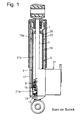
- a vibration damper comprises a cylinder 1, in which a piston rod 3 is arranged axially movable.
- a guiding and sealing unit 7 guides the piston rod 3 out of the upper end of the cylinder.
- a piston unit 9 is attached to the piston rod 3 with a piston valve assembly 11.
- the lower end of the cylinder 1 is closed by a bottom plate 13 with a bottom valve assembly 15.
- the cylinder 1 is enveloped by a container tube 17.
- the container tube 17 and an intermediate tube 5 form an annular space 19, which constitutes a compensation chamber.
- the space inside the cylinder 1 is divided by the piston unit 9 into a first working chamber 21 a and a second working chamber 21 b.
- the working chambers 21 a and 21 b are filled with Dämpf problemkeit.
- the compensation chamber 19 is filled to the level 19a with liquid and above it with gas.
- a first line section namely a high-pressure section 23, formed, which communicates via a bore 25 of the cylinder 1 with the second working chamber 21 b in connection.
- a laterally attached to the container tube 17 adjustable Dämpfventil worn 27 is followed by a laterally attached to the container tube 17 adjustable Dämpfventil worn 27. From this leads, not shown, one second line, namely a low pressure section 29, in the compensation chamber 19th
- the upper working chamber 21b decreases. An overpressure builds up in the upper working chamber 21b which can only dissipate into the lower working chamber 21a through the piston valve arrangement 11 as long as the adjustable damping valve device 27 is closed.
- the adjustable damper valve device 27 is opened, at the same time, liquid flows from the upper working chamber 21b through the high-pressure section 23 and the adjustable damper valve device 27 into the balancing chamber 19. The damping characteristic of the vibration damper during extension of the piston rod 3 is thus dependent on whether the adjustable damping valve 27 is more or less open or closed.
- the shock absorber when the damping valve 27 is open, the shock absorber also has a softer characteristic when retracted, when the adjustable damper valve device 27 is open and a harder characteristic when the damper valve device 27 is closed, just as when extending the piston rod. It should be noted that the flow direction through the high-pressure section 23 of the bypass is always the same, regardless of whether the piston rod extends or retracts.
- the Fig. 2 shows a first embodiment of the Dämpfventil worn 27.
- an outer housing 31 which is formed by a pipe socket of the container tube 17, a valve housing insert 33 is arranged.
- a lower disassemblable port 35 forms part of the high pressure section 23.
- the port 35 carries a valve seat disc 37 for a main stage valve body 39 of the adjustable damper valve device. Between the valve seat disc 37 and the port 35 may optionally be arranged an inlet valve 41.
- the main stage valve body 39 has a passage opening 43 which connects the high-pressure section 23 with a control chamber 45.
- at least one closing spring 47 is arranged for the main stage valve body 39.
- a precursor valve 53 is executed, which is arbitrary by a solenoid 55 as an actuator can be controlled.
- a precursor valve body 57 forms a seat valve together with the connection channel 49.
- a pressure level sets within the control chamber 45, the pressure force in addition to the closing force of the closing spring 47 counteracts a Abhubkraft in the high pressure section 23 to the main stage valve body 39.
- the precursor valve body 39 has an outer valve ring 59, which alternately at least one drain port 61 and at least two emergency operation channels 63a; 63b is driving.
- a biasing spring 65 biases the preliminary stage valve body 57 to a closed position with respect to the drainage port 61.
- the emergency operation channels 63a; 63b are designed in the valve housing insert 33 as radial channels, which in turn are connected to the collecting space 51.
- the adjustable damper valve device 27 has at least two emergency operation valves 69a; 69b, which have different opening characteristics. This different behavior is to be illustrated by the different size of the pictorial representations of the emergency operation valves. Deviating opening characteristic means that the opening force and the spring rate of at least one closing spring 71a; 71b of the emergency operation valves 69a; 69b are different.
- Each emergency operation valve 69a; 69b has its own housing 73a; 73b, in which a valve element 75a; 75b in this case a ball, from one inside the housing 73a; 73b arranged closing spring 71a; 71b is biased in a closed position.
- the closing spring 71a; 71b is adjustable in its closing force, z. B. by a support plate 77a; 77b for the closing spring 71a; 71b axially more or less deep into the housing 73a; 73b is screwed.
- Each emergency operation valve 69a; 69b is in turn via the housing 73a; 73b screwed into the valve housing insert 33.
- the biasing spring 65 presses the valve ring 59 of the pilot valve 53 in the direction of the drain opening 61 and closes it. With this closing movement, the emergency operation channels 63a; 63b effective.
- the damping force generated by the main stage valve body 39 is then determined by the sum of the passage cross sections of the emergency operation valves.
- FIG. 4 is a desired damping force characteristic shown.
- a first region of interest is determined by an opening first emergency valve 69a.
- Other emergency valves 73; 69b are still closed.
- the second emergency operation valve 69b At the intersection of the characteristics of two emergency valves 69a; 69b also opens the second emergency operation valve 69b, which is hydraulically connected in parallel with the first emergency operation valve 69a.
- a third emergency operating valve determines with its opening characteristic a third Kennhnien Scheme.
- the different slopes of the Characteristic ranges can be achieved, for example, by different spring rates of the respective closing springs 71 i.
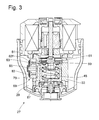
- the Fig. 3 shows an alternative solution to Fig. 2 , Deviating come not several emergency valves 69a; 69b for use, but a single emergency valve 69 includes a Dämpfventilaufsatz 79, which is arranged on the valve housing insert 33.
- a simple disk body can be used, which is externally attached to the valve housing insert 33.
- the Dämpfventilaufsatz 79 has at least one passageway 81, the outlet opening of at least one valve disc 83 is at least partially covered.
- the at least one valve disc 83 is biased by a central fastener 85 in conjunction with a disc spring 83 f on the Dämpfventilaufsatz 79.
- a distribution channel 87 is executed, which connects the emergency operating channel 63 in the valve housing insert 33 with the at least one passage 81 in the Dämpfventilaufsatz 79.
- the Dämpfventilaufsatz 79 is disposed in a stepped opening of the valve housing insert 33 and is based on a paragraph.
Landscapes
- Engineering & Computer Science (AREA)
- General Engineering & Computer Science (AREA)
- Mechanical Engineering (AREA)
- Physics & Mathematics (AREA)
- Electromagnetism (AREA)
- Fluid-Damping Devices (AREA)
Abstract
Description
- Die Erfindung betrifft einen verstellbaren Schwingungsdämpfer gemäß dem Oberbegriff von Patentanspruch 1.
- Aus der gattungsbildenden
DE 39 17 064 A1 ist ein verstellbarer Schwingungsdämpfer bekannt, der zusätzlich zu einem magnetkraftbetätigten Dämpfventil ein Notbetriebventil aufweist, das dann wirksam wird, wenn z. B. die Stromversorgung einer Magnetspule des Dämpfventils unterbrochen ist. - In der Ausführung nach
Fig. 2 derDE 39 17 064 A1 umfasst das Notbetriebventil einen Durchtrittskanal, dessen Austrittsöffnung von einem Ventilkörper zumindest teilweise abgedeckt wird. Bei derFig. 2 ist es ersichtlich, dass es sich um eine Prinzipdarstellung handelt, da keinerlei Teilungsfugen vorliegen, die z. B. die Montage der Ventilscheibe 105 des Notbetriebventils voraussetzen. - Aus der ATZextra "Mercedes-Benz E-Klasse", Ausgabe Januar 2009, ist ebenfalls ein verstellbare Dämpfventileinrichtung mit einem Notbetriebventil bekannt. Auch dieses Notbetriebventil ist in einer Parallelströmungsverbindung zu einer Abflussöffnung aus einem Steuerraum für das verstellbare Dämpfventil angeordnet. In dem Bild 17 auf der Seite 138 ist der eng begrenzte Bauraum erkennbar. Das Notbetriebventil ist als rotes radial angeordnetes Bauteil erkennbar. Ein derartiges Druckbegrenzungsventil, umfassend eine Kugel, die von einer Feder in Schließrichtung vorgespannt wird, erzeugt eine lineare Dämpfkraftkennlinie, die jedoch noch nicht dem angestrebten Kennlinienverlauf entspricht. Folglich müssen im Notbetrieb noch Komfortnachteile hingenommen werden, die es aufgabengemäß zu minimieren gilt.
- Erfindungsgemäß wird die Aufgabe dadurch gelöst, dass dem Notbetriebventil ein zweites Notbetriebventil parallel geschaltet ist, das eine vom ersten Notbetriebventil abweichende Öffnungscharakteristik aufweist.
- Der große Vorteil besteht darin, dass über die Parallelschaltung von mindestens zwei Notbetriebventilen eine gekrümmte Dämpfkraftkennlinie für den Notbetrieb erreicht wird. An jeweils einem Schnittpunkt zweier Dämpfventilkennlinien liegt ein Übergangspunkt vor, an dem sich die Steigung der Dämpfkraftkennlinie signifikant ändert, so dass auch degressive Dämpfkraftkennlinien realisierbar sind.
- In weiterer Ausgestaltung weist das Dämpfventil einen Ventilgehäuseeinsatz auf, in dem ein vom Aktuator zumindest mittelbar angesteuerter Dämpfventilkörper angeordnet ist, wobei der Ventilgehäuseeinsatz mehrere Notbetriebkanäle aufweist, die mit Notbetriebventilen bestückt sind. Der Ventilgehäuseeinsatz bietet den Vorteil, dass die Notbetriebventile sehr gut zugänglich und damit auch leicht montierbar sind.
- Die Notbetriebkanäle im Ventilgehäuseeinsatz sind als Radialkanäle ausgeführt, so dass der Ventilgehäuseeinsatz in Umfangsrichtung beliebig in einem äußeren Dämpfventilgehäuse montiert werden kann.
- Zur weiteren Vereinfachung der Strömungswege im Dämpfventile sind die Radialkanäle an einem Sammelraum angeschlossen, der wiederum mit der Abflussöffnung des Dämpfventils verbunden ist.
- Das Notbetriebventil weist ein Gehäuse auf, in dem ein Ventilelement angeordnet ist, das von einer innerhalb des Gehäuses angeordneten Schließfeder in eine Schließposition vorgespannt ist, wobei die Schließfeder in ihrer Schließkraft einstellbar ist. Der Vorteil dieser Bauweise besteht darin, dass das Notbetriebventil vor dem Einbau auf seine Kennlinie eingestellt werden kann.
- Zur Befestigung ist das Gehäuse des Notbetriebventils im Ventilgehäuseeinsatz eingeschraubt.
- Bei einer Alternativvariante umfasst das Notbetriebventil einen Dämpfventilaufsatz, der an einem Ventilgehäuseeinsatz angeordnet ist, in dem ein vom Aktuator zumindest mittelbar angesteuerter Dämpfventilkörper angeordnet ist, wobei der Dämpfventilaufsatz mindestens einen Durchtrittskanal aufweist, dessen Ausgangsöffnung von mindestens einer Ventilscheibe zumindest teilweise abgedeckt wird.
- Durch die Verwendung der mindestens einen elastischen Ventilscheibe können auch Dämpfkraftkennlinien mit degressivem Kennlinienverlauf einfach realisiert werden.
- Dabei ist zwischen dem Dämpfventilaufsatz und dem Ventilgehäuseeinsatz ein Verteilerkanal ausgeführt, der den Notbetriebkanal im Ventilgehäuseeinsatz mit dem mindesten einen Durchtrittskanal im Dämpfventilaufsatz verbindet.
- Sehr einfach lässt sich der Verteilerkanal gestalten, wenn der Dämpfventilaufsatz in einer Stufenöffnung des Ventilgehäuseseinsatzes angeordnet ist und sich der Dämpfventileinsatz auf einem Absatz der Stufenöffnung abstützt, so dass ein definierter Spalt vorliegt.
- Anhand der folgenden Figurenbeschreibung soll die Erfindung näher erläutert werden.
- Es zeigt:
- Fig. 1
- Darstellung der Einbausituation der Dämpfventileinrichtung an einem Schwingungsdämpfer
- Fig. 2
- Verstellbare Dämpfventileinrichtung mit mehreren Notbetriebventilen
- Fig. 3
- Verstellbare Dämpfventileinrichtung mit Dämpfventilaufsatz als Notbetriebventil
- Fig. 4
- Dämpfkraftkennlinie in Notbetriebsfunktion
- In
Fig. 1 weist ein Schwingungsdämpfer einen Zylinder 1 auf, in dem eine Kolbenstange 3 axial beweglich angeordnet ist. Eine Führungs- und Dichtungseinheit 7 führt die Kolbenstange 3 aus dem oberen Ende des Zylinders heraus. Innerhalb des Zylinders 1 ist an der Kolbenstange 3 eine Kolbeneinheit 9 mit einer Kolbenventilanordnung 11 befestigt. Das untere Ende des Zylinders 1 ist durch eine Bodenplatte 13 mit einer Bodenventilanordnung 15 abgeschlossen. Der Zylinder 1 wird von einem Behälterrohr 17 umhüllt. Das Behälterrohr 17 und ein Zwischenrohr 5 bilden einen Ringraum 19, der eine Ausgleichskammer darstellt. Der Raum innerhalb des Zylinders 1 ist durch die Kolbeneinheit 9 in eine erste Arbeitskammer 21 a und eine zweite Arbeitskammer 21 b unterteilt. Die Arbeitskammern 21 a und 21 b sind mit Dämpfflüssigkeit gefüllt. Die Ausgleichskammer 19 ist bis zu dem Niveau 19a mit Flüssigkeit und darüber mit Gas gefüllt. Innerhalb der Ausgleichskammer 19 ist eine erste Leitungsstrecke, nämlich eine Hochdruckteilstrecke 23, gebildet, welche über eine Bohrung 25 des Zylinders 1 mit der zweiten Arbeitskammer 21 b in Verbindung steht. An diese Hochdruckteilstrecke schließt sich eine seitlich an dem Behälterrohr 17 angebaute verstellbare Dämpfventileinrichtung 27 an. Von dieser führt, nicht dargestellt, eine zweite Leitungsstrecke, nämlich eine Niederdruckteilstrecke 29, in die Ausgleichskammer 19. - Fährt die Kolbenstange 3 aus dem Zylinder 1 nach oben aus, verkleinert sich die obere Arbeitskammer 21b. Es baut sich in der oberen Arbeitskammer 21b ein Überdruck auf, der sich nur durch die Kolbenventilanordnung 11 in die untere Arbeitskammer 21a abbauen kann, solange die verstellbare Dämpfventileinrichtung 27 geschlossen ist. Wenn die verstellbare Dämpfventileinrichtung 27 geöffnet ist, so fließt gleichzeitig Flüssigkeit von der oberen Arbeitskammer 21 b durch die Hochdruckteilstrecke 23 und die verstellbare Dämpfventileinrichtung 27 in die Ausgleichskammer19. Die Dämpfcharakteristik des Schwingungsdämpfers beim Ausfahren der Kolbenstange 3 ist also davon abhängig, ob das verstellbare Dämpfventil 27 mehr oder weniger offen oder geschlossen ist.
- Wenn die Kolbenstange 3 in den Zylinder 1 einfährt, so bildet sich in der unteren Arbeitskammer 21a ein Überdruck. Flüssigkeit kann von der unteren Arbeitskammer 21a durch die Kolbenventilanordnung 11 nach oben in die obere Arbeitskammer 21b übergehen. Die durch das zunehmende Kolbenstangenvolumen innerhalb des Zylinders 1 verdrängte Flüssigkeit wird durch die Bodenventilanordnung 15 in die Ausgleichskammer 19 ausgetrieben. In der oberen Arbeitskammer 21b tritt, da der Durchflusswiderstand der Kolbenventilanordnung 11 geringer ist als der Durchflusswiderstand der Bodenventilanordnung 15, ebenfalls ein steigender Druck auf. Dieser steigende Druck kann bei geöffneter Dämpfventileinrichtung 27 durch die Hochdruckteilstrecke 23 wiederum in den Ausgleichsraum 19 überfließen.
- Dies bedeutet, dass bei geöffnetem Dämpfventil 27 der Stoßdämpfer auch beim Einfahren dann eine weichere Charakteristik hat, wenn die verstellbare Dämpfventileinrichtung 27 geöffnet ist und eine härtere Charakteristik, wenn die Dämpfventileinrichtung 27 geschlossen ist, genauso wie beim Ausfahren der Kolbenstange. Festzuhalten ist, dass die Strömungsrichtung durch die Hochdruckteilstrecke 23 des Bypasses immer die gleiche ist, unabhängig davon, ob die Kolbenstange ein- oder ausfährt.
- Die
Fig. 2 zeigt eine erste Ausführungsform der Dämpfventileinrichtung 27. In einem äußeren Gehäuse 31, das von einem Rohrstutzen des Behälterrohres 17 gebildet wird, ist ein Ventilgehäuseeinsatz 33 angeordnet. Ein unterer demontierbarer Anschluss 35 bildet einen Teil der Hochdruckteilstrecke 23. Des Weiteren trägt der Anschluss 35 eine Ventilsitzscheibe 37 für einen Hauptstufenventilkörper 39 der verstellbaren Dämpfventileinrichtung. Zwischen der Ventilsitzscheibe 37 und dem Anschluss 35 kann optional ein Einlaufventil 41 angeordnet sein. - Der Hauptstufenventilkörper 39 weist eine Durchgangsöffnung 43 auf, die die Hochdruckteilstrecke 23 mit einem Steuerraum 45 verbindet. In dem Steuerraum 45 ist mindestens eine Schließfeder 47 für den Hauptstufenventilkörper 39 angeordnet. An einem Verbindungskanal 49 des Steuerraums 45 zu einem Sammelraum 51 ist ein Vorstufenventil 53 ausgeführt, das von einer Magnetspule 55 als Aktuator willkürlich angesteuert werden kann. Ein Vorstufenventilkörper 57 bildet zusammen mit dem Verbindungskanal 49 ein Sitzventil. Je nach eingestelltem Abflussquerschnitt am Vorstufenventil 53 stellt sich innerhalb des Steuerraums 45 ein Druckniveau ein, dessen Druckkraft zusätzlich zur Schließkraft der Schließfeder 47 einer Abhubkraft in der Hochdruckteilstrecke 23 auf den Hauptstufenventilkörper 39 entgegenwirkt.
- Der Vorstufenventilkörper 39 weist einen äußeren Ventilring 59 auf, der wechselweise mindestens eine Abflussöffnung 61 und mindestens zwei Notbetriebkanäle 63a; 63b ansteuert. Eine Vorspannfeder 65 spannt den Vorstufenventilkörper 57 in eine Schließposition bezogen auf die Abflussöffnung 61 vor. Die Notbetriebkanäle 63a; 63b sind in dem Ventilgehäuseeinsatz 33 als Radialkanäle ausgeführt, die wiederum an den Sammelraum 51 angeschlossen sind.
- Bei einer Bestromung der Magnetspule 55 bewegt sich ein mit dem Vorstufenventilkörper 57 verbundenen Anker 67 in Richtung des Steuerraums 45. Dadurch gibt der Vorstufenventilkörper 57 schon bei sehr kleinen Strömen die Abflussöffnung 61 frei.
- Wie aus der
Fig. 2 ersichtlich ist, verfügt die verstellbare Dämpfventileinrichtung 27 über mindestens zwei Notbetriebventile 69a; 69b, die voneinander abweichende Öffnungscharakteristiken aufweisen. Dieses unterschiedliche Verhalten soll durch die unterschiedliche Größe der bildlichen Darstellungen der Notbetriebventile verdeutlicht werden. Abweichende äffnungscharakteristik bedeutet, dass die Öffnungskraft und die Federrate mindestens einer Schließfeder 71a; 71b der Notbetriebventile 69a; 69b unterschiedlich sind. - Jedes Notbetriebventil 69a; 69b weist ein eigenes Gehäuse 73a; 73b auf, in dem ein Ventilelement 75a; 75b in diesem Fall eine Kugel, von einer innerhalb des Gehäuses 73a; 73b angeordneten Schließfeder 71a; 71b in eine Schließposition vorgespannt wird. Die Schließfeder 71a; 71b ist in ihrer Schließkraft einstellbar, z. B. indem eine Abstützscheibe 77a; 77b für die Schließfeder 71a; 71b axial mehr oder weniger tief in das Gehäuse 73a; 73b eingeschraubt wird. Jedes Notbetriebventil 69a; 69b ist wiederum über das Gehäuse 73a; 73b im Ventilgehäuseeinsatz 33 eingeschraubt.
- Im Notbetrieb, d. h. z. B. stromlose Magnetspule 55, drückt die Vorspannfeder 65 den Ventilring 59 des Vorstufenventils 53 in Richtung der Abflussöffnung 61 und verschließt diese. Mit dieser Verschließbewegung werden die Notbetriebkanäle 63a; 63b wirksam. Die vom Hauptstufenventilkörper 39 erzeugte Dämpfkraft wird dann von dem der Summe der Durchlassquerschnitte der Notbetriebventile bestimmt.
- In der
Fig. 4 ist eine angestrebte Dämpfkraftkennlinie dargestellt. Ein erster Kennhnienbereich wird von einem sich öffnenden ersten Notbetriebventil 69a bestimmt. Weitere Notbetriebventile 73; 69b sind noch geschlossen. Am Schnittpunkt der Kennlinien zweier Notbetriebventile 69a; 69b öffnet auch das zweite Notbetriebventil 69b, das dem ersten Notbetriebventil 69a hydraulisch parallel geschaltet ist. Ein drittes Notbetriebventil bestimmt mit seiner Öffnungscharakteristik einen dritten Kennhnienbereich. Die verschiedenen Steigungen der Kennlinienbereiche lassen sich beispielsweise durch unterschiedliche Federraten der jeweiligen Schließfedern 71 i erreichen. - Wie man weiter aus der
Fig. 4 erkennt, stellt sich im Notbetrieb bei der verstellbaren Dämpfventileinrichtung ein degressives Dämpfkraftverhalten ein. Die im Normalbetrieb vom Vorstufenventilkörper 57 gestellten Abflussquerschnitte werden von den Notbetriebventilen 69a; 69b nachgebildet. - Die
Fig. 3 zeigt eine Alternativlösung zurFig. 2 . Abweichend kommen nicht mehrere Notbetriebventile 69a; 69b zur Anwendung, sondern ein einziges Notbetriebventil 69 umfasst einen Dämpfventilaufsatz 79, der an dem Ventilgehäuseeinsatz 33 angeordnet ist. Als Dämpfventilaufsatz 79 kann ein einfacher Scheibenkörper verwendet werden, der außenseitig am Ventilgehäuseeinsatz 33 befestigt ist. Der Dämpfventilaufsatz 79 weist mindestens einen Durchtrittskanal 81 auf, dessen Ausgangsöffnung von mindestens einer Ventilscheibe 83 zumindest teilweise abgedeckt wird. Die mindestens eine Ventilscheibe 83 wird von einem zentralen Befestigungsmittel 85 in Verbindung mit einer Tellerfeder 83f auf den Dämpfventilaufsatz 79 vorgespannt. Durch die Bestückung des Dämpfventilaufsatzes 79 mit mindestens einer Tellerfeder 83f kann eine Dämpfkraftkennlinie gemäßFig. 4 erreicht werden. - Zwischen dem Dämpfventilaufsatz 79 und dem Ventilgehäuseeinsatz 33 ist ein Verteilerkanal 87 ausgeführt, der den Notbetriebkanal 63 im Ventilgehäuseeinsatz 33 mit dem mindestens einen Durchtrittskanal 81 im Dämpfventilaufsatz 79 verbindet. Dabei ist der Dämpfventilaufsatz 79 in einer Stufenöffnung des Ventilgehäuseeinsatzes 33 angeordnet und stützt sich auf einem Absatz ab.
- In der Notbetriebstellung des Ventilrings 59, also wenn die Abflussöffnung 61 geschlossen ist, tritt das gesamte Dämpfmedium aus dem Steuerraum 45 über den Notbetriebkanal 63 in die Stufenöffnung des Ventilgehäuseeinsatzes 33 ein und wird von dem Verteilerkanal 87 zum Durchtrittskanal 81 geführt. Das Dämpfmedium tritt über die abgehobene Ventilscheibe 83 in die Niederdruckteilstrecke aus.
-
- 3
- 1 Zylinder Kolbenstange
- 5
- Zwischenrohr
- 7
- Führungs- Dichtungseinheit
- 9
- Kolbeneinheit
- 11
- Kolbenventilanordnung
- 13
- Bodenplatte
- 15
- Bodenventilanordnung
- 17
- Behälterrohr
- 19
- Ringraum
- 21a; 21b
- Arbeitskammern
- 23
- Hockdruckteilstrecke
- 25
- Bohrung
- 27
- Dämpfventileinrichtung
- 29
- Niederdruckteilstrecke
- 31
- äußeres Gehäuse
- 33
- Ventilgehäuseeinsatz
- 35
- Anschluss
- 37
- Ventilsitzscheibe
- 39
- Hauptstufenventilkörper
- 41
- Einlaufventil
- 43
- Durchgangsöffnung
- 45
- Steuerraum
- 47
- Schließfeder
- 49
- Verbindungskanal
- 51
- Sammelraum
- 53
- Vorstufenventil
- 55
- Magnetspule
- 57
- Vorstufenventhkörper
- 59
- Ventilring
- 61
- Abflussöffnung
- 63a; 63b
- Notbetriebkanäle
- 65
- Vorspannfeder
- 67
- Anker
- 69a; 69b
- Notbetriebventile
- 71a; 71b
- Schließfeder
- 73a; 73b
- Gehäuse
- 75a; 75b
- Ventilelement
- 77a; 77b
- Abstützscheibe
- 79
- Dämpfventilaufsatz
- 81
- Durchtrittskanal
- 83
- Ventilscheibe
- 85
- Befestigungsmittel
- 87
- Verteilerkanal
Claims (9)
- Verstellbare Dämpfventileinrichtung, umfassend einen Aktuator (55;67) zur Ansteuerung eines Dämpfventils (53;39) wobei einer Abflussöffnung 61 des Dämpfventils (53;39) ein Notbetriebventil (69; 69a) über einen Notbetriebkanal (63a) parallel geschaltet ist, wobei das Notbetriebventil (69; 69a) einen Ventilkörper (75a) aufweist, der von einer Feder (71a) in Schließposition vorgespannt wird,
dadurch gekennzeichnet,
dass dem Notbetriebventil (69a) ein zweites Notbetriebventil (69b) parallel geschaltet ist, das eine vom ersten Notbetriebventil (69a) abweichende Öffnungscharakteristik aufweist. - Dämpfventileinrichtung nach Anspruch 1,
dadurch gekennzeichnet,
dass die Dämpfventileinrichtung (27) einen Ventilgehäuseeinsatz (33) aufweist, in dem ein vom Aktuator (55; 67) zumindest mittelbar angesteuerter Dämpfventilkörper (39) angeordnet ist, wobei der Ventilgehäuseeinsatz (33) mehrere Notbetriebkanäle (63a; 63b) aufweist, die mit Notbetriebsventilen (69a; 69b) bestückt sind. - Dämpfventileinrichtung nach Anspruch 2,
dadurch gekennzeichnet,
dass die Notbetriebkanäle (63A, 63b) im Ventilgehäuseeinsatz (33) als Radialkanäle ausgeführt sind. - Dämpfventileinrichtung nach Anspruch 3,
dadurch gekennzeichnet,
dass die Radialkanäle (63a; 63b) an einem Sammelraum (51) angeschlossen sind, der wiederum mit der Abflussöffnung (61) der Dämpfventileinrichtung (27) verbunden ist. - Dämpfventileinrichtung nach Anspruch 1,
dadurch gekennzeichnet,
dass das Notbetriebventil (69a; 69b) ein Gehäuse (73a; 73b) aufweist, in dem ein Ventilelement (75a; 75b) angeordnet ist, das von einer innerhalb des Gehäuses (73a; 73b) angeordneten Schließfeder (71a; 71b) in eine Schließposition vorgespannt ist, wobei die Schließfeder (71a; 71b) in ihrer Schließkraft einstellbar ist. - Dämpfventileinrichtung nach Anspruch 5,
dadurch gekennzeichnet,
dass das Gehäuse (73a; 73b) des Notbetriebventils (69a; 69b) im Ventilgehäuseeinsatz (33) eingeschraubt ist. - Dämpfventileinrichtung nach dem Oberbegriff von Patentanspruch 1,
dadurch gekennzeichnet,
dass das Notbetriebventil (69) einen Dämpfventilaufsatz (79) umfasst, der an einem Ventilgehäuseeinsatz (33) angeordnet ist, in dem ein vom Aktuator (55; 67) zumindest mittelbar angesteuerter Dämpfventilkörper (39) angeordnet ist, wobei der Dämpfventilaufsatz (79) mindestens einen Durchtrittskanal (81) aufweist, dessen Ausgangsöffnung von mindestens einer Ventilscheibe (83) zumindest teilweise abgedeckt wird. - Dämpfventileinrichtung nach Anspruch 7,
dadurch gekennzeichnet,
dass das zwischen dem Dämpfventilaufsatz (79) und dem Ventilgehäuseeinsatz (33) ein Verteilerkanal (87) ausgeführt ist, der den Notbetriebkanal (63) im Ventilgehäuseeinsatz (33) mit dem mindesten einen Durchtrittsl<anal (81) im Dämpfventilaufsatz (79) verbindet. - Dämpfventileinrichtung nach Anspruch 7,
dadurch gekennzeichnet,
dass das der Dämpfventilaufsatz (79) in einer Stufenöffnung des Ventilgehäuseseinsatzes (33) angeordnet ist.
Applications Claiming Priority (1)
| Application Number | Priority Date | Filing Date | Title |
|---|---|---|---|
| DE102009002582A DE102009002582A1 (de) | 2009-04-23 | 2009-04-23 | Verstellbarer Schwingungsdämpfer mit einem Notbetriebventil |
Publications (3)
| Publication Number | Publication Date |
|---|---|
| EP2243979A2 true EP2243979A2 (de) | 2010-10-27 |
| EP2243979A3 EP2243979A3 (de) | 2012-04-18 |
| EP2243979B1 EP2243979B1 (de) | 2013-10-02 |
Family
ID=42245944
Family Applications (1)
| Application Number | Title | Priority Date | Filing Date |
|---|---|---|---|
| EP10160118.5A Not-in-force EP2243979B1 (de) | 2009-04-23 | 2010-04-16 | Verstellbarer Schwingungsdämpfer mit einem Notbetriebventil |
Country Status (2)
| Country | Link |
|---|---|
| EP (1) | EP2243979B1 (de) |
| DE (1) | DE102009002582A1 (de) |
Cited By (1)
| Publication number | Priority date | Publication date | Assignee | Title |
|---|---|---|---|---|
| CN115217882A (zh) * | 2022-06-14 | 2022-10-21 | 联合汽车电子有限公司 | 阻尼控制电磁阀 |
Families Citing this family (9)
| Publication number | Priority date | Publication date | Assignee | Title |
|---|---|---|---|---|
| KR20120049010A (ko) | 2010-11-08 | 2012-05-16 | 주식회사 만도 | 쇽업소버의 감쇠력 가변 밸브 조립체 |
| KR101230550B1 (ko) | 2010-11-08 | 2013-02-07 | 주식회사 만도 | 쇽업소버의 감쇠력 가변 밸브 조립체 |
| DE102010063386B4 (de) | 2010-12-17 | 2012-09-20 | Zf Friedrichshafen Ag | Verstellbare Dämpfventileinrichtung |
| US8881888B2 (en) | 2011-06-15 | 2014-11-11 | The Procter & Gamble Company | Modules for manufacturing systems and modular manufacturing systems |
| DE102011079144B4 (de) | 2011-07-14 | 2013-02-07 | Zf Friedrichshafen Ag | Verstellbare Dämpfventileinrichtung mit einem Notbetriebventil |
| DE102014224976A1 (de) * | 2014-12-05 | 2016-06-09 | Zf Friedrichshafen Ag | Dämpfventil |
| DE102021200915B3 (de) | 2021-02-02 | 2022-07-14 | Zf Friedrichshafen Ag | Dämpfventileinrichtung für einen Schwingungsdämpfer |
| DE102024209571A1 (de) | 2024-10-01 | 2026-04-02 | Zf Friedrichshafen Ag | Verstellbare Dämpfventileinrichtung mit einem Notbetriebsventil |
| DE102024209572A1 (de) | 2024-10-01 | 2026-04-02 | Zf Friedrichshafen Ag | Verstellbare Dämpfventileinrichtung mit einem Notbetriebsventil |
Family Cites Families (6)
| Publication number | Priority date | Publication date | Assignee | Title |
|---|---|---|---|---|
| DE3937795A1 (de) * | 1989-05-26 | 1990-11-29 | Bosch Gmbh Robert | Stossdaempfer |
| DE3917064A1 (de) | 1989-05-26 | 1990-11-29 | Bosch Gmbh Robert | Stossdaempfer ii |
| DE3942545A1 (de) * | 1989-12-22 | 1991-06-27 | Bosch Gmbh Robert | Druckbetaetigtes ventil |
| DE4003595A1 (de) * | 1990-02-02 | 1991-08-08 | Siemens Ag | Verfahren zum bedrucken eines aufzeichnungstraegers mit einem druckkopf |
| DE4208886A1 (de) * | 1992-03-19 | 1993-09-23 | Fichtel & Sachs Ag | Daempfkraftveraenderbarer schwingungsdaempfer mit notbetriebseinstellung |
| JP3285302B2 (ja) * | 1994-10-21 | 2002-05-27 | ヤマハ発動機株式会社 | 減衰器 |
-
2009
- 2009-04-23 DE DE102009002582A patent/DE102009002582A1/de not_active Ceased
-
2010
- 2010-04-16 EP EP10160118.5A patent/EP2243979B1/de not_active Not-in-force
Non-Patent Citations (1)
| Title |
|---|
| None |
Cited By (2)
| Publication number | Priority date | Publication date | Assignee | Title |
|---|---|---|---|---|
| CN115217882A (zh) * | 2022-06-14 | 2022-10-21 | 联合汽车电子有限公司 | 阻尼控制电磁阀 |
| CN115217882B (zh) * | 2022-06-14 | 2024-05-31 | 联合汽车电子有限公司 | 阻尼控制电磁阀 |
Also Published As
| Publication number | Publication date |
|---|---|
| EP2243979B1 (de) | 2013-10-02 |
| EP2243979A3 (de) | 2012-04-18 |
| DE102009002582A1 (de) | 2010-10-28 |
Similar Documents
| Publication | Publication Date | Title |
|---|---|---|
| EP2243979B1 (de) | Verstellbarer Schwingungsdämpfer mit einem Notbetriebventil | |
| DE102009061003B4 (de) | Verstellbare Dämpfventileinrichtung | |
| DE102010063386B4 (de) | Verstellbare Dämpfventileinrichtung | |
| DE102011003924B4 (de) | Verstellbares Dämpfventil für einen Schwingungsdämpfer | |
| EP2382520B1 (de) | Proportional-druckregelventil und seine verwendung für hydraulisch betätigbare kupplungen | |
| DE102007005288B4 (de) | Hydraulischer Schwingungsdämpfer | |
| DE102012210459B3 (de) | Verstellbare Dämpfventileinrichtung | |
| EP0864794B1 (de) | Proportional-Drosselventil | |
| DE102005058846B4 (de) | Ventilbaukastensystem mit elektromagnetisch betätigtem Ventil | |
| DE102011010474A1 (de) | Proportional-Druckregelventil | |
| EP2505869A2 (de) | Verstellbare Dämpfventileinrichtung für einen Schwingungsdämpfer | |
| EP2159444A1 (de) | Verstellbares Dämpfventil | |
| EP3047183B1 (de) | Steuervorrichtung zum wahlweisen fluidischen verbinden und trennen von fluid-anschlussstellen | |
| DE102010003958A1 (de) | Magnetventil | |
| EP2628974A2 (de) | Verstellbare Dämpfventileinrichtung für einen Schwingungsdämpfer | |
| DE102007005465A1 (de) | Elektrisch ansteuerbares Ventil | |
| EP2718602B1 (de) | Ventil, insbesondere druckregelventil oder druckbegrenzungsventil | |
| EP1771675B1 (de) | Elektrisch ansteuerbares ventil | |
| EP2185988B1 (de) | Druckbegrenzungsventil und anordnung eines druckbegrenzungsventils zur vorsteuerung eines druckregelventils | |
| DE10308482B4 (de) | Elektromagnetventil | |
| EP1611358A1 (de) | Stetig verstellbares wegeventil | |
| DE102023122423B4 (de) | Dämpfungsventileinrichtung für einen Stoßdämpfer eines Kraftfahrzeugs | |
| DE102024202488B3 (de) | Verstellbare Dämpfventileinrichtung für einen Schwingungsdämpfer | |
| EP2354589A2 (de) | Verstellbares Dämpfventil | |
| WO2007082816A1 (de) | Elektromagnetventil |
Legal Events
| Date | Code | Title | Description |
|---|---|---|---|
| PUAI | Public reference made under article 153(3) epc to a published international application that has entered the european phase |
Free format text: ORIGINAL CODE: 0009012 |
|
| AK | Designated contracting states |
Kind code of ref document: A2 Designated state(s): AT BE BG CH CY CZ DE DK EE ES FI FR GB GR HR HU IE IS IT LI LT LU LV MC MK MT NL NO PL PT RO SE SI SK SM TR |
|
| AX | Request for extension of the european patent |
Extension state: AL BA ME RS |
|
| PUAL | Search report despatched |
Free format text: ORIGINAL CODE: 0009013 |
|
| AK | Designated contracting states |
Kind code of ref document: A3 Designated state(s): AT BE BG CH CY CZ DE DK EE ES FI FR GB GR HR HU IE IS IT LI LT LU LV MC MK MT NL NO PL PT RO SE SI SK SM TR |
|
| AX | Request for extension of the european patent |
Extension state: AL BA ME RS |
|
| RIC1 | Information provided on ipc code assigned before grant |
Ipc: F16F 9/46 20060101AFI20120313BHEP |
|
| 17P | Request for examination filed |
Effective date: 20120912 |
|
| GRAP | Despatch of communication of intention to grant a patent |
Free format text: ORIGINAL CODE: EPIDOSNIGR1 |
|
| INTG | Intention to grant announced |
Effective date: 20130523 |
|
| GRAS | Grant fee paid |
Free format text: ORIGINAL CODE: EPIDOSNIGR3 |
|
| GRAA | (expected) grant |
Free format text: ORIGINAL CODE: 0009210 |
|
| AK | Designated contracting states |
Kind code of ref document: B1 Designated state(s): AT BE BG CH CY CZ DE DK EE ES FI FR GB GR HR HU IE IS IT LI LT LU LV MC MK MT NL NO PL PT RO SE SI SK SM TR |
|
| REG | Reference to a national code |
Ref country code: GB Ref legal event code: FG4D Free format text: NOT ENGLISH |
|
| REG | Reference to a national code |
Ref country code: AT Ref legal event code: REF Ref document number: 634765 Country of ref document: AT Kind code of ref document: T Effective date: 20131015 Ref country code: CH Ref legal event code: EP |
|
| REG | Reference to a national code |
Ref country code: IE Ref legal event code: FG4D Free format text: LANGUAGE OF EP DOCUMENT: GERMAN |
|
| REG | Reference to a national code |
Ref country code: DE Ref legal event code: R096 Ref document number: 502010004903 Country of ref document: DE Effective date: 20131205 |
|
| REG | Reference to a national code |
Ref country code: NL Ref legal event code: VDEP Effective date: 20131002 |
|
| PG25 | Lapsed in a contracting state [announced via postgrant information from national office to epo] |
Ref country code: SI Free format text: LAPSE BECAUSE OF FAILURE TO SUBMIT A TRANSLATION OF THE DESCRIPTION OR TO PAY THE FEE WITHIN THE PRESCRIBED TIME-LIMIT Effective date: 20131002 |
|
| REG | Reference to a national code |
Ref country code: LT Ref legal event code: MG4D |
|
| PG25 | Lapsed in a contracting state [announced via postgrant information from national office to epo] |
Ref country code: LT Free format text: LAPSE BECAUSE OF FAILURE TO SUBMIT A TRANSLATION OF THE DESCRIPTION OR TO PAY THE FEE WITHIN THE PRESCRIBED TIME-LIMIT Effective date: 20131002 Ref country code: FI Free format text: LAPSE BECAUSE OF FAILURE TO SUBMIT A TRANSLATION OF THE DESCRIPTION OR TO PAY THE FEE WITHIN THE PRESCRIBED TIME-LIMIT Effective date: 20131002 Ref country code: IS Free format text: LAPSE BECAUSE OF FAILURE TO SUBMIT A TRANSLATION OF THE DESCRIPTION OR TO PAY THE FEE WITHIN THE PRESCRIBED TIME-LIMIT Effective date: 20140202 Ref country code: NL Free format text: LAPSE BECAUSE OF FAILURE TO SUBMIT A TRANSLATION OF THE DESCRIPTION OR TO PAY THE FEE WITHIN THE PRESCRIBED TIME-LIMIT Effective date: 20131002 Ref country code: CZ Free format text: LAPSE BECAUSE OF FAILURE TO SUBMIT A TRANSLATION OF THE DESCRIPTION OR TO PAY THE FEE WITHIN THE PRESCRIBED TIME-LIMIT Effective date: 20131002 Ref country code: SE Free format text: LAPSE BECAUSE OF FAILURE TO SUBMIT A TRANSLATION OF THE DESCRIPTION OR TO PAY THE FEE WITHIN THE PRESCRIBED TIME-LIMIT Effective date: 20131002 Ref country code: NO Free format text: LAPSE BECAUSE OF FAILURE TO SUBMIT A TRANSLATION OF THE DESCRIPTION OR TO PAY THE FEE WITHIN THE PRESCRIBED TIME-LIMIT Effective date: 20140102 Ref country code: HR Free format text: LAPSE BECAUSE OF FAILURE TO SUBMIT A TRANSLATION OF THE DESCRIPTION OR TO PAY THE FEE WITHIN THE PRESCRIBED TIME-LIMIT Effective date: 20131002 |
|
| PG25 | Lapsed in a contracting state [announced via postgrant information from national office to epo] |
Ref country code: LV Free format text: LAPSE BECAUSE OF FAILURE TO SUBMIT A TRANSLATION OF THE DESCRIPTION OR TO PAY THE FEE WITHIN THE PRESCRIBED TIME-LIMIT Effective date: 20131002 Ref country code: ES Free format text: LAPSE BECAUSE OF FAILURE TO SUBMIT A TRANSLATION OF THE DESCRIPTION OR TO PAY THE FEE WITHIN THE PRESCRIBED TIME-LIMIT Effective date: 20131002 Ref country code: CY Free format text: LAPSE BECAUSE OF FAILURE TO SUBMIT A TRANSLATION OF THE DESCRIPTION OR TO PAY THE FEE WITHIN THE PRESCRIBED TIME-LIMIT Effective date: 20131002 Ref country code: PL Free format text: LAPSE BECAUSE OF FAILURE TO SUBMIT A TRANSLATION OF THE DESCRIPTION OR TO PAY THE FEE WITHIN THE PRESCRIBED TIME-LIMIT Effective date: 20131002 |
|
| PG25 | Lapsed in a contracting state [announced via postgrant information from national office to epo] |
Ref country code: PT Free format text: LAPSE BECAUSE OF FAILURE TO SUBMIT A TRANSLATION OF THE DESCRIPTION OR TO PAY THE FEE WITHIN THE PRESCRIBED TIME-LIMIT Effective date: 20140203 |
|
| REG | Reference to a national code |
Ref country code: DE Ref legal event code: R097 Ref document number: 502010004903 Country of ref document: DE |
|
| PG25 | Lapsed in a contracting state [announced via postgrant information from national office to epo] |
Ref country code: EE Free format text: LAPSE BECAUSE OF FAILURE TO SUBMIT A TRANSLATION OF THE DESCRIPTION OR TO PAY THE FEE WITHIN THE PRESCRIBED TIME-LIMIT Effective date: 20131002 |
|
| PGFP | Annual fee paid to national office [announced via postgrant information from national office to epo] |
Ref country code: GB Payment date: 20140416 Year of fee payment: 5 |
|
| PLBE | No opposition filed within time limit |
Free format text: ORIGINAL CODE: 0009261 |
|
| STAA | Information on the status of an ep patent application or granted ep patent |
Free format text: STATUS: NO OPPOSITION FILED WITHIN TIME LIMIT |
|
| PG25 | Lapsed in a contracting state [announced via postgrant information from national office to epo] |
Ref country code: RO Free format text: LAPSE BECAUSE OF FAILURE TO SUBMIT A TRANSLATION OF THE DESCRIPTION OR TO PAY THE FEE WITHIN THE PRESCRIBED TIME-LIMIT Effective date: 20131002 Ref country code: SK Free format text: LAPSE BECAUSE OF FAILURE TO SUBMIT A TRANSLATION OF THE DESCRIPTION OR TO PAY THE FEE WITHIN THE PRESCRIBED TIME-LIMIT Effective date: 20131002 Ref country code: IT Free format text: LAPSE BECAUSE OF FAILURE TO SUBMIT A TRANSLATION OF THE DESCRIPTION OR TO PAY THE FEE WITHIN THE PRESCRIBED TIME-LIMIT Effective date: 20131002 |
|
| PGFP | Annual fee paid to national office [announced via postgrant information from national office to epo] |
Ref country code: FR Payment date: 20140409 Year of fee payment: 5 |
|
| 26N | No opposition filed |
Effective date: 20140703 |
|
| PG25 | Lapsed in a contracting state [announced via postgrant information from national office to epo] |
Ref country code: DK Free format text: LAPSE BECAUSE OF FAILURE TO SUBMIT A TRANSLATION OF THE DESCRIPTION OR TO PAY THE FEE WITHIN THE PRESCRIBED TIME-LIMIT Effective date: 20131002 |
|
| REG | Reference to a national code |
Ref country code: DE Ref legal event code: R097 Ref document number: 502010004903 Country of ref document: DE Effective date: 20140703 |
|
| PG25 | Lapsed in a contracting state [announced via postgrant information from national office to epo] |
Ref country code: MC Free format text: LAPSE BECAUSE OF FAILURE TO SUBMIT A TRANSLATION OF THE DESCRIPTION OR TO PAY THE FEE WITHIN THE PRESCRIBED TIME-LIMIT Effective date: 20131002 Ref country code: LU Free format text: LAPSE BECAUSE OF FAILURE TO SUBMIT A TRANSLATION OF THE DESCRIPTION OR TO PAY THE FEE WITHIN THE PRESCRIBED TIME-LIMIT Effective date: 20140416 |
|
| REG | Reference to a national code |
Ref country code: CH Ref legal event code: PL |
|
| REG | Reference to a national code |
Ref country code: IE Ref legal event code: MM4A |
|
| PG25 | Lapsed in a contracting state [announced via postgrant information from national office to epo] |
Ref country code: LI Free format text: LAPSE BECAUSE OF NON-PAYMENT OF DUE FEES Effective date: 20140430 Ref country code: CH Free format text: LAPSE BECAUSE OF NON-PAYMENT OF DUE FEES Effective date: 20140430 |
|
| PG25 | Lapsed in a contracting state [announced via postgrant information from national office to epo] |
Ref country code: IE Free format text: LAPSE BECAUSE OF NON-PAYMENT OF DUE FEES Effective date: 20140416 |
|
| PGFP | Annual fee paid to national office [announced via postgrant information from national office to epo] |
Ref country code: DE Payment date: 20150408 Year of fee payment: 6 |
|
| GBPC | Gb: european patent ceased through non-payment of renewal fee |
Effective date: 20150416 |
|
| PG25 | Lapsed in a contracting state [announced via postgrant information from national office to epo] |
Ref country code: GB Free format text: LAPSE BECAUSE OF NON-PAYMENT OF DUE FEES Effective date: 20150416 |
|
| REG | Reference to a national code |
Ref country code: FR Ref legal event code: ST Effective date: 20151231 |
|
| PG25 | Lapsed in a contracting state [announced via postgrant information from national office to epo] |
Ref country code: FR Free format text: LAPSE BECAUSE OF NON-PAYMENT OF DUE FEES Effective date: 20150430 |
|
| PG25 | Lapsed in a contracting state [announced via postgrant information from national office to epo] |
Ref country code: MT Free format text: LAPSE BECAUSE OF FAILURE TO SUBMIT A TRANSLATION OF THE DESCRIPTION OR TO PAY THE FEE WITHIN THE PRESCRIBED TIME-LIMIT Effective date: 20131002 |
|
| PG25 | Lapsed in a contracting state [announced via postgrant information from national office to epo] |
Ref country code: NO Free format text: LAPSE BECAUSE OF FAILURE TO SUBMIT A TRANSLATION OF THE DESCRIPTION OR TO PAY THE FEE WITHIN THE PRESCRIBED TIME-LIMIT Effective date: 20140101 Ref country code: SM Free format text: LAPSE BECAUSE OF FAILURE TO SUBMIT A TRANSLATION OF THE DESCRIPTION OR TO PAY THE FEE WITHIN THE PRESCRIBED TIME-LIMIT Effective date: 20131002 |
|
| REG | Reference to a national code |
Ref country code: AT Ref legal event code: MM01 Ref document number: 634765 Country of ref document: AT Kind code of ref document: T Effective date: 20150416 |
|
| PG25 | Lapsed in a contracting state [announced via postgrant information from national office to epo] |
Ref country code: BG Free format text: LAPSE BECAUSE OF FAILURE TO SUBMIT A TRANSLATION OF THE DESCRIPTION OR TO PAY THE FEE WITHIN THE PRESCRIBED TIME-LIMIT Effective date: 20131002 Ref country code: GR Free format text: LAPSE BECAUSE OF FAILURE TO SUBMIT A TRANSLATION OF THE DESCRIPTION OR TO PAY THE FEE WITHIN THE PRESCRIBED TIME-LIMIT Effective date: 20140103 |
|
| PG25 | Lapsed in a contracting state [announced via postgrant information from national office to epo] |
Ref country code: BE Free format text: LAPSE BECAUSE OF FAILURE TO SUBMIT A TRANSLATION OF THE DESCRIPTION OR TO PAY THE FEE WITHIN THE PRESCRIBED TIME-LIMIT Effective date: 20140430 Ref country code: TR Free format text: LAPSE BECAUSE OF FAILURE TO SUBMIT A TRANSLATION OF THE DESCRIPTION OR TO PAY THE FEE WITHIN THE PRESCRIBED TIME-LIMIT Effective date: 20131002 Ref country code: HU Free format text: LAPSE BECAUSE OF FAILURE TO SUBMIT A TRANSLATION OF THE DESCRIPTION OR TO PAY THE FEE WITHIN THE PRESCRIBED TIME-LIMIT; INVALID AB INITIO Effective date: 20100416 |
|
| PG25 | Lapsed in a contracting state [announced via postgrant information from national office to epo] |
Ref country code: AT Free format text: LAPSE BECAUSE OF NON-PAYMENT OF DUE FEES Effective date: 20150416 |
|
| REG | Reference to a national code |
Ref country code: DE Ref legal event code: R119 Ref document number: 502010004903 Country of ref document: DE |
|
| PG25 | Lapsed in a contracting state [announced via postgrant information from national office to epo] |
Ref country code: DE Free format text: LAPSE BECAUSE OF NON-PAYMENT OF DUE FEES Effective date: 20161101 |
|
| PG25 | Lapsed in a contracting state [announced via postgrant information from national office to epo] |
Ref country code: MK Free format text: LAPSE BECAUSE OF FAILURE TO SUBMIT A TRANSLATION OF THE DESCRIPTION OR TO PAY THE FEE WITHIN THE PRESCRIBED TIME-LIMIT Effective date: 20131002 |