EP2243489B1 - Granulysin und interleukin-6 für infektionen - Google Patents
Granulysin und interleukin-6 für infektionen Download PDFInfo
- Publication number
- EP2243489B1 EP2243489B1 EP09171752A EP09171752A EP2243489B1 EP 2243489 B1 EP2243489 B1 EP 2243489B1 EP 09171752 A EP09171752 A EP 09171752A EP 09171752 A EP09171752 A EP 09171752A EP 2243489 B1 EP2243489 B1 EP 2243489B1
- Authority
- EP
- European Patent Office
- Prior art keywords
- granulysin
- tuberculosis
- expression vector
- vivo expression
- recombinant protein
- Prior art date
- Legal status (The legal status is an assumption and is not a legal conclusion. Google has not performed a legal analysis and makes no representation as to the accuracy of the status listed.)
- Not-in-force
Links
Images


Classifications
-
- A—HUMAN NECESSITIES
- A61—MEDICAL OR VETERINARY SCIENCE; HYGIENE
- A61K—PREPARATIONS FOR MEDICAL, DENTAL OR TOILETRY PURPOSES
- A61K38/00—Medicinal preparations containing peptides
- A61K38/16—Peptides having more than 20 amino acids; Gastrins; Somatostatins; Melanotropins; Derivatives thereof
- A61K38/17—Peptides having more than 20 amino acids; Gastrins; Somatostatins; Melanotropins; Derivatives thereof from animals; from humans
- A61K38/19—Cytokines; Lymphokines; Interferons
- A61K38/20—Interleukins [IL]
-
- A—HUMAN NECESSITIES
- A61—MEDICAL OR VETERINARY SCIENCE; HYGIENE
- A61K—PREPARATIONS FOR MEDICAL, DENTAL OR TOILETRY PURPOSES
- A61K38/00—Medicinal preparations containing peptides
- A61K38/16—Peptides having more than 20 amino acids; Gastrins; Somatostatins; Melanotropins; Derivatives thereof
- A61K38/164—Peptides having more than 20 amino acids; Gastrins; Somatostatins; Melanotropins; Derivatives thereof from bacteria
-
- A—HUMAN NECESSITIES
- A61—MEDICAL OR VETERINARY SCIENCE; HYGIENE
- A61K—PREPARATIONS FOR MEDICAL, DENTAL OR TOILETRY PURPOSES
- A61K38/00—Medicinal preparations containing peptides
- A61K38/16—Peptides having more than 20 amino acids; Gastrins; Somatostatins; Melanotropins; Derivatives thereof
- A61K38/17—Peptides having more than 20 amino acids; Gastrins; Somatostatins; Melanotropins; Derivatives thereof from animals; from humans
- A61K38/1703—Peptides having more than 20 amino acids; Gastrins; Somatostatins; Melanotropins; Derivatives thereof from animals; from humans from vertebrates
- A61K38/1709—Peptides having more than 20 amino acids; Gastrins; Somatostatins; Melanotropins; Derivatives thereof from animals; from humans from vertebrates from mammals
-
- A—HUMAN NECESSITIES
- A61—MEDICAL OR VETERINARY SCIENCE; HYGIENE
- A61K—PREPARATIONS FOR MEDICAL, DENTAL OR TOILETRY PURPOSES
- A61K38/00—Medicinal preparations containing peptides
- A61K38/16—Peptides having more than 20 amino acids; Gastrins; Somatostatins; Melanotropins; Derivatives thereof
- A61K38/17—Peptides having more than 20 amino acids; Gastrins; Somatostatins; Melanotropins; Derivatives thereof from animals; from humans
- A61K38/1703—Peptides having more than 20 amino acids; Gastrins; Somatostatins; Melanotropins; Derivatives thereof from animals; from humans from vertebrates
- A61K38/1709—Peptides having more than 20 amino acids; Gastrins; Somatostatins; Melanotropins; Derivatives thereof from animals; from humans from vertebrates from mammals
- A61K38/1729—Cationic antimicrobial peptides, e.g. defensins
-
- A—HUMAN NECESSITIES
- A61—MEDICAL OR VETERINARY SCIENCE; HYGIENE
- A61K—PREPARATIONS FOR MEDICAL, DENTAL OR TOILETRY PURPOSES
- A61K38/00—Medicinal preparations containing peptides
- A61K38/16—Peptides having more than 20 amino acids; Gastrins; Somatostatins; Melanotropins; Derivatives thereof
- A61K38/17—Peptides having more than 20 amino acids; Gastrins; Somatostatins; Melanotropins; Derivatives thereof from animals; from humans
- A61K38/19—Cytokines; Lymphokines; Interferons
- A61K38/20—Interleukins [IL]
- A61K38/204—IL-6
-
- A—HUMAN NECESSITIES
- A61—MEDICAL OR VETERINARY SCIENCE; HYGIENE
- A61K—PREPARATIONS FOR MEDICAL, DENTAL OR TOILETRY PURPOSES
- A61K38/00—Medicinal preparations containing peptides
- A61K38/16—Peptides having more than 20 amino acids; Gastrins; Somatostatins; Melanotropins; Derivatives thereof
- A61K38/17—Peptides having more than 20 amino acids; Gastrins; Somatostatins; Melanotropins; Derivatives thereof from animals; from humans
- A61K38/19—Cytokines; Lymphokines; Interferons
- A61K38/20—Interleukins [IL]
- A61K38/208—IL-12
-
- A—HUMAN NECESSITIES
- A61—MEDICAL OR VETERINARY SCIENCE; HYGIENE
- A61K—PREPARATIONS FOR MEDICAL, DENTAL OR TOILETRY PURPOSES
- A61K39/00—Medicinal preparations containing antigens or antibodies
- A61K39/02—Bacterial antigens
- A61K39/04—Mycobacterium, e.g. Mycobacterium tuberculosis
-
- A—HUMAN NECESSITIES
- A61—MEDICAL OR VETERINARY SCIENCE; HYGIENE
- A61P—SPECIFIC THERAPEUTIC ACTIVITY OF CHEMICAL COMPOUNDS OR MEDICINAL PREPARATIONS
- A61P31/00—Antiinfectives, i.e. antibiotics, antiseptics, chemotherapeutics
-
- A—HUMAN NECESSITIES
- A61—MEDICAL OR VETERINARY SCIENCE; HYGIENE
- A61P—SPECIFIC THERAPEUTIC ACTIVITY OF CHEMICAL COMPOUNDS OR MEDICINAL PREPARATIONS
- A61P31/00—Antiinfectives, i.e. antibiotics, antiseptics, chemotherapeutics
- A61P31/04—Antibacterial agents
- A61P31/06—Antibacterial agents for tuberculosis
-
- A—HUMAN NECESSITIES
- A61—MEDICAL OR VETERINARY SCIENCE; HYGIENE
- A61P—SPECIFIC THERAPEUTIC ACTIVITY OF CHEMICAL COMPOUNDS OR MEDICINAL PREPARATIONS
- A61P43/00—Drugs for specific purposes, not provided for in groups A61P1/00-A61P41/00
Definitions
- the present invention relates to a therapeutic agent for treating infectious diseases such as tuberculosis.
- a therapeutic agent for infectious diseases is indispensable.
- a number of therapeutic agents for infections such as antibiotics and synthetic antibacterial agents are provided to be used in medical care.
- an antibacterial agent which is mainly provided as therapeutic agent for infections has in fact an unavoidable problem; appearance of drug resistant bacteria. That is, a new antibacterial agent leads to produce a new drug resistant bacterium, and such a sarcastic state continues until now.
- tuberculosis occupies the first position of a death rate among single infectious diseases, and its increasing tendency becomes a worldwide problem. Further, a drug resistant bacterium having resistance to almost all antibiotics has been confirmed, and this problem has been obvious.
- granulysin which is a molecule expressed in Natural Killer cells (NK cell) or Cytotoxic T Lymphocytes (CTL), has direct ability to kill and injure bacteria such as Mycobacterium tuberculosis [ Stenger, S.et al., Science 282, 121-125 (1998 )].
- Granulysin is produced as 15K and, thereafter, processed into 9K in a cytotoxic granule.
- 15 K and 9K granulysins are respectively incorporated into a macrophage so as to kill and injure bacteria such as Mycobacterium tuberculosis phagocytosed into the macrophage.
- 9K granulysin requires a perforin, which is a molecule derived from the same cytotoxic intragranule, to enter into the macrophage. This is because it is necessary to perforate a target cell by perforin such that 9K granulysin enters into the cell therethrough. Accordingly, 9K granulysin shows cytotoxicity.
- 15K granulysin does not require perforin capable of perforating the target cell in order to enter into a macrophage, and kills and injures bacteria such as Mycobacterium tuberculosis phagocytosed into the macrophage. Accordingly, 15K granulysin shows no cytotoxicity.
- the present inventors produced 9K granulysin transgenic mouse and 15K granulysin transgenic mouse, then intravenously administered 5x10 5 CFU of H37Rv Mycobacterium tuberculosis through tail vein in each mouse and a wild-type control mouse respectively, and after 4 weeks, measured the numbers of Mycobacterium tuberculosis in lungs of each mouse, and confirmed that the number of Mycobacterium tuberculosis in the lung of 15K granulysin transgenic mouse is more reduced than that of 9K granulysin transgenic mouse with a statistically significant difference (p ⁇ 0.05; Student's t Test).
- the present inventors were the first to find that 15K granulysin had significantly stronger killing effect and suppressing effect on Mycobacterium tuberculosis in vivo than 9K granulysin.
- the result suggested that 9K Granulysin had very weak suppressing effect on Mycobacterium tuberculosis in vivo.
- the present inventors filed an application relating to a therapeutic agent for infections comprising 15K granulysin as an active ingredient, which has no cytotoxicity and has stronger inhibiting effect against Mycobacterium tuberculosis than 9K granulysin, and a therapeutic agent for infections comprising a vector in which a gene encoding 15 K granulysin is incorporated to express 15K granulysin in vivo as an active ingredient.
- the application has been patented ( Japanese Patent No. 4149713 ).
- a therapeutic agent comprising certain substances together with 15K granulysin rather than comprising 15K granulysin itself, which is effective on infections caused by bacteria such as Mycobacterium tuberculosis phagocytosed into the macrophage, is desired.
- the present invention provides a therapeutic agent for infections comprising certain substances together with 15K granulysin rather than only 15K granulysin itself, to which bacteria acquire less resistance, and which has different characteristics from antibiotics and stronger effect on killing bacteria such as Mycobacterium tuberculosis (M. tuberculosis) phagocytosed into the macrophage.
- a therapeutic agent for infections comprising certain substances together with 15K granulysin rather than only 15K granulysin itself, to which bacteria acquire less resistance, and which has different characteristics from antibiotics and stronger effect on killing bacteria such as Mycobacterium tuberculosis (M. tuberculosis) phagocytosed into the macrophage.
- a therapeutic agent for infections comprising as active ingredients: 15K granulysin; and a vector in which a gene encoding 15K granulysin is incorporated to express 15K granulysin in vivo (Hereinafter, referred to as "15K granulysin in vivo expression vector") is disclosed.
- the administration of the therapeutic agent shows no cytotoxicity and shows stronger killing effect on bacteria such as M. tuberculosis phagocytosed into the macrophage than that of 15K granulysin itself or of 15K granulysin in vivo expression vector itself.
- a therapeutic agent for infections comprising as active ingredients: 15K granulysin; and at least one of interleukin 6 (hereinafter referred to as “IL-6”), interleukin 23 (hereinafter referred to as “IL-23”) or interleukin 27 (hereinafter referred to as “IL-27”) is disclosed.
- the administration of the therapeutic agent shows no cytotoxicity and shows stronger killing effect on bacteria such as M. tuberculosis than that of 15K granulysin itself or of at least one of IL-6, IL-23 or IL-27 itself.
- a therapeutic agent for infections comprising as active ingredients: 15K granulysin in vivo expression vector; and at least one of IL-6, IL-23, or IL-27 is disclosed.
- the administration of the therapeutic agent shows stronger killing effects on bacteria such as M. tuberculosis than that of 15K granulysin in vivo expression vector itself or of at least one of IL-6, IL-23 or IL-27 itself.
- a therapeutic agent for infections comprising as active ingredients: 15K granulysin in vivo expression vector; and HVJ-envelope HSP65DNA and IL-12 DNAin vivo expression vectors against M. tuberculosis created by the present inventors (Hereinafter, referred to as "HSP65DNA and IL-12DNA in vivo expression vectors") is disclosed.
- HSP65DNA and IL-12DNA in vivo expression vectors show strong treatment effects on not only mouse family but also Macaca fascicularis family which is considered as the closest model to human in terms of tuberculosis infection.
- the administration of the therapeutic agent shows stronger killing effects on bacteria such as M.
- HSP65DNA and IL-12DNA in vivo expression vectors are prepared by incorporating 65KDa heat-shock protein DNA (HSP65DNA) of M. tuberculosis H37Rv and IL-12 DNA into an envelope of Sendai virus (HVJ) , and known to show a strong treatment effect on M. tuberculosis. ( Okada et al, Jpn.J.Clin.Immunol.,31 (5) 356-368 (2008 ))
- 15K granulysin recombinant protein is stably provided in great quantities.
- an agent for infections which is effective to Mycobacterium tuberculosis is provided.
- the present description discloses a therapeutic agent for infections comprising a combination of 15K granulysin and 15K granulysin in vivo expression vector, a combination of 15K granulysin and at least one interleukin selected from IL-6, IL-23 or IL-27, a combination of 15K granulysin in vivo expression vector and at least one interleukin selected from IL-6, IL-23 or IL-27, or a combination of 15K granulysin in vivo expression vector and HSP65DNA and IL-12DNA in vivo expression vectors, which has no side effect and shows killing effect on bacteria such as M. tuberculosis.
- 15K granulysin used as an active ingredient of the present therapeutic agent may be obtained by being separated from a living body.
- 15K granulysin is a trace component in a living body, it is preferable to be used as a recombinant protein obtained by expressing a gene encoding 15K granulysin.
- it is also a suitable means to produce 15K granulysin in a living body, utilizing 15K granulysin in vivo expression vector in which a gene encoding 15K granulysin is incorporated, as an active ingredient.
- a sequence of a gene encoding 15K granulysin has been already reported. Based on this, a gene encoding 15K granulysin is effectively prepared to express this gene, which results in preparing a recombinant protein of 15K granulysin.
- nucleotide chains that are complementary to both ends of a sequence of a gene encoding 15K granulysin are used as amplification primers, and a gene amplification method such as a PCR method is used to prepare a gene amplification product of the gene encoding 15K granulysin.
- a gene expression vector such as Escherichia coli, Bacillus subtilis, yeast and insect cell is transformed with such the recombinant vector so as to produce a desired 15K granulysin.
- a gene expression vector used herein a vector having a promoter and an enhancer at a region upstream of a gene to be expressed, and a transcription termination sequence at a region downstream of the gene is used.
- an expression of a 15K granulysin gene is not limited to a direct expression system.
- a fused protein expression system utilizing a ⁇ -galactosidase gene, a glutathione-S-transferase gene or a thioredoxin gene may be used.
- pQE As a gene expression vector using Escherichia coli as a host, there are exemplified pQE, pGEX, pT7-7, pMAL, pTrxFus, pET, and pNT26CII.
- pPL608, pNC3, pSM23, and pKH80 As a gene expression vector using Bacillus subtilis as a host, there are exemplified pPL608, pNC3, pSM23, and pKH80.
- pGT5 As a gene expression vector using yeast as a host, there are exemplified pGT5, pDB248X, pART1, pREP1, YEp13, YRp7, and YCp50.
- These gene expression vectors may be selected depending on the purpose of expression of 15K granulysin. For example, when 15K granulysin is expressed, it is preferable to select a gene expression vector for which Escherichia coli, Bacillus subtilis or yeast may be selected as a host. When 15K granulysin is expressed to show an assuredly activity even at a small amount, it is preferable to select a gene expression vector for which a mammal cell or an insect cell may be selected as a host.
- the obtained transformant is cultured according to the conventional methods so as to accumulate a desired 15K granulysin.
- Medium used in such the culture may be appropriately selected depending on the characteristics of a host.
- LB medium and TB medium may be appropriately used in the case of using Escherichia coli as a host
- RPMI1640 medium may be appropriately used in the case of using mammal cells as a host.
- 15K granulysin may be isolated and purified from the obtained culture according to the conventional method. For example, various treating operations utilizing physical and/or chemical nature of 15K granulysin may be used.
- treatment with a protein precipitating agent ultrafiltration, gel filtration, high performance liquid chromatography, centrifugation, electrophoresis, affinity chromatography using a specific antibody, and dialysis method can be used alone or by combining these methods.
- An active ingredient of the present therapeutic agent is a recombinant vector, which is an in vivo expression vector in which a gene encoding 15K granulysin used for expressing the aforementioned recombinant protein is incorporated.
- Examples of the in vivo expression vector are not limited to, but include an adenovirus vector and a retrovirus vector.
- the aforementioned virus gene is incorporated into a cosmid vector, and a gene capable of expressing 15K granulysin is further incorporated into the cosmid vector and then, this cosmid vector and a parent virus DNA-TP which has been treated with a restriction enzyme are transfected into 293 cells, whereby, homologous recombination occurs in the 293 cells, thus, a desired in vivo expression vector is produced.
- 15K granulysin may be formed to a preparation composition by blending an appropriate pharmaceutical preparation thereinto (of course, only 15K glanulysin is possible).
- a pharmaceutical preparation carrier for example, excipients and diluents such as fillers, bulking agents, binders, wetting agents, stabilizers, solubilizers, disintegrating agents and surface active agents which are conventionally used as a pharmaceutical preparation carrier may be freely selected depending on a specific dosage form.
- a form of a preparation composition is not particularly limited as far as 15K granulysin is effectively used in treatments of infectious diseases.
- solid agents such as tablets, powders, granules and pills, and also injectable forms such as solutions, suspensions and emulsions may be used.
- An appropriate carrier to 15K granulysin may be added to produce a dried agent, which is formulated to be liquid upon use.
- the 15K granulysin in vivo expression vector prepared as described above is isolated and purified, and thereafter administered into a living body, so as to produce 15K granulysin in vivo and exhibit pharmacological effects of 15K granulysin.
- a dose amount may be appropriately selected depending on an administration method and an administration form of an agent, and symptom of a patient. It is preferable to administer 10,000 ⁇ g/50kg of the 15K granulysin recombinant protein once per day or by dividing into a few times per day and 6 times at a few dates interval, while it is preferable to administer 2,000 ⁇ g/50kg of the 15K granulysin in vivo expression vector once per day and 6 times at a few dates interval, but it is not limited thereto.
- a dosage form of the 15K granulysin in vivo expression vector is generally an injectable form.
- 15K granulysin in vivo expression vector may be prepared in an injectable form by adding an appropriate carrier thereto. Then, the 15K granulysin recombinant protein and the 15K granulysin in vivo expression vector in the injectable forms may be administered by intravenous, intramuscular, intraosseous, intra-articular, subcutaneous, intracutaneous, or intraperitoneal administration at the same time or alternately at a given interval.
- Present Therapeutic Agent Comprising 15K Granulsin Recombinant Protein and at least one Interleukin Selected from IL-6, IL-23 or IL-27 as Active Ingredient
- Combined use of the 15K granulysin recombinant protein and at least one interleukin selected from IL-6, IL-23 or IL-27 shows killing effects on bacteria such as M. tuberculosis phagocytosed into the macrophage than independent use of the above materials.
- 15K granulysin recombinant protein and at least one interleukin selected from IL-6, IL-23 or IL-27 may be formed in a preparation composition by blending an appropriate pharmaceutical preparation carrier thereinto.
- a pharmaceutical preparation carrier for example, excipients and diluents such as fillers, bulking agents, binders, wetting agents, stabilizers, solubilizers, disintegrating agents and surface active agents which are conventionally used as a pharmaceutical preparation carrier may be freely selected depending on a specific dosage form.
- a form of a preparation composition is not particularly limited as far as both the 15K granulysin recombinant protein and the at least one interleukin selected from IL-6, IL-23 or IL-27 are effectively used in treatments of infectious diseases.
- solid agents such as tablets, powders, granules and pills, and also injectable forms such as solutions, suspensions and emulsions may be used.
- An appropriate carrier to the 15K granulysin recombinant protein and the at least one interleukin selected from interleukin 6, interleukin 23 or interleukin 27 may be added to produce a dried agent, which is formulated to be liquid upon use.
- a dose amount of such the therapeutic agent may be appropriately selected depending on an administration method and an administration form of an agent, and symptom of a patient. It is preferable to administer 10,000 ⁇ g/50kg of 15K granulysin recombinant protein and 2,500 ⁇ g/50kg in the case of IL-6, 5,000 ⁇ g/50kg in the case of IL-23, or 2,500 ⁇ g/50kg in the case of IL-27, which are active ingredients, once per day or by dividing into a few times per day, and 6 times at a few dates to more than 1 week interval, but not limited thereto.
- the administrations of the two materials may be performed at the same time or alternately at a given interval.
- Such the various forms of pharmaceutical preparations may be administered by an appropriate administration route depending on its form, for example, by intravenous, intramuscular, intraosseous, intra-articular, subcutaneous, intracutaneous, or intraperitoneal administration in the case of an injectable form, or by oral or enteral administration in the case of a solid agent form.
- Present Therapeutic Agent Comprising 15K Granulsin In Vivo Expression Vector and at least one Interleukin Selected from IL-6, IL-23 or IL-27 as Active ingredient
- Combined use of the 15K granulysin in vivo expression vector and the at least one interleukin selected from interleukin 6, interleukin 23 or interleukin 27 as active ingredients enables to show killing effects on bacteria such as M. tuberculosis phagocytosed into the macrophage than independent use of the above materials.
- 15K granulysin in vivo expression vector and the at least one interleukin selected from IL-6, IL-23 or IL-27 are formed to a preparation composition by blending an appropriate pharmaceutical preparation carrier thereinto.
- a dose amount of such the therapeutic agent may be appropriately decided depending on an administration method and an administration form of an agent, and symptom of a patient.
- a dosage form of the 15K granulysin in vivo expression vector is generally an injectable form.
- the at least one interleukin selected from IL-6, IL-23, or IL-27 may be prepared in an injectable form by adding an appropriate carrier thereto. Then, the both materials in the injectable forms may be administered at the same time or alternately at a given interval.
- a dosage form of the 15K granulsin in vivo expression vector and an HSP65DNA and IL-12DNA in vivo expression vectors is generally an injectable form, and it may be administered by intravenous, intramuscular, intraosseous, intra-articular, subcutaneous, intracutaneous or intraperitoneal administration.
- a dose of such the present therapeutic agent may be appropriately selected depending on an administration method and an administration form of an agent, and symptom of a patient, but being not limited.
- “Synergetic effect” used herein means effect when a combined use of more than two materials improves killing effect on bacteria compared to an independent use of the materials.
- G1 to G10 groups used in the examples are shown in TABLE.1.
- 15K granulysin recombinant protein and 15K granuysin in vivo expression vector were administered on the same day.
- G3 15K granulysin recombinant protein and Interleukin (IL-6 or IL-23) were administered alternately.
- G4 15K granulysin in vivo expression vector and interleukin (IL-23 or IL-27) were administered alternately.
- G6 Only 15K granulysin in vivo expression vector was administered in the same day as the administration of 15K granulysin in vivo expression vector in G2, G4 or G11.
- G7 Only interleukin (IL-6, IL-23 or IL-27) was administered in the same day as the administration of Interleukin in G3 or G4.
- G9 15K granulysin in vivo expression vector was administered in the first half of the experimental period, and IL-6 was administered in the last half of the experimental period.
- G10 Only IL-6 was administered in the same day as the administration of interleukin in G9.
- G11 15K granulysin in vivo expression vector and HSP65DNA and IL-12 DNA in vivo expression vectors were administered alternately.
- G12 Only HSP65DNA and IL-12 DNA in vivo expression vectors were administered in the same day as the administration of HSP65DNA and IL-12 DNA in vivo expression vectors in G11.
- 15K granulysin recombinant protein was obtained from R&D System Co (Minneapolis, MN).
- IL-6 was obtained from Miltenyi Biotec Co. (Auburn, CA).
- Recombinant mouse IL-23 and recombinant mouse IL-27 were obtained from R&D System Co.
- 15K granulysin in vivo expression vector was prepared by inserting 15K granulysin gene into CAG vector, and incorporating the obtained vector into an envelope of Sendai virus (HVJ: Hemagglutinating Virus of Japan).
- HSP65DNA and IL-12 DNA in vivo expression vectors were prepared by inserting their genes respectively into pcDNA3 ⁇ 1 vectors, and incorporating the obtained vectors into an envelope of Sendai virus (HVJ: Hemagglutinating Virus of Japan).
- DBA/1 and BALB/c mice were used. These mice are easily infected by M.tuberculosis. For statistical analysis, Student's t Test was used.
- M. tuberculosis H37Rv human type
- 1x10 7 CFU was suspended with 0.2 ml of saline, and this was administered intraperitoneally.
- 1x10 3 CFU was administered into a respiratory passage of the mouse in an aerosol chamber.
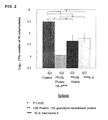
- mice 8 weeks old DBA/1 mice was intraperitoneally infected with M. tuberculosis.
- the mice were divided into a group with no administration (G1), a group with administrations of 15K granulysin recombinant protein and 15K granulysin in vivo expression vector (G2), a group with an administration of only 15K granulysin recombinant protein (G5), and a group with an administration of only 15K granulysin in vivo expression vector (G6).
- G2 15K granulysin recombinant protein was administered 4 times at intervals, and 15K granulysin in vivo expression vector was administered 7 times at intervals.
- G5 only 15K granulysin recombinant protein, and in G6, only 15K granulysin in vivo expression vector, were administered respectively on the same day as G2.
- liver tissues including liver cells.
- the obtained tissues were homogenized and cultured on a 7H11 plate agar medium for 14 days. The number of colonies of M. tuberculosis was counted.
- the number of colonies in G2 was fewer than those in G5 and G6.
- the numbers of colonies of 3 mice from each group were put in log 10 in order to perform a statistical analysis, and the number of M. tuberculosis in G2 was more reduced than those in G5 and G6 with a statistically significant difference (p ⁇ 0.05).
- G1 which is a control
- G2 G5 and G6 in the same way
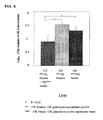
- the numbers of M. tuberculosis in G2, G5 and G6 were more reduced than that in G1 with a statistically significant difference (p ⁇ 0.05) (See FIG.1 ).
- 15K granulysin recombinant protein and 15K granulysin in vivo expression vector independently exhibit effects in a liver, however, the combination of the above enables to significantly improve the killing effect on M. tuberculosis and show the synergetic effect.
- mice 8 weeks old DBA/1 mice was lung-infected with M. tuberculosis in an aerosol chamber.
- the mice were divided into a group with no administration (G1), a group with administrations of 15K granulysin recombinant protein and IL-6 (G3), a group with an administration of only 15K granulysin recombinant protein (G5), and a group with an administration of only IL-6 (G7).
- G3 15K granulysin recombinant protein and IL-6 were alternately administered 6 times each.
- G5 only 15K granulysin recombinant protein, and in G7, only IL-6, were administered 6 times respectively. None was administered in G1.
- mice were dissected after euthanasia to obtain spleen tissues including spleen cells.
- the obtained tissues were homogenized and cultured on a 7H11 plate agar medium for 14 days. The number of colonies of M. tuberculosis was counted.
- the number of colonies in G3 was fewer than those in G5 and G7.
- the numbers of colonies of 3 mice from each group were put in log 10 in order to perform the statistical analysis, and the number of M. tuberculosis in G3 was more reduced than those in G5 and G7 with a statistically significant difference (p ⁇ 0.05).
- 15K granulysin recombinant protein and IL-6 independently show the effect in a spleen, however, the combination of the above enables to significantly improve the killing effect on M. tuberculosis, and show the synergetic effect.
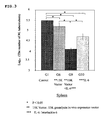
- mice 8 weeks old DBA/1 mice was lung-infected with M. tuberculosis in an aerosol chamber.
- the mice were divided into a group with no administration (G1), a group with administrations of 15K granulysin in vivo expression vector and IL-6 (G9), a group with an administration of only 15K granulysin in vivo expression vector (G6), and a group with an administration of only IL-6 (G10).
- mice were dissected after euthanasia to obtain spleen tissues including spleen cells.
- the obtained tissues were homogenized and cultured on a 7H11 plate agar medium for 14 days. The number of colonies of M. tuberculosis was counted.
- the number of colonies in G9 was fewer than those in G6 and G10.
- the numbers of colonies of 3 mice from each group were put in log 10 in order to perform the statistical analysis, and the number of M. tuberculosis of G9 was more reduced than those of G6 and G10 with a statistically significant difference (p ⁇ 0.05).
- G1 which is a control
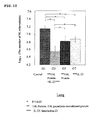
- G9, G6 and G10 in the same way, and the numbers of M. tuberculosis in G9, G6 and G10 were more reduced than that in G1 with a statistically significant difference (p ⁇ 0.05) (See FIG.3 ).
- the combined use of 15K granulysin in vivo expression vector and IL-6 significantly improves the killing effect on M. tuberculosis in a spleen compared to the independent use of the above materials, and show the synergetic effect.
- mice which are commonly used in experiments of tuberculosis infection, were lung-infected with M. tuberculosis in an aerosol chamber.
- the mice were divided into a group with no administration (G1), a group with administrations of 15K granulysin recombinant protein and IL-6 (G3), a group with an administration of only 15K granulysin recombinant protein (G5), and a group with an administration of only IL-6 (G7).
- G3 15K granulysin recombinant protein and IL-6 were alternately administered 6 times each.
- G5 only 15K granulysin recombinant protein, and in G7, only IL-6, were administered 6 times respectively. None was administered in G1.
- mice were dissected after euthanasia to obtain liver tissues including liver cells and lung tissues including lung cells.
- the obtained tissues were homogenized and cultured on a 7H11 plate agar medium for 14 days. The number of colonies of M. tuberculosis was counted.
- the number of colonies in G3 was fewer than those in G5 and G7.
- the numbers of colonies of 3 mice from each group were put in log 10 in order to perform the statistical analysis, and the number of M. tuberculosis of G3 was more reduced than those of G5 and G7 with a statistically significant difference (p ⁇ 0.05).
- 15K granulysin and IL-6 exhibit effects in liver and lung independently, however, the combination of the above enables to significantly improve the killing effect on M. tuberculosis and show the synergetic effect.
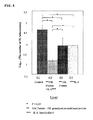
- mice 8 weeks old DBA/1 mice were lung-infected with M. tuberculosis in an aerosol chamber.
- the mice were divided into a group with administrations of 15K granulysin recombinant protein and 15K granulysin in vivo expression vector (G2), a group with an administration of only 15K granulysin recombinant protein (G5), and a group with an administration of only 15K granulysin in vivo expressin vector (G6).
- G2 15K granulysin recombinant protein and 15K granulysin in vivo expression vector were administered 6 times at intervals in the same day. In G5, only 15K granulysin recombinant protein, and in G6, only 15K granulysin in vivo expression vector, were administered 6 times respectively.
- liver tissues including liver cells.
- the obtained tissues were homogenized and cultured on a 7H11 plate agar medium for 14 days. The number of colonies of M. tuberculosis was counted.
- the number of colonies in G2 was fewer than those in G5 and G6.
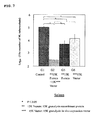
- the numbers of colonies of 3 mice from each group were put in log 10 in order to perform the statistical analysis, and the number of M. tuberculosis in G2 was more reduced than those in G5 and G6 with a statistically significant difference (p ⁇ 0.05) (See FIG. 6 ).
- the combination of 15K granulysin recombinant protein and 15K granulysin in vivo expression vector in liver significantly improve the killing effect on M. tuberculosis and show the synergetic effect.
- mice 8 weeks old DBA/1 mice were lung-infected with M. tuberculosis in an aerosol chamber.
- the mice were divided into a group with no administration (G1), a group with administrations of 15K granulysin recombinant protein and 15K granulysin in vivo expression vector (G2), a group with an administration of only 15K granulysin recombinant protein (G5), and a group with an administration of 15K granulysin in vivo expression vector (G6).
- G2 15K granulysin recombinant protein and 15K granulysin in vivo expression vector were alternately administered 6 times each in the same day.
- G5 only 15K granulysin recombinant protein, and in G6, only 15K granulysin in vivo expression vector, were administered 6 times respectively.
- mice were dissected after euthanasia to obtain spleen tissues including spleen cells.
- the obtained tissues were homogenized and cultured on a 7H11 plate agar medium for 14 days. The number of colonies of M. tuberculosis was counted.
- the number of colonies in G2 was fewer than those in G5 and G6.
- the numbers of colonies of 3 mice from each group were put in log 10 in order to perform the statistical analysis, and the number of M. tuberculosis in G2 was more reduced than those in G5 and G6 with a statistically significant difference (p ⁇ 0.05).
- G1 which is a control
- G2 G5 and G6 in the same way
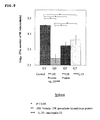
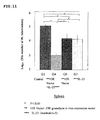
- the number of M. tuberculosis in G2 was more reduced than those in G5 and G6 with a statistically significant difference (p ⁇ 0.05) (See FIG.7 ).
- 15K granulysin recombinant protein and 15K granulysin in vivo expression vector exhibit effects in spleen independently, however, the combination of the above enables to significantly improve the killing effect on M. tuberculosis and show the synergetic effect.
- mice were lung-infected with M. tuberculosis in an aerosol chamber.
- the mice were divided into a group with no administration (G1), a group with administrations of 15K granulysin recombinant protein and IL-23 (G3), a group with an administration of only 15K granulysin recombinant protein (G5), and a group with an administration of only IL-23 (G7).
- G3 15K granulysin recombinant protein and IL-23 were alternately administered 6 times each. In G5, only 15K granulysin, and in G7, only IL-23, were administered 6 times respectively. None was administered in G1.
- mice were dissected after euthanasia to obtain spleen, liver and lung tissues including spleen, liver and lung cells respectively.
- the obtained tissues were homogenized and cultured on a 7H11 plate agar medium for 14 days. The number of colonies of M. tuberculosis was counted.
- 15K granulysin and IL-23 independently exhibit effects in all of spleen, liver and lung, however, the combination of the above enables to significantly improve the killing effect on M. tuberculosis and show the synergetic effect.
- mice were lung-infected with M. tuberculosis in an aerosol chamber.
- the mice were divided into a group with no administration (G1), a group with administrations of 15K granulysin in vivo expression vector and IL-23 (G4), a group with an administration of only 15K granulysin in vivo expression vector (G6), and a group with an administration of only IL-23 (G7).
- G4 15K granulysin in vivo expression vector and IL-23 were alternately administered 6 times each.
- G6 only 15K granulysin in vivo expression vector, and in G7, only IL-23, were administered 6 times respectively. None was administered in G1.
- mice were dissected after euthanasia to obtain spleen tissues including spleen cells.
- the obtained tissues were homogenized and cultured on a 7H11 plate agar medium for 14 days. The number of colonies of M. tuberculosis was counted.
- the number of colonies in G4 was fewer than those in G6 and G7.
- the numbers of colonies of 3 mice from each group were put in log 10 in order to perform the statistical analysis, and the number of M. tuberculosis in G4 was more reduced than those in G6 and G7 with a statistically significant difference (p ⁇ 0.05).
- 15K granulysin in vivo expression vector and IL-23 exhibit effects in spleen independently, however, the combination of the above enables to significantly improve the killing effect on M. tuberculosis and show the synergetic effect.
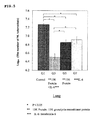
- mice were lung-infected with M. tuberculosis in an aerosol chamber.
- the mice were divided into a group with administrations of 15K granulysin in vivo expression vector and IL-27 (G4), a group with an administration of only 15K granulysin in vivo expression vector (G6), and a group with an administration of only IL-27 (G7).
- G4 15K granulysin in vivo expression vector and IL-27 were alternately administered 6 times each.
- G6 only 15K granulysin in vivo expression vector, and in G7, only IL-27, were administered 6 times respectively.
- mice were dissected after euthanasia to obtain lung tissues including lung cells.
- the obtained tissues were homogenized and cultured on a 7H11 plate agar medium for 14 days. The number of colonies of M. tuberculosis was counted.
- the number of colonies in G4 was fewer than those in G6 and G7.
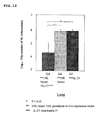
- the numbers of colonies of 3 mice from each group were put in log 10 in order to perform the statistical analysis, and the number of M. tuberculosis in G4 was more reduced than those in G6 and G7 with a statistically significant difference (p ⁇ 0.05) (See FIG.12 ).
- the combination of 15K granulysin in vivo expression vector and IL-27 in lung significantly improves the killing effect on M. tuberculosis and shows the synergetic effect.
- mice 8 weeks old DBA/1 mice were lung-infected with M. tuberculosis in an aerosol chamber.
- the mice were divided into a group with administrations of 15K granulysin in vivo expression vector and HSP65DNA and IL-12DNA in vivo expression vectors (G11), a group with an administration of only 15K granulysin in vivo expression vector (G6), and a group with an administration of only HSP65DNA and IL-12DNA in vivo expression vectors (G12).
- liver tissues including liver cells.
- the obtained tissues were homogenized and cultured on a 7H11 plate agar medium for 14 days. The number of colonies of M. tuberculosis was counted.
- the number of colonies in G11 was fewer than those in G6 and G12.
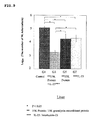
- the numbers of colonies of 3 mice from each group were put in log 10 in order to perform the statistical analysis, and the number of M. tuberculosis in G11 was more reduced than those in G6 and G12 with a statistically significant difference (p ⁇ 0.05) (See FIG.13 ).
- the combined use of 15K granulysin in vivo expression vector and HSP65DNA and IL-12DNA in vivo expression vectors in liver significantly improves the killing effect on M. tuberculosis compared to the independent use of the above materials, and shows the synergetic effect.
- the present description discloses a useful therapeutic agent for infections comprising as an active ingredient: a combination of 15K granulysin and 15K granulysin in vivo expression vector, a combination of 15K granulysin and at least one interleukin selected from IL-6, IL-23 or IL-27, a combination of 15K granulysin in vivo expression vector and at least one interleukin selected from IL-6, IL-23 or IL-27, or a combination of 15K granulysin in vivo expression vector and HSP65DNA and IL-12DNA in vivo expression vector, which has less side effect, and to which bacteria can hardly acquire resistance.
Landscapes
- Health & Medical Sciences (AREA)
- Life Sciences & Earth Sciences (AREA)
- Medicinal Chemistry (AREA)
- Chemical & Material Sciences (AREA)
- Public Health (AREA)
- Veterinary Medicine (AREA)
- Pharmacology & Pharmacy (AREA)
- Animal Behavior & Ethology (AREA)
- General Health & Medical Sciences (AREA)
- Immunology (AREA)
- Epidemiology (AREA)
- Engineering & Computer Science (AREA)
- Bioinformatics & Cheminformatics (AREA)
- Gastroenterology & Hepatology (AREA)
- Proteomics, Peptides & Aminoacids (AREA)
- Zoology (AREA)
- Marine Sciences & Fisheries (AREA)
- Communicable Diseases (AREA)
- Pulmonology (AREA)
- Nuclear Medicine, Radiotherapy & Molecular Imaging (AREA)
- Organic Chemistry (AREA)
- General Chemical & Material Sciences (AREA)
- Chemical Kinetics & Catalysis (AREA)
- Microbiology (AREA)
- Mycology (AREA)
- Oncology (AREA)
- Medicines That Contain Protein Lipid Enzymes And Other Medicines (AREA)
- Medicines Containing Material From Animals Or Micro-Organisms (AREA)
Claims (7)
- Therapeutische Zusammensetzung zur Verwendung bei der Behandlung von Infektionen, wobei die Zusammensetzung als aktive Bestandteile 15K Granulysin und Interleukin 6 umfasst.
- Therapeutische Zusammensetzung zur Verwendung nach Anspruch 1, wobei die Infektionen bakterielle Infektionen sind.
- Therapeutische Zusammensetzung zur Verwendung nach Anspruch 2, wobei der ursächliche Mikroorganismus der bakteriellen Infektionen Mycobacterium Tuberculosis ist.
- Therapeutische Zusammensetzung zur Verwendung bei der Behandlung von Infektionen, wobei die Zusammensetzung als aktive Komponenten einen Vektor, in dem ein Gen, das 15K Granulysin kodiert, enthalten ist, um 15K Granulysin in vivo zu exprimieren, und Interleukin 6 umfasst.
- Therapeutische Zusammensetzung zur Verwendung nach Anspruch 4, wobei die Infektionen bakterielle Infektionen sind.
- Therapeutische Zusammensetzung zur Verwendung nach Anspruch 5, wobei der ursächliche Mikroorganismus der bakteriellen Infektionen Mycobacterium Tuberculosis ist.
- Therapeutische Zusammensetzung zur Verwendung nach Anspruch 1, wobei das 15K Granulysin ein rekombinantes Protein ist.
Priority Applications (1)
| Application Number | Priority Date | Filing Date | Title |
|---|---|---|---|
| EP12183606.8A EP2532358B1 (de) | 2009-04-24 | 2009-09-30 | Therapeutisches Mittel für Infektionen |
Applications Claiming Priority (1)
| Application Number | Priority Date | Filing Date | Title |
|---|---|---|---|
| US12/386,974 US8288509B2 (en) | 2002-02-22 | 2009-04-24 | Therapeutic agent for infections, and treatment method using the same |
Related Child Applications (1)
| Application Number | Title | Priority Date | Filing Date |
|---|---|---|---|
| EP12183606.8 Division-Into | 2012-09-07 |
Publications (3)
| Publication Number | Publication Date |
|---|---|
| EP2243489A2 EP2243489A2 (de) | 2010-10-27 |
| EP2243489A3 EP2243489A3 (de) | 2010-12-08 |
| EP2243489B1 true EP2243489B1 (de) | 2012-10-31 |
Family
ID=42312886
Family Applications (2)
| Application Number | Title | Priority Date | Filing Date |
|---|---|---|---|
| EP12183606.8A Not-in-force EP2532358B1 (de) | 2009-04-24 | 2009-09-30 | Therapeutisches Mittel für Infektionen |
| EP09171752A Not-in-force EP2243489B1 (de) | 2009-04-24 | 2009-09-30 | Granulysin und interleukin-6 für infektionen |
Family Applications Before (1)
| Application Number | Title | Priority Date | Filing Date |
|---|---|---|---|
| EP12183606.8A Not-in-force EP2532358B1 (de) | 2009-04-24 | 2009-09-30 | Therapeutisches Mittel für Infektionen |
Country Status (4)
| Country | Link |
|---|---|
| US (3) | US8288509B2 (de) |
| EP (2) | EP2532358B1 (de) |
| JP (1) | JP5596318B2 (de) |
| CN (1) | CN101869714A (de) |
Families Citing this family (6)
| Publication number | Priority date | Publication date | Assignee | Title |
|---|---|---|---|---|
| US8288509B2 (en) * | 2002-02-22 | 2012-10-16 | National Hospital Organization Kinki-chuo Chest Medical center | Therapeutic agent for infections, and treatment method using the same |
| GB201005262D0 (en) * | 2010-03-29 | 2010-05-12 | Griffith Susan | Granulysin and derived peptides: use as novel anthelmintic molecules |
| ES2521365B1 (es) * | 2013-02-06 | 2015-09-09 | Universidad De Zaragoza | Uso de la granulisina para el tratamiento de tumores sólidos |
| CN105879058B (zh) * | 2016-05-10 | 2017-11-14 | 华中科技大学 | 一种结核病基因药物及其制备方法 |
| CN107904252A (zh) * | 2017-11-20 | 2018-04-13 | 湖南丰晖生物科技有限公司 | 质粒载体及其构建方法、应用 |
| CN107868799A (zh) * | 2017-11-20 | 2018-04-03 | 湖南丰晖生物科技有限公司 | 表达载体及其构建方法和应用 |
Family Cites Families (12)
| Publication number | Priority date | Publication date | Assignee | Title |
|---|---|---|---|---|
| EP0586812B1 (de) | 1992-07-13 | 2000-01-05 | Nisshin Flour Milling Co., Ltd. | Arzneimittel die Glicentin als aktiven Wirkstoff enthalten |
| WO1999022755A1 (en) * | 1997-11-04 | 1999-05-14 | The Board Of Trustees Of The Leland Stanford Junior University | Use of granulysin as an antimicrobial agent |
| AU2002354427A1 (en) * | 2001-12-17 | 2003-06-30 | Bml, Inc. | Method of detecting extracellular granulysin |
| JP4149713B2 (ja) * | 2002-02-22 | 2008-09-17 | 全司 岡田 | 感染症治療剤 |
| US8288509B2 (en) * | 2002-02-22 | 2012-10-16 | National Hospital Organization Kinki-chuo Chest Medical center | Therapeutic agent for infections, and treatment method using the same |
| US7160696B2 (en) * | 2003-04-14 | 2007-01-09 | The Penn State Research Foundation | Bovine lymphocyte-derived antibacterial protein |
| WO2005026194A2 (en) * | 2003-09-12 | 2005-03-24 | The Regents Of The University Of California | Granulysin peptides and methods of use thereof |
| US20050249699A1 (en) * | 2004-05-05 | 2005-11-10 | Stoff Jesse A | Immunodynamic complexes and methods for using and preparing such complexes |
| WO2006088945A2 (en) * | 2005-02-14 | 2006-08-24 | The Regents Of The University Of California | Granulysin peptides and methods of use thereof |
| US8202835B2 (en) * | 2005-06-17 | 2012-06-19 | Yitzchak Hillman | Disease treatment via antimicrobial peptides or their inhibitors |
| EP1950218A1 (de) * | 2007-01-24 | 2008-07-30 | Centre National de la Recherche Scientifique | Sulfoglykolipid-Antigene, Verfahren zu deren Herstellung und ihre Verwendung gegen Tuberkulose |
| AU2010307075B2 (en) * | 2009-10-12 | 2014-12-18 | The United States Of America, As Represented By The Secretary, Department Of Health And Human Services | Granulysin in immunotherapy |
-
2009
- 2009-04-24 US US12/386,974 patent/US8288509B2/en not_active Expired - Fee Related
- 2009-08-20 JP JP2009191378A patent/JP5596318B2/ja active Active
- 2009-09-30 EP EP12183606.8A patent/EP2532358B1/de not_active Not-in-force
- 2009-09-30 EP EP09171752A patent/EP2243489B1/de not_active Not-in-force
- 2009-10-21 CN CN200910206609A patent/CN101869714A/zh active Pending
-
2012
- 2012-09-06 US US13/604,645 patent/US20130011366A1/en not_active Abandoned
-
2014
- 2014-06-02 US US14/292,940 patent/US9233142B2/en not_active Expired - Fee Related
Also Published As
| Publication number | Publication date |
|---|---|
| EP2532358A1 (de) | 2012-12-12 |
| JP2010254662A (ja) | 2010-11-11 |
| JP5596318B2 (ja) | 2014-09-24 |
| US8288509B2 (en) | 2012-10-16 |
| EP2243489A3 (de) | 2010-12-08 |
| US20090274651A1 (en) | 2009-11-05 |
| EP2243489A2 (de) | 2010-10-27 |
| US20140308240A1 (en) | 2014-10-16 |
| US9233142B2 (en) | 2016-01-12 |
| EP2532358B1 (de) | 2014-01-08 |
| CN101869714A (zh) | 2010-10-27 |
| US20130011366A1 (en) | 2013-01-10 |
Similar Documents
| Publication | Publication Date | Title |
|---|---|---|
| Duarte-Mata et al. | Antimicrobial peptides immune modulation role in intracellular bacterial infection | |
| EP2243489B1 (de) | Granulysin und interleukin-6 für infektionen | |
| Deng et al. | CpG oligodeoxynucleotides stimulate protective innate immunity against pulmonary Klebsiella infection | |
| Broide et al. | Immunostimulatory DNA sequences inhibit IL-5, eosinophilic inflammation, and airway hyperresponsiveness in mice | |
| US20230382961A1 (en) | Cath2 derivatives | |
| JP4236699B2 (ja) | 抗生物質抵抗性グラム陽性細菌の制御および感染治療の方法 | |
| US6599880B1 (en) | Bactericidal/permeability-increasing protein (BPI) deletion analogs | |
| JPH03504980A (ja) | Gm―csfを用いる白血球機能障害の治療 | |
| Reddy | Mechanism of Mycobacterium avium complex pathogenesis | |
| WO2004072093A2 (en) | Antimicrobial agents from streptococcus mitis and streptococcus oralis | |
| EP1484066B1 (de) | 15k Granulysin zur Behandlung von Infektionen | |
| HK1147061A (en) | Therapeutic agent for infections | |
| Matsumoto et al. | Mechanism of protective effect of recombinant human granulocyte colony‐stimulating factor (rG‐CSF) on Pseudomonas infection | |
| Williams et al. | The potential for monocyte-mediated immunotherapy during infection and malignancy-Part II: In vivo activation by exogenous cytokines and clinical applications | |
| US6593457B1 (en) | Lymphocyte-derived antimicrobial protein (LDAP) and methods of isolating and producing and using the protein | |
| US8227418B2 (en) | Alpha-defensins as anthrax immunotherapeutics | |
| Karp et al. | Management of infections in neutropenic patients: new opportunities and emerging challenges | |
| WO2025106685A1 (en) | Interleukin-2 superkine and interleukin-33, compositions and uses thereof | |
| KR20030012199A (ko) | 사이토카인 유전자를 유효성분으로 포함하는 dna 백신 | |
| WO1992008448A1 (en) | Method for preventing drug-induced or radiation myelosuppression | |
| Horwitz | State of the Art Lecture. Toward an understanding of host and bacterial molecules mediating Legionella pneumophila pathogenesis | |
| Kawakami | 0S0S GGG G LLLL | |
| Marshall | Effects of lipopolysaccharide and other bacterial toxins on macrophage Ia expression and the elicitation of antibacterial T cell immunity | |
| KR20150120100A (ko) | 펩타이드를 포함하는 장내독소 b 중독증 치료 또는 예방용 약제학적 조성물 | |
| HUT78097A (hu) | IL-10 alkalmazása perifériás vér mononukleáris sejt citolitikus aktivitás stimulálására |
Legal Events
| Date | Code | Title | Description |
|---|---|---|---|
| PUAI | Public reference made under article 153(3) epc to a published international application that has entered the european phase |
Free format text: ORIGINAL CODE: 0009012 |
|
| AK | Designated contracting states |
Kind code of ref document: A2 Designated state(s): AT BE BG CH CY CZ DE DK EE ES FI FR GB GR HR HU IE IS IT LI LT LU LV MC MK MT NL NO PL PT RO SE SI SK SM TR |
|
| AX | Request for extension of the european patent |
Extension state: AL BA RS |
|
| PUAL | Search report despatched |
Free format text: ORIGINAL CODE: 0009013 |
|
| AK | Designated contracting states |
Kind code of ref document: A3 Designated state(s): AT BE BG CH CY CZ DE DK EE ES FI FR GB GR HR HU IE IS IT LI LT LU LV MC MK MT NL NO PL PT RO SE SI SK SM TR |
|
| AX | Request for extension of the european patent |
Extension state: AL BA RS |
|
| 17P | Request for examination filed |
Effective date: 20110608 |
|
| GRAJ | Information related to disapproval of communication of intention to grant by the applicant or resumption of examination proceedings by the epo deleted |
Free format text: ORIGINAL CODE: EPIDOSDIGR1 |
|
| GRAP | Despatch of communication of intention to grant a patent |
Free format text: ORIGINAL CODE: EPIDOSNIGR1 |
|
| RIC1 | Information provided on ipc code assigned before grant |
Ipc: A61K 38/17 20060101AFI20120413BHEP Ipc: A61K 38/20 20060101ALI20120413BHEP Ipc: A61P 31/06 20060101ALI20120413BHEP Ipc: A61P 31/00 20060101ALI20120413BHEP |
|
| RTI1 | Title (correction) |
Free format text: GRANULYSIN AND INTERLEUKIN-6 FOR INFECTIONS |
|
| GRAP | Despatch of communication of intention to grant a patent |
Free format text: ORIGINAL CODE: EPIDOSNIGR1 |
|
| GRAS | Grant fee paid |
Free format text: ORIGINAL CODE: EPIDOSNIGR3 |
|
| GRAA | (expected) grant |
Free format text: ORIGINAL CODE: 0009210 |
|
| AK | Designated contracting states |
Kind code of ref document: B1 Designated state(s): AT BE BG CH CY CZ DE DK EE ES FI FR GB GR HR HU IE IS IT LI LT LU LV MC MK MT NL NO PL PT RO SE SI SK SM TR |
|
| REG | Reference to a national code |
Ref country code: GB Ref legal event code: FG4D Ref country code: CH Ref legal event code: EP |
|
| REG | Reference to a national code |
Ref country code: AT Ref legal event code: REF Ref document number: 581622 Country of ref document: AT Kind code of ref document: T Effective date: 20121115 |
|
| REG | Reference to a national code |
Ref country code: IE Ref legal event code: FG4D |
|
| REG | Reference to a national code |
Ref country code: DE Ref legal event code: R096 Ref document number: 602009010775 Country of ref document: DE Effective date: 20121227 |
|
| REG | Reference to a national code |
Ref country code: AT Ref legal event code: MK05 Ref document number: 581622 Country of ref document: AT Kind code of ref document: T Effective date: 20121031 Ref country code: CH Ref legal event code: NV Representative=s name: ISLER AND PEDRAZZINI AG, CH |
|
| REG | Reference to a national code |
Ref country code: LT Ref legal event code: MG4D |
|
| REG | Reference to a national code |
Ref country code: NL Ref legal event code: VDEP Effective date: 20121031 |
|
| PG25 | Lapsed in a contracting state [announced via postgrant information from national office to epo] |
Ref country code: ES Free format text: LAPSE BECAUSE OF FAILURE TO SUBMIT A TRANSLATION OF THE DESCRIPTION OR TO PAY THE FEE WITHIN THE PRESCRIBED TIME-LIMIT Effective date: 20130211 Ref country code: HR Free format text: LAPSE BECAUSE OF FAILURE TO SUBMIT A TRANSLATION OF THE DESCRIPTION OR TO PAY THE FEE WITHIN THE PRESCRIBED TIME-LIMIT Effective date: 20121031 Ref country code: SE Free format text: LAPSE BECAUSE OF FAILURE TO SUBMIT A TRANSLATION OF THE DESCRIPTION OR TO PAY THE FEE WITHIN THE PRESCRIBED TIME-LIMIT Effective date: 20121031 Ref country code: LT Free format text: LAPSE BECAUSE OF FAILURE TO SUBMIT A TRANSLATION OF THE DESCRIPTION OR TO PAY THE FEE WITHIN THE PRESCRIBED TIME-LIMIT Effective date: 20121031 Ref country code: FI Free format text: LAPSE BECAUSE OF FAILURE TO SUBMIT A TRANSLATION OF THE DESCRIPTION OR TO PAY THE FEE WITHIN THE PRESCRIBED TIME-LIMIT Effective date: 20121031 Ref country code: NL Free format text: LAPSE BECAUSE OF FAILURE TO SUBMIT A TRANSLATION OF THE DESCRIPTION OR TO PAY THE FEE WITHIN THE PRESCRIBED TIME-LIMIT Effective date: 20121031 Ref country code: IS Free format text: LAPSE BECAUSE OF FAILURE TO SUBMIT A TRANSLATION OF THE DESCRIPTION OR TO PAY THE FEE WITHIN THE PRESCRIBED TIME-LIMIT Effective date: 20130228 Ref country code: NO Free format text: LAPSE BECAUSE OF FAILURE TO SUBMIT A TRANSLATION OF THE DESCRIPTION OR TO PAY THE FEE WITHIN THE PRESCRIBED TIME-LIMIT Effective date: 20130131 |
|
| PG25 | Lapsed in a contracting state [announced via postgrant information from national office to epo] |
Ref country code: PT Free format text: LAPSE BECAUSE OF FAILURE TO SUBMIT A TRANSLATION OF THE DESCRIPTION OR TO PAY THE FEE WITHIN THE PRESCRIBED TIME-LIMIT Effective date: 20130228 Ref country code: SI Free format text: LAPSE BECAUSE OF FAILURE TO SUBMIT A TRANSLATION OF THE DESCRIPTION OR TO PAY THE FEE WITHIN THE PRESCRIBED TIME-LIMIT Effective date: 20121031 Ref country code: PL Free format text: LAPSE BECAUSE OF FAILURE TO SUBMIT A TRANSLATION OF THE DESCRIPTION OR TO PAY THE FEE WITHIN THE PRESCRIBED TIME-LIMIT Effective date: 20121031 Ref country code: BE Free format text: LAPSE BECAUSE OF FAILURE TO SUBMIT A TRANSLATION OF THE DESCRIPTION OR TO PAY THE FEE WITHIN THE PRESCRIBED TIME-LIMIT Effective date: 20121031 Ref country code: GR Free format text: LAPSE BECAUSE OF FAILURE TO SUBMIT A TRANSLATION OF THE DESCRIPTION OR TO PAY THE FEE WITHIN THE PRESCRIBED TIME-LIMIT Effective date: 20130201 Ref country code: LV Free format text: LAPSE BECAUSE OF FAILURE TO SUBMIT A TRANSLATION OF THE DESCRIPTION OR TO PAY THE FEE WITHIN THE PRESCRIBED TIME-LIMIT Effective date: 20121031 |
|
| PG25 | Lapsed in a contracting state [announced via postgrant information from national office to epo] |
Ref country code: AT Free format text: LAPSE BECAUSE OF FAILURE TO SUBMIT A TRANSLATION OF THE DESCRIPTION OR TO PAY THE FEE WITHIN THE PRESCRIBED TIME-LIMIT Effective date: 20121031 |
|
| PG25 | Lapsed in a contracting state [announced via postgrant information from national office to epo] |
Ref country code: CZ Free format text: LAPSE BECAUSE OF FAILURE TO SUBMIT A TRANSLATION OF THE DESCRIPTION OR TO PAY THE FEE WITHIN THE PRESCRIBED TIME-LIMIT Effective date: 20121031 Ref country code: EE Free format text: LAPSE BECAUSE OF FAILURE TO SUBMIT A TRANSLATION OF THE DESCRIPTION OR TO PAY THE FEE WITHIN THE PRESCRIBED TIME-LIMIT Effective date: 20121031 Ref country code: DK Free format text: LAPSE BECAUSE OF FAILURE TO SUBMIT A TRANSLATION OF THE DESCRIPTION OR TO PAY THE FEE WITHIN THE PRESCRIBED TIME-LIMIT Effective date: 20121031 Ref country code: BG Free format text: LAPSE BECAUSE OF FAILURE TO SUBMIT A TRANSLATION OF THE DESCRIPTION OR TO PAY THE FEE WITHIN THE PRESCRIBED TIME-LIMIT Effective date: 20130131 Ref country code: SK Free format text: LAPSE BECAUSE OF FAILURE TO SUBMIT A TRANSLATION OF THE DESCRIPTION OR TO PAY THE FEE WITHIN THE PRESCRIBED TIME-LIMIT Effective date: 20121031 |
|
| PG25 | Lapsed in a contracting state [announced via postgrant information from national office to epo] |
Ref country code: RO Free format text: LAPSE BECAUSE OF FAILURE TO SUBMIT A TRANSLATION OF THE DESCRIPTION OR TO PAY THE FEE WITHIN THE PRESCRIBED TIME-LIMIT Effective date: 20121031 Ref country code: IT Free format text: LAPSE BECAUSE OF FAILURE TO SUBMIT A TRANSLATION OF THE DESCRIPTION OR TO PAY THE FEE WITHIN THE PRESCRIBED TIME-LIMIT Effective date: 20121031 |
|
| PLBE | No opposition filed within time limit |
Free format text: ORIGINAL CODE: 0009261 |
|
| STAA | Information on the status of an ep patent application or granted ep patent |
Free format text: STATUS: NO OPPOSITION FILED WITHIN TIME LIMIT |
|
| 26N | No opposition filed |
Effective date: 20130801 |
|
| REG | Reference to a national code |
Ref country code: DE Ref legal event code: R097 Ref document number: 602009010775 Country of ref document: DE Effective date: 20130801 |
|
| PG25 | Lapsed in a contracting state [announced via postgrant information from national office to epo] |
Ref country code: CY Free format text: LAPSE BECAUSE OF FAILURE TO SUBMIT A TRANSLATION OF THE DESCRIPTION OR TO PAY THE FEE WITHIN THE PRESCRIBED TIME-LIMIT Effective date: 20121031 |
|
| PG25 | Lapsed in a contracting state [announced via postgrant information from national office to epo] |
Ref country code: MC Free format text: LAPSE BECAUSE OF FAILURE TO SUBMIT A TRANSLATION OF THE DESCRIPTION OR TO PAY THE FEE WITHIN THE PRESCRIBED TIME-LIMIT Effective date: 20121031 |
|
| GBPC | Gb: european patent ceased through non-payment of renewal fee |
Effective date: 20130930 |
|
| REG | Reference to a national code |
Ref country code: IE Ref legal event code: MM4A |
|
| PG25 | Lapsed in a contracting state [announced via postgrant information from national office to epo] |
Ref country code: GB Free format text: LAPSE BECAUSE OF NON-PAYMENT OF DUE FEES Effective date: 20130930 Ref country code: IE Free format text: LAPSE BECAUSE OF NON-PAYMENT OF DUE FEES Effective date: 20130930 |
|
| PG25 | Lapsed in a contracting state [announced via postgrant information from national office to epo] |
Ref country code: SM Free format text: LAPSE BECAUSE OF FAILURE TO SUBMIT A TRANSLATION OF THE DESCRIPTION OR TO PAY THE FEE WITHIN THE PRESCRIBED TIME-LIMIT Effective date: 20121031 |
|
| PG25 | Lapsed in a contracting state [announced via postgrant information from national office to epo] |
Ref country code: MT Free format text: LAPSE BECAUSE OF FAILURE TO SUBMIT A TRANSLATION OF THE DESCRIPTION OR TO PAY THE FEE WITHIN THE PRESCRIBED TIME-LIMIT Effective date: 20121031 Ref country code: TR Free format text: LAPSE BECAUSE OF FAILURE TO SUBMIT A TRANSLATION OF THE DESCRIPTION OR TO PAY THE FEE WITHIN THE PRESCRIBED TIME-LIMIT Effective date: 20121031 |
|
| PG25 | Lapsed in a contracting state [announced via postgrant information from national office to epo] |
Ref country code: MK Free format text: LAPSE BECAUSE OF FAILURE TO SUBMIT A TRANSLATION OF THE DESCRIPTION OR TO PAY THE FEE WITHIN THE PRESCRIBED TIME-LIMIT Effective date: 20121031 Ref country code: HU Free format text: LAPSE BECAUSE OF FAILURE TO SUBMIT A TRANSLATION OF THE DESCRIPTION OR TO PAY THE FEE WITHIN THE PRESCRIBED TIME-LIMIT; INVALID AB INITIO Effective date: 20090930 Ref country code: LU Free format text: LAPSE BECAUSE OF NON-PAYMENT OF DUE FEES Effective date: 20130930 |
|
| REG | Reference to a national code |
Ref country code: FR Ref legal event code: PLFP Year of fee payment: 8 |
|
| REG | Reference to a national code |
Ref country code: FR Ref legal event code: PLFP Year of fee payment: 9 |
|
| PGFP | Annual fee paid to national office [announced via postgrant information from national office to epo] |
Ref country code: FR Payment date: 20170713 Year of fee payment: 9 Ref country code: CH Payment date: 20170912 Year of fee payment: 9 |
|
| PGFP | Annual fee paid to national office [announced via postgrant information from national office to epo] |
Ref country code: DE Payment date: 20170928 Year of fee payment: 9 |
|
| REG | Reference to a national code |
Ref country code: DE Ref legal event code: R119 Ref document number: 602009010775 Country of ref document: DE |
|
| REG | Reference to a national code |
Ref country code: CH Ref legal event code: PL |
|
| PG25 | Lapsed in a contracting state [announced via postgrant information from national office to epo] |
Ref country code: DE Free format text: LAPSE BECAUSE OF NON-PAYMENT OF DUE FEES Effective date: 20190402 |
|
| PG25 | Lapsed in a contracting state [announced via postgrant information from national office to epo] |
Ref country code: FR Free format text: LAPSE BECAUSE OF NON-PAYMENT OF DUE FEES Effective date: 20180930 Ref country code: CH Free format text: LAPSE BECAUSE OF NON-PAYMENT OF DUE FEES Effective date: 20180930 Ref country code: LI Free format text: LAPSE BECAUSE OF NON-PAYMENT OF DUE FEES Effective date: 20180930 |