EP2232745B1 - Datenverarbeitungsverfahren und - Google Patents
Datenverarbeitungsverfahren und Download PDFInfo
- Publication number
- EP2232745B1 EP2232745B1 EP08851728.9A EP08851728A EP2232745B1 EP 2232745 B1 EP2232745 B1 EP 2232745B1 EP 08851728 A EP08851728 A EP 08851728A EP 2232745 B1 EP2232745 B1 EP 2232745B1
- Authority
- EP
- European Patent Office
- Prior art keywords
- rds
- data
- group
- host processor
- processor
- Prior art date
- Legal status (The legal status is an assumption and is not a legal conclusion. Google has not performed a legal analysis and makes no representation as to the accuracy of the status listed.)
- Not-in-force
Links
- 238000003672 processing method Methods 0.000 title description 2
- 238000012545 processing Methods 0.000 claims description 58
- 239000000872 buffer Substances 0.000 claims description 28
- 238000000034 method Methods 0.000 claims description 24
- 230000008859 change Effects 0.000 claims description 13
- 238000001914 filtration Methods 0.000 claims description 12
- 238000004590 computer program Methods 0.000 claims description 2
- 238000010586 diagram Methods 0.000 description 48
- 238000012546 transfer Methods 0.000 description 25
- 230000000875 corresponding effect Effects 0.000 description 16
- 238000005516 engineering process Methods 0.000 description 12
- 230000005540 biological transmission Effects 0.000 description 11
- 230000008569 process Effects 0.000 description 11
- 239000011435 rock Substances 0.000 description 5
- 238000004891 communication Methods 0.000 description 4
- 238000002347 injection Methods 0.000 description 4
- 239000007924 injection Substances 0.000 description 4
- 230000003068 static effect Effects 0.000 description 4
- 101150058910 RDS1 gene Proteins 0.000 description 3
- 101100219167 Saccharomyces cerevisiae (strain ATCC 204508 / S288c) BUL1 gene Proteins 0.000 description 3
- 230000003139 buffering effect Effects 0.000 description 3
- 238000013461 design Methods 0.000 description 3
- 238000001514 detection method Methods 0.000 description 3
- 101000692944 Homo sapiens PHD finger-like domain-containing protein 5A Proteins 0.000 description 2
- 102100026389 PHD finger-like domain-containing protein 5A Human genes 0.000 description 2
- 101100140267 Saccharomyces cerevisiae (strain ATCC 204508 / S288c) RDS2 gene Proteins 0.000 description 2
- 230000009977 dual effect Effects 0.000 description 2
- 230000006870 function Effects 0.000 description 2
- 230000003993 interaction Effects 0.000 description 2
- 230000000873 masking effect Effects 0.000 description 2
- 230000009467 reduction Effects 0.000 description 2
- 101001090865 Homo sapiens 26S proteasome regulatory subunit 7 Proteins 0.000 description 1
- 101000828889 Homo sapiens tRNA modification GTPase GTPBP3, mitochondrial Proteins 0.000 description 1
- 101100478969 Oryza sativa subsp. japonica SUS2 gene Proteins 0.000 description 1
- 101100004663 Saccharomyces cerevisiae (strain ATCC 204508 / S288c) BRR2 gene Proteins 0.000 description 1
- 101100504519 Saccharomyces cerevisiae (strain ATCC 204508 / S288c) GLE1 gene Proteins 0.000 description 1
- 238000004458 analytical method Methods 0.000 description 1
- 238000013459 approach Methods 0.000 description 1
- 230000001174 ascending effect Effects 0.000 description 1
- 238000004364 calculation method Methods 0.000 description 1
- 230000000295 complement effect Effects 0.000 description 1
- 238000010276 construction Methods 0.000 description 1
- 230000001276 controlling effect Effects 0.000 description 1
- 230000002596 correlated effect Effects 0.000 description 1
- 239000000203 mixture Substances 0.000 description 1
- 238000012986 modification Methods 0.000 description 1
- 230000004048 modification Effects 0.000 description 1
- 230000000737 periodic effect Effects 0.000 description 1
- 238000000926 separation method Methods 0.000 description 1
- 102100023793 tRNA modification GTPase GTPBP3, mitochondrial Human genes 0.000 description 1
- 238000012360 testing method Methods 0.000 description 1
- 238000010200 validation analysis Methods 0.000 description 1
Images











Classifications
-
- H—ELECTRICITY
- H04—ELECTRIC COMMUNICATION TECHNIQUE
- H04H—BROADCAST COMMUNICATION
- H04H40/00—Arrangements specially adapted for receiving broadcast information
- H04H40/18—Arrangements characterised by circuits or components specially adapted for receiving
-
- H—ELECTRICITY
- H04—ELECTRIC COMMUNICATION TECHNIQUE
- H04H—BROADCAST COMMUNICATION
- H04H60/00—Arrangements for broadcast applications with a direct linking to broadcast information or broadcast space-time; Broadcast-related systems
- H04H60/68—Systems specially adapted for using specific information, e.g. geographical or meteorological information
- H04H60/73—Systems specially adapted for using specific information, e.g. geographical or meteorological information using meta-information
- H04H60/74—Systems specially adapted for using specific information, e.g. geographical or meteorological information using meta-information using programme related information, e.g. title, composer or interpreter
-
- H—ELECTRICITY
- H04—ELECTRIC COMMUNICATION TECHNIQUE
- H04H—BROADCAST COMMUNICATION
- H04H60/00—Arrangements for broadcast applications with a direct linking to broadcast information or broadcast space-time; Broadcast-related systems
- H04H60/02—Arrangements for generating broadcast information; Arrangements for generating broadcast-related information with a direct linking to broadcast information or to broadcast space-time; Arrangements for simultaneous generation of broadcast information and broadcast-related information
- H04H60/06—Arrangements for scheduling broadcast services or broadcast-related services
-
- H—ELECTRICITY
- H04—ELECTRIC COMMUNICATION TECHNIQUE
- H04H—BROADCAST COMMUNICATION
- H04H2201/00—Aspects of broadcast communication
- H04H2201/10—Aspects of broadcast communication characterised by the type of broadcast system
- H04H2201/13—Aspects of broadcast communication characterised by the type of broadcast system radio data system/radio broadcast data system [RDS/RBDS]
Definitions
- the subject technology relates generally to radio transmissions or reception, and more specifically to radio data system (RDS) data processing methods and apparatus.
- RDS radio data system
- Broadcast radio data is typically used in FM radio stations, which transmit stereo-multiplex signals in the VHF frequency band. Broadcast radio data can be used by the FM radio stations to display information relating to their radio broadcast.
- An FM radio which receives the broadcast radio data, can reproduce that data on a display.
- the raw broadcast radio data itself is passed to the host processor of the FM radio.
- the host processor then typically processes the raw broadcast radio data, so that the data can be reproduced on the display.
- the host processor must typically handle numerous interrupts associated with the broadcast radio data, thus causing the host processor to use more power, memory and processing cycles. As such, there is a need in the art for a system and methodology to improve power and memory efficiency of the host processor.
- a host system for processing radio data system (RDS) data includes a host processor.
- the host system further includes a data processor configured to receive the RDS data, configured to filter the RDS data to allow the host processor to receive a selected set of the RDS data, and configured to reduce the number of interrupts to the host processor.
- RDS radio data system
- a data processor for processing radio data system (RDS) data includes a filter module configured to receive the RDS data, configured to filter the RDS data to allow a host processor to receive a selected set of the RDS data, and configured to reduce the number of interrupts to the host processor.
- RDS radio data system
- a radio receiver for receiving Radio Data Service (RDS) (or Radio Broadcast Data Service - RBDS) transmissions includes an RDS decoder and an Information Word Type (IWT) memory.
- the memory contains at least one Group Type Code (GTC).
- a detection circuit receives RDS data from RDS decoder.
- the RDS data includes a Group Type Code (GTC) in the information word of Block 2 ( fig.2 ).
- the detection circuit identifies the Group Type Code in the RDS data and searches for a match with the codes stored in memory. If a match is found, then the detection circuit sends a match signal to the host processor, causing the processor core to be activated and process the RDS data received from decoder.
- the host processor may thus receive fewer interrupts than in a conventional RDS decoding circuit and may be required to process RDS data relatively infrequently.
- the audio decoder may also be powered down while the receiver is looking for a match, and activated only for a predetermined type of broadcast program. Reduced power consumption in a multimedia device incorporating an RDS radio receiver is thus possible.
- US 2003/153292 A1 discloses a method of masking interruptions in the playback of received radio signals is described, wherein lengthy interruptions are allowed only when modulation of the radio broadcast program currently being received is recognized as speech, and a modulation pause in the received radio signal is detected. This method permits complete masking of lengthy interruptions in playback or making them inaudible, where these interruptions are necessary, e.g., for analysis/testing for a transmission frequency of transmitted RDS information to be used as an alternative to a transmission frequency currently being received.
- EP-A-1 755 219 discloses a data multiplex broadcasting receiver having a multi-tuner construction includes tuners each of which can independently demodulate a modulation signal from a reception wave, a controller for controlling so as to perform an audio output of an interruption program through the tuner when the generation of the interruption program which satisfies an interrupting condition is detected, and a data reproducing unit for demodulating a data signal multiplexed to the reception wave, decoding the demodulated signal, and reproducing broadcasting related information data.
- the controller executes a tuning control to the tuner so as to select the station to transmit a specific broadcasting wave to which a data signal including information regarding broadcasting stations belonging to this and other networks has been multiplexed. After completion of the tuning control, the controller monitors whether the interrupting condition has been satisfied or not based on the broadcasting related information data in the reception wave of the tuner.
- a host system for processing radio data system (RDS) data includes a host processor and a data processor.
- the data processor comprises means for receiving the RDS data, means for filtering the RDS data to allow the host processor to receive a selected set of the RDS data, and means for reducing the number of interrupts to the host processor.
- a method of processing radio data system (RDS) data utilizing a data processor includes receiving, by the data processor, the RDS data.
- the method further includes filtering, by the data processor, the RDS data to allow a host processor to receive a selected set of the RDS data.
- the method includes reducing, by the data processor, the number of interrupts to the host processor.
- a machine-readable medium encoded with instructions for processing radio data system (RDS) data within a data processor includes code for receiving, by the data processor, the RDS data.
- the instructions further include code for filtering, by the data processor, the RDS data to allow a host processor to receive a selected set of the RDS data.
- the instructions include code for reducing, by the data processor, the number of interrupts to the host processor.
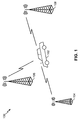
- FIG. 1 is a diagram illustrating an example of a radio broadcast network 100 in which a host system can be used.
- radio broadcast network 100 includes multiple base stations 104, 106 and 108 for transmitting radio transmission broadcasts.
- the radio transmission broadcasts are typically transmitted as stereo-multiplex signals in the VHF frequency band.
- Radio data system (RDS) data can be broadcast by base stations 104, 106 and 108, to display information relating to the radio broadcast.
- the station name, song title, and/or artist can be included in the RDS data.
- the RDS data can provide other services, such as showing messages on behalf of advertisers.
- RDS data of this disclosure is for the European RDS standard, which is defined in the European Committee for Electrotechnical Standardization, EN 50067 specification.
- Another exemplary utilization of the RDS data of this disclosure is for the North American radio broadcast data system (RBDS) standard (also referred to as NRSC-4), which is largely based on the European RDS standard.
- RBDS North American radio broadcast data system
- NRSC-4 North American radio broadcast data system
- the RDS data of this disclosure is not limited to one or more of the above standards/examples.
- the RDS data can include, additionally or alternatively, other suitable information related to a radio transmission.
- a host system at a receiving station 102 that receives the RDS data can reproduce that data on a display of the host system.
- receiving station 102 is depicted as a car.
- receiving station 102 should not be limited as such, and can also represent, for example, a person, another mobile entity/device, or a stationary entity/device associated with a host system.
- the host system can represent a computer, a laptop computer, a telephone, a mobile telephone, a personal digital assistant (PDA), an audio player, a game console, a camera, a camcorder, an audio device, a video device, a multimedia device, a component(s) of any of the foregoing (such as a printed circuit board(s), an integrated circuit(s), and/or a circuit component(s)), or any other device capable of supporting RDS.
- a host system can be stationary or mobile, and it can be a digital device.
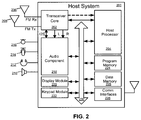
- FIG. 2 is a conceptual block diagram illustrating an example of a hardware configuration for a host system.
- Host system 200 includes transceiver core 202, which interfaces with host processor 204.
- Host processor 204 may correspond with a primary processor for host system 200.
- Transceiver core 202 can send/receive Inter-IC Sound (12s) information with audio component 218, and can send left and right audio data output to audio component 218.
- Transceiver core 202 can also receive FM radio information, which may include RDS data, through antenna 206.
- transceiver core 202 can transmit FM radio information through antenna 208.
- RDS data received by transceiver core 202 through antenna 206 can be processed by transceiver core 202, so as to reduce the number of interrupts sent to host processor 204.
- antenna 208 which is used for transmission of data, is not necessary for interaction between transceiver core 202 and host processor 204 or for reduction of interrupts.
- Host system 200 may also include a display module 220 for displaying, among other things, RDS data received through antenna 206.
- Host system may also include keypad module 222 for user input, as well as program memory 224, data memory 226 and communication interfaces 228. Communication between audio module 218, display module 220, keypad module 222, host processor 204, program memory 224, data memory 226 and communication interfaces 228 may be possible via a bus 230.
- host system 200 can include various connections for input/output with external devices. These connections include, for example, speaker output connection 210, headphone output connection 212, microphone input connection 214 and stereo input connection 216.
- FIG. 3 is a conceptual block diagram illustrating an example of a hardware configuration for transceiver core 202 of FIG. 2 .
- transceiver core 202 can receive FM radio information, including RDS data, through antenna 206 and can transmit FM radio information through antenna 208.
- Transceiver core 202 can also send/receive Inter-IC Sound (I2s) data, and can send left and right audio output via audio interface 304 to other parts of host system 200.
- I2s Inter-IC Sound
- Transceiver core 202 may include FM receiver 302 for receiving a FM radio signal, which may include RDS data.
- FM demodulator 308 can be used to demodulate the FM radio signal, and RDS decoder 320 can be used to decode encoded RDS data within the FM radio signal.
- Transceiver core 202 may also include RDS encoder 324 for encoding RDS data of an FM radio signal, FM modulator 316 for modulating the FM radio signal, and FM transmitter 306 for transmitting the FM radio signal via antenna 208.
- RDS encoder 324 for encoding RDS data of an FM radio signal
- FM modulator 316 for modulating the FM radio signal
- FM transmitter 306 for transmitting the FM radio signal via antenna 208.
- transmission of an FM radio signal from transceiver core 202 is not necessary for interaction between transceiver core 202 and host processor 204 or for reduction of interrupts.
- Transceiver core 202 also includes microprocessor 322 which, among other things, is capable of processing received RDS data.
- Microprocessor 322 can access program read only memory (ROM) 310, program random access memory (RAM) 312 and data RAM 314.
- ROM read only memory
- RAM program random access memory
- Microprocessor 322 can also access control registers 326, each of which includes at least one bit.
- control registers 326 can provide at least an indication(s) whether host processor 204 should receive an interrupt(s) by, for example, setting a bit(s) in a corresponding status register(s).
- control registers 326 can be seen to include parameters to filter RDS data and to reduce the number of interrupts to host processor 204. According to one aspect, these parameters are configurable (or controllable) by host processor 204, and depending on the parameter(s), transceiver core 202 can filter some or all of RDS data or not filter the RDS data. Furthermore, depending on the parameter(s), the number of interrupts to host processor 204 can be reduced or not reduced.
- transceiver core 202 may include a control interface 328 which, among other things, is used in asserting host interrupts to host processor 204.
- control interface 328 can access the control registers 326, since these registers are used for determining which interrupts are to be received by host processor 204.
- FIG. 4 is a conceptual block diagram illustrating examples of different implementations of transceiver core 202.
- transceiver core 202 can be integrated into various targets and platforms. These targets/platforms include, but are not limited to, a discrete product 402, a die inside a System in Package (SIP) product 404, a core integrated on-chip in discrete radio frequency integrated circuit (RF IC) 406, a core integrated on-chip in radio front end base band system-on-chip (RF/BB SOC) 408 and a core-integrated on-chip in die 410.
- SIP System in Package
- RF IC radio frequency integrated circuit
- RF/BB SOC radio front end base band system-on-chip
- transceiver core 202 and host processor 204 can be implemented on a single chip or a single component, or can be implemented on separate chips or separate components.
- FIG. 5 is a conceptual block diagram illustrating an example of benefits provided by using a transceiver core with a host processor.
- host processor 204 can offload processing to transceiver core 202.
- the number of interrupts asserted to host processor 204 can be reduced, since transceiver core 202 can, for example, filter the RDS data and/or include a buffer for the RDS data.
- the amount of traffic to host processor 204 can be reduced. As such, power and memory efficiency of the host processor is seen to be improved.
- FIG. 6 is a conceptual block diagram illustrating an example of the structure of the baseband coding of RDS data.
- RDS data may include one or more RDS groups. Each RDS group may have 104 bits.
- Each RDS group 602 may include 4 blocks, each block 604 having 26 bits each. More particularly, each block 604 may include an information word 606 of 16 bits and a checkword 608 of 10 bits.
- FIG. 7 is a conceptual block diagram illustrating an example of a message format and address structure for RDS data.
- Block 1 of every RDS group may include a program identification (PI) code 702.
- PI program identification
- Block 2 also may include 1 bit for a traffic code 710, and 4 bits for a program type (PTY) code 712.
- FIG. 8 is a conceptual block diagram illustrating an example of an RDS group data structure.
- Each RDS group data structure 802 may correspond to an RDS group 602 including plural blocks 604.
- the RDS group data structure may store the least significant bits (LSB) and most significant bits (MSB) of the information word 606 as separate bytes.
- RDS group data structure 802 may include a block status byte 804 for each block, where the block status byte 804 may indicates a block identification (ID) and whether there are uncorrectable errors in the block.
- ID block identification
- the RDS group data structure 802 represents an exemplary data structure which can be processed by transceiver core 202.
- transceiver core 202 includes a core digital component and a core firmware component, which are described in more detail below with reference to FIG. 9 .
- the core digital component correlates each block 604 of an RDS group 602 with the associated checkword 608, and generates a block status byte 804 indicating the block ID and whether there are any uncorrectable errors in the block 604.
- the 16 bits of the information word 606 are also placed in the RDS group data structure 802.
- the core firmware typically receives RDS group data 802 from the core digital component approximately every 87.6 msec.
- RDS data are exemplary, and the subject technology is not limited to these exemplary structures of RDS data and applies to other structures of data.
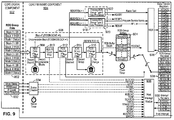
- FIG. 9 is a conceptual block diagram illustrating a core digital component and core firmware component of transceiver core 202.
- core firmware component 904 can receive RDS group data 802 from core digital component 902 approximately every 87.6 msec. The filtering and data processing performed by core firmware component 904 can potentially reduce the number of host interrupts and improve host processor utilization.
- Core firmware component 904 may include host interrupt module 936 and interrupt registers 930 for asserting interrupts to host processor 204. Interrupt registers 930 may be controllable by host processor 204. Core firmware component 904 may also include filter module 906, which may include RDS data filter 908, RDS program identification (PI) match filter 910, RDS Block-B filter 912, RDS group filter 914 and RDS change filter 916. In addition, core firmware component 904 may include group processing component 918. Core firmware component 904 may also include RDS group buffers 924, which may be utilized to reduce the number of interrupts to host processor 204. The filtering of RDS data, processing of group types 0 and 2, and use of RDS group buffers 924 will be described later in more detail. Core firmware component 904 may also include data transfer registers 926 and RDS group registers 928, each of which may be controllable by host processor 204.
- filter module 906 may include RDS data filter 908, RDS program identification (PI) match filter 910, RDS Block-B filter
- Core digital component 902 may provide data 932 including mono-stereo, RSSI level, interference (IF) count and sync detector information to core firmware component 904. This data 932 is receivable by status checker 934 of core firmware component 904. Status checker 934 processes data 932, and the processed data may result in an interrupt being asserted to host processor 204 via host interrupt module 936.
- RDS data filter 908 of filter module 906 can filter out an RDS group having either an uncorrectable error or a Block-E group type.
- Host processor 204 can enable transceiver core 202 so that RDS data filter 908 discards erroneous or unwanted RDS groups from being processed further.
- RDS data filter 908 may receive a group of RDS blocks approximately every 87.6 msec.
- block-E groups may be used for paging systems in the United States. They may have the same modulation and data structure as RDS data but may employ a different data protocol.
- block status 804 (see FIG. 8 ) of an RDS group is marked as "Uncorrectable” or "Undefined” and the RDSBADBLOCK is not set in the ADVCTRL register, the RDS data group is discarded. Otherwise, the data group is placed directly into RDS Group buffer 924. All other data groups are forwarded on through filter module 906 for further processing.
- RDS PI match filter 910 may determine whether an RDS group has a program identification (ID) which matches a given pattern, so that an interrupt to host processor 204 can be asserted.
- Host processor 204 can enable transceiver core 202 to assert an interrupt whenever the program ID in block 1 and/or the bits in block 2 match a given pattern.
- RDS PI match filter 910 is enabled when host processor 204 writes the PICHK bytes in the RDS_CONFIG data transfer (XFR) mode of transceiver core 202.
- RDS PI match filter 910 receives an RDS data group, it will compare the program identification (PI) in block 1 with the PICHK word provided by host processor 204. If the PI words match, then the PROGID interrupt status bit is set, and an interrupt is sent to host processor 204, if the PROGIDINT interrupt control bit of transceiver core 202 is enabled.
- the PI can be a 4-digit Hex code unique for each station/program.
- the capability of RDS PI match filter 910 could be used, for example, in cases where host processor 204 wants to know immediately whether a currently tuned channel is the program that it desires.
- RDS Block-B filter 912 may determine whether an RDS group has a block 2 (i.e., Block-B) entry which matches a given Block-B parameter, so that an interrupt to host processor 204 can be asserted.
- RDS Block-B filter 912 can provide a quick route of specific data to host processor 204. If block 2 of the RDS data group matches the host processor defined Block-B filter parameters, then the group data is immediately made available for host processor 204 to process. No further processing of the RDS group data is performed in transceiver core 202.
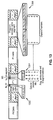
- FIG. 10 is an exemplary sequence chart illustrating one case of a host receiving RDS Block-B data.
- host processor 204 can communicate with transceiver core 202.
- a Block-B match is detected in transceiver core 202, and host processor 204 becomes aware that a Block-B match has occurred.
- RDS group filter 914 can filter out an RDS group having a group type which is not within a given one or more group types.
- RDS group filter 914 can provide a means for host processor 204 to select which RDS group types to store into RDS group buffers 924, so that host processor 204 only has to process the data in which it is interested.
- host processor 204 can enable transceiver core 202 to only pass selected RDS group types.
- core firmware component 904 can be configured (e.g., by host processor 204) to filter out, if so desired, or not to filter out RDS group data for group type 0 or group type 2.
- FIG. 9 depicts that RDS group data 802 with either a group type 0 or group type 2 are processed by group processing component 918, if RDSRTEN, RDSPSEN, and/or RDSAFEN are set in the ADVCTRL register.
- host processor 204 may filter out a specific group type (i.e., Core discards) by setting a bit in the following data transfer mode (RDS_CONFIG) registers in transceiver core 202:
- RDS group filter 914 represents a particular group type.
- FIG. 11 is a conceptual block diagram illustrating an example of RDS group filter 914.
- RDS group filter 914 is cleared (all bits are set back to "0"). If a bit is set ("1") then that particular group type will not be forwarded.
- RDS change filter 916 filters out an RDS group having RDS group data which has not changed.
- Host processor 204 can enable transceiver core 202 to pass the specified group types only if there are changes in RDS group data.
- RDS group data that passes through RDS group filter 914 may be applied to RDS change filter 916.
- RDS change filter 916 may be used to reduce the amount of repeat data for each particular group type.
- host processor 204 may set the RDSFILTER bit in the ADVCTRL register of transceiver core 202.
- filter module 906 is capable of performing various types of filtering of RDS group data 802, so as to reduce the number of interrupts to host processor 204.
- core firmware component 904 may also include group processing component 918, which will now be described in more detail.
- Group processing component 918 may include RDS group type 0 data processor 922 and RDS group type 2 data processor 920. With reference to RDS group type 0 data processor 922, this processor may determine whether an RDS group has a group type 0 and whether there is a change in program service (PS) information for the RDS group, so as to assert an interrupt to host processor 204 when such a determination is positive.
- PS program service
- Transceiver core 202 has the capability of processing RDS group type 0A and 0B data.
- This type of group data is typically considered to have the primary RDS features (e.g., program identification (PI), program service (PS), traffic program (TP), traffic announcement (TA), seek/scan program type (PTY) and alternative frequency (AF)) and is typically transmitted by FM broadcasters.
- PI program identification
- PS program service
- TP traffic program
- TA traffic announcement
- AF seek/scan program type
- AF seek/scan program type
- this type of group data provides FM receivers with tuning information such as the current program type (ex., "Soft Rock"), program service name (ex., "ROCK1053”) and possible alternative frequencies that carry the same program.
- FIG. 12 is a conceptual block diagram illustrating an example of RDS basic tuning and switching information for RDS group type 0A. It shows, among other data, group type code 1202, program service name and DI segment address 1204, alternative frequency 1206, and program service name segment 1208.
- FIG. 13 is a conceptual block diagram illustrating an example of RDS basic tuning and switching information for group type 0B. It shows, among other data, group type code 1302, program service name and DI segment address 1304, and program service name segment 1306.
- transceiver core 202 can assemble and validate program service character strings, and only when the string changes, or is repeated once, transceiver core 202 alerts host processor 204.
- Host processor 204 may only have to output the indicated string(s) on its display.
- host processor 204 can set the RDSPSEN bit in the ADVCTRL register of transceiver core 202.
- the program service (PS) table event may consist of an array of eight program service name strings (8 characters in length). This PS table may be seen to handle the United States radio broadcasters' usage of program service as a text-messaging feature similar to radio text.
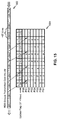
- FIG. 14 is a conceptual block diagram illustrating an example of a format for program service (PS) table 1400.
- the first byte of PS table 1400 may consist of bit flags (PS0 - PS7) used to indicate which program service names in PS table 1400 are new or repeats. For example, if PS2 - PS4 are set and the update bit ("U") is set, then host processor 204 only cycles through PS2 - PS4 on its display.
- PS table 1400 The next five bits in PS table 1400 are the current program type (e.g., "Classic Rock”).
- the update flag (“U) indicates whether the indicated program service names are new ("0") or repeats ("1").
- PS table 1400 The next four bits in PS table 1400 are flags extracted from the group 0 packet, as follows:
- FIG. 15 is a conceptual block diagram illustrating an example of generating a PS name table 1504.
- the broadcaster is constantly transmitting the same sequences of group 0 packets 1502 indicating the artist and song title.
- Transceiver core 202 re-assembles and validates each PS name string and update PS table 1504 as needed.
- FIG. 16 is a conceptual diagram illustrating an example of PS name data and corresponding text displayed on a host system 200.
- the content of the last PS table 1602 received by host processor 204 is shown.
- host processor 204 should read the update flag, which indicates repeat, and cycle through the PS names as indicated in the PS bit flags for PS2 through PS5. These PS names can then be displayed on host display 1604.
- Enabling the foregoing validation feature as well as filtering out group 0A/0B packets from RDS group buffers 924 can greatly reduce the amount of traffic from transceiver core 202 to host processor 204. Only a few PS table events will occur during a song or a commercial break instead of many group 0 packets.
- FIG. 17 is a sequence chart illustrating an example of processing RDS data with group type 0. More particularly, FIG. 17 provides an example of how host processor 204 can enable the RDS group type 0 data processing feature and receive PS table data from transceiver core 202.
- Host system 300 may provide for dynamic program service names for group type 0 data.
- the RBDS standard North American equivalent of the European RDS standard adopted less stringent requirements for PS usage. Broadcasters in the United States use the program service name to not only present call letters (“KPBS”) and slogans ("Z-90"), but also use it to also transmit song title and artist information. Therefore, the PS may be continuously changing.
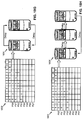
- FIGS. 18A to 18J are conceptual diagrams illustrating an example of dynamic PS name data and corresponding display text on host processor 204.
- an FM broadcaster uses the program service name to transmit "Soft,” “Rock,” “Kicksy,” and "96.5" repeatedly during a commercial break. When a song starts to play, the broadcaster then transmits "Faith by,” “George,” and “Michael” continuously during the song. The broadcaster constantly repeats PS strings since it does not know when receivers are tuned into the station. Such repeated transmission can lead to numerous interrupts being sent to host processor 204.
- element 1802 corresponds with the PS name table and element 1804 corresponds with the host display.
- transceiver core 202 is enabled during the broadcaster's commercial break and starts receiving RDS group type 0A segments 0-3 that create "Rock ".
- This string is placed in PS table 1802, the corresponding PS bit is set, and the update flag is set to new ("0").
- the current program type (PTY), program identification (PI), and other fields are also filled in.
- the RDSPS interrupt status bit is set and if the RDSPSINT interrupt control bit is enabled, an interrupt is generated for host processor 204.
- host processor 204 reads PS table 1802, it detects that the PS name in the table is new and refresh its display 1804 with the indicated PS string.
- Transceiver core 202 receives the next group 0A segments 0-3 which creates an 8-character string that matches an element already in PS table 1802.
- the repeated PS bit is set, and the update flag is set to repeat ("1").
- An interrupt is generated for host processor 204, if enabled, and host processor 204 reads PS table 1802 and leaves its display 1804 with the repeated PS name.
- Transceiver core 202 receives group 0A segments 0-3 "Kicksy ". Transceiver core 202 places the PS string in the next available slot in PS table 1802, sets the corresponding PS flag bit, and sets the update flag to new ("0").
- Transceiver core 202 receives group 0A segments 0-3 that create the string " 96.5 ". Transceiver core 202 places the PS string in next available slot in PS table 1802, sets the corresponding PS flag bit, and sets the update flag to new ("0").
- the broadcaster transmits the PS name "Soft " and transceiver core 202 updates PS table 1802.
- the broadcaster is repeating the four PS names throughout the commercial break.
- Transceiver core 202 receives "Rock " and so it sets the corresponding PS flag bit and the update flag to repeat ("1").
- transceiver core 202 receives "Kicksy " again and sets the PS flag bit and the update flag to repeat ("1"). Since there are now multiple program service names that are flagged as repeat, host processor 204 cycles through the PS names with a pre-defined delay (e.g., 2 seconds). If host processor 204 receives a PS table that indicates new PS names, it cancels the periodic display timer and displays the new PS name.
- a pre-defined delay e.g. 2 seconds
- transceiver core 202 receives the repeated string " 96.5 " and sets the corresponding PS bit and the update flag to repeat ("1").
- transceiver core 202 receives the repeated string "Soft " and sets the corresponding PS bit and the update flag to repeat ("1"). At this point transceiver core 202 stops sending PS table events to host processor 204 since the PS names "Soft”, “Rock”, “Kicksy”, and "96.5" repeat during the commercial break (which can last a few minutes). Host processor 204 uses the last PS table 1802 received to update its display 1804.
- Transceiver core 202 receives RDS group type 0A segments 0-3 that create " George ". This string is placed in PS table 1802, the corresponding PS bit is set, and the update flag is set to new ("0").
- RDS group type 0 data processing feature was tested with a real life broadcast. During a period of time ( ⁇ 10 minutes), a local broadcaster transmitted 2,973 group type 0A during a Song1 ⁇ Commercial Break ⁇ Song2 sequence. With the RDSPSEN feature enabled, transceiver core 202 sent 49 PS tables to host processor 204.
- host processor 204 wishes to process RDS group type 0A itself, it could configure RDS group filter 914 (see FIG. 9 ) to route all the group type 0A packets. In this example, host processor 204 would have received 2,973 group type 0A packets. Host processor 204 would then have to spend processor time validating and assembling the program service names. In this example, the savings in host processor "interrupts" using the RDS group type 0 data processing feature would have been 98.4%.
- host system 200 may also provide for static program service names.
- the design intent of the program service may be to provide a label for the receiver preset which is invariant, since receivers incorporating the alternative frequency (AF) feature will switch from one frequency to another in following a selected program.
- the PS name of a tuned service is inherently static.
- Transceiver core 202 uses the same PS table event to notify host processor 204 of a new program service name. Host processor 204 can retrieve the PS table at anytime.
- FIGS. 19A to 19B are conceptual diagrams illustrating an example of static PS name data and corresponding display text on host processor 204.
- a European user tunes to a new channel ("CAPITAL ").
- element 1902 corresponds with the PS name table and element 1904 corresponds with the host display.
- FIG. 19A which can be seen to correspond with a first event, host processor 204 tunes transceiver core 202 to a new frequency.
- Transceiver core 202 receives RDS group type 0A segments 0-3 that create "CAPITAL ". This string is placed in PS table 1902, the corresponding PS bit is set, and the update flag is set to new ("0"). The current program type is also filled in.
- Host processor 204 receives the PS table event and updates its display 1904.
- transceiver core 202 receives sequential segments 0-3 which creates an 8-character string that matches an element already in PS table 1902.
- the repeated PS bit is set and the update flag is set to repeat ("1").
- host processor 204 leaves the repeat program service name on its display 1904 until it receives another PS table event that has the update flag set to new. This would occur if the traffic announcement (TA) field changes or if host processor 204 tunes to a different station.
- TA traffic announcement
- Transceiver core 202 may determine whether an RDS group has a group type 0 and whether there is a change in AF list information, so that an interrupt can be asserted to host processor 204. In one example, transceiver core 202 will extract the AF list from group type 0A and only when the list changes, will transceiver core 202 provide the AF list in a host control interface (HCI) event. Host processor 204 could use this list to manually tune the FM radio to an alternative frequency. In addition, if host processor 204 receives an AF list for the currently tuned station, it can enable an AF jump search mode if the received signal strength goes below a certain threshold. To enable the RDS alternative frequency list feature, host processor 204 can set the RDSAFEN bit in the ADVCTRL register.
- HCI host control interface
- FIG. 20 is a conceptual block diagram illustrating an example of an alternative frequency (AF) list format.
- Host processor 204 uses the RDS_AF_0/1 data transfer (XFR) modes to read AF list 2000 from transceiver core 202.
- XFR data transfer
- group processing component 918 may also include RDS group type 2 data processor 920, which will now be described in greater detail.
- RDS group type 2 data processor 920 may determine whether an RDS group has a group type 2 and whether there is a change in radio text (RT) information for the RDS group, so as to assert an interrupt to the host processor when such a determination is positive.
- RT is typically considered to be a secondary feature of RDS, and allows radio broadcasters to transmit up to 64 characters of information to the listener such as current artist, song title, station promotions, etc.
- transceiver core 202 may extract out the RT and provide up to a 64 character string, along with the PI and PTY, to host processor 204 only when the RT string changes.
- Transceiver core 202 may assemble and validate the radio text character string, and when the string changes, transceiver core 202 interrupts host processor 204, if RDSRTINT is enabled.
- Host processor 204 may then read the radio text by using the RDS_RT_0/1/2/3/4 data transfer (XFR) modes.
- Host processor 204 may only need to output the string on its display.
- the radio text may end with a carriage return (0x0D) but some broadcasters pad the string with spaces (0x20).
- host processor 204 can set the RDSRTEN bit in the ADVCTRL register.
- FIG. 21 is a conceptual block diagram illustrating an exemplary format of RDS radio text for group type 2A. It shows, among other data, group type code 2102, text segment address code 2104, and radio text segments 2106 and 2108.
- FIG. 22 is a conceptual block diagram illustrating an exemplary format of RDS radio text for group type 2B. It shows, among other data, group type code 2202, text segment address code 2204, and radio text segment 2206.
- RDS group type 2 data processing feature was tested with a real life broadcast. During a period of time ( ⁇ 10 minutes), a local broadcaster transmitted 3,464 group type 2A during a Song1 ⁇ Commercial Break ⁇ Song2 sequence. With the RDSRTEN advanced feature enabled, transceiver core 202 only sent three Radio Text events to host processor 204.
- RDS Block-B filter 912 (see FIG. 9 ) was configured to route all group type 2A, host processor 204 would have been interrupted with BFLAG 3,464 times. Host processor 204 would then have to spend processor time validating and assembling the text string. In this example, the savings in host processor "interrupts" using the RDS group type 2 data processing would have been 99.9%.
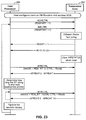
- FIG. 23 is a sequence chart illustrating an example of the RDS group type 2 data processing. It shows an example of how host processor 204 would enable the RDS group type 2 data processing feature and receive radio text data.
- group processing component 918 includes RDS group type 0 data processor 922 and RDS group type 2 data processor 920 for processing these specific group types.
- core firmware component 904 may also include RDS group buffers 924, which will now be described in more detail.
- RDS group buffers 924 may store plural RDS groups before interrupting host processor 204, so as to reduce the number of interrupts for new RDS data.
- FIG. 24 is a conceptual block diagram illustrating an example of RDS group buffers.
- Transceiver core 202 may contain dual RDS group buffers 2402 and 2404 (corresponding to element 924 in FIG. 9 ) that can hold up to 21 RDS groups.
- An RDS group contains, for example, 4 blocks. Each block contains two information bytes and one status byte, as previously described with reference to FIG. 8 .
- Host processor 204 configures the buffer threshold with the DEPTH parameter of the RDS_CONFIG data transfer (XFR) mode.
- transceiver core 202 can notify host processor 204 and switch to the other buffer where it begins filling with the next RDS group.
- the dual RDS group buffers allow host processor 204 to read from one buffer while transceiver core 202 writes to the other. It should be noted that host processor 204 reads the contents of one RDS group buffer before transceiver core 202 fills the other buffer (to the pre-defined threshold) or else it can lose the remaining data in that buffer.
- Host processor 204 can also set a flush timer to prevent groups in a buffer from becoming "stale."
- the flush timer can be configured by writing the FLUSHT in the RDS_CONFIG data transfer (XFR) mode.
- FIG. 25 is a sequence chart illustrating an example of buffering and processing RDS group data.
- host processor 204 can read the contents of the RDS group buffers 924 of FIG. 9 by communicating with transceiver core 202.
- transceiver core 202 (i) using RDS data filter 908, host processor 204 can enable transceiver core 202 to discard uncorrectable blocks and RDS groups that consist of Block-E types, which may be used in paging systems in the United states; (ii) using RDS PI match filter 910, host processor 204 can enable transceiver core 202 to assert an interrupt whenever the program ID in block 1 and/or the bits in block 2 match a given pattern; (iii) using Block-B-filter 912, host processor 204 can enable transceiver core 202 to assert an interrupt whenever block 2 of an RDS data group matches Block-B filter parameters defined by host processor 204; (iv) using RDS group filter 914, host processor 204 can enable transceiver core 202 to only pass the specified group types; and (v) using RDS change filter 916, host processor 204 can enable transceiver core 202 to enable transceiver core 202 to only pass the specified group types; and (v) using RDS change filter 916,
- the host processor controllable RDS features further include: (vi) using RDS group buffers 924, host processor 204 can configure transceiver core 202 to buffer up to 21 groups before notifying host processor 204 that there is new RDS data to be processed; (vii) using RDS group type 0 data processor 922, host processor 204 can enable transceiver core 202 to process RDS group type 0 (basic tuning and switching information) packets, where transceiver core 202 can extract out the program identification (PI) code, program type (PTY) and provide a table of program service (PS) strings, where transceiver core 202 may only send information when there are changes in the PS table (e.g., when a song changes), and where host processor 204 can also enable transceiver core 202 to extract the alternative frequency (AF) list information from RDS group type 0; and (viii) using RDS group type 2 data processor 920, host processor 204 can enable transceiver core 202 to process RDS group type 2 (radio text) packet
- transceiver core 202 has numerous filtering and data processing capabilities that can help reduce the amount of RDS processing on host processor 204. For example, buffering of the RDS group data in transceiver core 202 can reduce the number of interrupts to host processor 204. Thus, host processor 204 does not have to wake-up as often to acknowledge RDS interrupts. Filtering enables host processor 204 to only receive the desired data types and only if it has changed. This typically reduces the amount of interrupts and saves code on the host processor 204 that would have been needed to filter out the "raw" RDS data. Processing of the main RDS group types (0 and 2) in transceiver core 202 is seen to offload host processor 204.
- Host processor 204 would only have to display the preprocessed PS and RT strings to the user.
- the PS table and RT string resides in the transceiver core's memory so host processor 204 could disable all interrupts and retrieve the current strings when it wishes (e.g., coming out of screen saver mode).
- FIG. 26 is a conceptual block diagram illustrating an example of a configuration for transceiver core 202 for performing various levels of RDS data processing. As shown in FIG. 26 , transceiver core 202 can be configured to perform various levels of RDS processing.
- FIG. 27 is a flowchart illustrating an exemplary operation of processing RDS data utilizing a data processor.
- RDS data is received by a data processor.
- the received RDS data is filtered by the data processor. This allows host processor 204 to receive a selected set of the RDS data.
- the number of interrupts to host processor 204 is reduced by the data processor.
- a data processor may include one or more of the components or all of the components shown in FIG. 9 .
- a data processor may include a microprocessor 322 of FIG. 3 , or any other one or more of the components or all of the components shown, for example, in FIG. 3 .
- a data processor and a host processor may be implemented on the same integrated circuit, the same printed circuit board, or the same device or component.
- a data processor and a host processor may be implemented on separate integrated circuits, separate printed circuit boards, or separate devices or components.
- a data processor and a host processor may be distributed over different devices or components.
- a data processor may be configured to filter the RDS data based on one or more parameters configurable by a host processor (e.g., controlled, enabled or disabled by a host processor) so that depending on the one or more parameters, the selected set of the RDS data is a subset of the RDS data.
- a host processor e.g., controlled, enabled or disabled by a host processor
- the selected set of the RDS data is a subset of the RDS data, none of the RDS data, or the entire RDS data.
- a data processor may include one or more filters (e.g., blocks 908, 910, 912, 914, and 916 in FIG. 9 ) for filtering the RDS data.
- Each or some of the filters can be selectively configurable by a host processor (e.g., controlled, enabled or disabled by a host processor).
- a host processor e.g., controlled, enabled or disabled by a host processor
- each or some of the filters can be configurable by a host processor independently of one or more of the other filters.
- a data processor may also include one or more RDS group buffers that are selectively configurable by a host processor (e.g., controlled, enabled or disabled by a host processor).
- a data processor may include one or more group processing components (e.g., blocks 920 and 922 in FIG. 9 ) that are selectively configurable by a host processor (e.g., controlled, enabled or disabled by a host processor).
- group processing components e.g., blocks 920 and 922 in FIG. 9
- a host processor e.g., controlled, enabled or disabled by a host processor
- one or more group processing elements can be configurable by a host processor independently of one or more of the other group processing components.
- a data processor is configured to reduce the number of interrupts to a host processor based on one or more parameters configurable by the host processor (e.g., controlled, enabled or disabled by a host processor) so that depending on the one or more parameters, the number of interrupts are reduced or not reduced.
- Each of a data processor and a host processor may be implemented using software, hardware, or a combination of both.
- each of a data processor and a host processor may be implemented with one or more processors.
- a processor may be a general-purpose microprocessor, a microcontroller, a digital signal processor (DSP), an application specific integrated circuit (ASIC), a field programmable gate array (FPGA), a programmable logic device (PLD), a controller, a state machine, gated logic, discrete hardware components, or any other suitable device that can perform calculations or other manipulations of information.
- DSP digital signal processor
- ASIC application specific integrated circuit
- FPGA field programmable gate array
- PLD programmable logic device
- controller a state machine, gated logic, discrete hardware components, or any other suitable device that can perform calculations or other manipulations of information.
- Each of a data processor and a host processor may also include one or more machine-readable media for storing software.
- Software shall be construed broadly to mean instructions, data, or any combination thereof, whether referred to as software, firmware, middleware, microcode, hardware description language, or otherwise. Instructions may include code (e.g., in source code format, binary code format, executable code format, or any other suitable format of code).
- Machine-readable media may include storage integrated into a processor, such as might be the case with an ASIC.
- Machine-readable media may also include storage external to a processor, such as a random access memory (RAM), a flash memory, a read only memory (ROM), a programmable read-only memory (PROM), an erasable PROM (EPROM), registers, a hard disk, a removable disk, a CD-ROM, a DVD, or any other suitable storage device.
- RAM random access memory
- ROM read only memory
- PROM erasable PROM
- registers a hard disk, a removable disk, a CD-ROM, a DVD, or any other suitable storage device.
- machine-readable media may include a transmission line or a carrier wave that encodes a data signal.
- a machine-readable medium is a computer-readable medium encoded or stored with instructions and is a computing element, which defines structural and functional interrelationships between the instructions and the rest of the system, which permit the instructions' functionality to be realized.
- Instructions may be executable, for example, by a host system or by a processor of a host system. Instructions can be, for example, a computer program including code.
- FIG. 28 is a conceptual block diagram illustrating an example of the functionality of a host system for processing RDS data.
- Host system 200 includes a host processor 204 and a data processor 2802.
- Data processor 28'02 includes a module 2804 for receiving the RDS data.
- Data processor 2802 further includes a module 2806 for filtering the RDS data to allow host processor 204 to receive a selected set of the RDS data.
- data processor 2802 includes a module 2808 for reducing the number of interrupts to host processor 204.
- each of group processing component 918 and filter module 906 may be implemented as electronic hardware, computer software, or combinations of both.
- group processing component 918 and filter module 906 may be implemented as electronic hardware, computer software, or combinations of both.
- various illustrative blocks, modules, elements, components, methods, and algorithms have been described above generally in terms of their functionality. Whether such functionality is implemented as hardware or software depends upon the particular application and design constraints imposed on the overall system. Skilled artisans may implement the described functionality in varying ways for each particular application.
- Various components and blocks may be arranged differently (e.g., arranged in a different order, or partitioned in a different way) all without departing from the scope of the subject technology.
- the specific orders of the filters in filter module 906 of FIG. 9 may be rearranged, and some or all of the filters may be partitioned in a different way.
- This document defines the control registers for the FM+RDS Transceiver Core (the "Core”).
- the Core's high-level architecture is shown in Figure 1 -I. This core can be made into a standalone IC, embedded within a SIP, or integrated within another die or chip.
- control registers may be defined for communication between the Host Processor (the "Host) and the Core.
- Code variables appear in angle brackets, e.g., ⁇ number>.
- Commands and command variables appear in a different font, e.g., copy a: *.* b:.
- Parameter types are indicated by arrows:
- Reference documents which may include QUALCOMM ® , standards, and resource documents, arc listed in Table 1-1.
- Table 1-1 Reference documents and standards Ref.
- 011 Scan for Weakest Stations SRCHMODE[2:0] Searches the entire FM band for the 12 weakest stations. Host can retrieve this information by reading the RX_STATIONS_0(1) data transfer mode. The FM Controller may automatically tune to the weakest station at the end of the scan.
- 100 RDS Seek PTY Similar to Seek mode but may search for next channel that matches the RDS Program Type (SRCHPTY). If no channel matches the PTY, then may return to start.
- 101 RDS Scan PTY Similar to Scan mode but may search for next channel that matches the RDS Program Type (SRCHPTY). If no channel matches the PTY, then may return to start.
- RDS Seek PI Similar to Seek PTY but may search for RDS Program Identification (SRCHPI).
- 111 RDS AF Jump Tune to Alternate Frequency (AF) and stay if signal quality better than current channel.
- ERROR may be set if could not perform the specified search.
- TUNE is set every time the FM Controller tunes to a "good" channel.
- Table 3-17 RMSSI - Received Main Signal Strength Indication Description Bit Field Name Access Description 7:0 RMSSI R MSSI combined with LNA gain, VGA gain, and other constants to represent the received main signal strength measured at the antenna.
- Table 3-18 IFCNT - Interference Count Description Bit Field Name Access Description 7:0 IFCNT R Measured by the Interference Detector as the frequency separation from the main signal.
- Table 3-19 RDS1 LSB - RDS Block 1 LSB Description Bit Field Name Access Description 7:0 RDS1[7:0] R RDS Block 1 information bits m 0 - m 7 .
- the Data Transfer (XFR) registers are used to pass various data and configuration parameters between the Core and host processor.
- the host processor sets the desired MODE in the XFRCTRL register and set the CTRL field to read.
- the Core may then populate the XFRDAT0 - XFRDAT15 registers with the defined mode bytes.
- the Core may set the TRANSFER interrupt status bit and interrupt the host if the TRANSFERCTRL interrupt control bit is set.
- the host may then extract the XFR mode bytes once it detects that the Core has updated the registers.
- the host processor updates XFRDAT0 - XFRDAT 15 with the appropriate mode bytes.
- the host processor then sets the desired MODE in the XFRCTRL register and set the CTRL field to write.
- the core may detect that the XFRCTRL register was written to and may read the XFR mode bytes. After reading all the mode bytes, the Core may set the TRANSFER interrupt status bit and interrupt the host if the TRANSFERCTRL interrupt control bit is set.
- Table 4-1 describes the XFR bytes for each given mode.
- Table 4-3 RDS_PS_1 - RDS Program Service Table 1 Mode Byte Bit Field Name Access Reset Description 0 7:0 PS_0_0 RW 0 Program Service Name 0 character number 1. 1 7:0 PS_0_1 RW 0 Program Service Name 0 character number 2. 2 7:0 PS_0_2 RW 0 Program Service Name 0 character number 3. 3 7:0 PS_0_3 RW 0 Program Service Name 0 character number 4. 4 7:0 PS_0_4 RW 0 Program Service Name 0 character number 5. 5 7:0 PS_0_5 RW 0 Program Service Name 0 character number 6. 6 7:0 PS_0_6 RW 0 Program Service Name 0 character number 7.
- control registers can be used by the Host processor to download firmware into the Corc's program RAM.
- Two image formats arc supported:
Landscapes
- Engineering & Computer Science (AREA)
- Signal Processing (AREA)
- Circuits Of Receivers In General (AREA)
Claims (14)
- Ein Host-System (200) zum Verarbeiten von RDS (Radio Data System)-Daten, die eine oder mehrere RDS-Gruppen enthalten, wobei jede Gruppe eine Vielzahl von Blöcken aufweist, wobei das Host-System (200) aufweist:einen Host-Prozessor (204);und gekennzeichnet durch:einen Datenprozessor (2802), der konfiguriert ist zum Empfangen der RDS-Daten, damit der Host-Prozessor (204) einen ausgewählten Satz der RDS-Daten empfangen kann, und zum Reduzieren der Anzahl von Unterbrechungen zu dem Host-Prozessor (204), aufweisend:ein RDS-Änderungsfilter (916), das konfiguriert ist zum Herausfiltern einer RDS-Gruppe aus der einen oder den mehreren RDS-Gruppen, die unveränderte RDS-Gruppendaten aufweist.
- Host-System (200) nach Anspruch 1, wobei jeder aus der Vielzahl von Blöcken ein Informationswort und ein Blockstatusbyte aufweist, wobei das Blockstatusbyte konfiguriert ist zum Angeben einer Blockidentifikation und des Vorhandenseins von nicht-korrigierbaren Fehlern in einem entsprechenden aus der Vielzahl von Blöcken.
- Host-System (200) nach Anspruch 1, wobei der Datenprozessor (2802) weiterhin ein oder mehrere Filter aufweist, die wahlweise und unabhängig konfigurierbar sind basierend auf einem oder mehreren Parametern, die durch den Host-Prozessor (204) konfigurierbar sind, sodass in Abhängigkeit von dem einen oder den mehreren Parametern der ausgewählte Satz von RDS-Daten einen Teilsatz der RDS-Daten, keine der RDS-Daten oder die vollständigen RDS-Daten umfasst.
- Host-System (200) nach Anspruch 1, wobei der Datenprozessor (2802) konfiguriert ist zum Reduzieren der Anzahl von Unterbrechungen zu dem Host-Prozessor (204) basierend auf einem oder mehreren Parametern, die durch den Host-Prozessor (204) konfigurierbar sind, sodass in Abhängigkeit von dem einen oder den mehreren Parametern die Anzahl von Unterbrechungen reduziert oder nicht reduziert wird.
- Host-System (200) nach Anspruch 3, wobei das eine oder die mehreren Filter aufweisen:ein RDS-Datenfilter (908), das konfiguriert ist zum Herausfiltern einer RDS-Gruppe mit einem nicht-korrigierbaren Fehler oder einer RDS-Gruppe mit einem Block-E-Gruppentyp, wobei der Block-E-Gruppentyp einer Anzahl von korrigierten Fehlern in einem entsprechenden aus der Vielzahl von Blöcken entspricht, oderein RDS-Programmidentifikation (PI)-Abstimmungsfilter (910), das konfiguriert ist zum Bestimmen, ob eine RDS-Gruppe eine Programmidentifikation, die einem bestimmten Muster entspricht, aufweist, um eine Unterbrechung zu dem Host-Prozessor (204) auszugeben, wenn die Bestimmung positiv ist, oderein RDS-Block-B-Filter (912), das konfiguriert ist zum Bestimmen, ob eine RDS-Gruppe einen Block-2-Eintrag aufweist, der einem gegebenen Block-B-Parameter entspricht, wobei der Block-B-Parameter einer Anzahl von korrigierten Fehlern in einem entsprechenden aus der Vielzahl von Datenblöcken entspricht, oderein RDS-Gruppen-Filter (914), das konfiguriert ist zum Herausfiltern einer RDS-Gruppe mit einem Gruppentyp, der nicht zu einem oder mehreren gegebenen Gruppentypen gehört.
- Host-System (200) nach Anspruch 3, wobei der Datenprozessor (2802) konfiguriert ist zum Bestimmen, ob eine RDS-Gruppe einen Gruppentyp 0 aufweist und ob eine Änderung in Programmdienst (PS)-Informationen für die RDS-Gruppe vorliegt, um eine Unterbrechung zu dem Host-Prozessor (204) auszugeben, wenn die Bestimmung positiv ist.
- Host-System (200) nach Anspruch 3, wobei der Datenprozessor (2802) konfiguriert ist zum Bestimmen, ob eine RDS-Gruppe einen Gruppentyp 0 aufweist und ob eine Änderung in Alternativfrequenz (AF)-Listeninformationen vorliegt, um eine Unterbrechung zu dem Host-Prozessor (204) auszugeben, wenn die Bestimmung positiv ist.
- Host-System (200) nach Anspruch 3, wobei der Datenprozessor (2802) konfiguriert ist zum Bestimmen, ob eine RDS-Gruppe einen Gruppentyp 2 aufweist und ob eine Änderung in Radiotext (RT)-Informationen für die RDS-Gruppe vorliegt, um eine Unterbrechung zu dem Host-Prozessor (204) auszugeben, wenn die Bestimmung positiv ist.
- Host-System (200) nach Anspruch 3, wobei der Datenprozessor (2802) einen Speicherpuffer (924) aufweist, der wahlweise durch den Host-Prozessor (204) konfigurierbar ist, um mehrere RDS-Gruppen zu speichern, bevor der Host-Prozessor (204) unterbrochen wird, um die Anzahl von Unterbrechungen für neue RDS-Daten zu reduzieren.
- Host-System (200) nach Anspruch 1, das weiterhin aufweist:wenigstens ein Unterbrechungs-Steuerregister, wobei jedes des wenigstens einen Unterbrechungs-Steuerregisters wenigstens ein Bit aufweist, undwenigstes ein Unterbrechungs-Statusregister, wobei jedes des wenigstens einen Unterbrechungs-Statusregisters konfiguriert ist, um einem entsprechenden Unterbrechungs-Steuerregister zu entsprechen, und wenigstens ein Bit aufweist,wobei das Bit für jedes des wenigstens einen Unterbrechungs-Steuerregisters konfiguriert ist zum Bestimmen, ob der Host-Prozessor (204) eine Unterbrechung empfangen soll, wenn das Bit in einem entsprechenden einen des wenigstens einen Unterbrechungs-Statusregisters gesetzt ist.
- Host-System (200) nach einem der vorstehenden Ansprüche, wobei der Datenprozessor (2802) weiterhin einen oder mehrere Gruppenpuffer aufweist, die konfiguriert sind zum Speichern einiger oder aller der mehreren RDS-Gruppen, um die Anzahl von Unterbrechungen zu dem Host-Prozessor (204) zu reduzieren.
- Host-System (200) nach Anspruch 11, das weiterhin aufweist:eine oder mehrere Gruppenverarbeitungskomponenten, die wahlweise durch den Host-Prozessor (204) konfigurierbar sind.
- Ein Verfahren zum Verarbeiten von RDS (Radio Data System)-Daten, die eine oder mehrere RDS-Gruppen enthalten, aufweisend:Empfangen der RDS-Daten an einem Datenprozessor (2802) und Verarbeiten der empfangenen Daten, damit ein Host-Prozessor (204) einen ausgewählten Satz der RDS-Daten empfangen kann, und Reduzieren der Anzahl von Unterbrechungen zu dem Host-Prozessor (204),dadurch gekennzeichnet, dass das Verarbeiten der empfangenen Daten aufweist:Herausfiltern einer RDS-Gruppe, die unveränderte RDS-Gruppendaten aufweist.
- Ein computerlesbares Speichermedium mit einem darauf gespeicherten Computerprogramm, wobei das Programm computerausführbare Befehle aufweist, die ausgebildet sind, um bei einer Ausführung durch ein Verarbeitungsmodul die Verfahrensschritte von Anspruch 13 durchzuführen.
Applications Claiming Priority (2)
| Application Number | Priority Date | Filing Date | Title |
|---|---|---|---|
| US11/944,045 US8503957B2 (en) | 2007-11-21 | 2007-11-21 | Radio data system (RDS) data processing methods and apparatus |
| PCT/US2008/084392 WO2009067689A1 (en) | 2007-11-21 | 2008-11-21 | Radio data system (rds) data processing methods and apparatus |
Publications (2)
| Publication Number | Publication Date |
|---|---|
| EP2232745A1 EP2232745A1 (de) | 2010-09-29 |
| EP2232745B1 true EP2232745B1 (de) | 2016-03-02 |
Family
ID=40642493
Family Applications (1)
| Application Number | Title | Priority Date | Filing Date |
|---|---|---|---|
| EP08851728.9A Not-in-force EP2232745B1 (de) | 2007-11-21 | 2008-11-21 | Datenverarbeitungsverfahren und |
Country Status (6)
| Country | Link |
|---|---|
| US (1) | US8503957B2 (de) |
| EP (1) | EP2232745B1 (de) |
| JP (1) | JP4927997B2 (de) |
| KR (1) | KR101256714B1 (de) |
| CN (2) | CN105356961A (de) |
| TW (1) | TW200939676A (de) |
Families Citing this family (8)
| Publication number | Priority date | Publication date | Assignee | Title |
|---|---|---|---|---|
| US8478216B2 (en) | 2007-11-21 | 2013-07-02 | Qualcomm Incorporated | Method and apparatus for searching for or tuning to one or more radio stations with minimum interaction with host processor |
| US8666304B2 (en) * | 2007-11-21 | 2014-03-04 | Qualcomm Incorporated | Methods and apparatus for downloading one or more radio data system (RDS) group type processing routines for RDS data |
| US8326216B2 (en) | 2007-11-21 | 2012-12-04 | Qualcomm Incorporated | Method and system for transmitting radio data system (RDS) data |
| US8571501B2 (en) * | 2008-04-21 | 2013-10-29 | Qualcomm Incorporated | Cellular handheld device with FM Radio Data System receiver |
| JP2011524665A (ja) * | 2008-05-29 | 2011-09-01 | トムトム インターナショナル ベスローテン フエンノートシャップ | ポータブル電子通信装置、通信システム、これらのためのエラーデータの消去方法、並びに、これらのための再同調遅延の低減方法 |
| CN102055489B (zh) * | 2009-10-28 | 2014-07-16 | 博通集成电路(上海)有限公司 | 用于广播接收机中的搜台装置及方法 |
| CN102882898A (zh) * | 2011-07-11 | 2013-01-16 | 无锡智感星际科技有限公司 | 一种基于rds的在线群组交互的系统和方法 |
| TWI784853B (zh) * | 2021-12-23 | 2022-11-21 | 新唐科技股份有限公司 | 資料偵測電路以及處理裝置 |
Family Cites Families (56)
| Publication number | Priority date | Publication date | Assignee | Title |
|---|---|---|---|---|
| JP2647672B2 (ja) | 1988-02-05 | 1997-08-27 | パイオニア株式会社 | データ多重放送受信機 |
| GB8829274D0 (en) * | 1988-12-15 | 1989-01-25 | British Broadcasting Corp | Improvements to rds radio systems |
| JP2867494B2 (ja) | 1989-11-22 | 1999-03-08 | 株式会社リコー | ラジオ・データ・システム |
| JP2606747B2 (ja) | 1990-01-17 | 1997-05-07 | アルパイン株式会社 | 自動追従方法 |
| NL9000533A (nl) | 1990-03-07 | 1991-10-01 | Philips Nv | Werkwijze voor de overdracht van radio-data-systeemsignalen met verkeersprogramma-identificatie en ontvanger voor dergelijke radio-data-systeemsignalen. |
| JPH04220021A (ja) | 1990-03-08 | 1992-08-11 | Philips Gloeilampenfab:Nv | トラヒック・プログラム識別によるラジオデータシステム信号を伝送する方法およびそのラジオデータシステム信号用の受信装置 |
| JP2658538B2 (ja) * | 1990-09-14 | 1997-09-30 | 三菱電機株式会社 | Rds受信機 |
| US5282028A (en) * | 1990-11-27 | 1994-01-25 | Scientific-Atlanta, Inc. | Remote control for digital music terminal with synchronized communications |
| DE4103062C2 (de) | 1991-02-01 | 1994-03-31 | Blaupunkt Werke Gmbh | Rundfunkempfänger |
| JP3049164B2 (ja) * | 1992-12-25 | 2000-06-05 | 株式会社ケンウッド | データ多重放送用チューナ |
| FR2700629B1 (fr) * | 1993-01-15 | 1995-02-24 | Renault | Procédé de sélection d'informations routières, et système pour sa mise en Óoeuvre. |
| DE4306595A1 (de) * | 1993-03-03 | 1994-09-08 | Blaupunkt Werke Gmbh | Autoradio mit einem Decoder für zusätzliche Signale und mit einem Speicher für übermittelte Informationen |
| JPH07106989A (ja) * | 1993-09-30 | 1995-04-21 | Sony Corp | 受信装置 |
| JP3267802B2 (ja) * | 1994-06-06 | 2002-03-25 | パイオニア株式会社 | 受信局自動切換機能を備えた受信機 |
| JP3250386B2 (ja) | 1994-10-05 | 2002-01-28 | 株式会社デンソー | Fm多重放送受信装置 |
| FR2735311B1 (fr) | 1995-06-07 | 1997-08-14 | Telediffusion Fse | Protocole d'emission de messages de controle d'acces a des applications rds, dispositifs d'emission et de reception correspondants. |
| US5790958A (en) * | 1995-10-16 | 1998-08-04 | Mmgt Enterprises, Inc. | Radio reception system for general purpose computer |
| US6931451B1 (en) * | 1996-10-03 | 2005-08-16 | Gotuit Media Corp. | Systems and methods for modifying broadcast programming |
| JPH10126292A (ja) | 1996-10-14 | 1998-05-15 | Kenwood Corp | 受信機及びrds受信機 |
| US6266736B1 (en) * | 1997-01-31 | 2001-07-24 | Sony Corporation | Method and apparatus for efficient software updating |
| JP3606420B2 (ja) | 1997-10-15 | 2005-01-05 | パイオニア株式会社 | 併設チューナを有するデータ多重放送受信機 |
| JP3622887B2 (ja) * | 1998-07-17 | 2005-02-23 | パイオニア株式会社 | 受信機 |
| US6625464B1 (en) * | 1998-08-13 | 2003-09-23 | Data Fm, Incorporated | Codeable programmable receiver and point to multipoint messaging system |
| JP4102952B2 (ja) * | 1999-04-26 | 2008-06-18 | ソニー株式会社 | 受信機 |
| DE10004002A1 (de) * | 2000-01-29 | 2001-08-09 | Bosch Gmbh Robert | Verfahren zum Verdecken von Unterbrechnungen der Wiedergabe empfangener Rundfunksignale |
| DE10031981A1 (de) * | 2000-06-30 | 2002-01-10 | Bosch Gmbh Robert | Verfahren zur Übertragung von Informationen durch einen Rundfunksender, Verfahren zum Empfang von durch einen Rundfunksender ausgestrahlten Informationen, Verfahren zur Steuerung eines Rundfunkempfängers und Rundfunkempfänger |
| KR20120039749A (ko) * | 2000-09-13 | 2012-04-25 | 스트라토스 오디오, 인코포레이티드 | 미디어 콘텐츠 주문 및 배달 방법 및 시스템 |
| US8117281B2 (en) * | 2006-11-02 | 2012-02-14 | Addnclick, Inc. | Using internet content as a means to establish live social networks by linking internet users to each other who are simultaneously engaged in the same and/or similar content |
| US7088740B1 (en) * | 2000-12-21 | 2006-08-08 | Bae Systems Information And Electronic Systems Integration Inc | Digital FM radio system |
| JP3893881B2 (ja) * | 2001-02-16 | 2007-03-14 | 株式会社日立製作所 | ソフトウェア無線機および無線システム、ソフトウェア無線機の認定方式 |
| US7623824B2 (en) * | 2002-12-16 | 2009-11-24 | Nokia Corporation | Broadcast media bookmarks |
| JP4106425B2 (ja) | 2002-11-06 | 2008-06-25 | 株式会社ケンウッド | ラジオデータ受信システム、データ受信方法及びプログラム |
| US7502589B2 (en) * | 2002-12-06 | 2009-03-10 | Bose Corporation | Supplemental broadcast data processing |
| TW578433B (en) | 2003-01-02 | 2004-03-01 | Inst Information Industry | Push wireless downloading method and system of wireless device application program |
| KR100740191B1 (ko) | 2003-10-16 | 2007-07-16 | 노키아 코포레이션 | 감소된 전력 소비를 위한 신호 수신 방법 및 장치 |
| GB2407223B (en) | 2003-10-16 | 2006-06-07 | Nokia Corp | Reduced power consumption |
| JP4181021B2 (ja) | 2003-11-27 | 2008-11-12 | アルパイン株式会社 | 多重放送用受信装置および多重放送受信方法 |
| GB2409360A (en) | 2003-12-19 | 2005-06-22 | Nokia Corp | Selection of stations from a set of stations received by a br oadcast receiver |
| WO2006058337A2 (en) | 2004-11-29 | 2006-06-01 | Acco Brands Usa Llc | System and method for using the radio data system (rds) and an fm transmitter with a portable device |
| DE102004057766B4 (de) * | 2004-11-30 | 2007-06-21 | Advanced Micro Devices, Inc., Sunnyvale | Funkschnittstellensteuerung auf Grundlage einer Ereignislistenspezifikation |
| TWI270010B (en) | 2004-12-21 | 2007-01-01 | Ind Tech Res Inst | Method of wireless data download for mobile communication |
| US20060223467A1 (en) * | 2005-04-05 | 2006-10-05 | Nokia Corporation | Method and device for low-power FM transmission of audio data to RDS (Radio Data System) capable FM radio receiver |
| KR20060129583A (ko) | 2005-06-07 | 2006-12-18 | 엘지전자 주식회사 | 라디오 텍스트 데이터 처리장치 및 방법 |
| TWI276325B (en) | 2005-09-16 | 2007-03-11 | Hon Hai Prec Ind Co Ltd | Mobile communication device and method for downloading configuration files thereof and wireless communication system |
| US7542746B2 (en) | 2005-12-02 | 2009-06-02 | Sony Ericsson Mobile Communications Ab | RDS radio unit |
| JP2007179132A (ja) | 2005-12-27 | 2007-07-12 | Sharp Corp | 割り込み制御装置、情報処理システム、及びそのプログラム |
| JP5394229B2 (ja) * | 2006-04-20 | 2014-01-22 | クゥアルコム・インコーポレイテッド | 放送ラジオのためのタグ付け言語 |
| US20100332356A1 (en) * | 2006-12-05 | 2010-12-30 | Spolar Margaret M | System for purchasing commercial goods and services at a location remote therefrom |
| US20100114783A1 (en) * | 2006-12-05 | 2010-05-06 | Spolar Margaret M | System for combining and bundling commercial products, items having monetary value, business transactions, and entertainment |
| US8812399B2 (en) * | 2007-05-14 | 2014-08-19 | Kopin Corporation | Mobile consumer-to-consumer personal point of sale system and related business method |
| CN101868778A (zh) * | 2007-11-20 | 2010-10-20 | 诺基亚公司 | 在用户接口中的或与之相关的改进及关联设备和方法 |
| US8666304B2 (en) * | 2007-11-21 | 2014-03-04 | Qualcomm Incorporated | Methods and apparatus for downloading one or more radio data system (RDS) group type processing routines for RDS data |
| US8478216B2 (en) * | 2007-11-21 | 2013-07-02 | Qualcomm Incorporated | Method and apparatus for searching for or tuning to one or more radio stations with minimum interaction with host processor |
| US8326216B2 (en) * | 2007-11-21 | 2012-12-04 | Qualcomm Incorporated | Method and system for transmitting radio data system (RDS) data |
| US8521078B2 (en) * | 2008-03-21 | 2013-08-27 | Qualcomm Incorporated | Common interface protocol for sending FR-RDS messages in wireless communication systems |
| US8571501B2 (en) * | 2008-04-21 | 2013-10-29 | Qualcomm Incorporated | Cellular handheld device with FM Radio Data System receiver |
-
2007
- 2007-11-21 US US11/944,045 patent/US8503957B2/en not_active Expired - Fee Related
-
2008
- 2008-11-21 EP EP08851728.9A patent/EP2232745B1/de not_active Not-in-force
- 2008-11-21 CN CN201510641822.2A patent/CN105356961A/zh active Pending
- 2008-11-21 JP JP2010535102A patent/JP4927997B2/ja not_active Expired - Fee Related
- 2008-11-21 CN CN200880116746A patent/CN101868931A/zh active Pending
- 2008-11-21 TW TW097145182A patent/TW200939676A/zh unknown
- 2008-11-21 KR KR1020107013632A patent/KR101256714B1/ko not_active Expired - Fee Related
Also Published As
| Publication number | Publication date |
|---|---|
| KR101256714B1 (ko) | 2013-04-23 |
| US8503957B2 (en) | 2013-08-06 |
| JP4927997B2 (ja) | 2012-05-09 |
| CN101868931A (zh) | 2010-10-20 |
| TW200939676A (en) | 2009-09-16 |
| US20090131002A1 (en) | 2009-05-21 |
| KR20100087039A (ko) | 2010-08-02 |
| EP2232745A1 (de) | 2010-09-29 |
| JP2011504712A (ja) | 2011-02-10 |
| CN105356961A (zh) | 2016-02-24 |
Similar Documents
| Publication | Publication Date | Title |
|---|---|---|
| EP2232745B1 (de) | Datenverarbeitungsverfahren und | |
| US8326216B2 (en) | Method and system for transmitting radio data system (RDS) data | |
| EP2227873B1 (de) | Verfahren und vorrichtung zum suchen nach oder einstellen von einer oder mehreren radiostationen mit minimaler wechselwirkung mit dem hostprozessor | |
| US7043215B2 (en) | Method of performing a fast tune for a digital broadcast station in a radio receiver | |
| CN101861708B (zh) | 用于针对无线电数据系统(rds)数据而下载一个或一个以上无线电数据系统(rds)群组类型处理例程的方法及设备 | |
| US8024725B2 (en) | Method of upgrading software through download in T-DMB terminal | |
| KR100861380B1 (ko) | 감소된 전력 소비를 위한 신호 수신 방법 및 장치 | |
| US6980769B2 (en) | Method for determining the validity of a radio station lookup table | |
| WO2009067689A1 (en) | Radio data system (rds) data processing methods and apparatus |
Legal Events
| Date | Code | Title | Description |
|---|---|---|---|
| PUAI | Public reference made under article 153(3) epc to a published international application that has entered the european phase |
Free format text: ORIGINAL CODE: 0009012 |
|
| 17P | Request for examination filed |
Effective date: 20100618 |
|
| AK | Designated contracting states |
Kind code of ref document: A1 Designated state(s): AT BE BG CH CY CZ DE DK EE ES FI FR GB GR HR HU IE IS IT LI LT LU LV MC MT NL NO PL PT RO SE SI SK TR |
|
| AX | Request for extension of the european patent |
Extension state: AL BA MK RS |
|
| DAX | Request for extension of the european patent (deleted) | ||
| 17Q | First examination report despatched |
Effective date: 20140805 |
|
| GRAP | Despatch of communication of intention to grant a patent |
Free format text: ORIGINAL CODE: EPIDOSNIGR1 |
|
| INTG | Intention to grant announced |
Effective date: 20150917 |
|
| GRAS | Grant fee paid |
Free format text: ORIGINAL CODE: EPIDOSNIGR3 |
|
| GRAA | (expected) grant |
Free format text: ORIGINAL CODE: 0009210 |
|
| AK | Designated contracting states |
Kind code of ref document: B1 Designated state(s): AT BE BG CH CY CZ DE DK EE ES FI FR GB GR HR HU IE IS IT LI LT LU LV MC MT NL NO PL PT RO SE SI SK TR |
|
| REG | Reference to a national code |
Ref country code: GB Ref legal event code: FG4D |
|
| REG | Reference to a national code |
Ref country code: AT Ref legal event code: REF Ref document number: 778636 Country of ref document: AT Kind code of ref document: T Effective date: 20160315 Ref country code: CH Ref legal event code: EP |
|
| REG | Reference to a national code |
Ref country code: IE Ref legal event code: FG4D |
|
| REG | Reference to a national code |
Ref country code: DE Ref legal event code: R096 Ref document number: 602008042606 Country of ref document: DE |
|
| REG | Reference to a national code |
Ref country code: NL Ref legal event code: MP Effective date: 20160302 |
|
| REG | Reference to a national code |
Ref country code: LT Ref legal event code: MG4D |
|
| REG | Reference to a national code |
Ref country code: AT Ref legal event code: MK05 Ref document number: 778636 Country of ref document: AT Kind code of ref document: T Effective date: 20160302 |
|
| PG25 | Lapsed in a contracting state [announced via postgrant information from national office to epo] |
Ref country code: FI Free format text: LAPSE BECAUSE OF FAILURE TO SUBMIT A TRANSLATION OF THE DESCRIPTION OR TO PAY THE FEE WITHIN THE PRESCRIBED TIME-LIMIT Effective date: 20160302 Ref country code: ES Free format text: LAPSE BECAUSE OF FAILURE TO SUBMIT A TRANSLATION OF THE DESCRIPTION OR TO PAY THE FEE WITHIN THE PRESCRIBED TIME-LIMIT Effective date: 20160302 Ref country code: HR Free format text: LAPSE BECAUSE OF FAILURE TO SUBMIT A TRANSLATION OF THE DESCRIPTION OR TO PAY THE FEE WITHIN THE PRESCRIBED TIME-LIMIT Effective date: 20160302 Ref country code: GR Free format text: LAPSE BECAUSE OF FAILURE TO SUBMIT A TRANSLATION OF THE DESCRIPTION OR TO PAY THE FEE WITHIN THE PRESCRIBED TIME-LIMIT Effective date: 20160603 Ref country code: NO Free format text: LAPSE BECAUSE OF FAILURE TO SUBMIT A TRANSLATION OF THE DESCRIPTION OR TO PAY THE FEE WITHIN THE PRESCRIBED TIME-LIMIT Effective date: 20160602 |
|
| PG25 | Lapsed in a contracting state [announced via postgrant information from national office to epo] |
Ref country code: LV Free format text: LAPSE BECAUSE OF FAILURE TO SUBMIT A TRANSLATION OF THE DESCRIPTION OR TO PAY THE FEE WITHIN THE PRESCRIBED TIME-LIMIT Effective date: 20160302 Ref country code: PL Free format text: LAPSE BECAUSE OF FAILURE TO SUBMIT A TRANSLATION OF THE DESCRIPTION OR TO PAY THE FEE WITHIN THE PRESCRIBED TIME-LIMIT Effective date: 20160302 Ref country code: AT Free format text: LAPSE BECAUSE OF FAILURE TO SUBMIT A TRANSLATION OF THE DESCRIPTION OR TO PAY THE FEE WITHIN THE PRESCRIBED TIME-LIMIT Effective date: 20160302 Ref country code: LT Free format text: LAPSE BECAUSE OF FAILURE TO SUBMIT A TRANSLATION OF THE DESCRIPTION OR TO PAY THE FEE WITHIN THE PRESCRIBED TIME-LIMIT Effective date: 20160302 Ref country code: NL Free format text: LAPSE BECAUSE OF FAILURE TO SUBMIT A TRANSLATION OF THE DESCRIPTION OR TO PAY THE FEE WITHIN THE PRESCRIBED TIME-LIMIT Effective date: 20160302 Ref country code: SE Free format text: LAPSE BECAUSE OF FAILURE TO SUBMIT A TRANSLATION OF THE DESCRIPTION OR TO PAY THE FEE WITHIN THE PRESCRIBED TIME-LIMIT Effective date: 20160302 |
|
| REG | Reference to a national code |
Ref country code: FR Ref legal event code: PLFP Year of fee payment: 9 |
|
| PG25 | Lapsed in a contracting state [announced via postgrant information from national office to epo] |
Ref country code: IS Free format text: LAPSE BECAUSE OF FAILURE TO SUBMIT A TRANSLATION OF THE DESCRIPTION OR TO PAY THE FEE WITHIN THE PRESCRIBED TIME-LIMIT Effective date: 20160702 Ref country code: EE Free format text: LAPSE BECAUSE OF FAILURE TO SUBMIT A TRANSLATION OF THE DESCRIPTION OR TO PAY THE FEE WITHIN THE PRESCRIBED TIME-LIMIT Effective date: 20160302 |
|
| PG25 | Lapsed in a contracting state [announced via postgrant information from national office to epo] |
Ref country code: SK Free format text: LAPSE BECAUSE OF FAILURE TO SUBMIT A TRANSLATION OF THE DESCRIPTION OR TO PAY THE FEE WITHIN THE PRESCRIBED TIME-LIMIT Effective date: 20160302 Ref country code: CZ Free format text: LAPSE BECAUSE OF FAILURE TO SUBMIT A TRANSLATION OF THE DESCRIPTION OR TO PAY THE FEE WITHIN THE PRESCRIBED TIME-LIMIT Effective date: 20160302 Ref country code: PT Free format text: LAPSE BECAUSE OF FAILURE TO SUBMIT A TRANSLATION OF THE DESCRIPTION OR TO PAY THE FEE WITHIN THE PRESCRIBED TIME-LIMIT Effective date: 20160704 Ref country code: RO Free format text: LAPSE BECAUSE OF FAILURE TO SUBMIT A TRANSLATION OF THE DESCRIPTION OR TO PAY THE FEE WITHIN THE PRESCRIBED TIME-LIMIT Effective date: 20160302 |
|
| REG | Reference to a national code |
Ref country code: DE Ref legal event code: R097 Ref document number: 602008042606 Country of ref document: DE |
|
| PG25 | Lapsed in a contracting state [announced via postgrant information from national office to epo] |
Ref country code: IT Free format text: LAPSE BECAUSE OF FAILURE TO SUBMIT A TRANSLATION OF THE DESCRIPTION OR TO PAY THE FEE WITHIN THE PRESCRIBED TIME-LIMIT Effective date: 20160302 Ref country code: BE Free format text: LAPSE BECAUSE OF FAILURE TO SUBMIT A TRANSLATION OF THE DESCRIPTION OR TO PAY THE FEE WITHIN THE PRESCRIBED TIME-LIMIT Effective date: 20160302 |
|
| PLBE | No opposition filed within time limit |
Free format text: ORIGINAL CODE: 0009261 |
|
| STAA | Information on the status of an ep patent application or granted ep patent |
Free format text: STATUS: NO OPPOSITION FILED WITHIN TIME LIMIT |
|
| PG25 | Lapsed in a contracting state [announced via postgrant information from national office to epo] |
Ref country code: DK Free format text: LAPSE BECAUSE OF FAILURE TO SUBMIT A TRANSLATION OF THE DESCRIPTION OR TO PAY THE FEE WITHIN THE PRESCRIBED TIME-LIMIT Effective date: 20160302 |
|
| 26N | No opposition filed |
Effective date: 20161205 |
|
| PG25 | Lapsed in a contracting state [announced via postgrant information from national office to epo] |
Ref country code: BG Free format text: LAPSE BECAUSE OF FAILURE TO SUBMIT A TRANSLATION OF THE DESCRIPTION OR TO PAY THE FEE WITHIN THE PRESCRIBED TIME-LIMIT Effective date: 20160602 Ref country code: SI Free format text: LAPSE BECAUSE OF FAILURE TO SUBMIT A TRANSLATION OF THE DESCRIPTION OR TO PAY THE FEE WITHIN THE PRESCRIBED TIME-LIMIT Effective date: 20160302 |
|
| REG | Reference to a national code |
Ref country code: CH Ref legal event code: PL |
|
| PG25 | Lapsed in a contracting state [announced via postgrant information from national office to epo] |
Ref country code: LI Free format text: LAPSE BECAUSE OF NON-PAYMENT OF DUE FEES Effective date: 20161130 Ref country code: CH Free format text: LAPSE BECAUSE OF NON-PAYMENT OF DUE FEES Effective date: 20161130 |
|
| REG | Reference to a national code |
Ref country code: IE Ref legal event code: MM4A |
|
| PG25 | Lapsed in a contracting state [announced via postgrant information from national office to epo] |
Ref country code: LU Free format text: LAPSE BECAUSE OF NON-PAYMENT OF DUE FEES Effective date: 20161130 |
|
| REG | Reference to a national code |
Ref country code: FR Ref legal event code: PLFP Year of fee payment: 10 |
|
| PG25 | Lapsed in a contracting state [announced via postgrant information from national office to epo] |
Ref country code: IE Free format text: LAPSE BECAUSE OF NON-PAYMENT OF DUE FEES Effective date: 20161121 |
|
| PGFP | Annual fee paid to national office [announced via postgrant information from national office to epo] |
Ref country code: FR Payment date: 20171018 Year of fee payment: 10 Ref country code: DE Payment date: 20171130 Year of fee payment: 10 |
|
| PGFP | Annual fee paid to national office [announced via postgrant information from national office to epo] |
Ref country code: GB Payment date: 20171026 Year of fee payment: 10 |
|
| PG25 | Lapsed in a contracting state [announced via postgrant information from national office to epo] |
Ref country code: HU Free format text: LAPSE BECAUSE OF FAILURE TO SUBMIT A TRANSLATION OF THE DESCRIPTION OR TO PAY THE FEE WITHIN THE PRESCRIBED TIME-LIMIT; INVALID AB INITIO Effective date: 20081121 Ref country code: CY Free format text: LAPSE BECAUSE OF FAILURE TO SUBMIT A TRANSLATION OF THE DESCRIPTION OR TO PAY THE FEE WITHIN THE PRESCRIBED TIME-LIMIT Effective date: 20160302 |
|
| PG25 | Lapsed in a contracting state [announced via postgrant information from national office to epo] |
Ref country code: TR Free format text: LAPSE BECAUSE OF FAILURE TO SUBMIT A TRANSLATION OF THE DESCRIPTION OR TO PAY THE FEE WITHIN THE PRESCRIBED TIME-LIMIT Effective date: 20160302 Ref country code: MC Free format text: LAPSE BECAUSE OF FAILURE TO SUBMIT A TRANSLATION OF THE DESCRIPTION OR TO PAY THE FEE WITHIN THE PRESCRIBED TIME-LIMIT Effective date: 20160302 |
|
| PG25 | Lapsed in a contracting state [announced via postgrant information from national office to epo] |
Ref country code: MT Free format text: LAPSE BECAUSE OF NON-PAYMENT OF DUE FEES Effective date: 20161121 |
|
| REG | Reference to a national code |
Ref country code: DE Ref legal event code: R119 Ref document number: 602008042606 Country of ref document: DE |
|
| GBPC | Gb: european patent ceased through non-payment of renewal fee |
Effective date: 20181121 |
|
| PG25 | Lapsed in a contracting state [announced via postgrant information from national office to epo] |
Ref country code: DE Free format text: LAPSE BECAUSE OF NON-PAYMENT OF DUE FEES Effective date: 20190601 Ref country code: FR Free format text: LAPSE BECAUSE OF NON-PAYMENT OF DUE FEES Effective date: 20181130 |
|
| PG25 | Lapsed in a contracting state [announced via postgrant information from national office to epo] |
Ref country code: GB Free format text: LAPSE BECAUSE OF NON-PAYMENT OF DUE FEES Effective date: 20181121 |