EP2231864B1 - Secretion of fatty acids by photosynthetic microorganisms - Google Patents
Secretion of fatty acids by photosynthetic microorganisms Download PDFInfo
- Publication number
- EP2231864B1 EP2231864B1 EP08860168.7A EP08860168A EP2231864B1 EP 2231864 B1 EP2231864 B1 EP 2231864B1 EP 08860168 A EP08860168 A EP 08860168A EP 2231864 B1 EP2231864 B1 EP 2231864B1
- Authority
- EP
- European Patent Office
- Prior art keywords
- culture
- acyl
- fatty acids
- medium
- acp
- Prior art date
- Legal status (The legal status is an assumption and is not a legal conclusion. Google has not performed a legal analysis and makes no representation as to the accuracy of the status listed.)
- Not-in-force
Links
- 235000014113 dietary fatty acids Nutrition 0.000 title claims description 110
- 239000000194 fatty acid Substances 0.000 title claims description 110
- 229930195729 fatty acid Natural products 0.000 title claims description 110
- 150000004665 fatty acids Chemical class 0.000 title claims description 109
- 230000000243 photosynthetic effect Effects 0.000 title description 17
- 230000028327 secretion Effects 0.000 title description 15
- 244000005700 microbiome Species 0.000 title description 13
- 108090000623 proteins and genes Proteins 0.000 claims description 100
- 108020002982 thioesterase Proteins 0.000 claims description 35
- 102000005488 Thioesterase Human genes 0.000 claims description 32
- 238000000034 method Methods 0.000 claims description 32
- OKTJSMMVPCPJKN-UHFFFAOYSA-N Carbon Chemical compound [C] OKTJSMMVPCPJKN-UHFFFAOYSA-N 0.000 claims description 27
- 108700021044 acyl-ACP thioesterase Proteins 0.000 claims description 26
- 239000002609 medium Substances 0.000 claims description 25
- 102000004190 Enzymes Human genes 0.000 claims description 24
- 108090000790 Enzymes Proteins 0.000 claims description 24
- 239000003463 adsorbent Substances 0.000 claims description 21
- 229910052799 carbon Inorganic materials 0.000 claims description 20
- 239000001963 growth medium Substances 0.000 claims description 18
- 241001464430 Cyanobacterium Species 0.000 claims description 13
- 230000015572 biosynthetic process Effects 0.000 claims description 12
- 230000000694 effects Effects 0.000 claims description 8
- 102000014914 Carrier Proteins Human genes 0.000 claims description 7
- 108010078791 Carrier Proteins Proteins 0.000 claims description 7
- 241000219992 Cuphea Species 0.000 claims description 6
- 108030000162 Long-chain-fatty-acid-[acyl-carrier-protein] ligases Proteins 0.000 claims description 6
- 238000004113 cell culture Methods 0.000 claims description 6
- 230000008569 process Effects 0.000 claims description 6
- 108050002233 Beta-ketoacyl synthases Proteins 0.000 claims description 4
- 102000011802 Beta-ketoacyl synthases Human genes 0.000 claims description 4
- 108090000364 Ligases Proteins 0.000 claims description 4
- 102000003960 Ligases Human genes 0.000 claims description 4
- 108090000344 1,4-alpha-Glucan Branching Enzyme Proteins 0.000 claims description 3
- 238000003259 recombinant expression Methods 0.000 claims description 3
- 150000001720 carbohydrates Chemical class 0.000 claims description 2
- 239000003456 ion exchange resin Substances 0.000 claims description 2
- 229920003303 ion-exchange polymer Polymers 0.000 claims description 2
- 102000003925 1,4-alpha-Glucan Branching Enzyme Human genes 0.000 claims 1
- 239000002250 absorbent Substances 0.000 claims 1
- 230000002745 absorbent Effects 0.000 claims 1
- 241000196324 Embryophyta Species 0.000 description 34
- 235000021588 free fatty acids Nutrition 0.000 description 34
- 239000013612 plasmid Substances 0.000 description 33
- 230000014509 gene expression Effects 0.000 description 30
- 239000012634 fragment Substances 0.000 description 25
- OKKJLVBELUTLKV-UHFFFAOYSA-N Methanol Chemical compound OC OKKJLVBELUTLKV-UHFFFAOYSA-N 0.000 description 24
- 210000004027 cell Anatomy 0.000 description 23
- 238000004519 manufacturing process Methods 0.000 description 22
- 230000009858 acid secretion Effects 0.000 description 19
- 239000000446 fuel Substances 0.000 description 18
- VLKZOEOYAKHREP-UHFFFAOYSA-N n-Hexane Chemical compound CCCCCC VLKZOEOYAKHREP-UHFFFAOYSA-N 0.000 description 18
- WWZKQHOCKIZLMA-UHFFFAOYSA-N octanoic acid Chemical compound CCCCCCCC(O)=O WWZKQHOCKIZLMA-UHFFFAOYSA-N 0.000 description 18
- 239000000126 substance Substances 0.000 description 18
- CURLTUGMZLYLDI-UHFFFAOYSA-N Carbon dioxide Chemical compound O=C=O CURLTUGMZLYLDI-UHFFFAOYSA-N 0.000 description 17
- 241000192700 Cyanobacteria Species 0.000 description 17
- FAPWRFPIFSIZLT-UHFFFAOYSA-M Sodium chloride Chemical compound [Na+].[Cl-] FAPWRFPIFSIZLT-UHFFFAOYSA-M 0.000 description 17
- 241000192581 Synechocystis sp. Species 0.000 description 17
- 239000011347 resin Substances 0.000 description 17
- 229920005989 resin Polymers 0.000 description 17
- 150000002632 lipids Chemical class 0.000 description 16
- 229910002092 carbon dioxide Inorganic materials 0.000 description 15
- 150000004667 medium chain fatty acids Chemical class 0.000 description 15
- 239000000203 mixture Substances 0.000 description 15
- 108020004414 DNA Proteins 0.000 description 13
- 102000004169 proteins and genes Human genes 0.000 description 13
- 108010031100 chloroplast transit peptides Proteins 0.000 description 11
- 108700019146 Transgenes Proteins 0.000 description 10
- 150000001875 compounds Chemical class 0.000 description 10
- 229920001467 poly(styrenesulfonates) Polymers 0.000 description 10
- 239000000243 solution Substances 0.000 description 10
- 241000192589 Synechococcus elongatus PCC 7942 Species 0.000 description 9
- 241000192584 Synechocystis Species 0.000 description 9
- OBETXYAYXDNJHR-UHFFFAOYSA-N alpha-ethylcaproic acid Natural products CCCCC(CC)C(O)=O OBETXYAYXDNJHR-UHFFFAOYSA-N 0.000 description 9
- 238000004458 analytical method Methods 0.000 description 9
- 239000013604 expression vector Substances 0.000 description 9
- 230000006870 function Effects 0.000 description 9
- 239000011780 sodium chloride Substances 0.000 description 9
- 238000001179 sorption measurement Methods 0.000 description 9
- 230000006801 homologous recombination Effects 0.000 description 8
- 238000002744 homologous recombination Methods 0.000 description 8
- 230000006698 induction Effects 0.000 description 8
- 230000001105 regulatory effect Effects 0.000 description 8
- 239000013598 vector Substances 0.000 description 8
- GYSCBCSGKXNZRH-UHFFFAOYSA-N 1-benzothiophene-2-carboxamide Chemical compound C1=CC=C2SC(C(=O)N)=CC2=C1 GYSCBCSGKXNZRH-UHFFFAOYSA-N 0.000 description 7
- GHVNFZFCNZKVNT-UHFFFAOYSA-N Decanoic acid Natural products CCCCCCCCCC(O)=O GHVNFZFCNZKVNT-UHFFFAOYSA-N 0.000 description 7
- 101150070444 glgB gene Proteins 0.000 description 7
- 230000012010 growth Effects 0.000 description 7
- 238000005286 illumination Methods 0.000 description 7
- 230000010354 integration Effects 0.000 description 7
- 239000007788 liquid Substances 0.000 description 7
- 239000000758 substrate Substances 0.000 description 7
- LFQSCWFLJHTTHZ-UHFFFAOYSA-N Ethanol Chemical compound CCO LFQSCWFLJHTTHZ-UHFFFAOYSA-N 0.000 description 6
- 101150056703 Mrps14 gene Proteins 0.000 description 6
- NBIIXXVUZAFLBC-UHFFFAOYSA-N Phosphoric acid Chemical compound OP(O)(O)=O NBIIXXVUZAFLBC-UHFFFAOYSA-N 0.000 description 6
- 101150025079 RPS14 gene Proteins 0.000 description 6
- 241001453296 Synechococcus elongatus Species 0.000 description 6
- ZSLZBFCDCINBPY-ZSJPKINUSA-N acetyl-CoA Chemical compound O[C@@H]1[C@H](OP(O)(O)=O)[C@@H](COP(O)(=O)OP(O)(=O)OCC(C)(C)[C@@H](O)C(=O)NCCC(=O)NCCSC(=O)C)O[C@H]1N1C2=NC=NC(N)=C2N=C1 ZSLZBFCDCINBPY-ZSJPKINUSA-N 0.000 description 6
- 239000002551 biofuel Substances 0.000 description 6
- 210000000349 chromosome Anatomy 0.000 description 6
- 239000000706 filtrate Substances 0.000 description 6
- 238000003306 harvesting Methods 0.000 description 6
- 101150107339 rpsN gene Proteins 0.000 description 6
- 101150028844 rpsZ gene Proteins 0.000 description 6
- 239000002904 solvent Substances 0.000 description 6
- UNFWWIHTNXNPBV-WXKVUWSESA-N spectinomycin Chemical compound O([C@@H]1[C@@H](NC)[C@@H](O)[C@H]([C@@H]([C@H]1O1)O)NC)[C@]2(O)[C@H]1O[C@H](C)CC2=O UNFWWIHTNXNPBV-WXKVUWSESA-N 0.000 description 6
- 229960000268 spectinomycin Drugs 0.000 description 6
- 241000206761 Bacillariophyta Species 0.000 description 5
- 108091026890 Coding region Proteins 0.000 description 5
- 241001491687 Thalassiosira pseudonana Species 0.000 description 5
- 102000004243 Tubulin Human genes 0.000 description 5
- 108090000704 Tubulin Proteins 0.000 description 5
- 238000007792 addition Methods 0.000 description 5
- 238000006243 chemical reaction Methods 0.000 description 5
- 238000002485 combustion reaction Methods 0.000 description 5
- 239000012228 culture supernatant Substances 0.000 description 5
- 238000012217 deletion Methods 0.000 description 5
- 230000037430 deletion Effects 0.000 description 5
- 150000002148 esters Chemical class 0.000 description 5
- -1 fatty acid esters Chemical class 0.000 description 5
- 238000004817 gas chromatography Methods 0.000 description 5
- 239000003550 marker Substances 0.000 description 5
- 239000002773 nucleotide Substances 0.000 description 5
- 125000003729 nucleotide group Chemical group 0.000 description 5
- 239000002245 particle Substances 0.000 description 5
- 230000006798 recombination Effects 0.000 description 5
- 238000005215 recombination Methods 0.000 description 5
- 238000011084 recovery Methods 0.000 description 5
- 108091008146 restriction endonucleases Proteins 0.000 description 5
- 241000894007 species Species 0.000 description 5
- 241000195628 Chlorophyta Species 0.000 description 4
- 240000006262 Cuphea hookeriana Species 0.000 description 4
- 241000219919 Cuphea lanceolata Species 0.000 description 4
- 125000002252 acyl group Chemical group 0.000 description 4
- 239000000654 additive Substances 0.000 description 4
- 150000001336 alkenes Chemical class 0.000 description 4
- 229960005091 chloramphenicol Drugs 0.000 description 4
- WIIZWVCIJKGZOK-RKDXNWHRSA-N chloramphenicol Chemical compound ClC(Cl)C(=O)N[C@H](CO)[C@H](O)C1=CC=C([N+]([O-])=O)C=C1 WIIZWVCIJKGZOK-RKDXNWHRSA-N 0.000 description 4
- 230000002708 enhancing effect Effects 0.000 description 4
- 239000002816 fuel additive Substances 0.000 description 4
- 238000010438 heat treatment Methods 0.000 description 4
- 230000002209 hydrophobic effect Effects 0.000 description 4
- 238000003780 insertion Methods 0.000 description 4
- 230000037431 insertion Effects 0.000 description 4
- 229930027917 kanamycin Natural products 0.000 description 4
- 229960000318 kanamycin Drugs 0.000 description 4
- SBUJHOSQTJFQJX-NOAMYHISSA-N kanamycin Chemical compound O[C@@H]1[C@@H](O)[C@H](O)[C@@H](CN)O[C@@H]1O[C@H]1[C@H](O)[C@@H](O[C@@H]2[C@@H]([C@@H](N)[C@H](O)[C@@H](CO)O2)O)[C@H](N)C[C@@H]1N SBUJHOSQTJFQJX-NOAMYHISSA-N 0.000 description 4
- 229930182823 kanamycin A Natural products 0.000 description 4
- 238000000622 liquid--liquid extraction Methods 0.000 description 4
- 230000001404 mediated effect Effects 0.000 description 4
- 230000004048 modification Effects 0.000 description 4
- 238000012986 modification Methods 0.000 description 4
- 239000003208 petroleum Substances 0.000 description 4
- 239000000047 product Substances 0.000 description 4
- 230000002829 reductive effect Effects 0.000 description 4
- 238000000638 solvent extraction Methods 0.000 description 4
- 230000009466 transformation Effects 0.000 description 4
- 230000009261 transgenic effect Effects 0.000 description 4
- 235000015112 vegetable and seed oil Nutrition 0.000 description 4
- 102000000452 Acetyl-CoA carboxylase Human genes 0.000 description 3
- 108010016219 Acetyl-CoA carboxylase Proteins 0.000 description 3
- 108010018763 Biotin carboxylase Proteins 0.000 description 3
- 240000000385 Brassica napus var. napus Species 0.000 description 3
- 244000020518 Carthamus tinctorius Species 0.000 description 3
- 235000003255 Carthamus tinctorius Nutrition 0.000 description 3
- 244000018436 Coriandrum sativum Species 0.000 description 3
- 235000002787 Coriandrum sativum Nutrition 0.000 description 3
- 241000167559 Cuphea palustris Species 0.000 description 3
- 241001495477 Cuphea wrightii Species 0.000 description 3
- 241000588724 Escherichia coli Species 0.000 description 3
- PEDCQBHIVMGVHV-UHFFFAOYSA-N Glycerine Chemical compound OCC(O)CO PEDCQBHIVMGVHV-UHFFFAOYSA-N 0.000 description 3
- 244000068988 Glycine max Species 0.000 description 3
- 235000010469 Glycine max Nutrition 0.000 description 3
- 244000020551 Helianthus annuus Species 0.000 description 3
- 235000003222 Helianthus annuus Nutrition 0.000 description 3
- LTYOQGRJFJAKNA-KKIMTKSISA-N Malonyl CoA Natural products S(C(=O)CC(=O)O)CCNC(=O)CCNC(=O)[C@@H](O)C(CO[P@](=O)(O[P@](=O)(OC[C@H]1[C@@H](OP(=O)(O)O)[C@@H](O)[C@@H](n2c3ncnc(N)c3nc2)O1)O)O)(C)C LTYOQGRJFJAKNA-KKIMTKSISA-N 0.000 description 3
- 108091028043 Nucleic acid sequence Proteins 0.000 description 3
- 241000192707 Synechococcus Species 0.000 description 3
- 241000192593 Synechocystis sp. PCC 6803 Species 0.000 description 3
- 108700005078 Synthetic Genes Proteins 0.000 description 3
- 241000970911 Trichormus variabilis ATCC 29413 Species 0.000 description 3
- 150000001298 alcohols Chemical class 0.000 description 3
- 150000001335 aliphatic alkanes Chemical class 0.000 description 3
- 229910000147 aluminium phosphate Inorganic materials 0.000 description 3
- 230000008901 benefit Effects 0.000 description 3
- 239000002299 complementary DNA Substances 0.000 description 3
- 230000021615 conjugation Effects 0.000 description 3
- 238000011161 development Methods 0.000 description 3
- 230000018109 developmental process Effects 0.000 description 3
- 238000010586 diagram Methods 0.000 description 3
- 238000002474 experimental method Methods 0.000 description 3
- 238000000605 extraction Methods 0.000 description 3
- 230000004927 fusion Effects 0.000 description 3
- 238000000769 gas chromatography-flame ionisation detection Methods 0.000 description 3
- 230000002779 inactivation Effects 0.000 description 3
- 238000011534 incubation Methods 0.000 description 3
- 230000001939 inductive effect Effects 0.000 description 3
- 239000003112 inhibitor Substances 0.000 description 3
- 238000011081 inoculation Methods 0.000 description 3
- 238000002955 isolation Methods 0.000 description 3
- LTYOQGRJFJAKNA-DVVLENMVSA-N malonyl-CoA Chemical compound O[C@@H]1[C@H](OP(O)(O)=O)[C@@H](COP(O)(=O)OP(O)(=O)OCC(C)(C)[C@@H](O)C(=O)NCCC(=O)NCCSC(=O)CC(O)=O)O[C@H]1N1C2=NC=NC(N)=C2N=C1 LTYOQGRJFJAKNA-DVVLENMVSA-N 0.000 description 3
- 238000005259 measurement Methods 0.000 description 3
- 230000035772 mutation Effects 0.000 description 3
- 230000007935 neutral effect Effects 0.000 description 3
- 239000003921 oil Substances 0.000 description 3
- 235000019198 oils Nutrition 0.000 description 3
- 230000003287 optical effect Effects 0.000 description 3
- 229920006395 saturated elastomer Polymers 0.000 description 3
- 239000013605 shuttle vector Substances 0.000 description 3
- 238000003786 synthesis reaction Methods 0.000 description 3
- 150000007970 thio esters Chemical class 0.000 description 3
- 108010032326 thioesterase II Proteins 0.000 description 3
- XLYOFNOQVPJJNP-UHFFFAOYSA-N water Substances O XLYOFNOQVPJJNP-UHFFFAOYSA-N 0.000 description 3
- WRIDQFICGBMAFQ-UHFFFAOYSA-N (E)-8-Octadecenoic acid Natural products CCCCCCCCCC=CCCCCCCC(O)=O WRIDQFICGBMAFQ-UHFFFAOYSA-N 0.000 description 2
- KBPLFHHGFOOTCA-UHFFFAOYSA-N 1-Octanol Chemical compound CCCCCCCCO KBPLFHHGFOOTCA-UHFFFAOYSA-N 0.000 description 2
- LQJBNNIYVWPHFW-UHFFFAOYSA-N 20:1omega9c fatty acid Natural products CCCCCCCCCCC=CCCCCCCCC(O)=O LQJBNNIYVWPHFW-UHFFFAOYSA-N 0.000 description 2
- QSBYPNXLFMSGKH-UHFFFAOYSA-N 9-Heptadecensaeure Natural products CCCCCCCC=CCCCCCCCC(O)=O QSBYPNXLFMSGKH-UHFFFAOYSA-N 0.000 description 2
- 102000004539 Acyl-CoA Oxidase Human genes 0.000 description 2
- 108020001558 Acyl-CoA oxidase Proteins 0.000 description 2
- 240000002900 Arthrospira platensis Species 0.000 description 2
- 235000016425 Arthrospira platensis Nutrition 0.000 description 2
- 241000894006 Bacteria Species 0.000 description 2
- 235000014698 Brassica juncea var multisecta Nutrition 0.000 description 2
- 235000006008 Brassica napus var napus Nutrition 0.000 description 2
- 235000006618 Brassica rapa subsp oleifera Nutrition 0.000 description 2
- 235000004977 Brassica sinapistrum Nutrition 0.000 description 2
- 241000195597 Chlamydomonas reinhardtii Species 0.000 description 2
- 108010035563 Chloramphenicol O-acetyltransferase Proteins 0.000 description 2
- 108010072742 Chloroplast Proton-Translocating ATPases Proteins 0.000 description 2
- 108020004705 Codon Proteins 0.000 description 2
- 102000005870 Coenzyme A Ligases Human genes 0.000 description 2
- RTZKZFJDLAIYFH-UHFFFAOYSA-N Diethyl ether Chemical compound CCOCC RTZKZFJDLAIYFH-UHFFFAOYSA-N 0.000 description 2
- 241000282326 Felis catus Species 0.000 description 2
- 240000006053 Garcinia mangostana Species 0.000 description 2
- 235000017048 Garcinia mangostana Nutrition 0.000 description 2
- 108091029795 Intergenic region Proteins 0.000 description 2
- 108010011449 Long-chain-fatty-acid-CoA ligase Proteins 0.000 description 2
- 239000005642 Oleic acid Substances 0.000 description 2
- ZQPPMHVWECSIRJ-UHFFFAOYSA-N Oleic acid Natural products CCCCCCCCC=CCCCCCCCC(O)=O ZQPPMHVWECSIRJ-UHFFFAOYSA-N 0.000 description 2
- 239000004698 Polyethylene Substances 0.000 description 2
- 239000004793 Polystyrene Substances 0.000 description 2
- 101100064649 Rattus norvegicus Ehhadh gene Proteins 0.000 description 2
- VYPSYNLAJGMNEJ-UHFFFAOYSA-N Silicium dioxide Chemical compound O=[Si]=O VYPSYNLAJGMNEJ-UHFFFAOYSA-N 0.000 description 2
- 101100095302 Streptococcus gordonii secA1 gene Proteins 0.000 description 2
- 241000192560 Synechococcus sp. Species 0.000 description 2
- 241001178535 Thalassiosira pseudonana CCMP1335 Species 0.000 description 2
- 241001149163 Ulmus americana Species 0.000 description 2
- 244000025271 Umbellularia californica Species 0.000 description 2
- 235000008674 Umbellularia californica Nutrition 0.000 description 2
- 101100119784 Umbellularia californica FATB1 gene Proteins 0.000 description 2
- 241000700605 Viruses Species 0.000 description 2
- 229910021536 Zeolite Inorganic materials 0.000 description 2
- NRAUADCLPJTGSF-ZPGVOIKOSA-N [(2r,3s,4r,5r,6r)-6-[[(3as,7r,7as)-7-hydroxy-4-oxo-1,3a,5,6,7,7a-hexahydroimidazo[4,5-c]pyridin-2-yl]amino]-5-[[(3s)-3,6-diaminohexanoyl]amino]-4-hydroxy-2-(hydroxymethyl)oxan-3-yl] carbamate Chemical compound NCCC[C@H](N)CC(=O)N[C@@H]1[C@@H](O)[C@H](OC(N)=O)[C@@H](CO)O[C@H]1\N=C/1N[C@H](C(=O)NC[C@H]2O)[C@@H]2N\1 NRAUADCLPJTGSF-ZPGVOIKOSA-N 0.000 description 2
- 101150067314 aadA gene Proteins 0.000 description 2
- 230000009471 action Effects 0.000 description 2
- 230000004075 alteration Effects 0.000 description 2
- PNEYBMLMFCGWSK-UHFFFAOYSA-N aluminium oxide Inorganic materials [O-2].[O-2].[O-2].[Al+3].[Al+3] PNEYBMLMFCGWSK-UHFFFAOYSA-N 0.000 description 2
- 150000001413 amino acids Chemical group 0.000 description 2
- 238000003556 assay Methods 0.000 description 2
- 230000001580 bacterial effect Effects 0.000 description 2
- 230000003115 biocidal effect Effects 0.000 description 2
- 238000010170 biological method Methods 0.000 description 2
- 230000006696 biosynthetic metabolic pathway Effects 0.000 description 2
- 239000001569 carbon dioxide Substances 0.000 description 2
- 101150055766 cat gene Proteins 0.000 description 2
- 230000015556 catabolic process Effects 0.000 description 2
- 238000012512 characterization method Methods 0.000 description 2
- 238000010367 cloning Methods 0.000 description 2
- 210000001072 colon Anatomy 0.000 description 2
- 238000010276 construction Methods 0.000 description 2
- 239000002537 cosmetic Substances 0.000 description 2
- 230000008878 coupling Effects 0.000 description 2
- 238000010168 coupling process Methods 0.000 description 2
- 238000005859 coupling reaction Methods 0.000 description 2
- MWKFXSUHUHTGQN-UHFFFAOYSA-N decan-1-ol Chemical compound CCCCCCCCCCO MWKFXSUHUHTGQN-UHFFFAOYSA-N 0.000 description 2
- 238000006731 degradation reaction Methods 0.000 description 2
- 238000003795 desorption Methods 0.000 description 2
- 239000003599 detergent Substances 0.000 description 2
- HNPSIPDUKPIQMN-UHFFFAOYSA-N dioxosilane;oxo(oxoalumanyloxy)alumane Chemical compound O=[Si]=O.O=[Al]O[Al]=O HNPSIPDUKPIQMN-UHFFFAOYSA-N 0.000 description 2
- 238000004520 electroporation Methods 0.000 description 2
- 230000002255 enzymatic effect Effects 0.000 description 2
- 150000002191 fatty alcohols Chemical class 0.000 description 2
- 239000011521 glass Substances 0.000 description 2
- 239000003365 glass fiber Substances 0.000 description 2
- IPCSVZSSVZVIGE-UHFFFAOYSA-N hexadecanoic acid Chemical compound CCCCCCCCCCCCCCCC(O)=O IPCSVZSSVZVIGE-UHFFFAOYSA-N 0.000 description 2
- 229930195733 hydrocarbon Natural products 0.000 description 2
- 150000002430 hydrocarbons Chemical class 0.000 description 2
- 238000001727 in vivo Methods 0.000 description 2
- 230000003834 intracellular effect Effects 0.000 description 2
- QXJSBBXBKPUZAA-UHFFFAOYSA-N isooleic acid Natural products CCCCCCCC=CCCCCCCCCC(O)=O QXJSBBXBKPUZAA-UHFFFAOYSA-N 0.000 description 2
- 239000000314 lubricant Substances 0.000 description 2
- 238000012269 metabolic engineering Methods 0.000 description 2
- 230000004060 metabolic process Effects 0.000 description 2
- 108010041935 nourseothricin acetyltransferase Proteins 0.000 description 2
- TVMXDCGIABBOFY-UHFFFAOYSA-N octane Chemical compound CCCCCCCC TVMXDCGIABBOFY-UHFFFAOYSA-N 0.000 description 2
- ZQPPMHVWECSIRJ-KTKRTIGZSA-N oleic acid Chemical compound CCCCCCCC\C=C/CCCCCCCC(O)=O ZQPPMHVWECSIRJ-KTKRTIGZSA-N 0.000 description 2
- 238000005457 optimization Methods 0.000 description 2
- 150000002894 organic compounds Chemical class 0.000 description 2
- 230000037361 pathway Effects 0.000 description 2
- 230000037039 plant physiology Effects 0.000 description 2
- 210000002706 plastid Anatomy 0.000 description 2
- 239000005014 poly(hydroxyalkanoate) Substances 0.000 description 2
- 229920000515 polycarbonate Polymers 0.000 description 2
- 239000004417 polycarbonate Substances 0.000 description 2
- 229920000573 polyethylene Polymers 0.000 description 2
- 229920003053 polystyrene-divinylbenzene Polymers 0.000 description 2
- 238000012545 processing Methods 0.000 description 2
- 101150075980 psbA gene Proteins 0.000 description 2
- 238000012216 screening Methods 0.000 description 2
- 101150108659 secA gene Proteins 0.000 description 2
- 239000007787 solid Substances 0.000 description 2
- 229940082787 spirulina Drugs 0.000 description 2
- 239000004094 surface-active agent Substances 0.000 description 2
- 238000012360 testing method Methods 0.000 description 2
- 238000011144 upstream manufacturing Methods 0.000 description 2
- 239000010457 zeolite Substances 0.000 description 2
- 108010093803 3-ketoacyl-acyl carrier protein synthase III Proteins 0.000 description 1
- 108030002854 Acetoacetyl-CoA synthases Proteins 0.000 description 1
- 229920001817 Agar Polymers 0.000 description 1
- 101000935487 Agrobacterium fabrum (strain C58 / ATCC 33970) 3-oxopimeloyl-[acyl-carrier-protein] synthase Proteins 0.000 description 1
- NLXLAEXVIDQMFP-UHFFFAOYSA-N Ammonia chloride Chemical compound [NH4+].[Cl-] NLXLAEXVIDQMFP-UHFFFAOYSA-N 0.000 description 1
- 108091093088 Amplicon Proteins 0.000 description 1
- 241000192542 Anabaena Species 0.000 description 1
- 241000149144 Anabaenopsis Species 0.000 description 1
- 241000192660 Aphanizomenon Species 0.000 description 1
- 241000219195 Arabidopsis thaliana Species 0.000 description 1
- 101100119780 Arabidopsis thaliana FATB gene Proteins 0.000 description 1
- 241001495180 Arthrospira Species 0.000 description 1
- CIWBSHSKHKDKBQ-JLAZNSOCSA-N Ascorbic acid Chemical compound OC[C@H](O)[C@H]1OC(=O)C(O)=C1O CIWBSHSKHKDKBQ-JLAZNSOCSA-N 0.000 description 1
- 241001467606 Bacillariophyceae Species 0.000 description 1
- 101001074429 Bacillus subtilis (strain 168) Polyketide biosynthesis acyltransferase homolog PksD Proteins 0.000 description 1
- 101000936617 Bacillus velezensis (strain DSM 23117 / BGSC 10A6 / FZB42) Polyketide biosynthesis acyltransferase homolog BaeD Proteins 0.000 description 1
- BVKZGUZCCUSVTD-UHFFFAOYSA-M Bicarbonate Chemical compound OC([O-])=O BVKZGUZCCUSVTD-UHFFFAOYSA-M 0.000 description 1
- 239000002028 Biomass Substances 0.000 description 1
- 241000589174 Bradyrhizobium japonicum Species 0.000 description 1
- 240000002791 Brassica napus Species 0.000 description 1
- 235000011293 Brassica napus Nutrition 0.000 description 1
- 241000192685 Calothrix Species 0.000 description 1
- 244000185501 Capsicum chinense Species 0.000 description 1
- 235000018306 Capsicum chinense Nutrition 0.000 description 1
- 101710132601 Capsid protein Proteins 0.000 description 1
- BVKZGUZCCUSVTD-UHFFFAOYSA-L Carbonate Chemical compound [O-]C([O-])=O BVKZGUZCCUSVTD-UHFFFAOYSA-L 0.000 description 1
- 102000053642 Catalytic RNA Human genes 0.000 description 1
- 108090000994 Catalytic RNA Proteins 0.000 description 1
- 241001611009 Chamaesiphon Species 0.000 description 1
- 241000192703 Chlorogloeopsis Species 0.000 description 1
- 241000196319 Chlorophyceae Species 0.000 description 1
- 241000531074 Chroococcidiopsis Species 0.000 description 1
- 241001219477 Chroococcus Species 0.000 description 1
- 229920000887 Chrysolaminarin Polymers 0.000 description 1
- 101710094648 Coat protein Proteins 0.000 description 1
- 101100119775 Coriandrum sativum FATA gene Proteins 0.000 description 1
- 241000973888 Crinalium Species 0.000 description 1
- 241000195493 Cryptophyta Species 0.000 description 1
- 241001254186 Cuphea calophylla Species 0.000 description 1
- 101100119782 Cuphea hookeriana FATB1 gene Proteins 0.000 description 1
- 108700005180 Cuphea palustris FatB2 Proteins 0.000 description 1
- 241000414116 Cyanobium Species 0.000 description 1
- 241001353641 Cyanocystis Species 0.000 description 1
- 241000380046 Cyanospira Species 0.000 description 1
- 241000159506 Cyanothece Species 0.000 description 1
- 241001299740 Cylindrospermopsis Species 0.000 description 1
- 241000565779 Cylindrospermum Species 0.000 description 1
- 102000053602 DNA Human genes 0.000 description 1
- 102000016928 DNA-directed DNA polymerase Human genes 0.000 description 1
- 108010014303 DNA-directed DNA polymerase Proteins 0.000 description 1
- 241000721041 Dactylococcopsis Species 0.000 description 1
- 241000530784 Dermocarpella Species 0.000 description 1
- 240000003133 Elaeis guineensis Species 0.000 description 1
- 235000001950 Elaeis guineensis Nutrition 0.000 description 1
- 241000192601 Fischerella Species 0.000 description 1
- 241000892911 Geitlerinema Species 0.000 description 1
- 241001464794 Gloeobacter Species 0.000 description 1
- 241001464427 Gloeocapsa Species 0.000 description 1
- 241001134702 Gloeothece Species 0.000 description 1
- 229920002527 Glycogen Polymers 0.000 description 1
- 229930186217 Glycolipid Natural products 0.000 description 1
- 102100021181 Golgi phosphoprotein 3 Human genes 0.000 description 1
- 244000299507 Gossypium hirsutum Species 0.000 description 1
- 235000009432 Gossypium hirsutum Nutrition 0.000 description 1
- 241000549847 Halospirulina Species 0.000 description 1
- 108090000604 Hydrolases Proteins 0.000 description 1
- 102000004157 Hydrolases Human genes 0.000 description 1
- 101150031639 IV gene Proteins 0.000 description 1
- 244000071493 Iris tectorum Species 0.000 description 1
- 244000050403 Iris x germanica Species 0.000 description 1
- 235000002971 Iris x germanica Nutrition 0.000 description 1
- 108010025815 Kanamycin Kinase Proteins 0.000 description 1
- 108010054278 Lac Repressors Proteins 0.000 description 1
- 241000218195 Lauraceae Species 0.000 description 1
- 241000215457 Leptolyngbya Species 0.000 description 1
- 241000913084 Limnothrix Species 0.000 description 1
- 241001134698 Lyngbya Species 0.000 description 1
- 241000219991 Lythraceae Species 0.000 description 1
- 101710125418 Major capsid protein Proteins 0.000 description 1
- 241000179980 Microcoleus Species 0.000 description 1
- 241000192701 Microcystis Species 0.000 description 1
- 244000270834 Myristica fragrans Species 0.000 description 1
- 235000009421 Myristica fragrans Nutrition 0.000 description 1
- 241000511380 Myxosarcina Species 0.000 description 1
- 241000059630 Nodularia <Cyanobacteria> Species 0.000 description 1
- 241000192656 Nostoc Species 0.000 description 1
- 241000243387 Nostochopsis Species 0.000 description 1
- 101710141454 Nucleoprotein Proteins 0.000 description 1
- 241000192497 Oscillatoria Species 0.000 description 1
- 238000012408 PCR amplification Methods 0.000 description 1
- 229910019142 PO4 Inorganic materials 0.000 description 1
- 235000021314 Palmitic acid Nutrition 0.000 description 1
- ABLZXFCXXLZCGV-UHFFFAOYSA-N Phosphorous acid Chemical compound OP(O)=O ABLZXFCXXLZCGV-UHFFFAOYSA-N 0.000 description 1
- 241000530769 Planktothrix Species 0.000 description 1
- 241000179979 Pleurocapsa Species 0.000 description 1
- 239000004952 Polyamide Substances 0.000 description 1
- 101710083689 Probable capsid protein Proteins 0.000 description 1
- 241000192138 Prochlorococcus Species 0.000 description 1
- 241000192141 Prochloron Species 0.000 description 1
- 241000192144 Prochlorothrix Species 0.000 description 1
- 108010076504 Protein Sorting Signals Proteins 0.000 description 1
- 241000192511 Pseudanabaena Species 0.000 description 1
- 102000009661 Repressor Proteins Human genes 0.000 description 1
- 108010003581 Ribulose-bisphosphate carboxylase Proteins 0.000 description 1
- 241001575211 Rivularia <snail> Species 0.000 description 1
- 241001093501 Rutaceae Species 0.000 description 1
- 241000192120 Scytonema Species 0.000 description 1
- 229920005654 Sephadex Polymers 0.000 description 1
- 239000012507 Sephadex™ Substances 0.000 description 1
- 241001464990 Stanieria Species 0.000 description 1
- 229920002472 Starch Polymers 0.000 description 1
- 241000973891 Starria Species 0.000 description 1
- 241000243446 Stigonema Species 0.000 description 1
- 241000187310 Streptomyces noursei Species 0.000 description 1
- 108010023191 Streptomycin 3''-adenylyltransferase Proteins 0.000 description 1
- 241001512067 Symploca Species 0.000 description 1
- 241000135402 Synechococcus elongatus PCC 6301 Species 0.000 description 1
- 101100228996 Synechocystis sp. (strain PCC 6803 / Kazusa) glgB gene Proteins 0.000 description 1
- 241000157473 Tolypothrix Species 0.000 description 1
- 241000192118 Trichodesmium Species 0.000 description 1
- 244000098338 Triticum aestivum Species 0.000 description 1
- 241000530641 Tychonema Species 0.000 description 1
- 241000218220 Ulmaceae Species 0.000 description 1
- 241001672648 Vieira Species 0.000 description 1
- 241001123252 Vochysiaceae Species 0.000 description 1
- 239000004164 Wax ester Substances 0.000 description 1
- 241000511385 Xenococcus Species 0.000 description 1
- 240000008042 Zea mays Species 0.000 description 1
- 235000016383 Zea mays subsp huehuetenangensis Nutrition 0.000 description 1
- 235000002017 Zea mays subsp mays Nutrition 0.000 description 1
- 238000005299 abrasion Methods 0.000 description 1
- 238000009825 accumulation Methods 0.000 description 1
- 239000008272 agar Substances 0.000 description 1
- 125000000217 alkyl group Chemical group 0.000 description 1
- WNROFYMDJYEPJX-UHFFFAOYSA-K aluminium hydroxide Chemical compound [OH-].[OH-].[OH-].[Al+3] WNROFYMDJYEPJX-UHFFFAOYSA-K 0.000 description 1
- 150000001408 amides Chemical class 0.000 description 1
- RHZUVFJBSILHOK-UHFFFAOYSA-N anthracen-1-ylmethanolate Chemical compound C1=CC=C2C=C3C(C[O-])=CC=CC3=CC2=C1 RHZUVFJBSILHOK-UHFFFAOYSA-N 0.000 description 1
- 239000003830 anthracite Substances 0.000 description 1
- 230000003466 anti-cipated effect Effects 0.000 description 1
- 230000000692 anti-sense effect Effects 0.000 description 1
- 229940053200 antiepileptics fatty acid derivative Drugs 0.000 description 1
- 239000003963 antioxidant agent Substances 0.000 description 1
- 238000013459 approach Methods 0.000 description 1
- 239000011324 bead Substances 0.000 description 1
- 230000009286 beneficial effect Effects 0.000 description 1
- 230000002902 bimodal effect Effects 0.000 description 1
- 239000003139 biocide Substances 0.000 description 1
- 239000003225 biodiesel Substances 0.000 description 1
- 230000033228 biological regulation Effects 0.000 description 1
- 235000014633 carbohydrates Nutrition 0.000 description 1
- BVKZGUZCCUSVTD-UHFFFAOYSA-N carbonic acid Chemical compound OC(O)=O BVKZGUZCCUSVTD-UHFFFAOYSA-N 0.000 description 1
- 125000003178 carboxy group Chemical group [H]OC(*)=O 0.000 description 1
- 238000004523 catalytic cracking Methods 0.000 description 1
- 230000003197 catalytic effect Effects 0.000 description 1
- 238000009903 catalytic hydrogenation reaction Methods 0.000 description 1
- 238000001833 catalytic reforming Methods 0.000 description 1
- 210000002421 cell wall Anatomy 0.000 description 1
- 238000005119 centrifugation Methods 0.000 description 1
- 229910010293 ceramic material Inorganic materials 0.000 description 1
- 238000001311 chemical methods and process Methods 0.000 description 1
- 230000003749 cleanliness Effects 0.000 description 1
- 238000003776 cleavage reaction Methods 0.000 description 1
- 230000000295 complement effect Effects 0.000 description 1
- 238000005260 corrosion Methods 0.000 description 1
- 230000007797 corrosion Effects 0.000 description 1
- 239000010779 crude oil Substances 0.000 description 1
- 230000001086 cytosolic effect Effects 0.000 description 1
- NXMUXTAGFPJGTQ-UHFFFAOYSA-N decanoic acid;octanoic acid Chemical compound CCCCCCCC(O)=O.CCCCCCCCCC(O)=O NXMUXTAGFPJGTQ-UHFFFAOYSA-N 0.000 description 1
- 238000006114 decarboxylation reaction Methods 0.000 description 1
- 230000003247 decreasing effect Effects 0.000 description 1
- 230000002950 deficient Effects 0.000 description 1
- 230000018044 dehydration Effects 0.000 description 1
- 238000006297 dehydration reaction Methods 0.000 description 1
- 239000008367 deionised water Substances 0.000 description 1
- 229910021641 deionized water Inorganic materials 0.000 description 1
- 238000013461 design Methods 0.000 description 1
- 239000002283 diesel fuel Substances 0.000 description 1
- 230000003292 diminished effect Effects 0.000 description 1
- 239000002270 dispersing agent Substances 0.000 description 1
- 238000009826 distribution Methods 0.000 description 1
- 230000003828 downregulation Effects 0.000 description 1
- 239000003814 drug Substances 0.000 description 1
- 239000000975 dye Substances 0.000 description 1
- 238000010828 elution Methods 0.000 description 1
- 238000005516 engineering process Methods 0.000 description 1
- 238000007824 enzymatic assay Methods 0.000 description 1
- 230000032050 esterification Effects 0.000 description 1
- 238000005886 esterification reaction Methods 0.000 description 1
- 210000003527 eukaryotic cell Anatomy 0.000 description 1
- 238000001704 evaporation Methods 0.000 description 1
- 230000008020 evaporation Effects 0.000 description 1
- 235000019387 fatty acid methyl ester Nutrition 0.000 description 1
- 230000004136 fatty acid synthesis Effects 0.000 description 1
- 150000002194 fatty esters Chemical class 0.000 description 1
- YMTINGFKWWXKFG-UHFFFAOYSA-N fenofibrate Chemical compound C1=CC(OC(C)(C)C(=O)OC(C)C)=CC=C1C(=O)C1=CC=C(Cl)C=C1 YMTINGFKWWXKFG-UHFFFAOYSA-N 0.000 description 1
- 239000000835 fiber Substances 0.000 description 1
- 238000001914 filtration Methods 0.000 description 1
- 239000000796 flavoring agent Substances 0.000 description 1
- 235000019634 flavors Nutrition 0.000 description 1
- 239000008394 flocculating agent Substances 0.000 description 1
- 239000006260 foam Substances 0.000 description 1
- 238000009472 formulation Methods 0.000 description 1
- 239000002803 fossil fuel Substances 0.000 description 1
- 230000008014 freezing Effects 0.000 description 1
- 238000007710 freezing Methods 0.000 description 1
- 239000000295 fuel oil Substances 0.000 description 1
- 239000000499 gel Substances 0.000 description 1
- 238000003209 gene knockout Methods 0.000 description 1
- 108010052221 glucan synthase Proteins 0.000 description 1
- 150000004676 glycans Chemical class 0.000 description 1
- 229940096919 glycogen Drugs 0.000 description 1
- 239000010439 graphite Substances 0.000 description 1
- 229910002804 graphite Inorganic materials 0.000 description 1
- 230000009036 growth inhibition Effects 0.000 description 1
- 230000006872 improvement Effects 0.000 description 1
- 239000000411 inducer Substances 0.000 description 1
- 230000002401 inhibitory effect Effects 0.000 description 1
- 150000002484 inorganic compounds Chemical class 0.000 description 1
- 229910010272 inorganic material Inorganic materials 0.000 description 1
- 150000002500 ions Chemical class 0.000 description 1
- 238000006317 isomerization reaction Methods 0.000 description 1
- BPHPUYQFMNQIOC-NXRLNHOXSA-N isopropyl beta-D-thiogalactopyranoside Chemical compound CC(C)S[C@@H]1O[C@H](CO)[C@H](O)[C@H](O)[C@H]1O BPHPUYQFMNQIOC-NXRLNHOXSA-N 0.000 description 1
- 125000001449 isopropyl group Chemical group [H]C([H])([H])C([H])(*)C([H])([H])[H] 0.000 description 1
- 229940070765 laurate Drugs 0.000 description 1
- 230000037356 lipid metabolism Effects 0.000 description 1
- 238000011068 loading method Methods 0.000 description 1
- 150000004668 long chain fatty acids Chemical class 0.000 description 1
- 235000009973 maize Nutrition 0.000 description 1
- 239000000463 material Substances 0.000 description 1
- 239000012528 membrane Substances 0.000 description 1
- 239000006078 metal deactivator Substances 0.000 description 1
- MYWUZJCMWCOHBA-VIFPVBQESA-N methamphetamine Chemical compound CN[C@@H](C)CC1=CC=CC=C1 MYWUZJCMWCOHBA-VIFPVBQESA-N 0.000 description 1
- 150000004702 methyl esters Chemical class 0.000 description 1
- 238000002156 mixing Methods 0.000 description 1
- 239000000178 monomer Substances 0.000 description 1
- 229940105132 myristate Drugs 0.000 description 1
- WQEPLUUGTLDZJY-UHFFFAOYSA-N n-Pentadecanoic acid Natural products CCCCCCCCCCCCCCC(O)=O WQEPLUUGTLDZJY-UHFFFAOYSA-N 0.000 description 1
- AFFLGGQVNFXPEV-UHFFFAOYSA-N n-decene Natural products CCCCCCCCC=C AFFLGGQVNFXPEV-UHFFFAOYSA-N 0.000 description 1
- 239000012454 non-polar solvent Substances 0.000 description 1
- 108020004707 nucleic acids Proteins 0.000 description 1
- 102000039446 nucleic acids Human genes 0.000 description 1
- 150000007523 nucleic acids Chemical class 0.000 description 1
- 239000002417 nutraceutical Substances 0.000 description 1
- 235000021436 nutraceutical agent Nutrition 0.000 description 1
- 235000015097 nutrients Nutrition 0.000 description 1
- 230000002018 overexpression Effects 0.000 description 1
- 238000007254 oxidation reaction Methods 0.000 description 1
- 230000001590 oxidative effect Effects 0.000 description 1
- 230000020477 pH reduction Effects 0.000 description 1
- 125000001312 palmitoyl group Chemical group O=C([*])C([H])([H])C([H])([H])C([H])([H])C([H])([H])C([H])([H])C([H])([H])C([H])([H])C([H])([H])C([H])([H])C([H])([H])C([H])([H])C([H])([H])C([H])([H])C([H])([H])C([H])([H])[H] 0.000 description 1
- 238000005192 partition Methods 0.000 description 1
- 230000000737 periodic effect Effects 0.000 description 1
- 230000002572 peristaltic effect Effects 0.000 description 1
- JTJMJGYZQZDUJJ-UHFFFAOYSA-N phencyclidine Chemical compound C1CCCCN1C1(C=2C=CC=CC=2)CCCCC1 JTJMJGYZQZDUJJ-UHFFFAOYSA-N 0.000 description 1
- NBIIXXVUZAFLBC-UHFFFAOYSA-K phosphate Chemical compound [O-]P([O-])([O-])=O NBIIXXVUZAFLBC-UHFFFAOYSA-K 0.000 description 1
- 239000010452 phosphate Substances 0.000 description 1
- 150000003904 phospholipids Chemical class 0.000 description 1
- 239000010773 plant oil Substances 0.000 description 1
- 239000004014 plasticizer Substances 0.000 description 1
- 108010010718 poly(3-hydroxyalkanoic acid) synthase Proteins 0.000 description 1
- 229920000058 polyacrylate Polymers 0.000 description 1
- 229920002647 polyamide Polymers 0.000 description 1
- 229920000728 polyester Polymers 0.000 description 1
- 229920000903 polyhydroxyalkanoate Polymers 0.000 description 1
- 239000002952 polymeric resin Substances 0.000 description 1
- 229920001282 polysaccharide Polymers 0.000 description 1
- 239000005017 polysaccharide Substances 0.000 description 1
- 229920001296 polysiloxane Polymers 0.000 description 1
- 229920002223 polystyrene Polymers 0.000 description 1
- 239000004810 polytetrafluoroethylene Substances 0.000 description 1
- 229920001343 polytetrafluoroethylene Polymers 0.000 description 1
- 229920002635 polyurethane Polymers 0.000 description 1
- 239000004814 polyurethane Substances 0.000 description 1
- 108090000765 processed proteins & peptides Proteins 0.000 description 1
- 238000011027 product recovery Methods 0.000 description 1
- 230000000750 progressive effect Effects 0.000 description 1
- 238000010188 recombinant method Methods 0.000 description 1
- 238000004064 recycling Methods 0.000 description 1
- 230000031390 regulation of fatty acid biosynthetic process Effects 0.000 description 1
- 238000011160 research Methods 0.000 description 1
- 230000000717 retained effect Effects 0.000 description 1
- 108091092562 ribozyme Proteins 0.000 description 1
- 230000007017 scission Effects 0.000 description 1
- 230000003248 secreting effect Effects 0.000 description 1
- 238000002864 sequence alignment Methods 0.000 description 1
- 239000000377 silicon dioxide Substances 0.000 description 1
- 239000000779 smoke Substances 0.000 description 1
- 239000000344 soap Substances 0.000 description 1
- 239000003381 stabilizer Substances 0.000 description 1
- 238000010561 standard procedure Methods 0.000 description 1
- 235000019698 starch Nutrition 0.000 description 1
- 239000008107 starch Substances 0.000 description 1
- 230000003068 static effect Effects 0.000 description 1
- 125000003696 stearoyl group Chemical group O=C([*])C([H])([H])C([H])([H])C([H])([H])C([H])([H])C([H])([H])C([H])([H])C([H])([H])C([H])([H])C([H])([H])C([H])([H])C([H])([H])C([H])([H])C([H])([H])C([H])([H])C([H])([H])C([H])([H])C([H])([H])[H] 0.000 description 1
- 238000003860 storage Methods 0.000 description 1
- 239000000725 suspension Substances 0.000 description 1
- 229920003002 synthetic resin Polymers 0.000 description 1
- TUNFSRHWOTWDNC-UHFFFAOYSA-N tetradecanoic acid Chemical compound CCCCCCCCCCCCCC(O)=O TUNFSRHWOTWDNC-UHFFFAOYSA-N 0.000 description 1
- 230000002103 transcriptional effect Effects 0.000 description 1
- 238000005809 transesterification reaction Methods 0.000 description 1
- 150000003626 triacylglycerols Chemical class 0.000 description 1
- 239000001993 wax Substances 0.000 description 1
- 235000019386 wax ester Nutrition 0.000 description 1
- 239000004711 α-olefin Substances 0.000 description 1
Images


Classifications
-
- C—CHEMISTRY; METALLURGY
- C12—BIOCHEMISTRY; BEER; SPIRITS; WINE; VINEGAR; MICROBIOLOGY; ENZYMOLOGY; MUTATION OR GENETIC ENGINEERING
- C12P—FERMENTATION OR ENZYME-USING PROCESSES TO SYNTHESISE A DESIRED CHEMICAL COMPOUND OR COMPOSITION OR TO SEPARATE OPTICAL ISOMERS FROM A RACEMIC MIXTURE
- C12P7/00—Preparation of oxygen-containing organic compounds
- C12P7/64—Fats; Fatty oils; Ester-type waxes; Higher fatty acids, i.e. having at least seven carbon atoms in an unbroken chain bound to a carboxyl group; Oxidised oils or fats
- C12P7/6436—Fatty acid esters
- C12P7/649—Biodiesel, i.e. fatty acid alkyl esters
-
- C—CHEMISTRY; METALLURGY
- C12—BIOCHEMISTRY; BEER; SPIRITS; WINE; VINEGAR; MICROBIOLOGY; ENZYMOLOGY; MUTATION OR GENETIC ENGINEERING
- C12N—MICROORGANISMS OR ENZYMES; COMPOSITIONS THEREOF; PROPAGATING, PRESERVING, OR MAINTAINING MICROORGANISMS; MUTATION OR GENETIC ENGINEERING; CULTURE MEDIA
- C12N9/00—Enzymes; Proenzymes; Compositions thereof; Processes for preparing, activating, inhibiting, separating or purifying enzymes
- C12N9/14—Hydrolases (3)
- C12N9/16—Hydrolases (3) acting on ester bonds (3.1)
-
- C—CHEMISTRY; METALLURGY
- C12—BIOCHEMISTRY; BEER; SPIRITS; WINE; VINEGAR; MICROBIOLOGY; ENZYMOLOGY; MUTATION OR GENETIC ENGINEERING
- C12P—FERMENTATION OR ENZYME-USING PROCESSES TO SYNTHESISE A DESIRED CHEMICAL COMPOUND OR COMPOSITION OR TO SEPARATE OPTICAL ISOMERS FROM A RACEMIC MIXTURE
- C12P7/00—Preparation of oxygen-containing organic compounds
- C12P7/64—Fats; Fatty oils; Ester-type waxes; Higher fatty acids, i.e. having at least seven carbon atoms in an unbroken chain bound to a carboxyl group; Oxidised oils or fats
- C12P7/6409—Fatty acids
-
- Y—GENERAL TAGGING OF NEW TECHNOLOGICAL DEVELOPMENTS; GENERAL TAGGING OF CROSS-SECTIONAL TECHNOLOGIES SPANNING OVER SEVERAL SECTIONS OF THE IPC; TECHNICAL SUBJECTS COVERED BY FORMER USPC CROSS-REFERENCE ART COLLECTIONS [XRACs] AND DIGESTS
- Y02—TECHNOLOGIES OR APPLICATIONS FOR MITIGATION OR ADAPTATION AGAINST CLIMATE CHANGE
- Y02E—REDUCTION OF GREENHOUSE GAS [GHG] EMISSIONS, RELATED TO ENERGY GENERATION, TRANSMISSION OR DISTRIBUTION
- Y02E50/00—Technologies for the production of fuel of non-fossil origin
- Y02E50/10—Biofuels, e.g. bio-diesel
-
- Y—GENERAL TAGGING OF NEW TECHNOLOGICAL DEVELOPMENTS; GENERAL TAGGING OF CROSS-SECTIONAL TECHNOLOGIES SPANNING OVER SEVERAL SECTIONS OF THE IPC; TECHNICAL SUBJECTS COVERED BY FORMER USPC CROSS-REFERENCE ART COLLECTIONS [XRACs] AND DIGESTS
- Y02—TECHNOLOGIES OR APPLICATIONS FOR MITIGATION OR ADAPTATION AGAINST CLIMATE CHANGE
- Y02P—CLIMATE CHANGE MITIGATION TECHNOLOGIES IN THE PRODUCTION OR PROCESSING OF GOODS
- Y02P20/00—Technologies relating to chemical industry
- Y02P20/50—Improvements relating to the production of bulk chemicals
- Y02P20/582—Recycling of unreacted starting or intermediate materials
-
- Y—GENERAL TAGGING OF NEW TECHNOLOGICAL DEVELOPMENTS; GENERAL TAGGING OF CROSS-SECTIONAL TECHNOLOGIES SPANNING OVER SEVERAL SECTIONS OF THE IPC; TECHNICAL SUBJECTS COVERED BY FORMER USPC CROSS-REFERENCE ART COLLECTIONS [XRACs] AND DIGESTS
- Y02—TECHNOLOGIES OR APPLICATIONS FOR MITIGATION OR ADAPTATION AGAINST CLIMATE CHANGE
- Y02T—CLIMATE CHANGE MITIGATION TECHNOLOGIES RELATED TO TRANSPORTATION
- Y02T50/00—Aeronautics or air transport
- Y02T50/60—Efficient propulsion technologies, e.g. for aircraft
- Y02T50/678—Aviation using fuels of non-fossil origin
Definitions
- This invention relates to photosynthetic microorganisms that convert inorganic carbon to fatty acids and secrete them into the culture medium, methods of production of fatty acids using such organisms, and uses thereof.
- the fatty acids may be used directly or may be further modified to alternate forms such as esters, reduced forms such as alcohols, or hydrocarbons, for applications in different industries, including fuels and chemicals.
- Photosynthetic microorganisms including eukaryotic algae and cyanobacteria, contain various lipids, including polar lipids and neutral lipids.
- Polar lipids e.g., phospholipids, glycolipids, sulfolipids
- neutral lipids e.g., triacylglycerols, wax esters
- a substantial research effort has been devoted to the development of methods to produce lipid-based fuels and chemicals from photosynthetic microorganisms.
- eukaryotic microalgae are grown under nutrient-replete conditions until a certain cell density is achieved, after which the cells are subjected to growth under nutrient-deficient conditions, which often leads to the accumulation of neutral lipids.
- the cells are then harvested by various means (e.g., settling, which can be facilitated by the addition of flocculants, followed by centrifugation), dried, and then the lipids are extracted from the cells by the use of various non-polar solvents.
- Harvesting of the cells and extraction of the lipids are cost-intensive steps. It would be desirable to obtain lipids from photosynthetic microorganisms without the requirement for cell harvesting and extraction.
- the invention includes the expression of heterologous acyl-ACP thioesterase (TE) genes in photosynthetic microbes. Many of these genes, along with their use to alter lipid metabolism in oilseeds, have been described previously. Genes encoding the proteins that catalyze various steps in the synthesis and further metabolism of fatty acids have also been extensively described.
- TE heterologous acyl-ACP thioesterase
- acyl-ACP thioesterases unsaturated fatty acid-recognizing Fat A versus saturated fatty acid-recognizing FatB
- FatAs show marked preference for 18:1-ACP with minor activity towards 18:0- and 16:0-ACPs
- FatBs hydrolyze primarily saturated acyl-ACPs with chain lengths that vary between 8-16 carbons.
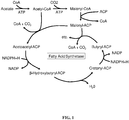
- fatty acid synthetase catalyzes a repeating cycle wherein malonyl-acyl carrier protein (ACP) is condensed with a substrate, initially acetyl-CoA, to form acetoacetyl-ACP, liberating CO 2 .
- ACP malonyl-acyl carrier protein
- the acetoacetyl-ACP is then reduced, dehydrated, and reduced further to butyryl-ACP which can then itself be condensed with malonyl-ACP, and the cycle repeated, adding a 2-carbon unit at each turn.
- the production of free fatty acids would therefore be enhanced by a thioesterase that would liberate the fatty acid itself from ACP, breaking the cycle.
- the acyl-ACP is prevented from reentering the cycle. Production of the fatty acid would also be encouraged by enhancing the levels of fatty acid synthetase and inhibiting any enzymes which result in degradation or further metabolism of the fatty acid.
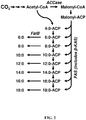
- Figure 2 presents a more detailed description of the sequential formation of acyl-ACPs of longer and longer chains. As shown, the thioesterase enzymes listed in Figure 2 liberate the fatty acid from the ACP thioester.
- Voelker, T., et ah, Science (1992) 251:12-74 describe " Fatty acid biosynthesis redirected to medium chains in transgenic oilseed plants.”
- Voelker, T., and Davies, M., Journal of Bacteriology (1994) 176:7320-7327 describe "Alteration of the specificity and regulation of fatty acid synthesis of Escherichia coli by expression of a plant medium-chain acyl-acyl carrier protein thioesterase.”
- the present invention is directed to the production of recombinant cyanobacteria that are able to secrete fatty acids derived from inorganic carbon into the culture medium. Methods to remove the secreted fatty acids from the culture medium without the need for cell harvesting are also provided. It is anticipated that these improvements will lead to lower costs for producing lipid-based fuels and chemicals from cyanobacteria. In addition, this invention enables the production of fatty acids of defined chain length, thus allowing their use in the formulation of a variety of different products, including fuels and chemicals.
- Carbon dioxide (which, along with carbonic acid, bicarbonate and/or carbonate define the term "inorganic carbon") is converted in the photosynthetic process to organic compounds.
- the inorganic carbon source includes any way of delivering inorganic carbon, optionally in admixture with any other combination of compounds which do not serve as the primary carbon feedstock, but only as a mixture or carrier (for example, emissions from biofuel (e.g., ethanol) plants, power plants, petroleum-based refineries, as well as atmospheric and subterranean sources).
- biofuel e.g., ethanol
- One embodiment of the invention relates to a culture of recombinant cyanobacteria, said organisms comprising at least one recombinant expression vector encoding at least one exogenous acyl-ACP thioesterase, wherein the at least one exogenous acyl-ACP thioesterase preferentially liberates fatty acid chains containing 6 to 20 carbons from these ACP thioesters.
- the fatty acids are formed from inorganic carbon as their carbon source and the culture medium provides inorganic carbon as the carbon source for the formation of fatty acids.
- the presence of the exogenous thioesterase will increase the secretion levels of desired fatty acids by at least 2-4 fold.
- the invention is directed to a cell culture of a recombinant cyanobacterium comprising at least one recombinant expression system encoding at least one exogenous acyl-ACP thioesterase, wherein said acyl-ACP thioesterase preferentially liberates a fatty acid chain that contains 6-20 carbons, and wherein the culture medium provides inorganic carbon as the carbon source for the formation of fatty acids and wherein said cyanobacterium secretes the fatty acid liberated by the acyl-ACP thioesterase into the culture medium.
- the thioesterase preferentially liberates a fatty acid chain that contains 6, 7, 8, 9, 10, 11, 12, 13, 14, 15, 16, 17, 18, 19 or 20 carbons.
- the invention is directed to a method to produce fatty acids of desired chain lengths by incubating these cultures and recovering these secreted fatty acids from the cultures.
- the recovery employs solid particulate adsorbents to harvest the secreted fatty acids.
- the fatty acids thus recovered can be further modified synthetically or used directly as components of biofuels or chemicals.
- the present invention provides cyanobacteria that secrete fatty acids into the culture medium, along with methods to adsorb the fatty acids from the culture medium and collect them for processing into fuels and chemicals.
- the invention thereby eliminates or greatly reduces the need to harvest and extract the cells, resulting in substantially reduced production costs.
- FIG. 2 is an overview of one aspect of the invention.
- carbon dioxide is converted to acetyl-CoA using the multiple steps in the photosynthetic process.
- the acetyl-CoA is then converted to malonyl-CoA by the action of acetyl-CoA carboxylase.
- the malonyl-CoA is then converted to malonyl-ACP by the action of malonyl-CoA:ACP transacylase which, upon progressive action of fatty acid synthetase, results in successive additions of two carbon units.
- the process is essentially halted at carbon chain lengths of 6 or 8 or 10 or 12 or 14 or 16 or 18 carbons by supplying the appropriate thioesterase (shown in Figure 2 as FatB).
- FatB thioesterase
- the cell biomass can be harvested as well.
- the secreted fatty acids can be converted to various other forms including, for example, methyl esters, alkanes, alkenes, alpha-olefins and fatty alcohols.
- the organism In order to effect secretion of the free fatty acids, the organism is provided at least one expression system for at least one thioesterase that operates preferentially to liberate fatty acids of the desired length.
- thioesterase that operates preferentially to liberate fatty acids of the desired length.
- Examples include U.S. Patent 5298421 , entitled “Plant medium-chain-preferring acyl-ACP thioesterases and related methods," which describes the isolation of an acyl-ACP thioesterase and the gene that encodes it from the immature seeds of Umbellularia californica.
- Other sources for such thioesterases and their encoding genes include U.S. Patent 5,304,481 , entitled “Plant thioesterase having preferential hydrolase activity toward C12 acyl-ACP substrate," U.S. Patent 5,344,771 , entitled “Plant thioesterases," U.S. Patent 5,455,167 , entitled “Medium-chain thioesterases in plants,” U.S.
- Patent 5,512,482 entitled “Plant thioesterases”
- U.S. Patent 5,530,186 entitled “Nucleotide sequences of soybean acyl-ACP thioesterase genes”
- U.S. Patent 5,639,790 entitled “Plant medium-chain thioesterases”
- U.S. Patent 5,667,997 entitled “C8 and C10 medium-chain thioesterases in plants”
- U.S. Patent 5,723,761 entitled “Plant acyl-ACP thioesterase sequences”
- U.S. Patent 5,807,893 entitled “Plant thioesterases and use for modification of fatty acid composition in plant seed oils”
- Patent 5,850,022 entitled “Production of myristate in plant cells”
- U.S. Patent 5,910,631 entitled “Middle chain-specific thioesterase genes from Cuphea lanceolata ”
- U.S. Patent 5,945,585 entitled “Specific for palmitoyl, stearoyl and oleoyl-alp thioesters nucleic acid fragments encoding acyl-ACP thioesterase enzymes and the use of these fragments in altering plant oil composition”
- U.S. Patent 5,955,329 entitled “Engineering plant thioesterases for altered substrate specificity”
- Patent 5,955,650 entitled “Nucleotide sequences of canola and soybean palmitoyl-ACP thioesterase genes and their use in the regulation of fatty acid content of the oils of soybean and canola plants”
- U.S. Patent 6,331,664 entitled “Acyl-ACP thioesterase nucleic acids from maize and methods of altering palmitic acid levels in transgenic plants therewith.”
- acyl-ACP TEs can be isolated from plants that naturally contain large amounts of medium-chain fatty acids in their seed oil, including certain plants in the Lauraceae , Lythraceae , Rutaceae , Ulmaceae , and Vochysiaceae families.
- the fatty acids produced by the seeds of these plants are esterified to glycerol and retained inside the cells. The seeds containing the products can then be harvested and processed to isolate the fatty acids.
- Other sources of these enzymes, such as bacteria may also be used.
- the known acyl-ACP TEs from plants can be divided into two main classes, based on their amino acid sequences and their specificity for acyl-ACPs of differing chain lengths and degrees of unsaturation.
- the "FatA” type of plant acyl-ACP TE has preferential activity on oleoyl-ACP, thereby releasing oleic acid, an 18-carbon fatty acid with a single double bond nine carbons distal to the carboxyl group.
- the "FatB" type of plant acyl-ACP TE has preferential activity on saturated acyl-ACPs, and can have broad or narrow chain length specificities.
- FatB enzymes from different species of Cuphea have been shown to release fatty acids ranging from eight carbons in length to sixteen carbons in length from the corresponding acyl-ACPs.
- fatty acids ranging from eight carbons in length to sixteen carbons in length from the corresponding acyl-ACPs.
- Table 1 Listed below in Table 1 are several plant acyl-ACP TEs along with their substrate preferences.
- acyl-ACP TEs The enzymes listed in Table 1 are exemplary and many additional genes encoding acyl-ACP TEs can be isolated and used in this invention, including but not limited to genes such as those that encode the following acyl-ACP TEs (referred to by GenPept Accession Numbers):
- acyl-ACP TEs include: Arabidopsis thaliana (At); Bradyrhizobium japonicum (Bj); Brassica napus (Bn); Cinnamonum camphorum (Cc); Capsicum chinense (Cch); Cuphea hookeriana (Ch); Cuphea lanceolata (CI); Cuphea palustris (Cp); Coriandrum sativum (Cs); Carthamus tinctorius (Ct); Cuphea wrightii (Cw); Elaeis guineensis (Eg); Gossypium hirsutum (Gh); Garcinia mangostana (Gm); Helianthus annuus (Ha); Iris germanica (Ig); Iris tectorum (It); Myristica fragrans (Mf); Triticum aestivum (Ta); Ulmus Americana (Ua); and Umbellularia californica (At); Bradyrhizobium
- the present invention contemplates the specific production of an individual length of medium-chain fatty acid, for example, predominently producing C8 fatty acids in one culture of recombinant cyanobacteria.
- the present invention contemplates the production of a combination of two or more different length fatty acids, for example, both C8 and C10 fatty acids in one culture of recombinant photosynthetic microorganisms.
- the host may be modified to include an expression system for a heterologous gene that encodes a ( ⁇ -ketoacyl synthase (KAS) that preferentially produces acyl-ACPs having medium chain lengths.
- KAS ⁇ -ketoacyl synthase
- Such KAS enzymes have been described from several plants, including various species of Cuphea. See Dehesh, K., et ah, The Plant Journal (1998) 15:383-390 , describe " KAS IV: a 3-ketoacyl-ACP synthase from Cuphea sp.
- heterologous acyl-ACP TE is a medium chain specific condensing enzyme.”; Slabaugh, M., et al, The Plant Journal (1998) 13:611-620 ), and would serve to increase the availability of acyl-ACP molecules of the proper length for recognition and cleavage by the heterologous medium-chain acyl-ACP TE.
- the host cell containing a heterologous acyl-ACP TE gene may be further modified to include an expression system for a heterologous gene that encodes a multifunctional acetyl-CoA carboxylase or a set of heterologous genes that encode the various subunits of a multi-subunit type of acetyl-CoA carboxylase.
- Other heterologous genes that encode additional enzymes or components of the fatty acid biosynthesis pathway could also be introduced and expressed in acyl-ACP TE-containing host cells.
- the description describes how the cyanobacterium may also be modified such that one or more genes that encode beta-oxidation pathway enzymes have been inactivated or downregulated, or the enzymes themselves may be inhibited. This would prevent the degradation of fatty acids released from acyl-ACPs, thus enhancing the yield of secreted fatty acids.
- the desired products are medium-chain fatty acids
- the inactivation or downregulation of genes that encode acyl-CoA synthetase and/or acyl-CoA oxidase enzymes that preferentially use these chain lengths as substrates would be beneficial.
- Mutations in the genes encoding medium-chain-specific acyl-CoA synthetase and/or medium-chain-specific acyl-CoA oxidase enzymes such that the activity of the enzymes is diminished would also be effective in increasing the yield of secreted fatty acids.
- An additional modification inactivates or down-regulates the acyl-ACP synthetase gene or inactivates the gene or protein.
- Mutations in the genes can be introduced either by recombinant or non-recombinant methods. These enzymes and their genes are well known, and may be targeted specifically by disruption, deletion, generation of antisense sequences, generation of ribozymes or other recombinant approaches known to the practitioner. Inactivation of the genes can also be accomplished by random mutation techniques such as UV, and the resulting cells screened for successful mutants.
- the proteins themselves can be inhibited by intracellular generation of appropriate antibodies or intracellular generation of peptide inhibitors.
- the description describes how the cyanobacterium may also be modified such that one or more genes that encode storage carbohydrate or polyhydroxyalkanoate (PHA) biosynthesis pathway enzymes have been inactivated or down-regulated, or the enzymes themselves may be inhibited.
- PHA polyhydroxyalkanoate
- Examples include enzymes involved in glycogen, starch, or chrysolaminarin synthesis, including glucan synthases and branching enzymes.
- Other examples include enzymes involved in PHA biosynthesis such as acetoacetyl-CoA synthase and PHA synthase.
- heterologous genes in cyanobacteria is enabled by the introduction of appropriate expression vectors.
- a variety of promoters that function in cyanobacteria can be utilized, including, but not limited to the lac, tac, and trc promoters and derivatives that are inducible by the addition of isopropyl P-D-1-thiogalactopyranoside (IPTG), promoters that are naturally associated with transposon- or bacterial chromosome-borne antibiotic resistance genes (neomycin phosphotransferase, chloramphenicol acetyltransferase, spectinomycin adenyltransferase, etc.), promoters associated with various heterologous bacterial and native cyanobacterial genes, promoters from viruses and phages, and synthetic promoters. Promoters isolated from cyanobacteria that have been used successfully include the following:
- transcriptional terminators can be used for expression vector construction.
- examples of possible terminators include, but are not limited to, psbA, psaAB, rbc, secA, and T7 coat protein.
- Expression vectors are introduced into the cyanobacterial strains by standard methods, including, but not limited to, natural DNA uptake, conjugation, electroporation, particle bombardment, and abrasion with glass beads, SiC fibers, or other particles.
- the vectors can be: 1) targeted for integration into the cyanobacterial chromosome by including flanking sequences that enable homologous recombination into the chromosome, 2) targeted for integration into endogenous cyanobacterial plasmids by including flanking sequences that enable homologous recombination into the endogenous plasmids, or 3) designed such that the expression vectors replicate within the chosen host.
- cyanobacteria blue-green algae
- a number of cyanobacterial species are known and have been manipulated using molecular biological techniques, including the unicellular cyanobacteria Synechocystis sp. PCC6803 and Synechococcus elongates PCC7942, whose genomes have been completely sequenced.
- cyanobacteria The following genera of cyanobacteria may be used: one group includes Chamaesiphon Dactylococcopsis Prochlorococcus Chroococcus Gloeobacter Prochloron Cyanobacterium Gloeocapsa Synechococcus Cyanobium Gloeothece Synechocystis Cyanothece Microcystis
- Another group includes Cyanocystis Xenococcus Pleurocapsa Dermocarpella Chroococcidiopsis Stanieria Myxosarcina
- Still another group includes Arthrospira Limnothrix Pseudanabaena Borzia Lyngbya Spirulina Crinalium Microcoleus Starria Geitlerinema Oscillatoria Symploca Halospirulina Planktothrix Trichodesmium Leptolyngbya Prochlorothrix Tychonema
- Still another group includes Anabaena Cyanospira Nostoc Anabaenopsis Cylindrospermopsis Rivularia Aphanizomenon Cylindrospermum Scytonema Calothrix Nodularia Tolypothrix
- Desirable qualities of the host strain include high potential growth rate and lipid productivity at 25-50°C, high light intensity tolerance, growth in brackish or saline water, i.e., in wide range of water types, resistance to growth inhibition by high O 2 concentrations, filamentous morphology to aid harvesting by screens; resistance to predation, ability to be flocculated (by chemicals or 'on-demand autoflocculation'), excellent inorganic carbon uptake characteristics, virus or cyanophage-resistance, tolerance to free fatty acids or other compounds associated with the invention method, and ability to undergo metabolic engineering.
- Metabolic engineering is facilitated by the ability to take up DNA by electroporation or conjugation, lack of a restriction system and efficient homologous recombination in the event gene replacement or gene knockouts are required.
- the fatty acids secreted into the culture medium by the recombinant cyanobacteria described above can be recovered in a variety of ways.
- a straightforward isolation method by partition using immiscible solvents may be employed.
- particulate adsorbents can be employed. These may be lipophilic particulates or ion exchange resins, depending on the design of the recovery method. They may be circulating in the separated medium and then collected, or the medium may be passed over a fixed bed column, for example, a chromatographic column containing these particulates.
- the fatty acids are then eluted from the particulate adsorbents by the use of an appropriate solvent. Evaporation of the solvent, followed by further processing of the isolated fatty acids and lipids can then be carried out to yield chemicals and fuels that can be used for a variety of commercial purposes.
- the particulate adsorbents may have average diameters ranging from 0.5 mm to 30 mm which can be manufactured from various materials including, but not limited to, polyethylene and derivatives, polystyrene and derivatives, polyamide and derivatives, polyester and derivatives, polyurethane and derivatives, polyacrylates and derivatives, silicone and derivatives, and polysaccharide and derivatives. Certain glass and ceramic materials can also be used as the solid support component of the fat adsorbing objects.
- the surfaces of the particulate adsorbents may be modified so that they are better able to bind fatty acids and lipids. An example of such modification is the introduction of ether-linked alkyl groups having various chain lengths, preferably 8-30 carbons. In another example, acyl chains of various lengths can be attached to the surface of the fat adsorbing objects via ester, thioester, or amide linkages.
- the particulate adsorbents are coated with inorganic compounds known to bind fatty acids and lipids.
- inorganic compounds known to bind fatty acids and lipids. Examples of such compounds include but are not limited to aluminum hydroxide, graphite, anthracite, and silica.
- the particles used may also be magnetized or otherwise derivatized to facilitate recovery.
- the particles may be coupled to one member of a binding pair and the adsorbed to a substrate containing the relevant binding partner.
- the fatty acids may be eluted from the particulate adsorbents by the use of an appropriate solvent such as hexane or ethanol.
- the particulate adsorbents may be reused by returning them to the culture medium or used in a regenerated column.
- the solvent containing the dissolved fatty acids is then evaporated, leaving the fatty acids in a purified state for further conversion to chemicals and fuels.
- the particulate adsorbents can be designed to be neutrally buoyant or positively buoyant to enhance circulation in the culture medium.
- a continuous cycle of fatty acid removal and recovery can be implemented by utilizing the steps outlined above.
- the recovered fatty acids may be converted to alternative organic compounds, used directly, or mixed with other components. Chemical methods for such conversions are well understood in the art, and developments of biological methods for such conversions are also contemplated
- compositions comprising the fatty acids produced by the recombinant cyanobacteria described herein, and uses thereof.
- the composition may comprise the fatty acids themselves, or further derivatives of the fatty acids, such as alcohols, alkanes, and alkenes which can be generated from the fatty acids produced by the microorganisms by any methods that are known in the art, as well as by development of biological methods of conversion.
- fatty acids may be converted to alkenes by catalytic hydrogenation and catalytic dehydration.
- the composition may serve, for example, as a biocrude.
- the biocrude can be processed through refineries that will convert the composition compounds to various petroleum and petrochemical replacements, including alkanes, olefins and aromatics through processes including hydrotreatment, decarboxylation, isomerization and catalytic cracking and reforming.
- the biocrude can be also converted to ester-based fuels, such as fatty acid methyl ester (commercially known as biodiesel), through established chemical processes including transesterification and esterification.
- derivatives of the fatty acids of the present invention include C8 chemicals, such as octanol, used in the manufacture of esters for cosmetics and flavors as well as for various medical applications, and octane, used primarily as a co-monomer in production of polyethylene.
- C8 chemicals such as octanol
- octane used primarily as a co-monomer in production of polyethylene.
- Derivatives of the fatty acids of the present invention may also include C10 chemicals, such as decanol, used in the manufacture of plasticizers, surfactants and solvents, and decene, used in the manufacture of lubricants.
- Biocrudes are biologically produced compounds or a mix of different biologically produced compounds that are used as a feedstock for refineries in replacement of, or in complement to, crude oil or other forms of petroleum.
- these feedstocks have been pre-processed through biological, chemical, mechanical or thermal processes in order to be in a liquid state that is adequate for introduction in a petroleum refinery.
- the fatty acids of the present invention can be a biocrude, and further processed to a biofuel composition.
- the biofuel can then perform as a finished fuel or a fuel additive.
- Finished fuel is defined as a chemical compound or a mix of chemical compounds (produced through chemical, thermochemical or biological routes) that is in an adequate chemical and physical state to be used directly as a neat fuel or fuel additive in an engine. In many cases, but not always, the suitability of a finished fuel for use in an engine application is determined by a specification which describes the necessary physical and chemical properties that need to be met.
- engines are: internal combustion engine, gas turbine, steam turbine, external combustion engine, and steam boiler.
- finished fuels include: diesel fuel to be used in a compression-ignited (diesel) internal combustion engine, jet fuel to be used in an aviation turbine, fuel oil to be used in a boiler to generate steam or in an external combustion engine, ethanol to be used in a flex-fuel engine.
- diesel fuel to be used in a compression-ignited (diesel) internal combustion engine jet fuel to be used in an aviation turbine
- fuel oil to be used in a boiler to generate steam or in an external combustion engine fuel oil to be used in a boiler to generate steam or in an external combustion engine
- ethanol to be used in a flex-fuel engine.
- ASTM standards mainly used ion the US
- EN standards mainly used in Europe.
- Fuel additive refers to a compound or composition that is used in combination with another fuel for a variety of reasons, which include but are not limited to complying with mandates on the use of biofuels, reducing the consumption of fossil fuel-derived products or enhancing the performance of a fuel or engine.
- fuel additives can be used to alter the freezing/gelling point, cloud point, lubricity, viscosity, oxidative stability, ignition quality, octane level, and flash point. Additives can further function as antioxidants,
- demulsifiers oxygenates, thermal stability improvers, cetane improvers, stabilizers, cold flow improvers, combustion improvers, anti-foams, anti-haze additives, icing inhibitors, injector cleanliness additives, smoke suppressants, drag reducing additives, metal deactivators, dispersants, detergents, demulsifiers, dyes, markers, static dissipaters, biocides, and/or corrosion inhibitors.
- the Cuphea hookeriana FatB2 gene encoding an acyl-ACP thioesterase (ChFatB2) enzyme was modified for optimized expression in Synechococcus elongatus PCC 7942.
- ChFatB2 acyl-ACP thioesterase
- the nucleotide sequence of this derivative of the ChFatB2 gene (hereafter ChFatB2-7942) is provided as SEQ ID NO:7.
- the protein sequence encoded by this gene is provided in SEQ ID NO:8.
- trc Two different versions of the trc promoter, trc ( Egon, A., et al., Gene (1983) 25:167-178 ) and "enhanced trc" (hereafter trcE, from pTrcHis A, Invitrogen) were used to drive the expression of ChFatB2-7942 in S. elongatus PCC 7942.
- the trc promoter is repressed by the Lac repressor protein encoded by the lacIq gene and can be induced by the addition of isopropyl ⁇ -D-1-thiogalactopyranoside (IPTG).
- IPTG isopropyl ⁇ -D-1-thiogalactopyranoside
- the trcE promoter is a derivative of trc designed to facilitate expression of eukaryotic proteins in E. coli and is also inducible by IPTG.
- the fusion fragments of ChFatB2-7942 operably linked to trc or trcE, together with the lacIq gene, were cloned into the shuttle vector pAM2314 ( Mackey, S. R., et al., Methods Mol. Biol. (2007) 362:115-129 ), which enables transformation of S. elongatus PCC 7942 via double homologous recombination-mediated integration into the "NS1" site of the chromosome.
- the constructed plasmid containing the trcE::ChFatB2-7942 expression cassette and lacIq gene is designated pSGI-YC01.
- SEQ ID NO:9 represents the sequence between and including the NS1 recombination sites of pSGI-YC01.
- the constructed plasmid containing the trc::ChFatB2-7942 expression cassette and lacIq gene is designated pSGI-YC09.
- SEQ ID NO:10 represents the sequence between and including the NS1 recombination sites of pSGI-YC09.
- Each of the plasmids pSGI-YC01 and pSGI-YC09, along with the control vector pAM2314, were introduced into wild-type S . elongatus PCC 7942 cells as described by Golden and Sherman (J. Bacteriol. (1984) 158:36-42 ). Both recombinant and control strains were pre-cultivated in 100 mL of BG-11 medium supplied with spectinomycin (5 mg/L) to late-log phase (OD 730nm 1.0) on a rotary shaker (150 rpm) at 30°C with constant illumination (60 ⁇ E m -2 sec -1 ).
- Cultures were sampled 0, 48, 96, and 168 hours after IPTG induction and then filtered through Whatman ® GF/F filters using a Millipore vacuum filter manifold. Filtrates were collected in screw top culture tubes for gas chromatographic (GC) analysis.
- GC gas chromatographic
- Free fatty acids were separated from filtered cell cultures using liquid-liquid extraction. Five mL of the filtrate were mixed with 125 ⁇ L of 1 M H 3 PO 3 and 0.25 mL of 5 M NaCl, followed by addition of 2 mL of hexane and thorough mixing.
- a 0.2 ⁇ l sample of the hexane was injected using a 40:1 split ratio onto a DB-FFAP column (J&W Scientific, 15 m x 250 ⁇ m x 0.25 ⁇ m), with a temperature profile starting at 150°C for 0.5 min, then heating at 15°C/min to 230°C and holding for 7.1 min (1.1 mL/min He).
- the trcE::ChFatB2-7942 and trc::ChFatB2-7942 fusion fragments, together with the lacIq gene, were cloned into the shuttle vector pSGI-YC03 (SEQ ID NO:11), which enables transformation of Synechocystis sp. PCC 6803 via double homologous recombination-mediated integration into the "RS1" site of the chromosome ( Williams, Methods Enzymol. (1988) 167:766-778 ).
- the constructed plasmid containing the trcE::ChFatB2-7942 expression cassette and lacIq gene is designated pSGI-YC08.
- SEQ ID NO:12 represents the sequence between and including the RS1 recombination sites of pSGI-YC08.
- the constructed plasmid containing the trc::ChFatB2-7942 expression cassette and lacIq gene is designated pSGI-YC14.
- SEQ ID NO:13 represents the sequence between and including the RS1 recombination sites of pSGI-YC14.
- Cultures were sampled 0, 72, and 144 hours after IPTG induction and then filtered through Whatman ® GF/B filters using a Millipore vacuum filter manifold. Filtrates were collected in screw top culture tubes for gas chromatographic (GC) analysis. Free fatty acids (FFA) were separated from the filtered culture supernatant solutions by liquid-liquid extraction.
- GC gas chromatographic
- the trc::ChFatB2-7942 and trcE::ChFatB2-7942 fusion fragments, together with the lacIq gene, were PCR amplified using primers RS3-3F (SEQ ID NO:14) and 4YC-rrnBter-3 (SEQ ID NO:15) from pSGI-YC14 and pSGI-YC08, respectively, and then cloned into the shuttle vector pEL17, which enables transformation of A. variabilis ATCC 29413 via double homologous recombination-mediated integration into the nifU1 locus of the chromosome ( Lyons and Thiel, J. Bacteriol. (1995) 177:1570-1575 ).
- the constructed plasmids are designated pSGI-YC69 and pSGI-YC70 for trc::ChFatB2-7942 and trcE::ChFatB2-7942, respectively.
- Cultures are sampled every 72 hours and then filtered through Whatman® GF/F filters using a Millipore vacuum filter manifold. Filtrates are collected in screw top culture tubes for gas chromatographic (GC) analysis as described in Example 1.
- GC gas chromatographic
- Primer pairs 918-15 (SEQ ID NO:16) / 918-13 (SEQ ID NO:17) and 918-25 (SEQ ID NO:18) / 918-23 (SEQ ID NO:19) were used to amplify two DNA fragments corresponding to a 5' portion (1-480 bp) and a 3' portion (903-1521 bp) of the coding region of synpcc7942_0918 , respectively.
- the cat fragment was amplified from plasmid pAM1573 ( Mackey et al., Methods Mol. Biol.
- the resulting 2,840-bp blunt-end PCR fragment (SEQ ID NO:22) was then ligated into pUC19 ( Yanisch-Perron et al., Gene 33:103-119 ), which has been digested with both Hind III and Eco RI to remove the multiple cloning sites and subsequently blunted with T4 DNA polymerase, to yield plasmid pSGI-YC04.
- Plasmid pSGI-YC04 was introduced into S. elongatus strain SGC-YC1-2, which harbors a copy of trcE::ChFatB2-7942 integrated into NS1 (see Example 1). The resulting strain was designated SGC-YC4-7. Fatty acid production assays and GC analyses were performed as described in Example 1. The results of GC analyses indicating the levels of FFAs in cultures of various S . elongatus strains 168 hours after IPTG induction are shown in Table 4-1. It is possible that inactivation of the acyl-ACP synthetase gene has a larger impact on secretion of long-chain fatty acids than on secretion of medium-chain fatty acids.
- Table 4-1 Medium-chain fatty acid secretion in various strains of S . elongatus. Strain Parent Strain Plasmid Added Transgenes Deletions Fatty Acids (mg/L) 8:0 10:0 16:0 16:1 SGC-YC2-5 PCC 7942 pAM2314 none none ND ND ND 1.4 SGC-YC1-2 PCC 7942 pSGI-YC01 trcE::ChFatB2 -7942 none 1.4 4.2 ND 1.6 SGC-YC4-7 SGC-YC1-2 pSGI-YC04 trcE::ChFatB2 -7942 synpcc7942_ 0918 1.0 3.1 1.1 3.9 Note: ND represents "not detected" ( ⁇ 1 mg/L).
- PCC 6803 was amplified from genomic DNA using PCR with primers NB001 (SEQ ID NO:23) and NB002 (SEQ ID NO:24). This fragment was cloned into the pCR2.1 vector (Invitrogen) to yield plasmid pSGI-NB3 and subsequently cut with the restriction enzyme Mfe1.
- a chloramphenicol resistance marker cassette containing the cat gene and associated regulatory control sequences was amplified from plasmid pAM1573 ( Andersson, et al., Methods Enzymol. (2000) 305:527-542 ) to contain flanking Mfe1 restriction sites using PCR with primers NB010 (SEQ ID NO:25) and NB011 (SEQ ID NO:26).
- the cat gene expression cassette was then inserted into the MfeI site of pSGI-NB3 to yield pSGI-NB5 (SEQ ID NO:27).
- the pSGI-NB5 vector was transformed into trcE::ChFatB2-7942-containing Synechocystis strain SGC-YC10-5 (see Example 1) according to Zang et al., J Microbiology (2007) 45:241-245 . Insertion of the chloramphenicol resistance marker into the Slr1609 gene through homologous recombination was verified by PCR screening of insert and insertion site. The resulting strain was designated SGC-NB10-4, which was tested in liquid BG-11 medium for fatty acid secretion. All liquid medium growth conditions used a rotary shaker (150 rpm) at 30°C with constant illumination (60 ⁇ E ⁇ m -2 ⁇ sec -1 ).
- Free fatty acids were separated from the filtered culture supernatant solutions by liquid-liquid extraction for GC/FID (flame ionization detector) analysis.
- GC/FID flame ionization detector
- 2 mL filtered culture was extracted with a mixture of 50 ⁇ l phosphoric acid (1 M), 100 ⁇ l NaCl (5 M) and 2 mL hexane.
- a 0.2 ⁇ l sample was injected using a 40:1 split ratio on to a DB-FFAP column (J&W Scientific, 15 m x 250 ⁇ m x 0.25 ⁇ m), with a temperature profile starting at 150°C for 0.5 min, then heating at 15°C/min to 230°C and holding for 7.1 min (1.1 mL/min He).
- GC results indicating secreted levels of free fatty acids after 144 hours are shown in Table 5-1.
- Table 5.1 Medium-chain fatty acid secretion in various strains of Synechocystis. Strain Parent Strain Plasmid Added Transgenes Deletions Fatty Acids (mg/L) 8:0 10:0 SGC-YC10-5 PCC 6803 pSGI-YC08 trcE::ChFatB2-7942 none 58.3 67.7 SGC-NB10-4 SGC-YC10-5 pSGI-NB5 trcE::ChFatB2-7942 slr1609 57.7 73.7 Note: ND represents "not detected" ( ⁇ 1 mg/L).
- a DNA fragment comprising a functional operon was synthesized such that it contained the following elements in the given order: the trc promoter, the Cuphea lanceolata 3-ketoacyl-acyl carrier protein synthase IV gene (ClKas-IV, GenBank Accession No. CAC59946) codon-optimized for expression in Synechococcus elongatus PCC 7942, and the rps14 terminator (SEQ ID NO:28) from Synechococcus sp. WH8102.
- the nucleotide sequence of this entire functional operon, along with various flanking restriction enzyme recognition sites, is provided in SEQ ID NO:29.
- Another DNA fragment comprising a functional operon was synthesized such that it contained the following elements in the given order: the trc promoter, the Helianthus annuus 3-ketoacyl-acyl carrier protein synthase III gene (HaKas-III, GenBank Accession No. ABP93352) codon-optimized for expression in both Synechococcus elongatus PCC 7942 and Synechocystis sp. PCC 6803, and rps14 terminator from Synechococcus sp. WH8102.
- the nucleotide sequence of this functional operon, along with various flanking restriction enzyme recognition sites, is provided in SEQ ID NO:30.
- Codon optimization was performed by the use of the "Gene Designer” (version 1.1.4.1) software program provided by DNA2.0, Inc.
- the functional operon (expression cassette) containing the codon-modified ClKas-IV gene as represented in SEQ ID NO:29 was digested by the restriction enzymes SpeI and XbaI and inserted into plasmid pSGI-YC39 between the restriction sites SpeI and XbaI to form plasmid pSGI-BL26, which enables integration of the functional operon into the Synechocystis sp. PCC 6803 chromosome at the "RS2" recombination site ( Aoki, et al., J. Bacteriol (1995) 177:5606-5611 ).
- the plasmid pSGI-BL27 containing the DNA fragment represented in SEQ ID NO:30 was constructed in the same way.
- Plasmid pSGI-BL43 contains the trcE promoter, the codon-optimized ClKas-IV gene, and the rps14 terminator as represented in SEQ ID NO:31 and was made by inserting a SpeI/NcoI trcE fragment from pTrcHis A (Invitrogen) into SpeI/NcoI-digested pSGI-BL26.
- An additional plasmid, pSGI-BL44 contains the trcE promoter, the optimized ClKas-IV gene, the S .
- elongatus PCC 7942 kaiBC intergenic region, the optimized HaKas-III gene, and the rps14 terminator as represented in SEQ ID NO:32 and was made by inserting a BamHI/SacI fragment (containing the S . elongatus kaiBC intergenic region, the HaKas-III gene, and the rps14 terminator) generated via PCR amplification into BglII/SacI-digested pSGI-BL43.
- the PCR primers used to generate the DNA fragment containing the kaiBC region, HaKas-III, and rps14 terminator are provided as SEQ ID NO:33 and SEQ ID NO:34.
- Results indicating the levels of secreted octanoic acid and decanoic acid in culture supernatants 144 hours after culture inoculation are shown in Table 6-1.
- the ClKas-IV and HaKas-III genes present in the indicated strains were under the control of the trc promoter.
- Table 6-1 Medium-chain fatty acid secretion in (in mg/L) various Synechocystis sp.
- Table 6-1 For a more optimized measurement of fatty acid secretion in these strains, the fatty acid secretion data shown in Table 6-1 were normalized to cell culture density, measured as optical density at 730 nm (OD 730nm ); these data are presented in Table 6-2. Other experiments described in this application could be normalized in a similar fashion. Table 6-2 Normalized medium-chain fatty acid secretion (mg/L/OD 730nm ) in various Synechocystis sp.
- Results indicating the levels of secreted octanoic acid and decanoic acid in culture supernatants of additional strains 120 hours after culture inoculation are shown in Table 6-3.
- the ClKas-IV and HaKas-III genes present in the indicated strains were under the control of the trcE promoter.
- Table 6-3 Medium-chain fatty acid secretion (in mg/L) in various Synechocystis sp.
- fatty acid secretion data shown in Table 6-1 were normalized to cell culture density, measured as optical density at 730 nm (OD 730nm ); these data are presented in Table 6-4.
- Table 6-4 Normalized medium-chain fatty acid secretion (mg/L/OD 730nm ) in various Synechocystis sp.
- a synthetic gene that encodes a derivative of the ChFatB2 enzyme with specificity for medium-chain (8:0-10:0) acyl-ACPs is expressed in various diatoms (Bacillariophyceae) by constructing and utilizing expression vectors comprising the ChFatB2 gene operably linked to gene regulatory regions (promoters and terminators) that function in diatoms.
- the gene is optimized for expression in specific diatom species and the portion of the gene that encodes the plastid transit peptide region of the native ChFatB2 protein is replaced with a plastid transit peptide that functions optimally in diatoms.
- the protein encoded by this gene referred to hereafter as ChFatB2-Thal, is provided in SEQ ID NO:36.
- the ChFatB2-Thal gene was placed between the T. pseudonana alpha-tubulin promoter and terminator regulatory sequences.
- the alpha-tubulin promoter was amplified from genomic DNA isolated from T. pseudonana CCMP 1335 by use of primers PR1 (SEQ ID NO:37) and PR3 (SEQ ID NO:38), whereas the alpha-tubulin terminator was amplified by use of primers PR4 (SEQ ID NO:39) and PR8 (SEQ ID NO:40).
- the KpnI/BamHI fragment from the alpha-tubulin promoter amplicon, the BamHI/Xbal fragment from the alpha-tubulin terminator and the large fragment from KpnI/XbaI- cut pUC118 were then combined to form pSGI-PR5.
- the NcoI/BamHI fragment from ChFatB2-Thal gene was then inserted into NcoI/BamHI-digested pSGI-PR5 to form pSGI- PR16.
- NAT nourseothricin acetyltransferase
- pSGI-PR16 and pSGI-PR7 were co-transformed into T. pseudonana CCMP 1335 by means of particle bombardment essentially as described by Poulsen, et al, (J. Phycol. (2006) 42:1059-1065 ).
- Transformed cells were selected on agar plates in the presence of 100 mg/L nourseothricin (ClonNAT, obtained from Werner BioAgents, Germany). The presence of the ChFatB2-Thal gene in cells was confirmed by the use of PCR. Transformants were grown in ASW liquid medium ( Darley and Volcani, Exp. Cell Res.
- a synthetic gene that encodes a derivative of the ChFatB2 enzyme with specificity for medium-chain (8:0-10:0) acyl-ACPs is expressed in green algae (Chlorophyceae) by constructing and utilizing expression vectors comprising the ChFatB2 gene operably linked to gene regulatory regions (promoters and terminators) that function in green algae.
- the gene is optimized for expression in specific green algal species and the portion of the gene that encodes the plastid transit peptide region of the native ChFatB2 protein is replaced with a plastid transit peptide that functions optimally in green algae.
- the nucleotide sequence provided as SEQ ID NO:42 represents a derivative of the ChFatB2 gene optimized for expression in Chlamydomonas reinhardtii and in which the native plastid transit peptide-encoding region of the gene has been replaced with the plastid transit peptide associated with the gamma subunit of the coupling factor portion (CF1) of the chloroplast ATP synthase from C . reinhardtii (GenPept Accession No. XP 001696335).
- the protein encoded by this gene is provided in SEQ ID NO:43.
- a 1.4-kbp DNA fragment spanning an area upstream and into the coding region of the 1,4-alpha-glucan branching enzyme gene ( glgB , Cyanobase gene designation sll0158) from Synechocystis sp.
- PCC6803 was amplified from genomic DNA using PCR with primers glgB-5 (SEQ ID NO:44) and glgB-3 (SEQ ID NO:45). This fragment was cloned into the pCR4-Topo vector (Invitrogen) to yield plasmid pSGI-BL32 and subsequently cut with the restriction enzyme AvaI.
- a spectinomycin resistance marker cassette containing the aadA gene and associated regulatory control sequences was digested by HindIII from plasmid pSGI-BL27. Both of the linear fragments were treated with the Quick BluntingTM Kit (New England Biolabs). The aadA gene expression cassette was then inserted into the Aval site of pSGI-BL32 to yield pSGI-BL33. The portion of pSGI-BL33 that inserts into and inactivates the glgB gene is provided as SEQ ID NO:46).
- the pSGI-BL33 vector was transformed into wild-type Synechocystis PCC 6803 and into trcE::ChFatB2-7942-containing Synechocystis strain SGC-YC10-5 (see Example 1) according to Zang, et al., J. Microbiology (2007) 45:241-245 . Insertion of the spectinomycin resistance marker into the S110158 ( glgB ) gene via homologous recombination was verified by PCR screening of insert and insertion site. Verified knockout strains were tested in liquid BG-11 medium for secretion of fatty acids.
- Free fatty acids were separated from the filtered culture supernatant solutions by liquid-liquid extraction for GC/FID analysis.
- 2 mL of filtered culture were extracted with a mixture of 50 ⁇ L phosphoric acid (1 M), 100 ⁇ L NaCl (5 M) and 2 mL hexane.
- a 0.2 ⁇ l sample was injected using a 40:1 split ratio on to a DB-FFAP column (J&W Scientific, 15 m x 250 ⁇ m x 0.25 ⁇ m), with a temperature profile starting at 150°C for 0.5 min, then heating at 15°C/min to 230°C and holding for 7.1 min (1.1 mL/min He).
- Table 9-1 Medium-chain Fatty Acid Secretion (in mg/L) in Various Synechocystis sp. Strains Strain Parent Strain Plasmid Added Deletion Transgenes Fatty Acids 8:0 10:0 PCC 6803 n/a n/a None None ND ND SGC-BL33-1 PCC 6803 pSGI-BL33 S110158 ( glgB ) None ND ND SGC-YC10-5 PCC 6803 pSGI-YC08 None trcE-ChFatB2-7942 70.0 68.7 SGC-BL33-2 SGC-YC10-5 pSGI-BL33 S110158 ( glgB ) trcE-ChFatB2-7942 66.2 68.1 Note: ND represents "not detected" ( ⁇ 1 mg/L).
- Table 9-1 Normalized Medium-chain Fatty Acid Secretion (mg/L/OD 730nm ) in Various Synechocystis sp.
- a spike solution was formulated by dissolving 75 mg/L octanoic acid and 75 mg/L decanoic acid in BG-11 medium supplemented with 300 mM NaCl and adjusting the pH to 5.8. 50 mg of each of the resins listed in Table 1 were weighed into a 50 mL centrifuge tube and combined with 1.0 mL of methanol and shaken gently. The excess methanol was decanted and the resins were dried under a 25 in Hg vacuum, room temperature, overnight. 50 mL of the spike solution was then added to each of the resins and incubated with gentle shaking at 31°C for 24 hours.
- the effect of pH on adsorbent capacity was studied utilizing Dowex ® Optipore ® V503.
- 40 mg of the resin were combined with 40 mL of BG-11 media spiked with 150 mg/L of octanoic and decanoic acid and adjusted to a pH of 10.0, 7.5, 4.8, or 2.8.
- the pH 10 spike was buffered with 5 mM CAPS.
- the pH 7.5 and 2.8 spikes were buffered with 5 mM phosphate, and the pH 4.8 was buffered naturally by the dissolved fatty acids, with 5 mM NaCl added to maintain consistent conductivity.
- the spikes were incubated with resin as described above. Free fatty acid concentrations were measured with an enzymatic assay purchased from Zen-bio.
- Synechocystis sp. strain SGC-YC10-5 which contains the ChFatB2-7942 gene as described in Example 1, was cultured in BG-11 with and without Dowex ® Optipore ® V503 resin. 400 mL of fresh culture was induced with 5 mM IPTG and incubated at room temperature for 1 hour to allow for uptake of the inducer. The culture was then divided into four 1,000 mL baffled Erlenmeyer flasks with PTFE vent caps. To two of the flasks, approximately 400 mg of Dowex ® Optipore ® V503 were added. The adsorbent resin in the test flasks was recovered and exchanged for fresh resin daily for 10 days.
- Table 10-3 above reveals a clear relationship between free fatty acid adsorption capacity and pH. This relationship results from the inefficiency of extraction of the ionized form of the free fatty acids. Many potential production hosts require a pH significantly higher than the pKa of free fatty acids in order to survive and reproduce. An extreme example of this would be the alkalophilic cyanobacteria such as those belonging to the genera Synechococcus, Synechocystis, Spirulina, and many others, which prefer a pH between 9 and 11 for optimum growth.
- Figure 5 outlines an embodiment of the invention wherein this problem is solved by recycling a portion of the culture first through a vessel where it is contacted with concentrated CO 2 gas to lower the pH, then through a stationary adsorbent column wherein the protonated free fatty acids are captured.
- the CO 2 -enriched, free fatty acid-depleted suspension is then returned to the bulk culture.
- the pressure inside the gas-liquid contactor can be controlled independently to provide a constant pH in the stream exiting the adsorption column. Further, the pressure of the post-column flash vessel can be controlled so as to provide a supply of CO 2 which is titrated to the CO 2 consumption rate of the bulk culture through PID control of pH, dissolved CO 2 , off-gas CO 2 , or any combination of the three. The excess CO 2 can then be recycled.
- Vessel E-1 was filled with 4L of a spike solution containing 700 mg/L octanoic acid dissolved in 100 mM NaCl, pH 11.1.
- Column C1 was filled with 45.2 g of Dowex ® Optipore ® V503 polymeric resin. The resin was activated with two column volumes of methanol, followed by a wash of three column volumes of 100 mM NaCl, pH 11.1.
- Liquid-gas contact vessel E2 was then filled with 200 mL of spike solution and 34.7 psia of CO 2 .
- a synthetic gene that encodes a derivative of a FatA-type plant acyl-ACP TE enzyme with specificity for oleoyl-ACP is expressed in various photosynthetic microorganisms by constructing and utilizing expression vectors comprising a FatA gene operably linked to gene regulatory regions (promoters and terminators) that function in the host photosynthetic microorganism.
- the gene is optimized for expression in the host photosynthetic microorganism and the portion of the gene that encodes the plastid transit peptide region of the native FatA protein is removed for expression in cyanobacteria or replaced with a plastid transit peptide that functions effectively in the host eukaryotic photosynthetic microorganisms.
- Genes that could be used for this purpose include, but are not limited to, those that encode the following acyl-ACP TEs (referred to by GenPept Accession Numbers): NP_189147.1, AAC49002, CAA52070.1, CAA52069.1, 193041.1, CAC39106, CA017726, AAC72883, AAA33020, AAL79361, AAQ08223.1, AAB51523, AAL77443, AAA33019, AAG35064, and AAL77445.
- GenPept Accession Numbers referred to by GenPept Accession Numbers: NP_189147.1, AAC49002, CAA52070.1, CAA52069.1, 193041.1, CAC39106, CA017726, AAC72883, AAA33020, AAL79361, AAQ08223.1, AAB51523, AAL77443, AAA33019, AAG35064, and AAL77445.
Landscapes
- Chemical & Material Sciences (AREA)
- Organic Chemistry (AREA)
- Life Sciences & Earth Sciences (AREA)
- Wood Science & Technology (AREA)
- Engineering & Computer Science (AREA)
- Zoology (AREA)
- Health & Medical Sciences (AREA)
- Genetics & Genomics (AREA)
- Bioinformatics & Cheminformatics (AREA)
- General Health & Medical Sciences (AREA)
- Microbiology (AREA)
- Biochemistry (AREA)
- General Engineering & Computer Science (AREA)
- Biotechnology (AREA)
- General Chemical & Material Sciences (AREA)
- Chemical Kinetics & Catalysis (AREA)
- Oil, Petroleum & Natural Gas (AREA)
- Medicinal Chemistry (AREA)
- Molecular Biology (AREA)
- Biomedical Technology (AREA)
- Preparation Of Compounds By Using Micro-Organisms (AREA)
- Micro-Organisms Or Cultivation Processes Thereof (AREA)
Applications Claiming Priority (2)
| Application Number | Priority Date | Filing Date | Title |
|---|---|---|---|
| US733307P | 2007-12-11 | 2007-12-11 | |
| PCT/US2008/086485 WO2009076559A1 (en) | 2007-12-11 | 2008-12-11 | Secretion of fatty aicds by photosynthetic microorganisms |
Publications (3)
| Publication Number | Publication Date |
|---|---|
| EP2231864A1 EP2231864A1 (en) | 2010-09-29 |
| EP2231864A4 EP2231864A4 (en) | 2011-02-02 |
| EP2231864B1 true EP2231864B1 (en) | 2017-05-24 |
Family
ID=40755894
Family Applications (1)
| Application Number | Title | Priority Date | Filing Date |
|---|---|---|---|
| EP08860168.7A Not-in-force EP2231864B1 (en) | 2007-12-11 | 2008-12-11 | Secretion of fatty acids by photosynthetic microorganisms |
Country Status (10)
| Country | Link |
|---|---|
| US (2) | US20090298143A1 (enExample) |
| EP (1) | EP2231864B1 (enExample) |
| JP (1) | JP5465183B2 (enExample) |
| CN (1) | CN101952452B (enExample) |
| AU (1) | AU2008335089B2 (enExample) |
| BR (1) | BRPI0821508B1 (enExample) |
| MX (1) | MX2010006539A (enExample) |
| MY (1) | MY154028A (enExample) |
| WO (1) | WO2009076559A1 (enExample) |
| ZA (1) | ZA201004253B (enExample) |
Families Citing this family (64)
| Publication number | Priority date | Publication date | Assignee | Title |
|---|---|---|---|---|
| US20080152636A1 (en) * | 2006-09-08 | 2008-06-26 | Kaneka Corporation | Composition containing reduced coenzyme Q10 and lysolecithin |
| US8272669B2 (en) * | 2006-10-24 | 2012-09-25 | Timothy J. Flynn | Label assembly for applying a label to an object |
| CN101765661B (zh) | 2007-06-01 | 2014-08-06 | 索拉兹米公司 | 在微生物中生产油 |
| MY154028A (en) | 2007-12-11 | 2015-04-30 | Synthetic Genomics Inc | Secretion of fatty acids by photosynthetic microorganisms |
| US8048654B2 (en) | 2010-06-09 | 2011-11-01 | Joule Unlimited Technologies, Inc. | Methods and compositions for the recombinant biosynthesis of fatty acids and esters |
| AU2013201607B2 (en) * | 2008-04-28 | 2015-03-12 | Naturally Scientific Technologies Limited | Production of biofuel from tissue culture sources |
| GB0807619D0 (en) * | 2008-04-28 | 2008-06-04 | Whitton Peter A | Production of bio fuels from plant tissue culture sources |
| US20120094338A1 (en) * | 2008-07-22 | 2012-04-19 | Li zhong kui | Continuous production and excretion of waxy products from photosynthetic organisms |
| US20100303989A1 (en) | 2008-10-14 | 2010-12-02 | Solazyme, Inc. | Microalgal Flour |
| WO2010048568A1 (en) | 2008-10-23 | 2010-04-29 | Targeted Growth, Inc. | Modified photosynthetic microorganisms for producing triglycerides |
| CN107034142A (zh) | 2008-11-28 | 2017-08-11 | 泰拉瑞亚控股公司 | 在异养型微生物中制备特制油 |
| WO2010075440A1 (en) | 2008-12-23 | 2010-07-01 | Targeted Growth, Inc. | Modified photosynthetic microorganisms with reduced glycogen and their use in producing carbon-based products |
| WO2011008565A1 (en) | 2009-06-29 | 2011-01-20 | Synthetic Genomics, Inc. | Acyl-acp thioesterase genes and uses therefor |
| US9359623B2 (en) | 2009-07-24 | 2016-06-07 | The Regents Of The University Of California | Methods and compositions for the production of fatty acids in photosynthetic prokaryotic microorganisms |
| US8980613B2 (en) | 2010-04-06 | 2015-03-17 | Matrix Genetics, Llc | Modified photosynthetic microorganisms for producing lipids |
| JP2011246605A (ja) * | 2010-05-26 | 2011-12-08 | Hitachi Plant Technologies Ltd | バイオ燃料製造方法 |
| SG10201504197SA (en) * | 2010-05-28 | 2015-06-29 | Solazyme Inc | Food Compositions Comprising Tailored Oils |
| ES2746074T3 (es) | 2010-11-03 | 2020-03-04 | Corbion Biotech Inc | Aceites microbianos con puntos de fluidez reducidos, fluidos dieléctricos producidos a partir de estos y métodos relacionados |
| WO2012071439A1 (en) * | 2010-11-22 | 2012-05-31 | The Regents Of The University Of California | Host cells and methods for producing diacid compounds |
| EP2655615A4 (en) | 2010-12-23 | 2014-04-23 | Exxonmobil Res & Eng Co | PROKARYOTIC ACYL ACP THIOESTERASES FOR THE PREPARATION OF FATTY ACIDS IN GENETICALLY MODIFIED MICROORGANISMS |
| US9175256B2 (en) | 2010-12-23 | 2015-11-03 | Exxonmobil Research And Engineering Company | Production of fatty acids and fatty acid derivatives by recombinant microorganisms expressing polypeptides having lipolytic activity |
| CN110066836A (zh) * | 2011-02-02 | 2019-07-30 | 柯碧恩生物技术公司 | 产自重组产油微生物的定制油 |
| US20130040340A1 (en) | 2011-02-07 | 2013-02-14 | E. I. Du Pont De Nemours And Company | Production of alcohol esters in situ using alcohols and fatty acids produced by microorganisms |
| WO2012135668A1 (en) | 2011-03-31 | 2012-10-04 | Exxonmobil Research And Engineering Company | Metabolic pathway targeting by transcription factor overexpression |
| US8846352B2 (en) | 2011-05-06 | 2014-09-30 | Solazyme, Inc. | Genetically engineered microorganisms that metabolize xylose |
| EP2725895A1 (en) * | 2011-06-28 | 2014-05-07 | Brookhaven Science Associates LLC | Modified plants with increased oil content |
| CN103635571B (zh) | 2011-06-30 | 2016-12-14 | 艾克森美孚研究与工程公司 | 调控毒素和抗毒素基因用于生物防范 |
| US9399768B2 (en) | 2011-07-27 | 2016-07-26 | Iowa State University Research Foundation, Inc. | Materials and methods for using an acyl-acyl carrier protein thioesterase and mutants and chimeras thereof in fatty acid synthesis |
| US8951762B2 (en) | 2011-07-27 | 2015-02-10 | Iowa State University Research Foundation, Inc. | Materials and methods for using an acyl—acyl carrier protein thioesterase and mutants and chimeras thereof in fatty acid synthesis |
| DE102011110946A1 (de) * | 2011-08-15 | 2016-01-21 | Evonik Degussa Gmbh | Biotechnologisches Syntheseverfahren von omegafunktionalisierten Carbonsäuren und Carbonsäure-Estern aus einfachen Kohlenstoffquellen |
| DE102011110945A1 (de) | 2011-08-15 | 2013-02-21 | Evonik Degussa Gmbh | Biotechnologisches Syntheseverfahren von organischen Verbindungen mit alkIL-Genprodukt |
| BR112014007115A2 (pt) | 2011-09-27 | 2017-04-25 | Exxonmobil Res & Eng Co | éster sintases de cera acil-acp |
| EP2814972B1 (en) | 2012-02-24 | 2020-04-22 | ExxonMobil Research and Engineering Company | Enhanced production of fatty acids and fatty acid derivatives by recombinant microorganisms |
| US9096834B2 (en) | 2012-02-24 | 2015-08-04 | Exxonmobil Research And Engineering Company | Recombinant microorganisms comprising thioesterase and lysophosphatidic acid acyltransferase genes for fatty acid production |
| US8962299B2 (en) | 2012-02-29 | 2015-02-24 | Exxonmobil Research And Engineering Company | Four-gene pathway for wax ester synthesis |
| US8945908B2 (en) | 2012-04-18 | 2015-02-03 | Solazyme, Inc. | Tailored oils |
| US9719114B2 (en) | 2012-04-18 | 2017-08-01 | Terravia Holdings, Inc. | Tailored oils |
| US9181568B2 (en) | 2012-04-23 | 2015-11-10 | Exxonmobil Research And Engineering Company | Cell systems and methods for improving fatty acid synthesis by expression of dehydrogenases |
| WO2014088560A1 (en) * | 2012-12-04 | 2014-06-12 | Exxonmobil Research And Engineering Company | Tetraselmis promoters and terminators for use in eukaryotic cells |
| US10098371B2 (en) | 2013-01-28 | 2018-10-16 | Solazyme Roquette Nutritionals, LLC | Microalgal flour |
| US9249252B2 (en) | 2013-04-26 | 2016-02-02 | Solazyme, Inc. | Low polyunsaturated fatty acid oils and uses thereof |
| DE102013208228A1 (de) | 2013-05-06 | 2014-11-06 | Siemens Aktiengesellschaft | Verfahren zum Kultivieren eines Mikroorganismus in einer in vitro Kultur und Verfahren zum Herstellen eines Sekundärmetabolits |
| FR3009619B1 (fr) | 2013-08-07 | 2017-12-29 | Roquette Freres | Compositions de biomasse de microalgues riches en proteines de qualite sensorielle optimisee |
| BR112016006839A8 (pt) | 2013-10-04 | 2017-10-03 | Solazyme Inc | Óleos customizados |
| JP6341676B2 (ja) | 2014-01-31 | 2018-06-13 | 花王株式会社 | 改変シアノバクテリア |
| WO2015149026A1 (en) | 2014-03-28 | 2015-10-01 | Solazyme, Inc. | Lauric ester compositions |
| ES2764273T3 (es) | 2014-07-10 | 2020-06-02 | Corbion Biotech Inc | Nuevos genes de cetoacil ACP sintasa y uso de los mismos |
| KR101735632B1 (ko) * | 2014-12-10 | 2017-05-16 | 한국과학기술연구원 | 시아노박테리아 발현 벡터 |
| US10287612B2 (en) | 2014-12-22 | 2019-05-14 | Kao Corporation | Modified cyanobacteria |
| JP6568718B2 (ja) * | 2015-05-22 | 2019-08-28 | 花王株式会社 | 脂質の製造方法 |
| JP6587468B2 (ja) | 2015-09-11 | 2019-10-09 | 花王株式会社 | 脂質の製造方法 |
| JP2019500877A (ja) | 2016-01-07 | 2019-01-17 | コナゲン インコーポレイテッド | 生合成プロセスによりカプシノイドを調製する方法 |
| US10418697B2 (en) * | 2016-02-25 | 2019-09-17 | Toshiba Client Solutions Co. Ltd. | Antenna apparatus and electronic device |
| JP6734112B2 (ja) | 2016-05-10 | 2020-08-05 | 花王株式会社 | 脂質の製造方法 |
| PL3487986T3 (pl) | 2016-07-19 | 2021-11-08 | Conagen Inc. | Sposób produkcji mikrobiologicznej określonych naturalnych kapsaicynoidów |
| JP6971607B2 (ja) * | 2016-12-19 | 2021-11-24 | 花王株式会社 | 脂質の製造方法 |
| CN110291194B (zh) * | 2016-12-22 | 2024-11-22 | 科纳根公司 | 用于微生物生产8-甲基壬酸的方法 |
| JP6934303B2 (ja) | 2017-02-08 | 2021-09-15 | 花王株式会社 | 脂肪族アルコールの生産方法 |
| US12447202B2 (en) | 2018-05-17 | 2025-10-21 | Lumen Bioscience, Inc. | Arthrospira platensis oral vaccine delivery platform |
| US12252513B2 (en) | 2018-07-16 | 2025-03-18 | Lumen Bioscience, Inc. | Thermostable phycobiliproteins produced from recombinant arthrospira |
| JP7551990B2 (ja) * | 2020-08-28 | 2024-09-18 | 大成建設株式会社 | 遊離脂肪酸の分離方法と回収方法 |
| US11336975B1 (en) | 2021-02-01 | 2022-05-17 | Shure Acquisition Holdings, Inc. | Wearable device with detune-resilient antenna |
| JP7646964B2 (ja) * | 2021-08-20 | 2025-03-18 | 大成建設株式会社 | 遊離脂肪酸の回収方法、回収システム |
| GB2617381A (en) | 2022-04-07 | 2023-10-11 | Phycobloom Ltd | Engineered photosynthetic organisms |
Family Cites Families (19)
| Publication number | Priority date | Publication date | Assignee | Title |
|---|---|---|---|---|
| US5298421A (en) * | 1990-04-26 | 1994-03-29 | Calgene, Inc. | Plant medium-chain-preferring acyl-ACP thioesterases and related methods |
| US5179219A (en) * | 1990-11-19 | 1993-01-12 | Uop | Process for separating fatty acids and triglycerides |
| US5455167A (en) | 1991-05-21 | 1995-10-03 | Calgene Inc. | Medium-chain thioesterases in plants |
| JP2729883B2 (ja) * | 1992-10-07 | 1998-03-18 | 工業技術院長 | 藍藻を用いる有機分泌物の製造方法 |
| US6150512A (en) * | 1995-05-15 | 2000-11-21 | Yuan; Ling | Engineering plant thioesterases and disclosure of plant thioesterases having novel substrate specificity |
| DK0963439T3 (da) | 1997-02-19 | 2007-09-03 | Enol Energy Inc | Genmanipulerede Cyanobakterier til fremstilling af ethanol |
| US6495140B1 (en) * | 1998-01-12 | 2002-12-17 | Her Majesty In Right Of Canada As Represented By The Minister Of Agriculture And Agri-Food Canada | Process for the isolation, recovery and purification of non-polar extractives |
| JP4474082B2 (ja) * | 1999-07-07 | 2010-06-02 | キリン協和フーズ株式会社 | 水酸化脂肪酸およびδ−ラクトン類の製造方法 |
| EP1254238B1 (de) * | 2000-02-09 | 2009-09-16 | Basf Se | Neues elongasegen und verfahren zur herstellung mehrfach ungesättigter fettsäuren |
| DE60141760D1 (de) * | 2000-09-28 | 2010-05-20 | Bioriginal Food & Science Corp | Fad4, fad5, fad5-2, and fad6, mitglieder der fettsäuredesaturasefamilie und ihre verwendungen |
| CN101018868A (zh) * | 2004-02-13 | 2007-08-15 | 马泰克生物科学公司 | Schizochytrium脂肪酸合酶(fas)以及与其相关的产品和方法 |
| EP1752532A1 (en) | 2005-08-09 | 2007-02-14 | Helmholtz-Zentrum für Infektionsforschung GmbH | Extracellular polyhydroxyalkanoates produced by genetically engineered microorganisms |
| US9297028B2 (en) * | 2005-09-29 | 2016-03-29 | Butamax Advanced Biofuels Llc | Fermentive production of four carbon alcohols |
| US7470532B2 (en) * | 2005-10-19 | 2008-12-30 | E.I. Du Pont De Nemours And Company | Mortierella alpina C16/18 fatty acid elongase |
| AU2007254151A1 (en) | 2006-05-19 | 2007-11-29 | Ls9, Inc. | Production of fatty acids and derivatives thereof |
| CA2678915C (en) | 2007-03-28 | 2019-04-09 | Ls9, Inc. | Enhanced production of fatty acid derivatives |
| CN101765661B (zh) | 2007-06-01 | 2014-08-06 | 索拉兹米公司 | 在微生物中生产油 |
| MY154028A (en) | 2007-12-11 | 2015-04-30 | Synthetic Genomics Inc | Secretion of fatty acids by photosynthetic microorganisms |
| US20110218354A1 (en) | 2008-09-19 | 2011-09-08 | President And Fellows Of Harvard College | Photoautotrophic Adipogenesis Technology (Phat) |
-
2008
- 2008-12-11 MY MYPI2010002698A patent/MY154028A/en unknown
- 2008-12-11 US US12/333,280 patent/US20090298143A1/en not_active Abandoned
- 2008-12-11 WO PCT/US2008/086485 patent/WO2009076559A1/en not_active Ceased
- 2008-12-11 AU AU2008335089A patent/AU2008335089B2/en not_active Ceased
- 2008-12-11 MX MX2010006539A patent/MX2010006539A/es unknown
- 2008-12-11 EP EP08860168.7A patent/EP2231864B1/en not_active Not-in-force
- 2008-12-11 BR BRPI0821508A patent/BRPI0821508B1/pt not_active IP Right Cessation
- 2008-12-11 CN CN200880126568.0A patent/CN101952452B/zh not_active Expired - Fee Related
- 2008-12-11 JP JP2010538169A patent/JP5465183B2/ja not_active Expired - Fee Related
-
2010
- 2010-06-15 ZA ZA2010/04253A patent/ZA201004253B/en unknown
-
2011
- 2011-12-29 US US13/340,350 patent/US10233470B2/en not_active Expired - Fee Related
Also Published As
| Publication number | Publication date |
|---|---|
| BRPI0821508B1 (pt) | 2018-12-26 |
| MX2010006539A (es) | 2011-02-23 |
| US20130005003A1 (en) | 2013-01-03 |
| AU2008335089B2 (en) | 2014-06-26 |
| JP2011505838A (ja) | 2011-03-03 |
| CN101952452B (zh) | 2014-07-09 |
| BRPI0821508A2 (pt) | 2014-11-04 |
| EP2231864A1 (en) | 2010-09-29 |
| ZA201004253B (en) | 2011-08-31 |
| MY154028A (en) | 2015-04-30 |
| WO2009076559A1 (en) | 2009-06-18 |
| WO2009076559A8 (en) | 2010-05-20 |
| CN101952452A (zh) | 2011-01-19 |
| EP2231864A4 (en) | 2011-02-02 |
| US10233470B2 (en) | 2019-03-19 |
| US20090298143A1 (en) | 2009-12-03 |
| JP5465183B2 (ja) | 2014-04-09 |
| AU2008335089A1 (en) | 2009-06-18 |
Similar Documents
| Publication | Publication Date | Title |
|---|---|---|
| EP2231864B1 (en) | Secretion of fatty acids by photosynthetic microorganisms | |
| EP2448955B1 (en) | Acyl-acp thioesterase genes and uses therefor | |
| CN102300996B (zh) | 在异养型微生物中制备特制油 | |
| EP2753701B1 (en) | Acyl-acp wax ester synthases | |
| US9175256B2 (en) | Production of fatty acids and fatty acid derivatives by recombinant microorganisms expressing polypeptides having lipolytic activity | |
| US20130224811A1 (en) | Four-gene pathway for wax ester synthesis | |
| WO2013130062A1 (en) | Four-gene pathway for wax ester synthesis |
Legal Events
| Date | Code | Title | Description |
|---|---|---|---|
| PUAI | Public reference made under article 153(3) epc to a published international application that has entered the european phase |
Free format text: ORIGINAL CODE: 0009012 |
|
| 17P | Request for examination filed |
Effective date: 20100712 |
|
| AK | Designated contracting states |
Kind code of ref document: A1 Designated state(s): AT BE BG CH CY CZ DE DK EE ES FI FR GB GR HR HU IE IS IT LI LT LU LV MC MT NL NO PL PT RO SE SI SK TR |
|
| AX | Request for extension of the european patent |
Extension state: AL BA MK RS |
|
| RIC1 | Information provided on ipc code assigned before grant |
Ipc: C12N 9/16 20060101ALI20101221BHEP Ipc: C12P 7/64 20060101AFI20090707BHEP |
|
| A4 | Supplementary search report drawn up and despatched |
Effective date: 20110104 |
|
| DAX | Request for extension of the european patent (deleted) | ||
| 17Q | First examination report despatched |
Effective date: 20121214 |
|
| GRAP | Despatch of communication of intention to grant a patent |
Free format text: ORIGINAL CODE: EPIDOSNIGR1 |
|
| INTG | Intention to grant announced |
Effective date: 20161215 |
|
| RIN1 | Information on inventor provided before grant (corrected) |
Inventor name: DODGE, COREY, NEAL Inventor name: LIU, BO Inventor name: ROESSLER, PAUL, GORDON Inventor name: CHEN, YOU |
|
| GRAS | Grant fee paid |
Free format text: ORIGINAL CODE: EPIDOSNIGR3 |
|
| GRAA | (expected) grant |
Free format text: ORIGINAL CODE: 0009210 |
|
| AK | Designated contracting states |
Kind code of ref document: B1 Designated state(s): AT BE BG CH CY CZ DE DK EE ES FI FR GB GR HR HU IE IS IT LI LT LU LV MC MT NL NO PL PT RO SE SI SK TR |
|
| REG | Reference to a national code |
Ref country code: GB Ref legal event code: FG4D |
|
| REG | Reference to a national code |
Ref country code: CH Ref legal event code: EP |
|
| REG | Reference to a national code |
Ref country code: IE Ref legal event code: FG4D |
|
| REG | Reference to a national code |
Ref country code: AT Ref legal event code: REF Ref document number: 896051 Country of ref document: AT Kind code of ref document: T Effective date: 20170615 |
|
| REG | Reference to a national code |
Ref country code: DE Ref legal event code: R096 Ref document number: 602008050425 Country of ref document: DE |
|
| REG | Reference to a national code |
Ref country code: CH Ref legal event code: NV Representative=s name: FIAMMENGHI-FIAMMENGHI, CH |
|
| REG | Reference to a national code |
Ref country code: NL Ref legal event code: FP |
|
| REG | Reference to a national code |
Ref country code: LT Ref legal event code: MG4D |
|
| REG | Reference to a national code |
Ref country code: AT Ref legal event code: MK05 Ref document number: 896051 Country of ref document: AT Kind code of ref document: T Effective date: 20170524 |
|
| PG25 | Lapsed in a contracting state [announced via postgrant information from national office to epo] |
Ref country code: AT Free format text: LAPSE BECAUSE OF FAILURE TO SUBMIT A TRANSLATION OF THE DESCRIPTION OR TO PAY THE FEE WITHIN THE PRESCRIBED TIME-LIMIT Effective date: 20170524 Ref country code: FI Free format text: LAPSE BECAUSE OF FAILURE TO SUBMIT A TRANSLATION OF THE DESCRIPTION OR TO PAY THE FEE WITHIN THE PRESCRIBED TIME-LIMIT Effective date: 20170524 Ref country code: HR Free format text: LAPSE BECAUSE OF FAILURE TO SUBMIT A TRANSLATION OF THE DESCRIPTION OR TO PAY THE FEE WITHIN THE PRESCRIBED TIME-LIMIT Effective date: 20170524 Ref country code: ES Free format text: LAPSE BECAUSE OF FAILURE TO SUBMIT A TRANSLATION OF THE DESCRIPTION OR TO PAY THE FEE WITHIN THE PRESCRIBED TIME-LIMIT Effective date: 20170524 Ref country code: GR Free format text: LAPSE BECAUSE OF FAILURE TO SUBMIT A TRANSLATION OF THE DESCRIPTION OR TO PAY THE FEE WITHIN THE PRESCRIBED TIME-LIMIT Effective date: 20170825 Ref country code: NO Free format text: LAPSE BECAUSE OF FAILURE TO SUBMIT A TRANSLATION OF THE DESCRIPTION OR TO PAY THE FEE WITHIN THE PRESCRIBED TIME-LIMIT Effective date: 20170824 Ref country code: LT Free format text: LAPSE BECAUSE OF FAILURE TO SUBMIT A TRANSLATION OF THE DESCRIPTION OR TO PAY THE FEE WITHIN THE PRESCRIBED TIME-LIMIT Effective date: 20170524 |
|
| PG25 | Lapsed in a contracting state [announced via postgrant information from national office to epo] |
Ref country code: BG Free format text: LAPSE BECAUSE OF FAILURE TO SUBMIT A TRANSLATION OF THE DESCRIPTION OR TO PAY THE FEE WITHIN THE PRESCRIBED TIME-LIMIT Effective date: 20170824 Ref country code: IS Free format text: LAPSE BECAUSE OF FAILURE TO SUBMIT A TRANSLATION OF THE DESCRIPTION OR TO PAY THE FEE WITHIN THE PRESCRIBED TIME-LIMIT Effective date: 20170924 Ref country code: LV Free format text: LAPSE BECAUSE OF FAILURE TO SUBMIT A TRANSLATION OF THE DESCRIPTION OR TO PAY THE FEE WITHIN THE PRESCRIBED TIME-LIMIT Effective date: 20170524 Ref country code: SE Free format text: LAPSE BECAUSE OF FAILURE TO SUBMIT A TRANSLATION OF THE DESCRIPTION OR TO PAY THE FEE WITHIN THE PRESCRIBED TIME-LIMIT Effective date: 20170524 |
|
| REG | Reference to a national code |
Ref country code: FR Ref legal event code: PLFP Year of fee payment: 10 |
|
| PG25 | Lapsed in a contracting state [announced via postgrant information from national office to epo] |
Ref country code: EE Free format text: LAPSE BECAUSE OF FAILURE TO SUBMIT A TRANSLATION OF THE DESCRIPTION OR TO PAY THE FEE WITHIN THE PRESCRIBED TIME-LIMIT Effective date: 20170524 Ref country code: RO Free format text: LAPSE BECAUSE OF FAILURE TO SUBMIT A TRANSLATION OF THE DESCRIPTION OR TO PAY THE FEE WITHIN THE PRESCRIBED TIME-LIMIT Effective date: 20170524 Ref country code: SK Free format text: LAPSE BECAUSE OF FAILURE TO SUBMIT A TRANSLATION OF THE DESCRIPTION OR TO PAY THE FEE WITHIN THE PRESCRIBED TIME-LIMIT Effective date: 20170524 Ref country code: DK Free format text: LAPSE BECAUSE OF FAILURE TO SUBMIT A TRANSLATION OF THE DESCRIPTION OR TO PAY THE FEE WITHIN THE PRESCRIBED TIME-LIMIT Effective date: 20170524 Ref country code: CZ Free format text: LAPSE BECAUSE OF FAILURE TO SUBMIT A TRANSLATION OF THE DESCRIPTION OR TO PAY THE FEE WITHIN THE PRESCRIBED TIME-LIMIT Effective date: 20170524 |
|
| REG | Reference to a national code |
Ref country code: DE Ref legal event code: R097 Ref document number: 602008050425 Country of ref document: DE |
|
| PG25 | Lapsed in a contracting state [announced via postgrant information from national office to epo] |
Ref country code: PL Free format text: LAPSE BECAUSE OF FAILURE TO SUBMIT A TRANSLATION OF THE DESCRIPTION OR TO PAY THE FEE WITHIN THE PRESCRIBED TIME-LIMIT Effective date: 20170524 Ref country code: IT Free format text: LAPSE BECAUSE OF FAILURE TO SUBMIT A TRANSLATION OF THE DESCRIPTION OR TO PAY THE FEE WITHIN THE PRESCRIBED TIME-LIMIT Effective date: 20170524 |
|
| PLBE | No opposition filed within time limit |
Free format text: ORIGINAL CODE: 0009261 |
|
| STAA | Information on the status of an ep patent application or granted ep patent |
Free format text: STATUS: NO OPPOSITION FILED WITHIN TIME LIMIT |
|
| 26N | No opposition filed |
Effective date: 20180227 |
|
| PG25 | Lapsed in a contracting state [announced via postgrant information from national office to epo] |
Ref country code: SI Free format text: LAPSE BECAUSE OF FAILURE TO SUBMIT A TRANSLATION OF THE DESCRIPTION OR TO PAY THE FEE WITHIN THE PRESCRIBED TIME-LIMIT Effective date: 20170524 |
|
| REG | Reference to a national code |
Ref country code: IE Ref legal event code: MM4A |
|
| PG25 | Lapsed in a contracting state [announced via postgrant information from national office to epo] |
Ref country code: MT Free format text: LAPSE BECAUSE OF NON-PAYMENT OF DUE FEES Effective date: 20171211 Ref country code: LU Free format text: LAPSE BECAUSE OF NON-PAYMENT OF DUE FEES Effective date: 20171211 |
|
| REG | Reference to a national code |
Ref country code: BE Ref legal event code: MM Effective date: 20171231 |
|
| PG25 | Lapsed in a contracting state [announced via postgrant information from national office to epo] |
Ref country code: IE Free format text: LAPSE BECAUSE OF NON-PAYMENT OF DUE FEES Effective date: 20171211 |
|
| PG25 | Lapsed in a contracting state [announced via postgrant information from national office to epo] |
Ref country code: BE Free format text: LAPSE BECAUSE OF NON-PAYMENT OF DUE FEES Effective date: 20171231 |
|
| PGFP | Annual fee paid to national office [announced via postgrant information from national office to epo] |
Ref country code: FR Payment date: 20181226 Year of fee payment: 11 Ref country code: GB Payment date: 20181227 Year of fee payment: 11 |
|
| PGFP | Annual fee paid to national office [announced via postgrant information from national office to epo] |
Ref country code: NL Payment date: 20181226 Year of fee payment: 11 Ref country code: DE Payment date: 20181231 Year of fee payment: 11 Ref country code: CH Payment date: 20190103 Year of fee payment: 11 |
|
| PG25 | Lapsed in a contracting state [announced via postgrant information from national office to epo] |
Ref country code: MC Free format text: LAPSE BECAUSE OF FAILURE TO SUBMIT A TRANSLATION OF THE DESCRIPTION OR TO PAY THE FEE WITHIN THE PRESCRIBED TIME-LIMIT Effective date: 20170524 Ref country code: HU Free format text: LAPSE BECAUSE OF FAILURE TO SUBMIT A TRANSLATION OF THE DESCRIPTION OR TO PAY THE FEE WITHIN THE PRESCRIBED TIME-LIMIT; INVALID AB INITIO Effective date: 20081211 |
|
| PG25 | Lapsed in a contracting state [announced via postgrant information from national office to epo] |
Ref country code: CY Free format text: LAPSE BECAUSE OF NON-PAYMENT OF DUE FEES Effective date: 20170524 |
|
| PG25 | Lapsed in a contracting state [announced via postgrant information from national office to epo] |
Ref country code: TR Free format text: LAPSE BECAUSE OF FAILURE TO SUBMIT A TRANSLATION OF THE DESCRIPTION OR TO PAY THE FEE WITHIN THE PRESCRIBED TIME-LIMIT Effective date: 20170524 |
|
| PG25 | Lapsed in a contracting state [announced via postgrant information from national office to epo] |
Ref country code: PT Free format text: LAPSE BECAUSE OF FAILURE TO SUBMIT A TRANSLATION OF THE DESCRIPTION OR TO PAY THE FEE WITHIN THE PRESCRIBED TIME-LIMIT Effective date: 20170524 |
|
| REG | Reference to a national code |
Ref country code: DE Ref legal event code: R119 Ref document number: 602008050425 Country of ref document: DE |
|
| REG | Reference to a national code |
Ref country code: CH Ref legal event code: PL |
|
| REG | Reference to a national code |
Ref country code: NL Ref legal event code: MM Effective date: 20200101 |
|
| GBPC | Gb: european patent ceased through non-payment of renewal fee |
Effective date: 20191211 |
|
| PG25 | Lapsed in a contracting state [announced via postgrant information from national office to epo] |
Ref country code: NL Free format text: LAPSE BECAUSE OF NON-PAYMENT OF DUE FEES Effective date: 20200101 |
|
| PG25 | Lapsed in a contracting state [announced via postgrant information from national office to epo] |
Ref country code: FR Free format text: LAPSE BECAUSE OF NON-PAYMENT OF DUE FEES Effective date: 20191231 Ref country code: GB Free format text: LAPSE BECAUSE OF NON-PAYMENT OF DUE FEES Effective date: 20191211 Ref country code: DE Free format text: LAPSE BECAUSE OF NON-PAYMENT OF DUE FEES Effective date: 20200701 |
|
| PG25 | Lapsed in a contracting state [announced via postgrant information from national office to epo] |
Ref country code: LI Free format text: LAPSE BECAUSE OF NON-PAYMENT OF DUE FEES Effective date: 20191231 Ref country code: CH Free format text: LAPSE BECAUSE OF NON-PAYMENT OF DUE FEES Effective date: 20191231 |