EP2228127A1 - Procédé de préparation de particules de silice poreuses, lesdites particules et leurs utilisations - Google Patents
Procédé de préparation de particules de silice poreuses, lesdites particules et leurs utilisations Download PDFInfo
- Publication number
- EP2228127A1 EP2228127A1 EP20100154389 EP10154389A EP2228127A1 EP 2228127 A1 EP2228127 A1 EP 2228127A1 EP 20100154389 EP20100154389 EP 20100154389 EP 10154389 A EP10154389 A EP 10154389A EP 2228127 A1 EP2228127 A1 EP 2228127A1
- Authority
- EP
- European Patent Office
- Prior art keywords
- microemulsion
- water
- group
- soluble
- compound
- Prior art date
- Legal status (The legal status is an assumption and is not a legal conclusion. Google has not performed a legal analysis and makes no representation as to the accuracy of the status listed.)
- Granted
Links
- VYPSYNLAJGMNEJ-UHFFFAOYSA-N Silicium dioxide Chemical compound O=[Si]=O VYPSYNLAJGMNEJ-UHFFFAOYSA-N 0.000 title claims abstract description 137
- 238000004519 manufacturing process Methods 0.000 title claims abstract description 6
- 239000000377 silicon dioxide Substances 0.000 claims abstract description 51
- 238000000034 method Methods 0.000 claims abstract description 50
- 239000003795 chemical substances by application Substances 0.000 claims abstract description 41
- 230000008569 process Effects 0.000 claims abstract description 35
- 239000002245 particle Substances 0.000 claims abstract description 29
- 239000004530 micro-emulsion Substances 0.000 claims description 69
- XLYOFNOQVPJJNP-UHFFFAOYSA-N water Substances O XLYOFNOQVPJJNP-UHFFFAOYSA-N 0.000 claims description 59
- 239000002798 polar solvent Substances 0.000 claims description 38
- 229910000077 silane Inorganic materials 0.000 claims description 35
- 150000001875 compounds Chemical class 0.000 claims description 34
- 229920000858 Cyclodextrin Polymers 0.000 claims description 29
- 239000004094 surface-active agent Substances 0.000 claims description 27
- -1 silane compound Chemical class 0.000 claims description 26
- 239000003361 porogen Substances 0.000 claims description 25
- LFQSCWFLJHTTHZ-UHFFFAOYSA-N Ethanol Chemical compound CCO LFQSCWFLJHTTHZ-UHFFFAOYSA-N 0.000 claims description 24
- BLRPTPMANUNPDV-UHFFFAOYSA-N Silane Chemical compound [SiH4] BLRPTPMANUNPDV-UHFFFAOYSA-N 0.000 claims description 24
- QGZKDVFQNNGYKY-UHFFFAOYSA-N Ammonia Chemical compound N QGZKDVFQNNGYKY-UHFFFAOYSA-N 0.000 claims description 19
- HEMHJVSKTPXQMS-UHFFFAOYSA-M Sodium hydroxide Chemical compound [OH-].[Na+] HEMHJVSKTPXQMS-UHFFFAOYSA-M 0.000 claims description 18
- 125000004432 carbon atom Chemical group C* 0.000 claims description 16
- WMFOQBRAJBCJND-UHFFFAOYSA-M Lithium hydroxide Chemical compound [Li+].[OH-] WMFOQBRAJBCJND-UHFFFAOYSA-M 0.000 claims description 15
- 239000004604 Blowing Agent Substances 0.000 claims description 13
- 229940097362 cyclodextrins Drugs 0.000 claims description 13
- 239000002904 solvent Substances 0.000 claims description 13
- WYURNTSHIVDZCO-UHFFFAOYSA-N Tetrahydrofuran Chemical compound C1CCOC1 WYURNTSHIVDZCO-UHFFFAOYSA-N 0.000 claims description 12
- 239000011148 porous material Substances 0.000 claims description 10
- 238000010668 complexation reaction Methods 0.000 claims description 9
- CSCPPACGZOOCGX-UHFFFAOYSA-N Acetone Chemical compound CC(C)=O CSCPPACGZOOCGX-UHFFFAOYSA-N 0.000 claims description 8
- 125000000217 alkyl group Chemical group 0.000 claims description 8
- 230000003301 hydrolyzing effect Effects 0.000 claims description 8
- HFHDHCJBZVLPGP-UHFFFAOYSA-N schardinger α-dextrin Chemical class O1C(C(C2O)O)C(CO)OC2OC(C(C2O)O)C(CO)OC2OC(C(C2O)O)C(CO)OC2OC(C(O)C2O)C(CO)OC2OC(C(C2O)O)C(CO)OC2OC2C(O)C(O)C1OC2CO HFHDHCJBZVLPGP-UHFFFAOYSA-N 0.000 claims description 8
- 125000003396 thiol group Chemical group [H]S* 0.000 claims description 8
- 229910021529 ammonia Inorganic materials 0.000 claims description 7
- 125000002887 hydroxy group Chemical group [H]O* 0.000 claims description 7
- 229910052736 halogen Inorganic materials 0.000 claims description 5
- 150000002367 halogens Chemical class 0.000 claims description 5
- 125000003368 amide group Chemical group 0.000 claims description 4
- 125000003277 amino group Chemical group 0.000 claims description 4
- 125000003118 aryl group Chemical group 0.000 claims description 4
- 229910021645 metal ion Inorganic materials 0.000 claims description 4
- 238000002156 mixing Methods 0.000 claims description 4
- 229920001542 oligosaccharide Polymers 0.000 claims description 4
- KWYUFKZDYYNOTN-UHFFFAOYSA-M Potassium hydroxide Chemical compound [OH-].[K+] KWYUFKZDYYNOTN-UHFFFAOYSA-M 0.000 claims description 3
- 125000002252 acyl group Chemical group 0.000 claims description 3
- 125000003178 carboxy group Chemical group [H]OC(*)=O 0.000 claims description 3
- 238000006555 catalytic reaction Methods 0.000 claims description 3
- 125000003700 epoxy group Chemical group 0.000 claims description 3
- 150000004676 glycans Chemical class 0.000 claims description 3
- 229910052739 hydrogen Inorganic materials 0.000 claims description 3
- 239000001257 hydrogen Substances 0.000 claims description 3
- 238000010348 incorporation Methods 0.000 claims description 3
- IQPQWNKOIGAROB-UHFFFAOYSA-N isocyanate group Chemical group [N-]=C=O IQPQWNKOIGAROB-UHFFFAOYSA-N 0.000 claims description 3
- 150000002772 monosaccharides Chemical class 0.000 claims description 3
- 150000002482 oligosaccharides Chemical class 0.000 claims description 3
- 229920001282 polysaccharide Polymers 0.000 claims description 3
- 239000005017 polysaccharide Substances 0.000 claims description 3
- 125000000391 vinyl group Chemical group [H]C([*])=C([H])[H] 0.000 claims description 3
- UFHFLCQGNIYNRP-UHFFFAOYSA-N Hydrogen Chemical compound [H][H] UFHFLCQGNIYNRP-UHFFFAOYSA-N 0.000 claims description 2
- 229910052768 actinide Inorganic materials 0.000 claims description 2
- 150000001255 actinides Chemical class 0.000 claims description 2
- 125000003545 alkoxy group Chemical group 0.000 claims description 2
- 230000000368 destabilizing effect Effects 0.000 claims description 2
- 238000001514 detection method Methods 0.000 claims description 2
- 229910052747 lanthanoid Inorganic materials 0.000 claims description 2
- 150000002602 lanthanoids Chemical class 0.000 claims description 2
- 238000000926 separation method Methods 0.000 claims description 2
- PXQLVRUNWNTZOS-UHFFFAOYSA-N sulfanyl Chemical class [SH] PXQLVRUNWNTZOS-UHFFFAOYSA-N 0.000 claims 1
- 238000004090 dissolution Methods 0.000 abstract description 4
- 239000002105 nanoparticle Substances 0.000 description 35
- BOTDANWDWHJENH-UHFFFAOYSA-N Tetraethyl orthosilicate Chemical compound CCO[Si](OCC)(OCC)OCC BOTDANWDWHJENH-UHFFFAOYSA-N 0.000 description 20
- 239000000203 mixture Substances 0.000 description 14
- WHGYBXFWUBPSRW-FOUAGVGXSA-N beta-cyclodextrin Chemical compound OC[C@H]([C@H]([C@@H]([C@H]1O)O)O[C@H]2O[C@@H]([C@@H](O[C@H]3O[C@H](CO)[C@H]([C@@H]([C@H]3O)O)O[C@H]3O[C@H](CO)[C@H]([C@@H]([C@H]3O)O)O[C@H]3O[C@H](CO)[C@H]([C@@H]([C@H]3O)O)O[C@H]3O[C@H](CO)[C@H]([C@@H]([C@H]3O)O)O3)[C@H](O)[C@H]2O)CO)O[C@@H]1O[C@H]1[C@H](O)[C@@H](O)[C@@H]3O[C@@H]1CO WHGYBXFWUBPSRW-FOUAGVGXSA-N 0.000 description 12
- 235000011175 beta-cyclodextrine Nutrition 0.000 description 12
- 239000001116 FEMA 4028 Substances 0.000 description 11
- 229960004853 betadex Drugs 0.000 description 11
- 229930006000 Sucrose Natural products 0.000 description 10
- CZMRCDWAGMRECN-UGDNZRGBSA-N Sucrose Chemical compound O[C@H]1[C@H](O)[C@@H](CO)O[C@@]1(CO)O[C@@H]1[C@H](O)[C@@H](O)[C@H](O)[C@@H](CO)O1 CZMRCDWAGMRECN-UGDNZRGBSA-N 0.000 description 10
- 229960004793 sucrose Drugs 0.000 description 10
- 238000005406 washing Methods 0.000 description 10
- 239000007864 aqueous solution Substances 0.000 description 9
- 238000002360 preparation method Methods 0.000 description 9
- 239000000243 solution Substances 0.000 description 9
- 239000005720 sucrose Substances 0.000 description 9
- LRHPLDYGYMQRHN-UHFFFAOYSA-N N-Butanol Chemical compound CCCCO LRHPLDYGYMQRHN-UHFFFAOYSA-N 0.000 description 8
- ZSIAUFGUXNUGDI-UHFFFAOYSA-N hexan-1-ol Chemical compound CCCCCCO ZSIAUFGUXNUGDI-UHFFFAOYSA-N 0.000 description 8
- 230000007062 hydrolysis Effects 0.000 description 8
- 238000006460 hydrolysis reaction Methods 0.000 description 8
- 238000004458 analytical method Methods 0.000 description 7
- 239000006185 dispersion Substances 0.000 description 7
- YXFVVABEGXRONW-UHFFFAOYSA-N Toluene Chemical compound CC1=CC=CC=C1 YXFVVABEGXRONW-UHFFFAOYSA-N 0.000 description 6
- 239000002585 base Substances 0.000 description 6
- 239000011324 bead Substances 0.000 description 6
- 238000000502 dialysis Methods 0.000 description 6
- XEEYBQQBJWHFJM-UHFFFAOYSA-N iron Substances [Fe] XEEYBQQBJWHFJM-UHFFFAOYSA-N 0.000 description 6
- 239000002243 precursor Substances 0.000 description 6
- 238000003756 stirring Methods 0.000 description 6
- VHUUQVKOLVNVRT-UHFFFAOYSA-N Ammonium hydroxide Chemical compound [NH4+].[OH-] VHUUQVKOLVNVRT-UHFFFAOYSA-N 0.000 description 5
- RTZKZFJDLAIYFH-UHFFFAOYSA-N Diethyl ether Chemical compound CCOCC RTZKZFJDLAIYFH-UHFFFAOYSA-N 0.000 description 5
- LYCAIKOWRPUZTN-UHFFFAOYSA-N Ethylene glycol Chemical compound OCCO LYCAIKOWRPUZTN-UHFFFAOYSA-N 0.000 description 5
- 229910004298 SiO 2 Inorganic materials 0.000 description 5
- OUAWJLNOTQAOHL-UHFFFAOYSA-N [9-(diethylamino)benzo[a]phenoxazin-5-ylidene]azanium;perchlorate Chemical compound [O-]Cl(=O)(=O)=O.C1=CC=C2C3=NC4=CC=C(N(CC)CC)C=C4OC3=CC(=[NH2+])C2=C1 OUAWJLNOTQAOHL-UHFFFAOYSA-N 0.000 description 5
- 238000001354 calcination Methods 0.000 description 5
- 239000002563 ionic surfactant Substances 0.000 description 5
- 239000007788 liquid Substances 0.000 description 5
- 239000000463 material Substances 0.000 description 5
- 239000002736 nonionic surfactant Substances 0.000 description 5
- 239000000126 substance Substances 0.000 description 5
- YLQBMQCUIZJEEH-UHFFFAOYSA-N tetrahydrofuran Natural products C=1C=COC=1 YLQBMQCUIZJEEH-UHFFFAOYSA-N 0.000 description 5
- WYTZZXDRDKSJID-UHFFFAOYSA-N (3-aminopropyl)triethoxysilane Chemical compound CCO[Si](OCC)(OCC)CCCN WYTZZXDRDKSJID-UHFFFAOYSA-N 0.000 description 4
- IAZDPXIOMUYVGZ-UHFFFAOYSA-N Dimethylsulphoxide Chemical compound CS(C)=O IAZDPXIOMUYVGZ-UHFFFAOYSA-N 0.000 description 4
- IMNFDUFMRHMDMM-UHFFFAOYSA-N N-Heptane Chemical compound CCCCCCC IMNFDUFMRHMDMM-UHFFFAOYSA-N 0.000 description 4
- 238000003917 TEM image Methods 0.000 description 4
- 239000003814 drug Substances 0.000 description 4
- 238000005530 etching Methods 0.000 description 4
- 230000002209 hydrophobic effect Effects 0.000 description 4
- TWNIBLMWSKIRAT-VFUOTHLCSA-N levoglucosan Chemical group O[C@@H]1[C@@H](O)[C@H](O)[C@H]2CO[C@@H]1O2 TWNIBLMWSKIRAT-VFUOTHLCSA-N 0.000 description 4
- 229910052751 metal Inorganic materials 0.000 description 4
- 239000002184 metal Substances 0.000 description 4
- BASFCYQUMIYNBI-UHFFFAOYSA-N platinum Chemical compound [Pt] BASFCYQUMIYNBI-UHFFFAOYSA-N 0.000 description 4
- 238000004062 sedimentation Methods 0.000 description 4
- 238000004611 spectroscopical analysis Methods 0.000 description 4
- QTBSBXVTEAMEQO-UHFFFAOYSA-N Acetic acid Chemical compound CC(O)=O QTBSBXVTEAMEQO-UHFFFAOYSA-N 0.000 description 3
- WEVYAHXRMPXWCK-UHFFFAOYSA-N Acetonitrile Chemical compound CC#N WEVYAHXRMPXWCK-UHFFFAOYSA-N 0.000 description 3
- UHOVQNZJYSORNB-UHFFFAOYSA-N Benzene Chemical compound C1=CC=CC=C1 UHOVQNZJYSORNB-UHFFFAOYSA-N 0.000 description 3
- XDTMQSROBMDMFD-UHFFFAOYSA-N Cyclohexane Chemical compound C1CCCCC1 XDTMQSROBMDMFD-UHFFFAOYSA-N 0.000 description 3
- PEDCQBHIVMGVHV-UHFFFAOYSA-N Glycerine Chemical compound OCC(O)CO PEDCQBHIVMGVHV-UHFFFAOYSA-N 0.000 description 3
- OKKJLVBELUTLKV-UHFFFAOYSA-N Methanol Chemical compound OC OKKJLVBELUTLKV-UHFFFAOYSA-N 0.000 description 3
- 229920004890 Triton X-100 Polymers 0.000 description 3
- 238000009826 distribution Methods 0.000 description 3
- 239000000975 dye Substances 0.000 description 3
- 230000008030 elimination Effects 0.000 description 3
- 238000003379 elimination reaction Methods 0.000 description 3
- 235000013305 food Nutrition 0.000 description 3
- DMEGYFMYUHOHGS-UHFFFAOYSA-N heptamethylene Natural products C1CCCCCC1 DMEGYFMYUHOHGS-UHFFFAOYSA-N 0.000 description 3
- SNEFVJQHWBOIMY-UHFFFAOYSA-M hexadecyl(trimethoxy)azanium;bromide Chemical compound [Br-].CCCCCCCCCCCCCCCC[N+](OC)(OC)OC SNEFVJQHWBOIMY-UHFFFAOYSA-M 0.000 description 3
- XMBWDFGMSWQBCA-UHFFFAOYSA-N hydrogen iodide Chemical compound I XMBWDFGMSWQBCA-UHFFFAOYSA-N 0.000 description 3
- 150000002739 metals Chemical class 0.000 description 3
- VLKZOEOYAKHREP-UHFFFAOYSA-N n-Hexane Chemical compound CCCCCC VLKZOEOYAKHREP-UHFFFAOYSA-N 0.000 description 3
- 230000002093 peripheral effect Effects 0.000 description 3
- 229920001296 polysiloxane Polymers 0.000 description 3
- 229910052712 strontium Inorganic materials 0.000 description 3
- CIOAGBVUUVVLOB-UHFFFAOYSA-N strontium atom Chemical compound [Sr] CIOAGBVUUVVLOB-UHFFFAOYSA-N 0.000 description 3
- 238000006467 substitution reaction Methods 0.000 description 3
- 238000004627 transmission electron microscopy Methods 0.000 description 3
- CEQGXFSRENZDFH-UHFFFAOYSA-N triethoxy(sulfanyl)silane Chemical compound CCO[Si](S)(OCC)OCC CEQGXFSRENZDFH-UHFFFAOYSA-N 0.000 description 3
- DXALOGXSFLZLLN-WTZPKTTFSA-N (3s,4s,5r)-1,3,4,6-tetrahydroxy-5-[(2r,3r,4s,5s,6r)-3,4,5-trihydroxy-6-(hydroxymethyl)oxan-2-yl]oxyhexan-2-one Chemical compound OCC(=O)[C@@H](O)[C@H](O)[C@@H](CO)O[C@H]1O[C@H](CO)[C@@H](O)[C@H](O)[C@H]1O DXALOGXSFLZLLN-WTZPKTTFSA-N 0.000 description 2
- QAQSNXHKHKONNS-UHFFFAOYSA-N 1-ethyl-2-hydroxy-4-methyl-6-oxopyridine-3-carboxamide Chemical compound CCN1C(O)=C(C(N)=O)C(C)=CC1=O QAQSNXHKHKONNS-UHFFFAOYSA-N 0.000 description 2
- OWEGMIWEEQEYGQ-UHFFFAOYSA-N 100676-05-9 Natural products OC1C(O)C(O)C(CO)OC1OCC1C(O)C(O)C(O)C(OC2C(OC(O)C(O)C2O)CO)O1 OWEGMIWEEQEYGQ-UHFFFAOYSA-N 0.000 description 2
- QIGJYVCQYDKYDW-UHFFFAOYSA-N 3-O-alpha-D-mannopyranosyl-D-mannopyranose Natural products OC1C(O)C(O)C(CO)OC1OC1C(O)C(CO)OC(O)C1O QIGJYVCQYDKYDW-UHFFFAOYSA-N 0.000 description 2
- GUBGYTABKSRVRQ-PZPXDAEZSA-N 4β-mannobiose Chemical compound O[C@H]1[C@@H](O)[C@H](O)[C@@H](CO)O[C@H]1O[C@@H]1[C@@H](CO)O[C@@H](O)[C@@H](O)[C@H]1O GUBGYTABKSRVRQ-PZPXDAEZSA-N 0.000 description 2
- PVXPPJIGRGXGCY-TZLCEDOOSA-N 6-O-alpha-D-glucopyranosyl-D-fructofuranose Chemical compound O[C@@H]1[C@@H](O)[C@H](O)[C@@H](CO)O[C@@H]1OC[C@@H]1[C@@H](O)[C@H](O)C(O)(CO)O1 PVXPPJIGRGXGCY-TZLCEDOOSA-N 0.000 description 2
- RGSFGYAAUTVSQA-UHFFFAOYSA-N Cyclopentane Chemical compound C1CCCC1 RGSFGYAAUTVSQA-UHFFFAOYSA-N 0.000 description 2
- GUBGYTABKSRVRQ-CUHNMECISA-N D-Cellobiose Chemical compound O[C@@H]1[C@@H](O)[C@H](O)[C@@H](CO)O[C@H]1O[C@@H]1[C@@H](CO)OC(O)[C@H](O)[C@H]1O GUBGYTABKSRVRQ-CUHNMECISA-N 0.000 description 2
- SRBFZHDQGSBBOR-IOVATXLUSA-N D-xylopyranose Chemical compound O[C@@H]1COC(O)[C@H](O)[C@H]1O SRBFZHDQGSBBOR-IOVATXLUSA-N 0.000 description 2
- 108020004414 DNA Proteins 0.000 description 2
- 102000053602 DNA Human genes 0.000 description 2
- AYRXSINWFIIFAE-SCLMCMATSA-N Isomaltose Natural products OC[C@H]1O[C@H](OC[C@@H](O)[C@@H](O)[C@H](O)[C@@H](O)C=O)[C@@H](O)[C@@H](O)[C@@H]1O AYRXSINWFIIFAE-SCLMCMATSA-N 0.000 description 2
- GUBGYTABKSRVRQ-QKKXKWKRSA-N Lactose Natural products OC[C@H]1O[C@@H](O[C@H]2[C@H](O)[C@@H](O)C(O)O[C@@H]2CO)[C@H](O)[C@@H](O)[C@H]1O GUBGYTABKSRVRQ-QKKXKWKRSA-N 0.000 description 2
- JPFGFRMPGVDDGE-UHFFFAOYSA-N Leucrose Natural products OC1C(O)C(O)C(CO)OC1OC1C(O)C(O)C(O)(CO)OC1 JPFGFRMPGVDDGE-UHFFFAOYSA-N 0.000 description 2
- GUBGYTABKSRVRQ-PICCSMPSSA-N Maltose Natural products O[C@@H]1[C@@H](O)[C@H](O)[C@@H](CO)O[C@@H]1O[C@@H]1[C@@H](CO)OC(O)[C@H](O)[C@H]1O GUBGYTABKSRVRQ-PICCSMPSSA-N 0.000 description 2
- NBGXQZRRLOGAJF-UHFFFAOYSA-N Maltulose Natural products OC1C(O)C(O)C(CO)OC1OC1C(O)C(O)(CO)OCC1O NBGXQZRRLOGAJF-UHFFFAOYSA-N 0.000 description 2
- AMQJEAYHLZJPGS-UHFFFAOYSA-N N-Pentanol Chemical compound CCCCCO AMQJEAYHLZJPGS-UHFFFAOYSA-N 0.000 description 2
- DKXNBNKWCZZMJT-UHFFFAOYSA-N O4-alpha-D-Mannopyranosyl-D-mannose Natural products O=CC(O)C(O)C(C(O)CO)OC1OC(CO)C(O)C(O)C1O DKXNBNKWCZZMJT-UHFFFAOYSA-N 0.000 description 2
- OFBQJSOFQDEBGM-UHFFFAOYSA-N Pentane Chemical compound CCCCC OFBQJSOFQDEBGM-UHFFFAOYSA-N 0.000 description 2
- OVVGHDNPYGTYIT-VHBGUFLRSA-N Robinobiose Natural products O(C[C@@H]1[C@@H](O)[C@H](O)[C@@H](O)[C@H](O)O1)[C@H]1[C@H](O)[C@@H](O)[C@@H](O)[C@@H](C)O1 OVVGHDNPYGTYIT-VHBGUFLRSA-N 0.000 description 2
- BQCADISMDOOEFD-UHFFFAOYSA-N Silver Chemical compound [Ag] BQCADISMDOOEFD-UHFFFAOYSA-N 0.000 description 2
- DBMJMQXJHONAFJ-UHFFFAOYSA-M Sodium laurylsulphate Chemical compound [Na+].CCCCCCCCCCCCOS([O-])(=O)=O DBMJMQXJHONAFJ-UHFFFAOYSA-M 0.000 description 2
- HIWPGCMGAMJNRG-ACCAVRKYSA-N Sophorose Natural products O([C@H]1[C@@H](O)[C@@H](O)[C@@H](CO)O[C@H]1O)[C@H]1[C@H](O)[C@@H](O)[C@@H](O)[C@@H](CO)O1 HIWPGCMGAMJNRG-ACCAVRKYSA-N 0.000 description 2
- DRQXUCVJDCRJDB-UHFFFAOYSA-N Turanose Natural products OC1C(CO)OC(O)(CO)C1OC1C(O)C(O)C(O)C(CO)O1 DRQXUCVJDCRJDB-UHFFFAOYSA-N 0.000 description 2
- 238000010306 acid treatment Methods 0.000 description 2
- 239000013543 active substance Substances 0.000 description 2
- ORILYTVJVMAKLC-UHFFFAOYSA-N adamantane Chemical compound C1C(C2)CC3CC1CC2C3 ORILYTVJVMAKLC-UHFFFAOYSA-N 0.000 description 2
- PYMYPHUHKUWMLA-UHFFFAOYSA-N arabinose Natural products OCC(O)C(O)C(O)C=O PYMYPHUHKUWMLA-UHFFFAOYSA-N 0.000 description 2
- 125000001797 benzyl group Chemical group [H]C1=C([H])C([H])=C(C([H])=C1[H])C([H])([H])* 0.000 description 2
- SRBFZHDQGSBBOR-UHFFFAOYSA-N beta-D-Pyranose-Lyxose Natural products OC1COC(O)C(O)C1O SRBFZHDQGSBBOR-UHFFFAOYSA-N 0.000 description 2
- HIWPGCMGAMJNRG-UHFFFAOYSA-N beta-sophorose Natural products OC1C(O)C(CO)OC(O)C1OC1C(O)C(O)C(O)C(CO)O1 HIWPGCMGAMJNRG-UHFFFAOYSA-N 0.000 description 2
- 230000015572 biosynthetic process Effects 0.000 description 2
- DKPFZGUDAPQIHT-UHFFFAOYSA-N butyl acetate Chemical compound CCCCOC(C)=O DKPFZGUDAPQIHT-UHFFFAOYSA-N 0.000 description 2
- 238000005119 centrifugation Methods 0.000 description 2
- 238000006243 chemical reaction Methods 0.000 description 2
- HVYWMOMLDIMFJA-DPAQBDIFSA-N cholesterol Chemical compound C1C=C2C[C@@H](O)CC[C@]2(C)[C@@H]2[C@@H]1[C@@H]1CC[C@H]([C@H](C)CCCC(C)C)[C@@]1(C)CC2 HVYWMOMLDIMFJA-DPAQBDIFSA-N 0.000 description 2
- 239000000084 colloidal system Substances 0.000 description 2
- 238000005260 corrosion Methods 0.000 description 2
- 230000007797 corrosion Effects 0.000 description 2
- RWGFKTVRMDUZSP-UHFFFAOYSA-N cumene Chemical compound CC(C)C1=CC=CC=C1 RWGFKTVRMDUZSP-UHFFFAOYSA-N 0.000 description 2
- 239000008367 deionised water Substances 0.000 description 2
- 229910021641 deionized water Inorganic materials 0.000 description 2
- RXKJFZQQPQGTFL-UHFFFAOYSA-N dihydroxyacetone Chemical compound OCC(=O)CO RXKJFZQQPQGTFL-UHFFFAOYSA-N 0.000 description 2
- JJQZDUKDJDQPMQ-UHFFFAOYSA-N dimethoxy(dimethyl)silane Chemical compound CO[Si](C)(C)OC JJQZDUKDJDQPMQ-UHFFFAOYSA-N 0.000 description 2
- 239000012153 distilled water Substances 0.000 description 2
- 238000000295 emission spectrum Methods 0.000 description 2
- 230000005284 excitation Effects 0.000 description 2
- 238000000695 excitation spectrum Methods 0.000 description 2
- 238000007306 functionalization reaction Methods 0.000 description 2
- DCAYPVUWAIABOU-UHFFFAOYSA-N hexadecane Chemical compound CCCCCCCCCCCCCCCC DCAYPVUWAIABOU-UHFFFAOYSA-N 0.000 description 2
- 150000002430 hydrocarbons Chemical class 0.000 description 2
- 238000011065 in-situ storage Methods 0.000 description 2
- MOFVSTNWEDAEEK-UHFFFAOYSA-M indocyanine green Chemical compound [Na+].[O-]S(=O)(=O)CCCCN1C2=CC=C3C=CC=CC3=C2C(C)(C)C1=CC=CC=CC=CC1=[N+](CCCCS([O-])(=O)=O)C2=CC=C(C=CC=C3)C3=C2C1(C)C MOFVSTNWEDAEEK-UHFFFAOYSA-M 0.000 description 2
- DLRVVLDZNNYCBX-RTPHMHGBSA-N isomaltose Chemical compound O[C@@H]1[C@@H](O)[C@H](O)[C@@H](CO)O[C@@H]1OC[C@@H]1[C@@H](O)[C@H](O)[C@@H](O)C(O)O1 DLRVVLDZNNYCBX-RTPHMHGBSA-N 0.000 description 2
- 239000008101 lactose Substances 0.000 description 2
- JCQLYHFGKNRPGE-FCVZTGTOSA-N lactulose Chemical compound OC[C@H]1O[C@](O)(CO)[C@@H](O)[C@@H]1O[C@H]1[C@H](O)[C@@H](O)[C@@H](O)[C@@H](CO)O1 JCQLYHFGKNRPGE-FCVZTGTOSA-N 0.000 description 2
- 229960000511 lactulose Drugs 0.000 description 2
- PFCRQPBOOFTZGQ-UHFFFAOYSA-N lactulose keto form Natural products OCC(=O)C(O)C(C(O)CO)OC1OC(CO)C(O)C(O)C1O PFCRQPBOOFTZGQ-UHFFFAOYSA-N 0.000 description 2
- QIGJYVCQYDKYDW-LCOYTZNXSA-N laminarabiose Chemical compound O[C@@H]1[C@@H](O)[C@H](O)[C@@H](CO)O[C@H]1O[C@H]1[C@H](O)[C@@H](CO)OC(O)[C@@H]1O QIGJYVCQYDKYDW-LCOYTZNXSA-N 0.000 description 2
- 238000003760 magnetic stirring Methods 0.000 description 2
- JCQLYHFGKNRPGE-HFZVAGMNSA-N maltulose Chemical compound OC[C@H]1O[C@](O)(CO)[C@@H](O)[C@@H]1O[C@@H]1[C@H](O)[C@@H](O)[C@H](O)[C@@H](CO)O1 JCQLYHFGKNRPGE-HFZVAGMNSA-N 0.000 description 2
- 239000012528 membrane Substances 0.000 description 2
- UVLDECUUBLLYRG-UHFFFAOYSA-M n-[(5e)-2-[2-(5-chloro-3-ethyl-1,3-benzothiazol-3-ium-2-yl)ethenyl]-5-[(2z)-2-(5-chloro-3-ethyl-1,3-benzothiazol-2-ylidene)ethylidene]cyclopenten-1-yl]-n-phenylaniline;perchlorate Chemical compound [O-]Cl(=O)(=O)=O.S1C2=CC=C(Cl)C=C2N(CC)C1=CC=C1CCC(C=CC2=[N+](C3=CC(Cl)=CC=C3S2)CC)=C1N(C=1C=CC=CC=1)C1=CC=CC=C1 UVLDECUUBLLYRG-UHFFFAOYSA-M 0.000 description 2
- 125000001624 naphthyl group Chemical group 0.000 description 2
- TVMXDCGIABBOFY-UHFFFAOYSA-N octane Chemical compound CCCCCCCC TVMXDCGIABBOFY-UHFFFAOYSA-N 0.000 description 2
- 239000003960 organic solvent Substances 0.000 description 2
- 239000000825 pharmaceutical preparation Substances 0.000 description 2
- 229940127557 pharmaceutical product Drugs 0.000 description 2
- 229910052697 platinum Inorganic materials 0.000 description 2
- 239000003495 polar organic solvent Substances 0.000 description 2
- 150000004032 porphyrins Chemical class 0.000 description 2
- 125000001436 propyl group Chemical group [H]C([*])([H])C([H])([H])C([H])([H])[H] 0.000 description 2
- 108090000623 proteins and genes Proteins 0.000 description 2
- 102000004169 proteins and genes Human genes 0.000 description 2
- 239000011541 reaction mixture Substances 0.000 description 2
- OVVGHDNPYGTYIT-BNXXONSGSA-N rutinose Chemical compound O[C@@H]1[C@H](O)[C@@H](O)[C@H](C)O[C@H]1OC[C@@H]1[C@@H](O)[C@H](O)[C@@H](O)[C@H](O)O1 OVVGHDNPYGTYIT-BNXXONSGSA-N 0.000 description 2
- 229910052709 silver Inorganic materials 0.000 description 2
- 239000004332 silver Substances 0.000 description 2
- 235000019333 sodium laurylsulphate Nutrition 0.000 description 2
- PZDOWFGHCNHPQD-VNNZMYODSA-N sophorose Chemical compound OC[C@@H](O)[C@@H](O)[C@H](O)[C@H](C=O)O[C@@H]1O[C@H](CO)[C@@H](O)[C@H](O)[C@H]1O PZDOWFGHCNHPQD-VNNZMYODSA-N 0.000 description 2
- 239000000725 suspension Substances 0.000 description 2
- RULSWEULPANCDV-PIXUTMIVSA-N turanose Chemical compound OC[C@@H](O)[C@@H](O)[C@@H](C(=O)CO)O[C@H]1O[C@H](CO)[C@@H](O)[C@H](O)[C@H]1O RULSWEULPANCDV-PIXUTMIVSA-N 0.000 description 2
- HDTRYLNUVZCQOY-UHFFFAOYSA-N α-D-glucopyranosyl-α-D-glucopyranoside Natural products OC1C(O)C(O)C(CO)OC1OC1C(O)C(O)C(O)C(CO)O1 HDTRYLNUVZCQOY-UHFFFAOYSA-N 0.000 description 1
- NHQOULZCPKJYMM-UHFFFAOYSA-M (2e)-1,3,3-trimethyl-2-[(2e)-7-(1,3,3-trimethylindol-1-ium-2-yl)hepta-2,4,6-trienylidene]indole;perchlorate Chemical compound [O-]Cl(=O)(=O)=O.CC1(C)C2=CC=CC=C2N(C)C1=CC=CC=CC=CC1=[N+](C)C2=CC=CC=C2C1(C)C NHQOULZCPKJYMM-UHFFFAOYSA-M 0.000 description 1
- 108091032973 (ribonucleotides)n+m Proteins 0.000 description 1
- SVBWNHOBPFJIRU-UHFFFAOYSA-N 1-O-alpha-D-Glucopyranosyl-D-fructose Natural products OC1C(O)C(O)C(CO)OC1OCC1(O)C(O)C(O)C(O)CO1 SVBWNHOBPFJIRU-UHFFFAOYSA-N 0.000 description 1
- WIHIUFRJMOAJFO-UHFFFAOYSA-N 2-[2-[2-[2-[2-[2-[2-[2-[2-[2-[2-[2-(4-nonylphenoxy)ethoxy]ethoxy]ethoxy]ethoxy]ethoxy]ethoxy]ethoxy]ethoxy]ethoxy]ethoxy]ethoxy]ethanol Chemical compound CCCCCCCCCC1=CC=C(OCCOCCOCCOCCOCCOCCOCCOCCOCCOCCOCCOCCO)C=C1 WIHIUFRJMOAJFO-UHFFFAOYSA-N 0.000 description 1
- WRJTXSZPMAXPRF-UHFFFAOYSA-N 2-[3-(ethylamino)-6-ethylimino-2,7-dimethylxanthen-9-yl]benzoic acid;perchloric acid Chemical compound [O-]Cl(=O)(=O)=O.C1=2C=C(C)C(NCC)=CC=2OC2=CC(=[NH+]CC)C(C)=CC2=C1C1=CC=CC=C1C(O)=O WRJTXSZPMAXPRF-UHFFFAOYSA-N 0.000 description 1
- ASJSAQIRZKANQN-CRCLSJGQSA-N 2-deoxy-D-ribose Chemical compound OC[C@@H](O)[C@@H](O)CC=O ASJSAQIRZKANQN-CRCLSJGQSA-N 0.000 description 1
- UUEWCQRISZBELL-UHFFFAOYSA-N 3-trimethoxysilylpropane-1-thiol Chemical compound CO[Si](OC)(OC)CCCS UUEWCQRISZBELL-UHFFFAOYSA-N 0.000 description 1
- HIQIXEFWDLTDED-UHFFFAOYSA-N 4-hydroxy-1-piperidin-4-ylpyrrolidin-2-one Chemical compound O=C1CC(O)CN1C1CCNCC1 HIQIXEFWDLTDED-UHFFFAOYSA-N 0.000 description 1
- STOOUUMSJPLRNI-UHFFFAOYSA-N 5-amino-4-hydroxy-3-[[4-[4-[(4-hydroxyphenyl)diazenyl]phenyl]phenyl]diazenyl]-6-[(4-nitrophenyl)diazenyl]naphthalene-2,7-disulfonic acid Chemical compound OS(=O)(=O)C1=CC2=CC(S(O)(=O)=O)=C(N=NC=3C=CC(=CC=3)C=3C=CC(=CC=3)N=NC=3C=CC(O)=CC=3)C(O)=C2C(N)=C1N=NC1=CC=C([N+]([O-])=O)C=C1 STOOUUMSJPLRNI-UHFFFAOYSA-N 0.000 description 1
- 101710134784 Agnoprotein Proteins 0.000 description 1
- 239000012099 Alexa Fluor family Substances 0.000 description 1
- 229920001450 Alpha-Cyclodextrin Polymers 0.000 description 1
- GUBGYTABKSRVRQ-XLOQQCSPSA-N Alpha-Lactose Chemical compound O[C@@H]1[C@@H](O)[C@@H](O)[C@@H](CO)O[C@H]1O[C@@H]1[C@@H](CO)O[C@H](O)[C@H](O)[C@H]1O GUBGYTABKSRVRQ-XLOQQCSPSA-N 0.000 description 1
- 241000894006 Bacteria Species 0.000 description 1
- 239000004215 Carbon black (E152) Substances 0.000 description 1
- LZZYPRNAOMGNLH-UHFFFAOYSA-M Cetrimonium bromide Chemical compound [Br-].CCCCCCCCCCCCCCCC[N+](C)(C)C LZZYPRNAOMGNLH-UHFFFAOYSA-M 0.000 description 1
- VYZAMTAEIAYCRO-UHFFFAOYSA-N Chromium Chemical compound [Cr] VYZAMTAEIAYCRO-UHFFFAOYSA-N 0.000 description 1
- YTBSYETUWUMLBZ-UHFFFAOYSA-N D-Erythrose Natural products OCC(O)C(O)C=O YTBSYETUWUMLBZ-UHFFFAOYSA-N 0.000 description 1
- WQZGKKKJIJFFOK-CBPJZXOFSA-N D-Gulose Chemical compound OC[C@H]1OC(O)[C@H](O)[C@H](O)[C@H]1O WQZGKKKJIJFFOK-CBPJZXOFSA-N 0.000 description 1
- WQZGKKKJIJFFOK-WHZQZERISA-N D-aldose Chemical compound OC[C@H]1OC(O)[C@@H](O)[C@@H](O)[C@H]1O WQZGKKKJIJFFOK-WHZQZERISA-N 0.000 description 1
- WQZGKKKJIJFFOK-IVMDWMLBSA-N D-allopyranose Chemical compound OC[C@H]1OC(O)[C@H](O)[C@H](O)[C@@H]1O WQZGKKKJIJFFOK-IVMDWMLBSA-N 0.000 description 1
- LKDRXBCSQODPBY-JDJSBBGDSA-N D-allulose Chemical compound OCC1(O)OC[C@@H](O)[C@@H](O)[C@H]1O LKDRXBCSQODPBY-JDJSBBGDSA-N 0.000 description 1
- YTBSYETUWUMLBZ-IUYQGCFVSA-N D-erythrose Chemical compound OC[C@@H](O)[C@@H](O)C=O YTBSYETUWUMLBZ-IUYQGCFVSA-N 0.000 description 1
- MNQZXJOMYWMBOU-VKHMYHEASA-N D-glyceraldehyde Chemical compound OC[C@@H](O)C=O MNQZXJOMYWMBOU-VKHMYHEASA-N 0.000 description 1
- HSNZZMHEPUFJNZ-QMTIVRBISA-N D-keto-manno-heptulose Chemical compound OC[C@@H](O)[C@@H](O)[C@H](O)[C@H](O)C(=O)CO HSNZZMHEPUFJNZ-QMTIVRBISA-N 0.000 description 1
- HAIWUXASLYEWLM-UHFFFAOYSA-N D-manno-Heptulose Natural products OCC1OC(O)(CO)C(O)C(O)C1O HAIWUXASLYEWLM-UHFFFAOYSA-N 0.000 description 1
- WQZGKKKJIJFFOK-QTVWNMPRSA-N D-mannopyranose Chemical compound OC[C@H]1OC(O)[C@@H](O)[C@@H](O)[C@@H]1O WQZGKKKJIJFFOK-QTVWNMPRSA-N 0.000 description 1
- HMFHBZSHGGEWLO-SOOFDHNKSA-N D-ribofuranose Chemical compound OC[C@H]1OC(O)[C@H](O)[C@@H]1O HMFHBZSHGGEWLO-SOOFDHNKSA-N 0.000 description 1
- ZAQJHHRNXZUBTE-NQXXGFSBSA-N D-ribulose Chemical compound OC[C@@H](O)[C@@H](O)C(=O)CO ZAQJHHRNXZUBTE-NQXXGFSBSA-N 0.000 description 1
- ZAQJHHRNXZUBTE-UHFFFAOYSA-N D-threo-2-Pentulose Natural products OCC(O)C(O)C(=O)CO ZAQJHHRNXZUBTE-UHFFFAOYSA-N 0.000 description 1
- YTBSYETUWUMLBZ-QWWZWVQMSA-N D-threose Chemical compound OC[C@@H](O)[C@H](O)C=O YTBSYETUWUMLBZ-QWWZWVQMSA-N 0.000 description 1
- ZAQJHHRNXZUBTE-WUJLRWPWSA-N D-xylulose Chemical compound OC[C@@H](O)[C@H](O)C(=O)CO ZAQJHHRNXZUBTE-WUJLRWPWSA-N 0.000 description 1
- KCXVZYZYPLLWCC-UHFFFAOYSA-N EDTA Chemical compound OC(=O)CN(CC(O)=O)CCN(CC(O)=O)CC(O)=O KCXVZYZYPLLWCC-UHFFFAOYSA-N 0.000 description 1
- 206010056474 Erythrosis Diseases 0.000 description 1
- 229930091371 Fructose Natural products 0.000 description 1
- 239000005715 Fructose Substances 0.000 description 1
- RFSUNEUAIZKAJO-ARQDHWQXSA-N Fructose Chemical compound OC[C@H]1O[C@](O)(CO)[C@@H](O)[C@@H]1O RFSUNEUAIZKAJO-ARQDHWQXSA-N 0.000 description 1
- WQZGKKKJIJFFOK-GASJEMHNSA-N Glucose Natural products OC[C@H]1OC(O)[C@H](O)[C@@H](O)[C@@H]1O WQZGKKKJIJFFOK-GASJEMHNSA-N 0.000 description 1
- 229920002527 Glycogen Polymers 0.000 description 1
- DGAQECJNVWCQMB-PUAWFVPOSA-M Ilexoside XXIX Chemical compound C[C@@H]1CC[C@@]2(CC[C@@]3(C(=CC[C@H]4[C@]3(CC[C@@H]5[C@@]4(CC[C@@H](C5(C)C)OS(=O)(=O)[O-])C)C)[C@@H]2[C@]1(C)O)C)C(=O)O[C@H]6[C@@H]([C@H]([C@@H]([C@H](O6)CO)O)O)O.[Na+] DGAQECJNVWCQMB-PUAWFVPOSA-M 0.000 description 1
- NHTMVDHEPJAVLT-UHFFFAOYSA-N Isooctane Chemical compound CC(C)CC(C)(C)C NHTMVDHEPJAVLT-UHFFFAOYSA-N 0.000 description 1
- LKDRXBCSQODPBY-AMVSKUEXSA-N L-(-)-Sorbose Chemical compound OCC1(O)OC[C@H](O)[C@@H](O)[C@@H]1O LKDRXBCSQODPBY-AMVSKUEXSA-N 0.000 description 1
- WQZGKKKJIJFFOK-VSOAQEOCSA-N L-altropyranose Chemical compound OC[C@@H]1OC(O)[C@H](O)[C@@H](O)[C@H]1O WQZGKKKJIJFFOK-VSOAQEOCSA-N 0.000 description 1
- HSNZZMHEPUFJNZ-UHFFFAOYSA-N L-galacto-2-Heptulose Natural products OCC(O)C(O)C(O)C(O)C(=O)CO HSNZZMHEPUFJNZ-UHFFFAOYSA-N 0.000 description 1
- PEEHTFAAVSWFBL-UHFFFAOYSA-N Maleimide Chemical compound O=C1NC(=O)C=C1 PEEHTFAAVSWFBL-UHFFFAOYSA-N 0.000 description 1
- 101100496858 Mus musculus Colec12 gene Proteins 0.000 description 1
- CTQNGGLPUBDAKN-UHFFFAOYSA-N O-Xylene Chemical compound CC1=CC=CC=C1C CTQNGGLPUBDAKN-UHFFFAOYSA-N 0.000 description 1
- BPQQTUXANYXVAA-UHFFFAOYSA-N Orthosilicate Chemical compound [O-][Si]([O-])([O-])[O-] BPQQTUXANYXVAA-UHFFFAOYSA-N 0.000 description 1
- 239000004695 Polyether sulfone Substances 0.000 description 1
- 229920001213 Polysorbate 20 Polymers 0.000 description 1
- PYMYPHUHKUWMLA-LMVFSUKVSA-N Ribose Natural products OC[C@@H](O)[C@@H](O)[C@@H](O)C=O PYMYPHUHKUWMLA-LMVFSUKVSA-N 0.000 description 1
- HAIWUXASLYEWLM-AZEWMMITSA-N Sedoheptulose Natural products OC[C@H]1[C@H](O)[C@H](O)[C@H](O)[C@@](O)(CO)O1 HAIWUXASLYEWLM-AZEWMMITSA-N 0.000 description 1
- 239000006087 Silane Coupling Agent Substances 0.000 description 1
- 108020004682 Single-Stranded DNA Proteins 0.000 description 1
- PRXRUNOAOLTIEF-ADSICKODSA-N Sorbitan trioleate Chemical compound CCCCCCCC\C=C/CCCCCCCC(=O)OC[C@@H](OC(=O)CCCCCCC\C=C/CCCCCCCC)[C@H]1OC[C@H](O)[C@H]1OC(=O)CCCCCCC\C=C/CCCCCCCC PRXRUNOAOLTIEF-ADSICKODSA-N 0.000 description 1
- QAOWNCQODCNURD-UHFFFAOYSA-L Sulfate Chemical compound [O-]S([O-])(=O)=O QAOWNCQODCNURD-UHFFFAOYSA-L 0.000 description 1
- WPMWEFXCIYCJSA-UHFFFAOYSA-N Tetraethylene glycol monododecyl ether Chemical compound CCCCCCCCCCCCOCCOCCOCCOCCO WPMWEFXCIYCJSA-UHFFFAOYSA-N 0.000 description 1
- HDTRYLNUVZCQOY-WSWWMNSNSA-N Trehalose Natural products O[C@@H]1[C@@H](O)[C@@H](O)[C@@H](CO)O[C@@H]1O[C@@H]1[C@H](O)[C@@H](O)[C@@H](O)[C@@H](CO)O1 HDTRYLNUVZCQOY-WSWWMNSNSA-N 0.000 description 1
- 239000013504 Triton X-100 Substances 0.000 description 1
- 241000700605 Viruses Species 0.000 description 1
- 229910021536 Zeolite Inorganic materials 0.000 description 1
- HCHKCACWOHOZIP-UHFFFAOYSA-N Zinc Chemical compound [Zn] HCHKCACWOHOZIP-UHFFFAOYSA-N 0.000 description 1
- 239000002253 acid Substances 0.000 description 1
- 150000001298 alcohols Chemical class 0.000 description 1
- 239000003513 alkali Substances 0.000 description 1
- HDTRYLNUVZCQOY-LIZSDCNHSA-N alpha,alpha-trehalose Chemical compound O[C@@H]1[C@@H](O)[C@H](O)[C@@H](CO)O[C@@H]1O[C@@H]1[C@H](O)[C@@H](O)[C@H](O)[C@@H](CO)O1 HDTRYLNUVZCQOY-LIZSDCNHSA-N 0.000 description 1
- HMFHBZSHGGEWLO-UHFFFAOYSA-N alpha-D-Furanose-Ribose Natural products OCC1OC(O)C(O)C1O HMFHBZSHGGEWLO-UHFFFAOYSA-N 0.000 description 1
- WQZGKKKJIJFFOK-PHYPRBDBSA-N alpha-D-galactose Chemical compound OC[C@H]1O[C@H](O)[C@H](O)[C@@H](O)[C@H]1O WQZGKKKJIJFFOK-PHYPRBDBSA-N 0.000 description 1
- SRBFZHDQGSBBOR-STGXQOJASA-N alpha-D-lyxopyranose Chemical compound O[C@@H]1CO[C@H](O)[C@@H](O)[C@H]1O SRBFZHDQGSBBOR-STGXQOJASA-N 0.000 description 1
- HFHDHCJBZVLPGP-RWMJIURBSA-N alpha-cyclodextrin Chemical compound OC[C@H]([C@H]([C@@H]([C@H]1O)O)O[C@H]2O[C@@H]([C@@H](O[C@H]3O[C@H](CO)[C@H]([C@@H]([C@H]3O)O)O[C@H]3O[C@H](CO)[C@H]([C@@H]([C@H]3O)O)O[C@H]3O[C@H](CO)[C@H]([C@@H]([C@H]3O)O)O3)[C@H](O)[C@H]2O)CO)O[C@@H]1O[C@H]1[C@H](O)[C@@H](O)[C@@H]3O[C@@H]1CO HFHDHCJBZVLPGP-RWMJIURBSA-N 0.000 description 1
- 229940043377 alpha-cyclodextrin Drugs 0.000 description 1
- 229910000323 aluminium silicate Inorganic materials 0.000 description 1
- 150000001412 amines Chemical group 0.000 description 1
- PYMYPHUHKUWMLA-WDCZJNDASA-N arabinose Chemical compound OC[C@@H](O)[C@@H](O)[C@H](O)C=O PYMYPHUHKUWMLA-WDCZJNDASA-N 0.000 description 1
- WOHYVFWWTVNXTP-TWOHWVPZSA-N beta-D-fructofuranosyl-(2,1)-beta-D-fructofuranose Chemical compound O[C@H]1[C@H](O)[C@@H](CO)O[C@]1(O)CO[C@@]1(CO)[C@@H](O)[C@H](O)[C@@H](CO)O1 WOHYVFWWTVNXTP-TWOHWVPZSA-N 0.000 description 1
- WQZGKKKJIJFFOK-VFUOTHLCSA-N beta-D-glucose Chemical compound OC[C@H]1O[C@@H](O)[C@H](O)[C@@H](O)[C@@H]1O WQZGKKKJIJFFOK-VFUOTHLCSA-N 0.000 description 1
- GUBGYTABKSRVRQ-QUYVBRFLSA-N beta-maltose Chemical compound OC[C@H]1O[C@H](O[C@H]2[C@H](O)[C@@H](O)[C@H](O)O[C@@H]2CO)[C@H](O)[C@@H](O)[C@@H]1O GUBGYTABKSRVRQ-QUYVBRFLSA-N 0.000 description 1
- DLRVVLDZNNYCBX-ZZFZYMBESA-N beta-melibiose Chemical compound O[C@@H]1[C@@H](O)[C@@H](O)[C@@H](CO)O[C@@H]1OC[C@@H]1[C@@H](O)[C@H](O)[C@@H](O)[C@H](O)O1 DLRVVLDZNNYCBX-ZZFZYMBESA-N 0.000 description 1
- 230000005540 biological transmission Effects 0.000 description 1
- 238000007664 blowing Methods 0.000 description 1
- OCWYEMOEOGEQAN-UHFFFAOYSA-N bumetrizole Chemical compound CC(C)(C)C1=CC(C)=CC(N2N=C3C=C(Cl)C=CC3=N2)=C1O OCWYEMOEOGEQAN-UHFFFAOYSA-N 0.000 description 1
- 229910052793 cadmium Inorganic materials 0.000 description 1
- BDOSMKKIYDKNTQ-UHFFFAOYSA-N cadmium atom Chemical compound [Cd] BDOSMKKIYDKNTQ-UHFFFAOYSA-N 0.000 description 1
- 150000001720 carbohydrates Chemical class 0.000 description 1
- 239000003054 catalyst Substances 0.000 description 1
- 239000001913 cellulose Substances 0.000 description 1
- 229920002678 cellulose Polymers 0.000 description 1
- 229910000420 cerium oxide Inorganic materials 0.000 description 1
- DRVWBEJJZZTIGJ-UHFFFAOYSA-N cerium(3+);oxygen(2-) Chemical class [O-2].[O-2].[O-2].[Ce+3].[Ce+3] DRVWBEJJZZTIGJ-UHFFFAOYSA-N 0.000 description 1
- 238000012512 characterization method Methods 0.000 description 1
- 238000007385 chemical modification Methods 0.000 description 1
- 239000003153 chemical reaction reagent Substances 0.000 description 1
- 235000012000 cholesterol Nutrition 0.000 description 1
- 229910052804 chromium Inorganic materials 0.000 description 1
- 239000011651 chromium Substances 0.000 description 1
- 239000003086 colorant Substances 0.000 description 1
- QUQFTIVBFKLPCL-UHFFFAOYSA-L copper;2-amino-3-[(2-amino-2-carboxylatoethyl)disulfanyl]propanoate Chemical compound [Cu+2].[O-]C(=O)C(N)CSSCC(N)C([O-])=O QUQFTIVBFKLPCL-UHFFFAOYSA-L 0.000 description 1
- 235000013681 dietary sucrose Nutrition 0.000 description 1
- 238000009792 diffusion process Methods 0.000 description 1
- 229940120503 dihydroxyacetone Drugs 0.000 description 1
- JVSWJIKNEAIKJW-UHFFFAOYSA-N dimethyl-hexane Natural products CCCCCC(C)C JVSWJIKNEAIKJW-UHFFFAOYSA-N 0.000 description 1
- UBHZUDXTHNMNLD-UHFFFAOYSA-N dimethylsilane Chemical compound C[SiH2]C UBHZUDXTHNMNLD-UHFFFAOYSA-N 0.000 description 1
- HNPSIPDUKPIQMN-UHFFFAOYSA-N dioxosilane;oxo(oxoalumanyloxy)alumane Chemical compound O=[Si]=O.O=[Al]O[Al]=O HNPSIPDUKPIQMN-UHFFFAOYSA-N 0.000 description 1
- POULHZVOKOAJMA-UHFFFAOYSA-N dodecanoic acid Chemical class CCCCCCCCCCCC(O)=O POULHZVOKOAJMA-UHFFFAOYSA-N 0.000 description 1
- MCPKSFINULVDNX-UHFFFAOYSA-N drometrizole Chemical compound CC1=CC=C(O)C(N2N=C3C=CC=CC3=N2)=C1 MCPKSFINULVDNX-UHFFFAOYSA-N 0.000 description 1
- 229940079593 drug Drugs 0.000 description 1
- 230000007613 environmental effect Effects 0.000 description 1
- 238000006911 enzymatic reaction Methods 0.000 description 1
- UQPHVQVXLPRNCX-UHFFFAOYSA-N erythrulose Chemical compound OCC(O)C(=O)CO UQPHVQVXLPRNCX-UHFFFAOYSA-N 0.000 description 1
- 238000002474 experimental method Methods 0.000 description 1
- 238000001914 filtration Methods 0.000 description 1
- GNBHRKFJIUUOQI-UHFFFAOYSA-N fluorescein Chemical compound O1C(=O)C2=CC=CC=C2C21C1=CC=C(O)C=C1OC1=CC(O)=CC=C21 GNBHRKFJIUUOQI-UHFFFAOYSA-N 0.000 description 1
- 229930182830 galactose Natural products 0.000 description 1
- GDSRMADSINPKSL-HSEONFRVSA-N gamma-cyclodextrin Chemical compound OC[C@H]([C@H]([C@@H]([C@H]1O)O)O[C@H]2O[C@@H]([C@@H](O[C@H]3O[C@H](CO)[C@H]([C@@H]([C@H]3O)O)O[C@H]3O[C@H](CO)[C@H]([C@@H]([C@H]3O)O)O[C@H]3O[C@H](CO)[C@H]([C@@H]([C@H]3O)O)O[C@H]3O[C@H](CO)[C@H]([C@@H]([C@H]3O)O)O[C@H]3O[C@H](CO)[C@H]([C@@H]([C@H]3O)O)O3)[C@H](O)[C@H]2O)CO)O[C@@H]1O[C@H]1[C@H](O)[C@@H](O)[C@@H]3O[C@@H]1CO GDSRMADSINPKSL-HSEONFRVSA-N 0.000 description 1
- 229940080345 gamma-cyclodextrin Drugs 0.000 description 1
- 239000008103 glucose Substances 0.000 description 1
- 125000002791 glucosyl group Chemical group C1([C@H](O)[C@@H](O)[C@H](O)[C@H](O1)CO)* 0.000 description 1
- 229940096919 glycogen Drugs 0.000 description 1
- 150000002334 glycols Chemical class 0.000 description 1
- PCHJSUWPFVWCPO-UHFFFAOYSA-N gold Chemical compound [Au] PCHJSUWPFVWCPO-UHFFFAOYSA-N 0.000 description 1
- 229910052737 gold Inorganic materials 0.000 description 1
- 239000010931 gold Substances 0.000 description 1
- 229930195733 hydrocarbon Natural products 0.000 description 1
- WGCNASOHLSPBMP-UHFFFAOYSA-N hydroxyacetaldehyde Natural products OCC=O WGCNASOHLSPBMP-UHFFFAOYSA-N 0.000 description 1
- 125000002951 idosyl group Chemical class C1([C@@H](O)[C@H](O)[C@@H](O)[C@H](O1)CO)* 0.000 description 1
- 238000001727 in vivo Methods 0.000 description 1
- 150000002484 inorganic compounds Chemical class 0.000 description 1
- 229910010272 inorganic material Inorganic materials 0.000 description 1
- 229910052742 iron Inorganic materials 0.000 description 1
- KXUHSQYYJYAXGZ-UHFFFAOYSA-N isobutylbenzene Chemical compound CC(C)CC1=CC=CC=C1 KXUHSQYYJYAXGZ-UHFFFAOYSA-N 0.000 description 1
- BJHIKXHVCXFQLS-PQLUHFTBSA-N keto-D-tagatose Chemical compound OC[C@@H](O)[C@H](O)[C@H](O)C(=O)CO BJHIKXHVCXFQLS-PQLUHFTBSA-N 0.000 description 1
- 239000011159 matrix material Substances 0.000 description 1
- 238000005259 measurement Methods 0.000 description 1
- 125000002496 methyl group Chemical group [H]C([H])([H])* 0.000 description 1
- 239000011859 microparticle Substances 0.000 description 1
- SHXOKQKTZJXHHR-UHFFFAOYSA-N n,n-diethyl-5-iminobenzo[a]phenoxazin-9-amine;hydrochloride Chemical compound [Cl-].C1=CC=C2C3=NC4=CC=C(N(CC)CC)C=C4OC3=CC(=[NH2+])C2=C1 SHXOKQKTZJXHHR-UHFFFAOYSA-N 0.000 description 1
- 239000011234 nano-particulate material Substances 0.000 description 1
- 239000002086 nanomaterial Substances 0.000 description 1
- LKKPNUDVOYAOBB-UHFFFAOYSA-N naphthalocyanine Chemical compound N1C(N=C2C3=CC4=CC=CC=C4C=C3C(N=C3C4=CC5=CC=CC=C5C=C4C(=N4)N3)=N2)=C(C=C2C(C=CC=C2)=C2)C2=C1N=C1C2=CC3=CC=CC=C3C=C2C4=N1 LKKPNUDVOYAOBB-UHFFFAOYSA-N 0.000 description 1
- 229920005615 natural polymer Polymers 0.000 description 1
- 229930014626 natural product Natural products 0.000 description 1
- 231100000252 nontoxic Toxicity 0.000 description 1
- 230000003000 nontoxic effect Effects 0.000 description 1
- 108020004707 nucleic acids Proteins 0.000 description 1
- 102000039446 nucleic acids Human genes 0.000 description 1
- 150000007523 nucleic acids Chemical class 0.000 description 1
- SLYCYWCVSGPDFR-UHFFFAOYSA-N octadecyltrimethoxysilane Chemical compound CCCCCCCCCCCCCCCCCC[Si](OC)(OC)OC SLYCYWCVSGPDFR-UHFFFAOYSA-N 0.000 description 1
- 229920002113 octoxynol Polymers 0.000 description 1
- MSRJTTSHWYDFIU-UHFFFAOYSA-N octyltriethoxysilane Chemical compound CCCCCCCC[Si](OCC)(OCC)OCC MSRJTTSHWYDFIU-UHFFFAOYSA-N 0.000 description 1
- 230000003287 optical effect Effects 0.000 description 1
- HDJUFIJUNWBWGE-UHFFFAOYSA-N oxazine 750 perchlorate Chemical compound [O-]Cl(=O)(=O)=O.C12=CC=CC=C2C(NCC)=CC2=C1N=C1C=C(CCC3)C4=[N+]3CCCC4=C1O2 HDJUFIJUNWBWGE-UHFFFAOYSA-N 0.000 description 1
- GHTWDWCFRFTBRB-UHFFFAOYSA-M oxazine-170 Chemical compound [O-]Cl(=O)(=O)=O.N1=C2C3=CC=CC=C3C(NCC)=CC2=[O+]C2=C1C=C(C)C(N(C)CC)=C2 GHTWDWCFRFTBRB-UHFFFAOYSA-M 0.000 description 1
- SOQBVABWOPYFQZ-UHFFFAOYSA-N oxygen(2-);titanium(4+) Chemical class [O-2].[O-2].[Ti+4] SOQBVABWOPYFQZ-UHFFFAOYSA-N 0.000 description 1
- 238000010422 painting Methods 0.000 description 1
- 239000011236 particulate material Substances 0.000 description 1
- VLTRZXGMWDSKGL-UHFFFAOYSA-M perchlorate Inorganic materials [O-]Cl(=O)(=O)=O VLTRZXGMWDSKGL-UHFFFAOYSA-M 0.000 description 1
- VLTRZXGMWDSKGL-UHFFFAOYSA-N perchloric acid Chemical compound OCl(=O)(=O)=O VLTRZXGMWDSKGL-UHFFFAOYSA-N 0.000 description 1
- 239000002304 perfume Substances 0.000 description 1
- 239000003208 petroleum Substances 0.000 description 1
- 239000008194 pharmaceutical composition Substances 0.000 description 1
- 150000002989 phenols Chemical class 0.000 description 1
- 125000001997 phenyl group Chemical group [H]C1=C([H])C([H])=C(*)C([H])=C1[H] 0.000 description 1
- IEQIEDJGQAUEQZ-UHFFFAOYSA-N phthalocyanine Chemical compound N1C(N=C2C3=CC=CC=C3C(N=C3C4=CC=CC=C4C(=N4)N3)=N2)=C(C=CC=C2)C2=C1N=C1C2=CC=CC=C2C4=N1 IEQIEDJGQAUEQZ-UHFFFAOYSA-N 0.000 description 1
- 229920001606 poly(lactic acid-co-glycolic acid) Polymers 0.000 description 1
- 229920006393 polyether sulfone Polymers 0.000 description 1
- 238000006116 polymerization reaction Methods 0.000 description 1
- 239000000256 polyoxyethylene sorbitan monolaurate Substances 0.000 description 1
- 235000010486 polyoxyethylene sorbitan monolaurate Nutrition 0.000 description 1
- 229920000136 polysorbate Polymers 0.000 description 1
- 230000001376 precipitating effect Effects 0.000 description 1
- 238000007639 printing Methods 0.000 description 1
- 102000004196 processed proteins & peptides Human genes 0.000 description 1
- 108090000765 processed proteins & peptides Proteins 0.000 description 1
- 238000012545 processing Methods 0.000 description 1
- BDERNNFJNOPAEC-UHFFFAOYSA-N propan-1-ol Chemical compound CCCO BDERNNFJNOPAEC-UHFFFAOYSA-N 0.000 description 1
- 239000012474 protein marker Substances 0.000 description 1
- 238000000197 pyrolysis Methods 0.000 description 1
- 238000011084 recovery Methods 0.000 description 1
- 238000007670 refining Methods 0.000 description 1
- PYWVYCXTNDRMGF-UHFFFAOYSA-N rhodamine B Chemical compound [Cl-].C=12C=CC(=[N+](CC)CC)C=C2OC2=CC(N(CC)CC)=CC=C2C=1C1=CC=CC=C1C(O)=O PYWVYCXTNDRMGF-UHFFFAOYSA-N 0.000 description 1
- 229940043267 rhodamine b Drugs 0.000 description 1
- 150000003839 salts Chemical class 0.000 description 1
- HSNZZMHEPUFJNZ-SHUUEZRQSA-N sedoheptulose Chemical compound OC[C@@H](O)[C@@H](O)[C@@H](O)[C@H](O)C(=O)CO HSNZZMHEPUFJNZ-SHUUEZRQSA-N 0.000 description 1
- 239000004065 semiconductor Substances 0.000 description 1
- 150000004756 silanes Chemical class 0.000 description 1
- 229910052708 sodium Inorganic materials 0.000 description 1
- 239000011734 sodium Substances 0.000 description 1
- QQIQAVJARACLHE-UHFFFAOYSA-M sodium;4-[(2z)-2-[(2z)-2-[2-chloro-3-[(e)-2-[3,3-dimethyl-1-(4-sulfonatobutyl)indol-1-ium-2-yl]ethenyl]cyclohex-2-en-1-ylidene]ethylidene]-3,3-dimethylindol-1-yl]butane-1-sulfonate Chemical compound [Na+].[O-]S(=O)(=O)CCCCN1C2=CC=CC=C2C(C)(C)\C1=C/C=C\1C(Cl)=C(\C=C\C=2C(C3=CC=CC=C3[N+]=2CCCCS([O-])(=O)=O)(C)C)CCC/1 QQIQAVJARACLHE-UHFFFAOYSA-M 0.000 description 1
- 238000003980 solgel method Methods 0.000 description 1
- 239000007787 solid Substances 0.000 description 1
- 238000005063 solubilization Methods 0.000 description 1
- 230000007928 solubilization Effects 0.000 description 1
- 239000002594 sorbent Substances 0.000 description 1
- 241000894007 species Species 0.000 description 1
- 239000012798 spherical particle Substances 0.000 description 1
- 125000003375 sulfoxide group Chemical group 0.000 description 1
- 229910021653 sulphate ion Inorganic materials 0.000 description 1
- 238000003786 synthesis reaction Methods 0.000 description 1
- 238000012360 testing method Methods 0.000 description 1
- DQXAGPTUVYYCHJ-UHFFFAOYSA-J tetrasodium;2-(2-ethylhexyl)-2-sulfobutanedioate Chemical compound [Na+].[Na+].[Na+].[Na+].CCCCC(CC)CC(S(O)(=O)=O)(C([O-])=O)CC([O-])=O.CCCCC(CC)CC(S(O)(=O)=O)(C([O-])=O)CC([O-])=O DQXAGPTUVYYCHJ-UHFFFAOYSA-J 0.000 description 1
- 150000003573 thiols Chemical group 0.000 description 1
- OGIDPMRJRNCKJF-UHFFFAOYSA-N titanium oxide Inorganic materials [Ti]=O OGIDPMRJRNCKJF-UHFFFAOYSA-N 0.000 description 1
- NMXLJRHBJVMYPD-IPFGBZKGSA-N trehalulose Chemical compound O[C@H]1[C@H](O)[C@@H](CO)O[C@]1(O)CO[C@@H]1[C@H](O)[C@@H](O)[C@H](O)[C@@H](CO)O1 NMXLJRHBJVMYPD-IPFGBZKGSA-N 0.000 description 1
- FZMJEGJVKFTGMU-UHFFFAOYSA-N triethoxy(octadecyl)silane Chemical compound CCCCCCCCCCCCCCCCCC[Si](OCC)(OCC)OCC FZMJEGJVKFTGMU-UHFFFAOYSA-N 0.000 description 1
- JCVQKRGIASEUKR-UHFFFAOYSA-N triethoxy(phenyl)silane Chemical compound CCO[Si](OCC)(OCC)C1=CC=CC=C1 JCVQKRGIASEUKR-UHFFFAOYSA-N 0.000 description 1
- RZZFFRVPXSULDJ-UHFFFAOYSA-N triethyl 2-sulfanylethyl silicate Chemical compound CCO[Si](OCC)(OCC)OCCS RZZFFRVPXSULDJ-UHFFFAOYSA-N 0.000 description 1
- 238000000108 ultra-filtration Methods 0.000 description 1
- 239000008096 xylene Substances 0.000 description 1
- 239000010457 zeolite Substances 0.000 description 1
- 229910052725 zinc Inorganic materials 0.000 description 1
- 239000011701 zinc Substances 0.000 description 1
Images


Classifications
-
- C—CHEMISTRY; METALLURGY
- C01—INORGANIC CHEMISTRY
- C01B—NON-METALLIC ELEMENTS; COMPOUNDS THEREOF; METALLOIDS OR COMPOUNDS THEREOF NOT COVERED BY SUBCLASS C01C
- C01B33/00—Silicon; Compounds thereof
- C01B33/113—Silicon oxides; Hydrates thereof
- C01B33/12—Silica; Hydrates thereof, e.g. lepidoic silicic acid
- C01B33/126—Preparation of silica of undetermined type
-
- C—CHEMISTRY; METALLURGY
- C01—INORGANIC CHEMISTRY
- C01B—NON-METALLIC ELEMENTS; COMPOUNDS THEREOF; METALLOIDS OR COMPOUNDS THEREOF NOT COVERED BY SUBCLASS C01C
- C01B33/00—Silicon; Compounds thereof
- C01B33/113—Silicon oxides; Hydrates thereof
- C01B33/12—Silica; Hydrates thereof, e.g. lepidoic silicic acid
- C01B33/14—Colloidal silica, e.g. dispersions, gels, sols
- C01B33/145—Preparation of hydroorganosols, organosols or dispersions in an organic medium
-
- C—CHEMISTRY; METALLURGY
- C01—INORGANIC CHEMISTRY
- C01B—NON-METALLIC ELEMENTS; COMPOUNDS THEREOF; METALLOIDS OR COMPOUNDS THEREOF NOT COVERED BY SUBCLASS C01C
- C01B33/00—Silicon; Compounds thereof
- C01B33/113—Silicon oxides; Hydrates thereof
- C01B33/12—Silica; Hydrates thereof, e.g. lepidoic silicic acid
- C01B33/14—Colloidal silica, e.g. dispersions, gels, sols
- C01B33/146—After-treatment of sols
-
- Y—GENERAL TAGGING OF NEW TECHNOLOGICAL DEVELOPMENTS; GENERAL TAGGING OF CROSS-SECTIONAL TECHNOLOGIES SPANNING OVER SEVERAL SECTIONS OF THE IPC; TECHNICAL SUBJECTS COVERED BY FORMER USPC CROSS-REFERENCE ART COLLECTIONS [XRACs] AND DIGESTS
- Y10—TECHNICAL SUBJECTS COVERED BY FORMER USPC
- Y10T—TECHNICAL SUBJECTS COVERED BY FORMER US CLASSIFICATION
- Y10T428/00—Stock material or miscellaneous articles
- Y10T428/29—Coated or structually defined flake, particle, cell, strand, strand portion, rod, filament, macroscopic fiber or mass thereof
- Y10T428/2982—Particulate matter [e.g., sphere, flake, etc.]
Definitions
- the present invention relates to the field of silica particles and in particular spherical and porous silica nanoparticles.
- the present invention relates to a process for preparing porous silica particles involving the use of a water-soluble porogen such as a cyclodextrin derivative or a saccharide. It also relates to the porous silica particles that can be prepared by this process and their different uses and applications.
- Spherical and porous nanoparticles are well known in the art. Regular porosity can be generated in silica-based materials by a conventional sol-gel process. However, low mechanical strength, low thermal conductivity and hydrophobicity are significant concerns because these materials are amorphous in nature.
- porogens which are calcined so as to obtain pores of different sizes. That said, this method requires a robust material in view of the optimal temperature to achieve in order to create the porosity, temperature generally above 500 ° C.
- Various applications of the calcination method have been reported in the literature to produce nanometric porosity in different particles such as aluminosilicates, cerium oxides, silica beads, titanium oxides. Concerning silica beads, Vacassy et al. (2000) proposes to use, as porogen, either 3-aminopropyltriethoxysilane which is a trialkoxysilane having a non-hydrolyzable amine function, or glycerol. This last pore-forming agent gives the best results in terms of morphology and particle size distribution. However, the particles obtained have a size greater than 150 nm [1].
- platinum-containing silica mesoporous particles were produced using a platinum precursor as a blowing agent and requiring calcination to produce the required porosity.
- the preparation of porous microstructures using silica based blowing agents has also been described.
- nanoparticles Fe 2 O 3 / SiO 2 mesoporous Fe 2 O 3 / SiO 2 nanoparticles are obtained when the inverse microemulsion uses tetraethylorthosilicate (TEOS) and a subsequently calcined porogenic agent, octadecyltrimethoxysilane (C18TMS).
- TEOS tetraethylorthosilicate
- C18TMS octadecyltrimethoxysilane
- hollow SiO 2 nanoparticles are obtained by etching the metal core of the Fe 2 O 3 / SiO 2 nanoparticles. Another method of introduction of porosity reported in the literature is therefore the etching of nanoparticles.
- Porosity can also be formed through the use of a surfactant. This has notably been used to form mesoporous silicate particles using cetyltrimethoxyammonium bromide (CTAB) as surfactant and then extracting it from particles formed by acid washes [3] .
- CTAB cetyltrimethoxyammonium bromide
- Cyclodextrins have already been reported as a porogen.
- cyclodextrins consist of cyclic oligosaccharides and are capable of forming complexes with hydrophobic molecules. This results in a large number of applications in various fields such as active agent transport, pharmaceutical formulation, environmental protection, supramolecular chemistry, perfume diffusion and, in the food industry, for the preparation of products. without cholesterol.
- lipophilic pharmaceutical products of a size compatible with the hydrophobic core of a cyclodextrin such as ⁇ -cyclodextrin having an internal diameter and therefore an internal cavity of approximately 7.5 ⁇ can form complexes, resulting in a increasing the aqueous solubility of these pharmaceuticals.
- cyclodextrins are non-toxic, do not denature proteins and do not interfere with enzymatic reactions.
- cyclodextrins as a pore-forming agent
- the patent US 6,632,748 describes the preparation of substances with nanopores of diameter less than 50 ⁇ such as thin and insulating films. This preparation uses precursors of the silica-based matrix and cyclodextrins as pore-forming agent and a pyrolysis step of this pore-forming agent [5] .
- ⁇ -cyclodextrins have been used to create porosity in MFI films silica / zeolite, the process used in the preparation of these films including a calcination step [6] .
- the preparation of porous microparticles of poly (lactide-co-glycolide) larger than 1 ⁇ m by the use of ⁇ -cyclodextrins is also reported [7] .
- the present invention overcomes the disadvantages and technical problems listed above. Indeed, the latter proposes a process for the preparation of porous silica particles by using a particular family of porogens ie water-soluble porogens whose elimination, essential for obtaining porosity, does not require harsh processes. such as calcination, etching, corrosion or acid treatment. Considering the natural hydrophilicity of the porogens used such as ⁇ -cyclodextrin or sucrose, the latter can easily be removed by processes considered as gentle and low energy such as dialysis.
- a porogen soluble in water such as ⁇ -cyclodextrin or sucrose makes it possible to generate a homogeneous porosity in the silica particles and to introduce a regular porosity to the nanoscale in particulate materials, spherical silica-based and especially nanoparticulate materials whose size is preferably less than 100 nm.
- the elimination of the hydrophilically labile porogen creates ordered and uniform pores advantageously having diameters of less than 10 ⁇ .
- Another feature of the present invention relates to the increase in the specific surface area of the silica particles, due to the efficient removal of the porogen, creating cavities capable of trapping a larger number of target molecules as enumerated below.
- the surface of the silica particles obtained by the process according to the invention can be functionalized thus making it possible not only to obtain a porous material (with cavities), but also sensitive and more efficient at the complexation of metal ions for example.
- the surface and the pores can be functionalized, using silica precursors functionalized with silane coupling agents NH 2 (aminopropyltriethoxysilane or APTES), SH (mercaptotriethoxysilane), EDTA, etc ... so as to be able to improve the ability of these particles to trap targeted elements.
- this functionalization can determine the desired influence on the polarity of the material, and thus its influence on the affinity with the solvent to be used in the case of the application, that is to say, polar, apolar, etc ... and therefore the desired dispersion.
- the silica particle comprising said water-soluble porogen is prepared from an inverse microemulsion.
- reverse microemulsion also called “water-in-oil” microemulsion
- water-in-oil microemulsion a clear, thermodynamically stable suspension of fine droplets of a first polar liquid in a second non-polar liquid and therefore immiscible with the first liquid.
- silica particle in the context of the present invention a particularly spherical silica particle having uniform and ordered pores preferably having diameters of less than 10 ⁇ .
- the silica particles according to the invention have a mean size of less than or equal to 100 nm, in particular less than or equal to 80 nm, in particular less than or equal to 60 nm and even of the order of 40 nm (ie 40 ⁇ 10 nm).
- the silica particles according to the invention may be optionally functionalized.
- water-soluble porogenic agent is intended to mean a porogenic agent miscible with an aqueous solution and of which only a very small quantity can be extracted from said aqueous solution in a non-polar organic solvent such as than toluene or heptane.
- very small quantity is meant an amount of less than 5%, especially less than 3%, and in particular, less than 1% by weight relative to the total weight of porogen present in the aqueous solution.
- the pore-forming agent that is soluble in water used in the context of the present invention has a solubility in water at 25 ° C. of greater than 10 g / l and in particular greater than 15 g / l. This solubility is of the order of 18 g / l in the case of cyclodextrins [8] .
- the water-soluble blowing agent used in the context of the present invention is chosen from the group consisting of cyclodextrins, cyclodextrin derivatives, monosaccharides, oligosaccharides and polysaccharides.
- cyclodextrins compounds formed by the binding of n anhydroglucose units, united by alpha-1,4 glucosidic bonds with n representing an integer of between 5 and 12 (inclusive), and especially natural cyclodextrins having 6, 7 and 8 units of anhydroglucose and called ⁇ -cyclodextrin, ⁇ -cyclodextrin and ⁇ -cyclodextrin respectively.
- cyclodextrin derivatives is meant cyclodextrins derived from cyclodextrins as previously defined by chemical modifications and especially by substitutions.
- a cyclodextrin derivative may have one or more substitutions, identical or different, on one or more anhydroglucose units.
- Any substitution aims in particular to replace a hydroxyl group one anhydroglucose unit with another group such as a halogen; maltosyl; glucosyl; phenyl; benzyl; methyl; hydroxypropyl; a naphthyl; an optionally substituted linear or branched alkyl group having from 1 to 20 carbon atoms; an aryl group, linear or branched, optionally substituted, having from 1 to 20 carbon atoms, preferably from 3 to 18 carbon atoms and, more particularly, from 6 to 15 carbon atoms; an amine group, optionally substituted, having from 1 to 20 carbon atoms; an amide group, optionally substituted, having from 1 to 20 carbon atoms; an optionally substituted sulphonyl group having from 1 to 20 carbon atoms; an optionally substituted sulfoxide group having from 1 to 20 carbon atoms; an optionally substituted thiol group having from 1 to 20 carbon atoms.
- the monosaccharides advantageously used in the context of the present invention are monoses having from 3 to 7 carbons such as glyceraldehyde, dihydroxyacetone, erythrose, threose, erythrulose, deoxyribose, ribose, arabinose , xylose, lyxose, ribulose, xylulose, allose, altrose, glucose, mannose, gulose, idose, galactose, talose, psicose, fructose, sorbose, tagatose, sedoheptulose and mannoheptulose.
- monoses having from 3 to 7 carbons such as glyceraldehyde, dihydroxyacetone, erythrose, threose, erythrulose, deoxyribose, ribose, arabinose , xylose, lyxose, ribu
- a porogen particularly suitable for the process according to the invention is the ⁇ -cyclodextrin molecule which has the form of a truncated cone, consisting of a hydrophobic cavity and activated hydroxyl groups.
- This molecule has a great affinity for water. It is known that the outer surface as well as the core of the silica nanoparticles have hydroxyl groups and these groups can interact with the ⁇ -cyclodextrin molecules by forming hydrogen bonds. Thus, this phenomenon ensures good miscibility between the ⁇ -cyclodextrin molecules and the silica particles in suspension. By introducing ⁇ -cyclodextrin molecules and varying the concentration, the mesoporosity becomes controllable.
- step (a) of the process according to the invention consists in preparing a first microemulsion (M 1 ) in which the water-soluble pore-forming agent is subsequently incorporated.
- This microemulsion (M 1 ) of the water-in-oil type is obtained by mixing together at least one surfactant, at least one co-surfactant and at least one non-polar or slightly polar solvent.
- the surfactant, the co-surfactant and the non-polar or weakly polar solvent may be mixed at once or added one after the other or in groups.
- they are added one after the other and, in the following order, surfactant and then co-surfactant then non-polar or weakly polar solvent.
- the mixing is carried out with stirring using a stirrer, a magnetic bar, an ultrasonic bath or a homogenizer, and may be carried out at a temperature of between 10 and 40 ° C, advantageously between 15 and 30 ° C and more particularly at ambient temperature (ie 23 ° C. ⁇ 5 ° C.) for a period of between 1 and 45 minutes, in particular between 5 and 30 minutes and, in particular, for 15 minutes.
- the surfactant (s) that may be used in the context of the present invention aims to introduce hydrophilic species in a hydrophobic environment and may be chosen from ionic surfactants, nonionic surfactants and mixtures thereof
- mixtures is meant, in the context of the present invention, a mixture of at least two different ionic surfactants, a mixture of at least two different nonionic surfactants or a mixture of at least one nonionic surfactant.
- ionic agent and at least one ionic surfactant is meant, in the context of the present invention, a mixture of at least two different ionic surfactants, a mixture of at least two different nonionic surfactants or a mixture of at least one nonionic surfactant.
- An ionic surfactant may in particular be in the form of a hydrocarbon chain, charged whose charge is counterbalanced by a counter-ion.
- ionic surfactants mention may be made of sodium bis (2-ethylhexyl sulfosuccinate) (AOT), cetyltrimethylammonium bromide (CTAB), cetylpyridinium bromide (CPB) and mixtures thereof.
- a nonionic surfactant that may be used in the context of the present invention may be chosen from the group consisting of polyethoxylated alcohols, polyethoxylated phenols, oleates, laurates and their mixtures.
- Triton X such as Triton X-100
- Brij such as Brij-30
- Igepal COs such as Igepal CO-720
- Tween such as Tween 20
- Spans such as the Span 85.
- co-surfactant in the context of the present invention an agent capable of facilitating the formation of microemulsions and stabilize them.
- said co-surfactant is an amphiphilic compound chosen from the group consisting of a sodium alkyl sulphate of 8 to 20 carbon atoms, such as SDS (for "sodium dodecyl sulphate”); an alcohol such as an isomer of propanol, butanol, pentanol and hexanol; a glycol and their mixtures.
- non-polar or weakly polar solvent is usable in the context of the present invention.
- said non-polar or weakly polar solvent is a non-polar or weakly polar organic solvent and, in particular, chosen from the group consisting of n-butanol, hexanol, cyclopentane, pentane, cyclohexane, n-butanol and n-butanol.
- the surfactant is present in a proportion of between 1 and 30%, especially between 5 and 25% and, in particular, between 10 and 20% by volume relative to the total volume of said microemulsion.
- the co-surfactant is also present in the microemulsion (M 1 ) in a proportion of between 1 and 30%, especially between 5 and 25% and, in particular, between 10 and 20% by volume relative to the total volume of said microemulsion.
- the non-polar or weakly polar solvent is present in the microemulsion. (M 1 ), in a proportion of between 40 and 98%, especially between 50 and 90% and, in particular, between 60 and 80% by volume relative to the total volume of said microemulsion.
- the pore-forming agent which is soluble in water as defined above is incorporated to form the microemulsion (M a ) of the water-in-oil type.
- the water-soluble blowing agent may be added in solid form, in liquid form or in solution in a polar solvent.
- a polar solvent is added to the microemulsion after the incorporation of said water-soluble porogen into the microemulsion (M 1 ).
- the water-soluble pore-forming agent is added to the microemulsion (M 1 ) in solution in a polar solvent and then the polar solvent, which is identical to or different from the first, is added again. More in particular, the two polar solvents used are identical.
- the addition of the blowing agent and optionally the polar solvent may be carried out with stirring using a stirrer, a magnetic bar, an ultrasonic bath or a homogenizer.
- polar solvent in the context of the present invention a solvent selected from the group consisting of water, deionized water, distilled water, acidified or basic, acetic acid, hydroxylated solvents such as methanol and ethanol, low molecular weight liquid glycols such as ethylene glycol, dimethyl sulfoxide (DMSO), acetonitrile, acetone, tetrahydrofuran (THF) and mixtures thereof.
- DMSO dimethyl sulfoxide
- THF tetrahydrofuran
- the polar solvent (polar solvent in which the blowing agent is in solution and / or other polar solvent subsequently added) is present in the microemulsion (M a ) in a proportion of between 0.5 and 20%, especially between 1 and 15% and, in particular, between 2 and 10% by volume relative to the total volume of said microemulsion.
- the pore-forming agent which is soluble in water is present in this polar solvent in an amount of between 0.05 and 10%, especially between 0.1 and 5% and, in particular, between 0.2 and 1% by volume. relative to the total volume of polar solvent.
- Step (b) of the process according to the invention aims at providing for the hydrolysis of a silane-based compound by adding to the microemulsion (M a ) a compound allowing this hydrolysis, the microemulsion (M b ) thus obtained being a water-in-oil microemulsion.
- compound allowing the hydrolysis of the silane compound is meant in the context of the present invention a compound selected from the group consisting of ammonia, potassium hydroxide (KOH), lithium hydroxide (LiOH) and sodium hydroxide (NaOH) and, advantageously, a solution of such a compound in a polar solvent, identical or different, to the polar solvent used in step (a).
- the compound for hydrolyzing the silane compound is, more particularly, ammonia or a solution of ammonia in a polar solvent. Indeed, ammonia acts as reagent (H 2 O) and as catalyst (NH 3 ) of the hydrolysis of the silane compound.
- the compound selected from the group consisting of ammonia, potassium hydroxide (KOH), lithium hydroxide (LiOH) and sodium hydroxide (NaOH) dissolved in the polar solvent is present in a proportion between 5 and 50%, especially between 10 and 40% and, in particular, between 20 and 30% by volume relative to the total volume of said solution.
- said solution is present in a proportion of between 0.05 and 20%, especially between 0.1 and 10% and, in particular, between 0.5 and 5% by volume relative to the total volume of the microemulsion ( M b ).
- Step (b) can be carried out with stirring using a stirrer, a magnetic bar, an ultrasonic bath or a homogenizer. and at a temperature between 10 and 40 ° C, advantageously between 15 and 30 ° C and, more particularly, at room temperature (ie 23 ° C ⁇ 5 ° C) for a period of between 6 and 48 hours, in particular between 12 and and 36 h and, in particular, for 24 h.
- Step (c) consists in incorporating into the microemulsion (M b ) thus obtained a silane-based compound or several silane-based compounds, which are identical or different, which will give (by) sol-gel reaction the silica of the particles. silica according to the invention.
- the incorporation into the microemulsion (M b ) of the silane-based compound (s) to obtain the microemulsion (M c ) of the water-in-oil type is carried out with stirring using a stirrer, a magnetic bar, a ultrasonic bath or a homogenizer, and may be carried out at a temperature between 10 and 40 ° C, preferably between 15 and 30 ° C and, more particularly, at room temperature (ie 23 ° C ⁇ 5 ° C) during a period of between 5 min and 2 h, especially between 15 min and 1 h and, in particular, for 30 min.
- said silane-based compound (s) is (are) an alkysilane or an alkoxysilane. More particularly, said silane-based compound (s) is (are) of general formula SiR 1 R 2 R 3 R 4 in which R 1 , R 2 , R 3 and R 4 are independently of one another.
- silane-based compounds substituted by halogen, amine group, amide group, acyl group, vinyl group, hydroxyl group, epoxy group, an isocyanate group, a carboxyl group, a thiol group (or mercapto) or an acryloxy group and in particular a methacryloxy group.
- the silane-based compound is more particularly chosen from tetraethoxysilane (TEOS, Si (OC 2 H 5 ) 4 ), dimethylsilane (DMSi, Si (CH 3 ) 2 H 2 ) and phenyltriethoxysilane (PTES, C 6 H 5 Si (OC 2 H 5 ) 3 ), n-octyltriethoxysilane (CH 3 (CH 2 ) 7 Si (OC 2 H 5 ) 3 ), n-octadecyltriethoxysilane (CH 3 (CH 2 ) 17 Si (OC 2 H 5 ) 3 ), dimethyldimethoxysilane (DMDMOS, Si (CH 3 ) 2 (OCH 3 ) 2 ), 3-mercaptopropyltrimethoxysilane (SH (CH 2 ) 3 Si (OCH 3 ) 3 ), mercaptotriethoxysilane (SH-Si ( OC 2 H 5 ) 3 ), aminopropyl
- the silane compound used can be a mixture containing less than 20% and especially 5 to 15% of a silane prefunctionalized with respect to the total amount of silane compounds.
- a mixture containing TEOS and 5 to 15% of mercaptotetraethoxysilane may be used for the preparation of porous silica particles according to the invention and functionalized with thiol groups.
- the silane-based compound is present in a proportion of between 0.05 and 20%, especially between 0.1 and 10% and, in particular, between 0.5 and 5% by volume. relative to the total volume of said microemulsion.
- Step (d) of the process according to the invention aims at precipitating the silica particles by addition of a solvent which does not denature the structure of the nanoparticles but which destabilizes or denatures the microemulsion (M c ) obtained in step ( vs).
- the solvent used is a polar solvent as defined above.
- a particular polar solvent to be used in step (d) is selected from the group consisting of ethanol, acetone and THF.
- a volume of solvent equal to or greater than the volume of said microemulsion is added, in particular greater by a factor of 1.5, in particular greater by a factor of 2, and even greater by a factor 3.
- step (e) implements one or more steps, identical or different, chosen from the centrifugation, sedimentation and washing steps.
- the washing step (s) is (are) carried out in a polar solvent as defined above, hereinafter referred to as washing solvent.
- washing solvent a polar solvent as defined above, hereinafter referred to as washing solvent.
- one (or more) centrifugation stage (s) it (they) can be implemented by centrifuging the silica particles, in particular in a washing solvent at room temperature, at a speed between 4000 and 8000 rpm and, in particular, of the order of 6000 rpm (ie 6000 ⁇ 500 rpm) and this, for a period of between 5 min and 2 h, in particular between 10 min and 1 h and, in particular, during 15 min.
- the removal of the pore-forming agent which is soluble in water may be carried out, in particular during step (f) of the process according to the invention, by any technique known to those skilled in the art, favoring the solubilization or dissolution of said agent. blowing.
- this step (f) consists in placing the silica particles comprising a water-soluble porogenic agent in contact with a very large volume of water.
- very large volume is meant a volume greater by a factor of 50, in particular by a factor of 500 and, in particular, by a factor of 1000 to the volume of silica particles comprising a water-soluble porogenic agent, recovered after step (e) of the process according to the invention.
- Step (f) may be a dialysis step, the silica nanoparticles comprising a water-soluble pore-forming agent being separated from the volume of water by a cellulose membrane, of the Zellu trans® type (Roth company).
- Step (f) can be carried out with stirring using a stirrer, a magnetic bar, an ultrasonic bath or a homogenizer, at a temperature of between 0 and 30 ° C., advantageously between 2 and 20 ° C. ° C and, more particularly, cold (ie 6 ° C ⁇ 2 ° C) and this, for a period of between 30 h and 15 d, especially between 3 and 10 days and, in particular, for 1 week.
- the pore-forming agent which is soluble in water can begin to be eliminated from the silica particles comprising it, and especially if the solvent used in this (or these) step (s) is aqueous.
- the present invention further relates to a porous silica particle capable of being prepared by the process of the present invention.
- This particle is a porous silica particle as defined above.
- the porous silica particle according to the invention has a homogeneous porosity.
- the pores are the same size, this size being a function of the porogen used.
- the porous silica particle according to the invention has ordered and uniform pores preferably having diameters of less than 10 ⁇ and an average size of less than or equal to 100 nm, especially less than or equal to equal to 80 nm, in particular less than or equal to 60 nm and even of the order of 40 nm.
- the present invention finally relates to the use of a porous silica particle according to the invention in fields such as catalysis, printing, filtration, painting, polymerization, heat exchange, materials chemistry, hydrocarbon refining, sorbents, food industry, active agent transport, biomolecules, pharmaceuticals, bioelectronic compounds and electronic, optical, semiconductor and sensor devices.
- the present invention relates to the use of a porous silica particle according to the present invention for the separation, detection, catalysis and complexation of a product of interest.
- product of interest in the context of the present invention, a natural product, artificial or synthetic, organic or inorganic and especially selected from the group consisting of chemicals, metal ions, inorganic compounds, organic or inorganic molecules, drugs, peptides, proteins, nucleic acids (single-stranded or double-stranded DNA and RNA), artificial or natural polymers, food or pharmaceutical products, viruses, bacteria, cells and other entities.
- chemical is meant more particularly in the invention a product selected from the group consisting of phthalocyanines (substituted in peripheral positions, and / or non-peripheral), porphyrins (substituted in meso and / or peripheral positions ( ⁇ )), dyes and fluorophores (cardiogreen, naphthalocyanine, fluorescein, rhodamine B, oxazine 750 perchlorate, IR 140, IR 676, HITC, 1,1 ', 3,3,3'3'-hexamethylindotricarbocyanine perchlorate, rhodamine 19 perchlorate diamine green B, propyl astra blue iodide, nile blue perchlorate, IR 783, IR 806, oxazine 170 perchlorate).
- phthalocyanines substituted in peripheral positions, and / or non-peripheral
- porphyrins substituted in meso
- the present invention relates, in particular, to the use of a porous silica particle according to the present invention for the complexation and entrapment of metal ions, optionally in the form of salts or colloids, such as gold, silver, copper , strontium, lead, cadmium, chromium, iron and zinc, alkali, alkaline earth, actinide and lanthanide.
- metal ions optionally in the form of salts or colloids, such as gold, silver, copper , strontium, lead, cadmium, chromium, iron and zinc, alkali, alkaline earth, actinide and lanthanide.
- the Figure 1 presents the excitation and emission spectra of the aqueous solution containing silica nanoparticles labeled with Nile Blue A perchlorate and prepared in accordance with the process of the invention.
- the Figure 2 presents the size distribution obtained for two independent experiments with porous nanoparticles, prepared according to the method of the present invention and complexed with IR 806.
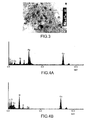
- the Figure 3 is a TEM image of an aqueous dispersion of porous silica nanoparticles, prepared according to the method of the invention and complexed with silver (Ag).
- the Figure 4 presents elementary analyzes by dispersive energy X spectrometry (EDSX) carried out on the spherical nanoparticles of the dispersion presented at the Figure 3 , present outside agglomerate ( Figure 4A ) and in an agglomerate ( Figure 4B ).
- EDSX dispersive energy X spectrometry
- the Figure 5 is a TEM image of an aqueous dispersion of porous silica nanoparticles, prepared according to the process of the invention and complexed with strontium (Sr).
- the Figure 6 presents elementary analyzes by dispersive energy X spectrometry (EDSX) carried out on the spherical nanoparticles of the dispersion presented at the Figure 5 , present outside agglomerate ( Figure 6A ) and in an agglomerate ( Figure 6B ).
- EDSX dispersive energy X spectrometry
- the hydrophilic ⁇ -cyclodextrin is dissolved in water before being injected and distributed uniformly in situ in the inverse microemulsion at room temperature prior to the addition of tetraethoxysilane (TEOS, precursor of silica ).
- TEOS tetraethoxysilane
- the latter ⁇ 40 nm in diameter
- the latter are dispersed in water and passed to cold dialysis in water distilled and deionized to remove the ⁇ -cyclodextrin intended to constitute the porosity of these nano-objects.
- a microemulsion is generated by adding, in that order, the following chemicals, Triton X100 surfactant (16.8 mL), co-surfactant n-hexanol (16.4 mL), cyclohexane organic solvent (75.4 mL), , 04 mL). The solution is then stirred at room temperature for 15 minutes.
- the hydrolysis of the TEOS is initiated by the aqueous ammonia already present and the reaction mixture is stirred for 24 hours at room temperature.
- microemulsion is destabilized by the addition of ethanol (200 ml) and the silica beads are washed three times with ethanol and once with water, each washing being followed by centrifugal sedimentation (15 minutes at room temperature). 6000 rpm).
- the removal of the porogen whose solubility in water is of the order of 18 g / L is approximately 16.5 mM is completed by dialysis in water (5 L) with stirring magnetic for a week.
- the porous silica nanoparticles dispersed in water (400 mL) are then characterized by Zetasizer analysis and transmission electron microscopy (TEM).
- An aqueous solution of porous silica nanoparticles (10 ml) prepared according to the process of the invention is diluted with water (19 ml) and kept under strong magnetic stirring.
- the silica beads complexed with the fluorophore are then washed three times with ethanol and once with water, each washing being followed by centrifugal sedimentation (15 minutes at 6000 rpm).
- Table 1 shows the various fluorophores and metals introduced into the porous silica particles prepared according to the method of the invention.
- Table 1 Molecular Weight / gmol -1 Colors ⁇ max / nm (solvent) Expt. Dyes and fluorophores NPcSi (OH) 2 1 774.88 Dark green 760 (THF) 20 Cardiogreen 774.96 Green 777 (Water) 36 Propyl Astra Bue Iodide 2 1408.75 Blue 336, 614 (Water) 66 Porphyrin 3 790.8 Red 411 (Water) 67 IR 806 735.33 Green 802 (Water) 68 Nile Blue A perchlorate 417.85 Blue 638 (Water) 69 IR 140 779.21 Colorless 827 (Water) 70 HITC 4 536.5 Pale green 734 (Water) 71 2- (2-hydroxy-5-methylphenyl) benzotriazole 5 225.25 Colorless 290 (THF) 72 Alexa Fluor 680-C 2 Male
- silica nanoparticles labeled with Nile Blue perchlorate A prepared according to the method of paragraph 2.1 above and dispersed in water, are then characterized by Zetasizer analysis, transmission electron microscope (TEM) and fluorescence measurement.
- the Figure 1 presents the excitation and emission spectra of the aqueous solution containing these labeled silica nanoparticles.
- the spherical and porous nanoparticles prepared according to the method described in point 1 above are complexed with the IR 806 dye.
- the size of the nanoparticles complexed with IR 806 and dispersed in water is analyzed.
- the Figure 2 presents the size distribution obtained for two independent tests, the average measured size being respectively 85.24 nm and 68.06 nm.
- An aqueous dispersion of silica nanoparticles containing Ag is prepared by using sucrose as pore-forming agent.
- the hydrophilic sucrose is dissolved in water before being injected and uniformly distributed in situ in the inverse microemulsion at room temperature prior to the addition of tetraethoxysilane (TEOS, precursor of the silica).
- TEOS tetraethoxysilane
- the latter ⁇ 60 nm in diameter
- the sucrose intended to constitute the porosity of these nano-objects are dispersed in water and cold-dialyzed in distilled and deionized water to eliminate the sucrose intended to constitute the porosity of these nano-objects.
- a microemulsion was generated by adding, in that order, the following chemicals, Triton X100 surfactant (5 mL), n-hexanol co-surfactant (5 mL), cyclohexane organic solvent (20 mL). The solution is then stirred at room temperature for 15 minutes.
- Aqueous ammonia at 25% ( 125 ⁇ L) is injected into this microemulsion
- the resulting microemulsion is stirred at room temperature for 30 minutes
- the hydrolysis of TEOS is initiated by the aqueous ammonia already present and the reaction mixture is stirred for 24 hours at room temperature.
- the microemulsion is destabilized by the addition of ethanol (200 mL) and the silica beads are washed three times with ethanol and once with water, each wash being followed by centrifuge sedimentation (15 minutes at 6000 rpm).
- the elimination of the porogen whose solubility in water is of the order of 22.15 g / L at 20 ° C. is completed by dialysis in water (5 L) with magnetic stirring. during one week.
- the porous silica nanoparticles dispersed in water (500 ml) are then characterized by Zetasizer analysis and transmission electron microscopy (TEM).
- the TEM image shows the microstructure of the Expt 25 sample ( Figure 3 ).
- spherical nanoparticles located in an agglomerate and out of agglomerate.
- the size of these nanoparticles is between 30 and 80 nm.
- Elemental analyzes by dispersive energy X spectrometry were performed on these spherical nanoparticles ( Figure 4A ).
- the non-agglomerate spherical nanoparticles are rich in Ag. They also contain elements in Si and in S.
- Table 2 below shows the numerical values obtained from the analysis corresponding to the Figure 4A .
- the TEM image shows the microstructure of the Expt 32 sample ( Figure 5 ).
- spherical nanoparticles located in an agglomerate and out of agglomerate.
- the size of these nanoparticles is about 100 nm.
- Elemental analyzes by dispersive energy X spectrometry were performed on these spherical nanoparticles ( Figure 6A ).
- the spherical nanoparticles located outside the agglomerate are very rich in element Si and sometimes contain a element in Sr.
- Table 4 below shows the numerical values obtained from the analysis corresponding to the Figure 6A . ⁇ u> Table 4 ⁇ / u> Elm CL value Norm wt% Prec. Atomic% Yes 1.0000 92.90 9.57 97.61 Sr 4.7693 7.10 6.00 2.39
Landscapes
- Chemical & Material Sciences (AREA)
- Organic Chemistry (AREA)
- Inorganic Chemistry (AREA)
- Dispersion Chemistry (AREA)
- Silicon Compounds (AREA)
Abstract
Description
- La présente invention se rapporte au domaine des particules de silice et notamment des nanoparticules de silice sphériques et poreuses.
- En effet, la présente invention a pour objet un procédé de préparation de particules de silice poreuses impliquant l'utilisation d'un agent porogène soluble dans l'eau tel qu'un dérivé de cyclodextrine ou un saccharide. Elle concerne également les particules de silice poreuses susceptibles d'être préparées par ce procédé et leurs différentes utilisations et applications.
- Les nanoparticules sphériques et poreuses sont bien connues de l'art antérieur. Une porosité régulière peut être générée dans des matériaux à base de silice par un procédé sol-gel conventionnel. Cependant, une faible force mécanique, une faible conductivité thermique et l'hydrophobie sont des préoccupations significatives car ces matériaux sont de nature amorphe.
- Récemment, plusieurs méthodes ont été établies afin de produire un matériel poreux de taille nanométrique ayant une structure régulière et poreuse.
- Une de ces méthodes est l'utilisation de porogènes qui sont calcinés de façon à obtenir des pores de différentes tailles. Cela dit, cette méthode nécessite un matériel robuste au vu de la température optimale à atteindre afin de créer la porosité, température généralement supérieure à 500°C. Différentes applications de la méthode de calcination ont été rapportées dans la littérature, afin de produire une porosité nanométrique dans différentes particules telles que des aluminosilicates, des oxydes de cérium, des billes de silice, des oxydes de titane. Concernant les billes de silice, l'article de Vacassy et al. (2000) propose d'utiliser, comme agent porogène, soit du 3-aminopropyltriéthoxysilane qui est un trialcoxysilane présentant une fonction amine non-hydrolysable, soit du glycérol. Ce dernier agent porogène donne les meilleurs résultats en terme de morphologie et de distribution de taille des particules. Toutefois, les particules obtenues présentent une taille supérieure à 150 nm [1].
- En outre, des particules mésoporeuses de silice contenant du platine ont été produites, en utilisant un précurseur de platine comme agent porogène, et en nécessitant une calcination afin de produire la porosité requise. La préparation de microstructures poreuses utilisant des agents porogènes à base de silice a également été décrite.
- L'article de Yi et al. (2006) propose de préparer différents types de nanoparticules à partir de nanoparticules présentant un coeur de Fe2O3 et une coquille de SiO2 (ci-après désignées nanoparticules Fe2O3/SiO2), ladite coquille ayant été synthétisée par microémulsion inverse [2]. Ainsi, des nanoparticules Fe2O3/SiO2 mésoporeuses sont obtenues, lorsque la microémulsion inverse met en oeuvre du tetraéthylorthosilicate (TEOS) et un agent porogène ultérieurement calciné, l'octadécyltrimethoxysilane (C18TMS). En variante, des nanoparticules de SiO2 creuses sont obtenues par gravure du coeur métallique des nanoparticules Fe2O3/SiO2. Une autre méthode d'introduction de porosité rapportée dans la littérature consiste donc en la gravure de nanoparticules.
- La porosité peut aussi être formée grâce à l'utilisation d'un agent tensioactif. Ceci a notamment été mis en oeuvre pour former des particules de silicates mésoporeuses en utilisant le bromure de cetyltrimethoxyammonium (CTAB) comme agent tensioactif puis en l'extrayant des particules formées par des lavages acides [3].
- Des nanostructures ordonnées de silice hybride ont été établies avec une porosité induite par l'utilisation de porogènes thermiques et notamment de porogènes thermiques de type adamantane, greffés à des précurseurs de silice [4].
- Il existe donc un réel besoin pour un procédé de préparation de particules de silice poreuses, facile à mettre en oeuvre et n'impliquant pas d'étapes de traitement rude telles que calcination, gravure, corrosion ou traitement acide.
- Les cyclodextrines ont déjà été rapportées comme agent porogène. Pour rappel, les cyclodextrines se composent d'oligosaccharides cycliques et sont capables de former des complexes avec des molécules hydrophobes. Il en résulte un grand nombre d'applications dans divers domaines tels que le transport d'agents actifs, la formulation pharmaceutique, la protection environnementale, la chimie supramoléculaire, la diffusion de parfums et, dans l'industrie alimentaire, pour la préparation de produits sans cholestérol. En effet, des produits pharmaceutiques lipophiles d'une taille compatible avec le coeur hydrophobe d'une cyclodextrine telle que la β-cyclodextrine présentant un diamètre interne et donc une cavité interne d'environ 7,5 Å peuvent former des complexes, résultant en une augmentation de la solubilité aqueuse de ces produits pharmaceutiques. L'efficacité in vivo est généralement maintenue quand ces produits pharmaceutiques sont administrés comme des complexes de cyclodextrines. Par ailleurs, il est important de mentionner que les cyclodextrines sont non-toxiques, ne dénaturent pas les protéines et n'interfèrent pas avec des réactions enzymatiques.
- Concernant l'utilisation de cyclodextrines comme agent porogène, le brevet
US 6,632,748 décrit la préparation de substances avec des nanopores de diamètre inférieur à 50 Å telles que des films minces et isolants. Cette préparation met en oeuvre des précurseurs de la matrice à base de silice et des cyclodextrines comme agent porogène et une étape de pyrolyse de cet agent porogène [5]. - De même, des γ-cyclodextrines ont été utilisées afin de créer une porosité dans des films MFI de silice/zéolite, le procédé mis en oeuvre lors de la préparation de ces films incluant une étape de calcination [6]. La préparation de microparticules poreuses de poly(lactide-co-glycolide) d'une taille supérieure à 1 µm par l'utilisation de β-cyclodextrines est également rapportée [7].
- Toutefois, les cyclodextrines n'ont jamais été utilisées en tant qu'agent porogène pour la préparation de particules de silice poreuses.
- La présente invention permet de remédier aux inconvénients et problèmes techniques listés ci-dessus. En effet, cette dernière propose un procédé de préparation de particules de silice poreuses en utilisant une famille particulière de porogènes i.e. des porogènes solubles dans l'eau dont l'élimination, essentielle à l'obtention de la porosité, ne nécessite pas de procédés rudes tels que calcination, gravure, corrosion ou traitement acide. Considérant l'hydrophilie naturelle des porogènes mis en oeuvre tels que la β-cyclodextrine ou du sucrose, ces derniers peuvent facilement être enlevés par des procédés considérés comme doux et peu énergétiques tels qu'une dialyse.
- Les travaux des inventeurs ont mis en évidence que l'utilisation d'un porogène soluble dans l'eau tel que la β-cyclodextrine ou du sucrose permet de générer une porosité homogène dans les particules de silice et d'introduire une porosité régulière à l'échelle nanométrique dans des matériaux particulaires, sphériques à base de silice et notamment des matériaux nanoparticulaires dont la taille est avantageusement inférieure à 100 nm. En effet, l'élimination du porogène hydrophiliquement labile crée des pores ordonnés et uniformes possédant, de façon avantageuse, des diamètres inférieurs à 10 Å.
- Une autre caractéristique de la présente invention se rapporte à l'augmentation de la surface spécifique des particules de silice, phénomène dû à l'élimination efficace du porogène, créant des cavités capables d'emprisonner un plus grand nombre de molécules cibles telles qu'énumérées ci-après.
- De plus, dans le cadre de la présente invention, la surface des particules de silice obtenues par le procédé selon l'invention peut être fonctionnalisée permettant ainsi non seulement d'obtenir un matériau poreux (à cavités), mais également sensible et plus performant à la complexation d'ions métalliques par exemple. En effet, la surface et les pores peuvent être fonctionnalisés, à l'aide de précurseurs de silice fonctionnalisés par des agents de couplage silane NH2 (aminopropyltriéthoxysilane ou APTES), SH (mercaptotriéthoxysilane), EDTA, etc... de façon à pouvoir améliorer la capacité de ces particules à emprisonner des éléments ciblés. De plus, cette fonctionnalisation peut déterminer l'influence désirée sur la polarité du matériau, et ainsi son influence sur l'affinité avec le solvant à utiliser dans le cas de l'application, c'est-à-dire, polaire, apolaire, etc... et donc de la dispersion désirée.
- Ainsi, la présente invention concerne un procédé de préparation d'une particule de silice poreuse comprenant les étapes consistant à :
- préparer une particule de silice comprenant un agent porogène soluble dans l'eau, puis
- éliminer par dissolution ledit agent porogène.
- Dans le cadre de la présente invention, la particule de silice comprenant ledit agent porogène soluble dans l'eau est préparée à partir d'une microémulsion inverse.
- Par « microémulsion inverse », également appelée microémulsion « eau dans huile », on entend une suspension limpide, thermodynamiquement stable, de fines goutelettes d'un premier liquide polaire dans un second liquide non-polaire et donc non miscible avec le premier liquide.
- Plus particulièrement, le procédé selon l'invention comprend les étapes suivantes :
- a) préparer une microémulsion (Ma) du type eau dans huile contenant ledit agent porogène soluble dans l'eau,
- b) ajouter, à la microémulsion (Ma) préparée à l'étape (a), un composé permettant l'hydrolyse d'un composé à base de silane,
- c) ajouter, à la microémulsion (Mb) obtenue à l'étape (b), au moins un composé à base de silane,
- d) ajouter à la microémulsion (Mc) obtenue à l'étape (c) un solvant permettant de déstabiliser ladite microémulsion,
- e) récupérer les particules de silice comprenant ledit agent porogène, précipitées lors de l'étape (d), et
- f) éliminer par dissolution l'agent porogène soluble dans l'eau des particules de silice récupérées lors de l'étape (e) afin d'obtenir des particules de silice poreuses.
- Par « particule de silice poreuse », on entend dans le cadre de la présente invention une particule de silice notamment sphérique présentant des pores ordonnés et uniformes possédant, de préférence, des diamètres inférieurs à 10 Å. Avantageusement, les particules de silice selon l'invention présentent une taille moyenne inférieure ou égale à 100 nm, notamment inférieure ou égale à 80 nm, en particulier inférieure ou égale à 60 nm et, voire, de l'ordre de 40 nm (i.e. 40 ± 10 nm). Les particules de silice selon l'invention peuvent être éventuellement fonctionnalisées.
- Par « agent porogène soluble dans l'eau », on entend dans le cadre de la présente invention un agent porogène miscible avec une solution aqueuse et dont seule une très faible quantité peut être extraite de ladite solution aqueuse dans un solvant organique non-polaire tel que du toluène ou de l'heptane.
- Par « très faible quantité », on entend une quantité inférieure à 5%, notamment inférieure à 3% et, en particulier, inférieure à 1% en poids par rapport au poids total de porogène présent dans la solution aqueuse.
- L'agent porogène soluble dans l'eau mis en oeuvre dans le cadre de la présente invention présente une solubilité dans l'eau, à 25°C, supérieure à 10 g/l et notamment supérieure à 15 g/l. Cette solubilité est de l'ordre de 18 g/l dans le cas des cyclodextrines [8].
- Avantageusement, l'agent porogène soluble dans l'eau utilisé dans le cadre de la présente invention est choisi dans le groupe constitué par les cyclodextrines, les dérivés de cyclodextrine, les monosaccharides, les oligosaccharides et les polysaccharides.
- Par « cyclodextrines », on entend des composés formés par la liaison de n unités d'anhydroglucose, unies par des liaisons glucosidiques alpha-1,4 avec n représentant un entier compris entre 5 et 12 (bornes incluses) et notamment les cyclodextrines naturelles présentant 6, 7 et 8 unités d'anhydroglucose et appelées α-cyclodextrine, β-cyclodextrine et γ-cyclodextrine respectivement.
- Par « dérivés de cyclodextrine », on entend des cyclodextrines dérivées des cyclodextrines telles que précédemment définies par des modifications chimiques et notamment par des substitutions. Ainsi, un dérivé de cyclodextrine peut présenter une ou plusieurs substitutions, identiques ou différentes, sur une ou plusieurs unités d'anhydroglucose. Toute substitution vise notamment à remplacer un groupement hydroxyle d'une unité d'anhydroglucose par un autre groupement tel qu'un halogène ; un maltosyle ; un glucosyle ; un phényle ; un benzyle ; un méthyle ; un hydroxypropyle ; un naphthyle ; un groupement alkyle, linéaire ou ramifié, éventuellement substitué, ayant de 1 à 20 atomes de carbone ; un groupement aryle, linéaire ou ramifié, éventuellement substitué, ayant de 1 à 20 atomes de carbone, avantageusement de 3 à 18 atomes de carbone et, plus particulièrement, de 6 à 15 atomes de carbone ; un groupement amine, éventuellement substitué, ayant de 1 à 20 atomes de carbone ; un groupement amide, éventuellement substitué, ayant de 1 à 20 atomes de carbone ; un groupement sulfonyle, éventuellement substitué, ayant de 1 à 20 atomes de carbone ; un groupement sulfoxyde, éventuellement substitué, ayant de 1 à 20 atomes de carbone ; un groupement thiol, éventuellement substitué, ayant de 1 à 20 atomes de carbone. Par « éventuellement substitué » on entend substitué par un halogène, un hydroxyle, un naphthyle, un benzyle, un alkyle ayant de 1 à 6 atomes de carbone.
- A titre d'exemples non limitatifs de dérivés de cyclodextrines utilisables dans le cadre de la présente invention, on peut citer les dérivés de formule (I) décrits dans le brevet US 5,760,017 [9].
- Les monosaccharides avantageusement mis en oeuvre dans le cadre de la présente invention sont des oses présentant de 3 à 7 carbones tels que le glycéraldéhyde, le dihydroxyacétone, l'érythrose, le thréose, l'érythrulose, le désoxyribose, le ribose, l'arabinose, le xylose, le lyxose, le ribulose, le xylulose, l'allose, l'altrose, le glucose, le mannose, le gulose, l'idose, le galactose, le talose, le psicose, le fructose, le sorbose, le tagatose, le sédoheptulose et le mannoheptulose.
- Les oligosaccharides et les polysaccharides avantageusement mis en oeuvre dans le cadre de la présente invention sont notamment :
- des diholosides ou oligoholosides tels que le tréhalulose, le saccharose (ou sucrose), le turanose, le maltulose, le leucrose, l'isomaltulose, le mélibiose, le lactulose, le lactose, le rutinose, l'inulobiose, le mannobiose, le tréhalose, le maltose, l'isomaltose, le sophorose, le laminaribiose et le cellobiose ; et
- des polyholosides, comme le glycogène, étant entendu que le poids moléculaire du porogène ne doit pas excéder notamment 15000, en particulier, 10000, et voire 4000, tous étant solubles dans l'eau.
- Un porogène particulièrement adapté au procédé selon l'invention est la molécule de β-cyclodextrine qui a la forme d'un cône tronqué, constitué d'une cavité hydrophobe et de groupes hydroxyles activés. Cette molécule possède une grande affinité pour l'eau. Il est connu que la surface externe ainsi que le coeur des nanoparticules de silice possèdent des groupements hydroxyles et ces derniers peuvent interagir avec les molécules de β-cyclodextrine en formant des ponts hydrogène. Ainsi, ce phénomène assure une bonne miscibilité entre les molécules de β-cyclodextrine et les particules de silice en suspension. En introduisant des molécules de β-cyclodextrine et en faisant varier la concentration, la mésoporosité devient controlable.
- L'étape (a) du procédé selon l'invention consiste donc à préparer une microémulsion (Ma) du type eau dans huile contenant l'agent porogène soluble dans l'eau. Toute technique permettant de préparer une telle microémulsion est utilisable dans le cadre de la présente invention. Ainsi, il est possible de :
- soit préparer une première microémulsion (M1) du type eau dans huile et d'y incorporer ultérieurement l'agent porogène soluble dans l'eau pour obtenir la microémulsion (Ma) ;
- soit préparer la microémulsion (Ma) directement en mélangeant ensemble les différents composants et donc l'agent porogène soluble dans l'eau.
- Avantageusement, l'étape (a) du procédé selon l'invention consiste à préparer une première microémulsion (M1) dans laquelle est ultérieurement incorporé l'agent porogène soluble dans l'eau. Cette microémulsion (M1) du type eau dans huile est obtenue en mélangeant ensemble au moins un tensioactif, au moins un co-tensioactif et au moins un solvant non-polaire ou faiblement polaire. Le tensioactif, le co-tensioactif et le solvant non-polaire ou faiblement polaire peuvent être mélangés en une fois ou être ajoutés les uns après les autres ou par groupe. Avantageusement, ils sont ajoutés les uns après les autres et, dans l'ordre suivant, tensioactif puis co-tensioactif puis solvant non-polaire ou faiblement polaire.
- Le mélange est effectué sous agitation en utilisant un agitateur, un barreau magnétique, un bain à ultrasons ou un homogénéisateur, et peut être mis en oeuvre à une température comprise entre 10 et 40°C, avantageusement entre 15 et 30°C et, plus particulièrement, à température ambiante (i.e. 23°C ± 5°C) pendant une durée comprise entre 1 et 45 min, notamment entre 5 et 30 min et, en particulier, pendant 15 min.
- Le (ou les) tensioactif(s) utilisable(s) dans le cadre de la présente invention vise(nt) à introduire des espèces hydrophiles dans un environnement hydrophobe et peu(ven)t être choisi(s) parmi les tensioactifs ioniques, les tensioactifs non-ioniques et leurs mélanges. Par « mélanges », on entend, dans le cadre de la présente invention, un mélange d'au moins deux tensioactifs ioniques différents, un mélange d'au moins deux tensioactifs non-ioniques différents ou un mélange d'au moins un tensioactif non-ionique et d'au moins un tensioactif ionique.
- Un tensioactif ionique peut notamment se présenter sous forme d'une chaîne hydrocarbonée, chargée dont la charge est contre-balancée par un Contre-ion. A titre d'exemples non limitatifs de tensioactifs ioniques, on peut citer le bis (2-éthylhexyl sulfosuccinate) de sodium (AOT), le bromure de cétyltriméthylammonium (CTAB), le bromure de cétylpyridinium (CPB) et leurs mélanges.
- Un tensioactif non-ionique utilisable dans le cadre de la présente invention peut être choisi dans le groupe constitué par les alcools polyéthoxylés, les phénols polyéthoxylés, les oléates, les laurates et leurs mélanges. A titre d'exemples non limitatifs de tensioactifs non-ioniques commerciaux, on peut citer les Triton X tels que le Triton X-100 ; les Brij tels que Brij-30 ; les Igepal CO tels que le Igepal CO-720 ; les Tween tels que le Tween 20 ; les Span tels que le Span 85.
- Par « co-tensioactif », on entend dans le cadre de la présente invention un agent capable de faciliter la formation des microémulsions et les stabiliser. Avantageusement, ledit co-tensioactif est un composé amphiphile choisi dans le groupe constitué par un sulfate d'alkyle sodique à 8 à 20 atomes de carbone tel que le SDS (pour « Sodium Dodecyl Sulfate ») ; un alcool tel qu'un isomère de propanol, de butanol, de pentanol et d'hexanol ; un glycol et leurs mélanges.
- Tout solvant non-polaire ou faiblement polaire est utilisable dans le cadre de la présente invention. Avantageusement, ledit solvant non-polaire ou faiblement polaire est un solvant organique non-polaire ou faiblement polaire et, notamment, choisi dans le groupe constitué par le n-butanol, l'hexanol, le cyclopentane, le pentane, le cyclohexane, le n-hexane, le cycloheptane, l'heptane, le n-octane, l'isooctane, l'hexadécane, l'éther de pétrole, le benzène, l'isobutyl-benzène, le toluène, le xylène, les cumènes, le diéthyl éther, le n-butyl acétate, l'isopropyl myristate et leurs mélanges.
- Dans la microémulsion (M1), le tensioactif est présent dans une proportion comprise entre 1 et 30 %, notamment entre 5 et 25 % et, en particulier, entre 10 et 20 % en volume par rapport au volume total de ladite microémulsion. Le co-tensioactif est également présent, dans la microémulsion (M1), dans une proportion comprise entre 1 et 30 %, notamment entre 5 et 25 % et, en particulier, entre 10 et 20 % en volume par rapport au volume total de ladite microémulsion. Ainsi, le solvant non-polaire ou faiblement polaire est présent, dans la microémulsion. (M1), dans une proportion comprise entre 40 et 98 %, notamment entre 50 et 90 % et, en particulier, entre 60 et 80 % en volume par rapport au volume total de ladite microémulsion.
- Une fois la microémulsion (M1) préparée, l'agent porogène soluble dans l'eau tel que précédemment défini est incorporé pour former la microémulsion (Ma) du type eau dans huile.
- L'agent porogène soluble dans l'eau peut être ajouté sous forme solide, sous forme liquide ou en solution dans un solvant polaire. Quelle que soit la variante mise en oeuvre, un solvant polaire est rajouté à la microémulsion après l'incorporation dudit agent porogène soluble dans l'eau dans la microémulsion (M1). Avantageusement, l'agent porogène soluble dans l'eau est ajouté à la microémulsion (M1) en solution dans un solvant polaire puis du solvant polaire, identique ou différent du premier, est encore ajouté. Plus particulièrement, les deux solvants polaires utilisés sont identiques. L'ajout de l'agent porogène et éventuellement du solvant polaire peut être effectué sous agitation en utilisant un agitateur, un barreau magnétique, un bain à ultrasons ou un homogénéisateur.
- Par « solvant polaire », on entend dans la cadre de la présente invention un solvant choisi dans le groupe constitué par l'eau, l'eau désionisée, l'eau distillée, acidifiées ou basiques, l'acide acétique, les solvants hydroxylés comme le méthanol et l'éthanol, les glycols liquides de faible poids moléculaire tels que l'éthylèneglycol, le diméthylsulfoxyde (DMSO), l'acétonitrile, l'acétone, le tétrahydrofurane (THF) et leurs mélanges.
- Le solvant polaire (solvant polaire dans lequel l'agent porogène est en solution et/ou autre solvant polaire ultérieurement ajouté) est présent, dans la microémulsion (Ma), dans une proportion comprise entre 0,5 et 20 %, notamment entre 1 et 15 % et, en particulier, entre 2 et 10 % en volume par rapport au volume total de ladite microémulsion. L'agent porogène soluble dans l'eau est présent dans ce solvant polaire en une quantité comprise entre 0,05 et 10 %, notamment entre 0,1 et 5 % et, en particulier, entre 0,2 et 1 % en volume par rapport au volume total de solvant polaire.
- L'étape (b) du procédé selon l'invention vise à prévoir l'hydrolyse d'un composé à base de silane en ajoutant à la microémulsion (Ma) un composé permettant cette hydrolyse, la microémulsion (Mb) ainsi obtenue étant une microémulsion eau dans huile.
- Par « composé permettant l'hydrolyse du composé à base de silane », on entend dans le cadre de la présente invention un composé choisi dans le groupe constitué par l'ammoniac, l'hydroxyde de potassium (KOH), l'hydroxyde de lithium (LiOH) et l'hydroxyde de sodium (NaOH) et, avantageusement, une solution d'un tel composé dans un solvant polaire, identique ou différent, au solvant polaire mis en oeuvre lors de l'étape (a). Le composé permettant l'hydrolyse du composé à base de silane est, plus particulièrement, de l'ammoniac ou une solution d'ammoniac dans un solvant polaire. En effet, l'ammoniac agit comme réactif (H2O) et comme catalyseur (NH3) de l'hydrolyse du composé à base de silane.
- Le composé choisi dans le groupe constitué par l'ammoniac, l'hydroxyde de potassium (KOH), l'hydroxyde de lithium (LiOH) et l'hydroxyde de sodium (NaOH), en solution dans le solvant polaire est présent dans une proportion comprise entre 5 et 50 %, notamment entre 10 et 40 % et, en particulier, entre 20 et 30 % en volume par rapport au volume total de ladite solution. De plus, ladite solution est présente dans une proportion comprise entre 0,05 et 20 %, notamment entre 0,1 et 10 % et, en particulier, entre 0,5 et 5 % en volume par rapport au volume total de la microémulsion (Mb).
- L'étape (b) peut être mise en oeuvre sous agitation en utilisant un agitateur, un barreau magnétique, un bain à ultrasons ou un homogénéisateur, et à une température comprise entre 10 et 40°C, avantageusement entre 15 et 30°C et, plus particulièrement, à température ambiante (i.e. 23°C ± 5°C) pendant une durée comprise entre 6 et 48 h, notamment entre 12 et 36 h et, en particulier, pendant 24 h.
- L'étape (c) consiste à incorporer dans la microémulsion (Mb) ainsi obtenue un composé à base de silane ou plusieurs composés à base de silane, identiques ou différents, qui donnera(ont) par réaction sol-gel la silice des particules de silice selon l'invention. L'incorporation dans la microémulsion (Mb) du (ou des) composé(s) à base de silane pour obtenir la microémulsion (Mc) du type eau dans huile est effectuée sous agitation en utilisant un agitateur, un barreau magnétique, un bain à ultrasons ou un homogénéisateur, et peut être mise en oeuvre à une température comprise entre 10 et 40°C, avantageusement entre 15 et 30°C et, plus particulièrement, à température ambiante (i.e. 23°C ± 5°C) pendant une durée comprise entre 5 min et 2 h, notamment entre 15 min et 1 h et, en particulier, pendant 30 min.
- Avantageusement, ledit (ou lesdits) composé(s) à base de silane est(sont) un alkysilane ou un alcoxysilane. Plus particulièrement, ledit (ou lesdits) composé(s) à base de silane est(sont) de formule générale SiR1R2R3R4 dans laquelle R1, R2, R3 et R4 sont, indépendamment les uns des autres, un hydrogène ; un halogène ; un groupe amine ; un groupe amide ; un groupe acyle ; un groupe vinyle ; un groupe hydroxyle ; un groupe epoxy ; un groupe isocyanate ; un groupe carboxyle ; un groupe thiol (ou mercapto) ; un groupe acryloxy tel qu'un groupe méthacryloxy ; un groupe alkyle, linéaire ou ramifié, éventuellement substitué, de 1 à 12 carbones, notamment de 1 à 6 atomes de carbone ; un groupe aryle, linéaire ou ramifié, éventuellement substitué, de 4 à 15 carbones, notamment de 4 à 10 atomes de carbone ou un groupe alcoxyle de formule -OR6 avec R6 représentant un groupe alkyle tel que précédemment défini. Par « éventuellement substitué », on entend, dans le cadre des groupes alkyle et aryle des composés à base de silane, substitué par un halogène, un groupe amine, un groupe amide, un groupe acyle, un groupe vinyle, un groupe hydroxyle, un groupe epoxy, un groupe isocyanate, un groupe carboxyle, un groupe thiol (ou mercapto) ou un groupe acryloxy et notamment un groupe méthacryloxy.
- Le composé à base de silane est, plus particulièrement, choisi parmi le tétraéthoxysilane (TEOS, Si(OC2H5)4), le diméthylsilane (DMSi, Si(CH3)2H2), le phényltriéthoxysilane (PTES, C6H5Si(OC2H5)3), le n-octyltriéthoxysilane (CH3(CH2)7Si(OC2H5)3), le n-octadécyltriéthoxysilane (CH3(CH2)17Si(OC2H5)3), le diméthyldiméthoxysilane (DMDMOS, Si(CH3)2(OCH3)2), le 3-mercaptopropyltriméthoxysilane (SH(CH2)3Si(OCH3)3), le mercaptotriéthoxysilane (SH-Si(OC2H5)3), l'aminopropyltriéthoxysilane (NH2(CH2)3Si(OC2H5)3) et leurs mélanges. De façon plus particulière, le composé à base de silane est le tétraéthoxysilane (TEOS, Si(OC2H5)4).
- En vue de la fonctionnalisation de la surface et des pores des particules de silice obtenues selon l'invention, le composé à base de silane mis en oeuvre peut être un mélange contenant moins de 20% et notamment de 5 à 15% d'un silane préfonctionnalisé par rapport à la quantité totale de composés à base de silane. A titre d'exemple, un mélange contenant du TEOS et de 5 à 15% de mercaptotetraéthoxysilane peut être utilisé pour la préparation de particules de silice poreuses selon l'invention et fonctionnalisées par des groupements thiol.
- Dans la microémulsion (Mc), le composé à base de silane est présent dans une proportion comprise entre 0,05 et 20 %, notamment entre 0,1 et 10 % et, en particulier, entre 0,5 et 5 % en volume par rapport au volume total de ladite microémulsion.
- L'étape (d) du procédé selon l'invention vise à précipiter les particules de silice par addition d'un solvant qui ne dénature pas la structure des nanoparticules mais qui déstabilise ou dénature la microémulsion (Mc) obtenue à l'étape (c).
- Avantageusement, le solvant mis en oeuvre est un solvant polaire tel que précédemment défini. Un solvant polaire particulier à mettre en oeuvre lors de l'étape (d) est choisi dans le groupe constitué par l'éthanol, l'acétone et le THF. Ainsi, est ajouté, à la microémulsion (Mc), un volume de solvant identique ou supérieur au volume de ladite microémulsion, notamment supérieur d'un facteur 1,5, en particulier, supérieur d'un facteur 2, et voire supérieur d'un facteur 3.
- Toute technique permettant de récupérer les particules de silice comprenant ledit agent porogène, précipitées lors de l'étape (d) peut être mise en oeuvre lors de l'étape (e) du procédé selon l'invention. Avantageusement, cette étape (e) met en oeuvre une ou plusieurs étapes, identiques ou différentes, choisies parmi les étapes de centrifugation, de sédimentation et de lavages. La (ou les) étape(s) de lavage est(sont) effectuée(s) dans un solvant polaire tel que précédemment défini, ci-après désigné solvant de lavage. Lorsque l'étape de récupération met en oeuvre plusieurs lavages, un même solvant polaire est utilisé pour plusieurs voire pour tous les lavages ou plusieurs solvants polaires différents sont utilisés à chaque lavage. Concernant une (ou plusieurs) étape(s) de centrifugation, elle(s) peu(ven)t être mise(s) en oeuvre en centrifugeant les particules de silice notamment dans un solvant de lavage à température ambiante, à une vitesse comprise entre 4000 et 8000 rpm et, en particulier, de l'ordre de 6000 rpm (i.e. 6000 ± 500 rpm) et ce, pendant une durée comprise entre 5 min et 2 h, notamment entre 10 min et 1 h et, en particulier, pendant 15 min.
- L'élimination de l'agent porogène soluble dans l'eau peut être effectuée, notamment lors de l'étape (f) du procédé selon l'invention par toute technique connue de l'homme du métier favorisant la solubilisation ou la dissolution dudit agent porogène.
- Avantageusement, cette étape (f) consiste à mettre les particules de silice comprenant un agent porogène soluble dans l'eau au contact d'un très large volume d'eau. Par « très large volume », on entend un volume supérieur d'un facteur 50, notamment d'un facteur 500 et, en particulier, d'un facteur 1000 au volume de particules de silice comprenant un agent porogène soluble dans l'eau, récupérées après l'étape (e) du procédé selon l'invention. L'étape (f) peut être une étape de dialyse, les nanoparticules de silice comprenant un agent porogène soluble dans l'eau étant séparées du volume d'eau par une membrane de cellulose, du type Zellu trans® (société Roth). Alternativement, on peut prévoir une étape d'ultrafiltration à la place de l'étape de dialyse, via une membrane en polyethersulfone. L'étape (f) peut, de plus, être mise en oeuvre sous agitation en utilisant un agitateur, un barreau magnétique, un bain à ultrasons ou un homogénéisateur, à une température comprise entre 0 et 30°C, avantageusement entre 2 et 20°C et, plus particulièrement, à froid (i.e. 6°C ± 2°C) et ce, pendant une durée comprise entre 30 h et 15 j, notamment entre 3 j et 10 j et, en particulier, pendant 1 semaine.
- Il convient de remarquer que, dès les étapes (d) et/ou (e) du procédé selon l'invention, l'agent porogène soluble dans l'eau peut commencer à être éliminé des particules de silice le comprenant et ce, notamment si le solvant mis en oeuvre dans ce (ou ces) étape(s) est aqueux.
- La présente invention concerne également la microémulsion (Mc) susceptible d'être mise en oeuvre dans le cadre du procédé selon l'invention. Cette microémulsion de type eau dans huile comprend :
- au moins un tensioactif, notamment tel que précédemment défini,
- au moins un co-tensioactif, notamment tel que précédemment défini,
- au moins un solvant non-polaire ou faiblement polaire, notamment tel que précédemment défini,
- au moins un solvant polaire, notamment tel que précédemment défini,
- au moins un porogène soluble dans l'eau, notamment tel que précédemment défini,
- au moins un composé à base de silane, notamment tel que précédemment défini, et
- au moins un composé capable d'hydrolyser ledit composé à base de silane, notamment tel que précédemment défini.
- Avantageusement, la microémulsion de type eau dans huile objet de la présente invention comprend :
- au moins un tensioactif en une quantité comprise entre 1 et 30 %, notamment entre 5 et 25 % et, en particulier, entre 10 et 20 % ;
- au moins un co-tensioactif en une quantité comprise entre 1 et 30 %, notamment entre 5 et 25 % et, en particulier, entre 10 et 20 % ;
- au moins un solvant non-polaire ou faiblement polaire en une quantité comprise entre 40 et 95 %, notamment entre 50 et 90 % et, en particulier, entre 60 et 80 % ;
- au moins un solvant polaire en une quantité comprise entre 0,5 et 20 %, notamment entre 1 et 15 % et, en particulier, entre 2 et 10 % ;
- au moins un porogène soluble dans l'eau en une quantité comprise entre 0,001 et 1 %, notamment entre 0,005 et 0,1 % et, en particulier, entre 0,001 et 0,05 % ;
- au moins un composé à base de silane en une quantité comprise entre 0,05 et 20 %, notamment entre 0,1 et 10 % et, en particulier, entre 0,5 et 5 % ; et
- au moins un composé capable d'hydrolyser ledit composé à base de silane en une quantité comprise entre 0,01 et 5 %, notamment entre 0,05 et 1 % et, en particulier, entre 0,1 et 0,5 %.
- La présente invention concerne, de plus, une particule de silice poreuse susceptibe d'être préparée par le procédé de la présente invention. Cette particule est une particule de silice poreuse telle que précédemment définie.
- La particule de silice poreuse selon l'invention présente une porosité homogène. Les pores sont de même taille, cette taille étant fonction du porogène employé. Avantageusement, la particule de silice poreuse selon l'invention présente des pores ordonnés et uniformes possédant, de préférence, des diamètres inférieurs à 10 Å et une taille moyenne inférieure ou égale à 100 nm, notamment inférieure ou égale à 80 nm, en particulier inférieure ou égale à 60 nm et, voire, de l'ordre de 40 nm.
- La présente invention concerne enfin l'utilisation d'une particule de silice poreuse selon l'invention dans des domaines tels que la catalyse, l'imprimerie, la filtration, la peinture, la polymérisation, l'échange thermique, la chimie des matériaux, le raffinage d'hydrocarbures, les absorbants, l'industrie alimentaire, le transport d'agents actifs, les biomolécules, les produits pharmaceutiques, les composés bioélectroniques et les dispositifs électroniques, optiques, de semiconducteurs et de capteurs.
- Plus particulièrement, la présente invention concerne l'utilisation d'une particule de silice poreuse selon la présente invention pour la séparation, la détection, la catalyse et la complexation d'un produit d'intérêt.
- Par « produit d'intérêt », on entend dans le cadre de la présente invention, un produit naturel, artificiel ou synthétique, organique ou inorganique et notamment choisi dans le groupe constitué par les produits chimiques, les ions métalliques, les composés inorganiques, les molécules organiques ou inorganiques, les médicaments, les peptides, les protéines, les acides nucléiques (ADN simple-brin ou double brin et ARN), les polymères artificiels ou naturels, les produits alimentaires ou pharmaceutiques, les virus, les bactéries, les cellules et d'autres entités.
- Par « produit chimique », on entend plus particulièrement dans l'invention un produit choisi dans le groupe constitué par les phthalocyanines (substituées en positions périphériques, et/ou non-périphériques), les porphyrines (substituées en positions méso et/ou périphériques (β)), des colorants et fluorophores (cardiogreen, naphthalocyanine, fluorescéine, rhodamine B, oxazine 750 perchlorate, IR 140, IR 676, HITC, 1,1',3,3,3'3'-hexamethylindotricarbocyanine perchlorate, rhodamine 19 perchlorate, diamine green B, propyl astra blue iodide, nile blue perchlorate, IR 783, IR 806, oxazine 170 perchlorate).
- La présente invention concerne, tout particulièrement, l'utilisation d'une particule de silice poreuse selon la présente invention pour la complexation et l'emprisonnement d'ions métalliques, éventuellement sous forme de sels ou de colloides, tels que or, argent, cuivre, strontium, plomb, cadmium, chrome, fer et zinc, d'alcalins, d'alcalino-terreux, d'actinides et de lanthanides.
- D'autres caractéristiques et avantages de la présente invention apparaîtront encore à l'homme du métier à la lecture des exemples ci-dessous donnés à titre illustratif et non limitatif, en référence aux figures annexées.
- La
Figure 1 présente les spectres d'excitation et d'émission de la solution aqueuse contenant des nanoparticules de silice marquées avec le perchlorate de Nile Blue A et préparées conformément au procédé de l'invention. - La
Figure 2 présente la distribution en taille obtenue pour deux expériences indépendantes avec des nanoparticules poreuses, préparées selon le procédé de la présente invention et complexées avec le IR 806. - La
Figure 3 est une image de MET d'une dispersion aqueuse de nanoparticules de silice poreuses, préparées selon le procédé de l'invention et complexées avec de l'argent (Ag). - La
Figure 4 présente des analyses élémentaires par spectrométrie X d'énergie dispersive (EDSX) effectuées sur les nanoparticules sphériques de la dispersion présentée à laFigure 3 , présentes hors agglomérat (Figure 4A ) et dans un agglomérat (Figure 4B ). - La
Figure 5 est une image de MET d'une dispersion aqueuse de nanoparticules de silice poreuses, préparées selon le procédé de l'invention et complexées avec du strontium (Sr). - La
Figure 6 présente des analyses élémentaires par spectrométrie X d'énergie dispersive (EDSX) effectuées sur les nanoparticules sphériques de la dispersion présentée à laFigure 5 , présentes hors agglomérat (Figure 6A ) et dans un agglomérat (Figure 6B ). - Dans le procédé de cet exemple, la β-cyclodextrine hydrophile est dissoute dans de l'eau avant d'être injectée et distribuée uniformément in situ dans la microémulsion inverse à température ambiante antérieurement à l'ajout du tetraethoxysilane (TEOS, précurseur de la silice). Après hydrolyse du TEOS avec de l'ammoniac aqueux NH4OH, et différentes étapes de lavage des particules de silice, ces dernières (∼ 40 nm de diamètre) sont dispersées dans l'eau et passées en dialyse à froid dans de l'eau distillée et déionisée afin d'éliminer la β-cyclodextrine destinée à constituer la porosité de ces nano-objets.
- Plus particulièrement, une microémulsion est générée en ajoutant, dans cet ordre, les produits chimiques suivants, le tensioactif Triton X100 (16,8 mL), le co-tensioactif n-hexanol (16,4 mL), le solvant organique cyclohexane (75,04 mL). La solution est alors agitée à température ambiante pendant 15 minutes.
- Ensuite, l'agent porogène β-cyclodextrine en solution aqueuse est ajouté (2%, 16 mg dans 800 µL d'eau, M = 1135,01 gmol-1) suivi par de l'eau (4 mL). L'ammoniac aqueux à 25% (1000 µL) est injecté dans cette microémulsion. La microémulsion résultante est agitée à température ambiante pendant 30 minutes. Le dérivé silicone TEOS (pour « tetraethoxysilane », 900 µL, 40,32 x 10⁻⁴ mol, d = 0,934, M = 208,33 gmol-1) est à son tour additionné. L'hydrolyse du TEOS est initiée par l'ammoniac aqueux déjà présent et le mélange réactionnel est agité pendant 24 heures à température ambiante.
- La microémulsion est déstabilisée par l'addition d'éthanol (200 mL) et les billes de silice sont lavées trois fois à l'éthanol et une fois à l'eau, chaque lavage étant suivi par une sédimentation à la centrifugeuse (15 minutes à 6000 rpm).
- Après l'étape de lavage, l'élimination du porogène dont la solubilité dans l'eau est de l'ordre de 18 g/L soit approximativement de 16,5 mM est achevée par dialyse dans l'eau (5 L) sous agitation magnétique pendant une semaine. Les nanoparticules de silice poreuses dispersées dans l'eau (400 mL) sont alors caractérisées par analyse au Zetasizer et en microscope électronique en transmission (MET).
- Une solution aqueuse de nanoparticules de silice poreuses (10 mL) préparées selon le procédé de l'invention est diluée avec de l'eau (19 mL) et gardée sous vive agitation magnétique.
- Ensuite, une solution aqueuse de perchlorate de Nile Blue A (0,41 mg dans 1 mL d'eau, C = 10-3 M, M = 417,85 gmol-1, n = 10-6 mol) est ajoutée au mélange réactionnel qui est agité à température ambiante pendant 24 heures. Les billes de silice complexées avec le fluorophore sont alors lavées trois fois à l'éthanol et une fois à l'eau, chaque lavage étant suivi par une sédimentation à la centrifugeuse (15 minutes à 6000 rpm).
- Le Tableau 1 ci-dessous reprend les différents fluorophores et métaux introduits dans les particules de silice poreuses préparées selon le procédé de l'invention.
Tableau 1 Poids Moléculaires / gmol-1 Couleurs λmax / nm (solvant) Expt. Colorants et fluorophores NPcSi(OH)2 1 774,88 Vert foncé 760 (THF) 20 Cardiogreen 774,96 Vert 777 (Eau) 36 Propyl Astra Bue Iodide2 1408,75 Bleu 336, 614 (Eau) 66 Porphyrine3 790,8 Rouge 411 (Eau) 67 IR 806 735,33 Vert 802 (Eau) 68 Nile Blue A perchlorate 417,85 Bleu 638 (Eau) 69 IR 140 779,21 Incolore 827 (Eau) 70 HITC4 536,5 Vert pâle 734 (Eau) 71 2-(2-hydroxy-5-methylphenyl)benzotriazole5 225,25 Incolore 290 (THF) 72 Alexa Fluor 680-C2 maléimide6 ∼1000 Bleu pâle 686 (Eau) 39 Métaux PbNO3 331,21 Incolore - 35 SrCl2 158,53 Incolore - 32 AgNO3 169,87 Incolore - 25+26 1 Dihydroxyde de silicone 2,3-naphthalocyanine
2 Famille des Phthalocyanines
3 Acide Meso-Tetraphenylpozphine-4,4',4",4"'-tetracarboxylique
4 Iodure de 1,1',3,3,3',3'-hexamethylindotricarbocyanine
5 Absorbeur UV
6 Marqueur de protéines - Les nanoparticules de silice marquées avec le perchlorate de Nile Blue A préparées conformément au procédé du point 2.1 ci-dessus et dispersées dans l'eau sont alors caractérisées par analyse au Zetasizer, en microscope électronique en transmission (MET) et par mesure de fluorescence.
- La
Figure 1 présente les spectres d'excitation et d'émission de la solution aqueuse contenant ces nanoparticules de silice marquées. - Les nanoparticules sphériques et poreuses préparées selon le procédé décrit au point 1 ci-dessus sont complexées avec le colorant IR 806.
- La taille des nanoparticules complexées avec le IR 806 et dispersées dans l'eau est analysée. La
Figure 2 présente la distribution en taille obtenue pour deux essais indépendants, la taille moyenne mesurée étant respectivement de 85,24 nm et 68,06 nm. - Une dispersion aqueuse de nanoparticules de silice contenant du Ag est préparée en utilisant comme agent porogène du sucrose.
- Dans le procédé de cet exemple, le sucrose hydrophile est dissous dans de l'eau avant d'être injecté et distribué uniformément in situ dans la microémulsion inverse à température ambiante antérieurement à l'ajout du tétraéthoxysilane (TEOS, précurseur de la silice). Après hydrolyse du TEOS avec de l'ammoniac, et différentes étapes de lavage des particules de silice, ces dernières (∼ 60 nm de diamètre) sont dispersées dans l'eau et passées en dialyse à froid dans de l'eau distillée et déionisée afin d'éliminer le sucrose destiné à constituer la porosité de ces nano-objets.
- Plus particulièrement, une microémulsion a été générée en ajoutant, dans cet ordre, les produits chimiques suivants, le tensioactif Triton X100 (5 mL), le co-tensioactif n-hexanol (5 mL), le solvant organique cyclohexane (20 mL). La solution est alors agitée à température ambiante pendant 15 minutes.
- Ensuite, l'agent porogène sucrose en solution aqueuse est ajouté (0.5%, 5 mg dans 200 µL d'eau, M = 342.30 gmol-1 suivi par de l'eau (1 mL). L'ammoniac aqueux à 25% (125 µL) est injecté dans cette microémulsion. La microémulsion résultante est agitée à température ambiante pendant 30 minutes. Le dérivé silicone TEOS (pour « tétraéthoxysilane », 176 µL, 8 x 10⁻⁴ mol, d = 0,934, M = 208,33 gmol-1) est à son tour additionné. L'hydrolyse du TEOS est initiée par l'ammoniac aqueux déjà présent et le mélange réactionnel est agité pendant 24 heures à température ambiante. La microémulsion est déstabilisée par l'addition d'éthanol (200 mL) et les billes de silice sont lavées trois fois à l'éthanol et une fois à l'eau, chaque lavage étant suivi par une sédimentation à la centrifugeuse (15 minutes à 6000 rpm).
- Après l'étape de lavage, l'élimination du porogène dont la solubilité dans l'eau est de l'ordre de 22,15 g/L à 20°C est achevée par dialyse dans l'eau (5 L) sous agitation magnétique pendant une semaine. Les nanoparticules de silice poreuses dispersées dans l'eau (500 mL) sont alors caractérisées par analyse au Zetasizer et en microscope électronique en transmission (MET).
- L'image de MET montre la microstructure de l'échantillon Expt 25 (
Figure 3 ). Nous observons des nanoparticules sphériques situées dans un agglomérat et hors agglomérat. La taille de ces nanoparticules se situe entre 30 et 80 nm. - Des analyses élémentaires par spectrométrie X d'énergie dispersive (EDSX) ont été effectuées sur ces nanoparticules sphériques (
Figure 4A ). Les nanoparticules sphériques situées hors agglomérat sont riches en Ag. Elles contiennent également des éléments en Si et en S. Le Tableau 2 ci-dessous reprend les valeurs numériques obtenues à partir de l'analyse correspondant à laFigure 4A .Tableau 2 Elm CL value Norm wt% Prec. Atomic % Line Si 1.0000 6.41 0.98 19.62 K line S 1.1690 3.04 0.83 8.16 K line Ag 4.5206 90.55 7.16 72.22 L line - Des analyses par EDSX ont été également effectuées sur ces agglomérats (
Figure 4B ). Ces derniers sont riches en Si et contiennent peu de Ag. Le Tableau 3 ci-dessous reprend les valeurs numériques obtenues à partir de l'analyse correspondant à laFigure 4B .Tableau 3 Elm CL value Norm wt% Prec. Atomic % Line Si 1.0000 72.12 6.56 81.57 K line S 1.1690 14.67 3.56 14.54 K line Ag 4.5206 13.21 8.19 3.89 L line - Une dispersion aqueuse de nanoparticules de silice poreuses, fonctionnalisées avec des groupements thiols (SH) via l'ajout de 5 à 15% de mercaptotriethoxysilane avec le TEOS, contenant du strontium.
- L'image de MET montre la microstructure de l'échantillon Expt 32 (
Figure 5 ). Nous observons des nanoparticules sphériques situées dans un agglomérat et hors agglomérat. La taille de ces nanoparticules fait environ 100 nm. - Des analyses élémentaires par spectrométrie X d'énergie dispersive (EDSX) ont été effectuées sur ces nanoparticules sphériques (
Figure 6A ). Les nanoparticules sphériques situées hors agglomérat sont très riches en élément Si et parfois contiennent un élément en Sr. Le Tableau 4 ci-dessous reprend les valeurs numériques obtenues à partir de l'analyse correspondant à laFigure 6A .Tableau 4 Elm CL value Norm wt% Prec. Atomic % Si 1.0000 92.90 9.57 97.61 Sr 4.7693 7.10 6.00 2.39 - Des analyses par EDSX ont été également effectuées sur ces agglomérats (
Figure 4B ). Par rapport aux particules sphériques, l'agglomérat a un pourcentage élevé en élément S. En effet, les fonctions thiol sont plus concentrées sur les billes nanométriques et confèrent une plus grande complexation. Le Tableau 5 ci-dessous reprend les valeurs numériques obtenues à partir de l'analyse de laFigure 6B .Tableau 5 Elm CL value Norm wt% Prec. Atomic % Si 1.0000 87.65 4.54 89.01 Sr 4.7693 0.00 0.00 0.00 S 1.1690 12.35 1.97 10.99 -
- 1 Vacassy, R.; Flatt, R.J.; Hofmann, H.; Choi, K.S.; Singh, R.K. J. of Colloid. and Interface Science, 2000, 227, 302-315.
- 2 Yi, D.K.; Lee, S.S.; Papaefthymiou, G.C.; Ying, J.Y. Chem. Mater., 2006, 18, 614-619.
- 3 Lim, M.H.; Blanford, C.F.; Stein, A. Chem. Mater., 1998, 10, 467-470.
- 4 Cho, W.; Cha, B.; Kim, J.M.; Char, K. In "The 231st ACS National Meeting", Nano-structured Polymers: Atlanta, GA, March 26-30, 2006, Poly 214.
- 5 Brevet
US 6 632 748 au nom de Samsung Electronics et publié le 14 octobre 2003. - 6 Li, S.; Li, Z.; Yan, Y. Adv. Mater., 2003, 15, 1528-1531.
- 7 Kwon, M.J.; Bae, J.H.; Kim, J.J.; Na, K.; Lee, E.S. International Journal of Pharmaceutics, 2007, 333, 5-9.
- 8 Sabadini, E.; Cosgrove, T.; do Carmo Egidio, F. Carbohydr. Res., 2006, 341, 270-274.
- 9 Brevet
US 5 760 017 au nom du Commissariat à l'Energie Atomique et publié le 2 juin 1998.
Claims (16)
- Procédé de préparation d'une particule de silice poreuse comprenant les étapes consistant à :- préparer une particule de silice comprenant un agent porogène soluble dans l'eau, puis- éliminer par dissolution ledit agent porogène.
- Procédé selon la revendication 1,
caractérisé en ce que ladite particule de silice comprenant ledit agent porogène soluble dans l'eau est préparée à partir d'une microémulsion inverse. - Procédé selon l'une quelconque des revendications 1 ou 2, caractérisé en ce qu'il comprend les étapes suivantes :a) préparer une microémulsion (Ma) du type eau dans huile contenant ledit agent porogène soluble dans l'eau,b) ajouter à la microémulsion (Ma) préparée à l'étape (a) un composé permettant l'hydrolyse d'un composé à base de silane,c) ajouter à la microémulsion (Mb) obtenue à l'étape (b) au moins un composé à base de silane,d) ajouter à la microémulsion (Mc) obtenue à l'étape (c) un solvant permettant de déstabiliser ladite microémulsion,e) récupérer les particules de silice comprenant ledit agent porogène, précipitées lors de l'étape (d), etf) éliminer par dissolution l'agent porogène soluble dans l'eau des particules de silice récupérées lors de l'étape (e) afin d'obtenir des particules de silice poreuses.
- Procédé selon l'une quelconque des revendications 1 à 3, caractérisé en ce que ledit agent porogène soluble dans l'eau est choisi dans le groupe constitué par les cyclodextrines, les dérivés de cyclodextrine, les monosaccharides, les oligosaccharides et les polysaccharides.
- Procédé selon l'une quelconque des revendications 3 ou 4, caractérisé en ce que ladite étape (a) consiste à préparer une première microémulsion (M1) dans laquelle est ultérieurement incorporé l'agent porogène soluble dans l'eau.
- Procédé selon la revendication 5,
caractérisé en ce que ladite microémulsion (M1) est obtenue en mélangeant ensemble au moins un tensioactif, au moins un co-tensioactif et au moins un solvant non-polaire ou faiblement polaire. - Procédé selon l'une quelconque des revendications 5 ou 6, caractérisé en ce qu'un solvant polaire est rajouté à la microémulsion après l'incorporation dudit agent porogène soluble dans l'eau dans la microémulsion (M1).
- Procédé selon l'une quelconque des revendications 3 à 7, caractérisé en ce que ledit (ou lesdits) composé(s) à base de silane est(sont) de formule générale :
SiR1R2R3R4
dans laquelle R1, R2, R3 et R4 sont, indépendamment les uns des autres, un hydrogène ; un halogène ; un groupe amine ; un groupe amide ; un groupe acyle ; un groupe vinyle ; un groupe hydroxyle ; un groupe epoxy ; un groupe isocyanate ; un groupe carboxyle ; un groupe thiol (ou mercapto) ; un groupe acryloxy tel qu'un groupe méthacryloxy ; un groupe alkyle, linéaire ou ramifié, éventuellement substitué, de 1 à 12 carbones, notamment de 1 à 6 atomes de carbone ; un groupe aryle, linéaire ou ramifié, éventuellement substitué, de 4 à 15 carbones, notamment de 4 à 10 atomes de carbone ou un groupe alcoxyle de formule -OR6 avec R6 représentant un groupe alkyle, linéaire ou ramifié, éventuellement substitué, de 1 à 12 carbones, notamment de 1 à 6 atomes de carbone. - Procédé selon l'une quelconque des revendications 3 à 8, caractérisé en ce que ledit composé permettant l'hydrolyse du composé à base de silane est un composé choisi dans le groupe constitué par l'ammoniac, l'hydroxyde de potassium (KOH), l'hydroxyde de lithium (LiOH) et l'hydroxyde de sodium (NaOH).
- Procédé selon l'une quelconque des revendications 3 à 9, caractérisé en ce que le solvant permettant de déstabiliser la microémulsion (Mc) est un solvant polaire tel que de l'éthanol, de l'acétone ou du THF.
- Microémulsion (Mc) du type eau dans huile et susceptible d'être mise en oeuvre dans le cadre d'un procédé tel que défini à l'une quelconque des revendications précédentes, comprenant :- au moins un tensioactif,- au moins un co-tensioactif,- au moins un solvant non-polaire ou faiblement polaire,- au moins un solvant polaire,- au moins un porogène soluble dans l'eau, notamment tel que défini à la revendication 4,- au moins un composé à base de silane, notamment tel que défini à la revendication 8, et- au moins un composé capable d'hydrolyser ledit composé à base de silane, notamment tel que défini à la revendication 9.
- Microémulsion selon la revendication 11, caractérisée en ce qu'elle comprend :- au moins un tensioactif en une quantité comprise entre 1 et 30 %, notamment entre 5 et 25 % et, en particulier, entre 10 et 20 % ;- au moins un co-tensioactif en une quantité comprise entre 1 et 30 %, notamment entre 5 et 25 % et, en particulier, entre 10 et 20 % ;- au moins un solvant non-polaire ou faiblement polaire en une quantité comprise entre 40 et 95 %, notamment entre 50 et 90 % et, en particulier, entre 60 et 80 % ;- au moins un solvant polaire en une quantité comprise entre 0,5 et 20 %, notamment entre 1 et 15 % et, en particulier, entre 2 et 10 % ;- au moins un porogène soluble dans l'eau en une quantité comprise entre 0,001 et 1 %, notamment entre 0,005 et 0,1 % et, en particulier, entre 0,001 et 0,05 % ;- au moins un composé à base de silane en une quantité comprise entre 0,05 et 20 %, notamment entre 0,1 et 10 % et, en particulier, entre 0,5 et 5 % ; et- au moins un composé capable d'hydrolyser ledit composé à base de silane en une quantité comprise entre 0,01 et 5 %, notamment entre 0,05 et 1 % et, en particulier, entre 0,1 et 0,5 %.
- Particule de silice poreuse susceptibe d'être préparée par un procédé tel que défini à l'une quelconque des revendications 1 à 10.
- Particule de silice poreuse selon la revendication 13, caractérisée en ce qu'elle présente des pores ordonnés et uniformes possédant, de préférence, des diamètres inférieurs à 10 Å et une taille moyenne inférieure ou égale à 100 nm, notamment inférieure ou égale à 80 nm, en particulier inférieure ou égale à 60 nm et, voire, de l'ordre de 40 nm.
- Utilisation d'une particule de silice poreuse selon l'une quelconque des revendications 13 ou 14, pour la séparation, la détection, la catalyse et la complexation d'un produit d'intérêt.
- Utilisation selon la revendication 15 pour la complexation et l'emprisonnement d'ions métalliques, d'alcalins, d'alcalino-terreux, d'actinides et de lanthanides.
Applications Claiming Priority (1)
| Application Number | Priority Date | Filing Date | Title |
|---|---|---|---|
| FR0951239A FR2942622B1 (fr) | 2009-02-27 | 2009-02-27 | Procede de preparation de particules de silice poreuses, lesdites particules et leurs utilisations |
Publications (2)
| Publication Number | Publication Date |
|---|---|
| EP2228127A1 true EP2228127A1 (fr) | 2010-09-15 |
| EP2228127B1 EP2228127B1 (fr) | 2015-11-04 |
Family
ID=41092997
Family Applications (1)
| Application Number | Title | Priority Date | Filing Date |
|---|---|---|---|
| EP10154389.0A Not-in-force EP2228127B1 (fr) | 2009-02-27 | 2010-02-23 | Procédé de préparation de particules de silice poreuses, lesdites particules et leurs utilisations |
Country Status (4)
| Country | Link |
|---|---|
| US (1) | US8852544B2 (fr) |
| EP (1) | EP2228127B1 (fr) |
| JP (1) | JP5760245B2 (fr) |
| FR (1) | FR2942622B1 (fr) |
Cited By (3)
| Publication number | Priority date | Publication date | Assignee | Title |
|---|---|---|---|---|
| FR2971508A1 (fr) * | 2011-02-16 | 2012-08-17 | Commissariat Energie Atomique | Procede de preparation par irradiation micro-ondes de particules de silice contenant un derive de phtalocyanine, lesdites particules et leurs utilisations |
| WO2013053799A1 (fr) * | 2011-10-14 | 2013-04-18 | Arcelik Anonim Sirketi | Panneau isolant sous vide |
| WO2016116679A1 (fr) | 2015-01-21 | 2016-07-28 | Ab7 Innovation S.A.S.U. | Procédé d'élaboration d'un matériau composite non poreux hydro- et/ou lipo-absorbant de compositions actives liquides |
Families Citing this family (11)
| Publication number | Priority date | Publication date | Assignee | Title |
|---|---|---|---|---|
| BR112012006430A2 (pt) | 2009-09-23 | 2018-03-13 | Fef Chemicals As | preparação de sílica gel mesoporosa e macroporosa |
| EP2782693A4 (fr) * | 2011-11-23 | 2015-08-19 | Momentive Performance Mat Inc | Particules contenant du métal fonctionnalisé et leurs procédés de fabrication |
| KR102188457B1 (ko) * | 2014-07-22 | 2020-12-08 | 주식회사 케이씨텍 | 연마입자 및 이를 포함하는 연마 슬러리 |
| CN104495857B (zh) * | 2014-12-10 | 2016-08-24 | 深圳市力合材料有限公司 | 一种快速制备大粒径硅溶胶的方法 |
| LU92783B1 (en) * | 2015-07-22 | 2017-01-31 | Luxembourg Inst Of Science And Tech (List) | Highly aminated self-assembling fuctionalized Mesoporous Silicia Nanoparticles and methods of synthesis |
| JP7128544B2 (ja) * | 2018-02-26 | 2022-08-31 | 国立大学法人東海国立大学機構 | 熱交換器、冷凍機および焼結体 |
| CN114504844B (zh) * | 2020-10-28 | 2023-08-08 | 中国石油化工股份有限公司 | 一种聚结材料及其制备方法和除油方法 |
| CN113200551A (zh) * | 2021-04-29 | 2021-08-03 | 武汉理工大学 | 一种改性白炭黑的制备方法 |
| CN115305359B (zh) * | 2022-08-23 | 2023-08-01 | 成都先进金属材料产业技术研究院股份有限公司 | 一种基于微乳液从硫钴精矿浸出液选择性萃取铜的方法 |
| CN119192032B (zh) * | 2024-11-27 | 2025-03-11 | 齐鲁工业大学(山东省科学院) | 以介孔二氧化硅作为助剂的异氰酸酯的制备方法 |
| CN121470494B (zh) * | 2026-01-07 | 2026-03-20 | 宁波大学 | 二氧化硅水凝胶、其去除方法以及二氧化硅水凝胶膜 |
Citations (3)
| Publication number | Priority date | Publication date | Assignee | Title |
|---|---|---|---|---|
| US5760017A (en) | 1993-12-22 | 1998-06-02 | Commissariat A L'energie Atomique | Cyclodextrin derivatives usable in particular for solubilizing hydrophobic chemical compounds such as medicaments and their preparation process |
| WO1999036357A1 (fr) * | 1998-01-20 | 1999-07-22 | Drexel University | Matieres mesoporeuses et leurs procedes de fabrication |
| US6632748B2 (en) | 2001-03-27 | 2003-10-14 | Samsung Electronics Co., Ltd. | Composition for preparing substances having nano-pores |
Family Cites Families (10)
| Publication number | Priority date | Publication date | Assignee | Title |
|---|---|---|---|---|
| CA1337750C (fr) * | 1987-11-24 | 1995-12-19 | John L. Fulton | Separation de micelles inversees a l'aide de fluide supercritique |
| US6048616A (en) * | 1993-04-21 | 2000-04-11 | Philips Electronics N.A. Corp. | Encapsulated quantum sized doped semiconductor particles and method of manufacturing same |
| DE19639016A1 (de) * | 1996-09-23 | 1998-03-26 | Basf Ag | Mesoporöses Siliciumdioxid, Verfahren zu seiner Herstellung und seiner Verwendung |
| US6696258B1 (en) * | 1998-01-20 | 2004-02-24 | Drexel University | Mesoporous materials and methods of making the same |
| US6036886A (en) * | 1998-07-29 | 2000-03-14 | Nanocrystals Technology L.P. | Microemulsion method for producing activated metal oxide nanocrystals |
| JP2001038193A (ja) * | 1999-07-28 | 2001-02-13 | Nippon Millipore Kk | 複合シリカマイクロカプセルの製造方法と複合シリカマイクロカプセルの芯物質の固定化と徐放作用の制御方法。 |
| US6899857B2 (en) * | 2001-11-13 | 2005-05-31 | Chartered Semiconductors Manufactured Limited | Method for forming a region of low dielectric constant nanoporous material using a microemulsion technique |
| US7405002B2 (en) * | 2004-08-04 | 2008-07-29 | Agency For Science, Technology And Research | Coated water-soluble nanoparticles comprising semiconductor core and silica coating |
| WO2006050579A1 (fr) * | 2004-11-15 | 2006-05-18 | Australian Nuclear Science & Technology Organisation | Particules solides issues de la destabilisation controlee de microemulsions |
| US8003567B2 (en) * | 2009-08-17 | 2011-08-23 | Honda Motor Co., Ltd. | Nanocomposite support materials |
-
2009
- 2009-02-27 FR FR0951239A patent/FR2942622B1/fr not_active Expired - Fee Related
-
2010
- 2010-02-23 EP EP10154389.0A patent/EP2228127B1/fr not_active Not-in-force
- 2010-02-25 US US12/712,228 patent/US8852544B2/en not_active Expired - Fee Related
- 2010-02-25 JP JP2010040529A patent/JP5760245B2/ja not_active Expired - Fee Related
Patent Citations (3)
| Publication number | Priority date | Publication date | Assignee | Title |
|---|---|---|---|---|
| US5760017A (en) | 1993-12-22 | 1998-06-02 | Commissariat A L'energie Atomique | Cyclodextrin derivatives usable in particular for solubilizing hydrophobic chemical compounds such as medicaments and their preparation process |
| WO1999036357A1 (fr) * | 1998-01-20 | 1999-07-22 | Drexel University | Matieres mesoporeuses et leurs procedes de fabrication |
| US6632748B2 (en) | 2001-03-27 | 2003-10-14 | Samsung Electronics Co., Ltd. | Composition for preparing substances having nano-pores |
Non-Patent Citations (9)
| Title |
|---|
| CHO, W.; CHA, B.; KIM, J.M.; CHAR, K.: "The 231st ACS National Meeting", NANO-STRUCTURED POLYMERS, 26 March 2006 (2006-03-26), pages 214 |
| DONG KEE YI ET.AL.: "Nanoparticle Architectures Templated by SiO2/Fe2O3 Nanocomposites", CHEM. MATER., vol. 18, 2006, pages 614 - 619, XP002548295 * |
| KWON, M.J.; BAE, J.H.; KIM, J.J.; NA, K.; LEE, E.S., INTERNATIONAL JOURNAL OF PHARMACEUTICS, vol. 333, 2007, pages 5 - 9 |
| LI, S.; LI, Z.; YAN, Y., ADV. MATER., vol. 15, 2003, pages 1528 - 1531 |
| LIM, M.H.; BLANFORD, C.F.; STEIN, A., CHEM. MATER., vol. 10, 1998, pages 467 - 470 |
| R. VACASSY ET.AL.: "Synthesis of Microporous Silica Spheres", JOURNAL OF COLLOID AND INTERFACE SCIENCE, vol. 227, 2000, pages 302 - 315, XP002548294 * |
| SABADINI, E.; COSGROVE, T.; DO CARMO EGIDIO, F. CARBOHYDR. RES., vol. 341, 2006, pages 270 - 274 |
| VACASSY, R.; FLATT, R.J.; HOFMANN, H.; CHOI, K.S.; SINGH, R.K., J. OF COLLOID. AND INTERFACE SCIENCE, vol. 227, 2000, pages 302 - 315 |
| YI, D.K.; LEE, S.S.; PAPAEFTHYMIOU, G.C.; YING, J.Y., CHEM. MATER., vol. 18, 2006, pages 614 - 619 |
Cited By (4)
| Publication number | Priority date | Publication date | Assignee | Title |
|---|---|---|---|---|
| FR2971508A1 (fr) * | 2011-02-16 | 2012-08-17 | Commissariat Energie Atomique | Procede de preparation par irradiation micro-ondes de particules de silice contenant un derive de phtalocyanine, lesdites particules et leurs utilisations |
| WO2012110554A1 (fr) * | 2011-02-16 | 2012-08-23 | Commissariat à l'énergie atomique et aux énergies alternatives | Procédé de préparation par irradiation micro-ondes de particules de silice contenant un dérivé de phtalocyanine, lesdites particules et leurs utilisations |
| WO2013053799A1 (fr) * | 2011-10-14 | 2013-04-18 | Arcelik Anonim Sirketi | Panneau isolant sous vide |
| WO2016116679A1 (fr) | 2015-01-21 | 2016-07-28 | Ab7 Innovation S.A.S.U. | Procédé d'élaboration d'un matériau composite non poreux hydro- et/ou lipo-absorbant de compositions actives liquides |
Also Published As
| Publication number | Publication date |
|---|---|
| EP2228127B1 (fr) | 2015-11-04 |
| FR2942622A1 (fr) | 2010-09-03 |
| JP2010202505A (ja) | 2010-09-16 |
| FR2942622B1 (fr) | 2011-05-13 |
| JP5760245B2 (ja) | 2015-08-05 |
| US8852544B2 (en) | 2014-10-07 |
| US20100221542A1 (en) | 2010-09-02 |
Similar Documents
| Publication | Publication Date | Title |
|---|---|---|
| EP2228127B1 (fr) | Procédé de préparation de particules de silice poreuses, lesdites particules et leurs utilisations | |
| Hartlen et al. | Facile preparation of highly monodisperse small silica spheres (15 to> 200 nm) suitable for colloidal templating and formation of ordered arrays | |
| FR2952368A1 (fr) | Particule de silice incorporant une molecule d'interet, son procede de preparation et ses utilisations. | |
| FR2721615A1 (fr) | Procédé de préparation de particules d'oxyde métallique organophiles. | |
| EP2470548A2 (fr) | Procédé de préparation de particules de silice contenant un dérivé de phtalocyanine, lesdites particules et leurs utilisations | |
| EP2806958B1 (fr) | Décontamination par hydrogels d'échantillons aqueux contenant des nanoparticules | |
| CN111406740B (zh) | 一种基于氮化硼纳米片接枝亲水高分子的纳米农药制剂及其制备方法 | |
| FR2956109A1 (fr) | Procede de preparation par voie stober de particules de silice contenant un derive de phtalocyanine, lesdites particules et leurs utilisations. | |
| WO2009092725A2 (fr) | Particules enrobees et fonctionnalisees, polymere les contenant, leur procede de preparation et leurs utilisations | |
| EP1963341B1 (fr) | Materiau hybride organique - inorganique mesostructure | |
| CN113462425A (zh) | 一种高效Janus型两亲硅基破乳剂及其制备方法 | |
| WO2006010851A2 (fr) | Procede de preparation de particules d'aluminium enrobees par une couche polymere | |
| WO2003035772A1 (fr) | Compositions pigmentaires a base de silice | |
| EP2922787B1 (fr) | Procédé de fabrication de nanotubes hybrides d'imogolite | |
| EP2567940B1 (fr) | Procédé de préparation d'argiles ayant de nouvelles propriétés physicochimiques | |
| WO2022013250A1 (fr) | Procédé de synthèse de particules de silice poreuse nanométriques et submicroniques par chimie douce | |
| EP3164208A1 (fr) | Procede de synthese d'allophane hybride | |
| FR2862236A1 (fr) | Particules inorganiques dissymetriques, procede pour leur preparation. | |
| WO2013102657A1 (fr) | Procede de preparation de particules d'oxyde de titane contenant un derive de phtalocyanine, lesdites particules et leurs utilisations | |
| EP4496774A1 (fr) | Matériaux mésoporeux magnétiques à base de silice (3ms) | |
| EP3164209A1 (fr) | Application d'aluminosilicates hybrides | |
| WO2014114717A1 (fr) | PROCÉDÉ DE PRÉPARATION D'UN MATÉRIAU HYBRIDE MgO/ORGANIQUE, LEDIT MATÉRIAU ET SES UTILISATIONS | |
| WO2004063285A1 (fr) | Compositions pigmentaires colorees a base de silice | |
| WO2012110554A1 (fr) | Procédé de préparation par irradiation micro-ondes de particules de silice contenant un dérivé de phtalocyanine, lesdites particules et leurs utilisations | |
| FR2936722A1 (fr) | Materiaux nanocomposites et procede de fabrication par nanoprecipitation. |
Legal Events
| Date | Code | Title | Description |
|---|---|---|---|
| PUAI | Public reference made under article 153(3) epc to a published international application that has entered the european phase |
Free format text: ORIGINAL CODE: 0009012 |
|
| AK | Designated contracting states |
Kind code of ref document: A1 Designated state(s): AT BE BG CH CY CZ DE DK EE ES FI FR GB GR HR HU IE IS IT LI LT LU LV MC MK MT NL NO PL PT RO SE SI SK SM TR |
|
| 17P | Request for examination filed |
Effective date: 20110303 |
|
| 17Q | First examination report despatched |
Effective date: 20111229 |
|
| GRAP | Despatch of communication of intention to grant a patent |
Free format text: ORIGINAL CODE: EPIDOSNIGR1 |
|
| INTG | Intention to grant announced |
Effective date: 20150522 |
|
| RIN1 | Information on inventor provided before grant (corrected) |
Inventor name: PONCELET, OLIVIER Inventor name: AUGER, AURELIEN |
|
| GRAS | Grant fee paid |
Free format text: ORIGINAL CODE: EPIDOSNIGR3 |
|
| GRAA | (expected) grant |
Free format text: ORIGINAL CODE: 0009210 |
|
| AK | Designated contracting states |
Kind code of ref document: B1 Designated state(s): AT BE BG CH CY CZ DE DK EE ES FI FR GB GR HR HU IE IS IT LI LT LU LV MC MK MT NL NO PL PT RO SE SI SK SM TR |
|
| REG | Reference to a national code |
Ref country code: GB Ref legal event code: FG4D Free format text: NOT ENGLISH |
|
| REG | Reference to a national code |
Ref country code: CH Ref legal event code: EP |
|
| REG | Reference to a national code |
Ref country code: AT Ref legal event code: REF Ref document number: 758812 Country of ref document: AT Kind code of ref document: T Effective date: 20151115 |
|
| REG | Reference to a national code |
Ref country code: IE Ref legal event code: FG4D Free format text: LANGUAGE OF EP DOCUMENT: FRENCH |
|
| REG | Reference to a national code |
Ref country code: DE Ref legal event code: R096 Ref document number: 602010028702 Country of ref document: DE |
|
| REG | Reference to a national code |
Ref country code: FR Ref legal event code: PLFP Year of fee payment: 7 |
|
| REG | Reference to a national code |
Ref country code: NL Ref legal event code: MP Effective date: 20151104 |
|
| REG | Reference to a national code |
Ref country code: LT Ref legal event code: MG4D |
|
| REG | Reference to a national code |
Ref country code: AT Ref legal event code: MK05 Ref document number: 758812 Country of ref document: AT Kind code of ref document: T Effective date: 20151104 |
|
| PG25 | Lapsed in a contracting state [announced via postgrant information from national office to epo] |
Ref country code: IT Free format text: LAPSE BECAUSE OF FAILURE TO SUBMIT A TRANSLATION OF THE DESCRIPTION OR TO PAY THE FEE WITHIN THE PRESCRIBED TIME-LIMIT Effective date: 20151104 Ref country code: NL Free format text: LAPSE BECAUSE OF FAILURE TO SUBMIT A TRANSLATION OF THE DESCRIPTION OR TO PAY THE FEE WITHIN THE PRESCRIBED TIME-LIMIT Effective date: 20151104 Ref country code: IS Free format text: LAPSE BECAUSE OF FAILURE TO SUBMIT A TRANSLATION OF THE DESCRIPTION OR TO PAY THE FEE WITHIN THE PRESCRIBED TIME-LIMIT Effective date: 20160304 Ref country code: ES Free format text: LAPSE BECAUSE OF FAILURE TO SUBMIT A TRANSLATION OF THE DESCRIPTION OR TO PAY THE FEE WITHIN THE PRESCRIBED TIME-LIMIT Effective date: 20151104 Ref country code: HR Free format text: LAPSE BECAUSE OF FAILURE TO SUBMIT A TRANSLATION OF THE DESCRIPTION OR TO PAY THE FEE WITHIN THE PRESCRIBED TIME-LIMIT Effective date: 20151104 Ref country code: LT Free format text: LAPSE BECAUSE OF FAILURE TO SUBMIT A TRANSLATION OF THE DESCRIPTION OR TO PAY THE FEE WITHIN THE PRESCRIBED TIME-LIMIT Effective date: 20151104 Ref country code: NO Free format text: LAPSE BECAUSE OF FAILURE TO SUBMIT A TRANSLATION OF THE DESCRIPTION OR TO PAY THE FEE WITHIN THE PRESCRIBED TIME-LIMIT Effective date: 20160204 |
|
| PGFP | Annual fee paid to national office [announced via postgrant information from national office to epo] |
Ref country code: DE Payment date: 20160212 Year of fee payment: 7 |
|
| PG25 | Lapsed in a contracting state [announced via postgrant information from national office to epo] |
Ref country code: BE Free format text: LAPSE BECAUSE OF NON-PAYMENT OF DUE FEES Effective date: 20160229 Ref country code: FI Free format text: LAPSE BECAUSE OF FAILURE TO SUBMIT A TRANSLATION OF THE DESCRIPTION OR TO PAY THE FEE WITHIN THE PRESCRIBED TIME-LIMIT Effective date: 20151104 Ref country code: PT Free format text: LAPSE BECAUSE OF FAILURE TO SUBMIT A TRANSLATION OF THE DESCRIPTION OR TO PAY THE FEE WITHIN THE PRESCRIBED TIME-LIMIT Effective date: 20160304 Ref country code: PL Free format text: LAPSE BECAUSE OF FAILURE TO SUBMIT A TRANSLATION OF THE DESCRIPTION OR TO PAY THE FEE WITHIN THE PRESCRIBED TIME-LIMIT Effective date: 20151104 Ref country code: SE Free format text: LAPSE BECAUSE OF FAILURE TO SUBMIT A TRANSLATION OF THE DESCRIPTION OR TO PAY THE FEE WITHIN THE PRESCRIBED TIME-LIMIT Effective date: 20151104 Ref country code: LV Free format text: LAPSE BECAUSE OF FAILURE TO SUBMIT A TRANSLATION OF THE DESCRIPTION OR TO PAY THE FEE WITHIN THE PRESCRIBED TIME-LIMIT Effective date: 20151104 Ref country code: GR Free format text: LAPSE BECAUSE OF FAILURE TO SUBMIT A TRANSLATION OF THE DESCRIPTION OR TO PAY THE FEE WITHIN THE PRESCRIBED TIME-LIMIT Effective date: 20160205 Ref country code: AT Free format text: LAPSE BECAUSE OF FAILURE TO SUBMIT A TRANSLATION OF THE DESCRIPTION OR TO PAY THE FEE WITHIN THE PRESCRIBED TIME-LIMIT Effective date: 20151104 |
|
| PGFP | Annual fee paid to national office [announced via postgrant information from national office to epo] |
Ref country code: GB Payment date: 20160216 Year of fee payment: 7 Ref country code: FR Payment date: 20160229 Year of fee payment: 7 |
|
| PG25 | Lapsed in a contracting state [announced via postgrant information from national office to epo] |
Ref country code: CZ Free format text: LAPSE BECAUSE OF FAILURE TO SUBMIT A TRANSLATION OF THE DESCRIPTION OR TO PAY THE FEE WITHIN THE PRESCRIBED TIME-LIMIT Effective date: 20151104 |
|
| REG | Reference to a national code |
Ref country code: DE Ref legal event code: R097 Ref document number: 602010028702 Country of ref document: DE |
|
| PG25 | Lapsed in a contracting state [announced via postgrant information from national office to epo] |
Ref country code: EE Free format text: LAPSE BECAUSE OF FAILURE TO SUBMIT A TRANSLATION OF THE DESCRIPTION OR TO PAY THE FEE WITHIN THE PRESCRIBED TIME-LIMIT Effective date: 20151104 Ref country code: SM Free format text: LAPSE BECAUSE OF FAILURE TO SUBMIT A TRANSLATION OF THE DESCRIPTION OR TO PAY THE FEE WITHIN THE PRESCRIBED TIME-LIMIT Effective date: 20151104 Ref country code: RO Free format text: LAPSE BECAUSE OF FAILURE TO SUBMIT A TRANSLATION OF THE DESCRIPTION OR TO PAY THE FEE WITHIN THE PRESCRIBED TIME-LIMIT Effective date: 20151104 Ref country code: DK Free format text: LAPSE BECAUSE OF FAILURE TO SUBMIT A TRANSLATION OF THE DESCRIPTION OR TO PAY THE FEE WITHIN THE PRESCRIBED TIME-LIMIT Effective date: 20151104 Ref country code: SK Free format text: LAPSE BECAUSE OF FAILURE TO SUBMIT A TRANSLATION OF THE DESCRIPTION OR TO PAY THE FEE WITHIN THE PRESCRIBED TIME-LIMIT Effective date: 20151104 |
|
| PLBE | No opposition filed within time limit |
Free format text: ORIGINAL CODE: 0009261 |
|
| STAA | Information on the status of an ep patent application or granted ep patent |
Free format text: STATUS: NO OPPOSITION FILED WITHIN TIME LIMIT |
|
| PG25 | Lapsed in a contracting state [announced via postgrant information from national office to epo] |
Ref country code: MC Free format text: LAPSE BECAUSE OF FAILURE TO SUBMIT A TRANSLATION OF THE DESCRIPTION OR TO PAY THE FEE WITHIN THE PRESCRIBED TIME-LIMIT Effective date: 20151104 Ref country code: LU Free format text: LAPSE BECAUSE OF FAILURE TO SUBMIT A TRANSLATION OF THE DESCRIPTION OR TO PAY THE FEE WITHIN THE PRESCRIBED TIME-LIMIT Effective date: 20160223 |
|
| REG | Reference to a national code |
Ref country code: CH Ref legal event code: PL |
|
| 26N | No opposition filed |
Effective date: 20160805 |
|
| PG25 | Lapsed in a contracting state [announced via postgrant information from national office to epo] |
Ref country code: CH Free format text: LAPSE BECAUSE OF NON-PAYMENT OF DUE FEES Effective date: 20160229 Ref country code: LI Free format text: LAPSE BECAUSE OF NON-PAYMENT OF DUE FEES Effective date: 20160229 |
|
| PG25 | Lapsed in a contracting state [announced via postgrant information from national office to epo] |
Ref country code: SI Free format text: LAPSE BECAUSE OF FAILURE TO SUBMIT A TRANSLATION OF THE DESCRIPTION OR TO PAY THE FEE WITHIN THE PRESCRIBED TIME-LIMIT Effective date: 20151104 |
|
| REG | Reference to a national code |
Ref country code: IE Ref legal event code: MM4A |
|
| PG25 | Lapsed in a contracting state [announced via postgrant information from national office to epo] |
Ref country code: IE Free format text: LAPSE BECAUSE OF NON-PAYMENT OF DUE FEES Effective date: 20160223 |
|
| PG25 | Lapsed in a contracting state [announced via postgrant information from national office to epo] |
Ref country code: MT Free format text: LAPSE BECAUSE OF FAILURE TO SUBMIT A TRANSLATION OF THE DESCRIPTION OR TO PAY THE FEE WITHIN THE PRESCRIBED TIME-LIMIT Effective date: 20151104 |
|
| REG | Reference to a national code |
Ref country code: DE Ref legal event code: R119 Ref document number: 602010028702 Country of ref document: DE |
|
| GBPC | Gb: european patent ceased through non-payment of renewal fee |
Effective date: 20170223 |
|
| REG | Reference to a national code |
Ref country code: FR Ref legal event code: ST Effective date: 20171031 |
|
| PG25 | Lapsed in a contracting state [announced via postgrant information from national office to epo] |
Ref country code: DE Free format text: LAPSE BECAUSE OF NON-PAYMENT OF DUE FEES Effective date: 20170901 Ref country code: FR Free format text: LAPSE BECAUSE OF NON-PAYMENT OF DUE FEES Effective date: 20170228 |
|
| PG25 | Lapsed in a contracting state [announced via postgrant information from national office to epo] |
Ref country code: GB Free format text: LAPSE BECAUSE OF NON-PAYMENT OF DUE FEES Effective date: 20170223 |
|
| PG25 | Lapsed in a contracting state [announced via postgrant information from national office to epo] |
Ref country code: CY Free format text: LAPSE BECAUSE OF FAILURE TO SUBMIT A TRANSLATION OF THE DESCRIPTION OR TO PAY THE FEE WITHIN THE PRESCRIBED TIME-LIMIT Effective date: 20151104 Ref country code: HU Free format text: LAPSE BECAUSE OF FAILURE TO SUBMIT A TRANSLATION OF THE DESCRIPTION OR TO PAY THE FEE WITHIN THE PRESCRIBED TIME-LIMIT; INVALID AB INITIO Effective date: 20100223 |
|
| PG25 | Lapsed in a contracting state [announced via postgrant information from national office to epo] |
Ref country code: TR Free format text: LAPSE BECAUSE OF FAILURE TO SUBMIT A TRANSLATION OF THE DESCRIPTION OR TO PAY THE FEE WITHIN THE PRESCRIBED TIME-LIMIT Effective date: 20151104 Ref country code: MK Free format text: LAPSE BECAUSE OF FAILURE TO SUBMIT A TRANSLATION OF THE DESCRIPTION OR TO PAY THE FEE WITHIN THE PRESCRIBED TIME-LIMIT Effective date: 20151104 |
|
| PG25 | Lapsed in a contracting state [announced via postgrant information from national office to epo] |
Ref country code: BG Free format text: LAPSE BECAUSE OF FAILURE TO SUBMIT A TRANSLATION OF THE DESCRIPTION OR TO PAY THE FEE WITHIN THE PRESCRIBED TIME-LIMIT Effective date: 20151104 |