EP2220221B1 - Recombinantly modified plasmin - Google Patents
Recombinantly modified plasmin Download PDFInfo
- Publication number
- EP2220221B1 EP2220221B1 EP08857923.0A EP08857923A EP2220221B1 EP 2220221 B1 EP2220221 B1 EP 2220221B1 EP 08857923 A EP08857923 A EP 08857923A EP 2220221 B1 EP2220221 B1 EP 2220221B1
- Authority
- EP
- European Patent Office
- Prior art keywords
- polypeptide
- plasmin
- plasminogen
- tal6003
- amino acid
- Prior art date
- Legal status (The legal status is an assumption and is not a legal conclusion. Google has not performed a legal analysis and makes no representation as to the accuracy of the status listed.)
- Active
Links
Images



Classifications
-
- C—CHEMISTRY; METALLURGY
- C12—BIOCHEMISTRY; BEER; SPIRITS; WINE; VINEGAR; MICROBIOLOGY; ENZYMOLOGY; MUTATION OR GENETIC ENGINEERING
- C12N—MICROORGANISMS OR ENZYMES; COMPOSITIONS THEREOF; PROPAGATING, PRESERVING, OR MAINTAINING MICROORGANISMS; MUTATION OR GENETIC ENGINEERING; CULTURE MEDIA
- C12N9/00—Enzymes; Proenzymes; Compositions thereof; Processes for preparing, activating, inhibiting, separating or purifying enzymes
- C12N9/14—Hydrolases (3)
- C12N9/48—Hydrolases (3) acting on peptide bonds (3.4)
- C12N9/50—Proteinases, e.g. Endopeptidases (3.4.21-3.4.25)
- C12N9/64—Proteinases, e.g. Endopeptidases (3.4.21-3.4.25) derived from animal tissue
- C12N9/6421—Proteinases, e.g. Endopeptidases (3.4.21-3.4.25) derived from animal tissue from mammals
- C12N9/6424—Serine endopeptidases (3.4.21)
- C12N9/6435—Plasmin (3.4.21.7), i.e. fibrinolysin
-
- A—HUMAN NECESSITIES
- A61—MEDICAL OR VETERINARY SCIENCE; HYGIENE
- A61P—SPECIFIC THERAPEUTIC ACTIVITY OF CHEMICAL COMPOUNDS OR MEDICINAL PREPARATIONS
- A61P7/00—Drugs for disorders of the blood or the extracellular fluid
- A61P7/02—Antithrombotic agents; Anticoagulants; Platelet aggregation inhibitors
-
- C—CHEMISTRY; METALLURGY
- C12—BIOCHEMISTRY; BEER; SPIRITS; WINE; VINEGAR; MICROBIOLOGY; ENZYMOLOGY; MUTATION OR GENETIC ENGINEERING
- C12N—MICROORGANISMS OR ENZYMES; COMPOSITIONS THEREOF; PROPAGATING, PRESERVING, OR MAINTAINING MICROORGANISMS; MUTATION OR GENETIC ENGINEERING; CULTURE MEDIA
- C12N11/00—Carrier-bound or immobilised enzymes; Carrier-bound or immobilised microbial cells; Preparation thereof
- C12N11/02—Enzymes or microbial cells immobilised on or in an organic carrier
- C12N11/04—Enzymes or microbial cells immobilised on or in an organic carrier entrapped within the carrier, e.g. gel or hollow fibres
-
- C—CHEMISTRY; METALLURGY
- C12—BIOCHEMISTRY; BEER; SPIRITS; WINE; VINEGAR; MICROBIOLOGY; ENZYMOLOGY; MUTATION OR GENETIC ENGINEERING
- C12Y—ENZYMES
- C12Y304/00—Hydrolases acting on peptide bonds, i.e. peptidases (3.4)
- C12Y304/21—Serine endopeptidases (3.4.21)
- C12Y304/21007—Plasmin (3.4.21.7), i.e. fibrinolysin
-
- C—CHEMISTRY; METALLURGY
- C07—ORGANIC CHEMISTRY
- C07K—PEPTIDES
- C07K2319/00—Fusion polypeptide
Definitions
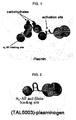
- Human plasminogen is a single-chain protein containing 791 amino acid residues. Activation of plasminogen to plasmin results from a single cleavage of the Arg561-Val562 peptide bond in the zymogen. The resulting plasmin molecule is a two-chain, disulfide-linked serine protease with trypsin-like specificity (cleaves after Lys and Arg).
- the amino-terminal heavy chain of plasmin (residues 1-561, ⁇ 60 kDa) is composed of five kringle domains, each containing approximately 80 amino acid residues.
- the kringle domains are responsible for the regulatory properties of plasminogen, such as interaction with activation inhibitors, e.g., Cl -1 ions; with activation stimulators, e.g., ⁇ -aminocaproic acid; with mammalian and bacterial cells; and with other proteins, such as the plasmin physiological substrate, fibrin and plasmin inhibitor, ⁇ 2-antiplasmin.
- kringle 1 is one of the most multi-functional: its lysine-binding activity has been shown to be responsible for plasmin interaction with ⁇ 2-antiplasmin and fibrin. See Wiman, B., et al., Biochim. Biophys. Acta 579: 142-154 (1979 ); and Lucas, M.A., et al., J. Biol. Chem. 258: 4249-4256 (1983 ).
- the C-terminal light chain of plasmin (residues 562-791, ⁇ 25kDa) is a typical serine protease, homologous to trypsin and containing the classic serine protease catalytic triad: His603, Asp646 and Ser741. Plasminogen contains 24 disulfide bridges and 2 glycosylation sites on Asn289 and Thr346.
- Mini-plasminogen can be activated in the same way as plasminogen, forming mini-plasmin.
- Plasminogen is produced in the form of insoluble inclusion bodies and is not re-foldable from that state. Further, the expression of plasminogen in mammalian cells is complicated by intracellular activation of plasminogen into plasmin and the resulting cytotoxicity. Production of fully active plasminogen using insect cells is possible, however, this system is not suitable for large-scale production due to low yield. Further, as with any recombinant protein scheme, the potential exists for encountering immunogenicity problems in the subject receiving the therapeutic recombinant protein.
- Immunogenicity can be a barrier to the effective and/or efficient utilization of certain recombinant protein therapeutic schemes.
- Immunogenicity is a complex series of responses to a substance (e.g., the chemical structure of a protein including the amino acid sequence) that is perceived as foreign and may include production of neutralizing and non-neutralizing antibodies, formation of immune complexes, complement activation, mast cell activation, inflammation, and anaphylaxis.
- Immunogenicity may limit the efficacy and safety of a protein therapeutic in multiple ways. Efficacy can be reduced directly by the formation of neutralizing antibodies. Efficacy may also be reduced indirectly, as binding to either neutralizing or non-neutralizing antibodies typically leads to rapid clearance from serum. Severe side effects and even death may occur when an immune reaction is raised. One special class of side effects results when neutralizing antibodies cross-react with an endogenous protein and block its function.
- a modified recombinant protein possessing the desirable characteristics (e.g., regions with native-like chemical structures) of plasmin/plasminogen while lacking certain negative characteristics and being capable of production in recombinant protein expression systems including bacterial cells in substantial quantities, is desirable.
- Medynski D. et al disclose the refolding, purification, and activation of miniplasminogen isolated from E. coli inclusion bodies.
- the present invention provides a polynucleotide comprising a nucleotide sequence encoding a polypeptide having:
- the present invention provides a polypeptide encoded by the above polynucleotide.
- the present invention provides an expression vector comprising the polynucleotide of the present invention.
- the polynucleotide comprises a nucleotide sequence as shown in SEQ ID NO: 1.
- the present invention provides a cultured cell comprising an expression vector comprising a polynucleotide of the present invention.
- the polynucleotide comprises a nucleotide sequence as shown in SEQ ID NO: 1.
- the cultured cell is a prokaryotic organism.
- the prokaryotic organism is E. coli.
- the present invention provides a method for making one or more recombinant plasmin polypeptides having different N-termini.
- the method comprises:
- the present inventors have discovered novel recombinant plasminogen polypeptides, or variants thereof, herein referred to as (TAL6003)-plasminogens that have native plasminogen-like features despite deletion of 4 kringles from its structure.
- These (TAL6003)-plasminogens, or variants thereof are zymogens that are capable of becoming activated to functional plasmin enzymes (herein referred to as (TAL6003)-plasmins) following an activation event that at least involves proteolytic cleavage of an Arg-Val peptide bond located between the kringle domain and the serine protease domain of the zymogen.
- the (TAL6003)-plasminogen, or a variant thereof, of the present invention has fibrin- and antiplasmin-binding as well as activation properties of full-length native human plasminogen. Further, the (TAL6003)-plasminogen has a number of novel and desirable features including high-level expression in recombinant production and certain protein chemical structures identical or very similar to naturally occurring forms of human plasma-derived plasminogen.
- the (TAL6003)-plasmin(ogen)s according to the present invention can be characterized at least by the following:
- the invention provides recombinant (TAL6003)-plasmin(ogen) polypeptides having a single kringle region N-terminal to the activation site and serine protease domain, having certain advantages relative to mini-plasmin(ogen).
- the (TAL6003)-plasminogens of the invention only have one kringle domain, as such, N-terminal to the activation site, some embodiments include additional sequences N-terminal to the activation site. Additional N-terminal sequences can be derived from those of native kringle regions of plasminogen.
- the N-terminal kringle domains of the present invention include kringle sequences of kringles 1 and 4 of native plasmin(ogen) and functional equivalents thereof.
- kringle sequences of kringles 1 and 4 of native plasmin(ogen) and functional equivalents thereof.
- preservation of function in polypeptide variants including preservation of residues participating in or influencing lysine binding.
- polypeptides of the present invention can exhibit reduced immunogenicity by virtue of native-like structures.
- the recombinant plasminogen of the present invention has an N-terminus identical to that of one of the naturally occurring forms of human plasma-derived plasminogen, which upon activation by streptokinase, produces plasmin polypeptides comprising native-like N-termini.
- the novel polypeptides of the present invention have a sequence between the Kringle and Serine protease domains that is similar to the junction between Kringle 5 and the SP domain in naturally occurring human plasmin.
- domain and region of a polypeptide are generally synonymous as used herein, unless otherwise indicated to the contrary.
- structural or functional designations such as “kringle” or “serine protease,” etc., such terms will introduce a polypeptide feature relating to at least some characteristic(s) commonly recognized and understood to be associated with the polypeptide structures corresponding to such designations.
- a “cultured host cell,” as used herein, refers to a prokaryotic or eukaryotic cell that contains heterologous DNA that has been introduced into the cell by any means, e.g., electroporation, calcium phosphate precipitation, microinjection, transformation, viral infection, and the like.
- Heterologous as used herein means “of different natural origin” or representing a non-natural state. For example, if a cultured host cell is transformed with a DNA or gene derived from another organism, particularly from another species, that gene is heterologous with respect to that cultured host cell, and also with respect to descendants of the cultured host cell which carry that gene. Similarly, “heterologous” refers to a nucleotide sequence derived from and inserted into the same natural, original cell type, but which is present in a non-natural state, e.g., a different copy number or under the control of different regulatory elements.
- heterologous when used in the context of a nucleic acid or amino acid sequence, the term “heterologous” also may refer to any region of the sequence that is of a different natural origin than another region of the same sequence. For example, if a recombinant protein comprises a kringle domain derived from apolipoprotein(a) and a serine-protease domain derived from plasminogen, the kringle domain and the serine protease domain are “heterologous" relative to each other, particularly if each domain is derived from a different species or organism.
- a "vector" molecule is a nucleic acid molecule into which heterologous nucleic acid can be inserted which can then be introduced into an appropriate cultured host cell.
- Vectors preferably have one or more origins of replication, and one or more sites into which the recombinant DNA can be inserted.
- Vectors often have convenient means by which cells with vectors can be selected from those without, e.g., they encode drug resistance genes.
- Common vectors include plasmids, viral genomes, and (primarily in yeast and bacteria) "artificial chromosomes.”
- transcriptional control sequence refers to nucleic acid sequences, such as initiator sequences, enhancer sequences and promoter sequences, which induce, repress, or otherwise control the transcription of protein encoding nucleic acid sequences to which they are operably-linked.
- polypeptide is used interchangeably herein with the terms “peptide” and “protein.”
- nucleic acid can refer to any nucleic acid that contains the information necessary for the purpose indicated by the context. That is, the nucleic acid can be DNA or RNA, either single stranded or double stranded, or other nucleic acid, as long as the polymer is capable of representing the appropriate information, e.g., in relation to an encoded peptide, and can include complementary sequences, e.g., sense strands and anti-sense strands of nucleic acids polymers.
- variant of a polypeptide refers to an amino acid sequence that is altered by one or more amino acids.
- the variant can have "conservative” changes, wherein a substituted amino acid has similar structural or chemical properties, e.g., replacement of leucine with isoleucine.
- a variant can have "non-conservative” changes, e.g., replacement of a glycine with a tryptophan.
- Analogous minor variation can also include amino acid deletion or insertion, or both.
- a particular form of a "variant" polypeptide is a "functionally equivalent” polypeptide, i.e., a polypeptide that exhibits substantially similar in vivo or in vitro activity as the examples of the polypeptide of invention, as described in more detail below.
- Guidance in determining which amino acid residues can be substituted, inserted, or deleted without eliminating biological or immunological activity can be found using computer programs well known in the art, for example, DNASTAR software (DNASTAR, Inc., Madison, WI). Further, specific guidance is provided below, including that provided within the cited references that are fully incorporated herein by reference.
- N-terminal and C-terminal are used herein to designate the relative position of any amino acid sequence or polypeptide domain or structure to which they are applied. The relative positioning will be apparent from the context. That is, an "N-terminal” feature will be located at least closer to the N-terminus of the polypeptide molecule than another feature discussed in the same context (the other feature possible referred to as “C-terminal” to the first feature). Similarly, the terms “5'-" and “3'-” can be used herein to designate relative positions of features of polynucleotides.
- polypeptides referred to herein as having an N-terminal domain "homologous to a kringle domain of native human plasminogen” exhibit structural and functional characteristics similar to native kringle domains of plasminogen. Further, the polypeptides referred to herein as having an N-terminal domain "homologous to kringle 1" exhibit characteristics similar to native kringle 1, at least to the extent that the polypeptides can have a higher affinity for ⁇ -aminocarboxylic acids (and functional homologs such as trans -4 aminomethylcyclohexane-1-carboxylic acid, a cyclic acid) than kringle 5.
- references to kringle domains "homologous to kringle 4" are defined similarly, as noted above regarding the phrase “homologous to kringle 1.” That is, they exhibit functional characteristics similar to kringle 4 of native human plasminogen as discussed above. These polypeptides also bind immobilized lysine as described above.
- the polypeptides of the invention bind immobilized lysine.
- binding immobilized lysine means that the polypeptides so characterized are retarded in their progress relative to mini-plasminogen when subjected to column chromatography using lysine-SEPHAROSETM as the chromatographic media.
- the polypeptides of the invention can be eluted from such chromatographic media (lysine affinity resins) using solutions containing the specific ligand, e.g., ⁇ -ACA, as eluants.
- references can be consulted by those of skill in the art to determine which residues can be varied by conservative or non-conservative substitution, deletion, or addition to yield a deletion mutant within the scope of the present invention.
- the following references provide information regarding particular residues of the native kringle domains that may be important for binding of ⁇ -aminocarboxylic acids: U.S. Pat. No. 6,538,103 to Ji, et al. ; U.S. Pat. No. 6,218,517 to Suzuki ; Douglas, J.T., et al., Biochemistry 41(10): 3302-10 (2002 ); Zajicek, J., et al., J. Mol. Biol.
- the present invention can encompass other fibrin-binding domains or regions N-terminal to the activation site.
- the invention can include polypeptides in which the serine protease domain of plasmin is attached to a fibrin-binding kringle selected from a group including, but not limited to, kringle 4 of human plasminogen, kringle 2 of tPA, or a kringle of apolipoprotein(a).
- the invention can include polypeptides in which a serine protease domain of plasmin is attached to any other known fibrin-binding modules, such as the "finger" domain of tPA or fibronectin, or the FAB fragment of fibrin-specific IgG.
- the polypeptides of the present invention have protein chemical structures (e.g., native-like N-terminus and native-like juncture between the kringle and the serine protease domain) that are identical to the chemical structures found in the naturally occurring forms of human plasma-derived plasmin(ogen).
- protein chemical structures e.g., native-like N-terminus and native-like juncture between the kringle and the serine protease domain
- certain features of a protein can contribute to its immunogenicity, including but not limited to its amino acid sequence.
- the present invention provides an effective protein therapeutic based on recombinant (TAL6003)-plasminogen by preemptively reducing the potential immunogenicity of (TAL6003)-plasminogen through incorporation of amino acid sequences that resemble native human plasminogen sequences.
- the recombinant (TAL6003)-plasminogen polypeptide of the present invention comprises (a) a single N-terminal kringle domain homologous to a kringle domain of native human plasminogen, wherein the last four amino acid residues within the kringle domain are V, P, Q, and C; and (b) a C-terminal domain activation site and serine protease domain homologous to the corresponding domains in human plasminogen; wherein the polypeptide binds to immobilized lysine and is capable of becoming activated to functional plasmin enzymes following an activation event that at least involves proteolytic cleavage of an Arg-Val peptide bond located between the kringle domain and the serine protease domain .
- the recombinant (TAL6003)-plasminogen polypeptides of the present invention can be activated by one of ordinary skill in the art to provide a (TAL6003)-plasmin polypeptide.
- the (TAL6003)-plasmin polypeptide exhibits a fibrinolytic activity that is inhibited by ⁇ 2-antiplasmin at a rate of inhibition that is at least about 5-fold faster than the rate of inhibition of the fibrinolytic activity of mini-plasmin by ⁇ 2-antiplasmin.
- the polypeptide has an amino acid sequence as shown in SEQ ID NO: 2, and conservative substitutions thereof. In other embodiments, the polypeptide has an arginine residue at a relative position analogous to that of position 85 of the amino acid sequence shown in SEQ ID NO: 2.
- the (TAL6003)-plasminogen described in this invention makes use of amino acid residue modifications to the junction region joining the single kringle domain and the serine protease domain. Accordingly, this juncture between the two domains more closely resembles the naturally occurring juncture between the kringle 5 domain and the serine protease domain of human plasminogen.
- the (TAL6003)-plasminogen described in this invention further comprises a native-like N-terminal sequence.
- the recombinantly produced (TAL6003)-plasminogen can be cleaved off upon activation to provide recombinant (TAL6003)-plasmin polypeptides also having native-like N-termini.
- residues at certain positions of the single N-terminal kringle domain of (TAL6003)-plasminogen are conserved relative to kringle 1 of native human plasminogen.
- residues at positions associated with disulfide bridging and lysine binding include Cys84, Cys105, Cys133, Cys145, Cys157, and Cys162, and Pro136-Pro140, Pro143-Tyr146, and Arg153-Tyr156, respectively (positions numbered as shown in Figure 3 ).
- mini-plasmin(ogen) which has an analogous domain composition
- K-SP kringle-serine protease
- Arg arginine
- the (TAL6003)-plasminogen of the invention comprises a single N-terminal kringle domain comprising an Arg residue at a relative position analogous to that of position 85 of the amino acid sequence shown in SEQ ID NO: 2.
- a relative position analogous to that of position 85 of the amino acid sequence shown in SEQ ID NO: 2 include Arg(153), Arg(234), Arg(324), and Arg(426) positions of the amino acid sequence shown in SEQ ID NO: 4.
- N-terminal Characterization of the single N-terminal kringle domain of (TAL6003)-plasminogen as "N-terminal” means only that the domain is present N-terminal to the activation site and does not mean that additional amino acids residues N-terminal to the domain itself are not present. Further, the number and identity of residues interposed between the most C-terminal cysteine residue of the single N-terminal kringle domain (i.e., the most C-terminal Cys residue shown in Figure 4 ) and the activation site of plasminogen can be varied without departing from the scope of the present invention.
- the invention relates to polynucleotides, polypeptides, recombinant methods for producing the polypeptides, vectors containing the polynucleotides, expression systems for producing the polypeptides, and cultured host cells comprising such expression systems.
- the invention relates to a polynucleotide encoding the polypeptide disclosed herein or a polypeptide having conservative amino acid substitutions thereof.
- Guidance regarding selection of "conservative" amino acid substitutions is provided in more detail below.
- the polynucleotide is DNA.
- the invention relates to cells containing at least one polynucleotide of the invention.
- the polynucleotide comprises the nucleotide sequence as shown in SEQ ID NO: 1.
- the polypeptide comprises the amino acid sequence as shown in SEQ ID NO: 2.
- the polynucleotides of the invention include variants that have substitutions, deletions, and/or additions that can involve one or more nucleotides.
- the variants can be altered in coding regions, non-coding regions, or both. Alterations in the coding regions can produce conservative or non-conservative amino acid substitutions, deletions, or additions. Especially preferred among these are silent substitutions, additions and deletions, which do not alter the properties and activities of the (TAL6003)-plasmin(ogen) protein or portions thereof. Also especially preferred in this regard are conservative substitutions (see below).
- the nucleic acid molecule of the present invention comprises a polynucleotide having a nucleotide sequence that encodes a polypeptide having the amino acid sequence shown in SEQ ID NO: 2.
- the nucleic acid molecule comprises a polynucleotide having the nucleotide sequence shown in SEQ ID NO: 1, or a degenerate variant thereof.
- the present invention also relates to vectors which include the isolated nucleic acid molecules of the present invention, cultured host cells which are genetically engineered with the recombinant vectors, and the production of the (TAL6003)-plasmin(ogen) polypeptides by recombinant techniques.
- Recombinant constructs can be introduced into cultured host cells using well-known techniques such as infection, transduction, transfection, transvection, electroporation, and transformation.
- the vector can be, for example, a phage, plasmid, viral or retroviral vector.
- Retroviral vectors can be replication competent or replication defective. In the latter case, viral propagation generally will occur only in complementing cultured host cells.
- the polynucleotides can be joined to a vector containing a selectable marker for propagation in a cultured host.
- a plasmid vector is introduced in a precipitate, such as a calcium phosphate precipitate, or in a complex with a charged lipid. If the vector is a virus, it can be packaged in vitro using an appropriate packaging cell line and then transduced into cultured host cells.
- vectors comprising cis -acting control regions to the polynucleotide of interest.
- Appropriate trans-acting factors can be supplied by the cultured host, supplied by a complementing vector, or supplied by the vector itself upon introduction into the cultured host.
- the vectors provide for specific expression, which can be inducible and/or cell type-specific. Particularly preferred among such vectors are those inducible by environmental factors that are easy to manipulate, such as temperature and nutrient additives.
- Expression vectors useful in the present invention include chromosomal-, episomal- and virus-derived vectors, e.g., vectors derived from bacterial plasmids, bacteriophage, yeast episomes, yeast chromosomal elements, viruses such as baculoviruses, papova viruses, vaccinia viruses, adenoviruses, fowl pox viruses, pseudorabies viruses and retroviruses, and vectors derived from combinations thereof, such as cosmids and phagemids.
- vectors derived from bacterial plasmids, bacteriophage, yeast episomes, yeast chromosomal elements, viruses such as baculoviruses, papova viruses, vaccinia viruses, adenoviruses, fowl pox viruses, pseudorabies viruses and retroviruses and vectors derived from combinations thereof, such as cosmids and phagemids.
- DNA inserts should be operatively linked to an appropriate promoter, such as the phage lambda PL promoter, the E. coli lac, trp and tac promoters, the SV40 early and late promoters and promoters of retroviral LTRs, to name a few.
- an appropriate promoter such as the phage lambda PL promoter, the E. coli lac, trp and tac promoters, the SV40 early and late promoters and promoters of retroviral LTRs, to name a few.
- Other suitable promoters will be known to the skilled artisan.
- the expression constructs will further contain sites for transcription initiation, termination and, in the transcribed region, a ribosome binding site for translation.
- the coding portion of the mature transcripts expressed by the constructs can include a translation initiating at the beginning and a termination codon (UAA, UGA, or UAG) appropriately positioned at the end of the polypeptide to be translated.
- the expression vectors will preferably include at least one selectable marker.
- markers include dihydrofolate reductase or neomycin resistance for eukaryotic cell culture and tetracycline or ampicillin resistance genes for culturing in E. coli and other bacteria.
- Representative examples of appropriate cultured hosts include, but are not limited to, bacterial cells, such as E. coli, Streptomyces and Salmonella typhimurium cells; fungal cells, such as yeast cells; insect cells such as Drosophila S2 and Spodoptera Sf9 cells; animal cells such as CHO, COS and Bowes melanoma cells; and plant cells. Appropriate culture mediums and conditions for the above-described cultured host cells are known in the art.
- eukaryotic vectors are pWLNEO, pSV2CAT, pOG44, pXT1 and pSG available from Stratagene; and pSVK3, pBPV, pMSG and pSVL available from Pharmacia.
- Other suitable vectors will be readily apparent to the skilled artisan.
- Bacterial promoters suitable for use in the present invention include the E. coli lac I and lac Z promoters, the T3 and T7 promoters, the gpt promoter, the lambda PR and PL promoters, and the trp promoter.
- Suitable eukaryotic promoters include the CMV immediate early promoter, the HSV thymidine kinase promoter, the early and late SV40 promoters, the promoters of retroviral LTRs, such as those of the Rous sarcoma virus (RSV), and metallothionein promoters, such as the mouse metallothionein-I promoter.
- Introduction of a vector construct into the cultured host cell can be effected by calcium phosphate transfection, DEAE-dextran mediated transfection, cationic lipid-mediated transfection, electroporation, transduction, infection, or other methods. Such methods are described in many standard laboratory manuals, such as Davis et al., Basic Methods In Molecular Biology, 2nd Edition (1995 ).
- Enhancers are cis-acting elements of DNA, usually about from 10 to 300 bp that act to increase transcriptional activity of a promoter in a given cultured host cell-type.
- enhancers include the SV40 enhancer, which is located on the late side of the replication origin at bp 100 to 270, the cytomegalovirus early promoter enhancer, the polyoma enhancer on the late side of the replication origin, and adenovirus enhancers.
- secretion signals can be incorporated into the expressed polypeptide.
- the signals can be endogenous to the polypeptide or they can be heterologous signals.
- the polypeptide can be expressed in a modified form, such as a fusion protein, and can include not only secretion signals, but also additional heterologous functional regions. For instance, a region of additional amino acids, particularly charged amino acids, can be added to the N-terminus, for example, the polypeptide to improve stability and persistence in the cultured host cell, during purification, or during subsequent handling and storage. Also, peptide moieties can be added to the polypeptide to facilitate purification. Such regions can be removed prior to final preparation of the polypeptide. The additions of peptide moieties to polypeptides to engender secretion or excretion, to improve stability and to facilitate purification, among others, are familiar and routine techniques in the art.
- a preferred fusion protein comprises a heterologous region from immunoglobulin that is useful to solubilize proteins.
- EP 0 464 533 A1 (Canadian counterpart, 2,045,869 ) discloses fusion proteins comprising various portions of constant region of immunoglobulin molecules together with another human protein or part thereof.
- the Fc part in a fusion protein is thoroughly advantageous for use in therapy and diagnosis and thus results, for example, in improved pharmacokinetic properties.
- Fc portion proves to be a hindrance to use in therapy and diagnosis, for example, when the fusion protein is to be used as antigen for immunizations.
- human proteins have been fused with Fc portions for the purpose of high-throughput screening assays (such as hIL5-receptor, to identify antagonists of hIL-5). See, Bennett, D., et al., J. Molecular Recognition, 8: 52-58 (1995 ) and Johanson, K. et al., J. Biol. Chem. 270(16): 9459-9471 (1995 ).
- polypeptides of the present invention include naturally purified products, products of chemical synthetic procedures, and products produced by recombinant techniques from a prokaryotic or eukaryotic cultured host, including, for example, bacterial, yeast, higher plant, insect and mammalian cells.
- polypeptides of the invention can also include an initial modified methionine residue, in some cases as a result of host-mediated processes.
- polypeptides useful in production of the "isolated polypeptides" of the invention can produced by solid phase synthetic methods. See Houghten, R. A., Proc. Natl. Acad. Sci. USA 82: 5131-5135 (1985 ); and U.S. Pat. No. 4,631,211 to Houghten et al. (1986 ).
- polypeptides of the present invention can be provided in an isolated form.
- isolated polypeptide is intended a polypeptide removed from its native environment.
- a polypeptide produced and/or contained within a recombinant cultured host cell is considered isolated for purposes of the present invention.
- isolated polypeptides are polypeptides that have been purified, partially or substantially, from a recombinant cultured host.
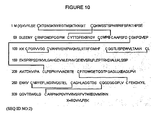
- the amino acid sequence for (TAL6003)-plasminogen is shown in SEQ ID NO: 2.
- a polynucleotide having the nucleotide sequence encoding (TAL6003)-plasminogen was codon-optimized for E. coli expression and mRNA stability to provide the DNA sequence as shown in SEQ ID NO: 1.
- This polynucleotide was cloned into the Nde I and Bam H1 sites of E. coli expression vector pET24b(+) (Novagen; Madison, WI) to produce cytosolic protein.
- expression in bacteria provided a recombinant (TAL6003)-plasminogen polypeptide having the amino acid sequence as shown in SEQ ID NO: 2 (i.e., a recombinant (TAL6003)-plasminogen with an N-terminal methionine (i.e., M1) immediately preceding the arginine amino acid residue (i.e., R2) corresponding to the arginine at position 70 (i.e., R70) of the native human plasminogen amino acid sequence shown in SEQ ID NO: 4 ( see also, e.g., Fig. 3 ).
- TAL6003-plasminogen polypeptide having the amino acid sequence as shown in SEQ ID NO: 2 (i.e., a recombinant (TAL6003)-plasminogen with an N-terminal methionine (i.e., M1) immediately preceding the arginine amino acid residue (i.e., R2) corresponding to the arginine at position 70 (i.e., R70)
- Such a recombinant product was susceptible to further cleavage to yield additional proteins having different N-termini including a protein with an N-terminal lysine (i.e., K10) or valine (i.e., V11) corresponding, respectively, to the lysine at position 78 (i.e., K78) or the valine at position 79 (i.e., V79) of native human plasminogen.
- N-terminal lysine i.e., K10
- valine i.e., V11
- Table 1 N-termini of native plasmin(ogen) (e.g ., based on SEQ ID NO: 4) and (TAL6003)-plasmin(ogen) (e.g ., based on SEQ ID NO: 2, or a variant thereof)
- Native Plasminogen comprising 19 amino acid leader sequence e.g ., based on SEQ ID NO: 4
- Native "Lys-Plasminogen" i.e., cleavage of leader sequence
- Native Plasmin species possible based on cleavage, if any, of Lys-Plasminogen: ( see SEQ ID NO:14) M 69 R 70 DVVLFEKK 78 V 79 YLSEC >
- the expression vector comprising the DNA encoding (TAL6003)-plasminogen was transformed into a variety of cells including BL21(DE3) RIL (Stratagene, La Jolla, CA), BL21(DE3) (genotype: F - ompT hsdSB (rB - mB - ) gal dcm (DE3)) (EMB Biosciences, Inc., San Diego, CA), and BLR(DE3) (genotype: F - ompT hsdSB (rB - mB - ) gal dcm (DE3) ⁇ (srl - recA)306::Tn10(TetR)), and protein over-expression following induction by 1 mM IPTG (isopropyl-beta-D-thiogalactopyranoside) was analyzed by SDS-PAGE. Expression estimates were at least about 250 mg/L cell culture in shaker flasks.
- Cell type BL21(DE3) RIL is engineered to express rare E. coli tRNAs coding for Arg, Ile, and Leu. Further, both BL21(DE3) and BLR(DE3) are B strain E. coli that is classified as non-pathogenic to humans and animals based on the absence of virulence and colonization factors. BLR(DE3) cells lack the recA gene for DNA recombination, and induction of lamba phage has not been reported with these cells.
- a research cell bank of the (TAL6003)-plasminogen construct in BLR(DE3) cells was produced and tested for purity, identity, and induction of bacteriophage at Charles River Laboratories (Malvern, PA). The testing confirmed the identity and purity of the research cell bank and the cells passed the phage induction test with no phage observed (data not shown).
- the cell pellet was washed three times with wash solution (50 mM Tris-HCl, pH 7.4 containing 10 mM EDTA, 1% Triton-X-100, and 0.5 M urea), and the final pellet was dissolved in 40 mL of extraction buffer (PBS, pH 7.4 containing 10 mM EDTA, 20 mM DTT, and 6 M guanidine-HCl) and stored at 4 °C overnight.
- wash solution 50 mM Tris-HCl, pH 7.4 containing 10 mM EDTA, 1% Triton-X-100, and 0.5 M urea
- PBS pH 7.4 containing 10 mM EDTA, 20 mM DTT, and 6 M guanidine-HCl
- the solution was centrifuged for 30 minutes at 15,000 ⁇ g to remove solids and the supernatant was slowly added to the refolding solution (50 mM Tris-HCl, pH 8.3, 3.5 M guanidine-HCl, 0.5 M arginine-HCl, 10 mM EDTA, 3 mM GSH, 0.3 mM GSSG) while stirring at 4 °C.
- the refolding procedure was carried out at protein concentration of about 0.29 g/L.
- the refolding solution was kept for 2 days at 4 °C undisturbed and then dialyzed against an 8-fold volume of 0.1 M Tris-HCl pH 8.0 containing 10 mM EDTA, 0.15 M NaCl, 0.15 M arginine-HCl, over a period of 8-10 hours with frequent changes of the buffer solution.
- the protein solution was then removed from dialysis and concentrated using AMICON filters with the membrane cut-off of 10 kDa to approximately 10-20 mL and dialyzed overnight versus a 100-fold volume of 0.1 M Tris pH 8.0 containing 10 mM EDTA, 0.15 M NaCl. This material was centrifuged to remove particulates, and then passed over lysine affinity resin (Lysine-SEPHAROSETM 4B; Amersham Biosciences, Piscataway, NJ). (TAL6003)-plasminogen was eluted from the resin using Tris-buffered saline, pH 8.0 containing 0.2 M epsilon aminocaproic acid ( ⁇ -ACA).
- 80 mg of inclusion bodies could be isolated from 1 liter of cell culture and 40 mg could be eluted in the lysine-SEPHAROSE chromatography step.
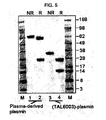
- TAL6003-plasminogen appeared as a band in the 35-40 kDa region by SDS-PAGE analysis of reduced (dithiothreitol-treated) and non-reduced protein. Its molecular mass, determined by MALDI mass-spectrometry, was about 38,140 Da, which is close to the expected value.
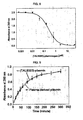
- the resulting fluorescence values were corrected for dilution and plotted versus the concentration of ⁇ -ACA over a range of 0-50 ⁇ M ⁇ -ACA. Data were fitted by non-linear regression to obtain a K d of about 19 ⁇ M.
- plasminogen One property of plasminogen is its ability to bind fibrin.
- fibrin-binding properties was tested in a microtiter plate assay in which binding of (TAL6003)-plasminogen to fibrin was assessed by its subsequent activation by tPA and resulting clot lysis.
- 100 ⁇ L of 5 mg/mL fibrinogen was polymerized with thrombin in each well of a microtiter plate.
- Various concentrations of (TAL6003)-plasminogen was added on top of the fibrin clots and incubated for 1 hour at 37 °C.
- the plate was washed extensively with PBS while the fibrin clots are still intact and attached to the wells. After washing, a 0.1 mg/mL solution of tPA was added to each well and the plate was incubated 2 hours at 37 °C. As a result, some of the clots were completely dissolved and some were partially dissolved, while wells with very low amounts of (TAL6003)-plasminogen and control wells remained practically intact.
- the degree of fibrinolysis was monitored by measuring the 280 nm absorbance of remainders of the initial clots reconstituted in 1 M NaOH. The absorbance values were plotted as a function of (TAL6003)-plasminogen concentration.
- the addition of SK to the purified (TAL6003)-plasminogen solution effects the conversion of (TAL6003)-plasminogen to (TAL6003)-plasmin.
- the protein was concentrated to 2 mg/mL and diluted 1:1 with 50% glycerol to produce a 1 mg/mL solution in 25% glycerol.
- the solution was brought to room temperature and streptokinase was added at a 1:100 molar ratio of SK:(TAL6003)-plasminogen.
- the reaction was incubated without stirring at room temperature for 4.5 hrs.
- the reaction was then slowed down by addition of NaCl to a 0.5 M final concentration. Analysis of activation by SDS-PAGE indicated a 90% yield of activated protein.
- TAL6003-plasmin Activated (TAL6003)-plasmin was purified by Benzamidine Affinity Chromatography.
- the purpose of benzamidine affinity purification was the separation of unactivated (TAL6003)-plasminogen and impurities, including (TAL6003)-plasmin degradation products, from active (TAL6003)-plasmin.
- the SK activation solution was applied to an equilibrated Benzamidine-SEPHAROSETM 4 Fast Flow column.
- the (TAL6003)-plasmin, both clipped and intact, was captured by the affinity resin while the aforementioned impurities flowed through the column.
- the column was washed with the equilibration buffer until the absorbance at 280 nm reached baseline.
- the bound (TAL6003)-plasmin was then eluted using a low pH ⁇ -ACA step to strip all remaining protein from the column. Typical yields were 75%, with protein that is 95% active as measured by chromogenic plasmin potency assay.
- the rate of inhibition of (TAL6003)-plasmin by ⁇ 2-antiplasmin was determined to be 1.8 ⁇ 0.06 ⁇ 10 7 M -1 s -1 using the method of Wiman and Collen ( Wiman, B. and D. Collen, Eur. J. Biochem. 84: 573-578 (1978 )) in which plasmin and ⁇ 2-antiplasmin are mixed then assayed for S-2251 activity at specific time points (Table 3). This value is comparable to reported values for plasmin of 2.5 ⁇ 10 7 M -1 s -1 (from Anonick, et al., Thrombosis Res. 59: 449 (1990 )). Table 3.
- micro-plasmin revealed ⁇ 2-antiplasmin inhibition rates of 1.8 ⁇ 10 5 M -1 s -1 and 3.1 ⁇ 10 5 M -1 s -1 in two separate experiments.
- the rate of ⁇ 2-antiplasmin inhibition of mini-plasmin was determined to be 2.4 ⁇ 10 5 M -1 s -1 .
- Literature values are taken from Anonick, et al., Thrombosis Res. 59: 449 (1990). All rates were measured according to the methods published in Anonick, et al.
Landscapes
- Chemical & Material Sciences (AREA)
- Health & Medical Sciences (AREA)
- Organic Chemistry (AREA)
- Engineering & Computer Science (AREA)
- Life Sciences & Earth Sciences (AREA)
- Bioinformatics & Cheminformatics (AREA)
- Zoology (AREA)
- Wood Science & Technology (AREA)
- Genetics & Genomics (AREA)
- General Health & Medical Sciences (AREA)
- General Engineering & Computer Science (AREA)
- Biochemistry (AREA)
- Biomedical Technology (AREA)
- Microbiology (AREA)
- Biotechnology (AREA)
- Medicinal Chemistry (AREA)
- Molecular Biology (AREA)
- Dispersion Chemistry (AREA)
- Hematology (AREA)
- Diabetes (AREA)
- Pharmacology & Pharmacy (AREA)
- Nuclear Medicine, Radiotherapy & Molecular Imaging (AREA)
- General Chemical & Material Sciences (AREA)
- Chemical Kinetics & Catalysis (AREA)
- Veterinary Medicine (AREA)
- Animal Behavior & Ethology (AREA)
- Public Health (AREA)
- Enzymes And Modification Thereof (AREA)
- Micro-Organisms Or Cultivation Processes Thereof (AREA)
- Medicines That Contain Protein Lipid Enzymes And Other Medicines (AREA)
- Preparation Of Compounds By Using Micro-Organisms (AREA)
- Peptides Or Proteins (AREA)
Priority Applications (1)
| Application Number | Priority Date | Filing Date | Title |
|---|---|---|---|
| PL08857923T PL2220221T3 (pl) | 2007-11-29 | 2008-11-25 | Rekombinacyjnie zmodyfikowana plazmina |
Applications Claiming Priority (2)
| Application Number | Priority Date | Filing Date | Title |
|---|---|---|---|
| US99114807P | 2007-11-29 | 2007-11-29 | |
| PCT/US2008/084645 WO2009073471A1 (en) | 2007-11-29 | 2008-11-25 | Recombinantly modified plasmin |
Publications (2)
| Publication Number | Publication Date |
|---|---|
| EP2220221A1 EP2220221A1 (en) | 2010-08-25 |
| EP2220221B1 true EP2220221B1 (en) | 2014-12-31 |
Family
ID=40379999
Family Applications (1)
| Application Number | Title | Priority Date | Filing Date |
|---|---|---|---|
| EP08857923.0A Active EP2220221B1 (en) | 2007-11-29 | 2008-11-25 | Recombinantly modified plasmin |
Country Status (17)
| Country | Link |
|---|---|
| US (3) | US8101394B2 (https=) |
| EP (1) | EP2220221B1 (https=) |
| JP (1) | JP5539896B2 (https=) |
| KR (1) | KR101529743B1 (https=) |
| CN (1) | CN101918548B (https=) |
| AU (1) | AU2008331545B2 (https=) |
| BR (1) | BRPI0819780B1 (https=) |
| CA (1) | CA2707266C (https=) |
| ES (1) | ES2534040T3 (https=) |
| HU (1) | HUE024916T2 (https=) |
| IL (1) | IL205936A (https=) |
| MX (1) | MX2010005947A (https=) |
| NZ (2) | NZ585715A (https=) |
| PL (1) | PL2220221T3 (https=) |
| PT (1) | PT2220221E (https=) |
| WO (1) | WO2009073471A1 (https=) |
| ZA (1) | ZA201003730B (https=) |
Families Citing this family (28)
| Publication number | Priority date | Publication date | Assignee | Title |
|---|---|---|---|---|
| CN1961070A (zh) | 2004-04-22 | 2007-05-09 | 泰勒克里斯生物治疗学公司 | 重组修饰的纤溶酶 |
| JP5539896B2 (ja) | 2007-11-29 | 2014-07-02 | グリフオルス・セラピユーテイクス・インコーポレーテツド | 組換え的に改変されたプラスミン |
| WO2009149199A2 (en) | 2008-06-04 | 2009-12-10 | Talecris Biotherapeutics, Inc. | Composition, method and kit for preparing plasmin |
| PT2403865E (pt) * | 2009-03-03 | 2015-11-18 | Grifols Therapeutics Inc | Métodos de preparação de plasminogénio |
| KR20120050442A (ko) | 2009-07-10 | 2012-05-18 | 쓰롬보제닉스 엔.브이. | 플라스미노겐 및 플라스민의 변이체 |
| US20120189609A1 (en) | 2009-08-28 | 2012-07-26 | Thrombogenics Nv | Improvement to trabeculectomy |
| CN102121023B (zh) * | 2010-12-22 | 2012-07-04 | 中山大学 | 突变型人纤溶酶原kringle5及其制备方法及应用 |
| EP2661493B1 (en) | 2011-01-05 | 2016-03-30 | ThromboGenics N.V. | Plasminogen and plasmin variants |
| JP6000353B2 (ja) | 2011-08-12 | 2016-09-28 | スロンボジェニックス・ナムローゼ・フェンノートシャップThromboGenics NV | プラスミノーゲンおよびプラスミンの変異体 |
| CN103205410B (zh) * | 2012-01-13 | 2018-03-06 | 蔺莹莹 | 重组微纤维蛋白溶酶及其制备方法和应用 |
| SG11201506886TA (en) | 2013-03-14 | 2015-09-29 | Bayer Healthcare Llc | Monoclonal antibodies against antithrombin beta complexed with heparin |
| DE102014112212A1 (de) * | 2014-08-26 | 2016-03-03 | Akesion Gmbh | Rekombinante Fusionsproteine zur Vorbeugung oder Behandlung von Adhäsionen bei Geweben oder Organen |
| FR3035120B1 (fr) * | 2015-04-15 | 2020-02-07 | Arcadophta | Composition de plasminogenase immobilisee, procede de preparation, utilisation et dispositif comprenant une telle composition |
| ES2982294T3 (es) | 2015-12-18 | 2024-10-15 | Talengen Int Ltd | Plasminógeno para su uso en el tratamiento o prevención de lesiones nerviosas por diabetes mellitus |
| DK3395354T3 (da) | 2015-12-18 | 2024-06-03 | Talengen Int Ltd | Plasminogen til anvendelse i behandling af diabetisk nefropati |
| CN108463240A (zh) | 2015-12-18 | 2018-08-28 | 泰伦基国际有限公司 | 一种预防或治疗糖尿病性视网膜病变的方法 |
| DK3391902T5 (da) | 2015-12-18 | 2024-09-23 | Talengen Int Ltd | Plasminogen til anvendelse i behandlingen af diabetisk angiokardiopati |
| CN110198732A (zh) * | 2016-12-15 | 2019-09-03 | 泰伦基国际有限公司 | 一种促进胰岛素受体底物-2表达的方法 |
| JP7213552B2 (ja) | 2016-12-15 | 2023-01-27 | タレンゲン インターナショナル リミテッド | 肝の繊維化を予防及び治療するための方法 |
| CN108210905A (zh) * | 2016-12-15 | 2018-06-29 | 深圳瑞健生命科学研究院有限公司 | 预防和治疗皮肤纤维化的药物及其用途 |
| JP7168990B2 (ja) | 2016-12-15 | 2022-11-10 | タレンゲン インターナショナル リミテッド | 肥満症を予防および治療するための方法および薬物 |
| TWI677348B (zh) | 2016-12-15 | 2019-11-21 | 大陸商深圳瑞健生命科學研究院有限公司 | 一種改善心臟病變的方法 |
| WO2018107686A1 (zh) * | 2016-12-15 | 2018-06-21 | 深圳瑞健生命科学研究院有限公司 | 一种治疗动脉粥样硬化及其并发症的方法 |
| CA3067890A1 (en) | 2017-06-19 | 2018-12-27 | Talengen International Limited | Method for regulating and controling glp-1/glp-1r and drug |
| US11140020B1 (en) | 2018-03-01 | 2021-10-05 | Amazon Technologies, Inc. | Availability-enhancing gateways for network traffic in virtualized computing environments |
| EP3914277A4 (en) * | 2019-01-25 | 2022-10-19 | Council of Scientific & Industrial Research | Fibrinolytic composition and method of its preparation |
| EP4140498A4 (en) | 2020-05-11 | 2023-11-01 | Talengen International Limited | Method and drug for treating spinal muscular atrophy |
| CN118308334B (zh) * | 2024-06-06 | 2024-10-08 | 深圳市卫光生物制品股份有限公司 | 一种重组人纤溶酶原及其制备方法和应用 |
Family Cites Families (23)
| Publication number | Priority date | Publication date | Assignee | Title |
|---|---|---|---|---|
| US4652639A (en) * | 1982-05-06 | 1987-03-24 | Amgen | Manufacture and expression of structural genes |
| US4631211A (en) * | 1985-03-25 | 1986-12-23 | Scripps Clinic & Research Foundation | Means for sequential solid phase organic synthesis and methods using the same |
| US4774087A (en) * | 1987-08-14 | 1988-09-27 | Northwestern University | Micro-size fibrinolytic plasmin |
| US7253264B1 (en) * | 1990-06-28 | 2007-08-07 | Sanofi-Arentideutschland GmbH | Immunoglobulin fusion proteins, their production and use |
| US6312893B1 (en) * | 1996-01-23 | 2001-11-06 | Qiagen Genomics, Inc. | Methods and compositions for determining the sequence of nucleic acid molecules |
| DE69701671T3 (de) | 1996-01-23 | 2006-08-17 | Qiagen Genomics, Inc., Bothell | Verfahren und zusammenstellungen zur sequenzbestimmung von nukleinsäuremolekülen |
| US6613508B1 (en) * | 1996-01-23 | 2003-09-02 | Qiagen Genomics, Inc. | Methods and compositions for analyzing nucleic acid molecules utilizing sizing techniques |
| JPH10158300A (ja) * | 1996-11-28 | 1998-06-16 | Suzuki Motor Corp | 血管新生抑制効果を有するタンパク質とその製造方法及びアンギオスタチンの製造方法 |
| EP1000176A1 (en) * | 1997-07-22 | 2000-05-17 | Rapigene, Inc. | Computer method and system for correlating sequencing data by ms |
| IL140729A0 (en) * | 1998-07-14 | 2002-02-10 | Bristol Myers Squibb Co | Lysine binding fragments of angiostatin, pharmaceutical compositions containing the same and processes for the preparation thereof |
| ATE349226T1 (de) * | 1998-09-29 | 2007-01-15 | Leuven Res & Dev Vzw | Verwendung von verbindungen die alpha2- antiplasmin in vivo reduzieren zur herstellung einer zusammensetzung zur behandlung ischämischer schlaganfälle |
| US6969515B2 (en) * | 1999-11-13 | 2005-11-29 | Talecris Biotherapeutics, Inc. | Method of thrombolysis by local delivery of reversibly inactivated acidified plasmin |
| US6964764B2 (en) * | 1999-11-13 | 2005-11-15 | Talecris Biotherapeutics, Inc. | Method of thrombolysis by local delivery of reversibly inactivated acidified plasmin |
| US6355243B1 (en) * | 1999-11-13 | 2002-03-12 | Bayer Corporation | Method of thrombolysis by local delivery of active plasmin |
| AU2001275091A1 (en) * | 2000-06-02 | 2001-12-17 | Blue Heron Biotechnology, Inc. | Methods for improving the sequence fidelity of synthetic double-stranded oligonucleotides |
| EP1343903B1 (en) | 2000-12-21 | 2007-11-14 | Thromb-X N.V. | A yeast expression vector and a method of making a recombinant protein by expression in a yeast cell |
| AU2002357249A1 (en) | 2001-12-13 | 2003-07-09 | Blue Heron Biotechnology, Inc. | Methods for removal of double-stranded oligonucleotides containing sequence errors using mismatch recognition proteins |
| US7776026B2 (en) * | 2002-02-06 | 2010-08-17 | Nuvue Technologies, Inc. | Method for vitreous liquefaction |
| US20050124036A1 (en) * | 2002-02-06 | 2005-06-09 | Rudy Susilo | Method for producing recombinant proteins in micro-organisms |
| GB0228409D0 (en) * | 2002-12-06 | 2003-01-08 | Thromb X Nv | Pharmacological vitreolysis |
| CN1961070A (zh) * | 2004-04-22 | 2007-05-09 | 泰勒克里斯生物治疗学公司 | 重组修饰的纤溶酶 |
| US8231869B2 (en) * | 2005-10-20 | 2012-07-31 | Grifols Therapeutics Inc. | Recombinant plasmin for opthalmic indications |
| JP5539896B2 (ja) | 2007-11-29 | 2014-07-02 | グリフオルス・セラピユーテイクス・インコーポレーテツド | 組換え的に改変されたプラスミン |
-
2008
- 2008-11-25 JP JP2010536117A patent/JP5539896B2/ja active Active
- 2008-11-25 CN CN2008801232704A patent/CN101918548B/zh active Active
- 2008-11-25 BR BRPI0819780-6A patent/BRPI0819780B1/pt not_active IP Right Cessation
- 2008-11-25 KR KR1020107014243A patent/KR101529743B1/ko not_active Expired - Fee Related
- 2008-11-25 NZ NZ585715A patent/NZ585715A/en not_active IP Right Cessation
- 2008-11-25 EP EP08857923.0A patent/EP2220221B1/en active Active
- 2008-11-25 MX MX2010005947A patent/MX2010005947A/es active IP Right Grant
- 2008-11-25 CA CA2707266A patent/CA2707266C/en active Active
- 2008-11-25 NZ NZ593837A patent/NZ593837A/xx not_active IP Right Cessation
- 2008-11-25 AU AU2008331545A patent/AU2008331545B2/en active Active
- 2008-11-25 US US12/744,376 patent/US8101394B2/en active Active
- 2008-11-25 PL PL08857923T patent/PL2220221T3/pl unknown
- 2008-11-25 WO PCT/US2008/084645 patent/WO2009073471A1/en not_active Ceased
- 2008-11-25 HU HUE08857923A patent/HUE024916T2/en unknown
- 2008-11-25 PT PT88579230T patent/PT2220221E/pt unknown
- 2008-11-25 ES ES08857923.0T patent/ES2534040T3/es active Active
-
2010
- 2010-05-24 IL IL205936A patent/IL205936A/en active IP Right Grant
- 2010-05-25 ZA ZA2010/03730A patent/ZA201003730B/en unknown
-
2011
- 2011-11-22 US US13/302,322 patent/US8182808B2/en active Active
-
2012
- 2012-05-03 US US13/463,437 patent/US8512980B2/en not_active Expired - Lifetime
Also Published As
| Publication number | Publication date |
|---|---|
| JP5539896B2 (ja) | 2014-07-02 |
| PL2220221T3 (pl) | 2015-07-31 |
| ZA201003730B (en) | 2012-11-28 |
| JP2011505140A (ja) | 2011-02-24 |
| NZ593837A (en) | 2013-01-25 |
| BRPI0819780A2 (pt) | 2015-08-11 |
| US8101394B2 (en) | 2012-01-24 |
| KR20100102135A (ko) | 2010-09-20 |
| US8182808B2 (en) | 2012-05-22 |
| CN101918548B (zh) | 2013-10-16 |
| US20120093799A1 (en) | 2012-04-19 |
| HUE024916T2 (en) | 2016-02-29 |
| HK1146089A1 (en) | 2011-05-13 |
| MX2010005947A (es) | 2010-09-10 |
| BRPI0819780B1 (pt) | 2023-01-24 |
| EP2220221A1 (en) | 2010-08-25 |
| NZ585715A (en) | 2011-11-25 |
| US8512980B2 (en) | 2013-08-20 |
| US20110003332A1 (en) | 2011-01-06 |
| CA2707266C (en) | 2013-12-31 |
| IL205936A0 (en) | 2010-11-30 |
| CA2707266A1 (en) | 2009-06-11 |
| KR101529743B1 (ko) | 2015-06-17 |
| IL205936A (en) | 2015-04-30 |
| CN101918548A (zh) | 2010-12-15 |
| PT2220221E (pt) | 2015-04-16 |
| AU2008331545A1 (en) | 2009-06-11 |
| US20120276611A1 (en) | 2012-11-01 |
| WO2009073471A1 (en) | 2009-06-11 |
| ES2534040T3 (es) | 2015-04-16 |
| AU2008331545B2 (en) | 2014-01-16 |
Similar Documents
| Publication | Publication Date | Title |
|---|---|---|
| EP2220221B1 (en) | Recombinantly modified plasmin | |
| US8420079B2 (en) | Recombinantly modified plasmin | |
| HK1146089B (en) | Recombinantly modified plasmin | |
| HK1099341B (en) | Recombinantly modified plasmin | |
| HK1150242B (en) | Recombinantly modified plasmin | |
| HK1175812B (en) | Recombinantly modified plasmin |
Legal Events
| Date | Code | Title | Description |
|---|---|---|---|
| PUAI | Public reference made under article 153(3) epc to a published international application that has entered the european phase |
Free format text: ORIGINAL CODE: 0009012 |
|
| 17P | Request for examination filed |
Effective date: 20100628 |
|
| AK | Designated contracting states |
Kind code of ref document: A1 Designated state(s): AT BE BG CH CY CZ DE DK EE ES FI FR GB GR HR HU IE IS IT LI LT LU LV MC MT NL NO PL PT RO SE SI SK TR |
|
| AX | Request for extension of the european patent |
Extension state: AL BA MK RS |
|
| 17Q | First examination report despatched |
Effective date: 20101102 |
|
| DAX | Request for extension of the european patent (deleted) | ||
| REG | Reference to a national code |
Ref country code: HK Ref legal event code: DE Ref document number: 1146089 Country of ref document: HK |
|
| RAP1 | Party data changed (applicant data changed or rights of an application transferred) |
Owner name: GRIFOLS THERAPEUTICS INC. |
|
| GRAP | Despatch of communication of intention to grant a patent |
Free format text: ORIGINAL CODE: EPIDOSNIGR1 |
|
| INTG | Intention to grant announced |
Effective date: 20141013 |
|
| GRAS | Grant fee paid |
Free format text: ORIGINAL CODE: EPIDOSNIGR3 |
|
| GRAA | (expected) grant |
Free format text: ORIGINAL CODE: 0009210 |
|
| AK | Designated contracting states |
Kind code of ref document: B1 Designated state(s): AT BE BG CH CY CZ DE DK EE ES FI FR GB GR HR HU IE IS IT LI LT LU LV MC MT NL NO PL PT RO SE SI SK TR |
|
| REG | Reference to a national code |
Ref country code: CH Ref legal event code: EP Ref country code: GB Ref legal event code: FG4D |
|
| REG | Reference to a national code |
Ref country code: IE Ref legal event code: FG4D |
|
| REG | Reference to a national code |
Ref country code: AT Ref legal event code: REF Ref document number: 704432 Country of ref document: AT Kind code of ref document: T Effective date: 20150215 |
|
| REG | Reference to a national code |
Ref country code: DE Ref legal event code: R096 Ref document number: 602008036168 Country of ref document: DE Effective date: 20150226 |
|
| REG | Reference to a national code |
Ref country code: CH Ref legal event code: NV Representative=s name: ISLER AND PEDRAZZINI AG, CH |
|
| REG | Reference to a national code |
Ref country code: SE Ref legal event code: TRGR |
|
| REG | Reference to a national code |
Ref country code: ES Ref legal event code: FG2A Ref document number: 2534040 Country of ref document: ES Kind code of ref document: T3 Effective date: 20150416 Ref country code: PT Ref legal event code: SC4A Free format text: AVAILABILITY OF NATIONAL TRANSLATION Effective date: 20150330 |
|
| PG25 | Lapsed in a contracting state [announced via postgrant information from national office to epo] |
Ref country code: NO Free format text: LAPSE BECAUSE OF FAILURE TO SUBMIT A TRANSLATION OF THE DESCRIPTION OR TO PAY THE FEE WITHIN THE PRESCRIBED TIME-LIMIT Effective date: 20150331 Ref country code: LT Free format text: LAPSE BECAUSE OF FAILURE TO SUBMIT A TRANSLATION OF THE DESCRIPTION OR TO PAY THE FEE WITHIN THE PRESCRIBED TIME-LIMIT Effective date: 20141231 |
|
| REG | Reference to a national code |
Ref country code: LT Ref legal event code: MG4D |
|
| REG | Reference to a national code |
Ref country code: GR Ref legal event code: EP Ref document number: 20150400703 Country of ref document: GR Effective date: 20150421 |
|
| PG25 | Lapsed in a contracting state [announced via postgrant information from national office to epo] |
Ref country code: HR Free format text: LAPSE BECAUSE OF FAILURE TO SUBMIT A TRANSLATION OF THE DESCRIPTION OR TO PAY THE FEE WITHIN THE PRESCRIBED TIME-LIMIT Effective date: 20141231 Ref country code: LV Free format text: LAPSE BECAUSE OF FAILURE TO SUBMIT A TRANSLATION OF THE DESCRIPTION OR TO PAY THE FEE WITHIN THE PRESCRIBED TIME-LIMIT Effective date: 20141231 |
|
| REG | Reference to a national code |
Ref country code: SK Ref legal event code: T3 Ref document number: E 18413 Country of ref document: SK |
|
| PG25 | Lapsed in a contracting state [announced via postgrant information from national office to epo] |
Ref country code: RO Free format text: LAPSE BECAUSE OF FAILURE TO SUBMIT A TRANSLATION OF THE DESCRIPTION OR TO PAY THE FEE WITHIN THE PRESCRIBED TIME-LIMIT Effective date: 20141231 |
|
| REG | Reference to a national code |
Ref country code: PL Ref legal event code: T3 |
|
| PG25 | Lapsed in a contracting state [announced via postgrant information from national office to epo] |
Ref country code: IS Free format text: LAPSE BECAUSE OF FAILURE TO SUBMIT A TRANSLATION OF THE DESCRIPTION OR TO PAY THE FEE WITHIN THE PRESCRIBED TIME-LIMIT Effective date: 20150430 |
|
| REG | Reference to a national code |
Ref country code: DE Ref legal event code: R097 Ref document number: 602008036168 Country of ref document: DE |
|
| REG | Reference to a national code |
Ref country code: HK Ref legal event code: GR Ref document number: 1146089 Country of ref document: HK |
|
| REG | Reference to a national code |
Ref country code: FR Ref legal event code: PLFP Year of fee payment: 8 |
|
| PG25 | Lapsed in a contracting state [announced via postgrant information from national office to epo] |
Ref country code: DK Free format text: LAPSE BECAUSE OF FAILURE TO SUBMIT A TRANSLATION OF THE DESCRIPTION OR TO PAY THE FEE WITHIN THE PRESCRIBED TIME-LIMIT Effective date: 20141231 Ref country code: EE Free format text: LAPSE BECAUSE OF FAILURE TO SUBMIT A TRANSLATION OF THE DESCRIPTION OR TO PAY THE FEE WITHIN THE PRESCRIBED TIME-LIMIT Effective date: 20141231 |
|
| PLBE | No opposition filed within time limit |
Free format text: ORIGINAL CODE: 0009261 |
|
| STAA | Information on the status of an ep patent application or granted ep patent |
Free format text: STATUS: NO OPPOSITION FILED WITHIN TIME LIMIT |
|
| 26N | No opposition filed |
Effective date: 20151001 |
|
| REG | Reference to a national code |
Ref country code: AT Ref legal event code: UEP Ref document number: 704432 Country of ref document: AT Kind code of ref document: T Effective date: 20141231 |
|
| PG25 | Lapsed in a contracting state [announced via postgrant information from national office to epo] |
Ref country code: SI Free format text: LAPSE BECAUSE OF FAILURE TO SUBMIT A TRANSLATION OF THE DESCRIPTION OR TO PAY THE FEE WITHIN THE PRESCRIBED TIME-LIMIT Effective date: 20141231 |
|
| REG | Reference to a national code |
Ref country code: HU Ref legal event code: AG4A Ref document number: E024916 Country of ref document: HU |
|
| PG25 | Lapsed in a contracting state [announced via postgrant information from national office to epo] |
Ref country code: MC Free format text: LAPSE BECAUSE OF FAILURE TO SUBMIT A TRANSLATION OF THE DESCRIPTION OR TO PAY THE FEE WITHIN THE PRESCRIBED TIME-LIMIT Effective date: 20141231 Ref country code: LU Free format text: LAPSE BECAUSE OF FAILURE TO SUBMIT A TRANSLATION OF THE DESCRIPTION OR TO PAY THE FEE WITHIN THE PRESCRIBED TIME-LIMIT Effective date: 20151125 |
|
| REG | Reference to a national code |
Ref country code: FR Ref legal event code: PLFP Year of fee payment: 9 |
|
| PG25 | Lapsed in a contracting state [announced via postgrant information from national office to epo] |
Ref country code: BG Free format text: LAPSE BECAUSE OF FAILURE TO SUBMIT A TRANSLATION OF THE DESCRIPTION OR TO PAY THE FEE WITHIN THE PRESCRIBED TIME-LIMIT Effective date: 20141231 |
|
| PG25 | Lapsed in a contracting state [announced via postgrant information from national office to epo] |
Ref country code: CY Free format text: LAPSE BECAUSE OF FAILURE TO SUBMIT A TRANSLATION OF THE DESCRIPTION OR TO PAY THE FEE WITHIN THE PRESCRIBED TIME-LIMIT Effective date: 20141231 |
|
| PG25 | Lapsed in a contracting state [announced via postgrant information from national office to epo] |
Ref country code: MT Free format text: LAPSE BECAUSE OF FAILURE TO SUBMIT A TRANSLATION OF THE DESCRIPTION OR TO PAY THE FEE WITHIN THE PRESCRIBED TIME-LIMIT Effective date: 20141231 |
|
| REG | Reference to a national code |
Ref country code: FR Ref legal event code: PLFP Year of fee payment: 10 |
|
| REG | Reference to a national code |
Ref country code: FR Ref legal event code: PLFP Year of fee payment: 11 |
|
| PGFP | Annual fee paid to national office [announced via postgrant information from national office to epo] |
Ref country code: NL Payment date: 20221025 Year of fee payment: 15 |
|
| PGFP | Annual fee paid to national office [announced via postgrant information from national office to epo] |
Ref country code: TR Payment date: 20221006 Year of fee payment: 15 Ref country code: SK Payment date: 20221007 Year of fee payment: 15 Ref country code: SE Payment date: 20221031 Year of fee payment: 15 Ref country code: PT Payment date: 20221006 Year of fee payment: 15 Ref country code: FI Payment date: 20221021 Year of fee payment: 15 Ref country code: CZ Payment date: 20221007 Year of fee payment: 15 Ref country code: AT Payment date: 20221104 Year of fee payment: 15 |
|
| PGFP | Annual fee paid to national office [announced via postgrant information from national office to epo] |
Ref country code: PL Payment date: 20221006 Year of fee payment: 15 Ref country code: HU Payment date: 20221022 Year of fee payment: 15 Ref country code: GR Payment date: 20221102 Year of fee payment: 15 Ref country code: CH Payment date: 20221201 Year of fee payment: 15 Ref country code: BE Payment date: 20221031 Year of fee payment: 15 |
|
| P01 | Opt-out of the competence of the unified patent court (upc) registered |
Effective date: 20230403 |
|
| REG | Reference to a national code |
Ref country code: CH Ref legal event code: PL |
|
| REG | Reference to a national code |
Ref country code: SE Ref legal event code: EUG |
|
| REG | Reference to a national code |
Ref country code: NL Ref legal event code: MM Effective date: 20231201 |
|
| PG25 | Lapsed in a contracting state [announced via postgrant information from national office to epo] |
Ref country code: GR Free format text: LAPSE BECAUSE OF NON-PAYMENT OF DUE FEES Effective date: 20240610 |
|
| REG | Reference to a national code |
Ref country code: AT Ref legal event code: MM01 Ref document number: 704432 Country of ref document: AT Kind code of ref document: T Effective date: 20231125 |
|
| PG25 | Lapsed in a contracting state [announced via postgrant information from national office to epo] |
Ref country code: CH Free format text: LAPSE BECAUSE OF NON-PAYMENT OF DUE FEES Effective date: 20231130 |
|
| PG25 | Lapsed in a contracting state [announced via postgrant information from national office to epo] |
Ref country code: AT Free format text: LAPSE BECAUSE OF NON-PAYMENT OF DUE FEES Effective date: 20231125 Ref country code: CZ Free format text: LAPSE BECAUSE OF NON-PAYMENT OF DUE FEES Effective date: 20231125 |
|
| PG25 | Lapsed in a contracting state [announced via postgrant information from national office to epo] |
Ref country code: SK Free format text: LAPSE BECAUSE OF NON-PAYMENT OF DUE FEES Effective date: 20231125 |
|
| PG25 | Lapsed in a contracting state [announced via postgrant information from national office to epo] |
Ref country code: SK Free format text: LAPSE BECAUSE OF NON-PAYMENT OF DUE FEES Effective date: 20231125 Ref country code: GR Free format text: LAPSE BECAUSE OF NON-PAYMENT OF DUE FEES Effective date: 20240610 Ref country code: FI Free format text: LAPSE BECAUSE OF NON-PAYMENT OF DUE FEES Effective date: 20231125 Ref country code: CZ Free format text: LAPSE BECAUSE OF NON-PAYMENT OF DUE FEES Effective date: 20231125 Ref country code: CH Free format text: LAPSE BECAUSE OF NON-PAYMENT OF DUE FEES Effective date: 20231130 Ref country code: AT Free format text: LAPSE BECAUSE OF NON-PAYMENT OF DUE FEES Effective date: 20231125 |
|
| PG25 | Lapsed in a contracting state [announced via postgrant information from national office to epo] |
Ref country code: PT Free format text: LAPSE BECAUSE OF NON-PAYMENT OF DUE FEES Effective date: 20240527 |
|
| REG | Reference to a national code |
Ref country code: BE Ref legal event code: MM Effective date: 20231130 |
|
| PG25 | Lapsed in a contracting state [announced via postgrant information from national office to epo] |
Ref country code: SE Free format text: LAPSE BECAUSE OF NON-PAYMENT OF DUE FEES Effective date: 20231126 Ref country code: PT Free format text: LAPSE BECAUSE OF NON-PAYMENT OF DUE FEES Effective date: 20240527 Ref country code: HU Free format text: LAPSE BECAUSE OF NON-PAYMENT OF DUE FEES Effective date: 20231126 |
|
| PG25 | Lapsed in a contracting state [announced via postgrant information from national office to epo] |
Ref country code: NL Free format text: LAPSE BECAUSE OF NON-PAYMENT OF DUE FEES Effective date: 20231201 |
|
| PG25 | Lapsed in a contracting state [announced via postgrant information from national office to epo] |
Ref country code: NL Free format text: LAPSE BECAUSE OF NON-PAYMENT OF DUE FEES Effective date: 20231201 |
|
| PG25 | Lapsed in a contracting state [announced via postgrant information from national office to epo] |
Ref country code: BE Free format text: LAPSE BECAUSE OF NON-PAYMENT OF DUE FEES Effective date: 20231130 |
|
| PG25 | Lapsed in a contracting state [announced via postgrant information from national office to epo] |
Ref country code: BE Free format text: LAPSE BECAUSE OF NON-PAYMENT OF DUE FEES Effective date: 20231130 |
|
| PG25 | Lapsed in a contracting state [announced via postgrant information from national office to epo] |
Ref country code: PL Free format text: LAPSE BECAUSE OF NON-PAYMENT OF DUE FEES Effective date: 20231125 |
|
| PGFP | Annual fee paid to national office [announced via postgrant information from national office to epo] |
Ref country code: DE Payment date: 20251128 Year of fee payment: 18 |
|
| PGFP | Annual fee paid to national office [announced via postgrant information from national office to epo] |
Ref country code: GB Payment date: 20251103 Year of fee payment: 18 |
|
| PGFP | Annual fee paid to national office [announced via postgrant information from national office to epo] |
Ref country code: IT Payment date: 20251002 Year of fee payment: 18 |
|
| PGFP | Annual fee paid to national office [announced via postgrant information from national office to epo] |
Ref country code: FR Payment date: 20251002 Year of fee payment: 18 |
|
| PGFP | Annual fee paid to national office [announced via postgrant information from national office to epo] |
Ref country code: IE Payment date: 20251003 Year of fee payment: 18 |
|
| PGFP | Annual fee paid to national office [announced via postgrant information from national office to epo] |
Ref country code: ES Payment date: 20251219 Year of fee payment: 18 |