EP2207844B1 - Flammwidrige polycarbonate mit polyolen - Google Patents
Flammwidrige polycarbonate mit polyolen Download PDFInfo
- Publication number
- EP2207844B1 EP2207844B1 EP08845390.7A EP08845390A EP2207844B1 EP 2207844 B1 EP2207844 B1 EP 2207844B1 EP 08845390 A EP08845390 A EP 08845390A EP 2207844 B1 EP2207844 B1 EP 2207844B1
- Authority
- EP
- European Patent Office
- Prior art keywords
- weight
- potassium
- aromatic
- composition according
- sodium
- Prior art date
- Legal status (The legal status is an assumption and is not a legal conclusion. Google has not performed a legal analysis and makes no representation as to the accuracy of the status listed.)
- Not-in-force
Links
- 229920000515 polycarbonate Polymers 0.000 title claims description 48
- 239000004417 polycarbonate Substances 0.000 title claims description 47
- 229920005862 polyol Polymers 0.000 title claims description 27
- 150000003077 polyols Chemical class 0.000 title claims description 27
- 239000003063 flame retardant Substances 0.000 title description 32
- RNFJDJUURJAICM-UHFFFAOYSA-N 2,2,4,4,6,6-hexaphenoxy-1,3,5-triaza-2$l^{5},4$l^{5},6$l^{5}-triphosphacyclohexa-1,3,5-triene Chemical compound N=1P(OC=2C=CC=CC=2)(OC=2C=CC=CC=2)=NP(OC=2C=CC=CC=2)(OC=2C=CC=CC=2)=NP=1(OC=1C=CC=CC=1)OC1=CC=CC=C1 RNFJDJUURJAICM-UHFFFAOYSA-N 0.000 title description 19
- 239000000203 mixture Substances 0.000 claims description 74
- -1 polytetrafluoroethylene Polymers 0.000 claims description 35
- 125000003118 aryl group Chemical group 0.000 claims description 24
- 229910052784 alkaline earth metal Inorganic materials 0.000 claims description 16
- 125000001931 aliphatic group Chemical group 0.000 claims description 11
- 229920000909 polytetrahydrofuran Polymers 0.000 claims description 11
- 229920001343 polytetrafluoroethylene Polymers 0.000 claims description 10
- 239000004810 polytetrafluoroethylene Substances 0.000 claims description 10
- 239000003795 chemical substances by application Substances 0.000 claims description 9
- 229910052783 alkali metal Inorganic materials 0.000 claims description 7
- 150000001340 alkali metals Chemical class 0.000 claims description 7
- LVTHXRLARFLXNR-UHFFFAOYSA-M potassium;1,1,2,2,3,3,4,4,4-nonafluorobutane-1-sulfonate Chemical compound [K+].[O-]S(=O)(=O)C(F)(F)C(F)(F)C(F)(F)C(F)(F)F LVTHXRLARFLXNR-UHFFFAOYSA-M 0.000 claims description 7
- 150000001342 alkaline earth metals Chemical class 0.000 claims description 6
- 238000001746 injection moulding Methods 0.000 claims description 2
- QYBQLZVBDVQILW-UHFFFAOYSA-N phenyl benzenesulfonate;potassium Chemical compound [K].C=1C=CC=CC=1S(=O)(=O)OC1=CC=CC=C1 QYBQLZVBDVQILW-UHFFFAOYSA-N 0.000 claims description 2
- JXLHNMVSKXFWAO-UHFFFAOYSA-N azane;7-fluoro-2,1,3-benzoxadiazole-4-sulfonic acid Chemical compound N.OS(=O)(=O)C1=CC=C(F)C2=NON=C12 JXLHNMVSKXFWAO-UHFFFAOYSA-N 0.000 claims 8
- XNHPXELLWREZKM-UHFFFAOYSA-N [Na].C=1C=CC=CC=1S(=O)(=O)OC1=CC=CC=C1 Chemical compound [Na].C=1C=CC=CC=1S(=O)(=O)OC1=CC=CC=C1 XNHPXELLWREZKM-UHFFFAOYSA-N 0.000 claims 1
- QBJDFZSOZNDVDE-UHFFFAOYSA-M sodium;1,1,2,2,3,3,4,4,4-nonafluorobutane-1-sulfonate Chemical compound [Na+].[O-]S(=O)(=O)C(F)(F)C(F)(F)C(F)(F)C(F)(F)F QBJDFZSOZNDVDE-UHFFFAOYSA-M 0.000 claims 1
- IISBACLAFKSPIT-UHFFFAOYSA-N bisphenol A Chemical group C=1C=C(O)C=CC=1C(C)(C)C1=CC=C(O)C=C1 IISBACLAFKSPIT-UHFFFAOYSA-N 0.000 description 31
- 238000000034 method Methods 0.000 description 26
- 229910052708 sodium Inorganic materials 0.000 description 25
- 239000011734 sodium Substances 0.000 description 25
- DGAQECJNVWCQMB-PUAWFVPOSA-M Ilexoside XXIX Chemical compound C[C@@H]1CC[C@@]2(CC[C@@]3(C(=CC[C@H]4[C@]3(CC[C@@H]5[C@@]4(CC[C@@H](C5(C)C)OS(=O)(=O)[O-])C)C)[C@@H]2[C@]1(C)O)C)C(=O)O[C@H]6[C@@H]([C@H]([C@@H]([C@H](O6)CO)O)O)O.[Na+] DGAQECJNVWCQMB-PUAWFVPOSA-M 0.000 description 22
- 239000000654 additive Substances 0.000 description 18
- 150000001875 compounds Chemical class 0.000 description 16
- YMWUJEATGCHHMB-UHFFFAOYSA-N Dichloromethane Chemical compound ClCCl YMWUJEATGCHHMB-UHFFFAOYSA-N 0.000 description 15
- 239000003054 catalyst Substances 0.000 description 14
- 229940106691 bisphenol a Drugs 0.000 description 13
- 229920000642 polymer Polymers 0.000 description 13
- PPBRXRYQALVLMV-UHFFFAOYSA-N Styrene Chemical compound C=CC1=CC=CC=C1 PPBRXRYQALVLMV-UHFFFAOYSA-N 0.000 description 12
- 239000004033 plastic Substances 0.000 description 12
- 229920003023 plastic Polymers 0.000 description 12
- 150000003839 salts Chemical class 0.000 description 11
- ZLMJMSJWJFRBEC-UHFFFAOYSA-N Potassium Chemical compound [K] ZLMJMSJWJFRBEC-UHFFFAOYSA-N 0.000 description 10
- 229910052757 nitrogen Inorganic materials 0.000 description 10
- 150000003018 phosphorus compounds Chemical class 0.000 description 10
- 229920000570 polyether Polymers 0.000 description 10
- 239000011591 potassium Substances 0.000 description 10
- 229930185605 Bisphenol Natural products 0.000 description 9
- 239000004721 Polyphenylene oxide Substances 0.000 description 9
- 239000000155 melt Substances 0.000 description 9
- 229910052700 potassium Inorganic materials 0.000 description 9
- MVPPADPHJFYWMZ-UHFFFAOYSA-N chlorobenzene Chemical compound ClC1=CC=CC=C1 MVPPADPHJFYWMZ-UHFFFAOYSA-N 0.000 description 8
- 229910052698 phosphorus Inorganic materials 0.000 description 8
- 239000011574 phosphorus Substances 0.000 description 8
- 238000012360 testing method Methods 0.000 description 8
- 238000005809 transesterification reaction Methods 0.000 description 8
- OAICVXFJPJFONN-UHFFFAOYSA-N Phosphorus Chemical compound [P] OAICVXFJPJFONN-UHFFFAOYSA-N 0.000 description 7
- 238000002360 preparation method Methods 0.000 description 7
- VPWNQTHUCYMVMZ-UHFFFAOYSA-N 4,4'-sulfonyldiphenol Chemical class C1=CC(O)=CC=C1S(=O)(=O)C1=CC=C(O)C=C1 VPWNQTHUCYMVMZ-UHFFFAOYSA-N 0.000 description 6
- LSNNMFCWUKXFEE-UHFFFAOYSA-M Bisulfite Chemical compound OS([O-])=O LSNNMFCWUKXFEE-UHFFFAOYSA-M 0.000 description 6
- HEMHJVSKTPXQMS-UHFFFAOYSA-M Sodium hydroxide Chemical compound [OH-].[Na+] HEMHJVSKTPXQMS-UHFFFAOYSA-M 0.000 description 6
- 125000004432 carbon atom Chemical group C* 0.000 description 6
- 125000001997 phenyl group Chemical group [H]C1=C([H])C([H])=C(*)C([H])=C1[H] 0.000 description 6
- XAEFZNCEHLXOMS-UHFFFAOYSA-M potassium benzoate Chemical compound [K+].[O-]C(=O)C1=CC=CC=C1 XAEFZNCEHLXOMS-UHFFFAOYSA-M 0.000 description 6
- 239000000843 powder Substances 0.000 description 6
- NLHHRLWOUZZQLW-UHFFFAOYSA-N Acrylonitrile Chemical compound C=CC#N NLHHRLWOUZZQLW-UHFFFAOYSA-N 0.000 description 5
- ZAMOUSCENKQFHK-UHFFFAOYSA-N Chlorine atom Chemical compound [Cl] ZAMOUSCENKQFHK-UHFFFAOYSA-N 0.000 description 5
- 230000000996 additive effect Effects 0.000 description 5
- 239000003513 alkali Substances 0.000 description 5
- 125000002947 alkylene group Chemical group 0.000 description 5
- 239000000460 chlorine Substances 0.000 description 5
- 229910052801 chlorine Inorganic materials 0.000 description 5
- 229920001577 copolymer Polymers 0.000 description 5
- 229910052736 halogen Inorganic materials 0.000 description 5
- 150000002367 halogens Chemical class 0.000 description 5
- 239000000463 material Substances 0.000 description 5
- 229920000728 polyester Polymers 0.000 description 5
- 239000000047 product Substances 0.000 description 5
- GHMLBKRAJCXXBS-UHFFFAOYSA-N resorcinol Chemical compound OC1=CC=CC(O)=C1 GHMLBKRAJCXXBS-UHFFFAOYSA-N 0.000 description 5
- LPUUYZVKCMCHLO-UHFFFAOYSA-N 4,5,6,7-tetrachloroisoindole-1,3-dione Chemical class ClC1=C(Cl)C(Cl)=C2C(=O)NC(=O)C2=C1Cl LPUUYZVKCMCHLO-UHFFFAOYSA-N 0.000 description 4
- WKBOTKDWSSQWDR-UHFFFAOYSA-N Bromine atom Chemical compound [Br] WKBOTKDWSSQWDR-UHFFFAOYSA-N 0.000 description 4
- ISWSIDIOOBJBQZ-UHFFFAOYSA-N Phenol Chemical compound OC1=CC=CC=C1 ISWSIDIOOBJBQZ-UHFFFAOYSA-N 0.000 description 4
- 125000000217 alkyl group Chemical group 0.000 description 4
- 239000006085 branching agent Substances 0.000 description 4
- GDTBXPJZTBHREO-UHFFFAOYSA-N bromine Substances BrBr GDTBXPJZTBHREO-UHFFFAOYSA-N 0.000 description 4
- 229910052794 bromium Inorganic materials 0.000 description 4
- 150000005690 diesters Chemical class 0.000 description 4
- ROORDVPLFPIABK-UHFFFAOYSA-N diphenyl carbonate Chemical compound C=1C=CC=CC=1OC(=O)OC1=CC=CC=C1 ROORDVPLFPIABK-UHFFFAOYSA-N 0.000 description 4
- LYCAIKOWRPUZTN-UHFFFAOYSA-N ethylene glycol Natural products OCCO LYCAIKOWRPUZTN-UHFFFAOYSA-N 0.000 description 4
- 238000001125 extrusion Methods 0.000 description 4
- 238000004519 manufacturing process Methods 0.000 description 4
- 125000002496 methyl group Chemical group [H]C([H])([H])* 0.000 description 4
- 150000003014 phosphoric acid esters Chemical class 0.000 description 4
- 239000000049 pigment Substances 0.000 description 4
- 229920001223 polyethylene glycol Polymers 0.000 description 4
- 239000000243 solution Substances 0.000 description 4
- 239000002904 solvent Substances 0.000 description 4
- 239000007858 starting material Substances 0.000 description 4
- 238000003786 synthesis reaction Methods 0.000 description 4
- VEORPZCZECFIRK-UHFFFAOYSA-N 3,3',5,5'-tetrabromobisphenol A Chemical compound C=1C(Br)=C(O)C(Br)=CC=1C(C)(C)C1=CC(Br)=C(O)C(Br)=C1 VEORPZCZECFIRK-UHFFFAOYSA-N 0.000 description 3
- ZEKCYPANSOJWDH-UHFFFAOYSA-N 3,3-bis(4-hydroxy-3-methylphenyl)-1H-indol-2-one Chemical compound C1=C(O)C(C)=CC(C2(C3=CC=CC=C3NC2=O)C=2C=C(C)C(O)=CC=2)=C1 ZEKCYPANSOJWDH-UHFFFAOYSA-N 0.000 description 3
- BVKZGUZCCUSVTD-UHFFFAOYSA-L Carbonate Chemical compound [O-]C([O-])=O BVKZGUZCCUSVTD-UHFFFAOYSA-L 0.000 description 3
- QXNVGIXVLWOKEQ-UHFFFAOYSA-N Disodium Chemical compound [Na][Na] QXNVGIXVLWOKEQ-UHFFFAOYSA-N 0.000 description 3
- PEDCQBHIVMGVHV-UHFFFAOYSA-N Glycerine Chemical compound OCC(O)CO PEDCQBHIVMGVHV-UHFFFAOYSA-N 0.000 description 3
- QIGBRXMKCJKVMJ-UHFFFAOYSA-N Hydroquinone Chemical compound OC1=CC=C(O)C=C1 QIGBRXMKCJKVMJ-UHFFFAOYSA-N 0.000 description 3
- 229910019142 PO4 Inorganic materials 0.000 description 3
- ZMANZCXQSJIPKH-UHFFFAOYSA-N Triethylamine Chemical compound CCN(CC)CC ZMANZCXQSJIPKH-UHFFFAOYSA-N 0.000 description 3
- 150000004703 alkoxides Chemical class 0.000 description 3
- 230000015572 biosynthetic process Effects 0.000 description 3
- 150000004650 carbonic acid diesters Chemical class 0.000 description 3
- 238000013329 compounding Methods 0.000 description 3
- 238000005520 cutting process Methods 0.000 description 3
- MTHSVFCYNBDYFN-UHFFFAOYSA-N diethylene glycol Chemical compound OCCOCCO MTHSVFCYNBDYFN-UHFFFAOYSA-N 0.000 description 3
- 239000000945 filler Substances 0.000 description 3
- 238000005227 gel permeation chromatography Methods 0.000 description 3
- 229920000578 graft copolymer Polymers 0.000 description 3
- 239000008187 granular material Substances 0.000 description 3
- 229910052751 metal Inorganic materials 0.000 description 3
- 239000002184 metal Substances 0.000 description 3
- 229920002842 oligophosphate Polymers 0.000 description 3
- 235000021317 phosphate Nutrition 0.000 description 3
- 150000003008 phosphonic acid esters Chemical class 0.000 description 3
- 150000004714 phosphonium salts Chemical class 0.000 description 3
- 229920001515 polyalkylene glycol Polymers 0.000 description 3
- 229920006324 polyoxymethylene Polymers 0.000 description 3
- 229960001755 resorcinol Drugs 0.000 description 3
- 229920001169 thermoplastic Polymers 0.000 description 3
- 239000004416 thermosoftening plastic Substances 0.000 description 3
- 125000002088 tosyl group Chemical group [H]C1=C([H])C(=C([H])C([H])=C1C([H])([H])[H])S(*)(=O)=O 0.000 description 3
- UNXRWKVEANCORM-UHFFFAOYSA-N triphosphoric acid Polymers OP(O)(=O)OP(O)(=O)OP(O)(O)=O UNXRWKVEANCORM-UHFFFAOYSA-N 0.000 description 3
- XLYOFNOQVPJJNP-UHFFFAOYSA-N water Chemical compound O XLYOFNOQVPJJNP-UHFFFAOYSA-N 0.000 description 3
- XXTRBCFGWMRWQG-UHFFFAOYSA-N 1,1,1,2,2,3,3,4,4,5,5,6,6,7,7,8,8,8-octadecafluorooctane sulfuric acid Chemical compound OS(O)(=O)=O.FC(F)(F)C(F)(F)C(F)(F)C(F)(F)C(F)(F)C(F)(F)C(F)(F)C(F)(F)F XXTRBCFGWMRWQG-UHFFFAOYSA-N 0.000 description 2
- RFFLAFLAYFXFSW-UHFFFAOYSA-N 1,2-dichlorobenzene Chemical compound ClC1=CC=CC=C1Cl RFFLAFLAYFXFSW-UHFFFAOYSA-N 0.000 description 2
- XXKHDSGLCLCFSC-UHFFFAOYSA-N 2,3-diphenylphenol Chemical compound C=1C=CC=CC=1C=1C(O)=CC=CC=1C1=CC=CC=C1 XXKHDSGLCLCFSC-UHFFFAOYSA-N 0.000 description 2
- UIAFKZKHHVMJGS-UHFFFAOYSA-N 2,4-dihydroxybenzoic acid Chemical compound OC(=O)C1=CC=C(O)C=C1O UIAFKZKHHVMJGS-UHFFFAOYSA-N 0.000 description 2
- CJWNFAKWHDOUKL-UHFFFAOYSA-N 2-(2-phenylpropan-2-yl)phenol Chemical compound C=1C=CC=C(O)C=1C(C)(C)C1=CC=CC=C1 CJWNFAKWHDOUKL-UHFFFAOYSA-N 0.000 description 2
- XKZQKPRCPNGNFR-UHFFFAOYSA-N 2-(3-hydroxyphenyl)phenol Chemical compound OC1=CC=CC(C=2C(=CC=CC=2)O)=C1 XKZQKPRCPNGNFR-UHFFFAOYSA-N 0.000 description 2
- JFEBIVJTGIPNKL-UHFFFAOYSA-N 4,5,6,7-tetrachloro-2-(4,5,6,7-tetrachloro-1,3-dioxoisoindol-2-yl)isoindole-1,3-dione Chemical compound O=C1C(C(=C(Cl)C(Cl)=C2Cl)Cl)=C2C(=O)N1N1C(=O)C2=C(Cl)C(Cl)=C(Cl)C(Cl)=C2C1=O JFEBIVJTGIPNKL-UHFFFAOYSA-N 0.000 description 2
- OHCSZUQRNNNMRG-UHFFFAOYSA-N 4,5,6,7-tetrachloro-2-methylisoindole-1,3-dione Chemical compound ClC1=C(Cl)C(Cl)=C(Cl)C2=C1C(=O)N(C)C2=O OHCSZUQRNNNMRG-UHFFFAOYSA-N 0.000 description 2
- LPTOKNBNQSVVQO-UHFFFAOYSA-N 4,5,6,7-tetrachloro-2-phenylisoindole-1,3-dione Chemical compound O=C1C2=C(Cl)C(Cl)=C(Cl)C(Cl)=C2C(=O)N1C1=CC=CC=C1 LPTOKNBNQSVVQO-UHFFFAOYSA-N 0.000 description 2
- BRPSWMCDEYMRPE-UHFFFAOYSA-N 4-[1,1-bis(4-hydroxyphenyl)ethyl]phenol Chemical compound C=1C=C(O)C=CC=1C(C=1C=CC(O)=CC=1)(C)C1=CC=C(O)C=C1 BRPSWMCDEYMRPE-UHFFFAOYSA-N 0.000 description 2
- UMPGNGRIGSEMTC-UHFFFAOYSA-N 4-[1-(4-hydroxyphenyl)-3,3,5-trimethylcyclohexyl]phenol Chemical compound C1C(C)CC(C)(C)CC1(C=1C=CC(O)=CC=1)C1=CC=C(O)C=C1 UMPGNGRIGSEMTC-UHFFFAOYSA-N 0.000 description 2
- 125000004203 4-hydroxyphenyl group Chemical group [H]OC1=C([H])C([H])=C(*)C([H])=C1[H] 0.000 description 2
- QHPQWRBYOIRBIT-UHFFFAOYSA-N 4-tert-butylphenol Chemical compound CC(C)(C)C1=CC=C(O)C=C1 QHPQWRBYOIRBIT-UHFFFAOYSA-N 0.000 description 2
- KAKZBPTYRLMSJV-UHFFFAOYSA-N Butadiene Chemical compound C=CC=C KAKZBPTYRLMSJV-UHFFFAOYSA-N 0.000 description 2
- VEXZGXHMUGYJMC-UHFFFAOYSA-M Chloride anion Chemical compound [Cl-] VEXZGXHMUGYJMC-UHFFFAOYSA-M 0.000 description 2
- ABLZXFCXXLZCGV-UHFFFAOYSA-N Phosphorous acid Chemical class OP(O)=O ABLZXFCXXLZCGV-UHFFFAOYSA-N 0.000 description 2
- 239000002202 Polyethylene glycol Substances 0.000 description 2
- 239000004793 Polystyrene Substances 0.000 description 2
- KKEYFWRCBNTPAC-UHFFFAOYSA-N Terephthalic acid Chemical compound OC(=O)C1=CC=C(C(O)=O)C=C1 KKEYFWRCBNTPAC-UHFFFAOYSA-N 0.000 description 2
- WYURNTSHIVDZCO-UHFFFAOYSA-N Tetrahydrofuran Chemical compound C1CCOC1 WYURNTSHIVDZCO-UHFFFAOYSA-N 0.000 description 2
- 239000012963 UV stabilizer Substances 0.000 description 2
- XPFJTILPXFOCOW-UHFFFAOYSA-N [2,3-bis(2-phenylpropan-2-yl)phenyl] hydrogen carbonate Chemical compound C=1C=CC(OC(O)=O)=C(C(C)(C)C=2C=CC=CC=2)C=1C(C)(C)C1=CC=CC=C1 XPFJTILPXFOCOW-UHFFFAOYSA-N 0.000 description 2
- 150000001450 anions Chemical class 0.000 description 2
- ADCOVFLJGNWWNZ-UHFFFAOYSA-N antimony trioxide Chemical compound O=[Sb]O[Sb]=O ADCOVFLJGNWWNZ-UHFFFAOYSA-N 0.000 description 2
- 239000002216 antistatic agent Substances 0.000 description 2
- QMKYBPDZANOJGF-UHFFFAOYSA-N benzene-1,3,5-tricarboxylic acid Chemical compound OC(=O)C1=CC(C(O)=O)=CC(C(O)=O)=C1 QMKYBPDZANOJGF-UHFFFAOYSA-N 0.000 description 2
- 230000005540 biological transmission Effects 0.000 description 2
- 239000004305 biphenyl Substances 0.000 description 2
- 229920001400 block copolymer Polymers 0.000 description 2
- JHRWWRDRBPCWTF-OLQVQODUSA-N captafol Chemical compound C1C=CC[C@H]2C(=O)N(SC(Cl)(Cl)C(Cl)Cl)C(=O)[C@H]21 JHRWWRDRBPCWTF-OLQVQODUSA-N 0.000 description 2
- BVKZGUZCCUSVTD-UHFFFAOYSA-N carbonic acid Chemical compound OC(O)=O BVKZGUZCCUSVTD-UHFFFAOYSA-N 0.000 description 2
- 150000004649 carbonic acid derivatives Chemical class 0.000 description 2
- 125000000853 cresyl group Chemical group C1(=CC=C(C=C1)C)* 0.000 description 2
- 238000007872 degassing Methods 0.000 description 2
- 230000006866 deterioration Effects 0.000 description 2
- 239000006185 dispersion Substances 0.000 description 2
- 239000012760 heat stabilizer Substances 0.000 description 2
- 238000004128 high performance liquid chromatography Methods 0.000 description 2
- 229920001519 homopolymer Polymers 0.000 description 2
- 125000002887 hydroxy group Chemical group [H]O* 0.000 description 2
- 230000001788 irregular Effects 0.000 description 2
- QQVIHTHCMHWDBS-UHFFFAOYSA-N isophthalic acid Chemical compound OC(=O)C1=CC=CC(C(O)=O)=C1 QQVIHTHCMHWDBS-UHFFFAOYSA-N 0.000 description 2
- 238000002844 melting Methods 0.000 description 2
- 230000008018 melting Effects 0.000 description 2
- 238000002156 mixing Methods 0.000 description 2
- 239000006082 mold release agent Substances 0.000 description 2
- 238000000465 moulding Methods 0.000 description 2
- 150000003013 phosphoric acid derivatives Chemical class 0.000 description 2
- XNGIFLGASWRNHJ-UHFFFAOYSA-N phthalic acid Chemical compound OC(=O)C1=CC=CC=C1C(O)=O XNGIFLGASWRNHJ-UHFFFAOYSA-N 0.000 description 2
- 238000006068 polycondensation reaction Methods 0.000 description 2
- 229920006149 polyester-amide block copolymer Polymers 0.000 description 2
- 238000006116 polymerization reaction Methods 0.000 description 2
- 229920001451 polypropylene glycol Polymers 0.000 description 2
- 229920001296 polysiloxane Polymers 0.000 description 2
- 229920002223 polystyrene Polymers 0.000 description 2
- WEAGBZRZUQFQAU-UHFFFAOYSA-M potassium;2,4,6-trichlorobenzoate Chemical compound [K+].[O-]C(=O)C1=C(Cl)C=C(Cl)C=C1Cl WEAGBZRZUQFQAU-UHFFFAOYSA-M 0.000 description 2
- GGRIQDPLLHVRDU-UHFFFAOYSA-M potassium;2-(benzenesulfonyl)benzenesulfonate Chemical compound [K+].[O-]S(=O)(=O)C1=CC=CC=C1S(=O)(=O)C1=CC=CC=C1 GGRIQDPLLHVRDU-UHFFFAOYSA-M 0.000 description 2
- 238000012552 review Methods 0.000 description 2
- 239000007787 solid Substances 0.000 description 2
- 238000003860 storage Methods 0.000 description 2
- 239000000126 substance Substances 0.000 description 2
- 229940124530 sulfonamide Drugs 0.000 description 2
- BDHFUVZGWQCTTF-UHFFFAOYSA-M sulfonate Chemical compound [O-]S(=O)=O BDHFUVZGWQCTTF-UHFFFAOYSA-M 0.000 description 2
- USFPINLPPFWTJW-UHFFFAOYSA-N tetraphenylphosphonium Chemical compound C1=CC=CC=C1[P+](C=1C=CC=CC=1)(C=1C=CC=CC=1)C1=CC=CC=C1 USFPINLPPFWTJW-UHFFFAOYSA-N 0.000 description 2
- AYEKOFBPNLCAJY-UHFFFAOYSA-O thiamine pyrophosphate Chemical compound CC1=C(CCOP(O)(=O)OP(O)(O)=O)SC=[N+]1CC1=CN=C(C)N=C1N AYEKOFBPNLCAJY-UHFFFAOYSA-O 0.000 description 2
- RIOQSEWOXXDEQQ-UHFFFAOYSA-N triphenylphosphine Chemical compound C1=CC=CC=C1P(C=1C=CC=CC=1)C1=CC=CC=C1 RIOQSEWOXXDEQQ-UHFFFAOYSA-N 0.000 description 2
- DNIAPMSPPWPWGF-VKHMYHEASA-N (+)-propylene glycol Chemical compound C[C@H](O)CO DNIAPMSPPWPWGF-VKHMYHEASA-N 0.000 description 1
- XMLBPRRSPYDOSJ-UHFFFAOYSA-N (2,3-dibutylphenyl) hydrogen carbonate Chemical compound CCCCC1=CC=CC(OC(O)=O)=C1CCCC XMLBPRRSPYDOSJ-UHFFFAOYSA-N 0.000 description 1
- LRKJNLYYRJVBLB-UHFFFAOYSA-N (2,3-diphenylphenyl) hydrogen carbonate Chemical compound C=1C=CC=CC=1C=1C(OC(=O)O)=CC=CC=1C1=CC=CC=C1 LRKJNLYYRJVBLB-UHFFFAOYSA-N 0.000 description 1
- WDTYGAMSPKPQML-UHFFFAOYSA-N (2,3-ditert-butylphenyl) hydrogen carbonate Chemical compound CC(C)(C)C1=CC=CC(OC(O)=O)=C1C(C)(C)C WDTYGAMSPKPQML-UHFFFAOYSA-N 0.000 description 1
- GCYXVFFTBOTFOK-UHFFFAOYSA-N (2-butylphenyl) phenyl carbonate Chemical compound CCCCC1=CC=CC=C1OC(=O)OC1=CC=CC=C1 GCYXVFFTBOTFOK-UHFFFAOYSA-N 0.000 description 1
- XMNDMAQKWSQVOV-UHFFFAOYSA-N (2-methylphenyl) diphenyl phosphate Chemical compound CC1=CC=CC=C1OP(=O)(OC=1C=CC=CC=1)OC1=CC=CC=C1 XMNDMAQKWSQVOV-UHFFFAOYSA-N 0.000 description 1
- DNIAPMSPPWPWGF-GSVOUGTGSA-N (R)-(-)-Propylene glycol Chemical compound C[C@@H](O)CO DNIAPMSPPWPWGF-GSVOUGTGSA-N 0.000 description 1
- ZWWGKYHSHZDTKG-UHFFFAOYSA-N 1,1,1,2,2,3,3,4,4,4-decafluorobutane sulfuric acid Chemical compound OS(O)(=O)=O.FC(F)(F)C(F)(F)C(F)(F)C(F)(F)F ZWWGKYHSHZDTKG-UHFFFAOYSA-N 0.000 description 1
- SCYULBFZEHDVBN-UHFFFAOYSA-N 1,1-Dichloroethane Chemical class CC(Cl)Cl SCYULBFZEHDVBN-UHFFFAOYSA-N 0.000 description 1
- YPFDHNVEDLHUCE-UHFFFAOYSA-N 1,3-propanediol Substances OCCCO YPFDHNVEDLHUCE-UHFFFAOYSA-N 0.000 description 1
- RMSGQZDGSZOJMU-UHFFFAOYSA-N 1-butyl-2-phenylbenzene Chemical group CCCCC1=CC=CC=C1C1=CC=CC=C1 RMSGQZDGSZOJMU-UHFFFAOYSA-N 0.000 description 1
- YIYBRXKMQFDHSM-UHFFFAOYSA-N 2,2'-Dihydroxybenzophenone Chemical class OC1=CC=CC=C1C(=O)C1=CC=CC=C1O YIYBRXKMQFDHSM-UHFFFAOYSA-N 0.000 description 1
- HZNVUJQVZSTENZ-UHFFFAOYSA-N 2,3-dichloro-5,6-dicyano-1,4-benzoquinone Chemical compound ClC1=C(Cl)C(=O)C(C#N)=C(C#N)C1=O HZNVUJQVZSTENZ-UHFFFAOYSA-N 0.000 description 1
- PQXKWPLDPFFDJP-UHFFFAOYSA-N 2,3-dimethyloxirane Chemical compound CC1OC1C PQXKWPLDPFFDJP-UHFFFAOYSA-N 0.000 description 1
- VPVTXVHUJHGOCM-UHFFFAOYSA-N 2,4-bis[2-(4-hydroxyphenyl)propan-2-yl]phenol Chemical compound C=1C=C(O)C(C(C)(C)C=2C=CC(O)=CC=2)=CC=1C(C)(C)C1=CC=C(O)C=C1 VPVTXVHUJHGOCM-UHFFFAOYSA-N 0.000 description 1
- MAQOZOILPAMFSW-UHFFFAOYSA-N 2,6-bis[(2-hydroxy-5-methylphenyl)methyl]-4-methylphenol Chemical compound CC1=CC=C(O)C(CC=2C(=C(CC=3C(=CC=C(C)C=3)O)C=C(C)C=2)O)=C1 MAQOZOILPAMFSW-UHFFFAOYSA-N 0.000 description 1
- VXHYVVAUHMGCEX-UHFFFAOYSA-N 2-(2-hydroxyphenoxy)phenol Chemical class OC1=CC=CC=C1OC1=CC=CC=C1O VXHYVVAUHMGCEX-UHFFFAOYSA-N 0.000 description 1
- QUWAJPZDCZDTJS-UHFFFAOYSA-N 2-(2-hydroxyphenyl)sulfonylphenol Chemical class OC1=CC=CC=C1S(=O)(=O)C1=CC=CC=C1O QUWAJPZDCZDTJS-UHFFFAOYSA-N 0.000 description 1
- KYGLCUAXJICESS-UHFFFAOYSA-N 2-[2,3-di(propan-2-yl)phenyl]phenol Chemical class CC(C)C1=CC=CC(C=2C(=CC=CC=2)O)=C1C(C)C KYGLCUAXJICESS-UHFFFAOYSA-N 0.000 description 1
- VADKRMSMGWJZCF-UHFFFAOYSA-N 2-bromophenol Chemical compound OC1=CC=CC=C1Br VADKRMSMGWJZCF-UHFFFAOYSA-N 0.000 description 1
- FEUPZKQRLZAQLP-UHFFFAOYSA-N 2-butyl-4,5,6,7-tetrachloroisoindole-1,3-dione Chemical compound ClC1=C(Cl)C(Cl)=C(Cl)C2=C1C(=O)N(CCCC)C2=O FEUPZKQRLZAQLP-UHFFFAOYSA-N 0.000 description 1
- ISPYQTSUDJAMAB-UHFFFAOYSA-N 2-chlorophenol Chemical compound OC1=CC=CC=C1Cl ISPYQTSUDJAMAB-UHFFFAOYSA-N 0.000 description 1
- QTWJRLJHJPIABL-UHFFFAOYSA-N 2-methylphenol;3-methylphenol;4-methylphenol Chemical compound CC1=CC=C(O)C=C1.CC1=CC=CC(O)=C1.CC1=CC=CC=C1O QTWJRLJHJPIABL-UHFFFAOYSA-N 0.000 description 1
- XUSNPFGLKGCWGN-UHFFFAOYSA-N 3-[4-(3-aminopropyl)piperazin-1-yl]propan-1-amine Chemical compound NCCCN1CCN(CCCN)CC1 XUSNPFGLKGCWGN-UHFFFAOYSA-N 0.000 description 1
- FGIPWXMJBITOHM-UHFFFAOYSA-N 4,5,6,7-tetrachloro-2-(2,4,6-trichlorophenyl)isoindole-1,3-dione Chemical compound ClC1=CC(Cl)=CC(Cl)=C1N1C(=O)C(C(Cl)=C(Cl)C(Cl)=C2Cl)=C2C1=O FGIPWXMJBITOHM-UHFFFAOYSA-N 0.000 description 1
- CVLNXBQATVNXEA-UHFFFAOYSA-N 4,5,6,7-tetrachloro-2-(2-methylpropyl)isoindole-1,3-dione Chemical compound ClC1=C(Cl)C(Cl)=C(Cl)C2=C1C(=O)N(CC(C)C)C2=O CVLNXBQATVNXEA-UHFFFAOYSA-N 0.000 description 1
- KKVLKHHDLQSFSU-UHFFFAOYSA-N 4,5,6,7-tetrachloro-2-(3,5-dichlorophenyl)isoindole-1,3-dione Chemical compound ClC1=CC(Cl)=CC(N2C(C3=C(C(=C(Cl)C(Cl)=C3Cl)Cl)C2=O)=O)=C1 KKVLKHHDLQSFSU-UHFFFAOYSA-N 0.000 description 1
- ZLAHKCUEEYMHFP-UHFFFAOYSA-N 4,5,6,7-tetrachloro-2-(4-chlorophenyl)isoindole-1,3-dione Chemical compound C1=CC(Cl)=CC=C1N1C(=O)C(C(Cl)=C(Cl)C(Cl)=C2Cl)=C2C1=O ZLAHKCUEEYMHFP-UHFFFAOYSA-N 0.000 description 1
- DTSUYDPYXWBPIG-UHFFFAOYSA-N 4,5,6,7-tetrachloro-2-ethylisoindole-1,3-dione Chemical compound ClC1=C(Cl)C(Cl)=C(Cl)C2=C1C(=O)N(CC)C2=O DTSUYDPYXWBPIG-UHFFFAOYSA-N 0.000 description 1
- YHPVYZMRBAXBAW-UHFFFAOYSA-N 4,5,6,7-tetrachloro-2-naphthalen-1-ylisoindole-1,3-dione Chemical compound C1=CC=C2C(N3C(=O)C4=C(C(=C(Cl)C(Cl)=C4C3=O)Cl)Cl)=CC=CC2=C1 YHPVYZMRBAXBAW-UHFFFAOYSA-N 0.000 description 1
- HSOZZLSISYXUTJ-UHFFFAOYSA-N 4,5,6,7-tetrachloro-2-propan-2-ylisoindole-1,3-dione Chemical compound ClC1=C(Cl)C(Cl)=C(Cl)C2=C1C(=O)N(C(C)C)C2=O HSOZZLSISYXUTJ-UHFFFAOYSA-N 0.000 description 1
- ULUXWMFXOPDBAS-UHFFFAOYSA-N 4,5,6,7-tetrachloro-2-propylisoindole-1,3-dione Chemical compound ClC1=C(Cl)C(Cl)=C(Cl)C2=C1C(=O)N(CCC)C2=O ULUXWMFXOPDBAS-UHFFFAOYSA-N 0.000 description 1
- NEQFBGHQPUXOFH-UHFFFAOYSA-N 4-(4-carboxyphenyl)benzoic acid Chemical compound C1=CC(C(=O)O)=CC=C1C1=CC=C(C(O)=O)C=C1 NEQFBGHQPUXOFH-UHFFFAOYSA-N 0.000 description 1
- XJGTVJRTDRARGO-UHFFFAOYSA-N 4-[2-(4-hydroxyphenyl)propan-2-yl]benzene-1,3-diol Chemical compound C=1C=C(O)C=C(O)C=1C(C)(C)C1=CC=C(O)C=C1 XJGTVJRTDRARGO-UHFFFAOYSA-N 0.000 description 1
- PVFQHGDIOXNKIC-UHFFFAOYSA-N 4-[2-[3-[2-(4-hydroxyphenyl)propan-2-yl]phenyl]propan-2-yl]phenol Chemical compound C=1C=CC(C(C)(C)C=2C=CC(O)=CC=2)=CC=1C(C)(C)C1=CC=C(O)C=C1 PVFQHGDIOXNKIC-UHFFFAOYSA-N 0.000 description 1
- RQTDWDATSAVLOR-UHFFFAOYSA-N 4-[3,5-bis(4-hydroxyphenyl)phenyl]phenol Chemical compound C1=CC(O)=CC=C1C1=CC(C=2C=CC(O)=CC=2)=CC(C=2C=CC(O)=CC=2)=C1 RQTDWDATSAVLOR-UHFFFAOYSA-N 0.000 description 1
- CIEGINNQDIULCT-UHFFFAOYSA-N 4-[4,6-bis(4-hydroxyphenyl)-4,6-dimethylheptan-2-yl]phenol Chemical compound C=1C=C(O)C=CC=1C(C)CC(C)(C=1C=CC(O)=CC=1)CC(C)(C)C1=CC=C(O)C=C1 CIEGINNQDIULCT-UHFFFAOYSA-N 0.000 description 1
- IQNDEQHJTOJHAK-UHFFFAOYSA-N 4-[4-[2-[4,4-bis(4-hydroxyphenyl)cyclohexyl]propan-2-yl]-1-(4-hydroxyphenyl)cyclohexyl]phenol Chemical compound C1CC(C=2C=CC(O)=CC=2)(C=2C=CC(O)=CC=2)CCC1C(C)(C)C(CC1)CCC1(C=1C=CC(O)=CC=1)C1=CC=C(O)C=C1 IQNDEQHJTOJHAK-UHFFFAOYSA-N 0.000 description 1
- LIDWAYDGZUAJEG-UHFFFAOYSA-N 4-[bis(4-hydroxyphenyl)-phenylmethyl]phenol Chemical compound C1=CC(O)=CC=C1C(C=1C=CC(O)=CC=1)(C=1C=CC(O)=CC=1)C1=CC=CC=C1 LIDWAYDGZUAJEG-UHFFFAOYSA-N 0.000 description 1
- BOCLKUCIZOXUEY-UHFFFAOYSA-N 4-[tris(4-hydroxyphenyl)methyl]phenol Chemical compound C1=CC(O)=CC=C1C(C=1C=CC(O)=CC=1)(C=1C=CC(O)=CC=1)C1=CC=C(O)C=C1 BOCLKUCIZOXUEY-UHFFFAOYSA-N 0.000 description 1
- XLPKAUDSAPXLJO-UHFFFAOYSA-N 4-bromo-2-[[2-[(5-bromo-2-hydroxyphenyl)methylideneamino]phenyl]iminomethyl]phenol Chemical compound OC1=CC=C(Br)C=C1C=NC1=CC=CC=C1N=CC1=CC(Br)=CC=C1O XLPKAUDSAPXLJO-UHFFFAOYSA-N 0.000 description 1
- NIXOWILDQLNWCW-UHFFFAOYSA-M Acrylate Chemical compound [O-]C(=O)C=C NIXOWILDQLNWCW-UHFFFAOYSA-M 0.000 description 1
- QGZKDVFQNNGYKY-UHFFFAOYSA-O Ammonium Chemical compound [NH4+] QGZKDVFQNNGYKY-UHFFFAOYSA-O 0.000 description 1
- BVKZGUZCCUSVTD-UHFFFAOYSA-M Bicarbonate Chemical compound OC([O-])=O BVKZGUZCCUSVTD-UHFFFAOYSA-M 0.000 description 1
- KZMGYPLQYOPHEL-UHFFFAOYSA-N Boron trifluoride etherate Chemical compound FB(F)F.CCOCC KZMGYPLQYOPHEL-UHFFFAOYSA-N 0.000 description 1
- YMVFJGILRZIPMU-UHFFFAOYSA-N C1(=CC=CC=C1)S(=O)(=O)C1=CC=CC=C1.[K].[K] Chemical compound C1(=CC=CC=C1)S(=O)(=O)C1=CC=CC=C1.[K].[K] YMVFJGILRZIPMU-UHFFFAOYSA-N 0.000 description 1
- 125000005915 C6-C14 aryl group Chemical group 0.000 description 1
- KIQRMDIOGUBOJY-UHFFFAOYSA-N CC(C)(C)C1=CC=CC(OC(O)=O)=C1C1=CC=CC=C1 Chemical compound CC(C)(C)C1=CC=CC(OC(O)=O)=C1C1=CC=CC=C1 KIQRMDIOGUBOJY-UHFFFAOYSA-N 0.000 description 1
- 101100189588 Canis lupus familiaris PDE6B gene Proteins 0.000 description 1
- 229920000049 Carbon (fiber) Polymers 0.000 description 1
- HEDRZPFGACZZDS-UHFFFAOYSA-N Chloroform Chemical compound ClC(Cl)Cl HEDRZPFGACZZDS-UHFFFAOYSA-N 0.000 description 1
- XFXPMWWXUTWYJX-UHFFFAOYSA-N Cyanide Chemical compound N#[C-] XFXPMWWXUTWYJX-UHFFFAOYSA-N 0.000 description 1
- 229920006360 Hostaflon Polymers 0.000 description 1
- 239000002841 Lewis acid Substances 0.000 description 1
- WHXSMMKQMYFTQS-UHFFFAOYSA-N Lithium Chemical compound [Li] WHXSMMKQMYFTQS-UHFFFAOYSA-N 0.000 description 1
- 239000004425 Makrolon Substances 0.000 description 1
- 229920004061 Makrolon® 3108 Polymers 0.000 description 1
- OFOBLEOULBTSOW-UHFFFAOYSA-N Malonic acid Chemical compound OC(=O)CC(O)=O OFOBLEOULBTSOW-UHFFFAOYSA-N 0.000 description 1
- 229920000877 Melamine resin Polymers 0.000 description 1
- VVQNEPGJFQJSBK-UHFFFAOYSA-N Methyl methacrylate Chemical compound COC(=O)C(C)=C VVQNEPGJFQJSBK-UHFFFAOYSA-N 0.000 description 1
- HTLZVHNRZJPSMI-UHFFFAOYSA-N N-ethylpiperidine Chemical compound CCN1CCCCC1 HTLZVHNRZJPSMI-UHFFFAOYSA-N 0.000 description 1
- NYZCHFJDJHGQDF-UHFFFAOYSA-K O.P(=O)([O-])([O-])[O-].[B+3] Chemical compound O.P(=O)([O-])([O-])[O-].[B+3] NYZCHFJDJHGQDF-UHFFFAOYSA-K 0.000 description 1
- JPYHHZQJCSQRJY-UHFFFAOYSA-N Phloroglucinol Natural products CCC=CCC=CCC=CCC=CCCCCC(=O)C1=C(O)C=C(O)C=C1O JPYHHZQJCSQRJY-UHFFFAOYSA-N 0.000 description 1
- YGYAWVDWMABLBF-UHFFFAOYSA-N Phosgene Chemical compound ClC(Cl)=O YGYAWVDWMABLBF-UHFFFAOYSA-N 0.000 description 1
- 239000004952 Polyamide Substances 0.000 description 1
- 239000004642 Polyimide Substances 0.000 description 1
- GOOHAUXETOMSMM-UHFFFAOYSA-N Propylene oxide Chemical compound CC1CO1 GOOHAUXETOMSMM-UHFFFAOYSA-N 0.000 description 1
- 229920000297 Rayon Polymers 0.000 description 1
- QAOWNCQODCNURD-UHFFFAOYSA-L Sulfate Chemical compound [O-]S([O-])(=O)=O QAOWNCQODCNURD-UHFFFAOYSA-L 0.000 description 1
- QAOWNCQODCNURD-UHFFFAOYSA-N Sulfuric acid Chemical compound OS(O)(=O)=O QAOWNCQODCNURD-UHFFFAOYSA-N 0.000 description 1
- YSMRWXYRXBRSND-UHFFFAOYSA-N TOTP Chemical compound CC1=CC=CC=C1OP(=O)(OC=1C(=CC=CC=1)C)OC1=CC=CC=C1C YSMRWXYRXBRSND-UHFFFAOYSA-N 0.000 description 1
- ZJCCRDAZUWHFQH-UHFFFAOYSA-N Trimethylolpropane Chemical compound CCC(CO)(CO)CO ZJCCRDAZUWHFQH-UHFFFAOYSA-N 0.000 description 1
- 238000006887 Ullmann reaction Methods 0.000 description 1
- 229920001807 Urea-formaldehyde Polymers 0.000 description 1
- YVLBYCBTXCOTJX-UHFFFAOYSA-N [2,3-bis(2-methylpropyl)phenyl] hydrogen carbonate Chemical compound CC(C)CC1=CC=CC(OC(O)=O)=C1CC(C)C YVLBYCBTXCOTJX-UHFFFAOYSA-N 0.000 description 1
- RLGVZKSBLWELCX-UHFFFAOYSA-N [2-(2-methylpropyl)phenyl] phenyl carbonate Chemical compound CC(C)CC1=CC=CC=C1OC(=O)OC1=CC=CC=C1 RLGVZKSBLWELCX-UHFFFAOYSA-N 0.000 description 1
- 239000002253 acid Substances 0.000 description 1
- 150000001252 acrylic acid derivatives Chemical class 0.000 description 1
- NIXOWILDQLNWCW-UHFFFAOYSA-N acrylic acid group Chemical group C(C=C)(=O)O NIXOWILDQLNWCW-UHFFFAOYSA-N 0.000 description 1
- 230000002411 adverse Effects 0.000 description 1
- 150000001298 alcohols Chemical class 0.000 description 1
- 150000001335 aliphatic alkanes Chemical class 0.000 description 1
- 150000008044 alkali metal hydroxides Chemical class 0.000 description 1
- 229910000272 alkali metal oxide Inorganic materials 0.000 description 1
- 229910001860 alkaline earth metal hydroxide Inorganic materials 0.000 description 1
- 229920000180 alkyd Polymers 0.000 description 1
- 150000001350 alkyl halides Chemical class 0.000 description 1
- XYLMUPLGERFSHI-UHFFFAOYSA-N alpha-Methylstyrene Chemical compound CC(=C)C1=CC=CC=C1 XYLMUPLGERFSHI-UHFFFAOYSA-N 0.000 description 1
- 238000010539 anionic addition polymerization reaction Methods 0.000 description 1
- VMPVEPPRYRXYNP-UHFFFAOYSA-I antimony(5+);pentachloride Chemical compound Cl[Sb](Cl)(Cl)(Cl)Cl VMPVEPPRYRXYNP-UHFFFAOYSA-I 0.000 description 1
- 238000000149 argon plasma sintering Methods 0.000 description 1
- 125000003710 aryl alkyl group Chemical group 0.000 description 1
- 150000005840 aryl radicals Chemical class 0.000 description 1
- 239000002585 base Substances 0.000 description 1
- UHOVQNZJYSORNB-UHFFFAOYSA-N benzene Substances C1=CC=CC=C1 UHOVQNZJYSORNB-UHFFFAOYSA-N 0.000 description 1
- 239000012965 benzophenone Substances 0.000 description 1
- KCXMKQUNVWSEMD-UHFFFAOYSA-N benzyl chloride Chemical compound ClCC1=CC=CC=C1 KCXMKQUNVWSEMD-UHFFFAOYSA-N 0.000 description 1
- 229940114055 beta-resorcylic acid Drugs 0.000 description 1
- 230000001588 bifunctional effect Effects 0.000 description 1
- 235000010290 biphenyl Nutrition 0.000 description 1
- 125000006267 biphenyl group Chemical group 0.000 description 1
- FYINPAGSFFIWNP-UHFFFAOYSA-N bis(2,3-ditert-butylphenyl) carbonate Chemical compound CC(C)(C)C1=CC=CC(OC(=O)OC=2C(=C(C=CC=2)C(C)(C)C)C(C)(C)C)=C1C(C)(C)C FYINPAGSFFIWNP-UHFFFAOYSA-N 0.000 description 1
- OVOJOVKLDIRHBD-UHFFFAOYSA-N bis(2-hexylphenyl) carbonate Chemical compound CCCCCCC1=CC=CC=C1OC(=O)OC1=CC=CC=C1CCCCCC OVOJOVKLDIRHBD-UHFFFAOYSA-N 0.000 description 1
- OOJFDVPHZVRRJS-UHFFFAOYSA-N bis(2-nonylphenyl) carbonate Chemical compound CCCCCCCCCC1=CC=CC=C1OC(=O)OC1=CC=CC=C1CCCCCCCCC OOJFDVPHZVRRJS-UHFFFAOYSA-N 0.000 description 1
- YNQHBBBRRLHNGJ-UHFFFAOYSA-N bis(2-pentylphenyl) carbonate Chemical compound CCCCCC1=CC=CC=C1OC(=O)OC1=CC=CC=C1CCCCC YNQHBBBRRLHNGJ-UHFFFAOYSA-N 0.000 description 1
- DPGAUDBZWZEOJV-UHFFFAOYSA-N bis(3-pentadecylphenyl) carbonate Chemical compound CCCCCCCCCCCCCCCC1=CC=CC(OC(=O)OC=2C=C(CCCCCCCCCCCCCCC)C=CC=2)=C1 DPGAUDBZWZEOJV-UHFFFAOYSA-N 0.000 description 1
- LGSACZFATCFFPF-UHFFFAOYSA-N bis(4-phenoxyphenyl) carbonate Chemical compound C=1C=C(OC=2C=CC=CC=2)C=CC=1OC(=O)OC(C=C1)=CC=C1OC1=CC=CC=C1 LGSACZFATCFFPF-UHFFFAOYSA-N 0.000 description 1
- PAZLHIYNXQVVJA-UHFFFAOYSA-N bis[2,3-bis(2-phenylpropan-2-yl)phenyl] carbonate Chemical compound C=1C=CC(OC(=O)OC=2C(=C(C=CC=2)C(C)(C)C=2C=CC=CC=2)C(C)(C)C=2C=CC=CC=2)=C(C(C)(C)C=2C=CC=CC=2)C=1C(C)(C)C1=CC=CC=C1 PAZLHIYNXQVVJA-UHFFFAOYSA-N 0.000 description 1
- 238000000071 blow moulding Methods 0.000 description 1
- CODNYICXDISAEA-UHFFFAOYSA-N bromine monochloride Chemical compound BrCl CODNYICXDISAEA-UHFFFAOYSA-N 0.000 description 1
- AHVOFPQVUVXHNL-UHFFFAOYSA-N butyl prop-2-enoate;methyl 2-methylprop-2-enoate Chemical compound COC(=O)C(C)=C.CCCCOC(=O)C=C AHVOFPQVUVXHNL-UHFFFAOYSA-N 0.000 description 1
- 239000004917 carbon fiber Substances 0.000 description 1
- 229950005499 carbon tetrachloride Drugs 0.000 description 1
- 125000005587 carbonate group Chemical group 0.000 description 1
- 150000004651 carbonic acid esters Chemical class 0.000 description 1
- 150000001733 carboxylic acid esters Chemical class 0.000 description 1
- 239000000969 carrier Substances 0.000 description 1
- 238000006555 catalytic reaction Methods 0.000 description 1
- 238000010538 cationic polymerization reaction Methods 0.000 description 1
- 229920002678 cellulose Polymers 0.000 description 1
- 238000006243 chemical reaction Methods 0.000 description 1
- 239000007795 chemical reaction product Substances 0.000 description 1
- 229960001701 chloroform Drugs 0.000 description 1
- 239000002131 composite material Substances 0.000 description 1
- 238000001816 cooling Methods 0.000 description 1
- 229930003836 cresol Natural products 0.000 description 1
- MGNCLNQXLYJVJD-UHFFFAOYSA-N cyanuric chloride Chemical compound ClC1=NC(Cl)=NC(Cl)=N1 MGNCLNQXLYJVJD-UHFFFAOYSA-N 0.000 description 1
- 230000007423 decrease Effects 0.000 description 1
- 238000000151 deposition Methods 0.000 description 1
- 150000001993 dienes Chemical class 0.000 description 1
- DRXDBDATOLWSNZ-UHFFFAOYSA-L dilithium;dioxido-oxo-phenyl-$l^{5}-phosphane Chemical compound [Li+].[Li+].[O-]P([O-])(=O)C1=CC=CC=C1 DRXDBDATOLWSNZ-UHFFFAOYSA-L 0.000 description 1
- IEJIGPNLZYLLBP-UHFFFAOYSA-N dimethyl carbonate Chemical compound COC(=O)OC IEJIGPNLZYLLBP-UHFFFAOYSA-N 0.000 description 1
- BJZIJOLEWHWTJO-UHFFFAOYSA-H dipotassium;hexafluorozirconium(2-) Chemical compound [F-].[F-].[F-].[F-].[F-].[F-].[K+].[K+].[Zr+4] BJZIJOLEWHWTJO-UHFFFAOYSA-H 0.000 description 1
- KLKYJMASALXYQR-UHFFFAOYSA-L dipotassium;methyl-dioxido-oxo-$l^{5}-phosphane Chemical compound [K+].[K+].CP([O-])([O-])=O KLKYJMASALXYQR-UHFFFAOYSA-L 0.000 description 1
- RXCBCUJUGULOGC-UHFFFAOYSA-H dipotassium;tetrafluorotitanium;difluoride Chemical compound [F-].[F-].[F-].[F-].[F-].[F-].[K+].[K+].[Ti+4] RXCBCUJUGULOGC-UHFFFAOYSA-H 0.000 description 1
- SZXQTJUDPRGNJN-UHFFFAOYSA-N dipropylene glycol Chemical compound OCCCOCCCO SZXQTJUDPRGNJN-UHFFFAOYSA-N 0.000 description 1
- 238000009826 distribution Methods 0.000 description 1
- 229920001971 elastomer Polymers 0.000 description 1
- 238000004870 electrical engineering Methods 0.000 description 1
- 239000003822 epoxy resin Substances 0.000 description 1
- 150000002148 esters Chemical class 0.000 description 1
- RTZKZFJDLAIYFH-UHFFFAOYSA-N ether Substances CCOCC RTZKZFJDLAIYFH-UHFFFAOYSA-N 0.000 description 1
- 230000008020 evaporation Effects 0.000 description 1
- 238000001704 evaporation Methods 0.000 description 1
- 238000010101 extrusion blow moulding Methods 0.000 description 1
- 239000011552 falling film Substances 0.000 description 1
- 238000011049 filling Methods 0.000 description 1
- 238000004817 gas chromatography Methods 0.000 description 1
- 239000003365 glass fiber Substances 0.000 description 1
- 238000009499 grossing Methods 0.000 description 1
- 150000004820 halides Chemical class 0.000 description 1
- 150000002366 halogen compounds Chemical class 0.000 description 1
- LNEPOXFFQSENCJ-UHFFFAOYSA-N haloperidol Chemical compound C1CC(O)(C=2C=CC(Cl)=CC=2)CCN1CCCC(=O)C1=CC=C(F)C=C1 LNEPOXFFQSENCJ-UHFFFAOYSA-N 0.000 description 1
- 125000004435 hydrogen atom Chemical group [H]* 0.000 description 1
- QAOWNCQODCNURD-UHFFFAOYSA-M hydrogensulfate Chemical compound OS([O-])(=O)=O QAOWNCQODCNURD-UHFFFAOYSA-M 0.000 description 1
- 229960004337 hydroquinone Drugs 0.000 description 1
- XLYOFNOQVPJJNP-UHFFFAOYSA-M hydroxide Chemical compound [OH-] XLYOFNOQVPJJNP-UHFFFAOYSA-M 0.000 description 1
- 150000004679 hydroxides Chemical class 0.000 description 1
- WGCNASOHLSPBMP-UHFFFAOYSA-N hydroxyacetaldehyde Natural products OCC=O WGCNASOHLSPBMP-UHFFFAOYSA-N 0.000 description 1
- 125000004464 hydroxyphenyl group Chemical group 0.000 description 1
- 238000011065 in-situ storage Methods 0.000 description 1
- 238000010348 incorporation Methods 0.000 description 1
- 238000002347 injection Methods 0.000 description 1
- 239000007924 injection Substances 0.000 description 1
- 238000010406 interfacial reaction Methods 0.000 description 1
- 230000005865 ionizing radiation Effects 0.000 description 1
- PXZQEOJJUGGUIB-UHFFFAOYSA-N isoindolin-1-one Chemical compound C1=CC=C2C(=O)NCC2=C1 PXZQEOJJUGGUIB-UHFFFAOYSA-N 0.000 description 1
- 150000007517 lewis acids Chemical class 0.000 description 1
- 125000005647 linker group Chemical group 0.000 description 1
- 229910052744 lithium Inorganic materials 0.000 description 1
- 229910001386 lithium phosphate Inorganic materials 0.000 description 1
- 230000005923 long-lasting effect Effects 0.000 description 1
- 150000004706 metal oxides Chemical class 0.000 description 1
- 239000000178 monomer Substances 0.000 description 1
- DNIAPMSPPWPWGF-UHFFFAOYSA-N monopropylene glycol Natural products CC(O)CO DNIAPMSPPWPWGF-UHFFFAOYSA-N 0.000 description 1
- 238000010137 moulding (plastic) Methods 0.000 description 1
- BRSBTWUVNJWDET-UHFFFAOYSA-N n-(benzenesulfonyl)benzenesulfonamide;potassium Chemical compound [K].C=1C=CC=CC=1S(=O)(=O)NS(=O)(=O)C1=CC=CC=C1 BRSBTWUVNJWDET-UHFFFAOYSA-N 0.000 description 1
- SNMVRZFUUCLYTO-UHFFFAOYSA-N n-propyl chloride Chemical class CCCCl SNMVRZFUUCLYTO-UHFFFAOYSA-N 0.000 description 1
- 125000001624 naphthyl group Chemical group 0.000 description 1
- YAFOVCNAQTZDQB-UHFFFAOYSA-N octyl diphenyl phosphate Chemical compound C=1C=CC=CC=1OP(=O)(OCCCCCCCC)OC1=CC=CC=C1 YAFOVCNAQTZDQB-UHFFFAOYSA-N 0.000 description 1
- 125000002347 octyl group Chemical group [H]C([*])([H])C([H])([H])C([H])([H])C([H])([H])C([H])([H])C([H])([H])C([H])([H])C([H])([H])[H] 0.000 description 1
- 229920000620 organic polymer Polymers 0.000 description 1
- 239000003960 organic solvent Substances 0.000 description 1
- 125000005375 organosiloxane group Chemical group 0.000 description 1
- 230000003647 oxidation Effects 0.000 description 1
- 238000007254 oxidation reaction Methods 0.000 description 1
- MPQXHAGKBWFSNV-UHFFFAOYSA-N oxidophosphanium Chemical class [PH3]=O MPQXHAGKBWFSNV-UHFFFAOYSA-N 0.000 description 1
- 150000002924 oxiranes Chemical class 0.000 description 1
- 239000002245 particle Substances 0.000 description 1
- LUYQYZLEHLTPBH-UHFFFAOYSA-N perfluorobutanesulfonyl fluoride Chemical class FC(F)(F)C(F)(F)C(F)(F)C(F)(F)S(F)(=O)=O LUYQYZLEHLTPBH-UHFFFAOYSA-N 0.000 description 1
- 230000005501 phase interface Effects 0.000 description 1
- OTNHOIBSJQUFLE-UHFFFAOYSA-N phenol;1-phenylindole-2,3-dione Chemical compound OC1=CC=CC=C1.OC1=CC=CC=C1.C12=CC=CC=C2C(=O)C(=O)N1C1=CC=CC=C1 OTNHOIBSJQUFLE-UHFFFAOYSA-N 0.000 description 1
- 229920001568 phenolic resin Polymers 0.000 description 1
- 150000002989 phenols Chemical class 0.000 description 1
- LCTYQEDRGNZITB-UHFFFAOYSA-N phenyl (2-phenylphenyl) carbonate Chemical compound C=1C=CC=C(C=2C=CC=CC=2)C=1OC(=O)OC1=CC=CC=C1 LCTYQEDRGNZITB-UHFFFAOYSA-N 0.000 description 1
- ZUOUZKKEUPVFJK-UHFFFAOYSA-N phenylbenzene Natural products C1=CC=CC=C1C1=CC=CC=C1 ZUOUZKKEUPVFJK-UHFFFAOYSA-N 0.000 description 1
- QCDYQQDYXPDABM-UHFFFAOYSA-N phloroglucinol Chemical compound OC1=CC(O)=CC(O)=C1 QCDYQQDYXPDABM-UHFFFAOYSA-N 0.000 description 1
- 229960001553 phloroglucinol Drugs 0.000 description 1
- 229910000064 phosphane Inorganic materials 0.000 description 1
- 150000003002 phosphanes Chemical class 0.000 description 1
- NBIIXXVUZAFLBC-UHFFFAOYSA-K phosphate Chemical compound [O-]P([O-])([O-])=O NBIIXXVUZAFLBC-UHFFFAOYSA-K 0.000 description 1
- 239000010452 phosphate Substances 0.000 description 1
- ACVYVLVWPXVTIT-UHFFFAOYSA-N phosphinic acid Chemical class O[PH2]=O ACVYVLVWPXVTIT-UHFFFAOYSA-N 0.000 description 1
- AQSJGOWTSHOLKH-UHFFFAOYSA-N phosphite(3-) Chemical class [O-]P([O-])[O-] AQSJGOWTSHOLKH-UHFFFAOYSA-N 0.000 description 1
- PTMHPRAIXMAOOB-UHFFFAOYSA-N phosphoramidic acid Chemical class NP(O)(O)=O PTMHPRAIXMAOOB-UHFFFAOYSA-N 0.000 description 1
- 230000000704 physical effect Effects 0.000 description 1
- 229920001643 poly(ether ketone) Polymers 0.000 description 1
- 229920003229 poly(methyl methacrylate) Polymers 0.000 description 1
- 229920002492 poly(sulfone) Polymers 0.000 description 1
- 229920000058 polyacrylate Polymers 0.000 description 1
- 229920002647 polyamide Polymers 0.000 description 1
- 229920002480 polybenzimidazole Polymers 0.000 description 1
- 229920001707 polybutylene terephthalate Polymers 0.000 description 1
- 229920000647 polyepoxide Polymers 0.000 description 1
- 229920006393 polyether sulfone Polymers 0.000 description 1
- 229920000139 polyethylene terephthalate Polymers 0.000 description 1
- 239000005020 polyethylene terephthalate Substances 0.000 description 1
- 229920001721 polyimide Polymers 0.000 description 1
- 229920000193 polymethacrylate Polymers 0.000 description 1
- 239000004926 polymethyl methacrylate Substances 0.000 description 1
- 229920000098 polyolefin Polymers 0.000 description 1
- 229920006295 polythiol Polymers 0.000 description 1
- 229920000166 polytrimethylene carbonate Polymers 0.000 description 1
- 229920002635 polyurethane Polymers 0.000 description 1
- 239000004814 polyurethane Substances 0.000 description 1
- 230000008092 positive effect Effects 0.000 description 1
- OQZCJRJRGMMSGK-UHFFFAOYSA-M potassium metaphosphate Chemical compound [K+].[O-]P(=O)=O OQZCJRJRGMMSGK-UHFFFAOYSA-M 0.000 description 1
- 229940099402 potassium metaphosphate Drugs 0.000 description 1
- 229910000160 potassium phosphate Inorganic materials 0.000 description 1
- 229940098424 potassium pyrophosphate Drugs 0.000 description 1
- GBEAPGVTFRUJRU-UHFFFAOYSA-M potassium;2,3,4,5,6-pentachlorobenzoate Chemical compound [K+].[O-]C(=O)C1=C(Cl)C(Cl)=C(Cl)C(Cl)=C1Cl GBEAPGVTFRUJRU-UHFFFAOYSA-M 0.000 description 1
- IDCFOFYKKXBZRS-UHFFFAOYSA-M potassium;2,4-dichlorobenzoate Chemical compound [K+].[O-]C(=O)C1=CC=C(Cl)C=C1Cl IDCFOFYKKXBZRS-UHFFFAOYSA-M 0.000 description 1
- WGKRYHXNEYRYIV-UHFFFAOYSA-M potassium;2-formylbenzenesulfonate Chemical compound [K+].[O-]S(=O)(=O)C1=CC=CC=C1C=O WGKRYHXNEYRYIV-UHFFFAOYSA-M 0.000 description 1
- YJAFGIAEMSIQOD-UHFFFAOYSA-N potassium;styrene Chemical compound [K].C=CC1=CC=CC=C1 YJAFGIAEMSIQOD-UHFFFAOYSA-N 0.000 description 1
- 235000013772 propylene glycol Nutrition 0.000 description 1
- 239000010453 quartz Substances 0.000 description 1
- 150000003254 radicals Chemical class 0.000 description 1
- 239000002964 rayon Substances 0.000 description 1
- 239000005060 rubber Substances 0.000 description 1
- VYPSYNLAJGMNEJ-UHFFFAOYSA-N silicon dioxide Inorganic materials O=[Si]=O VYPSYNLAJGMNEJ-UHFFFAOYSA-N 0.000 description 1
- 229920002379 silicone rubber Polymers 0.000 description 1
- 229940083542 sodium Drugs 0.000 description 1
- NESLWCLHZZISNB-UHFFFAOYSA-M sodium phenolate Chemical compound [Na+].[O-]C1=CC=CC=C1 NESLWCLHZZISNB-UHFFFAOYSA-M 0.000 description 1
- 229960003339 sodium phosphate Drugs 0.000 description 1
- 229940048086 sodium pyrophosphate Drugs 0.000 description 1
- 239000003381 stabilizer Substances 0.000 description 1
- 230000001954 sterilising effect Effects 0.000 description 1
- 238000004659 sterilization and disinfection Methods 0.000 description 1
- 150000003456 sulfonamides Chemical class 0.000 description 1
- 229920001059 synthetic polymer Polymers 0.000 description 1
- 150000003512 tertiary amines Chemical class 0.000 description 1
- VZGDMQKNWNREIO-UHFFFAOYSA-N tetrachloromethane Chemical compound ClC(Cl)(Cl)Cl VZGDMQKNWNREIO-UHFFFAOYSA-N 0.000 description 1
- YLQBMQCUIZJEEH-UHFFFAOYSA-N tetrahydrofuran Natural products C=1C=COC=1 YLQBMQCUIZJEEH-UHFFFAOYSA-N 0.000 description 1
- XVHQFGPOVXTXPD-UHFFFAOYSA-M tetraphenylphosphanium;hydroxide Chemical compound [OH-].C1=CC=CC=C1[P+](C=1C=CC=CC=1)(C=1C=CC=CC=1)C1=CC=CC=C1 XVHQFGPOVXTXPD-UHFFFAOYSA-M 0.000 description 1
- ZLLNYWQSSYUXJM-UHFFFAOYSA-M tetraphenylphosphanium;phenoxide Chemical compound [O-]C1=CC=CC=C1.C1=CC=CC=C1[P+](C=1C=CC=CC=1)(C=1C=CC=CC=1)C1=CC=CC=C1 ZLLNYWQSSYUXJM-UHFFFAOYSA-M 0.000 description 1
- WAGFXJQAIZNSEQ-UHFFFAOYSA-M tetraphenylphosphonium chloride Chemical compound [Cl-].C1=CC=CC=C1[P+](C=1C=CC=CC=1)(C=1C=CC=CC=1)C1=CC=CC=C1 WAGFXJQAIZNSEQ-UHFFFAOYSA-M 0.000 description 1
- RYCLIXPGLDDLTM-UHFFFAOYSA-J tetrapotassium;phosphonato phosphate Chemical compound [K+].[K+].[K+].[K+].[O-]P([O-])(=O)OP([O-])([O-])=O RYCLIXPGLDDLTM-UHFFFAOYSA-J 0.000 description 1
- 238000009757 thermoplastic moulding Methods 0.000 description 1
- 239000010409 thin film Substances 0.000 description 1
- STCOOQWBFONSKY-UHFFFAOYSA-N tributyl phosphate Chemical compound CCCCOP(=O)(OCCCC)OCCCC STCOOQWBFONSKY-UHFFFAOYSA-N 0.000 description 1
- IMFACGCPASFAPR-UHFFFAOYSA-N tributylamine Chemical compound CCCCN(CCCC)CCCC IMFACGCPASFAPR-UHFFFAOYSA-N 0.000 description 1
- ITMCEJHCFYSIIV-UHFFFAOYSA-N triflic acid Chemical compound OS(=O)(=O)C(F)(F)F ITMCEJHCFYSIIV-UHFFFAOYSA-N 0.000 description 1
- TWQULNDIKKJZPH-UHFFFAOYSA-K trilithium;phosphate Chemical compound [Li+].[Li+].[Li+].[O-]P([O-])([O-])=O TWQULNDIKKJZPH-UHFFFAOYSA-K 0.000 description 1
- XZZNDPSIHUTMOC-UHFFFAOYSA-N triphenyl phosphate Chemical compound C=1C=CC=CC=1OP(OC=1C=CC=CC=1)(=O)OC1=CC=CC=C1 XZZNDPSIHUTMOC-UHFFFAOYSA-N 0.000 description 1
- ZIZQEDPMQXFXTE-UHFFFAOYSA-H tripotassium;hexafluoroaluminum(3-) Chemical compound [F-].[F-].[F-].[F-].[F-].[F-].[Al+3].[K+].[K+].[K+] ZIZQEDPMQXFXTE-UHFFFAOYSA-H 0.000 description 1
- AZSKHRTUXHLAHS-UHFFFAOYSA-N tris(2,4-di-tert-butylphenyl) phosphate Chemical compound CC(C)(C)C1=CC(C(C)(C)C)=CC=C1OP(=O)(OC=1C(=CC(=CC=1)C(C)(C)C)C(C)(C)C)OC1=CC=C(C(C)(C)C)C=C1C(C)(C)C AZSKHRTUXHLAHS-UHFFFAOYSA-N 0.000 description 1
- LIPMRGQQBZJCTM-UHFFFAOYSA-N tris(2-propan-2-ylphenyl) phosphate Chemical compound CC(C)C1=CC=CC=C1OP(=O)(OC=1C(=CC=CC=1)C(C)C)OC1=CC=CC=C1C(C)C LIPMRGQQBZJCTM-UHFFFAOYSA-N 0.000 description 1
- SOBHUZYZLFQYFK-UHFFFAOYSA-K trisodium;hydroxy-[[phosphonatomethyl(phosphonomethyl)amino]methyl]phosphinate Chemical compound [Na+].[Na+].[Na+].OP(O)(=O)CN(CP(O)([O-])=O)CP([O-])([O-])=O SOBHUZYZLFQYFK-UHFFFAOYSA-K 0.000 description 1
- 239000008096 xylene Substances 0.000 description 1
- 150000003738 xylenes Chemical class 0.000 description 1
- 125000002256 xylenyl group Chemical group C1(C(C=CC=C1)C)(C)* 0.000 description 1
Classifications
-
- C—CHEMISTRY; METALLURGY
- C08—ORGANIC MACROMOLECULAR COMPOUNDS; THEIR PREPARATION OR CHEMICAL WORKING-UP; COMPOSITIONS BASED THEREON
- C08L—COMPOSITIONS OF MACROMOLECULAR COMPOUNDS
- C08L69/00—Compositions of polycarbonates; Compositions of derivatives of polycarbonates
-
- C—CHEMISTRY; METALLURGY
- C08—ORGANIC MACROMOLECULAR COMPOUNDS; THEIR PREPARATION OR CHEMICAL WORKING-UP; COMPOSITIONS BASED THEREON
- C08K—Use of inorganic or non-macromolecular organic substances as compounding ingredients
- C08K5/00—Use of organic ingredients
- C08K5/36—Sulfur-, selenium-, or tellurium-containing compounds
- C08K5/41—Compounds containing sulfur bound to oxygen
- C08K5/42—Sulfonic acids; Derivatives thereof
-
- C—CHEMISTRY; METALLURGY
- C08—ORGANIC MACROMOLECULAR COMPOUNDS; THEIR PREPARATION OR CHEMICAL WORKING-UP; COMPOSITIONS BASED THEREON
- C08K—Use of inorganic or non-macromolecular organic substances as compounding ingredients
- C08K5/00—Use of organic ingredients
- C08K5/36—Sulfur-, selenium-, or tellurium-containing compounds
- C08K5/43—Compounds containing sulfur bound to nitrogen
-
- C—CHEMISTRY; METALLURGY
- C08—ORGANIC MACROMOLECULAR COMPOUNDS; THEIR PREPARATION OR CHEMICAL WORKING-UP; COMPOSITIONS BASED THEREON
- C08L—COMPOSITIONS OF MACROMOLECULAR COMPOUNDS
- C08L2205/00—Polymer mixtures characterised by other features
- C08L2205/03—Polymer mixtures characterised by other features containing three or more polymers in a blend
-
- C—CHEMISTRY; METALLURGY
- C08—ORGANIC MACROMOLECULAR COMPOUNDS; THEIR PREPARATION OR CHEMICAL WORKING-UP; COMPOSITIONS BASED THEREON
- C08L—COMPOSITIONS OF MACROMOLECULAR COMPOUNDS
- C08L71/00—Compositions of polyethers obtained by reactions forming an ether link in the main chain; Compositions of derivatives of such polymers
- C08L71/02—Polyalkylene oxides
-
- C—CHEMISTRY; METALLURGY
- C08—ORGANIC MACROMOLECULAR COMPOUNDS; THEIR PREPARATION OR CHEMICAL WORKING-UP; COMPOSITIONS BASED THEREON
- C08L—COMPOSITIONS OF MACROMOLECULAR COMPOUNDS
- C08L79/00—Compositions of macromolecular compounds obtained by reactions forming in the main chain of the macromolecule a linkage containing nitrogen with or without oxygen or carbon only, not provided for in groups C08L61/00 - C08L77/00
- C08L79/04—Polycondensates having nitrogen-containing heterocyclic rings in the main chain; Polyhydrazides; Polyamide acids or similar polyimide precursors
- C08L79/08—Polyimides; Polyester-imides; Polyamide-imides; Polyamide acids or similar polyimide precursors
Definitions
- the present invention relates to compositions containing polycarbonate, and a combination of polyol and alkali or alkaline earth metal salt of an aliphatic or aromatic sulfonic acid in certain amounts.
- Flame-resistant plastic molding compounds are used for a variety of applications. Typical applications of such plastics include electrical engineering and electronics, where they are used for example for the production of carriers of live parts or in the form of television and monitor housings. But even in the interior trim of rail vehicles or aircraft, flame retardant plastics have found their place. In addition to good flame retardancy, the plastics used must also show other positive properties at a high level.
- the JP-A 02-202544 comprises compositions containing aromatic sulfonic acid metal salts in amounts of 0.01 to 2, preferably 0.05 to 1.5 parts by weight and 0.01 to 3.0, preferably 0.01 to 2.0 parts by weight (in each case based on 100 Parts by weight polycarbonate) alkylene glycol oligomers and injection molded articles thereof with improved flame retardance and good transparency and reduced tendency to color changes.
- the object of this application was to provide flame retarded transparent polycarbonate (PC) compositions. It has been found that a combination of polyalkylene glycol having a molecular weight of 200 to 1000 with a metal salt of an aromatic sulfonic acid provides a flame-retardant transparent PC composition.
- JP-A 02-202544 expressly states that the transparency of compositions containing polyalkylene glycol of molecular weight> 1000 decreases.
- the application describes polycarbonate compositions containing 0.1% by weight of potassium diphenyl sulfonate and 0.3% by weight of polyethylene glycol having a molecular weight of 600 and 3400, respectively (examples).
- US 2006/0116467 A1 describes a process for the preparation of flame-retardant thermoplastic molding compositions using aqueous PTFE dispersions.
- EP-A 0 374 816 relates to a process for dispersing one or more flame retardant additives in carbonate polymers to improve the antiwear properties of the flame retardant polymer.
- compositions of organic polymers in which surface-modified particles are dispersed in an amount which is suitable for reducing the flammability of the polymer.
- US 6,469,072 B1 discloses a method for dispersing solid additives in polymers by means of mixers.
- US 6,455,620 B1 discloses compositions containing an oxidation catalyst and at least one polyether from the group of polyalkylene glycols.
- US-A 3215663 describes a process for dispersing pigments in high molecular weight linear synthetic polymers.
- compositions stabilized against deterioration and deterioration of physical properties during sterilization by ionizing radiation.
- the compositions contain polycarbonate a polyoxyalkylene derivative and free di-sulfonimides according to the formula given, which act as a stabilizer.
- compositions comprising polycarbonate with a combination of alkali metal or alkaline earth metal salt of an aliphatic or aromatic sulfonic acid and small amounts of polyol has an excellent property profile in terms of transparency and flame retardancy, in particular for polyols having a molecular weight> 1000 overall low concentration of flame retardant additive and polyol.
- the present invention therefore relates to a composition comprising polycarbonate and 0.01% by weight to ⁇ 0.3,% by weight of polyol and 0.01% by weight to 0.8% by weight of an alkali metal or alkaline earth metal salt of an aliphatic or aromatic sulfonic acid , ,
- compositions can be used advantageously in various applications. These include, for example, applications in the electrical / electronics sector, such as lamp housings, electrical circuit breakers, power strips or television or monitor housings.
- the compositions according to the invention can be used in the form of panels for architectural or industrial glazings, as linings of rail vehicle and aircraft interiors, to which in each case increased flame retardance requirements are placed.
- the present invention also relates to a process for the preparation of a composition according to the invention, characterized in that polycarbonate, at least one polyol and at least one alkali or alkaline earth metal salt of a respective aliphatic or aromatic sulfonic acid, a sulfonamide or a sulfonimide are combined and mixed, optionally in solvent, wherein optionally homogenized and the solvent is removed. Excluding the polymer compound, for example, granulated and processed directly into moldings.
- Polycarbonates for the compositions according to the invention are homopolycarbonates, copolycarbonates and thermoplastic, preferably aromatic, polyester carbonates, which in the present application are subsumed under the name "polycarbonate”.
- the homopolycarbonates, copolycarbonates and polyestercarbonates according to the invention generally have weight average molecular weights of 2,000 to 200,000, preferably 3,000 to 150,000, in particular 5,000 to 100,000, very particularly preferably 8,000 to 80,000, in particular 12,000 to 70 000 (determined by GPC with polycarbonate calibration), most preferably average molecular weights M w from 16,000 to 40,000 g / mol.
- Preferred compounds to be used as starting compounds are bisphenols of the general formula (1) HO-Z-OH, wherein Z is a divalent organic radical having from 6 to 30 carbon atoms and containing one or more aromatic groups.
- Examples of such compounds are bisphenols which belong to the group of dihydroxydiphenyls, bis (hydroxyphenyl) alkanes, indanebisphenols, bis (hydroxyphenyl) ethers, bis (hydroxyphenyl) -sulfones, bis (hydroxyphenyl) ketones and ⁇ , ⁇ '-bis (hydroxyphenyl) - diisopropylbenzenes.
- Particularly preferred bisphenols belonging to the aforementioned linking groups are bisphenol-A, tetraalkylbisphenol-A, 4,4- (meta-phenylenediisopropyl) diphenol (bisphenol M), 4,4- (para-phenylenediisopropyl) diphenol, N-phenyl- Isatin bisphenol, 1,1-bis (4-hydroxyphenyl) -3,3,5-trimethylcyclohexane (BP-TMC), bisphenols of the 2-hydrocarbyl-3,3-bis (4-hydroxyaryl) phthalimidines type, in particular 2-phenyl-3,3-bis (4-hydroxyphenyl) phthalimidine, and optionally mixtures thereof.
- Polyestercarbonates are obtained by reacting the abovementioned bisphenols, at least one aromatic dicarboxylic acid and optionally carbonic acid equivalents.
- Suitable aromatic dicarboxylic acids are, for example, phthalic acid, terephthalic acid, isophthalic acid, 3,3'- or 4,4'-diphenyldicarboxylic acid and benzophenone dicarboxylic acids.
- a portion, up to 80 mole%, preferably from 20 to 50 mole%, of the carbonate groups in the polycarbonates may be replaced by aromatic dicarboxylic acid ester groups.
- Inert organic solvents used in the interfacial process include, for example, dichloromethane, the various dichloroethanes and chloropropane compounds, tetrachloromethane, trichloromethane, chlorobenzene, and chlorotoluene. Preference is given to using chlorobenzene or dichloromethane or mixtures of dichloromethane and chlorobenzene.
- the interfacial reaction can be accelerated by catalysts such as tertiary amines, in particular N-alkylpiperidines or onium salts.
- catalysts such as tertiary amines, in particular N-alkylpiperidines or onium salts.
- Tributylamine, triethylamine and N-ethylpiperidine are preferably used.
- the in DE-A 42 38 123 mentioned catalysts used.
- the polycarbonates can be deliberately and controlled branched by the use of small amounts of branching.
- Some suitable branching agents are: isatin biscresol, phloroglucinol, 4,6-dimethyl-2,4,6-tri- (4-hydroxyphenyl) -hepten-2; 4,6-dimethyl-2,4,6-tri- (4-hydroxyphenyl) heptane; 1,3,5-tri- (4-hydroxyphenyl) benzene; 1,1,1-tri- (4-hydroxyphenyl) ethane; Tri- (4-hydroxyphenyl) -phenylmethane; 2,2-bis [4,4-bis (4-hydroxyphenyl) -cyclohexyl] -propane; 2,4-bis (4-hydroxyphenyl-isopropyl) -phenol; 2,6-bis- (2-hydroxy-5'-methyl-benzyl) -4-methyl phenol; 2- (4-hydroxyphenyl) -2- (2,4-dihydroxyphenyl) propane; He
- the optionally used 0.05 to 2 mol%, based on diphenols, of branching agents or mixtures of the branching agents can be used together with the diphenols but can also be added at a later stage of the synthesis.
- Chain terminators can be used.
- the chain terminators used are preferably phenols such as phenol, alkylphenols such as cresol and 4-tert-butylphenol, chlorophenol, bromophenol, cumylphenol or mixtures thereof in amounts of 1-20 mol%, preferably 2-10 mol%, per mole of bisphenol. Preference is given to phenol, 4-tert-butylphenol or cumylphenol.
- Chain terminators and branching agents may be added separately or together with the bisphenol to the syntheses.
- the preferred polycarbonate according to the invention is bisphenol A homopolycarbonate.
- the polycarbonates of the invention may also be prepared by the melt transesterification process.
- the melt transesterification process is, for example, in Encyclopedia of Polymer Science, Vol. 10 (1969 ) Chemistry and Physics of Polycarbonates, Polymer Reviews, H. Schnell, Vol. 9, John Wiley and Sons, Inc. (1964 ) as well as the DE-C 10 31 512 described.
- the aromatic dihydroxy compounds already described in the phase boundary process are transesterified in the melt with carbonic acid diesters with the aid of suitable catalysts and optionally further additives
- the proportion of carbonic acid ester is 100 to 130 mol%, preferably 103 to 120 mol%, particularly preferably 103 to 109 mol%, based on the dihydroxy compound.
- the catalysts are preferably used in amounts of from 10 -8 to 10 -3 mol, based on one mol of bisphenol, particularly preferably in amounts of from 10 -7 to 10 -4 mol.
- catalysts can be used alone or optionally in addition to the onium salt to increase the rate of polymerization.
- These include salts of alkali metals and alkaline earth metals, such as hydroxides, alkoxides and aryloxides of lithium, sodium and potassium, preferably sodium hydroxide, alkoxide or aryloxide salts. Most preferred are sodium hydroxide and sodium phenolate.
- the amounts of cocatalyst can range from 1 to 200 ppb, preferably from 5 to 150 ppb, and most preferably from 10 to 125 ppb, each calculated as sodium.
- the transesterification reaction of the aromatic dihydroxy compound and the carbonic diester in the melt is preferably carried out in two stages.
- the melting of the aromatic dihydroxy compound and the carbonic diester at temperatures of 80 to 250 ° C, preferably 100 to 230 ° C, particularly preferably 120 to 190 ° C under normal pressure in 0 to 5 hours, preferably 0.25 to 3 hours instead.
- the oligocarbonate is prepared from the aromatic dihydroxy compound and the carbonic acid diester by applying a vacuum (up to 2 mm Hg) and increasing the temperature (up to 260 ° C) by distilling off the monophenol. In this case, the majority of vapors from the process accrue.
- the oligocarbonate thus prepared has an average molecular weight M w (determined by measuring the relative solution viscosity in dichloromethane or in mixtures of equal amounts by weight of phenol / o-dichlorobenzene calibrated by light scattering) in the range from 2000 g / mol to 18 000 g / mol, preferably from 4 000 g / mol to 15,000 g / mol.
- polycarbonate is prepared by further increasing the temperature to 250 to 320 ° C, preferably 270 to 295 ° C and a pressure of ⁇ 2 mm Hg in the polycondensation. The remainder of the vapors are removed from the process.
- the catalysts can also be used in combination (two or more) with each other.
- alkali / alkaline earth metal catalysts When using alkali / alkaline earth metal catalysts, it may be advantageous to add the alkali / alkaline earth metal catalysts at a later time (eg, after the oligocarbonate synthesis in the second stage polycondensation).
- the reaction of the aromatic dihydroxy compound and the carbonic acid diester to give the polycarbonate can be carried out batchwise or preferably continuously, for example in stirred vessels, thin-film evaporators, falling film evaporators, stirred tank cascades, extruders, kneaders, simple disk reactors and high-viscosity disk reactors.
- branched polycarbonates or copolycarbonates can be prepared by using polyfunctional compounds.
- the polycarbonates according to the invention may also contain other aromatic polycarbonates and / or other plastics such as aromatic polyesters such as polybutylene terephthalate or polyethylene terephthalate, polyamides, polyimides, polyesteramides, polyacrylates and polymethacrylates such as, for example, polyalkyl (meth) acrylates and in particular polymethylmethacrylate, polyacetals, polyurethanes, polyolefins, halogen-containing Polymers, polysulfones, polyethersulfones, polyetherketones, polysiloxanes, polybenzimidazoles, urea-formaldehyde resins, melamine-formaldehyde resins, Phenol-formaldehyde resins, alkyd resins, epoxy resins, polystyrenes, copolymers of styrene or of alpha-methylstyrene with dienes or acrylic derivatives, graft polymers based on acryl
- the polycarbonates according to the invention and optionally further plastics contained can also be added in conventional amounts of the additives customary for these thermoplastics, such as fillers, UV stabilizers, heat stabilizers, antistatic agents and pigments; if appropriate, the demolding behavior, the flow behavior, and / or the flame retardancy can be improved by adding external mold release agents, flow agents, and / or flame retardants (eg, alkyl and aryl phosphites, phosphates, phosphanes, low molecular weight carboxylic acid esters, halogen compounds, salts , Chalk, quartz powder, glass and carbon fibers, pigments and their combination). Such compounds are z. In WO 99/55772 , Pp. 15-25, EP 1 308 084 and in the corresponding chapters of the " Plastics Additives Handbook ", ed. Hans Zweifel, 5th Edition 2000, Hanser Publishers, Kunststoff described s.
- Polyols in the present disclosure are those having number average molecular weights of from 250 to 20,000, preferably from 500 to 8,000, more preferably from 500 to 6,000, most preferably from 1100 to 6,000, and having a functionality of from 1.5 to 8.
- polyether polyols containing from two to four, preferably two, hydroxyl groups are commercial products, e.g. the polytetrahydrofuran homopolymers Tetrathane® 250 or Tetrathane® 2900 from Du Pont suitable.
- Suitable polyether polyols are also block copolymers and copolymers with an irregular sequence of chain building blocks and mixtures of the polyether polyols.
- Polyetherpolyols can be prepared by known processes, for example by anionic polymerization of alkylene oxides in the presence of alkali metal hydroxides or alkali metal alkoxides as catalysts and with the addition of at least one starter molecule containing reactive hydrogen atoms or by cationic polymerization of alkylene oxides in the presence of Lewis acids such as antimony pentachloride or boron fluoride Etherate or by double metal cyanide (DMC) catalysis.
- Suitable alkylene oxides contain 2 to 4 carbon atoms in the alkylene radical. Examples are tetrahydrofuran, 1,2-propylene oxide, 1,2- or 2,3-butylene oxide.
- the alkylene oxides can be used individually, alternately in succession or as mixtures.
- Suitable starter molecules are water or dihydric and trihydric alcohols, such as ethylene glycol, 1,2-propanediol and 1,3-propanediol, diethylene glycol, dipropylene glycol, 1,4-ethanediol, glycerol, trimethylolpropane, etc.
- polyether polyols are polymer-modified polyether polyols, preferably graft polyether polyols, in particular those based on styrene and / or acrylonitrile, which can be obtained by in situ polymerization of acrylonitrile, styrene or preferably mixtures of styrene and acrylonitrile.
- polyesters polythioethers, polyacetals, polycarbonates and polyesteramides having at least two, preferably from 2 to 4, hydroxyl groups and generally a number-average molecular weight of from 400 to 8000.
- the bifunctional polyether derivatives may be a homopolymer, a block copolymer or a copolymer having an irregular sequence of the chain building blocks.
- mixtures of the polyesters and polyethers can be used.
- the stated polyols can be used in the context of the present disclosure both alone and as mixtures of different polyols.
- the proportion of polyol or of polyols in the compositions is 0.01% by weight to ⁇ 0.3% by weight, preferably 0.01% by weight to 0.25% by weight, very particularly preferably 0.01% by weight. % to 0.12% by weight, in particular 0.03 to 0.11% by weight, in each case based on the total composition.
- polyols having four carbon atoms in the alkylene moiety are preferred.
- An example of such a preferred polyol is polytetrahydrofuran.
- alkali or alkaline earth metal salts of aliphatic or aromatic sulfonic acid sulfonamide and sulfonimide derivatives are used.
- suitable salts are: sodium or potassium perfluorobutanesulfate, sodium or potassium perfluoromethanesulfonate, sodium or potassium perfluorooctane sulfate, sodium or potassium 2,5-dichlorobenzenesulfate, sodium or potassium 2,4,5-trichlorobenzenesulfate, sodium or potassium methylphosphonate, sodium or potassium (2-phenyl-ethylene) -phosphonate, sodium or potassium pentachlorobenzoate, sodium or potassium 2,4,6-trichlorobenzoate, sodium or potassium 2,4-dichlorobenzoate, lithium phenylphosphonate, sodium or potassium Potassium diphenylsulfone sulfonate, sodium or potassium 2-formylbenzenesulfonate, sodium or potassium (N-benzenesulfonyl) benzenesulfonamide.
- Potassium nona-fluoro-1-butane sulfonate is including as Bayowet ® C4 (Lanxess, Leverkusen, Germany, CAS no. 29420-49-3), RM64 (company Miteni, Italy) or 3M TM Perfluorobutanesulfonyl fluorides FC-51 (Company 3M, USA) commercially available. Likewise suitable are mixtures of the salts mentioned.
- potassium perfluorobutanesulfonate potassium diphenyl sulfone sulfonate, N- (p-tolylsulfonyl) -p-toluenesulfimide potassium salt, N- (N'-benzylaminocabonyl) sulfanylimide potassium salt, most preferably potassium nona-fluoro-1-butanesulfonate ,
- organic flame retardant salts are used in amounts of 0.01% by weight to 0.8% by weight, preferably 0.02% by weight to 0.6% by weight, particularly preferably 0.03% by weight to 0.2% by weight, very particularly preferably 0.03 to 0.15% by weight, in particular 0.03 to 0.065% by weight, in each case based on the total composition used in the molding compositions.
- flame retardants for example, phosphorus-containing flame retardants selected from the groups of mono- and oligomeric phosphoric and phosphonic acid esters, phosphonates, phosphonates, phosphinates, phosphites, hypophosphites, phosphine oxides and phosphazenes, including mixtures of several components selected from one or more of these groups as flame retardants can be used in question.
- Other preferably halogen-free phosphorus compounds which are not specifically mentioned here can also be used alone or in any combination with other preferably halogen-free phosphorus compounds. These include purely inorganic phosphorus compounds such as boron phosphate hydrate.
- phosphorus-containing flame retardants phosphonatamines into consideration.
- phosphonatamines are for example in U.S. Patent 5,844,028 described.
- Phosphazenes and their preparation are for example in EP-A 728 811 .
- siloxanes, phosphorylated organosiloxanes, silicones or siloxysilanes as flame retardants, which is described, for example, in US Pat EP 1 342 753 , in the DE 10257079A as well as in the EP 1 188 792 will be described in more detail.
- Phosphorus-containing flame retardant additives in the sense of the invention are preferably selected from the groups of mono- and oligomeric phosphoric and phosphonic acid esters, phosphonatoamines and phosphazenes, it also being possible to use mixtures of several components selected from one or several of these groups as flame retardant additive. Others too Non-specifically mentioned halogen-free phosphorus compounds can be used alone or in any combination with other halogen-free phosphorus compounds.
- Phosphorus compounds of the formula (4) are, in particular, tributyl phosphate, triphenyl phosphate, tricresyl phosphate, diphenyl cresyl phosphate, diphenyl octyl phosphate, diphenyl 2-ethyl cresyl phosphate, tri (isopropylphenyl) phosphate, resorcinol bridged oligophosphate and bisphenol A bridged oligophosphate.
- the use of oligomeric phosphoric acid esters of the formula (4) derived from bisphenol A is particularly preferred.
- phosphorus-containing flame retardant additive is bisphenol A-based oligophosphate according to formula (IVa).
- the phosphorus compounds are known (cf., for example EP-A 0 363 608 . EP-A 0 640 655 ) or can be prepared by known methods in an analogous manner (eg Ullmanns Encyclopedia of Technical Chemistry, Vol. 18, p. 301 ff. 1979 ; Houben-Weyl, Methods of Organic Chemistry, Vol. 12/1, p. 43 ; Beilstein Vol. 6, p. 177 ).
- the stated q value is the mean q value.
- the mean q value can be determined by determining the composition of the phosphorus compound (molecular weight distribution) by means of a suitable method (gas chromatography (GC), high pressure liquid chromatography (HPLC), gel permeation chromatography (GPC)) and from this the mean values for q are calculated.
- phosphonatamines and phosphazenes as described in WO 00/00541 and WO 01/18105 are described, are used as flame retardant additives.
- the flame retardant additives can be used alone or in any desired mixture with one another or in admixture with other flameproofing additives.
- Phosphorus-containing flame retardant additives are commercially available, for. B. Reofos ® BAPP (Chemtura, Indianapolis, USA), NcendX ® P-30 (Albemarle, Baton Rouge, Louisiana, USA), Fyrolflex ® BDP (Akzo Nobel, Arnhem, Netherlands), CR 741 ® (Daihachi , Osaka, Japan) ,. Reofos ® TPP (from Chemtura), Fyrolflex ® TPP (Akzo Nobel), Disflamoll ® TP (Lanxess) Reofos RDP (Chemtura) or Fyrolflex ® RDP (Akzo Nobel).
- Phosphorus-containing flame retardants are preferably added as required in amounts of up to 30 wt .-%, more preferably, 2 to 25 wt .-%, most preferably 3 to 15 wt .-% (based on the total composition).
- anti-drip agents can be added to the compositions.
- anti-dripping agent for example, polytetrafluoroethylene (PTFE) is called.
- PTFE polytetrafluoroethylene
- PTFE is commercially available in various product qualities. These include additives such as Hostaflon TF2021 ® or PTFE blends as Metablen ® A-3800 (40% PTFE CAS 9002-84-0 and about 60% methyl methacrylate / butyl acrylate copolymer CAS 25852-37-3 by Mitsubishi Rayon) or Blendex B449 ® (about 50% PTFE and about 50% SAN [from 80% styrene and 20% acrylonitrile] Chemtura.
- Metablen ® A-3800 50% PTFE CAS 9002-84-0 and about 60% methyl methacrylate / butyl acrylate copolymer CAS 25852-37-3 by Mitsubishi Rayon
- Blendex B449 ® about 50% PTFE and about 50% SAN [
- PTFE is used in amounts of 0.05% by weight to 5% by weight, preferably 0.1% by weight to 1.0% by weight, more preferably 0.1% by weight to 0.5% by weight, based in each case on Total composition used.
- halogen-containing compounds include brominated compounds such as brominated oligocarbonates (eg Tetrabromobisphenol A oligocarbonate BC-52 ®, ® BC-58, BC-52HP ® from Chemtura), Polypentabrombenzylacrylate (eg FR 1025 from Dead Sea Bromine (DSB)), oligomeric reaction products of tetrabromobisphenol-A with epoxides (eg FR 2300 and 2400 from DSB), or brominated oligo- or polystyrenes (eg Pyro-Chek ® 68PB from Ferro Corporation, PDBS 80 and Fire Master ® PBS-64HW from Chemtura).
- brominated compounds such as brominated oligocarbonates (eg Tetrabromobisphenol A oligocarbonate BC-52 ®, ® BC-58, BC-52HP ® from Chemtura), Polypentabrombenzylacrylate (eg FR 1025 from Dead
- brominated oligocarbonates based on bisphenol A in particular tetrabromobisphenol A oligocarbonat.
- bromine-containing compounds are used in amounts of 0.1% by weight to 30% by weight, preferably 0.1% by weight to 20% by weight, more preferably 0.1% by weight to 10% by weight and most preferably 0.1 % By weight to 5.0% by weight, based in each case on the total composition.
- chlorine-containing flame retardants such as tetrachlorophthalimides can be used.
- tetrachlorophthalimides are: N-methyltetrachlorophthalimide, N-ethyltetrachlorophthalimide, N-propyltetrachlorophthalimide, N-isopropyltetrachlorophthalimide, N-butyltetrachlorophthalimide, N-isobutyltetrachlorophthalimide, N-phenyltetrachlorophthalimide, N- (4-chlorophenyl) tetrachlorophthalimide, N- (3, 5-dichlorophenyl) tetrachlorophthalimide, N- (2,4,6-trichlorophenyl) -tetrachlorophthalimide, N-naphthyltetrachlorophthalimide.
- suitable tetrachlorophthalimides according to the invention of the formula (7) are: N, N'-ethylene-
- N N'-propylene-di-tetrachlorophthalimide N, N'-butylene-di-tetrachlorophthalimide N, N'-p-phenylene-di-tetrachlorophthalimide, 4,4'-di-tetrachlorophthalimido-diphenyl, N- (tetrachlorophthalimido) - tetrachlorophthalimide.
- N-methyl and N-phenyltetrachlorophthalimide Particularly suitable for the purposes of the invention are N-methyl and N-phenyltetrachlorophthalimide, N, N'-ethylene-di-tetrachlorophthalimide and N- (tetrachlorophthalimido) tetrachlorophthalimide.
- Mixtures of different tetrachlorophthalimides of the formula (7) or (8) are also to be used.
- the abovementioned chlorine-containing compounds are used in amounts of 0.1% by weight to 30% by weight, preferably 0.1% by weight to 20% by weight, more preferably 0.1% by weight to 10% by weight and most preferably 0 , 1% by weight to 5.0% by weight, based in each case on the total composition.
- the bromine- or chlorine-containing flame retardants can also be used in combination with antimony trioxide.
- the present invention is not limited to the flame retardants mentioned, but also other flame retardant additives, such as in J. Troitzsch, "International Plastics Flammability Handbook", Hanser Verlag, Kunststoff 1990 described, be used s.
- the polycarbonates and copolycarbonates according to the invention may furthermore be added in conventional amounts to the customary additives for these thermoplastics, such as fillers, UV stabilizers, heat stabilizers, mold release agents, flow agents, antistatic agents and pigments.
- Thermostabilizers such as, for example, and preferably tris- (2,4-di-tert-butylphenyl) phosphate or triphenylphosphine are preferably added in an amount of 10 to 3000 ppm based on the total composition.
- composition containing polycarbonate, at least one polyol and at least one flame retardant additive is carried out by conventional incorporation methods and can be realized, for example, by mixing solutions of the flame retardant additive and the polyol with a solution of polycarbonate in suitable solvents such as dichloromethane, haloalkanes, haloaromatics, chlorobenzene and xylenes ,
- suitable solvents such as dichloromethane, haloalkanes, haloaromatics, chlorobenzene and xylenes .
- suitable solvents such as dichloromethane, haloalkanes, haloaromatics, chlorobenzene and xylenes
- the substance mixtures are then preferably homogenized in a known manner by extrusion.
- the solution mixtures are preferably worked up in a known manner by evaporation of the solvent and subsequent extrusion, for example, compounded.
- composition can be mixed in conventional mixing devices such as screw extruders (for example twin-screw extruder, ZSK), kneaders, Brabender or Banbury mills and then extruded. After extrusion, the extrudate can be cooled and comminuted. It is also possible to premix individual components and then to add the remaining starting materials individually and / or likewise mixed.
- compositions according to the invention can be worked up in a known manner and processed to give any shaped bodies, for example by extrusion, injection molding or extrusion blow molding.
- the polycarbonate granules of the base material are fed to the hopper of the main extruder, the coextrusion material of the coextruder.
- the melting and conveying of the respective material takes place. Both material melts are combined in the coexadapter and form a composite after leaving the die and cooling.
- the other facilities are used for transporting, cutting and depositing the extruded sheets.
- Sheets without a coextrusion layer are prepared accordingly either by not operating the coextruder or by filling it with the same polymer composition as the main extruder.
- blow molding of polycarbonate is among others in the DE-A 102 29 594 and cited literature.
- the UL94V-1 rating requires that the individual afterburn times be no longer than 30 seconds and that the sum of the afterburn times of 10 flashings of 5 samples be no greater than 250 seconds. The total afterglow time must not exceed 250 seconds.
- Classification UL94V-2 shall be considered to result in a burning dripping if the other criteria of UL94V-1 classification are met.
- the flame retardance test was carried out on test bars measuring 127x12.7xX mm, where X is the thickness of the test specimen indicated in the table.
- the haze and transmission were determined according to DIN 5036 on 60 x 40 x 4 mm geometry plates
- Polycarbonate (powder) polycarbonate (based on bisphenol A) Powder with an average molecular weight M w of 31,000 (Makrolon® 3108 from Bayer MaterialScience AG).
- PTHF Polytetrahydrofuran having an average molecular weight of 2900 (Tetrathane® 2900 from Du Pont).
- PEG Polyethylene glycol with an average molecular weight of 8,000.
- PPG Polypropylene glycol with an average molecular weight of 500.
- KFBS Potassium nona-fluoro-1-butanesulfonate V in Table 1 stands for comparison
Landscapes
- Chemical & Material Sciences (AREA)
- Health & Medical Sciences (AREA)
- Chemical Kinetics & Catalysis (AREA)
- Medicinal Chemistry (AREA)
- Polymers & Plastics (AREA)
- Organic Chemistry (AREA)
- Compositions Of Macromolecular Compounds (AREA)
Description
- Die vorliegende Erfindung betrifft Zusammensetzungen enthaltend Polycarbonat, sowie eine Kombination von Polyol und Alkali- oder Erdalkalisalz einer aliphatischen oder aromatischen Sulfonsäure in bestimmten Mengen.
- Flammfest ausgerüstete Kunststoffformmassen werden für eine Vielzahl von Anwendungen eingesetzt. Typische Einsatzgebiet solcher Kunststoffe ist unter anderem die Elektrotechnik und Elektronik, wo sie beispielsweise zur Herstellung von Trägern spannungsführender Teile oder in Form von Femseh- und Monitorgehäusen eingesetzt werden. Aber auch im Bereich der Innenverkleidungen von Schienenfahrzeugen oder Flugzeugen haben flammwidrig ausgerüstete Kunststoffe ihren festen Platz gefunden. Hierbei müssen die verwendeten Kunststoffe neben guten Flammschutzeigenschaften auch weitere positive Eigenschaften auf hohem Niveau zeigen.
- In der Vergangenheit hat es nicht an Versuchen gemangelt, die Flammwidrigkeit von Kunststoffen weiter zu erhöhen.
- Die
JP-A 02-202544 -
JP-A 02-202544 -
US 2006/0116467 A1 beschreibt ein Verfahren zur Herstellung flammgeschützter thermoplastischer Formmassen unter Verwendung wässriger PTFE-Dispersionen. -
EP-A 0 374 816 betrifft ein Verfahren zur Dispergierung eines oder mehrerer Flammschutzadditive in Carbonatpolymeren zur Verbesserung der Schtagzäheigenschaften des flammgeschützten Polymers. - In der
US 2007/0129465 A1 werden Zusammensetzungen aus organischen Polymeren beschrieben, in denen oberflächenmodifizierte Partikel in einer Menge dispergiert sind, die geeignet ist, die Entflammbarkeit des Polymers zu reduzieren. -
US 6,469,072 B1 offenbart eine Methode zur Dispergierung fester Additive in Polymeren mit Hilfe von Mischern. -
US 6,455,620 B1 legt Zusammensetzungen offen, die einen Oxidations-Katalysator und wenigstens einen Polyether aus der Gruppe der Polyalkylenglycole enthalten. -
US-A 3215663 beschreibt einen Prozess zur Dispergierung von Pigmenten in linearen synthetischen Polymeren mit hohem Molekulargewicht. - In der
US-A 5118721 wird ein Verfahren zur Herstellung von Füllstoffdispersionen unter Verwendung von Polyetherpolyolen beschrieben. -
US 6.166.116 beschreibt Polycarbonatzusammensetzungen, die gegen Verfärhung und Verschlechterung physikalischer Eigenschaften während der Sterilization durch ionisierende Strahlung stabilisiert sind. Die Zusammensetzungen enthalten Polycarbonat ein Polyoxyalkylene-Derivat und freie Di-Sulfonimide gemäß der angegebenen Formel, die als Stabilisator fungieren. - Trotz aller bisherigen Bemühungen besteht nach wie vor ein Bedarf nach in ihrer Flammwidrigkeit weiter verbesserten Zusammensetzungen insbesondere zur Anwendung in dünnwandigen Erzeugnissen. Dies gilt in ganz besonderem Maße für transparente Zusammensetzungen bzw. für transparente Erzeugnisse. In diesem Zusammenhang war es eine Aufgabe der vorliegenden Erfindung, transparente Zusammensetzungen bereitzustellen, welche eine deutlich verbesserte Flammwidrigkeit bei Wandstärken kleiner gleich 3 mm aufweisen.
- Im Rahmen der vorliegenden Erfindung wurde gefunden, dass die Ausrüstung von Zusammensetzungen enthaltend Polycarbonat mit einer Kombination aus Alkali- oder Erdalkalisalz einer aliphatischen oder aromatischen Sulfonsäure und geringen Mengen Polyol ein ausgezeichnetes Eigenschaftsbild hinsichtlich Transparenz und Flammschutz aufweisen, insbesondere bei Polyolen mit einem Molekulargewicht > 1000 bei insgesamt geringer Konzentration an Flammschutzadditiv und Polyol. Die vorliegende Erfindung betrifft daher eine Zusammensetzung enthaltend Polycarbonat und 0,01 Gew-% bis < 0,3, Gew-% Polyol und 0,01 Gew-% bis 0,8 Gew-% eines Alkali- oder Erdalkalisalz einer aliphatischen oder aromatischen Sulfonsäure. .
- Solche Zusammensetzungen lassen sich in diversen Anwendungen vorteilhaft einsetzen. Hierzu zählen beispielsweise Anwendungen im Elektro-/Elektronikbereich wie zum Beispiel Lampengehäuse, Elektroschutzschalter, Steckerleisten oder Fernseh- beziehungsweise Monitorgehäuse. Darüber können die erfindungsgemäßen Zusammensetzungen in Form von Platten für Architektur-oder Industrieverscheibungen, als Verkleidungen von Schienenfahrzeug- und Flugzeuginnenräumen, an die jeweils erhöhte Anforderungen an die Flammwidrigkeit gestellt werden, eingesetzt werden.
- Die vorliegende Erfindung betrifft auch ein Verfahren zur Herstellung einer erfindungsgemäßen Zusammensetzung, dadurch gekennzeichnet dass Polycarbonat, mindestens ein Polyol und mindestens ein Alkali- oder Erdalkalisalz einer jeweils aliphatischen oder aromatischen Sulfonsäure, eines Sulfonamids oder eines Sulfonimids zusammengeführt und vermischt werden, gegebenenfalls in Lösungsmittel, wobei gegebenenfalls homogenisiert wird und das Lösungsmittel entfernt wird. Ausschließend wird das Polymercompound beispielsweise granuliert und direkt zu Formteilen weiterverarbeitet.
- Polycarbonate für die erfindungsgemäßen Zusammensetzungen sind Homopolycarbonate, Copolycarbonate und thermoplastische, vorzugsweise aromatische, Polyestercarbonate, die in der vorliegenden Anmeldung unter der Bezeichnung "Polycarbonat" subsumiert werden..
- Die erfindungsgemäßen Homopolycarbonate, Copolycarbonate und Polyestercarbonate haben im Allgemeinen mittlere Molekulargewichte (Gewichtsmittel) von 2 000 bis 200 000, bevorzugt 3 000 bis 150 000, insbesondere 5 000 bis 100 000, ganz besonders bevorzugt 8 000 bis 80 000, insbesondere 12 000 bis 70 000 (bestimmt nach GPC mit Polycarbonat-Eichung), ganz besonders bevorzugt mittlere Molekulargewichte
M w von 16.000 bis 40.000 g/mol. - Zur Herstellung von Polycarbonaten für die erfindungsgemäßen Zusammensetzungen sei beispielhaft auf "Schnell", Chemistry and Physics of Polycarbonats, Polymer Reviews, Vol. 9, Interscience Publishers, New York, London, Sydney 1964, auf D.C. PREVORSEK, B.T. DEBONA and Y. KESTEN, Corporate Research Center, Allied Chemical Corporation, Moristown, New Jersey 07960, "Synthesis of Poly(ester)carbonate Copolymers" in Journal of Polymer Science, Polymer Chemistry Edition, Vol. 19, 75-90 (1980), auf D. Freitag, U. Grigo, P.R. Müller, N. Nouvertne, BAYER AG, "Polycarbonates" in Encyclopedia of Polymer Science and Engineering, Vol. 11, Second Edition, 1988, Seiten 648-718 und schließlich auf Dres. U. Grigo, K. Kircher und P.R. Müller "Polycarbonate" in Becker/Braun, Kunststoff-Handbuch, Band 3/1, Polycarbonate, Polyacetale, Polyester, Celluloseester, Carl Hanser Verlag München, Wien 1992, Seiten 117-299 verwiesen. Die Herstellung erfolgt vorzugsweise nach dem Phasengrenzflächenverfahren oder dem Schmelze-Umesterungsverfahren und wird zunächst beispielhaft an dem Phasengrenzflächenverfahren beschrieben.
- Als Ausgangsverbindungen bevorzugt einzusetzende Verbindungen sind Bisphenole der allgemeinen Formel (1) HO-Z-OH, worin Z ein divalenter organischer Rest mit 6 bis 30 Kohlenstoffatomen ist, der eine oder mehrere aromatische Gruppen enthält.
- Beispiele solcher Verbindungen sind Bisphenole, die zu der Gruppe der Dihydroxydiphenyle, Bis(hydroxyphenyl)alkane, Indanbisphenole, Bis(hydroxyphenyl)ether, Bis(hydroxyphenyl)-sulfone, Bis(hydroxyphenyl)ketone und α,α'-Bis(hydroxyphenyl)-diisopropylbenzole gehören.
- Besonders bevorzugte Bisphenole, die zu den vorgenannten Verbindungsgruppen gehören, sind Bisphenol-A, Tetraalkylbisphenol-A, 4,4-(meta-Phenylendiisopropyl)diphenol (Bisphenol M), 4,4-(para-Phenylendiisopropyl)diphenol, N-Phenyl-Isatinbisphenol, 1,1-Bis-(4-hydroxyphenyl)-3,3,5-trimethylcyclohexan (BP-TMC), Bisphenole vom Typ der 2-Hydrocarbyl-3,3-bis(4-hydroxya-ryl)phthalimidine, insbesondere 2-Phenyl-3,3-bis(4-hydroxyphenyl)phthalimidin, sowie gegebenenfalls deren Gemische. Besonders bevorzugt sind Homopolycarbonate auf Basis Bisphenol-A und Copolycarbonate auf der Basis der Monomere Bisphenol-A und 1,1-Bis-(4-hydroxyphenyl)-3,3,5-trimethylcyclohexan. Die erfindungsgemäß einzusetzenden Bisphenolverbindungen werden mit Kohlensäureverbindungen, insbesondere Phosgen oder beim Schmelzeumesterungsprozess Diphenylcarbonat bzw. Dimethylcarbonat, umgesetzt.
- Polyestercarbonate werden durch Umsetzung der bereits genannten Bisphenole, mindestens einer aromatischen Dicarbonsäure und gegebenenfalls Kohlensäureäquivalente erhalten. Geeignete aromatische Dicarbonsäuren sind beispielsweise Phthalsäure, Terephthalsäure, Isophthalsäure, 3,3'-oder 4,4'-Diphenyldicarbonsäure und Benzophenondicarbonsäuren. Ein Teil, bis zu 80 Mol-%, vorzugsweise von 20 bis 50 Mol-% der Carbonatgruppen in den Polycarbonaten können durch aromatische Dicarbonsäureester-Gruppen ersetzt sein.
- Beim Phasengrenzflächenverfahren verwendete inerte organische Lösungsmittel sind beispielsweise Dichlormethan, die verschiedenen Dichlorethane und Chlorpropanverbindungen, Tetrachlormethan, Trichlormethan, Chlorbenzol und Chlortoluol. Vorzugsweise werden Chlorbenzol oder Dichlormethan bzw. Gemische aus Dichlormethan und Chlorbenzol eingesetzt.
- Die Phasengrenzflächenreaktion kann durch Katalysatoren wie tertiäre Amine, insbesondere N-Alkylpiperidine oder Oniumsalze beschleunigt werden. Bevorzugt werden Tributylamin, Triethylamin und N-Ethylpiperidin verwendet. Im Falle des Schmelzeumesterungsprozesses werden die in
DE-A 42 38 123 genannten Katalysatoren verwendet. - Die Polycarbonate können durch den Einsatz geringer Mengen Verzweiger bewusst und kontrolliert verzweigt werden. Einige geeignete Verzweiger sind: Isatinbiskresol, Phloroglucin, 4,6-Dimethyl-2,4,6-tri-(4-hydroxyphenyl)-hepten-2; 4,6-Dimethyl-2,4,6-tri-(4-hydroxyphenyl)-heptan; 1,3,5-Tri-(4-hydroxyphenyl)-benzol; 1,1,1-Tri-(4-hydroxyphenyl)-ethan; Tri-(4-hydroxyphenyl)-phenylmethan; 2,2-Bis-[4,4-bis-(4-hydroxyphenyl)-cyclohexyl]-propan; 2,4-Bis-(4-hydroxyphenyl-isopropyl)-phenol; 2,6-Bis-(2-hydroxy-5'-methyl-benzyl)-4-methylphenol; 2-(4-Hydroxyphenyl)-2-(2,4-dihydroxyphenyl)-propan; Hexa-(4-(4-hydroxyphenyl-isopropyl)-phenyl)-orthoterephthalsäureester; Tetra-(4-hydroxyphenyl)-methan; Tetra-(4-(4-hydroxyphenyl-isopropyl)-phenoxy)-methan; α,α',α"-Tris-(4-hydroxyphenyl)-1,3 ,5-triisopropylbenzol; 2,4-Dihydroxybenzoesäure; Trimesinsäure; Cyanurchlorid; 3,3-Bis-(3-methyl-4-hydroxyphenyl)-2-oxo-2,3-dihydroindol; 1,4-Bis-(4',4"-dihydroxytriphenyl)-methyl)-benzol und insbesondere: 1,1,1-Tri-(4-hydroxyphenyl)-ethan und Bis-(3-methyl-4-hydroxyphenyl)-2-oxo-2,3-dihydroindol.
- Die gegebenenfalls mitzuverwendenden 0,05 bis 2 Mol-%, bezogen auf eingesetzte Diphenole, an Verzweigern bzw. Mischungen der Verzweigern, können mit den Diphenolen zusammen eingesetzt werden aber auch in einem späteren Stadium der Synthese zugegeben werden.
- Es können Kettenabbrecher eingesetzt werden. Als Kettenabbrecher werden bevorzugt Phenole wie Phenol, Alkylphenole wie Kresol und 4-tert.-Butylphenol, Chlorphenol, Bromphenol, Cumylphenol oder deren Mischungen verwendet in Mengen von 1-20 Mol-%, bevorzugt 2-10 Mol-%, je Mol Bisphenol. Bevorzugt sind Phenol, 4-tert.-Butylphenol bzw. Cumylphenol.
- Kettenabbrecher und Verzweiger können getrennt oder aber auch zusammen mit dem Bisphenol den Synthesen zugesetzt werden.
- Das erfindungsgemäß bevorzugte Polycarbonat ist Bisphenol-A-Homopolycarbonat.
- Alternativ können die erfindungsgemäßen Polycarbonate auch nach dem Schmelzumesterungsverfahren hergestellt werden. Das Schmelzumesterungsverfahren ist beispielsweise in der Encyclopedia of Polymer Science, Vol. 10 (1969), Chemistry and Physics of Polycarbonates, Polymer Reviews, H. Schnell, Vol. 9, John Wiley and Sons, Inc. (1964) sowie der
DE-C 10 31 512 beschrieben. - Beim Schmelzumesterungsverfahren werden die bereits beim Phasengrenzflächenverfahren beschriebenen aromatischen Dihydroxyverbindungen, mit Kohlensäurediestern unter Zuhilfenahme von geeigneten Katalysatoren und gegebenenfalls weiteren Zusatzstoffen in der Schmelze umgeestert
- Kohlensäurediester im Sinne der Erfindung sind solche der Formel (1) und (2)

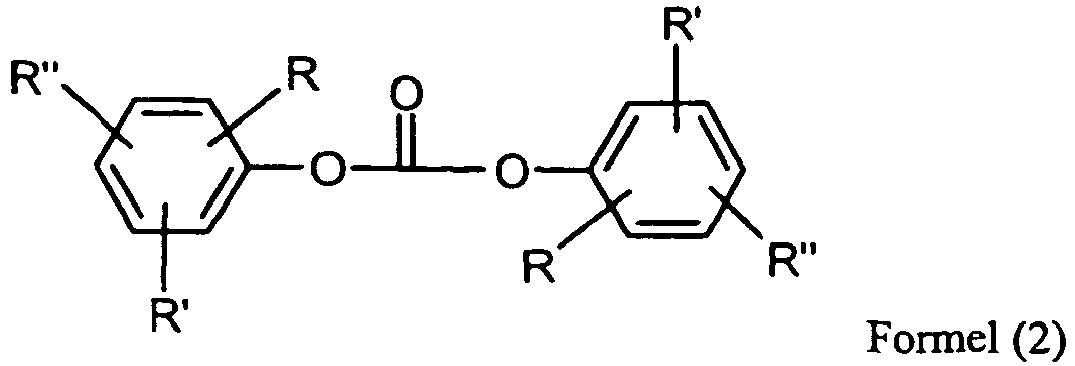
- R, R' und R"
- unabhängig voneinander H, gegebenenfalls verzweigte C1-C34-Alkyl/Cycloalkyl, C7-C34-Alkaryl oder C6-C34-Aryl darstellen können,
- Diphenylcarbonat, Butylphenyl-phenylcarbonat, Di-Butylphenylcarbonat, Isobutylphenyl-phenylcarbonat, Di-Isobutylphenylcarbonat, tert-Butylphenyl-phenylcarbonat, Di-tert-Butylphenylcarbonat, n-Pentylphenyl-phenylcarbonat, Di-(n-Pentylphenyl)carbonat, n-Hexylphenyl-phenylcarbonat, Di-(n-Hexylphenyl)carbonat, Cyclohexylphenyl-phenylcarbonat, Di-Cyclohexylphenylcarbonat, Phenylphenol-phenylcarbonat, Di-Phenylphenolcarbonat, Isooctylphenyl-phenylcarbonat, Di-Isooctylphenylcarbonat, n-Nonylphenyl-phenylcarbonat, Di-(n-Nonylphenyl)carbonat, Cumylphenyl-phenylcarbonat, Di-Cumylphenylcarbonat, Naphthylphenyl-phenylcarbonat, Di-Naphthylphenylcarbonat, Di-tert-Butylphenyl-phenylcarbonat, Di-(Di-tert-Butylphenyl)carbonat, Dicumylphenyl-phenylcarbonat, Di-(Dicumylphenyl)carbonat, 4-Phenoxyphenyl-phenylcarbonat, Di-(4-Phenoxyphenyl)carbonat, 3-Pentadecylphenyl-phenylcarbonat, Di-(3-Pentadecylphenyl)carbonat, Tritylphenyl-phenylcarbonat, Di-Tritylphenylcarbonat,
bevorzugt
Diphenylcarbonat, tert-Butylphenyl-phenylcarbonat, Di-tert-Butylphenylcarbonat, Phenylphenol-phenylcarbonat, Di-Phenylphenolcarbonat, Cumylphenyl-phenylcarbonat, Di-Cumylphenylcarbonat, besonders bevorzugt Diphenylcarbonat. - Es können auch Mischungen der genannten Kohlensäurediester eingesetzt werden.
- Der Anteil an Kohlensäureester beträgt 100 bis 130 mol-%, bevorzugt 103 bis 120 mol-%, besonders bevorzugt 103 bis 109 mol-%, bezogen auf die Dihydroxyverbindung.
- Als Katalysatoren im Sinne der Erfindung werden im Schmelzumesterungsverfahren wie in der genannten Literatur beschrieben basische Katalysatoren wie beispielsweise Alkali- und Erdalkalihydroxide und -oxide aber auch Ammonium- oder Phosphoniumsalze, im Folgenden als Oniumsalze bezeichnet, eingesetzt. Bevorzugt werden dabei Oniumsalze, besonders bevorzugt Phosphoniumsalze eingesetzt. Phosphoniumsalze im Sinne der Erfindung sind solche der Formel (3)

- R1-4
- dieselben oder verschiedene C1-C10-Alkyle, C6-C10-Aryle, C7-C10-Aralkyle oder C5-C6-Cycloalkyle sein können, bevorzugt Methyl oder C6-C14-Aryle, besonders bevorzugt Methyl oder Phenyl, und
- X-
- ein Anion wie Hydroxid, Sulfat, Hydrogensulfat, Hydrogencarbonat, Carbonat, ein Halogenid, bevorzugt Chlorid, oder ein Alkoholat der Formel OR sein kann, wobei R C6-C14-Aryl oder C7-C12-Aralkyl, bevorzugt Phenyl, sein kann. Bevorzugte Katalysatoren sind
- Die Katalysatoren werden bevorzugt in Mengen von 10-8 bis 10-3 mol, bezogen auf ein mol Bisphenol, besonders bevorzugt in Mengen von 10-7 bis 10-4 mol, eingesetzt.
- Weitere Katalysatoren können allein oder gegebenenfalls zusätzlich zu dem Oniumsalz verwendet werden, um die Geschwindigkeit der Polymerisation zu erhöhen. Dazu gehören Salze von Alkalimetallen und Erdalkalimetallen, wie Hydroxide, Alkoxide und Aryloxide von Lithium, Natrium und Kalium, vorzugsweise Hydroxid-, Alkoxid- oder Aryloxidsalze von Natrium. Am meisten bevorzugt sind Natriumhydroxid- und Natriumphenolat. Die Mengen des Cokatalysators können im Bereich von 1 bis 200 ppb, vorzugsweise 5 bis 150 ppb und am meisten bevorzugt 10 bis 125 ppb liegen, jeweils berechnet als Natrium.
- Die Umesterungsreaktion der aromatischen Dihydroxyverbindung und des Kohlensäurediester in der Schmelze wird bevorzugt in zwei Stufen durchgeführt. In der ersten Stufe findet das Aufschmelzen der aromatischen Dihydroxyverbindung und des Kohlensäurediester bei Temperaturen von 80 bis 250°C, bevorzugt 100 bis 230°C, besonders bevorzugt 120 bis 190°C unter normalem Druck in 0 bis 5 Stunden, bevorzugt 0,25 bis 3 Stunden statt. Nach Zugabe des Katalysators wird durch Anlegen von Vakuum (bis zu 2 mm Hg) und Erhöhung der Temperatur (auf bis zu 260°C) durch Abdestillieren des Monophenols das Oligocarbonat aus der aromatischen Dihydroxyverbindung und dem Kohlensäurediester hergestellt. Hierbei fällt die Hauptmenge an Brüden aus dem Prozess an. Das so hergestellte Oligocarbonat hat eine mittlere Gewichtsmolmasse Mw (ermittelt durch Messung der rel. Lösungsviskosität in Dichlormethan oder in Mischungen gleicher Gewichtsmengen Phenol/o-Dichlorbenzol geeicht durch Lichtstreuung) im Bereich von 2000 g/mol bis 18 000 g/mol bevorzugt von 4 000 g/mol bis 15 000 g/mol.
- In der zweiten Stufe wird bei der Polykondensation durch weiteres Erhöhen der Temperatur auf 250 bis 320°C, bevorzugt 270 bis 295°C und einem Druck von <2 mm Hg das Polycarbonat hergestellt. Hierbei wird der Rest an Brüden aus dem Prozess entfernt.
- Die Katalysatoren können auch in Kombination (zwei oder mehrere) miteinander eingesetzt werden.
- Beim Einsatz von Alkali-/Erdalkalimetallkatalysatoren kann es vorteilhaft sein, die Alkali-/ Erdalkalimetallkatalysatoren zu einem späteren Zeitpunkt (z. B. nach der Oligocarbonatsynthese bei der Polykondensation in der zweiten Stufe) zuzusetzen.
- Die Reaktion der aromatischen Dihydroxyverbindung und des Kohlensäurediester zum Polycarbonat kann im Sinne des erfindungsgemäßen Verfahrens diskontinuierlich oder bevorzugt kontinuierlich durchgeführt werden, beispielsweise in Rührkesseln, Dünnschichtverdampfern, Fallfilmverdampfern, Rührkesselkaskaden, Extrudern, Knetern, einfachen Scheibenreaktoren und Hochviskosscheibenreaktoren.
- Analog des Phasengrenzflächenverfahrens können durch Einsatz mehrfunktioneller Verbindungen verzweigte Poly- oder Copolycarbonate hergestellt werden.
- Den erfindungsgemäßen Polycarbonaten können noch andere aromatische Polycarbonate und/oder andere Kunststoffe wie aromatische Polyester wie Polybutylenterephthalat oder Polyethylenterephthalat, Polyamide, Polyimide, Polyesteramide, Polyacrylate und Polymethacrylate wie zum Beispiel Polyalkyl(meth)acrylate und hier insbesondere Polymethylmethacrylat, Polyacetale, Polyurethane, Polyolefine, halogenhaltige Polymere, Polysulfone, Polyethersulfone, Polyetherketone, Polysiloxane, Polybenzimidazole, Harnstoff-Formaldehyd-Harze, Melamin-Formaldehydharze, Phenol-Formaldehyd-Harze, Alkydharze, Epoxidharze, Polystyrole, Copolymere des Styrols oder des alpha-Methylstyrols mit Dienen oder Acrylderivaten, Pfropfpolymerisate auf Basis Acrylnitril/-Butadien/Styrol oder auf Acrylatkautschuk basierende Pfropfcopolymerisate (s. beispielsweise die in
EP-A 640 655 - Den erfindungsgemäßen Polycarbonaten sowie den ggf. weiteren enthaltenen Kunststoffen können noch die für diese Thermoplasten üblichen Additive wie Füllstoffe, UV-Stabilisatoren, Thermostabilisatoren, Antistatika und Pigmente in den üblichen Mengen zugesetzt werden; gegebenenfalls können das Entformungsverhalten, das Fließverhalten, und/oder die Flammwidrigkeit noch durch Zusatz externer Entformungsmittel, Fließmittel, und/oder Flammschutzmittel verbessert werden (z. B. Alkyl- und Arylphosphite, -phosphate, -phosphane, -niedermolekulare Carbonsäureester, Halogenverbindungen, Salze, Kreide, Quarzmehl, Glas- und Kohlenstofffasern, Pigmente und deren Kombination). Solche Verbindungen werden z. B. in
WO 99/55772 EP 1 308 084 und in den entsprechenden Kapiteln des "Plastics Additives Handbook" , ed. Hans Zweifel, 5th Edition 2000, Hanser Publishers, Munich beschrieben. - Polyole im Rahmen der vorliegenden Offenbarung sind solche mit zahlengemittelten Molekularge-wichten von 250 bis 20000, bevorzugt von 500 bis 8000, besonders bevorzugt 500 bis 6000, ganz besonders bevorzugt von 1100 bis 6000 und einer Funktionalität von 1,5 bis 8. Zum Beispiel sind dies Polyetherpolyole, die zwei bis vier vorzugsweise zwei Hydroxylgruppen enthalten. Als Handelsprodukte sind z.B. die Polytetrahydrofuran-Homopolymerisate Tetrathane® 250 oder Tetrathane® 2900 der Firma Du Pont geeignet. Geeignete Polyetherpolyole sind auch Blockcopolymerisate und Copolymerisate mit unregelmäßiger Folge der Kettenbausteinen sowie Mischungen der Polyetherpolyole.
- Polyetherpolyole können nach bekannten Verfahren, hergestellt werden, beispielsweise durch anionische Polymerisation von Alkylenoxiden in Gegenwart von Alkalihydroxiden oder Alkalialkoholaten als Katalysatoren und unter Zusatz mindestens eines Startermoleküls, das reaktive Wasserstoffatome enthält oder durch kationische Polymerisation von Alkylenoxiden in Gegenwart von Lewis-Säuren wie Antimonpentachlorid oder Borfluorid-Etherat oder durch Doppelmetallcyanid (DMC)-Katalyse. Geeignete Alkylenoxide enthalten 2 bis 4 Kohlenstoffatome im Alkylenrest. Beispiele sind Tetrahydrofuran, 1,2-Propylenoxid, 1,2- bzw. 2,3-Butylenoxid. Die Alkylenoxide können einzeln, alternierend nacheinander oder als Mischungen verwendet werden. Als Startermolekül kommen Wasser oder 2- und 3-wertige Alkohole in Betracht, wie Ethylenglykol, 1,2-Propandiol und 1,3-Propandiol, Diethylenglykol, Dipropylenglykol, Ethandiol-1,4, Glycerin, Trimethylolpropan usw.
- Als Polyetherpolyole eignen sich ferner polymermodifizierte Polyetherpolyole, vorzugsweise Pfropfpolyetherpolyole, insbesondere solche auf Styrol- und/oder Acrylnitrilbasis, die durch in situ Polymerisation von Acrylnitril, Styrol oder vorzugsweise Mischungen aus Styrol und Acrylnitril gewonnen werden können.
- Als weitere Polyole können die mindestens zwei, vorzugsweise 2 bis 4 Hydroxylgruppen und in der Regel ein zahlengemitteltes Molekulargewicht von 400-8000 aufweisenden Polyester, Polythioether, Polyacetale, Polycarbonate und Polyesteramide verwendet werden. Bei den bifunktionellen Polyether-Derivaten kann es sich um ein Homopolymerisat, um ein Blockcopolymerisat oder um ein Copolymerisat mit unregelmäßiger Folge der Kettenbausteine handeln. Mischungen der Polyester und Polyether können selbstverständlich eingesetzt werden.
- Die genannten Polyole können im Rahmen der vorliegenden Offenbarung sowohl alleine als auch als Mischungen verschiedener Polyole eingesetzt werden. Der Anteil an Polyol bzw. an Polyolen in den Zusammensetzungen beträgt 0,01 Gew-% bis < 0,3 Gew-%, bevorzugt 0,01 Gew-% bis 0,25 Gew-%, ganz besonders bevorzugt 0,01 Gew-% bis 0,12 Gew-%, insbesondere 0,03 bis 0,11 Gew-% jeweils bezogen auf die Gesamtzusammensetzung.
- Für die Erhöhung der Flammwidrigkeit von Zusammensetzungen, die zu transparenten Erzeugnissen verarbeitet werden sollen, ist der Einsatz von Polyolen mit vier Kohlenstoffatomen im Alkylenteil bevorzugt. Ein Beispiel für ein solches bevorzugtes Polyol ist Polytetrahydrofuran.
- Als Flammschutzmittel werden Alkali- bzw. Erdalkalisalze von aliphatischen bzw. aromatischen Sulfonsäure- Sulfonamid- und Sulfonimidderivaten eingesetzt.
- Geeignete Salze sind beispielsweise: Natrium- oder Kaliumperfluorbutansulfat, Natrium- oder Kaliumperfluormethansulfonat, Natrium- oder Kaliumperfluoroctansulfat, Natrium-oder Kalium-2,5-dichlorbenzolsulfat, Natrium- oder Kalium-2,4,5-trichlorbenzolsulfat, Natrium- oder Kaliummethylphosphonat, Natrium- oder Kalium-(2-phenyl-ethylen)-phosphonat, Natrium- oder Kaliumpentachlorbenzoat, Natrium- oder Kalium-2,4,6-trichlorbenzoat, Natrium-oder Kalium-2,4-dichlorbenzoat, Lithium-phenylphosphonat, Natrium- oder Kalium-diphenylsulfon-sulfonat, Natrium- oder Kalium-2-formylbenzolsulfonat, Natrium- oder Kalium-(N-benzolsulfonyl)-benzolsulfonamid. Trinatrium- oder Trikalium-hexafluoroaluminat, Dinatrium- oder Dikaliumhexafluorotitanat, Dinatrium- oder Dikalium-hexafluorosilikat, Dinatrium- oder Dikaliumhexafluorozirkonat, Natrium- oder Kalium-pyrophosphat, Natrium- oder Kalium-metaphosphat, Natrium- oder Kalium-tetrafluoroborat, Natrium- oder Kalium-hexafluorophosphat, Natrium- oder Kalium- oder Lithiumphosphat, N-(p-tolylsulfonyl-)-p-toluolsulfimid-Kaliumsalz, N-(N'-Benzyl-aminocarbonyl)-sulfanylimid-Kaliumsalz.
- Bevorzugt werden Natrium- oder Kaliumperfluorbutansulfat, Natrium- oder Kaliumperfluoroctansulfat, Natrium- oder Kalium-diphenylsulfon-sulfonat und Natrium oder Kalium-2,4,6-trichlorben-zoat und N-(p-tolylsulfonyl-)-p-toluolsulfimid-Kaliumsalz, N-(N'-Benzylaminocabonyl)-sulfanylimid-Kaliumsalz. Ganz besonders bevorzugt sind Kalium-nona-fluor-1-butansulfonat und Natrium- oder Kalium-diphenyl-sulfonsäure-sulfonat. Kalium-nona-fluor-1-butansulfonat ist u.a. als Bayowet®C4 (Firma Lanxess, Leverkusen, Deutschland, CAS-Nr. 29420-49-3), RM64 (Firma Miteni, Italien) oder als 3M™ Perfluorobutanesulfonyl Fluoride FC-51 (Firma 3M, USA) kommerziell erhältlich. Ebenfalls sind Mischungen der genannten Salze geeignet.
- Besonders bevorzugt sind Kaliumperfluorbutansulfonat, Kaliumdiphenyl-sulfonsulfonat, N-(p-tolylsulfonyl-)-p-toluolsulfimid-Kaliumsalz, N-(N'-Benzylaminocabonyl)-sulfanylimid-Kaliumsalz, ganz besonders bevorzugt ist Kalium-nona-fluor-1-butansulfonat.
- Diese organischen Flammschutzsalze werden in Mengen von 0,01 Gew-% bis 0,8 Gew%, bevorzugt 0,02 Gew% bis 0,6 Gew-%, besonders bevorzugt 0,03 Gew-% bis 0,2 Gew-%, ganz besonders bevorzugt 0,03 bis 0,15 Gew-%, insbesondere 0,03 bis 0,065 Gew.-% jeweils bezogen auf die Gesamtzusammensetzung in den Formmassen eingesetzt.
- Als weitere Flammschutzmittel kommen z.B. phosphorhaltige Flammschutzmittel ausgewählt aus den Gruppen der Mono- und oligomeren Phosphor- und Phosphonsäureester, Phosphonatamine, Phosphonate, Phosphinate, Phosphite, Hypophosphite, Phosphinoxide und Phosphazene, wobei auch Mischungen von mehreren Komponenten ausgewählt aus einer oder verschiedenen dieser Gruppen als Flammschutzmittel zum Einsatz kommen können in Frage. Auch andere hier nicht speziell erwähnte vorzugsweise halogenfreie Phosphorverbindungen können alleine oder in beliebiger Kombination mit anderen vorzugsweise halogenfreien Phosphorverbindungen eingesetzt werden. Hierzu zählen auch rein anorganische Phosphorverbindungen wie Borphosphathydrat. Des weiteren kommen als phosphorhaltige Flammschutzmittel Phosphonatamine in Betracht. Die Herstellung von Phosphonataminen ist beispielsweise in
US-Patentschrift 5,844,028 beschrieben. Phosphazene und deren Herstellung sind beispielsweise inEP-A 728 811 DE-A 1 961668 undWO 97/40092 EP 1 342 753 , in derDE 10257079A sowie in derEP 1 188 792 näher beschrieben wird. - Phosphorhaltige Flammschutzadditive im erfindungsgemäßen Sinne sind bevorzugt ausgewählt aus den Gruppen der Mono- und oligomeren Phosphor- und Phosphonsäureester, Phosphonatamine und Phosphazene, wobei auch Mischungen von mehreren Komponenten ausgewählt aus einer oder verschiedenen dieser Gruppen als Flammschutzadditiv zum Einsatz kommen können. Auch andere hier nicht speziell erwähnte halogenfreie Phosphorverbindungen können alleine oder in beliebiger Kombination mit anderen halogenfreien Phosphorverbindungen eingesetzt werden.
- Bevorzugte Mono- und oligomere Phosphor- bzw. Phosphonsäureester sind Phosphorverbindungen der allgemeinen Formel (4)
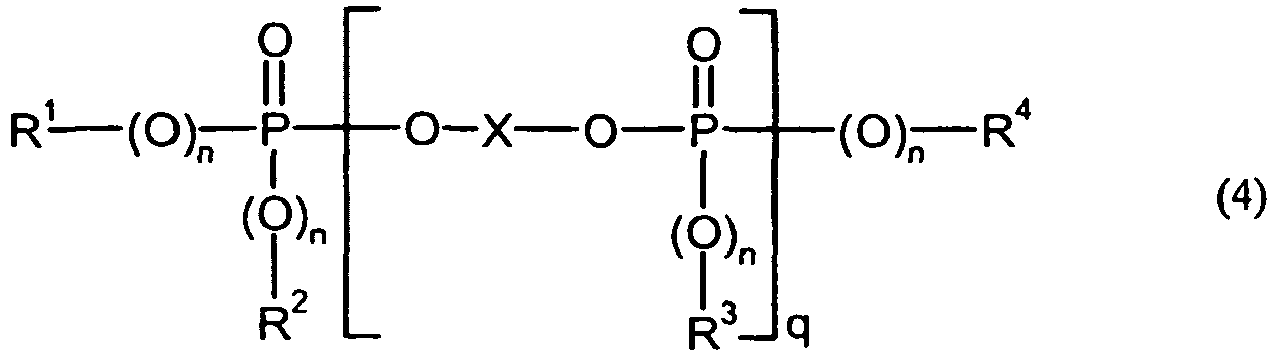
- R1, R2, R3 und R4,
- unabhängig voneinander jeweils gegebenenfalls halogeniertes C1 bis C8-Alkyl, jeweils gegebenenfalls durch Alkyl, vorzugsweise C1 bis C4-Alkyl, und/oder Halogen, vorzugsweise Chlor, Brom, substituiertes C5 bis C6-Cycloalkyl, C6 bis C20-Aryl oder C7 bis C12-Aralkyl,
- n
- unabhängig voneinander, 0 oder 1,
- q
- 0 bis 30 und
- X
- einen ein- oder mehrkernigen aromatischen Rest mit 6 bis 30 C-Atomen, oder einen linearen oder verzweigten aliphatischen Rest mit 2 bis 30 C-Atomen, der OH-substituiert sein und bis zu 8 Etherbindungen enthalten kann, bedeuten.
- Bevorzugt stehen R1, R2, R3 und R4 unabhängig voneinander für C1 bis C4-Alkyl, Phenyl, Naphthyl oder Phenyl-C1-C4-alkyl. Die aromatischen Gruppen R1, R2, R3 und R4 können ihrerseits mit Halogen- und/oder Alkylgruppen, vorzugsweise Chlor, Brom und/oder C1 bis C4-Alkyl substituiert sein. Besonders bevorzugte Aryl-Reste sind Kresyl, Phenyl, Xylenyl, Propylphenyl oder Butylphenyl sowie die entsprechenden bromierten und chlorierten Derivate davon.
- X
- in der Formel (4) bedeutet bevorzugt einen ein- oder mehrkernigen aromatischen Rest mit 6 bis 30 C-Atomen. Dieser leitet sich bevorzugt von Bisphenolen der Formel (1) ab.
- n
- in der Formel (4) kann, unabhängig voneinander, 0 oder 1 sein, vorzugsweise ist n gleich 1.
- q
- steht für Werte von 0 bis 30, bevorzugt 0,3 bis 20, besonders bevorzugt 0,5 bis 10, insbesondere 0,5 bis 6, ganz besonders bevorzugt 1,1 bis 1,6.
- X
- steht besonders bevorzugt für


- Als phosphorhaltige Flammschutzmittel können auch Mischungen verschiedener Phosphate gemäß Formel (4) eingesetzt werden.
- Phosphorverbindungen der Formel (4) sind insbesondere Tributylphosphat, Triphenylphosphat, Trikresylphosphat, Diphenylkresylphosphat, Diphenyloctylphosphat, Diphenyl-2-ethylkresylphosphat, Tri-(isopropylphenyl)-phosphat, Resorcin verbrücktes Oligophosphat und Bisphenol A verbrücktes Oligophosphat. Der Einsatz von oligomeren Phosphorsäureestern der Formel (4), die sich vom Bisphenol A ableiten, ist insbesondere bevorzugt.
- Höchst bevorzugt es phosphorhaltiges Flammschutzadditiv ist Bisphenol-A basierendes Oligophosphat gemäß Formel (IVa).

- Die Phosphorverbindungen sind bekannt (vgl. z.B.
EP-A 0 363 608 ,EP-A 0 640 655 ) oder lassen sich nach bekannten Methoden in analoger Weise herstellen (z.B. Ullmanns Enzyklopädie der technischen Chemie, Bd. 18, S. 301 ff. 1979; Houben-Weyl, Methoden der organischen Chemie, Bd. 12/1, S. 43; Beilstein Bd. 6, S. 177). - Wenn Mischungen verschiedener Phosphorverbindungen eingesetzt werden und im Fall von oligomeren Phosphorverbindungen, handelt es sich bei dem angegebenen q-Wert um den mittleren q-Wert. Der mittlere q-Wert kann bestimmt werden, indem mittels geeigneter Methode (Gaschromatographie (GC), High Pressure Liquid Chromatography (HPLC), Gelpermeationschromatographie (GPC)) die Zusammensetzung der Phosphorverbindung (Molekulargewichtsverteilung) bestimmt wird und daraus die Mittelwerte für q berechnet werden.
- Weiterhin können Phosphonatamine und Phosphazene, wie sie in
WO 00/00541 WO 01/18105 - Die Flammschutzadditive können allein oder in beliebiger Mischung untereinander oder in Mischung mit anderen Flammschutzadditiven eingesetzt werden.
- Phosphorhaltige Flammschutzaditive sind kommerziell erhältlich, z. B. Reofos® BAPP (Firma Chemtura, Indianapolis, USA), NcendX® P-30 (Firma Albemarle, Baton Rouge, Louisiana, USA), Fyrolflex® BDP (Firma Akzo Nobel, Arnheim, Niederlande), CR 741® (Firma Daihachi, Osaka, Japan),. Reofos® TPP (Firma Chemtura), Fyrolflex® TPP (Firma Akzo Nobel), Disflamoll® TP (Firma Lanxess), Reofos RDP (Firma Chemtura) oder Fyrolflex® RDP (Firma Akzo Nobel).
- Phosphorhaltige Flammschutzmittel werden nach Bedarf bevorzugt in Mengen von bis zu 30 Gew.-%, besonders bevorzugt, 2 bis 25 Gew.-%, ganz besonders bevorzugt 3 bis 15 Gew.-% (bezogen auf die Gesamtzusammensetzung) zugesetzt.
- Weiterhin können den Zusammensetzungen Antitropfmittel zugesetzt werden. Als Antitropfmittel ist beispielsweise Polytetrafluorethylen (PTFE) genannt. PTFE ist in diversen Produktqualitäten kommerziell verfügbar. Hierzu zählen Additive wie Hostaflon® TF2021 oder aber PTFE-Blends wie Metablen® A-3800 (ca. 40% PTFE CAS 9002-84-0 und ca. 60 % Methylmethacrylat/Butylacrylat Copolymer CAS 25852-37-3 von Misubishi-Rayon) oder Blendex® B449 (ca. 50% PTFE und ca. 50 % SAN [aus 80 % Styrol und 20 % Acrylnitril] der Firma Chemtura.
- Im Rahmen der vorliegenden Erfindung wird PTFE in Mengen von 0,05 Gew% bis 5 Gew%, bevorzugt 0,1 Gew% bis 1,0 Gew%, besonders bevorzugt 0,1 Gew% bis 0,5 Gew% jeweils bezogen auf die Gesamtzusammensetzung eingesetzt.
- Weitere geeignete Flammschutzmittel im Sinne der vorliegenden Erfindung sind halogenhaltige Verbindungen. Hierzu zählen bromierte Verbindungen wie bromierte Oligocarbonate (z.B. Tetrabrombisphenol-A oligocarbonat BC-52®, BC-58®, BC-52HP® der Firma Chemtura), Polypentabrombenzylacrylate (z.B. FR 1025 der Firma Dead Sea Bromine (DSB)), oligomere Umsetzungsprodukte aus Tetrabrom-bisphenol-A mit Expoxiden (z.B. FR 2300 und 2400 der Firma DSB), oder bromierte Oligo- bzw. Polystyrole (z.B. Pyro-Chek® 68PB der Firma Ferro Corporation, PDBS 80 und Firemaster®PBS-64HW der Firma Chemtura).
- Besonders bevorzugt im Rahmen dieser Erfindung sind bromierte Oligocarbonate auf Basis Bisphenol A, insbesondere Tetrabrombisphenol-A oligocarbonat.
- Im Rahmen der vorliegenden Erfindung werden bromhaltige Verbindungen in Mengen von 0,1 Gew% bis 30 Gew%, bevorzugt 0,1 Gew% bis 20 Gew%, besonders bevorzugt 0,1 Gew% bis 10 Gew% und ganz besonders bevorzugt 0,1 Gew% bis 5,0 Gew% jeweils bezogen auf die Gesamtzusammensetzung eingesetzt.
- Des weiteren können chlorhaltige Flammschutzmittel wie zum Beispiel Tetrachlorphthalimide eingesetzt werden.
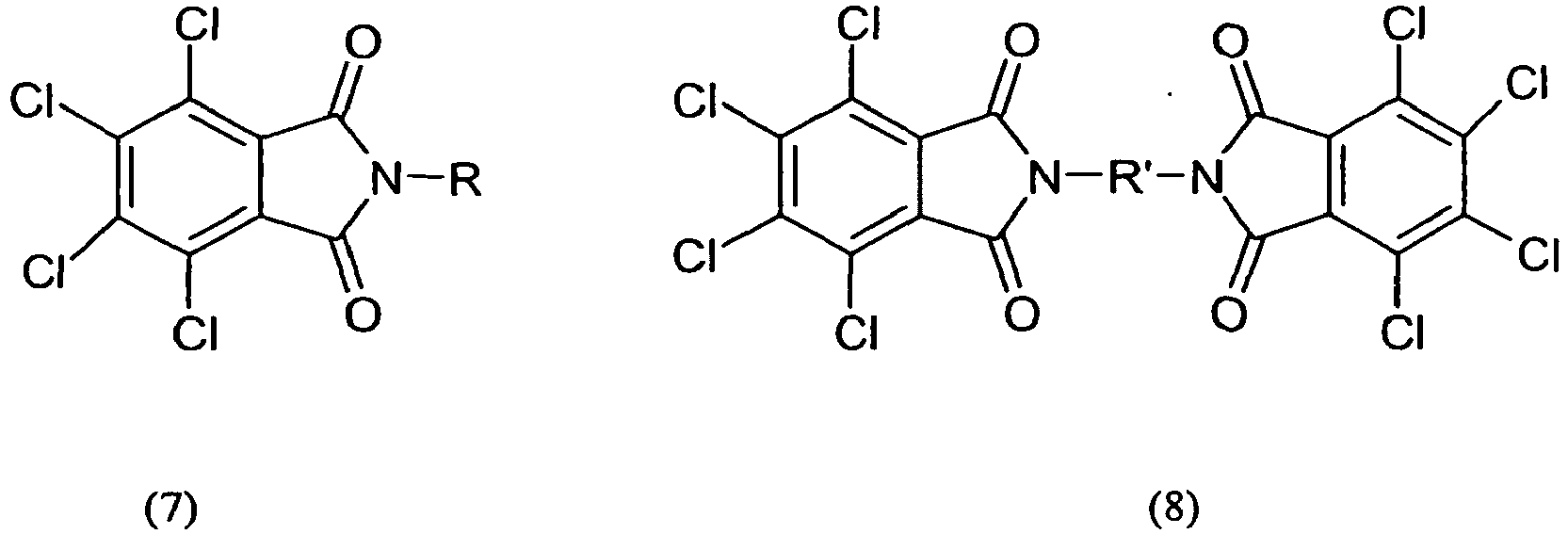
- Als geeignete Tetrachlorphthalimide im Sinne der Erfindung gemäss Formel (7) seien beispielsweise genannt: N-Methyl-tetrachlorphthalimid, N-ethyl- tetrachlorphthalimid, N-Propyl- tetrachlorphthalimid, N-lsopropyl- tetrachlorphthalimid, N-Butyl- tetrachlorphthalimid, N-Isobutyltetrachlorphthalimid, N-Phenyl- tetrachlorphthalimid, N- (4-Chlorphenyl) tetrachlorphthalimid, N-(3, 5-Dichlorphenyl)-tetrachlorphthalimid N-(2,4,6-Trichlorphenyl)- tetrachlorphthalimid, N-Naphthyl- tetrachlorphthalimid. Als geeignete Tetrachlorphthalimideim Sinne der Erfindung gemäss Formel (7) seienbeispielsweise genannt: N,N'-Ethylen-di-tetrachlorphthalimid.
- N.N'- Propylen-di- tetrachlorphthalimid N,N'-Butylen-di-tetrachlorphthalimid N,N'-p-Phenylen-di-tetrachlorphthalimid, 4,4'-Di-tetrachlorphthalimido-diphenyl,N-(Tetrachlorphthalimido)-tetrachlorphthalimid.
- Insbesondere geeignet im Sinne der Erfindung sind N-Methyl- sowie N-Phenyltetrachlorphthalimid, N,N'-Ethylen-di-tetrachlorphthalimid und N-(Tetrachlorphthalimido)-tetrachlorphthalimid.
Mischungen verschiedener Tetrachlorphthalimide der Formeln (7) oder (8) sind gleichfalls zu verwenden. - Im Rahmen der vorliegenden Erfindung werden die genannten chlorhaltigen Verbindungen in Mengen von 0,1 Gew% bis 30 Gew%, bevorzugt 0,1 Gew% bis 20 Gew%, besonders bevorzugt 0,1 Gew% bis 10 Gew% und ganz besonders bevorzugt 0,1 Gew% bis 5,0 Gew% jeweils bezogen auf die Gesamtzusammensetzung eingesetzt.
- Die brom- beziehungsweise chlorhaltigen Flammschutzmittel können auch in Kombination mit Antimontrioxid eingesetzt werden.
- Hierbei ist die vorliegende Erfindung nicht auf die genannten Flammschutzmittel beschränkt, vielmehr können auch weitere flammhemmende Additive, wie z.B. in J. Troitzsch, "International Plastics Flammability Handbook", Hanser Verlag, München 1990 beschrieben, eingesetzt werden.
- Bei der Auswahl weiterer Flammschutzmittel ist darauf zu achten, dass die Transparenz nicht negativ beeinträchtigt wird.
- Den erfindungsgemäßen Polycarbonaten und Copolycarbonaten können weiterhin die für diese Thermoplasten üblichen Additive wie Füllstoffe, UV-Stabilisatoren, Thermostabilisatoren, Entformungsmittel, Fließmittel, Antistatika und Pigmente in den üblichen Mengen zugesetzt werden. Thermostabilisatoren wie beispielsweise und bevorzugt Tris-(2,4-di-tert, -butylphenyl)phosphat oder Triphenylphosphin werden bevorzugt in einer Menge von 10 bis 3000 ppm, bezogen auf die Gesamtzusammensetzung, zugesetzt.
- Die Herstellung einer Zusammensetzung enthaltend Polycarbonat , mindestens ein Polyol und mindestens ein Flammschutzadditiv erfolgt mit gängigen Einarbeitungsverfahren und kann beispielsweise durch Vermischen von Lösungen des Flammschutzadditives und des Polyols mit einer Lösung von Polycarbonat in geeigneten Lösungsmitteln wie Dichlormethan, Halogenalkanen, Halogenaromaten, Chlorbenzol und Xylolen realisiert werden. Die Substanzgemische werden dann bevorzugt in bekannter Weise durch Extrusion homogenisiert. Die Lösungsgemische werden bevorzugt in bekannter Weise durch Ausdampfen des Lösungsmittels und anschließender Extrusion aufgearbeitet, beispielsweise compoundiert.
- Zudem kann die Zusammensetzung in üblichen Mischvorrichtungen wie Schneckenextrudern (zum Beispiel Zweischneckenextruder, ZSK), Kneter, Brabender- oder Banbury-Mühlen gemischt und anschließend extrudiert werden. Nach der Extrusion kann das Extrudat abgekühlt und zerkleinert werden. Es können auch einzelne Komponenten vorgemischt werden und dann die restlichen Ausgangsstoffe einzeln und/oder ebenfalls gemischt hinzugegeben werden.
- Die erfindungsgemäßen Zusammensetzungen können in bekannter Weise aufgearbeitet und zu beliebigen Formkörpern verarbeitet werden, beispielsweise durch Extrusion, Spritzguss oder Extrusionsblasformen.
- Coextrudierte Polycarbonatmassivplatten können z. B. mit Hilfe folgender Maschinen und Apparate hergestellt werden:
- den Hauptextruder mit einer Schnecke der Länge 33 D und einem Durchmesser von 70 mm mit Entgasung
- einen Coextruder zum Aufbringen der Deckschicht mit einer Schnecke der Länge 25 D und einem Durchmesser von 35 mm
- eine speziellen Coextrusions-Breitschlitzdüse mit 450 mm Breite
- einen Glättkalander
- eine Rollenbahn
- eine Abzugseinrichtung
- eine Ablängvorrichtung (Säge)
- einen Ablagetisch.
- Coextrudierte Polycarbonatstegplatten können z. B. mit Hilfe folgender Maschinen und Apparate hergestellt werden:
- dem Hauptextruder mit einer Schnecke der Länge 33 D und einem Durchmesser von 70 mm mit Entgasung
- dem Coexadapter
- einem Coextruder zum Aufbringen der Deckschicht mit einer Schnecke der Länge 25 D und einem Durchmesser von 30 mm
- der speziellen Breitschlitzdüse mit 350 mm Breite
- dem Kalibrator
- der Rollenbahn
- der Abzugseinrichtung
- der Ablängvorrichtung (Säge)
- dem Ablagetisch.
- Bei beiden Plattentypen wird das Polycarbonat-Granulat des Basismaterials dem Fülltrichter des Hauptextruders zugeführt, das Coextrusionsmaterial dem des Coextruders. Im jeweiligen Plastifiziersystem Zylinder/Schnecke erfolgt das Aufschmelzen und Fördern des jeweiligen Materials. Beide Materialschmelzen werden im Coexadapter zusammengeführt und bilden nach Verlassen der Düse und Abkühlen einen Verbund. Die weiteren Einrichtungen dienen dem Transport, Ablängen und Ablegen der extrudierten Platten.
- Platten ohne Coextrusionsschicht werden entsprechend hergestellt, indem entweder der Coextruder nicht betrieben wird oder mit der gleichen Polymerzusammensetzung wie der Hauptextruder befüllt wird.
- Das Blasformen von Polycarbonat ist unter anderem in der
DE-A 102 29 594 und hier zitierter Literatur näher beschrieben. - Das Brandverhalten wurde nach der Methode UL94V Underwriters Laboratories Inc. Standard of Safety, "Test for Flammability of Plastic Materials for Parts in Devices and Appliances", S 14 ff, Northbrook 1998; b) J. Troitzsch, "International Plastics Flammability Handbook", S. 346 ff., Hanser Verlag, München 1990) bestimmt. Für die Einstufung eines flammgeschützten Kunststoffs in die Brandklasse UL94V-0 müssen im einzelnen die folgenden Kriterien erfüllt sein: bei einem Satz von 5 ASTM Normprüfkörpern (Maße: 127 x 12,7 x X, mit X = Dicke des Prüfkörpers, z.B. 3,2; 3,0; 1,5 1,0 oder 0,75 mm) dürfen alle Proben nach zweimaliger Beflammung von 10 Sekunden Dauer mit einer offenen Flamme definierter Höhe nicht länger als 10 Sekunden nachbrennen. Die Summe der Nachbrennzeiten bei 10 Beflammungen von 5 Proben darf nicht größer als 50 Sekunden sein. Zudem darf kein brennendes Abtropfen, vollständiges Abbrennen oder Nachglühen des jeweiligen Prüfkörpers von länger als 30 Sekunden erfolgen. Die Einstufung UL94V-1 verlangt, dass die Einzelnachbrennzeiten nicht länger als 30 Sekunden betragen und dass die Summe der Nachbrennzeiten von 10 Beflammungen von 5 Proben nicht größer als 250 Sekunden ist. Die Gesamtnachglühzeit darf nicht mehr als 250 Sekunden betragen. Die übrigen Kriterien sind identisch mit den oben erwähnten. Eine Einstufung in die Brandklasse UL94V-2 erfolgt dann, wenn es bei Erfüllen der übrigen Kriterien der UL94V-1 Einstufung zu einem brennenden Abtropfen kommt.
- Die Flammschutzprüfung wurde an Teststäben der Abmessungen 127x12,7xX mm, wobei X die Dicke des Prüfkörpers ist, die in der Tabelle angegeben ist.
- Die Trübung (Haze) und Transmission wurden bestimmt nach DIN 5036 an Platten der Geometrie 60 x 40 x 4 mm
- Die Einrichtung zur Compoundierung besteht aus:
- Dosiereinrichtung für die Komponenten
- Einem gleichlaufenden Zweiwellenkneter (ZSK 53 von der Firma Werner & Pfleiderer) mit einem Schneckendurchmesser von 53 mm
- Einer Lochdüse zur Ausformung von Schmelzesträngen
- Einem Wasserbad zur Abkühlung und dem Verfestigen der Stränge
- Einem Granulator.
- KFBS und die entsprechenden Polyole werden in Pulverform mit dem Polycarbonat-Pulver vermischt und in das Polycarbonat eincompoundiert. Mit Hilfe der oben beschriebenen Compoundiereinrichtung werden die in Tabelle langegebenen Zusammensetzungen hergestellt.
Tabelle 2 (Mengenangaben in Gew.-%) Beispiel 1V 2 3 4V 5 6V 7V 8V Polycarbonat Granulat Auf 100 Gew% Auf 100 Gew% Auf 100 Gew% Auf 100 Gew% Auf 100 Gew% Auf 100 Gew% Auf 100 Gew% Auf 100 Gew% Polycarbonat Pulver 6,935 Gew% 6,885 Gew% 6,835 Gew% 6,9 6,8 6,4 6,8 6,4 KFBS 0,065 0,065 0,065 0,1 0,1 0,1 0,1 0,1 PTHF -- 0,05 0,1 -- 0,1 0,5 -- -- PEG -- -- -- -- -- -- 0,1 0,5 UL 94 bei 2,6mm V2 V0 V0 -- -- -- -- -- UL 94 bei 2,8 mm V2 V0 V0 -- -- -- -- -- UL 94 bei 3,0 mm V1 V0 V0 V0 V0 V0 V0 V0 UL 94 bei 3,2mm V1 V0 V0 V0 V0 V0 V0 V0 Trübung 0,4 0,2 0,2 1,4 0,7 2,6 1,3 2,6 Transmission 88,96 89,15 89,18 87,6 88,58 87,66 86,3 83,12 Polycarbonat (Granulat): Polycarbonat (Basis Bisphenol A)mit einem mittleren Molekulargewicht Mw von 28000 (Makrolon® 2808 der BayerMaterialScience AG).
Polycarbonat (Pulver): Polycarbonat (Basis Bisphenol A) Pulver mit einem mittleren Molekulargewicht Mw von 31000 (Makrolon® 3108 der BayerMaterialScience AG).
PTHF: Polytetrahydrofuran mit einem mittleren Molekulargewicht von 2900 (Tetrathane® 2900 der Firma Du Pont).
PEG: Polyethylenglycol mit einem mittleren Molekulargewicht von 8000.
PPG: Polypropylenglycol mit einem mittleren Molekulargewicht von 500.
KFBS: Kalium-nona-fluor-1-butansulfonat
V in Tabelle 1 steht für Vergleich
Tetraphenylphosphoniumhydroxid,
Tetraphenylphosphoniumphenolat,
besonders bevorzugt Tetraphenylphosphoniumphenolat.
Claims (11)
- Polycarbonat - Zusammensetzung enthaltend 0,01 Gew% bis < 0,3, Gew.-% Polyol und wobei als Polyol Blytetrahydrofuran eingesetzt wird, und 0,01 Gew% bis 0,8 Gew.-% eines Alkali- oder Erdalkalisalz einer aliphatischen oder aromatischen Sulfonsäure, jeweils bezogen auf die Gesamtzusammensetzung.
- Zusammensetzung gemäß Anspruch 1, enthaltend 0,01 bis 0,25 Gew.-% Polytetrahydrofuran.
- Zusammensetzung gemäß Anspruch 1 enthaltend 0,01 bis 0,12 Gew.-% Polytetrahydrofuran.
- Zusammensetzung gemäß Anspruch 1 enthaltend 0,03 bis 0,11 Gew-% Polytetrahydrofuran und 0,03 bis 0,15 Gew.-% Alkali- oder Erdalkalisalz einer aliphatischen oder aromatischen Sulfonsäure.
- Zusammensetzung gemäß Anspruch 1 enthaltend 0,03 bis 0,11 Gew-% Polytetrahydrofuran und 0,03 bis 0,065 Gew. -% Alkali- oder Erdalkalisalz einer aliphatischen oder aromatischen Sulfonsäure.
- Zusammensetzung nach Anspruch 1, enthaltend ein Polytetrahydrofuran mit einem Molekulargewicht von 250 bis 20000.
- Zusammensetzung gemäß Anspruch 1, enthaltend Natrium- oder Kalium-nona-fluor-1-butansulfonat, Natrium- oder Kalium-Diphenyl-Sulfonsäuresulfonat oder eine Mischung hieraus ist.
- Zusammensetzung gemäß Anspruch 1, dadurch gekennzeichnet, dass zusätzlich ein Antitropfmittel enthalten ist.
- Zusammensetzung gemäß Anspruch 8, wobei das Antitropfmittel ein Polytetrafluorethylen oder ein Polytetrafluorethylen-Blend ist.
- Erzeugnis enthaltend eine Zusammensetzung gemäß Anspruch 1.
- Erzeugnis gemäß Anspruch 10, dadurch gekennzeichnet, dass das Erzeugnis im Spritzgussverfahren hergestellt wird.
Applications Claiming Priority (2)
| Application Number | Priority Date | Filing Date | Title |
|---|---|---|---|
| DE102007052783A DE102007052783A1 (de) | 2007-11-02 | 2007-11-02 | Flammwidrige Polycarbonate mit Polyolen |
| PCT/EP2008/008836 WO2009056241A1 (de) | 2007-11-02 | 2008-10-18 | Flammwidrige polycarbonate mit polyolen |
Publications (2)
| Publication Number | Publication Date |
|---|---|
| EP2207844A1 EP2207844A1 (de) | 2010-07-21 |
| EP2207844B1 true EP2207844B1 (de) | 2013-07-03 |
Family
ID=40107168
Family Applications (1)
| Application Number | Title | Priority Date | Filing Date |
|---|---|---|---|
| EP08845390.7A Not-in-force EP2207844B1 (de) | 2007-11-02 | 2008-10-18 | Flammwidrige polycarbonate mit polyolen |
Country Status (8)
| Country | Link |
|---|---|
| US (1) | US20090137709A1 (de) |
| EP (1) | EP2207844B1 (de) |
| JP (1) | JP2011502208A (de) |
| KR (1) | KR20100087144A (de) |
| CN (1) | CN101842429B (de) |
| DE (1) | DE102007052783A1 (de) |
| TW (1) | TW200940622A (de) |
| WO (1) | WO2009056241A1 (de) |
Families Citing this family (9)
| Publication number | Priority date | Publication date | Assignee | Title |
|---|---|---|---|---|
| DE102009039121A1 (de) * | 2009-08-28 | 2011-03-03 | Bayer Materialscience Ag | Erzeugnisse mit verbesserter Flammwidrigkeit |
| US20110071241A1 (en) * | 2009-09-23 | 2011-03-24 | Bayer Materialscience Llc | Flame retardant, optically clear thermoplastic molding composition |
| DE102009052363A1 (de) | 2009-11-07 | 2011-05-12 | Bayer Materialscience Ag | Polycarbonate mit verbesserter Transmission |
| WO2011083635A1 (ja) * | 2010-01-07 | 2011-07-14 | 出光興産株式会社 | 芳香族ポリカーボネート樹脂組成物及びそれを用いた光学成形品 |
| CN103189203B (zh) * | 2010-01-22 | 2017-03-01 | 科思创德国股份有限公司 | 具有高透光率的阻燃制品 |
| JP5663659B2 (ja) * | 2011-04-28 | 2015-02-04 | 帝人株式会社 | 導光体用ポリカーボネート樹脂組成物、並びにそれからなる導光体および面光源体 |
| EP2543695A1 (de) * | 2011-07-08 | 2013-01-09 | Bayer MaterialScience AG | Matte, flammgeschützte Artikel mit hoher Transmission |
| US11370704B2 (en) | 2017-10-27 | 2022-06-28 | Owens Corning Intellectual Capital, Llc | Sizing compositions including weakly-coordinating anion salts and uses thereof |
| JP7252727B2 (ja) * | 2018-09-14 | 2023-04-05 | 出光興産株式会社 | ポリカーボネート系樹脂組成物 |
Family Cites Families (32)
| Publication number | Priority date | Publication date | Assignee | Title |
|---|---|---|---|---|
| US3215663A (en) | 1961-06-23 | 1965-11-02 | Mineral Pigments Corp | Process for pigment dispersion |
| NL6817492A (de) * | 1968-12-06 | 1969-02-25 | ||
| GB8821058D0 (en) | 1988-09-08 | 1988-10-05 | Bp Chem Int Ltd | Dispersion polymer polyols |
| NL8802346A (nl) | 1988-09-22 | 1990-04-17 | Gen Electric | Polymeermengsel met aromatisch polycarbonaat, styreen bevattend copolymeer en/of entpolymeer en een vlamvertragend middel, daaruit gevormde voorwerpen. |
| US5041479A (en) | 1988-12-20 | 1991-08-20 | The Dow Chemical Company | Dispersing ignition resistant additives into carbonate polymers |
| JPH02202544A (ja) | 1989-01-31 | 1990-08-10 | Nippon G Ii Plast Kk | 難燃性ポリカーボネート樹脂組成物 |
| US5844028A (en) | 1992-10-20 | 1998-12-01 | Solutia Inc. | Cyclic phosphorus containing flame retardant compounds |
| DE4238123C2 (de) | 1992-11-12 | 2000-03-09 | Bayer Ag | Verfahren zur Herstellung von thermoplastischen Polycarbonaten |
| US6005025A (en) | 1992-11-17 | 1999-12-21 | General Electric Company | Method of dispersing solid additives in polymers and products made therewith |
| DE4328656A1 (de) | 1993-08-26 | 1995-03-02 | Bayer Ag | Flammwidrige, spannungsrißbeständige Polycarbonat-ABS-Formmassen |
| EP0728811B1 (de) | 1995-02-27 | 2003-09-17 | Mitsubishi Chemical Corporation | Hammhemmende thermoplastische Harzzusammensetzung |
| JP3640734B2 (ja) * | 1996-04-12 | 2005-04-20 | 旭化成ケミカルズ株式会社 | ポリカーボネート樹脂組成物及びその成形体 |
| DE19615230A1 (de) * | 1996-04-18 | 1997-10-23 | Basf Ag | Flammgeschützte thermoplastische Formmassen |
| MY119540A (en) | 1998-04-24 | 2005-06-30 | Ciba Spacialty Chemicals Holding Inc | Increasing the molecular weight of polyesters |
| DE19828536A1 (de) | 1998-06-26 | 1999-12-30 | Bayer Ag | Flammwidrige Polycarbonat/ABS-Formmassen |
| JP4408309B2 (ja) | 1999-04-23 | 2010-02-03 | 住友ダウ株式会社 | 難燃性ポリカーボネート樹脂組成物 |
| US6166116A (en) * | 1999-06-03 | 2000-12-26 | The Dow Chemical Company | Carbonate polymer compositions stabilized against discoloration and physical property deterioration during sterilization by ionizing radiation |
| US6455620B1 (en) | 1999-08-10 | 2002-09-24 | Eastman Chemical Company | Polyether containing polymers for oxygen scavenging |
| DE19941821A1 (de) * | 1999-09-02 | 2001-03-08 | Bayer Ag | Flammwidrige Polycarbonat-ABS-Blends |
| DE10118787A1 (de) * | 2001-04-17 | 2002-10-24 | Bayer Ag | Flammwidrige und anti-elektrostatisch ausgerüstete Polycarbonat-Formmassen |
| JP3891272B2 (ja) | 2002-03-05 | 2007-03-14 | 信越化学工業株式会社 | 難燃性樹脂組成物及びその成型品 |
| CN1655919A (zh) * | 2002-03-25 | 2005-08-17 | 拜尔材料科学股份公司 | 具有均匀的壁厚的塑料容器 |
| DE10229594A1 (de) | 2002-07-02 | 2004-01-15 | Bayer Ag | Behälter aus Kunststoff mit homogener Wanddicke |
| EP1308084A1 (de) | 2002-10-02 | 2003-05-07 | Ciba SC Holding AG | Synergistisch wirksame UV-Absorbercombination |
| DE10257079A1 (de) | 2002-12-06 | 2004-06-24 | Bayer Ag | Verwendung von phosphorylierten Organosiloxanen als Flammschutzmittel |
| US7638091B2 (en) * | 2004-07-02 | 2009-12-29 | Sabic Innovative Plastics Ip B. V. | Methods of sterilizing polycarbonate articles and methods of manufacture |
| EP1770126B1 (de) * | 2004-07-20 | 2018-01-10 | Teijin Chemicals, Ltd. | Aromatisches polycarbonat enthaltende harzzusammensetzung und herstellungsverfahren dafür |
| US20060116467A1 (en) | 2004-11-30 | 2006-06-01 | Bayer Materialscience Llc | Flame retardant polycarbonate composition |
| US7767736B2 (en) | 2005-12-05 | 2010-08-03 | 3M Innovative Properties Company | Flame retardant polymer composition |
| US7902264B2 (en) * | 2006-01-27 | 2011-03-08 | Sabic Innovative Plastics Ip B.V. | Polytrimethylene terephthalate (PTT) derived from polyethylene terephthalate (PET) and containing PET residues |
| US20070191519A1 (en) * | 2006-02-14 | 2007-08-16 | General Electric Company | Halogen-free polycarbonate compositions and articles formed therefrom |
| BRPI0707830A2 (pt) * | 2006-02-14 | 2011-05-10 | Ciba Holding Inc | composiÇÕes retardantes de chama de sulfonato aromÁtico |
-
2007
- 2007-11-02 DE DE102007052783A patent/DE102007052783A1/de not_active Withdrawn
-
2008
- 2008-10-18 CN CN2008801144544A patent/CN101842429B/zh not_active Expired - Fee Related
- 2008-10-18 EP EP08845390.7A patent/EP2207844B1/de not_active Not-in-force
- 2008-10-18 WO PCT/EP2008/008836 patent/WO2009056241A1/de not_active Ceased
- 2008-10-18 KR KR1020107009639A patent/KR20100087144A/ko not_active Withdrawn
- 2008-10-18 JP JP2010532464A patent/JP2011502208A/ja active Pending
- 2008-10-30 TW TW097141711A patent/TW200940622A/zh unknown
- 2008-10-31 US US12/262,346 patent/US20090137709A1/en not_active Abandoned
Also Published As
| Publication number | Publication date |
|---|---|
| CN101842429A (zh) | 2010-09-22 |
| EP2207844A1 (de) | 2010-07-21 |
| TW200940622A (en) | 2009-10-01 |
| WO2009056241A1 (de) | 2009-05-07 |
| DE102007052783A1 (de) | 2009-05-07 |
| US20090137709A1 (en) | 2009-05-28 |
| KR20100087144A (ko) | 2010-08-03 |
| CN101842429B (zh) | 2013-03-27 |
| JP2011502208A (ja) | 2011-01-20 |
Similar Documents
| Publication | Publication Date | Title |
|---|---|---|
| EP2354182B1 (de) | Erzeugnisse mit verbesserter Flammwidrigkeit | |
| EP2207844B1 (de) | Flammwidrige polycarbonate mit polyolen | |
| EP1169386B1 (de) | Flammwidrige thermoplastische formmasse | |
| EP3116971B1 (de) | Thermisch leitfähige thermoplastische zusammensetzungen mit ausgewogener verarbeitbarkeit | |
| DE10230983A1 (de) | Mehrschichtiges Erzeugnis enthaltend Polycarbonat | |
| EP2325243A2 (de) | Polycarbonate mit verbesserter Transmission | |
| DE102007017936A1 (de) | Erzeugnisse mit verbesserter Flammwidrigkeit | |
| DE102008054329A1 (de) | Erzeugnisse mit verbesserter Flammwidrigkeit | |
| EP2188333A1 (de) | Formteile mit verbesserten oberflächen | |
| DE10118787A1 (de) | Flammwidrige und anti-elektrostatisch ausgerüstete Polycarbonat-Formmassen | |
| EP2496639B1 (de) | Polycarbonatzusammensetzung mit verbesserter flammwidrigkeit für extrusionsanwendungen | |
| EP1238002B1 (de) | Polycarbonatformmassen | |
| WO2002085613A2 (de) | Mehrschichtsysteme enthaltend antistatische formmassen | |
| EP1762591B1 (de) | Zusammensetzung enthaltend Polycarbonat und neuartige UV-Absorber | |
| EP1554338B1 (de) | Flammgeschützte polycarbonate und polyestercarbonate | |
| DE10028412A1 (de) | Zusammensetzungen enthaltend Polycarbonat | |
| EP2496636B1 (de) | Polycarbonatzusammensetzung mit verbesserter flammwidrigkeit für extrusionsanwendungen | |
| EP0643096B1 (de) | Stabilisierte, flammwidrige Polycarbonatformmassen | |
| EP2496638B1 (de) | Platten aus polycarbonat mit verbesserter flammwidrigkeit | |
| EP2955201A1 (de) | Glasfaserverstärkte Polycarbonat-Zusammensetzungen | |
| DE10204524A1 (de) | Zusammensetzungen enthaltend Polycarbonat | |
| EP2468820A1 (de) | Polycarbonatzusammensetzungen mit verbesserter Flammenresistenz | |
| DE10053152A1 (de) | Zusammensetzung enthaltend thermoplastische Kunststoffe | |
| WO2023012085A1 (de) | Polycarbonat-zusammensetzungen mit hohem cti | |
| EP3670594A1 (de) | Thermoplastische zusammensetzungen mit guter stabilität bei thermischer belastung |
Legal Events
| Date | Code | Title | Description |
|---|---|---|---|
| PUAI | Public reference made under article 153(3) epc to a published international application that has entered the european phase |
Free format text: ORIGINAL CODE: 0009012 |
|
| 17P | Request for examination filed |
Effective date: 20100602 |
|
| AK | Designated contracting states |
Kind code of ref document: A1 Designated state(s): AT BE BG CH CY CZ DE DK EE ES FI FR GB GR HR HU IE IS IT LI LT LU LV MC MT NL NO PL PT RO SE SI SK TR |
|
| AX | Request for extension of the european patent |
Extension state: AL BA MK RS |
|
| 17Q | First examination report despatched |
Effective date: 20101202 |
|
| DAX | Request for extension of the european patent (deleted) | ||
| GRAP | Despatch of communication of intention to grant a patent |
Free format text: ORIGINAL CODE: EPIDOSNIGR1 |
|
| GRAS | Grant fee paid |
Free format text: ORIGINAL CODE: EPIDOSNIGR3 |
|
| RAP1 | Party data changed (applicant data changed or rights of an application transferred) |
Owner name: BAYER INTELLECTUAL PROPERTY GMBH |
|
| GRAA | (expected) grant |
Free format text: ORIGINAL CODE: 0009210 |
|
| AK | Designated contracting states |
Kind code of ref document: B1 Designated state(s): AT BE BG CH CY CZ DE DK EE ES FI FR GB GR HR HU IE IS IT LI LT LU LV MC MT NL NO PL PT RO SE SI SK TR |
|
| REG | Reference to a national code |
Ref country code: GB Ref legal event code: FG4D Free format text: NOT ENGLISH |
|
| REG | Reference to a national code |
Ref country code: CH Ref legal event code: EP Ref country code: AT Ref legal event code: REF Ref document number: 619756 Country of ref document: AT Kind code of ref document: T Effective date: 20130715 |
|
| REG | Reference to a national code |
Ref country code: IE Ref legal event code: FG4D Free format text: LANGUAGE OF EP DOCUMENT: GERMAN |
|
| REG | Reference to a national code |
Ref country code: DE Ref legal event code: R096 Ref document number: 502008010244 Country of ref document: DE Effective date: 20130829 |
|
| PG25 | Lapsed in a contracting state [announced via postgrant information from national office to epo] |
Ref country code: SI Free format text: LAPSE BECAUSE OF FAILURE TO SUBMIT A TRANSLATION OF THE DESCRIPTION OR TO PAY THE FEE WITHIN THE PRESCRIBED TIME-LIMIT Effective date: 20130703 |
|
| REG | Reference to a national code |
Ref country code: NL Ref legal event code: VDEP Effective date: 20130703 |
|
| REG | Reference to a national code |
Ref country code: LT Ref legal event code: MG4D |
|
| PG25 | Lapsed in a contracting state [announced via postgrant information from national office to epo] |
Ref country code: CY Free format text: LAPSE BECAUSE OF FAILURE TO SUBMIT A TRANSLATION OF THE DESCRIPTION OR TO PAY THE FEE WITHIN THE PRESCRIBED TIME-LIMIT Effective date: 20130828 Ref country code: NO Free format text: LAPSE BECAUSE OF FAILURE TO SUBMIT A TRANSLATION OF THE DESCRIPTION OR TO PAY THE FEE WITHIN THE PRESCRIBED TIME-LIMIT Effective date: 20131003 Ref country code: IS Free format text: LAPSE BECAUSE OF FAILURE TO SUBMIT A TRANSLATION OF THE DESCRIPTION OR TO PAY THE FEE WITHIN THE PRESCRIBED TIME-LIMIT Effective date: 20131103 Ref country code: SE Free format text: LAPSE BECAUSE OF FAILURE TO SUBMIT A TRANSLATION OF THE DESCRIPTION OR TO PAY THE FEE WITHIN THE PRESCRIBED TIME-LIMIT Effective date: 20130703 Ref country code: HR Free format text: LAPSE BECAUSE OF FAILURE TO SUBMIT A TRANSLATION OF THE DESCRIPTION OR TO PAY THE FEE WITHIN THE PRESCRIBED TIME-LIMIT Effective date: 20130703 Ref country code: PT Free format text: LAPSE BECAUSE OF FAILURE TO SUBMIT A TRANSLATION OF THE DESCRIPTION OR TO PAY THE FEE WITHIN THE PRESCRIBED TIME-LIMIT Effective date: 20131104 Ref country code: LT Free format text: LAPSE BECAUSE OF FAILURE TO SUBMIT A TRANSLATION OF THE DESCRIPTION OR TO PAY THE FEE WITHIN THE PRESCRIBED TIME-LIMIT Effective date: 20130703 |
|
| PGFP | Annual fee paid to national office [announced via postgrant information from national office to epo] |
Ref country code: DE Payment date: 20131016 Year of fee payment: 6 |
|
| PG25 | Lapsed in a contracting state [announced via postgrant information from national office to epo] |
Ref country code: LV Free format text: LAPSE BECAUSE OF FAILURE TO SUBMIT A TRANSLATION OF THE DESCRIPTION OR TO PAY THE FEE WITHIN THE PRESCRIBED TIME-LIMIT Effective date: 20130703 Ref country code: FI Free format text: LAPSE BECAUSE OF FAILURE TO SUBMIT A TRANSLATION OF THE DESCRIPTION OR TO PAY THE FEE WITHIN THE PRESCRIBED TIME-LIMIT Effective date: 20130703 Ref country code: PL Free format text: LAPSE BECAUSE OF FAILURE TO SUBMIT A TRANSLATION OF THE DESCRIPTION OR TO PAY THE FEE WITHIN THE PRESCRIBED TIME-LIMIT Effective date: 20130703 Ref country code: ES Free format text: LAPSE BECAUSE OF FAILURE TO SUBMIT A TRANSLATION OF THE DESCRIPTION OR TO PAY THE FEE WITHIN THE PRESCRIBED TIME-LIMIT Effective date: 20131014 Ref country code: NL Free format text: LAPSE BECAUSE OF FAILURE TO SUBMIT A TRANSLATION OF THE DESCRIPTION OR TO PAY THE FEE WITHIN THE PRESCRIBED TIME-LIMIT Effective date: 20130703 Ref country code: GR Free format text: LAPSE BECAUSE OF FAILURE TO SUBMIT A TRANSLATION OF THE DESCRIPTION OR TO PAY THE FEE WITHIN THE PRESCRIBED TIME-LIMIT Effective date: 20131004 |
|
| PG25 | Lapsed in a contracting state [announced via postgrant information from national office to epo] |
Ref country code: CY Free format text: LAPSE BECAUSE OF FAILURE TO SUBMIT A TRANSLATION OF THE DESCRIPTION OR TO PAY THE FEE WITHIN THE PRESCRIBED TIME-LIMIT Effective date: 20130703 |
|
| BERE | Be: lapsed |
Owner name: BAYER INTELLECTUAL PROPERTY G.M.B.H. Effective date: 20131031 |
|
| PG25 | Lapsed in a contracting state [announced via postgrant information from national office to epo] |
Ref country code: RO Free format text: LAPSE BECAUSE OF FAILURE TO SUBMIT A TRANSLATION OF THE DESCRIPTION OR TO PAY THE FEE WITHIN THE PRESCRIBED TIME-LIMIT Effective date: 20130703 Ref country code: EE Free format text: LAPSE BECAUSE OF FAILURE TO SUBMIT A TRANSLATION OF THE DESCRIPTION OR TO PAY THE FEE WITHIN THE PRESCRIBED TIME-LIMIT Effective date: 20130703 Ref country code: CZ Free format text: LAPSE BECAUSE OF FAILURE TO SUBMIT A TRANSLATION OF THE DESCRIPTION OR TO PAY THE FEE WITHIN THE PRESCRIBED TIME-LIMIT Effective date: 20130703 Ref country code: SK Free format text: LAPSE BECAUSE OF FAILURE TO SUBMIT A TRANSLATION OF THE DESCRIPTION OR TO PAY THE FEE WITHIN THE PRESCRIBED TIME-LIMIT Effective date: 20130703 Ref country code: DK Free format text: LAPSE BECAUSE OF FAILURE TO SUBMIT A TRANSLATION OF THE DESCRIPTION OR TO PAY THE FEE WITHIN THE PRESCRIBED TIME-LIMIT Effective date: 20130703 |
|
| PLBE | No opposition filed within time limit |
Free format text: ORIGINAL CODE: 0009261 |
|
| STAA | Information on the status of an ep patent application or granted ep patent |
Free format text: STATUS: NO OPPOSITION FILED WITHIN TIME LIMIT |
|
| PG25 | Lapsed in a contracting state [announced via postgrant information from national office to epo] |
Ref country code: MC Free format text: LAPSE BECAUSE OF FAILURE TO SUBMIT A TRANSLATION OF THE DESCRIPTION OR TO PAY THE FEE WITHIN THE PRESCRIBED TIME-LIMIT Effective date: 20130703 Ref country code: IT Free format text: LAPSE BECAUSE OF FAILURE TO SUBMIT A TRANSLATION OF THE DESCRIPTION OR TO PAY THE FEE WITHIN THE PRESCRIBED TIME-LIMIT Effective date: 20130703 |
|
| REG | Reference to a national code |
Ref country code: CH Ref legal event code: PL |
|
| 26N | No opposition filed |
Effective date: 20140404 |
|
| GBPC | Gb: european patent ceased through non-payment of renewal fee |
Effective date: 20131018 |
|
| REG | Reference to a national code |
Ref country code: DE Ref legal event code: R097 Ref document number: 502008010244 Country of ref document: DE Effective date: 20140404 |
|
| REG | Reference to a national code |
Ref country code: IE Ref legal event code: MM4A |
|
| PG25 | Lapsed in a contracting state [announced via postgrant information from national office to epo] |
Ref country code: CH Free format text: LAPSE BECAUSE OF NON-PAYMENT OF DUE FEES Effective date: 20131031 Ref country code: LI Free format text: LAPSE BECAUSE OF NON-PAYMENT OF DUE FEES Effective date: 20131031 Ref country code: GB Free format text: LAPSE BECAUSE OF NON-PAYMENT OF DUE FEES Effective date: 20131018 |
|
| REG | Reference to a national code |
Ref country code: FR Ref legal event code: ST Effective date: 20140630 |
|
| PG25 | Lapsed in a contracting state [announced via postgrant information from national office to epo] |
Ref country code: FR Free format text: LAPSE BECAUSE OF NON-PAYMENT OF DUE FEES Effective date: 20131031 |
|
| PG25 | Lapsed in a contracting state [announced via postgrant information from national office to epo] |
Ref country code: BE Free format text: LAPSE BECAUSE OF NON-PAYMENT OF DUE FEES Effective date: 20131031 |
|
| PG25 | Lapsed in a contracting state [announced via postgrant information from national office to epo] |
Ref country code: IE Free format text: LAPSE BECAUSE OF NON-PAYMENT OF DUE FEES Effective date: 20131018 |
|
| REG | Reference to a national code |
Ref country code: AT Ref legal event code: MM01 Ref document number: 619756 Country of ref document: AT Kind code of ref document: T Effective date: 20131018 |
|
| PG25 | Lapsed in a contracting state [announced via postgrant information from national office to epo] |
Ref country code: AT Free format text: LAPSE BECAUSE OF NON-PAYMENT OF DUE FEES Effective date: 20131018 |
|
| REG | Reference to a national code |
Ref country code: DE Ref legal event code: R119 Ref document number: 502008010244 Country of ref document: DE |
|
| PG25 | Lapsed in a contracting state [announced via postgrant information from national office to epo] |
Ref country code: TR Free format text: LAPSE BECAUSE OF FAILURE TO SUBMIT A TRANSLATION OF THE DESCRIPTION OR TO PAY THE FEE WITHIN THE PRESCRIBED TIME-LIMIT Effective date: 20130703 |
|
| PG25 | Lapsed in a contracting state [announced via postgrant information from national office to epo] |
Ref country code: BG Free format text: LAPSE BECAUSE OF FAILURE TO SUBMIT A TRANSLATION OF THE DESCRIPTION OR TO PAY THE FEE WITHIN THE PRESCRIBED TIME-LIMIT Effective date: 20130703 Ref country code: DE Free format text: LAPSE BECAUSE OF NON-PAYMENT OF DUE FEES Effective date: 20150501 Ref country code: HU Free format text: LAPSE BECAUSE OF FAILURE TO SUBMIT A TRANSLATION OF THE DESCRIPTION OR TO PAY THE FEE WITHIN THE PRESCRIBED TIME-LIMIT; INVALID AB INITIO Effective date: 20081018 Ref country code: LU Free format text: LAPSE BECAUSE OF NON-PAYMENT OF DUE FEES Effective date: 20131018 |
|
| PG25 | Lapsed in a contracting state [announced via postgrant information from national office to epo] |
Ref country code: MT Free format text: LAPSE BECAUSE OF FAILURE TO SUBMIT A TRANSLATION OF THE DESCRIPTION OR TO PAY THE FEE WITHIN THE PRESCRIBED TIME-LIMIT Effective date: 20130703 |