EP2193244B1 - A method for determining the amount or the distribution of concrete reinforcement fibres respectively for or in concrete - Google Patents
A method for determining the amount or the distribution of concrete reinforcement fibres respectively for or in concrete Download PDFInfo
- Publication number
- EP2193244B1 EP2193244B1 EP20080804867 EP08804867A EP2193244B1 EP 2193244 B1 EP2193244 B1 EP 2193244B1 EP 20080804867 EP20080804867 EP 20080804867 EP 08804867 A EP08804867 A EP 08804867A EP 2193244 B1 EP2193244 B1 EP 2193244B1
- Authority
- EP
- European Patent Office
- Prior art keywords
- concrete
- fibres
- rfid
- reinforcement fibres
- rfid markers
- Prior art date
- Legal status (The legal status is an assumption and is not a legal conclusion. Google has not performed a legal analysis and makes no representation as to the accuracy of the status listed.)
- Active
Links
Images

Classifications
-
- E—FIXED CONSTRUCTIONS
- E04—BUILDING
- E04C—STRUCTURAL ELEMENTS; BUILDING MATERIALS
- E04C5/00—Reinforcing elements, e.g. for concrete; Auxiliary elements therefor
- E04C5/07—Reinforcing elements of material other than metal, e.g. of glass, of plastics, or not exclusively made of metal
-
- E—FIXED CONSTRUCTIONS
- E04—BUILDING
- E04C—STRUCTURAL ELEMENTS; BUILDING MATERIALS
- E04C5/00—Reinforcing elements, e.g. for concrete; Auxiliary elements therefor
- E04C5/07—Reinforcing elements of material other than metal, e.g. of glass, of plastics, or not exclusively made of metal
- E04C5/073—Discrete reinforcing elements, e.g. fibres
- E04C5/076—Specially adapted packagings therefor, e.g. for dosing
-
- B—PERFORMING OPERATIONS; TRANSPORTING
- B28—WORKING CEMENT, CLAY, OR STONE
- B28B—SHAPING CLAY OR OTHER CERAMIC COMPOSITIONS; SHAPING SLAG; SHAPING MIXTURES CONTAINING CEMENTITIOUS MATERIAL, e.g. PLASTER
- B28B23/00—Arrangements specially adapted for the production of shaped articles with elements wholly or partly embedded in the moulding material; Production of reinforced objects
- B28B23/0031—Arrangements specially adapted for the production of shaped articles with elements wholly or partly embedded in the moulding material; Production of reinforced objects with product identification means, e.g. labels on test products or integrated circuit tags inside products RFID
-
- B—PERFORMING OPERATIONS; TRANSPORTING
- B28—WORKING CEMENT, CLAY, OR STONE
- B28C—PREPARING CLAY; PRODUCING MIXTURES CONTAINING CLAY OR CEMENTITIOUS MATERIAL, e.g. PLASTER
- B28C5/00—Apparatus or methods for producing mixtures of cement with other substances, e.g. slurries, mortars, porous or fibrous compositions
- B28C5/40—Mixing specially adapted for preparing mixtures containing fibres
-
- C—CHEMISTRY; METALLURGY
- C04—CEMENTS; CONCRETE; ARTIFICIAL STONE; CERAMICS; REFRACTORIES
- C04B—LIME, MAGNESIA; SLAG; CEMENTS; COMPOSITIONS THEREOF, e.g. MORTARS, CONCRETE OR LIKE BUILDING MATERIALS; ARTIFICIAL STONE; CERAMICS; REFRACTORIES; TREATMENT OF NATURAL STONE
- C04B28/00—Compositions of mortars, concrete or artificial stone, containing inorganic binders or the reaction product of an inorganic and an organic binder, e.g. polycarboxylate cements
- C04B28/02—Compositions of mortars, concrete or artificial stone, containing inorganic binders or the reaction product of an inorganic and an organic binder, e.g. polycarboxylate cements containing hydraulic cements other than calcium sulfates
-
- E—FIXED CONSTRUCTIONS
- E04—BUILDING
- E04C—STRUCTURAL ELEMENTS; BUILDING MATERIALS
- E04C5/00—Reinforcing elements, e.g. for concrete; Auxiliary elements therefor
-
- E—FIXED CONSTRUCTIONS
- E04—BUILDING
- E04C—STRUCTURAL ELEMENTS; BUILDING MATERIALS
- E04C5/00—Reinforcing elements, e.g. for concrete; Auxiliary elements therefor
- E04C5/01—Reinforcing elements of metal, e.g. with non-structural coatings
- E04C5/012—Discrete reinforcing elements, e.g. fibres
-
- Y—GENERAL TAGGING OF NEW TECHNOLOGICAL DEVELOPMENTS; GENERAL TAGGING OF CROSS-SECTIONAL TECHNOLOGIES SPANNING OVER SEVERAL SECTIONS OF THE IPC; TECHNICAL SUBJECTS COVERED BY FORMER USPC CROSS-REFERENCE ART COLLECTIONS [XRACs] AND DIGESTS
- Y10—TECHNICAL SUBJECTS COVERED BY FORMER USPC
- Y10T—TECHNICAL SUBJECTS COVERED BY FORMER US CLASSIFICATION
- Y10T29/00—Metal working
- Y10T29/49—Method of mechanical manufacture
- Y10T29/49826—Assembling or joining
-
- Y—GENERAL TAGGING OF NEW TECHNOLOGICAL DEVELOPMENTS; GENERAL TAGGING OF CROSS-SECTIONAL TECHNOLOGIES SPANNING OVER SEVERAL SECTIONS OF THE IPC; TECHNICAL SUBJECTS COVERED BY FORMER USPC CROSS-REFERENCE ART COLLECTIONS [XRACs] AND DIGESTS
- Y10—TECHNICAL SUBJECTS COVERED BY FORMER USPC
- Y10T—TECHNICAL SUBJECTS COVERED BY FORMER US CLASSIFICATION
- Y10T428/00—Stock material or miscellaneous articles
- Y10T428/249921—Web or sheet containing structurally defined element or component
- Y10T428/249924—Noninterengaged fiber-containing paper-free web or sheet which is not of specified porosity
- Y10T428/24994—Fiber embedded in or on the surface of a polymeric matrix
-
- Y—GENERAL TAGGING OF NEW TECHNOLOGICAL DEVELOPMENTS; GENERAL TAGGING OF CROSS-SECTIONAL TECHNOLOGIES SPANNING OVER SEVERAL SECTIONS OF THE IPC; TECHNICAL SUBJECTS COVERED BY FORMER USPC CROSS-REFERENCE ART COLLECTIONS [XRACs] AND DIGESTS
- Y10—TECHNICAL SUBJECTS COVERED BY FORMER USPC
- Y10T—TECHNICAL SUBJECTS COVERED BY FORMER US CLASSIFICATION
- Y10T428/00—Stock material or miscellaneous articles
- Y10T428/249921—Web or sheet containing structurally defined element or component
- Y10T428/249924—Noninterengaged fiber-containing paper-free web or sheet which is not of specified porosity
- Y10T428/24994—Fiber embedded in or on the surface of a polymeric matrix
- Y10T428/249942—Fibers are aligned substantially parallel
Definitions
- the invention relates to a method for determining the amount of concrete reinforcement fibres for the manufacturing of fibre concrete and to a method for determining the content and/or distribution of concrete reinforcement fibres within a fibre concrete.
- fibre concrete or concrete reinforced with concrete reinforcing fibres
- the fibres Once integrated in the concrete, the fibres also need to have a homogeneous distribution to assure a correct reinforcement and quality.
- Another disadvantage of the existing situation is that once the fibres are in the concrete, fresh or hardened, it is difficult to control the quality of the fibre reinforced concrete, i.e. not only the right type and quantity of fibres that have been used, but particularly the actual fibre distribution within the concrete. Wash-out tests are carried out on site to ensure that the correct amount of reinforcing fibres has been dosed into the concrete and distributed homogeneously. This is time consuming, requires special equipment and might deliver results too late.
- Non-destructive magnetic field testing apparatus exists, but this requires pouring concrete in a mould. For a hardened concrete structure, this still involves drilling a core out of the structure. These tests are however limited to steel fibres and there is no continuous measurement possible.
- Non-steel fibres such as e.g. polypropylene fibres, are being used more and more extensively as reinforcement for concrete and other structures. There exists an urgent need for control mechanisms to check the correct type, amount and distribution of steel and non-steel reinforced concrete, even when the concrete structure has been there for years.
- JP2005-330729 discloses the use of a radio IC tag to provide information about a concrete member so that said information is not lost or does not hinder the appearance and the workability of the concrete member. Since the tag may deteriorate over years and may produce a malfunction, two or more tags are applied underground in a concrete member. The tags may also be fixed to a steel rod placed in the concrete. However, said tags are used solely for the purpose of providing information about the concrete member as such. The information is pre-stored on the tag, meaning that the proportioning and/or mixture ratio is stored as information on the tag, but does not provide any guarentee or examining about the actual proportioning or mixing ratio in the concrete.
- the invention intends to avoid aforementioned disadvantages.
- the invention relates to a method for determining the amount of concrete reinforcement fibres for concrete, comprising the steps of: a) providing an assembly of concrete reinforcement fibres and one or more RFID markers wherein the amount of RFID markers is indicative for the amount of concrete reinforcement fibres, e.g. is in proportion to the amount of concrete reinforcement fibres; b) providing a reader device for reading said RFID markers; c) counting the amount of RFID markers, and d) proportioning backwards said amount to determine the amount of said concrete reinforcement fibres.
- the invention also relates to a method for determining the amount of concrete reinforcement fibres in concrete or in a concrete structure, comprising the steps of: a) providing a concrete or a concrete structure comprising an assembly of concrete reinforcement fibres and one or more RFID markers, wherein the amount of said RFID markers is indicative for the amount of said concrete reinforcement fibres, e.g. is in proportion to the amount of said concrete reinforcemement fibres; b) providing a reader device for reading the RFID markers in said concrete or concrete structure; c) counting the amount of determine the amount of said concrete reinforcement fibres.
- the invention further relates to a method for determining the distribution of concrete reinforcement fibres in a concrete or a concrete structure, said method comprising the following steps: a) providing a concrete or a concrete structure comprising an assembly of concrete reinforcement fibres and one or more RFID markers, wherein the amount of said RFID markers is in proportion to the amount of said concrete reinforcement fibres; b) providing a reader device for reading the RFID markers in said concrete or concrete structure; c) determining the distribution of RFID markers; and d) proportioning backwards said distribution to determine the distribution of said concrete reinforcement fibres.
- the invention still further relates to a method for identifying the concrete reinforcement fibres in a concrete or a concrete structure, comprising the steps of: a) providing a concrete or concrete structure comprising an assembly of concrete reinforcement fibres and one or more RFID markers, wherein said RFID markers carry information about said fibres; b) providing a reader device for reading the information on one or more of said RFID markers in said concrete structure; and c) identifying said concrete reinforcement fibres on the basis of said information.
- the RFID markers may also carry information about the history of the fibres: when and where they have been manufactured so that quality control can be automated and complaints can be traced back.
- the markers used in the present invention comprise information not solely about the concrete member as such, but particularly about the concrete reinforcing fibres and the position/distribution of said fibres in the concrete. Said information can be explicit (e.g. type of fibre, etc. or inherent (the distribution or position of the markers determine the distribution or positions of the fibres in the concrete, considering that the fibres and the markers are in amount in relation to each other).
- the proportioning and/or mixture ratio may be stored as information on the tag, whereas the present invention distributes RFID markers into the concrete mixture so that the presence/ position/distribution of markers is an actual measure for the presence/ position/distribution of fibres in the concrete.
- a simple "I am here" information on the RFID markers suffices to indicate the position/distribution of said markers.
- the markers are dispersed in the concrete in a similar manner as the reinforcement fibres, the markers are a measure for the distribution of the concrete reinforcement fibres in the reinforced concrete.
- the concrete reinforcement fibres in reinforced concrete need to have a homogeneous distribution to assure a correct reinforcement quality.
- the effect of the RFID markers of the present invention is that the quality of the mixture can be checked in real-time, e.g. while pouring, and also non-destructively, i.e. after the concrete is laid down. This can be achieved by checking the preferable homogeneous distribution of the RFID markers in the concrete, and not as such the information on the markers. Bad concrete members can hereby immediately be identified, removed and laid again. In the most simple case, the RFID markers only contain the information e.g. "1" meaning "I am here".
- the present RFID markers comprise information about the fibres, and not solely about the concrete as in prior art systems.
- concrete structure relates to concrete structures as such, but also to concrete which has not yet been cast at its final (cast on site) or intermediate (precast plant) position.
- the concrete structure is the concrete mixture within a truck. This is after concrete production but before a structure is made out of it. So the term concrete structure also comprises non-cured concrete.
- the invention is suitable for concrete reinforcement fibres which improve other properties of the concrete including but not limited to shrinkage at early concrete age, fire resistance and impact resistance. Furthermore the invention is suitable for steel or non-steel concrete reinforcement fibres or other elements which improve properties of any structure.
- the concrete reinforcement fibres of the invention may be any fibre made of steel, non-steel or a combination of both. Typically this involves fibres made of steel, polymers, carbon, PVA, glass etc.
- said concrete reinforcement fibres could be DRAMIX® fibres for reinforcement of concrete produced and sold by the applicant.
- US 6,945,986 by applicant discloses an assembly of fibres for concrete.
- Steel concrete reinforcement fibres for concrete reinforcement typically have a length ranging from 3 mm to 60 mm, a thickness typically ranging from 0.08 mm to 1.20 mm and a tensile strength greater than 800 MPa, e.g. greater than 1200 MPa, e.g. greater than 2000 MPa.
- the steel fibre is preferably provided with anchorages for mechanically anchoring the fibre in concrete.
- the length-to-thickness ratio typically ranges between 40 and 200.
- the concentration of concrete reinforcement fibres in concrete may range from 10 kg/m 3 to 80 kg/m 3 or even higher amount for special applications or concretes like ultra high performance concretes.
- the term “thickness” of a steel concrete reinforcement fibre refers to the smallest cross-sectional dimension of a straight steel fibre without the anchorages.
- anchorage refers to any deviation from a straight steel concrete reinforcement fibre with a uniform transversal cross-section where the deviation helps to improve the anchorage of the steel fibre in concrete.
- the fibre can be undulated or can have hooked and/or deformed ends.
- the steel concrete reinforcement fibres may or may not be provided with a metallic coating such as brass or zinc or an organic coating such as polyamide or with an anorganic coating or a combination of a metallic coating with a polymeric coating thereon.
- a metallic coating such as brass or zinc or an organic coating such as polyamide or with an anorganic coating or a combination of a metallic coating with a polymeric coating thereon.
- non-steel fibres may be used in concrete, either alone or in combination with steel fibres.
- these fibres are glass fibres, carbon fibres, aramid fibres, synthetic polymers (e.g. polyeolefin, polyester, polyamide, polyimide, polypropylene or polysulfone).
- synthetic polymer fibres may be bundled together and wrapped by means of a dispersible shrink wrap material such as disclosed in e.g. WO-A-94/25702 .
- the present invention is especially suited for examining the distribution of non-steel fibres within a structure.
- Concrete reinforcement fibres may be used in matrixes such as e.g. in concrete, mortar, plaster or asphalt.
- the fibres are mixed with the concrete, mortar, plaster or asphalt for reasons such as e.g. reinforcement or fire protection. It is a general requirement that the fibres are distributed homogeneously and with a known content or ratio in the structures as exemplified above.
- Concrete reinforcement fibres according to the invention may also comprise any shape or L/D ratio, like circular or triangular fibres, fibres in the shape of a zigzag, meshed fibres or fibre clusters or any other shape of fibres suitable for use as reinforcement in a concrete or concrete structure.
- embodiment concrete reinforcement assemblies may comprise reinforcing structures other than concrete reinforcement fibres, such as steel bars / mesh, pre-stressing or post-tensioning cables.
- the RFID markers according to the invention may then be used to detect the presence of said reinforcement, meaning in the simplest case "I am here" information, either by proximity of position within the concrete, or just the presence, or the amount or distribution of such reinforcement witin a concrete structure.
- Such an application can be useful e.g. where the reinforced concrete needs to be handled further and one does not want to be hindered by steel reinforcement. Locating the position of steel reinforcement within a concrete structure is very useful in all kinds of applications.
- One or more RFID markers may be placed along e.g. a steel rod to determine its exact position within a concrete structure.
- the RFID markers may also be used in combination with grid shaped reinforcement strips or reinforcement clips for reinforcing horizontal or vertical masonry joints such as disclosed in EP-B1-0719366 or in EP-B1-1528176 .
- RFID or Radio-Frequency IDentification is an automatic identification method, relying on storing and remotely retrieving data using devices called RFID markers, tags or transponders.
- AIDC Automatic identification and Data Capture
- RFID has become an accepted technology in areas such as logistics, labeling, security and production control. First applications can be found in the building industry whereby this technology is used to replace delivery notes by RFID markers which are mixed into the concrete.
- RFID marker means any RFID tag, transponder or any type of other marker which is an automatic device that transmits a (predetermined) message in response to a (predefined) received signal according to the RFID technology mentioned above.
- RFID markers according to the invention may also transmit continuous signals to be captured by any receiver.
- RFID marker is to be understood very broadly as any other suitable marker having the capability to at least send out a signal by which the presence ("I am here") or position of said marker can be detected. This is also referred to as “1/0" or “on/off information.
- the term includes wireless chips, magnetic materials, or any kind of very small device that can be incorporated into e.g. a concrete structure and that can be detected in a comfortable read range from the exterior of said concrete structure.
- RFID marker can also mean a combination of said RFID markers, e.g. markers to allow identification and soft magnetic wire to allow determining amount and distribution.
- a RFID tag would typically be glued or fixed on a concrete reinforcement fibre or another substrate while this is not necessarily the case with a RFID marker.
- An RFID marker can contain any kind information which can be read out by electromagnetic radiation.
- RFID markers can be applied to or incorporated into a product for the purpose of identification using radiowaves.
- Passive RFID markers are cheaper than active markers and require no maintenance. Due to the lack of onboard power supply RFID markers can be quite small and as such are very suited for the methods of the invention.
- An RFID marker chip contains non-volatile storable data. RFID markers can be read from several meters away depending on the frequency and environment and beyond the line of sight of the reader.
- RFID markers may be promiscuous, attending all requests alike, or secure, which requires authentication and control of typical password management and secure key distribution issues.
- a marker may as well be prepared to be activated or deactivated in response to specific reader commands.
- the information stored on an RFID marker can be configured in different ways: read-only, write-once-read-many and read-write. Markers may also have the ability to monitor, measure and record numerous environmental conditions when combined with a sensing device. Retrieved data can either be interpreted realtime or can be stored on a computer device. Retrieved data (e.g. a data ID)can also be used to link to further information to be looked up via internet or specialised databases.
- the RFID markers carry basic information that allow the detection of the marker as such, e.g. by sending out an "I am here" signal.
- chipless RFID could be used as well, for instance materials with special magnetic properties or any other characteristic which allows to detect their presence.
- the RFID markers also carry other information either related or not to the concrete reinforcement fibres.
- the assembly of said concrete reinforcement fibres may comprise one or more RFID markers.
- One marker may be enough to detect e.g. the assembly as such or to identify a certain kind of information in the assembly. More than one RFID marker may be needed e.g. to detect amounts or distributions of concrete reinforcement fibers.
- RFID markers typically function at high (e.g. 13.56-MHz) and ultrahigh (e.g. 856- to 960-MHz) frequencies.
- RFID markers in the assembly of concrete reinforcement fibres, to be added to a concrete or concrete structure may store any type of information related to the concrete, but particularly related to the reinforcing fibres. Examples include but are not limited to product identification, length L, diameter D, L/D, origin and type.
- RFID markers in the assembly of concrete reinforcement fibres may also store a "check sum” information or meta-data about the assembly of RFID markers. By that it can be verified if all markers that should be in the concrete actually passed. Information about the markers may be stored in a separate "check sum” marker or in the network. Meta-data provides information about possible missing or damaged RFID markers.
- RFID markers may also store any type of information not related to the reinforcing fibres, e.g. related to the concrete structure as a whole, or related to any other aspect of the construction such as logistics, manufacturing or any other type of information.
- RFID markers may further carry the same or different information.
- An assembly of concrete reinforcement fibres may comprise e.g. some RFID markers carrying the same information, and one or more RFID markers carrying different information.
- RFID markers may store one or more types of information on the same marker.
- the present invention allows for the use of the simplest and cheapest RFID markers, carrying only "on/off' information. It is the position/distribution of said markers that provides information about the reinforced concrete, and this in relation to the (distribution of) reinforced fibres.
- the assembly of the invention comprises RFID markers having the same L/D ratio as the concrete reinforcement fibres. As such the distribution of RFID markers is a good measure for the distribution of concrete reinforcement fibres, since the markers will be dispersed in the concrete in a similar manner as the fibres. In another embodiment the assembly of the invention comprises RFID markers having a different shape as the fibres.
- the RFID marker has the same or similar length over diameter (L/D) ratio as the concrete reinforcement fibres or a collection of concrete reinforcement fibres.
- L/D ratio is within 10 to 20%. The reason can be explained as follows. It is known in the art that the L/D ratio of a concrete reinforcement fibre is an important parameter influencing the distribution of concrete reinforcement fibres in concrete. By having an RFID marker with the same L/D ratio as the concrete reinforcement fibres, the RFID markers will spread in the same way as the fibres in the concrete so that determining the position of the RFID markers in concrete will give information about the positioning of the fibres in concrete.
- a predefined amount and type of concrete reinforcement fibres further comprises one or more predefined amount and type of RFID markers.
- the amount and/or type of RFID markers may hereby be an indicator of the amount and/or type of concrete reinforcement fibres.
- the amount of one or more of said RFID markers is in proportion to the amount of said fibres.
- RFID markers may also store any type of information related to an assembly or package of concrete reinforcement fibres and markers, whereby typically one RFID marker may identify the package of fibres or a certain amount of RFID markers may identify a certain amount or type of concrete reinforcement fibres.
- RFID markers in the assembly may be fixed or attached to one or more concrete reinforcement fibres, or they may be added separately from the fibres to the assembly. RFID markers may also be grouped together in a package and added as such to the assembly.
- RFID markers especially RFID tags, could also be printed on fibres directly, or it could be printed on the assembly as such.
- the assembly of concrete reinforcement fibres may comprise identical concrete reinforcement fibres, or it may comprise different types of concrete reinforcement fibres.
- the assembly may comprise identical RFID markers, or it may comprise different types of RFID markers. In one example different RFID markers could be added to identify the different types of concrete reinforcement fibres in the assembly.
- RFID markers may also be distributed into the concrete reinforcement fibres by weight, e.g. one or two or three or more RFID markers per kilo fibres.
- every concrete reinforcement fibre or type of concrete reinforcement fibre comprises an RFID marker identifying the fibre.
- every subpackage of concrete reinforcement fibres comprises one or more RFID markers identifying the subpackage.
- a subpackage could be a set of concrete reinforcement fibres glued together, as in patent US4,284,667 of the applicant.
- An RFID marker could also be glued in the subpackage or printed on it.
- a subpackage could be a single sac in a chained package of concrete reinforcement fibres, as in patent application US6,945,686 A1 by the applicant.
- one or more RFID markers may be packed together with the concrete reinforcement fibres in a same sac, or they may be packed in a different sac of the chain package, at regular intervals within the chain. The RFID markers would then identify the concrete reinforcement fibres in the preceding or following package(s) between the intervals.
- the RFID markers could also be attached or printed to the disposable packing material.
- the RFID markers of the invention may have different shapes.
- the RFID transponder of the invention may be packaged in many different ways into an RFID marker. In one example it can be mounted on a substrate to create a tag. In another example it can be sandwiched between an adhesive layer and a paper label to create a printable RFID label, or smart label. RFID tranponders can also be embedded in a plastic card or special packaging to resist heat, cold or harsh conditions.
- the RFID marker should be suited to survive in a concrete environment.
- RFID markers according to the invention are preferably resistant to an alkaline environment and high mechanic impact during mixing, pumping and placing.
- the assembly of concrete reinforcement fibres may be packed in a bag, a box, a chain package, a wrap, a glue or any other means to hold the concrete reinforcement fibres and RFID markers together.
- the assembly may be packed in big bags or big boxes of 1100 kg steel concrete reinforcement fibres.
- Another packaging provides for water soluble or non-water soluble middle-sized bags of 20 kg.
- Small bags of 100 g until 2 kg may be used. These small bags may be isolated or may form a chain packaging.
- RFID markers and readers are available in different frequencies.
- RFID markers of the invention may use low, high, ultra-high, and microwave or other frequencies depending on the circumstamces and application.
- the assembly of concrete reinforcement fibres may comprise RFID markers having the same or different frequencies.
- steel concrete reinforcement fibre concentration in concrete is in the range of 10 kg/m 3 and more.
- concrete or concrete structure means any state of concrete, comprising but not limited to e.g dry composition or part of composition, wet, pre-mixed, pre-cast, cast, hardened, broken out, damaged, exploded, earthquaked, or any piece of concrete in any state or condition. These may be found e.g. on a construction site, in a factory, at a distribution or manufacturing centre, in a mixing truck, in a concrete building, road or bridge.
- a primary object of the invention is to provide a method for determining the amount of concrete reinforcement fibres for concrete, said method comprising the steps of a) providing an assembly as set out above wherein the amount of RFID markers is in proportion to the amount of concrete reinforcement fibres; b) providing a reader device for reading said RFID markers; c) counting the amount of RFID markers; and d) proportioning backwards said amount to determine the amount of concrete reinforcement fibres.
- Another object of the invention is to provide a method for determining the quality or content of concrete reinforcement fibres for concrete, said method comprising the steps of a) providing an assembly as set out above, wherein the RFID markers carry information about the concrete reinforcement fibres; b) providing a reader device for reading the information on said RFID markers; c) interpreting the information of RFID markers on content and/or quality.
- the method of the invention describes an automated way of dosing the exact amount (quantity) and content (quality) of fibres needed for manufacturing a fibre concrete.
- the method of the invention may work as follows.
- a reading device e.g. the chute of a mixer the information on the RFID markers is read by a reading device, and/or the RFID markers passing the device can be counted.
- a computer device can interpret when the exact amount and type of concrete reinforcement fibres have passed the chute by interpreting the information read from the RFID markers, by which the chute of the mixer is then lifted to stop the supply of concrete reinforcement fibres being added to the mixer.
- the reading device can also read some packages of concrete reinforcement fibres comprising RFID markers before mixing these with the concrete, hereby determining the exact amount of packages to be added for mixing. Reading can either be integrated in the mixing process, or it can be done standalone before the action of mixing, depending on the intelligence and complexity of the reading device.
- Other examples according to the invention may include but are not limited to reader devices on conveyor belts, hoses, pipes, pumps.
- the assembly of concrete reinforcement fibres and RFID markers may also involve separate supplies of concrete reinforcement fibres and RFID markers either or not related to each other.
- the total amount of concrete reinforcement fibres which has been dosed to a preferably known volume of concrete can be determined by reading and interpreting the number of RFID marker counts and the number of RFID markers per kg of concrete reinforcement fibres. In another example, measuring the time difference between each RFID marker count will allow to make information about concrete reinforcement fiber distribution available. This may be used, for instance, when unloading the concrete mixer (e.g. central mixer or truck mixer) into a transportation device or when the concrete is poured from the transportation device or directly from a mixer or truck mixer. In case of non-constant unloading speed, the measured time difference between two markers can be adjusted by knowing the actual volume flow. Volume flow may, for instance, be measured directly or be concluded from the number of drum rotations of the mixer per time unit.
- the concrete mixer e.g. central mixer or truck mixer
- the computer device may work either standalone or integrated in the reading device.
- the computer device may have just a reading function, e.g. read the amount of fibres that have passed; or it may have a more intelligent data processing functionality in that it e.g. can visualise, calculate and correlate amount and distribution of fibres needed for a given amount of concrete.
- the computer device may further also read and/or interprete information carried on RFID markers.
- the computer device can be located on the building or manufacturing site, or it can be offsite and linked via the internet or any other network.
- the computer device may also receive or transmit information from/to sensors or actuators which are not an integral part of the computer device. Such sensors might be needed e.g. to detect the rotation speed of the drum when the truck is unloaded so that the volume flow can be determined.
- the computer device may also link information carried on RFID markers to the internet or databases, so that the data can be used to create business value or to extract further information not stored on the markers.
- the customer can e.g., consult concrete reinforcement fibre type and construction recommendations, while the concrete reinforcement fibre manufacturer can e.g. check the content and origin of a certain fibre concrete comprising the RFID markers.
- the mixture of concrete reinforcement fibres and the concrete or mortar comprises said RFID markers in a dispersed manner, in the same or similar way as the concrete reinforcement fibres are dispersed or distributed in the concrete or mortar.
- An inherent advantage of the method of the invention is that once mixed and submerged into the concrete or mortar (the presence of) the concrete reinforcement fibres can still be identified. Examples include but are not limited to type of concrete reinforcement fibres, origin and distribution of concrete reinforcement fibres within the concrete.
- the degree of identification depends on the information carried by the RFID markers.
- full traceability of the concrete reinforcement fibres could be provided by storing e.g. information about production date, production line and any other information needed to fully trace a concrete reinforcement fibre in the manufacturing or logistics process.
- RFID technology allows to read a RFID marker through the packaging or the product itself.
- the RFID marker can be read independently of the orientation of the RFID marker.
- the RFID markers may serve other purposes as set out hereunder in further methods of the invention.
- Another object of the invention is to provide a complementary method for identifying the fibres in a concrete or in a concrete structure, said method comprising the steps of: a) providing a concrete or a concrete structure comprising an assembly of concrete reinforcement fibres and one or more RFID markers, wherein said RFID markers carry information about said concrete reinforcement fibres; b) providing a reader device for reading the information on one or more of said RFID markers in said concrete or concrete structure; and c) identifying said concrete reinforcement fibres on the basis of said information.
- a further object of the invention is to provide a method for determining the distribution of concrete reinforcement fibres in a concrete or in a concrete structure, said method comprising the steps of: a) providing a concrete or a concrete structure comprising an assembly of concrete reinforcement fibres and one or more RFID markers, wherein the amount of said RFID markers is indicative of or in proportion to the amount of said concrete reinforcement fibres; b) providing a reader device for reading the RFID markers in said concrete structure; c) determining the distribution of RFID markers; and d) proportioning backwards said distribution to determine the distribution of concrete reinforcement fibres.
- An unclaimed variant of the method according to the invention for determining the distribution of fibres in a concrete or in a concrete structure is a method comprising the steps of: a) providing a concrete or concrete structure comprising an assembly of concrete reinforcement fibres and one or more RFID markers, wherein said RFID markers carry information about said concrete reinforcement fibres; b) providing a reader device for reading the information on one or more of said RFID markers in said concrete or concrete structure; c) determining the distribution of RFID markers; and d) determining the distribution of concrete reinforcement fibres based on the information and distribution of RFID markers.
- the previous two methods may further comprise a computer device for visualising the location of each RFID marker within said concrete structure.
- Still a further object of the invention is to provide a complementary method for determining the origin of concrete reinforcement fibres within a concrete or concrete structure, said method comprising the steps of: a) providing a concrete or concrete structure comprising an assembly of concrete reinforcement fibres and one or more RFID markers, wherein at least one of said RFID markers carry information about the origin of said concrete reinforcement fibres; and b) providing a reader device for reading said origin information.
- Yet another object of the invention is to provide a complementary method for determining the type of concrete reinforcement fibres within a concrete or concrete structure, said method comprising the following steps: a) providing a concrete or concrete structure comprising an assembly of concrete reinforcement fibres and one or more RFID markers, wherein at least one of said RFID markers carry information about the type of said concrete reinforcement fibres; and b) providing a reader device for reading said type information.
- the methods according to the invention as described above allow for advanced quality control and non-destructive testing of concrete reinforcement fibres for concrete and fibre concrete.
- the RFID markers could be printed onto or attached to each concrete reinforcement fibre, allowing for an exact determination of the distribution or content of the concrete reinforcement fibres within the concrete.
- Computer visualisation can represent the exact place of every RFID marker/fibre within the concrete.
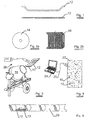
- FIG. 1 shows an RFID marker 10 with the same or similar L/D ratio as a fibre 12.
- the RFID marker and the concrete reinforcement fibre have a very similar shape to allow similar distribution or dispersion of the RFID markers and the fibres. In this way the distribution of the RFID markers is an objective measure for the distribution of the concrete reinforcement fibres.
- FIG. 2a shows another shape RFID marker 14 with the same L/D ratio as the glued concrete reinforcement fibres 16 shown on Fig 2b ..
- FIG. 3 shows a concrete mixer 18 having a reader device 20 to read the passing assemblies of RFID markers 10 and concrete reinforcement fibres 12.
- FIG. 4 shows a concrete structure 22 comprising concrete reinforcement fibres 12 and RFID markers 10.
- a reader device 20 reads the RFID marker information and a computer device 24 interprets the data.
- FIG. 5 shows a chain package as sold by the applicant whereby each subpackage 26 comprises concrete reinforcement fibres 12 and an RFID marker 10.
- FIG. 6 shows the unloading of concrete from a truck 28.
- a reader device 20 detects the content within the concrete, i.e. the passing assemblies of RFID markers 10 and concrete reinforcement fibres 12 within the concrete.
- the reader device suitable for reading RFID markers, can also determine the amount and distribution of concrete reinforcement fibres within the concrete.
Landscapes
- Engineering & Computer Science (AREA)
- Architecture (AREA)
- Structural Engineering (AREA)
- Chemical & Material Sciences (AREA)
- Ceramic Engineering (AREA)
- Civil Engineering (AREA)
- Mechanical Engineering (AREA)
- Microelectronics & Electronic Packaging (AREA)
- Manufacturing & Machinery (AREA)
- Chemical Kinetics & Catalysis (AREA)
- Inorganic Chemistry (AREA)
- Materials Engineering (AREA)
- Organic Chemistry (AREA)
- Reinforcement Elements For Buildings (AREA)
- On-Site Construction Work That Accompanies The Preparation And Application Of Concrete (AREA)
- Preparation Of Clay, And Manufacture Of Mixtures Containing Clay Or Cement (AREA)
- Investigating Or Analyzing Materials By The Use Of Electric Means (AREA)
- Manufacturing Of Tubular Articles Or Embedded Moulded Articles (AREA)
- Manufacture, Treatment Of Glass Fibers (AREA)
Priority Applications (2)
| Application Number | Priority Date | Filing Date | Title |
|---|---|---|---|
| EP20080804867 EP2193244B1 (en) | 2007-10-02 | 2008-09-29 | A method for determining the amount or the distribution of concrete reinforcement fibres respectively for or in concrete |
| PL08804867T PL2193244T3 (pl) | 2007-10-02 | 2008-09-29 | Sposób wyznaczania ilości lub rozmieszczenia włókien wzmacniających beton, odpowiednio dla lub w betonie |
Applications Claiming Priority (3)
| Application Number | Priority Date | Filing Date | Title |
|---|---|---|---|
| EP07117733 | 2007-10-02 | ||
| EP20080804867 EP2193244B1 (en) | 2007-10-02 | 2008-09-29 | A method for determining the amount or the distribution of concrete reinforcement fibres respectively for or in concrete |
| PCT/EP2008/063008 WO2009043833A1 (en) | 2007-10-02 | 2008-09-29 | Assembly for reinforcement for concrete and markers |
Publications (2)
| Publication Number | Publication Date |
|---|---|
| EP2193244A1 EP2193244A1 (en) | 2010-06-09 |
| EP2193244B1 true EP2193244B1 (en) | 2011-04-20 |
Family
ID=39111567
Family Applications (1)
| Application Number | Title | Priority Date | Filing Date |
|---|---|---|---|
| EP20080804867 Active EP2193244B1 (en) | 2007-10-02 | 2008-09-29 | A method for determining the amount or the distribution of concrete reinforcement fibres respectively for or in concrete |
Country Status (16)
| Country | Link |
|---|---|
| US (1) | US8322600B2 (pl) |
| EP (1) | EP2193244B1 (pl) |
| JP (1) | JP5480144B2 (pl) |
| KR (1) | KR101523797B1 (pl) |
| CN (1) | CN101815829B (pl) |
| AT (1) | ATE506502T1 (pl) |
| AU (1) | AU2008307004B2 (pl) |
| BR (1) | BRPI0817624A2 (pl) |
| DE (1) | DE602008006427D1 (pl) |
| DK (1) | DK2193244T3 (pl) |
| ES (1) | ES2361383T3 (pl) |
| MX (1) | MX2010003526A (pl) |
| PL (1) | PL2193244T3 (pl) |
| PT (1) | PT2193244E (pl) |
| RU (1) | RU2469159C2 (pl) |
| WO (1) | WO2009043833A1 (pl) |
Families Citing this family (24)
| Publication number | Priority date | Publication date | Assignee | Title |
|---|---|---|---|---|
| JP2009282874A (ja) * | 2008-05-26 | 2009-12-03 | Hitachi Ltd | 構造体用rfidタグ |
| JP5249266B2 (ja) * | 2010-02-26 | 2013-07-31 | 三智商事株式会社 | 生コンの搬入現場における品質管理システムおよび生コン情報タグの書込み・読取り装置 |
| CN102050603B (zh) * | 2010-11-12 | 2012-11-28 | 金文成 | 高强度混凝土复合材料及其制备方法和应用 |
| US20120167487A1 (en) * | 2010-12-20 | 2012-07-05 | Fluor Technologies Corporation | Locatable and embeddable anchor point covers |
| JP5275379B2 (ja) * | 2011-01-24 | 2013-08-28 | 三智商事株式会社 | 竪型無線icタグ投入装置 |
| JP5811481B2 (ja) * | 2011-06-24 | 2015-11-11 | 日本ヒューム株式会社 | 規格化された遠心成形コンクリート杭の生産管理システム |
| FR2978270B1 (fr) | 2011-07-20 | 2016-04-15 | Elechem | Article ou produit integrant un marqueur et son procede de fabrication |
| FI123142B (fi) * | 2011-08-26 | 2012-11-30 | Elematic Oy Ab | Menetelmä ja laitteisto tunnisteen kiinnittämiseksi liukuvalettuun esivalmistettuun betonituotteeseen |
| US8877329B2 (en) | 2012-09-25 | 2014-11-04 | Romeo Ilarian Ciuperca | High performance, highly energy efficient precast composite insulated concrete panels |
| US9458637B2 (en) | 2012-09-25 | 2016-10-04 | Romeo Ilarian Ciuperca | Composite insulated plywood, insulated plywood concrete form and method of curing concrete using same |
| CA2911409C (en) | 2013-05-13 | 2021-03-02 | Romeo Ilarian Ciuperca | Insulated concrete battery mold, insulated passive concrete curing system, accelerated concrete curing apparatus and method of using same |
| US10065339B2 (en) | 2013-05-13 | 2018-09-04 | Romeo Ilarian Ciuperca | Removable composite insulated concrete form, insulated precast concrete table and method of accelerating concrete curing using same |
| AU2014315033A1 (en) | 2013-09-09 | 2016-03-31 | Romeo Ilarian Ciuperca | Insulated concrete slip form and method of accelerating concrete curing using same |
| US10464071B2 (en) * | 2013-09-18 | 2019-11-05 | Schlumberger Technology Corporation | System and method for preparing a treatment fluid |
| ITRN20130049A1 (it) * | 2013-12-04 | 2015-06-05 | Edil Impianti 2 S R L | Metodo per la realizzazione di un manufatto scatolare in calcestruzzo, come una vasca o pozzetto, e vasca o pozzetto per la depurazione dell'acqua e trattamento dei liquami e vasca o pozzetto. |
| FI125340B (en) * | 2014-05-05 | 2015-08-31 | Elematic Oy Ab | Method and equipment for casting concrete products |
| WO2017050430A1 (de) * | 2015-09-21 | 2017-03-30 | Aberl Ingenieurbüro | Identifizierung von werkstücken sowie identifizierbarer werkstoff und identifizierbare werkstücke |
| EP3144858A1 (de) * | 2015-09-21 | 2017-03-22 | Aberl Ingenieurbüro | Identifizierbarer werkstoff und identifizierbare werkstücke |
| CA2956649A1 (en) | 2016-01-31 | 2017-07-31 | Romeo Ilarian Ciuperca | Self-annealing concrete forms and method of making and using same |
| US11773315B2 (en) | 2016-03-01 | 2023-10-03 | Schlumberger Technology Corporation | Well treatment methods |
| CN108249836B (zh) * | 2018-03-09 | 2023-05-05 | 中交四航局港湾工程设计院有限公司 | 一种用于码头面层的防开裂结构 |
| PL3953123T3 (pl) * | 2019-04-12 | 2025-10-27 | Carbicrete Inc. | Utwardzanie przez karbonatyzację do wytwarzania produktów betonowych na bazie żużla odlewanego na mokro |
| US12475272B2 (en) * | 2019-09-26 | 2025-11-18 | Impacto Protensão Ltd | Computer-implemented verification of post-tensioning systems |
| TR202004801A1 (tr) * | 2020-03-27 | 2021-10-21 | Kordsa Teknik Tekstil As | Beton güçlendi̇rme elemani |
Family Cites Families (24)
| Publication number | Priority date | Publication date | Assignee | Title |
|---|---|---|---|---|
| NL173433C (pl) | 1973-04-16 | Bekaert Sa Nv | ||
| JPS5387532A (en) | 1976-07-24 | 1978-08-02 | Shiyunichi Akazawa | Method of mixing steel fibers within concrete or mortar |
| DE3412216A1 (de) | 1984-04-02 | 1985-10-10 | Bergwerksverband Gmbh, 4300 Essen | Vorrichtung zum vereinzeln und dosieren von leichtem fasergut |
| DK164265C (da) | 1990-03-28 | 1992-11-02 | Skako As | Fremgangsmaade til dosering af fibre |
| FR2672045A1 (fr) | 1991-01-28 | 1992-07-31 | Rocher Georges | Procede et dispositif de prelevement et de dosage des fibres metalliques utilisees pour la fabrication de beton renforce. |
| DK23491D0 (da) | 1991-02-12 | 1991-02-12 | Skako As | Fremgangsmaade og anlaeg til ved opklipning af fibersnor i fiberklip at dosere dette til en betonblanding |
| DK23591D0 (da) | 1991-02-12 | 1991-02-12 | Skako As | Fremgangsmaade og anlaeg til at dosere fiberklip til en betonblanding |
| JPH0743220B2 (ja) * | 1991-05-11 | 1995-05-15 | 株式会社栗本鐵工所 | ロータリーキルンの平均滞留時間の制御方法とその装置 |
| DE4427156A1 (de) | 1994-08-01 | 1996-02-15 | Klein Anton | Dosiervorrichtung |
| JPH08209938A (ja) * | 1995-02-07 | 1996-08-13 | Nasuka:Kk | 土木建築用鉄筋の目印 |
| DE29714704U1 (de) | 1997-08-15 | 1997-10-16 | Kuhfeldt, Arthur, 41748 Viersen | Vorrichtung zum Dosieren von Fasern für die Herstellung von beispielsweise Faserzementmörtel, insbesondere Faserdosieranlage für Glas-, Kunststoff- oder Stahlfasern |
| JP2918224B1 (ja) * | 1998-07-15 | 1999-07-12 | 小林記録紙株式会社 | 建設資材内部へのrfidデータキャリア設置方法とrfidデータキャリア設置治具 |
| NL1010572C2 (nl) * | 1998-11-17 | 2000-05-18 | Bekaert Sa Nv | Wapeningsbeugel voor toepassing in metselwerk alsmede aldus gevormd metselwerk. |
| US7034660B2 (en) * | 1999-02-26 | 2006-04-25 | Sri International | Sensor devices for structural health monitoring |
| JP4310763B2 (ja) * | 1999-05-06 | 2009-08-12 | 小林クリエイト株式会社 | Rfidデータキャリア設置治具 |
| US20020183882A1 (en) * | 2000-10-20 | 2002-12-05 | Michael Dearing | RF point of sale and delivery method and system using communication with remote computer and having features to read a large number of RF tags |
| US6811861B2 (en) * | 2000-11-28 | 2004-11-02 | Wisconsin Alumni Research Foundation | Structural reinforcement using composite strips |
| BE1014155A3 (nl) * | 2001-05-04 | 2003-05-06 | Bekaert Sa Nv | Werkwijze voor het doseren van wapeningsvezels bij de vervaardiging van vezelbeton en daarbij toegepaste kettingverpakking. |
| CA2788668C (en) * | 2003-08-29 | 2016-08-23 | Buckeye Technologies Inc. | System for delivery of fibers into concrete |
| US20050095424A1 (en) * | 2003-11-03 | 2005-05-05 | Thompson Alvin D. | Fibrous rebar with hydraulic binder |
| JP2005330729A (ja) * | 2004-05-20 | 2005-12-02 | Taisei Corp | コンクリート部材 |
| JP4633416B2 (ja) * | 2004-09-06 | 2011-02-16 | 太平洋セメント株式会社 | コンクリートの管理方法 |
| ES2336326T5 (es) * | 2004-10-22 | 2021-07-26 | Sato Holdings Kk | Método para aplicar un elemento de identificación que transporta una etiqueta sobre un objeto |
| JP2006348538A (ja) * | 2005-06-14 | 2006-12-28 | Taiheiyo Cement Corp | Rfidタグ取付治具、rfidタグユニットおよびrfidタグの取付方法 |
-
2008
- 2008-09-29 MX MX2010003526A patent/MX2010003526A/es active IP Right Grant
- 2008-09-29 PT PT08804867T patent/PT2193244E/pt unknown
- 2008-09-29 PL PL08804867T patent/PL2193244T3/pl unknown
- 2008-09-29 US US12/679,364 patent/US8322600B2/en active Active
- 2008-09-29 DE DE200860006427 patent/DE602008006427D1/de active Active
- 2008-09-29 CN CN2008801101676A patent/CN101815829B/zh active Active
- 2008-09-29 DK DK08804867T patent/DK2193244T3/da active
- 2008-09-29 KR KR1020107007162A patent/KR101523797B1/ko active Active
- 2008-09-29 BR BRPI0817624 patent/BRPI0817624A2/pt not_active Application Discontinuation
- 2008-09-29 ES ES08804867T patent/ES2361383T3/es active Active
- 2008-09-29 JP JP2010527426A patent/JP5480144B2/ja not_active Expired - Fee Related
- 2008-09-29 RU RU2010117216/03A patent/RU2469159C2/ru not_active IP Right Cessation
- 2008-09-29 AU AU2008307004A patent/AU2008307004B2/en not_active Ceased
- 2008-09-29 EP EP20080804867 patent/EP2193244B1/en active Active
- 2008-09-29 AT AT08804867T patent/ATE506502T1/de active
- 2008-09-29 WO PCT/EP2008/063008 patent/WO2009043833A1/en not_active Ceased
Also Published As
| Publication number | Publication date |
|---|---|
| RU2469159C2 (ru) | 2012-12-10 |
| JP5480144B2 (ja) | 2014-04-23 |
| BRPI0817624A2 (pt) | 2015-03-31 |
| ATE506502T1 (de) | 2011-05-15 |
| KR20100082832A (ko) | 2010-07-20 |
| CN101815829A (zh) | 2010-08-25 |
| US20100219236A1 (en) | 2010-09-02 |
| DK2193244T3 (da) | 2011-06-06 |
| US8322600B2 (en) | 2012-12-04 |
| DE602008006427D1 (de) | 2011-06-01 |
| KR101523797B1 (ko) | 2015-05-29 |
| EP2193244A1 (en) | 2010-06-09 |
| MX2010003526A (es) | 2010-05-19 |
| AU2008307004A1 (en) | 2009-04-09 |
| RU2010117216A (ru) | 2011-11-10 |
| WO2009043833A1 (en) | 2009-04-09 |
| ES2361383T3 (es) | 2011-06-16 |
| PL2193244T3 (pl) | 2011-07-29 |
| AU2008307004B2 (en) | 2013-08-01 |
| JP2011501704A (ja) | 2011-01-13 |
| PT2193244E (pt) | 2011-05-12 |
| CN101815829B (zh) | 2012-08-08 |
Similar Documents
| Publication | Publication Date | Title |
|---|---|---|
| EP2193244B1 (en) | A method for determining the amount or the distribution of concrete reinforcement fibres respectively for or in concrete | |
| US20250003948A1 (en) | Methods, systems, and computer program products for locating and tracking objects | |
| US7986218B2 (en) | Sensor devices for structural health monitoring | |
| US20120007579A1 (en) | Embedded wireless corrosion sensor | |
| EP1909218A1 (en) | Quality control system of concrete and cement products using wireless IC tag | |
| US9751812B2 (en) | Taggant for cement authentication | |
| US20130136539A1 (en) | Paving system utilizing embedded measuring devices | |
| Simonen et al. | Wireless sensors for monitoring corrosion in reinforced concrete members | |
| US20130104797A1 (en) | System, method and apparatus for forensic marking of cementitious materials | |
| US8729503B2 (en) | System, method and apparatus for forensic marking | |
| EP2923184B1 (en) | A method to determine or monitor the amount or the distribution of additional material present in a flow of a flowable substance | |
| JP2007033238A (ja) | コンクリート品質管理・保証方法 | |
| Kallonen et al. | Embedded RFID in product identification | |
| JASELSKIS et al. | Construction Transportation–Related RFID Research and Applications | |
| Satoh et al. | Development and application of wireless corrosion sensor using RFID technology for reinforced concrete | |
| Mustafa | Radio frequency identification applications in pavement engineering | |
| Han et al. | Application of RFID Technology in Asphalt Pavement Construction | |
| IT201900005942A1 (it) | Real-time identification and tracking system and method for construction and maintenance purposes | |
| DE102006035187A1 (de) | Baumaterial und Verarbeitungssystem für ein Baumaterial | |
| Swift et al. | RFID Instrumentation in a Field Application | |
| Soares et al. | RFID in the Construction of Single Family Dwellings | |
| Papanicolaou et al. | Prediction of scour depth in gravel bed rivers using radio frequency IDs: application to the Skagit River. |
Legal Events
| Date | Code | Title | Description |
|---|---|---|---|
| PUAI | Public reference made under article 153(3) epc to a published international application that has entered the european phase |
Free format text: ORIGINAL CODE: 0009012 |
|
| 17P | Request for examination filed |
Effective date: 20100301 |
|
| AK | Designated contracting states |
Kind code of ref document: A1 Designated state(s): AT BE BG CH CY CZ DE DK EE ES FI FR GB GR HR HU IE IS IT LI LT LU LV MC MT NL NO PL PT RO SE SI SK TR |
|
| AX | Request for extension of the european patent |
Extension state: AL BA MK RS |
|
| GRAP | Despatch of communication of intention to grant a patent |
Free format text: ORIGINAL CODE: EPIDOSNIGR1 |
|
| RIC1 | Information provided on ipc code assigned before grant |
Ipc: E04C 5/07 20060101ALI20101027BHEP Ipc: E04C 5/01 20060101AFI20101027BHEP Ipc: C04B 28/02 20060101ALI20101027BHEP Ipc: B28C 5/40 20060101ALI20101027BHEP |
|
| RTI1 | Title (correction) |
Free format text: A METHOD FOR DETERMINING THE AMOUNT OR THE DISTRIBUTION OF CONCRETE REINFORCEMENT FIBRES RESPECTIVELY FOR OR IN CONCRETE |
|
| DAX | Request for extension of the european patent (deleted) | ||
| GRAS | Grant fee paid |
Free format text: ORIGINAL CODE: EPIDOSNIGR3 |
|
| GRAA | (expected) grant |
Free format text: ORIGINAL CODE: 0009210 |
|
| AK | Designated contracting states |
Kind code of ref document: B1 Designated state(s): AT BE BG CH CY CZ DE DK EE ES FI FR GB GR HR HU IE IS IT LI LT LU LV MC MT NL NO PL PT RO SE SI SK TR |
|
| REG | Reference to a national code |
Ref country code: GB Ref legal event code: FG4D |
|
| REG | Reference to a national code |
Ref country code: CH Ref legal event code: EP |
|
| REG | Reference to a national code |
Ref country code: PT Ref legal event code: SC4A Free format text: AVAILABILITY OF NATIONAL TRANSLATION Effective date: 20110505 |
|
| REG | Reference to a national code |
Ref country code: IE Ref legal event code: FG4D |
|
| REF | Corresponds to: |
Ref document number: 602008006427 Country of ref document: DE Date of ref document: 20110601 Kind code of ref document: P |
|
| REG | Reference to a national code |
Ref country code: DE Ref legal event code: R096 Ref document number: 602008006427 Country of ref document: DE Effective date: 20110601 |
|
| REG | Reference to a national code |
Ref country code: DK Ref legal event code: T3 |
|
| REG | Reference to a national code |
Ref country code: SE Ref legal event code: TRGR |
|
| REG | Reference to a national code |
Ref country code: NL Ref legal event code: T3 |
|
| REG | Reference to a national code |
Ref country code: ES Ref legal event code: FG2A Ref document number: 2361383 Country of ref document: ES Kind code of ref document: T3 Effective date: 20110616 |
|
| REG | Reference to a national code |
Ref country code: GR Ref legal event code: EP Ref document number: 20110401124 Country of ref document: GR Effective date: 20110614 |
|
| REG | Reference to a national code |
Ref country code: PL Ref legal event code: T3 |
|
| REG | Reference to a national code |
Ref country code: SK Ref legal event code: T3 Ref document number: E 9341 Country of ref document: SK |
|
| REG | Reference to a national code |
Ref country code: NO Ref legal event code: T2 Effective date: 20110420 |
|
| LTIE | Lt: invalidation of european patent or patent extension |
Effective date: 20110420 |
|
| REG | Reference to a national code |
Ref country code: HU Ref legal event code: AG4A Ref document number: E010979 Country of ref document: HU |
|
| PG25 | Lapsed in a contracting state [announced via postgrant information from national office to epo] |
Ref country code: HR Free format text: LAPSE BECAUSE OF FAILURE TO SUBMIT A TRANSLATION OF THE DESCRIPTION OR TO PAY THE FEE WITHIN THE PRESCRIBED TIME-LIMIT Effective date: 20110420 Ref country code: LT Free format text: LAPSE BECAUSE OF FAILURE TO SUBMIT A TRANSLATION OF THE DESCRIPTION OR TO PAY THE FEE WITHIN THE PRESCRIBED TIME-LIMIT Effective date: 20110420 |
|
| PG25 | Lapsed in a contracting state [announced via postgrant information from national office to epo] |
Ref country code: CY Free format text: LAPSE BECAUSE OF FAILURE TO SUBMIT A TRANSLATION OF THE DESCRIPTION OR TO PAY THE FEE WITHIN THE PRESCRIBED TIME-LIMIT Effective date: 20110420 Ref country code: SI Free format text: LAPSE BECAUSE OF FAILURE TO SUBMIT A TRANSLATION OF THE DESCRIPTION OR TO PAY THE FEE WITHIN THE PRESCRIBED TIME-LIMIT Effective date: 20110420 Ref country code: IS Free format text: LAPSE BECAUSE OF FAILURE TO SUBMIT A TRANSLATION OF THE DESCRIPTION OR TO PAY THE FEE WITHIN THE PRESCRIBED TIME-LIMIT Effective date: 20110820 Ref country code: LV Free format text: LAPSE BECAUSE OF FAILURE TO SUBMIT A TRANSLATION OF THE DESCRIPTION OR TO PAY THE FEE WITHIN THE PRESCRIBED TIME-LIMIT Effective date: 20110420 |
|
| PG25 | Lapsed in a contracting state [announced via postgrant information from national office to epo] |
Ref country code: EE Free format text: LAPSE BECAUSE OF FAILURE TO SUBMIT A TRANSLATION OF THE DESCRIPTION OR TO PAY THE FEE WITHIN THE PRESCRIBED TIME-LIMIT Effective date: 20110420 |
|
| PLBE | No opposition filed within time limit |
Free format text: ORIGINAL CODE: 0009261 |
|
| STAA | Information on the status of an ep patent application or granted ep patent |
Free format text: STATUS: NO OPPOSITION FILED WITHIN TIME LIMIT |
|
| PG25 | Lapsed in a contracting state [announced via postgrant information from national office to epo] |
Ref country code: RO Free format text: LAPSE BECAUSE OF FAILURE TO SUBMIT A TRANSLATION OF THE DESCRIPTION OR TO PAY THE FEE WITHIN THE PRESCRIBED TIME-LIMIT Effective date: 20110420 |
|
| 26N | No opposition filed |
Effective date: 20120123 |
|
| PG25 | Lapsed in a contracting state [announced via postgrant information from national office to epo] |
Ref country code: MC Free format text: LAPSE BECAUSE OF NON-PAYMENT OF DUE FEES Effective date: 20110930 |
|
| REG | Reference to a national code |
Ref country code: DE Ref legal event code: R097 Ref document number: 602008006427 Country of ref document: DE Effective date: 20120123 |
|
| PG25 | Lapsed in a contracting state [announced via postgrant information from national office to epo] |
Ref country code: MT Free format text: LAPSE BECAUSE OF FAILURE TO SUBMIT A TRANSLATION OF THE DESCRIPTION OR TO PAY THE FEE WITHIN THE PRESCRIBED TIME-LIMIT Effective date: 20110420 |
|
| REG | Reference to a national code |
Ref country code: FR Ref legal event code: PLFP Year of fee payment: 9 |
|
| REG | Reference to a national code |
Ref country code: FR Ref legal event code: PLFP Year of fee payment: 10 |
|
| PGFP | Annual fee paid to national office [announced via postgrant information from national office to epo] |
Ref country code: GB Payment date: 20170824 Year of fee payment: 10 Ref country code: GB Payment date: 20170921 Year of fee payment: 10 Ref country code: NO Payment date: 20170925 Year of fee payment: 10 Ref country code: CH Payment date: 20170921 Year of fee payment: 10 Ref country code: GR Payment date: 20170919 Year of fee payment: 10 Ref country code: CZ Payment date: 20170926 Year of fee payment: 10 Ref country code: SK Payment date: 20170927 Year of fee payment: 10 Ref country code: IT Payment date: 20170926 Year of fee payment: 10 |
|
| PGFP | Annual fee paid to national office [announced via postgrant information from national office to epo] |
Ref country code: PT Payment date: 20170927 Year of fee payment: 10 Ref country code: AT Payment date: 20170922 Year of fee payment: 10 Ref country code: PL Payment date: 20170918 Year of fee payment: 10 Ref country code: DK Payment date: 20170921 Year of fee payment: 10 Ref country code: IE Payment date: 20170928 Year of fee payment: 10 Ref country code: HU Payment date: 20170918 Year of fee payment: 10 Ref country code: SE Payment date: 20170921 Year of fee payment: 10 Ref country code: BG Payment date: 20170928 Year of fee payment: 10 |
|
| PGFP | Annual fee paid to national office [announced via postgrant information from national office to epo] |
Ref country code: ES Payment date: 20171026 Year of fee payment: 10 |
|
| REG | Reference to a national code |
Ref country code: FR Ref legal event code: PLFP Year of fee payment: 11 |
|
| REG | Reference to a national code |
Ref country code: NO Ref legal event code: MMEP |
|
| PG25 | Lapsed in a contracting state [announced via postgrant information from national office to epo] |
Ref country code: FI Free format text: LAPSE BECAUSE OF NON-PAYMENT OF DUE FEES Effective date: 20180929 Ref country code: CZ Free format text: LAPSE BECAUSE OF NON-PAYMENT OF DUE FEES Effective date: 20180929 |
|
| REG | Reference to a national code |
Ref country code: SE Ref legal event code: EUG Ref country code: CH Ref legal event code: PL |
|
| REG | Reference to a national code |
Ref country code: DK Ref legal event code: EBP Effective date: 20180930 |
|
| REG | Reference to a national code |
Ref country code: AT Ref legal event code: MM01 Ref document number: 506502 Country of ref document: AT Kind code of ref document: T Effective date: 20180929 |
|
| GBPC | Gb: european patent ceased through non-payment of renewal fee |
Effective date: 20180929 |
|
| PG25 | Lapsed in a contracting state [announced via postgrant information from national office to epo] |
Ref country code: PT Free format text: LAPSE BECAUSE OF NON-PAYMENT OF DUE FEES Effective date: 20190329 Ref country code: SE Free format text: LAPSE BECAUSE OF NON-PAYMENT OF DUE FEES Effective date: 20180930 |
|
| REG | Reference to a national code |
Ref country code: SK Ref legal event code: MM4A Ref document number: E 9341 Country of ref document: SK Effective date: 20180929 |
|
| REG | Reference to a national code |
Ref country code: IE Ref legal event code: MM4A |
|
| PG25 | Lapsed in a contracting state [announced via postgrant information from national office to epo] |
Ref country code: LU Free format text: LAPSE BECAUSE OF NON-PAYMENT OF DUE FEES Effective date: 20180929 |
|
| PG25 | Lapsed in a contracting state [announced via postgrant information from national office to epo] |
Ref country code: IT Free format text: LAPSE BECAUSE OF NON-PAYMENT OF DUE FEES Effective date: 20180929 Ref country code: NO Free format text: LAPSE BECAUSE OF NON-PAYMENT OF DUE FEES Effective date: 20180930 Ref country code: IE Free format text: LAPSE BECAUSE OF NON-PAYMENT OF DUE FEES Effective date: 20180929 |
|
| PG25 | Lapsed in a contracting state [announced via postgrant information from national office to epo] |
Ref country code: BG Free format text: LAPSE BECAUSE OF NON-PAYMENT OF DUE FEES Effective date: 20190430 Ref country code: SK Free format text: LAPSE BECAUSE OF NON-PAYMENT OF DUE FEES Effective date: 20180929 Ref country code: GR Free format text: LAPSE BECAUSE OF NON-PAYMENT OF DUE FEES Effective date: 20190402 Ref country code: HU Free format text: LAPSE BECAUSE OF NON-PAYMENT OF DUE FEES Effective date: 20180930 Ref country code: CH Free format text: LAPSE BECAUSE OF NON-PAYMENT OF DUE FEES Effective date: 20180930 Ref country code: LI Free format text: LAPSE BECAUSE OF NON-PAYMENT OF DUE FEES Effective date: 20180930 |
|
| PG25 | Lapsed in a contracting state [announced via postgrant information from national office to epo] |
Ref country code: AT Free format text: LAPSE BECAUSE OF NON-PAYMENT OF DUE FEES Effective date: 20180929 Ref country code: GB Free format text: LAPSE BECAUSE OF NON-PAYMENT OF DUE FEES Effective date: 20180929 Ref country code: DK Free format text: LAPSE BECAUSE OF NON-PAYMENT OF DUE FEES Effective date: 20180930 |
|
| PGFP | Annual fee paid to national office [announced via postgrant information from national office to epo] |
Ref country code: NL Payment date: 20190918 Year of fee payment: 12 |
|
| REG | Reference to a national code |
Ref country code: ES Ref legal event code: FD2A Effective date: 20191104 |
|
| PG25 | Lapsed in a contracting state [announced via postgrant information from national office to epo] |
Ref country code: ES Free format text: LAPSE BECAUSE OF NON-PAYMENT OF DUE FEES Effective date: 20180930 |
|
| PG25 | Lapsed in a contracting state [announced via postgrant information from national office to epo] |
Ref country code: PL Free format text: LAPSE BECAUSE OF NON-PAYMENT OF DUE FEES Effective date: 20180929 |
|
| REG | Reference to a national code |
Ref country code: NL Ref legal event code: MM Effective date: 20201001 |
|
| PG25 | Lapsed in a contracting state [announced via postgrant information from national office to epo] |
Ref country code: NL Free format text: LAPSE BECAUSE OF NON-PAYMENT OF DUE FEES Effective date: 20201001 |
|
| P01 | Opt-out of the competence of the unified patent court (upc) registered |
Effective date: 20230619 |
|
| PGFP | Annual fee paid to national office [announced via postgrant information from national office to epo] |
Ref country code: BE Payment date: 20240918 Year of fee payment: 17 |
|
| PGFP | Annual fee paid to national office [announced via postgrant information from national office to epo] |
Ref country code: FR Payment date: 20240925 Year of fee payment: 17 |
|
| PGFP | Annual fee paid to national office [announced via postgrant information from national office to epo] |
Ref country code: DE Payment date: 20250919 Year of fee payment: 18 |
|
| PGFP | Annual fee paid to national office [announced via postgrant information from national office to epo] |
Ref country code: TR Payment date: 20250923 Year of fee payment: 18 |