EP2188655B1 - Contact lens packaging solutions - Google Patents
Contact lens packaging solutions Download PDFInfo
- Publication number
- EP2188655B1 EP2188655B1 EP08795627A EP08795627A EP2188655B1 EP 2188655 B1 EP2188655 B1 EP 2188655B1 EP 08795627 A EP08795627 A EP 08795627A EP 08795627 A EP08795627 A EP 08795627A EP 2188655 B1 EP2188655 B1 EP 2188655B1
- Authority
- EP
- European Patent Office
- Prior art keywords
- contact lens
- packaging solution
- acid
- carbon atoms
- solution
- Prior art date
- Legal status (The legal status is an assumption and is not a legal conclusion. Google has not performed a legal analysis and makes no representation as to the accuracy of the status listed.)
- Ceased
Links
Images
Classifications
-
- A—HUMAN NECESSITIES
- A61—MEDICAL OR VETERINARY SCIENCE; HYGIENE
- A61L—METHODS OR APPARATUS FOR STERILISING MATERIALS OR OBJECTS IN GENERAL; DISINFECTION, STERILISATION OR DEODORISATION OF AIR; CHEMICAL ASPECTS OF BANDAGES, DRESSINGS, ABSORBENT PADS OR SURGICAL ARTICLES; MATERIALS FOR BANDAGES, DRESSINGS, ABSORBENT PADS OR SURGICAL ARTICLES
- A61L12/00—Methods or apparatus for disinfecting or sterilising contact lenses; Accessories therefor
- A61L12/08—Methods or apparatus for disinfecting or sterilising contact lenses; Accessories therefor using chemical substances
-
- B—PERFORMING OPERATIONS; TRANSPORTING
- B65—CONVEYING; PACKING; STORING; HANDLING THIN OR FILAMENTARY MATERIAL
- B65B—MACHINES, APPARATUS OR DEVICES FOR, OR METHODS OF, PACKAGING ARTICLES OR MATERIALS; UNPACKING
- B65B25/00—Packaging other articles presenting special problems
- B65B25/008—Packaging other articles presenting special problems packaging of contact lenses
-
- A—HUMAN NECESSITIES
- A61—MEDICAL OR VETERINARY SCIENCE; HYGIENE
- A61L—METHODS OR APPARATUS FOR STERILISING MATERIALS OR OBJECTS IN GENERAL; DISINFECTION, STERILISATION OR DEODORISATION OF AIR; CHEMICAL ASPECTS OF BANDAGES, DRESSINGS, ABSORBENT PADS OR SURGICAL ARTICLES; MATERIALS FOR BANDAGES, DRESSINGS, ABSORBENT PADS OR SURGICAL ARTICLES
- A61L12/00—Methods or apparatus for disinfecting or sterilising contact lenses; Accessories therefor
- A61L12/02—Methods or apparatus for disinfecting or sterilising contact lenses; Accessories therefor using physical phenomena, e.g. electricity, ultrasound or ultrafiltration
- A61L12/04—Heat
-
- G—PHYSICS
- G02—OPTICS
- G02B—OPTICAL ELEMENTS, SYSTEMS OR APPARATUS
- G02B1/00—Optical elements characterised by the material of which they are made; Optical coatings for optical elements
- G02B1/04—Optical elements characterised by the material of which they are made; Optical coatings for optical elements made of organic materials, e.g. plastics
- G02B1/041—Lenses
- G02B1/043—Contact lenses
-
- G—PHYSICS
- G02—OPTICS
- G02C—SPECTACLES; SUNGLASSES OR GOGGLES INSOFAR AS THEY HAVE THE SAME FEATURES AS SPECTACLES; CONTACT LENSES
- G02C7/00—Optical parts
- G02C7/02—Lenses; Lens systems ; Methods of designing lenses
- G02C7/04—Contact lenses for the eyes
Definitions
- One long felt need in the contact lens industry is to provide contact lenses which are comfortable for users to wear.
- One of the problems that contact lens users complain of most is initial discomfort (i.e., immediately after lens insertion).
- One of the approaches is to use soft contact lenses to alleviate to some extent the initial discomfort because of their relatively soft surfaces, but also to their pliability, which permits them to modify their shape somewhat with different eyes.
- Such approach requires a great effort in developing new materials and lens designs and may not be cost effective.
- Another approach is to apply directly eye drops of an ocular lubricant into the wearer's eye while the lens is being worn, in order to provide some relief to some extent, e.g., the initial discomfort of wearers, discomfort suffering from dry-eye effects, or end-of-day discomfort.
- WO2004/054629 discloses a buffered aqueous contact lens disinfecting solution (i.e. a so-called multi-purpose solution) with a tonicity of 200 to 450 mOsm/kg, a pH of between 6 and 8, and a concentration of chloride ions below 1500 ppm.
- WO2007/098040 discloses an aqueous solution as well as a method for sterilizing and storing a contact lens made of a hydrogel material, preferably a poly(oxyalkylene)-containing hydrogel material.
- the solution comprises one or more organic buffer agents, an organic tonicity-adjusting agent in an amount sufficient to provide an osmolarity of from 200 to 450 mosm/l, wherein the aqueous solution has a pH of from 5.5 to 8.5.
- extended-wear contact lenses e.g., silicone hydrogel contact lenses
- the present invention in one aspect, provides an ophthalmic product according to independent claim 1.
- the present invention in another aspect, provides a process for making a soft contact lens capable of easing wearer's initial discomfort according to independent claim 8.
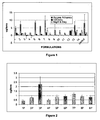
- Figure 1 shows effects of a packaging solution upon in vitro lipid fouling of commercially available silicone hydrogel lenses.
- Figure 2 shows effects of hydrating and storing silicone hydrogel lenses (O2OPTIX) in a packaging solution upon in vitro lipid fouling.
- Contact Lens refers to a structure that can be placed on or within a wearer's eye.
- a contact lens can correct, improve, or alter a user's eyesight, but that need not be the case.
- a contact lens can be of any appropriate material known in the art or later developed, and can be a soft lens, a hard lens, or a hybrid lens.
- a "silicone hydrogel contact lens” refers to a contact lens comprising a silicone hydrogel material.
- hydrogel refers to a polymeric material which can absorb at least 10 percent by weight of water when it is fully hydrated.
- a hydrogel material can be obtained by polymerization or copolymerization of at least one hydrophilic monomer in the presence of or in the absence of additional monomers and/or macromers or by crosslinking of a prepolymer.
- a “silicone hydrogel” refers to a hydrogel obtained by copolymerization of a polymerizable composition comprising at least one silicone-containing vinylic monomer or at least one silicone-containing macromer or a silicone-containing prepolymer.
- a “monomer” means a low molecular weight compound that can be polymerized actinically or thermally. Low molecular weight typically means average molecular weights less than 700 Daltons.
- a monomer can be a vinylic monomer or a compound comprising two thiol groups.
- a compound with two thiol groups can participate in thiol-ene step-growth radical polymerization with a monomer with vinyl group to form a polymer.
- Step-growth radical polymerization can be used in making contact lenses, as described in a commonly-owned copending US patent application No. 60/869,812 filed Dec. 13, 2006 (entitled “Production of Ophthalmic Devices Based on Photo-Induced Step Growth Polymerization”.
- a "vinylic monomer”, as used herein, refers to a low molecular weight compound that has an ethylenically unsaturated group and can be polymerized actinically or thermally. Low molecular weight typically means average molecular weights less than 700 Daltons.
- actinically in reference to curing or polymerizing of a polymerizable composition or material means that the curing (e.g., crosslinked and/or polymerized) is performed by actinic irradiation, such as, for example, UV irradiation, ionized radiation (e.g. gamma ray or X-ray irradiation), microwave irradiation, and the like.
- actinic irradiation such as, for example, UV irradiation, ionized radiation (e.g. gamma ray or X-ray irradiation), microwave irradiation, and the like.
- thermal curing or actinic curing methods are well-known to a person skilled in the art.
- fluid indicates that a material is capable of flowing like a liquid.
- hydrophilic monomer refers to a monomer which can be polymerized actinically or thermally to form a polymer that is water-soluble or can absorb at least 10 percent by weight water.
- a "macromer” refers to a medium and high molecular weight compound which can be polymerized and/or crosslinked actinically or thermally.
- Medium and high molecular weight typically means average molecular weights greater than 700 Daltons.
- a macromer comprises one or more ethylenically unsaturated groups and/or one or more thiol groups, which can participate in free radical chain growth polymerization or thiol-ene step-growth radical polymerization.
- a macromer contains ethylenically unsaturated groups and can be polymerized actinically or thermally.
- a "prepolymer” refers to a starting polymer which contains crosslinkable groups and can be cured (e.g., crosslinked and/or polymerized) actinically or thermally to obtain a crosslinked and/or polymerized polymer having a molecular weight much higher than the starting polymer.
- a prepolymer comprises one or more ethylenically unsaturated groups and/or one or more thiol groups, which can participate in free radical chain growth polymerization or thiol-ene step-growth radical polymerization.
- Polymer means a material formed by polymerizing one or more monomers or macromers or by crosslinking one or more prepolymers.
- a “photoinitiator” refers to a chemical that initiates radical crosslinking/polymerizing reaction by the use of light.
- Suitable photoinitiators include, without limitation, benzoin methyl ether, diethoxyacetophenone, a benzoylphosphine oxide, 1-hydroxycyclohexyl phenyl ketone, Darocure® types, and Irgacure® types, preferably Darocure® 1173, and Irgacure® 2959.
- thermal initiator refers to a chemical that initiates radical crosslinking/polymerizing reaction by the use of heat energy.
- suitable thermal initiators include, but are not limited to, 2,2'-azobis (2,4-dimethylpentanenitrile), 2,2'-azobis (2-methylpropanenitrile), 2,2'-azobis (2-methylbutanenitrile), peroxides such as benzoyl peroxide, and the like.
- the thermal initiator is 2,2'-azobis(isobutyronitrile) (AIBN).
- a packaging solution is ophthatmically safe.
- ophthalmically safe with respect to a packaging solution is meant that a contact lens immersed in the solution is safe for direct placement on the eye without rinsing, that is, the solution is safe and sufficiently comfortable for daily contact with the eye via a contact lens.
- An ophthalmically safe solution has a tonicity and pH that is compatible with the eye and comprises materials, and amounts thereof, that are non-cytotoxic according to international ISO standards and U.S. FDA regulations.
- compatible with the eye means a solution that may be in intimate contact with the eye for an extended period of time without significantly damaging the eye and without significant user discomfort.
- a "reduced susceptibility to oxidation degradation of the polyethylene glycol” means that the susceptibility to oxidative degradation of a polyethylene glycol in a solution containing an ⁇ -oxo-multi-acid or salt thereof after subject to a sterilization treatment is reduced (characterized by the amount of detectable formic acid and optionally other degradation by-products in a stabilized poly(oxyalkylene)-containing polymeric material being 80% or less, preferably 65% or less, more preferably 50% or less, of that detected in a solution without any ⁇ -oxo-multi-acid or salt thereof).
- the methods for determining formic acid and other by-products derived from oxidative degradation PEG-containing polymeric materials are described in US patent application publication No. 2004/0116564 A1 . Alternatively, a person skilled in the art knows how to analyze the oxidative degradation products of a PEG-containing polymeric material.
- a “leachable polymeric lubricant” as used herein refer to a non-ionic hydrophilic polymer which is not covalently bound to but instead is associated with or entrapped in the polymer matrix of a contact lens and which can enhance surface wettability of a contact lens and/or the eye or reduce the frictional character of the contact lens surface.
- the present invention is generally directed to a hydrogel contact lens capable of easing lens-wearer's initial discomfort.
- the present invention is partly based on the discovery that a lens packaging solution including a copolymer of vinylpyrrolidone and a low molecular weight polyethylene glycol (PEG) can provide to a hydrogel contact lens, which is immersed and autoclaved in the packaging solution, with unexpected benefits of increased wettability, reduced friction, initial conditioning (by cushioning the lens), and/or reduced adherence of deposits onto the lens.
- a lens packaging solution including a copolymer of vinylpyrrolidone and a low molecular weight polyethylene glycol (PEG) can provide to a hydrogel contact lens, which is immersed and autoclaved in the packaging solution, with unexpected benefits of increased wettability, reduced friction, initial conditioning (by cushioning the lens), and/or reduced adherence of deposits onto the lens.
- PEG polyethylene glycol
- a low molecular weight PEG and a copolymer of vinylpyrrolidone can have a synergetic effects on the initial comfort (at the time of inserting the lens).
- the copolymer with sufficiently larger molecular weight can form a cushion layer between the lens and the epithelium of the cornea without increasing substantially the viscosity of the packaging solution (i.e., above 5 centipoises at 25°C).
- Incorporation of a low molecular weight PEG in the cushion layer can increase the lubricity, wettability (characterized by water contact angle) and/or reduced friction of the cushion layer. This added cushioning is believed to provide a temporary lubricious layer that would allow the lens to settle gently on the eye with slight lubrication and improve initial insert comfort.
- the present invention in one aspect, provides an ophthalmic product comprising a sealed and sterilized package which include a packaging solution and a soft hydrogel contact lens immersed in the packaging solution, wherein the packaging solution [includes] comprises: a copolymer of vinylpyrrolidone and at least one amino-containing vinylic monomer, wherein the amino-containing vinylic monomer is selected from the group consisting of alkylaminoalkylmethacrylate having 8-15 carbon atoms, alkylaminoalkylacrylate having 7-15 carbon atoms, dialkylaminoalkylmethacrylate having 8-20 carbon atoms, dialkylaminoalkylacrylate having 7-20 carbon atoms, and N-vinylalkylamide having 3-10 carbon atoms, wherein the homopolymer or copolymer is present in an amount sufficient to provide the packaging solution a viscosity of up to 5.0 centipoise, preferably up to 4.0 centipoises, even more preferably up to
- Lens packages are well known to a person skilled in the art for autoclaving and storing a soft contact lens. Any lens packages can be used in the invention.
- a lens package is a blister package which comprises a base and a cover, wherein the cover is detachably sealed to the base, wherein the base includes a cavity for receiving a sterile packaging solution and the contact lens.
- Lenses are packaged in individual packages, sealed, and sterilized (e.g., by autoclave at about 120°C or higher for at least 30 minutes) prior to dispensing to users.
- autoclave at about 120°C or higher for at least 30 minutes
- a person skilled in the art will understand well how to seal and sterilize lens packages.
- a soft hydrogel contact lens can be a conventional hydrogel contact lens (i.e., a non-silicone hydrogel lens) or preferably a silicone hydrogel contact lens.
- a packaging solution of the invention is ophthalmically compatible and may be any water-based solution that is used for the storage of contact lenses.
- a packaging solution of the invention can be a saline solution, a buffered solution, and deionized water.
- N-vinyl alkylamide examples include without limitation N-vinyl formaide, N-vinyl acetamide, N-vinyl isopropylamide, and N-vinyl-N-methyl acetamide.
- preferred copolymers includes without limitation copolymers of vinylpyrrolidone and dimethylaminoethylmethacrylate. Such preferred copolymers are commercially available, e.g., Copolymer 845 and Copolymer 937 from ISP.
- a polyethylene glycol has a molecular weight of 600 or less, most preferably from 100 to 500.
- Exemplary ⁇ -oxo-multi-acids or biocompatible salts thereof include without limitation citric acid, 2-ketoglutaric acid, or malic acid or biocompatible (preferably ophthalmically compatible) salts thereof. More preferably, an ⁇ -oxo-multi-acid is citric or malic acid or biocompatible (preferably ophthalmically compatible) salts thereof (e.g., sodium, potassium, or the like).
- the solution of the present invention contains a buffering agent.
- the buffering agents maintain the pH in a physiologically acceptable range of 6 to 8. Any known, physiologically compatible buffering agents can be used.
- Suitable buffering agents as a constituent of the contact lens care composition according to the invention are known to the person skilled in the art. Examples are boric acid, borates, e.g. sodium borate, citric acid, citrates, e.g. potassium citrate, bicarbonates, e.g.
- TRIS (2-amino-2-hydroxymethyl-1,3-propanediol), Bis-Tris (Bis-(2-hydroxyethyl)-imino-tris-(hydroxymethyl)-methane), bis-aminopolyols, triethanolamine, ACES (N-(2-hydroxyethyl)-2-aminoethanesulfonic acid), BES (N,N-Bis(2-hydroxyethyl)-2-aminoethanesulfonic acid), HEPES (4-(2-hydroxyethyl)-1-piperazineethanesulfonic acid), MES (2-(N-morpholino)ethanesulfonic acid), MOPS (3-[N-morpholino]-propanesulfonic acid), PIPES (piperazine-N,N'-bis(2-ethanesulfonic acid), TES (N-[Tris(hydroxymethyl)methyl]-2-aminoethanesulfonic acid), salt
- each buffer agent is that amount necessary to be effective in achieving a pH of the composition of from 6.5 to 7.5. Typically, it is present in an amount of from 0.001% to 2%, preferably from 0.01% to 1%; most preferably from 0.05% to 0.30% by weight.
- solutions according to the invention are preferably formulated in such a way that they are isotonic with the lachrymal fluid.
- a solution which is isotonic with the lachrymal fluid is generally understood to be a solution whose concentration corresponds to the concentration of a 0.9% sodium chloride solution (308 mOsm/kg). Deviations from this concentration are possible throughout.
- the isotonicity with the lachrymal fluid, or even another desired tonicity may be adjusted by adding organic or inorganic substances which affect the tonicity.
- Suitable occularly acceptable tonicity agents include, but are not limited to sodium chloride, potassium chloride, glycerol, propylene glycol, polyols, mannitols, sorbitol, xylitol and mixtures thereof.
- the majority of the tonicity of the solution is provided by one or more compounds selected from the group consisting of non-halide containing electrolytes (e.g., sodium bicarbonate) and non-electrolytic compounds.
- the tonicity of the solution is typically adjusted to be in the range from 200 to 450 milliosmol (mOsm), preferably from 250 to 350 mOsm.
- a packaging solution of the invention can optionally include a viscosity-enhancing polymers, which can be a water soluble cellulose-derived polymer, a water-soluble polyvinylalcohol (PVA), or combination thereof.
- a viscosity-enhancing polymers include without limitation cellulose ethers.
- Exemplary preferred cellulose ethers are methyl cellulose (MC), ethyl cellulose, hydroxymethylcellulose, hydroxyethyl cellulose (HEC), hydroxypropylcellulose (HPC), hydroxypropylmethyl cellulose (HPMC), or a mixture thereof. More preferably, a cellulose ether is hydroxyethyl cellulose (HEC), hydroxypropylmethyl cellulose (HPMC), and mixtures thereof.
- the cellulose ether is present in the composition in an amount of preferably from 0.1 % to 1% by weight, based on the total amount of the packaging solution.
- the solution can further comprises mucin-like materials, ophthalmically beneficial materials, and/or surfactants.
- mucin-like materials include without limitation polyglycolic acid and polylactides.
- a mucin-like material can be used as guest materials which can be released continuously and slowly over extended period of time to the ocular surface of the eye for treating dry eye syndrome.
- the mucin-like material preferably is present in effective amounts.
- Exemplary ophthalmically beneficial materials include without limitation 2-pyrrolidone-5-carboxylic acid (PCA), amino acids (e.g., taurine, glycine, etc.), alpha hydroxyl acids (e.g., glycolic, lactic, malic, tartaric, mandelic and citric acids and salts thereof, etc.), linoleic and gamma linoleic acids, and vitamins (e.g., B5, A, B6, etc.).
- PCA 2-pyrrolidone-5-carboxylic acid
- amino acids e.g., taurine, glycine, etc.
- alpha hydroxyl acids e.g., glycolic, lactic, malic, tartaric, mandelic and citric acids and salts thereof, etc.
- linoleic and gamma linoleic acids e.g., B5, A, B6, etc.
- Surfactants can be virtually any ocularly acceptable surfactant including non-ionic, anionic, and amphoteric surfactants.
- preferred surfactants include without limitation poloxamers (e.g., Pluronic® F108, F88, F68, F68LF, F127, F87, F77, P85, P75, P104, and P84), poloamines (e.g., Tetronic® 707, 1107 and 1307, polyethylene glycol esters of fatty acids (e.g., Tween® 20, Tween® 80), polyoxyethylene or polyoxypropylene ethers of C 12 -C 18 alkanes (e.g., Brij® 35), polyoxyethyene stearate (Myrj® 52), polyoxyethylene propylene glycol stearate (Atlas® G 2612), and amphoteric surfactants under the trade names Mirataine® and Miranol®.
- poloxamers e.g., Pluronic
- a lens can be prepared according to any methods known to a person skilled in the art from a hydrogel lens-forming formulation.
- a "hydrogel lens-forming formulation” or “hydrogel lens-forming material” refers to a polymerizable composition which can be cured (i.e., polymerized and/or crosslinked) thermally or actinically to obtain a crosslinked/polymerized polymeric material.
- Lens-forming materials are well known to a person skilled in the art.
- a lens forming material comprises polymerizable/crosslinkable components, for example, such as, monomers, macromers, prepolymers, or combinations thereof, as known to a person skilled in the art.
- a lens-forming material can further include other components, such as non-crosslinkable hydrophilic polymers (i.e., leachable polymeric lubricants), an initiator (e.g., a photoinitiator or a thermal initiator), a visibility tinting agent, UV-blocking agent, photosensitizers, antimicrobial agents (e.g., Ag-nanoparticles), and the like.
- non-crosslinkable hydrophilic polymers i.e., leachable polymeric lubricants
- an initiator e.g., a photoinitiator or a thermal initiator
- a visibility tinting agent e.g., UV-blocking agent
- photosensitizers e.g., Ag-nanoparticles
- antimicrobial agents e.g., Ag-nanoparticles
- lens making examples include without limitation, cast-molding, spin-casting, and lathing.
- a person skilled in the art will know well how to cast-mold lenses from a lens-forming formulation in molds based on thermal or actinic polymerization.
- a hydrogel lens-forming formulation (or a polymerizable fluid composition) can be a solution or a solvent-free liquid or melt at a temperature below 60 °C.
- leachable lubricants are non-crosslinkable hydrophilic polymers (i.e. without anctinically-crosslinkable groups) having no charges. Any suitable non-charged hydrophilic polymers can be used so long as they are compatible with the lens-forming material (i.e., can produce optically clear contact lenses). Exemplary non-crosslinkable (i.e.
- hydrophilic polymers include, but are not limited to, polyvinyl alcohols (PVAs), polyamides, polyimides, polylactone, a homopolymer of a vinyl lactam, a copolymer of at least one vinyl lactam in the presence or in the absence of one or more hydrophilic vinylic comonomers, alkylated polyvinylpyrrolidones, a homopolymer of acrylamide or methacrylamide, a copolymer of acrylamide or methacrylamide with one or more hydrophilic vinylic monomers, polyethylene oxide (PEO)), a polyoxyethylene derivative, poly-N-N-dimethylacrylamide, polyacrylic acid, poly 2 ethyl oxazoline, heparin polysaccharides, polysaccharides, and mixtures thereof.
- PVAs polyvinyl alcohols
- polyamides polyamides
- polyimides polylactone
- polylactone a homopolymer of a vinyl lact
- the number-average molecular weight M n of the hydrophilic polymer is preferably from 10,000 to 500,000, more preferably from 20,000 to 200,000.
- polyvinylpyrrolidone examples include without limitation those polymer characterized by molecular weight grades of K-15, K-30, K-60, K-90, K-120, and the likes.
- copolymers of n-vinylpyrrolidone with one ore more vinylic monomers includes without limitation vinylpyrrolidone/vinylacetate copolymers, vinylpyrrolidone/dimethylaminoethylmethacrylate copolymers (e.g., Copolymer 845, Copolymer 937, Copolymer 958 from ISP Corporation), vinylpyrrolidone/vinylcaprolactam/dimethyl-aminoethylmethacrylate copolymer.
- alkylated pyrrolidones includes without limitation the family of GANEX® Alkylated pyrrolidone from ISP Corporation.
- a suitable polyoxyethylene derivative is, for example, n-alkylphenyl polyoxyethylene ether, n-alkyl polyoxy-ethylene ether (e.g., TRITON®), polyglycol ether surfactant (TERGITOL®), polyoxyethylenesorbitan (e.g., TWEEN®), polyoxyethylated glycol monoether (e.g., BRIJ®, polyoxylethylene 9 lauryl ether, polyoxylethylene 10 ether, polyoxylethylene 10 tridecyl ether), or a block copolymer of ethylene oxide and propylene oxide.
- n-alkylphenyl polyoxyethylene ether e.g., TRITON®
- polyglycol ether surfactant TERGITOL®
- polyoxyethylenesorbitan e.g., TWEEN®
- polyoxyethylated glycol monoether e.g., BRIJ®, polyoxylethylene 9 lauryl ether, polyoxylethylene
- block copolymers of ethylene oxide and propylene oxide include without limitation poloxamers and poloxamines, which are available, for example, under the tradename PLURONIC®, PLURONIC-R®, TETRONIC®, TETRONIC-R® or PLURADOT®.
- Poloxamers are triblock copolymers with the structure PEO-PPO-PEO (where "PEO" is poly(ethylene oxide) and "PPO" is poly(propylene oxide).
- poloxamers A considerable number of poloxamers is known, differing merely in the molecular weight and in the PEO/PPO ratio; Examples of poloxamers include 101, 105, 108, 122, 123, 124, 181, 182, 183, 184, 185, 188, 212, 215, 217, 231, 234, 235, 237, 238, 282, 284, 288, 331, 333, 334, 335, 338, 401, 402, 403 and 407.
- the order of polyoxyethylene and polyoxypropylene blocks can be reversed creating block copolymers with the structure PPO-PEO-PPO, which are known as PLURONIC-R® polymers.
- Poloxamines are polymers with the structure (PEO-PPO) 2 -N-(CH 2 ) 2 -N-(PPO-PEO) 2 that are available with different molecular weights and PEO/PPO ratios. Again, the order of polyoxyethylene and polyoxypropylene blocks can be reversed creating block copolymers with the structure (PPO-PEO) 2 -N-(CH 2 ) 2 -N-(PEO-PPO) 2 , which are known as TETRONIC-R® polymers.
- Polyoxypropylene-polyoxyethylene block copolymers can also be designed with hydrophilic blocks comprising a random mix of ethylene oxide and propylene oxide repeating units. To maintain the hydrophilic character of the block, ethylene oxide will predominate. Similarly, the hydrophobic block can be a mixture of ethylene oxide and propylene oxide repeating units. Such block copolymers are available under the tradename PLURADOT®.
- Non-crosslinkable PVAs of all kinds for example those with low, medium or high polyvinyl acetate contents may be employed.
- the PVAs used may also comprise small proportions, for example up to 20 %, preferably up to 5 %, of copolymer units as mentioned before.
- non-crosslinkable polyvinyl alcohols employed in the present invention are known and are commercially available, for example under the brand name Mowiol ® from KSE (Kuraray Specialties Europe).
- the leachable lubricants can be the same polymers having different molecular weights or different polymers having different molecular weights.
- the present invention in another aspect, provides a process for making a soft contact lens capable of easing wearer's initial discomfort.
- the method of the invention comprises the steps of: a) packaging a hydrogel contact lens in a container containing a packaging solution, wherein the packaging solution comprises a copolymer of vinylpyrrolidone and at least one amino-containing vinylic monomer, wherein the amino-containing vinylic monomer is selected from the group consisting of alkylaminoalkylmethacrylate having 8-15 carbon atoms, alkylaminoalkylacrylate having 7-15 carbon atoms, dialkylaminoalkylmethacrylate having 8-20 carbon atoms, dialkylaminoalkylacrylate having 7-20 carbon atoms, and N-vinylalkylamide having 3-10 carbon atoms, wherein the homopolymer or copolymer is present in an amount sufficient to provide the packaging solution a viscosity of up to 5.0 centipoise, preferably up to 4.0 centi
- hydrogel lens-forming formulations (lens-forming materials), leachable lubricants, packages, sealing and sterilization, and the others can be used in this aspect of the invention.
- Copolymer 845 is obtained from ISP and PEG 400 (Sentry Carbowax 400) is obtained from Dow. Solutions are prepared by dissolving various components in 1 L of water as shown in Table 1. Where HEC is used as one of the components, the solution is prepared at about 80°C to dissolve HEC. Table 1 I II III IV NaCl (% by weight) 0.5 0.65 0.56 0.41 NaH 2 PO 4 ⁇ H 2 O (% by weight) 0.77 0.77 0.77 0.77 Na 2 HPO 4 ⁇ 7H 2 O (% by weight) 0.48 0.48 0.48 0.48 Copolymer 845 (% by weight) 1.0 1.0 1.0 1.0 HEC (% by weight) 0.15 PEG 400 (% by weight) 0.5 1.0 2.0 1.0
- Example 1 Each packaging solution prepared in Example 1 are tested for cytotoxicity using L-929 (L929) murine fibroblastic cells following 24 hours exposure time points. Alamar Blue Assay (AB) and neutral red uptake and release assay (NRUR) are used to determine the solution cytotoxicity. Neat solutions of the test sample are diluted 1:1, 1:3 and 1:7 (50, 25 and 12.5% final concentration of the neat solution) across a 96 well plate format and exposed to the cell monolayer for a period of 24 hours. For this test, cells grown under controlled conditions are monitored for their viability to survive and grow following initial exposure and incubation with the test solutions, as compared to controls. BAK at 10 ppm is used as a positive control.
- AB Alamar Blue Assay
- NRUR neutral red uptake and release assay
- the packaging solution I exhibits viability percentages of 83%, 87% and 93% for 50%, 25% and 12.5% test solutions respectively for the AB method at 24 hours exposure for L929 cells and also exhibits viability percentages of 92%, 98% and 97% for 50%, 25% and 12.5% test solutions respectively for the NRUR method at 24 hours exposure for L929 cells.
- the packaging solution II exhibits viability percentages of 86%, 92% and 94% for 50%, 25% and 12.5% test solutions respectively for the AB method at 24 hours exposure for L929 cells and also exhibits viability percentages of 99%, 101 % and 101% for 50%, 25% and 12.5% test solutions respectively for the NRUR method at 24 hours exposure for L929 cells.
- the packaging solution III exhibits viability percentages of 90%, 92% and 94% for 50%, 25% and 12.5% test solutions respectively for the AB method at 24 hours exposure for L929 cells and also exhibits viability percentages of 103%, 102% and 97% for 50%, 25% and 12.5% test solutions respectively for the NRUR method at 24 hours exposure for L929 cells.
- the packaging solution IV exhibits viability percentages of 88%, 96% and 94% for 50%, 25% and 12.5% test solutions respectively for the AB method at 24 hours exposure for L929 cells and also exhibits viability percentages of 85%, 98% and 98% for 50%, 25% and 12.5% test solutions respectively for the NRUR method at 24 hours exposure for L929 cells.
- 020PTIXTM lenses are packaged in blister packages containing a packaging solution (one of Y1, Y2, Y3, and Y4), sealed and autoclaved.
- a packaging solution one of Y1, Y2, Y3, and Y4
- Night & Day lenses along with Acuvue Advance and O2Optix are removed from packaging saline, rinsed three times with a packaging solution (listed below) and then soaked overnight in the packaging solution. The following day the lenses are placed in a fresh 24 well plate with 10 ⁇ g/ml phosphotidylethanolamine for another overnight soak. After 24 hours the lenses are moved from 34.5 degrees Celsius incubation and aluminum foil, buffer exchanged three times, placed in fresh 24 well plate with 1 ml of phosphate buffered saline (PBS) and read on the Victor II Wallac.
- PBS phosphate buffered saline
- the lenses are soaked in fluorescently tagged phosphotidylethanolamine and therefore readings for fluorescence after being read on the standard curve provided ⁇ g/lens counts.
- Packaging solutions 3, 4, 8, 9, 10 & 11 significantly decreased lipid fouling to all tested silicone hydrogel lenses. All but one of these formulations contained PVP as opposed to Copolymer 845 ( Figure 1 ).
- a standard curve is prepared using a 24-well plate with the curves respective lens type.
- the standard curve ranged from 10 ⁇ g/ml- 0 ⁇ g/ml in PBS at pH 7.2.
- Three lenses of each Night & Day, Acuvue Advance & O2Optix are soaked in 10 ⁇ g/ml FITC-phosphotidylethanolamine for 24 hours, incubating at 34.5°C and rocking in complete dark. Once complete lenses are buffer-exchanged 3 times in PBS and then placed in a fresh 24 well plate with 1 ml PBS and read on the Wallac in parallel with each lenses associated standard curve. From these absorbance counts the actual ⁇ g/lens counts are calculated.
- a packaging solution (listed below) is used in an imbibed production process in which lenses are "imbibed” with the packaging solution by using the packaging solution as the hydrating solution for the dry lenses after plasma treatment as well as for lens wet inspection.
- the packaging solution is are also used for the fill saline (i.e., in the lens package).
- a standard curve is prepared using a 24-well plate. Each well containing the lens under investigation to negate any autofluorecense.
- the standard curve ranged from 10 ⁇ g/ml-0.5 ⁇ g/ml in PBS at pH 7.2. Five lenses from each group are soaked in 10 ⁇ g/ml FITC-phosphotidylethanolamine for 24 hours, rocking at 34.5°C wrapped in aluminum foil. After incubation lenses are buffer exchanged 3 times in PBS and read on the Victor II Wallac in parallel with each lenses associated standard curve. From these raw counts the actual ⁇ g/lens counts are calculated.
Landscapes
- Health & Medical Sciences (AREA)
- Physics & Mathematics (AREA)
- General Health & Medical Sciences (AREA)
- Epidemiology (AREA)
- Life Sciences & Earth Sciences (AREA)
- Animal Behavior & Ethology (AREA)
- Public Health (AREA)
- Veterinary Medicine (AREA)
- General Physics & Mathematics (AREA)
- Optics & Photonics (AREA)
- Ophthalmology & Optometry (AREA)
- Engineering & Computer Science (AREA)
- Mechanical Engineering (AREA)
- Chemical & Material Sciences (AREA)
- Chemical Kinetics & Catalysis (AREA)
- General Chemical & Material Sciences (AREA)
- Eyeglasses (AREA)
- Medicinal Preparation (AREA)
- Apparatus For Disinfection Or Sterilisation (AREA)
- Wrappers (AREA)
Applications Claiming Priority (2)
| Application Number | Priority Date | Filing Date | Title |
|---|---|---|---|
| US96933707P | 2007-08-31 | 2007-08-31 | |
| PCT/US2008/010146 WO2009032122A1 (en) | 2007-08-31 | 2008-08-27 | Contact lens packaging solutions |
Publications (2)
| Publication Number | Publication Date |
|---|---|
| EP2188655A1 EP2188655A1 (en) | 2010-05-26 |
| EP2188655B1 true EP2188655B1 (en) | 2012-01-04 |
Family
ID=40260610
Family Applications (1)
| Application Number | Title | Priority Date | Filing Date |
|---|---|---|---|
| EP08795627A Ceased EP2188655B1 (en) | 2007-08-31 | 2008-08-27 | Contact lens packaging solutions |
Country Status (7)
| Country | Link |
|---|---|
| US (2) | US8689971B2 (enExample) |
| EP (1) | EP2188655B1 (enExample) |
| JP (2) | JP5643092B2 (enExample) |
| KR (1) | KR101535692B1 (enExample) |
| AT (1) | ATE540327T1 (enExample) |
| CA (1) | CA2692831C (enExample) |
| WO (1) | WO2009032122A1 (enExample) |
Families Citing this family (66)
| Publication number | Priority date | Publication date | Assignee | Title |
|---|---|---|---|---|
| KR101535692B1 (ko) * | 2007-08-31 | 2015-07-09 | 노파르티스 아게 | 콘택트 렌즈 포장 용액 |
| US20090173045A1 (en) * | 2008-01-09 | 2009-07-09 | Yu-Chin Lai | Packaging Solutions |
| JP5947723B2 (ja) * | 2009-11-17 | 2016-07-06 | ノバルティス アーゲー | コンタクトレンズの消毒のための過酸化水素溶液及びキット |
| KR102159909B1 (ko) * | 2010-07-30 | 2020-09-25 | 알콘 인코포레이티드 | 수분이 풍부한 표면을 갖는 실리콘 히드로겔 렌즈 |
| US8798332B2 (en) | 2012-05-15 | 2014-08-05 | Google Inc. | Contact lenses |
| US9523865B2 (en) | 2012-07-26 | 2016-12-20 | Verily Life Sciences Llc | Contact lenses with hybrid power sources |
| US9158133B1 (en) | 2012-07-26 | 2015-10-13 | Google Inc. | Contact lens employing optical signals for power and/or communication |
| US9298020B1 (en) | 2012-07-26 | 2016-03-29 | Verily Life Sciences Llc | Input system |
| US8857981B2 (en) | 2012-07-26 | 2014-10-14 | Google Inc. | Facilitation of contact lenses with capacitive sensors |
| US8919953B1 (en) | 2012-08-02 | 2014-12-30 | Google Inc. | Actuatable contact lenses |
| US9696564B1 (en) | 2012-08-21 | 2017-07-04 | Verily Life Sciences Llc | Contact lens with metal portion and polymer layer having indentations |
| US8971978B2 (en) | 2012-08-21 | 2015-03-03 | Google Inc. | Contact lens with integrated pulse oximeter |
| US9111473B1 (en) | 2012-08-24 | 2015-08-18 | Google Inc. | Input system |
| US8820934B1 (en) | 2012-09-05 | 2014-09-02 | Google Inc. | Passive surface acoustic wave communication |
| US20140192315A1 (en) | 2012-09-07 | 2014-07-10 | Google Inc. | In-situ tear sample collection and testing using a contact lens |
| US9398868B1 (en) | 2012-09-11 | 2016-07-26 | Verily Life Sciences Llc | Cancellation of a baseline current signal via current subtraction within a linear relaxation oscillator-based current-to-frequency converter circuit |
| US10010270B2 (en) | 2012-09-17 | 2018-07-03 | Verily Life Sciences Llc | Sensing system |
| US9326710B1 (en) | 2012-09-20 | 2016-05-03 | Verily Life Sciences Llc | Contact lenses having sensors with adjustable sensitivity |
| US8870370B1 (en) | 2012-09-24 | 2014-10-28 | Google Inc. | Contact lens that facilitates antenna communication via sensor impedance modulation |
| US8960898B1 (en) | 2012-09-24 | 2015-02-24 | Google Inc. | Contact lens that restricts incoming light to the eye |
| US8979271B2 (en) | 2012-09-25 | 2015-03-17 | Google Inc. | Facilitation of temperature compensation for contact lens sensors and temperature sensing |
| US8989834B2 (en) | 2012-09-25 | 2015-03-24 | Google Inc. | Wearable device |
| US20140088372A1 (en) | 2012-09-25 | 2014-03-27 | Google Inc. | Information processing method |
| US8960899B2 (en) | 2012-09-26 | 2015-02-24 | Google Inc. | Assembling thin silicon chips on a contact lens |
| US9884180B1 (en) | 2012-09-26 | 2018-02-06 | Verily Life Sciences Llc | Power transducer for a retinal implant using a contact lens |
| US8985763B1 (en) | 2012-09-26 | 2015-03-24 | Google Inc. | Contact lens having an uneven embedded substrate and method of manufacture |
| US8821811B2 (en) | 2012-09-26 | 2014-09-02 | Google Inc. | In-vitro contact lens testing |
| US9063351B1 (en) | 2012-09-28 | 2015-06-23 | Google Inc. | Input detection system |
| US8965478B2 (en) | 2012-10-12 | 2015-02-24 | Google Inc. | Microelectrodes in an ophthalmic electrochemical sensor |
| US9176332B1 (en) | 2012-10-24 | 2015-11-03 | Google Inc. | Contact lens and method of manufacture to improve sensor sensitivity |
| US9757056B1 (en) | 2012-10-26 | 2017-09-12 | Verily Life Sciences Llc | Over-molding of sensor apparatus in eye-mountable device |
| US10338408B2 (en) | 2012-12-17 | 2019-07-02 | Novartis Ag | Method for making improved UV-absorbing ophthalmic lenses |
| US8874182B2 (en) | 2013-01-15 | 2014-10-28 | Google Inc. | Encapsulated electronics |
| US9289954B2 (en) | 2013-01-17 | 2016-03-22 | Verily Life Sciences Llc | Method of ring-shaped structure placement in an eye-mountable device |
| US9636016B1 (en) | 2013-01-25 | 2017-05-02 | Verily Life Sciences Llc | Eye-mountable devices and methods for accurately placing a flexible ring containing electronics in eye-mountable devices |
| US20140209481A1 (en) | 2013-01-25 | 2014-07-31 | Google Inc. | Standby Biasing Of Electrochemical Sensor To Reduce Sensor Stabilization Time During Measurement |
| US9161712B2 (en) | 2013-03-26 | 2015-10-20 | Google Inc. | Systems and methods for encapsulating electronics in a mountable device |
| US9113829B2 (en) | 2013-03-27 | 2015-08-25 | Google Inc. | Systems and methods for encapsulating electronics in a mountable device |
| WO2014167611A1 (ja) * | 2013-04-12 | 2014-10-16 | ロート製薬株式会社 | コンタクトレンズ用組成物およびそれを用いたコンタクトレンズパッケージ |
| US20140371560A1 (en) | 2013-06-14 | 2014-12-18 | Google Inc. | Body-Mountable Devices and Methods for Embedding a Structure in a Body-Mountable Device |
| US9084561B2 (en) | 2013-06-17 | 2015-07-21 | Google Inc. | Symmetrically arranged sensor electrodes in an ophthalmic electrochemical sensor |
| US9948895B1 (en) | 2013-06-18 | 2018-04-17 | Verily Life Sciences Llc | Fully integrated pinhole camera for eye-mountable imaging system |
| US9685689B1 (en) | 2013-06-27 | 2017-06-20 | Verily Life Sciences Llc | Fabrication methods for bio-compatible devices |
| US9307901B1 (en) | 2013-06-28 | 2016-04-12 | Verily Life Sciences Llc | Methods for leaving a channel in a polymer layer using a cross-linked polymer plug |
| US9028772B2 (en) | 2013-06-28 | 2015-05-12 | Google Inc. | Methods for forming a channel through a polymer layer using one or more photoresist layers |
| US9492118B1 (en) | 2013-06-28 | 2016-11-15 | Life Sciences Llc | Pre-treatment process for electrochemical amperometric sensor |
| US9814387B2 (en) | 2013-06-28 | 2017-11-14 | Verily Life Sciences, LLC | Device identification |
| CN105829081B (zh) | 2013-12-17 | 2017-12-19 | 诺华股份有限公司 | 具有交联的亲水性涂层的硅水凝胶镜片 |
| US9572522B2 (en) | 2013-12-20 | 2017-02-21 | Verily Life Sciences Llc | Tear fluid conductivity sensor |
| US9654674B1 (en) | 2013-12-20 | 2017-05-16 | Verily Life Sciences Llc | Image sensor with a plurality of light channels |
| US9366570B1 (en) | 2014-03-10 | 2016-06-14 | Verily Life Sciences Llc | Photodiode operable in photoconductive mode and photovoltaic mode |
| US9184698B1 (en) | 2014-03-11 | 2015-11-10 | Google Inc. | Reference frequency from ambient light signal |
| US9789655B1 (en) | 2014-03-14 | 2017-10-17 | Verily Life Sciences Llc | Methods for mold release of body-mountable devices including microelectronics |
| US20150366311A1 (en) * | 2014-06-19 | 2015-12-24 | Coopervision International Holding Company, Lp | Protection of Contact Lenses from Microbial Contamination Caused by Handling |
| US11002884B2 (en) | 2014-08-26 | 2021-05-11 | Alcon Inc. | Method for applying stable coating on silicone hydrogel contact lenses |
| WO2017094552A1 (ja) * | 2015-11-30 | 2017-06-08 | ロート製薬株式会社 | 眼科組成物 |
| MY186090A (en) | 2015-12-03 | 2021-06-21 | Alcon Inc | Contact lens packaging solutions |
| MY184638A (en) | 2015-12-15 | 2021-04-13 | Alcon Inc | Method for applying stable coating on silicone hydrogel contact lenses |
| EP3722867A4 (en) | 2017-12-04 | 2021-08-11 | NOF Corporation | SOFT CONTACT LENS TREATMENT SOLUTION |
| MY201826A (en) | 2017-12-13 | 2024-03-19 | Alcon Inc | Method for producing mps-compatible water gradient contact lenses |
| TWI798452B (zh) * | 2019-06-17 | 2023-04-11 | 晶碩光學股份有限公司 | 隱形眼鏡產品 |
| US20220151251A1 (en) * | 2020-11-17 | 2022-05-19 | Provisur Technologies, Inc. | System for treating whole meat material and grinding whole meat material into ground meat product |
| US20260125617A1 (en) | 2021-10-29 | 2026-05-07 | Nof Corporation | Treatment fluid for soft contact lens |
| JP2023178249A (ja) | 2022-06-02 | 2023-12-14 | 日油株式会社 | コーティング層を有するソフトコンタクトレンズ |
| EP4535068A4 (en) | 2022-06-02 | 2026-07-15 | Nof Corp | SOFT CONTACT LENS WITH COATING LAYERS |
| US12282209B1 (en) | 2023-05-31 | 2025-04-22 | Coopervision International Limited | Contact lens and packaging solution |
Family Cites Families (119)
| Publication number | Priority date | Publication date | Assignee | Title |
|---|---|---|---|---|
| US3549747A (en) | 1968-02-20 | 1970-12-22 | Flow Pharma Inc | Contact lens wetting solution and method of using same |
| USB724600I5 (enExample) | 1968-04-26 | |||
| US3639576A (en) | 1968-06-19 | 1972-02-01 | Barnes Hind Pharm Inc | Resterilizing contact lens solution |
| GB1340517A (en) | 1969-12-01 | 1973-12-12 | Burton Parsons Chemicals Inc | Ophthalmic solution |
| US4013576A (en) | 1973-11-21 | 1977-03-22 | Wesley-Jessen Inc. | Contact lens treating composition |
| JPS5111853U (enExample) * | 1974-07-12 | 1976-01-28 | ||
| US4141665A (en) * | 1977-09-14 | 1979-02-27 | Snapp Jr Edward A | Lockable joint for articulated members |
| US4287175A (en) | 1978-06-22 | 1981-09-01 | Merck & Co., Inc. | Contact lens wetting agents |
| US4409205A (en) | 1979-03-05 | 1983-10-11 | Cooper Laboratories, Inc. | Ophthalmic solution |
| US4323467A (en) | 1980-11-24 | 1982-04-06 | Syntex (U.S.A.) Inc. | Contact lens cleaning, storing and wetting solutions |
| JPS57186733A (en) | 1981-05-13 | 1982-11-17 | Toyo Contact Lens Co Ltd | Agent for use in contact lenses |
| JPS5870208A (ja) | 1981-10-22 | 1983-04-26 | Toyo Contact Lens Co Ltd | コンタクトレンズ用洗浄剤 |
| US4626292A (en) | 1982-06-01 | 1986-12-02 | Sherman Laboratories, Inc. | Soft contact lens wetting and preservation method |
| US4551461A (en) | 1982-06-01 | 1985-11-05 | Sherman Laboratories, Inc. | Soft contact lens ambient temperature disinfectant and rinsing solution and method |
| US4529535A (en) | 1982-06-01 | 1985-07-16 | Sherman Laboratories, Inc. | Soft contact lens wetting solution containing preservative system and method |
| GB8422950D0 (en) | 1984-09-11 | 1984-10-17 | Warne K J | Hydrogel |
| US4808239A (en) | 1984-12-28 | 1989-02-28 | Alcon Laboratories, Inc. | Method of cleaning contact lens using compositions containing polyether carboxylic acid surfactant |
| US4748189A (en) * | 1985-04-19 | 1988-05-31 | Ciba-Geigy Corporation | Ophthalmic solutions and methods for improving the comfort and safety of contact lenses |
| GB8601967D0 (en) | 1986-01-28 | 1986-03-05 | Coopervision Optics | Manufacturing contact lenses |
| US4786436A (en) | 1986-01-31 | 1988-11-22 | Bausch & Lomb Incorporated | Wetting solutions for contact lenses |
| US4783488A (en) | 1987-01-31 | 1988-11-08 | Bausch & Lomb Incorporated | Contact lens wetting solution |
| US5141665A (en) | 1987-03-31 | 1992-08-25 | Sherman Laboratories, Inc. | Cleaning, conditioning, storing and wetting system and method for rigid gas permeable contact lenses and other contact lenses |
| US5322667A (en) | 1987-03-31 | 1994-06-21 | Sherman Pharmaceuticals, Inc. | Preservative system for ophthalmic and contact lens solutions and method for cleaning disinfecting and storing contact lenses |
| EP0315836A3 (en) | 1987-10-30 | 1990-10-17 | HÜLS AMERICA INC. (a Delaware corporation) | Polyorganosiloxane based interpenetrating network polymers and methods of making |
| US5089053A (en) | 1989-11-09 | 1992-02-18 | Polymer Technology Corporation | Contact lens cleaning material and method |
| US5157093A (en) | 1990-05-10 | 1992-10-20 | Ciba-Geigy Corporation | Hydroxyethyl cellulose derivatives containing pendant (meth)acryloyl units bound through urethane groups and hydrogel contact lenses made therefrom |
| AU647880B2 (en) | 1991-02-28 | 1994-03-31 | Ciba-Geigy Ag | Contact lenses made from thermoformable material |
| NZ242358A (en) | 1991-05-10 | 1994-03-25 | Allergan Inc | Use of thiol compounds to inhibit deposits on a contact lens |
| US5260001A (en) | 1992-08-03 | 1993-11-09 | Bausch & Lomb Incorporated | Spincasting process for producing a series of contact lenses having desired shapes |
| JPH08503701A (ja) | 1992-10-28 | 1996-04-23 | サイトアーレクス・コーポレーシヨン | 眼科用溶液および使用方法 |
| US5364601A (en) | 1992-12-30 | 1994-11-15 | Bausch & Lomb Incorporated | Treating of contact lenses with compositions comprising PVP-H202 |
| EP0681485A1 (en) | 1993-01-26 | 1995-11-15 | Allergan, Inc. | Compositions and methods to disinfect contact lenses |
| AU7061594A (en) | 1993-06-18 | 1995-01-17 | Polymer Technology Corporation | Contact lens solution containing peo and cationic cellulose |
| ES2144525T3 (es) | 1993-06-18 | 2000-06-16 | Polymer Technology Corp | Composicion para limpiar y humedecer lentes de contacto. |
| US5405878A (en) | 1993-06-18 | 1995-04-11 | Wilmington Partners L.P. | Contact lens solution containing cationic glycoside |
| BR9407262A (pt) | 1993-06-18 | 1996-10-01 | Polymer Technology Corp | Composição aquosa e método para limpar e umedecer uma lente de contato e método para limpar desinfetar e umedecer uma lente de contato |
| US5401327A (en) | 1993-06-18 | 1995-03-28 | Wilmington Partners L.P. | Method of treating contact lenses |
| US5382599A (en) | 1993-10-13 | 1995-01-17 | Allergan, Inc. | Method of inhibiting protozoan growth in eye care products using a polyvalent cation chelating agent |
| US5712356A (en) | 1993-11-26 | 1998-01-27 | Ciba Vision Corporation | Cross-linkable copolymers and hydrogels |
| AU1373195A (en) | 1993-12-21 | 1995-07-10 | Bausch & Lomb Incorporated | Method for increasing hydrophilicity of contact lenses |
| AU2553995A (en) | 1994-06-15 | 1996-01-05 | Alcon Laboratories, Inc. | Improved method for storing contact lenses |
| MX9701514A (es) | 1994-09-09 | 1997-05-31 | Novo Nordisk As | Limpieza, desinfeccion y preparacion de lentes de contacto. |
| US5700559A (en) | 1994-12-16 | 1997-12-23 | Advanced Surface Technology | Durable hydrophilic surface coatings |
| DE69629230D1 (de) | 1995-03-24 | 2003-09-04 | Ocular Res Of Bonton Inc | Hydrogellinse mit Lipid-Vorbeschichtigung |
| US5731087A (en) | 1995-06-07 | 1998-03-24 | Union Carbide Chemicals & Plastics Technology Corporation | Lubricious coatings containing polymers with vinyl and carboxylic acid moieties |
| US5605661A (en) * | 1995-08-18 | 1997-02-25 | Alcon Laboratories, Inc. | Methods of using liquid enzyme compositions containing mixed polyols |
| GB9524452D0 (en) | 1995-11-30 | 1996-01-31 | Award Plc | Contact lens packaging |
| US5800412A (en) | 1996-10-10 | 1998-09-01 | Sts Biopolymers, Inc. | Hydrophilic coatings with hydrating agents |
| US5882687A (en) | 1997-01-10 | 1999-03-16 | Allergan | Compositions and methods for storing contact lenses |
| US5800807A (en) | 1997-01-29 | 1998-09-01 | Bausch & Lomb Incorporated | Ophthalmic compositions including glycerin and propylene glycol |
| US6258591B1 (en) | 1997-04-03 | 2001-07-10 | Ophtecs Corporation | One-pack preparation for disinfection, neutralization and cleaning of contact lenses and method of disinfection, neutralization and cleaning |
| FR2762849B1 (fr) | 1997-05-05 | 1999-06-18 | Essilor Int | Solution aqueuse d'entretien des lentilles de contact |
| GB9711818D0 (en) | 1997-06-06 | 1997-08-06 | Bausch & Lomb | Contact lens packing solutions and methods for improving the comfort of disposable contact lenses |
| US7654728B2 (en) | 1997-10-24 | 2010-02-02 | Revalesio Corporation | System and method for therapeutic application of dissolved oxygen |
| US20030129083A1 (en) | 1997-11-26 | 2003-07-10 | Advanced Medical Optics, Inc. | Multi purpose contact lens care compositions including propylene glycol or glycerin |
| US6822016B2 (en) | 2001-09-10 | 2004-11-23 | Johnson & Johnson Vision Care, Inc. | Biomedical devices containing internal wetting agents |
| US5998498A (en) | 1998-03-02 | 1999-12-07 | Johnson & Johnson Vision Products, Inc. | Soft contact lenses |
| US7052131B2 (en) | 2001-09-10 | 2006-05-30 | J&J Vision Care, Inc. | Biomedical devices containing internal wetting agents |
| US6367929B1 (en) | 1998-03-02 | 2002-04-09 | Johnson & Johnson Vision Care, Inc. | Hydrogel with internal wetting agent |
| CN1299387A (zh) | 1998-05-05 | 2001-06-13 | 博士伦公司 | 硅氧烷水凝胶接触镜片的等离子体表面处理 |
| AU3786699A (en) | 1998-05-05 | 1999-11-23 | Bausch & Lomb Incorporated | Surface treatment of silicone hydrogel contact lenses |
| JP3883739B2 (ja) | 1998-05-22 | 2007-02-21 | 株式会社メニコン | コンタクトレンズ用殺菌液 |
| AU4980199A (en) | 1998-07-08 | 2000-02-01 | Sunsoft Corporation | Interpenetrating polymer network hydrophilic hydrogels for contact lens |
| EP1050304A1 (en) | 1998-11-16 | 2000-11-08 | Rohto Pharmaceutical Co., Ltd. | Liquid ophthalmic preparations |
| US6037328A (en) | 1998-12-22 | 2000-03-14 | Bausch & Lomb Incorporated | Method and composition for rewetting and preventing deposits on contact lens |
| US6274133B1 (en) | 1998-12-22 | 2001-08-14 | Bausch & Lomb Incorporated | Method for treating extended-wear contact lenses in the eyes |
| US6630243B2 (en) | 1999-05-20 | 2003-10-07 | Bausch & Lomb Incorporated | Surface treatment of silicone hydrogel contact lenses comprising hydrophilic polymer chains attached to an intermediate carbon coating |
| US6482799B1 (en) | 1999-05-25 | 2002-11-19 | The Regents Of The University Of California | Self-preserving multipurpose ophthalmic solutions incorporating a polypeptide antimicrobial |
| US7364723B1 (en) | 1999-09-20 | 2008-04-29 | Menicon Co., Ltd. | Liquid preparation for contact lenses |
| DE60043907D1 (de) | 1999-10-07 | 2010-04-08 | Johnson & Johnson Vision Care | Weiche Kontaktlinsen |
| WO2001034312A1 (en) | 1999-11-05 | 2001-05-17 | Bausch & Lomb Incorporated | Surface treatment of non-plasma treated silicone hydrogel contact lenses |
| WO2001041909A1 (en) | 1999-12-08 | 2001-06-14 | The Procter & Gamble Company | Compositions including ether-capped poly(oxyalkylated) alcohol wetting agents |
| US20020018732A1 (en) | 2000-04-21 | 2002-02-14 | Hung William M. | Preserving compositions containing chitosan and processes for making water soluble O-acetylated chitosan and chitosan |
| US6428839B1 (en) | 2000-06-02 | 2002-08-06 | Bausch & Lomb Incorporated | Surface treatment of medical device |
| US20020182315A1 (en) | 2000-11-01 | 2002-12-05 | Heiler David J. | Surface treatment of non-plasma treated silicone hydrogel contact lenses |
| DE60140007D1 (de) | 2000-11-08 | 2009-11-05 | Fxs Ventures Llc | Verbesserte ophthalmische und kontaktlinsenlösungen mit einfachen sacchariden als konservierungsverbesserer |
| US6634748B1 (en) | 2000-11-15 | 2003-10-21 | Johnson & Johnson Vision Care, Inc. | Methods of stabilizing silicone hydrogels against hydrolytic degradation |
| US6867172B2 (en) | 2000-12-07 | 2005-03-15 | Johnson & Johnson Vision Care, Inc. | Methods of inhibiting the adherence of lenses to their packaging |
| US6531432B2 (en) | 2000-12-07 | 2003-03-11 | Johnson & Johnson Vision Care, Inc. | Contact lens packaging solutions |
| US20020115578A1 (en) | 2000-12-14 | 2002-08-22 | Groemminger Suzanne F. | Composition for cleaning and wetting contact lenses |
| US6805836B2 (en) | 2000-12-15 | 2004-10-19 | Bausch & Lomb Incorporated | Prevention of preservative uptake into biomaterials |
| US6702983B2 (en) | 2001-05-15 | 2004-03-09 | Bausch & Lomb Incorporated | Low ionic strength method and composition for reducing bacterial attachment to biomaterials |
| US6815074B2 (en) | 2001-05-30 | 2004-11-09 | Novartis Ag | Polymeric materials for making contact lenses |
| US7879267B2 (en) | 2001-08-02 | 2011-02-01 | J&J Vision Care, Inc. | Method for coating articles by mold transfer |
| US20030095230A1 (en) | 2001-08-02 | 2003-05-22 | Neely Frank L. | Antimicrobial lenses and methods of their use related patent applications |
| JP2003057610A (ja) * | 2001-08-09 | 2003-02-26 | Ophtecs Corp | コンタクトレンズ用液剤組成物 |
| US6528464B1 (en) | 2001-08-17 | 2003-03-04 | Bausch & Lomb Incorporated | Composition and method for inhibiting uptake of biguanide antimicrobials by hydrogels |
| US6617291B1 (en) | 2001-11-08 | 2003-09-09 | Francis X. Smith | Ophthalmic and contact lens solutions |
| US20040028645A1 (en) | 2001-12-13 | 2004-02-12 | Masood Chowhan | Artificial tear composition adapted to be used with contact lenses |
| US20060094643A1 (en) | 2002-07-03 | 2006-05-04 | Yuri Svirkin | Compositions of hyaluronic acid and methods of use |
| US20080299179A1 (en) * | 2002-09-06 | 2008-12-04 | Osman Rathore | Solutions for ophthalmic lenses containing at least one silicone containing component |
| US6926965B2 (en) | 2002-09-11 | 2005-08-09 | Novartis Ag | LbL-coated medical device and method for making the same |
| CA2500540A1 (en) * | 2002-09-30 | 2004-04-15 | Bausch & Lomb Incorporated | Bacterial attachment reduction to biomaterials and biomedical devices |
| US20060073185A1 (en) * | 2002-12-13 | 2006-04-06 | Bausch & Lomb Incorporated | Method and composition for contact lenses |
| US7037469B2 (en) | 2003-03-19 | 2006-05-02 | Bausch & Lomb, Inc. | Method and composition for reducing contact lens swelling |
| US20040115270A1 (en) | 2002-12-13 | 2004-06-17 | Dharmendra Jani | Absorption and controlled release of polyethers from hydrogel biomaterials |
| US7550418B2 (en) | 2002-12-13 | 2009-06-23 | Novartis Ag | Lens care composition and method |
| US20040120982A1 (en) | 2002-12-19 | 2004-06-24 | Zanini Diana | Biomedical devices with coatings attached via latent reactive components |
| US20040119176A1 (en) | 2002-12-23 | 2004-06-24 | Bausch & Lomb Incorporated | Method for manufacturing lenses |
| EP2281584A1 (en) | 2002-12-23 | 2011-02-09 | Johnson and Johnson Vision Care, Inc. | Contact lens packages containing additives |
| US20040120916A1 (en) | 2002-12-23 | 2004-06-24 | Advanced Medical Optics, Inc. | Contact lens care compositions, methods of use and preparation which protect ocular tissue membrane integrity |
| US20040137079A1 (en) | 2003-01-08 | 2004-07-15 | Cook James N. | Contact lens and eye drop rewetter compositions and methods |
| WO2004091438A2 (en) | 2003-04-15 | 2004-10-28 | Fxs Ventures, Llc | Improved ophthalmic and contact lens solutions containing peptides as representative enhancers |
| WO2005011966A1 (en) | 2003-07-24 | 2005-02-10 | Provis Limited | Methods and apparatus for use in contact lens manufacture and packaging |
| US7416737B2 (en) | 2003-11-18 | 2008-08-26 | Johnson & Johnson Vision Care, Inc. | Antimicrobial lenses, processes to prepare them and methods of their use |
| US20050119141A1 (en) | 2003-12-01 | 2005-06-02 | Irene Quenville | Stability enhancement of solutions containing antimicrobial agents |
| JP2005208628A (ja) * | 2003-12-25 | 2005-08-04 | Lion Corp | コンタクトレンズ用プレケア剤及びコンタクトレンズのプレケア方法 |
| US7786185B2 (en) | 2004-03-05 | 2010-08-31 | Johnson & Johnson Vision Care, Inc. | Wettable hydrogels comprising acyclic polyamides |
| WO2006009101A1 (ja) | 2004-07-21 | 2006-01-26 | Senju Pharmaceutical Co, .Ltd. | コンタクトレンズ用装着液 |
| US7423082B2 (en) * | 2004-08-20 | 2008-09-09 | Lubrizol Advanced Materials, Inc. | Associative thickeners for aqueous systems |
| HUE044130T2 (hu) | 2004-08-27 | 2019-09-30 | Coopervision Int Holding Co Lp | Szilikon-hidrogél kontaktlencsék |
| US7247692B2 (en) | 2004-09-30 | 2007-07-24 | Johnson & Johnson Vision Care, Inc. | Biomedical devices containing amphiphilic block copolymers |
| EP1802357B2 (en) | 2004-10-01 | 2013-09-18 | Menicon Singapore Pte Ltd. | Method for sterilising contact lens with package solution |
| JP4642449B2 (ja) | 2004-12-06 | 2011-03-02 | 株式会社メニコン | コンタクトレンズ用液剤組成物 |
| KR101389300B1 (ko) | 2005-02-14 | 2014-04-25 | 존슨 앤드 존슨 비젼 케어, 인코포레이티드 | 안과용 렌즈의 제조방법, 안과용 장치 및 콘택트 렌즈 |
| JP5116211B2 (ja) * | 2005-03-03 | 2013-01-09 | ロート製薬株式会社 | 粘膜適用組成物 |
| US9804295B2 (en) | 2005-05-05 | 2017-10-31 | Novartis Ag | Ophthalmic devices for sustained delivery of active compounds |
| EP1988936B1 (en) | 2006-02-17 | 2014-08-06 | Novartis AG | Ophtalmic product and method for sterilization |
| KR101535692B1 (ko) * | 2007-08-31 | 2015-07-09 | 노파르티스 아게 | 콘택트 렌즈 포장 용액 |
-
2008
- 2008-08-27 KR KR1020107006936A patent/KR101535692B1/ko not_active Expired - Fee Related
- 2008-08-27 WO PCT/US2008/010146 patent/WO2009032122A1/en not_active Ceased
- 2008-08-27 AT AT08795627T patent/ATE540327T1/de active
- 2008-08-27 CA CA2692831A patent/CA2692831C/en not_active Expired - Fee Related
- 2008-08-27 JP JP2010522932A patent/JP5643092B2/ja not_active Expired - Fee Related
- 2008-08-27 US US12/229,771 patent/US8689971B2/en active Active
- 2008-08-27 EP EP08795627A patent/EP2188655B1/en not_active Ceased
-
2014
- 2014-02-17 US US14/181,890 patent/US9162784B2/en active Active
- 2014-07-24 JP JP2014151165A patent/JP5821140B2/ja not_active Expired - Fee Related
Also Published As
| Publication number | Publication date |
|---|---|
| EP2188655A1 (en) | 2010-05-26 |
| KR20100049125A (ko) | 2010-05-11 |
| KR101535692B1 (ko) | 2015-07-09 |
| JP5821140B2 (ja) | 2015-11-24 |
| JP5643092B2 (ja) | 2014-12-17 |
| WO2009032122A1 (en) | 2009-03-12 |
| US20090057164A1 (en) | 2009-03-05 |
| JP2014222362A (ja) | 2014-11-27 |
| ATE540327T1 (de) | 2012-01-15 |
| US20140237945A1 (en) | 2014-08-28 |
| JP2010538321A (ja) | 2010-12-09 |
| CA2692831C (en) | 2016-05-17 |
| US8689971B2 (en) | 2014-04-08 |
| US9162784B2 (en) | 2015-10-20 |
| CA2692831A1 (en) | 2009-03-12 |
Similar Documents
| Publication | Publication Date | Title |
|---|---|---|
| US8689971B2 (en) | Contact lens packaging solutions | |
| AU2008295493B2 (en) | Contact lens products | |
| KR102648671B1 (ko) | 콘택트 렌즈 포장 용액 | |
| AU2013224663B2 (en) | Contact Lens Products |
Legal Events
| Date | Code | Title | Description |
|---|---|---|---|
| PUAI | Public reference made under article 153(3) epc to a published international application that has entered the european phase |
Free format text: ORIGINAL CODE: 0009012 |
|
| 17P | Request for examination filed |
Effective date: 20100316 |
|
| AK | Designated contracting states |
Kind code of ref document: A1 Designated state(s): AT BE BG CH CY CZ DE DK EE ES FI FR GB GR HR HU IE IS IT LI LT LU LV MC MT NL NO PL PT RO SE SI SK TR |
|
| AX | Request for extension of the european patent |
Extension state: AL BA MK RS |
|
| 17Q | First examination report despatched |
Effective date: 20100818 |
|
| DAX | Request for extension of the european patent (deleted) | ||
| GRAP | Despatch of communication of intention to grant a patent |
Free format text: ORIGINAL CODE: EPIDOSNIGR1 |
|
| GRAS | Grant fee paid |
Free format text: ORIGINAL CODE: EPIDOSNIGR3 |
|
| GRAA | (expected) grant |
Free format text: ORIGINAL CODE: 0009210 |
|
| AK | Designated contracting states |
Kind code of ref document: B1 Designated state(s): AT BE BG CH CY CZ DE DK EE ES FI FR GB GR HR HU IE IS IT LI LT LU LV MC MT NL NO PL PT RO SE SI SK TR |
|
| REG | Reference to a national code |
Ref country code: GB Ref legal event code: FG4D |
|
| REG | Reference to a national code |
Ref country code: CH Ref legal event code: EP |
|
| REG | Reference to a national code |
Ref country code: AT Ref legal event code: REF Ref document number: 540327 Country of ref document: AT Kind code of ref document: T Effective date: 20120115 |
|
| REG | Reference to a national code |
Ref country code: IE Ref legal event code: FG4D |
|
| REG | Reference to a national code |
Ref country code: DE Ref legal event code: R096 Ref document number: 602008012518 Country of ref document: DE Effective date: 20120308 |
|
| REG | Reference to a national code |
Ref country code: NL Ref legal event code: VDEP Effective date: 20120104 |
|
| PG25 | Lapsed in a contracting state [announced via postgrant information from national office to epo] |
Ref country code: SI Free format text: LAPSE BECAUSE OF FAILURE TO SUBMIT A TRANSLATION OF THE DESCRIPTION OR TO PAY THE FEE WITHIN THE PRESCRIBED TIME-LIMIT Effective date: 20120104 |
|
| LTIE | Lt: invalidation of european patent or patent extension |
Effective date: 20120104 |
|
| PG25 | Lapsed in a contracting state [announced via postgrant information from national office to epo] |
Ref country code: BE Free format text: LAPSE BECAUSE OF FAILURE TO SUBMIT A TRANSLATION OF THE DESCRIPTION OR TO PAY THE FEE WITHIN THE PRESCRIBED TIME-LIMIT Effective date: 20120104 Ref country code: BG Free format text: LAPSE BECAUSE OF FAILURE TO SUBMIT A TRANSLATION OF THE DESCRIPTION OR TO PAY THE FEE WITHIN THE PRESCRIBED TIME-LIMIT Effective date: 20120404 Ref country code: LT Free format text: LAPSE BECAUSE OF FAILURE TO SUBMIT A TRANSLATION OF THE DESCRIPTION OR TO PAY THE FEE WITHIN THE PRESCRIBED TIME-LIMIT Effective date: 20120104 Ref country code: HR Free format text: LAPSE BECAUSE OF FAILURE TO SUBMIT A TRANSLATION OF THE DESCRIPTION OR TO PAY THE FEE WITHIN THE PRESCRIBED TIME-LIMIT Effective date: 20120104 Ref country code: IS Free format text: LAPSE BECAUSE OF FAILURE TO SUBMIT A TRANSLATION OF THE DESCRIPTION OR TO PAY THE FEE WITHIN THE PRESCRIBED TIME-LIMIT Effective date: 20120504 Ref country code: NO Free format text: LAPSE BECAUSE OF FAILURE TO SUBMIT A TRANSLATION OF THE DESCRIPTION OR TO PAY THE FEE WITHIN THE PRESCRIBED TIME-LIMIT Effective date: 20120404 Ref country code: NL Free format text: LAPSE BECAUSE OF FAILURE TO SUBMIT A TRANSLATION OF THE DESCRIPTION OR TO PAY THE FEE WITHIN THE PRESCRIBED TIME-LIMIT Effective date: 20120104 |
|
| PG25 | Lapsed in a contracting state [announced via postgrant information from national office to epo] |
Ref country code: PT Free format text: LAPSE BECAUSE OF FAILURE TO SUBMIT A TRANSLATION OF THE DESCRIPTION OR TO PAY THE FEE WITHIN THE PRESCRIBED TIME-LIMIT Effective date: 20120504 Ref country code: LV Free format text: LAPSE BECAUSE OF FAILURE TO SUBMIT A TRANSLATION OF THE DESCRIPTION OR TO PAY THE FEE WITHIN THE PRESCRIBED TIME-LIMIT Effective date: 20120104 Ref country code: PL Free format text: LAPSE BECAUSE OF FAILURE TO SUBMIT A TRANSLATION OF THE DESCRIPTION OR TO PAY THE FEE WITHIN THE PRESCRIBED TIME-LIMIT Effective date: 20120104 Ref country code: GR Free format text: LAPSE BECAUSE OF FAILURE TO SUBMIT A TRANSLATION OF THE DESCRIPTION OR TO PAY THE FEE WITHIN THE PRESCRIBED TIME-LIMIT Effective date: 20120405 Ref country code: FI Free format text: LAPSE BECAUSE OF FAILURE TO SUBMIT A TRANSLATION OF THE DESCRIPTION OR TO PAY THE FEE WITHIN THE PRESCRIBED TIME-LIMIT Effective date: 20120104 |
|
| REG | Reference to a national code |
Ref country code: AT Ref legal event code: MK05 Ref document number: 540327 Country of ref document: AT Kind code of ref document: T Effective date: 20120104 |
|
| PG25 | Lapsed in a contracting state [announced via postgrant information from national office to epo] |
Ref country code: CY Free format text: LAPSE BECAUSE OF FAILURE TO SUBMIT A TRANSLATION OF THE DESCRIPTION OR TO PAY THE FEE WITHIN THE PRESCRIBED TIME-LIMIT Effective date: 20120104 |
|
| PG25 | Lapsed in a contracting state [announced via postgrant information from national office to epo] |
Ref country code: CZ Free format text: LAPSE BECAUSE OF FAILURE TO SUBMIT A TRANSLATION OF THE DESCRIPTION OR TO PAY THE FEE WITHIN THE PRESCRIBED TIME-LIMIT Effective date: 20120104 Ref country code: SE Free format text: LAPSE BECAUSE OF FAILURE TO SUBMIT A TRANSLATION OF THE DESCRIPTION OR TO PAY THE FEE WITHIN THE PRESCRIBED TIME-LIMIT Effective date: 20120104 Ref country code: DK Free format text: LAPSE BECAUSE OF FAILURE TO SUBMIT A TRANSLATION OF THE DESCRIPTION OR TO PAY THE FEE WITHIN THE PRESCRIBED TIME-LIMIT Effective date: 20120104 Ref country code: RO Free format text: LAPSE BECAUSE OF FAILURE TO SUBMIT A TRANSLATION OF THE DESCRIPTION OR TO PAY THE FEE WITHIN THE PRESCRIBED TIME-LIMIT Effective date: 20120104 Ref country code: EE Free format text: LAPSE BECAUSE OF FAILURE TO SUBMIT A TRANSLATION OF THE DESCRIPTION OR TO PAY THE FEE WITHIN THE PRESCRIBED TIME-LIMIT Effective date: 20120104 |
|
| PLBE | No opposition filed within time limit |
Free format text: ORIGINAL CODE: 0009261 |
|
| STAA | Information on the status of an ep patent application or granted ep patent |
Free format text: STATUS: NO OPPOSITION FILED WITHIN TIME LIMIT |
|
| PG25 | Lapsed in a contracting state [announced via postgrant information from national office to epo] |
Ref country code: SK Free format text: LAPSE BECAUSE OF FAILURE TO SUBMIT A TRANSLATION OF THE DESCRIPTION OR TO PAY THE FEE WITHIN THE PRESCRIBED TIME-LIMIT Effective date: 20120104 |
|
| 26N | No opposition filed |
Effective date: 20121005 |
|
| PG25 | Lapsed in a contracting state [announced via postgrant information from national office to epo] |
Ref country code: AT Free format text: LAPSE BECAUSE OF FAILURE TO SUBMIT A TRANSLATION OF THE DESCRIPTION OR TO PAY THE FEE WITHIN THE PRESCRIBED TIME-LIMIT Effective date: 20120104 |
|
| REG | Reference to a national code |
Ref country code: DE Ref legal event code: R097 Ref document number: 602008012518 Country of ref document: DE Effective date: 20121005 |
|
| REG | Reference to a national code |
Ref country code: CH Ref legal event code: PL |
|
| PG25 | Lapsed in a contracting state [announced via postgrant information from national office to epo] |
Ref country code: MC Free format text: LAPSE BECAUSE OF NON-PAYMENT OF DUE FEES Effective date: 20120831 |
|
| PG25 | Lapsed in a contracting state [announced via postgrant information from national office to epo] |
Ref country code: CH Free format text: LAPSE BECAUSE OF NON-PAYMENT OF DUE FEES Effective date: 20120831 Ref country code: LI Free format text: LAPSE BECAUSE OF NON-PAYMENT OF DUE FEES Effective date: 20120831 |
|
| PG25 | Lapsed in a contracting state [announced via postgrant information from national office to epo] |
Ref country code: ES Free format text: LAPSE BECAUSE OF FAILURE TO SUBMIT A TRANSLATION OF THE DESCRIPTION OR TO PAY THE FEE WITHIN THE PRESCRIBED TIME-LIMIT Effective date: 20120415 |
|
| PG25 | Lapsed in a contracting state [announced via postgrant information from national office to epo] |
Ref country code: MT Free format text: LAPSE BECAUSE OF FAILURE TO SUBMIT A TRANSLATION OF THE DESCRIPTION OR TO PAY THE FEE WITHIN THE PRESCRIBED TIME-LIMIT Effective date: 20120104 |
|
| PG25 | Lapsed in a contracting state [announced via postgrant information from national office to epo] |
Ref country code: TR Free format text: LAPSE BECAUSE OF FAILURE TO SUBMIT A TRANSLATION OF THE DESCRIPTION OR TO PAY THE FEE WITHIN THE PRESCRIBED TIME-LIMIT Effective date: 20120104 |
|
| PG25 | Lapsed in a contracting state [announced via postgrant information from national office to epo] |
Ref country code: LU Free format text: LAPSE BECAUSE OF NON-PAYMENT OF DUE FEES Effective date: 20120827 |
|
| PG25 | Lapsed in a contracting state [announced via postgrant information from national office to epo] |
Ref country code: HU Free format text: LAPSE BECAUSE OF FAILURE TO SUBMIT A TRANSLATION OF THE DESCRIPTION OR TO PAY THE FEE WITHIN THE PRESCRIBED TIME-LIMIT Effective date: 20080827 |
|
| REG | Reference to a national code |
Ref country code: FR Ref legal event code: PLFP Year of fee payment: 9 |
|
| REG | Reference to a national code |
Ref country code: FR Ref legal event code: PLFP Year of fee payment: 10 |
|
| PGFP | Annual fee paid to national office [announced via postgrant information from national office to epo] |
Ref country code: PL Payment date: 20170412 Year of fee payment: 8 Ref country code: GB Payment date: 20170823 Year of fee payment: 10 Ref country code: IT Payment date: 20170824 Year of fee payment: 10 |
|
| GBPC | Gb: european patent ceased through non-payment of renewal fee |
Effective date: 20180827 |
|
| PG25 | Lapsed in a contracting state [announced via postgrant information from national office to epo] |
Ref country code: IT Free format text: LAPSE BECAUSE OF NON-PAYMENT OF DUE FEES Effective date: 20180827 |
|
| PG25 | Lapsed in a contracting state [announced via postgrant information from national office to epo] |
Ref country code: FR Free format text: LAPSE BECAUSE OF NON-PAYMENT OF DUE FEES Effective date: 20180831 |
|
| PG25 | Lapsed in a contracting state [announced via postgrant information from national office to epo] |
Ref country code: GB Free format text: LAPSE BECAUSE OF NON-PAYMENT OF DUE FEES Effective date: 20180827 |
|
| PGFP | Annual fee paid to national office [announced via postgrant information from national office to epo] |
Ref country code: IE Payment date: 20190813 Year of fee payment: 12 Ref country code: DE Payment date: 20190813 Year of fee payment: 12 |
|
| REG | Reference to a national code |
Ref country code: DE Ref legal event code: R082 Ref document number: 602008012518 Country of ref document: DE Representative=s name: WEICKMANN & WEICKMANN PATENT- UND RECHTSANWAEL, DE Ref country code: DE Ref legal event code: R081 Ref document number: 602008012518 Country of ref document: DE Owner name: ALCON INC., CH Free format text: FORMER OWNER: NOVARTIS AG, 4056 BASEL, CH |
|
| REG | Reference to a national code |
Ref country code: DE Ref legal event code: R119 Ref document number: 602008012518 Country of ref document: DE |
|
| PG25 | Lapsed in a contracting state [announced via postgrant information from national office to epo] |
Ref country code: DE Free format text: LAPSE BECAUSE OF NON-PAYMENT OF DUE FEES Effective date: 20210302 |
|
| PG25 | Lapsed in a contracting state [announced via postgrant information from national office to epo] |
Ref country code: IE Free format text: LAPSE BECAUSE OF NON-PAYMENT OF DUE FEES Effective date: 20200827 |