EP2181696B1 - Anti Pickel Hautbehandlungsmittel - Google Patents
Anti Pickel Hautbehandlungsmittel Download PDFInfo
- Publication number
- EP2181696B1 EP2181696B1 EP09173142.2A EP09173142A EP2181696B1 EP 2181696 B1 EP2181696 B1 EP 2181696B1 EP 09173142 A EP09173142 A EP 09173142A EP 2181696 B1 EP2181696 B1 EP 2181696B1
- Authority
- EP
- European Patent Office
- Prior art keywords
- acid
- weight
- composition according
- preferred
- composition
- Prior art date
- Legal status (The legal status is an assumption and is not a legal conclusion. Google has not performed a legal analysis and makes no representation as to the accuracy of the status listed.)
- Revoked
Links
- 239000000203 mixture Substances 0.000 claims description 193
- -1 1-oxo-2-propenyl Chemical group 0.000 claims description 56
- 239000000178 monomer Substances 0.000 claims description 50
- 239000002253 acid Substances 0.000 claims description 41
- 229920000642 polymer Polymers 0.000 claims description 26
- 229920000867 polyelectrolyte Polymers 0.000 claims description 24
- XLYOFNOQVPJJNP-UHFFFAOYSA-N water Substances O XLYOFNOQVPJJNP-UHFFFAOYSA-N 0.000 claims description 24
- 239000002537 cosmetic Substances 0.000 claims description 22
- 150000003839 salts Chemical class 0.000 claims description 21
- WPYMKLBDIGXBTP-UHFFFAOYSA-N benzoic acid Chemical compound OC(=O)C1=CC=CC=C1 WPYMKLBDIGXBTP-UHFFFAOYSA-N 0.000 claims description 20
- YGSDEFSMJLZEOE-UHFFFAOYSA-N salicylic acid Chemical compound OC(=O)C1=CC=CC=C1O YGSDEFSMJLZEOE-UHFFFAOYSA-N 0.000 claims description 20
- 229920001577 copolymer Polymers 0.000 claims description 18
- 239000002562 thickening agent Substances 0.000 claims description 17
- 229920000126 latex Polymers 0.000 claims description 14
- XHZPRMZZQOIPDS-UHFFFAOYSA-N 2-Methyl-2-[(1-oxo-2-propenyl)amino]-1-propanesulfonic acid Chemical compound OS(=O)(=O)CC(C)(C)NC(=O)C=C XHZPRMZZQOIPDS-UHFFFAOYSA-N 0.000 claims description 13
- 239000004816 latex Substances 0.000 claims description 13
- FJKROLUGYXJWQN-UHFFFAOYSA-N papa-hydroxy-benzoic acid Natural products OC(=O)C1=CC=C(O)C=C1 FJKROLUGYXJWQN-UHFFFAOYSA-N 0.000 claims description 10
- 229960004889 salicylic acid Drugs 0.000 claims description 10
- 239000005711 Benzoic acid Substances 0.000 claims description 9
- 235000010233 benzoic acid Nutrition 0.000 claims description 9
- 239000003995 emulsifying agent Substances 0.000 claims description 9
- 150000001558 benzoic acid derivatives Chemical class 0.000 claims description 8
- 150000003873 salicylate salts Chemical class 0.000 claims description 8
- ABBQHOQBGMUPJH-UHFFFAOYSA-M Sodium salicylate Chemical compound [Na+].OC1=CC=CC=C1C([O-])=O ABBQHOQBGMUPJH-UHFFFAOYSA-M 0.000 claims description 7
- KSYGJAFGQWTAFW-UHFFFAOYSA-N 1,3-bis(2-hydroxyethyl)urea Chemical compound OCCNC(=O)NCCO KSYGJAFGQWTAFW-UHFFFAOYSA-N 0.000 claims description 6
- SMZOUWXMTYCWNB-UHFFFAOYSA-N 2-(2-methoxy-5-methylphenyl)ethanamine Chemical compound COC1=CC=C(C)C=C1CCN SMZOUWXMTYCWNB-UHFFFAOYSA-N 0.000 claims description 6
- NIXOWILDQLNWCW-UHFFFAOYSA-N 2-Propenoic acid Natural products OC(=O)C=C NIXOWILDQLNWCW-UHFFFAOYSA-N 0.000 claims description 6
- WHNWPMSKXPGLAX-UHFFFAOYSA-N N-Vinyl-2-pyrrolidone Chemical compound C=CN1CCCC1=O WHNWPMSKXPGLAX-UHFFFAOYSA-N 0.000 claims description 6
- WXMKPNITSTVMEF-UHFFFAOYSA-M sodium benzoate Chemical compound [Na+].[O-]C(=O)C1=CC=CC=C1 WXMKPNITSTVMEF-UHFFFAOYSA-M 0.000 claims description 6
- 239000004299 sodium benzoate Substances 0.000 claims description 6
- 235000010234 sodium benzoate Nutrition 0.000 claims description 6
- 229960004025 sodium salicylate Drugs 0.000 claims description 6
- 230000000699 topical effect Effects 0.000 claims description 4
- JAHNSTQSQJOJLO-UHFFFAOYSA-N 2-(3-fluorophenyl)-1h-imidazole Chemical compound FC1=CC=CC(C=2NC=CN=2)=C1 JAHNSTQSQJOJLO-UHFFFAOYSA-N 0.000 claims description 3
- CERQOIWHTDAKMF-UHFFFAOYSA-N Methacrylic acid Chemical compound CC(=C)C(O)=O CERQOIWHTDAKMF-UHFFFAOYSA-N 0.000 claims description 3
- OFOBLEOULBTSOW-UHFFFAOYSA-N Propanedioic acid Natural products OC(=O)CC(O)=O OFOBLEOULBTSOW-UHFFFAOYSA-N 0.000 claims description 3
- VZCYOOQTPOCHFL-UPHRSURJSA-N maleic acid Chemical compound OC(=O)\C=C/C(O)=O VZCYOOQTPOCHFL-UPHRSURJSA-N 0.000 claims description 3
- 239000011976 maleic acid Substances 0.000 claims description 3
- LVHBHZANLOWSRM-UHFFFAOYSA-N methylenebutanedioic acid Natural products OC(=O)CC(=C)C(O)=O LVHBHZANLOWSRM-UHFFFAOYSA-N 0.000 claims description 3
- VZCYOOQTPOCHFL-UHFFFAOYSA-N trans-butenedioic acid Natural products OC(=O)C=CC(O)=O VZCYOOQTPOCHFL-UHFFFAOYSA-N 0.000 claims description 3
- KYWVDGFGRYJLPE-UHFFFAOYSA-N trimethylazanium;acetate Chemical compound CN(C)C.CC(O)=O KYWVDGFGRYJLPE-UHFFFAOYSA-N 0.000 claims description 3
- 125000002924 primary amino group Chemical group [H]N([H])* 0.000 claims 1
- 239000003795 chemical substances by application Substances 0.000 description 54
- 210000003491 skin Anatomy 0.000 description 35
- 150000002148 esters Chemical class 0.000 description 24
- 239000000126 substance Substances 0.000 description 24
- 230000007935 neutral effect Effects 0.000 description 21
- 239000000284 extract Substances 0.000 description 20
- 229930182478 glucoside Natural products 0.000 description 20
- 230000006870 function Effects 0.000 description 18
- 150000001875 compounds Chemical class 0.000 description 17
- 239000013543 active substance Substances 0.000 description 16
- 229940024606 amino acid Drugs 0.000 description 16
- 235000001014 amino acid Nutrition 0.000 description 16
- 239000003945 anionic surfactant Substances 0.000 description 16
- 239000013065 commercial product Substances 0.000 description 16
- KWIUHFFTVRNATP-UHFFFAOYSA-N glycine betaine Chemical compound C[N+](C)(C)CC([O-])=O KWIUHFFTVRNATP-UHFFFAOYSA-N 0.000 description 16
- 239000004480 active ingredient Substances 0.000 description 15
- 150000001413 amino acids Chemical class 0.000 description 14
- 239000003921 oil Substances 0.000 description 14
- 239000002245 particle Substances 0.000 description 14
- 235000013824 polyphenols Nutrition 0.000 description 13
- 239000000843 powder Substances 0.000 description 13
- 239000000047 product Substances 0.000 description 13
- 206010000496 acne Diseases 0.000 description 12
- YBJHBAHKTGYVGT-ZKWXMUAHSA-N (+)-Biotin Chemical compound N1C(=O)N[C@@H]2[C@H](CCCCC(=O)O)SC[C@@H]21 YBJHBAHKTGYVGT-ZKWXMUAHSA-N 0.000 description 11
- OSCJHTSDLYVCQC-UHFFFAOYSA-N 2-ethylhexyl 4-[[4-[4-(tert-butylcarbamoyl)anilino]-6-[4-(2-ethylhexoxycarbonyl)anilino]-1,3,5-triazin-2-yl]amino]benzoate Chemical compound C1=CC(C(=O)OCC(CC)CCCC)=CC=C1NC1=NC(NC=2C=CC(=CC=2)C(=O)NC(C)(C)C)=NC(NC=2C=CC(=CC=2)C(=O)OCC(CC)CCCC)=N1 OSCJHTSDLYVCQC-UHFFFAOYSA-N 0.000 description 11
- PXQPEWDEAKTCGB-UHFFFAOYSA-N orotic acid Chemical compound OC(=O)C1=CC(=O)NC(=O)N1 PXQPEWDEAKTCGB-UHFFFAOYSA-N 0.000 description 11
- 150000008442 polyphenolic compounds Chemical class 0.000 description 11
- 239000003531 protein hydrolysate Substances 0.000 description 11
- 239000011734 sodium Substances 0.000 description 11
- 229940088594 vitamin Drugs 0.000 description 11
- 229930003231 vitamin Natural products 0.000 description 11
- 235000013343 vitamin Nutrition 0.000 description 11
- 239000011782 vitamin Substances 0.000 description 11
- 108010009736 Protein Hydrolysates Proteins 0.000 description 10
- FPIPGXGPPPQFEQ-OVSJKPMPSA-N all-trans-retinol Chemical compound OC\C=C(/C)\C=C\C=C(/C)\C=C\C1=C(C)CCCC1(C)C FPIPGXGPPPQFEQ-OVSJKPMPSA-N 0.000 description 10
- 150000008131 glucosides Chemical class 0.000 description 10
- 125000002887 hydroxy group Chemical group [H]O* 0.000 description 10
- 229910052708 sodium Inorganic materials 0.000 description 10
- 108010046331 Deoxyribodipyrimidine photo-lyase Proteins 0.000 description 9
- DGAQECJNVWCQMB-PUAWFVPOSA-M Ilexoside XXIX Chemical compound C[C@@H]1CC[C@@]2(CC[C@@]3(C(=CC[C@H]4[C@]3(CC[C@@H]5[C@@]4(CC[C@@H](C5(C)C)OS(=O)(=O)[O-])C)C)[C@@H]2[C@]1(C)O)C)C(=O)O[C@H]6[C@@H]([C@H]([C@@H]([C@H](O6)CO)O)O)O.[Na+] DGAQECJNVWCQMB-PUAWFVPOSA-M 0.000 description 9
- KRKNYBCHXYNGOX-UHFFFAOYSA-N citric acid Chemical compound OC(=O)CC(O)(C(O)=O)CC(O)=O KRKNYBCHXYNGOX-UHFFFAOYSA-N 0.000 description 9
- 235000014113 dietary fatty acids Nutrition 0.000 description 9
- 229930195729 fatty acid Natural products 0.000 description 9
- 239000000194 fatty acid Substances 0.000 description 9
- OVBPIULPVIDEAO-LBPRGKRZSA-N folic acid Chemical compound C=1N=C2NC(N)=NC(=O)C2=NC=1CNC1=CC=C(C(=O)N[C@@H](CCC(O)=O)C(O)=O)C=C1 OVBPIULPVIDEAO-LBPRGKRZSA-N 0.000 description 9
- SERHXTVXHNVDKA-UHFFFAOYSA-N pantolactone Chemical compound CC1(C)COC(=O)C1O SERHXTVXHNVDKA-UHFFFAOYSA-N 0.000 description 9
- 150000003722 vitamin derivatives Chemical class 0.000 description 9
- GHOKWGTUZJEAQD-ZETCQYMHSA-N (D)-(+)-Pantothenic acid Chemical compound OCC(C)(C)[C@@H](O)C(=O)NCCC(O)=O GHOKWGTUZJEAQD-ZETCQYMHSA-N 0.000 description 8
- PEDCQBHIVMGVHV-UHFFFAOYSA-N Glycerine Chemical compound OCC(O)CO PEDCQBHIVMGVHV-UHFFFAOYSA-N 0.000 description 8
- 235000011430 Malus pumila Nutrition 0.000 description 8
- 235000015103 Malus silvestris Nutrition 0.000 description 8
- XSQUKJJJFZCRTK-UHFFFAOYSA-N Urea Natural products NC(N)=O XSQUKJJJFZCRTK-UHFFFAOYSA-N 0.000 description 8
- 229960003237 betaine Drugs 0.000 description 8
- 239000000839 emulsion Substances 0.000 description 8
- DFPAKSUCGFBDDF-UHFFFAOYSA-N nicotinic acid amide Natural products NC(=O)C1=CC=CN=C1 DFPAKSUCGFBDDF-UHFFFAOYSA-N 0.000 description 8
- LXNHXLLTXMVWPM-UHFFFAOYSA-N pyridoxine Chemical compound CC1=NC=C(CO)C(CO)=C1O LXNHXLLTXMVWPM-UHFFFAOYSA-N 0.000 description 8
- 229920001864 tannin Polymers 0.000 description 8
- 235000018553 tannin Nutrition 0.000 description 8
- 239000001648 tannin Substances 0.000 description 8
- SNPLKNRPJHDVJA-ZETCQYMHSA-N D-panthenol Chemical compound OCC(C)(C)[C@@H](O)C(=O)NCCCO SNPLKNRPJHDVJA-ZETCQYMHSA-N 0.000 description 7
- IAYPIBMASNFSPL-UHFFFAOYSA-N Ethylene oxide Chemical class C1CO1 IAYPIBMASNFSPL-UHFFFAOYSA-N 0.000 description 7
- CVSVTCORWBXHQV-UHFFFAOYSA-N creatine Chemical compound NC(=[NH2+])N(C)CC([O-])=O CVSVTCORWBXHQV-UHFFFAOYSA-N 0.000 description 7
- 150000004676 glycans Chemical class 0.000 description 7
- 235000020957 pantothenol Nutrition 0.000 description 7
- 229920001282 polysaccharide Polymers 0.000 description 7
- 239000005017 polysaccharide Substances 0.000 description 7
- 229940083542 sodium Drugs 0.000 description 7
- 235000019156 vitamin B Nutrition 0.000 description 7
- 239000011720 vitamin B Substances 0.000 description 7
- YJCJVMMDTBEITC-UHFFFAOYSA-N 10-hydroxycapric acid Chemical compound OCCCCCCCCCC(O)=O YJCJVMMDTBEITC-UHFFFAOYSA-N 0.000 description 6
- FPIPGXGPPPQFEQ-UHFFFAOYSA-N 13-cis retinol Natural products OCC=C(C)C=CC=C(C)C=CC1=C(C)CCCC1(C)C FPIPGXGPPPQFEQ-UHFFFAOYSA-N 0.000 description 6
- MIJYXULNPSFWEK-GTOFXWBISA-N 3beta-hydroxyolean-12-en-28-oic acid Chemical compound C1C[C@H](O)C(C)(C)[C@@H]2CC[C@@]3(C)[C@]4(C)CC[C@@]5(C(O)=O)CCC(C)(C)C[C@H]5C4=CC[C@@H]3[C@]21C MIJYXULNPSFWEK-GTOFXWBISA-N 0.000 description 6
- 208000002874 Acne Vulgaris Diseases 0.000 description 6
- 108091034117 Oligonucleotide Proteins 0.000 description 6
- DNIAPMSPPWPWGF-UHFFFAOYSA-N Propylene glycol Chemical compound CC(O)CO DNIAPMSPPWPWGF-UHFFFAOYSA-N 0.000 description 6
- VYGQUTWHTHXGQB-FFHKNEKCSA-N Retinol Palmitate Chemical compound CCCCCCCCCCCCCCCC(=O)OC\C=C(/C)\C=C\C=C(/C)\C=C\C1=C(C)CCCC1(C)C VYGQUTWHTHXGQB-FFHKNEKCSA-N 0.000 description 6
- 229930003270 Vitamin B Natural products 0.000 description 6
- 150000007513 acids Chemical class 0.000 description 6
- 239000004202 carbamide Substances 0.000 description 6
- 235000017471 coenzyme Q10 Nutrition 0.000 description 6
- 150000004665 fatty acids Chemical class 0.000 description 6
- 235000019152 folic acid Nutrition 0.000 description 6
- 239000004615 ingredient Substances 0.000 description 6
- 125000002496 methyl group Chemical group [H]C([H])([H])* 0.000 description 6
- 239000004530 micro-emulsion Substances 0.000 description 6
- 235000005152 nicotinamide Nutrition 0.000 description 6
- 239000011570 nicotinamide Substances 0.000 description 6
- 239000002736 nonionic surfactant Substances 0.000 description 6
- 229940101267 panthenol Drugs 0.000 description 6
- 239000011619 pantothenol Substances 0.000 description 6
- 229910052700 potassium Inorganic materials 0.000 description 6
- CXMXRPHRNRROMY-UHFFFAOYSA-N sebacic acid Chemical compound OC(=O)CCCCCCCCC(O)=O CXMXRPHRNRROMY-UHFFFAOYSA-N 0.000 description 6
- 239000000344 soap Substances 0.000 description 6
- 239000004094 surface-active agent Substances 0.000 description 6
- GVJHHUAWPYXKBD-UHFFFAOYSA-N (±)-α-Tocopherol Chemical group OC1=C(C)C(C)=C2OC(CCCC(C)CCCC(C)CCCC(C)C)(C)CCC2=C1C GVJHHUAWPYXKBD-UHFFFAOYSA-N 0.000 description 5
- QTBSBXVTEAMEQO-UHFFFAOYSA-N Acetic acid Chemical compound CC(O)=O QTBSBXVTEAMEQO-UHFFFAOYSA-N 0.000 description 5
- CIWBSHSKHKDKBQ-JLAZNSOCSA-N Ascorbic acid Chemical compound OC[C@H](O)[C@H]1OC(=O)C(O)=C1O CIWBSHSKHKDKBQ-JLAZNSOCSA-N 0.000 description 5
- 229910019142 PO4 Inorganic materials 0.000 description 5
- AUNGANRZJHBGPY-SCRDCRAPSA-N Riboflavin Chemical compound OC[C@@H](O)[C@@H](O)[C@@H](O)CN1C=2C=C(C)C(C)=CC=2N=C2C1=NC(=O)NC2=O AUNGANRZJHBGPY-SCRDCRAPSA-N 0.000 description 5
- 229920002472 Starch Polymers 0.000 description 5
- 230000002378 acidificating effect Effects 0.000 description 5
- 229960002685 biotin Drugs 0.000 description 5
- 235000020958 biotin Nutrition 0.000 description 5
- 239000011616 biotin Substances 0.000 description 5
- 239000003093 cationic surfactant Substances 0.000 description 5
- 150000008266 deoxy sugars Chemical class 0.000 description 5
- 150000002191 fatty alcohols Chemical class 0.000 description 5
- 239000011724 folic acid Substances 0.000 description 5
- 239000000499 gel Substances 0.000 description 5
- 125000004435 hydrogen atom Chemical group [H]* 0.000 description 5
- 229930013032 isoflavonoid Natural products 0.000 description 5
- 150000003817 isoflavonoid derivatives Chemical class 0.000 description 5
- 235000012891 isoflavonoids Nutrition 0.000 description 5
- 239000007788 liquid Substances 0.000 description 5
- 235000021317 phosphate Nutrition 0.000 description 5
- 229920003229 poly(methyl methacrylate) Polymers 0.000 description 5
- 238000002360 preparation method Methods 0.000 description 5
- 108090000623 proteins and genes Proteins 0.000 description 5
- NPCOQXAVBJJZBQ-UHFFFAOYSA-N reduced coenzyme Q9 Natural products COC1=C(O)C(C)=C(CC=C(C)CCC=C(C)CCC=C(C)CCC=C(C)CCC=C(C)CCC=C(C)CCC=C(C)CCC=C(C)CCC=C(C)C)C(O)=C1OC NPCOQXAVBJJZBQ-UHFFFAOYSA-N 0.000 description 5
- 239000007787 solid Substances 0.000 description 5
- 235000019698 starch Nutrition 0.000 description 5
- 229930003799 tocopherol Natural products 0.000 description 5
- 239000011732 tocopherol Substances 0.000 description 5
- GVJHHUAWPYXKBD-IEOSBIPESA-N α-tocopherol Chemical compound OC1=C(C)C(C)=C2O[C@@](CCC[C@H](C)CCC[C@H](C)CCCC(C)C)(C)CCC2=C1C GVJHHUAWPYXKBD-IEOSBIPESA-N 0.000 description 5
- HZAXFHJVJLSVMW-UHFFFAOYSA-N 2-Aminoethan-1-ol Chemical compound NCCO HZAXFHJVJLSVMW-UHFFFAOYSA-N 0.000 description 4
- OMIGHNLMNHATMP-UHFFFAOYSA-N 2-hydroxyethyl prop-2-enoate Chemical compound OCCOC(=O)C=C OMIGHNLMNHATMP-UHFFFAOYSA-N 0.000 description 4
- BANXPJUEBPWEOT-UHFFFAOYSA-N 2-methyl-Pentadecane Chemical compound CCCCCCCCCCCCCC(C)C BANXPJUEBPWEOT-UHFFFAOYSA-N 0.000 description 4
- WHNPOQXWAMXPTA-UHFFFAOYSA-N 3-methylbut-2-enamide Chemical compound CC(C)=CC(N)=O WHNPOQXWAMXPTA-UHFFFAOYSA-N 0.000 description 4
- HRPVXLWXLXDGHG-UHFFFAOYSA-N Acrylamide Chemical compound NC(=O)C=C HRPVXLWXLXDGHG-UHFFFAOYSA-N 0.000 description 4
- QGZKDVFQNNGYKY-UHFFFAOYSA-O Ammonium Chemical compound [NH4+] QGZKDVFQNNGYKY-UHFFFAOYSA-O 0.000 description 4
- 239000004342 Benzoyl peroxide Substances 0.000 description 4
- OMPJBNCRMGITSC-UHFFFAOYSA-N Benzoylperoxide Chemical compound C=1C=CC=CC=1C(=O)OOC(=O)C1=CC=CC=C1 OMPJBNCRMGITSC-UHFFFAOYSA-N 0.000 description 4
- 125000002853 C1-C4 hydroxyalkyl group Chemical group 0.000 description 4
- GHXZTYHSJHQHIJ-UHFFFAOYSA-N Chlorhexidine Chemical compound C=1C=C(Cl)C=CC=1NC(N)=NC(N)=NCCCCCCN=C(N)N=C(N)NC1=CC=C(Cl)C=C1 GHXZTYHSJHQHIJ-UHFFFAOYSA-N 0.000 description 4
- ACTIUHUUMQJHFO-UHFFFAOYSA-N Coenzym Q10 Natural products COC1=C(OC)C(=O)C(CC=C(C)CCC=C(C)CCC=C(C)CCC=C(C)CCC=C(C)CCC=C(C)CCC=C(C)CCC=C(C)CCC=C(C)CCC=C(C)C)=C(C)C1=O ACTIUHUUMQJHFO-UHFFFAOYSA-N 0.000 description 4
- 102000008186 Collagen Human genes 0.000 description 4
- 108010035532 Collagen Proteins 0.000 description 4
- RGHNJXZEOKUKBD-SQOUGZDYSA-N D-gluconic acid Chemical compound OC[C@@H](O)[C@@H](O)[C@H](O)[C@@H](O)C(O)=O RGHNJXZEOKUKBD-SQOUGZDYSA-N 0.000 description 4
- 108010076525 DNA Repair Enzymes Proteins 0.000 description 4
- 102000011724 DNA Repair Enzymes Human genes 0.000 description 4
- AEMRFAOFKBGASW-UHFFFAOYSA-N Glycolic acid Chemical compound OCC(O)=O AEMRFAOFKBGASW-UHFFFAOYSA-N 0.000 description 4
- 102000011782 Keratins Human genes 0.000 description 4
- 108010076876 Keratins Proteins 0.000 description 4
- ZLMJMSJWJFRBEC-UHFFFAOYSA-N Potassium Chemical compound [K] ZLMJMSJWJFRBEC-UHFFFAOYSA-N 0.000 description 4
- VYPSYNLAJGMNEJ-UHFFFAOYSA-N Silicium dioxide Chemical compound O=[Si]=O VYPSYNLAJGMNEJ-UHFFFAOYSA-N 0.000 description 4
- XEFQLINVKFYRCS-UHFFFAOYSA-N Triclosan Chemical compound OC1=CC(Cl)=CC=C1OC1=CC=C(Cl)C=C1Cl XEFQLINVKFYRCS-UHFFFAOYSA-N 0.000 description 4
- HCHKCACWOHOZIP-UHFFFAOYSA-N Zinc Chemical compound [Zn] HCHKCACWOHOZIP-UHFFFAOYSA-N 0.000 description 4
- POJWUDADGALRAB-UHFFFAOYSA-N allantoin Chemical compound NC(=O)NC1NC(=O)NC1=O POJWUDADGALRAB-UHFFFAOYSA-N 0.000 description 4
- 235000019400 benzoyl peroxide Nutrition 0.000 description 4
- 230000015572 biosynthetic process Effects 0.000 description 4
- RHDGNLCLDBVESU-UHFFFAOYSA-N but-3-en-4-olide Chemical class O=C1CC=CO1 RHDGNLCLDBVESU-UHFFFAOYSA-N 0.000 description 4
- 229960003260 chlorhexidine Drugs 0.000 description 4
- ACTIUHUUMQJHFO-UPTCCGCDSA-N coenzyme Q10 Chemical compound COC1=C(OC)C(=O)C(C\C=C(/C)CC\C=C(/C)CC\C=C(/C)CC\C=C(/C)CC\C=C(/C)CC\C=C(/C)CC\C=C(/C)CC\C=C(/C)CC\C=C(/C)CCC=C(C)C)=C(C)C1=O ACTIUHUUMQJHFO-UPTCCGCDSA-N 0.000 description 4
- 229920001436 collagen Polymers 0.000 description 4
- UKMSUNONTOPOIO-UHFFFAOYSA-N docosanoic acid Chemical compound CCCCCCCCCCCCCCCCCCCCCC(O)=O UKMSUNONTOPOIO-UHFFFAOYSA-N 0.000 description 4
- POULHZVOKOAJMA-UHFFFAOYSA-N dodecanoic acid Chemical compound CCCCCCCCCCCC(O)=O POULHZVOKOAJMA-UHFFFAOYSA-N 0.000 description 4
- 229930003935 flavonoid Natural products 0.000 description 4
- 235000017173 flavonoids Nutrition 0.000 description 4
- 150000002215 flavonoids Chemical class 0.000 description 4
- LPLVUJXQOOQHMX-UHFFFAOYSA-N glycyrrhetinic acid glycoside Natural products C1CC(C2C(C3(CCC4(C)CCC(C)(CC4C3=CC2=O)C(O)=O)C)(C)CC2)(C)C2C(C)(C)C1OC1OC(C(O)=O)C(O)C(O)C1OC1OC(C(O)=O)C(O)C(O)C1O LPLVUJXQOOQHMX-UHFFFAOYSA-N 0.000 description 4
- 229960004949 glycyrrhizic acid Drugs 0.000 description 4
- LPLVUJXQOOQHMX-QWBHMCJMSA-N glycyrrhizinic acid Chemical compound O([C@@H]1[C@@H](O)[C@H](O)[C@H](O[C@@H]1O[C@@H]1C([C@H]2[C@]([C@@H]3[C@@]([C@@]4(CC[C@@]5(C)CC[C@@](C)(C[C@H]5C4=CC3=O)C(O)=O)C)(C)CC2)(C)CC1)(C)C)C(O)=O)[C@@H]1O[C@H](C(O)=O)[C@@H](O)[C@H](O)[C@H]1O LPLVUJXQOOQHMX-QWBHMCJMSA-N 0.000 description 4
- IPCSVZSSVZVIGE-UHFFFAOYSA-N hexadecanoic acid Chemical compound CCCCCCCCCCCCCCCC(O)=O IPCSVZSSVZVIGE-UHFFFAOYSA-N 0.000 description 4
- JVTAAEKCZFNVCJ-UHFFFAOYSA-N lactic acid Chemical compound CC(O)C(O)=O JVTAAEKCZFNVCJ-UHFFFAOYSA-N 0.000 description 4
- 239000011777 magnesium Substances 0.000 description 4
- 229960003966 nicotinamide Drugs 0.000 description 4
- BDJRBEYXGGNYIS-UHFFFAOYSA-N nonanedioic acid Chemical compound OC(=O)CCCCCCCC(O)=O BDJRBEYXGGNYIS-UHFFFAOYSA-N 0.000 description 4
- 239000007764 o/w emulsion Substances 0.000 description 4
- 229960005010 orotic acid Drugs 0.000 description 4
- SIEVQTNTRMBCHO-UHFFFAOYSA-N pantolactone Natural products CC1(C)OC(=O)CC1O SIEVQTNTRMBCHO-UHFFFAOYSA-N 0.000 description 4
- 229940115458 pantolactone Drugs 0.000 description 4
- 239000011591 potassium Substances 0.000 description 4
- 239000002243 precursor Substances 0.000 description 4
- 235000018102 proteins Nutrition 0.000 description 4
- 102000004169 proteins and genes Human genes 0.000 description 4
- NHZMQXZHNVQTQA-UHFFFAOYSA-N pyridoxamine Chemical compound CC1=NC=C(CO)C(CN)=C1O NHZMQXZHNVQTQA-UHFFFAOYSA-N 0.000 description 4
- 235000008160 pyridoxine Nutrition 0.000 description 4
- 239000011677 pyridoxine Substances 0.000 description 4
- 229920006395 saturated elastomer Polymers 0.000 description 4
- PRAKJMSDJKAYCZ-UHFFFAOYSA-N squalane Chemical compound CC(C)CCCC(C)CCCC(C)CCCCC(C)CCCC(C)CCCC(C)C PRAKJMSDJKAYCZ-UHFFFAOYSA-N 0.000 description 4
- 239000008107 starch Substances 0.000 description 4
- 230000008719 thickening Effects 0.000 description 4
- 229960003500 triclosan Drugs 0.000 description 4
- KNXVOGGZOFOROK-UHFFFAOYSA-N trimagnesium;dioxido(oxo)silane;hydroxy-oxido-oxosilane Chemical compound [Mg+2].[Mg+2].[Mg+2].O[Si]([O-])=O.O[Si]([O-])=O.[O-][Si]([O-])=O.[O-][Si]([O-])=O KNXVOGGZOFOROK-UHFFFAOYSA-N 0.000 description 4
- 150000003672 ureas Chemical class 0.000 description 4
- WEYVVCKOOFYHRW-UHFFFAOYSA-N usnic acid Chemical compound CC12C(=O)C(C(=O)C)=C(O)C=C1OC1=C2C(O)=C(C)C(O)=C1C(C)=O WEYVVCKOOFYHRW-UHFFFAOYSA-N 0.000 description 4
- 229940011671 vitamin b6 Drugs 0.000 description 4
- 229910052725 zinc Inorganic materials 0.000 description 4
- 239000011701 zinc Substances 0.000 description 4
- DBSABEYSGXPBTA-RXSVEWSESA-N (2r)-2-[(1s)-1,2-dihydroxyethyl]-3,4-dihydroxy-2h-furan-5-one;phosphoric acid Chemical compound OP(O)(O)=O.OC[C@H](O)[C@H]1OC(=O)C(O)=C1O DBSABEYSGXPBTA-RXSVEWSESA-N 0.000 description 3
- QZLXCFQVOCEKSX-NOCHOARKSA-N (2s,4r)-1-hexadecanoyl-4-hexadecanoyloxypyrrolidine-2-carboxylic acid Chemical compound CCCCCCCCCCCCCCCC(=O)O[C@@H]1C[C@@H](C(O)=O)N(C(=O)CCCCCCCCCCCCCCC)C1 QZLXCFQVOCEKSX-NOCHOARKSA-N 0.000 description 3
- PQUXFUBNSYCQAL-UHFFFAOYSA-N 1-(2,3-difluorophenyl)ethanone Chemical compound CC(=O)C1=CC=CC(F)=C1F PQUXFUBNSYCQAL-UHFFFAOYSA-N 0.000 description 3
- TUSDEZXZIZRFGC-UHFFFAOYSA-N 1-O-galloyl-3,6-(R)-HHDP-beta-D-glucose Natural products OC1C(O2)COC(=O)C3=CC(O)=C(O)C(O)=C3C3=C(O)C(O)=C(O)C=C3C(=O)OC1C(O)C2OC(=O)C1=CC(O)=C(O)C(O)=C1 TUSDEZXZIZRFGC-UHFFFAOYSA-N 0.000 description 3
- GJCOSYZMQJWQCA-UHFFFAOYSA-N 9H-xanthene Chemical class C1=CC=C2CC3=CC=CC=C3OC2=C1 GJCOSYZMQJWQCA-UHFFFAOYSA-N 0.000 description 3
- 241000894006 Bacteria Species 0.000 description 3
- 239000004215 Carbon black (E152) Substances 0.000 description 3
- GHOKWGTUZJEAQD-UHFFFAOYSA-N Chick antidermatitis factor Natural products OCC(C)(C)C(O)C(=O)NCCC(O)=O GHOKWGTUZJEAQD-UHFFFAOYSA-N 0.000 description 3
- 108010066551 Cholestenone 5 alpha-Reductase Proteins 0.000 description 3
- 244000060011 Cocos nucifera Species 0.000 description 3
- 235000013162 Cocos nucifera Nutrition 0.000 description 3
- 108020004414 DNA Proteins 0.000 description 3
- WQXNXVUDBPYKBA-UHFFFAOYSA-N Ectoine Natural products CC1=NCCC(C(O)=O)N1 WQXNXVUDBPYKBA-UHFFFAOYSA-N 0.000 description 3
- JKLISIRFYWXLQG-UHFFFAOYSA-N Epioleonolsaeure Natural products C1CC(O)C(C)(C)C2CCC3(C)C4(C)CCC5(C(O)=O)CCC(C)(C)CC5C4CCC3C21C JKLISIRFYWXLQG-UHFFFAOYSA-N 0.000 description 3
- 239000001263 FEMA 3042 Substances 0.000 description 3
- WQZGKKKJIJFFOK-GASJEMHNSA-N Glucose Natural products OC[C@H]1OC(O)[C@H](O)[C@@H](O)[C@@H]1O WQZGKKKJIJFFOK-GASJEMHNSA-N 0.000 description 3
- 244000081841 Malus domestica Species 0.000 description 3
- 244000070406 Malus silvestris Species 0.000 description 3
- 240000007817 Olea europaea Species 0.000 description 3
- YBRJHZPWOMJYKQ-UHFFFAOYSA-N Oleanolic acid Natural products CC1(C)CC2C3=CCC4C5(C)CCC(O)C(C)(C)C5CCC4(C)C3(C)CCC2(C1)C(=O)O YBRJHZPWOMJYKQ-UHFFFAOYSA-N 0.000 description 3
- MIJYXULNPSFWEK-UHFFFAOYSA-N Oleanolinsaeure Natural products C1CC(O)C(C)(C)C2CCC3(C)C4(C)CCC5(C(O)=O)CCC(C)(C)CC5C4=CCC3C21C MIJYXULNPSFWEK-UHFFFAOYSA-N 0.000 description 3
- LRBQNJMCXXYXIU-PPKXGCFTSA-N Penta-digallate-beta-D-glucose Natural products OC1=C(O)C(O)=CC(C(=O)OC=2C(=C(O)C=C(C=2)C(=O)OC[C@@H]2[C@H]([C@H](OC(=O)C=3C=C(OC(=O)C=4C=C(O)C(O)=C(O)C=4)C(O)=C(O)C=3)[C@@H](OC(=O)C=3C=C(OC(=O)C=4C=C(O)C(O)=C(O)C=4)C(O)=C(O)C=3)[C@H](OC(=O)C=3C=C(OC(=O)C=4C=C(O)C(O)=C(O)C=4)C(O)=C(O)C=3)O2)OC(=O)C=2C=C(OC(=O)C=3C=C(O)C(O)=C(O)C=3)C(O)=C(O)C=2)O)=C1 LRBQNJMCXXYXIU-PPKXGCFTSA-N 0.000 description 3
- QNVSXXGDAPORNA-UHFFFAOYSA-N Resveratrol Natural products OC1=CC=CC(C=CC=2C=C(O)C(O)=CC=2)=C1 QNVSXXGDAPORNA-UHFFFAOYSA-N 0.000 description 3
- NWGKJDSIEKMTRX-AAZCQSIUSA-N Sorbitan monooleate Chemical compound CCCCCCCC\C=C/CCCCCCCC(=O)OC[C@@H](O)[C@H]1OC[C@H](O)[C@H]1O NWGKJDSIEKMTRX-AAZCQSIUSA-N 0.000 description 3
- DKGAVHZHDRPRBM-UHFFFAOYSA-N Tert-Butanol Chemical compound CC(C)(C)O DKGAVHZHDRPRBM-UHFFFAOYSA-N 0.000 description 3
- IQFYYKKMVGJFEH-XLPZGREQSA-N Thymidine Natural products O=C1NC(=O)C(C)=CN1[C@@H]1O[C@H](CO)[C@@H](O)C1 IQFYYKKMVGJFEH-XLPZGREQSA-N 0.000 description 3
- FPIPGXGPPPQFEQ-BOOMUCAASA-N Vitamin A Natural products OC/C=C(/C)\C=C\C=C(\C)/C=C/C1=C(C)CCCC1(C)C FPIPGXGPPPQFEQ-BOOMUCAASA-N 0.000 description 3
- 239000003463 adsorbent Substances 0.000 description 3
- 239000002280 amphoteric surfactant Substances 0.000 description 3
- 230000000845 anti-microbial effect Effects 0.000 description 3
- 229940071097 ascorbyl phosphate Drugs 0.000 description 3
- 229960003328 benzoyl peroxide Drugs 0.000 description 3
- 125000000484 butyl group Chemical group [H]C([*])([H])C([H])([H])C([H])([H])C([H])([H])[H] 0.000 description 3
- 125000004432 carbon atom Chemical group C* 0.000 description 3
- 239000004359 castor oil Substances 0.000 description 3
- 235000019438 castor oil Nutrition 0.000 description 3
- 150000001765 catechin Chemical class 0.000 description 3
- ADRVNXBAWSRFAJ-UHFFFAOYSA-N catechin Natural products OC1Cc2cc(O)cc(O)c2OC1c3ccc(O)c(O)c3 ADRVNXBAWSRFAJ-UHFFFAOYSA-N 0.000 description 3
- 235000005487 catechin Nutrition 0.000 description 3
- 125000002091 cationic group Chemical group 0.000 description 3
- 235000015165 citric acid Nutrition 0.000 description 3
- 229960003624 creatine Drugs 0.000 description 3
- 239000006046 creatine Substances 0.000 description 3
- FOTKYAAJKYLFFN-UHFFFAOYSA-N decane-1,10-diol Chemical compound OCCCCCCCCCCO FOTKYAAJKYLFFN-UHFFFAOYSA-N 0.000 description 3
- WQXNXVUDBPYKBA-YFKPBYRVSA-N ectoine Chemical compound CC1=[NH+][C@H](C([O-])=O)CCN1 WQXNXVUDBPYKBA-YFKPBYRVSA-N 0.000 description 3
- 235000013399 edible fruits Nutrition 0.000 description 3
- 230000000694 effects Effects 0.000 description 3
- 125000001495 ethyl group Chemical group [H]C([H])([H])C([H])([H])* 0.000 description 3
- 210000002950 fibroblast Anatomy 0.000 description 3
- 239000008103 glucose Substances 0.000 description 3
- 235000011187 glycerol Nutrition 0.000 description 3
- ZEMPKEQAKRGZGQ-XOQCFJPHSA-N glycerol triricinoleate Natural products CCCCCC[C@@H](O)CC=CCCCCCCCC(=O)OC[C@@H](COC(=O)CCCCCCCC=CC[C@@H](O)CCCCCC)OC(=O)CCCCCCCC=CC[C@H](O)CCCCCC ZEMPKEQAKRGZGQ-XOQCFJPHSA-N 0.000 description 3
- UYRUBYNTXSDKQT-UHFFFAOYSA-N glycyrrhizic acid Natural products CC1(C)C(CCC2(C)C1CCC3(C)C2C(=O)C=C4C5CC(C)(CCC5(C)CCC34C)C(=O)O)OC6OC(C(O)C(O)C6OC7OC(O)C(O)C(O)C7C(=O)O)C(=O)O UYRUBYNTXSDKQT-UHFFFAOYSA-N 0.000 description 3
- 235000019410 glycyrrhizin Nutrition 0.000 description 3
- 229930195733 hydrocarbon Natural products 0.000 description 3
- 125000001449 isopropyl group Chemical group [H]C([H])([H])C([H])(*)C([H])([H])[H] 0.000 description 3
- 229910052749 magnesium Inorganic materials 0.000 description 3
- 229910052751 metal Inorganic materials 0.000 description 3
- 239000002184 metal Substances 0.000 description 3
- 239000002480 mineral oil Substances 0.000 description 3
- UNBDDZDKBWPHAX-UHFFFAOYSA-N n,n-di(propan-2-yl)formamide Chemical compound CC(C)N(C=O)C(C)C UNBDDZDKBWPHAX-UHFFFAOYSA-N 0.000 description 3
- BXWNKGSJHAJOGX-UHFFFAOYSA-N n-hexadecyl alcohol Natural products CCCCCCCCCCCCCCCCO BXWNKGSJHAJOGX-UHFFFAOYSA-N 0.000 description 3
- 238000006386 neutralization reaction Methods 0.000 description 3
- QIQXTHQIDYTFRH-UHFFFAOYSA-N octadecanoic acid Chemical compound CCCCCCCCCCCCCCCCCC(O)=O QIQXTHQIDYTFRH-UHFFFAOYSA-N 0.000 description 3
- 229940100243 oleanolic acid Drugs 0.000 description 3
- 229940055726 pantothenic acid Drugs 0.000 description 3
- 235000019161 pantothenic acid Nutrition 0.000 description 3
- 239000011713 pantothenic acid Substances 0.000 description 3
- 239000000419 plant extract Substances 0.000 description 3
- 229920000193 polymethacrylate Polymers 0.000 description 3
- 239000001267 polyvinylpyrrolidone Substances 0.000 description 3
- 229920000036 polyvinylpyrrolidone Polymers 0.000 description 3
- 235000013855 polyvinylpyrrolidone Nutrition 0.000 description 3
- HZLWUYJLOIAQFC-UHFFFAOYSA-N prosapogenin PS-A Natural products C12CC(C)(C)CCC2(C(O)=O)CCC(C2(CCC3C4(C)C)C)(C)C1=CCC2C3(C)CCC4OC1OCC(O)C(O)C1O HZLWUYJLOIAQFC-UHFFFAOYSA-N 0.000 description 3
- 239000002994 raw material Substances 0.000 description 3
- 235000021283 resveratrol Nutrition 0.000 description 3
- 229940016667 resveratrol Drugs 0.000 description 3
- 229940108325 retinyl palmitate Drugs 0.000 description 3
- 235000019172 retinyl palmitate Nutrition 0.000 description 3
- 239000011769 retinyl palmitate Substances 0.000 description 3
- 229940047670 sodium acrylate Drugs 0.000 description 3
- 229950004959 sorbitan oleate Drugs 0.000 description 3
- 239000007921 spray Substances 0.000 description 3
- 125000001424 substituent group Chemical group 0.000 description 3
- QAOWNCQODCNURD-UHFFFAOYSA-L sulfate group Chemical group S(=O)(=O)([O-])[O-] QAOWNCQODCNURD-UHFFFAOYSA-L 0.000 description 3
- BDHFUVZGWQCTTF-UHFFFAOYSA-M sulfonate Chemical compound [O-]S(=O)=O BDHFUVZGWQCTTF-UHFFFAOYSA-M 0.000 description 3
- 238000006277 sulfonation reaction Methods 0.000 description 3
- 238000003786 synthesis reaction Methods 0.000 description 3
- 239000003760 tallow Substances 0.000 description 3
- 229920002258 tannic acid Polymers 0.000 description 3
- LRBQNJMCXXYXIU-NRMVVENXSA-N tannic acid Chemical compound OC1=C(O)C(O)=CC(C(=O)OC=2C(=C(O)C=C(C=2)C(=O)OC[C@@H]2[C@H]([C@H](OC(=O)C=3C=C(OC(=O)C=4C=C(O)C(O)=C(O)C=4)C(O)=C(O)C=3)[C@@H](OC(=O)C=3C=C(OC(=O)C=4C=C(O)C(O)=C(O)C=4)C(O)=C(O)C=3)[C@@H](OC(=O)C=3C=C(OC(=O)C=4C=C(O)C(O)=C(O)C=4)C(O)=C(O)C=3)O2)OC(=O)C=2C=C(OC(=O)C=3C=C(O)C(O)=C(O)C=3)C(O)=C(O)C=2)O)=C1 LRBQNJMCXXYXIU-NRMVVENXSA-N 0.000 description 3
- 235000015523 tannic acid Nutrition 0.000 description 3
- 229940033123 tannic acid Drugs 0.000 description 3
- JZRWCGZRTZMZEH-UHFFFAOYSA-N thiamine Chemical compound CC1=C(CCO)SC=[N+]1CC1=CN=C(C)N=C1N JZRWCGZRTZMZEH-UHFFFAOYSA-N 0.000 description 3
- 235000010384 tocopherol Nutrition 0.000 description 3
- 229960001295 tocopherol Drugs 0.000 description 3
- 229940035936 ubiquinone Drugs 0.000 description 3
- 235000019155 vitamin A Nutrition 0.000 description 3
- 239000011719 vitamin A Substances 0.000 description 3
- 229940045997 vitamin a Drugs 0.000 description 3
- 230000037303 wrinkles Effects 0.000 description 3
- 239000000230 xanthan gum Substances 0.000 description 3
- 229920001285 xanthan gum Polymers 0.000 description 3
- 235000010493 xanthan gum Nutrition 0.000 description 3
- 229940082509 xanthan gum Drugs 0.000 description 3
- MTCFGRXMJLQNBG-REOHCLBHSA-N (2S)-2-Amino-3-hydroxypropansäure Chemical compound OC[C@H](N)C(O)=O MTCFGRXMJLQNBG-REOHCLBHSA-N 0.000 description 2
- WCGUUGGRBIKTOS-GPOJBZKASA-N (3beta)-3-hydroxyurs-12-en-28-oic acid Chemical compound C1C[C@H](O)C(C)(C)[C@@H]2CC[C@@]3(C)[C@]4(C)CC[C@@]5(C(O)=O)CC[C@@H](C)[C@H](C)[C@H]5C4=CC[C@@H]3[C@]21C WCGUUGGRBIKTOS-GPOJBZKASA-N 0.000 description 2
- RBCOYOYDYNXAFA-UHFFFAOYSA-L (5-hydroxy-4,6-dimethylpyridin-3-yl)methyl phosphate Chemical compound CC1=NC=C(COP([O-])([O-])=O)C(C)=C1O RBCOYOYDYNXAFA-UHFFFAOYSA-L 0.000 description 2
- PHIQHXFUZVPYII-ZCFIWIBFSA-N (R)-carnitine Chemical compound C[N+](C)(C)C[C@H](O)CC([O-])=O PHIQHXFUZVPYII-ZCFIWIBFSA-N 0.000 description 2
- MYRTYDVEIRVNKP-UHFFFAOYSA-N 1,2-Divinylbenzene Chemical compound C=CC1=CC=CC=C1C=C MYRTYDVEIRVNKP-UHFFFAOYSA-N 0.000 description 2
- MPDGHEJMBKOTSU-YKLVYJNSSA-N 18beta-glycyrrhetic acid Chemical compound C([C@H]1C2=CC(=O)[C@H]34)[C@@](C)(C(O)=O)CC[C@]1(C)CC[C@@]2(C)[C@]4(C)CC[C@@H]1[C@]3(C)CC[C@H](O)C1(C)C MPDGHEJMBKOTSU-YKLVYJNSSA-N 0.000 description 2
- 229940043268 2,2,4,4,6,8,8-heptamethylnonane Drugs 0.000 description 2
- QRIMLDXJAPZHJE-UHFFFAOYSA-N 2,3-dihydroxypropyl 2-methylprop-2-enoate Chemical compound CC(=C)C(=O)OCC(O)CO QRIMLDXJAPZHJE-UHFFFAOYSA-N 0.000 description 2
- OWPUOLBODXJOKH-UHFFFAOYSA-N 2,3-dihydroxypropyl prop-2-enoate Chemical compound OCC(O)COC(=O)C=C OWPUOLBODXJOKH-UHFFFAOYSA-N 0.000 description 2
- GHPVDCPCKSNJDR-UHFFFAOYSA-N 2-hydroxydecanoic acid Chemical compound CCCCCCCCC(O)C(O)=O GHPVDCPCKSNJDR-UHFFFAOYSA-N 0.000 description 2
- RGMMREBHCYXQMA-UHFFFAOYSA-N 2-hydroxyheptanoic acid Chemical compound CCCCCC(O)C(O)=O RGMMREBHCYXQMA-UHFFFAOYSA-N 0.000 description 2
- JGHSBPIZNUXPLA-UHFFFAOYSA-N 2-hydroxyhexadecanoic acid Chemical compound CCCCCCCCCCCCCCC(O)C(O)=O JGHSBPIZNUXPLA-UHFFFAOYSA-N 0.000 description 2
- JYZJYKOZGGEXSX-UHFFFAOYSA-N 2-hydroxymyristic acid Chemical compound CCCCCCCCCCCCC(O)C(O)=O JYZJYKOZGGEXSX-UHFFFAOYSA-N 0.000 description 2
- KIHBGTRZFAVZRV-UHFFFAOYSA-N 2-hydroxyoctadecanoic acid Chemical compound CCCCCCCCCCCCCCCCC(O)C(O)=O KIHBGTRZFAVZRV-UHFFFAOYSA-N 0.000 description 2
- UVRCNEIYXSRHNT-UHFFFAOYSA-N 3-ethylpent-2-enamide Chemical compound CCC(CC)=CC(N)=O UVRCNEIYXSRHNT-UHFFFAOYSA-N 0.000 description 2
- NHMYHAJXJQVPIO-UHFFFAOYSA-N 3-propylhex-2-enamide Chemical compound CCCC(CCC)=CC(N)=O NHMYHAJXJQVPIO-UHFFFAOYSA-N 0.000 description 2
- ALYNCZNDIQEVRV-UHFFFAOYSA-N 4-aminobenzoic acid Chemical compound NC1=CC=C(C(O)=O)C=C1 ALYNCZNDIQEVRV-UHFFFAOYSA-N 0.000 description 2
- 239000001606 7-[(2S,3R,4S,5S,6R)-4,5-dihydroxy-6-(hydroxymethyl)-3-[(2S,3R,4R,5R,6S)-3,4,5-trihydroxy-6-methyloxan-2-yl]oxyoxan-2-yl]oxy-5-hydroxy-2-(4-hydroxyphenyl)chroman-4-one Substances 0.000 description 2
- RFWGABANNQMHMZ-UHFFFAOYSA-N 8-acetoxy-7-acetyl-6,7,7a,8-tetrahydro-5H-benzo[g][1,3]dioxolo[4',5':4,5]benzo[1,2,3-de]quinoline Natural products CC=C1C(CC(=O)OCCC=2C=C(O)C(O)=CC=2)C(C(=O)OC)=COC1OC1OC(CO)C(O)C(O)C1O RFWGABANNQMHMZ-UHFFFAOYSA-N 0.000 description 2
- LRFVTYWOQMYALW-UHFFFAOYSA-N 9H-xanthine Chemical class O=C1NC(=O)NC2=C1NC=N2 LRFVTYWOQMYALW-UHFFFAOYSA-N 0.000 description 2
- ZKHQWZAMYRWXGA-KQYNXXCUSA-N Adenosine triphosphate Chemical compound C1=NC=2C(N)=NC=NC=2N1[C@@H]1O[C@H](COP(O)(=O)OP(O)(=O)OP(O)(O)=O)[C@@H](O)[C@H]1O ZKHQWZAMYRWXGA-KQYNXXCUSA-N 0.000 description 2
- ZKHQWZAMYRWXGA-UHFFFAOYSA-N Adenosine triphosphate Natural products C1=NC=2C(N)=NC=NC=2N1C1OC(COP(O)(=O)OP(O)(=O)OP(O)(O)=O)C(O)C1O ZKHQWZAMYRWXGA-UHFFFAOYSA-N 0.000 description 2
- POJWUDADGALRAB-PVQJCKRUSA-N Allantoin Natural products NC(=O)N[C@@H]1NC(=O)NC1=O POJWUDADGALRAB-PVQJCKRUSA-N 0.000 description 2
- 235000021357 Behenic acid Nutrition 0.000 description 2
- DWRXFEITVBNRMK-UHFFFAOYSA-N Beta-D-1-Arabinofuranosylthymine Natural products O=C1NC(=O)C(C)=CN1C1C(O)C(O)C(CO)O1 DWRXFEITVBNRMK-UHFFFAOYSA-N 0.000 description 2
- LPQLVKHWWGULLA-UHFFFAOYSA-N C(C)(C)C(=CC(=O)N)C(C)C Chemical compound C(C)(C)C(=CC(=O)N)C(C)C LPQLVKHWWGULLA-UHFFFAOYSA-N 0.000 description 2
- AUNGANRZJHBGPY-UHFFFAOYSA-N D-Lyxoflavin Natural products OCC(O)C(O)C(O)CN1C=2C=C(C)C(C)=CC=2N=C2C1=NC(=O)NC2=O AUNGANRZJHBGPY-UHFFFAOYSA-N 0.000 description 2
- ZAKOWWREFLAJOT-CEFNRUSXSA-N D-alpha-tocopherylacetate Chemical compound CC(=O)OC1=C(C)C(C)=C2O[C@@](CCC[C@H](C)CCC[C@H](C)CCCC(C)C)(C)CCC2=C1C ZAKOWWREFLAJOT-CEFNRUSXSA-N 0.000 description 2
- RGHNJXZEOKUKBD-UHFFFAOYSA-N D-gluconic acid Natural products OCC(O)C(O)C(O)C(O)C(O)=O RGHNJXZEOKUKBD-UHFFFAOYSA-N 0.000 description 2
- SHZGCJCMOBCMKK-UHFFFAOYSA-N D-mannomethylose Natural products CC1OC(O)C(O)C(O)C1O SHZGCJCMOBCMKK-UHFFFAOYSA-N 0.000 description 2
- HKVGJQVJNQRJPO-UHFFFAOYSA-N Demethyloleuropein Natural products O1C=C(C(O)=O)C(CC(=O)OCCC=2C=C(O)C(O)=CC=2)C(=CC)C1OC1OC(CO)C(O)C(O)C1O HKVGJQVJNQRJPO-UHFFFAOYSA-N 0.000 description 2
- FEWJPZIEWOKRBE-JCYAYHJZSA-N Dextrotartaric acid Chemical compound OC(=O)[C@H](O)[C@@H](O)C(O)=O FEWJPZIEWOKRBE-JCYAYHJZSA-N 0.000 description 2
- QXNVGIXVLWOKEQ-UHFFFAOYSA-N Disodium Chemical compound [Na][Na] QXNVGIXVLWOKEQ-UHFFFAOYSA-N 0.000 description 2
- 101000877447 Enterobacteria phage T4 Endonuclease V Proteins 0.000 description 2
- 102000004190 Enzymes Human genes 0.000 description 2
- 108090000790 Enzymes Proteins 0.000 description 2
- 102000010834 Extracellular Matrix Proteins Human genes 0.000 description 2
- 108010037362 Extracellular Matrix Proteins Proteins 0.000 description 2
- 244000308505 Filipendula ulmaria Species 0.000 description 2
- 235000016622 Filipendula ulmaria Nutrition 0.000 description 2
- IAJILQKETJEXLJ-UHFFFAOYSA-N Galacturonsaeure Natural products O=CC(O)C(O)C(O)C(O)C(O)=O IAJILQKETJEXLJ-UHFFFAOYSA-N 0.000 description 2
- DHMQDGOQFOQNFH-UHFFFAOYSA-N Glycine Chemical compound NCC(O)=O DHMQDGOQFOQNFH-UHFFFAOYSA-N 0.000 description 2
- 239000004378 Glycyrrhizin Substances 0.000 description 2
- NYHBQMYGNKIUIF-UUOKFMHZSA-N Guanosine Chemical compound C1=NC=2C(=O)NC(N)=NC=2N1[C@@H]1O[C@H](CO)[C@@H](O)[C@H]1O NYHBQMYGNKIUIF-UUOKFMHZSA-N 0.000 description 2
- QIGBRXMKCJKVMJ-UHFFFAOYSA-N Hydroquinone Chemical compound OC1=CC=C(O)C=C1 QIGBRXMKCJKVMJ-UHFFFAOYSA-N 0.000 description 2
- WOBHKFSMXKNTIM-UHFFFAOYSA-N Hydroxyethyl methacrylate Chemical compound CC(=C)C(=O)OCCO WOBHKFSMXKNTIM-UHFFFAOYSA-N 0.000 description 2
- PMMYEEVYMWASQN-DMTCNVIQSA-N Hydroxyproline Chemical compound O[C@H]1CN[C@H](C(O)=O)C1 PMMYEEVYMWASQN-DMTCNVIQSA-N 0.000 description 2
- PWKSKIMOESPYIA-BYPYZUCNSA-N L-N-acetyl-Cysteine Chemical compound CC(=O)N[C@@H](CS)C(O)=O PWKSKIMOESPYIA-BYPYZUCNSA-N 0.000 description 2
- QAQJMLQRFWZOBN-LAUBAEHRSA-N L-ascorbyl-6-palmitate Chemical compound CCCCCCCCCCCCCCCC(=O)OC[C@H](O)[C@H]1OC(=O)C(O)=C1O QAQJMLQRFWZOBN-LAUBAEHRSA-N 0.000 description 2
- 239000011786 L-ascorbyl-6-palmitate Substances 0.000 description 2
- WHUUTDBJXJRKMK-VKHMYHEASA-N L-glutamic acid Chemical compound OC(=O)[C@@H](N)CCC(O)=O WHUUTDBJXJRKMK-VKHMYHEASA-N 0.000 description 2
- KDXKERNSBIXSRK-YFKPBYRVSA-N L-lysine Chemical compound NCCCC[C@H](N)C(O)=O KDXKERNSBIXSRK-YFKPBYRVSA-N 0.000 description 2
- 239000005639 Lauric acid Substances 0.000 description 2
- KDXKERNSBIXSRK-UHFFFAOYSA-N Lysine Natural products NCCCCC(N)C(O)=O KDXKERNSBIXSRK-UHFFFAOYSA-N 0.000 description 2
- 239000004472 Lysine Substances 0.000 description 2
- FYYHWMGAXLPEAU-UHFFFAOYSA-N Magnesium Chemical compound [Mg] FYYHWMGAXLPEAU-UHFFFAOYSA-N 0.000 description 2
- 241000220225 Malus Species 0.000 description 2
- 229920000881 Modified starch Polymers 0.000 description 2
- OVBPIULPVIDEAO-UHFFFAOYSA-N N-Pteroyl-L-glutaminsaeure Natural products C=1N=C2NC(N)=NC(=O)C2=NC=1CNC1=CC=C(C(=O)NC(CCC(O)=O)C(O)=O)C=C1 OVBPIULPVIDEAO-UHFFFAOYSA-N 0.000 description 2
- PVNIIMVLHYAWGP-UHFFFAOYSA-N Niacin Chemical compound OC(=O)C1=CC=CN=C1 PVNIIMVLHYAWGP-UHFFFAOYSA-N 0.000 description 2
- 235000002725 Olea europaea Nutrition 0.000 description 2
- RFWGABANNQMHMZ-HYYSZPHDSA-N Oleuropein Chemical compound O([C@@H]1OC=C([C@H](C1=CC)CC(=O)OCCC=1C=C(O)C(O)=CC=1)C(=O)OC)[C@@H]1O[C@H](CO)[C@@H](O)[C@H](O)[C@H]1O RFWGABANNQMHMZ-HYYSZPHDSA-N 0.000 description 2
- 235000021314 Palmitic acid Nutrition 0.000 description 2
- NBIIXXVUZAFLBC-UHFFFAOYSA-N Phosphoric acid Chemical compound OP(O)(O)=O NBIIXXVUZAFLBC-UHFFFAOYSA-N 0.000 description 2
- 239000004952 Polyamide Substances 0.000 description 2
- 239000004698 Polyethylene Substances 0.000 description 2
- RADKZDMFGJYCBB-UHFFFAOYSA-N Pyridoxal Chemical compound CC1=NC=C(CO)C(C=O)=C1O RADKZDMFGJYCBB-UHFFFAOYSA-N 0.000 description 2
- LCTONWCANYUPML-UHFFFAOYSA-N Pyruvic acid Chemical compound CC(=O)C(O)=O LCTONWCANYUPML-UHFFFAOYSA-N 0.000 description 2
- 206010039792 Seborrhoea Diseases 0.000 description 2
- MTCFGRXMJLQNBG-UHFFFAOYSA-N Serine Natural products OCC(N)C(O)=O MTCFGRXMJLQNBG-UHFFFAOYSA-N 0.000 description 2
- 235000021355 Stearic acid Nutrition 0.000 description 2
- 241000192589 Synechococcus elongatus PCC 7942 Species 0.000 description 2
- FEWJPZIEWOKRBE-UHFFFAOYSA-N Tartaric acid Natural products [H+].[H+].[O-]C(=O)C(O)C(O)C([O-])=O FEWJPZIEWOKRBE-UHFFFAOYSA-N 0.000 description 2
- 244000269722 Thea sinensis Species 0.000 description 2
- LUKBXSAWLPMMSZ-OWOJBTEDSA-N Trans-resveratrol Chemical compound C1=CC(O)=CC=C1\C=C\C1=CC(O)=CC(O)=C1 LUKBXSAWLPMMSZ-OWOJBTEDSA-N 0.000 description 2
- XCCTYIAWTASOJW-UHFFFAOYSA-N UDP-Glc Natural products OC1C(O)C(COP(O)(=O)OP(O)(O)=O)OC1N1C(=O)NC(=O)C=C1 XCCTYIAWTASOJW-UHFFFAOYSA-N 0.000 description 2
- XCCTYIAWTASOJW-XVFCMESISA-N Uridine-5'-Diphosphate Chemical compound O[C@@H]1[C@H](O)[C@@H](COP(O)(=O)OP(O)(O)=O)O[C@H]1N1C(=O)NC(=O)C=C1 XCCTYIAWTASOJW-XVFCMESISA-N 0.000 description 2
- XWCYDHJOKKGVHC-UHFFFAOYSA-N Vitamin A2 Chemical compound OCC=C(C)C=CC=C(C)C=CC1=C(C)C=CCC1(C)C XWCYDHJOKKGVHC-UHFFFAOYSA-N 0.000 description 2
- LWZFANDGMFTDAV-BURFUSLBSA-N [(2r)-2-[(2r,3r,4s)-3,4-dihydroxyoxolan-2-yl]-2-hydroxyethyl] dodecanoate Chemical compound CCCCCCCCCCCC(=O)OC[C@@H](O)[C@H]1OC[C@H](O)[C@H]1O LWZFANDGMFTDAV-BURFUSLBSA-N 0.000 description 2
- 229960001456 adenosine triphosphate Drugs 0.000 description 2
- 229910052783 alkali metal Inorganic materials 0.000 description 2
- 125000000217 alkyl group Chemical group 0.000 description 2
- 229960000458 allantoin Drugs 0.000 description 2
- 229910052782 aluminium Inorganic materials 0.000 description 2
- XAGFODPZIPBFFR-UHFFFAOYSA-N aluminium Chemical compound [Al] XAGFODPZIPBFFR-UHFFFAOYSA-N 0.000 description 2
- 235000019286 ammonium lactate Nutrition 0.000 description 2
- 235000021120 animal protein Nutrition 0.000 description 2
- 125000000129 anionic group Chemical group 0.000 description 2
- 230000000844 anti-bacterial effect Effects 0.000 description 2
- 235000010385 ascorbyl palmitate Nutrition 0.000 description 2
- 229940116226 behenic acid Drugs 0.000 description 2
- IQFYYKKMVGJFEH-UHFFFAOYSA-N beta-L-thymidine Natural products O=C1NC(=O)C(C)=CN1C1OC(CO)C(O)C1 IQFYYKKMVGJFEH-UHFFFAOYSA-N 0.000 description 2
- RYYVLZVUVIJVGH-UHFFFAOYSA-N caffeine Chemical compound CN1C(=O)N(C)C(=O)C2=C1N=CN2C RYYVLZVUVIJVGH-UHFFFAOYSA-N 0.000 description 2
- 229910052791 calcium Inorganic materials 0.000 description 2
- 239000011575 calcium Substances 0.000 description 2
- 125000003178 carboxy group Chemical group [H]OC(*)=O 0.000 description 2
- 150000007942 carboxylates Chemical class 0.000 description 2
- 229960004203 carnitine Drugs 0.000 description 2
- 230000015556 catabolic process Effects 0.000 description 2
- YCIMNLLNPGFGHC-UHFFFAOYSA-N catechol Chemical compound OC1=CC=CC=C1O YCIMNLLNPGFGHC-UHFFFAOYSA-N 0.000 description 2
- 229960000541 cetyl alcohol Drugs 0.000 description 2
- 108010006161 conchiolin Proteins 0.000 description 2
- 239000003431 cross linking reagent Substances 0.000 description 2
- IERHLVCPSMICTF-UHFFFAOYSA-N cytidine monophosphate Natural products O=C1N=C(N)C=CN1C1C(O)C(O)C(COP(O)(O)=O)O1 IERHLVCPSMICTF-UHFFFAOYSA-N 0.000 description 2
- IERHLVCPSMICTF-ZAKLUEHWSA-N cytidine-5'-monophosphate Chemical compound O=C1N=C(N)C=CN1[C@H]1[C@H](O)[C@@H](O)[C@H](COP(O)(O)=O)O1 IERHLVCPSMICTF-ZAKLUEHWSA-N 0.000 description 2
- ZAKOWWREFLAJOT-UHFFFAOYSA-N d-alpha-Tocopheryl acetate Natural products CC(=O)OC1=C(C)C(C)=C2OC(CCCC(C)CCCC(C)CCCC(C)C)(C)CCC2=C1C ZAKOWWREFLAJOT-UHFFFAOYSA-N 0.000 description 2
- GHVNFZFCNZKVNT-UHFFFAOYSA-N decanoic acid Chemical compound CCCCCCCCCC(O)=O GHVNFZFCNZKVNT-UHFFFAOYSA-N 0.000 description 2
- 238000006731 degradation reaction Methods 0.000 description 2
- COVFEVWNJUOYRL-UHFFFAOYSA-N digallic acid Chemical compound OC(=O)C1=CC(O)=C(O)C(OC(=O)C=2C=C(O)C(O)=C(O)C=2)=C1 COVFEVWNJUOYRL-UHFFFAOYSA-N 0.000 description 2
- HWUINYGRRJTXGE-UTLKBRERSA-L disodium;(2s)-2-(dodecanoylamino)pentanedioate Chemical compound [Na+].[Na+].CCCCCCCCCCCC(=O)N[C@H](C([O-])=O)CCC([O-])=O HWUINYGRRJTXGE-UTLKBRERSA-L 0.000 description 2
- PMMYEEVYMWASQN-UHFFFAOYSA-N dl-hydroxyproline Natural products OC1C[NH2+]C(C([O-])=O)C1 PMMYEEVYMWASQN-UHFFFAOYSA-N 0.000 description 2
- LQZZUXJYWNFBMV-UHFFFAOYSA-N dodecan-1-ol Chemical compound CCCCCCCCCCCCO LQZZUXJYWNFBMV-UHFFFAOYSA-N 0.000 description 2
- 125000003438 dodecyl group Chemical group [H]C([H])([H])C([H])([H])C([H])([H])C([H])([H])C([H])([H])C([H])([H])C([H])([H])C([H])([H])C([H])([H])C([H])([H])C([H])([H])C([H])([H])* 0.000 description 2
- XMOCLSLCDHWDHP-IUODEOHRSA-N epi-Gallocatechin Chemical compound C1([C@H]2OC3=CC(O)=CC(O)=C3C[C@H]2O)=CC(O)=C(O)C(O)=C1 XMOCLSLCDHWDHP-IUODEOHRSA-N 0.000 description 2
- 150000002170 ethers Chemical class 0.000 description 2
- 210000002744 extracellular matrix Anatomy 0.000 description 2
- 229930003944 flavone Natural products 0.000 description 2
- 150000002213 flavones Chemical class 0.000 description 2
- 235000011949 flavones Nutrition 0.000 description 2
- 230000009975 flexible effect Effects 0.000 description 2
- 229940014144 folate Drugs 0.000 description 2
- 229960000304 folic acid Drugs 0.000 description 2
- 210000001061 forehead Anatomy 0.000 description 2
- 238000009472 formulation Methods 0.000 description 2
- LNTHITQWFMADLM-UHFFFAOYSA-N gallic acid Chemical class OC(=O)C1=CC(O)=C(O)C(O)=C1 LNTHITQWFMADLM-UHFFFAOYSA-N 0.000 description 2
- 229920002824 gallotannin Polymers 0.000 description 2
- FOYKKGHVWRFIBD-UHFFFAOYSA-N gamma-tocopherol acetate Natural products CC(=O)OC1=C(C)C(C)=C2OC(CCCC(C)CCCC(C)CCCC(C)C)(C)CCC2=C1 FOYKKGHVWRFIBD-UHFFFAOYSA-N 0.000 description 2
- 239000000174 gluconic acid Substances 0.000 description 2
- 235000012208 gluconic acid Nutrition 0.000 description 2
- 229960002989 glutamic acid Drugs 0.000 description 2
- RBNPOMFGQQGHHO-UHFFFAOYSA-N glyceric acid Chemical compound OCC(O)C(O)=O RBNPOMFGQQGHHO-UHFFFAOYSA-N 0.000 description 2
- 229960005150 glycerol Drugs 0.000 description 2
- 239000001685 glycyrrhizic acid Substances 0.000 description 2
- 239000003102 growth factor Substances 0.000 description 2
- FUZZWVXGSFPDMH-UHFFFAOYSA-N hexanoic acid Chemical compound CCCCCC(O)=O FUZZWVXGSFPDMH-UHFFFAOYSA-N 0.000 description 2
- 229920001519 homopolymer Polymers 0.000 description 2
- 229920006007 hydrogenated polyisobutylene Polymers 0.000 description 2
- 229960002591 hydroxyproline Drugs 0.000 description 2
- 230000001965 increasing effect Effects 0.000 description 2
- 239000003112 inhibitor Substances 0.000 description 2
- 230000003993 interaction Effects 0.000 description 2
- 230000007794 irritation Effects 0.000 description 2
- CJWQYWQDLBZGPD-UHFFFAOYSA-N isoflavone Natural products C1=C(OC)C(OC)=CC(OC)=C1C1=COC2=C(C=CC(C)(C)O3)C3=C(OC)C=C2C1=O CJWQYWQDLBZGPD-UHFFFAOYSA-N 0.000 description 2
- 235000008696 isoflavones Nutrition 0.000 description 2
- KUVMKLCGXIYSNH-UHFFFAOYSA-N isopentadecane Natural products CCCCCCCCCCCCC(C)C KUVMKLCGXIYSNH-UHFFFAOYSA-N 0.000 description 2
- 239000004310 lactic acid Substances 0.000 description 2
- 235000014655 lactic acid Nutrition 0.000 description 2
- 150000002596 lactones Chemical class 0.000 description 2
- 229940074358 magnesium ascorbate Drugs 0.000 description 2
- AIOKQVJVNPDJKA-ZZMNMWMASA-L magnesium;(2r)-2-[(1s)-1,2-dihydroxyethyl]-4-hydroxy-5-oxo-2h-furan-3-olate Chemical compound [Mg+2].OC[C@H](O)[C@H]1OC(=O)C(O)=C1[O-].OC[C@H](O)[C@H]1OC(=O)C(O)=C1[O-] AIOKQVJVNPDJKA-ZZMNMWMASA-L 0.000 description 2
- 150000002696 manganese Chemical class 0.000 description 2
- 238000000034 method Methods 0.000 description 2
- 235000019426 modified starch Nutrition 0.000 description 2
- ZIUHHBKFKCYYJD-UHFFFAOYSA-N n,n'-methylenebisacrylamide Chemical compound C=CC(=O)NCNC(=O)C=C ZIUHHBKFKCYYJD-UHFFFAOYSA-N 0.000 description 2
- WQEPLUUGTLDZJY-UHFFFAOYSA-N n-Pentadecanoic acid Natural products CCCCCCCCCCCCCCC(O)=O WQEPLUUGTLDZJY-UHFFFAOYSA-N 0.000 description 2
- JXTPJDDICSTXJX-UHFFFAOYSA-N n-Triacontane Natural products CCCCCCCCCCCCCCCCCCCCCCCCCCCCCC JXTPJDDICSTXJX-UHFFFAOYSA-N 0.000 description 2
- 125000004108 n-butyl group Chemical group [H]C([H])([H])C([H])([H])C([H])([H])C([H])([H])* 0.000 description 2
- 125000004123 n-propyl group Chemical group [H]C([H])([H])C([H])([H])C([H])([H])* 0.000 description 2
- DFPMSGMNTNDNHN-ZPHOTFPESA-N naringin Chemical compound O[C@@H]1[C@H](O)[C@@H](O)[C@H](C)O[C@H]1O[C@H]1[C@H](OC=2C=C3O[C@@H](CC(=O)C3=C(O)C=2)C=2C=CC(O)=CC=2)O[C@H](CO)[C@@H](O)[C@@H]1O DFPMSGMNTNDNHN-ZPHOTFPESA-N 0.000 description 2
- 229930019673 naringin Natural products 0.000 description 2
- 229940052490 naringin Drugs 0.000 description 2
- 229910052757 nitrogen Inorganic materials 0.000 description 2
- 108020004707 nucleic acids Proteins 0.000 description 2
- 102000039446 nucleic acids Human genes 0.000 description 2
- 150000007523 nucleic acids Chemical class 0.000 description 2
- GLDOVTGHNKAZLK-UHFFFAOYSA-N octadecan-1-ol Chemical compound CCCCCCCCCCCCCCCCCCO GLDOVTGHNKAZLK-UHFFFAOYSA-N 0.000 description 2
- OQCDKBAXFALNLD-UHFFFAOYSA-N octadecanoic acid Natural products CCCCCCCC(C)CCCCCCCCC(O)=O OQCDKBAXFALNLD-UHFFFAOYSA-N 0.000 description 2
- WWZKQHOCKIZLMA-UHFFFAOYSA-N octanoic acid Chemical compound CCCCCCCC(O)=O WWZKQHOCKIZLMA-UHFFFAOYSA-N 0.000 description 2
- 125000002801 octanoyl group Chemical group C(CCCCCCC)(=O)* 0.000 description 2
- 230000037312 oily skin Effects 0.000 description 2
- RFWGABANNQMHMZ-CARRXEGNSA-N oleuropein Natural products COC(=O)C1=CO[C@@H](O[C@H]2O[C@@H](CO)[C@H](O)[C@@H](O)[C@@H]2O)C(=CC)[C@H]1CC(=O)OCCc3ccc(O)c(O)c3 RFWGABANNQMHMZ-CARRXEGNSA-N 0.000 description 2
- 235000011576 oleuropein Nutrition 0.000 description 2
- 229940114496 olive leaf extract Drugs 0.000 description 2
- 125000000913 palmityl group Chemical group [H]C([*])([H])C([H])([H])C([H])([H])C([H])([H])C([H])([H])C([H])([H])C([H])([H])C([H])([H])C([H])([H])C([H])([H])C([H])([H])C([H])([H])C([H])([H])C([H])([H])C([H])([H])C([H])([H])[H] 0.000 description 2
- ISWSIDIOOBJBQZ-UHFFFAOYSA-N phenol group Chemical group C1(=CC=CC=C1)O ISWSIDIOOBJBQZ-UHFFFAOYSA-N 0.000 description 2
- ABLZXFCXXLZCGV-UHFFFAOYSA-N phosphonic acid group Chemical group P(O)(O)=O ABLZXFCXXLZCGV-UHFFFAOYSA-N 0.000 description 2
- 229920003023 plastic Polymers 0.000 description 2
- 239000004033 plastic Substances 0.000 description 2
- 229920002647 polyamide Polymers 0.000 description 2
- 229920000573 polyethylene Polymers 0.000 description 2
- 229920001296 polysiloxane Polymers 0.000 description 2
- HOZMBDKPRFLCKN-UHFFFAOYSA-M potassium;2-[[9-(carboxymethylamino)-9-oxononanoyl]amino]acetate Chemical compound [K+].OC(=O)CNC(=O)CCCCCCCC(=O)NCC([O-])=O HOZMBDKPRFLCKN-UHFFFAOYSA-M 0.000 description 2
- 235000008151 pyridoxamine Nutrition 0.000 description 2
- 239000011699 pyridoxamine Substances 0.000 description 2
- WQGWDDDVZFFDIG-UHFFFAOYSA-N pyrogallol Chemical compound OC1=CC=CC(O)=C1O WQGWDDDVZFFDIG-UHFFFAOYSA-N 0.000 description 2
- 230000005855 radiation Effects 0.000 description 2
- GHMLBKRAJCXXBS-UHFFFAOYSA-N resorcinol Chemical compound OC1=CC=CC(O)=C1 GHMLBKRAJCXXBS-UHFFFAOYSA-N 0.000 description 2
- 229960003471 retinol Drugs 0.000 description 2
- 235000020944 retinol Nutrition 0.000 description 2
- 239000011607 retinol Substances 0.000 description 2
- QGNJRVVDBSJHIZ-QHLGVNSISA-N retinyl acetate Chemical compound CC(=O)OC\C=C(/C)\C=C\C=C(/C)\C=C\C1=C(C)CCCC1(C)C QGNJRVVDBSJHIZ-QHLGVNSISA-N 0.000 description 2
- 235000019192 riboflavin Nutrition 0.000 description 2
- 229960002477 riboflavin Drugs 0.000 description 2
- 239000002151 riboflavin Substances 0.000 description 2
- FSYKKLYZXJSNPZ-UHFFFAOYSA-N sarcosine Chemical compound C[NH2+]CC([O-])=O FSYKKLYZXJSNPZ-UHFFFAOYSA-N 0.000 description 2
- 150000004671 saturated fatty acids Chemical class 0.000 description 2
- 210000002374 sebum Anatomy 0.000 description 2
- 125000002914 sec-butyl group Chemical group [H]C([H])([H])C([H])([H])C([H])(*)C([H])([H])[H] 0.000 description 2
- 229960001153 serine Drugs 0.000 description 2
- 239000000377 silicon dioxide Substances 0.000 description 2
- 229960005055 sodium ascorbate Drugs 0.000 description 2
- 229940045944 sodium lauroyl glutamate Drugs 0.000 description 2
- 159000000000 sodium salts Chemical class 0.000 description 2
- 239000000243 solution Substances 0.000 description 2
- 229950006451 sorbitan laurate Drugs 0.000 description 2
- 235000011067 sorbitan monolaureate Nutrition 0.000 description 2
- 229940032094 squalane Drugs 0.000 description 2
- 239000008117 stearic acid Substances 0.000 description 2
- 235000000346 sugar Nutrition 0.000 description 2
- 125000000542 sulfonic acid group Chemical group 0.000 description 2
- AKEJUJNQAAGONA-UHFFFAOYSA-N sulfur trioxide Chemical compound O=S(=O)=O AKEJUJNQAAGONA-UHFFFAOYSA-N 0.000 description 2
- 150000003470 sulfuric acid monoesters Chemical class 0.000 description 2
- 239000000454 talc Substances 0.000 description 2
- 229910052623 talc Inorganic materials 0.000 description 2
- 229960001367 tartaric acid Drugs 0.000 description 2
- XOAAWQZATWQOTB-UHFFFAOYSA-N taurine Chemical compound NCCS(O)(=O)=O XOAAWQZATWQOTB-UHFFFAOYSA-N 0.000 description 2
- TUNFSRHWOTWDNC-HKGQFRNVSA-N tetradecanoic acid Chemical compound CCCCCCCCCCCCC[14C](O)=O TUNFSRHWOTWDNC-HKGQFRNVSA-N 0.000 description 2
- YAPQBXQYLJRXSA-UHFFFAOYSA-N theobromine Chemical compound CN1C(=O)NC(=O)C2=C1N=CN2C YAPQBXQYLJRXSA-UHFFFAOYSA-N 0.000 description 2
- ZFXYFBGIUFBOJW-UHFFFAOYSA-N theophylline Chemical compound O=C1N(C)C(=O)N(C)C2=C1NC=N2 ZFXYFBGIUFBOJW-UHFFFAOYSA-N 0.000 description 2
- 150000003568 thioethers Chemical class 0.000 description 2
- 229940104230 thymidine Drugs 0.000 description 2
- 235000019149 tocopherols Nutrition 0.000 description 2
- FGMPLJWBKKVCDB-UHFFFAOYSA-N trans-L-hydroxy-proline Natural products ON1CCCC1C(O)=O FGMPLJWBKKVCDB-UHFFFAOYSA-N 0.000 description 2
- 239000001226 triphosphate Substances 0.000 description 2
- 229940040064 ubiquinol Drugs 0.000 description 2
- QNTNKSLOFHEFPK-UPTCCGCDSA-N ubiquinol-10 Chemical compound COC1=C(O)C(C)=C(C\C=C(/C)CC\C=C(/C)CC\C=C(/C)CC\C=C(/C)CC\C=C(/C)CC\C=C(/C)CC\C=C(/C)CC\C=C(/C)CC\C=C(/C)CCC=C(C)C)C(O)=C1OC QNTNKSLOFHEFPK-UPTCCGCDSA-N 0.000 description 2
- 150000003669 ubiquinones Chemical class 0.000 description 2
- 229940096998 ursolic acid Drugs 0.000 description 2
- PLSAJKYPRJGMHO-UHFFFAOYSA-N ursolic acid Natural products CC1CCC2(CCC3(C)C(C=CC4C5(C)CCC(O)C(C)(C)C5CCC34C)C2C1C)C(=O)O PLSAJKYPRJGMHO-UHFFFAOYSA-N 0.000 description 2
- 229940004858 usnic acid Drugs 0.000 description 2
- ICTZCAHDGHPRQR-UHFFFAOYSA-N usnic acid Natural products OC1=C(C)C(O)=C(C(C)=O)C2=C1C1(C)C(O)=C(C(=O)C)C(=O)C=C1O2 ICTZCAHDGHPRQR-UHFFFAOYSA-N 0.000 description 2
- 235000013311 vegetables Nutrition 0.000 description 2
- 210000002268 wool Anatomy 0.000 description 2
- QUEDXNHFTDJVIY-UHFFFAOYSA-N γ-tocopherol Chemical class OC1=C(C)C(C)=C2OC(CCCC(C)CCCC(C)CCCC(C)C)(C)CCC2=C1 QUEDXNHFTDJVIY-UHFFFAOYSA-N 0.000 description 2
- PFTAWBLQPZVEMU-DZGCQCFKSA-N (+)-catechin Chemical compound C1([C@H]2OC3=CC(O)=CC(O)=C3C[C@@H]2O)=CC=C(O)C(O)=C1 PFTAWBLQPZVEMU-DZGCQCFKSA-N 0.000 description 1
- PFTAWBLQPZVEMU-ZFWWWQNUSA-N (+)-epicatechin Natural products C1([C@@H]2OC3=CC(O)=CC(O)=C3C[C@@H]2O)=CC=C(O)C(O)=C1 PFTAWBLQPZVEMU-ZFWWWQNUSA-N 0.000 description 1
- PFTAWBLQPZVEMU-UKRRQHHQSA-N (-)-epicatechin Chemical compound C1([C@H]2OC3=CC(O)=CC(O)=C3C[C@H]2O)=CC=C(O)C(O)=C1 PFTAWBLQPZVEMU-UKRRQHHQSA-N 0.000 description 1
- QBYIENPQHBMVBV-HFEGYEGKSA-N (2R)-2-hydroxy-2-phenylacetic acid Chemical compound O[C@@H](C(O)=O)c1ccccc1.O[C@@H](C(O)=O)c1ccccc1 QBYIENPQHBMVBV-HFEGYEGKSA-N 0.000 description 1
- UFSKIYBOKFBSOA-MLYSRARTSA-N (2r,3s,4s,5r)-2-(hydroxymethyl)-6-octadecoxyoxane-3,4,5-triol Chemical compound CCCCCCCCCCCCCCCCCCOC1O[C@H](CO)[C@@H](O)[C@H](O)[C@H]1O UFSKIYBOKFBSOA-MLYSRARTSA-N 0.000 description 1
- FPDYKABXINADKS-LURJTMIESA-N (2s)-2-(methylazaniumyl)hexanoate Chemical compound CCCC[C@H](NC)C(O)=O FPDYKABXINADKS-LURJTMIESA-N 0.000 description 1
- VEVRNHHLCPGNDU-MUGJNUQGSA-N (2s)-2-amino-5-[1-[(5s)-5-amino-5-carboxypentyl]-3,5-bis[(3s)-3-amino-3-carboxypropyl]pyridin-1-ium-4-yl]pentanoate Chemical compound OC(=O)[C@@H](N)CCCC[N+]1=CC(CC[C@H](N)C(O)=O)=C(CCC[C@H](N)C([O-])=O)C(CC[C@H](N)C(O)=O)=C1 VEVRNHHLCPGNDU-MUGJNUQGSA-N 0.000 description 1
- MUCMKTPAZLSKTL-UHFFFAOYSA-N (3RS)-3-hydroxydodecanoic acid Natural products CCCCCCCCCC(O)CC(O)=O MUCMKTPAZLSKTL-UHFFFAOYSA-N 0.000 description 1
- PAEMERHSTIDLSE-VEIQOZLZSA-N (3r,4s,5s,6r)-2-hexadecoxy-6-(hydroxymethyl)oxane-3,4,5-triol Chemical compound CCCCCCCCCCCCCCCCOC1O[C@H](CO)[C@@H](O)[C@H](O)[C@H]1O PAEMERHSTIDLSE-VEIQOZLZSA-N 0.000 description 1
- MLPGZRVFTNWGPH-JIYYBXOBSA-N (5r,8s,9s,10r,13s,14s)-4-diazonio-17-[(2r)-1-hydroxypropan-2-yl]-10,13-dimethyl-2,5,6,7,8,9,11,12,14,15,16,17-dodecahydro-1h-cyclopenta[a]phenanthren-3-olate Chemical compound N#[N+]C([C@@H]1CC2)=C([O-])CC[C@]1(C)[C@@H]1[C@@H]2[C@@H]2CCC([C@H](CO)C)[C@@]2(C)CC1 MLPGZRVFTNWGPH-JIYYBXOBSA-N 0.000 description 1
- FVXFSDPODGMXJK-VIVDETTOSA-N (8s,9s,10r,13s,14s)-10,13-dimethyl-2,5,6,7,8,9,11,12,14,15,16,17-dodecahydro-1h-cyclopenta[a]phenanthrene-3-carboxylic acid Chemical class C1CC2C=C(C(O)=O)CC[C@]2(C)[C@@H]2[C@@H]1[C@@H]1CCC[C@@]1(C)CC2 FVXFSDPODGMXJK-VIVDETTOSA-N 0.000 description 1
- YQACAXHKQZCEOI-UDCWSGSHSA-N (8s,9s,10r,13s,14s,17s)-10,13-dimethyl-3-oxo-1,2,6,7,8,9,11,12,14,15,16,17-dodecahydrocyclopenta[a]phenanthrene-17-carboxylic acid Chemical compound O=C1CC[C@]2(C)[C@H]3CC[C@](C)([C@H](CC4)C(O)=O)[C@@H]4[C@@H]3CCC2=C1 YQACAXHKQZCEOI-UDCWSGSHSA-N 0.000 description 1
- SERHXTVXHNVDKA-BYPYZUCNSA-N (R)-pantolactone Chemical compound CC1(C)COC(=O)[C@@H]1O SERHXTVXHNVDKA-BYPYZUCNSA-N 0.000 description 1
- BJEPYKJPYRNKOW-REOHCLBHSA-N (S)-malic acid Chemical compound OC(=O)[C@@H](O)CC(O)=O BJEPYKJPYRNKOW-REOHCLBHSA-N 0.000 description 1
- 229940115459 (r)- pantolactone Drugs 0.000 description 1
- HLZKNKRTKFSKGZ-UHFFFAOYSA-N 1-Tetradecanol Natural products CCCCCCCCCCCCCCO HLZKNKRTKFSKGZ-UHFFFAOYSA-N 0.000 description 1
- UHDGCWIWMRVCDJ-UHFFFAOYSA-N 1-beta-D-Xylofuranosyl-NH-Cytosine Natural products O=C1N=C(N)C=CN1C1C(O)C(O)C(CO)O1 UHDGCWIWMRVCDJ-UHFFFAOYSA-N 0.000 description 1
- TVLSKGDBUQMDPR-UHFFFAOYSA-N 2,3-Dimethoxy-5-methyl-6-(3-methyl-2-buten-1-yl)-1,4-benzenediol Chemical class COC1=C(O)C(C)=C(CC=C(C)C)C(O)=C1OC TVLSKGDBUQMDPR-UHFFFAOYSA-N 0.000 description 1
- BWZVCCNYKMEVEX-UHFFFAOYSA-N 2,4,6-Trimethylpyridine Chemical compound CC1=CC(C)=NC(C)=C1 BWZVCCNYKMEVEX-UHFFFAOYSA-N 0.000 description 1
- AYPZAZPOYROADP-UHFFFAOYSA-N 2-(2-phenylethenyl)phenol Chemical class OC1=CC=CC=C1C=CC1=CC=CC=C1 AYPZAZPOYROADP-UHFFFAOYSA-N 0.000 description 1
- PDWIQYODPROSQH-PYHARJCCSA-N 2-deoxy-D-ribofuranose Chemical compound OC[C@H]1OC(O)C[C@@H]1O PDWIQYODPROSQH-PYHARJCCSA-N 0.000 description 1
- AFENDNXGAFYKQO-UHFFFAOYSA-N 2-hydroxybutyric acid Chemical compound CCC(O)C(O)=O AFENDNXGAFYKQO-UHFFFAOYSA-N 0.000 description 1
- CLAHOZSYMRNIPY-UHFFFAOYSA-N 2-hydroxyethylurea Chemical compound NC(=O)NCCO CLAHOZSYMRNIPY-UHFFFAOYSA-N 0.000 description 1
- NYHNVHGFPZAZGA-UHFFFAOYSA-N 2-hydroxyhexanoic acid Chemical compound CCCCC(O)C(O)=O NYHNVHGFPZAZGA-UHFFFAOYSA-N 0.000 description 1
- JRHWHSJDIILJAT-UHFFFAOYSA-N 2-hydroxypentanoic acid Chemical compound CCCC(O)C(O)=O JRHWHSJDIILJAT-UHFFFAOYSA-N 0.000 description 1
- LPNSCOVIJFIXTJ-UHFFFAOYSA-N 2-methylidenebutanamide Chemical compound CCC(=C)C(N)=O LPNSCOVIJFIXTJ-UHFFFAOYSA-N 0.000 description 1
- QCDWFXQBSFUVSP-UHFFFAOYSA-N 2-phenoxyethanol Chemical compound OCCOC1=CC=CC=C1 QCDWFXQBSFUVSP-UHFFFAOYSA-N 0.000 description 1
- BXAAQNFGSQKPDZ-UHFFFAOYSA-N 3-[1,2,2-tris(prop-2-enoxy)ethoxy]prop-1-ene Chemical compound C=CCOC(OCC=C)C(OCC=C)OCC=C BXAAQNFGSQKPDZ-UHFFFAOYSA-N 0.000 description 1
- IUPHTVOTTBREAV-UHFFFAOYSA-N 3-hydroxybutanoic acid;3-hydroxypentanoic acid Chemical compound CC(O)CC(O)=O.CCC(O)CC(O)=O IUPHTVOTTBREAV-UHFFFAOYSA-N 0.000 description 1
- ATVJXMYDOSMEPO-UHFFFAOYSA-N 3-prop-2-enoxyprop-1-ene Chemical compound C=CCOCC=C ATVJXMYDOSMEPO-UHFFFAOYSA-N 0.000 description 1
- 150000000520 4-azasteroids Chemical class 0.000 description 1
- YHXHKYRQLYQUIH-UHFFFAOYSA-N 4-hydroxymandelic acid Chemical compound OC(=O)C(O)C1=CC=C(O)C=C1 YHXHKYRQLYQUIH-UHFFFAOYSA-N 0.000 description 1
- ODHCTXKNWHHXJC-VKHMYHEASA-N 5-oxo-L-proline Chemical compound OC(=O)[C@@H]1CCC(=O)N1 ODHCTXKNWHHXJC-VKHMYHEASA-N 0.000 description 1
- NAKFRQULMGLXBT-UHFFFAOYSA-N 6-methoxyquinolin-8-ol Chemical compound N1=CC=CC2=CC(OC)=CC(O)=C21 NAKFRQULMGLXBT-UHFFFAOYSA-N 0.000 description 1
- CJIJXIFQYOPWTF-UHFFFAOYSA-N 7-hydroxycoumarin Natural products O1C(=O)C=CC2=CC(O)=CC=C21 CJIJXIFQYOPWTF-UHFFFAOYSA-N 0.000 description 1
- QTBSBXVTEAMEQO-UHFFFAOYSA-M Acetate Chemical compound CC([O-])=O QTBSBXVTEAMEQO-UHFFFAOYSA-M 0.000 description 1
- OIRDTQYFTABQOQ-KQYNXXCUSA-N Adenosine Natural products C1=NC=2C(N)=NC=NC=2N1[C@@H]1O[C@H](CO)[C@@H](O)[C@H]1O OIRDTQYFTABQOQ-KQYNXXCUSA-N 0.000 description 1
- 229910002012 Aerosil® Inorganic materials 0.000 description 1
- 239000005995 Aluminium silicate Substances 0.000 description 1
- VHUUQVKOLVNVRT-UHFFFAOYSA-N Ammonium hydroxide Chemical compound [NH4+].[OH-] VHUUQVKOLVNVRT-UHFFFAOYSA-N 0.000 description 1
- 239000004251 Ammonium lactate Substances 0.000 description 1
- 244000144725 Amygdalus communis Species 0.000 description 1
- 240000005528 Arctium lappa Species 0.000 description 1
- 235000003130 Arctium lappa Nutrition 0.000 description 1
- 235000008078 Arctium minus Nutrition 0.000 description 1
- 244000080767 Areca catechu Species 0.000 description 1
- 235000006226 Areca catechu Nutrition 0.000 description 1
- KZXPVYVSHUJCEO-ULQDDVLXSA-N Arg-Phe-Lys Chemical compound NC(=N)NCCC[C@H](N)C(=O)N[C@H](C(=O)N[C@@H](CCCCN)C(O)=O)CC1=CC=CC=C1 KZXPVYVSHUJCEO-ULQDDVLXSA-N 0.000 description 1
- 239000004475 Arginine Substances 0.000 description 1
- DCXYFEDJOCDNAF-UHFFFAOYSA-N Asparagine Natural products OC(=O)C(N)CC(N)=O DCXYFEDJOCDNAF-UHFFFAOYSA-N 0.000 description 1
- 229910052582 BN Inorganic materials 0.000 description 1
- 229920013642 Biopol™ Polymers 0.000 description 1
- PZNSFCLAULLKQX-UHFFFAOYSA-N Boron nitride Chemical compound N#B PZNSFCLAULLKQX-UHFFFAOYSA-N 0.000 description 1
- 239000002126 C01EB10 - Adenosine Substances 0.000 description 1
- DHFUFHYLYSCIJY-WSGIOKLISA-N CCCCCCCCCCCCCCCCCCCCO[C@@H]1O[C@H](CO)[C@@H](O)[C@H](O)[C@H]1O Chemical compound CCCCCCCCCCCCCCCCCCCCO[C@@H]1O[C@H](CO)[C@@H](O)[C@H](O)[C@H]1O DHFUFHYLYSCIJY-WSGIOKLISA-N 0.000 description 1
- 0 CN(*)C(N(*)I)=O Chemical compound CN(*)C(N(*)I)=O 0.000 description 1
- OYPRJOBELJOOCE-UHFFFAOYSA-N Calcium Chemical compound [Ca] OYPRJOBELJOOCE-UHFFFAOYSA-N 0.000 description 1
- 239000005632 Capric acid (CAS 334-48-5) Substances 0.000 description 1
- 239000005635 Caprylic acid (CAS 124-07-2) Substances 0.000 description 1
- 229920001661 Chitosan Polymers 0.000 description 1
- 235000007516 Chrysanthemum Nutrition 0.000 description 1
- 244000189548 Chrysanthemum x morifolium Species 0.000 description 1
- MIKUYHXYGGJMLM-GIMIYPNGSA-N Crotonoside Natural products C1=NC2=C(N)NC(=O)N=C2N1[C@H]1O[C@@H](CO)[C@H](O)[C@@H]1O MIKUYHXYGGJMLM-GIMIYPNGSA-N 0.000 description 1
- UHDGCWIWMRVCDJ-PSQAKQOGSA-N Cytidine Natural products O=C1N=C(N)C=CN1[C@@H]1[C@@H](O)[C@@H](O)[C@H](CO)O1 UHDGCWIWMRVCDJ-PSQAKQOGSA-N 0.000 description 1
- FBPFZTCFMRRESA-FSIIMWSLSA-N D-Glucitol Natural products OC[C@H](O)[C@H](O)[C@@H](O)[C@H](O)CO FBPFZTCFMRRESA-FSIIMWSLSA-N 0.000 description 1
- FBPFZTCFMRRESA-KVTDHHQDSA-N D-Mannitol Chemical compound OC[C@@H](O)[C@@H](O)[C@H](O)[C@H](O)CO FBPFZTCFMRRESA-KVTDHHQDSA-N 0.000 description 1
- HEBKCHPVOIAQTA-QWWZWVQMSA-N D-arabinitol Chemical compound OC[C@@H](O)C(O)[C@H](O)CO HEBKCHPVOIAQTA-QWWZWVQMSA-N 0.000 description 1
- ZZZCUOFIHGPKAK-UHFFFAOYSA-N D-erythro-ascorbic acid Natural products OCC1OC(=O)C(O)=C1O ZZZCUOFIHGPKAK-UHFFFAOYSA-N 0.000 description 1
- AEMOLEFTQBMNLQ-YMDCURPLSA-N D-galactopyranuronic acid Chemical compound OC1O[C@H](C(O)=O)[C@H](O)[C@H](O)[C@H]1O AEMOLEFTQBMNLQ-YMDCURPLSA-N 0.000 description 1
- DSLZVSRJTYRBFB-LLEIAEIESA-N D-glucaric acid Chemical compound OC(=O)[C@@H](O)[C@@H](O)[C@H](O)[C@@H](O)C(O)=O DSLZVSRJTYRBFB-LLEIAEIESA-N 0.000 description 1
- FBPFZTCFMRRESA-JGWLITMVSA-N D-glucitol Chemical compound OC[C@H](O)[C@@H](O)[C@H](O)[C@H](O)CO FBPFZTCFMRRESA-JGWLITMVSA-N 0.000 description 1
- AEMOLEFTQBMNLQ-AQKNRBDQSA-N D-glucopyranuronic acid Chemical compound OC1O[C@H](C(O)=O)[C@@H](O)[C@H](O)[C@H]1O AEMOLEFTQBMNLQ-AQKNRBDQSA-N 0.000 description 1
- NYHBQMYGNKIUIF-UHFFFAOYSA-N D-guanosine Natural products C1=2NC(N)=NC(=O)C=2N=CN1C1OC(CO)C(O)C1O NYHBQMYGNKIUIF-UHFFFAOYSA-N 0.000 description 1
- DSLZVSRJTYRBFB-LDHWTSMMSA-N D-mannaric acid Chemical compound OC(=O)[C@@H](O)[C@@H](O)[C@H](O)[C@H](O)C(O)=O DSLZVSRJTYRBFB-LDHWTSMMSA-N 0.000 description 1
- HMFHBZSHGGEWLO-SOOFDHNKSA-N D-ribofuranose Chemical compound OC[C@H]1OC(O)[C@H](O)[C@@H]1O HMFHBZSHGGEWLO-SOOFDHNKSA-N 0.000 description 1
- XUIIKFGFIJCVMT-GFCCVEGCSA-N D-thyroxine Chemical compound IC1=CC(C[C@@H](N)C(O)=O)=CC(I)=C1OC1=CC(I)=C(O)C(I)=C1 XUIIKFGFIJCVMT-GFCCVEGCSA-N 0.000 description 1
- 230000033616 DNA repair Effects 0.000 description 1
- 108010082495 Dietary Plant Proteins Proteins 0.000 description 1
- 229920002707 Digallic acid Polymers 0.000 description 1
- SNRUBQQJIBEYMU-UHFFFAOYSA-N Dodecane Natural products CCCCCCCCCCCC SNRUBQQJIBEYMU-UHFFFAOYSA-N 0.000 description 1
- 102000016942 Elastin Human genes 0.000 description 1
- 108010014258 Elastin Proteins 0.000 description 1
- 241000196324 Embryophyta Species 0.000 description 1
- 239000004386 Erythritol Substances 0.000 description 1
- UNXHWFMMPAWVPI-UHFFFAOYSA-N Erythritol Natural products OCC(O)C(O)CO UNXHWFMMPAWVPI-UHFFFAOYSA-N 0.000 description 1
- 241000588724 Escherichia coli Species 0.000 description 1
- 241000701533 Escherichia virus T4 Species 0.000 description 1
- LFQSCWFLJHTTHZ-UHFFFAOYSA-N Ethanol Chemical compound CCO LFQSCWFLJHTTHZ-UHFFFAOYSA-N 0.000 description 1
- 235000012571 Ficus glomerata Nutrition 0.000 description 1
- 240000000365 Ficus racemosa Species 0.000 description 1
- PNNNRSAQSRJVSB-SLPGGIOYSA-N Fucose Natural products C[C@H](O)[C@@H](O)[C@H](O)[C@H](O)C=O PNNNRSAQSRJVSB-SLPGGIOYSA-N 0.000 description 1
- 108010058643 Fungal Proteins Proteins 0.000 description 1
- DSLZVSRJTYRBFB-UHFFFAOYSA-N Galactaric acid Natural products OC(=O)C(O)C(O)C(O)C(O)C(O)=O DSLZVSRJTYRBFB-UHFFFAOYSA-N 0.000 description 1
- WHUUTDBJXJRKMK-UHFFFAOYSA-N Glutamic acid Natural products OC(=O)C(N)CCC(O)=O WHUUTDBJXJRKMK-UHFFFAOYSA-N 0.000 description 1
- 239000004471 Glycine Substances 0.000 description 1
- 235000010469 Glycine max Nutrition 0.000 description 1
- MPDGHEJMBKOTSU-UHFFFAOYSA-N Glycyrrhetinsaeure Natural products C12C(=O)C=C3C4CC(C)(C(O)=O)CCC4(C)CCC3(C)C1(C)CCC1C2(C)CCC(O)C1(C)C MPDGHEJMBKOTSU-UHFFFAOYSA-N 0.000 description 1
- 241000208680 Hamamelis mollis Species 0.000 description 1
- 241001456088 Hesperocnide Species 0.000 description 1
- LCWXJXMHJVIJFK-UHFFFAOYSA-N Hydroxylysine Natural products NCC(O)CC(N)CC(O)=O LCWXJXMHJVIJFK-UHFFFAOYSA-N 0.000 description 1
- LPHGQDQBBGAPDZ-UHFFFAOYSA-N Isocaffeine Natural products CN1C(=O)N(C)C(=O)C2=C1N(C)C=N2 LPHGQDQBBGAPDZ-UHFFFAOYSA-N 0.000 description 1
- XUJNEKJLAYXESH-REOHCLBHSA-N L-Cysteine Chemical compound SC[C@H](N)C(O)=O XUJNEKJLAYXESH-REOHCLBHSA-N 0.000 description 1
- XMOCLSLCDHWDHP-UHFFFAOYSA-N L-Epigallocatechin Natural products OC1CC2=C(O)C=C(O)C=C2OC1C1=CC(O)=C(O)C(O)=C1 XMOCLSLCDHWDHP-UHFFFAOYSA-N 0.000 description 1
- AHLPHDHHMVZTML-BYPYZUCNSA-N L-Ornithine Chemical compound NCCC[C@H](N)C(O)=O AHLPHDHHMVZTML-BYPYZUCNSA-N 0.000 description 1
- ONIBWKKTOPOVIA-BYPYZUCNSA-N L-Proline Chemical compound OC(=O)[C@@H]1CCCN1 ONIBWKKTOPOVIA-BYPYZUCNSA-N 0.000 description 1
- QNAYBMKLOCPYGJ-REOHCLBHSA-N L-alanine Chemical compound C[C@H](N)C(O)=O QNAYBMKLOCPYGJ-REOHCLBHSA-N 0.000 description 1
- ODKSFYDXXFIFQN-BYPYZUCNSA-P L-argininium(2+) Chemical compound NC(=[NH2+])NCCC[C@H]([NH3+])C(O)=O ODKSFYDXXFIFQN-BYPYZUCNSA-P 0.000 description 1
- DCXYFEDJOCDNAF-REOHCLBHSA-N L-asparagine Chemical compound OC(=O)[C@@H](N)CC(N)=O DCXYFEDJOCDNAF-REOHCLBHSA-N 0.000 description 1
- CKLJMWTZIZZHCS-REOHCLBHSA-N L-aspartic acid Chemical compound OC(=O)[C@@H](N)CC(O)=O CKLJMWTZIZZHCS-REOHCLBHSA-N 0.000 description 1
- FSBIGDSBMBYOPN-VKHMYHEASA-N L-canavanine Chemical compound OC(=O)[C@@H](N)CCONC(N)=N FSBIGDSBMBYOPN-VKHMYHEASA-N 0.000 description 1
- RHGKLRLOHDJJDR-BYPYZUCNSA-N L-citrulline Chemical compound NC(=O)NCCC[C@H]([NH3+])C([O-])=O RHGKLRLOHDJJDR-BYPYZUCNSA-N 0.000 description 1
- LEVWYRKDKASIDU-IMJSIDKUSA-N L-cystine Chemical compound [O-]C(=O)[C@@H]([NH3+])CSSC[C@H]([NH3+])C([O-])=O LEVWYRKDKASIDU-IMJSIDKUSA-N 0.000 description 1
- SHZGCJCMOBCMKK-DHVFOXMCSA-N L-fucopyranose Chemical compound C[C@@H]1OC(O)[C@@H](O)[C@H](O)[C@@H]1O SHZGCJCMOBCMKK-DHVFOXMCSA-N 0.000 description 1
- ZDXPYRJPNDTMRX-VKHMYHEASA-N L-glutamine Chemical compound OC(=O)[C@@H](N)CCC(N)=O ZDXPYRJPNDTMRX-VKHMYHEASA-N 0.000 description 1
- HNDVDQJCIGZPNO-YFKPBYRVSA-N L-histidine Chemical compound OC(=O)[C@@H](N)CC1=CN=CN1 HNDVDQJCIGZPNO-YFKPBYRVSA-N 0.000 description 1
- JTTHKOPSMAVJFE-VIFPVBQESA-N L-homophenylalanine Chemical compound OC(=O)[C@@H](N)CCC1=CC=CC=C1 JTTHKOPSMAVJFE-VIFPVBQESA-N 0.000 description 1
- AGPKZVBTJJNPAG-WHFBIAKZSA-N L-isoleucine Chemical compound CC[C@H](C)[C@H](N)C(O)=O AGPKZVBTJJNPAG-WHFBIAKZSA-N 0.000 description 1
- ROHFNLRQFUQHCH-YFKPBYRVSA-N L-leucine Chemical compound CC(C)C[C@H](N)C(O)=O ROHFNLRQFUQHCH-YFKPBYRVSA-N 0.000 description 1
- FFEARJCKVFRZRR-BYPYZUCNSA-N L-methionine Chemical compound CSCC[C@H](N)C(O)=O FFEARJCKVFRZRR-BYPYZUCNSA-N 0.000 description 1
- COLNVLDHVKWLRT-QMMMGPOBSA-N L-phenylalanine Chemical compound OC(=O)[C@@H](N)CC1=CC=CC=C1 COLNVLDHVKWLRT-QMMMGPOBSA-N 0.000 description 1
- SHZGCJCMOBCMKK-JFNONXLTSA-N L-rhamnopyranose Chemical compound C[C@@H]1OC(O)[C@H](O)[C@H](O)[C@H]1O SHZGCJCMOBCMKK-JFNONXLTSA-N 0.000 description 1
- PNNNRSAQSRJVSB-UHFFFAOYSA-N L-rhamnose Natural products CC(O)C(O)C(O)C(O)C=O PNNNRSAQSRJVSB-UHFFFAOYSA-N 0.000 description 1
- AYFVYJQAPQTCCC-GBXIJSLDSA-N L-threonine Chemical compound C[C@@H](O)[C@H](N)C(O)=O AYFVYJQAPQTCCC-GBXIJSLDSA-N 0.000 description 1
- QIVBCDIJIAJPQS-VIFPVBQESA-N L-tryptophane Chemical compound C1=CC=C2C(C[C@H](N)C(O)=O)=CNC2=C1 QIVBCDIJIAJPQS-VIFPVBQESA-N 0.000 description 1
- OUYCCCASQSFEME-QMMMGPOBSA-N L-tyrosine Chemical compound OC(=O)[C@@H](N)CC1=CC=C(O)C=C1 OUYCCCASQSFEME-QMMMGPOBSA-N 0.000 description 1
- KZSNJWFQEVHDMF-BYPYZUCNSA-N L-valine Chemical compound CC(C)[C@H](N)C(O)=O KZSNJWFQEVHDMF-BYPYZUCNSA-N 0.000 description 1
- 102000008192 Lactoglobulins Human genes 0.000 description 1
- 108010060630 Lactoglobulins Proteins 0.000 description 1
- ROHFNLRQFUQHCH-UHFFFAOYSA-N Leucine Natural products CC(C)CC(N)C(O)=O ROHFNLRQFUQHCH-UHFFFAOYSA-N 0.000 description 1
- VTAJIXDZFCRWBR-UHFFFAOYSA-N Licoricesaponin B2 Natural products C1C(C2C(C3(CCC4(C)CCC(C)(CC4C3=CC2)C(O)=O)C)(C)CC2)(C)C2C(C)(C)CC1OC1OC(C(O)=O)C(O)C(O)C1OC1OC(C(O)=O)C(O)C(O)C1O VTAJIXDZFCRWBR-UHFFFAOYSA-N 0.000 description 1
- OYHQOLUKZRVURQ-HZJYTTRNSA-N Linoleic acid Chemical compound CCCCC\C=C/C\C=C/CCCCCCCC(O)=O OYHQOLUKZRVURQ-HZJYTTRNSA-N 0.000 description 1
- 239000004907 Macro-emulsion Substances 0.000 description 1
- 229930195725 Mannitol Natural products 0.000 description 1
- 244000062730 Melissa officinalis Species 0.000 description 1
- 235000010654 Melissa officinalis Nutrition 0.000 description 1
- FEWJPZIEWOKRBE-XIXRPRMCSA-N Mesotartaric acid Chemical compound OC(=O)[C@@H](O)[C@@H](O)C(O)=O FEWJPZIEWOKRBE-XIXRPRMCSA-N 0.000 description 1
- 102000014171 Milk Proteins Human genes 0.000 description 1
- 108010011756 Milk Proteins Proteins 0.000 description 1
- 239000004368 Modified starch Substances 0.000 description 1
- ILRKKHJEINIICQ-OOFFSTKBSA-N Monoammonium glycyrrhizinate Chemical compound N.O([C@@H]1[C@@H](O)[C@H](O)[C@H](O[C@@H]1O[C@H]1CC[C@]2(C)[C@H]3C(=O)C=C4[C@@H]5C[C@](C)(CC[C@@]5(CC[C@@]4(C)[C@]3(C)CC[C@H]2C1(C)C)C)C(O)=O)C(O)=O)[C@@H]1O[C@H](C(O)=O)[C@@H](O)[C@H](O)[C@H]1O ILRKKHJEINIICQ-OOFFSTKBSA-N 0.000 description 1
- RHGKLRLOHDJJDR-UHFFFAOYSA-N Ndelta-carbamoyl-DL-ornithine Natural products OC(=O)C(N)CCCNC(N)=O RHGKLRLOHDJJDR-UHFFFAOYSA-N 0.000 description 1
- 229920000299 Nylon 12 Polymers 0.000 description 1
- 229920002292 Nylon 6 Polymers 0.000 description 1
- FSBIGDSBMBYOPN-UHFFFAOYSA-N O-guanidino-DL-homoserine Natural products OC(=O)C(N)CCON=C(N)N FSBIGDSBMBYOPN-UHFFFAOYSA-N 0.000 description 1
- 102000015636 Oligopeptides Human genes 0.000 description 1
- 108010038807 Oligopeptides Proteins 0.000 description 1
- AHLPHDHHMVZTML-UHFFFAOYSA-N Orn-delta-NH2 Natural products NCCCC(N)C(O)=O AHLPHDHHMVZTML-UHFFFAOYSA-N 0.000 description 1
- UTJLXEIPEHZYQJ-UHFFFAOYSA-N Ornithine Natural products OC(=O)C(C)CCCN UTJLXEIPEHZYQJ-UHFFFAOYSA-N 0.000 description 1
- 240000007594 Oryza sativa Species 0.000 description 1
- 235000007164 Oryza sativa Nutrition 0.000 description 1
- 239000004435 Oxo alcohol Substances 0.000 description 1
- 102000004861 Phosphoric Diester Hydrolases Human genes 0.000 description 1
- 108090001050 Phosphoric Diester Hydrolases Proteins 0.000 description 1
- 240000004713 Pisum sativum Species 0.000 description 1
- 235000010582 Pisum sativum Nutrition 0.000 description 1
- 229920003171 Poly (ethylene oxide) Polymers 0.000 description 1
- 229920002367 Polyisobutene Polymers 0.000 description 1
- 239000004743 Polypropylene Substances 0.000 description 1
- 239000004793 Polystyrene Substances 0.000 description 1
- ONIBWKKTOPOVIA-UHFFFAOYSA-N Proline Natural products OC(=O)C1CCCN1 ONIBWKKTOPOVIA-UHFFFAOYSA-N 0.000 description 1
- CZPWVGJYEJSRLH-UHFFFAOYSA-N Pyrimidine Chemical compound C1=CN=CN=C1 CZPWVGJYEJSRLH-UHFFFAOYSA-N 0.000 description 1
- 108091093078 Pyrimidine dimer Proteins 0.000 description 1
- ODHCTXKNWHHXJC-GSVOUGTGSA-N Pyroglutamic acid Natural products OC(=O)[C@H]1CCC(=O)N1 ODHCTXKNWHHXJC-GSVOUGTGSA-N 0.000 description 1
- 235000017343 Quebracho blanco Nutrition 0.000 description 1
- 244000305267 Quercus macrolepis Species 0.000 description 1
- 235000016976 Quercus macrolepis Nutrition 0.000 description 1
- IWYDHOAUDWTVEP-UHFFFAOYSA-N R-2-phenyl-2-hydroxyacetic acid Natural products OC(=O)C(O)C1=CC=CC=C1 IWYDHOAUDWTVEP-UHFFFAOYSA-N 0.000 description 1
- NCYCYZXNIZJOKI-OVSJKPMPSA-N Retinaldehyde Chemical compound O=C\C=C(/C)\C=C\C=C(/C)\C=C\C1=C(C)CCCC1(C)C NCYCYZXNIZJOKI-OVSJKPMPSA-N 0.000 description 1
- VYGQUTWHTHXGQB-UHFFFAOYSA-N Retinol hexadecanoate Natural products CCCCCCCCCCCCCCCC(=O)OCC=C(C)C=CC=C(C)C=CC1=C(C)CCCC1(C)C VYGQUTWHTHXGQB-UHFFFAOYSA-N 0.000 description 1
- 240000004808 Saccharomyces cerevisiae Species 0.000 description 1
- 108010077895 Sarcosine Proteins 0.000 description 1
- 241000065615 Schinopsis balansae Species 0.000 description 1
- 206010040880 Skin irritation Diseases 0.000 description 1
- 244000061456 Solanum tuberosum Species 0.000 description 1
- 235000002595 Solanum tuberosum Nutrition 0.000 description 1
- 235000015125 Sterculia urens Nutrition 0.000 description 1
- CZMRCDWAGMRECN-UGDNZRGBSA-N Sucrose Chemical compound O[C@H]1[C@H](O)[C@@H](CO)O[C@@]1(CO)O[C@@H]1[C@H](O)[C@@H](O)[C@H](O)[C@@H](CO)O1 CZMRCDWAGMRECN-UGDNZRGBSA-N 0.000 description 1
- 229930006000 Sucrose Natural products 0.000 description 1
- ULUAUXLGCMPNKK-UHFFFAOYSA-N Sulfobutanedioic acid Chemical class OC(=O)CC(C(O)=O)S(O)(=O)=O ULUAUXLGCMPNKK-UHFFFAOYSA-N 0.000 description 1
- 239000004809 Teflon Substances 0.000 description 1
- 229920006362 Teflon® Polymers 0.000 description 1
- 235000006468 Thea sinensis Nutrition 0.000 description 1
- AYFVYJQAPQTCCC-UHFFFAOYSA-N Threonine Natural products CC(O)C(N)C(O)=O AYFVYJQAPQTCCC-UHFFFAOYSA-N 0.000 description 1
- 239000004473 Threonine Substances 0.000 description 1
- 102000002938 Thrombospondin Human genes 0.000 description 1
- 108060008245 Thrombospondin Proteins 0.000 description 1
- 102000004887 Transforming Growth Factor beta Human genes 0.000 description 1
- 108090001012 Transforming Growth Factor beta Proteins 0.000 description 1
- GSEJCLTVZPLZKY-UHFFFAOYSA-N Triethanolamine Chemical compound OCCN(CCO)CCO GSEJCLTVZPLZKY-UHFFFAOYSA-N 0.000 description 1
- 235000021307 Triticum Nutrition 0.000 description 1
- 244000098338 Triticum aestivum Species 0.000 description 1
- QIVBCDIJIAJPQS-UHFFFAOYSA-N Tryptophan Natural products C1=CC=C2C(CC(N)C(O)=O)=CNC2=C1 QIVBCDIJIAJPQS-UHFFFAOYSA-N 0.000 description 1
- DRTQHJPVMGBUCF-XVFCMESISA-N Uridine Natural products O[C@@H]1[C@H](O)[C@@H](CO)O[C@H]1N1C(=O)NC(=O)C=C1 DRTQHJPVMGBUCF-XVFCMESISA-N 0.000 description 1
- 235000009108 Urtica dioica Nutrition 0.000 description 1
- KZSNJWFQEVHDMF-UHFFFAOYSA-N Valine Natural products CC(C)C(N)C(O)=O KZSNJWFQEVHDMF-UHFFFAOYSA-N 0.000 description 1
- 229930003756 Vitamin B7 Natural products 0.000 description 1
- 229930003268 Vitamin C Natural products 0.000 description 1
- 229930003427 Vitamin E Natural products 0.000 description 1
- 235000009754 Vitis X bourquina Nutrition 0.000 description 1
- 235000012333 Vitis X labruscana Nutrition 0.000 description 1
- 240000006365 Vitis vinifera Species 0.000 description 1
- 235000014787 Vitis vinifera Nutrition 0.000 description 1
- WHMDKBIGKVEYHS-IYEMJOQQSA-L Zinc gluconate Chemical compound [Zn+2].OC[C@@H](O)[C@@H](O)[C@H](O)[C@@H](O)C([O-])=O.OC[C@@H](O)[C@@H](O)[C@H](O)[C@@H](O)C([O-])=O WHMDKBIGKVEYHS-IYEMJOQQSA-L 0.000 description 1
- DFPAKSUCGFBDDF-ZQBYOMGUSA-N [14c]-nicotinamide Chemical compound N[14C](=O)C1=CC=CN=C1 DFPAKSUCGFBDDF-ZQBYOMGUSA-N 0.000 description 1
- ASJWEHCPLGMOJE-LJMGSBPFSA-N ac1l3rvh Chemical class N1C(=O)NC(=O)[C@@]2(C)[C@@]3(C)C(=O)NC(=O)N[C@H]3[C@H]21 ASJWEHCPLGMOJE-LJMGSBPFSA-N 0.000 description 1
- 229940022663 acetate Drugs 0.000 description 1
- 125000002777 acetyl group Chemical group [H]C([H])([H])C(*)=O 0.000 description 1
- 238000005903 acid hydrolysis reaction Methods 0.000 description 1
- ODHCTXKNWHHXJC-UHFFFAOYSA-N acide pyroglutamique Natural products OC(=O)C1CCC(=O)N1 ODHCTXKNWHHXJC-UHFFFAOYSA-N 0.000 description 1
- 150000001252 acrylic acid derivatives Chemical class 0.000 description 1
- 230000009471 action Effects 0.000 description 1
- 230000004913 activation Effects 0.000 description 1
- 125000002015 acyclic group Chemical group 0.000 description 1
- 125000002252 acyl group Chemical group 0.000 description 1
- 229960005305 adenosine Drugs 0.000 description 1
- 239000000853 adhesive Substances 0.000 description 1
- 230000001070 adhesive effect Effects 0.000 description 1
- 239000000443 aerosol Substances 0.000 description 1
- 230000032683 aging Effects 0.000 description 1
- 235000004279 alanine Nutrition 0.000 description 1
- 150000001335 aliphatic alkanes Chemical class 0.000 description 1
- 125000001931 aliphatic group Chemical group 0.000 description 1
- 150000001340 alkali metals Chemical class 0.000 description 1
- 238000005904 alkaline hydrolysis reaction Methods 0.000 description 1
- 150000001336 alkenes Chemical class 0.000 description 1
- 150000004996 alkyl benzenes Chemical class 0.000 description 1
- 150000005215 alkyl ethers Chemical class 0.000 description 1
- OENHQHLEOONYIE-UKMVMLAPSA-N all-trans beta-carotene Natural products CC=1CCCC(C)(C)C=1/C=C/C(/C)=C/C=C/C(/C)=C/C=C/C=C(C)C=CC=C(C)C=CC1=C(C)CCCC1(C)C OENHQHLEOONYIE-UKMVMLAPSA-N 0.000 description 1
- SHGAZHPCJJPHSC-YCNIQYBTSA-N all-trans-retinoic acid Chemical compound OC(=O)\C=C(/C)\C=C\C=C(/C)\C=C\C1=C(C)CCCC1(C)C SHGAZHPCJJPHSC-YCNIQYBTSA-N 0.000 description 1
- 235000019169 all-trans-retinol Nutrition 0.000 description 1
- 239000011717 all-trans-retinol Substances 0.000 description 1
- 235000020224 almond Nutrition 0.000 description 1
- 229940087168 alpha tocopherol Drugs 0.000 description 1
- YDZIJQXINJLRLL-UHFFFAOYSA-N alpha-hydroxydodecanoic acid Natural products CCCCCCCCCCC(O)C(O)=O YDZIJQXINJLRLL-UHFFFAOYSA-N 0.000 description 1
- BJEPYKJPYRNKOW-UHFFFAOYSA-N alpha-hydroxysuccinic acid Natural products OC(=O)C(O)CC(O)=O BJEPYKJPYRNKOW-UHFFFAOYSA-N 0.000 description 1
- AZDRQVAHHNSJOQ-UHFFFAOYSA-N alumane Chemical class [AlH3] AZDRQVAHHNSJOQ-UHFFFAOYSA-N 0.000 description 1
- 229910000147 aluminium phosphate Inorganic materials 0.000 description 1
- 235000012211 aluminium silicate Nutrition 0.000 description 1
- 125000003277 amino group Chemical group 0.000 description 1
- 229960004050 aminobenzoic acid Drugs 0.000 description 1
- PECIYKGSSMCNHN-UHFFFAOYSA-N aminophylline Chemical compound NCCN.O=C1N(C)C(=O)N(C)C2=NC=N[C]21.O=C1N(C)C(=O)N(C)C2=NC=N[C]21 PECIYKGSSMCNHN-UHFFFAOYSA-N 0.000 description 1
- 229960003556 aminophylline Drugs 0.000 description 1
- 239000000908 ammonium hydroxide Substances 0.000 description 1
- RZOBLYBZQXQGFY-UHFFFAOYSA-N ammonium lactate Chemical class [NH4+].CC(O)C([O-])=O RZOBLYBZQXQGFY-UHFFFAOYSA-N 0.000 description 1
- 229940059265 ammonium lactate Drugs 0.000 description 1
- 150000003863 ammonium salts Chemical class 0.000 description 1
- 239000010775 animal oil Substances 0.000 description 1
- 229930014669 anthocyanidin Natural products 0.000 description 1
- 235000008758 anthocyanidins Nutrition 0.000 description 1
- 239000003242 anti bacterial agent Substances 0.000 description 1
- 230000003255 anti-acne Effects 0.000 description 1
- 230000003712 anti-aging effect Effects 0.000 description 1
- 230000001166 anti-perspirative effect Effects 0.000 description 1
- 239000004599 antimicrobial Substances 0.000 description 1
- 239000003213 antiperspirant Substances 0.000 description 1
- 229940011403 apple seed extract Drugs 0.000 description 1
- 239000007864 aqueous solution Substances 0.000 description 1
- 125000001124 arachidoyl group Chemical group O=C([*])C([H])([H])C([H])([H])C([H])([H])C([H])([H])C([H])([H])C([H])([H])C([H])([H])C([H])([H])C([H])([H])C([H])([H])C([H])([H])C([H])([H])C([H])([H])C([H])([H])C([H])([H])C([H])([H])C([H])([H])C([H])([H])C([H])([H])[H] 0.000 description 1
- ODKSFYDXXFIFQN-UHFFFAOYSA-N arginine Natural products OC(=O)C(N)CCCNC(N)=N ODKSFYDXXFIFQN-UHFFFAOYSA-N 0.000 description 1
- 235000009697 arginine Nutrition 0.000 description 1
- 150000001491 aromatic compounds Chemical class 0.000 description 1
- VUEDNLCYHKSELL-UHFFFAOYSA-N arsonium Chemical group [AsH4+] VUEDNLCYHKSELL-UHFFFAOYSA-N 0.000 description 1
- 125000003118 aryl group Chemical group 0.000 description 1
- 229940072107 ascorbate Drugs 0.000 description 1
- 235000010323 ascorbic acid Nutrition 0.000 description 1
- 239000011668 ascorbic acid Substances 0.000 description 1
- 125000003289 ascorbyl group Chemical group [H]O[C@@]([H])(C([H])([H])O*)[C@@]1([H])OC(=O)C(O*)=C1O* 0.000 description 1
- 229960001230 asparagine Drugs 0.000 description 1
- 235000009582 asparagine Nutrition 0.000 description 1
- 235000003704 aspartic acid Nutrition 0.000 description 1
- BQMNFPBUAQPINY-UHFFFAOYSA-N azane;2-methyl-2-(prop-2-enoylamino)propane-1-sulfonic acid Chemical compound [NH4+].[O-]S(=O)(=O)CC(C)(C)NC(=O)C=C BQMNFPBUAQPINY-UHFFFAOYSA-N 0.000 description 1
- RZOBLYBZQXQGFY-HSHFZTNMSA-N azanium;(2r)-2-hydroxypropanoate Chemical compound [NH4+].C[C@@H](O)C([O-])=O RZOBLYBZQXQGFY-HSHFZTNMSA-N 0.000 description 1
- 230000001580 bacterial effect Effects 0.000 description 1
- 239000000440 bentonite Substances 0.000 description 1
- 229910000278 bentonite Inorganic materials 0.000 description 1
- SVPXDRXYRYOSEX-UHFFFAOYSA-N bentoquatam Chemical compound O.O=[Si]=O.O=[Al]O[Al]=O SVPXDRXYRYOSEX-UHFFFAOYSA-N 0.000 description 1
- VWPUAXALDFFXJW-UHFFFAOYSA-N benzenehexol Chemical compound OC1=C(O)C(O)=C(O)C(O)=C1O VWPUAXALDFFXJW-UHFFFAOYSA-N 0.000 description 1
- 150000008366 benzophenones Chemical class 0.000 description 1
- 150000001565 benzotriazoles Chemical class 0.000 description 1
- WQZGKKKJIJFFOK-VFUOTHLCSA-N beta-D-glucose Chemical compound OC[C@H]1O[C@@H](O)[C@H](O)[C@@H](O)[C@@H]1O WQZGKKKJIJFFOK-VFUOTHLCSA-N 0.000 description 1
- DRTQHJPVMGBUCF-PSQAKQOGSA-N beta-L-uridine Natural products O[C@H]1[C@@H](O)[C@H](CO)O[C@@H]1N1C(=O)NC(=O)C=C1 DRTQHJPVMGBUCF-PSQAKQOGSA-N 0.000 description 1
- OQFSQFPPLPISGP-UHFFFAOYSA-N beta-carboxyaspartic acid Natural products OC(=O)C(N)C(C(O)=O)C(O)=O OQFSQFPPLPISGP-UHFFFAOYSA-N 0.000 description 1
- 235000013734 beta-carotene Nutrition 0.000 description 1
- 239000011648 beta-carotene Substances 0.000 description 1
- TUPZEYHYWIEDIH-WAIFQNFQSA-N beta-carotene Natural products CC(=C/C=C/C=C(C)/C=C/C=C(C)/C=C/C1=C(C)CCCC1(C)C)C=CC=C(/C)C=CC2=CCCCC2(C)C TUPZEYHYWIEDIH-WAIFQNFQSA-N 0.000 description 1
- 229960002747 betacarotene Drugs 0.000 description 1
- 150000001615 biotins Chemical class 0.000 description 1
- 230000000740 bleeding effect Effects 0.000 description 1
- 229910052796 boron Inorganic materials 0.000 description 1
- 125000004063 butyryl group Chemical group O=C([*])C([H])([H])C([H])([H])C([H])([H])[H] 0.000 description 1
- 229960001948 caffeine Drugs 0.000 description 1
- VJEONQKOZGKCAK-UHFFFAOYSA-N caffeine Natural products CN1C(=O)N(C)C(=O)C2=C1C=CN2C VJEONQKOZGKCAK-UHFFFAOYSA-N 0.000 description 1
- 229910052799 carbon Inorganic materials 0.000 description 1
- 150000001735 carboxylic acids Chemical class 0.000 description 1
- 239000003054 catalyst Substances 0.000 description 1
- 210000004027 cell Anatomy 0.000 description 1
- 239000001913 cellulose Substances 0.000 description 1
- 229920002678 cellulose Polymers 0.000 description 1
- 238000006243 chemical reaction Methods 0.000 description 1
- 229960001231 choline Drugs 0.000 description 1
- 229910052804 chromium Inorganic materials 0.000 description 1
- 150000001851 cinnamic acid derivatives Chemical class 0.000 description 1
- XFTRTWQBIOMVPK-UHFFFAOYSA-N citramalic acid Chemical compound OC(=O)C(O)(C)CC(O)=O XFTRTWQBIOMVPK-UHFFFAOYSA-N 0.000 description 1
- 229960002173 citrulline Drugs 0.000 description 1
- 235000013477 citrulline Nutrition 0.000 description 1
- 238000003776 cleavage reaction Methods 0.000 description 1
- 229940110767 coenzyme Q10 Drugs 0.000 description 1
- 238000009833 condensation Methods 0.000 description 1
- 239000007859 condensation product Substances 0.000 description 1
- 238000001816 cooling Methods 0.000 description 1
- 238000007334 copolymerization reaction Methods 0.000 description 1
- 239000003581 cosmetic carrier Substances 0.000 description 1
- 239000006071 cream Substances 0.000 description 1
- 238000004132 cross linking Methods 0.000 description 1
- 125000004093 cyano group Chemical group *C#N 0.000 description 1
- 125000004122 cyclic group Chemical group 0.000 description 1
- 229960002433 cysteine Drugs 0.000 description 1
- 235000018417 cysteine Nutrition 0.000 description 1
- XUJNEKJLAYXESH-UHFFFAOYSA-N cysteine Natural products SCC(N)C(O)=O XUJNEKJLAYXESH-UHFFFAOYSA-N 0.000 description 1
- 229960003067 cystine Drugs 0.000 description 1
- 125000002704 decyl group Chemical group [H]C([H])([H])C([H])([H])C([H])([H])C([H])([H])C([H])([H])C([H])([H])C([H])([H])C([H])([H])C([H])([H])C([H])([H])* 0.000 description 1
- YSMODUONRAFBET-UHFFFAOYSA-N delta-DL-hydroxylysine Natural products NCC(O)CCC(N)C(O)=O YSMODUONRAFBET-UHFFFAOYSA-N 0.000 description 1
- 229940000033 dermatological agent Drugs 0.000 description 1
- 239000003241 dermatological agent Substances 0.000 description 1
- 239000003599 detergent Substances 0.000 description 1
- 150000005690 diesters Chemical class 0.000 description 1
- 150000005205 dihydroxybenzenes Chemical class 0.000 description 1
- 150000002016 disaccharides Chemical class 0.000 description 1
- JRHWWJSWHFFZRY-XRIOVQLTSA-L disodium;(2s)-2-(octanoylamino)pentanedioate Chemical compound [Na+].[Na+].CCCCCCCC(=O)N[C@H](C([O-])=O)CCC([O-])=O JRHWWJSWHFFZRY-XRIOVQLTSA-L 0.000 description 1
- 239000003814 drug Substances 0.000 description 1
- 229940079593 drug Drugs 0.000 description 1
- 239000000890 drug combination Substances 0.000 description 1
- 239000000975 dye Substances 0.000 description 1
- 230000002500 effect on skin Effects 0.000 description 1
- 125000004016 elaidoyl group Chemical group O=C([*])C([H])([H])C([H])([H])C([H])([H])C([H])([H])C([H])([H])C([H])([H])C([H])([H])/C([H])=C([H])/C([H])([H])C([H])([H])C([H])([H])C([H])([H])C([H])([H])C([H])([H])C([H])([H])C([H])([H])[H] 0.000 description 1
- 229920002549 elastin Polymers 0.000 description 1
- 230000002708 enhancing effect Effects 0.000 description 1
- 229960003720 enoxolone Drugs 0.000 description 1
- LPTRNLNOHUVQMS-UHFFFAOYSA-N epicatechin Natural products Cc1cc(O)cc2OC(C(O)Cc12)c1ccc(O)c(O)c1 LPTRNLNOHUVQMS-UHFFFAOYSA-N 0.000 description 1
- 235000012734 epicatechin Nutrition 0.000 description 1
- DZYNKLUGCOSVKS-UHFFFAOYSA-N epigallocatechin Natural products OC1Cc2cc(O)cc(O)c2OC1c3cc(O)c(O)c(O)c3 DZYNKLUGCOSVKS-UHFFFAOYSA-N 0.000 description 1
- DPUOLQHDNGRHBS-KTKRTIGZSA-N erucic acid Chemical class CCCCCCCC\C=C/CCCCCCCCCCCC(O)=O DPUOLQHDNGRHBS-KTKRTIGZSA-N 0.000 description 1
- UNXHWFMMPAWVPI-ZXZARUISSA-N erythritol Chemical compound OC[C@H](O)[C@H](O)CO UNXHWFMMPAWVPI-ZXZARUISSA-N 0.000 description 1
- 229940009714 erythritol Drugs 0.000 description 1
- 235000019414 erythritol Nutrition 0.000 description 1
- YSMODUONRAFBET-UHNVWZDZSA-N erythro-5-hydroxy-L-lysine Chemical compound NC[C@H](O)CC[C@H](N)C(O)=O YSMODUONRAFBET-UHNVWZDZSA-N 0.000 description 1
- 230000032050 esterification Effects 0.000 description 1
- 238000005886 esterification reaction Methods 0.000 description 1
- 239000002979 fabric softener Substances 0.000 description 1
- 239000003925 fat Substances 0.000 description 1
- 235000013861 fat-free Nutrition 0.000 description 1
- DBEPLOCGEIEOCV-WSBQPABSSA-N finasteride Chemical compound N([C@@H]1CC2)C(=O)C=C[C@]1(C)[C@@H]1[C@@H]2[C@@H]2CC[C@H](C(=O)NC(C)(C)C)[C@@]2(C)CC1 DBEPLOCGEIEOCV-WSBQPABSSA-N 0.000 description 1
- 229960004039 finasteride Drugs 0.000 description 1
- 150000002206 flavan-3-ols Chemical class 0.000 description 1
- NWKFECICNXDNOQ-UHFFFAOYSA-N flavylium Chemical compound C1=CC=CC=C1C1=CC=C(C=CC=C2)C2=[O+]1 NWKFECICNXDNOQ-UHFFFAOYSA-N 0.000 description 1
- 230000009969 flowable effect Effects 0.000 description 1
- 239000006260 foam Substances 0.000 description 1
- 238000005187 foaming Methods 0.000 description 1
- 150000002224 folic acids Chemical class 0.000 description 1
- DSLZVSRJTYRBFB-DUHBMQHGSA-N galactaric acid Chemical compound OC(=O)[C@H](O)[C@@H](O)[C@@H](O)[C@H](O)C(O)=O DSLZVSRJTYRBFB-DUHBMQHGSA-N 0.000 description 1
- WIGCFUFOHFEKBI-UHFFFAOYSA-N gamma-tocopherol Natural products CC(C)CCCC(C)CCCC(C)CCCC1CCC2C(C)C(O)C(C)C(C)C2O1 WIGCFUFOHFEKBI-UHFFFAOYSA-N 0.000 description 1
- 229950006191 gluconic acid Drugs 0.000 description 1
- 229940097043 glucuronic acid Drugs 0.000 description 1
- 229930195712 glutamate Natural products 0.000 description 1
- 229940049906 glutamate Drugs 0.000 description 1
- 235000013922 glutamic acid Nutrition 0.000 description 1
- 239000004220 glutamic acid Substances 0.000 description 1
- ZDXPYRJPNDTMRX-UHFFFAOYSA-N glutamine Natural products OC(=O)C(N)CCC(N)=O ZDXPYRJPNDTMRX-UHFFFAOYSA-N 0.000 description 1
- 229930182470 glycoside Natural products 0.000 description 1
- 235000009569 green tea Nutrition 0.000 description 1
- 229940029575 guanosine Drugs 0.000 description 1
- RQFCJASXJCIDSX-UUOKFMHZSA-N guanosine 5'-monophosphate Chemical class C1=2NC(N)=NC(=O)C=2N=CN1[C@@H]1O[C@H](COP(O)(O)=O)[C@@H](O)[C@H]1O RQFCJASXJCIDSX-UUOKFMHZSA-N 0.000 description 1
- 210000004209 hair Anatomy 0.000 description 1
- 230000009931 harmful effect Effects 0.000 description 1
- 238000010438 heat treatment Methods 0.000 description 1
- 125000000268 heptanoyl group Chemical group O=C([*])C([H])([H])C([H])([H])C([H])([H])C([H])([H])C([H])([H])C([H])([H])[H] 0.000 description 1
- SFFVATKALSIZGN-UHFFFAOYSA-N hexadecan-7-ol Chemical compound CCCCCCCCCC(O)CCCCCC SFFVATKALSIZGN-UHFFFAOYSA-N 0.000 description 1
- BJXKLGPZWDKIHU-IBGZPJMESA-N hexadecyl (2s)-5-oxopyrrolidine-2-carboxylate Chemical compound CCCCCCCCCCCCCCCCOC(=O)[C@@H]1CCC(=O)N1 BJXKLGPZWDKIHU-IBGZPJMESA-N 0.000 description 1
- XXMIOPMDWAUFGU-UHFFFAOYSA-N hexane-1,6-diol Chemical compound OCCCCCCO XXMIOPMDWAUFGU-UHFFFAOYSA-N 0.000 description 1
- 125000003104 hexanoyl group Chemical group O=C([*])C([H])([H])C([H])([H])C([H])([H])C([H])([H])C([H])([H])[H] 0.000 description 1
- 125000004051 hexyl group Chemical group [H]C([H])([H])C([H])([H])C([H])([H])C([H])([H])C([H])([H])C([H])([H])* 0.000 description 1
- 210000003630 histaminocyte Anatomy 0.000 description 1
- HNDVDQJCIGZPNO-UHFFFAOYSA-N histidine Natural products OC(=O)C(N)CC1=CN=CN1 HNDVDQJCIGZPNO-UHFFFAOYSA-N 0.000 description 1
- 239000000017 hydrogel Substances 0.000 description 1
- 229910052739 hydrogen Inorganic materials 0.000 description 1
- 230000007062 hydrolysis Effects 0.000 description 1
- 238000006460 hydrolysis reaction Methods 0.000 description 1
- 229960004337 hydroquinone Drugs 0.000 description 1
- QJHBJHUKURJDLG-UHFFFAOYSA-N hydroxy-L-lysine Natural products NCCCCC(NO)C(O)=O QJHBJHUKURJDLG-UHFFFAOYSA-N 0.000 description 1
- TUJKJAMUKRIRHC-UHFFFAOYSA-N hydroxyl Chemical compound [OH] TUJKJAMUKRIRHC-UHFFFAOYSA-N 0.000 description 1
- CBOIHMRHGLHBPB-UHFFFAOYSA-N hydroxymethyl Chemical compound O[CH2] CBOIHMRHGLHBPB-UHFFFAOYSA-N 0.000 description 1
- 210000000987 immune system Anatomy 0.000 description 1
- 229910052738 indium Inorganic materials 0.000 description 1
- MGFYSGNNHQQTJW-UHFFFAOYSA-N iodonium Chemical compound [IH2+] MGFYSGNNHQQTJW-UHFFFAOYSA-N 0.000 description 1
- 229910052742 iron Inorganic materials 0.000 description 1
- RGXCTRIQQODGIZ-UHFFFAOYSA-O isodesmosine Chemical compound OC(=O)C(N)CCCC[N+]1=CC(CCC(N)C(O)=O)=CC(CCC(N)C(O)=O)=C1CCCC(N)C(O)=O RGXCTRIQQODGIZ-UHFFFAOYSA-O 0.000 description 1
- 150000002515 isoflavone derivatives Chemical class 0.000 description 1
- 229960000310 isoleucine Drugs 0.000 description 1
- AGPKZVBTJJNPAG-UHFFFAOYSA-N isoleucine Natural products CCC(C)C(N)C(O)=O AGPKZVBTJJNPAG-UHFFFAOYSA-N 0.000 description 1
- NLYAJNPCOHFWQQ-UHFFFAOYSA-N kaolin Chemical compound O.O.O=[Al]O[Si](=O)O[Si](=O)O[Al]=O NLYAJNPCOHFWQQ-UHFFFAOYSA-N 0.000 description 1
- 125000000400 lauroyl group Chemical group O=C([*])C([H])([H])C([H])([H])C([H])([H])C([H])([H])C([H])([H])C([H])([H])C([H])([H])C([H])([H])C([H])([H])C([H])([H])C([H])([H])[H] 0.000 description 1
- 229920005610 lignin Polymers 0.000 description 1
- 239000000865 liniment Substances 0.000 description 1
- 229940049918 linoleate Drugs 0.000 description 1
- 229940083747 low-ceiling diuretics xanthine derivative Drugs 0.000 description 1
- 210000002540 macrophage Anatomy 0.000 description 1
- 229940078752 magnesium ascorbyl phosphate Drugs 0.000 description 1
- FPYJFEHAWHCUMM-UHFFFAOYSA-N maleic anhydride Chemical compound O=C1OC(=O)C=C1 FPYJFEHAWHCUMM-UHFFFAOYSA-N 0.000 description 1
- 239000001630 malic acid Substances 0.000 description 1
- 235000011090 malic acid Nutrition 0.000 description 1
- 229960002510 mandelic acid Drugs 0.000 description 1
- 229910052748 manganese Inorganic materials 0.000 description 1
- 239000011572 manganese Substances 0.000 description 1
- 239000000594 mannitol Substances 0.000 description 1
- 235000010355 mannitol Nutrition 0.000 description 1
- 238000004519 manufacturing process Methods 0.000 description 1
- 230000009245 menopause Effects 0.000 description 1
- HEBKCHPVOIAQTA-UHFFFAOYSA-N meso ribitol Natural products OCC(O)C(O)C(O)CO HEBKCHPVOIAQTA-UHFFFAOYSA-N 0.000 description 1
- FQPSGWSUVKBHSU-UHFFFAOYSA-N methacrylamide Chemical compound CC(=C)C(N)=O FQPSGWSUVKBHSU-UHFFFAOYSA-N 0.000 description 1
- 229930182817 methionine Natural products 0.000 description 1
- 150000004702 methyl esters Chemical class 0.000 description 1
- 244000005700 microbiome Species 0.000 description 1
- 235000021239 milk protein Nutrition 0.000 description 1
- 235000010446 mineral oil Nutrition 0.000 description 1
- 230000003020 moisturizing effect Effects 0.000 description 1
- 150000002772 monosaccharides Chemical class 0.000 description 1
- 125000001419 myristoyl group Chemical group O=C([*])C([H])([H])C([H])([H])C([H])([H])C([H])([H])C([H])([H])C([H])([H])C([H])([H])C([H])([H])C([H])([H])C([H])([H])C([H])([H])C([H])([H])C([H])([H])[H] 0.000 description 1
- 229940043348 myristyl alcohol Drugs 0.000 description 1
- 125000001421 myristyl group Chemical group [H]C([*])([H])C([H])([H])C([H])([H])C([H])([H])C([H])([H])C([H])([H])C([H])([H])C([H])([H])C([H])([H])C([H])([H])C([H])([H])C([H])([H])C([H])([H])C([H])([H])[H] 0.000 description 1
- GOQYKNQRPGWPLP-UHFFFAOYSA-N n-heptadecyl alcohol Natural products CCCCCCCCCCCCCCCCCO GOQYKNQRPGWPLP-UHFFFAOYSA-N 0.000 description 1
- 125000000740 n-pentyl group Chemical group [H]C([H])([H])C([H])([H])C([H])([H])C([H])([H])C([H])([H])* 0.000 description 1
- QNILTEGFHQSKFF-UHFFFAOYSA-N n-propan-2-ylprop-2-enamide Chemical compound CC(C)NC(=O)C=C QNILTEGFHQSKFF-UHFFFAOYSA-N 0.000 description 1
- WDFKEEALECCKTJ-UHFFFAOYSA-N n-propylprop-2-enamide Chemical compound CCCNC(=O)C=C WDFKEEALECCKTJ-UHFFFAOYSA-N 0.000 description 1
- 239000007908 nanoemulsion Substances 0.000 description 1
- 239000005445 natural material Substances 0.000 description 1
- 235000001968 nicotinic acid Nutrition 0.000 description 1
- 229960003512 nicotinic acid Drugs 0.000 description 1
- 239000011664 nicotinic acid Substances 0.000 description 1
- 125000001402 nonanoyl group Chemical group O=C([*])C([H])([H])C([H])([H])C([H])([H])C([H])([H])C([H])([H])C([H])([H])C([H])([H])C([H])([H])[H] 0.000 description 1
- 239000002773 nucleotide Substances 0.000 description 1
- 125000003729 nucleotide group Chemical group 0.000 description 1
- 229960002446 octanoic acid Drugs 0.000 description 1
- 125000002347 octyl group Chemical group [H]C([*])([H])C([H])([H])C([H])([H])C([H])([H])C([H])([H])C([H])([H])C([H])([H])C([H])([H])[H] 0.000 description 1
- 235000014593 oils and fats Nutrition 0.000 description 1
- 229940049964 oleate Drugs 0.000 description 1
- JRZJOMJEPLMPRA-UHFFFAOYSA-N olefin Natural products CCCCCCCC=C JRZJOMJEPLMPRA-UHFFFAOYSA-N 0.000 description 1
- ZQPPMHVWECSIRJ-KTKRTIGZSA-N oleic acid Chemical compound CCCCCCCC\C=C/CCCCCCCC(O)=O ZQPPMHVWECSIRJ-KTKRTIGZSA-N 0.000 description 1
- 150000007530 organic bases Chemical class 0.000 description 1
- 150000002894 organic compounds Chemical class 0.000 description 1
- 229960003104 ornithine Drugs 0.000 description 1
- 229910052760 oxygen Inorganic materials 0.000 description 1
- 125000001312 palmitoyl group Chemical group O=C([*])C([H])([H])C([H])([H])C([H])([H])C([H])([H])C([H])([H])C([H])([H])C([H])([H])C([H])([H])C([H])([H])C([H])([H])C([H])([H])C([H])([H])C([H])([H])C([H])([H])C([H])([H])[H] 0.000 description 1
- WXZMFSXDPGVJKK-UHFFFAOYSA-N pentaerythritol Chemical compound OCC(CO)(CO)CO WXZMFSXDPGVJKK-UHFFFAOYSA-N 0.000 description 1
- 150000002972 pentoses Chemical class 0.000 description 1
- 125000001147 pentyl group Chemical group C(CCCC)* 0.000 description 1
- 239000002304 perfume Substances 0.000 description 1
- 229940083251 peripheral vasodilators purine derivative Drugs 0.000 description 1
- 229960005323 phenoxyethanol Drugs 0.000 description 1
- COLNVLDHVKWLRT-UHFFFAOYSA-N phenylalanine Natural products OC(=O)C(N)CC1=CC=CC=C1 COLNVLDHVKWLRT-UHFFFAOYSA-N 0.000 description 1
- QCDYQQDYXPDABM-UHFFFAOYSA-N phloroglucinol Chemical compound OC1=CC(O)=CC(O)=C1 QCDYQQDYXPDABM-UHFFFAOYSA-N 0.000 description 1
- 229960001553 phloroglucinol Drugs 0.000 description 1
- NBIIXXVUZAFLBC-UHFFFAOYSA-K phosphate Chemical compound [O-]P([O-])([O-])=O NBIIXXVUZAFLBC-UHFFFAOYSA-K 0.000 description 1
- 239000010452 phosphate Substances 0.000 description 1
- XYFCBTPGUUZFHI-UHFFFAOYSA-O phosphonium Chemical compound [PH4+] XYFCBTPGUUZFHI-UHFFFAOYSA-O 0.000 description 1
- 229910052698 phosphorus Inorganic materials 0.000 description 1
- 229930195732 phytohormone Natural products 0.000 description 1
- 229940068065 phytosterols Drugs 0.000 description 1
- 235000010204 pine bark Nutrition 0.000 description 1
- 229920000058 polyacrylate Polymers 0.000 description 1
- 229920000515 polycarbonate Polymers 0.000 description 1
- 239000004417 polycarbonate Substances 0.000 description 1
- 229920000728 polyester Polymers 0.000 description 1
- 229920001223 polyethylene glycol Polymers 0.000 description 1
- 108091033319 polynucleotide Proteins 0.000 description 1
- 102000040430 polynucleotide Human genes 0.000 description 1
- 239000002157 polynucleotide Substances 0.000 description 1
- 229920000098 polyolefin Polymers 0.000 description 1
- 229920001155 polypropylene Polymers 0.000 description 1
- 229920002223 polystyrene Polymers 0.000 description 1
- 229920002635 polyurethane Polymers 0.000 description 1
- 239000004814 polyurethane Substances 0.000 description 1
- 239000011148 porous material Substances 0.000 description 1
- 229940116905 potassium ascorbyl tocopheryl phosphate Drugs 0.000 description 1
- 159000000001 potassium salts Chemical class 0.000 description 1
- VIHIKSJKXIMMLV-FZTHFCCHSA-M potassium;[(2r)-2-[(1s)-1,2-dihydroxyethyl]-3-hydroxy-5-oxo-2h-furan-4-yl] [(2r)-2,5,7,8-tetramethyl-2-[(4r,8r)-4,8,12-trimethyltridecyl]-3,4-dihydrochromen-6-yl] phosphate Chemical compound [K+].C([C@@](OC1=C(C)C=2C)(C)CCC[C@H](C)CCC[C@H](C)CCCC(C)C)CC1=C(C)C=2OP([O-])(=O)OC1=C(O)[C@@H]([C@@H](O)CO)OC1=O VIHIKSJKXIMMLV-FZTHFCCHSA-M 0.000 description 1
- 239000003755 preservative agent Substances 0.000 description 1
- 230000008569 process Effects 0.000 description 1
- 108090000765 processed proteins & peptides Proteins 0.000 description 1
- 102000004196 processed proteins & peptides Human genes 0.000 description 1
- FJGQHLDAFYBROH-UHFFFAOYSA-N propane-1,2,3-triol;sulfo hydrogen sulfate Chemical compound OCC(O)CO.OS(=O)(=O)OS(O)(=O)=O FJGQHLDAFYBROH-UHFFFAOYSA-N 0.000 description 1
- 125000001325 propanoyl group Chemical group O=C([*])C([H])([H])C([H])([H])[H] 0.000 description 1
- 239000003380 propellant Substances 0.000 description 1
- 125000001436 propyl group Chemical group [H]C([*])([H])C([H])([H])C([H])([H])[H] 0.000 description 1
- 229960004063 propylene glycol Drugs 0.000 description 1
- 235000013772 propylene glycol Nutrition 0.000 description 1
- CPNGPNLZQNNVQM-UHFFFAOYSA-N pteridine Chemical group N1=CN=CC2=NC=CN=C21 CPNGPNLZQNNVQM-UHFFFAOYSA-N 0.000 description 1
- 238000000746 purification Methods 0.000 description 1
- 229960003581 pyridoxal Drugs 0.000 description 1
- 235000008164 pyridoxal Nutrition 0.000 description 1
- 239000011674 pyridoxal Substances 0.000 description 1
- 150000003223 pyridoxals Chemical class 0.000 description 1
- 229940083082 pyrimidine derivative acting on arteriolar smooth muscle Drugs 0.000 description 1
- 239000013635 pyrimidine dimer Substances 0.000 description 1
- 229940079877 pyrogallol Drugs 0.000 description 1
- 229940107700 pyruvic acid Drugs 0.000 description 1
- 150000003254 radicals Chemical class 0.000 description 1
- 235000020095 red wine Nutrition 0.000 description 1
- 229960001755 resorcinol Drugs 0.000 description 1
- 235000020945 retinal Nutrition 0.000 description 1
- 239000011604 retinal Substances 0.000 description 1
- 229930002330 retinoic acid Natural products 0.000 description 1
- 229960000342 retinol acetate Drugs 0.000 description 1
- 235000019173 retinyl acetate Nutrition 0.000 description 1
- 239000011770 retinyl acetate Substances 0.000 description 1
- 235000009566 rice Nutrition 0.000 description 1
- 150000003902 salicylic acid esters Chemical class 0.000 description 1
- 229940043230 sarcosine Drugs 0.000 description 1
- 235000003441 saturated fatty acids Nutrition 0.000 description 1
- 230000007017 scission Effects 0.000 description 1
- 210000001732 sebaceous gland Anatomy 0.000 description 1
- 150000003333 secondary alcohols Chemical class 0.000 description 1
- 230000035807 sensation Effects 0.000 description 1
- 230000037307 sensitive skin Effects 0.000 description 1
- 150000004760 silicates Chemical class 0.000 description 1
- 229920005573 silicon-containing polymer Polymers 0.000 description 1
- 230000009759 skin aging Effects 0.000 description 1
- 230000036556 skin irritation Effects 0.000 description 1
- 231100000475 skin irritation Toxicity 0.000 description 1
- 244000005714 skin microbiome Species 0.000 description 1
- YRWWOAFMPXPHEJ-OFBPEYICSA-K sodium L-ascorbic acid 2-phosphate Chemical compound [Na+].[Na+].[Na+].OC[C@H](O)[C@H]1OC(=O)C(OP([O-])([O-])=O)=C1[O-] YRWWOAFMPXPHEJ-OFBPEYICSA-K 0.000 description 1
- 229940048058 sodium ascorbyl phosphate Drugs 0.000 description 1
- FDRCDNZGSXJAFP-UHFFFAOYSA-M sodium chloroacetate Chemical compound [Na+].[O-]C(=O)CCl FDRCDNZGSXJAFP-UHFFFAOYSA-M 0.000 description 1
- 229940077092 sodium myristoyl glutamate Drugs 0.000 description 1
- 229940045635 sodium pyroglutamate Drugs 0.000 description 1
- 229940045898 sodium stearoyl glutamate Drugs 0.000 description 1
- FCBUGCHAVCFTHW-NTISSMGPSA-N sodium;(2s)-2-(tetradecanoylamino)pentanedioic acid Chemical compound [Na].CCCCCCCCCCCCCC(=O)N[C@H](C(O)=O)CCC(O)=O FCBUGCHAVCFTHW-NTISSMGPSA-N 0.000 description 1
- CRPCXAMJWCDHFM-DFWYDOINSA-M sodium;(2s)-5-oxopyrrolidine-2-carboxylate Chemical compound [Na+].[O-]C(=O)[C@@H]1CCC(=O)N1 CRPCXAMJWCDHFM-DFWYDOINSA-M 0.000 description 1
- NNWWKJZPQXRIDP-YDALLXLXSA-M sodium;(4s)-4-amino-5-decanoyloxy-5-oxopentanoate Chemical compound [Na+].CCCCCCCCCC(=O)OC(=O)[C@@H](N)CCC([O-])=O NNWWKJZPQXRIDP-YDALLXLXSA-M 0.000 description 1
- KDHFCTLPQJQDQI-BDQAORGHSA-M sodium;(4s)-4-amino-5-octadecanoyloxy-5-oxopentanoate Chemical compound [Na+].CCCCCCCCCCCCCCCCCC(=O)OC(=O)[C@@H](N)CCC([O-])=O KDHFCTLPQJQDQI-BDQAORGHSA-M 0.000 description 1
- FWFUWXVFYKCSQA-UHFFFAOYSA-M sodium;2-methyl-2-(prop-2-enoylamino)propane-1-sulfonate Chemical compound [Na+].[O-]S(=O)(=O)CC(C)(C)NC(=O)C=C FWFUWXVFYKCSQA-UHFFFAOYSA-M 0.000 description 1
- 239000002904 solvent Substances 0.000 description 1
- 239000000600 sorbitol Substances 0.000 description 1
- 125000003696 stearoyl group Chemical group O=C([*])C([H])([H])C([H])([H])C([H])([H])C([H])([H])C([H])([H])C([H])([H])C([H])([H])C([H])([H])C([H])([H])C([H])([H])C([H])([H])C([H])([H])C([H])([H])C([H])([H])C([H])([H])C([H])([H])C([H])([H])[H] 0.000 description 1
- 229940012831 stearyl alcohol Drugs 0.000 description 1
- 150000003431 steroids Chemical class 0.000 description 1
- 150000001629 stilbenes Chemical class 0.000 description 1
- 235000021286 stilbenes Nutrition 0.000 description 1
- 239000000758 substrate Substances 0.000 description 1
- 229940086735 succinate Drugs 0.000 description 1
- KDYFGRWQOYBRFD-UHFFFAOYSA-L succinate(2-) Chemical compound [O-]C(=O)CCC([O-])=O KDYFGRWQOYBRFD-UHFFFAOYSA-L 0.000 description 1
- 239000005720 sucrose Substances 0.000 description 1
- 150000008163 sugars Chemical class 0.000 description 1
- RWSOTUBLDIXVET-UHFFFAOYSA-O sulfonium Chemical compound [SH3+] RWSOTUBLDIXVET-UHFFFAOYSA-O 0.000 description 1
- 229910052717 sulfur Inorganic materials 0.000 description 1
- 150000003467 sulfuric acid derivatives Chemical class 0.000 description 1
- 230000000475 sunscreen effect Effects 0.000 description 1
- 239000000516 sunscreening agent Substances 0.000 description 1
- 239000011975 tartaric acid Substances 0.000 description 1
- 235000002906 tartaric acid Nutrition 0.000 description 1
- 229960003080 taurine Drugs 0.000 description 1
- ZRKFYGHZFMAOKI-QMGMOQQFSA-N tgfbeta Chemical compound C([C@H](NC(=O)[C@H](C(C)C)NC(=O)CNC(=O)[C@H](CCC(O)=O)NC(=O)[C@H](CCCNC(N)=N)NC(=O)[C@H](CC(N)=O)NC(=O)[C@H](CC(C)C)NC(=O)[C@H]([C@@H](C)O)NC(=O)[C@H](CCC(O)=O)NC(=O)[C@H]([C@@H](C)O)NC(=O)[C@H](CC(C)C)NC(=O)CNC(=O)[C@H](C)NC(=O)[C@H](CO)NC(=O)[C@H](CCC(N)=O)NC(=O)[C@@H](NC(=O)[C@H](C)NC(=O)[C@H](C)NC(=O)[C@@H](NC(=O)[C@H](CC(C)C)NC(=O)[C@@H](N)CCSC)C(C)C)[C@@H](C)CC)C(=O)N[C@@H]([C@@H](C)O)C(=O)N[C@@H](C(C)C)C(=O)N[C@@H](CC=1C=CC=CC=1)C(=O)N[C@@H](C)C(=O)N1[C@@H](CCC1)C(=O)N[C@@H]([C@@H](C)O)C(=O)N[C@@H](CC(N)=O)C(=O)N[C@@H](CCC(O)=O)C(=O)N[C@@H](C)C(=O)N[C@@H](CC=1C=CC=CC=1)C(=O)N[C@@H](CCCNC(N)=N)C(=O)N[C@@H](C)C(=O)N[C@@H](CC(C)C)C(=O)N1[C@@H](CCC1)C(=O)N1[C@@H](CCC1)C(=O)N[C@@H](CCCNC(N)=N)C(=O)N[C@@H](CCC(O)=O)C(=O)N[C@@H](CCCNC(N)=N)C(=O)N[C@@H](CO)C(=O)N[C@@H](CCCNC(N)=N)C(=O)N[C@@H](CC(C)C)C(=O)N[C@@H](CC(C)C)C(O)=O)C1=CC=C(O)C=C1 ZRKFYGHZFMAOKI-QMGMOQQFSA-N 0.000 description 1
- 229960004559 theobromine Drugs 0.000 description 1
- 229960000278 theophylline Drugs 0.000 description 1
- 230000001225 therapeutic effect Effects 0.000 description 1
- 238000002560 therapeutic procedure Methods 0.000 description 1
- 235000019157 thiamine Nutrition 0.000 description 1
- 229960003495 thiamine Drugs 0.000 description 1
- 239000011721 thiamine Substances 0.000 description 1
- DPJRMOMPQZCRJU-UHFFFAOYSA-M thiamine hydrochloride Chemical compound Cl.[Cl-].CC1=C(CCO)SC=[N+]1CC1=CN=C(C)N=C1N DPJRMOMPQZCRJU-UHFFFAOYSA-M 0.000 description 1
- 229960000344 thiamine hydrochloride Drugs 0.000 description 1
- 235000019190 thiamine hydrochloride Nutrition 0.000 description 1
- 239000011747 thiamine hydrochloride Substances 0.000 description 1
- 229960002898 threonine Drugs 0.000 description 1
- 229940034208 thyroxine Drugs 0.000 description 1
- XUIIKFGFIJCVMT-UHFFFAOYSA-N thyroxine-binding globulin Natural products IC1=CC(CC([NH3+])C([O-])=O)=CC(I)=C1OC1=CC(I)=C(O)C(I)=C1 XUIIKFGFIJCVMT-UHFFFAOYSA-N 0.000 description 1
- 229910052718 tin Inorganic materials 0.000 description 1
- 239000011135 tin Substances 0.000 description 1
- 230000008467 tissue growth Effects 0.000 description 1
- 230000017423 tissue regeneration Effects 0.000 description 1
- 229960000984 tocofersolan Drugs 0.000 description 1
- 150000003611 tocopherol derivatives Chemical class 0.000 description 1
- LOIYMIARKYCTBW-OWOJBTEDSA-N trans-urocanic acid Chemical compound OC(=O)\C=C\C1=CNC=N1 LOIYMIARKYCTBW-OWOJBTEDSA-N 0.000 description 1
- LOIYMIARKYCTBW-UHFFFAOYSA-N trans-urocanic acid Natural products OC(=O)C=CC1=CNC=N1 LOIYMIARKYCTBW-UHFFFAOYSA-N 0.000 description 1
- 238000005809 transesterification reaction Methods 0.000 description 1
- 150000003626 triacylglycerols Chemical class 0.000 description 1
- 150000005691 triesters Chemical class 0.000 description 1
- HTJNEBVCZXHBNJ-XCTPRCOBSA-H trimagnesium;(2r)-2-[(1s)-1,2-dihydroxyethyl]-3,4-dihydroxy-2h-furan-5-one;diphosphate Chemical compound [Mg+2].[Mg+2].[Mg+2].[O-]P([O-])([O-])=O.[O-]P([O-])([O-])=O.OC[C@H](O)[C@H]1OC(=O)C(O)=C1O HTJNEBVCZXHBNJ-XCTPRCOBSA-H 0.000 description 1
- 235000011178 triphosphate Nutrition 0.000 description 1
- UNXRWKVEANCORM-UHFFFAOYSA-N triphosphoric acid Chemical class OP(O)(=O)OP(O)(=O)OP(O)(O)=O UNXRWKVEANCORM-UHFFFAOYSA-N 0.000 description 1
- 150000003648 triterpenes Chemical class 0.000 description 1
- 229960004799 tryptophan Drugs 0.000 description 1
- 229960004441 tyrosine Drugs 0.000 description 1
- OUYCCCASQSFEME-UHFFFAOYSA-N tyrosine Natural products OC(=O)C(N)CC1=CC=C(O)C=C1 OUYCCCASQSFEME-UHFFFAOYSA-N 0.000 description 1
- ORHBXUUXSCNDEV-UHFFFAOYSA-N umbelliferone Chemical compound C1=CC(=O)OC2=CC(O)=CC=C21 ORHBXUUXSCNDEV-UHFFFAOYSA-N 0.000 description 1
- HFTAFOQKODTIJY-UHFFFAOYSA-N umbelliferone Natural products Cc1cc2C=CC(=O)Oc2cc1OCC=CC(C)(C)O HFTAFOQKODTIJY-UHFFFAOYSA-N 0.000 description 1
- 125000000297 undecanoyl group Chemical group O=C([*])C([H])([H])C([H])([H])C([H])([H])C([H])([H])C([H])([H])C([H])([H])C([H])([H])C([H])([H])C([H])([H])C([H])([H])[H] 0.000 description 1
- DRTQHJPVMGBUCF-UHFFFAOYSA-N uracil arabinoside Natural products OC1C(O)C(CO)OC1N1C(=O)NC(=O)C=C1 DRTQHJPVMGBUCF-UHFFFAOYSA-N 0.000 description 1
- 229940045145 uridine Drugs 0.000 description 1
- 125000003774 valeryl group Chemical group O=C([*])C([H])([H])C([H])([H])C([H])([H])C([H])([H])[H] 0.000 description 1
- 229960004295 valine Drugs 0.000 description 1
- 239000004474 valine Substances 0.000 description 1
- 239000008158 vegetable oil Substances 0.000 description 1
- NCYCYZXNIZJOKI-UHFFFAOYSA-N vitamin A aldehyde Natural products O=CC=C(C)C=CC=C(C)C=CC1=C(C)CCCC1(C)C NCYCYZXNIZJOKI-UHFFFAOYSA-N 0.000 description 1
- 235000011912 vitamin B7 Nutrition 0.000 description 1
- 239000011735 vitamin B7 Substances 0.000 description 1
- 235000019154 vitamin C Nutrition 0.000 description 1
- 239000011718 vitamin C Substances 0.000 description 1
- 235000019165 vitamin E Nutrition 0.000 description 1
- 239000011709 vitamin E Substances 0.000 description 1
- 229940046009 vitamin E Drugs 0.000 description 1
- 229940046001 vitamin b complex Drugs 0.000 description 1
- 239000007762 w/o emulsion Substances 0.000 description 1
- 239000001993 wax Substances 0.000 description 1
- 229940118846 witch hazel Drugs 0.000 description 1
- 239000011670 zinc gluconate Substances 0.000 description 1
- 229960000306 zinc gluconate Drugs 0.000 description 1
- 235000011478 zinc gluconate Nutrition 0.000 description 1
- OWVLYQRCCIEOPF-QHTZZOMLSA-L zinc;(2s)-5-oxopyrrolidine-2-carboxylate Chemical compound [Zn+2].[O-]C(=O)[C@@H]1CCC(=O)N1.[O-]C(=O)[C@@H]1CCC(=O)N1 OWVLYQRCCIEOPF-QHTZZOMLSA-L 0.000 description 1
- 235000004835 α-tocopherol Nutrition 0.000 description 1
- 239000002076 α-tocopherol Substances 0.000 description 1
- OENHQHLEOONYIE-JLTXGRSLSA-N β-Carotene Chemical compound CC=1CCCC(C)(C)C=1\C=C\C(\C)=C\C=C\C(\C)=C\C=C\C=C(/C)\C=C\C=C(/C)\C=C\C1=C(C)CCCC1(C)C OENHQHLEOONYIE-JLTXGRSLSA-N 0.000 description 1
Classifications
-
- A—HUMAN NECESSITIES
- A61—MEDICAL OR VETERINARY SCIENCE; HYGIENE
- A61K—PREPARATIONS FOR MEDICAL, DENTAL OR TOILETRY PURPOSES
- A61K8/00—Cosmetics or similar toiletry preparations
- A61K8/18—Cosmetics or similar toiletry preparations characterised by the composition
- A61K8/30—Cosmetics or similar toiletry preparations characterised by the composition containing organic compounds
- A61K8/33—Cosmetics or similar toiletry preparations characterised by the composition containing organic compounds containing oxygen
- A61K8/36—Carboxylic acids; Salts or anhydrides thereof
- A61K8/368—Carboxylic acids; Salts or anhydrides thereof with carboxyl groups directly bound to carbon atoms of aromatic rings
-
- A—HUMAN NECESSITIES
- A61—MEDICAL OR VETERINARY SCIENCE; HYGIENE
- A61K—PREPARATIONS FOR MEDICAL, DENTAL OR TOILETRY PURPOSES
- A61K8/00—Cosmetics or similar toiletry preparations
- A61K8/18—Cosmetics or similar toiletry preparations characterised by the composition
- A61K8/72—Cosmetics or similar toiletry preparations characterised by the composition containing organic macromolecular compounds
- A61K8/73—Polysaccharides
-
- A—HUMAN NECESSITIES
- A61—MEDICAL OR VETERINARY SCIENCE; HYGIENE
- A61K—PREPARATIONS FOR MEDICAL, DENTAL OR TOILETRY PURPOSES
- A61K8/00—Cosmetics or similar toiletry preparations
- A61K8/18—Cosmetics or similar toiletry preparations characterised by the composition
- A61K8/72—Cosmetics or similar toiletry preparations characterised by the composition containing organic macromolecular compounds
- A61K8/81—Cosmetics or similar toiletry preparations characterised by the composition containing organic macromolecular compounds obtained by reactions involving only carbon-to-carbon unsaturated bonds
- A61K8/817—Compositions of homopolymers or copolymers of compounds having one or more unsaturated aliphatic radicals, each having only one carbon-to-carbon double bond, and at least one being terminated by a single or double bond to nitrogen or by a heterocyclic ring containing nitrogen; Compositions or derivatives of such polymers, e.g. vinylimidazol, vinylcaprolactame, allylamines (Polyquaternium 6)
- A61K8/8182—Copolymers of vinyl-pyrrolidones. Compositions of derivatives of such polymers
-
- A—HUMAN NECESSITIES
- A61—MEDICAL OR VETERINARY SCIENCE; HYGIENE
- A61P—SPECIFIC THERAPEUTIC ACTIVITY OF CHEMICAL COMPOUNDS OR MEDICINAL PREPARATIONS
- A61P17/00—Drugs for dermatological disorders
- A61P17/10—Anti-acne agents
-
- A—HUMAN NECESSITIES
- A61—MEDICAL OR VETERINARY SCIENCE; HYGIENE
- A61Q—SPECIFIC USE OF COSMETICS OR SIMILAR TOILETRY PREPARATIONS
- A61Q19/00—Preparations for care of the skin
-
- A—HUMAN NECESSITIES
- A61—MEDICAL OR VETERINARY SCIENCE; HYGIENE
- A61K—PREPARATIONS FOR MEDICAL, DENTAL OR TOILETRY PURPOSES
- A61K2800/00—Properties of cosmetic compositions or active ingredients thereof or formulation aids used therein and process related aspects
- A61K2800/40—Chemical, physico-chemical or functional or structural properties of particular ingredients
- A61K2800/59—Mixtures
- A61K2800/592—Mixtures of compounds complementing their respective functions
-
- A—HUMAN NECESSITIES
- A61—MEDICAL OR VETERINARY SCIENCE; HYGIENE
- A61K—PREPARATIONS FOR MEDICAL, DENTAL OR TOILETRY PURPOSES
- A61K9/00—Medicinal preparations characterised by special physical form
- A61K9/0012—Galenical forms characterised by the site of application
- A61K9/0014—Skin, i.e. galenical aspects of topical compositions
Definitions
- the invention relates to preparations for skin care, which have an excellent antibacterial effect due to special ingredients.
- T-zone forehead, nose, chin
- the forehead is also particularly affected by the formation of wrinkles and lines, so that their treatment with a moisture-enhancing product would actually be absolutely necessary.
- the treatment of blemishes and oily skin may also be effected by means other than the abovementioned active substances triclosan, benzoyl peroxide or chlorhexidine, e.g. B. with ethanolic or glycolic solutions.
- active substances triclosan, benzoyl peroxide or chlorhexidine e.g. B. with ethanolic or glycolic solutions.
- the object of the present invention was to provide antibacterial skin care and cleansing preparations which effectively and specifically combat acne and blemish causing bacteria and which are effective against acne and impure skin.
- compositions of the invention may be in solid, semi-solid, liquid, disperse, emulsified, suspended or gel form.
- the agents according to the invention can be formulated as an aerosol, that is, they are packaged in a pressure vessel, from which they can be sprayed with the aid of a propellant.
- the agents according to the invention can be sprayed as a propellant-free pump spray.
- compositions according to the invention are thickened aqueous compositions.
- a cosmetic carrier which particularly supports the effectiveness of the combination according to the invention is disclosed below.
- compositions according to the invention are characterized in that, based on their weight, they contain from 0.3 to 0.65% by weight, preferably from 0.35 to 0.6% by weight, particularly preferably from 0.4 to 0.6% by weight. and in particular from 0.45 to 0.5% by weight of sodium benzoate.
- compositions according to the invention are characterized in that, based on their weight, they contain from 0.3 to 0.65% by weight, preferably from 0.35 to 0.6% by weight, particularly preferably from 0.4 to 0.6% by weight. and in particular from 0.45 to 0.5% by weight of sodium salicylate.
- compositions according to the invention contain both sodium benzoate and sodium salicylate.
- compositions according to the invention in addition to the two substances mentioned no further substance from the group of benzoates and salicylates is included.
- compositions according to the invention are those in which the weight ratio of the total amount of benzoic acid and benzoates to the total amount of salicylic acid and salicylates is in the range from 3: 2 to 2: 3, preferably from 5: 4 to 4: 5 and in particular from 1.1: 1 to 1: 1.1.
- the special carrier of this preferred embodiment leads to a pleasant application of the compositions according to the invention without bleeding, dropping or sticking.
- the effectiveness of the composition according to the invention is further increased by this carrier.
- the thickener system of this preferred embodiment is eminently suitable for thickening aqueous-based systems such that the compositions of this preferred embodiment of this invention contain from 20 to 95% by weight of water, based on their weight.
- Preferred compositions according to the invention are characterized in that they contain, based on their weight, from 30 to 94% by weight, preferably from 35 to 92.5% by weight, particularly preferably 40 to 90 wt .-%, more preferably 50 to 87.5 wt .-% and in particular 60 to 85 wt .-% water.
- the compositions according to the invention of this preferred embodiment contain dehydroxanthan gum (dehydrated xanthan gum having the INCI name dehydroxanthan gum).
- dehydrated xanthan gum having the INCI name dehydroxanthan gum.
- the production of dehydrated xanthan gum is, for example, from the published patent application JP 07278202 A known.
- Dehydrated xanthan gum with the INCI name Dehydroxanthan Gum is available under the trade name Amaze ® XT from National Starch. National Starch also numerous examples of formulations with Amaze ® XT are published, but which the expert can find no evidence of a particular aptitude and special advantages of the raw material Amaze ® XT for thickening acidic compositions.
- compositions of this preferred embodiment which are particularly preferred according to the invention are characterized in that, based on their weight, they contain from 0.05 to 5% by weight, preferably from 0.1 to 4% by weight, particularly preferably from 0.25 to 3% by weight, more preferably 0.5 to 2.5 wt .-% and in particular 1 to 2 wt .-% dehydroxanthan gum b).
- cross-linked copolymer of vinylpyrrolidone and 2-methyl-2 [(1-oxo-2-propenyl) amino] -1-propanesulfonic acid partially or completely neutralized contained in the compositions of this preferred embodiment as a second component of the thickener combination obtainable by copolymerization of these two monomers in the presence of ammonium hydroxide and a crosslinking agent.
- the crosslinking can be carried out with the aid of poly olefinically unsaturated compounds, for example divinylbenzene, tetraallyloxyethane, methylenebisacrylamide, diallyl ether, polyallylpolyglyceryl ethers, or allyl ethers of sugars or sugar derivatives such as erythritol, pentaerythritol, arabitol, mannitol, sorbitol, sucrose or glucose.
- Methylenebisacrylamide is a preferred crosslinking agent.
- compositions according to the invention of this preferred embodiment contain, based on their weight, 0.05 to 3% by weight, preferably 0.1 to 2% by weight, more preferably 0.2 to 1.5% by weight, more preferably 0, From 25 to 1.25% by weight and in particular from 0.5 to 1% by weight of at least one crosslinked copolymer c) of vinylpyrrolidone and 2-methyl-2 [(1-oxo-2-propenyl) amino] -1-propanesulfonic acid which is partially or completely neutralized.
- compositions according to the invention of this preferred embodiment contain at least one polymeric thickener d) in the form of an inverse, auto-inversible polymer latex containing an oil phase, a water phase, at least one oil-in-water emulsifier and at least one branched or crosslinked one
- a polyelectrolyte which is a copolymer having at least one monomer having a strong acid function and at least one other monomer which is neutral or contains a weak acid function.
- compositions according to the invention are characterized in that they contain, based on their weight, 0.1 to 5% by weight, preferably 0.25 to 4% by weight, more preferably 0.5 to 3% by weight, more preferably 0 , 75 to 2.5 wt .-% and in particular 1 to 2 wt .-% at least one polymeric thickener d) in the form of an inverse, auto-inversible polymer latex.
- the weak acid function of the polyelectrolyte monomer in the polymeric thickener d) is a carboxyl group -COOH which is partially or completely neutralized.
- the partial neutralization of the weak acid function results in the neutralized monomer building block and the unneutralized, acidic monomer building block, for example, acrylic acid and sodium acrylate.
- Both monomers are considered to be the same for the purposes of the present application. Accordingly, both monomers in the sense of the present application are considered as "weak acid monomer".
- Such weakly acidic polyelectrolyte monomers are acrylic acid, methacrylic acid, itaconic acid and maleic acid.
- Preferred compositions according to the invention are therefore characterized in that the weak acid function of the polyelectrolyte monomer is a carboxyl group -COOH which is partially or completely neutralized, further preferred compositions according to the invention of this preferred embodiment being characterized in that the monomers of the polyelectrolyte that are weakly acidic -COOH group are selected from acrylic acid, methacrylic acid, itaconic acid and maleic acid, which are partially or completely neutralized.
- the strong acid function of the polyelectrolyte monomer in the polymeric thickener d) is selected from a sulfonic acid group -SO 3 H and a phosphonic acid group which are partially or completely neutralized.
- a particularly preferred strong acid polyelectrolyte monomer is 2-methyl-2 [(1-oxo-2-propenyl) amino] -1-propanesulfonic acid which is partially or fully neutralized so that preferred compositions of this preferred embodiment according to the present invention are characterized in that the polyelectrolyte monomer with strong acid function in the polymeric Thickener d) is selected from 2-methyl-2 [(1-oxo-2-propenyl) amino] -1-propanesulfonic acid, which is partially or completely neutralized.
- the partial neutralization of the strong acid function results in the neutralized monomer building block and the unneutralized, acidic monomer building block, for example, 2-methyl-2 [(1-oxo-2-propenyl) amino] -1-propanesulfonic acid and sodium 2-methyl-2 [(1-oxo-2-propenyl) amino] -1-propanesulfonate.
- Both monomers are considered to be the same for the purposes of the present application. Accordingly, both monomers in the context of the present application are considered as "strong acid monomer".
- compositions according to the invention of this preferred embodiment are therefore characterized in that the strong acid function of the polyelectrolyte monomer is selected from a sulfonic acid group -SO 3 H and a phosphonic acid group which are partially or completely neutralized, wherein further preferred compositions according to the invention are characterized in that the polyelectrolyte monomer strong acid function is selected from 2-methyl-2 [(1-oxo-2-propenyl) amino] -1-propanesulfonic acid, which is partially or completely neutralized.
- all polyelectrolyte monomers which are functionalized with a weak or strong acid group are partially or completely neutralized as sodium, potassium, ammonium, ethanolamine or amino acid salt.
- Preferred compositions according to the invention are therefore characterized in that the polyelectrolyte monomers in the polymeric thickener d), which are functionalized with a weak or strong acid group, are partially or completely neutralized as sodium, potassium, ammonium, ethanolamine or amino acid salt.
- the neutral polyelectrolyte monomer in the polymeric thickener d) is selected from 2-hydroxyethyl acrylate, 2,3-dihydroxypropyl acrylate, 2-hydroxyethyl methacrylate, 2,3-dihydroxy-propyl methacrylate, the ethoxylated derivatives of the abovementioned esters a molecular weight between 400 and 1000 g / mol, acrylamide, alkylacrylamides such as methylacrylamide, ethylacrylamide, n-propylacrylamide and isopropylacrylamide, dialkylamides such as dimethylacrylamide, diethylacrylamide, di-n-propylacrylamide and diisopropylacrylamide, as well as polyvinylpyrrolidone.
- the neutral polyelectrolyte monomer is selected from 2-hydroxyethyl acrylate, 2,3-dihydroxypropyl acrylate, 2-hydroxyethyl methacrylate, 2,3-dihydroxypropyl methacrylate, the ethoxylated derivatives of said esters having a molecular weight between 400 and 1000 g / mol, acrylamide, dimethylacrylamide , Diethylacrylamide, di-n-propylacrylamide, diisopropylacrylamide and polyvinylpyrrolidone.
- Particularly preferred neutral polyelectrolyte monomers are selected from 2-hydroxyethyl acrylate, acrylamide, dimethylacrylamide and polyvinylpyrrolidone.
- Crosslinked copolymers of 2-methyl-2 [(1-oxo-2-propenyl) amino] -1-propanesulfonic acid (AMPS) and hydroxyethyl acrylate, in the form of an inverse, auto-inversible latex, are commercially available, z. B. under the trade names Simulgel ® NS, Simulgel ® I-NS 100, Simulgel ® FL and Sepiplus ® S from Seppic.
- AMPS 2-methyl-2 [(1-oxo-2-propenyl) amino] -1-propanesulfonic acid
- acrylamide in the form of an inverse, auto-inversible latex commercially available , z. B. under the trade name Simulgel ® 600 from Seppic.
- AMPS 2-methyl-2 [(1-oxo-2-propenyl) amino] -1-propanesulfonic acid
- acrylic acid in the form of an inverse, auto-inversible latex commercially available , z. B. under the trade names Simulgel ® EG and Simulgel ® EPG from Seppic.
- AMPS 2-methyl-2 [(1-oxo-2-propenyl) amino] -1-propanesulfonic acid
- acrylic acid or sodium acrylate acrylic acid or sodium acrylate
- dimethylacrylamide in the form of an inverse, auto-inversible latex commercially available, for. B. under the trade name Simulgel ® SMS 88 from Seppic.
- All the abovementioned, preferably used inverse polymer latexes have in common that they contain at least one oil, preferably selected from white mineral oils, squalane, isohexadecane and (optionally hydrogenated) polyisobutene, and at least one oil-in-water emulsifier selected from the ethylene oxide adducts of Sorbitan oleate, castor oil, if desired cured, sorbitan laurate and lauryl alcohol, and further selected from the polyethylene oxide-free oil-in-water emulsifier class of C6-C22 fatty alcohol glucose ethers, in particular Caprinic Glucoside, Caprylic Glucoside, Capric Glucoside, Lauric Glucoside, Myristic glucosides, cetyl glucosides, stearyl glucosides, arachidyl glucosides, behenyl glucosides, more preferably caprylic glucosides and capric
- compositions of this preferred embodiment according to the invention are characterized in that the oil phase of the inverse polymer latex contains at least one oil selected from white mineral oils, squalane, isohexadecane and (optionally hydrogenated) polyisobutene.
- compositions according to the invention of this preferred embodiment are characterized in that the oil-in-water emulsifier contained in the inverse polymer latex is selected from the ethylene oxide adducts of sorbitan oleate, castor oil, which is optionally cured, sorbitan laurate and lauryl alcohol, from the polyethylene oxide free oil-in-water emulsifier class of C6-C22 fatty alcohol glucose ethers, in particular Caprinic Glucoside, Caprylic Glucoside, Capric Glucoside, Lauric Glucoside, Myristic Glucoside, Cetyl Glucoside, Stearyl Glucoside, Arachidyl Glucoside, Behenyl Glucoside, more preferably Caprylic Glucoside and Capric Glucoside.
- the oil-in-water emulsifier contained in the inverse polymer latex is selected from the ethylene oxide adducts of sorbitan oleate, castor oil, which
- the preferred thickening polymer latices d) according to the invention preferably have a polymer content of 30-90% by weight, preferably 35-75% by weight and more preferably 40-60% by weight, in each case based on the total latex.
- the polymer content of the latex has only an importance for the preparation of the compositions according to the invention, z. B. in terms of miscibility or metering.
- the polymer content per se, based on the composition according to the invention is significant.
- the thickening polymer d) is preferably in amounts of from 0.1 to 5% by weight, preferably 0.3 to 3% by weight and particularly preferably, based on the total composition according to the invention 0.5 to 2.5 wt .-%, based on the total inventive cosmetic composition, used, wherein polymer contents of 0.4, 0.6, 0.7, 0.8, 0.9, 1.0, 1 , 1, 1.2, 1.3, 1.4, 1.5, 1.6, 1.7, 1.8, 1.9, 2.0, 2.1, 2.2, 2.3 and 2.4% by weight are particularly preferred and polymer contents of 0.3, 0.4, 0.5, 0.6, 0.7, 0.8, 0.9, 1.0 and 1.1 wt. -% can be extraordinarily preferred.
- a further composition particularly preferred according to the invention is therefore characterized in that it contains 0.5 to 5% by weight, preferably 1.0 to 4% by weight, more preferably 1.5 to 3% by weight, based on its weight in particular from 1.75 to 2.5 wt .-% trimethylammonium acetate (H 3 C) 3 N + CH 2 COO - contains.
- compositions of the invention which are particularly preferred according to the invention contain, based on their weight, from 0.25 to 5% by weight, preferably from 0.5 to 4% by weight, particularly preferably from 0.75 to 3% by weight and in particular from 1 to 2% by weight.
- % N, N'-bis (2-hydroxyethyl) urea is particularly preferred according to the invention.
- skin treatment agent used below is not to be understood as limiting.
- Anionic surfactants are preferably contained in the agents according to the invention.
- anionic surfactants for example, those of the sulfonate type and sulfates are used.
- surfactants of the sulfonate type preferably come C 9-13 alkyl benzene sulfonates, olefin sulfonates, ie mixtures of alkene and hydroxyalkanesulfonates and disulfonates, as they are z. B.
- alkanesulfonates consisting of C 12-18 alkanes, for example by Sulfochlorination or sulfoxidation be obtained with subsequent hydrolysis or neutralization.
- esters of ⁇ -sulfo fatty acids for example the ⁇ -sulfonated methyl esters of hydrogenated coconut, palm kernel or tallow fatty acids.
- anionic surfactants are sulfated fatty acid glycerol esters.
- Fatty acid glycerol esters are to be understood as meaning the mono-, di- and triesters and mixtures thereof, as obtained in the preparation by esterification of a monoglycerol with 1 to 3 moles of fatty acid or in the transesterification of triglycerides with 0.3 to 2 moles of glycerol.
- Preferred sulfated fatty acid glycerol esters are the sulfonation products of saturated fatty acids having 6 to 22 carbon atoms, for example caproic acid, caprylic acid, capric acid, myristic acid, lauric acid, palmitic acid, stearic acid or behenic acid.
- Alk (en) ylsulfates are the alkali metal salts and in particular the sodium salts of the sulfuric monoesters of C 12 -C 18 fatty alcohols, for example coconut fatty alcohol, tallow fatty alcohol, lauryl, myristyl, cetyl or stearyl alcohol or the C 10 -C 20 oxo alcohols and those half-esters of secondary alcohols of these chain lengths are preferred. Also preferred are alk (en) ylsulfates of said chain length, which contain a synthetic, produced on a petrochemical basis straight-chain alkyl radical, which have an analogous degradation behavior as the adequate compounds based on oleochemical raw materials.
- the sulfuric acid monoesters of straight-chain or branched C 7-21 -alcohols ethoxylated with 1 to 6 mol of ethylene oxide such as 2-methyl-branched C 9-1- alcohols having on average 3.5 mol of ethylene oxide (EO) or C 12-18 Fatty alcohols with 1 to 4 EO are suitable. Due to their high foaming behavior, they are preferably used only in relatively small amounts, for example in amounts of from 1 to 5% by weight, in detergents in particular.
- the agents according to the invention may preferably be free of sulfuric acid monoester.
- Another class of anionic surfactants is the class of ether carboxylic acids obtainable by the reaction of fatty alcohol ethoxylates with sodium chloroacetate in the presence of basic catalysts.
- Ethercarboxylic acids are water hardness insensitive and have excellent surfactant properties on.
- Suitable anionic surfactants are, for example, the partial esters of di- or polyhydroxyalkanes, mono- and disaccharides, polyethylene glycols with the EO adducts of maleic anhydride to at least monounsaturated carboxylic acids having a chain length of 10 to 25 carbon atoms with an acid number of 10 to 140.
- preferred anionic surfactants have 4 to 28, preferably 6 to 20, in particular 8 to 18, particularly preferably 10 to 16, most preferably 12 to 14 carbon atoms, two or more anionic, in particular two, acid groups, preferably carboxylate, sulfonate and / or sulfate groups, in particular a carboxylate and a sulfate group on.
- Examples of these compounds are the alpha-sulfofatty acid salts, the acylglutamates, the monoglyceride disulfates and the alkyl ethers of the glycerol disulfate, and in particular monoesterified sulfosuccinates.
- anionic surfactants in the composition according to the invention can vary within wide ranges, depending on the purpose of the agent in question.
- an agent according to the invention can contain very large amounts of anionic surfactant, preferably up to an order of magnitude of up to 40, 50 or 60% by weight or more.
- an agent according to the invention may contain only very small amounts of anionic surfactant, for example less than 15 or 10% by weight or less than 5% by weight or even less.
- anionic surfactants are advantageously present in the compositions according to the invention in amounts of from 0.1 to 40% by weight and in particular from 5 to 30% by weight, with concentrations above 10% by weight and even above 15% by weight being particular Find favor.
- the agent according to the invention contains anionic surfactants, preferably in amounts of at least 0.01% by weight, based on the total agent.
- the agent of the invention may be free of anionic surfactant.
- soaps may be present in the compositions according to the invention.
- Particularly suitable are saturated fatty acid soaps, such as the salts of lauric acid, myristic acid, palmitic acid, stearic acid, hydrogenated erucic acid and behenic acid, and in particular of natural fatty acids, e.g. Coconut, palm kernel or tallow fatty acids, derived soap mixtures.
- the content of the composition of soaps, independently of other anionic surfactants is preferably not more than 3% by weight and in particular 0.5 to 2.5% by weight, based on the total agent.
- the agent according to the invention is free of soap.
- the anionic surfactants and soaps may be in the form of their sodium, potassium or ammonium salts and as soluble salts of organic bases, such as mono-, di- or triethanolamine.
- they are in the form of their sodium or potassium salts, especially in the form of the sodium salts.
- nonionic surfactants may also be included in the compositions of the invention, both in solid and in liquid compositions.
- their content may be up to 2 or 3 or 5 wt .-%.
- It may also contain larger amounts of nonionic surfactant, for example up to 5 wt .-% or 10 wt .-% or 15 wt .-% or 20 wt .-%, 30 wt .-%, 40 wt .-%, 50% by weight or even beyond, if appropriate.
- Useful lower limits may be at values of 0.01, 0.1, 1, 2, 3 or 4 wt .-%.
- the nonionic surfactants are in relatively large amounts, ie up to 50% by weight, advantageously from 0.1 to 40% by weight, particularly preferably from 0.5 to 30 and in particular from 2 to 25% by weight, in each case based on the total agent included.
- the agent according to the invention contains nonionic surfactants, preferably in amounts of at least 0.1% by weight, based on the total agent.
- the agent according to the invention may be free from nonionic surfactant.
- all known from the prior art nonionic surfactants may be included in the inventive compositions.
- the skin treatment compositions according to the invention may preferably also contain at least one cationic surfactant.
- Suitable cationic surfactants are, for example, surface-active quaternary compounds, in particular having an ammonium, sulfonium, phosphonium, iodonium or arsonium group.
- the skin-treating agents of the invention may contain one or more cationic surfactants, advantageously in amounts, based on the total composition, of from 0 to 30% by weight, more preferably greater than 0 to 20% by weight, preferably from 0.01 to 10% by weight. , in particular 0.1 to 5 wt .-%. Suitable minimum values may also be 0.5, 1, 2 or 3 wt .-%.
- the agent according to the invention contains cationic surfactants, preferably in amounts of at least 0.1% by weight, based on the total agent.
- the agent according to the invention may be free of cationic surfactant.
- the skin treatment compositions according to the invention may also contain at least one amphoteric surfactant.
- the skin treatment compositions of the invention may contain one or more amphoteric surfactants, advantageously in amounts, based on the total composition, of from 0 to 30% by weight, more preferably greater than 0 to 20% by weight, preferably from 0.01 to 10% by weight. , in particular 0.1 to 5 wt .-%.
- the agent of the invention may be free of amphoteric surfactants.
- the agents according to the invention can contain only very little total surfactant, e.g. the total amount of surfactant may be less than 20% by weight, 15% by weight, 10% by weight or 5% by weight, advantageously even less than 3% by weight or less than 1% by weight, in particular even less than 0.5 Wt .-% or less than 0.1 wt .-%, wt .-% each based on the total agent.
- the total surfactant content is preferably at least 0.01% by weight, 0.1% by weight or 1% by weight, based on the total agent.
- the composition of the invention contains water in an amount of more than 20 wt .-%, advantageously more than 30 wt .-%., More preferably more than 40 wt .-%, even more advantageous as 50 wt .-%, in particular 60 to 99 wt .-%, particularly preferably 70 to 98 wt .-% and most preferably 80 to 95 wt .-%, based on the total agent.
- the upper limit of water may also be 80 wt%, 70 wt%, 60 wt%, 50 wt%, 40 wt%, 30 wt%, 20 wt%, or 10 Wt .-% wt .-%, based on the total agent.
- the lower limit of water may e.g. also at 80 wt .-%, 70 wt .-%, 60 wt .-%, 50 wt .-%, 40 wt .-%, 30 wt .-%, 20 wt .-% or 10 wt .-% are , relative to the entire remedy.
- the agent according to the invention is in particulate form, for example as an anti-acne powder or as a matting powder
- the particles can be post-treated, for example, by rounding the particles of the agent.
- the skin treatment agent according to the invention contains at least one UV-absorbing substance.
- the UV-absorbing substance When used in small amounts (up to about 1 wt .-%), the UV-absorbing substance is used to advantageously improve the light resistance of other formulation ingredients (product protection). When used in higher amounts (greater than 1% by weight), the UV-absorbing substance serves to protect the treated skin from the harmful effects of UV radiation.
- Under UV-absorbing substance are organic and inorganic substances (sunscreen) to be understood, which are able to absorb ultraviolet rays and the absorbed energy in the form of longer-wave radiation, e.g. Heat again.
- Compounds having these desired properties include, for example, the non-radiative deactivating compounds and derivatives of benzophenone having substituents in the 2- and / or 4-position. Also suitable are substituted benzotriazoles, phenyl-substituted acrylates (cinnamic acid derivatives) in the 3-position, optionally with cyano groups in the 2-position, salicylic acid esters and natural substances such as umbelliferone and the body's own urocanic acid.
- the at least one UV-absorbing substance is in preferred skin treatment compositions according to the invention in a total amount of 0.01 wt .-% to 20 wt .-%, particularly preferably 1-10 wt .-%, most preferably 2 wt .-% to 7 wt .-%, contain.
- Preferred agents according to the invention comprise one or more solvents in a total amount of usually up to 90% by weight, preferably 0.1 to 30% by weight, in particular 2 to 20% by weight, particularly preferably 3 to 15% by weight. , most preferably 5 to 12 wt .-%, for example, 5.3 or 10.6 wt .-%, each based on the total agent.
- the agent according to the invention may preferably contain one or more antimicrobial agents or preservatives in an amount of usually 0.0001 to 3 wt.%, Preferably 0.0001 to 2 wt.%, In particular 0.0002 to 1 wt. more preferably 0.0002 to 0.2% by weight, most preferably 0.0003 to 0.1% by weight.
- compositions according to the invention are characterized in that at least one alkyl- or hydroxyalkyl-substituted urea of the general formula (A) is present to improve skin moisture while omitting comedogenic substances.
- R 1 , R 2 , R 3 and R 4 independently of one another represent a hydrogen atom, a methyl, ethyl, n-propyl, isopropyl, n-butyl, sec-butyl, tert.
- compositions according to the invention are characterized in that the at least one alkyl- or hydroxyalkyl-substituted urea of the general formula (A) is selected from compounds in which R 1 , R 2 , R 3 and R 4 independently of one another represent a hydrogen atom, a methyl , Ethyl, n-propyl, isopropyl, n-butyl, sec-butyl, tert.
- compositions according to the invention are characterized in that the at least one alkyl or hydroxyalkyl-substituted urea of the general formula (A) is selected from bis-N, N'- (2-hydroxyethyl) urea.
- Particularly preferred compositions according to the invention are characterized in that they contain at least one alkyl or hydroxyalkyl-substituted urea of the formula (A), in particular N, N'-bis (2-hydroxyethyl) urea, in a total amount of 0.01-50% by weight.
- N, N'-bis (2-hydroxyethyl) urea a crystalline solid at room temperature, is e.g. B. as a commercial product Hydrovance National Starch and Chemical Company as about 45 - 55% aqueous solution containing urea and ammonium lactate available.
- compositions according to the invention contain at least one further cosmetic active ingredient which is selected from monomers, oligomers and polymers of amino acids, NC 2 -C 24 -acylamino acids and / or the esters and / or the physiologically tolerable metal salts of these substances, as well as mixtures of these agents.
- the monomers of the amino acids and / or the NC 2 -C 24 -acylamino acids are selected from alanine, arginine, asparagine, aspartic acid, canavanine, citrulline, cysteine, cystine, desmosine, dipalmitoylhydroxyproline, glutamine, glutamic acid, glycine, histidine, homophenylalanine, hydroxylysine, Hydroxyproline, isodesmosine, isoleucine, leucine, lysine, methionine, methylnorleucine, ornithine, phenylalanine, proline, pyroglutamic acid, sarcosine, serine, taurine, threonine, thyroxine, tryptophan, tyrosine, valine, N-acetyl-L-cysteine, zinc pyroglutamate, sodium octanoylglutamate, Sodium decanoyl gluta
- the C 2 -C 24 -acyl radical with which the said amino acids are derivatized on the amino group is selected from an acetyl, propanoyl, butanoyl, pentanoyl, hexanoyl, heptanoyl, octanoyl, nonanoyl, decanoyl- , Undecanoyl, lauroyl, tridecanoyl, myristoyl, pentadecanoyl, cetoyl, palmitoyl, stearoyl, elaidoyl, arachidoyl or behenoyl radical.
- C 8 -C 18 acyl radicals are also referred to as cocoyl radical and are likewise preferred substituents.
- the amino acids which carry an OH group can also be esterified at this OH group.
- a preferred example of this according to the invention is hydroxyproline, which is N-acylated and esterified with two, preferably linear, C 2 -C 22 fatty acid residues, more preferably dipalmitoylhydroxyproline, which is e.g. B. Sepilift DPHP available from the company Seppic.
- physiologically acceptable salts of the inventively preferred active ingredients containing acid groups and can form salts are selected from the ammonium, alkali metal, magnesium, calcium, aluminum, zinc and manganese salts. Preferred are the sodium, potassium, magnesium, aluminum, zinc and manganese salts.
- amino acid oligomers are peptides having 2 to 30, preferably 2 to 15, amino acids.
- the oligomers of the amino acids and / or the NC 2 -C 24 -acylamino acids are preferably selected from di-, tri-, tetra-, penta-, hexa- or pentadecapeptides which may be N-acylated and / or esterified.
- amino acid oligomers stimulate collagen synthesis or are able to recruit immune system cells, such as mast cells and macrophages, which then induce tissue repair processes via the release of growth factors, eg collagen synthesis, or are able to sequence them To bind Arg-Phe-Lys in thrombospondin I (TSP-1) and thus to release active TGF-ß ( tissue growth factor ), which induces the synthesis of collagen in dermal fibroblasts.
- TSP-1 thrombospondin I
- TGF-ß tissue growth factor
- the polymers of the amino acids and / or the NC 2 -C 24 -acylamino acids are preferably selected from vegetable and animal protein hydrolysates and / or proteins.
- Animal protein hydrolysates are z. B. elastin, collagen, keratin, silk, conchiolin and milk protein protein hydrolysates, which may also be in the form of salts.
- Vegetable protein hydrolysates eg. Soy, wheat, almonds, peas, potato and rice protein hydrolysates.
- keratin hydrolysates in particular wool keratin hydrolysates.
- a particularly preferred wool keratin hydrolyzate is available under the name Keratec Pep from Croda. Keratec Pep has a smaller molecular weight fraction having an average molecular weight of 150 daltons and a larger molecular weight fraction having an average molecular weight of 1265 daltons.
- conchiolin hydrolyzates in particular those which are obtainable under the names Pearl Protein Extract and Pearl Protein Extract BG from the company Maruzen.
- protein hydrolysates may also contain monomeric amino acids and oligopeptides; their composition is usually undefined.
- acyl derivatives of protein hydrolysates in the form of their fatty acid condensation products.
- cationized protein hydrolysates are particularly preferred. Particular preference is given to cationic protein hydrolyzates whose protein content on which they are based has a molecular weight of from 100 to 25,000 daltons, preferably from 250 to 5,000 daltons.
- cationic protein hydrolyzates are to be understood as meaning quaternized amino acids and mixtures thereof.
- the cationic protein hydrolysates may also be further derivatized.
- the polymers of the amino acids are selected from DNA repair enzymes.
- DNA repair enzymes preferred according to the invention are photolyase and T4 endonuclease V, the latter abbreviated to "T4N5" below. These two enzymes are already known in the art as so-called DNA repair enzymes.
- DNA repair is defined as the cleavage or removal of UV-induced pyrimidine dimers from the DNA.
- Photolyase is the abbreviation for deoxyribodipyrimidine photolyase or DNA photolyase, an enzyme with the classification number EC 4.1.99.3.
- a particularly efficient photolyase is derived from Anacystis nidulans, a phototrophic marine microorganism.
- the photolyase from A. nidulans is now obtained in technically relevant quantities from E. coli.
- Photolyase relies on light for activation.
- the enzyme T4 endonuclease V is produced by the denV gene of bacteriophage T4 and belongs to the phosphodiesterases which hydrolytically cleave the nucleic acids at the (5'-3 ') bond.
- T4N5 is also active without the influence of light.
- Particularly preferred according to the invention is the use of liposome-encapsulated DNA repair enzymes.
- Liposome-encapsulated photolyase is commercially available for. B. under the product name Photosome TM, liposome-encapsulated T4N5 z. B.
- compositions according to the invention are characterized in that they comprise at least one of the commercial products Photosomes TM or Ultrasomes TM in total amounts of 0.1-10% by weight, preferably 0.5-5.0% by weight and particularly preferably 1.0 - 4.0 wt .-%, based on the total composition of the invention.
- compositions according to the invention are characterized in that they comprise at least one monomer, oligomer or polymer of amino acids, NC 2 -C 24 -acylamino acids and / or the esters and / or the physiologically tolerable metal salts of these substances in total amounts of 0.0000001-10 wt .-%, preferably 0.001 - 5 wt .-% and particularly preferably 0.01 - 1 - 2 - 3 wt .-%, each based on the active substance content in the entire composition according to the invention, included.
- compositions according to the invention comprise at least one DNA oligonucleotide or at least one RNA oligonucleotide.
- an oligonucleotide is understood as meaning polymers of from 2 to 20, preferably from 2 to 10, mononucleotides which, like polynucleotides and nucleic acids, are linked by phosphoric diester bridges.
- the nucleotides consist of nucleobases (usually pyrimidine or purine derivatives), pentoses (usually D-ribofuranose or 2-deoxy-D-ribofuranose in ⁇ -N-glycosidic Binding to the nucleobase) and phosphoric acid.
- the mononucleotides are, for example, adenosine phosphates, cytidine phosphates, guanosine phosphates, uridine phosphates and thymidine phosphates, in particular CMP (cytidine 5'-monophosphate), UDP (uridine 5'-diphosphate), ATP (adenosine 5'-triphosphate) and GTP (guanosine). 5'-triphosphate).
- An oligonucleotide particularly preferred according to the invention is the thymidine dinucleotide.
- compositions according to the invention are characterized in that they contain at least one DNA oligonucleotide and / or one RNA oligonucleotide in total amounts of 0.000001-5 wt.%, Preferably 0.0001-0.5 wt.%, And particularly preferably 0.001-0.05% by weight, based on the total composition.
- compositions according to the invention comprise at least one natural betaine compound.
- Natural betaine compounds of the invention are naturally occurring compounds having the atomic group R 3 N + -CH 2 -X-COO according to IUPAC Rule C-816.1. So-called betaine surfactants (synthetic) do not fall under the betaine compounds used according to the invention, nor any other zwitterionic compounds in which the positive charge on N or P and the negative charge formally reside on O, S, B or C, but which are not of the IUPAC Comply with rule C-816.1.
- Particularly preferred compositions according to the invention are characterized in that they contain at least one natural betaine compound in a total amount of 0.05 to 5 wt.%, Preferably 0.1 to 3 wt.%, Particularly preferably 0.5 to 2 wt. , in each case based on the total composition.
- compositions according to the invention contain at least one vitamin, provitamin or a compound designated as vitamin precursor from the vitamin groups A, B, C, E, H and K and the esters of the aforementioned substances.
- the group of substances called vitamin A includes retinol (vitamin A 1 ) and 3,4-didehydroretinol (vitamin A 2 ).
- the ⁇ -carotene is the provitamin of retinol.
- Particularly preferred vitamin A components according to the invention are vitamin A acid and its esters, vitamin A aldehyde and vitamin A alcohol, and also esters thereof, such as retinyl palmitate and retinyl acetate.
- Particularly preferred compositions according to the invention are characterized in that they comprise at least one vitamin, provitamin or a compound designated as vitamin precursor from the vitamin group A or at least one ester thereof in total amounts of 0.001-2% by weight, preferably 0.05-0.05. 1 wt .-%, based on the total composition.
- the vitamin B group or the vitamin B complex include, among others, vitamin B 1 , trivial name thiamine.
- Thiamine hydrochloride is preferably used in amounts of from 0.0005 to 0.1-1% by weight, based on the total composition according to the invention;
- Vitamin B 2 trivial name riboflavin.
- riboflavin or its derivatives in amounts of from 0.0005 to 0.1 - 1 wt .-%, based on the total composition of the invention used; Vitamin B 3 .
- Vitamin B 3 Under this name, the compounds nicotinic acid and nicotinamide (niacinamide) are performed.
- Preferred according to the invention is the nicotinic acid amide, which is preferably present in the compositions according to the invention in amounts of from 0.0005 to 0.1-1% by weight, based on the total composition according to the invention; Vitamin B 5 (pantothenic acid and panthenol). Panthenol is preferably used.
- Preferred derivatives of panthenol according to the invention are, in particular, the esters and ethers of panthenol and also cationically derivatized panthenols.
- derivatives of 2-furanone having the general structural formula (VIT-I) are used instead of and in addition to pantothenic acid or panthenol.
- the 2-furanone derivatives in which the substituents R 1 to R 6 are independently a hydrogen atom, a hydroxyl radical, a methyl, methoxy, aminomethyl or hydroxymethyl radical, a saturated or mono- or diunsaturated, linear or branched C 2 -C 4 - hydrocarbon radical, a saturated or mono- or diunsaturated, branched or linear mono-, di- or trihydroxy-C 2 -C 4 - hydrocarbon radical or a saturated or mono- or diunsaturated, branched or linear mono , Di- or triamino-C 2 -C 4 - hydrocarbon radical represent.
- a preferred derivative is the substance dihydro-3-hydroxy-4,4-dimethyl-2 (3H) -furanone with the trivial name pantolactone (Merck).
- the extremely preferred 2-furanone derivative according to the invention is pantolactone (dihydro-3-hydroxy-4,4-dimethyl-2 (3H) -furanone), where in formula (I) R 1 is a hydroxyl group, R 2 is a hydrogen atom, R 3 and R 4 represent a methyl group and R 5 and R 6 represent a hydrogen atom.
- the stereoisomer (R) -pantolactone is formed during the degradation of pantothenic acid.
- compositions according to the invention are characterized in that they contain at least one of the said compounds of the vitamin B 5 type and of the 2-furanone derivatives in a total amount of 0.05 to 5% by weight, preferably 0.1 to 3% by weight. -%, particularly preferably 0.5 to 2 wt .-%, each based on the total composition included; Vitamin B 6 , which is understood hereunder not a uniform substance, but the known under the common names pyridoxine, pyridoxamine and pyridoxal derivatives of 5-hydroxymethyl-2-methylpyridin-3-ol.
- compositions according to the invention are characterized in that they contain at least one vitamin B 6 component in a total amount of from 0.0001 to 1.0% by weight, in particular in amounts of from 0.001 to 0.01% by weight; Vitamin B 7 (biotin), also known as vitamin H or "skin vitamin".
- Vitamin B 7 also known as vitamin H or "skin vitamin”.
- Particularly preferred compositions according to the invention are characterized in that they contain at least one component, selected from biotin and the biotin esters, in a total amount of 0.0001 to 1.0 wt .-%, in particular 0.001 to 0.01 wt .-%, contain; Folic acid (vitamin B 9 , vitamin B c ).
- N- [4- (2-amino-3,4-dihydro-4-oxo-6-pteridinylmethylamino) -benzoyl] -L-glutamic acid N-pteroyl-L-glutamic acid, PteGlu.
- Folate is used synonymously with pteroylglutamate, folate is the generic term for all folic acid-active compounds and refers to a class of compounds containing a 4-aminobenzoic acid and L-glutamic connected pteridine ring.
- compositions according to the invention are characterized in that they contain at least one component selected from folic acid, folates and their esters, in a total amount of from 0.0001 to 1.0% by weight, in particular from 0.01 to 0.5% by weight. %, based on the composition; Orotic acid (vitamin B 13 , 1,2,3,6-tetrahydro-2,6-dioxo-4-pyrimidine-carboxylic acid, uracil-6-carboxylic acid, molar acid). Orotic acid, its choline ester or orotic acid metal salts (orotates of Ca, Cr, Fe, K, Co, Cu, Li, Mg, Mn, Na, Zn, Sn) are particularly preferred according to the invention.
- compositions according to the invention are characterized in that they contain at least one component selected from orotic acid, orotates and their esters, in a total amount of 0.0001-1.0% by weight, in particular 0.01-0.5% by weight. %, based on the composition.
- compositions according to the invention comprise at least one substance which is selected from the vitamins, provitamins and vitamin precursors of the group B 1 , B 2 , B 3 , B 6 , B 7 , B 9 , B 13 and their esters and pantolactone.
- Preferred vitamins, provitamins and vitamin precursors of group C and their esters are vitamin C (ascorbic acid) and the derivatives ascorbyl palmitate, stearate, dipalmitate, acetate, magnesium ascorbyl phosphate, sodium ascorbyl phosphate, sodium and magnesium ascorbate, disodium ascorbyl phosphate and sulfate, potassium ascorbyl tocopheryl phosphate, chitosan ascorbate or ascorbyl.
- vitamin C ascorbic acid
- vitamin C ascorbic acid
- compositions according to the invention are characterized in that they contain at least one of the said compounds of the vitamin C type in a total amount of 0.05 to 5 wt.%, Preferably 0.1 to 3 wt.%, Particularly preferably 0.5 to 1 - 2 wt .-%, each based on the total composition.
- the vitamin E group includes tocopherol, especially ⁇ -tocopherol, and its derivatives.
- Preferred derivatives are in particular the esters, such as tocopheryl acetate, nicotinate, phosphate, succinate, linoleate, oleate, tocophereth-5, tocophereth-10, tocophereth-12, tocophereth-18, tocophereth-50 and tocopherol.
- compositions according to the invention are characterized in that they comprise at least one substance selected from tocopherol and its derivatives in a total amount of 0.05 to 5 wt.%, Preferably 0.1 to 3 wt.%, Particularly preferably 0, 5 to 1 - 2 wt .-%, each based on the total composition.
- Vitamin A palmitate (retinyl palmitate), pantolactone, nicotinamide, pyridoxine, pyridoxamine, pyridoxal, biotin, ascorbyl palmitate, ascorbyl acetate, Mg ascorbyl phosphate, Na ascorbyl phosphate, Sodium and magnesium ascorbate and the tocopherol esters, especially tocopheryl acetate, are especially preferred according to the invention.
- compositions according to the invention contain, in addition to the active ingredient combination according to the invention, at least one ⁇ -hydroxycarboxylic acid, ⁇ -ketocarboxylic acid or ⁇ -hydroxycarboxylic acid or their ester, lactone or salt form.
- Preferred ⁇ -hydroxycarboxylic acids or ⁇ -ketocarboxylic acids according to the invention are glycolic acid, lactic acid, tartaric acid, citric acid, 2-hydroxybutanoic acid, 2,3-dihydroxypropanoic acid, 2-hydroxypentanoic acid, 2-hydroxyhexanoic acid, 2-hydroxyheptanoic acid, 2-hydroxyoctanoic acid, 2-hydroxydecanoic acid, 2- Hydroxydodecanoic acid, 2-hydroxytetradecanoic acid, 2-hydroxyhexadecanoic acid, 2-hydroxyoctadecanoic acid, mandelic acid, 4-hydroxymandelic acid, malic acid, erythraric acid, threaric acid, glucaric acid, galactaric acid, mannaric acid, gular acid, 2-hydroxy-2-methylsuccinic acid, gluconic acid, pyruvic acid, glucuronic acid and galacturonic acid.
- Particularly preferred ⁇ -hydroxycarboxylic acids are lactic acid, citric acid, glycolic acid and gluconic acid.
- a particularly preferred ⁇ -hydroxycarboxylic acid is salicylic acid.
- the esters of said acids are selected from the methyl, ethyl, propyl, isopropyl, butyl, amyl, pentyl, hexyl, 2-ethylhexyl, octyl, decyl, dodecyl and hexadecyl esters.
- compositions according to the invention are characterized in that in addition to the combination of active substances according to the invention at least one ⁇ -hydroxycarboxylic acid, ⁇ -ketocarboxylic acid and / or ⁇ -hydroxycarboxylic acid or a derivative, in particular an ester, a lactone or a salt thereof, in a total amount of 0, 01 - 10 wt .-%, preferably 0.1 to 5 wt .-%, particularly preferably 0.5 to 1 - 2 wt .-%, each based on the total composition.
- compositions according to the invention contain at least one flavonoid or at least one flavonoid-rich plant extract.
- compositions according to the invention are characterized in that they contain at least one flavonoid in a total amount of from 0.0001 to 1% by weight, preferably from 0.0005 to 0.5% by weight and more preferably from 0.001 to 0.1% by weight. %, in each case based on the flavonoid active substance in the entire cosmetic composition.
- compositions according to the invention contain at least one isoflavonoid or at least one isoflavonoid-rich plant extract.
- the isoflavones and the isoflavone glycosides are counted at this point as isoflavonoids.
- Particularly preferred compositions according to the invention are characterized in that they contain at least one isoflavonoid in a total amount of 0.00001 to 1% by weight, preferably 0.0005 to 0.5% by weight and more preferably 0.001 to 0.1% by weight. %, in each case based on the Isoflavonoid2011substanz in the entire cosmetic composition.
- compositions according to the invention comprise at least one polyphenol or one polyphenol-rich plant extract.
- polyphenols are aromatic compounds which contain at least two phenolic hydroxyl groups in the molecule. These include the three dihydroxybenzenes Catechol, resorcinol and hydroquinone, phloroglucin, pyrogallol and hexahydroxybenzene.
- free and etherified polyphenols occur, for example, in floral dyes (anthocyanidins, flavones), in tannins (catechins, tannins), as lichen or fern ingredients (usnic acid, acylpolyphenols), in lignins and as gallic acid derivatives.
- Preferred polyphenols are flavones, catechins, usnic acid, and as tannins the derivatives of gallic acid, digallic acid and digalloylgallic acid.
- Particularly preferred polyphenols are the monomeric catechins, ie the derivatives of flavan-3-ols, and leucoanthocyanidins, ie the derivatives of leucoanthocyanidins which preferably carry phenolic hydroxyl groups in the 5,7,3 ', 4', 5 'position, preferably epicatechin and epigallocatechin, as well as the tannins resulting from self-condensation.
- Such tannins are preferably not used in isolated pure substance, but as extracts of tanning-rich plant parts, eg. Extracts of catechu, quebracho, oak bark and pine bark, as well as other tree bark, leaves of green tea (camellia sinensis) and mate. Also particularly preferred are the tannins.
- a particularly preferred polyphenol-rich cosmetic active ingredient is the commercial product Sepivinol R, an extract of red wine, available from Seppic.
- Another particularly preferred polyphenol-rich cosmetic active ingredient is the commercial product Crodarom Chardonnay L, an extract from the cores of the Chardonnay grape, available from Croda.
- the polyphenols are preferred in amounts of 0.001 to 10% by weight, more preferably 0.005 to 5% by weight and very preferably 0.01 to 3% by weight, based in each case on the weight of the commercial product, of at least one polyphenol contains, used in the entire composition of the invention.
- compositions according to the invention comprise at least one ubiquinone or a ubiquinol or derivatives thereof.
- Ubiquinols are the reduced form of ubiquinones.
- compositions according to the invention are characterized in that they contain at least one ubiquinone, ubiquinol or a derivative thereof in a total amount of from 0.0001 to 1% by weight, preferably from 0.001 to 0.5% by weight and more preferably from 0.005 to 0, 1 wt .-%, each based on the total composition included.
- compositions according to the invention comprise at least one naturally occurring xanthine derivative selected from caffeine, theophylline, theobromine and aminophylline.
- the naturally occurring xanthine derivatives are preferred in amounts of from 0.0001 to 1% by weight, more preferably from 0.001 to 0.5% by weight and most preferably from 0.005 to 0.1% by weight, based in each case on entire composition, included.
- the compositions according to the invention contain ectoine.
- Ectoin is the common name for 2-methyl-1,4,5,6-tetrahydropyrimidine-4-carboxylate.
- ectoine is preferably present in amounts of 0.0001 to 1% by weight, more preferably 0.001 to 0.5% by weight and most preferably 0.005 to 0.01% by weight, based in each case on the total composition.
- the compositions according to the invention contain creatine.
- Creatine is the common name for N -methyl-guanidino-acetic acid or N -amidinosar-kosin.
- creatine is preferred in amounts of 0.0001 to 1% by weight, more preferably 0.001 to 0.5% by weight and most preferably 0.01 to 0.1% by weight, based in each case on the total composition, contain.
- compositions according to the invention contain at least one olive leaf extract (Olea Europaea (Olive) Leaf Extract).
- Particularly preferred compositions according to the invention are characterized in that they contain at least one olive leaf extract in a total amount of from 0.01 to 5% by weight, preferably from 0.1 to 3% by weight and more preferably from 0.5 to 1 to 2% by weight. %, in each case based on the extract as a commercial product tel quel in the entire composition according to the invention.
- Olive leaf extracts may have a high content of oleanolic acid and / or oleanol.
- compositions according to the invention contain Oleanolic acid, oleanol and / or oleuropein.
- Particularly preferred compositions according to the invention are characterized in that they contain oleanolic acid, oleanol and / or oleuropein in a total amount of 0.00001 to 2% by weight, preferably 0.001 to 1% by weight and more preferably 0.05 to 0.1% by weight .-%, in each case based on the total composition of the invention.
- compositions according to the invention contain ursolic acid.
- Particularly preferred compositions according to the invention are characterized in that they comprise ursolic acid in a total amount of 0.00001 to 2% by weight, preferably 0.001 to 1% by weight and particularly preferably 0.05 to 0.1% by weight, in each case to the entire composition of the invention.
- compositions according to the invention contain at least one active substance which is selected from the mono- and polyhydroxystilbenes and their esters.
- polyhydroxystilbenes are understood to mean stilbenes which are substituted by 2, 3, 4, 5, 6, 7, 8, 9 or 10 hydroxyl groups on the two phenyl radicals, it being possible for these to be esterified.
- Mono- and polyhydroxystilbenes and their esters increase and / or enhance the interaction between the extracellular matrix and the fibroblasts.
- Particularly preferred hydroxystilbenes and their esters according to the invention are selected from resveratrol (trans-stilbene-3,4'-5-triol), the resveratrol mono-, di- and triphosphoric acid esters and their salts.
- An inventively particularly preferred Resveratrolphosphorklareester is trisodium resveratrol triphosphates, z. Available from Ajinomoto.
- Cosmetic or dermatological compositions which are particularly preferred according to the invention are characterized in that they contain at least one active agent selected from the mono- and polyhydroxystilbenes and their esters, in a total amount of 0.000001-5% by weight, preferably 0.00001-1 Wt .-%, particularly preferably 0.0001 - 0.1 wt .-% and most preferably 0.005 - 0.05 wt .-%, in each case based on the content of active substance in the total composition.
- compositions according to the invention contain at least one extract of apple seed extracts (Pyrus malus (Apple) Fruit Extract).
- apple seed extracts Panolitic malus (Apple) Fruit Extract
- Such extracts increase and / or enhance the interaction between the extracellular matrix and the fibroblasts.
- apple seed extracts according to the invention are available under the trade name Ederline from Seporga.
- the product Ederline contains phytohormones, isoflavonoids, phytosterols, triterpenoids, tocopherols and natural waxes.
- Ederline is once in water-soluble form as Ederline-H (INCI: PEG-40 Hydrogenated Castor Oil, PPG-2-Ceteareth-9, Pyrus Malus (Apple) Fruit Extract), on the other in fat-soluble form as Ederline-L (INCI: Hexyldecanol , Pyrus Malus (Apple) Fruit Extract).
- Ederline-H INCI: PEG-40 Hydrogenated Castor Oil, PPG-2-Ceteareth-9, Pyrus Malus (Apple) Fruit Extract
- Ederline-L INCI: Hexyldecanol , Pyrus Malus (Apple) Fruit Extract
- Cosmetic or dermatological compositions which are particularly preferred according to the invention are characterized in that they contain the raw material Ederline in amounts of from 0.1 to 10% by weight, preferably from 1 to 8% by weight and more preferably from 3 to 5% by weight, in each case on the entire composition, included.
- particularly preferred cosmetic or dermatological compositions contain at least one apple seed extract in amounts of 0.00001 to 2 wt .-%, preferably 0.001 to 1.6 wt .-% and particularly preferably 0.03 to 1 wt .-%, each based on the content of active substance in the entire composition.
- compositions according to the invention contain at least one sebum-regulating active ingredient to support the action of the active ingredient combination according to the invention.
- Sebum-regulating active substances preferred according to the invention are selected from 10-hydroxydecanoic acid, sebacic acid, azelaic acid and the esters of azelaic acid, in particular potassium azeloyl diglycinate, 1,10-decanediol and at least one extract of Spiraea ulmaria, glycyrrhizin, which is also referred to as glycyrrhizic acid or glycyrrhetinic acid glycoside and the beta-glucuronido-alpha-glucuronide of glycyrrhetinic acid, and their salts, tannic acid and its salts, gallotannins, naringin, mixtures of glycyrrhizin (salts), tannic acid (salts)
- Asebiol particularly Asebiol ® LS 2539 BT 2 (INCI: Aqua, Hydrolyzed Yeast Protein, Pyridoxine, Niacinamide, glycerol , panthenol, allantoin, biotin) and Asebiol ® LS 2539 BT (Aqua, Hydrolyzed Yeast protein, Pyridoxine, Niacinamide, glycerin, panthenol, propylene glycol, allantoin, Disodium azelates, biotin), and PEG-8 Isolauryl thioether as such.
- Asebiol particularly Asebiol ® LS 2539 BT 2 (INCI: Aqua, Hydrolyzed Yeast Protein, Pyridoxine, Niacinamide, glycerol , panthenol, allantoin, biotin
- Asebiol ® LS 2539 BT Aqua, Hydrolyzed Yeast protein, Pyridoxine, Niaci
- compositions according to the invention are characterized in that they contain at least one sebum-regulating active ingredient in total amounts of 0.00001 to 10% by weight, preferably 0.01 to 5% by weight and more preferably 0.1 to 1 -2 Wt .-%, each based on the active ingredient in the total composition according to the invention.
- the skin treatment compositions according to the invention preferably further comprise at least one particulate, sebum-sorbing agent, in particular talc, starch and other particles.
- Cosmetic or dermatological compositions preferred according to the invention are characterized in that the particulate, sebum-sorbing active ingredient is selected from inorganic and organic cosmetic adsorbents having average particle diameters of 0.1 to 100 .mu.m, preferably 0.5 to 50 .mu.m, more preferably 5 to 30 .mu.m and exceptionally preferably 10 to 25 .mu.m.
- Particularly preferred inorganic adsorbents are selected from silicas, particularly Aerosil ® grades, silica gels, silica, clays and layered silicates, in particular bentonite or kaolin, magnesium aluminum silicates, in particular talc, and boron nitride, and mixtures of said substances.
- Particularly preferred organic adsorbents are selected from starches and starch derivatives, which may be modified chemically and / or physically, in particular modified starch derivatives of type DRY FLO ® from Akzo Nobel, cellulose powders, lactoglobulin, particularly sodium C 8-16 -Isoalkylsuccinyllactoglobulin-sulfonate, e.g. , B.
- Polymer powder based on a polymethacrylate copolymer are z. B. as a commercial product Polytrap ® 6603 (Dow Corning) available.
- Other polymer powders e.g. Example based on polyamides, obtainable under the name Orgasol ® 1002 (polyamide-6) and Orgasol ® 2002 (polyamide-12) from Elf Atochem.
- polymer powders are crosslinked polymethacrylates (Micro Pearl ® M from SEPPIC or Plastic Powder A of NIKKOL), cross-linked polymethyl (Micro Pearl ® M 305 and Micro Pearl ® M 310 from SEPPIC), styrene-divinylbenzene copolymers (e.g., B. Plastic Powder FP (of NIKKOL), polyethylene and polypropylene powder z. B. ACCUREL EP 400 ® (ex AKZO) or silicone polymers z. B. silicone powder X2-1605 from Dow Corning).
- crosslinked polymethacrylates Micro Pearl ® M from SEPPIC or Plastic Powder A of NIKKOL
- cross-linked polymethyl Mocro Pearl ® M 305 and Micro Pearl ® M 310 from SEPPIC
- styrene-divinylbenzene copolymers e.g., B. Plastic Powder FP (of NIKKOL)
- the particulate, sebumsorb Schlierende drug on cavities has hemispherical particles, more preferably at least 50 wt .-% of the particles are hemispherical. In a further preferred embodiment of the invention, the particulate, sebumsorb Schlierende agent has hemispherical particles with cavities, more preferably at least 50 wt .-% of the particles are hemispherical with cavities.
- Particularly preferred particulate, sebumsorb Schlude agents are crosslinked polymethylmethacrylates with average particle diameters of 5-50 microns, in particular the commercial products Micropearl ® M 305 and Micropearl ® M 310 SEPPIC.
- Extremely preferred particulate, sebumsorb Schlude agents are crosslinked polymethyl methacrylates with average particle diameters of 5 - 50 microns, which include hemispherical particles with cavities, more preferably at least 50 wt .-% of the particles are hemispherical with cavities, such as the commercial product Micropearl ® M 310 of SEPPIC.
- compositions are characterized in that they contain at least one particulate sebum-sorbing agent in a total amount of 0.5 to 10% by weight, preferably 1 to 5% by weight and more preferably 1.5 to 3% by weight, in each case based on the total composition.
- the skin treatment compositions according to the invention preferably further contain at least one astringent active ingredient which leads to a temporary narrowing of the skin pores, for example tannins or tannins or polyphenols in general, furthermore aluminum salts, such as are also used as antiperspirant active ingredients. These agents regulate the amount of sebum on the skin surface by delaying sebum leakage.
- the skin treatment compositions according to the invention preferably further comprise at least one sebum-regulating active substance which inhibits the enzyme 5-alpha-reductase which is involved in the activity of the sebaceous glands.
- Preferred inhibitors of 5-alpha-reductase are selected from finasteride ®, 4-androstene-3-one-17 ⁇ -carboxylic acid, (4R) -5,10-seco-19-norpregna-4,5-diene-3,10, 20-trian, (5-alpha, 20-R) -4-diazo-21-hydroxy-20-methylpregnan-3-one, 4-azasteroid, especially 17 ⁇ -N, N-diethylcarbamoyl-4-methyl-4-aza 5-alpha-androstan-3-one, 17-alpha-acetoxy-6-methylene pregn-4-ene-3,20-dione, 3-carboxyandrosta-3,5-diene steroid derivatives and 3-carboxy A ring-aryl steroids, 3-androstene-3-carboxylic acids, 3-carboxy-17 ⁇ -substituted steroids, 17 ⁇ - (Nt-butylcarboxamide) -5-a-androst-1-en-4-aza-3-
- compositions according to the invention are characterized in that they contain at least one inhibitor of 5-alpha reductase in a total amount of from 0.0001 to 1% by weight, preferably from 0.001 to 0.5% by weight and more preferably from 0.01 to 0.1 wt .-%, each based on the total composition included.
- compositions according to the invention contain at least one deoxy sugar or at least one deoxy sugar building block containing polysaccharide.
- Preferred deoxysugars according to the invention are selected from rhamnose and fucose.
- An inventively particularly preferred, deoxy devices containing polysaccharide is the commercial product fucogel ® from Solabia with the INCI name Biosaccharide Gum -1.
- Another inventively particularly preferred, deoxy devices containing polysaccharide is the commercial product Rhamnosoft ® from Solabia with the INCI name Biosaccharide Gum-2.
- An inventively particularly preferred, deoxy devices containing polysaccharide is the commercial product Fucogenol ® from Solabia with the INCI name Biosaccharide Gum-third
- An inventively particularly preferred, deoxy devices containing polysaccharide is the commercial product Glycofilm ® from Solabia with the INCI name Biosaccharide Gum-fourth
- the invention furthermore given to mixtures of the above, containing at least one deoxy-block polysaccharides, for example the mixture of Biosaccharide Gum-2 and Biosaccharide Gum-3, available as a commercial product Elastinol plus ® from Solabia are.
- compositions according to the invention are characterized in that they contain at least one deoxysugar and / or at least one polysaccharide containing deoxy sugar units in total amounts of from 0.001 to 5% by weight, preferably from 0.01 to 2% by weight and more preferably 0.1 to 1 wt .-%, each based on the total composition of the invention.
- the skin treatment compositions according to the invention are in the form of a liquid, flowable or solid oil-in-water emulsion, water-in-oil emulsion, multiple emulsion, in particular an oil-in-water-in-oil or water-in Oil-in-water emulsion, macroemulsion, miniemulsion, microemulsion, PIT emulsion, nanoemulsion, Pickering emulsion, hydrodispersion, hydrogel, lipogel, a mono- or multiphase solution, a foam, a powder, or a mixture with at least one polymer suitable as a medical adhesive.
- the agents may also be presented in anhydrous form, such as an oil or a balm.
- the carrier may be a vegetable or animal oil, a mineral oil, a synthetic oil or a mixture of such oils.
- the agents are present as microemulsions.
- microemulsions are understood as meaning not only the thermodynamically stable microemulsions but also the so-called "PIT" emulsions.
- PIT phase inversion temperature
- These emulsions are systems with the 3 components water, oil and emulsifier, which are present at room temperature as an oil-in-water emulsion. When these systems are heated, microemulsions are formed in a certain temperature range (referred to as the phase inversion temperature or "PIT”) and, on further heating, convert to water-in-oil emulsions.
- PIT phase inversion temperature
- O / W emulsions are again formed, but they are also present at room temperature as microemulsions or as very finely divided emulsions having an average particle diameter of less than 400 nm and in particular of about 100-300 nm. According to the invention, those micro- or "PIT" emulsions may be preferred which have an average particle diameter of about 200 nm.
- the agent according to the invention is free of perfume oil components, in particular in products for sensitive skin.
- Another object of the present invention is a non-therapeutic method for non-therapeutic, cosmetic treatment of impure skin, characterized in that a cosmetic or dermatological topical composition according to the invention is applied to the skin.
- Skin treatment agent according to the invention (in% by weight) 1,6-hexanediol 8,000 betaine 2,000 Dehydroxanthan gum 2,500 N, N'-bis (2-hydroxyethyl) urea 4,000 zinc gluconate 0,200 urea 0,250 Sodium benzoate 0,500 Sodium Salicylate 0,500 1,10-Decanediol 0,300 10-hydroxydecanoic acid 0,300 Sebacic Acid 0,300 Sodium Acrylate / Sodium Acryloyl Dimethyl Taurate Copolymer 0,300 Ammonium acryloyldimethyltaurate / VP copolymer 1,000 Citric Acid 0,500 Polyisobutene 0,700 Sorbitan Oleate 0,100 Caprylyl / caprylic glucosides 0,150 Ammonium lactates 0,100 tert-butyl alcohol 0,1,00 Aqua ad 100,000
Landscapes
- Health & Medical Sciences (AREA)
- Life Sciences & Earth Sciences (AREA)
- Veterinary Medicine (AREA)
- Public Health (AREA)
- General Health & Medical Sciences (AREA)
- Animal Behavior & Ethology (AREA)
- Epidemiology (AREA)
- Birds (AREA)
- Dermatology (AREA)
- Chemical Kinetics & Catalysis (AREA)
- Pharmacology & Pharmacy (AREA)
- Organic Chemistry (AREA)
- Nuclear Medicine, Radiotherapy & Molecular Imaging (AREA)
- Medicinal Chemistry (AREA)
- General Chemical & Material Sciences (AREA)
- Chemical & Material Sciences (AREA)
- Emergency Medicine (AREA)
- Bioinformatics & Cheminformatics (AREA)
- Engineering & Computer Science (AREA)
- Cosmetics (AREA)
- Pharmaceuticals Containing Other Organic And Inorganic Compounds (AREA)
Description
- Die Erfindung betrifft Zubereitungen zur Hautpflege, die aufgrund von speziellen Inhaltsstoffen eine ausgezeichnete antibakterielle Wirkung besitzen.
- Es hat nicht an Versuchen gefehlt, Akne zu bekämpfen, und eine Vielzahl von Agentien wird zu diesem Zweck in Zubereitungen zur Reinigung und Bekämpfung der Bakterien, die für Akne und unreine Haut verantwortlich sind, eingesetzt. Als antibakterielle Mittel finden beispielsweise Tri-closan, Benzoylperoxid oder Chlorhexidin Verwendung. Der Einsatz dieser Produkte kann jedoch in Einzelfällen mit Nachteilen verbunden sein. Chlorierte organische Verbindungen, wie Triclosan oder Chlorhexidin, sind aus ökologischen und gesetzlichen Gründen zu vermeiden. Benzoylperoxid ist ein reaktiver, allerdings bakterien-unspezifischer Wirkstoff, der zu Hautirritationen führen kann. Es besteht daher nach wie vor das Bedürfnis, Akne und unreine Haut zu bekämpfen und Wirkstoffe oder Wirkstoffkombinationen dafür bereitzustellen, die frei von den genannten Nachteilen sind. In den vergangenen Jahren hat sich bei vielen Kosmetikanwendern, insbesondere bei Frauen in der Zeit nach der Pubertät bis zum Beginn der Wechseljahre, das Phänomen bemerkbar, dass die Probleme mit unreiner und/oder fettiger Haut und der Neigung zu Akne und Pickelbildung über die Pubertät hinaus bestehen, gleichzeitig aber das Erscheinungsbild der Hautalterung immer stärker hervortritt.
- Pflegeprodukte, die das Erscheinungsbild der Hautalterung, wie insbesondere Fältchen, feine Linien und (erste) Falten, vor allem aber auch den zunehmenden Verlust an Hautfeuchtigkeit, behandeln und mildern sollen, enthalten häufig einen höheren Anteil an pflegenden Fetten und Ölen, die den Feuchtigkeitsgehalt der Haut steigern und die Elastizität der Haut verbessern sollen. Diese Öle und Fette allerdings sind häufig komedogen und verschlechtern das Hautbild der Hautpartien, die von Pickeln und Mitessern betroffen sind, welche meist in der sogenannten T-Zone (Stirn, Nase, Kinn) angesiedelt sind. Die Stirn ist allerdings auch besonders von der Bildung von Fältchen und Linien betroffen, so dass deren Behandlung mit einem feuchtigkeitssteigernden Produkt eigentlich zwingend erforderlich wäre.
- Die Behandlung von Hautunreinheiten und fettiger Haut kann auch mit anderen Mitteln als den oben genannten Wirkstoffen Triclosan, Benzoylperoxid oder Chlorhexidin erfolgen, z. B. mit ethanolischen oder glycolischen Lösungen. Diese führen aber insbesondere bei der nachpubertären Haut häufig zu einer zu starken Entfettung, unangenehmem, spannenden Hautgefühl und zu Reizungen.
- Die Aufgabe der vorliegenden Erfindung bestand darin, Zubereitungen zur antibakteriellen Hautpflege und -reinigung bereitzustellen, die Akne und unreine Haut verursachende Bakterien wirksam und spezifisch bekämpfen und gegen Akne und unreine Haut wirksam sind. Dabei sollten die Nachteile des Einsatzes bekannter Wirkstoffe, wie Triclosan, Benzoylperoxid oder Chlorhexidin, vermieden werden können. Insbesondere sollten Hautunverträglichkeiten und -reizungen sowie die Schädigung der hautpositiven Keime in der Hautflora vermieden werden.
- Es wurde nun gefunden, dass sich eine Kombination aus niedrigdosierten an sich bekannten Wirkstoffen synergistisch verhält, so dass mit insgesamt deutlich verringerter Einsatzmenge hoch wirksame Mittel bereitgestellt werden können, die sehr gut gegen Pickel wirken und dennoch äußerst gut verträglich sind.
- Gegenstand der vorliegenden Erfindung ist in einer ersten Ausführungsform eine kosmetische oder dermatologische topische Zusammensetzung mit einem Gehalt an Benzoesäure und/oder ihren Salzen und Salicylsäure und/oder ihren Salzen, dadurch gekennzeichnet, dass
- a) die Gesamtmenge an Benzoesäure und Benzoaten in der Zusammensetzunge bezogen auf das Gewicht der Zusammensetzung 0,2 bis 0,7 Gew.-% beträgt und
- b) die Gesamtmenge an Salicylsäure und Salicylaten in der Zusammensetzunge bezogen auf das Gewicht der Zusammensetzung 0,2 bis 0,7 Gew.-% beträgt und
- c) das Gewichtsverhältnis der Gesamtmenge an Benzoesäure und Benzoaten zur Gesamtmenge an Salicylsäure und Salicylaten im Bereich von 3 : 2 bis 2 : 3 liegt,
- Erfindungsgemäße Mittel können in fester, halbfester, flüssiger, disperser, emulgierter, suspendierter, oder gelförmiger Form vorliegen. Weiterhin können die erfindungsgemäßen Mittel als Aerosol konfektioniert sein, das heißt, sie sind in einem Druckbehälter verpackt, aus dem sie mit Hilfe eines Treibmittels versprüht werden können. Weiterhin können die erfindungsgemäßen Mittel als treibgasfreies Pumpspray versprüht werden.
- Ganz besonders bevorzugt werden erfindungsgemäße Mittel als verdickte wässrige Zusammensetzungen bereitgestellt. Ein die Wirksamkeit der erfindungsgemäßen Kombination besonders unterstützender kosmetischer Träger wird weiter unten offenbart.
- Erfindungsgemässe Zusammensetzungen sind dadurch gekennzeichnet, dass sie bezogen auf ihr Gewicht 0,3 bis 0,65 Gew.-%, vorzugsweise 0,35 bis 0,6 Gew.-%, besonders bevorzugt 0,4 bis 0,6 Gew.-% und insbesondere 0,45 bis 0,5 Gew.-% Natriumbenzoat enthalten.
- Erfindungsgemässe Zusammensetzungen sind dadurch gekennzeichnet, dass sie bezogen auf ihr Gewicht 0,3 bis 0,65 Gew.-%, bevorzugt 0,35 bis 0,6 Gew.-%, besonders bevorzugt 0,4 bis 0,6 Gew.-% und insbesondere 0,45 bis 0,5 Gew.-% Natriumsalicylat enthalten.
- Erfindungsgemässe Zusammensetzungen enthalten sowohl Natriumbenzoat als auch Natriumsalicylat. In noch weiter bevorzugten erfindungsgemäßen Zusammensetzungen ist zusätzlich zu den beiden genannten Stoffen keine weitere Substanz aus der Gruppe der Benzoate und Salicylate enthalten.
- Es ist erfindungsgemäß Benzoesäure/Benzoate und Salicylsäure/Salicylate innerhalb enger Verhältnisse zueinander einzusetzen. Hier sind erfindungsgemäße Zusammensetzungen bevorzugt, bei denen das Gewichtsverhältnis der Gesamtmenge an Benzoesäure und Benzoaten zur Gesamtmenge an Salicylsäure und Salicylaten im Bereich von 3 : 2 bis 2 : 3, vorzugsweise von 5 : 4 bis 4 : 5 und insbesondere von 1,1 : 1 bis 1: 1,1 beträgt.
- Wie bereits erwähnt, sind bevorzugte erfindungsgemäße Zusammensetzungen wässrige, verdickte Mittel. Ganz besonders bevorzugte erfindungsgemäße Zusammensetzungen enthalten bezogen auf ihr Gewicht
- a) 20 bis 95 Gew.-% Wasser und
- b) Dehydroxanthan Gum und
- c) mindestens ein vernetztes Copolymer aus Vinylpyrrolidon und 2-Methyl-2[(1-oxo-2-propenyl)amino]-1-propansulfonsäure, das teilweise oder vollständig neutralisiert ist,
- d) mindestens einen polymeren Verdicker in Form eines inversen, auto-inversiblen Polymerlatex, enthaltend eine Ölphase, eine Wasserphase, mindestens einen Öl-in-Wasser-Emulgator und mindestens einen verzweigten oder vernetzten Polyelektrolyten, wobei der Polyelektrolyt ausgewählt ist aus
- i) einem Homopolymer, dessen Monomer eine schwache Säurefunktion enthält, die teilweise oder vollständig neutralisiert ist,
- ii) einem Copolymer, das mindestens ein Monomer mit einer starken Säurefunktion sowie ein neutrales Monomer oder ein Monomer mit einer schwachen Säurefunktion enthält.
- Der spezielle Träger dieser bevorzugten Ausführungsform führt zu einer angenehmen Applikation der erfindungsgemäßen Zusammensetzungen ohne Verlaufen, Tropfen oder Kleben. Zudem wird die Wirksamkeit der erfindungsgemäßen Zusammensetzung durch diesen Träger weiter erhöht.
- Das Verdickersystem dieser bevorzugten Ausführungsform eignet sich hervorragend zur Verdickung wässrig-basierter Systeme, so dass die erfindungsgemäßen Zusammensetzungen dieser bevorzugten Ausführungsform - bezogen auf ihr Gewicht - 20 bis 95 Gew.-% Wasser enthalten. Bevorzugte erfindungsgemäße Zusammensetzungen sind dadurch gekennzeichnet, dass sie bezogen auf ihr Gewicht 30 bis 94 Gew.-%, vorzugsweise 35 bis 92,5 Gew.-%, besonders bevorzugt 40 bis 90 Gew.-%, weiter bevorzugt 50 bis 87,5 Gew.-% und insbesondere 60 bis 85 Gew.-% Wasser enthalten.
- Als ersten Bestandteil der Verdickerkombination enthalten die erfindungsgemäßen Zusammensetzungen dieser bevorzugten Ausführungsform Dehydroxanthan Gum (dehydratisiertes Xanthan-Gum mit der INCI-Bezeichnung Dehydroxanthan Gum). Die Herstellung von dehydratisiertem Xanthan-Gum ist beispielsweise aus der Offenlegungsschrift
JP 07278202 A - Erfindungsgemäß besonders bevorzugte Zusammensetzungen dieser bevorzugten Ausführungsform sind dadurch gekennzeichnet, dass sie bezogen auf ihr Gewicht 0,05 bis 5 Gew.-%, vorzugsweise 0,1 bis 4 Gew.-%, besonders bevorzugt 0,25 bis 3 Gew.-%, weiter bevorzugt 0,5 bis 2,5 Gew.-% und insbesondere 1 bis 2 Gew.-% Dehydroxanthan Gum b) enthalten.
- Das in den erfindungsgemäßen Zusammensetzungen dieser bevorzugten Ausführungsform als zweiter Bestandteil der Verdickerkombination enthaltene vernetzte Copolymer aus Vinylpyrrolidon und 2-Methyl-2[(1-oxo-2-propenyl)-amino]-1-propansulfonsäure, das teilweise oder vollständig neutralisiert ist, ist erhältlich durch Copolymerisation dieser beiden Monomere in Gegenwart von Ammoniumhydroxid und einem Vernetzungsmittel. Die Vernetzung kann gewünschtenfalls mit Hilfe mehrfach olefinisch ungesättigter Verbindungen, beispielsweise Divinylbenzol, Tetraallyloxyethan, Methylenbisacrylamid, Diallylether, Polyallylpolyglycerylether, oder Allylethern von Zuckern oder Zuckerderivaten wie Erythritol, Pentaerythritol, Arabitol, Mannitol, Sorbitol, Sucrose oder Glucose erfolgen. Methylenbisacrylamid ist ein bevorzugtes Vernetzungsagens.
- Bevorzugte erfindungsgemäße Zusammensetzungen dieser bevorzugten Ausführungsform enthalten bezogen auf ihr Gewicht 0,05 bis 3 Gew.-%, vorzugsweise 0,1 bis 2 Gew.-%, besonders bevorzugt 0,2 bis 1,5 Gew.-%, weiter bevorzugt 0,25 bis 1,25 Gew.-% und insbesondere 0,5 bis 1 Gew.-% mindestens eines vernetzten Copolymers c) aus Vinylpyrrolidon und 2-Methyl-2[(1-oxo-2-propenyl)amino]-1-propansulfonsäure, das teilweise oder vollständig neutralisiert ist.
- Als dritten Bestandteil der Verdickerkombination enthalten die erfindungsgemäßen Zusammensetzungen dieser bevorzugten Ausführungsform mindestens einen polymeren Verdicker d) in Form eines inversen, auto-inversiblen Polymerlatex, enthaltend eine Ölphase, eine Wasserphase, mindestens einen ÖI-in-Wasser-Emulgator und mindestens einen verzweigten oder vernetzten Polyelektrolyten, der ein Copolymer darstellt, das mindestens ein Monomer mit einer starken Säurefunktion sowie mindestens ein weiteres Monomer aufweist, das neutral ist oder eine schwache Säurefunktion enthält.
- Besonders bevorzugte erfindungsgemäße Zusammensetzungen sind dadurch gekennzeichnet, dass sie bezogen auf ihr Gewicht 0,1 bis 5 Gew.-%, vorzugsweise 0,25 bis 4 Gew.-%, besonders bevorzugt 0,5 bis 3 Gew.-%, weiter bevorzugt 0,75 bis 2,5 Gew.-% und insbesondere 1 bis 2 Gew.-% mindestens eines polymeren Verdickers d) in Form eines inversen, auto-inversiblen Polymerlatex enthalten.
- Bevorzugte Polyelektrolyten sind aus zwei, drei, vier, fünf oder sechs verschiedenen Monomeren aufgebaut, von denen mindestens ein Monomer eine starke Säurefunktion aufweist und das mindestens eine weitere Monomer neutral ist oder eine schwache Säurefunktion aufweist.
- Bevorzugt sind die Monomerkombinationen
- starke Säurefunktion/neutral,
- starke Säurefunktion/schwache Säurefunktion,
- starke Säurefunktion/schwache Säurefunktion/neutral
- starke Säurefunktion/schwache Säurefunktion 1/schwache Säurefunktion 2/neutral,
- starke Säurefunktion/schwache Säurefunktion/neutral 1/neutral 2,
- starke Säurefunktion/schwache Säurefunktion 1/schwache Säurefunktion 2/neutral 1/neutral 2.
- Die oben angegebene Reihenfolge der Auflistung der Monomerbausteine gibt dabei nicht notwendigerweise die tatsächliche Reihenfolge der Monomerbausteine im Polyelektrolytmolekül wieder.
- In einer bevorzugten Zusammensetzung dieser bevorzugten Ausführungsform ist die schwache Säurefunktion des Polyelektrolytmonomeren im polymeren Verdicker d) eine Carboxylgruppe -COOH, die teilweise oder vollständig neutralisiert ist. Aus der partiellen Neutralisation der schwachen Säurefunktion resultieren der neutralisierte Monomerbaustein und der nicht-neutralisierte, saure Monomerbaustein, beispielsweise Acrylsäure und Natriumacrylat. Beide Monomere werden im Sinne der vorliegenden Anmeldung als gleich angesehen. Dementsprechend werden beide Monomere im Sinne der vorliegenden Anmeldung als "Monomer mit schwacher Säurefunktion" angesehen.
- Besonders bevorzugte Beispiele für solche schwach sauren Polyelektrolytmonomeren sind Acrylsäure, Methacrylsäure, Itaconsäure und Maleinsäure. Bevorzugte erfindungsgemäße Zusammensetzungen sind daher dadurch gekennzeichnet, dass die schwache Säurefunktion des Polyelektrolytmonomeren eine Carboxylgruppe -COOH darstellt, die teilweise oder vollständig neutralisiert ist, wobei weiter bevorzugte erfindungsgemäße Zusammensetzungen dieser bevorzugten Ausführungsform dadurch gekennzeichnet sind, dass die Monomere des Polyelektrolyten, die mit der schwach sauren -COOH-Gruppe funktionalisiert sind, ausgewählt sind aus Acrylsäure, Methacrylsäure, Itaconsäure und Maleinsäure, die teilweise oder vollständig neutralisiert sind. In einer weiteren bevorzugten Zusammensetzungen dieser bevorzugten Ausführungsform ist die starke Säurefunktion des Polyelektrolytmonomeren im polymeren Verdicker d) ausgewählt aus einer Sulfonsäuregruppe -SO3H und einer Phosphonsäuregruppe, die teilweise oder vollständig neutralisiert sind.
- Ein besonders bevorzugtes Polyelektrolytmonomer mit starker Säurefunktion ist 2-Methyl-2[(1-oxo-2-propenyl)amino]-1-propansulfonsäure, die teilweise oder vollständig neutralisiert ist, so dass bevorzugte erfindungsgemäße Zusammensetzungen dieser bevorzugten Ausführungsform dadurch gekennzeichnet sind, dass das Polyelektrolytmonomer mit starker Säurefunktion im polymeren Verdicker d) ausgewählt ist aus 2-Methyl-2[(1-oxo-2-propenyl)amino]-1-propansulfonsäure, die teilweise oder vollständig neutralisiert ist.
- Aus der partiellen Neutralisation der starken Säurefunktion resultieren der neutralisierte Monomerbaustein und der nicht-neutralisierte, saure Monomerbaustein, beispielsweise 2-Methyl-2[(1-oxo-2-propenyl)amino]-1-propansulfonsäure und Natrium-2-methyl-2[(1-oxo-2-propenyl)amino]-1-propansulfonat. Beide Monomere werden im Sinne der vorliegenden Anmeldung als gleich angesehen. Dementsprechend werden beide Monomere im Sinne der vorliegenden Anmeldung als "Monomer mit starker Säurefunktion" angesehen.
- Bevorzugte erfindungsgemäße Zusammensetzungen dieser bevorzugten Ausführungsform sind daher dadurch gekennzeichnet, dass die starke Säurefunktion des Polyelektrolytmonomeren ausgewählt ist aus einer Sulfonsäuregruppe -SO3H und einer Phosphonsäuregruppe, die teilweise oder vollständig neutralisiert sind, wobei weiter bevorzugte erfindungsgemäße Zusammensetzungen dadurch gekennzeichnet sind, dass das Polyelektrolytmonomer mit starker Säurefunktion ausgewählt ist aus 2-Methyl-2[(1-oxo-2-propenyl)amino]-1-propansulfonsäure, die teilweise oder vollständig neutralisiert ist.
- Im Sinne der vorliegenden Erfindung sind alle Polyelektrolytmonomere, die mit einer schwachen oder starken Säuregruppe funktionalisiert sind, teilweise oder vollständig neutralisiert als Natrium-, Kalium-, Ammonium-, Ethanolamin- oder Aminosäure-Salz. Bevorzugte erfindungsgemäße Zusammensetzungen sind daher dadurch gekennzeichnet, dass die Polyelektrolytmonomere im polymeren Verdicker d), die mit einer schwachen oder starken Säuregruppe funktionalisiert sind, teilweise oder vollständig neutralisiert sind als Natrium-, Kalium-, Ammonium-, Ethanolamin- oder Aminosäure-Salz.
- In einer weiteren bevorzugten erfindungsgemäßen Zusammensetzung dieser bevorzugten Ausführungsform ist das neutrale Polyelektrolytmonomer im polymeren Verdicker d) ausgewählt aus 2-Hydroxyethylacrylat, 2,3-Dihydroxypropylacrylat, 2-Hydroxyethylmethacrylat, 2,3-Dihydroxy-propylmethacrylat, den ethoxylierten Derivaten der vorstehend genannten Ester mit einem Molekulargewicht zwischen 400 und 1000 g/mol, Acrylamid, Alkylacrylamiden, wie beispielsweise Methylacrylamid, Ethylacrylamid, n-Propylacrylamid und Isopropylacrylamid, Dialkylamiden, wie beispielsweise Dimethylacrylamid, Diethylacrylamid, Di-n-propylacrylamid und Diisopropylacrylamid, sowie Polyvinylpyrrolidon. In bevorzugten erfindungsgemäßen Zusammensetzungen ist das neutrale Polyelektrolytmonomer ausgewählt aus 2-Hydroxyethylacrylat, 2,3-Dihydroxypropylacrylat, 2-Hydroxyethylmethacrylat, 2,3-Dihydroxypropylmethacrylat, den ethoxylierten Derivaten der genannten Ester mit einem Molekulargewicht zwischen 400 und 1000 g/mol, Acrylamid, Dimethylacrylamid, Diethylacrylamid, Di-n-propylacrylamid, Diisopropylacrylamid sowie Polyvinylpyrrolidon. Besonders bevorzugte neutrale Polyelektrolytmonomere sind ausgewählt aus 2-Hydroxy-ethylacrylat, Acrylamid, Dimethylacrylamid und Polyvinylpyrrolidon.
- Vernetzte Copolymere aus 2-Methyl-2[(1-oxo-2-propenyl)amino]-1-propansulfonsäure (AMPS) und Hydroxyethylacrylat, in Form eines inversen, auto-inversiblen Latex sind kommerziell erhältlich, z. B. unter den Handelsnamen Simulgel®NS, Simulgel®I-NS 100, Simulgel®FL und Sepiplus® S von der Firma Seppic.
- Weiterhin besonders bevorzugt sind teilweise oder vollständig neutralisierte, vernetzte Copolymere aus 2-Methyl-2[(1-oxo-2-propenyl)amino]-1-propansulfonsäure (AMPS) und Acrylamid, in Form eines inversen, auto-inversiblen Latex kommerziell erhältlich, z. B. unter dem Handelsnamen Simulgel®600 von der Firma Seppic.
- Weiterhin besonders bevorzugt sind teilweise oder vollständig neutralisierte, vernetzte Copolymere aus 2-Methyl-2[(1-oxo-2-propenyl)amino]-1-propansulfonsäure (AMPS) und Acrylsäure, in Form eines inversen, auto-inversiblen Latex kommerziell erhältlich, z. B. unter den Handelsnamen Simulgel®EG und Simulgel®EPG von der Firma Seppic.
- Weiterhin besonders bevorzugt sind teilweise oder vollständig neutralisierte, vernetzte Copolymere aus 2-Methyl-2[(1-oxo-2-propenyl)amino]-1-propansulfonsäure (AMPS), Acrylsäure bzw. Natriumacrylat, und (als drittem Monomerbaustein) Dimethylacrylamid, in Form eines inversen, auto-inversiblen Latex kommerziell erhältlich, z. B. unter dem Handelsnamen Simulgel®SMS 88 von der Firma Seppic.
- Allen vorgenannten, bevorzugt verwendeten inversen Polymerlatices ist gemein, dass sie mindestens ein Öl, bevorzugt ausgewählt aus weißen Mineralölen, Squalan, Isohexadecan und (gegebenenfalls hydriertem) Polyisobuten, sowie mindestens einen ÖI-in-Wasser-Emulgator, ausgewählt aus den Ethylenoxid-Addukten von Sorbitanoleat, Ricinusöl, das gewünschtenfalls gehärtet ist, Sorbitanlaurat und Laurylalkohol, sowie weiterhin ausgewählt aus der Polyethylenoxid-freien Öl-in-Wasser-Emulgatorklasse der C6-C22-Fettalkohol-Glucoseether, insbesondere Caprinic Glucoside, Caprylic Glucoside, Capric Glucoside, Lauric Glucoside, Myristic Glucoside, Cetyl Glucoside, Stearyl Glucoside, Arachidyl Glucoside, Behenyl Glucoside, besonders bevorzugt Caprylic Glucoside und Capric Glucoside, enthalten. Demnach sind bevorzugte erfindungsgemäße Zusammensetzungen dieser bevorzugten Ausführungsform dadurch gekennzeichnet, dass die Ölphase des inversen Polymerlatex mindestens ein Öl, ausgewählt aus weißen Mineralölen, Squalan, Isohexadecan und (gegebenenfalls hydriertem) Polyisobuten, enthält. Weiter bevorzugte erfindungsgemäße Zusammensetzungen dieser bevorzugten Ausführungsform sind dadurch gekennzeichnet, dass der in dem inversen Polymerlatex enthaltene ÖI-in-Wasser-Emulgator ausgewählt ist aus den Ethylenoxid-Addukten von Sorbitanoleat, Ricinusöl, das gewünschtenfalls gehärtet ist, Sorbitanlaurat und Laurylalkohol, aus der Polyethylenoxid-freien ÖI-in-Wasser-Emulgatorklasse der C6-C22-Fettalkohol-Glucoseether, insbesondere Caprinic Glucoside, Caprylic Glucoside, Capric Glucoside, Lauric Glucoside, Myristic Glucoside, Cetyl Glucoside, Stearyl Glucoside, Arachidyl Glucoside, Behenyl Glucoside, besonders bevorzugt Caprylic Glucoside und Capric Glucoside.
- Die erfindungsgemäß bevorzugten verdickenden Polymerlatices d) weisen vorzugsweise einen Polymergehalt von 30 - 90 Gew.-%, bevorzugt 35 - 75 Gew.-% und besonders bevorzugt 40 - 60 Gew.-%, jeweils bezogen auf den gesamten Latex, auf. Der Polymergehalt des Latex hat dabei jedoch eher nur eine Bedeutung für die Herstellung der erfindungsgemäßen Zusammensetzungen, z. B. in Bezug auf die Mischbarkeit bzw. Dosierbarkeit. Für die erfindungsgemäßen Zusammensetzungen selbst ist eher der Polymergehalt an sich, bezogen auf die erfindungsgemäße Zusammensetzung, bedeutsam.
- Wird die erfindungsgemäße verdickte Zusammensetzung als Kosmetikum formuliert, wird - bezogen auf die gesamte erfindungsgemäße Zusammensetzung - das verdickende Polymer d) bevorzugt in Mengen von 0,1 - 5 Gew.-%, bevorzugt 0,3 - 3 Gew.-% und besonders bevorzugt 0,5 - 2,5 Gew.-%, bezogen auf die gesamte erfindungsgemäße kosmetische Zusammensetzung, eingesetzt, wobei Polymergehalte von 0,4, 0,6, 0,7, 0,8, 0,9, 1,0, 1,1, 1,2, 1,3, 1,4, 1,5, 1,6, 1,7, 1,8, 1,9, 2,0, 2,1, 2,2, 2,3 und 2,4 Gew.-% besonders bevorzugt und Polymergehalte von 0,3, 0,4, 0,5, 0,6, 0,7, 0,8, 0,9, 1,0 und 1,1 Gew.-% außerordentlich bevorzugt sein können.
- Es hat sich überraschenderweise gezeigt, dass sich Betain (Trimethylammoniumacetat) besonders gut in die erfindungsgemäßen Mittel zur topischen Behandlung der Haut einarbeiten läßt und die erfindungsgemäße Wirkstoffkombination unterstützt, indem die hautberuhigenden und -pflegenden Effekte weiter verstärkt werden. Eine weitere erfindungsgemäß besonders bevorzugte Zusammensetzung ist daher dadurch gekennzeichnet, dass sie bezogen auf ihr Gewicht 0,5 bis 5 Gew.-%, vorzugsweise 1,0 bis 4 Gew.-%, besonders bevorzugt 1,5 bis 3 Gew.-% und insbesondere 1,75 bis 2,5 Gew.-% Trimethylammoniumacetat (H3C)3N+CH2COO- enthält.
- Ein weiterer feuchtigkeitsspendender und hautweichmachender Wirkstoff, der hervorragend mit der erfindungsgemäßen Wirkstoffkombination harmoniert und seine Wirkung mit diesem schneller und nachhaltiger entfaltet, ist N,N'-Bis(2-hydroxyethyl)harnstoff. Zudem bewirkt die Anwesenheit dieses Inhaltsstoffes in erfindungsgemäßen Zusammensetzungen, dass die Wirksamkeit ausgewählter kosmetischer oder dermatologischer Wirkstoffe optimiert wird. Weitere erfindungsgemäß besonders bevorzugte Zusammensetzungen enthalten bezogen auf ihr Gewicht 0,25 bis 5 Gew.-%, vorzugsweise 0,5 bis 4 Gew.-%, besonders bevorzugt 0,75 bis 3 Gew.-% und insbesondere 1 bis 2 Gew.-% N,N'-Bis(2-hydroxyethyl)harnstoff.
- Nachfolgend werden einige besonders bevorzugte Stoffe ausführlicher beschrieben - dabei wird überwiegend auf erfindungsgemäße Hautbehandlungsmittel Bezug genommen. Selbstverständlich können die genannten Stoffe auch in Haarbehandlungsmitteln, anderen kosmetischen mitteln oder den vorstehend genannten nicht-kosmetischen Mitteln wie Weichspülern oder WC-Reinigern enthalten sein. Insofern ist der nachfolgend verwendete Begriff "Hautbehandlungsmittel" nicht beschränkend zu verstehen.
- Im folgenden werden bevorzugte Inhaltsstoffe der erfindungsgemäßen Mittel näher beschrieben. Anionische Tenside sind bevorzugt in den erfindungsgemäßen Mitteln enthalten. Als anionische Tenside werden beispielsweise solche vom Typ der Sulfonate und Sulfate eingesetzt. Als Tenside vom Sulfonat-Typ kommen dabei vorzugsweise C9-13-Alkylbenzolsulfonate, Olefinsulfonate, d.h. Gemische aus Alken- und Hydroxyalkansulfonaten sowie Disulfonaten, wie man sie z. B. aus C12-18-monoolefinen mit end- oder innenständiger Doppelbindung durch Sulfonieren mit gasförmigem Schwefeltrioxid und anschließende alkalische oder saure Hydrolyse der Sulfonierungsprodukte erhält, in Betracht. Geeignet sind auch Alkansulfonate, die aus C12-18-Alkanen beispielsweise durch Sulfochlorierung oder Sulfoxidation mit anschließender Hydrolyse bzw. Neutralisation gewonnen werden. Ebenso sind auch die Ester von α-Sulfofettsäuren (Estersulfonate), z.B. die α-sulfonierten Methylester der hydrierten Kokos-, Palmkern- oder Talgfettsäuren, geeignet. Weitere geeignete Aniontenside sind sulfierte Fettsäureglycerinester. Unter Fettsäureglycerinestern sind die Mono-, Di- und Triester sowie deren Gemische zu verstehen, wie sie bei der Herstellung durch Veresterung von einem Monoglycerin mit 1 bis 3 Mol Fettsäure oder bei der Umesterung von Triglyceriden mit 0,3 bis 2 Mol Glycerin erhalten werden. Bevorzugte sulfierte Fettsäureglycerinester sind dabei die Sulfierprodukte von gesättigten Fettsäuren mit 6 bis 22 Kohlenstoffatomen, beispielsweise der Capronsäure, Caprylsäure, Caprinsäure, Myristinsäure, Laurinsäure, Palmitinsäure, Stearinsäure oder Behensäure.
- Als Alk(en)ylsulfate werden die Alkali- und insbesondere die Natriumsalze der Schwefelsäurehalbester der C12-C18-Fettalkohole, beispielsweise aus Kokosfettalkohol, Talgfettalkohol, Lauryl-, Myristyl-, Cetyl- oder Stearylalkohol oder der C10-C20-Oxoalkohole und diejenigen Halbester sekundärer Alkohole dieser Kettenlängen bevorzugt. Weiterhin bevorzugt sind Alk(en)ylsulfate der genannten Kettenlänge, welche einen synthetischen, auf petrochemischer Basis hergestellten geradkettigen Alkylrest enthalten, die ein analoges Abbauverhalten besitzen wie die adäquaten Verbindungen auf der Basis von fettchemischen Rohstoffen.
- Auch die Schwefelsäuremonoester der mit 1 bis 6 Mol Ethylenoxid ethoxylierten geradkettigen oder verzweigten C7-21-Alkohole, wie 2-Methyl-verzweigte C9-1-Alkohole mit im Durchschnitt 3,5 Mol Ethylenoxid (EO) oder C12-18-Fettalkohole mit 1 bis 4 EO, sind geeignet. Sie werden insbesondere in Reinigungsmitteln aufgrund ihres hohen Schaumverhaltens vorzugsweise nur in relativ geringen Mengen, beispielsweise in Mengen von 1 bis 5 Gew.-%, eingesetzt. Vorzugsweise können die erfindungsgemäßen Mittel frei von Schwefelsäuremonoester sein. Eine weitere Klasse von Aniontensiden ist die durch Umsetzung von Fettalkoholethoxylaten mit Natriumchloracetat in Gegenwart basischer Katalysatoren zugängliche Klasse der Ethercarbonsäuren. Sie haben die allgemeine Formel: R10 O-(CH2-CH2-O) p -CH2-COOH mit R10=C1-C18 und p = 0,1 bis 20. Ethercarbonsäuren sind wasserhärteunempfindlich und weisen ausgezeichnete Tensideigenschaften auf. Geeignete anionische Tenside sind beispielsweise auch die Partialester von Di- oder Polyhydroxyalkanen, Mono- und Disacchariden, Polyethylenglycolen mit den EO-Addukten von Maleinsäureanhydrid an mindestens einfach ungesättigte Carbonsäuren mit einer Kettenlänge von 10 bis 25 Kohlenstoffatomen mit einer Säurezahl von 10 bis 140.
- Bevorzugte anionische Tenside weisen neben einem unverzweigten oder verzweigten, gesättigten oder ungesättigten, aliphatischen oder aromatischen, acyclischen oder cyclischen, optional alkoxylierten Alkylrest mit 4 bis 28, vorzugsweise 6 bis 20, insbesondere 8 bis 18, besonders bevorzugt 10 bis 16, äußerst bevorzugt 12 bis 14 Kohlenstoffatomen, zwei oder mehr anionische, insbesondere zwei, Säuregruppen, vorzugsweise Carboxylat-, Sulfonat- und/oder Sulfatgruppen, insbesondere eine Carboxylat- und eine Sulfatgruppe, auf. Beispiele dieser Verbindungen sind die alpha-Sulfofettsäuresalze, die Acylglutamate, die Monoglyceriddisulfate und die Alkylether des Glycerindisulfats sowie insbesondere monoveresterte Sulfosuccinate.
- Der Gehalt des erfindungsgemäßen Mittels an anionischen Tensiden, vorzugsweise an den genannten anionischen Tensiden, kann in weiten Bereichen variieren, je nachdem welchem Zweck das betreffende Mittel dient. So kann ein erfindungsgemäßes Mittel sehr große Mengen Aniontensid enthalten, vorzugsweise bis zu einer Größenordnung von bis zu 40, 50 oder 60 Gew.- oder mehr. Ebenso kann ein erfindungsgemäßes Mittel nur sehr geringe Mengen Aniontensid enthalten, beispielsweise weniger als 15 oder 10 Gew.-% oder weniger als 5 Gew.-% oder noch weniger. Vorteilhafterweise sind in den erfindungsgemäßen Mitteln jedoch Aniontenside in Mengen von 0,1 bis 40 Gew.-% und insbesondere 5 bis 30 Gew.-% enthalten, wobei Konzentrationen oberhalb von 10 Gew.-% und sogar oberhalb von 15 Gew.-% besondere Bevorzugung finden. Nach einer bevorzugten Ausführungsform enthält das erfindungsgemäße Mittel anionische Tenside, vorzugsweise in Mengen von zumindest 0,01 Gew.-%, bezogen auf das gesamte Mittel. Nach einer anderen bevorzugten Ausführungsform kann das erfindungsgemäße Mittel frei von Aniontensid sein.
- Zusätzlich zu den genannten anionischen Tensiden, aber auch unabhängig von diesen, können in den erfindungsgemäßen Mitteln Seifen enthalten sein. Geeignet sind insbesondere gesättigte Fettsäureseifen, wie die Salze der Laurinsäure, Myristinsäure, Palmitinsäure, Stearinsäure, hydrierte Erucasäure und Behensäure sowie insbesondere aus natürlichen Fettsäuren, z.B. Kokos-, Palmkern- oder Talgfettsäuren, abgeleitete Seifengemische. Der Gehalt des Mittels an Seifen beträgt, unabhängig von anderen Aniontensiden, vorzugsweise nicht mehr als 3 Gew.-% und insbesondere 0,5 bis 2,5 Gew.-%, bezogen auf das gesamte Mittel. Nach einer anderen bevorzugten Ausführungsform ist das erfindungsgemäße Mittel frei von Seife.
- Die anionischen Tenside und Seifen können in Form ihrer Natrium-, Kalium- oder Ammoniumsalze sowie als lösliche Salze organischer Basen, wie Mono-, Di- oder Triethanol-amin, vorliegen. Vorzugsweise liegen sie in Form ihrer Natrium- oder Kaliumsalze, insbesondere in Form der Natriumsalze vor.
- Vorteilhafterweise können nichtionische Tenside in den erfindungsgemäßen Mitteln ebenfalls enthalten sein, sowohl in festen wie in flüssigen Mitteln. Beispielsweise kann ihr Gehalt bis zu 2 oder 3 oder 5 Gew.-% betragen. Es können auch größere Mengen an nichtionischem Tensid enthalten sein, beispielsweise bis zu 5 Gew.-% oder 10 Gew.-% oder 15 Gew.-% oder 20 Gew.-%, 30 Gew.-%, 40 Gew.-%, 50 Gew.-% oder sogar darüber hinaus, falls es zweckmäßig ist. Sinnvolle Untergrenzen können bei Werten von 0,01, 0,1, 1, 2, 3 oder 4 Gew.-% liegen. Vorzugsweise sind die nichtionischen Tenside aber in größeren Mengen, also bis zu 50 Gew.-%, vorteilhafterweise von 0,1 bis 40 Gew.-%, besonders bevorzugt von 0,5 bis 30 und insbesondere von 2 bis 25 Gew.-%, jeweils bezogen auf das gesamte Mittel, enthalten. Nach einer bevorzugten Ausführungsform enthält das erfindungsgemäße Mittel nichtionische Tenside, vorzugsweise in Mengen von zumindest 0,1 Gew.-%, bezogen auf das gesamte Mittel. Nach einer anderen bevorzugten Ausführungsform kann das erfindungsgemäße Mittel frei von Niotensid sein. Vorteilhafterweise können alle aus dem Stand der Technik bekannten nichtionischen Tenside in den erfindungsgemäßen Mitteln enthalten sein.
- Die erfindungsgemäßen Hautbehandlungsmittel können vorzugsweise auch mindestens ein kationisches Tensid enthalten. Geeignete Kationtenside sind beispielsweise oberflächenaktive quaternäre Verbindungen, insbesondere mit einer Ammonium-, Sulfonium-, Phosphonium-, Jodonium- oder Arsoniumgruppe. Durch den Einsatz von quaternären oberflächenaktiven Verbindungen mit antimikrobieller Wirkung kann das Mittel mit einer antimikrobiellen Wirkung ausgestaltet werden bzw. dessen gegebenenfalls aufgrund anderer Inhaltsstoffe bereits vorhandene antimikrobielle Wirkung verbessert werden.
- Die erfindungsgemäßen Hautbehandlungsmittel können ein oder mehrere kationische Tenside enthalten, vorteilhafterweise in Mengen, bezogen auf die Gesamtzusammensetzung, von 0 bis 30 Gew.-%, noch vorteilhafter größer 0 bis 20 Gew.-%, vorzugsweise 0,01 bis 10 Gew.-%, insbesondere 0,1 bis 5 Gew.-%. Geeignete Mindestwerte können auch bei 0,5, 1, 2 oder 3 Gew.-% liegen. Nach einer bevorzugten Ausführungsform enthält das erfindungsgemäße Mittel kationische Tenside, vorzugsweise in Mengen von zumindest 0,1 Gew.-%, bezogen auf das gesamte Mittel. Nach einer anderen bevorzugten Ausführungsform kann das erfindungsgemäße Mittel frei von Kationtensid sein.
- Ebenso können die erfindungsgemäßen Hautbehandlungsmittel auch mindestens ein amphoteres Tensid enthalten. Die erfindungsgemäßen Hautbehandlungsmittel können ein oder mehrere amphotere Tenside enthalten, vorteilhafterweise in Mengen, bezogen auf die Gesamtzusammensetzung, von 0 bis 30 Gew.-%, noch vorteilhafter größer 0 bis 20 Gew.-%, vorzugsweise 0,01 bis 10 Gew.-%, insbesondere 0,1 bis 5 Gew.-%. Nach einer anderen bevorzugten Ausführungsform kann das erfindungsgemäße Mittel frei von amphoteren Tensiden sein.
- Nach einer bestimmten Ausführungsform können die erfindungsgemäßen Mittel nur sehr wenig Gesamttensid enthalten, z.B. kann die Gesamttensidmenge unter 20 Gew.-%, 15 Gew.-%, 10 Gew.-% oder 5 Gew.-%, vorteilhafterweise sogar unter 3 Gew.-% oder unter 1 Gew.-%, insbesondere sogar unter 0,5 Gew.-% oder unter 0,1 Gew.-% liegen, Gew.-% jeweils bezogen auf das gesamte Mittel. Vorzugsweise beträgt der Gesamttensidgehalt aber zumindest 0,01 Gew.-%, 0,1 Gew-% oder 1 Gew.-%, bezogen auf das gesamte Mittel.
- Im Falle flüssiger Mittel enthält das erfindungsgemäße Mittel nach einer bevorzugten Ausführungsform Wasser in einer Menge von mehr als 20 Gew.-%, vorteilhafterweise mehr als 30 Gew.-%., in weiter vorteilhafter Weise mehr als 40 Gew.-%, noch vorteilhafter mehr als 50 Gew.-%, insbesondere 60 bis 99 Gew.-%, besonders bevorzugt 70 bis 98 Gew.-% und äußerst bevorzugt 80 bis 95 Gew.-%, bezogen auf das gesamte Mittel. Die Obergrenze an Wasser kann auch bei 80 Gew.-%, 70 Gew.-%, 60 Gew.-%, 50 Gew.-%, 40 Gew.-%, 30 Gew.-%, 20 Gew.-% oder 10 Gew.-% Gew.-% liegen, bezogen auf das gesamte Mittel.
- Die Untergrenze an Wasser kann z.B. auch bei 80 Gew.-%, 70 Gew.-%, 60 Gew.-%, 50 Gew.-%, 40 Gew.-%, 30 Gew.-%, 20 Gew.-% oder 10 Gew.-% liegen, bezogen auf das gesamte Mittel.
- Die genannten Ober- und Untergrenzen können natürlich sinnvoll kombiniert werden, z.B. zu Wassergehalten von 60-80 Gew.-% oder 10-30 Gew.-% usw.
- Liegt das erfindungsgemäße Mittel in partikulärer Form vor, beispielsweise als Anti-Akne-Puder oder als mattierender Puder, so können die Partikel nachbehandelt werden, beispielsweise indem man die Partikel des Mittels verrundet.
- In einer weiteren bevorzugten Ausführungsform enthält das erfindungsgemäße Hautbehandlungsmittel mindestens eine UV-absorbierende Substanz enthalten. Bei einem Einsatz in geringen Mengen (bis etwa 1 Gew.-%) dient die UV-absorbierende Substanz dazu, vorteilhafterweise die Lichtbeständigkeit sonstiger Rezepturbestandteile zu verbessern (Produktschutz). Bei einem Einsatz in höheren Mengen (ab mehr als 1 Gew.-%) dient die UV-absorbierende Substanz dazu, die behandelte Haut vor den schädlichen Auswirkungen der UV-Strahlung zu schützen. Unter UV-absorbierende Substanz sind organische und anorganische Substanzen (Lichtschutzfilter) zu verstehen, die in der Lage sind, ultraviolette Strahlen zu absorbieren und die aufgenommene Energie in Form längerwelliger Strahlung, z.B. Wärme wieder abzugeben. Verbindungen, die diese gewünschten Eigenschaften aufweisen, sind beispielsweise die durch strahlungslose Desaktivierung wirksamen Verbindungen und Derivate des Benzophenons mit Substituenten in 2- und/oder 4-Stellung. Weiterhin sind auch substituierte Benzotriazole, in 3-Stellung Phenylsubstituierte Acrylate (Zimtsäurederivate), gegebenenfalls mit Cyanogruppen in 2-Stellung, Salicylsäureester sowie Naturstoffe wie Umbelliferon und die körpereigene Urocansäure geeignet.
- Die mindestens eine UV-absorbierende Substanz ist in bevorzugten erfindungsgemäßen Hautbehandlungsmitteln in einer Gesamtmenge von 0,01 Gew.-% bis 20 Gew.-%, besonders bevorzugt 1 - 10 Gew.-%, außerordentlich bevorzugt 2 Gew.-% bis 7 Gew.-%, enthalten.
- Bevorzugte erfindungsgemäße Mittel enthalten ein oder mehrere Lösungsmittel in einer Gesamtmenge von üblicherweise bis zu 90 Gew.-%, vorzugsweise 0,1 bis 30 Gew.-%, insbesondere 2 bis 20 Gew.-%, besonders bevorzugt 3 bis 15 Gew.-%, äußerst bevorzugt 5 bis 12 Gew.-%, beispielsweise 5,3 oder 10,6 Gew.-%, jeweils bezogen auf das gesamte Mittel.
- Das erfindungsgemäße Mittel kann vorzugsweise einen oder mehrere antimikrobielle Wirkstoffe bzw. Konservierungsmittel in einer Menge von üblicherweise 0,0001 bis 3 Gew.-%, vorzugsweise 0,0001 bis 2 Gew.-%, insbesondere 0,0002 bis 1 Gew.-%, besonders bevorzugt 0,0002 bis 0,2 Gew.-%, äußerst bevorzugt 0,0003 bis 0,1 Gew.-%, enthalten.
- Weitere bevorzugte erfindungsgemäße Zusammensetzungen sind dadurch gekennzeichnet, dass zur Verbesserung der Hautfeuchtigkeit unter Verzicht auf komedogene Substanzen mindestens ein alkyl- oder hydroxyalkylsubstituierten Harnstoff der allgemeinen Formel (A) enthalten ist,
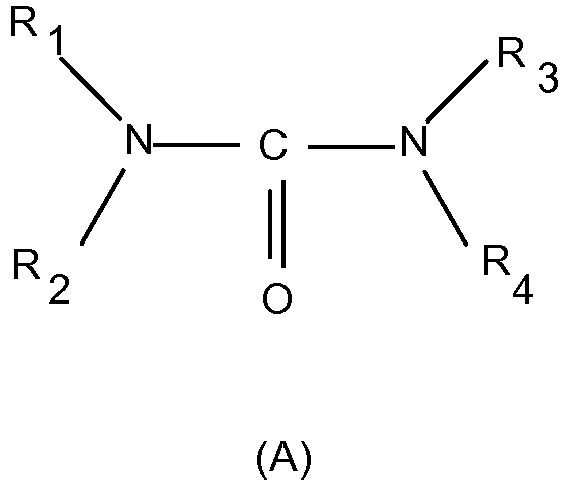
- Weitere bevorzugte erfindungsgemäße Zusammensetzungen sind dadurch gekennzeichnet, dass der mindestens eine alkyl- oder hydroxyalkylsubstituierte Harnstoff der allgemeinen Formel (A) ausgewählt ist aus Verbindungen, in denen R1, R2, R3 und R4 unabhängig voneinander für ein Wasserstoffatom, eine Methyl-, Ethyl-, n-Propyl-, Isopropyl-, n-Butyl-, sek.-Butyl-, tert. Butyl- oder C2-C6-Hydroxyalkyl-Gruppe, die mit 1 bis 5 Hydroxylgruppen oder C1-C4-Hydroxyalkyl-Gruppen substituiert ist, stehen, mit der Maßgabe, dass mindestens einer der Reste R1 und R2 und gleichzeitig mindestens einer der Reste R3 und R4 eine C2-C6-Hydroxyalkyl-Gruppe, die mit 1 bis 5 Hydroxylgruppen oder C1-C4-Hydroxyalkyl-Gruppen substituiert ist, darstellt.
- Weitere bevorzugte erfindungsgemäße Zusammensetzungen sind dadurch gekennzeichnet, dass der mindestens eine alkyl- oder hydroxyalkylsubstituierte Harnstoff der allgemeinen Formel (A) ausgewählt ist aus Bis-N,N'- (2-hydroxyethyl)harnstoff. Erfindungsgemäß besonders bevorzugte Zusammensetzungen sind dadurch gekennzeichnet, dass sie mindestens einen alkyl- oder hydroxyalkylsubstituierten Harnstoff gemäß Formel (A), insbesondere N,N'-Bis-(2-hydroxyethyl)-harnstoff, in einer Gesamtmenge von 0,01 - 50 Gew.-%, bevorzugt 0,1 - 20 Gew.-%, besonders bevorzugt 1 - 10 Gew.-% und außerordentlich bevorzugt 2 - 5 Gew.-%, bezogen auf die gesamte Zusammensetzung, enthalten. N,N'-Bis-(2-hydroxyethyl)harnstoff, bei Raumtemperatur ein kristalliner Feststoff, ist z. B. als Handelsprodukt Hydrovance der National Starch and Chemical Company als ca. 45 - 55 %ige wässrige Lösung mit einem Gehalt an Harnstoff und Ammoniumlactat erhältlich.
- In einer bevorzugten Ausführungsform enthalten die erfindungsgemäßen Zusammensetzungen mindestens einen weiteren kosmetischen Wirkstoff, der ausgewählt ist aus Monomeren, Oligomeren und Polymeren von Aminosäuren, N-C2-C24-Acylaminosäuren und/oder den Estern und/oder den physiologisch verträglichen Metallsalzen dieser Substanzen, sowie Mischungen dieser Wirkstoffe.
- Die Monomere der Aminosäuren und/oder der N-C2-C24-Acylaminosäuren sind ausgewählt aus Alanin, Arginin, Asparagin, Asparaginsäure, Canavanin, Citrullin, Cystein, Cystin, Desmosin, Dipalmitoylhydroxyprolin, Glutamin, Glutaminsäure, Glycin, Histidin, Homophenylalanin, Hydroxylysin, Hydroxyprolin, Isodesmosin, Isoleucin, Leucin, Lysin, Methionin, Methylnorleucin, Ornithin, Phenylalanin, Prolin, Pyroglutaminsäure, Sarcosin, Serin, Taurin, Threonin, Thyroxin, Tryptophan, Tyrosin, Valin, N-Acetyl-L-cystein, Zinkpyroglutamat, Natriumoctanoylglutamat, Natriumdecanoylglutamat, Natriumlauroylglutamat, Natriummyristoylglutamat, Natriumcetoylglutamat und Natriumstearoylglutamat. Besonders bevorzugt sind Lysin, Serin, N-Acetyl-L-cystein, Zink- und Natriumpyroglutamat und Natriumlauroylglutamat.
- Der C2 - C24-Acylrest, mit dem die genannten Aminosäuren an der Aminogruppe derivatisiert sind, ist ausgewählt aus einem Acetyl-, Propanoyl-, Butanoyl-, Pentanoyl-, Hexanoyl-, Heptanoyl-, Octanoyl-, Nonanoyl-, Decanoyl-, Undecanoyl-, Lauroyl-, Tridecanoyl-, Myristoyl-, Pentadecanoyl-, Cetoyl-, Palmitoyl-, Stearoyl-, Elaidoyl-, Arachidoyl- oder Behenoyl-Rest. Mischungen von C8-C18-Acylresten werden auch als Cocoyl-Rest bezeichnet und sind ebenfalls bevorzugte Substituenten. Mit den vorgenannten C2 - C24-Acylresten können die Aminosäuren, die eine OH-Gruppe tragen, auch an dieser OH-Gruppe verestert sein. Ein erfindungsgemäß bevorzugtes Beispiel hierfür ist Hydroxyprolin, das mit zwei, bevorzugt linearen, C2-C22-Fettsäureresten N-acyliert und verestert ist, besonders bevorzugt Dipalmitoylhydroxyprolin, das z. B. unter der Bezeichnung Sepilift DPHP von der Firma Seppic erhältlich ist.
- Die physiologisch verträglichen Salze der erfindungsgemäß bevorzugten Wirkstoffe, die Säuregruppen enthalten und Salze bilden können, sind ausgewählt aus den Ammonium-, Alkalimetall-, Magnesium-, Calcium-, Aluminium-, Zink- und Mangan-Salzen. Bevorzugt sind die Natrium-, Kalium-, Magnesium-, Aluminium-, Zink- und Mangan-Salze.
- Unter Aminosäureoligomeren werden erfindungsgemäß Peptide mit 2 - 30, bevorzugt 2 - 15, Aminosäuren, verstanden. Die Oligomere der Aminosäuren und/oder der N-C2-C24-Acylaminosäuren sind bevorzugt ausgewählt aus Di-, Tri-, Tetra-, Penta-, Hexa- oder Pentadecapeptiden, die N-acyliert und/oder verestert sein können. Zahlreiche dieser Aminosäureoligomere stimulieren die Collagensynthese beziehungsweise sind in der Lage, Zellen des Immunsystems, wie Mastzellen und Makrophagen, zu rekrutieren, die dann über die Freisetzung von Wachstumsfaktoren Reparaturprozesse im Gewebe, z.B. die Collagensynthese, induzieren, beziehungsweise sind in der Lage, an die Sequenz Arg-Phe-Lys in Thrombospondin I (TSP-1) zu binden und damit aktives TGF-ß (tissue growth factor), der die Synthese von Collagen in dermalen Fibroblasten induziert, freizusetzen. Derartige Aminosäureoligomere können als Wirkstoffe gegen die Hautalterung verwendet werden.
- Die Polymere der Aminosäuren und/oder der N-C2-C24-Acylaminosäuren sind bevorzugt ausgewählt aus pflanzlichen und tierischen Proteinhydrolysaten und/oder Proteinen. Tierische Proteinhydrolysate sind z. B. Elastin-, Collagen-, Keratin-, Seiden-, Conchiolin- und Milcheiweiß-Proteinhydrolysate, die auch in Form von Salzen vorliegen können. Erfindungsgemäß bevorzugt sind pflanzliche Proteinhydrolysate, z. B. Soja-, Weizen-, Mandel-, Erbsen-, Kartoffel- und Reisproteinhydrolysate.
- Weiterhin erfindungsgemäß bevorzugt sind Keratinhydrolysate, insbesondere Wollkeratinhydrolysate. Ein besonders bevorzugtes Wollkeratinhydrolysat ist unter der Bezeichnung Keratec Pep von der Firma Croda erhältlich. Keratec Pep weist eine kleinere Molekulargewichtsfraktion mit einem durchschnittlichen Molekulargewicht von 150 Dalton und eine größere Molekulargewichtsfraktion mit einem durchschnittlichen Molekulargewicht von 1265 Dalton auf. Weiterhin erfindungsgemäß bevorzugt sind Conchiolinhydrolysate, insbesondere solche, die unter den Bezeichnungen Pearl Protein Extract und Pearl Protein Extract BG von der Firma Maruzen erhältlich sind. Proteinhydrolysate können naturgemäß auch monomere Aminosäuren und Oligopeptide enthalten; ihre Zusammensetzung ist normalerweise nicht definiert. Ebenfalls bevorzugt ist der Einsatz von Acylderivaten der Proteinhydrolysate, z. B. in Form ihrer Fettsäure-Kondensationsprodukte. Erfindungsgemäß bevorzugt sind auch kationisierte Proteinhydrolysate. Besonders bevorzugt sind kationische Proteinhydrolysate, deren zugrunde liegender Proteinanteil ein Molekulargewicht von 100 bis zu 25000 Dalton, bevorzugt 250 bis 5000 Dalton aufweist. Weiterhin sind unter kationischen Proteinhydrolysaten quaternierte Aminosäuren und deren Gemische zu verstehen. Weiterhin können die kationischen Proteinhydrolysate auch noch weiter derivatisiert sein.
- In einer weiteren bevorzugten Ausführungsform sind die Polymeren der Aminosäuren ausgewählt aus DNA-Reparaturenzymen. Erfindungsgemäß bevorzugte DNA-Reparaturenzyme sind Photolyase und T4 Endonuclease V, letztere im weiteren mit "T4N5" abgekürzt. Diese beiden Enzyme sind im Stand der Technik bereits als sogenannte DNA-Reparatur-Enzyme bekannt. Unter DNA-Reparatur ist definitionsgemäß die Spaltung bzw. Entfernung von UV-induzierten Pyrimidindimeren aus der DNA zu verstehen. Photolyase ist die Kurzbezeichnung für Desoxyribodipyrimidin-Photolyase bzw. DNA-Photolyase, ein Enzym mit der Klassifizierungsnummer EC 4.1.99.3. Eine besonders effiziente Photolyase stammt aus Anacystis nidulans, einem phototrophen marinen Mikroorganismus. Die Photolyase aus A. nidulans wird in technisch relevanten Mengen mittlerweile aus E. coli gewonnen. Photolyase ist zur Aktivierung auf Licht angewiesen. Das Enzym T4 Endonuclease V wird vom denV-Gen der Bakteriophage T4 produziert und gehört zu den Phosphodiesterasen, die die Nucleinsäuren an der (5'-3')-Bindung hydrolytisch spalten. T4N5 ist auch ohne Lichteinfluss aktiv. Erfindungsgemäß besonders bevorzugt ist der Einsatz von liposomenverkapselten DNA-Reparaturenzymen. Liposomenverkapselte Photolyase ist im Handel z. B. unter der Produktbezeichnung Photosome™, liposomenverkapselte T4N5 z. B. unter der Bezeichnung Ultrasome™ von der Firma AGI Dermatics, USA, erhältlich. Erfindungsgemäß besonders bevorzugte Zusammensetzungen sind dadurch gekennzeichnet, dass sie mindestens eines der Handelsprodukte Photosomes™ oder Ultrasomes™ in Gesamtmengen von 0,1 - 10 Gew.-%, bevorzugt 0,5 - 5,0 Gew.-% und besonders bevorzugt 1,0 - 4,0 Gew.-%, bezogen auf die gesamte erfindungsgemäße Zusammensetzung, enthalten.
- Erfindungsgemäß besonders bevorzugte Zusammensetzungen sind dadurch gekennzeichnet, dass sie mindestens ein Monomer, Oligomer oder Polymer von Aminosäuren, N-C2-C24-Acylaminosäuren und/oder den Estern und/ oder den physiologisch verträglichen Metallsalzen dieser Substanzen in Gesamtmengen von 0,0000001 - 10 Gew.-%, bevorzugt 0,001 - 5 Gew.-% und besonders bevorzugt 0,01 - 1 - 2 - 3 Gew.-%, jeweils bezogen auf den Aktivsubstanzgehalt in der gesamten erfindungsgemäßen Zusammensetzung, enthalten.
- In einer weiteren bevorzugten Ausführungsform enthalten die erfindungsgemäßen Zusammensetzungen mindestens ein DNA-Oligonucleotid oder mindestens ein RNA-Oligonucleotid. Erfindungsgemäß werden unter einem Oligonucleotid Polymerisate aus 2 bis 20, bevorzugt 2 bis 10 Mononucleotiden verstanden, die ebenso wie bei Polynucleotiden und Nucleinsäuren durch Phosphorsäurediester-Brücken verknüpft sind. Die Nucleotide bestehen aus Nucleobasen (meist Pyrimidin- oder Purin-Derivaten), Pentosen (meist D-Ribofuranose oder 2-Desoxy-D-ribofuranose in β-N-glykosidischer Bindung an die Nucleobase) und Phosphorsäure. Die Mononucleotide sind zum Beispiel Adenosinphosphate, Cytidinphosphate, Guanosinphosphate, Uridinphosphate und Thymidinphosphate, insbesondere CMP (Cytidin-5'-monophosphat), UDP (Uridin-5'-diphosphat), ATP (Adenosin-5 '-triphosphat) und GTP (Guanosin-5'-triphosphat). Ein erfindungsgemäß besonders bevorzugtes Oligonucleotid ist das Thymidin-Dinucleotid.
- Erfindungsgemäß besonders bevorzugte Zusammensetzungen sind dadurch gekennzeichnet, dass sie mindestens ein DNA-Oligonucleotid und/oder ein RNA-Oligonucleotid in Gesamtmengen von 0,000001 - 5 Gew.-%, bevorzugt 0,0001 - 0,5 Gew.-% und besonders bevorzugt 0,001 - 0,05 Gew.-%, bezogen auf die gesamte Zusammensetzung, enthalten.
- In einer weiteren bevorzugten Ausführungsform enthalten die erfindungsgemäßen Zusammensetzungen mindestens eine natürliche Betainverbindung. Erfindungsgemäße natürliche Betainverbindungen sind natürlich vorkommende Verbindungen mit der Atomgruppierung R3N+-CH2-X-COO gemäß IUPAC-Regel C-816.1. Sogenannte Betaintenside (synthetisch) fallen nicht unter die erfindungsgemäß verwendeten Betainverbindungen, ebenso wenig andere zwitterionische Verbindungen, in denen sich die positive Ladung an N oder P und die negative Ladung formal an O, S, B oder C befindet, die aber nicht der IUPAC-Regel C-816.1 entsprechen. Erfindungsgemäß bevorzugte Betainverbindungen sind Betain (Me3N+-CH2-COO-) und Carnitin (Me3N+-CH2-CHOH-CH2-COO-) jeweils mit Me = Methyl und X = C-C-Einfachbindung (im Falle des Betains) oder X = -CHOH-CH2- (im Falle des Carnitins). Erfindungsgemäß besonders bevorzugte Zusammensetzungen sind dadurch gekennzeichnet, dass sie mindestens eine natürliche Betainverbindung in einer Gesamtmenge von 0,05 bis 5 Gew.-%, bevorzugt 0,1 bis 3 Gew.-%, besonders bevorzugt 0,5 bis 2 Gew.-%, jeweils bezogen auf die gesamte Zusammensetzung, enthalten.
- In einer weiteren bevorzugten Ausführungsform enthalten die erfindungsgemäßen Zusammensetzungen mindestens ein Vitamin, Provitamin oder eine als Vitaminvorstufe bezeichnete Verbindung aus den Vitamingruppen A, B, C, E, H und K und den Estern der vorgenannten Substanzen.
- Zur Gruppe der als Vitamin A bezeichneten Substanzen gehören das Retinol (Vitamin A1) sowie das 3,4-Didehydroretinol (Vitamin A2). Das β-Carotin ist das Provitamin des Retinols. Als Vitamin A-Komponente erfindungsgemäß besonders bevorzugt sind Vitamin A-Säure und deren Ester, Vitamin A-Aldehyd und Vitamin A-Alkohol sowie dessen Ester, wie Retinylpalmitat und Retinylacetat. Erfindungsgemäß besonders bevorzugte Zusammensetzungen sind dadurch gekennzeichnet, dass sie mindestens ein Vitamin, Provitamin oder eine als Vitaminvorstufe bezeichnete Verbindung aus den Vitamingruppe A oder mindestens einen Ester hiervon in Gesamtmengen von 0,001 - 2 Gew.-%, bevorzugt 0,05 - 0,05 - 1 Gew.-%, bezogen auf die gesamte Zusammensetzung, enthalten.
- Zur Vitamin B-Gruppe oder zu dem Vitamin B-Komplex gehören unter anderem Vitamin B1, Trivialname Thiamin. Bevorzugt wird Thiaminhydrochlorid in Mengen von 0,0005 bis 0,1 - 1 Gew.-%, bezogen auf die gesamte erfindungsgemäße Zusammensetzung, eingesetzt; Vitamin B2, Trivialname Riboflavin. Bevorzugt werden Riboflavin oder seine Derivate in Mengen von 0,0005 bis 0,1 - 1 Gew.-%, bezogen auf die gesamte erfindungsgemäße Zusammensetzung, eingesetzt; Vitamin B3. Unter dieser Bezeichnung werden die Verbindungen Nicotinsäure und Nicotinsäureamid (Niacinamid) geführt. Erfindungsgemäß bevorzugt ist das Nicotinsäureamid, das in den erfindungsgemäßen Zusammensetzungen bevorzugt in Mengen von 0,0005 bis 0,1 - 1 Gew.-%, bezogen auf die gesamte erfindungsgemäße Zusammensetzung, enthalten ist; Vitamin B5 (Pantothensäure und Panthenol). Bevorzugt wird Panthenol eingesetzt. Erfindungsgemäß bevorzugte Derivate des Panthenols sind insbesondere die Ester und Ether des Panthenols sowie kationisch derivatisierte Panthenole. In einer weiteren bevorzugten Ausführungsform der Erfindung werden an Stelle von sowie zusätzlich zu Pantothensäure oder Panthenol auch Derivate des 2-Furanon mit der allgemeinen Strukturformel (VIT-I) eingesetzt.

- Besonders bevorzugt sind die 2-Furanon-Derivate, in denen die Substituenten R1 bis R6 unabhängig voneinander ein Wasserstoffatom, einen Hydroxylrest, einen Methyl-, Methoxy-, Aminomethyl- oder Hydroxymethylrest, einen gesättigten oder ein- oder zweifach ungesättigten, linearen oder verzweigten C2-C4 - Kohlenwasserstoffrest, einen gesättigten oder ein- oder zweifach ungesättigten, verzweigten oder linearen Mono-, Di- oder Trihydroxy-C2-C4 - Kohlenwasserstoffrest oder einen gesättigten oder ein- oder zweifach ungesättigten, verzweigten oder linearen Mono-, Di- oder Triamino-C2-C4 - Kohlenwasserstoffrest darstellen. Ein bevorzugtes Derivat ist die Substanz Dihydro-3-hydroxy-4,4-dimethyl-2(3H)-furanon mit dem Trivialnamen Pantolacton (Merck). Das erfindungsgemäß außerordentlich bevorzugte 2-Furanon-Derivat ist Pantolacton (Dihydro-3-hydroxy-4,4-dimethyl-2(3H)-furanon), wobei in Formel (I) R1 für eine Hydroxylgruppe, R2 für ein Wasserstoffatom, R3 und R4 für eine Methylgruppe und R5 und R6 für ein Wasserstoffatom stehen. Das Stereoisomer (R)-Pantolacton entsteht beim Abbau von Pantothensäure.
- Erfindungsgemäß besonders bevorzugte Zusammensetzungen sind dadurch gekennzeichnet, dass sie mindestens eine der genannten Verbindungen des Vitamin B5-Typs sowie der 2-Furanon-derivate in einer Gesamtmenge von 0,05 bis 5 Gew.-%, bevorzugt 0,1 bis 3 Gew.-%, besonders bevorzugt 0,5 bis 2 Gew.-%, jeweils bezogen auf die gesamte Zusammensetzung, enthalten; Vitamin B6, wobei man hierunter keine einheitliche Substanz, sondern die unter den Trivialnamen Pyridoxin, Pyridoxamin und Pyridoxal bekannten Derivate des 5-Hydroxymethyl-2-methylpyridin-3-ols versteht. Erfindungsgemäß besonders bevorzugte Zusammensetzungen sind dadurch gekennzeichnet, dass sie mindestens eine Vitamin B6-Komponente in einer Gesamtmenge von 0,0001 bis 1,0 Gew.-%, insbesondere in Mengen von 0,001 bis 0,01 Gew.-%, enthalten; Vitamin B7 (Biotin), auch als Vitamin H oder "Hautvitamin" bezeichnet. Erfindungsgemäß besonders bevorzugte Zusammensetzungen sind dadurch gekennzeichnet, dass sie mindestens eine Komponente, ausgewählt aus Biotin und den Biotinestern, in einer Gesamtmenge von 0,0001 bis 1,0 Gew.-%, insbesondere 0,001 bis 0,01 Gew.-%, enthalten; Folsäure (Vitamin B9, Vitamin Bc). Internationaler Freiname für N-[4-(2-Amino-3,4-dihydro-4-oxo-6-pteridinylmethylamino)-benzoyl]-L-glutaminsäure (N-Pteroyl-L-glutaminsäure, PteGlu). Folat wird synonym zu Pteroylglutamat gebraucht, Folate ist der Sammelbegriff für alle Folsäure-wirksamen Verbindungen und bezeichnet eine Substanzklasse, die einen mit 4-Aminobenzoesäure und L-Glutaminsäure verbundenen Pteridin-Ring enthält. Erfindungsgemäß besonders bevorzugte Zusammensetzungen sind dadurch gekennzeichnet, dass sie mindestens eine Komponente, ausgewählt aus Folsäure, Folaten und deren Estern, in einer Gesamtmenge von 0,0001 bis 1,0 Gew.-%, insbesondere 0,01 bis 0,5 Gew.-%, bezogen auf die Zusammensetzung, enthalten; Orotsäure (Vitamin B13, 1,2,3,6-Tetrahydro-2,6-dioxo-4-pyrimidin-carbonsäure, Uracil-6-carbonsäure, Molkensäure). Orotsäure, ihr Cholinester oder Orotsäure-Metallsalze (Orotate von Ca, Cr, Fe, K, Co, Cu, Li, Mg, Mn, Na, Zn, Sn) sind erfindungsgemäß besonders bevorzugt. Erfindungsgemäß besonders bevorzugte Zusammensetzungen sind dadurch gekennzeichnet, dass sie mindestens eine Komponente, ausgewählt aus Orotsäure, Orotaten und deren Estern, in einer Gesamtmenge von 0,0001 - 1,0 Gew.-%, insbesondere 0,01 - 0,5 Gew.-%, bezogen auf die Zusammensetzung, enthalten.
- In einer weiteren bevorzugten Ausführungsform enthalten die erfindungsgemäßen Zusammensetzungen mindestens eine Substanz, die ausgewählt ist aus den Vitaminen, Provitaminen und Vitaminvorstufen der Gruppe B1, B2, B3, B6, B7, B9, B13 und deren Estern und aus Pantolacton. Bevorzugte Vitamine, Provitamine und Vitaminvorstufen der Gruppe C und deren Ester sind Vitamin C (Ascorbinsäure) und die Derivate Ascorbylpalmitat, -stearat, -dipalmitat, -acetat, Magnesiumascorbylphosphat, Natriumascorbylphosphat, Natrium- und Magnesiumascorbat, Dinatriumascorbylphosphat und -sulfat, Kaliumascorbyltocopherylphosphat, Chitosanascorbat oder Ascorbylglucosid. Die Kombination mit Tocopherolen kann ebenfalls bevorzugt sein. Erfindungsgemäß besonders bevorzugte Zusammensetzungen sind dadurch gekennzeichnet, dass sie mindestens eine der genannten Verbindungen des Vitamin C-Typs in einer Gesamtmenge von 0,05 bis 5 Gew.-%, bevorzugt 0,1 bis 3 Gew.-%, besonders bevorzugt 0,5 bis 1 - 2 Gew.-%, jeweils bezogen auf die gesamte Zusammensetzung, enthalten.
- Zur Vitamin E-Gruppe zählen Tocopherol, insbesondere α-Tocopherol, und seine Derivate. Bevorzugte Derivate sind insbesondere die Ester, wie Tocopherylacetat, -nicotinat, -phosphat, -succinat, -linoleat, -oleat, Tocophereth-5, Tocophereth-10, Tocophereth-12, Tocophereth-18, Tocophereth-50 und Tocophersolan. Erfindungsgemäß besonders bevorzugte Zusammensetzungen sind dadurch gekennzeichnet, dass sie mindestens eine Substanz, ausgewählt aus Tocopherol und seinen Derivaten, in einer Gesamtmenge von 0,05 bis 5 Gew.-%, bevorzugt 0,1 bis 3 Gew.-%, besonders bevorzugt 0,5 bis 1 - 2 Gew.-%, jeweils bezogen auf die gesamte Zusammensetzung, enthalten.
- Vitamin A-palmitat (Retinylpalmitat), Pantolacton, Nicotinsäureamid, Pyridoxin, Pyridoxamin, Pyridoxal, Biotin, Ascorbylpalmitat, Ascorbylacetat, Mg-Ascorbylphosphat, Na-Ascorbylphosphat, Natrium- und Magnesiumascorbat und die Tocopherolester, besonders Tocopherylacetat, sind erfindungsgemäß besonders bevorzugt.
- In einer weiteren bevorzugten Ausführungsform enthalten die erfindungsgemäßen Zusammensetzungen neben der erfindungsgemäßen Wirkstoffkombination mindestens eine α-Hydroxycarbonsäure, α-Ketocarbonsäure oder β-Hydroxycarbonsäure oder deren Ester-, Lacton- oder Salzform. Erfindungsgemäß bevorzugte α-Hydroxycarbonsäuren oder α-Ketocarbonsäuren sind Glycolsäure, Milchsäure, Weinsäure, Citronensäure, 2-Hydroxybutansäure, 2,3-Dihydroxypropansäure, 2-Hydroxypentansäure, 2-Hydroxyhexansäure, 2-Hydroxyheptansäure, 2-Hydroxyoctansäure, 2-Hydroxydecansäure, 2-Hydroxydodecansäure, 2-Hydroxytetradecansäure, 2-Hydroxyhexadecansäure, 2-Hydroxyoctadecansäure, Mandelsäure, 4-Hydroxymandelsäure, Äpfelsäure, Erythrarsäure, Threarsäure, Glucarsäure, Galactarsäure, Mannarsäure, Gularsäure, 2-Hydroxy-2-methylbernsteinsäure, Gluconsäure, Brenztraubensäure, Glucuronsäure und Galacturonsäure. Besonders bevorzugte α-Hydroxycarbonsäuren sind Milchsäure, Citronensäure, Glycolsäure und Gluconsäure. Eine besonders bevorzugte β-Hydroxycarbonsäure ist Salicylsäure. Die Ester der genannten Säuren sind ausgewählt aus den Methyl-, Ethyl-, Propyl-, Isopropyl-, Butyl-, Amyl-, Pentyl-, Hexyl-, 2-Ethylhexyl-, Octyl-, Decyl-, Dodecyl- und Hexadecylestern. Erfindungsgemäß besonders bevorzugte Zusammensetzungen sind dadurch gekennzeichnet, dass sie neben der erfindungsgemäßen Wirkstoffkombination mindestens eine α-Hydroxycarbonsäure, α-Ketocarbonsäure und/oder β-Hydroxycarbonsäure oder ein Derivat, insbesondere einen Ester, ein Lacton oder ein Salz hiervon, in einer Gesamtmenge von 0,01 - 10 Gew.-%, bevorzugt 0,1 - 5 Gew.-%, besonders bevorzugt 0,5 - 1 - 2 Gew.-%, jeweils bezogen auf die gesamte Zusammensetzung, enthalten.
- In einer weiteren bevorzugten Ausführungsform enthalten die erfindungsgemäßen Zusammensetzungen mindestens ein Flavonoid oder mindestens einen Flavonoid-reichen Pflanzenextrakt.
- Erfindungsgemäß besonders bevorzugte Zusammensetzungen sind dadurch gekennzeichnet, dass sie mindestens ein Flavonoid in einer Gesamtmenge von 0,0001 bis 1 Gew.-%, bevorzugt 0,0005 bis 0,5 Gew.-% und besonders bevorzugt 0,001 bis 0,1 Gew.-%, jeweils bezogen auf die Flavonoidaktivsubstanz in der gesamten kosmetischen Zusammensetzung, enthalten.
- In einer weiteren bevorzugten Ausführungsform enthalten die erfindungsgemäßen Zusammensetzungen mindestens ein Isoflavonoid oder mindestens einen Isoflavonoid-reichen Pflanzenextrakt. Zu den Isoflavonoiden werden an dieser Stelle die Isoflavone und die Isoflavon-Glycoside gezählt. Erfindungsgemäß besonders bevorzugte Zusammensetzungen sind dadurch gekennzeichnet, dass sie mindestens ein Isoflavonoid in einer Gesamtmenge von 0,00001 bis 1 Gew.-%, bevorzugt 0,0005 bis 0,5 Gew.-% und besonders bevorzugt 0,001 bis 0,1 Gew.-%, jeweils bezogen auf die Isoflavonoidaktivsubstanz in der gesamten kosmetischen Zusammensetzung, enthalten.
- In einer weiteren bevorzugten Ausführungsform enthalten die erfindungsgemäßen Zusammensetzungen mindestens ein Polyphenol oder einen Polyphenol-reichen Pflanzenextrakt. Unter Polyphenolen sind erfindungsgemäß aromatische Verbindungen zu verstehen, die mindestens zwei phenolische Hydroxy-Gruppen im Molekül enthalten. Hierzu zählen die drei Dihydroxybenzole Brenzcatechin, Resorcin und Hydrochinon, weiterhin Phloroglucin, Pyrogallol und Hexahydroxybenzol. In der Natur treten freie und veretherte Polyphenole beispielsweise in Blütenfarbstoffen (Anthocyanidine, Flavone), in Gerbstoffen (Catechine, Tannine), als Flechten- oder Farn-Inhaltsstoffe (Usninsäure, Acylpolyphenole), in Ligninen und als Gallussäure-Derivate auf. Bevorzugte Polyphenole sind Flavone, Catechine, Usninsäure, und als Tannine die Derivate der Gallussäure, Digallussäure und Digalloylgallussäure. Besonders bevorzugte Polyphenole sind die monomeren Catechine, das heißt die Derivate der Flavan-3-ole, und Leukoanthocyanidine, das heißt die Derivate der Leukoanthocyanidine, die bevorzugt in 5,7,3',4',5'-Stellung phenolische Hydroxygruppen tragen, bevorzugt Epicatechin und Epigallocatechin, sowie die daraus durch Selbstkondensation entstehenden Gerbstoffe. Solche Gerbstoffe werden bevorzugt nicht in isolierter Reinsubstanz, sondern als Extrakte gerbstoffreicher Pflanzenteile eingesetzt, z. B. Extrakte von Catechu, Quebracho, Eichenrinde und Pinienrinde sowie anderen Baumrinden, Blättern von Grünem Tee (camellia sinensis) und Mate. Ebenfalls besonders bevorzugt sind die Tannine.
- Ein besonders bevorzugter Polyphenol-reicher kosmetischer Wirkstoff ist das Handelsprodukt Sepivinol R, ein Extrakt aus Rotwein, erhältlich von der Firma Seppic. Ein weiterer besonders bevorzugter Polyphenol-reicher kosmetischer Wirkstoff ist das Handelsprodukt Crodarom Chardonnay L, ein Extrakt aus den Kernen der Chardonnay-Traube, erhältlich von der Firma Croda.
- Erfindungsgemäß bevorzugt werden die Polyphenole in Mengen von 0,001 bis 10 Gew.-%, besonders bevorzugt 0,005 bis 5 Gew.-% und außerordentlich bevorzugt 0,01 bis 3 Gew.-%, jeweils bezogen auf das Gewicht des Handelsproduktes, das mindestens ein Polyphenol enthält, in der gesamten erfindungsgemäßen Zusammensetzung, eingesetzt.
- In einer weiteren bevorzugten Ausführungsform enthalten die erfindungsgemäßen Zusammensetzungen mindestens ein Ubichinon oder ein Ubichinol oder deren Derivate. Ubichinole sind die reduzierte Form der Ubichinone. Die erfindungsgemäß bevorzugten Ubichinone weisen die Formel (UBI-I) auf:

- Besonders bevorzugt ist das Ubichinon der Formel (II) mit n = 10, auch bekannt als Coenzym Q10. Erfindungsgemäß besonders bevorzugte Zusammensetzungen sind dadurch gekennzeichnet, dass sie mindestens ein Ubichinon, Ubichinol oder ein Derivat hiervon in einer Gesamtmenge von 0,0001 bis 1 Gew.-%, bevorzugt 0,001 bis 0,5 Gew.-% und besonders bevorzugt 0,005 bis 0,1 Gew.-%, jeweils bezogen auf die gesamte Zusammensetzung, enthalten.
- In einer weiteren bevorzugten Ausführungsform enthalten die erfindungsgemäßen Zusammensetzungen mindestens ein natürlich vorkommendes Xanthin-Derivat, ausgewählt aus Coffein, Theophyllin, Theobromin und Aminophyllin. Erfindungsgemäß bevorzugt sind die natürlich vorkommenden Xanthin-Derivate in Mengen von 0,0001 bis 1 Gew.-%, besonders bevorzugt 0,001 bis 0,5 Gew.-% und außerordentlich bevorzugt 0,005 bis 0,1 Gew.-%, jeweils bezogen auf die gesamte Zusammensetzung, enthalten.
- In einer weiteren bevorzugten Ausführungsform enthalten die erfindungsgemäßen Zusammensetzungen Ectoin. Ectoin ist der Trivialname für 2-Methyl-1,4,5,6-tetrahydropyrimidin-4-carboxylat. Erfindungsgemäß bevorzugt ist Ectoin in Mengen von 0,0001 bis 1 Gew.-%, besonders bevorzugt 0,001 bis 0,5 Gew.-% und außerordentlich bevorzugt 0,005 bis 0,01 Gew.-%, jeweils bezogen auf die gesamte Zusammensetzung, enthalten.
- In einer weiteren bevorzugten Ausführungsform enthalten die erfindungsgemäßen Zusammensetzungen Kreatin. Kreatin ist der Trivialname für N-Methyl-guanidino-essigsäure bzw. N-Amidinosar-kosin. Erfindungsgemäß bevorzugt ist Kreatin in Mengen von 0,0001 bis 1 Gew.-%, besonders bevorzugt 0,001 bis 0,5 Gew.-% und außerordentlich bevorzugt 0,01 bis 0,1 Gew.-%, jeweils bezogen auf die gesamte Zusammensetzung, enthalten.
- In einer weiteren bevorzugten Ausführungsform enthalten die erfindungsgemäßen Zusammensetzungen mindestens einen Olivenblattextrakt (Olea Europaea (Olive) Leaf Extract). Erfindungsgemäß besonders bevorzugte Zusammensetzungen sind dadurch gekennzeichnet, dass sie mindestens einen Olivenblattextrakt in einer Gesamtmenge von 0,01 bis 5 Gew.-%, bevorzugt 0,1 bis 3 Gew.-% und besonders bevorzugt 0,5 bis 1 - 2 Gew.-%, jeweils bezogen auf den Extrakt als Handelsprodukt tel quel in der gesamten erfindungsgemäßen Zusammensetzung, enthalten. Olivenblattextrakte können einen hohen Gehalt an Oleanolsäure und/oder Oleanol aufweisen. In einer weiteren bevorzugten Ausführungsform enthalten die erfindungsgemäßen Zusammensetzungen Oleanolsäure, Oleanol und/oder Oleuropein. Erfindungsgemäß besonders bevorzugte Zusammensetzungen sind dadurch gekennzeichnet, dass sie Oleanolsäure, Oleanol und/oder Oleuropein in einer Gesamtmenge von 0,00001 bis 2 Gew.-%, bevorzugt 0,001 bis 1 Gew.-% und besonders bevorzugt 0,05 bis 0,1 Gew.-%, jeweils bezogen auf die gesamte erfindungsgemäße Zusammensetzung, enthalten.
- In einer weiteren bevorzugten Ausführungsform enthalten die erfindungsgemäßen Zusammensetzungen Ursolsäure. Erfindungsgemäß besonders bevorzugte Zusammensetzungen sind dadurch gekennzeichnet, dass sie Ursolsäure in einer Gesamtmenge von 0,00001 bis 2 Gew.-%, bevorzugt 0,001 bis 1 Gew.-% und besonders bevorzugt 0,05 bis 0,1 Gew.-%, jeweils bezogen auf die gesamte erfindungsgemäße Zusammensetzung, enthalten.
- In einer weiteren bevorzugten Ausführungsform enthalten die erfindungsgemäßen Zusammensetzungen mindestens einen Wirkstoff, der ausgewählt ist aus den Mono- und Polyhydroxystilbenen und deren Estern. Unter Polyhydroxystilbenen werden erfindungsgemäß Stilbene verstanden, die mit 2, 3, 4, 5, 6, 7, 8, 9 oder 10 Hydroxygruppen an den beiden Phenylresten substituiert sind, wobei diese verestert sein können. Mono- und Polyhydroxystilbene und deren Ester erhöhen und/oder verbessern die Interaktion zwischen der extrazellulären Matrix und den Fibroblasten. Erfindungsgemäß besonders bevorzugte Hydroxystilbene und deren Ester sind ausgewählt aus Resveratrol (trans-Stilben-3,4'-5-triol), den Resveratrolmono-, -di- und -triphosphorsäureestern und deren Salzen. Ein erfindungsgemäß besonders bevorzugter Resveratrolphosphorsäureester ist Trisodium Resveratrol Triphosphate, z. B. erhältlich von Ajinomoto.
- Erfindungsgemäß besonders bevorzugte kosmetische oder dermatologische Zusammensetzungen sind dadurch gekennzeichnet, dass sie mindestens einen Wirkstoff, der ausgewählt ist aus den Mono- und Polyhydroxystilbenen und deren Estern, in einer Gesamtmenge von 0,000001 - 5 Gew.-%, bevorzugt 0,00001 - 1 Gew.-%, besonders bevorzugt 0,0001 - 0,1 Gew.-% und außerordentlich bevorzugt 0,005 - 0,05 Gew.-%, enthalten, jeweils bezogen auf den Gehalt an Aktivsubstanz in der gesamten Zusammensetzung.
- In einer weiteren bevorzugten Ausführungsform enthalten die erfindungsgemäßen Zusammensetzungen mindestens einen Extrakt aus Apfelkernextrakten (Pyrus Malus (Apple) Fruit Extract). Derartige Extrakte erhöhen und/oder verbessern die Interaktion zwischen der extrazellulären Matrix und den Fibroblasten. Erfindungsgemäß besonders bevorzugte Apfelkernextrakte sind unter der Handelsbezeichnung Ederline von der Firma Seporga erhältlich. Das Produkt Ederline enthält Phytohormone, Isoflavonoide, Phytosterole, Triterpenoide, Tocopherole und natürliche Wachse. Ederline ist einmal in wasserlöslicher Form als Ederline-H (INCI: PEG-40 Hydrogenated Castor Oil, PPG-2-Ceteareth-9, Pyrus Malus (Apple) Fruit Extract), zum anderen in fettlöslicher Form als Ederline-L (INCI: Hexyldecanol, Pyrus Malus (Apple) Fruit Extract) erhältlich.
- Erfindungsgemäß besonders bevorzugte kosmetische oder dermatologische Zusammensetzungen sind dadurch gekennzeichnet, dass sie den Rohstoff Ederline in Mengen von 0,1 - 10 Gew.-%, bevorzugt 1 - 8 Gew.-% und besonders bevorzugt 3 - 5 Gew.-%, jeweils bezogen auf die gesamte Zusammensetzung, enthalten. Erfindungsgemäß besonders bevorzugte kosmetische oder dermatologische Zusammensetzungen enthalten mindestens einen Apfelkernextrakt in Mengen von 0,00001 - 2 Gew.-%, bevorzugt 0,001 - 1,6 Gew.-% und besonders bevorzugt 0,03 - 1 Gew.-%, jeweils bezogen auf den Gehalt an Aktivsubstanz in der gesamten Zusammensetzung.
- In einer weiteren bevorzugten Ausführungsform enthalten die erfindungsgemäßen Zusammensetzungen zur Unterstützung der Wirkung der erfindungsgemäßen Wirkstoffkombination mindestens einen sebumregulierenden Wirkstoff. Erfindungsgemäß bevorzugte sebumregulierende Wirkstoffe sind ausgewählt aus 10-Hydroxydecansäure, Sebacinsäure, Azelainsäure und den Estern der Azelainsäure, insbesondere Kaliumazeloyldiglycinat, 1,10-Decandiol und mindestens einem Extrakt aus Spiraea Ulmaria, Glycyrrhizin, das auch als Glycyrrhizinsäure oder Glycyrrhetinsäureglycosid bezeichnet wird und das 2-beta-Glucuronido-alpha-glucuronid der Glycyrrhetinsäure darstellt, sowie deren Salzen, Gerbsäure (tannic acid) und deren Salzen, Gallotanninen, Naringin, Mischungen aus Glycyrrhizin(salzen), Gerbsäure(salzen) und/oder Gallotanninen und Naringin, wie sie zum Beispiel als Handelsprodukt BiSCos Glynarin PF (INCI: Aqua (Water), Alcohol, Phenoxyethanol, Ammonium Glycyrrhizate, Tannic Acid, Naringine) von der Firma Biesterfeld erhältlich sind, weiterhin aus wasser- und öllöslichen Extrakten aus Hamamelis, Klettenwurzel und Brennessel, Zimtbaumextract (z. B. Sepicontrol® A5 von der Firma Seppic), Chrysanthemenextrakt (z. B. Laricyl® von Laboratoires Serobiologiques), Hefeproteinhydrolysaten, wie sie z.B. in den Handelsprodukten der Asebiol®-Serie von Laboratoires Serobiologiques erhältlich sind, insbesondere Asebiol® LS 2539 BT 2 (INCI: Aqua, Hydrolyzed Yeast Protein, Pyridoxine, Niacinamide, Glycerin, Panthenol, Allantoin, Biotin) und Asebiol® LS 2539 BT (Aqua, Hydrolyzed Yeast Protein, Pyridoxine, Niacinamide, Glycerin, Panthenol, Propylene Glycol, Allantoin, Disodium Azelate, Biotin) und PEG-8 Isolauryl Thioether, wie es z. B. in dem Handelsprodukt "Antifettfaktor® COS-218/2-A" von Cosmetochem enthalten ist (INCI: Aqua, Cetyl-PCA, PEG-8 Isolauryl Thioether, PCA, Cetyl Alcohol), sowie Mischungen der vorgenannten Substanzen. Bevorzugte Mischungen sind beispielsweise erhältlich als Handelsprodukt Acnacidol PG (Propylene Glycol, 10-Hydroxydecanoic acid, Sebacic acid, 1,10-Decandiol) von Vincience erhältlich. Ein bevorzugter Extrakt aus Spiraea Ulmaria ist z. B. im Produkt Seboregul 2 der Firma Silab enthalten. Kaliumazeloyldiglycinat ist z. B. in dem Produkt Azeloglicina der Firma Sinerga enthalten. Erfindungsgemäß besonders bevorzugte kosmetische oder dermatologische Zusammensetzungen sind dadurch gekennzeichnet, dass sie mindestens einen sebumregulierenden Wirkstoff in Gesamtmengen von 0,00001 bis 10 Gew.-%, bevorzugt 0,01 bis 5 Gew.-% und besonders bevorzugt 0,1 bis 1 -2 Gew.-%, jeweils bezogen auf Aktivsubstanz in der gesamten erfindungsgemäßen Zusammensetzung, enthalten.
- Zur Unterstützung der erfindungsgemäßen Wirkstoffkombination enthalten die erfindungsgemäßen Hautbehandlungsmittel bevorzugt weiterhin mindestens einen partikelförmigen, sebumsorbierenden Wirkstoff, insbesondere Talkum, Stärke und andere Partikel. Erfindungsgemäß bevorzugte kosmetische oder dermatologische Zusammensetzungen sind dadurch gekennzeichnet, dass der partikelförmige, sebumsorbierende Wirkstoff ausgewählt ist aus anorganischen und organischen kosmetischen Adsorbentien mit mittleren Partikeldurchmessern von 0,1 - 100 µm, bevorzugt 0,5 - 50 µm, besonders bevorzugt 5 - 30 µm und außerordentlich bevorzugt 10 - 25 µm. Besonders bevorzugte anorganische Adsorbentien sind ausgewählt aus Kieselsäuren, insbesondere Aerosil®-Typen, Kieselgelen, Siliciumdioxid, Tonen und Schichtsilicaten, insbesondere Bentoniten oder Kaolin, Magnesiumaluminiumsilikaten, insbesondere Talkum, und Bornitrid, sowie Mischungen der genannten Substanzen. Besonders bevorzugte organische Adsorbentien sind ausgewählt aus Stärken und Stärkederivaten, die chemisch und/oder physikalisch modifiziert sein können, insbesondere modifizierten Stärkederivaten vom Typ DRY FLO® von Akzo Nobel, Cellulosepulvern, Lactoglobulinderivaten, insbesondere Natrium-C8-16-Isoalkylsuccinyllactoglobulin-sulfonat, z. B. als Handelsprodukt Biopol® OE von Brooks Industries erhältlich, Polymerpulvern aus Polyolefinen, Polycarbonaten, Polyurethanen, Polyamiden, Polyestern, Polystyrolen, Polyacrylaten, Polymethacrylaten, Polymethylmethacrylaten, (Meth)acrylat- oder (Meth)acrylat-Vinyliden-Copolymeren, Teflon oder Siliconen, wobei die genannten Polymerpulver in einer besonders bevorzugten Ausführungsform der Erfindung vernetzt sein können, sowie Mischungen der genannten Substanzen.
- Polymerpulver auf Basis eines Polymethacrylat-Copolymers sind z. B. als Handelsprodukt Polytrap® 6603 (Dow Corning) erhältlich. Andere Polymerpulver, z. B. auf Basis von Polyamiden, sind unter der Bezeichnung Orgasol® 1002 (Polyamid-6) und Orgasol® 2002 (Polyamid-12) von Elf Atochem erhältlich. Weitere erfindungsgemäß besonders bevorzugte Polymerpulver sind vernetzte Polymethacrylate (Micropearl® M von SEPPIC oder Plastic Powder A von NIKKOL), vernetzte Polymethylmethacrylate (Micropearl® M 305 und Micropearl® M 310 von SEPPIC), Styrol-Divinylbenzol-Copolymere (z. B. Plastic Powder FP von NIKKOL), Polyethylen- und Polypropylen-Pulver (z. B. ACCUREL® EP 400 von AKZO) oder auch Siliconpolymere (z. B. Silicone Powder X2-1605 von Dow Corning).
- In einer weiteren bevorzugten Ausführungsform der Erfindung weist der partikelförmige, sebumsorbierende Wirkstoff Hohlräume auf. In einer weiteren bevorzugten Ausführungsform der Erfindung weist der partikelförmige, sebumsorbierende Wirkstoff halbkugelförmige Partikel auf, besonders bevorzugt sind mindestens 50 Gew.-% der Partikel halbkugelförmig. In einer weiteren bevorzugten Ausführungsform der Erfindung weist der partikelförmige, sebumsorbierende Wirkstoff halbkugelförmige Partikel mit Hohlräumen auf, besonders bevorzugt sind mindestens 50 Gew.-% der Partikel halbkugelförmig mit Hohlräumen.
- Besonders bevorzugte partikelförmige, sebumsorbierende Wirkstoffe sind vernetzte Polymethylmethacrylate mit mittleren Partikeldurchmessern von 5 - 50 µm, insbesondere die Handelsprodukte Micropearl® M 305 und Micropearl® M 310 von SEPPIC. Außerordentlich bevorzugte partikelförmige, sebumsorbierende Wirkstoffe sind vernetzte Polymethylmethacrylate mit mittleren Partikeldurchmessern von 5 - 50 µm, die halbkugelförmige Partikel mit Hohlräumen umfassen, wobei besonders bevorzugt mindestens 50 Gew.-% der Partikel halbkugelförmig mit Hohlräumen sind, wie insbesondere das Handelsprodukt Micropearl® M 310 von SEPPIC. Erfindungsgemäß besonders bevorzugte Zusammensetzungen sind dadurch gekennzeichnet, dass sie mindestens einen partikelförmigen sebumsorbierenden Wirkstoff in einer Gesamtmenge von 0,5 bis 10 Gew.-%, bevorzugt 1 bis 5 Gew.-% und besonders bevorzugt 1,5 bis 3 Gew.-%, jeweils bezogen auf die gesamte Zusammensetzung, enthalten.
- Zur Unterstützung der erfindungsgemäßen Wirkstoffkombination enthalten die erfindungsgemäßen Hautbehandlungsmittel bevorzugt weiterhin mindestens einen adstringierenden Wirkstoff, der zu einer temporären Verengung der Hautporen führt, beispielsweise Tannine bzw. Gerbstoffe bzw. allgemein Polyphenole, weiterhin Aluminiumsalze, wie sie auch als Antitranspirant-Wirkstoffe Verwendung finden. Diese Wirkstoffe regulieren die Sebummenge an der Hautoberfläche durch Verzögerung des Sebumaustritts.
- Zur Unterstützung der erfindungsgemäßen Wirkstoffkombination enthalten die erfindungsgemäßen Hautbehandlungsmittel bevorzugt weiterhin mindestens einen sebumregulierenden Wirkstoff, der das an der Aktivität der Talgdrüsen beteiligte Enzym 5-alpha-Reduktase inhibiert. Bevorzugte Inhibitoren der 5-alpha-Reduktase sind ausgewählt aus Finasterid®, 4-Androsten-3-on-17β-carbonsäure, (4R)-5,10-seco-19-Norpregna-4,5-dien-3,10,20-trian, (5-alpha,20-R)-4-Diazo-21-hydroxy-20-methylpregnan-3-on, 4-Azasteroide, insbesondere 17β-N,N-diethylcarbamoyl-4-methyl-4-aza-5-alpha-androstan-3-on, 17-alpha-acetoxy-6-methylenpregn-4-en-3,20-dion, 3-Carboxy-androsta-3,5-dien-Steroid-Derivate und 3-Carboxy A Ring-Aryl-Steroide, 3-Androsten-3-carbonsäuren, 3-Carboxy-17β-substituierte Steroide, 17β-(N-t-butylcarboxamid)-5-a-androst-1-en-4-aza-3-on, 17β-(N-t-butylcarboxamid)-androst-3,5-dien-3-carbonsäure, 17β-(N,N-diisopropylcarboxamid)-androst-3,5-dien-3-carbonsäure, 17β-(N,N-diisopropylcarboxamid)-estra-1,3, 5(10)-trien-3-carbonsäure, 17β-(N-t-butylcarboxamid)-estra-1,3,5(10)-trien-3-carbonsäure, 17β-(N,N-diisopropylcarboxamid)-estra-1,3,5(10)-trien-3-sulfonsäure, 17β-(N-t-butylcarboxamid)-estra-1,3,5(10)-trien-3-sulfonsäure, 17β-(N,N-diisopropylcarboxamid)-estra-1,3,5(10)-trien-3-phosphonsäure, 17β-(N-t-butylcarboxamid)-estra-1,3,5(10)-trien-3-phosphonsäure, 17β-(N,N-diisopropylcarboxamid)-estra-1,3,5(10)-trien-3-phosphinsäure, 17β-(N-t-butylcarboxamid)-estra-1,3,5(10)-trien-3-phosphinsäure, 17β-(N-t-butylcarboxamid)-androst-3,5-dien-3-phosphinsäure, 17β-(N,N-diisopropylcarboxamid)-androst-3,5-dien-3-phosphinsäure, 17β-(N-t-butylcarboxamid)-androst-3,5-dien-3-phosphonsäure, (Z)-17β-(N,N-diisopropylcarboxamid)-androst-4-en-3-yliden-essigsäure, 17β-(N,N-diisopropylcarboxamid)-5a-androst-2-en-3-essigsäure, (Z)-17β-(N,N-diiso-propylcarboxamid)-5α-androst-3-yliden-essigsäure, 17β-(N,N-diisopropylcarboxamid)-5a-androst-3-en-3-essigsäure und 17β-(N-t-butylcarboxamid)-5a-androst-2-en-3-essigsäure sowie den physiologisch verträglichen Salzen der vorgenannten Säuren. Erfindungsgemäß besonders bevorzugte Zusammensetzungen sind dadurch gekennzeichnet, dass sie mindestens einen Inhibitor der 5-alpha-Reduktase in einer Gesamtmenge von 0,0001 bis 1 Gew.-%, bevorzugt 0,001 bis 0,5 Gew.-% und besonders bevorzugt 0,01 bis 0,1 Gew.-%, jeweils bezogen auf die gesamte Zusammensetzung, enthalten.
- In einer weiteren bevorzugten Ausführungsform enthalten die erfindungsgemäßen Zusammensetzungen mindestens einen Desoxyzucker oder ein mindestens einen Desoxyzucker-Baustein enthaltendes Polysaccharid. Erfindungsgemäß bevorzugte Desoxyzucker sind ausgewählt aus Rhamnose und Fucose. Ein erfindungsgemäß besonders bevorzugtes, Desoxyzucker-Bausteine enthaltendes Polysaccharid ist das Handelsprodukt Fucogel® von Solabia mit der INCI-Bezeichnung Biosaccharide Gum-1. Ein weiteres erfindungsgemäß besonders bevorzugtes, Desoxyzucker-Bausteine enthaltendes Polysaccharid ist das Handelsprodukt Rhamnosoft® von Solabia mit der INCI-Bezeichnung Biosaccharide Gum-2. Ein erfindungsgemäß besonders bevorzugtes, Desoxyzucker-Bausteine enthaltendes Polysaccharid ist das Handelsprodukt Fucogenol® von Solabia mit der INCI-Bezeichnung Biosaccharide Gum-3. Ein erfindungsgemäß besonders bevorzugtes, Desoxyzucker-Bausteine enthaltendes Polysaccharid ist das Handelsprodukt Glycofilm® von Solabia mit der INCI-Bezeichnung Biosaccharide Gum-4. Erfindungsgemäß bevorzugt sind weiterhin Mischungen der vorgenannten, mindestens einen Desoxyzucker-Baustein enthaltenden Polysaccharide, beispielsweise die Mischung aus Biosaccharide Gum-2 und Biosaccharide Gum-3, erhältlich als Handelsprodukt Elastinol plus® von Solabia.
- Erfindungsgemäß besonders bevorzugte kosmetische oder dermatologische Zusammensetzungen sind dadurch gekennzeichnet, dass sie mindestens einen Desoxyzucker und/ oder mindestens ein Desoxyzucker-Bausteine enthaltendes Polysaccharid in Gesamtmengen von 0,001 bis 5 Gew.-%, bevorzugt 0,01 bis 2 Gew.-% und besonders bevorzugt 0,1 bis 1 Gew.-%, jeweils bezogen auf die gesamte erfindungsgemäße Zusammensetzung, enthalten.
- Vorteilhafterweise liegen die erfindungsgemäßen Hautbehandlungsmittel in Form einer flüssigen, fließfähigen oder festen Öl-in-Wasser-Emulsion, Wasser-in-Öl-Emulsion, Mehrfach-Emulsion, insbesondere einer Öl-in-Wasser-in-Öl- oder Wasser-in-Öl-in-Wasser-Emulsion, Makroemulsion, Miniemulsion, Mikroemulsion, PIT-Emulsion, Nanoemulsion, Pickering-Emulsion, Hydrodispersion, eines Hydrogels, eines Lipogels, einer ein- oder mehrphasigen Lösung, eines Schaumes, eines Puders oder einer Mischung mit mindestens einem als medizinischen Klebstoff geeigneten Polymer vor. Die Mittel können auch in wasserfreier Form, wie beispielsweise einem Öl oder einem Balsam, dargereicht werden. Hierbei kann der Träger ein pflanzliches oder tierisches Öl, ein Mineralöl, ein synthetisches Öl oder eine Mischung solcher Öle sein.
- In einer besonderen Ausführungsform der erfindungsgemäßen Mittel liegen die Mittel als Mikroemulsion vor. Unter Mikroemulsionen werden im Rahmen der Erfindung neben den thermodynamisch stabilen Mikroemulsionen auch die sogenannten "PIT"-Emulsionen verstanden. Bei diesen Emulsionen handelt es sich um Systeme mit den 3 Komponenten Wasser, Öl und Emulgator, die bei Raumtemperatur als Öl-in-Wasser-Emulsion vorliegen. Beim Erwärmen dieser Systeme bilden sich in einem bestimmten Temperaturbereich (als Phaseninversiontemperatur oder "PIT" bezeichnet) Mikroemulsionen aus, die sich bei weiterer Erwärmung in Wasser-in-Öl-Emulsionen umwandeln. Bei anschließendem Abkühlen werden wieder O/W-Emulsionen gebildet, die aber auch bei Raumtemperatur als Mikroemulsionen oder als sehr feinteilige Emulsionen mit einem mittleren Teilchendurchmesser unter 400 nm und insbesondere von etwa 100-300 nm, vorliegen. Erfindungsgemäß können solche Mikro- oder "PIT"-Emulsionen bevorzugt sein, die einen mittleren Teilchendurchmesser von etwa 200 nm aufweisen.
- Nach einer weiteren bevorzugten Ausführungsform ist das erfindungsgemäße Mittel frei von Parfümöl-Komponenten, insbesondere in Produkten für sensitive Haut.
- Ein weiterer Gegenstand der vorliegenden Erfindung ist ein nicht-therapeutisches Verfahren zur nicht-therapeutischen, kosmetischen Behandlung unreiner Haut, dadurch gekennzeichnet, dass eine erfindungsgemäße kosmetische oder dermatologische topische Zusammensetzung auf die Haut aufgetragen wird.
- Bezüglich weiterer bevorzugter Ausführungsformen der erfindungsgemäßen Verfahren gilt mutatis mutandis das zu den erfindungsgemäßen Mitteln Gesagte.
- Erfindungsgemäßes Hautbehandlungsmittel (Angaben in Gew.-%)
1,6-Hexandiol 8,000 Betain 2,000 Dehydroxanthan Gum 2,500 N,N'-Bis(2-hydroxyethyl)harnstoff 4,000 Zinkgluconat 0,200 Urea 0,250 Sodium Benzoate 0,500 Sodium Salicylate 0,500 1,10-Decanediol 0,300 10-Hydroxydecanoic Acid 0,300 Sebacic Acid 0,300 Sodium Acrylate/Sodium Acryloyldimethyl Taurate Copolymer 0,300 Ammonium Acryloyldimethyltaurate/VP Copolymer 1,000 Citric Acid 0,500 Polyisobutene 0,700 Sorbitan Oleate 0,100 Caprylyl/Capryl Glucoside 0,150 Ammonium Lactate 0,100 tert.-Butyl Alcohol 0,1,00 Aqua ad 100,000
Claims (14)
- Kosmetische oder dermatologische topische Zusammensetzung mit einem Gehalt an Benzoesäure und/oder ihren Salzen und Salicylsäure und/oder ihren Salzen, dadurch gekennzeichnet, dassa) die Gesamtmenge an Benzoesäure und Benzoaten in der Zusammensetzung bezogen auf das Gewicht der Zusammensetzung 0,2 bis 0,7 Gew.-% beträgt undb) die Gesamtmenge an Salicylsäure und Salicylaten in der Zusammensetzung bezogen auf das Gewicht der Zusammensetzung 0,2 bis 0,7 Gew.-% beträgt undc) das Gewichtsverhältnis der Gesamtmenge an Benzoesäure und Benzoaten zur Gesamtmenge an Salicylsäure und Salicylaten im Bereich von 3 : 2 bis 2 : 3 liegt,wobei sie bezogen auf ihr Gewicht 0,3 bis 0,65 Gew.-% Natriumbenzoat enthält und
wobei sie bezogen auf ihr Gewicht 0,3 bis 0,65 Gew.-% Natriumsalicylat enthält. - Zusammensetzung gemäß Anspruch 1, dadurch gekennzeichnet, dass sie bezogen auf ihr Gewicht 0,35 bis 0,6 Gew.-%, besonders bevorzugt 0,4 bis 0,6 Gew.-% und insbesondere 0,45 bis 0,5 Gew.-% Natriumbenzoat enthält.
- Zusammensetzung nach einem der Ansprüche 1 oder 2, dadurch gekennzeichnet, dass sie bezogen auf ihr Gewicht 0,35 bis 0,6 Gew.-%, besonders bevorzugt 0,4 bis 0,6 Gew.-% und insbesondere 0,45 bis 0,5 Gew.-% Natriumsalicylat enthält.
- Zusammensetzung nach einem der Ansprüche 1 bis 3, dadurch gekennzeichnet, dass das Gewichtsverhältnis der Gesamtmenge an Benzoesäure und Benzoaten zur Gesamtmenge an Salicylsäure und Salicylaten im Bereich von 5 : 4 bis 4 : 5 und insbesondere von 1,1 : 1 bis 1: 1,1 liegt.
- Zusammensetzung gemäß einem der vorhergehenden Ansprüche, enthaltend bezogen auf ihr Gewichta) 20 bis 95 Gew.-% Wasser undb) Dehydroxanthan Gum undc) mindestens ein vernetztes Copolymer aus Vinylpyrrolidon und 2-Methyl-2[(1-oxo-2-propenyl)amino]-1-propansulfonsäure, das teilweise oder vollständig neutralisiert ist,d) mindestens einen polymeren Verdicker in Form eines inversen, auto-inversiblen Polymerlatex, enthaltend eine Ölphase, eine Wasserphase, mindestens einen Öl-in-Wasser-Emulgator und mindestens einen verzweigten oder vernetzten Polyelektrolyten, wobei der Polyelektrolyt ausgewählt ist aus einem Copolymer, das mindestens ein Monomer mit einer starken Säurefunktion sowie ein Monomer mit einer schwachen Säurefunktion enthält.
- Zusammensetzung gemäß Anspruch 5, dadurch gekennzeichnet, dass sie bezogen auf ihr Gewicht 30 bis 94 Gew.-%, vorzugsweise 35 bis 92,5 Gew.-%, besonders bevorzugt 40 bis 90 Gew.-%, weiter bevorzugt 50 bis 87,5 Gew.-% und insbesondere 60 bis 85 Gew.-% Wasser enthält.
- Zusammensetzung gemäß einem der Ansprüche 5 oder 6, dadurch gekennzeichnet, dass sie bezogen auf ihr Gewicht 0,05 bis 5 Gew.-%, vorzugsweise 0,1 bis 4 Gew.-%, besonders bevorzugt 0,25 bis 3 Gew.-%, weiter bevorzugt 0,5 bis 2,5 Gew.-% und insbesondere 1 bis 2 Gew.-% Dehydroxanthan Gum b) enthält.
- Zusammensetzung gemäß einem der Ansprüche 5 bis 7, dadurch gekennzeichnet, dass sie bezogen auf ihr Gewicht 0,05 bis 3 Gew.-%, vorzugsweise 0,1 bis 2 Gew.-%, besonders bevorzugt 0,2 bis 1,5 Gew.-%, weiter bevorzugt 0,25 bis 1,25 Gew.-% und insbesondere 0,5 bis 1 Gew.-% mindestens eines vernetzten Copolymers c) aus Vinylpyrrolidon und 2-Methyl-2[(1-oxo-2-propenyl)amino]-1-propansulfonsäure, das teilweise oder vollständig neutralisiert ist, enthält.
- Zusammensetzung gemäß einem der Ansprüche 5 bis 8, dadurch gekennzeichnet, dass sie bezogen auf ihr Gewicht 0,1 bis 5 Gew.-%, vorzugsweise 0,25 bis 4 Gew.-%, besonders bevorzugt 0,5 bis 3 Gew.-%, weiter bevorzugt 0,75 bis 2,5 Gew.-% und insbesondere 1 bis 2 Gew.-% mindestens eines polymeren Verdickers d) in Form eines inversen, auto-inversiblen Polymerlatex enthält.
- Zusammensetzung gemäß einem der Ansprüche 5 bis 9, dadurch gekennzeichnet, dass die schwache Säurefunktion des Polyelektrolytmonomeren im polymeren Verdicker d) eine Carboxylgruppe -COOH darstellt, die teilweise oder vollständig neutralisiert ist.
- Zusammensetzung gemäß einem der Ansprüche 5 bis 10, dadurch gekennzeichnet, dass die Monomere des Polyelektrolyten im polymeren Verdicker d), die mit der schwach sauren -COOH-Gruppe funktionalisiert sind, ausgewählt sind aus Acrylsäure, Methacrylsäure, Itaconsäure und Maleinsäure, die teilweise oder vollständig neutralisiert sind.
- Zusammensetzung gemäß einem der Ansprüche 5 bis 11, dadurch gekennzeichnet, dass das Polyelektrolytmonomer mit starker Säurefunktion im polymeren Verdicker d) ausgewählt ist aus 2-Methyl-2[(1-oxo-2-propenyl)amino]-1-propansulfonsäure, die teilweise oder vollständig neutralisiert ist.
- Zusammensetzung gemäß einem der vorhergehenden Ansprüche, dadurch gekennzeichnet, dass sie bezogen auf ihr Gewicht 0,5 bis 5 Gew.-%, vorzugsweise 1,0 bis 4 Gew.-%, besonders bevorzugt 1,5 bis 3 Gew.-% und insbesondere 1,75 bis 2,5 Gew.-% Trimethylammoniumacetat (H3C)3N+CH2COO- enthält.
- Zusammensetzung gemäß einem der vorhergehenden Ansprüche, dadurch gekennzeichnet, dass sie bezogen auf ihr Gewicht 0,25 bis 5 Gew.-%, vorzugsweise 0,5 bis 4 Gew.-%, besonders bevorzugt 0,75 bis 3 Gew.-% und insbesondere 1 bis 2 Gew.-% N,N'-Bis(2-hydroxyethyl)harnstoff enthält.
Applications Claiming Priority (1)
| Application Number | Priority Date | Filing Date | Title |
|---|---|---|---|
| DE102008053884A DE102008053884A1 (de) | 2008-10-30 | 2008-10-30 | Anti Pickel Hautbehandlungsmittel |
Publications (3)
| Publication Number | Publication Date |
|---|---|
| EP2181696A2 EP2181696A2 (de) | 2010-05-05 |
| EP2181696A3 EP2181696A3 (de) | 2013-05-29 |
| EP2181696B1 true EP2181696B1 (de) | 2017-04-12 |
Family
ID=41569874
Family Applications (1)
| Application Number | Title | Priority Date | Filing Date |
|---|---|---|---|
| EP09173142.2A Revoked EP2181696B1 (de) | 2008-10-30 | 2009-10-15 | Anti Pickel Hautbehandlungsmittel |
Country Status (2)
| Country | Link |
|---|---|
| EP (1) | EP2181696B1 (de) |
| DE (1) | DE102008053884A1 (de) |
Families Citing this family (10)
| Publication number | Priority date | Publication date | Assignee | Title |
|---|---|---|---|---|
| DE102012203100A1 (de) * | 2012-02-29 | 2013-08-29 | Henkel Ag & Co. Kgaa | Emulsion mit Harnstoffderivaten |
| AU2013404932B2 (en) * | 2013-11-11 | 2017-10-05 | Colgate-Palmolive Company | Preservative system |
| RU2711928C2 (ru) * | 2015-08-18 | 2020-01-23 | Колгейт-Палмолив Компани | Система консервантов |
| DE102015224804A1 (de) | 2015-12-10 | 2017-06-14 | Henkel Ag & Co. Kgaa | Antibakterielles pflegendes Hautkosmetikum |
| KR102863391B1 (ko) | 2016-02-04 | 2025-09-22 | 앨러스틴 스킨케어, 인크. | 침습 및 비침습 시술적 피부 관리를 위한 조성물 및 방법 |
| US10493011B2 (en) | 2017-08-03 | 2019-12-03 | ALASTIN Skincare, Inc. | Peptide compositions and methods for ameliorating skin laxity and body contour |
| US11103455B2 (en) | 2018-08-02 | 2021-08-31 | ALASTIN Skincare, Inc. | Liposomal compositions and methods of use |
| CN117412734A (zh) * | 2021-03-07 | 2024-01-16 | 沙龙个人护理有限公司 | 抗生物膜防腐剂组合物 |
| US20220313575A1 (en) * | 2021-03-31 | 2022-10-06 | L'oreal | Preservative system |
| DE102021211592B4 (de) | 2021-10-14 | 2023-11-09 | Siemens Aktiengesellschaft | Betriebsverfahren für ein Ventilsystem, Ventilsystem, Steuereinheit und Computerprogrammprodukt |
Citations (21)
| Publication number | Priority date | Publication date | Assignee | Title |
|---|---|---|---|---|
| EP0281812A1 (de) | 1987-02-18 | 1988-09-14 | Milor Scientific, Ltd. | Zusammensetzung zur Behandlung von Akne |
| RO110900B1 (ro) | 1995-02-27 | 1996-05-30 | Inst De Biolog Dezvoltarii | Loțiune după ras |
| JP2634483B2 (ja) | 1990-06-18 | 1997-07-23 | オリンパス光学工業株式会社 | 防菌防黴清拭軟膏および光学機器の清拭方法 |
| WO2002055050A1 (de) | 2001-01-10 | 2002-07-18 | Beiersdorf Ag | Kosmetische und dermatologische waschaktive zubereitungen, enthaltend eine wirksame menge an iminodibernsteinsäure und/oder ihren salzen |
| WO2003013459A2 (de) | 2001-08-02 | 2003-02-20 | Beiersdorf Ag | Kosmetische reinigungsrezepturen |
| DE10156674A1 (de) | 2001-11-17 | 2003-05-28 | Beiersdorf Ag | Kosmetische Reinigungsformulierungen mit einem Gehalt an [S,S]-Ethylendiamindisuccinat |
| JP2003286153A (ja) | 2002-01-24 | 2003-10-07 | Shiseido Co Ltd | 皮膚外用組成物 |
| DE10216511A1 (de) | 2002-04-11 | 2003-10-23 | Beiersdorf Ag | Stärkehaltige kosmetische Tücher |
| EP1384467A1 (de) | 2002-07-27 | 2004-01-28 | Beiersdorf AG | Haarshampoo für feines und fettiges Haar |
| DE10247696A1 (de) | 2002-10-01 | 2004-04-15 | Beiersdorf Ag | Tensidhaltige Zubereitung mit substituierten Sacchariden |
| CN1528343A (zh) | 2003-09-28 | 2004-09-15 | 刘志程 | 含稀土治疗痤疮的药剂及其制法 |
| DE10354051A1 (de) | 2003-11-17 | 2005-06-16 | Beiersdorf Ag | Spender mit kosmetischen Zubereitungen, die Hilfsmittel zur Gängighaltung des Spenders enthalten |
| DE10356869A1 (de) | 2003-12-03 | 2005-07-07 | Beiersdorf Ag | Tensidhaltige Zubereitung mit Licochalcon A |
| DE102005016687A1 (de) | 2005-04-11 | 2006-03-16 | Henkel Kgaa | Verdickte alkoholhaltige Reinigungszusammensetzungen |
| US20060204530A1 (en) | 2005-03-10 | 2006-09-14 | Jr Chem, Llc | Benzoyl peroxide compositions and methods of use |
| DE102005033663A1 (de) | 2005-07-12 | 2007-01-25 | Beiersdorf Ag | Besonders milde Duschformulierung |
| US7189406B1 (en) | 1999-06-23 | 2007-03-13 | Dennis Gross | Composition and method for treating skin |
| WO2007108883A2 (en) | 2006-03-16 | 2007-09-27 | Johnson & Johnson Consumer, Companies, Inc. | High-deposition compositions and uses thereof |
| DE102006030092A1 (de) | 2006-06-28 | 2008-01-03 | Beiersdorf Ag | Haarpflegereinigungszusammensetzung mit besonderer Sensorik |
| DE102006032015A1 (de) | 2006-05-22 | 2008-01-17 | Beiersdorf Ag | Zubereitungen zur Sebumreduktion mit einem Gehalt an Hydroxycitrat als wirksames Prinzip |
| EP1889602A2 (de) | 2006-07-24 | 2008-02-20 | Beiersdorf AG | Kosmetische Zubereitungen zur Restrukturierung von Haaren mit besonderen Harnstoffderivaten |
Family Cites Families (13)
| Publication number | Priority date | Publication date | Assignee | Title |
|---|---|---|---|---|
| JP2916078B2 (ja) | 1994-04-13 | 1999-07-05 | 信越化学工業株式会社 | キサンタンガムの脱液方法 |
| GB9419091D0 (en) | 1994-09-22 | 1994-11-09 | Cerestar Holding Bv | Process for decreasing the build up of inorganic incrustations on textiles and detergent composition used in such process |
| PL364079A1 (en) | 2001-06-01 | 2004-12-13 | Henkel Kommanditgesellschaft Auf Aktien | Arylsulfatase-inhibitors in deodorants and antiperspirants |
| DE10154368A1 (de) | 2001-11-06 | 2003-05-15 | Henkel Kgaa | Beta-Glucuronidase-Inhibitoren in Deodorantien und Antitranspirantien |
| DE10216368A1 (de) | 2002-04-12 | 2003-10-16 | Henkel Kgaa | Arylsulfatase-Inhibitoren in Deodorantien und Antitranspirantien |
| FR2842201B1 (fr) | 2002-06-18 | 2005-01-14 | Probest | Nouvel oligosaccharide, compositions cosmetiques et/ou dermatologiques en contenant et ses applications |
| DE10260954A1 (de) | 2002-12-20 | 2004-07-01 | Henkel Kgaa | Arylsulfatase-Inhibitoren in Deodorantien und Antitranspirantien |
| DE102004011968A1 (de) | 2004-03-10 | 2005-09-29 | Henkel Kgaa | Präbiotisch wirksame Pflanzenextrakte |
| DE10333245C5 (de) | 2003-07-21 | 2015-02-19 | Henkel Ag & Co. Kgaa | Präbiotisch wirksame Pflanzenextrakte |
| EP1576946A1 (de) | 2004-03-18 | 2005-09-21 | Henkel Kommanditgesellschaft auf Aktien | Verwendung von Inhibitoren Gram-positiver Kokken in Deodorantien und Antitranspirantien |
| DE102005012476A1 (de) | 2005-03-16 | 2006-09-21 | Henkel Kgaa | Inhibitoren von Staphylococcus hominis in Deodorantien und Antitranspirantien |
| US7618956B2 (en) | 2005-05-31 | 2009-11-17 | The Gillette Company | Reduction of hair growth |
| DE102008053883A1 (de) * | 2008-10-30 | 2010-05-06 | Henkel Ag & Co. Kgaa | neues Verdickungssystem |
-
2008
- 2008-10-30 DE DE102008053884A patent/DE102008053884A1/de not_active Withdrawn
-
2009
- 2009-10-15 EP EP09173142.2A patent/EP2181696B1/de not_active Revoked
Patent Citations (21)
| Publication number | Priority date | Publication date | Assignee | Title |
|---|---|---|---|---|
| EP0281812A1 (de) | 1987-02-18 | 1988-09-14 | Milor Scientific, Ltd. | Zusammensetzung zur Behandlung von Akne |
| JP2634483B2 (ja) | 1990-06-18 | 1997-07-23 | オリンパス光学工業株式会社 | 防菌防黴清拭軟膏および光学機器の清拭方法 |
| RO110900B1 (ro) | 1995-02-27 | 1996-05-30 | Inst De Biolog Dezvoltarii | Loțiune după ras |
| US7189406B1 (en) | 1999-06-23 | 2007-03-13 | Dennis Gross | Composition and method for treating skin |
| WO2002055050A1 (de) | 2001-01-10 | 2002-07-18 | Beiersdorf Ag | Kosmetische und dermatologische waschaktive zubereitungen, enthaltend eine wirksame menge an iminodibernsteinsäure und/oder ihren salzen |
| WO2003013459A2 (de) | 2001-08-02 | 2003-02-20 | Beiersdorf Ag | Kosmetische reinigungsrezepturen |
| DE10156674A1 (de) | 2001-11-17 | 2003-05-28 | Beiersdorf Ag | Kosmetische Reinigungsformulierungen mit einem Gehalt an [S,S]-Ethylendiamindisuccinat |
| JP2003286153A (ja) | 2002-01-24 | 2003-10-07 | Shiseido Co Ltd | 皮膚外用組成物 |
| DE10216511A1 (de) | 2002-04-11 | 2003-10-23 | Beiersdorf Ag | Stärkehaltige kosmetische Tücher |
| EP1384467A1 (de) | 2002-07-27 | 2004-01-28 | Beiersdorf AG | Haarshampoo für feines und fettiges Haar |
| DE10247696A1 (de) | 2002-10-01 | 2004-04-15 | Beiersdorf Ag | Tensidhaltige Zubereitung mit substituierten Sacchariden |
| CN1528343A (zh) | 2003-09-28 | 2004-09-15 | 刘志程 | 含稀土治疗痤疮的药剂及其制法 |
| DE10354051A1 (de) | 2003-11-17 | 2005-06-16 | Beiersdorf Ag | Spender mit kosmetischen Zubereitungen, die Hilfsmittel zur Gängighaltung des Spenders enthalten |
| DE10356869A1 (de) | 2003-12-03 | 2005-07-07 | Beiersdorf Ag | Tensidhaltige Zubereitung mit Licochalcon A |
| US20060204530A1 (en) | 2005-03-10 | 2006-09-14 | Jr Chem, Llc | Benzoyl peroxide compositions and methods of use |
| DE102005016687A1 (de) | 2005-04-11 | 2006-03-16 | Henkel Kgaa | Verdickte alkoholhaltige Reinigungszusammensetzungen |
| DE102005033663A1 (de) | 2005-07-12 | 2007-01-25 | Beiersdorf Ag | Besonders milde Duschformulierung |
| WO2007108883A2 (en) | 2006-03-16 | 2007-09-27 | Johnson & Johnson Consumer, Companies, Inc. | High-deposition compositions and uses thereof |
| DE102006032015A1 (de) | 2006-05-22 | 2008-01-17 | Beiersdorf Ag | Zubereitungen zur Sebumreduktion mit einem Gehalt an Hydroxycitrat als wirksames Prinzip |
| DE102006030092A1 (de) | 2006-06-28 | 2008-01-03 | Beiersdorf Ag | Haarpflegereinigungszusammensetzung mit besonderer Sensorik |
| EP1889602A2 (de) | 2006-07-24 | 2008-02-20 | Beiersdorf AG | Kosmetische Zubereitungen zur Restrukturierung von Haaren mit besonderen Harnstoffderivaten |
Non-Patent Citations (4)
| Title |
|---|
| ANONYMOUS: "Verordnung über kosmetische Mittel (VKos)", KOSMETISCHE MITTEL AS 2000, 31 January 2000 (2000-01-31), pages 572, 574, 589, XP055452812 |
| DATABASE GNPD [O] June 1998 (1998-06-01), SCHWARZKOPF & HENKEL: "Gliss Kur Age Repair 40+ Shampoo", XP055452789, Database accession no. 619672 |
| DATABASE GNPD [O] SCHWARZKOPF & HENKEL: "Shower Gel", XP055452778, Database accession no. 743432 |
| MALAHYDE INFORMATION SYSTEMS: "DRY AND CLEAR® MEDICATED SKIN CLEANSER", 9 June 1983 (1983-06-09), pages 1 - 2, XP055452806 |
Also Published As
| Publication number | Publication date |
|---|---|
| DE102008053884A1 (de) | 2010-05-06 |
| EP2181696A2 (de) | 2010-05-05 |
| EP2181696A3 (de) | 2013-05-29 |
Similar Documents
| Publication | Publication Date | Title |
|---|---|---|
| EP2181696B1 (de) | Anti Pickel Hautbehandlungsmittel | |
| EP2182027B1 (de) | Neues Verdickungssystem | |
| DE102004032734A1 (de) | Präbiotisch wirksame Substanzen für Deodorantien | |
| DE102011089612A1 (de) | Körperpflegemittel mit verbesserter Hautfeuchte | |
| EP1938789A1 (de) | Verbesserung der Hautverträglichkeit von hyperämisierenden Wirkstoffen | |
| EP2005941A2 (de) | Zellverjüngende Zusammensetzungen | |
| DE102007024384A1 (de) | Kosmetische und dermatologische Zusammensetzungen gegen trockene Haut | |
| EP1776087A1 (de) | Kosmetische und dermatologische zusammensetzungen mit (2-hydroxyethyl)harnstoff | |
| WO2013091975A1 (de) | Biomimetische zusammensetzungen zur hautreinigung und -pflege | |
| DE102009027199A1 (de) | UV-Schutz-Kosmetikum | |
| DE102008054117A1 (de) | Wirkstoffkombination zur Behandlung reifer Haut II | |
| EP2011476A2 (de) | Feuchtigkeitsspendende kosmetische und dermatologische Zusammensetzungen mit Enhancern | |
| DE102007022448A1 (de) | Mittel zur Hautaufhellung | |
| DE102011118016A1 (de) | Kosmetische Mittel enthaltend Oxytocin und Riechstoffe | |
| EP2241306A2 (de) | Zusamensetzung mit antioxidativ wirksamen Peptiden | |
| EP1773328A1 (de) | Präbiotische intimpflege | |
| EP2633887B1 (de) | Neuartige Wirkstoffkombination zur effizienten Anti-Faltenwirkung | |
| DE102012222764A1 (de) | Kosmetische Mittel enthaltend Phospholipide und ausgewählte Pheromone | |
| EP2238964A2 (de) | Stabilisierte kosmetische Zusammensetzungen | |
| DE102012222969A1 (de) | Wirkstoffkombination zur Hautaufhellung II | |
| DE102005063063A1 (de) | Kosmetische Zusammensetzungen zur Hautmattierung | |
| DE102012222967A1 (de) | Wirkstoffkombination zum Schutz vor Alterungs- und Entzündungsprozessen | |
| DE102004034691A1 (de) | Verwendung von Siderophoren gegen Geruchskeime | |
| DE102006062566A1 (de) | Kosmetische und dermatologische Zusammensetzungen gegen unreine Haut und/oder Akne | |
| DE102007022449A1 (de) | Mittel zur Behandlung unreiner Haut |
Legal Events
| Date | Code | Title | Description |
|---|---|---|---|
| PUAI | Public reference made under article 153(3) epc to a published international application that has entered the european phase |
Free format text: ORIGINAL CODE: 0009012 |
|
| 17P | Request for examination filed |
Effective date: 20091015 |
|
| AK | Designated contracting states |
Kind code of ref document: A2 Designated state(s): AT BE BG CH CY CZ DE DK EE ES FI FR GB GR HR HU IE IS IT LI LT LU LV MC MK MT NL NO PL PT RO SE SI SK SM TR |
|
| AX | Request for extension of the european patent |
Extension state: AL BA RS |
|
| PUAL | Search report despatched |
Free format text: ORIGINAL CODE: 0009013 |
|
| AK | Designated contracting states |
Kind code of ref document: A3 Designated state(s): AT BE BG CH CY CZ DE DK EE ES FI FR GB GR HR HU IE IS IT LI LT LU LV MC MK MT NL NO PL PT RO SE SI SK SM TR |
|
| AX | Request for extension of the european patent |
Extension state: AL BA RS |
|
| RIC1 | Information provided on ipc code assigned before grant |
Ipc: A61P 17/10 20060101ALI20130422BHEP Ipc: A61K 8/73 20060101ALI20130422BHEP Ipc: A61K 8/368 20060101AFI20130422BHEP Ipc: A61K 8/81 20060101ALI20130422BHEP Ipc: A61Q 19/00 20060101ALI20130422BHEP |
|
| 17Q | First examination report despatched |
Effective date: 20130726 |
|
| GRAP | Despatch of communication of intention to grant a patent |
Free format text: ORIGINAL CODE: EPIDOSNIGR1 |
|
| STAA | Information on the status of an ep patent application or granted ep patent |
Free format text: STATUS: GRANT OF PATENT IS INTENDED |
|
| INTG | Intention to grant announced |
Effective date: 20161122 |
|
| RIN1 | Information on inventor provided before grant (corrected) |
Inventor name: STRUWE, ALEXANDRA Inventor name: WALDMANN-LAUE, MARIANNE Inventor name: BAEHREN, ANNIKA |
|
| GRAS | Grant fee paid |
Free format text: ORIGINAL CODE: EPIDOSNIGR3 |
|
| GRAA | (expected) grant |
Free format text: ORIGINAL CODE: 0009210 |
|
| STAA | Information on the status of an ep patent application or granted ep patent |
Free format text: STATUS: THE PATENT HAS BEEN GRANTED |
|
| AK | Designated contracting states |
Kind code of ref document: B1 Designated state(s): AT BE BG CH CY CZ DE DK EE ES FI FR GB GR HR HU IE IS IT LI LT LU LV MC MK MT NL NO PL PT RO SE SI SK SM TR |
|
| REG | Reference to a national code |
Ref country code: GB Ref legal event code: FG4D Free format text: NOT ENGLISH |
|
| REG | Reference to a national code |
Ref country code: CH Ref legal event code: EP |
|
| REG | Reference to a national code |
Ref country code: IE Ref legal event code: FG4D Free format text: LANGUAGE OF EP DOCUMENT: GERMAN |
|
| REG | Reference to a national code |
Ref country code: AT Ref legal event code: REF Ref document number: 883142 Country of ref document: AT Kind code of ref document: T Effective date: 20170515 |
|
| REG | Reference to a national code |
Ref country code: DE Ref legal event code: R096 Ref document number: 502009013857 Country of ref document: DE |
|
| REG | Reference to a national code |
Ref country code: NL Ref legal event code: MP Effective date: 20170412 |
|
| REG | Reference to a national code |
Ref country code: LT Ref legal event code: MG4D |
|
| PG25 | Lapsed in a contracting state [announced via postgrant information from national office to epo] |
Ref country code: NL Free format text: LAPSE BECAUSE OF FAILURE TO SUBMIT A TRANSLATION OF THE DESCRIPTION OR TO PAY THE FEE WITHIN THE PRESCRIBED TIME-LIMIT Effective date: 20170412 |
|
| REG | Reference to a national code |
Ref country code: FR Ref legal event code: PLFP Year of fee payment: 9 |
|
| PG25 | Lapsed in a contracting state [announced via postgrant information from national office to epo] |
Ref country code: GR Free format text: LAPSE BECAUSE OF FAILURE TO SUBMIT A TRANSLATION OF THE DESCRIPTION OR TO PAY THE FEE WITHIN THE PRESCRIBED TIME-LIMIT Effective date: 20170713 Ref country code: FI Free format text: LAPSE BECAUSE OF FAILURE TO SUBMIT A TRANSLATION OF THE DESCRIPTION OR TO PAY THE FEE WITHIN THE PRESCRIBED TIME-LIMIT Effective date: 20170412 Ref country code: NO Free format text: LAPSE BECAUSE OF FAILURE TO SUBMIT A TRANSLATION OF THE DESCRIPTION OR TO PAY THE FEE WITHIN THE PRESCRIBED TIME-LIMIT Effective date: 20170712 Ref country code: HR Free format text: LAPSE BECAUSE OF FAILURE TO SUBMIT A TRANSLATION OF THE DESCRIPTION OR TO PAY THE FEE WITHIN THE PRESCRIBED TIME-LIMIT Effective date: 20170412 Ref country code: ES Free format text: LAPSE BECAUSE OF FAILURE TO SUBMIT A TRANSLATION OF THE DESCRIPTION OR TO PAY THE FEE WITHIN THE PRESCRIBED TIME-LIMIT Effective date: 20170412 Ref country code: LT Free format text: LAPSE BECAUSE OF FAILURE TO SUBMIT A TRANSLATION OF THE DESCRIPTION OR TO PAY THE FEE WITHIN THE PRESCRIBED TIME-LIMIT Effective date: 20170412 |
|
| PG25 | Lapsed in a contracting state [announced via postgrant information from national office to epo] |
Ref country code: PL Free format text: LAPSE BECAUSE OF FAILURE TO SUBMIT A TRANSLATION OF THE DESCRIPTION OR TO PAY THE FEE WITHIN THE PRESCRIBED TIME-LIMIT Effective date: 20170412 Ref country code: IS Free format text: LAPSE BECAUSE OF FAILURE TO SUBMIT A TRANSLATION OF THE DESCRIPTION OR TO PAY THE FEE WITHIN THE PRESCRIBED TIME-LIMIT Effective date: 20170812 Ref country code: LV Free format text: LAPSE BECAUSE OF FAILURE TO SUBMIT A TRANSLATION OF THE DESCRIPTION OR TO PAY THE FEE WITHIN THE PRESCRIBED TIME-LIMIT Effective date: 20170412 Ref country code: BG Free format text: LAPSE BECAUSE OF FAILURE TO SUBMIT A TRANSLATION OF THE DESCRIPTION OR TO PAY THE FEE WITHIN THE PRESCRIBED TIME-LIMIT Effective date: 20170712 Ref country code: SE Free format text: LAPSE BECAUSE OF FAILURE TO SUBMIT A TRANSLATION OF THE DESCRIPTION OR TO PAY THE FEE WITHIN THE PRESCRIBED TIME-LIMIT Effective date: 20170412 |
|
| REG | Reference to a national code |
Ref country code: DE Ref legal event code: R026 Ref document number: 502009013857 Country of ref document: DE |
|
| PLBI | Opposition filed |
Free format text: ORIGINAL CODE: 0009260 |
|
| PLBI | Opposition filed |
Free format text: ORIGINAL CODE: 0009260 |
|
| PLAX | Notice of opposition and request to file observation + time limit sent |
Free format text: ORIGINAL CODE: EPIDOSNOBS2 |
|
| PG25 | Lapsed in a contracting state [announced via postgrant information from national office to epo] |
Ref country code: SK Free format text: LAPSE BECAUSE OF FAILURE TO SUBMIT A TRANSLATION OF THE DESCRIPTION OR TO PAY THE FEE WITHIN THE PRESCRIBED TIME-LIMIT Effective date: 20170412 Ref country code: RO Free format text: LAPSE BECAUSE OF FAILURE TO SUBMIT A TRANSLATION OF THE DESCRIPTION OR TO PAY THE FEE WITHIN THE PRESCRIBED TIME-LIMIT Effective date: 20170412 Ref country code: DK Free format text: LAPSE BECAUSE OF FAILURE TO SUBMIT A TRANSLATION OF THE DESCRIPTION OR TO PAY THE FEE WITHIN THE PRESCRIBED TIME-LIMIT Effective date: 20170412 Ref country code: EE Free format text: LAPSE BECAUSE OF FAILURE TO SUBMIT A TRANSLATION OF THE DESCRIPTION OR TO PAY THE FEE WITHIN THE PRESCRIBED TIME-LIMIT Effective date: 20170412 Ref country code: CZ Free format text: LAPSE BECAUSE OF FAILURE TO SUBMIT A TRANSLATION OF THE DESCRIPTION OR TO PAY THE FEE WITHIN THE PRESCRIBED TIME-LIMIT Effective date: 20170412 |
|
| PGFP | Annual fee paid to national office [announced via postgrant information from national office to epo] |
Ref country code: FR Payment date: 20171024 Year of fee payment: 9 Ref country code: DE Payment date: 20171019 Year of fee payment: 9 |
|
| 26 | Opposition filed |
Opponent name: BEIERSDORF AG Effective date: 20180111 |
|
| 26 | Opposition filed |
Opponent name: L'OREAL-D.I.P.I. Effective date: 20180112 |
|
| PG25 | Lapsed in a contracting state [announced via postgrant information from national office to epo] |
Ref country code: IT Free format text: LAPSE BECAUSE OF FAILURE TO SUBMIT A TRANSLATION OF THE DESCRIPTION OR TO PAY THE FEE WITHIN THE PRESCRIBED TIME-LIMIT Effective date: 20170412 Ref country code: SM Free format text: LAPSE BECAUSE OF FAILURE TO SUBMIT A TRANSLATION OF THE DESCRIPTION OR TO PAY THE FEE WITHIN THE PRESCRIBED TIME-LIMIT Effective date: 20170412 |
|
| PGFP | Annual fee paid to national office [announced via postgrant information from national office to epo] |
Ref country code: GB Payment date: 20171019 Year of fee payment: 9 |
|
| PG25 | Lapsed in a contracting state [announced via postgrant information from national office to epo] |
Ref country code: SI Free format text: LAPSE BECAUSE OF FAILURE TO SUBMIT A TRANSLATION OF THE DESCRIPTION OR TO PAY THE FEE WITHIN THE PRESCRIBED TIME-LIMIT Effective date: 20170412 Ref country code: MC Free format text: LAPSE BECAUSE OF FAILURE TO SUBMIT A TRANSLATION OF THE DESCRIPTION OR TO PAY THE FEE WITHIN THE PRESCRIBED TIME-LIMIT Effective date: 20170412 |
|
| REG | Reference to a national code |
Ref country code: CH Ref legal event code: PL |
|
| PLBB | Reply of patent proprietor to notice(s) of opposition received |
Free format text: ORIGINAL CODE: EPIDOSNOBS3 |
|
| REG | Reference to a national code |
Ref country code: IE Ref legal event code: MM4A |
|
| PG25 | Lapsed in a contracting state [announced via postgrant information from national office to epo] |
Ref country code: LI Free format text: LAPSE BECAUSE OF NON-PAYMENT OF DUE FEES Effective date: 20171031 Ref country code: LU Free format text: LAPSE BECAUSE OF NON-PAYMENT OF DUE FEES Effective date: 20171015 Ref country code: CH Free format text: LAPSE BECAUSE OF NON-PAYMENT OF DUE FEES Effective date: 20171031 |
|
| REG | Reference to a national code |
Ref country code: BE Ref legal event code: MM Effective date: 20171031 |
|
| PG25 | Lapsed in a contracting state [announced via postgrant information from national office to epo] |
Ref country code: BE Free format text: LAPSE BECAUSE OF NON-PAYMENT OF DUE FEES Effective date: 20171031 |
|
| PG25 | Lapsed in a contracting state [announced via postgrant information from national office to epo] |
Ref country code: MT Free format text: LAPSE BECAUSE OF FAILURE TO SUBMIT A TRANSLATION OF THE DESCRIPTION OR TO PAY THE FEE WITHIN THE PRESCRIBED TIME-LIMIT Effective date: 20170412 |
|
| PG25 | Lapsed in a contracting state [announced via postgrant information from national office to epo] |
Ref country code: IE Free format text: LAPSE BECAUSE OF NON-PAYMENT OF DUE FEES Effective date: 20171015 |
|
| RDAF | Communication despatched that patent is revoked |
Free format text: ORIGINAL CODE: EPIDOSNREV1 |
|
| REG | Reference to a national code |
Ref country code: DE Ref legal event code: R064 Ref document number: 502009013857 Country of ref document: DE Ref country code: DE Ref legal event code: R103 Ref document number: 502009013857 Country of ref document: DE |
|
| REG | Reference to a national code |
Ref country code: AT Ref legal event code: MM01 Ref document number: 883142 Country of ref document: AT Kind code of ref document: T Effective date: 20171015 |
|
| PG25 | Lapsed in a contracting state [announced via postgrant information from national office to epo] |
Ref country code: AT Free format text: LAPSE BECAUSE OF NON-PAYMENT OF DUE FEES Effective date: 20171015 |
|
| RDAG | Patent revoked |
Free format text: ORIGINAL CODE: 0009271 |
|
| STAA | Information on the status of an ep patent application or granted ep patent |
Free format text: STATUS: PATENT REVOKED |
|
| 27W | Patent revoked |
Effective date: 20181208 |
|
| GBPR | Gb: patent revoked under art. 102 of the ep convention designating the uk as contracting state |
Effective date: 20181208 |
|
| REG | Reference to a national code |
Ref country code: AT Ref legal event code: MA03 Ref document number: 883142 Country of ref document: AT Kind code of ref document: T Effective date: 20181208 |
|
| PG25 | Lapsed in a contracting state [announced via postgrant information from national office to epo] |
Ref country code: MK Free format text: LAPSE BECAUSE OF FAILURE TO SUBMIT A TRANSLATION OF THE DESCRIPTION OR TO PAY THE FEE WITHIN THE PRESCRIBED TIME-LIMIT Effective date: 20170412 |
|
| PG25 | Lapsed in a contracting state [announced via postgrant information from national office to epo] |
Ref country code: CY Free format text: LAPSE BECAUSE OF FAILURE TO SUBMIT A TRANSLATION OF THE DESCRIPTION OR TO PAY THE FEE WITHIN THE PRESCRIBED TIME-LIMIT Effective date: 20170412 Ref country code: PT Free format text: LAPSE BECAUSE OF FAILURE TO SUBMIT A TRANSLATION OF THE DESCRIPTION OR TO PAY THE FEE WITHIN THE PRESCRIBED TIME-LIMIT Effective date: 20170412 |
|
| PG25 | Lapsed in a contracting state [announced via postgrant information from national office to epo] |
Ref country code: TR Free format text: LAPSE BECAUSE OF FAILURE TO SUBMIT A TRANSLATION OF THE DESCRIPTION OR TO PAY THE FEE WITHIN THE PRESCRIBED TIME-LIMIT Effective date: 20170412 |