EP2178825B1 - Verfahren zur synthese von a-ring-aromatisierten acetyl-minocyclinen - Google Patents
Verfahren zur synthese von a-ring-aromatisierten acetyl-minocyclinen Download PDFInfo
- Publication number
- EP2178825B1 EP2178825B1 EP08784256.3A EP08784256A EP2178825B1 EP 2178825 B1 EP2178825 B1 EP 2178825B1 EP 08784256 A EP08784256 A EP 08784256A EP 2178825 B1 EP2178825 B1 EP 2178825B1
- Authority
- EP
- European Patent Office
- Prior art keywords
- acetyl
- minocycline
- previous
- several
- ring
- Prior art date
- Legal status (The legal status is an assumption and is not a legal conclusion. Google has not performed a legal analysis and makes no representation as to the accuracy of the status listed.)
- Not-in-force
Links
- 238000000034 method Methods 0.000 title claims description 38
- 230000015572 biosynthetic process Effects 0.000 title description 5
- 238000003786 synthesis reaction Methods 0.000 title description 5
- 125000000218 acetic acid group Chemical group C(C)(=O)* 0.000 title 1
- 229960004023 minocycline Drugs 0.000 claims description 30
- XEKOWRVHYACXOJ-UHFFFAOYSA-N Ethyl acetate Chemical compound CCOC(C)=O XEKOWRVHYACXOJ-UHFFFAOYSA-N 0.000 claims description 29
- WFDIJRYMOXRFFG-UHFFFAOYSA-N Acetic anhydride Chemical compound CC(=O)OC(C)=O WFDIJRYMOXRFFG-UHFFFAOYSA-N 0.000 claims description 25
- WTJXVDPDEQKTCV-UHFFFAOYSA-N 4,7-bis(dimethylamino)-1,10,11,12a-tetrahydroxy-3,12-dioxo-4a,5,5a,6-tetrahydro-4h-tetracene-2-carboxamide;hydron;chloride Chemical compound Cl.C1C2=C(N(C)C)C=CC(O)=C2C(O)=C2C1CC1C(N(C)C)C(=O)C(C(N)=O)=C(O)C1(O)C2=O WTJXVDPDEQKTCV-UHFFFAOYSA-N 0.000 claims description 16
- 229960002421 minocycline hydrochloride Drugs 0.000 claims description 16
- 125000002777 acetyl group Chemical group [H]C([H])([H])C(*)=O 0.000 claims description 14
- 238000006243 chemical reaction Methods 0.000 claims description 12
- 239000003208 petroleum Substances 0.000 claims description 11
- IAZDPXIOMUYVGZ-UHFFFAOYSA-N Dimethylsulphoxide Chemical compound CS(C)=O IAZDPXIOMUYVGZ-UHFFFAOYSA-N 0.000 claims description 10
- 239000000203 mixture Substances 0.000 claims description 10
- 239000000047 product Substances 0.000 claims description 9
- JUJWROOIHBZHMG-UHFFFAOYSA-N Pyridine Chemical compound C1=CC=NC=C1 JUJWROOIHBZHMG-UHFFFAOYSA-N 0.000 claims description 8
- 239000003814 drug Substances 0.000 claims description 8
- 239000002904 solvent Substances 0.000 claims description 8
- 239000007795 chemical reaction product Substances 0.000 claims description 7
- 230000004770 neurodegeneration Effects 0.000 claims description 7
- WEVYAHXRMPXWCK-UHFFFAOYSA-N Acetonitrile Chemical compound CC#N WEVYAHXRMPXWCK-UHFFFAOYSA-N 0.000 claims description 6
- YMWUJEATGCHHMB-UHFFFAOYSA-N Dichloromethane Chemical compound ClCCl YMWUJEATGCHHMB-UHFFFAOYSA-N 0.000 claims description 6
- ZMXDDKWLCZADIW-UHFFFAOYSA-N N,N-Dimethylformamide Chemical compound CN(C)C=O ZMXDDKWLCZADIW-UHFFFAOYSA-N 0.000 claims description 6
- CSCPPACGZOOCGX-UHFFFAOYSA-N Acetone Chemical compound CC(C)=O CSCPPACGZOOCGX-UHFFFAOYSA-N 0.000 claims description 5
- 239000003480 eluent Substances 0.000 claims description 5
- 208000015122 neurodegenerative disease Diseases 0.000 claims description 5
- 238000001953 recrystallisation Methods 0.000 claims description 5
- HEDRZPFGACZZDS-UHFFFAOYSA-N Chloroform Chemical group ClC(Cl)Cl HEDRZPFGACZZDS-UHFFFAOYSA-N 0.000 claims description 4
- VYPSYNLAJGMNEJ-UHFFFAOYSA-N Silicium dioxide Chemical compound O=[Si]=O VYPSYNLAJGMNEJ-UHFFFAOYSA-N 0.000 claims description 4
- DKPFZGUDAPQIHT-UHFFFAOYSA-N butyl acetate Chemical compound CCCCOC(C)=O DKPFZGUDAPQIHT-UHFFFAOYSA-N 0.000 claims description 4
- 239000012876 carrier material Substances 0.000 claims description 4
- IJKVHSBPTUYDLN-UHFFFAOYSA-N dihydroxy(oxo)silane Chemical compound O[Si](O)=O IJKVHSBPTUYDLN-UHFFFAOYSA-N 0.000 claims description 4
- 238000010828 elution Methods 0.000 claims description 4
- 229930195733 hydrocarbon Natural products 0.000 claims description 4
- 150000002430 hydrocarbons Chemical class 0.000 claims description 4
- TZIHFWKZFHZASV-UHFFFAOYSA-N methyl formate Chemical compound COC=O TZIHFWKZFHZASV-UHFFFAOYSA-N 0.000 claims description 4
- UMJSCPRVCHMLSP-UHFFFAOYSA-N pyridine Natural products COC1=CC=CN=C1 UMJSCPRVCHMLSP-UHFFFAOYSA-N 0.000 claims description 4
- 239000000741 silica gel Substances 0.000 claims description 4
- 229910002027 silica gel Inorganic materials 0.000 claims description 4
- 239000004215 Carbon black (E152) Substances 0.000 claims description 3
- 230000021736 acetylation Effects 0.000 claims description 3
- 238000006640 acetylation reaction Methods 0.000 claims description 3
- 239000011521 glass Substances 0.000 claims description 3
- 239000012442 inert solvent Substances 0.000 claims description 3
- NNPPMTNAJDCUHE-UHFFFAOYSA-N isobutane Chemical compound CC(C)C NNPPMTNAJDCUHE-UHFFFAOYSA-N 0.000 claims description 3
- 238000004519 manufacturing process Methods 0.000 claims description 3
- XDTMQSROBMDMFD-UHFFFAOYSA-N Cyclohexane Chemical compound C1CCCCC1 XDTMQSROBMDMFD-UHFFFAOYSA-N 0.000 claims description 2
- OFBQJSOFQDEBGM-UHFFFAOYSA-N Pentane Chemical compound CCCCC OFBQJSOFQDEBGM-UHFFFAOYSA-N 0.000 claims description 2
- 229920005654 Sephadex Polymers 0.000 claims description 2
- 239000012507 Sephadex™ Substances 0.000 claims description 2
- 238000005899 aromatization reaction Methods 0.000 claims description 2
- 239000006227 byproduct Substances 0.000 claims description 2
- IEJIGPNLZYLLBP-UHFFFAOYSA-N dimethyl carbonate Chemical compound COC(=O)OC IEJIGPNLZYLLBP-UHFFFAOYSA-N 0.000 claims description 2
- VLKZOEOYAKHREP-UHFFFAOYSA-N n-Hexane Chemical compound CCCCCC VLKZOEOYAKHREP-UHFFFAOYSA-N 0.000 claims description 2
- LYGJENNIWJXYER-UHFFFAOYSA-N nitromethane Chemical compound C[N+]([O-])=O LYGJENNIWJXYER-UHFFFAOYSA-N 0.000 claims description 2
- 230000036542 oxidative stress Effects 0.000 claims description 2
- TWNQGVIAIRXVLR-UHFFFAOYSA-N oxo(oxoalumanyloxy)alumane Chemical compound O=[Al]O[Al]=O TWNQGVIAIRXVLR-UHFFFAOYSA-N 0.000 claims description 2
- 125000002924 primary amino group Chemical group [H]N([H])* 0.000 claims description 2
- HXJUTPCZVOIRIF-UHFFFAOYSA-N sulfolane Chemical compound O=S1(=O)CCCC1 HXJUTPCZVOIRIF-UHFFFAOYSA-N 0.000 claims description 2
- 150000003512 tertiary amines Chemical class 0.000 claims description 2
- RTZKZFJDLAIYFH-UHFFFAOYSA-N Diethyl ether Chemical compound CCOCC RTZKZFJDLAIYFH-UHFFFAOYSA-N 0.000 claims 4
- DYKFCLLONBREIL-KVUCHLLUSA-N minocycline Chemical compound C([C@H]1C2)C3=C(N(C)C)C=CC(O)=C3C(=O)C1=C(O)[C@@]1(O)[C@@H]2[C@H](N(C)C)C(O)=C(C(N)=O)C1=O DYKFCLLONBREIL-KVUCHLLUSA-N 0.000 claims 4
- 102000016736 Cyclin Human genes 0.000 claims 2
- 108050006400 Cyclin Proteins 0.000 claims 2
- 229960001866 silicon dioxide Drugs 0.000 claims 2
- 239000003795 chemical substances by application Substances 0.000 claims 1
- 230000018044 dehydration Effects 0.000 claims 1
- 238000006297 dehydration reaction Methods 0.000 claims 1
- 229960001760 dimethyl sulfoxide Drugs 0.000 claims 1
- 230000006676 mitochondrial damage Effects 0.000 claims 1
- 150000007530 organic bases Chemical class 0.000 claims 1
- 125000000467 secondary amino group Chemical class [H]N([*:1])[*:2] 0.000 claims 1
- 239000007858 starting material Substances 0.000 claims 1
- 230000008569 process Effects 0.000 description 18
- 210000004027 cell Anatomy 0.000 description 17
- FFTVPQUHLQBXQZ-KVUCHLLUSA-N (4s,4as,5ar,12ar)-4,7-bis(dimethylamino)-1,10,11,12a-tetrahydroxy-3,12-dioxo-4a,5,5a,6-tetrahydro-4h-tetracene-2-carboxamide Chemical compound C1C2=C(N(C)C)C=CC(O)=C2C(O)=C2[C@@H]1C[C@H]1[C@H](N(C)C)C(=O)C(C(N)=O)=C(O)[C@@]1(O)C2=O FFTVPQUHLQBXQZ-KVUCHLLUSA-N 0.000 description 16
- 229940002612 prodrug Drugs 0.000 description 12
- 239000000651 prodrug Substances 0.000 description 12
- 239000000126 substance Substances 0.000 description 12
- IAZDPXIOMUYVGZ-WFGJKAKNSA-N Dimethyl sulfoxide Chemical compound [2H]C([2H])([2H])S(=O)C([2H])([2H])[2H] IAZDPXIOMUYVGZ-WFGJKAKNSA-N 0.000 description 10
- 230000003115 biocidal effect Effects 0.000 description 10
- 239000011541 reaction mixture Substances 0.000 description 9
- UHOVQNZJYSORNB-UHFFFAOYSA-N Benzene Chemical compound C1=CC=CC=C1 UHOVQNZJYSORNB-UHFFFAOYSA-N 0.000 description 8
- 235000019439 ethyl acetate Nutrition 0.000 description 8
- 229940079593 drug Drugs 0.000 description 7
- 210000003470 mitochondria Anatomy 0.000 description 7
- 238000003817 vacuum liquid chromatography Methods 0.000 description 7
- 238000004458 analytical method Methods 0.000 description 6
- 238000011534 incubation Methods 0.000 description 6
- 230000000324 neuroprotective effect Effects 0.000 description 6
- 239000004098 Tetracycline Substances 0.000 description 5
- 150000001875 compounds Chemical class 0.000 description 5
- 230000006378 damage Effects 0.000 description 5
- 235000019364 tetracycline Nutrition 0.000 description 5
- 150000003522 tetracyclines Chemical class 0.000 description 5
- 241000588724 Escherichia coli Species 0.000 description 4
- 150000002500 ions Chemical class 0.000 description 4
- 238000002360 preparation method Methods 0.000 description 4
- 230000001681 protective effect Effects 0.000 description 4
- 238000000746 purification Methods 0.000 description 4
- 239000002516 radical scavenger Substances 0.000 description 4
- 238000012360 testing method Methods 0.000 description 4
- 238000005160 1H NMR spectroscopy Methods 0.000 description 3
- JKMHFZQWWAIEOD-UHFFFAOYSA-N 2-[4-(2-hydroxyethyl)piperazin-1-yl]ethanesulfonic acid Chemical compound OCC[NH+]1CCN(CCS([O-])(=O)=O)CC1 JKMHFZQWWAIEOD-UHFFFAOYSA-N 0.000 description 3
- QTBSBXVTEAMEQO-UHFFFAOYSA-N Acetic acid Chemical compound CC(O)=O QTBSBXVTEAMEQO-UHFFFAOYSA-N 0.000 description 3
- 230000005526 G1 to G0 transition Effects 0.000 description 3
- 239000007995 HEPES buffer Substances 0.000 description 3
- OKKJLVBELUTLKV-UHFFFAOYSA-N Methanol Chemical compound OC OKKJLVBELUTLKV-UHFFFAOYSA-N 0.000 description 3
- 239000004480 active ingredient Substances 0.000 description 3
- 125000003118 aryl group Chemical group 0.000 description 3
- 210000001130 astrocyte Anatomy 0.000 description 3
- 230000004071 biological effect Effects 0.000 description 3
- 238000009835 boiling Methods 0.000 description 3
- 150000001733 carboxylic acid esters Chemical class 0.000 description 3
- 238000004113 cell culture Methods 0.000 description 3
- 230000000694 effects Effects 0.000 description 3
- 238000002114 high-resolution electrospray ionisation mass spectrometry Methods 0.000 description 3
- 230000006872 improvement Effects 0.000 description 3
- 230000004054 inflammatory process Effects 0.000 description 3
- 238000001819 mass spectrum Methods 0.000 description 3
- 230000004060 metabolic process Effects 0.000 description 3
- 229960002180 tetracycline Drugs 0.000 description 3
- 229930101283 tetracycline Natural products 0.000 description 3
- 208000024827 Alzheimer disease Diseases 0.000 description 2
- 208000018737 Parkinson disease Diseases 0.000 description 2
- FAPWRFPIFSIZLT-UHFFFAOYSA-M Sodium chloride Chemical compound [Na+].[Cl-] FAPWRFPIFSIZLT-UHFFFAOYSA-M 0.000 description 2
- 230000009471 action Effects 0.000 description 2
- 210000004556 brain Anatomy 0.000 description 2
- 239000003054 catalyst Substances 0.000 description 2
- 210000005056 cell body Anatomy 0.000 description 2
- 238000013375 chromatographic separation Methods 0.000 description 2
- 238000011097 chromatography purification Methods 0.000 description 2
- 238000004140 cleaning Methods 0.000 description 2
- 238000002425 crystallisation Methods 0.000 description 2
- 230000008025 crystallization Effects 0.000 description 2
- 238000009792 diffusion process Methods 0.000 description 2
- 239000001963 growth medium Substances 0.000 description 2
- NOESYZHRGYRDHS-UHFFFAOYSA-N insulin Chemical compound N1C(=O)C(NC(=O)C(CCC(N)=O)NC(=O)C(CCC(O)=O)NC(=O)C(C(C)C)NC(=O)C(NC(=O)CN)C(C)CC)CSSCC(C(NC(CO)C(=O)NC(CC(C)C)C(=O)NC(CC=2C=CC(O)=CC=2)C(=O)NC(CCC(N)=O)C(=O)NC(CC(C)C)C(=O)NC(CCC(O)=O)C(=O)NC(CC(N)=O)C(=O)NC(CC=2C=CC(O)=CC=2)C(=O)NC(CSSCC(NC(=O)C(C(C)C)NC(=O)C(CC(C)C)NC(=O)C(CC=2C=CC(O)=CC=2)NC(=O)C(CC(C)C)NC(=O)C(C)NC(=O)C(CCC(O)=O)NC(=O)C(C(C)C)NC(=O)C(CC(C)C)NC(=O)C(CC=2NC=NC=2)NC(=O)C(CO)NC(=O)CNC2=O)C(=O)NCC(=O)NC(CCC(O)=O)C(=O)NC(CCCNC(N)=N)C(=O)NCC(=O)NC(CC=3C=CC=CC=3)C(=O)NC(CC=3C=CC=CC=3)C(=O)NC(CC=3C=CC(O)=CC=3)C(=O)NC(C(C)O)C(=O)N3C(CCC3)C(=O)NC(CCCCN)C(=O)NC(C)C(O)=O)C(=O)NC(CC(N)=O)C(O)=O)=O)NC(=O)C(C(C)CC)NC(=O)C(CO)NC(=O)C(C(C)O)NC(=O)C1CSSCC2NC(=O)C(CC(C)C)NC(=O)C(NC(=O)C(CCC(N)=O)NC(=O)C(CC(N)=O)NC(=O)C(NC(=O)C(N)CC=1C=CC=CC=1)C(C)C)CC1=CN=CN1 NOESYZHRGYRDHS-UHFFFAOYSA-N 0.000 description 2
- 239000000463 material Substances 0.000 description 2
- 239000012528 membrane Substances 0.000 description 2
- 239000004090 neuroprotective agent Substances 0.000 description 2
- 230000000144 pharmacologic effect Effects 0.000 description 2
- 239000002243 precursor Substances 0.000 description 2
- 238000000425 proton nuclear magnetic resonance spectrum Methods 0.000 description 2
- 239000003642 reactive oxygen metabolite Substances 0.000 description 2
- 238000003756 stirring Methods 0.000 description 2
- 239000011550 stock solution Substances 0.000 description 2
- 239000012730 sustained-release form Substances 0.000 description 2
- 229940040944 tetracyclines Drugs 0.000 description 2
- 238000004809 thin layer chromatography Methods 0.000 description 2
- 238000002371 ultraviolet--visible spectrum Methods 0.000 description 2
- XLYOFNOQVPJJNP-UHFFFAOYSA-N water Substances O XLYOFNOQVPJJNP-UHFFFAOYSA-N 0.000 description 2
- 238000001644 13C nuclear magnetic resonance spectroscopy Methods 0.000 description 1
- 208000002874 Acne Vulgaris Diseases 0.000 description 1
- 229920001817 Agar Polymers 0.000 description 1
- 241000894006 Bacteria Species 0.000 description 1
- RYOCYPRPRQXMKB-UHFFFAOYSA-N CC(NC(c(c(OC(C)=O)c(c(CC1Cc(c2c(cc3)OC(C)=O)c3N(C)C)c3N(C)C)C(OC(C)=O)=C1C2=O)c3OC(C)=O)=O)=O Chemical compound CC(NC(c(c(OC(C)=O)c(c(CC1Cc(c2c(cc3)OC(C)=O)c3N(C)C)c3N(C)C)C(OC(C)=O)=C1C2=O)c3OC(C)=O)=O)=O RYOCYPRPRQXMKB-UHFFFAOYSA-N 0.000 description 1
- BBDAECWRHSWSDX-UHFFFAOYSA-N CC(NC(c(c(OC(C)=O)c(c(CC1Cc2c3c(OC(C)=O)ccc2N(C)C)c2C(O)=C1C3=O)N(C)C)c2OC(C)=O)=O)=O Chemical compound CC(NC(c(c(OC(C)=O)c(c(CC1Cc2c3c(OC(C)=O)ccc2N(C)C)c2C(O)=C1C3=O)N(C)C)c2OC(C)=O)=O)=O BBDAECWRHSWSDX-UHFFFAOYSA-N 0.000 description 1
- 108010051152 Carboxylesterase Proteins 0.000 description 1
- 102000013392 Carboxylesterase Human genes 0.000 description 1
- 208000035473 Communicable disease Diseases 0.000 description 1
- 206010010741 Conjunctivitis Diseases 0.000 description 1
- KDXKERNSBIXSRK-RXMQYKEDSA-N D-lysine Chemical compound NCCCC[C@@H](N)C(O)=O KDXKERNSBIXSRK-RXMQYKEDSA-N 0.000 description 1
- 239000006144 Dulbecco’s modified Eagle's medium Substances 0.000 description 1
- WQZGKKKJIJFFOK-GASJEMHNSA-N Glucose Natural products OC[C@H]1OC(O)[C@H](O)[C@@H](O)[C@@H]1O WQZGKKKJIJFFOK-GASJEMHNSA-N 0.000 description 1
- MHAJPDPJQMAIIY-UHFFFAOYSA-N Hydrogen peroxide Chemical compound OO MHAJPDPJQMAIIY-UHFFFAOYSA-N 0.000 description 1
- 102000004877 Insulin Human genes 0.000 description 1
- 108090001061 Insulin Proteins 0.000 description 1
- 108090000723 Insulin-Like Growth Factor I Proteins 0.000 description 1
- 102100037852 Insulin-like growth factor I Human genes 0.000 description 1
- 239000006142 Luria-Bertani Agar Substances 0.000 description 1
- 238000005481 NMR spectroscopy Methods 0.000 description 1
- 229920002274 Nalgene Polymers 0.000 description 1
- 239000004677 Nylon Substances 0.000 description 1
- 102000043276 Oncogene Human genes 0.000 description 1
- 108700020796 Oncogene Proteins 0.000 description 1
- 229930040373 Paraformaldehyde Natural products 0.000 description 1
- 208000007913 Pituitary Neoplasms Diseases 0.000 description 1
- 208000025747 Rheumatic disease Diseases 0.000 description 1
- 241001303601 Rosacea Species 0.000 description 1
- BUGBHKTXTAQXES-UHFFFAOYSA-N Selenium Chemical compound [Se] BUGBHKTXTAQXES-UHFFFAOYSA-N 0.000 description 1
- 208000020339 Spinal injury Diseases 0.000 description 1
- 208000006011 Stroke Diseases 0.000 description 1
- 206010000496 acne Diseases 0.000 description 1
- 239000013543 active substance Substances 0.000 description 1
- 230000001464 adherent effect Effects 0.000 description 1
- 239000008272 agar Substances 0.000 description 1
- 239000000956 alloy Substances 0.000 description 1
- 229910045601 alloy Inorganic materials 0.000 description 1
- VREFGVBLTWBCJP-UHFFFAOYSA-N alprazolam Chemical compound C12=CC(Cl)=CC=C2N2C(C)=NN=C2CN=C1C1=CC=CC=C1 VREFGVBLTWBCJP-UHFFFAOYSA-N 0.000 description 1
- 238000013459 approach Methods 0.000 description 1
- 230000033228 biological regulation Effects 0.000 description 1
- 230000008499 blood brain barrier function Effects 0.000 description 1
- 210000001218 blood-brain barrier Anatomy 0.000 description 1
- 150000001732 carboxylic acid derivatives Chemical class 0.000 description 1
- 230000001413 cellular effect Effects 0.000 description 1
- 230000019522 cellular metabolic process Effects 0.000 description 1
- 210000003169 central nervous system Anatomy 0.000 description 1
- 238000004587 chromatography analysis Methods 0.000 description 1
- 238000003776 cleavage reaction Methods 0.000 description 1
- 238000001816 cooling Methods 0.000 description 1
- 150000001923 cyclic compounds Chemical class 0.000 description 1
- 210000000805 cytoplasm Anatomy 0.000 description 1
- 238000005695 dehalogenation reaction Methods 0.000 description 1
- 230000001419 dependent effect Effects 0.000 description 1
- 238000013461 design Methods 0.000 description 1
- 238000011161 development Methods 0.000 description 1
- 201000010099 disease Diseases 0.000 description 1
- 208000037265 diseases, disorders, signs and symptoms Diseases 0.000 description 1
- 238000001035 drying Methods 0.000 description 1
- 230000008030 elimination Effects 0.000 description 1
- 238000003379 elimination reaction Methods 0.000 description 1
- 150000002085 enols Chemical group 0.000 description 1
- 230000005284 excitation Effects 0.000 description 1
- 238000002474 experimental method Methods 0.000 description 1
- 230000002349 favourable effect Effects 0.000 description 1
- 230000004992 fission Effects 0.000 description 1
- 239000000834 fixative Substances 0.000 description 1
- 210000001035 gastrointestinal tract Anatomy 0.000 description 1
- 230000009036 growth inhibition Effects 0.000 description 1
- 238000010438 heat treatment Methods 0.000 description 1
- 238000004128 high performance liquid chromatography Methods 0.000 description 1
- 238000005984 hydrogenation reaction Methods 0.000 description 1
- 125000002887 hydroxy group Chemical group [H]O* 0.000 description 1
- 201000001371 inclusion conjunctivitis Diseases 0.000 description 1
- 238000010348 incorporation Methods 0.000 description 1
- 230000002757 inflammatory effect Effects 0.000 description 1
- 230000005764 inhibitory process Effects 0.000 description 1
- 229940125396 insulin Drugs 0.000 description 1
- 230000003993 interaction Effects 0.000 description 1
- 238000011835 investigation Methods 0.000 description 1
- 239000001282 iso-butane Substances 0.000 description 1
- 150000002632 lipids Chemical class 0.000 description 1
- 238000009630 liquid culture Methods 0.000 description 1
- 230000003211 malignant effect Effects 0.000 description 1
- 238000004949 mass spectrometry Methods 0.000 description 1
- 230000001404 mediated effect Effects 0.000 description 1
- 239000002609 medium Substances 0.000 description 1
- 239000002207 metabolite Substances 0.000 description 1
- 244000005700 microbiome Species 0.000 description 1
- FZTMEYOUQQFBJR-UHFFFAOYSA-M mitoTracker Orange Chemical compound [Cl-].C=12C=CC(=[N+](C)C)C=C2OC2=CC(N(C)C)=CC=C2C=1C1=CC=C(CCl)C=C1 FZTMEYOUQQFBJR-UHFFFAOYSA-M 0.000 description 1
- 239000003068 molecular probe Substances 0.000 description 1
- 201000006417 multiple sclerosis Diseases 0.000 description 1
- 229930014626 natural product Natural products 0.000 description 1
- 230000001613 neoplastic effect Effects 0.000 description 1
- 235000015097 nutrients Nutrition 0.000 description 1
- 229920001778 nylon Polymers 0.000 description 1
- 238000005580 one pot reaction Methods 0.000 description 1
- 238000005457 optimization Methods 0.000 description 1
- 239000003960 organic solvent Substances 0.000 description 1
- 238000012261 overproduction Methods 0.000 description 1
- 229920002866 paraformaldehyde Polymers 0.000 description 1
- 230000008506 pathogenesis Effects 0.000 description 1
- 208000010916 pituitary tumor Diseases 0.000 description 1
- 210000001316 polygonal cell Anatomy 0.000 description 1
- 239000011148 porous material Substances 0.000 description 1
- 238000002953 preparative HPLC Methods 0.000 description 1
- 150000003141 primary amines Chemical class 0.000 description 1
- 108090000765 processed proteins & peptides Proteins 0.000 description 1
- 230000000750 progressive effect Effects 0.000 description 1
- 125000006239 protecting group Chemical group 0.000 description 1
- 239000003223 protective agent Substances 0.000 description 1
- 229940001470 psychoactive drug Drugs 0.000 description 1
- 239000004089 psychotropic agent Substances 0.000 description 1
- 230000035484 reaction time Effects 0.000 description 1
- 238000011084 recovery Methods 0.000 description 1
- 238000010992 reflux Methods 0.000 description 1
- 238000011160 research Methods 0.000 description 1
- 239000013557 residual solvent Substances 0.000 description 1
- 230000000241 respiratory effect Effects 0.000 description 1
- 238000012552 review Methods 0.000 description 1
- 206010039073 rheumatoid arthritis Diseases 0.000 description 1
- 210000004708 ribosome subunit Anatomy 0.000 description 1
- 201000004700 rosacea Diseases 0.000 description 1
- 230000007017 scission Effects 0.000 description 1
- 150000003335 secondary amines Chemical class 0.000 description 1
- 229910052711 selenium Inorganic materials 0.000 description 1
- 239000011669 selenium Substances 0.000 description 1
- 239000011780 sodium chloride Substances 0.000 description 1
- 239000007787 solid Substances 0.000 description 1
- 239000000243 solution Substances 0.000 description 1
- 239000011877 solvent mixture Substances 0.000 description 1
- 208000020431 spinal cord injury Diseases 0.000 description 1
- 239000000725 suspension Substances 0.000 description 1
- 238000013268 sustained release Methods 0.000 description 1
- 210000001519 tissue Anatomy 0.000 description 1
- 206010044325 trachoma Diseases 0.000 description 1
- 230000014616 translation Effects 0.000 description 1
- 238000000870 ultraviolet spectroscopy Methods 0.000 description 1
- 230000000007 visual effect Effects 0.000 description 1
Images


Classifications
-
- C—CHEMISTRY; METALLURGY
- C07—ORGANIC CHEMISTRY
- C07C—ACYCLIC OR CARBOCYCLIC COMPOUNDS
- C07C231/00—Preparation of carboxylic acid amides
- C07C231/02—Preparation of carboxylic acid amides from carboxylic acids or from esters, anhydrides, or halides thereof by reaction with ammonia or amines
-
- A—HUMAN NECESSITIES
- A61—MEDICAL OR VETERINARY SCIENCE; HYGIENE
- A61P—SPECIFIC THERAPEUTIC ACTIVITY OF CHEMICAL COMPOUNDS OR MEDICINAL PREPARATIONS
- A61P25/00—Drugs for disorders of the nervous system
-
- A—HUMAN NECESSITIES
- A61—MEDICAL OR VETERINARY SCIENCE; HYGIENE
- A61P—SPECIFIC THERAPEUTIC ACTIVITY OF CHEMICAL COMPOUNDS OR MEDICINAL PREPARATIONS
- A61P31/00—Antiinfectives, i.e. antibiotics, antiseptics, chemotherapeutics
- A61P31/04—Antibacterial agents
-
- C—CHEMISTRY; METALLURGY
- C07—ORGANIC CHEMISTRY
- C07C—ACYCLIC OR CARBOCYCLIC COMPOUNDS
- C07C2603/00—Systems containing at least three condensed rings
- C07C2603/02—Ortho- or ortho- and peri-condensed systems
- C07C2603/40—Ortho- or ortho- and peri-condensed systems containing four condensed rings
- C07C2603/42—Ortho- or ortho- and peri-condensed systems containing four condensed rings containing only six-membered rings
- C07C2603/44—Naphthacenes; Hydrogenated naphthacenes
Definitions
- the invention relates to a process for the synthesis of A-ring-flavored acetyl-minocycline.
- Minocycline is a tetracyclines semisynthetic broad spectrum antibiotic used for many years in clinical practice for the treatment of respiratory, urogenital and gastrointestinal tract infectious diseases, various skin conditions such as acne vulgaris, rosacea, and in trachoma, clamydia-conjunctivitis, borreliosis and others is used.
- Minocycline inhibits protein biosynthesis by binding to the 30S ribosomal subunit, thereby preventing the access of aminoacyl-t-RNA to the RNA-ribosome complex and thereby lengthening the peptide chain.
- minocycline In addition to the already known antibiotic effect of minocycline, another biological effect of the substance has recently come into the focus of research.
- Initial studies show that minocycline appears to have a protective effect on various inflammatory processes and neurodegenerative diseases ( Yong, VW, Wells, J., Giuliani, F., Casha, S., Power, C., and Metz, LM (2004).
- the promise of minocycline in neurology Lancet Neurol 3, 744-751 ).
- minocycline is currently being proposed for the clinical treatment of progressive inflammatory processes such as inflammatory rheumatoid arthritis ( Furst, DE (1998). Update on clinical trials in the rheumatic diseases. Curr Opin Rheumatol 10, 123-128 ).
- Inflammatory processes play a major role in the pathogenesis of neurodegenerative diseases such as Alzheimer's disease, Parkinson's disease, multiple sclerosis and post-traumatic brain and spinal cord injuries.
- the font DE 38 81 024 T2 discloses a process for producing tetracycline derivatives, such as minocycline, which is multi-step, using supported catalysts using organic solvent and pressure, with only dehalogenation and hydrogenation being performed in one step.
- the disadvantage of this manufacturing process is that it is expensive and therefore very expensive.
- selenium-containing alloys are used as catalyst in the process.
- the font WO 2005/070878 discloses A-ring aromatized tetracycline derivatives and a process for their preparation.
- the preparation of A-ring-flavored tetracyclines, as described in this disclosure, succeeds in principle, but requires several reaction stages and a complex purification of the reaction products by preparative HPLC, which for an industrial and thus profitable recovery of the active ingredients, eg in grams - or kilogram scale, unsuitable.
- minocycline Due to the biological and pharmacological effects found, the use of minocycline for the treatment of neurodegenerative diseases is very interesting. The study of minocycline as a lead structure represents an attractive approach in the search for neuroprotective agents.
- the 'prodrug' concept is known to the skilled person as a method to chemically modify hydrophilic drug molecules so that on the one hand increases their lipophilicity and thus the capacity of membranes, on the other hand, the actual Wirkstoffinoleküle only from a precursor ('prodrug') in the cells are formed.
- the precursor ('prodrug') u.a. as a transporter ('carrier').
- a 'prodrug' is by definition a substance or a drug that is not pharmacologically or metabolically active without metabolism and is only converted into an active substance by the metabolism in the body.
- 'Prodrugs' are of strategic importance in those cases in which the actual active ingredient only slightly and less selectively reaches the site of action.
- the 'prodrug' concept aims to improve the pharmacokinetic properties of the drug molecules, for example, to improve their absorbability / bioavailability or to allow blood-brain barrier mobility in the case of a psychotropic drug or neuroprotective drug.
- hydrophilic active ingredient molecules such as minocycline
- hydrophilic active ingredient molecules such as minocycline
- OH hydroxyl
- NH 2 amino
- One way of lowering their polarity is the introduction of apolar protective groups.
- the acetyl group (CH 3 CO) which after cleavage in the cells forms free acetic acid, which represents a natural metabolite of the cell metabolism, has proven to be an apolar protective agent ('prodrug moiety'). Both OH and NH 2 groups can be masked by acetyl groups.
- the polarity of the acetylated molecules is similar to the biological membranes, whereby a stronger interaction with lipids and thus increased diffusion into the tissue is achieved ('Carrier' effect).
- the acetyl groups are cleaved off by non-specific esterases, whereby the actual drug molecule is released endogenously and can take action here.
- the 'prodrug' also represents a sustained release form of the drug molecule which implies a sustained release and more favorable pharmacological behavior.
- minocycline-derived neuroprotective drug molecules have been described in the literature, although they are based on the natural product, but with which no 'prodrug' concept has yet been pursued.
- the object of the present invention is to obviate the drawbacks of the prior art by providing a low-cost process for the preparation of A-ring aromatized acetyl-minocyclines of the formula I which can also be carried out on an industrial scale.
- the present invention solves this problem by providing the doctrine of independent method, product, and use claims.
- the invention proposes to carry out a single or multiple acetylation of the lead structure with simultaneous elimination of water and aromatization of the A-ring in one step in order to arrive at a neuroprotective agent.
- an equimolar excess of acetic anhydride or organic proton scavenger is preferably used, these being simultaneously solvents for the minocycline hydrochloride.
- equimolar amounts of the educts corresponding to the number of acetyl groups to be introduced, reduced amounts of acetic anhydride and proton scavengers optionally having to be replaced by an inert solvent.
- Suitable inert solvents for the educts are, for example, chloroform, methylene chloride, nitromethane, acetonitrile, acetone, sulfolane, dimethylformamide or dimethyl sulfoxide.
- organic proton scavenger is preferably used pyridine, wherein the reaction is allowed to proceed in a temperature range of 4 to 100 ° C, more preferably at 75 ° C or below the boiling temperature of the reaction mixture.
- pyridine it is also possible to use other proton scavengers, such as, for example, primary, secondary or tertiary amines or carboxylic acid amides.
- the reaction is usually carried out at atmospheric pressure while stirring the reaction mixture. It uses a glass Reaction Appartur with reflux condenser, resulting solvent vapors are condensed and continuously recycled to the reaction mixture.
- the process according to the invention can also be carried out under reduced or elevated pressure.
- the application of increased pressure is particularly indicated when the Perform reaction at a temperature at which the solvent boils under atmospheric pressure.
- the two novel substances pentaacetylcycline (A-ring-aromatized pentaacetyl-minocycline) and tetraacetylcyclin (A-ring-aromatized tetraacetyl-minocycline) can be obtained by means of the method according to the invention in a reaction step, which are not previously published.
- illustration 1 shows by way of example the LC (HPLC) chromatogram and the corresponding mass spectra of the two main components of a reaction mixture after use of excess acetic anhydride. It is the high selectivity of the reaction for the pentaacetylated product (Formula II and Figure 1B ) recognizable. By optimizing the reaction conditions, the selectivity for the corresponding target product can be further increased, thereby simplifying or unnecessary cleaning steps described below.
- the reaction mixture is preferably added to a with petroleum spirit (boiling range: 40-60 ° C) or another hydrocarbon, such as n- pentane, n- hexane, cyclohexane or isobutane preconditioned carrier material which is in a Buchner funnel with frit bottom, a Chromatography column or a hanging vessel with sieve bottom.
- a hydrocarbon such as n- pentane, n- hexane, cyclohexane or isobutane preconditioned carrier material which is in a Buchner funnel with frit bottom, a Chromatography column or a hanging vessel with sieve bottom.
- VLC vacuum-train
- overpressure By vacuum-train (VLC) or by means of overpressure, the eluent is now passed through the support material (stationary phase).
- the elution of the target compounds is then carried out by giving a solvent gradient mixture consisting of a hydrocarbon and a carboxylic acid ester, wherein increasing the polarity of the mixture by higher levels of the carboxylic acid ester during the elution.
- a mixture of petroleum benzine and ethyl acetate is particularly preferably used for the elution of the target compounds.
- eluent mixtures of hydrocarbons with other carboxylic acid esters such as methyl formate, n- butyl acetate or dimethyl carbonate can be used.
- the support material (stationary phase) used are silica gel (eg silica gel 60), aluminum oxide, reversed phase silica gel or Sephadex.
- the eluent is distilled off under reduced pressure by using a rotary evaporator and the residue is recrystallized from one of the abovementioned solvent mixtures.
- the corresponding target compound is first dissolved in ethyl acetate with slight heating in the process according to the invention, and then crystallization is initiated by adding petroleum benzine, thus reducing the solubility product.
- the target compound is filtered off with the aid of a suction filter and removes residual solvent by drying in vacuo.
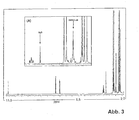
- novel substances pentaacetylcycline (A-ring-aromatized pentaacetyl-minocycline of the formula II) and tetraacetylcycline (A-ring-aromatised tetraacetyl-minocycline of the formula IV) which are listed by way of example by way of the process of the invention are prepared by mass spectroscopy (LC / MS , HR / MS), UV / VIS spectroscopy and characterized by 1 H and 13 C NMR. So shows Figure 2 For example, the UV / VIS spectra of both substances mentioned above and Figure 3 1 H-NMR of tetraacetylcycline of formula IV.
- H 2 O 2 reactive oxygen species
- ROS reactive oxygen species
- Pentaacetylcycles were carried out using an E. coli strain (Example 4). Pentaacetylcyclin has no antibiotic effect in comparison to the minocycline hydrochloride, which surprisingly a further desired biological effect was achieved.
- Minocycline hydrochloride (0.60 g, 1.215 mmol) was dissolved in 12 mL pyridine (11.73 g, 148.37 mmol) under ice-cooling (4 ° C) followed by the addition of 12 mL acetic anhydride (12.98 g, 127.18 mmol) with stirring. The mixture was then stirred at 4 ° C. for 30 minutes, at room temperature for 2 hours and at 75 ° C. for 30 minutes. The purification of the reaction product was carried out by vacuum liquid chromatography (VLC). For this purpose, silica gel 60 (75 g) was compacted in a glass suction filter under vacuum and preconditioned with petroleum benzine (boiling range: 40-60 ° C.).
- the reaction mixture was loaded onto the chromatographic column thus prepared and eluted with a petroleum benzine / ethyl acetate gradient (4/1, vol / vol to 100% EtOAc). Fractions containing the reaction product were pooled. After distilling off the solvent on a rotary evaporator, a residue (518.5 mg) was obtained, which was recrystallized from an ethyl acetate / petroleum benzine mixture and finally gave the almost pure pentaacetylcycline as a light yellow solid. The crude yield was 237.5 mg. For final cleaning, the product was subjected to another VLC. The pure yield was 181.9 mg (23% of theory).
- Pentaacetylcyclin A-ring aromatized pentaacetyl-minocycline:
- Tetraacetylcyclin was isolated by-product from the reaction mixture described in the exemplary embodiment chromatographically and then from the corresponding fraction, after distilling off the solvent and recrystallization from a petroleum benzine / ethyl acetate mixture, pure. Due to the bathochromic shift of the UV band over that of the pentaacetyl cyclic compound of the formula II, the enol form, corresponding to formula IV, is the most probable ( Figure 2 ). The other (non-enolic) OH or the NH 2 groups in the minocycline have a higher basicity and are therefore preferably acetylated.
- the 1 H NMR spectrum ( Figure 3 ) supports the structural proof.
- Astroglia cells ie rat non-neoplastic embryonic astrocyte cell line [ Chamaon, K., Kirches, E., Kanakis, D., Braeuninger, S., Dietzmann, K., and Mawrin, C. (2005). Regulation of the pituitary tumor transforming genes by insulin-like-growth factor-I and insulin differs between malignant and non-neoplastic astrocytes. Biochem Biophys Res Commun 331, 86-92 ] were cultured on poly-D-lysine coated coverslips at the bottom of culture dishes for 18 hours at 37 ° C (5% CO 2 ).
- the culture medium used in each case was 2 ml of DMEM (PAA Laboratories GmbH Pasching, Austria) and the seed density was 0.3 ⁇ 10 6 cells / 2 ml.
- the cell cultures were initially incubated with different concentrations (1.0, 5.0 and 25.0 ⁇ M) minocycline hydrochloride or pentaacetylcycline (formula II) for 30 minutes preincubated.
- the untreated control used was the sole addition of the solvent DMSO (2 ⁇ l / culture dish) under identical incubation conditions. This is followed by the addition of 1.0 or 3.0 mM H 2 O 2 (final concentration) and a further incubation for 2 hours.
- the correspondingly treated cells which were cultured only with 1.0 or 3.0 mM H 2 O 2 or only with minocycline hydrochloride or pentaacetylcycline, in the indicated concentrations.
- This protective effect of the A-ring-flavored pentaacetyl-minocycline is an improvement over minocycline hydrochloride, with which a similar protective effect can be observed only from 25 ⁇ M.
- minocycline hydrochloride and pentaacetylcycline do not damage the cells.
- the liquid culture (cultured in LB-Lennox-L-Broth base for 24 hours) of an E. coli suspension (150 ⁇ l) of strain C 600 hfc was evenly distributed on LB agar (Lennox-L agar, Gibco) using a sterile Drigalski spatula. Subsequently sterile filter paper leaflets (diameter 5.3 mm), which had previously been impregnated with sterile DMSO solutions and various concentrations (100 ⁇ M to 2.5 mM) of minocycline hydrochloride or pentaacetylcycline (formula II), were placed on the nutrient medium. After incubation of the plates at 37 ° C.
- the antibiotic activity of the substances was assessed on the basis of the diameter of the zones of inhibition, which become visible as a result of the lack of clouding by bacteria.
- minocycline hydrochloride concentration-dependent inhibits the growth of E. coli .
- pentaacetylcycline shows no growth inhibition even in the highest tested concentration of 2.5 mM and is therefore not antibiotic against the E. coli strain used.
Landscapes
- Chemical & Material Sciences (AREA)
- Organic Chemistry (AREA)
- Health & Medical Sciences (AREA)
- Chemical Kinetics & Catalysis (AREA)
- Life Sciences & Earth Sciences (AREA)
- Public Health (AREA)
- Medicinal Chemistry (AREA)
- Nuclear Medicine, Radiotherapy & Molecular Imaging (AREA)
- Veterinary Medicine (AREA)
- Pharmacology & Pharmacy (AREA)
- General Chemical & Material Sciences (AREA)
- Animal Behavior & Ethology (AREA)
- General Health & Medical Sciences (AREA)
- Communicable Diseases (AREA)
- Oncology (AREA)
- Engineering & Computer Science (AREA)
- Bioinformatics & Cheminformatics (AREA)
- Biomedical Technology (AREA)
- Neurology (AREA)
- Neurosurgery (AREA)
- Organic Low-Molecular-Weight Compounds And Preparation Thereof (AREA)
- Pharmaceuticals Containing Other Organic And Inorganic Compounds (AREA)
Description
- Die Erfindung betrifft ein Verfahren zur Synthese von A-Ring-aromatisierten Acetyl-Minocyclinen.
- Minocyclin (siehe FormelIII) ist ein semisynthetisches Breitband-Antibiotikum aus der Gruppe der Tetracycline, welches seit vielen Jahren in der klinischen Praxis zur Behandlung von infektiösen Erkrankungen der Atemwege, des Urogenital- und Gastrointestinaltraktes, bei verschiedenen Hauterkrankungen, wie Akne vulgaris, Rosacea, sowie bei Trachom, Clamydien-Conjunctivitis, Borreliose u.a. eingesetzt wird.
- Minocyclin hemmt die Proteinbiosynthese durch Bindung an die ribosomale 30S-Untereinheit, wodurch der Zugang von Aminoacyl-t-RNS zum RNS-Ribosomen-Komplex und damit die Verlängerung der Peptidkette verhindert wird.
- Neben der bereits bekannten antibiotischen Wirkung von Minocyclin rückte kürzlich ein anderer biologischer Effekt der Substanz in den Blickpunkt der Forschung. Erste Untersuchungen zeigen, dass Minocyclin offenbar einen schützenden Effekt bei verschiedenen Entzündungsprozessen und neurodegenerativen Erkrankungen hat (Yong, V.W., Wells, J., Giuliani, F., Casha, S., Power, C., and Metz, L.M. (2004). The promise of minocycline in neurology. Lancet Neurol 3, 744-751).
So wird Minocyclin gegenwärtig zur klinischen Behandlung fortschreitender Entzündungsprozesse, wie z.B. inflammatorischer rheumatoider Arthritis vorgeschlagen (Furst, D.E. (1998). Update on clinical trials in the rheumatic diseases. Curr Opin Rheumatol 10, 123-128). Entzündungsprozesse spielen eine große Rolle in der Pathogenese von neurodegenerativen Erkrankungen, wie der Alzheimer-Krankheit, Parkinson-Krankheit, Multipler Sklerose sowie bei posttraumatischen Hirn- und Rückenmarksverletzungen. - Die Schrift
DE 38 81 024 T2 offenbart ein Verfahren zur Herstellung von Tetracyclinderivaten, wie bspw. Minocyclin, dass mehrstufig ist, unter dem Einsatz von Katalysatoren auf einem Träger unter Verwendung von organischem Lösungsmittel und Druck abläuft, wobei lediglich die Enthalogenierung und Hydrierung in einem Schritt durchgeführt werden.
Der Nachteil dieses Herstellungsverfahrens ist, dass es aufwendig und damit sehr kostenintensiv ist. Darüber hinaus werden bei dem Verfahren u.a. selenhaltige Legierungen als Katalysator eingesetzt. - Die Schrift
WO 2005/070878 offenbart A-Ring-aromatisierte Tetracyclinderivate und ein Verfahren zu deren Herstellung.
Die Herstellung von A-Ring-aromatisierten Tetracyclinen, wie sie in dieser Offenlegung beschrieben ist, gelingt prinzipiell, setzt jedoch mehrere Reaktionsstufen und eine aufwendige Reinigung der Reaktionsprodukte durch präparative HPLC voraus, welche für eine industrielle und somit rentable Gewinnung der Wirkstoffe, z.B. im Gramm- oder Kilogramm-Maßstab, ungeeignet ist. - Aufgrund der gefundenen biologischen und pharmakologischen Wirkungen ist die Verwendung von Minocyclin zur Behandlung neurodegenerativer Erkrankungen sehr interessant. Die Untersuchung von Minocyclin als Leitstruktur stellt dabei einen attraktiven Ansatz bei der Suche nach neuroprotektiven Wirkstoffen dar.
- Eine Optimierung und Verbesserung der Minocyclin-Leitstruktur ist dabei in zwei Richtungen möglich:
- 1. Verbesserung der Pharmakokinetik, z.B. durch Realisierung eines 'Prodrug'-Konzeptes.
- 2. Aufhebung der antibiotischen Aktivität, wenn diese für die Wirkung als neuroprotektive Substanz nicht relevant ist, um einen Selektionsdruck auf Mikroorganismen in Richtung einer Resistenzentwicklung auszuschließen.
- Das 'Prodrug'-Konzept ist dem Fachmann als Methode bekannt, um hydrophile Wirkstoffmoleküle chemisch so zu verändern, dass sich zum einen ihre Lipophilie und damit die Aufnahmefähigkeit durch Membranen erhöht, zum anderen die eigentlichen Wirkstoffinoleküle erst aus einer Vorstufe ('Prodrug') in den Zellen gebildet werden. Hierbei dient die Vorstufe ('Prodrug') u.a. als Transporter ('Carrier').
- Eine 'Prodrug' ist per Definition ein Stoff bzw. ein Medikament, das ohne Verstoffwechselung pharmakologisch nicht oder wenig wirksam ist und erst durch die Verstoffwechselung im Körper in einen aktiven Wirkstoff überführt wird. 'Prodrugs' sind in denjenigen Fällen von strategischer Bedeutung, in denen der eigentliche Wirkstoff nur geringfügig und wenig selektiv den Wirkort erreicht.
Das 'Prodrug'-Konzept zielt dabei auf eine Verbesserung der pharmakokinetischen Eigenschaften der Wirkstoffmoleküle ab, um z.B. deren Resorbierbarkeit/Bioverfügbarkeit zu verbessern oder bei einem Psychopharmakon bzw. Neuroprotektivum die Blut-Hirn-Schranken-Gängigkeit zu ermöglichen. - Hydrophile Wirkstoffmoleküle, wie Minocyclin besitzen aufgrund von freien Hydroxyl(OH)- bzw. Amino(NH2)-Gruppen oftmals zwar eine gute Wasserlöslichkeit, was ihre pharmazeutische Formulierbarkeit begünstigt, sind aber relativ schlecht membrangängig.
Eine Möglichkeit der Senkung ihrer Polarität ist die Einführung von apolaren Schutzgruppen. Als apolare Schutzgruppe (engl. 'prodrug moiety') hat sich die Acetyl-Gruppe (CH3CO) bewährt, die nach Abspaltung in den Zellen freie Essigsäure bildet, welche einen natürlichen Metaboliten des Zellstoffwechsels darstellt. Sowohl OH- als auch NH2-Gruppen lassen sich durch Acetyl-Gruppen maskieren. Die Polarität der acetylierten Moleküle ist ähnlich der biologischer Membranen, wobei eine stärkere Wechselwirkung mit Lipiden und somit erhöhte Diffusion in das Gewebe erreicht wird ('Carrier'-Effekt). Nach Aufnahme der acetylierten 'Prodrug' in die Zellen werden die Acetyl-Gruppen durch unspezifische Esterasen abgespalten, wodurch das eigentliche Wirkstoffmolekül endogen freigesetzt wird und hier in Aktion treten kann. - Die 'Prodrug' stellt außerdem eine Retardform des Wirkstoffmoleküls dar, die eine verzögerte Freisetzung und ein günstigeres pharmakologisches Verhalten impliziert.
In der Literatur sind bisher nur wenige vom Minocyclin abgeleitete neuroprotektive Wirkstoffmoleküle beschrieben, die zwar den Naturstoff zum Vorbild haben, mit denen jedoch bisher kein 'Prodrug'-Konzept verfolgt wird [Wang, R., Du, Y., and Liu, Zhou, Z., Wang, H., Wang, X., (J. (2004). Synthesis and neuroprotective activity of novel C4, C7 derivates in tetracycline series. J Chin Pharm Sei 13, 217-220]. - Die Aufgabe der vorliegenden Erfindung ist es, die Nachteile des Standes der Technik zu vermeiden, in dem ein aufwandgeringes Verfahren zur Herstellung von A-Ring-aromatisierten Acetyl-Minocyclinen der Formel I bereitgestellt wird, das auch in industriellem Maßstab durchführbar ist.
- Die vorliegende Erfindung löst dieses Problem durch die Bereitstellung der Lehre der unabhängigen Verfahrens-, Produkt- und Verwendungsansprüche.
- Hierzu wird erfindungsgemäß vorgeschlagen, eine Ein- oder Mehrfach-Acetylierung der Leitstruktur unter gleichzeitiger Wasserabspaltung und Aromatisierung des A-Ringes in einem Schritt durchzuführen, um zu einem neuroprotektiven Wirkstoff zu gelangen.
- Dabei zeigt sich überraschenderweise, dass durch eine Einstufen-Reaktion von Minocyclinhydrochlorid mit Essigsäureanhydrid (Acetanhydrid) in Gegenwart eines organischen Protonenfängers A-Ring-aromatisierte ein- oder mehrfachacetylierte Minocycline der Formel I (wobei R1 bis R5 = Acetyl und / oder H sind) durch Acetylierung von Minocyclinhydrochlorid, die präparative chromatographische Aufreinigung bzw. Trennung der Reaktionsprodukte und die anschließende weiterführende Reinigung durch Umkristallisation der entsprechenden Produkte aus einem Ethylacetat / Petroleumbenzin-Gemisch erhalten werden.
- Solche A-Ring-aromatisierten Acetyl-Minocycline der Formel I (mit R1 bis R5 = Acetyl und/oder H) setzen nach Verstoffwechselung im Organismus A-Ring-aromatisiertes Minocyclin der Formel I (mit R1 bis R5 = H) frei, welches eine zell- bzw. neuroprotektive, jedoch keine antibiotische Wirkung mehr aufweist.
- Die Herstellung von ein- oder mehrfachacetylierten A-Ring-aromatisierten Minocyclinen der Formel I (wobei R1 bis R5 = Acetyl und / oder H sind) erfolgt durch die Reaktion von Minocyclinhydrochlorid mit Acetanhydrid in Gegenwart eines organischen Protonenfängers. Dabei wird vorzugsweise ein äquimolarer Überschuss an Acetanhydrid bzw. organischem Protonenfänger verwendet, wobei diese gleichzeitig Lösungsmittel für das Minocyclinhydrochlorid sind.
Genauso können aber auch äquimolare Mengen der Edukte, entsprechend der Anzahl einzuführender Acetyl-Gruppen eingesetzt werden, wobei verminderte Mengen an Acetanhydrid und Protonenfänger gegebenenfalls durch ein inertes Lösungsmittel zu ersetzen sind. Geeignete inerte Lösungsmittel für die Edukte sind beispielsweise Chloroform, Methylenchlorid, Nitromethan, Acetonitril, Aceton, Sulfolan, Dimethylformamid oder Dimethylsulfoxid. - Als organischer Protonenfänger wird bevorzugt Pyridin verwendet, wobei man die Reaktion in einem Temperaturbereich von 4 bis 100 °C, besonders bevorzugt bei 75 °C bzw. unterhalb der Siedetemperatur des Reaktionsgemisches ablaufen lässt.
Anstelle von Pyridin können auch andere Protonenfänger wie beispielsweise primäre, sekundäre oder tertiäre Amine bzw. Carbonsäureamide verwendet werden. - Die Umsetzung wird üblicherweise bei Normaldruck unter Rühren der Reaktionsmischung durchgeführt. Dabei verwendet man eine Glas-Reaktionsappartur mit Rückflusskühler, wobei entstehende Lösungsmitteldämpfe kondensiert und kontinuierlich in die Reaktionsmischung zurückgeführt werden.
- Das erfindungsgemäße Verfahren kann jedoch auch unter verminderten oder erhöhten Druck durchgeführt werden. Die Anwendung von erhöhtem Druck ist insbesondere dann angezeigt, wenn man die Reaktion bei einer Temperatur durchführen will, bei der das Lösungsmittel unter Normaldruck siedet.
- Überraschenderweise können mittels des erfindungsgemäßen Verfahrens in einem Reaktionsschritt die beiden neuartigen Substanzen Pentaacetylcyclin (A-Ring-aromatisiertes Pentaacetyl-Minocyclin) und Tetraacetylcyclin (A-Ring-aromatisiertes Tetraacetyl-Minocyclin) gewonnen werden, welche bisher nicht publiziert sind.
Abbildung 1 zeigt beispielhaft das LC(HPLC)-Chromatogramm und die korrespondierenden Massenspektren der zwei Hauptkomponenten eines Reaktionsgemisches nach Einsatz von überschüssigem Acetanhydrid. Es ist die hohe Selektivität der Reaktion für das pentaacetylierte Produkt (Formel II undAbbildung 1B ) erkennbar. Durch Optimierung der Reaktionsbedingungen kann die Selektivität für das entsprechende Zielprodukt noch weiter erhöht werden, wodurch sich nachfolgend beschriebene Reinigungsschritte vereinfachen bzw. erübrigen. - In dem hier beschriebenen erfindungsgemäßen Verfahren wird nach Ablauf der Reaktionszeit eine chromatographische Trennung bzw. Reinigung der Produkte mit Hilfe der VLC (Vakuum-Flüssigkeitschromatographie) durchgeführt.
Die VLC-Methode kann, je nach technischer Ausführung, auch im industriellen Maßstab durchgeführt werden. Dazu wird das Reaktionsgemisch vorzugsweise auf ein mit Petroleumbenzin (Siedebereich: 40 - 60 °C) oder einem anderen Kohlenwasserstoff, wie n-Pentan, n-Hexan, Cyclohexan oder Isobutan vorkonditioniertes Trägermaterial gegeben, welches sich in einem Büchner-Trichter mit Frittenboden, einer Chromatographie-Säule oder einem Hängegefäß mit Siebboden befindet. Durch Vakuum-Zug (VLC) oder mit Hilfe von Überdruck wird der Eluent nun durch das Trägermaterial (stationäre Phase) geleitet.
Die Elution der Zielverbindungen erfolgt anschließend durch Aufgabe eines Lösungsmittel-Gradientengemisches, bestehend aus einem Kohlenwasserstoff und einem Carbonsäureester, wobei man die Polarität des Gemisches durch höhere Anteile des Carbonsäureesters während der Elution steigert. - In dem hier vorgestellten erfindungsgemäßen Verfahren wird zur Elution der Zielverbindungen besonders bevorzugt ein Gemisch aus Petroleumbenzin und Ethylacetat verwendet. Es ist jedoch auch möglich, dass anstelle dessen Eluenten-Gemische von Kohlenwasserstoffen mit anderen Carbonsäureestern, wie Methylformiat, n-Butylacetat oder Dimethylcarbonat, verwendet werden können.
Als Trägermaterial (stationäre Phase) werden Kieselgel (z.B. Kieselgel 60), Aluminiumoxid, 'reversed phase'-Kieselgel oder Sephadex verwendet.
Nach Abtrennung entsprechender Fraktionen, welche die angereicherten Zielverbindungen enthalten, wird der Eluent unter vermindertem Druck durch Verwendung eines Rotationsverdampfers abdestilliert und der Rückstand aus einem der vorstehend genannten Lösungsmittel-Gemische umkristallisiert.
Zur Umkristallisation wird im erfindungsgemäßen Verfahren die entsprechende Zielverbindung zunächst unter leichtem Erwärmen in Ethylacetat gelöst und dann durch Zusatz von Petroleumbenzin, somit durch Verminderung des Löslichkeitsproduktes, eine Kristallisation eingeleitet.
Nach vollständiger Kristallisation, wobei man die Mischung für einige Stunden auf 4 °C kühlt, filtriert man die Zielverbindung mit Hilfe einer Filternutsche ab und entfernt Lösungsmittelreste durch Trocknung im Vakuum.
Die hier im Folgenden beispielhaft aufgeführten, vermittels des erfindungsgemäßen Verfahrens hergestellten neuartigen Substanzen Pentaacetylcyclin (A-Ring-aromatisiertes Pentaacetyl-Minocyclin der Formel II) und Tetraacetylcyclin (A-Ring-aromatisiertes Tetraacetyl-Minocyclin der Formel IV) wurden durch Massenspektroskopie (LC/MS, HR/MS), UV/VIS-Spektroskopie sowie durch 1H- und 13C-NMR charakterisiert.
So zeigtAbbildung 2 beispielhaft die UV/VIS-Spektren beider vorstehend genannter Substanzen undAbbildung 3 das 1H-NMR von Tetraacetylcyclin der Formel IV.
Die Prüfung der zellschützenden Eigenschaften der durch das erfindungsgemäße Verfahren dargestellten Substanzen erfolgte, beispielhaft an rein dargestelltem Pentaacetylcyclin der Formel II, mit Hilfe eines Astrozytenschädigungsmodells. Dieses Modell dient der Untersuchung durch oxidativen Stress vermittelter neurodegenerativer Erkrankungen bzw. zur Testung von zellschützenden Substanzen, mit denen eine solche Schädigung verhindert bzw. verringert werden kann. In dem beispielhaft verwendeten Modell werden Astrozyten mit Hilfe von Wasserstoffperoxid (H2O2) geschädigt und anschließend die Funktionalität und Morphologie der Zellen und Mitochondrien mikroskopisch beurteilt. Eine Überproduktion von H2O2, als reaktive Sauerstoffspezies (ROS), gilt im ZNS u.a. als Auslöser vieler neurodegenerativer Prozesse und Erkrankungen, wie Schlaganfall, Alzheimer-Krankheit, Parkinson-Krankheit, post-traumatischen Hirn- und Spinalverletzungen. Erstaunlicherweise vermochte Pentaacetylcyclin der Formel II gegenüber der Vergleichssubstanz Minocyclinhydrochlorid bereits in viel niedrigerer Dosierung die Schädigung der Mitochondrien deutlich zu vermindern (Beispiel 3 und Abbildung 4). Dieser Befund ist überraschend und zeigt die herausragenden Wirkeigenschaften der beispielhaft getesteten Substanz. - Die Überprüfung der antibiotischen Aktivität des durch das erfindungsgemäße Verfahren gewonnenen Pentaacetylcyclins erfolgte unter Verwendung eines E. coli-Stammes (Beispiel 4). Pentaacetylcyclin weist im Vergleich zum Minocyclinhydrochlorid keine antibiotische Wirkung mehr auf, womit überraschenderweise ein weiterer angestrebter biologischer Effekt erreicht wurde.
- Die Erfindung wird nachstehend an Hand der folgenden Ausführungsbeispiele und Abbildungen näher erläutert.
- Abb.l:
- Chromatogramm einer LC/MS-Analyse des erfindungsgemäßen Reaktionsgemisches vor der Aufreinigung, wobei
- (A) -Analytisches LC-Chromatogramm des Reaktionsgemisches,
- (B) -Massenspektrum des Pentaacetylcyclins (Analyse des Peak bei 11,69 min) und
- (C) -Massenspektrum des Tetraacetylcyclins (Analyse des Peak bei 12,37 min) bedeuten,
- Abb. 2:
- UV/VIS-Spektren von Pentaacetylcyclin (A) und Tetraacetylcyclin (B), hergestellt gemäß dem erfindungsgemäßen Verfahren, sowie
- Abb.3:
- 1H-NMR-Spektrum von Tetraacetylcyclin (in DMSO-d6) hergestellt gemäß dem erfindungsgemäßen Verfahren, wobei (A) eine vergrößerte Darstellung des Bereich von 2.0 - 3.6 ppm darstellt.
- Minocyclinhydrochlorid (0,60 g; 1,215 mmol) wurde unter Eiskühlung (4 °C) in 12 ml Pyridin (11,73 g; 148,37 mmol) gelöst und anschließend unter Rühren 12 ml Acetanhydrid (12.98 g, 127.18 mmol) hinzugefügt. Dann wurde die Mischung 30 Minuten bei 4 °C, 2 Stunden bei Raumtemperatur und 30 Minuten bei 75 °C nachgerührt. Die Reinigung des Reaktionsproduktes erfolgte durch Vakuumflüssigkeits-Chromatographie (VLC). Dazu wurde Kieselgel 60 (75 g) in einer Glasfilternutsche unter Vakuumzug verdichtet und mit Petroleumbenzin (Siedebereich: 40 - 60 °C) vorkonditioniert. Das Reaktionsgemisch wurde auf die so vorbereitete Chromatographiesäule geladen und mit einem Petroleumbenzin / Ethylacetat-Gradienten (4/1, vol/vol bis 100 % EtOAc) eluiert. Fraktionen, die das Reaktionsprodukt enthielten, wurden vereinigt. Nach Abdestillieren des Lösungsmittels am Rotationsverdampfer wurde ein Rückstand (518,5 mg) erhalten, der aus einem Ethylacetat / Petroleumbenzin-Gemisch umkristallisiert wurde und schließlich das fast reine Pentaacetylcyclin als hellgelben Feststoff lieferte. Die Roh-Ausbeute betrug 237,5 mg. Zur Endreinigung wurde das Produkt einer weiteren VLC unterworfen. Die Reinausbeute betrug 181,9 mg (23 % d. Theorie). Die analytische Kontrolle der jeweiligen Fraktionen erfolgte über Dünnschichtchromatographie (DC mit Fluoreszenzindikator, Polygram SIL G/UV254, Firma Macherey & Nagel) mit Kieselgel 60 als stationäre Phase und Petroleumbenzin/Ethylacetat (1/3, vol/vol) als mobile Phase. Für Zellkulturexperimente bzw. zur Testung der antibiotischen Wirkung wurden Stammlösungen der Substanz in DMSO hergestellt, mit Hilfe von Nalgene-Nylonfiltern (0,22 µm Porengröße) steril filtriert und bis zur Verwendung bei -20 °C gelagert.
-
- Rf (DC) = 0,50
- UV-VIS (λmax in MeOH): 330 nm (log ε 4,27)
- LC/MS (positive ion mode): 723 [M + C3H6O2]+, 688 [M + K]+, 672 [M + Na]+, 650 [M + H]+, 608 [650 - Acetyl + H]+, 590 [608 - H2O], 565 [608 - Acetyl]+, 548 [590 - Acetyl + H]+, 506 [548 - Acetyl + H]+
- HR-ESI-MS (negative ion mode): (M - H-) gef. 648,2198825, C33H34O11N3, dev. 2,5 ppm
- HR-ESI-MS: (M - Acetyl) gef. 606,2093178 (M - Acetyl), C31H32O10N3, dev. 1,2 ppm
- HR-ESI-MS (positive ion mode): (M+Na+) gef. 672,21638, C33H35O11N3Na, dev. 2,4 ppm
- 1H-NMR (DMSO-d6): δ (ppm) 2,16 (s, CH3); 2,23 (s, CH3); 2,27 (s, CH3); 2,28 (s, 2 CH3); 2,56 (m, CH); 2,66 (s, N(CH3)2); 2,73 (s, N(CH3)2); 2,76 (m, CH2, überlagert von N(CH3)2-Signal); 3,48 (m, CH2); 7,00 (d, J = 8,6 Hz, aromat. CH); 7,29 (d, J = 8,2 Hz, aromat. CH); 11,08 (br s, NH)
- 13C-NMR (DMSO-d6): Signale, Auswahl δ (ppm) 13,9; 20,2; 20,6; 24,6; 31,7; 42,4; 43,9; 59,5; 122,0; 124,5; 139,9; 148,5; 161,7; 167,2; 167,8; 168,1; 168,9; 169,8
- Tetraacetylcyclin wurde als Nebenprodukt aus dem, im Ausführungsbeispiel beschriebenen Reaktionsgemisch chromatographisch isoliert und anschließend aus der entsprechenden Fraktion, nach Abdestillieren des Lösungsmittels und Umkristallisation aus einem Petroleumbenzin/Ethylacetat-Gemisch, rein gewonnen. Aufgrund des bathochromen Shifts der UV-Bande gegenüber der des Pentaacetylcyclins der Formel II ist die Enol-Form, entsprechend Formel IV, am wahrscheinlichsten (
Abbildung 2 ). Die anderen (nicht enolischen) OH- bzw. die NH2-Gruppen im Minocyclin weisen eine höhere Basizität auf und werden deshalb bevorzugt acetyliert. Das 1H-NMR-Spektrum (Abbildung 3 ) unterstützt den Strukturbeweis. -
- Rf (DC) = 0,57
- UV-VIS (λmax): 252,381 (log s 4,27)
- LC/MS (positive ion mode): 681 [M + C3H6O2]+, 646 [M + K]+, 630 [M + Na]+, 608 [M + H]+, 566 [608 - Acetyl + H]+, 548 [566 - H2O]+, 524 [566 - Acetyl + H]+, 506 [524 - H2O]+
- 1H-NMR (DMSO-d6): δ (ppm) 2,16 (s, CH3); 2,22 (s, CH3); 2,27 (s, CH3); 2,29 (s, CH3); 2,49 (dt, J = 13,7 Hz, CH2); 2,63 (m, J = 4,5; 13,6 Hz; CH); 2,66 (s, N(CH3)2); 2,72 (s, N(CH3)2); 3,50 (dt, J = 4,5; 14,9 Hz; CH); 7,04 (d, J = 8,6 Hz; aromat. CH); 7,37 (d, J = 8,6 Hz; aromat. CH); 11,10 (s, NH)
- Astrogliazellen, d.h. nicht-neoplastische embryonale Astrozyten-Zelllinie der Ratte [Chamaon, K., Kirches, E., Kanakis, D., Braeuninger, S., Dietzmann, K., and Mawrin, C. (2005). Regulation of the pituitary tumor transforming gene by insulin-like-growth factor-I and insulin differs between malignant and non-neoplastic astrocytes. Biochem Biophys Res Commun 331, 86-92] wurden auf mit Poly-D-Lysin beschichteten Deckgläschen am Boden von Kulturschalen für 18 Stunden bei 37 °C (5 % CO2) kultiviert. Als Kulturmedium diente jeweils 2 ml DMEM (PAA Laboratories GmbH Pasching, Österreich) und die Einsaatdichte betrug 0,3 x 10⁶ Zellen/2 ml. Die Zellkulturen wurden zunächst mit unterschiedlichen Konzentrationen (1,0; 5,0 bzw. 25,0 µM) Minocyclinhydrochlorid bzw. Pentaacetylcyclin (Formel II) für 30 Minuten vorinkubiert. Als unbehandelte Kontrolle diente die alleinige Zugabe des Lösungsmittels DMSO (2 µl/Kulturschale) unter identischen Inkubationsbedingungen. Danach erfolgt die Zugabe von 1,0 bzw. 3,0 mM H2O2 (Endkonzentration) und eine weitere Inkubation für 2 Stunden. Als Vergleich dienten die entsprechend behandelten Zellen, welche nur mit 1,0 bzw. 3,0 mM H2O2 oder nur mit Minocyclinhydrochlorid bzw. Pentaacetylcyclin, in den angegebenen Konzentrationen kultiviert wurden. Nach Austausch des Kulturmediums gegen 2 ml auf 37 °C temperierten HEPES-Puffer (10 mM HEPES, 140 mM NaCl, 5 mM KCl, 2 mM CaCl2, 10 mM D-Glukose, pH 7,4) fand eine weitere Inkubation der Zellen für 30 Minuten statt. Darauf folgte die Zugabe von 40 nM MitoTracker® Orange CMTMRos (1 µl einer 80 µM Stammlösung der oxidierten Form, Bestell-Nr. M7510; λAnregung = 554 nm, λEmission = 576 nm; Molecular Probes Inc., Eugene, USA). Nach 30-minütiger Inkubation bei 37 °C wurden die Zellkulturen in 4% Paraformaldehyd (m/vol in HEPES-Puffer) für 30 Minuten fixiert, zur Entfernung des Fixationsmittels dreimal für 10 Minuten mit 0,1 M PBS gespült und anschließend die Deckgläschen mit den fixierten Zellen auf Objektträger in ImmuMount® befestigt. Zur visuellen Untersuchung und Dokumentation kam ein Zeiss-Axiophot-Fluoreszensmikroskop mit CCD-Kamera (AxioCam MRc) zum Einsatz.
Unbehandelte Kontrollzellen stellen sich als polygonale Zellkörper mit 2-3 langgestreckten Fortsätzen dar und erscheinen bei ausreichender Zelldichte als ein zelluläres Netz. Fadenförmige Mitochondrien sind im Zytoplasma bis in die Zellfortsätze hinein verteilt. Nach 2-stündiger Inkubation mit 1 mM H2O2 (ohne Minocyclin bzw. Pentaacetylcyclin) sind die Mehrzahl der Zellen geschädigt und zeigen einen deutlichen Rückzug ihrer Fortsätze. Dadurch verlieren die Zellkörper ihre polygonale Form und tendieren zur Abrundung. Infolge von Fission sind die Mitochondrien stark verkürzt und werden in Richtung des Zellkerns disloziert. Mit 3 mM H2O2 sind diese zellschädigenden Prozesse verstärkt. Die Dichte der haftenden Zellen ist verringert, die Zellkörper sind weit mehr abgerundet und die noch stärker verkürzten Mitochondrien sind nahe dem Zellkern akkumuliert. Die Zugabe von 25 µM Minocyclinhydrochlorid zu den zuvor mit H2O2 geschädigten Zellen hat einen schützenden Effekt. Die Zellen erhalten weitgehend ihre polygonale Gestalt und die Mitochondrien sind weniger verkürzt. Überraschenderweise zeigte sich, dass bei Verwendung von Pentaacetylcyclin schon bei der viel niedrigeren Konzentration von 1,0 µM die H2O2-induzierte Schädigung der Mitochondrien deutlich verringert wird. Dieser Schutzeffekt des A-Ring-aromatisierten Pentaacetyl-Minocyclins ist eine Verbesserung gegenüber Minocyclinhydrochlorid, mit welchem erst ab 25 µM eine ähnliche Schutzwirkung beobachtet werden kann. In dem genutzten Testsystem und den hier verwendeten Konzentrationen schädigen Minocyclinhydrochlorid und Pentaacetylcyclin die Zellen nicht. - Die Flüssigkultur (24 Stunden in LB-Lennox-L-Broth-Base kultiviert) einer E. coli-Suspension (150 µl) des Stammes C 600 hfc wurde auf LB-Agar (Lennox-L-Agar, Gibco) mit Hilfe eines sterilen Drigalski-Spatels gleichmäßig verteilt. Anschließend wurden sterile Filterpapierblättchen (Durchmesser 5,3 mm), die zuvor mit sterilen DMSO-Lösungen sowie unterschiedlichen Konzentrationen (100 µM bis 2,5 mM) von Minocyclinhydrochlorid bzw. Pentaacetylcyclin (Formel II) getränkt wurden, auf den Nährboden aufgelegt. Nach Inkubation der Platten bei 37 °C für 24 Stunden erfolgte die Beurteilung der antibiotischen Aktivität der Substanzen anhand der Durchmesser der Hemmhöfe, welche durch die fehlende Eintrübung durch Bakterien sichtbar werden. An Hand der unterschiedlichen Größe der Hemmhöfe ist erkennbar, dass Minocyclinhydrochlorid konzentrationsabhängig das Wachstum von E. coli inhibiert. Hingegen zeigt Pentaacetylcyclin selbst in der höchsten getesteten Konzentration von 2,5 mM keine Wachstumshemmung und ist demzufolge gegen den verwendeten E. coli Stamm nicht antibiotisch wirksam.


Claims (18)
- Verfahren zur Herstellung von A-Ring-aromatisierten Acetyl-Minocyclinen

- Verfahren gemäß Anspruch 1, dadurch gekennzeichnet, dass als Protonenfänger eine organische Base verwendet wird.
- Verfahren gemäß den Ansprüchen 1 und 2, dadurch gekennzeichnet, dass die Base ein primäres, sekundäres oder tertiäres Amin ist.
- Verfahren gemäß Anspruch 1 oder 2, dadurch gekennzeichnet, dass der Protonenfänger bevorzugt Pyridin ist.
- Verfahren gemäß Anspruch 1 oder 2, dadurch gekennzeichnet, dass das Acetanhydrid und der Protonenfänger im Überschuss oder äquimolar, entsprechend der Anzahl der einzuführenden Acetylgruppen, eingesetzt werden.
- Verfahren nach einem oder mehrerer der voran stehenden Ansprüche, dadurch gekennzeichnet, dass die Umsetzung der Edukte in einem inerten Lösungsmittel erfolgt.
- Verfahren gemäß Anspruch 6, dadurch gekennzeichnet, dass das Lösungsmittel Chloroform, Methylenchlorid, Nitromethan, Acetonitril, Aceton, Sulfolan, Dimethylformamid oder Dimethylsulfoxid ist.
- Verfahren nach einem oder mehrerer der voran stehenden Ansprüche, dadurch gekennzeichnet, dass die Umsetzung bei einer Temperatur von 4 bis 100° C, bei Normal- oder Überdruck durchgeführt wird.
- Verfahren nach einem oder mehrerer der voran stehenden Ansprüche, dadurch gekennzeichnet, dass Pentaacetylcyclin (A-Ring-aromatisiertes Pentaacetyl-Minocyclin) der Formel II

- Verfahren nach einem oder mehrerer der voran stehenden Ansprüche, dadurch gekennzeichnet, dass je nach Reaktionsführung andere A-Ring-aromatisierte, ein- oder mehrfachacetylierte Minocycline der Formel I (mit R1 bis R5 = Acetyl und/oder H, wobei mindestens ein R =Acetyl) synthetisiert werden, wobei die Anzahl der Acetylgruppen im Molekül kleiner oder gleich 5 ist.
- Verfahren nach einem oder mehrerer der voran stehenden Ansprüche, dadurch gekennzeichnet, dass als Nebenprodukt besonders bevorzugt das Tetraacetylcyclin (A-Ring-aromatisiertes Tetraacetyl-Minocyclin) der Formel IV

- Verfahren nach einem oder mehrerer der voran stehenden Ansprüche, dadurch gekennzeichnet, dass die chromatographische Reinigung der Reaktionsprodukte an Kieselgel 60 (Silicagel) oder einem anderen Trägermaterial wie Aluminiumoxid, 'reversed-phase'-Silicagel oder Sephadex durchgeführt wird.
- Verfahren nach einem oder mehrerer der voran stehenden Ansprüche, dadurch gekennzeichnet, dass die chromatographische Aufreinigung im Festbett, in einer Chromatographiesäule, in einem Büchner-Trichter mit Glasfritten-Einsatz oder einem Hängegefäß mit Siebboden-Einlage erfolgt.
- Verfahren nach einem oder mehrerer der voran stehenden Ansprüche, dadurch gekennzeichnet, dass zur Elution über das Trägermaterial und zur Umkristallisation der Reaktionsprodukte besonders bevorzugt ein Gemisch aus Ethylacetat und Petroleumbenzin verwendet wird.
- Verfahren nach einem oder mehrerer der voran stehenden Ansprüche, dadurch gekennzeichnet, dass an Stelle von Ethylacetat und Petroleumbenzin auch Methylformiat, n-Butylacetat, Dimethylcarbonat bzw. andere Kohlenwasserstoffe wie n-Pentan, n-Hexan, Cyclohexan oder Isobutan eingesetzt werden.
- A-Ring-aromatisiertes Pentaacetylminocyclin der Formel II

- A-Ring-aromatisiertes Tetraacetylminocyclin der Formel IV

- Verwendung des Wirkstoffes gemäß einem der Ansprüche 16 oder 17 zur Herstellung eines Medikamentes, welches zur Behandlung von durch oxidativen Stress und/oder mitochondriale Schädigungen vermittelter neurodegenerativer Erkrankungen eingesetzt werden kann.
Applications Claiming Priority (2)
| Application Number | Priority Date | Filing Date | Title |
|---|---|---|---|
| DE102007034259A DE102007034259A1 (de) | 2007-07-20 | 2007-07-20 | Verfahren zur Synthese von A-Ring-aromatisierten Acetyl-Minocyclinen |
| PCT/DE2008/001055 WO2009012741A1 (de) | 2007-07-20 | 2008-06-25 | Verfahren zur synthese von a-ring-aromatisierten acetyl-minocyclinen |
Publications (2)
| Publication Number | Publication Date |
|---|---|
| EP2178825A1 EP2178825A1 (de) | 2010-04-28 |
| EP2178825B1 true EP2178825B1 (de) | 2015-03-11 |
Family
ID=39876861
Family Applications (1)
| Application Number | Title | Priority Date | Filing Date |
|---|---|---|---|
| EP08784256.3A Not-in-force EP2178825B1 (de) | 2007-07-20 | 2008-06-25 | Verfahren zur synthese von a-ring-aromatisierten acetyl-minocyclinen |
Country Status (4)
| Country | Link |
|---|---|
| US (1) | US20100173991A1 (de) |
| EP (1) | EP2178825B1 (de) |
| DE (2) | DE102007034259A1 (de) |
| WO (1) | WO2009012741A1 (de) |
Families Citing this family (6)
| Publication number | Priority date | Publication date | Assignee | Title |
|---|---|---|---|---|
| EP2659887A1 (de) | 2012-05-03 | 2013-11-06 | Otto-von-Guericke-Universität Magdeburg | Verwendung A-Ring-aromatisierter Acetyl-Minocycline und pharmazeutischer Zubereitungen daraus zur Therapie und Prophylaxe entzündlicher Erkrankungen, Autoimmunerkrankungen und Transplantatabstoßungen |
| WO2014141110A2 (en) * | 2013-03-14 | 2014-09-18 | Curadev Pharma Pvt. Ltd. | Aminonitriles as kynurenine pathway inhibitors |
| WO2019241466A1 (en) | 2018-06-13 | 2019-12-19 | Texas Tech University System | Modified tetracycline for treatment of alcohol use disorder, pain and other disorders involving potential inflammatory processes |
| EP4117671A4 (de) | 2020-03-10 | 2024-04-10 | Texas Tech University System | Neue modifizierte tetracycline zur behandlung von alkoholmissbrauch, schmerzen und anderen erkrankungen mit potenziellen entzündlichen prozessen |
| WO2023147011A1 (en) * | 2022-01-27 | 2023-08-03 | Vimu Therapeutics | Compositions and methods for inhibiting severe acute respiratory syndrome (sars) coronavirus-2 (sars-cov-2) |
| WO2025090761A1 (en) * | 2023-10-24 | 2025-05-01 | Texas Tech University System | Treatment of retinal degeneration with minocycline and minocycline analogs |
Family Cites Families (4)
| Publication number | Priority date | Publication date | Assignee | Title |
|---|---|---|---|---|
| HU198173B (en) | 1987-09-18 | 1989-08-28 | Chinoin Gyogyszer Es Vegyeszet | Process for producing doxycycline |
| MY140194A (en) * | 2003-07-16 | 2009-11-30 | Leo Pharma As | Novel fusidic acid derivatives |
| US7786099B2 (en) | 2004-01-15 | 2010-08-31 | Paratek Pharmaceuticals, Inc. | Aromatic a-ring derivatives of tetracycline compounds |
| EP2016044B1 (de) * | 2006-04-07 | 2020-06-10 | President and Fellows of Harvard College | Pentacylin-derivate zur behandlung von infektionen |
-
2007
- 2007-07-20 DE DE102007034259A patent/DE102007034259A1/de not_active Withdrawn
-
2008
- 2008-06-25 WO PCT/DE2008/001055 patent/WO2009012741A1/de not_active Ceased
- 2008-06-25 US US12/669,913 patent/US20100173991A1/en not_active Abandoned
- 2008-06-25 EP EP08784256.3A patent/EP2178825B1/de not_active Not-in-force
- 2008-06-25 DE DE112008002579T patent/DE112008002579A5/de not_active Withdrawn
Also Published As
| Publication number | Publication date |
|---|---|
| DE102007034259A1 (de) | 2009-01-22 |
| EP2178825A1 (de) | 2010-04-28 |
| US20100173991A1 (en) | 2010-07-08 |
| DE112008002579A5 (de) | 2010-07-01 |
| WO2009012741A1 (de) | 2009-01-29 |
Similar Documents
| Publication | Publication Date | Title |
|---|---|---|
| DE69305322T2 (de) | Salpetersäureester von 2-(2,6-dihalophenylamino)phenylessigsäurederivaten und verfahren zu ihrer herstellung | |
| DE2265666C2 (de) | Pleuromutilin-Derivate, deren Herstellung und pharmazeutische Zubereitung | |
| DE60201890T2 (de) | Synthese von beta-lapachone und entsprechender zwischenprodukte | |
| EP2178825A1 (de) | Verfahren zur synthese von a-ring-aromatisierten acetyl-minocyclinen | |
| DE4100441A1 (de) | Verfahren zur herstellung von 6,12-dihydro-6-hydroxy-cannabidiol und dessen verwendung zur herstellung von trans-delta-9-tetrahydrocannabinol | |
| DE3752109T2 (de) | Entzündungshemmende Mittel | |
| DE69615499T2 (de) | Massenherstellungsverfahren von taxol aus pflanzen der gattung taxus | |
| Vinoth et al. | ISOLATION, CHARACTERIZATION, ANTIBIOLOGICAL, ANTICANCER ACTIVITY OF TETRAHYDROBENZO CHROMONE GLYCOSIDE DERIVATIVE FROM LEAF OF Melochia corchorifolia | |
| DE2623420C2 (de) | Verfahren zur Herstellung unsymmetrisch 13-disubstituierter Nitrosoharnstoffe | |
| DE3132221A1 (de) | Neue cyclophosphamid-derivate, verfahren zu ihrer herstellung und ihre verwendung | |
| DE69022196T2 (de) | Polyen-Makrolidderivate. | |
| EP0736535B1 (de) | Verfahren zur Herstellung von Dihydroartemisinin-hemisuccinat | |
| DE102008031208B4 (de) | Prozess zur großtechnischen Produktion von Taxanen | |
| DD231068A1 (de) | Verfahren zur herstellung von optisch reinen weinsaeuremonoestern von optisch aktiven alkanolaminen | |
| DE2409675C3 (de) | 5-Hydroxytryptophan-Derivate und Verfahren zu ihrer Herstellung | |
| EP0104654A2 (de) | Anthracyclinglykoside, deren Herstellung und Arzneimittel damit | |
| EP0923538A1 (de) | Verbindungen, die mit metallen komplexe bilden können | |
| CN112608329A (zh) | 青蒿素衍生物及其制备方法和应用 | |
| EP1572620A2 (de) | Verfahren zur herstellung optisch aktiver dihydropyrone | |
| AT509716B1 (de) | Neue tetrahydroanthracenon-derivate | |
| CN104710485A (zh) | 维生素d2糖苷类似物、合成及应用 | |
| CN118525849A (zh) | 一种放线菌源大环内酯衍生物在制备抗植物致病菌药物中的用途 | |
| DE4041688C2 (de) | ||
| AT392277B (de) | Diels-alder-addukte aus streptazolin und naphthochinonen und ihre oxidationsprodukte, verfahren zu ihrer herstellung und ihre verwendung zur herstellung von arzneimitteln | |
| ITRM960180A1 (it) | Bis alcanoil esteri della carnitina ad attivita' antibatterica, anti= micotica ed antiprotozoaria. |
Legal Events
| Date | Code | Title | Description |
|---|---|---|---|
| PUAI | Public reference made under article 153(3) epc to a published international application that has entered the european phase |
Free format text: ORIGINAL CODE: 0009012 |
|
| 17P | Request for examination filed |
Effective date: 20100215 |
|
| AK | Designated contracting states |
Kind code of ref document: A1 Designated state(s): AT BE BG CH CY CZ DE DK EE ES FI FR GB GR HR HU IE IS IT LI LT LU LV MC MT NL NO PL PT RO SE SI SK TR |
|
| AX | Request for extension of the european patent |
Extension state: AL BA MK RS |
|
| DAX | Request for extension of the european patent (deleted) | ||
| 17Q | First examination report despatched |
Effective date: 20120808 |
|
| GRAP | Despatch of communication of intention to grant a patent |
Free format text: ORIGINAL CODE: EPIDOSNIGR1 |
|
| INTG | Intention to grant announced |
Effective date: 20141002 |
|
| GRAS | Grant fee paid |
Free format text: ORIGINAL CODE: EPIDOSNIGR3 |
|
| GRAA | (expected) grant |
Free format text: ORIGINAL CODE: 0009210 |
|
| AK | Designated contracting states |
Kind code of ref document: B1 Designated state(s): AT BE BG CH CY CZ DE DK EE ES FI FR GB GR HR HU IE IS IT LI LT LU LV MC MT NL NO PL PT RO SE SI SK TR |
|
| REG | Reference to a national code |
Ref country code: GB Ref legal event code: FG4D Free format text: NOT ENGLISH |
|
| REG | Reference to a national code |
Ref country code: CH Ref legal event code: EP |
|
| RAP2 | Party data changed (patent owner data changed or rights of a patent transferred) |
Owner name: OTTO-VON-GUERICKE-UNIVERSITAET MAGDEBURG |
|
| REG | Reference to a national code |
Ref country code: IE Ref legal event code: FG4D Free format text: LANGUAGE OF EP DOCUMENT: GERMAN |
|
| REG | Reference to a national code |
Ref country code: AT Ref legal event code: REF Ref document number: 715249 Country of ref document: AT Kind code of ref document: T Effective date: 20150415 |
|
| REG | Reference to a national code |
Ref country code: DE Ref legal event code: R096 Ref document number: 502008012766 Country of ref document: DE Effective date: 20150423 |
|
| REG | Reference to a national code |
Ref country code: FR Ref legal event code: PLFP Year of fee payment: 8 |
|
| REG | Reference to a national code |
Ref country code: NL Ref legal event code: VDEP Effective date: 20150311 |
|
| REG | Reference to a national code |
Ref country code: NL Ref legal event code: VDEP Effective date: 20150311 |
|
| PG25 | Lapsed in a contracting state [announced via postgrant information from national office to epo] |
Ref country code: ES Free format text: LAPSE BECAUSE OF FAILURE TO SUBMIT A TRANSLATION OF THE DESCRIPTION OR TO PAY THE FEE WITHIN THE PRESCRIBED TIME-LIMIT Effective date: 20150311 Ref country code: LT Free format text: LAPSE BECAUSE OF FAILURE TO SUBMIT A TRANSLATION OF THE DESCRIPTION OR TO PAY THE FEE WITHIN THE PRESCRIBED TIME-LIMIT Effective date: 20150311 Ref country code: NO Free format text: LAPSE BECAUSE OF FAILURE TO SUBMIT A TRANSLATION OF THE DESCRIPTION OR TO PAY THE FEE WITHIN THE PRESCRIBED TIME-LIMIT Effective date: 20150611 Ref country code: HR Free format text: LAPSE BECAUSE OF FAILURE TO SUBMIT A TRANSLATION OF THE DESCRIPTION OR TO PAY THE FEE WITHIN THE PRESCRIBED TIME-LIMIT Effective date: 20150311 Ref country code: SE Free format text: LAPSE BECAUSE OF FAILURE TO SUBMIT A TRANSLATION OF THE DESCRIPTION OR TO PAY THE FEE WITHIN THE PRESCRIBED TIME-LIMIT Effective date: 20150311 Ref country code: FI Free format text: LAPSE BECAUSE OF FAILURE TO SUBMIT A TRANSLATION OF THE DESCRIPTION OR TO PAY THE FEE WITHIN THE PRESCRIBED TIME-LIMIT Effective date: 20150311 |
|
| PGFP | Annual fee paid to national office [announced via postgrant information from national office to epo] |
Ref country code: DE Payment date: 20150619 Year of fee payment: 8 Ref country code: GB Payment date: 20150618 Year of fee payment: 8 |
|
| REG | Reference to a national code |
Ref country code: LT Ref legal event code: MG4D |
|
| PG25 | Lapsed in a contracting state [announced via postgrant information from national office to epo] |
Ref country code: LV Free format text: LAPSE BECAUSE OF FAILURE TO SUBMIT A TRANSLATION OF THE DESCRIPTION OR TO PAY THE FEE WITHIN THE PRESCRIBED TIME-LIMIT Effective date: 20150311 Ref country code: GR Free format text: LAPSE BECAUSE OF FAILURE TO SUBMIT A TRANSLATION OF THE DESCRIPTION OR TO PAY THE FEE WITHIN THE PRESCRIBED TIME-LIMIT Effective date: 20150612 |
|
| PGFP | Annual fee paid to national office [announced via postgrant information from national office to epo] |
Ref country code: FR Payment date: 20150619 Year of fee payment: 8 |
|
| PG25 | Lapsed in a contracting state [announced via postgrant information from national office to epo] |
Ref country code: NL Free format text: LAPSE BECAUSE OF FAILURE TO SUBMIT A TRANSLATION OF THE DESCRIPTION OR TO PAY THE FEE WITHIN THE PRESCRIBED TIME-LIMIT Effective date: 20150311 |
|
| PG25 | Lapsed in a contracting state [announced via postgrant information from national office to epo] |
Ref country code: SK Free format text: LAPSE BECAUSE OF FAILURE TO SUBMIT A TRANSLATION OF THE DESCRIPTION OR TO PAY THE FEE WITHIN THE PRESCRIBED TIME-LIMIT Effective date: 20150311 Ref country code: PT Free format text: LAPSE BECAUSE OF FAILURE TO SUBMIT A TRANSLATION OF THE DESCRIPTION OR TO PAY THE FEE WITHIN THE PRESCRIBED TIME-LIMIT Effective date: 20150713 Ref country code: RO Free format text: LAPSE BECAUSE OF FAILURE TO SUBMIT A TRANSLATION OF THE DESCRIPTION OR TO PAY THE FEE WITHIN THE PRESCRIBED TIME-LIMIT Effective date: 20150311 Ref country code: CZ Free format text: LAPSE BECAUSE OF FAILURE TO SUBMIT A TRANSLATION OF THE DESCRIPTION OR TO PAY THE FEE WITHIN THE PRESCRIBED TIME-LIMIT Effective date: 20150311 Ref country code: EE Free format text: LAPSE BECAUSE OF FAILURE TO SUBMIT A TRANSLATION OF THE DESCRIPTION OR TO PAY THE FEE WITHIN THE PRESCRIBED TIME-LIMIT Effective date: 20150311 |
|
| PG25 | Lapsed in a contracting state [announced via postgrant information from national office to epo] |
Ref country code: IS Free format text: LAPSE BECAUSE OF FAILURE TO SUBMIT A TRANSLATION OF THE DESCRIPTION OR TO PAY THE FEE WITHIN THE PRESCRIBED TIME-LIMIT Effective date: 20150711 Ref country code: PL Free format text: LAPSE BECAUSE OF FAILURE TO SUBMIT A TRANSLATION OF THE DESCRIPTION OR TO PAY THE FEE WITHIN THE PRESCRIBED TIME-LIMIT Effective date: 20150311 |
|
| REG | Reference to a national code |
Ref country code: DE Ref legal event code: R097 Ref document number: 502008012766 Country of ref document: DE |
|
| PG25 | Lapsed in a contracting state [announced via postgrant information from national office to epo] |
Ref country code: IT Free format text: LAPSE BECAUSE OF FAILURE TO SUBMIT A TRANSLATION OF THE DESCRIPTION OR TO PAY THE FEE WITHIN THE PRESCRIBED TIME-LIMIT Effective date: 20150311 |
|
| PLBE | No opposition filed within time limit |
Free format text: ORIGINAL CODE: 0009261 |
|
| STAA | Information on the status of an ep patent application or granted ep patent |
Free format text: STATUS: NO OPPOSITION FILED WITHIN TIME LIMIT |
|
| PG25 | Lapsed in a contracting state [announced via postgrant information from national office to epo] |
Ref country code: MC Free format text: LAPSE BECAUSE OF FAILURE TO SUBMIT A TRANSLATION OF THE DESCRIPTION OR TO PAY THE FEE WITHIN THE PRESCRIBED TIME-LIMIT Effective date: 20150311 Ref country code: DK Free format text: LAPSE BECAUSE OF FAILURE TO SUBMIT A TRANSLATION OF THE DESCRIPTION OR TO PAY THE FEE WITHIN THE PRESCRIBED TIME-LIMIT Effective date: 20150311 |
|
| REG | Reference to a national code |
Ref country code: CH Ref legal event code: PL |
|
| 26N | No opposition filed |
Effective date: 20151214 |
|
| PG25 | Lapsed in a contracting state [announced via postgrant information from national office to epo] |
Ref country code: LU Free format text: LAPSE BECAUSE OF FAILURE TO SUBMIT A TRANSLATION OF THE DESCRIPTION OR TO PAY THE FEE WITHIN THE PRESCRIBED TIME-LIMIT Effective date: 20150625 Ref country code: SI Free format text: LAPSE BECAUSE OF FAILURE TO SUBMIT A TRANSLATION OF THE DESCRIPTION OR TO PAY THE FEE WITHIN THE PRESCRIBED TIME-LIMIT Effective date: 20150311 |
|
| REG | Reference to a national code |
Ref country code: IE Ref legal event code: MM4A |
|
| PG25 | Lapsed in a contracting state [announced via postgrant information from national office to epo] |
Ref country code: LI Free format text: LAPSE BECAUSE OF NON-PAYMENT OF DUE FEES Effective date: 20150630 Ref country code: CH Free format text: LAPSE BECAUSE OF NON-PAYMENT OF DUE FEES Effective date: 20150630 Ref country code: IE Free format text: LAPSE BECAUSE OF NON-PAYMENT OF DUE FEES Effective date: 20150625 |
|
| REG | Reference to a national code |
Ref country code: AT Ref legal event code: MM01 Ref document number: 715249 Country of ref document: AT Kind code of ref document: T Effective date: 20150625 |
|
| PG25 | Lapsed in a contracting state [announced via postgrant information from national office to epo] |
Ref country code: AT Free format text: LAPSE BECAUSE OF NON-PAYMENT OF DUE FEES Effective date: 20150625 |
|
| PG25 | Lapsed in a contracting state [announced via postgrant information from national office to epo] |
Ref country code: MT Free format text: LAPSE BECAUSE OF FAILURE TO SUBMIT A TRANSLATION OF THE DESCRIPTION OR TO PAY THE FEE WITHIN THE PRESCRIBED TIME-LIMIT Effective date: 20150311 |
|
| REG | Reference to a national code |
Ref country code: DE Ref legal event code: R119 Ref document number: 502008012766 Country of ref document: DE |
|
| GBPC | Gb: european patent ceased through non-payment of renewal fee |
Effective date: 20160625 |
|
| REG | Reference to a national code |
Ref country code: FR Ref legal event code: ST Effective date: 20170228 |
|
| PG25 | Lapsed in a contracting state [announced via postgrant information from national office to epo] |
Ref country code: FR Free format text: LAPSE BECAUSE OF NON-PAYMENT OF DUE FEES Effective date: 20160630 Ref country code: DE Free format text: LAPSE BECAUSE OF NON-PAYMENT OF DUE FEES Effective date: 20170103 |
|
| PG25 | Lapsed in a contracting state [announced via postgrant information from national office to epo] |
Ref country code: HU Free format text: LAPSE BECAUSE OF FAILURE TO SUBMIT A TRANSLATION OF THE DESCRIPTION OR TO PAY THE FEE WITHIN THE PRESCRIBED TIME-LIMIT; INVALID AB INITIO Effective date: 20080625 Ref country code: BG Free format text: LAPSE BECAUSE OF FAILURE TO SUBMIT A TRANSLATION OF THE DESCRIPTION OR TO PAY THE FEE WITHIN THE PRESCRIBED TIME-LIMIT Effective date: 20150311 Ref country code: GB Free format text: LAPSE BECAUSE OF NON-PAYMENT OF DUE FEES Effective date: 20160625 |
|
| PG25 | Lapsed in a contracting state [announced via postgrant information from national office to epo] |
Ref country code: CY Free format text: LAPSE BECAUSE OF FAILURE TO SUBMIT A TRANSLATION OF THE DESCRIPTION OR TO PAY THE FEE WITHIN THE PRESCRIBED TIME-LIMIT Effective date: 20150311 |
|
| PG25 | Lapsed in a contracting state [announced via postgrant information from national office to epo] |
Ref country code: BE Free format text: LAPSE BECAUSE OF NON-PAYMENT OF DUE FEES Effective date: 20150630 |
|
| PG25 | Lapsed in a contracting state [announced via postgrant information from national office to epo] |
Ref country code: TR Free format text: LAPSE BECAUSE OF FAILURE TO SUBMIT A TRANSLATION OF THE DESCRIPTION OR TO PAY THE FEE WITHIN THE PRESCRIBED TIME-LIMIT Effective date: 20150311 |