EP2172148B1 - Perimeter - Google Patents
Perimeter Download PDFInfo
- Publication number
- EP2172148B1 EP2172148B1 EP09169564.3A EP09169564A EP2172148B1 EP 2172148 B1 EP2172148 B1 EP 2172148B1 EP 09169564 A EP09169564 A EP 09169564A EP 2172148 B1 EP2172148 B1 EP 2172148B1
- Authority
- EP
- European Patent Office
- Prior art keywords
- fixation
- defective
- stimulus
- examinee
- criterion
- Prior art date
- Legal status (The legal status is an assumption and is not a legal conclusion. Google has not performed a legal analysis and makes no representation as to the accuracy of the status listed.)
- Not-in-force
Links
Images




Classifications
-
- A—HUMAN NECESSITIES
- A61—MEDICAL OR VETERINARY SCIENCE; HYGIENE
- A61B—DIAGNOSIS; SURGERY; IDENTIFICATION
- A61B3/00—Apparatus for testing the eyes; Instruments for examining the eyes
- A61B3/02—Subjective types, i.e. testing apparatus requiring the active assistance of the patient
- A61B3/024—Subjective types, i.e. testing apparatus requiring the active assistance of the patient for determining the visual field, e.g. perimeter types
-
- A—HUMAN NECESSITIES
- A61—MEDICAL OR VETERINARY SCIENCE; HYGIENE
- A61B—DIAGNOSIS; SURGERY; IDENTIFICATION
- A61B3/00—Apparatus for testing the eyes; Instruments for examining the eyes
- A61B3/0091—Fixation targets for viewing direction
-
- A—HUMAN NECESSITIES
- A61—MEDICAL OR VETERINARY SCIENCE; HYGIENE
- A61B—DIAGNOSIS; SURGERY; IDENTIFICATION
- A61B3/00—Apparatus for testing the eyes; Instruments for examining the eyes
- A61B3/10—Objective types, i.e. instruments for examining the eyes independent of the patients' perceptions or reactions
- A61B3/113—Objective types, i.e. instruments for examining the eyes independent of the patients' perceptions or reactions for determining or recording eye movement
Definitions
- the present disclosure relates to subject matter contained in Japanese patent application No. 2008-259268 filed on October 6, 2008 .
- This invention relates to a perimeter for measuring a visual field of an examinee in such a state that the examinee fixates a predetermined fixation point.
- Fig.7 is a typical view showing a structure of a conventional perimeter.
- a reference numeral 100 denotes a projection optical system for projecting stimuli A
- a reference numeral 101 denotes a visual field dome in the shape of a semi-sphere for projecting stimuli thereon.
- a reference numeral 103 denotes a response switch to be operated by an examinee.
- the projection optical system 100 When executing perimetry in such a state that an examinee fixates a fixation target (stimulus which is located at a center of visual field) inside the visual field dome 101, the projection optical system 100 successively displays stimuli A at various positions of the visual field dome 101.
- An examinee operates the response switch 103 when perceiving the stimulus A, but does not operate the response switch 103 when not perceiving.
- the visual field of an examinee can be measured based upon the response from the examinee.
- An important point for executing a correct perimetry is that an examinee correctly fixates a fixation target. Especially, it may be difficult for elderies or persons having eye disorders to continue to fixate a fixation target during a test, and it is necessary to judge as to whether or not an examinee correctly fixates a fixation target in order to execute correct perimetry.
- Units having various kinds of structures have been proposed as units for judging a fixation state of an examinee (see Japanese patent applications publication Nos. S62-9330 and H4-3213 ).
- US 2004/0057013 A1 discloses an example of a perimeter wherein an eye tracker determines the fixation state based on images of the pupil. In case of defective fixation, stimuli presentations may be repeated.
- US 5459536 discloses a threshold perimeter with a similar eye tracker.
- a conventional perimeter has such a problem that if an examinee does not correctly fixate a fixation target at a predetermine probability, credibility on all examination points in the perimetry is judged to be low and it is necessary to retry the perimetry thereby. In such a case, some burdens are forced on an examiner or an examinee, and examination time is longer thereby.
- an object of the invention is to provide a perimeter for solving the above-mentioned problems.
- FIG.1 One aspect of the invention exemplarily shown in Figs.1 and 2 is a perimeter for measuring a visual field in a state that an examinee fixates a predetermined fixation point, comprising:
- Another aspect of the invention is the perimeter, wherein said fixation state judging means has
- fixation state detecting portion is comprised of a photographing portion for obtaining successive images by photographing a front eye portion of an examinee and an image processing portion for processing said images obtained by said photographing portion so as to extract a pupil of said examinee and obtaining a center of said pupil, and said comparison judging portion judges a fixation state by comparing said center of pupil computed by said image processing portion with said criterion.
- Another aspect of the invention is the perimeter, further comprising monitor means for displaying a judged result of a visual field in connection with each presented stimulus and a judged result of said fixation state in connection with each presented stimulus.
- Another aspect of the invention is the perimeter, further comprising judgment processing means for controlling said stimulus presentation means to present a stimulus again to a measurement point where "defective fixation" was judged by said fixation state judging means.
- Another aspect of the invention is the perimeter , further comprising judgment processing means for controlling said stimulus presentation means to detect defective fixation by stimulating a blind-spot on said measurement point where "defective fixation", “may be defective fixation” or “no defective fixation” was judged by said fixation state judging means, whereby a blind-spot is stimulated for said measurement point where "defective fixation” was judged without fail, a blind-spot is stimulated at a first probability for said measurement point where "may be defective fixation” was judged, and a blind-spot is stimulated at a second probability (0 ⁇ the second probability ⁇ the first probability) for said measurement point where "no defective fixation" was judged.
- the fixation state is not judged in the whole perimetry, but the fixation state is individually judged for each stimulus in connection with each presented stimulus.
- the measurement point having high credibility and the measurement point having low credibility can be discriminated from each other. Then, even if defective fixation is judged, it is sufficient to retest only the point where the stimulus was presented, which was judged to be defective fixation.
- a defective fixation may even be disregarded as defined in the independent claim. Therefore, examiner's burden and examinee's burden are lighter than a case where the whole test is retried from the first as a conventional way, and the test time is shorter and the test efficiency is improved thereby.
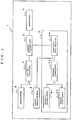
- Fig. 1 is a block diagram which shows an example of a structure of a perimeter according to the invention
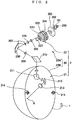
- Fig. 2 is a typical view which shows an example of stimulus presentation means to be used in the perimeter according to the invention
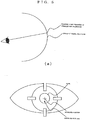
- Fig. 3(a) is a typical view for explaining a way of judgment as to whether there is defective fixation or not from a center position of a pupil
- Fig. 1 is a block diagram which shows an example of a structure of a perimeter according to the invention
- Fig. 2 is a typical view which shows an example of stimulus presentation means to be used in the perimeter according to the invention
- Fig. 3(a) is a typical view for explaining a way of judgment as to whether there is defective fixation or not from a center position of a pupil
- Fig. 1 is a block diagram which shows an example of a structure of a perimeter according to the invention
- Fig. 2 is a typical view which shows an example of stimulus presentation means to be used in the perimeter according to the invention
- FIG. 3(b) is a typical view for explaining a way of judging "defective fixation", “may be defective fixation” or “no defective fixation” from a center position of a pupil
- Fig.4 is a typical view which shows an example of presentation through monitor means
- Fig.5 is a typical view for explaining calibration of a position of rotation center of an eyeball
- Fig.6 is a typical view for explaining subjects for fixation state judgment in a threshold perimetry.
- a perimeter according to the invention which is exemplarily denoted with reference number 1 in Fig. 1 , measures a visual field of an examinee in such a state the examinee fixates a fixation point (such as a central point of a visual field dome).
- a perimeter 1 has stimulus presentation means 2 for successively presenting the stimuli with a predetermined luminance at various positions in a visual field of an examinee.
- the stimulus presentation means 2 as shown in Fig.2 is used (details are described hereinafter).
- the perimeter 1 has operation means 3, such as a push switch, and an examinee can operate the operation switch 3 when perceiving the presented stimulus A.
- operation means 3 such as a push switch
- the perimeter 1 has visual field judging means 4 for judging the visual field of an examinee based upon signals from the stimulus presentation means 2 and the operation means 3.
- Such visual field judging means 4 makes judgments according to kinds of perimetry, such as a screening perimetry, a threshold perimetry and an isopter perimetry.
- the perimetry 1 has fixation state judging means 5 for individually judging a fixation state of an examinee in association of each presented stimulus, and the fixation state judging means 5 individually judges the fixation state whenever the stimulus is presented.
- the fixation state judging means 5 is comprised of a fixation state detecting portion 51 for detecting the fixation state of an examinee, a criterion output portion 52 for outputting judgment standards for judging the fixation state, a comparison judging portion 53 for judging the fixation state by comparing the signals from the fixation state detecting portion 51 and the criterion output portion 52, and a judged result outputting portion 54 for outputting the judgment results in association with each presented stimulus based upon the signals from the stimulus presentation means 2 and the comparison judging portion 53.
- the fixation state detecting portion 51 is comprised of a photographing portion, such as a infrared CCD, for obtaining successive images by photographing a front eye of an examinee.
- the fixation state detecting portion 51 may have an image processing portion for processing images obtained by the photographing portion in order to extract a pupil of an examinee and obtaining a center of the pupil, in addition to the photographing portion. A judgment of fixation state is described later, referring to Fig. 3 .
- the fixation state detecting portion 51 may have a dislocation computing portion for computing a dislocation of a center of the pupil with respect to a standard position (that is, a central position of the pupil when an examinee correctly fixates the fixation target), in addition to the photographing portion and the image processing portion. In such a judgment of the fixation state, whether or not the computed dislocation is within a criteria (standard dislocation) may be only judged.
- the fixation state detecting portion 51 detects before the stimulus presentation means 2 presents the stimulus (before presenting each stimulus, such detection is conducted separately).
- the image processing portion computes the center of the pupil twice or more times each presentation of the stimulus, and its average is computed.
- the comparison judging portion 53 judges to be "defective fixation” if a detected result by the fixation state detecting portion 51 exceeds the criterion, and judges to be "no defective fixation” if a detected result by the fixation state detecting portion 51 does not exceed the criterion.
- 3(a) is a typical view for explaining a way of judgment "defective fixation” or “no defective fixation” on the basis of a center position of a pupil (that is, the position of the center of the pupil computed by the image processing portion), and a reference number RVO denotes the criterion outputted by the criterion outputting portion 52, and a reference number O denotes a standard position, that is, the central position of the pupil at the time when an examinee correctly fixates the fixation target.
- the judgment may be "no defective judgment” if the computed center of pupil is inside the criterion RV0, and may be “defective judgment” if the computed center of pupil is outside the criterion RV0.
- the criterion output portion 52 outputs two criterions, the first criterion and the second criterion (the first criterion is bigger than the second criterion) in order to avoid the above-mentioned two problems.
- Fig. 3(b) is a typical view for explaining a way of judging three, "defective fixation", “may be defective fixation” or "no defective fixation” from the central position of a pupil, that is, the central position of the pupil computed by the above-mentioned image processing portion.
- a reference number RV1 denotes a first criterion
- a reference number RV2 denotes a second criterion.
- the comparison judging portion 53 judges “defective fixation” if a result of detection by the fixation state detecting portion 51 is higher than the first criterion (that is, the center of the pupil computed is outside of the first criterion RV1), and judges “may be defective fixation” if a result of detection by the fixation state detecting portion 51 is between the first criterion RV1 and the second criterion RV2 (that is, if the center of the pupil computed is between the first criterion RV1 and the second criterion RV2), and judges "no defective fixation” if a result of detection by the fixation state detecting portion 51 is lower than the second criterion (that is, the center of the pupil computed is inside of the second criterion RV2.
- the fixation state detecting portion 51 seldom mistakes “no defective fixation” for "defective fixation” nor “defective fixation” for “no defective fixation” although the fixation state detecting portion 51 may mistake “may be defective fixation” for "defective fixation” or "no defective fixation” due to its rather low detection accuracy. For this reason, the above-mentioned two problems can be avoided. In the case of Fig. 3(b) , there are two criterions, but it does not mean that three or more criterions are not exist in the invention.
- the perimeter 1 may have judgment processing means 6 for dealing with predetermined processes based upon the judgment results by the fixation state judging means 5.
- the processes by the judgment processing means 6 are (1) detection of defective fixation by stimulation of blind-spot if "defective fixation" is judged (2) display of a judgment result of a fixation state in connection with a stimulus as well as a judgment result of a visual field in connection with a stimulus (3) presentation of a stimulus for test after amending defective fixation, and (4) retry to test a measurement point where defective fixation was judged by presenting a stimulus again.
- the fixation state judging means 5 judges each measurement point by three stages "defective fixation", “may be defective fixation” and “no defective fixation” on the basis of the two criterions, the judgment processing means 6 may control the stimulus presentation means 2 to detect the defective fixation by stimulating the blind-spot as follows.
- the perimeter 1 according to the invention may have monitor means 7 to be controlled by the judgment processing means 6, and the monitor means 7 may display the judgment result of the visual field in connection with the stimulus A (each stimulus A displayed by the stimulus presentation means 2) and the judgment result of the fixation state in connection with the stimulus A (each stimulus A displayed by the stimulus presentation means 2).
- Fig. 4 is an example of such a display.
- two digits of numerals denote a measurement result of each measurement point in a threshold perimetry, that is, the judgment result of the visual field in connection with each stimulus A, and a mark of square surrounding "27" is the stimulus which shows "defective fixation", and a double underline drawn under "32” denotes the stimulus which shows "may be defective fixation”.
- the monitor means 7 displays both the stimulus in the case of "defective fixation” and the stimulus in the case of "may be defective fixation", so that quantity of information increase.
- the judgment processing means 6 may control the stimulus presentation means 2 to regard a coordinate which the eye to be examined sees at this time as the coordinate of the fixation stimulus (the regarded fixation coordinate), and stimuli are presented from the regarded fixation coordinate to the coordinate where there is relatively no defective fixation so as to automatically amend the defective fixation.
- the judgment processing means 6 controls the stimulus presentation means 2 to present the stimulus again to the measurement point where "defective fixation" was judged for retry such point.
- the stimulus may be thus presented again after the test on all measurement points or at a proper timing during the test, that is, at a time when there are still remaining measurement points to be measured before finish of test on all measurement points. If the criterions are three or more, the processes (1) through (4) may be properly changed according to a number of the criterions.
- a stimulus is presented to each measurement point two or more times, changing its luminance, and a threshold value is determined by presence of a reply from an examinee.
- which stimulus (which presentation of stimulus) should be shown as “defective fixation” or “may be defective fixation” is necessary to be considered. If “good fixation and being responded”, ⁇ "defective fixation and being responded” ⁇ "good fixation and being responded” succeed in such an order, the second defective fixation may be disregarded based on the last "good fixation and being responded". In such an example, a conclusion is the same if there is no response in all steps.
- the threshold value is determined by "being responded” ⁇ "no response” ⁇ "being responded” as shown in Fig.6 (" ⁇ " in the figure means being responded and " ⁇ ” means no response) .
- the subjects are the last stimulation through which the threshold value was determined and the stimulation just before the last stimulation since the last stimulation and the stimulation just before the last stimulation are always divided into “being responded” and "no response”.
- a position of blind-spot is determined by a method disclosed in Japanese patent application publication No. 2008-36297 before the above-mentioned perimetry.
- the standard position as shown with a reference number O in Fig. 3(a) and (b) (that is, the central position of the pupil when an examinee correctly fixates the fixation target) may be computed after determination of the position of blind-spot .
- a center position of a pupil is sampled so as to obtain an average and the average is the standard position.
- an angle may be calibrated according to the following steps in order to eliminate a measurement error due to the different position of the rotation center of eyeball.
- the criterions for judging "defective fixation" are as follows.
- the fixation state is not judged in the whole perimetry, but the fixation state is individually judged for each stimulus in connection with each presented stimulus.
- the measurement point having high credibility and the measurement point having low credibility can be discriminated from each other.
- examiner's burden and examinee's burden are lighter than a case where the whole test is retried from the first as a conventional way, and the test time is shorter and the test efficiency is improved thereby.
- a reference numeral 20 in Fig. 2 denotes a stimulus presentation portion for presenting the stimulus A in the visual field of an examinee
- a reference numeral 21 denotes an indicated position changing portion for changing an indicated position of the stimulus A
- a reference numeral 22 denotes a luminance setting portion for setting the stimulus A.
- the stimulus presentation portion 20 as shown in the figure is comprised of a projection optical system 20A for projecting stimuli, and a projection member 20B to which the stimuli are projected by the projection optical system 20A.
- any structure of the stimulus presentation portion 20 is available as long as the stimuli are presented to the visual field of an examinee.
- many LEDs may be located, and the LEDs may be selectively lightened.
- the projection member 20B as shown in Fig.2 has a semi-sphere dome shape (visual field dome), but the other shape is available.
- the shape having a curved surface excluding the semi-sphere face or the shape having a plane is also available.
- the indicated position changing portion 21 may be comprised of driving means (not shown) for changing positions of structural elements of the projection optical system 20A, such as projector mirrors as shown with reference numerals 211, 212.
- the indicated position changing portion may control which LEDs should be lightened. Even if the projection optical system or the LEDs is used, an examiner may manually instruct to change the position to be presented with a tough pen, a mouse or a keyboard, watching a display, or such an instruction may be automatically executed with a pre-composed program.
- the luminance setting portion 22 may have various kinds of structures. But, the luminance setting portion 22 in Fig.2 is comprised of rotatably supported turrets 221, 222 respectively having two or more filters which attenuances are different and drive mechanism 223 for changing positions of the turrets 221, 222.
Landscapes
- Health & Medical Sciences (AREA)
- Life Sciences & Earth Sciences (AREA)
- Engineering & Computer Science (AREA)
- Medical Informatics (AREA)
- Surgery (AREA)
- Biophysics (AREA)
- Biomedical Technology (AREA)
- Heart & Thoracic Surgery (AREA)
- Physics & Mathematics (AREA)
- Molecular Biology (AREA)
- Ophthalmology & Optometry (AREA)
- Animal Behavior & Ethology (AREA)
- General Health & Medical Sciences (AREA)
- Public Health (AREA)
- Veterinary Medicine (AREA)
- Human Computer Interaction (AREA)
- Eye Examination Apparatus (AREA)
Claims (2)
- Perimeter (1) zum Messen eines Sichtfeldes in einem Zustand, in dem eine Testperson einen vorgegebenen Fixationspunkt fixiert, umfassend:a) ein Stimulus-Darstellungsmittel (2), das dazu konfiguriert ist, Stimuli (A) mit einer vorgegebenen Leuchtkraft nacheinander an verschiedenen Positionen im Sichtfeld einer Testperson darzustellen;b) ein Bedienungsmittel (3), das dazu konfiguriert ist, von der Testperson, die den dargestellten Stimulus (A) wahrgenommen hat, bedient zu werden;c) ein Sichtfeld-Beurteilungsmittel (4), das dazu konfiguriert ist, das Sichtfeld der Testperson auf der Grundlage von von dem Stimulus-Darstellungsmittel (2) und dem Bedienungsmittel (3) erhaltenen Signalen zu beurteilen; undd1) ein Fixationszustands-Beurteilungsmittel (5), das dazu konfiguriert ist, in Verbindung mit jedem dargestellten Stimulus (A) einen Fixationszustand der Testperson individuell zu beurteilen;d2) eine Beurteilungs-Verarbeitungseinheit, die dazu konfiguriert ist, das Stimulus-Darstellungsmittel (2) dazu zu steuern, einen Stimulus (A) erneut auf einem Messpunkt darzustellen, für den durch das Fixationszustands-Beurteilungsmittel (5) die Beurteilung "fehlerhafte Fixation" erfolgt ist;wobeie) das Fixationszustands-Beurteilungsmittel (5) umfasst:aa) eine Fixationszustands-Erkennungseinheit (51), die dazu konfiguriert ist, den Fixationszustand einer Testperson zu erkennen;bb) eine Kriterium-Ausgabeeinheit (52), die dazu konfiguriert ist, Kriterien für eine Beurteilung des Fixationszustands auszugeben;cc) eine Vergleichsbeurteilungseinheit (53), die dazu konfiguriert ist, den Fixationszustand zu beurteilen, indem von der Fixationszustands-Erkennungseinheit (51) und der Kriterium-Ausgabeeinheit (52) erhaltene Signale miteinander verglichen werden; unddd) eine Beurteilungsergebnis-Ausgabeeinheit (54), die dazu konfiguriert ist, in Verbindung mit jedem dargestellten Stimulus auf der Grundlage von von dem Stimulus-Darstellungsmittel (2) und der Vergleichsbeurteilungseinheit (53) erhaltenen Signalen ein Beurteilungsergebnis auszugeben;ee) wobei die Fixationszustands-Erkennungseinheit (51) umfasst:i) eine Fotografiereinheit, die dazu konfiguriert ist, durch Fotografieren eines vorderen Augenbereichs einer Testperson aufeinanderfolgende Bilder zu erhalten, undii) eine Bildverarbeitungseinheit, die dazu konfiguriert ist, die durch die Fotografiereinheit erhaltenen Bilder zu verarbeiten, um eine Pupille der Testperson zu extrahieren und einen Mittelpunkt der Pupille zu erhalten;ff) wobei die Kriterium-Ausgabeeinheit (52) dazu konfiguriert ist, ein erstes Kriterium (RV1) und ein zweites Kriterium (RV2), das kleiner als das erste Kriterium (RV1) ist, auszugeben, um den Fixationszustand, ausgehend von einer Mittelpunktposition der Pupille, als "fehlerhafte Fixation", "möglicherweise fehlerhafte Fixation" oder "keine fehlerhafte Fixation" zu beurteilen;gg) wobei die Vergleichsbeurteilungseinheit (53) dazu konfiguriert ist, die Beurteilung "fehlerhafte Fixation" zu stellen, wenn die durch die Fixationszustands-Erkennungseinheit (51) erkannte Position des Mittelpunkts der Pupille außerhalb des ersten Kriteriums (RV1) liegt, und die Beurteilung "möglicherweise fehlerhafte Fixation" zu stellen, wenn die durch die Fixationszustands-Erkennungseinheit (51) erkannte Position des Mittelpunkts der Pupille zwischen dem ersten Kriterium (RV1) und dem zweiten Kriterium (RV2) liegt, und die Beurteilung "keine fehlerhafte Fixation" zu stellen, wenn die durch die Fixationszustands-Erkennungseinheit (51) erkannte Position des Mittelpunkts der Pupille innerhalb des zweiten Kriteriums (RV2) liegt; undf) wobei das Stimulus-Darstellungsmittel (2), in einem Fall von Schwellenperimetrie, dazu konfiguriert ist, einen Stimulus (A) auf jedem Messpunkt dreimal oder öfter darzustellen und dabei seine Leuchtkraft zu ändern, und durch das Vorhandensein einer Antwort einer Testperson einen Schwellenwert zu bestimmen, und wobei, wenn "gute Fixation und beantwortet" → "fehlerhafte Fixation und beantwortet" → "gute Fixation und beantwortet" in dieser Reihenfolge erfolgen, der Perimeter dazu konfiguriert ist, auf der Grundlage des letzten "gute Fixation und beantwortet" die fehlerhafte Fixation nicht zu berücksichtigen.
- Perimeter nach Anspruch 1, ferner umfassend: ein Beurteilungs-Verarbeitungsmittel (6), um das Stimulus-Darstellungsmittel (2) dazu zu steuern, eine fehlerhafte Fixation dadurch zu erkennen, dass ein blinder Fleck auf dem Messpunkt stimuliert wird, bei dem durch das Fixationszustands-Beurteilungsmittel die Beurteilung "fehlerhafte Fixation", "möglicherweise fehlerhafte Fixation" oder "keine fehlerhafte Fixation" gestellt wurde,
wobei- für den Messpunkt, bei dem die Beurteilung "fehlerhafte Fixation" gestellt wurde, in jedem Fall ein blinder Fleck stimuliert wird,- für den Messpunkt, bei dem die Beurteilung "möglicherweise fehlerhafte Fixation" gestellt wurde, mit einer ersten Wahrscheinlichkeit ein blinder Fleck stimuliert wird, und- für den Messpunkt, bei dem die Beurteilung "keine fehlerhafte Fixation" gestellt wurde, mit einer zweiten Wahrscheinlichkeit, die kleiner als die erste Wahrscheinlichkeit ist, ein blinder Fleck stimuliert wird.
Applications Claiming Priority (1)
| Application Number | Priority Date | Filing Date | Title |
|---|---|---|---|
| JP2008259268A JP5624272B2 (ja) | 2008-10-06 | 2008-10-06 | 視野計 |
Publications (2)
| Publication Number | Publication Date |
|---|---|
| EP2172148A1 EP2172148A1 (de) | 2010-04-07 |
| EP2172148B1 true EP2172148B1 (de) | 2019-06-19 |
Family
ID=41100700
Family Applications (1)
| Application Number | Title | Priority Date | Filing Date |
|---|---|---|---|
| EP09169564.3A Not-in-force EP2172148B1 (de) | 2008-10-06 | 2009-09-07 | Perimeter |
Country Status (3)
| Country | Link |
|---|---|
| US (1) | US7942528B2 (de) |
| EP (1) | EP2172148B1 (de) |
| JP (1) | JP5624272B2 (de) |
Families Citing this family (13)
| Publication number | Priority date | Publication date | Assignee | Title |
|---|---|---|---|---|
| JP5451484B2 (ja) * | 2010-03-29 | 2014-03-26 | 興和株式会社 | 視野計、及び視野計の制御方法 |
| JP5553659B2 (ja) * | 2010-03-29 | 2014-07-16 | 興和株式会社 | 視野計 |
| JP5676311B2 (ja) | 2011-03-04 | 2015-02-25 | 興和株式会社 | 視野計 |
| US20140049751A1 (en) | 2011-04-25 | 2014-02-20 | Masayoshi OOUCHI | Perimeter |
| US8684529B2 (en) | 2011-04-28 | 2014-04-01 | Carl Zeiss Meditec, Inc. | Systems and methods for improved visual field testing |
| JP5936371B2 (ja) * | 2012-01-26 | 2016-06-22 | キヤノン株式会社 | 眼科装置、眼科装置の制御方法、およびプログラム |
| JP5936254B2 (ja) | 2012-02-29 | 2016-06-22 | 国立大学法人京都大学 | 眼底観察装置及び眼底画像解析装置 |
| US9179833B2 (en) * | 2013-02-28 | 2015-11-10 | Carl Zeiss Meditec, Inc. | Systems and methods for improved ease and accuracy of gaze tracking |
| GB201314308D0 (en) * | 2013-08-09 | 2013-09-25 | Bid Instr Ltd | Apparatus and method for assessing and improving the reliability of a visual field test |
| TWI504978B (zh) * | 2013-12-05 | 2015-10-21 | Innolux Corp | 液晶顯示面板及其製備方法 |
| US20160345823A1 (en) * | 2014-02-12 | 2016-12-01 | Kowa Company, Ltd | Perimeter |
| DE102019214784A1 (de) * | 2019-09-26 | 2021-04-01 | Carl Zeiss Meditec Ag | Verfahren zur Ermittlung physiologisch korrekter, biometrischer Daten eines Auges |
| CN118829387A (zh) * | 2022-03-29 | 2024-10-22 | 海克-斯特莱特股份公司 | 带可调透镜的视野计 |
Family Cites Families (13)
| Publication number | Priority date | Publication date | Assignee | Title |
|---|---|---|---|---|
| JPH0621913B2 (ja) | 1985-07-08 | 1994-03-23 | マミヤ・オーピー株式会社 | 4眼カメラにおける撮影枚数切換装置 |
| JPH0616748B2 (ja) * | 1986-06-06 | 1994-03-09 | 興和株式会社 | 固視監視装置 |
| JPH043213A (ja) | 1990-04-20 | 1992-01-08 | Seiichi Inoue | 思考分析表 |
| US5459536A (en) * | 1993-12-27 | 1995-10-17 | Alcon Laboratories, Inc. | Apparatus and method for automated perimetry |
| US5946075A (en) * | 1996-05-21 | 1999-08-31 | Horn; Gerald | Vision screening system |
| JP3606706B2 (ja) * | 1996-06-28 | 2005-01-05 | 株式会社ニデック | 眼科装置 |
| US5737060A (en) * | 1996-08-16 | 1998-04-07 | Kasha, Jr.; John R. | Visual field perimetry using virtual reality glasses |
| JP4728496B2 (ja) | 2001-03-15 | 2011-07-20 | 興和株式会社 | 眼科測定装置 |
| US7309128B2 (en) * | 2002-09-20 | 2007-12-18 | Centrofuse Technologies, Llc | Automated stereocampimeter and related method for improved measurement of the visual field |
| JP3950876B2 (ja) * | 2004-08-27 | 2007-08-01 | キヤノン株式会社 | 眼底検査装置 |
| JP4537192B2 (ja) * | 2004-12-21 | 2010-09-01 | キヤノン株式会社 | 眼科装置 |
| JP4896621B2 (ja) | 2006-08-09 | 2012-03-14 | 興和株式会社 | 視野計 |
| JP4806602B2 (ja) * | 2006-08-09 | 2011-11-02 | 興和株式会社 | 視野計 |
-
2008
- 2008-10-06 JP JP2008259268A patent/JP5624272B2/ja active Active
-
2009
- 2009-09-07 EP EP09169564.3A patent/EP2172148B1/de not_active Not-in-force
- 2009-09-15 US US12/559,640 patent/US7942528B2/en not_active Expired - Fee Related
Non-Patent Citations (1)
| Title |
|---|
| ROHRSCHNEIDER K ET AL: "Use of fundus perimetry (microperimetry) to quantify macular sensitivity", PROGRESS IN RETINAL AND EYE RESEARCH, OXFORD, GB, vol. 27, no. 5, 1 September 2008 (2008-09-01), pages 536 - 548, XP025534031, ISSN: 1350-9462, [retrieved on 20080803], DOI: 10.1016/J.PRETEYERES.2008.07.003 * |
Also Published As
| Publication number | Publication date |
|---|---|
| US7942528B2 (en) | 2011-05-17 |
| US20100002192A1 (en) | 2010-01-07 |
| JP5624272B2 (ja) | 2014-11-12 |
| JP2010088541A (ja) | 2010-04-22 |
| EP2172148A1 (de) | 2010-04-07 |
Similar Documents
| Publication | Publication Date | Title |
|---|---|---|
| EP2172148B1 (de) | Perimeter | |
| US9380938B2 (en) | System and methods for documenting and recording of the pupillary red reflex test and corneal light reflex screening of the eye in infants and young children | |
| US7665847B2 (en) | Eye mapping | |
| Burk et al. | Development of the standard reference plane for the Heidelberg retina tomograph | |
| JP5421146B2 (ja) | 視野検査システム | |
| WO2013132162A1 (en) | Method for assessing function of the visual system and apparatus thereof | |
| JP2008503244A (ja) | 網膜損傷を評価するための装置及び方法 | |
| US20110128498A1 (en) | Eye refractive power measurement apparatus | |
| WO2006106877A1 (ja) | 視野計及び視野計測方法 | |
| US11116393B2 (en) | Vision assessment based on gaze | |
| Healey et al. | Diagnostic accuracy of the Heidelberg Retina Tomograph for glaucoma: a population-based assessment | |
| JP5553659B2 (ja) | 視野計 | |
| US11083406B2 (en) | Detection of early stage alzheimer's disease and mild cognitive impairment | |
| Miller et al. | Astigmatism and amblyopia among Native American children (AANAC): design and methods | |
| CN111588346A (zh) | 一种基于中央眼的双眼视功能量化方法 | |
| JP5852187B2 (ja) | 視野計 | |
| Hillard OD et al. | Minimum Rim Width and Lamina Cribrosa Depth in Non-Glaucomatous and Glaucomatous US Veterans | |
| Moster et al. | Visual Fields in Glaucoma | |
| Wall et al. | Journal of Glaucoma Publish Ahead of Print | |
| CN119919367A (zh) | 一种旁中心注视检测方法、装置、电子设备及存储介质 | |
| CN118356146A (zh) | 基于动态注视行为分析的交互式视觉障碍智能检测系统 | |
| Shelat et al. | 32 Automated Perimetry in Glaucoma | |
| CN121059085A (zh) | 一种基于单色光的眼部疾病预测方法、设备及程序产品 | |
| Crabb | Visual Fields | |
| Rudnicka et al. | Interpretation measures from of automated visual field and semi-automated perimeters |
Legal Events
| Date | Code | Title | Description |
|---|---|---|---|
| PUAI | Public reference made under article 153(3) epc to a published international application that has entered the european phase |
Free format text: ORIGINAL CODE: 0009012 |
|
| AK | Designated contracting states |
Kind code of ref document: A1 Designated state(s): AT BE BG CH CY CZ DE DK EE ES FI FR GB GR HR HU IE IS IT LI LT LU LV MC MK MT NL NO PL PT RO SE SI SK SM TR |
|
| 17P | Request for examination filed |
Effective date: 20101007 |
|
| 17Q | First examination report despatched |
Effective date: 20120202 |
|
| STAA | Information on the status of an ep patent application or granted ep patent |
Free format text: STATUS: EXAMINATION IS IN PROGRESS |
|
| GRAP | Despatch of communication of intention to grant a patent |
Free format text: ORIGINAL CODE: EPIDOSNIGR1 |
|
| STAA | Information on the status of an ep patent application or granted ep patent |
Free format text: STATUS: GRANT OF PATENT IS INTENDED |
|
| RIC1 | Information provided on ipc code assigned before grant |
Ipc: A61B 3/024 20060101AFI20190128BHEP Ipc: A61B 3/113 20060101ALI20190128BHEP |
|
| INTG | Intention to grant announced |
Effective date: 20190212 |
|
| GRAS | Grant fee paid |
Free format text: ORIGINAL CODE: EPIDOSNIGR3 |
|
| GRAA | (expected) grant |
Free format text: ORIGINAL CODE: 0009210 |
|
| STAA | Information on the status of an ep patent application or granted ep patent |
Free format text: STATUS: THE PATENT HAS BEEN GRANTED |
|
| AK | Designated contracting states |
Kind code of ref document: B1 Designated state(s): AT BE BG CH CY CZ DE DK EE ES FI FR GB GR HR HU IE IS IT LI LT LU LV MC MK MT NL NO PL PT RO SE SI SK SM TR |
|
| REG | Reference to a national code |
Ref country code: GB Ref legal event code: FG4D |
|
| REG | Reference to a national code |
Ref country code: CH Ref legal event code: EP |
|
| REG | Reference to a national code |
Ref country code: IE Ref legal event code: FG4D |
|
| REG | Reference to a national code |
Ref country code: DE Ref legal event code: R096 Ref document number: 602009058773 Country of ref document: DE |
|
| REG | Reference to a national code |
Ref country code: AT Ref legal event code: REF Ref document number: 1144438 Country of ref document: AT Kind code of ref document: T Effective date: 20190715 |
|
| REG | Reference to a national code |
Ref country code: NL Ref legal event code: MP Effective date: 20190619 |
|
| PG25 | Lapsed in a contracting state [announced via postgrant information from national office to epo] |
Ref country code: FI Free format text: LAPSE BECAUSE OF FAILURE TO SUBMIT A TRANSLATION OF THE DESCRIPTION OR TO PAY THE FEE WITHIN THE PRESCRIBED TIME-LIMIT Effective date: 20190619 Ref country code: SE Free format text: LAPSE BECAUSE OF FAILURE TO SUBMIT A TRANSLATION OF THE DESCRIPTION OR TO PAY THE FEE WITHIN THE PRESCRIBED TIME-LIMIT Effective date: 20190619 Ref country code: LT Free format text: LAPSE BECAUSE OF FAILURE TO SUBMIT A TRANSLATION OF THE DESCRIPTION OR TO PAY THE FEE WITHIN THE PRESCRIBED TIME-LIMIT Effective date: 20190619 Ref country code: HR Free format text: LAPSE BECAUSE OF FAILURE TO SUBMIT A TRANSLATION OF THE DESCRIPTION OR TO PAY THE FEE WITHIN THE PRESCRIBED TIME-LIMIT Effective date: 20190619 Ref country code: NO Free format text: LAPSE BECAUSE OF FAILURE TO SUBMIT A TRANSLATION OF THE DESCRIPTION OR TO PAY THE FEE WITHIN THE PRESCRIBED TIME-LIMIT Effective date: 20190919 |
|
| REG | Reference to a national code |
Ref country code: LT Ref legal event code: MG4D |
|
| PG25 | Lapsed in a contracting state [announced via postgrant information from national office to epo] |
Ref country code: GR Free format text: LAPSE BECAUSE OF FAILURE TO SUBMIT A TRANSLATION OF THE DESCRIPTION OR TO PAY THE FEE WITHIN THE PRESCRIBED TIME-LIMIT Effective date: 20190920 Ref country code: LV Free format text: LAPSE BECAUSE OF FAILURE TO SUBMIT A TRANSLATION OF THE DESCRIPTION OR TO PAY THE FEE WITHIN THE PRESCRIBED TIME-LIMIT Effective date: 20190619 Ref country code: BG Free format text: LAPSE BECAUSE OF FAILURE TO SUBMIT A TRANSLATION OF THE DESCRIPTION OR TO PAY THE FEE WITHIN THE PRESCRIBED TIME-LIMIT Effective date: 20190919 |
|
| REG | Reference to a national code |
Ref country code: AT Ref legal event code: MK05 Ref document number: 1144438 Country of ref document: AT Kind code of ref document: T Effective date: 20190619 |
|
| PG25 | Lapsed in a contracting state [announced via postgrant information from national office to epo] |
Ref country code: RO Free format text: LAPSE BECAUSE OF FAILURE TO SUBMIT A TRANSLATION OF THE DESCRIPTION OR TO PAY THE FEE WITHIN THE PRESCRIBED TIME-LIMIT Effective date: 20190619 Ref country code: NL Free format text: LAPSE BECAUSE OF FAILURE TO SUBMIT A TRANSLATION OF THE DESCRIPTION OR TO PAY THE FEE WITHIN THE PRESCRIBED TIME-LIMIT Effective date: 20190619 Ref country code: CZ Free format text: LAPSE BECAUSE OF FAILURE TO SUBMIT A TRANSLATION OF THE DESCRIPTION OR TO PAY THE FEE WITHIN THE PRESCRIBED TIME-LIMIT Effective date: 20190619 Ref country code: PT Free format text: LAPSE BECAUSE OF FAILURE TO SUBMIT A TRANSLATION OF THE DESCRIPTION OR TO PAY THE FEE WITHIN THE PRESCRIBED TIME-LIMIT Effective date: 20191021 Ref country code: EE Free format text: LAPSE BECAUSE OF FAILURE TO SUBMIT A TRANSLATION OF THE DESCRIPTION OR TO PAY THE FEE WITHIN THE PRESCRIBED TIME-LIMIT Effective date: 20190619 Ref country code: AT Free format text: LAPSE BECAUSE OF FAILURE TO SUBMIT A TRANSLATION OF THE DESCRIPTION OR TO PAY THE FEE WITHIN THE PRESCRIBED TIME-LIMIT Effective date: 20190619 Ref country code: SK Free format text: LAPSE BECAUSE OF FAILURE TO SUBMIT A TRANSLATION OF THE DESCRIPTION OR TO PAY THE FEE WITHIN THE PRESCRIBED TIME-LIMIT Effective date: 20190619 |
|
| PG25 | Lapsed in a contracting state [announced via postgrant information from national office to epo] |
Ref country code: IT Free format text: LAPSE BECAUSE OF FAILURE TO SUBMIT A TRANSLATION OF THE DESCRIPTION OR TO PAY THE FEE WITHIN THE PRESCRIBED TIME-LIMIT Effective date: 20190619 Ref country code: SM Free format text: LAPSE BECAUSE OF FAILURE TO SUBMIT A TRANSLATION OF THE DESCRIPTION OR TO PAY THE FEE WITHIN THE PRESCRIBED TIME-LIMIT Effective date: 20190619 Ref country code: IS Free format text: LAPSE BECAUSE OF FAILURE TO SUBMIT A TRANSLATION OF THE DESCRIPTION OR TO PAY THE FEE WITHIN THE PRESCRIBED TIME-LIMIT Effective date: 20191019 Ref country code: ES Free format text: LAPSE BECAUSE OF FAILURE TO SUBMIT A TRANSLATION OF THE DESCRIPTION OR TO PAY THE FEE WITHIN THE PRESCRIBED TIME-LIMIT Effective date: 20190619 |
|
| PG25 | Lapsed in a contracting state [announced via postgrant information from national office to epo] |
Ref country code: TR Free format text: LAPSE BECAUSE OF FAILURE TO SUBMIT A TRANSLATION OF THE DESCRIPTION OR TO PAY THE FEE WITHIN THE PRESCRIBED TIME-LIMIT Effective date: 20190619 |
|
| PG25 | Lapsed in a contracting state [announced via postgrant information from national office to epo] |
Ref country code: DK Free format text: LAPSE BECAUSE OF FAILURE TO SUBMIT A TRANSLATION OF THE DESCRIPTION OR TO PAY THE FEE WITHIN THE PRESCRIBED TIME-LIMIT Effective date: 20190619 Ref country code: PL Free format text: LAPSE BECAUSE OF FAILURE TO SUBMIT A TRANSLATION OF THE DESCRIPTION OR TO PAY THE FEE WITHIN THE PRESCRIBED TIME-LIMIT Effective date: 20190619 |
|
| PG25 | Lapsed in a contracting state [announced via postgrant information from national office to epo] |
Ref country code: IS Free format text: LAPSE BECAUSE OF FAILURE TO SUBMIT A TRANSLATION OF THE DESCRIPTION OR TO PAY THE FEE WITHIN THE PRESCRIBED TIME-LIMIT Effective date: 20200224 Ref country code: MC Free format text: LAPSE BECAUSE OF FAILURE TO SUBMIT A TRANSLATION OF THE DESCRIPTION OR TO PAY THE FEE WITHIN THE PRESCRIBED TIME-LIMIT Effective date: 20190619 |
|
| REG | Reference to a national code |
Ref country code: CH Ref legal event code: PL |
|
| REG | Reference to a national code |
Ref country code: DE Ref legal event code: R097 Ref document number: 602009058773 Country of ref document: DE |
|
| PLBE | No opposition filed within time limit |
Free format text: ORIGINAL CODE: 0009261 |
|
| STAA | Information on the status of an ep patent application or granted ep patent |
Free format text: STATUS: NO OPPOSITION FILED WITHIN TIME LIMIT |
|
| PG2D | Information on lapse in contracting state deleted |
Ref country code: IS |
|
| PG25 | Lapsed in a contracting state [announced via postgrant information from national office to epo] |
Ref country code: CH Free format text: LAPSE BECAUSE OF NON-PAYMENT OF DUE FEES Effective date: 20190930 Ref country code: LU Free format text: LAPSE BECAUSE OF NON-PAYMENT OF DUE FEES Effective date: 20190907 Ref country code: LI Free format text: LAPSE BECAUSE OF NON-PAYMENT OF DUE FEES Effective date: 20190930 Ref country code: IE Free format text: LAPSE BECAUSE OF NON-PAYMENT OF DUE FEES Effective date: 20190907 |
|
| 26N | No opposition filed |
Effective date: 20200603 |
|
| REG | Reference to a national code |
Ref country code: BE Ref legal event code: MM Effective date: 20190930 |
|
| PG25 | Lapsed in a contracting state [announced via postgrant information from national office to epo] |
Ref country code: SI Free format text: LAPSE BECAUSE OF FAILURE TO SUBMIT A TRANSLATION OF THE DESCRIPTION OR TO PAY THE FEE WITHIN THE PRESCRIBED TIME-LIMIT Effective date: 20190619 Ref country code: BE Free format text: LAPSE BECAUSE OF NON-PAYMENT OF DUE FEES Effective date: 20190930 |
|
| PG25 | Lapsed in a contracting state [announced via postgrant information from national office to epo] |
Ref country code: FR Free format text: LAPSE BECAUSE OF NON-PAYMENT OF DUE FEES Effective date: 20190930 |
|
| PG25 | Lapsed in a contracting state [announced via postgrant information from national office to epo] |
Ref country code: CY Free format text: LAPSE BECAUSE OF FAILURE TO SUBMIT A TRANSLATION OF THE DESCRIPTION OR TO PAY THE FEE WITHIN THE PRESCRIBED TIME-LIMIT Effective date: 20190619 |
|
| PG25 | Lapsed in a contracting state [announced via postgrant information from national office to epo] |
Ref country code: MT Free format text: LAPSE BECAUSE OF FAILURE TO SUBMIT A TRANSLATION OF THE DESCRIPTION OR TO PAY THE FEE WITHIN THE PRESCRIBED TIME-LIMIT Effective date: 20190619 Ref country code: HU Free format text: LAPSE BECAUSE OF FAILURE TO SUBMIT A TRANSLATION OF THE DESCRIPTION OR TO PAY THE FEE WITHIN THE PRESCRIBED TIME-LIMIT; INVALID AB INITIO Effective date: 20090907 |
|
| PG25 | Lapsed in a contracting state [announced via postgrant information from national office to epo] |
Ref country code: MK Free format text: LAPSE BECAUSE OF FAILURE TO SUBMIT A TRANSLATION OF THE DESCRIPTION OR TO PAY THE FEE WITHIN THE PRESCRIBED TIME-LIMIT Effective date: 20190619 |
|
| PGFP | Annual fee paid to national office [announced via postgrant information from national office to epo] |
Ref country code: GB Payment date: 20220728 Year of fee payment: 14 Ref country code: DE Payment date: 20220803 Year of fee payment: 14 |
|
| REG | Reference to a national code |
Ref country code: DE Ref legal event code: R119 Ref document number: 602009058773 Country of ref document: DE |
|
| GBPC | Gb: european patent ceased through non-payment of renewal fee |
Effective date: 20230907 |
|
| PG25 | Lapsed in a contracting state [announced via postgrant information from national office to epo] |
Ref country code: GB Free format text: LAPSE BECAUSE OF NON-PAYMENT OF DUE FEES Effective date: 20230907 |
|
| PG25 | Lapsed in a contracting state [announced via postgrant information from national office to epo] |
Ref country code: GB Free format text: LAPSE BECAUSE OF NON-PAYMENT OF DUE FEES Effective date: 20230907 Ref country code: DE Free format text: LAPSE BECAUSE OF NON-PAYMENT OF DUE FEES Effective date: 20240403 |