EP2149852B1 - Pattern feature extraction method and device for the same - Google Patents
Pattern feature extraction method and device for the same Download PDFInfo
- Publication number
- EP2149852B1 EP2149852B1 EP09173514.2A EP09173514A EP2149852B1 EP 2149852 B1 EP2149852 B1 EP 2149852B1 EP 09173514 A EP09173514 A EP 09173514A EP 2149852 B1 EP2149852 B1 EP 2149852B1
- Authority
- EP
- European Patent Office
- Prior art keywords
- feature
- image
- vector
- vectors
- discriminant
- Prior art date
- Legal status (The legal status is an assumption and is not a legal conclusion. Google has not performed a legal analysis and makes no representation as to the accuracy of the status listed.)
- Expired - Lifetime
Links
Images







Classifications
-
- G—PHYSICS
- G06—COMPUTING OR CALCULATING; COUNTING
- G06T—IMAGE DATA PROCESSING OR GENERATION, IN GENERAL
- G06T7/00—Image analysis
-
- G—PHYSICS
- G06—COMPUTING OR CALCULATING; COUNTING
- G06V—IMAGE OR VIDEO RECOGNITION OR UNDERSTANDING
- G06V40/00—Recognition of biometric, human-related or animal-related patterns in image or video data
- G06V40/10—Human or animal bodies, e.g. vehicle occupants or pedestrians; Body parts, e.g. hands
- G06V40/16—Human faces, e.g. facial parts, sketches or expressions
- G06V40/168—Feature extraction; Face representation
- G06V40/169—Holistic features and representations, i.e. based on the facial image taken as a whole
-
- G—PHYSICS
- G06—COMPUTING OR CALCULATING; COUNTING
- G06F—ELECTRIC DIGITAL DATA PROCESSING
- G06F18/00—Pattern recognition
- G06F18/20—Analysing
- G06F18/21—Design or setup of recognition systems or techniques; Extraction of features in feature space; Blind source separation
- G06F18/213—Feature extraction, e.g. by transforming the feature space; Summarisation; Mappings, e.g. subspace methods
- G06F18/2132—Feature extraction, e.g. by transforming the feature space; Summarisation; Mappings, e.g. subspace methods based on discrimination criteria, e.g. discriminant analysis
-
- G—PHYSICS
- G06—COMPUTING OR CALCULATING; COUNTING
- G06V—IMAGE OR VIDEO RECOGNITION OR UNDERSTANDING
- G06V10/00—Arrangements for image or video recognition or understanding
- G06V10/70—Arrangements for image or video recognition or understanding using pattern recognition or machine learning
- G06V10/77—Processing image or video features in feature spaces; using data integration or data reduction, e.g. principal component analysis [PCA] or independent component analysis [ICA] or self-organising maps [SOM]; Blind source separation
- G06V10/7715—Feature extraction, e.g. by transforming the feature space, e.g. multi-dimensional scaling [MDS]; Mappings, e.g. subspace methods
-
- G—PHYSICS
- G06—COMPUTING OR CALCULATING; COUNTING
- G06V—IMAGE OR VIDEO RECOGNITION OR UNDERSTANDING
- G06V40/00—Recognition of biometric, human-related or animal-related patterns in image or video data
- G06V40/10—Human or animal bodies, e.g. vehicle occupants or pedestrians; Body parts, e.g. hands
- G06V40/16—Human faces, e.g. facial parts, sketches or expressions
- G06V40/168—Feature extraction; Face representation
- G06V40/171—Local features and components; Facial parts ; Occluding parts, e.g. glasses; Geometrical relationships
Definitions
- the similarity between patterns such as characters or human faces has been determined by extracting feature vectors from input patterns, extracting feature vectors effective for identification from the feature vectors, and comparing the feature vectors obtained from the respective patterns.
- non-patent reference 1 Moghaddam et al., "Probabilistic Visual Learning for Object Representation", IEEE Transactions on Pattern Analysis and Machine Intelligence, Vol. 19, No. 7, pp. 696 - 710, 1997
- linear discriminant analysis is performed on the principal components of the feature vector (non-patent reference 2: W.
- covariance matrices, within-class covariance matrices, and between-class covariance matrices are calculated with respect to prepared learning samples, and basis vectors are obtained as solutions to the eigenvalue problems in the covariance matrices.
- the features of input feature vectors are then transformed by using these basis vectors.
- the transformation matrix W which maximizes equation (1) can be obtained as a set of generalized eigenvectors corresponding to M large eigenvalues of equation (6) as the eigenvalue problem of a column vector w i .
- the transformation matrix W obtained in this manner will be referred to as a discriminant matrix.
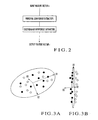
- the principal component analysis is performed on input feature vectors, and discriminant analysis is applied to principal components with large eigenvalues. More specifically, as shown in Fig. 2 , after principal components are extracted by projecting an input feature vector by using a basis matrix obtained by the principal component analysis, a feature vector effective for identification is extracted by projecting principal components by using the discriminant matrix obtained by discriminant analysis as a basis matrix.
- the principal component analysis using the total covariance matrix ⁇ T is no more than sequentially selecting orthogonal axes within a feature space in the axial direction in which large covariances appear. For this reason, a feature axis effective for pattern identification is lost.
- x 1 and x 1 are features which have large variances but are irrelevant to pattern identification
- x 3 is effective for pattern identification but has a small variance (between-class variance/within-class variance, i.e., Fisher's ratio, is large, but the variance value itself is sufficiently smaller than those of x 1 and x 2 ).
- x 1 and x 2 are features which have large variances but are irrelevant to pattern identification
- x 3 is effective for pattern identification but has a small variance (between-class variance/within-class variance, i.e., Fisher's ratio, is large, but the variance value itself is sufficiently smaller than those of x 1 and x 2 ).
- Fig. 3A is the distribution of data viewed from a direction almost perpendicular to the plane defined by x 1 and x 2 , with the black circles and white circles representing data points in different classes.
- black and white circles cannot be identified.
- Fig. 3B black and white circles can be separated from each other. If, however, an axis with a large variance is selected, the plane defined by x 1 and x 2 is selected as a feature space, which is equivalent to performing discrimination by seeing Fig. 3A . This makes it difficult to perform discrimination.
- the present invention has been made in consideration of the above problems in the prior art, and has as its object to provide a feature vector transformation technique for suppressing a reduction in feature amount effective for discrimination and performing efficient feature extraction when a feature vector effective for discrimination is to be extracted from an input pattern feature vector and feature dimensions are to be compressed.
- a pattern feature extraction method is characterized by comprising the step of expressing one of a pattern feature and a feature from an image by using a plurality of feature vectors x i , the step of obtaining a discriminant matrix W i of each feature vector by linear discriminant analysis with respect to each of the plurality of feature vectors x i , the step of obtaining in advance a discriminant matrix W T by linear discriminant analysis with respect to a feature vector y obtained by arraying vectors y i obtained by linearly transforming the vectors x i using the discriminant matrix W i , and the step of performing linear transformation specified by the discriminant matrix W i and the discriminant matrix W T .
- This pattern feature extraction method is characterized in that the step of performing linear transformation comprises the step of compressing the number of feature dimensions by transforming a feature vector of a pattern.
- the above pattern feature extraction method is characterized in that the step of expressing comprises the step of extracting a feature vector x i formed from pixel values obtained from a plurality of sample points with respect to a plurality of sample point sets S i preset in an image, and the step of performing linear transformation comprises the step of extracting a feature amount from the image by transforming a feature vector for each image sample set.
- the above pattern feature extraction method is characterized in that the step of expressing comprises the step of segmenting an image into a plurality of preset local regions, and expressing a feature amount as a feature vector x i extracted for each of the plurality of local regions, and the step of performing linear transformation comprises the step of extracting a feature amount from an image by transforming a feature vector of a local region.
- the above pattern feature extraction method is characterized by further comprising the step of performing a two-dimensional Fourier transform for an image, wherein the step of expressing comprises the step of extracting a real component and an imaginary component of a two-dimensional Fourier transform as a feature vector x i , and the step of calculating a power spectrum of a two-dimensional Fourier transform, and extracting the power spectrum as a feature vector x 2 , and in the step of performing linear transformation, a feature amount is extracted from an image by transforming a feature vector.
- This pattern feature extraction method is characterized in that in the step of performing linear transformation, a feature amount is extracted from an image by transforming a feature vector x 1 corresponding to a real component and an imaginary component of a Fourier component and a feature vector x 2 corresponding to a power spectrum of the Fourier component by linear transformation specified by a discriminant matrix W i and a discriminant matrix W T corresponding to principal components of a feature vector x i in such a manner that dimension reduction is realized.
- This pattern feature extraction method is characterised in that the step of expressing further comprises the step of segmenting an image into a plurality of regions, and in the step of extracting the feature vector x 2 , a two-dimensional Fourier power spectrum is calculated in each of the segmented regions.
- the method is characterized in that in the step of segmenting, a region is segmented into regions having different sizes in a multiple manner.
- the method is characterized in by further comprising the step of reducing feature dimensions by performing feature extraction by kernel discriminant analysis on an obtained two-dimensional Fourier power spectrum and extracting an effective feature amount.
- the method is characterized by further comprising the step of reducing feature dimensions by performing linear transformation using a discriminant matrix obtained in advance by linear discriminant analysis with respect to an obtained two-dimensional Fourier power spectrum.
- This pattern feature extraction method is characterized in that the step of expressing further comprises the step of calculating a power spectrum of a two-dimensional Fourier transform, the step of segmenting an image into a plurality of regions and calculating a power spectrum of a two-dimensional Fourier transform for each of the regions, and the step of extracting a vector obtained combining the respective power spectra as a feature vector x 2 .
- a pattern feature extraction device is a pattern feature extraction device for compressing feature dimensions of a pattern feature by using linear transformation, characterized by comprising basis matrix storage means for storing a basis matrix specified by a discriminant matrix W i of feature vectors obtained by linear discriminant analysis on a plurality of feature vectors x i representing a pattern feature and a discriminant matrix W T obtained in advance by linear discriminant analysis on a feature vector y obtained by combining vectors y i obtained by performing linear transformation of the vectors x i using a discriminant matrix, and linear transformation means for compressing feature dimension by transforming a feature vector of a pattern by using the basis matrix stored by the basis matrix storage means.
- a computer-readable storage medium is a computer-readable storage medium which records a program for causing a computer to execute pattern feature extraction to compress feature dimensions of a pattern feature by using linear transformation, the program being characterized by including a program for executing a function of expressing a pattern feature by a plurality of feature vectors x i , obtaining in advance a discriminant matrix W i of feature vectors obtained by performing linear discriminant analysis on each of the feature vectors x i , and obtaining in advance a discriminant matrix W T by linear discriminant analysis on a feature vector y obtained by combining vectors y i obtained by linear transformation of the vectors x i , and a function of compressing feature dimensions by transforming a feature vector of a pattern by linear transformation specified by the discriminant matrix W i and the discriminant matrix W T .
- An image feature extraction method is characterized by comprising the step of obtaining a Fourier spectrum vector by calculating a Fourier spectrum of an input normalized image by using a predetermined mathematic expression, the step of extracting a multiblock Fourier amplitude vector from a Fourier amplitude of a partial image of the normalized image, the step of obtaining normalized vectors of a Fourier spectrum vector and the multiblock intensity vector by performing projection of feature vectors with respect to the Fourier spectrum vector and the multiblock intensity vector by using a basis matrix, the step of combining the normalized vectors to form a combined Fourier vector and obtaining a projection vector of the coupled value by using a second basis matrix, and the step of extracting a Fourier feature by quantizing the projection vector.
- Fig. 1 is a block diagram showing a pattern feature extraction device using a pattern feature extraction device according to the present invention.
- the pattern feature extraction device will be described in detail below.
- the pattern feature extraction device includes a first linear transformation means 11 for linearly transforming an input feature vector x 1 , a second linear transformation means 12 for linearly transforming an input feature vector x 2 , and a third linear transformation means 13 for receiving feature vectors which are transformed and dimension-reduced by the linear transformation means 11 and 12 and linearly transforming them.
- the respective linear transformation means perform basis transformation based on discriminant analysis by using discriminant matrices obtained in advance by learning and stored in discriminant matrix storage means 14, 15, and 16.
- the input feature vectors x 1 and x 2 are feature amounts which are extracted in accordance with purposes in character recognition, face verification, and the like, and include, for example, directional features calculated from the gradient features of an image, and density features which are nothing less than the pixel values of an image.
- Each vector includes a plurality of elements, In this case, for example, N 1 directional features are input as one feature vector x 1 , and other N 2 density values as the feature vector x 2 .
- the discriminant matrix storage means 14 and 15 store discriminant matrices W 1 and W 2 obtained by performing linear discriminant analysis on the feature vectors x 1 and x 2 .
- discriminant matrices may be obtained by calculating a within-class covariance matrix ⁇ W (equation (2)) and between-class covariance matrix ⁇ B (equation (3)) with respect to feature vectors in prepared learning samples in accordance with their classes, as described above.
- Discriminant matrices can be obtained in advance by selecting eigenvectors W i corresponding to the large eigenvalues in an eigenvalue problem expressed by equation (6) with respect to these covariance matrices.
- the sizes of the matrices W 1 and W 2 are M 1 x N 1 and M 2 x N 2 , respectively.
- the numbers of feature dimensions can be efficiently reduced by greatly reducing dimension counts M 1 and M 2 of feature spaces to be projected. This can effectively decrease the data amount and increase the processing speed. If, however, the number of feature dimensions is reduced too much, the discriminant performance deteriorates. This is because as the number of feature dimensions is reduced, feature amounts effective for discrimination are lost.
- the dimension counts M 1 and M 2 of feature vectors are amounts which are easily influenced by the number of learning samples, and are preferably determined on the basis of experiments.
- the third linear transformation means 13 projects the vectors y 1 and y 2 calculated by the first and second linear transformation means as an input feature vector y to a discriminant space.
- a discriminant matrix W3 to be registered in the discriminant matrix storage means 16 is obtained from learning samples as in the case wherein the first and second discriminant matrices are calculated.
- the Lth-dimensional feature vector y is projected according to equation (9) by using the basis matrix W 3 (the size of the matrix is L x (M 1 + M 2 )), and a feature vector z to be output is obtained.
- Z W 3 T ⁇ y
- each feature vector is divided, and linear discriminant analysis is performed on learning samples of feature vectors with small dimension counts, thereby suppressing estimation errors, which tend to occur in high-dimensional feature components, and obtaining features effective for discrimination.
- the three linear transformation means are provided to perform processing concurrently and stepwisely.
- a linear discrimination means can be basically realized by a product-sum computing unit
- one linear transformation means can be commonly used by switching discriminant matrices to be read out in accordance with the input feature vector to be linearly transformed.
- the size of a necessary computing unit can be reduced by using one linear transformation means in this manner.
- linear transformations using the respective discriminant matrices can be integrated into linear transformation using one matrix.
- stepwise computation processing the number of times of product-sum computation is L x (M 1 + M 2 ) + M 1 N 1 + M 2 N 2 .
- the computation amount in batch computation processing as in the latter case is smaller than that in the former case, and hence high-speed computation can be realized.
- the batch computation method can reduce the computation amount and hence is effective.
- discriminant analysis is repeatedly performed on a feature vector having undergone discriminant analysis for each feature.
- a plurality of elements corresponding to one feature may be divided into a plurality of vectors, discriminant analysis may be performed on each element set as an input feature, and the corresponding projected vector may be further subjected to discriminant analysis.
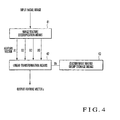
- the facial image feature extraction device includes an image feature decomposition means 41 for decomposing the density feature of an input facial image, a linear transformation means 42 for projecting a feature vector in accordance with a discriminant matrix corresponding to the feature vector, and a discriminant matrix group storage means 43 for storing the respective discriminant matrices described above.
- Techniques of extracting features from facial images include a method of positioning facial images at the eye position or the like and setting their density values as vector features, as disclosed in the above article by W. Zhao et al.
- image feature dimensions it is difficult to perform high-precision feature extraction by directly performing linear discriminant analysis using limited learning samples. Therefore, a deterioration in feature which is caused when the principal component analysis or the like is applied is suppressed by decomposing image feature elements, performing discriminant analysis on the decomposed features, and obtaining discriminant matrices.
- a basis matrix based on discriminant analysis can be calculated with high precision by sampling several images of each of several hundred individuals, i.e., a total of several thousand facial images. If the number of feature dimensions is as large as that of the original feature (2352 dimensions), in order to obtain similar performance with features based on discriminant analysis, it is expected that facial images of several thousand individuals must be sampled. In practice, however, it is difficult to collect such a large amount of image data, and hence this technique cannot be realized.
- This second-stage discriminant matrix is also stored in the discriminant matrix group storage means 43, and discriminant analysis is performed again by the linear transformation means 42 upon receiving the 180-dimensional vector of the first-stage discriminant feature.
- the first-stage discriminant matrix and second-stage discriminant matrix may be calculated in advance as indicated by equation (10). However, when 252 dimensions x 9 regions are to be compressed to 20 dimensions x 9 regions, and the 180 dimensions are to be transformed into 50 dimensions, the calculation in two stages will reduce the memory to be used and the computation amount to 1/2 or less and hence is efficient.
- a facial feature with high identification performance can be extracted.
- a Chinese character “ " and a Chinese character “ " are to be identified.
- the principal component analysis is performed on each entire character image to extract components having large eigenvalues
- the feature " " that helps to identify a Chinese character “ “ and a Chinese character “ " tends to be lost (for this reason, similar character identification is sometimes performed by using a specific high-order feature instead of a feature of a portion with a large eigenvalue obtained by the principal component analysis).
- the effectiveness of segmenting an image into local regions and extracting discriminant features is similar to a phenomenon in similar character identification in character recognition. It can be thought that spatially limiting a feature that is easy to identify can ensure higher precision per unit dimension than performing discriminant analysis on principal components as a whole.
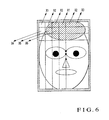
- the image feature decomposition means 41 may sample images from an entire-image and segment the sampled images instead of segmenting an image and forming a feature vector for each local region.
- a primary feature is to be divided by nine into nine 252-dimensional vectors
- sampling is performed from 3 x 3 regions, as shown in Fig. 6 . That is, the sampled images become reduced images with slight positional differences.
- These reduced images are raster-scanned to be transformed into nine feature vectors.
- Such feature vectors are used as primary vectors to calculate discriminant components. These discriminant components may be integrated to perform discriminant analysis again.
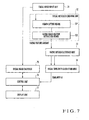
- FIG. 7 is a block diagram showing a facial image matching system using a facial metadata creating device according to the present invention.
- the facial image matching system will be described in detail below.
- the facial image matching system includes a facial image input unit 71 which inputs facial images, a facial metadata creating unit 72 which creates facial metadata, a facial metadata storage unit 73 which stores extracted facial metadata, a facial similarity calculation unit 74 which calculates a facial similarity from facial metadata, a facial image database 75 which stores facial images, a control unit 76 which controls the input of images, the creation of metadata, the storage of metadata, and the calculation of facial similarities in accordance with an image registration request/retrieval request, and a display unit 77 of a display which displays facial images and other information.
- the facial metadata creating unit 72 is comprised of a region cutting means 721 for cutting a facial region from an input facial image, and a facial image feature extraction means 722 which extracts a facial feature of the cut region.
- the facial metadata creating unit 72 creates metadata about a facial image by extracting facial feature vectors.
- a facial photo or the like is input upon adjustment of the size and position of the face by using the facial image input unit 71 such as a scanner or video camera.
- a human face may be directly input from a video camera or the like.
- the face position of the input image be detected by using a face detection technique like that disclosed in the above reference by Moghaddam and the size and the like of the facial image be automatically normalized.
- the input facial image is registered in the facial image database 75 as needed.
- the facial metadata creating unit 72 creates facial metadata and stores it in the facial metadata storage unit 73.
- the facial image input unit 71 inputs a facial image
- the facial metadata creating unit 72 creates facial metadata as in the case of registration.
- the created facial metadata is either registered in the facial metadata storage unit 73 or directly sent to the facial similarity calculation unit 74.
- the control unit 76 selects a facial image from the facial image database 75 on the basis of the result exhibiting the highest similarity, and displays the facial image on the display unit 77 or the like. An operator then checks the coincidence between the faces in the retrieved image and the registered image.
- the facial similarity calculation unit 74 makes calculation to check whether or not the facial image specified by the ID number coincides with the retrieved image. If the calculated similarity is lower than a predetermined similarity, it is determined that the two images do not coincide with each other, and the result is displayed on the display unit 77. Assume that this system is used for room access management. In this case, room access management can be performed by causing the control unit 76 to send an opening/closing control signal to an automatic door so as to control the automatic door, instead of displaying a facial image.
- the facial image matching system operates in the above manner. Such operation can be implemented on a computer system.
- facial image matching can be realized by storing a metadata creation program for executing metadata creation to be described in detail next and a similarity calculation program in a memory and executing these programs using a program control processor.
- these programs may be recorded on a computer-readable recording medium.
- the facial metadata creating unit 72 extracts a facial feature amount by using an image I(x, y) whose position and size have been normalized.
- the image is preferably normalized to set the eye positions to (16, 24) and (31, 24) and the size to 46 x 56 pixels. In the following case, the image has been normalized to this size.
- the region cutting means 721 then cuts a plurality of preset local regions of the facial image.
- one region is the entire normalized facial image (f(x, y)) and the other is a central region g(x, y) of 32 x 32 pixels centered on the face. This region may be cut such that the positions of the two eyes are set to (9, 12) and (24, 12).
- a central region of a face is cut in the above manner is that a stable feature can be extracted by cutting a range free from the influences of a hair style and the like even if the hair style changes (for example, when facial verification is used in a home robot, verification can be done even if the hair style changes before and after bathing). If a hair style and the like do not change (for example, personal identification within scenes in a video clip), since an improvement in verification performance can be expected by performing verification using images including hair styles, a large facial image including a hair style and a small facial image of a central portion of the face are cut.
- the facial image feature extraction means 722 then performs two-dimensional discrete Fourier transforms for the two cut regions f(x, y) to extract a facial image feature.
- the facial image feature extraction means includes a Fourier transform means 81 for performing a discrete Fourier transform for a normalized cut image, a Fourier power calculation means 82 for calculating the power spectrum of a Fourier-transformed Fourier frequency component, a linear transformation means 83 for regarding a feature vector obtained by raster-scanning the real and imaginary components of the Fourier frequency component calculated by the Fourier transform means 81 as a one-dimensional feature vector and extracting a discriminant feature from the principal components of the feature vector, a basis matrix storage means 84 for storing a basis matrix for the transformation, a linear transformation means 85 for extracting a discriminant feature of principal components from a power spectrum in the same manner as described above, and a basis matrix storage means 86 for storing a basis matrix for the transformation.
- a Fourier transform means 81 for performing a discrete Fourier transform for a normalized cut image
- a Fourier power calculation means 82 for calculating the power spectrum of a Fourier-transformed Fourier frequency component
- the facial image feature extraction means 722 further includes a linear transformation means 88 for normalizing each of the discriminant feature of the real and imaginary components of the Fourier feature and the discriminant feature of the power spectrum to a vector with a size of 1, and calculating a discriminant feature of a vector obtained by combining the two feature vectors, and a discriminant matrix storage means 89 for storing a discriminant matrix for the discriminant feature.
- discriminant features of principal components are calculated for a feature vector including the real and imaginary parts of the Fourier frequency component as elements and a feature vector including a power spectrum as an element, and a discriminant feature is calculated again for a feature vector obtained by combining the above vectors, thereby calculating the feature amount of the face.
- This method is widely known and described in, for example, Rosenfeld et al., "Digital Picture Processing", Kindai Kagaku Sha, pp. 20 - 26 , and hence a description thereof will be omitted.
- the Fourier power calculation means calculates a Fourier power spectrum
- F u ⁇ v Re F u ⁇ v 2 + Im Fu ⁇ v ) 2
- the linear transformation means 83 then handles the feature amount extracted as a frequency feature as a vector.
- a partial space to be defined in advance is set by a basis vector (eigenvector) obtained by preparing a facial image set for learning and performing discriminant analysis on the principal components of a frequency feature vector in a corresponding cut region. Since this basis vector is obtained by a widely known method described in various references including the reference by W. Zhao, a description thereof will be omitted.
- the reason why discriminant analysis is not directly performed is that the number of dimensions of a feature vector obtained by a Fourier transform is too large to directly handle discriminant analysis.
- this technique is one choice as a technique of extracting a first-stage feature vector.
- a basis matrix obtained by the method of repeating discriminant analysis may be used.
- a discriminant matrix ⁇ 1 of principal components which is to be stored in the basis matrix storage means 84 can be obtained from learning samples in advance by performing discriminant analysis on the principal components of a one-dimensional feature vector x 1 obtained by raster-scanning the real and imaginary components of a frequency feature.
- a Fourier feature need not always be handled as a complex number, and may be handled as a real number with an imaginary component being handled as another feature element.
- ⁇ 1 be a basis matrix for principal components
- W 1 be a discriminant matrix obtained by discriminant analysis on the vector of the principal components
- the number of dimensions to be reduced by the principal component analysis is set to about 1/10 (about 200 dimensions) of the original feature Fourier feature. Thereafter, the number of dimensions is reduced to about 70 by this discriminant matrix.
- This basis matrix is calculated in advance from learning samples and is used as information to be stored in the basis matrix storage means 84.
- Calculating a principal component discriminant feature for each component of a Fourier feature in this manner makes it possible to obtain a discriminant feature y 1 of the principal components of the feature vector x 1 of the real and imaginary components of Fourier components, and a discriminant feature y 2 of the principal components of the feature vector x 2 of a power spectrum.
- a normalization means 87 normalizes the size of each obtained feature vector to a unit vector with a size of 1.
- the vector length varies depending on the position of an origin for the measurement of a vector, and hence its reference position must also be determined in advance.
- a reference point is set by using a mean vector m i obtained from a learning sample of a projected feature vector y i .
- a mean vector By setting a mean vector as a reference point, feature vectors are distributed around the reference point. In the case of a Gaussian distribution, in particular, feature vectors are isotropically distributed. This makes it easy to limit a distribution region in a case wherein a feature vector is quantized in the end.
- the normalization means is provided to normalize the feature vector y 1 associated with the real and imaginary numbers of Fourier power and the feature vector y 2 associated with the power to unit vectors in advance. This makes it possible to normalize the sizes of two different kinds of feature amounts and stabilize the distribution features of feature vectors.
- the feature vectors y 1 0 and y 2 0 normalized in this manner are combined into one feature vector y in the same manner as (equation 8), and the combined feature vector y is projected to a discriminant space by using the discriminant matrix W 3 obtained by performing linear discriminant analysis, thereby obtaining an output feature vector z.
- the discriminant matrix W 3 for this purpose is stored in the discriminant matrix storage means 89, and the linear transformation means 88 performs projection computation for this purpose to calculate, for example, a 24-dimensional feature vector z.
- the size of each element must be normalized in advance.
- the size of each element is normalized in advance in accordance with the variance value of each element
- the size is five bits. In this case, it suffices if the size is quantized to a value falling within the range of -16 to 15.
- normalization is the computation of multiplying each element by the reciprocal of the standard deviation.
- W 3 0 T ⁇ W 3 T
- Performing normalization in this manner can perform range correction necessary for quantization.
- computation based on the Mahalanobis distance can be performed by only calculating a simple L2 norm in computing the norm of an inter-pattern distance at the time of collation, thereby reducing the computation amount at the time of collation.
- the facial image feature extraction means 722 extracts a feature vector z f from the normalized image f(x, y) in this manner.
- a feature vector z g is extracted by the facial image feature extraction means 722 in the same manner as described above.
- the two feature vectors z f and z g are extracted by using the facial metadata creating unit as a facial feature amount z.
- a computer may be caused to execute the above facial metadata creation sequence by a computer program.
- this program may be recorded on a computer-readable recording medium.
- the facial similarity calculation unit 74 calculates a similarity d(z 1 , z 2 ) by using K-dimensional feature vectors z 1 and z 2 obtained from two facial metadata.
- one facial image is registered, and a retrieval is performed by using one facial image.
- a similarity may be calculated for each of a plurality of facial metadata on the registration side.
- calculating a similarity by obtaining the mean or minimum value of similarity for each combination makes it possible to calculate a similarity for one facial data.
- this program may be recorded on a computer-readable recording medium.
- the present invention is directed to an improvement in the facial metadata creating unit 72 according to the third invention.
- the discriminant features of the principal components of a feature vector having the real and imaginary parts of a Fourier frequency component obtained by performing a Fourier transform for an input facial image and a feature vector having a power spectrum as an element are calculated, and the discriminant feature of a feature vector obtained by combining the respective vectors is calculated again, thereby calculating the feature amount of the face.
- a Fourier power spectrum reflects the overall feature amount of an input image
- components of the input pixels which contain much noise e.g., pixels around the mouth which tend to change in relative position
- the input image is segmented into regions, and a Fourier transform is performed for each local region.
- Discriminant analysis is then performed by using a power spectrum for each local region as a feature amount. This can reduce the influences of the feature amount of a region which locally exhibits poor discriminant performance (large within-class variance) by discriminant analysis.
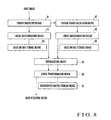
- Fig. 9 is a view for explaining an embodiment and shows the flow of feature extraction processing.
- a 32 x 32 pixel region is segmented into four 16 x 16 pixel regions, 16 8 x 8 pixel regions, 64 4 x 4 pixel regions, 256 2 x 2 pixel regions, and 1024 1 x 1 pixel regions (which are substantially the same as the input image, and hence the input image can be used without segmentation) (S1001).
- a Fourier transform is performed in each segmented region (S1002).
- a power spectrum is then calculated (S1003).
- the above calculation is performed all the segmented regions (S1004).
- the size of a region is changed (S1005).
- the sizes of all the regions are changed (S1006).
- the principal component analysis is performed in advance to obtain in advance the basis of the principal component analysis which reduces the number of dimensions. For example, an appropriate number of dimensions is about 300. Discriminant analysis is further performed on the feature vector of this dimension count to obtain a basis which reduces the number of dimensions and corresponds to a feature axis exhibiting good discriminant performance. A basis corresponding to the principal component analysis and discriminant analysis is calculated in advance (this basis will be referred to as a PCLDA projection basis ⁇ ).
- a discriminant feature z can be obtained by projecting the 5120-dimensional feature by linear computation using the projection basis ⁇ using this PCLDA basis.
- the feature amount of the face can be obtained by further performing quantization and the like for this feature.
- the 5120-dimensional feature amount can be reduced in the number of dimensions by considering the symmetry of the Fourier power spectrum and removing and not using high-frequency components. This can realize high-speed learning, reduce the amount of data required, and realize high-speed feature extraction. Therefore, the number of dimensions is preferably reduced as needed.
- Segmenting a region into blocks and multiplexing Fourier spectra in this manner can sequentially obtain multiple expressions of feature amounts having translation invariance numOfCentralFourier and local feature amounts from a feature amount equivalent to an image feature (in the case of 1024 segmentations).
- a feature amount effective for identification is selected from the multiple, redundant feature expressions by discriminant analysis, thereby obtaining a compact feature amount which provides good identification performance.
- a Fourier power spectrum is obtained by nonlinear computation for an image, which can calculate an effective feature amount which cannot be obtained by simply applying discriminant analysis based on linear computation to the image.
- second-stage feature extraction may be performed by using kernel discriminant analysis (discriminant analysis using a kernel technique called Kernel Fisher Discriminant Analysis, KFDA, Kernel Discriminant Analysis: KDA, or Generalized Discriminant Analysis: GDA).
- kernel discriminant analysis discriminant analysis using a kernel technique called Kernel Fisher Discriminant Analysis, KFDA, Kernel Discriminant Analysis: KDA, or Generalized Discriminant Analysis: GDA.
- kernel discriminant analysis For a detailed description of kernel discriminant analysis, see the reference by Q. Liu et al. (non-patent reference 3: "Kernel-based Optimized Feature Vectors Selection and Discriminant Analysis for Face Recognition", Processing of IAPR International Conference on Pattern Recognition (ICPR), Vol. II, pp. 362 - 365, 2002 ) or the reference by G. Baudat (non-patent reference 4: Generalized Discriminant Analysis Using a Kernel Approach", Neural Computation, Vol. 12, pp. 2385 - 2404, 2000 ).
- Each feature vector is then normalized by using its mean value, and second-stage LDA projection is performed.
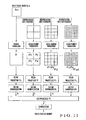
- Fig. 12 is a view for explaining still another embodiment and shows the flow of feature extraction processing.
- region segmentation is performed in a plurality of stages (two stages in Fig. 12 ) to extract multiple power spectra in multiple resolutions as feature amounts for discriminant analysis in consideration of the translation universality of Fourier power spectra in local regions and the reliability of the local regions.
- Feature extraction is then performed using the optimal feature space obtained by discriminant analysis.
- of the entire image power spectra
- of 16 8 x 8 pixel regions obtained by segmenting the entire image into 16 regions are extracted as feature vectors.
- a feature vector may be formed without sampling any high-frequency components for discrimination. If, for example, a feature vector is formed by sampling 1/4 of spectra which correspond to low-frequency components, the number of learning samples required can be reduced or the processing time required for learning and recognition can be shortened. If the number of learning data is small, discriminant analysis may be performed after the number of feature dimensions is reduced by the principal component analysis in advance.
- Discriminant analysis is performed by using a feature vector x 2 f extracted in this manner and a learning set prepared in advance to obtain a basis matrix ⁇ 2 f in advance.
- Fig. 9 shows an example of projection for the extraction of a discriminant feature from principal components (Principal Component Linear Discriminant Analysis; PCLDA).
- the feature vector x 2 f is projected by using the basis matrix ⁇ 2 f , and the mean and size of the projected feature vector are normalized, thereby calculating a feature vector y 2 f .
- the feature vector x 2 f obtained by combining the real and imaginary components of a Fourier frequency is projected by linear computation processing using a basis matrix ⁇ 1 f to obtain a feature vector with a reduced number of dimensions, and the mean and size of the vector are normalized to calculate a feature vector y 1 f .
- a feature vector obtained by combining these vectors is projected again by using a discriminant basis ⁇ 3 f to obtain a feature vector z f .
- This vector is quantized in, for example, five bits to extract a facial feature amount.
- the input is a facial image normalized to a size of 44 x 56 pixels.
- the above processing is applied to the 32 x 32 pixels of a central portion to extract a facial feature amount.
- facial feature amounts are also extracted from multiple segmented regions of the 44 x 56 pixel region of the entire face, including the entire 44 x 56 pixel region, four 22 x 28 pixel regions, and 16 11 x 14 pixel pixels.
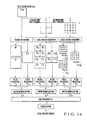
- Fig. 13 shows another embodiment, in which PCLDA projection of a combination of a real component, an imaginary component, and a power spectrum is performed for each local region, or PCLDA projection of a feature obtained by combining a real component and imaginary component and PCLDA projection of a power spectrum are separately performed, and LDA projection is finally performed, as shown in Fig. 14 .
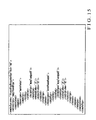
- Fig. 15 shows a description of a facial feature amount, as an example of a facial feature description, which uses a DDL representation syntax (Description Definition Language Representation Syntax) in ISO/IEC FDIS 15938-3, "Information technology Multimedia content description interface - Part 3: Visual ".
- DDL representation syntax (Description Definition Language Representation Syntax) in ISO/IEC FDIS 15938-3, "Information technology Multimedia content description interface - Part 3: Visual ".
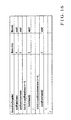
- Fig. 16 shows a rule in a case wherein a binary representation syntax is used for data representation.
- the sizes of the array components of FourierFeature and CentralFourierFeature are stored in the field of 6-bit integers without signs in numOfFourierFeature and numOfCentralFourierFeature, and each component of FourierFeature and CentralFourierFeature is stored in the form of a 5-bit integer without a sign.
- the FourierFeature element is derived from two feature vectors; one is a Fourier Spectrum Vector x 1 f , and the other is a Multi-block Fourier Amplitude Vector x 2 f .
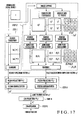
- Fig. 17 illustrates the extraction process of FourierFeature. Given a normalized face image, five steps should be performed to extract the element;
- a Fourier Spectrum Vector x 1 f is defined as a set of scanned components of the Fourier spectrum.
- Fig. 18 shows the scanning method of the Fourier spectrum.
- the dimension of x 1 f is 644.
- a multi-block Fourier Amplitude Vector is extracted from the Fourier amplitudes of partial images in the normalized face image.
- the partial images three types of images are used; (a) a holistic image, (b) quarter images, and (c) 1/16 images.
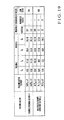
- Multi-block Fourier Amplitude Vectors is obtained by scanning low frequency regions of each amplitude
- the scan regions are defined in Fig. 19 .
- the dimension of x 2 f is 856.
- the Fourier Spectrum Vector x 1 f and Multi-block Fourier Amplitude Vector x 2 f shall be respectively projected using the PCLDA basis matrices ⁇ 1 f and ⁇ 2 f , and normalized to unit vectors y 1 f and y 2 f .
- the PCLDA basis matrix ⁇ k f and the mean vector m x f are a basis matrix obtained by performing linear discriminant analysis on the principal components of x k f and a mean of projected vectors, respectively. The values of them are given by referring to a look-up-table calculated in advance.
- the dimensions of y 1 f and y 2 f are 70 and 80, respectively.
- the normalized vectors y 1 f and y 2 f are combined to form a 150-dimensional Joint Fourier vector y 3 f , and projected using the LDA basis matrix ⁇ 3 f .
- the quantized elements are stored as FourierFeature.
- FourierFeature[0] represents the first quantized element w o f
- FourierFeature[numOfFourierFeature-1] corresponds to the (numOfFourlerFeature)th element w f numOfFourierFeature-1 .
- This element represents a facial feature based on the cascaded LDA of the Fourier characteristics of the central part in the normalized face image.
- CentralFourierFeature is extracted in the similar way as FourierFeature.
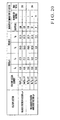
- a 256-dimensional Central Fourier Spectrum Vector x 1 g is produced by scanning the Fourier spectrum G(u, v) as defined in Fig. 20 .
- a multi-block Central Fourier Amplitude Vector x 2 g is obtained by scanning each amplitude
- the processing in STEP 3-5) are the same as those FourierFeature, for example, the Joint Central Fourier Vector y 3 g consists of the normalized vectors y 1 g and y 2 g .
- the basis matrices ⁇ 1 g , ⁇ 2 g , and ⁇ 3 g and the mean vectors m 1 g and m 2 g for CentralFourierFeature are calculated in advance, and prepared in the form of a look-up table.
- the size of CentralFourierFeature is indicated by numOfCentralFourierFeature.
- Facial feature description data obtained in this manner is compact in description length but exhibits high recognition performance, and hence is an expression efficient for the storage and transmission of data.
- the present invention may be implemented by a computer-executable program.
- the present invention can be implemented by describing the functions indicated by steps 1 to 5 in Fig. 17 in a computer-readable program and making the program function on the computer.
- this program may be recorded on a computer-readable recording medium.
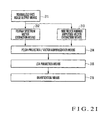
- Fig. 17 When the example shown in Fig. 17 is to be implemented as a device, all or some of the functions written in the block diagram of Fig. 21 may be implemented. More specifically, all or some of a normalized face image output means 211, Fourier spectrum vector extraction means 212, multiblock Fourier amplitude vector extraction means 213 and PCLDA projection/vector normalization means 214 may be implemented.
- a feature vector effective for discrimination by discriminant analysis is extracted from an input pattern feature vector for each element vector, and feature extraction is performed again for the obtained feature vector by using a discriminant matrix by discriminant analysis.
- Each embodiment described above is effective for a case wherein the number of learning samples required for discriminant analysis is limited in spite of a large pattern feature amount. That is, the number of feature dimensions can be reduced, while a loss of features effective for identification is suppressed, without necessarily using the principal component analysis.
- the image feature extraction method, the image feature extraction device, and the recording medium storing the corresponding program in the field of pattern recognition according to the present invention are suitable for the use in a feature vector transformation technique for compressing feature dimension by extracting feature vectors effective for recognition from input feature vectors.
Landscapes
- Engineering & Computer Science (AREA)
- Theoretical Computer Science (AREA)
- Computer Vision & Pattern Recognition (AREA)
- Health & Medical Sciences (AREA)
- Oral & Maxillofacial Surgery (AREA)
- General Physics & Mathematics (AREA)
- Physics & Mathematics (AREA)
- General Health & Medical Sciences (AREA)
- Multimedia (AREA)
- Evolutionary Computation (AREA)
- Data Mining & Analysis (AREA)
- Human Computer Interaction (AREA)
- Artificial Intelligence (AREA)
- Evolutionary Biology (AREA)
- Computing Systems (AREA)
- Life Sciences & Earth Sciences (AREA)
- Bioinformatics & Cheminformatics (AREA)
- Bioinformatics & Computational Biology (AREA)
- Software Systems (AREA)
- General Engineering & Computer Science (AREA)
- Databases & Information Systems (AREA)
- Medical Informatics (AREA)
- Image Analysis (AREA)
- Magnetic Resonance Imaging Apparatus (AREA)
- Image Processing (AREA)
- Collating Specific Patterns (AREA)
Applications Claiming Priority (4)
| Application Number | Priority Date | Filing Date | Title |
|---|---|---|---|
| JP2002207022 | 2002-07-16 | ||
| JP2002300594 | 2002-10-15 | ||
| JP2003068916A JP4292837B2 (ja) | 2002-07-16 | 2003-03-13 | パターン特徴抽出方法及びその装置 |
| EP03741208A EP1522962B1 (en) | 2002-07-16 | 2003-07-04 | Pattern characteristic extraction method and device for the same |
Related Parent Applications (1)
| Application Number | Title | Priority Date | Filing Date |
|---|---|---|---|
| EP03741208A Division EP1522962B1 (en) | 2002-07-16 | 2003-07-04 | Pattern characteristic extraction method and device for the same |
Publications (2)
| Publication Number | Publication Date |
|---|---|
| EP2149852A1 EP2149852A1 (en) | 2010-02-03 |
| EP2149852B1 true EP2149852B1 (en) | 2016-01-06 |
Family
ID=30118927
Family Applications (2)
| Application Number | Title | Priority Date | Filing Date |
|---|---|---|---|
| EP09173514.2A Expired - Lifetime EP2149852B1 (en) | 2002-07-16 | 2003-07-04 | Pattern feature extraction method and device for the same |
| EP03741208A Expired - Lifetime EP1522962B1 (en) | 2002-07-16 | 2003-07-04 | Pattern characteristic extraction method and device for the same |
Family Applications After (1)
| Application Number | Title | Priority Date | Filing Date |
|---|---|---|---|
| EP03741208A Expired - Lifetime EP1522962B1 (en) | 2002-07-16 | 2003-07-04 | Pattern characteristic extraction method and device for the same |
Country Status (6)
| Country | Link |
|---|---|
| US (2) | US20050201595A1 (enExample) |
| EP (2) | EP2149852B1 (enExample) |
| JP (1) | JP4292837B2 (enExample) |
| KR (1) | KR100578614B1 (enExample) |
| AT (1) | ATE511680T1 (enExample) |
| WO (1) | WO2004008391A1 (enExample) |
Families Citing this family (78)
| Publication number | Priority date | Publication date | Assignee | Title |
|---|---|---|---|---|
| AU2002253416A1 (en) * | 2002-03-27 | 2003-10-08 | Nokia Corporation | Pattern recognition |
| JP4770932B2 (ja) * | 2002-07-16 | 2011-09-14 | 日本電気株式会社 | パターン特徴抽出方法及びその装置 |
| JP4292837B2 (ja) | 2002-07-16 | 2009-07-08 | 日本電気株式会社 | パターン特徴抽出方法及びその装置 |
| EP1411459B1 (en) * | 2002-10-15 | 2009-05-13 | Samsung Electronics Co., Ltd. | Method and apparatus for extracting feature vector used for face recognition and retrieval |
| JP4483334B2 (ja) * | 2004-02-18 | 2010-06-16 | 富士ゼロックス株式会社 | 画像処理装置 |
| GB2414328A (en) * | 2004-05-17 | 2005-11-23 | Mitsubishi Electric Inf Tech | Discrimination transforms applied to frequency domain derived feature vectors |
| US20060148323A1 (en) * | 2004-12-03 | 2006-07-06 | Ulrich Canzler | Facial feature analysis system |
| US7689010B2 (en) * | 2004-12-03 | 2010-03-30 | Invacare International Sarl | Facial feature analysis system |
| JP2006338092A (ja) * | 2005-05-31 | 2006-12-14 | Nec Corp | パタン照合方法、パタン照合システム及びパタン照合プログラム |
| KR100723406B1 (ko) * | 2005-06-20 | 2007-05-30 | 삼성전자주식회사 | 국부이진패턴 구별 방법을 이용한 얼굴 검증 방법 및 장치 |
| JP4539494B2 (ja) * | 2005-08-23 | 2010-09-08 | コニカミノルタホールディングス株式会社 | 認証装置、認証方法及びプログラム |
| JP2007114413A (ja) * | 2005-10-19 | 2007-05-10 | Toshiba Corp | 音声非音声判別装置、音声区間検出装置、音声非音声判別方法、音声区間検出方法、音声非音声判別プログラムおよび音声区間検出プログラム |
| JP3976056B2 (ja) * | 2005-10-24 | 2007-09-12 | 日本電気株式会社 | 係数決定方法、特徴抽出方法、システム及びプログラム、並びにパタン照合方法、システム及びプログラム |
| JP4658788B2 (ja) * | 2005-12-06 | 2011-03-23 | 株式会社日立国際電気 | 画像処理装置、画像処理方法およびプログラム |
| WO2007066953A1 (en) * | 2005-12-08 | 2007-06-14 | Electronics And Telecommunications Research Institute | Apparatus for recognizing three-dimensional motion using linear discriminant analysis |
| KR100682987B1 (ko) * | 2005-12-08 | 2007-02-15 | 한국전자통신연구원 | 선형판별 분석기법을 이용한 3차원 동작인식 장치 및 그방법 |
| KR100723417B1 (ko) * | 2005-12-23 | 2007-05-30 | 삼성전자주식회사 | 얼굴 인식 방법, 그 장치, 이를 위한 얼굴 영상에서 특징추출 방법 및 그 장치 |
| JPWO2007088926A1 (ja) | 2006-02-01 | 2009-06-25 | 日本電気株式会社 | 画像処理、画像特徴抽出、および画像照合の装置、方法、およびプログラム並びに画像照合システム |
| JP5170961B2 (ja) * | 2006-02-01 | 2013-03-27 | ソニー株式会社 | 画像処理システム、画像処理装置および方法、プログラム、並びに記録媒体 |
| JP4631809B2 (ja) * | 2006-06-09 | 2011-02-16 | 富士ゼロックス株式会社 | 欠陥分類システム、画像形成装置および欠陥分類プログラム |
| KR100771244B1 (ko) * | 2006-06-12 | 2007-10-29 | 삼성전자주식회사 | 동영상 데이터 처리 방법 및 장치 |
| US7734097B1 (en) * | 2006-08-01 | 2010-06-08 | Mitsubishi Electric Research Laboratories, Inc. | Detecting objects in images with covariance matrices |
| JP4197019B2 (ja) * | 2006-08-02 | 2008-12-17 | ソニー株式会社 | 撮像装置および表情評価装置 |
| US7724960B1 (en) | 2006-09-08 | 2010-05-25 | University Of Central Florida Research Foundation Inc. | Recognition and classification based on principal component analysis in the transform domain |
| JP4282704B2 (ja) | 2006-09-27 | 2009-06-24 | 株式会社東芝 | 音声区間検出装置およびプログラム |
| JP5151522B2 (ja) * | 2007-02-09 | 2013-02-27 | 株式会社デンソー | 演算装置及びプログラム |
| JP4941791B2 (ja) * | 2007-04-23 | 2012-05-30 | 日本電気株式会社 | 2次元パターンのマッチング方法、特徴抽出方法、これらに用いる装置及びプログラム |
| JP4925120B2 (ja) * | 2007-07-02 | 2012-04-25 | 独立行政法人産業技術総合研究所 | 物体認識装置および物体認識方法 |
| US8068551B2 (en) * | 2007-09-06 | 2011-11-29 | Sharp Laboratories Of America, Inc. | Systems and methods for designing a reference signal to be transmitted in a multiplexed cellular system |
| JP4985264B2 (ja) * | 2007-09-25 | 2012-07-25 | 株式会社豊田中央研究所 | 物体識別装置 |
| CN101414348A (zh) * | 2007-10-19 | 2009-04-22 | 三星电子株式会社 | 多角度人脸识别方法和系统 |
| JP5081590B2 (ja) * | 2007-11-14 | 2012-11-28 | 株式会社日立ハイテクノロジーズ | 欠陥観察分類方法及びその装置 |
| JP4992046B2 (ja) * | 2007-12-07 | 2012-08-08 | Jfeスチール株式会社 | 鉄鋼プロセスの異常予知方法および装置 |
| JP4950930B2 (ja) | 2008-04-03 | 2012-06-13 | 株式会社東芝 | 音声/非音声を判定する装置、方法およびプログラム |
| US8208731B2 (en) * | 2008-04-07 | 2012-06-26 | Microsoft Corporation | Image descriptor quantization |
| JP5294342B2 (ja) * | 2008-04-28 | 2013-09-18 | 公立大学法人大阪府立大学 | 物体認識用画像データベースの作成方法、処理装置および処理用プログラム |
| EP2284791B1 (en) * | 2008-04-30 | 2014-01-01 | Osaka Prefecture University Public Corporation | Method of creating three-dimensional object identifying image database, processing apparatus and processing program |
| US8218880B2 (en) | 2008-05-29 | 2012-07-10 | Microsoft Corporation | Linear laplacian discrimination for feature extraction |
| US8553983B2 (en) | 2008-07-10 | 2013-10-08 | Nec Corporation | Personal authentication system and personal authentication method |
| US8024152B2 (en) * | 2008-09-23 | 2011-09-20 | Microsoft Corporation | Tensor linear laplacian discrimination for feature extraction |
| JP5556663B2 (ja) * | 2008-10-10 | 2014-07-23 | 日本電気株式会社 | 照合装置、照合方法、及びプログラム |
| US8213691B2 (en) * | 2008-12-30 | 2012-07-03 | Mitsubishi Electric Research Laboratories, Inc. | Method for identifying faces in images with improved accuracy using compressed feature vectors |
| EP2383697A4 (en) | 2009-01-23 | 2012-09-05 | Nec Corp | APPARATUS FOR EXTRACTING IDENTIFIERS FROM IMAGES |
| JP5726850B2 (ja) | 2009-03-20 | 2015-06-03 | ザ ジョンズ ホプキンス ユニバーシティ | 技術的技能を定量化する方法及びシステム |
| JP5459312B2 (ja) * | 2009-03-27 | 2014-04-02 | 日本電気株式会社 | パターン照合装置、パターン照合方法及びパターン照合プログラム |
| JP4935961B2 (ja) * | 2009-04-14 | 2012-05-23 | 日本電気株式会社 | 画像識別子抽出装置 |
| JP5548508B2 (ja) * | 2010-04-21 | 2014-07-16 | 日本放送協会 | 画像分類装置及びプログラム |
| JP2012027687A (ja) * | 2010-07-23 | 2012-02-09 | Casio Comput Co Ltd | 画像処理装置及びプログラム |
| JP2013003821A (ja) | 2011-06-16 | 2013-01-07 | Shinkawa Ltd | パターン位置検出方法 |
| US8838147B2 (en) * | 2011-08-31 | 2014-09-16 | Nokia Corporation | Method and apparatus for determining environmental context utilizing features obtained by multiple radio receivers |
| US9355303B2 (en) * | 2011-12-04 | 2016-05-31 | King Saud University | Face recognition using multilayered discriminant analysis |
| US8593452B2 (en) * | 2011-12-20 | 2013-11-26 | Apple Inc. | Face feature vector construction |
| JP5701787B2 (ja) * | 2012-02-17 | 2015-04-15 | 日本電信電話株式会社 | データ分類予測装置、方法、及びプログラム |
| JP5649601B2 (ja) * | 2012-03-14 | 2015-01-07 | 株式会社東芝 | 照合装置、方法及びプログラム |
| CN103514432B (zh) | 2012-06-25 | 2017-09-01 | 诺基亚技术有限公司 | 人脸特征提取方法、设备和计算机程序产品 |
| KR101351132B1 (ko) * | 2012-12-27 | 2014-01-14 | 조선대학교산학협력단 | 이방성의 웨이블릿 변환에 기반한 이미지 분할장치 및 그 방법 |
| KR20140107044A (ko) * | 2013-02-27 | 2014-09-04 | 삼성전자주식회사 | 이미지 서브 시스템 |
| WO2014167880A1 (ja) | 2013-04-09 | 2014-10-16 | 株式会社日立国際電気 | 画像検索装置、画像検索方法、および記録媒体 |
| CN103473544A (zh) * | 2013-04-28 | 2013-12-25 | 南京理工大学 | 一种鲁棒的人体特征快速提取方法 |
| JP6229352B2 (ja) | 2013-07-26 | 2017-11-15 | 富士通株式会社 | 画像処理装置、画像処理方法およびプログラム |
| JP6167733B2 (ja) * | 2013-07-30 | 2017-07-26 | 富士通株式会社 | 生体特徴ベクトル抽出装置、生体特徴ベクトル抽出方法、および生体特徴ベクトル抽出プログラム |
| JP6633267B2 (ja) | 2014-03-20 | 2020-01-22 | 株式会社東芝 | 次元削減装置、方法及びプログラム |
| CN105096304B (zh) * | 2014-05-22 | 2018-01-02 | 华为技术有限公司 | 一种图像特征的估计方法和设备 |
| KR102077260B1 (ko) * | 2014-08-08 | 2020-02-13 | 삼성전자주식회사 | 확룔 모델에 기반한 신뢰도를 이용하여 얼굴을 인식하는 방법 및 장치 |
| US9652664B1 (en) | 2014-12-30 | 2017-05-16 | Morphotrust Usa, Llc | Facial recognition using fractal features |
| US10366279B2 (en) | 2017-08-29 | 2019-07-30 | Bank Of America Corporation | System for execution of multiple events based on image data extraction and evaluation |
| CN108171216A (zh) * | 2018-01-22 | 2018-06-15 | 扬州大学 | 一种用于人脸识别的稀疏噪声矩阵分解方法 |
| US11521460B2 (en) | 2018-07-25 | 2022-12-06 | Konami Gaming, Inc. | Casino management system with a patron facial recognition system and methods of operating same |
| US10878657B2 (en) | 2018-07-25 | 2020-12-29 | Konami Gaming, Inc. | Casino management system with a patron facial recognition system and methods of operating same |
| US11222199B2 (en) * | 2018-12-05 | 2022-01-11 | International Business Machines Corporation | Automatically suggesting behavioral adjustments during video conferences |
| CN109919276A (zh) * | 2019-01-13 | 2019-06-21 | 湖南省农业信息与工程研究所 | 一种基于产品表面纹理图像特征的防伪方法 |
| US11244169B2 (en) | 2020-06-15 | 2022-02-08 | Bank Of America Corporation | System for executing multiple events based on video data extraction and evaluation |
| CN112115881B (zh) * | 2020-09-21 | 2023-09-26 | 国网重庆市电力公司长寿供电分公司 | 基于鲁棒鉴别特征学习的图像特征提取方法 |
| JP7733454B2 (ja) | 2021-03-12 | 2025-09-03 | キヤノン株式会社 | 情報処理装置、情報処理方法、画像識別システム、及びプログラム |
| WO2022244250A1 (ja) * | 2021-05-21 | 2022-11-24 | 日本電気株式会社 | 情報生成装置、判定装置、情報生成方法、判定方法及び記憶媒体 |
| CN113743485B (zh) * | 2021-08-23 | 2025-02-18 | 江苏大学 | 一种基于傅里叶域主成分分析的数据降维方法 |
| CN116347104B (zh) * | 2023-05-22 | 2023-10-17 | 宁波康达凯能医疗科技有限公司 | 基于高效判别分析的帧内图像编码方法、装置及存储介质 |
| US12684015B1 (en) * | 2023-11-22 | 2026-07-14 | Cisco Technology, Inc. | Systems and methods for detecting phishing emails using machine learning |
Family Cites Families (15)
| Publication number | Priority date | Publication date | Assignee | Title |
|---|---|---|---|---|
| US4259661A (en) * | 1978-09-01 | 1981-03-31 | Burroughs Corporation | Apparatus and method for recognizing a pattern |
| JPH04292837A (ja) | 1991-03-20 | 1992-10-16 | Fujitsu Ltd | プラズマディスプレイパネル |
| US20020009208A1 (en) * | 1995-08-09 | 2002-01-24 | Adnan Alattar | Authentication of physical and electronic media objects using digital watermarks |
| WO1995020296A1 (en) | 1994-01-19 | 1995-07-27 | University Of Strathclyde | Fractal data compression |
| US5684890A (en) * | 1994-02-28 | 1997-11-04 | Nec Corporation | Three-dimensional reference image segmenting method and apparatus |
| JP3022946B2 (ja) * | 1994-04-20 | 2000-03-21 | 株式会社エヌ・ティ・ティ・データ | パターン認識用特徴ベクトルの次元圧縮のための特徴変換行列の演算方式 |
| WO1997005566A1 (en) * | 1995-07-26 | 1997-02-13 | Identification Technologies International, Inc. | System for object verification and identification |
| JP3305551B2 (ja) | 1995-11-30 | 2002-07-22 | 日本電信電話株式会社 | 特定対称物体判定方法 |
| JP2739856B2 (ja) * | 1995-12-18 | 1998-04-15 | 日本電気株式会社 | 指掌紋画像処理装置 |
| US6021219A (en) * | 1997-01-07 | 2000-02-01 | Lucent Technologies Inc. | Methods and apparatus for distinguishing among several visual patterns |
| JPH11196262A (ja) * | 1997-11-07 | 1999-07-21 | Matsushita Electric Ind Co Ltd | デジタル情報埋込み・抽出装置および方法並びに当該方法を実行するためのプログラムを記録した媒体 |
| JP2000222572A (ja) | 1999-01-28 | 2000-08-11 | Toshiba Tec Corp | 性別の判定方法 |
| JP3809305B2 (ja) * | 1999-07-27 | 2006-08-16 | キヤノン株式会社 | 画像検索装置及び画像検索方法及びコンピュータ読み取り可能な記憶媒体 |
| GB0013016D0 (en) | 2000-05-26 | 2000-07-19 | Univ Surrey | Personal identity authentication process and system |
| JP4292837B2 (ja) | 2002-07-16 | 2009-07-08 | 日本電気株式会社 | パターン特徴抽出方法及びその装置 |
-
2003
- 2003-03-13 JP JP2003068916A patent/JP4292837B2/ja not_active Expired - Lifetime
- 2003-07-04 EP EP09173514.2A patent/EP2149852B1/en not_active Expired - Lifetime
- 2003-07-04 EP EP03741208A patent/EP1522962B1/en not_active Expired - Lifetime
- 2003-07-04 KR KR1020047017016A patent/KR100578614B1/ko not_active Expired - Lifetime
- 2003-07-04 AT AT03741208T patent/ATE511680T1/de not_active IP Right Cessation
- 2003-07-04 US US10/512,194 patent/US20050201595A1/en not_active Abandoned
- 2003-07-04 WO PCT/JP2003/008556 patent/WO2004008391A1/ja not_active Ceased
-
2008
- 2008-06-04 US US12/133,084 patent/US8116571B2/en not_active Expired - Fee Related
Also Published As
| Publication number | Publication date |
|---|---|
| HK1090157A1 (zh) | 2006-12-15 |
| US20080304750A1 (en) | 2008-12-11 |
| EP1522962A4 (en) | 2007-12-26 |
| ATE511680T1 (de) | 2011-06-15 |
| US20050201595A1 (en) | 2005-09-15 |
| JP4292837B2 (ja) | 2009-07-08 |
| WO2004008391A1 (ja) | 2004-01-22 |
| EP2149852A1 (en) | 2010-02-03 |
| KR100578614B1 (ko) | 2006-05-10 |
| JP2004192603A (ja) | 2004-07-08 |
| EP1522962A1 (en) | 2005-04-13 |
| KR20050009698A (ko) | 2005-01-25 |
| EP1522962B1 (en) | 2011-06-01 |
| US8116571B2 (en) | 2012-02-14 |
Similar Documents
| Publication | Publication Date | Title |
|---|---|---|
| EP1522962B1 (en) | Pattern characteristic extraction method and device for the same | |
| JP4589625B2 (ja) | カーネルフィッシャーフェイスを使用した顔認識 | |
| JP4770932B2 (ja) | パターン特徴抽出方法及びその装置 | |
| US7254256B2 (en) | Method and computer program product for locating facial features | |
| JP2005512201A5 (enExample) | ||
| EP1758059A1 (en) | Parameter estimation method, parameter estimation device, and collation method | |
| CN101685541A (zh) | 图像处理装置及图像处理方法 | |
| US20030161504A1 (en) | Image recognition system and recognition method thereof, and program | |
| US20030007690A1 (en) | System and method for image pattern matching using a unified signal transform | |
| Laparra et al. | Principal polynomial analysis | |
| Delac et al. | Face recognition in JPEG and JPEG2000 compressed domain | |
| Meena et al. | Effective curvelet-based facial expression recognition using graph signal processing | |
| Desai et al. | Algorithms for two dimensional multi set canonical correlation analysis | |
| Gao et al. | Sequential row–column independent component analysis for face recognition | |
| CN101082955B (zh) | 模式特征提取方法及用于执行该方法的设备 | |
| HK1090157B (en) | Pattern characteristic extraction method and device for the same | |
| El Meslouhi et al. | Unimodal multi-feature fusion and one-dimensional hidden Markov models for low-resolution face recognition | |
| Tuffour | Enhancing facial recognition: A comparative analysis of image preprocessing techniques in PCA, KL expansion and SVD | |
| JP4049288B2 (ja) | 正準判別分析装置、特徴抽出装置および記録媒体 | |
| Diamante et al. | Quaternion wavelet transformation for image processing: application, benefits, and future challenges | |
| Mahanta | Unified framework for matrix-variate linear discriminant analysis | |
| Saffarini | Deanship of Graduation Studies Al-Quds University | |
| Manfredi et al. | Face detection in a compressed domain | |
| Vasudha et al. | Performance Improvement of Face Recognition System using Selective Local Feature Vectors |
Legal Events
| Date | Code | Title | Description |
|---|---|---|---|
| PUAI | Public reference made under article 153(3) epc to a published international application that has entered the european phase |
Free format text: ORIGINAL CODE: 0009012 |
|
| AC | Divisional application: reference to earlier application |
Ref document number: 1522962 Country of ref document: EP Kind code of ref document: P |
|
| AK | Designated contracting states |
Kind code of ref document: A1 Designated state(s): AT BE BG CH CY CZ DE DK EE ES FI FR GB GR HU IE IT LI LU MC NL PT RO SE SI SK TR |
|
| 17P | Request for examination filed |
Effective date: 20100803 |
|
| 17Q | First examination report despatched |
Effective date: 20110316 |
|
| GRAP | Despatch of communication of intention to grant a patent |
Free format text: ORIGINAL CODE: EPIDOSNIGR1 |
|
| INTG | Intention to grant announced |
Effective date: 20150805 |
|
| GRAS | Grant fee paid |
Free format text: ORIGINAL CODE: EPIDOSNIGR3 |
|
| GRAA | (expected) grant |
Free format text: ORIGINAL CODE: 0009210 |
|
| AC | Divisional application: reference to earlier application |
Ref document number: 1522962 Country of ref document: EP Kind code of ref document: P |
|
| AK | Designated contracting states |
Kind code of ref document: B1 Designated state(s): AT BE BG CH CY CZ DE DK EE ES FI FR GB GR HU IE IT LI LU MC NL PT RO SE SI SK TR |
|
| REG | Reference to a national code |
Ref country code: GB Ref legal event code: FG4D |
|
| REG | Reference to a national code |
Ref country code: CH Ref legal event code: EP |
|
| REG | Reference to a national code |
Ref country code: IE Ref legal event code: FG4D |
|
| REG | Reference to a national code |
Ref country code: AT Ref legal event code: REF Ref document number: 769416 Country of ref document: AT Kind code of ref document: T Effective date: 20160215 |
|
| REG | Reference to a national code |
Ref country code: DE Ref legal event code: R096 Ref document number: 60348440 Country of ref document: DE |
|
| REG | Reference to a national code |
Ref country code: NL Ref legal event code: MP Effective date: 20160106 |
|
| REG | Reference to a national code |
Ref country code: AT Ref legal event code: MK05 Ref document number: 769416 Country of ref document: AT Kind code of ref document: T Effective date: 20160106 |
|
| PG25 | Lapsed in a contracting state [announced via postgrant information from national office to epo] |
Ref country code: NL Free format text: LAPSE BECAUSE OF FAILURE TO SUBMIT A TRANSLATION OF THE DESCRIPTION OR TO PAY THE FEE WITHIN THE PRESCRIBED TIME-LIMIT Effective date: 20160106 |
|
| PG25 | Lapsed in a contracting state [announced via postgrant information from national office to epo] |
Ref country code: FI Free format text: LAPSE BECAUSE OF FAILURE TO SUBMIT A TRANSLATION OF THE DESCRIPTION OR TO PAY THE FEE WITHIN THE PRESCRIBED TIME-LIMIT Effective date: 20160106 Ref country code: GR Free format text: LAPSE BECAUSE OF FAILURE TO SUBMIT A TRANSLATION OF THE DESCRIPTION OR TO PAY THE FEE WITHIN THE PRESCRIBED TIME-LIMIT Effective date: 20160407 Ref country code: ES Free format text: LAPSE BECAUSE OF FAILURE TO SUBMIT A TRANSLATION OF THE DESCRIPTION OR TO PAY THE FEE WITHIN THE PRESCRIBED TIME-LIMIT Effective date: 20160106 Ref country code: IT Free format text: LAPSE BECAUSE OF FAILURE TO SUBMIT A TRANSLATION OF THE DESCRIPTION OR TO PAY THE FEE WITHIN THE PRESCRIBED TIME-LIMIT Effective date: 20160106 |
|
| REG | Reference to a national code |
Ref country code: FR Ref legal event code: PLFP Year of fee payment: 14 |
|
| PG25 | Lapsed in a contracting state [announced via postgrant information from national office to epo] |
Ref country code: PT Free format text: LAPSE BECAUSE OF FAILURE TO SUBMIT A TRANSLATION OF THE DESCRIPTION OR TO PAY THE FEE WITHIN THE PRESCRIBED TIME-LIMIT Effective date: 20160506 Ref country code: AT Free format text: LAPSE BECAUSE OF FAILURE TO SUBMIT A TRANSLATION OF THE DESCRIPTION OR TO PAY THE FEE WITHIN THE PRESCRIBED TIME-LIMIT Effective date: 20160106 Ref country code: SE Free format text: LAPSE BECAUSE OF FAILURE TO SUBMIT A TRANSLATION OF THE DESCRIPTION OR TO PAY THE FEE WITHIN THE PRESCRIBED TIME-LIMIT Effective date: 20160106 |
|
| REG | Reference to a national code |
Ref country code: DE Ref legal event code: R097 Ref document number: 60348440 Country of ref document: DE |
|
| PG25 | Lapsed in a contracting state [announced via postgrant information from national office to epo] |
Ref country code: DK Free format text: LAPSE BECAUSE OF FAILURE TO SUBMIT A TRANSLATION OF THE DESCRIPTION OR TO PAY THE FEE WITHIN THE PRESCRIBED TIME-LIMIT Effective date: 20160106 Ref country code: EE Free format text: LAPSE BECAUSE OF FAILURE TO SUBMIT A TRANSLATION OF THE DESCRIPTION OR TO PAY THE FEE WITHIN THE PRESCRIBED TIME-LIMIT Effective date: 20160106 |
|
| PLBE | No opposition filed within time limit |
Free format text: ORIGINAL CODE: 0009261 |
|
| STAA | Information on the status of an ep patent application or granted ep patent |
Free format text: STATUS: NO OPPOSITION FILED WITHIN TIME LIMIT |
|
| PG25 | Lapsed in a contracting state [announced via postgrant information from national office to epo] |
Ref country code: CZ Free format text: LAPSE BECAUSE OF FAILURE TO SUBMIT A TRANSLATION OF THE DESCRIPTION OR TO PAY THE FEE WITHIN THE PRESCRIBED TIME-LIMIT Effective date: 20160106 Ref country code: SK Free format text: LAPSE BECAUSE OF FAILURE TO SUBMIT A TRANSLATION OF THE DESCRIPTION OR TO PAY THE FEE WITHIN THE PRESCRIBED TIME-LIMIT Effective date: 20160106 Ref country code: RO Free format text: LAPSE BECAUSE OF FAILURE TO SUBMIT A TRANSLATION OF THE DESCRIPTION OR TO PAY THE FEE WITHIN THE PRESCRIBED TIME-LIMIT Effective date: 20160106 |
|
| 26N | No opposition filed |
Effective date: 20161007 |
|
| PG25 | Lapsed in a contracting state [announced via postgrant information from national office to epo] |
Ref country code: BE Free format text: LAPSE BECAUSE OF FAILURE TO SUBMIT A TRANSLATION OF THE DESCRIPTION OR TO PAY THE FEE WITHIN THE PRESCRIBED TIME-LIMIT Effective date: 20160106 |
|
| PG25 | Lapsed in a contracting state [announced via postgrant information from national office to epo] |
Ref country code: SI Free format text: LAPSE BECAUSE OF FAILURE TO SUBMIT A TRANSLATION OF THE DESCRIPTION OR TO PAY THE FEE WITHIN THE PRESCRIBED TIME-LIMIT Effective date: 20160106 Ref country code: BG Free format text: LAPSE BECAUSE OF FAILURE TO SUBMIT A TRANSLATION OF THE DESCRIPTION OR TO PAY THE FEE WITHIN THE PRESCRIBED TIME-LIMIT Effective date: 20160406 |
|
| REG | Reference to a national code |
Ref country code: CH Ref legal event code: PL |
|
| PG25 | Lapsed in a contracting state [announced via postgrant information from national office to epo] |
Ref country code: MC Free format text: LAPSE BECAUSE OF FAILURE TO SUBMIT A TRANSLATION OF THE DESCRIPTION OR TO PAY THE FEE WITHIN THE PRESCRIBED TIME-LIMIT Effective date: 20160106 |
|
| PG25 | Lapsed in a contracting state [announced via postgrant information from national office to epo] |
Ref country code: LI Free format text: LAPSE BECAUSE OF NON-PAYMENT OF DUE FEES Effective date: 20160731 Ref country code: CH Free format text: LAPSE BECAUSE OF NON-PAYMENT OF DUE FEES Effective date: 20160731 |
|
| REG | Reference to a national code |
Ref country code: IE Ref legal event code: MM4A |
|
| REG | Reference to a national code |
Ref country code: FR Ref legal event code: PLFP Year of fee payment: 15 |
|
| PG25 | Lapsed in a contracting state [announced via postgrant information from national office to epo] |
Ref country code: IE Free format text: LAPSE BECAUSE OF NON-PAYMENT OF DUE FEES Effective date: 20160704 |
|
| PG25 | Lapsed in a contracting state [announced via postgrant information from national office to epo] |
Ref country code: LU Free format text: LAPSE BECAUSE OF NON-PAYMENT OF DUE FEES Effective date: 20160704 |
|
| PG25 | Lapsed in a contracting state [announced via postgrant information from national office to epo] |
Ref country code: HU Free format text: LAPSE BECAUSE OF FAILURE TO SUBMIT A TRANSLATION OF THE DESCRIPTION OR TO PAY THE FEE WITHIN THE PRESCRIBED TIME-LIMIT; INVALID AB INITIO Effective date: 20030704 Ref country code: CY Free format text: LAPSE BECAUSE OF FAILURE TO SUBMIT A TRANSLATION OF THE DESCRIPTION OR TO PAY THE FEE WITHIN THE PRESCRIBED TIME-LIMIT Effective date: 20160106 |
|
| REG | Reference to a national code |
Ref country code: FR Ref legal event code: PLFP Year of fee payment: 16 |
|
| PG25 | Lapsed in a contracting state [announced via postgrant information from national office to epo] |
Ref country code: TR Free format text: LAPSE BECAUSE OF FAILURE TO SUBMIT A TRANSLATION OF THE DESCRIPTION OR TO PAY THE FEE WITHIN THE PRESCRIBED TIME-LIMIT Effective date: 20160106 |
|
| REG | Reference to a national code |
Ref country code: DE Ref legal event code: R079 Ref document number: 60348440 Country of ref document: DE Free format text: PREVIOUS MAIN CLASS: G06K0009000000 Ipc: G06V0010000000 |
|
| PGFP | Annual fee paid to national office [announced via postgrant information from national office to epo] |
Ref country code: GB Payment date: 20220721 Year of fee payment: 20 Ref country code: DE Payment date: 20220720 Year of fee payment: 20 |
|
| PGFP | Annual fee paid to national office [announced via postgrant information from national office to epo] |
Ref country code: FR Payment date: 20220720 Year of fee payment: 20 |
|
| REG | Reference to a national code |
Ref country code: DE Ref legal event code: R071 Ref document number: 60348440 Country of ref document: DE |
|
| REG | Reference to a national code |
Ref country code: GB Ref legal event code: PE20 Expiry date: 20230703 |
|
| PG25 | Lapsed in a contracting state [announced via postgrant information from national office to epo] |
Ref country code: GB Free format text: LAPSE BECAUSE OF EXPIRATION OF PROTECTION Effective date: 20230703 |