EP2149488A2 - Getriebesteuerungssystem und Fahrzeug - Google Patents
Getriebesteuerungssystem und Fahrzeug Download PDFInfo
- Publication number
- EP2149488A2 EP2149488A2 EP09009885A EP09009885A EP2149488A2 EP 2149488 A2 EP2149488 A2 EP 2149488A2 EP 09009885 A EP09009885 A EP 09009885A EP 09009885 A EP09009885 A EP 09009885A EP 2149488 A2 EP2149488 A2 EP 2149488A2
- Authority
- EP
- European Patent Office
- Prior art keywords
- clutch
- transmission
- engine
- throttle
- opening
- Prior art date
- Legal status (The legal status is an assumption and is not a legal conclusion. Google has not performed a legal analysis and makes no representation as to the accuracy of the status listed.)
- Granted
Links
Images




Classifications
-
- B—PERFORMING OPERATIONS; TRANSPORTING
- B60—VEHICLES IN GENERAL
- B60W—CONJOINT CONTROL OF VEHICLE SUB-UNITS OF DIFFERENT TYPE OR DIFFERENT FUNCTION; CONTROL SYSTEMS SPECIALLY ADAPTED FOR HYBRID VEHICLES; ROAD VEHICLE DRIVE CONTROL SYSTEMS FOR PURPOSES NOT RELATED TO THE CONTROL OF A PARTICULAR SUB-UNIT
- B60W10/00—Conjoint control of vehicle sub-units of different type or different function
- B60W10/04—Conjoint control of vehicle sub-units of different type or different function including control of propulsion units
- B60W10/06—Conjoint control of vehicle sub-units of different type or different function including control of propulsion units including control of combustion engines
-
- B—PERFORMING OPERATIONS; TRANSPORTING
- B60—VEHICLES IN GENERAL
- B60W—CONJOINT CONTROL OF VEHICLE SUB-UNITS OF DIFFERENT TYPE OR DIFFERENT FUNCTION; CONTROL SYSTEMS SPECIALLY ADAPTED FOR HYBRID VEHICLES; ROAD VEHICLE DRIVE CONTROL SYSTEMS FOR PURPOSES NOT RELATED TO THE CONTROL OF A PARTICULAR SUB-UNIT
- B60W10/00—Conjoint control of vehicle sub-units of different type or different function
- B60W10/02—Conjoint control of vehicle sub-units of different type or different function including control of driveline clutches
-
- B—PERFORMING OPERATIONS; TRANSPORTING
- B60—VEHICLES IN GENERAL
- B60W—CONJOINT CONTROL OF VEHICLE SUB-UNITS OF DIFFERENT TYPE OR DIFFERENT FUNCTION; CONTROL SYSTEMS SPECIALLY ADAPTED FOR HYBRID VEHICLES; ROAD VEHICLE DRIVE CONTROL SYSTEMS FOR PURPOSES NOT RELATED TO THE CONTROL OF A PARTICULAR SUB-UNIT
- B60W10/00—Conjoint control of vehicle sub-units of different type or different function
- B60W10/10—Conjoint control of vehicle sub-units of different type or different function including control of change-speed gearings
- B60W10/11—Stepped gearings
-
- B—PERFORMING OPERATIONS; TRANSPORTING
- B60—VEHICLES IN GENERAL
- B60W—CONJOINT CONTROL OF VEHICLE SUB-UNITS OF DIFFERENT TYPE OR DIFFERENT FUNCTION; CONTROL SYSTEMS SPECIALLY ADAPTED FOR HYBRID VEHICLES; ROAD VEHICLE DRIVE CONTROL SYSTEMS FOR PURPOSES NOT RELATED TO THE CONTROL OF A PARTICULAR SUB-UNIT
- B60W30/00—Purposes of road vehicle drive control systems not related to the control of a particular sub-unit, e.g. of systems using conjoint control of vehicle sub-units
- B60W30/18—Propelling the vehicle
- B60W30/19—Improvement of gear change, e.g. by synchronisation or smoothing gear shift
-
- B—PERFORMING OPERATIONS; TRANSPORTING
- B60—VEHICLES IN GENERAL
- B60W—CONJOINT CONTROL OF VEHICLE SUB-UNITS OF DIFFERENT TYPE OR DIFFERENT FUNCTION; CONTROL SYSTEMS SPECIALLY ADAPTED FOR HYBRID VEHICLES; ROAD VEHICLE DRIVE CONTROL SYSTEMS FOR PURPOSES NOT RELATED TO THE CONTROL OF A PARTICULAR SUB-UNIT
- B60W50/00—Details of control systems for road vehicle drive control not related to the control of a particular sub-unit, e.g. process diagnostic or vehicle driver interfaces
- B60W50/0097—Predicting future conditions
-
- F—MECHANICAL ENGINEERING; LIGHTING; HEATING; WEAPONS; BLASTING
- F02—COMBUSTION ENGINES; HOT-GAS OR COMBUSTION-PRODUCT ENGINE PLANTS
- F02D—CONTROLLING COMBUSTION ENGINES
- F02D31/00—Use of speed-sensing governors to control combustion engines, not otherwise provided for
- F02D31/001—Electric control of rotation speed
- F02D31/002—Electric control of rotation speed controlling air supply
-
- F—MECHANICAL ENGINEERING; LIGHTING; HEATING; WEAPONS; BLASTING
- F02—COMBUSTION ENGINES; HOT-GAS OR COMBUSTION-PRODUCT ENGINE PLANTS
- F02D—CONTROLLING COMBUSTION ENGINES
- F02D41/00—Electrical control of supply of combustible mixture or its constituents
- F02D41/02—Circuit arrangements for generating control signals
- F02D41/021—Introducing corrections for particular conditions exterior to the engine
- F02D41/0215—Introducing corrections for particular conditions exterior to the engine in relation with elements of the transmission
- F02D41/023—Introducing corrections for particular conditions exterior to the engine in relation with elements of the transmission in relation with the gear ratio shifting
-
- F—MECHANICAL ENGINEERING; LIGHTING; HEATING; WEAPONS; BLASTING
- F16—ENGINEERING ELEMENTS AND UNITS; GENERAL MEASURES FOR PRODUCING AND MAINTAINING EFFECTIVE FUNCTIONING OF MACHINES OR INSTALLATIONS; THERMAL INSULATION IN GENERAL
- F16H—GEARING
- F16H61/00—Control functions within control units of change-speed- or reversing-gearings for conveying rotary motion ; Control of exclusively fluid gearing, friction gearing, gearings with endless flexible members or other particular types of gearing
- F16H61/04—Smoothing ratio shift
- F16H61/0437—Smoothing ratio shift by using electrical signals
-
- F—MECHANICAL ENGINEERING; LIGHTING; HEATING; WEAPONS; BLASTING
- F16—ENGINEERING ELEMENTS AND UNITS; GENERAL MEASURES FOR PRODUCING AND MAINTAINING EFFECTIVE FUNCTIONING OF MACHINES OR INSTALLATIONS; THERMAL INSULATION IN GENERAL
- F16H—GEARING
- F16H63/00—Control outputs from the control unit to change-speed- or reversing-gearings for conveying rotary motion or to other devices than the final output mechanism
- F16H63/40—Control outputs from the control unit to change-speed- or reversing-gearings for conveying rotary motion or to other devices than the final output mechanism comprising signals other than signals for actuating the final output mechanisms
- F16H63/46—Signals to a clutch outside the gearbox
-
- F—MECHANICAL ENGINEERING; LIGHTING; HEATING; WEAPONS; BLASTING
- F16—ENGINEERING ELEMENTS AND UNITS; GENERAL MEASURES FOR PRODUCING AND MAINTAINING EFFECTIVE FUNCTIONING OF MACHINES OR INSTALLATIONS; THERMAL INSULATION IN GENERAL
- F16H—GEARING
- F16H63/00—Control outputs from the control unit to change-speed- or reversing-gearings for conveying rotary motion or to other devices than the final output mechanism
- F16H63/40—Control outputs from the control unit to change-speed- or reversing-gearings for conveying rotary motion or to other devices than the final output mechanism comprising signals other than signals for actuating the final output mechanisms
- F16H63/50—Signals to an engine or motor
- F16H63/502—Signals to an engine or motor for smoothing gear shifts
-
- B—PERFORMING OPERATIONS; TRANSPORTING
- B60—VEHICLES IN GENERAL
- B60W—CONJOINT CONTROL OF VEHICLE SUB-UNITS OF DIFFERENT TYPE OR DIFFERENT FUNCTION; CONTROL SYSTEMS SPECIALLY ADAPTED FOR HYBRID VEHICLES; ROAD VEHICLE DRIVE CONTROL SYSTEMS FOR PURPOSES NOT RELATED TO THE CONTROL OF A PARTICULAR SUB-UNIT
- B60W2710/00—Output or target parameters relating to a particular sub-units
- B60W2710/06—Combustion engines, Gas turbines
- B60W2710/0605—Throttle position
-
- B—PERFORMING OPERATIONS; TRANSPORTING
- B60—VEHICLES IN GENERAL
- B60Y—INDEXING SCHEME RELATING TO ASPECTS CROSS-CUTTING VEHICLE TECHNOLOGY
- B60Y2200/00—Type of vehicle
- B60Y2200/10—Road Vehicles
- B60Y2200/12—Motorcycles, Trikes; Quads; Scooters
-
- F—MECHANICAL ENGINEERING; LIGHTING; HEATING; WEAPONS; BLASTING
- F02—COMBUSTION ENGINES; HOT-GAS OR COMBUSTION-PRODUCT ENGINE PLANTS
- F02D—CONTROLLING COMBUSTION ENGINES
- F02D41/00—Electrical control of supply of combustible mixture or its constituents
- F02D41/02—Circuit arrangements for generating control signals
- F02D41/021—Introducing corrections for particular conditions exterior to the engine
- F02D41/0215—Introducing corrections for particular conditions exterior to the engine in relation with elements of the transmission
- F02D41/0225—Introducing corrections for particular conditions exterior to the engine in relation with elements of the transmission in relation with the gear ratio or shift lever position
-
- F—MECHANICAL ENGINEERING; LIGHTING; HEATING; WEAPONS; BLASTING
- F16—ENGINEERING ELEMENTS AND UNITS; GENERAL MEASURES FOR PRODUCING AND MAINTAINING EFFECTIVE FUNCTIONING OF MACHINES OR INSTALLATIONS; THERMAL INSULATION IN GENERAL
- F16H—GEARING
- F16H2306/00—Shifting
- F16H2306/40—Shifting activities
- F16H2306/42—Changing the input torque to the transmission
-
- F—MECHANICAL ENGINEERING; LIGHTING; HEATING; WEAPONS; BLASTING
- F16—ENGINEERING ELEMENTS AND UNITS; GENERAL MEASURES FOR PRODUCING AND MAINTAINING EFFECTIVE FUNCTIONING OF MACHINES OR INSTALLATIONS; THERMAL INSULATION IN GENERAL
- F16H—GEARING
- F16H2306/00—Shifting
- F16H2306/40—Shifting activities
- F16H2306/54—Synchronising engine speed to transmission input speed
-
- F—MECHANICAL ENGINEERING; LIGHTING; HEATING; WEAPONS; BLASTING
- F16—ENGINEERING ELEMENTS AND UNITS; GENERAL MEASURES FOR PRODUCING AND MAINTAINING EFFECTIVE FUNCTIONING OF MACHINES OR INSTALLATIONS; THERMAL INSULATION IN GENERAL
- F16H—GEARING
- F16H59/00—Control inputs to control units of change-speed- or reversing-gearings for conveying rotary motion
- F16H59/14—Inputs being a function of torque or torque demand
- F16H59/24—Inputs being a function of torque or torque demand dependent on the throttle opening
-
- F—MECHANICAL ENGINEERING; LIGHTING; HEATING; WEAPONS; BLASTING
- F16—ENGINEERING ELEMENTS AND UNITS; GENERAL MEASURES FOR PRODUCING AND MAINTAINING EFFECTIVE FUNCTIONING OF MACHINES OR INSTALLATIONS; THERMAL INSULATION IN GENERAL
- F16H—GEARING
- F16H63/00—Control outputs from the control unit to change-speed- or reversing-gearings for conveying rotary motion or to other devices than the final output mechanism
- F16H63/02—Final output mechanisms therefor; Actuating means for the final output mechanisms
- F16H63/08—Multiple final output mechanisms being moved by a single common final actuating mechanism
- F16H63/16—Multiple final output mechanisms being moved by a single common final actuating mechanism the final output mechanisms being successively actuated by progressive movement of the final actuating mechanism
- F16H63/18—Multiple final output mechanisms being moved by a single common final actuating mechanism the final output mechanisms being successively actuated by progressive movement of the final actuating mechanism the final actuating mechanism comprising cams
Definitions
- the present invention relates to a transmission control system of a vehicle and a vehicle including the same.
- the electronic throttle valve system described in JP 2006-336639 A includes the throttle valve, a controller, an electric motor and a guard mechanism.
- the electric motor is coupled to a valve stem of the throttle valve.
- the valve stem of the throttle valve is coupled to a throttle grip through the guard mechanism and a throttle cable.
- the electric motor is electrically controlled by the controller according to an operation amount of the throttle grip. This causes the valve stem of the throttle valve to rotate and the opening of the throttle valve to be adjusted.
- the guard mechanism is mechanically rotated according to the operation amount of the throttle grip.
- rotation of the guard mechanism is transmitted to the valve stem. Accordingly, the opening of the throttle valve can be adjusted even when the electric motor is not in operation.
- a rotation angle of the valve stem is restricted by the guard mechanism. Specifically, when the throttle grip is not operated by a driver, the valve stem can hardly be rotated.
- a transmission control system includes a detection device arranged to detect a down-shifting operation, a throttle opening adjustment mechanism arranged to adjust an opening of a throttle valve, a shift mechanism arranged to change a gear position of a transmission, a clutch actuation mechanism arranged to switch a state of a clutch between a disconnection state and a transmission state, and a controller arranged to control the throttle opening adjustment mechanism, the shift mechanism and the clutch actuation mechanism, wherein the controller performs, after the detection device detects the down-shifting operation, a first control operation to increase the opening of the throttle valve to a first value by operation of the throttle opening adjustment mechanism and a second control operation to switch the clutch to the disconnection state by the clutch actuation mechanism, and after the clutch is switched to the disconnection state, the controller performs a third control operation to change the gear position of the transmission by operation of the shift mechanism and a fourth control operation to decrease the opening of the throttle valve to a second value that is smaller than the first value and larger
- the opening of the throttle valve is increased to the first value by operation of the throttle opening adjustment mechanism and the clutch is switched to the disconnection state by the clutch actuation mechanism after the detection device detects the down-shifting operation.
- the gear position of the transmission is changed by the shift mechanism and the opening of the throttle valve is decreased to the second value that is smaller than the first value and larger than the minimum value by operation of the throttle opening adjustment mechanism.
- the clutch is switched to the transmission state by the clutch actuation mechanism.
- a rotational speed of an engine is increased after the down-shifting operation is detected, so that the rotational speed of the engine can be brought close to a rotational speed suitable for the transmission after gear change. This prevents an occurrence of a shift shock in a vehicle when the clutch is brought into the transmission state.
- the second value may preferably be set to such a value that a torque generated in an engine is not more than a running resistance of a vehicle.
- the second value may be set to such a value that a torque generated in an engine is substantially zero. In this case, acceleration of the vehicle at the time of the connection of the clutch can be reliably prevented.
- the controller may control, when performing the fourth control operation, the opening of the throttle valve such that the opening of the throttle valve is not smaller than the second value.
- the opening of the throttle valve is set to the minimum value after the difference of the rotational speed between the first and second rotation plates is sufficiently decreased and the rotational speeds of the first and second rotation plates are sufficiently stabilized.
- the decrease in the rotational speed of the first rotation plate when the opening of the throttle valve attains the minimum value is prevented. This more reliably prevents the occurrence of the shift shock in the vehicle at the time of the connection of the clutch.
- the clutch may preferably include a first rotation plate that is rotated by a torque generated by an engine, and a second rotation plate that is provided so as to be in contact with and separated from the first rotation plate and comes in contact with the first rotation plate to transmit the torque generated by the engine to the transmission, the clutch actuation mechanism is a mechanism arranged to switch the clutch between the disconnection state and the transmission state by adjusting a distance of the second rotation plate from the first rotation plate, and the controller performs, after the clutch is set in the transmission state by the fifth control, an additional control operation to maintain the opening of the throttle valve at the second value by operation of the throttle opening adjustment mechanism until the distance of the second rotation plate from the first rotation plate is not more than a predetermined value.
- the clutch is set in the transmission state, and the opening of the throttle valve is then maintained at the second value until the distance of the second rotation plate from the first rotation plate is not more than the predetermined value. This more reliably prevents the occurrence of the shock in the vehicle at the time of the connection of the clutch.
- the controller may preferably adjust the opening of the throttle valve by operation of the throttle opening adjustment mechanism such that a torque generated in an engine is not more than a running resistance of a vehicle when the clutch is disconnected.
- a vehicle may include an accelerator operator that is operated by a driver, the controller adjusts the opening of the throttle valve by operation of the throttle opening adjustment mechanism based on an operation amount of the accelerator operator by the driver when shift change of the transmission is not performed, and wherein the transmission control system is operated in synchronization with the accelerator operator and further includes a coupling mechanism that is mechanically coupled to the throttle valve, and the throttle valve is operated in synchronization with the coupling mechanism when not being driven by operation of the throttle opening adjustment mechanism.
- the opening of the throttle valve is adjusted by operation of the throttle opening adjustment mechanism based on the operation amount of the accelerator operator when the shift change of the transmission is not performed.
- the opening of the throttle valve can be appropriately adjusted, thus improving the driving feeling of the vehicle.
- the throttle valve When the throttle valve is not driven by operation of the throttle opening adjustment mechanism, the throttle valve is operated in synchronization with operation of the accelerator operator. Accordingly, the driver can close the throttle valve by operating the accelerator operator even when the opening of the throttle valve cannot be adjusted by the controller.
- the transmission control system may further include a restriction mechanism arranged to restrict, when the operation amount of the accelerator operator is zero, the opening of the throttle valve to a third value that is preset, wherein the second value is smaller than the third value.
- the second value is smaller than the third value; therefore, the rotational speed of the engine can be easily brought close to the rotational speed suitable for the transmission after the gear change even though the down-shifting operation is performed by the driver while the operation amount of the accelerator operator is zero. Accordingly, occurrence of the shift shock in the vehicle at the time of the connection of the clutch can be prevented. This allows smooth down-shifting even during deceleration of the vehicle.
- the torque generated by the engine is transmitted to the drive wheel through the clutch and the transmission.
- the torque generated by the engine can be adjusted by adjusting the opening of the throttle valve.
- the opening of the throttle valve is increased to the first value by operation of the throttle opening adjustment mechanism and the clutch is switched to the disconnection state by the clutch actuation mechanism after the detection device detects the down-shifting operation.
- the gear position of the transmission is changed by the shift mechanism and the opening of the throttle valve is decreased to the second value that is smaller than the first value and larger than the minimum value by operation of the throttle opening adjustment mechanism.
- the clutch is switched to the transmission state by the clutch actuation mechanism.
- a rotational speed of the engine is increased after the down-shifting operation is detected, so that the rotational speed of the engine can be brought close to a rotational speed suitable for the transmission after gear change. This prevents occurrence of a shift shock in the vehicle when the clutch is brought into the transmission state.
- the opening of the throttle valve is adjusted to the second value without being set to the minimum value in the transmission control system. This prevents an output decrease in the engine before the clutch is switched to the transmission state, thus allowing the rotational speed of the engine to be sufficiently brought close to the rotational speed suitable for the transmission after the gear change. As a result, the occurrence of the shock in the vehicle can be prevented even though the duration of a half clutch state is shortened at the time of the connection of the clutch.
- the rotational speed of the engine is increased when the gear position of the transmission is shifted, so that the rotational speed of the engine can be brought close to the rotational speed suitable for the transmission after the gear change. This prevents the occurrence of the shift shock in the vehicle at the time of the connection of the clutch.
- the opening of the throttle valve is adjusted to the second value without being set to the minimum value when the connection of the clutch is started. This prevents an excessive decrease in the output of the engine before the clutch is switched to the transmission state even when the opening of the throttle valve cannot be sufficiently increased, thus allowing the rotational speed of the engine to be sufficiently brought close to the rotational speed suitable for the transmission after the gear change. As a result, the occurrence of the shock in the vehicle can be prevented even though the duration of a half clutch state is shortened at the time of switching of the clutch to the transmission state.
- the half clutch state is a state in which the clutch is in the transmission state while slipping.
- the transmission state is a state in which the torque of the engine is transmitted to the transmission through the clutch.
- the disconnection state is a state in which the torque of the engine is not transmitted to the transmission through the clutch.
- a head pipe 102 is provided at the front end of a main body frame 101.
- a front fork 103 is provided at the head pipe 102 so as to be able to swing from side to side.
- a front wheel 104 is rotatably supported.
- a handle 105 is provided at the upper end of the head pipe 102.
- the handle 105 is provided with an accelerator grip 106.
- An engine 107 is provided at the center of the main body frame 101.
- a throttle body 108 is attached to an intake port of the engine 107, and an exhaust pipe 109 is attached to an exhaust port of the engine 107.
- a crankcase 110 is attached to a lower portion of the engine 107.
- An engine rotational speed sensor SE3 is provided in the crankcase 110.
- the engine rotational speed sensor SE3 detects a rotational speed of the engine 107.
- a transmission case 111 is provided at a lower portion of the main body frame 101.
- a shift pedal 112 is provided at the transmission case 111.
- a shift cam rotation angle sensor SE4, a drive shaft rotational speed sensor SE5, a shifting operation detection sensor SE6, a transmission 5 (see Fig. 4 ), described below, and a shift mechanism 6 (see Fig. 4 ), described below, are provided in the transmission case 111.
- the shift cam rotation angle sensor SE4 detects a rotation angle of a shift cam 6a (see Fig. 4 ), described below.
- the drive shaft rotational speed sensor SE5 detects a rotational speed of a drive shaft 5b (see Fig. 4 ), described below.
- the shifting operation detection sensor SE6 is coupled to the shift pedal 112 ( Fig. 1 ), and detects an operation of the shift pedal 112 by the driver.
- a potentiometer, a load sensor, a magnetostrictive sensor or the like can be used as the shifting operation detection sensor SE6.
- an automatic transmission control system is provided in the motorcycle 100. Details of the automatic transmission control system will be described below.
- a fuel tank 113 is provided above the engine 107 and a seat 114 is provided in the rear of the fuel tank 113.
- An ECU (Electronic Control Unit) 50 is provided under the seat 114. Values detected by the sensors SE1 to SE6 are applied to the ECU 50. The ECU 50 controls each element of the motorcycle 100 based on the detected values applied from the sensors SE1 to SE6. Details will be described below.
- a rear arm 115 is connected to the main body frame 101 so as to extend to the rear of the engine 107.
- a rear wheel 116 and a rear wheel driven sprocket 117 are rotatably held by the rear arm 115.
- a chain 118 is attached to the rear wheel driven sprocket 117.
- Fig. 2 is a perspective view showing the appearance of the throttle body 108 of Fig. 1 .
- the throttle body 108 preferably includes a main body 801 and four cylindrical air flow paths 81, for example.
- the four air flow paths 81 are arranged to extend along one direction in the main body 801.
- the four air flow paths 81 are connected to four intake ports (not shown) of the engine 107 ( Fig. 1 ), respectively.
- Throttle valves 82 are provided in the respective air flow paths 81.
- the four throttle valves 82 are fixed to a common throttle shaft 83.
- the throttle sensor SE2 of Fig. 1 detects a rotation angle of the throttle shaft 83, thereby detecting the opening of the throttle valves 82 (throttle opening).
- a gear box 84 is provided at the center of the main body 801.
- a throttle actuator 85 including an electric motor, for example, is attached to the gear box 84.
- An output shaft (not shown) of the throttle actuator 85 is coupled to the throttle shaft 83 through one or plurality of gears accommodated in the gear box 84.
- a rotation shaft 87 is rotatably provided in the main body 801 so as to extend in a direction parallel or substantially parallel to an axial direction of the throttle shaft 83.
- a pulley 88 is fixed at substantially the center of the rotation shaft 87.
- An auxiliary arm 89 is fixed to one end of the rotation shaft 87.
- the throttle shaft 83 and the rotation shat 87 are coupled to each other by a link mechanism 86.
- the link mechanism 86 includes a first arm 861, a coupling member 862 and a second arm 863.
- the rotation shaft 87 is rotatably attached to the main body 801 so as to extend in the direction parallel or substantially parallel to the axial direction of the throttle shaft 83.
- the other end of the second arm 863 is rotatably attached to the rotation shaft 87.
- the auxiliary arm 89 is fixed to the one end of the rotation shaft 87. The rotation shaft 87 rotates to cause the auxiliary arm 89 to rotate around the rotation shaft 87 as a rotation axis.
- An engaging portion 891 is provided at one end of the auxiliary arm 89 so as to project toward the side of the second arm 863.
- the engaging portion 891 of the auxiliary arm 89 and the engaging portion 864 of the second arm 863 are arranged so as to be engaged with each other in rotational directions of the auxiliary arm 89 and the second arm 863.
- the pulley 88 is coupled to the accelerator grip 106 ( Fig. 1 ) through a throttle cable 881. Operation of the accelerator grip 106 by the driver causes rotation of the accelerator grip 106 to be transmitted to the pulley 88 through the throttle cable 881. This causes the pulley 88, the rotation shaft 87 and the auxiliary arm 89 to rotate.
- the accelerator opening sensor SE1 of Fig. 1 detects the rotation angle of the rotation shaft 87, thereby detecting the accelerator opening.
- Figs. 3A and 3B are diagrams for explaining the operation of the throttle body 108. Note that Figs. 3A and 3B are partially fragmented sectional views of the throttle body 108 that is seen from a direction indicated by an arrow X of Fig. 2 . Fig. 3A shows the opening of the throttle valve 82 being set to a minimum value and Fig. 3B shows the throttle valve 82 being fully opened.
- the operation is transmitted to the pulley 88 through the throttle cable 881 ( Fig. 2 ).
- This causes the pulley 88 to rotate in a direction of an arrow A as shown in Figs. 3A and 3B .
- the pulley 88 is rotated in a direction of an arrow B.
- the ECU 50 controls the throttle actuator 85 ( Fig. 2 ) based on the accelerator opening applied from the accelerator opening sensor SE1. This causes the throttle shaft 83 and the throttle valves 82 to rotate and the throttle opening to be adjusted. In this manner, the throttle opening is electrically adjusted by control of the ECU 50 in the normal operation.
- the engaging portion 864 and the engaging portion 891 are arranged so as to be engaged with each other in the rotational directions of the second arm 863 and the auxiliary arm 89.
- the auxiliary arm 89 rotates in synchronization with the operation of the accelerator grip 106 ( Fig. 1 ) by the driver. Therefore, when the accelerator grip 106 ( Fig. 1 ) is not operated by the driver (the operation amount is zero), the auxiliary arm 89 is fixed at a position shown in Fig. 3A . Accordingly, a range in which the second arm 863 can rotate is restricted to an angle ⁇ .
- the throttle actuator 85 ( Fig. 2 ) is stopped in a state of Fig. 3B , for example, the driver closes the accelerator grip 106 to cause the auxiliary arm 89 to rotate in the direction of the arrow B ( Figs. 3A and 3B ).
- the auxiliary arm 89 and the second arm 863 are coupled to each other by a coupling member that is not shown.
- the auxiliary arm 89 and the second arm 863 are fixed to each other in the rotational direction (the direction of the arrow B).
- the second arm 863 rotates in the direction of the arrow B around the rotation shaft 87 as the rotation axis to close the throttle valves 82.
- the throttle valves 82 are mechanically operated when the throttle opening cannot be adjusted by operation of the throttle actuator 85.
- the driver operates the accelerator grip 106 to easily cause the throttle valves 82 to be closed even when the throttle actuator 85 cannot be used in the throttle body 108 according to the present preferred embodiment.
- Fig. 4 is a diagram showing the configurations of the transmission and the shift mechanism.
- the friction disks 3c are biased by the pressure plate 3a in a direction in which the friction disks 3c come in close contact with the clutch disks 3b.
- a state in which the torque is transmitted between the plurality of clutch disks 3b and the plurality of friction disks 3c is referred to as a transmission state of the clutch 3
- a state in which the torque is not transmitted between the plurality of clutch disks 3b and the plurality of friction disks 3c is referred to as a disconnection state of the clutch 3 in the following description.
- the torque of the crank 2 is transmitted to the main shaft 5a through the clutch disks 3b and the friction disks 3c in the transmission state of the clutch 3, the torque of the crank 2 is not transmitted to the main shaft 5a in the disconnection state of the clutch 3.
- the push rod 5e is pushed out to the side of the clutch 3 when the clutch actuator 4 is driven by control of the ECU 50. This causes the pressure plate 3a to be pushed to cause the clutch disks 3b and the friction disks 3c to be separated from one another. As a result, the clutch 3 is brought into the disconnection state. Details of the control operation of the ECU 50 will be described below.
- the torque transmitted from the crank 2 to the main shaft 5a when the clutch 3 is in the transmission state is transmitted to the drive shaft 5b through the transmission gears 5c and the transmission gears 5d.
- the chain 118 of Fig. 1 is attached to the drive shaft 5b.
- the torque of the drive shaft 5b is transmitted to the rear wheel 116 ( Fig. 1 ) through the chain 118 and the rear wheel driven sprocket 117 ( Fig. 1 ). This causes the motorcycle 100 to drive.
- a reduction gear ratio between the main shaft 5a and the drive shaft 5b is determined by combination of the transmission gears 5c and the transmission gears 5d. Moreover, the reduction gear ratio between the main shaft 5a and the drive shaft 5b is changed by moving any transmission gears 5c, 5d of the plurality of transmission gears 5c, 5d. The transmission gears 5c, 5d are moved by the shift mechanism 6.
- the shift mechanism 6 includes the shift cam 6a.
- a plurality of cam grooves 6b (for example, three in Fig. 4 ) are formed in the shift cam 6a.
- a shift fork 6c is attached to each cam groove 6b.
- the shift cam 6a is connected to an electric or hydraulic shift actuator 7 through the link mechanism that is not shown.
- Fig. 5 is a diagram showing the configuration of the transmission control system according to the present preferred embodiment.
- the transmission control system 200 includes the accelerator opening sensor SE1, the throttle sensor SE2, the engine rotational speed sensor SE3, the shift cam rotation angle sensor SE4, the drive shaft rotational speed sensor SE5, the shifting operation detection sensor SE6, the ECU 50, the clutch actuator 4, the shift actuator 7 and the throttle actuator 85.
- the accelerator opening sensor SE1 detects the accelerator opening and applies the detected accelerator opening to the ECU 50.
- the throttle sensor SE2 detects the throttle opening and applies the detected throttle opening to the ECU 50.
- the engine rotational speed sensor SE3 detects the rotational speed of the engine 107 ( Fig. 1 ) and applies the detected rotational speed to the ECU 50.
- the shift cam rotation angle sensor SE4 detects the rotation angle of the shift cam 6a ( Fig. 4 ) and applies the detected rotation angle to the ECU 50.
- the drive shaft rotational speed sensor SE5 detects the rotational speed of the drive shaft 5b ( Fig. 4 ) of the transmission 5 ( Fig. 4 ) and applies the detected rotational speed to the ECU 50.
- the ECU 50 preferably includes an interface circuit, a CPU (central processing unit), a ROM (read only memory), a RAM (random access memory) and so on, for example.
- a map representing a relationship between the accelerator opening and the throttle opening is stored in the ROM or the RAM of the ECU 50.
- the ECU 50 controls the clutch actuator 4, the shift actuator 7 and the throttle actuator 85 based on detection results applied from the sensors SE1 to SE6. This causes the clutch 3, the shift mechanism 6 and the throttle body 108 to be driven, resulting in the shift change of the transmission 5.
- the ECU 50 determines whether the driver has performed the down-shifting operation based on the signal output from the shifting operation detection sensor SE6 (Step S1). When the down-shifting operation has not been performed by the driver, the ECU 50 stands by until the down-shifting operation is performed.
- the ECU 50 determines whether the down-shifting operation has been performed by the driver based on the output signal from the shifting operation detection sensor SE6.
- the output of the engine 107 is temporarily increased before disconnection of the clutch 3, because the down-shifting is generally performed during deceleration, and the reduction gear ratio between the main shaft 5a ( Fig. 4 ) and the drive shaft 5b ( Fig. 4 ) is increased by the down-shifting.
- the reduction gear ratio between the main shaft 5a and the drive shaft 5b is increased with the clutch 3 being disconnected, so that the rotational speed of the main shaft 5a is increased.
- the output (rotational speed) of the engine 107 is increased, thereby reducing the difference between the rotational speed of the clutch disks 3b ( Fig. 4 ) and the rotational speed of the main shaft 5a (the friction disks 3c ( Fig. 4 )). This prevents occurrence of the shift shock in the motorcycle 100.
- the opening of the accelerator grip 106 is set to a minimum value by the driver at the time of the down-shifting. Therefore, in the present preferred embodiment, description is made of a case where the down-shifting is performed while the accelerator grip 106 is not operated.
- the opening of the accelerator grip 106 is set to the minimum value, the angle through which the throttle valves 82 ( Fig. 3 ) can be rotated is restricted to the angle ⁇ ( Fig. 3 ) in the present preferred embodiment. Therefore, the torque transmitted from the drive shaft 5b to the main shaft 5a cannot be sufficiently reduced in some cases by simply increasing the throttle opening to the angle ⁇ . Accordingly, the down-shifting may not be smoothly performed.
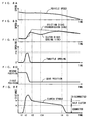
- Figs. 7A-7E are diagrams for explaining the down-shifting control according to the present preferred embodiment.
- Fig. 7A is a graph showing change of a vehicle speed with time
- Fig. 7B is a graph showing change of the rotational speeds of the clutch disks 3b and the friction disks 3c with time.
- Fig. 7C is a graph showing change of the throttle opening with time
- Fig. 7D is a graph showing change of the gear position of the transmission 5 with time
- Fig. 7E is a graph showing change of a movement amount of the push rod 5e ( Fig. 4 ) (hereinafter referred to as a clutch stroke) with time.
- the clutch 3 is in the transmission state when the clutch stroke is not more than a value b, and the clutch 3 is in the disconnection state when the clutch stroke is not less than the value b.
- the clutch 3 is in a half clutch state when the clutch stroke is larger than a value a and smaller than the value b.
- the clutch stroke is increased by the control of the ECU 50 after the driver has performed the down-shifting operation at a time point t1 in the down-shifting control according to the present preferred embodiment.
- the clutch 3 is brought into the disconnection state at a time point t2.
- the throttle opening is temporarily increased to a preset angle c by the control of the ECU 50 as shown in Fig. 7C . This reduces the engaging force between the transmission gears 5c and the transmission gears 5d, causing the transmission gears 5c or the transmission gears 5d to easily move.
- the throttle valves 82 are adjusted such that the torque of the engine 107 is not more than the running resistance until the clutch 3 is brought into the disconnection state at the time point t2 in the present preferred embodiment.
- the running resistance means resistance determined by air resistance, rolling resistance, incline resistance, acceleration resistance and so on, for example, acting on the motorcycle 100.
- the throttle valves 82 are adjusted such that the torque of the engine 107 is not more than the running resistance until the time point t2 at which the clutch 3 is brought into the disconnection state, so that the motorcycle 100 can be prevented from being accelerated after the down-shifting operation by the driver.
- the angle c of Fig. 7C is preset based on an allowable maximum rotational speed of the engine 107 (an upper limit of the rotational speed preset for sufficiently ensuring reliability of the engine). Specifically, when the output of the engine 107 is increased with the clutch 3 being disconnected (no load state), the angle c is determined such that the rotational speed of the engine 107 is maintained to be not more than the allowable maximum rotational speed, for example. In this case, the rotational speed of the engine 107 can be prevented from being faster than the allowable maximum rotational speed even though the throttle opening is increased to the angle c when the clutch 3 is in the disconnection state after the time point t2. This sufficiently ensures the reliability of the engine 107.
- a maximum throttle opening with which the rotational speed of the engine 107 can be maintained to be not more than the allowable maximum rotational speed in the no load state is set as the angle c in the present preferred embodiment. In this case, the rotational speed of the engine 107 is smoothly increased and the reliability of the engine 107 is sufficiently ensured.
- the angle c is set such that the engaging portion 864 ( Figs. 3A and 3B ) and the engaging portion 891 ( Figs. 3A and 3B ) do not come in contact with each other when the throttle opening is increased to the angle c with the opening of the accelerator grip 106 ( Fig. 1 ) being set to the minimum value.
- the angle c is set smaller than the angle ⁇ ( Figs. 3A and 3B ) by about 5°, for example.
- the engaging portion 864 and the engaging portion 891 can be reliably prevented from coming in contact with each other even though overshoot of the throttle valves 82 occurs. This prevents the accelerator grip 106 from being moved by a motor to give the rider uncomfortable feeling.
- the allowable maximum rotational speed is preferably set to about 9000 rpm
- the angle c is preferably set to about 25°
- the angle ⁇ is preferably set to about 30°, for example.
- the gear position of the transmission 5 is switched from the second position to the first position by the control of the ECU 50 after the time point t2 at which the clutch 3 is disconnected as shown in Figs. 7D and 7E .
- the clutch stroke is decreased, and the clutch 3 enters the transmission state at a time point t3.
- the gear position of the transmission 5 is moved to the lower position by one stage in a time period between the time point t2 and the time point t3, so that the reduction gear ratio between the main shaft 5a and the drive shaft 5b is increased in the present preferred embodiment.
- This increases the rotational speed of the main shaft 5a to increase the rotational speed of the friction disks 3c ( Fig. 4 ) as shown in Fig. 7B .
- the time period during which the clutch 3 is in the disconnection state (time period from the time point t2 to the time point t3) is set to not more than about 90 msec, for example, in order to shorten an idle running time period in the present preferred embodiment.
- an upper limit of the throttle opening is restricted to the angle c in the time period between the time point t2 and the time point t3. Even though the opening of the throttle valve is restricted, the output of the engine can be sufficiently increased by increasing the opening of the throttle for a long time period in a range of restriction. In this case, however, the opening of the throttle valve 82 cannot be maintained at the angle c for a sufficient time period.
- the rotational speed of the engine 107 is not significantly increased in the time period during which the clutch 3 is in the disconnection state in the present preferred embodiment. Accordingly, the rotational speed of the clutch disks 3b is lower than the rotational speed of the friction disks 3c at the time point t3 at which the clutch 3 is switched from the disconnection state to the transmission state as shown in Fig. 7B .
- the ratio of decrease of the clutch stroke is increased at a time point t4 at which the clutch stroke attains the value a, and the throttle opening is decreased from the angle d to 0°. Then, the clutch stroke is set to a minimum value at a time point t5, so that the down-shifting of the transmission 5 is completed.
- the throttle valves 82 are not fully closed, but the throttle opening is adjusted to the angle d at the time point t3 as shown in Fig. 7C in the present preferred embodiment.
- detail description is made of effects of the down-shifting control according to the present preferred embodiment white comparing the down-shifting control according to the present preferred embodiment with the down-shifting control in a case where the opening of the throttle valves 82 is set to the minimum value when the clutch 3 is switched from the disconnection state to the transmission state.
- Figs. 8A-8E are diagrams showing a state of each component when the opening of the throttle valves 82 is set to the minimum value at the time of switching the clutch 3 from the disconnection state to the transmission state.
- Fig. 8A is a graph showing change of the vehicle speed with time
- Fig. 8B is a graph showing change of the rotational speeds of the clutch disks 3b and the friction disks 3c with time.
- Fig. 8C is a graph showing change of the throttle opening with time
- Fig. 8D is a graph showing change of the gear position of the transmission 5 with time
- Fig. 8E is a graph showing change of the clutch stroke with time.
- the difference of the rotational speed between the clutch disks 3b and the friction disks 3c is increased at the time of switching the clutch 3 from the disconnection state to the transmission state as shown in Fig. 8B .
- the half clutch state has to be maintained for long in order to decrease the difference of the rotational speed between the clutch disks 3b and the friction disks 3c and to prevent occurrence of the shift shock.
- This causes a longer time period required for the down-shifting control.
- a time period from the time point t1 at which the driver performs the shifting operation to the time point t5 at which the down-shifting control is finished is about 800 msec in the example of Figs. 8A-8E .
- the throttle opening is adjusted to the angle d at the time of switching the clutch 3 from the disconnection state to the transmission state in the down-shifting control according to the present preferred embodiment, thereby quickly causing the engine brake to act on the motorcycle 100. This shortens the idle running time period and improves the driving feeling of the motorcycle 100.
- the throttle opening is adjusted to the angle d in the time period during which the clutch 3 is in the half clutch state (time period from the time point t3 to the time point t4) as shown in Fig. 7C and 7E in the present preferred embodiment.
- the excessive decrease in the rotational speed of the clutch disks 3b during the connection of the clutch 3 is prevented, thus allowing the rotational speed of the clutch disks 3b and the rotational speed of the friction disks 3c to coincide with each other in a short time period.
- a time period from the time point t1 to the time point t4 is about 220 msec to about 470 msec in the example of Figs. 7A-7E .
- a time period from the time point t1 to the time point t3 is about 90 msec to about 120 msec, for example, a time period from the time point t2 to the time point t3 is about 60 msec to about 90 msec, for example, and a time period from the time point t4 to the time point t5 is about 60 msec, for example.
- a time period required for decreasing the throttle opening from the angle c to the angle d is about 40 msec, for example.
- the time point at which the throttle opening is adjusted to the angle c and the time point t3 at which the connection of the clutch 3 is started are determined by the ECU 50 based on the rotational speed of the engine 107, the gear position of the transmission 5 and so on. Specifically, a relationship among the time point at which the throttle opening is adjusted to the angle c, the time point t3 at which the connection of the clutch 3 is started, the rotational speed of the engine 107, the gear position of the transmission 5 and so on is stored in advance in the ROM or the RAM of the ECU 50, for example. Then, the ECU 50 determines the time point at which the throttle opening is adjusted to the angle c and the time point t3 at which the connection of the clutch 3 is started based on the relationship.
- the angle d of Fig. 7C is a value determined based on the rotational speed of the engine 107 after the gear change calculated by the ECU 50 when the down-shifting operation is performed by the driver.
- the rotational speed of the engine 107 after the gear change is a rotational speed of the engine 107 with which the rotational speed (vehicle speed) of the drive shaft 5b ( Fig. 4 ) before the gear change can be maintained in the gear position after the gear change.
- the angle d of Fig. 7C is a throttle opening with which the torque generated by the engine 107 is zero in the rotational speed of the engine 107 after the gear change calculated by the foregoing equation. Detail description will be made of a method of calculating the angle d. Note that the throttle opening with which the torque generated by the engine 107 is zero is referred to as a zero torque opening in the following description.
- a relationship between the zero torque opening obtained by experiments, simulations and so on and the rotational speed of the engine 107 is stored in advance in the ROM or the RAM of the ECU 50. Then, the ECU 50 calculates the zero torque opening based on the relationship stored in the ROM (or the RAM) and the rotational speed of the engine 107 calculated by the foregoing equation (1). Note that the relationship between the zero torque opening and the rotational speed of the engine 107 may be stored as an equation or a map, for example.
- Fig. 9 is a diagram showing an example of the relationship between the zero torque opening and the rotational speed of the engine 107.
- the ordinate indicates the throttle opening and the abscissa indicates the rotational speed of the engine 107 in Fig. 9 .
- the zero torque opening is about 6° when the rotational speed of the engine 107 is approximately 4000 rpm, for example. Therefore, when the rotational speed of the engine 107 after the gear change calculated by the ECU 50 is approximately 4000 rpm, the angle d of Fig. 7C is set to about 6°, for example.
- the zero torque opening is about 9° when the rotational speed of the engine 107 is approximately 6000 rpm, for example. Therefore, when the rotational speed of the engine 107 after the gear change calculated by the ECU 50 is approximately 6000 rpm, the angle d of Fig. 7C is set to about 9°, for example.
- the large torque is prevented from being generated in the engine 107 at the time of switching the clutch 3 from the disconnection state to the transmission state.
- the throttle opening does not attain an angle smaller than the angle d at the time of decreasing the throttle opening from the angle c to the angle d as shown in Fig. 7C . This sufficiently prevents the excessive decrease in the rotational speed of the engine 107 at the time of the connection of the clutch 3. As a result, the down-shifting of the transmission 5 can be more smoothly performed.
- Figs. 10 and 11 are flowcharts showing details of the down-shifting control in Step S2 of Fig. 6 .
- the ECU 50 determines whether the gear position of the transmission 5 ( Fig. 4 ) is neutral based on the value detected by the shift cam rotation angle sensor SE4 ( Fig. 5 ) in the down-shifting control (step S41).
- the ECU 50 calculates the rotational speed of the engine 107 after the down-shifting based on the value detected by the engine rotational speed sensor SE3 ( Fig. 5 ), the value detected by the shift cam rotation angle sensor SE4 and the foregoing equation (1) (Step S42).
- the ECU 50 determines whether the rotational speed of the engine 107 before the down-shifting is not more than a first threshold value (about 2700 rpm, for example) based on the value detected by the engine rotational speed sensor SE3 and determines whether a difference between the rotational speed of the engine 107 before the down-shifting and the rotational speed of the engine 107 after the down-shifting calculated in Step S42 is not more than a second threshold value (about 400 rpm, for example) (Step S43).
- a first threshold value about 2700 rpm, for example
- the ECU 50 determines that the down-shifting can be smoothly performed with no output increase of the engine 107. Then, the ECU 50 controls the clutch actuator 4 ( Fig. 4 ) to disconnect the clutch 3 ( Fig. 4 ) without opening the throttle valves 82 (Step S44).
- the ECU 50 controls the shift actuator 7 ( Fig. 4 ) to rotate the shift cam 6a ( Fig. 4 ) with the clutch 3 being disconnected (Step S45).
- the shift forks 6c ( Fig. 4 ) move, causing the transmission gears 5c, 5d ( Fig. 4 ) to move.
- the gear position of the transmission 5 moves to the lower position by one stage.
- the ECU subsequently controls the clutch actuator 4 ( Fig. 4 ) to bring the clutch 3 ( Fig. 4 ) into the half clutch state by (Step S46). This gradually decreases the difference of the rotational speed between the clutch disks 3b and the friction disks 3c.
- Step S47 When the difference of the rotational speed between the clutch disks 3b and the friction disks 3c is not more than the third threshold value and the clutch stroke is not more than the fourth threshold value in Step S47, the ECU 50 controls the clutch actuator 4 to set the clutch stroke to the minimum value (Step S48). Accordingly, the down-shifting control is finished.
- Step S41 When it is determined that the gear position of the transmission 5 is neutral in Step S41, the ECU 50 does not execute the processes of Steps S42 to S48 and finishes the up-shifting control.
- the ECU 50 When it is determined that the rotational speed of the engine 107 is larger than the first threshold value or the difference between the rotational speed of the engine 107 before the down-shifting and the rotational speed of the engine 107 after the down-shifting is larger than the second threshold value in Step S43, the ECU 50 performs the down-shifting control described with reference to Figs. 7A-7E .
- the ECU 50 calculates the zero torque opening (the angle d in Fig. 7C ) based on the rotational speed of the engine 107 after the down-shifting calculated in Step S42 as shown in Fig. 11 (Step S49).
- the ECU 50 controls the throttle actuator 85 ( Fig. 2 ) to temporarily increase the output of the engine 107 ( Fig. 1 ) (Step S50).
- the throttle opening is adjusted to the angle c.
- the ECU 50 subsequently controls the clutch actuator 4 to switch the clutch 3 from the disconnection state to the transmission state (Step S51). Then, the ECU 50 controls the shift actuator 7 to rotate the shift cam 6a with the clutch 3 being disconnected (Step S52). Thus, the shift forks 6c are moved to cause the transmission gears 5c, 5d to be moved. As a result, the gear position of the transmission 5 moves to the lower position by one stage.
- the ECU 50 then controls the throttle actuator 85 to cause the throttle opening to be adjusted to the zero torque opening calculated in Step S49 (Step S53).
- the ECU 50 subsequently controls the clutch actuator 4 to bring the clutch 3 into the half clutch state (Step S54). This gradually decreases the difference of the rotational speed between the clutch disks 3b and the pressure plate 3a.
- the ECU 50 determines that the clutch 3 can be connected without occurrence of the shock in the motorcycle 100. Accordingly, the ECU 50 controls the clutch actuator 4 to set the clutch stroke to the minimum value and controls the throttle actuator 85 to set the throttle opening to the minimum value (Step S56). Accordingly, the down-shifting control is finished.
- the throttle valves 82 are not fully closed, thus preventing the decrease in the rotational speed of the clutch disks 3b during the connection of the clutch 3. This allows the rotational speed of the clutch disks 3b and the rotational speed of the friction disks 3c to coincide with each other in the short time period. As a result, the quick down-shifting can be performed without occurrence of the shift shock in the motorcycle 100.
- the throttle opening is adjusted to the zero torque opening (the angle d) when the clutch 3 is switched from the disconnection state to the transmission state, thus preventing the occurrence of the large torque in the engine 107 at the time of switching the clutch 3 from the disconnection state to the transmission state in the present preferred embodiment.
- This prevents the acceleration of the motorcycle 100 at the time of switching the clutch 3 from the disconnection state to the transmission state. As a result, the occurrence of the shift shock can be prevented.
- the method of calculating the rotational speed of the engine 107 is not limited to the above-described example.
- the rotational speed of the drive shaft 5b after the gear change may be calculated based on a change amount of the rotational speed of the drive shaft 5b in a predetermined time period before the gear change to calculate the rotational speed of the engine 107 with which the calculated rotational speed of the drive shaft 5b can be maintained.
- the rotational speed of the engine 107 after the gear change is calculated in consideration of change of the speed of the drive shaft 5b (the motorcycle 100), so that a more appropriate rotational speed of the engine 107 can be calculated. Accordingly, a more appropriate zero torque opening can be calculated.
- the method of calculating the zero torque opening is not limited to the above-described example.
- the zero torque opening may be calculated based on the rotational speed of the engine 107 after the gear change detected by the engine rotational speed sensor SE3.
- the zero torque opening may be a constant value calculated based on the rotational speed of the engine 107 at a predetermined time point (the time point t3 of Figs. 7A-7E , for example) after the gear change, or may be a value that changes according to the change of the rotational speed of the engine 107 in the half clutch time period (the time period from the time point t3 to the time point t4 of Figs. 7A-7E ), for example.
- the throttle opening is adjusted to the zero torque opening calculated by the ECU 50 at the time of connecting the clutch 3 and during the half clutch state of the clutch 3 in the foregoing preferred embodiment, the throttle opening may not be adjusted to the zero torque opening.
- the throttle opening may be adjusted such that the torque generated in the engine 107 is not less than zero and not more than the running resistance at the time of connecting the clutch 3 and during the half clutch state of the clutch 3.
- the connection of the clutch 3 does not cause the motorcycle 100 to be accelerated. Accordingly, the driving feeling of the motorcycle can be prevented from being degraded at the time of the connection of the clutch 3.
- Fig. 12 is a diagram showing a relationship between the throttle opening and the running resistance. Note that the ordinate indicates the torque generated in the engine 107, and the abscissa indicates the rotational speed of the engine 107 in Fig. 12 .
- the throttle opening of about 8° causes the torque of the engine 107 to be not less than zero and not more than the running resistance.
- the throttle opening in a range from about 10° to about 14° causes the torque of the engine 107 to be not less than zero and not more than the running resistance.
- the running resistance on each gear position is stored in advance in the ROM (or the RAM) of the ECU 50 as a map or an equation.
- the relationship among the throttle opening, the rotational speed of the engine 107 and the torque of the engine 107 is also stored in advance in the ROM (or the RAM) of the ECU 50. Then, the ECU 50 determines the throttle opening based on the relationships stored in the ROM (or the RAM), the value detected by the engine rotational speed sensor SE3 and the value detected by the shift cam rotation angle sensor SE4.
- a shift switch to detect the shifting operation by the driver may be provided at the handle 105. In this case, the driver can easily perform the shift change of the transmission 5 by operating the shift switch.
- the number of the air flow paths 81 is not limited to four.
- the number of the air flow paths 81 is preferably changed according to the number of cylinders of the engine 107. For example, when the throttle body 108 is attached to the engine 107 with three cylinders, three air flow paths 81 are preferably provided in the throttle body 108. When the throttle body 108 is attached to the engine 107 with five cylinders, five air flow paths 81 are preferably provided in the throttle body 108.
- motorcycle 100 is described as one example of the vehicle in the foregoing preferred embodiment, another vehicle such as a three-wheeled motor vehicle or a four-wheeled motor vehicle may be used.
- the present invention can be applied to a full automatic transmission control system.
- a torque sensor that detects the torque of the engine 107 may be provided instead of the shifting operation detection sensor SE6, and the up-shifting control and the down-shifting control may be started based on the torque of the engine 107 detected by the torque sensor, for example.
- Step S47 Fig. 10
- Step S55 Fig. 11
- a load acting on the push rod 5e and a preset threshold value may be compared with each other.
- the ECU 50 may determine that a connection amount of the clutch 3 is sufficiently increased when the load acting on the push rod 5e attains not less than the threshold value, and proceed to the process of Step S48 or Step S56.
- Step S47 and Step S55 the ECU 50 may proceed to the process of Step S48 and Step S56 when a state in which the difference of the rotational speed between the clutch disks 3b and the friction disks 3c is not more than the third threshold value continues for a preset time period (50 msec, for example) or more.
- the clutch 3 is connected while the rotational speeds of the clutch disks 3b and the friction disks 3c are stable, thus reliably preventing occurrence of the shift shock in the motorcycle 100.
- the throttle actuator 85 is an example of a throttle opening adjustment mechanism
- the shifting operation detection sensor SE6 is an example of a detection device
- the shift mechanism 6 and the shift actuator 7 are examples of a shift mechanism
- the clutch actuator 4 is an example of a clutch actuation mechanism
- the ECU 50 is an example of a controller
- the clutch disk 3b is an example of a first rotation plate
- the friction disk 3c is an example of a second rotation plate
- the accelerator grip 106 is an example of an accelerator operator
- the throttle shaft 83, the link mechanism 86, the rotation shaft 87, the pulley 88, the throttle cable 881 and the auxiliary arm 89 are examples of a coupling mechanism
- the engaging portion 864 and the engaging portion 891 are examples of a restriction mechanism
- the rear wheel 116 is an example of a drive wheel.
- the value c is an example of a first value
- the value d is an example of a second value
- zero is an example of a minimum value
- the third threshold value is an example of a preset value
- the fourth threshold value is an example of a predetermined value
- the angle ⁇ is an example of a third value.
Landscapes
- Engineering & Computer Science (AREA)
- Mechanical Engineering (AREA)
- General Engineering & Computer Science (AREA)
- Chemical & Material Sciences (AREA)
- Combustion & Propulsion (AREA)
- Transportation (AREA)
- Automation & Control Theory (AREA)
- Human Computer Interaction (AREA)
- Control Of Vehicle Engines Or Engines For Specific Uses (AREA)
- Control Of Throttle Valves Provided In The Intake System Or In The Exhaust System (AREA)
- Control Of Driving Devices And Active Controlling Of Vehicle (AREA)
- Control Of Transmission Device (AREA)
- Electrical Control Of Air Or Fuel Supplied To Internal-Combustion Engine (AREA)
Applications Claiming Priority (1)
| Application Number | Priority Date | Filing Date | Title |
|---|---|---|---|
| JP2008199400 | 2008-08-01 |
Publications (3)
| Publication Number | Publication Date |
|---|---|
| EP2149488A2 true EP2149488A2 (de) | 2010-02-03 |
| EP2149488A3 EP2149488A3 (de) | 2014-06-25 |
| EP2149488B1 EP2149488B1 (de) | 2015-09-02 |
Family
ID=41258120
Family Applications (1)
| Application Number | Title | Priority Date | Filing Date |
|---|---|---|---|
| EP09009885.6A Active EP2149488B1 (de) | 2008-08-01 | 2009-07-30 | Getriebesteuerungssystem und Fahrzeug |
Country Status (4)
| Country | Link |
|---|---|
| US (1) | US8437929B2 (de) |
| EP (1) | EP2149488B1 (de) |
| JP (1) | JP2010052726A (de) |
| CN (1) | CN101704366B (de) |
Cited By (5)
| Publication number | Priority date | Publication date | Assignee | Title |
|---|---|---|---|---|
| WO2013171564A1 (en) * | 2012-05-16 | 2013-11-21 | Toyota Jidosha Kabushiki Kaisha | System to control the torque of an internal combustion engine during a gear|change |
| EP2695783A1 (de) * | 2012-08-10 | 2014-02-12 | Yamaha Hatsudoki Kabushiki Kaisha | Automatische Übertragungsvorrichtung und Sattelfahrzeug mit der Vorrichtung |
| EP2716941A1 (de) * | 2012-10-03 | 2014-04-09 | Yamaha Hatsudoki Kabushiki Kaisha | Grätschsitz-Fahrzeug mit Drosselklappensteuerung bei Rückschaltung |
| US11408506B2 (en) * | 2019-08-22 | 2022-08-09 | Toyota Motor Engineering & Manufacturing North America, Inc. | Simulated rev-matching in a vehicle having a two motor hybrid system transmission |
| US11565581B2 (en) | 2020-01-07 | 2023-01-31 | Toyota Motor Engineering & Manufacturing North America, Inc. | Sequential simulated gear ratio calculation and rev-matching in a hybrid electric vehicle |
Families Citing this family (15)
| Publication number | Priority date | Publication date | Assignee | Title |
|---|---|---|---|---|
| WO2011096540A1 (ja) * | 2010-02-05 | 2011-08-11 | 本田技研工業株式会社 | クラッチ制御装置 |
| CN103097220B (zh) * | 2010-10-21 | 2015-09-30 | 日野自动车株式会社 | 变速控制装置、混合动力汽车及变速控制方法 |
| US8439803B2 (en) * | 2011-06-24 | 2013-05-14 | GM Global Technology Operations LLC | System and method for improved closed throttle downshifts |
| WO2013014750A1 (ja) * | 2011-07-26 | 2013-01-31 | 株式会社エフ・シー・シー | 車両用動力伝達システム |
| JP5926509B2 (ja) * | 2011-08-02 | 2016-05-25 | 株式会社ミクニ | スロットル装置 |
| DE102011085109A1 (de) * | 2011-10-24 | 2013-04-25 | Zf Friedrichshafen Ag | Verfahren zum Betreiben eines Antriebsstrangs und Steuerungseinrichtung |
| RU2719265C2 (ru) * | 2012-06-29 | 2020-04-17 | Бомбардье Рекриэйшенел Продактс Инк. | Снегоход |
| JP5936690B2 (ja) * | 2012-07-27 | 2016-06-22 | 本田技研工業株式会社 | 車両用自動変速機の制御装置 |
| FR3018551B1 (fr) * | 2014-03-14 | 2022-04-15 | Renault Sas | Procede de controle de l'arret d'un moteur thermique |
| CN105221733B (zh) * | 2014-07-03 | 2018-12-21 | 比亚迪股份有限公司 | 离合器的控制方法、装置和车辆 |
| US9702454B1 (en) * | 2015-03-30 | 2017-07-11 | Penny Technologies S.À.R.L. | Gearbox shift lock |
| JP7032974B2 (ja) * | 2018-03-30 | 2022-03-09 | カワサキモータース株式会社 | 変速機付き車両 |
| CN114017498B (zh) * | 2021-12-10 | 2023-03-31 | 合肥工业大学 | 一种离合器结合平顺性的控制方法 |
| JPWO2024013598A1 (de) * | 2022-07-15 | 2024-01-18 | ||
| JP2025179576A (ja) * | 2024-05-28 | 2025-12-10 | ヤマハ発動機株式会社 | 鞍乗型車両 |
Citations (2)
| Publication number | Priority date | Publication date | Assignee | Title |
|---|---|---|---|---|
| JPH038684B2 (de) | 1983-12-28 | 1991-02-06 | Honda Motor Co Ltd | |
| JP2006336639A (ja) | 2005-05-02 | 2006-12-14 | Yamaha Motor Co Ltd | 鞍乗型車両 |
Family Cites Families (18)
| Publication number | Priority date | Publication date | Assignee | Title |
|---|---|---|---|---|
| JPS591853A (ja) | 1982-06-28 | 1984-01-07 | Mitsubishi Motors Corp | 自動変速機制御装置 |
| JPH0684135B2 (ja) | 1987-09-29 | 1994-10-26 | ジャトコ株式会社 | エンジン・自動変速機駆動系統の制御装置 |
| US5369581A (en) * | 1989-03-17 | 1994-11-29 | Hitachi, Ltd. | Vehicle control apparatus and method therefor |
| JP3008684B2 (ja) | 1991-12-25 | 2000-02-14 | トヨタ自動車株式会社 | 自動変速機の変速制御装置 |
| JP2715819B2 (ja) | 1992-07-06 | 1998-02-18 | トヨタ自動車株式会社 | 自動変速機の変速制御装置 |
| JP3458358B2 (ja) | 1994-10-27 | 2003-10-20 | ヤマハ発動機株式会社 | バックトルクリミッター付クラッチ |
| FR2728838B1 (fr) * | 1994-12-28 | 1997-04-25 | Asulab Sa | Dispositif de propulsion pour vehicule automobile |
| JP3630198B2 (ja) | 1996-04-30 | 2005-03-16 | 本田技研工業株式会社 | 車両用内燃エンジン制御装置 |
| JP3623357B2 (ja) | 1998-02-20 | 2005-02-23 | 本田技研工業株式会社 | 車両の駆動制御装置 |
| CN2361505Y (zh) | 1999-03-22 | 2000-02-02 | 大连锦华汽车电子有限公司 | 电控电动机械式自动变速装置 |
| JP2001328461A (ja) | 2000-05-19 | 2001-11-27 | Mitsubishi Electric Corp | 同期噛合式自動変速機付きエンジンの制御装置 |
| JP2003294062A (ja) | 2002-04-03 | 2003-10-15 | Yamaha Motor Co Ltd | 自動二輪車のエンジンブレーキ制御装置 |
| JP3701640B2 (ja) * | 2002-08-30 | 2005-10-05 | トヨタ自動車株式会社 | 車両用自動変速機のダウン変速制御装置 |
| JP2006083946A (ja) | 2004-09-16 | 2006-03-30 | Yamaha Motor Co Ltd | 車両の変速制御装置およびそれを備えた車両 |
| JP4274100B2 (ja) * | 2004-10-12 | 2009-06-03 | 日産自動車株式会社 | エンジンの制御装置 |
| JP4389748B2 (ja) * | 2004-10-12 | 2009-12-24 | 日産自動車株式会社 | エンジンの制御装置 |
| JP4461997B2 (ja) * | 2004-10-12 | 2010-05-12 | 日産自動車株式会社 | エンジンの制御装置 |
| JP2006336638A (ja) | 2005-05-02 | 2006-12-14 | Yamaha Motor Co Ltd | 鞍乗型車両 |
-
2009
- 2009-07-22 JP JP2009170873A patent/JP2010052726A/ja active Pending
- 2009-07-30 EP EP09009885.6A patent/EP2149488B1/de active Active
- 2009-07-30 US US12/512,289 patent/US8437929B2/en active Active
- 2009-08-03 CN CN2009101649263A patent/CN101704366B/zh active Active
Patent Citations (2)
| Publication number | Priority date | Publication date | Assignee | Title |
|---|---|---|---|---|
| JPH038684B2 (de) | 1983-12-28 | 1991-02-06 | Honda Motor Co Ltd | |
| JP2006336639A (ja) | 2005-05-02 | 2006-12-14 | Yamaha Motor Co Ltd | 鞍乗型車両 |
Cited By (5)
| Publication number | Priority date | Publication date | Assignee | Title |
|---|---|---|---|---|
| WO2013171564A1 (en) * | 2012-05-16 | 2013-11-21 | Toyota Jidosha Kabushiki Kaisha | System to control the torque of an internal combustion engine during a gear|change |
| EP2695783A1 (de) * | 2012-08-10 | 2014-02-12 | Yamaha Hatsudoki Kabushiki Kaisha | Automatische Übertragungsvorrichtung und Sattelfahrzeug mit der Vorrichtung |
| EP2716941A1 (de) * | 2012-10-03 | 2014-04-09 | Yamaha Hatsudoki Kabushiki Kaisha | Grätschsitz-Fahrzeug mit Drosselklappensteuerung bei Rückschaltung |
| US11408506B2 (en) * | 2019-08-22 | 2022-08-09 | Toyota Motor Engineering & Manufacturing North America, Inc. | Simulated rev-matching in a vehicle having a two motor hybrid system transmission |
| US11565581B2 (en) | 2020-01-07 | 2023-01-31 | Toyota Motor Engineering & Manufacturing North America, Inc. | Sequential simulated gear ratio calculation and rev-matching in a hybrid electric vehicle |
Also Published As
| Publication number | Publication date |
|---|---|
| JP2010052726A (ja) | 2010-03-11 |
| US8437929B2 (en) | 2013-05-07 |
| EP2149488B1 (de) | 2015-09-02 |
| EP2149488A3 (de) | 2014-06-25 |
| US20100030436A1 (en) | 2010-02-04 |
| CN101704366B (zh) | 2013-01-09 |
| CN101704366A (zh) | 2010-05-12 |
Similar Documents
| Publication | Publication Date | Title |
|---|---|---|
| EP2149488B1 (de) | Getriebesteuerungssystem und Fahrzeug | |
| EP2161481B1 (de) | Getriebesteuerungssystem und Fahrzeug | |
| US7938749B2 (en) | Control system and vehicle | |
| US7673728B2 (en) | Automated transmission controller and vehicle including the automated transmission controller | |
| US7846062B2 (en) | Control system and vehicle including the same | |
| US20080149409A1 (en) | Engine output adjustment system and vehicle including the same | |
| US8433489B2 (en) | Transmission control system with adjustable clutch disconnection and vehicle including same | |
| EP2159400B1 (de) | Steuerungssystem und Fahrzeug | |
| EP2159402B1 (de) | Drehmomenteinschätzungssystem und Fahrzeug | |
| US8260528B2 (en) | Control system for a motorcycle | |
| JP4432962B2 (ja) | 変速機の制御装置 | |
| JP2008144738A (ja) | 車両用動力出力装置の制御装置 | |
| JP2014035069A (ja) | 車両 | |
| EP3495255B1 (de) | Grätschsitzfahrzeug | |
| JP4133503B2 (ja) | 自動変速機の制御装置 | |
| JP2007303298A (ja) | 鞍乗型車両 | |
| JP5994663B2 (ja) | 車両の制御装置 | |
| JP2009221964A (ja) | 制御システムおよびそれを備えた鞍乗り型車両 | |
| JP2007113596A (ja) | 車両制御装置 |
Legal Events
| Date | Code | Title | Description |
|---|---|---|---|
| PUAI | Public reference made under article 153(3) epc to a published international application that has entered the european phase |
Free format text: ORIGINAL CODE: 0009012 |
|
| AK | Designated contracting states |
Kind code of ref document: A2 Designated state(s): AT BE BG CH CY CZ DE DK EE ES FI FR GB GR HR HU IE IS IT LI LT LU LV MC MK MT NL NO PL PT RO SE SI SK SM TR |
|
| AX | Request for extension of the european patent |
Extension state: AL BA RS |
|
| PUAL | Search report despatched |
Free format text: ORIGINAL CODE: 0009013 |
|
| AK | Designated contracting states |
Kind code of ref document: A3 Designated state(s): AT BE BG CH CY CZ DE DK EE ES FI FR GB GR HR HU IE IS IT LI LT LU LV MC MK MT NL NO PL PT RO SE SI SK SM TR |
|
| AX | Request for extension of the european patent |
Extension state: AL BA RS |
|
| RIC1 | Information provided on ipc code assigned before grant |
Ipc: F16H 63/46 20060101ALI20140520BHEP Ipc: F16H 61/04 20060101ALI20140520BHEP Ipc: B60W 10/06 20060101ALN20140520BHEP Ipc: F16H 63/50 20060101ALI20140520BHEP Ipc: F16H 59/24 20060101ALN20140520BHEP Ipc: B60W 30/18 20120101AFI20140520BHEP Ipc: B60W 10/10 20120101ALN20140520BHEP Ipc: B60W 10/02 20060101ALN20140520BHEP |
|
| 17P | Request for examination filed |
Effective date: 20140904 |
|
| RBV | Designated contracting states (corrected) |
Designated state(s): AT BE BG CH CY CZ DE DK EE ES FI FR GB GR HR HU IE IS IT LI LT LU LV MC MK MT NL NO PL PT RO SE SI SK SM TR |
|
| REG | Reference to a national code |
Ref country code: DE Ref legal event code: R079 Ref document number: 602009033282 Country of ref document: DE Free format text: PREVIOUS MAIN CLASS: B60W0030180000 Ipc: B60W0030190000 |
|
| GRAP | Despatch of communication of intention to grant a patent |
Free format text: ORIGINAL CODE: EPIDOSNIGR1 |
|
| INTG | Intention to grant announced |
Effective date: 20150225 |
|
| RIC1 | Information provided on ipc code assigned before grant |
Ipc: F16H 59/24 20060101ALN20150217BHEP Ipc: B60W 10/02 20060101ALN20150217BHEP Ipc: F16H 63/46 20060101ALI20150217BHEP Ipc: F16H 63/18 20060101ALN20150217BHEP Ipc: F16H 63/50 20060101ALI20150217BHEP Ipc: F16H 61/04 20060101ALI20150217BHEP Ipc: B60W 10/11 20120101ALN20150217BHEP Ipc: B60W 10/06 20060101ALN20150217BHEP Ipc: B60W 30/19 20120101AFI20150217BHEP |
|
| GRAS | Grant fee paid |
Free format text: ORIGINAL CODE: EPIDOSNIGR3 |
|
| GRAA | (expected) grant |
Free format text: ORIGINAL CODE: 0009210 |
|
| AK | Designated contracting states |
Kind code of ref document: B1 Designated state(s): AT BE BG CH CY CZ DE DK EE ES FI FR GB GR HR HU IE IS IT LI LT LU LV MC MK MT NL NO PL PT RO SE SI SK SM TR |
|
| REG | Reference to a national code |
Ref country code: GB Ref legal event code: FG4D |
|
| REG | Reference to a national code |
Ref country code: AT Ref legal event code: REF Ref document number: 746345 Country of ref document: AT Kind code of ref document: T Effective date: 20150915 Ref country code: CH Ref legal event code: EP |
|
| REG | Reference to a national code |
Ref country code: IE Ref legal event code: FG4D |
|
| REG | Reference to a national code |
Ref country code: DE Ref legal event code: R096 Ref document number: 602009033282 Country of ref document: DE |
|
| REG | Reference to a national code |
Ref country code: AT Ref legal event code: MK05 Ref document number: 746345 Country of ref document: AT Kind code of ref document: T Effective date: 20150902 |
|
| PG25 | Lapsed in a contracting state [announced via postgrant information from national office to epo] |
Ref country code: FI Free format text: LAPSE BECAUSE OF FAILURE TO SUBMIT A TRANSLATION OF THE DESCRIPTION OR TO PAY THE FEE WITHIN THE PRESCRIBED TIME-LIMIT Effective date: 20150902 Ref country code: LT Free format text: LAPSE BECAUSE OF FAILURE TO SUBMIT A TRANSLATION OF THE DESCRIPTION OR TO PAY THE FEE WITHIN THE PRESCRIBED TIME-LIMIT Effective date: 20150902 Ref country code: NO Free format text: LAPSE BECAUSE OF FAILURE TO SUBMIT A TRANSLATION OF THE DESCRIPTION OR TO PAY THE FEE WITHIN THE PRESCRIBED TIME-LIMIT Effective date: 20151202 Ref country code: GR Free format text: LAPSE BECAUSE OF FAILURE TO SUBMIT A TRANSLATION OF THE DESCRIPTION OR TO PAY THE FEE WITHIN THE PRESCRIBED TIME-LIMIT Effective date: 20151203 Ref country code: LV Free format text: LAPSE BECAUSE OF FAILURE TO SUBMIT A TRANSLATION OF THE DESCRIPTION OR TO PAY THE FEE WITHIN THE PRESCRIBED TIME-LIMIT Effective date: 20150902 |
|
| REG | Reference to a national code |
Ref country code: LT Ref legal event code: MG4D Ref country code: NL Ref legal event code: MP Effective date: 20150902 |
|
| PG25 | Lapsed in a contracting state [announced via postgrant information from national office to epo] |
Ref country code: SE Free format text: LAPSE BECAUSE OF FAILURE TO SUBMIT A TRANSLATION OF THE DESCRIPTION OR TO PAY THE FEE WITHIN THE PRESCRIBED TIME-LIMIT Effective date: 20150902 Ref country code: AT Free format text: LAPSE BECAUSE OF FAILURE TO SUBMIT A TRANSLATION OF THE DESCRIPTION OR TO PAY THE FEE WITHIN THE PRESCRIBED TIME-LIMIT Effective date: 20150902 Ref country code: ES Free format text: LAPSE BECAUSE OF FAILURE TO SUBMIT A TRANSLATION OF THE DESCRIPTION OR TO PAY THE FEE WITHIN THE PRESCRIBED TIME-LIMIT Effective date: 20150902 Ref country code: PL Free format text: LAPSE BECAUSE OF FAILURE TO SUBMIT A TRANSLATION OF THE DESCRIPTION OR TO PAY THE FEE WITHIN THE PRESCRIBED TIME-LIMIT Effective date: 20150902 |
|
| PG25 | Lapsed in a contracting state [announced via postgrant information from national office to epo] |
Ref country code: IS Free format text: LAPSE BECAUSE OF FAILURE TO SUBMIT A TRANSLATION OF THE DESCRIPTION OR TO PAY THE FEE WITHIN THE PRESCRIBED TIME-LIMIT Effective date: 20160102 Ref country code: CZ Free format text: LAPSE BECAUSE OF FAILURE TO SUBMIT A TRANSLATION OF THE DESCRIPTION OR TO PAY THE FEE WITHIN THE PRESCRIBED TIME-LIMIT Effective date: 20150902 Ref country code: SK Free format text: LAPSE BECAUSE OF FAILURE TO SUBMIT A TRANSLATION OF THE DESCRIPTION OR TO PAY THE FEE WITHIN THE PRESCRIBED TIME-LIMIT Effective date: 20150902 Ref country code: EE Free format text: LAPSE BECAUSE OF FAILURE TO SUBMIT A TRANSLATION OF THE DESCRIPTION OR TO PAY THE FEE WITHIN THE PRESCRIBED TIME-LIMIT Effective date: 20150902 Ref country code: NL Free format text: LAPSE BECAUSE OF FAILURE TO SUBMIT A TRANSLATION OF THE DESCRIPTION OR TO PAY THE FEE WITHIN THE PRESCRIBED TIME-LIMIT Effective date: 20150902 |
|
| PG25 | Lapsed in a contracting state [announced via postgrant information from national office to epo] |
Ref country code: PT Free format text: LAPSE BECAUSE OF FAILURE TO SUBMIT A TRANSLATION OF THE DESCRIPTION OR TO PAY THE FEE WITHIN THE PRESCRIBED TIME-LIMIT Effective date: 20160104 Ref country code: RO Free format text: LAPSE BECAUSE OF FAILURE TO SUBMIT A TRANSLATION OF THE DESCRIPTION OR TO PAY THE FEE WITHIN THE PRESCRIBED TIME-LIMIT Effective date: 20150902 |
|
| REG | Reference to a national code |
Ref country code: DE Ref legal event code: R097 Ref document number: 602009033282 Country of ref document: DE |
|
| PLBE | No opposition filed within time limit |
Free format text: ORIGINAL CODE: 0009261 |
|
| STAA | Information on the status of an ep patent application or granted ep patent |
Free format text: STATUS: NO OPPOSITION FILED WITHIN TIME LIMIT |
|
| REG | Reference to a national code |
Ref country code: FR Ref legal event code: PLFP Year of fee payment: 8 |
|
| 26N | No opposition filed |
Effective date: 20160603 |
|
| PG25 | Lapsed in a contracting state [announced via postgrant information from national office to epo] |
Ref country code: DK Free format text: LAPSE BECAUSE OF FAILURE TO SUBMIT A TRANSLATION OF THE DESCRIPTION OR TO PAY THE FEE WITHIN THE PRESCRIBED TIME-LIMIT Effective date: 20150902 Ref country code: SI Free format text: LAPSE BECAUSE OF FAILURE TO SUBMIT A TRANSLATION OF THE DESCRIPTION OR TO PAY THE FEE WITHIN THE PRESCRIBED TIME-LIMIT Effective date: 20150902 |
|
| PG25 | Lapsed in a contracting state [announced via postgrant information from national office to epo] |
Ref country code: BE Free format text: LAPSE BECAUSE OF FAILURE TO SUBMIT A TRANSLATION OF THE DESCRIPTION OR TO PAY THE FEE WITHIN THE PRESCRIBED TIME-LIMIT Effective date: 20150902 |
|
| REG | Reference to a national code |
Ref country code: CH Ref legal event code: PL |
|
| PG25 | Lapsed in a contracting state [announced via postgrant information from national office to epo] |
Ref country code: MC Free format text: LAPSE BECAUSE OF FAILURE TO SUBMIT A TRANSLATION OF THE DESCRIPTION OR TO PAY THE FEE WITHIN THE PRESCRIBED TIME-LIMIT Effective date: 20150902 |
|
| PG25 | Lapsed in a contracting state [announced via postgrant information from national office to epo] |
Ref country code: LI Free format text: LAPSE BECAUSE OF NON-PAYMENT OF DUE FEES Effective date: 20160731 Ref country code: CH Free format text: LAPSE BECAUSE OF NON-PAYMENT OF DUE FEES Effective date: 20160731 |
|
| REG | Reference to a national code |
Ref country code: IE Ref legal event code: MM4A |
|
| REG | Reference to a national code |
Ref country code: FR Ref legal event code: PLFP Year of fee payment: 9 |
|
| PG25 | Lapsed in a contracting state [announced via postgrant information from national office to epo] |
Ref country code: IE Free format text: LAPSE BECAUSE OF NON-PAYMENT OF DUE FEES Effective date: 20160730 |
|
| PG25 | Lapsed in a contracting state [announced via postgrant information from national office to epo] |
Ref country code: LU Free format text: LAPSE BECAUSE OF NON-PAYMENT OF DUE FEES Effective date: 20160730 |
|
| PG25 | Lapsed in a contracting state [announced via postgrant information from national office to epo] |
Ref country code: SM Free format text: LAPSE BECAUSE OF FAILURE TO SUBMIT A TRANSLATION OF THE DESCRIPTION OR TO PAY THE FEE WITHIN THE PRESCRIBED TIME-LIMIT Effective date: 20150902 Ref country code: HU Free format text: LAPSE BECAUSE OF FAILURE TO SUBMIT A TRANSLATION OF THE DESCRIPTION OR TO PAY THE FEE WITHIN THE PRESCRIBED TIME-LIMIT; INVALID AB INITIO Effective date: 20090730 Ref country code: CY Free format text: LAPSE BECAUSE OF FAILURE TO SUBMIT A TRANSLATION OF THE DESCRIPTION OR TO PAY THE FEE WITHIN THE PRESCRIBED TIME-LIMIT Effective date: 20150902 |
|
| PG25 | Lapsed in a contracting state [announced via postgrant information from national office to epo] |
Ref country code: HR Free format text: LAPSE BECAUSE OF FAILURE TO SUBMIT A TRANSLATION OF THE DESCRIPTION OR TO PAY THE FEE WITHIN THE PRESCRIBED TIME-LIMIT Effective date: 20150902 Ref country code: MK Free format text: LAPSE BECAUSE OF FAILURE TO SUBMIT A TRANSLATION OF THE DESCRIPTION OR TO PAY THE FEE WITHIN THE PRESCRIBED TIME-LIMIT Effective date: 20150902 Ref country code: TR Free format text: LAPSE BECAUSE OF FAILURE TO SUBMIT A TRANSLATION OF THE DESCRIPTION OR TO PAY THE FEE WITHIN THE PRESCRIBED TIME-LIMIT Effective date: 20150902 Ref country code: MT Free format text: LAPSE BECAUSE OF NON-PAYMENT OF DUE FEES Effective date: 20160731 |
|
| REG | Reference to a national code |
Ref country code: FR Ref legal event code: PLFP Year of fee payment: 10 |
|
| PG25 | Lapsed in a contracting state [announced via postgrant information from national office to epo] |
Ref country code: BG Free format text: LAPSE BECAUSE OF FAILURE TO SUBMIT A TRANSLATION OF THE DESCRIPTION OR TO PAY THE FEE WITHIN THE PRESCRIBED TIME-LIMIT Effective date: 20150902 |
|
| P01 | Opt-out of the competence of the unified patent court (upc) registered |
Effective date: 20230527 |
|
| PGFP | Annual fee paid to national office [announced via postgrant information from national office to epo] |
Ref country code: GB Payment date: 20240723 Year of fee payment: 16 |
|
| PGFP | Annual fee paid to national office [announced via postgrant information from national office to epo] |
Ref country code: FR Payment date: 20240729 Year of fee payment: 16 |
|
| PGFP | Annual fee paid to national office [announced via postgrant information from national office to epo] |
Ref country code: DE Payment date: 20250722 Year of fee payment: 17 |
|
| PGFP | Annual fee paid to national office [announced via postgrant information from national office to epo] |
Ref country code: IT Payment date: 20250724 Year of fee payment: 17 |
|
| GBPC | Gb: european patent ceased through non-payment of renewal fee |
Effective date: 20250730 |
|
| PG25 | Lapsed in a contracting state [announced via postgrant information from national office to epo] |
Ref country code: GB Free format text: LAPSE BECAUSE OF NON-PAYMENT OF DUE FEES Effective date: 20250730 |
|
| PG25 | Lapsed in a contracting state [announced via postgrant information from national office to epo] |
Ref country code: FR Free format text: LAPSE BECAUSE OF NON-PAYMENT OF DUE FEES Effective date: 20250731 |