EP2139771B1 - System zur erfassung der passage von objekten mit einem rfid-etikett und solch ein system verwendendes verfahren - Google Patents
System zur erfassung der passage von objekten mit einem rfid-etikett und solch ein system verwendendes verfahren Download PDFInfo
- Publication number
- EP2139771B1 EP2139771B1 EP07731417A EP07731417A EP2139771B1 EP 2139771 B1 EP2139771 B1 EP 2139771B1 EP 07731417 A EP07731417 A EP 07731417A EP 07731417 A EP07731417 A EP 07731417A EP 2139771 B1 EP2139771 B1 EP 2139771B1
- Authority
- EP
- European Patent Office
- Prior art keywords
- objects
- antenna
- passage
- reader
- mobile support
- Prior art date
- Legal status (The legal status is an assumption and is not a legal conclusion. Google has not performed a legal analysis and makes no representation as to the accuracy of the status listed.)
- Not-in-force
Links
Images


Classifications
-
- G—PHYSICS
- G06—COMPUTING OR CALCULATING; COUNTING
- G06K—GRAPHICAL DATA READING; PRESENTATION OF DATA; RECORD CARRIERS; HANDLING RECORD CARRIERS
- G06K7/00—Methods or arrangements for sensing record carriers, e.g. for reading patterns
- G06K7/10—Methods or arrangements for sensing record carriers, e.g. for reading patterns by electromagnetic radiation, e.g. optical sensing; by corpuscular radiation
- G06K7/10009—Methods or arrangements for sensing record carriers, e.g. for reading patterns by electromagnetic radiation, e.g. optical sensing; by corpuscular radiation sensing by radiation using wavelengths larger than 0.1 mm, e.g. radio-waves or microwaves
- G06K7/10316—Methods or arrangements for sensing record carriers, e.g. for reading patterns by electromagnetic radiation, e.g. optical sensing; by corpuscular radiation sensing by radiation using wavelengths larger than 0.1 mm, e.g. radio-waves or microwaves using at least one antenna particularly designed for interrogating the wireless record carriers
- G06K7/10346—Methods or arrangements for sensing record carriers, e.g. for reading patterns by electromagnetic radiation, e.g. optical sensing; by corpuscular radiation sensing by radiation using wavelengths larger than 0.1 mm, e.g. radio-waves or microwaves using at least one antenna particularly designed for interrogating the wireless record carriers the antenna being of the far field type, e.g. HF types or dipoles
-
- G—PHYSICS
- G06—COMPUTING OR CALCULATING; COUNTING
- G06K—GRAPHICAL DATA READING; PRESENTATION OF DATA; RECORD CARRIERS; HANDLING RECORD CARRIERS
- G06K7/00—Methods or arrangements for sensing record carriers, e.g. for reading patterns
- G06K7/10—Methods or arrangements for sensing record carriers, e.g. for reading patterns by electromagnetic radiation, e.g. optical sensing; by corpuscular radiation
- G06K7/10009—Methods or arrangements for sensing record carriers, e.g. for reading patterns by electromagnetic radiation, e.g. optical sensing; by corpuscular radiation sensing by radiation using wavelengths larger than 0.1 mm, e.g. radio-waves or microwaves
- G06K7/10316—Methods or arrangements for sensing record carriers, e.g. for reading patterns by electromagnetic radiation, e.g. optical sensing; by corpuscular radiation sensing by radiation using wavelengths larger than 0.1 mm, e.g. radio-waves or microwaves using at least one antenna particularly designed for interrogating the wireless record carriers
-
- G—PHYSICS
- G06—COMPUTING OR CALCULATING; COUNTING
- G06K—GRAPHICAL DATA READING; PRESENTATION OF DATA; RECORD CARRIERS; HANDLING RECORD CARRIERS
- G06K7/00—Methods or arrangements for sensing record carriers, e.g. for reading patterns
- G06K7/10—Methods or arrangements for sensing record carriers, e.g. for reading patterns by electromagnetic radiation, e.g. optical sensing; by corpuscular radiation
- G06K7/10009—Methods or arrangements for sensing record carriers, e.g. for reading patterns by electromagnetic radiation, e.g. optical sensing; by corpuscular radiation sensing by radiation using wavelengths larger than 0.1 mm, e.g. radio-waves or microwaves
- G06K7/10366—Methods or arrangements for sensing record carriers, e.g. for reading patterns by electromagnetic radiation, e.g. optical sensing; by corpuscular radiation sensing by radiation using wavelengths larger than 0.1 mm, e.g. radio-waves or microwaves the interrogation device being adapted for miscellaneous applications
- G06K7/10415—Methods or arrangements for sensing record carriers, e.g. for reading patterns by electromagnetic radiation, e.g. optical sensing; by corpuscular radiation sensing by radiation using wavelengths larger than 0.1 mm, e.g. radio-waves or microwaves the interrogation device being adapted for miscellaneous applications the interrogation device being fixed in its position, such as an access control device for reading wireless access cards, or a wireless ATM
- G06K7/10425—Methods or arrangements for sensing record carriers, e.g. for reading patterns by electromagnetic radiation, e.g. optical sensing; by corpuscular radiation sensing by radiation using wavelengths larger than 0.1 mm, e.g. radio-waves or microwaves the interrogation device being adapted for miscellaneous applications the interrogation device being fixed in its position, such as an access control device for reading wireless access cards, or a wireless ATM the interrogation device being arranged for interrogation of record carriers passing by the interrogation device
- G06K7/10435—Methods or arrangements for sensing record carriers, e.g. for reading patterns by electromagnetic radiation, e.g. optical sensing; by corpuscular radiation sensing by radiation using wavelengths larger than 0.1 mm, e.g. radio-waves or microwaves the interrogation device being adapted for miscellaneous applications the interrogation device being fixed in its position, such as an access control device for reading wireless access cards, or a wireless ATM the interrogation device being arranged for interrogation of record carriers passing by the interrogation device the interrogation device being positioned close to a conveyor belt or the like on which moving record carriers are passing
Definitions
- the present invention relates to a system for detecting the passage of objects, persons or animals carrying a radio frequency identification (RFID) tag.
- RFID radio frequency identification
- the invention also relates to the application of the system according to the invention to the identification of objects equipped with RFID tags transported on a conveyor.
- the aforementioned objects are luggage transported to a gantry or tunnel.
- gantries or tunnels are equipped with rigid and fixed antennas, connected to an RFID reader which allows remote reading labels fixed or glued on the luggage, thus allowing to identify them.
- the object that is to say the luggage, may escape reading and not be identified.
- the object of the present invention is to overcome the above disadvantages.
- RFID radio frequency identification tag
- the plane of the antenna carried by this support changes orientation with respect to that of the RFID tag carried by the objects.
- the mobile support is rigid and is articulated along an axis located above the passage zone.
- the mobile support pivots when it is encountered by an object.
- the mobile support is made of flexible material and is freely suspended at a point above the passage zone.
- the mobile support bends when it is encountered by an object, while remaining in contact with the object, until the latter, continuing its movement, completely escapes the mobile support. This gives excellent conditions for reading the label carried by the objects.
- the antenna is located near the lower end of the movable support to be in the passage zone.
- the antenna is located near the objects to be identified, which makes it possible to obtain optimal reading conditions.
- the support comprises a plurality of flexible strips arranged next to one another in a plane transverse to the direction of passage of said objects, persons or animals, each of said strips carrying, at its lower part, an RFID reading antenna.
- This arrangement makes it possible to avoid any risk that an object is not identified.
- the flexible strips extend over substantially the entire width of the passage, and the lower end of the flexible bands is located near the base of said passage.
- the antenna is located on the face of the strip opposite to that coming into contact with the objects. This avoids any risk of friction between the object and the antenna which could deteriorate it.
- the strips of the device according to the invention may be of any flexible material, such as synthetic material, rubber or textile.
- the antenna and the electrical conductor connected thereto may be constituted by a circuit board on the strip.
- Each of the mobile supports carrying an antenna the system comprising a reader for the information received by the antennas
- this system comprises a multiplexer providing a connection between the antennas and the reader.
- a central unit connected to the reader may further be provided for processing the information read by said reader.
- the system includes a processing unit comprising the multiplexer, the reader and the central unit. Said assembly can be assigned locally to the detection device. That is, each detection device is associated with a single processing set.
- the treatment assembly may be included in a housing mounted on, or in close proximity to, said sensing device.
- the system may further include remote central processing means adapted to handle other information than that from the processing set. So the system can understand several detection devices, as well as one or more sorting devices for objects, and the central processing means can be adapted to sort an object, in particular according to the information gathered during the passage of the objects through the detection device (s).
- the system may be a baggage sorting system at check-in or during transit through an airport. It can also be a postal sorting system.
- a method using a detection device is characterized in that each of the antennas is interrogated successively, preferably by means of a multiplexer providing a connection between the antennas and the reader. .
- the successive interrogation is advantageously conducted at a frequency, depending on the speed of advance of the object, person or animal crossing said barrier, so that any antenna that would detect the presence of the object, the person or the animal is interrogated at least once during the time during which this presence is detected by this antenna.
- the device 100 for detecting the passage of objects 1, 2 carrying a radio frequency identification (RFID) tag 3 comprises at least one mobile support 5, 5a which, at rest, forms a barrier by relative to the passage of said objects 1, 2, and which, in contact with them, is likely to move to an erased position (shown in broken lines at Figures 1 and 2 ).
- This mobile support 5, 5a carries an antenna 6 electrically connected to a reader 7 of RFID tags.
- the mobile support is rigid and is articulated along an axis 8 situated above the passage zone of the objects 1, 2.
- the movable support 5a is of flexible material, and is freely suspended at a point 9 situated above the passage zone of the objects 1, 2.
- the antenna 6 is located near the lower end of the movable support 5, 5a to be in the passage zone of the objects 1, 2.
- the support comprises a plurality of flexible strips 5b, 5c, 5d, 5e 5f, arranged next to each other, in a plane transverse to the direction of passage of the objects.
- Each of the bands 5b, 5c, 5d, 5e, 5f carries, at its lower part, an antenna 6 RFID reading.
- the flexible strips 5b, 5c, 5d, 5e, 5f extend over substantially the entire width of the passage of the objects, and the lower end of the flexible strips 5b, 5c, 5d, 5e, 5f is located near the base of said passage.
- the antenna 6 is located on the face of the strip 5b, 5c, 5d, 5e, 5f, opposite to that coming into contact with the objects, to prevent them from damaging this antenna 6.
- the strips 5b, 5c, 5d, 5e, 5f can be made of any synthetic or textile material, provided that it is flexible enough to be erased when passing objects.
- the antenna 6 and the electrical conductor 10 connected thereto may be constituted by an electrical circuit printed on the strip 5b, 5c, 5d, 5e, 5f.
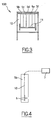
- the figure 3 illustrates an application of the device the invention to the identification of objects equipped with RFID tags carried on a conveyor 11.
- the objects to be identified may be luggage transported in a tunnel 12 (see figure 3 ), such as those installed at airports.
- the device according to the invention makes it possible to tend towards the identification of 100% of the luggage transported on the conveyor.
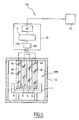
- a system 101 according to the invention will now be described, this system including a detection device 100.
- the device 100 is substantially of the same type as those already described with reference to the preceding figures. It will be noted however that the four bands 5b, 5e constituting the barrier are not contiguous, nor overlapping, but have between them free intervals. Nevertheless, these strips are sufficiently close together for an object passing through the device 100 to be effectively detected.
- the system 101 further comprises a processing unit 20, disposed locally relative to the detection device 100, and remote central processing means SC relative to the detection device.
- the processing unit comprises an MX multiplexer, a reader 7 and a CPU UC.
- Each of the four bands comprises, at its base, an antenna 6 connected by a respective conductor 10 to the multiplexer MX.
- the information received by the antennas and thus multiplexed, is then transmitted via a single conductor 110 to the reader 7, responsible for reading this information.
- the information is then transmitted to the central unit UC for local processing.
- the information may include the destination of a piece of luggage that has just been recorded. This information, once processed locally, can then be transmitted in whole or in part to the central processing means SC.
- the central processing means are provided for exploiting the system data at a central management system level.
- the central processing means may be provided to manage an apparatus for sorting baggage. They may be provided in particular for operating referral systems for baggage and / or for verifying that luggage initially registered by a passenger actually enter and exit the sorting equipment.
- a method using such a multiplexer system consists in successively interrogating each of the antennas of the detection device. This scanning is conducted at a frequency calculated as a function of the crossing speed of the device by the objects to be identified, so that any antenna which would detect an object is interrogated at least once during the time during which the presence of said object is detected. by this antenna.
- the central unit is advantageously configured to avoid double detection, for example if during two successive interrogations the same antenna detects the same object, or when two different antennas simultaneously or successively detect the same object.
- the reader 7 itself which can comprise an antenna reading algorithm detecting the signal of greater amplitude coming from the multiplexer, which thus designates the antenna best placed to read at a given instant the or labels located on the objects to be checked. The information from this antenna is then read completely and recorded by the reader to be transmitted to the central management system SC. Then, the reader reads the new signal of higher amplitude collected and reads the information of the new antenna thus selected.
- a device according to the invention is particularly advantageous with regard to the devices of the prior art.
- the reading rate of an RFID tag in the most unfavorable position is on average 71.3%, whereas in a device according to the invention, comprising antennas on flexible bands, the reading rate is 93.6%.
- the most unfavorable position is the case where the label is located under the object, in contact with the conveyor and close to the metal materials of the latter.
- the device according to the invention makes it possible to recognize 99.98% of the baggage passing in front of the antennas of the device according to the invention.
- the invention can also be applied to the identification of persons or animals crossing an access door or a gantry.
- a detection device may not include antenna on each of the mobile supports, but sufficiently for an effective detection of objects, people or animals that cross it.
- the detection device according to the invention may further comprise one or more antennas carried by fixed parts, which can also be multiplexed with the antennas carried by the mobile supports.
- the fixed antennas can be arranged below relative to the objects crossing the device, thus improving the detection of the RFID tags that would be positioned under the objects.
- the antennas can be placed at various places of mobile, rigid or flexible supports.
- the antennas 6 can be arranged vertically one underneath others towards the free end of the support 5 ', mobile about a vertical axis 8', as shown in FIG. figure 6 .
- antennas can also, and without departing from the scope of the invention, be arranged in an orderly or random manner on the entire surface of the movable support according to the place and objects to which the invention is applied.
- One of the important applications of the present invention is to make it possible to insert a curtain according to the invention in an existing sorting tunnel, without having to make substantial modifications to the conveyor system, in order to allow RFID control of the objects placed on the tunnel conveyor.
- the introduction of the current systems of RFID antennas placed along the walls of an existing sorting tunnel requires to replace all the metal parts of the tunnel and the conveyor to the right of the antenna area by plastic parts in order not to interfere with the reading of the antennas.
- movable supports for example flexible bands
Landscapes
- Engineering & Computer Science (AREA)
- Health & Medical Sciences (AREA)
- Toxicology (AREA)
- Physics & Mathematics (AREA)
- Computer Networks & Wireless Communication (AREA)
- Electromagnetism (AREA)
- General Health & Medical Sciences (AREA)
- Artificial Intelligence (AREA)
- Computer Vision & Pattern Recognition (AREA)
- General Physics & Mathematics (AREA)
- Theoretical Computer Science (AREA)
- Geophysics And Detection Of Objects (AREA)
Claims (22)
- System (101) zur Erfassung des Durchgangs von Objekten (1, 2), Personen oder Tieren, die ein Label (3, 4) zur Radiofrequenz-Identifikation tragen, umfassend:- wenigstens eine Erfassungsvorrichtung (100), die mehrere bewegliche Träger (5b, 5e) umfasst, welche in Ruhe eine Barriere gegenüber dem Durchgang der Objekte (1, 2), Personen oder Tiere bilden und welche bei Kontakt mit letzteren geeignet sind, sich in eine Ausweichposition zu bewegen, wobei ein jeder dieser beweglichen Träger (5b, 5e) eine Antenne (6) trägt;- ein mit den Antennen (6) elektrisch verbundenes Lesegerät (7) für die durch die Antennen empfangenen Informationen;- einen Multiplexer (MX), der eine Verbindung zwischen den Antennen (6) und dem Lesegerät (7) sicherstellt,dadurch gekennzeichnet, dass das Lesegerät (7) einen Algorithmus zum Auslesen der Antennen (6) umfasst, der das Signal mit der stärksten Amplitude aus dem Multiplexer (MX) erfasst, wodurch die Antenne (6) bestimmt wird, die am besten platziert ist, um zu einem gegebenen Zeitpunkt das (die) an den zu kontrollierenden Objekten (1, 2) befindliche(n) Label auszulesen.
- System nach Anspruch 1, dadurch gekennzeichnet, dass wenigstens ein beweglicher Träger (5) starr ist und um eine oberhalb des Durchgangsbereichs befindliche Achse (8) angelenkt ist.
- System nach Anspruch 1, dadurch gekennzeichnet, dass wenigstens ein beweglicher Träger (5') starr ist und um eine Achse (8'), die an der Seite des Durchgangsbereichs vertikal angeordnet ist, frei angelenkt ist.
- System nach Anspruch 1, dadurch gekennzeichnet, dass wenigstens ein beweglicher Träger (5a) aus flexiblem Material besteht und an einer oberhalb des Durchgangsbereichs befindlichen Stelle (9) frei aufgehängt ist.
- System nach Anspruch 1, dadurch gekennzeichnet, dass wenigstens ein beweglicher Träger (5'a, 5'b) flexibel ist und um eine Achse (8'), die an der Seite des Durchgangsbereichs vertikal angeordnet ist, frei angelenkt ist.
- System nach einem der Ansprüche 2 oder 4, dadurch gekennzeichnet, dass sich wenigstens eine Antenne (6) nahe dem unteren Ende eines beweglichen Trägers (5b, 5c, 5d, 5e) befindet, um in dem Durchgangsbereich zu sein.
- System nach einem der Ansprüche 3 oder 5, dadurch gekennzeichnet, dass es eine Vielzahl von Antennen (6) umfasst, die auf der gesamten Fläche eines beweglichen Trägers (5'a, 5'b) angeordnet sind.
- System nach Anspruch 7, dadurch gekennzeichnet, dass jeder bewegliche Träger (5'a, 5'b) eine Vielzahl von Antennen umfasst, die zum freien Ende des beweglichen Trägers vertikal angeordnet sind.
- System nach einem der Ansprüche 4 oder 5, dadurch gekennzeichnet, dass wenigstens ein Träger einen oder mehrere flexible Streifen (5, 5a, 5b, 5c, 5d, 5e, 5f) umfasst, die nebeneinander in einer Ebene quer zu der Richtung des Durchgangs der Objekte, Personen oder Tiere angeordnet sind, wobei ein jeder der Streifen (5, 5a, 5b, 5c, 5d, 5e, 5f) eine Radiofrequenz-Lese-Antenne (6) trägt.
- System nach Anspruch 9, dadurch gekennzeichnet, dass der oder die flexible(n) Streifen (5, 5a, 5b, 5c, 5d, 5e, 5f) sich über im Wesentlichen die gesamte Breite des Durchgangs erstrecken.
- System nach einem der Ansprüche 2 oder 3 oder 4 und 9 oder 10, dadurch gekennzeichnet, dass das untere Ende der flexiblen Streifen (5, 5a, 5b, 5c, 5d, 5e, 5f) nahe der Basis des Durchgangs gelegen ist.
- System nach einem der Ansprüche 9 bis 11, dadurch gekennzeichnet, dass die Antenne (6) sich auf der Seite des Streifens befindet, die von derjenigen abgewandt ist, welche mit den Objekten in Kontakt gelangt.
- System nach einem der Ansprüche 9 bis 12, dadurch gekennzeichnet, dass die Streifen aus Kunststoff oder Textil bestehen.
- System nach einem der Ansprüche 9 oder 13, dadurch gekennzeichnet, dass die Antenne (6) und ein mit dieser verbundener elektrischer Leiter (10) eine elektrische Schaltung bilden, die mit Hilfe von Materialien ausgebildet ist, welche geeignet sind, die Funktion von Antenne und elektrischem Leiter sicherzustellen, die selbst auf den Streifen (5, 5a, 5b, 5c, 5d, 5e, 5f) befestigt sind.
- System nach einem der vorhergehenden Ansprüche, dadurch gekennzeichnet, dass es ferner eine mit dem Lesegerät (7) verbundene Zentraleinheit (CU) für die Verarbeitung der durch das Lesegerät (7) ausgelesenen Informationen umfasst.
- System nach Anspruch 15, dadurch gekennzeichnet, dass es eine Verarbeitungseinheit (20) aufweist, welche den Multiplexer (MX), das Lesegerät (7) und die Zentraleinheit (CU) umfasst, wobei die Einheit (20) örtlich der Erfassungsvorrichtung zugeordnet ist.
- System nach Anspruch 16, dadurch gekennzeichnet, dass es ferner entfernte zentrale Verarbeitungsmittel umfasst, die dazu ausgelegt sind, andere Informationen als die aus der Verarbeitungseinheit (20) stammenden zu verarbeiten.
- Verwendung des Systems nach einem der vorhergehenden Ansprüche, für die Identifikation von mit Radiofrequenz-Labeln versehenen Objekten, die auf einer Fördereinrichtung (11) transportiert werden.
- Verwendung nach Anspruch 18, dadurch gekennzeichnet, dass die Objekte in einem Tunnel (12) beförderte Gepäckstücke sind.
- Verwendung des Systems nach einem der Ansprüche 1 bis 17, für die Identifikation von mit Radiofrequenz-Labeln versehenen Objekten, dadurch gekennzeichnet, dass die Objekte auf einer Palette oder einem Fahrzeug transportierte Gepäckstücke sind, wobei das System Klappen mit vertikaler Achse umfasst, die beim Durchgang der Objekte seitlich drehend ausweichen.
- Verfahren zur Erfassung des Durchgangs von Objekten (1, 2), Personen oder Tieren, die ein Label (3, 4) zur Radiofrequenz-Identifikation tragen, bei dem ein System verwendet wird, das wenigstens mehrere bewegliche Träger (5b-5e) umfasst, welche in Ruhe eine Barriere gegenüber dem Durchgang der Objekte (1, 2), Personen oder Tiere bilden und welche bei Kontakt mit letzteren geeignet sind, sich in eine Ausweichposition zu bewegen, wobei jeder bewegliche Träger (5b-5e) eine jeweilige Antenne (6) trägt, wobei das System ferner ein Lesegerät (7) für die durch die Antennen empfangenen Informationen sowie einen Multiplexer (MX), der eine Verbindung zwischen den Antennen (6) und dem Lesegerät (7) sicherstellt, umfasst;
wobei das Verfahren dadurch gekennzeichnet ist, dass eine jede der Antennen (6) nacheinander abgefragt wird und dass das Signal mit der stärksten Amplitude aus dem Multiplexer (MX) erfasst wird, wodurch die Antenne (6) bestimmt wird, die am besten platziert ist, um zu einem gegebenen Zeitpunkt das (die) an den zu kontrollierenden Objekten (1, 2) befindliche(n) Label auszulesen. - Verfahren nach Anspruch 21, dadurch gekennzeichnet, dass das sukzessive Abfragen mit einer Frequenz durchgeführt wird, die von der Vorrückgeschwindigkeit des Objektes (1, 2), der Person oder des Tieres, das/die die Barriere überschreitet, abhängt, so dass jede Antenne, die das Vorliegen des Objektes, der Person oder des Tieres erfassen würde, während der Zeit, in der das Vorliegen durch die Antenne erfasst wird, wenigstens einmal abgefragt wird.
Applications Claiming Priority (2)
| Application Number | Priority Date | Filing Date | Title |
|---|---|---|---|
| FR0702111A FR2914085A1 (fr) | 2007-03-23 | 2007-03-23 | Dispositif de detection du passage d'objets portant une etiquette rfid,procede et systeme utilisant un tel dispositif. |
| PCT/FR2007/000775 WO2008116976A1 (fr) | 2007-03-23 | 2007-05-04 | Dispositif de détection du passage d'objets portant une étiquette rfid, procédé et système utilisant un tel dispositif |
Publications (2)
| Publication Number | Publication Date |
|---|---|
| EP2139771A1 EP2139771A1 (de) | 2010-01-06 |
| EP2139771B1 true EP2139771B1 (de) | 2012-12-19 |
Family
ID=38521734
Family Applications (1)
| Application Number | Title | Priority Date | Filing Date |
|---|---|---|---|
| EP07731417A Not-in-force EP2139771B1 (de) | 2007-03-23 | 2007-05-04 | System zur erfassung der passage von objekten mit einem rfid-etikett und solch ein system verwendendes verfahren |
Country Status (6)
| Country | Link |
|---|---|
| US (1) | US8378818B2 (de) |
| EP (1) | EP2139771B1 (de) |
| ES (1) | ES2401459T3 (de) |
| FR (1) | FR2914085A1 (de) |
| PT (1) | PT2139771E (de) |
| WO (1) | WO2008116976A1 (de) |
Families Citing this family (8)
| Publication number | Priority date | Publication date | Assignee | Title |
|---|---|---|---|---|
| US8626844B2 (en) | 2007-03-26 | 2014-01-07 | The Trustees Of Columbia University In The City Of New York | Methods and media for exchanging data between nodes of disconnected networks |
| FR2928762B1 (fr) * | 2008-03-14 | 2012-02-17 | Ier | Dispositif et systeme de detection de passage d'objets, personnes ou animaux portant une etiquette rfid, dans l'ordre de passage et application a la detection de bagages |
| FR2936629B1 (fr) * | 2008-09-29 | 2011-03-25 | Azdine Bahou | Rideau a lanieres souples integrant des antennes lecteurs rfid et des moyens de controle automotiques pour assurer la tracabilite qualitative et quantitatives des produits en logistique |
| FR2936785B1 (fr) * | 2008-10-08 | 2013-06-14 | Ier | Dispositif reutilisable pour le transport et le stockage de marchandises, muni d'un identifiant, procede et systeme pour son identification et installation pour son suivi |
| CN102879762B (zh) * | 2012-09-27 | 2014-02-26 | 东南大学 | 基于射频接收信号强度值的隧道内车辆的动态定位方法 |
| WO2014056019A1 (en) * | 2012-10-09 | 2014-04-17 | Christopher John Wood | Mining and mineral processing tracers with radio-frequency identification |
| CN103489241A (zh) * | 2013-09-18 | 2014-01-01 | 上海北大方正科技电脑系统有限公司 | 一种基于rfid标签的机场行李提取方法及系统 |
| CN108883840B (zh) * | 2016-04-04 | 2022-11-25 | 三菱电机株式会社 | 行李领取管理系统 |
Family Cites Families (6)
| Publication number | Priority date | Publication date | Assignee | Title |
|---|---|---|---|---|
| US5221831A (en) * | 1991-11-29 | 1993-06-22 | Indala Corporation | Flap-type portal reader |
| JPH10240880A (ja) * | 1997-02-26 | 1998-09-11 | Rohm Co Ltd | Icカードシステム及びそれを用いた搬送システム |
| WO2003034360A1 (en) * | 2001-10-13 | 2003-04-24 | Escort Memory Systems | Flexible rfid antenna panel and system |
| US20040004577A1 (en) * | 2002-04-29 | 2004-01-08 | Forster Ian J. | Flexible curtain antenna for reading RFID tags |
| US20040070503A1 (en) * | 2002-10-10 | 2004-04-15 | Brian Monahan | Flexible RFID antenna panel and system |
| CN1902667B (zh) * | 2003-12-29 | 2011-06-29 | 美国邮政服务公司 | 用于跟踪物品的系统 |
-
2007
- 2007-03-23 FR FR0702111A patent/FR2914085A1/fr not_active Withdrawn
- 2007-05-04 PT PT77314177T patent/PT2139771E/pt unknown
- 2007-05-04 WO PCT/FR2007/000775 patent/WO2008116976A1/fr not_active Ceased
- 2007-05-04 EP EP07731417A patent/EP2139771B1/de not_active Not-in-force
- 2007-05-04 US US12/532,673 patent/US8378818B2/en not_active Expired - Fee Related
- 2007-05-04 ES ES07731417T patent/ES2401459T3/es active Active
Also Published As
| Publication number | Publication date |
|---|---|
| FR2914085A1 (fr) | 2008-09-26 |
| US20100102963A1 (en) | 2010-04-29 |
| PT2139771E (pt) | 2013-01-14 |
| US8378818B2 (en) | 2013-02-19 |
| ES2401459T3 (es) | 2013-04-19 |
| WO2008116976A1 (fr) | 2008-10-02 |
| EP2139771A1 (de) | 2010-01-06 |
Similar Documents
| Publication | Publication Date | Title |
|---|---|---|
| EP2139771A1 (de) | Vorrichtung zur erfassung des passierens von objekten mit einem rfid-etikett, solch eine vorrichtung verwendendes verfahren und system | |
| EP2113476B1 (de) | Sicherheitsvorrichtung für Verladerampen oder Entladerampen | |
| FR2849519A1 (fr) | Porte automatisee pour permettre ou interdire l'acces a un espace ou un vehicule de transport, en particulier a une salle d'embarquement ou a un avion | |
| WO2016059314A1 (fr) | Installation logistique avec des navettes de transport de colis et des equipements portatifs d'identification des colis | |
| FR2717593A1 (fr) | Contenant comprenant un moyen d'identification électronique et visuel. | |
| US10336555B1 (en) | Baggage handling and delivery system | |
| EP2257908A2 (de) | Vorrichtung und system zur erkennung des durchgangs von objekten, personen oder tieren mit einem rfid-etikett nach ihrer durchgangsfolge sowie anwendung in der gepäckortung | |
| EP3401251A1 (de) | Führungsträger oder -schiene, überladeanlage und verfahren zu dessen umsetzung | |
| WO2007120266A2 (en) | Method and apparatus for preventing luggage mishandling in public transportation systems | |
| FR3055008A1 (fr) | Dispositif d'occultation visuelle depuis un vehicule devant un quai de transbordement | |
| EP0728669A1 (de) | Automatische Etikettiervorrichtung für Produkte | |
| EP0902929B1 (de) | Vorrichtung zur Abgabe von aus Bahnabschnitt hergestellten Karten | |
| NL1034048C2 (nl) | Inrichting voor het identificeren van bagagestukken die zijn voorzien van een RFID-tag. | |
| FR3111315A1 (fr) | Procédé et dispositif de contrôle d’une installation de transport par câble et installation comprenant un tel dispositif de contrôle | |
| EP4229612B1 (de) | System zur fahrzeugidentifikation in einem automatisierten logistikzentrum | |
| FR2742427A1 (fr) | Dispositif apte a derouter les bagages ou colis douteux circulant sur une ligne de convoyage | |
| EP1366483A2 (de) | Vorrichtung zur selektiven anzeige von anzeigen | |
| FR3115522A3 (fr) | Vehicule de transport de charges avec paroi laterale rabattable | |
| WO1986000852A1 (fr) | Dispositif de decoupe d'enveloppes, et son application a une installation de traitement de courrier | |
| WO2017118823A1 (fr) | Chariot-portoir pour brancard | |
| EP3570218A1 (de) | Bordkarte mit einem rfid-etikett | |
| EP2767818B1 (de) | Diagnosesystem des strukturellen Zustands einer Rolleinheit eines Rollwagens auf einer Schiene, das punktuelle Sende- und Empfangsantennen umfasst | |
| FR3010058A1 (fr) | Procede et dispositif de detection de conteneur a dechet | |
| WO2022189547A1 (fr) | Pont de liaison d'un quai de transbordement | |
| EP2907420B1 (de) | Vorrichtung zum Kassieren von Artikeln, die eine Beleuchtungsvorrichtung und ein Laufband umfasst |
Legal Events
| Date | Code | Title | Description |
|---|---|---|---|
| PUAI | Public reference made under article 153(3) epc to a published international application that has entered the european phase |
Free format text: ORIGINAL CODE: 0009012 |
|
| 17P | Request for examination filed |
Effective date: 20091020 |
|
| AK | Designated contracting states |
Kind code of ref document: A1 Designated state(s): AT BE BG CH CY CZ DE DK EE ES FI FR GB GR HU IE IS IT LI LT LU LV MC MT NL PL PT RO SE SI SK TR |
|
| DAX | Request for extension of the european patent (deleted) | ||
| 17Q | First examination report despatched |
Effective date: 20100917 |
|
| GRAP | Despatch of communication of intention to grant a patent |
Free format text: ORIGINAL CODE: EPIDOSNIGR1 |
|
| GRAS | Grant fee paid |
Free format text: ORIGINAL CODE: EPIDOSNIGR3 |
|
| GRAA | (expected) grant |
Free format text: ORIGINAL CODE: 0009210 |
|
| AK | Designated contracting states |
Kind code of ref document: B1 Designated state(s): AT BE BG CH CY CZ DE DK EE ES FI FR GB GR HU IE IS IT LI LT LU LV MC MT NL PL PT RO SE SI SK TR |
|
| REG | Reference to a national code |
Ref country code: GB Ref legal event code: FG4D Free format text: NOT ENGLISH |
|
| REG | Reference to a national code |
Ref country code: CH Ref legal event code: EP |
|
| REG | Reference to a national code |
Ref country code: PT Ref legal event code: SC4A Free format text: AVAILABILITY OF NATIONAL TRANSLATION Effective date: 20121219 |
|
| REG | Reference to a national code |
Ref country code: AT Ref legal event code: REF Ref document number: 589250 Country of ref document: AT Kind code of ref document: T Effective date: 20130115 |
|
| REG | Reference to a national code |
Ref country code: DE Ref legal event code: R096 Ref document number: 602007027471 Country of ref document: DE Effective date: 20130207 |
|
| REG | Reference to a national code |
Ref country code: ES Ref legal event code: FG2A Ref document number: 2401459 Country of ref document: ES Kind code of ref document: T3 Effective date: 20130419 |
|
| REG | Reference to a national code |
Ref country code: NL Ref legal event code: T3 |
|
| PG25 | Lapsed in a contracting state [announced via postgrant information from national office to epo] |
Ref country code: LT Free format text: LAPSE BECAUSE OF FAILURE TO SUBMIT A TRANSLATION OF THE DESCRIPTION OR TO PAY THE FEE WITHIN THE PRESCRIBED TIME-LIMIT Effective date: 20121219 Ref country code: FI Free format text: LAPSE BECAUSE OF FAILURE TO SUBMIT A TRANSLATION OF THE DESCRIPTION OR TO PAY THE FEE WITHIN THE PRESCRIBED TIME-LIMIT Effective date: 20121219 Ref country code: SE Free format text: LAPSE BECAUSE OF FAILURE TO SUBMIT A TRANSLATION OF THE DESCRIPTION OR TO PAY THE FEE WITHIN THE PRESCRIBED TIME-LIMIT Effective date: 20121219 |
|
| REG | Reference to a national code |
Ref country code: AT Ref legal event code: MK05 Ref document number: 589250 Country of ref document: AT Kind code of ref document: T Effective date: 20121219 |
|
| REG | Reference to a national code |
Ref country code: LT Ref legal event code: MG4D |
|
| PG25 | Lapsed in a contracting state [announced via postgrant information from national office to epo] |
Ref country code: SI Free format text: LAPSE BECAUSE OF FAILURE TO SUBMIT A TRANSLATION OF THE DESCRIPTION OR TO PAY THE FEE WITHIN THE PRESCRIBED TIME-LIMIT Effective date: 20121219 Ref country code: LV Free format text: LAPSE BECAUSE OF FAILURE TO SUBMIT A TRANSLATION OF THE DESCRIPTION OR TO PAY THE FEE WITHIN THE PRESCRIBED TIME-LIMIT Effective date: 20121219 Ref country code: GR Free format text: LAPSE BECAUSE OF FAILURE TO SUBMIT A TRANSLATION OF THE DESCRIPTION OR TO PAY THE FEE WITHIN THE PRESCRIBED TIME-LIMIT Effective date: 20130320 |
|
| PG25 | Lapsed in a contracting state [announced via postgrant information from national office to epo] |
Ref country code: SK Free format text: LAPSE BECAUSE OF FAILURE TO SUBMIT A TRANSLATION OF THE DESCRIPTION OR TO PAY THE FEE WITHIN THE PRESCRIBED TIME-LIMIT Effective date: 20121219 Ref country code: BG Free format text: LAPSE BECAUSE OF FAILURE TO SUBMIT A TRANSLATION OF THE DESCRIPTION OR TO PAY THE FEE WITHIN THE PRESCRIBED TIME-LIMIT Effective date: 20130319 Ref country code: AT Free format text: LAPSE BECAUSE OF FAILURE TO SUBMIT A TRANSLATION OF THE DESCRIPTION OR TO PAY THE FEE WITHIN THE PRESCRIBED TIME-LIMIT Effective date: 20121219 Ref country code: CZ Free format text: LAPSE BECAUSE OF FAILURE TO SUBMIT A TRANSLATION OF THE DESCRIPTION OR TO PAY THE FEE WITHIN THE PRESCRIBED TIME-LIMIT Effective date: 20121219 Ref country code: IS Free format text: LAPSE BECAUSE OF FAILURE TO SUBMIT A TRANSLATION OF THE DESCRIPTION OR TO PAY THE FEE WITHIN THE PRESCRIBED TIME-LIMIT Effective date: 20130419 Ref country code: EE Free format text: LAPSE BECAUSE OF FAILURE TO SUBMIT A TRANSLATION OF THE DESCRIPTION OR TO PAY THE FEE WITHIN THE PRESCRIBED TIME-LIMIT Effective date: 20121219 |
|
| PGFP | Annual fee paid to national office [announced via postgrant information from national office to epo] |
Ref country code: GB Payment date: 20130514 Year of fee payment: 7 Ref country code: DE Payment date: 20130522 Year of fee payment: 7 |
|
| PG25 | Lapsed in a contracting state [announced via postgrant information from national office to epo] |
Ref country code: RO Free format text: LAPSE BECAUSE OF FAILURE TO SUBMIT A TRANSLATION OF THE DESCRIPTION OR TO PAY THE FEE WITHIN THE PRESCRIBED TIME-LIMIT Effective date: 20121219 Ref country code: PL Free format text: LAPSE BECAUSE OF FAILURE TO SUBMIT A TRANSLATION OF THE DESCRIPTION OR TO PAY THE FEE WITHIN THE PRESCRIBED TIME-LIMIT Effective date: 20121219 |
|
| PGFP | Annual fee paid to national office [announced via postgrant information from national office to epo] |
Ref country code: PT Payment date: 20130503 Year of fee payment: 7 Ref country code: BE Payment date: 20130521 Year of fee payment: 7 Ref country code: NL Payment date: 20130521 Year of fee payment: 7 Ref country code: IT Payment date: 20130530 Year of fee payment: 7 |
|
| PLBE | No opposition filed within time limit |
Free format text: ORIGINAL CODE: 0009261 |
|
| STAA | Information on the status of an ep patent application or granted ep patent |
Free format text: STATUS: NO OPPOSITION FILED WITHIN TIME LIMIT |
|
| PG25 | Lapsed in a contracting state [announced via postgrant information from national office to epo] |
Ref country code: DK Free format text: LAPSE BECAUSE OF FAILURE TO SUBMIT A TRANSLATION OF THE DESCRIPTION OR TO PAY THE FEE WITHIN THE PRESCRIBED TIME-LIMIT Effective date: 20121219 |
|
| 26N | No opposition filed |
Effective date: 20130920 |
|
| PG25 | Lapsed in a contracting state [announced via postgrant information from national office to epo] |
Ref country code: CY Free format text: LAPSE BECAUSE OF FAILURE TO SUBMIT A TRANSLATION OF THE DESCRIPTION OR TO PAY THE FEE WITHIN THE PRESCRIBED TIME-LIMIT Effective date: 20121219 |
|
| PG25 | Lapsed in a contracting state [announced via postgrant information from national office to epo] |
Ref country code: MC Free format text: LAPSE BECAUSE OF FAILURE TO SUBMIT A TRANSLATION OF THE DESCRIPTION OR TO PAY THE FEE WITHIN THE PRESCRIBED TIME-LIMIT Effective date: 20121219 |
|
| REG | Reference to a national code |
Ref country code: CH Ref legal event code: PL |
|
| REG | Reference to a national code |
Ref country code: DE Ref legal event code: R097 Ref document number: 602007027471 Country of ref document: DE Effective date: 20130920 |
|
| PG25 | Lapsed in a contracting state [announced via postgrant information from national office to epo] |
Ref country code: LI Free format text: LAPSE BECAUSE OF NON-PAYMENT OF DUE FEES Effective date: 20130531 Ref country code: CH Free format text: LAPSE BECAUSE OF NON-PAYMENT OF DUE FEES Effective date: 20130531 |
|
| REG | Reference to a national code |
Ref country code: IE Ref legal event code: MM4A |
|
| PG25 | Lapsed in a contracting state [announced via postgrant information from national office to epo] |
Ref country code: IE Free format text: LAPSE BECAUSE OF NON-PAYMENT OF DUE FEES Effective date: 20130504 |
|
| REG | Reference to a national code |
Ref country code: PT Ref legal event code: MM4A Free format text: LAPSE DUE TO NON-PAYMENT OF FEES Effective date: 20141104 |
|
| REG | Reference to a national code |
Ref country code: DE Ref legal event code: R119 Ref document number: 602007027471 Country of ref document: DE |
|
| REG | Reference to a national code |
Ref country code: NL Ref legal event code: V1 Effective date: 20141201 |
|
| GBPC | Gb: european patent ceased through non-payment of renewal fee |
Effective date: 20140504 |
|
| PG25 | Lapsed in a contracting state [announced via postgrant information from national office to epo] |
Ref country code: PT Free format text: LAPSE BECAUSE OF NON-PAYMENT OF DUE FEES Effective date: 20141104 |
|
| REG | Reference to a national code |
Ref country code: DE Ref legal event code: R119 Ref document number: 602007027471 Country of ref document: DE Effective date: 20141202 |
|
| PG25 | Lapsed in a contracting state [announced via postgrant information from national office to epo] |
Ref country code: NL Free format text: LAPSE BECAUSE OF NON-PAYMENT OF DUE FEES Effective date: 20141201 Ref country code: MT Free format text: LAPSE BECAUSE OF FAILURE TO SUBMIT A TRANSLATION OF THE DESCRIPTION OR TO PAY THE FEE WITHIN THE PRESCRIBED TIME-LIMIT Effective date: 20121219 |
|
| PG25 | Lapsed in a contracting state [announced via postgrant information from national office to epo] |
Ref country code: IT Free format text: LAPSE BECAUSE OF NON-PAYMENT OF DUE FEES Effective date: 20140504 Ref country code: DE Free format text: LAPSE BECAUSE OF NON-PAYMENT OF DUE FEES Effective date: 20141202 |
|
| PG25 | Lapsed in a contracting state [announced via postgrant information from national office to epo] |
Ref country code: GB Free format text: LAPSE BECAUSE OF NON-PAYMENT OF DUE FEES Effective date: 20140504 |
|
| PG25 | Lapsed in a contracting state [announced via postgrant information from national office to epo] |
Ref country code: TR Free format text: LAPSE BECAUSE OF FAILURE TO SUBMIT A TRANSLATION OF THE DESCRIPTION OR TO PAY THE FEE WITHIN THE PRESCRIBED TIME-LIMIT Effective date: 20121219 |
|
| PG25 | Lapsed in a contracting state [announced via postgrant information from national office to epo] |
Ref country code: LU Free format text: LAPSE BECAUSE OF NON-PAYMENT OF DUE FEES Effective date: 20130504 Ref country code: HU Free format text: LAPSE BECAUSE OF FAILURE TO SUBMIT A TRANSLATION OF THE DESCRIPTION OR TO PAY THE FEE WITHIN THE PRESCRIBED TIME-LIMIT; INVALID AB INITIO Effective date: 20070504 |
|
| REG | Reference to a national code |
Ref country code: ES Ref legal event code: FD2A Effective date: 20160127 |
|
| PG25 | Lapsed in a contracting state [announced via postgrant information from national office to epo] |
Ref country code: ES Free format text: LAPSE BECAUSE OF NON-PAYMENT OF DUE FEES Effective date: 20140505 |
|
| REG | Reference to a national code |
Ref country code: FR Ref legal event code: PLFP Year of fee payment: 10 |
|
| PGFP | Annual fee paid to national office [announced via postgrant information from national office to epo] |
Ref country code: FR Payment date: 20160526 Year of fee payment: 10 |
|
| PG25 | Lapsed in a contracting state [announced via postgrant information from national office to epo] |
Ref country code: BE Free format text: LAPSE BECAUSE OF NON-PAYMENT OF DUE FEES Effective date: 20140531 |
|
| REG | Reference to a national code |
Ref country code: FR Ref legal event code: ST Effective date: 20180131 |
|
| PG25 | Lapsed in a contracting state [announced via postgrant information from national office to epo] |
Ref country code: FR Free format text: LAPSE BECAUSE OF NON-PAYMENT OF DUE FEES Effective date: 20170531 |