EP2125949B1 - Objet pneumatique - Google Patents
Objet pneumatique Download PDFInfo
- Publication number
- EP2125949B1 EP2125949B1 EP07856877A EP07856877A EP2125949B1 EP 2125949 B1 EP2125949 B1 EP 2125949B1 EP 07856877 A EP07856877 A EP 07856877A EP 07856877 A EP07856877 A EP 07856877A EP 2125949 B1 EP2125949 B1 EP 2125949B1
- Authority
- EP
- European Patent Office
- Prior art keywords
- styrene
- elastomer
- self
- oils
- article according
- Prior art date
- Legal status (The legal status is an assumption and is not a legal conclusion. Google has not performed a legal analysis and makes no representation as to the accuracy of the status listed.)
- Not-in-force
Links
Images
Classifications
-
- C—CHEMISTRY; METALLURGY
- C09—DYES; PAINTS; POLISHES; NATURAL RESINS; ADHESIVES; COMPOSITIONS NOT OTHERWISE PROVIDED FOR; APPLICATIONS OF MATERIALS NOT OTHERWISE PROVIDED FOR
- C09K—MATERIALS FOR MISCELLANEOUS APPLICATIONS, NOT PROVIDED FOR ELSEWHERE
- C09K3/00—Materials not provided for elsewhere
- C09K3/10—Materials in mouldable or extrudable form for sealing or packing joints or covers
-
- B—PERFORMING OPERATIONS; TRANSPORTING
- B32—LAYERED PRODUCTS
- B32B—LAYERED PRODUCTS, i.e. PRODUCTS BUILT-UP OF STRATA OF FLAT OR NON-FLAT, e.g. CELLULAR OR HONEYCOMB, FORM
- B32B25/00—Layered products comprising a layer of natural or synthetic rubber
-
- B—PERFORMING OPERATIONS; TRANSPORTING
- B29—WORKING OF PLASTICS; WORKING OF SUBSTANCES IN A PLASTIC STATE IN GENERAL
- B29C—SHAPING OR JOINING OF PLASTICS; SHAPING OF MATERIAL IN A PLASTIC STATE, NOT OTHERWISE PROVIDED FOR; AFTER-TREATMENT OF THE SHAPED PRODUCTS, e.g. REPAIRING
- B29C73/00—Repairing of articles made from plastics or substances in a plastic state, e.g. of articles shaped or produced by using techniques covered by this subclass or subclass B29D
- B29C73/16—Auto-repairing or self-sealing arrangements or agents
- B29C73/18—Auto-repairing or self-sealing arrangements or agents the article material itself being self-sealing, e.g. by compression
-
- B—PERFORMING OPERATIONS; TRANSPORTING
- B60—VEHICLES IN GENERAL
- B60C—VEHICLE TYRES; TYRE INFLATION; TYRE CHANGING; CONNECTING VALVES TO INFLATABLE ELASTIC BODIES IN GENERAL; DEVICES OR ARRANGEMENTS RELATED TO TYRES
- B60C19/00—Tyre parts or constructions not otherwise provided for
- B60C19/12—Puncture preventing arrangements
- B60C19/122—Puncture preventing arrangements disposed inside of the inner liner
-
- C—CHEMISTRY; METALLURGY
- C08—ORGANIC MACROMOLECULAR COMPOUNDS; THEIR PREPARATION OR CHEMICAL WORKING-UP; COMPOSITIONS BASED THEREON
- C08L—COMPOSITIONS OF MACROMOLECULAR COMPOUNDS
- C08L23/00—Compositions of homopolymers or copolymers of unsaturated aliphatic hydrocarbons having only one carbon-to-carbon double bond; Compositions of derivatives of such polymers
- C08L23/02—Compositions of homopolymers or copolymers of unsaturated aliphatic hydrocarbons having only one carbon-to-carbon double bond; Compositions of derivatives of such polymers not modified by chemical after-treatment
- C08L23/18—Homopolymers or copolymers of hydrocarbons having four or more carbon atoms
- C08L23/20—Homopolymers or copolymers of hydrocarbons having four or more carbon atoms having four to nine carbon atoms
- C08L23/22—Copolymers of isobutene; Butyl rubber; Homopolymers or copolymers of other iso-olefins
-
- C—CHEMISTRY; METALLURGY
- C08—ORGANIC MACROMOLECULAR COMPOUNDS; THEIR PREPARATION OR CHEMICAL WORKING-UP; COMPOSITIONS BASED THEREON
- C08L—COMPOSITIONS OF MACROMOLECULAR COMPOUNDS
- C08L53/00—Compositions of block copolymers containing at least one sequence of a polymer obtained by reactions only involving carbon-to-carbon unsaturated bonds; Compositions of derivatives of such polymers
- C08L53/02—Compositions of block copolymers containing at least one sequence of a polymer obtained by reactions only involving carbon-to-carbon unsaturated bonds; Compositions of derivatives of such polymers of vinyl-aromatic monomers and conjugated dienes
-
- C—CHEMISTRY; METALLURGY
- C08—ORGANIC MACROMOLECULAR COMPOUNDS; THEIR PREPARATION OR CHEMICAL WORKING-UP; COMPOSITIONS BASED THEREON
- C08L—COMPOSITIONS OF MACROMOLECULAR COMPOUNDS
- C08L53/00—Compositions of block copolymers containing at least one sequence of a polymer obtained by reactions only involving carbon-to-carbon unsaturated bonds; Compositions of derivatives of such polymers
- C08L53/02—Compositions of block copolymers containing at least one sequence of a polymer obtained by reactions only involving carbon-to-carbon unsaturated bonds; Compositions of derivatives of such polymers of vinyl-aromatic monomers and conjugated dienes
- C08L53/025—Compositions of block copolymers containing at least one sequence of a polymer obtained by reactions only involving carbon-to-carbon unsaturated bonds; Compositions of derivatives of such polymers of vinyl-aromatic monomers and conjugated dienes modified
-
- B—PERFORMING OPERATIONS; TRANSPORTING
- B29—WORKING OF PLASTICS; WORKING OF SUBSTANCES IN A PLASTIC STATE IN GENERAL
- B29L—INDEXING SCHEME ASSOCIATED WITH SUBCLASS B29C, RELATING TO PARTICULAR ARTICLES
- B29L2030/00—Pneumatic or solid tyres or parts thereof
-
- Y—GENERAL TAGGING OF NEW TECHNOLOGICAL DEVELOPMENTS; GENERAL TAGGING OF CROSS-SECTIONAL TECHNOLOGIES SPANNING OVER SEVERAL SECTIONS OF THE IPC; TECHNICAL SUBJECTS COVERED BY FORMER USPC CROSS-REFERENCE ART COLLECTIONS [XRACs] AND DIGESTS
- Y10—TECHNICAL SUBJECTS COVERED BY FORMER USPC
- Y10T—TECHNICAL SUBJECTS COVERED BY FORMER US CLASSIFICATION
- Y10T152/00—Resilient tires and wheels
- Y10T152/10—Tires, resilient
- Y10T152/10495—Pneumatic tire or inner tube
- Y10T152/10666—Automatic sealing of punctures [e.g., self-healing, etc.]
- Y10T152/10675—Using flowable coating or composition
-
- Y—GENERAL TAGGING OF NEW TECHNOLOGICAL DEVELOPMENTS; GENERAL TAGGING OF CROSS-SECTIONAL TECHNOLOGIES SPANNING OVER SEVERAL SECTIONS OF THE IPC; TECHNICAL SUBJECTS COVERED BY FORMER USPC CROSS-REFERENCE ART COLLECTIONS [XRACs] AND DIGESTS
- Y10—TECHNICAL SUBJECTS COVERED BY FORMER USPC
- Y10T—TECHNICAL SUBJECTS COVERED BY FORMER US CLASSIFICATION
- Y10T152/00—Resilient tires and wheels
- Y10T152/10—Tires, resilient
- Y10T152/10495—Pneumatic tire or inner tube
- Y10T152/10666—Automatic sealing of punctures [e.g., self-healing, etc.]
- Y10T152/10675—Using flowable coating or composition
- Y10T152/10684—On inner surface of tubeless tire
Definitions
- the present invention relates to self-sealing compositions ( "self-sealing") and their use as anti-puncture layer in inflatable articles.
- Self-sealing compositions capable of achieving such an objective, by definition capable of ensuring automatically, that is to say without any external intervention, the sealing of a tire in case of perforation of the latter by a foreign body such as a nail, are particularly difficult to develop.
- a self-sealing layer In order to be usable, a self-sealing layer must satisfy many conditions of a physical and chemical nature. In particular, it must be effective over a very wide range of operating temperatures throughout the life of the tires. It must be able to close the hole when the piercing object remains in place; at the expulsion of the latter, it must be able to fill the hole and make the bandage waterproof, especially in winter conditions.
- the paper US Patent 4,113,799 (or FR-A-2,318,042 ) has proposed as a self-sealing layer a composition comprising a combination of partially crosslinked high and low molecular weight butyl rubbers, possibly in the presence of a small portion of thermoplastic styrene elastomer.
- said composition comprises from 55 to 70% by weight of a tackifier.
- the document US-A-4,228,839 has proposed as a self-sealing layer for a tire a rubber mixture containing a first polymeric material which degrades by irradiation, such as polyisobutylene, and a second polymeric material which crosslinks by irradiation, preferably a butyl rubber.
- butyl rubbers have significant hysteretic losses (high level of tan ( ⁇ )) over a broad spectrum of temperature, a disadvantage that affects the self-sealing compositions themselves with a sharp increase in hysteresis and a notable penalty of rolling resistance of pneumatic tires.
- compositions based on butyl rubber may, in addition, be insufficiently effective, especially in winter temperature conditions, after the expulsion or delayed removal of a perforating object which has remained in place for a long period of time. in the structure of the tire.
- the document EP-B1-1 090 069 has certainly proposed self-sealing compositions devoid of butyl rubber, whose specific formulation comprises per 100 parts by weight of a thermoplastic elastomer based on styrene, 80 to 140 parts of a liquid plasticizer, 110 to 190 parts of a tackifying resin and 2 to 20 parts of an additive.
- a large amount of tackifying resin in addition to the higher industrial cost it induces for the tires, can also penalize the rolling resistance of the tires because of a risk of excessive stiffening of the self-sealing composition.
- the present invention relates to a pneumatic object comprising, as a self-sealing composition, an elastomer composition comprising at least, as majority elastomer, a thermoplastic styrene elastomer (called "TPS”) and a lubricating oil. extension at a rate of between 200 and 700 phr (parts by weight per hundred parts of elastomer).
- TPS thermoplastic styrene elastomer
- the invention also relates per se to an airtight and puncture-resistant laminate, which can be used in particular in a pneumatic object, comprising at least a first puncture-resistant layer comprising the self-sealing composition defined above and a second impervious layer. in the air.
- the invention particularly relates to a pneumatic object such as a tire, comprising such a self-sealing composition or such a laminate, particularly when said composition or said laminate is disposed on the inner wall of said object or tire.
- the present invention particularly relates to the use of the above-mentioned self-sealing composition or laminate in tires intended to equip motor vehicles of the tourism type, SUV ( "Sport Utility Vehicles” ), two wheels (in particular motorcycles).
- aircraft such as industrial vehicles chosen from light trucks, "heavy goods vehicles” - that is, metros, buses, road transport vehicles (trucks, tractors, trailers), off-the-road vehicles such as guns agricultural or civil engineering - other transport or handling vehicles.
- the invention also relates to a pneumatic object comprising a puncture-resistant layer or a laminate as described above.
- composition or self-sealing material used in accordance with the invention is an elastomer composition comprising at least, as majority elastomer, a styrenic thermoplastic elastomer and, as a plasticizer, an extender oil at a weight ratio. between 200 and 700 phr.
- Styrenic thermoplastic elastomers are thermoplastic elastomers in the form of styrene-based block copolymers.
- thermoplastic polymers and elastomers consist in a known manner of rigid polystyrene blocks connected by flexible elastomer blocks, for example polybutadiene, polyisoprene or poly (ethylene / butylene). They are often triblock elastomers with two rigid segments connected by a flexible segment. The rigid and flexible segments can be arranged linearly, star or connected.
- the TPS elastomer is selected from the group consisting of styrene / butadiene / styrene block copolymers (SBS), styrene / isoprene / styrene (SIS), styrene / isoprene / butadiene / styrene (SIBS), styrene / ethylene / butylene / styrene (SEBS), styrene / ethylene / propylene / styrene (SEPS), styrene / ethylene / ethylene / propylene / styrene (SEEPS) and mixtures of these copolymers.
- SBS styrene / butadiene / styrene block copolymers
- SIBS styrene / isoprene / butadiene / sty
- said elastomer is selected from the group consisting of SEBS copolymers, SEPS copolymers and mixtures of these copolymers.
- the styrene content in the TPS elastomer is between 5 and 50%.
- the thermoplastic nature of the elastomer may decrease significantly while above the maximum recommended, the elasticity of the composition can be affected.
- the styrene content is more preferably between 10 and 40%, in particular between 15 and 35%.
- the glass transition temperature (Tg, measured according to ASTM D3418) of the TPS elastomer be less than -20 ° C, more preferably less than -40 ° C.
- Tg greater than these minima may reduce the performance of the self-sealing composition when used at a very low temperature; for such use, the Tg of the TPS elastomer is more preferably still below -50 ° C.
- the number-average molecular weight (denoted by Mn) of the TPS elastomer is preferably between 50,000 and 500,000 g / mol, more preferably between 75,000 and 450,000.
- Mn number-average molecular weight
- the cohesion between the chains of TPS elastomer, due to its dilution (amount of extender) may be affected; on the other hand, an increase in the temperature of use may affect the mechanical properties, including the properties at break, resulting in reduced performance "hot”.
- a mass Mn that is too high can be detrimental to the flexibility of the composition, at the recommended oil extension rates.
- a value in the range of 250,000 to 400,000 is particularly well suited, in particular to a use of the self-sealing composition in a tire.
- the number-average molecular weight (Mn) of the TPS elastomer is determined in known manner by steric exclusion chromatography (SEC).
- SEC steric exclusion chromatography
- the sample is solubilized beforehand in tetrahydrofuran at a concentration of approximately 1 g / l; then the solution is filtered on a 0.45 ⁇ m porosity filter before injection.
- the equipment used is a chromatographic chain "WATERS alliance”.
- the elution solvent is tetrahydrofuran, the flow rate 0.7 ml / min, the system temperature 35 ° C and the analysis time 90 min.
- a set of four WATERS columns in series, of trade names "STYRAGEL" ("HMW7", “HMW6E” and two "HT6E" is used.
- the injected volume of the solution of the polymer sample is 100 ⁇ l.
- the detector is a differential refractometer "WATERS 2410" and its associated software for the exploitation of chromatographic data is the “WATERS MILLENIUM” system.
- the calculated average molar masses relate to a calibration curve made with polystyrene standards.
- the TPS elastomer may constitute the entire elastomer matrix or the majority (preferably more than 50%, more preferably more than 70%) of the elastomer matrix. when it comprises one or more other elastomer (s), thermoplastic or not, for example of the diene type.
- the TPS elastomer is the only elastomer, and the only thermoplastic elastomer present in the self-sealing composition.
- the second essential constituent of the self-sealing composition is an extender oil (or plasticizing oil), used at a very high level, of between 200 and 700 phr (ie between 200 and 700 parts by weight per hundred parts of elastomer). ).
- extension oil preferably of a slightly polar nature, capable of extending and plasticizing elastomers, especially thermoplastics, may be used.
- these oils are liquids (that is to say, as a reminder, substances having the ability to eventually take the shape of their container), as opposed in particular to resins, in particular tackifying, which are inherently solid.
- the extender oil is chosen from the group consisting of polyolefinic oils (that is to say derived from the polymerization of olefins, monoolefins or diolefins), paraffinic oils, naphthenic oils (low or high viscosity), aromatic oils, mineral oils, and mixtures of these oils.
- the extender oil is selected from the group consisting of polybutenes, paraffinic oils and mixtures of these oils.
- polyisobutylene oils are sold in particular by the company Univar under the name "Dynapak Poly” (eg "Dynapak Poly 190"), by BASF under the names “Glissopal” (eg “Glissopal 1000") or "Oppanol "(eg” Oppanol B12 "); paraffinic oils are marketed for example by Exxon under the name “Telura 618” or by Repsol under the name "Extensol 51".
- the number-average molecular mass (Mn) of the extender oil is preferably between 200 and 30,000 g / mol, more preferably between 300 and 10,000 g / mol.
- the number average molecular weight (Mn) of the extender oil is determined by SEC, the sample being solubilized beforehand in tetrahydrofuran at a concentration of about 1 g / l; then the solution is filtered on a 0.45 ⁇ m porosity filter before injection.
- the equipment is the chromatographic chain "WATERS alliance”.
- the elution solvent is tetrahydrofuran, the flow rate is 1 ml / min, the temperature of the system is 35 ° C. and the analysis time is 30 minutes.
- the injected volume of the solution of the polymer sample is 100 ⁇ l.
- the detector is a differential refractometer "WATERS 2410" and its associated software for the exploitation of chromatographic data is the “WATERS MILLENIUM” system.
- the calculated average molar masses relate to a calibration curve made with polystyrene standards.
- the extension oil content be between 250 and 600 phr. Below the minimum indicated, the self-sealing composition may be too rigid for some applications while beyond the maximum recommended, there is a risk of insufficient cohesion of the composition. For this reason, the extender oil content is more preferably between 300 and 500 phr, especially for use of the self-sealing composition in a tire.
- TPS elastomer and extension oil are sufficient on their own for the self-sealing composition to fully fulfill its anti-puncture function vis-à-vis the pneumatic objects in which it is used.
- additives may be added, typically in small amounts (preferably at levels of less than 20 phr, more preferably less than 10 phr), such as, for example, reinforcing fillers such as carbon black, non-reinforcing or inert fillers, lamellar fillers, protective agents such as anti-UV, anti-oxidant or antiozonant, various other stabilizers, coloring agents advantageously used for coloring the self-sealing composition.
- the self-sealing composition does not require the use of tackifying resin (as a reminder, a resin capable of giving "tack” that is to say an immediate tack by light pressure on a support), the invention also applies to cases where such a tackifying resin would be used, in this case and preferably in a minor proportion, typically less than 100 phr, more preferably less than 50 phr (for example between 0 and 20 phr).
- the self-sealing composition could also comprise, still in a minor weight fraction relative to the TPS elastomer, polymers other than elastomers, such as for example thermoplastic polymers. compatible with TPS elastomer.
- composition or self-sealing material previously described is a solid (at 23 ° C) and elastic compound, which is characterized in particular, thanks to its specific formulation, by a very high flexibility and deformability.
- said self-sealing composition has for any temperature between + 30 ° C and + 100 ° C, a loss factor (tg ⁇ ) less than 0.2, more preferably less than 0.15, and a dynamic shear modulus G * less than the inflation pressure in service (denoted Pg) of the pneumatic object under consideration (in particular less than 0.1 MPa ), G * being more preferably between Pg / 30 and Pg (in particular between 0.01 and 0.1 MPa), tg ⁇ and G * being measured at a frequency of 10 Hz.
- the self-sealing composition has an elongation at break greater than 500%, more preferably greater than 800%, and a tensile strength greater than 0.2 MPa, these two quantities being measured at first elongation (that is to say without an accommodation cycle) at a temperature of 23 ° C, with a tensile speed of 500 mm / min (ASTM D412), and reported to the initial section of the specimen.
- TPS elastomers such as extended SEPS or SEBS with high levels of oils are well known and commercially available in expanded form.
- VTC TPE group VTC TPE group
- Dryflex eg “Dryflex 967100”
- Mediprene eg “Mediprene 500 000M”
- the self-sealing composition described above is used as an anti-puncture layer in any type of "pneumatic" object, that is to say, by definition, any object that takes its usable form when it is inflated with air.
- pneumatic objects examples include pneumatic boats, balls or balls used for play or sport.
- Such an anti-puncture layer is preferably disposed on the inner wall of the pneumatic object, covering it completely or at least in part, but it can also be completely integrated into its internal structure.
- the thickness of the anti-puncture layer is preferably greater than 0.3 mm, more preferably between 0.5 mm and 10 mm (in particular between 1 and 5 mm).
- the puncture-resistant layer then having several preferential thickness ranges.
- the puncture-resistant layer may vary, the puncture-resistant layer then having several preferential thickness ranges.
- the puncture-resistant layer may have a thickness of at least 0.4 mm, preferably between 0.8 and 2 mm.
- the preferred thickness may be between 1 and 3 mm.
- the preferred thickness may be between 2 and 10 mm.
- the preferential thickness may be between 0.4 and 2 mm.
- the self-sealing composition described here has the advantage of not presenting, in a very wide range of tire operating temperatures, virtually no penalty in terms of rolling resistance compared to a tire having no such layer. self-sealing; compared to the usual self-sealing compositions, it very significantly improves the shutter speed of the hole during the delayed withdrawal of a perforating object.
- the usual self-sealing compositions have a high creepability. During the rolling of pneumatic tires, they are often driven from the sidewall of these bandages under the effect of centrifugal forces and accumulate under their top part. This is not the case for the compositions recommended by the present invention which can be arranged throughout the inner part of the tires.
- the invention applies to cases where the self-sealing composition described above is used in a tire or other pneumatic object without necessarily being combined with an airtight layer.
- the self-sealing composition is associated with at least one second airtight layer, to constitute a multi-layer laminate product, self-sealing and watertight.
- air usable especially as internal wall of a pneumatic object such as a tire.
- the second layer of the laminate may comprise any type of material capable of fulfilling the function of airtight (or more generally gas) film, whether it is for example a very thin metal material such as a polymeric material.
- this airtight layer has a thickness greater than 0.05 mm, more preferably between 0.05 and 6 mm (for example from 0.1 to 2 mm).
- this second airtight layer comprises a butyl rubber composition.
- butyl rubber should be understood in a known manner a copolymer of isobutylene and isoprene (abbreviated IIR), and the halogenated versions, preferably chlorinated or brominated, of this type of copolymer.
- the butyl rubber is a halogenated butyl rubber or a halogenated and non-halogenated butyl blend.
- Butyl rubber can be used alone or in combination with one or more other elastomer (s), especially diene elastomers (s) such as for example natural rubber or synthetic polyisoprene.
- the airtight composition also comprises the various additives usually present in the airtight layers known to those skilled in the art, such as reinforcing fillers such as carbon black, lamellar fillers improving the seal (eg phyllosilicates such as kaolin, talc, mica, clays or clays modified ( "organo clays” )), protective agents such as antioxidants or antiozonants, a crosslinking system (for example based on sulfur or peroxide), various agents of implementation or other stabilizers.
- reinforcing fillers such as carbon black
- lamellar fillers improving the seal eg phyllosilicates such as kaolin, talc, mica, clays or clays modified ( "organo clays”
- protective agents such as antioxidants or antiozonants
- the two layers of the laminate according to the invention can be assembled by any appropriate means, for example by a simple heat treatment, preferably under pressure (for example a few minutes at 150 ° C. under 16 bar), with the aid of various adhesive agents or by interposing a third adhesive layer solidarisant the two others.
- the multilayer laminate of the invention is advantageously usable in pneumatic tires of all types of tires, in particular tires for passenger vehicles or industrial vehicles such as heavy goods vehicles.
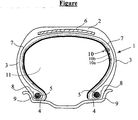
- the single appended figure shows very schematically (without respecting a specific scale), a radial section of a tire incorporating a laminate according to the invention.
- This tire 1 has a crown 2 reinforced by a crown reinforcement or belt 6, two sidewalls 3 and two beads 4, each of these beads 4 being reinforced with a rod 5.
- the crown 2 is surmounted by a tread represented in this schematic figure.
- a carcass reinforcement 7 is wound around the two rods 5 in each bead 4, the upturn 8 of this armature 7 being for example disposed towards the outside of the tire 1 which is shown here mounted on its rim 9.
- the carcass reinforcement 7 is in known manner constituted of at least one sheet reinforced by so-called "radial” cables, for example textile or metal, that is to say that these cables are arranged substantially parallel to each other and s' extend from one bead to the other so as to form an angle of between 80 ° and 90 ° with the median circumferential plane (plane perpendicular to the axis of rotation of the tire which is located halfway between the two beads 4 and goes through the middle of the crown frame 6).
- radial cables for example textile or metal
- the tire 1 is characterized in that its inner wall comprises a multi-layer laminate according to the invention, comprising at least two layers (10a, 10b), self-sealing thanks to its first layer (10a) and watertight. air through its second layer (10b).
- the two layers (10a, 10b) substantially cover the entire inner wall of the tire, extending from one flank to the other, at least up to the level of the tire hook. rim when the tire is in the mounted position.
- the layer 10a could, however, cover only part of the airtight zone (layer 10b), for example only the crown area of the tire or extend at least from the top zone. up to mid-flank (equator) of said bandage.
- the laminate is arranged in such a way that the first self-sealing layer (10a) is radially outermost in the tire, with respect to the other layer (10b), as shown schematically on the attached figure.
- the self-sealing layer (10a) covers the airtight layer (10b) on the side of the internal cavity 11 of the tire 1.
- this layer (10a) ) is radially innermost, then disposed between the sealing layer (10b) and the remainder of the structure of the bandage 1.
- the layer 10b (thickness 0.7 to 0.8 mm) is based on butyl rubber, has a conventional formulation for an "inner liner" ( “inner liner” ) which usually defines, in a bandage conventional pneumatic tire, the radially inner face of said tire for protecting the carcass reinforcement from the diffusion of air from the interior of the tire.
- This layer 10b airtight thus allows the swelling and pressure maintenance of the bandage 1; its sealing properties allow it to guarantee a relatively low rate of pressure loss, making it possible to maintain the swollen bandage, in normal operating condition for a sufficient period of time, normally several weeks or months.
- the layer 10a (about 2 mm thick) consists of the "Mediprene 500000M" product described above, the two essential constituents of which are an SEBS elastomer (with a styrene content of about 30%, a Tg close to -60 ° C and a Mn value of the order of 300 000 g / mol) and a paraffinic extension oil (Mn of the order of 600 g / mol) present at a weight content of about 400 phr.
- SEBS elastomer with a styrene content of about 30%, a Tg close to -60 ° C and a Mn value of the order of 300 000 g / mol
- Mn value of the order of 600 g / mol a paraffinic extension oil
- This layer 10a thus disposed between the layer 10b and the cavity 11 of the tire, provides the tire effective protection against pressure loss due to accidental perforations, allowing the automatic closure of these perforations.
- the composition serving as a self-sealing layer undergoes several constraints.
- said composition creates a sealed contact zone all around the body.
- the flexibility of the self-sealing composition allows it to interfere in openings of minimal size. This interaction between the self-sealing composition and the foreign body gives a seal to the area affected by the latter.
- a perforation In case of accidental or voluntary removal of the foreign body, a perforation remains: it is likely to create a more or less important leak, depending on its size.
- the self-sealing composition subjected to the effect of hydrostatic pressure, is sufficiently flexible and deformable to seal, by deforming, the perforation, preventing leakage of inflation gas.
- the flexibility of the self-sealing composition makes it possible to easily withstand the forces of the surrounding walls, even during the phases of deformation of the loaded tire and while driving.
- the tire provided with its puncture-resistant layer (10a) as described above can be produced before or after vulcanization (or baking).
- the self-sealing composition is simply applied in a conventional manner to the desired location, for forming the layer 10a.
- the vulcanization is then carried out conventionally.
- the TPS elastomers support the constraints related to the vulcanization step.
- An advantageous manufacturing variant for those skilled in the tire industry, will for example consist in a first step of depositing the self-sealing composition flat on a manufacturing drum in the form of a layer. ( “skim” ) of suitable thickness (for example 3 mm), before covering the latter with the airtight layer and then the rest of the tire structure, according to manufacturing techniques well known to man of career.
- This type of method also makes it possible to easily produce the second embodiment in which the sealing layer 10b is radially outermost.
- the self-sealing composition is applied inside the heated tire by any appropriate means, for example by gluing, spraying, or extruding and blowing a film. of appropriate thickness.
- tires of the tourism type of size 205/55 R16 "Energy 3" were tested.
- the inner wall of the tires (already comprising the airtight layer 10b) has been covered by the self-sealing layer (10a) previously described ("Mediprene 500 000M” product), with a thickness of 2 mm, then the vulcanized tires.
- this tire withstood rolling at 130 km / h at a rated load of 400 kg, without loss of pressure for more than 6300 km, beyond which the rolling was stopped.
- the tire thus perforated loses its pressure in less than a minute, becoming totally unfit for rolling.
Landscapes
- Chemical & Material Sciences (AREA)
- Organic Chemistry (AREA)
- Polymers & Plastics (AREA)
- Health & Medical Sciences (AREA)
- Chemical Kinetics & Catalysis (AREA)
- Medicinal Chemistry (AREA)
- Engineering & Computer Science (AREA)
- Mechanical Engineering (AREA)
- Materials Engineering (AREA)
- Sealing Material Composition (AREA)
- Compositions Of Macromolecular Compounds (AREA)
- Laminated Bodies (AREA)
- Dental Preparations (AREA)
- Adhesives Or Adhesive Processes (AREA)
Description
- La présente invention est relative aux compositions auto-obturantes ("self-sealing") et à leur utilisation comme couches anti-crevaison dans des objets pneumatiques.
- Elle se rapporte plus particulièrement à l'utilisation de telles compositions dans des bandages pneumatiques pour obturer d'éventuels trous dus à des perforations en service.
- Depuis quelques années, en particulier, les manufacturiers de bandages pneumatiques consentent des efforts particulièrement importants afin de développer des solutions originales à un problème datant du début même de l'utilisation des roues chaussées de bandages pneumatiques de type gonflés, à savoir comment permettre au véhicule de poursuivre sa route malgré une perte importante ou totale de pression d'un ou plusieurs bandages pneumatiques. Pendant des décennies, la roue de secours fut considérée comme la solution unique et universelle. Puis, plus récemment, les avantages considérables liés à sa suppression éventuelle sont apparus. Le concept de "mobilité étendue" se développe. Les techniques associées permettent de rouler avec le même bandage pneumatique, en fonction de certaines limites à respecter, après une crevaison ou une chute de pression. Cela permet par exemple de se rendre à un point de dépannage sans devoir s'arrêter, dans des circonstances souvent hasardeuses, pour installer la roue de secours.
- Des compositions auto-obturantes susceptibles de permettre d'atteindre un tel objectif, par définition aptes à assurer automatiquement, c'est-à-dire sans aucune intervention externe, l'étanchéité d'un bandage pneumatique en cas de perforation de ce dernier par un corps étranger tel qu'un clou, sont particulièrement difficiles à mettre au point.
- Pour pouvoir être utilisable, une couche auto-obturante doit satisfaire à de nombreuses conditions de nature physique et chimique. Elle doit notamment être efficace dans une très large gamme de températures d'utilisation et ce pendant toute la durée de vie des bandages pneumatiques. Elle doit être capable d'obturer le trou lorsque l'objet perforant reste en place ; à l'expulsion de ce dernier, elle doit pouvoir combler le trou et rendre le bandage étanche, notamment dans des conditions hivernales.
- De nombreuses solutions ont été imaginées mais n'ont pu se développer dans les bandages pneumatiques pour véhicules notamment par manque de stabilité dans le temps ou d'efficacité dans des conditions extrêmes de température d'utilisation.
- Pour contribuer à maintenir une bonne efficacité à haute température, le document
US-A-4,113,799 (ouFR-A-2 318 042 - Le document
US-A-4 228 839 a proposé comme couche auto-obturante pour pneumatique un mélange de caoutchouc contenant une première matière polymère qui se dégrade par irradiation, telle que du polyisobutylène, et une seconde matière polymère qui se réticule par irradiation, préférentiellement un caoutchouc butyl. - Le document
US-A-4 426 468 a lui aussi proposé une composition auto-obturante pour pneumatique à base de caoutchouc butyl à très haute masse moléculaire, réticulé. - Un inconvénient connu des caoutchoucs butyls est qu'ils présentent des pertes hystérétiques importantes (niveau élevé de tan(δ)) sur un spectre large de température, inconvénient qui se répercute sur les compositions auto-obturantes elles-mêmes avec une forte augmentation de l'hystérèse et une pénalisation notable de la résistance au roulement des bandages pneumatiques.
- Les Demanderesses ont constaté par ailleurs que ces compositions à base de caoutchouc butyl peuvent présenter en outre une efficacité insuffisante, notamment dans des conditions de température hivernales, après l'expulsion ou le retrait différé d'un objet perforant resté en place pendant une longue période dans la structure du bandage pneumatique.
- Le document
EP-B1-1 090 069 a certes proposé des compositions auto-obturantes dépourvues de caoutchouc butyl, dont la formulation spécifique comprend pour 100 parties en masse d'un élastomère thermoplastique à base de styrène, 80 à 140 parties d'un plastifiant liquide, 110 à 190 parties d'une résine tackifiante et de 2 à 20 parties d'un additif. - Une quantité importante de résine tackifiante, outre le coût industriel plus élevé qu'elle induit pour les pneumatiques, peut elle aussi pénaliser la résistance au roulement des pneumatiques en raison d'un risque de rigidification excessive de la composition auto-obturante.
- Or, les Demanderesses ont découvert lors de leurs recherches une composition auto-obturante de formulation notablement simplifiée, ne nécessitant ni caoutchouc butyl ni l'emploi de résines tackifiantes, qui présente en outre une performance améliorée par rapport aux compositions auto-obturantes de l'art antérieur.
- Ainsi, selon un premier objet, la présente invention concerne un objet pneumatique comportant comme composition auto-obturante, une composition élastomère comportant au moins, à titre d'élastomère majoritaire, un élastomère thermoplastique styrénique (dit "TPS") et une huile d'extension à un taux compris entre 200 et 700 pce (parties en poids pour cent parties d'élastomère).
- L'invention concerne également en soi un stratifié étanche à l'air et anti-crevaison, utilisable notamment dans un objet pneumatique, comportant au moins une première couche anti-crevaison comportant la composition auto-obturante définie ci-dessus et une seconde couche étanche à l'air.
- L'invention concerne particulièrement un objet pneumatique tel qu'un bandage pneumatique, comportant une telle composition auto-obturante ou un tel stratifié, particulièrement lorsque ladite composition ou ledit stratifié est disposé(e) sur la paroi interne dudit objet ou bandage pneumatique.
- La présente invention concerne particulièrement l'utilisation de la composition auto-obturante ou du stratifié ci-dessus dans des bandages pneumatiques destinés à équiper des véhicules à moteur de type tourisme, SUV ("Sport Utility Vehicles"), deux roues (notamment motos), avions, comme des véhicules industriels choisis parmi camionnettes, "Poids-lourd" - c'est-à-dire métro, bus, engins de transport routier (camions, tracteurs, remorques), véhicules hors-la-route tels qu'engins agricoles ou de génie civil -, autres véhicules de transport ou de manutention.
- L'invention concerne également un objet pneumatique comportant une couche anti-crevaison ou un stratifié tels que décrits ci-dessus.
- L'invention ainsi que ses avantages seront aisément compris à la lumière de la description et des exemples de réalisation qui suivent, ainsi que de la figure unique relative à ces exemples qui schématise en coupe radiale, un bandage pneumatique à armature de carcasse radiale utilisant une composition auto-obturante et un stratifié conformément à la présente invention.
- Dans la présente description, sauf indication expresse différente, tous les pourcentages (%) indiqués sont des % en masse.
- La composition ou matière auto-obturante utilisée conformément à l'invention est une composition élastomère comportant au moins, à titre d'élastomère majoritaire, un élastomère thermoplastique styrénique et, à titre d'agent plastifiant, une huile d'extension selon un taux pondéral compris entre 200 et 700 pce.
- Les élastomères thermoplastiques styréniques (en abrégé "TPS") sont des élastomères thermoplastiques se présentant sous la forme de copolymères blocs à base de styrène.
- De structure intermédiaire entre polymères thermoplastiques et élastomères, ils sont constitués de manière connue de séquences rigides polystyrène reliées par des séquences souples élastomère, par exemple polybutadiène, polyisoprène ou poly(éthylène/butylène). Ce sont souvent des élastomères triblocs avec deux segments rigides reliés par un segment souple. Les segments rigides et souples peuvent être disposés linéairement, en étoile ou branchés.
- De préférence, l'élastomère TPS est choisi dans le groupe constitué par les copolymères blocs styrène/ butadiène/ styrène (SBS), styrène/ isoprène/ styrène (SIS), styrène/ isoprène/ butadiène/ styrène (SIBS), styrène/ éthylène/ butylène/ styrène (SEBS), styrène/ éthylène/ propylène/ styrène (SEPS), styrène/ éthylène/ éthylène/ propylène/ styrène (SEEPS) et les mélanges de ces copolymères.
- Plus préférentiellement, ledit élastomère est choisi dans le groupe constitué par les copolymères SEBS, les copolymères SEPS et les mélanges de ces copolymères.
- Selon un autre mode de réalisation préférentiel de l'invention, le taux de styrène, dans l'élastomère TPS, est compris entre 5 et 50 %.
- En dessous du minimum indiqué, le caractère thermoplastique de l'élastomère risque de diminuer de manière sensible tandis qu'au-dessus du maximum préconisé, l'élasticité de la composition peut être affectée. Pour ces raisons, lé taux de styrène est plus préférentiellement compris entre 10 et 40%, en particulier entre 15 et 35%.
- On préfère que la température de transition vitreuse (Tg, mesurée selon ASTM D3418) de l'élastomère TPS soit inférieure à -20°C, plus préférentiellement inférieure à -40°C.
- Une valeur de Tg supérieure à ces minima, impliquant une Tg plus élevée de la composition auto-obturante elle-même, peut diminuer les performances de la composition auto-obturante lors d'une utilisation à très basse température ; pour une telle utilisation, la Tg de l'élastomère TPS est plus préférentiellement encore inférieure à -50°C.
- La masse moléculaire moyenne en nombre (notée Mn) de l'élastomère TPS est préférentiellement comprise entre 50 000 et 500 000 g/mol, plus préférentiellement comprise entre 75 000 et 450 000. En dessous des minima indiqués, la cohésion entre les chaînes d'élastomère TPS, en raison de sa dilution (quantité d'agent d'extension), risque d'être affectée ; d'autre part, une augmentation de la température d'usage risque d'affecter les propriétés mécaniques, notamment les propriétés à la rupture, avec pour conséquence une performance diminuée "à chaud". Par ailleurs, une masse Mn trop élevée peut être pénalisante pour la souplesse de la composition, aux taux d'huile d'extension préconisés. Ainsi, on a constaté qu'une valeur comprise dans un domaine de 250 000 à 400 000 était particulièrement bien adaptée, notamment à une utilisation de la composition auto-obturante dans un bandage pneumatique.
- La masse moléculaire moyenne en nombre (Mn) de l'élastomère TPS est déterminée de manière connue, par chromatographie d'exclusion stérique (SEC). L'échantillon est préalablement solubilisé dans du tétrahydrofuranne à une concentration d'environ 1 g/l ; puis la solution est filtrée sur filtre de porosité 0,45 µm avant injection. L'appareillage utilisé est une chaîne chromatographique "WATERS alliance". Le solvant d'élution est le tétrahydrofuranne, le débit de 0,7 ml/min, la température du système de 35°C et la durée d'analyse de 90 min. On utilise un jeu de quatre colonnes WATERS en série, de dénominations commerciales "STYRAGEL" ("HMW7", "HMW6E" et deux "HT6E"). Le volume injecté de la solution de l'échantillon de polymère est de 100 µl. Le détecteur est un réfractomètre différentiel "WATERS 2410" et son logiciel associé d'exploitation des données chromatographiques est le système "WATERS MILLENIUM". Les masses molaires moyennes calculées sont relatives à une courbe d'étalonnage réalisée avec des étalons de polystyrène.
- L'élastomère TPS peut constituer la totalité de la matrice élastomère ou la majorité pondérale (de préférence pour plus de 50 %, plus préférentiellement pour plus de 70%) de cette dernière lorsqu'elle comporte un ou plusieurs autre(s) élastomère(s), thermoplastiques ou non, par exemple du type diéniques.
- Selon un mode de réalisation préférentiel, l'élastomère TPS est le seul élastomère, et le seul élastomère thermoplastique présent dans la composition auto-obturante.
- Le deuxième constituant essentiel de la composition auto-obturante est une huile d'extension (ou huile plastifiante), utilisée à un taux très élevé, compris entre 200 et 700 pce (soit entre 200 et 700 parties en poids pour cent parties d'élastomère).
- On peut utiliser toute huile d'extension, de préférence à caractère faiblement polaire, apte à étendre, plastifier des élastomères, notamment thermoplastiques.
- A température ambiante (23°C), ces huiles, plus ou moins visqueuses, sont des liquides (c'est-à-dire, pour rappel, des substances ayant la capacité de prendre à terme la forme de leur contenant), par opposition notamment à des résines, en particulier tackifiantes, qui sont par nature solides.
- De préférence, l'huile d'extension est choisie dans le groupe constitué par les huiles polyoléfiniques (c'est-à-dire issues de la polymérisation d'oléfines, monooléfines ou dioléfines), les huiles paraffiniques, les huiles naphténiques (à basse ou haute viscosité), les huiles aromatiques, les huiles minérales, et les mélanges de ces huiles.
- Plus préférentiellement, l'huile d'extension est choisie dans le groupe constitué par les polybutènes, les huiles paraffiniques et les mélanges de ces huiles. On utilise tout particulièrement une huile polyisobutène, en particulier polyisobutylène (PIB).
- A titre d'exemples, des huiles polyisobutylène sont commercialisées notamment par la société Univar sous la dénomination "Dynapak Poly" (e.g. "Dynapak Poly 190"), par BASF sous les dénominations "Glissopal" (e.g. "Glissopal 1000") ou "Oppanol" (e.g. "Oppanol B12") ; des huiles paraffiniques sont commercialisées par exemple par Exxon sous la dénomination "Telura 618" ou par Repsol sous la dénomination "Extensol 51".
- La masse moléculaire moyenne en nombre (Mn) de l'huile d'extension est préférentiellement comprise entre 200 et 30 000 g/mol, plus préférentiellement encore comprise entre 300 et 10 000 g/mol.
- Pour des masses Mn trop basses, il existe un risque de migration de l'huile à l'extérieur de la composition auto-obturante, tandis que des masses trop élevées peuvent entraîner une rigidification excessive de cette composition. Une masse Mn comprise entre 350 et 4 000 g/mol, en particulier entre 400 et 3 000 g/mol, s'est avérée constituer un excellent compromis pour les applications visées, en particulier pour une utilisation dans un bandage pneumatique.
- La masse moléculaire moyenne en nombre (Mn) de l'huile d'extension est déterminée par SEC, l'échantillon étant préalablement solubilisé dans du tétrahydrofuranne à une concentration d'environ 1 g/l ; puis la solution est filtrée sur filtre de porosité 0,45µm avant injection. L'appareillage est la chaîne chromatographique "WATERS alliance". Le solvant d'élution est le tétrahydrofuranne, le débit de 1 ml/min, la température du système de 35°C et la durée d'analyse de 30 min. On utilise un jeu de deux colonnes "WATERS" de dénomination "STYRAGEL HT6E". Le volume injecté de la solution de l'échantillon de polymère est de 100 µl. Le détecteur est un réfractomètre différentiel "WATERS 2410" et son logiciel associé d'exploitation des données chromatographiques est le système "WATERS MILLENIUM". Les masses molaires moyennes calculées sont relatives à une courbe d'étalonnage réalisée avec des étalons de polystyrène.
- L'homme du métier saura, à la lumière de la description et des exemples de réalisation qui suivent, ajuster la quantité d'huile d'extension en fonction des conditions particulières d'usage de la composition auto-obturante, notamment de l'objet pneumatique dans lequel elle est destinée à être utilisée.
- On préfère que le taux d'huile d'extension soit compris entre 250 et 600 pce. En dessous du minimum indiqué, la composition auto-obturante risque de présenter une rigidité trop forte pour certaines applications tandis qu'au-delà du maximum préconisé, on s'expose à un risque de cohésion insuffisante de la composition. Pour cette raison, le taux d'huile d'extension est plus préférentiellement compris entre 300 et 500 pce, notamment pour une utilisation de la composition auto-obturante dans un bandage pneumatique.
- Les deux constituants précédemment décrits, à savoir élastomère TPS et huile d'extension sont suffisants à eux seuls pour que la composition auto-obturante remplisse totalement sa fonction anti-crevaison vis-à-vis des objets pneumatiques dans lesquels elle est utilisée.
- Toutefois, divers autres additifs peuvent être ajoutés, typiquement en faible quantité (préférentiellement à des taux inférieurs à 20 pce, plus préférentiellement inférieurs à 10 pce), comme par exemple des charges renforçantes tels que du noir de carbone, des charges non renforçantes ou inertes, des charges lamellaires, des agents de protection tels que des anti-UV, anti-oxydants ou anti-ozonants, divers autres stabilisants, des agents colorants avantageusement utilisables pour la coloration de la composition auto-obturante.
- Bien que la composition auto-obturante, grâce à sa formulation spécifique, ne nécessite pas l'emploi de résine tackifiante (pour rappel, une résine apte à donner du "tack" c'est-à-dire un collant immédiat par légère pression sur un support), l'invention s'applique également aux cas où une telle résine tackifiante serait utilisée, dans ce cas et de préférence selon une proportion minoritaire, typiquement inférieure à 100 pce, plus préférentiellement inférieure à 50 pce (par exemple comprise entre 0 et 20 pce).
- Outre les élastomères (TPS et autres élastomères éventuels) précédemment décrits, la composition auto-obturante pourrait aussi comporter, toujours selon une fraction pondérale minoritaire par rapport à l'élastomère TPS, des polymères autres que des élastomères, tels que par exemple des polymères thermoplastiques compatibles avec l'élastomère TPS.
- La composition ou matière auto-obturante précédemment décrite est un composé solide (à 23°C) et élastique, qui se caractérise notamment, grâce à sa formulation spécifique, par une très haute souplesse et déformabilité.
- Selon un mode de réalisation particulier de l'invention, notamment lors d'une utilisation dans un bandage pneumatique, ladite composition auto-obturante présente pour toute température comprise entre +30°C et +100°C, un facteur de perte (tg δ) inférieur à 0,2, plus préférentiellement inférieur à 0,15, et un module de cisaillement dynamique G* inférieur à la pression de gonflage en service (notée Pg) de l'objet pneumatique considéré (en particulier inférieur à 0,1 MPa), G* étant plus préférentiellement compris entre Pg/30 et Pg (en particulier compris entre 0,01 et 0,1 MPa), tg δ et G* étant mesurés à une fréquence de 10 Hz. Ces propriétés dynamiques sont mesurées de manière connue, sur rhéomètre "MCR 301" de la société Anton Paar ; les échantillons sont cylindriques avec une épaisseur de 2,5 mm et un diamètre de 4 mm, ils sont disposés dans une chambre thermique entre deux plateaux plans, l'un fixe et l'autre oscillant de façon sinusoïdale autour de son centre ; on applique aussi une contrainte normale de 0,02 MPa pendant toute la durée des essais ; on impose une déformation maximale de 1% et on effectue un balayage en température de -100°C à +250°C avec une rampe de 5°C/min.
- Selon un autre mode de réalisation particulier de l'invention, la composition auto-obturante présente un allongement à la rupture supérieur à 500%, plus préférentiellement supérieur à 800%, et une contrainte à la rupture supérieure à 0,2 MPa, ces deux grandeurs étant mesurées en première élongation (c'est-à-dire sans cycle d'accommodation) à une température de 23°C, avec une vitesse de traction de 500 mm/min (norme ASTM D412), et rapportées à la section initiale de l'éprouvette.
- Des élastomères TPS tels que SEPS ou SEBS étendus avec de forts taux d'huiles sont bien connus et disponibles commercialement sous la forme étendue. A titre d'exemples, on peut citer les produits commercialisés par la société Vita Thermoplastic Elastomers ou VTC ("VTC TPE group") sous la dénomination "Dryflex" (e.g. "Dryflex 967100") ou "Mediprene" (e.g. "Mediprene 500 000M"), ceux vendus par Multibase sous dénomination "Multiflex" (e.g. "Multiflex G00").
- Ces produits, développés notamment pour des applications médicales, pharmaceutiques ou cosmétiques, peuvent être mis en oeuvre de façon classique pour des TPE, par extrusion ou moulage, par exemple à partir d'une matière première disponible sous la forme de billes ou de granulés.
- De manière tout à fait surprenante, ils se sont révélés capables, après un éventuel ajustement, si nécessaire, de leur taux d'huile d'extension dans le domaine préconisé par la présente invention (soit entre 200 et 700 pce, de préférence entre 250 et 600 pce), de remplir la fonction d'une composition auto-obturante performante, comme cela est expliqué en détail ci-après.
- La composition auto-obturante précédemment décrite est utilisée comme couche anti-crevaison dans tout type d'objet "pneumatique", c'est-à-dire, par définition, tout objet qui prend sa forme utilisable quand on le gonfle d'air.
- A titre d'exemples de tels objets pneumatiques, on peut citer les bateaux pneumatiques, les ballons ou balles utilisées pour le jeu ou le sport.
- Elle est particulièrement bien adaptée à une utilisation comme couche anti-crevaison dans un objet pneumatique, produit fini ou semi-fini, en caoutchouc, tout particulièrement dans un bandage pneumatique pour véhicule automobile tel qu'un véhicule de type deux roues, tourisme ou industriel, ou non automobile tel que vélo.
- Une telle couche anti-crevaison est préférentiellement disposée sur la paroi interne de l'objet pneumatique, la recouvrant totalement ou au moins en partie, mais elle peut être également intégrée complètement à sa structure interne.
- L'épaisseur de la couche anti-crevaison est préférentiellement supérieure à 0,3 mm, plus préférentiellement comprise entre 0,5 mm et 10 mm (en particulier entre 1 et 5 mm).
- On comprendra aisément que, selon les domaines d'application spécifiques, les dimensions et les pressions en jeu, le mode de mise en oeuvre de l'invention peut varier, la couche anti-crevaison comportant alors plusieurs gammes d'épaisseur préférentielles. Ainsi par exemple, pour des bandages pneumatiques de type tourisme, elle peut avoir une épaisseur d'au moins 0,4 mm, préférentiellement comprise entre 0,8 et 2 mm. Selon un autre exemple, pour des bandages pneumatiques de véhicules poids lourds ou agricole, l'épaisseur préférentielle peut se situer entre 1 et 3 mm. Selon un autre exemple, pour des bandages pneumatiques de véhicules dans le domaine du génie civil ou pour avions, l'épaisseur préférentielle peut se situer entre 2 et 10 mm. Enfin, selon un autre exemple, pour des bandages pneumatiques de vélo, l'épaisseur préférentielle peut se situer entre 0,4 et 2 mm.
- La composition auto-obturante ici décrite a l'avantage de ne présenter, dans une très large gamme de températures d'utilisation des bandages pneumatiques, pratiquement aucune pénalisation en termes de résistance au roulement par rapport à un bandage pneumatique ne comportant pas une telle couche auto-obturante ; comparativement aux compositions auto-obturantes usuelles, elle améliore très notablement la vitesse d'obturation du trou lors du retrait différé d'un objet perforant.
- D'autre part, les compositions auto-obturantes usuelles présentent une aptitude importante au fluage. Lors du roulage des bandages pneumatiques, elles sont souvent chassées de la partie flanc de ces bandages sous l'effet des forces centrifuges et s'accumulent sous leur partie sommet. Ce n'est pas le cas pour les compositions préconisées par la présente invention qui peuvent être disposées dans toute la partie intérieure des bandages pneumatiques.
- Bien entendu, l'invention s'applique aux cas où la composition auto-obturante précédemment décrite est utilisée dans un bandage ou tout autre objet pneumatique sans être nécessairement combinée à une couche étanche à l'air.
- Toutefois, selon un mode particulier et préférentiel de réalisation de l'invention, la composition auto-obturante est associée à au moins une seconde couche étanche à l'air, pour constituer un produit stratifié multi-couches, auto-obturant et étanche à l'air, utilisable notamment comme paroi interne d'un objet pneumatique tel qu'un bandage pneumatique.
- La seconde couche du stratifié peut comporter tout type de matériau susceptible de remplir la fonction de film étanche à l'air (ou plus généralement aux gaz), qu'il s'agisse par exemple d'un matériau métallique très fin comme d'un matériau polymère.
- De préférence, cette couche étanche à l'air a une épaisseur supérieure à 0,05 mm, plus préférentiellement comprise entre 0,05 et 6 mm (par exemple de 0,1 à 2 mm).
- Selon un mode de réalisation préférentiel, cette seconde couche étanche à l'air comporte une composition de caoutchouc butyl. Par caoutchouc butyl, doit être entendu de manière connue un copolymère d'isobutylène et d'isoprène (en abrégé IIR), ainsi que les versions halogénées, de préférence chlorées ou bromées, de ce type de copolymère. De préférence, le caoutchouc butyl est un caoutchouc butyl halogéné ou un coupage de butyls halogéné et non halogéné.
- Le caoutchouc butyl peut être utilisé seul ou en association avec un ou plusieurs autre(s) élastomère(s), notamment élastomères diénique(s) tels que par exemple du caoutchouc naturel ou un polyisoprène synthétique. La composition étanche à l'air comporte par ailleurs les divers additifs usuellement présents dans les couches étanches à l'air connues de l'homme du métier, tels que des charges renforçantes comme le noir de carbone, des charges lamellaires améliorant l'étanchéité (e.g. phyllosilicates tels que kaolin, talc, mica, argiles ou argiles modifiées ("organo clays")), des agents de protection tels que antioxydants ou antiozonants, un système de réticulation (par exemple à base de soufre ou de peroxyde), divers agents de mise en oeuvre ou autres stabilisants.
- Les deux couches du stratifié conforme à l'invention peuvent être assemblées par tout moyen approprié, par exemple par un simple traitement thermique, de préférence sous pression (par exemple quelques min à 150°C sous 16 bars), à l'aide de divers agents adhésifs ou encore en intercalant une troisième couche adhésive solidarisant les deux autres.
- Le stratifié multicouches de l'invention est avantageusement utilisable dans les bandages pneumatiques de tous types de pneumatiques, en particulier de bandages pour véhicules tourisme ou véhicules industriels tels que Poids-lourd.
- A titre d'exemple, la figure unique annexée représente de manière très schématique (sans respect d'une échelle spécifique), une coupe radiale d'un bandage pneumatique incorporant un stratifié conforme à l'invention.
- Ce bandage pneumatique 1 comporte un sommet 2 renforcé par une armature de sommet ou ceinture 6, deux flancs 3 et deux bourrelets 4, chacun de ces bourrelets 4 étant renforcé avec une tringle 5. Le sommet 2 est surmonté d'une bande de roulement non représentée sur cette figure schématique. Une armature de carcasse 7 est enroulée autour des deux tringles 5 dans chaque bourrelet 4, le retournement 8 de cette armature 7 étant par exemple disposé vers l'extérieur du pneumatique 1 qui est ici représenté monté sur sa jante 9. L'armature de carcasse 7 est de manière connue en soi constituée d'au moins une nappe renforcée par des câbles dits "radiaux", par exemple textiles ou métalliques, c'est-à-dire que ces câbles sont disposés pratiquement parallèles les uns aux autres et s'étendent d'un bourrelet à l'autre de manière à former un angle compris entre 80° et 90° avec le plan circonférentiel médian (plan perpendiculaire à l'axe de rotation du pneumatique qui est situé à mi-distance des deux bourrelets 4 et passe par le milieu de l'armature de sommet 6).
- Le bandage pneumatique 1 est caractérisé en ce que sa paroi interne comporte un stratifié multi-couches conforme à l'invention, comportant au moins deux couches (10a, 10b), auto-obturant grâce à sa première couche (10a) et étanche à l'air grâce à sa seconde couche (10b).
- Conformément à un mode de réalisation préférentiel de l'invention, les deux couches (10a, 10b) couvrent substantiellement toute la paroi interne du bandage pneumatique, se prolongeant d'un flanc à l'autre, au moins jusqu'au niveau du crochet de jante lorsque le bandage pneumatique est en position montée. Selon d'autres modes de réalisation possibles, la couche 10a pourrait toutefois recouvrir uniquement une partie de la zone étanche à l'air (couche 10b), par exemple seulement la zone sommet du bandage pneumatique ou s'étendre au moins de la zone sommet jusqu'à mi-flanc (équateur) dudit bandage.
- Selon un autre mode de réalisation préférentiel, le stratifié est disposé de telle manière que la première couche (10a) auto-obturante soit radialement la plus externe dans le bandage pneumatique, par rapport à l'autre couche (10b), comme schématisé sur la figure annexée. En d'autres termes, la couche (10a) auto-obturante recouvre la couche (10b) étanche à l'air du côté de la cavité interne 11 du bandage pneumatique 1. Un autre mode de réalisation possible est celui où cette couche (10a) est radialement la plus interne, disposée alors entre la couche étanche (10b) et le reste de la structure du bandage 1.
- Dans cet exemple, la couche 10b (d'épaisseur 0,7 à 0,8 mm) est à base de caoutchouc butyl, présente une formulation conventionnelle pour une "gomme intérieure" ("inner liner") qui définit usuellement, dans un bandage pneumatique conventionnel, la face radialement interne dudit bandage destinée à protéger l'armature de carcasse de la diffusion d'air provenant de l'espace intérieur au bandage. Cette couche 10b étanche à l'air permet donc le gonflement et le maintien sous pression du bandage 1 ; ses propriétés d'étanchéité lui permettent de garantir un taux de perte de pression relativement faible, permettant de maintenir le bandage gonflé, en état de fonctionnement normal, pendant une durée suffisante, normalement de plusieurs semaines ou plusieurs mois.
- La couche 10a (d'épaisseur environ 2 mm) est quant à elle constituée du produit "Mediprene 500000M" précédemment décrit, dont les deux constituants essentiels sont un élastomère SEBS (avec un taux de styrène d'environ 30%, une Tg proche de -60°C et une valeur Mn de l'ordre de 300 000 g/mol) et une huile d'extension paraffinique (Mn de l'ordre de 600 g/mol) présente à un taux pondéral d'environ 400 pce.
- Cette couche 10a, disposée donc entre la couche 10b et la cavité 11 du pneumatique, permet de procurer au pneumatique une protection efficace contre les pertes de pression dues aux perforations accidentelles, en permettant l'obturation automatique de ces perforations.
- Si un corps étranger tel qu'un clou traverse la structure de l'objet pneumatique, par exemple une paroi telle qu'un flanc 3 ou le sommet 6 du bandage pneumatique 1, la composition servant de couche auto-obturante subit plusieurs contraintes. En réaction à ces contraintes, et grâce à ses propriétés avantageuses de déformabilité et d'élasticité, ladite composition crée une zone de contact étanche tout autour du corps. Peu importe que le contour ou profil de ce dernier soit uniforme ou régulier, la souplesse de la composition auto-obturante permet à cette dernière de s'immiscer dans des ouvertures de taille minime. Cette interaction entre la composition auto-obturante et le corps étranger confère une étanchéité à la zone affectée par ce dernier.
- En cas de retrait, accidentel ou volontaire, du corps étranger, une perforation reste : celle-ci est susceptible de créer une fuite plus ou moins importante, en fonction de sa taille. La composition auto-obturante, soumise à l'effet de la pression hydrostatique, est suffisamment souple et déformable pour obturer, en se déformant, la perforation, empêchant la fuite de gaz de gonflage. Dans le cas d'un bandage pneumatique notamment, il s'est avéré que la souplesse de la composition auto-obturante permettait de supporter sans problème les efforts des parois environnantes, même lors des phases de déformations du bandage pneumatique chargé et en roulage.
- Le pneumatique pourvu de sa couche anti-crevaison (10a) tel que décrit ci-dessus peut être réalisé avant ou après vulcanisation (ou cuisson).
- Dans le premier cas (i.e., avant cuisson du bandage pneumatique), la composition auto-obturante est simplement appliquée de façon conventionnelle à l'endroit souhaité, pour formation de la couche 10a. La vulcanisation est ensuite effectuée classiquement. Les élastomères TPS supportent bien les contraintes liées à l'étape de vulcanisation.
- Une variante de fabrication avantageuse, pour l'homme du métier des bandages pneumatiques, consistera par exemple au cours d'une première étape, à déposer à plat la composition auto-obturante directement sur un tambour de confection, sous la forme d'une couche ("skim") d'épaisseur adaptée (par exemple 3 mm), avant de recouvrir cette dernière avec la couche étanche à l'air puis le reste de la structure du bandage pneumatique, selon des techniques de fabrication bien connues de l'homme du métier. Ce type de procédé permet en outre de réaliser aisément le second mode de réalisation dans lequel la couche d'étanchéité 1 0b serait radialement la plus externe.
- Dans le second cas (i.e., après cuisson du bandage pneumatique), la composition auto-obturante est appliquée à l"intérieur du bandage pneumatique cuit par tout moyen approprié, par exemple par collage, par pulvérisation ou encore extrusion et soufflage d'un film d'épaisseur appropriée.
- Lors d'essais, des bandages pneumatiques de type tourisme, de dimension 205/55 R16 "Energy 3" ont été testés. La paroi interne des pneumatiques (comportant déjà la couche étanche à l'air 10b) a été recouverte par la couche auto-obturante (10a) précédemment décrite (produit "Mediprene 500 000M"), d'une épaisseur de 2 mm, puis les pneumatiques vulcanisés.
- Sur un des bandages pneumatiques monté et gonflé, cinq perforations de 6 mm de diamètre et deux perforations de 1 mm de diamètre ont été réalisées, à travers la bande de roulement et le bloc sommet d'une part, les flancs d'autre part, à l'aide de poinçons qui ont été immédiatement retirés.
- De manière inattendue, ce bandage a résisté à un roulage sur volant à 130 km/h, sous une charge nominale de 400 kg, sans perte de pression pendant plus de 6300 km, distance au-delà de laquelle le roulage a été stoppé.
- Sur un autre bandage pneumatique, on a procédé de la même façon en laissant cette fois en place les objets perforants, pendant une semaine. Le même excellent résultat a été obtenu.
- Sans composition auto-obturante et dans les mêmes conditions que ci-dessus, le bandage pneumatique ainsi perforé perd sa pression en moins d'une minute, devenant totalement inapte au roulage.
Claims (15)
- Objet pneumatique comportant une composition élastomère auto-obturante comportant au moins, à titre d'élastomère majoritaire, un élastomère thermoplastique styrénique (dit "TPS") et une huile d'extension à un taux compris entre 200 et 700 pce (parties en poids pour cent d'élastomère).
- Objet pneumatique selon la revendication 1, dans lequel l'élastomère TPS est choisi dans le groupe constitué par les copolymères blocs styrène/ butadiène/ styrène (SBS), styrène/ isoprène/ styrène (SIS), styrène/ isoprène/ butadiène/ styrène (SIBS), styrène/ éthylène/ butylène/ styrène (SEBS), styrène/ éthylène/ propylène/ styrène (SEPS), styrène/ éthylène/ éthylène/ propylène/ styrène (SEEPS) et les mélanges de ces copolymères.
- Objet pneumatique selon la revendication 2, dans lequel l'élastomère TPS est choisi dans le groupe constitué par les copolymères SEBS, les copolymères SEPS et les mélanges de ces copolymères.
- Objet pneumatique selon l'une quelconque des revendications 1 à 3, dans lequel l'élastomère TPS comprend entre 5 et 50% en masse de styrène.
- Objet pneumatique selon l'une quelconque des revendications t à 4, dans lequel la température de transition vitreuse (Tg) de l'élastomère TPS est inférieure à -20°C.
- Objet pneumatique selon l'une quelconque des revendications 1 à 5, dans lequel la masse moléculaire moyenne en nombre (Mn) de l'élastomère TPS est comprise entre 50 000 et 500 000 g/mol.
- Objet pneumatique selon l'une quelconque des revendications 1 à 6, dans lequel l'huile d'extension est choisie dans le groupe constitué par les huiles polyoléfiniques, les huiles paraffiniques, les huiles naphténiques, les huiles aromatiques, les huiles minérales, et les mélanges de ces huiles.
- Objet pneumatique selon la revendication 7, dans lequel l'huile d'extension est choisie dans le groupe constitué par les huiles polybutènes, les huiles paraffiniques et les mélanges de ces huiles.
- Objet pneumatique selon l'une quelconque des revendications 1 à 8, dans lequel la masse moléculaire moyenne en nombre (Mn) de l'huile d'extension est comprise entre 200 et 30 000 g/mol.
- Objet pneumatique selon l'une quelconque des revendications 1 à 9, dans lequel le taux d'huile d'extension est compris entre 250 et 600 pce.
- Objet pneumatique selon l'une quelconque des revendications 1 à 10, dans lequel la composition élastomère auto-obturante, utilisée comme couche anti-crevaison est déposée sur la paroi interne de l'objet pneumatique.
- Objet pneumatique selon l'une quelconque des revendications 1 à 11, dans lequel l'objet pneumatique est un bandage pneumatique.
- Stratifié étanche à l'air et anti-crevaison, utilisable notamment dans un objet pneumatique, comportant au moins :- une première couche anti-crevaison comportant la composition auto-obturante telle que définie dans l'une quelconque des revendications 1 à 10 ;- une seconde couche étanche à l'air.
- Stratifié selon la revendication 13, dans lequel la couche étanche à l'air comporte une composition de caoutchouc butyl.
- Objet pneumatique comportant un stratifié étanche à l'air et anti-crevaison selon les revendications 13 ou 14.
Applications Claiming Priority (2)
| Application Number | Priority Date | Filing Date | Title |
|---|---|---|---|
| FR0611307A FR2910478B1 (fr) | 2006-12-22 | 2006-12-22 | Composition auto-obturante pour objet pneumatique |
| PCT/EP2007/011154 WO2008080557A1 (fr) | 2006-12-22 | 2007-12-19 | Composition auto-obturante pour objet pneumatique |
Publications (2)
| Publication Number | Publication Date |
|---|---|
| EP2125949A1 EP2125949A1 (fr) | 2009-12-02 |
| EP2125949B1 true EP2125949B1 (fr) | 2012-02-15 |
Family
ID=38448652
Family Applications (1)
| Application Number | Title | Priority Date | Filing Date |
|---|---|---|---|
| EP07856877A Not-in-force EP2125949B1 (fr) | 2006-12-22 | 2007-12-19 | Objet pneumatique |
Country Status (10)
| Country | Link |
|---|---|
| US (1) | US8602075B2 (fr) |
| EP (1) | EP2125949B1 (fr) |
| JP (1) | JP5275249B2 (fr) |
| KR (1) | KR101416683B1 (fr) |
| CN (1) | CN101563417B (fr) |
| AT (1) | ATE545500T1 (fr) |
| BR (1) | BRPI0720484A2 (fr) |
| EA (1) | EA015373B1 (fr) |
| FR (1) | FR2910478B1 (fr) |
| WO (1) | WO2008080557A1 (fr) |
Families Citing this family (59)
| Publication number | Priority date | Publication date | Assignee | Title |
|---|---|---|---|---|
| FR2910478B1 (fr) * | 2006-12-22 | 2009-03-06 | Michelin Soc Tech | Composition auto-obturante pour objet pneumatique |
| CN100377895C (zh) * | 2007-01-12 | 2008-04-02 | 张海龙 | 耐扎、防弹、防漏安全轮胎及制造方法和所用防漏材料 |
| FR2923409B1 (fr) * | 2007-11-09 | 2009-12-18 | Michelin Soc Tech | Objet pneumatique pourvu d'une composition auto-obturante |
| FR2932712B1 (fr) * | 2008-06-24 | 2010-08-20 | Michelin Soc Tech | Stratifie etanche a l'air et anticrevaison pour objet pneumatique. |
| FR2933636B1 (fr) * | 2008-07-11 | 2011-09-02 | Michelin Soc Tech | Dispositif d'etancheite et procede de mise en place dudit dispositif sur une jante |
| FR2934275B1 (fr) * | 2008-07-24 | 2013-01-04 | Michelin Soc Tech | Composition auto-obturante pour objet pneumatique |
| FR2934603B1 (fr) * | 2008-08-01 | 2012-12-14 | Michelin Soc Tech | Composition auto-obturante pour objet pneumatique. |
| FR2939142B1 (fr) * | 2008-12-03 | 2010-12-31 | Michelin Soc Tech | Objet pneumatique pourvu d'une couche etanche aux gaz a base de deux elastomeres thermoplastiques |
| FR2939145B1 (fr) * | 2008-12-03 | 2010-12-31 | Soc Tech Michelin | Objet pneumatique pourvu d'une couche auto-obturante et etanche aux gaz, a base d'elastomere thermoplastique et d'une huile d'extension |
| FR2939076B1 (fr) * | 2008-12-03 | 2011-10-21 | Michelin Soc Tech | Stratifie multicouche etanche a l'air pour objet pneumatique |
| JP5347697B2 (ja) * | 2009-05-07 | 2013-11-20 | 横浜ゴム株式会社 | 空気入りタイヤの製造方法 |
| FR2945826B1 (fr) | 2009-05-25 | 2011-12-02 | Michelin Soc Tech | Renfort composite auto-adherent |
| FR2948321B1 (fr) | 2009-07-22 | 2011-11-18 | Michelin Soc Tech | Bandage pneumatique avec couche auto-obturante integree. |
| FR2948320B1 (fr) | 2009-07-27 | 2011-07-29 | Michelin Soc Tech | Objet pneumatique pourvu d'une couche etanche aux gaz a base d'un elastomere thermoplastique et d'une charge lamellaire. |
| CN102574434B (zh) | 2009-07-31 | 2014-10-29 | 米其林集团总公司 | 具有内置自密封层的充气轮胎 |
| JP4831706B2 (ja) * | 2009-09-04 | 2011-12-07 | 住友ゴム工業株式会社 | ポリマー積層体およびそれをインナーライナーに用いた空気入りタイヤ |
| FR2949998B1 (fr) * | 2009-09-15 | 2011-10-07 | Michelin Soc Tech | Bandage pneumatique avec couche auto-obturante integree |
| FR2952076B1 (fr) | 2009-10-29 | 2011-12-02 | Michelin Soc Tech | Renfort composite |
| IT1396617B1 (it) * | 2009-11-25 | 2012-12-14 | Pirelli | Metodo per controllare selettivamente la capacita' auto-sigillante di un pneumatico e pneumatico auto-sigillante per ruote di veicoli |
| FR2953760B1 (fr) * | 2009-12-14 | 2013-01-11 | Michelin Soc Tech | Bandage pneumatique avec couche auto-obturante integree |
| FR2956119B1 (fr) * | 2009-12-23 | 2012-12-28 | Michelin Soc Tech | Pneumatique dont la zone sommet est pourvue d'une sous-couche comportant un elastomere thermoplastique |
| FR2954333B1 (fr) * | 2009-12-23 | 2012-03-02 | Michelin Soc Tech | Pneumatique dont la zone sommet est pourvue d'une sous-couche comportant un elastomere thermoplastique |
| FR2955588B1 (fr) * | 2010-01-28 | 2012-03-09 | Michelin Soc Tech | Composition d'elastomere pour objet pneumatique, a propriete auto-obturante |
| FR2955587B1 (fr) * | 2010-01-28 | 2012-02-17 | Michelin Soc Tech | Composition d'elastomere pour objet pneumatique, a propriete auto-obturante |
| FR2957295B1 (fr) | 2010-03-15 | 2012-04-13 | Michelin Soc Tech | Procede et dispositif de fabrication d'une bande continue d'un produit fortement collant emballe dans un film thermoplastique |
| JP5243512B2 (ja) | 2010-06-29 | 2013-07-24 | 住友ゴム工業株式会社 | 空気入りタイヤの製造方法および空気入りタイヤ |
| FR2964344B1 (fr) * | 2010-09-02 | 2012-08-31 | Michelin Soc Tech | Bandage pneumatique avec une bande de roulement comportant un materiau de remplissage degradable |
| JP5670699B2 (ja) * | 2010-10-26 | 2015-02-18 | 住友ゴム工業株式会社 | 空気入りタイヤ |
| JP5247852B2 (ja) | 2010-11-05 | 2013-07-24 | 住友ゴム工業株式会社 | 空気入りタイヤの製造方法 |
| JP4944239B1 (ja) | 2010-11-17 | 2012-05-30 | 住友ゴム工業株式会社 | 空気入りタイヤの製造方法 |
| JP5225431B2 (ja) | 2010-12-06 | 2013-07-03 | 住友ゴム工業株式会社 | ストリップ、その製造方法および空気入りタイヤの製造方法 |
| FR2971187B1 (fr) * | 2011-02-03 | 2013-03-08 | Michelin Soc Tech | Renfort composite gaine d'une couche de polymere auto-adherente au caoutchouc |
| FR2977828B1 (fr) * | 2011-07-13 | 2013-08-16 | Michelin Soc Tech | Pneumatique pliable, procede de pliage et utilisation |
| FR2978447B1 (fr) | 2011-07-29 | 2014-12-19 | Michelin Soc Tech | Composition d'elastomere pour objet pneumatique, a propriete auto-obturante |
| ITMI20112360A1 (it) | 2011-12-22 | 2013-06-23 | Pirelli | Pneumatico auto-sigillante per ruote di veicoli |
| FR2989032B1 (fr) | 2012-04-05 | 2015-04-10 | Michelin & Cie | Pneumatique et ensemble pneumatique-roue a mobilite etendue |
| JP5882828B2 (ja) | 2012-05-07 | 2016-03-09 | 東レ・ダウコーニング株式会社 | ゴム用添加剤およびそれを配合してなるゴム組成物 |
| FR2993817B1 (fr) * | 2012-07-30 | 2014-08-08 | Michelin & Cie | Stratifie multicouche pour pneumatique |
| CN104661805A (zh) | 2012-09-24 | 2015-05-27 | 米其林集团总公司 | 用于向轮胎内壁施用颗粒的方法 |
| FR2999988B1 (fr) | 2012-12-20 | 2016-11-18 | Michelin & Cie | Ensemble pneumatique-roue a mobilite etendue |
| FR3002491B1 (fr) * | 2013-02-25 | 2015-03-27 | Michelin & Cie | Pneumatique auto-obturant comportant une armature de flanc supplementaire |
| FR3002490B1 (fr) | 2013-02-25 | 2015-03-27 | Michelin & Cie | Pneumatique auto-obturant comportant une armature de flanc supplementaire |
| JP5906359B2 (ja) * | 2013-05-31 | 2016-04-20 | 株式会社アウテックス | チューブレスタイヤ用の耐パンクシート、チューブレスタイヤおよびチューブレスタイヤのパンク修復方法 |
| CN103496303A (zh) * | 2013-10-11 | 2014-01-08 | 杭州顺源轮胎制造有限公司 | 防刺扎轮胎及其制备方法 |
| WO2015081408A1 (fr) * | 2013-12-04 | 2015-06-11 | Braskem S.A. | Composition élastomère à propriété de barrière, procédé pour sa préparation et son utilisation, et article pneumatique |
| FR3028449B1 (fr) | 2014-11-18 | 2018-04-20 | Compagnie Generale Des Etablissements Michelin | Ensemble roulant |
| US10406770B2 (en) | 2014-12-22 | 2019-09-10 | Bridgestone Americas Tire Operations, Llc | Method of applying a post cure laminate to a tire |
| FR3031473B1 (fr) * | 2015-01-08 | 2018-04-20 | Michelin & Cie | Ensemble roulant |
| US10086577B2 (en) | 2015-12-01 | 2018-10-02 | The Goodyear Tire & Rubber Company | Method of making a self-sealing tire, and a tire |
| US20170165872A1 (en) | 2015-12-11 | 2017-06-15 | The Goodyear Tire & Rubber Company | Modified tire sealant mixing device |
| US11034188B2 (en) | 2016-11-17 | 2021-06-15 | Bridgestone Americas Tire Operations, Llc | Pneumatic tire having reinforcing members and air barrier layer |
| WO2018093962A1 (fr) * | 2016-11-17 | 2018-05-24 | Bridgestone Americas Tire Operations, Llc | Pneumatique à couche d'agent d'étanchéité et à nappe barrière à l'air |
| JP6831912B2 (ja) | 2016-11-17 | 2021-02-17 | ブリヂストン アメリカズ タイヤ オペレーションズ、 エルエルシー | 空気バリア層を塗布した空気入りタイヤ |
| EP3541640B1 (fr) | 2016-11-17 | 2022-08-24 | Bridgestone Americas Tire Operations, LLC | Pneu ayant un élément d'amortissement adhérant à une nappe barrière à l'air |
| FR3067356A1 (fr) * | 2017-06-13 | 2018-12-14 | Compagnie Generale Des Etablissements Michelin | Compositions auto-obturantes |
| FR3067357A1 (fr) | 2017-06-13 | 2018-12-14 | Compagnie Generale Des Etablissements Michelin | Compositions auto-obturantes |
| FR3086947B1 (fr) * | 2018-10-03 | 2020-09-25 | Michelin & Cie | Compositions auto-obturantes |
| FR3103491B1 (fr) | 2019-11-27 | 2021-10-22 | Michelin & Cie | Composition auto-obturante pour objet pneumatique |
| CN121773160A (zh) | 2023-08-17 | 2026-03-31 | 埃克森美孚技术与工程公司 | 弹性体组合物及其方法 |
Family Cites Families (20)
| Publication number | Priority date | Publication date | Assignee | Title |
|---|---|---|---|---|
| US4140167A (en) * | 1976-08-20 | 1979-02-20 | The Firestone Tire & Rubber Company | Sealant laminates |
| JPS602203B2 (ja) * | 1977-08-01 | 1985-01-19 | 株式会社ブリヂストン | 2層構造パンク防止層を有する安全タイヤ |
| GB1599405A (en) * | 1977-08-11 | 1981-09-30 | Dunlop Ltd | Puncture sealants |
| US4228839A (en) * | 1978-08-03 | 1980-10-21 | The Firestone Tire & Rubber Company | Self-sealing pneumatic tire |
| US4359078A (en) * | 1979-03-14 | 1982-11-16 | The Goodyear Tire & Rubber Company | Pneumatic tire having puncture sealing feature and method of making same |
| US4913209A (en) * | 1985-01-22 | 1990-04-03 | The Uniroyal Goodrich Tire Company | Sealant product, laminate thereof, and pneumatic tire constructed therewith |
| US4833193A (en) * | 1987-08-14 | 1989-05-23 | Sieverding David L | Novel pressure sensitive adhesives |
| BR9306346A (pt) * | 1992-05-13 | 1998-06-30 | Raychem Ltd | Géis |
| US7344568B2 (en) * | 1994-04-19 | 2008-03-18 | Applied Elastomerics, Inc. | Tear resistant gels, composites, and liner articles |
| JP2889156B2 (ja) * | 1995-08-31 | 1999-05-10 | 住友ゴム工業株式会社 | 空気入りタイヤ |
| KR100277523B1 (ko) * | 1998-05-30 | 2001-01-15 | 김호균 | 타이어 펑크방지 조성물 및 그 도포방법 |
| DE60225460T2 (de) * | 2001-09-14 | 2009-02-26 | Honda Giken Kogyo K.K. | Luftreifen mit einer Versiegelungsschicht und Verfahren zu seiner Herstellung |
| US8007890B2 (en) * | 2002-05-20 | 2011-08-30 | Kuraray Co., Ltd. | Article in a sheet form and method for preparation thereof |
| US7484544B2 (en) * | 2002-05-31 | 2009-02-03 | Pirelli Pneumatici S.P.A. | Self-sealing tire for a vehicle wheel and process for producing the tire |
| EP1674542B1 (fr) * | 2003-10-17 | 2009-07-01 | LINTEC Corporation | Feuille adhesive pour pneumatique et procede de production associe |
| US7015284B2 (en) * | 2004-01-06 | 2006-03-21 | The Goodyear Tire & Rubber Company | Thermoplastic elastomer composition |
| CN100467529C (zh) * | 2005-06-17 | 2009-03-11 | 闫俊龙 | 一种热塑性弹性体及生产方法 |
| FR2910382B1 (fr) * | 2006-12-22 | 2009-03-06 | Michelin Soc Tech | Pneumatique avec une couche auto-obturante |
| FR2910478B1 (fr) * | 2006-12-22 | 2009-03-06 | Michelin Soc Tech | Composition auto-obturante pour objet pneumatique |
| FR2917996B1 (fr) * | 2007-06-28 | 2009-08-21 | Michelin Soc Tech | Pneumatique avec une couche auto-obturante. |
-
2006
- 2006-12-22 FR FR0611307A patent/FR2910478B1/fr not_active Expired - Fee Related
-
2007
- 2007-12-19 EA EA200970622A patent/EA015373B1/ru not_active IP Right Cessation
- 2007-12-19 KR KR1020097015240A patent/KR101416683B1/ko not_active Expired - Fee Related
- 2007-12-19 AT AT07856877T patent/ATE545500T1/de active
- 2007-12-19 CN CN2007800471154A patent/CN101563417B/zh active Active
- 2007-12-19 WO PCT/EP2007/011154 patent/WO2008080557A1/fr not_active Ceased
- 2007-12-19 EP EP07856877A patent/EP2125949B1/fr not_active Not-in-force
- 2007-12-19 BR BRPI0720484-1A patent/BRPI0720484A2/pt not_active IP Right Cessation
- 2007-12-19 US US12/520,856 patent/US8602075B2/en not_active Expired - Fee Related
- 2007-12-19 JP JP2009541869A patent/JP5275249B2/ja not_active Expired - Fee Related
Also Published As
| Publication number | Publication date |
|---|---|
| KR20090091355A (ko) | 2009-08-27 |
| FR2910478A1 (fr) | 2008-06-27 |
| ATE545500T1 (de) | 2012-03-15 |
| JP5275249B2 (ja) | 2013-08-28 |
| JP2010513121A (ja) | 2010-04-30 |
| US8602075B2 (en) | 2013-12-10 |
| BRPI0720484A2 (pt) | 2014-01-28 |
| EA200970622A1 (ru) | 2010-02-26 |
| CN101563417B (zh) | 2012-07-11 |
| WO2008080557A1 (fr) | 2008-07-10 |
| EP2125949A1 (fr) | 2009-12-02 |
| CN101563417A (zh) | 2009-10-21 |
| US20100051158A1 (en) | 2010-03-04 |
| EA015373B1 (ru) | 2011-08-30 |
| KR101416683B1 (ko) | 2014-07-08 |
| FR2910478B1 (fr) | 2009-03-06 |
Similar Documents
| Publication | Publication Date | Title |
|---|---|---|
| EP2167332B1 (fr) | Stratifie multicouches et anche aux gaz et anti-crevaison et objet pneumatique le comportant | |
| EP2125949A1 (fr) | Composition auto-obturante pour objet pneumatique | |
| EP2303563B1 (fr) | Composition elastomere auto-obturante | |
| EP2209608B1 (fr) | Objet pneumatique pourvu d'une composition auto-obturante | |
| EP2373476B1 (fr) | Objet pneumatique pourvu d'une couche auto-obturante et etanche aux gaz, a base d'elastomere thermoplastique et d'une huile d'extension | |
| EP2303562B1 (fr) | Stratifie etanche a l'air et anticrevaison pour objet pneumatique | |
| EP2152529B1 (fr) | Objet pneumatique pourvu d'une couche étanche aux gaz a base d'un élastomère thermoplastique | |
| EP2125392B1 (fr) | Pneumatique avec une couche auto-obturante | |
| EP2167328B1 (fr) | Objet pneumatique pourvu d'une couche etanche aux gaz a base d'un elastomere thermoplastique et d'une charge lamellaire | |
| EP2373486B1 (fr) | Stratifie multicouche etanche a l'air pour objet pneumatique | |
| EP2318202B1 (fr) | Composition auto-obturante pour objet pneumatique | |
| WO2008145277A1 (fr) | Objet pneumatique pourvu d'une couche etanche aux gaz a base d'un elastomere thermoplastique et d'une huile polybutene | |
| FR2917996A1 (fr) | Pneumatique avec une couche auto-obturante. | |
| EP2373739A1 (fr) | Objet pneumatique pourvu d'une couche etanche aux gaz a base d'un elastomere thermoplastique et de microspheres thermoplastiques expansees | |
| FR2939142A1 (fr) | Objet pneumatique pourvu d'une couche etanche aux gaz a base de deux elastomeres thermoplastiques |
Legal Events
| Date | Code | Title | Description |
|---|---|---|---|
| PUAI | Public reference made under article 153(3) epc to a published international application that has entered the european phase |
Free format text: ORIGINAL CODE: 0009012 |
|
| 17P | Request for examination filed |
Effective date: 20090722 |
|
| AK | Designated contracting states |
Kind code of ref document: A1 Designated state(s): AT BE BG CH CY CZ DE DK EE ES FI FR GB GR HU IE IS IT LI LT LU LV MC MT NL PL PT RO SE SI SK TR |
|
| DAX | Request for extension of the european patent (deleted) | ||
| 17Q | First examination report despatched |
Effective date: 20100518 |
|
| REG | Reference to a national code |
Ref country code: DE Ref legal event code: R079 Ref document number: 602007020756 Country of ref document: DE Free format text: PREVIOUS MAIN CLASS: C08L0023220000 Ipc: B29C0073180000 |
|
| GRAP | Despatch of communication of intention to grant a patent |
Free format text: ORIGINAL CODE: EPIDOSNIGR1 |
|
| RIC1 | Information provided on ipc code assigned before grant |
Ipc: C08L 53/02 20060101ALI20110519BHEP Ipc: B32B 25/00 20060101ALI20110519BHEP Ipc: B29C 73/18 20060101AFI20110519BHEP |
|
| RTI1 | Title (correction) |
Free format text: PNEUMATIC OBJECT |
|
| GRAS | Grant fee paid |
Free format text: ORIGINAL CODE: EPIDOSNIGR3 |
|
| GRAA | (expected) grant |
Free format text: ORIGINAL CODE: 0009210 |
|
| AK | Designated contracting states |
Kind code of ref document: B1 Designated state(s): AT BE BG CH CY CZ DE DK EE ES FI FR GB GR HU IE IS IT LI LT LU LV MC MT NL PL PT RO SE SI SK TR |
|
| REG | Reference to a national code |
Ref country code: CH Ref legal event code: EP Ref country code: GB Ref legal event code: FG4D Free format text: NOT ENGLISH |
|
| REG | Reference to a national code |
Ref country code: IE Ref legal event code: FG4D Free format text: LANGUAGE OF EP DOCUMENT: FRENCH |
|
| REG | Reference to a national code |
Ref country code: AT Ref legal event code: REF Ref document number: 545500 Country of ref document: AT Kind code of ref document: T Effective date: 20120315 |
|
| REG | Reference to a national code |
Ref country code: DE Ref legal event code: R096 Ref document number: 602007020756 Country of ref document: DE Effective date: 20120412 |
|
| REG | Reference to a national code |
Ref country code: NL Ref legal event code: VDEP Effective date: 20120215 |
|
| LTIE | Lt: invalidation of european patent or patent extension |
Effective date: 20120215 |
|
| PG25 | Lapsed in a contracting state [announced via postgrant information from national office to epo] |
Ref country code: NL Free format text: LAPSE BECAUSE OF FAILURE TO SUBMIT A TRANSLATION OF THE DESCRIPTION OR TO PAY THE FEE WITHIN THE PRESCRIBED TIME-LIMIT Effective date: 20120215 Ref country code: LT Free format text: LAPSE BECAUSE OF FAILURE TO SUBMIT A TRANSLATION OF THE DESCRIPTION OR TO PAY THE FEE WITHIN THE PRESCRIBED TIME-LIMIT Effective date: 20120215 Ref country code: IS Free format text: LAPSE BECAUSE OF FAILURE TO SUBMIT A TRANSLATION OF THE DESCRIPTION OR TO PAY THE FEE WITHIN THE PRESCRIBED TIME-LIMIT Effective date: 20120615 |
|
| PG25 | Lapsed in a contracting state [announced via postgrant information from national office to epo] |
Ref country code: LV Free format text: LAPSE BECAUSE OF FAILURE TO SUBMIT A TRANSLATION OF THE DESCRIPTION OR TO PAY THE FEE WITHIN THE PRESCRIBED TIME-LIMIT Effective date: 20120215 Ref country code: PT Free format text: LAPSE BECAUSE OF FAILURE TO SUBMIT A TRANSLATION OF THE DESCRIPTION OR TO PAY THE FEE WITHIN THE PRESCRIBED TIME-LIMIT Effective date: 20120615 Ref country code: GR Free format text: LAPSE BECAUSE OF FAILURE TO SUBMIT A TRANSLATION OF THE DESCRIPTION OR TO PAY THE FEE WITHIN THE PRESCRIBED TIME-LIMIT Effective date: 20120516 Ref country code: FI Free format text: LAPSE BECAUSE OF FAILURE TO SUBMIT A TRANSLATION OF THE DESCRIPTION OR TO PAY THE FEE WITHIN THE PRESCRIBED TIME-LIMIT Effective date: 20120215 Ref country code: PL Free format text: LAPSE BECAUSE OF FAILURE TO SUBMIT A TRANSLATION OF THE DESCRIPTION OR TO PAY THE FEE WITHIN THE PRESCRIBED TIME-LIMIT Effective date: 20120215 |
|
| REG | Reference to a national code |
Ref country code: IE Ref legal event code: FD4D |
|
| REG | Reference to a national code |
Ref country code: AT Ref legal event code: MK05 Ref document number: 545500 Country of ref document: AT Kind code of ref document: T Effective date: 20120215 |
|
| PG25 | Lapsed in a contracting state [announced via postgrant information from national office to epo] |
Ref country code: CY Free format text: LAPSE BECAUSE OF FAILURE TO SUBMIT A TRANSLATION OF THE DESCRIPTION OR TO PAY THE FEE WITHIN THE PRESCRIBED TIME-LIMIT Effective date: 20120215 |
|
| PG25 | Lapsed in a contracting state [announced via postgrant information from national office to epo] |
Ref country code: SE Free format text: LAPSE BECAUSE OF FAILURE TO SUBMIT A TRANSLATION OF THE DESCRIPTION OR TO PAY THE FEE WITHIN THE PRESCRIBED TIME-LIMIT Effective date: 20120215 Ref country code: IE Free format text: LAPSE BECAUSE OF FAILURE TO SUBMIT A TRANSLATION OF THE DESCRIPTION OR TO PAY THE FEE WITHIN THE PRESCRIBED TIME-LIMIT Effective date: 20120215 Ref country code: EE Free format text: LAPSE BECAUSE OF FAILURE TO SUBMIT A TRANSLATION OF THE DESCRIPTION OR TO PAY THE FEE WITHIN THE PRESCRIBED TIME-LIMIT Effective date: 20120215 Ref country code: DK Free format text: LAPSE BECAUSE OF FAILURE TO SUBMIT A TRANSLATION OF THE DESCRIPTION OR TO PAY THE FEE WITHIN THE PRESCRIBED TIME-LIMIT Effective date: 20120215 Ref country code: SI Free format text: LAPSE BECAUSE OF FAILURE TO SUBMIT A TRANSLATION OF THE DESCRIPTION OR TO PAY THE FEE WITHIN THE PRESCRIBED TIME-LIMIT Effective date: 20120215 Ref country code: CZ Free format text: LAPSE BECAUSE OF FAILURE TO SUBMIT A TRANSLATION OF THE DESCRIPTION OR TO PAY THE FEE WITHIN THE PRESCRIBED TIME-LIMIT Effective date: 20120215 Ref country code: RO Free format text: LAPSE BECAUSE OF FAILURE TO SUBMIT A TRANSLATION OF THE DESCRIPTION OR TO PAY THE FEE WITHIN THE PRESCRIBED TIME-LIMIT Effective date: 20120215 |
|
| PG25 | Lapsed in a contracting state [announced via postgrant information from national office to epo] |
Ref country code: SK Free format text: LAPSE BECAUSE OF FAILURE TO SUBMIT A TRANSLATION OF THE DESCRIPTION OR TO PAY THE FEE WITHIN THE PRESCRIBED TIME-LIMIT Effective date: 20120215 |
|
| PLBE | No opposition filed within time limit |
Free format text: ORIGINAL CODE: 0009261 |
|
| STAA | Information on the status of an ep patent application or granted ep patent |
Free format text: STATUS: NO OPPOSITION FILED WITHIN TIME LIMIT |
|
| 26N | No opposition filed |
Effective date: 20121116 |
|
| PG25 | Lapsed in a contracting state [announced via postgrant information from national office to epo] |
Ref country code: AT Free format text: LAPSE BECAUSE OF FAILURE TO SUBMIT A TRANSLATION OF THE DESCRIPTION OR TO PAY THE FEE WITHIN THE PRESCRIBED TIME-LIMIT Effective date: 20120215 |
|
| REG | Reference to a national code |
Ref country code: DE Ref legal event code: R097 Ref document number: 602007020756 Country of ref document: DE Effective date: 20121116 |
|
| PG25 | Lapsed in a contracting state [announced via postgrant information from national office to epo] |
Ref country code: ES Free format text: LAPSE BECAUSE OF FAILURE TO SUBMIT A TRANSLATION OF THE DESCRIPTION OR TO PAY THE FEE WITHIN THE PRESCRIBED TIME-LIMIT Effective date: 20120526 |
|
| BERE | Be: lapsed |
Owner name: MICHELIN RECHERCHE ET TECHNIQUE S.A. Effective date: 20121231 Owner name: SOC. DE TECHNOLOGIE MICHELIN Effective date: 20121231 |
|
| PG25 | Lapsed in a contracting state [announced via postgrant information from national office to epo] |
Ref country code: BG Free format text: LAPSE BECAUSE OF FAILURE TO SUBMIT A TRANSLATION OF THE DESCRIPTION OR TO PAY THE FEE WITHIN THE PRESCRIBED TIME-LIMIT Effective date: 20120515 Ref country code: MC Free format text: LAPSE BECAUSE OF NON-PAYMENT OF DUE FEES Effective date: 20121231 |
|
| REG | Reference to a national code |
Ref country code: CH Ref legal event code: PL |
|
| GBPC | Gb: european patent ceased through non-payment of renewal fee |
Effective date: 20121219 |
|
| PG25 | Lapsed in a contracting state [announced via postgrant information from national office to epo] |
Ref country code: BE Free format text: LAPSE BECAUSE OF NON-PAYMENT OF DUE FEES Effective date: 20121231 |
|
| PG25 | Lapsed in a contracting state [announced via postgrant information from national office to epo] |
Ref country code: CH Free format text: LAPSE BECAUSE OF NON-PAYMENT OF DUE FEES Effective date: 20121231 Ref country code: LI Free format text: LAPSE BECAUSE OF NON-PAYMENT OF DUE FEES Effective date: 20121231 |
|
| PG25 | Lapsed in a contracting state [announced via postgrant information from national office to epo] |
Ref country code: MT Free format text: LAPSE BECAUSE OF FAILURE TO SUBMIT A TRANSLATION OF THE DESCRIPTION OR TO PAY THE FEE WITHIN THE PRESCRIBED TIME-LIMIT Effective date: 20120215 Ref country code: GB Free format text: LAPSE BECAUSE OF NON-PAYMENT OF DUE FEES Effective date: 20121219 |
|
| PG25 | Lapsed in a contracting state [announced via postgrant information from national office to epo] |
Ref country code: TR Free format text: LAPSE BECAUSE OF FAILURE TO SUBMIT A TRANSLATION OF THE DESCRIPTION OR TO PAY THE FEE WITHIN THE PRESCRIBED TIME-LIMIT Effective date: 20120215 |
|
| PG25 | Lapsed in a contracting state [announced via postgrant information from national office to epo] |
Ref country code: LU Free format text: LAPSE BECAUSE OF NON-PAYMENT OF DUE FEES Effective date: 20121219 |
|
| PG25 | Lapsed in a contracting state [announced via postgrant information from national office to epo] |
Ref country code: HU Free format text: LAPSE BECAUSE OF FAILURE TO SUBMIT A TRANSLATION OF THE DESCRIPTION OR TO PAY THE FEE WITHIN THE PRESCRIBED TIME-LIMIT Effective date: 20071219 |
|
| REG | Reference to a national code |
Ref country code: FR Ref legal event code: PLFP Year of fee payment: 9 |
|
| REG | Reference to a national code |
Ref country code: FR Ref legal event code: PLFP Year of fee payment: 10 |
|
| PGFP | Annual fee paid to national office [announced via postgrant information from national office to epo] |
Ref country code: IT Payment date: 20161223 Year of fee payment: 10 |
|
| REG | Reference to a national code |
Ref country code: FR Ref legal event code: PLFP Year of fee payment: 11 |
|
| PG25 | Lapsed in a contracting state [announced via postgrant information from national office to epo] |
Ref country code: IT Free format text: LAPSE BECAUSE OF NON-PAYMENT OF DUE FEES Effective date: 20171219 |
|
| PGFP | Annual fee paid to national office [announced via postgrant information from national office to epo] |
Ref country code: DE Payment date: 20191210 Year of fee payment: 13 |
|
| REG | Reference to a national code |
Ref country code: DE Ref legal event code: R119 Ref document number: 602007020756 Country of ref document: DE |
|
| PG25 | Lapsed in a contracting state [announced via postgrant information from national office to epo] |
Ref country code: DE Free format text: LAPSE BECAUSE OF NON-PAYMENT OF DUE FEES Effective date: 20210701 |
|
| PGFP | Annual fee paid to national office [announced via postgrant information from national office to epo] |
Ref country code: FR Payment date: 20211224 Year of fee payment: 15 |
|
| PG25 | Lapsed in a contracting state [announced via postgrant information from national office to epo] |
Ref country code: FR Free format text: LAPSE BECAUSE OF NON-PAYMENT OF DUE FEES Effective date: 20221231 |