EP2114348B1 - Verblendkeramik für dentale restaurationen aus yttriumstabilisiertem zirkoniumdioxid - Google Patents
Verblendkeramik für dentale restaurationen aus yttriumstabilisiertem zirkoniumdioxid Download PDFInfo
- Publication number
- EP2114348B1 EP2114348B1 EP08734354A EP08734354A EP2114348B1 EP 2114348 B1 EP2114348 B1 EP 2114348B1 EP 08734354 A EP08734354 A EP 08734354A EP 08734354 A EP08734354 A EP 08734354A EP 2114348 B1 EP2114348 B1 EP 2114348B1
- Authority
- EP
- European Patent Office
- Prior art keywords
- weight
- yttrium
- zirconium dioxide
- veneer
- stabilized zirconium
- Prior art date
- Legal status (The legal status is an assumption and is not a legal conclusion. Google has not performed a legal analysis and makes no representation as to the accuracy of the status listed.)
- Active
Links
Images


Classifications
-
- C—CHEMISTRY; METALLURGY
- C03—GLASS; MINERAL OR SLAG WOOL
- C03C—CHEMICAL COMPOSITION OF GLASSES, GLAZES OR VITREOUS ENAMELS; SURFACE TREATMENT OF GLASS; SURFACE TREATMENT OF FIBRES OR FILAMENTS MADE FROM GLASS, MINERALS OR SLAGS; JOINING GLASS TO GLASS OR OTHER MATERIALS
- C03C3/00—Glass compositions
- C03C3/04—Glass compositions containing silica
- C03C3/076—Glass compositions containing silica with 40% to 90% silica, by weight
- C03C3/11—Glass compositions containing silica with 40% to 90% silica, by weight containing halogen or nitrogen
- C03C3/112—Glass compositions containing silica with 40% to 90% silica, by weight containing halogen or nitrogen containing fluorine
-
- A—HUMAN NECESSITIES
- A61—MEDICAL OR VETERINARY SCIENCE; HYGIENE
- A61K—PREPARATIONS FOR MEDICAL, DENTAL OR TOILETRY PURPOSES
- A61K6/00—Preparations for dentistry
- A61K6/15—Compositions characterised by their physical properties
- A61K6/16—Refractive index
-
- A—HUMAN NECESSITIES
- A61—MEDICAL OR VETERINARY SCIENCE; HYGIENE
- A61K—PREPARATIONS FOR MEDICAL, DENTAL OR TOILETRY PURPOSES
- A61K6/00—Preparations for dentistry
- A61K6/70—Preparations for dentistry comprising inorganic additives
- A61K6/78—Pigments
-
- A—HUMAN NECESSITIES
- A61—MEDICAL OR VETERINARY SCIENCE; HYGIENE
- A61K—PREPARATIONS FOR MEDICAL, DENTAL OR TOILETRY PURPOSES
- A61K6/00—Preparations for dentistry
- A61K6/80—Preparations for artificial teeth, for filling teeth or for capping teeth
- A61K6/802—Preparations for artificial teeth, for filling teeth or for capping teeth comprising ceramics
- A61K6/807—Preparations for artificial teeth, for filling teeth or for capping teeth comprising ceramics comprising magnesium oxide
-
- A—HUMAN NECESSITIES
- A61—MEDICAL OR VETERINARY SCIENCE; HYGIENE
- A61K—PREPARATIONS FOR MEDICAL, DENTAL OR TOILETRY PURPOSES
- A61K6/00—Preparations for dentistry
- A61K6/80—Preparations for artificial teeth, for filling teeth or for capping teeth
- A61K6/802—Preparations for artificial teeth, for filling teeth or for capping teeth comprising ceramics
- A61K6/818—Preparations for artificial teeth, for filling teeth or for capping teeth comprising ceramics comprising zirconium oxide
-
- A—HUMAN NECESSITIES
- A61—MEDICAL OR VETERINARY SCIENCE; HYGIENE
- A61K—PREPARATIONS FOR MEDICAL, DENTAL OR TOILETRY PURPOSES
- A61K6/00—Preparations for dentistry
- A61K6/80—Preparations for artificial teeth, for filling teeth or for capping teeth
- A61K6/802—Preparations for artificial teeth, for filling teeth or for capping teeth comprising ceramics
- A61K6/822—Preparations for artificial teeth, for filling teeth or for capping teeth comprising ceramics comprising rare earth metal oxides
-
- A—HUMAN NECESSITIES
- A61—MEDICAL OR VETERINARY SCIENCE; HYGIENE
- A61K—PREPARATIONS FOR MEDICAL, DENTAL OR TOILETRY PURPOSES
- A61K6/00—Preparations for dentistry
- A61K6/80—Preparations for artificial teeth, for filling teeth or for capping teeth
- A61K6/802—Preparations for artificial teeth, for filling teeth or for capping teeth comprising ceramics
- A61K6/824—Preparations for artificial teeth, for filling teeth or for capping teeth comprising ceramics comprising transition metal oxides
-
- C—CHEMISTRY; METALLURGY
- C03—GLASS; MINERAL OR SLAG WOOL
- C03B—MANUFACTURE, SHAPING, OR SUPPLEMENTARY PROCESSES
- C03B32/00—Thermal after-treatment of glass products not provided for in groups C03B19/00, C03B25/00 - C03B31/00 or C03B37/00, e.g. crystallisation, eliminating gas inclusions or other impurities; Hot-pressing vitrified, non-porous, shaped glass products
- C03B32/02—Thermal crystallisation, e.g. for crystallising glass bodies into glass-ceramic articles
-
- C—CHEMISTRY; METALLURGY
- C03—GLASS; MINERAL OR SLAG WOOL
- C03C—CHEMICAL COMPOSITION OF GLASSES, GLAZES OR VITREOUS ENAMELS; SURFACE TREATMENT OF GLASS; SURFACE TREATMENT OF FIBRES OR FILAMENTS MADE FROM GLASS, MINERALS OR SLAGS; JOINING GLASS TO GLASS OR OTHER MATERIALS
- C03C10/00—Devitrified glass ceramics, i.e. glass ceramics having a crystalline phase dispersed in a glassy phase and constituting at least 50% by weight of the total composition
- C03C10/0018—Devitrified glass ceramics, i.e. glass ceramics having a crystalline phase dispersed in a glassy phase and constituting at least 50% by weight of the total composition containing SiO2, Al2O3 and monovalent metal oxide as main constituents
- C03C10/0027—Devitrified glass ceramics, i.e. glass ceramics having a crystalline phase dispersed in a glassy phase and constituting at least 50% by weight of the total composition containing SiO2, Al2O3 and monovalent metal oxide as main constituents containing SiO2, Al2O3, Li2O as main constituents
-
- C—CHEMISTRY; METALLURGY
- C03—GLASS; MINERAL OR SLAG WOOL
- C03C—CHEMICAL COMPOSITION OF GLASSES, GLAZES OR VITREOUS ENAMELS; SURFACE TREATMENT OF GLASS; SURFACE TREATMENT OF FIBRES OR FILAMENTS MADE FROM GLASS, MINERALS OR SLAGS; JOINING GLASS TO GLASS OR OTHER MATERIALS
- C03C3/00—Glass compositions
- C03C3/04—Glass compositions containing silica
- C03C3/076—Glass compositions containing silica with 40% to 90% silica, by weight
- C03C3/083—Glass compositions containing silica with 40% to 90% silica, by weight containing aluminium oxide or an iron compound
-
- C—CHEMISTRY; METALLURGY
- C03—GLASS; MINERAL OR SLAG WOOL
- C03C—CHEMICAL COMPOSITION OF GLASSES, GLAZES OR VITREOUS ENAMELS; SURFACE TREATMENT OF GLASS; SURFACE TREATMENT OF FIBRES OR FILAMENTS MADE FROM GLASS, MINERALS OR SLAGS; JOINING GLASS TO GLASS OR OTHER MATERIALS
- C03C3/00—Glass compositions
- C03C3/04—Glass compositions containing silica
- C03C3/076—Glass compositions containing silica with 40% to 90% silica, by weight
- C03C3/083—Glass compositions containing silica with 40% to 90% silica, by weight containing aluminium oxide or an iron compound
- C03C3/085—Glass compositions containing silica with 40% to 90% silica, by weight containing aluminium oxide or an iron compound containing an oxide of a divalent metal
-
- C—CHEMISTRY; METALLURGY
- C03—GLASS; MINERAL OR SLAG WOOL
- C03C—CHEMICAL COMPOSITION OF GLASSES, GLAZES OR VITREOUS ENAMELS; SURFACE TREATMENT OF GLASS; SURFACE TREATMENT OF FIBRES OR FILAMENTS MADE FROM GLASS, MINERALS OR SLAGS; JOINING GLASS TO GLASS OR OTHER MATERIALS
- C03C3/00—Glass compositions
- C03C3/04—Glass compositions containing silica
- C03C3/076—Glass compositions containing silica with 40% to 90% silica, by weight
- C03C3/097—Glass compositions containing silica with 40% to 90% silica, by weight containing phosphorus, niobium or tantalum
-
- C—CHEMISTRY; METALLURGY
- C03—GLASS; MINERAL OR SLAG WOOL
- C03C—CHEMICAL COMPOSITION OF GLASSES, GLAZES OR VITREOUS ENAMELS; SURFACE TREATMENT OF GLASS; SURFACE TREATMENT OF FIBRES OR FILAMENTS MADE FROM GLASS, MINERALS OR SLAGS; JOINING GLASS TO GLASS OR OTHER MATERIALS
- C03C4/00—Compositions for glass with special properties
- C03C4/0007—Compositions for glass with special properties for biologically-compatible glass
- C03C4/0021—Compositions for glass with special properties for biologically-compatible glass for dental use
-
- C—CHEMISTRY; METALLURGY
- C03—GLASS; MINERAL OR SLAG WOOL
- C03C—CHEMICAL COMPOSITION OF GLASSES, GLAZES OR VITREOUS ENAMELS; SURFACE TREATMENT OF GLASS; SURFACE TREATMENT OF FIBRES OR FILAMENTS MADE FROM GLASS, MINERALS OR SLAGS; JOINING GLASS TO GLASS OR OTHER MATERIALS
- C03C8/00—Enamels; Glazes; Fusion seal compositions being frit compositions having non-frit additions
- C03C8/14—Glass frit mixtures having non-frit additions, e.g. opacifiers, colorants, mill-additions
-
- C—CHEMISTRY; METALLURGY
- C04—CEMENTS; CONCRETE; ARTIFICIAL STONE; CERAMICS; REFRACTORIES
- C04B—LIME, MAGNESIA; SLAG; CEMENTS; COMPOSITIONS THEREOF, e.g. MORTARS, CONCRETE OR LIKE BUILDING MATERIALS; ARTIFICIAL STONE; CERAMICS; REFRACTORIES; TREATMENT OF NATURAL STONE
- C04B41/00—After-treatment of mortars, concrete, artificial stone or ceramics; Treatment of natural stone
- C04B41/009—After-treatment of mortars, concrete, artificial stone or ceramics; Treatment of natural stone characterised by the material treated
-
- C—CHEMISTRY; METALLURGY
- C04—CEMENTS; CONCRETE; ARTIFICIAL STONE; CERAMICS; REFRACTORIES
- C04B—LIME, MAGNESIA; SLAG; CEMENTS; COMPOSITIONS THEREOF, e.g. MORTARS, CONCRETE OR LIKE BUILDING MATERIALS; ARTIFICIAL STONE; CERAMICS; REFRACTORIES; TREATMENT OF NATURAL STONE
- C04B41/00—After-treatment of mortars, concrete, artificial stone or ceramics; Treatment of natural stone
- C04B41/45—Coating or impregnating, e.g. injection in masonry, partial coating of green or fired ceramics, organic coating compositions for adhering together two concrete elements
- C04B41/50—Coating or impregnating, e.g. injection in masonry, partial coating of green or fired ceramics, organic coating compositions for adhering together two concrete elements with inorganic materials
- C04B41/5022—Coating or impregnating, e.g. injection in masonry, partial coating of green or fired ceramics, organic coating compositions for adhering together two concrete elements with inorganic materials with vitreous materials
- C04B41/5023—Glass-ceramics
-
- C—CHEMISTRY; METALLURGY
- C04—CEMENTS; CONCRETE; ARTIFICIAL STONE; CERAMICS; REFRACTORIES
- C04B—LIME, MAGNESIA; SLAG; CEMENTS; COMPOSITIONS THEREOF, e.g. MORTARS, CONCRETE OR LIKE BUILDING MATERIALS; ARTIFICIAL STONE; CERAMICS; REFRACTORIES; TREATMENT OF NATURAL STONE
- C04B41/00—After-treatment of mortars, concrete, artificial stone or ceramics; Treatment of natural stone
- C04B41/80—After-treatment of mortars, concrete, artificial stone or ceramics; Treatment of natural stone of only ceramics
- C04B41/81—Coating or impregnation
- C04B41/85—Coating or impregnation with inorganic materials
- C04B41/86—Glazes; Cold glazes
-
- C—CHEMISTRY; METALLURGY
- C04—CEMENTS; CONCRETE; ARTIFICIAL STONE; CERAMICS; REFRACTORIES
- C04B—LIME, MAGNESIA; SLAG; CEMENTS; COMPOSITIONS THEREOF, e.g. MORTARS, CONCRETE OR LIKE BUILDING MATERIALS; ARTIFICIAL STONE; CERAMICS; REFRACTORIES; TREATMENT OF NATURAL STONE
- C04B2111/00—Mortars, concrete or artificial stone or mixtures to prepare them, characterised by specific function, property or use
- C04B2111/00474—Uses not provided for elsewhere in C04B2111/00
- C04B2111/00836—Uses not provided for elsewhere in C04B2111/00 for medical or dental applications
Definitions
- the invention relates to veneering ceramics for dental restorations, wherein the framework ceramic consists of yttrium-stabilized zirconium dioxide.
- Yttria-stabilized zirconia is a high performance, high-strength material that is increasingly being used in restorative dentistry for framework ceramics for crowns, inlays, and bridges.
- the fine adjustment to the variety of natural teeth requires the use of veneering ceramics. In the resilience of the restored teeth previously formed the veneering ceramics a vulnerability.
- Veneering ceramics should allow a good modeling, be adapted to the color of the adjacent teeth, have a high chemical resistance, after a targeted temperature treatment itself have a high bending strength and are characterized by an intense adhesion with the framework ceramic.
- the veneering ceramics As starting materials in the production of the veneering ceramics are usually powder or pastes are used. The properties of the veneering ceramics are determined by the chemical and crystallographic characteristics as well as the grain size of the starting materials.
- Leucitumble dental ceramics are according to patent US 4,798,536 A made over the glass melt.
- the leucite content is in the range of 35 to 60% by weight.
- the high expansion coefficient of leucite-containing dental ceramics of 13 to 15 x 10 -6 / K is used for veneering metal crowns.
- the flexural strength of the veneering ceramics with leucite crystals is 80 MPa.
- the tooth With the DE 103 36 913 A1 It is proposed to manufacture the tooth to be restored in two stages. In the first stage, lithium metasilicate is crystallized, which is processed into dental products by machine processing. With a second temperature treatment, the lithium metasilicate is transferred to the stronger lithium disilicate. Thus, the entire restored tooth consists of glass ceramic with lithium disilicate crystals.
- the scaffold ceramics produced by this process have 4-point bending fracture strengths of greater than 1200 MPa.
- the invention has for its object to provide an opportunity for a translucent veneering ceramic with high bending strength, the veneering ceramic also should have a very good adhesion to the framework of yttria-stabilized zirconia.
- this object is achieved with a veneering ceramic of dental restorations made from yttrium-stabilized zirconium dioxide in that it is produced by the following components: a) SiO 2 58.0-74.0% by weight b) Al 2 O 3 4.0 - 19.0% by weight c) Li 2 O 5.0-17.0% by weight d) Na 2 O 4.0-12.0% by weight e) ZrO 2 0.5-6.0% by weight
- nucleating agent ZrO 2 it may be advantageous if, in addition to the nucleating agent ZrO 2, a further nucleating agent, eg TiO 2, is added within the limits of 0.2 to 8.0% by weight.
- the veneering ceramic is used as a powdered starting glass with crystalline additives or without separate crystalline additives and is sintered by means of a defined temperature program in the range between 800 and 940 ° C on dental products of yttrium-stabilized zirconia and crystallized controlled.
- the veneering ceramic can also contain powdered crystals in addition to the powdered starting glasses of the glass ceramic. Through a defined temperature treatment, the powdered veneering ceramic undergoes the processes of nucleation, sintering and fusion with the yttrium-stabilized zirconium dioxide and crystallization to form microcrystals.
- the starting glasses are powdered lithium disilicate. is added.
- the lithium disilicate can be prepared via a solid state reaction.
- TiO 2 supports the process of nucleation and crystallization of lithium disilicate.
- the veneering ceramic is then advantageously formed from a mixture containing the following components: a) SiO 2 58.0 - 72.0% by weight b) Al 2 O 3 4.0-18.0% by weight c) Li 2 O 5.0 -17.0% by weight d) Na 2 O 4.0-11.0% by weight e) ZrO 2 0.5-5.5% by weight f) TiO 2 0.2-8.0% by weight
- zirconium dioxide or a mixture of zirconium dioxide and titanium dioxide is used as the nucleating agent.
- titanium dioxide promotes the conversion of lithium metasilicate to lithium disilicate.
- the veneering ceramic is also preferred if, in addition to lithium disilicate, lithium titanium oxide silicate Li 2 TiOSiO 4 , lithium aluminosilicate ( ⁇ -spodumene) and smaller amounts of lithium metasilicate crystallize out.
- the veneering ceramic can also be designed so that the crystalline content is less than 40%.
- the veneering ceramic is applied thinly.
- the veneering ceramics are used for color matching and give the dental framework ceramics a special aesthetic sheen. Through targeted compressive stresses, the strength of the veneering ceramic can be further increased.
- the oxides of the elements Ce, Fe, Mn, Sn, V, Cr, In and the rare earth Pr, Nd, Sm, Eu, Tb, Dy and Er can be used.
- the additives La 2 O 3 , B 2 O 3 , P 2 O 5 , CaO, MgO, ZnO and fluoride can be added independently of one another, the concentration being in the range of up to 4.0% by weight.
- the nucleation and crystallization process can be interrupted by cooling the veneering ceramic to room temperature between nucleation and crystallization, storing and then heating to the crystallization temperature.
- the determination of the bond strength between the yttrium-stabilized zirconium dioxide and the veneering ceramic takes place in the bending test.
- the powdered veneering ceramic is applied to the end face of two round rods made of zirconium dioxide and subjected to the defined temperature treatment.
- the determination of the adhesive strength is carried out in a three-point bending test.
- the starting glasses were melted in platinum or platinum-rhodium crucibles at a temperature of 1530 ° C. and poured into water to produce a frit ( FIG. 2 ).
- the fritted starting glasses are tempered for approximately four hours at 580 ⁇ 100 ° C and pulverized after cooling.
- the particle size used is in the range of 0.6 ⁇ m to 20 ⁇ m.
- Powdered lithium disilicate can be added to the starting glasses.
- the lithium disilicate is produced via a solid-state reaction.
- FIG. 1 shows the X-ray diffractogram (XRD) of the lithium disilicate produced via the solid-state reaction.
- the moistened starting materials are applied as a veneering ceramic on the dental framework of yttrium-stabilized zirconia and fused at 890 ⁇ 50 ° C and crystallized controlled.
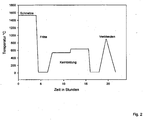
- FIG. 2 the typical temperature profile during the manufacturing process of the veneering ceramic is shown.
- Both the optical effect and the mechanical resistance of the veneering ceramic are influenced both by the structure of the veneering ceramic and by the interaction of the veneering ceramic and framework ceramic.
- the expansion coefficient ( ⁇ ) of the veneering ceramics and framework of yttria-stabilized zirconia (TZ3Y) must be consistent. Based on examples of Table 1, the expansion coefficients (a) of the veneering ceramics are documented in Table 2 and compared with yttrium-stabilized zirconium dioxide. Table 2 Examples 1 2 3 6 11 ZrO 2 ⁇ 50-300 ° C x 10 -6 / K 8.9 8.7 8.9 8.9 8.7 9.6 ⁇ 50-500 ° C x 10 -6 / K 9.8 9.8 9.8 9.6 9.3 9.8
- the adhesion between framework ceramics of yttrium - stabilized zirconia and the veneering ceramic was determined in the three - point bending test.
- the powder of the veneering ceramic was applied between two cylindrical specimens made of zirconium dioxide and subjected to a temperature treatment FIG. 2 subjected.
- veneering ceramics according to the invention having a high adhesive strength, different nucleation and crystallization processes are possible depending on the composition and the temperature treatment.
- the examples of the veneering ceramics 1, 4, 8, 9 and 10 crystallize to the crystal phases lithium silicate and zirconia.
- the zirconium dioxide serves as a nucleating agent.
- lithium metasilicate Li 2 SiO 3 is formed and, by the subsequent reaction with the surrounding silicate phase, lithium metasilicate transforms to lithium disilicate Li 2 Si 2 O 5 .
- the examples of veneering ceramics 2, 5 and 7 crystallize to the crystal phases lithium disilicate, ⁇ -spodumene, lithium titanium oxide silicate Li 2 (TiO) (SiO 4 ) and lithium metasilicate.
- the addition of titanium dioxide accelerates the crystallization of lithium disilicate Li 2 Si 2 O 5 .
- FIG. 3 the XRD recording is shown.
Landscapes
- Chemical & Material Sciences (AREA)
- Health & Medical Sciences (AREA)
- Engineering & Computer Science (AREA)
- Ceramic Engineering (AREA)
- Life Sciences & Earth Sciences (AREA)
- Oral & Maxillofacial Surgery (AREA)
- Materials Engineering (AREA)
- Organic Chemistry (AREA)
- Epidemiology (AREA)
- General Health & Medical Sciences (AREA)
- Public Health (AREA)
- Veterinary Medicine (AREA)
- Animal Behavior & Ethology (AREA)
- Chemical Kinetics & Catalysis (AREA)
- General Chemical & Material Sciences (AREA)
- Geochemistry & Mineralogy (AREA)
- Inorganic Chemistry (AREA)
- Plastic & Reconstructive Surgery (AREA)
- Structural Engineering (AREA)
- Crystallography & Structural Chemistry (AREA)
- Dispersion Chemistry (AREA)
- Molecular Biology (AREA)
- Physics & Mathematics (AREA)
- Thermal Sciences (AREA)
- Dental Preparations (AREA)
- Glass Compositions (AREA)
- Composite Materials (AREA)
- Manufacturing & Machinery (AREA)
- Compositions Of Oxide Ceramics (AREA)
Description
- Die Erfindung betrifft Verblendkeramiken für dentale Restaurationen, wobei die Gerüstkeramik aus yttriumstabilisiertem Zirkoniumdioxid besteht.
- Yttriumstabilisiertes Zirkoniumdioxid ist ein Hochleistungswerkstoff mit extrem hoher Festigkeit, der in der restaurativen Zahnmedizin in wachsendem Maße für Gerüstkeramiken für Kronen, Inlays sowie Brücken zum Einsatz kommt. Die Feinanpassung an die Vielfalt der natürlichen Zähne erfordert die Anwendung von Verblendkeramiken. In der Belastbarkeit der restaurierten Zähne bildeten bisher die Verblendkeramiken eine Schwachstelle.
- Verblendkeramiken sollten eine gute Modellierung ermöglichen, in der Farbgestaltung den benachbarten Zähnen angepasst sein, eine hohe chemische Beständigkeit aufweisen, nach einer gezielten Temperaturbehandlung selbst. über eine hohe Biegebruchfestigkeit verfügen und sich durch eine intensive Haftung mit der Gerüstkeramik auszeichnen.
- Als Ausgangsstoffe bei der Herstellung der Verblendkeramiken kommen in der Regel Pulver bzw. Pasten zur Anwendung. Die Eigenschaften der Verblendkeramik werden sowohl von den chemischen und kristallographischen Merkmalen als auch der Körnung der Ausgangsmaterialien bestimmt.
- Leucithaltige Dentalkeramiken werden entsprechend Patent
US 4,798,536 A über die Glasschmelze gefertigt. Der Leucitgehalt liegt im Bereich von 35 bis 60 Gew %. Der hohe Ausdehnungskoeffizient der leucithalfigen Dentalkeramik von 13 bis 15 x 10-6/K wird für das Verblenden von Metallkronen genutzt. Die Biegebruchfestigkeit der Verblendkeramik mit Leucitkristallen liegt bei 80 MPa. - Im Patent
US 4,189,325 A wird für den restaurativen Zahnersatz die Nutzung von Lithiumdisilicat vorgeschlagen. Dabei wird sich auf das Stoffsystem Li2O-CaO-Al2O3-SiO2 konzentriert. Zur Unterstützung der Kristallisation werden die Keimbildner Nb2O5 und Pt zugesetzt. - Mit dem Patent
US 4,515,634 A wird vorgeschlagen, im Grundsystem Li2O-CaO-Al2O3-SiO2 zur Verbesserung der Keimbildung und Kristallisation den Keimbildner P2O5 zuzusetzen. - Die Offenlegungsschrift
DE 197 50 794 A1 beschreibt den Einsatz von Lithiumdisilicat - Glaskeramiken für die Nutzung im Heißpressverfahren. Es hat sich jedoch gezeigt, dass bei der Anwendung dieses Verfahrens die Kantenfestigkeit am restaurierten Zahn nicht ausreichend ist und bei der Nachbearbeitung ein hoher Werkzeugverschleiß eintritt. - Mit der
DE 103 36 913 A1 wird vorgeschlagen, den zu restaurierenden Zahn in zwei Stufen zu fertigen. In der ersten Stufe wird Lithiummetasilicat zur Kristallisation gebracht, das durch maschinelle Verarbeitung zu dentalen Produkten verarbeitet wird. Mit einer zweiten Temperaturbehandlung wird das Lithiummetasilicat in das festere Lithiumdisilicat überführt. Damit besteht der gesamte restaurierte Zahn aus Glaskeramik mit Lithiumdisilicatkristallen. - In der Patentschrift
DE 196 47 739 C2 wird eine sinterbare Lithiumdisilicat-Glaskeramik sowie Glas beschrieben. Das Ausgangsmaterial wird zu Rohlingen gesintert. Diese Rohlinge werden bei 700 °C bis 1200 °C zu dentalen Produkten gepresst. Bei der plastischen Verformung weist die beschriebene Lithiumdisilicat-Glaskeramik nur eine geringe Reaktion mit der benachbarten Einbettmasse auf. - Auf der Grundlage von yttriumstabilisiertem Zirkoniumdioxid wird in der
EP 1 235 532 A1 ein Verfahren zur Herstellung von hochfestem keramischen Zahnersatz beschrieben. Die nach diesem Verfahren gefertigten Gerüstkeramiken weisen 4-Punkt Biegebruchfestigkeiten von größer 1200 MPa auf. - Der Erfindung liegt die Aufgabe zugrunde, eine Möglichkeit für eine transluzente Verblendkeramik mit hoher Biegebruchfestigkeit zu schaffen, wobei die Verblendkeramik ferner eine sehr gute Haftung zur Gerüstkeramik aus yttriumstabilisiertem Zirkoniumdioxid aufweisen soll.
- Erfindungsgemäß wird diese Aufgabe bei einer Verblendkeramik von aus yttriumstabilisiertem Zirkoniumdioxid hergestellten dentalen Restaurationen dadurch gelöst, dass sie durch die folgenden Komponenten hergestellt wird:
a) SiO2 58,0 - 74,0 Gew. % b) Al2O3 4,0 - 19,0 Gew. % c) Li2O 5,0-17,0 Gew. % d) Na2O 4,0 -12,0 Gew. % e) ZrO2 0,5 - 6,0 Gew. % - Von Vorteil kann es sein, wenn neben dem Keimbildner ZrO2 ein weiterer Keimbildner, z.B. TiO2 in den Grenzen von 0,2 bis 8,0 Gew. % beigefügt wird.
- Die Verblendkeramik kommt als gepulvertes Ausgangsglas mit kristallinen Zusätzen bzw. ohne gesonderte kristalline Zusätze zur Anwendung und wird mittels definiertem Temperaturprogramm im Bereich zwischen 800 und 940°C auf dentale Produkte aus yttriumstabilisiertem Zirkoniumdioxid aufgesintert und kontrolliert kristallisiert.
- Es hat sich überraschenderweise gezeigt, dass mit spezifischen Glaskeramiken und einem definierten Temperaturprogramm eine sehr hohe Haftfestigkeit auf dentalen Produkten aus yttriumstabilisiertem Zirkoniumdioxid erreicht wird. Die Verblendkeramik ist dabei transluzent und hat eine sehr gute chemische Beständigkeit. Die Hauptkristallphase der Glaskeramik besteht aus Lithiumdisilicat.
- Als Ausgangsprodukt kann die Verblendkeramik außer den gepulverten Ausgangsgläsern der Glaskeramik auch gepulverte Kristalle enthalten. Über eine definierte Temperaturbehandlung durchläuft die gepulverte Verblendkeramik die Prozesse Keimbildung, Sintern und Verschmelzen mit dem yttriumstabilisierten Zirkoniumdioxid sowie Kristallisation unter Bildung von Mikrokristallen.
- Es ist ebenfalls bevorzugt, dass den Ausgangsgläsern gepulvertes Lithiumdisilicat. zugesetzt wird. Das Lithiumdisilicat kann über eine Festkörperreaktion hergestellt werden.
- Die Zugabe von TiO2 unterstützt den Prozess der Keimbildung sowie der Kristallisation von Lithiumdisilicat. Die Verblendkeramik wird dann vorteilhafterweise aus einer Mischung gebildet, die die folgenden Komponenten enthält:
a) SiO2 58,0 - 72,0 Gew. % b) Al2O3 4,0-18,0 Gew. % c) Li2O 5,0 -17,0 Gew. % d) Na2O 4,0 - 11,0 Gew. % e) ZrO2 0,5 - 5,5 Gew. % f) TiO2 0,2 - 8,0 Gew. % - Für die gesteuerte Kristallisation der Verblendkeramik auf Basis von Lithiumsilicatmaterialien kommt als Keimbildner Zirkoniumdioxid bzw. ein Gemisch aus Zirkoniumdioxid und Titandioxid zum Einsatz. Die Zugabe von Titandioxid begünstigt die Umwandlung von Lithiummetasilicat in Lithiumdisilicat.
- Die Verblendkeramik ist ebenfalls bevorzugt, wenn neben Lithiumdisilicat auch Lithium Titanium Oxid Silicat Li2TiOSiO4 ,Lithiumalumosilicat (β - Spodumen) sowie geringere Mengen Lithiummetasilicat auskristallisieren.
- Die Verblendkeramik kann auch so gestaltet sein, dass der kristalline Anteil unter 40 % liegt. Dabei wird die Verblendkeramik dünn aufgetragen. In diesem Fall dient die Verblendkeramik der Farbanpassung und verleiht der dentalen Gerüstkeramik einen besonderen ästhetischen Glanz. Durch gezielte Druckspannungen kann die Festigkeit der Verblendkeramik weiter erhöht werden.
- Als färbende bzw. fluoreszierende Zusätze können die Oxide der Elemente Ce, Fe, Mn, Sn, V, Cr, In sowie der Seltenen Erden Pr, Nd, Sm, Eu, Tb, Dy und Er zum Einsatz kommen.
- Zur Modifizierung der Technologie können unabhängig voneinander die Zusätze La2O3, B2O3, P2O5, CaO, MgO, ZnO und Fluorid zugegeben werden, wobei die Konzentration maximal im Bereich bis zu 4,0 Gew % liegt.
- Für die Herstellung der Verblendkeramik erfolgt die Keimbildung im Temperaturbereich von 500 bis 680 °C und das Verschmelzen und Kristallisieren im Temperaturbereich von 800 bis 940 °C. Der Keimbildungs- und Kristallisationsprozess kann unterbrochen werden, indem die Verblendkeramik zwischen Keimbildung und Kristallisation auf Zimmertemperatur abgekühlt, gelagert und danach auf die Kristallisationstemperatur erhitzt wird.
- Die Bestimmung der Haftfestigkeit zwischen dem yttriumstabilisiertem Zirkoniumdioxid und der Verblendkeramik erfolgt im Biegeversuch. Dazu wird die gepulverte Verblendkeramik auf die Stirnfläche von zwei Rundstäben aus Zirkoniumdioxid aufgebracht und der definierten Temperaturbehandlung unterzogen. Die Bestimmung der Haftfestigkeit erfolgt im Dreipunktbiegeversuch.
- Bevorzugt werden Verblendkeramiken, deren Haftfestigkeit zum Zirkoniumdioxid mindestens 150 MPa beträgt.
- Die Erfindung soll nachstehend anhand von Ausführungsbeispielen näher erläutert werden. Die Zeichnungen zeigen:
- Fig. 1
- Röntgendiffraktogramm (XRD) nach der Festkörperreaktion von Lithiumoxid und Siliziurridioxid (vier Stunden bei 940 °C),
- fig. 2
- einen typischen Temperaturverlauf zur Herstellung der Verblendkeramik und
- Fig. 3
- XRD einer erfindungsgemäßen Verblendkeramik.
- Als Ausführungsbeispiele der erfindungsgemäßen Verblendkeramiken sind in der Tabelle 1 zwölf Synthesen ausgewiesen.
Tabelle 1 Beispiele 1 2 3 4 5 6 7 8 9 10 11 12 SiO2 71,0 71,1 62,0 0,5 69,7 61,2 70,5 70,5 69,6 69,6 58,9 60,5 Al2O3 9,0 4,9 17,9 8,9 4,8 17,7 4,9 8,9 8,8 8,8 17;0 17,5 Li2O 12,6 14,9 5,3 12,5 14,6 5,2 14, 8 12,5 12,4 12,4 5,0 5,2 Na2O 5,4 3,0 10,9 5,4 2,9 10,8 3,0 5,4 5,3 5,3 10,4 10,5 TiO2 5,0 4,9 1,2 5,0 5,0 2,5 ZrO2 2,0 1,1 3,9 2,0 1,1 3,9 1,1 2,0 2,0 2,0 3,7 3,8 CaF2 0,7 0,7 CaO 0,6 MgF2 0,7 BaF2 1,9 BaO 1,1 P2O5 1,4 0,8 Summe 100 100 100 100 100 100 100 100 100 100 100 100 - Die Ausgangsgläser wurden in Platin bzw. Platin - Rhodium - Tiegeln bei einer Temperatur von 1530 °C geschmolzen und zur Herstellung einer Fritte in Wasser gegossen (
Figur 2 ). - Zur Unterstützung der gesteuerten Kristallisation werden die gefritteten Ausgangsgläser ca. vier Stunden bei 580 ± 100 °C getempert und nach dem Abkühlen pulverisiert. Die zum Einsatz gebrachte Korngröße liegt im Bereich von 0,6 µm bis 20 µm.
- Den Ausgangsgläsern kann gepulvertes Lithiumdisilicat zugesetzt werden. Dabei wird das Lithiumdisilicat über eine Festkörperreaktion hergestellt.
-
Figur 1 zeigt das Röntgendiffraktogramm (XRD) des über die Festkörperreaktion hergestellten Lithiumdisilicates. - Die angefeuchteten Ausgangsmaterialien werden als Verblendkeramik auf die dentale Gerüstkeramik aus yttriumstabilisiertem Zirkoniumdioxid aufgetragen und bei 890 ± 50 °C verschmolzen und gesteuert kristallisiert.
- In
Figur 2 ist der typische Temperaturverlauf während des Herstellungsprozesses der Verblendkeramik dargestellt. - Alle zwölf Beispiele der in Tabelle 1 ausgewiesenen Verblendkeramiken sind transluzent.
- Sowohl die optische Wirkung als auch die mechanische Widerstandskraft der Verblendkeramik werden sowohl durch das Gefüge der Verblendkeramik als auch von der Wechselwirkung von Verblendkeramik und Gerüstkeramik beeinflusst.
- Der Ausdehnungskoeffizient (α) von der Verblendkeramik und der Gerüstkeramik aus yttriumstabilisiertem Zirkoniumdioxid (TZ3Y) muss aufeinander abgestimmt sein. Ausgehend von Beispielen der Tabelle 1 werden in der Tabelle 2 die Ausdehnungskoeffizienten (a) der Verblendkeramiken dokumentiert und mit yttriumstabilisiertem Zirkoniumdioxid verglichen.
Tabelle 2 Beispiele 1 2 3 6 11 ZrO2 α50-300°C x 10-6/K 8,9 8,7 8,9 8,9 8,7 9,6 α50-500°C x 10-6/K 9,8 9,8 9,8 9,6 9,3 9.8 - Die Haftfestigkeit zwischen Gerüstkeramik aus yttriumstablisiertem Zirkoniumdioxid und der Verblendkeramik wurde im Dreipunkt - Biegeversuch bestimmt. Dazu wurde das Pulver der Verblendkeramik zwischen zwei zylindrische Probenkörper aus Zirkoniumdioxid aufgebracht und einer Temperaturbehandlung entsprechend
Figur 2 unterzogen. - Für ausgewählte Proben ist in Tabelle 3 die Haftfestigkeit ausgewiesen, wobei σ = Haftfestigkeit in MPa nach Dreipunktbiegeversuch und m = Weibull Parameter sind.
Tabelle 3 Beispiele 1 2 3 12 σ MPa 162,1 183,1 173,4 172,4 m 7,6 13,2 3,5 4,4 - Bei den erfindungsgemäßen Verblendkeramiken mit hoher Haftfestigkeit sind in Abhängigkeit von der Zusammensetzung und der Temperaturbehandlung unterschiedliche Keimbildungs- und Kristallisationsabläufe möglich.
- Bezogen auf Tabelle 1 und einer Temperatur von 890 ± 50 °C kristallisieren die Beispiele der Verblendkeramiken 1, 4, 8, 9 und 10 zu den Kristallphasen Lithiumsilicat und Zirkoniumdioxid. Dabei dient das Zirkoniumdioxid als Keimbildner.
- Die Kristallisation des Lithiumsilicates erfolgt in zwei zeitlichen Etappen. Zuerst bildet sich Lithiummetasilicat Li2SiO3 und durch die anschließende Reaktion mit der umgebenden Silicatphase wandelt sich Lithiummetasilicat in Lithiumdisilicat Li2Si2O5 um.
- Bezogen auf Tabelle 1 und einer Temperatur von 890 ± 50 °C kristallisieren die Beispiele der Verblendkeramiken 2, 5 und 7 zu den Kristallphasen Lithiumdisilicat, β - Spodumen, Lithium Titanium Oxide Silicate Li2 (TiO)(SiO4) und Lithiummetasilicat. Durch den Zusatz von Titandioxid wird die Kristallisation von Lithiumdisilicat Li2Si2O5 beschleunigt. In
Figur 3 wird die XRD - Aufnahme ausgewiesen.
Claims (19)
- Verblendkeramik für dentale Restaurationen aus yttriumstabilisiertem Zirkoniumdioxid, dadurch gekennzeichnet, dass sie die folgenden Komponenten enthält:
a) SiO2 58,0 - 74,0 Gew. % b) Al2O3 4,0-19,0 Gew. % c) Li2O 5,0 - 17,0 Gew. % d) Na2O 4,0-12,0 Gew. % e) ZrO2 0,5 - 6,0 Gew. % - Ausgangsglas für Verblendkeramjken für dentale Restaurationen aus vttriumstabilisiertern Zirkoniumdioxid, dadurch gekennzeichnet, dass das Ausgangsglas die folgenden Komponenten enthält:
a) SiO2 58.0 - 74,0 Gew. % b) Al2O3 4.0-19.0 Gew. % c) Li2O 5.0-17,0 Gew. % d) Na2O 4.0-12.0 Gew. % e) ZrO2 0.5 - 6,0 Gew. % - Ausgangsglas gemäß Anspruch 2, dadurch gekennzeichnet, dass es zusätzlich gepulverte Kristalle, vorzugsweise gepulvertes Lithiumdisilicat, enthält.
- Verblendkeramik gemäß Anspruch 1 oder Ausgangsglas gemäß Anspruch 2 oder 3, dadurch gekennzeichnet, dass neben ZrO2 als weiterer Keimbildner 0,2 bis 8,0 Gew. % FiO2 enthalten sind.
- Verblendkeramik gemäß Anspruch 1 oder 4 oder Ausgangsglas gemäß einem der Ansprüche 2. 3 oder 4, dadurch gekennzeichnet, dass die folgenden Komponenten enthalten sind:
a) SiO2 58,0 - 72,0 Gew. % b) Al2O3 4,0 - 18,0 Gew. % c) Li2O 5,0 - 17,0 Gew. % d) Na2O 4,0 - 11,0 Gew. % e) ZrO2 0,5 - 5,5 Gew. % f) TiO2 0,2 - 8,0 Gew. % - Verblendkeramik Gemäß einem der Ansprüche 1. 4 oder 5 oder Ausgangsglas gemäß einem der Ansprüche 2 bis 5, dadurch Gekennzeichnet, dass unabhängig voneinander die Zusätze La2O3, B2O3, P2O5, CaO, MgO, ZnO und Fluorid enthalten sind, wobei die Konzentration maximal im Bereich bis zu 4.0 Gew. % liegt.
- Verblendkeramik gemäß Anspruch 6 oder Ausganosglas gemäß Anspruch 6, dadurch gekennzeichnet, dass die folgenden Komponenten enthalten sind:
a) La2O3 1,0 - 4,0 Gew. % b) B2O3 0,0 - 2,0 Gew. % c) MgO 0,0 - 2,0 Gew. % d) CaO 0,0 - 2,0 Gew. % e) ZnO 0,0 - 2,0 Gew. % f) BaO 0,0 - 1,0 Gew. % g) P2O5 0,0 - 2,0 Gew. % h) Fluorid 0,0 - 3,0 Gew. % - Verblendkeramik gemäß einem der Ansprüche 1 oder 4 bis 7 oder Ausgangsglas gemäß einem der Ansprüche 2 bis 7 , dadurch gekennzeichnet, dass Oxide der färbenden bzw. fluoreszierenden Zusätze von den Elementen Ce, Fe, Mn, Sn, V, Cr, In sowie der Seltenen Erden Pr, Nd, Sm, Eu, Tb, Dy und Er einzeln oder in Kombination enthalten sind.
- Verblendkeramik nach Anspruch 1 oder 5, dadurch gekennzeichnet, dass zur Unterdrückung der Kristallisation von Hochquarzmischkristallen weitere Alkalioxide, enthalten sind.
- Verblendkeramik nach einem der Ansprüche 1 oder 4 bis 9, dadurch gekennzeichnet, dass sie neben Lithiumdisilicat die Kristallphasen Lithium Titanium Oxid Silicat Li2 TiOSiO4, Lithiumalumosilicat (β-Spodumen) und geringere Mengen Lithiummetasilicat enthält.
- Ausgangsglas für Verblendkeramiken für dentale Restaurationen aus yttriumstabilisiertem Zirkoniumdioxid, dadurch gekennzeichnet, dass das Ausgangsglas
71,1 Gew.-% SiO2, 4,9 Gew.-% Al2O3, 14,9 Gew.-% Li2O, 3,0 Gew.-% Na2O, 5.0 Gew.-% -TiO2 und 1.1 Gew.-% ZrO2 - Ausgangsglas für Verblendkeramiken für dentale Restaurationen aus yttriumstabilisiertem Zirkoniumdioxid, dadurch gekennzeichnet, dass das Ausgangsglas
69,7 Gew.-% SiO2, 4.8 Gew.-% Al2O3, 14.6 Gew.-% Li2O, 2.9 Gew.-% Na2O, 4.9 Gew.-% TiO2, 1,1 Gew.-% ZrO2, 0,06 Gew.-% CaO und 1.4 Gew.-% P2O5 - Ausgangsglas für Verblendkeramiken für dentale Restaurationen aus yttriumstabilisiertem Zirkoniumdioxid, dadurch gekennzeichnet, dass das Ausgangsglas
70.5 Gew.-% SiO2, 4,9 Gew.-% Al2O3, 14.8 Gew.-% Li2O, 3,0 Gew.-% Na2O, 5,0 Gew.-% TiO2, 1,1 Gew.-% ZrO2, und 0,7 Gew.-% CaF2 - Verwendung einer Verblendkeramik gemäß einem der Ansprüche 1.oder 4 bis 10 oder eines Ausgangsglases gemäß einem der Ansprüche bis 7 oder 11 bis 13 zur Verblendung von dentalen Restaurationen aus yttriumstabilisiertem Zirkoniumdioxid.
- Verfahren zur Verblendung von dentalen Restaurationen aus yttriumstabilisiertem Zirkoniumdioxid unter Verwendung einer Verblendkeramik gemäß einem der Ansprüche 1 oder 4 bis 10 oder eines Ausgangs-glases gemäß einem der Ansprüche 2 bis 7 oder 11 bis 13.
- Verfahren zur Herstellung einer Verblendkeramik gemäß einem der Ansprüche 1 oder 4 bis 10, wobei eine Keimbildung im Temperaturbereich von 500 bis 680 °C und ein Verschmelzen und Kristallisieren im Temperaturbereich von. 800 bis 940 °C erfolgt.
- Verfahren nach Anspruch 15 zur Verblendung von dentalen Restaurationen aus yttriumstabilisiertem Zirkoniumdioxid mit einer Verblendkaramik nach einem der Ansprüche 1 oder 4 bis 10, gekennzeichnet durch die folgenden Verfahrensschritte:a) ein bei 1530 °C erschmolzenes Glas wird in Wasser gefrittet,b) das gefrittete Glas wird zur Keimbildung bei einer Temperatur von 500 °C bis 680 °C und einem Zeitraum von zwei bis sechs Stunden getempert,c) nach dem Abkühlen wird das getemperte Glas mechanisch pulverisiert,d) unter Hinzufügen von Wasser wird das vorbehandelte Pulver in eine Paste überführt,e) die Paste wird auf die Restaurationen aus yttriumstabilisiertem Zirkoniumdioxid aufgetragen und abschließendf) einer Temperaturbehandlung von 800 °C bis 940 °C unterzogen, wobei in der Verblendkeramik als Hauptkristallphase Lithiumdisilicat auskristallisiert.
- Verfahren nach Anspruch 17, dadurch gekennzeichnet, dass neben Lithiumdisilicat auch Lithiumalumosilicat sowie Lithium Titanium Oxid Silicat Li2TiOSiO4 auskristallisieren.
- Verfahren nach Anspruch 17 oder 18, dadurch gekennzeichnet, dass dem gefritteten Glas ein kristalliner Zusatz aus gepulvertem Lithiumdisilicat, welches über eine Festkörperreaktion hergestellt wurde, zugefügt wird.
Applications Claiming Priority (2)
| Application Number | Priority Date | Filing Date | Title |
|---|---|---|---|
| DE102007011337A DE102007011337A1 (de) | 2007-03-06 | 2007-03-06 | Verblendkeramik für dentale Restaurationen aus yttriumstabilisiertem Zirkoniumdioxid und Verfahren zur Verblendung von dentalen Restaurationen aus yttriumstabilisiertem Zirkoniumdioxid |
| PCT/DE2008/000405 WO2008106958A2 (de) | 2007-03-06 | 2008-03-06 | Verblendkeramik für dentale restaurationen aus yttriumstabilisiertem zirkoniumdioxid und verfahren zur verblendung von dentalen restaurationen aus yttriumstabilisiertem zirkoniumdioxid |
Publications (2)
| Publication Number | Publication Date |
|---|---|
| EP2114348A2 EP2114348A2 (de) | 2009-11-11 |
| EP2114348B1 true EP2114348B1 (de) | 2012-05-16 |
Family
ID=39677941
Family Applications (1)
| Application Number | Title | Priority Date | Filing Date |
|---|---|---|---|
| EP08734354A Active EP2114348B1 (de) | 2007-03-06 | 2008-03-06 | Verblendkeramik für dentale restaurationen aus yttriumstabilisiertem zirkoniumdioxid |
Country Status (6)
| Country | Link |
|---|---|
| US (3) | US8592330B2 (de) |
| EP (1) | EP2114348B1 (de) |
| JP (1) | JP5156031B2 (de) |
| CN (2) | CN103395982B (de) |
| DE (1) | DE102007011337A1 (de) |
| WO (1) | WO2008106958A2 (de) |
Families Citing this family (61)
| Publication number | Priority date | Publication date | Assignee | Title |
|---|---|---|---|---|
| US8444756B2 (en) | 2003-08-07 | 2013-05-21 | Ivoclar Vivadent Ag | Lithium silicate materials |
| DK1688398T3 (da) | 2005-02-08 | 2014-07-21 | Ivoclar Vivadent Ag | Lithiumsilikat-glaskeramik |
| DE102007011337A1 (de) | 2007-03-06 | 2008-09-11 | Hermsdorfer Institut Für Technische Keramik E.V. | Verblendkeramik für dentale Restaurationen aus yttriumstabilisiertem Zirkoniumdioxid und Verfahren zur Verblendung von dentalen Restaurationen aus yttriumstabilisiertem Zirkoniumdioxid |
| DE102009060274A1 (de) | 2009-12-23 | 2011-06-30 | DeguDent GmbH, 63457 | Lithiumdisilikat-Glaskeramik, Verfahren zu deren Herstellung und deren Verwendung |
| WO2011098115A1 (en) * | 2010-02-09 | 2011-08-18 | Vita Zahnfabrik H. Rauter Gmbh & Co. Kg | A process for improving the stability of yttrium stabilised zirconia for dental restorations |
| US8865606B2 (en) | 2010-04-16 | 2014-10-21 | Ivoclar Vivadent Ag | Process for the preparation of dental restorations |
| DK2377830T3 (en) | 2010-04-16 | 2016-07-18 | Ivoclar Vivadent Ag | Lithium silicate glass ceramics and glass with transition metal. |
| EP2387984A1 (de) | 2010-05-21 | 2011-11-23 | 3M Innovative Properties Company | Zahnkeramikgegenstand, Verfahren zu dessen Herstellung und Verwendung |
| DE102010035545A1 (de) | 2010-08-24 | 2012-03-01 | Fraunhofer-Gesellschaft zur Förderung der angewandten Forschung e.V. | Verblendkeramik für dentale Restaurationen aus yttriumstabilisiertem Zirkoniumdioxid sowie Verfahren zu deren Auftrag |
| DE102010050275A1 (de) | 2010-11-02 | 2012-05-03 | Degudent Gmbh | Lithiumsilikat-Gläser oder -Glaskeramiken, Verfahren zu deren Herstellung sowie deren Verwendung |
| JP5769873B2 (ja) | 2011-04-20 | 2015-08-26 | ストラウマン ホールディング アーゲー | ガラスセラミック体の調製方法 |
| US9206077B2 (en) | 2011-06-22 | 2015-12-08 | Fraunhofer-Gesellschaft zur Förderung der angewandten Forschung e. V. | Dental restoration, method for production thereof and glass ceramic |
| WO2012175615A1 (en) | 2011-06-22 | 2012-12-27 | Fraunhoffer-Gesellschaft Zur Förderung Der Angewandten Forschung E.V. | Dental restoration, method for its production and ingot |
| CA2851411C (en) | 2011-10-14 | 2018-09-04 | Ivoclar Vivadent Ag | Lithium silicate glass ceramic and glass with hexavalent metal oxide |
| EP2765975B1 (de) | 2011-10-14 | 2016-03-16 | Ivoclar Vivadent AG | Lithiumsilikat-glaskeramik und -glas mit dreiwertigem metalloxid |
| JP6518063B2 (ja) | 2011-10-14 | 2019-05-22 | イフォクレール ヴィヴァデント アクチェンゲゼルシャフトIvoclar Vivadent AG | 五価の金属酸化物を含むケイ酸リチウムガラスセラミックおよびガラス |
| CN103945819A (zh) * | 2011-10-14 | 2014-07-23 | 义获嘉伟瓦登特公司 | 包含四价金属氧化物的硅酸锂玻璃陶瓷和硅酸锂玻璃 |
| KR20160129098A (ko) | 2011-10-14 | 2016-11-08 | 이보클라 비바덴트 아게 | 2가 금속 산화물을 포함하는 리튬 실리케이트 유리 세라믹 및 리튬 실리케이트 유리 |
| JP6633278B2 (ja) | 2011-10-14 | 2020-01-22 | イフォクレール ヴィヴァデント アクチェンゲゼルシャフトIvoclar Vivadent AG | 一価の金属酸化物を含むケイ酸リチウムガラスセラミックおよびガラス |
| JP5859681B2 (ja) * | 2012-01-20 | 2016-02-10 | ストラウマン ホールディング アーゲー | 補綴要素 |
| EP2817267B1 (de) | 2012-02-24 | 2019-08-21 | PPG Industries Ohio, Inc. | Lithium mit glas mit hohem gehalt an oxidiertem eisen und verfahren zur herstellung davon |
| WO2013156483A1 (en) | 2012-04-16 | 2013-10-24 | Vita Zahnfabrik H. Rauter Gmbh & Co. Kg | Process for producing a non-dense sintered ceramic molded body having at least two layers |
| CN104334509B (zh) | 2012-05-11 | 2018-01-02 | 义获嘉伟瓦登特公司 | 用于牙科目的的预烧结坯料 |
| DE102012011371B9 (de) * | 2012-06-11 | 2018-10-18 | Kulzer Gmbh | Herstellung individueller dentaler Prothesen via CAD/CAM und Rapid Manufacturing/Rapid Prototyping aus digital erhobenen Daten der Mundsituation |
| CN102976617B (zh) * | 2012-11-30 | 2015-04-15 | 华泽庆 | 一种玻璃陶瓷及其制备方法 |
| US9701573B2 (en) | 2013-09-06 | 2017-07-11 | Corning Incorporated | High strength glass-ceramics having lithium disilicate and beta-spodumene structures |
| KR101450190B1 (ko) | 2013-11-19 | 2014-10-13 | (주)더스타일코리아 | 리튬 디실리케이트를 이용한 치과용 지르코니아 보철물 및 그 제조방법 |
| US10377661B2 (en) | 2014-05-16 | 2019-08-13 | Ivoclar Vivadent Ag | Glass ceramic with SiO2 as the main crystalline phase |
| ES2985048T3 (es) * | 2014-05-20 | 2024-11-04 | Ppg Ind Ohio Inc | Vidrio que contiene litio con alto y bajo contenido de hierro oxidado, método de fabricación del mismo y productos que usan el mismo |
| US11166795B2 (en) | 2014-08-27 | 2021-11-09 | Gc Corporation | Method for producing dental prosthesis, method for producing lithium disilicate blank for dental prosthesis and lithium disilicate blank for dental prosthesis |
| JP6347792B2 (ja) | 2014-08-27 | 2018-06-27 | 株式会社ジーシー | 歯科補綴物の製造方法、歯科補綴物用二ケイ酸リチウムブランクの製造方法、及び歯科補綴物用二ケイ酸リチウムブランク |
| CN104774007B (zh) * | 2015-03-04 | 2017-04-12 | 暨南大学 | 一种牙科玻璃部分渗透的功能梯度氧化锆陶瓷材料 |
| CA2986365A1 (en) * | 2015-05-25 | 2016-12-01 | Gc Corporation | Material for dental prosthesis, block body for making dental prosthesis, and dental prosthesis |
| DE102016106370A1 (de) * | 2016-03-23 | 2017-09-28 | Degudent Gmbh | Verfahren zur Herstellung eines eingefärbten Rohlings sowie Rohling |
| JP6993093B2 (ja) | 2016-03-31 | 2022-01-13 | 株式会社松風 | Al2O3未含有のケイ酸リチウムガラス組成物 |
| US10172696B2 (en) | 2016-06-15 | 2019-01-08 | Firas Khalid ALQARAWI | Method for producing a ceramic fixed partial denture |
| EP3275850B1 (de) * | 2016-07-28 | 2018-12-12 | Tubacoat, S.L. | Keramische zusammensetzung und material mit der besagten keramischen zusammensetzung als teil einer wärmerückgewinnungseinheit |
| DE102016119108A1 (de) | 2016-10-07 | 2018-04-12 | Degudent Gmbh | Lithiumsilikat-Glaskeramik |
| DE102016119934A1 (de) * | 2016-10-19 | 2018-05-03 | Degudent Gmbh | Verfahren zur Herstellung eines Rohlings, Rohling sowie eine dentale Restauration |
| CN106865979A (zh) * | 2017-04-26 | 2017-06-20 | 广东工业大学 | 一种荧光玻璃及其制备方法和应用 |
| CN107522404B (zh) * | 2017-09-15 | 2019-12-20 | 西安交通大学 | 一种牙科用锂铝硅系微晶玻璃及其制备方法 |
| US11680009B2 (en) * | 2017-12-01 | 2023-06-20 | Cdgm Glass Co., Ltd | Glass-ceramic and substrate thereof |
| GB201806356D0 (en) * | 2018-04-18 | 2018-05-30 | Alzahrani Ali Saleh A | Chemically strengthened glass-ceramics |
| CN109363952B (zh) * | 2018-11-29 | 2021-08-17 | 成都贝施美生物科技有限公司 | 一种烤瓷粉及其制备方法 |
| EP3887332A1 (de) * | 2018-11-30 | 2021-10-06 | Corning Incorporated | Schwarze beta-spodumen-lithiumsilikat-glaskeramiken |
| CN109608233A (zh) * | 2019-01-30 | 2019-04-12 | 成都贝施美医疗科技股份有限公司 | 一种改善牙科用二氧化锆陶瓷通透性的技术 |
| EP3696150A1 (de) * | 2019-02-14 | 2020-08-19 | Ivoclar Vivadent AG | Fluoreszierende glaskeramiken und gläser mit gehalt an europium |
| CN111470882B (zh) * | 2020-03-02 | 2022-11-15 | 北京大学口腔医学院 | 一种用于牙科的氧化锆表面处理方法 |
| CN112641635A (zh) * | 2020-12-11 | 2021-04-13 | 西安邮电大学 | 一种齿科美白除菌涂层材料及其制备方法和应用 |
| CN112551894A (zh) * | 2020-12-25 | 2021-03-26 | 山东国瓷功能材料股份有限公司 | 起始玻璃、具有核的硅酸锂玻璃及其制备方法和应用 |
| EP4049982A1 (de) * | 2021-02-24 | 2022-08-31 | Ivoclar Vivadent AG | Glaskeramik mit quarz-mischkristallphase |
| CN113716872B (zh) * | 2021-09-08 | 2024-02-02 | 中山大学附属口腔医院 | 一种用于齿科颜色可调的二硅酸锂微晶玻璃及其制备方法 |
| CN114149256B (zh) | 2021-12-30 | 2023-04-14 | 爱迪特(秦皇岛)科技股份有限公司 | 用于提高牙科氧化锆表面粘接性的陶瓷材料、修复材料、其制备方法及粘结方法 |
| CN114538780B (zh) * | 2022-01-27 | 2023-11-24 | 周口市中心医院 | 一种前牙饰面瓷材料及其制备方法 |
| CN115028365B (zh) * | 2022-06-24 | 2023-08-08 | 成都光明光电有限责任公司 | 玻璃陶瓷、玻璃陶瓷制品及其制造方法 |
| CN115259672B (zh) * | 2022-06-24 | 2023-08-08 | 成都光明光电有限责任公司 | 透明微晶玻璃和透明微晶玻璃制品 |
| CN120475951A (zh) * | 2022-12-22 | 2025-08-12 | 可乐丽则武齿科株式会社 | 齿科用瓷料 |
| WO2024135854A1 (ja) * | 2022-12-22 | 2024-06-27 | クラレノリタケデンタル株式会社 | 歯科用陶材 |
| WO2025051863A1 (de) | 2023-09-05 | 2025-03-13 | Vita Zahnfabrik H. Rauter Gmbh & Co. Kg | Glaskeramik-formkörper für dentale zwecke |
| WO2025051873A1 (de) | 2023-09-05 | 2025-03-13 | Vita Zahnfabrik H. Rauter Gmbh & Co. Kg | Glaskeramik-formkörper für dentale zwecke |
| CN120346547B (zh) * | 2025-06-23 | 2025-09-12 | 襄阳高隆磷化工有限责任公司 | 一种多级磷酸喷雾干燥机 |
Family Cites Families (69)
| Publication number | Priority date | Publication date | Assignee | Title |
|---|---|---|---|---|
| US2012230A (en) * | 1932-01-20 | 1935-08-20 | Kidde & Co Walter | Reflection preventing means |
| BE513836A (de) | 1951-08-30 | |||
| US3006775A (en) | 1959-09-23 | 1961-10-31 | Gen Electric | Ceramic material and method of making the same |
| US3022180A (en) | 1959-09-23 | 1962-02-20 | Gen Electric | Ceramic material and method of making the same |
| NL302981A (de) * | 1963-01-07 | |||
| US3252778A (en) | 1964-02-26 | 1966-05-24 | Goodman Philip | Method of making a high strength semicrystalline article |
| US3561984A (en) * | 1967-03-22 | 1971-02-09 | Scm Corp | Composition for glazing ceramic ware |
| GB1374605A (en) | 1971-05-24 | 1974-11-20 | Pilkington Brothers Ltd | Method of manufacturing glass ceramic material |
| US3816704A (en) | 1972-03-20 | 1974-06-11 | Gen Electric | Surface heating apparatus |
| US3977857A (en) | 1973-10-29 | 1976-08-31 | Westinghouse Electric Corporation | Metal bonding glass-ceramic compositions having improved hardness |
| DE2451121A1 (de) | 1973-10-31 | 1975-05-07 | Gen Electric | Verfahren zum herstellen von glaskeramiken |
| US4189325A (en) | 1979-01-09 | 1980-02-19 | The Board of Regents, State of Florida, University of Florida | Glass-ceramic dental restorations |
| FR2454796A1 (fr) * | 1979-04-24 | 1980-11-21 | Peter Paul | Procede d'amelioration de la resistance mecanique des porcelaines dentaires |
| US4414282A (en) | 1982-04-19 | 1983-11-08 | The United States Of America As Represented By The United States Department Of Energy | Glass ceramic seals to inconel |
| US4473653A (en) | 1982-08-16 | 1984-09-25 | Rudoi Boris L | Ballistic-resistant glass-ceramic and method of preparation |
| US4515634A (en) | 1983-10-17 | 1985-05-07 | Johnson & Johnson Dental Products Company | Castable glass-ceramic composition useful as dental restorative |
| US4480044A (en) | 1984-02-01 | 1984-10-30 | Corning Glass Works | High expansion glass-ceramic articles |
| JPS61101434A (ja) | 1984-10-23 | 1986-05-20 | Nippon Sheet Glass Co Ltd | 透明結晶化ガラス |
| CH668699A5 (de) | 1986-01-17 | 1989-01-31 | Sonja Wohlwend Erne | Verfahren zum herstellen von zahnersatzteilen. |
| DE3778513D1 (de) * | 1986-12-23 | 1992-05-27 | American Thermocraft Corp | Durchscheinende dentalporzellanzusammensetzung, verfahren zu ihrer herstellung und daraus hergestellte restauration. |
| US4798536A (en) | 1987-05-15 | 1989-01-17 | American Thermocraft Corp. | High strength feldspathic dental porcelains containing crystalline leucite |
| JPS63287709A (ja) * | 1986-12-23 | 1988-11-24 | アメリカン サ−モクラフト コ−ポレ−シヨン | 歯科用磁製組成物とその製造方法および歯科用磁製組成物からなる義歯 |
| US5217375A (en) * | 1989-03-23 | 1993-06-08 | Sandvik Ab | Artificial onlay tooth crowns and inlays |
| US5176961A (en) | 1991-10-07 | 1993-01-05 | Corning Incorporated | Colored, textured glass-ceramic articles |
| US5219799A (en) | 1991-10-07 | 1993-06-15 | Corning Incorporated | Lithium disilicate-containing glass-ceramics some of which are self-glazing |
| SE501333C2 (sv) | 1993-05-27 | 1995-01-16 | Sandvik Ab | Metod för framställning av keramiska tandrestaurationer |
| GB9319450D0 (en) | 1993-09-21 | 1995-03-08 | Gec Alsthom Ltd | Transparent glass ceramic |
| US5507981A (en) | 1994-05-31 | 1996-04-16 | Tel Ventures, Inc. | Method for molding dental restorations |
| DE4423794C1 (de) | 1994-07-01 | 1996-02-08 | Ivoclar Ag | Zr0¶2¶-haltige Glaskeramik, Verfahren zu deren Herstellung sowie deren Verwendung |
| DE4428839C2 (de) * | 1994-08-01 | 1997-01-23 | Ivoclar Ag | Alkali-Zink-Silicat-Glaskeramiken und -Gläser und Verfahren zur Herstellung der Glaskeramiken |
| DE4443173C2 (de) * | 1994-12-05 | 1997-04-10 | Schott Glaswerke | Bariumfreies Dentalglas mit guter Röntgenabsorption |
| DE19511396A1 (de) | 1995-03-28 | 1996-10-02 | Arnold Wohlwend | Verfahren zur Herstellung eines prothetischen Zahninlays bzw. einer prothetischen Zahnkrone |
| EP1124219A1 (de) | 1995-06-21 | 2001-08-16 | Ngk Insulators, Ltd. | Magnetplattenträger, magnetische Platte und Verfahren zur Herstellung des Magnetplattenträgers |
| US5691256A (en) | 1995-12-28 | 1997-11-25 | Yamamura Glass Co., Ltd. | Glass composition for magnetic disk substrates and magnetic disk substrate |
| ATE186286T1 (de) * | 1996-09-05 | 1999-11-15 | Ivoclar Ag | Sinterbare lithiumdisilikat-glaskeramik |
| US5968856A (en) | 1996-09-05 | 1999-10-19 | Ivoclar Ag | Sinterable lithium disilicate glass ceramic |
| DE19647739C2 (de) | 1996-09-05 | 2001-03-01 | Ivoclar Ag Schaan | Sinterbare Lithiumdisilikat-Glaskeramik sowie Glas |
| JP3140702B2 (ja) | 1996-12-20 | 2001-03-05 | 日本碍子株式会社 | 磁気ディスク基板用結晶化ガラス、磁気ディスク基板および磁気ディスク |
| US6119483A (en) * | 1996-12-30 | 2000-09-19 | Hoya Corporation | Process for producing glass substrate for information recording medium |
| US6280863B1 (en) * | 1997-06-12 | 2001-08-28 | Ivoclar Ag | Translucent apatite glass ceramic |
| JP3426926B2 (ja) | 1997-08-29 | 2003-07-14 | 京セラ株式会社 | 配線基板およびその実装構造 |
| DE19750794A1 (de) | 1997-11-10 | 1999-06-17 | Ivoclar Ag | Verfahren zur Herstellung von geformten transluzenten Lithiumdisilikat-Glaskeramik-Produkten |
| US6420288B2 (en) | 1997-11-10 | 2002-07-16 | Ivoclar Ag | Process for the preparation of shaped translucent lithium disilicate glass ceramic products |
| US6383645B1 (en) | 1998-03-23 | 2002-05-07 | Kabushiki Kaisha Ohara | Glass-ceramic substrate for an information storage medium |
| US6517623B1 (en) * | 1998-12-11 | 2003-02-11 | Jeneric/Pentron, Inc. | Lithium disilicate glass ceramics |
| US6802894B2 (en) * | 1998-12-11 | 2004-10-12 | Jeneric/Pentron Incorporated | Lithium disilicate glass-ceramics |
| US6022819A (en) * | 1998-07-17 | 2000-02-08 | Jeneric/Pentron Incorporated | Dental porcelain compositions |
| JP2000143290A (ja) | 1998-11-09 | 2000-05-23 | Ngk Insulators Ltd | 結晶化ガラス、磁気ディスク用基板、磁気ディスクおよび結晶化ガラスの製造方法 |
| JP4337176B2 (ja) | 1999-07-06 | 2009-09-30 | コニカミノルタオプト株式会社 | ガラス組成 |
| JP2001035417A (ja) | 1999-07-21 | 2001-02-09 | Ohara Inc | Crt用ガラスセラミックス |
| DE50010420D1 (de) | 1999-12-07 | 2005-06-30 | Inocermic Ges Fuer Innovative | Verfahren zur herstellung keramischen zahnersatzes |
| CN1125789C (zh) | 2000-05-16 | 2003-10-29 | 湖北新华光信息材料股份有限公司 | 一种高强度磁盘基板用微晶玻璃及其制造方法 |
| US6620747B2 (en) | 2000-06-28 | 2003-09-16 | Ivoclar Vivadent Ag | Low temperature-sintering apatite glass ceramic |
| DE10061630B4 (de) * | 2000-12-11 | 2004-02-12 | Vita Zahnfabrik H. Rauter Gmbh & Co. Kg | Vollkeramischer Zahnersatz mit einem Gerüst aus einem Cerstabillisierten Zirkonoxid |
| WO2003035014A1 (de) * | 2001-10-25 | 2003-05-01 | Vita Zahnfabrik H. Rauter Gmbh & Co. Kg | System zur herstellung einer verblendkeramik |
| EP1422210A1 (de) * | 2002-11-20 | 2004-05-26 | Vita Zahnfabrik H. Rauter GmbH & Co. KG | Verdichtung keramischer Werkstoffe mit Hilfe von elektromagnetischen Zentimeterwellen sowie Gefäss zur Durchführung des Verfahrens |
| JP2004288228A (ja) * | 2003-01-31 | 2004-10-14 | Hoya Corp | 情報記録媒体用基板、情報記録媒体およびその製造方法 |
| JP4169653B2 (ja) * | 2003-07-17 | 2008-10-22 | 株式会社ノリタケカンパニーリミテド | 歯科用補綴物の製造方法及びそれに用いるキット |
| JP2005062832A (ja) | 2003-07-28 | 2005-03-10 | Nippon Electric Glass Co Ltd | マイクロレンズ及びマイクロレンズアレイ |
| DE10336913C9 (de) * | 2003-08-07 | 2019-02-21 | Ivoclar Vivadent Ag | Verwendung eines Lithiumsilicatmaterials |
| DE102004013455B3 (de) | 2004-03-18 | 2005-09-08 | Ivoclar Vivadent Ag | Apatitglaskeramik auf der Basis von silicatischen Oxyapatiten, Verfahren zu ihrer Herstellung und ihre Verwendung |
| DK1688398T3 (da) | 2005-02-08 | 2014-07-21 | Ivoclar Vivadent Ag | Lithiumsilikat-glaskeramik |
| DE102005026269A1 (de) | 2005-06-08 | 2006-12-14 | Ivoclar Vivadent Ag | Dentalglaskeramiken |
| DE102007011337A1 (de) | 2007-03-06 | 2008-09-11 | Hermsdorfer Institut Für Technische Keramik E.V. | Verblendkeramik für dentale Restaurationen aus yttriumstabilisiertem Zirkoniumdioxid und Verfahren zur Verblendung von dentalen Restaurationen aus yttriumstabilisiertem Zirkoniumdioxid |
| US20090025627A1 (en) * | 2007-06-08 | 2009-01-29 | George Davis | Collapsible and stackable roadway construction barrier |
| US7892995B2 (en) | 2008-04-11 | 2011-02-22 | James R. Glidewell Dental Ceramics, Inc. | Lithium silicate glass ceramic and method for fabrication of dental appliances |
| US9241879B2 (en) | 2008-04-11 | 2016-01-26 | James R. Glidewell Dental Ceramics, Inc. | Lithium silicate glass ceramic for fabrication of dental appliances |
| DE102009060274A1 (de) | 2009-12-23 | 2011-06-30 | DeguDent GmbH, 63457 | Lithiumdisilikat-Glaskeramik, Verfahren zu deren Herstellung und deren Verwendung |
| US20120148988A1 (en) | 2010-12-14 | 2012-06-14 | James R. Glidewell Dental Ceramics, Inc. | Indirect restoration technology |
-
2007
- 2007-03-06 DE DE102007011337A patent/DE102007011337A1/de not_active Withdrawn
-
2008
- 2008-03-06 CN CN201310056556.8A patent/CN103395982B/zh active Active
- 2008-03-06 WO PCT/DE2008/000405 patent/WO2008106958A2/de not_active Ceased
- 2008-03-06 US US12/530,595 patent/US8592330B2/en active Active
- 2008-03-06 JP JP2009552063A patent/JP5156031B2/ja active Active
- 2008-03-06 EP EP08734354A patent/EP2114348B1/de active Active
- 2008-03-06 CN CN200880007416.9A patent/CN101932298B/zh active Active
-
2013
- 2013-10-16 US US14/054,920 patent/US8987153B2/en active Active
-
2015
- 2015-01-26 US US14/605,327 patent/US9359245B2/en active Active
Also Published As
| Publication number | Publication date |
|---|---|
| US20110030423A1 (en) | 2011-02-10 |
| WO2008106958A2 (de) | 2008-09-12 |
| US9359245B2 (en) | 2016-06-07 |
| EP2114348A2 (de) | 2009-11-11 |
| US8987153B2 (en) | 2015-03-24 |
| US20140045674A1 (en) | 2014-02-13 |
| CN101932298A (zh) | 2010-12-29 |
| US20150183681A1 (en) | 2015-07-02 |
| JP2010519986A (ja) | 2010-06-10 |
| CN103395982B (zh) | 2017-05-31 |
| CN101932298B (zh) | 2015-05-20 |
| DE102007011337A1 (de) | 2008-09-11 |
| JP5156031B2 (ja) | 2013-03-06 |
| US8592330B2 (en) | 2013-11-26 |
| CN103395982A (zh) | 2013-11-20 |
| WO2008106958A3 (de) | 2009-11-05 |
Similar Documents
| Publication | Publication Date | Title |
|---|---|---|
| EP2114348B1 (de) | Verblendkeramik für dentale restaurationen aus yttriumstabilisiertem zirkoniumdioxid | |
| EP2792345B1 (de) | Lithiumsilikat-Glaskeramik und -Glas mit Gehalt an Cäsiumoxid | |
| EP2609048B1 (de) | Verblendkeramik für dentale restaurationen aus yttriumstabilisiertem zirkoniumdioxid sowie verfahren zu deren auftrag | |
| EP2765977B1 (de) | Lithiumsilikat-glaskeramik und -glas mit einwertigem metalloxid | |
| EP4273107B1 (de) | Lithiumsilikat-tiefquarz-glaskeramik | |
| EP2765974B1 (de) | Lithiumsilikat-glaskeramik und -glas mit zweiwertigem metalloxid | |
| EP2765976B1 (de) | Lithiumsilikat-glaskeramik und -glas mit vierwertigem metalloxid | |
| EP2662343B2 (de) | Lithiumsilikat-Glaskeramik und -Glas mit Gehalt an ZrO2 | |
| EP3696149B1 (de) | Fluoreszierende glaskeramiken und gläser mit gehalt an cer und zinn | |
| EP2765975B1 (de) | Lithiumsilikat-glaskeramik und -glas mit dreiwertigem metalloxid | |
| EP1329430B1 (de) | Alkali-Zink-Silicat-Glaskeramiken und -Gläser | |
| EP1584607B1 (de) | Apatitglaskeramik auf der Basis von silicatischen Oxyapatiten | |
| EP2765979B1 (de) | Lithiumsilikat-glaskeramik und -glas mit fünfwertigem metalloxid | |
| EP2792649B1 (de) | Lithiumsilikat-Glaskeramik und -Glas mit Gehalt an Rubidiumoxid | |
| EP2765978B1 (de) | Lithiumsilikat-glaskeramik und -glas mit sechswertigem metalloxid | |
| DE19725552A1 (de) | Alkali-Silicat-Glas | |
| EP1170261A1 (de) | Tiefsinterndes Kalium-Zink-Silicat-Glas | |
| EP1167311B1 (de) | Tiefsinternde Apatit-Glaskeramik | |
| EP4049982A1 (de) | Glaskeramik mit quarz-mischkristallphase | |
| EP4201900A2 (de) | Lithiumsilikat-glaskeramik mit gehalt an zinn |
Legal Events
| Date | Code | Title | Description |
|---|---|---|---|
| PUAI | Public reference made under article 153(3) epc to a published international application that has entered the european phase |
Free format text: ORIGINAL CODE: 0009012 |
|
| 17P | Request for examination filed |
Effective date: 20090716 |
|
| AK | Designated contracting states |
Kind code of ref document: A2 Designated state(s): AT BE BG CH CY CZ DE DK EE ES FI FR GB GR HR HU IE IS IT LI LT LU LV MC MT NL NO PL PT RO SE SI SK TR |
|
| R17D | Deferred search report published (corrected) |
Effective date: 20091105 |
|
| RAP1 | Party data changed (applicant data changed or rights of an application transferred) |
Owner name: IVOCLAR VIVADENT AG |
|
| 17Q | First examination report despatched |
Effective date: 20100210 |
|
| DAX | Request for extension of the european patent (deleted) | ||
| GRAP | Despatch of communication of intention to grant a patent |
Free format text: ORIGINAL CODE: EPIDOSNIGR1 |
|
| GRAS | Grant fee paid |
Free format text: ORIGINAL CODE: EPIDOSNIGR3 |
|
| GRAA | (expected) grant |
Free format text: ORIGINAL CODE: 0009210 |
|
| AK | Designated contracting states |
Kind code of ref document: B1 Designated state(s): AT BE BG CH CY CZ DE DK EE ES FI FR GB GR HR HU IE IS IT LI LT LU LV MC MT NL NO PL PT RO SE SI SK TR |
|
| REG | Reference to a national code |
Ref country code: GB Ref legal event code: FG4D Free format text: NOT ENGLISH |
|
| REG | Reference to a national code |
Ref country code: DE Ref legal event code: R082 Ref document number: 502008007215 Country of ref document: DE Representative=s name: UEXKUELL & STOLBERG, DE Ref country code: DE Ref legal event code: R082 Ref document number: 502008007215 Country of ref document: DE Representative=s name: UEXKUELL & STOLBERG PARTNERSCHAFT VON PATENT- , DE |
|
| REG | Reference to a national code |
Ref country code: CH Ref legal event code: EP Ref country code: CH Ref legal event code: NV Representative=s name: KELLER & PARTNER PATENTANWAELTE AG |
|
| REG | Reference to a national code |
Ref country code: AT Ref legal event code: REF Ref document number: 557691 Country of ref document: AT Kind code of ref document: T Effective date: 20120615 |
|
| REG | Reference to a national code |
Ref country code: IE Ref legal event code: FG4D Free format text: LANGUAGE OF EP DOCUMENT: GERMAN |
|
| REG | Reference to a national code |
Ref country code: SE Ref legal event code: TRGR |
|
| REG | Reference to a national code |
Ref country code: DE Ref legal event code: R096 Ref document number: 502008007215 Country of ref document: DE Effective date: 20120712 |
|
| REG | Reference to a national code |
Ref country code: NL Ref legal event code: T3 |
|
| REG | Reference to a national code |
Ref country code: LT Ref legal event code: MG4D Effective date: 20120516 |
|
| PG25 | Lapsed in a contracting state [announced via postgrant information from national office to epo] |
Ref country code: LT Free format text: LAPSE BECAUSE OF FAILURE TO SUBMIT A TRANSLATION OF THE DESCRIPTION OR TO PAY THE FEE WITHIN THE PRESCRIBED TIME-LIMIT Effective date: 20120516 Ref country code: CY Free format text: LAPSE BECAUSE OF FAILURE TO SUBMIT A TRANSLATION OF THE DESCRIPTION OR TO PAY THE FEE WITHIN THE PRESCRIBED TIME-LIMIT Effective date: 20120516 Ref country code: NO Free format text: LAPSE BECAUSE OF FAILURE TO SUBMIT A TRANSLATION OF THE DESCRIPTION OR TO PAY THE FEE WITHIN THE PRESCRIBED TIME-LIMIT Effective date: 20120816 Ref country code: FI Free format text: LAPSE BECAUSE OF FAILURE TO SUBMIT A TRANSLATION OF THE DESCRIPTION OR TO PAY THE FEE WITHIN THE PRESCRIBED TIME-LIMIT Effective date: 20120516 Ref country code: IS Free format text: LAPSE BECAUSE OF FAILURE TO SUBMIT A TRANSLATION OF THE DESCRIPTION OR TO PAY THE FEE WITHIN THE PRESCRIBED TIME-LIMIT Effective date: 20120916 Ref country code: PL Free format text: LAPSE BECAUSE OF FAILURE TO SUBMIT A TRANSLATION OF THE DESCRIPTION OR TO PAY THE FEE WITHIN THE PRESCRIBED TIME-LIMIT Effective date: 20120516 |
|
| PG25 | Lapsed in a contracting state [announced via postgrant information from national office to epo] |
Ref country code: HR Free format text: LAPSE BECAUSE OF FAILURE TO SUBMIT A TRANSLATION OF THE DESCRIPTION OR TO PAY THE FEE WITHIN THE PRESCRIBED TIME-LIMIT Effective date: 20120516 Ref country code: GR Free format text: LAPSE BECAUSE OF FAILURE TO SUBMIT A TRANSLATION OF THE DESCRIPTION OR TO PAY THE FEE WITHIN THE PRESCRIBED TIME-LIMIT Effective date: 20120817 Ref country code: PT Free format text: LAPSE BECAUSE OF FAILURE TO SUBMIT A TRANSLATION OF THE DESCRIPTION OR TO PAY THE FEE WITHIN THE PRESCRIBED TIME-LIMIT Effective date: 20120917 Ref country code: SI Free format text: LAPSE BECAUSE OF FAILURE TO SUBMIT A TRANSLATION OF THE DESCRIPTION OR TO PAY THE FEE WITHIN THE PRESCRIBED TIME-LIMIT Effective date: 20120516 Ref country code: LV Free format text: LAPSE BECAUSE OF FAILURE TO SUBMIT A TRANSLATION OF THE DESCRIPTION OR TO PAY THE FEE WITHIN THE PRESCRIBED TIME-LIMIT Effective date: 20120516 |
|
| PG25 | Lapsed in a contracting state [announced via postgrant information from national office to epo] |
Ref country code: SK Free format text: LAPSE BECAUSE OF FAILURE TO SUBMIT A TRANSLATION OF THE DESCRIPTION OR TO PAY THE FEE WITHIN THE PRESCRIBED TIME-LIMIT Effective date: 20120516 Ref country code: RO Free format text: LAPSE BECAUSE OF FAILURE TO SUBMIT A TRANSLATION OF THE DESCRIPTION OR TO PAY THE FEE WITHIN THE PRESCRIBED TIME-LIMIT Effective date: 20120516 Ref country code: CZ Free format text: LAPSE BECAUSE OF FAILURE TO SUBMIT A TRANSLATION OF THE DESCRIPTION OR TO PAY THE FEE WITHIN THE PRESCRIBED TIME-LIMIT Effective date: 20120516 Ref country code: EE Free format text: LAPSE BECAUSE OF FAILURE TO SUBMIT A TRANSLATION OF THE DESCRIPTION OR TO PAY THE FEE WITHIN THE PRESCRIBED TIME-LIMIT Effective date: 20120516 Ref country code: DK Free format text: LAPSE BECAUSE OF FAILURE TO SUBMIT A TRANSLATION OF THE DESCRIPTION OR TO PAY THE FEE WITHIN THE PRESCRIBED TIME-LIMIT Effective date: 20120516 |
|
| PLBE | No opposition filed within time limit |
Free format text: ORIGINAL CODE: 0009261 |
|
| STAA | Information on the status of an ep patent application or granted ep patent |
Free format text: STATUS: NO OPPOSITION FILED WITHIN TIME LIMIT |
|
| 26N | No opposition filed |
Effective date: 20130219 |
|
| PG25 | Lapsed in a contracting state [announced via postgrant information from national office to epo] |
Ref country code: ES Free format text: LAPSE BECAUSE OF FAILURE TO SUBMIT A TRANSLATION OF THE DESCRIPTION OR TO PAY THE FEE WITHIN THE PRESCRIBED TIME-LIMIT Effective date: 20120827 |
|
| REG | Reference to a national code |
Ref country code: DE Ref legal event code: R097 Ref document number: 502008007215 Country of ref document: DE Effective date: 20130219 |
|
| PG25 | Lapsed in a contracting state [announced via postgrant information from national office to epo] |
Ref country code: BG Free format text: LAPSE BECAUSE OF FAILURE TO SUBMIT A TRANSLATION OF THE DESCRIPTION OR TO PAY THE FEE WITHIN THE PRESCRIBED TIME-LIMIT Effective date: 20120816 |
|
| PG25 | Lapsed in a contracting state [announced via postgrant information from national office to epo] |
Ref country code: MC Free format text: LAPSE BECAUSE OF NON-PAYMENT OF DUE FEES Effective date: 20130331 |
|
| REG | Reference to a national code |
Ref country code: IE Ref legal event code: MM4A |
|
| PG25 | Lapsed in a contracting state [announced via postgrant information from national office to epo] |
Ref country code: IE Free format text: LAPSE BECAUSE OF NON-PAYMENT OF DUE FEES Effective date: 20130306 |
|
| REG | Reference to a national code |
Ref country code: AT Ref legal event code: MM01 Ref document number: 557691 Country of ref document: AT Kind code of ref document: T Effective date: 20130306 |
|
| PG25 | Lapsed in a contracting state [announced via postgrant information from national office to epo] |
Ref country code: MT Free format text: LAPSE BECAUSE OF FAILURE TO SUBMIT A TRANSLATION OF THE DESCRIPTION OR TO PAY THE FEE WITHIN THE PRESCRIBED TIME-LIMIT Effective date: 20120516 |
|
| PG25 | Lapsed in a contracting state [announced via postgrant information from national office to epo] |
Ref country code: AT Free format text: LAPSE BECAUSE OF NON-PAYMENT OF DUE FEES Effective date: 20130306 |
|
| REG | Reference to a national code |
Ref country code: CH Ref legal event code: PCAR Free format text: NEW ADDRESS: EIGERSTRASSE 2 POSTFACH, 3000 BERN 14 (CH) |
|
| PG25 | Lapsed in a contracting state [announced via postgrant information from national office to epo] |
Ref country code: TR Free format text: LAPSE BECAUSE OF FAILURE TO SUBMIT A TRANSLATION OF THE DESCRIPTION OR TO PAY THE FEE WITHIN THE PRESCRIBED TIME-LIMIT Effective date: 20120516 |
|
| PG25 | Lapsed in a contracting state [announced via postgrant information from national office to epo] |
Ref country code: LU Free format text: LAPSE BECAUSE OF NON-PAYMENT OF DUE FEES Effective date: 20130306 Ref country code: HU Free format text: LAPSE BECAUSE OF FAILURE TO SUBMIT A TRANSLATION OF THE DESCRIPTION OR TO PAY THE FEE WITHIN THE PRESCRIBED TIME-LIMIT; INVALID AB INITIO Effective date: 20080306 |
|
| REG | Reference to a national code |
Ref country code: FR Ref legal event code: PLFP Year of fee payment: 9 |
|
| REG | Reference to a national code |
Ref country code: FR Ref legal event code: PLFP Year of fee payment: 10 |
|
| REG | Reference to a national code |
Ref country code: FR Ref legal event code: PLFP Year of fee payment: 11 |
|
| PGFP | Annual fee paid to national office [announced via postgrant information from national office to epo] |
Ref country code: SE Payment date: 20190211 Year of fee payment: 12 |
|
| REG | Reference to a national code |
Ref country code: DE Ref legal event code: R079 Ref document number: 502008007215 Country of ref document: DE Free format text: PREVIOUS MAIN CLASS: A61K0006027000 Ipc: A61K0006831000 |
|
| REG | Reference to a national code |
Ref country code: CH Ref legal event code: PFA Owner name: IVOCLAR VIVADENT AG, LI Free format text: FORMER OWNER: IVOCLAR VIVADENT AG, LI |
|
| REG | Reference to a national code |
Ref country code: BE Ref legal event code: MM Effective date: 20200331 |
|
| PG25 | Lapsed in a contracting state [announced via postgrant information from national office to epo] |
Ref country code: SE Free format text: LAPSE BECAUSE OF NON-PAYMENT OF DUE FEES Effective date: 20200307 |
|
| PG25 | Lapsed in a contracting state [announced via postgrant information from national office to epo] |
Ref country code: BE Free format text: LAPSE BECAUSE OF NON-PAYMENT OF DUE FEES Effective date: 20200331 |
|
| P01 | Opt-out of the competence of the unified patent court (upc) registered |
Effective date: 20230607 |
|
| PGFP | Annual fee paid to national office [announced via postgrant information from national office to epo] |
Ref country code: DE Payment date: 20250320 Year of fee payment: 18 |
|
| PGFP | Annual fee paid to national office [announced via postgrant information from national office to epo] |
Ref country code: NL Payment date: 20250321 Year of fee payment: 18 |
|
| PGFP | Annual fee paid to national office [announced via postgrant information from national office to epo] |
Ref country code: FR Payment date: 20250325 Year of fee payment: 18 |
|
| PGFP | Annual fee paid to national office [announced via postgrant information from national office to epo] |
Ref country code: IT Payment date: 20250306 Year of fee payment: 18 Ref country code: GB Payment date: 20250324 Year of fee payment: 18 |
|
| PGFP | Annual fee paid to national office [announced via postgrant information from national office to epo] |
Ref country code: CH Payment date: 20250429 Year of fee payment: 18 |