EP2110873A1 - Titanates de structure perovskite ou dérivée et ses applications - Google Patents
Titanates de structure perovskite ou dérivée et ses applications Download PDFInfo
- Publication number
- EP2110873A1 EP2110873A1 EP09290267A EP09290267A EP2110873A1 EP 2110873 A1 EP2110873 A1 EP 2110873A1 EP 09290267 A EP09290267 A EP 09290267A EP 09290267 A EP09290267 A EP 09290267A EP 2110873 A1 EP2110873 A1 EP 2110873A1
- Authority
- EP
- European Patent Office
- Prior art keywords
- mixture
- chosen
- anode
- cathode
- atom
- Prior art date
- Legal status (The legal status is an assumption and is not a legal conclusion. Google has not performed a legal analysis and makes no representation as to the accuracy of the status listed.)
- Granted
Links
- 239000000463 material Substances 0.000 claims abstract description 63
- 239000000203 mixture Substances 0.000 claims description 45
- 150000001875 compounds Chemical class 0.000 claims description 37
- 239000003792 electrolyte Substances 0.000 claims description 25
- 229910052759 nickel Inorganic materials 0.000 claims description 25
- 229910052751 metal Inorganic materials 0.000 claims description 20
- 239000002184 metal Substances 0.000 claims description 19
- 230000009467 reduction Effects 0.000 claims description 19
- 229910052802 copper Inorganic materials 0.000 claims description 15
- 238000000034 method Methods 0.000 claims description 14
- 239000007787 solid Substances 0.000 claims description 12
- 238000010438 heat treatment Methods 0.000 claims description 11
- 229910052727 yttrium Inorganic materials 0.000 claims description 11
- 150000002739 metals Chemical class 0.000 claims description 10
- 229910052712 strontium Inorganic materials 0.000 claims description 10
- 230000007704 transition Effects 0.000 claims description 10
- 239000000843 powder Substances 0.000 claims description 9
- 229910052746 lanthanum Inorganic materials 0.000 claims description 8
- 238000007254 oxidation reaction Methods 0.000 claims description 8
- 229910052723 transition metal Inorganic materials 0.000 claims description 8
- 150000003624 transition metals Chemical class 0.000 claims description 8
- 229910052782 aluminium Inorganic materials 0.000 claims description 7
- 229910052742 iron Inorganic materials 0.000 claims description 7
- 229910052748 manganese Inorganic materials 0.000 claims description 7
- 229910052684 Cerium Inorganic materials 0.000 claims description 6
- 229910052779 Neodymium Inorganic materials 0.000 claims description 6
- 229910052777 Praseodymium Inorganic materials 0.000 claims description 6
- 229910052791 calcium Inorganic materials 0.000 claims description 6
- 150000004649 carbonic acid derivatives Chemical class 0.000 claims description 6
- 239000000446 fuel Substances 0.000 claims description 6
- 229910052733 gallium Inorganic materials 0.000 claims description 6
- 229910052738 indium Inorganic materials 0.000 claims description 6
- 230000003647 oxidation Effects 0.000 claims description 6
- 230000008569 process Effects 0.000 claims description 6
- 238000005245 sintering Methods 0.000 claims description 6
- 229910052720 vanadium Inorganic materials 0.000 claims description 6
- 229910052788 barium Inorganic materials 0.000 claims description 5
- 230000008021 deposition Effects 0.000 claims description 4
- 239000002904 solvent Substances 0.000 claims description 4
- 238000007598 dipping method Methods 0.000 claims description 3
- 238000001035 drying Methods 0.000 claims description 3
- 238000000227 grinding Methods 0.000 claims description 2
- 238000002791 soaking Methods 0.000 claims 1
- 238000004519 manufacturing process Methods 0.000 abstract description 18
- RTAQQCXQSZGOHL-UHFFFAOYSA-N Titanium Chemical compound [Ti] RTAQQCXQSZGOHL-UHFFFAOYSA-N 0.000 abstract description 10
- XLYOFNOQVPJJNP-UHFFFAOYSA-N water Chemical compound O XLYOFNOQVPJJNP-UHFFFAOYSA-N 0.000 abstract description 6
- PXHVJJICTQNCMI-UHFFFAOYSA-N Nickel Chemical compound [Ni] PXHVJJICTQNCMI-UHFFFAOYSA-N 0.000 description 50
- 125000004429 atom Chemical group 0.000 description 33
- 239000010936 titanium Substances 0.000 description 26
- 238000001218 confocal laser scanning microscopy Methods 0.000 description 12
- 239000011195 cermet Substances 0.000 description 11
- UFHFLCQGNIYNRP-UHFFFAOYSA-N Hydrogen Chemical compound [H][H] UFHFLCQGNIYNRP-UHFFFAOYSA-N 0.000 description 8
- 239000001257 hydrogen Substances 0.000 description 8
- 229910052739 hydrogen Inorganic materials 0.000 description 8
- CSCPPACGZOOCGX-UHFFFAOYSA-N Acetone Chemical compound CC(C)=O CSCPPACGZOOCGX-UHFFFAOYSA-N 0.000 description 7
- KRKNYBCHXYNGOX-UHFFFAOYSA-N citric acid Chemical compound OC(=O)CC(O)(C(O)=O)CC(O)=O KRKNYBCHXYNGOX-UHFFFAOYSA-N 0.000 description 6
- VLKZOEOYAKHREP-UHFFFAOYSA-N n-Hexane Chemical compound CCCCCC VLKZOEOYAKHREP-UHFFFAOYSA-N 0.000 description 6
- 230000003197 catalytic effect Effects 0.000 description 5
- 239000010406 cathode material Substances 0.000 description 5
- 239000002346 layers by function Substances 0.000 description 5
- RVTZCBVAJQQJTK-UHFFFAOYSA-N oxygen(2-);zirconium(4+) Chemical compound [O-2].[O-2].[Zr+4] RVTZCBVAJQQJTK-UHFFFAOYSA-N 0.000 description 5
- 239000002243 precursor Substances 0.000 description 5
- 239000000126 substance Substances 0.000 description 5
- 238000003786 synthesis reaction Methods 0.000 description 5
- 229910052719 titanium Inorganic materials 0.000 description 5
- VWQVUPCCIRVNHF-UHFFFAOYSA-N yttrium atom Chemical compound [Y] VWQVUPCCIRVNHF-UHFFFAOYSA-N 0.000 description 5
- 229910001928 zirconium oxide Inorganic materials 0.000 description 5
- XKRFYHLGVUSROY-UHFFFAOYSA-N Argon Chemical compound [Ar] XKRFYHLGVUSROY-UHFFFAOYSA-N 0.000 description 4
- IMNFDUFMRHMDMM-UHFFFAOYSA-N N-Heptane Chemical compound CCCCCCC IMNFDUFMRHMDMM-UHFFFAOYSA-N 0.000 description 4
- OFBQJSOFQDEBGM-UHFFFAOYSA-N Pentane Chemical compound CCCCC OFBQJSOFQDEBGM-UHFFFAOYSA-N 0.000 description 4
- 239000010405 anode material Substances 0.000 description 4
- 230000015572 biosynthetic process Effects 0.000 description 4
- 239000003054 catalyst Substances 0.000 description 4
- 229910000422 cerium(IV) oxide Inorganic materials 0.000 description 4
- 229940082150 encore Drugs 0.000 description 4
- 229930195733 hydrocarbon Natural products 0.000 description 4
- 150000002430 hydrocarbons Chemical class 0.000 description 4
- VNWKTOKETHGBQD-UHFFFAOYSA-N methane Chemical compound C VNWKTOKETHGBQD-UHFFFAOYSA-N 0.000 description 4
- 239000008188 pellet Substances 0.000 description 4
- CIOAGBVUUVVLOB-UHFFFAOYSA-N strontium atom Chemical compound [Sr] CIOAGBVUUVVLOB-UHFFFAOYSA-N 0.000 description 4
- LYCAIKOWRPUZTN-UHFFFAOYSA-N Ethylene glycol Chemical compound OCCO LYCAIKOWRPUZTN-UHFFFAOYSA-N 0.000 description 3
- 229910021193 La 2 O 3 Inorganic materials 0.000 description 3
- QVGXLLKOCUKJST-UHFFFAOYSA-N atomic oxygen Chemical compound [O] QVGXLLKOCUKJST-UHFFFAOYSA-N 0.000 description 3
- 238000006555 catalytic reaction Methods 0.000 description 3
- 239000000919 ceramic Substances 0.000 description 3
- 239000002131 composite material Substances 0.000 description 3
- 239000007772 electrode material Substances 0.000 description 3
- FZLIPJUXYLNCLC-UHFFFAOYSA-N lanthanum atom Chemical compound [La] FZLIPJUXYLNCLC-UHFFFAOYSA-N 0.000 description 3
- 229910052760 oxygen Inorganic materials 0.000 description 3
- 239000001301 oxygen Substances 0.000 description 3
- 230000000930 thermomechanical effect Effects 0.000 description 3
- OKTJSMMVPCPJKN-UHFFFAOYSA-N Carbon Chemical compound [C] OKTJSMMVPCPJKN-UHFFFAOYSA-N 0.000 description 2
- 239000004215 Carbon black (E152) Substances 0.000 description 2
- 229940126062 Compound A Drugs 0.000 description 2
- LFQSCWFLJHTTHZ-UHFFFAOYSA-N Ethanol Chemical compound CCO LFQSCWFLJHTTHZ-UHFFFAOYSA-N 0.000 description 2
- NLDMNSXOCDLTTB-UHFFFAOYSA-N Heterophylliin A Natural products O1C2COC(=O)C3=CC(O)=C(O)C(O)=C3C3=C(O)C(O)=C(O)C=C3C(=O)OC2C(OC(=O)C=2C=C(O)C(O)=C(O)C=2)C(O)C1OC(=O)C1=CC(O)=C(O)C(O)=C1 NLDMNSXOCDLTTB-UHFFFAOYSA-N 0.000 description 2
- VYPSYNLAJGMNEJ-UHFFFAOYSA-N Silicium dioxide Chemical compound O=[Si]=O VYPSYNLAJGMNEJ-UHFFFAOYSA-N 0.000 description 2
- 229910010413 TiO 2 Inorganic materials 0.000 description 2
- 229910052786 argon Inorganic materials 0.000 description 2
- 229910052799 carbon Inorganic materials 0.000 description 2
- 230000015556 catabolic process Effects 0.000 description 2
- CETPSERCERDGAM-UHFFFAOYSA-N ceric oxide Chemical class O=[Ce]=O CETPSERCERDGAM-UHFFFAOYSA-N 0.000 description 2
- 229910052729 chemical element Inorganic materials 0.000 description 2
- 238000002485 combustion reaction Methods 0.000 description 2
- 239000000470 constituent Substances 0.000 description 2
- 238000006731 degradation reaction Methods 0.000 description 2
- 238000011161 development Methods 0.000 description 2
- 230000018109 developmental process Effects 0.000 description 2
- 238000009472 formulation Methods 0.000 description 2
- 239000007789 gas Substances 0.000 description 2
- 239000007970 homogeneous dispersion Substances 0.000 description 2
- 238000000265 homogenisation Methods 0.000 description 2
- 239000004570 mortar (masonry) Substances 0.000 description 2
- 239000012071 phase Substances 0.000 description 2
- 238000000634 powder X-ray diffraction Methods 0.000 description 2
- 229910052706 scandium Inorganic materials 0.000 description 2
- 238000007650 screen-printing Methods 0.000 description 2
- 238000007493 shaping process Methods 0.000 description 2
- 230000035882 stress Effects 0.000 description 2
- 238000012360 testing method Methods 0.000 description 2
- 238000002411 thermogravimetry Methods 0.000 description 2
- VXUYXOFXAQZZMF-UHFFFAOYSA-N titanium(IV) isopropoxide Chemical compound CC(C)O[Ti](OC(C)C)(OC(C)C)OC(C)C VXUYXOFXAQZZMF-UHFFFAOYSA-N 0.000 description 2
- 238000003826 uniaxial pressing Methods 0.000 description 2
- OVSKIKFHRZPJSS-UHFFFAOYSA-N 2,4-D Chemical compound OC(=O)COC1=CC=C(Cl)C=C1Cl OVSKIKFHRZPJSS-UHFFFAOYSA-N 0.000 description 1
- XEFGHVQACKIFMS-UHFFFAOYSA-N 2-hydroxypropane-1,2,3-tricarboxylic acid;nitric acid Chemical compound O[N+]([O-])=O.OC(=O)CC(O)(C(O)=O)CC(O)=O XEFGHVQACKIFMS-UHFFFAOYSA-N 0.000 description 1
- NLXLAEXVIDQMFP-UHFFFAOYSA-N Ammonium chloride Substances [NH4+].[Cl-] NLXLAEXVIDQMFP-UHFFFAOYSA-N 0.000 description 1
- VHUUQVKOLVNVRT-UHFFFAOYSA-N Ammonium hydroxide Chemical compound [NH4+].[OH-] VHUUQVKOLVNVRT-UHFFFAOYSA-N 0.000 description 1
- 229910052692 Dysprosium Inorganic materials 0.000 description 1
- 229910052691 Erbium Inorganic materials 0.000 description 1
- 239000001856 Ethyl cellulose Substances 0.000 description 1
- ZZSNKZQZMQGXPY-UHFFFAOYSA-N Ethyl cellulose Chemical compound CCOCC1OC(OC)C(OCC)C(OCC)C1OC1C(O)C(O)C(OC)C(CO)O1 ZZSNKZQZMQGXPY-UHFFFAOYSA-N 0.000 description 1
- 229910052693 Europium Inorganic materials 0.000 description 1
- 229910001111 Fine metal Inorganic materials 0.000 description 1
- 229910052688 Gadolinium Inorganic materials 0.000 description 1
- GYHNNYVSQQEPJS-UHFFFAOYSA-N Gallium Chemical compound [Ga] GYHNNYVSQQEPJS-UHFFFAOYSA-N 0.000 description 1
- 229910052689 Holmium Inorganic materials 0.000 description 1
- 230000005536 Jahn Teller effect Effects 0.000 description 1
- 229910052765 Lutetium Inorganic materials 0.000 description 1
- GRYLNZFGIOXLOG-UHFFFAOYSA-N Nitric acid Chemical compound O[N+]([O-])=O GRYLNZFGIOXLOG-UHFFFAOYSA-N 0.000 description 1
- 206010063493 Premature ageing Diseases 0.000 description 1
- 208000032038 Premature aging Diseases 0.000 description 1
- 229910052773 Promethium Inorganic materials 0.000 description 1
- 229910052772 Samarium Inorganic materials 0.000 description 1
- NINIDFKCEFEMDL-UHFFFAOYSA-N Sulfur Chemical compound [S] NINIDFKCEFEMDL-UHFFFAOYSA-N 0.000 description 1
- 241001080024 Telles Species 0.000 description 1
- 229910052771 Terbium Inorganic materials 0.000 description 1
- 229910052775 Thulium Inorganic materials 0.000 description 1
- ATJFFYVFTNAWJD-UHFFFAOYSA-N Tin Chemical compound [Sn] ATJFFYVFTNAWJD-UHFFFAOYSA-N 0.000 description 1
- LCKIEQZJEYYRIY-UHFFFAOYSA-N Titanium ion Chemical compound [Ti+4] LCKIEQZJEYYRIY-UHFFFAOYSA-N 0.000 description 1
- 229910052769 Ytterbium Inorganic materials 0.000 description 1
- 240000008042 Zea mays Species 0.000 description 1
- 230000032683 aging Effects 0.000 description 1
- WUOACPNHFRMFPN-UHFFFAOYSA-N alpha-terpineol Chemical compound CC1=CCC(C(C)(C)O)CC1 WUOACPNHFRMFPN-UHFFFAOYSA-N 0.000 description 1
- XAGFODPZIPBFFR-UHFFFAOYSA-N aluminium Chemical compound [Al] XAGFODPZIPBFFR-UHFFFAOYSA-N 0.000 description 1
- 235000011114 ammonium hydroxide Nutrition 0.000 description 1
- 238000000137 annealing Methods 0.000 description 1
- 150000007514 bases Chemical class 0.000 description 1
- 230000008901 benefit Effects 0.000 description 1
- 229910052790 beryllium Inorganic materials 0.000 description 1
- 239000011230 binding agent Substances 0.000 description 1
- 229910052797 bismuth Inorganic materials 0.000 description 1
- JCXGWMGPZLAOME-UHFFFAOYSA-N bismuth atom Chemical compound [Bi] JCXGWMGPZLAOME-UHFFFAOYSA-N 0.000 description 1
- 229910052793 cadmium Inorganic materials 0.000 description 1
- 238000001354 calcination Methods 0.000 description 1
- GWXLDORMOJMVQZ-UHFFFAOYSA-N cerium Chemical compound [Ce] GWXLDORMOJMVQZ-UHFFFAOYSA-N 0.000 description 1
- 229910052804 chromium Inorganic materials 0.000 description 1
- 238000001816 cooling Methods 0.000 description 1
- 239000013078 crystal Substances 0.000 description 1
- 238000002425 crystallisation Methods 0.000 description 1
- 230000008025 crystallization Effects 0.000 description 1
- 230000001351 cycling effect Effects 0.000 description 1
- 238000005235 decoking Methods 0.000 description 1
- 238000000354 decomposition reaction Methods 0.000 description 1
- SQIFACVGCPWBQZ-UHFFFAOYSA-N delta-terpineol Natural products CC(C)(O)C1CCC(=C)CC1 SQIFACVGCPWBQZ-UHFFFAOYSA-N 0.000 description 1
- 238000010586 diagram Methods 0.000 description 1
- 238000009792 diffusion process Methods 0.000 description 1
- 238000007571 dilatometry Methods 0.000 description 1
- 238000007865 diluting Methods 0.000 description 1
- 238000003618 dip coating Methods 0.000 description 1
- 238000006073 displacement reaction Methods 0.000 description 1
- 239000012153 distilled water Substances 0.000 description 1
- 238000009826 distribution Methods 0.000 description 1
- KBQHZAAAGSGFKK-UHFFFAOYSA-N dysprosium atom Chemical compound [Dy] KBQHZAAAGSGFKK-UHFFFAOYSA-N 0.000 description 1
- 230000005611 electricity Effects 0.000 description 1
- 238000005868 electrolysis reaction Methods 0.000 description 1
- 239000011532 electronic conductor Substances 0.000 description 1
- 238000005516 engineering process Methods 0.000 description 1
- UYAHIZSMUZPPFV-UHFFFAOYSA-N erbium Chemical compound [Er] UYAHIZSMUZPPFV-UHFFFAOYSA-N 0.000 description 1
- 229920001249 ethyl cellulose Polymers 0.000 description 1
- 235000019325 ethyl cellulose Nutrition 0.000 description 1
- OGPBJKLSAFTDLK-UHFFFAOYSA-N europium atom Chemical compound [Eu] OGPBJKLSAFTDLK-UHFFFAOYSA-N 0.000 description 1
- 238000002474 experimental method Methods 0.000 description 1
- UIWYJDYFSGRHKR-UHFFFAOYSA-N gadolinium atom Chemical compound [Gd] UIWYJDYFSGRHKR-UHFFFAOYSA-N 0.000 description 1
- 238000001879 gelation Methods 0.000 description 1
- 229910052737 gold Inorganic materials 0.000 description 1
- 229910052735 hafnium Inorganic materials 0.000 description 1
- KJZYNXUDTRRSPN-UHFFFAOYSA-N holmium atom Chemical compound [Ho] KJZYNXUDTRRSPN-UHFFFAOYSA-N 0.000 description 1
- 238000005470 impregnation Methods 0.000 description 1
- 238000011065 in-situ storage Methods 0.000 description 1
- APFVFJFRJDLVQX-UHFFFAOYSA-N indium atom Chemical compound [In] APFVFJFRJDLVQX-UHFFFAOYSA-N 0.000 description 1
- 229910052500 inorganic mineral Inorganic materials 0.000 description 1
- 150000002500 ions Chemical class 0.000 description 1
- 229910052741 iridium Inorganic materials 0.000 description 1
- 150000002576 ketones Chemical class 0.000 description 1
- 229910052747 lanthanoid Inorganic materials 0.000 description 1
- 150000002602 lanthanoids Chemical class 0.000 description 1
- 239000010410 layer Substances 0.000 description 1
- OHSVLFRHMCKCQY-UHFFFAOYSA-N lutetium atom Chemical compound [Lu] OHSVLFRHMCKCQY-UHFFFAOYSA-N 0.000 description 1
- 229910052749 magnesium Inorganic materials 0.000 description 1
- 239000011159 matrix material Substances 0.000 description 1
- 229910052753 mercury Inorganic materials 0.000 description 1
- 150000002736 metal compounds Chemical class 0.000 description 1
- 229910044991 metal oxide Inorganic materials 0.000 description 1
- 150000004706 metal oxides Chemical class 0.000 description 1
- 239000002923 metal particle Substances 0.000 description 1
- 229910052752 metalloid Inorganic materials 0.000 description 1
- 150000002738 metalloids Chemical class 0.000 description 1
- 239000011707 mineral Substances 0.000 description 1
- 229910052750 molybdenum Inorganic materials 0.000 description 1
- 239000002105 nanoparticle Substances 0.000 description 1
- QEFYFXOXNSNQGX-UHFFFAOYSA-N neodymium atom Chemical compound [Nd] QEFYFXOXNSNQGX-UHFFFAOYSA-N 0.000 description 1
- 229910052758 niobium Inorganic materials 0.000 description 1
- 229910017604 nitric acid Inorganic materials 0.000 description 1
- 150000002894 organic compounds Chemical class 0.000 description 1
- 229910052762 osmium Inorganic materials 0.000 description 1
- 230000001590 oxidative effect Effects 0.000 description 1
- 229910052763 palladium Inorganic materials 0.000 description 1
- 239000002245 particle Substances 0.000 description 1
- 230000037361 pathway Effects 0.000 description 1
- 230000000737 periodic effect Effects 0.000 description 1
- 229910052697 platinum Inorganic materials 0.000 description 1
- 231100000572 poisoning Toxicity 0.000 description 1
- 230000000607 poisoning effect Effects 0.000 description 1
- PUDIUYLPXJFUGB-UHFFFAOYSA-N praseodymium atom Chemical compound [Pr] PUDIUYLPXJFUGB-UHFFFAOYSA-N 0.000 description 1
- 238000001556 precipitation Methods 0.000 description 1
- 238000002360 preparation method Methods 0.000 description 1
- VQMWBBYLQSCNPO-UHFFFAOYSA-N promethium atom Chemical compound [Pm] VQMWBBYLQSCNPO-UHFFFAOYSA-N 0.000 description 1
- 238000000197 pyrolysis Methods 0.000 description 1
- 230000005855 radiation Effects 0.000 description 1
- 229910052761 rare earth metal Inorganic materials 0.000 description 1
- 150000002910 rare earth metals Chemical class 0.000 description 1
- 238000012552 review Methods 0.000 description 1
- 229910052702 rhenium Inorganic materials 0.000 description 1
- 229910052703 rhodium Inorganic materials 0.000 description 1
- 229910052707 ruthenium Inorganic materials 0.000 description 1
- KZUNJOHGWZRPMI-UHFFFAOYSA-N samarium atom Chemical compound [Sm] KZUNJOHGWZRPMI-UHFFFAOYSA-N 0.000 description 1
- SIXSYDAISGFNSX-UHFFFAOYSA-N scandium atom Chemical compound [Sc] SIXSYDAISGFNSX-UHFFFAOYSA-N 0.000 description 1
- 229910052709 silver Inorganic materials 0.000 description 1
- 239000007790 solid phase Substances 0.000 description 1
- 229910002076 stabilized zirconia Inorganic materials 0.000 description 1
- 238000003756 stirring Methods 0.000 description 1
- VEALVRVVWBQVSL-UHFFFAOYSA-N strontium titanate Chemical compound [Sr+2].[O-][Ti]([O-])=O VEALVRVVWBQVSL-UHFFFAOYSA-N 0.000 description 1
- 239000000758 substrate Substances 0.000 description 1
- 239000011593 sulfur Substances 0.000 description 1
- 229910052717 sulfur Inorganic materials 0.000 description 1
- 229910052715 tantalum Inorganic materials 0.000 description 1
- 229910052713 technetium Inorganic materials 0.000 description 1
- GZCRRIHWUXGPOV-UHFFFAOYSA-N terbium atom Chemical compound [Tb] GZCRRIHWUXGPOV-UHFFFAOYSA-N 0.000 description 1
- 229940116411 terpineol Drugs 0.000 description 1
- 229910052716 thallium Inorganic materials 0.000 description 1
- BKVIYDNLLOSFOA-UHFFFAOYSA-N thallium Chemical compound [Tl] BKVIYDNLLOSFOA-UHFFFAOYSA-N 0.000 description 1
- FRNOGLGSGLTDKL-UHFFFAOYSA-N thulium atom Chemical compound [Tm] FRNOGLGSGLTDKL-UHFFFAOYSA-N 0.000 description 1
- 229910052718 tin Inorganic materials 0.000 description 1
- 229910052721 tungsten Inorganic materials 0.000 description 1
- NAWDYIZEMPQZHO-UHFFFAOYSA-N ytterbium Chemical compound [Yb] NAWDYIZEMPQZHO-UHFFFAOYSA-N 0.000 description 1
- RUDFQVOCFDJEEF-UHFFFAOYSA-N yttrium(III) oxide Inorganic materials [O-2].[O-2].[O-2].[Y+3].[Y+3] RUDFQVOCFDJEEF-UHFFFAOYSA-N 0.000 description 1
- 229910052725 zinc Inorganic materials 0.000 description 1
- 229910052726 zirconium Inorganic materials 0.000 description 1
Images

Classifications
-
- C—CHEMISTRY; METALLURGY
- C01—INORGANIC CHEMISTRY
- C01G—COMPOUNDS CONTAINING METALS NOT COVERED BY SUBCLASSES C01D OR C01F
- C01G23/00—Compounds of titanium
- C01G23/003—Titanates
- C01G23/006—Alkaline earth titanates
-
- C—CHEMISTRY; METALLURGY
- C01—INORGANIC CHEMISTRY
- C01G—COMPOUNDS CONTAINING METALS NOT COVERED BY SUBCLASSES C01D OR C01F
- C01G23/00—Compounds of titanium
- C01G23/003—Titanates
-
- C—CHEMISTRY; METALLURGY
- C01—INORGANIC CHEMISTRY
- C01G—COMPOUNDS CONTAINING METALS NOT COVERED BY SUBCLASSES C01D OR C01F
- C01G51/00—Compounds of cobalt
- C01G51/80—Compounds containing cobalt, with or without oxygen or hydrogen, and containing one or more other elements
- C01G51/82—Compounds containing cobalt, with or without oxygen or hydrogen, and containing two or more other elements
-
- C—CHEMISTRY; METALLURGY
- C01—INORGANIC CHEMISTRY
- C01G—COMPOUNDS CONTAINING METALS NOT COVERED BY SUBCLASSES C01D OR C01F
- C01G53/00—Compounds of nickel
- C01G53/80—Compounds containing nickel, with or without oxygen or hydrogen, and containing one or more other elements
- C01G53/82—Compounds containing nickel, with or without oxygen or hydrogen, and containing two or more other elements
-
- C—CHEMISTRY; METALLURGY
- C04—CEMENTS; CONCRETE; ARTIFICIAL STONE; CERAMICS; REFRACTORIES
- C04B—LIME, MAGNESIA; SLAG; CEMENTS; COMPOSITIONS THEREOF, e.g. MORTARS, CONCRETE OR LIKE BUILDING MATERIALS; ARTIFICIAL STONE; CERAMICS; REFRACTORIES; TREATMENT OF NATURAL STONE
- C04B35/00—Shaped ceramic products characterised by their composition; Ceramics compositions; Processing powders of inorganic compounds preparatory to the manufacturing of ceramic products
- C04B35/01—Shaped ceramic products characterised by their composition; Ceramics compositions; Processing powders of inorganic compounds preparatory to the manufacturing of ceramic products based on oxide ceramics
- C04B35/46—Shaped ceramic products characterised by their composition; Ceramics compositions; Processing powders of inorganic compounds preparatory to the manufacturing of ceramic products based on oxide ceramics based on titanium oxides or titanates
- C04B35/462—Shaped ceramic products characterised by their composition; Ceramics compositions; Processing powders of inorganic compounds preparatory to the manufacturing of ceramic products based on oxide ceramics based on titanium oxides or titanates based on titanates
-
- C—CHEMISTRY; METALLURGY
- C04—CEMENTS; CONCRETE; ARTIFICIAL STONE; CERAMICS; REFRACTORIES
- C04B—LIME, MAGNESIA; SLAG; CEMENTS; COMPOSITIONS THEREOF, e.g. MORTARS, CONCRETE OR LIKE BUILDING MATERIALS; ARTIFICIAL STONE; CERAMICS; REFRACTORIES; TREATMENT OF NATURAL STONE
- C04B35/00—Shaped ceramic products characterised by their composition; Ceramics compositions; Processing powders of inorganic compounds preparatory to the manufacturing of ceramic products
- C04B35/01—Shaped ceramic products characterised by their composition; Ceramics compositions; Processing powders of inorganic compounds preparatory to the manufacturing of ceramic products based on oxide ceramics
- C04B35/46—Shaped ceramic products characterised by their composition; Ceramics compositions; Processing powders of inorganic compounds preparatory to the manufacturing of ceramic products based on oxide ceramics based on titanium oxides or titanates
- C04B35/462—Shaped ceramic products characterised by their composition; Ceramics compositions; Processing powders of inorganic compounds preparatory to the manufacturing of ceramic products based on oxide ceramics based on titanium oxides or titanates based on titanates
- C04B35/465—Shaped ceramic products characterised by their composition; Ceramics compositions; Processing powders of inorganic compounds preparatory to the manufacturing of ceramic products based on oxide ceramics based on titanium oxides or titanates based on titanates based on alkaline earth metal titanates
- C04B35/47—Shaped ceramic products characterised by their composition; Ceramics compositions; Processing powders of inorganic compounds preparatory to the manufacturing of ceramic products based on oxide ceramics based on titanium oxides or titanates based on titanates based on alkaline earth metal titanates based on strontium titanates
-
- H—ELECTRICITY
- H01—ELECTRIC ELEMENTS
- H01M—PROCESSES OR MEANS, e.g. BATTERIES, FOR THE DIRECT CONVERSION OF CHEMICAL ENERGY INTO ELECTRICAL ENERGY
- H01M4/00—Electrodes
- H01M4/86—Inert electrodes with catalytic activity, e.g. for fuel cells
- H01M4/90—Selection of catalytic material
- H01M4/9016—Oxides, hydroxides or oxygenated metallic salts
- H01M4/9025—Oxides specially used in fuel cell operating at high temperature, e.g. SOFC
- H01M4/9033—Complex oxides, optionally doped, of the type M1MeO3, M1 being an alkaline earth metal or a rare earth, Me being a metal, e.g. perovskites
-
- C—CHEMISTRY; METALLURGY
- C01—INORGANIC CHEMISTRY
- C01P—INDEXING SCHEME RELATING TO STRUCTURAL AND PHYSICAL ASPECTS OF SOLID INORGANIC COMPOUNDS
- C01P2002/00—Crystal-structural characteristics
- C01P2002/30—Three-dimensional structures
- C01P2002/34—Three-dimensional structures perovskite-type (ABO3)
-
- C—CHEMISTRY; METALLURGY
- C01—INORGANIC CHEMISTRY
- C01P—INDEXING SCHEME RELATING TO STRUCTURAL AND PHYSICAL ASPECTS OF SOLID INORGANIC COMPOUNDS
- C01P2002/00—Crystal-structural characteristics
- C01P2002/50—Solid solutions
- C01P2002/52—Solid solutions containing elements as dopants
-
- C—CHEMISTRY; METALLURGY
- C01—INORGANIC CHEMISTRY
- C01P—INDEXING SCHEME RELATING TO STRUCTURAL AND PHYSICAL ASPECTS OF SOLID INORGANIC COMPOUNDS
- C01P2002/00—Crystal-structural characteristics
- C01P2002/70—Crystal-structural characteristics defined by measured X-ray, neutron or electron diffraction data
- C01P2002/72—Crystal-structural characteristics defined by measured X-ray, neutron or electron diffraction data by d-values or two theta-values, e.g. as X-ray diagram
-
- C—CHEMISTRY; METALLURGY
- C01—INORGANIC CHEMISTRY
- C01P—INDEXING SCHEME RELATING TO STRUCTURAL AND PHYSICAL ASPECTS OF SOLID INORGANIC COMPOUNDS
- C01P2002/00—Crystal-structural characteristics
- C01P2002/70—Crystal-structural characteristics defined by measured X-ray, neutron or electron diffraction data
- C01P2002/77—Crystal-structural characteristics defined by measured X-ray, neutron or electron diffraction data by unit-cell parameters, atom positions or structure diagrams
-
- C—CHEMISTRY; METALLURGY
- C01—INORGANIC CHEMISTRY
- C01P—INDEXING SCHEME RELATING TO STRUCTURAL AND PHYSICAL ASPECTS OF SOLID INORGANIC COMPOUNDS
- C01P2002/00—Crystal-structural characteristics
- C01P2002/80—Crystal-structural characteristics defined by measured data other than those specified in group C01P2002/70
- C01P2002/88—Crystal-structural characteristics defined by measured data other than those specified in group C01P2002/70 by thermal analysis data, e.g. TGA, DTA, DSC
-
- C—CHEMISTRY; METALLURGY
- C01—INORGANIC CHEMISTRY
- C01P—INDEXING SCHEME RELATING TO STRUCTURAL AND PHYSICAL ASPECTS OF SOLID INORGANIC COMPOUNDS
- C01P2006/00—Physical properties of inorganic compounds
- C01P2006/40—Electric properties
-
- C—CHEMISTRY; METALLURGY
- C04—CEMENTS; CONCRETE; ARTIFICIAL STONE; CERAMICS; REFRACTORIES
- C04B—LIME, MAGNESIA; SLAG; CEMENTS; COMPOSITIONS THEREOF, e.g. MORTARS, CONCRETE OR LIKE BUILDING MATERIALS; ARTIFICIAL STONE; CERAMICS; REFRACTORIES; TREATMENT OF NATURAL STONE
- C04B2235/00—Aspects relating to ceramic starting mixtures or sintered ceramic products
- C04B2235/02—Composition of constituents of the starting material or of secondary phases of the final product
- C04B2235/30—Constituents and secondary phases not being of a fibrous nature
- C04B2235/32—Metal oxides, mixed metal oxides, or oxide-forming salts thereof, e.g. carbonates, nitrates, (oxy)hydroxides, chlorides
- C04B2235/3205—Alkaline earth oxides or oxide forming salts thereof, e.g. beryllium oxide
- C04B2235/3213—Strontium oxides or oxide-forming salts thereof
-
- C—CHEMISTRY; METALLURGY
- C04—CEMENTS; CONCRETE; ARTIFICIAL STONE; CERAMICS; REFRACTORIES
- C04B—LIME, MAGNESIA; SLAG; CEMENTS; COMPOSITIONS THEREOF, e.g. MORTARS, CONCRETE OR LIKE BUILDING MATERIALS; ARTIFICIAL STONE; CERAMICS; REFRACTORIES; TREATMENT OF NATURAL STONE
- C04B2235/00—Aspects relating to ceramic starting mixtures or sintered ceramic products
- C04B2235/02—Composition of constituents of the starting material or of secondary phases of the final product
- C04B2235/30—Constituents and secondary phases not being of a fibrous nature
- C04B2235/32—Metal oxides, mixed metal oxides, or oxide-forming salts thereof, e.g. carbonates, nitrates, (oxy)hydroxides, chlorides
- C04B2235/3224—Rare earth oxide or oxide forming salts thereof, e.g. scandium oxide
- C04B2235/3227—Lanthanum oxide or oxide-forming salts thereof
-
- C—CHEMISTRY; METALLURGY
- C04—CEMENTS; CONCRETE; ARTIFICIAL STONE; CERAMICS; REFRACTORIES
- C04B—LIME, MAGNESIA; SLAG; CEMENTS; COMPOSITIONS THEREOF, e.g. MORTARS, CONCRETE OR LIKE BUILDING MATERIALS; ARTIFICIAL STONE; CERAMICS; REFRACTORIES; TREATMENT OF NATURAL STONE
- C04B2235/00—Aspects relating to ceramic starting mixtures or sintered ceramic products
- C04B2235/02—Composition of constituents of the starting material or of secondary phases of the final product
- C04B2235/30—Constituents and secondary phases not being of a fibrous nature
- C04B2235/32—Metal oxides, mixed metal oxides, or oxide-forming salts thereof, e.g. carbonates, nitrates, (oxy)hydroxides, chlorides
- C04B2235/3224—Rare earth oxide or oxide forming salts thereof, e.g. scandium oxide
- C04B2235/3229—Cerium oxides or oxide-forming salts thereof
-
- C—CHEMISTRY; METALLURGY
- C04—CEMENTS; CONCRETE; ARTIFICIAL STONE; CERAMICS; REFRACTORIES
- C04B—LIME, MAGNESIA; SLAG; CEMENTS; COMPOSITIONS THEREOF, e.g. MORTARS, CONCRETE OR LIKE BUILDING MATERIALS; ARTIFICIAL STONE; CERAMICS; REFRACTORIES; TREATMENT OF NATURAL STONE
- C04B2235/00—Aspects relating to ceramic starting mixtures or sintered ceramic products
- C04B2235/02—Composition of constituents of the starting material or of secondary phases of the final product
- C04B2235/30—Constituents and secondary phases not being of a fibrous nature
- C04B2235/32—Metal oxides, mixed metal oxides, or oxide-forming salts thereof, e.g. carbonates, nitrates, (oxy)hydroxides, chlorides
- C04B2235/327—Iron group oxides, their mixed metal oxides, or oxide-forming salts thereof
- C04B2235/3279—Nickel oxides, nickalates, or oxide-forming salts thereof
-
- C—CHEMISTRY; METALLURGY
- C04—CEMENTS; CONCRETE; ARTIFICIAL STONE; CERAMICS; REFRACTORIES
- C04B—LIME, MAGNESIA; SLAG; CEMENTS; COMPOSITIONS THEREOF, e.g. MORTARS, CONCRETE OR LIKE BUILDING MATERIALS; ARTIFICIAL STONE; CERAMICS; REFRACTORIES; TREATMENT OF NATURAL STONE
- C04B2235/00—Aspects relating to ceramic starting mixtures or sintered ceramic products
- C04B2235/70—Aspects relating to sintered or melt-casted ceramic products
- C04B2235/74—Physical characteristics
- C04B2235/76—Crystal structural characteristics, e.g. symmetry
- C04B2235/768—Perovskite structure ABO3
-
- H—ELECTRICITY
- H01—ELECTRIC ELEMENTS
- H01M—PROCESSES OR MEANS, e.g. BATTERIES, FOR THE DIRECT CONVERSION OF CHEMICAL ENERGY INTO ELECTRICAL ENERGY
- H01M4/00—Electrodes
- H01M4/86—Inert electrodes with catalytic activity, e.g. for fuel cells
- H01M4/90—Selection of catalytic material
- H01M4/9016—Oxides, hydroxides or oxygenated metallic salts
-
- Y—GENERAL TAGGING OF NEW TECHNOLOGICAL DEVELOPMENTS; GENERAL TAGGING OF CROSS-SECTIONAL TECHNOLOGIES SPANNING OVER SEVERAL SECTIONS OF THE IPC; TECHNICAL SUBJECTS COVERED BY FORMER USPC CROSS-REFERENCE ART COLLECTIONS [XRACs] AND DIGESTS
- Y02—TECHNOLOGIES OR APPLICATIONS FOR MITIGATION OR ADAPTATION AGAINST CLIMATE CHANGE
- Y02E—REDUCTION OF GREENHOUSE GAS [GHG] EMISSIONS, RELATED TO ENERGY GENERATION, TRANSMISSION OR DISTRIBUTION
- Y02E60/00—Enabling technologies; Technologies with a potential or indirect contribution to GHG emissions mitigation
- Y02E60/30—Hydrogen technology
- Y02E60/50—Fuel cells
Definitions
- the subject of the invention is new materials of the titanate type with a perovskite or derivative structure and its uses for the production of electrodes, more particularly in SOFC (for Solid Oxide Fuel Cell) cells. or Electrolyser cells of High Temperature Water Vapor (EVHT), also known as SOEC (for Solid Oxide Electrolysis Cell).
- SOFC Solid Oxide Fuel Cell
- EVHT Electrolyser cells of High Temperature Water Vapor
- SOEC Solid Oxide Electrolysis Cell
- SOFC cells are one of the most advanced systems for producing electricity with high efficiency and without harming the environment. They can use as fuel hydrogen or a hydrocarbon such as methane.
- Each cell has two electrodes, anode and a cathode, separated by an electrolyte.
- Each electrode compartment must be made of a material that satisfies several constraints: the microstructure must be stable during the production and use of the cell; the different components of the cell must be chemically compatible and have close thermal expansion coefficients; porosity and catalytic activity must allow the cell to perform well. More precisely, the anode and the cathode must have a high electronic conductivity.
- the electrode material has ionic conductivity.
- the usual material for the production of the electrolyte is yttria stabilized zirconium oxide (YSZ).
- the anodes of SOFC batteries are usually made of a ceramic - metal mixture (cermet).
- cermet ceramic - metal mixture
- Nickel-based cermets, especially the yttrium stabilized zirconium oxide and zirconium oxide cermets (designated YSZ) have been developed and function remarkably with hydrogen as combustible.
- YSZ yttrium stabilized zirconium oxide and zirconium oxide cermets
- Ni-ceria or Cu-ceria cermets have been developed more recently.
- Ni / YSZ cermets have many disadvantages: at high temperatures they cause sintering of nickel particles, sulfur poisoning and carbon deposition when the system is running on hydrocarbons. If, for avoid carbon deposition, we introduce a large amount of water at the top of the cell, there is an accelerated magnification of the nickel grains and eventually a loss of performance of the electrode.
- Ni / YSZ cermet In the case of EVHT cells, the use of Ni / YSZ cermet involves the use of a large quantity of hydrogen in the water used as a fuel at the cathode inlet, and this to avoid nickel oxidation to NiO and / or Ni (OH) in particular, which would lead to degradation of the electrode, especially during shutdown phases of the system.
- WO 03/094268 discloses doped strontium titanates and their use for producing electrochemical cell electrodes and devices such as SOFCs, SOECs.
- Titanium may be substituted by Ni but up to a maximum of 20%.
- the present invention is based on the development of a new titanate material of perovskite structure substituted on the titanium site by a transition element such as hydrogen-reducible nickel so as to pass to the metallic state.
- This property allows the material to be used as SOFC cell cathode, and simultaneously, once reduced, as the anode of a same cell.
- rare earth refers to a set of 17 elements, including the lanthanides: Lanthanum (La), Cerium (Ce), Praseodymium (Pr), Neodymium (Nd), Promethium (Pm), Samarium (Sm), Europium ( Eu), Gadolinium (Gd), Terbium (Tb), Dysprosium (Dy), Holmium (Ho), Erbium (Er), Thulium (Tm), Ytterbium (Yb), Lutetium (Lu), and Yttrium (Y). ) and Scandium (Sc).
- alkaline earth refers to a set of atoms consisting of Be, Mg, Ca, Sr, Ba, Ra.
- transition metals refers to an assembly consisting of 29 chemical elements of atomic number 21 to 30, 39 to 48 and 72 to 80: Sc, Ti, V, Cr, Mn, Fe, Co, Ni, Cu, Zn , Y, Zr, Nb, Mo, Tc, Ru, Rh, Pd, Ag, Cd, Hf, Ta, W, Re, Os, Ir, Pt, Au, Hg.
- poor metals refers to a set of metallic chemical elements which in the periodic table of elements are adjacent to the metalloids. This set is more precisely composed of the following atoms: Aluminum, Gallium, Indium, Tin, Thallium, Lead, Bismuth.
- the compound of formula (II) has a structure derived from perovskite and is called Ruddlesden-Popper, comparable to those illustrated by F. Lichtenberg et al. (Progress in Solid State Chemistry, 29, (2001), 1-17 ) and can be obtained according to a similar method to obtain the compounds of formula (I) by adapting the protocols in accordance with the teachings of the art F. Lichtenberg et al. (Progress in Solid State Chemistry, 29, (2001), 1-18 ) and W. Sugimoto et al. (Solid State lonics, 108, (1998), 315-319 ).
- novel perovskite materials of the invention can be used for the manufacture of SOFC cell cathodes or EVHT cell anodes.
- novel perovskite materials of the invention of formula (I) or (II) may also be used for the manufacture of SOFC battery anode material or EVHT cell cathodes. For this they are subjected to a partial reduction step which leads to a composite material having a very homogeneous dispersion of the metal compound M 3 on the surface of the support material.
- the reduction of the cathode material to form the constitutive cermet of the hydrogen electrode is based on the exsolution method.
- Exsolution cermet shaping has been highly developed in the field of catalysis to obtain composites with a very homogeneous dispersion of the metal catalyst on the surface of the catalyst support and to improve the intimacy between catalyst and substrate.
- catalysis This process consists in reducing, often in situ, a compound containing a metallic element (generally nickel) in order to extract it from the crystalline structure totally or partially and then to form the cermet was baptized by R. Shiozaki et al. (Stud Surf Sci., Catal., 110, (1997), 701-710 ), the SPC (Solid Phase Crystallization) method.
- the cermets then formed are used in temperature in the presence of CH 4 to produce, by partial oxidation, synthesis gas (syngas).
- This method is more advantageous for preparing cermets than the impregnation technique which does not make it possible to obtain such a homogeneous distribution of nickel nanoparticles.
- T. Hayakawa et al. have notably studied the implementation by SPC of cermets of Ni / Ca 1-x Sr x TiO 3 type ( T. Hayakawa et al, Angew. Chem. Int. Ed. Engl., 35, (1996), 192-195 ; K. Takehira, et al., Catalysis Today, 24, (1995), 237-242 ) and the composites Ca 0.8 Sr 0.2 Ti 0.8 Ni 0.2 O and 0.8 Sr 0.2 Co 0.8 Ni 0.2 O ( T. Hayakawa et al., Catal. Lett., 22, (1993), 307-317 ) for purely catalytic applications. In the devices and methods of the invention, the application is quite different since these compounds are integrated in symmetrical electrochemical systems and it is the same material which is used as an air electrode (compound remaining single-phase) and Hydrogen electrode (component becoming cermet).
- the electrodes of the invention Compared to the electrodes of the prior art, the electrodes of the invention have improved electrochemical, electrical, mechanical and catalytic properties. They can be used with all kinds of fuels without the disadvantages of Ni / YSZ electrodes.
- the subject of the invention is an electrode of an electrochemical device such as an SOFC device or an EVHT device, this electrode comprising a material according to one of the formulas (I) and (II).
- this electrode also relates to an electrode of an electrochemical device, this electrode comprising a material resulting from the reduction of a material according to formulas (I) and (II).
- the reduction of the material of the invention of the air electrode is carried out under the following conditions: baking under reducing conditions, under H 2 in particular, at a temperature between 800 and 1500 ° C and for a time varying from a few minutes to several hours, and more preferably between 1000 and 1300 ° C and for periods of between 1 and 24 hours.
- This treatment can be carried out on the isolated electrode or directly in the cell.
- the material of formula (I) or (II) may be the constituent material of the electrode.
- the material resulting from the reduction of the material of formula (I) or (II) may be the constituent material of the electrode.
- the subject of the invention is any component of an electrochemical article, characterized in that it comprises a compound of general formula (I) or of general formula (II), and any component of an electrochemical article, characterized in that it comprises a compound resulting from the reduction of a compound of general formula (I) or of general formula (II).
- a functional layer is meant a thin layer of an electroconductive material placed between the electrode (anode or cathode) and the electrolyte. Possibly several functional layers of different materials can be superimposed. These functional layers serve to protect the electrode itself from degradation, or to improve the performance or catalytic activity of the electrode.
- a functional layer generally has a thickness of 1 to 50 microns, preferably 20 to 30 microns. It can be porous, especially it can have up to 70% porosity.
- the subject of the invention is also an electrochemical cell comprising an anode, a cathode and an electrolyte in which the anode and the cathode comprise the same material chosen from those of formula (I) and (II).
- the subject of the invention is also an electrochemical cell comprising an anode, a cathode and an electrolyte in which one of the electrodes is of a material chosen from those of formula (I) and (II) and the other electrode is in one material resulting from the reduction of the material of the first electrode.
- the subject of the invention is also a solid oxide fuel cell or SOFC, this cell comprising a cathode, anode and an electrolyte, assembled in a laminar manner, the electrolyte being placed between the anode and the cathode, the cathode comprising a compound of general formula (I) or of general formula (II), and the anode comprising a material identical to that of the cathode or a material resulting from the reduction of the material of the cathode.
- the electrolyte can be made of any material usually employed in SOFC cells.
- YSZ yttrium stabilized zirconium oxide
- substituted or unsubstituted ceria, perovskites such as Sr and / or Mg-substituted LaGaO 3 can be made of any material usually employed in SOFC cells.
- YSZ yttrium stabilized zirconium oxide
- perovskites such as Sr and / or Mg-substituted LaGaO 3 .
- the subject of the invention is also a high temperature steam electrolyser comprising at least one component, in particular at least one anode, of material of formula (I) or of formula (II) as they have described above and the cathode comprising a material identical to that of the anode or a material resulting from the reduction of the material of the anode.
- the electrolyte can be made of any material usually employed in SOFC cells.
- YSZ yttrium stabilized zirconium oxide
- substituted or unsubstituted ceria, perovskites such as Sr and / or Mg-substituted LaGaO 3 can be made of any material usually employed in SOFC cells.
- YSZ yttrium stabilized zirconium oxide
- perovskites such as Sr and / or Mg-substituted LaGaO 3 .
- the cells according to the invention are less expensive because they use only one material for the manufacture of the anode and the cathode, the production method comprises a single heat treatment step to lead to co-sintering electrodes, which limits the interdiffusion problems within the cell.
- a new process may be provided which comprises a step of dipping an electrolyte in a product of formula (I) or (II), said dipping (dip coating) allowing the deposition of the produced on two sides of the electrolyte, then a drying and a co-sintering heat treatment.
- the hydrogen electrode is reduced and the cell can enter normal operation.
- an ink is produced by diluting the material of the invention in a binder and the screen-printing is deposited on one or preferably on both sides of the electrolyte, and then heat treated in such a way as to cause the sintering of the deposit.
- Example 1 Synthesis of the compound La 0.5 Sr 0.5 Ti 0.75 Or 0.25 O three ( ⁇ 4 g) in solid powder form.
- La 2 O 3 (1.53782 g), Sr (CO 3 ) (1.39350 g), TiO 2 (1.13092 g) and NiO (0.35255 g) are manually mixed in stoichiometric proportions in a mortar in agate in the presence of acetone to facilitate homogenization.
- the resulting mixture is calcined at 1200 ° C. for 12 hours in air according to the following heat treatment: 20 ⁇ ° C ⁇ ⁇ 4 ⁇ h ⁇ 1 200 ⁇ ° C / 12 ⁇ h ⁇ ⁇ 4 ⁇ h ⁇ 20 ⁇ ° C
- the precursors Ce 2 (CO 3 ) 3 (2.16671 g), Sr (CO 3 ) (1.38984 g), TiO 2 (1.12545 g) and NiO (0.35161 g) are manually mixed in stoichiometric proportions. in an agate mortar in the presence of acetone to facilitate homogenization.
- the resulting mixture is calcined at 1200 ° C. for 12 hours under a stream of argon (7 ml.h -1 ) according to the following heat treatment: 20 ⁇ ° C ⁇ ⁇ 4 ⁇ h ⁇ 1200 ⁇ ° C / 12 ⁇ h ⁇ ⁇ 4 ⁇ h ⁇ 20 ⁇ ° C
- the formed compound is crushed and pressed into a pellet by uniaxial pressing.
- This pellet is then subjected to a second heat treatment for 24 h at 1350 ° C. under a flow of argon (7 ml ⁇ h -1 ). 20 ⁇ ° C ⁇ ⁇ 6 ⁇ h ⁇ 1350 ⁇ ° C / 24 ⁇ h ⁇ ⁇ 6 ⁇ h ⁇ 20 ⁇ ° C
- a naturally porous deposit of approximately 40 .mu.m thick is thus obtained.
- the half-cells formed do not exhibit apparent chemical diffusion ( figure 4 ).
- Example 4 Reduction of the compound 0.5 Sr 0.5 Ti 0.75 Or 0.25 O three to form the anode material
- the compounds The 2x Sr 1-2x Ti 1-x Ni x O 3 (0.25 ⁇ x ⁇ 0.45) are synthesized by combustion of nitrate-citrate gel which is a variant of the Pechini method ( US 3330697 ).
- 2 O 3 supplier: Rhodia, 99.9%
- SrCO 3 supplier: Alfa Aesar, 99.99%
- (CH 3 CO 2 ) 2 Ni supplier: Alfa Aesar,> 99%
- Ti OCH (CH 3 ) 2 ⁇ 4 (supplier: Alfa Aesar, 99.995%) are used as metal precursors.
- X is set by the amount of each precursor used according to the knowledge of those skilled in the art.
- Titanium isopropoxide Ti ⁇ OCH (CH 3 ) 2 ⁇ 4
- Ti ⁇ OCH (CH 3 ) 2 ⁇ 4 is previously diluted in an ethylene glycol / citric acid mixture in order to limit the risks of precipitation during the syntheses.
- the titanium ion concentration of this solution is determined by thermogravimetric analysis for 10 h at 1000 ° C.
Landscapes
- Chemical & Material Sciences (AREA)
- Organic Chemistry (AREA)
- Engineering & Computer Science (AREA)
- Inorganic Chemistry (AREA)
- Ceramic Engineering (AREA)
- Materials Engineering (AREA)
- Environmental & Geological Engineering (AREA)
- Geology (AREA)
- General Life Sciences & Earth Sciences (AREA)
- Manufacturing & Machinery (AREA)
- Life Sciences & Earth Sciences (AREA)
- Structural Engineering (AREA)
- Chemical Kinetics & Catalysis (AREA)
- Electrochemistry (AREA)
- General Chemical & Material Sciences (AREA)
- Inert Electrodes (AREA)
- Inorganic Compounds Of Heavy Metals (AREA)
- Fuel Cell (AREA)
- Battery Electrode And Active Subsutance (AREA)
Abstract
Description
- L'invention a pour objet de nouveaux matériaux du type titanate de structure perovskite ou dérivée et ses utilisations pour la production d'électrodes, plus particulièrement dans des cellules de pile SOFC (pour Solid Oxide Fuel Cell ou pile à combustible à électrode oxyde solide) ou des cellules d'Electrolyseur de la Vapeur d'eau à Haute Température (EVHT), également connues sous le nom de SOEC (pour Solid Oxide Electrolysis Cell). Ces nouveaux matériaux présentent la particularité de pouvoir être employés comme matériau de cathode de SOFC, d'anode de SOEC, mais aussi, après réduction partielle, comme matériau d'anode de SOFC ou de cathode de SOEC.
- Les cellules SOFC constituent l'un des systèmes les plus avancés pour produire de l'électricité avec un rendement élevé et sans nuire à l'environnement. Elles peuvent utiliser comme combustible de l'hydrogène ou un hydrocarbure comme le méthane.
- Chaque cellule comporte deux électrodes, une anode et une cathode, séparées par un électrolyte.
- Chaque compartiment d'électrode doit être constitué d'un matériau qui satisfait plusieurs contraintes : la microstructure doit être stable pendant la production et l'utilisation de la cellule ; les différents composants de la cellule doivent être chimiquement compatibles et présenter des coefficients d'expansion thermique proches ; la porosité et l'activité catalytique doivent permettre à la cellule de présenter de bonnes performances. De façon plus précise, l'anode et la cathode doivent être dotées d'une conductivité électronique élevée.
- En outre, elles doivent être stable en conditions réductrices pour l'anode et oxydantes pour la cathode. Il est en outre souhaitable que le matériau d'électrode présente une conductivité ionique.
- Le matériau habituel pour la production de l'électrolyte est l'oxyde de zirconium stabilisé à l'oxyde d'yttrium (YSZ).
- Les anodes des piles SOFC sont habituellement constituées d'un mélange céramique - métal (cermet). Les cermets à base de nickel, en particulier les cermets à base de Ni et d'oxyde de zirconium stabilisé par de l'oxyde d'yttrium (désigné YSZ) ont été mis au point et fonctionnent de façon remarquable avec de l'hydrogène comme combustible. Pour les cellules fonctionnant avec des hydrocarbures, des cermets Ni-cérine ou Cu-cérine ont été mis au point plus récemment.
- Les cermets Ni/YSZ ont néanmoins de nombreux inconvénients : à haute température ils provoquent le frittage des particules de nickel, l'empoisonnement au soufre et le dépôt de carbone lorsque le système fonctionne avec des hydrocarbures. Si, pour éviter le dépôt de carbone, on introduit une quantité importante d'eau en tête de cellule, il se produit un grossissement accéléré des grains de nickel et à terme une perte des performances de l'électrode.
- Dans le cas des cellules EVHT, l'utilisation de cermet Ni/YSZ implique d'employer une quantité importante d'hydrogène dans l'eau utilisée comme combustible en entrée de cathode, et cela pour éviter une oxydation du nickel en NiO et/ou Ni(OH) notamment, ce qui entraînerait une dégradation de l'électrode, surtout lors des phases d'arrêt du système.
- Plusieurs voies ont été étudiées en vue de remplacer les cermets dans les cellules des piles SOFC :
- Le titanate de strontium seul, uniquement substitué par du lanthane (La) en site A ne convient pas comme explicité dans Q.X. Fu et al., Journal of the Electrochemical Society, 153(4) D74-D83 (2006) et Olga A. Marina et al., Solid State Ionics, 149 (2002), 21-28.
- Les titanates de strontium substitués par d'autres métaux de transition semblent constituer une voie prometteuse, mais leur mise au point nécessite des améliorations dans la formulation du matériau.
- Une des solutions envisagées pour limiter le vieillissement prématuré observé aux interfaces électrode/électrolyte est de développer de nouveaux matériaux pouvant être à la fois utilisés comme cathode et comme anode. En effet, l'introduction d'un seul et même matériau d'électrode signifie avant tout une seule compatibilité chimique et thermomécanique avec l'électrolyte à gérer au sein de la cellule. La configuration symétrique permet par ailleurs un certain nombre de simplifications importantes.
- En effet, l'introduction d'un seul et même matériau pour les électrodes devrait faciliter la réduction des contraintes mécaniques au sein de la cellule. Elle devrait aussi permettre la simplification du procédé d'élaboration par l'emploi d'un co-frittage des électrodes, pouvant limiter les phénomènes d'interdiffusion au sein de la cellule, tout en permettant d'en diminuer le coût de fabrication et la manipulation parfois délicate. Ainsi des cellules plus robustes, plus fiables et potentiellement moins coûteuses devraient pouvoir être réalisées.
- Un autre des objectifs que l'on a cherché à atteindre est la synthèse d'un nouveau type de cermet contenant une quantité très faible de nickel ayant un rôle purement catalytique associé à une matrice céramique conductrice mixte (ionique/électronique) et qui plus est basique c'est-à-dire à fort pouvoir « décokant » en présence de faibles quantités d'H2O et/ou de CO2.
- On a notamment cherché à obtenir un composé basique comportant une très faible quantité de catalyseur, extrêmement divisé, et donc extrêmement actif, et réparti de manière homogène à l'interface porosité/céramique.
- Pour résoudre l'ensemble de ces problèmes on a cherché à mettre au point un matériau qui puisse être utilisé pour la fabrication de l'anode et de la cathode, de façon à résoudre les problèmes de compatibilité thermique, chimique et mécanique au sein de la cellule et à simplifier les conditions de fabrication de la cellule.
- Des cellules symétriques, employant le même matériau comme matériau d'anode et comme matériau de cathode sont connues dans l'art antérieur : D.M. Bastidas, et al., Journal of Material Chemistry, 16, (2006), 1603-1605, ont mis en évidence la possibilité d'utiliser un composé de type pérovskite (La0,75Sr0,25)Cr0,5Mn0,5O3 (LSCM) comme matériau d'électrode pour SOFC pouvant être utilisé à la fois comme anode et comme cathode afin de développer des cellules symétriques. Les premiers tests réalisés en cellule symétrique (LSCM/YSZ/LSCM) témoignent de performances relativement bonnes à 900°C : 300 mW.cm-2 sous H2 et 225 mW.cm-2 sous CH4. Dans ce cas précis c'est le même matériau, stable en cyclage redox, qui est préconisé comme matériau d'anode et de cathode pour SOFC.
- J.C. Ruiz-Moralez et al., Electrochimica Acta, 52, (2006), 278-284 ont cherché à optimiser la microstructure des électrodes à base de LSCM afin d'augmenter les performances de la cellule LSCM/YSZ/LSCM. Ils obtiennent à 950°C une puissance de 550 mW.cm-2 sous H2 et de 350 mW.cm-2 sous CH4. Même si elles sont déjà dignes d'intérêt, ces valeurs ne sont toutefois pas encore suffisamment élevées étant donnée la température de fonctionnement.
- Un autre type de cellules symétriques Lao0,75Sr0,25Cr0,5X'0,5 O3.δ/La0,9Sr0,1Ga0,9Mg0,2O2,85/La0,75Sr0,25Cr0,5X'0,5O3-δ(X' = Mn, Fe et Al) a été développé récemment par cette équipe (J. Peña-Martínez, et al., Electrochimica Acta, 52, (2007), 2950-2958). Ils ont atteint une puissance maximale de 54 mW.cm-2 à 800°C sous Ar/H2 (5%) humidifié pour les cellules de type La0,75Sr0,25Cr0,5M'0,5 O3-δ/La0,9Sr0,1Ga0,8Mg0,2O2,85/La0,75Sr0,25Cr0,5Mn'0,5O3-δ. Ces travaux récents montrent l'intérêt de développer la technologie des cellules symétriques.
- Le document
WO 03/094268 - Le titane peut être substitué par du Ni mais à hauteur de 20% au maximum.
- La présente invention se fonde sur la mise au point d'un nouveau matériau du type titanate de structure perovskite substitué sur le site du titane par un élément de transition comme par exemple du nickel réductible sous hydrogène de façon à passer à l'état métallique.
- Cette propriété permet au matériau d'être employé comme cathode de cellule SOFC, et simultanément, une fois réduit, comme anode d'une même cellule.
- L'invention a pour premier objet un composé répondant à la formule générale (I) :
M1 x1M2 x2(Ti(1-y-z)M3 yM4 z)O(3-δ) (I)
dans laquelle : - M1 représente un atome ou un mélange d'atomes choisis parmi les alcalino-terreux,
- M2 représente un atome ou un mélange d'atomes choisis parmi les terres rares,
- M3 représente un atome ou un mélange d'atomes choisis parmi les métaux de transition suivants : Ni, Co, Cu,
- M4 représente un atome ou un mélange d'atomes choisis parmi les métaux de transition autres que Ni, Co, Cu ; les terres rares acceptant une coordinance 6 ; les métaux pauvres de degré d'oxydation (+III),
- x = x1+x2 représente la stoechiométrie de A par rapport à B dans la structure pérovskite ABO3 avec 0,9 ≤x ≤ ; 0 < x1 < 1 ; 0 < x2 < 1,
- y représente le pourcentage molaire de M3 dans le sous-réseau du titane et 0<y<1,
- z représente le pourcentage molaire de M4 dans le sous-réseau du titane et 0≤z≤1,
- δ représente un nombre et 0 ≤ δ≤,5. Ce coefficient permet de rendre compte de la présence éventuelle de lacunes d'oxygène dans la structure pérovskite de façon à maintenir son électroneutralité et cela notamment sous atmosphère réductrice dans laquelle Ti peut adopter, même partiellement, un degré d'oxydation inférieur à +IV.
- L'expression «terre rare » désigne un ensemble de 17 éléments, comprenant les lanthanides : Lanthane (La), Cerium (Ce), Praséodyme (Pr), Néodyme (Nd), Prométhium (Pm), Samarium (Sm), Europium (Eu), Gadolinium (Gd), Terbium (Tb), Dysprosium (Dy), Holmium (Ho), Erbium (Er), Thulium (Tm), Ytterbium (Yb), Lutétium (Lu), ainsi que l'Yttrium (Y) et le Scandium (Sc).
- L'expression « alcalino-terreux » désigne un ensemble d'atomes composé de Be, Mg, Ca, Sr, Ba, Ra.
- L'expression « métaux de transition » désigne un ensemble constitué des 29 éléments chimiques de numéro atomique 21 à 30, 39 à 48 et 72 à 80 : Sc, Ti, V, Cr, Mn, Fe, Co, Ni, Cu, Zn, Y, Zr, Nb, Mo, Tc, Ru, Rh, Pd, Ag, Cd, Hf, Ta, W, Re, Os, Ir, Pt, Au, Hg.
- L'expression « métaux pauvres » désigne un ensemble constitué des éléments chimiques métalliques qui dans le tableau de la classification périodique des éléments sont adjacents aux métalloïdes. Cet ensemble est plus précisément constitué des atomes suivants : Aluminium, Gallium, Indium, Etain, Thallium, Plomb, Bismuth.
- De façon préférentielle, dans la formule (I), une ou plusieurs des conditions suivantes est vérifiée :
- M1 est choisi parmi : Ba, Sr, Ca ou un mélange de ces atomes,
- M2 est choisi parmi : La, Ce, Pr, Nd, Y, ou un mélange de ces atomes,
- M3 représente Ni,
- M4 représente un atome ou un mélange d'atomes choisis parmi :
- (i) les métaux de la première série de transition, de numéro atomique de 21 à 30, en dehors de Ni, Co, Cu et encore plus préférentiellement parmi : Mn, Fe, V
- (ii) les métaux pauvres suivants : Al, Ga, In,
- 0,95≤x≤1,
- 0,25≤y≤0,75.
- Préférentiellement 0≤x1≤0,5; 0,4≤x2≤1.
- Les composés de formule (I) ont une structure pérovskite. Le terme de pérovskite désigne une famille de minéraux de même structure dont la formule générale est ABO3. Dans la structure pérovskite cubique idéale, la coordinence des atomes A est 12 : ils sont sur un site à environnement cubique d'oxygène. La coordinence des atomes B est 6 :
- ils sont sur un site à environnement octaédrique d'oxygène. Ainsi, la structure pérovskite est constituée par des octaèdres BO6 liés par les sommets le long des trois axes cristallographiques, les atomes A étant placés dans les sites laissés vacants par les octaèdres (
Figure 1 ). - Néanmoins, il est rare que la structure reste aussi symétrique et de nombreuses distorsions sont en général observées (déplacements polaires, rationnels ou sous l'effet Jahn-Teller des ions) comme cela est décrit par K.S. Aleksandrov et al. (K.S. Aleksandrov and V.V. Berznosikov, Hierarchies of perovskite-like crystals (review), Phys. Solid State, 39, (1997), 695-714).
- Un autre objet de l'invention est un procédé de fabrication des composés de formule (I) :
- Les composés de formule (I) sont préparés en règle générale en présence d'air. Les oxydes et/ou les carbonates métalliques de Ti, M1, M2, M3 et M4 sont choisis en fonction de la formule (I) attendue, et dans les proportions stoechiométriques appropriées, c'est-à-dire les proportions stoechiométriques de la formule choisie.
- Les composants (oxydes et/ou carbonates métalliques) sont soumis à un broyage en présence de préférence d'un solvant, tel qu'un hydrocarbure léger, comme par exemple du pentane, de l'hexane, de l'heptane, voire éventuellement un alcool léger de type éthanol ou bien encore une cétone telle que l'acétone et en présence d'air, pendant plusieurs minutes à plusieurs heures. Puis le solvant est évaporé, la poudre est pastillée et calcinée, de préférence à une température supérieure à 1 000°C, avantageusement comprise entre 1 000°C et 1 400°C, pendant plusieurs heures sous air.
- Selon une variante, l'invention a pour objet un composé de formule générale (II) : (M1 x1M2 x2)(m+1)(Ti(1-y-z)M3 yM4 z)mO3m+1-δ (II)
- Selon cette variante, le composé de formule (II) a une structure dérivée de la pérovskite et que l'on nomme Ruddlesden-Popper, comparable à celles illustrées par F. Lichtenberg et al. (Progress in Solid State Chemistry, 29, (2001), 1-17) et peut être obtenue selon une méthode similaire à l'obtention des composés de la formule (I) en adaptant les protocoles conformément aux enseignements de l'art F. Lichtenberg et al. (Progress in Solid State Chemistry, 29, (2001), 1-18) et W. Sugimoto et al. (Solid State lonics, 108, (1998), 315-319).
- De façon préférentielle, dans la formule (II) une ou plusieurs des conditions suivantes est vérifiée :
- M1 est choisi parmi : Ba, Sr, Ca ou un mélange de ces atomes,
- M2 est choisi parmi : La, Ce, Pr, Nd,Y ou un mélange de ces éléments,
- M3 représente Ni,
- M4 représente un atome ou un mélange d'atomes choisis parmi :
- (i) les métaux de la première série de transition, de numéro atomique de 21 à 30, en dehors de Ni, Co, Cu et encore plus préférentiellement un atome ou un mélange d'atomes choisis parmi : Mn, Fe, V,
- (ii) les métaux pauvres suivants : Al, Ga, In,
- m=1,
- 0,95≤x≤1,
- 0,25≤y≤0,75.
- Préférentiellement 0,20 ≤x1≤ 0,80 ; 0,20≤x2≤0,80.
- Les nouveaux matériaux pérovskite de l'invention, de formule (I) ou (II) peuvent être utilisés pour la fabrication de cathodes de piles SOFC ou d'anodes de cellules EVHT.
- Les nouveaux matériaux pérovskite de l'invention de formule (I) ou (II) peuvent également être utilisés pour la fabrication de matériau d'anodes de piles SOFC ou de cathodes de cellules EVHT. Pour cela ils sont soumis à une étape de réduction partielle qui conduit à un matériau composite présentant une dispersion très homogène du composé métallique M3 à la surface du matériau support.
- La réduction du matériau de cathode pour former le cermet constitutif de l'électrode à hydrogène est basée sur la méthode d'exsolution. La mise en forme de cermets par exsolution a été très développée dans le domaine de la catalyse afin d'obtenir des composites présentant une dispersion très homogène du catalyseur métallique à la surface du support de catalyse et d'améliorer l'intimité entre catalyseur et substrat de catalyse. Ce procédé qui consiste à réduire, souvent in situ, un composé contenant un élément métallique (généralement le nickel) afin de le sortir de la structure cristalline totalement ou partiellement et de former alors le cermet a été baptisé par R. Shiozaki et al. (Stud. Surf. Sci. Catal., 110, (1997), 701-710), la méthode SPC (Solid Phase Crystallisation). Les cermets alors formés sont utilisés en température en présence de CH4 pour produire, par oxydation partielle, du gaz de synthèse (syngas). Cette méthode est plus avantageuse pour préparer des cermets que la technique d'imprégnation qui ne permet pas d'obtenir une répartition aussi homogène de nanoparticules de nickel.
- T. Hayakawa et al. ont notamment beaucoup étudié la mise en oeuvre par SPC de cermets de type Ni/Ca1-xSrxTiO3 (T. Hayakawa et al, Angew. Chem. Int. Ed. Engl., 35, (1996), 192-195 ; K. Takehira, et al., Catalysis Today, 24, (1995), 237-242) et les composites Ca0,8Sr0,2Ti0,8Ni0,2O et La0,8Sr0,2Co0,8Ni0,2O (T. Hayakawa et al., Catal. Lett., 22, (1993), 307-317) pour des applications purement catalytiques. Dans les dispositifs et les procédés de l'invention, l'application est tout autre puisque ces composés sont intégrés dans des systèmes électrochimiques symétriques et c'est le même matériau qui est utilisé en tant qu'électrode à air (composé restant monophasé) et électrode à hydrogène (composant devenant cermet).
- Comparativement aux électrodes de l'art antérieur, les électrodes de l'invention ont des propriétés électrochimiques, électriques, mécaniques et catalytiques améliorées. Elles peuvent être utilisées avec toutes sortes de combustibles sans présenter les inconvénients des électrodes Ni/YSZ.
- L'invention a pour objet une électrode d'un dispositif électrochimique tel qu'un dispositif SOFC ou un dispositif EVHT, cette électrode comprenant un matériau selon l'une des formules (I) et (II).
- Elle a encore pour objet une électrode d'un dispositif électrochimique, cette électrode comprenant un matériau résultant de la réduction d'un matériau selon les formules (I) et (II).
- De façon avantageuse, la réduction du matériau de l'invention de l'électrode à air est réalisée dans les conditions suivantes : cuisson en conditions réductrices, sous H2 notamment, à une température comprise entre 800 et 1500°C et pour un temps variant de quelques minutes à plusieurs heures, et plus avantageusement comprise entre 1000 et 1300°C et pendant des durées comprises entre 1 et 24 h.
- Ce traitement peut être mis en oeuvre sur l'électrode isolée ou directement dans la cellule.
- Selon l'invention le matériau de formule (I) ou (II) peut être le matériau constitutif de l'électrode. Egalement selon l'invention le matériau résultant de la réduction du matériau de formule (I) ou (II) peut être le matériau constitutif de l'électrode.
- Ces nouveaux matériaux peuvent également être employés dans d'autres applications, notamment comme couche fonctionnelle d'électrode. Plus généralement, l'invention a pour objet tout composant d'un article électrochimique, caractérisé en ce qu'il comporte un composé de formule générale (I) ou de formule générale (II), et tout composant d'un article électrochimique, caractérisé en ce qu'il comporte un composé issu de la réduction d'un composé de formule générale (I) ou de formule générale (II).
- Par « couche fonctionnelle » on entend une fine couche d'un matériau électroconducteur placé entre l'électrode (anode ou cathode) et l'électrolyte. Eventuellement plusieurs couches fonctionnelles de différents matériaux peuvent être superposées. Ces couches fonctionnelles servent à protéger l'électrode elle-même d'une dégradation, ou à améliorer les performances ou l'activité catalytique de l'électrode. Une couche fonctionnelle a généralement une épaisseur de 1 à 50 µm, de préférence de 20 à 30 µm. Elle peut être poreuse, notamment elle peut présenter jusqu'à 70% de porosité.
- L'invention a encore pour objet une cellule électrochimique comprenant une anode, une cathode et un électrolyte dans laquelle l'anode et la cathode comportent un même matériau choisi parmi ceux de formule (I) et (II).
- L'invention a encore pour objet une cellule électrochimique comprenant une anode, une cathode et un électrolyte dans laquelle l'une des électrodes est en un matériau choisi parmi ceux de formule (I) et (II) et l'autre électrode est en un matériau issu de la réduction du matériau de la première électrode.
- L'invention a encore pour objet une pile à combustible en oxyde solide ou SOFC, cette pile comprenant une cathode, une anode et un électrolyte, assemblés de façon laminaire, l'électrolyte étant placé entre l'anode et la cathode, la cathode comprenant un composé de formule générale (I) ou de formule générale (II), et l'anode comprenant un matériau identique à celui de la cathode ou un matériau issu de la réduction du matériau de la cathode.
- L'électrolyte peut être fait de tout matériau habituellement employé dans les cellules SOFC. En particulier on peut utiliser comme électrolyte de l'oxyde de zirconium stabilisé à l'yttrium (ou YSZ), qui présente une bonne stabilité thermique et chimique. Mais on peut aussi utiliser de la cérine substituée ou non, des pérovskites telles que du LaGaO3 substitué au Sr et/ou au Mg.
- L'invention a encore pour objet un électrolyseur de la vapeur d'eau à haute température, comportant au moins un composant, en particulier au moins une anode, en matériau de formule (I) ou de formule (II) tels qu'ils ont été décrits ci-dessus et la cathode comprenant un matériau identique à celui de l'anode ou un matériau issu de la réduction du matériau de l'anode.
- L'électrolyte peut être fait de tout matériau habituellement employé dans les cellules SOFC. En particulier on peut utiliser comme électrolyte de l'oxyde de zirconium stabilisé à l'yttrium (ou YSZ), qui présente une bonne stabilité thermique et chimique. Mais on peut aussi utiliser de la cérine substituée ou non, des pérovskites telles que du LaGaO3 substitué au Sr et/ou au Mg.
- En fonctionnement, ce ne seront pas à proprement parler les mêmes composés que l'on rencontrera des deux côtés de la cellule mais bien un composé de la composition nominale A côté air et, sous atmosphère réductrice, un cermet zM3/A'+A" qui en dérive par exsolution de l'élément de transition M3 (Ni, Co, Cu) sous forme de fines particules métalliques, laissant un composé oxyde A' moins riche, voire exempt de métal M3, en général conducteur électronique majoritaire, et éventuellement accompagné d'un deuxième composé oxyde A" moins riche, voire exempt de métal M3, en général isolant électronique. La réduction côté électrode à l'hydrogène intervenant in operando, c'est strictement le même matériau qui est présent côté cathodique et anodique durant la mise en forme et le cofrittage, facilitant ainsi ces étapes. Par la suite, le cermet formé côté électrode à hydrogène, de par son affiliation structurale au composé côté électrode à air, présentera des caractéristiques thermomécaniques voisines de ce dernier. Le vieillissement thermomécanique sera alors limité.
- Les cellules selon l'invention sont moins coûteuses car elles n'emploient qu'un seul matériau pour la fabrication de l'anode et de la cathode, le procédé d'élaboration comprend une seule étape de traitement thermique pour conduire à un co-frittage des électrodes, ce qui permet de limiter les problèmes d'interdiffusion au sein de la cellule.
- Ainsi on peut obtenir des cellules plus fiables, plus robustes et potentiellement moins coûteuses.
- Ces nouveaux matériaux permettent d'envisager de nouveaux procédés de production de cellules électrochimiques. Outre les procédés habituels de fabrication de cellules électrochimiques, on peut prévoir un nouveau procédé qui comprend une étape de trempage d'un électrolyte dans un produit de formule (I) ou (II), ce trempage (dip-coating) permettant le dépôt du produit sur deux faces de l'électrolyte, puis un séchage et un traitement thermique de co-frittage. A la mise en route de la cellule, l'électrode à hydrogène est réduite et la cellule peut entrer en fonctionnement normal.
- Sinon, de façon classique, on produit une encre par dilution du matériau de l'invention dans un liant et on effectue le dépôt par sérigraphie sur l'une ou de préférence sur deux faces de l'électrolyte, puis on traite thermiquement de façon à provoquer le frittage du dépôt.
- Les précurseurs La2O3 (1,53782 g), Sr(CO3) (1,39350 g), TiO2 (1,13092 g) et NiO (0,35255 g) sont mélangés manuellement en proportions stoechiométriques dans un mortier en agate en présence d'acétone pour faciliter l'homogénéisation. Le mélange résultant est calciné à 1 200°C pendant 12h sous air selon le traitement thermique suivant :

- Puis, le composé formé est broyé et pressé sous forme d'une pastille au moyen d'un pressage uniaxial. Cette pastille subit alors un deuxième traitement thermique de 24h à 1 350°C sous air.

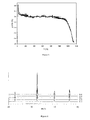
- Elle est ensuite broyée manuellement et tamisée (tamis de 20 µm) afin d'obtenir la poudre de La0,5Sr0,5Ti0,75Ni0,25O3. Le composé alors synthétisé est pur comme le montre le diagramme de diffraction des rayons X sur poudre de la
figure 2 . - Les précurseurs Ce2(CO3)3 (2,16671 g), Sr(CO3) (1,38984 g), TiO2 (1,12545 g) et NiO (0,35161 g) sont mélangés manuellement en proportions stoechiométriques dans un mortier en agate en présence d'acétone pour faciliter l'homogénéisation. Le mélange résultant est calciné à 1200°C pendant 12h sous flux d'argon (7 ml.h-1) selon le traitement thermique suivant :

- Puis, le composé formé est broyé et pressé sous forme d'une pastille au moyen d'un pressage uniaxial. Cette pastille subit alors un deuxième traitement thermique de 24h à 1350°C sous flux d'argon (7 ml.h-1).

- Elle est ensuite broyée manuellement et tamisée (tamis de 20 µm) afin d'obtenir la poudre de Ce0,5Sr0,5Ti0,75Ni0,25O3.
- Exemple 3 - Elaboration par sérigraphie d'une anode à base de La 0,5 Sr 0,5 Ti 0,75 -Ni 0,25 O 3 pour SOFC
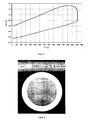
- 70 % massique de poudre sont mélangés avec 30 % massique d'un mélange terpinéol/éthyl cellulose (95/5 % massique). Cette préparation est homogénéisée manuellement puis au moyen d'un broyeur tricylindre (3 passages successifs permettent d'obtenir une encre homogène). L'encre est ensuite déposée par sérigraphie à la surface d'un électrolyte support de zircone stabilisée à l'yttrium (8 % mol). Le système formé est ensuite séché 15 min dans une étuve à 100°C. Afin de donner cohésion à l'interface électrode/électrolyte et tenue mécanique au dépôt un traitement thermique est nécessaire. Les condition de ce traitement ont été déterminées via une expérience de dilatométrie (
figure 3 ) réalisée sous air en géométrie verticale sur un barreau cylindrique de La0,5Sr0,5Ti0,75Ni0,25O3 de 10 mm de diamètre et de 8,86 mm d'épaisseur. Ainsi, 4h à 1200°C sont suffisantes :
- Un dépôt naturellement poreux de 40µm d'épaisseur environ est ainsi obtenu. Les demi-cellules formées ne présentent pas de diffusion chimique apparente (
figure 4 ). - A partir de la courbe de la
figure 3 , il a également été possible de déterminer au refroidissement un coefficient de dilatation thermique approché de 11.10-6 K-1. Cette valeur est typique d'un composé à structure pérovskite et présente l'avantage d'être très proche de celui de l'électrolyte YSZ 8 % (10.10-6 K-1) limitant ainsi les contraintes mécaniques à l'interface électrode/électrolyte. - Un recuit sous Ar/H2 (2 %) est nécessaire pour former le cermet Ni /[La1/3Sr2/3TiO3, La2O3]. Une analyse Thermogravimétrique (ATG) sous Ar/H2 (2 %) a été réalisée de 20°C à 1350°C (
figure 5 ). Sur la courbe de lafigure 5 une perte de masse est enregistrée à partir de 900°C environ et se poursuit jusqu'à 1350°C. Cette évolution est liée à la décomposition sous atmosphère réductrice du composé La0,5Sr0,5Ti0,75Ni0,25O3 en Ni, La1/3Sr2/3TiO3 et La2O3. Un traitement de réduction optimal de 1h à 1300°C ou 24h à 1200°C sous Ar/H2 (2%) est effectué sur le composé La0,5Sr0,5Ti0,75Ni0,25O3 - Les composés La2xSr1-2xTi1-xNixO3 (0,25 < x < 0,45) sont synthétisés par combustion de gel nitrate-citrate qui est une variante de la méthode Pechini (
US-3,330,697 ). La2O3 (fournisseur: Rhodia, 99,9%), SrCO3 (fournisseur: Alfa Aesar, 99,99%), (CH3CO2)2Ni (fournisseur: Alfa Aesar, >99%) et Ti{OCH(CH3)2}4 (fournisseur : Alfa Aesar, 99,995%) sont utilisés comme précurseurs métalliques. X est fixé par la quantité de chaque précurseur mis en oeuvre selon les connaissances de l'homme du métier. L'isopropoxyde de titane, Ti{OCH(CH3)2}4, est préalablement dilué dans un mélange éthylène glycol / acide citrique pour limiter les risques de précipitation lors des synthèses. La concentration en ions titane de cette solution est déterminée par analyse thermogravimétrique 10h à 1000°C. - Tout d'abord, l'acide citrique C6H8O7 est dissout dans un mélange eau distillée / acide nitrique HNO3 (65% m), puis les précurseurs métalliques sont ajoutés un à un en proportions stoechiométriques sous agitation et léger chauffage (40-50°C). Le volume du mélange est alors réduit par chauffage à 150°C jusqu'à ce qu'il commence à gélifier. Une solution d'ammoniaque (NH4OH à 28% vol.) est alors ajoutée à chaud pour neutraliser jusqu'à pH = 8. Le volume du mélange est de nouveau réduit jusqu'à gélification. Le gel est alors mis à sécher à l'étuve à 100°C. Lors du séchage, il gonfle et un xérogel est obtenu. Ce produit est d'aspect poreux et noir. Une pyrolyse de ce xérogel sous épiradiateur à rayonnement infra-rouge permet de poursuivre la réaction de combustion. Celle-ci se produit avec un grand dégagement de gaz (CO2 H2O,...) et donne une poudre très fine qui est broyée et calcinée à 600°C afin d'éliminer la majeure partie des composés organiques. La poudre ainsi obtenue est broyée manuellement de façon à l'homogénéiser puis calcinée selon le traitement thermique suivant :

- La pureté des composés est vérifiée par diffraction des rayons X sur poudre au moyen d'un diffractomètre Brüker D8 (cf.
figure 6 Diagramme RX des composés La2xSr1-2xTi1.xNixO3 (0,25<x<0,45) après calcination à 1350°C).
Claims (14)
- Composé de formule générale (I) M1 x1M2 x2(Ti(1-y-z)M3yM4 z)O(3-δ) (I) dans laquelle :- M1 représente un atome ou un mélange d'atomes choisis parmi les alcalino-terreux,- M2 représente un atome ou un mélange d'atomes choisis parmi les terres rares,- M3 représente un atome ou un mélange d'atomes choisis parmi les métaux de transition suivants : Ni, Co, Cu,- M4 représente un atome ou un mélange d'atomes choisis parmi les métaux de transition autres que Ni, Co, Cu ; les terres rares acceptant une coordinance 6 ; les métaux pauvres de degré d'oxydation (+III),- 0,9 ≤ x1 + x2≤ 1 ; 0 < x1< 1 ; 0 < x2 < 1- 0,25≤y<0,75,- 0≤z<1,- 0≤δ≤0,5.
- Composé de formule (I) selon la revendication 1, qui vérifie :- 0<x1≤,5 ; 0,4 ≤x2< 1
- Composé de formule générale (II) (M1 x1M2 x2)(m+1)(Ti(1-y-z)M3 yM4 z)mO3m+1-δ (II) dans laquelle :- M1 représente un atome ou un mélange d'atomes choisis parmi les alcalino-terreux,- M2 représente un atome ou un mélange d'atomes choisis parmi les terres rares,- M3 représente un atome ou un mélange d'atomes choisis parmi les métaux de transition suivants : Ni, Co, Cu,- M4 représente un atome ou un mélange d'atomes choisis parmi les métaux de transition autres que Ni, Co, Cu ; les terres rares acceptant une coordinance 6 ; les métaux pauvres de degré d'oxydation (+III),- 0,9≤x1+x2 ≤1 ; 0<x1<1;0<x2<1,- 0<y<1,- 0≤z<1,- 0≤δ≤0,5,- m est un entier supérieur ou égal à 1.
- Composé selon la revendication 3 qui vérifie : m=1 et 0,20≤x1≤0,80 ; 0,20≤x2≤ 0,80.
- Composé selon l'une quelconque des revendications 1 à 4, dans lequel une ou plusieurs des conditions suivantes est vérifiée :- M1 est choisi parmi : Ba, Sr, Ca ou un mélange de ces atomes,- M2 est choisi parmi : La, Ce, Pr, Nd, Y ou un mélange de ces atomes,- M3 représente Ni,- M4 représente un atome ou un mélange d'atomes choisis parmi :(i) les métaux de la première série de transition, de numéro atomique de 21 à 30, en dehors de Ni, Co, Cu et encore plus préférentiellement un atome ou un mélange d'atomes choisis parmi : Mn, Fe, V,(ii) les métaux pauvres suivants : Al, Ga, In,- 0,95 ≤x1+x2≤1.
- Procédé de fabrication des composés de formule (I) ou (II) selon l'une quelconque des revendications 1 à 5, caractérisé en ce que :- l'on utilise les oxydes et/ou les carbonates métalliques de Ti, M1 M2, M3 et M4 dans les proportions stoechiométriques appropriées,- les oxydes et/ou les carbonates métalliques sont soumis à un broyage en présence d'un solvant, et en présence d'air, pendant plusieurs heures,- le solvant est évaporé, la poudre est pastillée et calcinée, de préférence à une température supérieure à 1 000°C, pendant plusieurs heures sous air.
- Electrode d'un dispositif électrochimique, cette électrode comprenant un matériau choisi parmi ceux de formules (I) et (II) selon l'une quelconque des revendications 1 à 5.
- Electrode d'un dispositif électrochimique, cette électrode comprenant un matériau résultant de la réduction d'un matériau choisi parmi ceux de formules (I) et (II) selon l'une quelconque des revendications 1 à 5.
- Electrode selon la revendication 8, résultant de la réduction d'un matériau choisi parmi ceux de formules (I) et (II) par un procédé qui comprend les étapes suivantes : cuisson en conditions réductrices, sous H2 notamment, à une température comprise entre 800 et 1500°C et pour un temps variant de quelques minutes à plusieurs heures, et plus avantageusement comprise entre 1000 et 1300°C et pendant des durées comprises entre 1 et 24 h.
- Cellule électrochimique comprenant une anode, une cathode et un électrolyte dans laquelle l'anode et la cathode comportent un même matériau choisi parmi ceux de formule (I) et (II) selon l'une quelconque des revendications 1 à 5.
- Cellule électrochimique comprenant une anode, une cathode et un électrolyte dans laquelle l'une des électrodes est en un matériau choisi parmi ceux de formule (I) et (II) selon l'une quelconque des revendications 1 à 5 et l'autre électrode est en un matériau issu de la réduction du matériau de la première électrode.
- Cellule électrochimique selon l'une des revendications 10 et 11, cette cellule étant une pile combustible en oxyde solide, cette pile comprenant une cathode, une anode et un électrolyte, assemblés de façon laminaire, la cathode comprenant un composé de formule générale (I) ou de formule générale (II), et l'anode comprenant un matériau identique à celui de la cathode ou un matériau issu de la réduction du matériau de la cathode.
- Cellule électrochimique selon l'une des revendications 11 et 12, cette cellule étant un électrolyseur de la vapeur d'eau à haute température, comportant au moins une anode, en matériau de formule (I) ou de formule (II) selon l'une des revendications 1 à 5 et la cathode comprenant un matériau identique à celui de l'anode ou un matériau issu de la réduction du matériau de l'anode.
- Procédé de production d'une cellule électrochimique selon l'une des revendications 10 à 13, qui comprend une étape de trempage d'un électrolyte dans un produit de formule (I) ou (II) selon l'une quelconque des revendications 1 à 5, ce trempage permettant le dépôt du produit sur deux faces de l'électrolyte, puis un séchage et un traitement thermique de co-frittage.
Applications Claiming Priority (1)
| Application Number | Priority Date | Filing Date | Title |
|---|---|---|---|
| FR0802032A FR2930075B1 (fr) | 2008-04-14 | 2008-04-14 | Titanates de structure perovskite ou derivee et ses applications |
Publications (2)
| Publication Number | Publication Date |
|---|---|
| EP2110873A1 true EP2110873A1 (fr) | 2009-10-21 |
| EP2110873B1 EP2110873B1 (fr) | 2011-09-07 |
Family
ID=39731728
Family Applications (1)
| Application Number | Title | Priority Date | Filing Date |
|---|---|---|---|
| EP09290267A Not-in-force EP2110873B1 (fr) | 2008-04-14 | 2009-04-10 | Titanates de structure perovskite ou dérivée et leurs applications |
Country Status (6)
| Country | Link |
|---|---|
| US (1) | US8247113B2 (fr) |
| EP (1) | EP2110873B1 (fr) |
| JP (1) | JP5607893B2 (fr) |
| AT (1) | ATE523914T1 (fr) |
| ES (1) | ES2373269T3 (fr) |
| FR (1) | FR2930075B1 (fr) |
Cited By (4)
| Publication number | Priority date | Publication date | Assignee | Title |
|---|---|---|---|---|
| WO2010125254A3 (fr) * | 2009-04-27 | 2010-12-23 | Commissariat A L'energie Atomique Et Aux Energies Alternatives | Titanates de baryum doublement substitues au cérium et fer ou manganese de structure pérovskite |
| CN103022518A (zh) * | 2011-09-27 | 2013-04-03 | 三星电子株式会社 | 燃料电池用电极催化剂、其制法、膜电极组件和燃料电池 |
| EP2685537A1 (fr) * | 2012-07-12 | 2014-01-15 | Samsung Electronics Co., Ltd | Catalyseur d'électrode pour pile à combustible, son procédé de préparation et ensemble d'électrode de membrane et pile à combustible l'incluant |
| CN109594100A (zh) * | 2018-12-07 | 2019-04-09 | 东华大学 | 一种C3N4负载Cu/Sn合金材料及其制备和应用 |
Families Citing this family (9)
| Publication number | Priority date | Publication date | Assignee | Title |
|---|---|---|---|---|
| JP6043284B2 (ja) * | 2011-06-20 | 2016-12-14 | 株式会社三徳 | 固体電解質、固体電解質膜、燃料電池用セル及び燃料電池 |
| US20140272672A1 (en) * | 2013-03-15 | 2014-09-18 | Lg Fuel Cell Systems, Inc. | Composition for anode in fuel cell |
| GB201611953D0 (en) * | 2016-07-08 | 2016-08-24 | Univ Court Of The Univ Of St Andrews The | Method |
| CN106498435B (zh) * | 2016-11-24 | 2019-03-05 | 华中科技大学 | 一种固体氧化物电解池阴极材料及其制备方法 |
| GB2566104A (en) | 2017-09-05 | 2019-03-06 | Univ Court Univ St Andrews | Catalyst |
| US11557781B2 (en) | 2018-09-05 | 2023-01-17 | Battelle Energy Alliance, Llc | Electrochemical cells for hydrogen gas production and electricity generation, and related systems and methods |
| KR102220265B1 (ko) * | 2019-03-15 | 2021-02-25 | 한국세라믹기술원 | 니켈이 도핑된 페로브스카이트계 금속산화물의 조성제어 및 후처리를 통한 막반응기용 고온안정성 나노 니켈입자 촉매 제조방법 |
| CN113968596A (zh) * | 2021-10-11 | 2022-01-25 | 西安交通大学 | 一种铁基双钙钛矿型电极粉末材料及制备方法、基于其的燃料电池电极材料及制备方法 |
| JP2026512580A (ja) * | 2023-12-18 | 2026-04-17 | エルジー・ケム・リミテッド | メタン改質用触媒およびその製造方法 |
Citations (5)
| Publication number | Priority date | Publication date | Assignee | Title |
|---|---|---|---|---|
| US3330697A (en) | 1963-08-26 | 1967-07-11 | Sprague Electric Co | Method of preparing lead and alkaline earth titanates and niobates and coating method using the same to form a capacitor |
| WO2003094268A2 (fr) | 2002-05-03 | 2003-11-13 | Battelle Memorial Institute | Compositions de titanate de strontium dope au cerium modifie pour des anodes de piles a combustibles oxyde solides et des electrodes pour d'autres dispositifs electrochimiques |
| US20040265669A1 (en) * | 2003-06-27 | 2004-12-30 | Yeong Yoo | Y and Nb-doped SrTiO3 as a mixed conducting anode for solid oxide fuel cells |
| JP2005050760A (ja) * | 2003-07-31 | 2005-02-24 | Seimi Chem Co Ltd | 固体高分子電解質型燃料電池アノード電極触媒 |
| JP2007051033A (ja) * | 2005-08-18 | 2007-03-01 | Noritake Co Ltd | 多孔質セラミック支持体 |
Family Cites Families (17)
| Publication number | Priority date | Publication date | Assignee | Title |
|---|---|---|---|---|
| US4076611A (en) * | 1976-04-19 | 1978-02-28 | Olin Corporation | Electrode with lanthanum-containing perovskite surface |
| US4562124A (en) * | 1985-01-22 | 1985-12-31 | Westinghouse Electric Corp. | Air electrode material for high temperature electrochemical cells |
| JPH0292826A (ja) * | 1988-09-28 | 1990-04-03 | Kanegafuchi Chem Ind Co Ltd | 酸化物超電導体 |
| JPH0417259A (ja) * | 1990-05-10 | 1992-01-22 | Matsushita Electric Ind Co Ltd | 電池 |
| JPH0483535A (ja) * | 1990-07-26 | 1992-03-17 | Univ Beijing | ペロブスカイト型希土複合酸化物燃焼触媒 |
| TW269058B (fr) * | 1992-04-29 | 1996-01-21 | Westinghouse Electric Corp | |
| JP2001513188A (ja) * | 1995-09-25 | 2001-08-28 | ヘレウス エレクトロナイト インタナショナル エヌ.ヴィー. | 炭化水素センサ用電極材料 |
| US5977017A (en) * | 1996-04-10 | 1999-11-02 | Catalytic Solutions, Inc. | Perovskite-type metal oxide compounds |
| JP3241306B2 (ja) * | 1997-02-06 | 2001-12-25 | 三菱重工業株式会社 | インターコネクタ材料 |
| JP4393027B2 (ja) * | 2001-11-15 | 2010-01-06 | 日産自動車株式会社 | 固体酸化物燃料電池用複合酸化物およびその製造方法 |
| CA2776362A1 (fr) * | 2002-12-19 | 2004-06-19 | Valence Technology, Inc. | Batteries ayant des electrodes de phosphate de metal alcalin |
| US7943270B2 (en) * | 2003-06-10 | 2011-05-17 | Celltech Power Llc | Electrochemical device configurations |
| JP4503964B2 (ja) * | 2003-09-19 | 2010-07-14 | 株式会社東芝 | 非水電解質二次電池 |
| JP4257419B2 (ja) * | 2003-11-07 | 2009-04-22 | 独立行政法人産業技術総合研究所 | n型熱電変換特性を有する複合酸化物 |
| US7259126B2 (en) * | 2004-03-11 | 2007-08-21 | Ceramatec, Inc. | Gas diffusion electrode and catalyst for electrochemical oxygen reduction and method of dispersing the catalyst |
| JP4719940B2 (ja) * | 2004-12-27 | 2011-07-06 | Toto株式会社 | インターコネクタ材料及びこれを備えた固体酸化物形燃料電池 |
| DE102006030393A1 (de) * | 2006-07-01 | 2008-01-03 | Forschungszentrum Jülich GmbH | Keramische Werkstoffkombination für eine Anode für eine Hochtemperatur-Brennstoffzelle |
-
2008
- 2008-04-14 FR FR0802032A patent/FR2930075B1/fr not_active Expired - Fee Related
-
2009
- 2009-04-10 AT AT09290267T patent/ATE523914T1/de not_active IP Right Cessation
- 2009-04-10 ES ES09290267T patent/ES2373269T3/es active Active
- 2009-04-10 EP EP09290267A patent/EP2110873B1/fr not_active Not-in-force
- 2009-04-10 JP JP2009095964A patent/JP5607893B2/ja not_active Expired - Fee Related
- 2009-04-13 US US12/422,773 patent/US8247113B2/en not_active Expired - Fee Related
Patent Citations (5)
| Publication number | Priority date | Publication date | Assignee | Title |
|---|---|---|---|---|
| US3330697A (en) | 1963-08-26 | 1967-07-11 | Sprague Electric Co | Method of preparing lead and alkaline earth titanates and niobates and coating method using the same to form a capacitor |
| WO2003094268A2 (fr) | 2002-05-03 | 2003-11-13 | Battelle Memorial Institute | Compositions de titanate de strontium dope au cerium modifie pour des anodes de piles a combustibles oxyde solides et des electrodes pour d'autres dispositifs electrochimiques |
| US20040265669A1 (en) * | 2003-06-27 | 2004-12-30 | Yeong Yoo | Y and Nb-doped SrTiO3 as a mixed conducting anode for solid oxide fuel cells |
| JP2005050760A (ja) * | 2003-07-31 | 2005-02-24 | Seimi Chem Co Ltd | 固体高分子電解質型燃料電池アノード電極触媒 |
| JP2007051033A (ja) * | 2005-08-18 | 2007-03-01 | Noritake Co Ltd | 多孔質セラミック支持体 |
Non-Patent Citations (16)
| Title |
|---|
| D.M. BASTIDAS ET AL., JOURNAL OF MATERIAL CHEMISTRY, vol. 16, 2006, pages 1603 - 1605 |
| DATABASE INSPEC [online] April 2006 (2006-04-01), Q.X. FU ET AL.: "La0.4Sr0.6Ti1-xMnxO3-[delta] perovskites as anode materials for solid oxide fuel cells", XP002495934, Database accession no. 8841093 * |
| F. LICHTENBERG ET AL., PROGRESS IN SOLID STATE CHEMISTRY, vol. 29, 2001, pages 1 - 17 |
| F. LICHTENBERG ET AL., PROGRESS IN SOLID STATE CHEMISTRY, vol. 29, 2001, pages 1 - 18 |
| J. PENA-MARTINEZ ET AL., ELECTROCHIMICA ACTA, vol. 52, 2007, pages 2950 - 2958 |
| J.C. RUIZ-MORALEZ ET AL., ELECTROCHIMICA ACTA, vol. 52, 2006, pages 278 - 284 |
| JOURNAL OF THE ELECTROCHEMICAL SOCIETY, vol. 153, no. 4, 24 February 2006 (2006-02-24), pages D74 - D83, ISSN: 0013-4651 * |
| K. TAKEHIRA ET AL., CATALYSIS TODAY, vol. 24, 1995, pages 237 - 242 |
| K.S. ALEKSANDROV; V.V. BERZNOSIKOV: "Hierarchies of perovskite-like crystals (review)", PHYS. SOLID STATE, vol. 39, 1997, pages 695 - 714 |
| OLGA A. MARINA ET AL., SOLID STATE IONICS, vol. 149, 2002, pages 21 - 28 |
| P.R. SLATER ET AL.: "Synthesis and electrical characterisation of doped perovskite titanates as potential anode materials for solid oxide fuel cells", JOURNAL OF MATERIALS CHEMISTRY, vol. 7, no. 12, 1 December 1997 (1997-12-01), pages 2495 - 2498, XP000736616, ISSN: 0959-9428 * |
| Q.X. FU ET AL., JOURNAL OF THE ELECTROCHEMICAL SOCIETY, vol. 153, no. 4, 2006, pages D74 - D83 |
| R. SHIOZAKI ET AL., STUD. SURF. SCI. CATAL., vol. 110, 1997, pages 701 - 710 |
| T. HAYAKAWA ET AL., ANGEW. CHEM. INT. ED. ENGL., vol. 35, 1996, pages 192 - 195 |
| T. HAYAKAWA ET AL., CATAL. LETT., vol. 22, 1993, pages 307 - 317 |
| W. SUGIMOTO ET AL., SOLID STATE LONICS, vol. 108, 1998, pages 315 - 319 |
Cited By (6)
| Publication number | Priority date | Publication date | Assignee | Title |
|---|---|---|---|---|
| WO2010125254A3 (fr) * | 2009-04-27 | 2010-12-23 | Commissariat A L'energie Atomique Et Aux Energies Alternatives | Titanates de baryum doublement substitues au cérium et fer ou manganese de structure pérovskite |
| CN103022518A (zh) * | 2011-09-27 | 2013-04-03 | 三星电子株式会社 | 燃料电池用电极催化剂、其制法、膜电极组件和燃料电池 |
| CN103022518B (zh) * | 2011-09-27 | 2017-04-12 | 三星Sdi株式会社 | 燃料电池用电极催化剂、其制法、膜电极组件和燃料电池 |
| EP2685537A1 (fr) * | 2012-07-12 | 2014-01-15 | Samsung Electronics Co., Ltd | Catalyseur d'électrode pour pile à combustible, son procédé de préparation et ensemble d'électrode de membrane et pile à combustible l'incluant |
| US9147886B2 (en) | 2012-07-12 | 2015-09-29 | Samsung Electronics Co., Ltd. | Electrode catalyst for fuel cell, method of preparing the same, membrane electrode assembly, and fuel cell including the same |
| CN109594100A (zh) * | 2018-12-07 | 2019-04-09 | 东华大学 | 一种C3N4负载Cu/Sn合金材料及其制备和应用 |
Also Published As
| Publication number | Publication date |
|---|---|
| JP5607893B2 (ja) | 2014-10-15 |
| ES2373269T3 (es) | 2012-02-01 |
| US20100015489A1 (en) | 2010-01-21 |
| ATE523914T1 (de) | 2011-09-15 |
| FR2930075B1 (fr) | 2011-03-18 |
| JP2009263225A (ja) | 2009-11-12 |
| FR2930075A1 (fr) | 2009-10-16 |
| EP2110873B1 (fr) | 2011-09-07 |
| US8247113B2 (en) | 2012-08-21 |
Similar Documents
| Publication | Publication Date | Title |
|---|---|---|
| EP2110873B1 (fr) | Titanates de structure perovskite ou dérivée et leurs applications | |
| Faro et al. | Solid oxide fuel cells fed with dry ethanol: The effect of a perovskite protective anodic layer containing dispersed Ni-alloy@ FeOx core-shell nanoparticles | |
| Lopez-Vergara et al. | Effect of Preparation Conditions on the Polymorphism and Transport Properties of La6–x MoO12− δ (0≤ x≤ 0.8) | |
| US8409543B2 (en) | Method for preparing pyrochlore-type oxide and method for producing electrocatalyst for fuel cell | |
| WO2004038844A1 (fr) | Pile a combustible a oxyde solide et a anode a base de ceramique | |
| Xiong et al. | Surface regulating and hetero-interface engineering of an LSCF cathode by CVD for solid oxide fuel cells: integration of improved electrochemical performance and Cr-tolerance | |
| Jang et al. | La0. 6Sr0. 4Co0. 2Fe0. 8O3-δ cathode surface-treated with La2NiO4+ δ by aerosol-assisted chemical vapor deposition for high performance solid oxide fuel cells | |
| EP2538474A2 (fr) | Matériau pour pile à combustible à oxyde solide, cathode contenant le matériau et pile à combustible à oxyde solide comprenant le matériau | |
| KR102137987B1 (ko) | 함침법을 이용한 페로브스카이트 결정 구조 물질로 구성된 전극 소재의 제조 방법 및 이를 이용하여 제조한 전극 소재를 포함하는 금속공기전지, 고체 산화물 연료전지, 및 고체 산화물 수전해 셀 | |
| EP2097940B1 (fr) | Electrode a gaz, son procede de fabrication et ses applications | |
| CA2675988C (fr) | Materiau composite adapte a une utilisation en tant que materiau d'electrode dans une pile a oxyde solide | |
| Ghosh et al. | La0. 54Sr0. 4Fe0. 2Co0. 8O3− δ@ Co0. 01Ce0. 79Gd0. 2O2− δ functional cathode material for solid oxide fuel cell application | |
| EP2374177B1 (fr) | Procédé de fabrication d'une électrode cermet au nickel | |
| Aghdam et al. | Highly-pure single-phase La0. 65Ca0. 35FeO3 cathode material obtainment through an innovative low-temperature co-precipitation approach | |
| Feng et al. | Activating the cathode for solid oxide fuel cells by selective removal of surface strontium | |
| JP2023123410A (ja) | 導電性で防食性のマグネシウムチタン酸化物材料 | |
| KR102267721B1 (ko) | 고체 산화물 연료전지용 연료극 제조방법 | |
| KR102736911B1 (ko) | 이산화탄소 분해용 고체산화물 전해전지의 캐소드 조성물, 이산화탄소 분해용 고체산화물 전해전지 및 캐소드 조성물의 제조 방법 | |
| Sezer et al. | Influence of spin-coating speed on the morphology, surface chemistry and electrochemical performance stability of liquid precursor derived La0. 6Ca0. 4CoO3 electrode films | |
| WO2013050919A1 (fr) | Titanates conducteurs mixtes pour systeme electrochimique haute temperature | |
| KR102781808B1 (ko) | 고체 산화물 연료전지 전극용 나노입자 및 이를 포함하는 고체 산화물 연료전지용 전극 | |
| US20250305165A1 (en) | Oxygen electrode for solid oxide electrolysis cell and method of manufacturing the same | |
| Chávez-Guerrero et al. | Synthesis and characterization of Co-doped Lanthanum Nickelate perovskites for solid oxide fuel cell cathode material | |
| Han et al. | Electrochemical performance of Ruddlesden-popper structured cathode material La2NiO4+ δ composited with Ce0. 85Sm0. 15O2-δ electrolyte for solid oxide fuel cells | |
| WO2010125254A2 (fr) | Titanates de baryum doublement substitues au cérium et fer ou manganese de structure pérovskite |
Legal Events
| Date | Code | Title | Description |
|---|---|---|---|
| PUAI | Public reference made under article 153(3) epc to a published international application that has entered the european phase |
Free format text: ORIGINAL CODE: 0009012 |
|
| AK | Designated contracting states |
Kind code of ref document: A1 Designated state(s): AT BE BG CH CY CZ DE DK EE ES FI FR GB GR HR HU IE IS IT LI LT LU LV MC MK MT NL NO PL PT RO SE SI SK TR |
|
| RAP1 | Party data changed (applicant data changed or rights of an application transferred) |
Owner name: COMMISSARIAT A L'ENERGIE ATOMIQUE ET AUX ENERGIES |
|
| 17P | Request for examination filed |
Effective date: 20100330 |
|
| 17Q | First examination report despatched |
Effective date: 20100422 |
|
| R17C | First examination report despatched (corrected) |
Effective date: 20100429 |
|
| REG | Reference to a national code |
Ref country code: DE Ref legal event code: R079 Ref document number: 602009002553 Country of ref document: DE Free format text: PREVIOUS MAIN CLASS: H01M0004900000 Ipc: H01M0008120000 |
|
| GRAP | Despatch of communication of intention to grant a patent |
Free format text: ORIGINAL CODE: EPIDOSNIGR1 |
|
| RIC1 | Information provided on ipc code assigned before grant |
Ipc: C01G 51/00 20060101ALI20110225BHEP Ipc: H01M 4/90 20060101ALN20110225BHEP Ipc: H01M 8/12 20060101AFI20110225BHEP Ipc: C01G 23/00 20060101ALI20110225BHEP Ipc: C01G 53/00 20060101ALI20110225BHEP |
|
| GRAS | Grant fee paid |
Free format text: ORIGINAL CODE: EPIDOSNIGR3 |
|
| GRAA | (expected) grant |
Free format text: ORIGINAL CODE: 0009210 |
|
| REG | Reference to a national code |
Ref country code: GB Ref legal event code: FG4D Free format text: NOT ENGLISH |
|
| REG | Reference to a national code |
Ref country code: CH Ref legal event code: EP |
|
| REG | Reference to a national code |
Ref country code: IE Ref legal event code: FG4D Free format text: LANGUAGE OF EP DOCUMENT: FRENCH |
|
| REG | Reference to a national code |
Ref country code: DE Ref legal event code: R096 Ref document number: 602009002553 Country of ref document: DE Effective date: 20111103 |
|
| REG | Reference to a national code |
Ref country code: NL Ref legal event code: VDEP Effective date: 20110907 |
|
| PG25 | Lapsed in a contracting state [announced via postgrant information from national office to epo] |
Ref country code: HR Free format text: LAPSE BECAUSE OF FAILURE TO SUBMIT A TRANSLATION OF THE DESCRIPTION OR TO PAY THE FEE WITHIN THE PRESCRIBED TIME-LIMIT Effective date: 20110907 Ref country code: FI Free format text: LAPSE BECAUSE OF FAILURE TO SUBMIT A TRANSLATION OF THE DESCRIPTION OR TO PAY THE FEE WITHIN THE PRESCRIBED TIME-LIMIT Effective date: 20110907 Ref country code: SE Free format text: LAPSE BECAUSE OF FAILURE TO SUBMIT A TRANSLATION OF THE DESCRIPTION OR TO PAY THE FEE WITHIN THE PRESCRIBED TIME-LIMIT Effective date: 20110907 Ref country code: LT Free format text: LAPSE BECAUSE OF FAILURE TO SUBMIT A TRANSLATION OF THE DESCRIPTION OR TO PAY THE FEE WITHIN THE PRESCRIBED TIME-LIMIT Effective date: 20110907 Ref country code: NO Free format text: LAPSE BECAUSE OF FAILURE TO SUBMIT A TRANSLATION OF THE DESCRIPTION OR TO PAY THE FEE WITHIN THE PRESCRIBED TIME-LIMIT Effective date: 20111207 |
|
| REG | Reference to a national code |
Ref country code: ES Ref legal event code: FG2A Ref document number: 2373269 Country of ref document: ES Kind code of ref document: T3 Effective date: 20120201 |
|
| LTIE | Lt: invalidation of european patent or patent extension |
Effective date: 20110907 |
|
| PG25 | Lapsed in a contracting state [announced via postgrant information from national office to epo] |
Ref country code: CY Free format text: LAPSE BECAUSE OF FAILURE TO SUBMIT A TRANSLATION OF THE DESCRIPTION OR TO PAY THE FEE WITHIN THE PRESCRIBED TIME-LIMIT Effective date: 20110907 Ref country code: LV Free format text: LAPSE BECAUSE OF FAILURE TO SUBMIT A TRANSLATION OF THE DESCRIPTION OR TO PAY THE FEE WITHIN THE PRESCRIBED TIME-LIMIT Effective date: 20110907 Ref country code: AT Free format text: LAPSE BECAUSE OF FAILURE TO SUBMIT A TRANSLATION OF THE DESCRIPTION OR TO PAY THE FEE WITHIN THE PRESCRIBED TIME-LIMIT Effective date: 20110907 Ref country code: SI Free format text: LAPSE BECAUSE OF FAILURE TO SUBMIT A TRANSLATION OF THE DESCRIPTION OR TO PAY THE FEE WITHIN THE PRESCRIBED TIME-LIMIT Effective date: 20110907 Ref country code: GR Free format text: LAPSE BECAUSE OF FAILURE TO SUBMIT A TRANSLATION OF THE DESCRIPTION OR TO PAY THE FEE WITHIN THE PRESCRIBED TIME-LIMIT Effective date: 20111208 |
|
| REG | Reference to a national code |
Ref country code: AT Ref legal event code: MK05 Ref document number: 523914 Country of ref document: AT Kind code of ref document: T Effective date: 20110907 |
|
| REG | Reference to a national code |
Ref country code: IE Ref legal event code: FD4D |
|
| PG25 | Lapsed in a contracting state [announced via postgrant information from national office to epo] |
Ref country code: SK Free format text: LAPSE BECAUSE OF FAILURE TO SUBMIT A TRANSLATION OF THE DESCRIPTION OR TO PAY THE FEE WITHIN THE PRESCRIBED TIME-LIMIT Effective date: 20110907 Ref country code: CZ Free format text: LAPSE BECAUSE OF FAILURE TO SUBMIT A TRANSLATION OF THE DESCRIPTION OR TO PAY THE FEE WITHIN THE PRESCRIBED TIME-LIMIT Effective date: 20110907 Ref country code: IS Free format text: LAPSE BECAUSE OF FAILURE TO SUBMIT A TRANSLATION OF THE DESCRIPTION OR TO PAY THE FEE WITHIN THE PRESCRIBED TIME-LIMIT Effective date: 20120107 Ref country code: IE Free format text: LAPSE BECAUSE OF FAILURE TO SUBMIT A TRANSLATION OF THE DESCRIPTION OR TO PAY THE FEE WITHIN THE PRESCRIBED TIME-LIMIT Effective date: 20110907 |
|
| PG25 | Lapsed in a contracting state [announced via postgrant information from national office to epo] |
Ref country code: PT Free format text: LAPSE BECAUSE OF FAILURE TO SUBMIT A TRANSLATION OF THE DESCRIPTION OR TO PAY THE FEE WITHIN THE PRESCRIBED TIME-LIMIT Effective date: 20120109 Ref country code: RO Free format text: LAPSE BECAUSE OF FAILURE TO SUBMIT A TRANSLATION OF THE DESCRIPTION OR TO PAY THE FEE WITHIN THE PRESCRIBED TIME-LIMIT Effective date: 20110907 Ref country code: EE Free format text: LAPSE BECAUSE OF FAILURE TO SUBMIT A TRANSLATION OF THE DESCRIPTION OR TO PAY THE FEE WITHIN THE PRESCRIBED TIME-LIMIT Effective date: 20110907 Ref country code: PL Free format text: LAPSE BECAUSE OF FAILURE TO SUBMIT A TRANSLATION OF THE DESCRIPTION OR TO PAY THE FEE WITHIN THE PRESCRIBED TIME-LIMIT Effective date: 20110907 Ref country code: NL Free format text: LAPSE BECAUSE OF FAILURE TO SUBMIT A TRANSLATION OF THE DESCRIPTION OR TO PAY THE FEE WITHIN THE PRESCRIBED TIME-LIMIT Effective date: 20110907 |
|
| PLBE | No opposition filed within time limit |
Free format text: ORIGINAL CODE: 0009261 |
|
| STAA | Information on the status of an ep patent application or granted ep patent |
Free format text: STATUS: NO OPPOSITION FILED WITHIN TIME LIMIT |
|
| PG25 | Lapsed in a contracting state [announced via postgrant information from national office to epo] |
Ref country code: DK Free format text: LAPSE BECAUSE OF FAILURE TO SUBMIT A TRANSLATION OF THE DESCRIPTION OR TO PAY THE FEE WITHIN THE PRESCRIBED TIME-LIMIT Effective date: 20110907 |
|
| 26N | No opposition filed |
Effective date: 20120611 |
|
| REG | Reference to a national code |
Ref country code: DE Ref legal event code: R097 Ref document number: 602009002553 Country of ref document: DE Effective date: 20120611 |
|
| BERE | Be: lapsed |
Owner name: COMMISSARIAT A L'ENERGIE ATOMIQUE ET AUX ENERGIES Effective date: 20120430 |
|
| PG25 | Lapsed in a contracting state [announced via postgrant information from national office to epo] |
Ref country code: MC Free format text: LAPSE BECAUSE OF NON-PAYMENT OF DUE FEES Effective date: 20120430 |
|
| PG25 | Lapsed in a contracting state [announced via postgrant information from national office to epo] |
Ref country code: BE Free format text: LAPSE BECAUSE OF NON-PAYMENT OF DUE FEES Effective date: 20120430 |
|
| PG25 | Lapsed in a contracting state [announced via postgrant information from national office to epo] |
Ref country code: MK Free format text: LAPSE BECAUSE OF FAILURE TO SUBMIT A TRANSLATION OF THE DESCRIPTION OR TO PAY THE FEE WITHIN THE PRESCRIBED TIME-LIMIT Effective date: 20110907 |
|
| PG25 | Lapsed in a contracting state [announced via postgrant information from national office to epo] |
Ref country code: BG Free format text: LAPSE BECAUSE OF FAILURE TO SUBMIT A TRANSLATION OF THE DESCRIPTION OR TO PAY THE FEE WITHIN THE PRESCRIBED TIME-LIMIT Effective date: 20111207 |
|
| PG25 | Lapsed in a contracting state [announced via postgrant information from national office to epo] |
Ref country code: MT Free format text: LAPSE BECAUSE OF FAILURE TO SUBMIT A TRANSLATION OF THE DESCRIPTION OR TO PAY THE FEE WITHIN THE PRESCRIBED TIME-LIMIT Effective date: 20110907 |
|
| REG | Reference to a national code |
Ref country code: CH Ref legal event code: PL |
|
| PG25 | Lapsed in a contracting state [announced via postgrant information from national office to epo] |
Ref country code: CH Free format text: LAPSE BECAUSE OF NON-PAYMENT OF DUE FEES Effective date: 20130430 Ref country code: LI Free format text: LAPSE BECAUSE OF NON-PAYMENT OF DUE FEES Effective date: 20130430 |
|
| PG25 | Lapsed in a contracting state [announced via postgrant information from national office to epo] |
Ref country code: TR Free format text: LAPSE BECAUSE OF FAILURE TO SUBMIT A TRANSLATION OF THE DESCRIPTION OR TO PAY THE FEE WITHIN THE PRESCRIBED TIME-LIMIT Effective date: 20110907 |
|
| PG25 | Lapsed in a contracting state [announced via postgrant information from national office to epo] |
Ref country code: LU Free format text: LAPSE BECAUSE OF NON-PAYMENT OF DUE FEES Effective date: 20120410 |
|
| PG25 | Lapsed in a contracting state [announced via postgrant information from national office to epo] |
Ref country code: HU Free format text: LAPSE BECAUSE OF FAILURE TO SUBMIT A TRANSLATION OF THE DESCRIPTION OR TO PAY THE FEE WITHIN THE PRESCRIBED TIME-LIMIT Effective date: 20090410 |
|
| REG | Reference to a national code |
Ref country code: FR Ref legal event code: PLFP Year of fee payment: 7 |
|
| PGFP | Annual fee paid to national office [announced via postgrant information from national office to epo] |
Ref country code: ES Payment date: 20150423 Year of fee payment: 7 Ref country code: GB Payment date: 20150414 Year of fee payment: 7 Ref country code: DE Payment date: 20150409 Year of fee payment: 7 |
|
| PGFP | Annual fee paid to national office [announced via postgrant information from national office to epo] |
Ref country code: FR Payment date: 20150430 Year of fee payment: 7 Ref country code: IT Payment date: 20150424 Year of fee payment: 7 |
|
| REG | Reference to a national code |
Ref country code: DE Ref legal event code: R119 Ref document number: 602009002553 Country of ref document: DE |
|
| GBPC | Gb: european patent ceased through non-payment of renewal fee |
Effective date: 20160410 |
|
| REG | Reference to a national code |
Ref country code: FR Ref legal event code: ST Effective date: 20161230 |
|
| PG25 | Lapsed in a contracting state [announced via postgrant information from national office to epo] |
Ref country code: FR Free format text: LAPSE BECAUSE OF NON-PAYMENT OF DUE FEES Effective date: 20160502 Ref country code: DE Free format text: LAPSE BECAUSE OF NON-PAYMENT OF DUE FEES Effective date: 20161101 Ref country code: GB Free format text: LAPSE BECAUSE OF NON-PAYMENT OF DUE FEES Effective date: 20160410 |
|
| PG25 | Lapsed in a contracting state [announced via postgrant information from national office to epo] |
Ref country code: IT Free format text: LAPSE BECAUSE OF NON-PAYMENT OF DUE FEES Effective date: 20160410 |
|
| PG25 | Lapsed in a contracting state [announced via postgrant information from national office to epo] |
Ref country code: ES Free format text: LAPSE BECAUSE OF NON-PAYMENT OF DUE FEES Effective date: 20160411 |
|
| REG | Reference to a national code |
Ref country code: ES Ref legal event code: FD2A Effective date: 20180622 |